Total war, double vision and surgical strikes

Paul K. Saint-AmourOver the years I’ve learned much from the writings of Paul K. Saint-Amour, whose work on the violent intersections between modernism and air power has helped me think through my own project on bombing (‘Killing Space’) and, in a minor key, my analysis of cartography, aerial reconnaissance and ‘corpography’ on the Western Front in the First World War.  A minimalist listing would include:

Like me, Paul also has an essay in Pete Adey‘s co-edited collection, From above: war, violence and verticality (Hurst, 2013): ‘Photomosaics: mapping the Front, mapping the city’.

He has just published an important essay, ‘On the partiality of total war‘, in Critical inquiry 40 (2) (2014) 420-449, which has prompted this post.  What I so admire about Paul’s writing is his combination of literary style – these essays are a joy to read, even when they address the bleakest of subjects – critical imagination and analytical acumen, and the latest essay is no exception.

His central point is that the idea of ‘total war’ – which, as he insists, was essentially an inter-war constellation – was deeply partial.  It both naturalized and undermined a series of European imperialist distinctions between centre and periphery, peace and war:

‘… forms of violence forbidden in the metropole during peacetime were practiced in the colony, mandate, and protectorate, [and] … the distinction between peace and war was a luxury of the center. At the same time, by predicting that civilians in the metropole would have no immunity in future wars, it contributed to the erosion of the very imperial geography (center versus periphery) that it seemed to shore up.’

Hence the partiality of what he calls ‘the fractured problem-space of the concept’: ‘A truly total conception of war would have insisted openly on the legal, ethical, political, and technological connections between European conflagration and colonial air control’ (my emphasis).
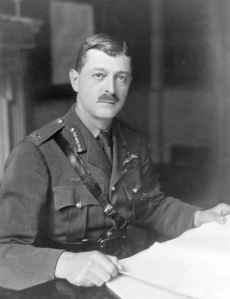
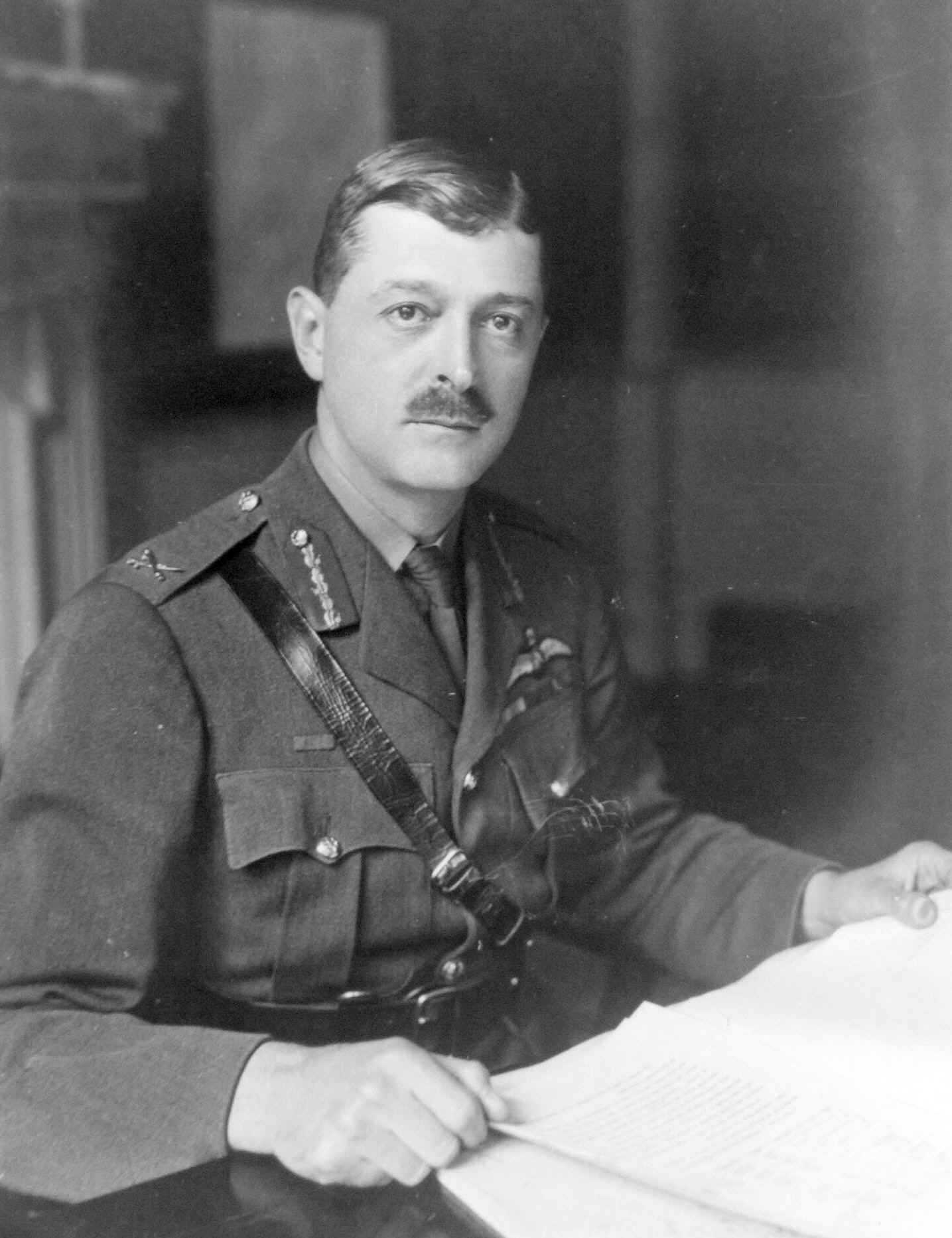
CharltonPaul advances these claims, and enters into this fraught ‘problem-space’, by tracking the figure of a Royal Air Force officer, L.E.O. Charlton (left).  A veteran of the First World War, Charlton was appalled by his experience of colonial ‘air control’ in Iraq in the 1920s (‘direct action by aeroplanes on indirect information by unreliable informants … was a species of oppression’: sounds familiar) but became a strenuous advocate of bombing civilians as the ‘new factor in warfare’ in the future. Convinced that Britain was exceptionally vulnerable to air attack, the only possible defence was extraordinary air superiority capable of landing devastating ‘hammer blows’.

Now others have traced the lines of descent from Britain’s ‘air policing’ in Palestine, Iraq and the North-West Frontier in the 1920s and 30s to its bomber offensive against Germany in the 1940s – ‘Bomber’ Harris notoriously cut his teeth in both Iraq and Palestine, though one historian treats this as precision dentistry – and still others have joined the dots from yesterday’s imperial borderlands to today’s: I’m thinking of  Mark Neocleous‘s (re)vision of police power (‘Air power as police power‘, Environment and Planning D: Society & Space 31 (4) (2013) 578-93 and Priya Satia‘s genealogy of ‘Drones: a history from the Middle East‘, Humanity 5 (1) (2014) 1-31.

But Paul complicates these genealogies in important ways by showing how, within British military circles, war from the air was at once prosecuted and displaced/deferred.  He argues that major air power theorists of the day reserved the category of ‘war’ for conflicts between sovereign states and relegated state violence ‘against colonial, mandate and protectorate populations’ to minor categories: ‘police actions, low-intensity conflicts, constabulary missions, pacification, colonial policing’.  Indeed, at the Geneva Disarmament Conference in 1923 the British delegation sought to abolish all air forces except those deployed ‘for police purposes in certain outlying regions’.  The manoeuvre failed, yet it wasn’t until 1977 that the first Additional Protocol to the Geneva Convention of 1949 recognised the right of subject populations to resist colonial domination, military occupation and racial repression, nominated such acts as constituting an ‘international conflict’, and extended to them the protections of international law.  Several states have refused to ratify the AP, including the United States, Israel, Iran, India and Pakistan.  Charlton’s original objection was to the use of air power outside declared war zones and against civilian subject populations: an objection that many would argue continues to have contemporary resonance in the CIA-directed drone strikes in Pakistan, Yemen, Somalia and elsewhere.

But Charlton’s masters (and, ultimately, Charlton himself) ‘dissevered’ the meaning of ongoing state violence in the periphery from prospective state violence at the centre.  ‘Home is the space of the total war to come‘ – the Royal Air Force evidently believed that lessons learned in the colonies could be repatriated to the metropolis – and this would necessarily involve the breaching of state borders.  War from the air thus dissolved the distinctions between military and civilian spaces, as Giulio Douhet prophesied in the 1920s:

‘By virtue of this new weapon, the repercussions of war are no longer limited by the farthest artillery range of guns, but can be felt directly for hundreds and hundreds of miles… The battlefield will be limited only by the boundaries of the nations at war, and all of their citizens will become combatants, since all of them will be exposed to the aerial offensives of the enemy. There will be no distinction any longer between soldiers and civilians.’

Few military experts in Britain talked about Douhet before the 1930s, but Charlton had read him in French translation, referring to him in his Cambridge lectures published as War from the air: past, present, future (1935): John Peaty calls him ‘Douhet’s leading disciple in Britain.’  But in Charlton’s view war from the air also redrew the contours of military violence so that they no longer lined fronts but bounded areas.  In principle this transformation of the target space provided for two different strategies, though in practice the differences between them were as much ideological as they were substantive.  Air strikes could take the form of either area bombing, levelling whole districts of cities, or so-called ‘precision bombing’ that would dislocate strategic nodes within a networked space, and it was this that Charlton believed was the key to aerial supremacy:

‘[T]he nation conceived by air-power theorists was a discrete entity unified both by the interlocking systems, structures, and forces that would constitute its war effort and by their collective targetability in the age of the bomber. As the proxy space for total war doctrine, in other words, air-power theory provided limitless occasions for representing the national totality. The common figures of “nerve centres,” “heart,” and “nerve ganglia” all participated in the emergent trope of an integrated national body whose geographical borders, war effort, and vulnerability were all coterminous.’
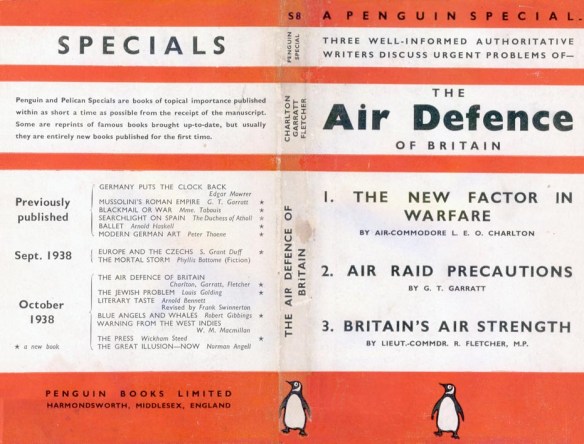
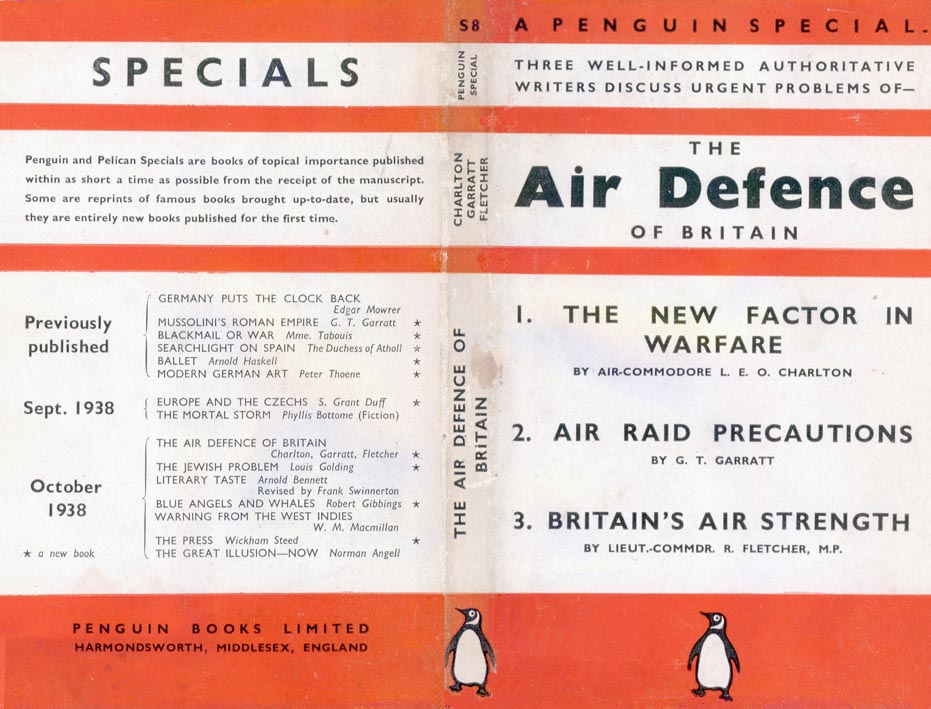
Penguin-S8 Air Defence of Britain

In War from the air, Charlton had advocated a devastating attack on the enemy capital:

‘It is the brain, and therefore the vital point. Injury to the brain means instant death, or paralysis, whereas injury to the body or the members, especially if it be a flesh-wound, may mean nothing at all, or, at most, a grave inconvenience.’

And in his contribution to The air defence of Britain, published in 1938, Charlton used the figure of the ‘national body’ to underscore what he saw as Britain’s vulnerability to air attack: ‘We are laid out, as if on an operating table, for the surgical methods of the bomber.’  As it turned out, of course, air strikes were even less ‘surgical’ than today’s aerialists try to claim, but as I showed in ‘Doors into nowhere’ (DOWNLOADS tab), these bio-physiological tropes were refined by Solly Zuckerman when he sought to provide a scientific  basis for the combined bomber offensive during the Second World War.
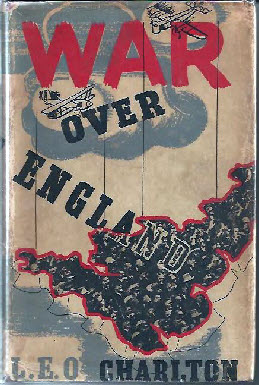
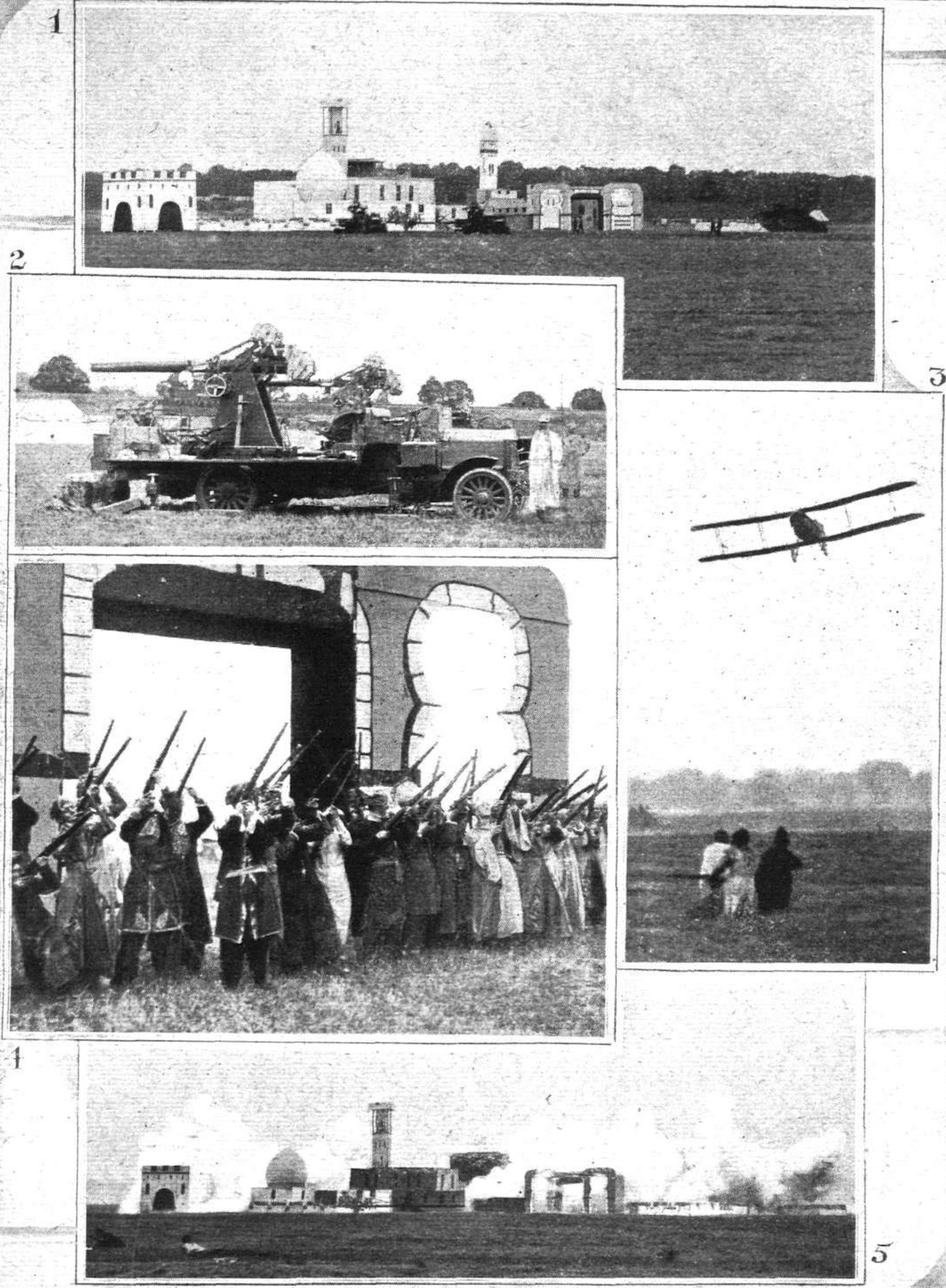
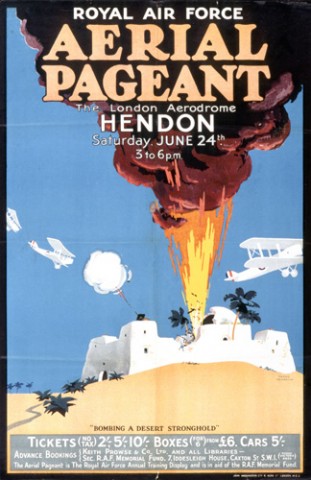
wp0a26afc9_1b-1But precisely because the enabling experiments for these operations were carried out in a colonial laboratory, ‘outside the boundaries of the national body’, this couldn’t qualify as war – so this was ‘interwar’ in quite another sense too – and, Charlton notwithstanding, the ‘bombing demonstrations’ that took place in Iraq and elsewhere were not subject to much critical scrutiny or public outcry in Britain.  On the contrary, within the metropole they were turned into popular entertainment at successive air displays at Hendon in North London in the 1920s (see below) (though, prophetically, by the 1930s, the pageant staged bombing runs against ‘the enemy’, and in War over England (1936) Charlton envisaged Britain forced to surrender after a devastating German air attack on, of all things, the Hendon Air Show) .
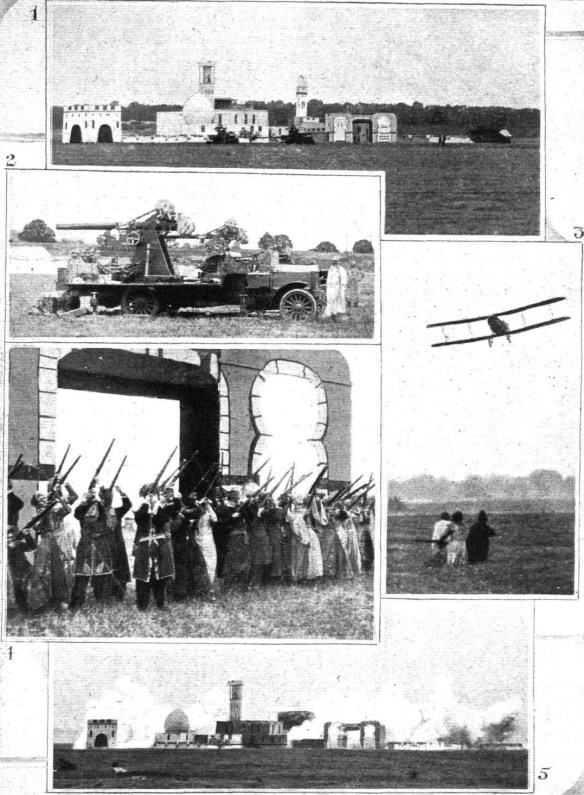
_hendon-pageant-1922

flight19220629p371

I think this argument could profitably be extended, because the desert ‘proving grounds’ had a cultural-strategic significance that, as both Priya Satia and Patrick Deer have shown, can be unravelled through another figure who also enters this problem-space, albeit in disguise, T.E. Lawrence or ‘Aircraftsman Ross’ (I’ve suggested some of these filiations in ‘DisOrdering the Orient’)….

I hope I’ve said enough to whet your appetite.  This is a rich argument about war’s geographies, at once imaginative and material, and my bare-bones’ summary really doesn’t do it justice.  An introductory footnote reveals that the essay, and presumably Paul’s previous ones, will appear in a book in progress (and prospect), Archive, Bomb, Civilian: Total War in the Shadows of Modernism, forthcoming from Oxford University Press.
Not cricket

DB-OHWHATALOVELYWAR-casualties

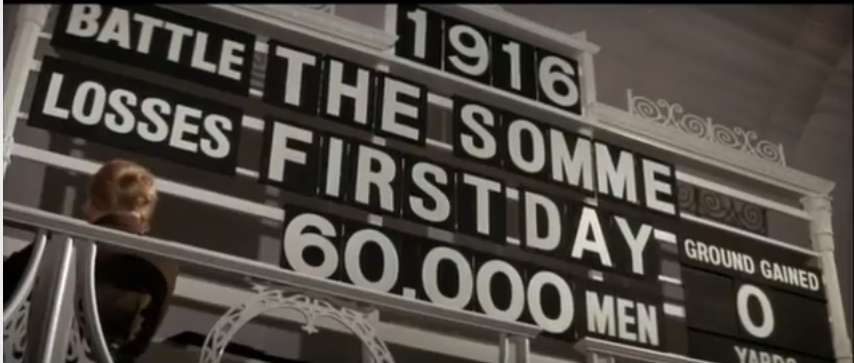
As the centenary of the outbreak of the First World War approaches, the guns have already been firing in Britain.  Michael Gove, the Secretary of State for Education, has sharply criticised those historians, artists, actors and commentators – in fact, pretty much everyone – who thinks the First World War (for Gove, it surely is ‘the Great War’) as a ‘catastrophe’.

The dangerous (‘unpatriotic’) left-wing spectacles he has in his crooked sights include Joan Littlewood‘s Theatre Workshop production/Richard Attenborough‘s film, Oh! what a lovely war! and the final series of Blackadder (on which see David Mitchell‘s wonderful commentary here, and the response to Gove from Tony Robinson – who played Baldrick – here).  Now, presumably, the villains also include the avowedly conservative historian Niall Ferguson, who recently described Britain’s decision to go to war as ‘the biggest error in modern history’.  I particularly enjoyed historian Richard Evans‘s dismissal of Gove as ‘a donkey who pretends to be a lion‘ (perhaps that should read ‘alien’?).

I rehearse all this because, as a welcome antidote to Gove’s shrill jingoism, europeana has just (re)launched europeana 1914-1918 (‘untold stories and official histories’), which brings together digital materials including letters, diaries, reports, photographs and film from libraries and archives around the world.  It really is a stunning resource: Mr Gove could profitably learn from both its mission and its content.

europeana 1914-1918

I notice, though, that the only ‘fronts’ singled out for systematic attention are the Western Front, the Eastern Front, the Italian Front and the Home Front.  Perhaps this is to be expected from ‘Europeana’, but I hope that other theatres of war (not least the Middle East and Africa) will be added…

When soldiers fall

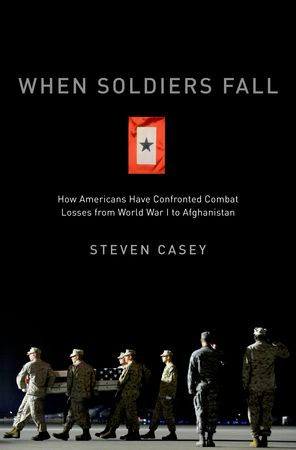
CASEY When soldiers fallNews of an important new book that feeds directly into my new project on medical-military machines and casualties of war, 1914-2014: Steven Casey‘s When Soldiers Fall: How Americans Have Confronted Combat Losses from World War I to Afghanistan (OUP, January 2014).  My own project is concerned with the precarious journeys of those wounded in war-zones (combatants and civilians) rather than those killed and the politics of ‘body-counts’, but Casey’s work presents a vigorous challenge to the usual assumptions about public responses to combat deaths:

The extent to which combat casualties influence the public’s support for war is one of the most frequently and fiercely debated subjects in current American life and has cast an enormous shadow over both the Iraq and Afghanistan conflicts. The common assumption, based largely on U.S. experience in past wars, is that the public is in some way casualty averse or casualty shy, and that as losses increase its support for a war will inexorably decline. Yet this assumption has been adopted as conventional wisdom without any awareness of one of the most important dimensions of the issue: how has the public become aware of the casualties sustained during particular wars? To what extent has the government tried to manipulate or massage the figures? When and why have these official figures been challenged by opportunistic political opponents or aggressive scoop-seeking reporters?

As Steven Casey demonstrates, at key moments in most wars what the public actually receives is not straightforward and accurate casualty totals, but an enormous amount of noise based on a mixture of suppression, suspicion, and speculation. This book aims to correct this gap in information by showing precise what casualty figures the government announced during its various wars, the timing of these announcements, and any spin officials may have placed upon these, using a range of hitherto untapped primary documents. Among the nuggets he has uncovered is that during World War I the media depended on Axis figures and that the Army and Navy did not announce casualty figures for an entire year during World War II. Organized chronologically, the book addresses the two world wars, the limited wars in Korea and Vietnam, and the recent conflicts that are part of the War on Terror. Using sources such as the private military command papers of Generals Patton, MacArthur, and Westmoreland, and previously unopened New York Times archives, it offers the first analysis of how the U.S. government has publicized combat casualties during these wars, and how these official announcements have been debated and disputed by other voices in the polity. Casey discusses factors such as changes of presidential administration, the improvement of technology, the sending of war correspondents to cover multiple conflicts, and the increasing ability to identify bodies. Casey recreates the complicated controversies that have surrounded key battles, and in doing so challenges the simplicity of the oft-repeated conventional wisdom that “as casualties mount, support decreases.” By integrating military and political history, he presents a totally new interpretation of U.S. domestic propaganda since 1917, filling a major gap left by a spate of recent books. Finally, it provides a fresh and engaging new perspective on some of the biggest battles in recent American history, including the Meuse-Argonne, D-Day, the Battle of the Bulge, China’s intervention in the Korean War, the Tet Offensive, and the recent campaigns in Iraq and Afghanistan.

Amazon has temporarily withdrawn its Kindle edition because there are technical issues that it is working with OUP to resolve: I hope this is sorted out soon…  But for now you can read an extract over at Salon, ‘How Richard Nixon reinvented American warfare (…and paved the way for Iraq and Afghanistan)’:

Determined to prop up South Vietnam in an election year, Nixon’s casualty sensitivity had not extended beyond American lives to enemy noncombatants. “Now, we won’t deliberately aim for civilians,” he told his senior advisers at one point in 1972, “but if a few bombs slop over, that’s just too bad.” In Nixon cold calculation the American electorate was principally concerned with U.S. losses; it cared far less about what happened to civilians….

In the wake of defeat, the U.S. government tried to learn the appropriate lessons. As well as reconsidering military-media relations, officials thought long and hard about the conditions under which the public would support the use of force—and the prospect of casualties—in the future. Sometimes, they looked back beyond Vietnam to an earlier era when the media had appeared more manageable and the public less skeptical. Of course, even during the two world wars and Korea, the government had always faced searching questions about the veracity of its casualty information. But Vietnam had clearly changed the rules of the game. Trust in government was much lower. The media was even keener to probe for the story behind the official narrative. And the whole debate was now even more sensitive to the human cost of war. These were all legacies that the two Bushes would have to grapple with in the post–Cold War era, as they took the United States into war against a new set of enemies.

Military logistics

Wartime logistics in Afghanistan

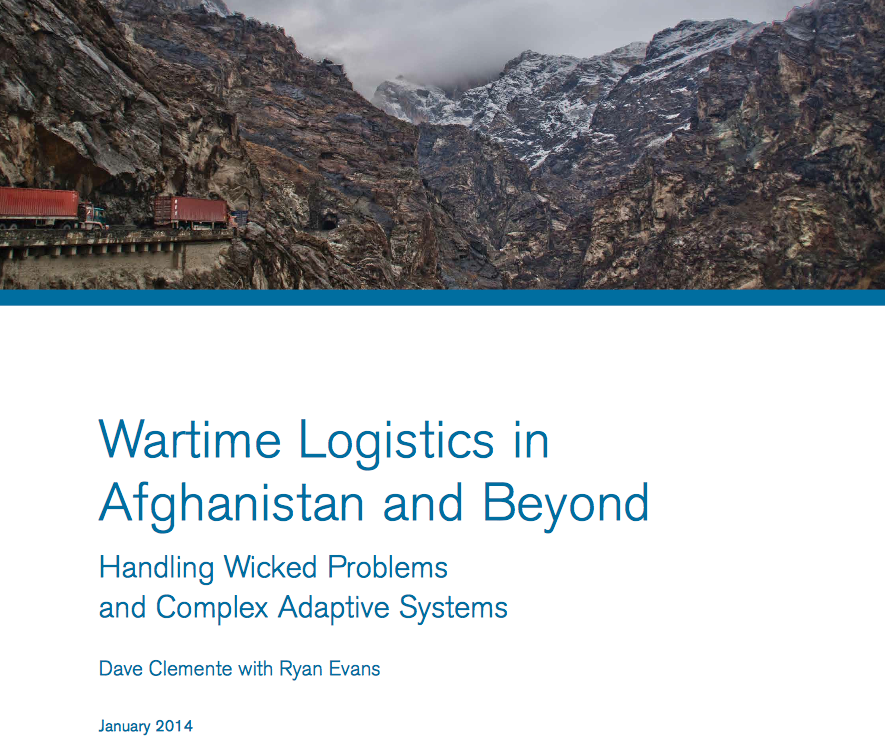
Following up my posts on military logistics in Afghanistan (see here, here and here), Dave Clement and Ryan Evans have produced a new report for Chatham House, ‘Wartime Logistics in Afghanistan and Beyond: Handling Wicked Problems and Complex Adaptive Systems‘.  Part of the discussion inevitably concerns the familiar problems faced by US forces – during both the occupation and the ‘draw-down’ – but the main focus is on the British military:

Over the past decade, thousands of military vehicles and tens of thousands of tonnes of supplies and equipment have been moved into Afghanistan in support of NATO operations. In the near future, this matériel will have to be disposed of or moved out of the country. For the UK military this will be the biggest logistics operation since the Second World War. The process of moving supplies into, around and out of Afghanistan is a resource-intensive operation that has already resulted in numerous instances of local and regional corruption, which have often been accepted as a cost of doing business. 

This report looks at how these and other problems arise and how the United Kingdom’s military supply chain can adapt to deal with them. It makes recommendations for utilizing supply chain resources to serve strategic and operational goals during the build-up and drawdown of forces. It analyses how broader opportunities can, over time, be extracted from managing the military supply chain and its component parts. These include improving local transport infrastructure, supporting reconstruction and development efforts, and delivering influence at local levels. These opportunities could be realized through a variety of means, including increased employment of local workers, targeted resource distribution, and intelligent contracting coupled with robust financial oversight.

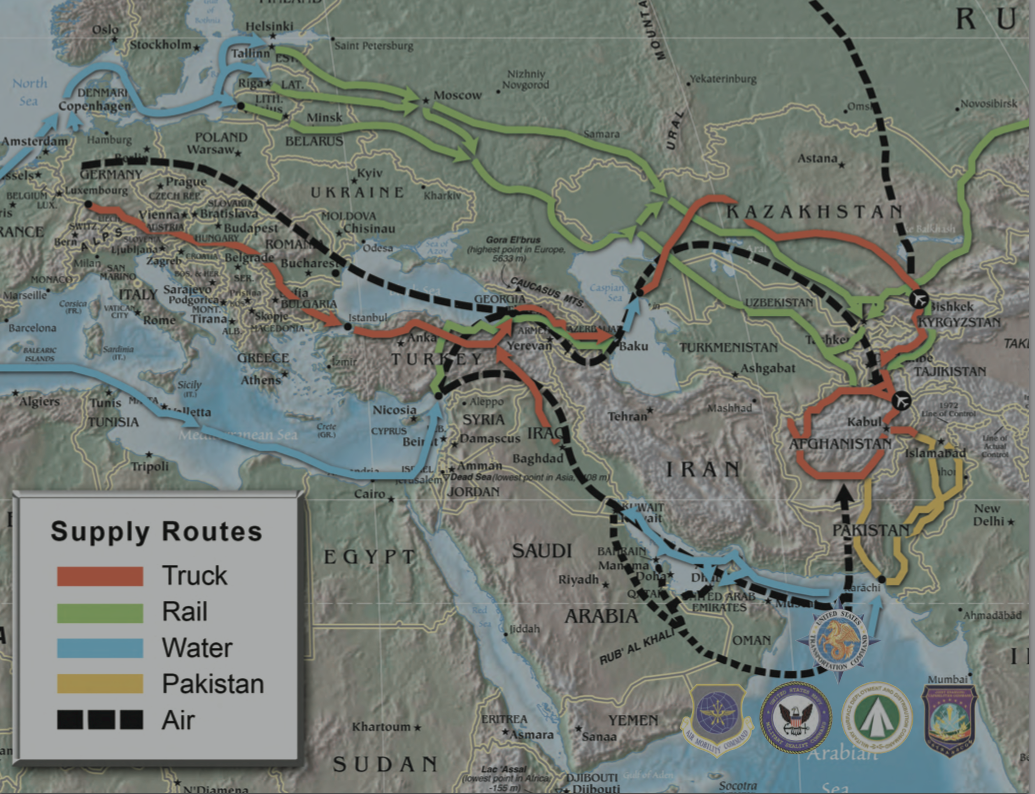
Military supply routes, Afghanistan

You can’t read military strategists these days without falling over ‘wicked problems’, but for me the originality of the report lies in its UK focus: a useful complement to the US discussions.  (The map, incidentally,comes from US Transportation Command’s Annual Report for 2011; the 2012 report is here).

You can read a summary, and access the full Chatham House report, here.

Disposable life

Histories of violence banner

Histories of Violence launches its tremendously important (and equally ambitious) Disposable Life project, which Brad Evans explains like this:

“Mass violence is poorly understood if it simply refers to casualties on battlefields or continues to be framed through conventional notions of warfare. We need to interrogate the multiple ways in which entire populations are rendered disposable on a daily basis if we are to take seriously the meaning of global citizenship in the 21st Century”. (Brad Evans, Project Director)

 Throughout the Twentieth Century, violence was ceaselessly waged against targeted populations deemed to be “disposable”. The years 2014-2016 will be a poignant moment to reflect upon the historical significance and contemporary meaning of these mass atrocities. The period begins with the 20th anniversary of the Zapatista uprising which provided a contemporary frame on the history of indigenous and racial persecution. April 2014 will mark the 20th anniversary of the Rwandan genocide which exposed to a watching global community the horrifying legacy of colonialism, along with its lasting and unresolved implications. June 2014 bears witness to the 100th anniversary of the outbreak of World War I which remains one of the bloodiest conflicts in human history. Onto January 2015, we confront the historical memory of the violence of Auschwitz which taught us the shame of being human. The year also witnesses the 70th anniversaries of the bombings of Hiroshima & Nagasaki that still serve as a horrifying reminder of the devastating potential of weapons of mass destruction and the capacity to reason widespread destruction; the 100th anniversary of the Armenian “genocide” which remains a source of contention and passionate debate in terms of its definition and political vocabulary; the 65th anniversary of the start of the Korea War that continues to have profound impact upon global ideas of security and peaceful co-habitation; the 60th anniversary of the official start of Vietnam War (from United States perspective) whose targeted violence against local populations and biospheres in particular fundamentally challenged claims of Western superiority and enlightenment; along with the 40th anniversary of the beginning of the “killing fields” in Cambodia which remains one of the most violent experimental episodes in the history of human existence.

There is no doubt a need to collectively memorialise these traumatic events and remember the devastating loss of life. Any attempt to create more just futures must have an appreciation of these histories of violence. There is also a need however to move beyond the historicity of memorialisation to critically question their contemporary significance in terms of providing a more honest and somber reflection of the present conjuncture. This requires us to move beyond the dominant Western tropes for conceptualising such violence as either exceptional in history or the result of a failure of liberal modernity. Disposability may take many different forms. It cannot be reduced to simplistic explanations. Nor can it be properly understood without engaging its underlying causes that may be of a political, economic, cultural, social, psychological and identity based nature. Only then might we start to rethink the terms of global citizenship in the 21st Century. With this in mind, the initiative is compelled to ask: Are there, for instance, aspects of contemporary global society that make it possible to think and act in ways that render specific populations disposable? How might we commemorate these tragic events in ways that will cultivate a deeper understanding of the conditions that give rise to extreme violence? Is it correct to argue that we now live in a post-colonial and post-racial moment? Or are there continued remnants from the brutality of colonialism that shapes relations amongst people today? What challenges does the notion of disposability pose for the integrity of social research? How should we engage the broader public in critical education and discussion around the various forms that violence has taken in the past and continues to take in the present? And how might we forge a truly trans-disciplinary pedagogy that connects the arts, humanities and social sciences such that we may engage more critically with the meaning of violence and the disposability of populations in the 21st Century?

This is excellent stuff, and from my point of view a critical question concerns the ways in which notions of ‘disposability’ circulate between (or perhaps more accurately among) the ‘battlefields and warfare’ with which the paragraph begins and the other spaces and spheres of social life to which it opens out.  I think this requires histories of violence, to be sure, but also geographies of violence – in short, historical geographies of violence.

The Project is launched with a short video from Cynthia Enloe, who ‘provides her original interpretation of the paradigm by exploring the meaning of disposability in the terms of the ways life continually appears arbitrary and nameless. For Enloe, not only does the problem of disposability point to contemporary forms of banality as earlier critiqued by Hannah Arendt, it allows us to rethink what it means to be humane in the 21st Century.’

For a partial list of future contributors, book projects and recommended readings, see here.  And keep watching that space!

Virtual Field Visits

Al-HaqAl-Haq, an independent NGO based in Ramallah and the West Bank affiliate of the International Commission of Jurists, has provided a remarkable portfolio of Virtual Field Visits to occupied Palestine.  They explain the project like this:

The overall purpose of the project is to improve Al Haq’s ability to communicate the geographic context, location and extent of the human rights violations that take place in the occupied Palestinian territory.

In order to do this we have developed a mapping and presentational tool that incorporates our own visual documentation with Google’s satellite imagery and utilises Google Earth’s 3D interface to present a clear and accurate picture of the situation on the ground.

You can read more about the project here. I’ve embedded the latest Virtual Field Visit below, which Al-Haq explains like this:

The “E1” Virtual Field Visit is the latest in a series of virtual field visits produced by Al-Haq. Designed to bring the field to people who are unable to visit the Occupied Palestinian Territory (OPT), the virtual field visits use maps to illustrate the obstacles and human rights abuses faced by Palestinians on a daily basis.

On 29 November 2012 the United Nations (UN) voted to upgrade the status of Palestine to non-member observer State. Shortly afterwards, Israel, who had vociferously objected to the upgrade, announced the construction of an additional 3,000 units for settlers in the West Bank. This included construction in what is known as the “E1” area, which refers to a twelve square kilometre plot of land located in the West Bank, to the east of the Jerusalem municipal boundary and bordering the Ma’ale Adumim settlement. The close proximity of the E1 area to Ma’ale Adumim settlement allows for significant expansion of what is already the third most popular settlement in the OPT. 

The E1 area stretches across 22,000 dunums of confiscated Palestinian land and also provides a vital passage joining the northern and southern sections of the West Bank, as well as Jerusalem. The closure of this passage would effectively cut the West Bank into two. Construction in the E1 area, combined with restrictions imposed by the Annexation Wall and the Oslo Accords, creates a clear obstacle to a self-sufficient economically viable Palestinian State.

http://vimeo.com/85139128

You can find the rest, including one on the Wall, together with maps and other multimedia materials, here.  If you have problems, all the videos are also available on YouTube and Vimeo.

Drones and asymmetric war

Thanks to the Aviationist for the link.

(in)Humanity and drones

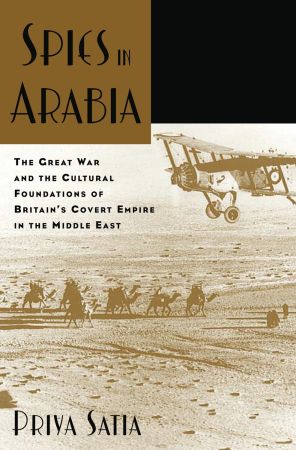
SATIA Spies in ArabiaThe latest issue of Humanity: an international journal of human rights, humanitarianism and development 5 (1) (2014) – see my previous post here – contains a wonderful dossier on Drones between past and present.  It includes Priya Satia, whose work I’ve admired ever since I read her wonderful Spies in Arabia: The Great War and the Cultural Foundations of Britain’s Covert Empire in the Middle East, on ‘Drones: a history from the Middle East’ (pp. 1-31), Anna Chotzen on ‘Beyond bounds: Morocco’s Rif War and the limits of international law’ (pp. 33-54: ‘From a legal standpoint, the United States’ drone offensives are eerily similar to Spain’s chemical war in Morocco a century ago’), and a Photo Esssay from Trevor Paglen (pp. 57-71), introduced by Nicholas Guilhot (pp. 55-56).

Priya’s essay is of particular interest to me, since it recovers the genealogy and, crucially, what she calls ‘the cultural history of bombardment’ that connects colonial practices of ‘air control’ to the ideologies that activate the drone strikes prosecuted by the US in Afghanistan, Pakistan and elsewhere.  She’s more sanguine about the transparency of those carried out by the USAF in Afghanistan than I am:

‘… in my conversations with military officers, it is clear how strongly the USAF wishes to distinguish its use of drones from ‘‘other agencies’ ’’ use of them, even while acknowledging that tactics are shared. The USAF’s drone strikes in Afghanistan are transparent; a JAG (judge advocate) assesses the proportionality of the action and the likelihood of collateral damage; official casualty figures line up well with independent counts.’

I now suspect it’s more than ‘tactics’ that are shared, and the lines between the USAF and the CIA are more blurred than – I agree – most military officers would wish.  And my project on ‘Militarized vision‘ is trying to identify the parameters within which the USAF’s transparency and its visual mediations operate.  But as she goes on to say, ‘However, all of this hardly matters politically, given the older and more recent history of aerial counterinsurgency in these regions.’  And she provides a rich and compelling account of that history and its traces in present memories and (para)military practices.

PAGLEN Untitled (Predator drone) 2013

Cloud computing

Just caught up with this: a fine essay over at the Deterritorial Investigations Unit – ‘Instead of building a genealogy of neoliberalism, we must build a cartography of the system’ – called  “The sage speaks of what he sees”: War Games and the New Spirit of Capitalism.

It’s a provocative Deleuzian take on the intersections between systems technology, military violence and the production of code/space, that starts with World War II and tracks on into the present (so in fact it combines genealogy and geography).

Developments in aviation technology, such as the capability for flying at higher altitudes and more complex bomb and weapon systems, led to profound problems in fire-control: in high-speed warfare, it was necessary for gunners to be able to respond immediately to actions in the combat environment and to hit their targets with a greater degree of accuracy. In order to deal with this new machinic vision of warfare (which extends beyond the fire-control issue itself, as larger programs like the Manhattan Project indicate), militaries were quickly investing millions of dollars into scientific research in an effort to find mastery over combat theaters. Through science, the command structures of the military were seeking an orderly control over the environment. 

SAGE

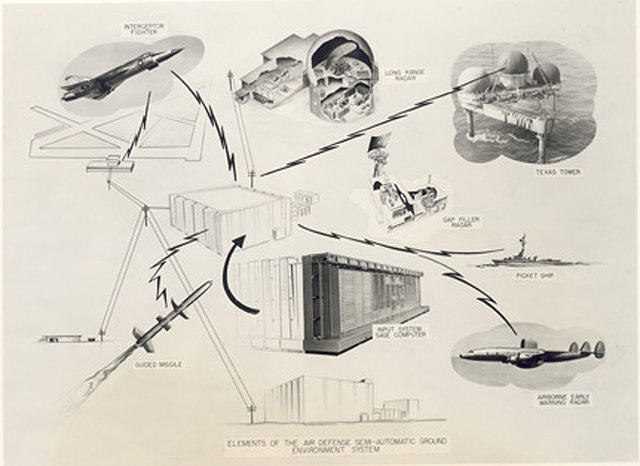
A central part in the narrative is played by the Semi-Automated [sometimes ‘Automatic’] Ground Environment (SAGE – hence in part the title) and its successor projects, including civilian derivatives like SABRE that revolutionised air travel ticketing (and Travelocity).  On that tangled web, see Jordan Crandall on ‘tracking’ here (also here) and here.

As George Valley and Jay Forrester (later of Urban dynamics fame) conceived of SAGE in 1953, the system would consist of

(1) a net of radars and other data sources and (2) digital computers that (a) receive the radar and other information to detect and tract aircraft, (b) process the track data to form a complete air situation, and (c) guide weapons to destroy enemy aircraft.

SAGE_diagram_of_systems

The system was developed at MIT’s Lincoln Laboratory (at a greater cost than the Manhattan Project, incidentally), and this is how the Lab summarises SAGE:

 A large network of radars would automatically detect a hostile bomber formation as it approached the U.S. mainland from any direction. The radar detections would be transmitted over telephone lines to the nearest SAGE direction center, where they would be processed by an AN/FSQ-7 computer. The direction center would then send out notification and continuous targeting information to the air bases best situated to carry out interception of the approaching bombers, as well as to a set of surface-to-air missile batteries. The direction center would also send data to and receive data from adjoining centers, and send situational awareness information to the command centers.  As the fighters from the air bases scrambled and became airborne, the direction center would continue to process track data from multiple radars and would transmit updated target positions in order to vector the intercepting aircraft to their targets. After the fighter aircraft intercepted the approaching bombers, they would send raid assessment information back to the direction center to determine whether additional aircraft or missile intercepts were necessary.

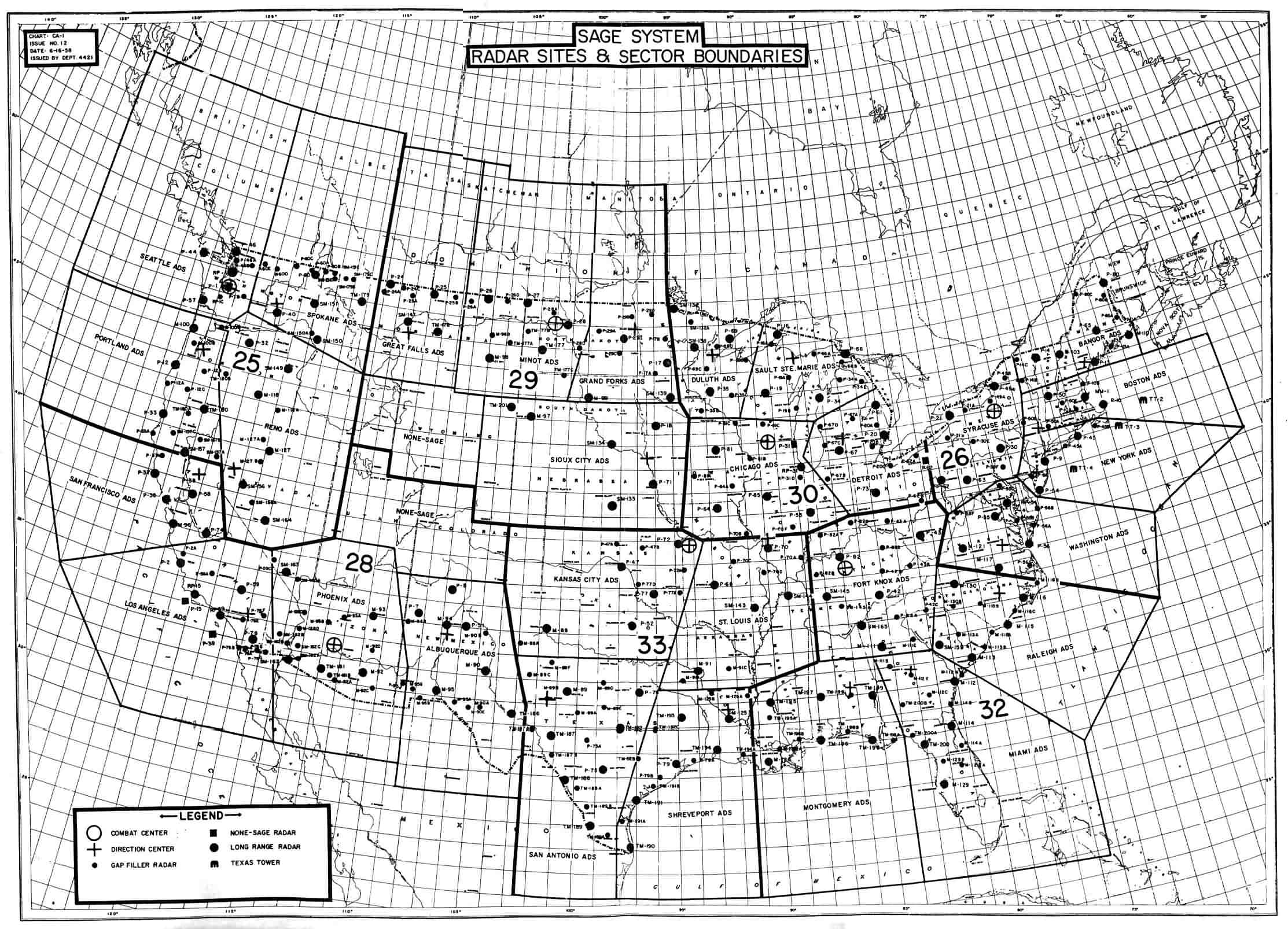
The network as envisaged in 1958 is shown below (more details here):

SAGE network plan 1958

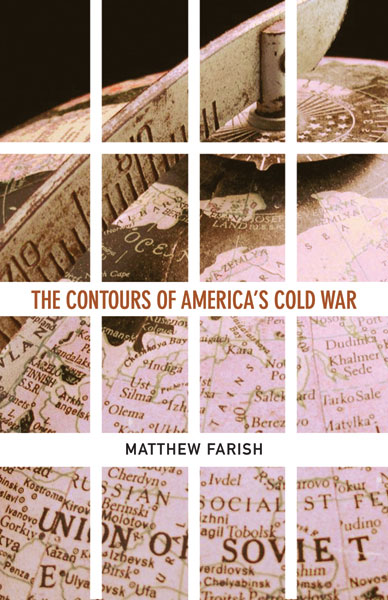
FARISH Contours of America's Cold WarThis plainly reaches back to the air defence systems set up by Britain and Germany during the Second World War, but more significantly for my purposes it intersects with the sensor-shooter system that was at the deadly centre of the ‘electronic battlefield’ during the Vietnam war and with a stream of subsequent tactical (rather than purely strategic) developments.  If you want to know more about SAGE and its spiralling military trajectory, I recommend Matt Farish‘s brilliant chapter in The contours of America’s Cold War (Minnesota, 2010), ‘The cybernetic continent: North America as defense laboratory’.

More recently still, there’s Jeremy Packer and Joshua Reeves, ‘Romancing the drone: military desire and anthropophobia from SAGE to swarm’, Canadian Journal of Communication 38 (2013) 309-31.  And, as their title suggests, all of this feeds into my continuing interest in the networks that make today’s drone wars possible, to which I’ll return shortly.