The facts on the ground

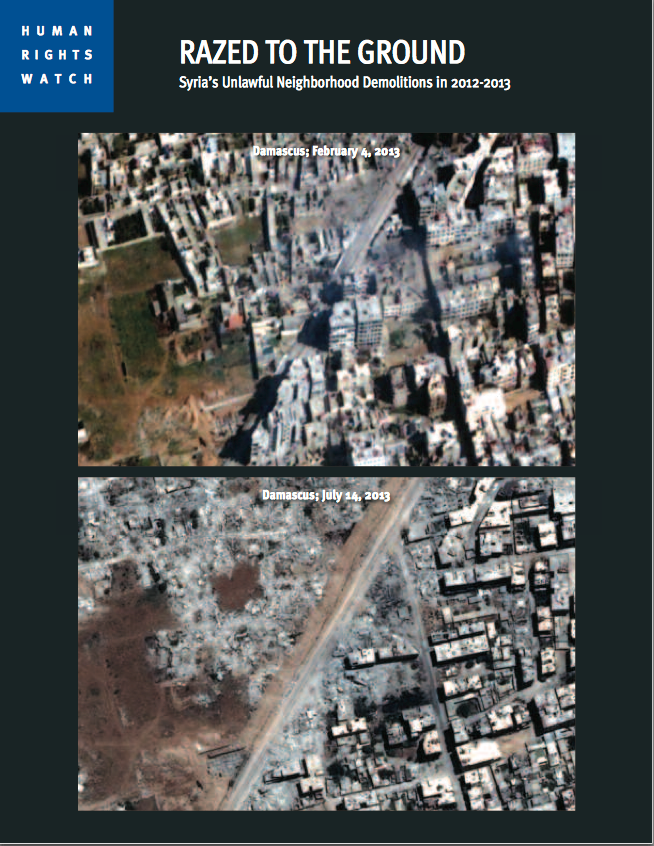
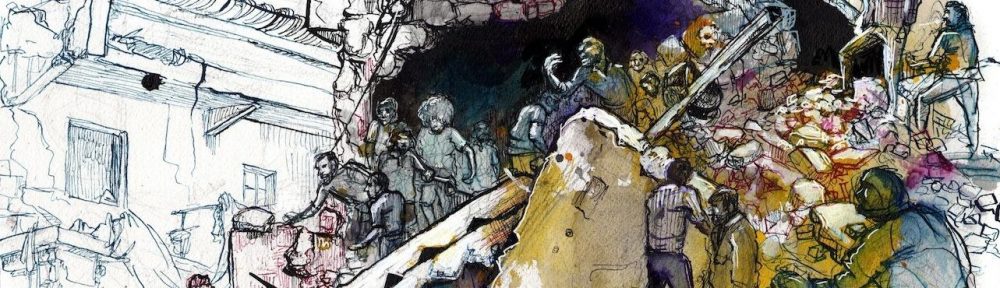
Razed to the groundHuman Rights Watch has released a bleak report, Razed to the Ground: Syria’s unlawful neighborhood demolitions, 2012-2013.

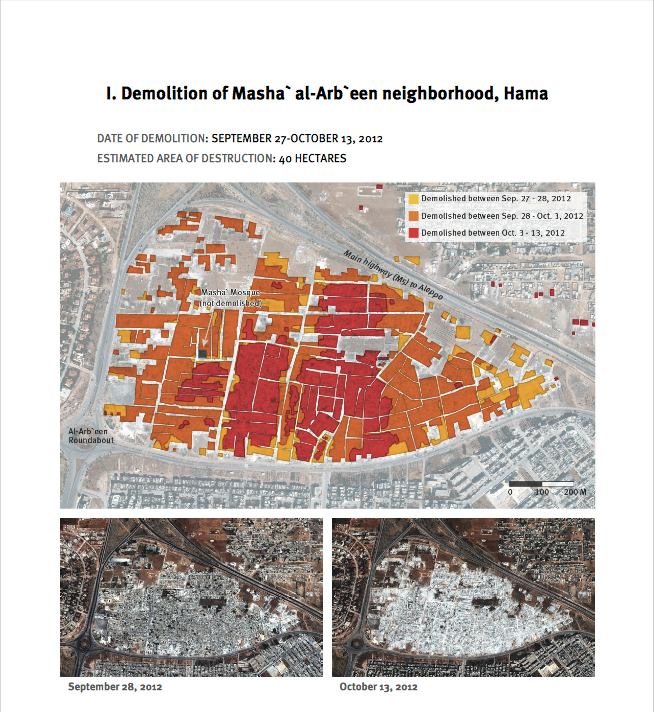
Satellite imagery, witness statements, and video and photographic evidence show that Syrian authorities deliberately and unlawfully demolished thousands of residential buildings in Damascus and Hama in 2012 and 2013, Human Rights Watch said in a report released today.

The 38-page report, “Razed to the Ground: Syria’s Unlawful Neighborhood Demolitions in 2012-2013,” documents seven cases of large-scale demolitions with explosives and bulldozers that violated the laws of war. The demolitions either served no necessary military purpose and appeared to intentionally punish the civilian population or caused disproportionate harm to civilians, Human Rights Watch found.

“Wiping entire neighborhoods off the map is not a legitimate tactic of war,” said Ole Solvang, emergencies researcher at Human Rights Watch. “These unlawful demolitions are the latest additions to a long list of crimes committed by the Syrian government.”

Demolitions, Hama

More images and commentary here, but this is almost certainly only a fragmentary map of a still wider geography of urbicide.  According to Martin Chulov, reporting from Beirut,

Nadim Houry, deputy director of Human Rights Watch for the Middle East and North Africa, said: “These are the areas that we were told about by witnesses. There are likely to be other areas, but there are many black holes in Syria where we don’t have information. This is likely part of a systematic policy in rebel held areas elsewhere in the country as well.

“It shows yet again that this is not a one-off act by a commander. This is part of a strategy targeting all opposition-held areas. It is a mirror image of the starvation of people in Yarmouk [refugee camp in Damascus] or in Old Homs. It shows yet again how ready the government is to collectively harm areas of people that are supporting the opposition.”

The circumstances and context are different, but Assad is clearly borrowing yet another tactic from Israel’s playbook.  The ongoing demolition of homes in occupied Palestine is a slower process, but just as brutal and just as illegal: see the work of the Israeli Committee against House Demolitions here (though I wish it were called the Committee against Home Demolitions to capture more fully what is being so deliberately and callously destroyed).  Here is Human Rights Watch last summer:

Israeli forces should immediately end unlawful demolitions of Palestinian homes and other structures in Occupied Palestinian Territory. The demolitions have displaced at least 79 Palestinians since August 19, 2013. Demolitions of homes and other structures that compel Palestinians to leave their communities may amount to the forcible transfer of residents of an occupied territory, which is a war crime.

Human Rights Watch documented demolitions on August 19 in East Jerusalem that displaced 39 people, including 18 children. Israeli human rights groups and the United Nations Office for the Coordination of Humanitarian Affairs (OCHA) documented additional demolitions in East Jerusalem and the West Bank on August 20 and 21 that destroyed the homes of 40 people, including 20 children.

“When Israeli forces routinely and repeatedly demolish homes in occupied territory without showing that it’s necessary for military operations, it appears that the only purpose is to drive families off their land, which is a war crime,” said Joe Stork, acting Middle East director at Human Rights Watch. “The politics of peace talks do not make it any less unlawful for Israel to demolish Palestinians’ homes without a valid military reason.”

Remember these two reports when you read the response from the ‘international community’ to the latest Syrian revelations.  And listen to the silences.

More dirty dancing

As I work on turning my Beirut talk on drone strikes in the Federally Administered Tribal Areas (FATA) into a long-form version – which includes a detailed and critical engagement with Giorgio Agamben‘s characterisation of the state/space of exception – I’ll post some of the key arguments here.  But for now, two important developments.

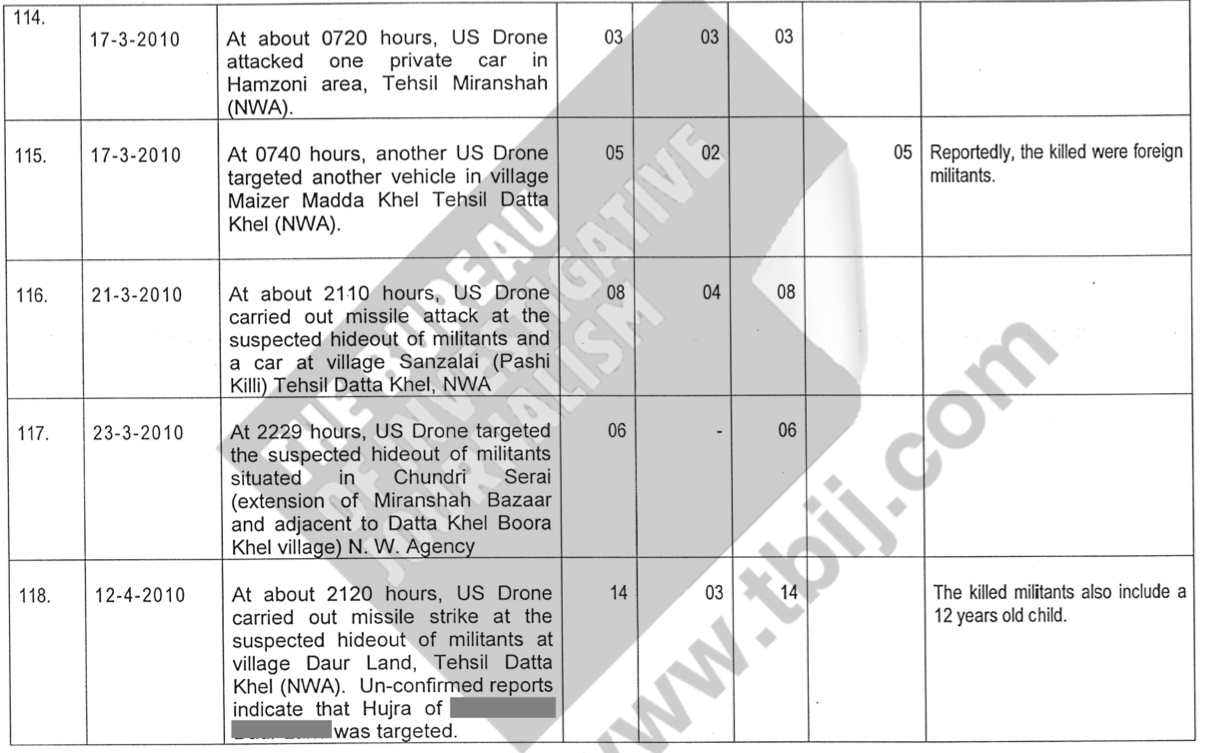
Document-excerpt

First, the Bureau of Investigative Journalism has just published a list of 330 drone strikes  between 2006 and July 2013 (data for the five strikes that took place in 2007 are missing) compiled by the Pakistan government (see extract above); this is an update of a partial release from the Bureau last summer.  The source is a series of reports filed each evening by Political Agents in the field to the FATA secretariat, and while it’s not a comprehensive listing – and Islamabad relies on other sources too – the document closely follows the Bureau’s own database compiled from other independent sources.  It also allows for a more accurate mapping of the strikes – more to come on this.

But one key difference between the list and the Bureau’s database is that, following the election of Obama, the official reports no longer attempted to classify the victims as combatants or civilians: and the coincidence may not be coincidental.  According to Chris Woods,

‘One of my sources, a former Pakistani minister, has indicated that local officials may have come under pressure to play down drone civilian deaths following the election of Barack Obama. It’s certainly of concern that almost all mention of non-combatant casualties simply disappears from this document after 2009, despite significant evidence to the contrary.’

One of the most egregious omissions is the drone strike on 24 October 2012 that killed Mamana Bibi, a grandmother tending the fields with her grandchildren.  The case was documented extensively by Amnesty International and yet, as the Bureau notes, while the date and location of the strike is recorded the report from the political agent is remarkably terse and makes nothing of her evident civilian status.

‘If a case as well-documented as Mamana Bibi’s isn’t recorded as a civilian death, that raises questions about whether any state records of these strikes can be seen as reliable, beyond the most basic information,’ said Mustafa Qadri, a researcher for Amnesty International…. ‘It also raises questions of complicity on the part of the Pakistan state – has there been a decision to stop recording civilians deaths?’

These are important questions, and in fact one of the central objectives of my own essay is to document the close, covert co-operation between the US and Pakistani authorities: what I called, in an earlier post, dirty dancing, trading partly on Jeremy Scahill’s inventory of ‘dirty wars’ and partly on Joshua Foust‘s calling out of the ‘Islamabad drone dance’.

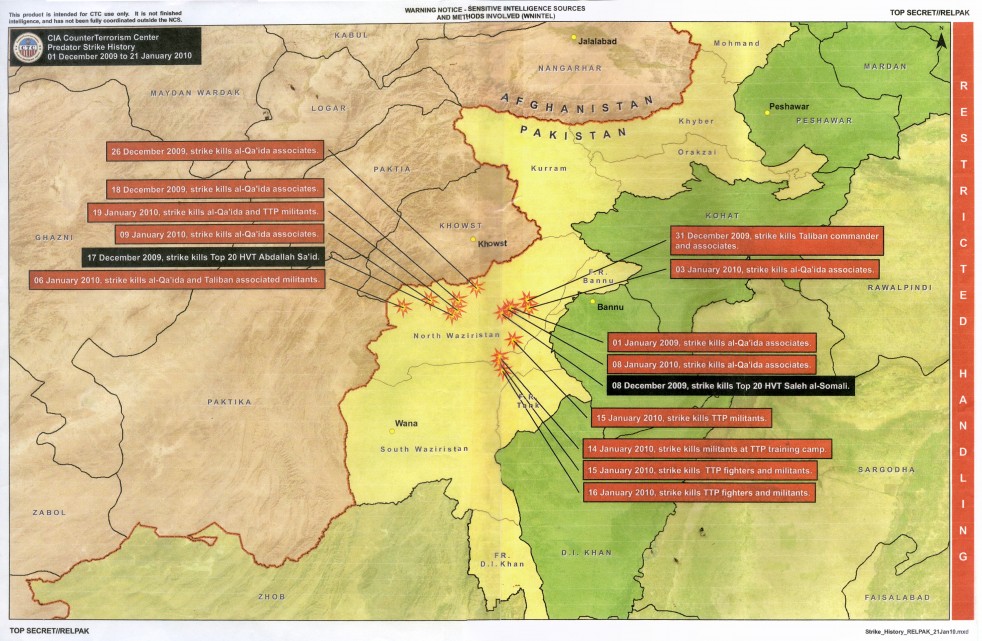
We now know that this collaboration continued at the very least until late 2011.  The CIA’s Counterterrorism Center routinely prepared reports that included maps (see below) and pre- and post-strike imagery that were briefed by the Deputy Director to Husain Haqqani, the Pakistani ambassador in Washington, and subsequently transmitted to Islamabad.

US_Pakistan_Panorama21382550661-1

And consistent with the reports from Political Agents to the FATA Secretariat, Greg Miller and Bob Woodward note that in these briefings:

Although often uncertain about the identities of its targets, the CIA expresses remarkable confidence in its accuracy, repeatedly ruling out the possibility that any civilians were killed.  One table estimates that as many as 152 “combatants” were killed and 26 were injured during the first six months of 2011. Lengthy columns with spaces to record civilian deaths or injuries contain nothing but zeroes.

The collaboration is important, because it has major implications for how one thinks about the Federally Administered Tribal Areas as a ‘space of exception’: there are multiple legal regimes through which the people who live in these borderlands are knowingly and deliberately ‘exposed to death’, as Agamben would have it.  More on this later, but for now there is a second, more substantive point to be sharpened.

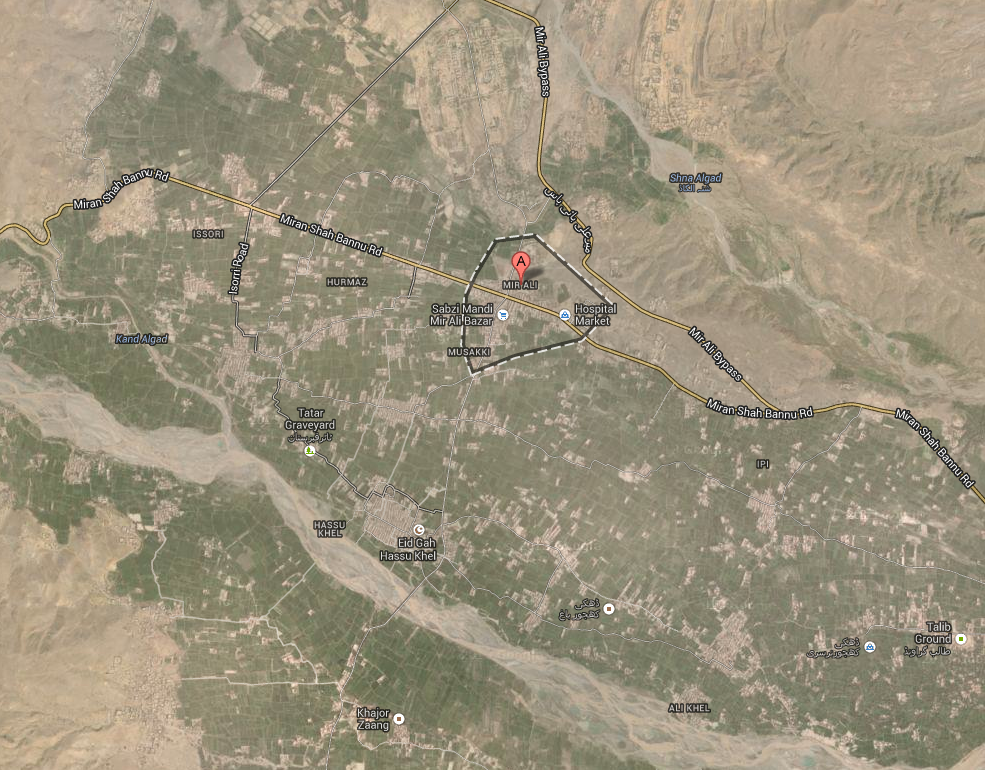
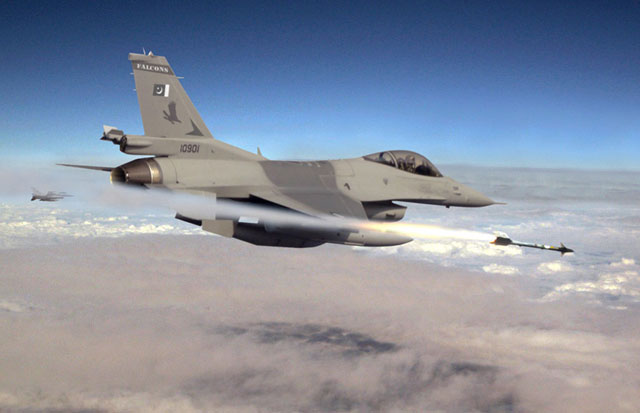
I’ve previously emphasised that the people of FATA are not only ‘living under drones‘, as the Stanford/NYU legal team put it last year, but also under the threat of air strikes from the Pakistan Air Force.  Last week the PAF resumed air strikes against leaders of the Tehrik-i-Taliban Pakistan (TTP) in North Waziristan, using first F-16 aircraft and then helicopter gunships to attack what were described as ‘eight major targets’ in the villages of Mir Ali (Hamzoni, Issori, Khadi and Nawana). Although the Air Force described the operation as a ‘blitz’, it initially claimed that only two people were killed.  A different story soon emerged.

MIR ALI

According to Pakistan’s International News, the air raids started just before midnight on 20 January, and people ‘left their homes in desperation and spent the night in the open along with children when the jets started bombing.’

There were conflicting reports about the identity of those killed. Military authorities said all the 40 people killed in the overnight aerial strikes were hardcore militants or their relatives and family members.

However, tribesmen in Mir Ali subdivision insisted that some local villagers, including women, children and elderly people, were also killed in the bombing by the PAF’s fighter aircraft and Pakistan Army’s helicopter gunships as residential areas were attacked.

848700893_1390366252

Several days later there were reports of hundreds – even thousands – of people fleeing the area in anticipation of continuing and intensifying military operations.  On 25 January the Express Tribune reported:

“Most of the families of Mir Ali Bazaar and adjacent areas have been leaving,” Abdullah Wazir, a resident of Spin Wam told The Express Tribune, adding, “women and children have been leaving with household materials, but livestock and larger items of belongings are being abandoned by these families.”

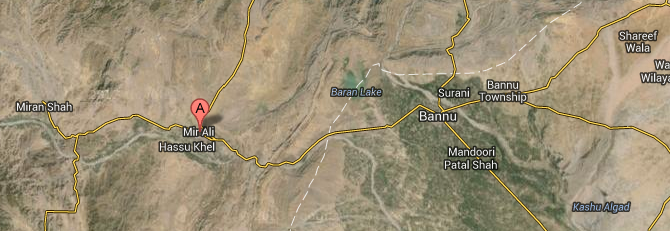
“It is difficult to find shelter in Bannu,” said Janath Noor, aged 38, who travelled there with her family. “There are problems at home and here in Bannu too.” She added that the families were forced to act independently as the political administrations in North Waziristan and Bannu have not made arrangements for the fleeing families. Some families reportedly spent the night under the open sky in Bannu town, waiting for any available shelter.

Some IDPs have also faced problems such as harassment at the hands of the police, requests for bribes, soaring rates of transport from Mir Ali and inflated rents for houses in Bannu. Some families, suspected of being militants, have had problems finding accommodation in Bannu district.

Mir Ali:Bannu

By 27 January the government estimated that 8,000 people had arrived in Bannu, while many others unable to find shelter and unwilling to sleep in the open had hone on to Peshawar and elsewhere.  But the head of the FATA Disaster Management Authority declared that ‘No military operation has been announced in the tribal area so there are no instructions to make arrangements for the internally displaced people.’

Most local people were clearly sceptical about that and, certainly, there were authoritative claims that Pakistan was being put ‘on a war footing’ to counter the surging power of the TTP.  In the same week that the air strikes were launched, Islamabad promulgated an amended Protection of Pakistan Ordinance (PPO), modelled on the imperial Rowlatt Act of 1919, that included provisions for secret courts, greater shoot-to-kill license for the police, house raids without warrants and the detention of terror suspects without charge. Rana Sanaullah, Minister for Law, Parliamentary Affairs and Public Prosecution in the Punjab and a close confidant of Prime Minister Nawaz Sharif, told the Guardian: ‘I think what will be done will be no worse than what has happened in Guantánamo Bay.’  Not surprisingly, he also offered support for the US drone strikes:

‘We believe that drone attacks damage the terrorists, very much… Inside, everyone believes that drone attacks are good; but outside, everyone condemn because the drones are American.’

And, as I’ll try to show in a later post, it’s a different inside/outside indistinction that plays a vital role in producing the FATA as a space of exception.

In plain sight

I’ve posted about camouflage before, but mainly in an historical context: the issue looms large in two recent essays, ‘Gabriel’s Map’ and the soon-to-be-completed ‘The natures of war’.  But it is, of course, of vital contemporary importance, and I’m thinking through its implications for my ‘Militarized vision‘ project.  After all, ‘seeing like a military‘ also involves what is not seen…

Here the work of Isla Forsyth is indispensable: see in particular her ‘Subversive patterning: the surgical qualities of camouflage’, Environment and Planning A 45(2013) 1037-52 and  ‘Designs on the desert: camouflage, deception and the militarization of space’, Cultural geographies, online July 2013; I also like James Philip Robertson‘s ‘Darkened surfaces”: camouflage and the nocturnal observation of Britain, 1941-45’, Environment and Planning A 45 (2013) 1053-69.

But these are all historical investigations, and for those new to contemporary camouflage Kelsey Campbell-Dollaghan has a helpful summary of advances (and failures) in ‘digital’ camouflage over at Gizmodo, ‘The history of invisibility and the future of camouflage’.

Hyperstealth Biotechnology Corp

The article takes off from the failure of the US Army’s ‘Universal Camouflage Pattern’ introduced in 2004, which was supposedly designed to work anywhere: not surprisingly, it didn’t. Cindi Katz‘s wonderfully waspish descriptions of the post-9/11 deployment of the National Guard in New York City are irresistible:

‘I’ve grown accustomed to their presence — frighteningly so — but still can’t get over their costumes. Green, woodsy camouflage. To blend with Penn Station?!’

Kelsey interviews Guy Cramer, CEO of Hyperstealth Biotechnology, ‘leaders in camouflage, concealment and deception’, and one of four finalists in the US Army’s Camo Improvement project. He has interesting things to say about fractals, pattern and scale but also about the temporal horizon of camouflage: how long does the deception have to work? Perhaps it will soon be time to head over to Penn Station again….

UPDATE: I’ve just stumbled across Stefka Hristova‘s ‘Digital Animalized Camouflage: A Zone of Biopolitical Indistinction’, from interstitial last year, which make a series of imaginative connections between digital camouflage and the state of exception: you can access it  here.

The rule of war

ADS_274_300por300The latest issue of Lisbon’s Análise Social has a special section devoted to the work of historical sociologist Michael Mann (all in English).  I’ve admired Mann’s historical and geographical range – and his combination of narrative and analytical power – ever since I read the first volume of his Sources of social power (1986; new edition 2012).

In the course of an interview with Miguel Bandeira Jéronimo, Mann describes the conceptual changes he has introduced as his multi-volume project has progressed, and he draws particular attention to his attempt to clarify the distinction between political power and military power:

Political power is the institutionalization of power relations over a given territory, backed up by mostly non-lethal, routinized and rule-governed coercion. Military power is the deployment of lethal violence which is aimed deliberately at terrifying, killing, and wounding people, and which is minimally or not at all institutionalized or rule-governed. Geopolitics lies between the two and can be either an extension of political or military power, according to whether inter-state relations contain matters of peace or war. The former are subject to negotiated rules and international courts and tribunals, the latter are not.

Leaving aside Mann’s claims about geopolitics, which I leave to my friends who work in that area, and the idea of a ‘given territory’ (on which I suspect Stuart Elden would have much to say), I’m puzzled by this.

I accept that not all rules are codified into formal protocols, but even in the case of so-called ‘new wars’ is military violence really perpetrated in a rule-free zone?  The operative codes may not be ‘ours’, and they may be fluid and improvisational, but this does not mean they don’t have a substantial role in drawing the contours of military and paramilitary violence.

And surely military power in many (though not all) of its contemporary forms is highly institutionalised and ‘rule-governed’?  The bureaucratisation of modern war, and in its later forms its juridification, is highly advanced: I don’t mean to imply that this is unproblematic, of course, still less that the rules remain intact throughout a conflict, and the reach of international courts and tribunals is evidently highly skewed (not least through the operation of political power), but still…  I think we need a much more nuanced account of the relations between law and war, one which recognises the complicities between them and, in particular, the ways in which military violence frequently works to extend the boundaries of a law that travels in the rear, its baggage train so to speak.

Finally, these clarifications are too clear.  In particular, they don’t address intra-state and transnational conflicts, and they make the distinction between ‘war’ and ‘peace’ such a black and white affair.  And here, plainly, the question of territory reappears in even more urgent (and contested) form.

Predatory networks

A key moment in the development of the United States’ UAV program was the deployment of a prototype Predator – General Atomics’ GNAT-750 – over Bosnia.  This is how I summarised the accelerated fielding program in ‘Moving targets’ (DOWNLOADS tab):

Even as the GNAT-750 was deployed over Bosnia-Herzegovina, the design was being developed into a new platform, the RQ-1 Predator, which incorporated three major modifications. The original intention had been to provide still imagery and text interpretation, but this was replaced by real-time motion video in colour (by day) and infrared (by night). A more serious limitation was range; the GNAT-750 could only operate 150 miles from the ground control station because it relied on a C-band line of sight data link. The CIA experimented with using relay aircraft to expedite data transmission – the same solution that had been used for the ‘electronic battlefield’ along the Ho Chi Minh Trail – but the breakthrough came with the use of the Ku-band satellite system that dramatically increased the operational range. The upgrade had been tested in the United States, and was retrofitted to Predators in Europe in August 1995. Although data was then rapidly transmitted across the Atlantic, the key intelligence nodes were still in Europe, like the Combined Air Operations Centre at Vicenza in Italy, and the drones were still controlled from ground stations within the region, at first from Gjader in Albania and later from Tazar in Hungary. A third, no less revolutionary innovation was the installation of an onboard global positioning system (GPS); early target imagery had to be geo-located using a PowerScene software program, but the introduction of satellite-linked GPS made a considerable difference to the speed and accuracy of targeting.

But I now think this misses other even more important dimensions that speak directly to the fabrication of the network in which Predators and eventually Reapers become embedded.

My primary source is a remarkable MIT PhD thesis by Lt. Col. Timothy Cullen, The MQ-9 Reaper Remotely Piloted Aircraft: Humans and Machines in Action (2011).  The research involved interviews with 50 pilots, 26 sensor operators, 13 Mission Intelligence Coordinators and 8 imagery analysts between 2009-2010 (so this is inevitably a snapshot of a changing program – but one with a wide field of view) and direct observation of training missions at Holloman Air Force Base; the thesis is also informed by Cullen’s own, considerable experience as a pilot of conventional strike aircraft and by actor-network theory, though most particularly by Edward Hutchins‘ cognitive ethnography and by the work of Lucy Suchman.

CULLEN p. 94I should say, too, that the thesis is irony made flesh, so to speak.  The author notes that:

Missing from public discussions are the details of remote air operations in current conflicts and the role of social networks, organizational culture, and professional practices in the evolution and history of RPA. The public cannot have informed discussions about these topics without empirical observations and descriptions of how RPA operators actually fly and employ the aircraft.

Fair enough, of course, but parts of the thesis are heavily redacted; I realise this isn’t – can’t – be Cullen’s doing, but it is as frustrating for the reader as it surely must be for the author (for Private Eye devotees, the image on the right shows p. 94).  Still, there’s enough in plain sight to provide a series of arresting insights into the development of the UAV program.

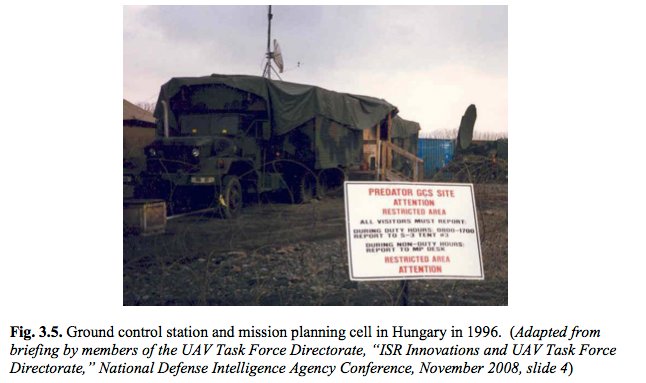
First, early Predator crews were remarkably detached from the wider mission and their ability to communicate with people outside their Ground Control Stations was extremely limited.  The pilot’s primary responsibility was to program the aircraft to fly on autopilot from target to target and to monitor the flight path, while two sensor operators identified and tracked the targets whose images were to be captured.  In a tent outside the ground control station a ‘Mission Planning Cell’ (MPC: see photograph below) served as the communications interface; since this was an experimental system, the Ground Control Station was not permitted to receive or transmit sensitive or classified information.  Apart from the transmission of images, all communications between the two were either face-to-face (literally through the tent flaps) or via a telephone link.
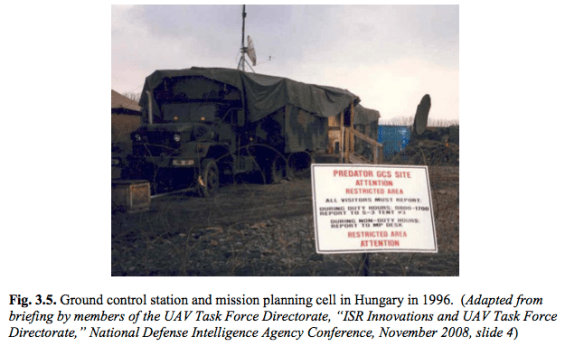
GCS and Mission Planning Cell, Hungary 1996

Before a mission the MPC received a set of 50-300 imagery targets (known as ‘Collection Points’) from the Balkans Combined Air Operations Center in Vicenza in Italy, and used this to create a detailed target deck.  The time between the initial requests and final image capture steadily decreased from 72 hours to 48 hours, and eventually re-tasking during a mission became standard: more on the tasking process here.

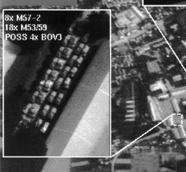
Bosnia imageryThe video feeds from the Predator were sent via coaxial cable to the MPC where they were digitised and encrypted for onward transmission over a secure network to commanders in the field and to a group of 10-12  imagery analysts in the United States.  The analysts posted video clips and annotated stills on a classified web page, but the quality of the video feeds with which they had to work was significantly less than the raw feeds available in theatre, and the slow response time was another serious limitation on the value of their work.

At the time, of course, all this seemed revolutionary, and the second Annual Report on the UAV program in 1996 declared that:

Even more significant than the Predator performance “firsts” is the wide use made of its imagery, amplified by the increased network of receiving stations both in-theater and back in CONUS [continental US]. The development of this dissemination capability is shown below.

conus

It first used VSATs at selected receiving sites, and then the SATCOM-based Joint Broadcast System (JBS). The Predator-JBS network represents the first time for the simultaneous broadcast of live UAV video to more than 15 users. This provided a common picture of the “battlefield.” Video imagery can be viewed either as full motion video or via a “mosaicking” technique at the ground station. 

[JAC Molesworth was the Joint Analysis Center at RAF Molesworth in the UK, US European Command’s intelligence center, and DISN is the Defense Information Systems Network for data, video and voice services].

But the system was far from responsive; the MPC filtered all communications from commanders and imagery analysts and, as the tasking diagram below shows, whether the cycle followed the standard model or allowed for more flexible re-tasking the Predator crew had very little discretion and was, in a substantial sense, what Cullen calls ‘a passive source of data’.  Its responsibilities were limited to the ‘physical control’ of the platform.

figure8-1

This has been transformed by the cumulative construction of an extended, distributed network in which UAV crews are in direct communication, either by voice or through secure internet chatrooms, with multiple agents: commanders, military lawyers, image analysts, joint terminal attack controllers and ground troops.  But this was not how the system was originally conceived or fielded, and Cullen shows that its transformation depended on the skilled intervention of UAV crews and their commanders who ‘envisioned and used the system as a collaborative network of operators, intelligence analysts, and ground personnel to establish objectives, exchange information, and understand the context of a mission’:

‘RPA [Remotely Piloted Aircraft] operators restructured the ground control station and crew tasks to shift the actions of crewmembers from low status missions of gathering and disseminating data to higher status tasks of integrating and creating information, participating in the assessment of threats, and actively contributing to commanders’ decision-making processes. RPA operators were not satisfied with simple connections to a network of people and tools to accomplish a mission. They sought and fostered social relationships with them and demanded interactive dialog among them in a form they could anticipate, understand, and evaluate’ (Cullen, p. 204).

Second, early Predator operations, not only in the Balkans in the late 1990s but also over southern Iraq and in Afghanistan, were not what would later become known as ‘remote-split operations’.  It was assumed that the Predator had to be operated as close to the combat theatre as possible. This was not only because of the platform’s limited range, important though this is: as I’ve said before, these are not weapons of global reach.  Indeed, it’s still the case that Predators and Reapers have to be physically close to their theatre of operations, which is why the United States has become so alarmed at the implications of a complete withdrawal from Afghanistan for the CIA’s program of targeted killing in Pakistan.  According to David Sanger and Eric Schmitt,

‘Their concern is that the nearest alternative bases are too far away for drones to reach the mountainous territory in Pakistan where the remnants of Al Qaeda’s central command are hiding. Those bases would also be too distant to monitor and respond as quickly as American forces can today if there were a crisis in the region, such as missing nuclear material or weapons in Pakistan and India.’ 

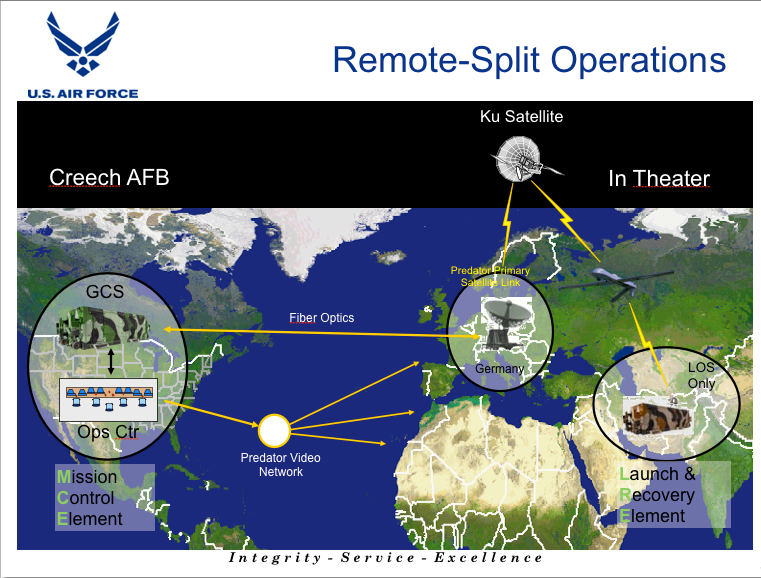
For the ‘no-fly zone’ established over southern Iraq reconnaissance flights were flown by Predators from Ali Al Salem Air Base in Kuwait, and for the initial campaign in Afghanistan from Jacobad in Pakistan, and Cullen explains that the vulnerability of these (‘austere’) sites limited the MPC’s access to secure networks, communications and databases.  But in 2002-3 USAF pilots and sensor operators returning from secondment to – Cullen actually calls it ‘kidnapping’ – ‘other agencies’, which is to say the CIA, successfully argued that the primary execution of remote missions should be consolidated at Nellis Air Force Base and its auxiliary field, Indian Springs (later re-named Creech AFB), in southern Nevada, which would expand and enhance crews’ access to secure intelligence and analysis capabilities.  There would still have to be a forward deployed ‘Launch and Recovery’ element to maintain the aircraft and to control take-off and landing using a line of sight link, but all other mission tasks could be handled from the continental United States using a Ku-band satellite link via a portal at Ramstein Air Force Base in Germany.  When remote split operations started in 2003 the MPC disappeared, replaced by a single Mission Intelligence Co-ordinator who was stationed inside the Ground Control Station in constant communication with the pilot and sensor operator and this, in turn, transformed the configuration and equipment inside the GCS.  But, crucially, relations beyond the GCS were also transformed as USAF commanders visited Afghanistan and Iraq and established close relations with ground troops: ‘remote’ and ‘split’ could not imply detachment, and the new technological networks had to be infused with new social interactions for the system to be effective.
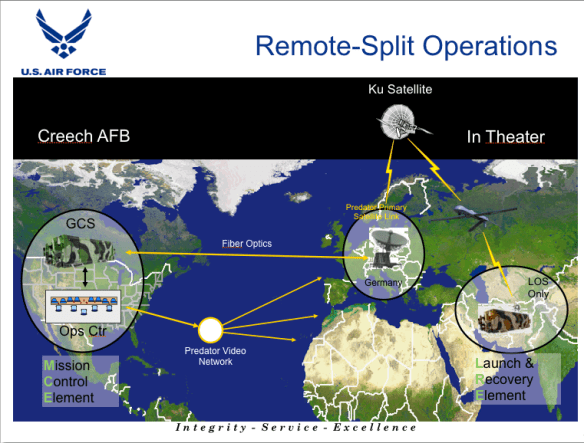
Remote-Split Operations (USAF)

Focal to these transformations – and a crucial driver of the process of network construction and transformation – was the decision to arm the Predator and turn it into a ‘hunter-killer’ platform.  At that point, Cullen observes,

‘Predator pilots became decision makers, and Predator’s weapons transformed Predator pilots and sensor operators into war fighters – Predator crews could create effects on the battlefield they could observe, evaluate and adjust… The arming of the Predator was synonymous with the integration of the system – the people, tools and practices of the Predator community – into military operations’ (pp. 245-7).

The reverse was also true: not only was the Predator integrated into the battlespace but, as Cullen notes, the network was ‘infused’ into the Ground Control Station. In consequence, a sensation of what Cullen calls ‘remote presence’ was inculcated amongst UAV crews and, in particular, sensor operators who developed a strong sense of being part of the machinic complex, ‘becoming the camera’ so intimately that they were ‘transported’ above the battlespace.  These transformations were stepped up with the development of the Reaper, reinforced by new practices and by the introduction of a new, profoundly combative discourse that distanced the Reaper from the Predator:

‘[T]o reinforce the power and responsibility of Reaper crews, members of the 42nd Attack Squadron changed the language of their work. Sensor operators did not operate a sensor ball; they flew a “targeting pod” like fighter pilots and weapon system officers. Reaper pilots and sensor operators did not have a “mission intelligence coordinator”; they coordinated strike missions with the support of an “intelligence crewmember.” Reaper crews did not conduct “intelligence, surveillance, and reconnaissance” missions; they flew “non-traditional” intelligence missions like fighter and bomber crews. Members of the 42nd Attack Squadron used the rhetoric of the fighter community to highlight the strike capabilities of Reaper; to influence the perceptions of Reaper operators; and to shape the priorities, attention, and assertiveness of Reaper crews during a mission’ (p. 264)

The language was performative, but its performative force – the ability to ‘create effects on the battlefield’ – was realised through the developing networks within which and through which it was deployed.

To be continued.
Cracks in the Wall?

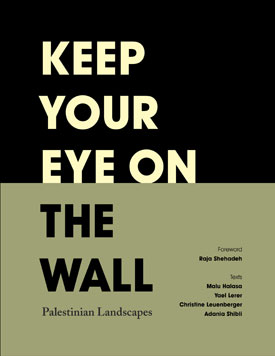
Keep-Your-Eye-on-the-WallThere’s a fine series of reflections by Andrew Ryder at Warscapes on a new book of photographs and essays on the Wall that Israel has built deep inside the occupied West Bank, Keep your eye on the Wall: Palestinian landscapes.  As Andrew notes,

‘The wall is a nuisance and eyesore; it is a scar in the natural landscape and the social body. It is congealed theft, and an act of violence.’

Eyal Weizman‘s Hollow Land tells us much about the way in which Israel’s neo-colonial project is inscribed through a series of visual practices – a scopic regime of extraordinary, ever-present and brooding violence – but Andrew’s commentary reminds us of another, no less artful politics of looking.  He engages in a wonderfully suggestive, deeply critical way with the aesthetics of dispossession and oppression:

While I found many of the photos in this book upsetting, I think that a traditionally aesthetic standpoint toward the wall, a disinterested interest, is particularly horrifying because it occludes something that was always obvious to me every time I looked at the wall, which was its manifest injustice.

Throughout the book, there are moments that the wall appears too static, imposing and impermeable. I found a lack of witness to the gaps and even the fragility of the structure. There seems little evidence of soldiers, checkpoints, settlements, refugee camps or the other evidence of dynamism or vulnerability in the territorial apparatus that the Israeli state has constructed.

The gaps I understand, but fragility?  vulnerability?  If only.  As Shakespeare put in in A Midsummer Night’s Dream,

O wicked Wall through whom I see no bliss!
Cursed be thy stones for thus deceiving me!
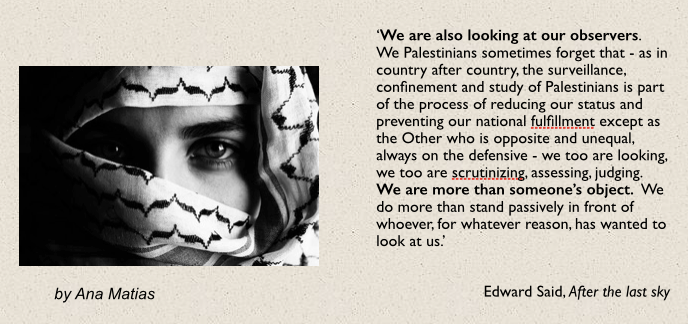
Others have travelled this route before, of course: I’ve already noted other critical reflections on the political and ethical snares set by any attempt to photograph the monstrosity.  And yet the collection that Andrew discusses is well-titled.  As Edward Said reminded his readers:
Observer and observed
For a different take on the political aesthetics of the occupied landscape – though not on the Wall – see Daniel Bertrand Monk’s An aesthetic occupation: the immediacy of architecture and the Palestine conflict (2002).

Humanity

HumanityStarting this month, I’ve joined the Editorial Board of the journal Humanity: An International Journal of Human Rights, Humanitarianism, and Development.  It includes a host of people whose work I admire, including Costas Douzinas, Samera Esmeir, Didier Fassin, James Ferguson, Barbara Harlow, Paul Kahn, Thomas Keenan, Martti Koskenniemi, Andrew Lakoff, Liisa Malkki and Mariella Pandolfi, so I’m really excited about all this.

Here’s the Mission Statement (the journal started in October 2010):

In recent decades, the traditional politics of ideological contest has been displaced by a politics of humanity. In many realms, left and right have given way to life and death. In both domestic and international contexts, the languages of human rights and humanitarianism are often spectacularly marshaled as moral claims to bolster multifarious policies and practices. And development—a central Cold War discourse—has evolved beyond strictly economic or institutional concerns to encompass matters once targeted in human rights activism and has expanded to address the acute humanitarian crises once treated as more episodic and temporary conditions.

The distinctions among human rights, humanitarianism, and development—which were once largely discrete categories—have blurred under the pressures of contemporary international politics, resource wars, and global policy. The integration of human rights, humanitarianism, and development under the rubric of “humanity” has meant, for better and worse, the erosion of the traditional meanings and applications of each. This convergence of the three concepts within a larger politics of humanity is arguably one of the signature phenomena of our time.

The global politics of humanity legitimates itself not on the old foundation of international humanitarian law or the more recent elaboration of international human rights; rather, it derives its legitimacy from its promise to generate new legal and political orders, to shape new social realities and relations, to establish new economic imperatives and interests, and to forge new cultural connections and values. And while the global politics of humanity is emphatically a politics of redemption, at least in its urge to mend, ameliorate, or even transform circumstances of disorder and atrocity, the very aspirational quality of the politics of humanity that lends it appeal often immunizes it from critical inquiry. The humanity to which activists and governments appeal—or hope to bring about—is never the same in each context, or even for all actors in the same project. These unacknowledged tensions, indeed, help define this novel form of global politics.

The goal of Humanity is to provide a single forum for the dispassionate, analytically focused examination of these trends and the political transformations that have reshaped the terms of liberation and idealism as well as the practices of domination and control.

For a number of years now, scholars working in their respective fields, publishing mostly in disciplinary journals, have been analyzing this convergence—its formative history and future implications. Many powerful insights about these ongoing transformations have emerged from diverse fields such as anthropology, history, law, literature, philosophy, and sociology. Too often, however, this work has remained cloistered from scholars in other fields and the world of practice, even though much of it shares a common intellectual genealogy; and the centripetal force of the disciplines has tended to perpetuate these divisions, even though all of them have a common stake in the world. By encouraging novel approaches to the problems of “humanity” and inviting our readers and contributors to venture beyond their usual disciplines, we hope to clear some of the obstacles to conversation among scholars in various disciplines and between academics and practitioners. Humanity will provide an interdisciplinary forum to facilitate inquiry into the movement of human rights, humanitarianism, and development towards a politics of humanity—because “humanity” itself is a multidisciplinary question.

Most treatments of human rights, humanitarianism, and development—popular, scholarly, and activist—tend to remain tightly tethered to the agendas of the causes that gave them their original purpose and continuing energy. Our belief, as the editors of Humanity, is that the purposes of reflective activity and critique are not necessarily to refine and reform policies and to discover best practices. Advocacy and reform have their place, of course; but so too should analysis and critique, not just of methods, metrics, and goals but also of ideals and ideologies.

The mission of Humanity is to explore, from as many perspectives as possible, the multiple ways that invocations of “humanity” never tell the whole truth about the practices and people they defend or advance. For Humanity, “humanity” will always be a problem.

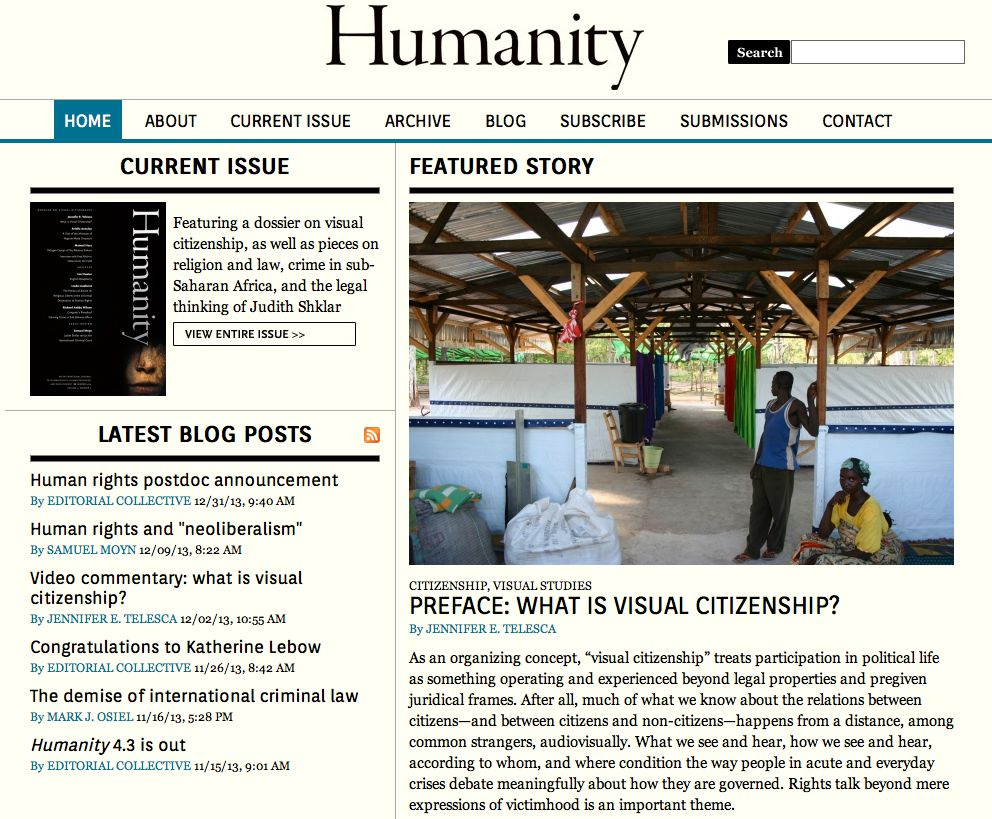
You can find out much more from Humanity Online here, which includes a preview of the latest issue on Visual Citizenship, featuring a downloadable introduction by  Jennifer Telesca, and a lively blog:

Humanity:2

A mile in these shoes

I’m just back from Beirut, and trying to catch up.  Every day I went for a walk along the Corniche, and on the second morning a young Syrian boy asked if he could clean my shoes.  I was wearing trainers, but told him that I’d pay him anyway and he could clean my shoes next time I came out; he refused to take the money until I had agreed where and when I would present myself for the service.  Heart-warming and hear-breaking, and I can’t get him out of my mind.  So here is a quick up-date on the situation (see also my previous posts here and here).

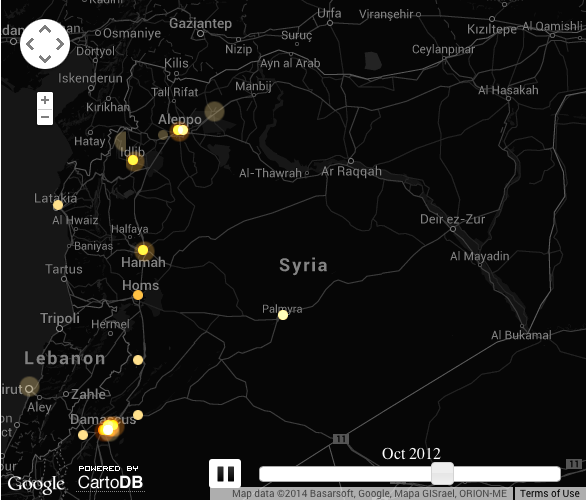
Syria civil war casualties

First, this week Foreign Policy published this sobering animated map of casualties from the civil war in Syria based on data from the Human Rights Data Analysis Group:

It visualizes the approximately 74,000 people who died from March 2011 to November 2013. Every flare represents the death of one or more people, the most common causes being shooting, shelling, and field execution. The brighter a flare is, the more people died in that specific time and place. The data used are drawn from the Violations Documentation Center (VDC), the documentation arm of the Local Coordination Committees in Syria which has been one of the eight sources on which HRDAG has based its count. In a June 2013 report, HRDAG cited VDC as the most thorough accounting of casualties in Syria, though the dataset has been found to contain some inconsistencies…

What the map demonstrates is the escalation of the conflict — with data from March 2011 through the VDC’s Nov. 21, 2013 report — and its quick descent from being a smattering of violence to a multi-front war with militias challenging the military (and other militias) almost everywhere at once. What it can’t show, of course, is the horror and destruction of this war.

My image is just a screen grab, of course, so you need to visit the original to see the overall, devastating effect.

For more detail, I recommend Syria Deeply, a new digital platform that attempts to combine citizen journalism with professional analysis; there’s a profile of the project at start-up over at Fast Company here and a more recent commentary from its founder Lara Setrakian here. I think there are lessons to be learned here about the way publics can be created and brought to engage with conflicts, and that goes for academics as well as journalists.

Second, it’s much harder to find information about those who have been wounded in the conflict – one of my present preoccupations: see here and here – but while I was in Beirut Lebanon’s Daily Star published an interesting report on NGOs working in the borderlands to treat casualties from the war zone.  In the Bekaa Valley the International Committee of the Red Cross has treated over 700 people since 2012, while a 20-bed clinic run by Lebanon’s Ighatheyya has treated 135 people since it opened five months ago in Kamed al-Loz.  The casualties include pro- and anti-Assad fighters (according to the ICRC, ‘When we know the patients are from opposing sides we separate them by placing them on different floors … We make sure they don’t know the other is there’) and civilians alike.  Many of them are suffering from infected wounds because they were initially treated in makeshift facilities in tents or private houses, which is why the perilous journey across the border is so vitally important. Neither the ICRC nor Ighatheyya make cross-border runs.  The Star‘s reporters explain:

Many patients are lawfully retrieved from the border by the Lebanese Red Cross, who then take them to a number of cooperating hospitals across the Bekaa Valley for treatment. According to a well-informed source, the ICRC has contracted four hospitals, in Chtaura, Jib Jenin, Baalbek and Hermel, to care for war wounded Syrians.

After surgery patients are often referred to clinics run by other non-governmental organizations, such as Ighatheyya, who oversee the patients’ convalescence…. Ighatheyya is [also] in the process of building a fully equipped 30-bed hospital in the border town of Arsal, where many refugees and combatants cross into Lebanon.

Another major locus of emergency medical treatment is Tripoli, just 30 km from the border and the primary treatment centre for Syrians seeking emergency medical assistance in northern Lebanon.  Médecins Sans Frontières, which also operates from four locations in the Bekaa Valley, has been supporting local clinics and hospitals here since February 2012 (and it’s been working inside Syria since March 2011).

NGOs are not the only organisations on the field.  Last summer NBC described the operation of a new clinic set up by the Syrian National Opposition to treat opposition fighters.  It too is in the Bekaa Valley, which is for the most part controlled by Hezbollah – which is of course militantly pro-Asad.  Four days after the clinic opened a local militia aligned with Hezbollah broke into the compound and forced a rapid evacuation, and early last summer armed men attacked an ambulance transporting a patient to surgery and kidnapped him: ‘Since then, the Lebanese Red Cross has refused to transport the clinic’s patients in ambulances through certain Hezbollah-dominated areas without an army escort. And private cars carrying patients through those areas have been shot at.’

For more on the transnational ‘therapeutic geographies’ involved in the wars in Iraq and Syria, see Omar Dewachi, Mac Skelton, Vinh-Kim Nguyen, Fouad Fouad, Ghassan Abu Sitta, Zeina Maasri and Rita Giacaman, ‘The Changing Therapeutic Geographies of the Iraqi and Syrian Wars’, forthcoming in The Lancet.  And for a discussion of the regional geopolitics of all this, including a corrective to the claim that the war in Syria is simply ‘spilling over’ into Lebanon, see Bélen Fernández over at warscapes here.

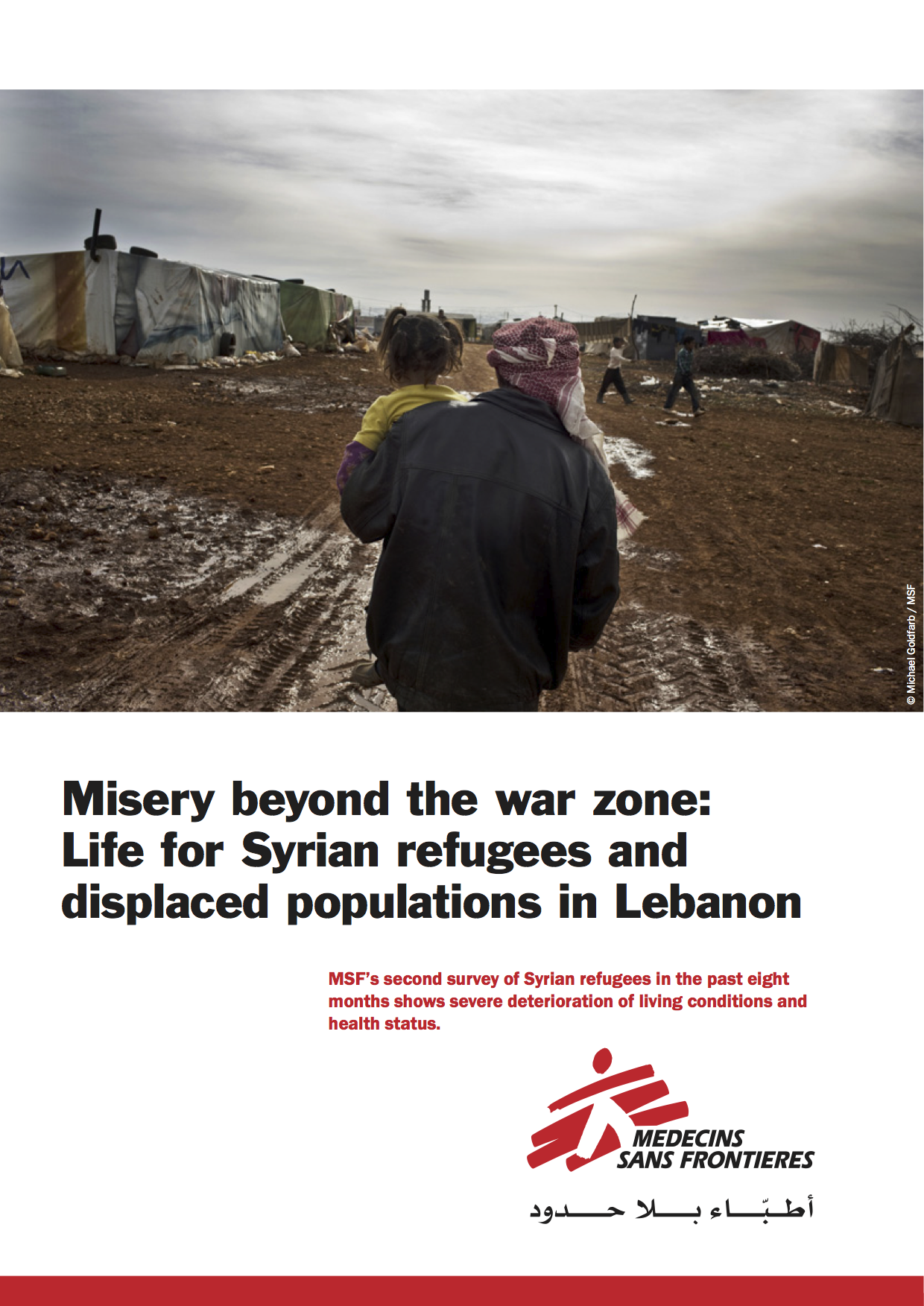
Syria-Lebanon-Report-2013 (dragged)As MSF emphasises, refugees from the conflict in Syria need more than emergency treatment for war wounds: ‘The epidemiological profile of populations does not change when they cross borders; those who needed medications for chronic conditions in Syria still need them in Lebanon.’  And, clearly, they have other pressing needs too:

‘[T]the gaps in service that existed [in June 2012] have not been sufficiently addressed but have in fact widened as more people have streamed across the border. Living conditions among the majority of refugees and Lebanese returnees remain extremely precarious, particularly with winter arriving. More than 50% of those interviewed, whether they were officially registered or not, are housed in substandard structures — inadequate collective shelters, farms, garages, unfinished buildings and old schools — that provide paltry, if any, protection against the elements. The rest are renting houses, but many of those people, now separated from their lives and livelihoods, are struggling to pay the rent. The medical picture has deteriorated as well. More than half of all interviewees (52%) cannot afford treatment for chronic disease care, and nearly one-third of them have had to suspend treatment already underway because it was too expensive to continue. For those who are and are not registered alike, the costs attached to essential primary health care, ante-natal care and institutional deliveries are prohibitive. Among non-registered returnees and internally displaced Lebanese, 63% received no assistance whatsoever from any NGO.’

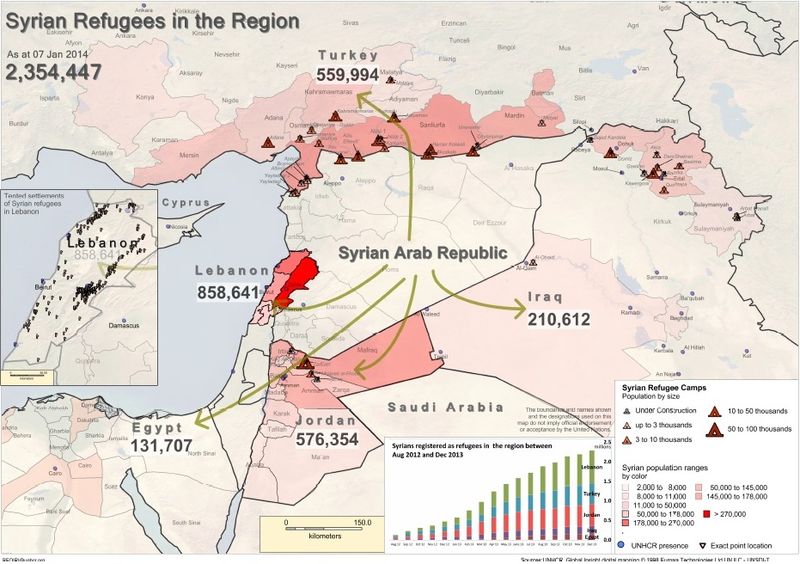
Here’s a recent map of Syrian refugee flows:

Syrian refugee flows to December 2013

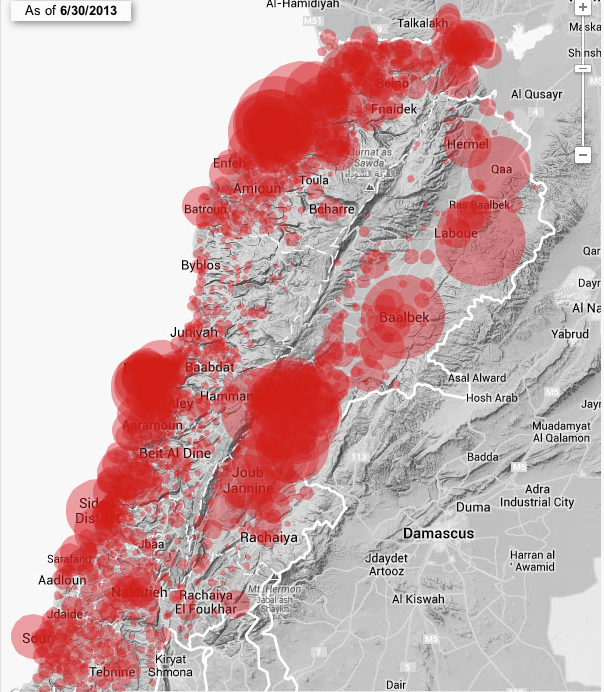
For more detail, UNHCR’s tabulations of Syrian refugees in Lebanon can be found here, and there’s a remarkable interactive map here (again, the image below is just a screen grab).

Syrian refugees in Lebanon summer 2013

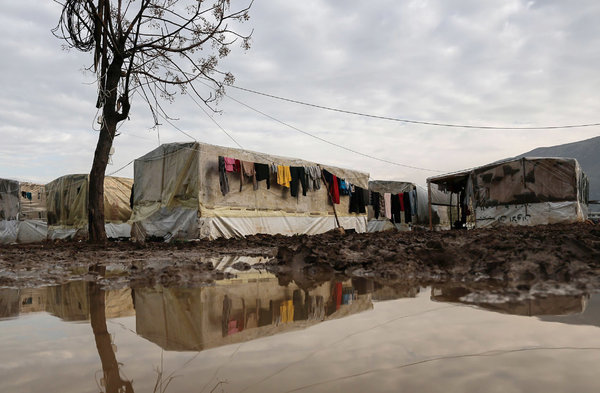
The number of registered refugees in Lebanon – and, as that MSF report indicates, registration is itself a deeply problematic process and the numbers understate the gravity of the situation – is now around one million; Lebanon’s population is four million, so one person in five is a refugee.  But wary of its experience with the Palestinian refugee camps – on which Adam Ramadan‘s work is indispensable: his book is due out later this year, but in the meantime see ‘In the ruins of Nahr al-Barid: Understanding the meaning of the camp‘, Journal of Palestine Studies 40 (1) (2010) and  ‘Spatialising the refugee camp‘, Transactions of the Institute of British Geographers 38 (1) (2013) 65-77 – Lebanon has refused to sanction camps for Syrian refugees: hence those ‘tented settlements’ on the map above (and see the image below).

24iht-m24-lebanon-refugees-articleLarge-v3

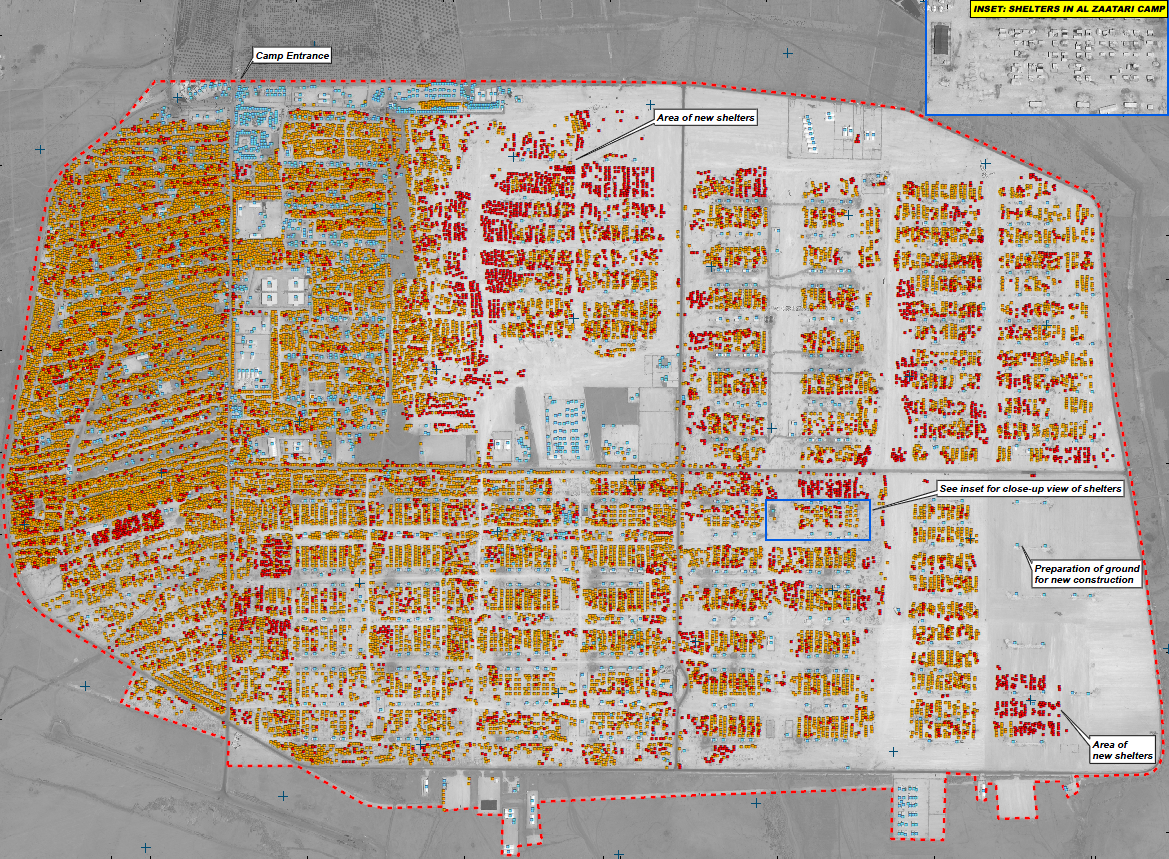
This strategy, or lack of it, is in marked contrast to Jordan, where Al- Za’atari, which opened in July 2012, will soon become the largest refugee camp in the world (below): you can find a sequence of satellite images showing its explosive growth here.

al-zataari-may-2013

But Lebanon is adamant that it will not sanction any intimations of permanence.  Norimitsu Onishi reported recently in the New York Times that

Those fears have forced the refugees to try to squeeze into pre-existing buildings and blend into the landscape. Those with means rent apartments. But hundreds of thousands are living in garages and occupying the nooks and crannies of buildings under construction. Abandoned buildings, including universities and shopping malls, have been taken over in their entirety by refugees.

Here, as usual, there are pickings to be had.  Last year Tracy McVeigh reported in the Guardian that

‘While there are widespread reports of extraordinary acts of generosity and kindness by Lebanese towards Syrian refugees, many people here are making money from Syria’s war. Landlords are getting rents for barely habitable properties, stables and outhouses. There are hefty profits to be made in the gun-running business, and refugees are easily exploited as cheap labour. The government is getting military resources from America and Europe, which are keen to see it able to protect its borders. But many others are losing out – those who are trying to house and feed large families along with their own.’

And that includes young boys looking for shoes to clean on the waterfront in Beirut.  If you want to donate more than the cost of a shoe-clean, you can reach Oxfam here, the International Rescue Committee here and UNHCR here.

Dirty wars and stained maps

I’m still in Beirut where I’ve had a wonderful time at the Transnational American Studies conference at AUB.  Yesterday morning I chaired a panel on ‘Geographies of War‘, which featured Laleh Khalili (on Kuwait, military logistics and private contractors: abstract here), Lisa Hajjar (on the (il)legal strictures and injustices at Guantanamo; she changed her paper so I can’t link to an abstract), and Jeremy Scahill (‘The world is America’s battlefield’: abstract here).

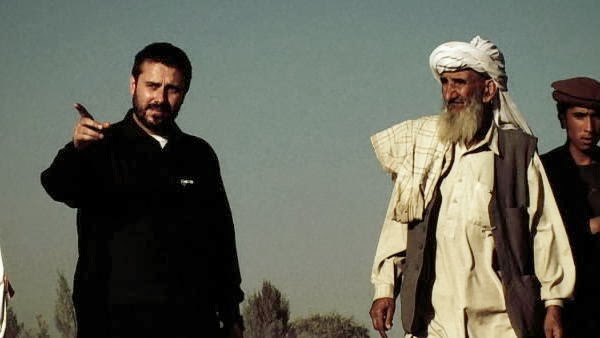
In the evening Jeremy showed the film of Dirty Wars, co-written with David Riker and directed by Rick Rowley.  Bear with me here; I’ll return to those ‘geographies’ in a moment.  Seeing the film for a second time (the first was in Toronto in the fall with Jaimie and Jorge) I have to say I found it less satisfactory – I much prefer the book, but it’s not only because the written version is (inevitably) more detailed and more nuanced.  I think it has something to do with the film being less an act of investigative journalism than a reconstruction of investigative journalism, a noir docudrama in which the investigator (no less inevitably) becomes the central figure: Sam Spade with a notebook.  For that reason, I think Michael O’Sullivan is simply wrong to say that ‘the film is a documentary pure and simple.’

Dirty Wars

You can see that most obviously in the section that deals with a Special Forces night raid in February 2010 on a compound in Gardez, Afghanistan, where much of the ground-breaking reporting was done by another journalist, Jerome Starkey.  But these scenes have incredible dramatic force, none the less, and the incorporation of cellphone footage of the raid and the unmasking of the Special Forces commander are genuinely and profoundly arresting (if only that were literally true).

Dirty Wars Gardez

I’m less convinced by the sections that treat the targeted killing of Anwar al-Awlaki, probably because I’m still dismayed that it was the killing of a U.S. citizen that sparked so much public outrage in the United States rather than the killing of all the others.  Certainly in the film, far more so than the book, there’s an unwavering focus on the ‘Americanness’ of al-Awlaki, and especially of his transparently innocent teenage son, murdered by a drone strike just two weeks later.  Home videos, games, clothes, a whole series of images are put to work to show not that ‘they’ are just like ‘us’ but that in some substantial sense ‘they’ are ‘us’.   I was left wondering about those who don’t qualify for these sort of identifications, who can’t provide similarly legible identity papers: how are we to recognise and acknowledge their lives as grievable too?  There’s also something unsettling about Jeremy’s epiphany that he’s come to Yemen ‘to apologise’: I’m still trying to figure out how he could, and what position he would have had to occupy for that to mean very much to al-Awlaki’s grandparents and cousins in Sa’ana.  

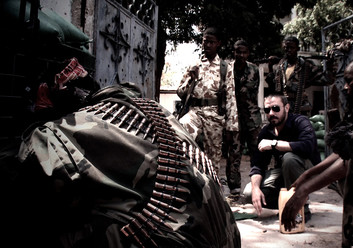
Dirty Wars SomaliaFinally, the extended passage through a war-ravaged town in Somalia, crouching alongside militias and interviewing a warlord who gives very little away, seems to run into the sand.  I was left with the uncomfortable feeling that these sequences had been retained primarily for Mohamed Afrah Qanyare‘s assertion (about his paymasters) that ‘America knows war… They are the war masters.’  

And yet, of course,  America doesn’t know war: Bush and Cheney famously avoided Vietnam, most of the war managers view the results of their military and paramilitary violence on screens and spreadsheets, and most of the public turns the other way.  As Kamila Shamsie says in Burnt Shadows, the United States fights ‘more wars than anyone else; because you understand war least of all’ (see also my draft introduction to The everywhere war here; scroll down).

That’s precisely why investigative journalism and documentary films are so urgently necessary – and why we need these different forms – but I’m not sure that rendering Jeremy’s courageous and principled investigations in the black and white tones of a Hollywood thriller is the best way to bring ‘what is hidden in plain sight’ into public view.  (For a different take, that pays close attention to the visual codes in the film, see Mike Hill‘s very smart essay over at Feedback here).  I do know that films have to be different from books, that they have different grammars if you like, and I also understand that one of the most effective ways of soliciting an audience’s response is through story-telling – academic prose would be considerably less deadly if it had more narrative force – but in the end I’m with Roger Ebert:  

‘Scahill is so respected and convincing that he doesn’t need such propping up, so the flashy directing and editing makes it feel as though “Dirty Wars” is trying too hard to sell things that might have sold themselves just fine without the hot box approach.’ 

Other (non-film) critics have objected to the way in which the history of clandestine/covert war is foreshortened in Dirty Wars, so that the CIA is left in the shadows.  But that’s surely because in the wake of 9/11 the CIA was, in some crucial respects, pushed out of the limelight and a vastly aggrandised Joint Special Operations Command took centre stage to play for Cheney and Rumsfeld. And it’s the combination of a para-militarized CIA and JSOC that is instrumental in pushing the boundaries of the everywhere war.

socommap4_large

  • Red markers: U.S. Special Operations Forces deployment in 2013.
  • Blue markers: U.S. Special Operations Forces working with/training/advising/conducting operations with indigenous troops in the U.S. or a third country during 2013.
  • Purple markers: U.S. Special Operations Forces deployment in 2012.
  • Yellow markers: U.S. Special Operations Forces working with/training/advising/conducting operations with indigenous troops in the U.S. or a third country during 2012.

US Special Operations Deployments, 2012-2013

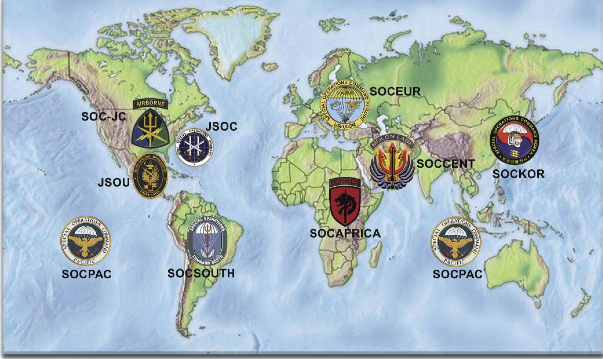
While I was writing this, a new report from Nick Turse popped on to my screen, charting the extraordinary global geography of JSOC (above) and its entanglements with other militaries and agencies like USAID.  JSOC has set up its own shadow system of subcommands mirroring the Pentagon’s division of the globe into unified combatant commands like US Central Command, each assigned to a different geographical region:

JSOC sub-commands

US Special Operations Command – Subcommands

I’ve taken the map above from US Special Operations Command’s own ‘Factbook‘, though it’s so reluctant to disclose any information that here too, as you’ll see if you read Nick’s article, part of the story is getting the story.  If you read this alongside Steve Niva‘s brilliant essay, ‘Disappearing violence: JSOC and the Pentagon’s new cartography of networked warfare’, Security dialogue 44 (3) (2013) 185-202, and in conjunction with the gritty detail (and vivid prose) of Dirty Wars, you’ll have a desperately disturbing sense of one of the modalities that is producing these new geographies of war.  As Scott Horton tells Jeremy in Dirty Wars, ‘suddenly the theatre of war has become the entire globe – it’s become everywhere.’

A new natural history of destruction?

Security by remote control conference

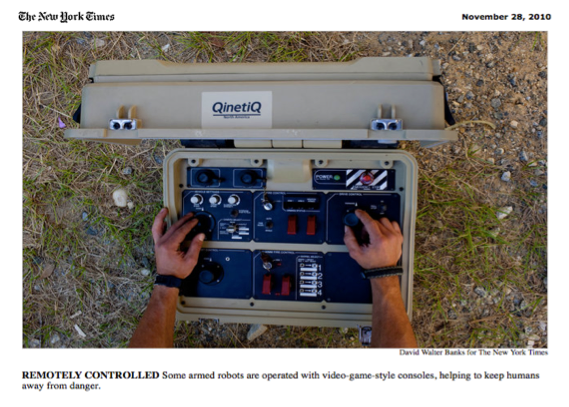
My work on drones has been invigorated by reading an outstandingly creative essay by Lucy Suchman on ‘Situational Awareness: deadly bioconvergence at the boundaries of bodies and machines’, forthcoming at the ever-interesting Mediatropes.  It’s sparked both an e-mail conversation and an invitation to speak at a symposium on Security by remote control: automation and autonomy in robot weapon systems at Lancaster University, 22-23 May.  Here is the call for papers:

Remotely operated and robotic systems are central to contemporary military operations. Robotic weapons can select targets and deliver lethal force with varying degrees of human control, and technologies for fully autonomous weapon systems are currently in development. Alongside military reconnaissance and the prospective configuration of ‘killer- robots,’ drone technologies are being deployed for ostensibly peaceful purposes, most notably surveillance of public space, private property and national borders. More generally, the frame offered by contemporary security discourses has redrawn previous boundaries regarding the use of state violence in the name of homeland protection. But despite an extended history of investment in technologies that promise to rationalise the conflict zone and accurately identify the imminent threat, the legitimacy and efficacy of actions taken in the name of security is increasingly in question.

The purpose of this symposium is to present and debate current scholarship on the ethics and legality of robotic systems in war and beyond. By robotic systems we mean networked devices with on-board algorithms that direct machine actions (in this case, tracking, targeting and deploying force) in varying configurations of pre-programmed operation and remote human control. The line between automation and autonomy has come under renewed debate in the context of contemporary developments in remotely controlled weapon systems, most prominently uninhabited aerial vehicles or drones. For 
example, in April of 2013 a coalition led by Human Rights Watch initiated a campaign in favour of a legally binding prohibition on the development, production and use of fully autonomous weapon systems. Simultaneously, some military and robotics experts emphasize the advantages of automated weapons and argue that equipping robots with the capacity to make ethical judgments is an achievable technological goal. Within these debates, the ‘human in the loop’ is posited alternately as the safeguard against illegitimate killing, or its source. Implicit across the debate is the premise of a moment of decision in which judgements of identification and appropriate response are made.

While emerging arms control strategies focus on the ‘red line’ that would prohibit the development and use of weapons that remove human judgment from the identification of targets and the decision to fire, the question remains to what extent human judgment and decision-making are already compromised by the intensifications of speed, and associated increase in forms and levels of automation, that characterise contemporary war-fighting, particularly in situations of remote control. Rather than attempting to establish one or the other of these concerns as correct, or even as more important than the other, we seek to focus our discussion on the troubling space between automation and autonomy, to understand more deeply their intimate relations, and the inherent contradictions that conjoin them.

To explore the key stakes and lines of argument in this debate, we invite contributions from scholars in the fields of security, peace and conflict studies, international human rights law, anthropology/sociology of science and technology, technoculture and technomilitarism, computing, simulation and cyber law. The ambition for this event is to stimulate ongoing cross-disciplinary discussion and further research on this topic, drawing on the resources of the Lancaster University centres that are its co-sponsors.

Confirmed Speakers:

Patrick Crogan, Senior Lecturer in Film Studies at the University of the West of England in Bristol, scholar of technoculture, videogames and military technoscience, author of Gameplay Mode: War, Simulation, and Technoculture (2011);

Derek Gregory, Peter Wall Distinguished Professor and Professor of Geography at the University of British Columbia in Vancouver, author of multiple works interrogating social and spatial dimensions of conflict, and currently completing a book titled The Everywhere War (forthcoming);

M. Shane Riza, command pilot and former instructor at the U.S. Air Force Weapons School, author of Killing Without Heart: Limits on Robotic Warfare in an Age of Persistent Conflict (2013);

Christiane Wilke, Associate Professor in Law and Legal Studies at Carleton University, Canada. She has been researching legal responses to state violence and is working on a project about visuality, photography, and international law.

To indicate your interest in participating, or for further information, please contact Lucy Suchman l.suchman@lancaster.ac.uk.

I’m really excited about this; I’m part way through Shane Riza’s book, and it’s already clear that I’m going to learn a lot from the meeting.

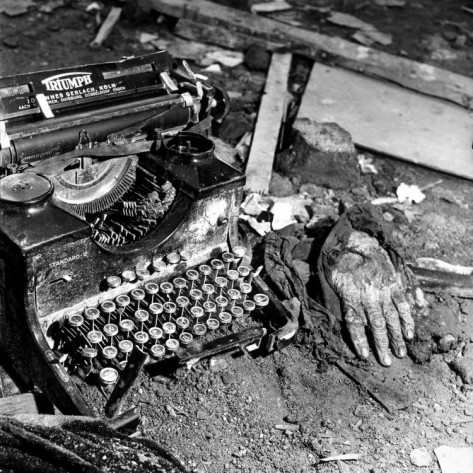
The image at the top of this post comes from the CFP, incidentally, but the image below is Margaret Bourke-White‘s classic photograph from the rubble of a bombed German city, which I use when I talk about the ways in which the trauma of air war dislocates the very sinews of language and the capacity to write and re-present (see ‘Doors in to nowhere’, an extended reflection on W.G. Sebald: DOWNLOADS tab).  Perhaps I’ll use my time at Lancaster (given the name, a peculiarly appropriate place) to join the dots between the two images and revisit ‘The natural history of destruction’ for the twenty-first century….

tumblr_m04iio5ICm1qbwvhpo1_500