St Noel of the Cameras

St Noel of the Cameras

News from Felix Driver of a fully-funded PhD studentship on the history of expeditionary film, directed by Felix and Catherine Souch, in conjunction with the RGS-IBG, the Royal Society and the British Film Institute:

Applications are welcome for a fully-funded AHRC PhD studentship on the history of expeditionary film, geographical science and media culture, available from September 2013 on a full-time or part-time basis. 
The project will investigate the production, distribution and presentation of films made on successive Everest expeditions between 1922 and 1953. Drawing on unique archival film collections held by the BFI, the Everest expedition archives and related collections such as The Times archives, the research will consider the logistical and technical requirements of expeditionary film, including the role of Sherpa porters in film-making; the role of media sponsorship in shaping the presentation of expedition work; and how film was shown, and to what audiences, within the context of popular and scientific understandings of mountaineering in the period. The research will also consider the wider significance and potential uses of the Everest film archive. This involves consideration of the role of key organizations, including the RGS and the BFI, in developing a community of interest around geographical film in the first half of the twentieth century. In addition to research in the unique Everest archives and in the associated BFI collection, the project will examine the potential of digital film in the context of public engagement and public memory.
Further details of the project, eligibility and applications process are available here and here.  The closing date for applications is 8 May 2013.
More information from Felix at f.driver@rhul.ac.uk
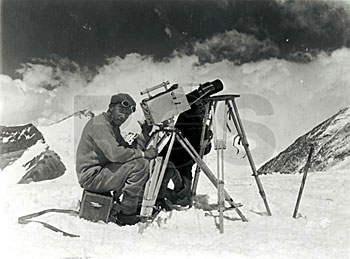
The image at the top (where else?!) shows Captain J.B. Noel, who was referred to as ‘St. Noel of the Cameras‘ by General Bruce, leader of the 1922 Everest Expedition. Noel photographed and filmed the 1922 and 1924 Everest Expeditions and can be seen here kinematographing the ascent of Mt Everest from the Chang La in 1922. I do hope somebody from Geography at Manchester reads the small print….
The natures of war

Natures of War

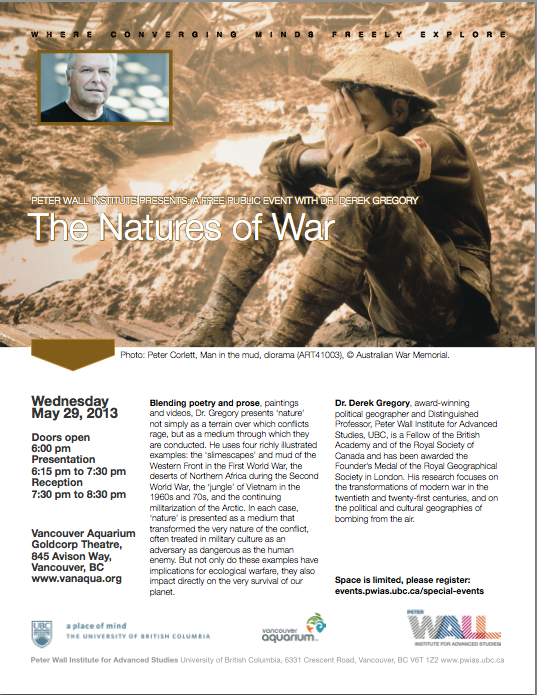
Just about to leave the High Atlas and Morocco, so something like normal service will resume once I’m back in London on Wednesday.  I’ve just received a near-final draft of the poster (above) for my Vancouver talk next month, “The natures of war“.  I’ll explain more of what I’m trying to work out in this presentation in a later post.  You’ll see that the venue is sort of appropriate – though I’ll leave my flippers at home.

More information and registration details here.

On the road – and off it

I’ll be travelling for the next several weeks so postings will probably be light until the end of the month. I’ll be spending most of my time in North Africa and Eastern Europe, with a stop-over at King’s College London for a seminar in Geography & War Studies (another outing for “Gabriel’s Map”, and I’m really looking forward to the discussion).

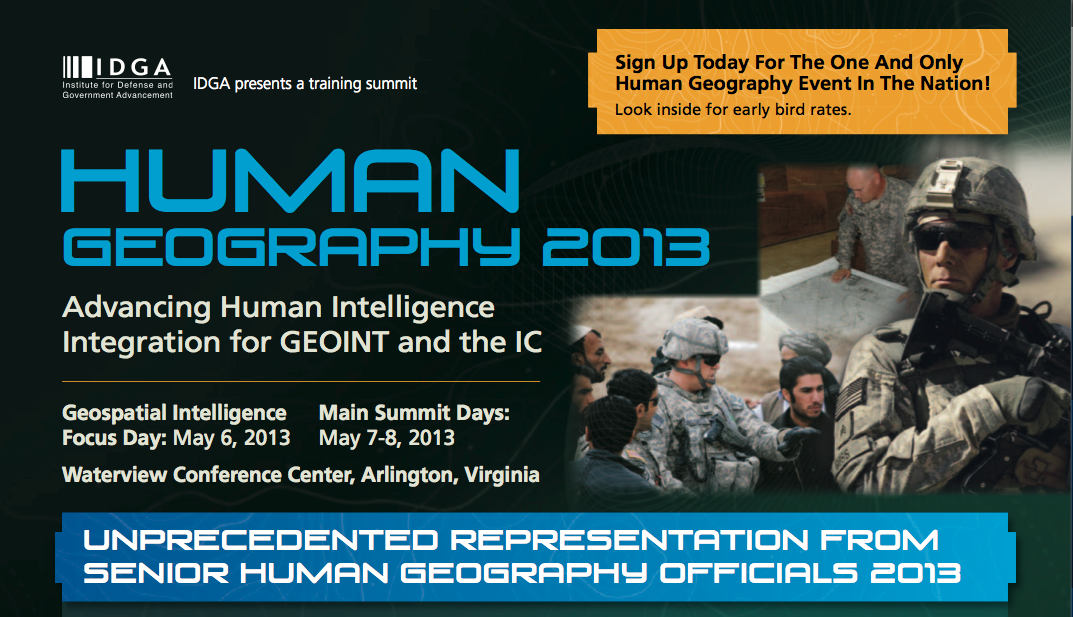
This means I’ll miss the Annual Meeting of the Association of American Geographers which starts today, but I thought readers would like to know about an event billed as “the one and only Human Geography event in the nation“… Really.  It takes place in Arlington, Virginia next month, and like its counterpart last year is organised by the Institute for Defense & Government Advancement.

IDGA Human Geography 2013:1

The letter of invitation from Tyler Baylis, IDGA’s Program Director, explains:

With an annual operating budget of $18 billion, DoD Military Intelligence programs have been instrumental in the war on terror. Human Geography has been at the forefront of these intelligence programs, often embodied in the Human Terrain Systems program which, with successful implementation, has recently increased from 22-31 operating teams in Afghanistan. In order for the US Military to operate in theatres where conventional warfare is not effective, Human Geography must be readily understood and utilized.

In advancing Human Geography, we must look too increased socio-cultural and language training to provide accurate and reliable data generated by on-the- ground research on the specific social groups in the supported unit’s operating environment. IDGA holds this event to service as a platform for you to learn about these areas through expert presentations from the CENTCOM, USMC Center for Irregular Warfare and the Air Force Culture and Language Center and as well as many other key players in the field.

Human Geography 2013 will deliver: • Unparalleled access to the latest SOCOM and Intelligence perspectives • Insights from former Human Terrain Analysts, and anecdotal success stories • Exclusive look into the future of Human Geography’s technological capabilities Plus, presentations and round table discussions will cover Human Terrain Systems, Big Data and Cloud Solutions, HUMINT and GEOINT, Advanced Socio-Cultural Training, Foreign Language Training, the Future of Human Geography in the Intelligence Community and more.

It’s an interesting and innovative time in the implementation of human geography into the Intelligence Community and Special Operations Warfare. Come participate in defining the future of the US military, and establish yourself in this exciting field at the only Human Geography event this year.

More information and the full brochure here.  For readers concerned at the escalating costs of conferences, an all-access pass for this three-day event comes in at $1, 498.

As I said last year, another meeting, and for the most part another geography.  But I do recognise one speaker, Alex Murphy, who is down to lead a session on ‘Using GEOINT for mapping and battlefield visualization’.

Retrograde logistics

In recent years much attention has been focused on the logistics of supplying the war in Afghanistan.  But now the reverse operation is gearing up, and (as anticipated) it’s no more straightforward.  Here’s Nate Rawlings for TIME:

For many good reasons, Afghanistan has been called a logistician’s nightmare. It is landlocked and far from a working port. Much of the country – especially in the east where a great deal of the fighting has taken place – is covered with mountains and threaded by decades-old roads and questionable bridges. The easiest way in and out of the country is a geopolitical minefield and the other two routes are three times as expensive.

And yet, for twelve years, logisticians have supplied troops with the equipment — large and small — necessary to fight a war. They have airdropped pallets of food and repair parts on remote bases, tossed “Speedballs” — body bags filled with ammunition and water — out of helicopters to troops under fire. And along the way, extra equipment has piled up at bases around Afghanistan. According to a December 2012 report to Congress by the by the Government Accountability Office, there is the equivalent of more than 90,000 twenty-foot containers of equipment all over Afghanistan. All together, there is $36 billion worth of vehicles, weapons systems, repair parts and utter junk scattered throughout the country, and bringing it home will cost an estimated $5.7 billion. 

(You can access a gallery of Yuri Kozyrev‘s photographs, all taken in late January this year, that accompany the essay here; some details of the corresponding British operation, including video, are available here).

Now AFP has confirmed that the current estimated cost of withdrawing US hardware and vehicles from Afghanistan – called a “retrograde” (sic) – will be $5–6 billion from 2012 through to 2014.  According to Brigadier General Steven Shapiro of 1st Theater Sustainment Command, a veteran of the withdrawal from Iraq, ‘the retrograde from Afghanistan is one of the most challenging military transportation operations in history in terms of scale and complexity.’  It’s certainly more difficult than Iraq, when equipment was simply trucked across the border to Kuwait ‘where it was packed, cleaned, recorded and shipped on’ within a stable security envelope.  Brigadier General Lee K. Levy explains: ‘If you think Iraq was difficult, I would call that getting your bachelor’s degree in logistics. Withdrawing from Afghanistan is getting your PhD in logistics and we are writing our thesis as we speak.’

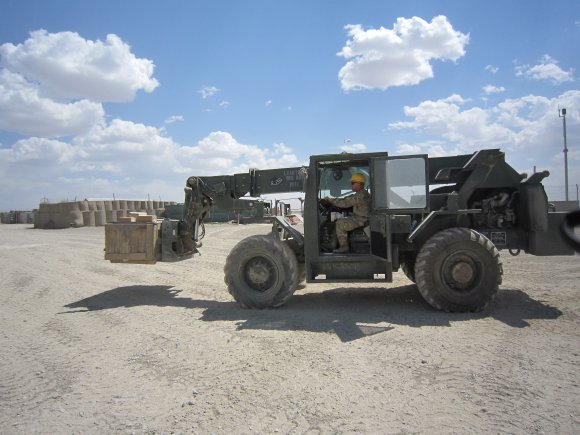
1st Infantry Division's retrograde yard at FOB Sharana, Afghanistan

In Afghanistan the most sensitive equipment will again be sent to Kuwait, though this time the US will be forced to use giant C-17 transport planes.  Some of the remaining gear will be sold (but the opportunities in Afghanistan are likely to be less than they were in Iraq, when some $1 billion of equipment were sold off or simply given to the Iraqi military) or even destroyed.  The process requires a labour-intensive inventory, selection and strip-down – you can get an idea of what’s involved in this short video from Bagram – and even then a vast amount will remain to be shipped out.

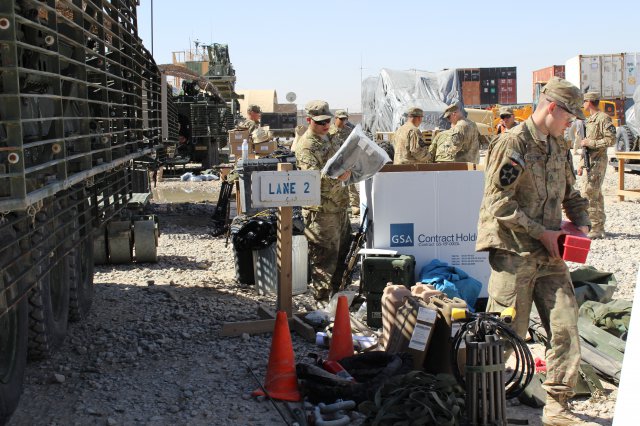
Soldiers inventory Stryker combat vehicle for retrograde, Kandahar, March 2013 (Sharonda Pearson)

The Wall Street Journal reports that the operation began in earnest last month, when a trial convoy of 20 military vehicles and more than 70 containers of military hardware was trucked through Pakistan and shipped out from Karachi.  According to the Journal,

The military says it now plans to move a combined total of around 100 containers and vehicles per week through Pakistan, a figure that is going to increase gradually over the coming weeks.

When the exodus is in full swing — military commanders expect the logistics push to reach its peak this August — the U.S. will be sending about 1,500 military vehicles and 1,000 containers per month out of Afghanistan. The majority — around two-thirds of that cargo — will move through Pakistan, military officials say.

Shapiro was bullish about the operation – the US Army has made no secret that what it calls the Pakistan Ground Lines of Communication are critical to the success of the retrograde –  and he claimed to be ‘very confident  that the Pakistani military is going to help us move through Pakistan.’  But it remains to be seen whether the outbound supply chain will be any more secure than the inbound one was:  today five NATO trucks en route for Karachi were torched and more or less completely destroyed 120 km. south east of Quetta.

Dignity and destruction in Gaza

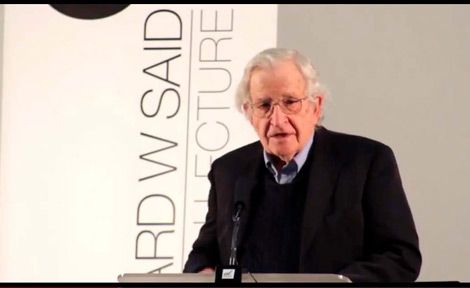
Noam Chomsky delivering the 2013 Edward Said Memorial Lecture

Edward Said died ten years ago in September, and earlier this month Noam Chomsky delivered the 2013 Edward Said Memorial Lecture in London: Violence and dignity: reflections on the Middle East.  The text that formed the basis for the lecture is here, and you can watch a video of the lecture here with introductions by Omar Al Qattan and Mariam Said.

It’s a wide-ranging lecture, but Chomsky returns again and again to the plight of the people of Gaza – and to the disgraceful actions of all those (inside Israel and out) who would rob them of their dignity, their independence and even their life.

Throughout these years Gaza has been a showcase for violence of every imaginable kind. The record includes such sadistic and carefully planned atrocities as Operation Cast Lead — “infanticide,” as it was called by the remarkable Norwegian physician Mads Gilbert who worked tirelessly at Gaza’s al-Shifa hospital with his dedicated Palestinian and Norwegian colleagues right through the criminal assault — a fair term, considering the hundreds of children massacred. And from there the violence ranges through just about every kind of cruelty that humans have used their higher mental faculties to devise, up to the pain of exile that Edward Said wrote about so eloquently. This is particularly stark in Gaza, where older people can still look across the border towards the homes a few miles away from which they were driven — or could if they were able to approach the border without being killed. One form of punishment has been to close off the Gaza side of the border area, including almost half the arable land, according to the leading academic scholar of Gaza, Harvard’s Sara Roy.

While a showcase for the human capacity for violence, Gaza is also an inspiring exemplar of the demand for dignity. The first phrase one hears in Gaza when asking about personal aspirations is for a life of dignity. The distinguished human rights lawyer Raji Sourani writes from his Gaza home that “What has to be kept in mind is that the occupation and the absolute closure is an ongoing attack on the human dignity of the people in Gaza in particular and all Palestinians generally. It is systematic degradation, humiliation, isolation and fragmentation of the Palestinian people.” While the bombs were once again raining down on defenseless civilians in Gaza last November he repeated that “We demand justice and accountability. We dream of a normal life, in freedom and dignity.”

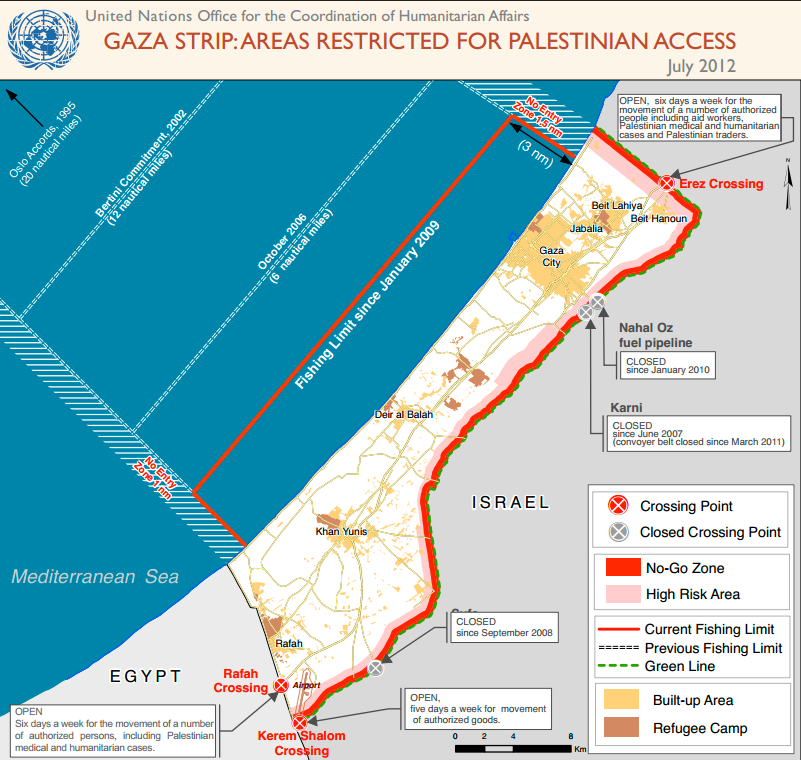
Gaza Strip restrictions

Last fall the brilliant Sara Roy gave another Said Memorial Lecture, this time at the Palestine Center in Washington DC, A deliberate cruelty: rendering Gaza unviable.  She spoke of Edward’s commitment to Gaza and its people:

Edward and I would always speak about Gaza, in fact every time we met. He felt a profound connection to the place and to the people that seemed to be a permanent part of him. Edward had great compassion and great respect for Gaza’s people. He embraced their suffering and took pride in their courage, in the dignified way they continued to move forward. Yet he feared one thing perhaps most of all: the separation and isolation that now engulfs Gaza and threatens, if it hasn’t already, to sever the Palestinians there from Palestinians elsewhere, forcing them, in the words of Hannah Arendt, to “live outside the common world,” deprived of profession and of citizenship, “without a deed by which to identify or specify [themselves].”

Edward raged against the division of his people and against the kind of loss that such division could bring: disunity, abandonment, irrelevance. In The Origins of Totalitarianism, Arendt argues that the fundamental deprivation of human rights is expressed first and most powerfully in “the deprivation of a place in the world which makes opinions significant and actions effective. Something much more fundamental than freedom and justice… is at stake when belonging to the community into which one is born is no longer a matter of course and not belonging no longer a matter of choice…” “This extremity and nothing else,” she writes, “is the situation of people deprived of human rights. They are deprived not of the right to freedom but of the right to action.” “Over the last 45 years Gaza’s trajectory has been striking; from a territory economically integrated into, and deeply dependent upon, Israel and deeply tied to the West Bank, to an area largely marginalized from Israel and the West Bank, an isolated (and disposable) enclave – subject to consistent military attacks – with which Israel and the West Bank have fewer formal economic or political ties than they once did. And from a captive economy restricted to fluctuating levels of growth (at best) but still possessed of the capacity to produce and innovate (within limitations), to an economy increasingly deprived of that capacity, characterized by unprecedented levels of unemployment and impoverishment, with three-quarters of its population needing humanitarian assistance. These damaging transformations among others I shall discuss are becoming increasingly institutionalized and permanent, shaping a future that is both partial and disfigured. What is happening to Gaza is, in my view, catastrophic; it is also deliberate, considered and purposeful.

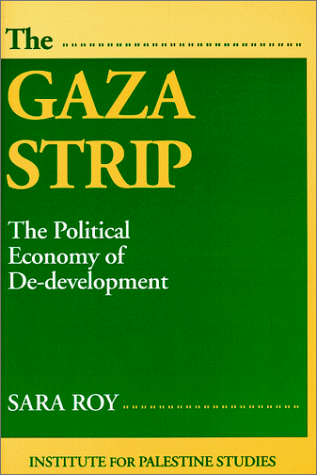
ROY Gaza StripHer lecture is spell-binding –though I hope that once and for all it breaks the spell of Israel’s ‘withdrawal’ from Gaza.  The map above comes from a UN report, Gaza in 2020: a liveable place? that is summarised here, and the text and a video of Sara’s lecture are available here and here.  The text will form part of Sara’s introduction to a new edition of The Gaza Strip: the Political Economy of De-development.

Marc Ellis provides a wonderful summary of and meditation on Sara’s passionately analytical lecture at Mondoweiss here, and you can access Sara’s A Land Diminished: reflections on Gaza’s landscape (2011) here (it also appears as a chapter in an important collection from the Ibrahim Abu-Lughod Institute of International Studies at Birzeit University, Gaza, Palestine: Out of the margins, which is available here).

Dronesong

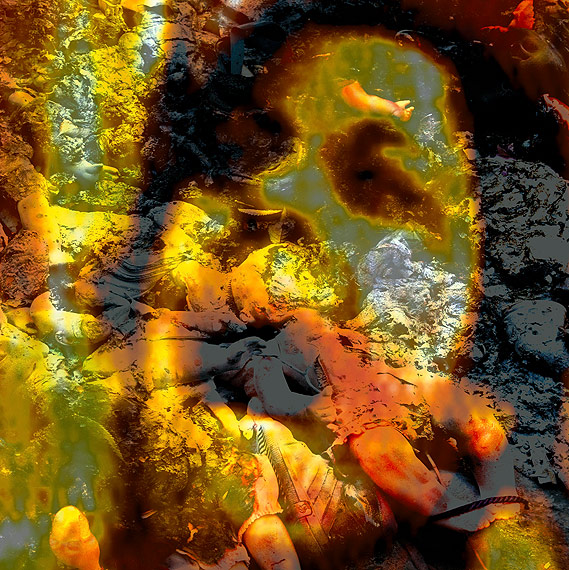
shawa-cast-lead‘In 1990,’ Palestinian pop-artist Laila Shawa recalls, ‘I had breast cancer.’

While undergoing radiotherapy, I watched on television the precision bombing of Baghdad by US airplanes, forever linking the two events in my mind and in my art. The body woman and the body land amalgamate; the invasion of one is equated with the invasion of the other and the implicit fact that both leave scars.”

Jo Long made a parallel, beautifully nuanced argument in her ‘Border Anxiety’ essay in Antipode in 2006, but you can literally see what Laila Shaw means in the extraordinary Cast Lead (2011; above left).

Laila is probably still best known for her silkscreen cycle Walls of Gaza (1992-95)a different take on graffiti to most geographers’, since she insists that the situation was unique:

I believe the Gaza Graffiti differs completely from urban graffiti that one sees in big cities around the world. In Gaza, graffiti on the wall was the only method available to Palestinians to communicate with each other. The Israeli occupiers banned any form of media in Gaza, such as newspapers, radio, or television. The writing is cursive, spontaneous and hurried. It changed almost daily to update whatever was happening in Gaza.

In the Walls cycle she juxtaposed images of Palestinian children and graffiti from Gaza to expose the trauma of war and occupation, a theme to which she returned in Target (2009), a variation on an iconic panel from Walls, in which a photograph of a young child is superimposed against a graffiti-covered wall with a cross-hair centred on his face.  ‘War deprives children of their childhood,’ she says.

Much of her work depends on mixed media juxtapositions like this, which she mobilizes to brilliant effect. She explains:

‘Today, when we are desensitized by the surfeit of media violence, new strategies are needed to overcome people’s apathy and weariness for compassion.’

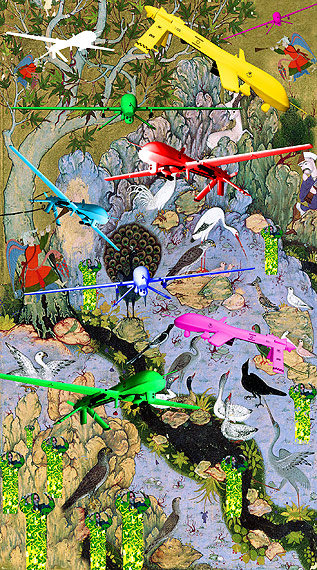
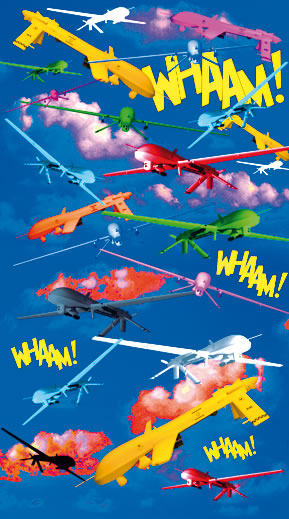
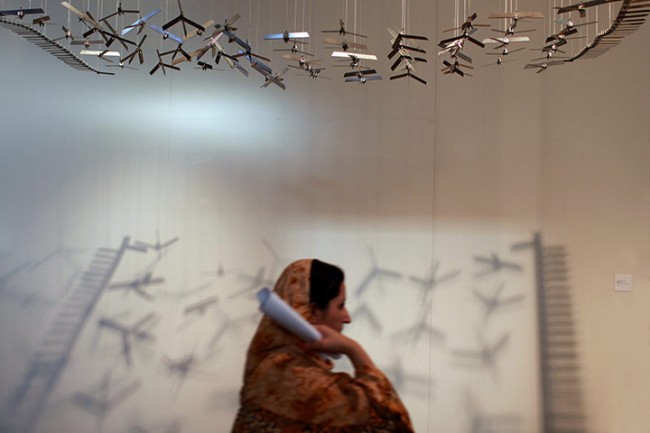
Last year she had an exhibition at London’s October Gallery, The Other Side of Paradise, which was in part provoked by a documentary on a female suicide bomber but which also included the extraordinary images shown below, Birds of Paradise and Gaza Sky, which speak directly to my previous post about other ways of visualizing drones.

SHAWA Birds of Paradise

SHAWA Gaza Sky

Laila was born in Gaza, but Gaza Sky strikes me as problematic; Israel doesn’t use Predators, so far as I know, but manufactures its own Heron drones and leases/sells them to other states.  Still, the image captures occupied Palestine since – for me – the reference isn’t only to Roy Lichtenstein‘s Whaam but also to Mahmoud Darwish‘s moving poem The earth is closing on us (which Edward Said used for his collaboration with Jean Mohr, After the last sky):

Where should we go after the last border? Where should the birds fly after the last sky?

I’m left wondering about how to draw together my first and last paragraphs – how to bring these ‘birds’ and the bodies on which they feed into the same frame.  This isn’t a compositional problem for my writing; it’s a political-aesthetic one.  So I start to think about Laila’s Target again.  For The social life of bombs, I plan to end the performance-work with a back-projected image of three children asleep under a checkered counterpane; all you you can hear is the rhythmic sound of their breathing.  As the camera moves in, it becomes clear that each checkered square is in motion; the sound gets louder.  Closer still, and each square becomes a video feed from a drone. Closer still, and one square fills the whole screen: the compound in which the children are sleeping, seen from high above (and far away).  By now the sound of breathing is incredibly loud; suddenly, an even louder explosion.  When the smoke clears, the sound dies away, and the lights slowly come up, we see three small figures, clutching the remains of their bedding – a re-staging and reworking of Noor Behram‘s to me iconic photograph of the three Bismullah children, the sole survivors of a drone strike in Waziristan.  But it could, of course, be Gaza.  Or Yemen.  Or Somalia…

Drone imaginaries

While everyone’s attention this week seems to have been captured by Pitch Interactive’s remarkable graphic of US drone strikes in Pakistan, Out of sight, Out of mindElspeth Van Veeren provides a timely reminder that there are other ways to visualise done warfare – all the more important given the central role that visual feeds play in the ‘dwell-detect-destroy’ assemblage.

2In a succinct and helpful online review she brings together several of the art projects I’ve written about in previous posts, including Omar Fast‘s video Five Thousand Feet Is The Best, Noor Behram‘s photographs from Waziristan and James Bridle‘s Dronestagram, and provides a suggestive argument about the visual politics involved:

If drones are to be understood and debated, we need to pay attention to the ways in which visual politics plays into these debates. How are drones visualized? How are the politics of drone warfare made sensible? Drones as things enter into our world through the ways in which they are talked about, but also the way they are represented, repeated and circulated. They become objects and images through which we think. Their different perspectives – drone thing, drone vision, dronestream, and droneshadow – offer different and in some ways competing imaginaries of drones…. 

 Paying closer attention to these visual practices, to the sensible politics of drone warfare, offers a way to think through the many ways in which security and insecurity are produced. These drone imaginaries make drones visible and sensible, and in so doing they also tune us into the different people and identities that are connected with this technology. Imagining a drone also means imagining a viewpoint and there is more than one way to imagine a drone.

You can find other examples here – from which I’ve borrowed the image above – and in Craig Jones‘s post here.

Elspeth develops her argument about visualization and politics  in depth and detail in a paper she is presenting in a panel on Visualizing insecurity at the ISA Convention in San Francisco next month, ‘Drone imaginaries: There is more than one way to imagine a drone’, and you can download a working draft here (registration required).  She also has a book in the works from Routledge, Security collisions.

Exceptions R Us

tumblr_mkc2q1MRtU1s9d11ko1_250Alex Vasudevan writes to alert me to this all-too-relevant site, Agamben Toys or Toys for the State of Exception

Most of the baubles on offer are decidedly for play in the global North, but for older kids with global (in)sensibilities there’s always this model Predator…. and plenty more like it (for example here and here).  Commentary – and comments (you’ll see what I mean) – here and (from Infowars) here.

Toys appeared in a radically different way in an exhibition at the University of Michigan’s College of Literature, Science and the Arts (LSA) earlier this year called State of Exception:

166510_475567315838743_1025941788_nLSA Professor of Anthropology Jason De León has spent long hours in the Sonoran environs, cataloging and collecting the items migrants leave behind as they attempt to cross into the United States. Water jugs. Shoes. Small kids’ toys. It looks like trash, but these objects, collected through his Undocumented Migrant Project (UMP), become data to help construct a record of people who are unknown, whose journeys rarely come to light.

Many of these objects are now on display through LSA’s Institute for the Humanities exhibit titled State of Exception. This exhibit considers the complexity and ambiguity of the found objects and what they may or may not reveal in terms of transition, human experience, culture, violence, and accountability.

This is the first major curation of De León’s work since UMP began in 2009, and is a combination of objects, installation, and video shot by photographer Richard Barnes along the U.S./Mexico border.

The exhibition closed earlier this month but you can still access the catalogue/brochure online here.

All of this reminds me that there’s a reason we spell ‘us’ the way we do…

Watching the drones

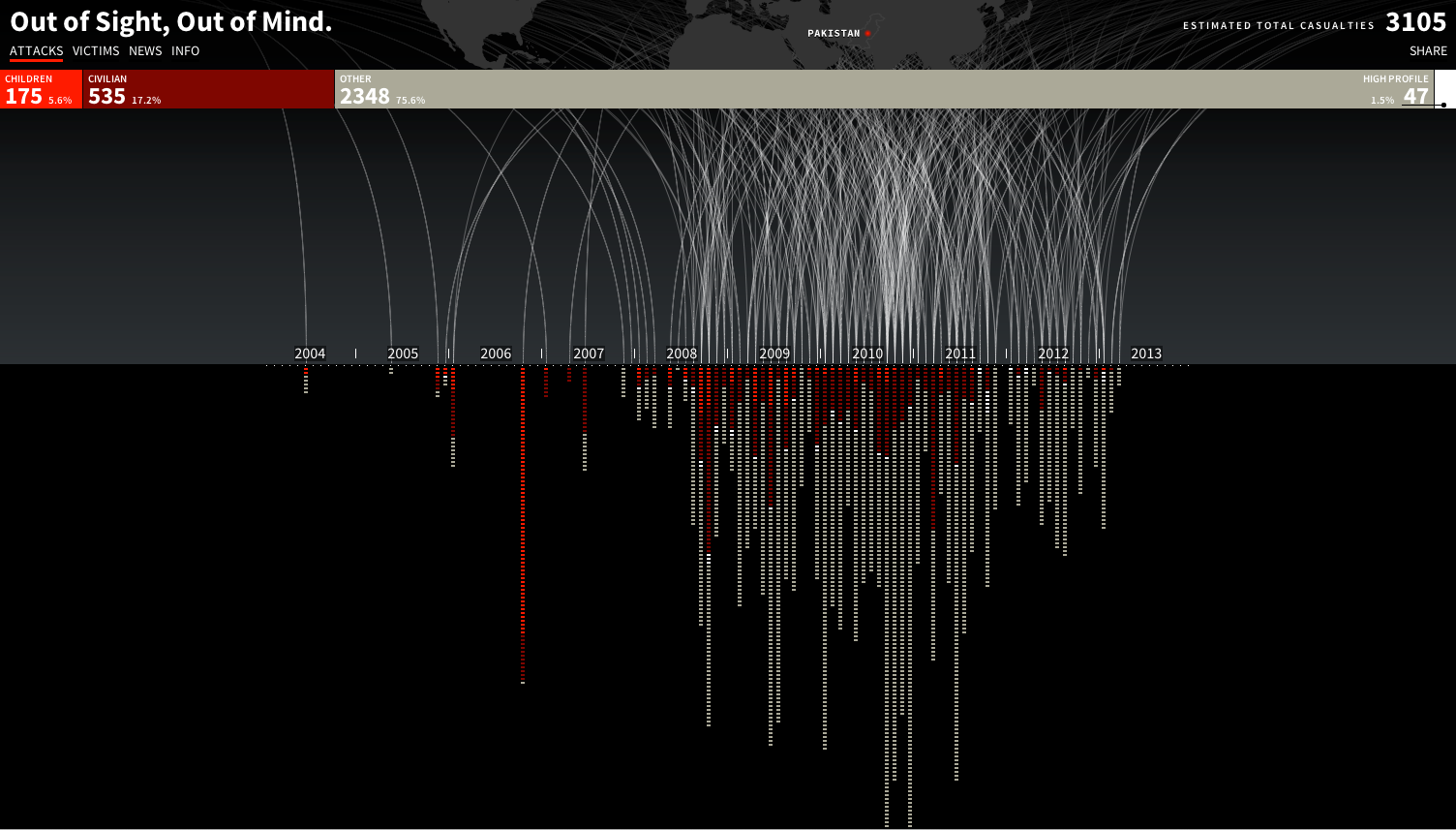
An interesting interview over at the Huffington Post with Wesley Grubbs, one of the visual designers at Berkeley-based Pitch Interactive responsible for the infographic of drone strikes in Pakistan that was released on Monday and has since gone viral.  I drew attention to it in my discussion of the geography of those strikes, but that dimension doesn’t appear in this otherwise compelling infographic (screenshot below).  The project is called Out of Sight, Out of Mind which certainly speaks to the politics of drone warfare but it’s also out of site, and the geography of these strikes, as I tried to show, is not incidental to those politics.

Drone strikes in Pakistan PITCH INTERACTIVE

I think that the political-aesthetic effect of this visualization – which is considerable, otherwise why so much attention? The numbers aren’t new to anyone who’s followed the Bureau of Investigative Journalism‘s painstaking work –  is bound up less with the raw numbers and more with those silver-grey arcs of light falling to the ground line: it’s a much more sobering (and I dare say thrilling) effect than a lifeless (sic) table.  As I watch them descend, I’m drawn back to images of much earlier bombings, and the lights exploding against a velvet sky.  And a visualization is doubly appropriate to a weapon that depends so much on visual apprehension – full-motion video feeds – and yet whose operation in the borderlands is shrouded in such semi-secrecy.  Grubbs told the Bureau that their intention was ‘to cause people to pause for a moment and say “Wow I’ve never seen this in that light before”.’

The site is live  – it will be updated in real time – and the same design group is intent on developing similar visualizations for drone strikes in Yemen and Somalia.

The Bureau’s work, the primary basis for the interactive, is so careful and considered that this attempt to downplay and even dismiss Pitch Interactive’s project is either simply ignorant or just plain silly.  The author objects that the numbers ‘aren’t exact’ and wants to see the full spreadsheet – but the Bureau has made its detailed databases available and discussed their limitations in depth and detail: what better (‘exact’) sources does she have in mind?  Perhaps she should try here.

I’m not sure that this is much better.  Its author concludes: ‘Put simply, the visualization is implying that of 3,105 drone-strike casualties, only 47 are known to be legitimate kills. This is nonsense.’ Actually, what is nonsense is to misread and mis-represent the infographic in this way; what the website clearly says is that less than 2 per cent of the victims (a total of 47 people) have been ‘high profile targets’ (the original object of Sylvan Magnolia, the code-name for the covert war).

Not incidentally, less than twenty per cent of those killed in the strikes have been named, and the Bureau has just released a short video to crowd-source funding so that their raw numbers are finally turned into names:

You can donate here.

Critical War Studies

A CFP from Shane Brighton, via Tarak Barkawi, for a workshop on Critical War Studies to be held at the University of Sussex on 11 September 2013:

Critical War Studies: emerging field, developing agendas

 What is left out when critical reflection on armed conflict is conducted under the sign of ‘security’?  What happens to ‘war’ itself in critical scholarship? What are the forms of contemporary militarism? How can the discourses and practices of fighting, transition to ‘peace’, war preparation and military and strategic thought be engaged reflexively? How might militaries be understood as sites of subaltern labour, resistance and critique? How can attentiveness to experiences of war generate critical resources within international relations, sociology, geography, anthropology, history and other disciplines?
 
 Multi-disciplinary proposals – initially an abstract or position statement – are invited for a one–day workshop convened by the University of Sussex Centre for Conflict and Security Research. The organisers welcome contributions engaging the idea of Critical War Studies, the themes outlined above and below, or suggesting other appropriate topics. It is envisaged that this will be the first of several events leading to opportunities for peer-reviewed publication.
 SCSR
Here’s the preliminary outline:
Panel 1: What is ‘Critical War Studies’?  
  • What’s in a name? ‘War’, ‘security’ and the analytical status of fighting
  • Critical approaches within strategic theory: who is strategy ‘for’?
  • Theory and the experience of war
  • War in/and society
Panel 2: Political Sociologies of fighting
  • Technologies, transformations of war, transformations of self
  • Subaltern military labour and military history in Europe and beyond
  • Battle narrative and identity
  • Gendering war
  • ‘Normality’ and ‘extremity’ in fighting and dying
Panel 3: Contemporary militarisms, contemporary militaries
  • Ideology contra experience: reflections on the policy/ practice disconnect in the war on terror
  • Beyond the strategic studies/ peace studies divide: continuity and change in militarism after the Cold War
  • The social construction of weapons
  • Military orientalisms and the representation of violence
Queries should be directed to Joanna Wood at  j.c.wood@sussex.ac.uk
It should be an excellent event; the SCSR has lots of lively people associated with its work.  And presumably there’ll be room for an equally lively discussion of the privatisation of war…