Dirty dancing and spaces of exception in Pakistan

Following up my post on the air campaigns waged by the United States and by Pakistan inside the Federally Administered Tribal Territories and the North-West Frontier Province (now Khyber Pakhtunkhwa), here are some screenshots from Chris Herwig‘s remarkable cartographic animation of casualties from US drone strikes from 2004 through to the present (data from the Bureau of Investigative Journalism):
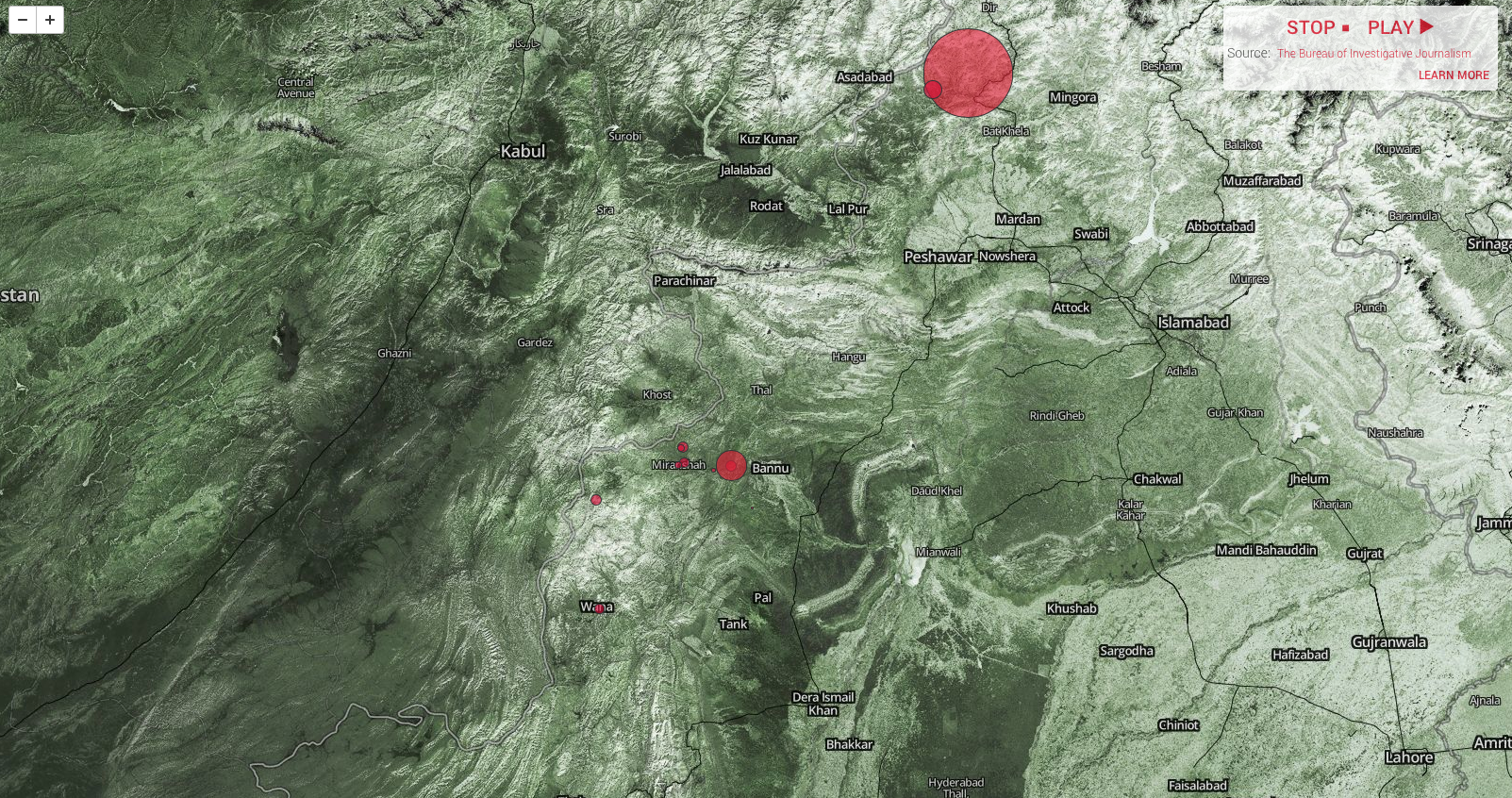
Casualties from US drone strikes to end December 2007
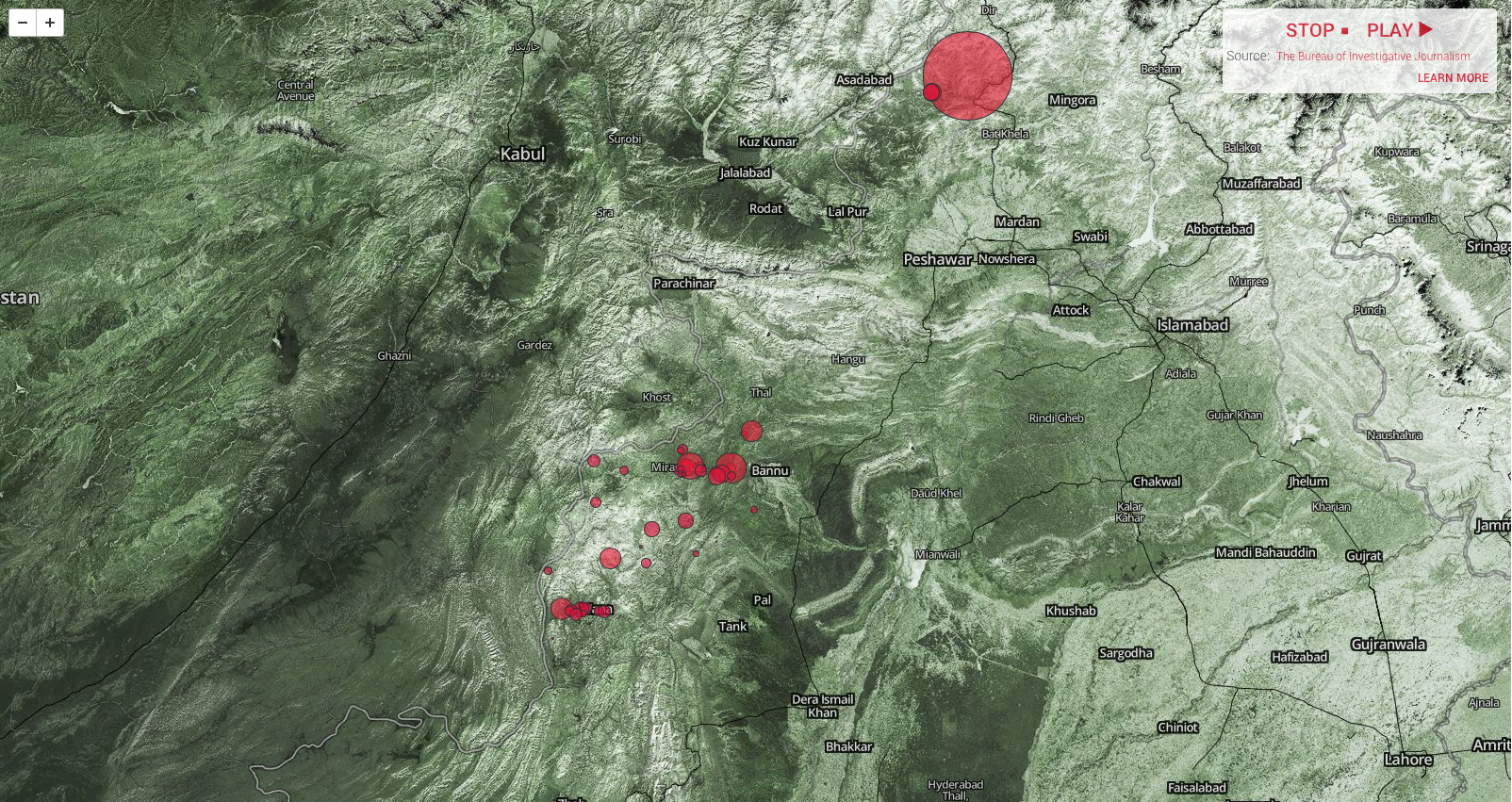
Casualties from US drone strikes to end December 2007

Casualties from US drone strikes to end December 2008
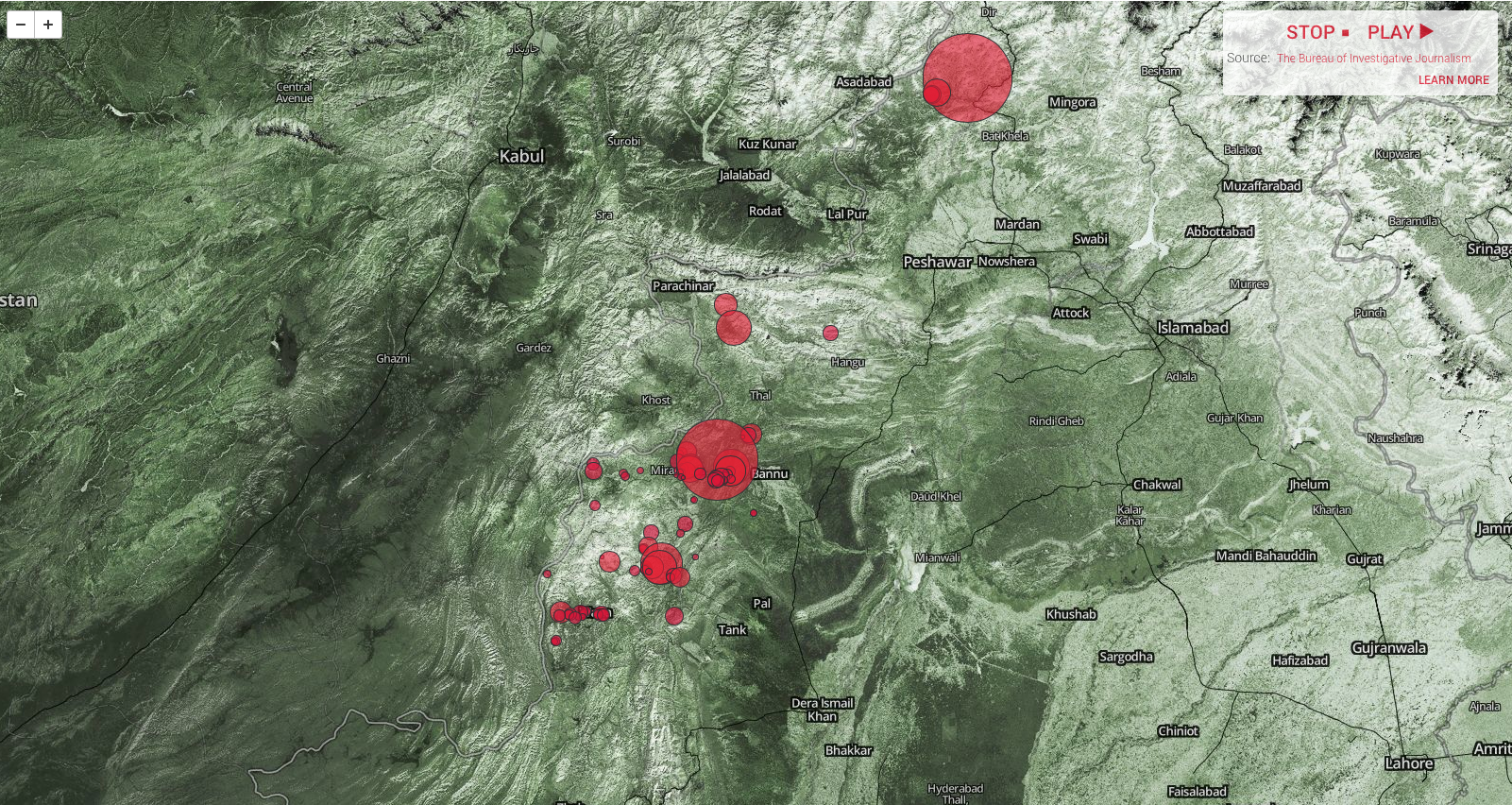
Casualties from US drone strikes to end December 2008

Casualties from US drone strikes to end December 2009
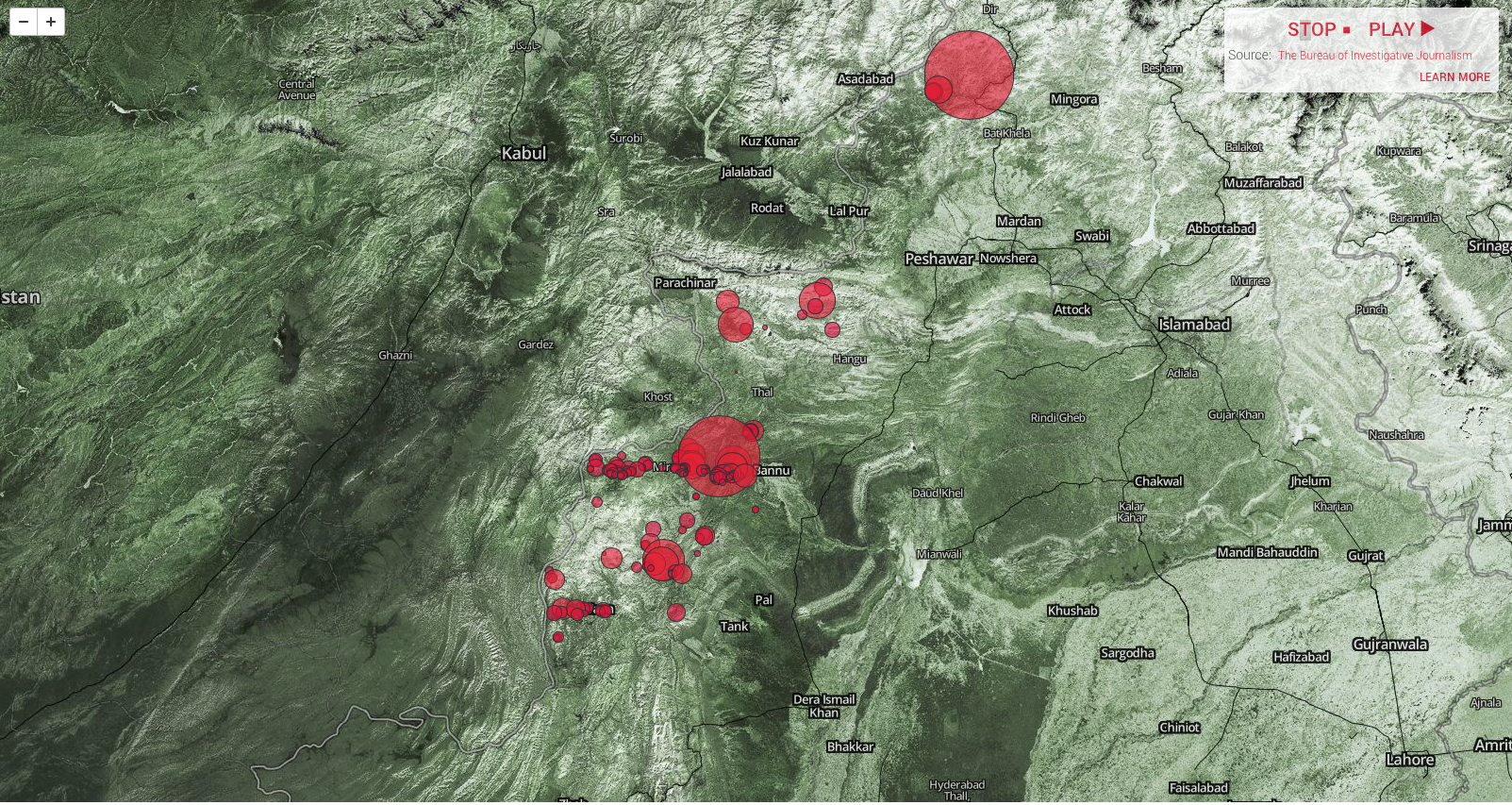
Casualties from US drone strikes to end December 2009

Casualties from US drone strikes to end December 2010
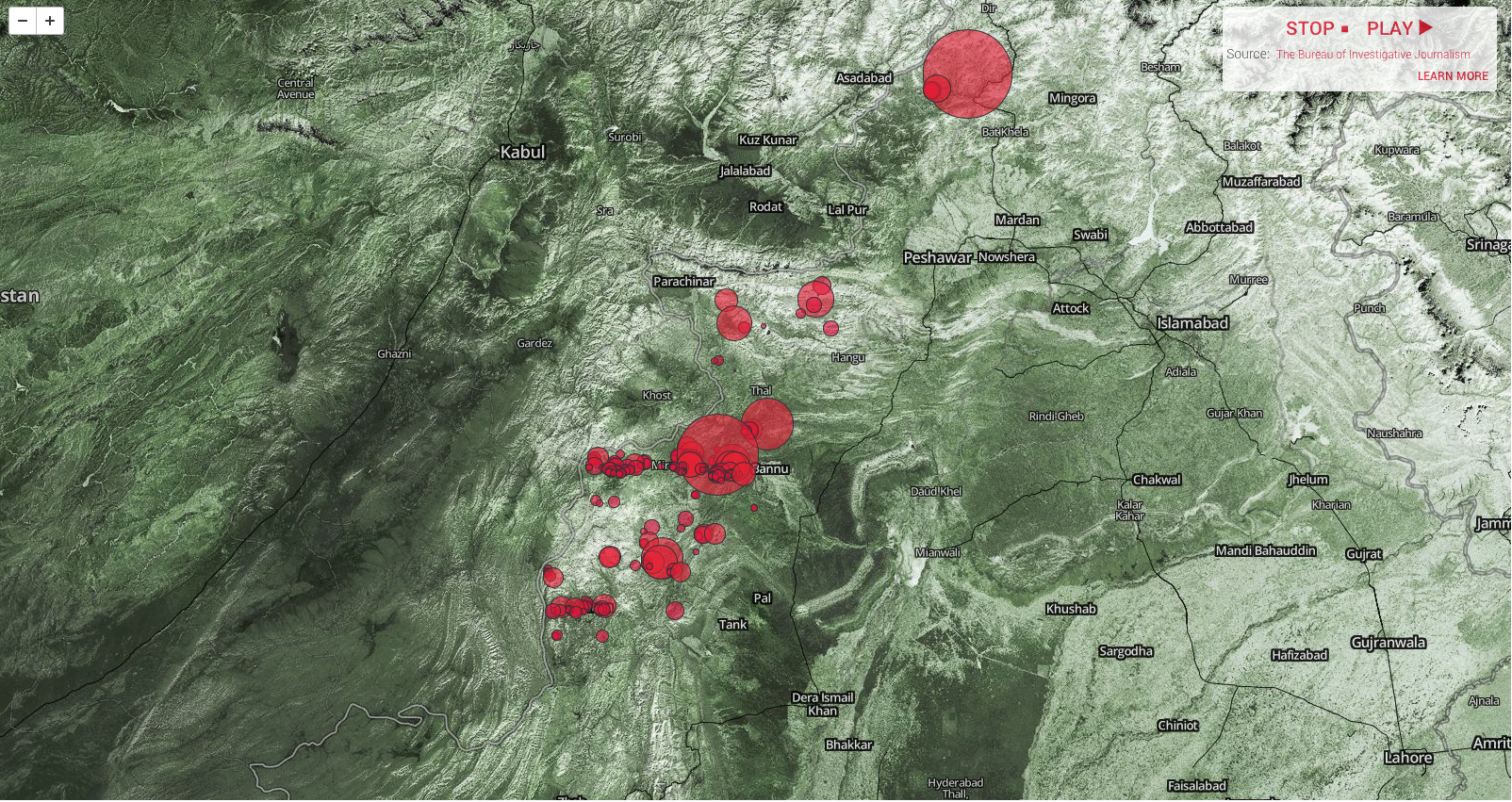
Casualties from US drone strikes to end December 2010

Casualties from US drone strikes to end December 2011
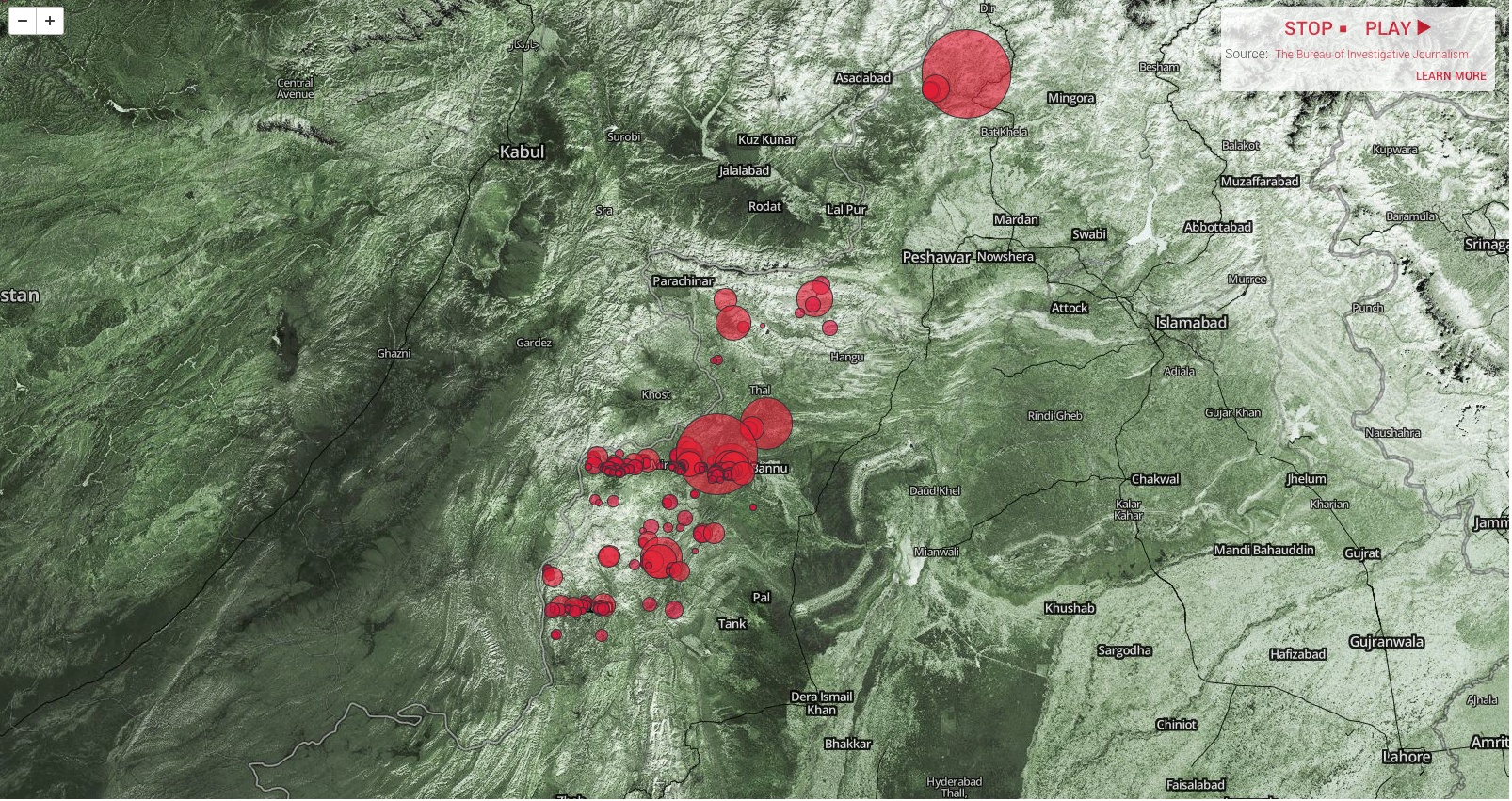
Casualties from US drone strikes to end December 2011

Casualties from US drone strikes to end December 2012

Casualties from US drone strikes to end December 2012

You can see the rapid escalation of strikes in 2009-2010 and their contraction in 2011-2012.  There is also a tendency for later strikes to cause fewer casualties; the Bureau suggests that this may have been the result of a deliberate decision to limit civilian casualties (the CIA was already reported to be using new, smaller missiles with a restricted blast field and minimal shrapnel by the spring of 2010, so the later change is likely to be down to a mix of better intelligence and greater circumspection) and, more recently, of a switch away from ‘signature strikes’ – the two are of course related – and John Brennan, who was one of the main boosters of the programme’s expansion, now claims that drone strikes are a weapon ‘of last resort’.  Maybe; most sources agree that even as the numbers of deaths dwindled, so too did their tactical significance.  By February 2011 it was clear that fewer and fewer were so-called ‘high-value targets’ and more and more were simply foot-soldiers.

Here are the Bureau’s raw figures:
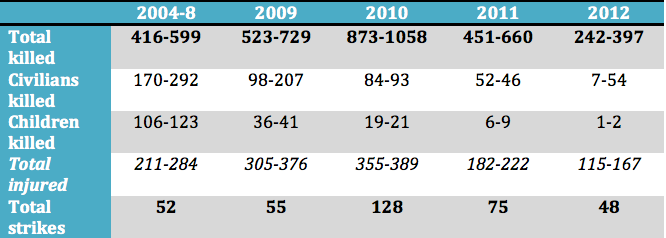
Drone strikes in Pakistan (BoJ)

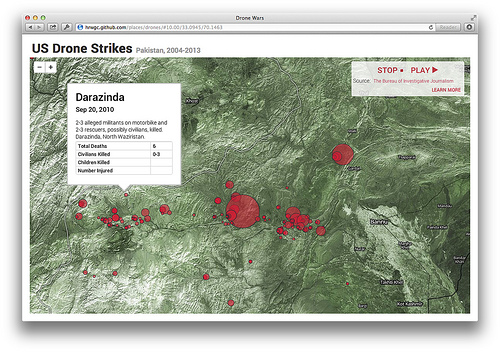
You can find an interactive animation of the Bureau’s tabulations from Pitch Interactive here (thanks to Steve Legg for the tip); the screenshot below doesn’t do justice to the political-aesthetic effect of seeing this in full motion (or of clicking on each strike for the details):
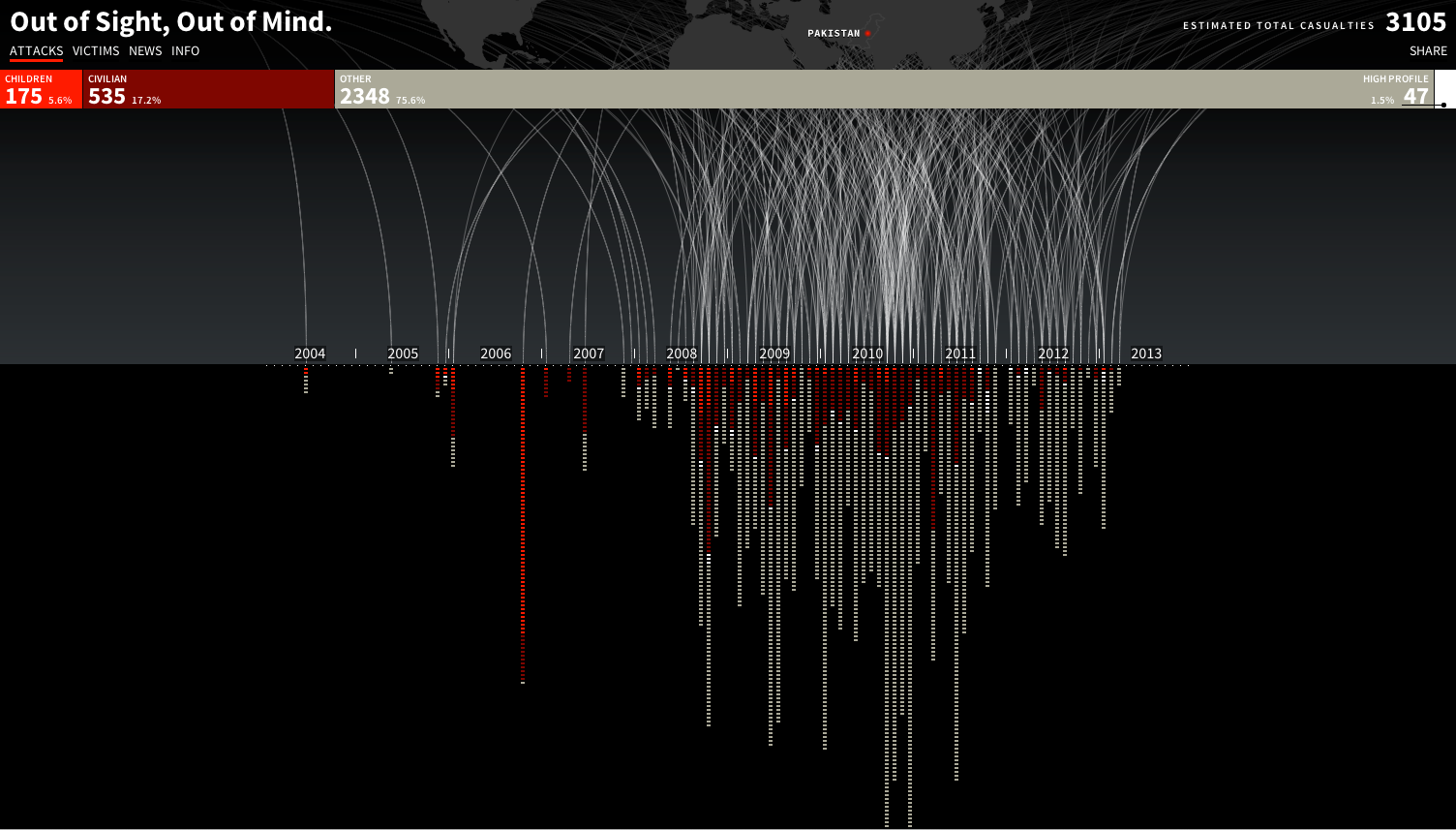
Drone strikes in Pakistan PITCH INTERACTIVE

The maps also show that the strikes have been concentrated on North Waziristan, increasingly so since 2010, the locus of the Haqqani Network (which is a longstanding ally of Pakistan’s Inter Services Intelligence), with a secondary concentration on South Waziristan (a key locus of Tehrik-i-Taliban).  Here’s a tabulation from the Long War Journal, and although the strike numbers are marginally different from the Bureau’s the geographical concentration is clear:
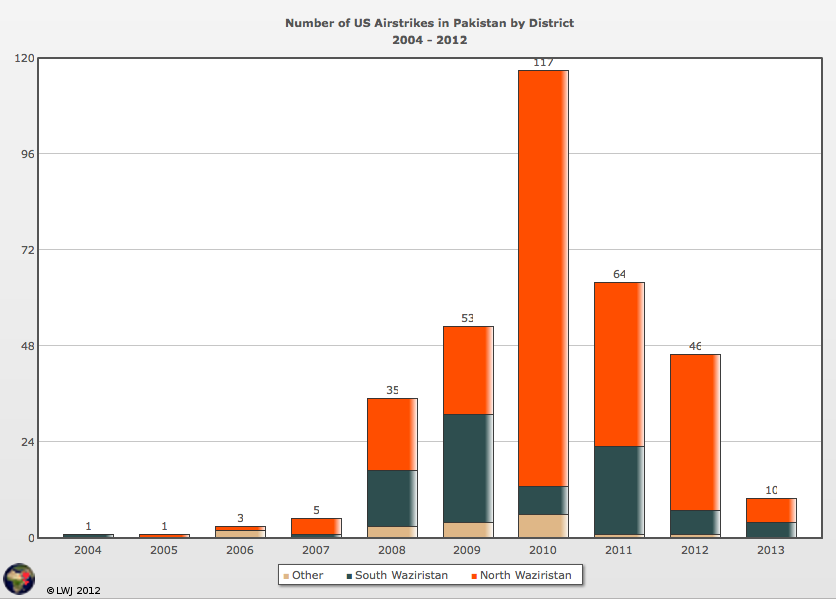
US air strikes in FATA by district

What the maps can’t convey is the intricate, inconstant gavotte between Pakistan’s various military campaigns and US air strikes in the borderlands since 2004.  In the wake of 9/11 and the US-led invasion of Afghanistan, and in response to increasing pressure from Washington, the Pakistan Army launched a number of offensives against militants in the Federally Administered Tribal Areas (FATA).  In April 2004, after fierce fighting in the mountains of South Waziristan, Islamabad concluded a peace accord with Nek Muhammad, a key militant leader in the agency.  But he was killed just two months later, the first casualty of a US drone strike in Pakistan, and the agreement immediately collapsed.   In 2005 similar, fragile agreements were negotiated with Baitullah Mehsud, Nek’s successor, and other militant leaders, but these were soon broken.  Accords were also signed in North Waziristan in 2006 and 2007 but these too were short-lived.  In 2008 a peace accord was signed with the Tehrik-i-Taliban but heavy fighting continued, with major ground and air operations in the agencies to the north of the Khyber Pass.  In 2009 Pakistan’s military campaign became even more aggressive. Much of its effort was focused on the northern districts, especially around the Swat Valley, but attention then switched back to South Waziristan.  During the summer the Pakistan Air Force carried out regular air strikes in the region; in August 2009 Baitullah Mehsud was killed in a US drone strike.  In October 30,000 ground troops entered the region, and US drone strikes in South Waziristan immediately juddered to a (temporary) halt.  These operations drove large numbers of militants into Orakzai, which in recent years has been a major target of air strikes by the Pakistan Air Force.

The previous paragraph is little more than a caricature of a highly complex and evolving battlespace, but the gavotte I’ve described has been artfully – if intermittently – choreographed by the US and by Pakistan in fraught concert: so much so that Joshua Foust writes of the ‘Islamabad drone dance’.

This may surprise some readers; earlier this month Ben Emmerson QC, the UN Special Rapporteur on Counterterrorism and Human Rights, concluded a three-day visit to Pakistan by reaffirming what he described as ‘the position of the government of Pakistan’ that drone strikes in the FATA ‘are a violation of Pakistan’s sovereignty and territorial integrity.’  Emmerson met with officials from the Ministry of Foreign Affairs, the Ministry of Defence and the Secretariat of the FATA – but not, significantly, with anyone from the military or the ISI – who told him that ‘reports of continuing tacit consent by Pakistan to the use of drones on its territory by any other State are false’ and that ‘a thorough search of Government records had revealed no indication of such consent having been given.’ Certainly, the government has repeatedly protested the strikes in public, and the National Assembly passed resolutions in May 2011 and April 2012 condemning them.  But Foust insists that Emmerson has been an unwitting participant in the dance.

We know, from the Wikileaks cache of diplomatic cables from the US Embassy in Islamabad, that in August 2008 Prime Minister Yousaf Raza Gillani told the Ambassador that he approved of the drone strikes as part of ongoing offensives in the FATA – ‘I don’t care if they do it as long as they get the right people’ – and that ‘We’ll protest it in the National Assembly and then ignore it.’  But this was more than ‘tacit consent’.  Foust reminds us that, until comparatively recently, US drones were being launched or supported from at least six different air bases inside Pakistan, shown below, including Islamabad, Jacobabad, Peshawar, Quetta and Tarbela Ghazi; the US was ordered to leave Shamsi and had its lease terminated in December 2011.
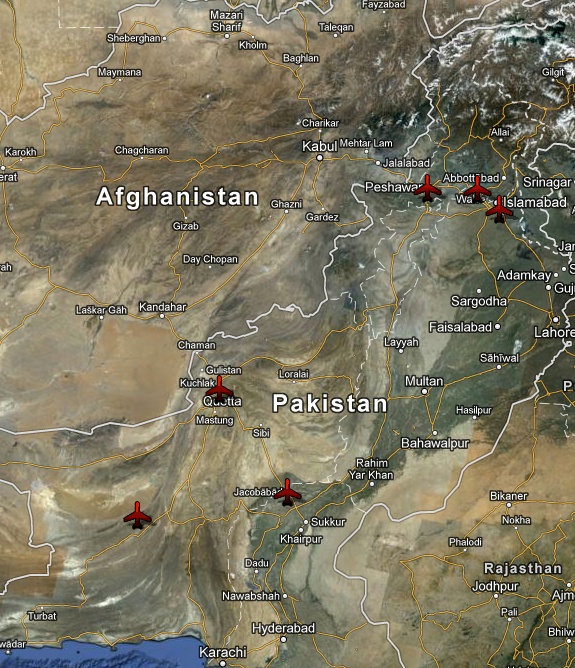
US bases inside Pakistan

Admiral Mullen greets General Kayani, August 2008But there’s more. Pakistan had agreed that the focus of the US strikes would be North and South Waziristan.  Earlier that same year, March 2008, the Chairman of the Joint Chiefs of Staff Admiral Mullen asked General Kayani, Pakistan’s Chief of Army Staff,  for help in approving ‘a third Restricted Operating Zone for US aircraft over the FATA’, and writing in the Washington Post in November 2010 Greg Miller confirmed that these ‘flight boxes’ were confined to North and South Waziristan (although the US had unsuccessfully pressed for permission to extend the flights over Quetta, outside the FATA).  The geometry of those boxes is not known, though it would not be difficult to superimpose two likely rectangles over the previous map sequence. Operational details are, not surprisingly, far from clear.  According to a report in the Wall Street Journal on 26 September 2012, the CIA sends a fax to the ISI every month detailing strike zones and intended targets – replies apparently stopped early last year, but the US interprets the silence as ‘tacit consent’ since Pakistan immediately de-conflicts the air space to allow the Predators to carry out their surveillance – and a report in the New York Times earlier this month claimed that the US still provides the Pakistan military with 30 minutes notice of an imminent strike in South Waziristan (but no advance notice for strikes in North Waziristan because the Haqqani Network enjoys such close ties with the ISI that the CIA fears their targets would be warned of the attack).

The focus on the FATA follows not only from the militant groups that are based there; it also derives from the exceptional legal status of the borderlands.  Under British colonial rule, this was a buffer zone whose inhabitants were allowed a measure of nominal autonomy; colonial power was exercised indirectly through the authority vested in tribal leaders (who received subsidies from the British), and the special Frontier Crimes Regulations – in practice corrupt and draconian – were codified by Lord Curzon in 1901.  After partition and independence in 1947 Pakistan retained the 1901 Regulations, so that the President – who has direct executive control of the FATA – appoints a Political Agent for each agency who has absolute authority to adjudicate criminal and civil affairs; ordinary Acts of Parliament do not apply to the FATA unless the President expressly declares that they do. Limited reforms were introduced in August 2011, including the right to political mobilisation, but some commentators raised doubts about their implementation.  Preventive detention and collective punishment remain in force and the writ of the courts is still severely restricted.
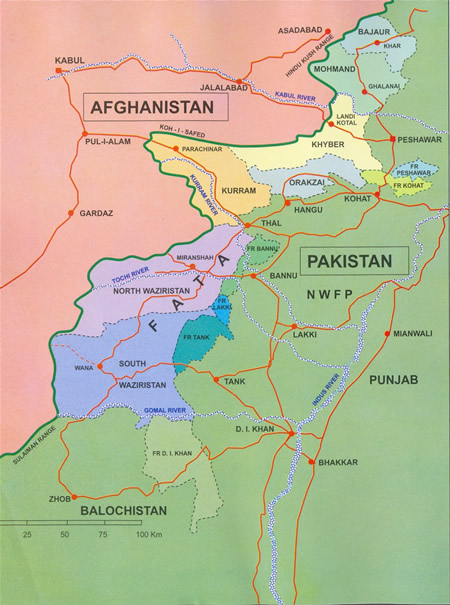
FATA and NWFP map

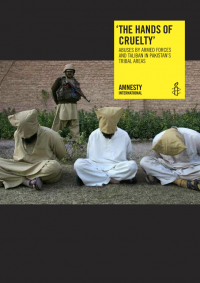
AMNESTY The Hands of Cruelty Abuses by Armed Forces and Taliban in Pakistan s Tribal AreasThese special measures were reinforced by the simultaneous passage of the Actions (in Aid of Civil Power) Regulations in 2011, a quid pro quo demanded by the military, which allowed the Pakistan Armed Forces to carry out ‘law enforcement duties [and] to conduct law enforcement operations’, granted them sweeping powers of pre-emptive arrest and detention without charge, and forbade the high court from intervening.  According to one local politician, these new Regulations are ‘even more dangerous’ than the Frontier Crimes Regulations: ‘It is a system of martial law over the Tribal Areas.’  A new report from Amnesty International (from which I’ve taken these accounts) borrows its title, The Hands of Cruelty, from a despairing claim made by a lawyer from Peshawar: ‘The hands of cruelty extend to the Tribal Areas, but the hands of justice cannot reach that far.’

(Given the – I think abusive – attack on Amnesty’s report by Abdullah Mansoor at Global Research as ‘malicious’ and ‘misinformation’ that virtually ignores the violence perpetrated by the Taliban and other militant groups, I should also draw readers’ (and his) attention to Amnesty’s previous report, As if Hell fell on me, which provides a detailed indictment of exactly that).

In short, the FATA constitute a space of exception in precisely the sense given to that term by Giorgio Agamben: the normal rights and protections under the law are withdrawn from a section of the population by the law.  To see what this has to do with the geography of US drone strikes we can turn to an attack on 19 November 2008 on a residential compound in Indi Khel, 22 miles outside Bannu and about two hours by road from Peshawar.  Five alleged militants were killed and four civilians injured: not a large toll compared to other strikes, and yet the public reaction across Pakistan was extraordinary.
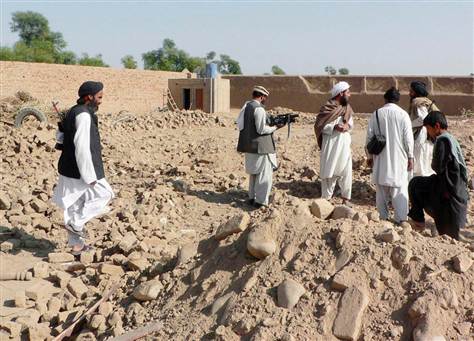
Drone strike at Indi Khel, Bannu, 19 November 2008

A diplomatic cable from US Ambassador Anne Patterson on 24 November explained the widening gap between what she called ‘private GOP [Government of Pakistan] acquiescence and public condemnation for U.S. action’:

‘According to local press, the alleged U.S. strike in Bannu on November 19 marked the first such attack in the settled areas of the Northwest Frontier Province, outside of the tribal areas. The strike drew a new round of condemnation by Prime Minister Gilani, coalition political parties, opposition leaders, and the media.

‘According to Pakistani press, the strike killed four people, including a senior Al-Qaida member, and injured five others. The first strike within “Pakistan proper” is seen as a watershed event, and the media is suggesting this could herald the spread of attacks to Peshawar or Islamabad. Even politicians who have no love lost for a dead terrorist are concerned by strikes within what is considered mainland Pakistan.’

The language is truly extraordinary, with its distinction between the FATA and ‘Pakistan proper’, even ‘mainland Pakistan’. In short: (imaginative) geography matters.  Not for nothing are the FATA known in Urdu as ilaqa ghair, which means ‘alien’ or ‘foreign’ lands.

The plight of the people in the FATA is exacerbated by the forceful imposition of a second, transnational legal regime: the right asserted by the United States to carry its fight against al Qaeda and its war against the Taliban across the border from the ‘hot’ zone in Afghanistan into militant sanctuaries in Pakistan.  This is part of a larger argument about the advanced deconstruction of the traditional, bounded battlefield – here Frédéric Megret‘s work is indispensable – and the production of a global battlespace, processes that have been accelerated by the remote operations permitted by drones.  But it remains both an assertion and an argument.  Although international law is not a deus ex machina, a neutral court of appeal above the fray, it nonetheless has a developed body of precepts that are supposed to regulate armed conflicts between states, and there are also protocols and tribunals that govern armed conflicts between governments and non-state actors within the territorial boundaries of a state (the former Yugoslavia or Ruanda, for example).  But conflicts between states and transnational non-state actors pose new and difficult questions, and perhaps even map a ‘legal void’.  Significantly, as Eyal Benvenisti points out in the Duke Journal of International and Comparative Law,

Concurrently with the successful efforts to impose restraints on intra-state asymmetric warfare, we have been witnessing efforts by the same powerful countries that pressed for intra-state conflict regulation to deregulate inter-state asymmetric warfare or what may be called “transnational” warfare.

I will leave a review of these debates, at once legal and political, for another day; among the most relevant recent contributions are Kenneth Anderson, ‘Targeted killing and drone warfare: how we came to debate whether there is a legal geography of war’ (2011), available here; Laurie Blank, ‘Defining the battlefield in contemporary conflict and counterterrorism: understanding the parameters of the zone of combat’, Georgia Journal of International and Comparative Law 39  (1) (2010-11), available here; Jennifer Daskal, ‘The geography of the battlefield: a framework for detention and targeting outside the “hot” conflict zone’ (2012), available here;  Noam Lubell and Nathan Derejko, ‘A global battlefield? Drones and the geographical scope of armed conflict’, Journal of International Criminal Justice 11 (1) (2013) 65-88 (abstract here).  In this twilight zone, where Washington at once admits its actions through a never-ending string of off-the-record briefings and yet denies any responsibility for their collateral outcomes, there are no inquiries into ‘mistakes’, no culpability for wrong-doing, and no compensation or restitution for the innocent victims.

Whatever you make of the rights and wrongs of all this, what matters for my present purposes is that these two legal regimes, one national and the other transnational, work in concert to expose the people of the Federally Administered Tribal Areas to military and paramilitary violence and, ultimately, death.

It’s more than a matter of law, of course (and in any case we shouldn’t confuse legality with legitimacy).  Within these exceptional spaces there has been active, tactical collaboration between the US and Pakistan.  Another diplomatic cable reported a meeting on 22 January 2008 with General Kayani, who asked US Central Command to provide ‘continuous Predator coverage of the conflict area’ in South Waziristan, but was offered only Joint Terminal Attack Controllers to direct PAF air strikes by F-16s – an offer which was refused because of a reluctance to allow US ground forces to operate inside Pakistan.  But in September and October 2009 small teams of US Special Forces were deployed to provide intelligence, surveillance and reconnaissance (ISR) support to the Pakistan Army, which included a ‘live downlink of unmanned aerial vehicle (UAV) full motion video.’ (What is interesting about all these exchanges is the degree of collaboration they reveal not only between the US and Pakistan but also between the CIA and the US military, especially Joint Special Operations Command; this is not surprising, given the hybridisation of military and paramilitary violence and the close involvement of the military in supplying, servicing and even flying the drones used in CIA-directed strikes).

There have been several reports of continuing collaboration between American and Pakistani intelligence operatives working on the ground in Pakistan, and one source – who purported to run a network of agents and ‘spotters’ in North and South Waziristan – told Reuters in January 2012 that ‘Our working relationship is a bit different from our political relationship.  It’s more productive.’  He claimed that the US and Pakistan agreed priority target lists between them, and that it took little more than two or three hours between the location of a targeted individual and the firing of missiles.  These claims are impossible to verify, but the emphasis on a working relationship rings true.
FATA flagPerhaps the most chilling of the Wikileaks cables is this (redacted) message sent from Islamabad in February 2009, reporting a discussion with a senior member of the FATA Secretariat, who enthusiastically recommended the practice of ‘double tap‘ – follow-up strikes targeting rescuers – and endorses the rationale for signature strikes against unknown, un-named targets:

9.  (S)  XXXXXXXXXXXX remains a strong advocate of U.S. strikes. In fact, he suggested to PO that the U.S. consider follow-on attacks immediately after an initial strike.  He explained that after a strike, the terrorists seal off the area to collect the bodies; in the first 10-24 hours after an attack, the only people in the area are terrorists, so “you should hit them again-there are no innocents there at that time.”  His sources report that the reported September 29 strike in South Waziristan had been particularly successful; “you will see that you hit more than has been reported in the press both in terms of quantity and quality.”  XXXXXXXXXXXX also drew a diagram essentially laying out the rationale for signature strikes…

Here you can see two perspectives on administrative killing, one from Pakistan and the other from the United States, converging onto a single target.

The cables from which I’ve quoted are all four or five years old, but this reflects the shutters coming down after the subsequent assault on Wikileaks and the arrest of  Bradley Manning – the reports from seasoned investigative journalists are much more recent.  I suppose you might conclude that none of them contradicts that artful word that does so much silent work in the official statement repeated by Emmerson, in which Pakistan denies reports of continuing tacit consent.  But given what I’ve shown about the deadly dance over those five years, do you really think the music has stopped?
Nieto’s Challenge

Many readers will remember Hillary Clinton‘s off-the-cuff claim last fall that “We face an increasing threat from a well-organised network, drug-trafficking threat that is, in some cases, morphing into or making common cause with what we would consider an insurgency in Mexico.”  In “The everywhere war” (DOWNLOADS tab) I used her comment – together with a host of other sources inside and outside the state – to suggest some of the ways in which conceptions of war were being transformed in the borderlands; so too the military/policing distinction.

But a new report from the International Crisis Group, Peña Nieto’s Challenge: Criminal cartels and rule of law in Mexico, suggests that – in the midst of calls to increase the militarization of the US southern border – at least some State Department officials are having second thoughts.  Indeed, the report claims that Clinton’s remark was seen at the time ‘as a misstatement by many in the State Department, aimed more at linking the kinds of violence and weapons used and the seriousness of the danger they posed rather than describing the nature of the cartels or their objectives.’  And now, in an interview with the Group, John Feeley, Principal Deputy Assistant Secretary of State for Western Hemisphere Affairs, insisted:

‘The violence associated with the criminal activities of the transnational criminal organisations (TCOs) in Mexico is not a national security problem or an insurgency that threatens to destabilise the Mexican government. Clearly, the violence … is a very serious public security problem that has important social and economic repercussions.’ 

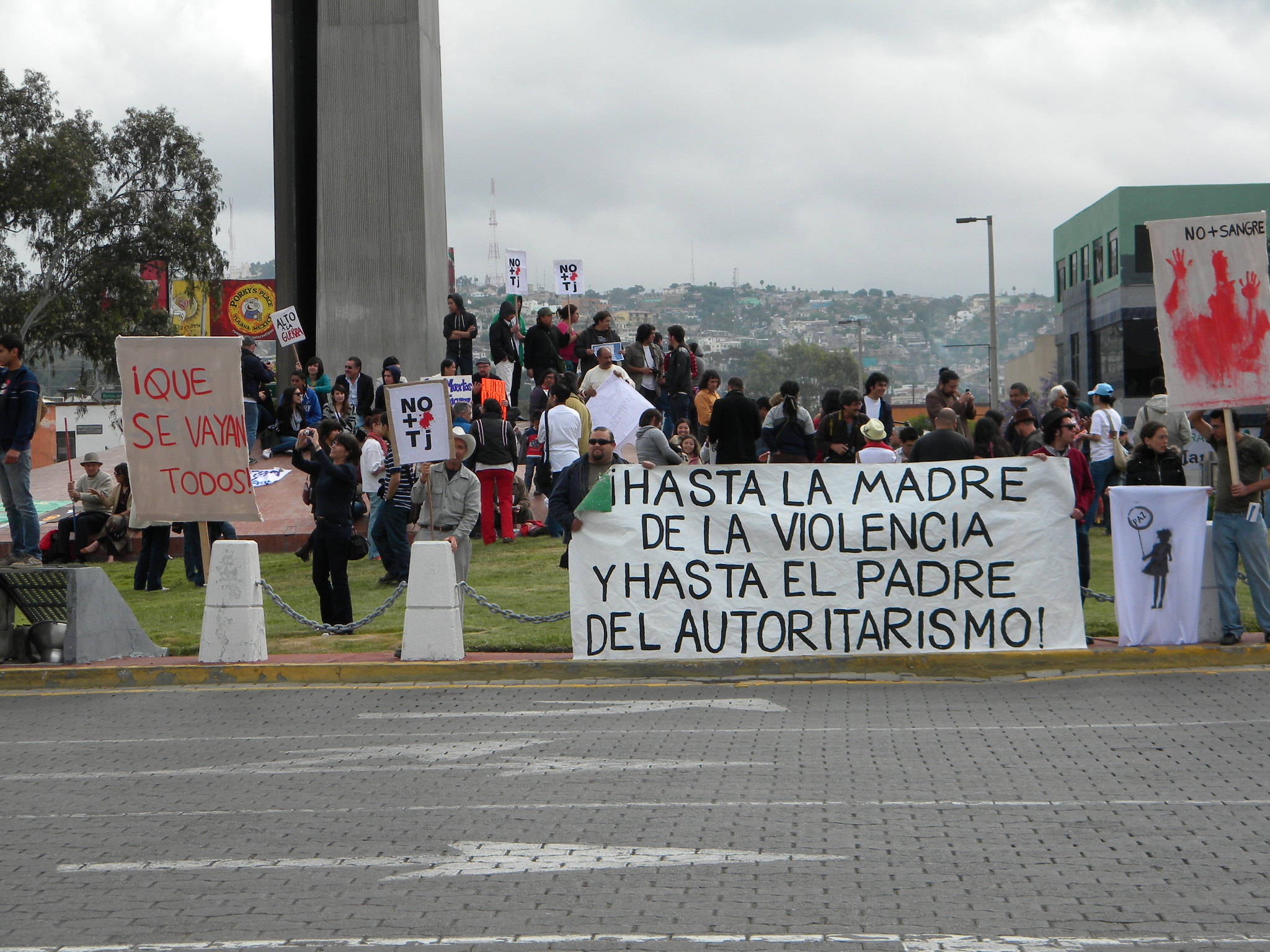
For all that, it’s surely more than a ‘public security problem’ and it also has the most acute political repercussions too:

no_more_blood

The report spells out many of those repercussions for the democratic constitution of Mexico – though whether Nieto (Mexico’s new President) will pay any attention to it is another question.  But its fundamental argument is captured in these paragraphs:

The development of cartels into murder squads fighting to control territory with military-grade weapons challenges the Mexican state’s monopoly on the use of force in some regions. The brutality of their crimes undermines civilian trust in the government’s capacity to protect them, and the corruption of drug money damages belief in key institutions. Cartels challenge the fundamental nature of the state, therefore, not by threatening to capture it, but by damaging and weakening it. The military fight-back has at times only further eroded the trust in government by inflicting serious human rights abuses. Some frustrated communities have formed armed “self- defence” groups against the cartels. Whatever the intent, these also degrade the rule of law. 

There has been fierce discussion about how to legally define the fighting. The violence has been described as a low-intensity armed conflict, a kind of war, because of the number of deaths and type of weapons used. The criminal groups have been described as everything from gangs, drug cartels and transnational criminal organisa- tions, to paramilitaries and terrorists. The Mexican government, much of the international community and many analysts reject the idea there is anything other than a serious criminal threat, even though those criminal groups use military and, at times, vicious terror tactics. The army and marines, too, thrown into the breach with limited police training and without efficient policing methods, have often used intense and lethal force to fight the groups, killing more than 2,300 alleged criminals in a five-year period.

Within the grey world of fighting between rival cartels and security forces, there is much confusion as to who the victims of the violence are, and who killed them or made them disappear. Estimates of the total who have died in connection with the fighting over the last six years range from 47,000 to more than 70,000, in addition to thousands of disappearances. Cartel gunmen often dress in military uniforms and include corrupt police in their ranks, so people are unsure if they are facing criminals or troops. A victims movement is demanding justice and security. Mexico has also lost hundreds of police and army officers, mayors, political candidates, judges, journalists and human rights defenders to the bloodshed that is taking a toll on its democratic institutions.

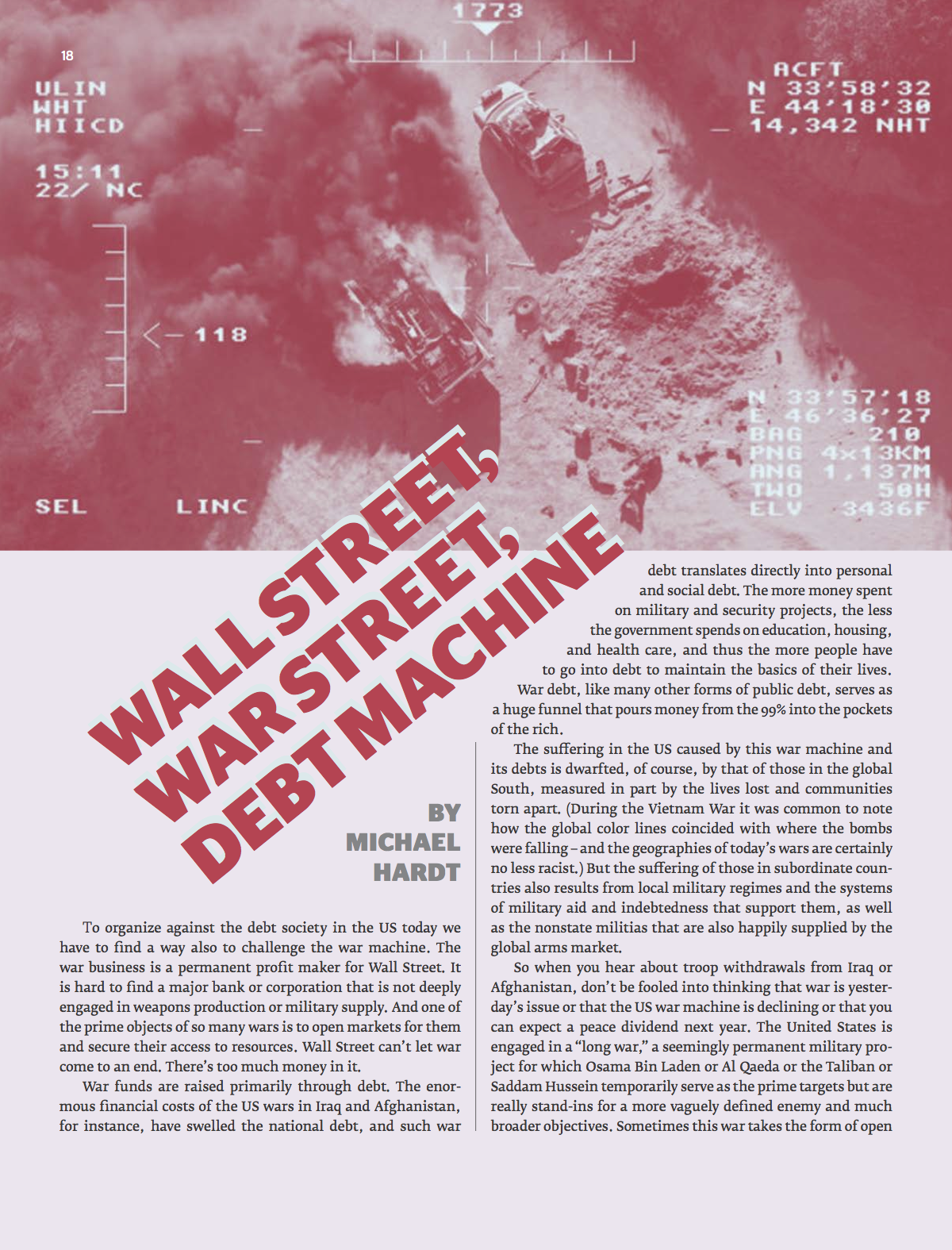
Wall Street, War Street

HARDT Wall Street, War StreetThe latest issue of Tidal:Occupy Theory, Occupy Strategy (open access online) includes a brief (two-page) article by Michael Hardt that offers a sharp reminder:

‘To organize against the debt society in the US today we have to find a way also to challenge the war machine.  The war business is a permanent profit maker for Wall Street… War funds are raised primarily through debt.  So when you hear about troop withdrawals from Iraq or Afghanistan, don’t be fooled into thinking that war is yesterday’s issue or that the US war machine is declining or that you can expect a peace dividend next year. The United States is engaged in a “long war,” a seemingly permanent military project for which Osama Bin Laden or Al Qaeda or the Taliban or Saddam Hussein temporarily serve as the prime targets but are really stand-ins for a more vaguely defined enemy and much broader objectives.’ 

Hardt identifies three drivers (or ‘logics’) of the war machine – imperialist, neo-liberal and humanitarian – that will be familiar to most readers (at least in this capsule – pod? – form).  He concludes:

‘There are many reasons to oppose the US war machine, with its complex of military and security operations, installations, and institutions. It is a killing machine, a racist machine, a misery machine, and much more. It’s also a debt machine, and thus perhaps, when engaged together with other contemporary issues posed by debt, a movement can also begin to erode the foundations for our seemingly permanent state of war.’

What interests me is not simply the neoliberal ‘logic’ pursued by our masters of war – and Jamie Peck‘s work surely shows that we need to be assiduous in unpacking its multiple logics and (trans)formations – but also the way in which it reaches deep into the practices of military violence.  We need to expose not only the ‘business of war’ – the parasitic synergies between advanced militaries and the corporations of the international arms industry (‘Big Arma‘), and the deadly embrace between advanced militaries and the private contractors to whom more and more tasks are outsourced – but also the ways in which (at least since the days of McNamara’s ‘technowar’) advanced militaries have increasingly internalized the language, models and metrics of the Corporation. Fans of Joel Bakan will know why I use the capital – I’m talking about more than PowerPoint.

Air strikes in Pakistan’s borderlands

I’m speaking about Drone strikes and the matrix of violence in Pakistan at a conference in Vancouver at the week-end – a presentation which will form part of The everywhere war – and to set some of the parameters I’ve been revisiting the changing geography of air strikes in the Federally Administered Tribal Areas.  It’s a formidably difficult question given the extraordinary dangers facing journalists, Pakistani or foreign, seeking to report from the FATA: for an incisive discussion of the media landscape inside the FATA see Sadaf Baig‘s Reporting from the frontlines.

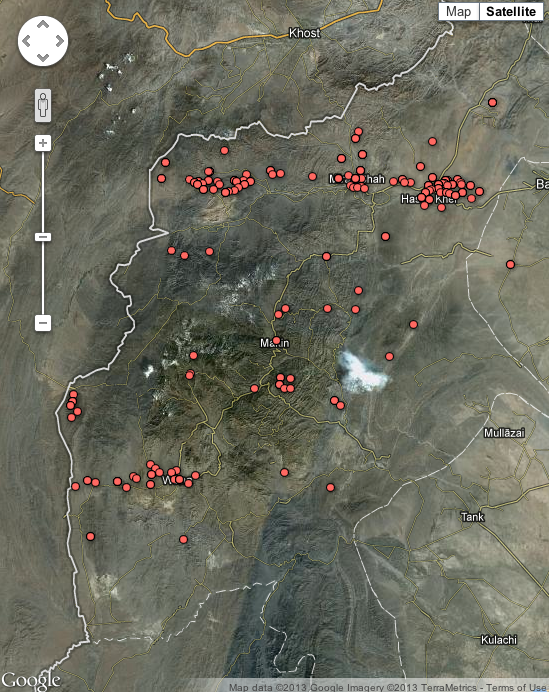
In my view, the most thorough if necessarily imperfect tabulations of US-directed strikes are those provided by the Bureau of Investigative JournalismThere have been several attempts to map this database, including the Bureau’s own use of Google maps (see below and here; but be careful: zooming in is a product of the digital platform and will give a misleading sense of the resolution level of the data).

BOJ US drone strikes in FATA

One of the most thoughtful (and dynamic) representations comes from Chris Herwig.  He described the technical basis of his mapping over at MapBox here, and you can visit his microsite here.  Go here to see the animation running (with annotations).

8448237526_92002912de

Chris’s project has also been featured on PBS here, where he also responds to several criticisms of the data and his visualizations.

Over at Slate, Chris Kirk has produced an interactive that tries to show the maximum number of estimated casualties from each strike, but the data are drawn from the New America Foundation database which has been criticised for underestimating casualties; one (to October 2012) version is here, and another (to February 2013), using a different cartographic design, is here.  More generally, Forensic Architecture‘s Unmanned Aerial Violence team is working to produce an online visualization of drone strikes not only over Pakistan but also over Afghanistan,Yemen, Somalia and Palestine. but it’s not yet operational).

But the problem doesn’t end with the cartographic piercing of the veil of semi-secrecy the White House, the CIA and JSOC cast over their remote operations, though I’ve noted before how their collective teasing of American journalists over the legal and administrative protocols they supposedly follow – especially the so-called “disposition matrix” –  works to (mis)direct attention towards Washington and away from the sites that Chris and others have struggled to map.

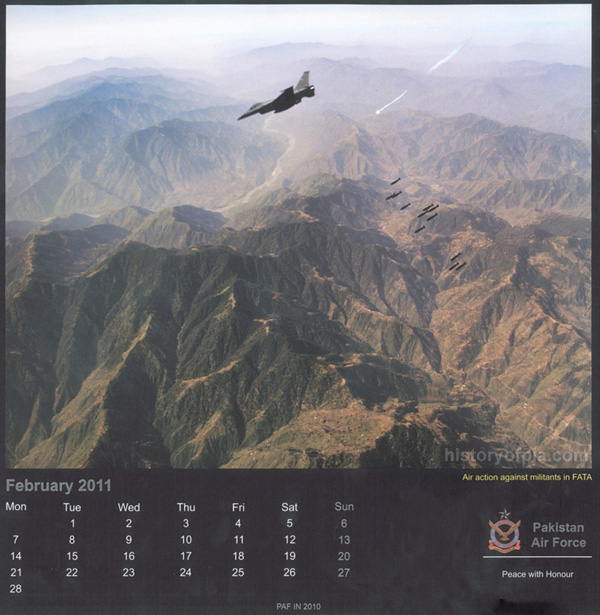
I say this because the US is not the only state carrying out air strikes in the region.  Soon after 9/11 and the US-led invasion of Afghanistan, largely in response to pressure from Washington, the Pakistan military moved into the FATA.  According to Zahid Ali Khan, Pakistan’s Frontier Corps was deployed in December 2001, but by May 2002 it was decided that a much heavier hand was needed and the Pakistan Army was ordered into the borderlands for the first time in the nation’s history.  Local people requested that military operations be limited to ground forces, but by 2004 this agreement was in shreds and – as the image below shows – ever since the Pakistan Air Force has made no secret of its continuing air strikes on the FATA.

PAF air strike in FATA

Again, there is no public tabulation, but the American Enterprise Institute‘s Critical Threats daily Pakistan Security Brief – I know, I know, it’s a neoconservative think-tank – culls this (needless to say, approving) record from reports in Pakistan media in the first two months of this year alone:

25 February PAF kills 10 TTP militants in Tirah [Kurram/Khyber, FATA]

21 February PAF bombs militants in Orakzai [NWF Province] killing 29

19-20 February PAF jets bomb TTP hideouts in Orakzai

11 February PAF jets kill 8 militants in the Tirah Valley

8 February Jets kill 9 militants in Orakzai

7 February PAF targets militants in Orakzai

6 February Jets kill 8 in Orakzai

30 January PAF kills 23 militants in Tirah Valley and 8 in Orakzai agency

28 January Pakistani jets bomb militants in Orakzai

4 January Gunships kill 3, injure more in North Waziristan retaliation

It’s a bare bones summary, clearly, and I suspect the readiness of the AEI to trust local media to report PAF strikes is in stark contrast to their attitude to local reports of US drone strikes.  I’ve also deliberately retained the original phrasing: conspicuously, there is no record of  civilian casualties. Like the United States, Pakistan routinely plays these down or denies them altogether.  Here, for example, is a typical report via the Long War Journal on 25 March 2010:

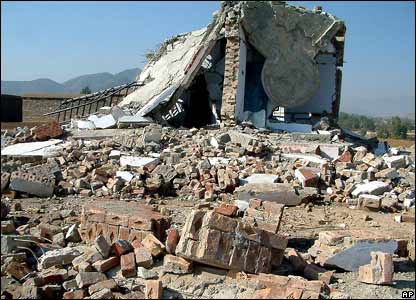
‘Pakistani fighter-bombers struck a series of targets in the Mamuzai region in [Orakzai] today. Sixty-one Taliban fighters were killed, Pakistani intelligence officials told The Associated Press. The military claimed that no civilians were killed in the attacks. The targets included a madrassa, a mosque, and a seminary run by the Tablighi Jamaat. Pakistani officials said that Taliban leaders were meeting at the Tablighi seminary.’

PAF air strike, Orakzai

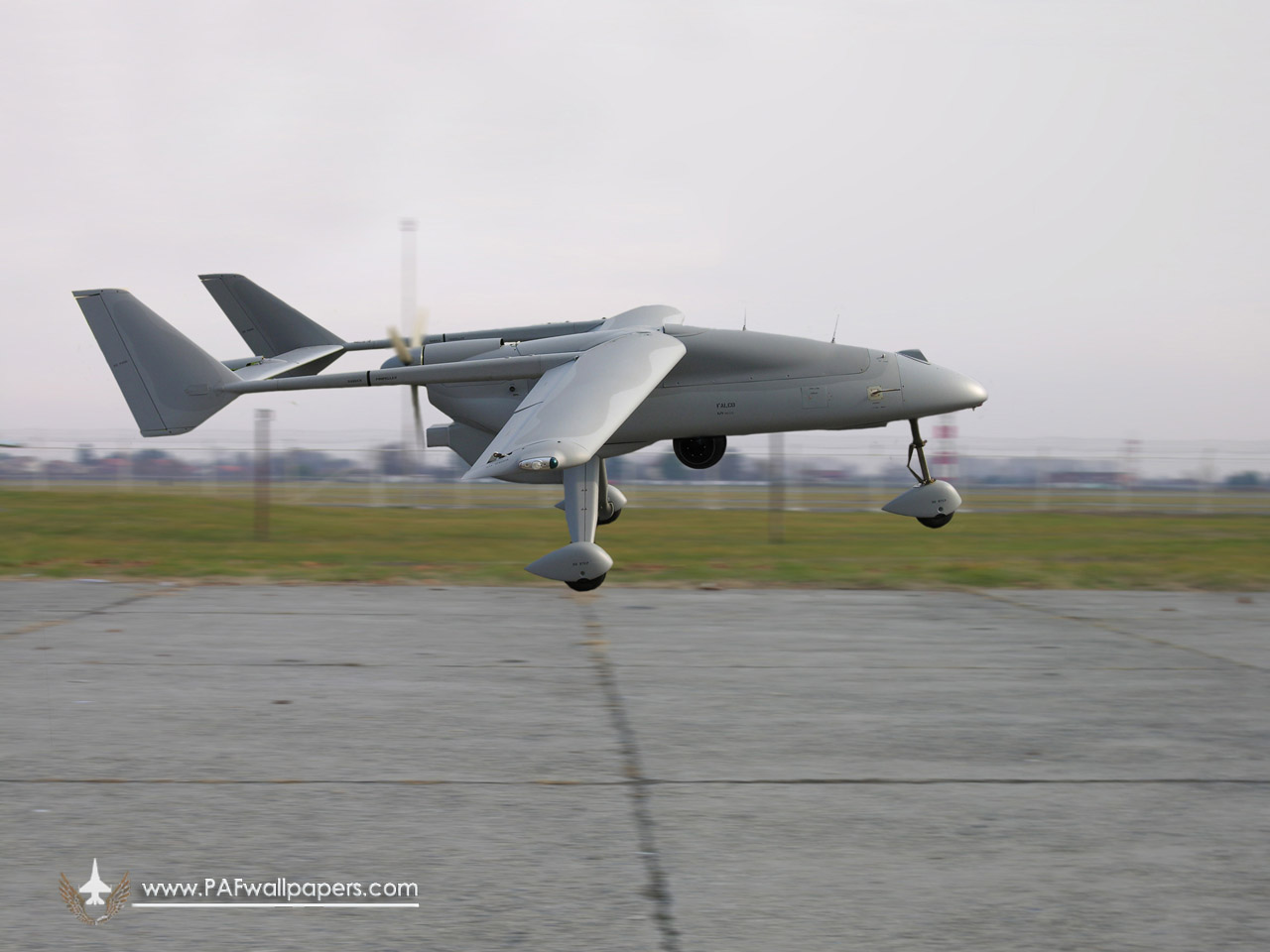
It’s unlikely that civilians were unscathed.  For the first four years at least the accuracy of the Air Force’s strikes was compromised by what Irfan Ahmad described as  its ‘lack of real time electronic intelligence and inferior technical means for command, control and communications’, by deficiencies in the targeting pods used by the PAF’s  ageing F-16 aircraft, and by the use of laser-guided missiles whose precision was reduced by clouds or poor visibility.  From 2008 new electro-optical targeting pods and sensors were being retrofitted and new ground and air capabilities for image exploitation put in place.  In 2009 the Air Force was also the launch customer for the Anglo-Italian Falco reconnaissance drone (see below), which is now co-produced in Pakistan; five systems were soon in use over the FATA, each comprising four aircraft with one held in reserve, and the Air Force was already anticipating arming them ‘with the most modern and lethal payloads’. More recently, the PAF has upgraded its F-16 fleet with new Block 52 versions and installed advanced avionics.  Throughout this period, as the military offensive periodically intensified, hundreds of thousands, perhaps millions of people were displaced from the borderlands.

falco_uav_galileo_avionica_paf_pakistan_air_force_01

It’s difficult to provide a detailed accounting of the air strikes, but in a rare admission former Air Chief Marshall Rao Qamar Suleiman claimed that the Pakistan Air Force carried out 5,000 strike sorties and dropped 11,600 bombs on 4,600 targets in the FATA between May 2008 and November 2011.  Unlike US air strikes in the region, PAF strikes are rarely ‘stand-alone’ affairs but are co-ordinated with ground forces (which is also the case with most drone strikes in Afghanistan, which operate in close concert with troops and conventional strike aircraft).

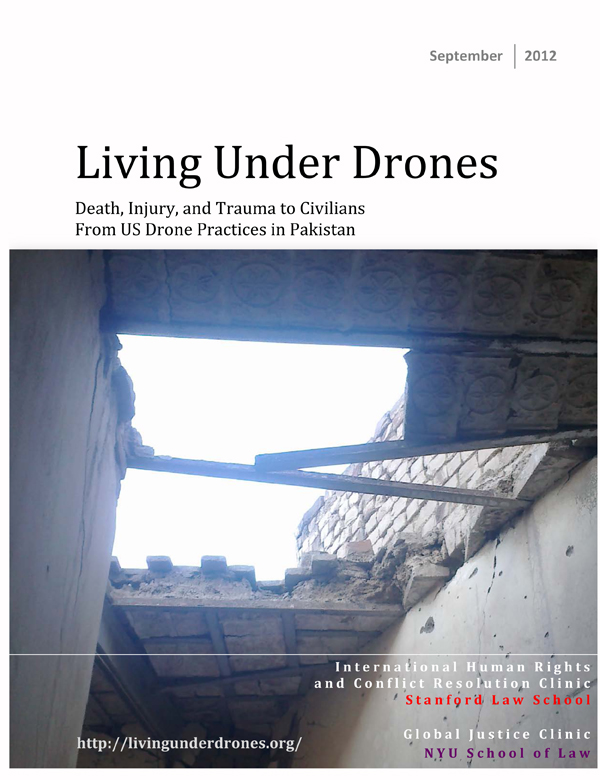
My object is recording all this is (I hope obviously) emphatically not to say that it is perfectly acceptable for the US to launch air strikes in the FATA because Pakistan is doing the same. Rather, the co-existence of the two air campaigns explains, in part, how it is possible for each party to accuse the other of carrying out an attack, as reported earlier this month.  More importantly, it also emphasises the ever-present horizon of danger within which the inhabitants of the borderlands are forced to live.  They are not only Living under drones.

Living Under Drones

The same point was sharpened by CIVIC – now the Center for Civilians in Conflict – in their (I think vital) report Civilian harm and conflict in North West Pakistan, published in October 2010. That report also details the violence meted out to civilians by militant groups in the region; for a detailed survey of the political geography of the borderlands, see Brian Fishman‘s The Battle for Pakistan: militancy and conflict across the FATA and NWFP, produced for the New America Foundation in 2010; there’s also much to think about in Daanish Mustafa and Katherine Brown, ‘Spaces of performative politics and terror in Pakistan‘, and in the same authors’ ‘The Taliban, Public Space and terror in Pakistan‘.

The existence of the two air campaigns also shows that the FATA are produced as a space of exception not only through Washington’s strenuous juggling with the Authorisation to Use Military Force and with international law (to validate the extension of its ‘global battlefield’) – whether it does so with or without Islamabad’s covert consent remains an open question – but also through Islamabad’s continued determination to treat the borderlands as legally anomalous territories for its own assertion of military violence.

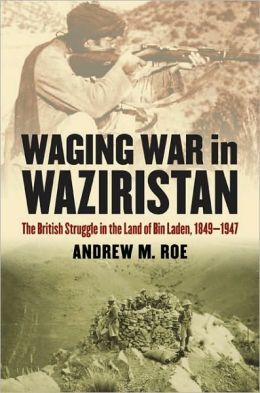
ROE Waging war in WaziristanThe last is a doubled colonial legacy.  Not only is the legal geography that structures the FATA’s relations with the Pakistani state a relict from Britain’s imperial decision to treat them as a space to be ‘excepted from state and society for the purposes of war’, as Ian Shaw and Majed Akhter put it in Antipode recently.

So too is the decision to continue to use the FATA as a laboratory for what the British called ‘air control’. Andrew Roe has provided a series of detailed discussions in the RAF’s invaluable Air Power Review, here and here and here, and brought much of his research together in Waging war in Waziristan (2010).

But for a rapid and sobering sense of how these campaigns were viewed from the air in the 1930s you need to watch this BBC interview with Group Captain Robert Lister, Wings over Waziristan, which includes extraordinary cine footage showing what he calls ‘tribal operations from the air’.  Lister was posted to Peshawar in 1935, and soon after he arrived both the Army and the Air Force were ordered to put down ‘a tribal insurrection or rebellion’ in Waziristan.  Their preferred method was to destroy villages by setting fire to individual houses, blowing them up, or bombing them from the air ‘to make them say “Right, it’s not worthwhile – come to terms.”‘  Listen as Lister says, in cut-glass tones, ‘It was a fair and just way of dealing with it: they started these troubles and had to be dealt with.’

Waziristan:Lister:Here's an attack being carried out

And if you want to discover a different dimension to ‘unmanning’ aerial vehicles, listen from 08.00-08.40.

UPDATE: I’ve just discovered another film shot over Waziristan in 1937 by Leonard de Ville Chisman, which covers the air and ground war against the Faqir of Ipi described by Lister.  It contains a number of strikingly similar shots, though there is of course no commentary: you can access it via Colonial Film: Moving Images of the British Empire here.  On that remarkably informative site, Francis Gooding writes:

The official record of NWFP operations during 1936-7 – a thick volume, its size indicating the scale and seriousness of the conflict – contains full details about the manner in which aircraft were employed. The flag marches of November that sparked the revolt were accompanied by aircraft reconnaissance, and the record notes that ‘air reconnaissance requirements were met by one flight of No. 5 (Army Co-operation) Squadron’ (Govt of India, op.cit., 15), and the RAF also provided close cover for troops, and this pattern – reconnaissance with close support against the enemy – was repeated throughout the operations.

Reels 14 and 15 of the Chisman collection record precisely these kinds of encounters and air operations, with footage of bombing raids and the dropping of supplies to forward positions by parachute taken from within flying aircraft. Aircraft were also used to disseminate information and warnings about future punitive action (again, this was a tried and tested method, typical of colonial air policing; see Omissi, 1990, 154-5). On 27 August 1937, for instance, ‘notices were dropped over the Shawal area warning the inhabitants that until the Faqir submitted to Government, any tribe sheltering him would be liable for punishment’ (Govt. of India, op.cit., 179), and reel 15 contains a sequence showing a pilot unfurling a large leaflet, with text in Pashto and Urdu. The following sequences show air-drops of these leaflets over hill country. There are also scenes showing armoured cars and tanks on the move, and a sequence apparently shot during a battle, with a line of artillery opening fire on hill positions. 

The Faqir’s uprising was arguably the most serious colonial insurgency of the inter-war imperial period, and the films are remarkable in that they record scenes of action from a poorly remembered but major guerrilla conflict. Beyond this historical importance they have another significance, for they offer scenes of something only very rarely captured on film, despite its regular occurrence throughout the Empire – the recourse to the punitive deployment of heavy weaponry against subject peoples in revolt.

Un-habitation

When Chris Harker was working on his PhD thesis at UBC I remember saying that while I admired the work of the Israeli Committee against House Demolitions a more accurate title would be Home Demolitions – simply because this would convey that much more was being so brutally and callously destroyed than bricks and mortar.  The practice is, of course, another vile dimension of the calculated (and illegal) colonisation of the West Bank by Israeli settlers, and Just Vision‘s latest film, My Neighborhood, puts the two together – erasure and occupation – in East Jerusalem.  But here too there are small signs of solidarity between Palestinians and Israelis that are vital for any prospect of ‘cohabitation‘…

My Neighbourhood

And now you can now watch the whole film on the Guardian website here.  Much more on East Jerusalem from the Civic Coalition for Palestinian Rights in Jerusalem here, from Settlement Watch (“Eyes on the Ground in East Jerusalem”) here and from B’Tselem: the Israeli Information Center for Human Rights in the Occupied Territories here.

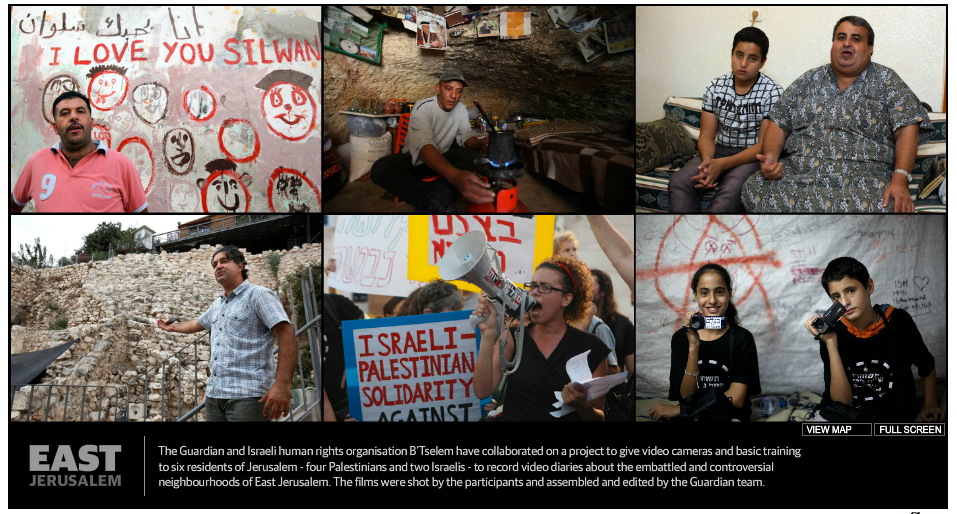
In 2011 the Guardian joined forces with B’Tselem to produce six short video diaries under the umbrella title Living in East Jerusalem, and these are still online here.

Living in East Jerusalem Video Diaries

Imaging war, mediating conflict

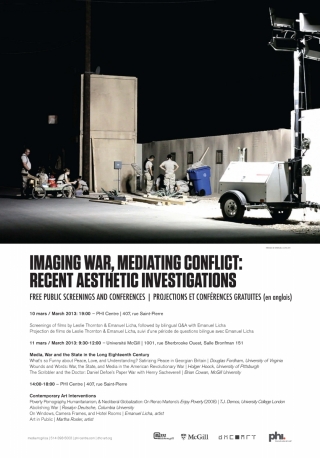
20131301_affiche_imagingwar_2725x39_1

Last weekend Media@McGill, in collaboration with DHC/ART Foundation for Contemporary Art, hosted a screening and conference on representations of war and conflict in art and art history (I’m grateful to Max Ritts for drawing my attention to it). Here is the original summary:

 Imaging War, Mediating Conflict: Recent Aesthetic Investigations addresses the politics, aesthetics and ethics of art and media practices relating to war from the 18th century until today, and assesses how such representations help to shape the experience of current conflicts, as well as their place in history.

There were two conference sessions (click on the title links for the abstracts).  The first, on Media, war and the state in the long eighteenth century, featured:

What’s so Funny about Peace, Love, and Understanding? Satirizing Peace in Georgian Britain | Douglas Fordham, University of Virginia

Wounds and Words: War, the State, and Media in the American Revolutionary War | Holger Hoock, University of Pittsburgh

The Scribbler and the Doctor: Daniel Defoe’s Paper War with Henry Sacheverell | Brian Cowan, McGill University

The second session, on Contemporary Art Interventions, featured:

Poverty Pornography, Humanitarianism, and Neoliberal Globalization: On Renzo Martens’s Enjoy Poverty (2008) | T.J. Demos, University College London

Abolishing War | Rosalyn Deutsche, Columbia University

On Windows, Camera Frames, and Hotel Rooms | Emanuel Licha, artist

Art in Public | Martha Rosler, artist

Abolishing warVideo of the presentations has now been uploaded and can be accessed here.  Two in particular caught my attention.

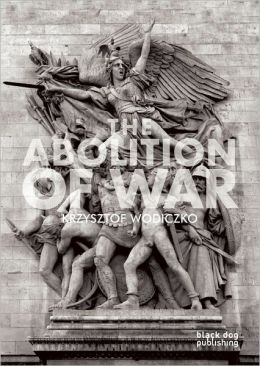
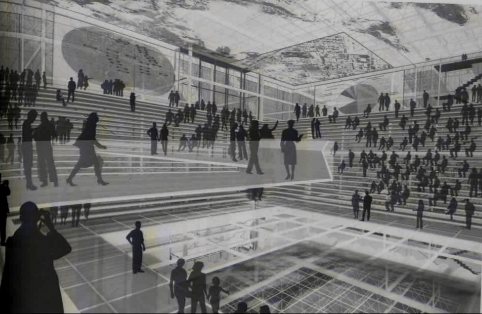
In an enviably polished and psychoanalytically informed presentation, Rosalyn Deutsche returns to an artist whose work she has considered several times in the past, Krzysztof Wodiczko (whose  Homeless Vehicle Project will be familiar to many geographers; others might know his more recent War Veteran Vehicle). Here she addresses, in a critically constructive fashion, his recent Arc de Triomphe: World Institute for the Abolition of War (though in fact he prefers the term “un-war” to “peace” for reasons Rosalyn explains at 09:51) and his extraordinary re-imagining and re-purposing of the iconic monument (see 11.13 on): what Rosalyn calls ‘disarming the Arc’.  More here and in Wodiczko’s book, The abolition of war, published last summer by Black Dog.  The same press has also published a lively volume of essays devoted to his work, Krzysztof Wodickzo (2011), which includes contributions from Rosalyn and Dick Hebdige, Dennis Hollier and Sanford Kwinter.

World Institute for the Abolition of War

Martha Rosler‘s House Beautiful: Bringing the War Home has always been a favourite of mine, and in her presentation at the McGill meeting, even as she battles with the recording system (haven’t we all?), she manages to say – and show – a great deal with a compelling economy.

Just looking?

Most readers interested in the politics of humanitarianism and what Eyal Weizman calls ‘the humanitarian present‘ will know Lilie Chouliaraki‘s work, notably The spectatorship of Suffering (Sage, 2006).  She has a new book out now, The ironic spectator: solidarity in the age of post-humanitarianismCHOULIARAKI The ironic spectator (Polity, 2012/13):

This path-breaking book explores how solidarity towards vulnerable others is performed  in our media environment. It argues that stories where famine is described through our own experience of dieting  or or where solidarity with Africa translates into wearing a cool armband tell us about much more than the cause that they attempt to communicate. They tell us something about the ways in which we imagine the world outside ourselves.

By showing historical change in Amnesty International and Oxfam appeals, in the Live Aid and Live 8 concerts, in the advocacy of Audrey Hepburn and Angelina Jolie as well as in earthquake news on the BBC,  this far-reaching book shows how solidarity has today come to be not about conviction but choice, not vision but lifestyle, not others but ourselves – turning us into the ironic spectators of other people’s suffering.

This intersects with my own interest in the modern and late modern spectatorship of war, though in complex and far from straightforward ways (I have particularly in mind the contemporary ‘consumption’ of war), so I was excited to read this description of Lilie’s current research:

My current work focuses on the mediation of war, where I explore the various public genres through which war has been mundanely communicated in our culture, from photojournalism to films and from memoirs to news. The aim is to better understand how our collective imagination of the battlefield and its sufferings, what we may call our ‘war imaginary’, has been shaping the moral tissue of public life, in the course of the past century (1914-2012).

As part of this project, she has an essay forthcoming in Visual communication later this year, ‘The humanity of war: iconic photojournalism, 1914-2012’, which will also appear in extended form in  Nick Couldry, Mirca Madianou and Amit Pinchevski (eds) The Ethics of Media (Palgrave, 2013).

Benhabib on Butler

BUTLER Parting waysWhen I first became interested in critical theory (an age ago now), I found Seyla Benhabib‘s work – and especially Critique, norm and utopia (1986) – wonderfully clear and immensely helpful. She has recently published an extended review essay on Judith Butler‘s Parting Ways: Jewishness and the critique of Zionism in Constellations (2012) (open access – at least for now).  It’s a characteristically careful, lapidary essay, which works towards this climactic conclusion:

Is there any hope then? I believe there is but not through boycott, divestment and sanctions movements, which are based upon a false analogy between the Israeli-Palestinian conflict and the South African struggle, but through continued, sustained, and deep engagement with all countries in the region. Even if the Arab Spring in Egypt brought into power a conservative Islamist party, building and drawing upon its years of resistance to the Mubarrak regime, it was a new generation of Egyptians who first put their lives on the line and who showed us one more time that the legacy of revolutions is, as Hannah Arendt would say, “like a fata morgana” that appears to travelers in the desert in unexpected ways. This young literate generation of men and women are present everywhere in the Arab world; they are networked throughout Europe and the USA and in many other countries as well via migratory nets of kin and family. Today this new generation has not yet found its political voice and they continue to fight behind the Islamic flag to the chants of “Allah is great.”

Israelis, who for a long time considered themselves as the sole democratic peoples in the Arab world, have been taken aback by this evolution. But many have rejoiced in it as well. Protests against Israeli government policies, inspired by Tahrir Square erupted in the summer of 2011 in Tel-Aviv, with thousands of young people chanting for social justice, housing, and jobs. Hundreds of Arab citizens of Israel participated in such protests. The number of Arab youth who are now perfectly bi-lingual is growing and, along with it, their political capacity to engage Israeli society directly. Many Palestinian Arabs living in occupied East Jerusalem would much rather become Israeli citizens in an open and gender-egalitarian society than live under the Islamist rule of a Hamas party. The racist attacks by Israeli religious youth this past summer against Palestinians in the old city of Jerusalem galvanized an entire country around anti-racist teach-ins and demonstrations.

Any call for “cohabitation” between the Israeli and Palestinian peoples that does not balance the continuing paranoia of extinction on the part of Israeli Jews with the legitimate claims and aspirations of the Palestinian people is a non-starter. This means that Israelis themselves will need to think hard and fast about the mess they have created in aspiring to maintain a “Jewish state” on the one hand and continuing to occupy the territories of the West Bank on the other. But the facts on the ground are moving in a different direction and much to the chagrin of liberal Zionists who still advocate a two-state solution: given the military and economic dependence of the West Bank territories upon Israel, maybe the time has come to call for a “confederation of Israeli and Palestinian peoples,” with two parliaments and two separate electoral systems but a common defense and security policy over territory and airspace, and shared water and other natural resources. Under such a scenario, the considerable achievements of the Israeli state and society in economic, technological, medical, and intellectual areas would not need to be dismantled but Israeli sovereignty would be disaggregated and nested into a joint confederal model.

My own instincts are closer to Butler than Benhabib, but her problematisation of Israel’s exceptionalist claims to ‘democracy’ and her investment in a wider political geography (including the Arab uprisings) is surely essential for any project of what Butler calls, following in some part Hannah Arendt,’cohabitation’.

But the very term ‘cohabitation’ is also unsettled (the mot juste) by a vital ‘fact on the ground’ that Rashid Khalidi identifies in the New York Times with vigour and precision: ‘The overwhelming dominance of Israel over the Palestinians means that the conflict is not one that demands reciprocal concessions from two equal parties.’

State terror and historical memory in Guatemala

Felix Driver has alerted me to a seminar in London next week by George Lovell, ‘The archive that never was: state terror and historical memory in Guatemala’, on Tuesday 19 March 2013 at 5.15pm in Room 104, South Block, Senate House, University of London.  

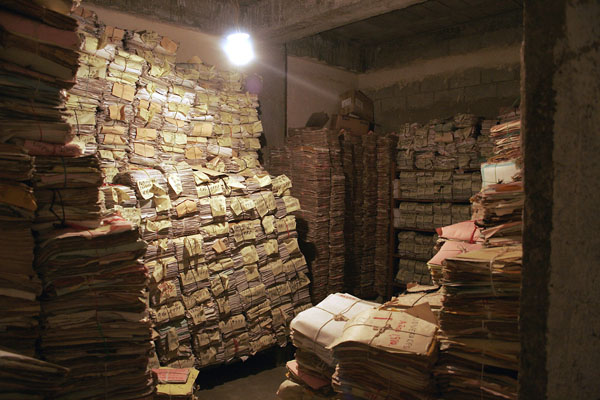
Interior room with bulb; Daniel Hernández-SalazarBetween 1961 and 1996, according to the findings of a United Nations Truth Commission, over 200,000 people in Guatemala lost their lives as a result of state-orchestrated acts of terror still denied by members of the security forces accused of perpetrating them. While conducting its investigations, the Truth Commission was repeatedly obstructed by army and police personnel from gaining access to official records, being told that no documentation of the type requested ever existed. Bureaucracies simply don’t work that way, even ones with good reason to destroy or conceal evidence of a self-incriminating nature. It was nonetheless of startling import when, on July 5, 2005, an attorney working for Guatemala’s Human Rights Office stumbled upon an archive recording the deeds of the National Police. Now known to contain an estimated 80 million documents, mainly covering the 1980s but dating back to earlier times, the archive revealed conspiracy and complicity on the part of police officers engaged in a ghoulish network of surveillance, intimidation, abduction, torture and murder, a veritable paper trail of death. A visit to the police archive, arranged so as to afford some first-hand familiarity with how its contents are being safeguarded and drawn upon for criminal proceedings as well as academic research, forms the basis of the seminar.

A preliminary account of the Historical Archive of the National Police (AHPN) is here (scroll down to the images) [and even more on related issues from the vaults of the National Security Archive at GWU here].  More than 10 million records have since been digitised in a collaborative project involving the University of Texas’ Lozano Long Institute for Latin American Studies, Rapoport Center for Human Rights and Justice, and Benson Latin American Collection, with the Archivo Histórico de la Policía Nacional de Guatemala.

AHPN

The records have been available online since December 2011; more on the project and its significance here and here:

In July 2005, the Procuraduría de los Derechos Humanos – the office of Guatemala’s human rights ombudsman – found the abandoned documents by accident in an abandoned munitions depot on the north side of Guatemala City. The messy bundles of records were stacked floor to ceiling in dozens of rooms infested by rats, bats and cockroaches, and many of the files were in an advanced state of decay. The administrative police records, which date from 1882 to 1997, document the repressive role played by the police during the 36-year armed conflict between leftist insurgents and government forces, which left a death toll of 250,000. That total included at least 45,000 people who were seized by the [US-backed] security forces and forcibly disappeared, their bodies buried in unmarked graves in cemeteries or in secret graves, often in military bases, according to the Historical Clarification CommissionThe U.N.-mandated truth commission found that the army was responsible for more than 90 percent of the killings in the civil war, most of whose victims were rural Maya Indians. The records that came to light in 2005 document the role played by the National Police during – and before – the conflict. The AHPN began to salvage and digitise the archives in 2006. The documents are held under tight security. The archive includes arrest warrants, surveillance reports, identification documents, interrogation records, snapshots of detainees and informants, and of unidentified bodies, fingerprint files, transcripts of radio communications, ledgers full of photographs and names, as well as more mundane documents like traffic tickets, drivers’ licence applications, invoices for new uniforms and personnel files.

There’s also a compelling report from the Historical Clarification Commission, Guatemala: Memory of Silence, here, which confirms that the National Police worked for military intelligence, ‘serving as the facade of the G-2 intelligence agency, and acted on its orders in the majority of cases.’  (I’ve posted about the blurring of military/policing before: in Mexico here and more generally here).

Incidentally, the photograph of the original archive (top of the page) is taken from the work of Daniel Hernández-Salazar, a former photojournalist for AP, Reuters and Agence-France Presse, who ‘has devoted much of his work to document the complex and painful recent history of his native Guatemala.’  More, including a portfolio of his images of the Guatemalan genocide, from the New York Times, ‘Angels Watch Over Memories Of War’, here.

LOVELL A Beauty that Hurts

For those who don’t know him, George is Professor of Geography at Queen’s University, and the author of the brilliant (and, as it happens, beautiful) book, A Beauty that Hurts: Life and death in Guatemala.

George gave me a copy soon after it was first published (1995 – it’s now in its third edition), and I’ve read it several times: apart from its substantive importance, it’s also a wonderful demonstration that first-class scholarship and graceful writing are not incompatible.

This seminar is part of a series run by the ever-inventive London Group of Historical Geographers: details here.

NOTE: The physical archive is in desperate need of financial support to continue its work: contact at ahpn@archivohistoricopn.org.  It and its staff also face other, acutely physical dangers as the Molina administration remilitarizes civil society and, ever since assuming office in January 2012, works to establish ‘an institutional culture disturbingly similar to the counter-insurgency model that dominated during the internal armed conflict.’  More on the vexed military/police nexus in Guatemala in a July 2012 report from International Crisis Group here.

Homogeneous (war) time

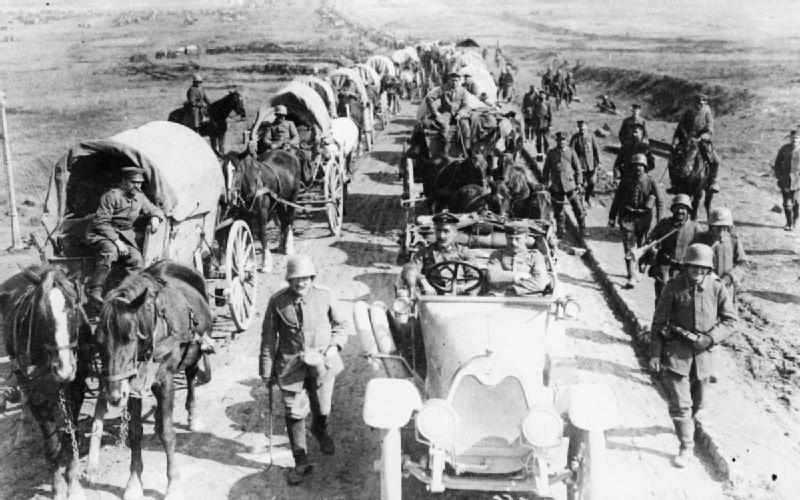
I’ve posted before about the ways in which the First World War involved the calibration and even mathematisation of the battle space, and it’s an important part of my argument in Gabriel’s Map (as you can see from the slides under the DOWNLOADS tab), but this in its turn required an elaborate choreography of time.  This is clearest in the co-ordination of artillery and infantry, particularly in the calculations required for a ‘creeping barrage’ in support of an advance, and eventually involved co-ordination with air support too, but it extended back far beyond the front lines; the re-supply and re-deployment of troops along narrow, crowded roads or narrow-gauge railways also required elaborate timetables, as Ernst Jünger makes clear in this passage from Storm of Steel:

‘The roads were choked with columns of marching men, innumerable guns and an endless supply column.  Even so, it was all orderly, following a carefully worked-out plan by the general staff.  Woe to the outfit that failed to keep to its allotted time and route; it would find itself elbowed into the gutter and having to wait for hours till another slot fell vacant’ (pp. 222-3).

German transport column on Albert-Bapaume road, March 1918 (IWM)

But how, exactly, were these offensive and logistical timetables orchestrated?  What was the mechanism for what Billy Bishop called ‘clockwork warfare’?

Jünger himself provides just one (German) example: ‘‘To keep everyone synchronised, on the dot of noon every day a black ball was lowered from the observation balloons, which disappeared at ten past twelve.’  This was presumably a battlefield adaptation of the ‘time-balls’ that had been developed by the British and then the US navies in the nineteenth century, but other ways of marking time on the Front seem to have been more common.

Two technologies were pressed into service by the Allies; they can both be seen in this synchronisation instruction contained in Operation Order (no 233) from the 112th Infantry Brigade on 10 October 1918:

O.C. No.2 Section, 41st Divisional Signal Company, will arrange for EIFFEL TOWER Time to be taken at 11.49 on “J” minus one day [“J” was the day of the attack] and afterwards will synchronise watches throughout the Brigade Group by a “rated” watch.

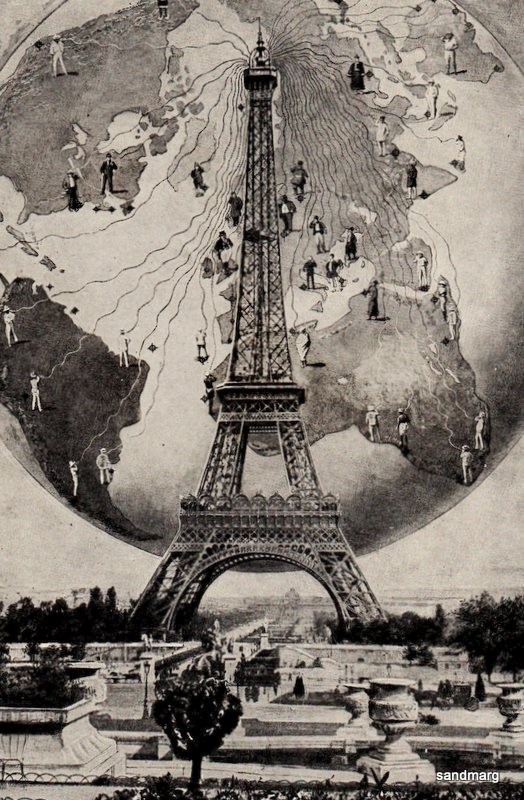
The first was the Eiffel Tower – or, more accurately, the time-signal transmitted from the Eiffel Tower throughout the war.  In 1909 the original twenty-year lease for the Tower was about to expire, and many Parisians loathed it (Maupassant famously had lunch there every day because it was the one place in the city from which it couldn’t be seen) so that its demolition seemed imminent.  But it was saved in large measure because the French military was persuaded of its strategic value as a navigation and wireless beacon. Eiffel had allowed the Minister of War to place antennas at the top in 1903, and the Bureau des Longitudes (under the direction of Henri Poincaré) urged the development of the military radio-telegraphic station to broadcast time-signals twice daily.  The original intention was to enable mariners to set their chronometers, but the project had a wider strategic, scientific and symbolic  significance. ‘Wireless simultaneity’, writes Peter Galison, ‘had become a military as well as a civilian priority’.

Eiffel Tower transmissions 1913

An experimental service started in 1909, and the French Army began broadcasts on 23 May 1910; by June 1913 a regular time service (based on transmissions from the master-clock at the Paris Observatory to the Tower) was in operation.  This continued throughout the war and in to the 1920s; the ‘ordinary time signals’, which were broadcast each day at 10.45 a.m., 10.47 a.m. and 10.49 a.m. and again at 11.45 p.m., 11.47 p.m. and 11.49 p.m., enabled ‘an expert observer, under the most favourable circumstances, to take the time to nearly 0.1 second’.  There’s more technical information than you could possible want here, but the meat of the story is in Peter Galison’s brilliant Einstein’s clocks, Poincaré’s maps: empires of time (2003) (for a discussion and overview see here).

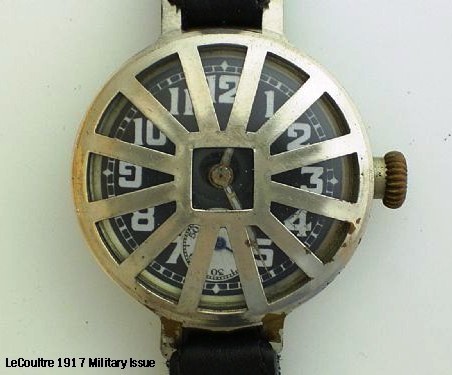
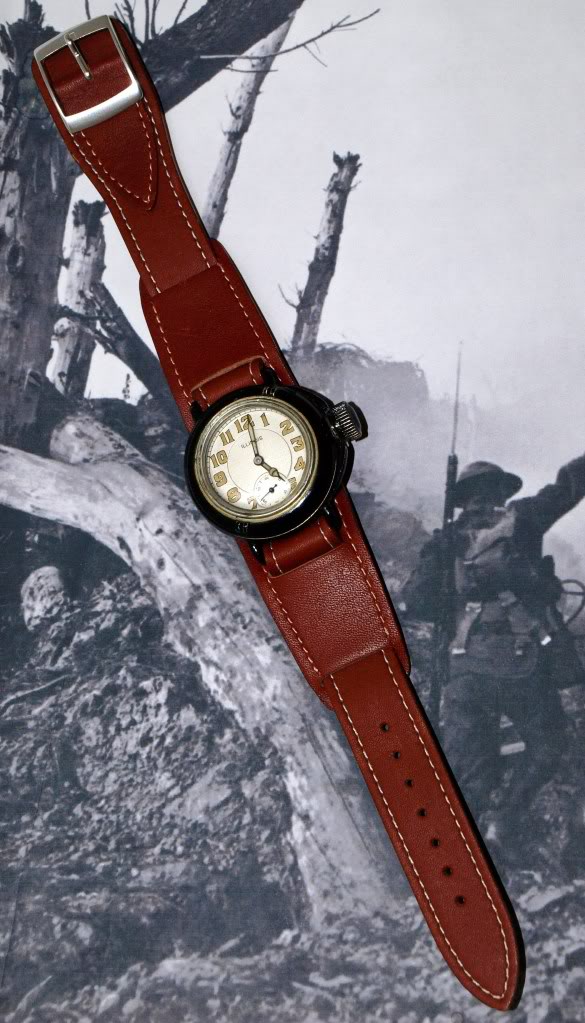
Trench watch c. 1916The second requirement for choreographing time in the battlespace was the wristwatch.  Originally wristwatches were designed for women (the first “wristlet” was made by Philippe Patek in 1868), and although the Kaiser had 2,000 wristwatches made for his naval officers in 1880 – and there is some evidence of their use in the Boer War – men continued to favour pocket-watches until the First World War.  Both soldiers and aviators needed a hands-free way of telling the time, and so the “trench watch” was born.  In Knowledge for War: Every officer’s handbook for the front, published in 1916, a wristwatch headed the kit list, above even a revolver and field glasses, and in the same year one manufacturer claimed that ‘one soldier in every four’ was already wearing a wristwatch ‘and the other three mean to get one as soon as they can.’

The first models had hinged covers (above), and often simply added lugs to existing small pocket-watches; wristwatches were widely advertised and bought commercially, but from 1917 the War Department began to procure and issue trench watches to officers for field trials.  Trench watches usually had luminous dials, for obvious reasons, and many models had ‘shrapnel guards’ (below).

Trench watch with shrapnel guard

If you want to know more, the Military Watch Resource (really) is the place to go; there’s also Konrad Knirim‘s 800 pp  British Military Timepeieces

The military importance of the wristwatch was captured in this essay in Stars and Stripes, published on 15 February 1918:

Trench watch‘I am the wrist watch…

From the general down to the newly-arrived buck private, they all wear me, they all swear by me instead of at me.

On the wrist of every line officer in the front line trenches, I point to the hour, minute and second at which the waiting men spring from the trenches to the attack.

I … am the final arbiter as to when the barrage shall be laid down, when it shall be advanced, when it shall case, when it shall resume.  I need but point with my tiny hands and the signal is given that means life or death to thousands upon thousands.

My phosphorous glow soothes and charms the chilled sentry, as he stands, waist deep in water amid the impenetrable blackness, and tells him how long he must watch there before his relief is due.

‘I mount guards, I dismiss guards.  Everything that is done in the army itself, that is done for the army behind the lines, must be done according to my dictates.  True to the Greenwich Observatory, I work over all men in khaki my rigid and imperious sway…  

I am in all and of all, at the heart of every move in this man’s war.  I am the witness of every action, the chronicler of every second that the war ticks on… I am, in this way, the indispensable, the always-to-be-reckoned-with.

I am the wrist watch.’

There were two ways in which watches were synchronised. Usually Signals Officers or orderlies were ordered to report to headquarters, as in this Instruction from the 169th Infantry Brigade on 14 August 1914:

Units will synchronise watches by sending orderlies to be at Brigade Headquarters with watches to receive the official time on “Y” day at the following hours:- 9 a.m, 5 p.m., 8 p.m

And again, in this Operation Order from the 89th Infantry Brigade on 29 July 1916:

One Officer from each Company will report to Battalion Headquarters in the SUNKEN ROAD at 2.30 a.m. 30th July, to synchronise watches.

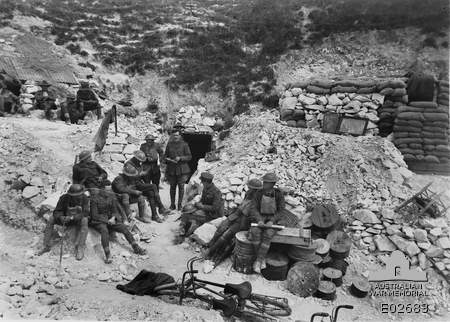
Intelligence officers from 4th Brigade AIF synchronising watches near Hamelet, 3 July 1918 (Australian War Memorial)

Intelligence officers from 4th Brigade AIF synchronising watches near Hamelet, 3 July 1918 (Australian War Memorial)

But centralisation also requires re-distribution, so to speak, as this order from 112 Infantry Brigade later in October 1918 makes clear:

Watches will be synchronised at 0630, 20th inst. Brigade Signal Officer will send watch round Units.

Edmund Blunden describes the practice in Undertones of War: ‘Watches were synchronized and reconsigned to the officers’; and again: ‘A runner came round distributing our watches, which had been synchronized at Bilge Street [‘battle headquarters’]’.

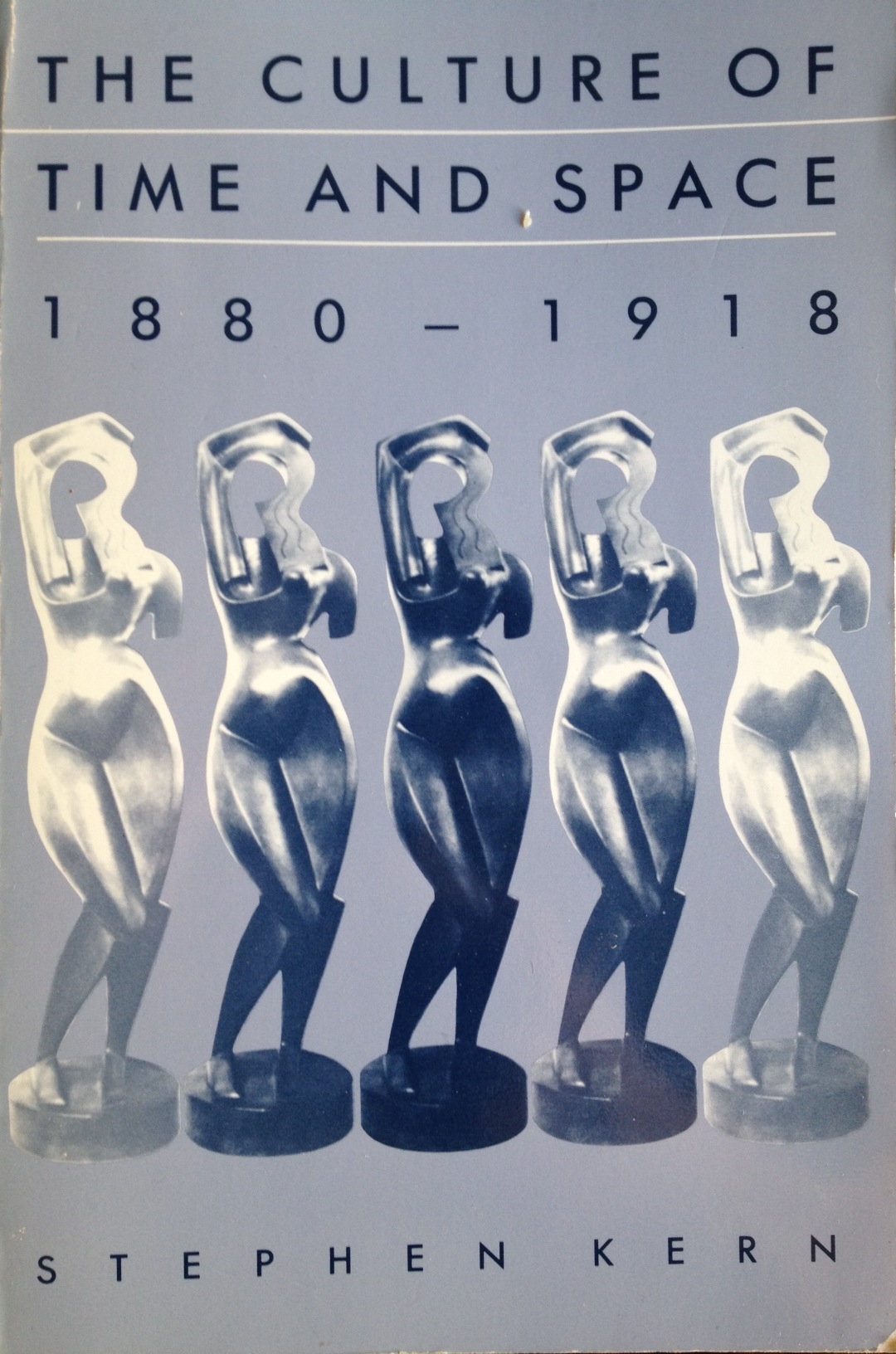
KERN Culture of time and spaceBy these various means, then, as Stephen Kern put it in The culture of time and space, 1880-1918,

‘The war imposed homogeneous time… The delicate sensitivity to private time of Bergson and Proust had no place in the war. It was obliterated by the overwhelming force of mass movements that regimented the lives of millions of men by the public time of clocks and wrist watches, synchronized to maximize the effectiveness of bombardments and offensives.’

That’s surely an over-statement: just as the ‘optical war’ produced through a profoundly cartographic vision was supplemented, subverted and even resisted by quite other, intimately sensuous geographies – what I’ve called a ‘corpography’ – so, too, must the impositions and regimentations of the hell of Walter Benjamin‘s ‘homogeneous, empty time’ have been registered and on occasion even refused in the persistence of other, more personal temporalities.

Note: For indispensable help in thinking through these issues, I’m indebted to contributors to the Great War Forum who patiently and generously responded to my original question: ‘When watches were synchronised what, exactly, were they synchronised to, and how was it done?’