The Anthropocene Project

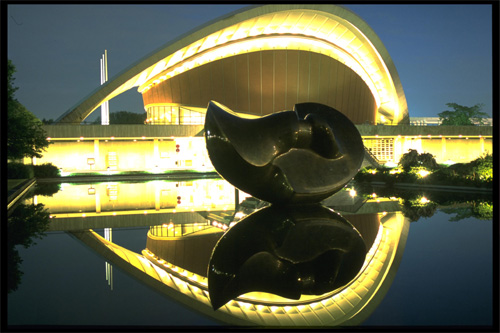
hkw_nachtThe dazzling Haus der Kulturen der Welt in Berlin (left) has posted a series of videos from its January 2013 series, The Anthropocene Project, here.  The list includes a series of dialogues/conversations (including Michael Taussig) and four keynotes:

Will Steffen, The Anthropocene: where are we going?

As one of the major proponents of the Anthropocene hypothesis, Will Steffen explores in his talk the origins of and scientific basis for the Anthropocene. From humanity’s hunter-gatherer beginnings to the previous century’s post-war global acceleration of populations, technologies, and consumption habits, the main question this lecture addresses is: where is all of this leading? Is the Great Acceleration the “new normal,” or will the earth system force the Anthropocenic era into a different direction? Steffen proposes an evaluation of the planetary future’s possibilities, asking: are we on the road to global sustainability or are we poised for global collapse? 

Dipesh Chakrabarty, History on an expanded canvas: the Anthropocene’s invitation

If climate scientists have become social historians, how can one translate their findings and construct an aggregate, common narrative that is not only legible to both localized sociologies and planetary geophysics, but effectively integrates both these positions? Post-colonial theorist and historian Dipesh Chakrabarty reflects on potentialities of past and future narratives within the Anthropocene. What kinds of empowerment and disempowerment do these collaborative and multifaceted storytellings imply for the Anthropocene? Chakrabarty engages with the proposed necessity of associating the histories of the earth and that of humans in order to effectively open up intellectual pathways towards the dissolution of modernity’s misunderstandings concerning human agency and capitalistic freedom. 

Elizabeth Povinelli, Geontologies: a requiem to late liberalism

Much critical theory has attempted to think life out-sideof the “human,” yet most applications of the Anthropocene have focused on how humanity might find a way to keep its way of life without loosing the “human.” Is the Anthropocene, then, a framework for humanizing or environmentalizing capitalism without losing capitalism? Departing from the premise that Western political theory is rooted in the carbon cycle, where life is seen as a metabolic ring of growth, reproduction, and degeneration, Povinelli tackles the “carbon imaginary” of biopolitics. She considers the diverse local arrangements of “life” in relation to the technological procedures of maintenance and renewal. What forms of being are privileged to lay claim to life or to preserve the earth’s being-processes? 

John Tresch, Cosmograms, or how to do things with worlds

Each culture has had means to conceptualize and address the nature and composition of the universe, frequently creating representations of the order of all that exists, also known as “cosmograms.” The concept of a cosmogram can be expanded to apply to all knowledge about “natural” and “human” worlds, as well as the interactions between them. Departing from the Anthropocene thesis’ conception of nature as a malleable entity, historian John Tresch takes a culturally and historically comparative perspective to consider instances of cosmo-pragmatics, or how cosmograms have been used to foster intervention upon the world. His talk addresses a variety of exemplary phenomena, from 19th century Romanticism and the Industrial Revolution to today’s ecological discourse and the fragility of our cosmic order. 

I hope there’s more to come, since the programme – a detailed pdf with abstracts is here – also included a performance by Taussig, a lecture from Rem Koolhaas,  and contributions from Lorraine Daston, John Law, Paolo Tavares, Eyal Weizman, Cary Wolfe and a host of others.  I very much like the idea of bringing the visual and performing arts into the discussion and transcending the conventional dull boundaries of the humanities and (especially) the ‘natural’ and ‘social’ sciences (to see something of what I mean, go here and scroll down to the image of John Law and Xavier Le Roy…)
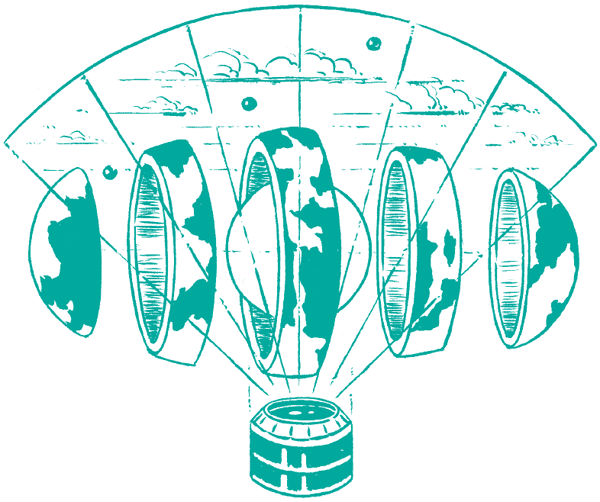
das_anthropozaen_eine_eroeffnung

Illustration: (c) Benedikt Rugar 2012

“The Anthropocene Project” is an initiative of Haus der Kulturen der Welt in cooperation with the Max-Planck-Gesellschaft, Deutsches Museum, the Rachel Carson Center for Environment and Society, Munich and the Institute for Advanced Sustainability Studies, Potsdam.  It’s a two-year project advertised thus:

Our notion of nature is now out of date. Humanity forms nature. This is the core premise of the Anthropocene thesis, announcing a paradigm shift in the natural sciences as well as providing new models for culture, politics, and everyday life. In a two-year project, HKW will explore the hypothesis’ manifold implications for the sciences and arts.  The “Anthropocene” is the new geological “age of mankind” as proposed by the Earth sciences. Popularized by Nobel Prize winner Paul J. Crutzen around the turn of the millenium, the term now stands for one of the most trailblazing scientific concepts of the present. The transdisciplinary Anthropocene Project explores this concept, using research and presentation methods from the arts and sciences. If the opposition between humanity and nature is now suspended, how do we change our perspectives and perception? Is it still possible to think in concepts like “artificial” and “natural?”  What does it mean for our anthropocentric understanding and our future if nature is man-made? What impact does the notion of global changes has on political decision-making? Which image of humanity appears if nature is shaped by mankind?

Good questions, though – since I’m still in thrall to Nigel Clark‘s Inhuman nature – I’m not so sure about the anthropocentric weight in this paragraph and, perhaps, more generally; it’s Nigel’s work that, in part, drives my interest in ‘nature’ as a medium through which (rather than merely ‘over which’) war is conducted.

Gabriel’s map

Gabriel's map posterThe video of  “Gabriel’s map: cartography and corpography in modern war”, a lecture I gave as part of the University of Kentucky’s Committee on Social Theory 2013 series on “Mapping” in January, is now available here.

The splendid poster (left) mangles the title, but any mangling of the content is down to me!

I’m presently re-working this as an essay, but I’ll eventually post the pdf of the slides: more soon.  In the meantime, I’d welcome any comments, suggestions and criticisms.

UPDATE:  You can now access the slides for this presentation as a pdf under DOWNLOADS, but please remember that this was the first version of the presentation – I expect to be revising it over the coming weeks – and if you use any of them (for teaching purposes only) please credit the source.

3-D War

It’s strange how things sometimes come together….  News of the online publication of Stuart Elden‘s paper, ‘Secure the volume: vertical geopolitics and the depth of power‘, coincides with a short post from Jasper Humphreys at the Marjan Centre, ‘Shape shifting in Flanders‘, which describes the war on the Western Front as the first 3-D war.  What Jasper has in mind is the combination of aerial reconnaissance (and artillery spotting) with the elaborate tunnelling under enemy lines to detonate huge explosions.  But if we extend the terrain beyond the Western Front then the claim becomes a more general and I think an even more powerful one, with the bombing of civilian targets far beyond the front lines by airships and aircraft and the unrestricted use of that ‘ungentlemanly weapon’, the submarine. (Stuart cites Paul Virilio‘s Bunker Archaeology, which identifies the emergence of ‘volumetric’, deep three-dimensional warfare with the Second World War, but the genealogy is clearly older than that).

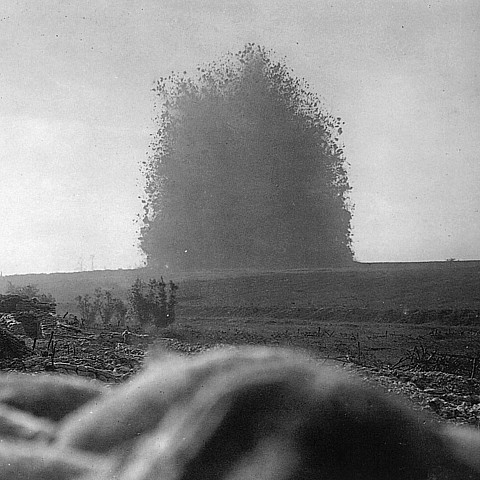
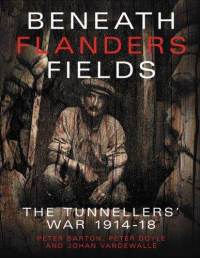
BARTON et al Beneath Flanders FieldsIt’s the underground war – the tunnellers’ war – that captures Jasper’s attention.  He focuses on the mining of Messines Ridge in June 1917, which (as he notes) appears in Sebastian Faulkes‘s Birdsong, but the tactic was a general one that not only scarred the landscape but also left an indelible impression on everyone who witnessed it, even by proxy: the detonation of the mine beneath Hawthorn Ridge in July 1916 was filmed by Geoffrey Malins for The Battle of the Somme (below).

Mining had started with the onset of trench warfare, and was dominated by the Germans during 1914 and 1915: ‘Although Germany had rejected military mining by 1914,’ Simon Jones notes, ‘it was nevertheless able quickly to revive its capability through the availability of fortress troops which could be attached ot its field army.  There seemed no alternative but to mine on the Western Front as a means of breaking the strong field defences.’  For the British and their allies mining evolved, if that’s the right verb, into three main phases: the Somme in 1916, Arras in April 1917 and – though its efficacy was by then undermined by the German strategy of defence-in-depth – Messines in June 1917.

Hawthorne Ridge mine

Hill 60 on the Messines Ridge had been mined in 1915, but the re-mining in June 1917 – as part of ‘the largest mining attack in the history of warfare’ (Jones) – was hugely spectacular:

‘The artillery preparations which for days had been intense had died down and the night was comparatively quiet…  Suddenly, all hell broke loose.  It was indescribable.  In the pale light it appeared as if the whole enemy line had begun to dance, then, one after another, huge tongues of flame shot hundreds of feet into the air, followed by dense columns of smoke which flattened out at the top like gigantic mushrooms.  From some craters were discharged tremendous showers of sparks, rivalling everything ever conceived in the way of fireworks.’

I’ve taken this from an essay by Roy MacLeod, ‘Phantom soldiers’, which provides an excellent discussion of Australian tunnellers in the underground war and emphasizes that theirs was a profoundly scientific campaign that involved knowledge of geology, engineering and – crucial for counter-mining – acoustics.  If it was science, it was doubly hellish science, both for the conditions endured by the tunnellers and for the consequences on the surface. In Underground warfare Simon Jones includes this report from a British artillery officer:

‘At exactly 3.10 a.m. Armageddon began.  The timing of all the batteries in the area was so wonderful and to a second every gun roared in one awful salvo.  At the same moment the two greatest mines in history were blown up…  First there was a double shock that shook the earth here 15,000 yards away like a gigantic earthquake.  I was nearly flung off my feet.  Then an immense wall of fire that seemed to go half-way up to heaven.  The whole country was lit with a red light like a photographic dark-room… The noise surpasses even the Somme; it is terrific, magnificent, overwhelming.  It makes one almost drunk with exhilaration…’

Barely two months later photographer Frank Hurley peered down at the huge crater in horror:

‘After, we climbed to the crest of hill 60, where we had an awesome view over the battlefield to the German lines. What an awful scene of desolation! Everything has been swept away: only stumps of trees stick up here & there & the whole field has the appearance of having been recently ploughed. Hill 60 long delayed our infantry advance, owing to its commanding position & the almost impregnable concrete emplacements & shelters constructed by the Bosch. We eventually won it by tunnelling underground, & then exploding three enormous mines, which practically blew the whole hill away & killed all the enemy on it. It’s the most awful & appalling sight I have ever seen. The exaggerated machinations of hell are here typified. Everywhere the ground is littered with bits of guns, bayonets, shells & men. Way down in one of these mine craters was an awful sight. There lay three hideous, almost skeleton decomposed fragments of corpses of German gunners. Oh the frightfulness of it all. To think that these fragments were once sweethearts, may be, husbands or loved sons, & this was the end. Almost back again to their native element but terrible. Until my dying day I shall never forget this haunting glimpse down into the mine crater on hill 60, – & this is but one tragedy of similar thousands…’

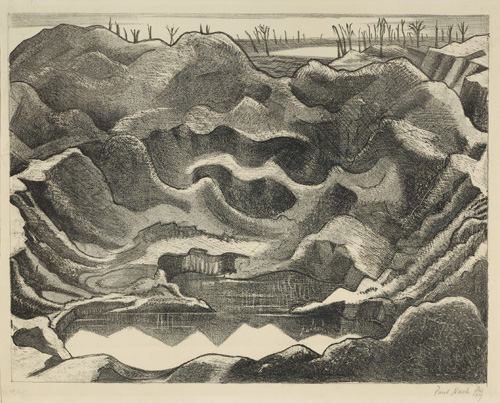
The nightmare scene was also the subject of Paul Nash‘s famous sketch, completed in November:

NASH The Crater

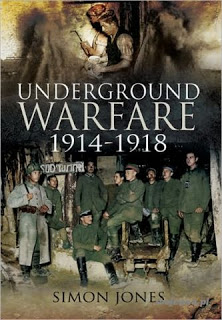
JONES Underground warfareThe BBC has a gallery of images of the underground war, which includes two maps of trenches and tunnels, here, and there’s a fascinating report of contemporary archaeological excavations of the same site here.  There are also helpful discussions and diagrams here. But the most comprehensive discussion is undoubtedly Simon Jones‘s Underground warfare 1914-1918 (2010), which includes compelling first-hand accounts from the tunnellers and countless others.

In the course of his own discussion, Jasper makes two other observations that also intersect with some of my current preoccupations.  The first is about the familiarization of the landscape of war by the first artists despatched to the front, though I’m less interested in the pastoral aesthetic than in subsequent, thoroughly modernist attempts to capture the ‘anti-landscape’ of the war.

The second is about the earthy, material medium through which the war was fought:

‘No war in history has combined such a vast theatre of operations fought in such proximity to the forces of Nature: firstly the elements of wind, rain, storms and snow created the all-pervasive mud and water – sometimes referred to metaphorically as ‘slime’ – along with the horses, mules, dogs and canaries, as well as rats and mice, all sharing the hell of the trenches with humans. Secondly, the geography and topography dominated the fighting: every small hill, river or indentation that would provide even a tiny advantage was a battle-ground.’

I’ve posted about these ‘slimescapes‘ before, and they loom large in my presentation on ‘Gabriel’s map’, but earlier this year I agreed to give a new public presentation this May (at the Vancouver Aquarium – where else?) on ‘The natures of war’ in which I develop the argument in more – er – depth.   I won’t be confining myself to the First World War, though I expect to have much to say about trench and tunnel warfare, and in particular I want to think through ‘nature’ less as the arena over which conflicts are fought (‘conflict commodities’, ‘resource wars’, and the rest) and more about nature as the medium through which conflict is conducted.  I’m assuming we can all agree that ‘nature’ is just as complex as Raymond Williams said it is, and that here it’s just a shorthand that will need very careful unpacking – or perhaps excavating.  More soon…

Naming names

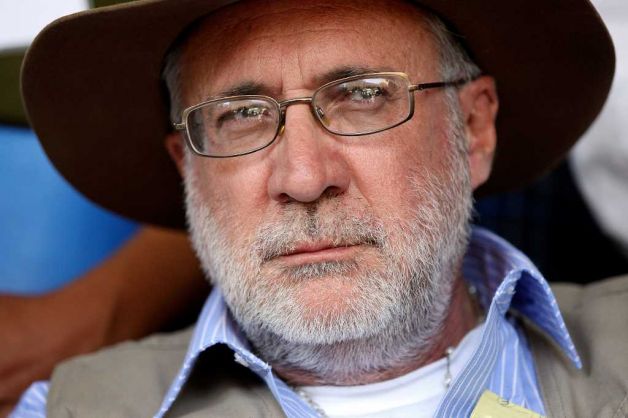
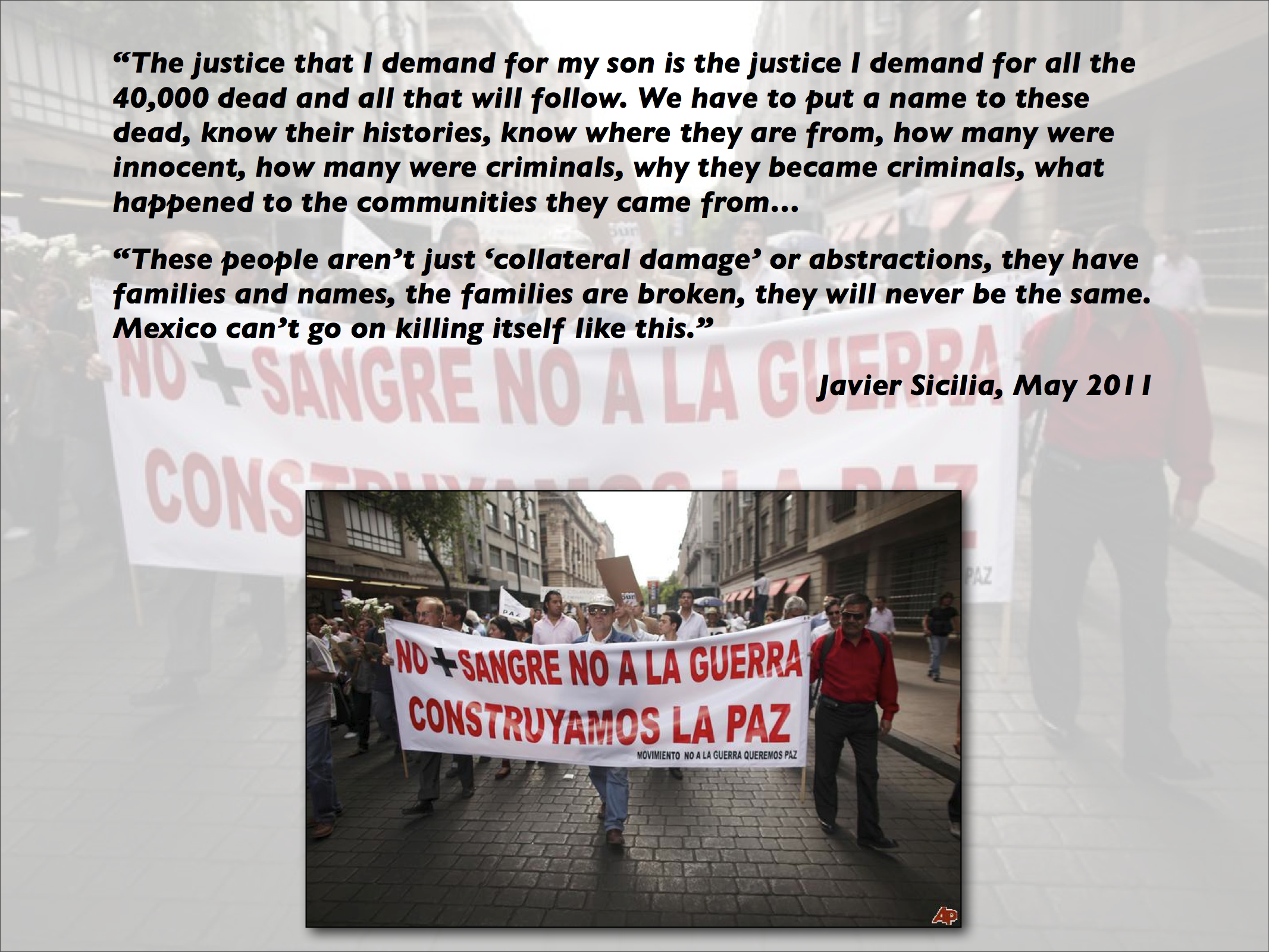
Mexican-poet-Javier-SiciliaIn March 2011 members of a Mexican drug cartel tortured and murdered a young student, Juan Francisco Sicilia Ortega, along with six of his friends in the city of Cuernavaca in Morelos.  His father, Javier Sicilia (right), poet, professor and journalist, later told Time:

‘When I got to Cuernavaca… I was in a lot of emotional pain. But when I arrived at the crematorium I had to deal with the media. I asked the reporters to have some respect; I told them I’d meet them the next day in the city plaza. When I got there I found they’d put a table [for a press conference] out for me, and I realized this was going to be bigger than I’d anticipated.

‘I had never thought of starting a movement or being a spokesman for anything. I’m a poet, and poets are better known for working with more obscure intuitions. But in those moments I was reminded that the life of the soul can be powerful too. My chief intuition then was that we had to give name and form to this tragedy and somehow put that into action with real citizens as a way to tell the government, “We need something new, especially new institutions to fight our lawlessness and corruption and impunity, not just that of the drug cartels but the state.”‘

Sicilia's call

Sicilia’s demand (above) started the Movement for Peace with Justice and Dignity (“Haste la Madre!”), but the call to abjure the aggregations and anonymizations of mass violence – by state and non-state actors – has been taken up in other political arenas too.

It’s in this spirit that I read the Open Society‘s detailed listing of 136 people who were subjected to secret detention or extraordinary rendition by the CIA.

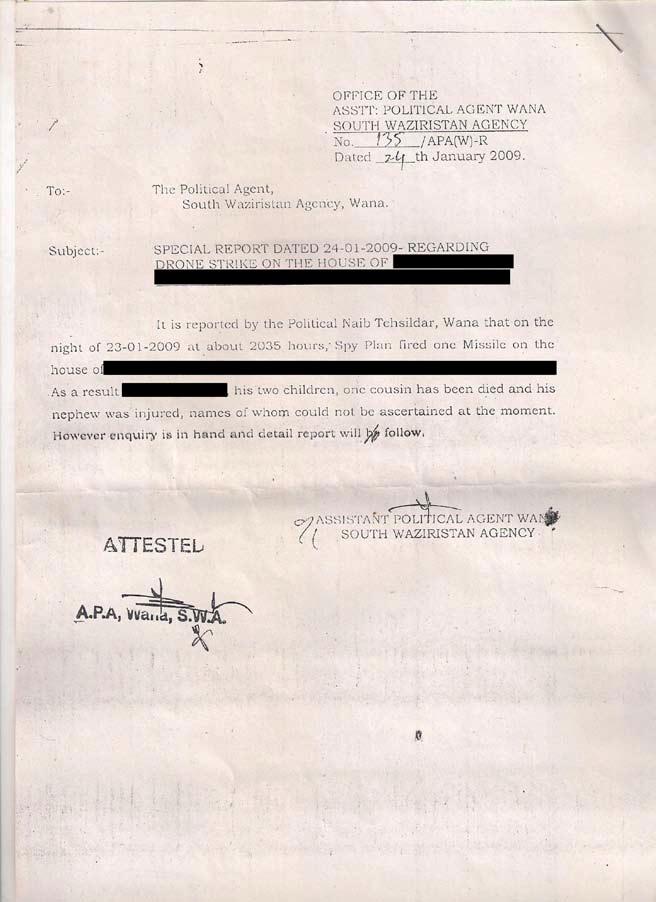
Sth-Wana-letter-Jan-20091And now – to turn to a program that is in many respects the flip side of extraordinary rendition (assuming a dark side can have another dark side) – the Bureau of Investigative Journalism in London has announced an ambitious campaign to identify and name all the victims of US-directed air strikes in Pakistan.

The Bureau’s Chris Woods explains:

‘Part of the justification for the US carrying out drone strikes without consent is their reported success. And naming those militants killed is key to that process. Al Qaeda bomber Fahd al-Quso’s death was widely celebrated.  Yet how many newspapers also registered the death of Mohamed Saleh Al-Suna,  a civilian caught up and killed in a US strike in Yemen on March 30? By showing only one side of the coin, we risk presenting a distorted picture of this new form of warfare. There is an obligation to identify all of those killed…’

And, yes, we also need to recover the names of those killed by other actors too.  None of  them are ‘just “collateral damage” or abstractions’.

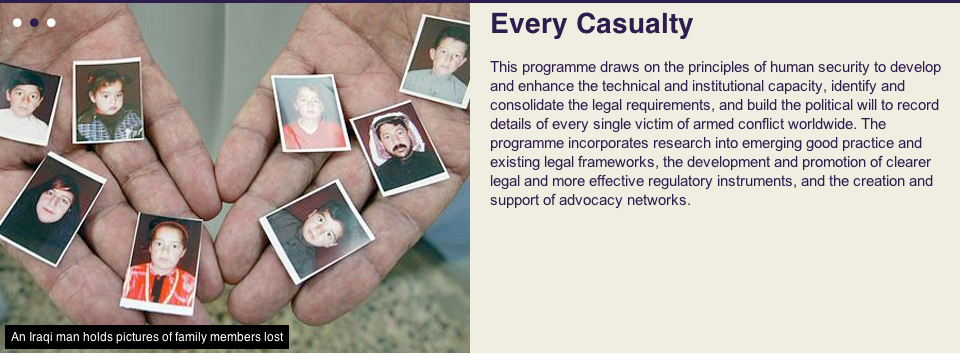
The principle is developed more generally by the Every Casualty project of the Oxford Research Group.

The purpose of the Every Casualty (EC) programme is to enhance the technical, legal and institutional capacity, as well as the political will, to record details of every single casualty of armed conflict throughout the world, civilian as well as combatant. Civilian deaths are particularly poorly documented, and often not recorded at all. Where death tolls are limited to purely numerical assessments, exaggerated, politicised claims and counter-claims frequently abound. By contrast, where Western nations are engaged in conflicts, they meticulously record their military dead not as numbers but by name.

Such detailed, verifiable and comprehensive recording when extended to all victims provides both a memorial for posterity and public recognition of our common humanity. Careful and respectful records ensure that the human cost of conflict is better understood and can become an immediately applicable resource for conflict prevention and post-conflict recovery and reconciliation.

Every casualty

But I think it’s probably a mistake to privilege names over numbers: numbers matter too, and  – whatever the legal-humanitarian reasons for recovering the names – they also help us to imagine what the raw numbers mean.  There are other ways of achieving the same end, and they don’t necessarily involve abandoning anonymity.  I’ve never forgotten the final scene in Richard Attenborough‘s film of “Oh, what a lovely war!”; the shot begins with a single white cross and then pans back and back and back, seemingly without end, until the screen is filled with a sea of 100, 000 crosses [start at 2:21].

TED talks and Wall works

This week it was announced that the TED talks will be moving from California to Vancouver in March 2014 – Mayor Gregor Robertson supposedly saw this as a sign that ‘we’re breaking through in thought leadership’ (sic) – so this may be a good time to announce something different (particularly for those, like Nathan Jurgenson, who are leery of the TED bandwagon).

PWIAS

The Peter Wall Institute for Advanced Studies at UBC plans to host six International Roundtable Discussions next year in Vancouver; the outline call is below, and you can find more details here, and details of our other international programs here.

Big Ideas. Time and space to explore them. The Peter Wall Institute for Advanced Studies at the University of British Columbia will host six International Roundtable Discussions each year for scholars from the international community and Canada to come together in the pursuit of knowledge in an interdisciplinary environment. The objective of the Institute’s International Roundtable Discussions is to engage in fundamental research and idea exchange that can prompt advances in science and society, and have a significant impact on the discovery of solutions to important problems.

  • The International Roundtable program is open to scholars around the world, who can submit proposals for roundtable discussions that will explore creative and innovative ideas that will make significant contributions to knowledge.
  • The international roundtable must offer a unique opportunity for collaboration among scholars. The Institute will not fund meetings that would have otherwise happened, such as annual meetings.
  • The application must describe how the proposed roundtable will create a coherent forum for creative curiosity and the exchange of ideas that can lead to new discoveries.

Applications must be submitted electronically, no later than June 1, 2013 for the May 5 to 10, 2014 Roundtables and October 1, 2013 for the October 20 to 25, 2014 Roundtables to Joanne Forbes, International Program Manager, internationalprograms@pwias.ubc.ca

The metal falcon

As public attention to military violence continues to contract to the use of drones, Rawan Yaghi supplements her previous account of living and dying under Israeli drones in Gaza with another despatch describing Israel’s use of conventional strike aircraft, Life under the F-16s in Gaza:

With F16s, it’s a scary roar like someone is mocking sounds in a water well. It also depends on the altitude of the plane, sometimes a high pitched roar, others a low distant one. F16s are harder to spot than drones or Apaches because they are always ahead of their roar. And since you never know where the plane is going and since buildings in Gaza are crammed into Gaza, you rarely get to see the metal falcon.

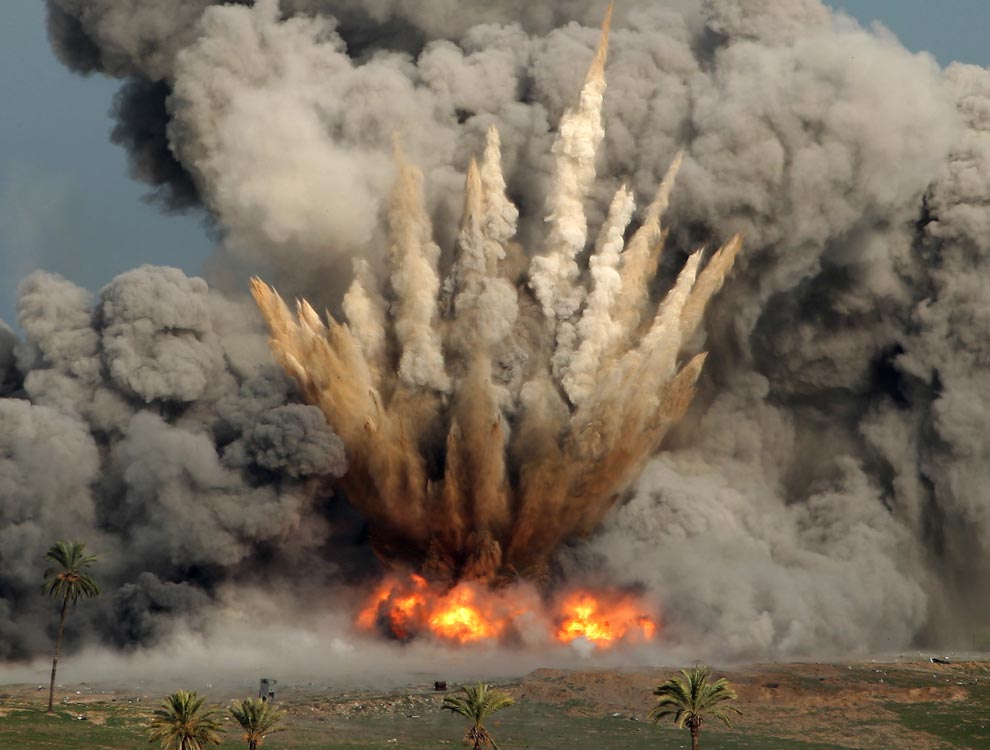
F-16 bombing Beit Hanoun, Gaza, January 2009 (Patrick Baz/AFP/Getty Images)

F-16 bombing Beit Hanoun, Gaza, January 2009 (Patrick Baz/AFP/Getty Images)

She describes the intimidating ‘mock raids’, the physical and psychological damage, and the scars that will never heal:

‘I was fourteen when the AbuSelmeyyas’ house was attacked by an F16 air strike. My body shivers as I write this. The attack killed the father and mother and seven of their children, Nasrallah 4, Aya 7, Yahya 9, Eman 12, Huda 14 who was my classmate in primary school and who had the most angelic voice I’ve ever heard, Sumayya 16, and Basma 17, leaving Awad, 19 at that time, injured and alone.  Fourteen  others were injured in that attack, since the house was located in a heavily populated neighborhood, not very far from where I live. The attack attempted to assassinate leaders of militant groups. However it failed. In October last year, The Israeli court in Jaffa refused to give any compensations to the relatives of the family and the only member if the family left, saying the house was targeted during a “combat operation”. I wasn’t allowed to see any news about the attack. I only heard some news about it. And I learned about Huda in the morning. I heard from my brother that day that the bomb was directly dropped on the room where the mother and the children were. I also heard about their body parts being found in the buildings next to their house. I was only fourteen. What did I know.

What I do know – what we all surely know – is that there is more to military violence than drones; that our attention ought not to be limited to the ‘rules’ (un)governing their operation; and that the dismal desire to wage wars outside declared war-zones neither started nor ended with George W. Bush.

Securing anti-security

Stuart Elden alerts us to Anti-Security… where you will find this:

Anti-security Mark Neocleous

This is an important project…

Global geographies of torture

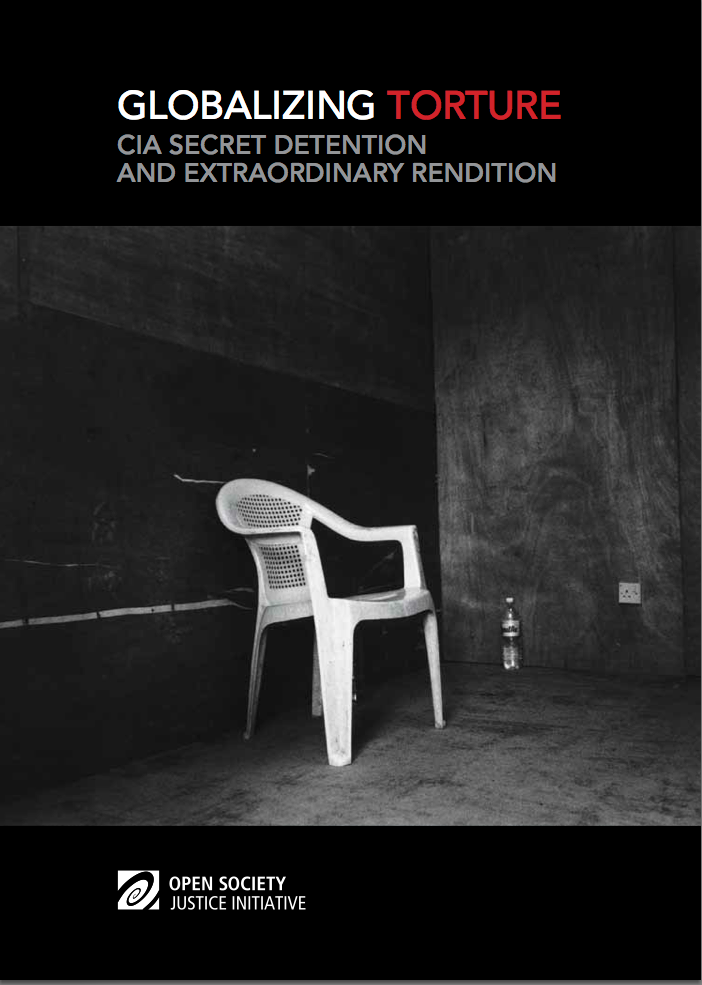
Globalizing torture (2013)It’s over six years since I wrote ‘The Black Flag’ and ‘Vanishing points’, two linked essays about Guantanamo, Abu Ghraib and the global war prison (see DOWNLOADS tab), and I’m currently updating, revising and integrating them for The everywhere war.

Today there’s news of a new report by Amrit Singh, Senior Legal Officer for the Open Society Justice Initiative’s National Security and Counterterrorism program, Globalizing torture, that lists 136 people who were subjected to CIA secret detention and/or extraordinary rendition.  The list – the most comprehensive to date: you can find it on pp. 30-60 – combines secret detention and extraordinary rendition ‘because the two programs had similar modalities, and torture, enforced disappearance, arbitrary detention, and the abuses were common to both.’

The report also identifies 54 states that were complicit in the programs: ‘hosting CIA prisons [“black sites”] on their territories; detaining, interrogating, torturing, and abusing individuals; assisting the CIA in the capture and transportation of detainees; permitting the use of their airspace and airports for secret CIA flights transporting detainees; providing intelligence leading to the CIA’s secret detention and extraordinary rendition of individuals; and interrogating individuals who were being secretly held in the custody of other governments. ‘  Only one state has issued an apology (over a single case), and only four have provided financial compensation to victims.  You can find this ghastly gazetteer, carefully annotated, on pp. 62-118. (There are some conspicuous omissions; the Guardian has an infog[eog]raphic here).

In case you think this is a purely historical geography, the report notes that:

‘the Obama administration did not end extraordinary rendition, choosing to rely on anti-torture diplomatic assurances from recipient countries and post-transfer monitoring of detainee treatment. As demonstrated in the cases of Maher Arar, who was tortured in Syria, and Ahmed Agiza and Muhammed al-Zery, who were tortured in Egypt, diplomatic assurances and post-transfer monitoring are not effective safeguards against torture. Soon after taking office in 2009, President Obama did issue an executive order that disavowed torture, ordered the closure of secret CIA detention facilities, and established an interagency task force to review interrogation and transfer policies and issue recommendations on “the practices of transferring individuals to other nations.” But the executive order did not repudiate extraordinary rendition, and was crafted to preserve the CIA’s authority to detain terrorist suspects on a short-term transitory basis prior to rendering them to another country for interrogation or trial.’

And, as the New York Times reports, ‘the Senate Intelligence Committee recently completed a 6,000-page study of the C.I.A. detention and interrogation program, but it remains classified, and it is uncertain whether and when it might be even partially released.’

‘A foreign field that is forever England’?

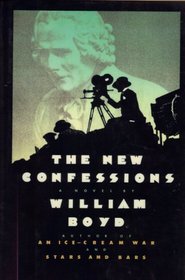
BOYD New ConfessionsI’ve already noted the effect that William Boyd‘s An Ice-Cream War (1982) had on me, but there’s another Boyd novel that also deals with the First World War – this time set on the Western Front rather than East Africa – that also offers much food for thought.

In the early sections of  The New Confessions (1987), an odyssey conducted in the obvious shadows of Rousseau, the protagonist John James Todd is serving in a Public School service battalion of the British Army just before Ypres.  In a chapter revealingly entitled ‘New geometries, new worlds’, Todd recalls the Ypres front in early June 1917 like this:

‘Take an idealized image of the English countryside – I always think of the Cotswolds in this connection…  Imagine you are walking along a country road.  You come to the crest of a gentle rise and there before you is a modest valley.  You know exactly the sort of view it provides.  A road, some hedgerowed lanes, a patchwork of fields, a couple of small villages – cottages, a post-office, a pub, a church – there a dovecote, there a farm and an old mill; here an embankment and a railway line; a wood to the left, copses and spinneys scattered randomly about.  The eye sweeps over these benign and neutral features unquestioningly.

‘Now place two armies on either side of this valley.  Have them dig in and construct a trench system.  Everything in between is suddenly invested with new sinister potential: that neat farm, the obliging drainage ditch, the village at the crossroads become key factors in strategy and survival.  Imagine running across those intervening fields in an attempt to capture positions on that gentle slope opposite so that you may advance one step into the valley beyond.  Which way will you go? What cover will you seek?  How swiftly will your legs carry you up that sudden gradient?  Will that culvert provide shelter from enfilading fire?  Is there an observation post in that barn?  Try it next time you are on a country stroll and see how the most tranquil scene can become instinct with violence.  It only requires a change in point of view.’

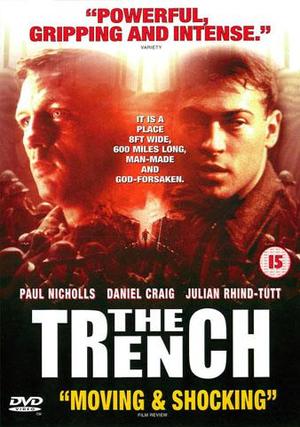
The TrenchLater Todd is recruited by the War Office Cinema Committee with strict instructions about what and may not be shown, and some ten years after he wrote the novel Boyd directed his own film, The Trench, set on the eve of the Battle of the Somme. But my point (for the moment) isn’t about photography or film but about the work of war artists on the Western Front.

During the spring of 1916 Charles Masterman, the director of the British War Propaganda Bureau, was persuaded to appoint the first Official War Artist, Muirhead Bone.  Bone was a sketcher and watercolour artist, who was duly commissioned as an honorary Second Lieutenant and arrived in France during the Battle of the Somme.  He returned to England in October, and two hundred of his drawings were published in ten monthly parts, with an accompanying commentary by C.E. Montague.

A View in Flanders behind the Lines, Showing Locre and the Tops of Dug-Outs on the Scherpenber 1916 by Sir Muirhead Bone 1876-1953

‘For many people at home,’ Samuel Hynes remarks in A war imagined, ‘they must have been an important source of their notions of what the war looked like.’  But, he continues,

‘Bone and Montague agreed that what it looked like was England; both the drawings and the commentaries imagine the war in familiarizing English terms…  They made the war look familiar, and they provided images of it from which both the dead and the suffering living had been entirely excluded.’

BONE British troops marching to the Somme

When the first two weekly installments appeared, apparently to considerable public acclaim, Wilfred Owen called them ‘the laughing stock of the army’ because they presented such a pastoralized, picturesque and sanitized view of the war: ‘To call it England!’  Many of Bone’s drawings, like the two examples I’ve shown here, rendered the landscape in the idealized terms of Boyd’s ‘country stroll’.  (There were exceptions, but even when Bone turned to the desolation of the battlefield many of his sketches were devoid of human form, alive or dead.)  To be sure, most commentators noted that in the rear a working countryside persisted, and many of them made much of the shocking transition from a landscape that was indeed familiar, largely untouched by military violence, to something unlike any landscape on earth.

And it’s exactly that anti-landscape Owen wanted to be represented.  In The soldiers’ tale Hynes writes that

‘War turns landscape into anti-landscape, and everything in that landscape into grotesque, broken, useless rubbish – including human limbs.’

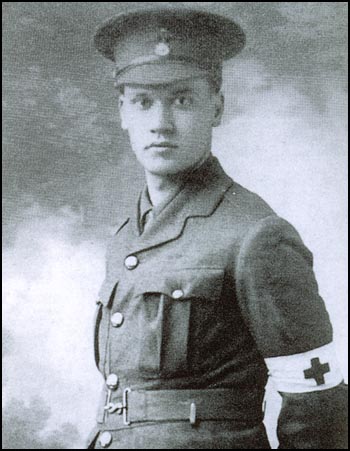
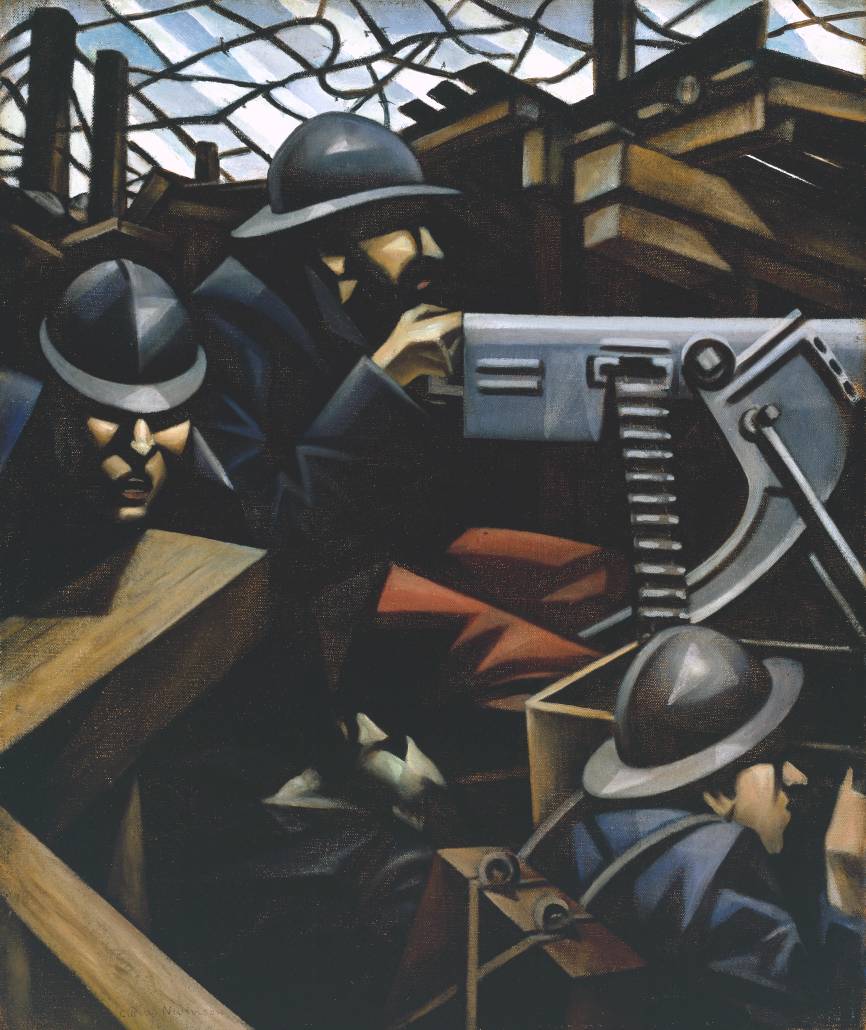
C.R.W. NevinsonAnd there were other artists who were developing Boyd’s ‘change in point of view’, a different visual vocabulary for these brutally new warscapes.  One of the most interesting, I think, is C.R.W. Nevinson.  Early in the war Nevinson served as an orderly with the Friends’ Ambulance Unit and then as an ambulance driver with the Royal Army Medical Corps.  He was invalided out in January 1916, a result of acute rheumatic fever, but in March 1916 he exhibited a series of Futurist paintings whose stark geometric planes and mechanised violence conveyed a radically different sensibility, one in which soldiers and machines were fused into shockingly new assemblages and where human bodies were caught up in and overwhelmed by the percussive force of the new military machine.  One of his most famous paintings, of a French machine-gune post, La Mitrailleuse (below), captures what Michael Walsh calls the ‘machinomorphic image’ of the war.

La Mitrailleuse 1915 by Christopher Richard Wynne Nevinson 1889-1946

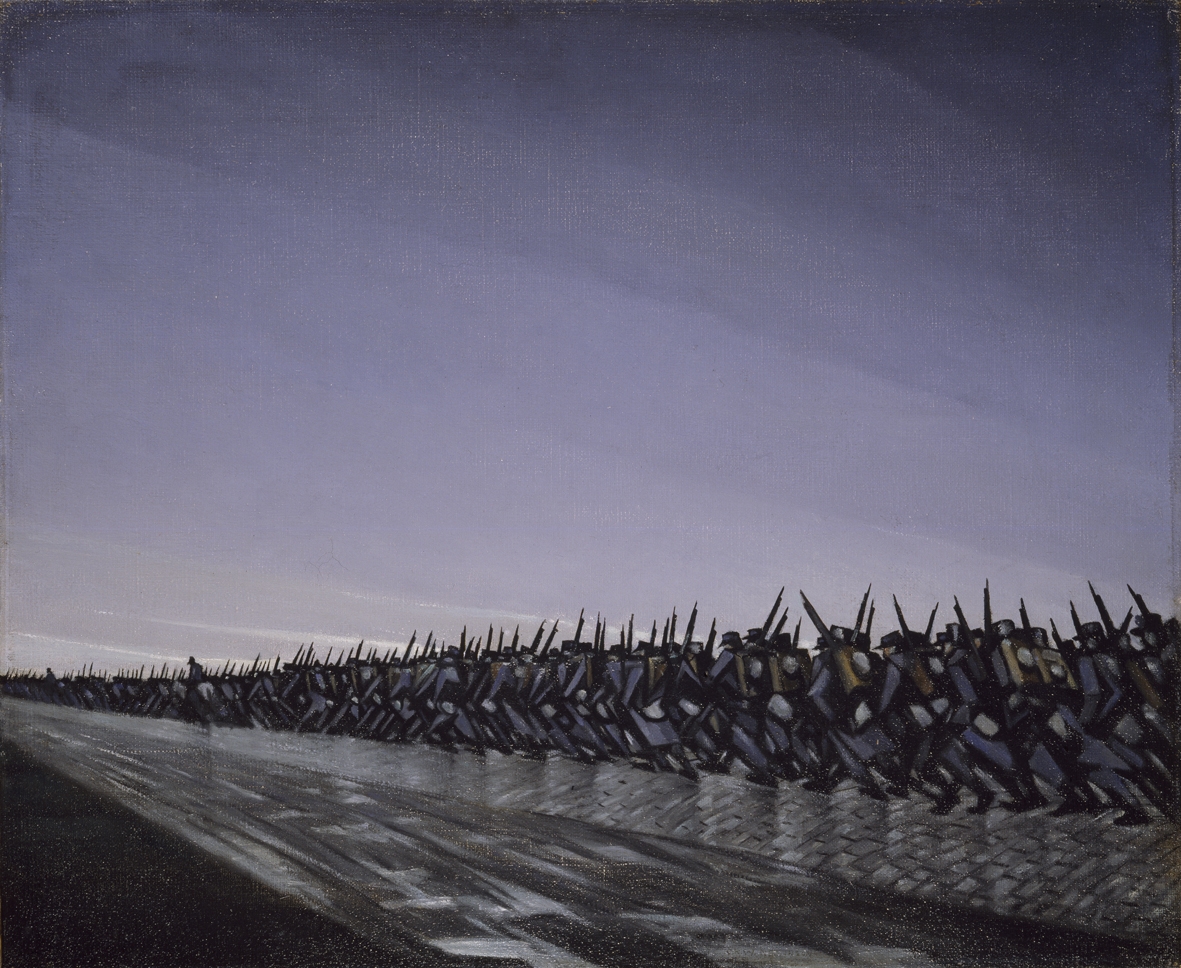
Walter Sickert claimed that La Mitrailleuse ‘will probably remain the most authoritative and concentrated utterance on the war in the history of painting’, but other Nevinson paintings of this period capture other dimensions of the automations of the killing machine, as in Column on the march (1915):

Nevinson Column on the march 1915

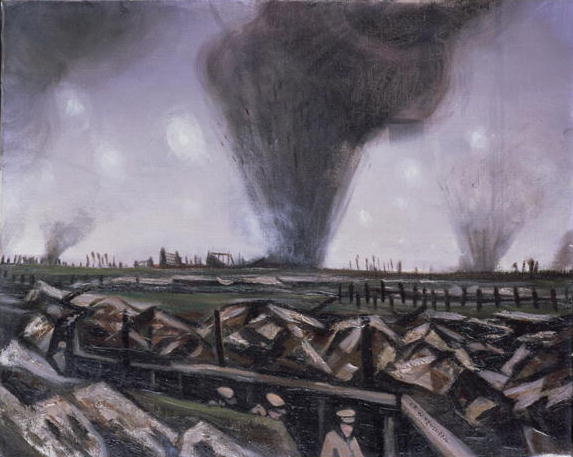
They also captured, through what Claude Philips praised as their ‘cold, calculated violence’ and ‘cruel, metallic angularity’, what Henri Lefebvre once called ‘the overwhelming of the human body’, as in The strafing (1915):

NEVINSON The strafing

In invoking Lefebvre here, I have in mind this passage from The production of space where he describes a modern, abstract, geometric space:

‘… space has no social existence independently of an intensive, aggressive and repressive visualization. It is thus – not symbolically but in fact – a purely visual space. The rise of the visual realm entails a series of substitutions and displacements by means of which it overwhelms the whole body and usurps its role.

And yet, of course, the production of this extraordinarily violent space was literally shot through with corporeal investments.

Postcard from Nevinson to MarinettiI’ve described these artworks as Futurist, but two riders are necessary.  The first, and most obvious, is that Marinetti‘s own Manifesto of Futurism expressed a desire ‘to glorify War – the only health giver of the world’, and while Nevinson was fascinated by, even infatuated with Marinetti – he sent Marinetti a postcard (right) of him posing in front of his ambulance, without any discernible sense of irony – this was a claim that Nevinson eventually explicitly repudiated (in a column for the Daily Express called ‘Painter of Smells at the Western Front’).  Bone, incidentally, liked Nevinson’s work.

The second is more interesting.  Paul Saint-Amour has described aerial photography and interpretation on the Western Front not as an applied realism but as an applied modernism – and with good reason (some interpretation manuals described ‘Cubist’ and ‘Futurist’ landscapes) – and if we extend this insight then we might say that in these artworks Nevinson was recovering and reinscribing a scopic regime that was instrumental in the very violence he sought to subvert.

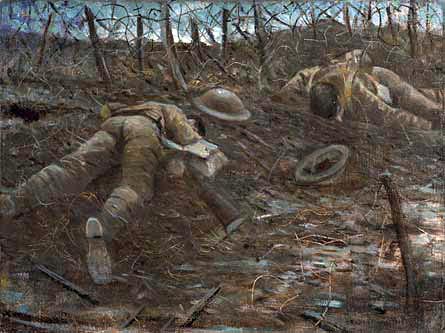
In March 1917 Nevinson was toying with the idea of putting his talents to work in the new camouflage section of the army, but by July he was back in France as an Official War Artist.  He went up in an observation balloon and claimed to be ‘the first man to paint in the air’; in fact he thought his ‘aeroplane pictures the finest work I have done’.  But in many of these later paintings he turned his back on Futurism and the machinations of the killing fields and restored the broken body to the art of war.  The most notable example is perhaps Paths of glory (1917).  Refused permission to exhibit the canvas at the Leicester Galleries in London by the War Office, Nevinson had it displayed with a brown paper sticker across the two dead bodies reading “Censored”…

NEVINSON Paths of glory

There is an excellent gallery of Nevinson’s work here, and for more discussion I recommend David Boyd Hancock, A crisis of brilliance: five young British artists and the Great War (2010); Michael Walsh, ‘C.R.W. Nevinson: conflict, contrast and controversy in paintings of war’, War in History 12 (2) (2005) 178-207, and his two books, C.R.W. Nevinson: This cult of violence (2002) and Hanging a rebel: the life of C.R.W. Nevinson (2008).

Big science – and small wars?

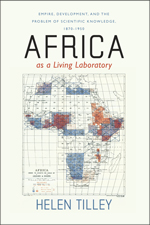
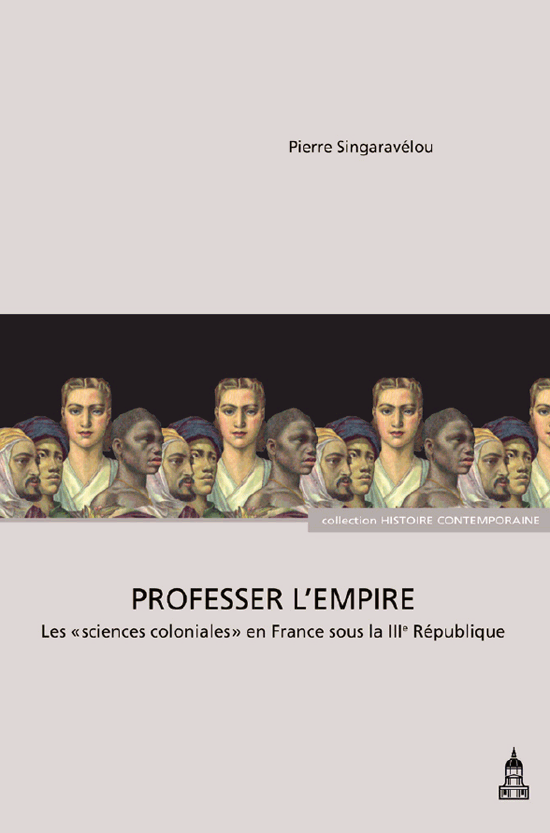
A fascinating review and preview by Alice Conklin of two books that promise to complicate the formation of ‘colonial science’: Helen Tilley‘s Africa as a living laboratory: Empire, Development, and the Problem of Scientific Knowledge, 1870-1950 (Chicago, 2011), and Pierre Singaravélou‘s Professer l’Empire: Les “sciences coloniales” en France sous la IIIe République (Sorbonne, 2011).

TILLEY Africa as a living laboratoryHelen Tilley will be known to most readers, I suspect, for her work on the history of ecology and the intersections between science, medicine and tropicality.  In Africa as a living laboratory, Conklin concludes,

‘Tilley’s case studies lead her to jettison the term “colonial science” altogether. The history of the African Survey [in the 1930s], she argues, proves that all scientific research circulates both locally and globally in ways that its producers cannot control – even when this research is sponsored by imperial governments seeking solutions to problems of colonial governance. From this perspective, defining any “science” as specifically “colonial” obscures more than it illuminates. Her point is not that “good” science triumphed over “bad” science in Britain’s African colonies, but that the outcome of the appeal to science was never absolutely predetermined by the fact of empire. Professionalizing scientists in the field could and often did maintain their distance from policy-making: their training encouraged them to they look for the very kind of complexity in human societies that overburdened administrators or their superiors did not have time to consider…’

Singaravelou Professer l'empireMost geographers will know Singaravélou’s edited collection, L’empire des géographes (which includes a characteristically incisive essay by Dan Clayton).  Conklin considers one of the most significant arguments in Professer l’Empire to be the claim that

‘…the world of teaching about the empire [in France] became a stimulating “place of encounters and exchanges between academics and administrators, politicians and advertisers”. Hovering on the fringes of the more orthodox disciplines of history, geography, law and political economy, and psychology, colonial scientists contributed new subjects (the comparative history of empires, legal anthropology, tropical geography) to their “parent” fields that would flourish after World War II; they were also among the first to practice interdisciplinarity, due to their long exiles in the field. As in Britain, their contributions have been lost from view because modern scholars have dismissed the “colonial sciences” as too tainted to be worth revisiting.

Taken together, Conklin concludes,

‘Singaravélou and Tilley make clear that without a complete picture of how all scientists functioned in the past, historians cannot understand – much less counter-act – the ideological and rhetorical power inherent in science itself. Considerable debate persists over the extent to which scientists facilitated colonialism, and colonialism facilitated science. While neither of these two richly contextualized books explores the question of how science translated into policy on the ground, they nevertheless remind us that there can be no foregone conclusion about the content of the scientific expertise promoted under colonialism. Both authors breathe new life into the history of dead white scientists attached to empire in the interwar era without in any way eulogizing or apologizing for them.’

My appreciation of these studies derives from my developing interest in the connections between scientific knowledges and military violence.  In my work on the metricisation of space on the Western Front in the First World War, for example, I’ve been impressed by Roy Macleod‘s studies of what he calls ‘the battlefield laboratory’ (in ‘Sight & Sound on the Western Front’, War & Society 18 (1) (2000)).  By early 1918, he writes, ‘the combined organisation of Field Survey Companies and “Maps, GHQ” had become almost an institute of advanced studies for cartographers, topographers, geographers and geologists’ and its ‘success in inter-disciplinary cooperation augured well for allied success in the last year of the war.’   It’s interesting to read this alongside Tilley’s opening, scene-setting chapter, ‘An Imperial Laboratory: Scientific Societies, Geopolitics, and Territorial Acquisitions’ – in which, of course, mapping is never far away – and then to think through the arc traced by what Steve Graham calls ‘Foucault’s boomerang’ across the killing fields of colonial Asia and Africa.  We know about the practices of counterinsurgency or colonial ‘air control’, to be sure, but we still need to know much more about the knowledges that are embedded within them.  And these two studies remind us that, on the field of Mars as elsewhere, the relations between knowledge and practice (or power) are rarely simple and never uni-directional.