Among a million and one other things, I’ve returned to my work on the history of bombing for my Reach from the Sky lectures in January.
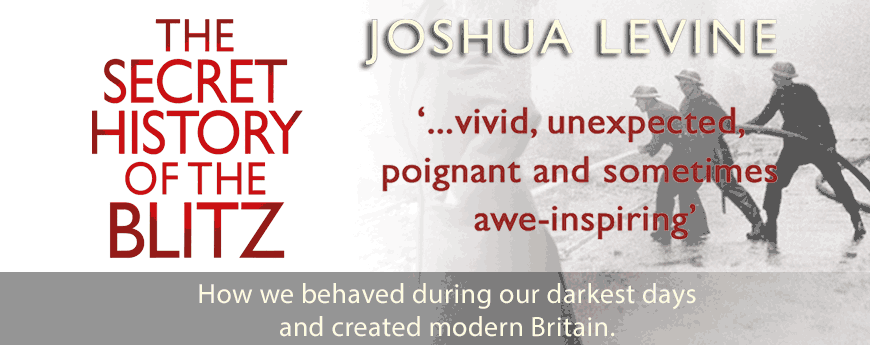
I’ve long admired Joshua Levine‘s work, and his Secret History of the Blitz is thoroughly impressive. Many others have picked their way across the bomb-sites before, of course, but there are genuinely novel insights to be found amidst the rubble and Levine is an excellent (and wonderfully literate) collector.
2015 is the 75th anniversary of the the Blitz of 1940-41. It is one of the most iconic periods in modern British history – and one of the most misunderstood. The ‘Blitz spirit’ is celebrated by some, whereas others dismiss it as a myth. Joshua Levine’s thrilling biography rejects the tired arguments and reveals the human truth: the Blitz was a time of extremes of experience and behaviour. People were pulling together and helping strangers, but they were also breaking rules and exploiting each other. Life during wartime, the author reveals, was complex and messy and real.
From the first page readers will discover a different story to the one they thought they knew – from the sacrifices made by ordinary people to a sudden surge in the popularity of nightclubs; from secret criminal trials at the Old Bailey to a Columbine-style murder in an Oxford college. There were new working opportunities for women and the appearance of unfamiliar cultures: whilst prayers were offered up in a south London mosque, Jamaican sailors were struggling to cross the country. Unlikely friendships were fostered and surprising sexualities explored – these years saw a boom in prostitution and even the emergence of a popular weekly magazine for fetishists. On the darker side, racketeers and spivs made money out of the chaos, and looters prowled the night to prey on bomb victims.
From the lack of cheese to the decreased suicide rate, this astonishing and entertaining book takes the true pulse of a ‘blitzed nation’. And it shows how social change during this time led to political change – which in turn has built the Britain we know today.
You can find good reviews from the Independenthere and from the Telegraphhere.
As you can perhaps divine from the chapter titles, this is at once an attempt to write a global history of the twentieth century through diagnostic episodes in bombing’s bleak history and a discussion of the political formations that aerial violence both presupposed and installed.
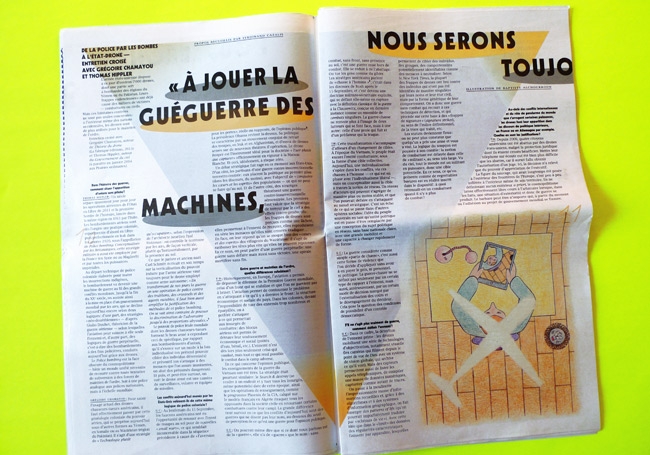
I stumbled upon a fascinating conversation between Thomas and Grégoire Chamayou (above) and since I provided a detailed commentary on Théorie du drone for those who can’t read French (you can access the full set here: scroll down for the links) I’ll try to do the same for Le gouvernment du ciel in the weeks ahead (and I’ll include some snippets from that extended conversation).
I don’t think my commentaries have been superceded by the publication of the translation, Theory of the drone, so I’m hoping the same will be true if there is an English version of Le gouvernment du ciel (though I can’t find any sign of one yet).
Two short, accessible essays on bombing that appeared in the New York Times recently; they resonate with my work on the genealogies and geographies of aerial violence, and they are both beautifully composed and immensely suggestive.
A view from a great height is irresistible. It is twinned with the ancient dream of flight. For millenniums, we have imaginatively soared above our material circumstances and dramatized this desire in tales from Icarus to Superman. Things look different from way up there. What was invisible before becomes visible: how one part of the landscape relates to another, how nature and infrastructure unfold. But with the acquisition of this panoptic view comes the loss of much that could be seen at close range. The face of the beloved is but one invisible detail among many.
The essay closes with a reflection on two aerial photographic projects, the collection of drone-shot images exhibited at Dronestagram and James Bridle‘s reconstruction of drone-strike imagery at Dronestagram:
The two Dronestagrams, the sanguine and the melancholic, add to our ever increasing archive of possible landscapes. Imagine all those pictures stitched together into a single image. In this ideal aerial view, neither the pervasive violence nor the sometimes cloying prettiness would be visible. Conquest and sentimentality would both be irrelevant. In other words, the image might be like the ‘‘blue marble’’ photograph of Earth, taken from the Apollo 17 spacecraft in 1972. It is our world, serene and self-contained, seen in one glance. It is not a view that excites us into plans for bombing our enemies, for it includes us as well. It is a view that reminds us of how mighty we are, how fragile, how delicately connected and how beautiful.
Actually, I don’t see the ‘blue marble’ photograph in that way at all: as I argued in Geographical Imaginations, this is the global North inspecting the global South (it was, after all, shot from a NASA platform). But Teju’s penultimate sentence is key, and it intersects with thoughts suggested by the second essay.
[I]n scaling up from one person to all humanity, we pass through a middle range — the social and political, Woolf’s home turf — where both connections and distinctions between people come into play. Yes, we are all at risk in climate change. But like our exposure to military violence, that risk is distributed unevenly. It falls disproportionately on those with the least protection from extreme weather, rising sea levels, hunger, drought, disease, displacement and the conflicts that can arise from all of these. Simply put, it falls most heavily on the poor.
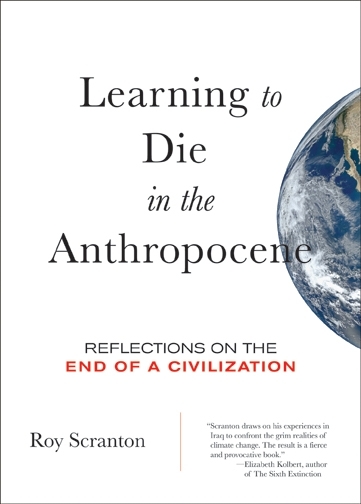
With philosophy’s help, I am prepared to tell myself, “I must learn how to die.” I may even be ready to say to humanity, “We as a species must learn how to die.” But it is a different thing altogether to say to another person, “Because of how I live, or because of actions undertaken in my name, you need to learn how to die more than I do. And you must bear, more than I do, the cognitive and emotional burdens of a life lived in the shadow of imminent death.” This is what the rich are saying every day to the poor. It’s what whites in the United States and elsewhere are saying every day to people of color. It’s what citizens of drone states are saying to those a hemisphere away, under the drones.
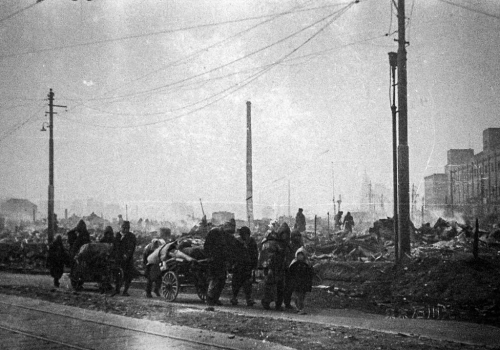
News from David Fedman of a new article co-authored with Cary Karacas, ‘The optics of urban ruination‘, which complements their previous, vital work on the cartographic imaginary of bombing. It’s published in the Journal of Urban History but you can access it here.
World War II yielded many photographs of bombed-out cities. In this paper we telescope between two sets and scales of images that represent the principal frames through which the American and Japanese publics have memorialized the incendiary bombings that laid waste to urban Japan: aerial photographs taken by the US Army Air Forces during its wartime planning, prosecution, and assessment of the raids; and the ground-level images captured by Ishikawa Kōyō, a photographer working on behalf of the Tokyo Metropolitan Police. By means of a detailed examination of the production, circulation, and consumption of these photographs— what some scholars have called an “archaeological approach” to images of ruination—we explore not only the visual rhetoric and reality of the destruction of Japan’s cities, but also how that destruction is situated in history, memory, and visual culture.
As always with their work, it’s exquisitely written, intellectually savvy and a very powerful argument. They juxtapose the photographic ‘view from above’ that was instrumental in the planning and execution of the American air raids with Ishikawa Kōyō’s ground-level perspective. His work is virtual unknown outside Japan and yet, as they say, has become ‘the principal visual testimony in Japan for public memory of the incendiary air raids as they were experienced on the ground’:
What followed were, according to Ishikawa, scenes from hell. His detailed account of that evening indeed repeatedly invokes infernal metaphors to describe Tokyo’s destruction. The “demon’s wings”(akuma no tsubasa) rained fire that carbonized corpses which “flowed through the streets like rapids.” The elements also conspired against the city to whip up the red winds (akakaze) that fanned the firestorms: “immense incandescent vortices,” he wrote, “rose in a number of places, swirling, flattening, sucking whole blocks of houses into a maelstrom of fire.”
Widespread chaos, intense heat, and the realization of the need to save his own life pre-vented Ishikawa from taking any photographs. His Chevrolet destroyed by flames, he slowly made his way on foot back to the Metropolitan Police Headquarters. After resting his fatigued body, at around 2 P.M. on March 10 Ishikawa set out to document the aftermath. He saw bodies “piled like mountains” (shitai no yama o kizuiteita) and corpses burnt to the point that “you could no longer discern the sex of the body” (danjyo no kubetsu mo tsukanai shitai).
Ishikawa first told himself not to photograph such upsetting images, but then, recalling his responsibilities to capture the “reality of the scenes,” he began to snap the shutter.That day Ishikawa took thirty-three photographs of the aftermath of what came to be called the Great Tokyo Air Raid.
You can find more at Japan Air Raids, a brilliant bilingual archive, and a (harrowing) selection of Ishikawa’s images here. If you do click on that link, heed their warning:
While photographs such as [these] provide an intimate sense of the bodily pain that was inflicted by the firebombing, they also require much of the viewer. It is one thing to look at such photographs; it is another thing altogether to comprehend or attach meaning to the actual suffering it exposes.
And – do I have to say this? – it’s worth thinking about other scenes of urban ruination.
I’ve been thinking about the description of Gaza as a space of exception in my last post, and I will elaborate (and qualify) that discussion shortly: in many ways the Israeli offensive against Gaza reinforces Achille Mbembe‘s arguments about necropolitics but, as I’ll try to show, suggests the need for a reworking of Giorgio Agamben‘s claims about the exception.
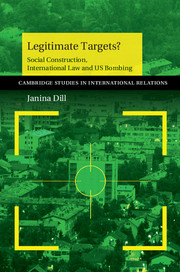
En route, I’ve been greatly taken by the work of Janina Dill (Politics and International Relations, Oxford) – particularly her discussion of Israel’s development of ‘Lawfare 2.0’ in relation to Gaza – and, as I say, I’ll have much more to say about that shortly. But I’ve also discovered she has a book due out from Cambridge in the fall which, like her (I imagine summary) chapter in The American Way of Bombing, speaks to my own work on genealogies and geographies of bombing: Legitimate Targets? Social construction, international law and US bombing.
Based on an innovative theory of international law, Janina Dill’s book investigates the effectiveness of international humanitarian law (IHL) in regulating the conduct of warfare. Through a comprehensive examination of the IHL defining a legitimate target of attack, Dill reveals a controversy among legal and military professionals about the ‘logic’ according to which belligerents ought to balance humanitarian and military imperatives: the logics of sufficiency or efficiency. Law prescribes the former, but increased recourse to IHL in US air warfare has led to targeting in accordance with the logic of efficiency. The logic of sufficiency is morally less problematic, yet neither logic satisfies contemporary expectations of effective IHL or legitimate warfare. Those expectations demand that hostilities follow a logic of liability, which proves impracticable. This book proposes changes to international law, but concludes that according to widely shared normative beliefs on the twenty-first-century battlefield there are no truly legitimate targets.
Introduction Part I. A Constructivist Theory of International Law:
1. The challenge
2. The theory Part II. The Definition of a Legitimate Target of Attack in International Law:
3. Positive law
4. Customary law Part III. An Empirical Study of International Law in War:
5. The rise of international law in US air warfare
6. The changing logic of US air warfare
7. The behavioural relevance of international law in US air warfare Part IV. An Evaluation of International Law in War:
8. The lack of normative success of international law in US air warfare
9. The impossibility of normative success for international law in war Conclusion.
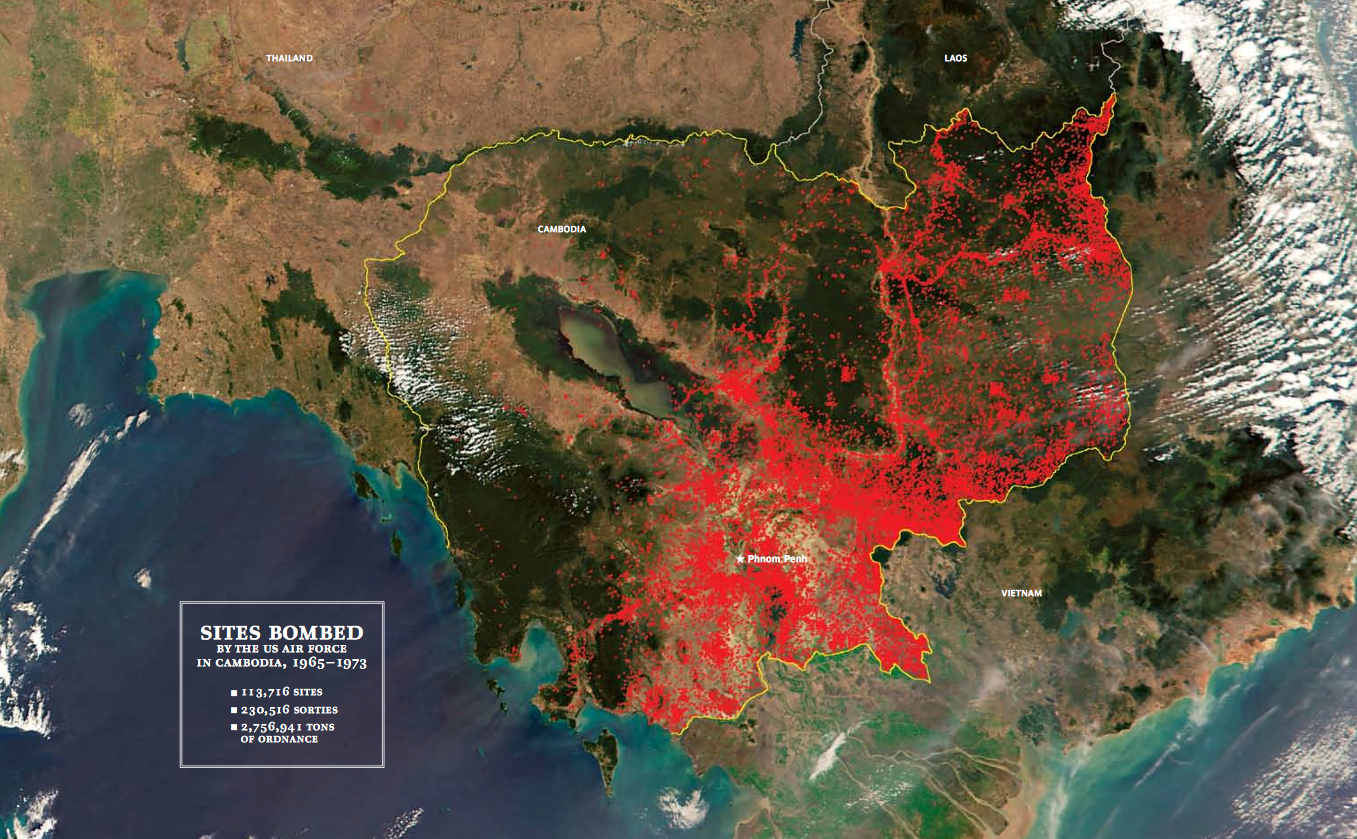
Many readers will know the remarkable work that’s been done to reconstruct the US bombing of Cambodia during the ‘Vietnam’ War: I’m thinking of Taylor Owenand Ben Kiernan‘s ‘Bombs over Cambodia’ which appeared in The Walrus in 2006: available here and here.
The still-incomplete database (it has several “dark” periods) reveals that from October 4, 1965, to August 15, 1973, the United States dropped far more ordnance on Cambodia than was previously believed: 2,756,941 tons’ worth, dropped in 230,516 sorties on 113,716 sites. Just over 10 percent of this bombing was indiscriminate, with 3,580 of the sites listed as having “unknown” targets and another 8,238 sites having no target listed at all. The database also shows that the bombing began four years earlier than is widely believed—not under Nixon, but under Lyndon Johnson. The impact of this bombing, the subject of much debate for the past three decades, is now clearer than ever. Civilian casualties in Cambodia drove an enraged populace into the arms of an insurgency that had enjoyed relatively little support until the bombing began, setting in motion the expansion of the Vietnam War deeper into Cambodia, a coup d’état in 1970, the rapid rise of the Khmer Rouge, and ultimately the Cambodian genocide.
The contemporary significance of these air strikes includes, of course, what Rob Nixon calls the ‘slow violence’ of the unexploded ordnance that still haunts the Cambodian landscape today. But they also have implications for recent bombing campaigns in Afghanistan, as Ben and Taylor discuss in ‘Roots of U.S. Troubles in Afghanistan: Civilian Bombing Casualties and the Cambodian Precedent’ here, and for today’s cross-border (though rather less covert) drone strikes in Pakistan, as Henry Grabar argued last year in The Atlantichere.
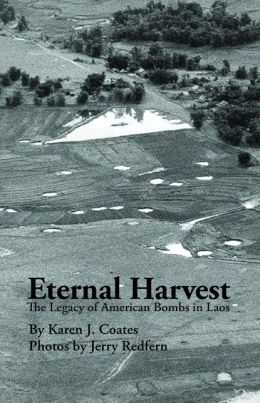
The conflict in Vietnam spilled across into Laos too, and a new book by Karen Coates (with photographs by Jerry Redfern) documents the effects of this even more shocking campaign in depth and detail: Eternal Harvest: the legacy of American bombs in Laos. The short animation below, just 98 seconds of your time, prepared by Jerry for Mother Jones, shows each bombing run:
The nearly 600,000 bombing runs delivered a staggering amount of explosives: The equivalent of a planeload of bombs every eight minutes for nine years, or a ton of bombs for every person in the country—more than what American planes unloaded on Germany and Japan combined during World War II. Laos remains, per capita, the most heavily bombed country on earth.
There’s a much longer version at vimeo here, which comes with this rider:
This video shows the US Air Force bombing campaign in Laos, from 1965 to 1973. The data comes from the website of the National Regulatory Authority of Lao PDR (NRA), which oversees UXO clearance in that country. They received the data from the US Embassy in Vientiane in 2000, from records originally created by the Department of Defense and stored at the National Archives.
The NRA data sets include information on the number and types of aircraft flown, types of bombs dropped, target conditions and after-action reports. For this graphic, only the dates, latitude and longitude, and the number of bombs dropped per mission are used.
The US Air Force began bombing Laos in June 1964. Many branches of the US, Thai, Lao, South Vietnamese and other forces also conducted aerial missions. But this graphic reflects only bombing missions noted in the NRA data, which show US Air Force missions beginning on October 1, 1965.
There’s much more information, plus photographs from the book, at the website that accompanies the book.
If you want a quick overview of the geography of bombing Laos, Peter Larson also has a useful survey which includes some helpful maps here; he’s constructed his own animation here.
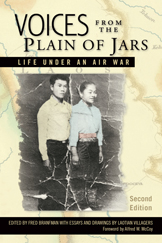
‘Animation’ is hardly the verb for such appalling carnage, I realise; the classic English-language account giving voices to the survivors (and victims) is Fred Branfman‘s brilliant Voices from the Plain of Jars: life under an air war, first published in 1972 and republished last year with an introduction by Alfred McCoy and available as an e-book.
I’ve written before about the long history of drones (UAVs or RPAs, if you prefer – and the Air Force does prefer), and the unrealised intersections between remotely-controlled aircraft and early television: I’m thinking of Archibald Low‘s experiments with what he called Televista in 1914 and his trial pilotless aircraft (codenamed ‘Aerial Target”) in the dog days of the First World War. I had assumed that the connections did not materialise – and even then in very precarious ways – until the closing stages of the Second World War with the US Project Aphrodite, which I discussed briefly in ‘Lines of Descent’ (DOWNLOADS tab).
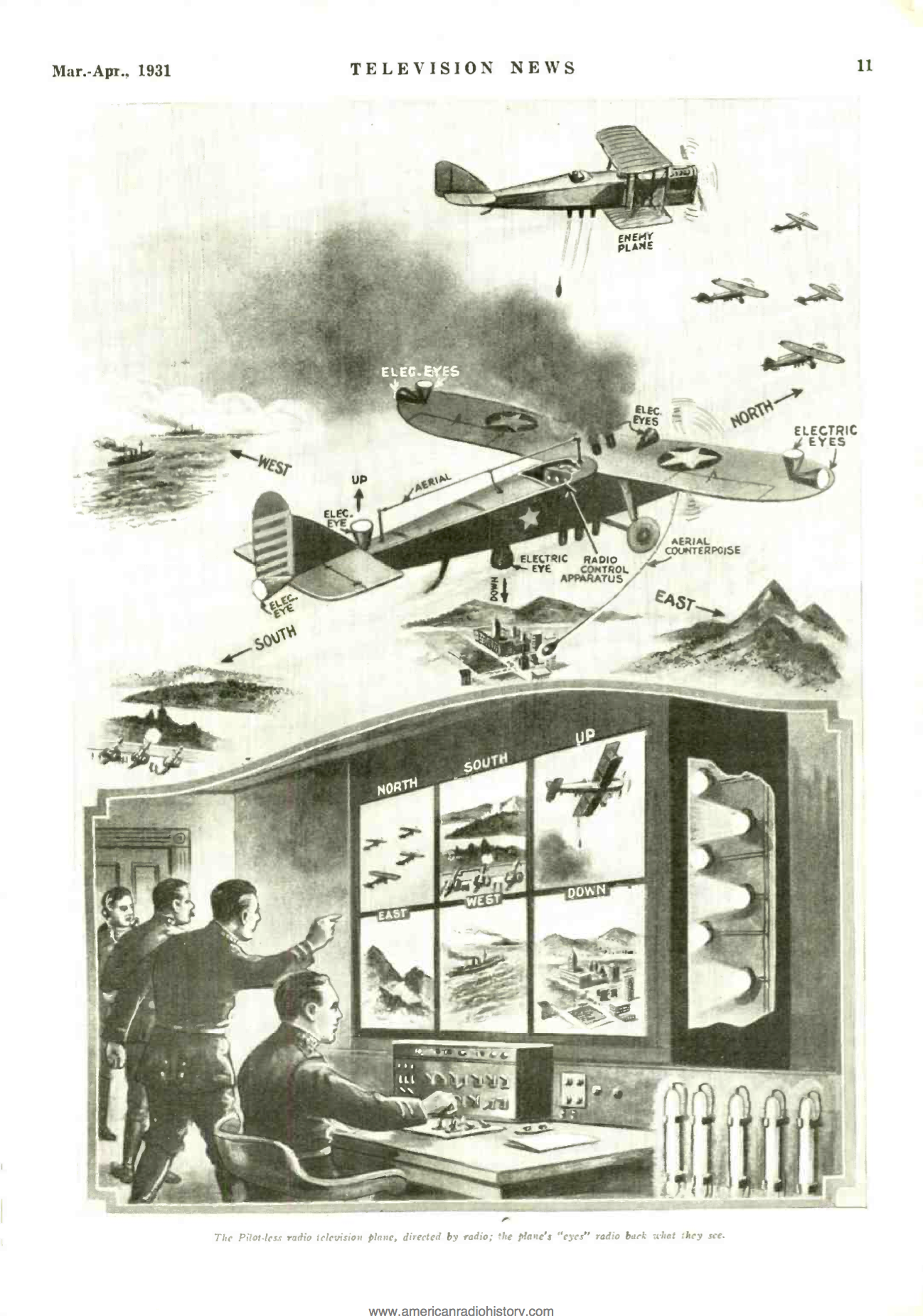
But now, via Gizmodo, I discover another way-station that was put in place in 1924. First published in The Experimenter magazine, and then republished in Television News in 1931 in its March-April issue, an article by Hugo Gernsback described the military operation of a ‘radio-controlled television plane’, directed by radio and navigated using ‘electric eyes’ that would enable ‘the control operator, although 50, 100 or possibly 500 miles away, [to] see exactly what goes on around the plane, just the same as if he himself were seated in the cockpit; with the further advantage that, sitting before a screen, he can scan six directions all at once, which no human aviator can do.’
And, just like Project Aphrodite and its modern descendants, this would be a hunter-killer mission:
‘The radio-controlled television airplane can then be directed to the spot where it is supposed to drop its bombs. Moreover, the distant-control operator can see exactly when his machine arrives over a given spot. A sighting arrangement can be attached to the plane in such a manner that, when the object to be bombed comes over the cross-wires in the range-finder, the bomb or bombs are dropped at the exact moment.’
But as the illustration indicates – and in contrast to today’s Predators and Reapers – it was assumed that the aircraft would be able to operate in contested air space – and even more effectively than a conventional aircraft:
If, for instance, an enemy airplane suddenly comes out of a cloud and starts dropping bombs on our machine below, the control operator sees this enemy machine quicker 500 miles away, than if an aviator sat in the cockpit one-quarter of a mile away from or below the enemy bomber. The control operator will send a radio signal that will immediately discharge a smoke screen from his radio television plane, hiding his craft in smoke.
Explaining the decision to republish the article, Gernsback accepted that when it first appeared ‘the ideas set forth therein might have appeared more or less fantastic’ – but ‘they are no longer considered so today’:
‘As a matter of fact, the radio-controlled airplane is with us today. Several of the leading governments have already in their possession airplanes that can now fly and stay aloft for any length of time, within reason, without a pilot or any human being on board.
‘The television adjunct will follow as a matter of course.’
Gernsback was an extraordinary man. Sometimes hailed as the father of science fiction – hence the Hugo Awards – he was keenly interested in turning his imaginative ideas into material fact. Even before the First World War he had invented a home radio set. Matthew Lasarexplains:
Gernsback’s “Telimco Wireless” didn’t receive the signals of any broadcast radio stations, since there were almost none before 1920. But it did ring a bell in an adjacent room without any connecting wires. Such was the sensation the device made that local police demanded a demonstration, following up on a fraud complaint. Satisfied that it worked, the Telimco was subsequently sold in many department stores … until the first World War, when the government banned amateur wireless transmission.
But he was soon fascinated by television; he launched Radio News and then move on to Television News as platforms for his ideas and enthusiasms. The image above shows him in 1963 wearing his ‘television glasses’. He died the following year, or he might have invented Google Glass too.
Over the years I’ve learned much from the writings of Paul K. Saint-Amour, whose work on the violent intersections between modernism and air power has helped me think through my own project on bombing (‘Killing Space’) and, in a minor key, my analysis of cartography, aerial reconnaissance and ‘corpography’ on the Western Front in the First World War. A minimalist listing would include:
Like me, Paul also has an essay in Pete Adey‘s co-edited collection, From above: war, violence and verticality (Hurst, 2013): ‘Photomosaics: mapping the Front, mapping the city’.
He has just published an important essay, ‘On the partiality of total war‘, in Critical inquiry 40 (2) (2014) 420-449, which has prompted this post. What I so admire about Paul’s writing is his combination of literary style – these essays are a joy to read, even when they address the bleakest of subjects – critical imagination and analytical acumen, and the latest essay is no exception.
His central point is that the idea of ‘total war’ – which, as he insists, was essentially an inter-war constellation – was deeply partial. It both naturalized and undermined a series of European imperialist distinctions between centre and periphery, peace and war:
‘… forms of violence forbidden in the metropole during peacetime were practiced in the colony, mandate, and protectorate, [and] … the distinction between peace and war was a luxury of the center. At the same time, by predicting that civilians in the metropole would have no immunity in future wars, it contributed to the erosion of the very imperial geography (center versus periphery) that it seemed to shore up.’
Hence the partiality of what he calls ‘the fractured problem-space of the concept’: ‘A truly total conception of war would have insisted openly on the legal, ethical, political, and technological connections between European conflagration and colonial air control’ (my emphasis).
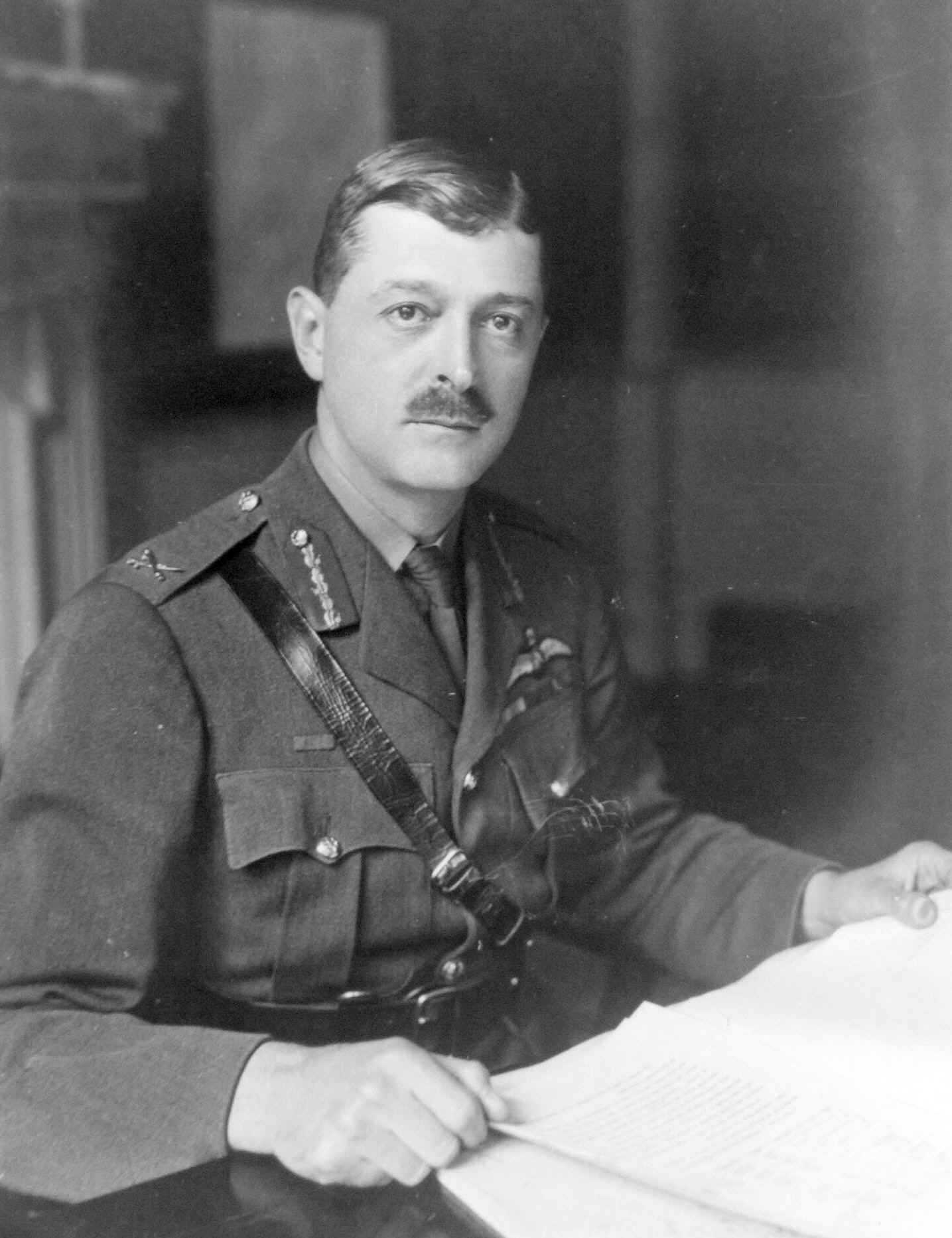
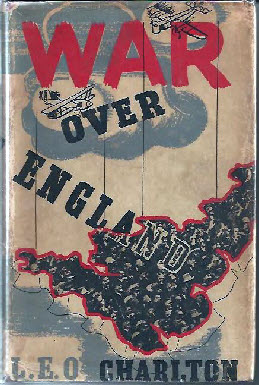
Paul advances these claims, and enters into this fraught ‘problem-space’, by tracking the figure of a Royal Air Force officer, L.E.O. Charlton (left). A veteran of the First World War, Charlton was appalled by his experience of colonial ‘air control’ in Iraq in the 1920s (‘direct action by aeroplanes on indirect information by unreliable informants … was a species of oppression’: sounds familiar) but became a strenuous advocate of bombing civilians as the ‘new factor in warfare’ in the future. Convinced that Britain was exceptionally vulnerable to air attack, the only possible defence was extraordinary air superiority capable of landing devastating ‘hammer blows’.
Now others have traced the lines of descent from Britain’s ‘air policing’ in Palestine, Iraq and the North-West Frontier in the 1920s and 30s to its bomber offensive against Germany in the 1940s – ‘Bomber’ Harris notoriously cut his teeth in both Iraq and Palestine, though one historian treats this as precision dentistry – and still others have joined the dots from yesterday’s imperial borderlands to today’s: I’m thinking of Mark Neocleous‘s (re)vision of police power (‘Air power as police power‘, Environment and Planning D: Society & Space 31 (4) (2013) 578-93 and Priya Satia‘s genealogy of ‘Drones: a history from the Middle East‘, Humanity 5 (1) (2014) 1-31.
But Paul complicates these genealogies in important ways by showing how, within British military circles, war from the air was at once prosecuted and displaced/deferred. He argues that major air power theorists of the day reserved the category of ‘war’ for conflicts between sovereign states and relegated state violence ‘against colonial, mandate and protectorate populations’ to minor categories: ‘police actions, low-intensity conflicts, constabulary missions, pacification, colonial policing’. Indeed, at the Geneva Disarmament Conference in 1923 the British delegation sought to abolish all air forces except those deployed ‘for police purposes in certain outlying regions’. The manoeuvre failed, yet it wasn’t until 1977 that the first Additional Protocol to the Geneva Convention of 1949 recognised the right of subject populations to resist colonial domination, military occupation and racial repression, nominated such acts as constituting an ‘international conflict’, and extended to them the protections of international law. Several states have refused to ratify the AP, including the United States, Israel, Iran, India and Pakistan. Charlton’s original objection was to the use of air power outside declared war zones and against civilian subject populations: an objection that many would argue continues to have contemporary resonance in the CIA-directed drone strikes in Pakistan, Yemen, Somalia and elsewhere.
But Charlton’s masters (and, ultimately, Charlton himself) ‘dissevered’ the meaning of ongoing state violence in the periphery from prospective state violence at the centre. ‘Home is the space of the total war to come‘ – the Royal Air Force evidently believed that lessons learned in the colonies could be repatriated to the metropolis – and this would necessarily involve the breaching of state borders. War from the air thus dissolved the distinctions between military and civilian spaces, as Giulio Douhet prophesied in the 1920s:
‘By virtue of this new weapon, the repercussions of war are no longer limited by the farthest artillery range of guns, but can be felt directly for hundreds and hundreds of miles… The battlefield will be limited only by the boundaries of the nations at war, and all of their citizens will become combatants, since all of them will be exposed to the aerial offensives of the enemy. There will be no distinction any longer between soldiers and civilians.’
Few military experts in Britain talked about Douhet before the 1930s, but Charlton had read him in French translation, referring to him in his Cambridge lectures published as War from the air: past, present, future (1935): John Peatycalls him ‘Douhet’s leading disciple in Britain.’ But in Charlton’s view war from the air also redrew the contours of military violence so that they no longer lined fronts but bounded areas. In principle this transformation of the target space provided for two different strategies, though in practice the differences between them were as much ideological as they were substantive. Air strikes could take the form of either area bombing, levelling whole districts of cities, or so-called ‘precision bombing’ that would dislocate strategic nodes within a networked space, and it was this that Charlton believed was the key to aerial supremacy:
‘[T]he nation conceived by air-power theorists was a discrete entity unified both by the interlocking systems, structures, and forces that would constitute its war effort and by their collective targetability in the age of the bomber. As the proxy space for total war doctrine, in other words, air-power theory provided limitless occasions for representing the national totality. The common figures of “nerve centres,” “heart,” and “nerve ganglia” all participated in the emergent trope of an integrated national body whose geographical borders, war effort, and vulnerability were all coterminous.’
In War from the air, Charlton had advocated a devastating attack on the enemy capital:
‘It is the brain, and therefore the vital point. Injury to the brain means instant death, or paralysis, whereas injury to the body or the members, especially if it be a flesh-wound, may mean nothing at all, or, at most, a grave inconvenience.’
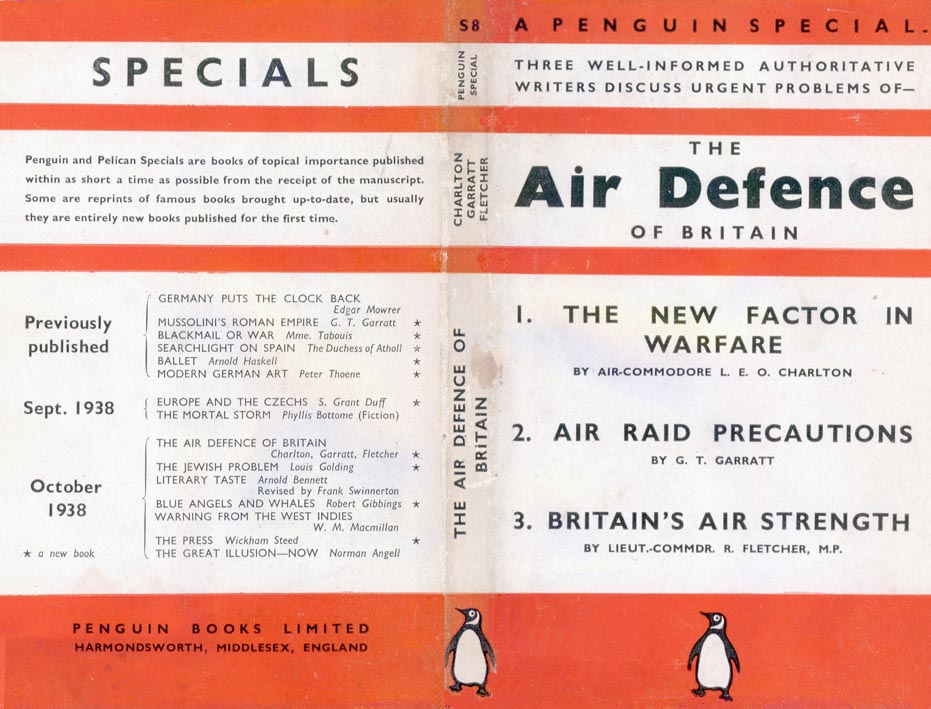
And in his contribution to The air defence of Britain, published in 1938, Charlton used the figure of the ‘national body’ to underscore what he saw as Britain’s vulnerability to air attack: ‘We are laid out, as if on an operating table, for the surgical methods of the bomber.’ As it turned out, of course, air strikes were even less ‘surgical’ than today’s aerialists try to claim, but as I showed in ‘Doors into nowhere’ (DOWNLOADS tab), these bio-physiological tropes were refined by Solly Zuckerman when he sought to provide a scientific basis for the combined bomber offensive during the Second World War.
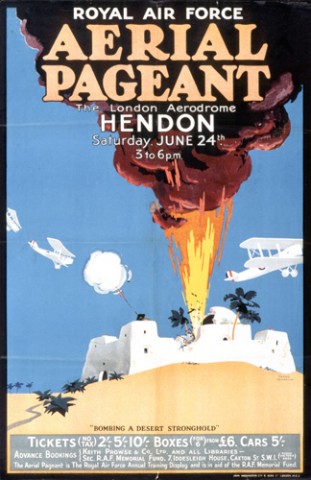
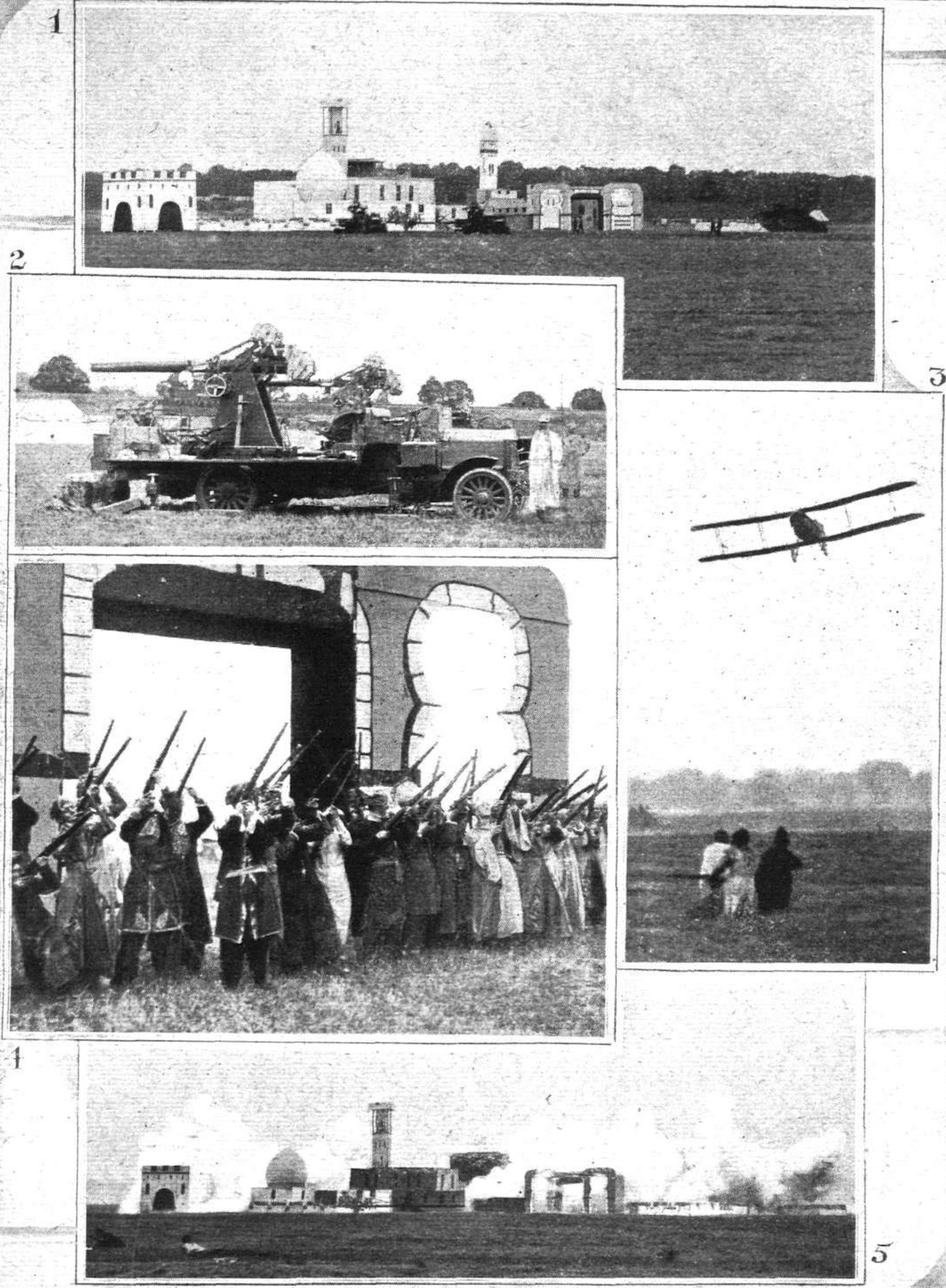
But precisely because the enabling experiments for these operations were carried out in a colonial laboratory, ‘outside the boundaries of the national body’, this couldn’t qualify as war – so this was ‘interwar’ in quite another sense too – and, Charlton notwithstanding, the ‘bombing demonstrations’ that took place in Iraq and elsewhere were not subject to much critical scrutiny or public outcry in Britain. On the contrary, within the metropole they were turned into popular entertainment at successive air displays at Hendon in North London in the 1920s (see below) (though, prophetically, by the 1930s, the pageant staged bombing runs against ‘the enemy’, and in War over England (1936) Charlton envisaged Britain forced to surrender after a devastating German air attack on, of all things, the Hendon Air Show) .
I think this argument could profitably be extended, because the desert ‘proving grounds’ had a cultural-strategic significance that, as both Priya Satia and Patrick Deerhave shown, can be unravelled through another figure who also enters this problem-space, albeit in disguise, T.E. Lawrence or ‘Aircraftsman Ross’ (I’ve suggested some of these filiations in ‘DisOrdering the Orient’)….
I hope I’ve said enough to whet your appetite. This is a rich argument about war’s geographies, at once imaginative and material, and my bare-bones’ summary really doesn’t do it justice. An introductory footnote reveals that the essay, and presumably Paul’s previous ones, will appear in a book in progress (and prospect), Archive, Bomb, Civilian: Total War in the Shadows of Modernism, forthcoming from Oxford University Press.
I’ll be talking about ‘Seeing like a military‘ at the Association of American Geographers’ Annual Meeting in Tampa (home of Joint Special Operations Command!) 8-12 April 2014, and here’s the abstract:
Modern war has long placed a premium on visuality, but later modern war deploys new political technologies of vision and incorporates them into distinctive modes of the mediatization and juridification of military violence. This paper sketches those general contours and then examines two episodes in more detail. Both were carried out by the US military. The first is a combat helicopter attack on unarmed civilians in New Baghdad in July 2007, the subject of a military investigation, a Wikileaks release (‘Collateral Murder’), and two documentary films (‘Permission to Engage’ and ‘Incident in New Baghdad’). The second is another combat helicopter attack, but this time facilitated by the crew of a MQ-1 Predator, on three civilian vehicles in Uruzgan province, Afghanistan in February 2010, which was the subject of a military investigation that has been documented in detail. I use these incidents to extend the debate about militarized vision beyond dominant discussions of ‘seeing like a drone’, and to raise a series of questions about witnessing and military violence under the sign of later modern war.
The title is obviously a riff on James C. Scott‘s Seeing like a state – not least his opening claim that ‘certain forms of knowledge and control require a narrowing of vision’ – and the abstract is really just a summary of previous posts on Militarized Vision (see also ‘Unmanning’ here), but I’ll provide updates as the work progresses.
I’m deep into the detailed investigation of the Uruzgan incident. Previously I’d worked from a transcript of communications between the Predator crew, the ground forces commander and others – hence ‘From a view to a kill’ (DOWNLOADS tab) – but the detailed investigation files are eye-opening and are beginning to suggest a different narrative.
I’ve also widened the scope of the project (which, as the abstract suggests, was already about much more than the full motion video from Predators and Reapers). Although I won’t be talking about this in Tampa, I’m also examining another incident, an air strike on two tankers hijacked by the Taliban near Omar Kheil in Kunduz, Afghanistan in September 2009. The strike was carried out by USAF jets on the orders of the German Army (the Bundeswehr) from its Forward Operating Base at Camp Kunduz. It’s a complicated story that needs some background about (1) the Bundeswehr in Afghanistan and (2) air strikes and civilian casualties.
Bad Kunduz: the Bundeswehr and Afghanistan
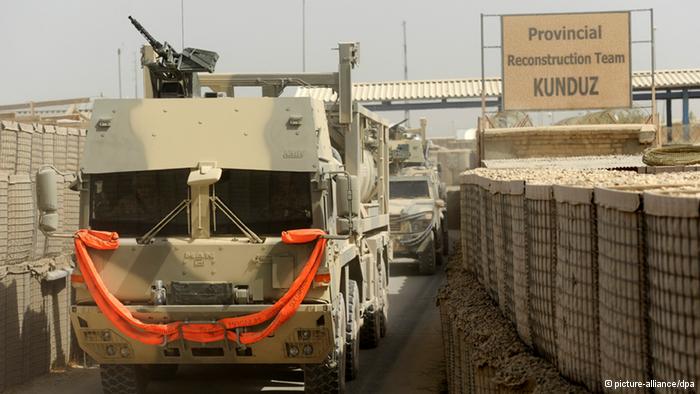
After 9/11 and the US-led invasion of Afghanistan, Germany provided the third largest contingent of troops to NATO’s International Security Assistance Force (ISAF), but Bonn saw its primary role as stabilisation and reconstruction – in fact, the government refused to describe its military operations in Afghanistan as a war at all – and following this mandate Camp Kunduz [below] served as the base for a Provincial Reconstruction Team which was instructed to maintain a ‘light footprint’: so much so that troops jokingly referred to the base as ‘Bad Kunduz‘ (‘Spa Kunduz’) because it was so removed from the fighting.
But the security situation deteriorated, and Taliban attacks on German patrols and bases intensified. By 2007 the Bundeswehr had formed Task Force 47, made up of regular soldiers and elite troops from the Kommando Spezialkräfte or Special Forces, to adopt a more offensive posture and, in particular, to identify Taliban commanders who would be placed on ISAF’s Joint Prioritized Effects List (JPEL) for kill/capture missions. A detachment from Task Force 47 was also stationed at Camp Kunduz.
Still, in August 2009 Der Spiegel ran a story on ‘How the Taliban are taking control in Kunduz‘, and interviewed the base commander, Colonel Georg Klein, who described what the newspaper called the new ‘logic of the war’:
‘Kunduz has changed… I really don’t want to shoot at other people. They’re people too, after all. But if I don’t shoot, they’ll kill my soldiers.’
This ‘new logic’ would be demonstrated with hideous clarity a fortnight later. Yet – in principle, at least – it was constrained by a new Tactical Directive issued by General Stanley McChrystal in response to civilian casualties caused by coalition air strikes.
Air strikes and civilian casualties
Bombing had played a major role in the invasion of Afghanistan, and air strikes continued to be of decisive importance as the war with the Taliban continued (for more information, see here and here). They were also the main source of civilian casualties caused by coalition military operations; as the air war was stepped up and the body count soared so public hostility increased.
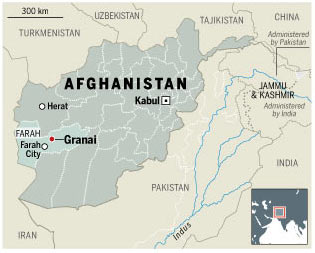
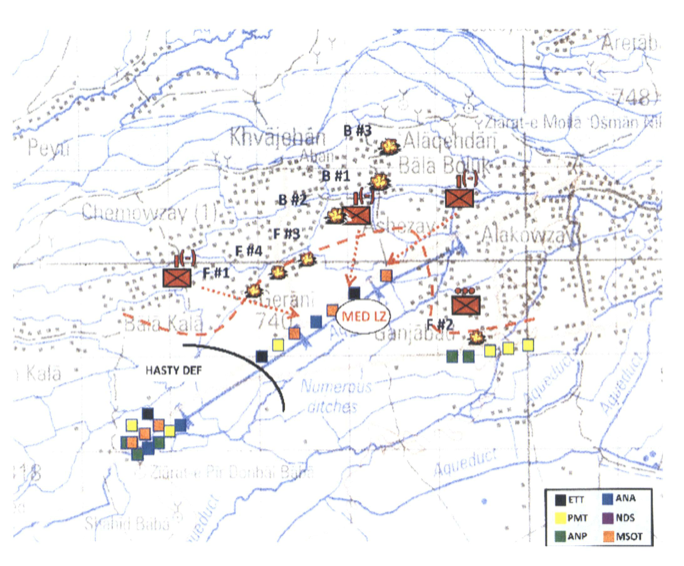
On 4 May 2009, just four months before the Kunduz air strike, there was yet another serious incident in which, according to a field investigation by the International Committee of the Red Cross, at least 89 civilians were killed in a series of air strikes near the village of Garani (sometimes spelled Gerani or even Granai) in the district of Bala Baluk in Farah province. Afghan forces had moved to engage the Taliban, supported by ISAF advisers, and as the fighting intensified they were reinforced by a detachment of US Marines. Close Air Support (CAS) was requested, and the first air strikes were carried out by F/A-18F jets (shown as #F1-4 in the graphic below). In the early evening their fuel reserves became too low to continue, and they were replaced by a B-1 bomber which made three further strikes (#B1-3). In the first strike, three 500 lb GPS-guided bombs were dropped; in the second, two 500 lb and two 2,000 lb bombs were dropped; and in the third a single 2,000 lb bomb was dropped. You can find images of the aftermath at Guy Smallman‘s gallery here.
The ICRC report on the incident has never been published, in accordance with its usual practice, but Wikileaks released a cable from the US Ambassador in Kabul describing his meeting with the ICRC’s Head of Mission on 13 June to discuss the results. The ambassador praised the Head of Mission as ‘one of the most credible sources for unbiased and objective information in Afghanistan’ and accepted that the investigation was ‘certainly exhaustive’. But the casualty estimates were considerably higher than those made by ISAF’s own military investigation, from which I’ve taken the map above.
According to the Executive Summary prepared for US Central Command, ‘we will never be able to determine precisely how many civilian casualties resulted from this operation’. The military investigation concluded that 26 civilians had been killed but did ‘not discount the possibility’ that there were many more, and its authors also noted the ‘balanced, thorough investigation’ carried out by the Afghan Independent Human Rights Commission that cited ‘as many as 86 civilian casualties’. Other reports claim as many as 147 civilians were killed.
The details of the military’s own investigation remain classified; General David Petraeuspromised to show the strike video from the B-1 bomber in a press briefing (see also here), but it has never been released, though Wikileaks reportedly had an encrypted version in its possession (the issue formed part of the US government’s case against Bradley/Chelsea Manning). Although the CENTCOM report of 18 June ‘validated the lawful military nature of the strike’, it also expressed grave concern at ‘the inability to discern the presence of civilians and assess the potential collateral damage of those strikes’, and its recommendations included an immediate review of guidance ‘for employment of kinetic weapons, to include CAS, in situations involving the potential for civilian casualties.’
On 2 July McChrystal updated the existing Tactical Directive of October 2008 with a revised Tactical Directive – parts of it remained classified, but the ‘releasable’ version is here – which insisted that
‘We must avoid the trap of winning tactical victories – but suffering strategic defeats – by causing civilian casualties or excessive damage and thus alienating the people.’
Among other provisions, the directive specifically instructed commanders to ‘weigh the gain of using CAS against the cost of civilian casualties’. This is, of course, a requirement under international humanitarian law, but McChrystal went further and tightened the Rules of Engagement to such a degree that David Wood could write of the US Air Force ‘holding fire over Afghanistan’. Lessons from the incident were also incorporated into US Marine pre-deployment briefings (here; scroll down) and it was also used as the basis for a ‘tactical decision-making’ module in the US Army’s Afghanistan Civilian Casualty Prevention Handbook (June 2012) (pp. 58-67). But these lessons hadn’t been learned in time to prevent the tragedy that took place near Kunduz on the night of 3/4 September 2009.
The Kunduz air strike
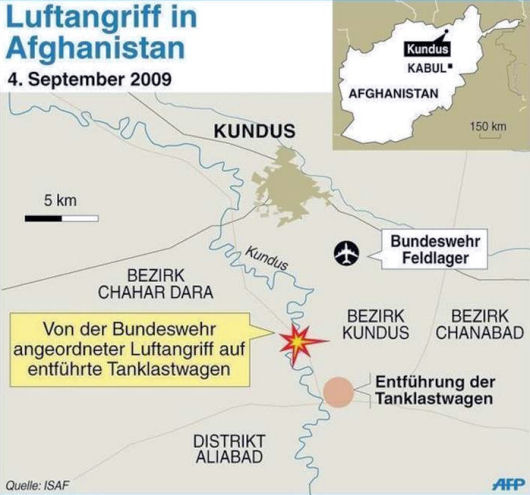
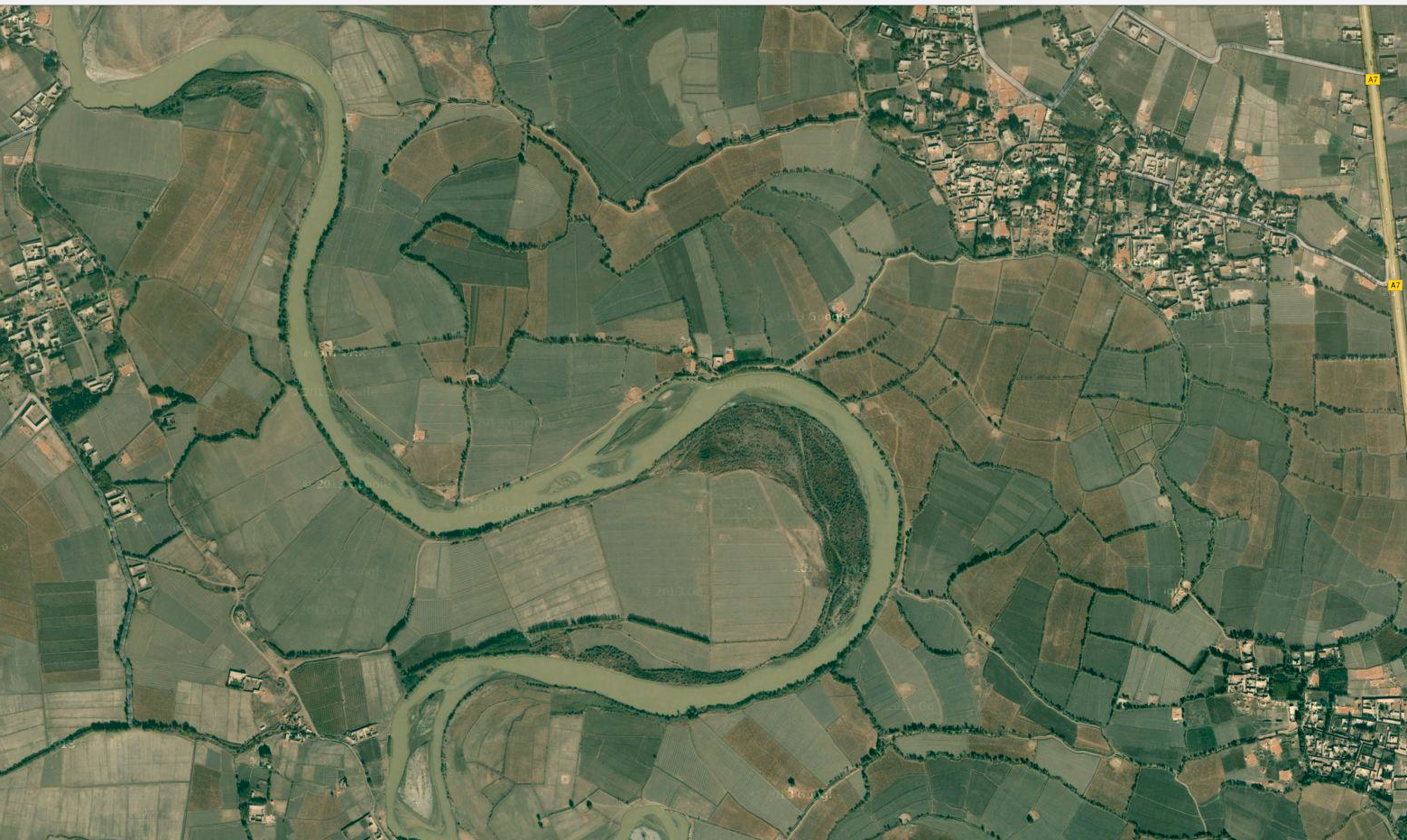
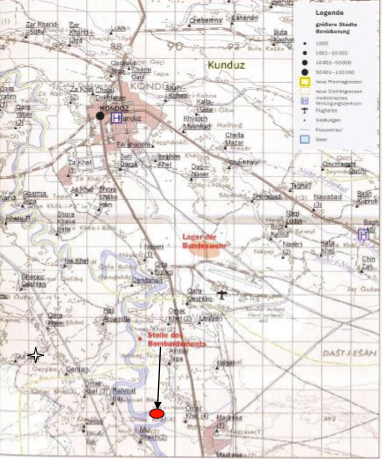
At 8 p.m. on 3 September Colonel Klein received a report that two tanker trucks had been hijacked by the Taliban as they drove south through Kunduz province (‘Entführung der Tanklastwagen’ on the map above). Thomas Ruttig provides an excellent overview of how what the Bundeswehr called ‘the Incident at Coordinate 42S VF 8934 5219’ unfolded here:
‘ The trucks were owned by an Afghan private company and contracted to deliver airplane fuel to ISAF forces. When the two hijacked lorries got stuck crossing a shallow riverbed at the border between Aliabad and Chahrdara districts, away from the main road, in the middle of a night in Ramadan, the Taliban mobilised the inhabitants of nearby villages more or less under their control to pump the fuel out and get the lorries going again. A large number took the offer up. Meanwhile, with the help of ISAF air reconnaissance, the immobilised trucks were located. This was done by a B-1 bomber which had cameras on board so strong they could even identify the weapons carried by the hijackers.’
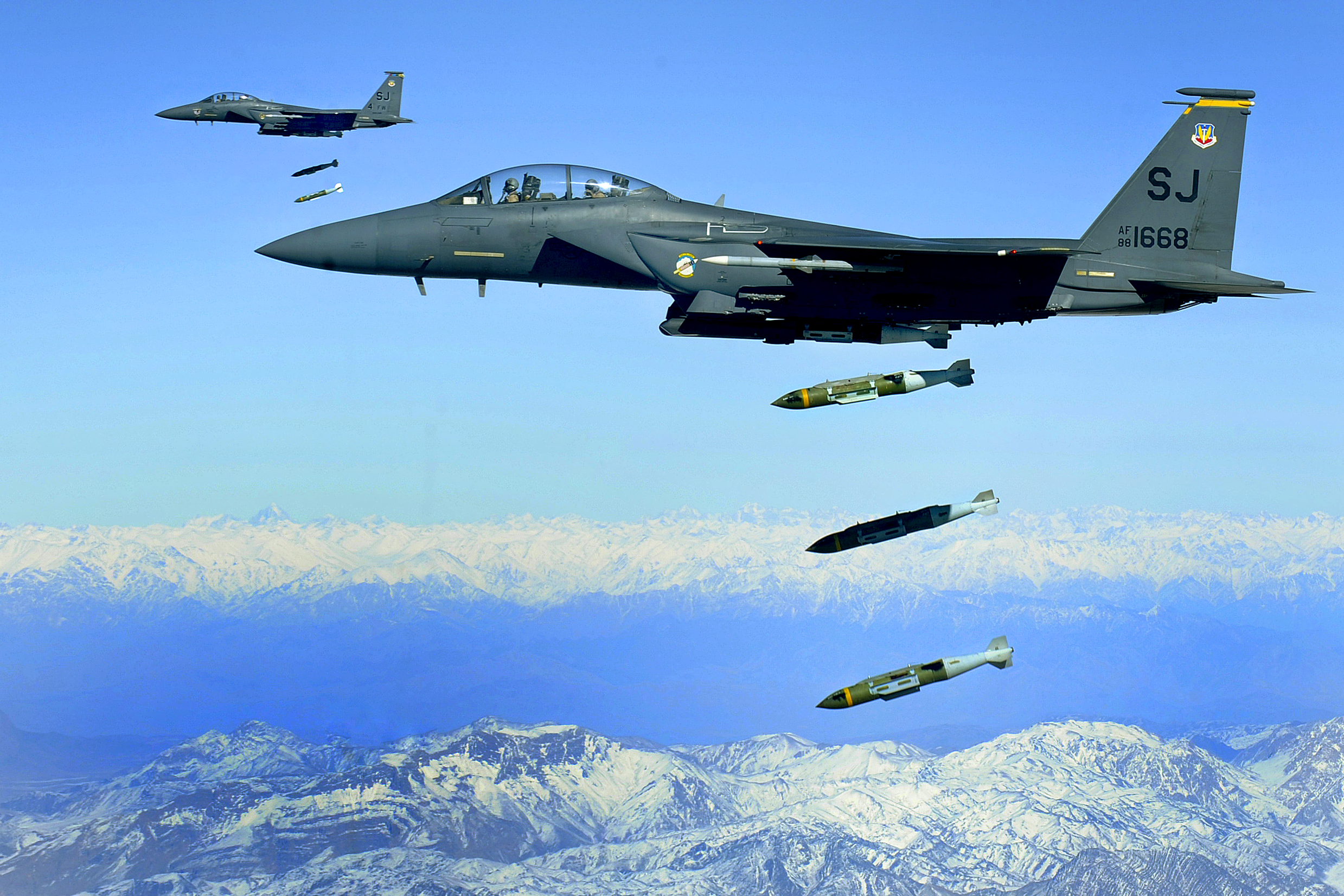
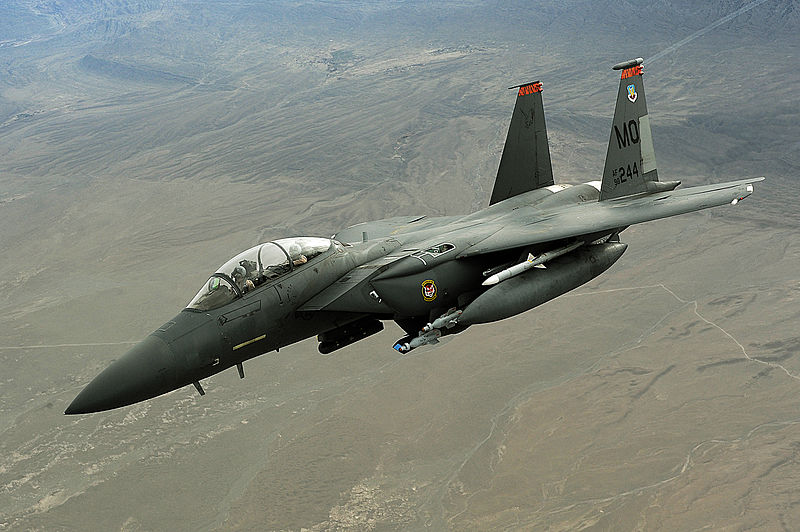
The B-1 had to withdraw in the early hours of the morning because it was running low on fuel, and according to some reports the US Air Force was unwilling to provide replacement aircraft unless there were ‘Troops in Contact’ (TIC) with the Taliban. Klein decided to confirm a TIC – even though his troops were not at the scene – and two F-15E fighter jets flew right over his Forward Operating Base and then took up their station near the tankers at 0108. These aircraft (the two shown below were photographed over eastern Afghanistan) are operated by two crew members, a pilot and a weapons systems officer, and are equipped with Forward-Looking Infrared Sensors that, as Rutting notes, ‘portrayed people on the ground only as black spots.’ The two jets eventually carried out an airstrike at 0150.
What is particularly interesting about all this is that – in the wake of McChrystal’s revised Tactical Directive and tightened Rules of Engagement – the American pilots of the two F15-Es were markedly reluctant to strike. They were eventually persuaded to do so by Klein, yet he had no direct ‘eyes’ on the events as they unfolded. He was relying on a visual feed from the strike aircraft to a Remote Operated Video Enhanced Receiver [ROVER] terminal and on ground reporting from a single Afghan informant – classified as C-3, the lowest grade for ‘actionable intelligence’ – who was communicating by telephone with other ‘sub-contacts’ at the scene; there were apparently five intermediaries between the local source and Klein. At least one of them was a Special Forces intelligence officer from Task Force 47 who was with Klein in the Tactical Operations Center; some reports suggest that he believed that four Taliban leaders on the JPEL were at the scene.
The 15-page (redacted) cockpit transcript is here; all times shown there are Zulu (i.e. GMT), but here I revert to local time to reconstruct what happened. Klein is with his Forward Air Controller codenamed ‘Red Baron’ – what the USAF calls a Joint Terminal Attack Controller or JTAC, which is how he appears in the transcript – in the Tactical Operations Centre at Camp Kunduz (marked as Lager der Bundeswehr on the map above and referred to as PRT KDZ in the SIGACT report below).
The JTAC first asks the pilots to ‘stay as high as possible’ so that they can transmit a wide-shot video of the scene to his ROVER-3 screen – although this isn’t the latest model the JTAC wants ‘the best picture possible to give the commander [Klein] the possibility to make a decision’ – and they paint the target with infrared. They are confident this won’t alert the people on the ground: ‘We got no friendlies in the vicinity of the target and I don’t believe the insurgents got N[ight] V[ision] G[oggles] to see the IR.’
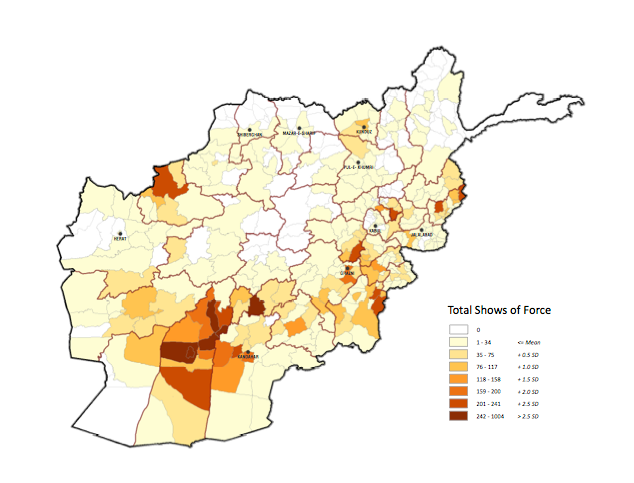
The picture is poor and so the pilots fly lower; they offer to provide ‘a show of force’, which is a standard tactic in Afghanistan accounting for 10 per cent of all Close Air Support sorties (though, as this map shows, it was less common in Kunduz compared to the south; I’ve borrowed the map from the remarkable work of Jason Lyall that I noted in a previous post on air strikes in Afghanistan).
The JTAC declines, saying ‘I want you to hide’, so that the people on the ground will have no warning of an impending attack, which leaves the pilots wondering ‘how we’d be able to drop anything on that as far as current ROE [Rules of Engagement] and stuff like that…’ They’re not sure that this meets the criteria for a TIC, which would allow them to engage, because they can’t see any German troops (‘friendlies’) on the ground: ‘We’ve got 50 to 100 people down there all claiming to be insurgents but I’m not seeing any imminent threat…’
One pilot accepts that the JTAC might have better information, but wants to ‘dig a little more’:
‘I’m really looking to find out status of the people inside [a nearby building 200 metres away] and then what’s inside the trucks. And then we can “show of force”, scatter the people, and then blow up the trucks.’
Again he offers to make a show of force but tells the JTAC they are ‘showing no CDE [collateral damage estimate] concerns within about 200 metres of that target.’ The pilots agree that Camp Kunduz is ‘pretty far away’ from the scene so that it is not visibly in imminent danger, and they wonder if ‘there is anyone else we can talk to’ before committing to a strike. They even contemplate contacting US Central Command’s Combined Air Operations Center in Qatar for clearance.
The pilots ask for confirmation that there would be ‘no civilians in the vicinity of the fragmentations’ from their two 500 lb GBU-38 bombs dropped on the tankers – ‘is that possible with no C[ollateral] D[amage] E[stimate]?’ the lead pilot queries – and again they ask the JTAC to confirm that everyone on the scene is ‘hostile’:
‘That’s affirmative. We got the intel information that everyone down there is hostile.’
More vehicles are arriving on the scene and the JTAC insists that this is now a ‘time-sensitive target’. He then passes the pilots the standard 9-line briefing for a strike (see left). The first three lines are ‘not applicable’ because the aircraft are already on the scene, but the JTAC specifies the altitude, the target (‘insurgents on sandbank with 2 stolen trucks’), target location and mark, repeats ‘no friendly forces in area’, and asks them to remain on station for a Battle Damage Assessment.
As the target is designated by the pilots, they ask the JTAC whether he is ‘trying to take out the vehicles or are you trying to take out the pax [people]?’
‘We’re trying to take out the pax.’
They again ask the JTAC to confirm that there are no friendlies in the vicinity, and he reports that they are all ‘safe’ at Camp Kunduz ‘roughly fifteen click to the east.’ (In fact, the base is about 8 km to the north east, but the tankers are facing in the opposite direction and Ruttig estimates it would have taken them an hour or so to reach the base on the rough, unpaved roads of the region).
The pilots still have misgivings: ‘something doesn’t feel right but I can’t put my thumb on it.’ They debate between themselves whether ‘in accordance with our ROE right now’ they should obtain higher-level clearance. If troops are not in imminent danger clearance is required from ISAF Headquarters in Kabul, and if there is a risk of civilian casualties clearance would need to be obtained from NATO’s Joint Force Command. Before they can reach a decision the JTAC jumps back in:
‘Clearance approved by commander he is right next to me.’
They’re not convinced. ‘The ground commander is clearing us hot but I don’t know if it meets the [hostile] intent or not.’
Still reluctant to strike – one pilot asks the other if ‘you’re saying it’s no imminent threat even though the JTAC said it was’ – the lead pilot tells the JTAC that they would prefer ‘to get down low, scatter the pax and blow up the vehicles’.
It then emerges that ‘ISR’ is en route, which presumably means a Predator with higher definition sensors, but before the remote platform can arrive the JTAC responds to the pilot’s repeated suggestion to scatter the people and then hit the trucks:
‘Negative, I want you to strike directly.’
Still no contact with the remote platform, and the lead pilot asks ‘one last [time]’ for confirmation that this is an imminent threat.
‘Yeah, those pax are an imminent threat, so those insurgents are trying to get all the gasoline off the tanks and after that they will regroup and we’ve got intel information about current ops so probably attacking Camp Kunduz.’
At 1.51 a.m. local time Klein gives the order: ‘Weapons release!’ The F-15Es are again ‘cleared hot’. Two 500lb GBU-38 bombs are released.
Here’s the strike video:
And here are the first military reports of the action (SIGACT or Significant Act) via Wikileaks:
From the ground
In contrast to these distanced observations, this is how the attack was described to Der Spiegel by one of the tanker drivers:
‘I can’t say how many airplanes there were or what type there were. But, starting at around 10 p.m., you could hear the sound of aircraft, though it was very faint. The plane must have been flying very high. But, yes, in Afghanistan, we recognize the sound of fighter jets. Some of the people around the trucks must have certainly heard the sound as well, but the majority of them were just jockeying to get fuel more quickly.
The armed men were getting nervous. They started making lots of phone calls again. I thought they were calling their leaders and asking for advice, asking what they were supposed to do now. At a certain point, some of them started shouting and waving their weapons around. They were screaming at the people to get away from the trucks because bombs were about to start falling. But no one wanted to miss an opportunity to get some free fuel. Then, some of the armed men even started running away…. I was sitting with some of the armed men along the river quite a way away from the trucks, maybe 50 meters (164 feet). The men were arguing over whether they should kill me right away or use me as a hostage to try to extort money from my company. I was very afraid — also of a possible bombardment….
At first, there was a loud droning, like what you hear when a generator short-circuits. Then there was a bright flash. I just let myself fall forward and went down underwater. Even from there, I could feel the shock wave. For a few seconds, it was as bright as day. Even the water was heating up. When I came out of the water, the whole area around the tanker trucks was on fire. It looked like the ground was spitting up fire, though it was just the fuel from the trucks. It was unbearably hot. There were bodies lying everywhere; they were completely carbonized.’
And this is how the scene was described to Amnesty International by another Afghan eyewitness:
“When we heard the planes flying everyone was scared and people began to flee the area at around 10.00 or 11.00 pm but then when people saw that the planes were only flying [and not bombarding] they returned to take the fuel. The number of the people were increasing every minute but after midnight the number started to decrease as many people obtained enough fuel and didn’t have enough containers to carry more fuel. It was around 1.00-1.30 am when the planes disappeared…
At about 1.45am we heard the planes return from our village. I tried to call my brother who was still at the scene. I knew that something was wrong if the planes returned but it seemed that the planes had blocked the telecommunication systems and we couldn’t get through to our relatives to call them to come back. Then I saw a big fire coming from plane and a big explosion with fire every where. I could see it from our village. Flames were very high and everyone rushed to the scene because most of the families had their children and family members out there.
As we arrived at the scene we could see nothing but flames and smoke. At that time it was almost around 3.00 [am] we saw the bodies burned and unidentifiable, others were badly injured and crying. The planes reappeared and then everyone fled in fear of being attacked and targeted. Some people got their family members’ bodies but not everyone. We couldn’t take the wounded people with us because the planes were still flying and we had to leave them there. As the planes disappeared, we went back and it was very early in the morning – everywhere were many bodies we couldn’t identify them at the time. Then every one carried the bodies to the villages and we had to bury some without knowing who they were. There were at least 20 children among the dead.”
Here is AFP video of the aftermath:
Ghaith Abdul-Ahad provide another extraordinary account in the Guardian:
What followed is one of the more macabre scenes of this or any war. The grief-stricken relatives began to argue and fight over the remains of the men and boys who a few hours earlier had greedily sought the tanker’s fuel. Poor people in one of the world’s poorest countries, they had been trying to hoard as much as they could for the coming winter.
“We didn’t recognise any of the dead when we arrived,” said Omar Khan, the turbaned village chief of Eissa Khail. “It was like a chemical bomb had gone off, everything was burned. The bodies were like this,” he brought his two hands together, his fingers curling like claws. “There were like burned tree logs, like charcoal.
“The villagers were fighting over the corpses. People were saying this is my brother, this is my cousin, and no one could identify anyone.”
So the elders stepped in. They collected all the bodies they could and asked the people to tell them how many relatives each family had lost.
A queue formed. One by one the bereaved gave the names of missing brothers, cousins, sons and nephews, and each in turn received their quota of corpses. It didn’t matter who was who, everyone was mangled beyond recognition anyway. All that mattered was that they had a body to bury and perform prayers upon.
If anybody still thinks that later modern war is somehow de-corporealized, they should read Abdul-Ahad’s full report. Ruttig takes up the story:
The number of people and specifically the number of civilians who were not ‘participating in hostilities’ killed in the strike is unclear to this day. It differs depending on the investigation report, some of which are published, while others remain classified. The still classified report by the then ISAF commander, General Stanley McChrystal – parts of which are cited in the report of the investigation committee of the German parliament, the Bundestag, that was published on 25 October 2011 – says “between 17 and 142 people” were killed. It does not seem to refer to killed civilians directly, but quotes local elders saying that possibly 30 to 40 civilians were killed. A report authored by a German military policeman who conducted an investigation at the location of the airstrike avoids stating whether there were what he called “non-involved civilians” among the dead …
The lawyers who brought the case before the Bonn court claim 137 people died, “undeniably many dozens of civilians”. An Afghan investigation commission, sent by President Hamed Karzai and led by police general Mirza Muhammad Yarmand, that was in the area between 4 and 10 September 2009, stated that 69 Taleban and 30 local residents – a term that leaves it open whether they were perceived as non-involved civilians or civilians that were supporting the Taleban in an operation – were killed.
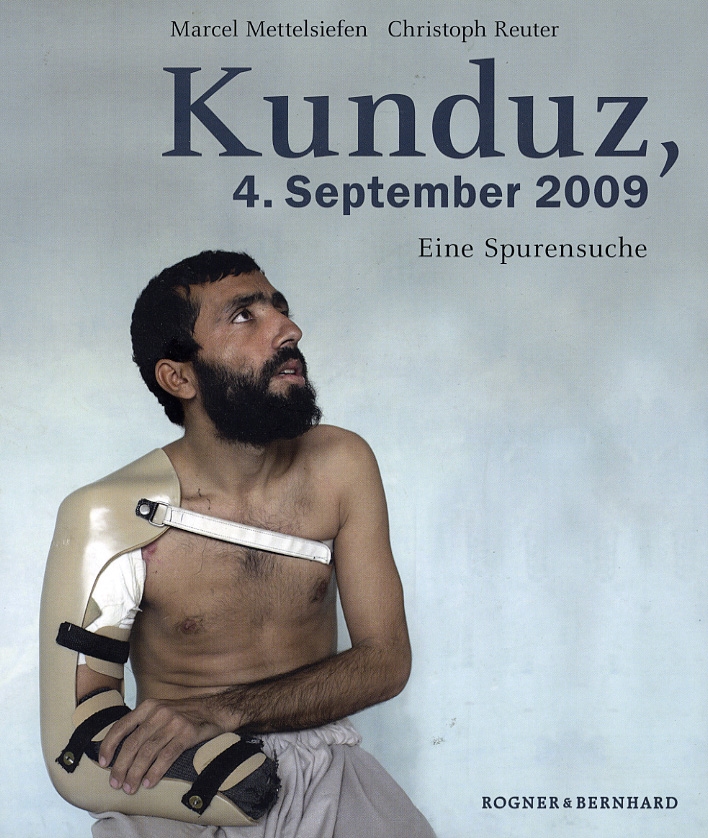
An Afghan human rights group, Afghanistan Rights Monitor, which also conducted interviews with victims in the area, said on 7 September that 60 to 70 civilians were killed. Finally, UNAMA, as stated in its 2009 Protection of Civilians report (on p 18), after its own investigation, said that 74 civilians, including many children, had been killed. One of the problems, said UNAMA, was that the fireball produced by dropping munitions on the fuel tankers incinerated many of the bodies, making their identification impossible. However, according to probably the most extensive investigation, carried out by two Germans, Christoph Reuter, a journalist and occasional AAN author, and Marcel Mettelsiefen, a photographer, who repeatedly travelled to the region interviewing families and community members, ninety civilians “from children to old men” were killed. Reuter and Mettelsiefen published a moving book [Kunduz – above], naming the victims they had confirmed as having been killed and featuring photographs – ID documents, family photos and such – of each of the victims and their relatives. It was a powerful way to humanise the numbers of those killed and the scale of the loss to the community.
Military investigations and mediatizations
Immediately after the strike a senior ISAF officer made it clear that ‘The most important thing is for local official[s] to refute CIVCAS (civilian casualties).’ This is a leitmotif in ISAF’s response to incidents like this – CIVCAS reporting (or the lack of it) was a major preoccupation of the Uruzgan investigation – as the military battles to ‘control the narrative’ before the Taliban provide their own version of events. When McChrystal heard about the strike, however, he was reportedly furious:
He had just tightened up the rules for air strikes in the Afghanistan conflict. Bombs should only be dropped in the cases of acute danger to ISAF soldiers, in order to create the necessary trust in the foreign troops. The Kunduz air strike did not fit into this picture at all….
“Freely admit what we don’t know and say we are investigating,” he ordered the Germans. He assumed the first assessement that there had been no civilian victims had been incorrect. There was no way one could have made that determination from the air. The angered ISAF chief said he was “deeply disappointed.” The first statements from the Germans had been “foolishness.” He also said he had doubts that the rules of engagement had been followed and asked why soldiers were first sent to the scene three hours after the first accusations in the media of civilian casualties.
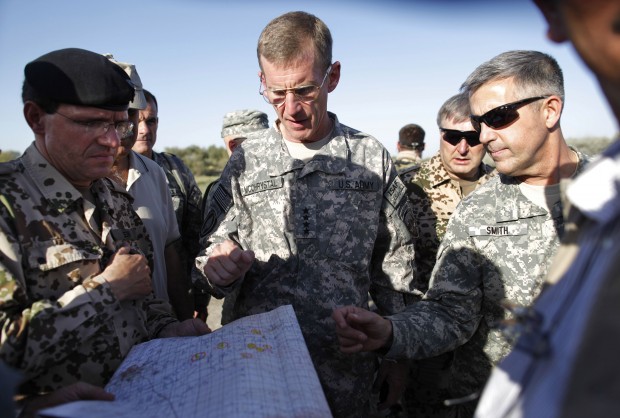
McChrystal was on the scene the next day – though Klein urged him not to go in case he was shot at – demanding to know why the Bundeswehr had waited so long to send a team to the strike site to conduct a ‘boots on ground’ Battle Damage Assessment and to provide a casualty report. On 9 September he announced the establishment of a Joint Investigation Board, which included a Canadian major-general (ISAF’s Air Component Element Director), officers from the USAF and the Bundeswehr, and military legal advisers (McChrystal’s detailed instructions to the Board are here).
Franz Josef Jung, Germany’s Minister of Defence, was soon on the offensive. He insisted that the Taliban’s seizure of the tankers ‘posed an acute threat to our soldiers’, that the strike was ‘absolutely necessary’ and that his officers had ‘very detailed information’ that the Taliban had planned to use the tankers to launch an attack. He was clearly displeased at McChrystal’s attitude (and determination), and five days after the strike had his Ministry set up a special task force (‘Group 85’) both to exploit an inside track to the investigation and to create a ‘positive image’ of the events. By then, an internal Bundeswehrinquiry had been completed. Its brief report described the incident as ‘Close Air Support’, determined that the Rules of Engagement for a ‘time-sensitive target’ had been followed and that Klein had the authority to order the strike, which was deemed ‘appropriate’, and declined to say whether ‘non-involved civilians’ had been killed alongside the Taliban.
But the subsequent, much more extensive report from ISAF’s Joint Investigation Board (75 pages plus 500 pages of attachments) flatly contradicted the German versions of what had taken place. According to Der Spiegel, which had seen the leaked report, the Board concluded that
‘Klein relied on only one person for “intelligence gathering,” which, even when combined with the aerial video images, was “inadequate to evaluate the various conditions and factors in such a difficult and complex target area.”
The report states it was not clear “what ROE (rule of engagement) was applied during the airstrike,” and that there was a “lack of understanding” by the German commander and his forward air controller (JTAC), “which resulted in actions and decisions inconsistent” with ISAF procedures and directives. Moreover, the report concludes, intelligence summaries and specific intelligence “provided by HUMINT (human intelligence) did not identify a specific threat” to the camp in Kunduz that night — the mandatory condition for an airstrike.’
In short, Klein knew that there were no ‘troops in contact’ but ‘believed that by declaring a “TIC” he would get the air support he wanted.’
Ironically, in 2008 Human Rights Watch had published a report showing that the likelihood of civilian casualties from air strikes in Afghanistan increased in TIC situations:
‘…we found that civilian casualties rarely occur during planned airstrikes on suspected Taliban targets… High civilian loss of life during airstrikes has almost always occurred during the fluid, rapid-response strikes, often carried out in support of ground troops after they came under insurgent attack. Such unplanned strikes included situations where US special forces units — normally small numbers of lightly armed personnel — came under insurgent attack; in US/NATO attacks in pursuit of insurgent forces that had retreated to populated villages; and in air attacks where US “anticipatory self- defense” rules of engagement applied.’
In any event, Klein’s own account was markedly different. In a two-page report ‘for German eyes only’, der Spiegel revealed,
Klein portrays himself as the person who tried to rein in the American fighter jets. He wrote that he called for smaller bombs to be used “contrary to the recommendation of the B-1B and F-15E pilots.” The German colonel also says that he limited the use of force to the tanker trucks and people in the immediate vicinity and forbade strikes on people elsewhere on the river bank. He wrote that the bombs were dropped solely on the sandbank “in order to definitively exclude the possibility of collateral damage in the neighboring villages.”
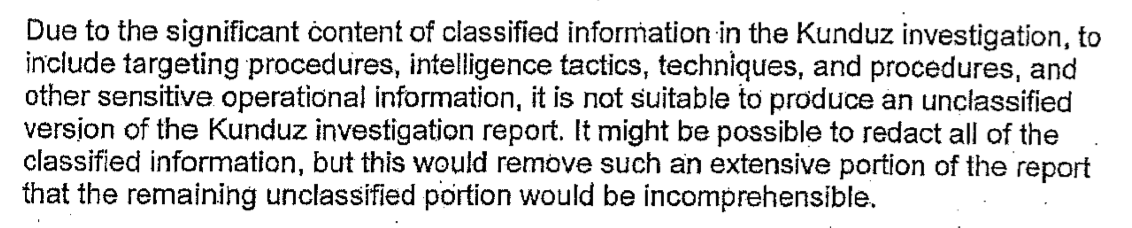
In January 2010 a Bundestag committee started to investigate how such different versions emerged and to determine who was responsible for the strike. Its final report is here and supporting documents here. ISAF still refused to release its own report, even to the parliamentary investigation:
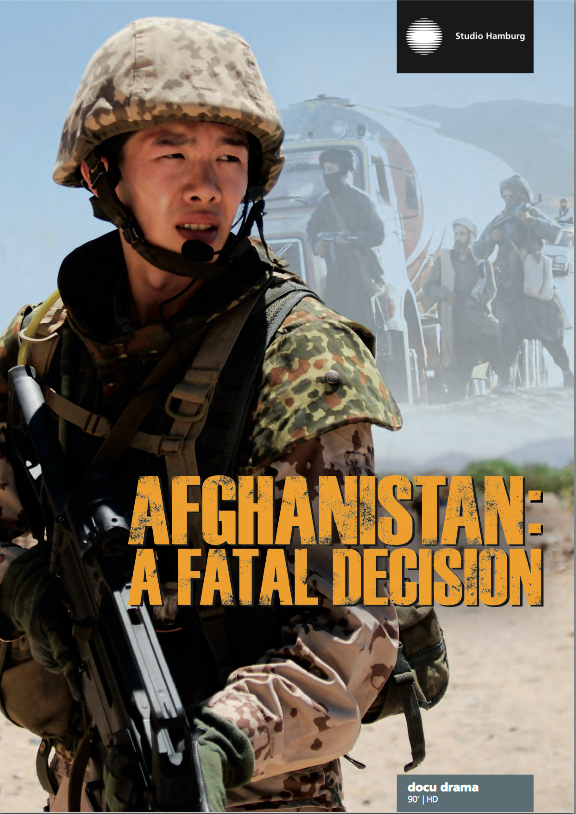
There are many other ways of ‘seeing’ what happened, of course, and the strike has been the subject of at least two films. The first, Raymond Ley’s Eine mörderische Entscheidung (2013), A fatal decision, is a docu-drama shot for German television. You can watch the trailer with English-language subtitles here. The full German-language film is available on YouTube here: it’s long, but if you start at 1:13:10 you’ll pick up the story as the informant is phoning in to the Forward Operating Base; the immediate prelude to the strike starts at 1:22:37. There’s an English-language discussion by Verena Neeshere, which translates the title as A murderous decision but gives a good extended synopsis of the film. (The production company uses both English-language titles, but ‘fatal‘ is a better representation of the tenor of the film).
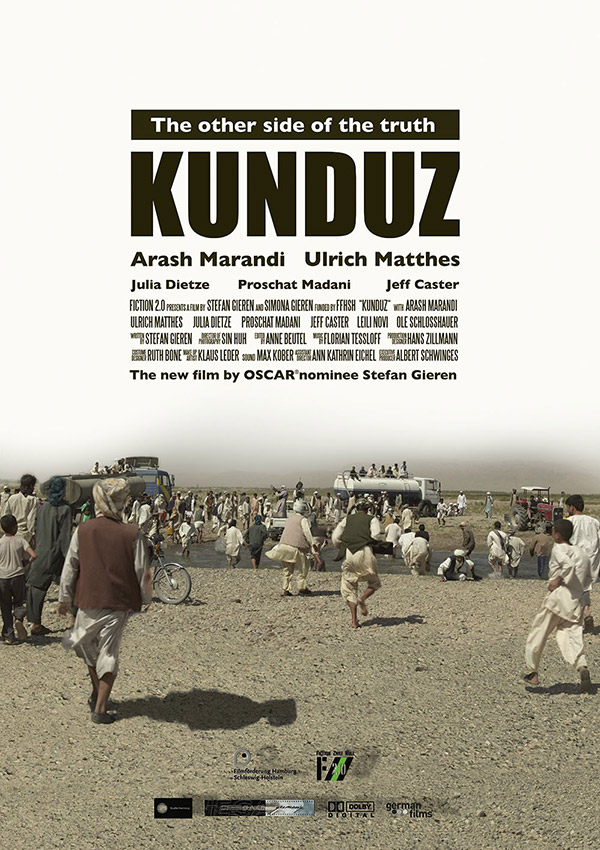
The second is Stefan and Simona Gieren‘s Kunduz (2012), a short film which builds on eyewitness reports to create a fictionalised German-Afghan photographer who witnessed the strike and tells his story to German doctors as he is is flown out from the area. You can see the trailer on vimeo here.
Preliminary observations
I still need to work my way through the Bundestag report in detail, but already several lines of inquiry are emerging that bear on my other case studies of ‘Militarized vision’.
(1) Militarized vision is not a constant. It’s an obvious point, but it can be sharpened because I don’t mean to confine this to the mundane (but still important) observation that political technologies of vision are constantly changing. So they are, but it’s clear that the ability of militaries to ‘see’ is differently and differentially distributed; there is a geography to militarized vision, and what Klein and his advisers saw on their screen was not what the F15E pilots saw – and that in turn was different to what the crew of the B-1 were able to see. This is about more than the resolution level of different imaging technologies, because:
(2) The politico-cultural construction of a wider ‘landscape of threat’ is crucial to the production and performance of a specific ‘space of the target’. In this case, the transition of the Bundeswehr‘s operational posture – the powerful sense of increasing and even impending Taliban attacks and the determination to take the offensive – clearly shaped the way in which Klein and those advising him (mis)read the developing situation. This in turn is shaped by developing legal geographies:
(3) The use of military force is clearly governed by international law which, as I’ve noted elsewhere, has an intimate relationship with technologies of vision. This extends beyond the requirements imposed by proportionality and distinction – including the US military’s ‘prosecution of the target’ and the ‘visual chain of custody’, though in this case it is notable that no military lawyers were involved in authorising the strike – because the legal armature that surrounds military violence is located at the intersection of international law, military law and domestic law. The relevance of McChrystal’s updated Tactical Directive and revised Rules of Engagement to the pilots’ field of vision is clear enough, but the refusal by Bonn to describe its military operations in Afghanistan as ‘war’ materially affected the way in which German law was brought to bear on Klein’s actions: his criminal prosecution was dropped soon after the government determined that the Kunduz affair was indeed a punctuation point – in fact an exclamation mark – in an armed conflict.
(4) And – to return to my first point from a different direction – what military investigations ‘see’ after an incident (and what they allow the public to see) is often radically different from what those caught up in the event-scene were able to see…
More to come.
Readings
There is a commentary on the strike by Constantin Schüßler and Yee-Kuang Heng,’The Bundeswehr and the Kunduz air strike 4 September 2009: Germany’s post-heroic moment?’, in European security 22 (30 (2013) 355-75. They explore not only the doctrine of force protection (in which risk is transferred to others in the field of view – see the still from Fatal Decision below – as I discussed in my commentary on what Grégoire Chamayou calls ‘necro-ethics’) but also the legal and media apparatus that enveloped the incident. For a more detailed treatment of the (il)legality of the strike, see Andreas Fischer-Lescanoand Steffen Kommer, ‘Entschädigung für Kollateralschäden? Rechtsfragen anlässlich des Luftangriffs bei Kunduz im September 2009’, Archiv des Völkerrechts 50 (2) (2012) 156-990, which makes extensive use of the Bundestag investigation, and Lesley Wexler, ‘International Humanitarian Law transparency’, Illinois Public Law and Legal Theory Research Papers Series 14-11 (2013) available via ssrn here.
For a discussion of the political landscape within which the strike took place, see Timo Noetzel, ‘The German politics of war: Kunduz and the war in Afghanistan‘, International Affairs 87 (2) (2011) 397-417; Thomas Rid and Martin Zapfe, ‘Mission command without amission: German military adaptation in Afghanistan’, in Theo Farrell, Frans Osinga and James A. Russell (eds), Military adaptation in Afghanistan (2013) 192-218. For the ethical perspective, Anya Topolksi has an extremely interesting essay, ‘Relationality: an ethical response to the tensions of network enabled operations in the Kunduz airstrikes’ forthcoming in the Journal of military ethics. Finally, Christine G. van Burken has an essay on ‘The non-neutrality of technology‘ in Military Review XCIII (3) (2013) 39-47 that spirals around the Kunduz strike and some of the issues that are central to my own focus on the political technologies involved.
I’m slowly working my war through Richard Overy‘s magisterial account of The Bombing War: Europe 1939-1945; the subtitle is a necessary reminder that this wasn’t the only ‘bombing war’ of the period, but Overy’s scope is still much wider than the usual focus on the Blitz and the combined bomber offensive against Germany. Too soon for me to work out what I think, but there’s an appreciative review by another brilliant historian of the period, Richard J. Evans, in the Guardianhere. Evans calls The Bombing War ‘probably the most important book published on the history of the second world war this century.’
Evans’s summary of bombing’s ‘surprising inefficiency’ and ‘staggering inaccuracy’ is worth repeating:
Bombing was surprisingly inefficient. As Overy shows, poor visibility, the sudden deterioration of weather conditions, malfunctioning equipment, outdated and slow-moving aircraft, pilot inexperience or crew exhaustion, and enemy action varying from anti-aircraft batteries to night-fighters or the jamming of navigation beams, all reduced the effectiveness of bomber fleets. Aircraft crashed, ran out of fuel or suffered engine failure with astonishing frequency. In its raids on Britain from January to June 1941, for example, 216 German bombers were lost and 190 damaged; 282 of these were as a result of flying accidents. The death rate among bomber crews was appallingly high (crew members in Bomber Command had a one-in-four chance of surviving their first tour of duty, and a one-in-10 chance of surviving their second) but not all of it was as a result of enemy action. At the end of 1941 Bomber Command reckoned that it was losing six aircraft to accidents for every one shot down by the enemy. The British and especially the Americans could make good these losses, and more besides; in the end, Germany’s smaller resources meant that the German air force was increasingly outproduced.
Above all, bombing was staggeringly inaccurate. Bomber fleets had to fly high to avoid anti-aircraft fire from the ground, so even if the weather was clear, they were often unable to locate their targets effectively. On one mission, Robert Kee, a bomber pilot who later became a successful historian, “bombed some incendiaries at what we hoped was Hanover” but mostly dropped his bombs on searchlight concentrations because that was all he could see through the cloud. One report, compiled in September 1941, reported that only 15% of aircraft were bombing within five miles of their target. In the last three months of 1944, it was reckoned that only 5.6% of bombs fell within a mile of the aiming point if there was cloud, despite the use of electronic navigation aids. One raid on a major oil plant saw 87% of the bombs missing their target entirely, and only two actually hitting the buildings.
There’s also a thoughtful review of The Bombing War by Keith Lowehere; Lowe’s account of the bombing of Hamburg, Inferno: the devastation of Hamburg, 1943, is another tour de force, which describes both the execution of the air raids and the consequences for those on the ground. Claire Tomalin‘s review of Inferno closed with a sentence that has haunted me ever since I read it: ‘Once you are committed to fighting, you are going to kill the innocent with whatever technology you have developed.’ Overy does discuss those consequences too, but I think it’s fair to say that the tone of his discussion is largely (though not exclusively) policy-directed – a matter of response rather than experience.
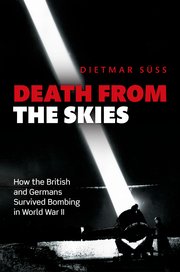
There are now a number of major studies of the effects of bombing individual cities, and Jörg Friedrich‘s The Fire: the bombing of Germany 1940-1945 is also indispensable. But for an account of the experiences of those crouching (and dying) under the bombs on an equally epic scale to Overy, albeit confined to Britain and Germany, we have to wait for Dietmar Süss‘s Death from the skies: how the British and Germans survived bombing in World War II, due from Oxford University Press next spring. Originally published in 2011 as Tod aus der Luft, the book has been a bestseller in Germany. Stefan Goebel provides a detailed review here:
‘The publication of Tod aus der Luft is to be highly welcomed, not least because it breaks into a market that for too long has been dominated by popular accounts on the one hand and official histories on the other. Süß’s extraordinary book combines the virtues of both genres: delivered with great panache, it is also based on a scrupulous examination of archival records. Potential buyers of Tod aus der Luft can expect multiple ‘two-in-one’ deals: not only is this book both sophisticated and accessible, written by an academic historian with a background in journalism, it is also a stimulating synthesis of the social, political, and cultural history of war, and a thoughtful comparative study of Britain (or ‘England’, as Süß has it) and Germany in the era of the Second World War…
‘At the centre of this comparative study are not the political systems (even though Süß has a great deal to say about their institutional structures) but the emergence of a Kriegsmoral (war morale) at the intersection of individual experiences and political mobilization. Moreover, this hefty tome is not meant to be a comprehensive ac-count of the British and German bombing campaigns of the Second World War. Rather, the author’s approach might be described as a history of the air war ‘from below’: one that is focused on the fear, experience, and memory (of people on the ground) of death and destruction….
‘The construction of a Kriegsmoral became the central preoccupation of both societies during the air war. This book offers an intriguing exploration of the comparative method; the author’s discussion of British society during the Blitz throws many aspects of the German experience of the air war into much sharper relief (and vice versa).’
Both books are, appropriately, blockbusters: Overy comes in at 880 pp and Süss at 736 pp.










 geographical imaginations