Civil(ian) wars in Yemen

It’s not easy to keep track of the intensifying civil war/proxy war in Yemen, but the New York Times has published a series of maps – including the one below – that sketch out some of the contours of violence.
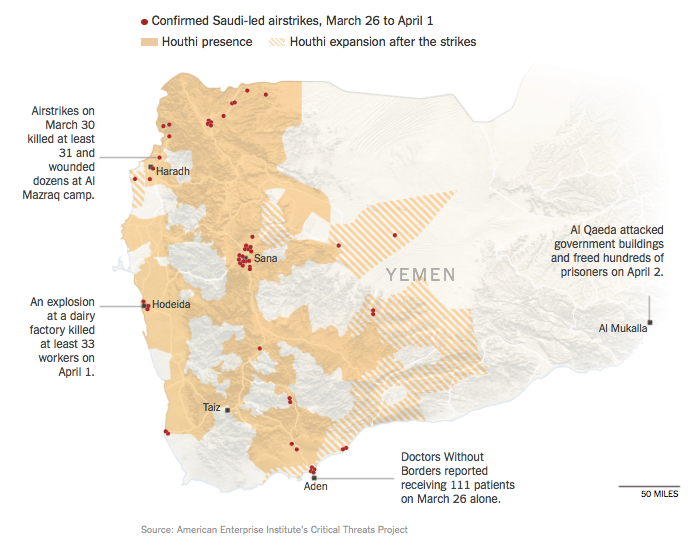
Saudi-led airstrikes in Yemen to April 2015

Not surprisingly, the Saudi-led air strikes (‘Operation Decisive Storm’ – really) have been ineffective in halting the advance of the Houthis; in fact, they may be counterproductive.  Three days ago senior United Nations officials warned that the loss of civilian lives and the repeated attacks on civilian infrastructure may constitute grave violations of international law, and there are now reports that US officials are also becoming alarmed at the mounting toll of civilian casualties.

The United States is, of course, intimately involved in the air campaign.  According to the Los Angeles Times:

Pentagon officials, who pride themselves on the care they take to avoid civilian casualties, have watched with growing alarm as Saudi airstrikes have hit what the U.N. this week called “dozens of public buildings,” including hospitals, schools, residential areas and mosques. The U.N. said at least 364 civilians have been killed in the campaign.

Although U.S. personnel don’t pick the bombing targets, Americans are working beside Saudi military officials to check the accuracy of target lists in a joint operations center in Riyadh, defense officials said. The Pentagon has expedited delivery of GPS-guided “smart” bomb kits to the Saudi air force to replenish supplies.

The U.S. role was quietly stepped up last week after the civilian death toll rose sharply. The number of U.S. personnel was increased from 12 to 20 in the operations center to help vet targets and to perform more precise calculations of bomb blast areas to help avoid civilian casualties.

U.S. reconnaissance drones now send live video feeds of potential targets and of damage after the bombs hit. The Air Force also began daily refueling flights last week to top off Saudi and United Arab Emirates fighter jets in midair, outside Yemen’s borders, so they can quickly return to the war.

You could be forgiven for thinking this a bit rich.  The US has long been waging its own air campaign in Yemen:
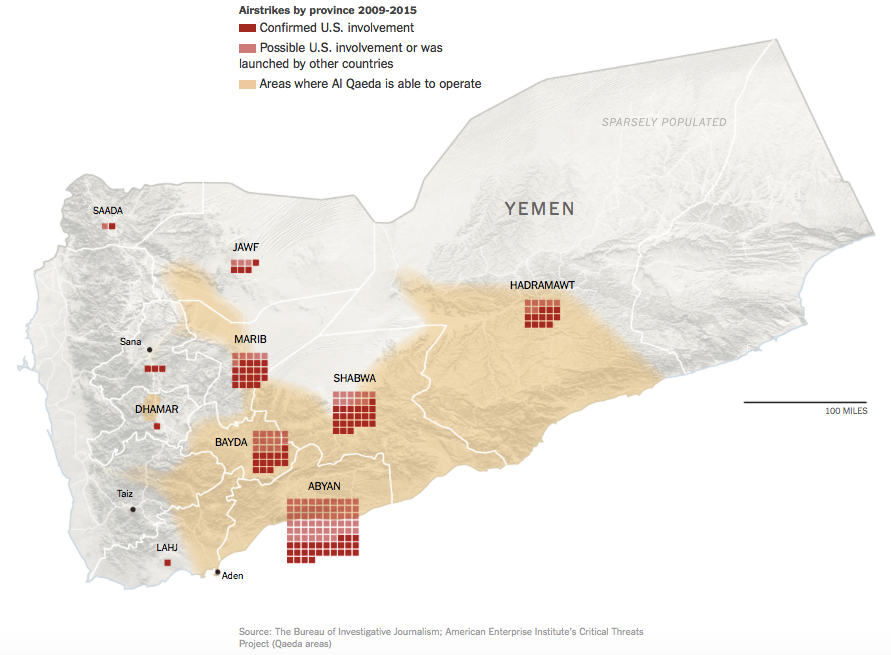
US air strikes in Yemen 2009-15

The NYT map above is derived from the vital work of the Bureau of Investigative Journalism, and you can find its detailed accounting of drone strikes in Yemen here.  Drone strikes have not been suspended during the new air offensive: earlier this week Al Qaeda in the Arabian Peninsula announced that one of its most prominent spokesmen and clerics, Ibrahim al-Rubeish, had been killed by a US drone strike near the coastal city of al Mukalla.

Readers will know that there has been considerable critical discussion of civilian casualties caused by the programme of targeted killing in Yemen (and elsewhere): so much so that on 23 May 2013 the Obama administration issued a Presidential Policy Guidance [PPG] for the use of force ‘outside the United States and areas of active hostilities’ that supposedly imposed more stringent restrictions on its use of (para)military violence outside ‘hot battlefields’ like Afghanistan.
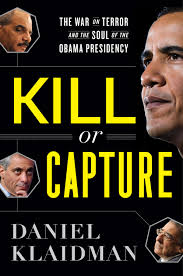
KLAIDMAN Kill or CaptureThe guidelines affirmed a preference for ‘capture’ over ‘kill’ – ‘The policy of the United States is not to use lethal force when it is feasible to capture a terrorist suspect, because capturing a terrorist offers the best opportunity to gather meaningful intelligence and to mitigate and disrupt terrorist plots’ – and so limited the use of lethal force to situations where ‘capture is not feasible at the time of the operation‘.  That last clause –my emphasis – clearly provides wide latitude for elevating ‘kill’ over capture’, but for a recent, vigorous discussion of the kill/capture debate prompted by the arrest and indictment of Mohanad Mahmoud Al Farekh earlier this month, see David Cole on ‘Targeted killing’ here.

In addition, crucially, the PPG required there to be a ‘near certainty’ that civilians would not be killed or injured during the operation.

Yet even when the guidelines were issued, they were ambiguous.  As Ryan Goodman pointed out, grey zones remained:

The notion of “areas of active hostilities” essentially refers to geographic zones where belligerents engage in sustained fighting. It is a term of art, as far as we can tell, developed by the administration at an unknown date, and not found in international law. In congressional testimony, the administration has stated that it considers Afghanistan an area of active hostilities, and it considers Yemen (despite frequent drone operations in that country) and Somalia outside the area of active hostilities.

These topological contortions did not begin with Obama.  The Bush administration made no secret of its central interest in ‘conducting war in countries we are not at war with‘.

Ryan’s discussion focused on the ambiguous location of Pakistan in this atlas of violence, and in particular the Federally Administered Tribal Areas: were they inside or outside “areas of active hostilities” (or even ‘half-in, half-out’)?  Since then, clearly, Yemen too may have been repositioned by Obama’s cartographers: it’s surely difficult to maintain the pretence that it is now not an ‘area of active hostilities’.

But in between the PPG and the opening of the new air offensive in Yemen, how effective were those restrictions on civilian casualties?  A collaborative investigation carried out by the Open Society Justice Initiative in the United States and the Mwatana Organization for Human Rights in Yemen raises plausible doubts.
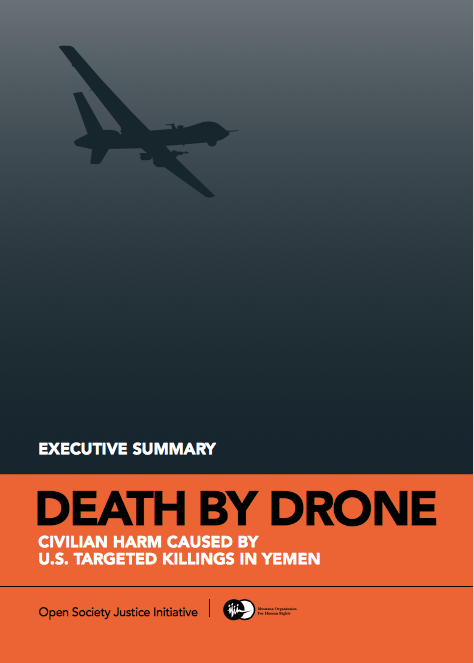
Death by Drone (Yemen) (2015)

Their joint report, Death by Drone: civilian harm caused by targeted killing in Yemen, investigates nine US air strikes carried out between May 2012 and April 2014, and is based on interviews with survivors and eyewitnesses, relatives of individuals killed or injured in the attacks, local community leaders, doctors and hospital staff who were involved in the treatment of victims, and Yemeni government officials:

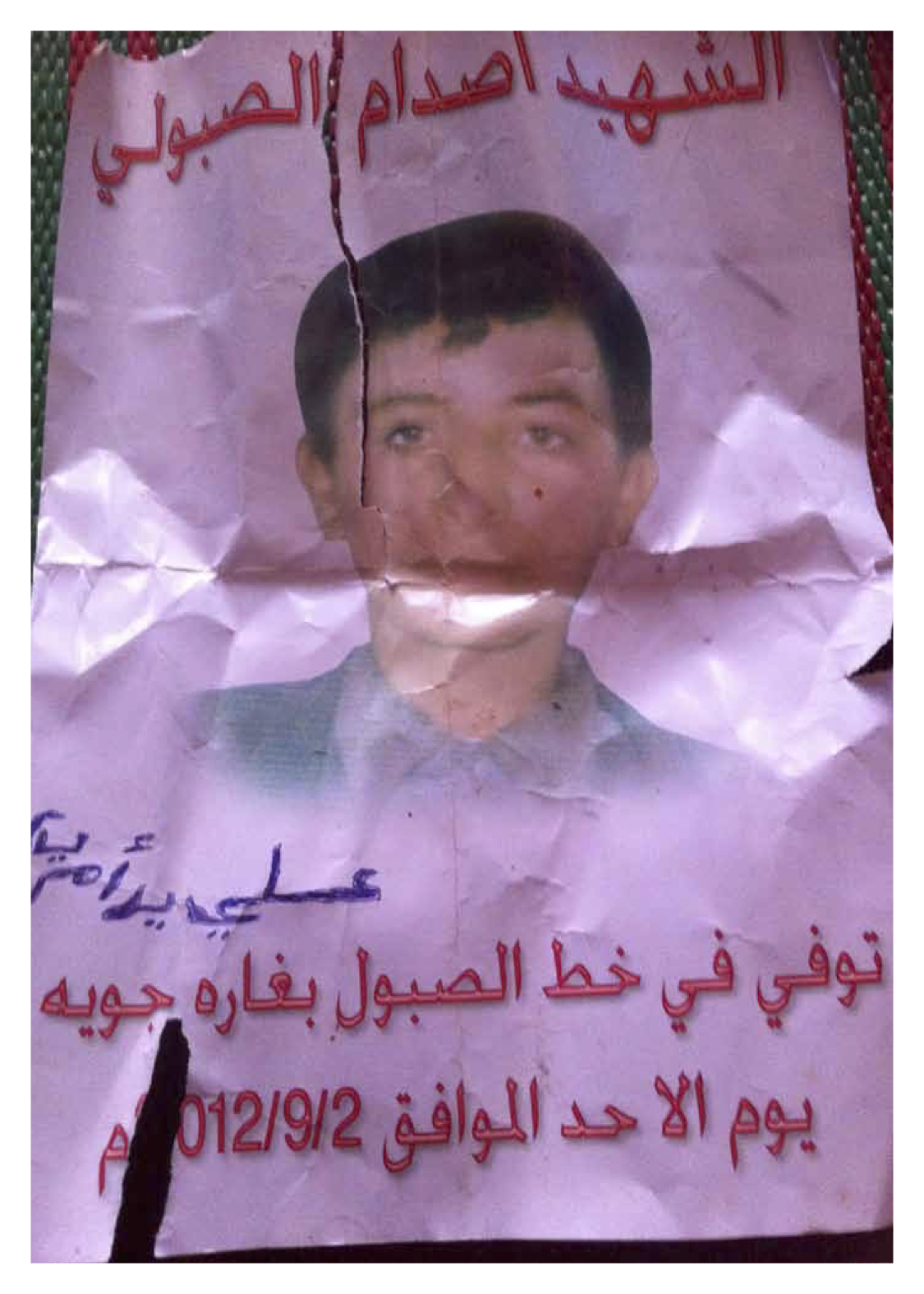
The nine case studies documented in this report provide evidence of 26 civilian deaths and injuries to an additional 13 civilians. This evidence casts doubt on the U.S. and Yemeni governments’ statements about the precision of drone strikes. Yemen’s President Abdu Rabbu Mansour al-Hadi praised U.S. drone strikes in Yemen as having a “zero margin of error” and commented that “the electronic brain’s precision is unmatched by the human brain.” The United States government has similarly emphasized that the precision afforded by drone technology enables the U.S. to kill al-Qaeda terrorists while limiting civilian harm…

[T]his report provides credible evidence that civilians were killed and/or injured in all nine airstrikes, including four which post-date President Obama’s [PPG] speech. To be sure, it is possible—owing to a mistake or an unforeseeable change of circumstances that manifests between the ordering of a strike and its occurrence—for civilians to be killed or injured despite a near-certainty prior to the strike that this would not happen. Nonetheless, the evidence of civilian deaths and injuries in nine cases raises serious concerns about the effective implementation of the “near-certainty” standard.
death-drones-report-eng-20150413 (dragged)

And in paragraphs that will be dismally familiar to anyone who has read the Stanford/NYU report on Living under drones in the Federally Administered Tribal Areas, the authors add:

The testimonies in this report describe desperately poor communities left to fend for themselves amid the devastation caused by U.S. drone strikes. Mothers and fathers who lost their children in drone strikes speak of inconsolable loss. They speak of their children’s bodies charred beyond recognition. Wives speak of losing their breadwinners, and of young children asking where their fathers have gone. The victims of these strikes say that these strikes will not make the United States or Yemen safer, and will only strengthen support for al-Qaeda.

The report also describes the terrorizing effects of U.S. drones on local populations. In many of the incidents documented, local residents had to live with drones continually flying overhead prior to the strikes and have lived in constant fear of another attack since. Some fled their villages for months after the strike, and lost their source of livelihood in the process. Survivors of the attacks continue to have nightmares of being killed in the next strike. Men go to their farms in fear. Children are afraid to go to school.

The Executive Summary is here, and you can download the full 123pp report here.
‘That others may die’

As I am (at last) moving into the finishing stages of my ‘Dirty Dancing’ essay on CIA-directed drone strikes in Pakistan’s Federally Administered Tribal Areas, it’s time to round up some of the latest work on drones and civilian casualties across multiple theatres.

tumblr_nhlv56QBGc1t8pecvo1_1280

First, Afghanistan: the principal theatre of US remote operations.  I’ve noted Larry Lewis‘s remarkable work before (here and here), based on classified sources, and in particular this claim (see also here):

Drone strikes in Afghanistan were seen to have close to the same number of civilian casualties per incident as manned aircraft, and were an order of magnitude more likely to result in civilian casualties per engagement.

usaf_mq_9_reaper_1024x1024As I said at the time, the distinction between an ‘incident’ and an ‘engagement’ is crucial, though most commentators who have seized on Larry’s work have ignored it and focused on the dramatic difference in civilian casualties per engagement. Despite my best efforts, the Pentagon were unwilling to clarify the difference, so here is what Larry himself has told me:

An engagement is probably intuitively what you would expect – the use of force against a target. The distinction is the term incident, which is borrowed from ISAF definitions. I should have said “civilian casualty incident.” This refers to an engagement that results in civilian casualties.

This means that, if you look at the collection of civilian casualty incidents, the average number of civilian casualties is close to the same for manned and unmanned platforms. At the same time, the rate of civilian casualties for the two platforms is markedly different, with unmanned platforms being ten times more likely to cause civilian casualties than manned platforms. That doesn’t mean that drones caused more civilian casualties than manned aircraft, by the way, since the denominators (number of engagements of manned aircraft versus drones) can and in fact were very different. But it does suggest that the relative risk of civilian casualties was higher for one kind of platform versus the other.

And this is in the specific context of Afghanistan and for a specific time. I wouldn’t want to say that this specific rate would be repeated, necessarily. Yet there were certain risk factors I observed in the civilian casualty incidents that I would expect to continue to be factors unless steps were taken to mitigate them.

Larry’s most recent report, Improving lethal action: learning and adapting in US Counterterrorism Operations, is available here.  It includes an analysis of the Uruzgan air strike that is central to my ‘Angry Eyes’ essay (next on my to-do list).

[The short clip above is from Baden Pailthorpe‘s stunning animation MQ-9 Reaper (That Others May Die) (2014) – you can find much more here]

You might think that all of this is now of historical interest since President Obama has declared the end of the Afghanistan war.  Not so.  Here is John Knefel writing in Rolling Stone this week:

Though many Americans may not have realized it, December 28th marked what the U.S. government called the official end of the war in Afghanistan. That war has been the longest in U.S. history – but despite the new announcement that the formal conflict is over, America’s war there is far from finished. In fact, the Obama administration still considers the Afghan theater an area of active hostilities, according to an email from a senior administration official – and therefore exempts it from the stricter drone and targeted killing guidelines the president announced at a major speech at the National Defense University in 2013.

“Afghanistan will continue to be considered an ‘area of active hostilities’ in 2015,” the official tells RS. “The PPG does not apply to areas of active hostilities.” (PPG stands for Presidential Policy Guidelines, the formal name for the heightened drone rules.)

That perplexing distinction – that formal combat operations are over but that the U.S. still remains in an armed conflict – in many ways exemplifies the lasting legacy of Obama’s foreign policy.

If you assume the situation in Pakistan is somehow less ambiguous, read Ryan Goodman on ‘areas of active hostilities’ over at Just Security here (I’m having to sort all this out for ‘Dirty Dancing’, of course).

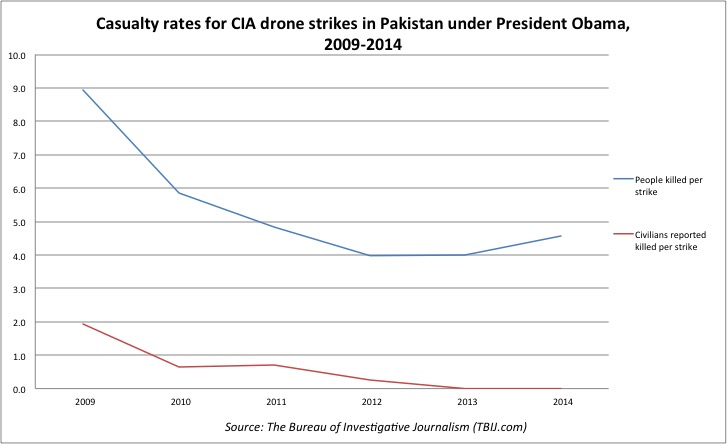
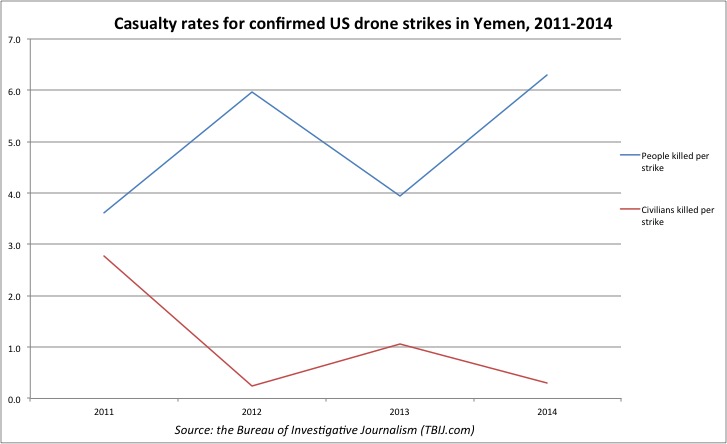
Second, the Bureau of Investigative Journalism has released its end-of-year report on US drone strikes in Pakistan, Yemen and Somalia in 2014, which includes these tabulations of casualty rates for the first two countries:

cas-rates-cia-pak-09-14

cas-rate-yemen-02-14

The Bureau comments:

While there have been more strikes [in Pakistan] in the past six years, the casualty rate has been lower under Obama than under his predecessor. The CIA killed eight people, on average, per strike during the Bush years. Under Obama, it is less than six. The civilian casualty rate is lower too – more than three civilians were reported killed per strike during the past presidency. Under Obama, less than one.  There were no confirmed civilian casualties in Pakistan in the past year, as in 2013….

The frequency of strikes [in Yemen] may have fallen in 2014 but more people were killed, on average, per strike than in any previous year.  The casualty rate for last year even outstrips 2012 – the bloodiest year recorded in the US’s drone campaign in Yemen when at least 173 people were reported killed in 29 strikes. In 2014 at least 82 people were reported to have died in just 13 strikes.

You can find the Long War Journal‘s tabulations for Pakistan here and Yemen here.

unammed-rogershillThird, Israel.  I’ve commented previously on an interview with an Israeli drone pilot, but it’s been difficult to put his observations in context (though see here and scroll down to the tabulations). Now Ann Rogers, who wrote Unmanned: drone warfare and global security (Pluto, 2014) with John Hill – as good an introduction to drone wars as you will find – has just released an essay on ‘Investigating the Relationship Between Drone Warfare and Civilian Casualties in Gaza‘.  It’s in a special issue of the open-access Journal of Strategic Security 7 (4) (2014) on ‘Future challenges in drone geopolitics’.  Here’s the abstract:

Unmanned aerial vehicles (UAVs), better known as drones, are increasingly touted as ‘humanitarian’ weapons that contribute positively to fighting just wars and saving innocent lives. At the same time, civilian casualties have become the most visible and criticized aspect of drone warfare. It is argued here that drones contribute to civilian casualties not in spite of, but because of, their unique attributes. They greatly extend war across time and space, pulling more potential threats and targets into play over long periods, and because they are low-risk and highly accurate, they are more likely to be used. The assumption that drones save lives obscures a new turn in strategic thinking that sees states such as Israel and the US rely on large numbers of small, highly discriminating attacks applied over time to achieve their objectives. This examination of Israel’s 2014 war in Gaza argues that civilian casualties are not an unexpected or unintended consequence of drone warfare, but an entirely predictable outcome.

Drone-flying-above-me-Friday-afternoon-400-x-300It’s an interesting essay, but I fear that it takes the Israeli military at its word.  Ann repeatedly refers to Israel’s ‘discriminating’ targeting:

‘The central point is that drones enabled the IDF to undertake detailed, extensive, and discriminating targeting of Gaza, before and during the actual fighting. The killing of civilians may be down to differing interpretations of military necessity, or in some cases, in how combatants and non-combatants are distinguished from one another. But it is the drone gaze that enables these targets to be ‘called into being’ (p. 102)…

‘As Israeli targeting of Gaza appears to have been highly discriminating, a more serious problem may lie in how its view of legitimate attacks differs from the global “norm.” (p. 104).’

I commented on Israeli attacks on hospitals and ambulances last summer here, here and here, and on the wholesale destruction of  Gaza here and here, so I confess I am at a loss for words.  But she is right to emphasise the operative power of international humanitarian law and its protocols of distinction (discrimination) and proportionality – though, as often as not, these seem to have been inoperative in anything other than a rhetorical sense.  For much more on this, and the way in which military lawyers are incorporated into Israel’s kill-chains, you should click across to Craig Jones‘s War, Law and Space.  All of which makes the Palestinian decision to seek membership of the International Criminal Court all the more important (there’s a good commentary on the wider legal issues by David Luban at Jus Security here and by a clutch of commentators at the Middle East Research and Information Project‘s blog here).  Perhaps not surprisingly, Daniel Reisner, the former head of the Israeli military’s International Law Department, has condemned the Palestinian application as ‘a belligerent act within the framework of the non-physical and kinetic world of lawfare.’

Finally, the US-led air strikes on IS/ISIL targets in Iraq and Syria.  Here we know much less than we should, not least because the Pentagon knows much less than it should.  Here is Nancy Youssef reporting earlier this week:

In a war fought largely from the air and in places no one can safely go, the impact is as opaque as the war itself, making it difficult to measure whether the U.S. and coalition effort is working.

“We don’t have the ability to count the nose of every guy we schwack,” as Pentagon spokesman Adm. John Kirby told reporters Tuesday, using military jargon [sic] for killing. “That’s not the goal.”

Presumably, that also means the Pentagon can’t count how many civilians it has accidentally killed in the name of ridding the region of ISIS.

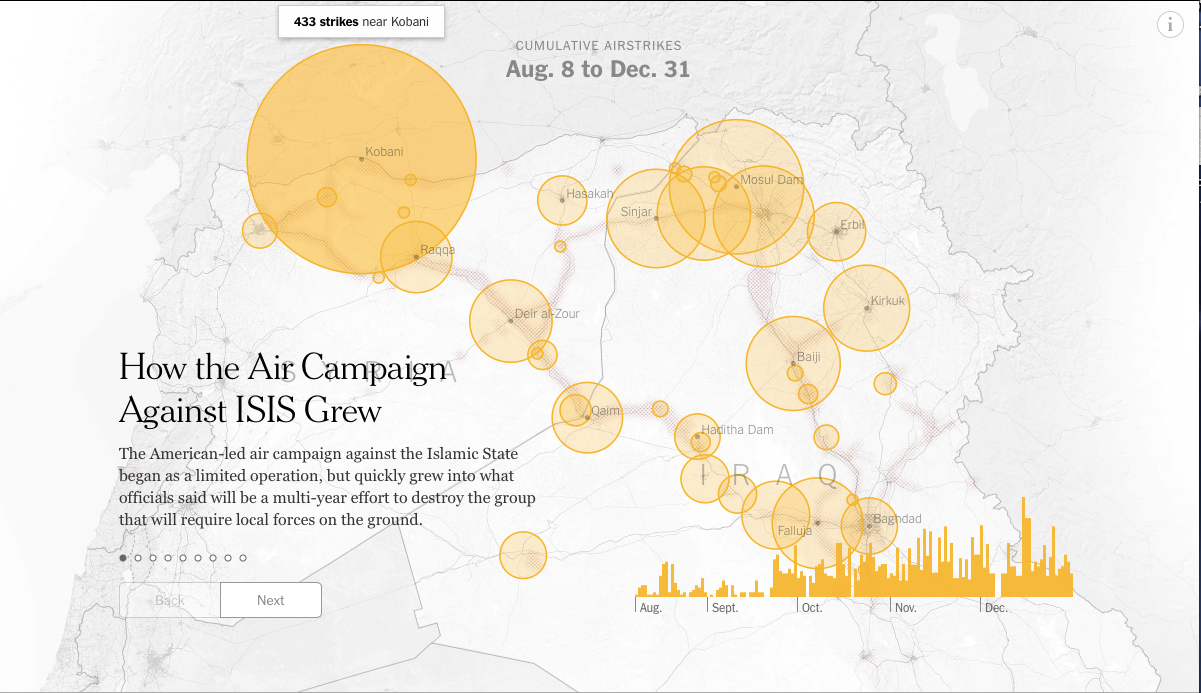
Drone Wars UK has an excellent survey of the logistics of air operations over Iraq and Syria from Chris Cole here, and the New York Times has produced a useful interactive map of US-led air strikes from which I’ve snipped this summary:

Iraq:Syria air strikes 4 August to 31 December 2014

We don’t know how many of these were carried out by drones or even orchestrated by them, but as their limitations are becoming clearer it’s reasonable to assume that most involved conventional strike aircraft.  We do know that targeting involves the analysis of video feeds from both remote and conventional platforms, and that CENTCOM has had considerable difficulty in juggling the competing demands for ISR from Afghanistan and from Iraq/Syria.

According to a report this week from W.J. Hennigan, who visited the USAF’s 480th Intelligence, Surveillance and Reconnaissance Wing at Langley Air Force Base in Virginia:

In a vast windowless room, several dozen intelligence analysts worked under the glow of more than 100 computer screens, quietly studying video streaming from U.S. drones and spy planes hunting for Islamic State militants in Iraq and Syria.

One team searched the incoming video to find a firefight underway between Iraqi security forces and militants somewhere south of the insurgent-held city of Mosul in northern Iraq.

For four hours, the analysts pored over the imagery before identifying 20 positions where the militants were dug in with machine guns and other weaponry. After the analysts called in the coordinates, 15 jets from five countries pounded the targets with more than two dozen bombs.

The Dec. 5 airstrike, one of 462 last month, underscores the Pentagon’s increased reliance on personnel far from the battlefield…  Air Force analysts here stand — or rather sit — on the virtual front lines by tracking Islamic State fighters in a war zone some 6,000 miles away.

But here’s the rub:

Unlike in past wars, when U.S. troops on the ground helped provide targeting information and intelligence, commanders in the battle against Islamic State rely chiefly on airborne surveillance, captured communications chatter, signals intelligence and other material that is processed by analysts here.

U.S. officers said the video-watching analysts working half a world away are no match for spotters and other troops feeding intelligence from the front lines.

“We don’t have anywhere near the level of intelligence we used to,” Lt. Col. Marc Spinuzzi, a senior intelligence officer, wrote in an email from Baghdad. The analysts are under “a lot of pressure … to clearly distinguish friend from foe, and to pick out the enemy from the civilian population” on the battlefield.

That is precisely how mistakes are made and civilians killed.  And, as Robert Naiman pointed out,

“There is a big danger here that U.S. air strikes in Syria are going to resemble the drone strikes in Pakistan and Yemen in the sense that there is no accountability for who is killed. We have reports of civilian casualties from people in the area and the U.S. government says, ‘No, they are bad guys.’ There has to be some public accountability for what happens when there are allegations of civilian casualties.”

At least the Pentagon has now gone some way towards recognising the problem.  Previously it had insisted that it was unaware of any civilian casualties, which is disingenuous: it beggars belief that 1,000 air strikes could have resulted in no civilian casualties – but if your ISR is inadequate it’s scarcely surprising that you would be ‘unaware’ of the consequences.  Even so, on 6 January the Pentagon announced that it had investigated 18 allegations of coalition airstrikes causing civilian casualties between 8 August and 30 December.  It determined that 13 were ‘not credible’, but was continuing to review three others; a further two, one in Iraq and one in Syria, are now the subject of formal military investigations.  But before you gold your breath, both Iraq and Syria are also exempt from the Presidential Policy Guidelines that require a ‘near certainty that no civilians will be killed or injured’.  Here is Harold Koh (really):

‘They seem to be creating this grey zone…  If we’re not applying the strict rules [to prevent civilian casualties] to Syria and Iraq, then they are of relatively limited value.’

Drones, militarized vision and civilian casualties

I’m just back from the AAG Conference in Tampa, and there’s a lot to catch up on.

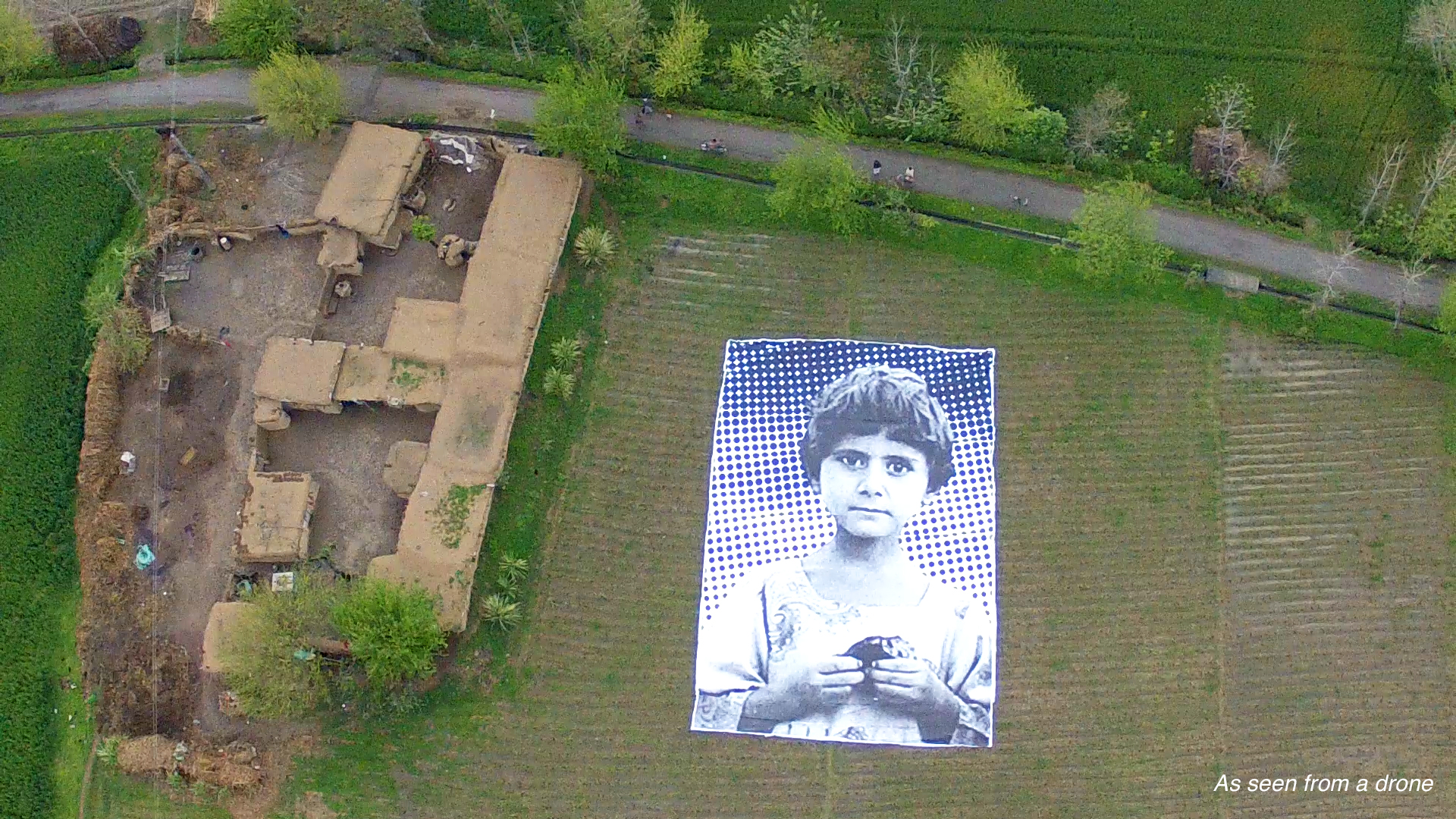
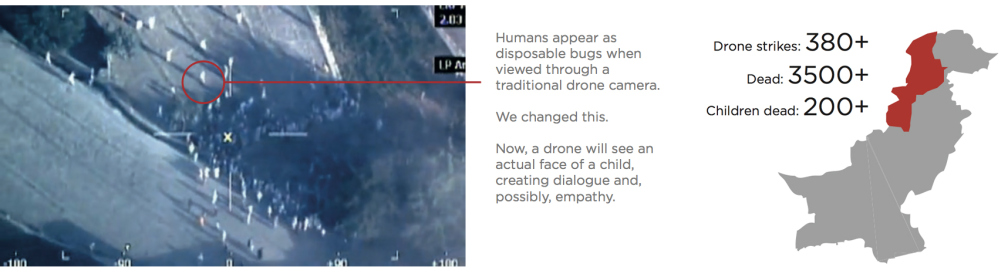
First, an art installation in Pakistan called #NotABlugSplat that reverses the paramilitary gaze and ‘targets Predator drone operators sitting thousands of miles away who refer to kills as BugSplats.’  Now they’ll see on their screens the face of a child who lost her parents and two young siblings in a drone strike.

jr_kpk_full

It’s a collaboration between Pakistani and American artists, working with Reprieve and the Foundation for Fundamental Rights, who also designed it ‘to be captured by satellites in order to make it a permanent part of the landscape on online mapping sites.’

667989206390250307

It’s an arresting project – but if you scroll through the comments that followed gizmodo‘s report you’ll see that ‘hope’ and ’empathy’ remain dismally distant for many people.

LEWIS Drone strikes in PakistanPerhaps some of them would benefit from a new report for the Center of Naval Analyses (CNA) by Larry Lewis, Drone strikes in Pakistan: reasons to assess civilian casualties.  I’ve noted his (largely classified) work on Drone strikes and civilian casualties in Afghanistan before, and in this – unclassified – report he leverages what we know about US military drone strikes in Afghanistan to address the cross-border attacks directed by the CIA.  Lewis makes two key points.

First, he notes that the US government’s claims about civilian casualties for its supposedly covert operations in Pakistan are significantly lower than ‘nearly every other estimate available’.  (En route, he draws attention to something that is usually overlooked in these calculations: under International Humanitarian Law, ‘the burden of proof is to determine whether a casualty is a combatant’, and where in doubt the casualty must be regarded and recorded as a civilian).  Based on his previous work in Afghanistan, Lewis suggests three overlapping reasons – apart from a disinclination to tell the truth – that ‘complicate the estimation process’:

  • An irregular enemy –  it is exceptionally difficult to distinguish combatants from civilians in irregular warfare, and this is exacerbated by combatants ‘co-locating with the local population’;
  • Misidentifications – ‘US forces mistakenly believe civilians to be enemy combatants’; I’m not sure how this is different from the first, but Lewis provides two examples that suggest he has in mind specific rather than general characteristics: mistaking men digging drainage ditches for militants burying an IED, for example, or assuming all those in close proximity to an engagement were involved (‘guilt by association’);
  • Battle Damage Assessments (BDA) based on aerial surveillance – determining the consequences of an air strike without ‘boots on the ground’ is likely to be defective

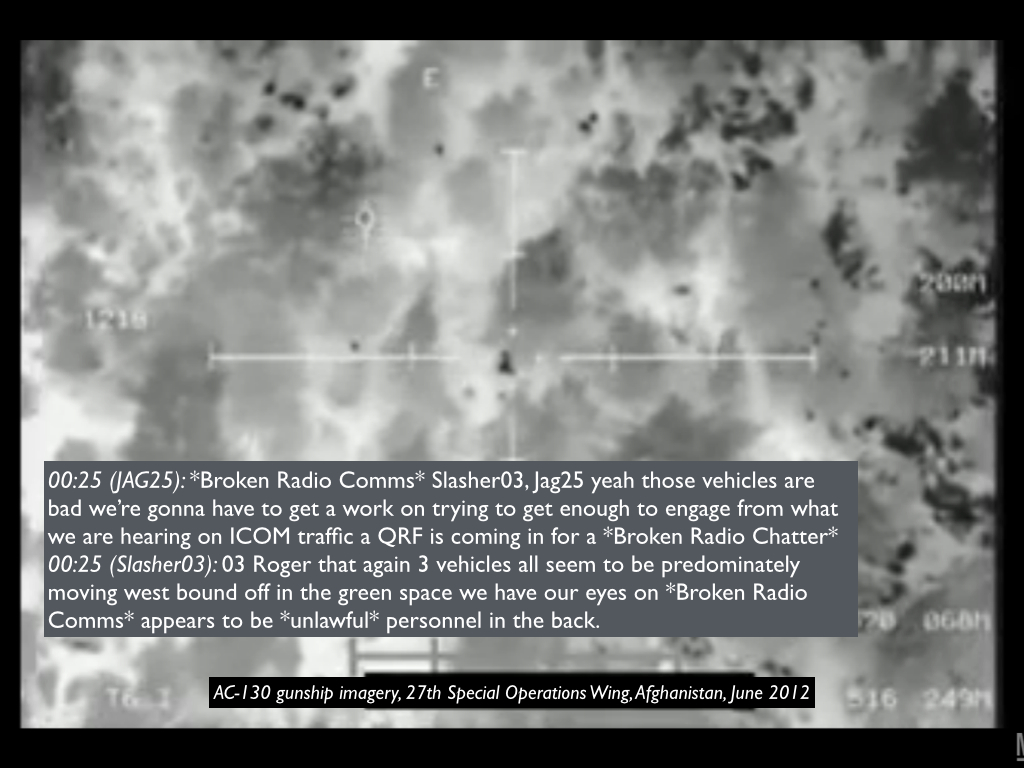
Of all of these, Lewis suggests that it is misidentification that is likely to be ‘the basis for the majority of civilian casualty incidents’ and cites the case that I discussed in detail in Tampa: the strike carried out by two attack helicopters following persistent surveillance from a Predator of a ‘convoy’ of three vehicles in Uruzgan province in Afghanistan in February 2010.  I’ll post my version of events shortly, since I think it is a mistake to collapse this episode into a monotonic ‘Predator vision’; there were other eyes in the sky [see the image below], and – still more significantly – military vision is not a uniquely technical process (which is why the concept of visuality is so important) and in this case involved different interpretations of the Full Motion Video Feed from the drone by different people at different locations. In short, there was a de-centralized, distributed and dispersed geography of militarized vision that was never resolved into a plenary (still less totalizing) frame.

AC 130 Gunship Imagery Afghanistan.001


That said, Lewis’s second point is about process not platform.  He has no truck with claims like Avery Plaw’s – ‘Where civilian casualties cannot be avoided they must be minimized.  This is what drone strikes do’ – because they mistake ‘platform precision for a comprehensive process that minimizes civilian casualties’ and are in fact ‘contradicted by operational data’.  He cites his earlier analysis of 2010-2011 data from Afghanistan, which ‘showed that several forms of attack, including engagements by manned air platforms, were less likely to cause civilian casualties than drone strikes’ (my emphasis; see my earlier discussion here). In his view, then, ‘minimizing civilian casualties is less a matter of platform or ordnance selection as it is using an approach that considers factors that lead to civilian casualties and then effectively takes them into account.’

The point is sharpened by Mark Gubrud in a response to a report from Charli Carpenter at the Duck of Minerva:

‘…drones use the same targeting pods and precision-guided weapons as the manned platforms they replace; in fact, the quality of imagery from the drones is degraded by the limited bandwidth and frequent interruptions of satellite links, as well as the transmission delay which can frustrate last-moment aborts. On top of the “soda straw” vision as compared with low-flying aircraft in close air support, these factors mean that, if anything, the drones are actually inherently less discriminate.’

Again, all of these factors were in play in the Uruzgan attack: degradations and interruptions of both video and audio transmissions were of critical importance – again, see the image from my Tampa presentation above – but even more significant was the way in which the military field of view expanded, contracted and even closed at different locations as the episode unfolded.  More to come.

Britain’s Reapers

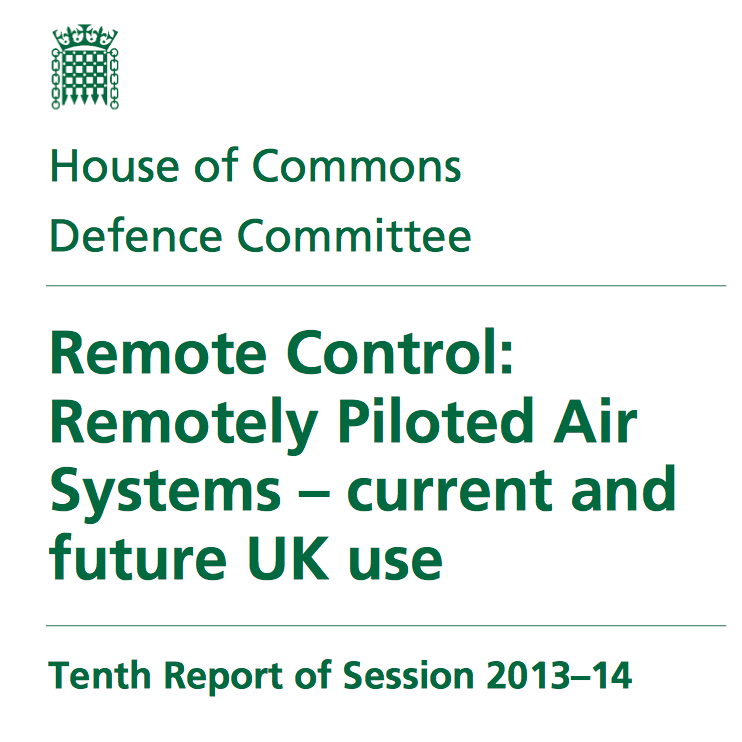
UK Remote Control

As Craig Jones has discussed in detail, it’s been much easier to get information about the ways in which the United States has incorporated drones into its military and paramilitary operations than to prise open the door of UK operations (see also Chris Cole on ‘five basic facts we are simply not allowed to know here).

But the House of Commons Defence Committee has just published a two-volume report, Remote Control: remotely piloted air systems – current and future UK use.

Volume 1, the report and formal minutes (58 pp), can be downloaded as a pdf here, and Volume II, written evidence (130 pp), is available here.  The second volume includes submissions from the Ministry of Defence, Northrop Grumman, and General Atomics together with critical submissions from Drone Wars UK, Reprieve, the Network for Social Change’s Remote Control project, and the Bureau of Investigative Journalism.

Over at the Bureau, Alice Ross has a first response and summary here, while Chris Cole has a trenchant critique at Drone Wars UK here.

I’m still working my way through all this, but here are some key passages.

First, on the ‘double proximity’ of drone operations – as I’ve said before, even though these platforms can be controlled from thousands of miles away they are not weapons of global reach:

‘The MoD told us that in order to utilise unmanned air systems in the most efficient manner, they should be based as close as possible to the target area of interest to allow for the longest loiter time possible. In a “non-permissive” or hostile environment this would be “extremely difficult”.’

The other side of this is the invocation of a new (though, as I’ve also emphasised, thoroughly conditional and technologically mediated) quasi-intimacy:

‘It was very clear from the visit to XIII Squadron and discussions with Reaper aircrew that all were experienced professional personnel with a clear purpose and keen understanding of the Rules of Engagement which govern their operations. Despite being remote from the battle space they exhibited a strong sense of connection to the life and death decisions they are sometimes required to take. This was in stark contrast to the image portrayed by some commentators of “drone” pilots as video gaming “warrior geeks”.’

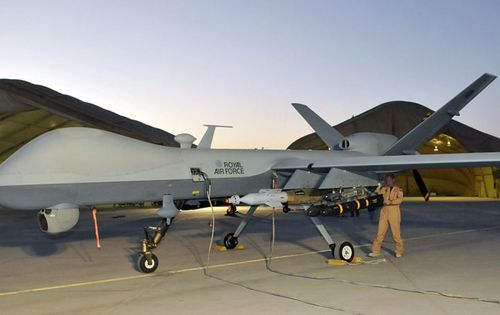
RAF Reaper

Again, as I’ve argued elsewhere, that ‘sense of connection’ is much more highly developed in relation to troops on the ground than to others who are in (or beyond) the field of view, and who are inevitably shut out from audio or online communications, which in part accounts for the risk to non-combatants whenever troops are ‘in contact’ with the Taliban and other fighters.

Second, the report seeks to draw a line between the US program of targeted killing and UK military operations in Afghanistan:

‘We acknowledge that over the last few years there has been a growing concern in relation to the sharing of intelligence with allies and the uses to which such data may contribute. While the issues raised by Reprieve stray beyond the terms of reference for our inquiry and indeed the remit of the Defence Committee, we do believe that there should be greater transparency in relation to safeguards and limitations the UK Government has in place for the sharing of intelligence…

‘We consider that it is of vital importance that a clear distinction be drawn between the actions of UK Armed Forces operating remotely piloted air systems in Afghanistan and those of other States elsewhere… In Afghanistan UAS provide intelligence in support of our ground commanders, enabling them to stay one step ahead of the enemy. Whether for targeting the Taliban or supporting troops on patrol, their ability to loiter over and survey areas for enemy activity and then feed back images and video in real time means they are an invaluable asset to our forces on the ground. Together, the UK’s fleet of UAS have carried out over 160,000 hours of ISR operations.

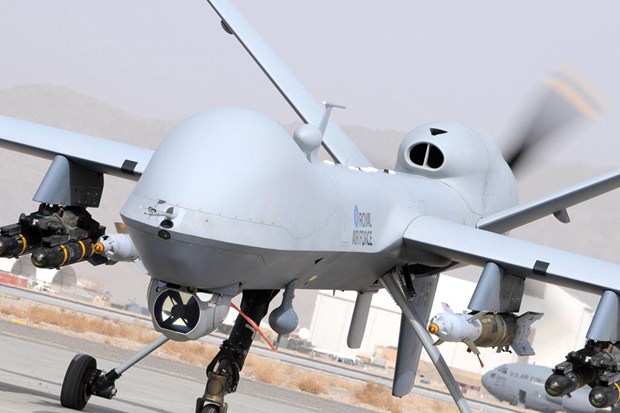
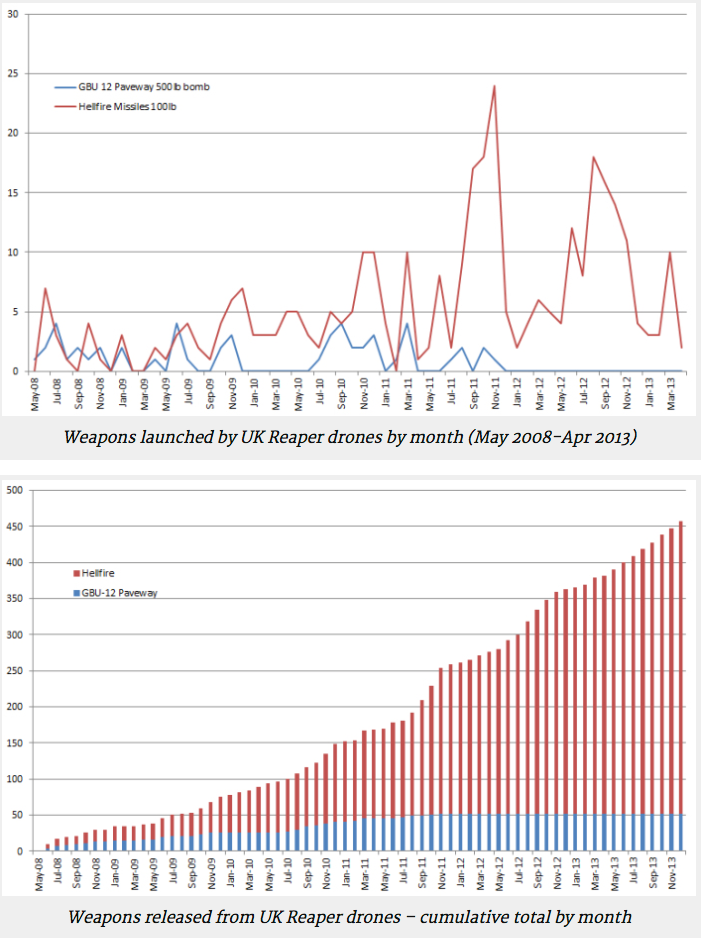
‘The General Atomics MQ-9 Reaper operated by the RAF is the UK’s only armed remotely piloted air system. The RAF fleet rose to ten in early 2014 as an additional five aircraft were accepted into service. RAF Reapers provide persistent intelligence, surveillance, target acquisition and reconnaissance (ISTAR) for ISAF forces in Afghanistan, mostly in support of UK forces in Helmand province…. Since May 2008, UK Reaper aircraft have been armed with precision-guided weapons—Hellfire laser guided air-to-ground missiles and GBU-12 Paveway 500lb laser guided bombs… By 31 August 2013, UK operated Reaper aircraft had flown over 50,000 hours on operations in the ISR role with 418 weapons fired in the same period.’

RAF Reaper and weapons

Here are the raw figures released to Drone Wars UK last month, following a FoI Request to the Ministry of Defence:

Weapons released by UK Reapers in Afghanistan 2008-2013 (Drone Wars UK)

Chris Cole is not convinced by the Committee’s (and, by extension, the Ministry’s) attempt to draw the line:

‘The report also argues that it is “of vital importance” that a clear distinction be draw between the use of drones by UK armed forces and what it discreetly calls “those of other States elsewhere.” It urges the MoD to continue its PR campaign – what the committee calls a “public awareness programme” – in order to “aid public understanding and acceptance.” PR it seems trumps transparency.’

Third, and closely connected to Chris’s misgivings, the report restates without examination the legal armature for UK military operations:

‘…the MoD told us that UK remotely piloted aircraft operate within the constraints of UK rules of engagement (ROE) and policy, even where operational control is assigned to a Coalition Commander, such as the Commander of ISAF. The MoD also stated that UK policy relating to targeting by remotely piloted aircraft is exactly the same as that for manned aircraft (and land and maritime weapons where applicable):

‘It is entirely compliant with International Humanitarian Law. Targets are always positively identified as legitimate military objectives and both pattern of life assessment and collateral damage estimate conducted. Strikes are carried out in accordance with the Law of Armed Conflict.

‘Personnel were keen for the public to know more and understand better what it is they do and to dispel some myths that have grown up about Reaper operations in particular. One pilot commented that the public needed to know that remotely piloted aircraft are “not robots, they’re not autonomous and we spend an awful lot of time training to fly them”. This training emphasised all aspects of the RAF rules of engagement such as whether a strike is necessary, whether any civilians are nearby, and what instructions have been received from the ground commander. Reaper aircrew were firmly of the view that the loiter time of remotely piloted aircraft allowed more informed decisions to be made and consequently the risk of civilian casualties was reduced should a missile strike be required….

Fourth, on civilian casualties and transparency:

‘The MoD told us that it was aware of only one incident involving an armed UK remotely piloted air system Reaper, which had resulted in the deaths of civilians:

‘On 25 March 2011 [three years ago to the day!] an attack on two pick-up trucks resulted in the destruction of a significant quantity of explosives and the death of two insurgents. Sadly, four Afghanistan civilians were also killed. In line with current ISAF procedures, an ISAF investigation was conducted to establish if any lessons could be learned or if any errors in operational procedures could be identified. In that case, the report concluded that the actions of the Reaper crew had been in accordance with extant procedures and rules of engagement.

…We note the conclusion of the UN Special Rapporteur [Ben Emmerson] that in any case in which civilians have been, or appear to have been, killed, there is an obligation on the State responsible to conduct a prompt, independent and impartial fact-finding inquiry and to provide a detailed public explanation. We recognise that this is not a simple and straightforward request as to do so could seriously jeopardise continuing operations. Nonetheless, we recommend that, to the extent that it is operationally secure to do so, following an event which has resulted in confirmed civilian casualties the MoD should seek to publish details about the incident and any lessons learned from the review process…’

For a good discussion of the UK’s definition of ‘civilian’ in such cases, see Dapo Akande at the European Journal of International Law here.

To be continued.

Precarious journeys

Much of last week was taken up with working out a new project for the next round of the Social Science and Humanities Research Council’s Insight Grant programme.  A ‘Notification of Intent’ to apply is required (I’m deliberately not saying ‘needed’) before you can actually apply in October – but since the NOI requires a plain-language summary and a figure for the total budget most of the planning has to be done months before the application.  I could fill a whole blog – and other non-digital receptacles – about the sense in all that; suffice to say I hit the button ten seconds (sic) before the electronic shutters came down.

The application is for a project called Medical-Military Machines and the Casualties of War: Genealogies and Geographies of Care.

859084-dust-off-inside-afghanistan-039-s-medevac

One of the central claims made by protagonists of later modern war is that its conduct is accurate and proportionate, legal and ethical, thereby raising the bar for ‘just’ or, as James Der Derian has it, ‘virtuous’ war (and as most readers will know, he would insist on those scare-quotes).  It has done so, its advocates argue, by limiting casualties through new modes of intelligence, surveillance and reconnaissance, new weapons systems, and new modes of accountability.  I explore these issues in my ongoing SSHRC project, Killing Space (DOWNLOADS tab)not least through my continuing study of drones (much more to come!) and this project maps its other, vitally important dimension – a sort of ‘Caring Space’ – in order to provide an indispensable substantive test for these claims.

The project concerns the provision of medical care for those wounded by military and paramilitary violence, casualties who are often overlooked in vexed but vital debates over ‘body counts’ and what constitutes (following Judith Butler) a grievable life.  I’m not going to ignore those matters, far from it, but my main concern will be on the survivors of military violence.  As I’ll explain in a moment, I want to analyse both combatant and civilian casualties, and so confound the simplistic politics in which the right is supposed to care about the one and the left about the other.

The project will involve both genealogy and geography.  I’m using ‘genealogy’ in something like the Foucauldian sense, but all I’ll say here is that historical depth is plainly essential to specify what is (and is not) novel about the ways in which advanced militaries wage war.  So the project will involve four case studies focusing on the United States and its allies.  The first three are the Western Front in World War I, North Africa in World War II, and South Vietnam (1963-1975) .  In this traverse from ‘total war’ to James Gibson’s ‘techno-war’ I’m planning to leverage my work on ‘The natures of war’.  While researching that presentation and long-form essay – which will eventually appear in War Material – I found  a treasure-trove of sources that I want to explore in much more depth and detail for this new project.  The fourth case study will involve the cluster of wars in the Greater Middle East post 9/11, and while much of this has been familiar ground for me ever since I started writing The colonial present, there are many new issues to address – including the deliberate targeting of hospitals and medical doctors by some factions and what Omar Dewachti calls the ‘therapeutic geographies’ involved in the transnational movement of war casualties from (say) Iraq, Libya and Syria to hospitals in Lebanon, Jordan and India.

The project has three components that address different geographies of casualty care.

Stretcher-bearers

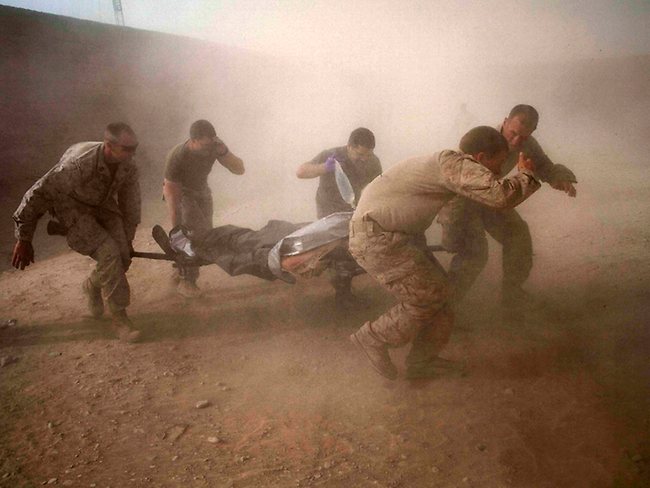
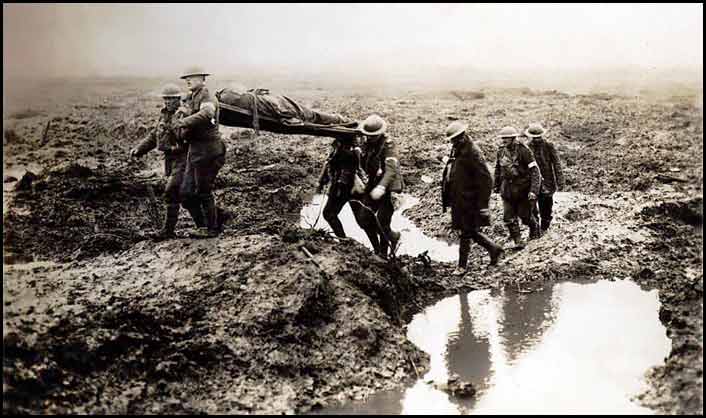
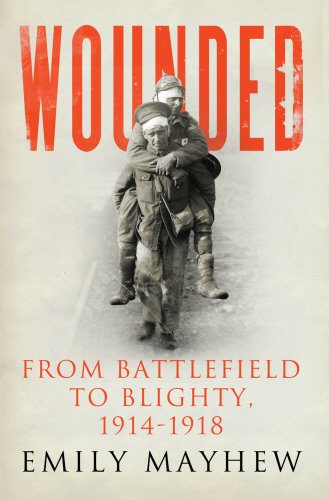
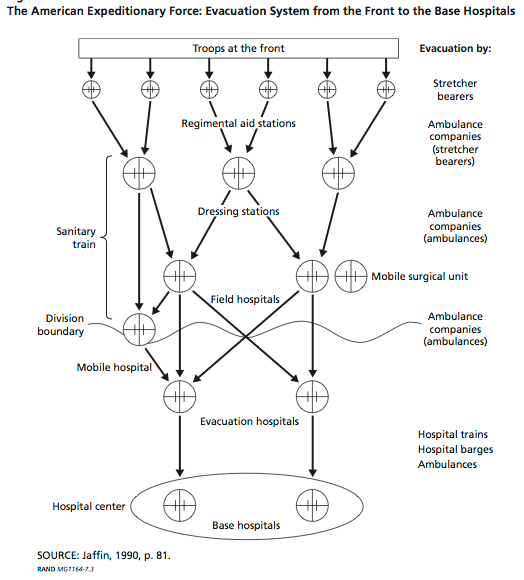
MAYHEW Wounded(1) Modern military medicine has sought to provide immediate care for troops injured in combat as close to the site of the injury as possible by deploying medical personnel and equipment in forward positions, and establishing evacuation routes for more seriously injured patients to higher-order medical facilities in the rear.  These systems have been transformed by technical advances designed to increase the time-space compression of treatment: the more widespread use of motorized ambulances in the Western Desert, for example, and helicopters for medical evacuation (‘dust-off’) in Vietnam and later conflicts. I plan to reconstruct these networks and their transnational extensions and to calibrate the changing transit times, and then to turn these skeletal geometries into human geographies through diaries, letters and, as we near the present, interviews, that I hope will bring into view the multiple people involved in these precarious, fleshy, and profoundly intimate journeys.  My inspiration for this is a series of thought-provoking essays in the Journal of the Royal Army Medical Corps (really), which provide a way in to the geometries and networks, and (very different) Emily Mayhew‘s Wounded: from Battlefield to Blighty, 1914-1918, due out next month, which uses the idea of a ‘journey’ in what could develop into a sort of phenomenology of care; I’ll say some more about some of this in a later post.

AEF Evacuation system WWI

The other two components follow from a remark made by Michel Foucault in ‘The Eye of Power’.  There he suggested that ‘doctors, along with the military, were the first managers of collective space’, but he assigned them to different spaces (‘campaigns’ versus ‘habitations’). Instead I want to explore what happens when military and medicine are called upon to imagine and manage the same space and install what, following the example of Mark Harrison, I’m calling a ‘medical-military machine’ in a war-zone.  So I’ll be following two tracks that are usually kept separate – civilian and combatant casualties (and here I want to extend the ongoing debates over their distinction from an abstract legal to a substantive therapeutic terrain) – and tracing the junctions where they intersect, in order to establish two other, complementary and sometimes countervailing geographies of care.

Medevac

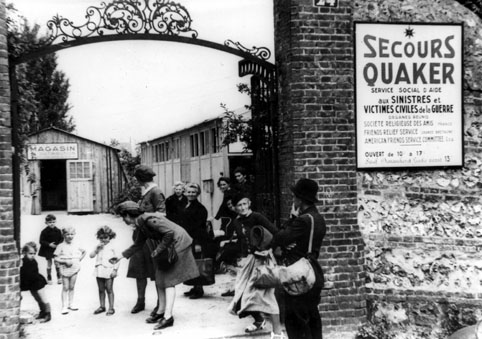
(2) There is an important sense in which modern war has always been ‘war amongst the people’: this is not a late twentieth-century preoccupation.  Images of ‘No Man’s Land’ on the Western Front distract attention from the injuries suffered by civilian populations who continued to inhabit houses and work farms behind the front lines, for example, while ground and air offensives in South Vietnam produced hundreds of thousands of civilian casualties.  So a second question is this: in what ways and in what places have militaries assumed medical responsibility for civilian casualties before and beyond the parameters of the Medical Civic Action Programs of contemporary counterinsurgency?

Secours Quaker

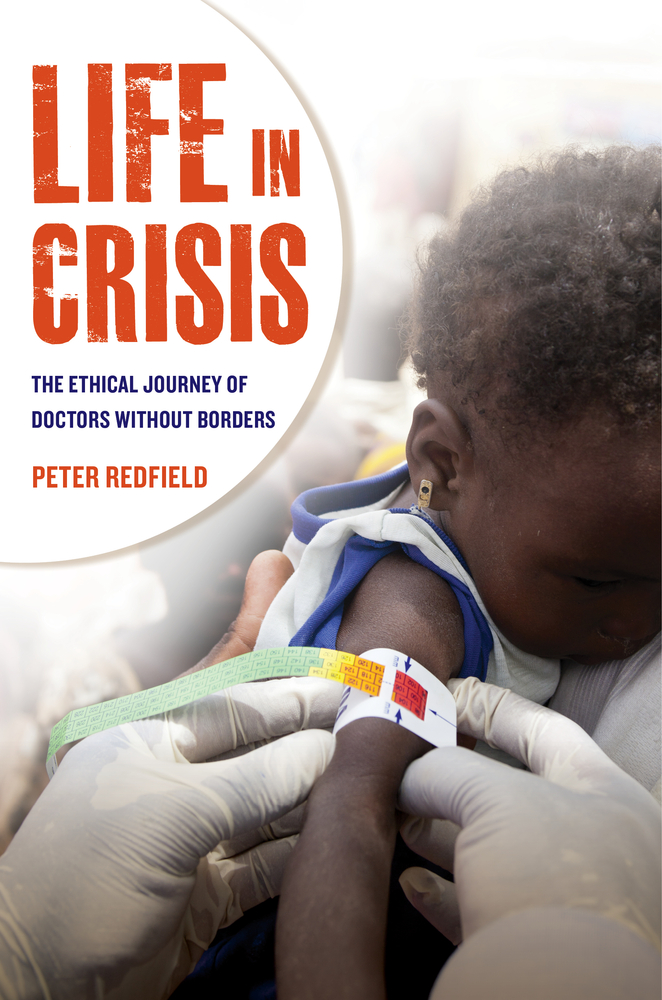
REDFIELD Life in Crisis MSF(3) Conversely, the military has not been the only agency making medical interventions in war-zones, and this is not a late twentieth century development either.  Civilian hospitals are increasingly important in today’s urban wars (where they often become targets too), but I want to pay particular attention to the work of international agencies.  I plan to analyse two voluntary organisations, the Friends’ Ambulance Unit and the American Field Service in the two world wars, and (I hope) two contemporary NGOs, the most obvious candidates being the International Committee of the Red Cross and Médecins sans Frontières.  I’m not assuming any direct filiations, and I’ll no doubt find all sorts of differences between them (particularly between the earlier and the later ones), but I’m particularly interested in the tensions between what at the moment I see as a common, more or less cosmopolitan engagement and the imperative to provide place-specific casualty care (and the logistics of doing so).   So a third question revolves around the rise of a ‘militarized humanism’ and the emergence of what Didier Fassin calls  ‘humanitarian reason’ as, perhaps, a form of governmentality.

http://vimeo.com/66342865

This really is just a bare-bones summary, and since I have another two months to flesh it out I’d really welcome any advice, suggestions or criticisms.  As I’ve described the project here you can see, I hope, that my case-studies and the questions I think they’ll enable me to address arise at the intersections of medical and military geography but also involve political, cultural and legal geographies.  And, as ever, those geographies all have a stubbornly little g: this really isn’t a disciplinary project.

Drones and civilian casualties in Afghanistan

I’ve been urging for some time now that the debate over drone strikes must not neglect what has been happening in Afghanistan: hence “From a view to a kill” (DOWNLOADS tab) and the much longer version to appear in The everywhere war.  According to a report on the Guardian website posted late on Tuesday by the resourceful Spencer Ackerman, ex-Danger Room (now sadly itself an ex-site), ‘A study conducted by a US military adviser has found that drone strikes in Afghanistan during a year of the protracted conflict caused 10 times more civilian casualties than strikes by manned fighter aircraft.’  The period under analysis (from mid-2010 to mid-2011) followed a series of measures announced by General Stanley McChrystal to reduce civilian casualties from air operations, and coincided with a dramatic increase in the number of drone strikes (which continued to increase through 2012).

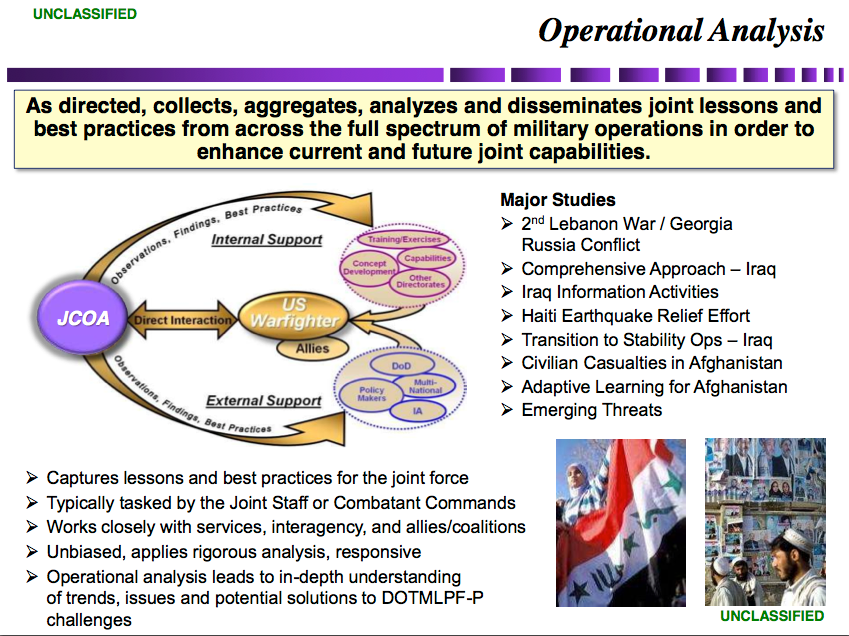
The study in question was carried out by Larry Lewis for the Joint Coalition and Operational Analysis (JCOA), a division of the Joint Staff J7 whose work is summarised in the following slide (which comes not from Edward Snowden‘s cache but from here):

JCOA

Notice ‘Civilian casualties in Afghanistan’ is #6 on the list of major studies.  The completed study is called Drone Strikes: Civilian Casualty Considerations and, apart from the Executive Summary that was published on 18 June, remains classified.  The opening paragraph is the primary source for Spencer’s story, and here it is:

‘The US government has described drone airstrikes in operations outside declared theaters of armed conflict as surgical and causing minimal civilian casualties. Analysis of air operations in Afghanistan, combined with a review of open-source reports for drone strikes in Pakistan, suggest that these fell short of intended goals. Specifically, drone strikes in Afghanistan were seen to have close to the same number of civilian casualties per incident as manned aircraft, and were an order of magnitude more likely to result in civilian casualties per engagement. Specific causal factors were identified that contributed to the relative propensity of drones to cause civilian casualties. Tailored training that addresses these causal factors could aid in reducing civilian casualties in engagements involving drones. While processes and operating forces in Afghanistan can differ from those in operations outside declared theaters of armed conflict, the factors above suggest that a dedicated analysis of civilian casualties in such operations would be worthwhile.’

The key sentence is in bold, and a version of it reappears in an essay, ‘Changing of the Guard: civilian protection for an evolving military’, that Lewis wrote with Sarah Holewinski, Executive Director of the Center for Civilians in Conflict and which appears in the latest issue of PRISM 4 (2) (2013), a journal of the Center for Complex Operations at the National Defense University (the press release from Civilians in Conflict is here).  The authors’ central concern is that ‘as Washington shifts its focus from counter-insurgency to counterterrorism, and from large-scale ground operations to more discrete and oftentimes-unmanned operations, the progress U.S. forces have made on preventing and mitigating civilian harm may soon be lost.’

They consider the risks attendant upon the increased reliance on Special Operations Forces – something that readers of Jeremy Scahill‘s Dirty Wars will need no warning of –  but also those that are likely to flow from an increased use of Unmanned Aerial Systems (UAS):

‘America’s use of force will increasing rely on new technologies, including air force capabilities to penetrate enemy defenses and strike over long distances. Unmanned Aerial Systems, sometimes referred to as “drones,” saw major use in Iraq and Afghanistan, and are slated for a big leap in funding. The Pentagon called for a nearly one-third increase in its fleet in the years ahead.

‘The use of UAS can have military advantages for avoiding civilian casualties in armed conflict, if used with that intent in mind. Their systems feature precision weapons, their sensors have increasingly high-resolution imagery to assess the ground situation, and back in the control room, trained imagery analysts scrutinize a target area prior to engaging, which isn’t always possible in a full ground operation.’

They list a series of familiar objections to the use of these remote platforms in areas outside ‘traditional combat theaters’, but they are also critical of  claims about their forensic capacity inside war-zones:

‘The assumption that UAS strikes are surgical in nature is … belied by research on recent combat operations in Afghanistan. There, UAS operations were statistically more likely to cause civilian casualties than were operations conducted by manned air platforms. One reason was limited training for UAS operators and analysts in how to minimize civilian harm. adding or improving training on civilian casualty prevention is a resource decision in direct tension with the increasing demand for more uaS and more operations, since additional training on civilian protection means time must be taken from somewhere else including the mission itself.’

They don’t say much about the reasons for this, except that they then criticise the ‘clandestine use of UAS by the US government’ because it raises ‘significant concerns that civilian casualties will not be properly monitored or investigated and thus called into question’ and then, several paragraphs later, they note that non-covert operations in Afghanistan ‘are replete with examples where all the engaged individuals were believed to be combatants, but a later investigation found many or all were civilians misidentified as combatants.’

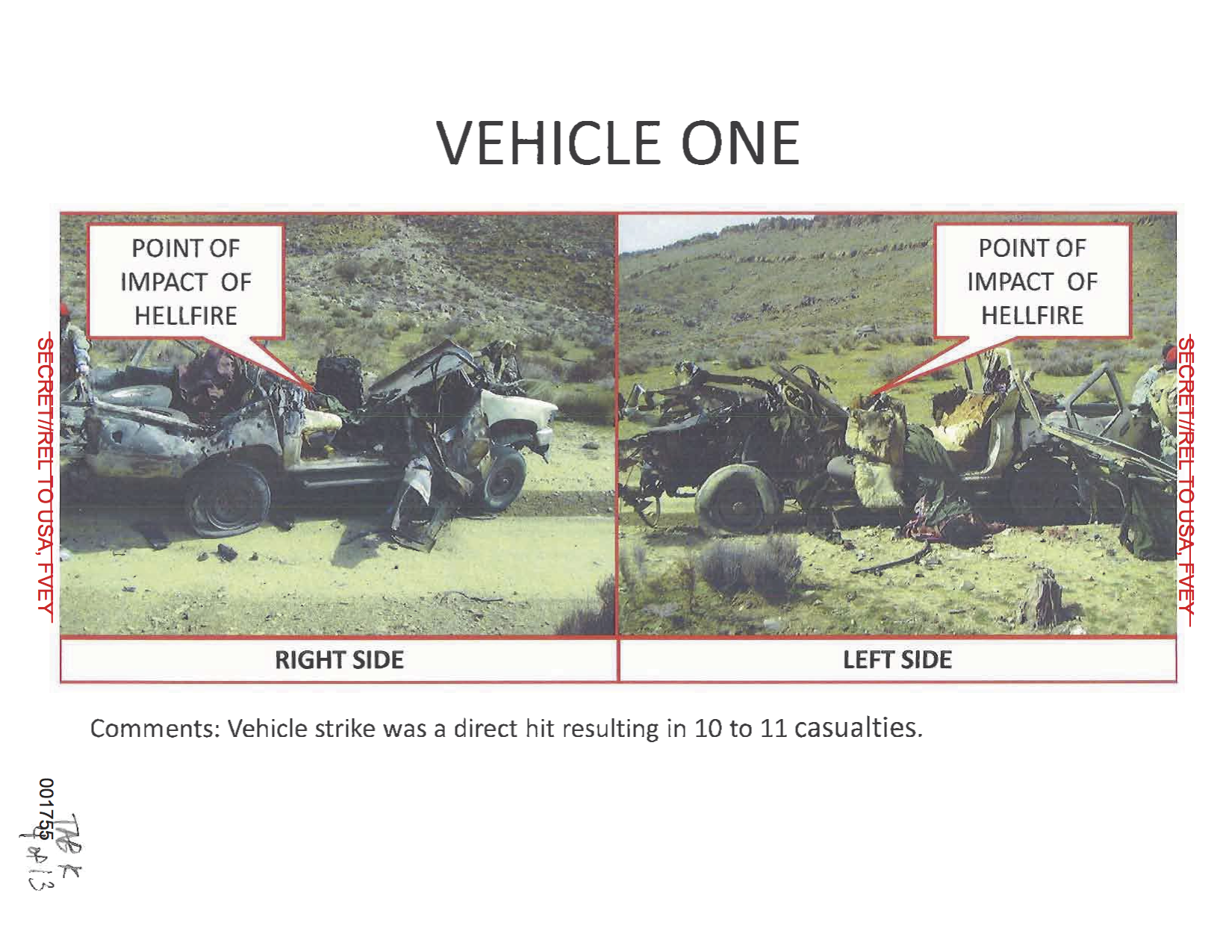
Attachment TAB A (Part 22 of 28) FOIA 10-0218 Uruzgan - Pages 1751-1800 (dragged) 1

A key issue, then appears to be misidentification, and in my examination of one hideous incident in Uruzgan province in Afghanistan in February 2010 (in “From a view to a kill”; see also the image above) – an analysis I develop in my more detail in The everywhere war – I suggested that the high-resolution video feeds from these remote platforms engender an intimacy with ground troops that belies the physical remoteness of the drone operators.  They routinely claim to be not 7,500 miles from the battlespace but just 18 inches – the distance from eye to screen – and this immersive capacity (which these feeds do indeed share with videogames) predisposes them to view virtually every proximate Afghan action as hostile:

‘… the greater incidence of civilian casualties when close air support is provided to ‘troops in contact’ may result not only from time-critical targeting and its correspondingly ‘fewer checks to determine if there is a civilian presence’ … but also from the persistent presence of the [UAS] and its video feeds immersing its remote operators in, and to some substantial degree rendering them responsible for the evolving situation on the ground. This predicament, in which proximity not distance becomes the problem, cannot be resolved by tinkering with the Rules of Engagement; high-resolution imagery is not a uniquely technical capacity but part of a techno-cultural system that renders ‘our’ space familiar even in ‘their’ space – which remains obdurately Other.’

I don’t know if this forms part of the classified report, of course, but in an earlier report, Reducing and mitigating civilian casualties: enduring lessons (dated April 2013) Lewis emphasised the importance of using ‘discrimination tools’ in ‘situations where forces need to discern whether an individual is demonstrating hostile intent’ – but what he seemed to have in mind was another technological fix, ‘higher-resolution imagery or night vision devices’, whereas the root of the problem may well not be the power to see but the capacity to make sense of what is seen.

In any event two other questions remain.

First, during the period under analysis drone strikes accounted for around 5 – 6 per cent of total weapon releases by all aircraft in Afghanistan, but many of the conventional strikes nevertheless relied on persistent surveillance of targets from Predators or Reapers and then attacks by helicopters or fighter-bombers (which was the case in the Uruzgan attack).  Does Lewis’s statistical analysis shed any light on the difference (I assume there is one) between a UAS acting as a ‘hunter-killer’ and a UAS providing only real-time ISR as part of a networked operation?

Second, what is the difference between ‘an incident’ and an ‘engagement’ in the first extract I’ve quoted?  This is a substantive issue of considerable moment: if drone strikes produce a roughly similar number of civilian casualties as conventional strike aircraft ‘per incident’ but ten times the number ‘per engagement’, it’s vital to know the difference. Protagonists of remote operations will undoubtedly seize on the first, critics on the second.

I’m trying to chase down the difference. To be continued…

Droning on

Here’s a selection of recent reports on drone strikes from around the web plus commentary:

Craig Whitlock completes the Washington Post‘s three-part series on ‘Permanent War’ – started by Greg Miller‘s report on the US ‘disposition matrix‘ for targeted killing – with a remarkable account of what he calls ‘the US military’s first permanent drone war base’ at Camp Lemonnier, just (barely) outside Djibouti City.  It’s ‘the busiest Predator drone base outside the Afghan war zone’, from which Predators are launched around the clock, sixteen times a day, to conduct missions in Somalia and Yemen.  Nominally overseen by US Africa Command (AFRICOM) – ‘the primary base of operations for US Africa Command in the Horn of Africa‘ – Whitlock mades it clear that it’s Joint Special Operations Command (JSOC) that calls the shots.  What is remarkable about Whitlock’s report is his artful piecing together of a jigsaw of information from construction solicitations, contracts and plans, submissions to Congress, planning memoranda, Air Force journals, and Predator accident investigation reports, some in the public domain and countless others obtained through FOI requests.  More on drone wars in East Africa from Somalia Report (which also provided the image of Camp Lemonnier below) and on what David Axe calls ‘America’s secret drone war in Africa’ from Wired‘s Danger Room.

Alex Kane at Mondoweiss reprises the Columbia report on Counting Drone Strike Deaths issued earlier this month – which is sharply critical of the estimates of civilian casualties in Pakistan reported by both the New America Foundation and the Long War Journal and endorses those provided by the Bureau of Investigative Journalism – and then follows up with an interview with Naureen Shah, Acting Director of the Human Rights Clinic and the Associate Director of the Counter-terrorism and Human Rights Project at Columbia:

… all of these estimates, including our estimate, are just based on news reports, news reports filed in that region where journalists have very limited access to the scene of the crime, if you will.

It’s not like journalists, for the most part, are going to where the drone strike happened and talking to witnesses, doing a bit of, almost a forensic analysis, being able to see what happened with their own eyes. This [Pakistan’s Federally Administered Tribal Areas] is a region where few journalists, even Pakistani journalists, can really get there. We’re talking about media reports that are often based on the word of anonymous, Pakistani government officials who have an interest in telling a story of, “drone strikes kill only militants.” We’re not going to see anonymous government officials admitting that many of the people killed are civilians. So it’s a stacked deck.’

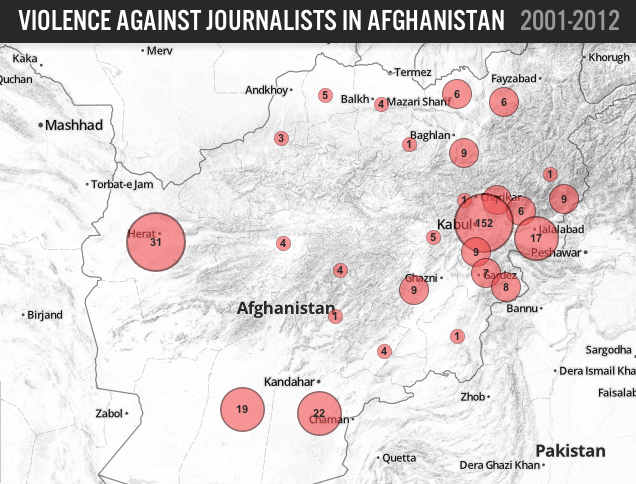
All true.  But there is a striking geographical absence from the kerfuffle over civilian casualties caused by drone strikes: Afghanistan.  The situation there is no less fraught: as the map below shows, journalists in Afghanistan also work in highly dangerous circumstances. (More on the map here and more from the Committee to Protect Journalists here).

The politico-technical matrix is also more complicated: in Afghanistan Predators and Reapers are part of an extended network in which aircraft are linked to ground forces and through which remote operators carry out persistent surveillance while, on occasion, leaving attacks to conventional strike aircraft (though they certainly also launch them from their own platforms too).  This makes it more difficult to disentangle drones from the wider apparatus of military violence – but why on earth should they be?  Afghanistan is part of a recognised ‘war zone’ – but does that make civilian casualties there any less grievable than those that take place across the border?

In the Mondoweiss interview Shah draws attention to the perpetual fear induced by the persistent presence of the drones:

We’re talking about planes hovering over head for hours every single day, and really the casualty of that, the human casualty, is peace of mind for the people who live there. We see reports that parents don’t want to send their kids out to school, that people don’t know what’s going to get them killed by a drone strike. Imagine living in that kind of fear, and we’re talking about communities that are already ravaged by war.

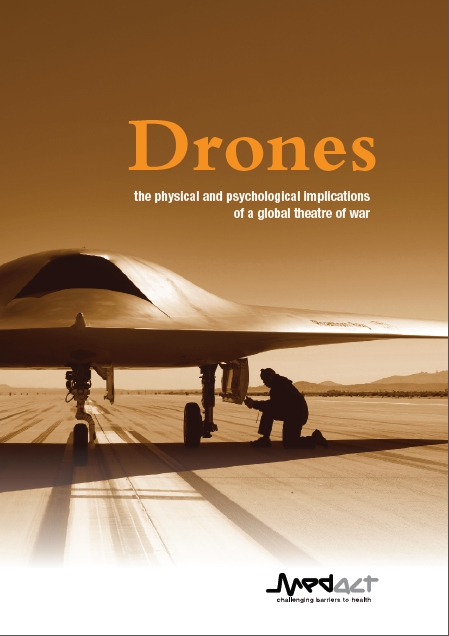
For more on this, turn to UK-based Medact’s report on Drones: the physical and psychological implications of a global theatre of war, also issued earlier this month.  Free download here.

Women are disproportionately affected by drones. What little control they have over their lives is further eroded by a weapon they know could strike at any time. Their lives and those of the children they try to protect are under constant threat. While men can sublimate their grief and anger to some degree by becoming fighters – one of the terrible consequences of drone warfare – women have no such outlet. And if their menfolk are killed in a drone strike, they may have to endure the continuing presence of the drone just overhead.

The report is a survey of surveys, short and to the point, but it adds a British dimension to the debate – important at a time when the RAF is doubling its Reaper fleet and moving control from Creech AFB in Nevada to RAF Waddington in Lincolnshire – and too briefly brings Israel’s use of drones in Gaza into the general discussion.  That last point desperately needs to be sharpened, given the global prominence of the Israeli drone industry and the filiations between US and Israeli practices of targeted killing.  Another depressing blank on the drone debate map.

(I hadn’t heard of Medact before, but it claims to speak out ‘for countless people across the globe whose health, wellbeing and access to proper health care are severely compromised by the effects of war, poverty and environmental damage’, and it’s associated with the journal Medicine, conflict and survival – a source which deserves close attention).

Haymarket Books has just published (pb and e-book versions) a collection of Nick Turse‘s columns on drones and Obama’s other signature modes of warfare, The changing face of empire: see here for an adapted version of the conclusion (extract below) and here for the book.

Several times this year, [General Martin Dempsey], the other joint chiefs, and regional war-fighting commanders have assembled at the Marine Corps Base in Quantico to conduct a futuristic war-game-meets-academic-seminar about the needs of the military in 2017. There, a giant map of the world, larger than a basketball court, was laid out so the Pentagon’s top brass could shuffle around the planet — provided they wore those scuff-preventing shoe covers — as they thought about “potential U.S. national military vulnerabilities in future conflicts” (so one participant told the New York Times). The sight of those generals with the world underfoot was a fitting image for Washington’s military ambitions, its penchant for foreign interventions, and its contempt for (non-U.S.) borders and national sovereignty.

And lastly, on an almost lighter note, Teo Ballvé at Territorial Masquerades has an artful post on ‘Writing like a drone’.  Following up on the ‘New Aesthetic‘, he describes a robotic graffiti writer that can write text massages ‘on such high risk/high profile targets as the U.S. Capitol Building’ and ‘can be deployed in any highly controlled space or public event from a remote location.’  It’s the remoteness that presumably prompts Teo to call this a ‘graffiti drone’, but there are two other (remote) connections to the real thing.

The project comes from the Institute for Applied Autonomy, which also hosts Trevor Paglen‘s captivating (sic) Terminal Air, a satirical version of the CIA’s extraordinary rendition flights –  the ‘capture’ side of the kill/capture regime that uses drones for the ‘kill’.

Former US Ambassador Kurt Volker adds a gloss to this in an Op-Ed in the Washington Post following up the ‘Permanent War’ reports:

More people have been killed in U.S. drone attacks than were ever incarcerated at Guantanamo Bay. Can we be certain there were no cases of mistaken identity or innocent deaths? Those detained at Guantanamo at least had a chance to establish their identities, to be reviewed by an oversight panel and, in most cases, to be released. Those who remain at Guantanamo have been vetted and will ultimately face some form of legal proceeding. Those killed in drone strikes, whoever they were, are gone. Period.

What he doesn’t quite say is that most of those incarcerated at Guantanamo were, on the US government’s own admission, never al Qaeda fighters.  More on the implications of these intelligence failures for the US targeted killing programme from the Stanford/NYU report on Living under drones here (scroll down).

Finally, back to Theo’s ‘graffiti drone’:  one of several synonyms for graffiti writing – particularly at night – is bombing…