Theory of the drone 11: Necro-ethics

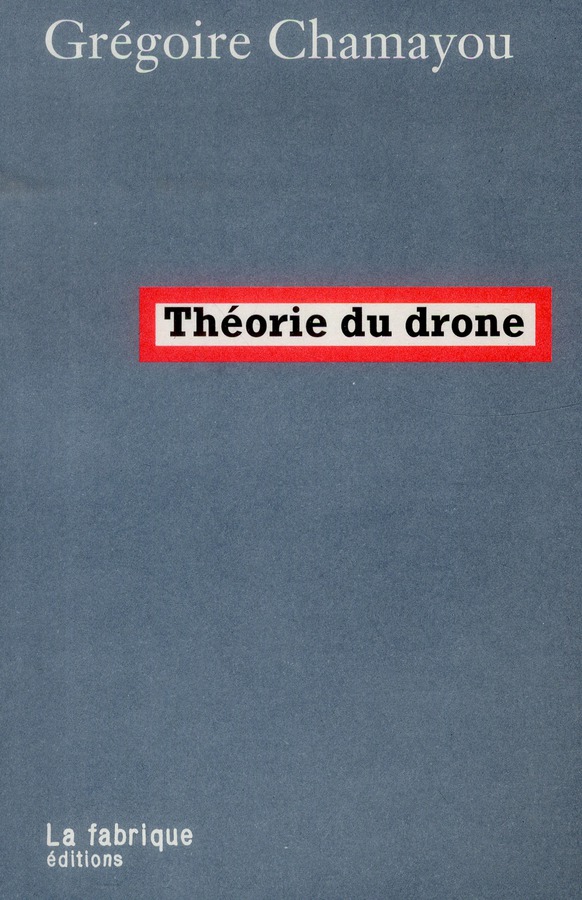
This is the 11th in a series of extended posts on Grégoire Chamayou‘s Théorie du drone and covers the first two of three chapters that constitute Part III: Necro-ethics.

The title recalls Achille Mbembe‘s seminal essay on ‘Necropolitics’ [Public culture 15 (1) (2003) 11-40], where he cuts the umbilical cord between sovereignty and the state (and supranational institutions) and, inspired by Michel Foucault and Giorgio Agamben, argues that ‘the ultimate expression of sovereignty resides, to a large degree, in the power and the capacity to dictate who may live and who must die.’  Necropolitics is thus about ‘contemporary forms of subjugation of life to the power of death’ – and at the limit the creation of what Mbembe calls ‘death-worlds’.

AlexisLeran-AchilleMbembe5Mins658

Mbembe develops his thesis in part – and for good reason – in relation to the Israeli occupation of Palestine.  I imagine readers will know that the Israeli Defence Force (IDF) advertises itself, incredibly, as ‘the most moral army in the world’, and although Chamayou’s ultimate objectives are different he too begins with a critical interrogation of one version of that claim (you can find much more about it in Muhammad Ali Khalidi‘s fine essay on Gaza in the Journal of Palestine Studies 39 (3) (2010) available on open access here).

1: Combatant immunity

Chamayou argues that what distinguishes contemporary forms of imperial military violence is not so much the asymmetry of the conflict or the differential distribution of vulnerability which results as the norms that are invoked to regulate its conduct.  Towards the end of the twentieth century, he suggests, the ‘quasi-invulnerability’ of the dominant force was transformed into an over-arching politico-ethical framework.  This first came into view during NATO’s intervention in Kosovo in 1999 when force protection was established as the key consideration: not only was the NATO campaign largely confined to bombing from the air (so that, apart from Special Forces, there were few boots – and, more to the point, NATO bodies – on the ground) – but pilots were ordered not to fly below 15,000 feet.  This kept them safely beyond the range of anti-aircraft fire, even as it reduced the accuracy of air strikes and endangered the lives of those the intervention was supposed to save.

nato-bombs-convoy

This seems to violate conventional notions of a just or ethical war, effectively turning ‘humanitarian intervention’ on its head, but Chamayou claims that in fact it heralded the explicit formulation of a principle of ‘imperial combatant immunity’.  Enter the IDF, stage right.  This new doctrine was set out in detail in an essay by Asa Kasher  and Amos Yadlin, writing from the ‘Department of Professional Ethics and Philosophy of Practice’ at Tel Aviv University and the IDF College of National Defense, and published as ‘Military ethics of fighting terror: an Israeli perspective’, Journal of military ethics 4 (1) (2005) 3-32.  As their affiliation shows, this was not an abstract, academic discussion; Chamayou notes, in an artful twist on Yves Lacoste (La géographie, ça sert, d’abord, à faire la guerre), ‘What use is moral philosophy?  Among other things, to wage war…’ (‘A quoi sert la philosophie morale?  Entre autres choses, à faire la guerre’) (p. 184).

In that essay Kasher and Yadlin proposed a comprehensive reformulation of military ethics – and, by extension, international law – but Chamayou fastens on their reworking (or demolition) of  the established principle of distinction.  He cites their central thesis, thus:

One major issue is the priority given to the duty to minimize casualties among the combatants of the state when they are engaged in combat acts against terror.  According to the ordinary conception underlying the distinction between combatants and noncombatants, the former have a lighter package of state duties than the latter. Consequently, the duty to minimize casualties among combatants during combat is last on the list of priorities or next to last, if terrorists are excluded from the category of noncombatants. We reject such conceptions, because we consider them to be immoral. A combatant is a citizen in uniform. In Israel, quite often he is a conscript or on reserve duty. His blood is as red and thick as that of citizens who are not in uniform. His life is as precious as the life of anyone else. A democratic state may send him to a battlefront only because it has a duty to defend its citizens and it cannot do this without some of them defending the others, within the framework of a just system of conscription and reserve duty. The state ought to have a compelling reason for jeopardizing a citizen’s life, whether or not he or she is in uniform. The fact that persons involved in terror are depicted as noncombatants is not a reason for jeopardizing the combatant’s life in their pursuit. He has to fight against terrorists because they are involved in terror. They shoulder the responsibility for their encounter with the combatant and should therefore bear the consequences. 

(It turns out that there are limits to the privileges accorded to citizen-soldiers: more recently Ha’aretz reports that Kasher suggested in early 2012 that medical experiments can be carried out on them, even if they are not fully informed of the details, in order to ‘build the military force’, though Kasher has contested these accusations and insisted that his opinion stipulated a series of ‘conditions’ that had to be met).

I didn’t mention Lacoste casually, because part of Kasher and Yadlin’s argument turns on territory: on the duties imposed by belligerent occupation (‘when a person resides in a territory that is under effective control of the state’).  This is a Trojan Horse, needless to say, because they clearly have Gaza in their sights, and their proposal seeks to further the egregious fiction that Israel’s ‘withdrawal’ in 2005 meant that the Palestinians effectively imprisoned in Gaza are no longer subject to Israeli occupation (for more on ‘Gaza under siege’, see here).  Chamayou doesn’t dwell on this, but the emphasis on ‘effective control’ could – if you accept Kasher and Yadlin’s grotesque argument (which they insist is a general one) – be brought to bear on the US campaign of targeted killing in the Federally Administered Tribal Areas of Pakistan, in Yemen and in Somalia and be made to intersect with the usual rhetoric about ‘ungoverned spaces’ and ‘lawless zones’.

Kasher and Yadlin summarize their proposed hierarchy of privileges by setting out a tariff according to which militaries would administer injury in priority sequence:

(d.1) Minimum injury to the lives of citizens of the state who are not combatants during combat;

(d.2) Minimum injury to the lives of other persons (outside the state) who are not involved in terror, when they are under the effective control of the state;

(d.3) Minimum injury to the lives of the combatants of the state in the course of their combat operations;

(d.4) Minimum injury to the lives of other persons (outside the state) who are not involved in terror, when they are not under the effective control of the state;

(d.5) Minimum injury to the lives of other persons (outside the state) who are indirectly involved in terror acts or activities;

(d.6) Injury as required to the liberties or lives of other persons (outside the state) who are directly involved in terror acts or activities.

Chamayou concludes that the core principle they seek to advance involves replacing the distinction between civilians and combatants by a hierarchical distinction between citizens and aliens: an unbridled nationalism masquerading as ethics (p. 187).  In other words, within the frontier of state control  – Chamayou says ‘ state sovereignty’, but that’s not quite what Kasher and Yadlin say – some lives are more precious than others,  while beyond that line inferior lives (including those of what they call ‘bystanders’) are to be exposed to violence and ultimately sacrificed: as they put it, ‘the state should give priority to saving the life of a single citizen, even if the collateral damage caused in the course of protecting that citizen is much higher…’

nyrb051409Their proposals had a slow fuse but they eventually set off a firestorm of protest.  Responding to a shorter version of the main essay [‘Assassination and preventive killing’, SAIS Review of International Affairs 25 (1) (2005)  41-57] and writing in the New York Review of Books (14 May 2009), Avishai Margalit and Michael Walzer were unequivocally appalled:

‘Their claim, crudely put, is that in such a war the safety of “our” soldiers takes precedence over the safety of “their” civilians.  Our main contention is that this claim is wrong and dangerous. It erodes the distinction between combatants and noncombatants, which is critical to the theory of justice in war (jus in bello).’

They continued:

‘The point of just war theory is to regulate warfare, to limit its occasions, and to regulate its conduct and legitimate scope. Wars between states should never be total wars between nations or peoples. Whatever happens to the two armies involved, whichever one wins or loses, whatever the nature of the battles or the extent of the casualties, the two nations, the two peoples, must be functioning communities at the war’s end. The war cannot be a war of extermination or ethnic cleansing. And what is true for states is also true for state-like political bodies such as Hamas and Hezbollah, whether they practice terrorism or not. The people they represent or claim to represent are a people like any other.

The main attribute of a state is its monopoly on the legitimate use of violence. Fighting against a state is fighting against the human instruments of that monopoly—and not against anyone else….

The crucial means for limiting the scope of warfare is to draw a sharp line between combatants and noncombatants. This is the only morally relevant distinction that all those involved in a war can agree on. We should think of terrorism as a concerted effort to blur this distinction so as to turn civilians into legitimate targets. When fighting against terrorism, we should not imitate it.’

In contrast,

‘For Kasher and Yadlin, there no longer is a categorical distinction between combatants and noncombatants. But the distinction should be categorical, since its whole point is to limit wars to those—only those—who have the capacity to injure (or who provide the means to injure)….

‘This is the guideline we advocate: Conduct your war in the presence of noncombatants on the other side with the same care as if your citizens were the noncombatants. A guideline like that should not seem strange to people who are guided by the counterfactual line from the Passover Haggadah, “In every generation, a man must regard himself as if he had come out of Egypt.”
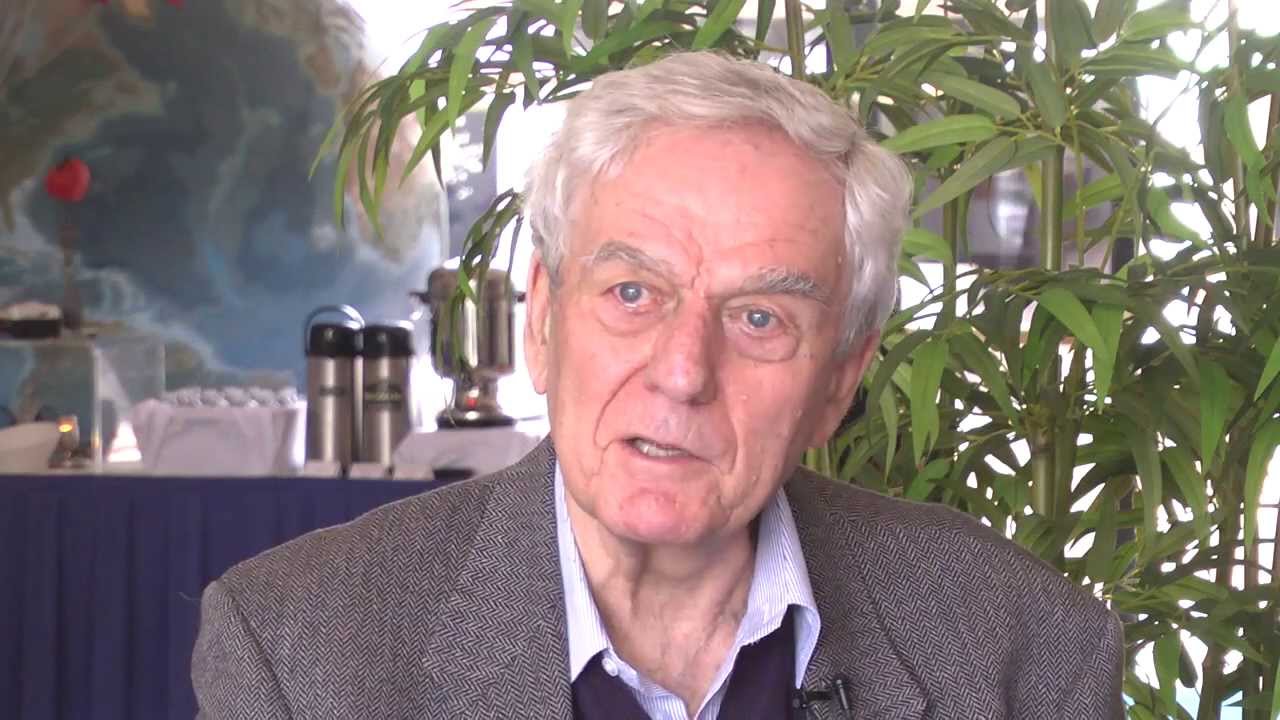
Menahem YaariTheir critique found vigorous support from Menahem Yaari, a theoretical economist whose work has addressed (amongst other things) questions of justice, uncertainty and risk, but who wrote in a subsequent issue (8 October 2009) in his capacity as President of the Israel Academy of Sciences and Humanities:

‘A military code of conduct that discriminates, in cases of hazards being inflicted upon innocent civilians, on the basis of whether these civilians are “ours” or “theirs” is all the more worrisome when viewed against a general background of growing ethnocentric and xenophobic attitudes in Israel’s traditional establishment. We see an ongoing drift from universalism and humanism toward parochialism and tribalism.’

Picking up from that last sentence, Chamayou believes that this drift has accelerated and that it is by no means confined to Israel’s ‘traditional establishment’.  In his view, the ‘evisceration’ of the core principles of international humanitarian law by a ‘nationalism of self-preservation’ has become ‘the primary guiding principle of the necro-ethics of the drone’ (p. 189).

2: Humanitarian weapon

Chamayou seeks to trace a line of descent from the previous arguments to those advanced more recently by academics who directly address (and defend) the US use of drones.  He has two men in mind: Avery Plaw, an Associate Professor of Political Science at UMass – Dartmouth, and Bradley Jay Strawser, an Assistant Professor of Philosophy in the Defense Analysis Department at the US Naval Postgraduate School at Monterey.

UMass_Drone-crop

Plaw has collaborated with several colleagues to track and evaluate drone strikes in Pakistan and is involved in the UMass DRONE project (I’ve commented on this before), but it’s an Op-Ed in the New York Times on 14 November 2012 that catches Chamayou’s attention.  ‘Drones save lives, American and others’ was the headline, and Chamayou is bemused: ‘How can an instrument of death save lives?’

The question seems to invite a biopolitical response – ‘killing in order to let live’, as Mbembe and others would no doubt have it, and Chamayou doesn’t quite provide that – but neither does Plaw quite say what the headline implies.  He suggests that ‘drone strikes are the best way to remove an all-too-real threat to American lives’ and that ‘there is evidence that drone strikes are less harmful to civilians than other means of reaching Al Qaeda and affiliates in remote, lawless regions’. Perhaps this amounts to the same thing, but it’s not quite the cold calculus that Chamayou attributes to Plaw.  And as I read his (brief) intervention, the ‘American lives’ that Plaw sees as being at risk are not those of, say, ground troops in Afghanistan but of civilians in the continental United States threatened by attacks from al-Qaeda and its affiliates  – though even then Plaw would have to explain how they are ‘saved’ by attacks on the Taliban and other militant groups which scarcely pose a trans-continental danger.

'Nobody dies' Popular Science November 1997

In any event, Chamayou challenges what he sees as the paradoxically vitalist claim that serves as the first principle of contemporary necro-ethics: drones are ‘humanitarian’ because they save lives – and specifically ‘our’ lives (p. 192), which he sees encapsulated even more succinctly than in Plaw’s Op-Ed by the tag-line in the image above (from Popular Science in November 1997): ‘Nobody dies – except the enemy.’

STRAWSER Killing by remote controlThis is where he turns to – and on – Strawser.  Like Plaw, he has had his views publicised in the media –see Rory Carroll on ‘The philosopher making the moral case for US drones’  in the Guardian here and Strawser’s hasty qualification here – but Chamayou directs his attention to Strawser’s essay ‘Moral Predators: the duty to employ uninhabited aerial vehicles’, Journal of military ethics 9 (4) (2010) 342-68.  More recently, by the way, he’s edited a collection of essays, Killing by remote control: the ethics of an unmanned military (Oxford University Press, 2013), which includes an essay by Plaw on ‘Counting the dead: the proportionality of predation in Pakistan’ and an exchange between Kasher and Plaw, in which the (I think substantial) differences between the two are clarified.  These centre on the principle of distinction: the requirement to discriminate between combatants and civilians.  Kasher makes no secret of what he calls his ‘negative attitude to the principle of distinction as it is commonly understood and practically applied’ (which doesn’t leave much room for a positive attitude).  ‘Humanitarian’, he insists, means ‘an attitude towards human beings as such, not toward a certain group of people’ – given the way in which the IDF treats Palestinians, this strikes me as pretty thick – so that the principle of distinction is really ‘civilarian’ (his term) and fails to respect ‘the human dignity of combatants in the broad sense of men and women in uniform’ (which isn’t a ‘broad sense’ at all, of course: Kasher’s combatants all wear uniform).  ‘A democratic state [sic] owes its citizens in military uniform a special justification for jeopardizing their life when they do it not for the relatively simple reason of defending their fellow citizens,’ he argues, ‘but when they are required to do it for the sake of saving the life of enemy citizens who are not combatants.’  The recourse to drones, he concludes, ‘circumvents such difficulties’.

Similarly, though not identically, Strawser regards the drone as not simply a morally permissible weapon but rather as a morally compulsory one.  He proposes a Principle of Unnecessary Risk , according to which ‘it is wrong to command someone to take on unnecessary potentially lethal risks in an effort to carry out a just action for some good’, and then extrapolates more or less directly to the compulsion to employ Unmanned Aerial Vehicles (UAVs):

‘We have a duty to protect an agent engaged in a justified act from harm to the greatest extent possible, so long as that protection does not interfere with the agent’s ability to act justly. UAVs afford precisely such protection. Therefore, we are obligated to employ UAV weapon systems if it can be shown that their use does not significantly reduce a warfighter’s operational capability.’

Strawser then qualifies his basic Principle: ‘the just warrior’s increased protection (which a UAV provides) should not be bought at an increased risk to noncombatants.’   In effect, Chamayou argues, Strawser makes Kasher and Yadlin’s principle of self-preservation subordinate to the minimisation of risks to non-combatants.  But when Strawser insists that ‘if using a UAV in place of an inhabited weapon platform in anyway whatsoever decreases the ability to adhere to jus in bello principles [of proportionality and distinction], then a UAV should not be used,’ Chamayou believes he is also playing his ‘get out of jail free’ card.  For Strawser claims that ‘there is good reason to think just the opposite is true: that UAV technology actually increases a pilot’s ability to discriminate’.   In support, Strawser cites an Israeli pilot –

‘The beauty of this seeker is that as the missile gets closer to the target, the picture gets clearer . . .The video image sent from the seeker via the fiber-optic link appears larger in our gunner’s display. And that makes it much easier to distinguish legitimate from non-legitimate targets’ 

– and Plaw’s analysis of drone strikes in Pakistan from 2004 to 2007.  Strawser concedes that the claim for enhanced distinction is an empirical one; Plaw’s analysis needs a fuller examination than I can provide in this post, but it’s important to note that 2007 is a significant cut-off.  As the chart below shows, from the splendid Bureau of Investigative Journalism, this is long before the Obama administration ramped up the attacks on the Federally Administered Tribal Areas.  Plaw’s chapter in Killing by remote control extends his analysis to 2011 and concludes that US drone strikes – particularly when weighed against casualties from insurgent attacks or Pakistan military operations in the region – most often meet the demands of proportionality; but the discussion doesn’t directly address discrimination.

All-Totals-Dash47

What Strawser does, Chamayou concludes, is offer a technical resolution of an ethical dilemma: it is not necessary to subordinate one principle to another – minimisation of risk to combatants (‘citizen-soldiers’) or minimisation of risk to non-combatants (‘alien’ or otherwise) – because this new technology of killing promises to satisfy both.  In effect, drones are supposed to introduce a new, intrinsically ethical symmetry to asymmetric warfare: they save ‘our’ lives and ‘their’ lives.  They combine the power to kill and to save, to wound and to care, a weapon at once humanitarian and military – ‘humilitaire’, as Chamayou has it.  (Others have made a case for the humanitarian uses of unarmed drones, but their arguments are a far cry from military applications).

Yet if this new military power saves lives, Chamayou demands, what is it saving them from?  His answer: from itself, from its own power to kill.  And if this seems the lesser evil, in Eyal Weizman‘s terms the ‘result of a field of calculations that seeks to compare, measure and evaluate different bad consequences’, then we need to remind ourselves, with Hannah Arendt, how quickly ‘those who choose the lesser evil forget … that they chose evil.’

Chamayou turns to Weizman deliberately; that ‘field of calculations’, the calculus that is focal to the construction through calibration of our ‘humanitarian present’, is the target of Chamayou’s next and final chapter in his critique of necro-ethics – of which more very soon.

UPDATE: Today’s Guardian has a video debate between Seumas Milne and Peter Lee (Portsmouth University): ‘Is the use of unmanned military drones ethical or criminal?’ Lee claims that, ‘used correctly’, this new technology and in particular the MQ-9 Reaper is ‘the most potentially ethical use of air power yet devised.’
Droning on

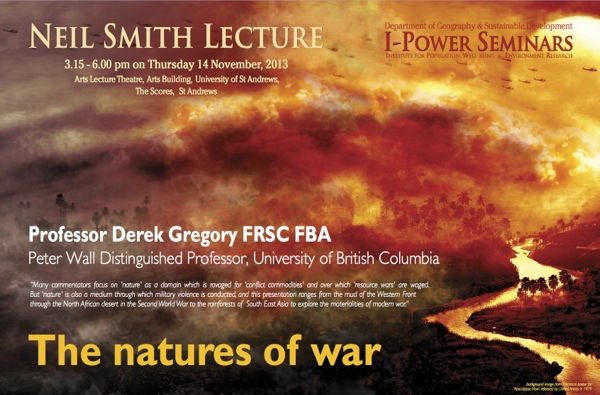
Sorry for the long silence – I’ve been prepping for my trip to St Andrews, where this afternoon I’ll be giving the Neil Smith Lecture.  Over the years I’ve given lots of lectures named after people I knew (if I knew them at all) only through their writings, and this is the first time I’ve given one named after someone I knew – and cared so much about.  There is a wonderful phrase in a commentary on Marx’s humanism (and humanity) and his critique of alienation, which talks about ‘man in the whole wealth of his being, man richly and deeply mentally alive’.  Needless to say I can’t track down the source when I need it – Ollman, maybe? – but I’ve never forgotten those words (or at least their force) since I read them years and years ago.  I can think of no other phrase that captures Neil so perfectly.

GREGORY The natures of war

Still lots to do, but I have added the final version of my general essay on drones, ‘Moving targets and violent geographies’, to the DOWNLOADS tab.  It will appear in an edited collection in honour of Allan Pred, edited by Lisa Hoffman and Heather Merrill, but I’ll also re-work it (and no doubt extend it) for The everywhere war so, as usual, I’d value any comments – preferably by e-mail to avoid the spam filters.  I’m flattered by those e-marketeers who think that my blog is a likely medium to flog everything from Viagra (well, not quite so flattered at that) to Louis Vuitton luggage, but thanks to those filters they – and perhaps you, dear reader – are out of luck…

And while I am channelling Del-Boy, another wordpress service lists the search terms that people use to navigate their way to the blog, and I’d particularly like to know what the person who was searching for – how do I put this? – a highly specialised type of basket apparently made in Vietnam made of Geographical imaginations.  I don’t expect they’d have found it on Louis Vuitton either.

Boundless Informant and the everyware war

As part of my presentation on “Drones and the everywhere war” at York, I decided to unpack this extraordinary claim made by John Nagl, one of the architects of the US military’s revised counterinsurgency doctrine:

We’re getting so good at various electronic means of identifying, tracking, locating members of the insurgency that we’re able to employ this extraordinary machine, an almost industrial-scale counterterrorism killing machine that has been able to pick out and take off the battlefield not just the top level al Qaeda-level insurgents, but also increasingly is being used to target mid-level insurgents.

It’s a remark I’ve discussed several times before.  Nagl’s ‘killing machine’ is not limited to drone strikes, of course, but subsumes the ‘night raids’  and other Special Forces operations detailed in Jeremy Scahill‘s Dirty Wars.  But at York I wanted to explore how those ‘electronic means of identifying, tracking and locating’ fed into drone strikes in Pakistan: and, thanks to Edward Snowden and Glenn Greenwald, I was able to get much closer to the belly of the beast.

Drones+ app

I’d started the presentation with a riff on Josh Begley‘s attempt to persuade Apple to include his Drones+ app in the App store.  Apple decided, for several contradictory and spurious reasons, to reject the app, and at his thesis defence Josh asked:

 ‘Do we really want to be as connected to our foreign policy as we are to our smart phones… Do we really want these things to be the site of how we experience remote war?’

Apple’s answer was ‘no’, clearly, but it turns out that others are intimately connected to drone strikes through their phones and e-mails, and it was this that I fastened on.

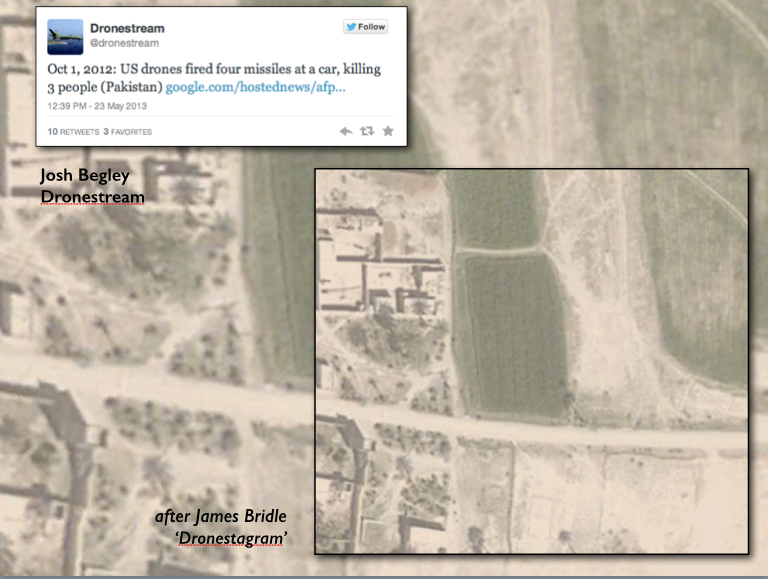
Josh, undeterred by Apple, went on to launch the Dronestream platform, from which he tweeted details of every known US drone strike.  I combined one of Josh’s tweets for 1 October 2012 with a version of James Bridle‘s Dronestagram, which uses Instagram to post images of the location of drone strikes (I say ‘a version’ because Dronestagram was launched too late for this particular strike, so this is a mock-up; in any case, it’s difficult to pinpoint the locations from available reports with much precision, but the details for this strike are available via the Bureau of Investigative Journalism, as the second slide below shows):

1 October 2012 Dronestream and Dronestagram

Bureau of Investigative Journalism 1 October 2012 strike

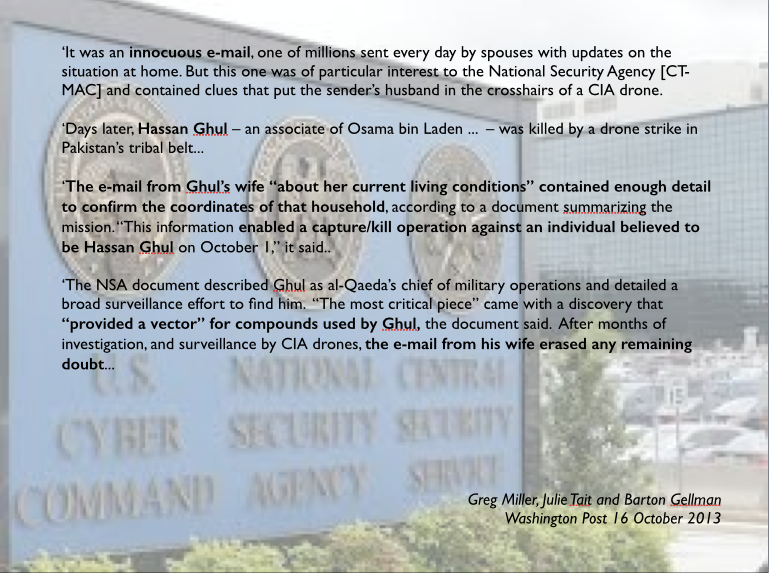
We now know that this strike was made possible as a result of interceptions made by the National Security Agency’s Counter-Terrorism Mission-Aligned Cell (CT-MAC).  Writing in the Washington Post on 16 October 2013 Greg Miller, Julie Tait and Barton Gellman explained how this strike had targeted Hassan Ghul:

Hassan Ghul NSA intercepts

Not quite ‘any doubt’; as they went on to note, ‘Although the attack was aimed at “an individual believed to be” the correct target, the outcome wasn’t certain until later, when “through SIGINT [signals intelligence] it was confirmed that Hassan Ghul was killed.”‘

So how did the intercept work?  Not surprisingly, we don’t know for sure; but the map below of NSA’s ‘Boundless Informant‘ – another dimension of what I’ve been calling ‘the everywhere war’ – offers some clues.  I’ve taken it from a report in the Guardian by Glenn Greenwald and Ewen MacAskill:

Boundless Informant March 2013 heat map

This is six months later, but it shows that Pakistan was, after Iran, the major focus of NSA’s surveillance and data mining operations (Miller and his colleagues had noted that “NSA threw the kitchen sink at FATA’, the Federally Administered Tribal Areas).  It would be wrong to assume that the targeted killing of Ghul was the result of a simple hack into hotmail, and the Post report details the multiple methods used by NSA.

Still, the geography of covert surveillance shown on the map is revealing.  Yesterday Greenwald returned to Boundless Informant and rebutted the charge that he had misinterpreted the meaning of this and other slides, and in doing so quoted from NSA’s own explanation of the system:

BOUNDLESSINFORMANT is a GAO [Global Access Operations, a branch of the NSA] prototype tool for a self-documenting SIGINT system. . . BOUNDLESSINFORMANT provides the ability to dynamically describe GAO’s collection capabilities (through metadata record counts) with no human intervention and graphically display the information in a map view, bar chart, or simple table. . . .
By extracting information from every DNI and DNR metadata record, the tool is able to create a near real-time snapshot of GAO’s collection capability at any given moment. The tool allows users to select a country on a map and view the metadata volume and select details about the collection against that country. The tool also allows users to view high level metrics by organization and then drill down to a more actionable level – down to the program and cover term.

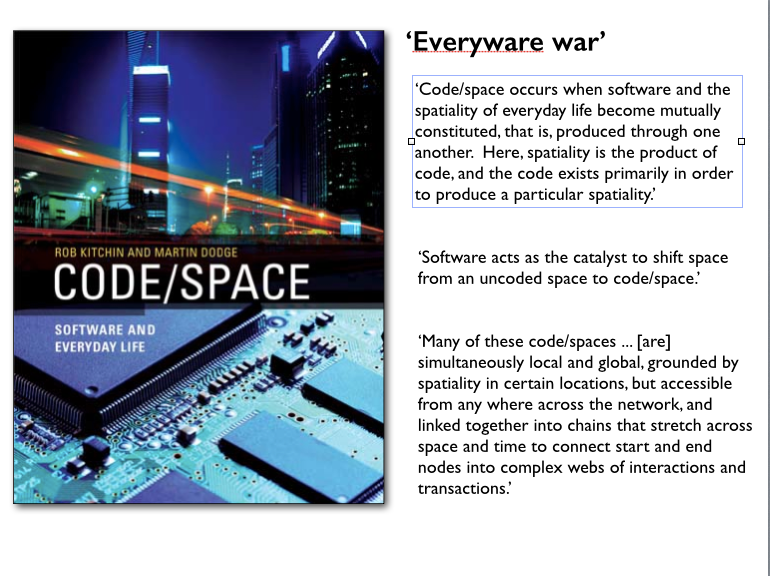
It’s not too difficult to connect the dots and draw two more general conclusions.  The first is that this is another, darker dimension to the ‘code/space’ and ‘everyware’ discussed in such impressive detail by Rob Kitchen and Martin Dodge:

Everyware war

My slide is just short-hand, of course, but you can see where I’m going, I hope – and, as we know from this week’s harrowing testimony on Capitol Hill about the murder of Mamana Bibi in Waziristan and Amnesty International’s report, Will I Be Next?, these operations and their algorithms work to turn ‘everyday life’ into everyday death.  So I’ll be thinking more carefully about code/space and its implication in the individuation of later modern war, paying closer attention to the technical production of ‘individuals’ as artefacts and algorithms as well as the production of the space of the target: more to come.

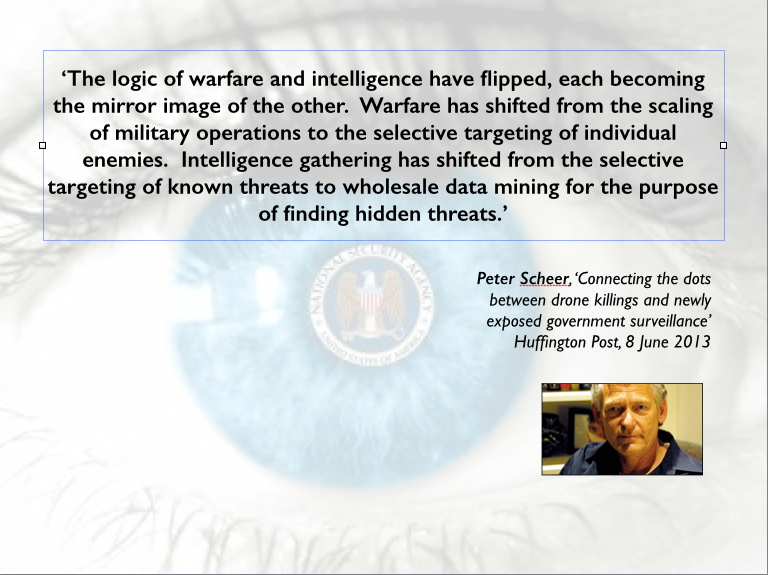
The second general conclusion I leave to Peter Scheer, who provides a more refined (and critical) gloss on John Nagl’s comment with which I began:

SCHEER Connecting the dots

I’m incorporating these and other developments into the revised and extended version of “Moving targets and violent geographies” which will appear in The everywhere war, but I hope this bare-bones account (and that first draft, available under the DOWNLOADS tab) shows that my posts are more connected than they must sometimes appear…  The slides were pulled together on the day I gave the presentation, so forgive any rough edges.

How we kill in war

Afghanistan Living With Drones

A new CBC Ideas program, How we kill in war, airs tonight at 9 p.m.

With every evolution in military technology comes a shift in military tactics. And each shift in tactics pushes our understanding of what is permissible and what is ethical behaviour in war. The American military’s use of drones brings with it uncomfortable moral questions. Journalist Naheed Mustafa visits Pakistan and explores the dilemmas posed by drone warfare.

Participants include:

Karim Khan – Journalist with Al Jazeera. Currently suing the CIA for the drone killing of his son and brother.

Marvi Sirmed – Democracy promoter and human rights activist.

Shahzad Akbar – Lawyer, currently representing victims of American drone strikes.

Derek Gregory – Peter Wall Distinguished Professor and Professor of Geography at University of British Columbia.

John Kaag – Associate Professor of Philosophy, University of Massachusetts at Lowell.

Bradley Strawser – Assistant Professor of Philosophy in the Defense Analysis Department, US Naval Postgraduate School.

I had an extended phone conversation with Naheed to prep for this, and then an hour-long interview (don’t worry: the extracts used are much shorter!).  She really does know her stuff, and the programme includes interviews with some of those who live under the shadow of drone attacks in the Federally Administered Tribal Areas.

You can listen in online here.

More unfinished business: haunting Waziristan

I’m just finishing up a new essay on drones and later modern war – “Moving targets and violent geographies” – and I’ll post the draft as soon as I’m done (this weekend, I hope).

Next up is the essay version of my various posts and presentations on air strikes in Pakistan’s Federally Administered Tribal Areas, past and present, by the US and by the Pakistan Air Force [see here and here], so I was heartened by news from Madiha Tahir [see my post here] of progress with her short documentary film, Wounds of Waziristan (they are down to the final edits):

More about the project and crowd-sourcing here, and you can find more information at the film’s website, which includes an image gallery and opens with some of the most hauntingly beautiful music composed by André Barros (shades of Arvo Part‘s Spiegel im Spiegel):

Haunting indeed.  In a report for Delhi’s Sunday Guardian, Tanishree Bhasin writes:

When Barack Obama finally admitted to the needless loss of life in Pakistan’s Waziristan area due to American drone attacks, he spoke about how the death of innocents would haunt him forever. Interrogating this notion of ‘haunting’ and what it means for those affected by these attacks is Pakistani filmmaker Madiha Tahir in her film Wounds of Waziristan….

With Wounds of Waziristan, Tahir tries to foreground the people who materially experience loss and absence — not as abstract body counts, but as the absence of a brother or a niece or a wife. “Haunting is the insistence by the dead that they be acknowledged, that the social conditions that brought about their demise be made known and rectified. So, haunting is about unfinished business. And, it’s thoroughly social and political. This film focuses on the people who live in Waziristan and who live among loss. Material conditions, whether it’s the rubble after a drone attack or the grave of one’s kin, persist in reminding the living of what they have lost,” she explains.

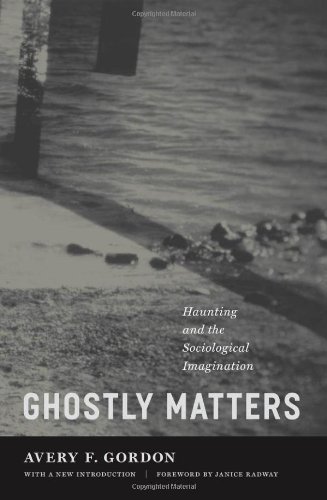
GORDON Ghostly matters

On her blog, Madiha wryly notes that her interest in the question of haunting may show ‘my academic side coming out’ – as well as an independent journalist she’s also a graduate  from NYU and Columbia, where she’s currently working on her PhD – and human geographers will probably be no strangers to the idea, from research by Steve Pile and Karen Till and most recently Alison Mountz‘s analysis of detention centres and Akin Akinwumi‘s work on Truth and Reconciliation Commissions.

Much of this has been indebted to Avery Gordon‘s by now classic study, Ghostly matters:

‘Haunting is one way in which abusive systems of power make themselves known and their impacts felt in everyday life, especially when they are supposedly over and done with or when their oppressive nature is denied… Haunting is not the same as being exploited, traumatized, or oppressed, although it usually involves these experiences or is produced by them. I used the term haunting to describe those singular yet repetitive instances when home becomes unfamiliar, when your bearings on the world lose direction, when the over-and-done-with comes alive, when what’s been in your blind spot comes into view.’

It’s not difficult to see how this applies to air strikes in Waziristan – the sense of familiarity unmoored by the devastations of state violence – but Madiha’s starting point is a two-page note Max Horkheimer and Theodor Adorno appended to Dialectic of Enlightenment, ‘On the theory of ghosts’, that also figured briefly in Gordon’s book (where she described it as an ‘unfilled promissory note’):

Only the conscious horror of destruction creates the correct relationship with the dead: unity with them because we, like them, are the victims of the same condition and the same disappointed hope.

It’s that first clause that animates Madiha’s work:

Only the conscious horror of destruction creates the correct relationship with the dead.

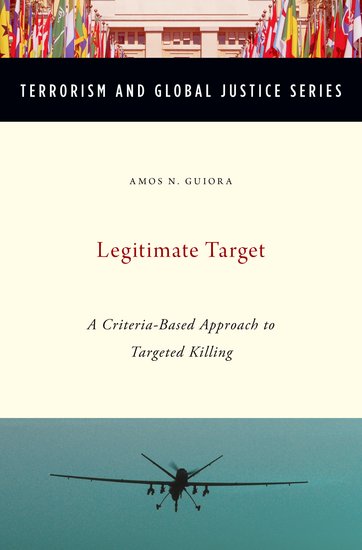
Legitimate TargetShe notes that so much (too much) of the contemporary debate about drones is framed by the language of international law and its grammar of execution that is deeply embedded in military violence: as operational law has become a central discourse in the animation and legitimation of the kill-chain, so it turns targeted killing into a quasi-juridical process.  In consequence, as she says with a nod to Eyal Weizman, ‘international law is caught up in constructing the proper order of violence.’

And as a journalist she is dismayed at the complicity of journalists in popularizing law

‘as the only frame through which we can talk about drone attacks and moral standards. Journalists regularly fail to look beyond the usual “experts” in policy and legal circles to other fields that may have an alternative to offer. We are becoming vulgar empiricists who seem to think that a truth not attached to a number (say, the number of “militants” vs. “civilians” killed), or a legal rule (for example: whether an action does/does not violate international law) is no truth at all.’

So Madiha proposes haunting as an alternative frame ‘through which one can re-direct the conversation from issues of legal standards to the lives lived and lives lost under the drones in Waziristan and elsewhere’:

‘The questions then turn on the material conditions and the loss suffered – not as evidence for legal arguments but as queries about what it does to a person to live in such conditions. The question is not, ‘Do I stick him in the “militant” or “civilian” column?’ but instead, who survives him? How do they deal with that loss? What is it like to live among the rubble?

It isn’t through legal standards but though trying to understand the horror of the destruction that we create the correct relationship — with the dead, yes — but with the living, too.’

This matters so much – and reappears in a different form in ‘Moving targets’ – because the contemporary individuation of ‘war’ (if it is war) works to sanitize the battlefield: to confine attention to the individual-as-target (which is itself a technical artefact separated from the exploded fleshiness that flickers briefly on the Predator’s video screens) and to foreclose the way in which every death ripples across a family, a community, a district and beyond [see my brief discussion with Ian Shaw here].

Fahim Qureshi Attack date 23 January 2009

And, as Madiha explained to the Sunday Guardian, these effects ripple across time as well as space, tearing the very fabric of history:

Speaking about her experiences while making this film, she explained that it’s not just a question of life being lost, but also the obliteration of history. “When drone attacks destroy homes — as they often do — they erase entire family histories. Homes in this area are built over time as families grow. There may be as many as 50 members of a family living in one house. When you destroy structures like that, you not only destroy people, you also destroy their history. The rubble that’s left in the wake of an attack is a living memory of what happened there. It embodies loss. The people in Waziristan have to live around this loss, near it, in it. They have to live among ghosts,” says Tahir.

Theory of the drone 10: Killing at a distance

This is the tenth in a series of extended posts on Grégoire Chamayou‘s Théorie du drone and covers the fifth and final chapter in Part II, Ethos and psyche.

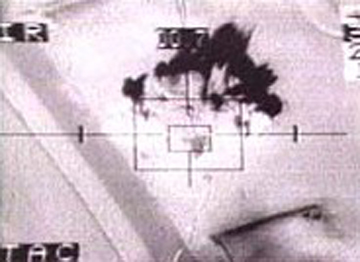
Gulf_war_target_camChamayou begins with a lecture given by German artist and film-maker Harun Farocki in Karlsruhe in 2003 called  ‘Phantom Images‘.  A ‘phantom image’, Farocki explained, is a view that is otherwise inaccessible to a human being – like the ‘bomb’s-eye view’ that became so familiar during the Gulf War (‘a suicidal camera’).  Like so many other ‘technical representations which maintain that they only represent the operative principle of a process’ these are, of course, techno-cultural performances.  They are techno-cultural because they produce a constructed and constrained space – in the Gulf War images that Farocki used to frame his argument, the battle space appears empty of people, a landscape without figures, an odyssey of destruction based on an object-ontology – and they are performances because they are what Farocki called ‘operative images’ that ‘do not represent an object but are part of an operation‘ (my emphasis).

You can find more on Farocki’s fascination with the virtual/real and Immersion here and on Images of War (at a distance) here.  Both ideas – immersion and distance – are central to Chamayou’s argument, but his starting-point is the idea of an operative image.  He wants to think of militarized vision as a ‘sighting’ that works not only to represent an object but also to act upon it and, in the case that most concerns both of us, this is the mainspring of the production of the target.

This has a long (techno-cultural) history, but drones use a video image to fix and execute the target: ‘You can click, and when you click, you kill.’  There’s something almost magical about it, Chamayou says: a hi-tech form of voodoo violence, like sticking pins into a wax doll, in which bringing someone into view – ‘pinning’ the target in the viewfinder – transports them into the killing space.

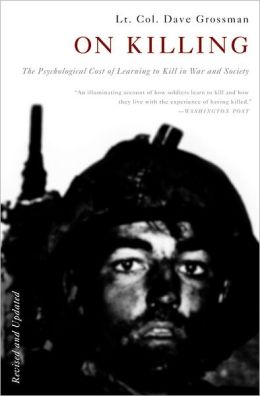
GROSSMAN On KillingBut what sort of space is it?  Chamayou considers a simple diagram from Dave Grossman‘s On Killing. For readers unfamiliar with his work, here is how Grossman describes himself on the website of his Killology Research Group:

Col. Grossman is a former West Point psychology professor, Professor of Military Science, and an Army Ranger who has combined his experiences to become the founder of a new field of scientific endeavor, which has been termed “killology.” In this new field Col. Grossman has made revolutionary new contributions to our understanding of killing in war, the psychological costs of war, the root causes of the current “virus” of violent crime that is raging around the world, and the process of healing the victims of violence, in war and peace. 

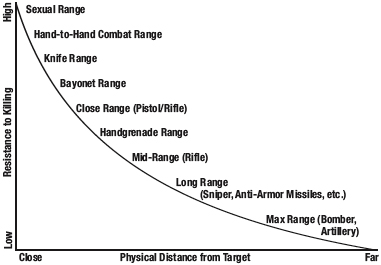
And here is the diagram, which summarises Grossman’s views on the relationship between ‘resistance to killing’ and distance from the target:

Resistance to killing as a function of distance

Grossman’s basic argument is that distance increases indifference and, as the annotations imply, there appears to be an historical sequence to all this.  Grossman’s book was published before the advent of the drone, but – given these two axes – the Predator and the Reaper presumably ought to appear on the extreme right of the diagram, representing the radicalisation of killing at a distance.

In fact, Grossman provides a discussion of videogames in which he says that the screen acts as a barrier between the player and the violence s/he unleashes in the game, making it easier to ‘kill’: exactly the argument advanced by those who claim that drones induce a ‘Playstation mentality’ to killing.

And yet, as I’ve explained in ‘From a view to a kill’ (DOWNLOADS tab), modern videogames are profoundly immersive, and the high-resolution full motion video feeds from the drones induce such an extraordinary sense of proximity, even intimacy – remember that crews frequently claim to be 18 inches from the combat zone, the distance from eye to screen – that drones are surely also pulled towards towards the extreme left of Grossman’s diagram.

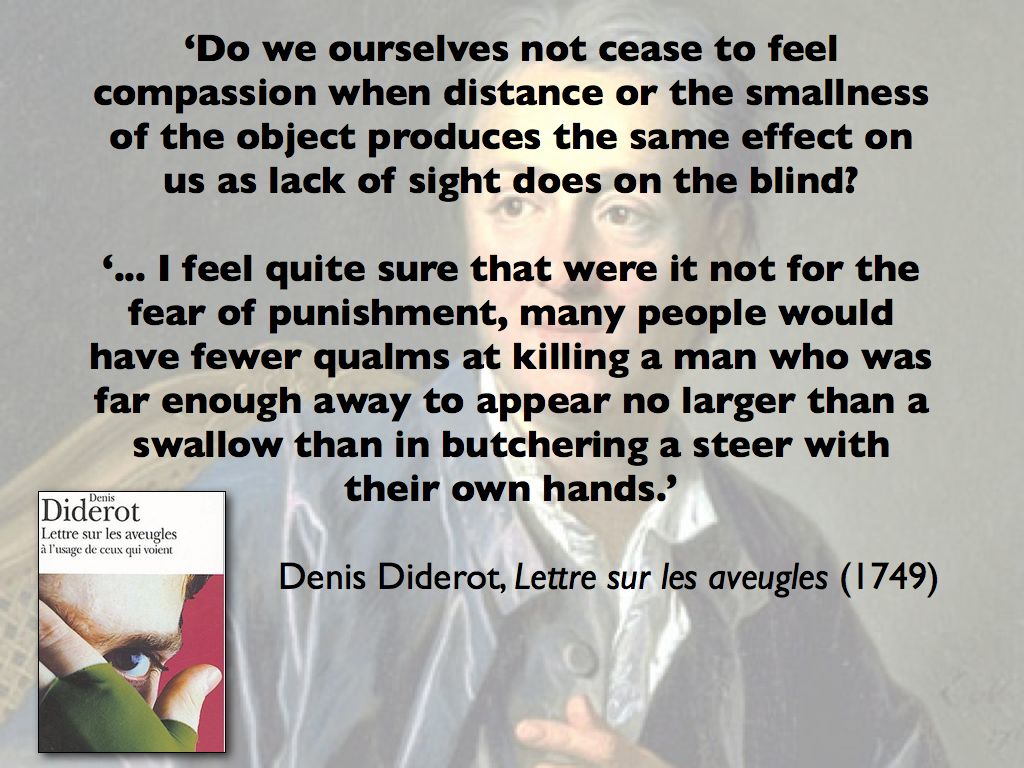
Chamayou doesn’t quote him, but Diderot’s Letter on the blind set out the original terms of the debate perfectly:

DIDEROT.001

But Chamayou is quick to show that ‘distance’ is a weasel-word, and in an extended footnote he elaborates his concept of pragmatic co-presence.  Co-presence denotes the possibility of A affecting B in some way, which means (in the absence of sorcery) that B must be within the sphere of action of A; more formally, co-presence involves the inclusion of one within the ‘range’ or ‘reach’ of another.  This is multi-dimensional – without technical mediation you can see someone much further away than you can hear them – but in many situations technical mediations are involved and so transform the relation.  This matters for two reasons.

First, there is nothing necessarily reciprocal about co-presence: what Chamayou calls ‘the structure of of co-presence’ determines what it is possible for you to do to the other, and is itself the product of struggle: each party to a conflict manouevres to produce a favourable asymmetry so that it becomes much easier for you to strike than to be hit.  In this sense, all war strives to be asymmetric – it’s not confined to wars between states and non-state actors – and it’s this that in part underwrites the history of war at a distance; as William Saletan put it, effectively re-describing Grossman’s diagram,

‘Technically, this is marvelous. Look at the history of weapons development: catapult, crossbow, cannon, rifle, revolver, machine gun, tank, bazooka, bomber, helicopter, submarine, cruise missile. Every step forward consists of a physical step backward: the ability to kill your enemy with better aim at a greater distance or from a safer location. You can hit him, but he can’t hit you.’

But – Chamayou’s second rider – ‘teletechnologies’ radically transform this sequence by severing co-presence from co-localisation.   What is distinctive about teletechnologies is not their capacity to act ‘at a distance’ but their indifference to and their interdigit(is)ation of ‘near’ and ‘far’.

This has far-reaching (sic) consequences because it produces a double disassociation.  Where, exactly, does the action take place?  Here (at Creech Air Force Base in Nevada) or there (Kandahar in Afghanistan)?  There is no single answer, of course, which is precisely Chamayou’s point.  This split – or series of splits, if you think of the wider networks involved – in turn engenders radically new forms of experience, of being-in-the-world, that can no longer be contained within the physico-corporeal confines of the conventional human subject.

Chamayou wants to show that this double disassociation is anything but ‘marvellous’.   He accepts that the targets that are produced through the full-motion video feeds from the Predators and Reapers are much less abstract: the crews see their targets – often people, not physical objects like the buildings or missile batteries that constituted Farocki’s ’empty’ battlespace – and they see the corporeal consequences of each strike.  ‘This novel combination of physical distance and visual proximity gives the lie to the old [Clausewitz-Hegelian] law of distance,’ Chamayou writes, since ‘increased distance no longer makes violence more abstract or more impersonal but, on the contrary, more graphic and more personal.’

But he insists that this proximity, even intimacy is counterbalanced by two factors which are also inscribed within the political technology of vision:

(1) ‘Proximity’ is contracted to the optical – and even this is degraded because the resolution of the video feeds reduces people to ‘avatars without faces’.  I think this is less straightforward than Chamayou implies.  He cites Salatan – ‘There’s no flesh on your monitor; just co-ordinates’ – which is a sharp remark, but the journalist was referring to the launch of long-range missiles (‘… tap a button on one continent and send a missile to another’) whereas the screens at Creech and elsewhere show human figures as well as co-ordinates.  More significant, I think, is that when drone operators provide close air support they are also in radio and online contact with troops on the ground, and this produces a pragmatic co-presence which is considerably more ‘fleshed out’ than their otherwise purely optical encounters with others in their field of view.

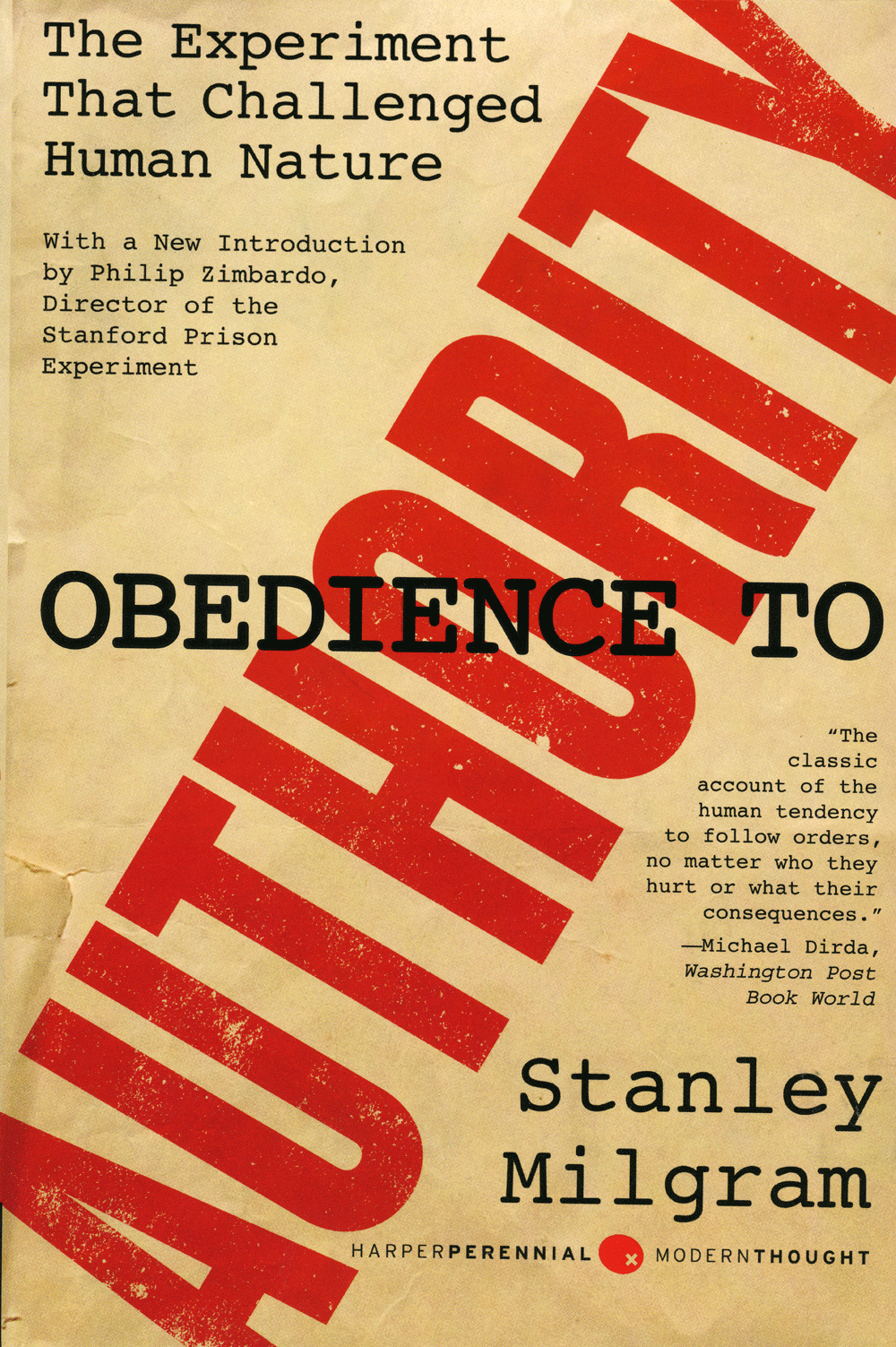
(2) Drone operators can see without being seen, and Chamayou argues that ‘the fact that the killer and his victim are not inscribed in “reciprocal perceptual fields” facilitates the administration of violence’ because it ruptures what psychologist Stanley Milgram in his notorious experiments on Obedience to authority [below] called ‘the phenomenological unity of the act’.  Milgram actually wrote “experienced”, not “phenomenological”, but you get the point; Milgram was discussing how much easier it is to hurt someone ‘if there is a physical separation of the act and its consequences’, which is radicalised in what the US Air Force calls the ‘remote split’ operations carried out by its Predators and Reapers.

MILGRAM Experiments

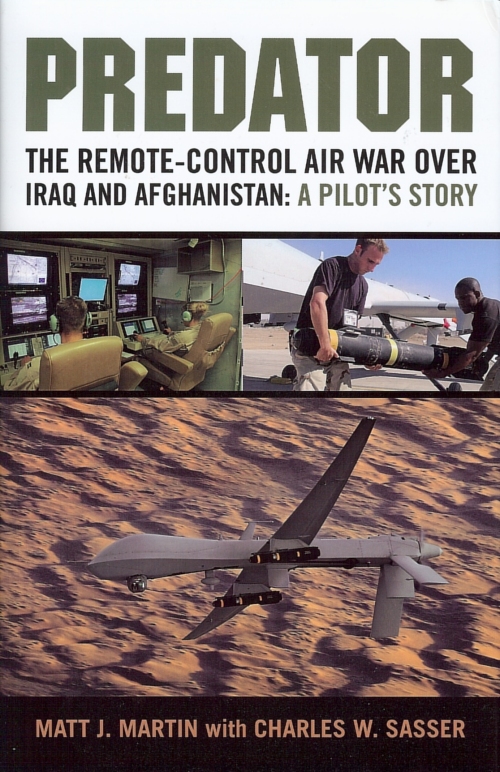
Milgram’s thesis was a general one, but to nail the sense of disassociation to the drone Chamayou quotes Major Matt Martin, a Predator operator:

‘The suddenness of action played out at long distance on computer screens left me feeling a bit stunned…  It would take some time for the reality of what happened so far away, for “real” to become real.’

Again, I think it’s more complicated than that.  Martin was clearly recalling an early experience, low on the learning curve, and interviews with other drone pilots suggest that within 6 months or so most had little difficulty in apprehending the reality, even the physicality of pragmatic co-presence. The sensor operator interviewed by Omer Fast for 5,000 Feet is the Best had this to say, for example:

‘… you get more into it the longer you’re working on the Predator.  Like my first fire mission.  You know, we fired a Hellfire missile at the target.  It didn’t quite strike [sic] me as, “Hey! I just killed someone!”  My first time.  It was within my first year there.  It didn’t quite impact.  It was like, “Yeah! I got somebody!”  You know?  And it was later on through a couple of more missions that I started to… The impact really dawned on me.  I just ended someone’s life!  That was me that did that!”‘

obedience-to-authority-milgramIt’s important to remember, too, that Milgram’s work was about structures of authority, and this has a palpable effect in the case of the military chain of command which has been transformed by the networked incorporation of video feeds from the drones and the deployment of military lawyers (JAGs) on the operations floor of the Combined Air and Space Operations Center (what I called ‘oversight’ in “From a view to a kill”),  which provides for a dispersion of responsibility across the network.

Equally important, I suspect, is that fact that drone crews are not only ‘following orders’, as the familiar jibe has it: they are also following procedures that transform military violence into a process that is at once techno-scientific and quasi-juridical and thus seen as conducted under the sign of an unimpeachable (military) Reason.

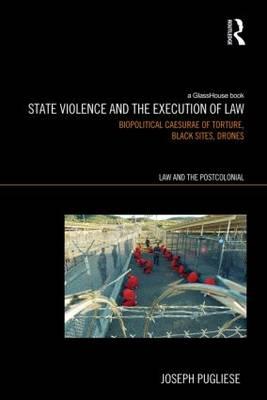
Joseph Pugliese makes a parallel argument about the incorporation of military-legal discourse into the techno-logic of the targeting process:

‘I argue that the parenthetical relation of law to technology is premised on a topical hiatus that disassociates the executioner who manipulates the killing technology of the drone from the facticity of the resultant execution. In this scenario, law is conceived of in the most radically instrumental of understandings: it enables and legitimates the execution while simultaneously suspending the connection between the doer and the deed.’
state-violence-and-the-execution-of-lawAnd yet at the same time, Pugliese explains, there is a ‘prosthetic’ relation between law and technology, in which ‘the human agent is always already inscribed by the technics of law.’ From the very beginning, he insists, the body is always already ‘instrumentalised by a series of technologies’ and also inscribed, from the very beginning, by a series of laws.  In short, ‘law is always already inscribed on the body, precisely as techné from the very first. This process of prosthetic inscription operates to constitute the very conditions of possibility for the conceptual marking of the body as”‘human’”‘: ‘The prosthesis,’ notes Bernard Stiegler, ‘is not a mere extension of the human body; it is the constitution of this body qua “human”’.’

Still, Chamayou suggests that (1) and (2) work together to sustain what Mary Cummings calls ‘moral buffering’.  In other words, and in counterpoint to optical proximity, the dispositif also provides a powerful means of distanciation.  Here is Fast’s interviewee again:

‘There’s always more of a personal touch when you’re watching something live.  And it’s even more personal when you’re the one that did it… Well, I mean you get more – I guess – emotionally distant.  As time goes on.  But I mean… I guess in my case, and some of the cases of the guys that I knew, as more time went by you put yourself more and more in the position that this is more and more real life and that you are actually there… And after a while you become emotionally distant.  But still you put yourself more and more as if you’re standing right there…’

MARTIN PredatorThis is compounded, so Chamayou argues, by a different dimension of ‘remote split’ operations. Because Predators and Reapers can stay aloft for 18 hours or more (the ‘persistent presence’ that makes them so much in demand), their crews work shifts and commute each day (or night) between home and work or, more accurately, between peace and war.  One drone operator saw this as a peculiarly strung-out existence: ‘We were just permanently between war and peace’  (my emphasis).  Matt Martin said much the same.  US-based crews ‘commute to work in rush-hour traffic, slip into a seat in front of a bank of computers, fly a warplane to shoot missiles at an enemy thousands of miles away, and then pick up the kids from school or a gallon of milk at the grocery store on [their] way home for dinner.’  He described it as living ‘a schizophrenic existence between two worlds’; the sign at the entrance to Creech Air Force Base read ‘You are now entering CENTCOM AOR [Area of Operations]’, but ‘it could just as easily have read “You are now entering C.S. Lewis’s Narnia” for all that my two worlds intersected.’
The way crews survive, Chamayou suggests, is by partitioning, ‘setting aside’, but this is extremely difficult for commuter-warriors as they regularly and rapidly move between a domestic sphere in which killing is taboo and a military sphere where (so he says) it is ‘a virtue’.   The superimposition of these two worlds – their contradictory clash – means that crews are in a sense ‘both in the rear and at the front, living in two very different moral universes between which their lives are torn.’
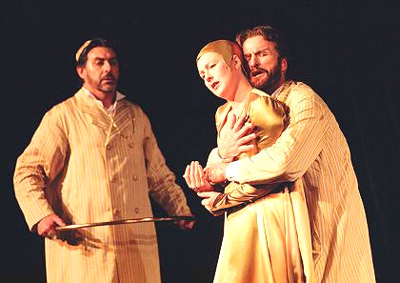
This is precisely the situation dramatised in George Brant‘s play Grounded, which I noted in an earlier post, and Chamayou cites a former USAF sensor operator Brandon Bryant (whose testimony I discussed here) to the same effect.  In both cases, crew members plainly are affected, even distressed by what they see on the screen; in fact Bryant has bee diagnosed with PTSD.

But Chamayou insists that this sort of testimony is rare and that most of them do manage to compartmentalise.  Fast’s sensor operator:

‘A lot of us learn real fast to leave all of our problems at the door.  You know, when we’re leaving the squadron and heading home.  Just kind of putting it on a rack and pushing it out of your mind.’

And this, Chamayou concludes, nails the real psychopathology of the drone.  He calls French philosopher Simone Weil’s Gravity and grace to his aid:

‘The faculty of setting things aside opens the door to every sort of crime…  The ring of Gyges who has become invisible – this is precisely the act of setting aside: setting oneself aside from the crime one commits; not establishing the connection between the two.’

Chamayou has used the myth of Gyges earlier in his critique, but here he invokes Weil to claim that the psychopathology of the drone is not the trauma some say that drone crews experience ‘but on the contrary the industrial production of compartmentalised psyches, protected from all possibility of reflection on the violence they have committed, just as their bodies are already protected against every possibility of exposure to the enemy.’

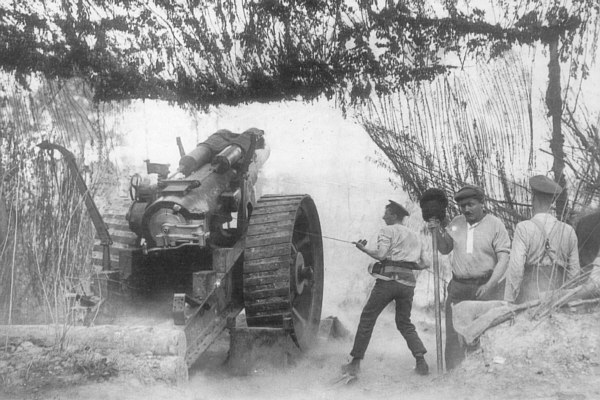
rwg05074-1I’m really not sure about this.  ‘Protected from all possibility of reflection’?  Much of the evidence that Chamayou cites here – like Milgram’s experiments – could be applied to most forms of military violence.  Here, for example, is Arnold Bennett describing artillery at work in Over there: war scenes on the Western Front (1915):

‘The affair is not like shooting at anything.  A polished missile is shoved into the gun.  A horrid bang – the missile has disappeared, has simply gone.  Where it has gone, what it has done, nobody in the hut seems to care.  There is a telephone close by, but only numbers and formulae – and perhaps an occasional rebuke – come out of the telephone, in response to which the  perspiring men make minute adjustments in the gun or in the next missile.

 ‘Of the target I am absolutely ignorant, and so are the perspiring men.’

I’ve found the same sentiments expressed by bomber crews during the Second World War.  The difference, clearly, is that drone strikes involve far more than ‘numbers and formulae’ – co-ordinates on the screen – and that the visual  production and so-called ‘prosecution’ of the target takes place in near real time, in vivid detail and under the eye of military lawyers.  But it is not surprising (nor, I think, especially pathological) that those who carry out these strikes conduct themselves with a certain seriousness, a ‘professionalism’ if you like, that precludes emotional investment. This is from David Wood‘s interview with a highly experienced USAF drone pilot:

Q: You must develop an emotional tie with the people on the ground that makes it hard if there is going to be a strike or a raid, people are going to be killed.

A: I would couch it not in terms of an emotional connection, but a … seriousness. I have watched this individual, and regardless of how many children he has, no matter how close his wife is, no matter what they do, that individual fired at Americans or coalition forces, or planted an IED — did something that met the rules of engagement and the laws of armed conflict, and I am tasked to strike that individual.

‘Professionalism’ shouldn’t be used as a mask to hide from critique, to be sure.  These crews are trained to perform with a calculative reason, dispassionately, through a techno-cultural and techno-legal armature, so that, as one USAF major told Nicola Abé, when she was preparing for a strike ‘there was no time for feelings’.  Or again, from another pilot operating a Predator over Afghanistan:

‘We understand that the lives we see in the screens are as real as our own…  I would not compare what I do as a job comparable to Call of Duty/any other video game, in any sense. It is very real and the seriousness of the lives on the ground is very real and instilled in all of our training. It is never something that we joke about. Very serious business.’

As I’ve noted before, there are (too) many instances in which crews do joke about their missions, the sort of ‘gallows humour’ that is no doubt a common reaction to  hunter-killer missions: but isn’t this also likely to be common amongst all military professionals who are trained to kill?  One pilot explicitly rejected the suggestion that drone crews become disassociated from what they do:

‘I wonder why people think this. We understand what we are doing is real world operations. We know our actions have consequences. I don’t understand the idea of being desensitized due to some operators not being in an actual firefight/combat zone.’

Later in the online exchange, the same pilot insists: ‘It’s very real.  Some of the stuff I’ve seen is burned into my brain’ – and then Brandon Bryant joins the conversation to ‘agree with what you guys have said.’  He’s on record as writing in his personal combat diary ‘I wish my eyes would rot.’

I realise that these passages can’t settle matters, but they surely cast doubt on the implication that drone crews are as machinic as the aircraft they fly.  Pugliese insists that the drone ‘cannot be reduced to a mindless machine of purely robotic acts’; neither, by virtue of what Pugliese calls their prosthetic relation to the drone, can the crew who fly them.   I still think that one of the most salient differences introduced by drones is the differential distanciation they allow when they provide close air support: an unprecedentedly close relation with troops on the ground and a calculative detachment from others in their field of view.

I realise, too, that this can’t apply to targeted killings, and so I leave you with this statement by Lt General Michael DeLong, who as deputy commander of US Central Command had to sign off on the first CIA-directed targeted killing, in Yemen in November 2002.  Then CIA Director George Tenet called DeLong to ask him to give the order, since the Predator was flown by a USAF crew:

delongp‘Tenet calls and said, “We got the target.” … I called General Franks [commander of CENTCOM]. Franks said, “Hey, if Tenet said it’s good, it’s good.” I said, “Okay … I’m going down to the UAV room.” … We had our lawyer there. Everything was done right. I mean, there was no hot dog. … The rules of war, the rules of combat that we had already set up, the rules of engagement ahead of time. Went by them. Okay, it’s a good target. …

I’m sitting back … looking at the wall, and I’m talking to George Tenet. And he goes, “You got to make the call?” These Predators had been lent to him, but the weapons on board were ours. So I said, “Okay, we’ll make the call. Shoot them.” 

Everything may have been ‘done right’, the procedures followed, but  when DeLong was asked ‘What does it feel like when you know you’re going down there to kill somebody?’ He replied:

‘It’s just war. It’s no different than going to the store to buy some eggs; it’s just something you got to do.’

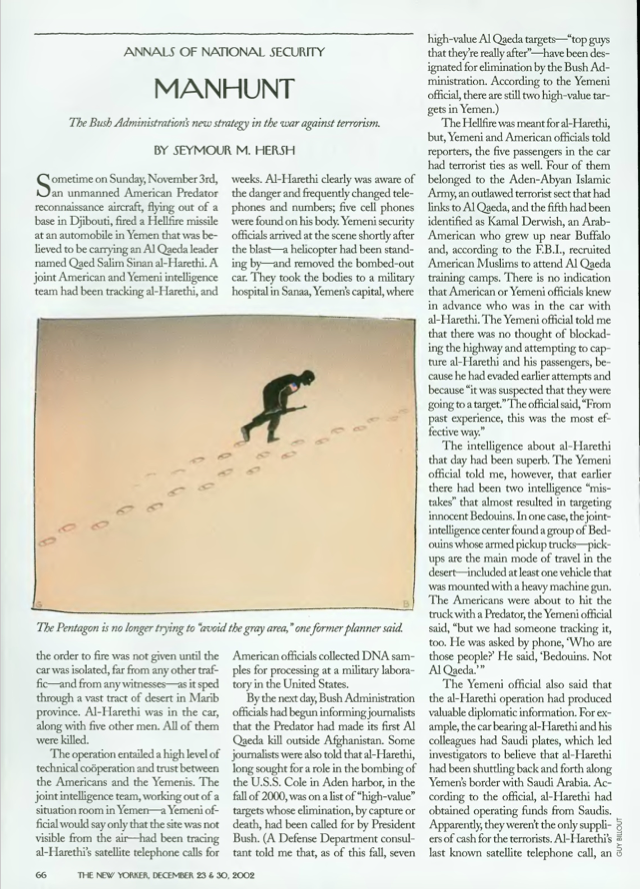
And, as Chamayou would surely insist, it wasn’t war.  It was, as Seymour Hersh wrote in the New Yorker on 23 December 2002, a manhunt.

HERSH Manhunt

To be continued.

The individuation of warfare?

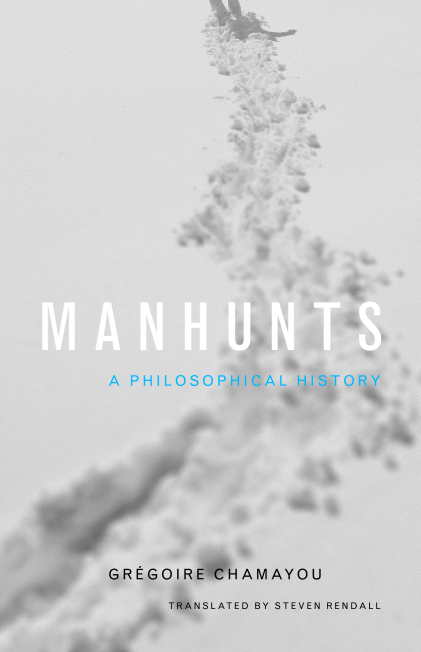
chamayou-manhuntsBefore I resume my reading of Grégoire Chamayou‘s Théorie du drone, I want to approach his thesis from a different direction. As I’ve noted, much of his argument turns on the reduction of later modern war to ‘man-hunting’: the profoundly asymmetric pursuit of individuals by activating the hunter-killer capacities of the Predator or the Reaper in a new form of networked (para)military violence. He describes this as a ‘state doctrine of non-conventional violence’ that combines elements of military and police operations without fully corresponding to either: ‘hybrid operations, monstrous offspring [enfants terribles] of the police and the military, of war and peace’.

These new modalities increase the asymmetry of war – to the point where it no longer looks like or perhaps even qualifies as war – because they preclude what Joseph Pugliese describes as ‘“a general system of exchange” [the reference is to Achille Mbembe’s necropolitics] between the hunter-killer apparatus ‘and its anonymous and unsuspecting victims, who have neither a right of reply nor recourse to judicial procedure.’

Pugliese insists that drones materialise what he calls a ‘prosthetics of law’, and the work of jurists and other legal scholars provides a revealing window into the constitution of later modern war and what, following Michael Smith, I want to call its geo-legal armature. To date, much of this discussion has concerned the reach of international law – the jurisdiction of international law within (Afghanistan) and beyond (Pakistan, Yemen and Somalia) formal zones of conflict – and the legal manoeuvres deployed by the United States to sanction its use of deadly force in ‘self-defence’ that violates the sovereignty of other states (which includes both international law and domestic protocols like the Authorization for the Use of Military Force and various executive orders issued after 9/11) . These matters are immensely consequential, and bear directly on what Frédéric Mégret callsthe deconstruction of the battlefield’.

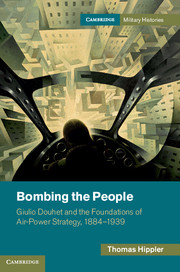
HIPPLER Bombing the PeopleIt’s important to understand that the ‘battlefield’ is more than a physical space; it’s also a normative space – the site of ‘exceptional norms’ within whose boundaries it is permissible to kill other human beings (subject to particular codes, rules and laws). Its deconstruction is not a new process. Modern military violence has rarely been confined to a champ de mars insulated from the supposedly safe spaces of civilian life. Long-range strategic bombing radically re-wrote the geography of war. This was already clear by the end of the First World War, and in 1921 Giulio Douhet could already confidently declare that

‘By virtue of this new weapon, the repercussions of war are no longer limited by the farthest artillery range of guns, but can be felt directly for hundreds and hundreds of miles… The battlefield will be limited only by the boundaries of the nations at war, and all of their citizens will become combatants, since all of them will be exposed to the aerial offensives of the enemy. There will be no distinction any longer between soldiers and civilians.’

The laboratory for these experimental geographies before the Second World War was Europe’s colonial (dis)possessions – so-called ‘air control’ in North Africa, the Middle East and along the North-West Frontier – but colonial wars had long involved ground campaigns fought with little or no distinction between combatants and civilians.

What does seem to be novel about more recent deconstructions, so Mégret argues, is ‘a deliberate attempt to manipulate what constitutes the battlefield and to transcend it in ways that liberate rather than constrain violence.’

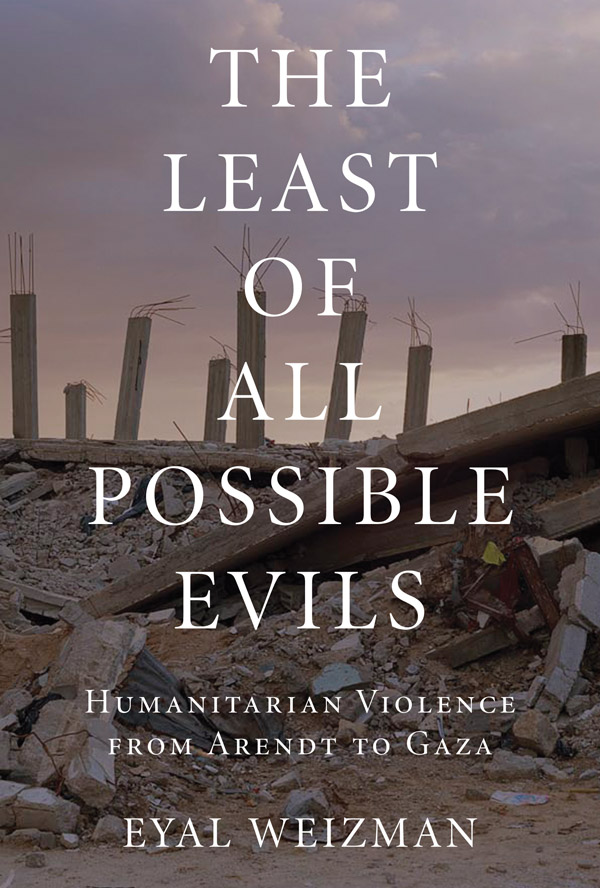
9781844676477 Least of All Possible EvilsThis should not surprise us. Law is not a deus ex machina that presides over war as impartial tribune. Law, Michel Foucault reminds us, ‘is born of real battles, victories, massacres and conquests’; law ‘is born in burning towns and ravaged fields.’ Today so-called ‘operational law’ has incorporated military lawyers into the kill-chain, moving them closer to the tip of the spear, but law also moves in the rear of military violence: in Eyal Weizman’s phrase, ‘violence legislates.’ In the case that most concerns him, that of the Israel Defense Force, military lawyers work in the grey zone between ‘the black’ (forbidden) and ‘the white’ (permitted) and actively seek to turn the grey into the white: to use military violence to extend the permissive envelope of the law.

The liber(alis)ation of violence that Mégret identifies transforms the very meaning of war. In conventional wars combatants are authorised to kill on the basis of what Paul Kahn calls their corporate identity:

‘…the combatant has about him something of the quality of the sacred. His acts are not entirely his own….

‘The combatant is not individually responsible for his actions because those acts are no more his than ours…. [W]arfare is a conflict between corporate subjects, inaccessible to ordinary ideas of individual responsibility, whether of soldier or commander. The moral accounting for war [is] the suffering of the nation itself – not a subsequent legal response to individual actors.’

The exception, Kahn continues, which also marks the boundary of corporate agency, is a war crime, which is ‘not attributable to the sovereign body, but only to the individual.’ Within that boundary, however, the enemy can be killed no matter what s/he is doing (apart from surrendering). There is no legal difference between killing a general and killing his driver, between firing a missile at a battery that is locking on to your aircraft and dropping a bomb on a barracks at night. ‘The enemy is always faceless,’ Kahn explains, ‘because we do not care about his personal history any more than we care about his hopes for the future.’ Combatants are vulnerable to violence not only because they are its vectors but also because they are enrolled in the apparatus that authorizes it: they are killed not as individuals but as the corporate bearers of a contingent (because temporary) enmity.

It is precisely this model that contemporary military violence now challenges through the prosthetics of law embodied and embedded in drone warfare – and this, Kahn insists, has transformed the political imaginary of warfare (You can find his full argument here: ‘Imagining warfare’, European journal of international law 24 (1) (2013) 199-216).

Warheads on foreheads

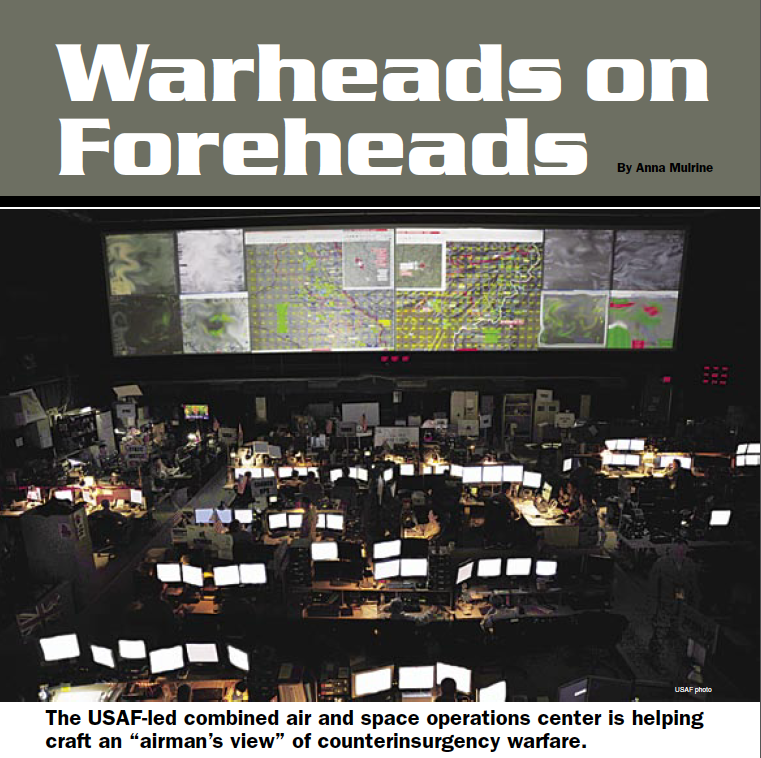
In a parallel argument, Samuel Issacharoff and Richard Pildes describe this development as the individuation of military force, driven in part by the affordances and dispositions of drone warfare which makes it possible to put ‘warheads on foreheads.’  Targets are no longer whole areas of cities – like Cologne or Hamburg in the Second World War – or extensive target boxes like those ravaged by B-52 ‘Arc Light’ strikes over the rainforest of Vietnam.  The targets are individuals and, since the United States claims the right to target them wherever they are found, this partly explains the dispersed geography of what I’ve called ‘the everywhere war’.   What interests Issacharoff and Pildes, like Kahn, is not so much the technology that makes this possible as the apparatus that makes it permissible.

Their presentation wavers uncertainly between counterinsurgency and counter-terrorism, and they also write more generally of ‘the new face of warfare’ and the use of ‘military force’, so that (as now happens in practice) the distinctions between the US military and the CIA become blurred.  But their core argument is that military force is now directed against specific individuals on the basis of determinate acts that they have committed or, by pre-emptive extension, are likely to commit.  In Kahn’s terms, this inaugurates a radically different (though in his eyes, highly unstable) political subjectivity through which the enemy is transformed into the criminal.  ‘The criminal is always an individual,’ Kahn explains; ‘the enemy is not.’

For Issacharoff and Pildes this new state of affairs requires an ‘adjudicative apparatus’ to positively identify, detect and prosecute the individual-as-target, which drives the military system ever closer to the judicial system:

 ‘As the fundamental transformation in the practice of the uses of military force moves, even implicitly, toward an individuated model of responsibility, military force inevitably begins to look justified in similar terms to the uses of punishment in the criminal justice system. That is, to the extent that someone can be targeted for the use of military force (capture, detention, killing) only because of the precise, specific acts in which he or she as an individual participated, military force now begins to look more and more like an implicit “adjudication” of individual responsibility.’

They suggest that this makes it inevitable that the boundaries between the military system and the judicial system ‘will become more permeable’ – a confirmation of the active constitution of the war/police assemblage (on which see Colleen Bell, Jan Bachmann and Caroline Holmqvist’s forthcoming collection, The New Interventionism: perspectives on war-police assemblages).

Kahn is, I think, much more troubled by this than Issacharoff and Pildes.  He concludes (like Chamayou):

‘Political violence is no longer between states with roughly symmetrical capacities to injure each other; violence no longer occurs on a battlefield between masses of uniformed combatants; and those involved no longer seem morally innocent. The drone is both a symbol and a part of the dynamic destruction of what had been a stable imaginative structure. It captures all of these changes: the engagement occurs in a normalized time and space, the enemy is not a state, the target is not innocent, and there is no reciprocity of risk. We can call this situation ‘war’, but it is no longer clear exactly what that means.

‘The use of drones signals a zone of exception to law that cannot claim the sovereign warrant. It represents statecraft as the administration of death. Neither warfare nor law enforcement, this new form of violence is best thought of as the high-tech form of a regime of disappearance. States have always had reasons to eliminate those who pose a threat. In some cases, the victims doubtlessly got what they deserved. There has always been a fascination with these secret acts of state, but they do not figure in the publicly celebrated narrative of the state. Neither Clausewitz nor Kant, but Machiavelli is our guide in this new war on terror.’

He is thoroughly alarmed at the resuscitation of what he calls ‘the history of administrative death’, whereas Issacharoff and Pildes – ironically, given what I take to be their geopolitical sympathies –treat the institution and development of an ‘adjudicative apparatus’ within the US programme of targeted killings as a vindication of their execution (sic).

I want to set aside other contributions to the emerging discussion over the ‘individuation’ of warfare – like Gabriella Blum‘s depiction of an ‘individual-centred regime’ of military conduct, which pays close attention to its unstable movement between nationalism and cosmopolitanism – in order to raise some questions about the selectivity of ‘individuation’ as a techno-legal process.  I intend that term to connote three things.

Target phase

(1) First, and most obviously, Issacharoff and Pildes fasten on the technical procedures that have been developed to administer targeted killings – which include both the ‘disposition matrix’ [see here] and its derivatives and the more directly instrumental targeting cycle [the diagram above shows the ‘Target’ phase of the Find-Fix-Track-Target-Engage-Assess cycle] , both of which admit legal opinions and formularies – that convert targeted killing into what Adi Ophir calls a quasi-juridical process.  This encoding works to contract the ethical horizon to the legal-juridical (see here for a critical commentary) while simultaneously diverting attention from the substantive practice – which, as I showed in ‘Lines of descent’ (DOWNLOADS tab), is shot through with all sorts of limitations that confound the abstract calculations of the targeting cycle (see, for example, Gregory McNeal here, who turns ‘accountability’ into accountancy).

(2) Second, ‘individuation’ refers to the production of the individual as a technical artefact of targeting.  S/he is someone who is apprehended as a screen image and a network trace;  s/he may be named in the case of a ‘personality strike’ but this serves only as an identifier in a target file, and the victims of ‘signature strikes‘ are not accorded even this limited status.  Others who are killed in the course of the strike almost always remain unidentified by those responsible for their deaths – ‘collateral damage’ whose anonymity confirms on them no individuality but only a collective ascription.  (For more, see Thomas Gregory, ‘Potential lives, impossible deaths: Afghanistan, civilian casualties and the politics of intelligibility’, International Feminist Journal of Politics 14 (3) (2012) 327-47; and ‘Naming names’ here).

(3) Third, the adjudication of ‘individual responsibility’ bears directly on the production of the target but not, so it seems, on the producers of the target.  Lucy Suchmann captures this other side – ‘our’ side – in a forthcoming essay in Mediatropes (‘Situational awareness: deadly bioconvergence at the boundaries of bodies and machines’):

‘A corollary to the configuration of “their” bodies as targets to be killed is the specific way in which “our” bodies are incorporated into war fighting assemblages as operating agents, at the same time that the locus of agency becomes increasingly ambiguous and diffuse. These are twin forms of contemporary bioconvergence, as all bodies are locked together within a wider apparatus characterized by troubling lacunae and unruly contingencies.’

Caroline Holmqvist, sharpens the same point in ‘Undoing war: war ontologies and the materiality of drone warfare’, Millennium (1 May 2013) d.o.i. 10.1177/0305829813483350); so too, and more directly relevant to the operations of a techno-legal process,  does Joseph Pugliese‘s figure of drone crews as ’embodied prostheses of the law of war grafted on to their respective technologies’.

These various contributions identify a dispersion of responsibility across the network in which the drone crews are embedded and through which they are constituted.  The technical division of labour is also a social division of labour – so that no individual bears the burden of killing another individual – but the social division of labour is also a technical division of labour through which ‘agency’ is conferred upon what Pugliese calls its prostheses:

‘Articulated in this blurring of lines of accountability is a complex network of prostheticised and tele-techno mediated relations and relays that can no longer be clearly demarcated along lines of categorical divisibility: such is precisely the logic of the prosthetic. As the military now attempts to grapple with this prostheticised landscape of war, it inevitably turns to technocratic solutions to questions of accountability concerning lethal drone strikes that kill the wrong targets.’

If the mandated technical procedures (1 above) fail to execute a sanctioned target (2 above) and if this triggers an investigation, the typical military response is to assign responsibility to the improper performance of particular individuals (which protects the integrity of the process) and/or to technical malfunctions or inefficiencies in the network and its instruments (which prompts technical improvements).  What this does not do – is deliberately designed not to do – is to probe the structure of this ‘techno-legal economy of war at a distance’ (Pugliese’s phrase) that turns, as I’ve tried to suggest, on a highly particular sense of individuation.  Still less do these inquiries disclose the ways in which, to paraphrase Weizman, ‘drones legislate’ by admitting or enrolling into this techno-legal economy particular subjectivities and forcefully excluding others .

More to come.

***

Note: Here are the citations for Issacharoff and Pildes’ full argument(s); the first is excerpted from the second, which deals with ‘capture’ (detention) as well as killing:

Samuel Issacharoff and Richard Pildes, ‘Drones and the dilemma of modern warfare’, in Peter Bergen and Daniel Rothenberg (eds) Drone wars: the transformation of armed conflict and the promise of law (Cambridge University Press, 2013); available here as NYU School of Law, Public Law & Legal Theory Research Paper Series Working Paper No. 13-34, June 2013

Samuel Ischaroff and Richard Pildes, ‘Targeted warfare: individuating enemy responsibility’, NYU School of Law, Public Law & Legal Theory Working Papers 343 (April 2013); available here.

Dronework

Some recent open access work on drones that intersects with my ongoing reading of Grégoire Chamayou‘s Théorie du drone.

Theorie du droneFirst, Philippe Theophanidis, a PhD student at the Université de Montréal, writes with the welcome news that he’s developed an online bibliography of English and French language materials, Grégoire Chamayou: bodies, manhunts and drones, available here.

Philippe’s own research concerns the theory of community in Jean-Luc Nancy and Roberto Esposito.  He adds:

‘I’m especially preoccupied by the fact that our contemporary mode of being-together paradoxically takes the form of destructive interactions. For that reason, I’m interested about war and space in general, and more precisely about “global civil war” (Schmitt) or war in the time of globalization. That’s why Chamayou’s new book caught my attention when it came out.’

Second, another contribution to the ramifying genealogy of drones that I’ve addressed in several previous posts (for example here and here): at OSU’s Origins: current events in historical perspective, Kenneth Hough provides an extended essay on what he calls ‘the long cultural history of drones’.  He adds some interesting material, most of it about the ways in which drones have been registered in American popular culture:

Since their emergence in the late nineteenth century, Americans have regarded unmanned aerial systems as four basic cultural phenomena: heralds of human accomplishment and hope for the future, signs of inhuman depravity portending society’s doom, mechanical misfires that are both ineffective and humorous, and transcendent machines that spark existential questions about war and society, tapping into what David Nye calls our “fundamental hopes and fears.”

But his long cultural history turns out to be a remarkably narrow cultural geography in which – apart from an excursus on V-1 rockets in the Second World War – experimental laboratories outside the United States (notably Britain and Israel) disappear from view.  For all that, I’m surprised that James Cameron‘s Avatar isn’t on his cultural hit list (though I know Cameron’s Canadian): to see what I mean, and for a more general cultural critique, check out Patrick Lichty‘s interesting essay, Drone: camera, weapon, toy on ‘the aestheticization of dark technology’.

The Atlantic September 2013 Drone warriorWhich brings me to my last sighting: Mark Bowden‘s cover essay in the latest (September) issue of Atlantic on ‘The Killing Machines: how to think about drones‘.  Despite the subtitle, much of Bowden’s extended essay asks how we should feel about drones.

Anyone familiar with his previous work (from Black Hawk Down on) probably won’t be surprised by his ultimate take on matters, and the early online comments show that he’s set off a firestorm of protest by what several writers call his ‘apologia’.

As a matter of fact, I think the essay is more complicated than that, and Bowden does address one of the central issues that Chamayou returns to again and again, the ways in which remote (split) operations transform the very nature of ‘combat’:

Drone strikes are a far cry from the atomic vaporizing of whole cities, but the horror of war doesn’t seem to diminish when it is reduced in scale. If anything, the act of willfully pinpointing a human being and summarily executing him from afar distills war to a single ghastly act.

One day this past January, a small patrol of marines in southern Afghanistan was working its way at dusk down a dirt road not far from Kandahar, staying to either side to avoid planted bombs, when it unexpectedly came under fire. The men scattered for cover. A battered pickup truck was closing in on them and popping off rounds from what sounded like a big gun.

Continents away, in a different time zone, a slender 19-year-old American soldier sat at a desk before a large color monitor, watching this action unfold in startlingly high definition. He had never been near a battlefield. He had graduated from basic training straight out of high school, and was one of a select few invited to fly Predators. This was his first time at the controls, essentially a joystick and the monitor. The drone he was flying was roughly 15,000 feet above the besieged patrol, each member marked clearly in monochrome on his monitor by an infrared uniform patch. He had been instructed to watch over the patrol, and to “stay frosty,” meaning: Whatever happens, don’t panic. No one had expected anything to happen. Now something was happening.

The young pilot zoomed in tight on the approaching truck. He saw in its bed a .50-caliber machine gun, a weapon that could do more damage to an army than a platoon of Goliaths.

A colonel, watching over his shoulder, said, “They’re pinned down pretty good. They’re gonna be screwed if you don’t do something.”

The colonel told the pilot to fix on the truck. A button on the joystick pulled up a computer-generated reticle, a grid displaying exact ground coordinates, distance, direction, range, etc. Once the computer locked on the pickup, it stayed zeroed in on the moving target.

“Are you ready to help?” the colonel asked.

An overlay on the grid showed the anticipated blast radius of an AGM-114 Hellfire missile—the drone carried two. Communicating via a digital audio link, the colonel instructed the men on the ground to back away, then gave them a few seconds to do so.

The pilot scrutinized the vehicle. Those who have seen unclassified clips of aerial attacks have only a dim appreciation of the optics available to the military and the CIA.

“I could see exactly what kind of gun it was in back,” the pilot told me later. “I could see two men in the front; their faces were covered. One was in the passenger seat and one was in the driver’s seat, and then one was on the gun, and I think there was another sitting in the bed of the truck, but he was kind of obscured from my angle.”

On the radio, they could hear the marines on the ground shouting for help.

“Fire one,” said the colonel.

The Hellfire is a 100-pound antitank missile, designed to destroy an armored vehicle. When the blast of smoke cleared, there was only a smoking crater on the dirt road.

“I was kind of freaked out,” the pilot said. “My whole body was shaking. It was something that was completely different. The first time doing it, it feels bad almost. It’s not easy to take another person’s life. It’s tough to think about. A lot of guys were congratulating me, telling me, ‘You protected them; you did your job. That’s what you are trained to do, supposed to do,’ so that was good reinforcement. But it’s still tough.”

One of the things that nagged at him, and that was still bugging him months later, was that he had delivered this deathblow without having been in any danger himself. The men he killed, and the marines on the ground, were at war. They were risking their hides. Whereas he was working his scheduled shift in a comfortable office building, on a sprawling base, in a peaceful country. It seemed unfair. He had been inspired to enlist by his grandfather’s manly stories of battle in the Korean War. He had wanted to prove something to himself and to his family, to make them as proud of him as they had been of his Pop-Pop.

“But this was a weird feeling,” he said. “You feel bad. You don’t feel worthy. I’m sitting there safe and sound, and those guys down there are in the thick of it, and I can have more impact than they can. It’s almost like I don’t feel like I deserve to be safe.”

I’ve described this identification with troops on the ground before, what one of Bowden’s correspondents calls ‘a very visceral connection to operations on the ground’.  And Bowden is stacking the deck by starting with what the US military calls ‘Troops in Contact‘ in Afghanistan rather than CIA-directed targeted killing in Pakistan: only later will he turn to the legal and quasi-legal landscape through which those strikes pass (more on this in a later post) .  But he then adds this:

If the soldier who pulls the trigger in safety feels this, consider the emotions of those on the receiving end, left to pick up the body parts of their husbands, fathers, brothers, friends. Where do they direct their anger? When the wrong person is targeted, or an innocent bystander is killed, imagine the sense of impotence and rage. How do those who remain strike back? No army is arrayed against them, no airfield is nearby to be attacked. If they manage to shoot down a drone, what have they done but disable a small machine? No matter how justified a strike seems to us, no matter how carefully weighed and skillfully applied, to those on the receiving end it is profoundly arrogant, the act of an enemy so distant and superior that he is untouchable.

As I say, more to come…

Theory of the drone 9: Psychopathologies of the drone

This is the ninth in a series of extended posts on Grégoire Chamayou‘s Théorie du drone and covers the fourth chapter in Part II, Ethos and psyche.

4 Psychopathologies of the drone

One of the most common media tropes in discussing ‘a day in the life’ of drone operators is their vulnerability to stress and, in particular, Post-Traumatic Stress Disorder (PTSD).  Chamayou traces this to an Associated Press report by Scott Lindlaw in August 2008, which claimed that the crews who ‘operate Predator drones over Iraq via remote control, launching deadly missile attacks from the safety of Southern California 7,000 miles away, are suffering some of the same psychological stresses as their comrades on the battlefield.’  Similar stories have circulated in other media reports.  The root claim is that, unlike pilots of conventional strike aircraft, drone crews see the results of their actions in close-up detail through their Full-Motion Video feeds and that they are required to remain on station to carry out a Battle Damage Assessment that often involves an inventory of body parts.

One recent study, ‘Killing in High Definition‘ by Scott Fitzsimmons and Karina Singha, presented at the International Studies Association in San Francisco earlier this year, makes the truly eye-popping suggestion that:

‘To reduce RPA operators’ exposure to the stress-inducing traumatic imagery associated with conducting airstrikes against human targets, the USAF should integrate graphical overlays into the visual sensor displays in the operators’ virtual cockpits. These overlays would, in real-time, mask the on-screen human victims of RPA airstrikes from the operators who carry them out with sprites or other simple graphics designed to dehumanize the victims’ appearance and, therefore, prevent the operators from seeing and developing haunting visual memories of the effects of their weapons.’

But in his original report Lindlaw admitted that ‘in interviews with five of the dozens of pilots and sensor operators at the various bases, none said they had been particularly troubled by their mission’, and Chamayou contends that the same discursive strategy – a bold claim discretely followed by denials – is common to most media reports of the stresses supposedly suffered by drone crews.  More: he juxtaposes the crews’ own denial of anything out of the ordinary with the scorn displayed towards their remote missions by pilots of conventional strike aircraft who, in online chatrooms and message boards, regard the very idea as an insult to those who daily risk their lives in combat.

The argument Chamayou develops closely follows William Saletan‘s commentary in Slate:

[The AP story] shows that operating a real hunter, killer, or spy aircraft from the faraway safety of a game-style console affects some operators in a way that video games don’t. But it doesn’t show that firing a missile from a console feels like being there — or that it haunts the triggerman the same way. Indeed, the paucity of evidence — despite the brutal work shifts, the superior video quality, and the additional burden of watching the target take the hit — suggests that it feels quite different.

Chamayou’s reading is more aggressive.  In his eyes, the repeated claim of vulnerability to stress emerged as a concerted response to criticisms of the supposed ‘Playstation mentality’ that attends remote killing and its reduction of war to a videogame.  He insists that it’s little more than an attempt to apply ‘a veneer of humanity to an instrument of mechanical murder’ – ‘crying crocodile tears’ before devouring the prey – and that it rests on absolutely no empirical foundation. This raises the stakes, of course, and it’s only fair to note that Lindlaw’s interviews with drone crews did not talk up combat-related stress and in fact a USAF white paper dismissed as ‘sensational’ the claim that PTSD rates among RPA crews were higher than those suffered by their forward-deployed counterparts.

Indeed, Chamayou himself relies on a public lecture given by Colonel Hernando Ortega, a senior medical officer attached to the USAF Intelligence, Surveillance and Reconnaissance Agency in February 2012.  Ortega reported USAF research that showed – conclusively – that drone crews are subject to often extraordinary stress.  But this is primarily a matter of their conditions of work – the demands of paying close attention to a screen hour after hour – and the rapid shift alternations between work and home (‘telecommuting to the war zone’) that allow little or no time or space for decompression.  Ortega explained that the symptoms rarely rise to the level of PTSD and are primarily the product of ‘operational stress’ rather than the result of combat-induced exposure to violence.

‘They don’t say [they are stressed] because we had to blow up a building. They don’t say because we saw people get blown up. That’s not what causes their stress — at least subjectively to them. It’s all the other quality of life things that everybody else would complain about too.’

Ortega could think of only one sensor operator who had been diagnosed with PTSD – a study by Wayne Chapelle, Amber Salinas and Lt Col Kent McDonald from the Department of Neurosurgery at the USAF School of Aerospace Medicine reported that 4 per cent of active duty RPA pilots and sensor operators were at ‘high risk for PTSD’ – but Ortega’s research questionnaires often revealed a sort of self-doubt over whether drone crews had made the right call when coming to the aid of troops in conflict rather than a direct response to a ‘physical threat event’:

‘Now it’s not to say that they don’t really feel about the physical threat to their brothers who are on the ground up there.  The band of brothers … is not just in the unit. I believe it’s on the network, and I believe the communication tools that are out there has extended the band of brothers mentality to these crews who are in contact with guys on the ground. They know each other from the chat rooms. They know each other from the whatever, however they communicate. They do it every day, same thing all the time…. So that piece of the stress, I think, when something bad happens, that really is out there…’

This sounds to me like the situation I described in ‘From a view to a kill’ (DOWNLOADS tab): the networked nature of remote operations draws operators into the conflict (which is why they so often insist that they are only 18″ from the battlefield, the distance from eye to screen) but on highly unequal, techno-culturally mediated terms that predispose them to identify with troops on the ground rather than with any others (or Others) in the immediate vicinity.  What Chamayou takes from all this is Ortega’s conclusion:

‘The major findings of the work so far has been that the popularized idea of watching the combat was really not what was producing the most just day to day stress for these guys. Now there are individual cases — like I said, particularly with, for instance, when something goes wrong — a friendly fire incident or other things like that. Those things produce a lot of stress and … more of an existential kind of guilt… could I have done better? Did I make the right choices? What could I have done more?’

DSM -5In fact for Chamayou the very idea of drone crews experiencing PTSD is an absurdity.  According to the latest edition of the Diagnostic and Statistical Manual for Mental Disorders (DSM -5, 2013; revised from the previous version cited by Chamayou, this incorporates major changes from DSM-IV, but these do not materially alter his main point), PTSD is a trauma and stressor-related disorder brought about by exposure to actual or threatened death, serious injury, or sexual violence.   The American Psychiatric Association explains:

The exposure must result from one or more of the following scenarios, in which the individual:

• directly experiences the traumatic event;

• witnesses the traumatic event in person;

• learns that the traumatic event occurred to a close family member or close friend (with the actual or threatened death being either violent or accidental); or

• experiences first-hand repeated or extreme exposure to aversive details of the traumatic event (not through media, pictures, television or movies unless work-related).

Drone crews do not ‘directly experience’ any traumatic event, Chamayou insists, and far from being ‘witnesses’  they are the perpetrators of trauma.  Those last three words in the extract I’ve just quoted do open up a third scenario – which would leave open the possibility of being affected by high-definition exposure through the FMV feeds and the Battle Damage Assessments performed by drone crews – but Chamayou hones the role of the perpetrator to explore a different though not unrelated scenario.

He takes his cue from Karl Abraham‘s discussion of neuroses in the First World War:

‘It is not only demanded of these men in the field that they must tolerate dangerous situations — a purely “passive performance — but there is a second demand which has been much too little considered, I allude to the aggressive acts for which the soldier must be hourly prepared, for besides the readiness to die, the readiness to kill is demanded of him…. [In our patients the anxiety as regards killing is of a similar significance to that of dying.’

51nCFmy0gdLChamayou is most interested in the development of this line of thought by psychologist/sociologist Rachel MacNair, who widens the field of PTSD to incorporate what she calls Perpetration-Induced Traumatic Stress (PITS): you can find a quick summary here.  (McNair is a long-time peace activist and in accordance with the ‘consistent life ethic’ she has used her work on PITS to intervene in what she calls ‘the abortion wars’; she is also associated with the Center for Global Nonkilling: see here).

Her book was written too early to address the use of drones for remote killing, but Chamayou suggests that this would be an appropriate means of putting their ‘psychopathologies’ to the test.  He thinks that individual operators lie somewhere between two poles: either they are indifferent to killing at a distance (the screen as barrier) or they feel culpable for the violence they have inflicted (the screen forcing them to confront the consequences of their actions).  It is, he concludes, an open question: though his next chapter on ‘Killing at a distance’ proposes a series of answers.

In fact, the USAF recognises the distinct possibility of PITS affecting drone crews, as this slide from a presentation by Chappelle and McDonald shows:

PTSD RPA crews CHAPPELLE

This year MacNair became President of Division 48 (Peace Psychology) of the American Psychological Association and instituted three Presidential Task Forces, the first of which specifically addresses drones.  She writes:

‘Task Force 1 is examining “The Psychological Issues of Unmanned Aerial Vehicles (Weaponized drones).” This will focus on the flying robots that kill, not the ones doing surveillance, nor the consumer drones that loom on the horizon. this is a very new field, with very little literature. We’ll look at what the psychological impact is on operators of the systems, the bureaucracy, surviving victims, and special therapeutic needs. The task force email for any feed-back or good literature citations or to request the full list of questions is dronetF@ peacepsych.org.’

The newsletter also includes a short statement from the next President of the Division, Brad Olson, setting out ‘Some thoughts for the Drone Task Force’ and an article by Marc Pilisuk on ‘The new face of war’.

Peace Psychology

Let me add three other comments.

(1) To limit the discussion to PTSD is to set the bar very high indeed, and the evidence of lower-level combat-induced stress on drone crews is less straightforward than Chamayou makes out.  In March 2013 Jean Otto and Bryant Webber reported the results of a study of ‘mental health outcomes’ covering the period 1 October 2003 to 31 December 2011 for 709 drone (RPA) pilots and 5, 526 pilots of manned aircraft (MA); they found that the crude incidence of adjustment, anxiety, depressive and other disorders among RPA pilots was considerably higher than for MA pilots, but once the samples were adjusted for age, number of deployments and other factors the ‘incidence rates among the cohorts did not significantly differ’ (my emphasis).

MH outcomes USAF

The study was experimental in all sorts of ways and it does not – could not – provide a fine-grained analysis of the nature of the pilots’ exposure to violence.  We should bear in mind, too, that the study was inevitably limited by inhibitions, both formal and informal, on admitting to any form of stress within the military.  But the report does suggest that it is a mistake to separate drone crews from the wider matrix of military violence and its effects in which they are embedded.

brandon-bryant-e1369021667128(2) If Chamayou is right in his suspicion that all this talk of drone crews being affected by what they see on their screens was a concerted strategy designed to disarm claims that remote operations reduce war to a videogame – in which case, not everybody in the Air Force was singing the same tune – the fact that most of them turn out to conduct their missions with equanimity does not prove the critics right: it does not follow that they take their responsibilities less seriously or more casually than the pilots of conventional strike aircraft.  Pilots and sensor operators undoubtedly have recourse to gallows humour (Chamayou would no doubt say that this befits their role as ‘executioners’), and there are too many reported instances of language that I too find repugnant, though I see no reason not to expect the same amongst military personnel of all stripes.  But there is also anecdotal evidence of situations in which pilots and their crews have been deeply affected by what they saw (and, yes, did).  The testimony of at least one former operator, Brandon Bryant (above, left), who has been diagnosed with PTSD, suggests that those involved probably move between these extremes – between the two poles proposed by Chamayou – dis/connecting as their actions and reactions entangle with events on the screen/ground.

(3) The most careful review I know of what is a complicated and contentious field is Peter Asaro, ‘The labor of surveillance and bureaucratized killing: new subjectivities of military drone operators, Social semiotics 23 (2) (2013) 196-22.  This combines medico-military studies, media reports and an artful reading of Omer Fast‘s film, 5,000 Feet is the Best.  as Peter says, there are many jobs that involve surveillance and many jobs that involve killing, but

‘What makes drone operators particularly interesting as subjects is not only that their work combines surveillance and killing, but also that it sits at an intersection of multiple networks of power and technology and visibility and invisibility, and their work is a focal point for debates about the ethics of killing, the effectiveness of military strategies for achieving political goals, the cultural and political significance of lethal robotics, and public concerns over the further automation of surveillance and killing.’

It’s a tour de force that navigates a careful passage between the ‘heroic’ and ‘anti-heroic’ myth of drones.  Here is what I take to be the key passage from his conclusion:

‘On the one hand, drone operators do not treat their job in the cavalier manner of a video game, but they do recognize the strong resemblance between the two. Many drone operators are often also videogame players in their free time, and readily acknowledge certain similarities in the technological interfaces of each. Yet the drone operators are very much aware of the reality of their actions, and the consequences it has on the lives and deaths of the people they watch via video streams from half a world away, as they bear witness to the violence of their own lethal decisions. What they are less aware of … is that their work involves the active construction of interpretations. The bodies and actions in the video streams are not simply ‘‘given’’ as soldiers, civilians, and possible insurgents – they are actively constructed as such. And in the process of this construction the technology plays both an enabling and mediating role. I use the term ‘‘mediating’’ here to indicate that it is a role of translation, not of truth or falsity directly, but of transformation and filtering. On the one hand there is the thermal imaging that provides a view into a mysterious and hidden world of relative temperatures. And thus these drone technologies offer a vision that contains more than the human alone could ever see. On the other hand we can see that the lived world of human experience, material practices, social interactions, and cultural meanings that they are observing are difficult to properly interpret and fully understand, and that even the highest resolution camera cannot resolve the uncertainties and misinterpretations. There is a limit to the fidelity that mediation itself can provide, insofar as it cannot provide genuine social participation and direct engagement. This applies not only to both surveillance and visuality, which is necessarily incomplete, but also to the limited forms of action and engagement that mediating technologies permit. While a soldier on the ground can use his or her hands to administer medical aid, or push a stalled car, as easily as they can hold a weapon, the drone operator can only observe and choose to kill or not to kill. Within this limited range of action, meaningful social interaction is fundamentally reduced to sorting the world into friends, enemies, and potential enemies, as no other categories can be meaningfully acted upon.’

There’s a discussion of these various issues, including many of the people mentioned in this post, at HuffPost Live here.

Theory of the drone 8: From invisibility to vulnerability

This is the eighth in a series of posts on Grégoire Chamayou‘s Théorie du drone and covers the third chapter in Part II, Ethos and psyche.

3: Crisis in military ethos

The track that Chamayou beats in this chapter is (perhaps appropriately) a tortured one: it twists from the invulnerability of the hunter through his defencelessness to his vulnerability to psychic harm.  And, as you’ll see, those gendered pronouns are a critical part of his argument.

Gyges (left) from Der König Kandaules

He begins with the story of Gyges.  In classical mythology Gyges was a shepherd who discovered a magical ring that could make him invisible.  Armed with his new power, Gyges eventually killed the king, married the queen and seized the throne.  ‘Invisibility’, Chamayou notes, ‘conferred upon him a kind of invulnerability.’  In Plato’s Republic the story is used to ask searching questions about virtue and justice: what happens to morality, to virtue, if it becomes possible to evade responsibility for one’s actions?

The dilemma is no longer confined to the realm of story-telling or philosophical speculation, Chamayou argues, because the thought-experiment has been realised through the political technology of the drone.  The modern answer to Plato’s question is now all too clear: invisibility produces not only invulnerability but also impunity.  In fact, in an Op-Ed last year on ‘The moral hazard of drones’ two American academics, John Kaag and Sarah Kreps, suggested that the myth of Gyges does indeed find its most telling contemporary application in the use of drones for remote killing:

One might argue that the myth of Gyges is a suitable allegory to describe the combatants who have attacked and killed American civilians and troops in the last 10 years. A shepherd from the Middle East discovers that he has the power of invisibility, the power to strike a fatal blow against a more powerful adversary, the power to do so without getting caught, the power to benefit from his deception. These, after all, are the tactics of terrorism.

But the myth of Gyges is really a story about modern counterterrorism, not terrorism.

We believe a stronger comparison can be made between the myth and the moral dangers of employing precision guided munitions and drone technologies to target suspected terrorists. What is distinctive about the tale of Gyges is the ease with which he can commit murder and get away scot-free. The technological advantage provided by the ring ends up serving as the justification of its use.

Terrorists, whatever the moral value of their deeds, may be found and punished; as humans they are subject to retribution, whether it be corporal or legal. They may lose or sacrifice their lives. They may, in fact, be killed in the middle of the night by a drone. Because remote controlled machines cannot suffer these consequences, and the humans who operate them do so at a great distance, the myth of Gyges is more a parable of modern counterterrorism than it is about terrorism.

[You can find a different version of their critique of drone warfare, which mercifully leans on materiality rather than mythology, in ‘The use of unmanned aerial vehicles in contemporary conflict: a legal and ethical analysis’, Polity  44 (2012) 260-85, available on open access here; as I’ll show in a later post, that essay intersects more directly and substantially with Chamayou’s own critique].

Chamayou accepts the force of Plato’s original question, and evidently applauds the way in which Kaag and Kreps bring it to bear on the present,  but he thinks there is another way of putting it.  Not ‘can the invisible person be virtuous?’ but ‘what sort of “virtue” is invoked by the modern Gyges?’

He develops his answer through a thumb-nail sketch of what he sees as both a crisis in and a transformation of military ethos.  Traditional military ethos privileged courage, sacrifice and heroism, qualities that worked to make killing (Chamayou actually says ‘butchery’) acceptable, even glorious.  These virtues gave war what Clausewitz saw as its presumptive moral force, which depended on a fundamental reciprocity (sometimes called the combatant’s privilege): in order to kill with honour, the soldier must be prepared to die.  War then becomes the supreme ethical experience: ‘To wage war is to learn to die.’

But what happens, Chamayou wants to know, when all of this (apart from the killing) becomes unnecessary? When it becomes possible to kill without the risk of dying?  If the combatant’s privilege is annulled, doesn’t killing become the height of cowardice and dishonour? In the contemporary age of what Edward Luttwak called ‘post-heroic war’ – what former Air Chief Marshall Brian Burridge famously and more bluntly described as ‘virtue-less war’ – those traditional military virtues are threatened.  In short, it’s not only those living under drones who see these new weapons as cowardly, and Chamayou believes that the contradiction between the new technical means of waging war and the traditional ideology that is supposed to inform its prosecution has provoked a profound crisis in the military ethos.

In fact, he says, some of the fiercest critics of remote killing are pilots of conventional strike aircraft. Chamayou cites this song written by two F-16 pilots, Chris Kurek and Rob Raymond, who perform as Dos Gringos (more here – really):

They shot down a Predator, that’s one less slot for me
They shot down a Predator and it filled my heart with glee
I had a smile when I logged on to AFPC
They shot down a Predator, that’s one less slot for me

They shot down a Predator and I say let’s send some more
Let’s fly ‘em over Baghdad and then see what’s in store
‘Cause I heard that the Air Force wants another 24
They shot down a Predator and I say let’s send some more

They shot down a Predator and I wonder how that feels
For that operator who lost his set of wheels
It must feel so defenseless; it’s like clubbing baby seals
They shot down a Predator and I wonder how that feels

As this clip makes clear, the hostility is about more than military values: the USAF now trains more crews for remote operations than for flying conventional aircraft.  But the values in question are given a particular inflection.  It would be a mistake to read ‘clubbing baby seals’ in the last verse as a reference to striking a target that can’t strike back.  After all, the song is about a Predator being shot down, and so it homes in on their inability to fight back: on their inability to engage in combat.

What is at stake here, Chamayou suggests, is a series of ‘manly’ and masculinist virtues and even virilities.  The complaint is that Unmanned Aerial Vehicles are literally ‘un-manned’ – their ‘pilots’ are not real pilots and not even real men. (You can find much more on this martial emasculation in Mary Manjikian, ‘Becoming Unmanned’ [International Feminist Journal of Politics (2013) doi: 10.1080/14616742.2012.746429]).

Even so, Chamayou is sceptical about the history being (re)written through these and similar objections.  Before announcing the end of the era of ‘manly’, heroic warfare, he suggests (in an obvious echo of Bruno Latour), we ought to ask whether ‘we’ moderns have ever fought heroic wars.  He draws attention to Walter Benjamin‘s scathing critique of a collection of essays edited by Ernst Jünger under the title War and Warrior in 1930:

‘These authors nowhere observe that the new warfare of technology and material [Materialschlacht] which appears to some of them as the highest revelation of existence,dispenses with all the wretched emblems of heroism that here and there have survived the [First] WorldWar.’

UK Approach to Unmanned Aircraft SystemsFaced with this storm of criticism, Chamayou suggests, military ethicists have found it necessary to erect an altogether different version of virtuous war.  If the drone is to be considered ‘virtuous’, several writers have argued, it is first and foremost because it rules out the possibility of casualties on ‘our’ side. Chamayou will have more to say about this in a later chapter on combatant immunity, but for now he finds confirmation in a Ministry of Defence report on The UK Approach to Unmanned Aircraft Systems in 2011 that, even as it acknowledged the ethical issues involved in abandoning the combatant’s privilege, nevertheless concluded that ‘use of unmanned aircraft prevents the potential loss of aircrew lives and is thus in itself morally justified.’

Statements like this bring into view an ongoing transformation from an ethic of sacrifice and courage to an ethic of auto-preservation (and, Chamayou adds, of cowardice): a sort of Revolution in Moral-Military Affairs.  The scale of traditional values is reversed, and in an Orwellian inversion words come to mean their opposite.  What used to be called cowardice is now called bravery, assassination becomes combat, and the spirit of sacrifice is turned into an object of opprobrium.  In Chamayou’s view we are witnessing not so much ‘virtue-less war’ as a vast operation to re-define the ‘virtues’ of war.

Dist_Warfare_Medal_800_t700

Chamayou fastens on the the Pentagon proposal late last year to award combat medals to drone operators.  Finally announcing the Distinguished Warfare Medal in February 2013, the Pentagon issued this statement:

Modern technology enables service members with special training and capabilities to more directly and precisely impact military operations at times far from the battlefield.  The Distinguished Warfare Medal will be awarded in the name of the secretary of defense to service members whose extraordinary achievements, regardless of their distance to the traditional combat theater, deserve distinct department-wide recognition.  

 “I have seen first-hand how modern tools like remotely piloted platforms and cyber systems have changed the way wars can be fought,” said Secretary of Defense Leon E. Panetta.  “We should also have the ability to honor extraordinary actions that make a true difference in combat operations, even if those actions are physically removed from the fight.”

The proposal set off a firestorm of protest in Congress and within the Air Force and online military forums.   It was withdrawn for review in less than a month and rescinded by Panetta’s successor in April.

The saga doesn’t quite do the work Chamayou wants it to do.  He uses it to reflect on the meaning of ‘bravery in combat’ – after all, he asks, what can bravery mean in circumstances ‘physically removed from the fight’? – but the Pentagon statement made it clear that the medal was to be awarded ‘for actions in any domain but not involving acts of valor.’

Still, this does not diminish the force of Chamayou’s main line of inquiry.  From the testimony of drone operators, he concludes that bravery consists not in them putting their lives on the line but in seeing the consequences of their actions online.  Drone crews are supposed to be so deeply affected by the high-resolution full-motion video feeds from their Predators and Reapers, which show in intimate detail the corporeal results of the strikes for which they are responsible, that they become highly vulnerable to Post-Traumatic Sress Disorder.  Traditionally bravery involved putting your physical body in danger; Chamayou says that it now it seems to involve putting your psychic being at risk.

This amounts to the elevation of what he calls a ‘purely psychic heroism’.  In previous wars the soldier was both the vector of violence and its potential victim, because the reciprocity of combat called on warriors to be at once executioner and potential victim.  Today the remote warrior is still required to be the executioner, but he can also become the psychological victim of his duty as executioner.

Jane Addams and delegates to the Hague conference in 1915

Chamayou is troubled by this for two reasons.

First, the idea of psychic vulnerability – of the damage inflicted on soldiers by the trauma of killing – was given form and substance in the First World War. In 1915  Jane Addams (above) – who will, I suspect, be known to most human geographers for her other achievements, particularly her work at Hull House in Chicago – returned from the International Congress of Women at the Hague to deliver a stunning address at Carnegie Hall on “The Revolt against War”.  In it, Chamayou tells us, she spoke of nurses treating ‘delirious soldiers [who] are again and again possessed by the same hallucination – that they are in the act of pulling their bayonets out of the bodies of men they have killed’, and of five young soldiers who committed suicide ‘not because they were afraid of being killed but because they were afraid they might be put into a position where they would have to kill someone else.’  To overcome these inhibitions, she noted, soldiers were routinely given a shot of rum before they went over the top.  Addams used these testimonies to develop a courageous and principled critique of military violence, and in 1931 she was awarded the Nobel Peace Prize.  (Read her Peace and Bread in time of war here). To Chamayou’s evident disgust, the trauma of war that Addams and others exposed is now being recycled into a legitimation of targeted killing.  Like a snake eating its tail, trauma is being mobilised to restore to war the ethico-heroic temper Addams insisted it had lost through trauma.

But, second, as I’ll show in the next post in this series, Chamayou is deeply sceptical of what he calls ‘the psychopathologies of the drone’.

One last comment before I go.  I don’t think the deployment of armed drones is provoking a wholesale transformation of military ethics, because that would be to absolutise their use.  The Air Force still flies conventional strike aircraft, troops are still deployed on the ground (including Special Forces) and – as the controversy over the medal confirms – the Pentagon still insists on a difference between distinguished service and bravery.  I don’t mean that drones do not raise serious ethical questions; of course they do, and I am dismayed at how often these are trumped by arguments about the legality of military violence.  But military violence takes many different forms, and it’s important not to lose sight of the larger killing fields in which drones are embedded.