Taking it to the limit

A postscript to my posts here, here and here on civilian deaths from air strikes in Iraq, Syria and elsewhere: Vice has an extended interview with Chris Woods of Airwars here.

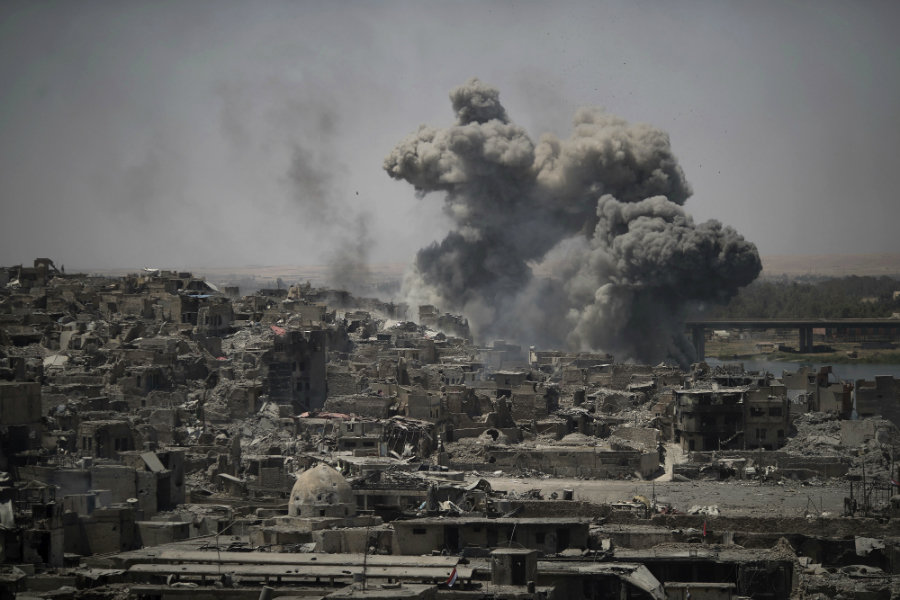
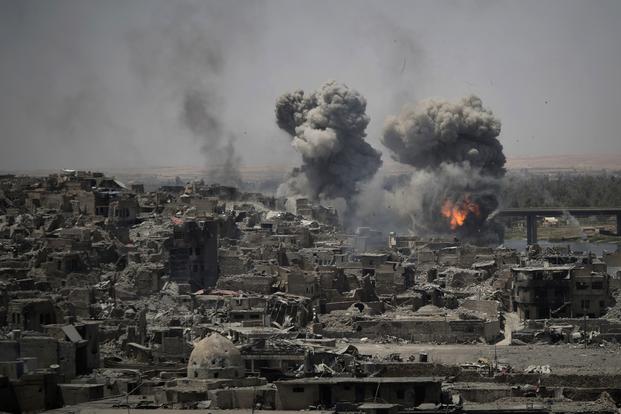
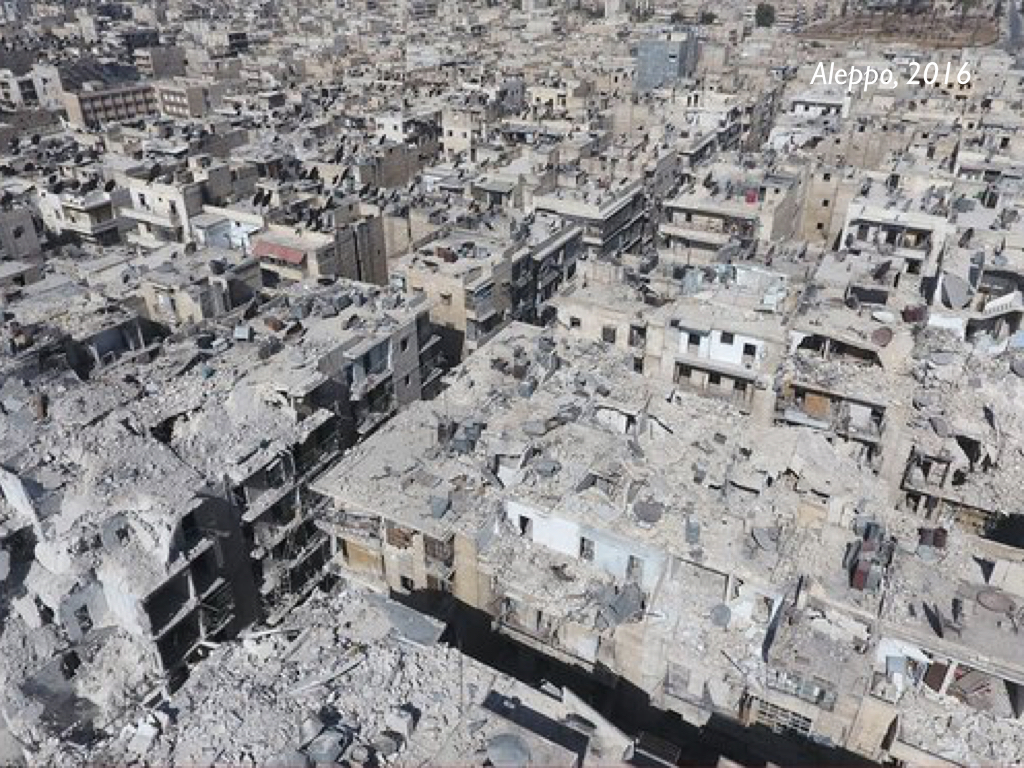
The biggest issue we saw in 2017—particularly if we look at the US-led coalition—was that the war moved very heavily into cities. That, more than any other single factor, resulted in the deaths of many more civilians and casualty events. We saw a similar pattern at the back end of 2016, when Russia and the Assad regime heavily bombed east Aleppo. There’s a very strong correlation between attacks on cities and large numbers of civilian casualties. And frankly, it doesn’t matter who’s carrying out those attacks. The outcome for civilians is always dire…

Things didn’t get any better under Trump for civilians—in fact, they got a lot worse. One of the reasons for that was the intensity of the bombardment. We saw an absolutely ferocious bombing campaign by the US and its allies in both Mosul and Raqqa in 2017. Between those two cities, the coalition alone dropped 50,000 munitions. One bomb or missile was dropped on Raqqa every 12 minutes, on average, for the duration of the four-month battle…

When Russia and the Assad regime were bombing Aleppo in late 2016, we had assumed that a key reason for the large number of civilian casualties was down to the fact they were primarily using dumb-bombs. We have actually changed our modeling since then, based on what we have seen with the coalition in places like Raqqa and Mosul. The reason is that even when you use precision bombs on cities, really, the outcome for civilians is the same as a dumb bomb. You can’t control what the bombs do when they land.

We saw very little difference between Russian and coalition strikes when it came to bombing cities. This is the big problem we have with a shift to urban warfare —it’s really taking us to the limits of any benefits we might have in terms of protecting civilians by using precision munitions.

Chris also has some characteristically smart (and sharp) things to say about transparency and accountability too…

Killing cities

In a perceptive commentary on the ground-breaking investigation by Azmat Khan and Anand Gopal into civilian casualties caused by the US air campaign against Islamic State (Daesh) in Iraq – see also my posts here and hereRobert Malley and Stephen Pomper write:

The Trump administration has celebrated a no-holds-barred approach to the fight against ISIS, given greater deference to ground commanders, loosened restrictions imposed by its predecessor, and expanded the fight to an ever-growing number of Middle Eastern and African theaters. This adds up to a quasi-automatic recipe for greater civilian casualties. Independent monitoring organizations have tracked the numbers, and invariably they point to a serious uptick in civilian deaths in Iraq and Syria since January 2017. The explanation lies partly in the transition in Iraq and Syria toward the final, more urban phase of the conflict in the heavily populated cities of Mosul and Raqqa. But partly only. It also lies in policy guidance, as well as in matters such as tone, attitude, and priorities set at the very top—including by the commander in chief. These have a way of trickling down and affecting performance on the battlefield.

And yet. Those dead civilians that The New York Times found not to have been counted were not counted by the Obama administration. They were not counted by people who were intent on limiting civilian casualties and ensuring transparency. That those safeguards proved inadequate even in the hands of an administration that considered them a priority raises particularly vexing questions.

Part of the problem, as they note, is the nature of the campaign itself.  This is not the sort of counterinsurgency campaign that emerged in Afghanistan and Iraq in which air power was used in support of US and allied ground troops (although we know that also produced more than its share of civilian casualties); neither is it a counterterrorism campaign directed against so-called High Value Targets who supposedly ‘present a direct and imminent threat to the United States’ (ditto; and as I discuss in ‘Dirty dancing’ – DOWNLOADS tab – ‘imminence’ turned out to be remarkably elastic, a deadly process of time-space expansion).
Ultimately, though, their anxieties turn on what they call the ‘over-militarization’ of the US response to al Qaeda and its affiliates and to IS.  They explain, succinctly, what has encouraged this militarized response (not least the lowering of the threshold for military violence allowed by remote operations):
[U]ntil this changes, an increasing number of innocent lives will suffer the consequence. Some will be counted. Others, not. All will have paid a terrible price.
In December the Bureau of Investigative Journalism confirmed an escalation in US air strikes across multiple theatres in Trump’s first year in office:
President Donald Trump inherited the framework allowing US aircraft to hit suspected terrorists outside of declared battlefields from his predecessor, Barack Obama. Bar some tinkering, his administration has largely stuck within the framework set by the previous one.

However, the quantity of operations has shot up under President Trump. Strikes doubled in Somalia and tripled in Yemen [in 2017].

In Afghanistan, where the Bureau has been monitoring US airstrikes since it was officially declared a noncombat mission at the end of 2014, the number of weapons dropped is now approaching levels last seen during the 2009-2012 surge.

Meanwhile, there are signs that the drone war may be returning to Pakistan, where attacks were also up, compared with 2016.

Much remains unclear about these actions, apart from Trump’s signature combination of machismo and ignorance, but we do know that Obama’s restrictions on the use of military force outside Afghanistan, Iraq and Syria have been loosened:

In 2013, Obama introduced measures that meant that strikes in areas of countries that were not active war-zones, such as Pakistan and Yemen, had to go through an elaborate sign-off process with the White House.

The Trump administration effectively side-stepped the restrictions by declaring parts of Somalia and Yemen to be areas of “active hostilities”.

In September NBC reported that the Trump administration was planning to allow the CIA to take a more aggressive role and to give the agency more authority to conduct (para)military operations.  In consequence a comprehensive revision of Obama’s guidelines was in prospect:

The drone playbook, known as the Presidential Policy Guidance, or PPG, includes a provision that no strike should go forward unless analysts determine that there is a near-certainty that no civilians will be harmed. And it includes a provision forbidding the addition of new detainees to the U.S. prison in Guantanamo Bay, Cuba.  The Trump administration is contemplating removing both of those restrictions.

Pakistan remains a nominally covert area of operations.  US drone strikes in the Federally Administered Tribal Areas resumed in March after a nine-month hiatus – though Trump’s latest spat with Islamabad raises questions about the sporadic but systematic co-operation that had characterised so much of the campaign – and (provocatively: again, see ‘Dirty Dancing’ for an explanation) one strike took place outside the FATA in June 2017.  The Bureau’s detailed list is here: five strikes are listed, killing 15-22 people.

In Afghanistan the Bureau noted that air strikes had doubled and that this escalation has been accompanied by a corresponding decrease in transparency (Chris Woods told me the same story for Iraq and Syria when we met in Utrecht).

All of this confirms the report released today by Action on Armed Violence.

At least 15,399 civilians were killed in the first 11 months of 2017 according to Action on Armed Violence’s (AOAV) recording of English language media explosive violence events.  This devastating toll – up to the end of November – strongly suggests that 2017 was the worst year for civilian deathsfrom explosive weapons since AOAV’s records began in 2011.

This sharp rise, constituting a 42% increase from the same period in 2016, when 10,877 civilians were killed, is largely down to a massive increase in deadly airstrikes.

Compared to 2011, the first year of AOAV’s recording, the rise in civilians killed by explosive violence in the first 11 months of 2017 constitutes an 175% increase (5,597 died in the same period seven years ago).

On average, our records to November show that there were 42 civilian deaths per day caused by explosive violence in 2017.

The report continues:

For the first time since our recording of all English language media reports of explosive weapon attacks began, the majority of civilian deaths were by air-launched weapons. Of the total civilian deaths recorded (15,399), 58% were caused by airstrikes, mainly in Syria, Iraq and Yemen.

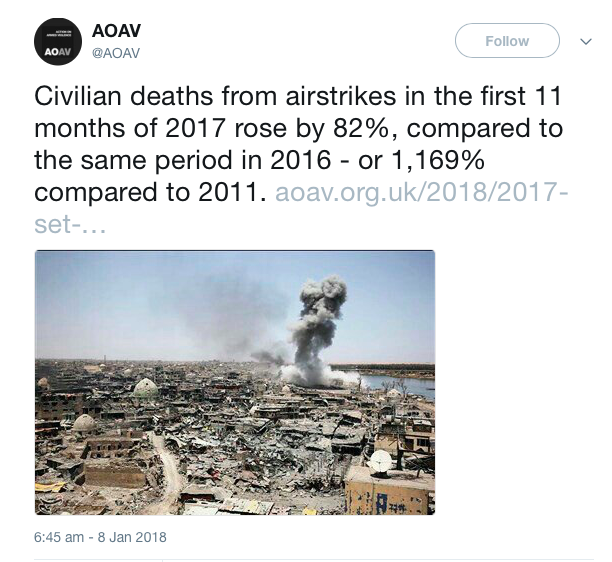
Civilian deaths from airstrikes in this 11-month period was 8,932 – an increase of 82% compared to the same period in 2016 when 4,902 civilians were killed, or 1,169% compared to 2011, when 704 died.

Significantly, as airstrikes are almost always used by State actors, rather than non-State groups, States were responsible for the majority of civilian deaths from explosive weapons for the first time since our records began.

Iain Overton, Executive Director of AOAV commented:

 These are stark figures that expose the lie that precision-guided missiles as used by State airforces do not lead to massive civilian harm. When explosive weapons are used in towns and cities, the results are inevitable: innocent children, women and men will die.

In the same vein, Karen McVeigh‘s summary for the Guardian quotes Chris Woods from Airwars:

This is about urban warfare and that’s why we are getting crazy numbers… War is moving into cities. It doesn’t matter whether it’s Russia or the US-led coalition or ground forces leading the assault, the outcome for civilians under attack is always dire…. We’re becoming too complacent about urban warfare, and militaries and governments are downplaying the effects.

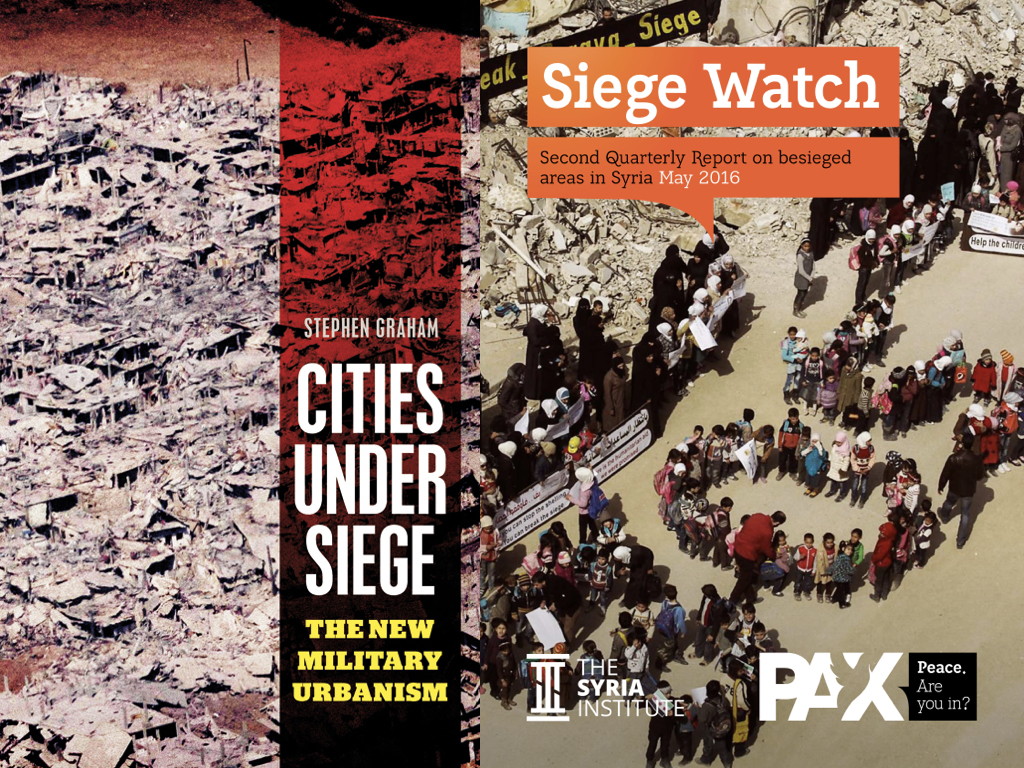
I think that’s right, though I also think war is moving back into the cities (if it ever left them); the serial military operations in Mosul and Raqqa are vivid examples of what Chris means, but they also recall the assaults on Fallujah and other cities documented in Steve Graham‘s still utterly indispensable Cities under siege.

The point is sharpened even further if we widen the angle of vision to take in air campaigns conducted by other air forces: the Syrian Arab Air Force and the Russian Air Force in Syria, or the Saudi-led coalition in Yemen.

Yet again, killing cities to save them.  As a spokesperson for Raqqa is Being Slaughtered Silently put it last summer, ‘This is very similar to the Vietnam war, where entire cities were destroyed… What is happening in Raqqa is like dropping a nuclear bomb in stages.’

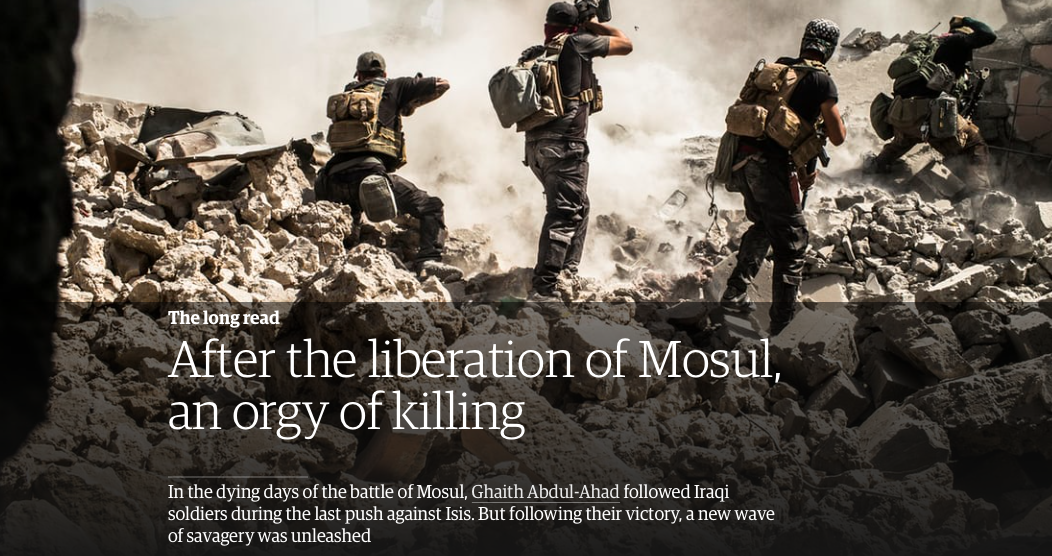
Steve’s work should also remind us that these dead cities are not produced by air strikes alone.  Once reduced to rubble they have often been disembowelled (I can think of no better word) by ground forces; it’s as though these now barely human landscapes compel or at any rate license the continued degradation of both the living and the dead:  see, for example, Kenneth Rosen on ‘The Devil’s Henchmen’ here or  Ghaith Abdul-Ahad‘s chillingly detailed report on the aftermath of the liberation of Mosul here.

I’m still astonished that all those high-minded theoretical debates on planetary urbanism somehow ignore the contemporary intensification of urbicide and urban warfare (see ‘Mumford and sons’ here).

Climate change and the war in the Syria

For those of you interested in the debate over global climate change and the war in Syria, there is an important exchange published online in Political Geography 60 (2017).  It starts with an essay by Jan Selby, Omar Dahi, Christiane Frölich and Mike Hulme, ‘Climate change and the Syrian civil war revisited‘:

For proponents of the view that anthropogenic climate change will become a ‘threat multiplier’ for instability in the decades ahead, the Syrian civil war has become a recurring reference point, providing apparently compelling evidence that such conflict effects are already with us. According to this view, human-induced climatic change was a contributory factor in the extreme drought experienced within Syria prior to its civil war; this drought in turn led to large-scale migration; and this migration in turn exacerbated the socio-economic stresses that underpinned Syria’s descent into war. This article provides a systematic interrogation of these claims, and finds little merit to them. Amongst other things it shows that there is no clear and reliable evidence that anthropogenic climate change was a factor in Syria’s pre-civil war drought; that this drought did not cause anywhere near the scale of migration that is often alleged; and that there exists no solid evidence that drought migration pressures in Syria contributed to civil war onset. The Syria case, the article finds, does not support ‘threat multiplier’ views of the impacts of climate change; to the contrary, we conclude, policymakers, commentators and scholars alike should exercise far greater caution when drawing such linkages or when securitising climate change.

Several of those whose work is criticised in the essay respond: Colin Kelley, Shahrzad, Mark Cane, Richard Seager and Yochanan Kushnir (their original contribution ‘claim[s] climate as one of many contributing factors to the unrest’ and ‘nothing [in the critique] refutes this, and none of their supportable arguments even offer reason for doubting this view’), and Peter Gleick (‘While the authors note in a few places that the research studies they critique do not typically claim that climate change “caused” the Syrian unrest, they themselves regularly repeat that very argument as a strawman that they then try to debunk’).

There’s also a blue-helmet response from Cullen Hendrix:

I fear getting the Syrian case “right” – or at least correcting a flawed dominant narrative – will negatively affect discussions of environmental impacts on conflict in the policy sphere. Many will read this article as “all this talk of climate change and conflict is wrong,” when in fact the evidence supports a much more limited conclusion: the impact of climatic factors on the Syrian civil war is not entirely clear. But the dramatic nature of the Syrian civil war and the vocal nature of those linking it to climate change have caused this case to exert inordinate influence on how influential non-specialists and the general public view the relationship between climate change and conflict.

There’s also a robust rejoinder from the original authors:

Firstly, we wish to emphasise that nothing in our analysis or our other writings questions the fact of anthropogenic climate change (though this really should go without saying) [Sadly it doesn’t: see here]. Second, we wish to note that, though some may read our article as evidence that ‘all this talk of climate change and conflict is wrong’, as Hendrix fears, this is not our view. Most academic studies of climate-conflict linkages are much more careful in their use of evidence, and on issues of causation, than the studies interrogated here. Moreover, though there is room for debate on where, when and howclimate change will affect conflict, we do not doubt that it will do so. Given the scale and the range of challenges posed by global climate change, it would frankly be incredible if it did not have some significant conflict implications.

And yet there is a long, sad history of people making overblown claims about climate change and conflict, the Syria example – and Al Gore’s recent extension of it to explain the UK’s vote to exit the European Union – being clear cases in point. Climate conflict discourse has historically been much more policy- and media-than research-led, and indeed policymakers and journalists often show scant regard for academic nuance on these issues (see e.g. Selby & Hoffmann, 2014). In the Syria case, this problem has been accentuated by the readiness of certain natural scientists, most prominently the authors of Kelley et al. (2015), to feed this un-nuanced policy and public discourse while using evidence casually and failing to engage with relevant social scientific research. To this extent the main implication of our analysis is simple: that far greater care is required, since without such care there really is a risk of climate conflict talk fuelling climate scepticism.

My sound-bites don’t do justice to the debate, nor to its importance.

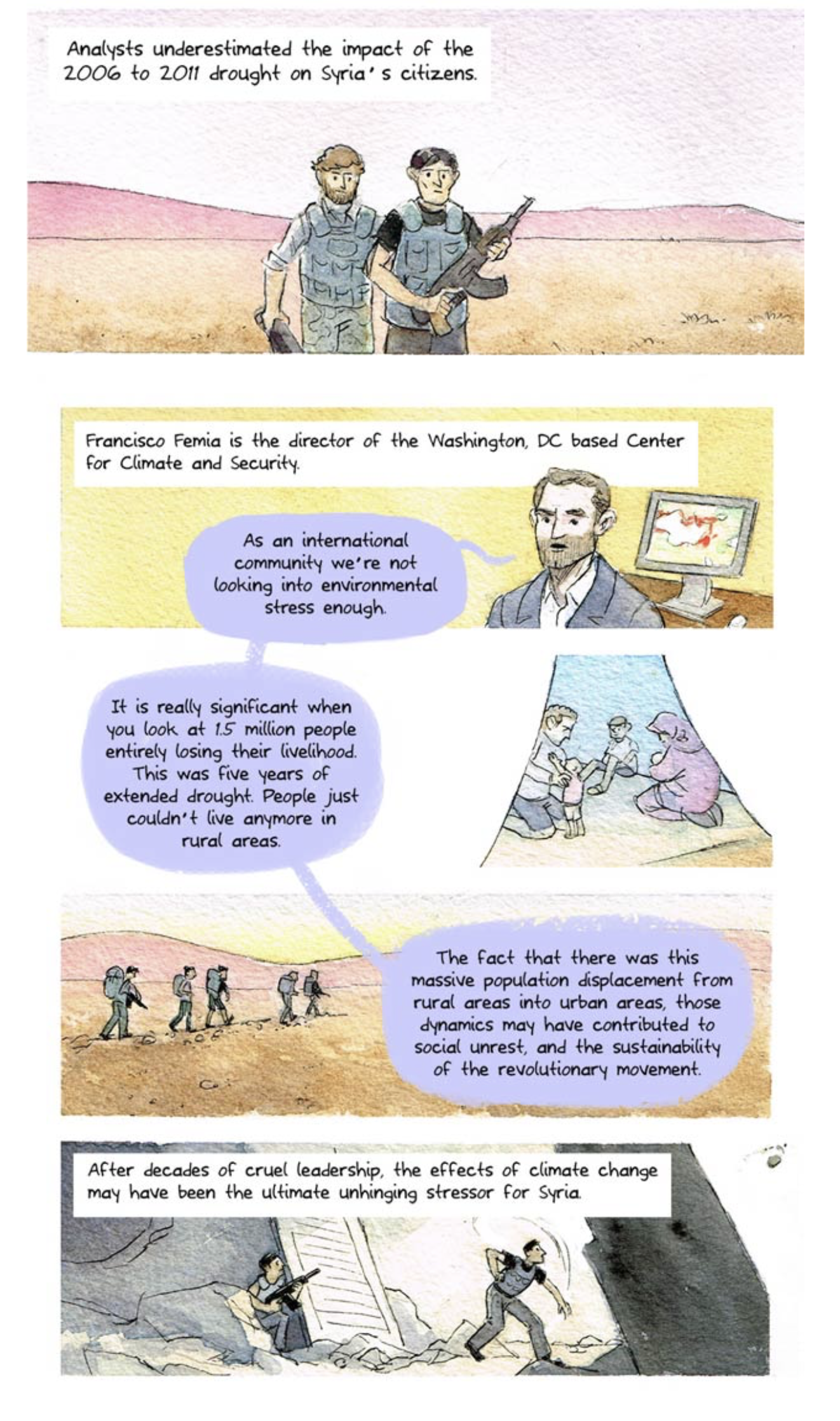
There’s also a commentary from the Center for Climate & Security (‘a non-partisan policy institute’ whose Advisory Board is stacked with Admirals and Generals: even if the Trump administration dismisses global climate change as a hoax invented by the Chinese, the Pentagon certainly doesn’t) here.

More on CCS from the Washington Post here.  The CCS was cited approvingly in a comic, “Syria’s Climate Conflict” (2014), produced by Years of Living Dangerously and Symbolia Magazine; you can access it via Mother Jones here.

If, like me, you wonder about the methodologies on which these arguments and counter-arguments rest, I recommend Thomas Ide, ‘Research methods for exploring the links between climate change and conflict‘, Wiley Interdisciplinary Reviews: Climate Change 8 (3) (2017) to jump-start the debate.

Other Dunkirks

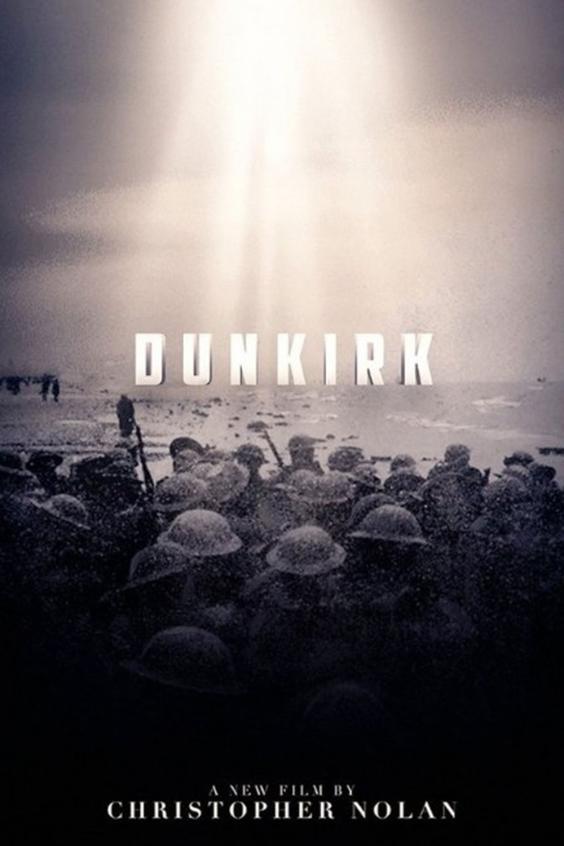
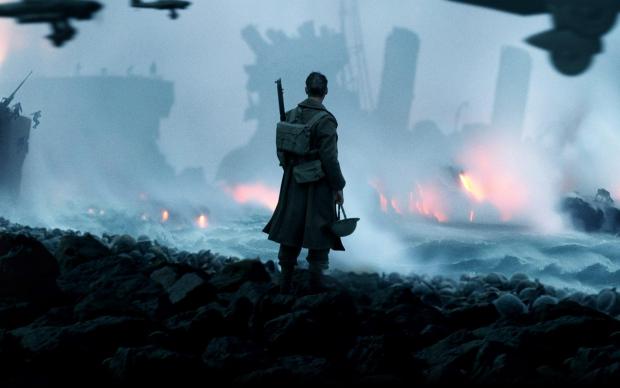
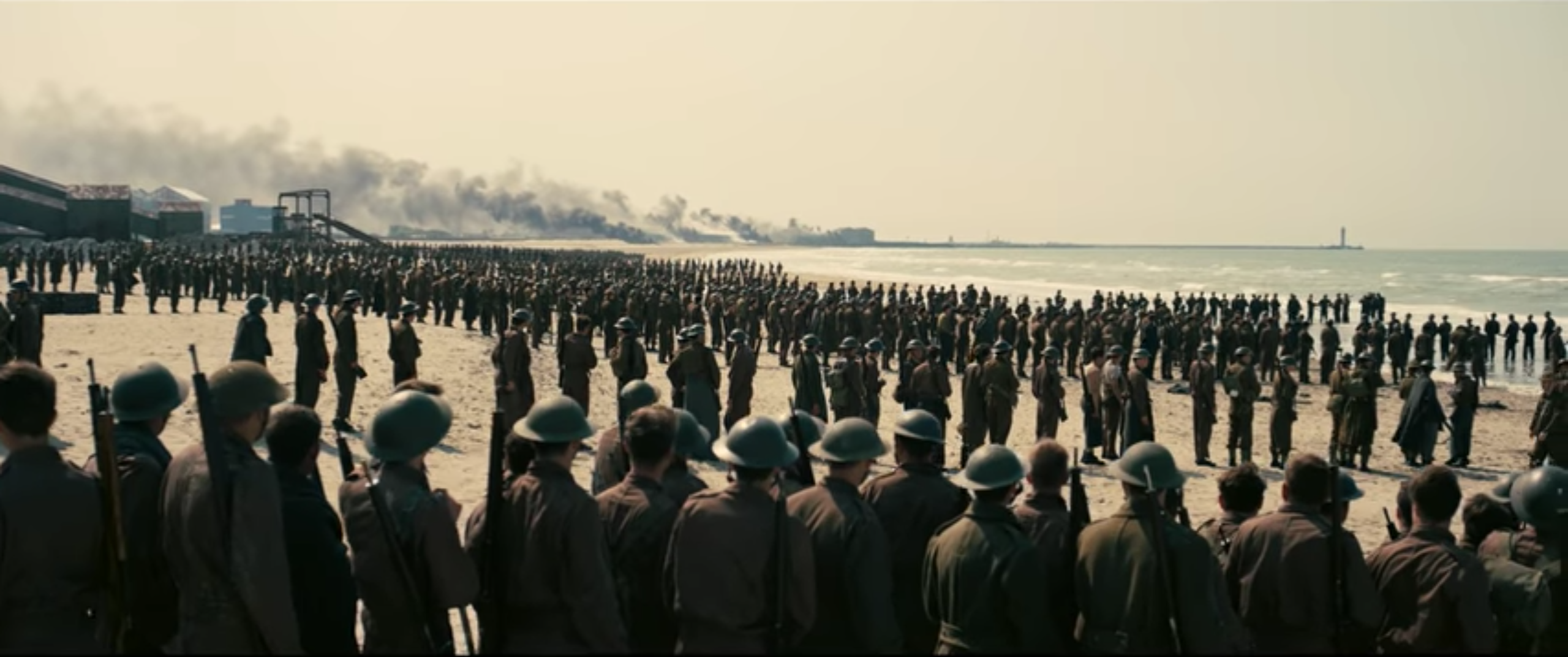
The web is awash with reviews and commentaries on Christopher Nolan‘s latest film, Dunkirk.  ‘A tour de force’, wrote Manhola Dargis in an extended review for the New York Times:

“Dunkirk” is a World War II movie, one told through soldiers, their lived and near-death experiences and their bodies under siege. Names are generally irrelevant here; on the beach — and in the sea and air — what counts are rank, unit, skill and the operation, although more important is survival, making it through another attack and somehow avoiding exploding bombs. Mr. Nolan’s emphasis on the visceral reality of Dunkirk leaves much unsaid; even in some opening explanatory text, the enemy isn’t identified as Nazi Germany. The soldiers, of course, know exactly who they are fighting and perhaps even why, but in the field the enemy is finally the unnamed stranger trying to kill them…

Mr. Nolan’s unyielding emphasis on the soldiers — and on war as it is experienced rather than on how it is strategized — blurs history even as it brings the present and its wars startlingly into view. “Dunkirk” is a tour de force of cinematic craft and technique, but one that is unambiguously in the service of a sober, sincere, profoundly moral story that closes the distance between yesterday’s fights and today’s. Mr. Nolan closes that distance cinematically with visual sweep and emotional intimacy, with images of warfare and huddled, frightened survivors that together with Hans Zimmer’s score reverberate through your body.

In the Guardian Peter Bradshaw also made much of the film’s visceral quality, rendered aurally as much as visually (and we surely know that the sound of war is crucial to its horror):

It also has Hans Zimmer’s best musical score: an eerie, keening, groaning accompaniment to a nightmare, switching finally to quasi-Elgar variations for the deliverance itself. Zimmer creates a continuous pantonal lament, which imitates the dive bomber scream and queasy turning of the tides, and it works in counterpoint to the deafening artillery and machine-gun fire that pretty much took the fillings out of my teeth and sent them in a shrapnel fusillade all over the cinema auditorium.

In the Telegraph, hardly surprisingly, Robbie Collin lauds the ‘Britishness’ of the film and also (significantly) its presentness.  He writes about this as an aesthetic –

there’s also something rivetingly present-tense about it all: the period detail is meticulous but never fawned over, the landscapes as crisp as if you were standing on them, the prestige-cinema glow turned off at the socket

– but, as readers of the Telegraph will surely have realised, this is also a matter of politics.  In one of the most perceptive essays I’ve read on the film, Anthony King describes this sensibility as an ‘arrogant insularity’ (he intends it as a criticism, of course, but Telegraph readers probably differ).  For him, Nolan seeks to ‘revive Dunkirk as a national myth in the 21st century’:

The drama focuses on five sinkings: a hospital ship, two troop ships, a fishing boat, and a Spitfire are all immersed. In each case, British soldiers or airmen have only moments to escape before they are drowned. Each sinking re-enacts the British predicament at Dunkirk: the desperate race of British soldiers to get home before they are inundated.

In this way, home — and the race for it — becomes the central motif of the entire film. The noun, “home,” recurs in the dialogue articulated by all the major actors. Indeed, the irony that soldiers in Dunkirk can practically see home with its White Cliffs and, yet, cannot reach it, is pointedly commented upon on two separate occasions. Home is the only redemption from the alienating emptiness of the French coast. Moreover, in order for British soldiers to escape, home has to come to them. No one else can save them.

(This is precisely why what Anthony calls the ‘radiant harmonies’ of Elgar’s Nimrod dissolve the dissonance noted by Peter Bradshaw to preside over – to celebrate in something like the religious sense – the climax of the film).

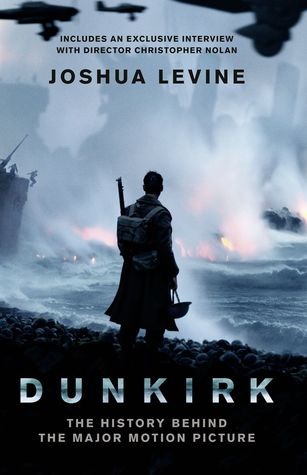
What is lost, in consequence, is both context and also composition.  The first is intentional, and Nolan makes a good case for wanting to convey the sense in which soldiers experience war in shards, torn from any larger context.  ‘That’s why we don’t see the Germans in the film,’ he says, ‘and why it’s approached from the point of view of the pure mechanics of survival rather than the politics of the event.’  As the historical adviser to the film, Joshua Levine (an historian whose work I’ve long admired) tells it:

[M]aking the threat faceless frees the event from its geopolitical ramifications –it becomes a timeless story of human survival. [Nolan] didn’t want to take a classic war film approach because in so many ways, the story of Dunkirk is not the story of a conventional battle. ‘It was death appearing from the sky,’ he says. ‘U-boats under the Channel that you can’t see. The enemy flying over and rising up through the waves to pick people off, to sink ships.’ The soldiers cannot understand their own predicament, and the audience experiences the same horror. This is why the action never leaves the beach. ‘If you’re continually showing the Germans as Germans and generals in rooms talking about strategy, you are lifting the veil.’ The audience would then be more informed than the soldiers. ‘Standing on a beach, trying to interpret what’s going on, “How do I get out of here? Should I stand in these lines? Should I go into the water?” That’s the experiential reality I want the audience to share.

But the second is, I think, unintentional.  I’ve written elsewhere about the myths of the First World War that continue to stalk the British political imaginary – see ‘All white on the Western Front?’ here – and several commentators have made the same point about Dunkirk.  Here is Sunny Singh in the Guardian:

What a surprise that Nigel Farage has endorsed the new fantasy-disguised-as-historical war film, Dunkirk. Christopher Nolan’s movie is an inadvertently timely, thinly veiled Brexiteer fantasy in which plucky Britons heroically retreat from the dangerous shores of Europe. Most importantly, it pushes the narrative that it was Britain as it exists today – and not the one with a global empire – that stood alone against the “European peril”.

To do so, it erases the Royal Indian Army Services Corp companies, which were not only on the beach, but tasked with transporting supplies over terrain that was inaccessible for the British Expeditionary Force’s motorised transport companies. It also ignores the fact that by 1938, lascars – mostly from South Asia and East Africa – counted for one of four crewmen on British merchant vessels, and thus participated in large numbers in the evacuation.

But Nolan’s erasures are not limited to the British. The French army deployed at Dunkirk included soldiers from Morocco, Algeria, Tunisia and other colonies, and in substantial numbers. Some non-white faces are visible in one crowd scene, but that’s it. The film forgets the racialised pecking order that determined life and death for both British and French colonial troops at Dunkirk and after it.

And here is Yasmin Khan in the New York Times:

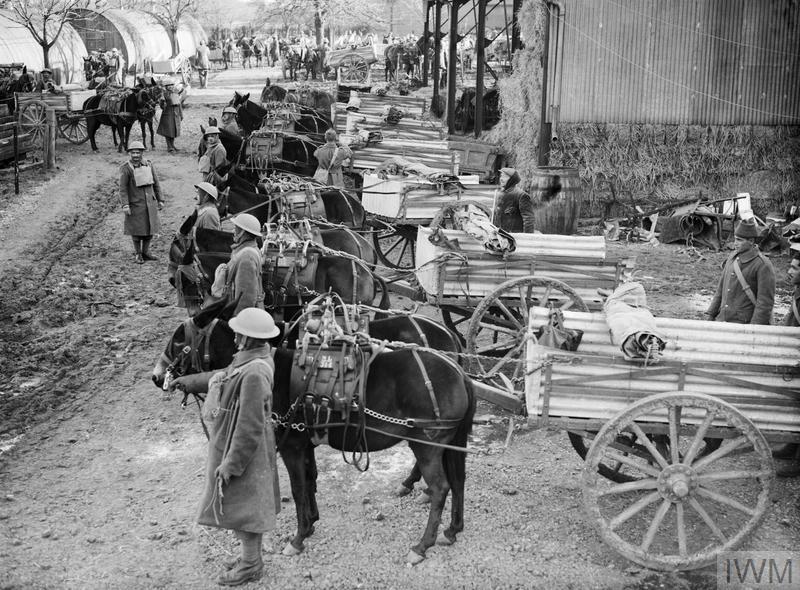
The Indian soldiers at Dunkirk were mainly Muslims from areas of British India that later became Pakistan. They were part of the Royal India Army Service Corps — transport companies that sailed from Bombay to Marseille. The men brought with them hundreds of mules, requested by the Allies in France because of the shortage of other means of transport. They played a significant role, ferrying equipment and supplies.

The Germans captured one Indian company and held the men as prisoners of war. Others were evacuated and made it to Britain….

The focus on Britain “standing alone” sometimes risks diminishing how the war brought pain in many places, right across the globe. The war, especially when viewed from the East, was about two empires locking horns rather than a nation taking on fascism. Above all, the narrative of a plucky island nation beating back the Germans omits the imperial dimension of the war. Many people living in the colonies were caught up in a vicious conflict beyond their control.

 Britain was always dependent on the colonies — in India, Southeast Asia, Africa and the Caribbean — for men, materials and support, but never more so than in World War II. Some five million from the empire joined the military services. Britain didn’t fight World War II — the British Empire did…
The myth of Dunkirk reinforces the idea that Britain stood alone. It is a political tool in the hands of those who would separate British history from European history and who want to reinforce the myths that underpin Brexit.
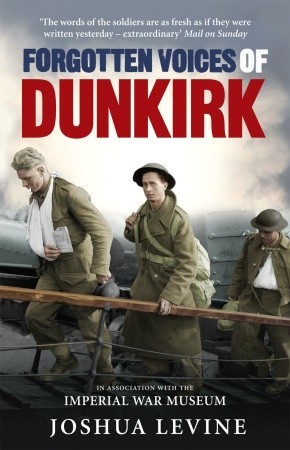
Ironically, in Joshua Levine‘s Forgotten voices of Dunkirk those other voices are absent – forgotten – too.
There are several other commentaries that sharpen similar points – see, for example, Yasmin Khan again here [and more generally her The Raj at War: a people’s history of India’s Second World War],  Ishaan Taroor here and Robert Fisk here (for a clumsy attempt to blunt those points, see Franz Stefan-Gady here); also the contributions to We Were There Too – but I’ll end with these observations from John Broich:

In the film, we see at least one French soldier who might be African. In fact, soldiers from Morocco, Algeria, Tunisia, and elsewhere were key to delaying the German attack. Other African soldiers made it to England and helped form the nucleus of the Free French forces that soon took the fight to the Axis.

THE BRITISH ARMY IN FRANCE 1940 (F 2478) Members of a mule transport company of the Royal Indian Army Service Corps on parade, 10 February 1940. Copyright: © IWM. Original Source: http://www.iwm.org.uk/collections/item/object/205204868

The latter has been much on my mind because for much of the summer I’ve been in the archives immersed in medical care and casualty evacuation in both those theatres.

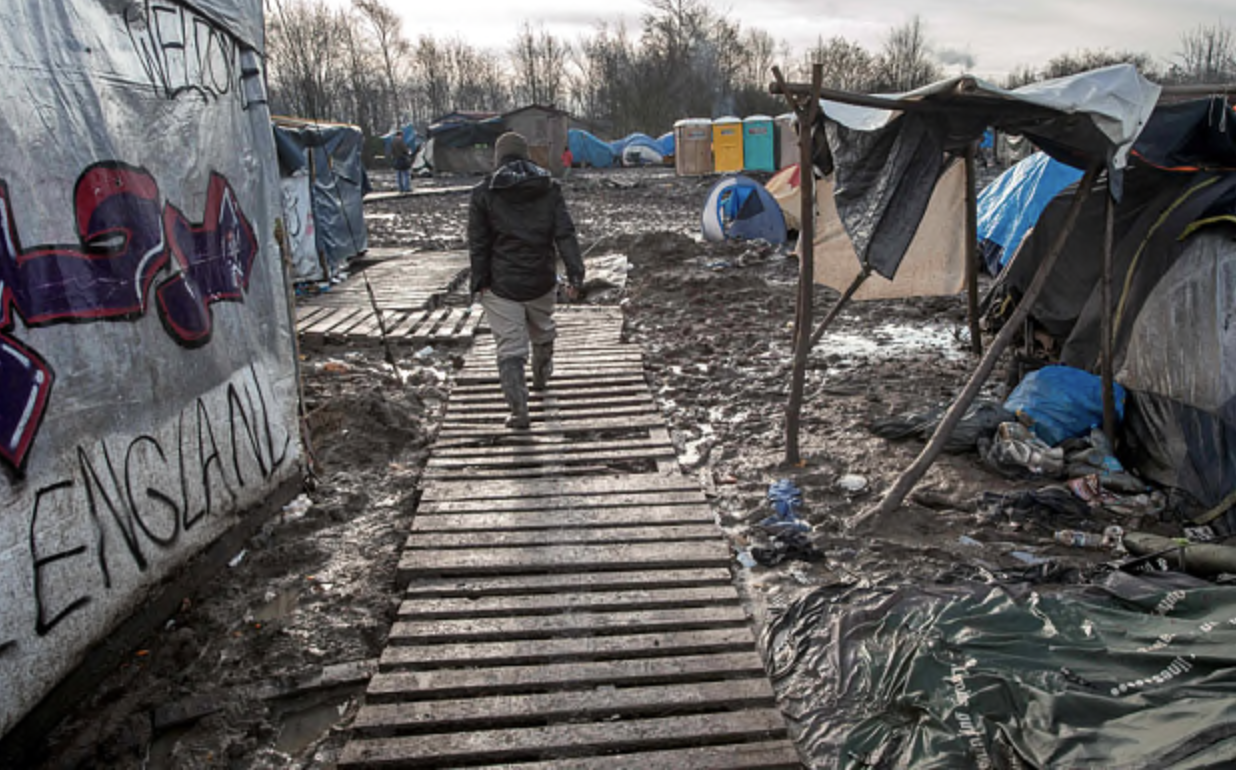
But I’ll leave that for another post, because I want to close with a reminder that – given what I’ve been saying about the ‘present-ness’ of Dunkirk – there is at least one other version that should be brought into focus.  And for that you need to read Jacob Albert on ‘The Fire in Dunkirk‘ at Guernica.  Here he is describing young Kurdish refugees – about the same age, I suspect, as many of those soldiers on the beach in 1940 – stranded in a camp outside Dunkirk (it burned down after he left):

Sometimes, they went to English class, offered four times a day in a damp Red Cross tent. I taught there occasionally. Everyone took their shoes off when they entered, but kept their coats. The head teacher was an Englishman with stinking socks who asked his pupils several times each week, since they were always vanishing and new ones always arriving: “Where? Is? The? Statue? Of Liberty?”

Everyone loved that one, even though no one was heading for the United States, because the Statue of Liberty is like Coca-Cola: both universal symbols, one of immigrant striving, the other of friendship and global happiness.

“Amrika! Atlantic! New York! California!” they’d shout. The teacher would smile and ask: “What does the Statue of Liberty rep-re-sent?” And the young men would look at him with glazed eyes, because they truly could never understand this guy, never felt like they were learning any English, and the English teacher would hem and haw: “What does it mean? What does it sym-bo-lize?” until finally, someone who spoke a little English, someone who had a brother in Leeds, would explain to the others, in Kurdish, what the guy meant, and everyone would shout: “Amrika! Freedom! Money! Barack Obama!” and the English teacher with the stinking socks would nod somberly at each and every one of them, and say, “It represents a Warm Welcome. Which I know doesn’t feel like the case. So, to better times, guys. To better times.” And with that, the English teacher would clap his hands, and the bored young men would stream out into the wind or rain…

There was nothing for them to do but think of leaving. That’s how anyone endured anything: boredom, filth, cold, fear. You can endure anything if you’re on your way to somewhere else.

In this case, it was England, which I discovered wondrous new things about. I learned that the Brits had an incredible welfare system, the best in Europe. I learned that minimum wage there was higher than in France. I learned that once you received British asylum, you were given a free house. I was told that the UK was full of good jobs, that it was less racist than any other European nation. That none of this was true didn’t dampen anybody’s incredible enthusiasm for the place. …

There were convincing reasons, too, with some basis in reality, for this fevered dreaming of Britain, which I had a hard time squaring with what these hopeful Kurds were putting themselves through to get there. It is easier to live invisibly in Britain, on the margins of things, than in France. In Britain, you don’t have to carry around photo ID. In Britain, you can easily find work in a kitchen or on a construction crew, if you’re open to being paid a pittance.

But facts are one thing, and narratives, another. The city of Dunkirk itself looms large in British mythology because of this very split. Over the course of one miraculous week in 1940, the British Navy managed to evacuate 340,000 Allied troops trapped on its beaches as the Germans drew close. Yet a few days later, Churchill delivered his rousing speech on the British virtues of endurance and determination (“We shall fight on the beaches, we shall fight on the landing grounds. . .”), and Dunkirk, the site of failure averted, was turned into one of national victory. It was Britain that now occupied such a place in the story of Kurdish exile.

You may think I’m making too much of this.  But when Joshua Levine asked him about ‘modern parallels’, Christopher Nolan explained that he saw his film as ‘a survival story’ and continued:

One of the great misfortunes of our time, one of the horrible, unfortunate things with the migrant crisis in Europe, is that we are dealing once more with the mechanics and the physics of extraordinary numbers of people trying to leave one country on boats and get to another country. It’s a horrible resonance but it’s very easy in our technologically advanced times to forget how much basic physics come into play. Reality is insurmountable. If you have a vast number of people in one place and they need to get someplace else and they can’t fly and they have to get on boats –to overcrowd the boats, with that human desire for survival . . . it’s unthinkably horrible to see it on our front pages in this modern day and age. But it’s there. With that going on in the world today, I don’t think you can in any way dismiss the events of Dunkirk as being from another world or another era.

‘I saw my city die’

I’ve been in Copenhagen and in Nijmegen talking about the war in Syria, presenting both updated versions of The Death of the Clinic (on attacks on hospitals and medical facilities: see here, here and – for my first update – here) and a new presentation, Cities under siege in Syria.

The new presentation ties those violations of medical neutrality – bluntly, war crimes – into the conduct of siege warfare in Syria and elsewhere and tries to recover the experiences and survival strategies of people and communities living under those desperate conditions (a far cry from my good friend Steve Graham‘s ‘new military urbanism‘, and a catastrophic combination of spectacular, episodic violence through bombing and shelling, and the slow violence of deprivation, dislocation and starvation).

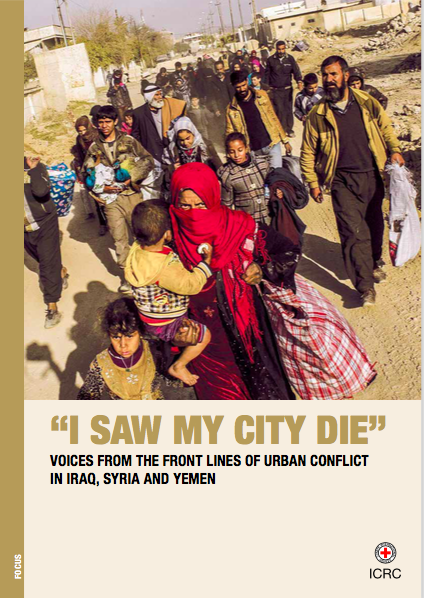
More on this soon, but on Thursday the International Committee of the Red Cross issued a remarkable report, I saw my city die, which is accompanied by an immersive microsite.  If you scroll to the end of the microsite, you’ll be asked to submit your e-mail for a link to the downloadable pdf of the report (I’ve just discovered you can also access it here).  More from the ICRC on the report here and here.

The report focuses on Iraq, Syria and Yemen, and includes wrenching first-hand testimonies:

The three conflicts in the report – Iraq, Syria and Yemen – account for around half of all conflict-related casualties worldwide between 2010 and 2015.

Some 17.5 million people have fled their homes, creating the largest global refugee and migration crisis since World War II.  11.5 million people – more than three people per minute – have fled their homes in Syria alone, since the start of the war.

It is not only lives and homes that are destroyed in these conflicts. The increasing use of explosive weapons that have wide impact areas, decimate the complex systems of services such as electricity, water, sanitation, garbage collection and health-care that civilians rely on to survive, making an eventual return to these cities even harder for those who have fled.

“The majority of people had very little choice and felt it was best to leave,” said Marianne Gasser, Head of ICRC’s Delegation in Syria. “Their houses were turned to rubble; there was very little food and no water or electricity. Not to mention the violence they had been witnessing for so long; no one could be expected to endure such suffering.”

This is a just preliminary notice: I’ll have much more to say when I’ve had a chance to read all this and think some more, so watch this space (and their space).

Bombs, bunkers and borders

Here is the first of a series of updates on Syria, this one identifying recent work on attacks on hospitals and health care which I’ve been reading while I turn my previous posts into a long-form essay (see ‘Your turn, doctor‘ and ‘The Death of the Clinic‘).

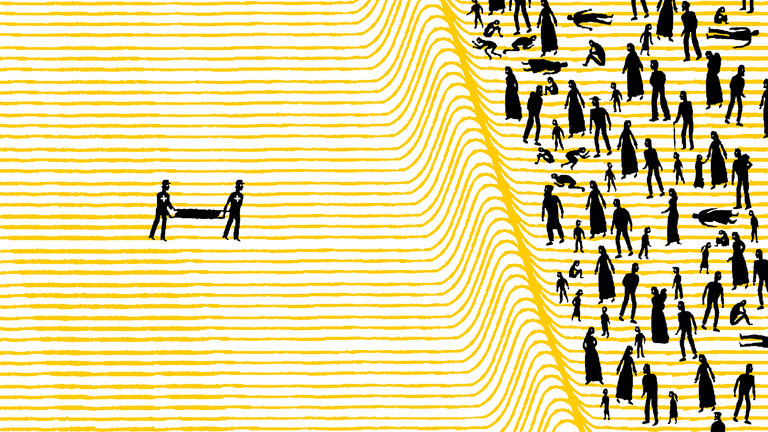
First, some context.  Human Rights Watch has joined a chorus of NGOs documenting attacks on hospitals and health care around the world.  On 24 May HRW issued this bleak statement:

Deadly attacks on hospitals and medical workers in conflicts around the world remain uninvestigated and unpunished a year after the United Nations Security Council called for greater action, Human Rights Watch said today.

On May 25, 2017, UN Secretary-General Antonio Guterres is scheduled to brief the Security Council on the implementation of Resolution 2286, which condemned wartime attacks on health facilities and urged governments to act against those responsible. Guterres should commit to alerting the Security Council of all future attacks on healthcare facilities on an ongoing rather than annual basis.

“Attacks on hospitals challenge the very foundation of the laws of war, and are unlikely to stop as long as those responsible for the attacks can get away with them,” said Bruno Stagno-Ugarte, deputy executive director for advocacy at Human Rights Watch. “Attacks on hospitals are especially insidious, because when you destroy a hospital and kill its health workers, you’re also risking the lives of those who will need their care in the future.”

The statement continues:

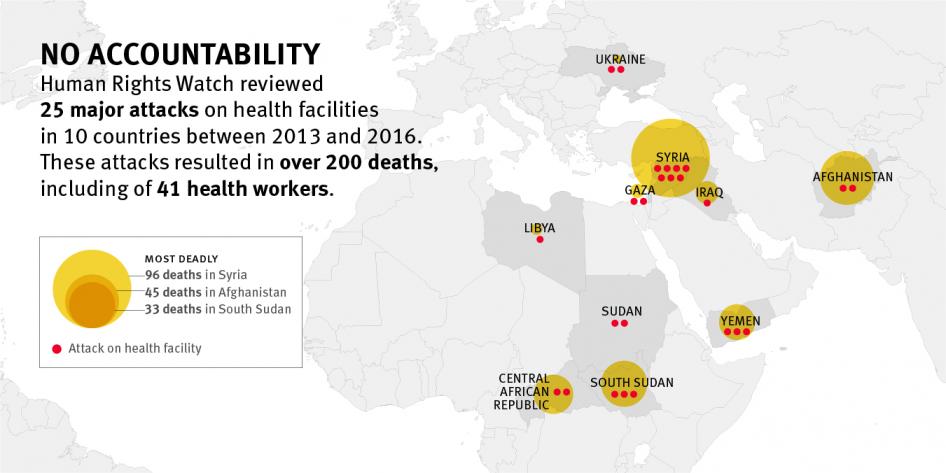
International humanitarian law, also known as the laws of war, prohibits attacks on health facilities and medical workers. To assess accountability measures undertaken for such attacks, Human Rights Watch reviewed 25 major attacks on health facilities between 2013 and 2016 in 10 countries [see map above]. For 20 of the incidents, no publicly available information indicates that investigations took place. In many cases, authorities did not respond to requests for information about the status of investigations. Investigations into the remaining five were seriously flawed…

No one appears to have faced criminal charges for their role in any of these attacks, at least 16 of which may have constituted war crimes. The attacks involved military forces or armed groups from Afghanistan, Central African Republic, Iraq, Israel, Libya, Russia, Saudi Arabia, South Sudan, Sudan, Syria, Ukraine, and the United States.

More here.

The World Health Organisation reached similar conclusions in its report of 17 May 2017:

Alexandra Sifferlin‘s commentary for Time drew attention to the importance of attacks on medical facilities in Syria:

In a 48-hour period in November, warplanes bombed five hospitals in Syria, leaving Aleppo’s rebel-controlled section without a functioning hospital. The loss of the Aleppo facilities — which had been handling more than 1,500 major surgeries each month — was just one hit in a series of escalating attacks on health care workers in 2016, the World Health Organization (WHO) reported on Friday.

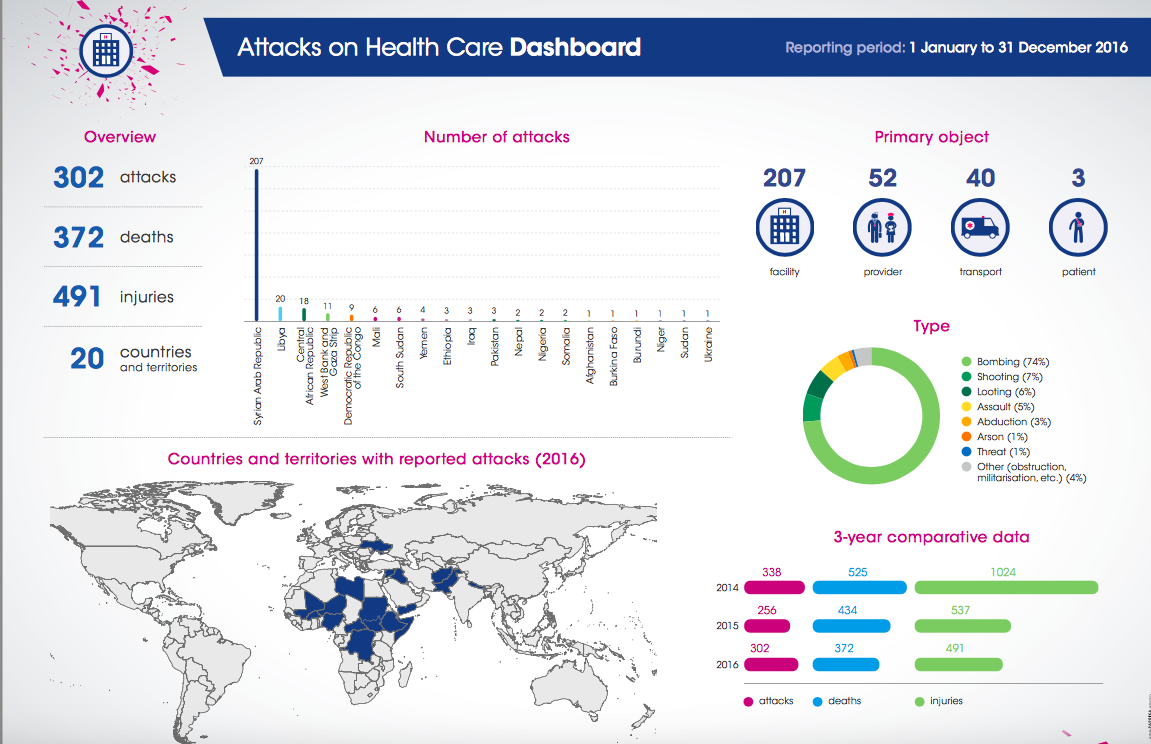
Violent attacks on hospitals and health workers “continue with alarming frequency,” the WHO said in its new report. In 2016, there were 302 violent attacks, which is about an 18% increase from the prior year, according to new data. The violence — 74% was in the form of bombings — occurred in 20 countries, but it was driven by relentless strikes on health facilities in Syria, which the WHO has previously condemned. Across the globe, the 302 attacks last year resulted in 372 deaths and 491 injuries…

After the spate of attacks on Syrian hospitals last November, the WHO reported that three of the bombed hospitals in Aleppo had been providing over 10,000 consultations every month. Two other bombed hospitals in the city of Idleb were providing similar levels of care, including 600 infant deliveries. One of the two hospitals in Idleb was a primary referral hospital for emergency childbirth care.

“The attack…is an outrage that puts many more lives in danger in Syria and deprives the most vulnerable – including children and pregnant women – of their right to health services, just at the time when they need them most,” the WHO said.

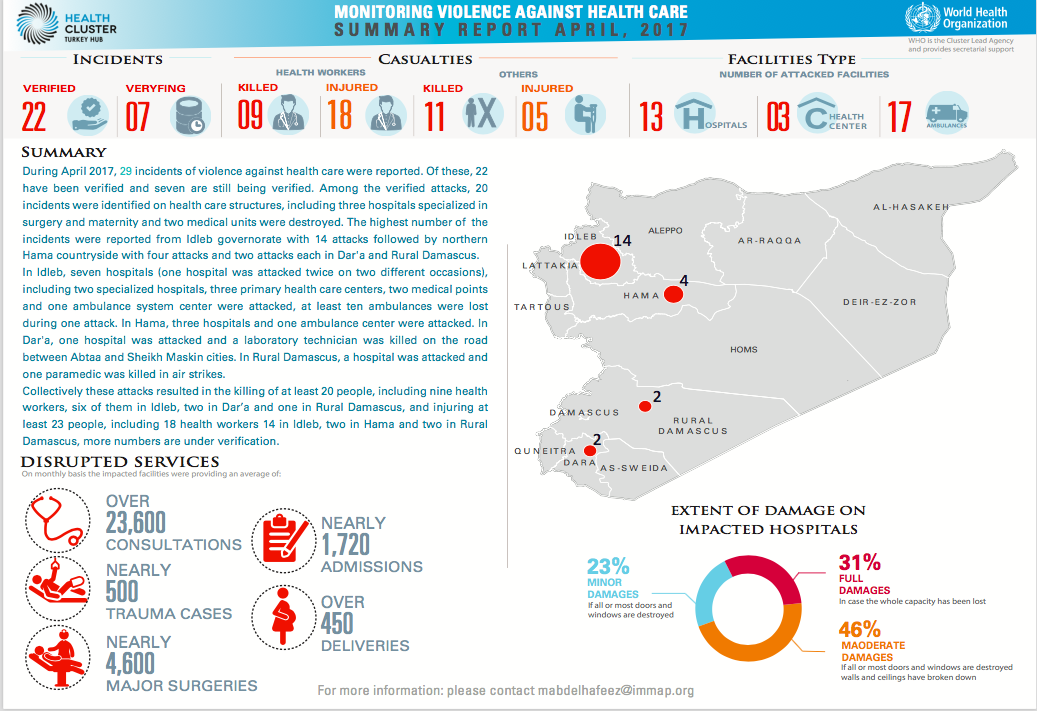
The WHO has also provided a series of reports on attacks on hospitals and health care in Syria; here is its summary for last month:

But the WHO’s role in the conflict in Syria has been sharply criticised by Annie Sparrow, who has accused it of becoming a de facto apologist for the Assad regime.  Writing in Middle East Eye earlier this year, she said:

For years now, the World Health Organisation (WHO) has been fiddling while Syria burns, bleeds and starves. Despite WHO Syria having spent hundreds of millions of dollars since the conflict began in March 2011, public health in Syria has gone from troubling in 2011 to catastrophic now…

Yet WHO Syria has been anything but an impartial agency serving the needy. As can be seen by a speech made by Elizabeth Hoff, WHO’s representative to Syria, to the UN Security Council (UNSC) on 19 November 2016, WHO has prioritised warm relations with the Syrian government over meeting the most acute needs of the Syrian people.

Annie singles out three particularly problematic issues.

  • She claims that the WHO parrots the Assad regime’s claim that before the conflict its vaccination programmes had covered 95 per cent of the population (or better), whereas she insists that vaccinations had been withheld from children ‘in areas considered politically unsympathetic, such as the provinces of Idlib, western Aleppo, and Deir Ezzor.’  On her reading, in consequence, the re-emergence of (for example) polio ‘is consistent with pre-existing low immunisation rates and the vulnerability of Syrian children living in government-shunned areas.’
  • It was not until 2016 that the WHO reported attacks on hospitals at all, and when its representative condemned ‘repeated attacks on healthcare facilities in Syria’ she failed to note that the vast majority of those attacks were carried out by the Syrian Arab Air Force and its Russian ally.  The geography of deprivation was erased: ‘It is only in opposition-held areas that healthcare is compromised because of the damage and destruction resulting from air strikes by pro-government forces.’
  • Those corpo-materialities – an elemental human geography, so to say – did emerge when the WHO accused the Assad regime of of ‘withholding approval for the delivery of surgical and medical supplies to “hard-to-reach” and “besieged” locations.’  But Annie objects to these ‘politically neutral terms’ because they are ‘euphemisms for opposition-controlled territory, and so [avoid] highlighting the political dimension of the aid blockages, or the responsibility of the government for 98 percent of the more than one million people forced to live in an area under siege.’

You can read WHO’s (I think highly selective) response here.

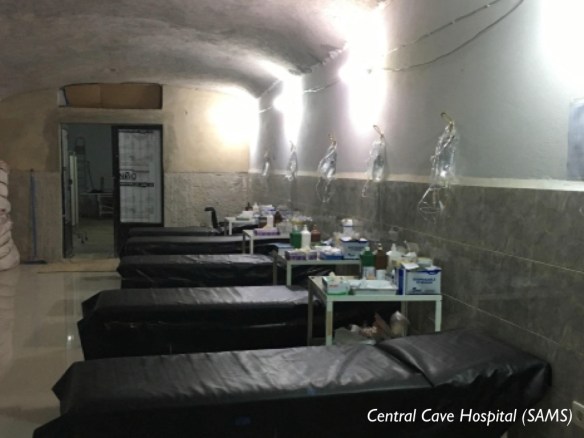
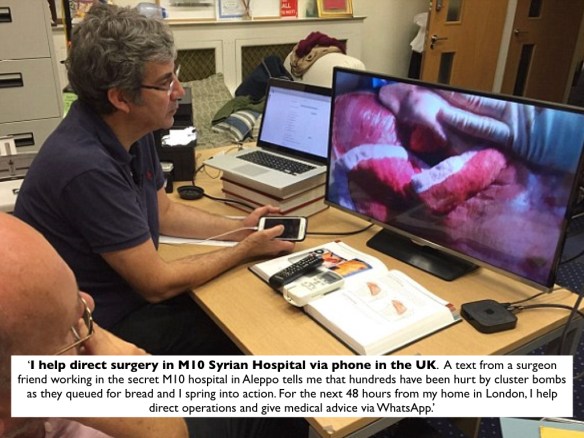
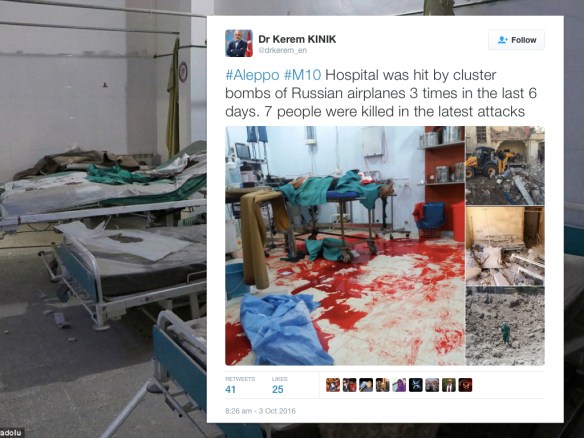
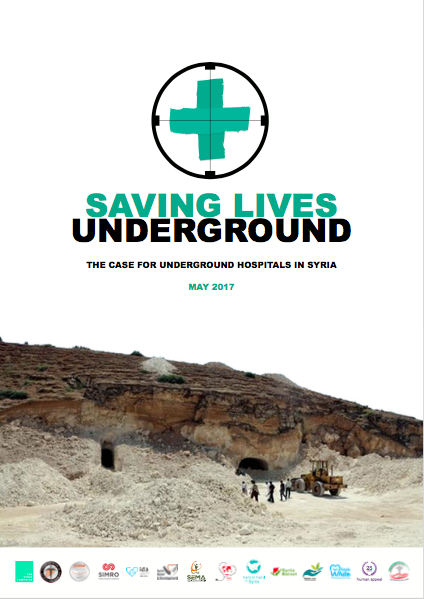
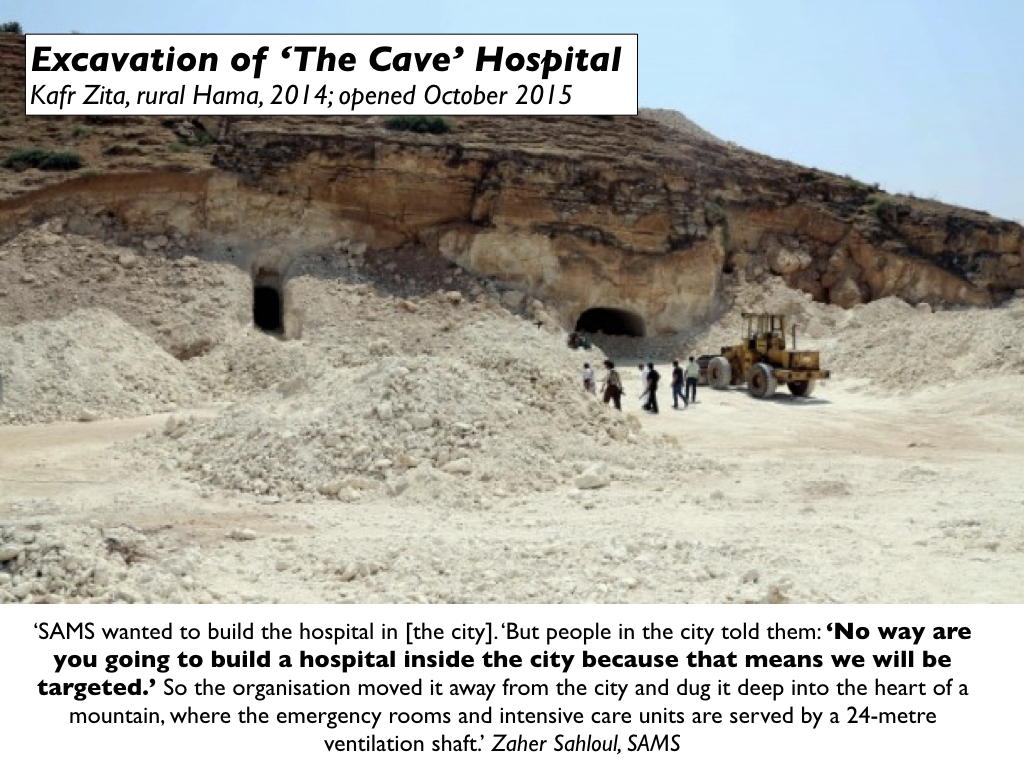
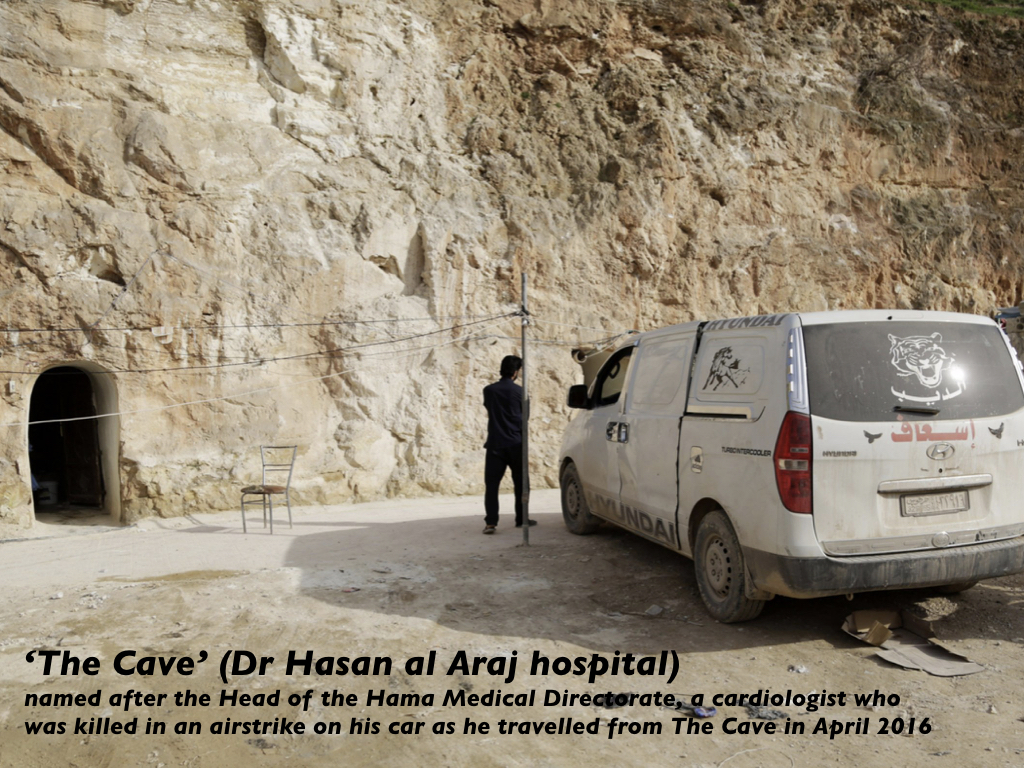
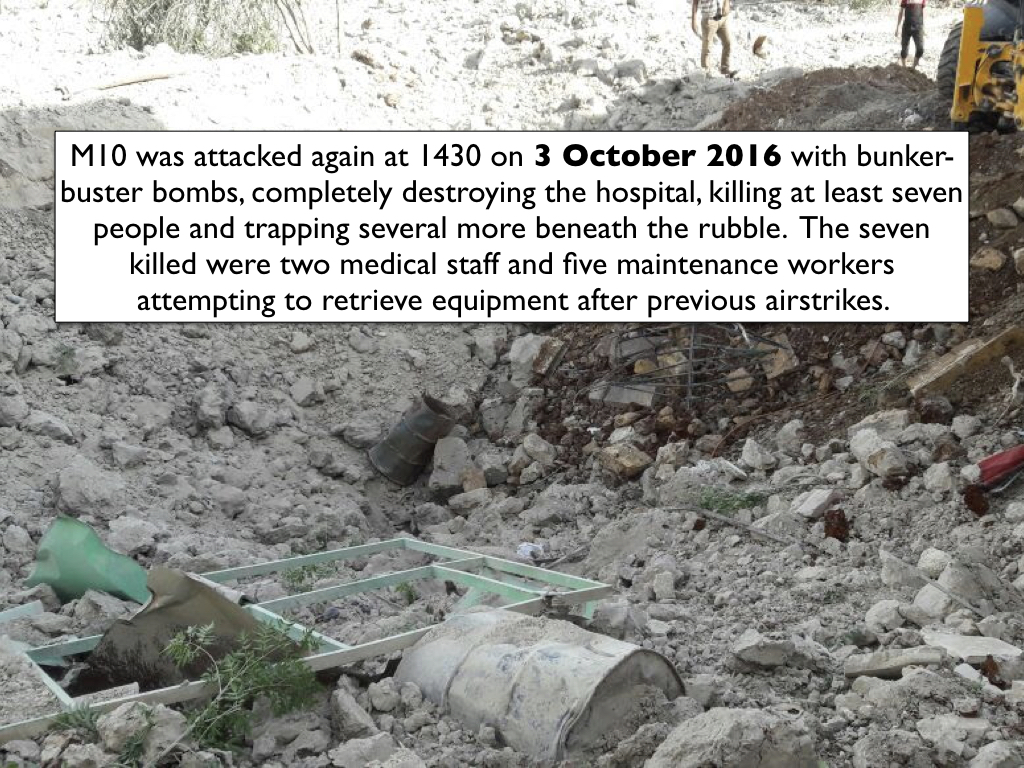
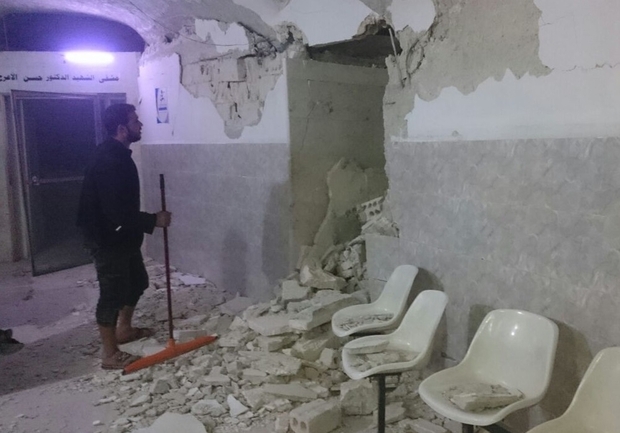
Earlier this month 13 Syrian medical organisations combined with the Syria Campaign to document how attacks on hospitals have driven hospitals and health facilities underground (I described this process – and the attacks on the Cave Hospital and the underground M10 hospital in Aleppo – in ‘Your turn, doctor‘).  In Saving Lives Underground, they write:

Health facilities in Syria are systematically targeted on a scale unprecedented in modern history.

There have been over 454 attacks on hospitals in the last six years, with 91% of the attacks perpetrated by the Assad government and Russia. During the last six months of 2016, the rate of attacks on healthcare increased dramatically. Most recently, in April 2017 alone, there were 25 attacks on medical facilities, or one attack every 29 hours.

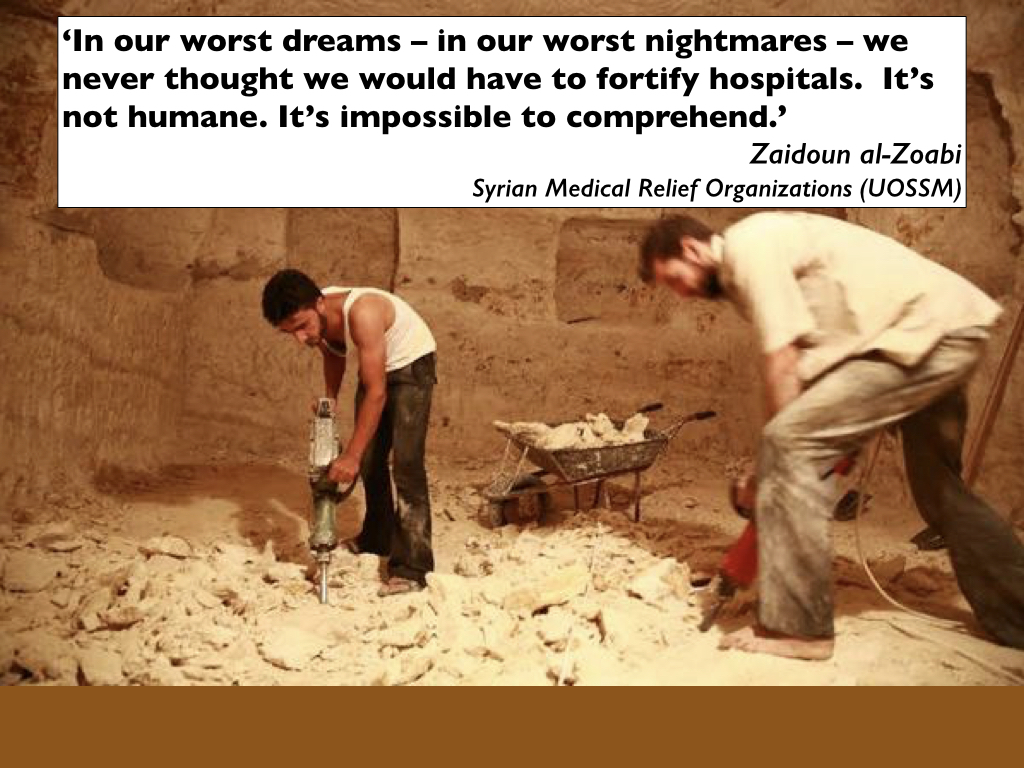
While the international community fails to protect Syrian medics from systematic aerial attacks on their hospitals, Syrians have developed an entire underground system to help protect patients and medical colleagues as best they can. The fortification of medical facilities is now considered a standard practice in Syria. Field hospitals have been driven underground, into basements, fortified with sandbags and cement walls, and into caves. These facilities have saved the lives of countless health workers and patients, preserved critical donor-funded equipment, and helped prevent displacement by providing communities with emergency care.

But all this comes at a cost:

Donors often see the reinforcement and building of underground medical facilities exclusively as long-term aid, or development work. However, as the Syria crisis is classified as a protracted emergency conflict, medical organizations do not currently have access to such long-term funds.

Budget lines for the emergency funding they receive can include “protection” work, but infrastructure building, even for protective purposes, often falls outside of their mandate. The divide between emergency humanitarian and development funding is creating a gap for projects that bridge the two, like protective measures for hospitals in Syria.

For this reason, as Emma Beals reported in the Guardian, many projects have resorted to crowdfunding:

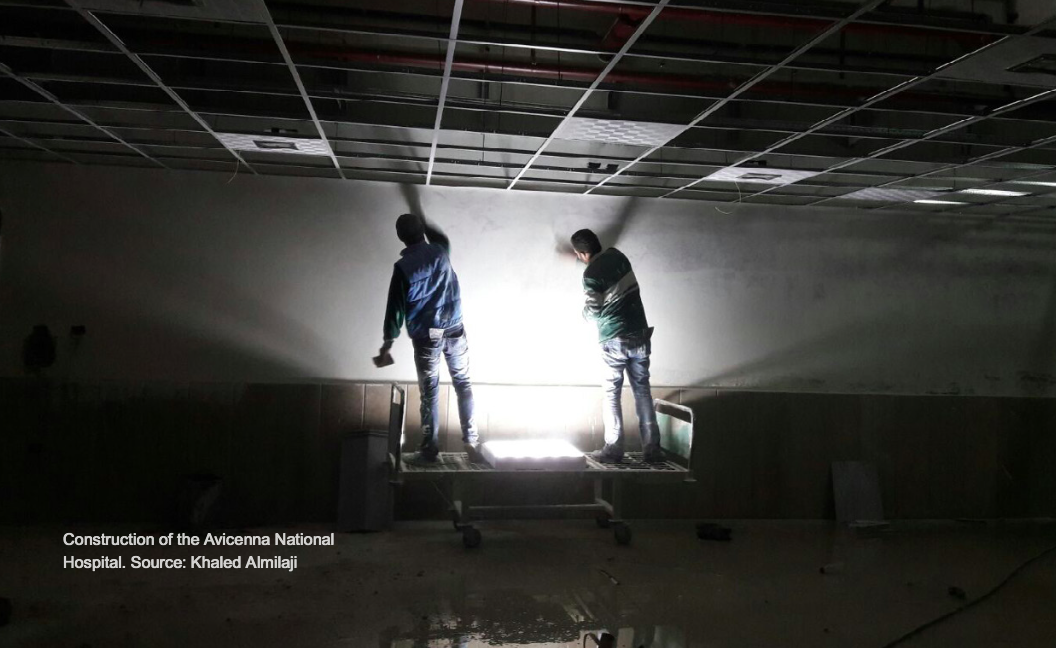
The latest underground medical project seeking crowdfunding to complete building works is the Avicenna women and children’s hospital in Idlib City, championed by Khaled al-Milaji, head of the Sustainable International Medical Relief Organisation.

Al-Milaji is working to raise money with colleagues from Brown University in the US, where he studied until extreme security vetting – the Trump administration’s “Muslim ban” – prevented him re-entering the country after a holiday in Turkey.

He has instead turned his attention to building reinforced underground levels of the hospital, sourcing private donations to meet the shortfall between donor funding and actual costs…

Crowdfunding was an essential part of building the children’s Hope hospital, near Jarabulus in northern Syria. The project is run by doctors from eastern Aleppo, who were evacuated from the city in December after it was besieged for nearly six months amid a heavy military campaign. Doctors worked with the People’s Convoy, which transported vital medical supplies from London to southern Turkey as well as raising funds to build the hospital, which opened in April. More than 4,800 single donations raised the building costs, with enough left over to run the hospital for six months.

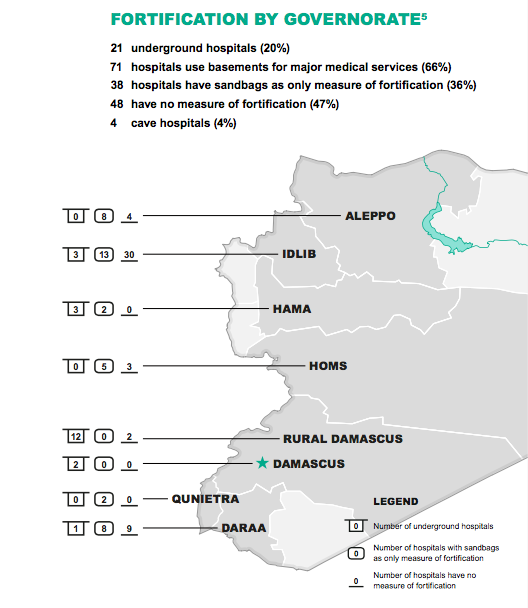
Saving Lives Underground distinguishes basement hospitals (the most common response to aerial attack by aircraft or shelling: 66 per cent of fortified hospitals fall into this category; the average cost is usually around $80–175,000, though more elaborate rehabilitation and repurposing can run up to $1 million); cave hospitals (‘the more effective protection model’ – though there are no guarantees – which accounts for around 4 per cent of fortified hospitals and which typically cost around $200–800,000) and purpose-built underground hospitals (two per cent of the total; these can cost from $800,000 to $1,500,000).

It’s chilling to think that hospitals have to be fortified and concealed in these ways: but even more disturbing, the report finds that 47 per cent of hospitals in these vulnerable areas have no fortification at all.

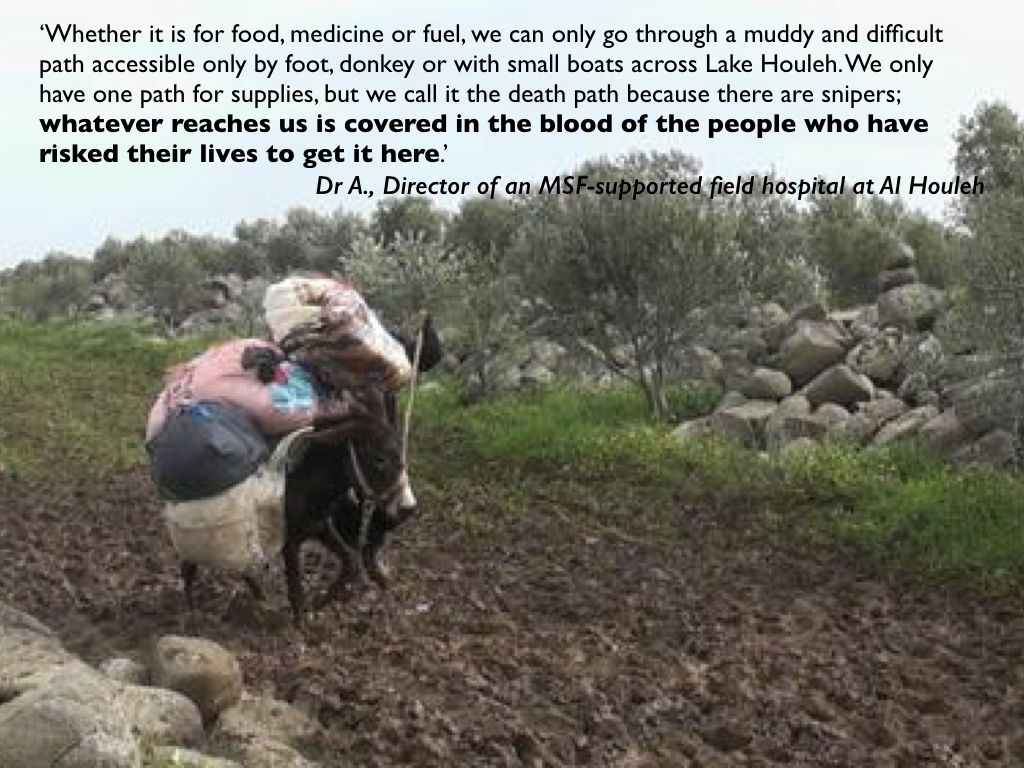
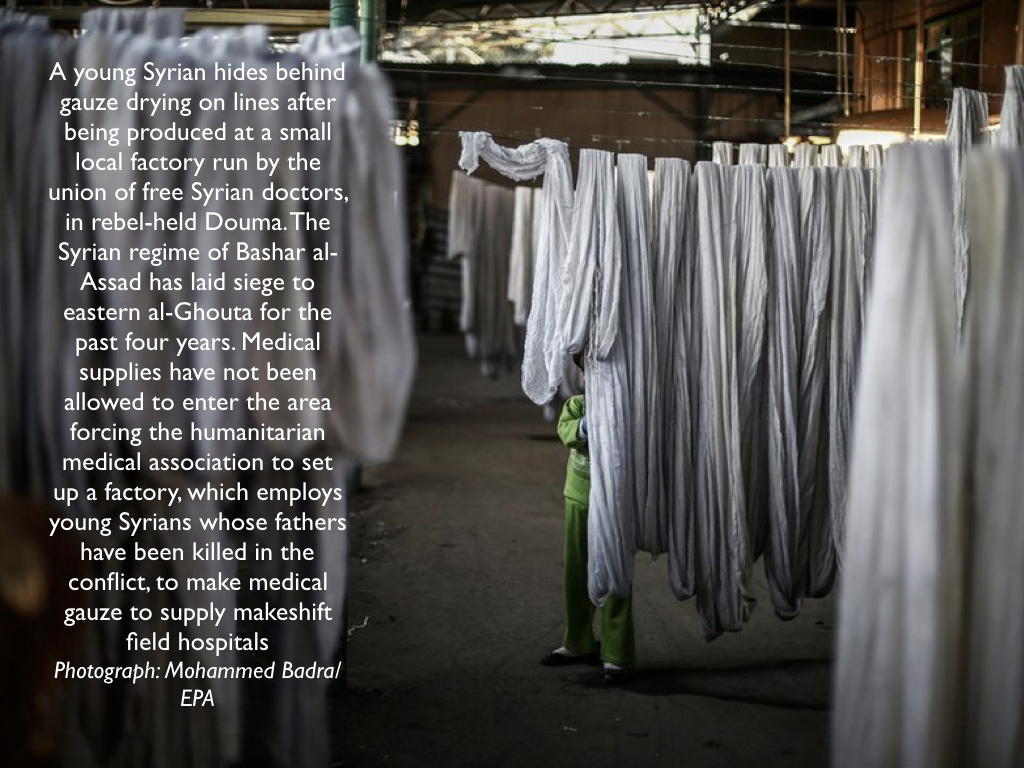
Seriously ill or wounded patients trapped inside besieged areas have few choices: medical facilities are degraded and often makeshift; access to vital medical supplies continues to be capriciously controlled and often denied; and attempts to evacuate them depend on short-lived ceasefires and deals (or bribes).  In Aleppo control of the Castello Road determined whether ambulances could successfully run the gauntlet from eastern Aleppo either west to hospitals in Reyhanli in Turkey or out to the Bab-al Salama Hospital in northern Aleppo and then across the border to state-run hospitals in Kilis: but in the absence of a formal agreement this was often a journey of last resort.

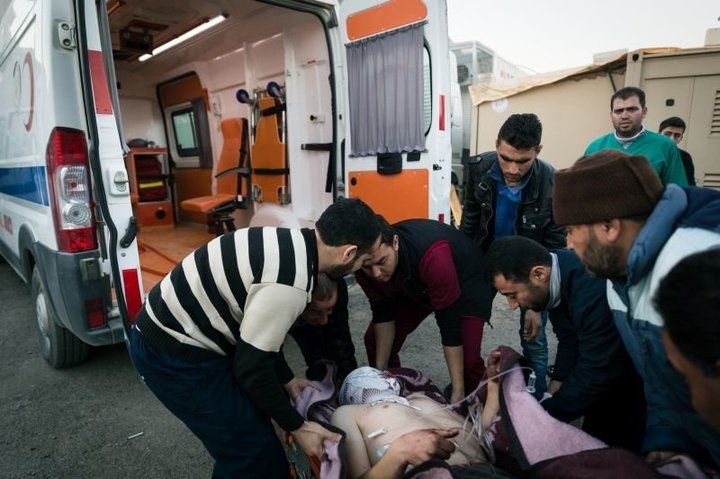
A victim of a barrel bomb attack in Aleppo is helped into a Turkish ambulance on call at the Bab al Salama Hospital near the Turkish border.

In October 2016 there were repeated attempts to broker medical evacuations from eastern Aleppo; eventually an agreement was reached, but the planned evacuations were stalled and then abandoned.  In December a new ‘humanitarian pause’ agreed with Russia and the Syrian government allowed more than 100 ambulances to be deployed by the Red Cross and the Red Crescent from Turkey; 200 critical patients were ferried from eastern Aleppo to hospitals in rural Aleppo, Idlib or Turkey – but the mission was abruptly terminated 24 hours after it had started.

The sick and injured have continued to make precarious journeys to hospitals in Turkey (Bab al-Hawa, Kilis, Reyhanli and other towns along the  border: see here, here and here), and also Jordan (in Ramtha and Amman, and in the Zaatari refugee camp: see here and here), Lebanon (in Beirut, Tripoli and clinics in the Bekaa Valley), and even Israel (trekking across the Golan Heights into Northern Israel: see here, herehere and especially here).

But there are no guarantees; travelling within Syria is dangerous and debilitating for patients, and access to hospitals outside Syria is frequently disrupted by border closures (which in turn can thrust the desperate into the hands of smugglers).  In March 2016, for example, Amnesty International reported:

 Since 2012 Jordan has imposed increasing restrictions on access for Syrians attempting to enter the country through formal and informal border crossings. It has made an exception for Syrians with war-related injuries.  However, Amnesty International has gathered information from humanitarian workers and family members of Syrian refugees with critical injuries being denied entry to Jordan for medical care, suggesting the exceptional criteria for entry on emergency medical grounds is inconsistently applied. This has led to refugees with critical injuries being returned to field hospitals in Syria, which are under attack on a regular basis, and to some people dying at the border.

In June Jordan closed the border, after an IS car bomb killed seven of its soldiers, and by December MSF had been forced to close its clinic at the Zaatari camp, which had provided post-operative care for casualties brought in from Dara’a.

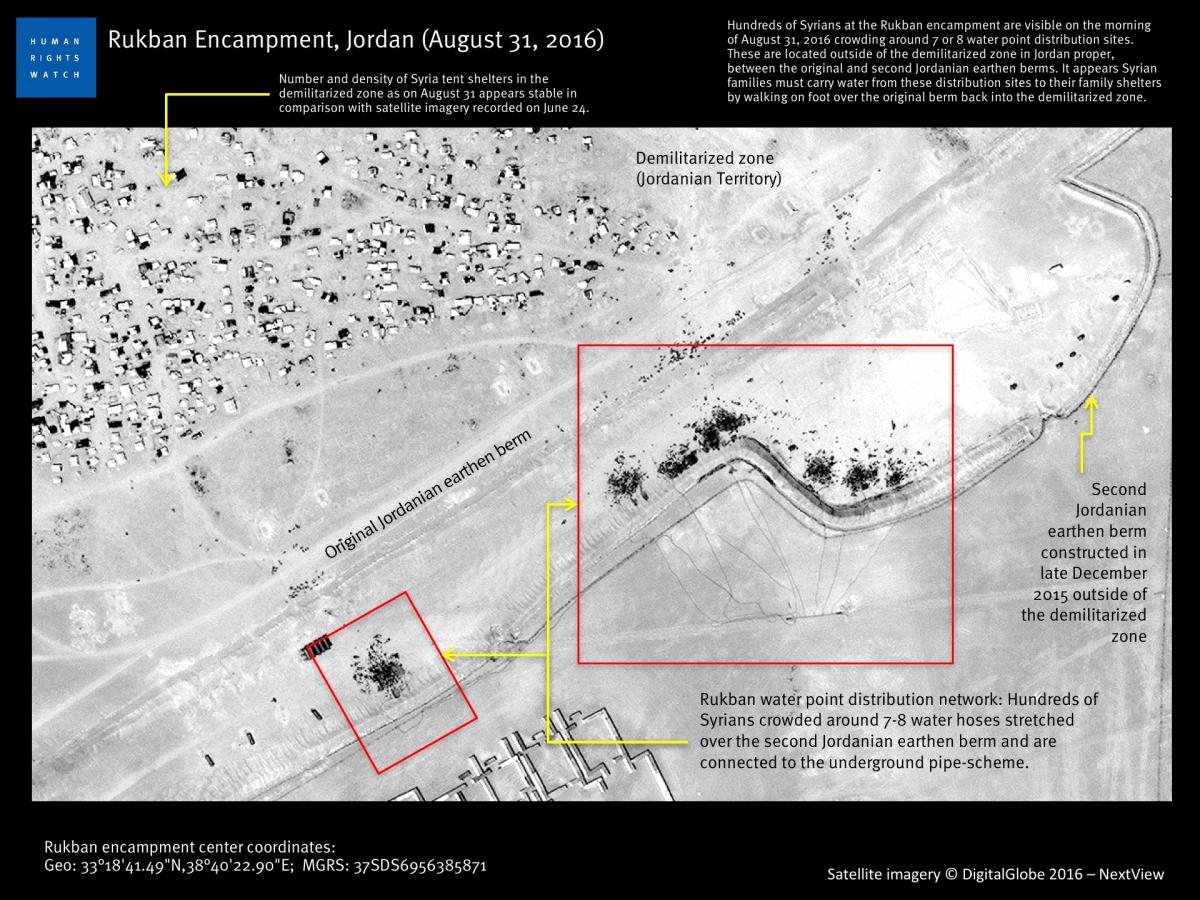
Tens of thousands of refugees are now trapped in a vast, informal encampment (see image above) between two desert berms in a sort of ‘no man’s land‘ between Syria and Jordan.  From there Jordanian troops transport selected patients to a UN clinic, located across the border in a sealed military zone – ‘and then take them back again to the checkpoint after they are treated.’

(For the image above, and a commentary by MSF’s Jason Cone, see here).

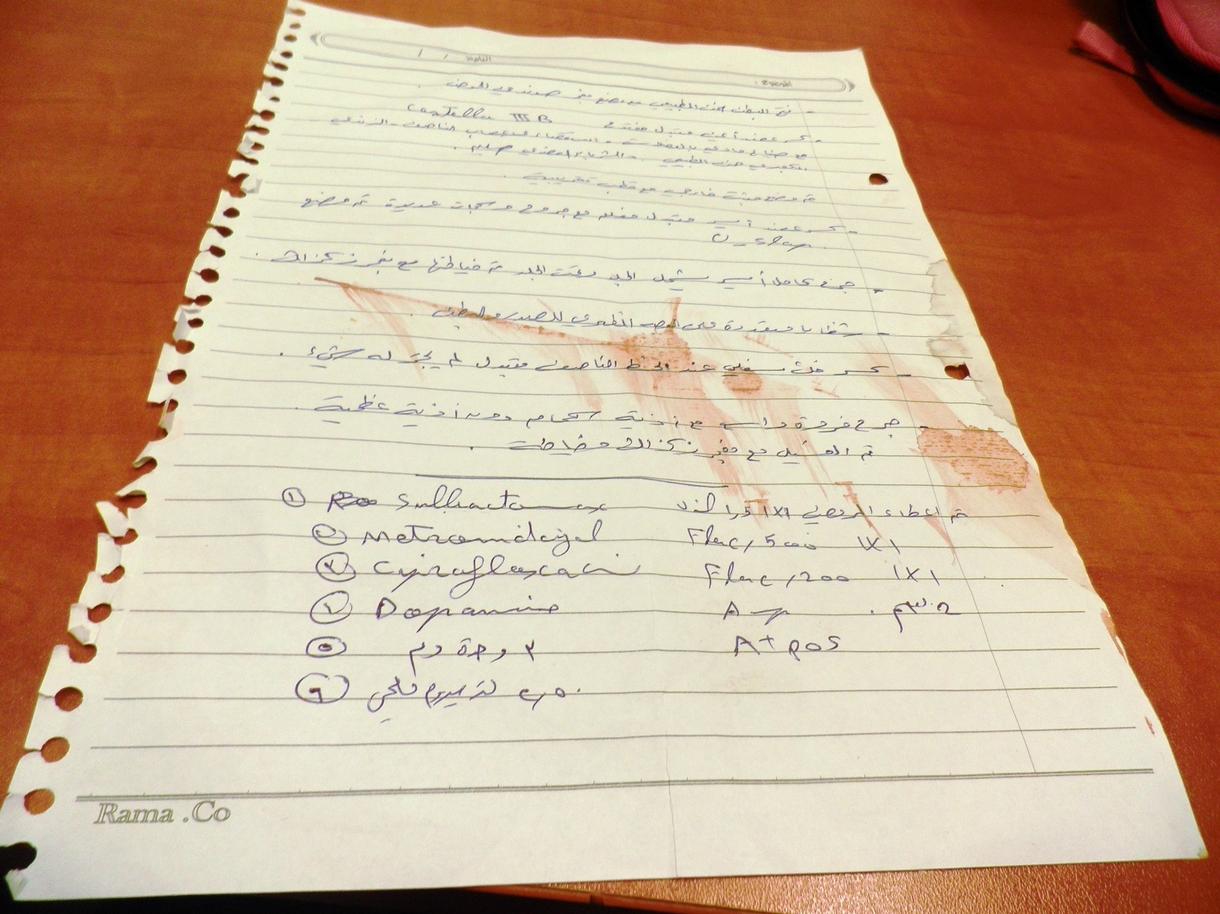
For patients who do manage to make it across any of these borders, it’s far from easy for doctors to recover their medical history – as the note below, pinned to an unconscious patient who was admitted to the Ziv Medical Center in Safed implies – and in the case of Syria (as in Iraq) everything is further complicated by a fraught politics of the wound.

Here, for example, is Professor Ghassan Abu-Sitta, head of plastic and reconstructive surgery at the medical centre in Beirut, talking earlier this month with Robert Fisk:

In Iraq, patients wounded in Saddam’s wars were initially treated as heroes – they had fought for their country against non-Arab Iran.  But after the US invasion of 2003, they became an embarrassment.  “The value of their wounds’ ‘capital’ changes from hero to zero,” Abu-Sitta says.  “And this means that their ability to access medical care also changes.  We are now reading the history of the region through the wounds.  War’s wounds carry with them the narrative of the wounding which becomes political capital.”

In the bleak wars that have scarred Syria, and which continue to open up divisions and divides there too, the same considerations come into play with equal force.

Conflict Urbanism

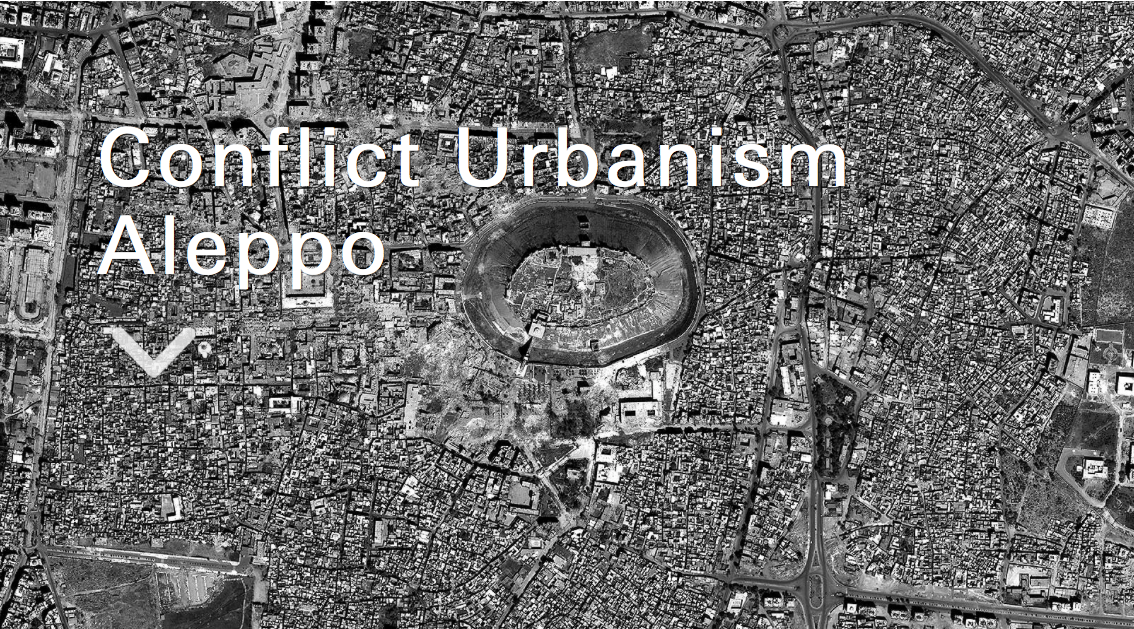
I’m in Copenhagen – and still bleary-eyed – for a symposium organised by my good friends Kirsten Simonsen and Lasse Koefoed at Roskilde on their current project  ‘Paradoxical spaces: Encountering the other in public space‘.  I’ll be talking about the war in Syria, drawing on my previous work on attacks on hospitals, healthcare workers and patients (see ‘Your turn, doctor‘) – which I’ve now considerably extended as I work on turning all this into  a longform essay: I’ll post some updates as soon as I can – but now adding a detailed discussion of siege warfare in Syria.  More on that in my next post; but for now I wanted to share some remarkable work on Aleppo by Laura Kurgan and her students at the Center for Spatial Research at Columbia:

Conflict Urbanism: Aleppo is a project in two stages.

First, we have built an open-source, interactive, layered map of Aleppo, at the neighborhood scale. Users can navigate the city, with the aid of high resolution satellite imagery from before and during the current civil war, and explore geo-located data about cultural sites, neighborhoods, and urban damage.

Second, the map is a platform for storytelling with data. We are inviting collaborators and students to bring new perspectives and analyses into the map to broaden our understanding of what’s happening in Aleppo. Case studies will document and narrate urban damage — at the infrastructural, neighborhood, building, social, and cultural scales — and will be added to the website over time.

We invite ideas and propositions, and hope to build on the data we have compiled here to create an active archive of the memory of destruction in Aleppo through investigation and interpretation, up close and from a distance.

That last phrase is an echo of Laura’s book, Close Up at a Distance: Mapping, Technology and Politics, published by MIT in 2013.  The new project emerged out of a seminar taught by Laura in 2016:

Students worked collaboratively to develop a series of case studies using a map developed by the Center for Spatial Research, specifically designed to research urban damage in Aleppo during the ongoing civil war. Their work incorporates a range of disciplines, methods and results. Each student was asked to create case studies and add layers to the existing map. The results — spatializing youtube video, interior borders between fighting factions, imagining urban survival during wartime, imaging escape routes, audio memory maps, roads, water, hospitals, informal neighborhoods, religion, communications infrastructure, and refugee camps at the borders — are [available online here].

I’m particularly taken by ‘Spatializing the YouTube War’.   One of the challenges for those of us who follow these events ‘at a distance’ is precisely how to get ‘close up’; digital media and the rise of citizen journalism have clearly transformed our knowledge of many of today’s conflict zones – think, for example, of the ways in which Forensic Architecture has used online videos to narrate and corroborate Russian and Syrian Arab Air Force attacks on hospitals in rebel-held areas Syria; similarly, Airwars has used uploaded videos for its painstaking analysis of US and coalition airstrikes and civilian casualties (see this really good backgrounder by Greg Jaffe on Kinder Haddad, one of the Airwars team, ‘How a woman in England tracks civilian deaths in Syria, one bomb at a time) – and I’ve used similar sources to explore the effects of siege warfare on Aleppo, Homs and Madaya.

Here is how Laura and her students – in this case, Nadine Fattaleh, Michael James Storm and Violet Whitney describe their contribution:

The civil war in Syria has shown how profoundly the rise of cellphones with video-cameras, as well as online video-hosting and emergent citizen journalism, has changed the landscape of war documentation. YouTube has become one of the largest sources (and archives) of information about events on the ground in Syria: since January 2012 over a million videos of the conflict there have been uploaded, with hundreds of millions of views to date. Major news agencies have come to rely on YouTube as a primary source for their reporting, and human rights organizations often cite videos as part of their advocacy and documentation efforts. This independently reported footage has created a new powerful archive, but opens up crucial questions of credibility, verification, and bias. As with all data, every video comes to us bearing the traces of the situation and intentions that motivated its production. This does not disqualify it – quite to the contrary – but it does demand that we approach everything critically and carefully.

We set out to investigate YouTube as archive of the Syrian uprising and to develop a method for organizing that archive spatially. We used the frameworks that we had developed for the Conflict Urbanism Aleppo interactive map, together with a naming convention used by Syrian civic media organizations, in order to sort and geolocate YouTube videos from multiple sources. We then produced a searchable interactive interface for three of the most highly cited YouTube channels, the Halab News Network, the Aleppo Media Center, and the Syrian Civil Defense. We encourage journalists, researchers, and others to use this specifically spatial tool in sorting and searching through the YouTube dataset.

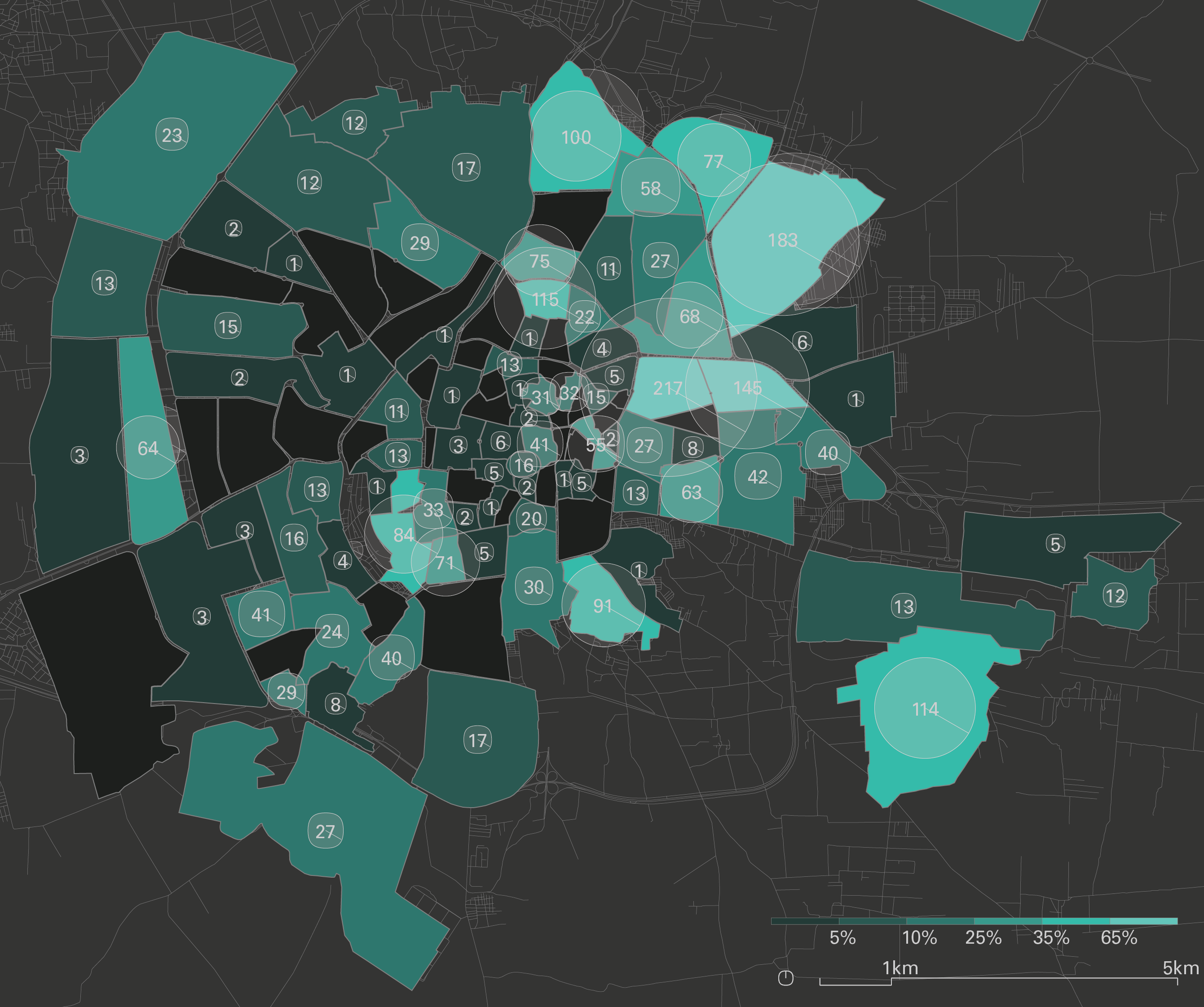
The Halab News Network [above] shows a wide distribution of videos across the city, including the city center and government-held Western side of the city. The Eastern half of the city — in particular the Northeastern neighborhoods of ash-Sha’ar (الشعار), Hanano (هنانو), and Ayn at-Tal (عين التينة) – is the best-documented.

In contrast:

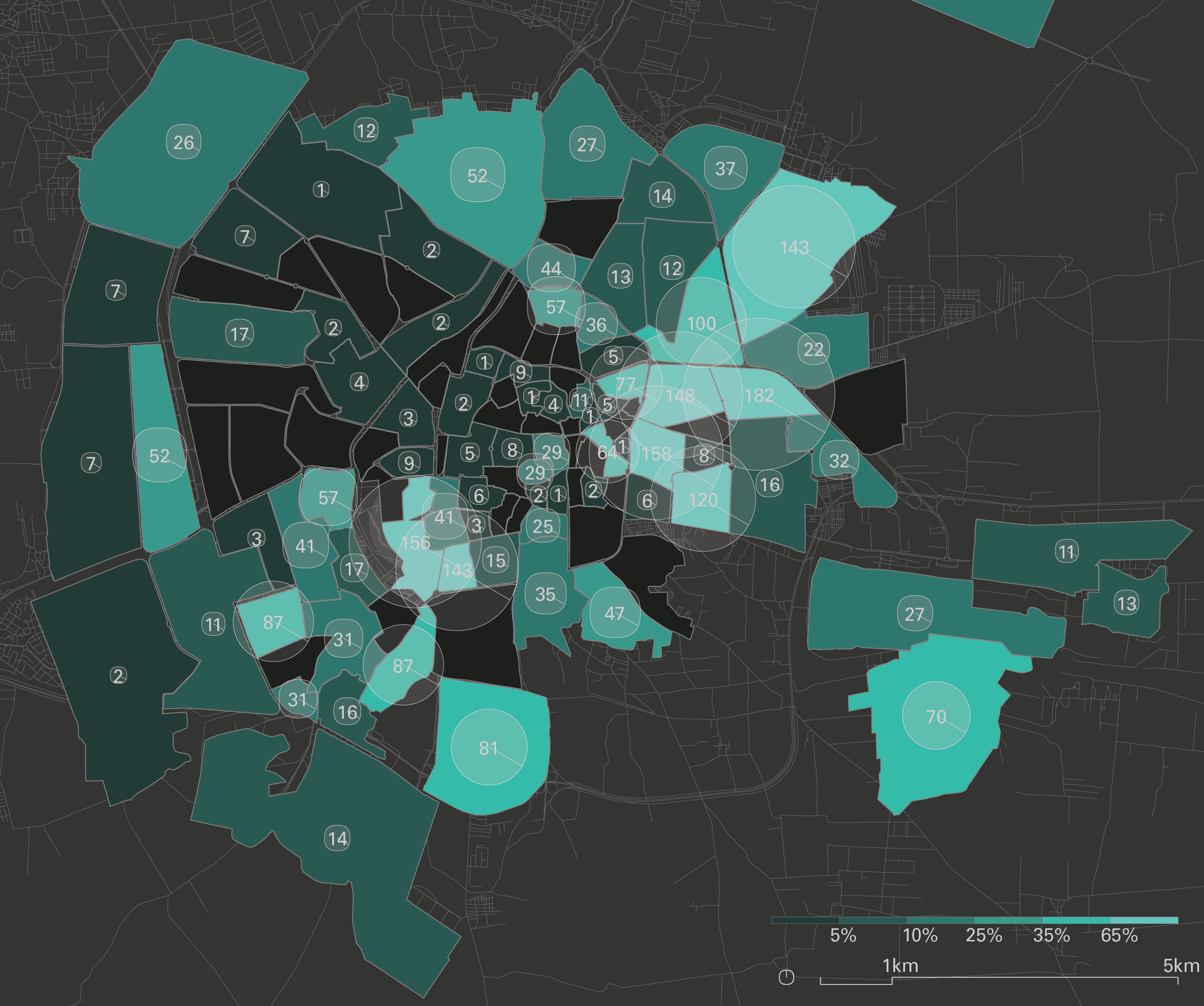
The videos published by the Aleppo Media Center [above] roughly follow the formerly rebel-held Eastern side of the city, with a small number of videos from the central and Western areas. The highest number of videos is in the neighborhood of ash-Sha’ar (الشعار). Particular spots include ash-Sha’ar (الشعار), coverage of which is shared with the Syrian Civil Defense. Another notable concentration are two neighborhoods in the Southwest, Bustan al-Qaser (بستان القصر) and al-Fardos (الفردوس).

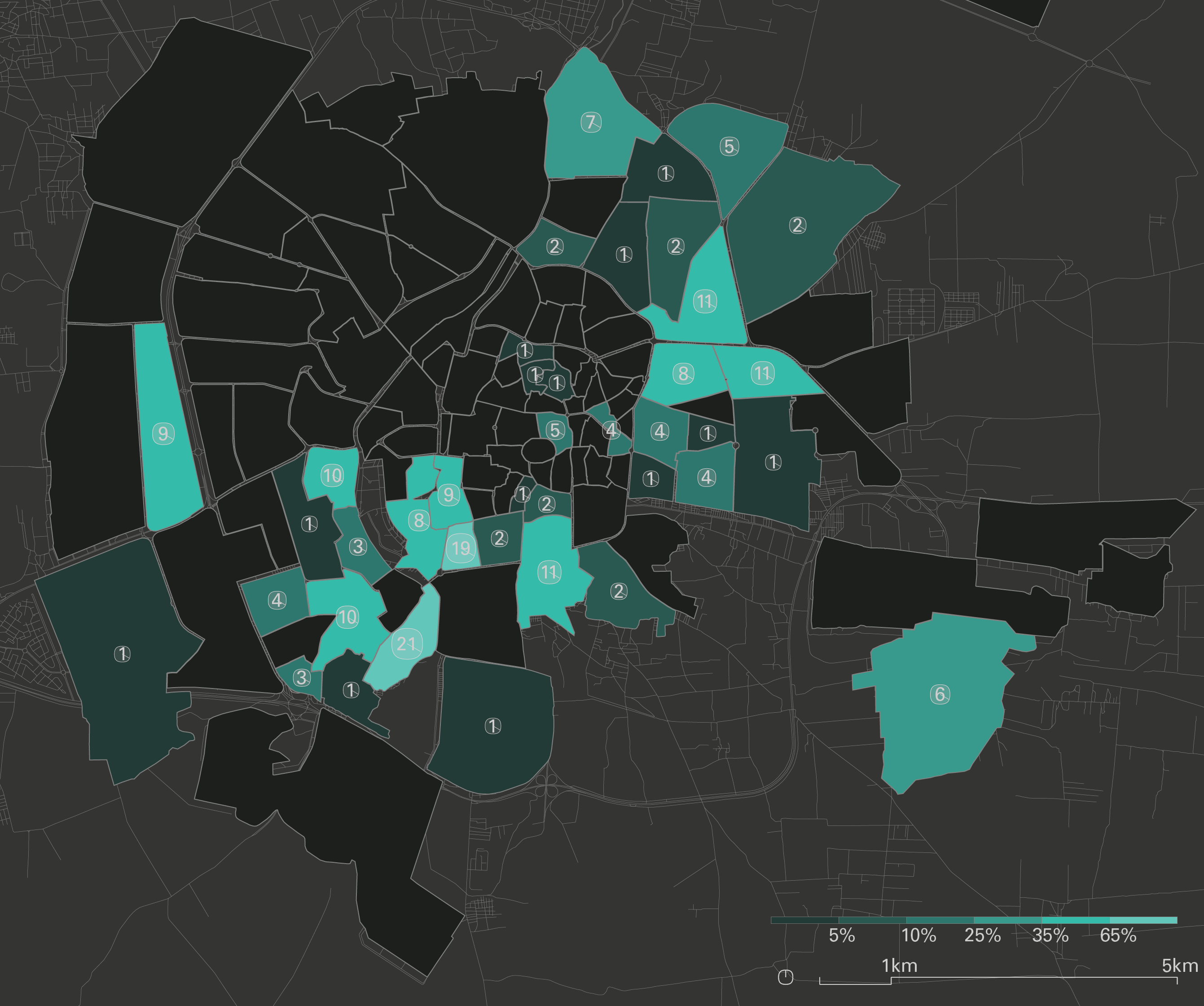
They also analyse the video geography produced by the White Helmets [below]: ‘The Syrian Civil Defense, also known as the White Helmets, have uploaded videos primarily in the formerly rebel-held Eastern and Southern areas of Aleppo. Only the Western area of ash-Shuhada’ (الشهداء) falls outside of this trend.’

This, like the other collaborative projects under the ‘Conflict Urbanism’ umbrella, is brilliant, essential work, and we are all in their debt.

You can read more about the project in a short essay by Laura, ‘Conflict Urbanism, Aleppo: Mapping Urban Damage’, in Architectural Design 87 (1) (2017) 72-77, and in another essay she has written with Jose Francisco Salarriaga and Dare Brawley, ‘Visualizing conflict: possibilities for urban research’, open access download via Urban Planning 2 (1) (2017) here [this includes notice of a parallel project in Colombia].

Striking Syria

screen-shot-2017-01-17-at-11-48-35

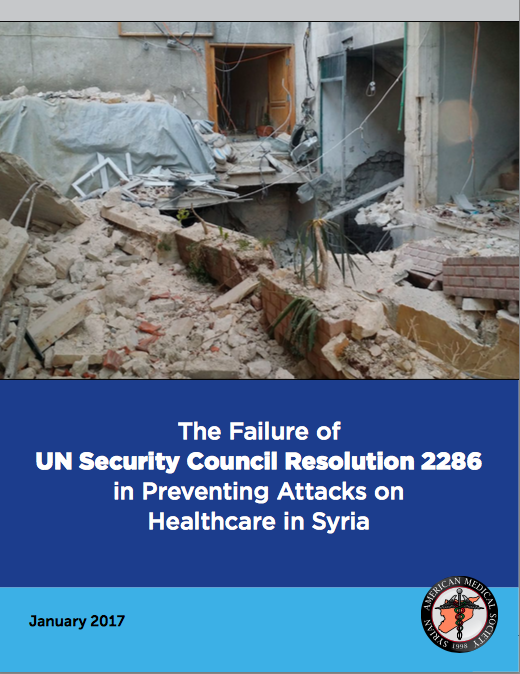
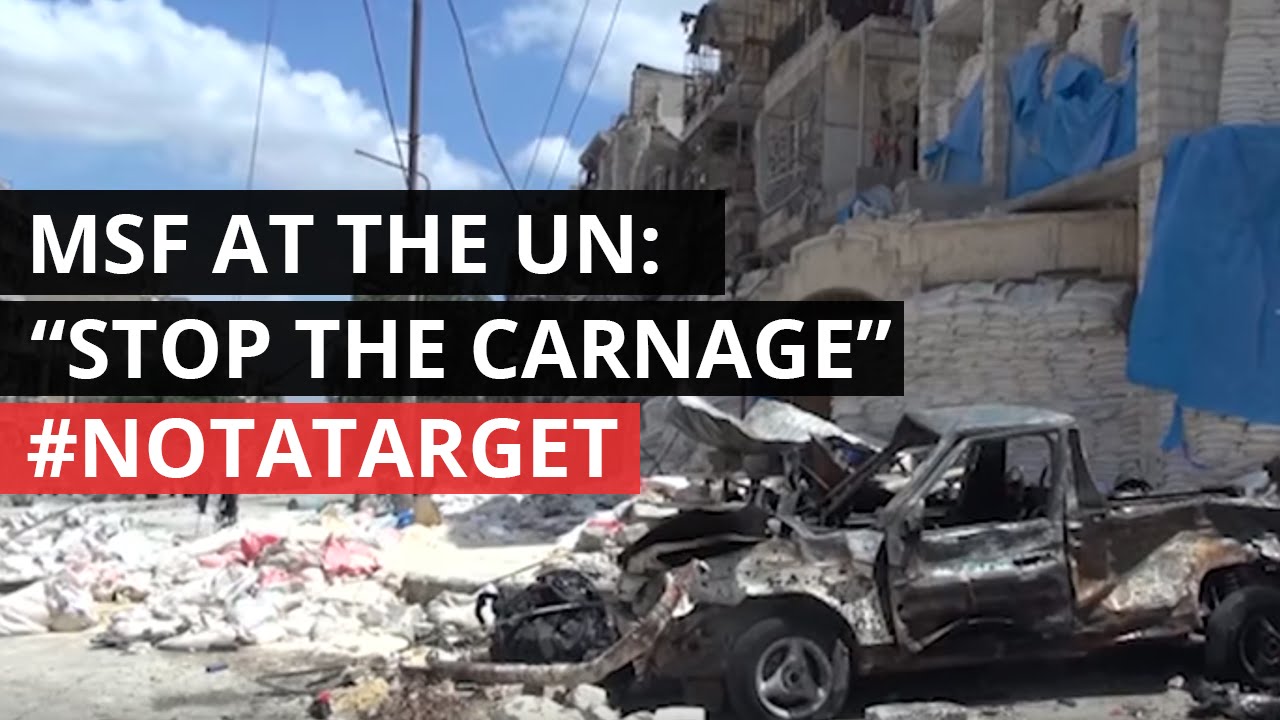
The Syrian-American Medical Society (SAMS) has published a grim report documenting the pattern of attacks on healthcare in Syria following the passage of UN Security Council Resolution 2286 on 3 May 2016 condemning attacks on medical facilities and personnel in conflict zones.  The Resolution was a general one; several states drew attention to Israel’s assault on medical facilities in Gaza, and to the US airstrike on the MSF Trauma Centre in Kunduz (Afghanistan) (see here and here).

The Resolution had the urgent support of a host of humanitarian NGOs; it was co-sponsored by more than 80 member states, and it was adopted unanimously by the Security Council.  At the time the UN Secretary-General Ban Ki-Moon described attacks on hospitals as a war crime, and declared:

When so-called surgical strikes are hitting surgical wards, something is deeply wrong… Even wars have rules…  The Council and all Member States must do more than condemn such attacks. They must use every ounce of influence to press parties to respect their obligations.

msf-at-the-un

And yet this is what SAMS found in Syria:

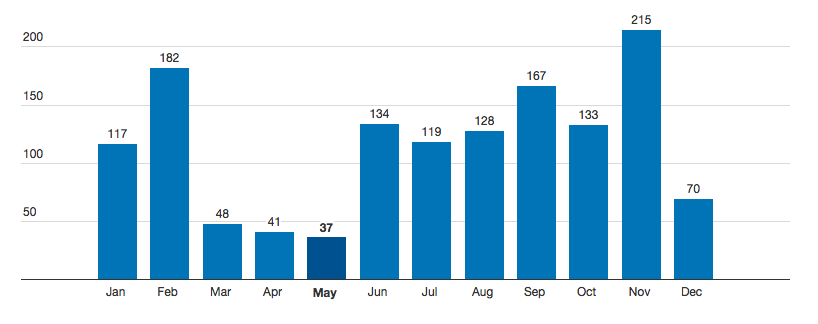
  • In 2015, the rate of targeting of medical facilities and personnel was one attack every four days.
  • In October 2015, following Russia’s intervention in support of the Syrian government, this rate doubled to one attack every 48 hours.
  • In November 2016 the rate virtually doubled again to one attack every 29 hours.

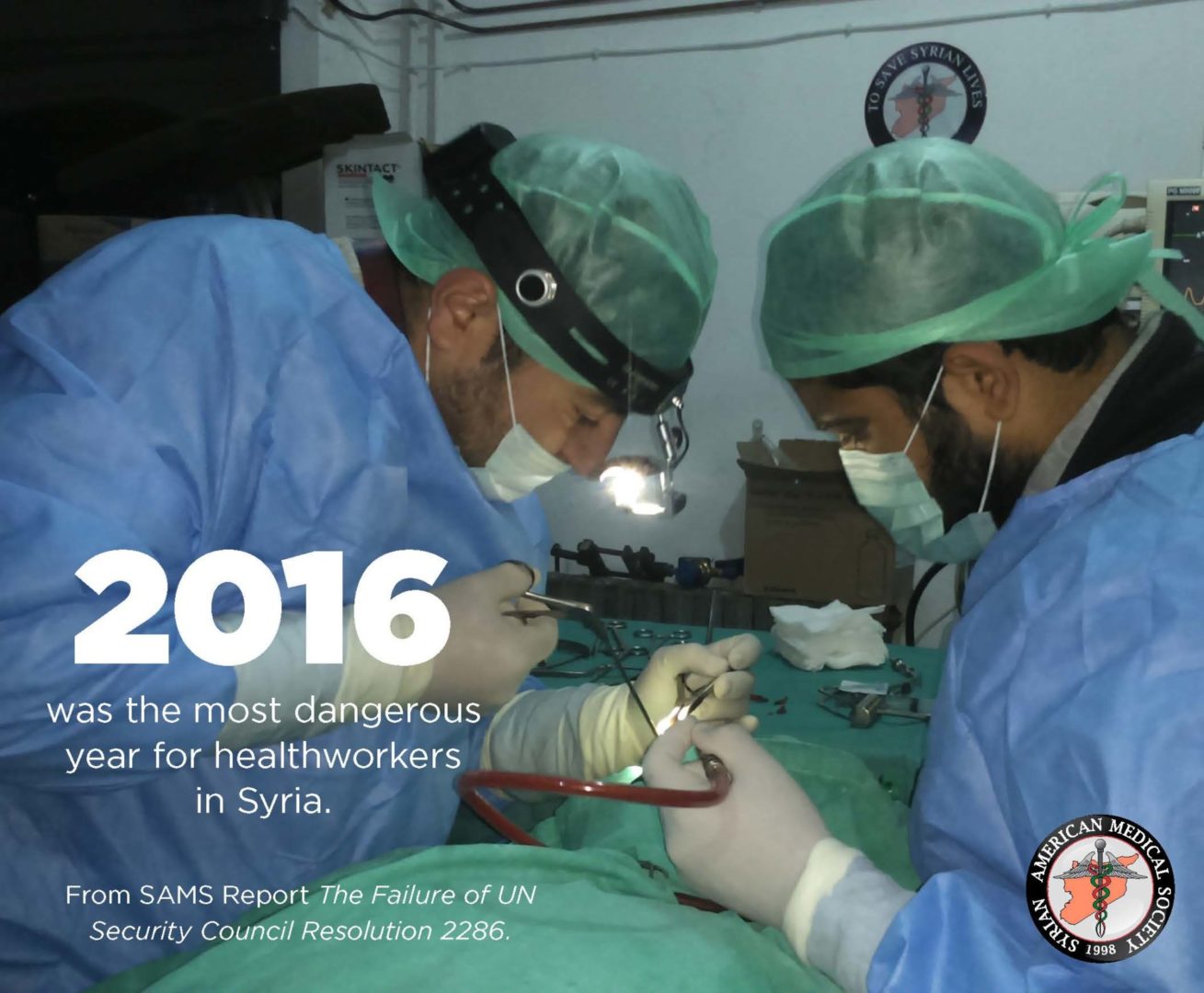
SAMS estimates that there were 252 attacks on medical facilities and personnel in 2016; 199 of them took place after the passage of UNSC Resolution 2286.

Between June and December  SAMS identified 172 attacks (all detailed in an appendix to the report): 168 of them were carried out by the Syrian government and its allies; one by non-state opposition forces; one by Islamic State; and two by unidentified parties.  Aleppo and Idlib were the principal targets: eastern Aleppo alone received a numbing 42 per cent of all attacks.

In case you are wondering about the sources for these claims, the report explains:

SAMS maintains rigid documentation standards in collaboration with partners in the WHO Health Cluster in Turkey and the Johns Hopkins University Bloomberg School of Public Health’s Center for Health and Human Rights. Our reporters on the ground rely on rst- hand testimony and photo documentation from medical sta and record the date, time, location, damages, casualties, impact on service delivery, weapon(s) used, and perpetrator of each incident. Any other source of information is not considered.

syria-attacks-graphics-03_page_6-e1484145301958

Dr Ahmad Tarakji, President of SAMS, reaches this bleak and compelling conclusion:

The failure of the international community to hold the perpetrators of these attacks accountable sends a dangerous message: that there are no lines, no limits, and no boundaries to the atrocities that are being committed against the Syrian people.

You can find more details about the targeting of doctors and hospitals in my post on the weaponisation of healthcare in Syria here; there is also a response to the passage of UNSC Resolution 2286 and its implementation by the Safeguarding Health in Conflict coalition (in September 2016) here.

Meanwhile Chris WoodsAirwars team has just released its preliminary assessment of civilian casualties from air strikes carried out by the US-led coalition and by Syrian/Russian air forces:

Syria’s civilians were under constant threat from Coalition air strikes throughout 2016, with 38% more casualty events reported in Syria than Iraq over the year. This may however reflect improved local reporting by Syrian monitors.

Overall, minimum likely civilian deaths in Syrian incidents graded by Airwars as Fair or Confirmed doubled in 2016. Across 136 incidents, between 654 and 1,058 civilians were claimed killed in total. Airwars estimates that a minimum of 818 civilians were likely injured in Fair and Confirmed events in Syria alone.

There were major spikes in February, in June and July (the Manbij campaign) and November the Raqqa campaign), all of them focused on areas held by Islamic State.

As for Syrian/Russian air strikes:

Airstrikes carried out by Moscow pummeled rebel-held areas of Syria throughout 2016, with many hundreds of civilians credibly reported killed.

Overall, there were 1,452 separate claimed civilian casualty events allegedly carried out by Russia during 2016. Between 6,228 and 8,172 civilians reportedly died in these events. Many of these incidents are likely to have been the result of actions by the Assad regime. Even so, civilian deaths from Russian strikes in 2016 far outpaced those from Coalition actions.

The pattern of civilian casualties from Russian air strikes:

screen-shot-2017-01-17-at-12-11-37

But at least three caveats are necessary.  First, these are provisional calculations:  ‘With so many allegations to assess, Airwars has a significant case backlog’, and the team has so far only completed a detailed analysis of the first four months of 2016.

Second, the report provides no separate listing of air strikes carried out by the Syrian Arab Air Force. The Airwars team concedes a ‘very high level of confusion – especially between Russia and the regime’.  Here is Kinda Haddad: ‘For many incidents we have some sources blaming the regime and others Russia – and we can’t really tell who is responsible as they use similar planes and weaponry.’  One major exception to that must be the use of barrel bombs dropped by the SAAF’s helicopters.

Third, these tabulations identify immediate casualties from the strikes: one of the reasons for attacking doctors and hospitals, as I explained previously, is to multiply subsequent and distant casualties – to deny those wounded (or simply sick) life-saving medical treatment.  So these casualty lists are minima – and not only as a result of the general problems of casualty accounting in conflict zones.

The Death of the Clinic

This is the fifth in a new series of posts on military violence against hospitals and medical personnel in conflict zones. It follows directly from my analysis of the situation in Syria here.

President Bashar al-Assad has consistently denied that his forces have attacked hospitals or doctors.  In an interview with SBS Australia on 1 July 2016 he asked his interviewer:

‘… the very simple question is: why do we attack hospitals and civilians?… No government in this situation has any interest in killing civilians or attacking hospitals. Anyway, if you attack hospitals, you can use any building to be a hospital. No, these are anecdotal claims, mendacious statements …’

president-al-assad-interview-sbs-australia-4

There are at least four answers to Assad’s disingenuous question (if you falter at the adjective, see here).

(1) Silencing the witnesses

When Widney Brown from Physicians for Human Rights testified at the Tom Lantos Human Rights Commission on 31 March 2016 she provided one clear and compelling rationale for Assad’s attacks on doctors:

‘… attacks on doctors silence particularly powerful witnesses. When the Syrian government denies its use of chemical weapons, cluster munitions, starvation, or torture, doctors can bear witnesses to these violations because they have seen and treated the victims.’

syrian-man-receiving-treatment-following-a-gas-attack

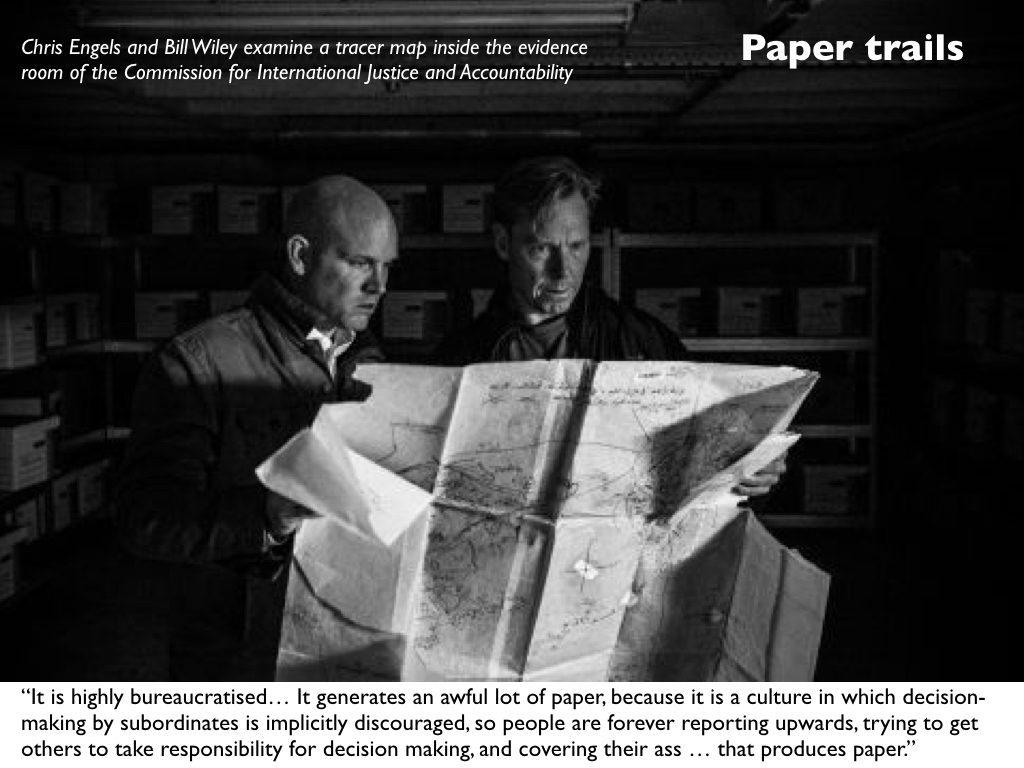
To be sure, there are other witnesses and even paper trails and photographic records.  Ben Taub, who has done so much to bring ‘Syria’s war on doctors‘ to the attention of a wider public, has also provided a detailed account of the work done by Bill Wiley and the Commission for International Justice and Accountability whose volunteers have smuggled over 600,000 documents out of Syria detailing mass torture and killings by the regime.

cija-syria-001

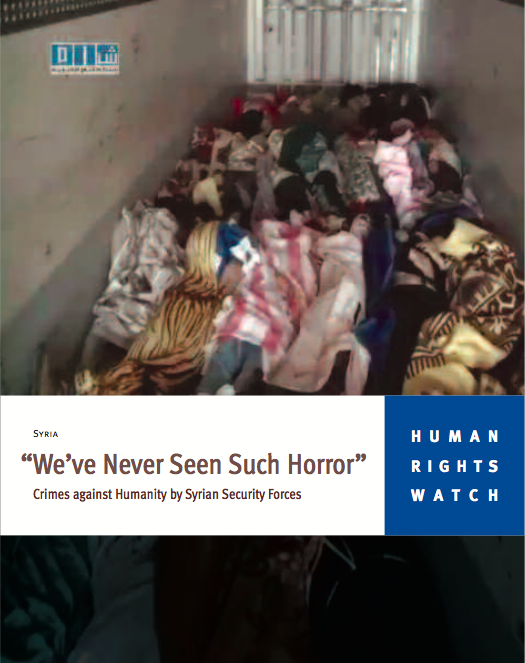
The war crimes have not been confined to attacks on hospitals in opposition-held areas.  A photographer known only as ‘Caesar’, who had been attached to the Defence Ministry’s Criminal Forensic Division, smuggled out thousands of high-resolution digital images exposing the horrors of the regime’s own military hospitals:

The pictures, most of them taken in Syrian military hospitals, show corpses photographed at close range – one at a time as well as in small groupings. Virtually all of the bodies – thousands of them – betray signs of torture: gouged eyes; mangled genitals; bruises and dried blood from beatings; acid and electric burns; emaciation; and marks from strangulation…

These unfortunates may have lived and died in different ways, but they were bound in death by coded numerals scribbled on their skin with markers, or on scraps of paper affixed to their bodies. The first set of numbers (for example, 2935 in the photographs at bottom) would denote a prisoner’s I.D. The second (for example, 215) would refer to the intelligence branch responsible for his or her death. Underneath these figures, in many cases, would appear the hospital case-file number (for example, 2487/B)…

[T]he system of organizing and recording the dead served three ends: to satisfy Syrian authorities that executions were carried out; to ensure that no one was improperly discharged; and to allow military judges to represent to families—by producing official-seeming death certificates—that their loved ones had died of natural causes. In many ways, these facilities were ideal for hiding “unwanted” individuals, alive or dead. As part of the Ministry of Defense, the hospitals were already fortified, which made it easy to shield their inner workings and keep away families who might come looking for missing relatives. “These hospitals provide cover for the crimes of the regime,” said Nawaf Fares, a top Syrian diplomat and tribal leader who defected in 2012. “People are brought into the hospitals, and killed, and their deaths are papered over with documentation.” When I asked him, during a recent interview in Dubai, Why involve the hospitals at all?, he leaned forward and said, “Because mass graves have a bad reputation.”

(2) Multiplying the casualties

This is a radicalisation of an old strategy.  As Sam Weber pointed out in Targets of opportunity (2005), ‘every target is inscribed in a network or chain of events that inevitably exceeds the opportunity that can be seized or the horizon that can be seen.’  So, for example, when the United States or Israel bombs a power plant it often as not explains that it has been careful to bomb in the small hours when only a skeleton staff was in the building in order to minimise collateral damage.  But this begs the question: why bomb the power plant at all?  In most instances the degradation of the electricity supply means that it becomes impossible to pump water or treat sewage; refrigerators fail and food perishes; hospitals are forced to use unreliable generators. The result – the intended, carefully calculated result – is that casualties rise at considerable distances from the target and over an extended period of time.

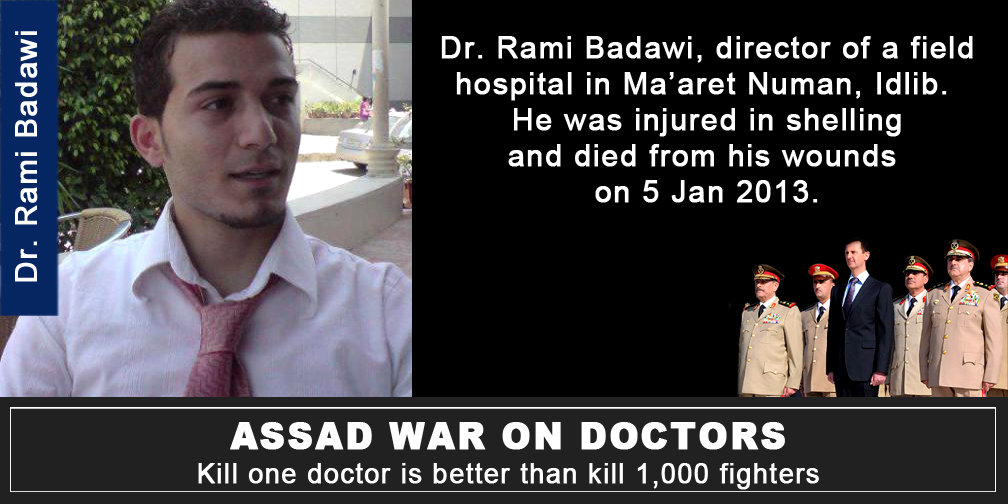
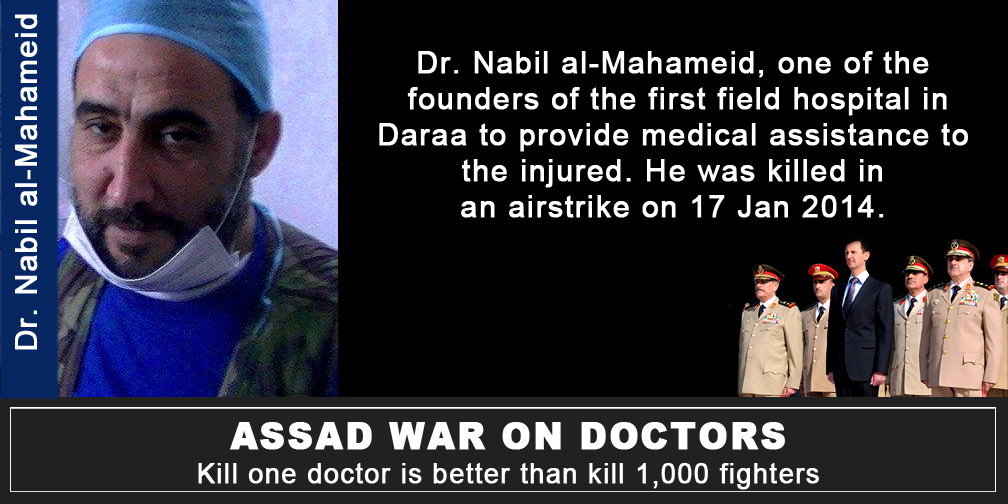
Similarly, Dr Abdulaziz Adel notes:  ‘Kill a doctor and you kill thousands.’  Simply put, patients who are sick or injured then go without treatment and in many cases their lives are put at risk.  (The images below are from Collateral Damage: more here).

syria_assad_war_crimes_murder_bomb67

syria_assad_war_crimes_murder_bomb15

syria_assad_war_crimes_murder_bomb37

Dr Rami Kalazi, a neurosurgeon from East Aleppo, agrees:

‘They are the artery of life in the city. Can you imagine a life in city without hospitals? Who will treat your kids? Who will make the surgeries for the injured people? So, they are targeting these hospitals because they know, if these hospitals were completely destroyed, the life will be completely destroyed.’

(3) ‘Moral[e] bombing’

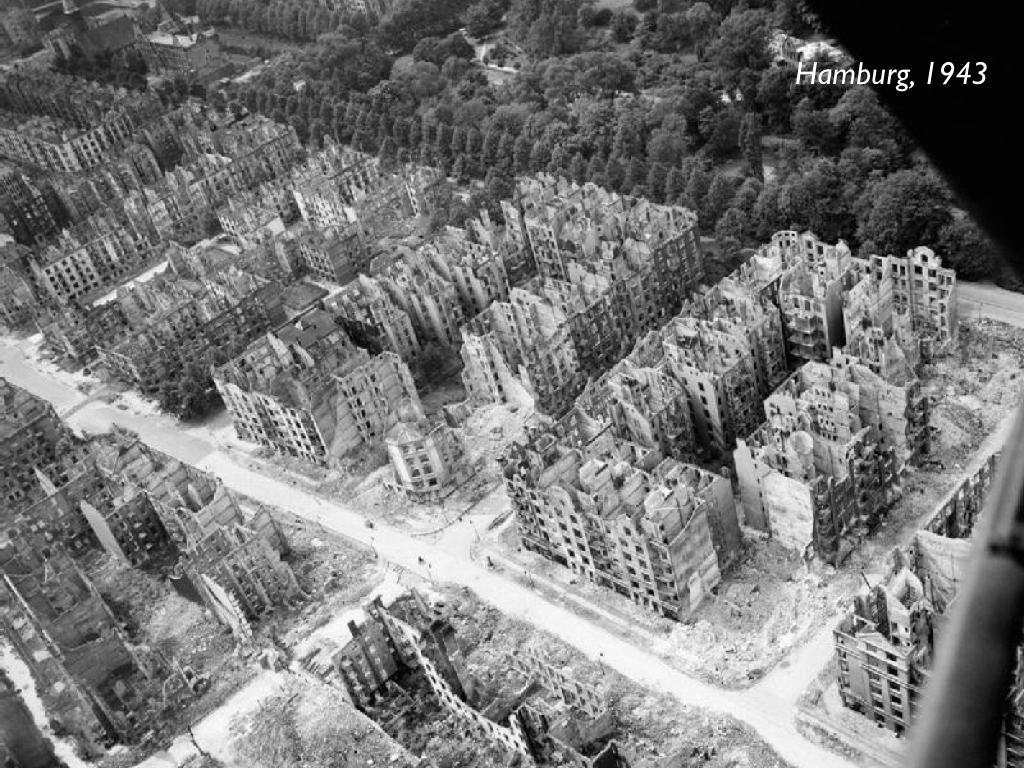
This too is an old strategy.  The architects of ‘area bombing’ during the combined bomber offensive against Germany during the Second World War described it as ‘moral [sic] bombing’: a sustained and systematic attempt to undermine the morale of the enemy population so that they would demand their leaders sue for peace.  If this was a tried and tested strategy, however, the test showed that it was a complete failure (see my ‘Doors into nowhere’: DOWNLOADS tab).

morale-bombing-001

morale-bombing-002

But the lesson was lost in Syria, where attacks on hospitals have had a central place.  As Samir Puri argues, the strategy behind the joint Syrian and Russian air campaign seems to be:

“If there is a total collapse of any kind of trauma care, those are the sort of things that can contribute to collapsing morale very suddenly. The morale of a besieged force can look robust until it collapses.”

And Syria is not unique in contemporary wars: Israel has deployed the same strategy in its repeated assaults on Gaza (see here, here and here for ‘Operation Protective Edge’ in 2014), and the Saudi-led coalition has attacked more than 70 hospitals and health facilities in Yemen since March 2015 (in this latter case Russian media have reported MSF’s objections to the ‘utter disregard for civilian life’ without dissent: see for example here).

flashback-gaza-2014-001

‘Preventing medicine’, as Annie Sparrow puts it, has become ‘a new weapon of mass destruction’.

(4) ‘Violence legislates’

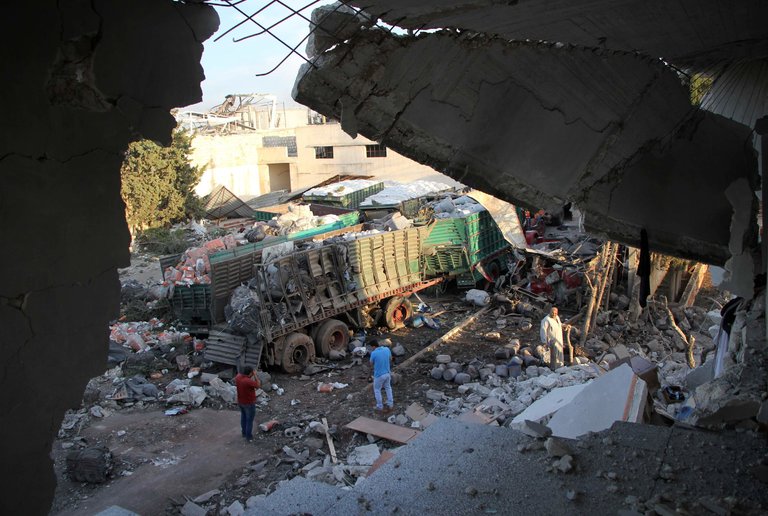
Following the attack on the UN aid convoy delivering supplies to a Syrian Red Crescent warehouse outside East Aleppo on 19 September 2016, 101 humanitarian organisations issued a joint appeal to the United Nations on 22 September; in part it read:

‘Deliberate attacks on humanitarian workers and civilians are war crimes. This must mark a turning point: the UN Security Council cannot allow increasingly brazen violations of international humanitarian law to continue with impunity.

‘Heads of state are gathered in New York this week for the United Nations General Assembly. Each one that accepts a lack of accountability for perpetrators and facilitators of war crimes colludes in the ongoing dissolution of international humanitarian law’ (my emphases).

The first paragraph is damning enough.  Ben Taub in the New Yorker again:

Nowhere has the supposed deterrent of eventual justice proved so visibly ineffective as in Syria. Like most countries, Syria signed the Rome Statute, which, according to U.N. rules, means that it is bound by the “obligation not to defeat the object and purpose of the treaty.” But, because Syria never actually ratified the document, the International Criminal Court has no independent authority to investigate or prosecute crimes that take place within Syrian territory. The U.N. Security Council does have the power to refer jurisdiction to the court, but international criminal justice is a relatively new and fragile endeavor, and, to a disturbing extent, its application is contingent on geopolitics.

But the sting comes in the second paragraph.  As I’ve noted before, international humanitarian law is not a neutral court of appeal, a deus ex machina above the fray, but has always been closely entangled with military violence.  In many respects it travels in the baggage train, constantly pulled by the trajectory of the very violence it supposedly seeks to regulate (or facilitate, depending on your point of view).  In short, as Eyal Weizman has it, ‘violence legislates‘.

There is good reason to fear that the systematic violation of medical neutrality is intended to force its dissolution.  Thomas Arcaro writes: ‘Humanitarian principles like neutrality and impartiality that once seemed so self-evident have been drawn into question, especially on the politically and ethnically complex battlefields of Iraq and Syria.’

And not only there.  In the case of the US airstrike on the MSF Trauma Centre in Kunduz in 2015, I’ve suggested that some key Afghan officers and politicians chafed at the protections afforded to wounded Taliban combatants by international humanitarian law.  They also alleged that the Trauma Centre had breached its conditional immunity because the Taliban had overrun the hospital and were firing at US and Afghan forces from its precincts.  There is no evidence to support that assertion, but it is an increasingly familiar claim.  On 7 December 2016 US Central Command justified a ‘precision strike’ requested by Iraqi forces on a building within the al-Salem hospital complex in Mosul by claiming that IS fighters had used it as a base to launch heavy and sustained machine-gun and rocket-propelled grenade attacks.  That would certainly have compromised the hospital’s immunity, but international humanitarian law still requires a warning to be issued before any attack and a proportionality analysis to be conducted; Colonel John Dorrian said that the US Air Force did not ‘have any reason to believe civilians were harmed’ but conceded that it was ‘very difficult to ascertain with full and total fidelity’ whether any medical staff or patients were in the building at the time of the air strike.

But what the Syrian case suggests is a new impatience with medical neutrality tout court: not only a hostility towards the treatment of wounded and sick combatants but also an unwillingness to extend sanctuary to wounded and sick civilians.

people-on-war-2016

And that reluctance is not confined to the Assad regime and its allies.    A survey carried out for the International Committee of the Red Cross between June and September makes for alarming reading – even once you’ve overcome your scepticism about public opinion polls.  As Spencer Ackerman reports:

Areas in active conflict record greater urgency over questions of civilian protection in wartime than do the great powers that often conduct or participate in those conflicts. In Ukraine, 83% believe everyone wounded and sick during a conflict has a right to health care, compared with 62% of Russians. A full 100% of Yemenis endorse the proposition, as do 81% of Afghans, 66% of Syrians and 42% of Iraqis – compared with 49% of Americans, 53% of Britons, 37% of the Chinese and 67% of the French.

It’s that last clause that is so disturbing: for the last four states listed are all permanent members of the UN Security Council…

So what, then, are we to make of what I’ve been calling ‘the exception to the exception’?

The exception to the exception

homo-sacerI think it’s a mistake to treat ‘the camp’, following Giorgio Agamben‘s vital work, as the exemplary, diagnostic site of the modern space of exception; the killing fields of today’s wars (themselves spaces of indistinction, where it is never clear where war stops and peace begins, where the geometry of the battlefield or, better, ‘battlespace’ becomes ever more fractured and blurred, and where the partitions between international and internal conflicts have been reduced to rubble) are also spaces within which groups of people are deliberately and knowingly exposed to death through the removal of legal protections that would ordinarily be afforded to them.  In short, killing and injuring become legally permissible.

Those exposed groups include both combatants and civilians, but their fate is not determined solely by the suspension of national laws (the case that concerns Agamben) because international humanitarian law continues to afford them some minimal protections.  One of its central provisions has been medical neutrality: yet if, through its serial violations in Syria and elsewhere, we are witnessing the slow ‘death of the clinic’ – which I treat as a topological figure which extends from the body of the sick or wounded through the evacuation chain to the hospital itself – and the extinction of ‘the exception to the exception’, the clinic as a (conditionally) sacrosanct space – then I think it’s necessary to add further twists to Agamben’s original conception.

As Adia Benton and Sa’ed Ashtan have argued, medical neutrality – the exception to the exception – represents a fraught attempt to restrict the state’s recourse to military violence: it is a limitation on and has now perhaps become even an affront to sovereign power and the state’s insistence that it is ‘the sole arbiter of who can live and who can die’.

Agamben describes the inhabitants of the space of exception as so many homines sacri – where sacer has the double meaning of both ‘sacred’ and ‘accursed’ – and it may be that in today’s killing fields doctors, nurses and healthcare workers are being transformed into new versions of homo sacer: once ‘sacred’ for their selfless devotion to saving lives, they are now ‘accursed’ for their principled dedication to medical neutrality.


homo-sacer_lode-kuylenstierna_press_gun

Yet the precarity of their existence under conditions of detention and torture, siege and airstrike, has not reduced them to what Agamben calls ‘bare life’.  They care – desperately – whether they live or die; they have improvised a series of survival strategies; they have not been silent in the face of almost unspeakable horror; and they have developed new forms of solidarity, support and sociality.

bodies-in-alliance-001

‘Your turn, doctor’

This is the fourth in a new series of posts on military violence against hospitals and medical personnel in conflict zones.  It follows from my analysis of air strikes on base hospitals on the coast of France in 1918 here, and of the US air strike on the MSF Trauma Centre in Kunduz, Afghanistan in 2015 here and here.  This post, together with the next in the series, is about Syria.  They all derive from a new presentation – still in active development – called ‘The Death of the Clinic: surgical strikes and spaces of exception’ that will eventually become an essay in my next book, so I would appreciate any comments or suggestions.

The eye of the storm 

Syria’s civil war has multiple origins, but one of the most incendiary incidents took place on 16 February 2011 in the city of Dara’a 80 km south of Damascus near the Jordanian border.  Inspired by the spread of the Arab uprisings east across the Maghreb from Tunisia, and the threat they posed to a succession of autocratic regimes, a group of local teenagers decided to daub slogans on the wall of their high school.  One of them, a brave 15-year old (who now lives with his family in Jordan), painted this:
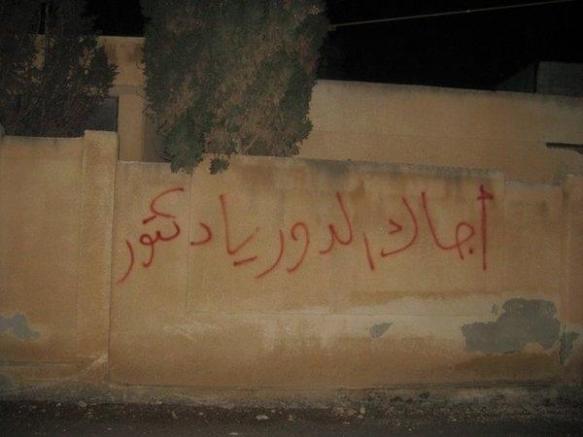
your-turn-doctor

‘Ejak el door ya Doctor’ – ‘Your turn, doctor’.

The doctor in question was Bashar al-Assad, Syria’s president, who had trained as an opthalmologist in Damacus and London.  In the months to come, Assad would give that slogan a viciously ironic twist.

The immediate response of the security forces to the graffiti was swift and draconian; the boys were rounded up, imprisoned and tortured (see herehere and here).  When their relatives protested to the officer in charge he told them:

‘Forget your children.  Just make more children. And if you don’t know how to make more, I’ll send someone to show you.’

hrw-weve-never-seen-such-horrorLocal people took to the streets, and as the demonstrations spread on 22 March security forces entered the National Hospital in Dara’a, cleared it of all non-essential medical staff and stationed snipers on the roof who were under orders to fire on protesters.  The hospital remained until military control until May 2013; admissions were restricted and snipers continued to fire on the sick and wounded who tried to approach the hospital.  On 8 April security forces opened fire on thousands of demonstrators approaching a roadblock; ambulances were prevented from reaching the wounded, and a doctor, a nurse and an ambulance driver were killed when they tried to get through (UN Human Rights Council: ‘Assault on Medical Care in Syria’, 13 September 2013: download here; see also the Human Rights Watch report, ”We’ve never seen such horror’ here).
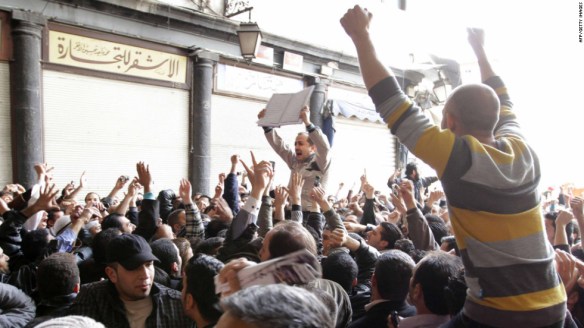
daraa-is-syria-in-damascus-2011

Others took up the cry, taking to the streets and chanting ‘Dara’a is Syria‘.  In many other areas the government stationed snipers, armoured personnel carriers, tanks and heavy artillery at hospitals; doctors suspected of treating protesters were arrested and tortured; security forces forcibly removed patients from hospitals, ‘claiming bullet or shrapnel wounds as evidence of participation in opposition activities’; and ambulances transporting casualties were attacked and pharmacies looted.

The UN Human Rights Council concluded:
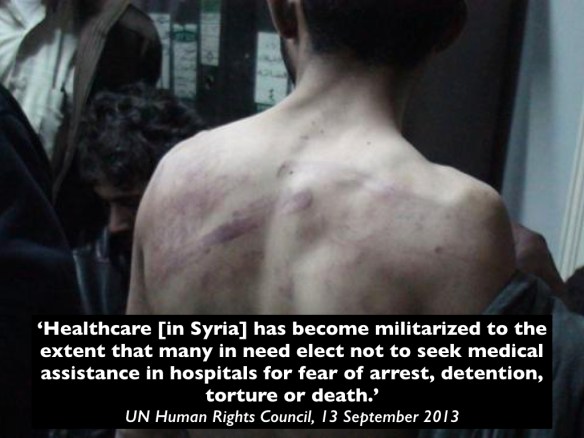
healthcare-has-become-militarised-001

This was, sadly, hardly novel.  In 2006, at the height of sectarian violence in occupied Baghdad, for example, Muqtada al-Sadr‘s Shi’a militia controlled the Health Ministry and manipulated the delivery of healthcare in order to marginalise and even exclude the Sunni population.  As Amit Paley reported:

‘In a city with few real refuges from sectarian violence – not government offices, not military bases, not even mosques – one place always emerged as a safe haven: hospitals…

‘In Baghdad these days, not even the hospitals are safe. In growing numbers, sick and wounded Sunnis have been abducted from public hospitals operated by Iraq’s Shiite-run Health Ministry and later killed, according to patients, families of victims, doctors and government officials.

‘As a result, more and more Iraqis are avoiding hospitals, making it even harder to preserve life in a city where death is seemingly everywhere. Gunshot victims are now being treated by nurses in makeshift emergency rooms set up in homes. Women giving birth are smuggled out of Baghdad and into clinics in safer provinces.’

He described hospitals as ‘Iraq’s new killing fields’, but in Syria the weaponisation of health care has been radicalised and explicitly authorized by the state.

Counterterrorism and the criminalisation of health care

Doctors were systematically targeted for treating anyone who opposed the government.  In April 2012 one surgeon from Idlib told Annie Sparrow:

‘We were detained in the hospital for several days. Tanks parked out front, artillery in the wards, snipers on the roofs shooting patients who tried to come. They took our names, and summoned three of the five security branches – state, political and military. I was interrogated and forced to sign several commitments not to treat anyone not pro-regime. Of course, as soon as I was released I violated it immediately…the city was full of wounded and sick people. Soon after that a friend who worked in military security let me know I was now “wanted” [for my work], the charge being that I was the leader of a terrorist group. So I went into hiding, and moved my family to Turkey. In retaliation my brother was executed.’
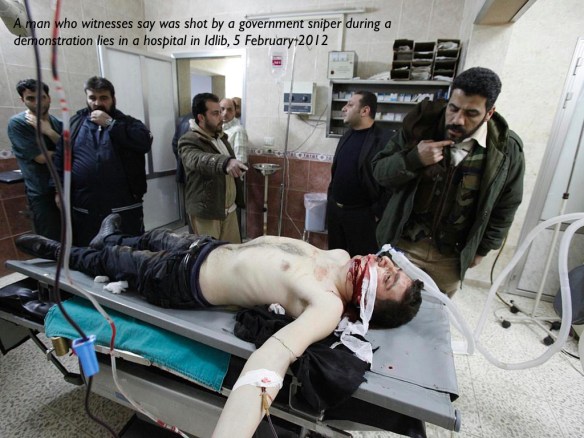
shot-by-a-sniper-001

The State of Emergency that had been in force in Syria since 1962 was abruptly ended on 21 April 2012.  But on 2 July a new Counter-terrorism Law came into force that criminalised all medical aid to the opposition.  Here is Annie Sparrow again:

it-is-forbidden-to-carry-out-any-first-aid-activities-001

The parallels with the objections voiced by some members of Afghanistan’s security services against MSF’s work in Kunduz are only too clear: but in Syria they have been given explicit state sanction enforced through the law.

As Neil Macfarquhar and Hala Droubi reported for the New York Times in March 2013, doctors repeatedly found themselves in the cross-hairs.  Here, for example, is the case of Dr Mohamad Nour Maktabi:
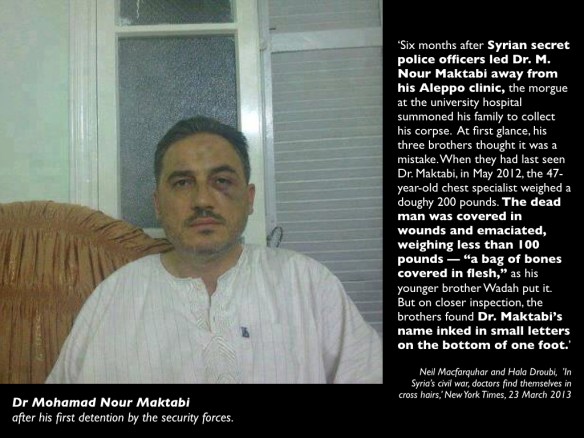
doctors-in-the-crosshairs-001

The Counter-terrorism Law also declared that all medical facilities operating in opposition-held areas without government permission were illegal – and thereby transformed them (under Syrian law, at least) into legitimate targets of military violence.

Air wars and ‘surgical strikes’

The nature of military and paramilitary violence has changed during the course of the war; shooting and mortar-fire have increasingly been supplemented by air strikes.
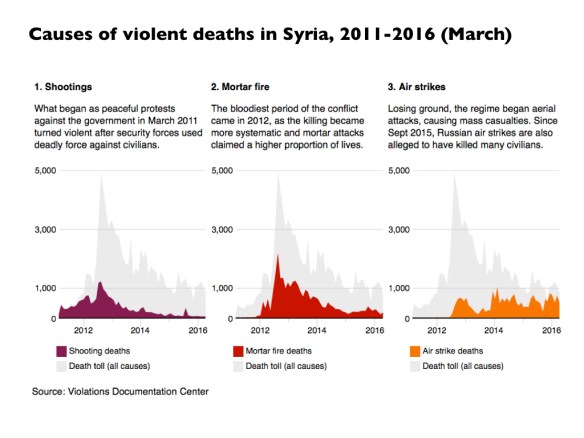
causes-of-violent-death-in-syria-2011-2016-001

Even in the early stages of the war doctors were confronting what one trauma specialist called ‘unimaginable injuries’.  Dr Rami Kalazi, a neurosurgeon in east Aleppo, explained:

‘In the beginning, we saw new injuries that we did not know how to treat. Fortunately, at the beginning of the revolution and when we began working in field hospitals, there was more freedom of movement. In 2012 and 2013, there was no such thing as “barrel bombs” and there was no violent shelling from airplanes, so many visiting foreign doctors came…

‘But even so, they told us that they were seeing injuries that they had never seen before in books or textbooks or in the hospitals where they worked in their home countries. Unfortunately, reality forces you to learn.’

But air strikes transformed the calculus of injury.  Many more casualties resulted from each attack, and the wounds of those who survived were often far more serious.

The US-led coalition has carried out multiple airstrikes primarily in areas controlled by IS, and the campaign has caused (minimally) hundreds and probably several thousand civilian casualties – see my analysis of specific US air strikes here and here, for example –  but the Syrian Arab Air Force has concentrated its fire on areas controlled by other rebel groups (see Jeffrey White‘s analysis here).

A favourite tactic has been the deployment of ‘barrel bombs‘ – in effect, aerial IEDs: oil drums filled with high explosive and cut rebar to act as shrapnel – dropped from helicopters (see Human Rights Watch here).  Basel al-Junaidi described witnessing their impact:

I saw the aftermath of a barrel bomb. I saw human remains scattered in the street; I heard the screaming. I’m trained as a doctor, but I was unable to act. I just stood there, petrified. The West thinks we’re used to this, but we aren’t of course. We’re like anyone else – we use computers and cars, not camels and tents…

Another doctor who worked in Syria said he kept ‘a drawing from a second grader in Aleppo, showing helicopters bombing the city, blood and destruction below.’  Chillingly, ‘the dead children are smiling while the living ones are crying.’
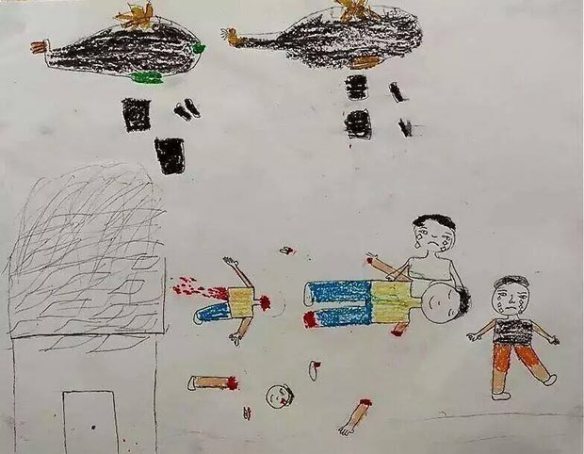
the-dead-children-are-smiling

From September 2015) the Russian Air Force, often acting in concert with the Syrian Arab Air Force, has also concentrated on targets in areas controlled by other opposition groups:
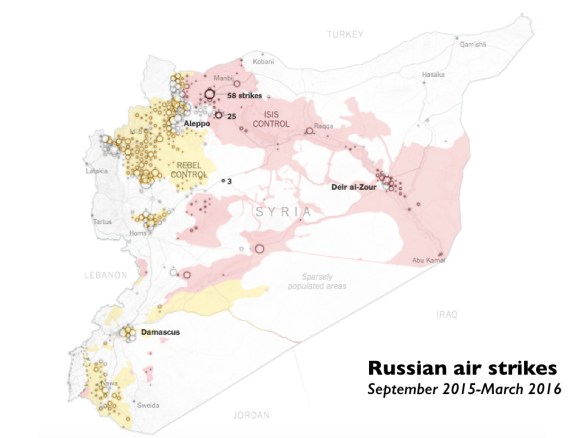
russian-air-strikes-in-syria-to-march-2016-001

Russia has routinely denied these charges, but from 30 September to 12 October 2015 its Ministry of Defence published videos of 43 airstrikes. Bellingcat, aided by crowdsourcing, identified the exact location of 36 of them and overlaid them on the ministry’s own map identifying which groups controlled what parts of the country (see the full report, ‘Distract, Deceive, Destroy’, here):

‘The result revealed inaccuracy on a grand scale: Russian officials described 30 of these videos as airstrikes on Isis positions but in only one example was the area struck in fact under the control of Isis, even according to the Russian MoD’s own map.’

The effect of these air strikes has been devastating on the population at large.  To make matters even worse, air strikes cannot target individual doctors and have instead frequently been directed against hospitals and other medical facilities.   This compromises not only trauma care for the wounded but also the treatment of chronic and infectious diseases:
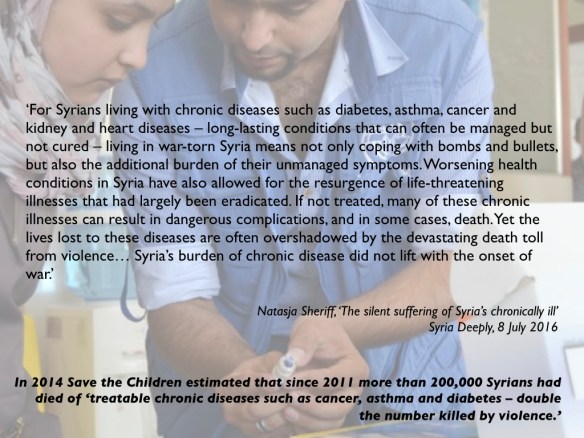
chronic-diseases-and-the-syrian-civil-war-001

(You can find a discussion of the problem of infectious diseases in Sima L. Sharara and Souha S. Kanj, ‘War and infectious diseases: challenges of the Syrian Civil War’, PLOS Pathogens 10 (11) (2014) here).

Hospitals and bomb sights

Doctors and other medical staff had to adjust to a new, sickening vulnerability.  Here is one OB/GYN who was still working in a hospital in East Aleppo when she was interviewed on Public Radio International in August 2016:

Carol Hills, PRI: Doctor Farida, did I just hear a noise there? Was that some sort of attack that I just heard?
Dr Farida Almouslem: It’s attack. [Laughs]. It’s normal. It’s away from me. Not next to me. These noises are all the time.
Hills: Do you and the doctors and patients you work with feel safe inside the place where you’re working?
Dr Farida: No. It’s not safe. I work at the third floor in my hospital. And many times the wall was perforated. So every woman came to the hospital, she knows that there is a danger on her life. So they just give the delivery, or give the birth, and then go home. She escapes to home because she knows our hospital is always targeted.

Other doctors in opposition-held areas said the same.  Here is Dr Mohamed Tennari, director of an above-the-ground field hospital in Idlib:

‘When I am in the hospital, I feel like I am sitting on a bomb. It is only a matter of time until it explodes. It is wrong − a hospital should not be the most dangerous place.  I wish I could say that targeting a hospital in Syria is unique, but is not.’

In fact, it’s far from unique: Physicians for Human Rights has issued a report detailing Attacks on Doctors, Patients and Hospitals hospitals and provided a interactive map of attacks on healthcare in Syria.

In the face of these escalating attacks, hospitals in opposition-held areas have tried to conceal their locations from the Syrian government.  In contrast to the protocol adopted by the MSF Trauma Centre in Kunduz, they have been markedly reluctant to provide their GPS coordinates (and see MSF’s explicit comparison between what happened in Kunduz and the situation in Syria here):
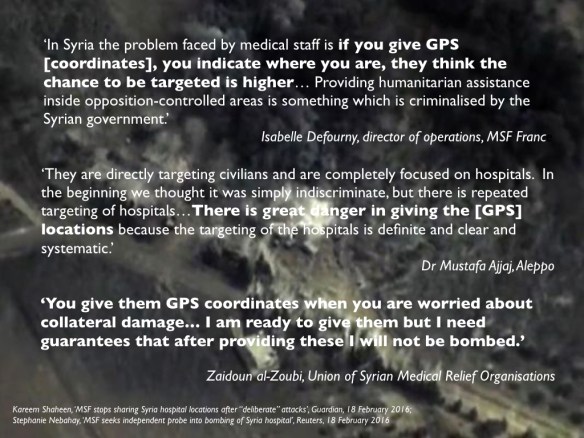
gps-coordinates-and-surgical-strikes-001

But this has trapped them in a grim Catch-22.  Michiel Hofman of Médecins sans Frontières – which is not permitted to operate in government-controlled areas in Syria – explains:

‘Hospitals that MSF supports in Syria are bereft of the possible protection of being clearly marked as a hospital or sharing of GPS coordinates, as the Syrian government passed an anti-terrorist law in 2012 that made illegal the provision of  humanitarian assistance – including medical care – to the opposition, forcing most health structures to go underground and operate without governmental medical registration. The bombing parties can then conveniently claim they were unaware it was a hospital they hit.’

More often, the Syrian government and its allies routinely describe the bombed building as a ‘so-called hospital’.  After an air strike on an MSF-supported hospital near Maarat al-Numan in Idlib on 15 February 2016 Bashar Jaafari, Syria’s ambassador to the United Nations, made this statement:

‘The so-called hospital was installed without any prior consultation with the Syrian government by the so-called French network called MSF which is a branch of the French intelligence operating in Syria… They assume the full consequences of the act because they did not consult with the Syrian government. They did not operate with the Syrian government permission.’

The allies of the Syria government are not confined to Russia and Iran.  On 27 April 2016 the Al Quds hospital in Aleppo was hit by two air strikes that killed 55 people  – among them two specialists, including Dr Muhammad Waseem Maaz, Al Quds’s pediatrician – and severely damaged the hospital. When it partially reopened 20 days later its capacity was reduced from 34 to 12 beds.  MSF conducted a detailed review of the operations of the hospital and the circumstances of the attack:
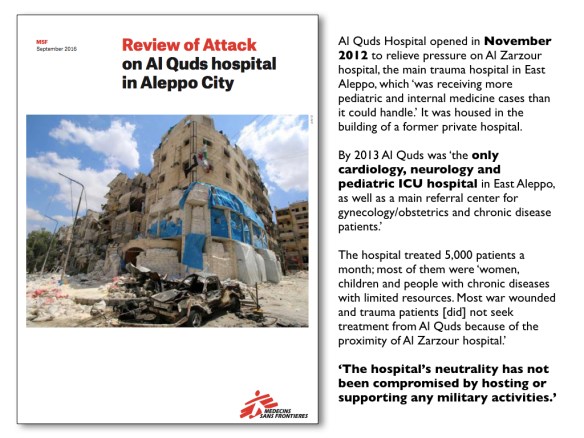
al-quds-hospital-attack-001

Here is Professor Tim Anderson on what he calls ‘The “Aleppo Hospital” Smokescreen‘ (and for reasons that will become obvious I am so tempted to put scare-quotes around the title that adorns his post; the Department of Political Economy at the University of Sydney lists him as a Senior Lecturer not a Professor, but perhaps anxiety over the appellation ‘Doctor’ is contagious):

‘…the story of Russian or Syrian air attacks on the ‘al Quds hospital’ gained prominence in the western media… CCTV showed people leaving this ‘hospital’ before an explosion.

‘The building is in the southern al-Sukkari district, which has been a stronghold of Jabhat al Nusra for some years. Many Aleppans had never heard of ‘al Quds hospital’. Dr Antaki [Aleppo Medical Association in Western Aleppo] says: “This hospital did not exist before the war. It must have been installed in a building after the war began”…. This facility was not a state-run or registered facility.’

Anderson is joined in his disinformation effort by Eva Bartlett writing in the ‘OffGuardian’:

Dr. Zahar Buttal, Chairman of the Aleppo Medical Association … said: “The media says the only pediatrician in Aleppo was killed in a hospital called Quds. In reality, it was a field hospital, not registered.”

As for the pediatrician, “We checked the name of the doctor and didn’t find him registered in Aleppo Medical Association records.”…

… central to the lies were the bias and propaganda of the very partial, corporate-financed Médecins Sans Frontières (MSF), which supports areas in Syria controlled by terrorists, specifically Jabhat al-Nusra…’

To repeat: the Syrian government has refused to register or recognise any hospitals operating in areas outside its control – hence the snide reference to ‘so-called hospitals’ and Anderson’s meretricious scare-quotes – and it does not permit MSF to operate in areas under its control (despite repeated requests).  As for the disappearance of Dr Muhammad Waseem Maaz from the Syrian government’s registry (though I have no doubt he was on other lists maintained by the regime) the director of the Children’s Hospital in Aleppo provides a graceful tribute to him here.  And here is the doctor whose death these commentators dismiss so lightly (if you have the stomach for it, you can see his last moments caught on CCTV here):

dr-muhammad-waseem-maaz

What, apart from the grotesque stipulations of the Syrian state, makes them think it proper to withdraw medical care from those living – surviving – in rebel-held areas?  International humanitarian law is unequivocal: they are entitled to medical treatment and to be protected whilst it is provided to them.

In rebel-held areas medical care has increasingly moved outside what were once established hospitals into the clandestine ‘field hospitals’ referred to above, which have been given numbered code-names to conceal their locations.  Some, like those established by MSF, follow strict medical protocols and, according to a study of one operating in Jabal al-Akrad by Miguel Trelles and his colleagues, they have (for a time) been able to provide high-quality medical care with remarkable survival rates (‘Providing surgery in a war-torn context: the Médecins Sans Frontières experience in Syria’, Conflict and Health (December 2015)).  As the attacks on them have increased and qualified personnel and medical supplies have become scarce, however, many have become exercises in improvisation:
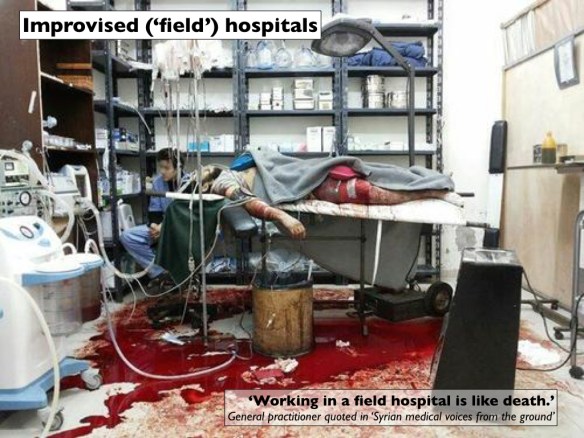
field-hospitals-001

Some of these hospitals have literally gone underground.  ‘‘In our worst dreams – in our worst nightmares – we never thought we would have to fortify hospitals,’ declared Dr Zaidoun al-Zoabi of the Union of Medical Care and Relief Organizations. ‘It’s not humane. It’s impossible to comprehend.’

Subterranean locations have been used not only to protect the hospitals but also to protect local populations.  Charles Davis reported that

‘whether it’s a vehicle or a building, anything that’s identifiable as providing medical care is ripe for an airstrike, so that staff have now taken to covering up any distinguishing characteristics. Even so, [Dr Abdulaziz Adel, a surgeon in East Aleppo, admits that] local residents are “always begging us to go away, take your hospital away from us or otherwise we’ll be a target.”‘

When the Syrian-American Medical Society proposed to build a hospital in Hama in 2014, local people begged them to locate it outside the city and so SAMS excavated what became the Dr Hasan al Araj Hospital, better known as ‘The Cave’:
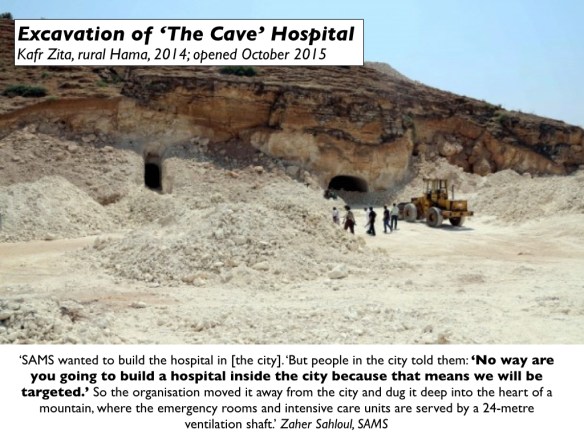
the-cave-hospital-001

the-cave-hospital-002

the-cave-hospital-003

Supply chains and kill-chains

As the civil war ground on, even the most basic medical supplies became scarce and obtaining them ever more dangerous.  In March 2015 MSF reported that:

‘Even if it is available, many suppliers do not want to risk selling material like gauze or surgical threads when they know it is going to be sent into North Homs. Gauze is considered synonymous with war surgery, and often a supplier is not willing to take the risk of being arrested or shut down for supplying a besieged area.’
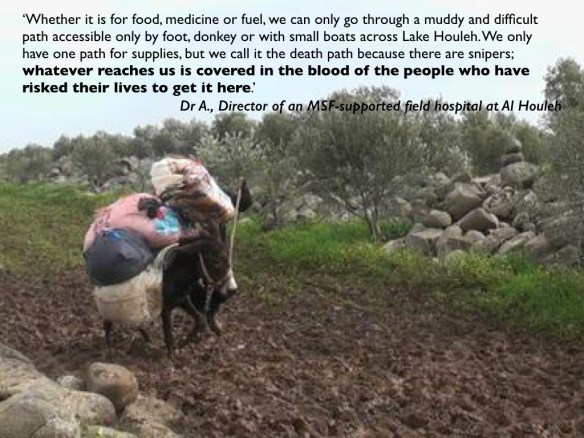
bloody-supply-chains-001

You can read more here and here.  One doctor told MSF:

‘It is precious, dangerous, incriminating. There are secret outlets supplying us with gauze.’

At the end of last year the Guardian provided this image of one of the secret factories:

gauze-factory-001

In East Ghouta, hospitals have been forced to use tunnels to bring in medical supplies (more from Ellen Francis and her colleagues here):
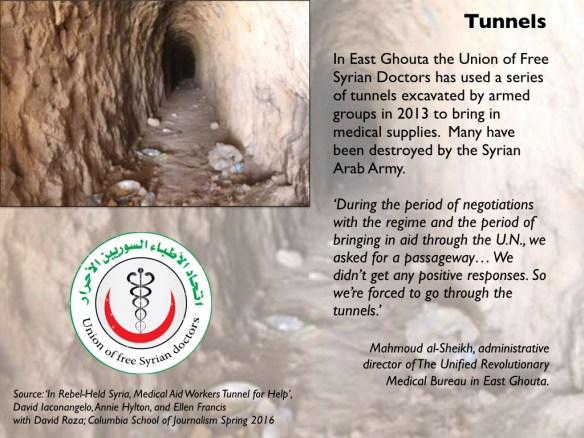
tunnels-and-the-siege-economy-in-aleppo-001

The risks are formidable and the costs have been almost prohibitive.  Ellen Francis and her colleagues at Columbia’s Graduate School of Journalism report that in January 2014 the Free Syrian Army and the Syrian Arab Army agreed an uneasy and ragged cease-fire in Barzeh, a small town on the northern edge of Damascus. There a team from the Union of Free Syrian Doctors was able to buy medical supplies from merchants who travelled out from the capital.

The merchants paid a 20 per cent ‘customs fee’ to Syrian Army soldiers; the agents for the doctors then paid a ‘tax’ to get the supplies through the Harasta checkpoint on the Army-controlled highway, and then a ‘toll’ to the rebels (‘tunnel lords’) who controlled the tunnels into Ghouta.

The combined fees inflated the price of medical supplies.  A litre of serum used to help the body replenish lost blood cost $1 in government-controlled areas and $3.50 to $10 via the tunnel route. Ghouta was using about 10,000 litres of serum per month.  The supply chain was subsequently severed once Barzeh itself came under siege and was cut off from Damascus.

Some humanitarian aid has crossed the lines by more conventional routes – conventional for a war zone at any rate – but medical supplies have routinely been removed from aid convoys.  On 19 May 2016 the UN Secretary-General reported to the Security Council:

‘[By May] 2016, WHO [had] submitted 21 individual requests to the Government of the Syrian Arab Republic to deliver medical supplies to 82 locations in 10 governorates. The Government approved five requests [while] 16 requests remained unanswered.

‘The removal of life-saving medicines and medical supplies continued, with nearly 47,459 treatments removed from convoys in April intended for locations in Homs, Aleppo and Rif Dimashq governorates. Removed items included surgical supplies, emergency kits, trauma kits, mental health medicines, burn kits and multivitamins. Removals extended to basic items, such as antibacterial soap, which was removed from midwifery kits. Items were also removed from other kits, notably surgical tools…’

Even then, aid convoys are not safe.  Four months later to the day a UNICEF aid convoy delivering supplies to a Syrian Red Crescent warehouse at Urum al-Kubra in Aleppo was attacked from the air, killing at least 18 people and destroying 18 of the 31 trucks.  Most analysts have concluded that the Russian Air Force was responsible, perhaps acting in concert with the Syrian Arab Air Force – see for example here and here– but the Russian Ministry of Defence and the usual suspects have variously blamed spontaneous combustion, a ground attack by rebels and a US drone attack.
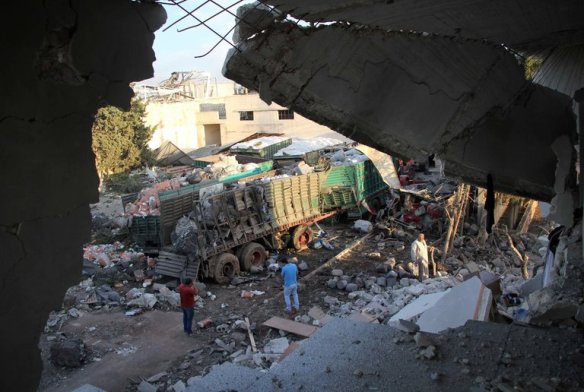
un-convoy-attacked-in-aleppo

These shortages are threaded into dispersed and precarious siege economies that gravely affect the health of local populations.  In December 2015 an estimated 400,000 people were surviving without access to life-saving aid in 15 besieged locations across Syria; the figures gathered by Siege Watch are even higher.

Surrounded by 6,000 land-mines and 65 sniper-controlled checkpoints, Madaya’s 40,000 inhabitants have been under siege since July 2015; 32 people died of starvation and malnutrition in December 2015 alone.  One resident interviewed by Amnesty International in January 2016 described the catastrophic situation:

‘Every day I wake up and start searching for food. I lost a lot of weight, I look like a skeleton covered only in skin. Every day, I feel that I will faint and not wake up again… I have a wife and three children. We eat once every two days to make sure that whatever we buy doesn’t run out. On other days, we have water and salt and sometimes the leaves from trees. Sometimes organizations distribute food they have bought from suppliers, but they cannot cover the needs of all the people.

‘In Madaya, you see walking skeletons. The children are always crying. We have many people with chronic diseases. Some told me that they go every day to the checkpoints, asking to leave, but the government won’t allow them out. We have only one field hospital, just one room, but they don’t have any medical equipment or supplies.’

An aid convoy was allowed in four days after this interview.

There are also grave shortages of skilled medical personnel.  The doctors who remain in opposition-held areas have all had to learn new skills sometimes far beyond their original training.  In March 2015 one young surgeon working in an MSF-supported hospital east of Damascus recalled:

‘There was a pregnant woman who was trapped during the time we were under full siege. She was due to deliver soon. All negotiation attempts to get her out failed. She needed a cesarean operation, but there was no maternity hospital we could get her to, and I had never done this operation before.

A few days before the expected delivery date, I was trying to get a working internet connection to read up information on doing a C-section. The clock was ticking and my fear and stress started to peak. I wished I could stop time, but the woman’s labour started…’

In 2015 OCHA estimated that more than 40 per cent of pregnant women in these areas now scheduled C-sections to reduce the risk of an attack preventing them from obtaining care.

In some cases doctors can call on skilled overseas help via Skype from consultants on call 24/7 in the United States, Canada and the United Kingdom.  Ben Taub has written movingly of the extraordinary efforts of what he calls ‘the shadow doctors’ enlisted in ‘the underground race to spread medical knowledge as the Syrian regime erases it.’  One of the most active is Britain’s Dr David Nott:

dr-david-nott-and-remote-surgery-001

dr-david-nott-and-remote-surgery-002

But not all those seeking specialist help are qualified surgeons.  In the field hospital serving the besieged town of Madaya medical care has been provided by a dentist, a dental student and a veterinarian.  Avi Asher-Schapiro reports:

‘The five-year civil war has plunged the Madaya clinicians into the deep end, forcing them to perform medical procedures that push them far beyond their training. They have treated countless gunshot victims, performed seven amputations, over a dozen C-sections, and diagnosed everything from meningitis to cancer.’

As he explains, this remarkable trio has also relied on remote medicine:
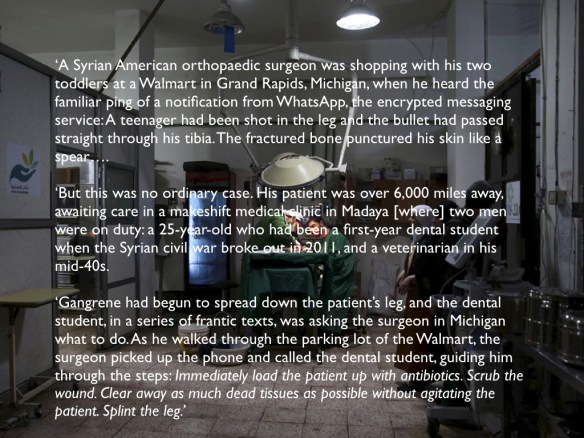
madaya-remote-medicine-001

These are all extraordinary responses to near-impossible, life-threatening situations.  But their successes have been short-lived.

The Madaya clinic was forced to close in November 2016:
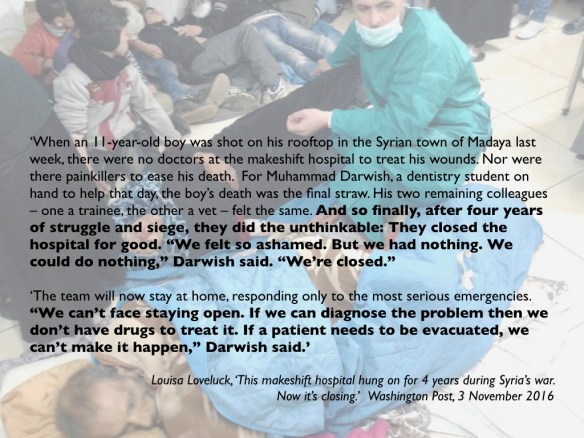
closure-of-madaya-clinic-001

And the M10 hospital where Nott helped direct surgery – the largest trauma and ICU centre in East Aleppo – was hit by successive, catastrophic air strikes.  First, an attack on 28 September 2016 left only half the hospital operational.  On 1 October Xisco Villalonga, MSF’s Director of Operations, reported that

‘Bombs are raining from Syria-led coalition planes and the whole of east Aleppo has become a giant kill box.’

That night multiple strikes on M10 killed two people and injured ten others; the hospital had to be evacuated because one crater was so deep there were fears that the rest of the building would collapse.
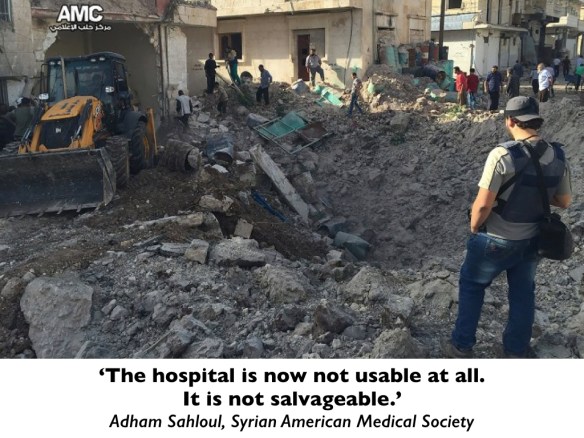
m10-hospital-bombed-001

But the ordeal was not over: there were further, devastating strikes on 3 October:
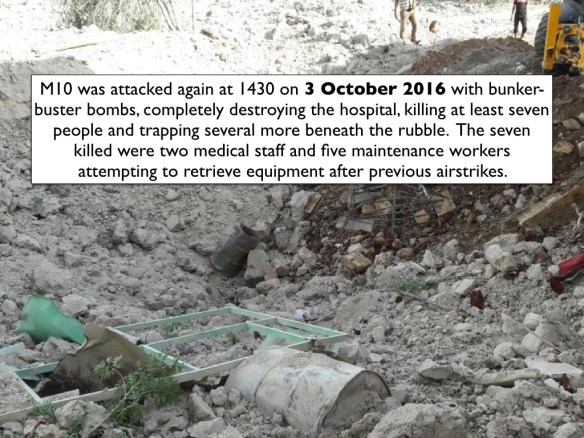
m10-hospital-bombed-002

m10-hospital-bombed-003

The underground hospitals have fared no better.  ‘The Cave’ – 15 metres inside a mountain, remember – was hit by two ‘bunker-buster’ bombs at 1500 on 2 October 2016. After 35 staff and patients had been evacuated a second strike occurred in the early evening involving missiles and cluster bombs. The E.R. was wrecked, ceilings collapsed, cement walls crumbled and generators, water tanks and medical equipment were destroyed (see image below).  Nobody was seriously injured but the hospital sustained critical damage and has been closed indefinitely. It used to treat 300 patients and perform 150 surgeries a month.

Cave Hospital hit by bunker-buster bombs

The exception to the exception

Once safe places under the protection of international humanitarian law – the exception to the space of exception that is the conflict zone – hospitals have become the targets of a new and extraordinarily vicious modality of modern war.  The systematic attacks on hospitals have not only threatened the lives of patients and healthcare workers; they have also made many patients reluctant to seek medical treatment at all.  In February 2015 a report from the Centre for Public Health and Human Rights at Johns Hopkins University was already warning of the consequences:

‘Unless they feel their life is in danger, many people won’t go to hospital because it is targeted for bombardment’ [Physician, Aleppo]. Two physicians reported that fear of travel and an understanding that the hospital is a target has led to a 50% decrease in clinic visits and surgery cases, even though the level of violence has not decreased.

Dr Farida, the OB/GYN in East Aleppo interviewed earlier, no longer has a hospital to work in – the last remaining hospital was reduced to rubble and closed on 18 November – and she now provides what medical care she can from a basement:

‘People know it’s a basement, but they are afraid to come here because they know any health facility is deliberately targeted by the regime. For women, they are afraid to come — but they don’t have any other option. When they don’t have a car or fuel to come here, they have to give birth at home. Women are bleeding at home and babies are born dehydrated without oxygen.’

Those that do make the precarious journey to a field hospital or other medical facility almost always now find that their care is compromised by the shortage or even the absence of doctors, nurses, medical supplies and even the most basic medical equipment.  So doctors use ordinary sewing cotton instead of surgical thread; local anaesthetic where they would normally use a general, or even home-made, improvised variants.  Dr Zaher Sahloul, who still tries to provide help to colleagues in Syria from his home in Chicago via WhatsApp, explains:

‘We operate on the mindset that they have basic things we take for granted… The reality is, they don’t have 90 percent of the things we think they have. They know better what they have and what they can do with it. These people are facing decisions we will never face in our lives. If you have 10 patients dying, who will you see first? Do you use spoiled gauze and dirty tubes at the risk of infection? It’s Hell for them.’

As I write, the Syrian Arab Army and its supporting militias are advancing into East Aleppo, where air strikes and artillery bombardments have left more than 250,000 people without access to any form of advanced medical care.  The World Health Organisation announced that ‘although some health services are still available through small clinics, residents no longer have access to trauma care, major surgeries, and other consultations for serious health conditions.’

The final irony – although in this catalogue of horrors it probably isn’t the last at all – is that the Kremlin has announced that it will send two mobile hospitals to treat patients from East Aleppo.  The Defence Ministry will operate ‘a special 100-bed clinic with trauma equipment for treating children’ and the Emergencies Ministry will provide a 50-bed clinic capable of treating 200 outpatients a day.
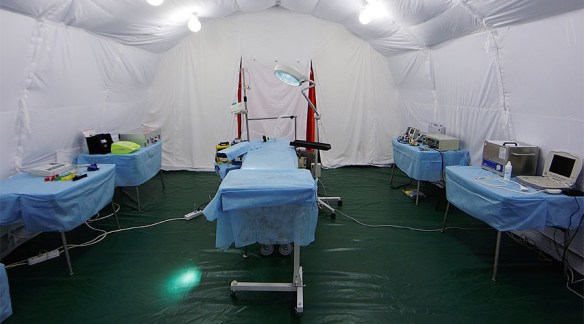
russian-mobile-hospital

While the Kremlin congratulates itself on its ‘humanity’, we need to remember that this minimalist contribution would not have been necessary at all had medical neutrality been respected and doctors and nurses, hospitals and clinics not been so ruthlessly, systematically and deliberately targeted in the first place.

UPDATE:  On 5 December the Defence Ministry’s mobile hospital (set up in West Aleppo to treat patients from East Aleppo) came under mortar fire from the crumbling opposition-held area to the east; one Russian doctor and two paramedics were killed.  It’s not clear whether the hospital was deliberately targeted – there have been accusations that the co-ordinates of the hospital must have been given to the militants for it to have been hit ‘right at the moment when it started working‘ – or whether it was caught in the indiscriminate shelling and mortar-fire that has hit other hospitals in West Aleppo.
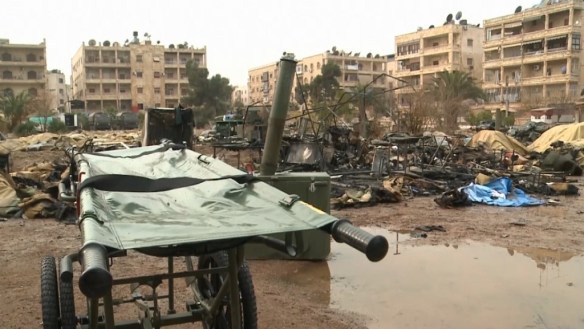
russian-mobile-hospital-attacked-in-aleppo

But I should make two things clear.  First, attacks on hospitals in West Aleppo – even though I don’t think they have exhibited anything like the scale or the systematicity of those directed against medical facilities and healthcare workers in opposition-held areas – are as reprehensible as those on hospitals in the East.  Second, the muted response from the US-led coalition to the shelling of the Russian field hospital is deeply disturbing.  The International Committee of the Red Cross announced after the attack that ‘all sides to the conflict in Syria are failing in their duties to respect and protect healthcare workers, patients, and hospitals, and to distinguish between them and military objectives.’  The Russian Ministry of Defence dismissed this as a ‘cynical’ display of indifference to the deaths of its doctors, but I don’t read it like that at all – what is cynical is the partisan appeal to medical neutrality when it suits, and its systematic violation when it doesn’t.
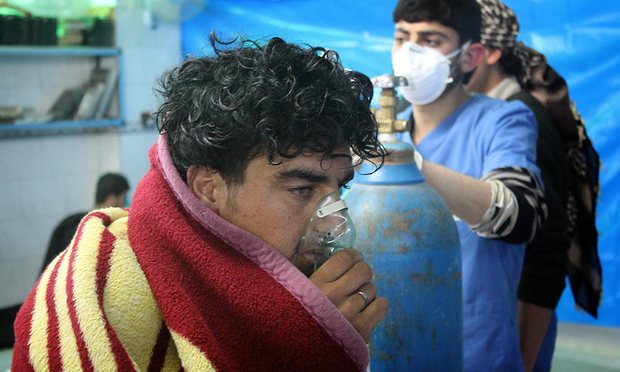
To be continued