‘That others may die’

As I am (at last) moving into the finishing stages of my ‘Dirty Dancing’ essay on CIA-directed drone strikes in Pakistan’s Federally Administered Tribal Areas, it’s time to round up some of the latest work on drones and civilian casualties across multiple theatres.
tumblr_nhlv56QBGc1t8pecvo1_1280

First, Afghanistan: the principal theatre of US remote operations.  I’ve noted Larry Lewis‘s remarkable work before (here and here), based on classified sources, and in particular this claim (see also here):

Drone strikes in Afghanistan were seen to have close to the same number of civilian casualties per incident as manned aircraft, and were an order of magnitude more likely to result in civilian casualties per engagement.
usaf_mq_9_reaper_1024x1024As I said at the time, the distinction between an ‘incident’ and an ‘engagement’ is crucial, though most commentators who have seized on Larry’s work have ignored it and focused on the dramatic difference in civilian casualties per engagement. Despite my best efforts, the Pentagon were unwilling to clarify the difference, so here is what Larry himself has told me:

An engagement is probably intuitively what you would expect – the use of force against a target. The distinction is the term incident, which is borrowed from ISAF definitions. I should have said “civilian casualty incident.” This refers to an engagement that results in civilian casualties.

This means that, if you look at the collection of civilian casualty incidents, the average number of civilian casualties is close to the same for manned and unmanned platforms. At the same time, the rate of civilian casualties for the two platforms is markedly different, with unmanned platforms being ten times more likely to cause civilian casualties than manned platforms. That doesn’t mean that drones caused more civilian casualties than manned aircraft, by the way, since the denominators (number of engagements of manned aircraft versus drones) can and in fact were very different. But it does suggest that the relative risk of civilian casualties was higher for one kind of platform versus the other.

And this is in the specific context of Afghanistan and for a specific time. I wouldn’t want to say that this specific rate would be repeated, necessarily. Yet there were certain risk factors I observed in the civilian casualty incidents that I would expect to continue to be factors unless steps were taken to mitigate them.

Larry’s most recent report, Improving lethal action: learning and adapting in US Counterterrorism Operations, is available here.  It includes an analysis of the Uruzgan air strike that is central to my ‘Angry Eyes’ essay (next on my to-do list).

[The short clip above is from Baden Pailthorpe‘s stunning animation MQ-9 Reaper (That Others May Die) (2014) – you can find much more here]

You might think that all of this is now of historical interest since President Obama has declared the end of the Afghanistan war.  Not so.  Here is John Knefel writing in Rolling Stone this week:

Though many Americans may not have realized it, December 28th marked what the U.S. government called the official end of the war in Afghanistan. That war has been the longest in U.S. history – but despite the new announcement that the formal conflict is over, America’s war there is far from finished. In fact, the Obama administration still considers the Afghan theater an area of active hostilities, according to an email from a senior administration official – and therefore exempts it from the stricter drone and targeted killing guidelines the president announced at a major speech at the National Defense University in 2013.

“Afghanistan will continue to be considered an ‘area of active hostilities’ in 2015,” the official tells RS. “The PPG does not apply to areas of active hostilities.” (PPG stands for Presidential Policy Guidelines, the formal name for the heightened drone rules.)

That perplexing distinction – that formal combat operations are over but that the U.S. still remains in an armed conflict – in many ways exemplifies the lasting legacy of Obama’s foreign policy.

If you assume the situation in Pakistan is somehow less ambiguous, read Ryan Goodman on ‘areas of active hostilities’ over at Just Security here (I’m having to sort all this out for ‘Dirty Dancing’, of course).

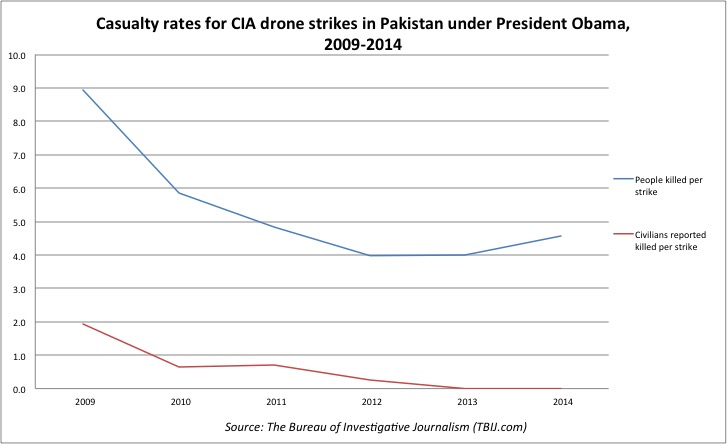
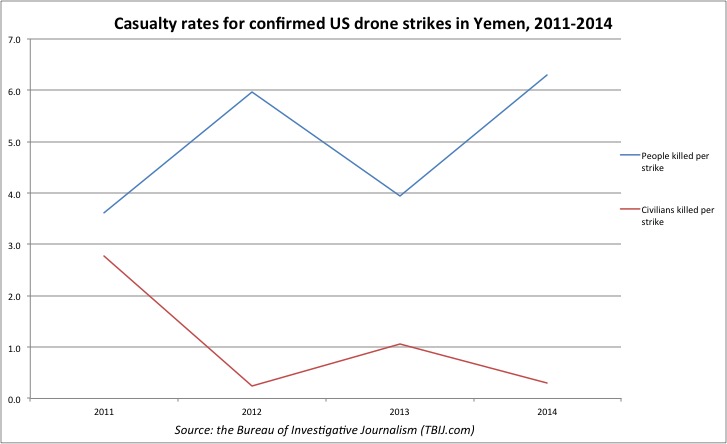
Second, the Bureau of Investigative Journalism has released its end-of-year report on US drone strikes in Pakistan, Yemen and Somalia in 2014, which includes these tabulations of casualty rates for the first two countries:
cas-rates-cia-pak-09-14

cas-rate-yemen-02-14

The Bureau comments:

While there have been more strikes [in Pakistan] in the past six years, the casualty rate has been lower under Obama than under his predecessor. The CIA killed eight people, on average, per strike during the Bush years. Under Obama, it is less than six. The civilian casualty rate is lower too – more than three civilians were reported killed per strike during the past presidency. Under Obama, less than one.  There were no confirmed civilian casualties in Pakistan in the past year, as in 2013….

The frequency of strikes [in Yemen] may have fallen in 2014 but more people were killed, on average, per strike than in any previous year.  The casualty rate for last year even outstrips 2012 – the bloodiest year recorded in the US’s drone campaign in Yemen when at least 173 people were reported killed in 29 strikes. In 2014 at least 82 people were reported to have died in just 13 strikes.

You can find the Long War Journal‘s tabulations for Pakistan here and Yemen here.
unammed-rogershillThird, Israel.  I’ve commented previously on an interview with an Israeli drone pilot, but it’s been difficult to put his observations in context (though see here and scroll down to the tabulations). Now Ann Rogers, who wrote Unmanned: drone warfare and global security (Pluto, 2014) with John Hill – as good an introduction to drone wars as you will find – has just released an essay on ‘Investigating the Relationship Between Drone Warfare and Civilian Casualties in Gaza‘.  It’s in a special issue of the open-access Journal of Strategic Security 7 (4) (2014) on ‘Future challenges in drone geopolitics’.  Here’s the abstract:

Unmanned aerial vehicles (UAVs), better known as drones, are increasingly touted as ‘humanitarian’ weapons that contribute positively to fighting just wars and saving innocent lives. At the same time, civilian casualties have become the most visible and criticized aspect of drone warfare. It is argued here that drones contribute to civilian casualties not in spite of, but because of, their unique attributes. They greatly extend war across time and space, pulling more potential threats and targets into play over long periods, and because they are low-risk and highly accurate, they are more likely to be used. The assumption that drones save lives obscures a new turn in strategic thinking that sees states such as Israel and the US rely on large numbers of small, highly discriminating attacks applied over time to achieve their objectives. This examination of Israel’s 2014 war in Gaza argues that civilian casualties are not an unexpected or unintended consequence of drone warfare, but an entirely predictable outcome.
Drone-flying-above-me-Friday-afternoon-400-x-300It’s an interesting essay, but I fear that it takes the Israeli military at its word.  Ann repeatedly refers to Israel’s ‘discriminating’ targeting:

‘The central point is that drones enabled the IDF to undertake detailed, extensive, and discriminating targeting of Gaza, before and during the actual fighting. The killing of civilians may be down to differing interpretations of military necessity, or in some cases, in how combatants and non-combatants are distinguished from one another. But it is the drone gaze that enables these targets to be ‘called into being’ (p. 102)…

‘As Israeli targeting of Gaza appears to have been highly discriminating, a more serious problem may lie in how its view of legitimate attacks differs from the global “norm.” (p. 104).’

I commented on Israeli attacks on hospitals and ambulances last summer here, here and here, and on the wholesale destruction of  Gaza here and here, so I confess I am at a loss for words.  But she is right to emphasise the operative power of international humanitarian law and its protocols of distinction (discrimination) and proportionality – though, as often as not, these seem to have been inoperative in anything other than a rhetorical sense.  For much more on this, and the way in which military lawyers are incorporated into Israel’s kill-chains, you should click across to Craig Jones‘s War, Law and Space.  All of which makes the Palestinian decision to seek membership of the International Criminal Court all the more important (there’s a good commentary on the wider legal issues by David Luban at Jus Security here and by a clutch of commentators at the Middle East Research and Information Project‘s blog here).  Perhaps not surprisingly, Daniel Reisner, the former head of the Israeli military’s International Law Department, has condemned the Palestinian application as ‘a belligerent act within the framework of the non-physical and kinetic world of lawfare.’

Finally, the US-led air strikes on IS/ISIL targets in Iraq and Syria.  Here we know much less than we should, not least because the Pentagon knows much less than it should.  Here is Nancy Youssef reporting earlier this week:

In a war fought largely from the air and in places no one can safely go, the impact is as opaque as the war itself, making it difficult to measure whether the U.S. and coalition effort is working.

“We don’t have the ability to count the nose of every guy we schwack,” as Pentagon spokesman Adm. John Kirby told reporters Tuesday, using military jargon [sic] for killing. “That’s not the goal.”

Presumably, that also means the Pentagon can’t count how many civilians it has accidentally killed in the name of ridding the region of ISIS.

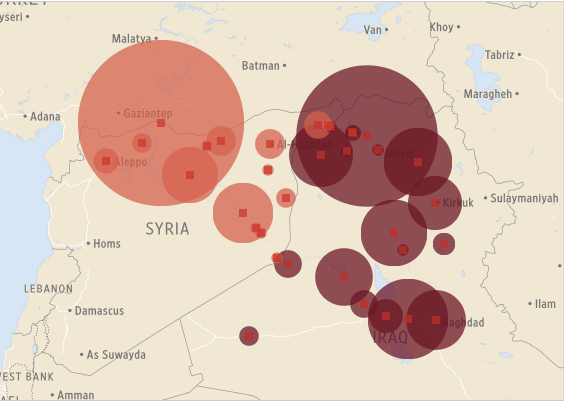
Drone Wars UK has an excellent survey of the logistics of air operations over Iraq and Syria from Chris Cole here, and the New York Times has produced a useful interactive map of US-led air strikes from which I’ve snipped this summary:
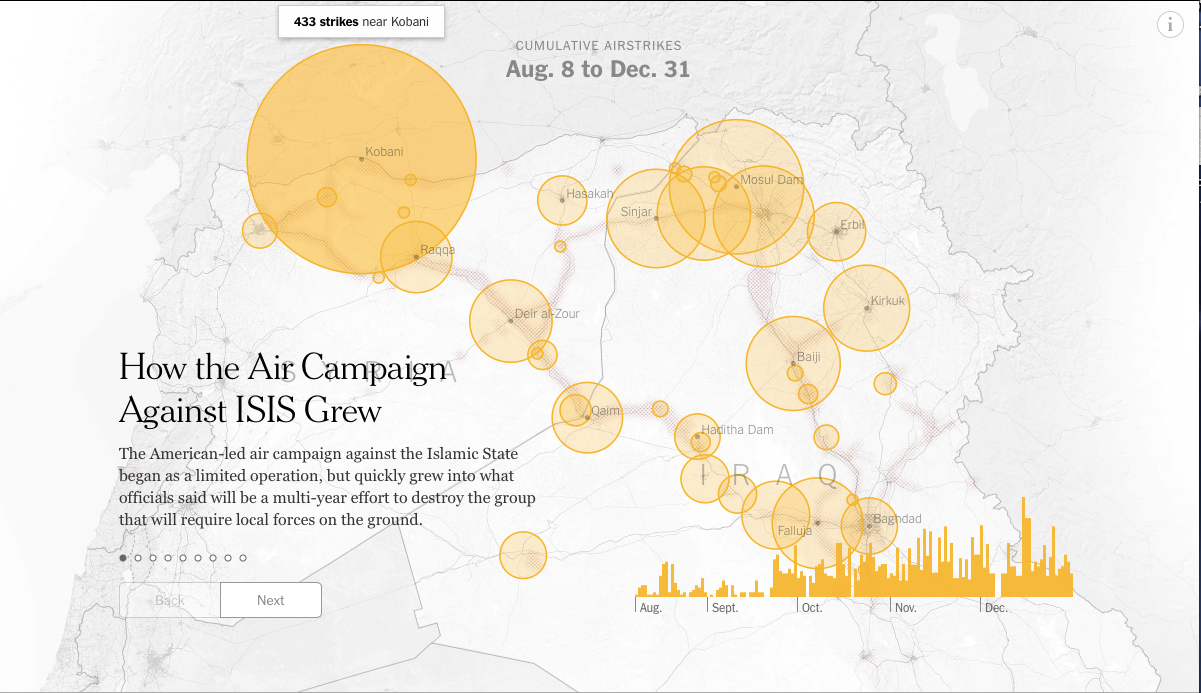
Iraq:Syria air strikes 4 August to 31 December 2014

We don’t know how many of these were carried out by drones or even orchestrated by them, but as their limitations are becoming clearer it’s reasonable to assume that most involved conventional strike aircraft.  We do know that targeting involves the analysis of video feeds from both remote and conventional platforms, and that CENTCOM has had considerable difficulty in juggling the competing demands for ISR from Afghanistan and from Iraq/Syria.

According to a report this week from W.J. Hennigan, who visited the USAF’s 480th Intelligence, Surveillance and Reconnaissance Wing at Langley Air Force Base in Virginia:

In a vast windowless room, several dozen intelligence analysts worked under the glow of more than 100 computer screens, quietly studying video streaming from U.S. drones and spy planes hunting for Islamic State militants in Iraq and Syria.

One team searched the incoming video to find a firefight underway between Iraqi security forces and militants somewhere south of the insurgent-held city of Mosul in northern Iraq.

For four hours, the analysts pored over the imagery before identifying 20 positions where the militants were dug in with machine guns and other weaponry. After the analysts called in the coordinates, 15 jets from five countries pounded the targets with more than two dozen bombs.

The Dec. 5 airstrike, one of 462 last month, underscores the Pentagon’s increased reliance on personnel far from the battlefield…  Air Force analysts here stand — or rather sit — on the virtual front lines by tracking Islamic State fighters in a war zone some 6,000 miles away.

But here’s the rub:

Unlike in past wars, when U.S. troops on the ground helped provide targeting information and intelligence, commanders in the battle against Islamic State rely chiefly on airborne surveillance, captured communications chatter, signals intelligence and other material that is processed by analysts here.

U.S. officers said the video-watching analysts working half a world away are no match for spotters and other troops feeding intelligence from the front lines.

“We don’t have anywhere near the level of intelligence we used to,” Lt. Col. Marc Spinuzzi, a senior intelligence officer, wrote in an email from Baghdad. The analysts are under “a lot of pressure … to clearly distinguish friend from foe, and to pick out the enemy from the civilian population” on the battlefield.

That is precisely how mistakes are made and civilians killed.  And, as Robert Naiman pointed out,

“There is a big danger here that U.S. air strikes in Syria are going to resemble the drone strikes in Pakistan and Yemen in the sense that there is no accountability for who is killed. We have reports of civilian casualties from people in the area and the U.S. government says, ‘No, they are bad guys.’ There has to be some public accountability for what happens when there are allegations of civilian casualties.”

At least the Pentagon has now gone some way towards recognising the problem.  Previously it had insisted that it was unaware of any civilian casualties, which is disingenuous: it beggars belief that 1,000 air strikes could have resulted in no civilian casualties – but if your ISR is inadequate it’s scarcely surprising that you would be ‘unaware’ of the consequences.  Even so, on 6 January the Pentagon announced that it had investigated 18 allegations of coalition airstrikes causing civilian casualties between 8 August and 30 December.  It determined that 13 were ‘not credible’, but was continuing to review three others; a further two, one in Iraq and one in Syria, are now the subject of formal military investigations.  But before you gold your breath, both Iraq and Syria are also exempt from the Presidential Policy Guidelines that require a ‘near certainty that no civilians will be killed or injured’.  Here is Harold Koh (really):

‘They seem to be creating this grey zone…  If we’re not applying the strict rules [to prevent civilian casualties] to Syria and Iraq, then they are of relatively limited value.’

Bodies on the line

The more I think about corpography (see also ‘Corpographies under the DOWNLOADS tab) – especially as part of my project on casualty evacuation from war zones – the more I wonder about Grégoire Chamayou‘s otherwise artful claim that with the advent of armed drones the ‘body becomes the battlefield’.  He means something very particular by this, of course, as I’ve explained before (see also here).

But let me describe the journey I’ve been taking in the last week or so that has prompted this post. Later this month I’m speaking on ‘Wounds of war, 1914-2014‘, where I plan to sketch a series of comparisons between casualty evacuation on the Western Front (1914-18) and casualty evacuation from Afghanistan.  I’ve already put in a lot of work on the first of these, which will appear on these pages in the weeks and months ahead, but it was time to find out more about the second.

800px-Medical_Emergency_Response_Team_Recovers_a_Casualty_in_Afghanistan_MOD_45151884

En route I belatedly discovered the truly brilliant work of David Cotterrell who is, among many other things, an installation artist and Professor of Fine Art at Sheffield Hallam University.  He became interested in documenting the British military casualty evacuation chain from Afghanistan, and in 2007 secured access to the Joint Medical Forces’ operations at Camp Bastion in Helmand.  He underwent basic training, a course in even more basic battlefield first-aid, and then found himself on an RAF transport plane to Bastion.  The Role 3 Hospital was, as he notes, a staging-ground. ‘Field hospitals are islands between contrasting environments,’ he wrote in his diary, ‘between the danger and dirt of the Forward Operating Bases and the order and convention of civilian healthcare.’  You can read a long, illustrated extract from the diary (3 – 26 November 2007) here, follow the photo-essay as a slideshow here, and explore David’s many other projects on his own website here.

THEY-WERE-SOLDIERS_by-Ann-Jones_72The diary is immensely interesting and informative in its own right, not least about the exceptional personal and professional difficulties involved in documenting the evacuation process.  Here there’s a helpful comparison to be made with journalist Ann Jones‘s no less brilliant They were soldiers: how the wounded return from America’s wars (more on this in a later post), which starts at the US military’s own Level III Trauma Center, the Craig Joint Theater Hospital at Bagram, and moves via Landstuhl Regional Medical Center in Germany, the largest US hospital outside the United States, to the Walter Reed Army Medical Center in Washington DC.

David’s visual record is even more compelling, as you would expect from a visual artist, not only in its documentary dimension but also in the installations that have been derived from it.  In Serial Loop, for example, we are confronted with a looped film showing the endless arrival of casualties at Bastion: ‘The sound of a continuously arriving and departing Chinook helicopter accompanies images of a bleak and wasted landscape; the banality of the film’s fixed perspective masks the dramas that unfold within the ambulances as they travel to triage.’

9-liner explores what David calls ‘the abstraction of experience within conflict’:

9-Liner explores the dislocation between the parallel experiences of casualties within theatre. It is a quiet study of a dramatic event: the attempt to bring an injured soldier to the tented entrance of the desert field hospital. The screens show apparently unrelated information. JCHAT – a silent scrolling codified message – runs on a central screen. Our interpretation of it is enabled through its relationship between one of two radically different but equally accurate views of the same event. To the left we see the Watchkeeper – a soldier manning phones and reading computer screens in a crowded office. On the right we view the MERT flight – the journey of the Medical Emergency Response Team in a Chinook helicopter.

SHU’s REF submission includes this summary of David’s work (one of the very few useful things to come out of that otherwise absurdist exercise):

The research made clear that soldiers recovering from life-changing injuries had limited means of reconstructing the narrative of their transformative experiences. From the time of wounding through to secondary operations in the UK, many soldiers remained sedated or unconscious for a period of up to five days. The radical physical transformation that had occurred during this period was not adequately reconciled through medical notes, and the embargo on photographic documentation of incident and subsequent medical procedures served further to obscure this period of lost memory.

A culture of secrecy meant that medical professionals were unable to access documentation of the expanded care pathway with which they, and their colleagues, were engaged. This fragmentation of experience and understanding within the process of evacuation, treatment and rehabilitation meant that the assessment of the contradictions and disorientation experienced by casualties and medical practitioners was denied to front-line staff.

Family members, colleagues and members of the public outside the immediate environment of the military were unable to visualise or understand the transformative effects of conflict on directly affected civilians and soldiers. Partly as a result, the scope for public debate to engage meaningfully with the longer term societal cost of contemporary conflict was limited.

The submission goes on to list an impressive series of debriefings, presentations to military and medical professionals, major exhibitions, and follow-through research in Birmingham.

5-soldiers_header

And it’s one of those follow-throughs that prompted me to think some more about corpographies.  I’d noted the connection between corpography and choreography in my original post, but David’s extraordinary collaboration with choreographer Rosie Kay and her dance company gives that a much sharper edge.  Again, there’s a comparison to be drawn – this time with Owen Sheers‘s impressively researched and executed body of work, not only the astonishing Pink Mist but also The Two Worlds of Charlie F (2012)which was a stage play based on the experiences of wounded soldiers who also made up the majority of the cast (see my discussion of these two projects here).

5 Soldiers started life as a stage presentation in 2010 (watch some extracts here):

A dance theatre work with 5 dancers, it looks at how the human body is essential to, and used in, warfare. 5 SOLDIERS explores the physical training that prepares you for war, as well as the possible effects on the body, and the injury caused by warfare.

Featuring Kay’s trademark intense physicality and athleticism, 5 SOLDIERS weaves a journey of physical transformation, helping us understand how soldiers are made and how war affects them.

5 SOLDIERS is a unique collaboration between award-winning choreographer Rosie Kay, visual artist David Cotterrell and theatre director Walter Meierjohann. It follows an intense period of research, where Rosie learnt battle training with The 4th Battalion The Rifles and David spent time in Helmand Province with the Joint Forces Medical Group.

Rosie explained her commitment to the project (and her training with The Rifles) like this:

“I wanted to look at how the physicality of a soldier’s job defines them –like a dancer, the soldier is drilled, trained, their responses becoming automatic, but can anything prepare you for the realities of war? It is young soldiers and their bodies that are the ultimate weapon in war – their strength and weaknesses may win or lose a battle, their ability to harm or injure others is key to victory. While war is surrounded with weaponry, uniforms, history and ceremony, the real business is human, dirty, messy, painful and happening right now.”

(She is, not coincidentally, an affiliate of the School of Anthropology at Oxford).

5 Soldiers installation PNG

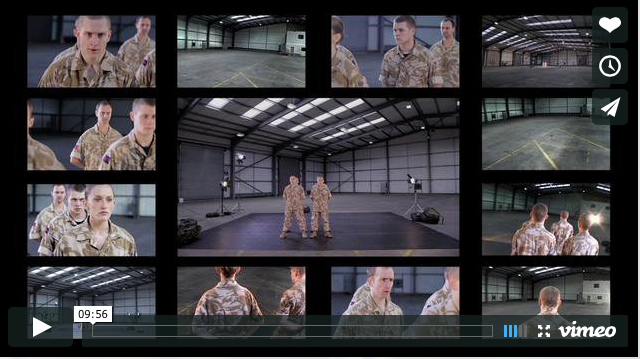
And now there’s a film version that works as a multi-screen installation (screen shot above).

Instead of just creating a short film, the team wanted the web user to get a truly interactive way to watch dance, and actually feel that they can go inside the minds and the body of the work. The 80-minute work was cut to just 10 minutes long, and the company spent one week filming in a huge aircraft hangar at Coventry Airport…

Using a variety of cutting edge filming techniques, the collaborative team have created a 13 angle edit that takes you into the heart of the work, follows each of the dancers, and zooms out so that the performers appear to be like ants in a huge empty landscape.

You can see the interactive, multi-perspectival version here.  This relied on helmetcams, and there’s a fine, more general commentary on this in Kevin McSorley‘s ‘Helmetcams, militarized sensation and “somatic war”‘ here.  But here’s the short, ‘director’s cut’ version:

And look at the tag-line: ‘The body is the frontline’.  It’s not only drones that make it so.

Novel wars

Since I added ‘The Natures of War’ to the DOWNLOADS section several people have asked me about my use of novels, especially in relation to Vietnam, while others have asked me to recommend writings – both novels and memoirs – that treat contemporary conflicts, especially Afghanistan.

Writing letters to home

The first part is easy.  To say things too quickly, I think the usual distinction between ‘fiction’ and ‘non-fiction’ is much more problematic than it seems (don’t we all know this? and in any case where exactly do you place a ‘memoir’ in such a strangely bifurcated landscape?).  I also believe that there are some insights – truths, if you prefer – that are best conveyed in ostensibly fictional form.  For that reason I suspect it’s significant that it’s my appeal to (for example) Karl Marlantes‘s magnificent Matterhorn in the Vietnam section that seems to trouble some readers much more than my use of poetry in the section on the Western Desert in the Second World War.  Yet both emerged through their authors’ reflections on their experiences of modern war in those places.  That doesn’t mean that one can ignore literary conventions or linguistic devices – no text is a transparent reflection of the world, after all – but this surely also holds for nominally factual accounts too (and that goes for military blogs, which have created their own conventions).  In other ‘fictional’ cases I can think of – like Tom McCarthy‘s C, which I drew upon in ‘Gabriel’s Map’ to characterise the battlefields of the Western Front  – the narrative is clearly embedded in intensive and immensely thoughtful research.  In fact, I’d push this further: hence my interest in documentary drama as part of – not simply a product of – the research process.

The second question is more difficult, but there are some recent guides which might help.  A good place to start is George Packer‘s ‘Home Fires: how soldiers write their wars‘ which appeared in the New Yorker last spring.  Packer tries to pin down what is distinctive about writing that seeks to capture the wars fought in the shadows of 9/11:

‘The first wave of literature by American combatants in these long, inconclusive wars has begun to appear—poems, memoirs, short stories, novels. Their concerns are the same as in all war writing: bravery and fear, the thin line between survival and brutality, the maddening unknowability of the enemy, tenderness, brotherhood, alienation from a former self, the ghosts of the past, the misfit of home.

But Iraq was also different from other American wars… Without a draft, without the slightest sacrifice asked of a disengaged public, Iraq put more mental distance between soldiers and civilians than any war of its duration that I can think of. The war in Iraq, like the one in Vietnam, wasn’t popular; but the troops, at least nominally, were—wildly so. (Just watch the crowd at a sports event if someone in uniform is asked to stand and be acknowledged.) Both sides of the relationship, if they were being honest, felt its essential falseness.’

Given this disconnect, he concludes, ‘it’s not surprising that the new war literature is intensely interested in the return home.’  But when it deals with the soldiers’ experience of war, he continues,

‘It deals in particulars, which is where the heightened alertness of combatants has to remain, and it’s more likely to notice things. To most foreign observers, the landscape of Iraq is relentlessly empty and ugly, like a physical extension of the country’s trauma. But in the poetry and the prose of soldiers and marines the desert comes to life with birdsong and other noises, the moonlit sand breeds dreams and hallucinations.’

It’s that struggle to turn the experience of land into its evocation that interests me.  But Packer makes surprisingly little of it, and his gaze is focused almost unwaveringly on Iraq rather than Afghanistan (not surprising, given his own war reporting).

Writing in the New York TimesMichiko Kakutani identifies a series of writings on the human costs of what Dexter Filkins called ‘the forever war’:

‘War cracks people’s lives apart, unmasks the most extreme emotions, fuels the deepest existential questions. Even as the wars in Iraq and Afghanistan morph into shapeless struggles with no clear ends in sight, they have given birth to an extraordinary outpouring of writing that tries to make sense of it all: journalism that has unraveled the back story of how and why America went to war, and also a profusion of stories, novels, memoirs and poems that testify to the day-to-day realities and to the wars’ ever-unspooling human costs.

‘All war literature, across the centuries, bears witness to certain eternal truths: the death and chaos encountered, minute by minute; the bonds of love and loyalty among soldiers; the bad dreams and worse anxieties that afflict many of those lucky enough to return home. And today’s emerging literature … both reverberates with those timeless experiences and is imprinted with the particularities of the conflicts in Afghanistan and Iraq: changes in technology, the increased presence of female soldiers and, most importantly, the all-volunteer military, which has opened a chasm between soldiers (“the other 1 percent”) and civilians.’

Here too there is an attempt to see how today’s writing differs from the established canon of war literature.  En route, Kakutani makes some good suggestions for reading, but she says very little about the differences – those dense ‘particulars’ again – between Iraq and Afghanistan.

afghan1

She leaves that to Brian Castner‘s outstanding essay for the LA Review of Books, ‘Afghanistan: a stage without a play.’

Castner did two tours in Iraq, and his own account of that experience (and, just as important, what followed) in The Long Walk is a tour de force in every sense of the phrase.  But he is also remarkably perceptive in his readings of Afghanistan (‘the Undescribed War’, he calls it) and – of particular interest to me, given my interest in ‘the natures of war’ or what my good friend Gastón Gordillo would prefer me to call ‘terrain‘ – its land and landscapes.  Castner also draws several illuminating comparisons with Vietnam (not least through a double parallel with the US’s ‘Indian Wars’ of the nineteenth century).

Kevin Maurer covered both wars, and always found

“Afghanistan far more riveting than Iraq because it’s a whole different world. Baghdad is a Middle Eastern city, but it is a modern city. In Afghanistan that barely exists. I’ve always been able to turn my brain into Afghanistan mode and out, while Iraq blurs.”

The influence of the terrain, especially its beauty, is clear: while a few descriptions of colorful Iraqi skies creep into the literature, it was mostly an ugly urban war fought along the New York State Thruway, rest stop to rest stop. “Afghanistan always had that Vietnam vibe to it,” Maurer said, “because you can go get lost in Afghanistan, you can be on some hill on some outpost. In Iraq you were never that far out.”

Korengal

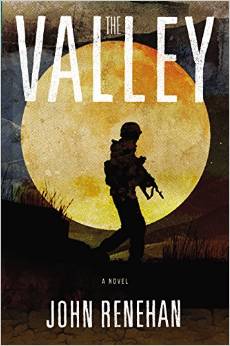
And for that very reason the terrain was always more than beautiful.  You can see that in a film like Restrepo – and even more clearly in Koregal (above) – but according to Castner you can also see it in John Renehan’s forthcoming novel, The Valley.  And here too Vietnam continues to haunt the imaginative landscape:

RENEHAN The ValleyThe landscape acts as an omnipresent consciousness, an apparition always in the corner of [Lieutenant] Black’s eye, and Renehan attaches to it layers of reverence and dread and unknowable quasi-mysticism; the valley is capable of anything. This infection spreads slowly for the reader, and Renehan says his writing process followed a similar path. “I more or less thought I was setting out to write a mystery story that happened to be set in a war. But as I started writing it I realized it was growing into something different in my mind, and it changed on paper too.” A detective story becomes a heroin- and concussion-fueled dreamscape that crosses genres. “Going After Cacciato gave me comfort in writing the parts of The Valley that become almost surreal,” Renehan said. “It reassured me that this sort of thing is okay, because it’s a war novel, right?”

What I need to think more about – the process I started in ‘Gabriel’s Map’ and continued in ‘The Natures of War’ – is how, despite Castner’s title, the stage is always part of the play.  And novels and poems will continue to help me do so.

POSTSCRIPT  Just after I finished drafting this post, I stumbled across ‘s Peter Molin‘s excellent blog: Time Now: the Iraq and Afghan wars in art, film and literature which also discusses the three reviews I list here.  Peter is a US Army officer who served in Afghanistan in 2008-9, and his posts are rich in ideas, insights and resources: well worth bookmarking.

Untargeted killing

Back in November 2012 I explained that the debate over CIA-directed targeted killing in Pakistan, Yemen, Somalia and elsewhere risked overlooking the conduct of targeted killing by the US military and its coalition partners in Afghanistan:

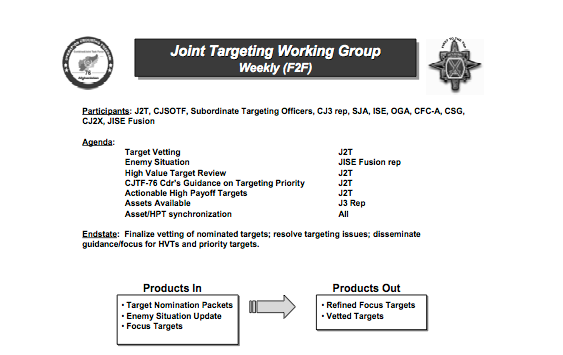
Targeted killings are also carried out by the US military – indeed, the US Air Force has advertised its ability to put ‘warheads on foreheads’ – and a strategic research report written by Colonel James Garrett for the US Army [‘Necessity and Proportionality in the Operation Enduring Freedom VII Campaign‘] provides a rare insight into the process followed by the military in operationalising its Joint Prioritized Effects List (JPEL). Wikileaks has provided further information about JSOC’s Task Force 373 – see, for example, here and here – but the focus of Garrett’s 2008 report is the application of the legal principles of necessity and proportionality (two vital principles in the calculus of International Humanitarian Law (IHL)) in counterinsurgency operations. Garrett describes ‘time-sensitive targeting procedures’ used by the Joint Targeting Working Group to order air strikes on ‘high-value’ Taliban and al-Qaeda leaders in Afghanistan, summarised in this diagram:

joint-targeting-working-group

Notice that the members included representatives from both Combined Joint Special Operations Task Force (CJSOTF) and the CIA (‘Other Government Agency’, OGA). This matters because Joint Special Operations Command (JSOC) – once commanded by General Stanley McChrystal – and the CIA, even though they have their own ‘kill lists’, often co-operate in targeted killings and are both involved in strikes outside Afghanistan. Indeed, there have been persistent reports that many of the drone strikes in Pakistan attributed to the CIA – even if directed by the agency – have been carried out by JSOC.

Now Spiegel Online has provided new, detailed information about the Joint Prioritized Effects List and targeted killing in Afghanistan.  Its base materials – some of which come from the Snowden cache – cover the period 2009-2011 and include an anonymised version of the JPEL (extract below).

JPEL Afghanistan PNG

The Spiegel team explains:

[This is] the first known complete list of the Western alliance’s “targeted killings” in Afghanistan. The documents show that the deadly missions were not just viewed as a last resort to prevent attacks, but were in fact part of everyday life in the guerilla war in Afghanistan.

The list, which included up to 750 people at times, proves for the first time that NATO didn’t just target the Taliban leadership, but also eliminated mid- and lower-level members of the group on a large scale. Some Afghans were only on the list because, as drug dealers, they were allegedly supporting the insurgents.

As I’ve said, the JPEL was maintained through close collaboration between the CIA and the US military, including Joint Special Operations Command, so it is not surprising that the list is not confined to Afghanistan but also includes Pakistanis who were located inside Pakistan.

We already know that targeted killings inside Pakistan’s Federally Administered Tribal Areas involved signal intelligence from the NSA, Britain’s GCHQ and Australia’s Pine Gap facility.  Spiegel‘s cache of documents shows that coalition states outside the ‘Five Eyes’ (US, UK, Canada, Australia and New Zealand) were included in the wider Center Ice platform that also supplied geospatial intelligence for tracking and targeting.  Taken together:

Predator drones and Eurofighter jets equipped with sensors were constantly searching for the radio signals from known telephone numbers tied to the Taliban. The hunt began as soon as the mobile phones were switched on.

Britain’s GCHQ and the US National Security Agency (NSA) maintained long lists of Afghan and Pakistani mobile phone numbers belonging to Taliban officials. A sophisticated mechanism was activated whenever a number was detected. If there was already a recording of the enemy combatant’s voice in the archives, it was used for identification purposes. If the pattern matched, preparations for an operation could begin. The attacks were so devastating for the Taliban that they instructed their fighters to stop using mobile phones.

The document also reveals how vague the basis for deadly operations apparently was. In the voice recognition procedure, it was sufficient if a suspect identified himself by name once during the monitored conversation. Within the next 24 hours, this voice recognition was treated as “positive target identification” and, therefore, as legitimate grounds for an airstrike. This greatly increased the risk of civilian casualties…

[In addition]  Center Ice was not just used to share intelligence about mobile phone conversations, but also information about targets.

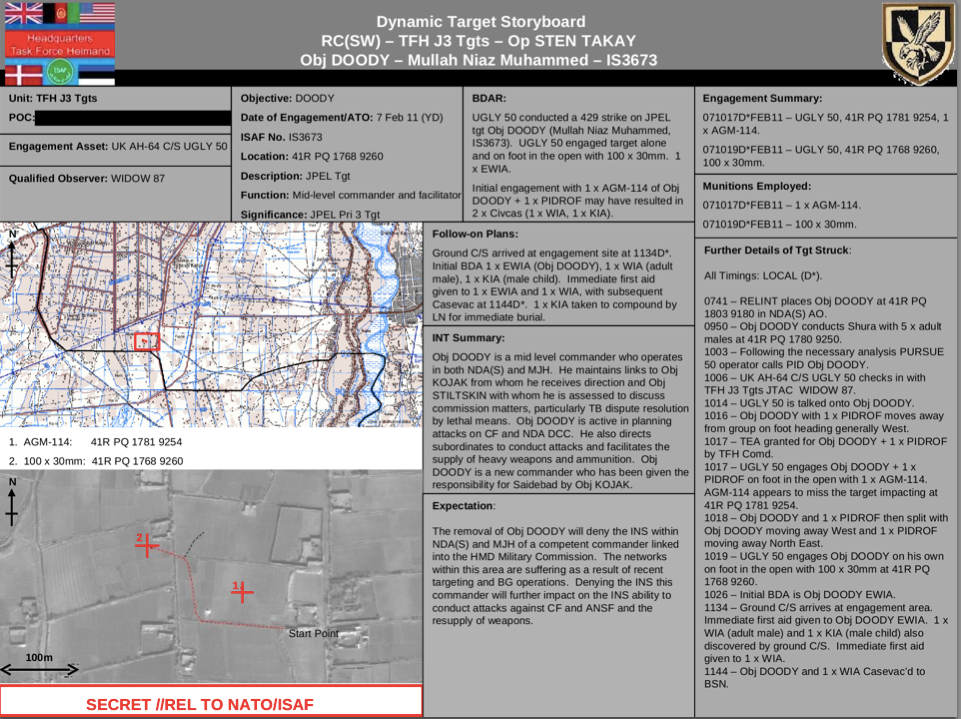
Finally – and directly relevant to that penultimate paragraph – Spiegel includes a detailed post-strike ‘Dynamic Target Storyboard‘ that explains how one mission executed by a British AH-60 helicopter (callsign/codename UGLY 50) armed with Hellfire missiles missed its target (‘Objective DOODY’, a mid-level Taliban commander called Mullah Niaz Muhammed categorised as JPEL ‘level 3’) on its first pass and then, coming in for a second attack, seriously wounded an innocent father and killed his child:

Dynamic Targeting Storyboard PNG

To navigate the storyboard – a standard ‘after action’ report – you need to wade through an alphabet soup of acronyms, some of which I know and others I don’t.  Working left to right along the top line, the mission was under the control of TFH – ISAF’s Task Force Helmand – whose main component was provided by the UK military; under BDAR (Battle Damage Assessment and Repair) the AH-64 attack helicopter is identified as operating under ISAF Rules of Engagement 429 (the details of all these ROEs remain classified).  The Intelligence Summary shown below identifies the target as ‘Objective DOODY’, provides skeletal details of his activities, and links him with two other targets on the JPEL, ‘KOJAK’ and ‘STILTSKIN’ (presumably part of the military’s standard social network analysis).

The far right column provides further information about the attack.  At 0741 intelligence (ELINT is electronic intelligence, but RELINT is not included in the Ministry of Defence’s acronym list) places ‘DOODY’ in Nad-e-Ali (South); by 0950 he is holding a meeting with five other men, and at 1003 a ‘PURSUE 50 operator’ [how I would like to know more about what means] confirms positive identification (PID) which denotes ‘reasonable certainty that this is a legitimate military target’. Shortly afterwards, a Joint Terminal Attack Controller (JTAC), listed as a ‘Qualified Observer’ with the grim call sign WIDOW 87,  contacts the helicopter crew and talks them on to the target: once they have him in their field of view they are ready to attack.  What isn’t clear from all this is whether the JTAC is relying on a video feed from a drone – this seems the most likely source, and an aerial view is included on the storyboard, tracking the target’s movements once the attack is under way – or whether s/he is on the ground (unlikely, I think, since ground troops take more than an hour to arrive on site after the attack: see ‘Follow-on Plans’ box).

When the target walks away from the meeting, accompanied by one man, the helicopter crew is cleared to engage both of them (TEA) (I’ve explained PID but if anyone knows what PIDROF means please let me know since that seems to authorise killing his unknown and unnamed companion).

According to a supplementary page on the storyboard file, shown below, the AH-64 makes its initial run but fails to engage and returns for a second attempt; in doing so, the crew loses visual identification of the target, what the military usually calls the ‘visual chain of custody’, and at 1017 fires a Hellfire missile which misses the nominated target and instead causes fragmentation injuries to two civilians nearby (marked 1 on the aerial view).  The helicopter returns again; by then ‘DOODY’ and his companion have parted company, and the crew fires 100 rounds from its 30 mm cannon at ‘DOODY’, leaving him seriously wounded (EWIA: ‘enemy wounded in action’; marked 2 on the aerial view).

Assessment
Over an hour later, at 1134, ground troops arrive to capture ‘DOODY’ – but they also find one other seriously wounded man and the body of his young son.  The boy is buried by his family, and the casualties are airlifted to the military hospital at Camp Bastion (BSN);  ‘DOODY’ is later transferred to Kandahar for further treatment for a serious head wound.
ISAF launched an investigation into the incident, but no details have been released.

So: two innocent, unnamed bystanders killed.  As more evidence unfolds of the inaccuracies of ‘targeted killing’, even when the target is supposedly named and identified (so not a ‘signature strike’), it seems that we should start talking about the prevalence of untargeted killing…

The War Corps

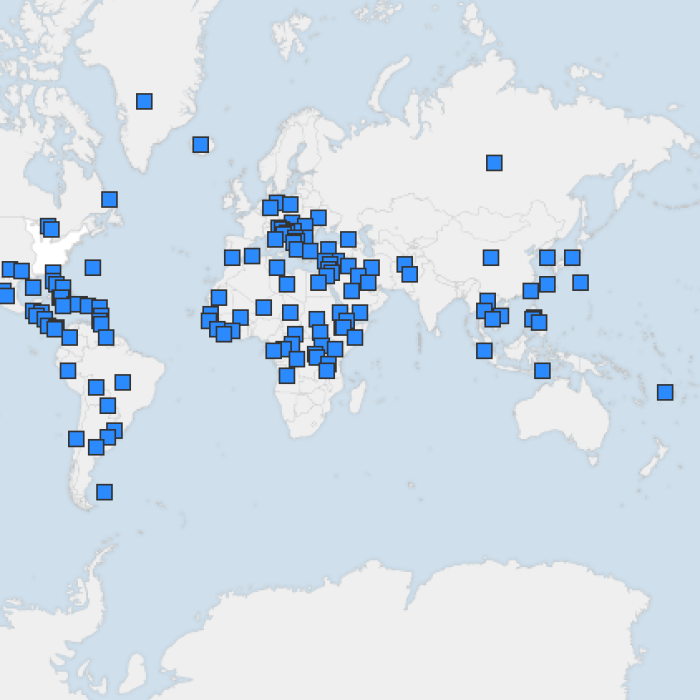
The US Congressional Research Service recently released a report, Instances of Use of United States Armed Forces Abroad, 1798-2014:

The instances differ greatly in number of forces, purpose, extent of hostilities, and legal authorization. Eleven times in its history the United States has formally declared war against foreign nations. These 11 U.S. war declarations encompassed 5 separate wars: the war with Great Britain declared in 1812; the war with Mexico declared in 1846; the war with Spain declared in 1898; the First World War, during which the United States declared war with Germany and with Austria-Hungary during 1917; and World War II, during which the United States declared war against Japan, Germany, and Italy in 1941, and against Bulgaria, Hungary, and Rumania in 1942.

Some of the instances were extended military engagements that might be considered undeclared wars. These include the Undeclared Naval War with France from 1798 to 1800; the First Barbary War from 1801 to 1805; the Second Barbary War of 1815; the Korean War of 1950-1953; the Vietnam War from 1964 to 1973; the Persian Gulf War of 1991; global actions against foreign terrorists after the September 11, 2001, attacks on the United States; and the war with Iraq in 2003. With the exception of the Korean War, all of these conflicts received congressional authorization in some form short of a formal declaration of war. Other, more recent instances often involve deployment of U.S. military forces as part of a multinational operation associated with NATO or the United Nations.

Barbara Salazar Torreon, who compiled the report, adds:

The list does not include covert actions or numerous instances in which U.S. forces have been stationed abroad since World War II in occupation forces or for participation in mutual security organizations, base agreements, or routine military assistance or training operations. Because of differing judgments over the actions to be included, other lists may include more or fewer instances.

5875790-1x1-700x700

abc news has now provided an interactive that maps the data set here, together with a discussion of the original report.

Degrees of intimacy

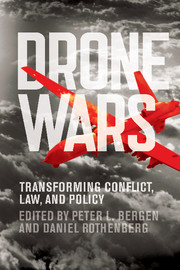
Drone warsNext month Cambridge University Press is publishing a book of essays edited by Peter Bergen and Daniel Rothenberg, Drone wars: transforming conflict, law and policy, due out from Cambridge University Press at the end of the year.  Here’s the blurb:

Drones are the iconic military technology of many of today’s most pressing conflicts, a lens through which U.S. foreign policy is understood, and a means for discussing key issues regarding the laws of war and the changing nature of global politics. Drones have captured the public imagination, partly because they project lethal force in a manner that challenges accepted rules, norms, and moral understandings. Drone Wars presents a series of essays by legal scholars, journalists, government officials, military analysts, social scientists, and foreign policy experts. It addresses drones’ impact on the ground, how their use adheres to and challenges the laws of war, their relationship to complex policy challenges, and the ways they help us understand the future of war. The book is a diverse and comprehensive interdisciplinary perspective on drones that covers important debates on targeted killing and civilian casualties, presents key data on drone deployment, and offers new ideas on their historical development, significance, and impact on law and policy. Drone Wars documents the current state of the field at an important moment in history when new military technologies are transforming how war is practiced by the United States and, increasingly, by other states and by non-state actors around the world.

And here is the Contents List:

Part I. Drones on the Ground:

1. My guards absolutely feared drones: reflections on being held captive for seven months by the Taliban David Rohde
2. The decade of the drone: analyzing CIA drone attacks, casualties, and policy Peter Bergen and Jennifer Rowland
3. Just trust us: the need to know more about the civilian impact of US drone strikes Sarah Holewinski
4. The boundaries of war?: Assessing the impact of drone strikes in Yemen Christopher Swift
5. What do Pakistanis really think about drones? Saba Imtiaz

Part II. Drones and the Laws of War:

6. It is war at a very intimate level USAF pilot
7. This is not war by machine Charles Blanchard
8. Regulating drones: are targeted killings by drones outside traditional battlefields legal? William Banks
9. A move within the shadows: will JSOC’s control of drones improve policy? Naureen Shah
10. Defending the drones: Harold Koh and the evolution of US policy Tara McKelvey
Part III. Drones and Policy Challenges:
11. ‘Bring on the magic’: using drones in combat Michael Waltz
12. The five deadly flaws of talking about emerging military technologies and the need for new approaches to law, ethics, and war P. W. Singer
13. Drones and cognitive dissonance Rosa Brooks
14. Predator effect: a phenomenon unique to the war on terror Meg Braun
15. Disciplining drone strikes: just war in the context of counterterrorism David True
16. World of drones: the global proliferation of drone technology Peter Bergen and Jennifer Rowland

Part IV. Drones and the Future of Warfare:

17. No one feels safe Adam Khan
18. ‘Drones’ now and what to expect over the next ten years Werner Dahm
19. From Orville Wright to September 11: what the history of drone technology says about the future Konstantin Kakaes
20. Drones and the dilemma of modern warfare Richard Pildes and Samuel Issacharoff
21. How to manage drones, transformative technologies, the evolving nature of conflict and the inadequacy of current systems of law Brad Allenby
22. Drones and the emergence of data-driven warfare Daniel Rothenberg

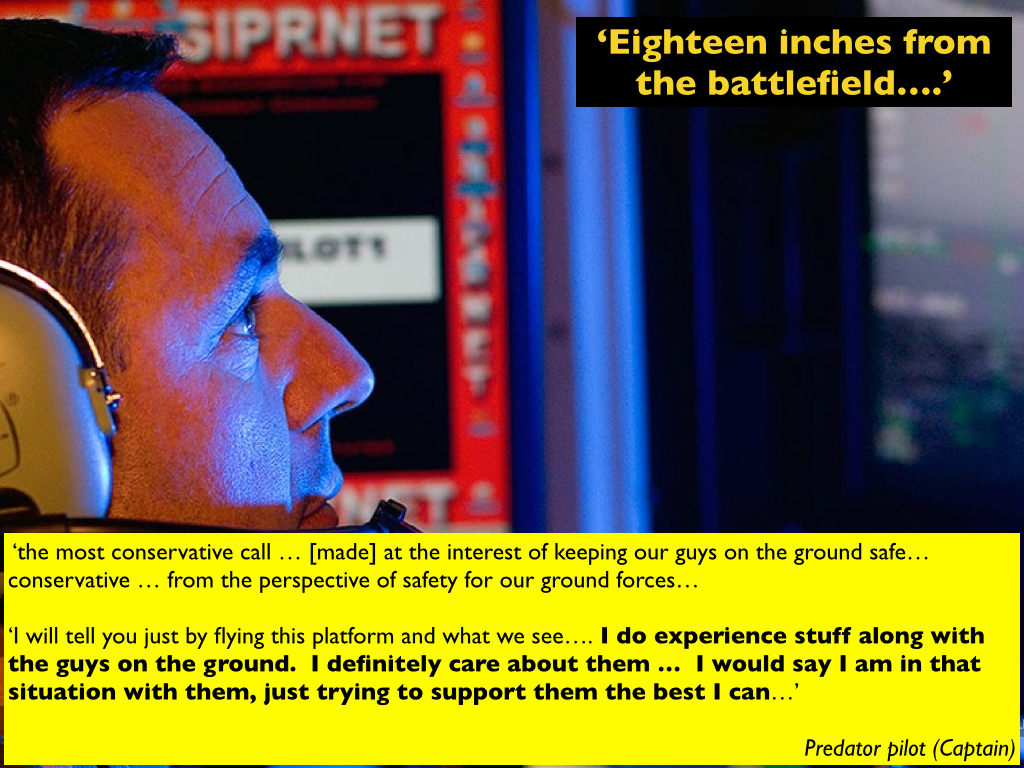
Over at Foreign Policy you can find an early version of Chapter 6, which is an interview with a drone pilot conducted by Daniel Rothenberg.  There are two passages in the interview that reinforce the sense of the bifurcated world inhabited by drone crews that I described in ‘From a view to a kill’ and ‘Drone geographies’ (DOWNLOADS tab).  On the one side the pilot confirms the inculcation of an intimacy with ground troops, particularly when the platforms are tasked to provide Close Air Support, which is in some degree both reciprocal and verbal:

“Because of the length of time that you’re over any certain area you’re able to engage in lengthy communications with individuals on the ground. You build relationships. Things are a little more personal in an RPA than in an aircraft that’s up for just a few hours. When you’re talking to that twenty year old with the rifle for twenty-plus hours at a time, maybe for weeks, you build a relationship. And with that, there’s an emotional attachment to those individuals.

“You see them on a screen. That can only happen because of the amount of time you’re on station. I have a buddy who was actually able to make contact with his son’s friend over in the AOR [area of responsibility]. If you don’t think that’s going to make you focus, then I don’t know what will.

“Many individuals that have been over there have said, ‘You know, we were really happy to see you show up’; ‘We knew that you were going to keep us from being flanked’; ‘We felt confident in our ability to move this convoy from ‘A’ to ‘B’ because you were there.’ The guy on the ground and the woman on the ground see how effective we are. And it gives them more confidence.”

GREGORY Angry Eyes Extract.001

[The image above is taken from my ‘Angry Eyes’ presentation; the Predator pilot in this instance was involved in orchestrating the air strike in Uruzgan province, Afghanistan on 21 February 2010, and the quotation is taken from the US Army investigation into the incident.  I’m converting the presentation into the final chapter for The everywhere war, and I’ll post the draft as soon as I’m finished.]

But when the pilot in Rothenberg’s interview goes on to claim that ‘Targeting with RPAs is very intimate’ and that ‘It is war at a very intimate level’, he reveals on the other side an altogether different sense of intimacy: one that is strictly one-sided, limited to the visual, and which resides in a more abstracted view:

“Flying an RPA, you start to understand people in other countries based on their day-to-day patterns of life. A person wakes up, they do this, they greet their friends this way, etc. You become immersed in their life. You feel like you’re a part of what they’re doing every single day. So, even if you’re not emotionally engaged with those individuals, you become a little bit attached. I’ve learned about Afghan culture this way. You see their interactions. You’re studying them. You see everything.”

The distinction isn’t elaborated, but the claims of ‘immersion’ and becoming ‘part of what they’re doing every day’ are simply astonishing, no?  You can find more on the voyeurism of ‘pattern of life analysis’ and the remarkable conceit that ‘you see everything’ here.

GREGORY Drones and the everywhere war 2014 Homeland insecurities.001

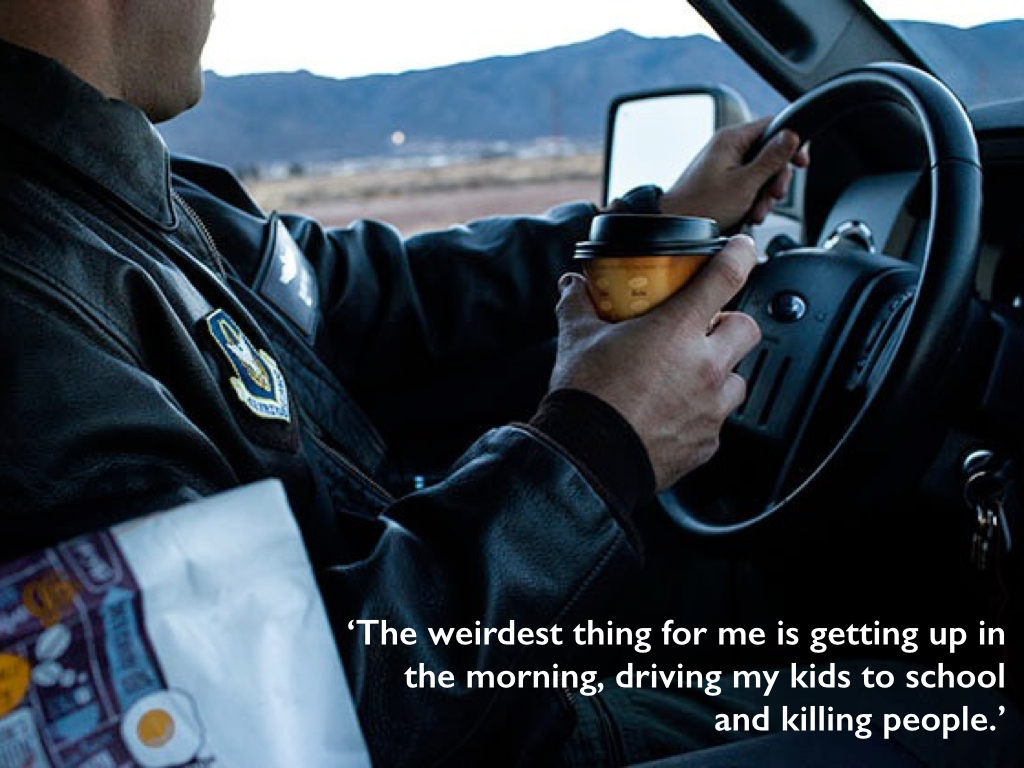
[The image above is taken from my ‘Drone geographies’ presentation]

The interview emphasises a different bifurcation, which revolves around the alternation between ‘work’ and ‘home’ when remote operations are conducted from the United States:

“”When you’re doing RPA operations, you’re mentally there, wherever there is. You’re flying the mission. You’re talking to folks on the ground. You’re involved in kinetic strikes. Then you step out the ground control station (GCS) and you’re not there anymore…

“Those are two very, very different worlds. And you’re in and out of those worlds daily. I have to combine those two worlds. Every single day. Multiple times a day. So, I am there and then I am not there and then I am there again. The time between leaving the GCS [Ground Control Station] and, say, having lunch with my wife could be as little as ten minutes. It’s really that fast.”

You can find much more on these bifurcations in my detailed commentary on Grégoire Chamayou‘s Théorie du drone here and in ‘Drone geographies’ (DOWNLOADS tab).

There’s one final point to sharpen.  In my developing work on militarized vision, and especially the ‘Angry eyes’ presentation/essay,  I’ve tried to widen the focus beyond the strikes carried out by Predators and Reapers to address the role they play in networked operations where the strikes are carried out by conventional strike aircraft.  Here is what Rothenberg’s pilot says about what I’ve called the administration of military violence (where, as David Nally taught me an age ago, ‘administration’ has an appropriately double meaning):

‘”Flying an RPA is more like being a manager than flying a traditional manned aircraft, where a lot of times your focus is on keeping the shiny side up; keeping the wings level, putting the aircraft where it needs to be to accomplish the mission. In the RPA world, you’re managing multiple assets and you’re involved with the other platforms using the information coming off of your aircraft.

“You could use the term ‘orchestrating’; you are helping to orchestrate an operation.”

***

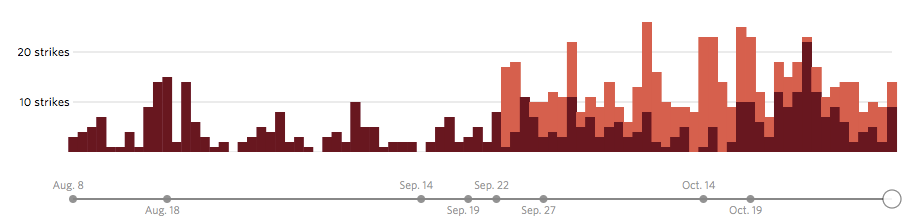
Drone wars appears just as remote operations over Iraq and Syria are ramping up: you can find an excellent review by Chris Cole at Drone Wars UK here, ‘Drones in Iraq and Syria: What we know and what we don’t.’  The images below are from the Wall Street Journal‘s interactive showing all air strikes reported by US Central Command 8 August through 3 November 2014:

Air strikes in Iraq and Syria

During this period  769 coalition air strikes were reported: 434 in Syria (the dark columns), including 217 on the besieged border city of Kobane, and 335 in Iraq (the light columns), including 157 on Mosul and the Mosul Dam.

Air strikes in Iraq and Syria August-November 2014

But bear in mind these figures are for all air strikes and do not distinguish between those carried out directly by drones and those carried out by conventional strike aircraft.  As Chris emphasises:

‘Since the start of the bombing campaign, US drones have undertaken both surveillance and strike missions in Iraq and Syria but military spokespeople have refused to give details about which aircraft are undertaking which strikes repeatedly using the formula “US military forces used attack, fighter, bomber and remotely-piloted aircraft to conduct airstrikes.”’

Although the USAF has used a mix of MQ-1 (Predator) and MQ-9 (Reaper) drones, F-15E, F-16, F/A-18 and F-22 fighters, B-1 bombers, AC-130 gunships and AH-64 Apache helicopters in these operations, it seems likely that its capacity to use remote platforms to provide intelligence, surveillance and reconnaissance is limited by its continuing commitments in Afghanistan (though Britain’s Royal Air Force has now deployed its Reapers for operations in both Iraq and Syria).

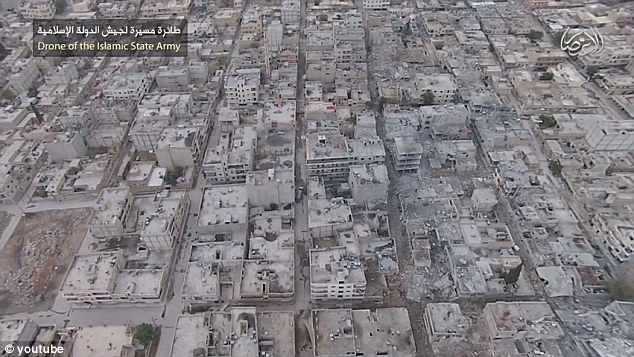
IS (Islamic State) claims to have its own drones too.  In February it released video of its aerial surveillance of Fallujah in Iraq, taken from a DJI Phantom FC40 quadcopter, in August it released video of Taqba air base in Syria taken from the same platform, tagged as ‘a drone of the Islamic State army’, and in September a propaganda video featuring hostage John Cantile showed similar footage of Kobane (below).

1414438887900_wps_7_IS_have_released_a_new_vi

These image streams are all from commercial surveillance drones, but in September the Iranian news agency Fars reported that Hezbollah had launched an air strike from Lebanon against a command centre of the al-Nursra Front outside Arsal in Syria using an armed (obviously Iranian) drone.

You can find Peter Bergen’s and Emily Schneiders view on those developments here, and a recent survey of the proliferation of drone technologies among non-state actors here.

The details of both the state and non-state air strikes remain murky, but I doubt that much ‘intimacy’ is claimed for any of them.

Smelling blood

Writing about the sensory armature of modern war seems to have two dimensions (and as usual it’s the relationship between them that matters).  One involves the political technologies used by advanced militaries to detect the physical presence of their enemies: the infrared sensors that form part of the multispectral targeting systems fitted to Predators and Reapers that can detect heat signatures of bodies, other sensors that can detect ‘chemical signatures’ associated with IED factories, and sophisticated signals monitoring equipment.  These are all prosthetic devices that extend the range of the human sensorium – though they also depend upon it – so that the other dimension, which remains stubbornly important even in later modern war, is constituted by the human body and its own sensory capabilities.  This was the central concern of the conference on Sensing War held over the summer, and you can find the abstracts from the meeting here (I particularly like the remark made by a Bundeswehr officer reported by Marion Naeser-Lather: ‘To understand Afghanistan, you have to see, hear, smell and taste it’).  It’s also a central theme of my lecture/essay on ‘The natures of war’.

British_55th_Division_gas_casualties_10_April_1918

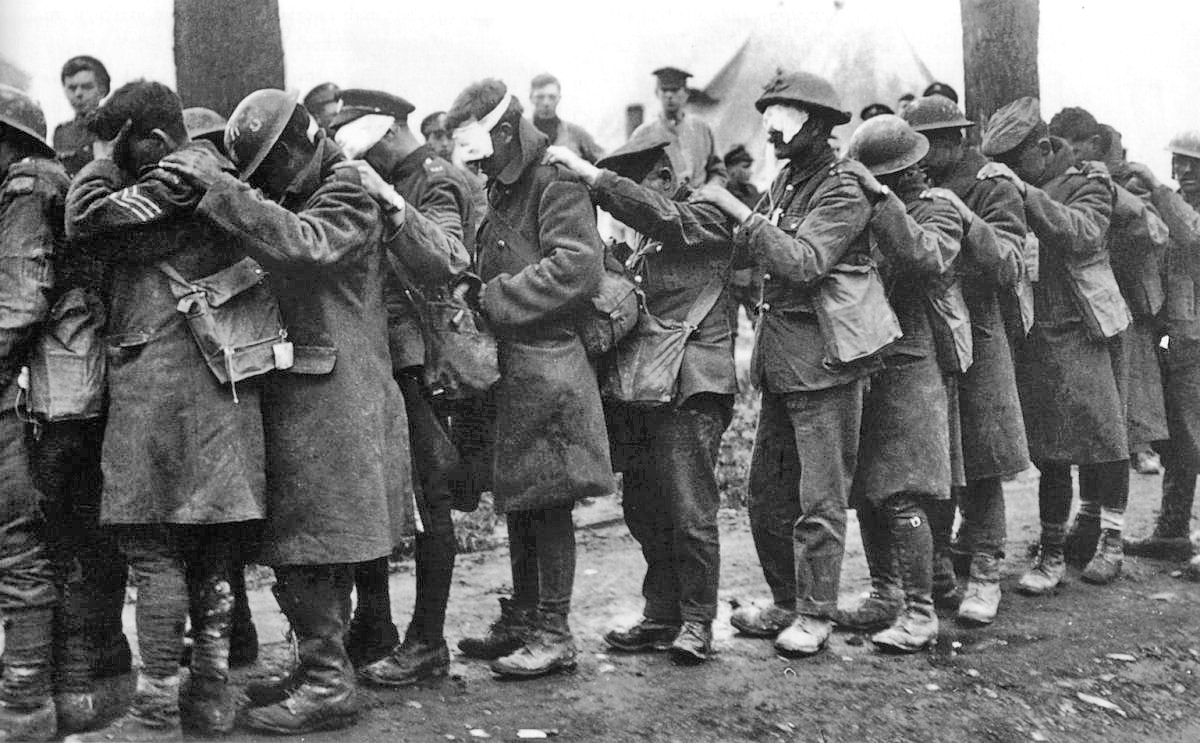
While I was in Zurich I had a lively and productive discussion about the penultimate draft of that essay with Benedikt Korf, Timothy Raeymaekers, Rory Rowan and their students, and as a result of that, together with an e-conversation with Steve Legg, I’ve been re-thinking my previous ideas about corpography.  Steve drew my attention to the ways in which I describe senses being ‘out of place’ on the Western Front: tasting rather than feeling mud, for example, or feeling rather than hearing shell-fire.  You can find further examples in the extracts from the essay I’ve posted about the war in Vietnam here and here.  This scrambling of the senses seems to be different from the intersensoriality discussed by Concordia’s innovative Centre for Sensory Studies.

In response to a similar observation in Zurich, I suggested that the Enlightenment project involved a disciplining of the senses – establishing what it was permissible to see, to hear, to touch, to taste or to smell – and allocating epistemologies to each: what it was possible to know from seeing, hearing, and the rest.  And that perhaps these regulated divisions were undone and their epistemologies radically challenged by the intensity of experience on the battlefield.

Since then I’ve stumbled upon the wonderful work of Matt Leonard; see, for example, his exquisitely titled essay on the First World War, ‘A senseless war‘, in which he argues that

‘The Western Front was a world that could not be negotiated by temporarily reordering the operation of our senses, for the ‘temporary’ became a relative term in the hell of the trenches. Rather, the relationship with the environment had to be completely restructured.’

See also his splendid essay on ‘Mud in World War I’ from Military history here.

I’ve also discovered a literature on the history of the senses that I should really have known about, including Diana Ackerman‘s A natural history of the senses (1990) – a book Richard Fetzer suggests we ‘read, taste, fondle’so I suspect it says rather more about the joys of corporeality than its trials – and Robert Jütte‘s A history of the senses: from Antiquity to cyberspace (2004).

More recently, there’s Constance Classen‘s The deepest sense: a cultural history of touch (2012) which cries out to be read alongside Santanu Das‘s brilliant Touch and intimacy in First World War literature (2008).  Bloomsbsury’s series on  A Cultural History of the Senses (2014) includes volumes on A Cultural History of the Senses in the Age of Empire, 1800-1920 (edited by Constance Classen) and A Cultural History of the Senses in the Modern Age, 1920-2000 (edited by David Howes); the detailed contents list is here, though I don’t know how much space they devote to war.

There’s also a sensory archaeology.  For intimations of a sensory geography, see Mark Paterson, ‘Haptic geographies: ethnography, haptic knowledges and sensuous dispositions’, in Progress in human geography 33 (6) (2009) 766-88 (also available here), the collection Mark edited with Martin Dodge, Touching space, placing touch (2012) and Caleb Johnson and Hayden Lorimer, ‘Sensing the city’, Cultural geographies 21 (4) (2014) 673-80.  There’s also developing work on sonic geographies.  But substantively this is all a far cry from what I’ve been thinking about here.

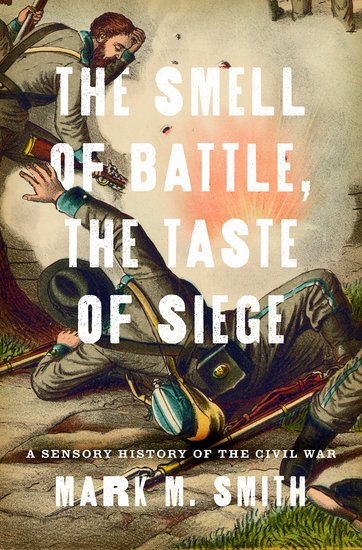
SMITH The smell of battlePerhaps closest to what I have in mind is Mark Smith‘s re-narration of the American Civil war in The smell of battle, the taste of siege (2014):

Historical accounts of major events have almost always relied upon what those who were there witnessed. Nowhere is this truer than in the nerve-shattering chaos of warfare, where sight seems to confer objective truth and acts as the basis of reconstruction. In The Smell of Battle, the Taste of Siege, historian Mark M. Smith considers how all five senses, including sight, shaped the experience of the Civil War and thus its memory, exploring its full sensory impact on everyone from the soldiers on the field to the civilians waiting at home.

From the eardrum-shattering barrage of shells announcing the outbreak of war at Fort Sumter; to the stench produced by the corpses lying in the mid-summer sun at Gettysburg; to the siege of Vicksburg, once a center of Southern culinary aesthetics and starved into submission, Smith recreates how Civil War was felt and lived. Relying on first-hand accounts, Smith focuses on specific senses, one for each event, offering a wholly new perspective. At Bull Run, the similarities between the colors of the Union and Confederate uniforms created concern over what later would be called “friendly fire” and helped decide the outcome of the first major battle, simply because no one was quite sure they could believe their eyes. He evokes what it might have felt like to be in the HL Hunley submarine, in which eight men worked cheek by jowl in near-total darkness in a space 48 inches high, 42 inches wide. Often argued to be the first “total war,” the Civil War overwhelmed the senses because of its unprecedented nature and scope, rendering sight less reliable and, Smith shows, forcefully engaging the nonvisual senses. Sherman’s March was little less than a full-blown assault on Southern sense and sensibility, leaving nothing untouched and no one unaffected.

One last thought: the identification (and limitation) of just five senses is a conventional, European construction, and so I’m left wondering about Steve’s final suggestion: that perhaps the intensity of experience in the deserts of North Africa and the Central Highlands of Vietnam reveals the dependence of the Cartesian model on particular ‘natures’ and, above all, on the ethnocentric privileges accorded to ‘temperate nature’ as ‘normal nature’.  These radically intemperate natures – the Western Front too – thus took their toll on more than the bodies of the soldiers who fought through them.

Predator View

I’m in Zurich – many thanks to Benedikt Korf for the invitation and the wonderful hospitality – for a seminar with Benedikt’s doctoral students on the long form version of ‘The Natures of War’ (they have what I hope is the penultimate draft; I’ll post the final version once I’ve reworked it after the seminar) and then a public lecture: ‘Angry eyes: the militarization of vision and modern war’.

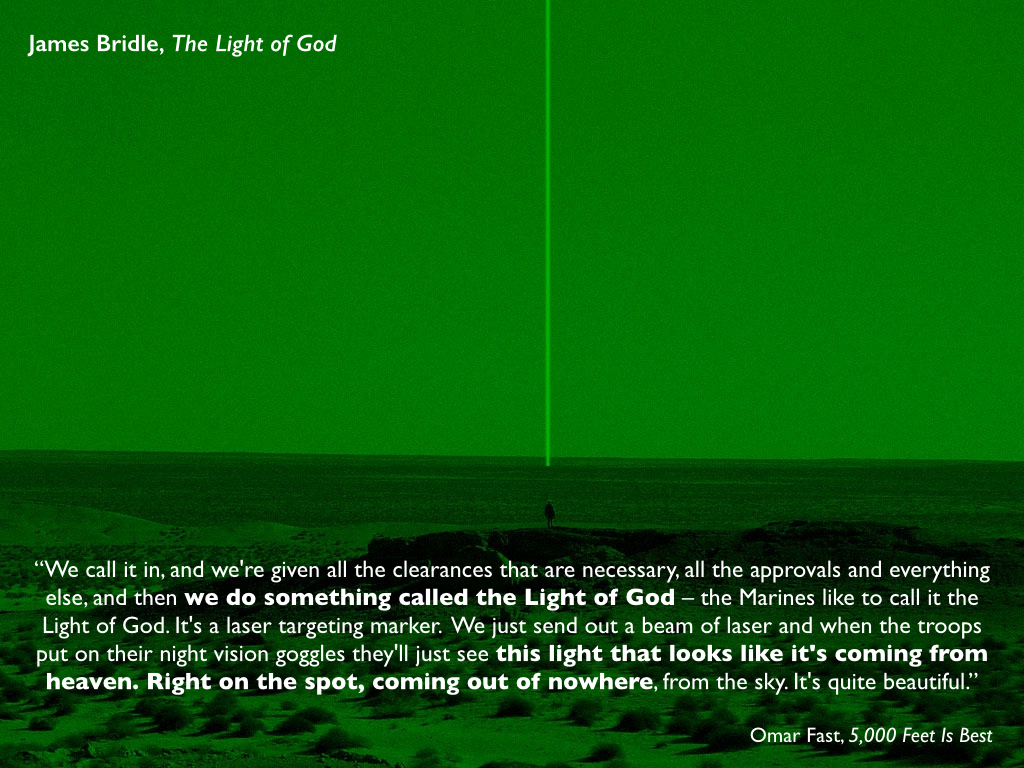
Part of my argument in the lecture is about the narrowness of ‘Predator View’, so let me explain what I mean.  My starting point is the illusion that the use of the intelligence, surveillance and reconnaissance capabilities of remote platforms like the MQ-1 Predator or the MQ-9 Reaper produces a transparent battlespace: in effect, a version of Donna Haraway‘s ‘God-trick’, the ability to see everything from nowhere in particular.  The most succinct version of this is the treatment of laser targeting as ‘the eye of God’:

Eye of God.001

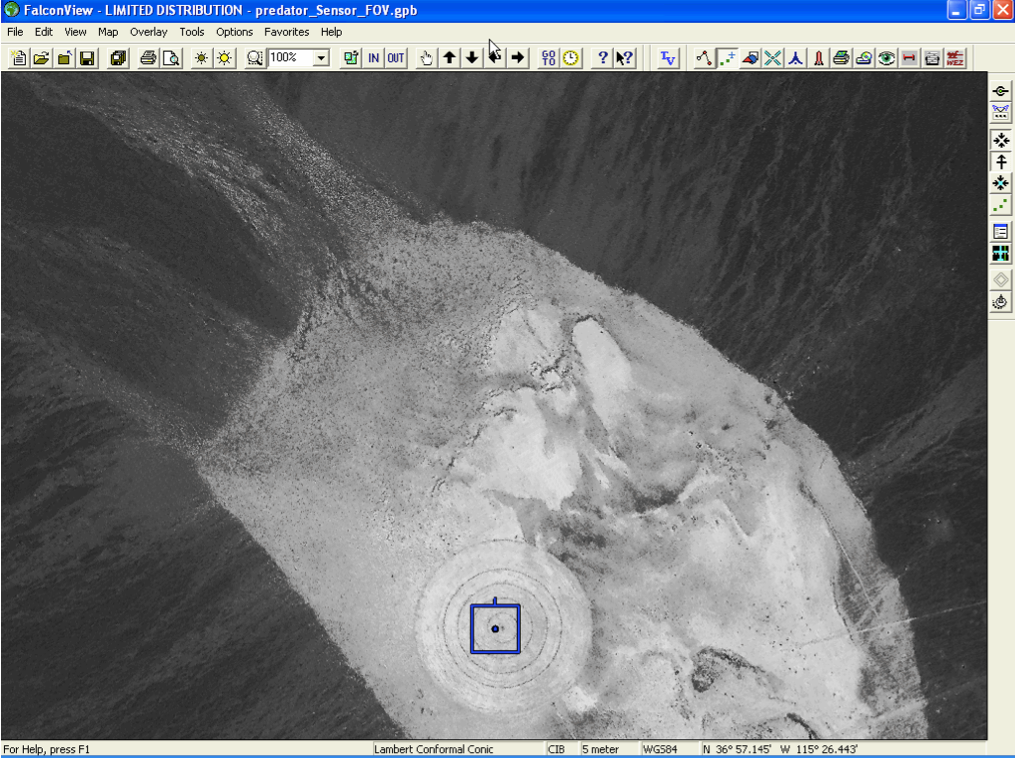
In fact, ‘Predator View’ is remarkably narrow. First, and most directly, a common complaint is that the view provided by its Full Motion Video is literally too narrow – ‘like looking through a soda straw’.  It’s for this reason that pilots and sensor operators also use FalconView, a Windows-based mapping tool that is supposed to provide them with situational awareness.  I’ve taken the image below from a presentation by Lt Col Paul Hastert (USAF) on ‘Spiral development in wartime’ – the screenshot is the FalconView image, the small square the field of view from a Predator – but the most detailed account of FalconView is Jon Lindsay‘s ‘”War upon the map”‘: User innovation in American military software’, Technology and culture 51 (3) (2010) 619-51.

FALCONVIEW and Predator FOV

There have been several later releases of FalconView, and a version is now even open source, so it’s probably not surprising that the US military also uses Google Earth.  In fact, in two of the air strikes I consider in detail it was, in part, juggling these different views that contributed to wrong targeting decisions.  (There are projects that provide a wider field of view – the nine-camera suite of Gorgon Stare is in operation and its second increment is already in use in Afghanistan – and others that integrate imagery from multiple sources, like Raytheon’s Zeus, which is intended to supplant FalconView as the ‘primary mission execution tool‘).

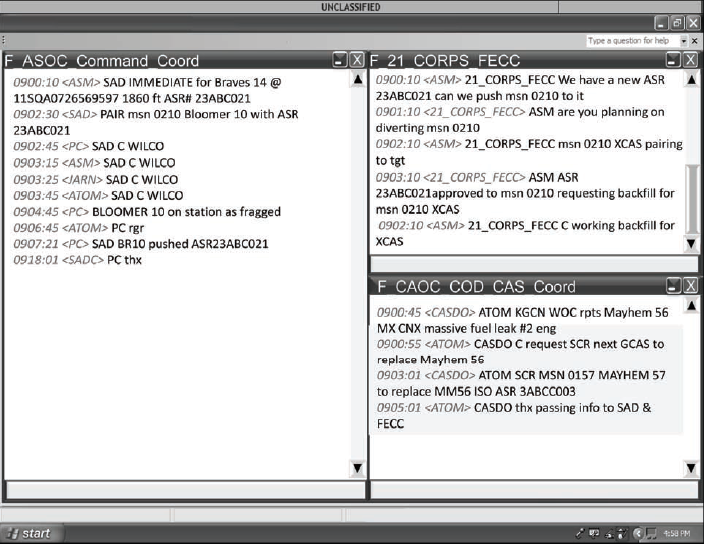
But in the air strikes that I consider those involved in these networked operations are also busy communicating via radio and – crucially – via the typed messages displayed in mIRC‘s online chat windows.  The image below is taken from the US military’s multi-service manual on Tactical Chat (see also the discussion at Public Intelligence here).

mIRC 3 chatrooms

In the case of the ‘friendly fire’ incident in the Sangin Valley in 2011, the pilot and sensor operator were unaware of crucial entries made by image analysts in mIRC and of private (or ‘whisper’) chats to the Mission Intelligence Co-ordiator.  That’s not entirely surprising.  Once permission has been given to engage a target, ‘KILL CHAIN” is typed into the room to minimise extraneous chatter that might otherwise visually distract and so ‘degrade’ the strike.  According to the Mission Intelligence Controller for the Sangin incident:

‘When we got a standby for a 9-line [strike briefing] we put [KILLCHAIN] in the mIRC room to shut down chatter so we can be heads down supporting the pilot and the sensor … as they are getting ready for a possible Hellfire shot our whatever action… That’s our job, to be their third set of eyes…’

That third set of eyes is vital, though of little use if its responses are shut down.  In this case the pilot was paying no attention to mIRC because he was fully occupied:

‘I did not see the chat in the main mission room after seeing muzzle flashes. From that point on, my focus was clear concise communications with the [Joint Terminal Attack Controller] and ensuing [Close Air Support] comms, 9 line etc. At this point I was also focused on keeping the aircraft in position to maintain FMV on the individuals. I was also getting the aircraft into the [Weapons Engagement Zone]. Winds were 30 knots out of the west so I had to make sure I kept the aircraft position and direction in cross check.’

All of this suggests that it is unduly narrow to focus the analytical gaze on the Full Motion Video feeds.

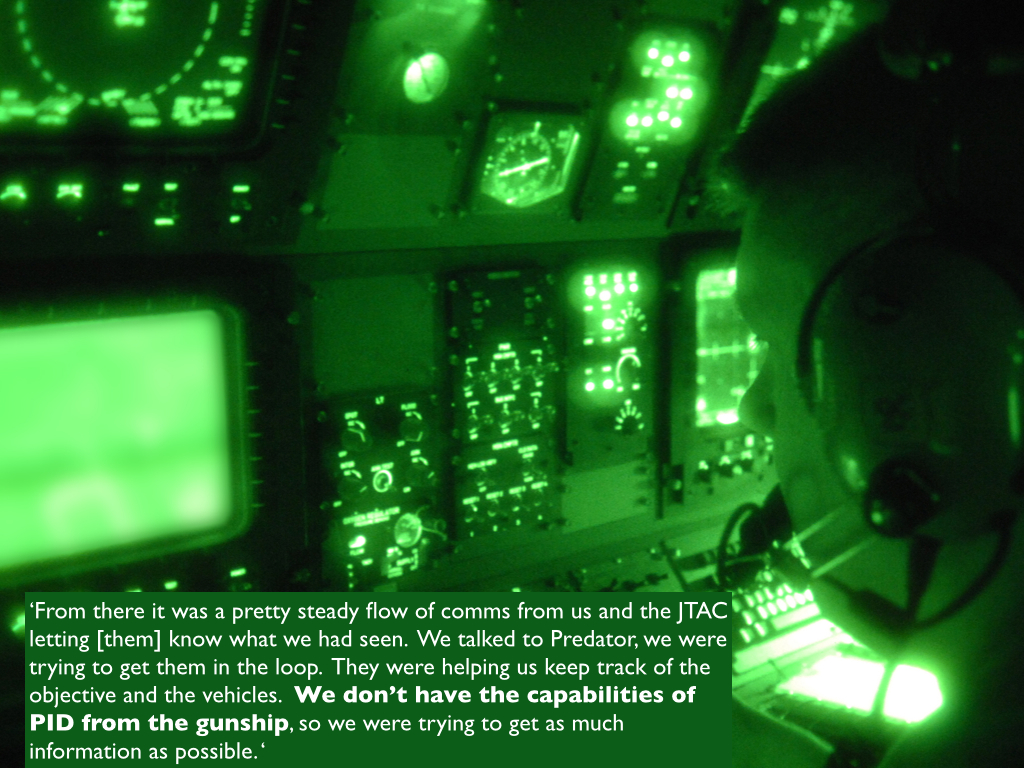
But there’s more.  Militarised vision is not limited to Predators and their successors, and it’s important to consider the clarity and resolution of the imagery captured and transmitted from other, conventional aircraft like the AC-130 (first image below), the B-1 bomber, F-15E strike aircraft or attack helicopters (second image below)  – again, this was important in two of the strikes I consider in detail.

AC-10 Uruzgan.001

MMS from attack helicopter - Uruzgan.001

This leads me to two other senses in which the critical emphasis on ‘Predator View’ is too narrow.  It’s a mistake to fasten on one incident – even what has become the iconic ‘signature strike’ coordinated by a Predator on three civilian trucks in Uruzgan – because that misses the continuities, repetitions and transformations in Close Air Support (which is where most of the mistakes are made).

Better, I think, to widen the analytical gaze, which is why I examine the Kunduz air strike on 4 September 2009 (in which no remote platform was involved), the Uruzgan air strike of 21 February 2010 (which was co-ordinated by a Predator but carried out by two attack helicopters), and the Sangin Valley air strike of 6 April 2011 (which was executed by a Predator).  The Granai strike is included because it trigged McChrystal’s Tactical Directive of 6 July 2009 to minimise civilian casualties: ‘‘We must avoid the trap of winning tactical victories – but suffering strategic defeats – by causing civilian casualties or excessive damage and thus alienating the people.’  In all three cases I’ve worked through thousands of pages of official investigations – one by the German Bundestag since the ISAF report remains classified (Kunduz), and the others by the US Army and US Air Force (Uruzgan) and the US Marine Corps (Sangin Valley).

4 US air strikes in Afghanistan.001

And finally, it is also necessary to consider the multiple viewing positions involved in networked military violence.  There is a de-centralised, distributed and dispersed geography of militarised vision whose fields of view expand, contract and even close at different locations engaged in the administration of military violence.  And in all three incidents it turns out that vital mistakes in the interpretation of imagery were made at operations centres in theatre on the ground.

This has prompted me to radically revise the argument I originally set out in ‘From a view to a kill’ (DOWNLOADS tab).  There my focus was on the geography shown in the first map below – like every other commentator I’ve read, incidentally – but I’ve now widened the angle to take in the geography shown in the second map and this substantially changes the story.

Dispersed vision Uruzgan (1).001

Dispersed vision Uruzgan (2).001

It was what happened at the operations centres at Special Operations Task Force 12 in Kandahar and Combined Joint Special Operations Task Force in Bagram that turned out to be every bit as important as the Predator crew’s obvious desire to ‘go kinetic’.

I make similar arguments about Kunduz, where the F-15E pilots were clearly reluctant to strike and the ground commander and JTAC at the Forward Operating Base overrode their objections.

Sangin is even more instructive, because the official investigation of this ‘friendly fire’ incident that resulted in the deaths of two Marines largely exonerated both the Predator crew and the ground commander and JTAC at the operations centre – but a detailed, spirited counter-memorandum from the US Marines commandant refuted the findings line by line, castigated the attempt to pin the blame for what happened on the young, inexperienced lieutenant leading the patrol, and excoriated the ground commander and JTAC back at the patrol base.  More on this soon.

The (long!) essay on these  strikes is the last chapter I need to complete for The everywhere war. There is a strong sense, so I shall argue, in which it was the view ‘on the ground’ that mattered much more than any ‘light of God’ from above.  And as for transparency….

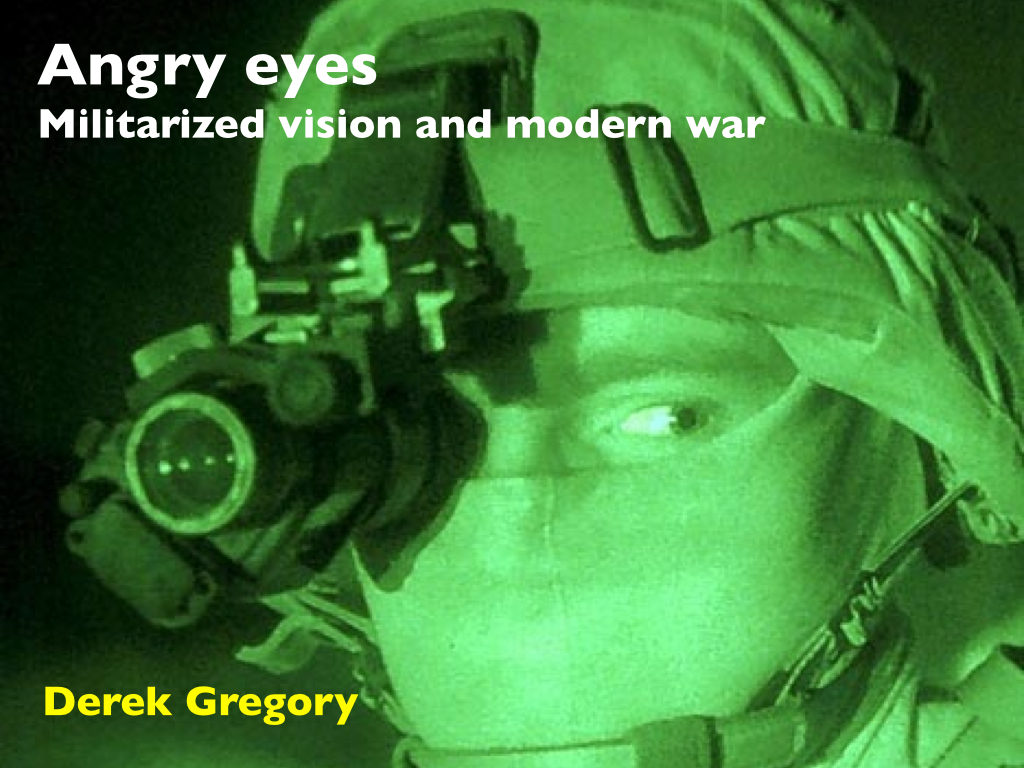
Angry eyes

GREGORY Angry eyes JPEG.001

As part of my project on Militarized Vision I’ve been drawing together my work on two air strikes in Afghanistan in which the full motion video feeds from UAVs played a central role.  The first was an air strike in Uruzgan on 21 February 2010, which was carried out by two combat helicopters but mediated by video and commentary from a Predator and other eyes in the sky (the most thorough press account is by David Cloud here).  The second was a  ‘friendly fire’ incident in the Sangin valley on 5 April 2011 when a Predator strike claimed the lives of two US Marines (you can find an excellent summary account by David Cloud and David Zucchino here).

The two reports I’ve just cited were published in the LA TimesCombat by Camera series, but a close reading of the two official investigations – thousands of pages obtained through FOIA requests – inevitably shows that the stories were more complicated than the tag-line implies.  Still, for all the differences there are some remarkably close parallels between the two, and these have prompted me to revise (in radical ways) the analysis I originally offered in “From a view to a kill” (DOWNLOADS tab).

Searching for a title for the presentations I’m giving on this in October and November, I half-remembered a song called ‘Angry Eyes’.  When I tracked down the lyrics (by Kenny Loggins) I literally could not believe my eyes.  He obviously wasn’t writing about the US Air Force (or the Israeli), but it requires no great leap of the imagination to switch from love to violence:

Time, time and again
I’ve seen you starin’ out at me.

Now, then and again, I wonder
What it is that you see

[Chorus:]
With those Angry Eyes.
Well, I bet you wish you could
Cut me down with those Angry Eyes…

You want to believe that
I am not the same as you.
I can’t concieve, oh no,
What it is you’re tryin’ to do

[Chorus]

What a shot you could be if
You could shoot at me
With those Angry Eyes…

You tried to defend that
You are not the one to blame.

But I’m finding it hard, my friend,
When I’m in the deadly aim
Of those Angry Eyes.

So the presentations (here in Vancouver, and in Zurich and Bergen) will be called “‘Angry eyes’: militarized vision and modern war”.  As the image implies, there’s more to this than full motion video displays, and I’m also going to try to say something about the genealogy of what Paul K. Saint-Amour calls ‘optical war’ (and its distance from the corpographies of ‘boots on the ground‘).

More on all this later, when I’ve finished the essay that I am presently spinning off the presentations with the same title; it’s the last thing I have to do for “The everywhere war” (I hope).

Boots on the ground

?????????????????????????????????????????????????????????????????????????????????????????????????????????????????????????????????????????????????????????????????????????????????????????????????????????????????????????????????????????????????????????????????????????????????????????????????????????????????????????????????????????????????????????????????????????????????????????????????????????????????????????????????

One of the most shop-soiled phrases of the past several weeks and months is “boots on the ground” (or the lack of them).  You can find historical and contemporary discussions from the US military here and here, but the most recent – and recurrent – instance is President Obama’s insistence that, whatever else the United States will do in Iraq and Syria to counter the aggressive advance of the Islamic State, it won’t involve “boots on the ground”.  The reasons are not difficult to discern, and they involve the substitution of “boots on the ground” for “bodies in bags” (on which, see the American Friends Service Committee exhibition, “Eyes Wide Open“: also the Burning Man version here).

But they also involve an extraordinary (but, again, by no means unprecedented) restriction of what constitutes armed combat.  Mark Landler has a very good discussion of this in the New York Times:

American advisers could be sent to the front lines alongside Iraqi and Kurdish troops, and could even call in airstrikes, without directly engaging the enemy. It is a definition rejected by virtually every military expert.

“Calling in airstrikes is just as much combat as firing a rifle at someone,” said John A. Nagl, a retired lieutenant colonel who served in a tank battalion in Iraq and helped write the Army’s counterinsurgency field manual. “What that guy really is doing is painting a house with a laser designator that results in that house being vaporized.”

The American advisers are armed, and if they are shot at by the enemy, they are authorized to return fire. In a close combat advisory role in a city, experts said, the American troops would tell Iraqi commanders which house to hit, how much ammunition to use in an assault, and how to organize medical evacuation for their troops…

“If you’re trying to deploy a military effect on the ground, you’re in combat,” said Paul D. Eaton, a retired Army general who helped train Iraqi troops and is now an adviser to the National Security Network. “You may not be in direct combat, but it’s a combat mission.”

There are also not very muffled  echoes of Vietnam and the US Military Assistance Command.

This is very much on my mind, because I’ve been busy finishing the long-form version of “The Natures of War”, and in the process radically re-working my discussion of the ground war in Vietnam.  This has given me a new insight into what “boots on the ground” means – with an emphasis on the “ground”, or what my good friend Gastón Gordillo prefers to call terrain – and here is an extract (I’ll post the full draft next week, which will include the references and the footnotes).

***

GI Vietnam LIFE

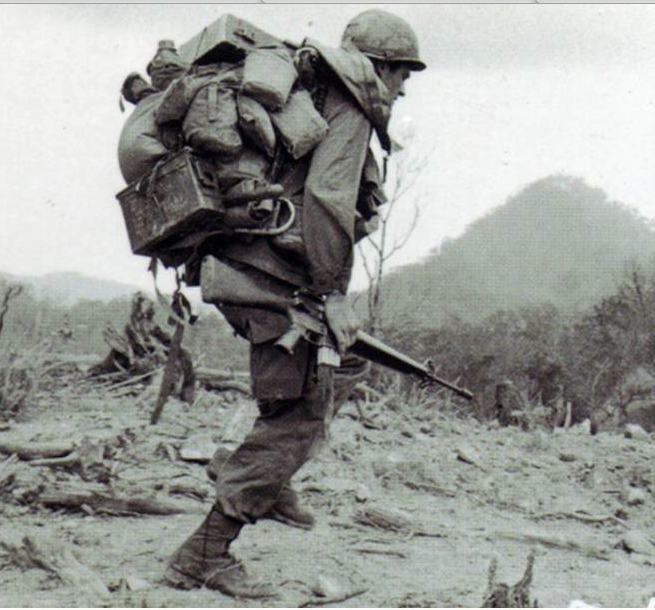
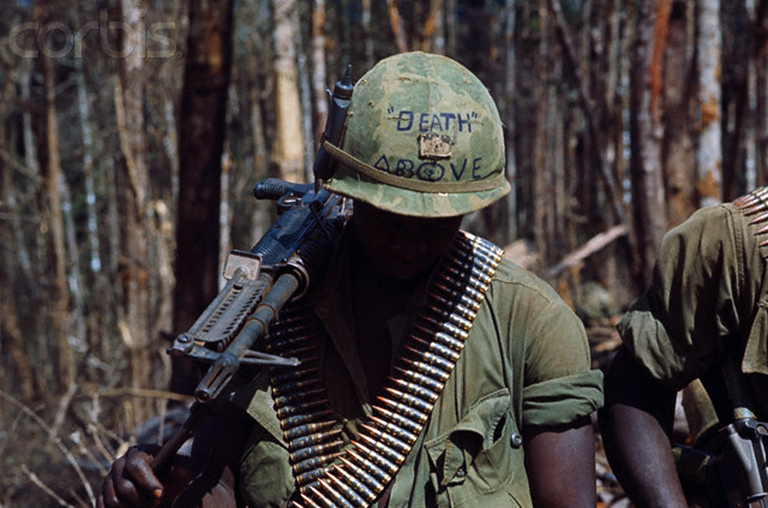
Then as now the scale of support involved in combat operations meant that many soldiers never left their bases – in Vietnam the ratio of support to combat troops was roughly 10 to 1 [this is the ratio cited by most historians, but the US Army prefers a much lower “Tooth to Tail” ratio: see here] – but those that did had to carry their world on their backs. On a long patrol they might be resupplied by helicopter, but that could never be guaranteed. In addition to a rifle, most men carried at least 60 pounds: multiple quart canteens of water (at least two and sometimes as many as eight: ‘There is never, ever enough water’) and canned C-rations; ammunition and grenades; and a poncho or half-shelter which doubled as a stretcher or a shroud if they were hit. In addition, radio operators carried a PRC-25 field radio, which weighed 23 pounds, and spare batteries, while mortar crews lugged a firing tube and base plate weighing around 40 pounds, and their bearers carried four mortar rounds (which added 32 pounds of dead weight to their load). This mattered because, as one newly arrived lieutenant soon realised, ‘the jungle would exact a toll for every ounce I carried.’ ‘We dumped everything we didn’t absolutely need,’ one GI explained, but still the rucksack frame and webbing rubbed and cut so ‘our waists and shoulders were covered with “saddle sores” that were kept raw by sweat and dirt and cartridge belts and packs.’ Everyone, he said ‘was in a constant world of hurt.’

Combat Infantryman Vietnam

It was just as tough on the legs. Tim O’Brien translates the equipment list – ‘the things they carried’ – into its impact on the lower body:

‘We walked along. Forward with the left leg, plant the foot, lock the knee, arch the ankle. Push the leg into the paddy, stiffen the spine. Let the war rest there atop the left leg: the rucksack, the radio, the hand grenades, the magazines of golden ammo, the rifle, the steel helmet, the jingling dog-tags, the body’s own fat and water and meat, the whole contingent of warring artefacts and flesh. Let it all perch there, rocking on top of the left leg, fastened and tied and anchored by latches and zippers and snaps and nylon cord. Packhorse for the soul.’

Soldier in paddy field An Thi S Vietnam- Jan 1966Skinner

O’Brien was describing a patrol moving through rice paddies, and these imposed their own burdens on soldiers. Out in the open they were vulnerable to attack or sniper fire, and they avoided the dikes which were often mined or booby-trapped.

‘Instead, we struggled through the sucking mud of the paddies. The banks of the streams were especially treacherous. Each step through the soft muck was torture, and every few steps a man would sink in mud up to his crotch. The gnarled roots of the mangroves could twist an ankle or a knee in a second. The putrid stench of rotting vegetation permeated the stifling humid air, and canteens were emptied quickly.’

‘The water in these pestilential miasmas was stagnant, muddy and fetid,’ explained one lieutenant, ‘with all kinds of flotsam, including mosquito larvae and water buffalo faeces applied as fertiliser’. Beneath the murky water lurked the menace of punji stakes made of split bamboo that could pierce a boot and put a soldier out of action; worse, the wound could become infected from the dung-laden water, and air evacuation was often imperative. Then there were the leeches: ‘When we reached the other side of the rice paddies,’ the lieutenant continued, ‘my men dropped their pants and burned the already engorged leeches off their ankles and penises with lit cigarettes; even the non-smokers carried cigarettes for this purpose.’

photo5

In the Central Highlands soldiers had to fight their way through triple-canopied jungle and up thickly forested mountain sides. Like their comrades in the paddy-fields, they learned to avoid the beaten track. They rarely used trails, which were notorious for mines and booby-traps that, as Philip Caputo explained, turned ‘an infantryman’s world upside down’:

‘The foot soldier has a special feeling for the ground. He walks on it, fights on it, sleeps and eats on it; the ground shelters him under fire; he digs his home in it. But mines and booby traps transform that friendly, familiar earth into a thing of menace, a thing to be feared as much as machine guns or mortar shells. The infantryman knows that any moment the ground he is walking on can erupt and kill him; kill him if he’s lucky. If he’s unlucky, he will be turned into a blind, deaf, emasculated, legless shell.’

He might have been talking about the cyborg natures of the Western Front or the Western Desert, but in Vietnam’s guerrilla war there were few fixed minefields beyond the Demilitarized Zone. Base perimeters were systematically mined by the US and its allies, and the North Vietnamese often mined clearings that could be used as helicopter landing zones. But it was the transience of mining by the North Vietnamese Army and the Viet Cong – its improvisational, opportunistic nature – that was so threatening. ‘The NVA were so good at moving mines around that they would put the minefield out at dusk along a patrol route and take it in before dawn’ so that ‘you could clear one area and there would be mines there the next night.’ Booby-traps could be anywhere: ‘They hang from trees. They nestle in shrubbery. They lie under the sand.’ Denied the trails, soldiers had to hack a path with their machetes or Ka-Bars or more often, to muffle the sound of their painfully slow progress, they threaded their way between the trees and the choking vines:

‘Up ridges, down ridges, over ridges, wading through rocky streams, hacking at jungle growth, breathing in and hopefully breathing out some of the constant bugs that continuously swarmed around our heads, watching our skin as it quickly deteriorated from the numerous bites, scrapes, cuts, tears, thorns, and other abuses of the environment that attempted to beat our bodies into submission. The clothes and boots forming the inanimate part of our body protection were quickly drenched with sweat, dirt, mashed bugs, and the mixed blood and juices from both the bugs’ bodies and our own.’

In the Highlands they encountered other cyborg natures. Devastating Arc Light strikes by B-52 bombers produced a surreal, cratered moonscape whose blasted terrain was even more difficult to negotiate than pristine rainforest:

‘The jungle had been torn to smithereens by the big bombs. Trees had been ripped from the ground forming an abatis of twisted, interattached splintered branches, vines, and roots that was more impenetrable than the worst the natural jungle had to offer.’

US Soldier Wearing Helmet with Message

The craters would be ‘littered with huge pieces of bomb shrapnel’ and unexploded bombs that had not burrowed into the soft earth: their ‘green shapes that protrude menacingly from the red dirt add yet another facet of terror for us to deal with.’ It was impossible to avoid the deep craters: ‘They are too congested; the muddy holes sap our strength as we slide down into their depths, wade through the stagnant green rainwater and then climb fifteen feet up to the slope to the opposite rim.’ If the bombs had found their target then the patrols faced more than a physical barrier, because the bomb field would also contain decomposed corpses, animal and human, and body parts. Delezen continued:

‘[T]he heavy smell of death is around us and is growing stronger as we move. Soon I discover that the source of the overpowering stench is a shallow bomb crater positioned along our path; the crater was probably gouged into the earth by a five hundred pound bomb. There is a naked leg sticking out of the dark hole; on the foot is a rubber sandal made from a discarded truck tire. It looks as though the crater is moving … the movement is rats. In the dusk it looks like a blackish gray carpet covering the mangled, bloated bodies that the grunts have thrown into the hole. The bottom of the hole is full of large maggots that create the illusion that the crater is shimmering. I determine that there are at least twelve enemy bodies that lay intertwined in the crater. The huge rats are snapping at each other as they feed on the dead soldiers; this has to be the entrance to hell itself. The smell is overwhelming; it is so strong that I can taste it.’

B-52s and long-range artillery were not the only means of ravaging the land. It was also impregnated with the residues of napalm and other chemical toxins, and long after an air strike these could still irritate your eyes, make you gag and burn your skin. They also turned any vertical movement into a dangerous glissade:

‘[T]he mountain that we are now climbing has been attacked by countless sorties of Phantom jets delivering “snake and nape.” The splintered, tortured tree trunks are black and charred from the napalm and the oily gel that did not ignite has mixed with the red mud, turning it into a texture similar to axle grease. My pack and ammo belt are waterlogged and have picked up extra weight from the greasy mud.

‘The mud has clogged the lug soles of our jungle boots and it is difficult not to slip; we know that if we lose our footing we will end up at the bottom of the mountain. I use my weapon to climb, digging the stock into the mud as a brace while I grab the next bomb-blasted tree trunk. The oily napalm has lubricated the entire mountain, it has soaked into the burned trees; we have to grasp each splintered trunk in a hug. The black M-16 no longer resembles a rifle; it is encased within a shapeless red blob of sticky mud. After a while, I have to use my Ka-Bar to climb with. I stab the earth ahead and then pull myself up; the deep, soft mud soon renders this effort useless.’

***

 There’s much, much more, as the full post will show, but I’ve said enough to convey some of the ways in which “boots on the ground” are involved in my developing interest in corpography and war.  This extract also raises two other issues that I can’t develop in any detail in the essay.

red-plateau-memoir-north-vietnamese-soldier-john-edmund-delezen-paperback-cover-artThe first turns on the parallel experience of the National Liberation Front [the ‘Viet Cong”] and the North Vietnamese Army.  The Americans assumed that their enemies were creatures of the jungle (in more ways than one), but many of them were recruited from towns and cities and had little or no experience of the rainforest and no idea of the privations that jungle warfare would impose on them.  This is made clear in Truon Nhu Tang‘s A Viet Cong memoir, which is widely cited, but the best and most directly relevant account that I know is the truly remarkable collaboration between John Edmund Delezen and Nguyen Van Tuan, Red Plateau, which describes a North Vietnamese battalion ‘comprised of boys from towns and farms and most knew very little about the forest-enshrouded mountains’.  I cite Delezen in the extract above – his Eye of the tiger is one of the very best personal accounts I’ve read – but his collaboration with his erstwhile enemy is just as compelling.  Here is Nguyen Van Tuan’s inventory of the things carried by the NVA:

‘As dark nears we once again move onto the path and begin our trek south, I curse my pack; if not for this burden I would move effortlessly. Each pack contains an extra uniform and one pair of pajamas, a rain-sheet, a ground cloth, a shovel, ammunition, grenades, explosives, a small medical kit, B-40 rockets for the RPG crews or boxes of machine gun ammunition for the  crews and toilet articles which are for the most part extremely minimal. In addition to this loaded pack, we each carry our individual weapon with ammunition vest, knife and canteen of water. The heavy weapon crews and mortar teams suffer worse…much worse, the load they carry is unimaginable….

‘When we pause to fill canteens from a stream, we try to rearrange the loads we are burdened with; it is a futile task, there is no relief, each arrangement brings its own torment. The loads we bear begin to increase as the supplies carried by those who fall prey to fever and those who carry the litters must be redistributed; our packs remain things that we continue to curse.’

The second issue is the genealogy of “the things they carried”, and Tom Atkinson (really; not quite “Tommy Atkins” but close enough) has provided an extremely interesting visual reconstruction of what he calls “Soldiers’ Inventories” here (you can also find more here and here).  His 13 images extend from the Battle of Hastings (1066) through the Somme in 1916 and the Battle of Arnhem in 1944 to Helmand in 2014 (shown below), though since this is an inventory of British soldiers there’s no trace of Vietnam.  (Interestingly, though, a common complaint from US soldiers and especially Marines in Vietnam was that much of their equipment was outdated and derived from the Second World War – including, on occasion, their canned rations).

Helmand_2996025b

Here’s the key for a close-support sapper, Royal Engineers, Helmland Province, 2014:

1 Silva compass – used for basic navigation and fire control orders
2 Karabiner – used for securing kit and equipment to the vehicles
3 Osprey body armour shoulder and neck attachments – the armour increases protection but can be very restrictive so these parts are detachable depending on the threat assessment
4 Osprey body armour; can be fitted with pouches to carry everything from ammunition, water, first aid kits and grenade or with plates and protective attachments (as shown)
5 Notebook
6 Warm weather hat
7 Spare clothing including underwear trousers, UBAS (Under body Armour Shirt) and normal shirt
8 Dog tags
9 A desert issued belt
10 Beret – used for repatriation ceremonies, vigils and large parades
11 Shemagh – to soak up sweat and also a dust guard
12 Gloves
13 Sandals – issued kit, as soldiers may need to run for cover even while showering
14 Boots
15 Multi tool
16 Washkit
17 GSR – general service respirator
18 A housewife – a basic sewing kit; a soldier has to repair his own rips and tears on the ground
19 Socks, scarf, wristwatch
20 Camel pack – drinking water pack
21 Cooker and mug and tea making kit
22 Rations – quantity will depend on the task but soldiers normally carry about 24 hours worth
23 First aid kit including the (black) tourniquet and (grey) first field dressing
24 Ballistic protection – used to protect the groin from IED blast
25 Knee pads – offer protection to a soldier whilst “taking a knee” from the heat of the ground or rocky areas
26 Sleeping bag with an inflatable roll mat
27 Camera, cigarettes
28 Radio – BOWMAN Radio system (HF, VHF or even SAT Comms), daysack could also be fitted with ECM (Electronic counter measures)
29 Personal role radio – used for line of sight communications within a small patrol
30 Magazine
31 Envelopes
32 Mine extraction kit fitted with a mine prodder, instruction and mine marking kit
33 Weapon cleaning kit
34 Holster
35 Pistol – used as a second weapon system and in confined spaces or where a “long” weapon is unsuitable. Sig and Glock have mostly replaced the Browning 9mm calibre
36 Bar mine – anti-tank landmine
37 Head torch – can be fitted with coloured lenses for more tactical situations
38 Bayonet and bayonet scabbard
39 SA80 A2 fitted with a desert hand guard, upgraded flash eliminator and bipod, all issued for Afghanistan and a SUSAT sight system. It is 5.56 calibre and is here issued with 6 magazines which can hold 30 rounds each
40 Ballistic eye protection – normally goggles or sunglasses
41 Mk 6 Helmet fitted with Helmet mounted night vision systems
42 iPad – personal effect for down time
43 Poncho

I’ll leave the least word to Karl Marlantes, whose splendid Vietnam novel Matterhorn I’ve recommended before.  This comes from his What it is like to go to war (2011), and in so many ways returns us to where I came in:

I am not saying that the infantry today has it easy. Certainly the communications with home have changed, but the field conditions, such as filth, cold, heat, fatigue, and lack of sleep, have not changed since the infantry was using rocks. However, the trend is clear. Robots are already being deployed for fighting in cities. And soon they will be able to be controlled from Nevada.