Headings

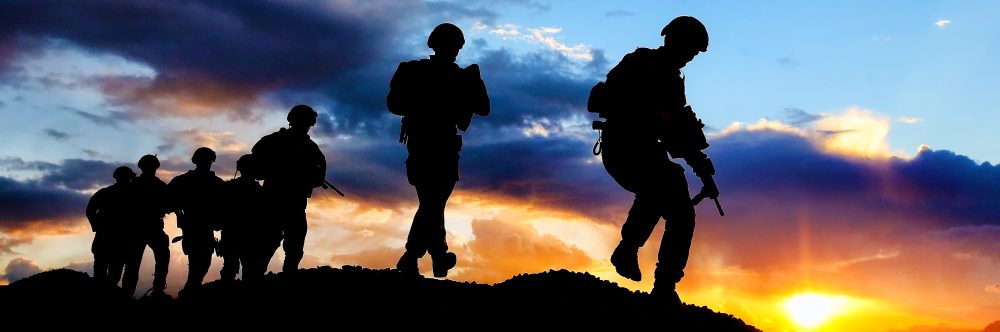
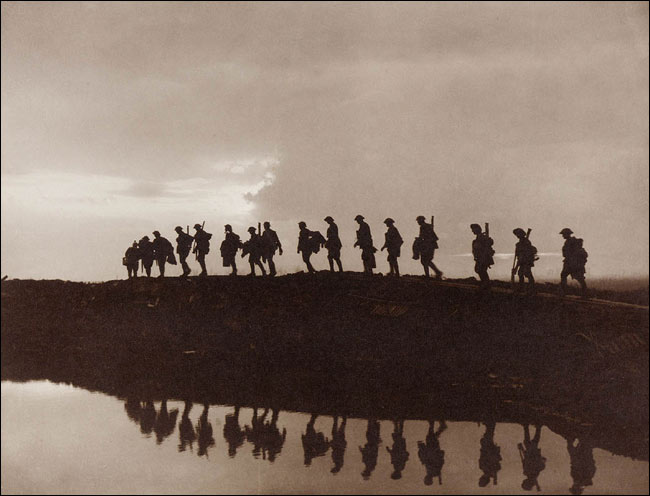
I’ve changed the header for this site; the original was cropped from a famous Frank Hurley image – perhaps the most famous Frank Hurley image – showing Australian infantry moving up to the front near Hooge in October 1917:

forward

I’ve written about Hurley before, and it turns out that this may be one of his many manipulated images: see Bob Meade‘s detective work here (though see the cautionary notes in the comments too).

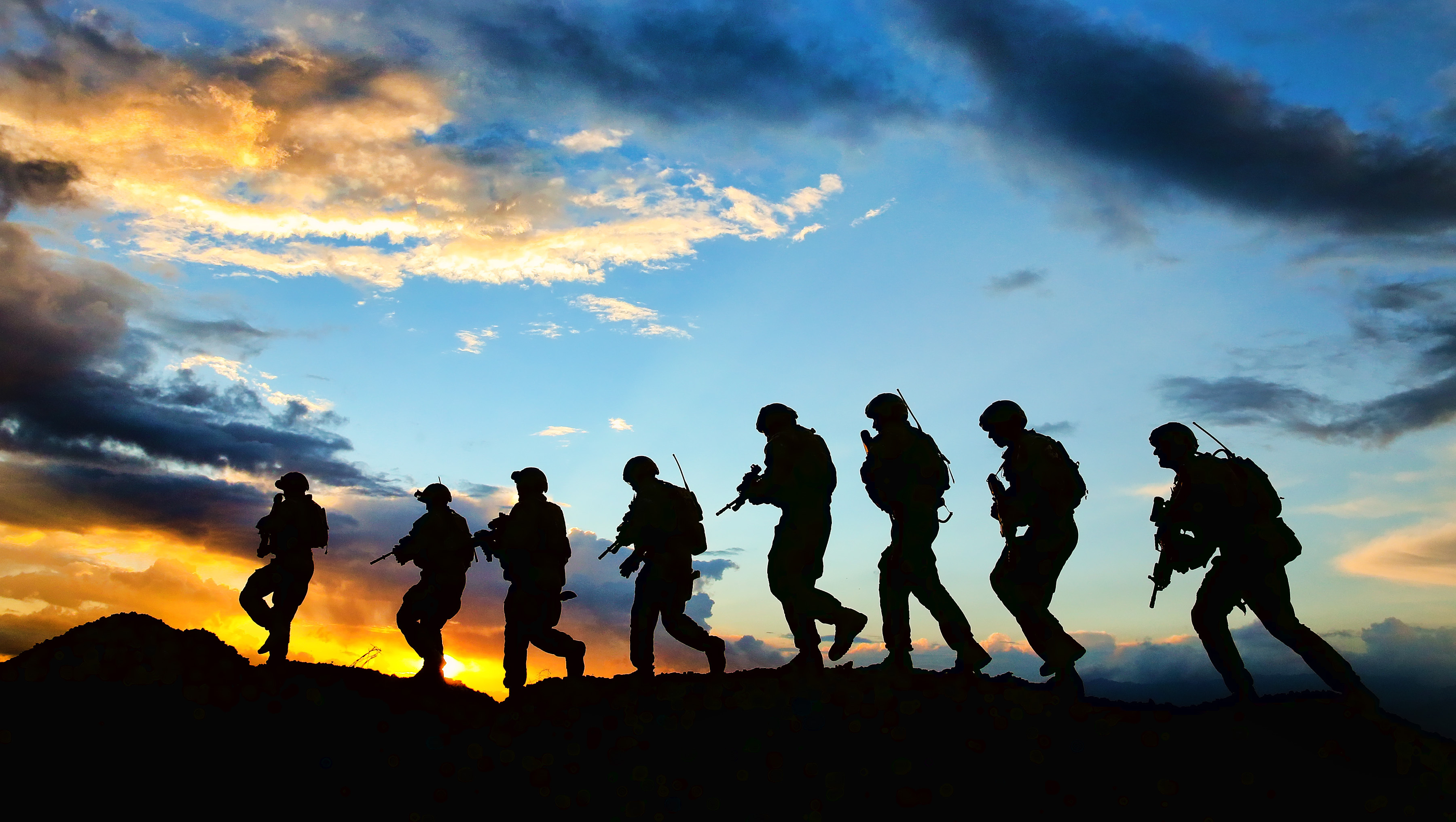
While I was doing some image research for my presentation at the Association of American Geographers in Tampa, I discovered the parallel, contemporary  image I’ve substituted.  Here is the uncropped image, taken by Mark Doran, which shows soldiers from the 7th Battalion Royal Australian Regiment at sunset at Tarin Kot (Uruzgan, Afghanistan) in 2013:

Sunset shadows in Uruzgan


Endless War and the machine

When I wrote ‘Seeing Red: Baghdad and the event-ful city’ (DOWNLOADS tab) I was intrigued by the way in which the US military apprehended the city as a field of events:

‘In Baghdad, these security practices performed a continuous audit that compiled reports of events (Significant Activity Reports or SIGACTS) and correlated the incidence of ‘enemy-initiated attacks’ and other ‘enemy actions’ with a series of civil, commercial and environmental indicators of the population at large: moments in the production of what Dillon and Lobo-Guerrero call a generalized bio-economy.’  

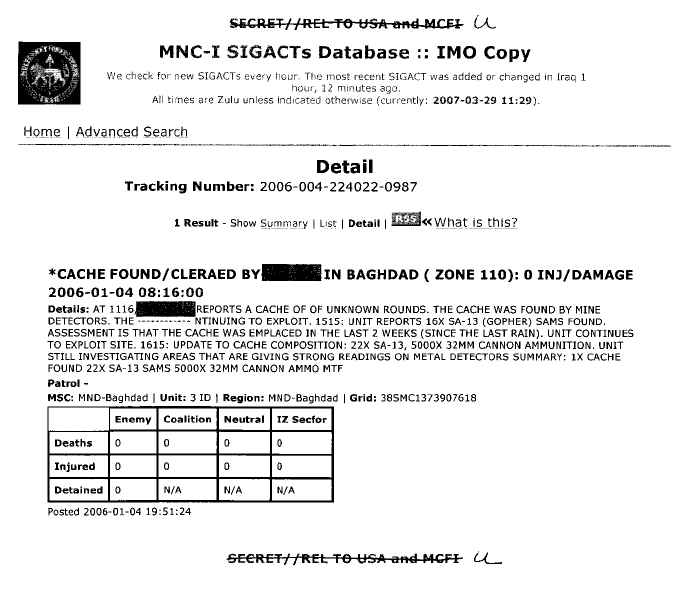
The animating core of the system was the SIGACT  – shown below – and these were eventually fed into a single reporting and analysis platform, the Combined Information Data Network Exchange (CIDNE).

SIGACT

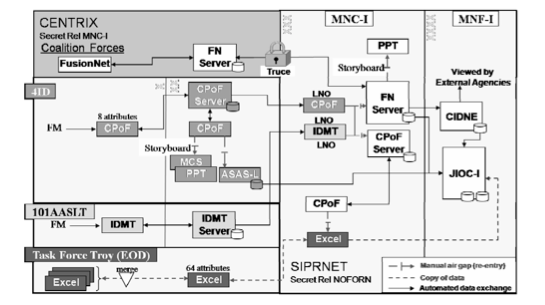
‘The primary transcription of an event, its constitution as a SIGACT, with all its uncertainties and limitations, was transmitted downstream to be digitized and visualized, correlated and ‘cleansed’, so that it could be aggregated to show trends or mapped to show distributions.  All the systems for SIGACT recording and analysis interfaced with visualization and presentation software, which was used to generate ‘storyboards’ at every level in the chain.’

The chain as it was constituted in Iraq in May 2006 is shown below; CENTRIX (top left) is the Combined Enterprise Regional Information Exchange System that provided information exchange across the US-led coalition;  CPoF (scattered across the centre field) is the Command Post of the Future, a distributed GIS system I discussed in the original essay that provided a command-level visualization of the battlespace as a field of events (a system that has since been upgraded multiple times); and at the centre right you can see the key automated data exchanges to and from CIDNE:

MNF-I Event Reporting, May 2006 (Wortman)

Since I wrote, scholars have used SIGACT reports much more systematically to analyse the connective tissue between ethno-sectarian violence and the ‘surge’ – see, for example, Stephen Biddle, Jeffrey Friedman and Jacob Shapiro, ‘Testing the surge’, International Security 37 (1) (2012) 7-40; Nils Weidmann and Idean Saleyhan, ‘Violence and ethnic segregation: a computational model applied to Baghdad‘, International Studies Quarterly 57 (2013) 52-64 – to explore the political dynamics of civilian casualties – see, for example, Luke Condra and Jacob Shapiro, ‘Who takes the blame?  The strategic effects of collateral damage’, American Journal of Political Science 56 (1) (2012) 167-87 – and to conduct more general evaluations of counterinsurgency in Iraq: see, for example, Eli Berman, Jacob Shapiro and Joseph Felter, ‘Can hearts and minds be bought? The economics of counterinsurgency in Iraq’, Journal of political economy 119 (4) (2011) 766-819.

I’ve been revisiting these modelling exercises for The everywhere war, because they require me to rework my essay on ‘The biopolitics of Baghdad’ (though not, I think, to change its main argument).  I’m struck by the idiom they use – my critique of spatial science written in another age would have been substantially different had it been less preoccupied with the detecting of spatial pattern, had its methods been applied more often to issues that matter, and had its architects been less convinced of the self-sufficiency of their methods.

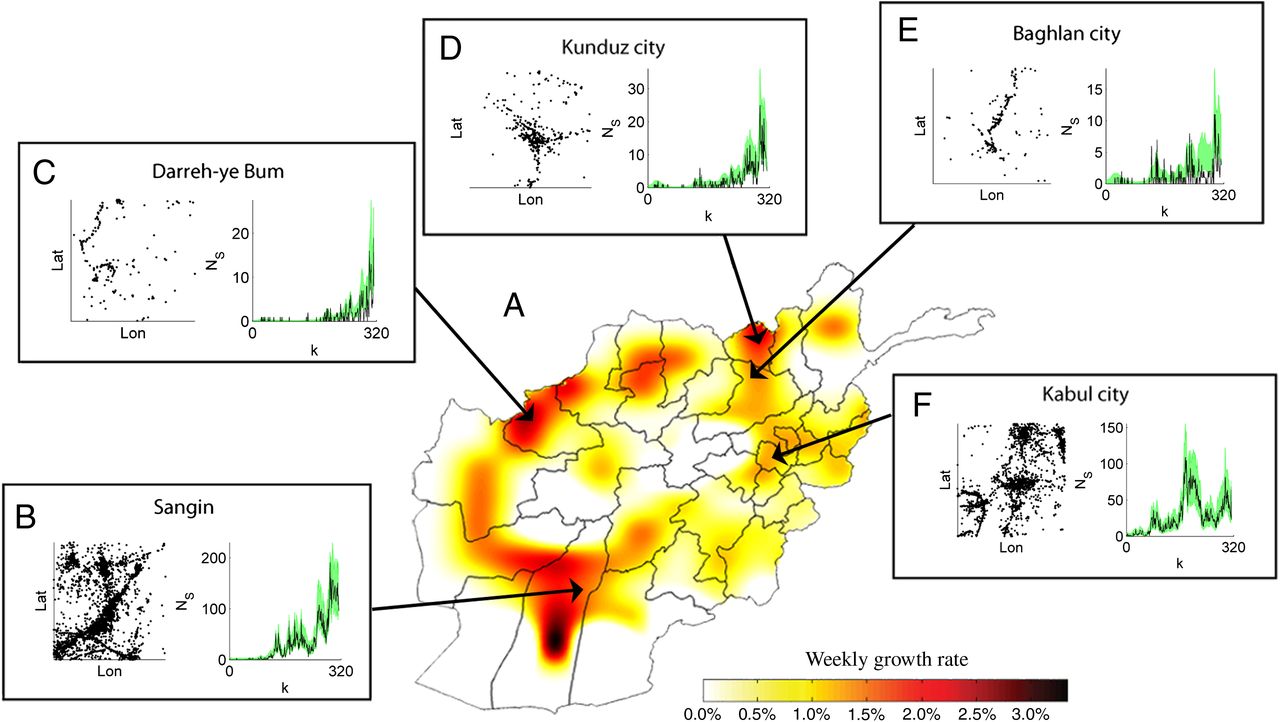
But I’m also struck by the idiom of the SIGACT itself.  We’ve since become much more accustomed to its staccato rhythm through Wikileaks’ release of the Afghan and Iraq War Diaries, whose key source was CIDNE.  Again, these have been visualised and analysed in all sorts of ways: see, for example, herehere, here and here (and especially Visualizing Data and its links here).  The image below comes from Andrew Zammit-Mangion, Michael Dewar, Visakan Kadirkamanathan and Guido Sanguinetti,’Point-process modelling of the Afghan War Diaries’, Proceedings of the National Academy of Sciences 109 (31) (2012) and shows the time-space incidence of events recorded in the Diaries (here I suspect I’m channelling half-remembered conversations with Andrew Cliff….)

F2.large

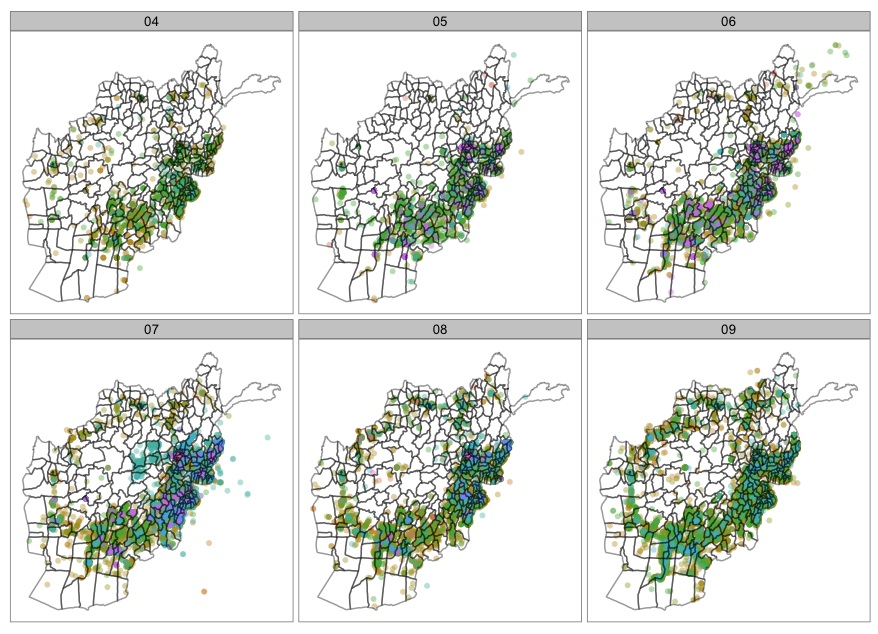
And here, rather more prosaically, is another version – by Drew Conway and Mike Dewar – that provides a time-sequence of the mounting intensity of the war 2004-2009 (for Danger Room‘s discussion and gloss, see here):

events_by_label_map

Now David Pinder has kindly drawn my attention to an extraordinarily suggestive essay by Graham Harwood,Endless War: on the database structure of armed conflict’ over at rhizome, and to the art-work that is it subject, which together have returned me to my original interest in the ‘event-field’ of later modern war and the automated interactions between its data platforms.

Graham’s central question is deceptively simple: ‘How does the way war is thought relate to how it is fought?’ SIGACTS populate the digital battlespace with events and invite a calculative and algorithmic apprehension of the field of military violence.  To show what this means, Graham and his partner Matsuko Yokokoji (who together compose YoHa: English translation ‘aftermath’) joined with his Goldsmith’s colleague Matthew Fuller to produce an intriguing artwork, Endless War.

It processes the WikiLeaks Afghan War Diary data set as a collection of analytic viewpoints, both machine and human. A software-driven system, Endless War reveals the structure of these viewpoints by using N-gram fingerprints, a method that allows sorting of the text as an anonymous corpus without having to impose predetermined categories on it. Presented as a gallery installation, the system includes a computer that processes the data in real time, projections of the results, and coil pick-up microphones on the central processing unit that sonify the inner working of the machine.

The torrent files released by WikiLeaks in 2010 are the residue of the system that created them, both machine and human. They seem to hint at the existence of a sensorium, an entire sensory and intellectual apparatus of the military body readied for battle, an apparatus through which the Afghan war is both thought and fought.

You can get a sense of the result from vimeo’s record of the installation at the Void Gallery in Derry:

This is a video, obviously, but Endless War isn’t a video.  As the artists explain in a note added to the vimeo clip:

Just as an algorithm is an ‘effective procedure’, a series of logical steps required to complete a task, the Afghan War Diary shows war as it is computed, reduced to an endless permutation of jargon, acronyms, procedure recorded, cross-referenced and seen as a sequence or pattern of events.

Endless War is not a video installation but a month-long real-time processing of this data seen from a series of different analytical points of view. (From the point of view of each individual entry; in terms of phrase matching between entries; and searches for the frequency of terms.) As the war is fought it produces entries in databases that are in turn analysed by software looking for repeated patterns of events, spatial information, kinds of actors, timings and other factors. Endless War shows how the way war is thought relates to the way it is fought. Both are seen as, potentially endless, computational processes. The algorithmic imaginary of contemporary power meshes with the drawn out failure of imperial adventure.

This computational assemblage (think not only of the cascading algorithms but also of the people and the handshakes between the machines: a political technology ‘full of hungry operators’, as Graham has it) is performative: it is at once an inventory – an archive – and a machine for producing a particular version of the military future. Graham again:

‘A SigAct necessarily retains evidential power that reflects its origin outside of the system that will now preserve it, but once isolated from blood and guts, sweat and secretions of the theatre of action (TOA), the SigActs are reassembled through a process of data atomisation. This filter constructs a domain where the formal relation, set theory, and predicate logic has priority over the semantic descriptions of death, missile strikes, or the changing of a tank track and the nuts and bolts needed…

This system of record keeping can be seen as a utopia of war. It is idealized, abstracted, contained; time can be rolled back or forward at a keystroke, vast distances traversed in a query, a Foucauldian placeless place that opens itself up behind the surface of blood-letting and hardware maintenance and the ordering of toilet rolls. A residue that casts a shadow to give NATO visibility to itself. As the ensemble of technical objects and flesh congeal, they create an organ to collectively act to rid itself of some perceived threat—this time from Al Qaeda or the Taliban—faulty vehicles, bad supplies, or invasive politics. This organ also allows NATO’s human souls to imagine themselves grasping the moment, the contingency of now. All of the war, all of the significant events, all of the time, all of the land, coming under the symbolic control of a central administration through the database, affording governance to coerce down the chain of command.’

This is a much more powerful way of capturing – and, through the physical installation itself, conveying – what I originally and imperfectly argued in ‘Seeing Red’:

‘… optical detachment is threatened by a battle space that is visibly and viscerally alive with death; biopolitics bleeds into necropolitics. And yet the Press Briefings that are parasitic upon these visualizations move in a dialectical spiral, and their carefully orchestrated parade of maps, screens and decks reinstates optical detachment. For even as the distancing apparatus of the world-as-exhibition is dissolved and the map becomes the city, so the city becomes the map: and in that moment – in that movement – Baghdad is transformed into an abstract geometry of points and areas and returned to the field of geopolitics. And as those maps are animated, the body politic is scanned, and the tumours visibly shrink, so Baghdad is transformed into a biopolitical field whose ‘death-producing activities [are hidden] under the rhetoric of making live’ (Dauphinee and Masters 2007: xii). In this looking-glass world bodies are counted but they do not count; they become the signs of a pathological condition and the vector of recovery. These processes of abstraction are, of course, profoundly embodied. This is not algorithmic war, and behind every mark on the map/city is a constellation of fear and terror, pain and grief. For that very reason our disclosure of the infrastructure of insight cannot be limited to the nomination of the visible.’

Britain’s Reapers

UK Remote Control

As Craig Jones has discussed in detail, it’s been much easier to get information about the ways in which the United States has incorporated drones into its military and paramilitary operations than to prise open the door of UK operations (see also Chris Cole on ‘five basic facts we are simply not allowed to know here).

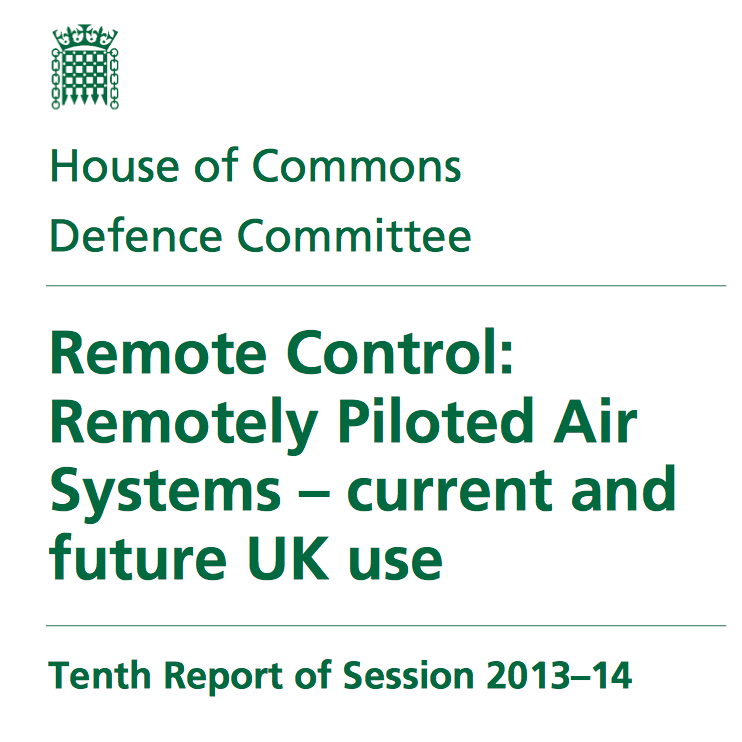
But the House of Commons Defence Committee has just published a two-volume report, Remote Control: remotely piloted air systems – current and future UK use.

Volume 1, the report and formal minutes (58 pp), can be downloaded as a pdf here, and Volume II, written evidence (130 pp), is available here.  The second volume includes submissions from the Ministry of Defence, Northrop Grumman, and General Atomics together with critical submissions from Drone Wars UK, Reprieve, the Network for Social Change’s Remote Control project, and the Bureau of Investigative Journalism.

Over at the Bureau, Alice Ross has a first response and summary here, while Chris Cole has a trenchant critique at Drone Wars UK here.

I’m still working my way through all this, but here are some key passages.

First, on the ‘double proximity’ of drone operations – as I’ve said before, even though these platforms can be controlled from thousands of miles away they are not weapons of global reach:

‘The MoD told us that in order to utilise unmanned air systems in the most efficient manner, they should be based as close as possible to the target area of interest to allow for the longest loiter time possible. In a “non-permissive” or hostile environment this would be “extremely difficult”.’

The other side of this is the invocation of a new (though, as I’ve also emphasised, thoroughly conditional and technologically mediated) quasi-intimacy:

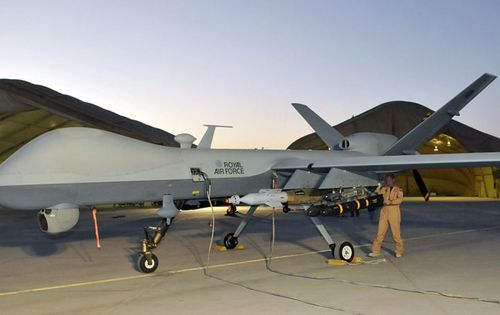
‘It was very clear from the visit to XIII Squadron and discussions with Reaper aircrew that all were experienced professional personnel with a clear purpose and keen understanding of the Rules of Engagement which govern their operations. Despite being remote from the battle space they exhibited a strong sense of connection to the life and death decisions they are sometimes required to take. This was in stark contrast to the image portrayed by some commentators of “drone” pilots as video gaming “warrior geeks”.’

RAF Reaper

Again, as I’ve argued elsewhere, that ‘sense of connection’ is much more highly developed in relation to troops on the ground than to others who are in (or beyond) the field of view, and who are inevitably shut out from audio or online communications, which in part accounts for the risk to non-combatants whenever troops are ‘in contact’ with the Taliban and other fighters.

Second, the report seeks to draw a line between the US program of targeted killing and UK military operations in Afghanistan:

‘We acknowledge that over the last few years there has been a growing concern in relation to the sharing of intelligence with allies and the uses to which such data may contribute. While the issues raised by Reprieve stray beyond the terms of reference for our inquiry and indeed the remit of the Defence Committee, we do believe that there should be greater transparency in relation to safeguards and limitations the UK Government has in place for the sharing of intelligence…

‘We consider that it is of vital importance that a clear distinction be drawn between the actions of UK Armed Forces operating remotely piloted air systems in Afghanistan and those of other States elsewhere… In Afghanistan UAS provide intelligence in support of our ground commanders, enabling them to stay one step ahead of the enemy. Whether for targeting the Taliban or supporting troops on patrol, their ability to loiter over and survey areas for enemy activity and then feed back images and video in real time means they are an invaluable asset to our forces on the ground. Together, the UK’s fleet of UAS have carried out over 160,000 hours of ISR operations.

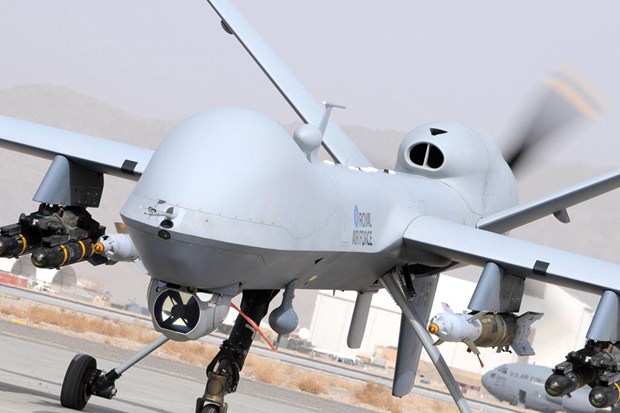
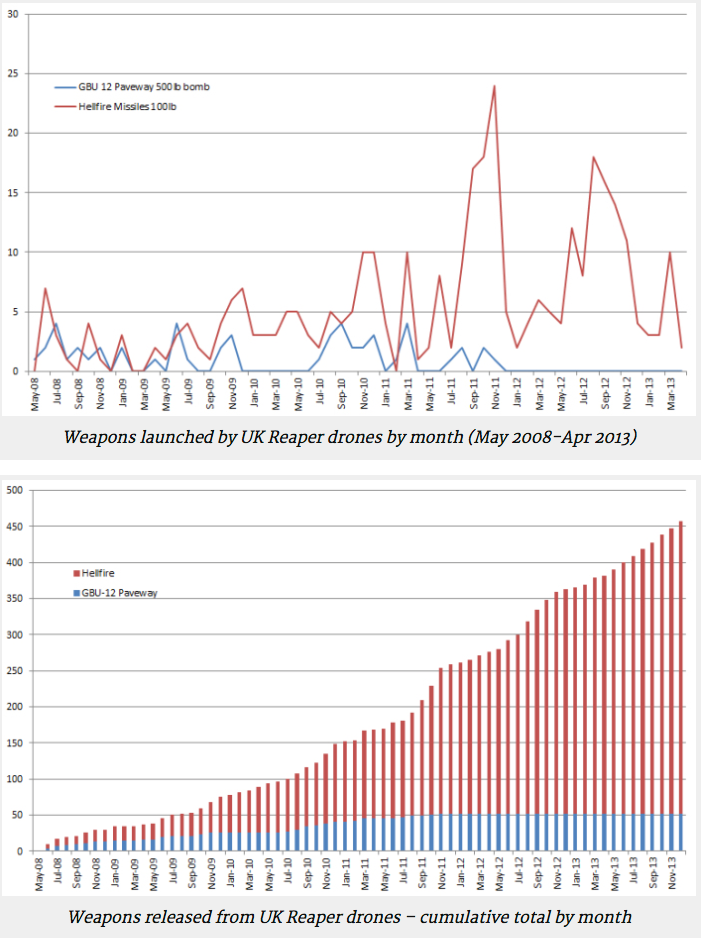
‘The General Atomics MQ-9 Reaper operated by the RAF is the UK’s only armed remotely piloted air system. The RAF fleet rose to ten in early 2014 as an additional five aircraft were accepted into service. RAF Reapers provide persistent intelligence, surveillance, target acquisition and reconnaissance (ISTAR) for ISAF forces in Afghanistan, mostly in support of UK forces in Helmand province…. Since May 2008, UK Reaper aircraft have been armed with precision-guided weapons—Hellfire laser guided air-to-ground missiles and GBU-12 Paveway 500lb laser guided bombs… By 31 August 2013, UK operated Reaper aircraft had flown over 50,000 hours on operations in the ISR role with 418 weapons fired in the same period.’

RAF Reaper and weapons

Here are the raw figures released to Drone Wars UK last month, following a FoI Request to the Ministry of Defence:

Weapons released by UK Reapers in Afghanistan 2008-2013 (Drone Wars UK)

Chris Cole is not convinced by the Committee’s (and, by extension, the Ministry’s) attempt to draw the line:

‘The report also argues that it is “of vital importance” that a clear distinction be draw between the use of drones by UK armed forces and what it discreetly calls “those of other States elsewhere.” It urges the MoD to continue its PR campaign – what the committee calls a “public awareness programme” – in order to “aid public understanding and acceptance.” PR it seems trumps transparency.’

Third, and closely connected to Chris’s misgivings, the report restates without examination the legal armature for UK military operations:

‘…the MoD told us that UK remotely piloted aircraft operate within the constraints of UK rules of engagement (ROE) and policy, even where operational control is assigned to a Coalition Commander, such as the Commander of ISAF. The MoD also stated that UK policy relating to targeting by remotely piloted aircraft is exactly the same as that for manned aircraft (and land and maritime weapons where applicable):

‘It is entirely compliant with International Humanitarian Law. Targets are always positively identified as legitimate military objectives and both pattern of life assessment and collateral damage estimate conducted. Strikes are carried out in accordance with the Law of Armed Conflict.

‘Personnel were keen for the public to know more and understand better what it is they do and to dispel some myths that have grown up about Reaper operations in particular. One pilot commented that the public needed to know that remotely piloted aircraft are “not robots, they’re not autonomous and we spend an awful lot of time training to fly them”. This training emphasised all aspects of the RAF rules of engagement such as whether a strike is necessary, whether any civilians are nearby, and what instructions have been received from the ground commander. Reaper aircrew were firmly of the view that the loiter time of remotely piloted aircraft allowed more informed decisions to be made and consequently the risk of civilian casualties was reduced should a missile strike be required….

Fourth, on civilian casualties and transparency:

‘The MoD told us that it was aware of only one incident involving an armed UK remotely piloted air system Reaper, which had resulted in the deaths of civilians:

‘On 25 March 2011 [three years ago to the day!] an attack on two pick-up trucks resulted in the destruction of a significant quantity of explosives and the death of two insurgents. Sadly, four Afghanistan civilians were also killed. In line with current ISAF procedures, an ISAF investigation was conducted to establish if any lessons could be learned or if any errors in operational procedures could be identified. In that case, the report concluded that the actions of the Reaper crew had been in accordance with extant procedures and rules of engagement.

…We note the conclusion of the UN Special Rapporteur [Ben Emmerson] that in any case in which civilians have been, or appear to have been, killed, there is an obligation on the State responsible to conduct a prompt, independent and impartial fact-finding inquiry and to provide a detailed public explanation. We recognise that this is not a simple and straightforward request as to do so could seriously jeopardise continuing operations. Nonetheless, we recommend that, to the extent that it is operationally secure to do so, following an event which has resulted in confirmed civilian casualties the MoD should seek to publish details about the incident and any lessons learned from the review process…’

For a good discussion of the UK’s definition of ‘civilian’ in such cases, see Dapo Akande at the European Journal of International Law here.

To be continued.
War and therapeutic geographies

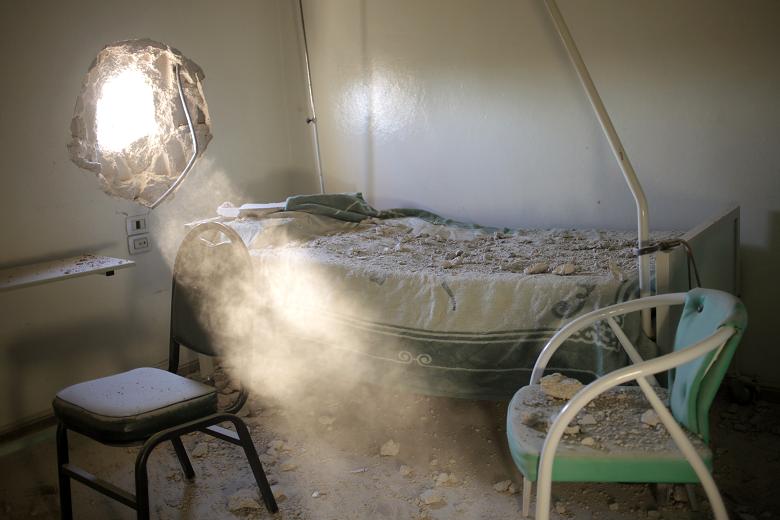
Tall Rifat hospital near Aleppo attacked by helicopter gunships June 2012

I previously noted the problems of providing medical care to those fleeing the war in Syria – and to those who’ve been left behind – and an article by Thanassis Cambanis in the Boston Globe (‘Medical care is now a tool of war’) reinforces the importance of the issue:

 The medical students disappeared on a run to the Aleppo suburbs. It was 2011, the first year of the Syrian uprising, and they were taking bandages and medicine to communities that had rebelled against the brutal Assad regime. A few days later, the students’ bodies, bruised and broken, were dumped on their parents’ doorsteps.

Dr. Fouad M. Fouad, a surgeon and prominent figure in Syrian public health, knew some of the students who had been killed. And he knew what their deaths meant. The laws of war—in which medical personnel are allowed to treat everybody equally, combatants and civilians from any side—no longer applied in Syria.

“The message was clear: Even taking medicine to civilians in opposition areas was a crime,” he recalled.

As the war accelerated, Syria’s medical system was dragged further into the conflict. Government officials ordered Fouad and his colleagues to withhold treatment from people who supported the opposition, even if they weren’t combatants. The regime canceled polio vaccinations in opposition areas, allowing a preventable disease to take hold. And it wasn’t just the regime: Opposition fighters found doctors and their families a soft target for kidnapping; doctors always had some cash and tended not to have special protection like other wealthy Syrians.

Doctors began to flee Syria, Fouad among them. He left for Beirut in 2012. By last year, according to a United Nations working group, the number of doctors in Aleppo, Syria’s largest city, had plummeted from more than 5,000 to just 36.

Since then, Fouad has joined a small but growing group of doctors trying to persuade global policy makers—starting with the world’s public health community—to pay more urgent attention to how profoundly new types of war are transforming medicine and public health.

It is grotesquely ironic that ‘global policy-makers’ should have to be persuaded of the new linkages between war, medicine and public health, given how often later modern war is described (and, by implication, legitimated) through medical metaphors: see in particular Colleen Bell, ‘War and the allegory of medical intervention: why metaphors matter’, International Political Sociology 6: 3 (2012) 325-28 and ‘Hybrid warfare and its metaphors’, Humanity 3 (2) (2012) 225-47.

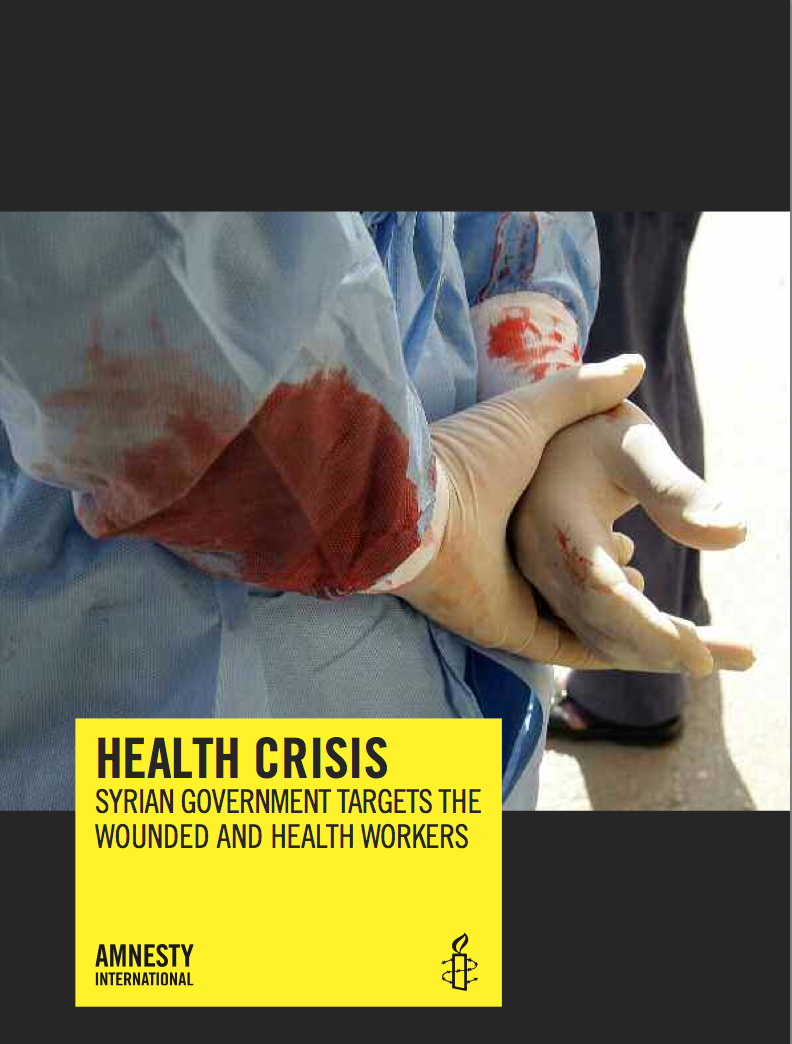
AI Health Crisis in SyriaBut there are, as Fouad emphasises, quite other, densely material biopolitics attached to contemporary military and paramilitary violence, including not only the targeting of medical staff, as he says, but also their patients.

“In Syria today, wounded patients and doctors are pursued and risk torture and arrest at the hands of the security services,” said Marie-Pierre Allié, president of [Médecins san Frontières’]. “Medicine is being used as a weapon of persecution.”

In October 2011 Amnesty International described the partisan abuse of the wounded in hospitals in Damascus and Homs, and the denial of medical care in detention facilities, in chilling detail.

At least then (and there) there were hospitals.  Linking only too directly to my previous post on Aleppo, Cambanis concludes:

Today, Fouad’s former home of Aleppo is largely a ghost town, its population displaced to safer parts of Syria or across the border to Turkey and Lebanon. The city’s former residents carry the medical consequences of war to their new homes, Fouad said—not just injuries, but effects as varied as smoking rates, untreated cancer, and scabies. Wars like those in Syria and Iraq don’t follow the old rules, and their effects don’t stop at the border.

I first became aware of these issues at a conference on War and medicine in Paris in December 2012, which prompted my current interest in the casualties of war, combatant and civilian, and the formation of modern medical-military machines.  Several friends from the Paris meeting (Omar Dewachi, Vinh-Kim Nguyen and  Ghassan Abu Sitta) have since joined with other colleagues to produce a preliminary review published this month in The Lancet: ‘Changing therapeutic geographies of the Iraqi and Syrian wars’.  They write:

War is a global health problem. The repercussions of war go beyond death, injury, and morbidity. The effects of war are long term, reshaping the everyday lives and survival of entire populations.

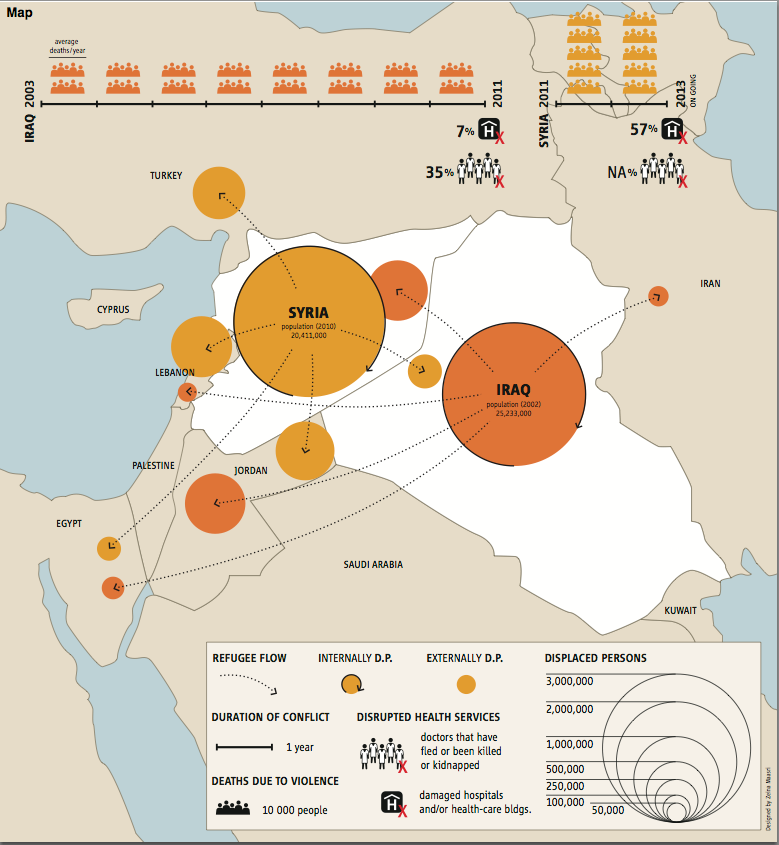
In this report,we assess the long-term and transnational dimensions of two conflicts: the US-led occupation of Iraq in 2003 and the ongoing armed conflict in Syria, which erupted in 2011. Our aim is to show that, although these conflicts differ in their geopolitical contexts and timelines, they share similarities in terms of the effects on health and health care. We analyse the implications of two intertwined processes—the militarisation and regionalisation of health care.  In both Syria and Iraq,boundaries between civilian and combatant spaces have been blurred. Consequently,hospitals and clinics are no longer safe havens. The targeting and misappropriation of health-care facilities have become part of the tactics of warfare. Simultaneously, the conflicts in Iraq and Syria have caused large-scale internal and external displacement of populations. This displacement has created huge challenges for neighbouring countries that are struggling to absorb the health-care needs of millions of people.

They emphasise ‘the targeting and implication of medicine in warfare’ and note that ‘the militarisation of health care follows the larger trends of the war on terror, where the boundaries between civilian and combatant spaces are broadly disrespected.’  They have in mind ‘not only the problem of violence against health care, but also [the ways in which] health care itself has become an instrument of violence, with health professionals participating (or being forced to participate) in torture, the withholding of care, or preferential treatment of soldiers.’

And they describe a largely unplanned dispersal of medical care across the region that blurs other – national – boundaries, requiring careful analysis of the ‘therapeutic geographies‘ which trace the precarious and shifting journeys through which people obtain medical treatment in and beyond the war zone.  They insist that ‘migrants seeking refuge from violence cannot be framed and presented as mere victims but as people using various strategies to acquire health care and remake their lives.’ The manuscript version of the report included the map below, which illustrates the scale of the problem:

Therapeutic geographies

My own work addresses similar issues through four case studies over a longer time-span, to try to capture the dynamics of these medical-military constellations: the Western Front in 1914-18, the Western Desert in the Second World War, Vietnam, and Afghanistan 2001-2014 (see ‘Medical-military machines’, DOWNLOADS tab).

msf-afghanistan-report-finaToday Médecins sans Frontières published an important report, Between rhetoric and reality:  the ongoing struggle to access healthcare in Afghanistan, that speaks directly to these concerns.  Like the Lancet team, the report explores the ways in which war affects not only the provision of healthcare for those wounded by its violences but also access to healthcare for those in the war zone who suffer from other, often chronic and life-threatening illnesses: ‘The conflict creates dramatic barriers that people must overcome to reach basic or life- saving medical assistance. It also directly causes death, injury or suffering that increase medical needs.’  Releasing their findings, MSF explained:

After more than a decade of international aid and investment, access to basic and emergency medical care in Afghanistan remains severely limited and sorely ill-adapted to meet growing needs created by the ongoing conflict…  While healthcare is often held up as an achievement of international state-building efforts in Afghanistan, the situation is far from being a simple success story. Although progress has been made in healthcare provision since 2002, the report … reveals the serious and often deadly risks that people are forced to take to seek both basic and emergency care.

The research – conducted over six months in 2013 with more than 800 patients in the hospitals where MSF works in Helmand, Kabul, Khost and Kunduz provinces – makes it clear that the upbeat rhetoric about the gains in healthcare risks overlooking the suffering of Afghans who struggle without access to adequate medical assistance.

“One in every five of the patients we interviewed had a family member or close friend who had died within the last year due to a lack of access to medical care,” said Christopher Stokes, MSF general director. “For those who reached our hospitals, 40 per cent of them told us they faced fighting, landmines, checkpoints or harassment on their journey.”

The patients’ testimonies expose a wide gap between what exists on paper in terms of healthcare and what actually functions. The majority said that they had to bypass their closest public health facility during a recent illness, pushing them to travel greater distances – at significant cost and risk – to seek care.

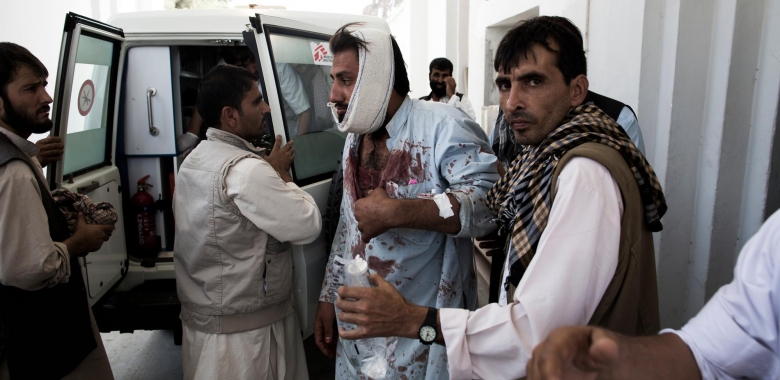
MSF provides a photoessay describing some of these precarious journeys (‘Long and dangerous roads’) here, from which I’ve taken the photograph below, showing an inured man being led by a relative into the Kunduz Trauma Centre.

MSB5652

When soldiers fall

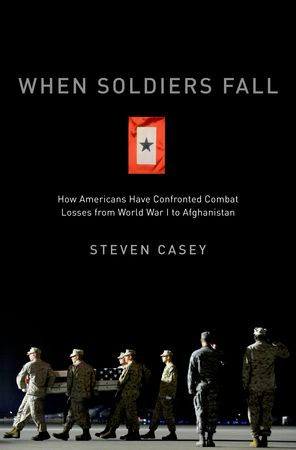
CASEY When soldiers fallNews of an important new book that feeds directly into my new project on medical-military machines and casualties of war, 1914-2014: Steven Casey‘s When Soldiers Fall: How Americans Have Confronted Combat Losses from World War I to Afghanistan (OUP, January 2014).  My own project is concerned with the precarious journeys of those wounded in war-zones (combatants and civilians) rather than those killed and the politics of ‘body-counts’, but Casey’s work presents a vigorous challenge to the usual assumptions about public responses to combat deaths:

The extent to which combat casualties influence the public’s support for war is one of the most frequently and fiercely debated subjects in current American life and has cast an enormous shadow over both the Iraq and Afghanistan conflicts. The common assumption, based largely on U.S. experience in past wars, is that the public is in some way casualty averse or casualty shy, and that as losses increase its support for a war will inexorably decline. Yet this assumption has been adopted as conventional wisdom without any awareness of one of the most important dimensions of the issue: how has the public become aware of the casualties sustained during particular wars? To what extent has the government tried to manipulate or massage the figures? When and why have these official figures been challenged by opportunistic political opponents or aggressive scoop-seeking reporters?

As Steven Casey demonstrates, at key moments in most wars what the public actually receives is not straightforward and accurate casualty totals, but an enormous amount of noise based on a mixture of suppression, suspicion, and speculation. This book aims to correct this gap in information by showing precise what casualty figures the government announced during its various wars, the timing of these announcements, and any spin officials may have placed upon these, using a range of hitherto untapped primary documents. Among the nuggets he has uncovered is that during World War I the media depended on Axis figures and that the Army and Navy did not announce casualty figures for an entire year during World War II. Organized chronologically, the book addresses the two world wars, the limited wars in Korea and Vietnam, and the recent conflicts that are part of the War on Terror. Using sources such as the private military command papers of Generals Patton, MacArthur, and Westmoreland, and previously unopened New York Times archives, it offers the first analysis of how the U.S. government has publicized combat casualties during these wars, and how these official announcements have been debated and disputed by other voices in the polity. Casey discusses factors such as changes of presidential administration, the improvement of technology, the sending of war correspondents to cover multiple conflicts, and the increasing ability to identify bodies. Casey recreates the complicated controversies that have surrounded key battles, and in doing so challenges the simplicity of the oft-repeated conventional wisdom that “as casualties mount, support decreases.” By integrating military and political history, he presents a totally new interpretation of U.S. domestic propaganda since 1917, filling a major gap left by a spate of recent books. Finally, it provides a fresh and engaging new perspective on some of the biggest battles in recent American history, including the Meuse-Argonne, D-Day, the Battle of the Bulge, China’s intervention in the Korean War, the Tet Offensive, and the recent campaigns in Iraq and Afghanistan.

Amazon has temporarily withdrawn its Kindle edition because there are technical issues that it is working with OUP to resolve: I hope this is sorted out soon…  But for now you can read an extract over at Salon, ‘How Richard Nixon reinvented American warfare (…and paved the way for Iraq and Afghanistan)’:

Determined to prop up South Vietnam in an election year, Nixon’s casualty sensitivity had not extended beyond American lives to enemy noncombatants. “Now, we won’t deliberately aim for civilians,” he told his senior advisers at one point in 1972, “but if a few bombs slop over, that’s just too bad.” In Nixon cold calculation the American electorate was principally concerned with U.S. losses; it cared far less about what happened to civilians….

In the wake of defeat, the U.S. government tried to learn the appropriate lessons. As well as reconsidering military-media relations, officials thought long and hard about the conditions under which the public would support the use of force—and the prospect of casualties—in the future. Sometimes, they looked back beyond Vietnam to an earlier era when the media had appeared more manageable and the public less skeptical. Of course, even during the two world wars and Korea, the government had always faced searching questions about the veracity of its casualty information. But Vietnam had clearly changed the rules of the game. Trust in government was much lower. The media was even keener to probe for the story behind the official narrative. And the whole debate was now even more sensitive to the human cost of war. These were all legacies that the two Bushes would have to grapple with in the post–Cold War era, as they took the United States into war against a new set of enemies.

Military logistics

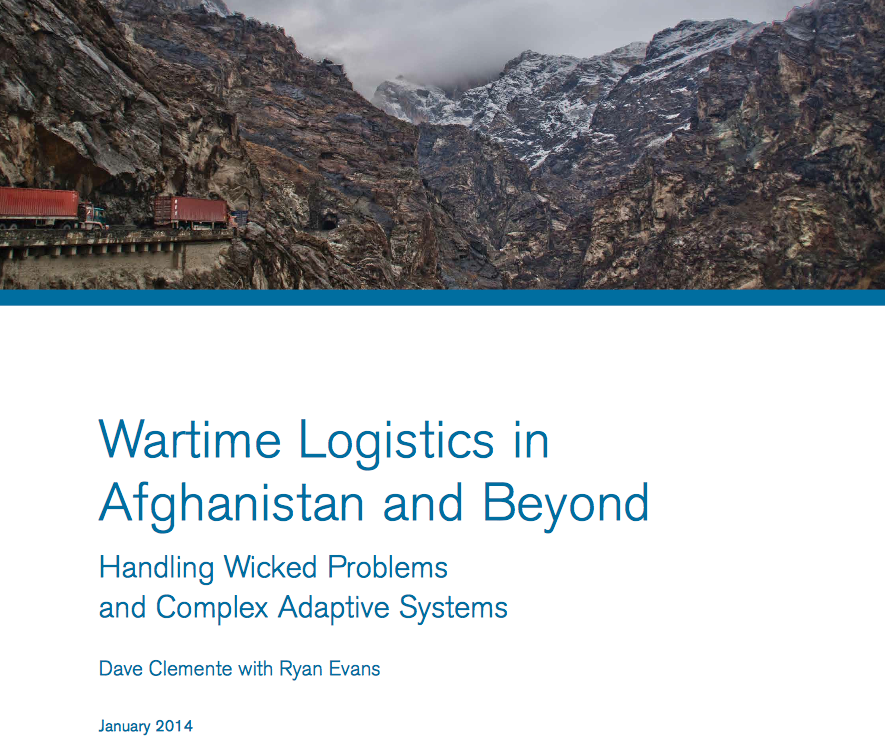
Wartime logistics in Afghanistan

Following up my posts on military logistics in Afghanistan (see here, here and here), Dave Clement and Ryan Evans have produced a new report for Chatham House, ‘Wartime Logistics in Afghanistan and Beyond: Handling Wicked Problems and Complex Adaptive Systems‘.  Part of the discussion inevitably concerns the familiar problems faced by US forces – during both the occupation and the ‘draw-down’ – but the main focus is on the British military:

Over the past decade, thousands of military vehicles and tens of thousands of tonnes of supplies and equipment have been moved into Afghanistan in support of NATO operations. In the near future, this matériel will have to be disposed of or moved out of the country. For the UK military this will be the biggest logistics operation since the Second World War. The process of moving supplies into, around and out of Afghanistan is a resource-intensive operation that has already resulted in numerous instances of local and regional corruption, which have often been accepted as a cost of doing business. 

This report looks at how these and other problems arise and how the United Kingdom’s military supply chain can adapt to deal with them. It makes recommendations for utilizing supply chain resources to serve strategic and operational goals during the build-up and drawdown of forces. It analyses how broader opportunities can, over time, be extracted from managing the military supply chain and its component parts. These include improving local transport infrastructure, supporting reconstruction and development efforts, and delivering influence at local levels. These opportunities could be realized through a variety of means, including increased employment of local workers, targeted resource distribution, and intelligent contracting coupled with robust financial oversight.

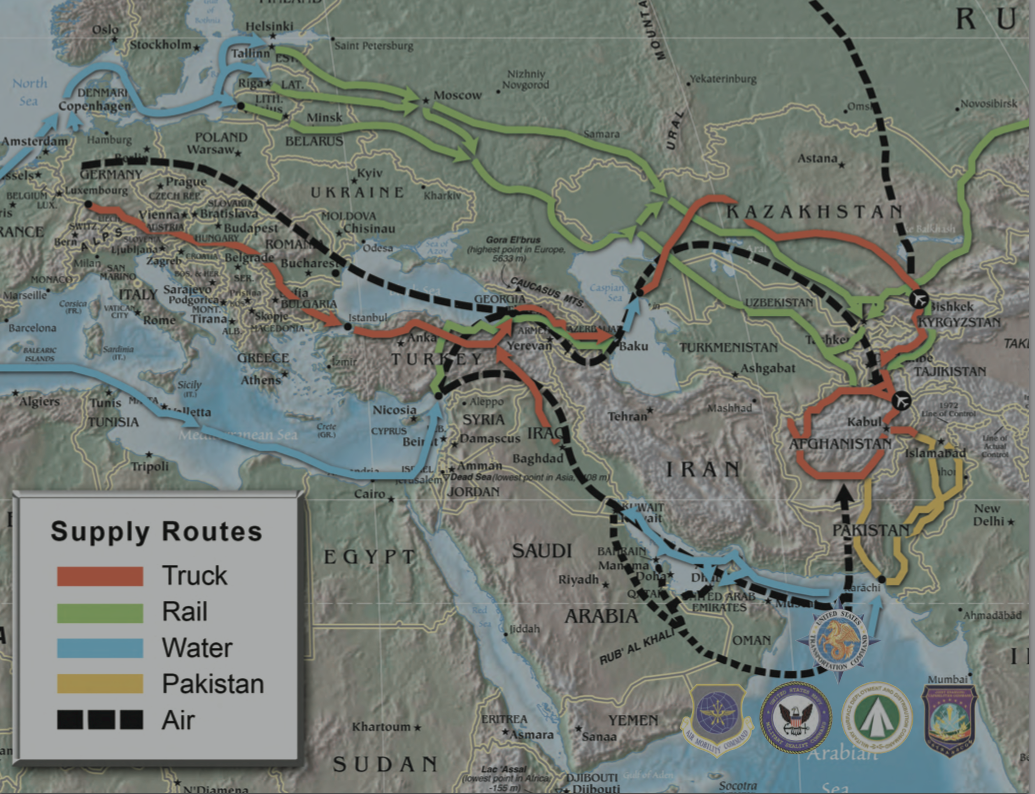
Military supply routes, Afghanistan

You can’t read military strategists these days without falling over ‘wicked problems’, but for me the originality of the report lies in its UK focus: a useful complement to the US discussions.  (The map, incidentally,comes from US Transportation Command’s Annual Report for 2011; the 2012 report is here).

You can read a summary, and access the full Chatham House report, here.

Drones and asymmetric war

Thanks to the Aviationist for the link.

(in)Humanity and drones

SATIA Spies in ArabiaThe latest issue of Humanity: an international journal of human rights, humanitarianism and development 5 (1) (2014) – see my previous post here – contains a wonderful dossier on Drones between past and present.  It includes Priya Satia, whose work I’ve admired ever since I read her wonderful Spies in Arabia: The Great War and the Cultural Foundations of Britain’s Covert Empire in the Middle East, on ‘Drones: a history from the Middle East’ (pp. 1-31), Anna Chotzen on ‘Beyond bounds: Morocco’s Rif War and the limits of international law’ (pp. 33-54: ‘From a legal standpoint, the United States’ drone offensives are eerily similar to Spain’s chemical war in Morocco a century ago’), and a Photo Esssay from Trevor Paglen (pp. 57-71), introduced by Nicholas Guilhot (pp. 55-56).

Priya’s essay is of particular interest to me, since it recovers the genealogy and, crucially, what she calls ‘the cultural history of bombardment’ that connects colonial practices of ‘air control’ to the ideologies that activate the drone strikes prosecuted by the US in Afghanistan, Pakistan and elsewhere.  She’s more sanguine about the transparency of those carried out by the USAF in Afghanistan than I am:

‘… in my conversations with military officers, it is clear how strongly the USAF wishes to distinguish its use of drones from ‘‘other agencies’ ’’ use of them, even while acknowledging that tactics are shared. The USAF’s drone strikes in Afghanistan are transparent; a JAG (judge advocate) assesses the proportionality of the action and the likelihood of collateral damage; official casualty figures line up well with independent counts.’

I now suspect it’s more than ‘tactics’ that are shared, and the lines between the USAF and the CIA are more blurred than – I agree – most military officers would wish.  And my project on ‘Militarized vision‘ is trying to identify the parameters within which the USAF’s transparency and its visual mediations operate.  But as she goes on to say, ‘However, all of this hardly matters politically, given the older and more recent history of aerial counterinsurgency in these regions.’  And she provides a rich and compelling account of that history and its traces in present memories and (para)military practices.

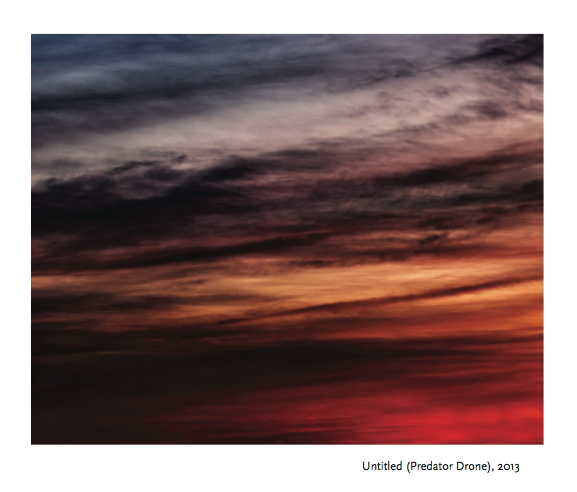
PAGLEN Untitled (Predator drone) 2013

Dirty wars and stained maps

I’m still in Beirut where I’ve had a wonderful time at the Transnational American Studies conference at AUB.  Yesterday morning I chaired a panel on ‘Geographies of War‘, which featured Laleh Khalili (on Kuwait, military logistics and private contractors: abstract here), Lisa Hajjar (on the (il)legal strictures and injustices at Guantanamo; she changed her paper so I can’t link to an abstract), and Jeremy Scahill (‘The world is America’s battlefield’: abstract here).

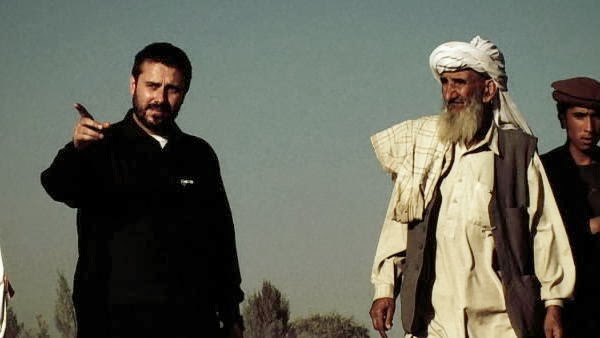
In the evening Jeremy showed the film of Dirty Wars, co-written with David Riker and directed by Rick Rowley.  Bear with me here; I’ll return to those ‘geographies’ in a moment.  Seeing the film for a second time (the first was in Toronto in the fall with Jaimie and Jorge) I have to say I found it less satisfactory – I much prefer the book, but it’s not only because the written version is (inevitably) more detailed and more nuanced.  I think it has something to do with the film being less an act of investigative journalism than a reconstruction of investigative journalism, a noir docudrama in which the investigator (no less inevitably) becomes the central figure: Sam Spade with a notebook.  For that reason, I think Michael O’Sullivan is simply wrong to say that ‘the film is a documentary pure and simple.’

Dirty Wars

You can see that most obviously in the section that deals with a Special Forces night raid in February 2010 on a compound in Gardez, Afghanistan, where much of the ground-breaking reporting was done by another journalist, Jerome Starkey.  But these scenes have incredible dramatic force, none the less, and the incorporation of cellphone footage of the raid and the unmasking of the Special Forces commander are genuinely and profoundly arresting (if only that were literally true).

Dirty Wars Gardez

I’m less convinced by the sections that treat the targeted killing of Anwar al-Awlaki, probably because I’m still dismayed that it was the killing of a U.S. citizen that sparked so much public outrage in the United States rather than the killing of all the others.  Certainly in the film, far more so than the book, there’s an unwavering focus on the ‘Americanness’ of al-Awlaki, and especially of his transparently innocent teenage son, murdered by a drone strike just two weeks later.  Home videos, games, clothes, a whole series of images are put to work to show not that ‘they’ are just like ‘us’ but that in some substantial sense ‘they’ are ‘us’.   I was left wondering about those who don’t qualify for these sort of identifications, who can’t provide similarly legible identity papers: how are we to recognise and acknowledge their lives as grievable too?  There’s also something unsettling about Jeremy’s epiphany that he’s come to Yemen ‘to apologise’: I’m still trying to figure out how he could, and what position he would have had to occupy for that to mean very much to al-Awlaki’s grandparents and cousins in Sa’ana.  

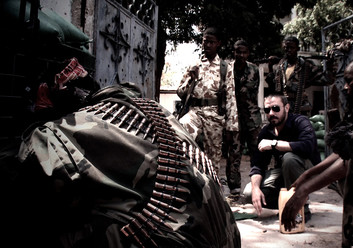
Dirty Wars SomaliaFinally, the extended passage through a war-ravaged town in Somalia, crouching alongside militias and interviewing a warlord who gives very little away, seems to run into the sand.  I was left with the uncomfortable feeling that these sequences had been retained primarily for Mohamed Afrah Qanyare‘s assertion (about his paymasters) that ‘America knows war… They are the war masters.’  

And yet, of course,  America doesn’t know war: Bush and Cheney famously avoided Vietnam, most of the war managers view the results of their military and paramilitary violence on screens and spreadsheets, and most of the public turns the other way.  As Kamila Shamsie says in Burnt Shadows, the United States fights ‘more wars than anyone else; because you understand war least of all’ (see also my draft introduction to The everywhere war here; scroll down).

That’s precisely why investigative journalism and documentary films are so urgently necessary – and why we need these different forms – but I’m not sure that rendering Jeremy’s courageous and principled investigations in the black and white tones of a Hollywood thriller is the best way to bring ‘what is hidden in plain sight’ into public view.  (For a different take, that pays close attention to the visual codes in the film, see Mike Hill‘s very smart essay over at Feedback here).  I do know that films have to be different from books, that they have different grammars if you like, and I also understand that one of the most effective ways of soliciting an audience’s response is through story-telling – academic prose would be considerably less deadly if it had more narrative force – but in the end I’m with Roger Ebert:  

‘Scahill is so respected and convincing that he doesn’t need such propping up, so the flashy directing and editing makes it feel as though “Dirty Wars” is trying too hard to sell things that might have sold themselves just fine without the hot box approach.’ 

Other (non-film) critics have objected to the way in which the history of clandestine/covert war is foreshortened in Dirty Wars, so that the CIA is left in the shadows.  But that’s surely because in the wake of 9/11 the CIA was, in some crucial respects, pushed out of the limelight and a vastly aggrandised Joint Special Operations Command took centre stage to play for Cheney and Rumsfeld. And it’s the combination of a para-militarized CIA and JSOC that is instrumental in pushing the boundaries of the everywhere war.

socommap4_large

  • Red markers: U.S. Special Operations Forces deployment in 2013.
  • Blue markers: U.S. Special Operations Forces working with/training/advising/conducting operations with indigenous troops in the U.S. or a third country during 2013.
  • Purple markers: U.S. Special Operations Forces deployment in 2012.
  • Yellow markers: U.S. Special Operations Forces working with/training/advising/conducting operations with indigenous troops in the U.S. or a third country during 2012.

US Special Operations Deployments, 2012-2013

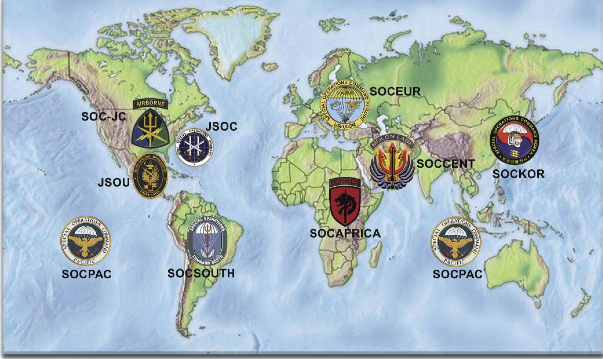
While I was writing this, a new report from Nick Turse popped on to my screen, charting the extraordinary global geography of JSOC (above) and its entanglements with other militaries and agencies like USAID.  JSOC has set up its own shadow system of subcommands mirroring the Pentagon’s division of the globe into unified combatant commands like US Central Command, each assigned to a different geographical region:

JSOC sub-commands

US Special Operations Command – Subcommands

I’ve taken the map above from US Special Operations Command’s own ‘Factbook‘, though it’s so reluctant to disclose any information that here too, as you’ll see if you read Nick’s article, part of the story is getting the story.  If you read this alongside Steve Niva‘s brilliant essay, ‘Disappearing violence: JSOC and the Pentagon’s new cartography of networked warfare’, Security dialogue 44 (3) (2013) 185-202, and in conjunction with the gritty detail (and vivid prose) of Dirty Wars, you’ll have a desperately disturbing sense of one of the modalities that is producing these new geographies of war.  As Scott Horton tells Jeremy in Dirty Wars, ‘suddenly the theatre of war has become the entire globe – it’s become everywhere.’