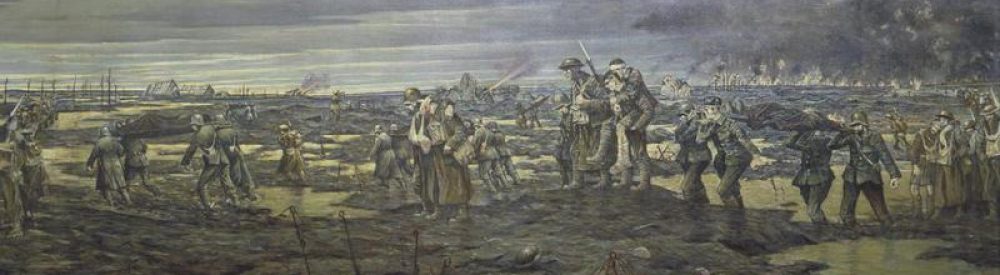
‘Imagination bodies forth…’

Following from my previous post, I’ve been thinking a lot about bodies recently, and for two reasons.
DUDZIAK War-timeThe first is the workshop on War & Medicine I attended in Paris just before Christmas.  It became very clear early on how difficult it is to determine when military violence comes to an end; Mary Dudziak has recently written about this in her War time: an idea, its history, its consequences (Oxford, 2012), largely from a legal point of view (and not without criticism), but it’s worth emphasising that the effects of violence continue long after any formal end to combat.  This ought to be obvious, but it’s astonishing how often it’s ignored or glossed over.

Think, for example, of the continuing toll of the conflicts in Afghanistan and Iraq, recovered in detail by Catherine Lutz (who was part of the workshop) and her colleagues at the Costs of War project, which shows how ‘the human and economic costs of these wars will continue for decades’.
NIXON Slow violenceOr think of  the toxic environments produced by ecological warfare, by the use of depleted uranium in munitions, and by the continued deployment of land mines and cluster bombs – what Rob Nixon brilliantly calls the ‘slow violence’ produced by ‘ecologies of the aftermath’ (more on this in a later post):

 ‘In our age of depleted-uranium warfare, we have an ethical obligation to challenge the military body counts that consistently underestimate (in advance and in retrospect) the true toll of waging high-tech wars.  Who is counting the staggered deaths that civilians and soldiers suffer from depleted uranium ingested or blown across the desert?  Who is counting the belated fatalities from unexploded cluster bombs that lie in wait for months of years, metastasizing into landmines?  Who is counting deaths from chemical residues left behind by so-called pinpoint bombing, residues that turn into foreign insurgents, infiltrating native rivers and poisoning the food chains?  Who is counting the victims of genetic deterioration – the stillborn, malformed infants conceived by parents whose DNA has been scrambled by war’s toxins?’

(If you think we are winning the war on land-mines, especially in you are in Canada, read this).

These two contributions – and the conversations we had in Paris – rapidly displaced the lazy assumption of a politics of care in which the left mourns civilian casualties and the right military casualties. That there is a politics of care is clear enough, but there’s also a political geography: that’s written in to the biopolitical projects that are contained within so many late modern wars, and in Paris Omar Dewachi and Ghassan Abu-Sitta described how ‘care’ has become a means of controlling populations in wars in Iraq, Libya and Syria – a rather different sense of ‘surgical warfare’ from the one we’re used to – with states like Saudi Arabia and Qatar also funding the transfer of thousands of injured people from the war zones for treatment in hospitals in Egypt, Jordan and Lebanon.

And two brilliant medical anthropologists, Ken Macleish and Zoe Wool, brought with them vivid, carefully wrought ethnographies of injured soldiers’ bodies.  The American soldier may appear a figure of unprecedented invulnerabilty and astonishing violence – what Ken calls a figure of ‘technological magic’ produced by a ‘phantasmagoric technological empowerment of the body’ – but, as he and Zoe reminded us, soldiers are not only ‘the agents and instruments of sovereign violence’ but also its objects.  Their studies took me to places I’ve never been and rarely thought about, but I’ve been thinking about two other dimensions of their work that combined to produce my second reason for thinking about bodies.

One is the historicity that is embedded in this process.  Ken paraphrased Walter Benjamin‘s observation in the wake of the First World War – ‘the technological progress evident in modern warfare does not ensure the protection of the human body so much as it subjects it to previously unimaginable forms of harm and exposure’ – and linked it to John Keegan‘s claim in The face of battle that the military history of the twentieth-century was distinguished by the rise of ‘”thing-killing’ as opposed to man-killing weapons’ (the example he had in mind was heavy artillery).  The other is the corporeality of the combat zone.  Ken again:  ‘You need not only knowledge of what the weapons and armor can do for you and to you but a kind of bodily habitus as well – an ability to take in the sensory indications of danger and act on them without having to think too hard about it first.’  In an essay ‘On movement’ forthcoming in Ethnos, Zoe develops this insight through an artful distinction between carnality and corporeality (which may require me to revise my vocabulary):

‘The analytics of movement is a turning toward emergent carnality, flesh, and the way it is seen and felt; proprioception and those other senses of sight, sound, touch, and taste through which a body and a space enact a meaningful, sensible articulation; visceral experiences forged and diagnosed through the trauma of war which also exceed its limits.’ 

an-ice-cream-warAnd so to my second reason for thinking about bodies. Later this month I’m giving a lecture in the University of Kentucky’s annual Social Theory series.  The theme this year is Mapping, and my title is ‘Gabriel’s Map‘.  This is a riff on a phase from William Boyd‘s novel, An Ice-Cream War, that has haunted me ever since I first read it:

‘Gabriel thought maps should be banned.  They gave the world an order and reasonableness it didn’t possess.’

The occasion for the remark is a spectacularly unsuccessful British attempt to defeat a much smaller German force in November 1914 at Tanga in German East Africa; the young subaltern, Gabriel, rapidly discovers that there is a world of difference between what Clausewitz once called ‘paper war’ – a plan of attack plotted on the neat, stable lines of a map – and ‘real war’.   What I plan (sic) to do is arc back from this exceptionally brutal campaign – which lasted two weeks longer than the war in Europe – to the western front.  The two were strikingly different: the war in Africa was a war of movement and manoeuvre fought with the most meagre of military intelligence, whereas the central years of the war in Europe were distinguished by stasis and attrition and involved an extraordinary effort to maintain near real-time mapping of the disposition of forces.

The point here is to explore a dialectic between cartography and what I think I’m going to call corpography.

FINNEGAN Shooting The FrontThe first of these has involved working out the intimate relationship between mapping and aerial reconnaissance (what the Royal Flying Corps called ‘shooting the front’).  There is a marvellously rich story to be told here which, among other things, shows that the stasis of trench warfare was Janus-faced: it was produced by a myriad of micro-movements – advances and withdrawals, raids and repulses – whose effectiveness depended not on the fixity of the map at all but on its more or less constant updating (which in turn means that this capacity isn’t the unique preserve of twenty-first century ‘digital navigation’).  So here I’ll show how a casaced of millions of trench maps and aerial photographs was produced, distributed and then incorporated into the field of action through copies, re-drawings, sketches and annotations by front-line soldiers.  I have wonderful, telling examples, like this one (look carefully at the annotations):
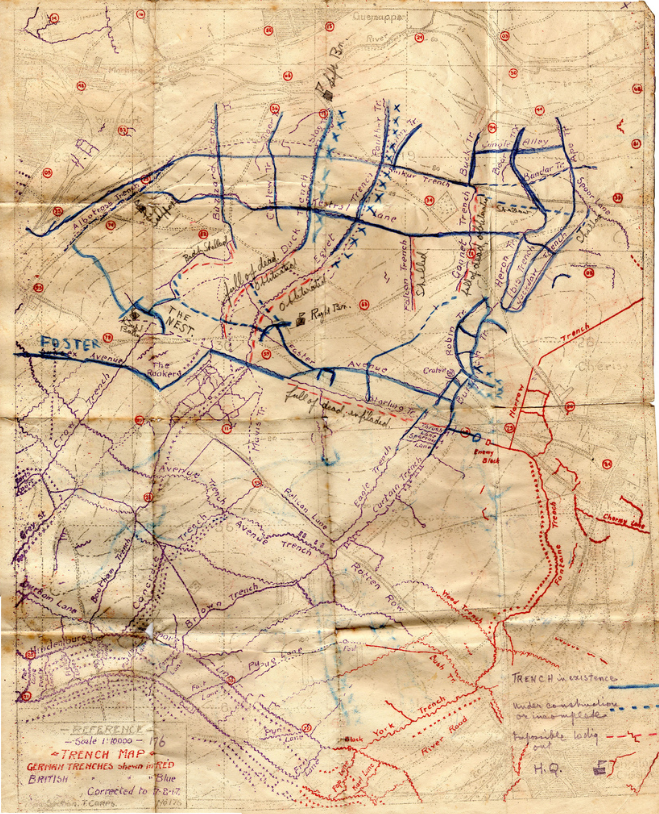
Trench map annotated

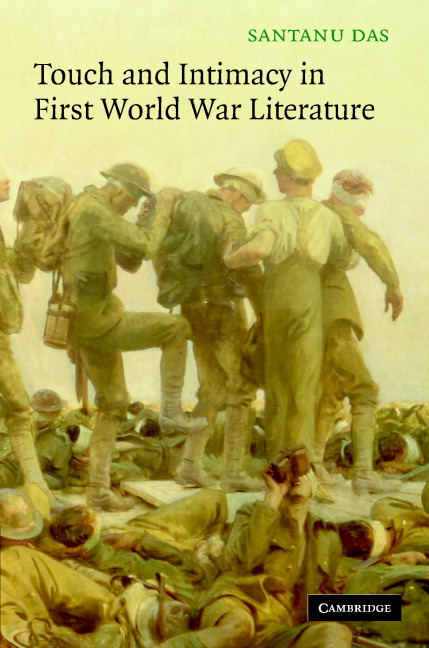
Santanu DAS: Touch an dintimacy in First World War literatureBut I also want to show (as the map above implies: all those “full of dead” annotations) how, for these men, the battlefield was also literally a field: a vile, violent medium to be known not only (or even primarily) through sight but through touch, smell and sound: what Santanu Das memorably calls a ‘slimescape’ which was also a soundscape.  This was a close-in terrain that was known through the physicality of the body as a sensuous, haptic geography:

‘Amidst the dark, muddy, subterranean world of the trenches, the soldiers navigated space … not through the safe distance of the gaze but rather through the clumsy immediacy of their bodies: “crawl” is a recurring verb in trench narratives, showing the shift from the visual to the tactile.’

This was a ‘mapping’ of sorts – as Becca Weir suggests in  ‘“Degrees in nothingness”: battlefield topography in the First World War’, Critical Quarterly 49 (4) (2007) 40-55 – and there is a dialectic between cartography and corpography.

I’ve been working my way through a series of diaries, memoirs and letters to flesh out its performance in detail, but the most vivid illustration of the entanglements of cartography and corpography that I’ve found – and that I suspect I shall ever find – is this extract from a ‘body density map’ for part of the Somme.  This shows the standard trench map above a contemporary satellite photograph; each carefully ruled square is overprinted with the number of dead soldiers found buried in the first sweep after the war (between March and April 1919)…
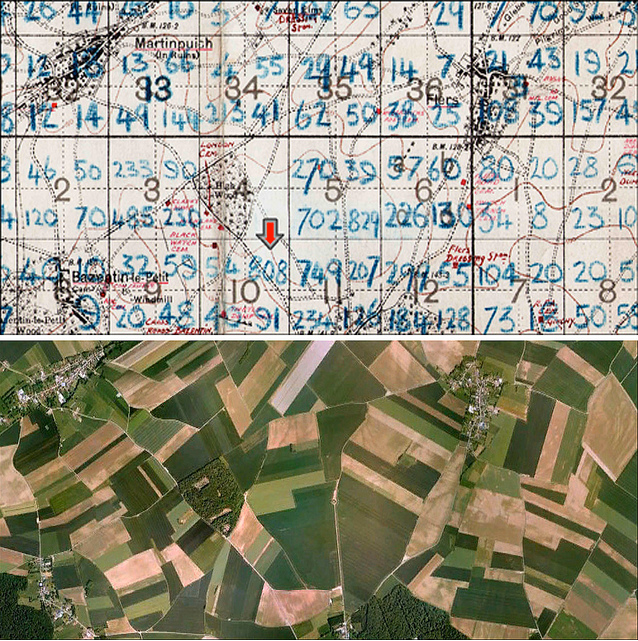
Body Density Map, High Wood, Somme image by shipscompass on flickr

I won’t say more at present because I need to keep my powder dry for Kentucky, but I hope it will be clear by the end that, even though I’ll be  talking about the First World War, I will also have been talking about the wars conducted in the shadows of the Twin Towers and the Pentagon.
The military and the mob

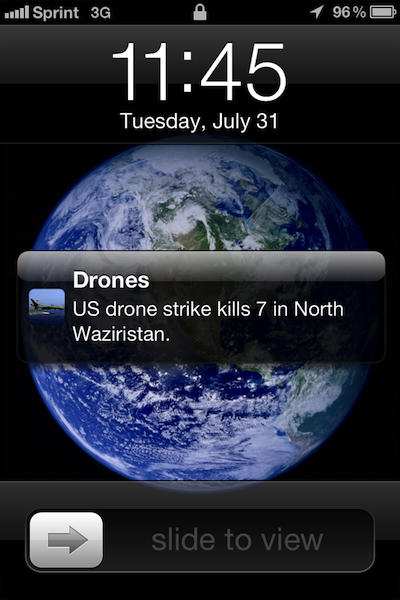
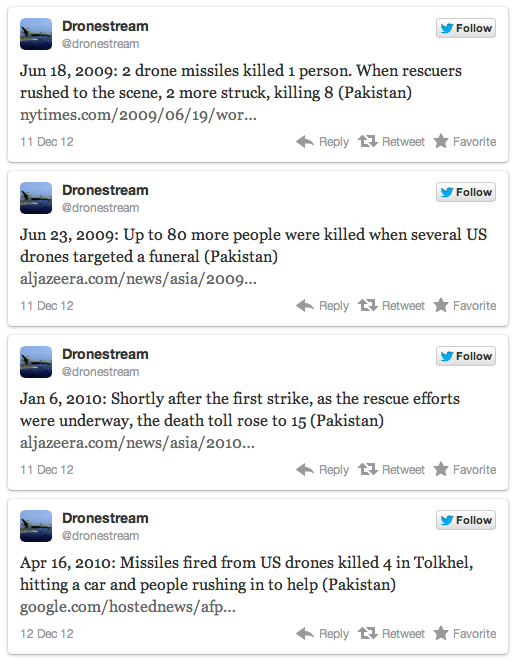
Double Tap streamMichael Kelley notes that Josh Begley‘s tweeted enumeration of US drone strikes in Pakistan, Yemen and Somalia at Dronestream confirms the vile ‘double-tap‘ strategy in which a first strike is rapidly followed by a second targeting rescuers.  As Kelley notes, ‘A 2007 report by the Homeland Security Institute called double taps a “favorite tactic of Hamas” and the FBI considers it a tactic employed by terrorists.’

The militarised practice has been widely reported – not least in Staford/NYU’s Living under Drones – but Begley’s cascade of tweets provides a powerful statement of its relentless rhythm.  In September Mirza Shahzad Akbar, a Pakistani lawyer who represents victims of the attacks, told Britain’s Independent newspaper:

“These strikes are becoming much more common…  In the past it used to be a one-off, every now and then. Now almost every other attack is a double tap. There is no justification for it.”

Far from any justification, the UN Special Rapporteur on Extrajudicial Killings argues that such attacks constitute war crimes.  In fact, as Gwynne Dyer points out,

“DOUBLE TAP” IS what mobsters do when they put somebody down. One bullet in the heart, one in the head. That way they stay down. It’s practically standard operating procedure among hitmen.

Street gangs of Baghdad.001

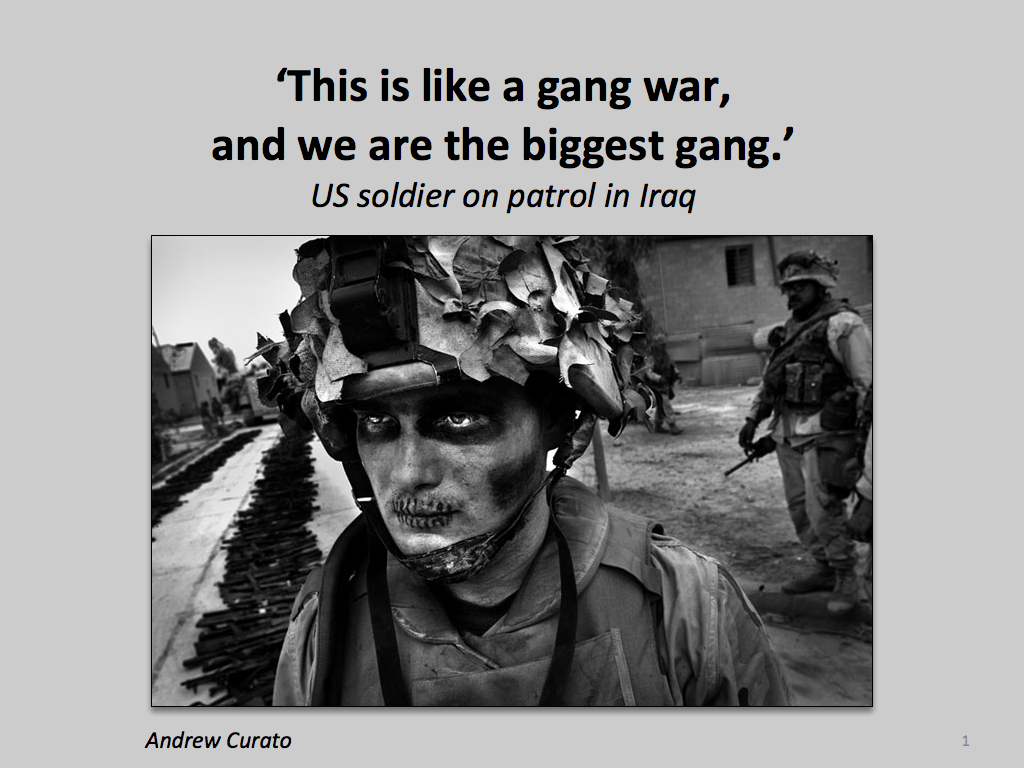
It’s not so long ago that the Pentagon was alarmed at the presence of members of US street gangs among its soldiers patrolling the streets of Baghdad (see Frank Main, ‘Gangs claim their turf in Iraq’, Chicago Sun-Times 1 May 2006).  It’s high time the US took a look at mobsters patrolling the skies too.

Thanks to my good friend Oliver Belcher for the original link.

The politics of drone wars

I’m in the UK this week for – amongst other things – a seminar with Pete Adey, Sara Fregonese and some of the Geopolitics and Security students at Royal Holloway on my bombing project, Killing space; a workshop at Open Democracy for a new series on Cities in Conflict to be curated by Tom Cowan; and a lecture at Nottingham organised by Steve Legg: another outing for “Deadly Embrace”.

At the RHUL meeting the conversation frequently turned to drones; Pete made an audio recording of it, and I think at least part of what we discussed will appear on the Theory, culture & society website in the near future.  But I’d like to try to set out some of my own puzzlements and positions about the politics of drones here.

There are many ways in which individuals can take a stand against war, and there is a long and principled tradition of conscientious objection that includes pacifists in two World Wars through young Americans who resisted the draft in the 1960s and 70s to high school students in Israel who refuse to serve in the army of occupation.  In recent times most popular mobilisations against war have been against particular wars – I’m thinking of the demonstrations against the wars in S.E. Asia in the 60s and 70s, for example, or the millions of people who took to the streets to express their opposition to the US-led invasion of Iraq in 2003 – or against particular objects of violence: campaigns to ban land mines or cluster munitions, for example.  To me, the most effective political response to the use of Predators, Reapers and other UAVs in Afghanistan, Pakistan, Yemen, Somalia and elsewhere is to move between the two: to use the drone to draw publics into an apprehension of the wider fields of military violence in which they are deployed.

Global Hawk imagery of aftermath of Haiti earthquakeI think it is a mistake to focus on the object itself because, like all objects, a drone is highly unstable: it’s not a fixed, determinate ‘thing’ but its capacities and dispositions depend on the network or assemblage in which it is embedded. To see what I mean, begin by stripping the bombs and the missiles from these platforms: at present most drones are used for intelligence, surveillance and reconnaissance (ISR), and these capabilities extend far beyond the domain of offensive operations and even beyond those of the military.  In 2010 US Southern Command used a Global Hawk to provide detailed imagery of the damage caused by the Haiti earthquake (above) and the following year another Global Hawk was deployed to assess the damage to the Fukishima Daiichi nuclear plant in Japan; other, smaller and far less sophisticated drones have been used to monitor wildfires in California and to track and disrupt Japanese whaling fleets, while a series of other, broadly ecological-humanitarian projects have been proposed with varying degrees of plausibility.  I don’t rehearse these other possibilities to minimise the military and paramilitary uses of the technology – and we surely know, not least from Nick Turse‘s account in The Complex, that the military and the civilian have become ever more hopelessly entangled with one another – and neither am I indifferent to the blurring of military power and NGO relief operations in the humanitarian present,  but we need to acknowledge, to paraphrase Clive Barnett, that not all ISR operations are sinister: ‘presumptively illegitimate, undemocratic or suspect‘.

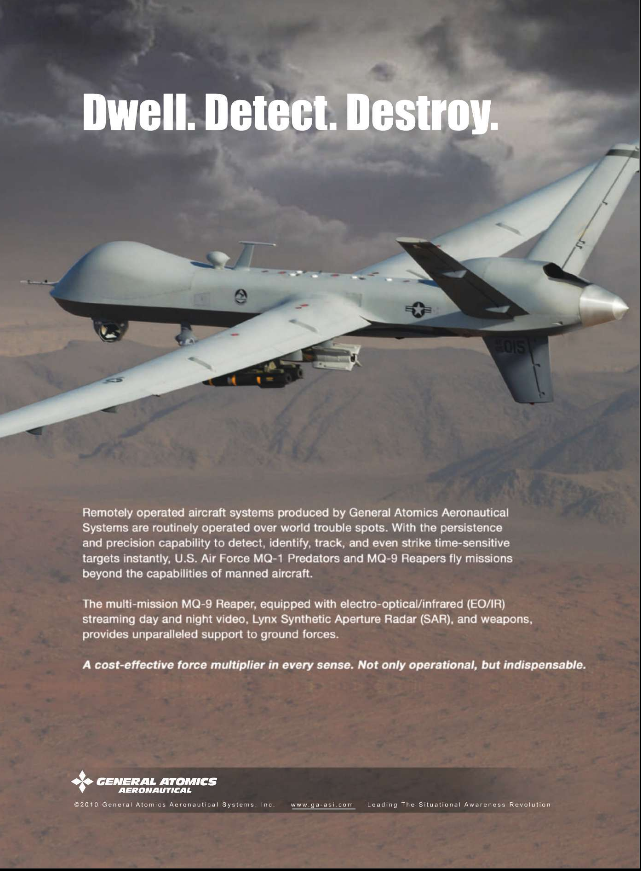
Dwell Detect Destroy drone ad

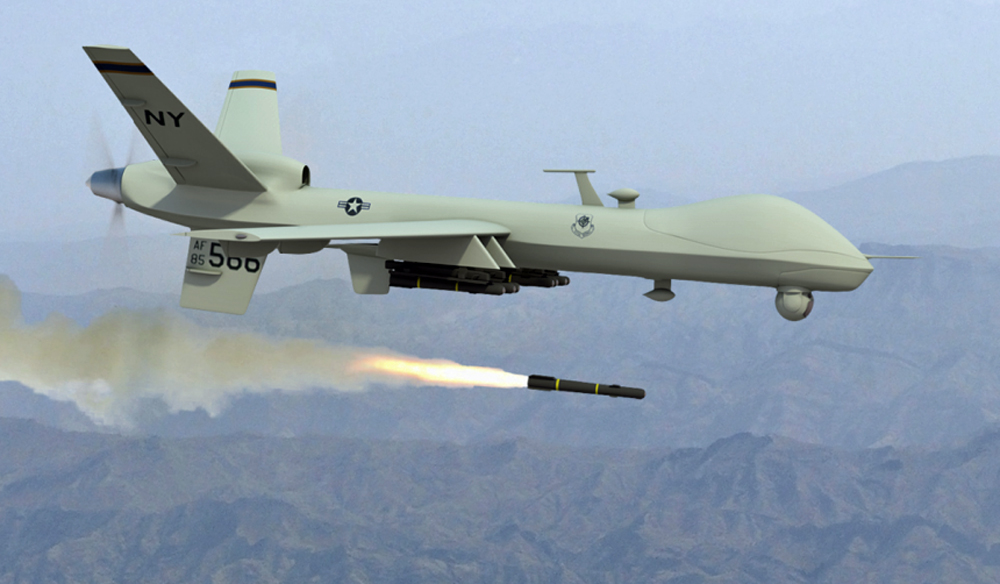
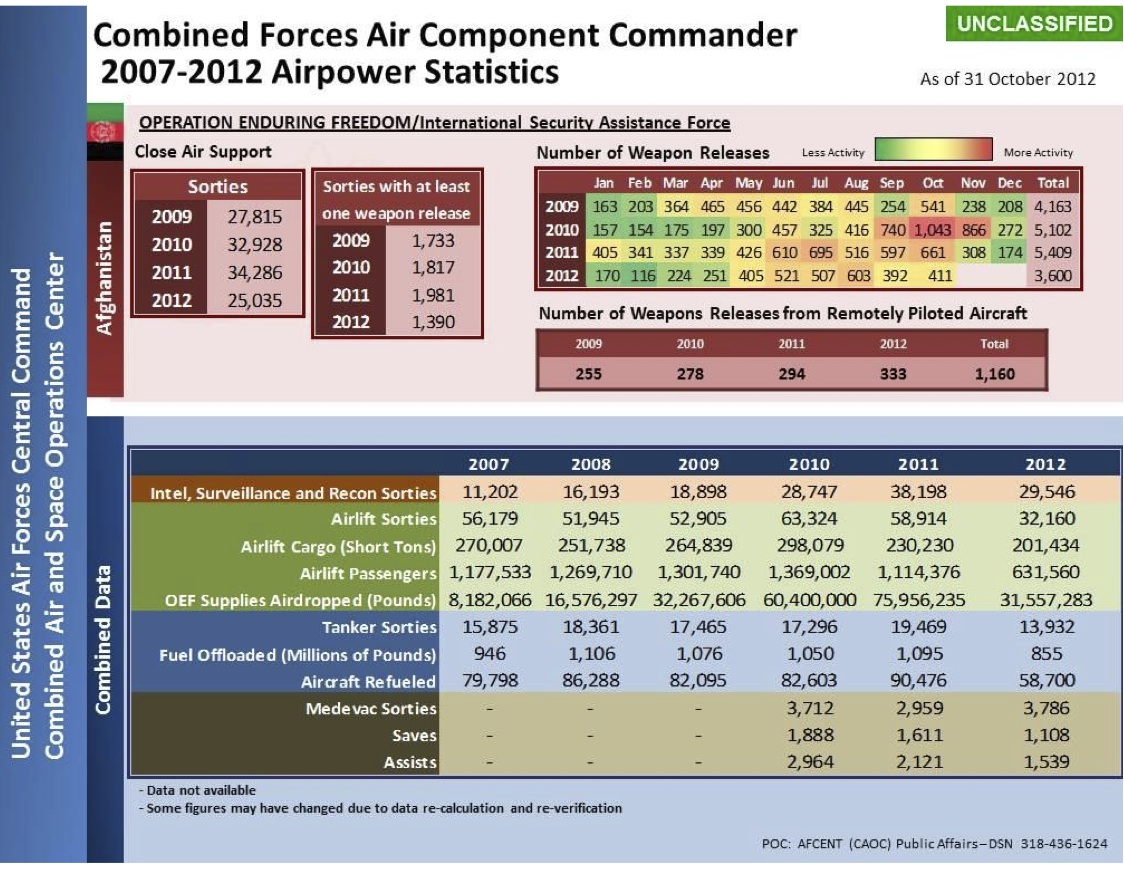
Hellfire missile launch (USAF)This is why Drone Wars UK focuses on ‘armed drones’ and Drones Watch on ‘killer drones’.  It’s clear that militarised ISR is part of a continued ‘rush to the intimate’ that is profoundly invasive and, on many occasions, extraordinarily violent. In Afghanistan the US military embeds its UAVs in a networked kill-chain in which their near real-time, high-resolution, full-motion video feeds are routinely used to call in attacks from conventional strike aircraft.  So let’s now put the bombs and missiles back on these platforms, since the Predators and Reapers are usually armed and their manufacturers boast about their capacity to compress the kill-chain: to ‘dwell, detect [and] destroy’. But it then makes no sense to object to the strikes carried out directly from them and to exempt those carried out by conventional means across the network: what is the difference between a Hellfire missile launched from a Reaper and one fired from an Apache helicopter gunship?  (To put this in perspective, according to the most recent airpower summary, USAF Predators and Reapers directly accounted for just 5-6 per cent of its ‘weapons releases’ in Afghanistan in 2009, 2010, and 2011, though the proportion climbed to 9.25 per cent in the first ten months of 2012).

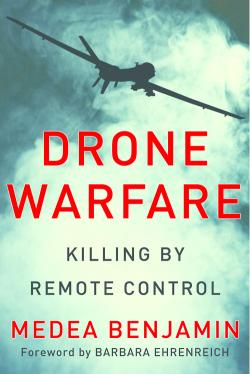
Medea BENJAMIN Drone WarfareTo answer that question critics usually cite the horror of death at a distance.  This is death from thousands of miles away, conducted by operators in the continental United States: ‘killing by remote control’.  And yet there are countless other ways in which militaries have been killing from ever increasing distances ever since the invention of the slingshot and the longbow. If you insist that it is wrong to kill somebody from 7,500 miles away, then over what distance do you think it is acceptable?  If you are determined to absolutize distance in this way, then don’t you need to consider all the other ways in which advanced militaries are able to kill their adversaries (and civilians) without ever seeing them? Again, I don’t raise the spectre of Cruise missiles launched from ships hundreds of miles from their targets, the US ‘Prompt Global Strike’ capability and its Advanced Hypersonic Weapon which is ultimately  intended to hit a target anywhere on the planet in under an hour, or the prospect of ‘frictionless’ cyberwarfare, to minimise the deaths caused by drones.  I simply want our politics to apprehend the larger field of military violence in which they are deployed.

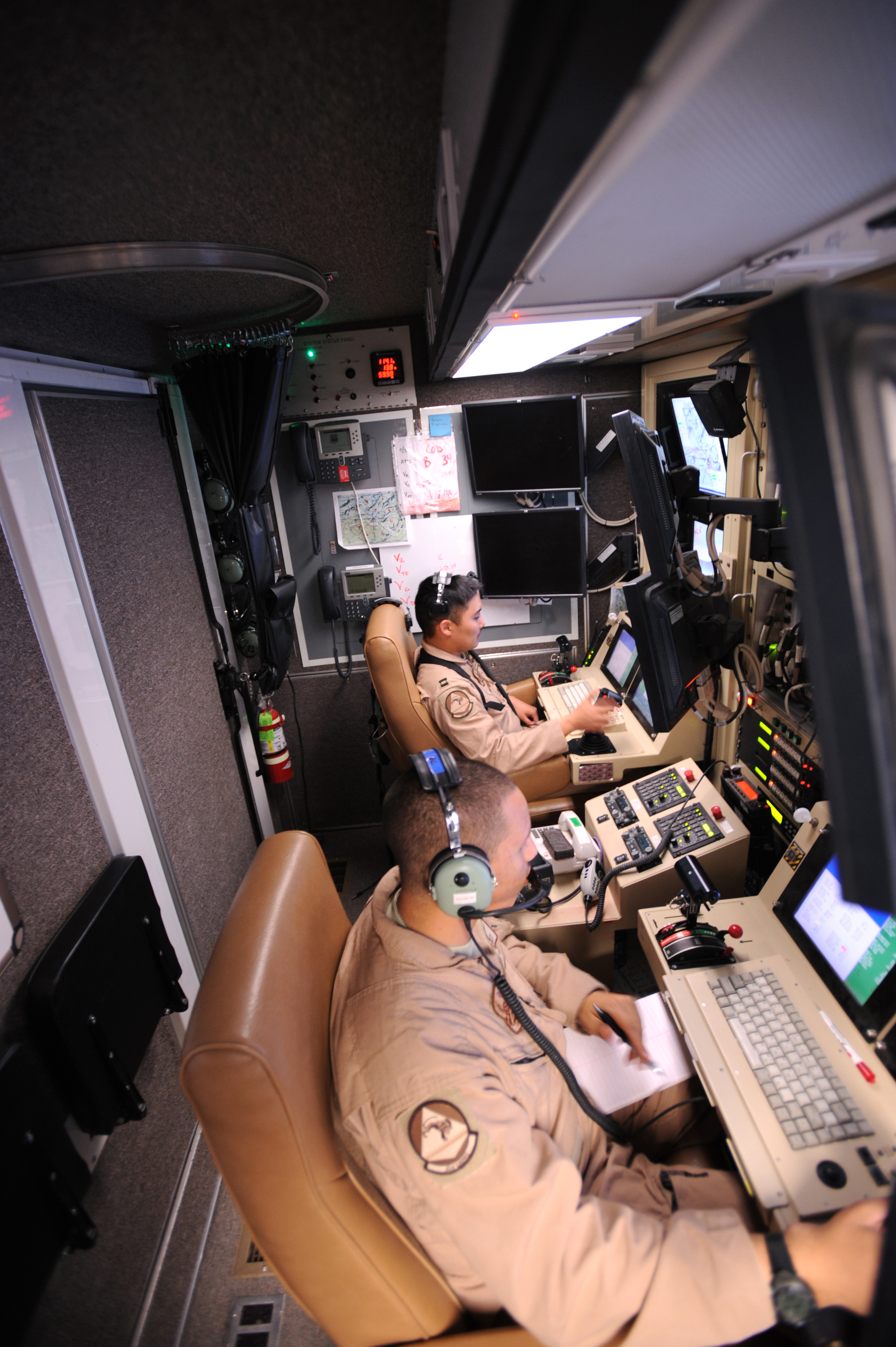
And there is something different about those deaths that draws us back into the killing fields.  I should say at once that I don’t think this is simply war reduced to a video-game – and in any case there are many other military technologies that also depend on hand-eye co-ordination, multi-tasking and spatial acuity, all skill-sets valorized by video-games – but I also think it a mistake to assume that the screen effectively insulates the viewer from the victim.  In this sense there is a parallel between the platforms, because video-games are profoundly immersive, and those who call in or carry out these strikes insist that they are not 7,500 miles from their targets at all (and Launch & Recovery crews are much closer than that) but ‘eighteen inches away’: the distance from eye to screen.  It’s a highly selective process of compression; as I’ve shown in detail in Lines of descent (DOWNLOADS tab), those involved in the remote kill-chain typically feel remarkably close to their own troops on the ground and remain distant from the life-worlds of the population at large (which in part accounts for the civilian casualties when drones are used to provide close air support).  But unlike most other forms of distant death and destruction, the pilots, sensor operators and others who are networked into these kill-chains can see their targets up close – even if their ‘seeing’ is techno-culturally conditioned and often predisposes them to treat innocent actions as hostile intentions – and they typically remain on station to carry out a ‘bomb damage assessment’ and so see for themselves, often in hideous detail, what they have done.

Flying an MQ-9 Reaper over Kandahar, Afghanistan

The most consequential change is that these new modes of air power deal not in the area bombing of cities like Cologne, Hamburg or Dresden, or the blind bombing of target boxes over the rainforests of Vietnam, Laos and Cambodia, but – in addition to close air support – in the calculated assassination of individuals or groups: so-called ‘targeted killing‘ or what the USAF calls putting ‘warheads on foreheads‘.  This does not mean that the firebombing of cities in the Second World War should become the moral standard against which we judge contemporary military violence. On the contrary, targeted killing raises its own grave legal and ethical questions – and, not incidentally, those video feeds have given military lawyers a pivotal role in these newly networked strikes – that in turn activate two other no less serious concerns about the emergent geographies of fields of military violence.

First is the fear that the use of remote platforms lowers the threshold at which military violence will be launched.  Predators and Reapers are much cheaper than conventional strike aircraft, and if there are no troops on the ground, there are no body bags to come home.  In short, drone war threatens to become risk-transfer war hypostatised; the risk is transferred wholly to the adversary population.  But at present these platforms have high failure rates – they are vulnerable to weather conditions (and I don’t mean hurricanes and monsoons, I mean clouds), they crash all too frequently and they are so slow and noisy that they can easily be shot down so they can only be used in uncontested airspace.  These limitations mean that, at present at any rate, they are less likely to incite conventional state-on-state war – though there is certainly a global arms race to acquire and develop far more advanced drone technologies.

Second and closely connected is the fear that they make it much easier to engage in war by stealth.  If one of the primary foreign policy challenges of the last Bush administration was ‘conducting war in countries we are not at war with‘, Obama’s version is the determination to wage what Martin Libicki calls ‘non-obvious warfare’: hence the Obama administration’s preference for remote operations, Special Forces and cyber-attacks.  To be sure, there are degrees of obviousness: the drone attacks in Pakistan, Yemen, Somalia and elsewhere are hardly covert – since they are hidden in plain sight – but they are, within limits, more deniable than the deployment of thousands of ground troops and so inherently less accountable to the various publics involved in them.  And in all these cases Predators and Reapers dramatically heighten the asymmetry involved in military and paramilitary operations against non-state actors, where they have made a policy of ‘kill’ rather than ‘capture’ a much more tempting (and much more pernicious) US counter-terrorism strategy.

More to come.

Epicentre of the drone war

In the middle of the (understandable) concern at US drone attacks in Pakistan, Yemen and Somalia, I’ve been stubbornly insisting for months now that we should not overlook the significance of Afghanistan.  That’s precisely why I wrote ‘From a view to a kill’ (DOWNLOADS tab).  Now Noah Shachtman at Danger Room reports:

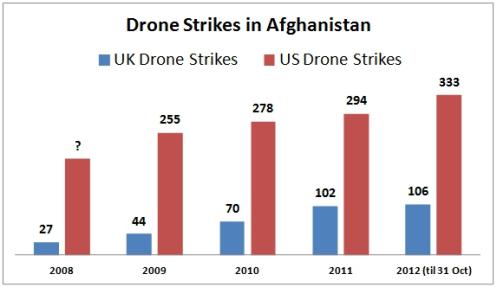
The American military has launched 333 drone strikes this year in Afghanistan. That’s not only the highest total ever, according to U.S. Air Force statistics. It’s essentially the same number of robotic attacks in Pakistan since the CIA-led campaign there began nearly eight years ago.

You can access monthly airpower summaries here.  These show that these strikes are intensifying even as ground operations are being scaled back:

The U.S. military is now launching more drone strikes — an average of 33 per month — than at any moment in the 11 years of the Afghan conflict. It’s a major escalation from just last year, when the monthly average was 24.5. And it’s happening while the rest of the American war effort is winding down.

The UK is markedly reluctant to provide detailed information on its remote operations – and Drone Wars UK has raised serious questions about the accuracy of some of its returns (and much more besides) – but  Global Research gives this breakdown between US and UK strikes:

Shachtman points out that the protocols governing USAF operations in Afghanistan are different from those followed for CIA-directed strikes elsewhere,and so they are.  He’s right to emphasise the importance of these remote platforms for providing close air support to ‘troops in contact’, often as part of a networked attack.  But what he doesn’t note is the increased propensity for civilian casualties in these situations – literally in the heat of the moment – nor the fact that the US military has its own disposition matrix for killing targets on its own hit list.  As I noted here,  these are crucial considerations.

Drone’s eye view

I expect many readers will remember  that Apple rejected NYU grad student Josh Begley‘s Drones+ app last August.  It did so three times and for a multiplicity of confusing – and frankly shifty – reasons.  Apparently it was neither ‘useful’ nor ‘entertaining’; then it presented ‘excessively objectionable’ content (something to take up with the Pentagon and the CIA, surely?). As Danger Room explained, the app was bare bones stuff:

When a drone strike occurs, Drones+ catalogs it, and presents a map of the area where the strike took place, marked by a pushpin. You can click through to media reports of a given strike that the Bureau of Investigative Reporting compiles, as well as some basic facts about whom the media thinks the strike targeted.

All the more ironic, really, since the US military makes extensive use of smart phone technology – including its own (restricted) apps for the iPhone.  More on that here and here and here.

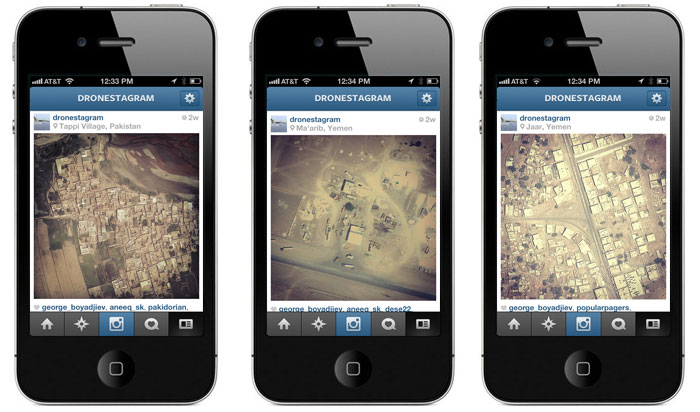
But for the past several weeks James Bridle – of New Aesthetic fame – has been posting satellite images of the distant places where drone strikes are recorded by the Bureau of Investigative Journalism to Instagram: and, as the image below shows, you can view these on your iPhone…

There are, of course, difficulties in pinpointing the locations of drone strikes– and James is evidently very well aware of them – but on his Dronestagram website he explains his desire to convert abstract targets into physical places in terms that resonate beautifully with the arguments I’m trying to develop in Deadly embrace:

The political and practical possibilities of drone strikes are the consequence of invisible, distancing technologies, and a technologically-disengaged media and society. Foreign wars and foreign bodies have always counted for less, but the technology that was supposed to bring us closer together is used to obscure and obfuscate. We use military technologies like GPS and Kinect for work and play; they continue to be used militarily to maim and kill, ever further away and ever less visibly.

Yet at the same time we are attempting to build a 1:1 map of the world through satellite and surveillance technologies, that does allow us to see these landscapes, should we choose to go there. These technologies are not just for “organising” information, they are also for revealing it, for telling us something new about the world around us, rendering it more clearly.

History, like space, is coproduced by us and our technologies: those technologies include satellite mapping, social photo sharing from handheld devices, and fleets of flying death robots. We should engage with them at every level. These are just images of foreign landscapes, still; yet we have got better at immediacy and intimacy online: perhaps we can be better at empathy too.

You can follow the images here and in much more detail via tumblr here.  More information here.

This comes at an opportune moment since I’ve been talking this week with Susan Schuppli and Eyal Weizman at Forensic Architecture about a collaborative, interactive project to bring together all the available data on drone strikes.

Targeted killings and signature strikes

And so what Tom Junod calls the lethal presidency continues…  though it surely would have done whoever occupied the White House for the next four years.

Much of the discussion of US targeted killing has centred on both its status under international law and on the quasi-judicial armature through which various government agencies, including the Pentagon and the Central Intelligence Agency, draw up and adjudicate their kill lists of named individuals who are liable to a ‘personality strike’. But the majority of US targeted killings turn out to be ‘signature strikes’.

Signature strikes were initiated under President George W. Bush, who authorised more permissive rules of engagement in January/February 2008.  According to Eric Schmitt and David Sanger, writing in the New York Times,

[A] series of meetings among President Bush’s national security advisers resulted in a significant relaxation of the rules under which American forces could aim attacks at suspected Qaeda and Taliban fighters in the tribal areas near Pakistan’s border with Afghanistan.

The change, described by senior American and Pakistani officials who would not speak for attribution because of the classified nature of the program, allows American military commanders greater leeway to choose from what one official who took part in the debate called “a Chinese menu” of strike options.

Instead of having to confirm the identity of a suspected militant leader before attacking, this shift allowed American operators to strike convoys of vehicles that bear the characteristics of Qaeda or Taliban leaders on the run, for instance, so long as the risk of civilian casualties is judged to be low.

Under Obama signature strikes increased in frequency, and Micah Zenko notes that the President’s initial reluctance soon yielded to endorsement:

According to Daniel Klaidman, when Obama was first made aware of signature strikes, the CIA’s deputy director clarified: “Mr. President, we can see that there are a lot of military-age males down there, men associated with terrorist activity, but we don’t necessarily know who they are.” Obama reacted sharply, “That’s not good enough for me.” According to one adviser describing the president’s unease: “‘He would squirm … he didn’t like the idea of kill ‘em and sort it out later.’” Like other controversial counterterrorism policies inherited by Obama, it did end up “good enough,” since he allowed the practice to stand in Pakistan, and in April authorized the CIA and JSOC to conduct signature strikes in Yemen as well.

Today signature strikes are frequently triggered not on the fly – a sudden response to an imminent threat – but by a sustained ‘pattern of life’ that arouses the suspicion of distant observers and operators. This depends on persistent surveillance – on full motion video feeds and a suite of algorithms that decompose individual traces and networks – some of which involve a weaponized version of Hägerstrand’s time-geography: see, for example, GeoTime 5 here.

We know even less about the legal authority for these attacks, but Kevin Jon Heller has a new essay on their legality up at the wonderful open access resource that is SSRN [Social Science Research Network]  here, and there are preliminary responses at Opinio Juris here.  This is the abstract:

The vast majority of drone attacks conducted by the U.S. have been signature strikes – strikes that target “groups of men who bear certain signatures, or defining characteristics associated with terrorist activity, but whose identities aren’t known.” In 2010, for example, Reuters reported that of the 500 “militants” killed by drones between 2008 and 2010, only 8% were the kind “top-tier militant targets” or “mid-to-high-level organizers” whose identities could have been known prior to being killed. Similarly, in 2011, a U.S. official revealed that the U.S. had killed “twice as many ‘wanted terrorists’ in signature strikes than in personality strikes.” 

Despite the U.S.’s intense reliance on signature strikes, scholars have paid almost no attention to their legality under international law. This article attempts to fill that lacuna. Section I explains why a signature strike must be justified under either international humanitarian law (IHL) or international human rights law (IHRL) even if the strike was a legitimate act of self-defence under Article 51 of the UN Charter. Section II explores the legality of signature strikes under IHL. It concludes that although some signature strikes clearly comply with the principle of distinction, others either violate that principle as a matter of law or require evidence concerning the target that the U.S. is unlikely to have prior to the attack. Section III then provides a similar analysis for IHRL, concluding that most of the signature strikes permitted by IHL – though certainly not all – would violate IHRL’s insistence that individuals cannot be arbitrarily deprived of their right to life.

The most interesting section (for me) is Kevin’s discussion of ‘evidentiary adequacy’.  Most of the examples he discusses appear to be derived from CIA-directed strikes in Pakistan – drawing on the Stanford/NYU report on Living under drones – and, for that very reason, are remarkably limited. But we know much more about problems of evidence – and inference – from strikes conducted by the US military in Afghanistan…

The first point to make, then, is that targeted killings are also carried out by the US military – indeed, the US Air Force has advertised its ability to put ‘warheads on foreheads‘ – and a strategic research report written by Colonel James Garrett for the US Army provides a rare insight into the process followed by the military in operationalising its Joint Prioritized Effects List (JPEL). Wikileaks has provided further information about JSOC’s Task Force 373 – see, for example, here and here – but the focus of Garrett’s 2008 report is the application of the legal principles of necessity and proportionality (two vital principles in the calculus of International Humanitarian Law (IHL) discussed by Kevin) in counterinsurgency operations.  Garrett describes ‘time-sensitive targeting procedures’ used by the Joint Targeting Working Group to order air strikes on ‘high-value’ Taliban and al-Qaeda leaders in Afghanistan, summarised in this diagram:

Notice that the members included representatives from both Combined Joint Special Operations Task Force (CJSOTF) and the CIA (‘Other Government Agency’, OGA).  This matters because Joint Special Operations Command (JSOC) – once commanded by General Stanley McChrystal – and the CIA, even though they have their own ‘kill lists’, often co-operate in targeted killings and are both involved in strikes outside Afghanistan.  Indeed, there have been persistent reports that many of the drone strikes in Pakistan attributed to the CIA – even if directed by the agency – have been carried out by JSOC.  Here is Jeremy Scahill citing a ‘military intelligence source’:

“Some of these strikes are attributed to OGA [Other Government Agency, intelligence parlance for the CIA], but in reality it’s JSOC and their parallel program of UAVs [unmanned aerial vehicles] because they also have access to UAVs. So when you see some of these hits, especially the ones with high civilian casualties, those are almost always JSOC strikes.”

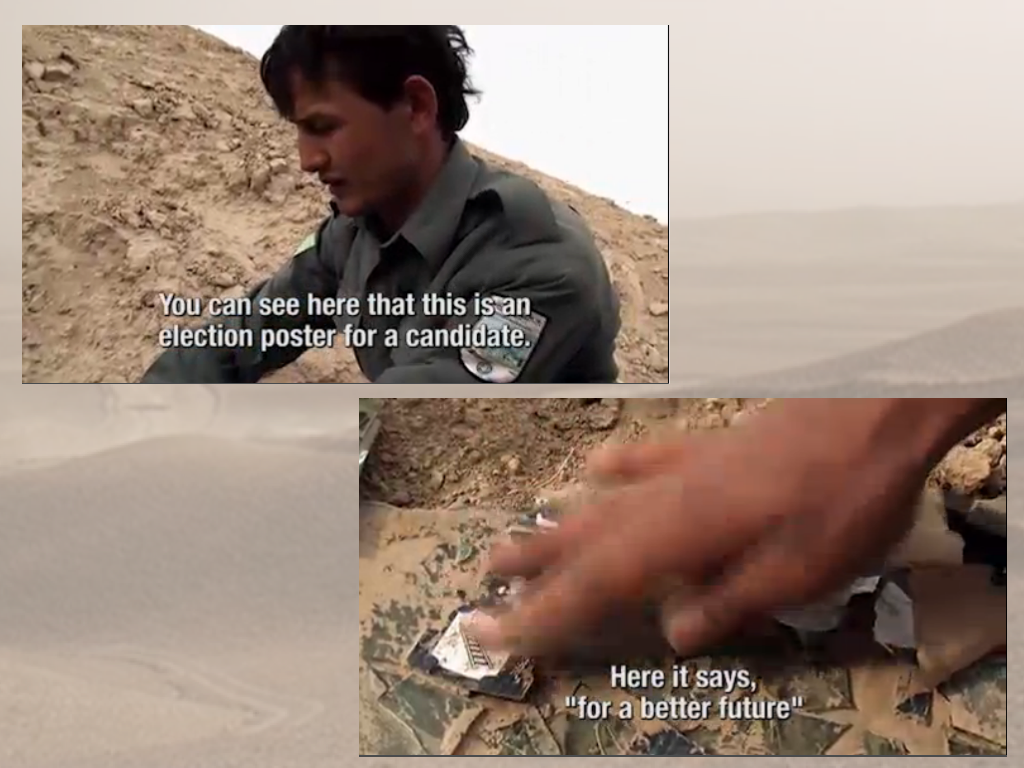
Garrett’s discussion clearly refers to ‘personality strikes’, but – second – the distinction between the evidential/inferential apparatus used for a ‘personality strike’ and for a ‘signature strike’ is by no means clear-cut.  Kate Clark‘s report for the Afghan Analysts Network describes the attempted killing of Muhammad Amin, the Taliban deputy shadow governor of Takhar province.  On 2 September 2010 ISAF announced that a ‘precision air strike’ earlier that morning had killed him and ‘nine other militants’.  The target had been under persistent surveillance from remote platforms – what Petraeus later called ‘days and days of the unblinking eye’ – until two strike aircraft repeatedly bombed the convoy in which he was travelling.  Two attack helicopters were then ‘authorized to re-engage’ the survivors. The victim was not the designated target, however, but Zabet Amanullah, the election agent for a parliamentary candidate; nine other campaign workers died with him. Clark’s painstaking analysis clearly shows that one man had been mistaken for the other, which she attributed to an over-reliance on ‘technical data’ – on remote signatures.  Special Forces had concentrated on tracking cell phone usage and constructing social networks. ‘We were not tracking the names,’ she was told, ‘we were targeting the telephones.’

This is unlikely to be an isolated incident.  Here for example is Gareth Porter:

‘…the link analysis methodology employed by intelligence analysis is incapable of qualitative distinctions among relationships depicted on their maps of links among “nodes.” It operates exclusively on quantitative data – in this case, the number of phone calls to or visits made to an existing JPEL target or to other numbers in touch with that target. The inevitable result is that more numbers of phones held by civilian noncombatants show up on the charts of insurgent networks. If the phone records show multiple links to numbers already on the “kill/capture” list, the individual is likely to be added to the list.’

In the Takhar case, despite informed protests to the contrary, ISAF insisted that they had killed their intended target (added emphases are mine):

PBS/Frontline screened a Stephen Grey/Dan Edge documentary on the Takhar incident last year, Kill/Capture, from which the images below are taken (reworked for my presentation on Lines of descent) and which, like Kate Clark’s remarkable report on which it drew, gave the lie to the ISAF statement; the film included an Afghan Police video of the aftermath of the attack: more here, video here, and transcript here.

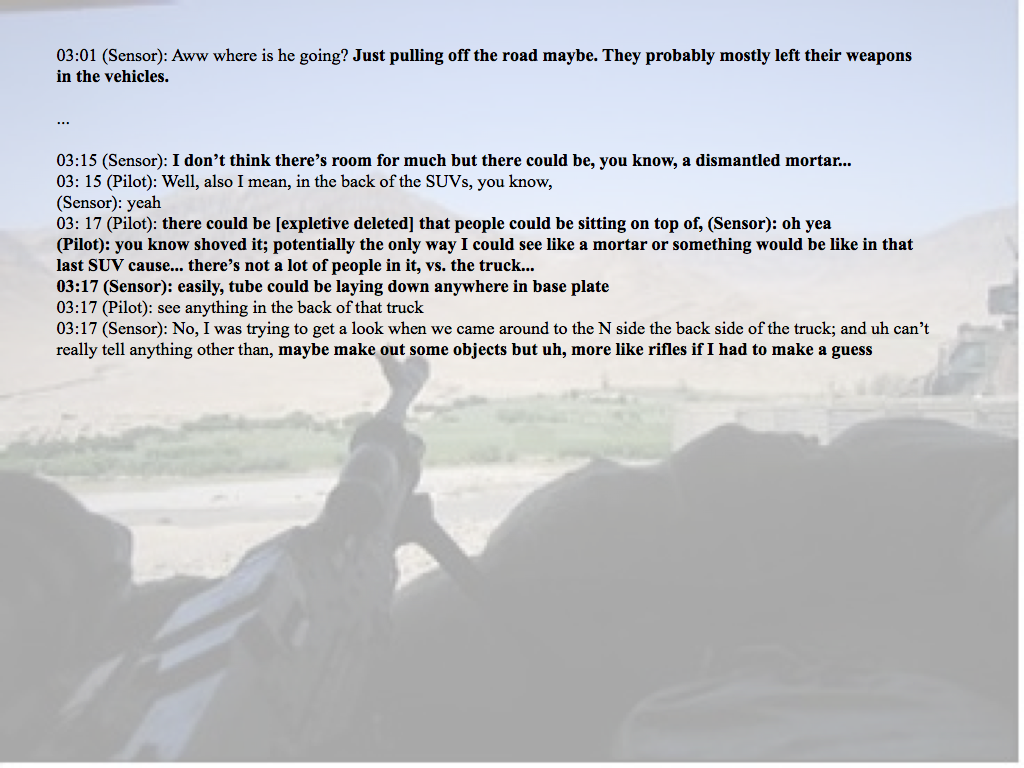
Finally, there is a persistent propensity to read hostile intent into innocent actions. In ‘From a view to a kill’ (DOWNLOADS tab) I describe in detail an attack launched on 21 October 2010 near Shahidi Hassas in Uruzgan province in central Afghanistan.  In the early morning a Predator was tasked to track three vehicles travelling down a mountain road, several miles away from a Special Forces unit moving in to search a village for an IED factory.

The Predator crew in Nevada had radio contact with the Special Forces Joint Terminal Attack Controller and they were online with image analysts at the Air Force’s Special Operations Command headquarters in Florida. At every turn the flight crew converted their observations into threat indicators: thus the two SUVs and a pick-up truck became a ‘convoy’, cylindrical objects ‘rifles’, adolescents ‘military-aged males’ and praying a Taliban signifier (‘seriously, that’s what they do’).

After three hours’ surveillance two Kiowa helicopters were called in, and during the attack at least 23 people were killed and more than a dozen wounded.  Only after the smoke had cleared did the horrified Predator crew re-cognize the victims as civilians, including women and children.

I’m including a much fuller account in The everywhere war, based on a close reading of the redacted investigative report by Major General Timothy McHale released under a FOI request (the images above are all taken from my Keynote presentation based on the report), and you can also find David McCloud‘s spine-chilling analysis for the LA Times here.  But even in this abbreviated form it’s clear that the cascade of (mis)interpretations offered by the flight crew mimics Kevin’s list of ‘signatures’, where some would be categorised as ‘possibly adequate’ and others as ‘inadequate’.

All of these materials relate to air strikes inside a war zone, so that their modalities are different – in Afghanistan remote platforms like the Predator and the Reaper are one element in a networked ‘killing machine’, and they work in close concert with ground forces and conventional strike aircraft – and the legal parameters are not as contentious as those that govern ‘extra-territorial’ strikes in Pakistan, Somalia or Yemen (which are Kevin’s primary concern).  But they all raise questions about the evidential and inferential practices that are incorporated into the kill-chain that are clearly capable of wider application and concern.

Those questions raise other issues too.  It seems clear, from the examples I’ve given, that to isolate a single platform (the drone) is to contract the scrutiny of military and paramilitary violence that, under the conditions of late modern war, is typically networked.  And to determine the legal status of targeted killing must not foreclose on wider political and ethical decisions: to accept late modern war’s avowed reflexivity is too often to equate legality with legitimacy.

COIN tossing

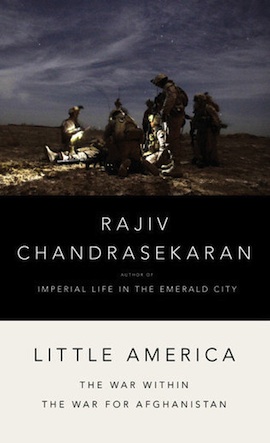
Anyone who has read Washington Post journalist Rajiv Chandrasekaran‘s Imperial Life in the Emerald City: Inside Iraq’s Green Zone (Vintage, 2006) or his Little America: the war within the war in Afghanistan (Knopf, 2012) – and even those who haven’t – will enjoy David Johnson‘s interview with him at the Boston Review.

In it Chandrasekaran draws some illuminating parallels (in two words: ‘strategic failure’) and provocative contrasts between the two campaigns:

I surely saw far more imperialistic overtones in Iraq than in Afghanistan. The bulk of my narrative in Little America focuses on how the Obama administration attempted to deal with the situation there. Though they pursued, in my view, a flawed strategy, they did approach it with some degree of humility. I certainly wouldn’t ascribe imperialist aims to the United States in Afghanistan from 2009 onward or even before that. I don’t ever think that we really went about it in that way. Whereas, one can look at what occurred in Iraq, particularly in the early years, and come to a very different conclusion.

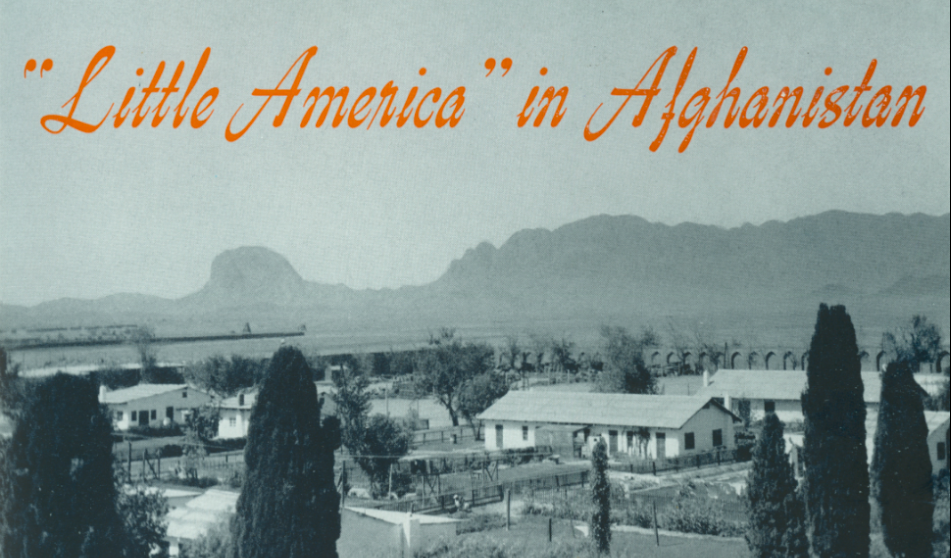
Chandrasekaran has some important things to say about the so-called ‘development-security’ nexus, not least through a comparison with USAID projects in Helmand in the 1950s. You know he’s on to something when Max Boot dismisses it: that was when local people started calling the area ‘Little America’, but Boot says that’s ‘far removed’ from the present situation.  I think Chandresekaran is right; certainly when I was writing the Afghanistan chapters of The colonial present I learned much from Nick Cullather, ‘Damming Afghanistan: modernization in a buffer state’, Journal of American History 89 (2002) 512-37 – a preliminary study researched and written, as he notes, ‘between the beginning of the bombing campaign in late September and the mopping up [sic] of Taliban resistance around Tora Bora in early December 2001.’  Chandresekaran relied on an early version of the essay, and you can now access a later version as Chapter 4 [‘We shall release the waters’] of Cullather’s The hungry world: America’s Cold War battle against poverty in Asia (Harvard, 2010).  Little America loops back to where it began, with one farmer – whose father had been drawn to Helmand by the promise of the new dam – telling Chandresekaran: ‘We are waiting for you Americans to finish what you started.’

This is also the epitaph for what Chandrasekaran sees as ‘the good war turned bad’: too few people were invested in seeing it through.  In the book he paints vivid portraits of those on the ground who were committed to staying the course, but concludes that they were the exception:

‘It wasn’t Obama’s war, and it wasn’t America’s war.  

‘For years we dwelled on the limitations of the Afghans.  We should have focused on ours.’

Not surprisingly, Boot doesn’t care for Chandrasekaran’s take on counterinsurgency either, though his own view is spectacularly devoid of the historical and geographical sensitivity that distinguishes Little America. Boot describes COIN as ‘just the accumulated wisdom of generations of soldiers of many nationalities who have fought guerrillas’ (really) and insists that it (singular) ‘has worked in countries as diverse as the Philippines (during both the war with the U.S. in 1899-1902 and the Huk Rebellion in 1946-54), Malaya, El Salvador, Northern Ireland, Colombia and Iraq.’ Perhaps it all depends on what you mean by ‘worked’…

In fact, Chandrasekaran focuses relentlessly on the work of counterinsurgency.  Little America begins with the sequestered imagery of ‘America abroad’ that will be familiar to readers of Imperial Life in the Emerald City –

– but soon moves far beyond such enclaves to document operations on the ground. In the interview he provides a pointed evaluation of US counterinsurgency (or lack of it) in Afghanistan:

I think the big lesson of Afghanistan is that we can’t afford to do this. COIN may be a great theory, but it probably will be irrelevant for the United States for the foreseeable future because it’s just too damned expensive and time consuming. You have to understand the value of the object you are trying to save with counterinsurgency—essentially your classic cost-benefit analysis. Even starting in 2009, if we’d mounted a real full-on COIN effort, we probably could have gotten to a better point today. We shouldn’t kid ourselves that what we did was full-on COIN—that would have involved more troops, more money, more civilian experts. But would all of that have been worth it? Was what we’ve already spent on this effort worth it? Particularly given the other national security challenges we face? The economic stagnation at home?  So, the debate over COIN I think misses a key point: it’s not whether it works or not. It’s whether it’s a worthwhile expenditure or not.

(Little America reports that the cost of keeping one US service member in Afghanistan for a year is $1 million… though there are, of course, many other non-monetary costs that fall on many other people).

Chandrasekaran offers a more detailed and nuanced discussion of counterinsurgency in Afghanistan in a fine interview with Peter Munson at the Small Wars Journal.

I described Chandrasekaran as a journalist but he’s (even) more: his website records his residencies as a public policy scholar at the Woodrow Wilson International Center and the Center for a New American Security – which is where he converted his ‘sand-encrusted notebooks’ into the manuscript of Little America – and the International Reporting Project at the Johns Hopkins School for Advanced International Studies.

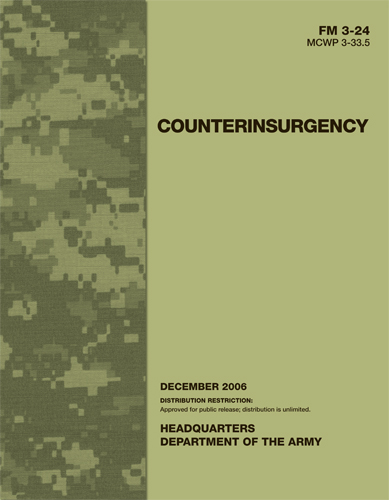
I’m making so much of Chandresekaran’s emphasis on the conduct of counterinsurgency and the connections between reporting and reflection because the academic critique of contemporary counterinsurgency has drawn a bead on the doctrine so vigorously advertised by the US Army and Marine Corps in 2006.  When I wrote “Rush to the intimate” (DOWNLOADS tab) the new field manual FM 3-24 had just been released, and I was interested in how this – together with changes in pre-deployment training, technology and the rest – described a ‘cultural turn’ of sorts that seemed to be addressed as much to the American public as it was to the American military.  (In later work I’ve explored the bio-political dimensions of counterinsurgency too, and I’m presently revising those discussions for the book).

Since then there has been a stream of detailed examinations of the doctrine and its genealogy, and I’d particularly recommend:

Ben Anderson, ‘Population and affective perception: biopolitics and antiicpatory action in US counterinsurgency doctrine’, Antipode 43 (2) (2011) 205-36

Josef Teboho Ansorge, ‘Spirits of war: a field manual’, International political sociology 4 (2010) 362-79

Alan Cromartie, ‘Field Manual 3-24 and the heritage of counterinsurgency theory’, Millennium 41 (2012) 91-111

Marcus Kienscherf, ‘A programme of global pacification: US counterinsurgency doctrine and the biopolitics of human (in)security’, Security dialogue 42 (6) (2012) 517-35

Patricia Owens, ‘From Bismarck to Petraeus:the question of the social and the social question in counterinsurgency’, European journal of international relations [online early: March 2012]

There is indeed something odd about a mode of military operations that advertises itself as ‘the graduate level of war’ (one of Petraeus’s favourite conceits about counterinsurgency) and yet describes a ‘cultural turn’ that is decades behind the cultural turns within the contemporary humanities and the social sciences.  There’s also been a vigorous debate about the enlistment of the social sciences, particularly anthropology, in the doctrinal ‘weaponizing’ of culture – though I sometimes worry that this contracts to a critique of weaponizing anthropology.  (I don’t mean the latter is unimportant – as David Price‘s important work demonstrates – and there are obvious connections between the two.  But disciplinary purity is the least of our problems).

That said, the discussion of counterinsurgency surely can’t be limited to a single text, its predecessors and its intellectual credentials. If there has been a ‘cultural turn’, then its codification now extends far beyond FM 3-24 (which is in any case being revised); if the domestic audience was an important consideration in 2006, the public has certainly lost interest since then (and, if the US election is any guide, in anything other than an air strike on Iran); and whatever the attractions of large-scale counterinsurgency operations in the recent past, Obama’s clear preference is for a mix of drone strikes, short-term and small-scale Special Forces operations, and cyberwar.

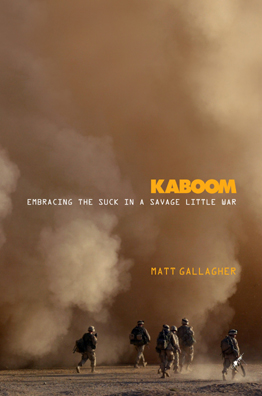
But – Chandresekaran’s sharp point (and Clausewitz’s too) – there’s also a difference between ‘paper war’ and ‘real war’.  Here are just two passages from former Lieutenant Matt Gallagher‘s Kaboom: embracing the suck in a savage little war (Da Capo, 2010) that dramatise the difference between the Field Manual and the field:

‘There was a brief pause and then [Staff Sergeant Boondock] continued. “Think I’ll be able to bust Cultural Awareness out on one of the hajjis now?” he said, referring to the stun gun he carried on his ammo pack… we were all waiting for the day that some Iraqi did something to warrant its electric kiss’ (p. xi). 

‘In this malleable, flexible world, creativity and ingenuity replaced firepower and overwhelming force as the central pillars of the army’s output. Ideally, a decentralized army struck like a swarm of killer bees rather than a lumbering elephant… In conventional warfare, the order of war dissolved into anarchy as time yielded more and more blood. Unconventional, decentralized warfare was the exact opposite. In fluid theory and historical practice, victorious counterinsurgencies served as a shining inverse to … conventionality, because through anarchy and bloodshed, order could eventually be established. This was the war I had trained for, brooded over, and studied. Then there was the war I fought’ (p. 175) 

There’s also a particularly telling passage in David Finkel‘s The good soldiers (Farrar, Straus & Giroux, 2009) that speaks directly to COIN spinning, to its address to the American public and, more particularly, to the body politic:

‘Soldiers such as Kauzlarich might be able to talk about the war as it was playing out in Iraq, but after crossing the Atlantic Ocean from one version of the war to the other, Petraeus had gone to Washington to talk about the war as it was playing out in Washington‘ (p. 130),

I’ve been gathering lots more examples from accounts like these – some of which, like Gallagher’s, started out as military blogs – but one of Chandresekaran’s many achievements is to show what can (must) be achieved when we to turn to an examination of practice.

There have been other studies of counterinsurgency operations – some from within the military, some from within the academy, and some at the nexus between the two – but the need to explore the connections between theory and practice (which are always two-way: the military constantly seeks to incorporate what it calls ‘lessons learned’ into its training) has never been greater.

This isn’t limited to counterinsurgency either: it’s one thing to demand to know what the ‘rules’ governing drone strikes are, for example, but quite another to monitor their implementation.

For academics, none of this is straightforward.  We aren’t war correspondents – and my own debt to courageous journalists like Chandresekaran is immense – and I suspect most of us would be unwilling to enlist in Human Terrain Teams.  There’s a long history to geography‘s military service; today some geographers undertake (critical) field work in war zones – Jennifer Fluri, Philippe le Billon, Michael Watts and others – and no doubt many more geographers live in them.

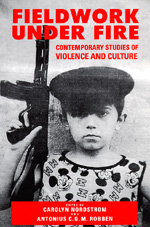
There’s also a particularly rich anthropology written from war zones. I’m thinking in particular of the work of Sverker Finnström (Living with bad surroundings, Duke, 2008), Danny Hoffman (The war machines, Duke, 2011), and Carolyn Nordstrom (especially A different kind of war story, SBS, 2002  and Shadows of war, University of California Press, 2004).

All of these studies approach ‘fieldwork under fire’ from a radically different position to David Kilcullen‘s ‘conflict ethnography’ (which is placed directly at the service of counterinsurgency operations) but, as Neil Whitehead showed, they still raise serious ethical questions about witnessing violence and, indeed, the violence of what he called ‘ethnographic interrogation’ that is often aggravated in a war zone.  (For more, see Fieldwork under fire (left) and Sascha Helbardt, Dagmar Hellmann-Rajanayagam and Rüdiger Korff, ‘War’s dark glamour’, Cambridge Review of International Affairs 23 (2) (2010) 349-69).

To be sure, there is important work to be done ‘off stage’ and in the vicinity of war, as Wendy Jones insists in ‘Lives and deaths of the imagination in war’s shadow’, Social anthropology 19 (2011) 332-41, and overtly techno-cultural modes of remote witnessing have their own dilemmas. But the dangers involved in venturing beyond our screens – and outside our emerald cities – are more than corporeal: they are also intellectual and ethical.

Chandresekaran’s principled combination of reporting and reflection shows how necessary it is to face them down.

Droning on

Here’s a selection of recent reports on drone strikes from around the web plus commentary:

Craig Whitlock completes the Washington Post‘s three-part series on ‘Permanent War’ – started by Greg Miller‘s report on the US ‘disposition matrix‘ for targeted killing – with a remarkable account of what he calls ‘the US military’s first permanent drone war base’ at Camp Lemonnier, just (barely) outside Djibouti City.  It’s ‘the busiest Predator drone base outside the Afghan war zone’, from which Predators are launched around the clock, sixteen times a day, to conduct missions in Somalia and Yemen.  Nominally overseen by US Africa Command (AFRICOM) – ‘the primary base of operations for US Africa Command in the Horn of Africa‘ – Whitlock mades it clear that it’s Joint Special Operations Command (JSOC) that calls the shots.  What is remarkable about Whitlock’s report is his artful piecing together of a jigsaw of information from construction solicitations, contracts and plans, submissions to Congress, planning memoranda, Air Force journals, and Predator accident investigation reports, some in the public domain and countless others obtained through FOI requests.  More on drone wars in East Africa from Somalia Report (which also provided the image of Camp Lemonnier below) and on what David Axe calls ‘America’s secret drone war in Africa’ from Wired‘s Danger Room.

Alex Kane at Mondoweiss reprises the Columbia report on Counting Drone Strike Deaths issued earlier this month – which is sharply critical of the estimates of civilian casualties in Pakistan reported by both the New America Foundation and the Long War Journal and endorses those provided by the Bureau of Investigative Journalism – and then follows up with an interview with Naureen Shah, Acting Director of the Human Rights Clinic and the Associate Director of the Counter-terrorism and Human Rights Project at Columbia:

… all of these estimates, including our estimate, are just based on news reports, news reports filed in that region where journalists have very limited access to the scene of the crime, if you will.

It’s not like journalists, for the most part, are going to where the drone strike happened and talking to witnesses, doing a bit of, almost a forensic analysis, being able to see what happened with their own eyes. This [Pakistan’s Federally Administered Tribal Areas] is a region where few journalists, even Pakistani journalists, can really get there. We’re talking about media reports that are often based on the word of anonymous, Pakistani government officials who have an interest in telling a story of, “drone strikes kill only militants.” We’re not going to see anonymous government officials admitting that many of the people killed are civilians. So it’s a stacked deck.’

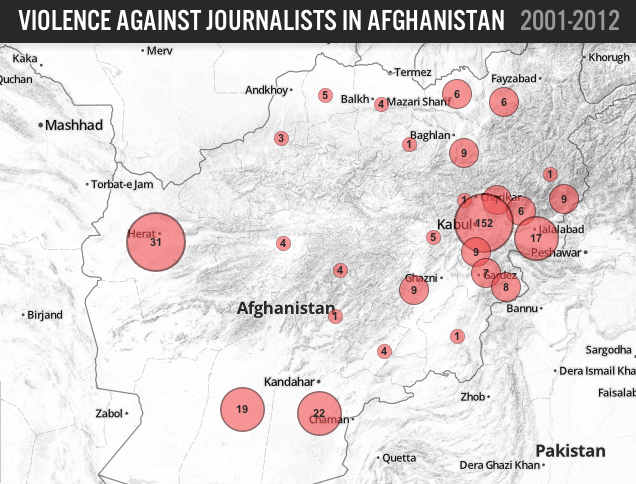
All true.  But there is a striking geographical absence from the kerfuffle over civilian casualties caused by drone strikes: Afghanistan.  The situation there is no less fraught: as the map below shows, journalists in Afghanistan also work in highly dangerous circumstances. (More on the map here and more from the Committee to Protect Journalists here).

The politico-technical matrix is also more complicated: in Afghanistan Predators and Reapers are part of an extended network in which aircraft are linked to ground forces and through which remote operators carry out persistent surveillance while, on occasion, leaving attacks to conventional strike aircraft (though they certainly also launch them from their own platforms too).  This makes it more difficult to disentangle drones from the wider apparatus of military violence – but why on earth should they be?  Afghanistan is part of a recognised ‘war zone’ – but does that make civilian casualties there any less grievable than those that take place across the border?

In the Mondoweiss interview Shah draws attention to the perpetual fear induced by the persistent presence of the drones:

We’re talking about planes hovering over head for hours every single day, and really the casualty of that, the human casualty, is peace of mind for the people who live there. We see reports that parents don’t want to send their kids out to school, that people don’t know what’s going to get them killed by a drone strike. Imagine living in that kind of fear, and we’re talking about communities that are already ravaged by war.

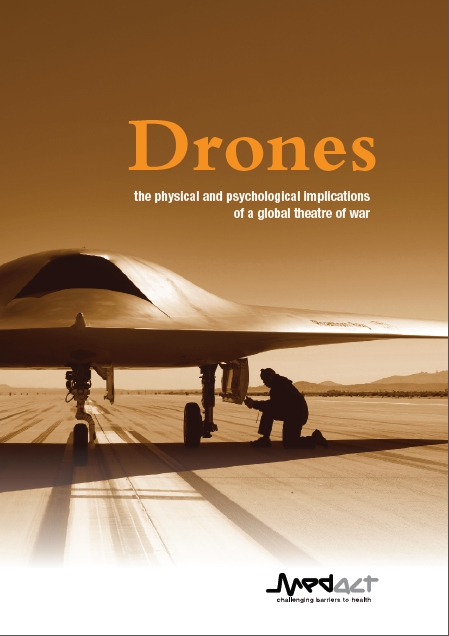
For more on this, turn to UK-based Medact’s report on Drones: the physical and psychological implications of a global theatre of war, also issued earlier this month.  Free download here.

Women are disproportionately affected by drones. What little control they have over their lives is further eroded by a weapon they know could strike at any time. Their lives and those of the children they try to protect are under constant threat. While men can sublimate their grief and anger to some degree by becoming fighters – one of the terrible consequences of drone warfare – women have no such outlet. And if their menfolk are killed in a drone strike, they may have to endure the continuing presence of the drone just overhead.

The report is a survey of surveys, short and to the point, but it adds a British dimension to the debate – important at a time when the RAF is doubling its Reaper fleet and moving control from Creech AFB in Nevada to RAF Waddington in Lincolnshire – and too briefly brings Israel’s use of drones in Gaza into the general discussion.  That last point desperately needs to be sharpened, given the global prominence of the Israeli drone industry and the filiations between US and Israeli practices of targeted killing.  Another depressing blank on the drone debate map.

(I hadn’t heard of Medact before, but it claims to speak out ‘for countless people across the globe whose health, wellbeing and access to proper health care are severely compromised by the effects of war, poverty and environmental damage’, and it’s associated with the journal Medicine, conflict and survival – a source which deserves close attention).

Haymarket Books has just published (pb and e-book versions) a collection of Nick Turse‘s columns on drones and Obama’s other signature modes of warfare, The changing face of empire: see here for an adapted version of the conclusion (extract below) and here for the book.

Several times this year, [General Martin Dempsey], the other joint chiefs, and regional war-fighting commanders have assembled at the Marine Corps Base in Quantico to conduct a futuristic war-game-meets-academic-seminar about the needs of the military in 2017. There, a giant map of the world, larger than a basketball court, was laid out so the Pentagon’s top brass could shuffle around the planet — provided they wore those scuff-preventing shoe covers — as they thought about “potential U.S. national military vulnerabilities in future conflicts” (so one participant told the New York Times). The sight of those generals with the world underfoot was a fitting image for Washington’s military ambitions, its penchant for foreign interventions, and its contempt for (non-U.S.) borders and national sovereignty.

And lastly, on an almost lighter note, Teo Ballvé at Territorial Masquerades has an artful post on ‘Writing like a drone’.  Following up on the ‘New Aesthetic‘, he describes a robotic graffiti writer that can write text massages ‘on such high risk/high profile targets as the U.S. Capitol Building’ and ‘can be deployed in any highly controlled space or public event from a remote location.’  It’s the remoteness that presumably prompts Teo to call this a ‘graffiti drone’, but there are two other (remote) connections to the real thing.

The project comes from the Institute for Applied Autonomy, which also hosts Trevor Paglen‘s captivating (sic) Terminal Air, a satirical version of the CIA’s extraordinary rendition flights –  the ‘capture’ side of the kill/capture regime that uses drones for the ‘kill’.

Former US Ambassador Kurt Volker adds a gloss to this in an Op-Ed in the Washington Post following up the ‘Permanent War’ reports:

More people have been killed in U.S. drone attacks than were ever incarcerated at Guantanamo Bay. Can we be certain there were no cases of mistaken identity or innocent deaths? Those detained at Guantanamo at least had a chance to establish their identities, to be reviewed by an oversight panel and, in most cases, to be released. Those who remain at Guantanamo have been vetted and will ultimately face some form of legal proceeding. Those killed in drone strikes, whoever they were, are gone. Period.

What he doesn’t quite say is that most of those incarcerated at Guantanamo were, on the US government’s own admission, never al Qaeda fighters.  More on the implications of these intelligence failures for the US targeted killing programme from the Stanford/NYU report on Living under drones here (scroll down).

Finally, back to Theo’s ‘graffiti drone’:  one of several synonyms for graffiti writing – particularly at night – is bombing…

Logistics and the fortunes of war in Afghanistan

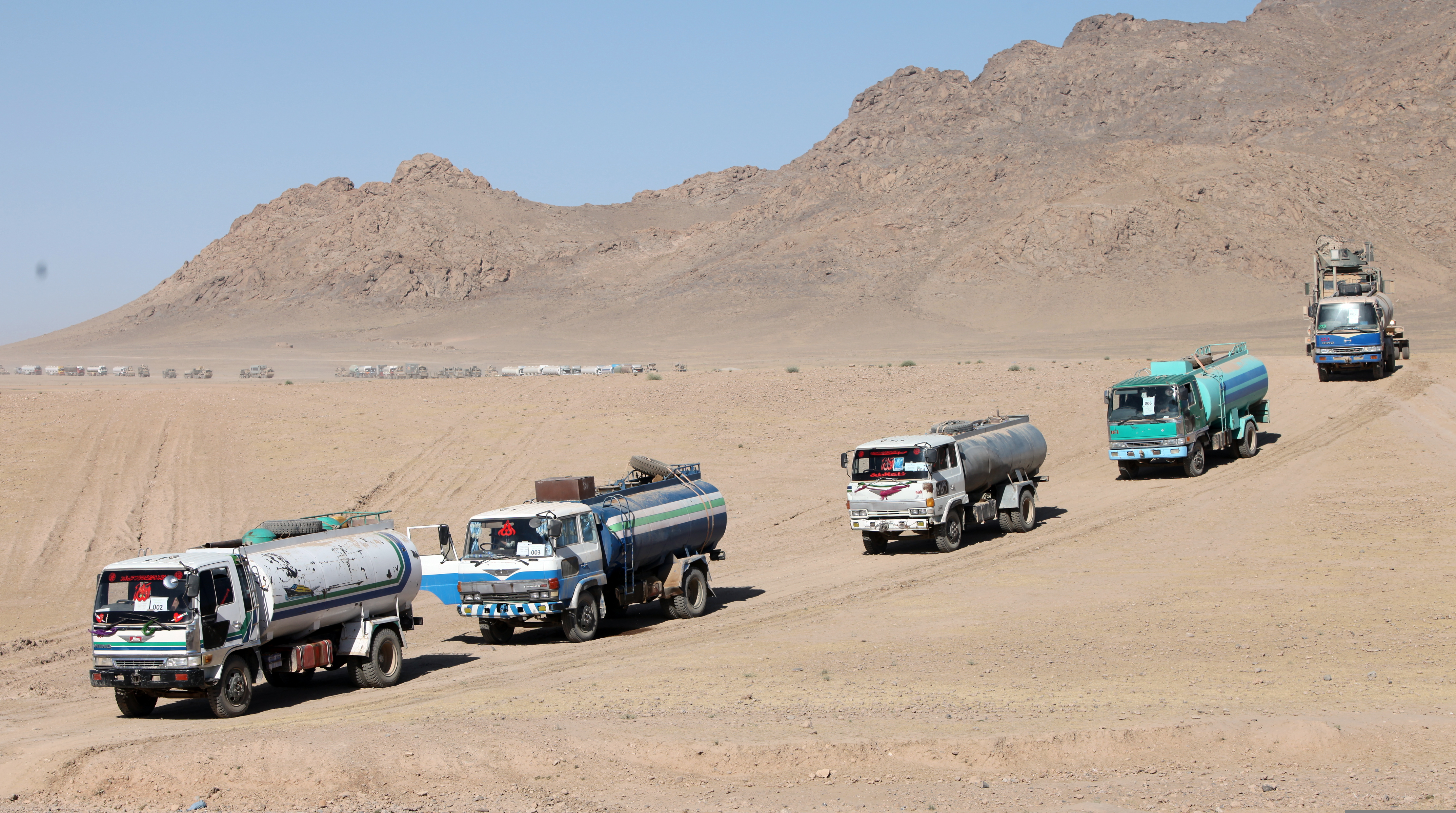
More on post-Host Nation Trucking in Afghanistan from “Mohammad Jawad” in Kabul.  Reporting for Afghanistan Today, Jawad notes that by the middle of 2012 3,515 logistics companies had been registered with the Afghan Investment Support Agency, but this has not brought an end to the monopolies and insider-dealing of the old contracts: ‘Most contracts at the giant US base at Bagram go to a handful of companies, including one run by a former interior minister.’  A primary focus of their operations continues to be supplying fuel to the military:

‘The amount of fuel needed to power the war machine is vast and it now mainly arrives at Hairatan from Uzbekistan by train in 60-ton or 110-ton wagons. “The amounts arriving at night differ, but usually it is 70 to 100 wagons coming for ISAF but only 30 to 35 wagons for civilian use,” said an Afghan oil trader at the port.  A 16-ton tanker load of fuel moved from Hairatan to Jalalabad for civilian clients earns hauliers 700-800 US dollars, according to insiders. But ISAF pays up to 220 dollars per ton, meaning the same load earns contractors around 3,500 dollars if delivered for the military.’

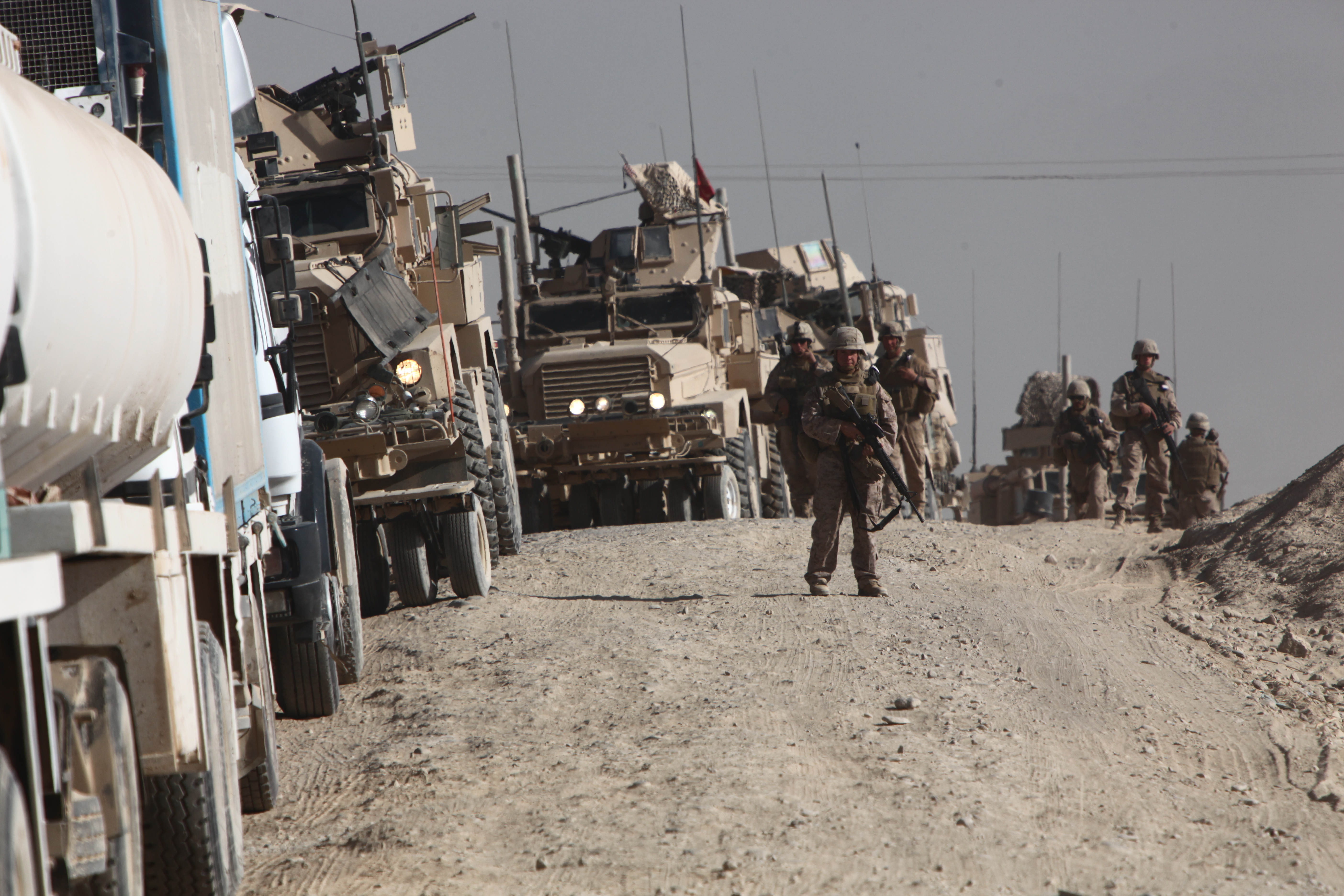
For ‘sensitive supplies’ (including fuel) in particularly dangerous areas like Helmand the US military provides an escort:

US Marines escort 35 Afghan trucks through northern Helmand, July 2011 [US Department of Defense/Sgt Rachael Moore]

US Marines escort a fuel convoy outside FOB Edinburgh, Helmand, September 2011 [US Department of Defense/Cpl Michael Augusto]

But security for much of the supply chain continues to be privatized.  Jawad again:

‘”There is no single approach for securing convoys, it varies,” said a company owner. “In some secure areas, no one is paid protection money because companies have shareholders and allies who are warlords, which ensures the convoys safely reach their destinations. In other areas, people use private security companies that have links with the Taliban, and they pay them not to touch the loads.”

The re-opening of the Pakistan Ground Lines of Communication has been uneven.  Border crossings into Afghanistan were closed to NATO convoys in November 2011 and re-opened on 5 July 2012 –  but the Torkham Gate at the Khyber Pass closed again on 24 July after an insurgent attack killed one driver and injured another.   Trans-border shipments were resumed a fortnight later (on 5 August) under paramilitary escort.  Cargoes are supposed to be restricted to non-lethal supplies, and trucks crossing at Torkham were inspected to ensure that they carried no weapons. Even so, now that the border has re-opened the black market in arms and other military supplies is picking up.  An arms dealer from Quetta told Amir Laatif that business had really suffered during the closure, “But, thank God, things have been settled down, and we are going to reactivate our business.”   Although prices shot up during the closure, dealers had little stock on hand, but now they believe “Good days are back.”

Yet many of the black-market US-made weapons circulating in Pakistan have crossed the other way: intelligence sources estimate that more than 70 per cent originate from Afghan smugglers who buy them from soldiers in the Afghan National Army or members of the Afghan National Police.

And soon NATO supplies will be flowing the other way too.  Much of logistics planning by the military is now geared towards reverse-engineering the supply chain as the draw-down of NATO forces accelerates.  Working from what they call the Reset Playbook, Graham Bowley reports the Pentagon reckons it ‘will have to wrangle 100,000 shipping containers of material and 45,000 to 50,000 vehicles like tanks and Humvees from all across Afghanistan.’  There have already been complaints from front-line troops that the roll-back is disrupting combat operations. Rob Taylor for Reuters quotes one officer: “It’s a nightmare. We barely have enough guys to cover our area, let alone get ready to pack up.”  For that reason it is possible – in fact likely – that in the short term more troops will be sent to Afghanistan to clean, pack and ship equipment back.  But they also plan to ship all weapons, ammunition and other ‘sensitive equipment’ out by air, so the arms dealers may yet be disappointed .

Remote Witnessing

In an astonishing essay on ‘Drone bombings in the Federally Administered Tribal Areas’, published in the Journal of Geographical Information Systems 4 (2012) 136-141 – the places this blog is taking me! – Katrina Laygo, Thomas Gillespie, Noel Rayo and Erin Garcia (three geographers and a political scientist at UCLA) explore what they call ‘public remote sensing applications for security monitoring’.

An open-access version should be available here but there is also a manuscript version here.  (In fact news of the project appeared in the press soon after the US raid on Osama Bin Laden’s compound last year – Gillespie and John Agnew headed a team that had used satellite imagery and the theory of island biogeography (sic) to predict the location of bin Laden’s hideout in 2009 – but much of the media interest in the new work focused on the image captured by satellite of a Predator circling above an area south west of Miram Shah.)

The new project uses unclassified high-resolution imagery from QuickBird 2 (via GeoEye) to monitor drone strikes in Pakistan’s Federally Administered Tribal Areas (FATA).  The difficulties (and dangers) of eyewitness reports are well-known, and media coverage of drone strikes in the area is at best uneven – though the Bureau of Investigative Journalism, along with organizations like CIVIC and Reprieve, continue to do brave, invaluable, eye-popping work – but the UCLA team concludes that, in principle, the commercial availability of the satellite imagery means that  ‘it is possible for the public’ – a distant public – ‘to monitor drone bombings in the [FATA]’.

You can see where they might be going.  In the weeks preceding the US-led invasion of Afghanistan the Pentagon secured exclusive rights to commercial imagery from the Ikonos-2 satellite.  They didn’t need it for operational purposes; the objective was to exercise ‘shutter control’ and prevent media and other organizations from obtaining imagery that might reveal casualties from the high-level bombing campaign. It wasn’t cheap; the standard cost was around $200 per square kilometre, with a premium for rapid turnaround, and news media had been paying $500 for each image.  It’s still not cheap.  The authors of this (I presume preliminary) report concede that ‘it may be prohibitively expensive to monitor the entire region’.  They estimate that weekly data for one year’s coverage of a town like Miram Shah would cost $64,000, though this would not be beyond the reach of some organizations.

But their own test-case is not encouraging.  Working from a map of drone strikes and casualties constructed by the Center for American Progress – they don’t say why they selected this source – the team searched the satellite image for evidence of any of the 16 drone strikes around Miram Shah before 1 January 2010 included in the database.  This is what they say:

 ‘We feel confident that we were able to identify the location of one drone bombing in Figure 4(b). If the center of the compound is the target, it would appear that the drone bombing is accurate. This also suggests that the blast radius of such attacks is relatively small or less than 20 m. Indeed, the walls still appear to remain intact. This appears similar to blast radii reported for hellfire missiles which are used by both the Predator and Reaper drones.’

The claim is not only repeated but generalized in the abstract: ‘Results suggest that drone bombings are very accurate and drone missions are common in the region.’

They suggest no such thing; drone strikes are most certainly common, but the claim about their accuracy is based on a single case for which nothing is known of the intended target or the basis for its identification – was this yet another wedding party?  Neither can anything be said about civilian casualties; they don’t key this site back into their casualty database, such as it is, and in any case they note that ‘The resolution of QuickBird 2 is currently not high enough to see or quantify casualties.’  Not exactly forensic architecture then.

Not surprisingly, though, the conclusion chimes with the Center for American Progress’s own endorsement of the campaign:

Hardly a week goes by without some key figure in the Al Qaeda network and its affiliates being targeted in a range of actions, including drone strikes as well as other actions by U.S. intelligence and law enforcement agencies to prevent attacks and degrade the Al Qaeda network. The damage done to Al Qaeda by the Obama administration represents America’s greatest national security success since the fall of the Soviet Union and the peaceful integration of Eastern European countries in the 1990s.

The importance of all this goes beyond the particular case.  Susan Sontag once famously declared that ‘Being a spectator of calamities taking place in another country is a quintessentially modern experience.’  It’s a more complicated (and contentious) claim than it looks, but in any event being a spectator is not the same as being a witness.  And we surely know – or ought to know – from Lisa Parkss wonderful work that satellite and other remote technologies do not provide an unmediated window on the world. I’m thinking particularly of her ‘Satellite view of Srebrenica: tele-visuality and the politics of witnessing’ in Social identities 7 (4) (2001), and ‘Digging into Google Earth: an analysis of “Crisis in Darfur”‘ in Geoforum 40 (4) (2009), but you can get a sense of her work from the press report of her 2010 lecture to the New Zealand Geographical Society here.  She also has a new book out late this year/early next from Routledge, Coverage: media spaces and security after 9/11.

Now the use of satellite technology to conduct ‘remote witnessing’ is not alien to human rights organizations, but most of them are well aware of its problems as well as its potential.  Amnesty International sponsored the Science for Human Rights Project (originally Satellites for Human Rights) from January 2008 to January 2011:

Its primary purpose was to test the potential use of geospatial technologies for human rights impact. The purpose of the evaluation is to assess the extent to which work undertaken by Amnesty International contributed to change (intended and unintended) and to assess the potential for using geospatial technologies to contribute towards more effective advocacy and impact.

There have been a series of public examples.  Some of them have been conducted under other banners, like the celebrity Satellite Sentinel Project on Sudan.

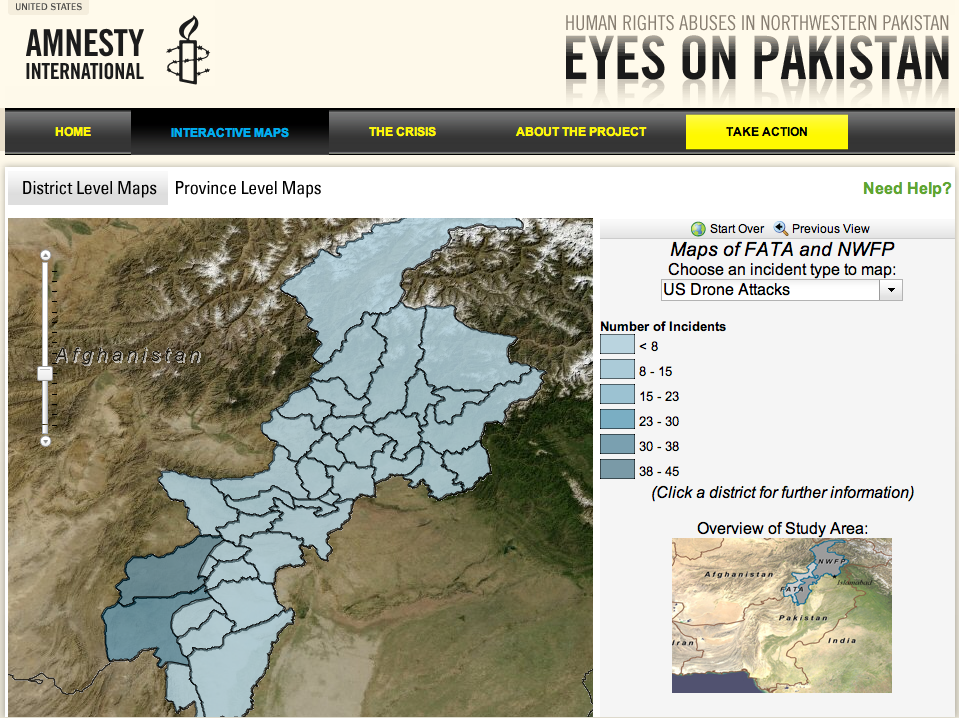
But the most directly relevant to this post is probably Amnesty’s (now terminated) Eyes on Pakistan archived here.  Although this involved interactive mapping platforms rather than the use of satellite imagery the project title gives a clear indication of the direction in which Amnesty was moving and the wider debate about witnessing of which it was a part.

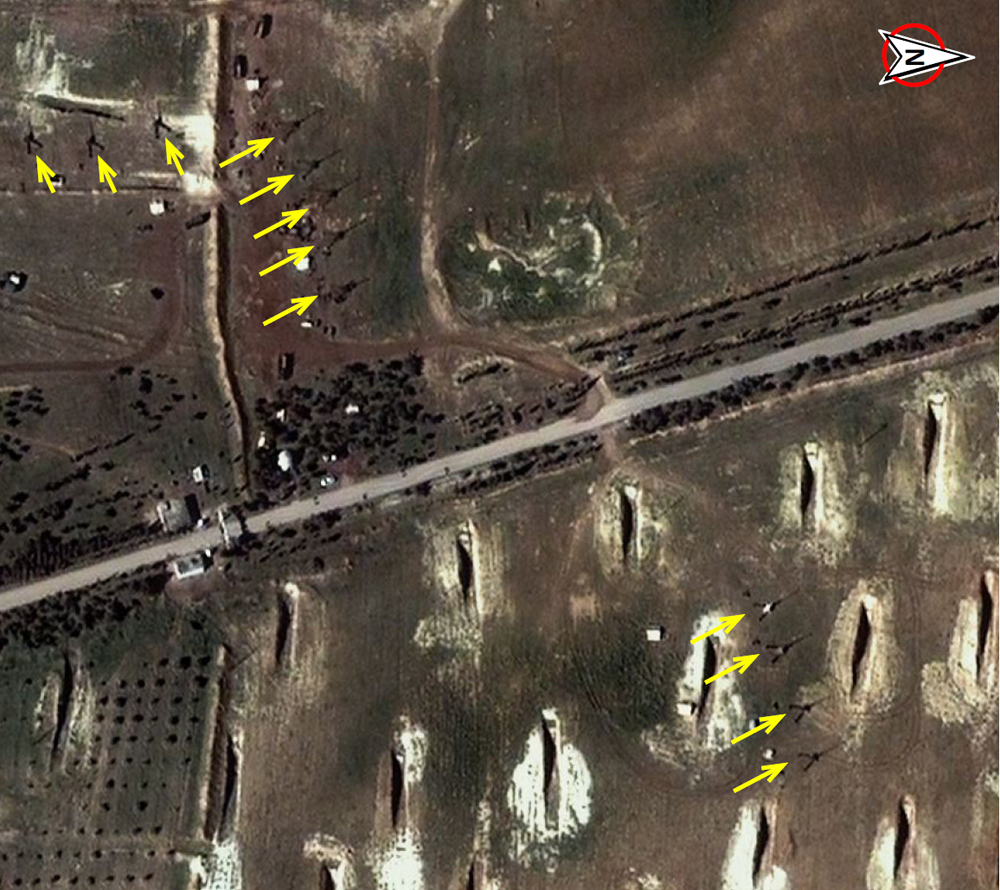
Amnesty has also launched Eyes on Darfur (here too the imagery is no longer being updated) and now Eyes on Syria.  This does involve remote imagery, and there is an interesting discussion on Amnesty USA’s blog about its significance:

The images from Homs and Hama show clearly that armed forces have not been removed from residential areas, as demanded by the U.N. General Assembly resolution from mid February. In Hama, the images reveal an increase in military equipment over the last weeks, raising the specter of an impending assault on the city where the father of current President Bashar al-Assad unleashed a bloody 27-day assault three decades ago, with as many as 25,000 people killed.

With reports of a ground assault underway in Homs, the analysis of imagery identifies military equipment and checkpoints throughout Homs, and field guns and mortars actively deployed and pointing at Homs [see image left]. Additionally, the images show the shelling of residential areas in Homs, concentrated on the Bab ‘Amr neighborhood. Artillery impact craters are visible in large sections of Bab ‘Amr, from where we have received the names of hundreds killed throughout the period of intense shelling.

Note that last clause: to convert remote sensing into remote witnessing requires difficult, painstaking work in multiple registers because the imagery does not speak for itself.  To believe otherwise means that anyone who ventriloquises from imagery alone – academics screening imagery in California or CIA/USAF analysts scrutinising near real-time feeds from drones – runs the real risk of seeing what they are predisposed to see.  As that same blog post notes,

Satellite images can help to show the widespread and systematic nature of violations, characteristics inherent to certain international crimes such as crimes against humanity. Additionally, they can help in identifying command responsibility, a key requirement for holding individual perpetrators accountable. [Ivan] Simonovic [Assistant Secretary-General for Human Rights] pointed out that the UN Panel on Sri Lanka relied a lot on satellite images. The same holds true for the current commission of inquiry on Syria, which equally relies on satellite images. Thus, the point is that while satellite images barely deliver the “smoking gun” that leads to a conviction, they can provide major support for international investigations and accountability mechanisms.

And this brings me back to drones.  Writing in the New York Times on 30 January 2012 Andrew Sniderman and Mark Hanis proposed re-purposing drones ‘for human rights’:

DRONES are not just for firing missiles in Pakistan. In Iraq, the State Department is using them to watch for threats to Americans. It’s time we used the revolution in military affairs to serve human rights advocacy. With drones, we could take clear pictures and videos of human rights abuses, and we could start with Syria. The need there is even more urgent now, because the Arab League’s observers suspended operations last week. They fled the very violence they were trying to monitor. Drones could replace them, and could even go to some places the observers, who were escorted and restricted by the government, could not see. This we know: the Syrian government isn’t just fighting rebels, as it claims; it is shooting unarmed protesters, and has been doing so for months. Despite a ban on news media, much of the violence is being caught on camera by ubiquitous cellphones. The footage is shaky and the images grainy, but still they make us YouTube witnesses. Imagine if we could watch in high definition with a bird’s-eye view. A drone would let us count demonstrators, gun barrels and pools of blood. And the evidence could be broadcast for a global audience, including diplomats at the United Nations and prosecutors at the International Criminal Court.

This produced a series of responses:  Lauren Jenkins was appalled, Daniel Solomon sceptical, and Patrick Meier sympathetic.  The most scathing response was from anthropologist Darryl Li in Middle East Report, which provoked a heated exchange between him and Sniderman.  I see all this as part of a diffuse (and I think largely uncoordinated) campaign to rehabilitate drones in the public eye, something I’ll be writing about in a future column for open Democracy.  But whatever you make of it, and wherever your sympathies lie, the debate about ‘humanitarian drones’ clearly underscores the necessity of seeing visual technologies as political-cultural technologies enrolled in highly particular scopic regimes.

In short – and to return to where I started – remote witnessing is not a passive practice but an intervention in a field of power and as such it involves a series of investments that spiral far beyond the cost of obtaining the imagery.