Angry Eyes (2)

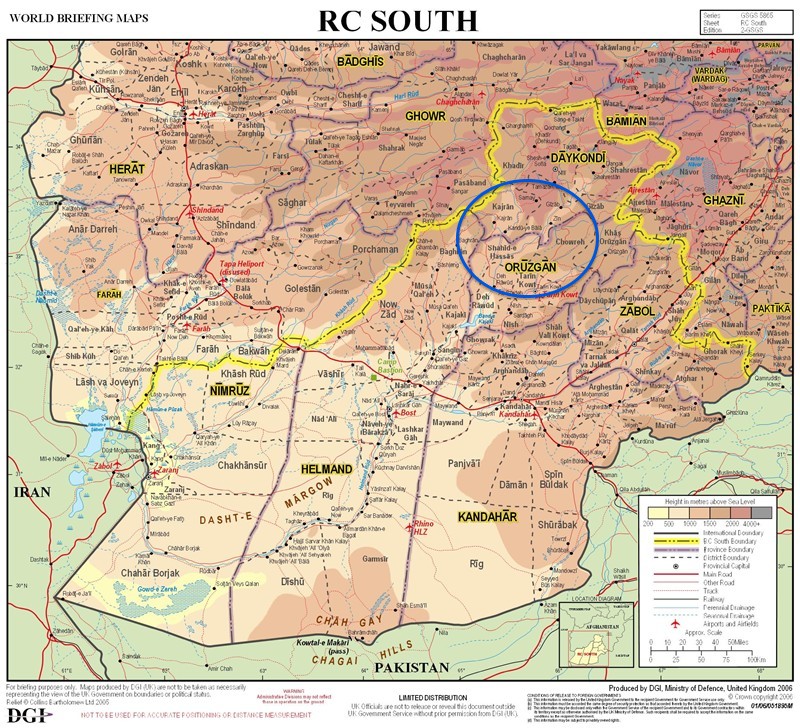
MAP isaf-rc-south

This is the second installment of my analysis of an air strike orchestrated by a Predator in Uruzgan province, Afghanistan on 21 February 2010; the first installment is here.

(4) Command and control?

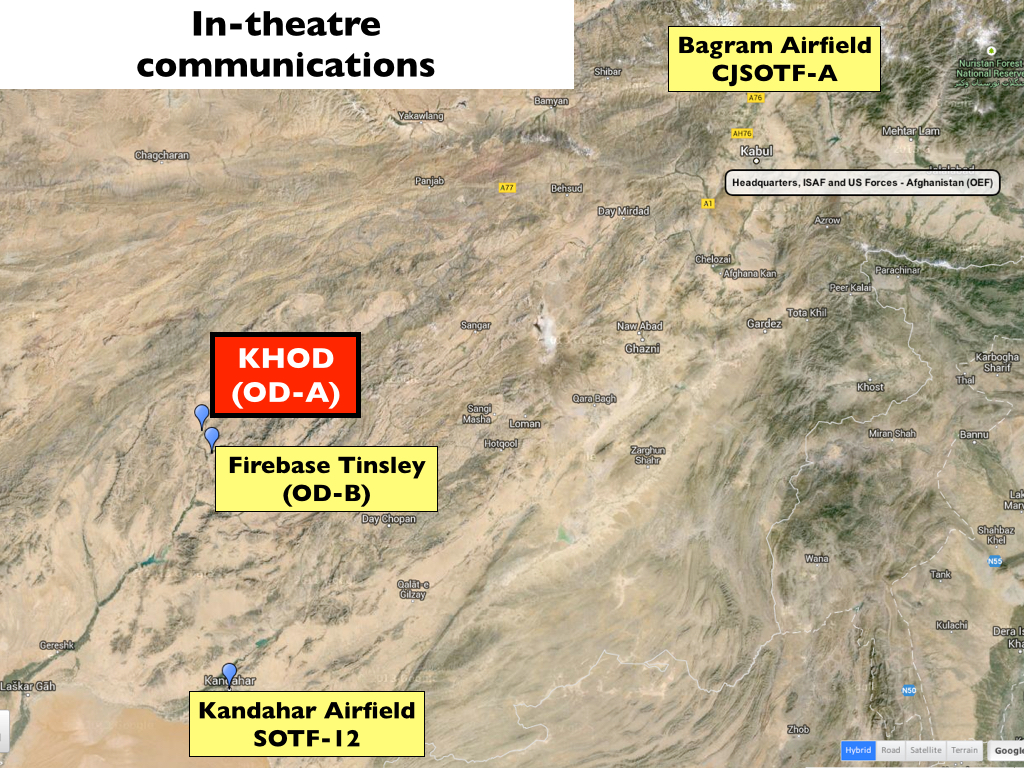
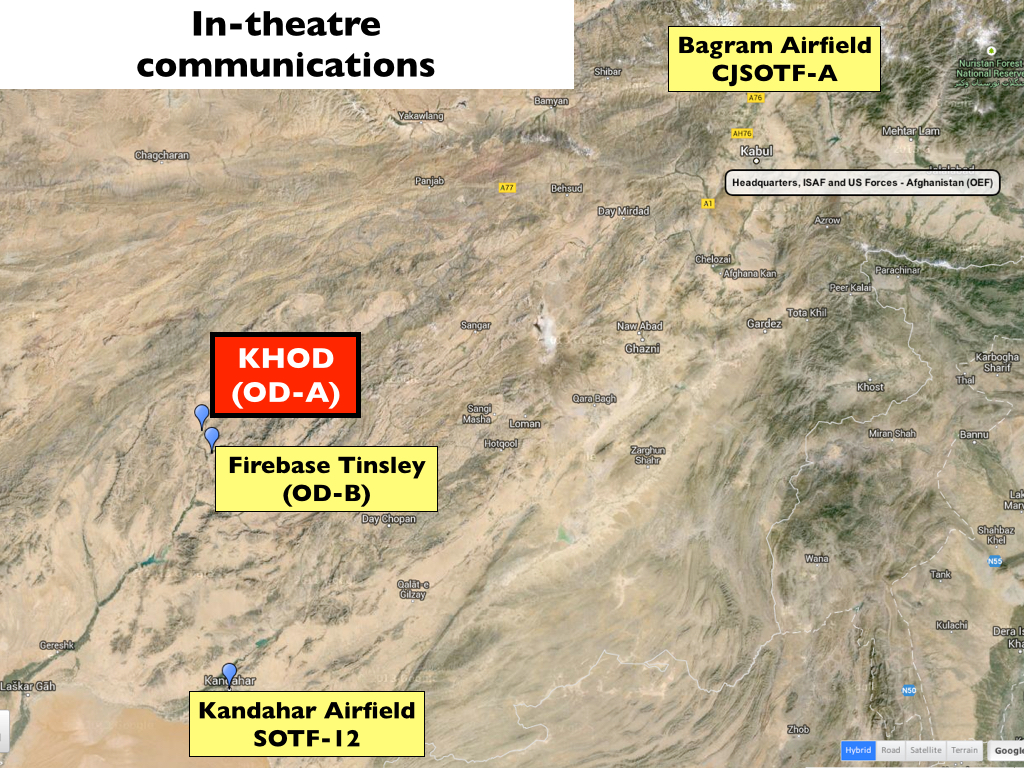
What was happening in and around Khod was being followed not only by flight crews and image analysts in the continental United States but also by several Special Forces command posts or Operations Centers in Afghanistan.  In ascending order these were:

(1) the base from which ODA 3124 had set out at Firebase Tinsley (formerly known as Cobra);

(2) Special Operations Task Force-12 (SOTF-12), based at Kandahar;

(3) Combined Joint Special Operations Task Force – Afghanistan (CJSOTF-A) based at Bagram.
GREGORY Angry Eyes 2015 IMAGES.064

Once the ODA 3124 left the wire, command and support passed to SOTF-12; the OD-B at Tinsley had limited resources and limited (and as it happens intermittent) communications access and could only monitor what was happening.

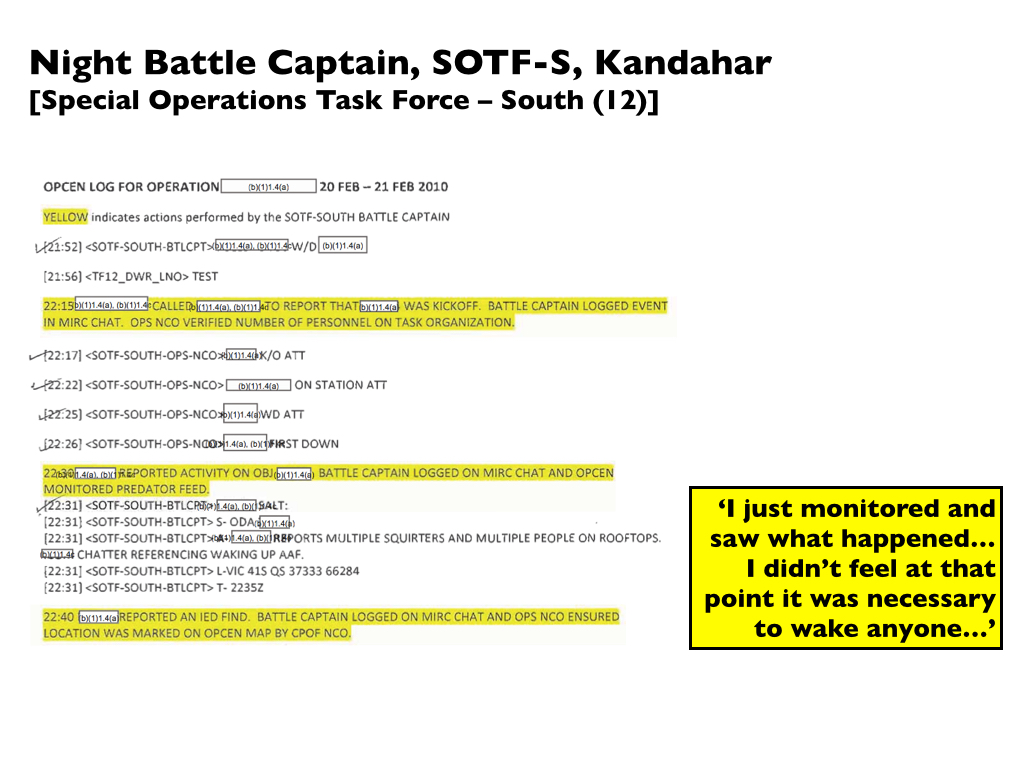
That was normal, but in fact both higher commands did more or less the same: and the investigating team was clearly appalled.  At SOTF-12 all senior (field grade) officers were asleep during the period of ‘highest density of risk and threatening kinetic activity’ (although they had established ‘wake-up criteria’ for emergency situations).  The Night Battle Captain had been in post for just three weeks and had been given little training in his role; he received a stream of SALT reports from the Ground Force Commander of ODA 3124 (which detailed Size of enemy force, Activity of enemy force, Location and Time of observation) but simply monitored the developing situation – what one investigating officer characterised as ‘a pretty passive kind of watching’.
GREGORY Angry Eyes 2015 IMAGES.065

The same was true at CJSOTF-A (the staff there monitored 15-25 missions a day, but this was the only active operation that had declared a potential Troops in Contact).

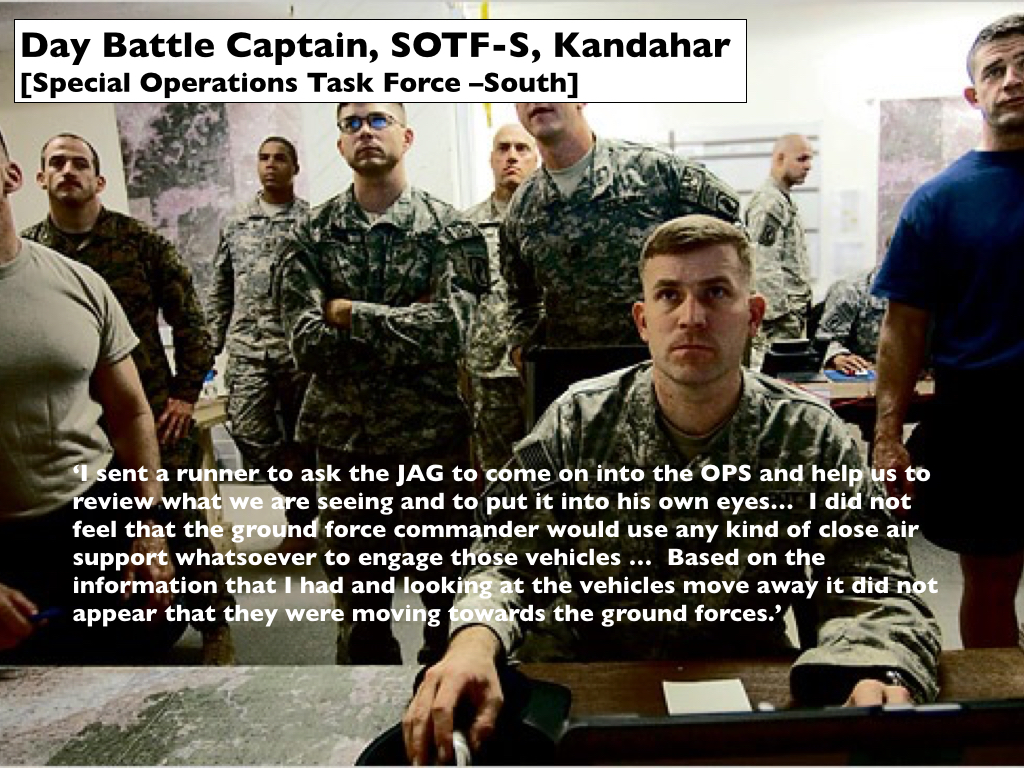
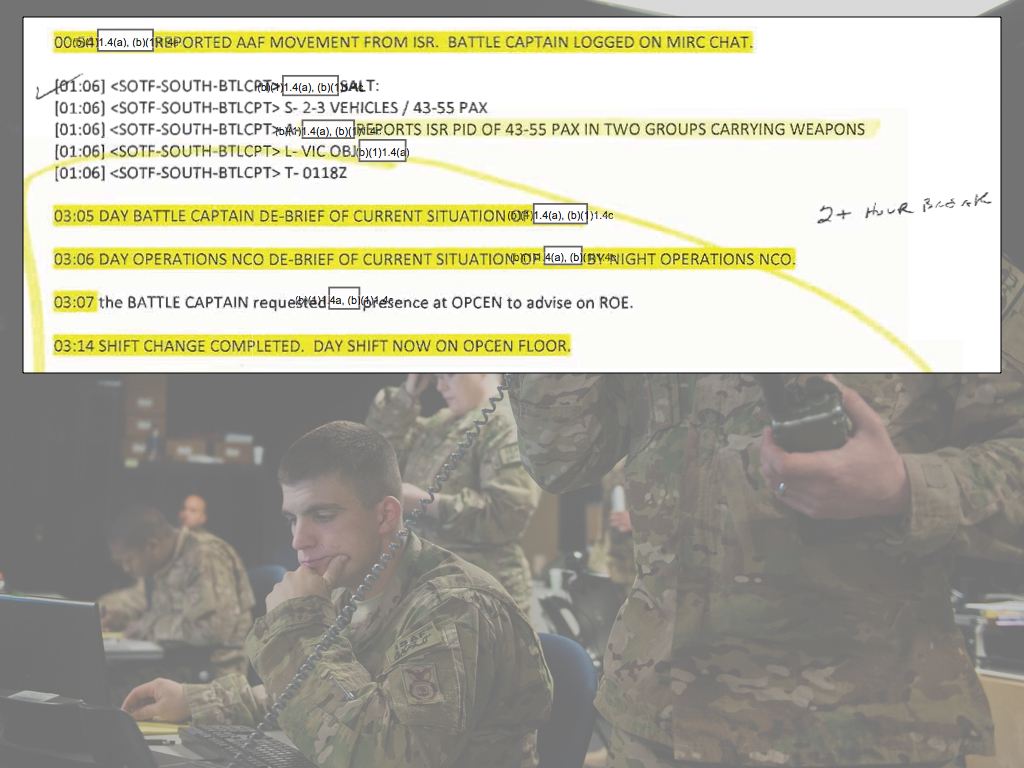
When the more experienced Day Battle Captain entered the Joint Operations Center at Kandahar and was briefed by the Night Battle Captain he was sufficiently concerned to send a runner to ask the Judge Advocate, a military lawyer, to come to the JOC.  He believed the occupants of the vehicles were hostile but was not convinced that they posed an immediate threat to troops on the ground:  ‘I wanted to hear someone who was extremely smart with the tactical directive and use of CAS [Close Air Support] in a situation I hadn’t seen before’.

This was a smart call for many reasons; the commander of US Special Forces, Brigadier General Edward Reeder, told the inquiry: ‘Honestly I don’t take a shit without one [a JAG], especially in this business’.  Significantly, the Safety Observer at Creech testified that there was no ‘operational law attorney’ available onsite for aircrews conducting remote operations; conversely, JAGs were on the operations floor of CENTCOM’s Combined Air and Space Operations Centre at Ul Udeid Air Base and, as this case shows, they were available at operations centers established by subordinate commands in-theatre.
GREGORY Angry Eyes 2015 IMAGES.073

GREGORY Angry Eyes 2015 IMAGES.074

The JAG at Kandahar was not routinely called in for ‘Troops in Contact’ but on this occasion he was told ‘my Legal Opinion [was] needed at the OPCENT and that it wasn’t imminent but they wanted me to rush over there right away…’

Meanwhile up at Bagram Colonel Gus Benton, the commanding officer of CJSOTF-A, was being briefed by his second-in-command who understood that the Ground Force Commander’s intention was to allow the three vehicles to move closer to his position at Khod.  He thought that made sound tactical sense.

‘I said that … is what we did, we let them come to us so we can get eyes on them. During my time I never let my guys engage with CAS if they couldn’t see it. I said that is great and COL [Benton] said “that is not fucking great” and left the room.’

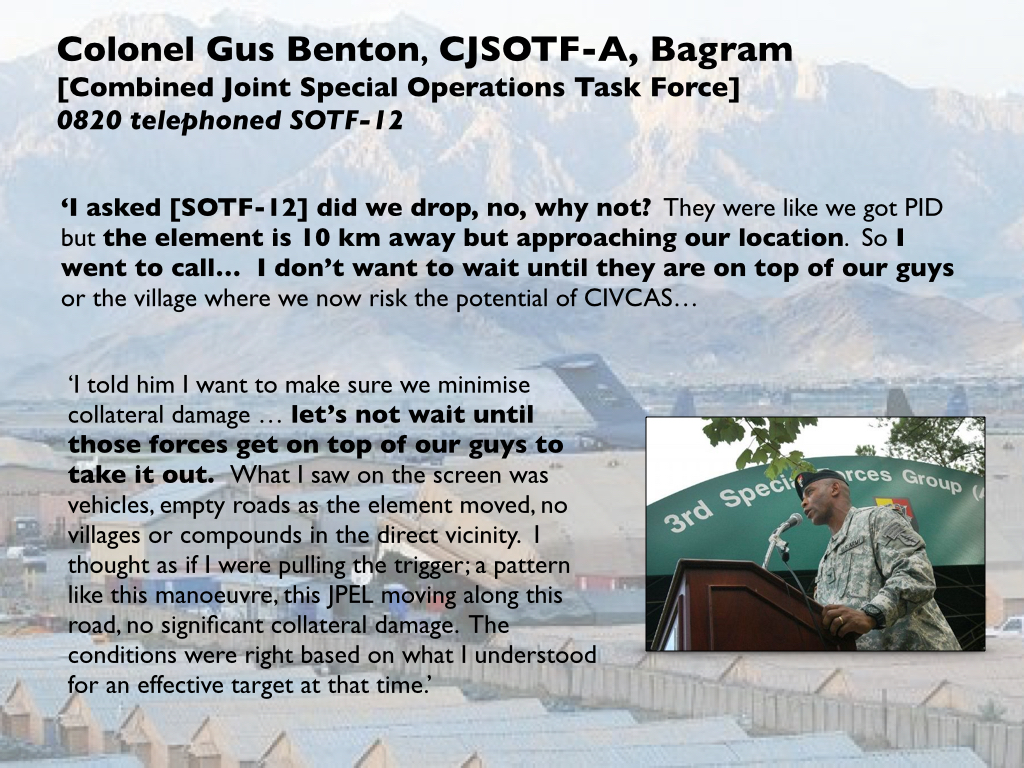
At 0820, ten minutes after the JAG entered the JOC at Kandahar, while he was watching the Predator feed, the phone rang: it was Benton.  He demanded Lt Colonel Brian Petit, the SOTF-12 commander, be woken up and brought to the phone:
GREGORY Angry Eyes 2015 IMAGES.076

He spectacularly mis-read the situation (not least because he mis-read the Predator feed).  It was true that the vehicles were in open country, and not near any compounds or villages; but Benton consistently claimed that the vehicles were ‘travelling towards our objective’ whereas – as MG McHale’s investigating team pointed out to him – they were in fact moving away from Khod.
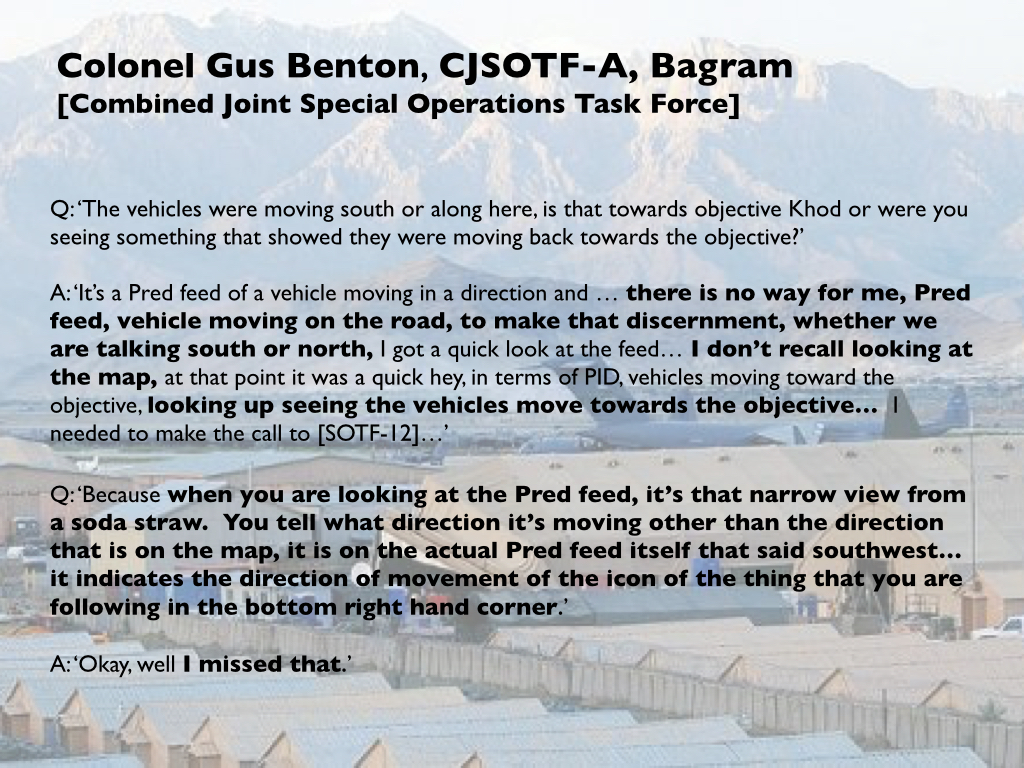
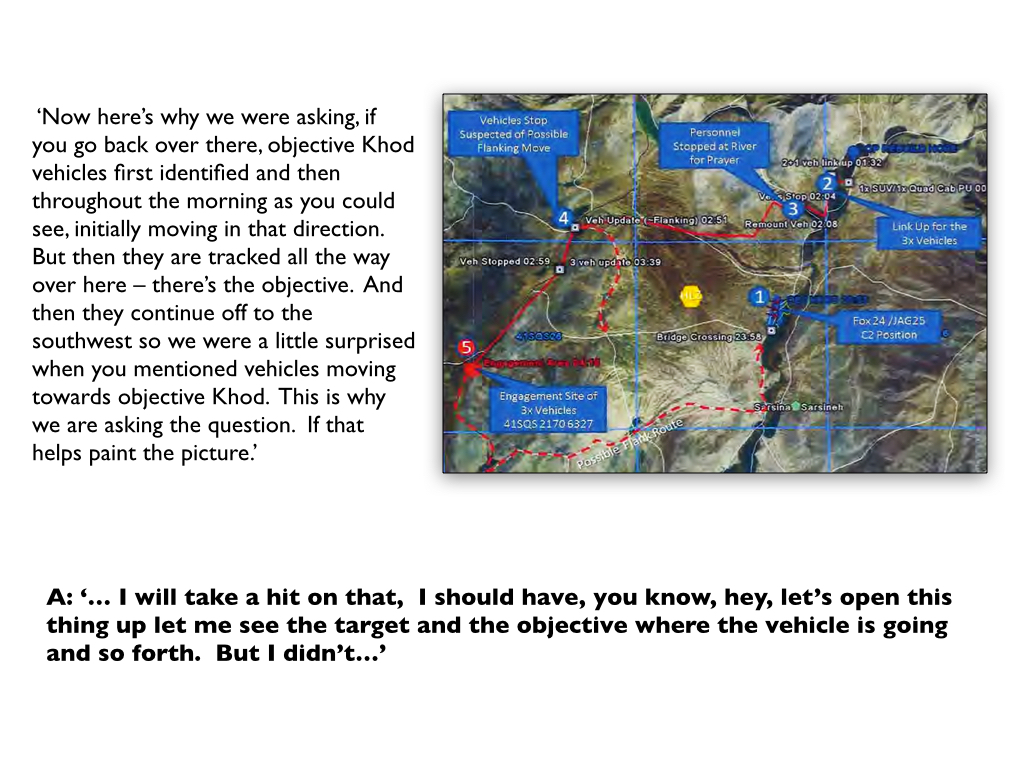
GREGORY Angry Eyes 2015 IMAGES.077

GREGORY Angry Eyes 2015 IMAGES.078

There had also been some, inconclusive discussion of a possible ‘High Value Target’ when the vehicles were first tracked, but the presence of a pre-approved target on the Joint Prioritised Effects List (Benton’s ‘JPEL moving along this road’) had never been confirmed and the Ground Force Commander had effectively discarded it (‘above my authority’, he said).

Certainly, the JAG at Kandahar read the situation differently:
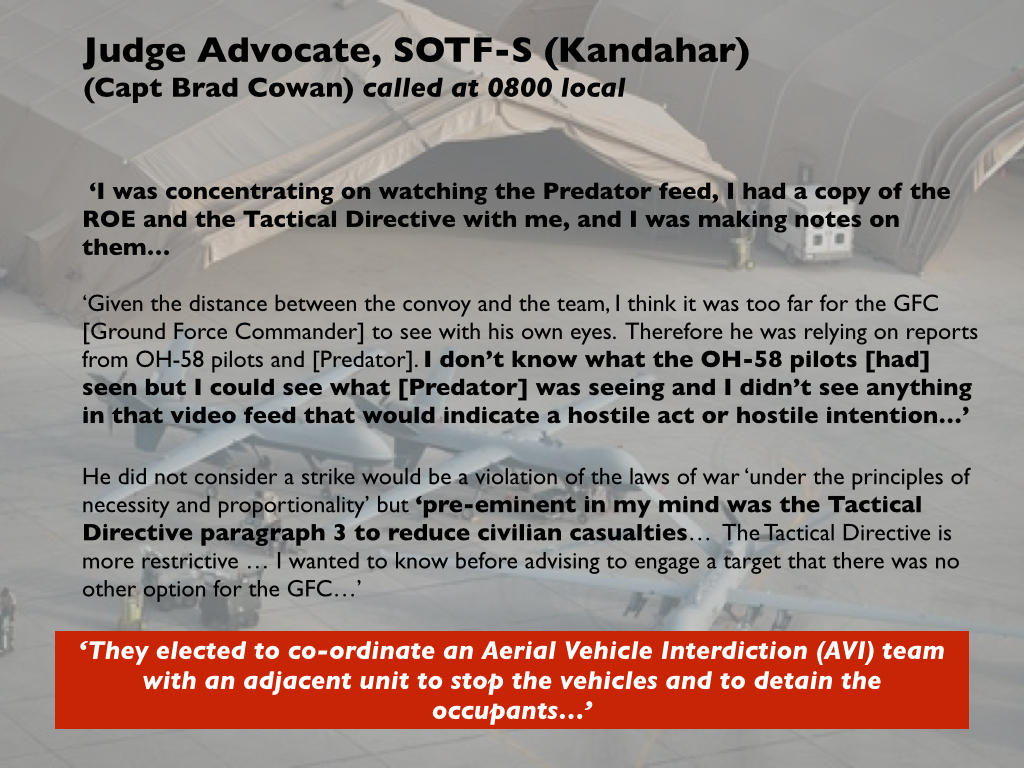
GREGORY Angry Eyes 2015 IMAGES.075

When Benton rang off, the JAG went over to the Day Battle Captain and Lt Col Petit and recommended an Aerial Vehicle Interdiction (AVI) team be called in for a show of force to stop the vehicles without engaging the occupants in offensive action.

They agreed; in fact another Task Force also watching the Predator feed called to make the same suggestion, and the Fires Officer set about arranging to use their Apache helicopters to conduct an AVI:
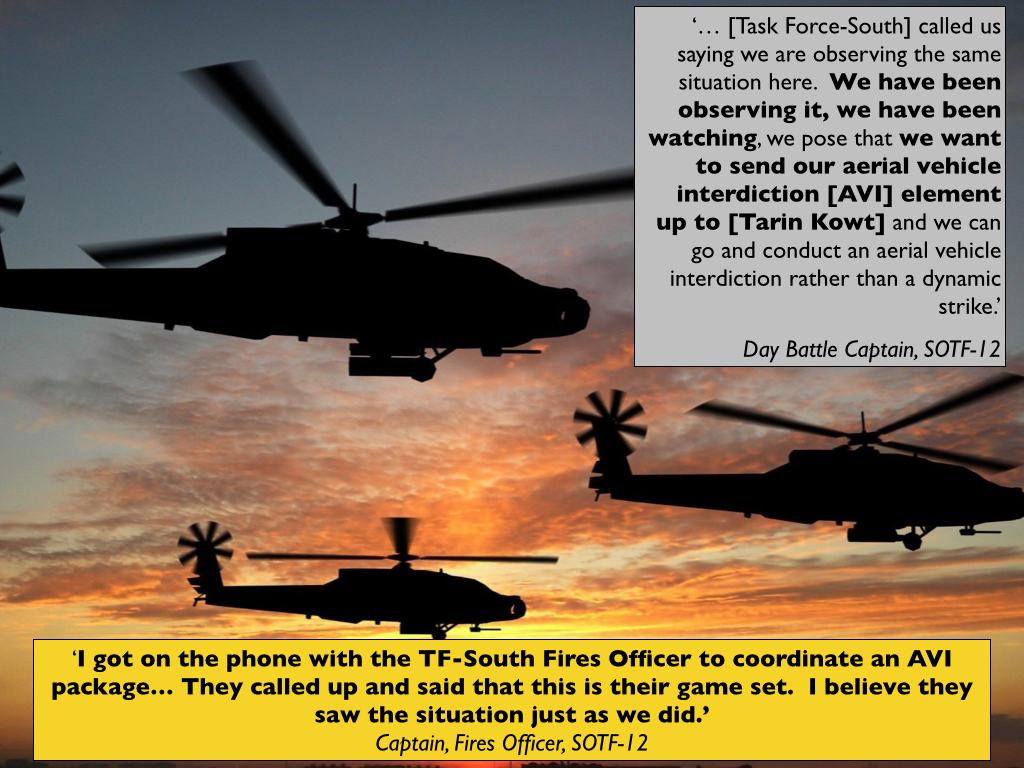
GREGORY Angry Eyes 2015 IMAGES.079

The Fires Officer had been responsible for setting up the Restricted Operating Zone for aircraft supporting the ODA – de-conflicting the airspace and establishing what aircraft would be available – but its management was de-centralised:

‘I establish the ROZ, give the initial layout of what assets are going on, and then I pass that to the JTAC [Joint Terminal Attack Controller with the Ground Force Commander at Khod].  I pass the frequencies to the assets and the JTAC controls them from there.’

At 0630, long before all this frantic activity at Kandahar, the two OH-58s had arrived at a short hold location beyond the ‘range of enemy visual and audio detection’, and at 0730 they had left to refuel at Tarin Kowt.  The Day Battle Captain and the Fires Officer both thought they were still off station.  In fact, the helicopters had returned to hold at Tinsley/Cobra at 0810 and flat pitched to conserve fuel (which means they landed and left the rotor blades spinning but with no lift); thirty minutes later the JTAC called them forward and the Predator began to talk them on to the target.

The Day Battle Captain had another reason for thinking he and his colleagues in the JOC had more time.  He maintained that the helicopters had been brought in not to engage the three vehicles but to provide air support if and when the ‘convoy’ reached Khod and the precautionary ‘AirTic’ turned into a real TIC or Troops in Contact:

‘… the CAS brought on station for his [the Ground Force Commander’s] use was not for the vehicles but for what we thought was going to be a large TIC on the objective. The weapons team that was pushed forward to his location was not for the vehicles, it was for the possibility of a large TIC on the objective based on the ICOM chatter that we had.’

That chimes with Benton’s second-in-command at Bagram, who also thought the Ground Force Commander was waiting for the ‘convoy’ to reach Khod, but neither witness explained the basis for their belief.  It was presumably a string of transmissions from the JTAC to the Predator crew: at 0538 he told them the Ground Force Commander wanted to ‘keep tracking them and bring them in as close as we can until we have CCA up’ (referring to the Close Combat Attack helicopters, the OH-58s); shortly before 0630 he confirmed that the Ground Force Commander’s intent was to ‘permit the enemy to close, and we’ll engage them closer when they’re all consolidated’; and at 0818 he was still talking about allowing the vehicles to ‘close distance.’

Yet this does not account for the evident urgency with which the Day Battle Captain and the JAG were concerned to establish ‘hostile intent’ and ‘immediate threat’.  When the vehicles were first spotted they were 5 km from Khod, and when they were attacked they were 12 km away across broken and difficult terrain: so what was the rush if the Ground Force Commander was continuing to exercise what the Army calls ‘tactical patience’ and wait for the vehicles to reach him and his force?

In fact, the messages from the Ground Force Commander had been mixed; throughout the night the JTAC had also repeatedly made it clear that the ODA commander’s intent was ‘to destroy the vehicles and the personnel’.  The Ground Force Commander insisted that ‘sometime between 0820 and 0830’ he sent a SALT report to SOTF-12 to say that he was going to engage the target.  Unfortunately there is no way to confirm this, because SOTF’s text records of the verbal SALT reports stopped at 0630 for reasons that were never disclosed (or perhaps never pursued), but it would explain why the JTAC’s log apparently showed the JAG contacting him at 0829 to confirm there were no women and children on the target.  It would also account for testimony by one of the screeners, who realised that the helicopters were cleared to engage at 0835, ten minutes before the strike, when the NCO responsible for monitoring the Predator feed at SOTF-12 ‘dropped’ into the ‘ISR’ (I presume the relevant chat room window), and in response:

‘The MC [Mission Intelligence Co-ordinator at Creech] passed that the OH58 were cleared to engage the vehicles. We were all caught off guard… It seemed strange because we had called out that these vehicles were going west. I don’t know how they determined these vehicles to be hostile… I brought up a whisper [private chat] with the MC, I said are you sure, what are the time frames when they will be coming in, and the MC responded saying we don’t know their ETA and at that moment the first vehicle blew up…’

Should those watching the events unfold have been taken aback when the vehicles were attacked?  According to the pilot of the Predator, he and his crew were surprised at the rapid escalation of events:

‘The strike ultimately came a little quicker than we expected…. we believed we were going to continue to follow, continue to pass up feeds… When he decided to engage with the helos when they did, it happened very quickly from our standpoint. I don’t have a lot of info or situational awareness of why the JTAC decided to use them when they did. When they actually came up … the JTAC switched me on frequencies. So we weren’t talking on the frequency I was talking to him on a different frequency to coordinate with the helos.

But their surprise was as nothing compared to the reaction of most observers when the first vehicle exploded.  The officer in charge of the screeners and imagery analysts who had been scrutinising the Predator feed at Air Force Special Operations Command at Hurlburt Field in Florida couldn’t believe it:
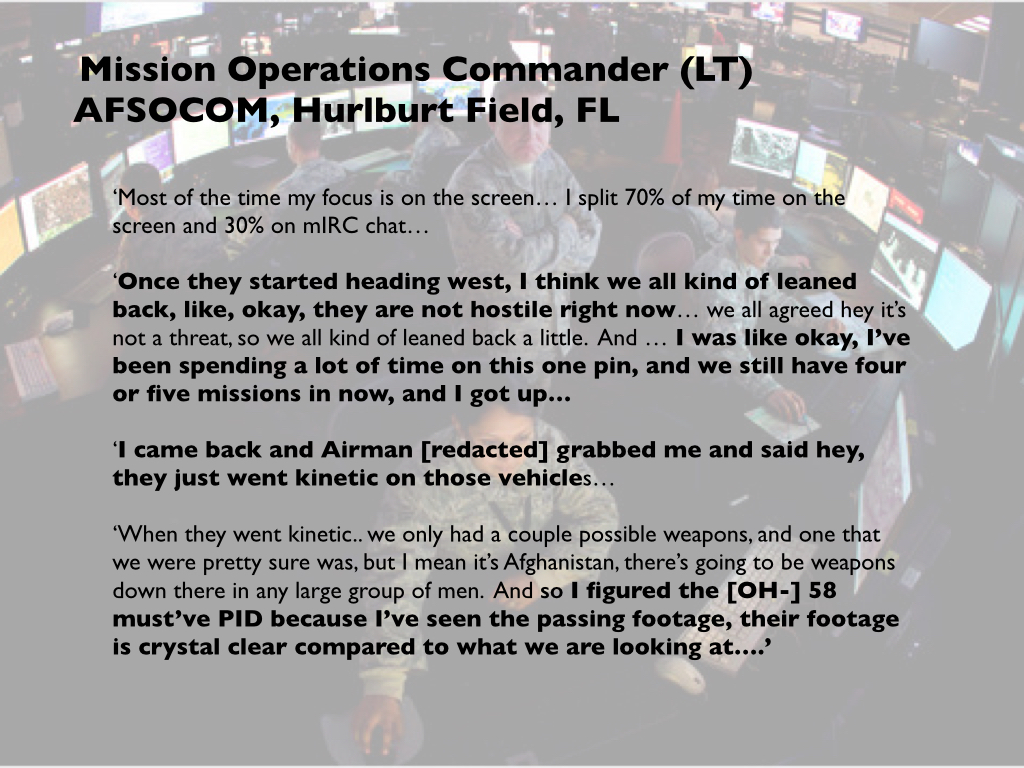
GREGORY Angry Eyes 2015 IMAGES.088

The Day Battle Captain testified:

‘I did not feel that the ground force commander would use any kind of close air support whatsoever to engage those vehicles… Based on the information that I had and looking at the vehicles move away it did not appear that they were moving towards the ground forces…

… as we were watching the Predator feed the first vehicles exploded. And everyone in the OPSCEN was immediately shocked… The amount of time from when that course of action approved by the SOTF commander to when we actually saw the strike occur there was no time, there was not adequate time to inform the ground commander that that was the course of action decided by the CJSOTF commander… I have phones ringing left and right, talking to people, trying to explain things, you know we look up on the screen and it happened…’
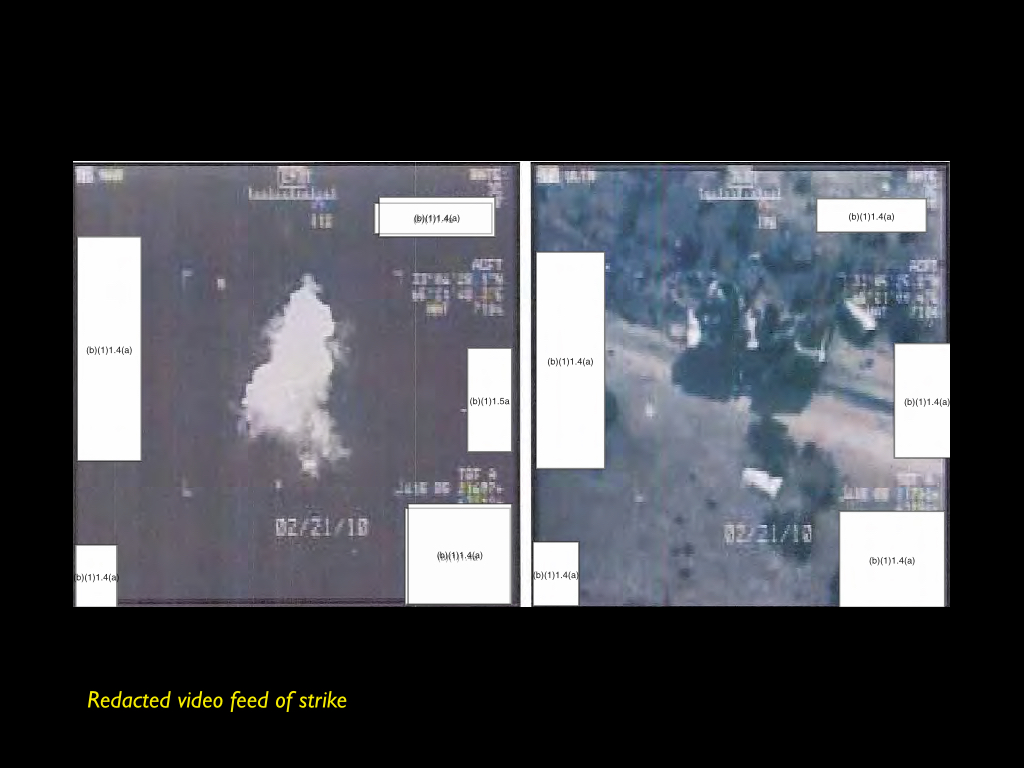
GREGORY Angry Eyes 2015 IMAGES.089

The Fires Officer:

‘I don’t think at any time anyone communicated to the GFC [Ground Force Commander] not to strike these vehicles because it is not something that we normally do. We feel that if he is in contact with the Predator and the OH-58s that we sent out to screen which we were not aware of and he is on the ground he generally has a pretty good picture of what is going on. He might be more privy to some conversation that he had with the OH-58 than what we know about. We normally give the GFC pretty big leeway on how they operate and the same with the JTAC because he has control of the assets and I am not going to try to take his assets away.’

In short, the investigation concluded that the Ground Force Commander never knew that an Aerial Vehicle Interdiction was being arranged, and neither of his higher commands were aware that he had cleared the helicopters to attack the three vehicles.

But, as I will show next, what lay behind these failures of communication was a de-centralised, distributed and dispersed geography of militarised vision whose fields of view expanded, contracted and even closed at different locations engaged in the administration of military violence.  Far from being a concerted performance of Donna Haraway‘s ‘God-trick’ – the ability to see everything from nowhere – this version of networked war was one in which nobody had a clear and full view of what was happening.

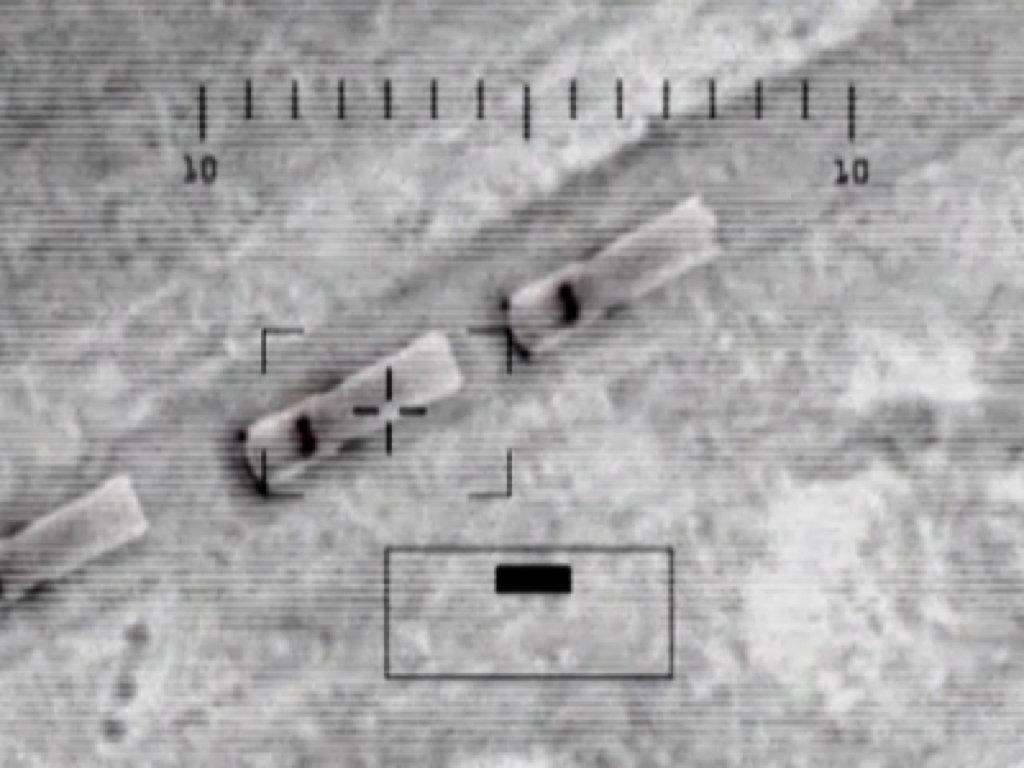
Part of this can be attributed to technical issues – the different fields of view available on different platforms, the low resolution of infra-red imagery (which Andrew Cockburn claims registers a visual acuity of 20/200, ‘the legal definition of blindness in the United States’), transmission interruptions, and the compression of full-colour imagery to accommodate bandwidth pressure.  So for example:
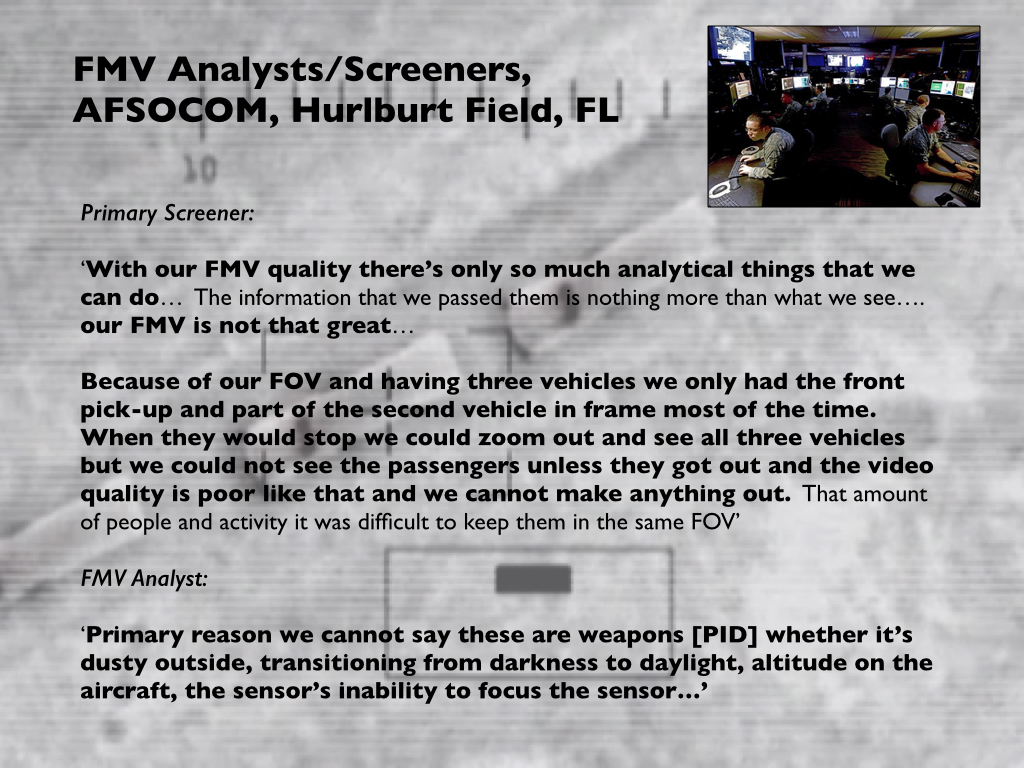
GREGORY Angry Eyes 2015 IMAGES.125

But it is also a matter of different interpretive fields.  Peter Asaro cautions:

‘The fact that the members of this team all have access to high-resolution imagery of the same situation does not mean that they all ‘‘see’’ the same thing. The visual content and interpretation of the visual scene is the product of analysis and negotiation among the team, as well as the context given by the situational awareness, which is itself constructed.’

The point is a sharp one: different visualities jostle and collide, and in the transactions between the observers the possibility of any synoptic ‘God-trick’ disappears.  But it needs to be sharpened, because different people have differential access to the distributed stream of visual feeds, mIRC and radio communications.  Here the disposition of bodies combines with the techno-cultural capacity to make sense of what was happening to fracture any ‘common operating picture’.   As one officer at Kandahar put it:

‘We didn’t have eyes on, minus ISR platform, that we can all see, who watches what? All the discrepancies between who watches what. What I see may be different from what someone else might interpret on the ISR… ISR is not reliable; it is simply a video platform.’

He was talking specifically about the multiple lines of communication (and hence bases for interpretation) within his Operations Center: now multiply that across sites scattered across Afghanistan and the continental United States and it becomes clear that the contemporary ‘fog of war’ may be as much the result of too much information as too little.

To be continued.
Angry Eyes (1)

GREGORY Angry Eyes 2015 IMAGES.028

I promised to post the notes for my presentation of ‘Angry Eyes: the God-Trick and the geography of militarised vision‘, and this is the first instalment (illuminated by some of the slides from the presentation). This isn’t the final, long-form version – and I would welcome comments and suggestions on these notes – but I hope it will provide something of a guide to where I’m coming from and where I’m going.

In many ways, this is a companion to ‘Dirty Dancing: drones and death in the borderlands’ (I’ll post the full text version of that shortly; until then see here, here and here), but that essay examines aerial violence in the Federally Administered Tribal Areas of Pakistan, tracing the long history of air strikes in the region, from Britain’s colonial ‘air policing’ of its North West Frontier through the repeated incursions by Afghan and Soviet aircraft during the Soviet occupation of Afghanistan (which are missing from most critical accounts) to today’s drone strikes directed by the CIA and air raids conducted by the Pakistan Air Force. ‘Angry Eyes’ focuses instead on a series of US air strikes inside Afghanistan.

(1) Eyes in the Sky

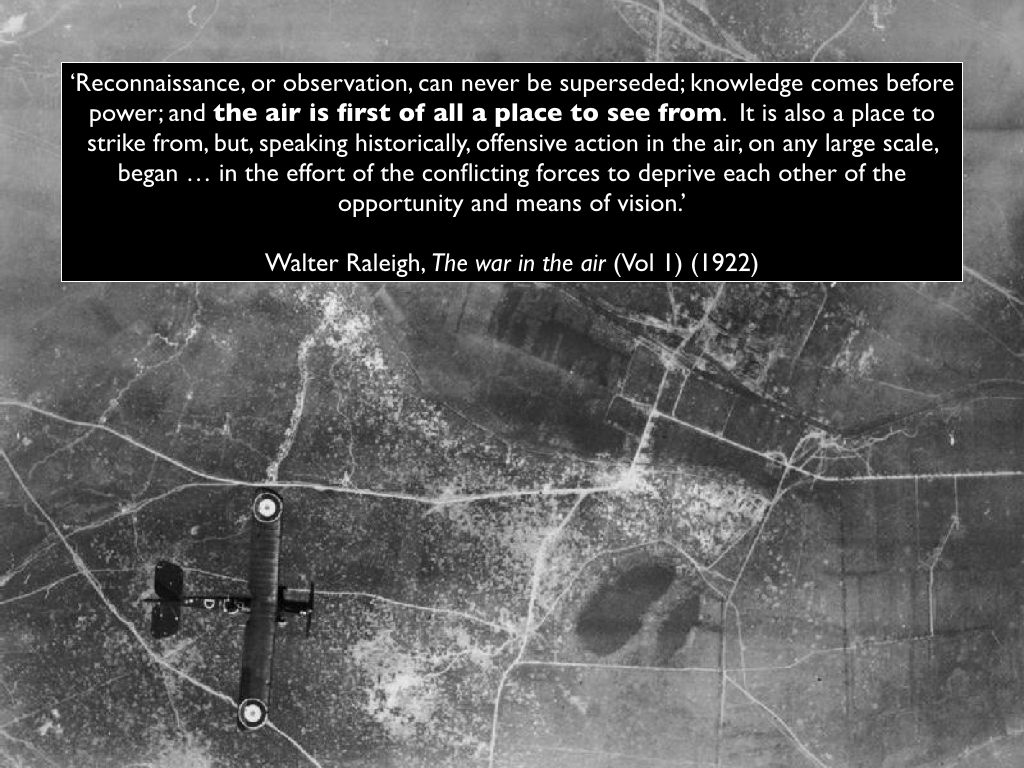
The history of aerial reconnaissance reveals an enduring intimacy between air operations and ground operations. Balloons and aircraft were essential adjuncts to army (and especially artillery) operations; before the First World War most commentator insisted that the primary use of military aircraft would be to act as spotters for artillery, enabling the guns to range on distant targets, and that bombing would never assume a major offensive role. As I’ve noted elsewhere, Orville Wright was among the sceptics: ‘I have never considered bomb-dropping as the most important function of the airplane,’ he told the New York Times in July 1917, ‘and I have no reason to change this opinion now that we have entered the war.’  For him – though he did not altogether discount the importance of striking particular targets, like the Krupp works at Essen – the key role of the aeroplane was reconnaissance (‘scouting’) for ground forces, including artillery: ‘About all that has been accomplished by either side from bomb dropping has been to kill a few non-combatants, and that will have no bearing on the result of the war.’  That was, of course, a short-sighted view – even in the First World War aircraft carried out strikes against targets on and far beyond the battlefield – but the sharper point is that the importance of aerial reconnaissance depended on a version of what today would be called networked war (albeit a desperately imperfect one) (see my ‘Gabriel’s Map [DOWNLOADS tab]; for the pre-war history of bombing, see here; for the bombing of Paris in the First World War see here). 

GREGORY Angry Eyes 2015 IMAGES.003

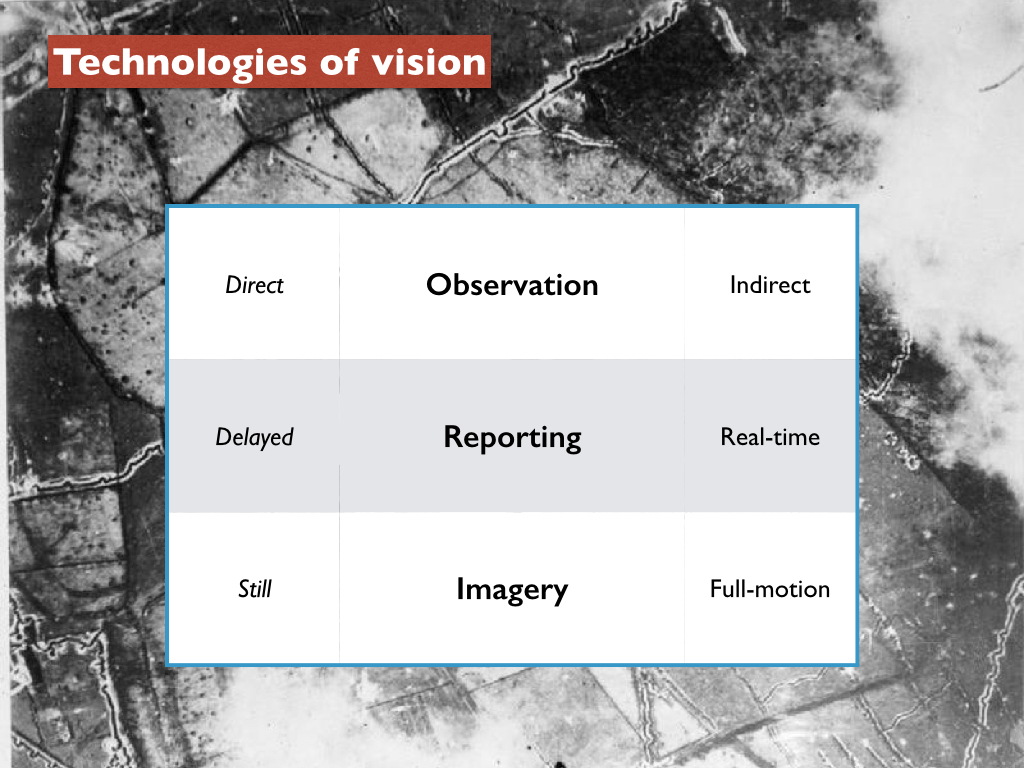
Over the next 50 years the technologies of vision changed dramatically: from direct to indirect observation, from delayed to real-time reporting, and from still to full motion imagery.

GREGORY Angry Eyes 2015 IMAGES.004

And the ligatures between seeing (or sensing) and shooting steadily contracted until these functions were combined in a single platform – notably (but not exclusively) the Predator and the Reaper.  Even then, wiring aerial operations to ground manoeuvres often (even usually) remains central:

GREGORY Angry Eyes 2015 IMAGES.006

Remarks like these speak directly to Donna Haraway’s cautionary critique of the ‘God-Trick’: the claim to see everything from nowhere, or at least from a privileged ‘vanishing point’. This has been made explicit by Lauren Wilcox in Bodies of Violence:

… the satellite systems and the drone’s video cameras mean that the bomber’s eye view is the God’s eye view of objectivity… this myth is put into practice in the apparatus of precision bombing, in which the view from above becomes the absolute truth, the view from nowhere.

And – Haraway’s point, which has been sharpened by Wilcox – is that this view from nowhere is, in some substantial sense, a view from no-body (and even of no-body). Here is Owen Sheers in his novel I saw a man:

“A U.S. drone strike.” That was all the press release said. No mention of Creech, screeners, Intel coordinator, an operator, a pilot. It was as if the Predator had been genuinely unmanned. As if there had been no hand behind its flight, no eye behind its cameras.

wilcox-bodies-of-violenceThe appeal to the divine is thus more than a rhetorical device. One Predator pilot admitted that ‘Sometimes I felt like God hurling thunderbolts from afar.’ As Wilcox notes, then,

‘Precision bombing reproduces the illusion of a disembodied subject with not only a privileged view of the world, but the power to destroy all that it sees…. The posthuman bodies of precision bombers, relying on God’s eye, or panoptical, views are produced as masterful, yet benign, subjects, using superior technology to spare civilians from riskier forms of aerial bombardment.’

And yet there have been seemingly endless civilian casualties…

(2) Killing and casualties in Afghanistan

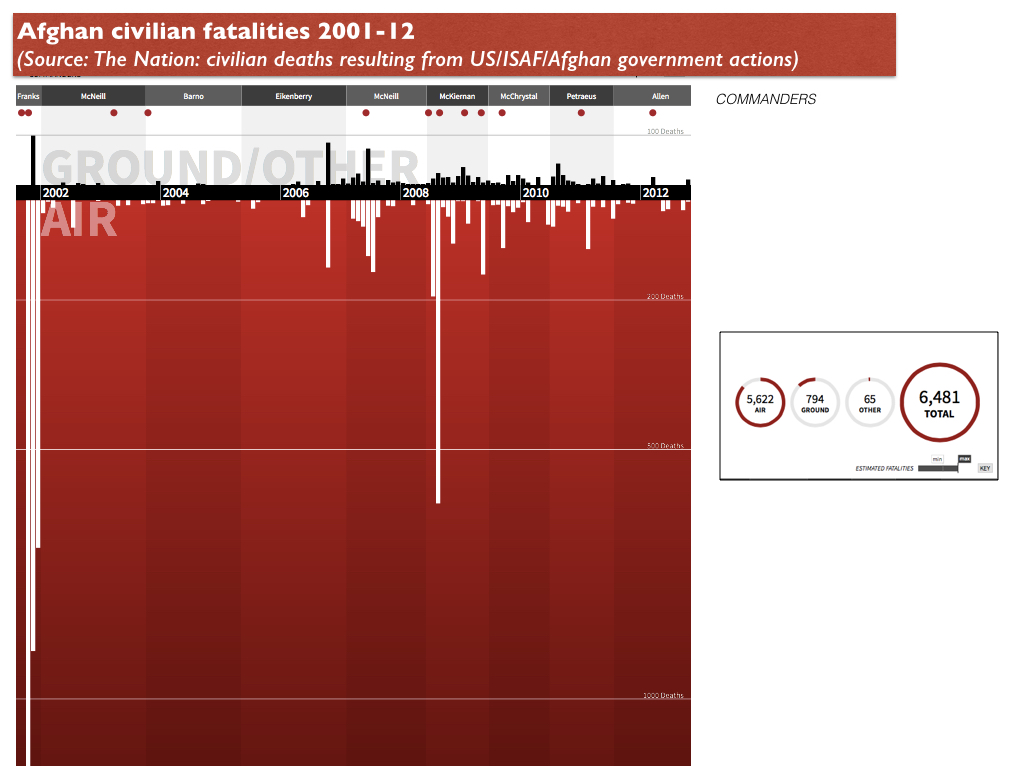
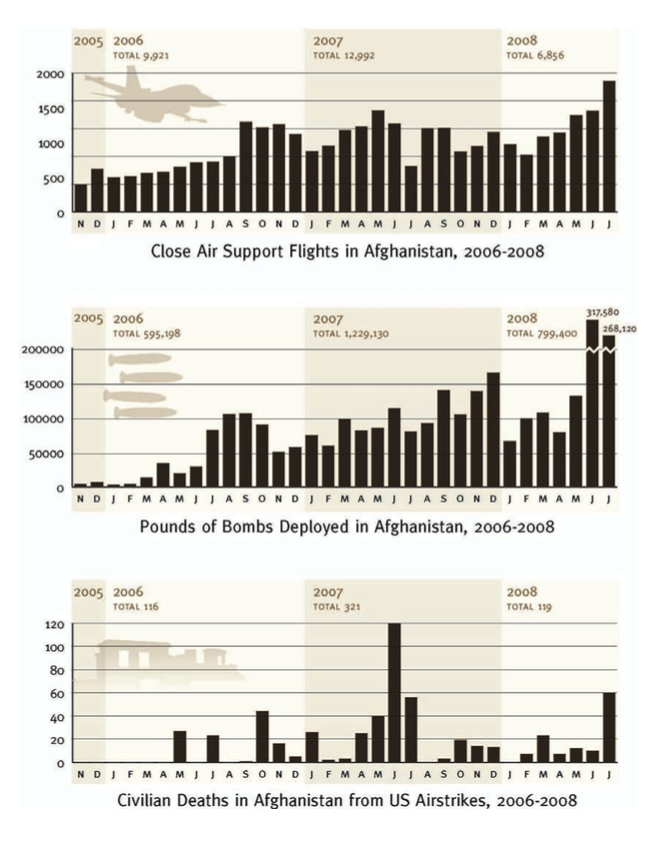
Throughout the US-led occupation of Afghanistan, air strikes have been the overwhelming cause of civilian deaths caused by coalition forces:

GREGORY Angry Eyes 2015 IMAGES.011

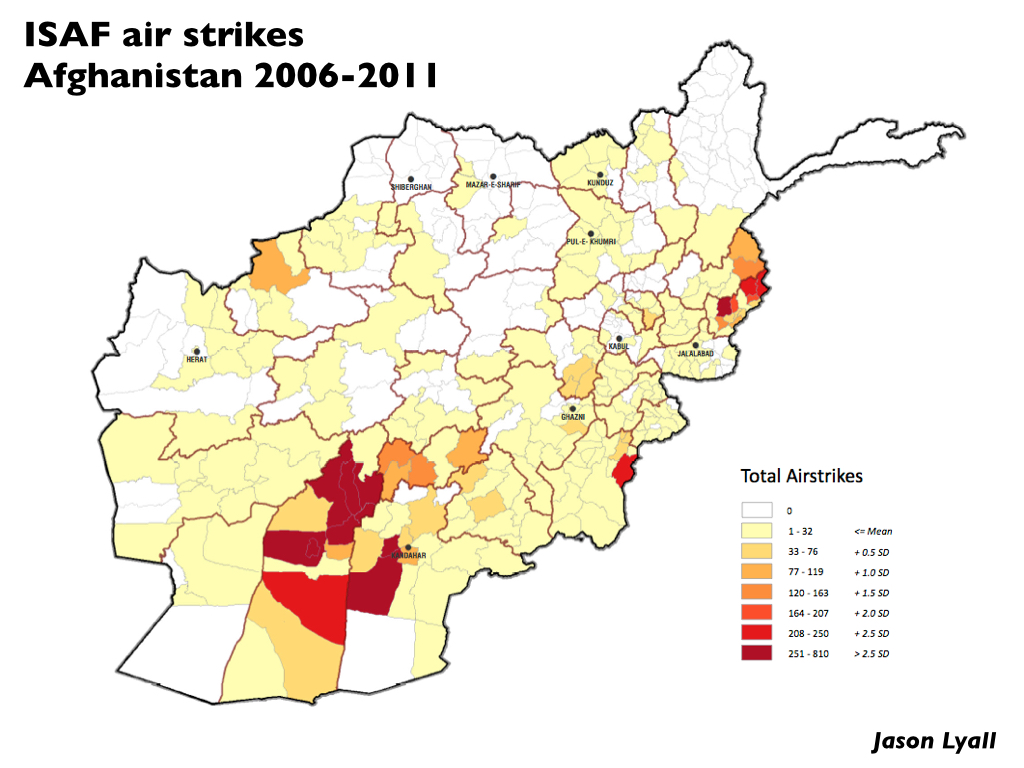
As Jason Lyall‘s marvellous work shows (below), air strikes have been concentrated in the south.  I should note that the title of his map refers explicitly to ISAF air operations – I’m not sure if this includes those conducted under the aegis of Operation Enduring Freedom, a separate US-UK-Agfghan operation, although a primary source of his data is USAF Central Command’s Airpower Statistics.  It makes a difference, for reasons I’ll explain later; the strike that is my primary focus took place in the south (in Uruzgan) but was in support of a Special Forces operation conducted under OEF.

Jason Lyall air strikes.001

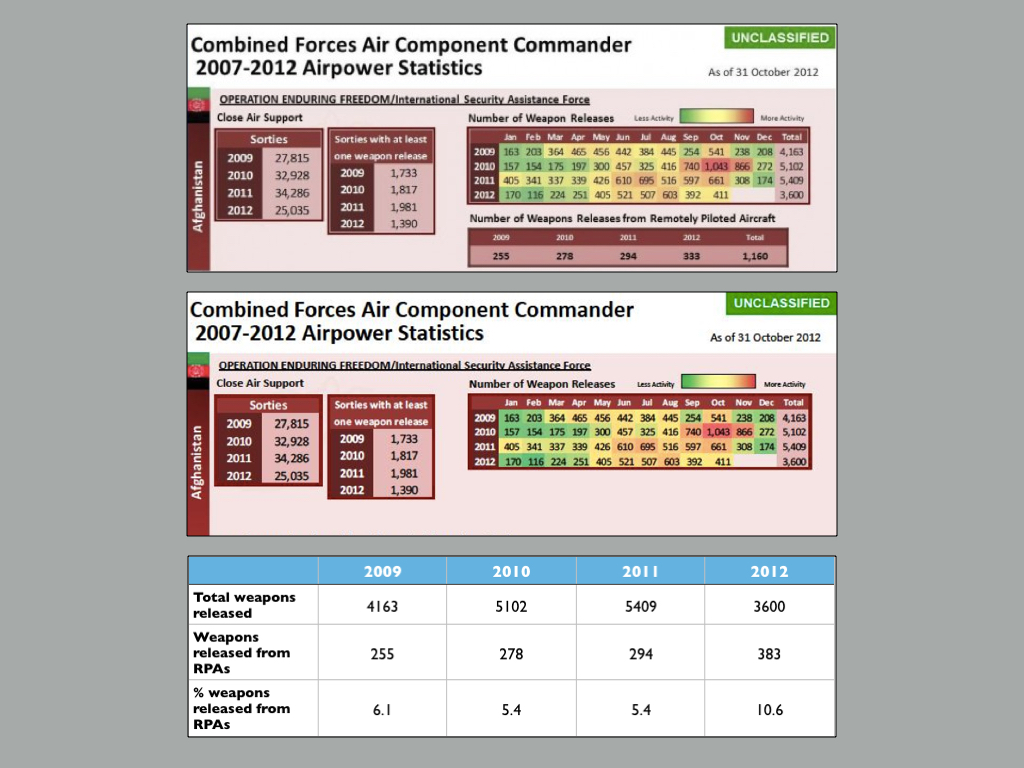
In any event, most of those strikes have been carried out from conventional platforms – strike aircraft or attack helicopters – not drones (though notice how the data on weapons released from Predators and Reapers was rapidly removed from the regular Airpower Statistics issued by US Central Command):

GREGORY Angry Eyes 2015 IMAGES.013

This relates to a specific period, and one might expect drone strikes to become even more important as the numbers of US ground troops in Afghanistan fall.  Even so:

  • in many, perhaps most of those cases drones have provided vital intelligence, surveillance and reconnaissance (ISR) capabilities: in effect, they may well have orchestrated the attacks even if they did not execute them;
  • according to the Bureau of Investigative Journalism [‘Tracking drone strikes in Afghanistan‘], ‘Afghanistan is the most drone bombed country in the world… Research by the Bureau… has found more than 1,000 drone attacks hit the country from the start of 2008 to the end of October 2012. In the same period, the Bureau has recorded 482 US drone strikes in Pakistan, Yemen, Somalia and Libya’; and
  • where drones have also carried out the attacks, Larry Lewis’s analysis of classified SIGACT data shows that ‘unmanned platforms [are] ten times more likely to cause civilian casualties than manned platforms’ (see also here)

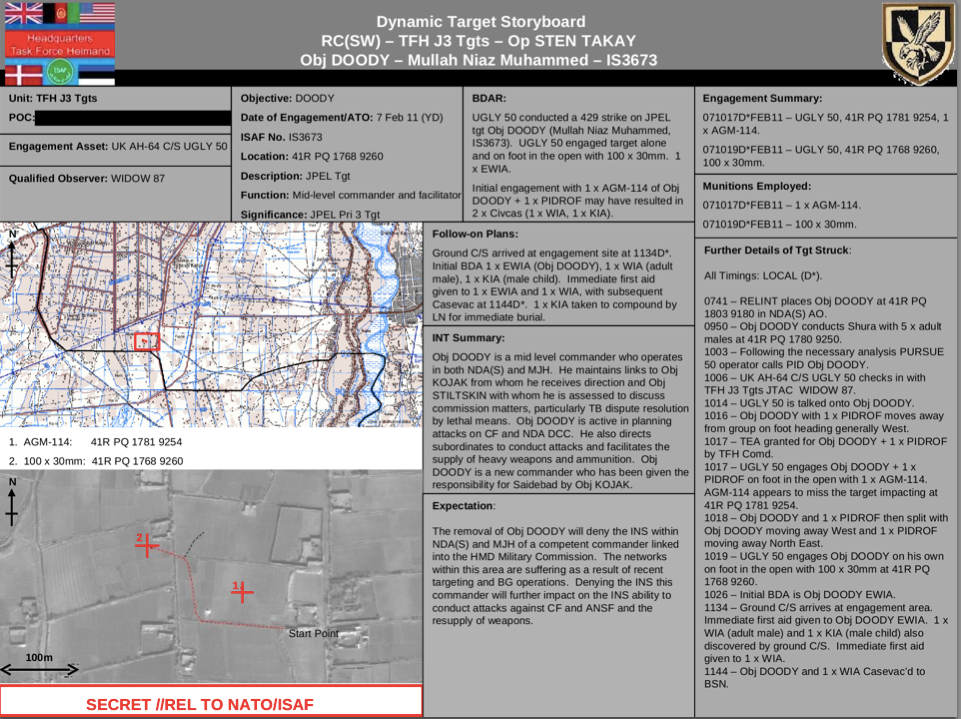
There have been two main forms of air strike in Afghanistan.  First, the US military carries out so-called ‘targeted killing’ there as well as elsewhere in the world; it has its own Joint Prioritized Effects List of people deemed to be legitimate military targets (see here and here), and the supposed capacity of its drones and their crews to put ‘warheads on foreheads’ means that they are often involved in these remote executions.

Dynamic Targeting Storyboard PNG

Even so, these operations have certainly caused the deaths of innocent civilians (see, notably, Kate Clark‘s forensic report on the Takhar attack in September 2010: more here).

Second, the US Air Force also provides close air support to ground troops – and civilian casualties are even more likely to result from these  situations, known as ‘Troops in Contact’.

GREGORY Angry Eyes 2015 IMAGES.019

HRW Troops in Contact and CIVCAS

As Marc Garlasco noted when he was working for Human Rights Watch:

“When they have the time to plan things out and use all the collateral damage mitigation techniques and all the tools in their toolbox, they’ve gotten to the point where it is very rare for civilians to be harmed or killed in these attacks.  When they have to do it on the fly and they are not able to use all these techniques, then civilians die.”

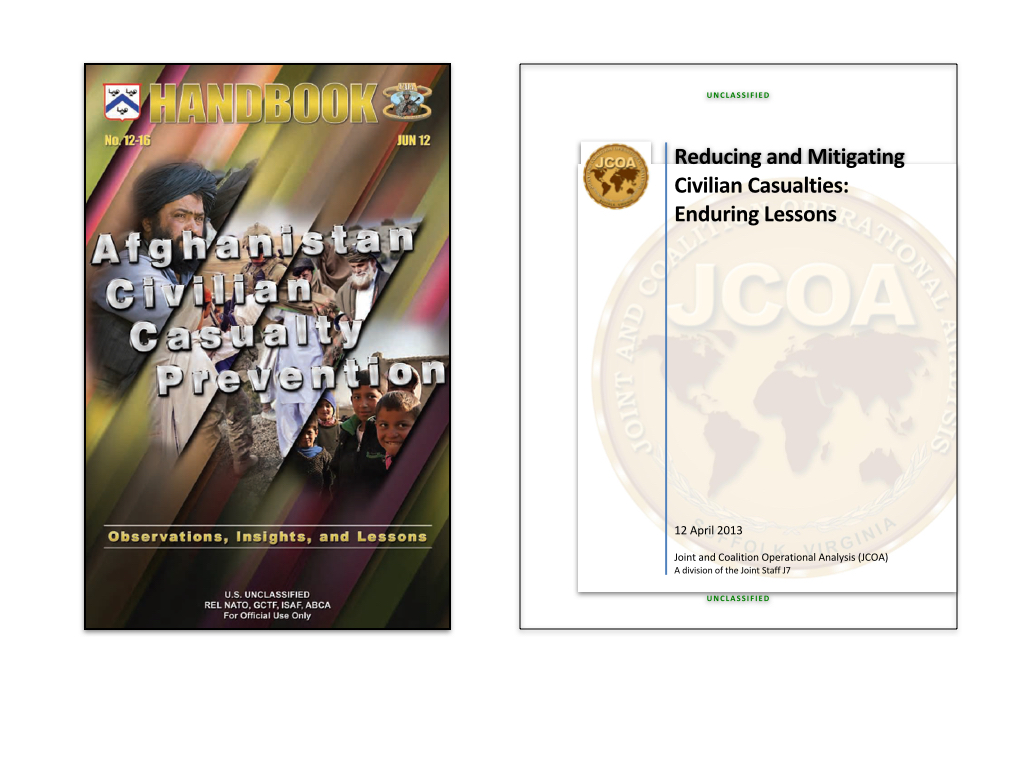
That said, it is simply wrong to claim that the US military is indifferent to civilian casualties.   There have been several major studies of civilian casualties (see also here and here).

GREGORY Angry Eyes 2015 IMAGES.009

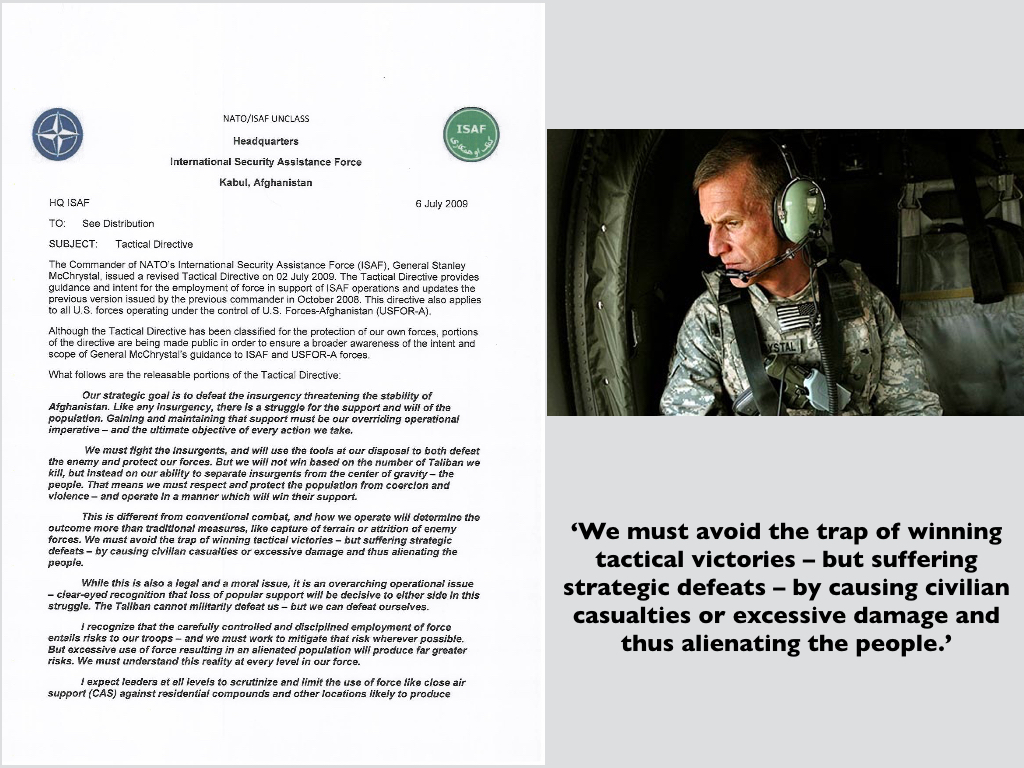
In addition, the juridification of later modern war means that military lawyers (JAGs) are closely involved in operational decisions (though the laws of war provide at best a limited shield for civilians and certainly do not outlaw their deaths); Rules of Engagement and Tactical Directives are issued and modified; and investigations into ‘civilian casualty incidents’ (CIVCAS) are established at the commander’s discretion.  Of most relevance to my own argument is General Stanley McChrystal‘s Tactical Directive issued on 6 July 2009.

GREGORY Angry Eyes 2015 IMAGES.021

This was not window-dressing.  Here is Michael Hastings in his by now infamous profile of McChrystal in Rolling Stone (8 July 2010):

McChrystal has issued some of the strictest directives to avoid civilian casualties that the U.S. military has ever encountered in a war zone. It’s “insurgent math,” as he calls it – for every innocent person you kill, you create 10 new enemies. He has ordered convoys to curtail their reckless driving, put restrictions on the use of air power and severely limited night raids. He regularly apologizes to Hamid Karzai when civilians are killed, and berates commanders responsible for civilian deaths. “For a while,” says one U.S. official, “the most dangerous place to be in Afghanistan was in front of McChrystal after a ‘civ cas’ incident.” The ISAF command has even discussed ways to make not killing into something you can win an award for: There’s talk of creating a new medal for “courageous restraint,” a buzzword that’s unlikely to gain much traction in the gung-ho culture of the U.S. military.

Indeed, McChrystal’s actions were fiercely criticised: see Charles Dunlap here (more here).

(3) Predator View

And so I turn to one of the most extensively documented CIVCAS incidents in Afghanistan: an attack on three vehicles near the village of Shahidi Hassas in Uruzgan province in February 2010, which killed at least 15-16 civilians and injured another 12.  This has become the ‘signature strike’ for most critical commentaries on drone operations:

GREGORY Angry Eyes 2015 IMAGES.023GREGORY Angry Eyes 2015 IMAGES.024

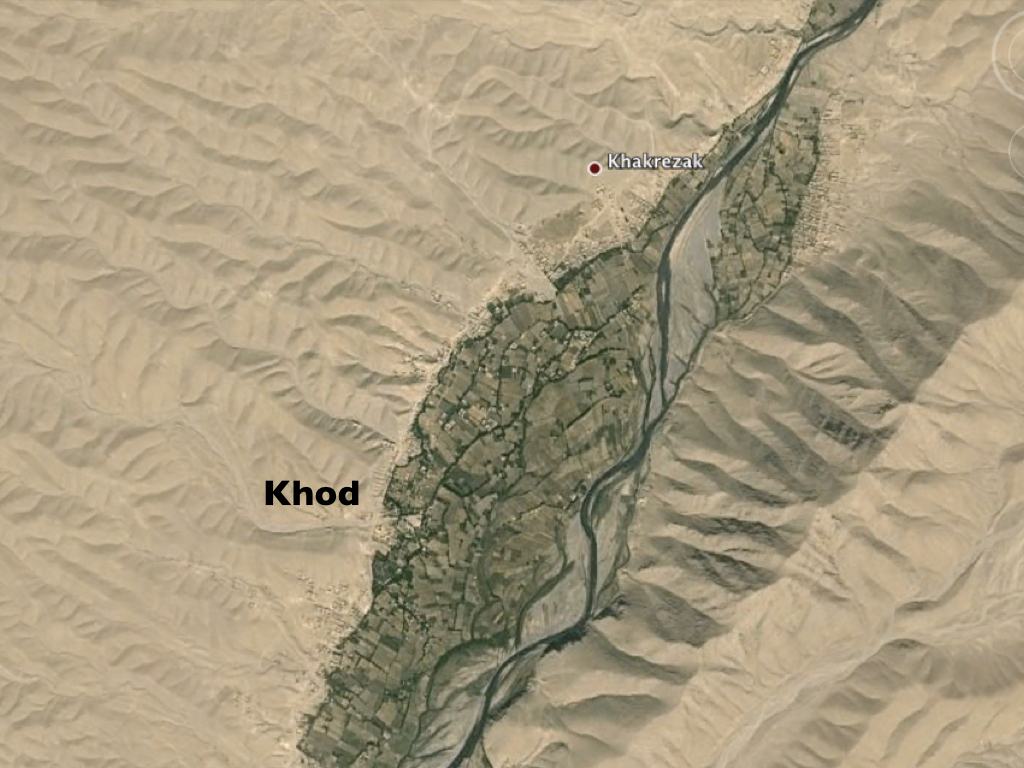
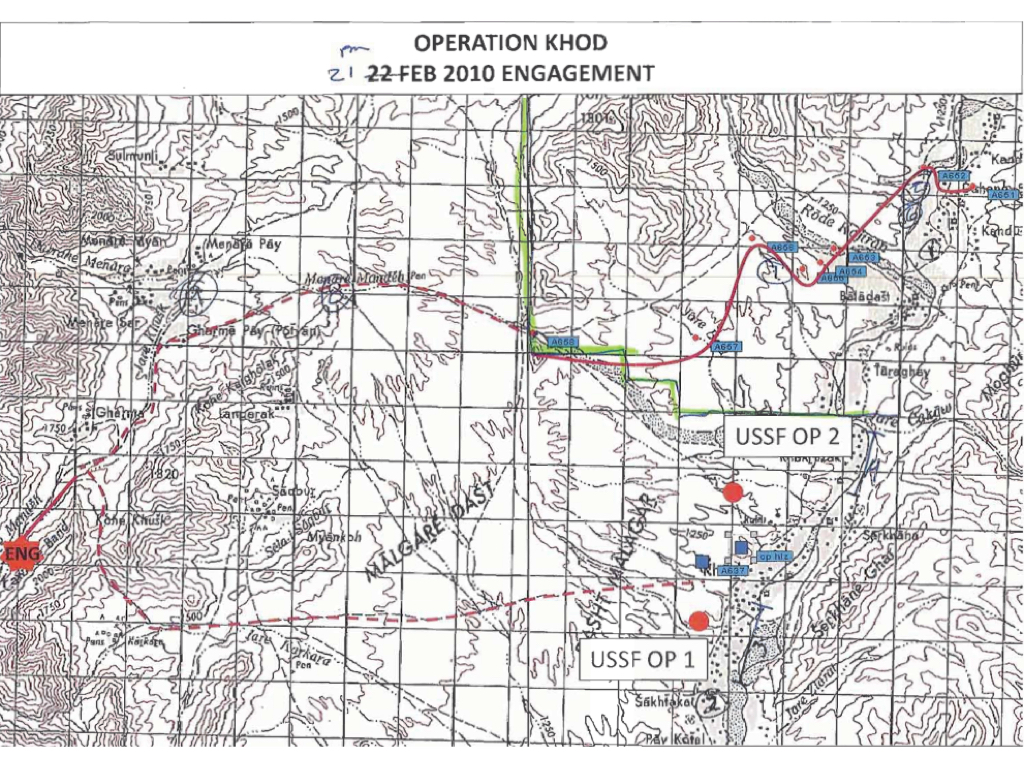
In the early morning of 21 February 2010 a US Special Forces team of 12 soldiers (these are always described as Operational Detachment Alpha: in this case ODA 3124) supported by 30 Afghan National Police officers and 30 Afghan National Army troops flew in on three Chinook helicopters to two locations near the village of Khod.  This is an arid, mountainous region but Khod lies in a river valley where an extensive irrigation system has been constructed to create a ‘green zone’:

KHOD map.001

On a scale from 0 to 2, this was a ‘level 1 CONOPS’, which means that it was judged to pose a ‘medium risk’ to the troops with ‘some potential for political repercussions’.  These are usually daylight cordon and search operations with air support.  In this case the mission was to search the compounds in and around the village for a suspected IED factory and to disrupt ‘insurgent infrastructure’.

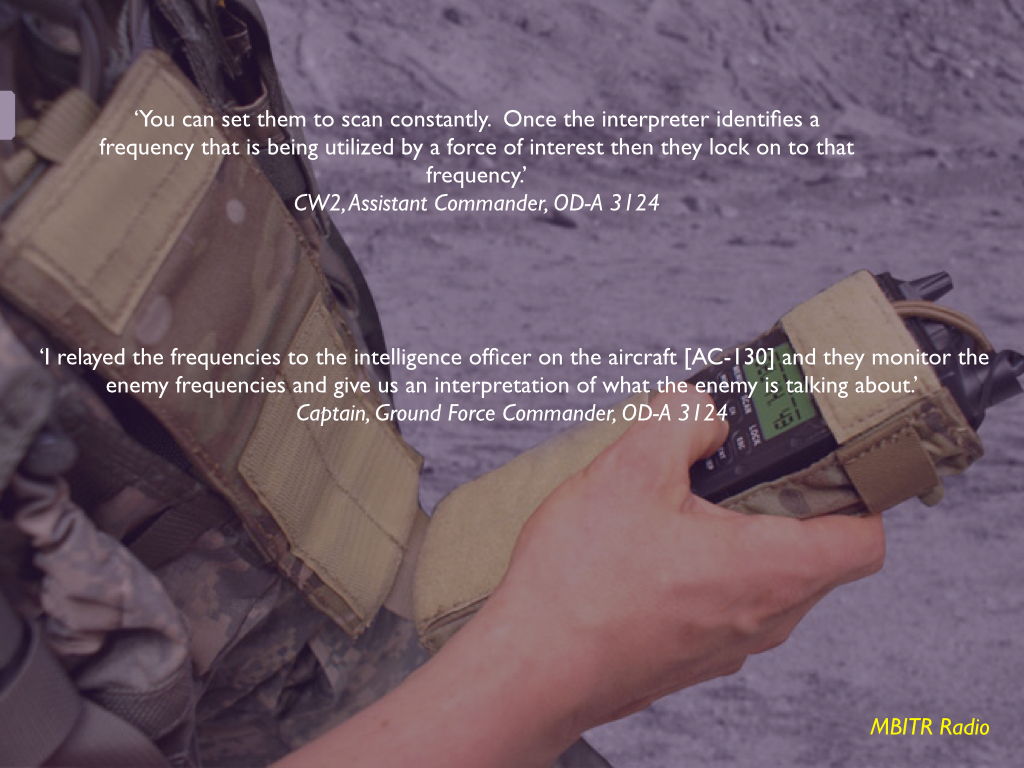
The Taliban clearly knew they were coming.  While the troops waited for dawn the scanners on their MBITR radios picked up chatter urging the mujaheddin to gather for an attack, and they passed the frequency to an AC-130 gunship which was providing air support; through their night vision goggles the troops could see figures ducking into the cover provided by the irrigation ditches; and communications intercepted by other support aircraft, including a manned electronic signals intelligence platform referred to only by its call sign ‘Arrow 30’, confirmed a strong Taliban presence.

MBITR radios scanning.001

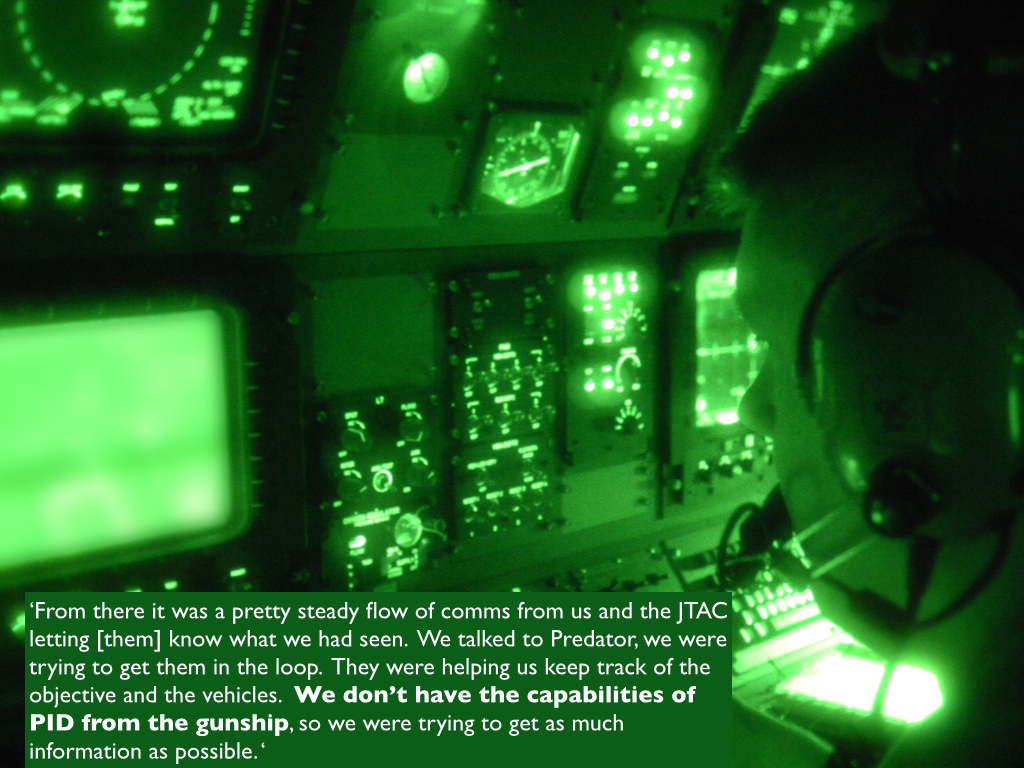
There were reports of vehicles moving towards the village from the south, and then headlights were detected five kilometres to the north.  The AC-130 moved north to investigate.  It had an extensive sensor suite on board but its resolution was insufficient for the crew to detect whether the occupants of the vehicles were armed [PID or ‘positive identification’ of a legitimate military target], and so they co-ordinated their surveillance with a Predator that had taken off from Kandahar Air Field and was controlled by a crew (call-sign KIRK 97) at Creech Air Force Base in Nevada.  In addition to its Multi-Spectral Targeting System, the Predator was equipped with an ‘Air Handler’ that intercepted and geo-located wireless communications; this raw signals intelligence was handled by an ‘exploitation cell’ (almost certainly operated by a National Security Agency unit at Kandahar) who entered their findings into one of the chat-rooms monitored by the Predator and other operations centres that were involved in the mission.

GREGORY Angry Eyes 2015 IMAGES.053

When the AC-130 started to run low on fuel, the Predator took over ISR for the duration of the mission.  The JTAC could not see the trucks from his position on the ground, and neither did he have access to the full-motion video feed from the Predator – the ODA was not equipped with a ruggedised laptop or ROVER [Remote Operational Video Enhanced Receiver] that should have been standard equipment (‘There’s one per base, and if it goes down you’re out of luck’) – and so he had to rely entirely on radio communications with the flight crew.

GREGORY Angry Eyes 2015 IMAGES.067

Throughout the night and into the morning the crew of the Predator interpreted more or less everything they saw on their screens as indicative of hostile intent: the trucks were a ‘convoy’ (at one stage they were referred to as ‘technical trucks’); the occupants were ‘Military Aged Males’ (’12-13 years old with a weapon is just as dangerous’); when they stopped to pray at dawn this was seen as a Taliban signifier (‘I mean, seriously, that’s what they do’); and when the trucks swung west, away from the direct route to Khod, this was interpreted as ‘tactical manoeuvring’ or ‘flanking’.

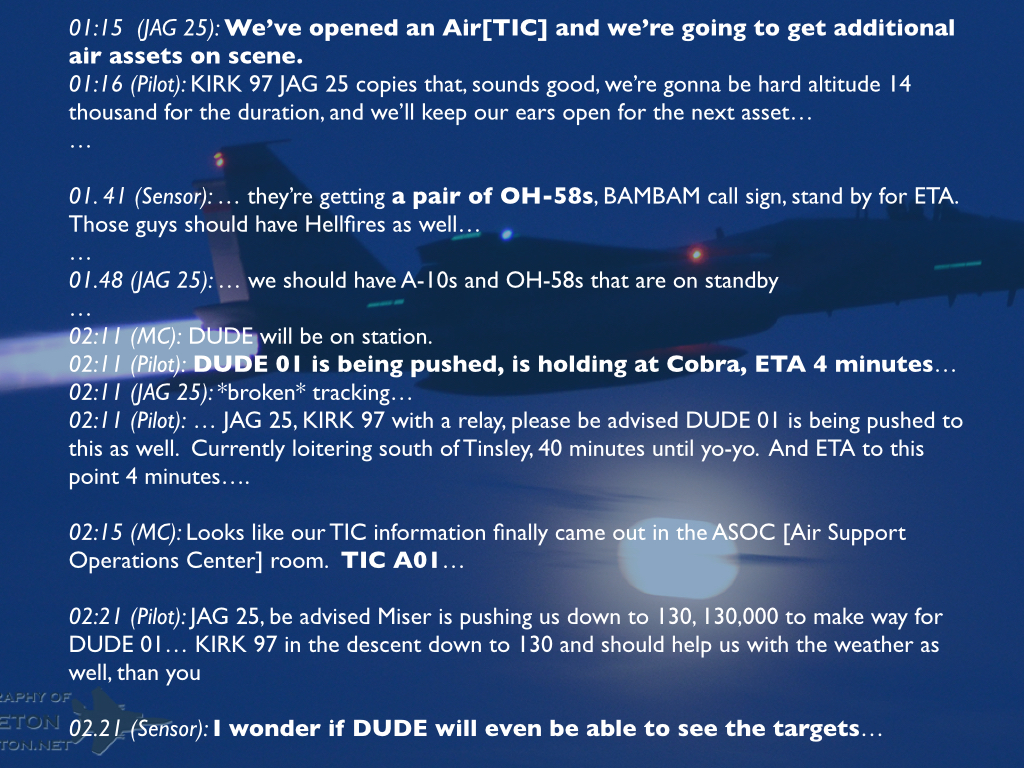
Eventually the ground force commander with ODA 3124 became convinced of hostile intent, and anticipated an imminent ‘Troops in Contact’.  This in turn prompted the declaration of a precautionary ‘AirTIC’ to bring strike aircraft on station since the Predator only had one Hellfire missile onboard.  The ground force commander was annoyed when fighter aircraft arrived (call-sign DUDE 01) – ‘I have fast movers over my station, my desire is to have rotary-wing aircraft’ – because he believed the engine noise would warn the target.  In fact, the JTAC who had access to intercepts of Taliban radio communication confirmed that ‘as soon as he showed up everyone started talking about stopping movement’;  coincidentally, as it happened, the vehicles immediately swung west, heading away from Khod.

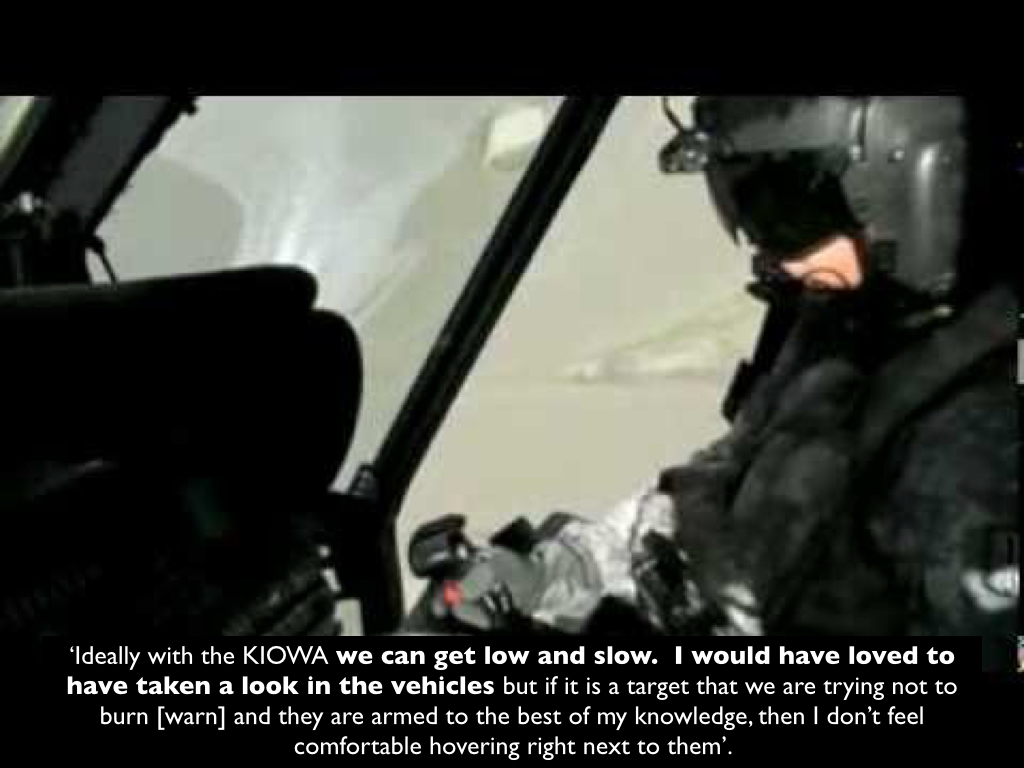
Two US Army Kiowa combat helicopters (OH-58s, call-sign BAM-BAM) were now briefed for the attack.

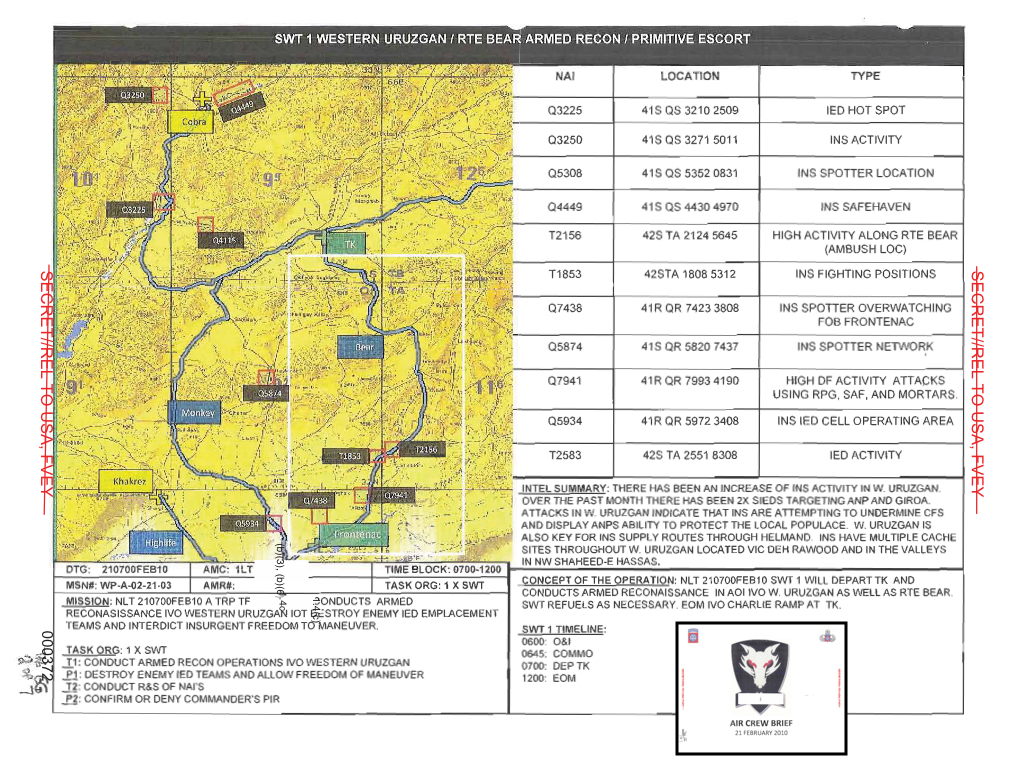
GREGORY Angry Eyes 2015 IMAGES.058

Their situation map (below) confirmed this as a landscape of ever-present threat, and this imaginative geography was instrumental in the reading of the situation and the activation of the strike:

GREGORY Angry Eyes 2015 IMAGES.080

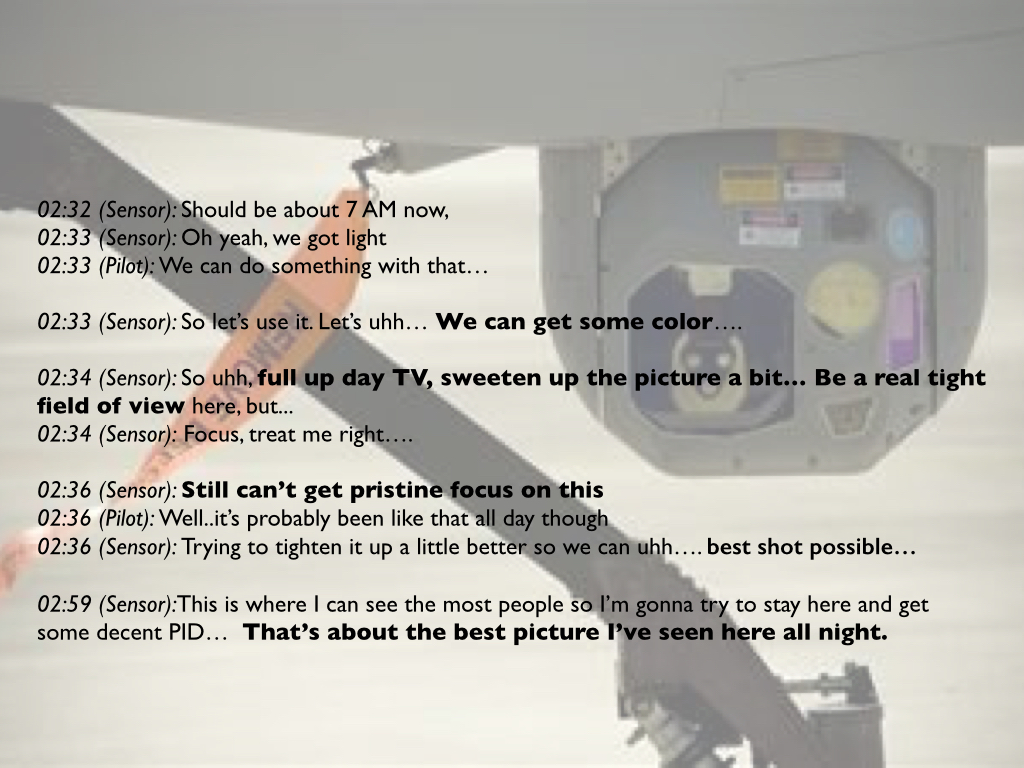
Meanwhile, the Predator’s sensor operator was juggling the image stream, switching from infrared to ‘Day TV’ and trying to sharpen the focus:

GREGORY Angry Eyes 2015 IMAGES.060

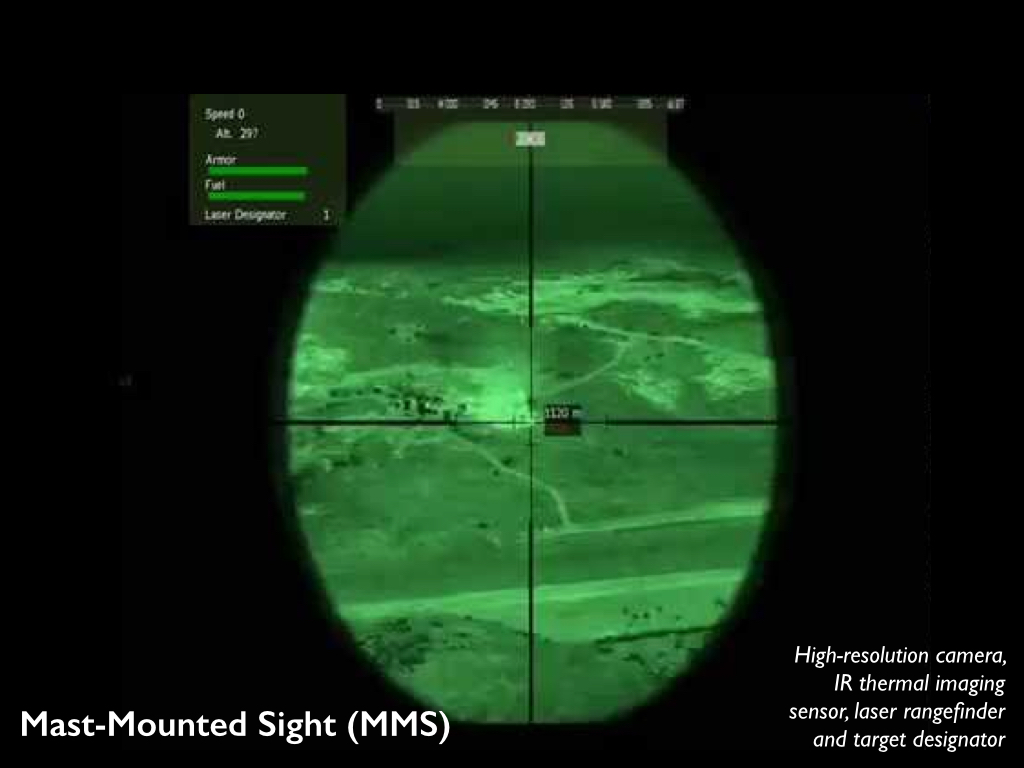
The helicopters had their own sensor system – a Mast Mounted Sight (MMS) – but its resolution was low (see below); they were also reluctant to come in low in case this warned the target:

GREGORY Angry Eyes 2015 IMAGES.082

GREGORY Angry Eyes 2015 IMAGES.085

In any case, there were severe limitations to what the pilots could see:

So, for all these reasons, they were reliant on what the Predator crew was telling them (they too had no access to the FMV feed from the Predator).  They lined up for the shot, and the Predator crew keenly anticipated being able to ‘play clean up’. ‘As long as you keep somebody that we can shoot in the field of view,’ the Predator pilot told his Sensor Operator, ‘I’m happy.’

GREGORY Angry Eyes 2015 IMAGES.086

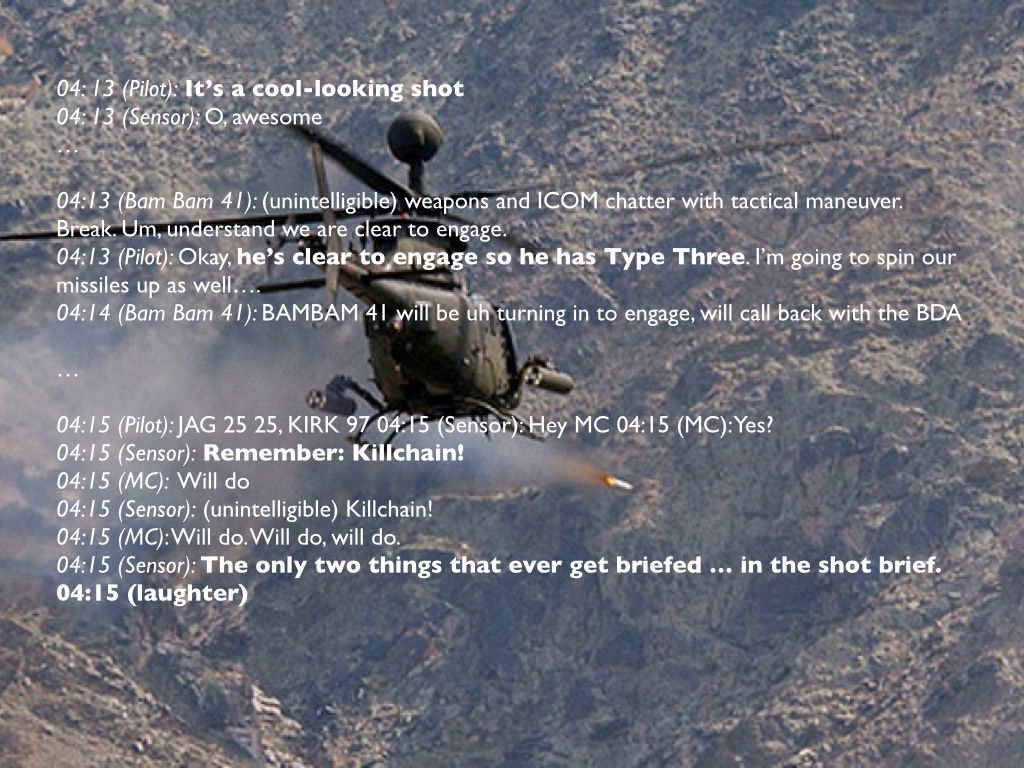
Throughout the mission the Predator crew had been communicating not only by radio but also through mIRC (internet relay chat); multiple windows were open during every mission, but KILLCHAIN was typed into the primary chat room to close down all ‘extraneous’ communications during the final run so that the crew could concentrate on executing the strike.

The ground commander through the JTAC cleared the helicopters to engage: ‘Type Three’ on the slide above refers to a control situation in which the JTAC can see neither the target nor the strike aircraft and wishes to authorise multiple attacks within a single engagement.  According to the US Air Force’s protocols for terminal control:

Type 3 control does not require the JTAC to visually acquire the aircraft or the target; however, all targeting data must be coordinated through the supported commander’s battle staff (JP 3-09.3). During Type 3 control, JTACs provide attacking aircraft targeting restrictions (e.g., time, geographic boundaries, final attack heading, specific target set, etc.) and then grant a “blanket” weapons release clearance to meet the prescribed restrictions. The JTAC will monitor radio transmissions and other available digital information to maintain control of the engagement.

Hellfire missiles from the helicopters ripped into the trucks, and when the smoke cleared those watching – from the helicopters and on screens at multiple locations in Afghanistan and the continental United States – began to suspect that women and children were clearly in the field of view.  A team from ODA 3124 was helicoptered in to co-ordinate the evacuation of casualties and to conduct a ‘sensitive site exploration’.

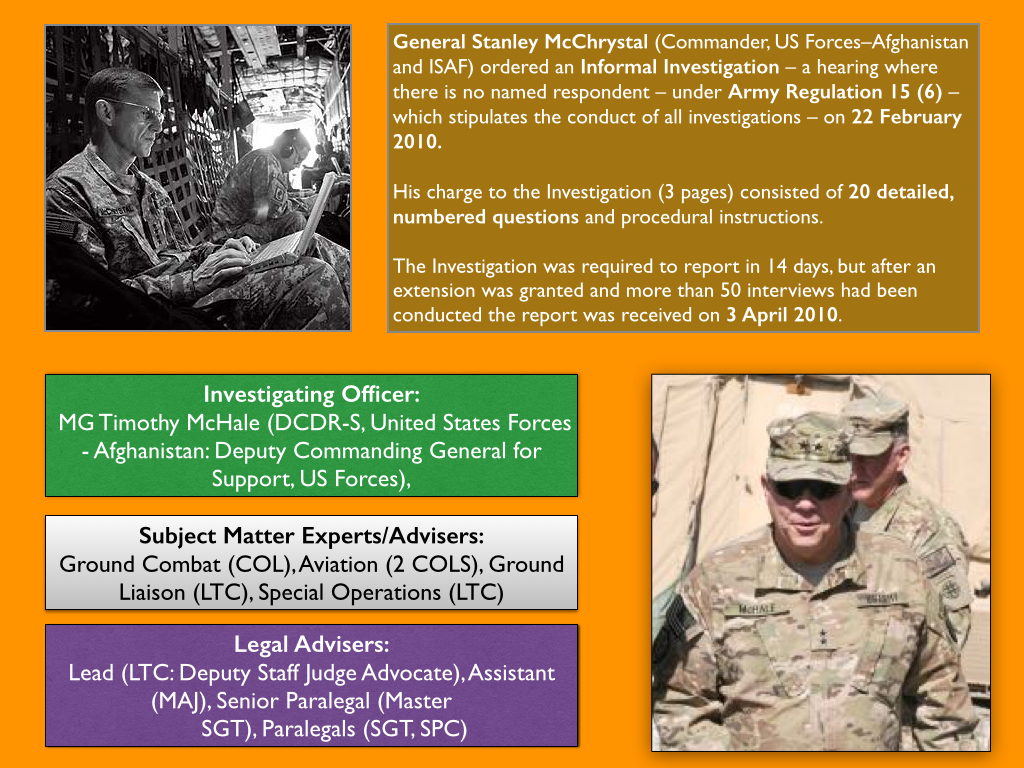
It turned out that the occupants of the vehicles were all Hazaras who were vehemently anti-Taliban (4,000 Hazara had been massacred by the Taliban at Mazar-i-Sharif in August 1998); they were going to Kandahar for a variety of reasons – shopkeepers going for supplies, a mechanic going to buy spare parts, students returning to school, patients seeking medical treatment, others simply looking for work – and they were travelling together (‘in convoy’) for safety through what they knew was Taliban territory. When civilian casualties were eventually confirmed – which is a story in itself – General McChrystal set up an Informal Investigation.

GREGORY Angry Eyes 2015 IMAGES.139

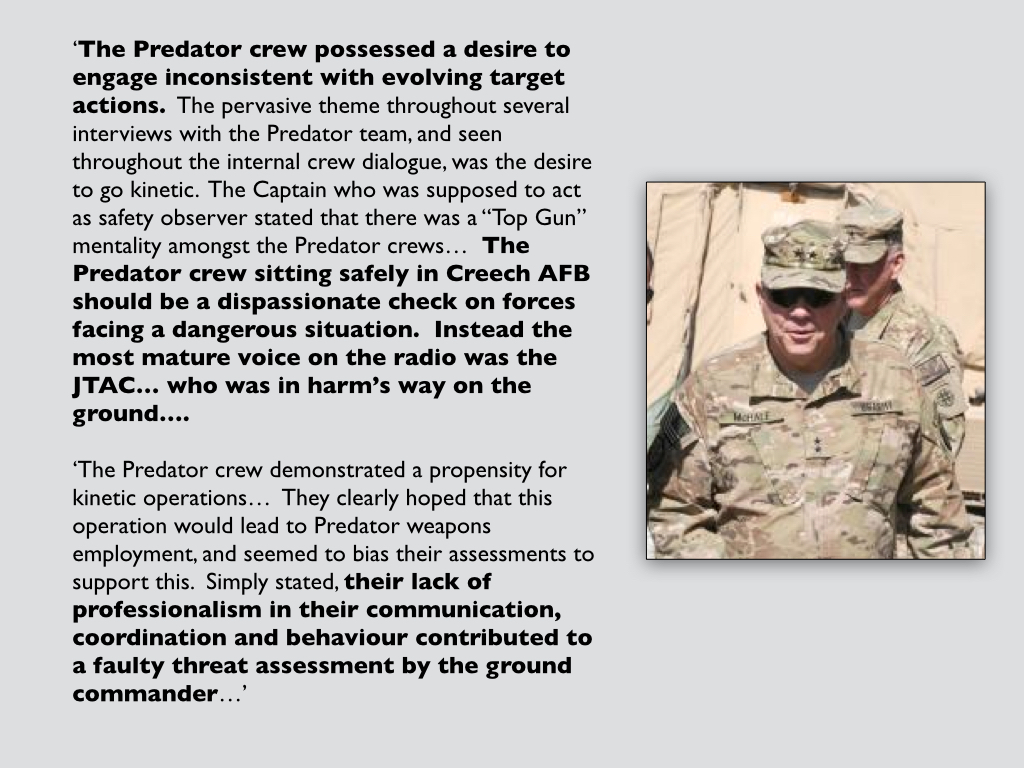
Most commentators (including me in “From a view to a kill”: DOWNLOADS tab) have endorsed the central conclusion reached by the Army investigation:

GREGORY Angry Eyes 2015 IMAGES.034

But this was not the conclusion reached by the USAF Commander’s Directed Investigation into the actions of the Predator crew (which McChrystal ordered when he received McHale’s report).  Major-General Robert Otto conceded that ‘the Predator crew’s faulty communications clouded the picture on adolescents and allowed them to be transformed into military-aged males’, but he insisted that their actions were otherwise entirely professional:

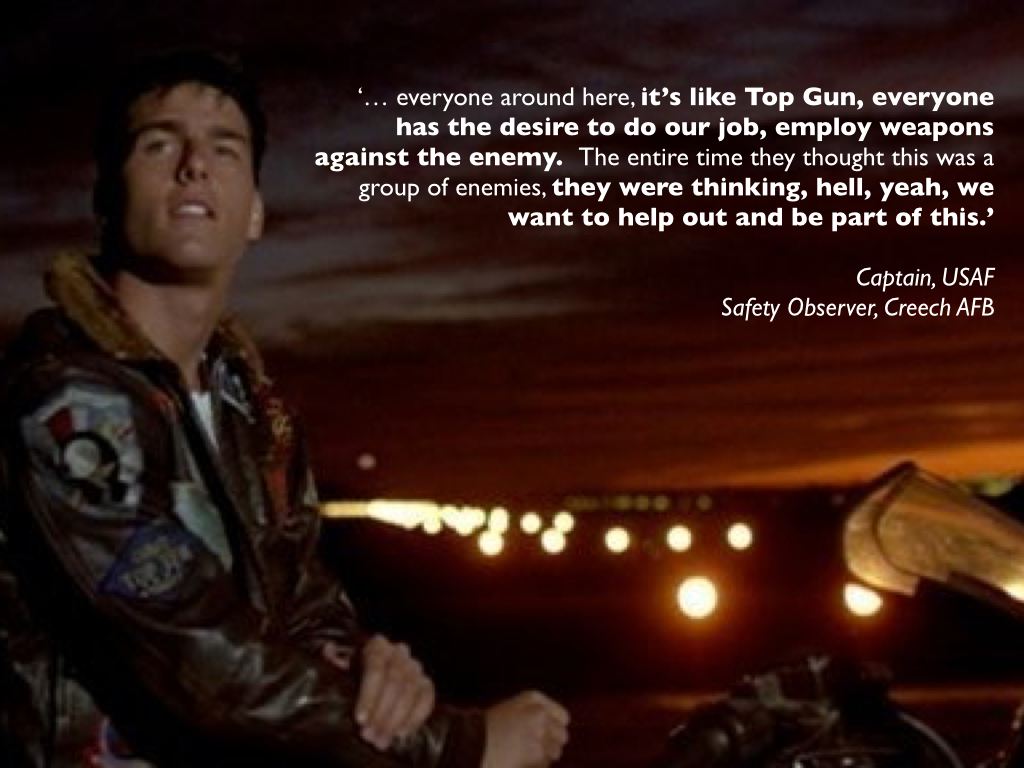
‘Upon INFIL and throughout the operation, extensive Intercepted Communications (ICOM) chatter correlated with FMV and observed ground movement appeared to indicate a group of over thirty individuals were an insurgent convoy…. Kirk 97 did not display an inappropriate bias to go kinetic beyond the desire to “support the ground commander”. The crew was alert and ready to execute a kinetic operation but there was no resemblance to a “Top Gun” mentality.’

The reference was to a statement made to McHale’s team by a captain at Creech:

GREGORY Angry Eyes 2015 IMAGES.036

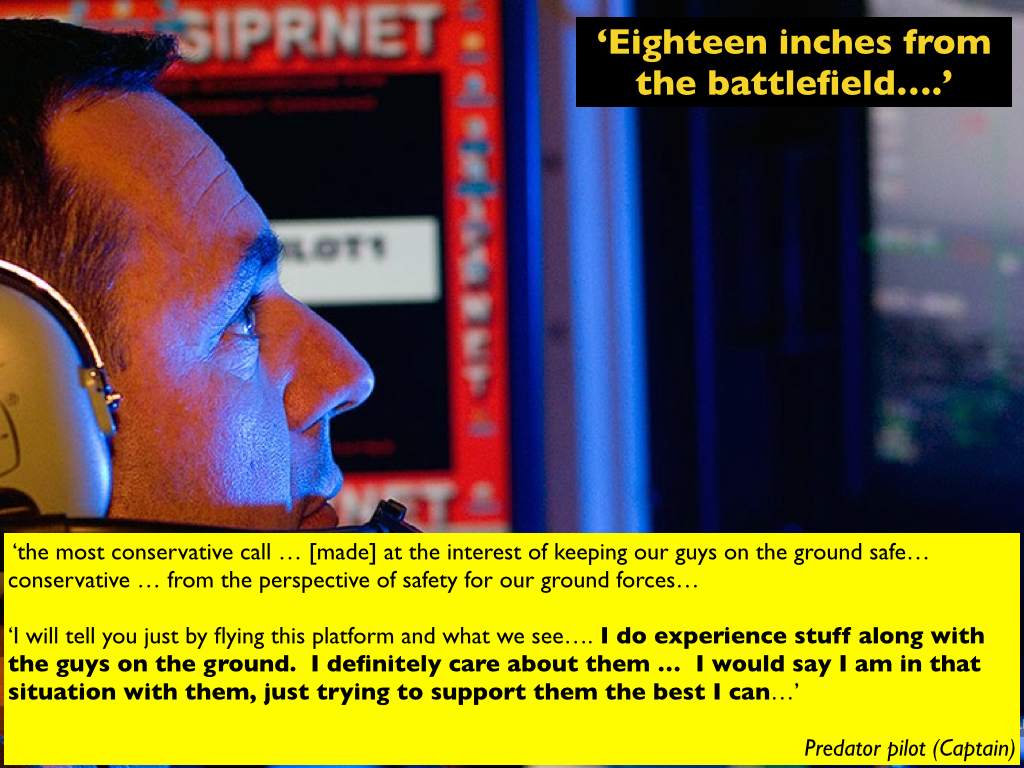
Be that as it may, the last clause– the desire ‘to help out and be part of this’ – is, I think, substantial.  As I argued in “From a view to a kill”, most Predator and Reaper crews insist that they are not thousands of miles from the battlefield but just eighteen inches away: the distance from eye to screen.  There is something profoundly immersive about the combination of full-motion video and live radio communication; perhaps the crews who operate these remote missions over-compensate for the physical distance to the troops on the ground by immersing themselves in a virtual distance that pre-disposes them to interpret so much that appears on their screens as hostile and threatening.

GREGORY Angry Eyes 2015 IMAGES.037

So far, so familiar.  But two qualifications impose themselves.

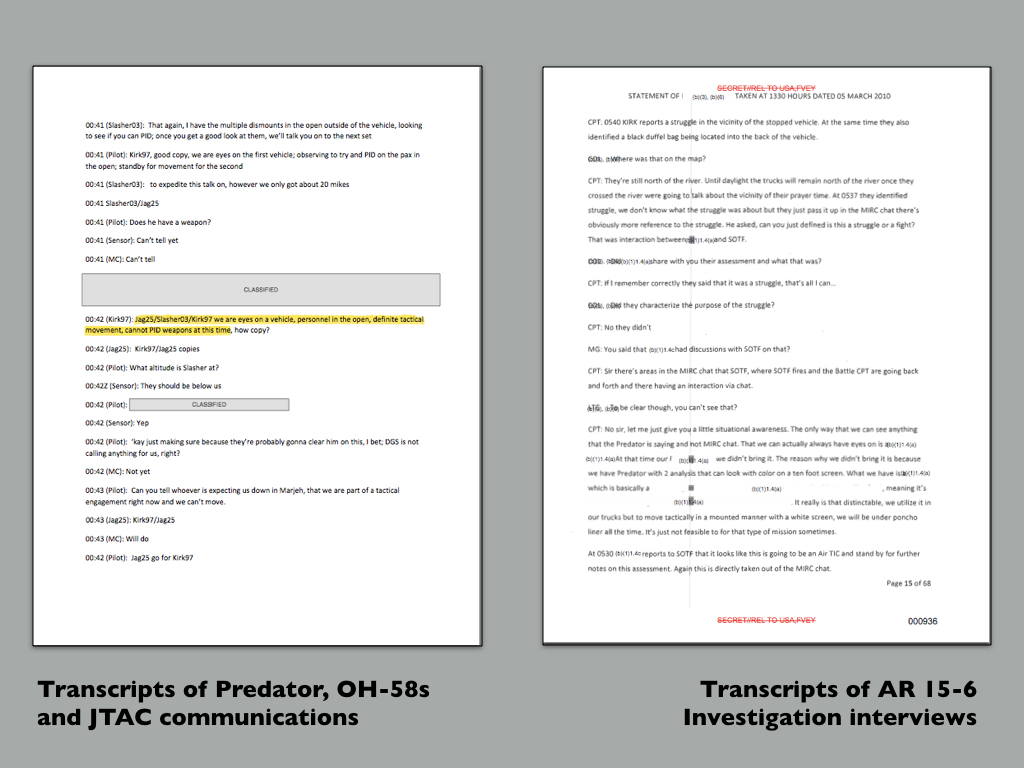
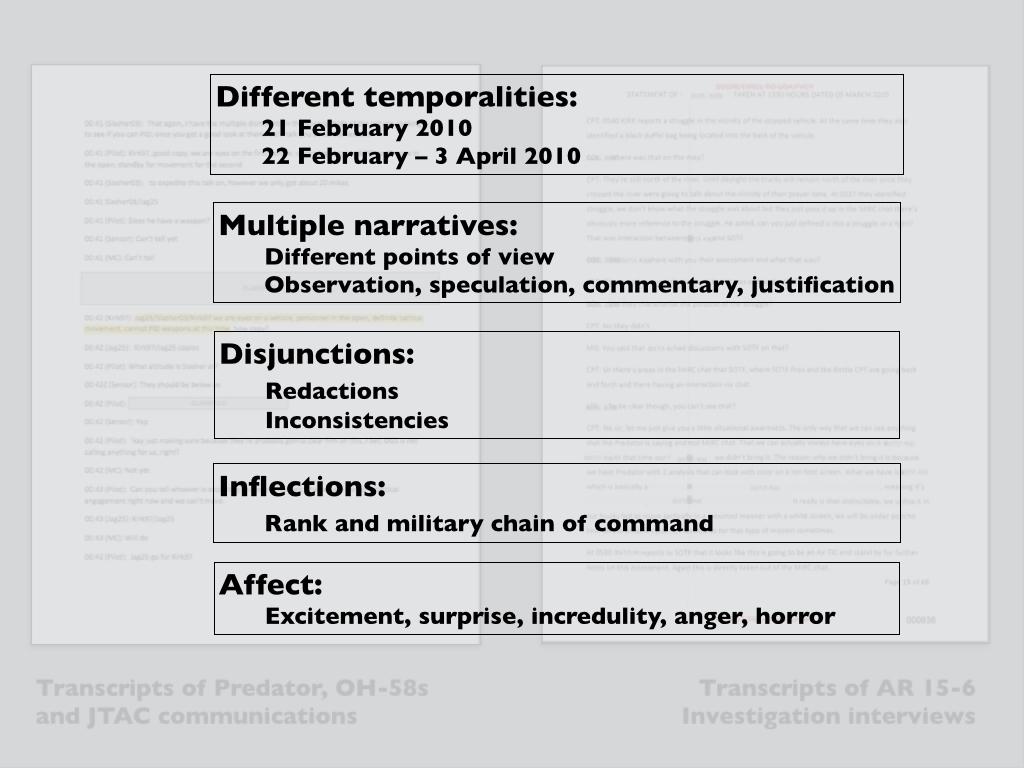
First, virtually all the published accounts that I have read – and the one that I have published – draw on a detailed report by David S. Cloud, ‘Anatomy of an Afghan war tragedy‘, that appeared in the Los Angeles Times on 10 April 2011, which was based on a transcript of radio communications between the Predator crew, the helicopter pilots and a Joint Terminal Attack Controller (JTAC) who was relaying information to and from the ground force commander.  But according to Andrew Cockburn, McHale’s original investigation compiled a hand-drawn timeline of events that ran for 66 feet around the four walls of a hangar he had commandeered for his office; his investigation ran to over 2,000 pages of evidence and transcripts.  It’s a complicated, composite document: a record of transactions – of conversations, negotiations and interrogations inflected by the chain of command – made at different times, in different places and under different circumstances. Redactions make inference necessarily incomplete, and there are inevitably inconsistencies in the accounts offered by different witnesses. So I need to be cautious about producing a too coherent narrative – this is not the tightly integrated ‘network warfare’ described by Steve Niva in his excellent account of Joint Special Operations Command (‘Disappearing violence: JSOC and the Pentagon’s new cartography of networked warfare’, Security dialogue 44 (2013) 185-202).

GREGORY Angry Eyes 2015 IMAGES.137

GREGORY Angry Eyes 2015 IMAGES.138

Still, when you work through those materials a radically different picture of the administration of military violence emerge.  In his important essay on ‘The necropolitics of drones’ (International Political Sociology 9 [2015] 113-127) Jamie Allinson uses McHale’s executive summary to demarcate the kill-chain involved in the incident:

The US military “kill chain” involved in the Uruzgan incident comprised ground troops, referred to in the text as “Operational Detachment Alpha” (ODA), the Predator Drone operators based at Creech Air Force Base in Nevada, the “screeners” processing information from the Predator video feeds at Hurlburt Field Base in Florida, and helicopter gunships known as ‘OH-58D’ in the text. The helicopters fired the actual missiles: but this was on the basis of decision made by drone operators based on their interpretation of what the screeners said.

But – as I’ll show in the second instalment – the kill-chain was far more extensive and included two Special Forces operations centers at Kandahar and Bagram that were responsible for overseeing and supporting the mission of ODA-3124.

GREGORY Angry Eyes 2015 IMAGES.064

The significance of this becomes clearer – my second qualification – if the air strike in Uruzgan is analysed not in isolation but in relation to other air strikes that also produced unintended casualties.  As a matter of fact, official military investigations are required to be independent; they are not allowed to refer to previous incidents and, indeed, JAGs who advise on targeting do not routinely invoke what we might think of as a sort of ‘case law’ either.  But if this air strike is read in relation to two others – an attack by two F-15E strike aircraft on a tanker hijacked by the Taliban near Kunduz on 4 September 2009, and an attack carried out by a Predator in the Sangin Valley on 6 April 2011 – then revealing parallels come into view.  All three were supposed to involve ‘Troops in Contact’; the visual feeds that framed each incident – and through which the targets were constituted as targets – were highly ambiguous and even misleading; and the role of the ground force commander and the operations centers that were supposed to provide support turns out to have been critical in all three cases.

To be continued.
Bombs and books

Among a million and one other things, I’ve returned to my work on the history of bombing for my Reach from the Sky lectures in January.

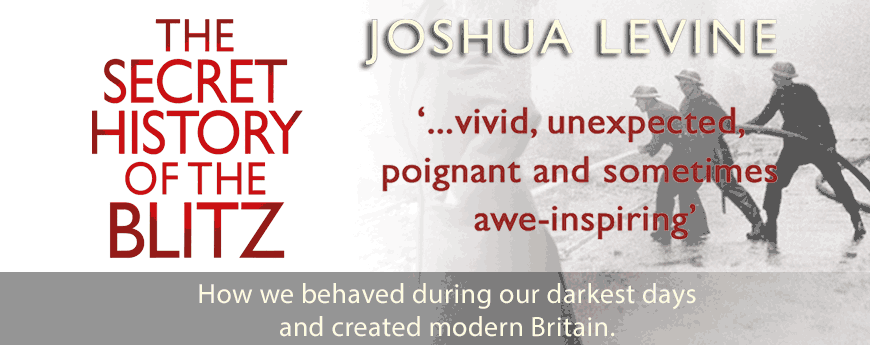
Secret History of the Blitz

I’ve long admired Joshua Levine‘s work, and his Secret History of the Blitz is thoroughly impressive.  Many others have picked their way across the bomb-sites before, of course, but there are genuinely novel insights to be found amidst the rubble and Levine is an excellent (and wonderfully literate) collector.

2015 is the 75th anniversary of the the Blitz of 1940-41. It is one of the most iconic periods in modern British history – and one of the most misunderstood. The ‘Blitz spirit’ is celebrated by some, whereas others dismiss it as a myth. Joshua Levine’s thrilling biography rejects the tired arguments and reveals the human truth: the Blitz was a time of extremes of experience and behaviour. People were pulling together and helping strangers, but they were also breaking rules and exploiting each other. Life during wartime, the author reveals, was complex and messy and real.

From the first page readers will discover a different story to the one they thought they knew – from the sacrifices made by ordinary people to a sudden surge in the popularity of nightclubs; from secret criminal trials at the Old Bailey to a Columbine-style murder in an Oxford college. There were new working opportunities for women and the appearance of unfamiliar cultures: whilst prayers were offered up in a south London mosque, Jamaican sailors were struggling to cross the country. Unlikely friendships were fostered and surprising sexualities explored – these years saw a boom in prostitution and even the emergence of a popular weekly magazine for fetishists. On the darker side, racketeers and spivs made money out of the chaos, and looters prowled the night to prey on bomb victims.

From the lack of cheese to the decreased suicide rate, this astonishing and entertaining book takes the true pulse of a ‘blitzed nation’. And it shows how social change during this time led to political change – which in turn has built the Britain we know today.

You can find good reviews from the Independent here and from the Telegraph here.

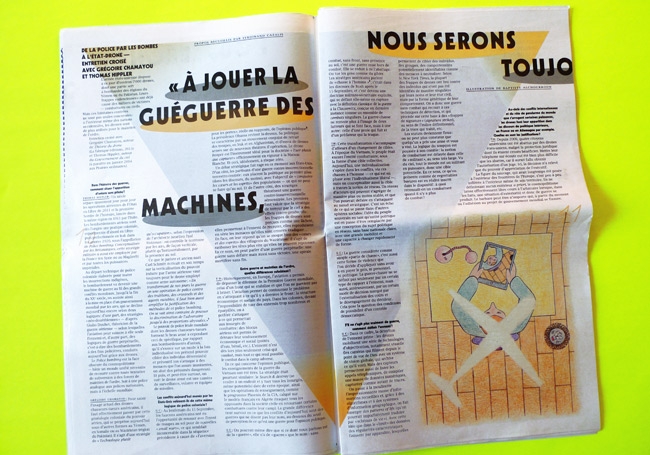
Le gouvernement du ciel

Very different in reach and tone (but also impressively literate), and in many ways much closer to some of the themes I want to address in Cambridge in January,  is Thomas Hippler‘s Le gouvernment du ciel: histoire globale des bombardements aériens.  Readers interested in these things will surely know his remarkable account of Giulio Douhet,  Bombing the People: Giulio Douhet and the Foundations of Air-Power Strategy, 1884–1939; the new book picks up from the last chapter of the previous one in many ways.

Here is the Contents List:

Prologue

The earth, the sea and the sky

Towards perpetual peace

The colonial matrix

Civilisation, cosmopolitanism and democracy

The people and the populace

Philosophy of the bomb

Making and unmaking a people

Under the nuclear shield, ‘revolutionary war’

World governance and perpetual war

As you can perhaps divine from the chapter titles, this is at once an attempt to write a global history of the twentieth century through diagnostic episodes in bombing’s bleak history and a discussion of the political formations that aerial violence both presupposed and installed.
Chamayou:Hippert

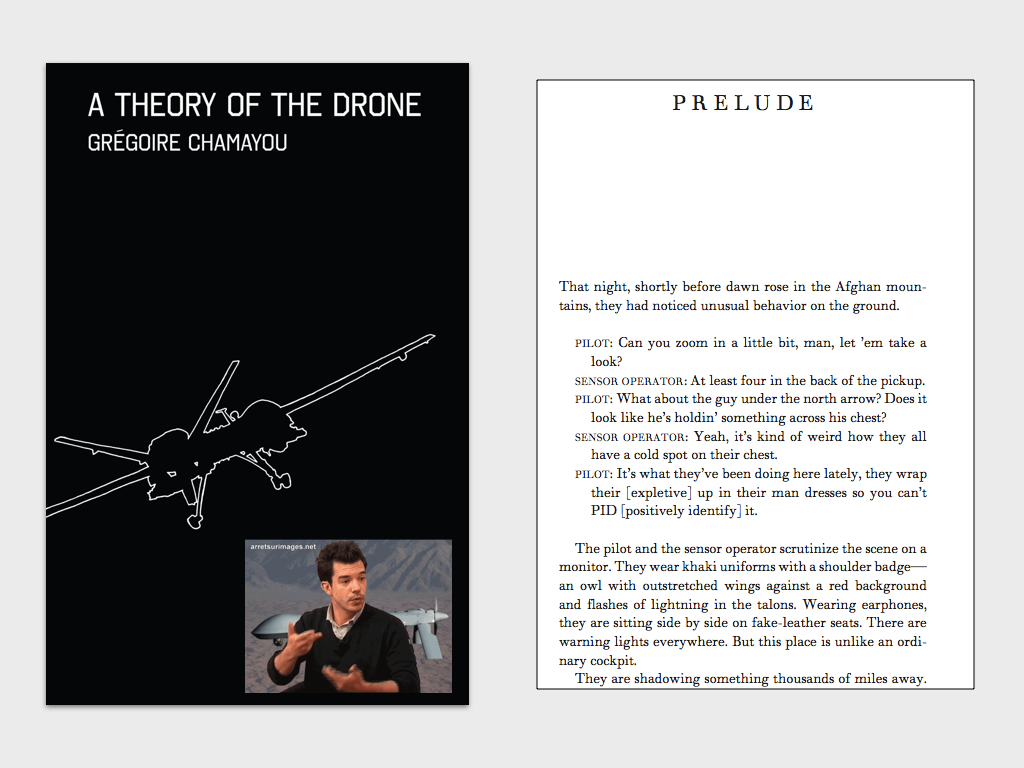
I stumbled upon a fascinating conversation between Thomas and Grégoire Chamayou (above) and since I provided a detailed commentary on Théorie du drone for those who can’t read French (you can access the full set here: scroll down for the links) I’ll try to do the same for Le gouvernment du ciel in the weeks ahead (and I’ll include some snippets from that extended conversation).

I don’t think my commentaries have been superceded by the publication of the translation, Theory of the drone, so I’m hoping the same will be true if there is an English version of Le gouvernment du ciel (though I can’t find any sign of one yet).

Reach from the Sky

Tanner_V2

I’ve been invited to give the annual Tanner Lectures in Cambridge on 13-14 January 2016. The Lectures are given in parallel at nine universities in the UK and the USA: Cambridge, Oxford, Harvard, Princeton, Stanford, Yale, Berkeley, Michigan and Utah.

Appointment as a Tanner lecturer is a recognition for uncommon achievement and outstanding abilities in the field of human values. The lecturers may be elicited from philosophy, religion, the humanities, the sciences, the creative arts, and learned professions, or from leadership in public or private affairs. The lectureships are international and intercultural and transcend ethnic, national, religious, and ideological distinctions.

The purpose of the Tanner Lectures is to advance and reflect upon the scholarly and scientific learning relating to human values. This intention embraces the entire range of values pertinent to the human condition, interest, behavior, and aspiration. The lectures are published in an annual volume.

The Tanner Lectures were established by the American scholar, industrialist, and philanthropist, Obert Clark Tanner. In creating the lectureships, Professor Tanner said, “I hope these lectures will contribute to the intellectual and moral life of mankind. I see them simply as a search for a better understanding of human behavior and human values. This understanding may be pursued for its own intrinsic worth, but it may also eventually have practical consequences for the quality of personal and social life.”
It’s a huge honour, and thoroughly intimidating when I look at the roster of previous speakers and those delivering the other lectures in 2015-16, and I’m thrilled – though so far I’ve only got as far as a title: ‘Reach from the Sky: aerial violence and the everywhere war‘.  The clock is ticking, so watch this space for progress reports…

Doomsday Books

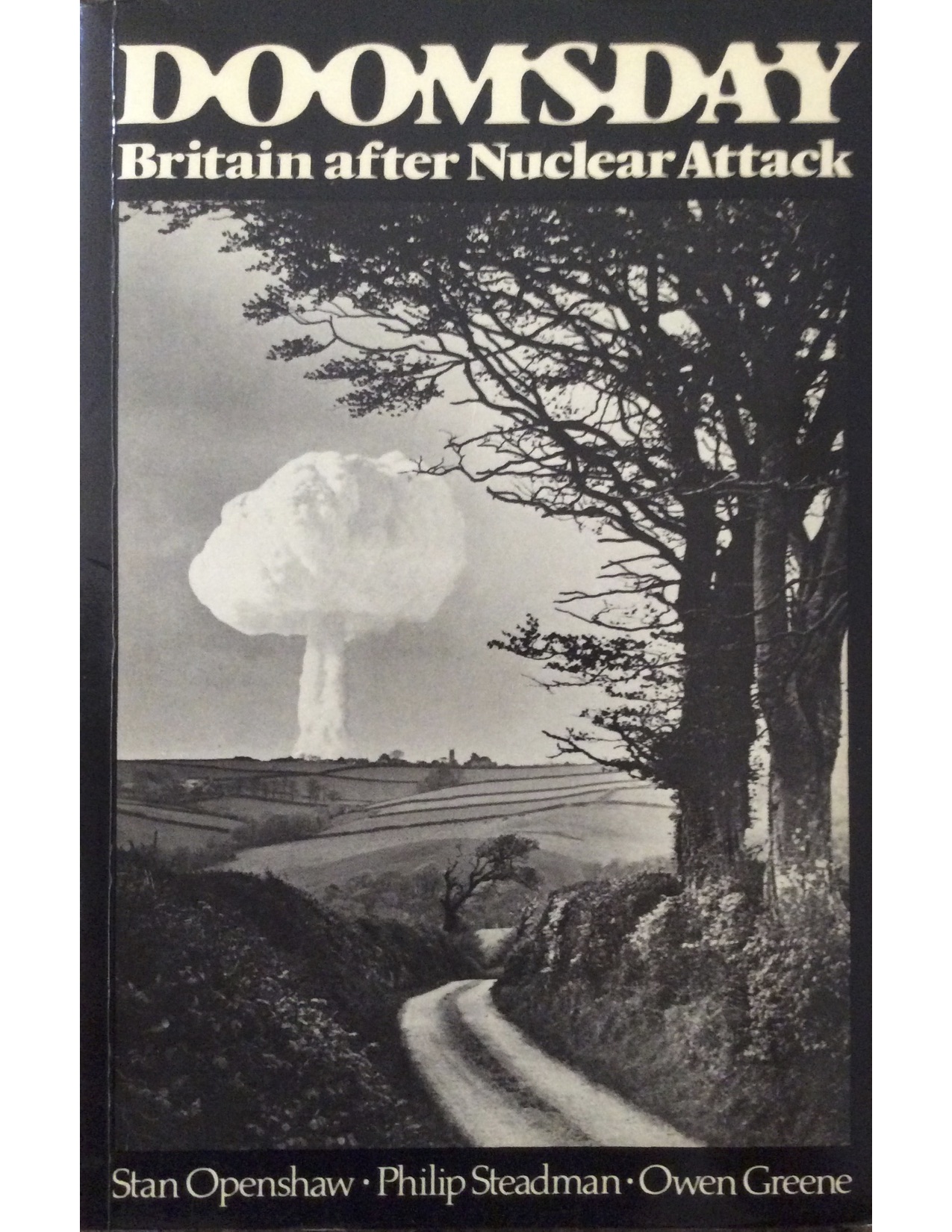
DOOMSDAYStill wandering through the nuclear wastelands… (see also here, here and here).  Not surprisingly, there is a considerable literature on the United States and nuclear war, but much less on the UK.  I still have my tattered copy of Doomsday:  Britain after nuclear attack by Stan Openshaw, Philip Steadman and Owen Greene, published more than thirty years ago.  Those were heady days: the authors were members of Scientists Against Nuclear Arms, and the book was put together soon after the European Nuclear Disarmament Appeal launched by E. P. Thompson (who famously announced he had “left his desk” to further the campaign), Mary Kaldor, Dan Smith and Ken Coates.

Next to Doomsday is my equally battered and well-thumbed copy of a book of essays edited by two other British geographers, David Pepper and Alan Jenkins, The geography of peace and war, which appeared in 1985.  It was in three Parts, ‘The geography of the Cold War and the arms race’, ‘The geography of nuclear war’ (which included an update from Stan and Philip) and ‘The geography of peace’ (with an essay on nuclear weapon free zones).

Fast forward twenty years, and these emphases are in stark contrast to Colin Flint‘s edited collection, Geography of war and peace, in which nuclear war receives just passing mention(s).  The same is true of Audrey Kobayashi‘s still more recent Geography of peace and armed conflict – apart from one brief chapter concerned with Iran.

HOGG British Nuclear CultureAll of this will explain why I am looking forward to the publication of Jonathan Hogg‘s British Nuclear Culture: official and unofficial narratives in the long 20th century, coming from Bloomsbury in January:

The advent of the atomic bomb, the social and cultural impact of nuclear science, and the history of the British nuclear state after 1945 is a complex and contested story. British Nuclear Culture is an important survey that offers a new interpretation of the nuclear century by tracing the tensions between ‘official’ and ‘unofficial’ nuclear narratives in British culture.

In this book, Jonathan Hogg argues that nuclear culture was a pervasive and persistent aspect of British life, particularly in the years following 1945. This idea is illustrated through detailed analysis of various primary source materials, such as newspaper articles, government files, fictional texts, film, music and oral testimonies. The book introduces unfamiliar sources to students of nuclear and cold war history, and offers in-depth and critical reflections on the expanding historiography in this area of research.

Chronologically arranged, British Nuclear Culture reflects upon, and returns to, a number of key themes throughout, including nuclear anxiety, government policy, civil defence, ‘nukespeak’ and nuclear subjectivity, individual experience, protest and resistance, and the influence of the British nuclear state on everyday life. The book contains illustrations, individual case studies, a select bibliography, a timeline, and a list of helpful online resources for students of nuclear history.

Joseph Masco – author of The nuclear borderlands: The Manhattan Project in post-Cold War New Mexico and The theater of operations: National security affect from the Cold War to the War on Terror  – likes it, which is more than enough for me:

We know the atomic bomb fundamentally transformed modern life, but Jonathan Hogg shows us that it did not do so in the same way everywhere. This is a important contribution to nuclear studies as it takes both nation and region seriously in the production of a nuclear culture. Hogg does not just follow expert concerns or defense policy debates, he also attends to the vernacular forms of local activisms across British cities and generations. British Nuclear Culture leads the way to a new comparative nuclear studies, and with it, a deeper understanding of the nuclear revolution.

Here is the Contents List:

Introduction
1. Early Nuclear Culture
2. The Manhattan Project
3. 1945 – 1950: Early Responses to the Bomb
4. 1950 – 1958: Maturing Responses
5. 1958 – 1979: Radicalised and Realist Responses
6. 1979 – 1989: Extreme Realism
7. 1989 – 2011: The Persistence of Nuclear Culture
8. Conclusion

For those who don’t think it surprising that – apart from people like Michael Curry, Matt FarishScott Kirsch and Fraser MacDonald– human geographers should have turned away from a critical scrutiny of atomic geographies so speedily with the presumptive waning of the Cold War, notice the title of Chapter 7…

Little Boys and Blue Skies

These are very preliminary notes and ideas for my presentation at “Through Post-Atomic Eyes” in Toronto next month: I would really – really – welcome any comments, suggestions or advice.  I don’t usually post presentations in advance, and this is still a long way from the finished version, but in this case I am venturing into (irradiated) fields unknown to me until a few months ago…

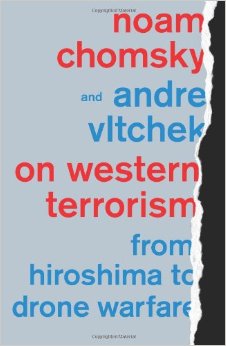
CHOMSKY On Western terrorismAt first sight, any comparison between America’s nuclear war capability and its drone strikes in Afghanistan, Iraq, Pakistan, Somalia, Syria and Yemen seems fanciful. The scale of investment, the speed and range of the delivery systems, the nature of the targets, the blast radii and precision of the munitions, and the time and space horizons of the effects are so clearly incommensurable. It’s noticeable that the conversation between Noam Chomsky and Andre Vltchek published as On Western Terrorism: from Hiroshima to drone warfare (2013) says virtually nothing about the two terms in its subtitle.

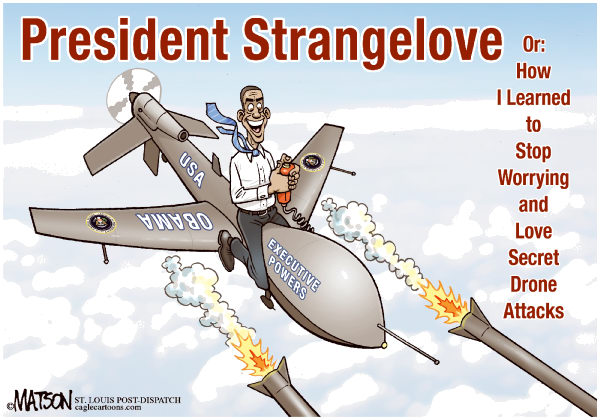
Yet nuclear weapons and drone strikes have both been attended by intense diplomatic, geopolitical and geo-legal manoeuvres, they have both sparked major oppositional campaigns by activist organisations, and they have both had major impacts on popular culture (as the two images below attest).

dr-strangelove-still-580

President-Strangelove

But there are other coincidences, connections and transformations that also bear close critical examination.

When Paul Tibbets flew the Enola Gay across the blue sky of Hiroshima on 6 August 1945 one of his major concerns was to execute a fast, tight 155 degree turn to escape the effects of the blast from ‘Little Boy’.  There is some dispute over the precise escape angle – there’s an exhaustive discussion in the new preface to Paul Nahin‘s Chases and escapes: the mathematics of pursuit and evasion (second edition, 2007) – but the crucial point is the concern for the survival of the aircraft and its crew.

Enola Gay co-pilot [Robert Lewis]'s sketch after briefing of approach and 155 turn by the B-29s weaponeer William Parsons, 4 August 1945

Tibbets successfully made his escape but four years later, when the US Atomic Energy Commission was developing far more powerful bombs, the Air Force became convinced that escape from those blasts would be impossible. And so it implemented Project Brass Ring which was intended to convert B-47 Stratojet bombers into remotely-piloted aircraft capable of delivering atomic bombs without any loss of American lives.  (What follows is taken from Delmer Trester, ‘Thermonuclear weapon delivery by unmanned B-47: Project Brass Ring‘; it was included in A history of the Air Force Atomic Energy Program, 1949-1953, which can be downloaded here; you can obtain a quick overview here).

‘It appeared that the Air Force would need some method to deliver a 10,000-pound package over a distance of 4,000 nautical miles with an accuracy of at least two miles from the center of the target. It was expected the package would produce a lethal area so great that, were it released in a normal manner, the carrier would not survive the explosion effects. Although not mentioned by name, the “package” was a thermonuclear device – the hydrogen or H-bomb…

B-47 Stratojet bomber (USAF)

‘The ultimate objective was to fashion a B-47 carrier with completely automatic operation from take-off to bomb drop… The immediate plan included the director B-47A aircraft as a vital part of the mission. Under direction from the mother aircraft, the missile would take off, climb to altitude and establish cruise speed conditions. While still in friendly territory, the crew aboard the director checked out the missile and committed its instruments to automatically accomplish the remainder of the mission. This was all that was required of the director. The missile, once committed, had no provision for returning to its base… either the B-47 became a true missile and dived toward the target … or a mechanism triggered the bomb free, as in a normal bombing run.’

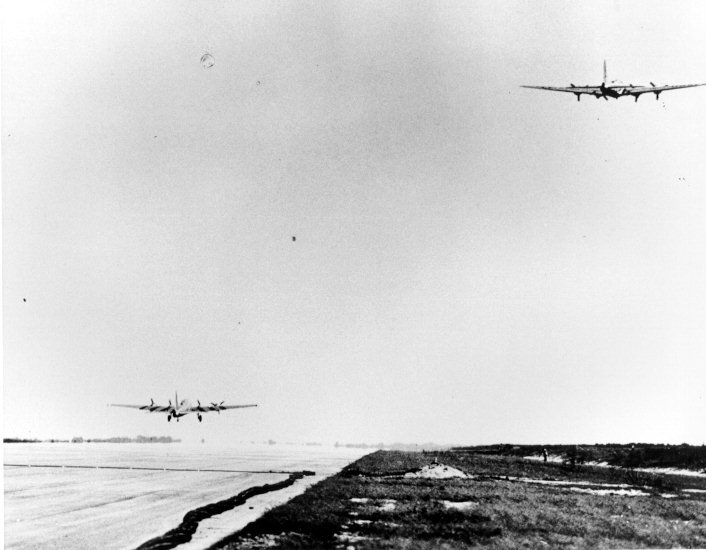
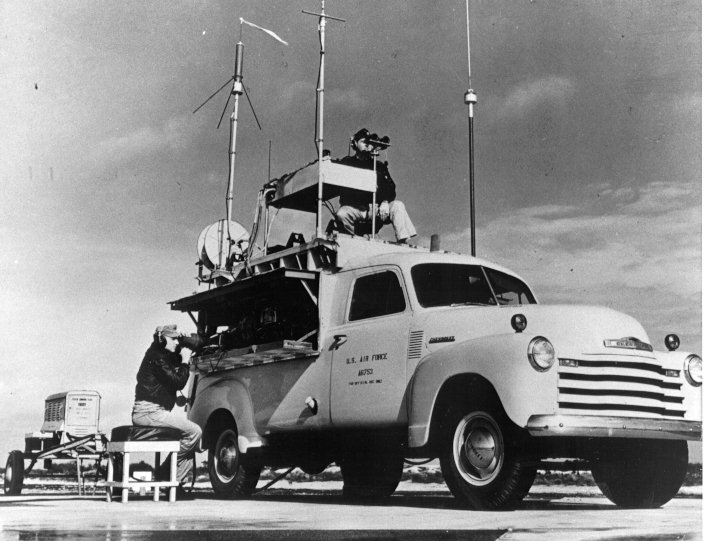
This was a re-run of Operation Aphrodite, a failed series of experiments carried out in the closing stages of the Second World War in Europe, and – as the images below show – after the war the Air Force had continued to experiment with B-17 aircraft remotely piloted from both ‘director aircraft’ [top image; the director aircraft is top right] and ‘ground control units’ [bottom image].  These operated under the aegis of the Air Force’s Pilotless Aircraft Branch which was created in 1946 in an attempt to establish the service’s proprietary rights over missile development.

B-17 drones

Ground control unit for B-17 drone

But the Brass Ring team soon discovered that their original task had swelled far beyond its original, taxing specifications: in October 1951 they were told that ‘the super-bomb’ would weigh 50,000 lbs. They modified their plans (and planes) accordingly, and after a series of setbacks the first test flight was successful:

‘The automatic take-off, climb and cruise sequence was initiated remotely from a ground control station. The aircraft azimuth, during take-off, was controlled by an auxiliary control station at the end of the runway. Subsequent maneuvers, descent and landing (including remote release of a drag parachute and application of brakes) were accomplished from the ground control station. The test was generally satisfactory; however, there were several aspects – certain level flight conditions, turn characteristics and the suitability of the aircraft as a “bombing platform” – which required further investigation.’

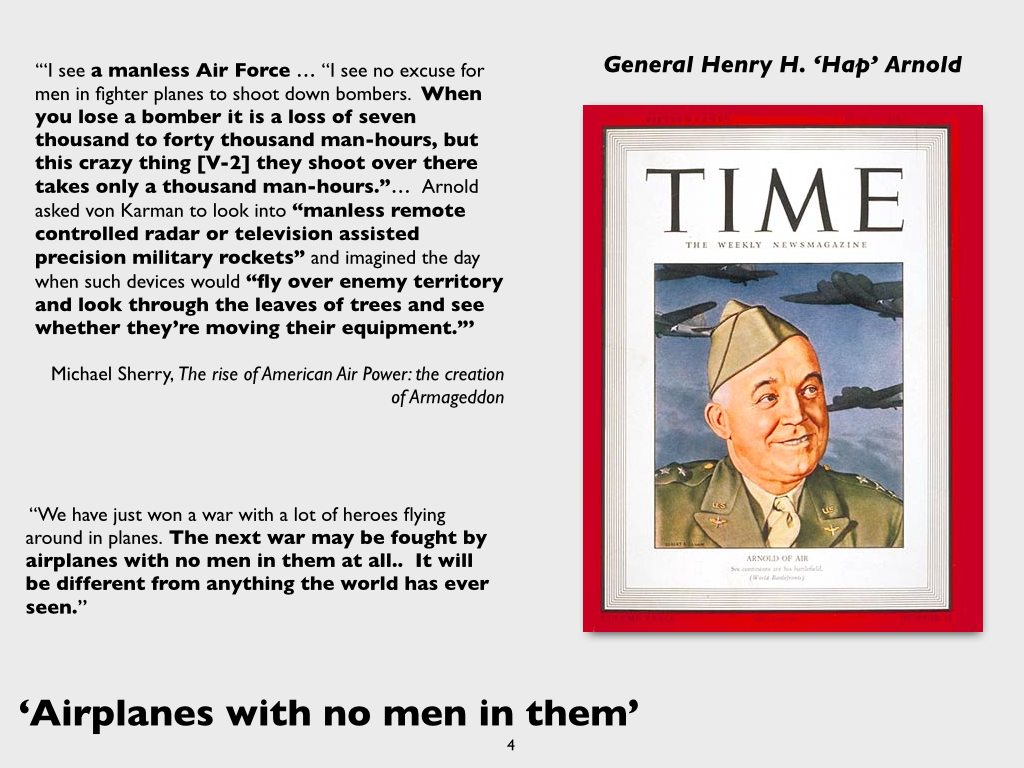
This was part of a larger imaginary in which, as Life had commented in its issue of 20 August 1945, echoing USAAF General Henry H. ‘Hap’ Arnold, ‘robot planes … and atomic bombs will do the work today done by fleets of thousands of piloted bombers.’ (Arnold thought this a mixed blessing, and in an essay ghost-written with William Shockley he noted that nuclear weapons had made destruction ‘too cheap and easy’ – one bomb and one aircraft could replace hundreds of bombs and vast fleets of bombers – and a similar concern is often raised by critics of today’s Predators and Reapers who argue that their remote, often covert operations have lowered the threshold for military violence).

Henry H Hap Arnold.001

Brass Ring was abandoned on 13 March 1953, once the Air Force determined that a manned aircraft could execute the delivery safely (at least, for those on board).  It would be decades before another company closely associated with nuclear research – General Atomics (more here) – supplied the US Air Force with its first MQ-1 Predators.

1994-august

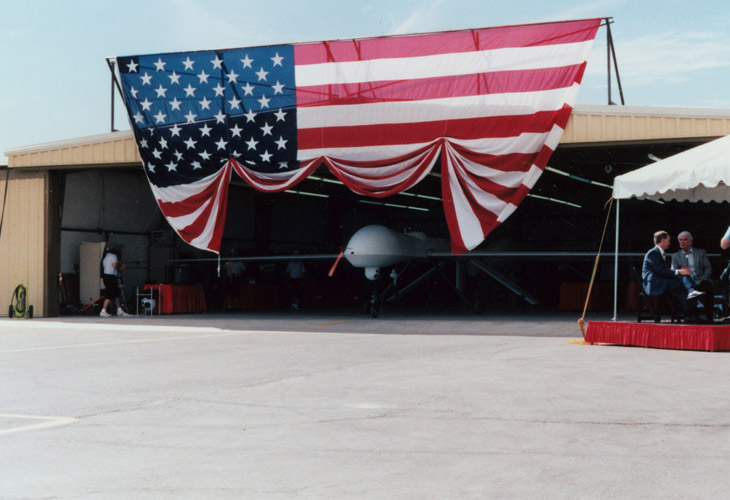
These were originally conceived as unarmed, tactical not strategic platforms, designed to provide intelligence, surveillance and reconnaissance for conventional strike aircraft. But the concern with American lives became a leitmotif of both programs, and one of the foundations for today’s remote operations is the ability (as the USAF has it) to ‘project power without vulnerability’.

BOYER By the bomb's early lightThe visible effects of bombing Hiroshima and Nagasaki on the Japanese population were the subject of strict censorship – still photographs were never published, while Japanese media and even US military film crews had their documentary footage embargoed – and public attention in the United States was turned more or less immediately towards visualising ‘Hiroshima USA’ (Paul Boyer is particularly good on this; there are also many images and a good discussion here). Even the US Strategic Bombing Survey indulged in the same speculation: ‘What if the target for the bomb had been an American city?’ it asked in its June 1946 report. ‘The casualty rates at Hiroshima and Nagasaki, applied to the massed inhabitants of Manhattan, Brooklyn, and the Bronx, yield a grim conclusion.’ Although the original targets had been Asian cities it was American cities that were designated as future victims.  ‘Physically untouched by the war’ (apart from Pearl Harbor), Boyer wrote,

‘the United States at the moment of victory perceived itself as naked and vulnerable.  Sole possessors and users of a devastating instrument of mass destruction, Americans envisioned themselves not as a potential threat to other peoples, but as potential victims.’

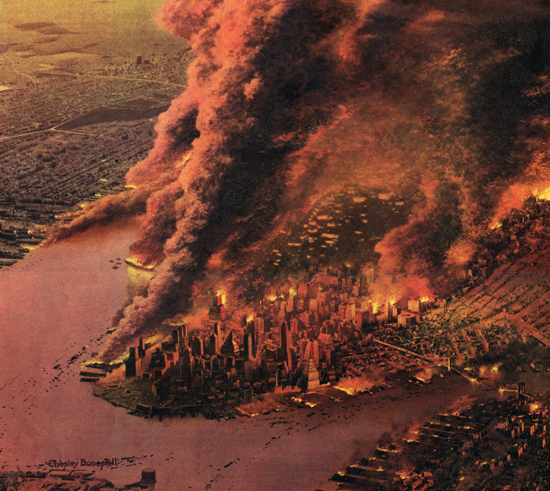
This was the abiding anxiety instilled by the national security state and orchestrated through its military-industrial-media-entertainment complex throughout the post-war decades.  Perhaps the most famous sequence of images – imaginative geographies, I suppose –accompanied an essay by John Lear in Collier’s Magazine in August 1950, ‘Hiroshima USA: Can anything be done about it?‘, showing a series of paintings by Chesley Bonestell and Birney Lettick imagining the effects of a nuclear strike on New York:

Hiroshima USA 11950-aug-6-colliers-p12-sm

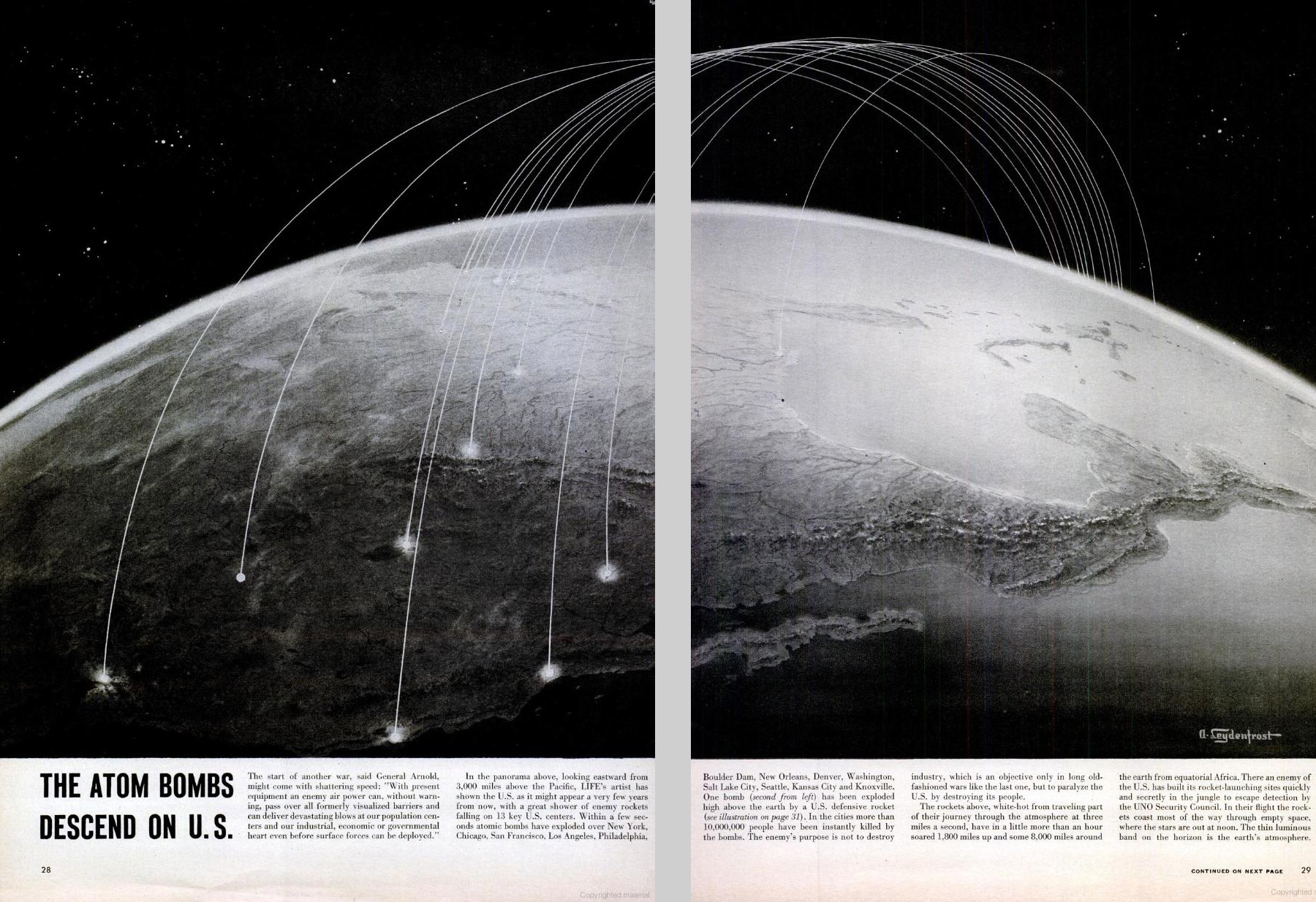
Similar sequences, often accompanied by maps, were produced for many other cities (and the simulations continue: see, for example, here).  The images below, from Life on 19 November 1945, come from ‘The 36-Hour War’ (see here for a commentary) that envisaged a nuclear attack on multiple cities across the USA, including Washington DC, from (presumably Soviet) ‘rocket-launching sites [built] quickly and secretly in the jungle’ of equatorial Africa:

1945-Life-36-Hour-War-2

1945-Life-36-Hour-War-1

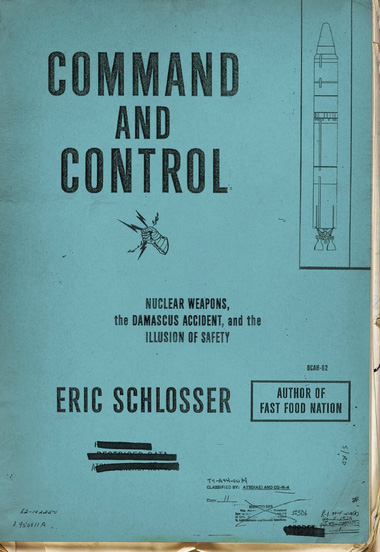
Schlosser-Command-and-Control-bookAs it happened, American cities did indeed become targets – for the US Air Force.  According to Eric Schlosser, under General Curtis Le May the goal was

to build a Strategic Air Command that could strike the Soviet Union with planes based in the United States and deliver every nuclear weapon at once. SAC bomber crews constantly trained and prepared for that all-out assault. They staged mock attacks on every city in the United States with a population larger than twenty-five thousand, practicing to drop atomic bombs on urban targets in the middle of the night. San Francisco was bombed more than six hundred times within a month.

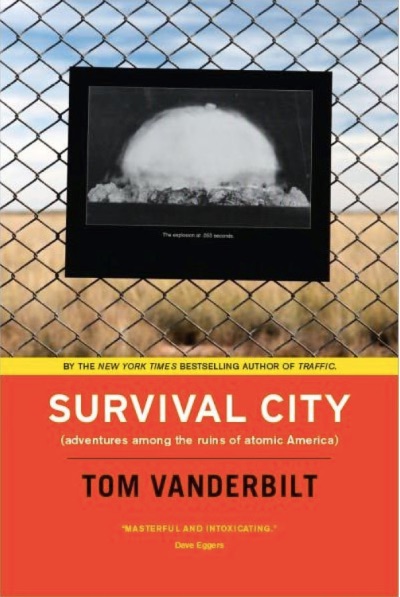
VANDERBILT Survival CityTests were also conducted at the Nevada Proving Ground, ‘the most nuclear-bombed place on the planet’, to determine the likely effects.  One of the purposes of the Strategic Bombing Survey’s Physical Damage Division had been to document the effects of the bombs on buildings in Hiroshima and Nagasaki – to read them as ‘blueprints for the atomic future‘ – and both Japanese and American medical teams had been sent in shortly after the blasts to record their effects on bodies (from 1947 their work was subsumed under the Atomic Bomb Casualty Commission).  It was now imperative bring the two together and to bring their results home.  And so, starting in 1953 with ‘Operation Doorstep’, mannequins were placed inside single-family houses at the Nevada site to calculate the prospects for the survival of what Joseph Masco calls the American ‘nuclearised’ family in the event of a nuclear attack; they subsequently went on public exhibition around the country with the tag line:

‘These mannikins could have been real people; in fact, they could have been you.’

In the Second World War experimental bombing runs had been staged against mock German and Japanese targets at the Dugway Proving Ground but – significantly – the buildings had no occupants: as Tom Vanderbilt wryly remarks, now ‘the inhabitants had been rewritten into the picture’ because the objective was to calibrate the lives of Americans.

Rachele Riley Mannequins

I have borrowed this image from the mesmerising work of artist Rachele Riley, whose project on The evolution of silence centres on Yucca Flat in the Nevada Test Site and raises a series of sharp questions about both the imagery and the soundscape of the nuclear age.

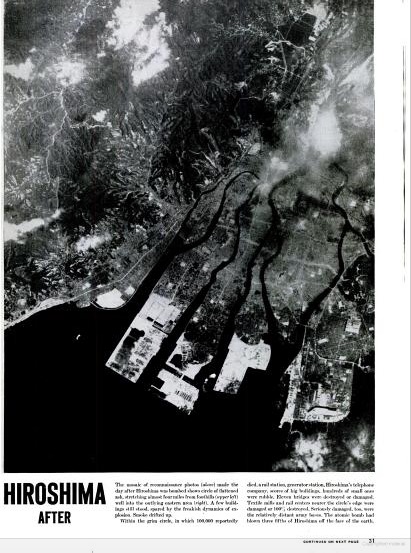
The power of the image – ‘the nuclear sublime’ – was one of the central objectives of the attacks on Hiroshima and Nagasaki: ‘the weapon’s devastating power had to be seen to be believed,’ as Kyo Maclear observed, and it had to be seen and believed in Moscow as well as in Tokyo.  Here the visual economies of nuclear attacks are radically different from drone strikes. In the immediate aftermath there was no shortage of atomic ‘views from the air’ –  aerial photographs of the vast cloud towering into the sky and of Hiroshima before and after the bomb.  Here is Life (sic) on 20 August 1945:

LIFE:Hiroshima 1

LIFE:Hiroshima 2LIFE:Hiroshima 3

Yet for the most part, and with some significant exceptions, aerial views are singularly absent from today’s drone wars. To Svea Braeunert (‘Bringing the war home: how visual artists return the drone’s gaze‘) that is all the more remarkable because drone strikes are activated by what video artist Harun Farocki called operative images: but that is also the reason for the difference. Aerial photographs of Hiroshima or Nagasaki reveal a field of destruction in which bodies are conspicuously absent; the resolution level is too coarse to discern the bomb’s victims.

But the video feeds from a Predator or Reaper, for all their imperfections, are designed to identify (and kill) individuals, and their aerial gaze would – if disclosed – reveal the bodies of their victims. That is precisely why the videos are rarely released (and, according to Eyal Weizman, why satellite imagery used by investigators to reconstruct drone strikes is degraded to a resolution level incapable of registering a human body – which remains ‘hidden in the pixels‘ – and why their forensic visual analysis is forced to focus on buildings not bodies).

OMAR FAST %000 Feet is Best

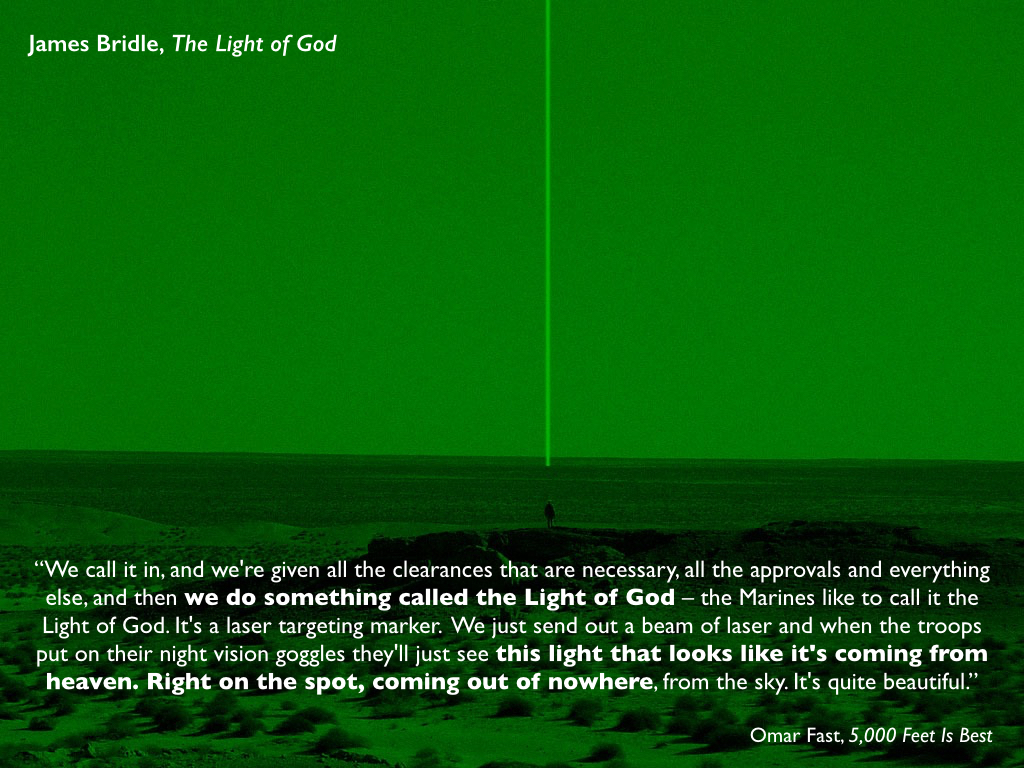
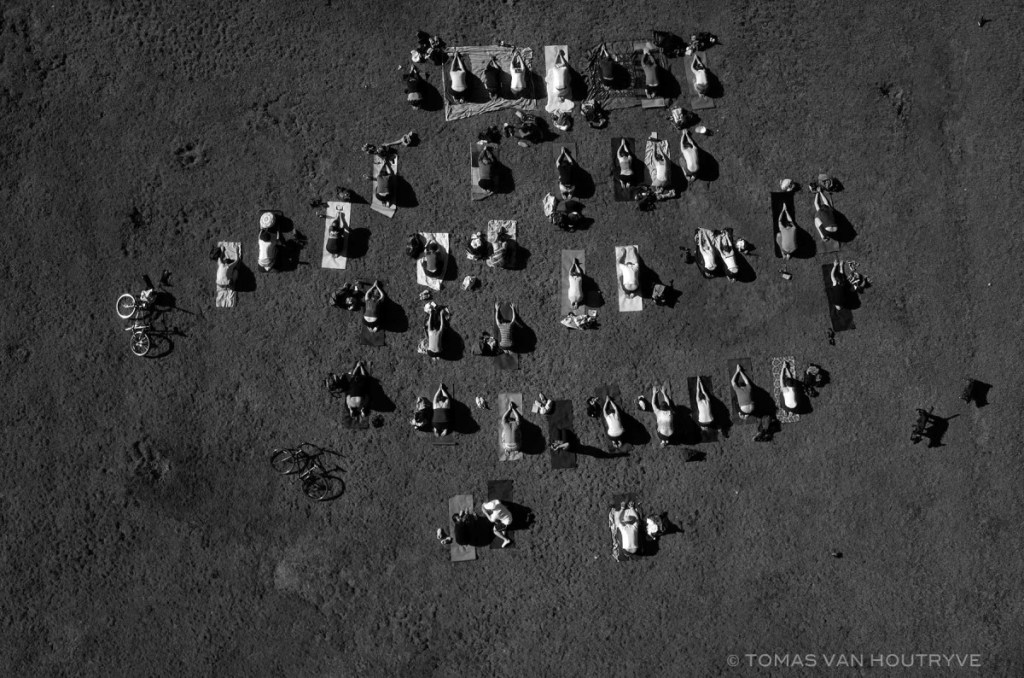
One might expect visual artists to fill in the blank. Yet – a further contrast with Hiroshima – apart from projects like Omar Fast’s ‘5,000 Feet is Best’ (above) and Thomas van Houtryve’s ‘Blue Sky Days’ (below) there have been precious few attempts to imagine drone strikes on American soil.

van HOUTRYVE Blue Sky Days

Perhaps this is because they are so unlikely: at present these remote platforms can only be used in uncontested air space, against people or states who are unable (or in the case of Pakistan, unwilling) to defend themselves. But there has been a protracted debate about such strikes on American citizens (notably the case of Anwar al-Awlaki) and a concerted attempt to focus on the rules followed by the CIA and JSOC in their programs of targeted killing (which has artfully diverted public attention to Washington and away from Waziristan).

There is also a visceral, visible continuity between the two: just as in Hiroshima and Nagasaki, there has been little public concern over the victims of drone strikes, the vast majority of whom have once again been Asian.

If the targeting process continues to be racialised, it also continues to be bureaucratised. After the Second World War the US Air Force was determined to speed up its targeting cycle, and in 1946 started to compile a computerised database of potential targets in the Soviet Union; this was soon extended to Soviet satellites and Korea, and by 1960 the Bombing Encyclopedia of the World (now called the ‘Basic Encyclopedia’) contained 80,000 Consolidated Target Intelligence Files. These were harvested to plan Strategic Air Command’s nuclear strikes and to calibrate Damage and Contamination Models. One of the analysts responsible for nominating targets later described the process as ‘the bureaucratisation of homicide’. Similar criticisms have been launched against the ‘disposition matrix’ used by the CIA to nominate individuals authorised for targeted killing (see here and here); most of these are in Pakistan, Somalia, and Yemen, though there are other kill lists, including Joint Prioritised Effects Lists compiled by the US military for war zones in Afghanistan and Iraq. In both cases the target files are in principle global in reach, and both nuclear strikes and targeted killings (outside established war zones) are judged to be sufficiently serious and ‘sensitive’ to require direct Presidential approval.

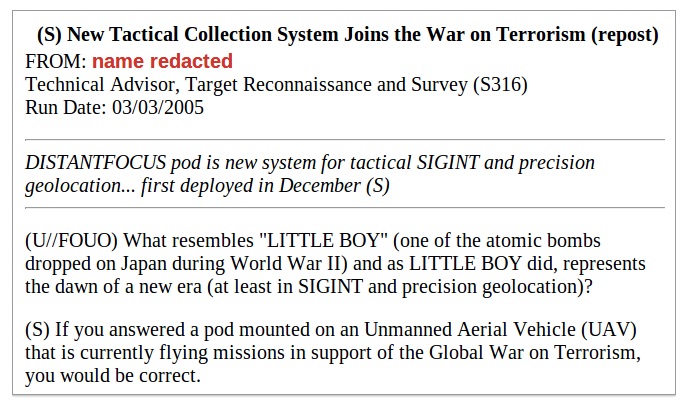
Speeding up the targeting cycle has involved more than the pre-emptive identification of targets. In contrast to the fixed targets for nuclear strikes, today’s Predators and Reapers are typically directed against mobile targets virtually impossible to locate in advance. Pursuing these fleeting ‘targets of opportunity’ relies on a rapidly changing and expanding suite of sensors to identify and track individuals in near-real time. In 2004 the Defense Science Board recommended the Pentagon establish ‘a “Manhattan Project”-like program for ID/TTI’ [identification, tagging, tracking and locating], and one year later a Technical Advisor working for the National Security Agency’s Target Reconnaissance and Survey Division posed the following question:

NSA's Little Boy

The onboard sensor suite in the pod has since become ever more effective in intercepting and monitoring electronic communications as part of a vast system of digital data capture, but Predators had already been armed with Hellfire missiles to compress the kill-chain still further, and to many commentators the most radical innovation in later modern war has been the fusion of sensor and shooter in a single platform. The new integrated systems were first trialled – on a Predator flown by test pilots from General Atomics – in February 2000 at Indian Springs Auxiliary Field. The main objective was to hunt and kill Osama bin Laden, and at the request of the Air Force and the CIA a series of tests was carried out.

First, the Air Force wanted to determine whether the Predator could withstand a missile being fired from beneath its insubstantial wings (a ghostly echo of earlier anxieties over the survivability of the Enola Gay and its successors – though plainly much reduced by the absence of any pilot on board).

Second, the CIA wanted to assess the likely effects of a Hellfire strike on the occupants of a single-storey building like those found in rural Afghanistan (nuclear tests had used mannequins and pigs as human surrogates; these used plywood cut-outs and watermelons).

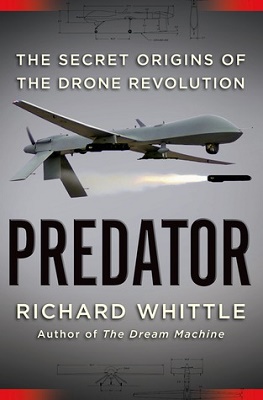
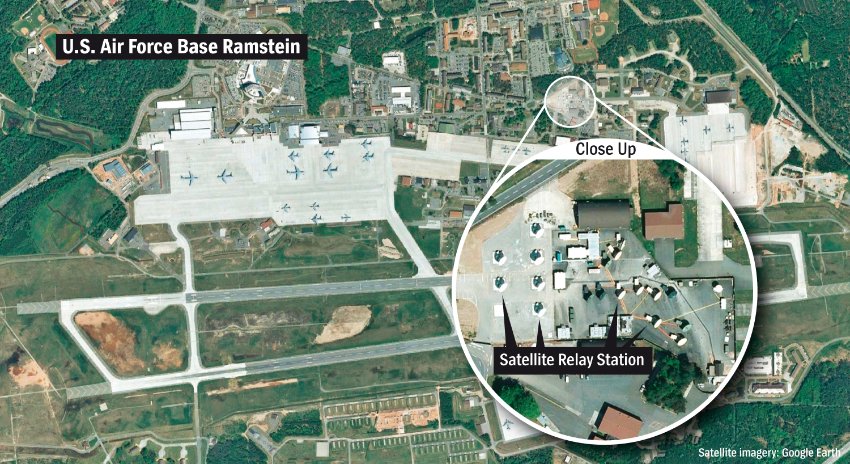
predatorBoth sets of tests were eventually successful (see also here) but, as Richard Whittle shows in consummate detail, a series of legal and diplomatic obstacles remained. In order to secure satellite access over Afghanistan, previous Predator flights to find bin Laden had been flown from a ground control station at Ramstein Air Base in Germany. But using a Predator to kill bin Laden was less straightforward. After protracted debate, US Government lawyers agreed that a Predator armed with a missile would not violate the 1987 Intermediate-Range Nuclear Forces Treaty, which eliminated nuclear and conventional missiles with intermediate ranges but which – unhelpfully for the CIA – defined missiles as ‘unmanned, self-propelled … weapon-delivery vehicles’; the lawyers determined that the Predator was merely a platform and, unlike a cruise missile, had no warhead so that it remained outside the Treaty. But they also insisted that the Status of Forces Agreement with Germany would require Berlin’s consent for the activation of an armed Predator. (The United States stored tactical nuclear warheads at Ramstein until 2005; although the US insisted it retained control over them, in the event of war they were to have been delivered by the Luftwaffe as part of a concerted NATO nuclear strike).

RAMSTEIN English captions

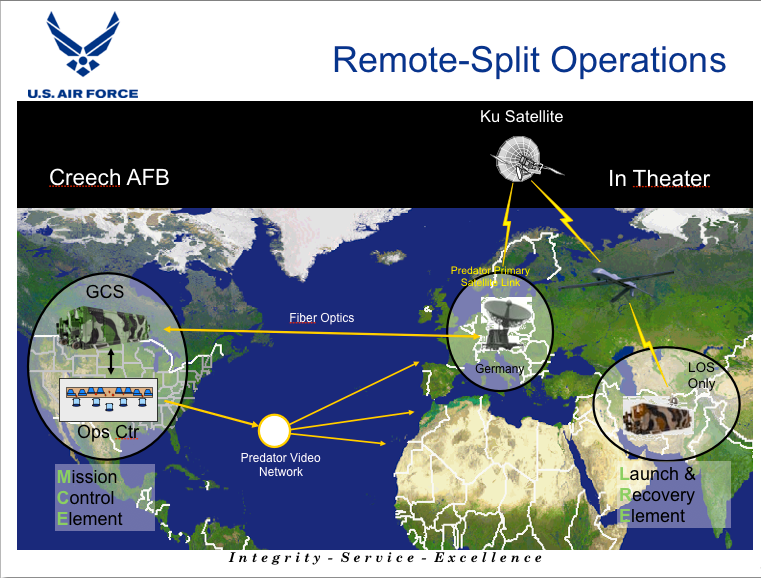
The need to bring Berlin onside (and so potentially compromise the secrecy of the project) was one of the main reasons why the ground control station was relocated to Indian Springs, connected to the satellite link at Ramstein through a fibre-optic cable under the Atlantic:

remote-split-operations-usaf

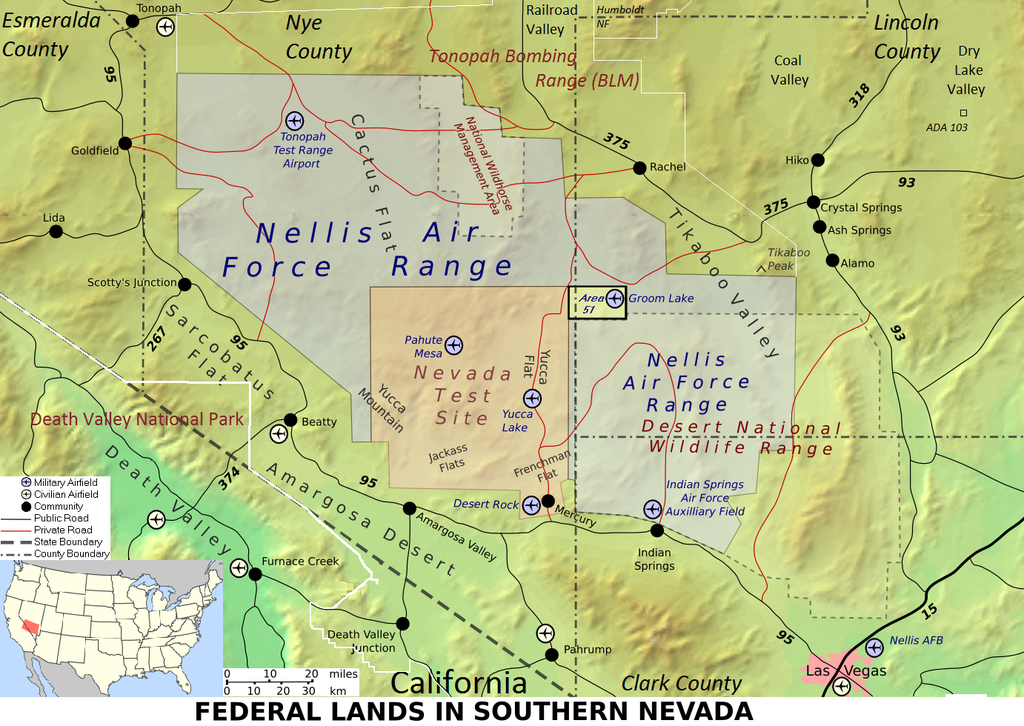
In fact, since 1952 Indian Springs had been a key portal into the Nevada Test Site – its purpose was to support both US Atomic Energy Commission nuclear testing at the Nevada Proving Grounds and US Air Force operations at the Nellis Air Force Base’s vast Gunnery and Bombing Range – and in June 2005 it morphed into Creech Air Force Base: the main centre from which ‘remote-split’ operations in Afghanistan, Pakistan and elsewhere are flown by USAF pilots. Most of the covert operations are directed by the CIA (some by Joint Special Operations Command), but the Predators and Reapers are used for more than targeted killing; the primary missions are still to provide ISR for conventional strikes and now also close air support for ground troops.

Wfm_area51_map_en

The geographies overlap, coalesce and – even allowing for the differences in scale – conjure up a radically diffuse and dispersed field of military violence.  When Tom Vanderbilt described ‘a war with no clear boundaries, no clear battlefields … a war waged in such secrecy that both records and physical locations are often utterly obscured’ he was talking about nuclear war.  But exactly the same could be said of today’s drone wars, those versions of later modern war in which the body becomes the battle space (‘warheads on foreheads’) and the hunting ground planetary: another dismal iteration of the ‘everywhere war’ (see here and here).

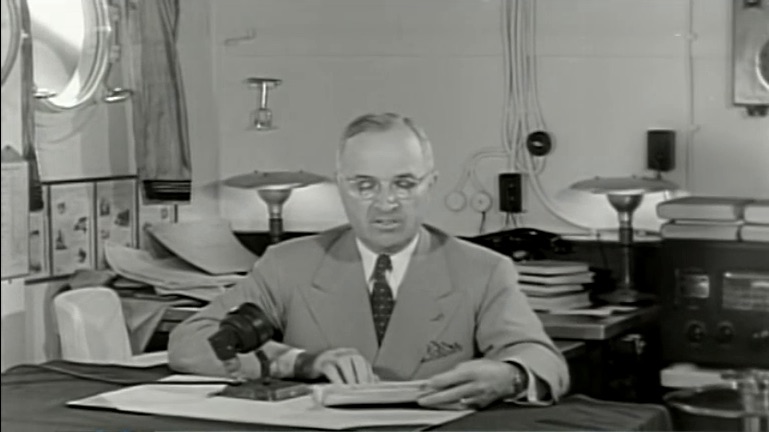
For all these connections and intersections, a key divide is the issue of civilians and casualties. On 9 August 1945 President Truman (below) described Hiroshima as a ‘military base’ selected ‘because we wished in this first attack to avoid, insofar as possible, the killing of civilians’.

TRUMAN Hiroshima speech

This was simply untrue, and similar – often no less deceptive – formulations are routinely used to justify US drone strikes and to minimise what is now called ‘collateral damage’. Still, the scale of civilian casualties is clearly different: usually dozens rather than hundreds of thousands.

And yet, there is something irredeemably personal and solitary about the response to death from either cause; parents searching for the bodies of their children in the ruins are as alone in Dhatta Khel as they were in Hiroshima.  When Yukiko Hayashi [her real name is Sachiko Kawamura] describes the anguish of a young woman and her father finding the remains of their family – the poem, ‘Sky of Hiroshima‘, is autobiographical – it is surely not difficult to transpose its pathos to other children in other places:

Daddy squats down, and digs with his hands
Suddenly, his voice weak with exhaustion, he points
I throw the hoe aside
And dig at the spot with my hands
The tiles have grown warm in the sun
And we dig
With a grim and quiet intent

Oh…
Mommy’s bone
Oh…
When I squeezed it
White powder danced in the wind
Mommy’s bone
When I put it in my mouth
Tasted lonely
The unbearable sorrow
Began to rise in my father and I
Left alone
Screaming, and picking up bones
And putting them into the candy box
Where they made a rustle

My little brother was right beside my mommy
Little more than a skeleton
His insides, not burnt out completely
Lay exposed…

NOOR BEHRAM Orphans Dande Darpa Khel 21 August 2009

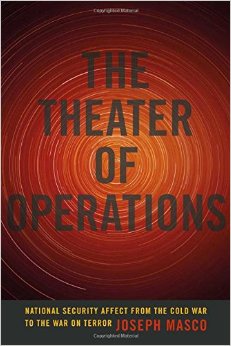
MASCO Theater of OperationsIn The Theater of Operations Joseph Masco draws a series of distinctions between the US national security state inaugurated by the first atomic bombs and the counter-terror state whose organs have proliferated since 9/11.

He properly (and brilliantly) insists on the affects instilled in the American public by the counter-terror state as vital parts of its purpose, logic and practice – yet he says virtually nothing about the affects induced amongst the vulnerable populations forced to ‘live under drones’ and its other modes of military and paramilitary violence.

In Waziristan no air raid sirens warn local people of a strike, no anti-aircraft systems protect them, and no air-raid shelters are available for them to seek refuge.

1374361_10151671014096363_1647526274_n

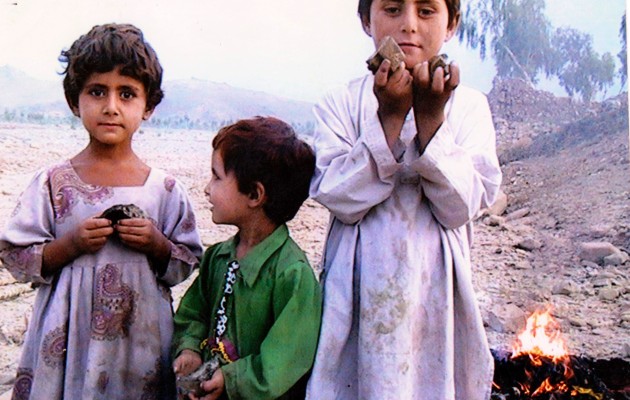
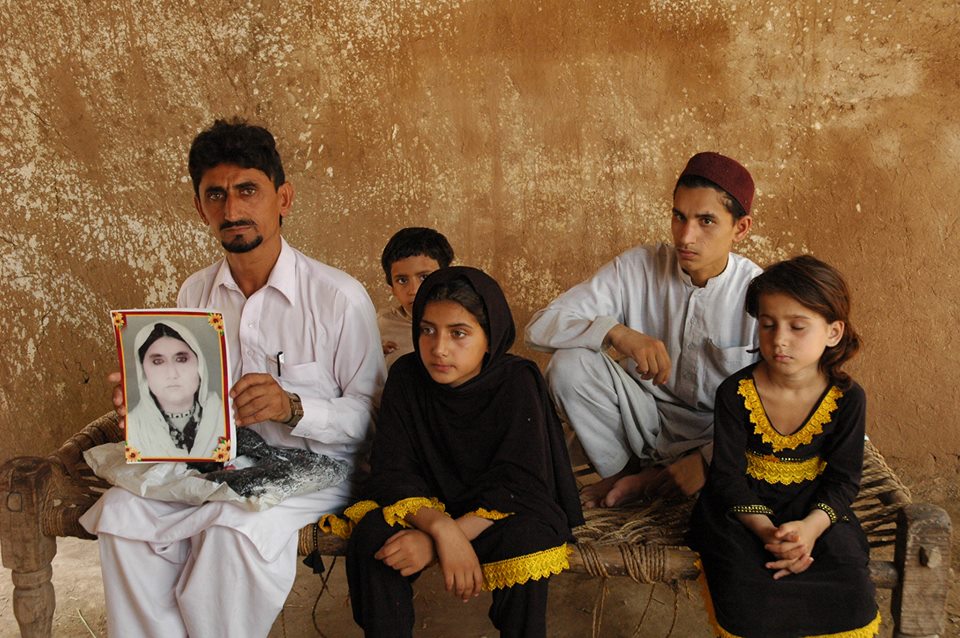
Hence young Zubair Rehman’s (above, top right) heartbreaking admission after a drone killed his grandmother as she tended the fields in Ghundi Kala in North Waziristan (see here and here):

‘I no longer love blue skies. In fact, I now prefer grey skies. The drones do not fly when the skies are grey.’

Post-atomic eyes

Postcard

I’m speaking at a conference called “Through Post-Atomic Eyes” in Toronto next month.

Through Post-Atomic Eyes brings together an interdisciplinary group of artists and scholars to explore the complex legacy of the atomic age in contemporary art and culture. In what ways do photography and other lens-based art practices shed light on this legacy in the 21st century, and how has atomic culture shaped contemporary intersections of photography, nuclear industries, and military techno-cultures? Join us as we explore some of the most urgent issues of our time, from climate change and the Anthropocene to surveillance culture and the advent of drone warfare, through a post-atomic lens.

Through Post-Atomic Eyes is scheduled to coincide with John O’Brian’s groundbreaking exhibition, Camera Atomica, the first substantial exhibition of nuclear photography to encompass the postwar period from the bombings of Hiroshima and Nagasaki in 1945 to the meltdown at Fukushima in 2011. Now on view at the Art Gallery of Ontario (until November 15, 2015).

(John’s exhibition at the AGO follows a successful showing in London late last year: see my post here).

I confess that when I received the Toronto invitation I was at a loss: how was I supposed to view drone warfare through post-atomic eyes?  At first sight, any comparison between America’s nuclear war capability and its drone strikes in Afghanistan, Iraq, Pakistan, Somalia, Syria and Yemen seems fanciful. The scale of investment, the speed and range of the delivery systems, the nature of the targets, the blast radii and precision of the munitions, and the time and space horizons of the effects are so clearly incommensurable.  So I dragged my feet, accepting the invitation because the other presenters (see the poster above) include so many people whose work I admire, but not making much progress.

Eventually I realised that the root problem was that, while I had extensive research on genealogies of bombing under my belt, I knew next to nothing about The Bomb.  So, while I’ve been burrowing away in the archives in London for my project on casualty evacuation 1914-2014 and also inching my “Dirty Dancing’ essay into the home straight, I’ve also been reading and reading and reading.  So much wonderful, sobering material out there, some of which surfaced in my recent posts on Hiroshima and the metastases of nuclear weapons since then.

And, as I’ll try to show in detail in my next post, I’ve found a startling series of coincidences, convergences and transformations.  I now have a rough shape for my presentation, which I’m calling “Little Boys and Blue Skies“: a title which, as you’ll soon see, traces an arc from bombing Hiroshima to bombing Waziristan.  Watch this space.

Viewfinders

Hiroshima

Two short, accessible essays on bombing that appeared in the New York Times recently; they resonate with my work on the genealogies and geographies of aerial violence, and they are both beautifully composed and immensely suggestive.

First, Teju Cole on ‘The Unquiet Sky‘:

A view from a great height is irresistible. It is twinned with the ancient dream of flight. For millenniums, we have imaginatively soared above our material circumstances and dramatized this desire in tales from Icarus to Superman. Things look different from way up there. What was invisible before becomes visible: how one part of the landscape relates to another, how nature and infrastructure unfold. But with the acquisition of this panoptic view comes the loss of much that could be seen at close range. The face of the beloved is but one invisible detail among many.

The essay closes with a reflection on two aerial photographic projects, the collection of drone-shot images exhibited at Dronestagram and James Bridle‘s reconstruction of drone-strike imagery at Dronestagram:

The two Dronestagrams, the sanguine and the melancholic, add to our ever increasing archive of possible landscapes. Imagine all those pictures stitched together into a single image. In this ideal aerial view, neither the pervasive violence nor the sometimes cloying prettiness would be visible. Conquest and sentimentality would both be irrelevant. In other words, the image might be like the ‘‘blue marble’’ photograph of Earth, taken from the Apollo 17 spacecraft in 1972. It is our world, serene and self-contained, seen in one glance. It is not a view that excites us into plans for bombing our enemies, for it includes us as well. It is a view that reminds us of how mighty we are, how fragile, how delicately connected and how beautiful.

Actually, I don’t see the ‘blue marble’ photograph in that way at all: as I argued in Geographical Imaginations, this is the global North inspecting the global South (it was, after all, shot from a NASA platform).  But Teju’s penultimate sentence is key, and it intersects with thoughts suggested by the second essay.

87286100064510LSecond, then, Paul Saint-Amour‘s ‘Waiting for the bomb to drop‘.  Spiralling through some of my favourite authors, Paul ends with a reflection on Roy Scranton‘s ‘Learning how to die in the Anthropocene‘ (see here and here too), which he suggests may be the equivalent of Virginia Woolf‘s ‘“Thoughts on Peace in an Air Raid” for our day’:

[I]n scaling up from one person to all humanity, we pass through a middle range — the social and political, Woolf’s home turf — where both connections and distinctions between people come into play. Yes, we are all at risk in climate change. But like our exposure to military violence, that risk is distributed unevenly. It falls disproportionately on those with the least protection from extreme weather, rising sea levels, hunger, drought, disease, displacement and the conflicts that can arise from all of these. Simply put, it falls most heavily on the poor.

With philosophy’s help, I am prepared to tell myself, “I must learn how to die.” I may even be ready to say to humanity, “We as a species must learn how to die.” But it is a different thing altogether to say to another person, “Because of how I live, or because of actions undertaken in my name, you need to learn how to die more than I do. And you must bear, more than I do, the cognitive and emotional burdens of a life lived in the shadow of imminent death.” This is what the rich are saying every day to the poor. It’s what whites in the United States and elsewhere are saying every day to people of color. It’s what citizens of drone states are saying to those a hemisphere away, under the drones.

A world of proliferated drones

CNAS A world of proliferated dronesA new report from Kelley Sayler at the Center for a New American Security, A world of proliferated drones, starts to map what she calls ‘the likely contours of a drone-saturated world’.  The report emphasises that the United States does not have a monopoly on drones  – more than 90 states and non-state actors have them – but unusually the report pays close attention to the repurposing of small, commercial off-the-shelf drones.  It begins by summarising their capability for intelligence, surveillance and reconnaissance:

‘Current commercial drone technologies – available for purchase in either pre-assembled or customizable, component form – enable a number of high-end capabilities that were formerly the monopoly of major military powers.

Many commercial off-the-shelf (COTS) drones – including the best-selling model, the DJI Phantom – are now equipped with GPS and waypoint navigation systems. These systems enable the drone to accurately determine and hold its position, in turn removing the need for line-of-sight communications and allowing for autonomous flight… Operators of pre-assembled systems can also take advantage of smartphone-based control systems, dramatically improving ease of use. Such systems enable the user to navigate the drone simply by selecting a destination on a map or even by merely tilting the user’s phone…

High-definition video cameras are also widely available on COTS drones and, when combined with video downlinks, can provide real-time intelligence, surveillance, and reconnaissance (ISR) capabilities to multilocation receivers, though these capabilities are often limited by range and battery life.’

The report emphasises the potential weaponisation of these small drones for what it calls ‘overmatch’, in effect reversing the terms of asymmetric warfare, through (for example) the development of ‘flying IEDs‘:

‘While such systems may not appear sophisticated in a traditional military sense, ground-emplaced IEDs have caused thousands of American deaths in Iraq and Afghanistan and proved profoundly hard to defeat. Drones will enable airborne IEDs that can actively seek out U.S. forces, rather than passively lying in wait. Indeed, low-cost drones may lead to a paradigm shift in ground warfare for the United States, ending more than a half- century of air dominance in which U.S. ground forces have not had to fear attacks from the air.  Airborne IEDs could similarly be used in a terrorist attack against civilians or in precision strikes against high-profile individuals or landmarks.’

But the report also makes much of the US’s continued military-industrial investment in high-end drones.  Here various forms of stealth technology make much of the running, or at least issue most of the promissory notes, since today’s Predators and Reapers can only operate in more or less undefended air space – which is another way of saying they can only be used against the weak and/or with the complicity of other states (as in Pakistan and Yemen) – and face immense difficulties in what the US Air Force calls A2/AD [anti-access/area-denial] environments (see here and here). But I’m particularly interested in what the report has to say about the use of large military drones to act as communications relays.  Here the emphasis is on the ability of these remote relays to integrate what is otherwise often remarkably un-networked warfare and to extend the range of operational control and transmissable data.

Drones as communication relays (CNAS)

‘Large military-specific systems offer a number of additional improvements in communications capabilities. Many include wide-band satellite communications (SATCOM) that expand the amount and extend the range of transmittable data, providing distant ground stations with real-time ISR. Like some baseline systems, high-end systems are generally capable of line-of-sight communi- cations with other platforms operating in their area and, for this reason, are often employed as communications relays. Perhaps the most vivid example of the force-multiplying effects of such capabilities is the EQ-4 – what is essentially an RQ-4 Global Hawk outfitted with the Battlefield Airborne Communications Node (BACN). BACN serves as a universal translator for a diverse set of U.S. aircraft that are not otherwise capable of communicating with each other due to incompatible data links – providing a vital connection between, for example, fourth-generation F-16 fighter jets, B-1 bombers, and stealthy, fifth-generation F-22s [BACN is also used on conventional platforms: see here for its role in co-ordinating an air strike in Afghanistan]. Communications relay capabilities will also allow states to operate drones at extended ranges (300 to 800 kilometers) without satellite communications, allowing significant penetration into neighboring countries or contested areas’ (my emphasis).

Steve Graham and I are presently working on an essay on drones and satellite communications: so much of the discussion of geospatial intelligence has focused on satellite imagery, but the geographies of satellite communications (and, crucially, bandwidth) play a major role in the deployment of drones and in the highly variable quality of the imagery they transmit to users across the network.

Reconfiguring global space (II)

Reconfiguring Global Space PNG

The full programme and abstracts for ‘Reconfiguring global space: the geography, politics and ethics of drone war‘ (Indiana University, 14-17 July) is now available.

Now I’ve read the abstracts this looks even more exciting than it did when all I had was a list of names… There are so many contributions that intersect with my own work and interests I’m looking forward to some lively exchanges – and to learning a lot.