Citizen Ex

Algorithmic citizenship JPEG

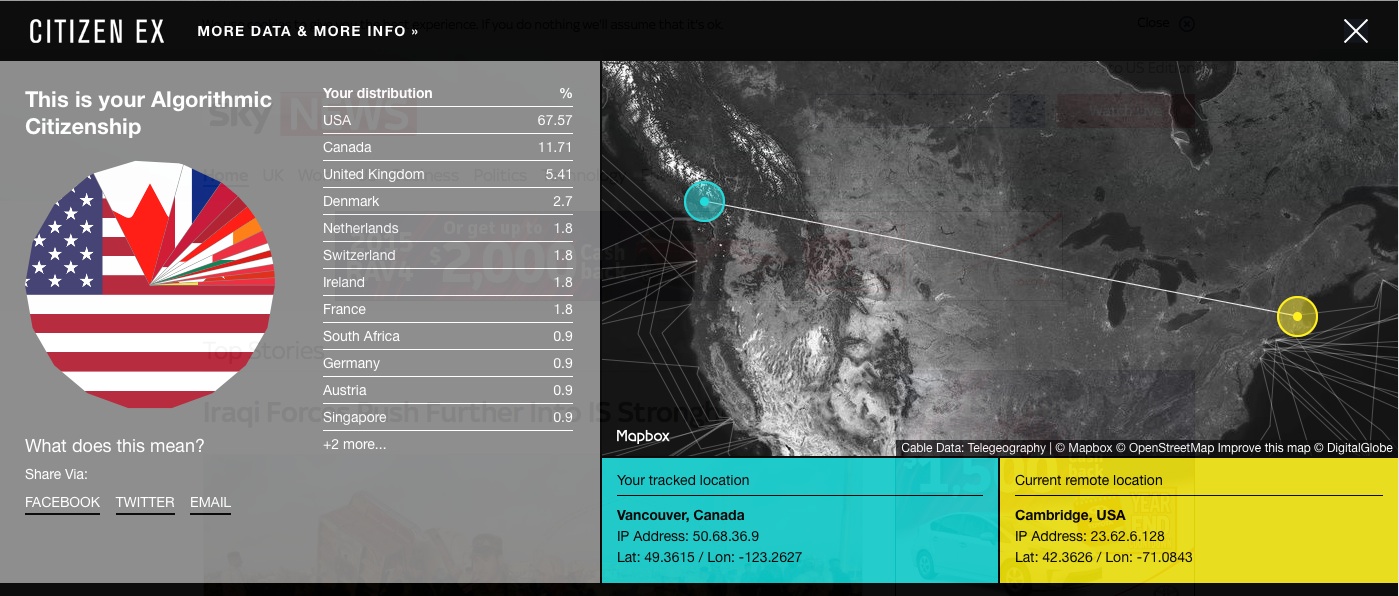
I’m late to this, so apologies, but if you are either weary of web-surfing or can’t get off your digital board, check out James Bridle‘s Citizen Ex project on ‘algorithmic citizenship’:

Algorithmic Citizenship is a form of citizenship which is not assigned at birth, or through complex legal documents, but through data. Like other computerised processes, it can happen at the speed of light, and it can happen over and over again, constantly revising and recalculating. It can split a single citizenship into an infinite number of sub-citizenships, and count and weight them over time to produce combinations of affiliations to different states.

Citizen Ex calculates your Algorithmic Citizenship based on where you go online. Every site you visit is counted as evidence of your affiliation to a particular place, and added to your constantly revised Algorithmic Citizenship. Because the internet is everywhere, you can go anywhere – but because the internet is real, this also has consequences.

The basic idea is derived from an essay by John Cheney-Lippold in Theory, culture and society here:

Marketing and web analytic companies have implemented sophisticated algorithms to observe, analyze, and identify users through large surveillance networks online. These computer algorithms have the capacity to infer categories of identity upon users based largely on their web-surfing habits. In this article I will first discuss the conceptual and theoretical work around code, outlining its use in an analysis of online categorization practices. The article will then approach the function of code at the level of the category, arguing that an analysis of coded computer algorithms enables a supplement to Foucauldian thinking around biopolitics and biopower, of what I call soft biopower and soft biopolitics. These new conceptual devices allow us to better understand the workings of biopower at the level of the category, of using computer code, statistics and surveillance to construct categories within populations according to users’ surveilled internet history. Finally, the article will think through the nuanced ways that algorithmic inference works as a mode of control, of processes of identification that structure and regulate our lives online within the context of online marketing and algorithmic categorization.

From James’s Citizen Ex site you can download (from the banner, top left) an extension to your browser which – after you’ve browsed some more – will calculate, in a very rough and ready way, your own algorithmic citizenship.  Mine (from today’s little effort) is shown at the head of this post.

This may look like an entertaining distraction, but what lies behind it is of course deadly serious: read, for example, James’s (short) stories on Libya and Syria.

Created as a browser plug-in, Citizen Ex shows us the true physical locations of the sites we visit and the territories that govern our actions as we traverse the web. In this reality, every mouse click leaves a trace, as our personal data is collected and stored in locations around the globe. It is with this information that governments and corporations construct a notional vision of our lives. This is our ‘algorithmic citizenship’ — the way we appear to the network. This programmatic fluidity is far removed from the true complexity of human identity. It reduces it to something calculable, which has profound implications for our understanding of privacy, citizenship and the self.

It also has profound implications for surveillance and the digital production of the killing spaces of later modern war.  Read this alongside Louise Amoore‘s brilliant work on The politics of possibility and you can perhaps see where I’m going:

‘[W]hat comes to count as the actionable intelligence behind a sovereign decision is a mosaic of overwhelmingly ordinary fragments of a life that become, once arrayed together, secret and sensitive evidence…

‘Drawing some elements of past activities into the calculation, the mosaic nonetheless moves over the surface of multiple past subjects and events in order to imagine a future unknown subject.’

It’s not difficult to divine (sic) how ‘Citizen Ex’ becomes ‘Citizen-Ex’.

Another Manhattan Project

I still regard Postmodern geographies as Ed Soja‘s finest book – his most considered and his most creative – and within that his essay on ‘Taking Los Angeles Apart‘ is surely the stand-out contribution.  By turns playful and passionate, it’s packed with insights about Los Angeles and late modern cities.  I discussed it at length in Geographical imaginations – the book not the blog – but the essay has come back to haunt me ever since I learned of an extraordinary new book which I know Ed would have read with the greatest interest.

KISHIK The Manhattan Project

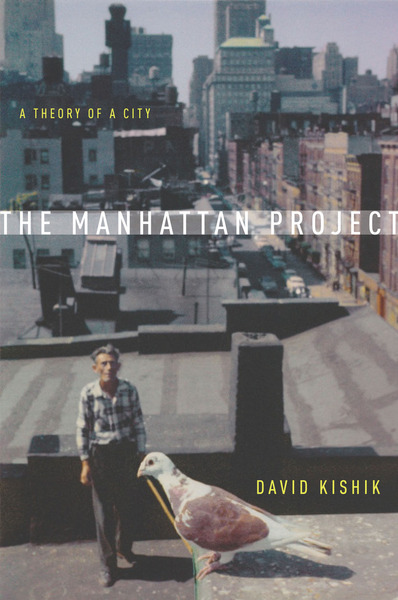
It’s David Kishik‘s The Manhattan Project, which I stumbled across because of its title and my new-found interest in seeing drones through post-atomic eyes.  But it’s not about that Manhattan Project at all.  Instead, it riffs on Benjamin’s Arcades Project in the most astonishing of ways:

In The Manhattan Project, David Kishik dares to imagine a Walter Benjamin who did not commit suicide in 1940, but managed instead to escape the Nazis to begin a long, solitary life in New York. During his anonymous, posthumous existence, while he was haunting and haunted by his new city, Benjamin composed a sequel to his Arcades Project. Just as his incomplete masterpiece revolved around Paris, capital of the nineteenth century, this spectral text was dedicated to New York, capital of the twentieth. Kishik’s sui generis work of experimental scholarship or fictional philosophy is thus presented as a study of a manuscript that was never written.

The fictitious prolongation of Benjamin’s life will raise more than one eyebrow, but the wit, breadth, and incisiveness of Kishik’s own writing is bound to impress. Kishik reveals a world of secret affinities between New York City and Paris, the flâneur and the homeless person, the collector and the hoarder, the covered arcade and the bare street, but also between photography and graffiti, pragmatism and minimalism, Andy Warhol and Robert Moses, Hannah Arendt and Jane Jacobs. A critical celebration of New York City, The Manhattan Project reshapes our perception of urban life, and rethinks our very conception of modernity.

Another good friend who is sadly no longer with us, Allan Pred, would surely have relished that too. I’m sure Ed would have insisted that Benjamin would never have gone to New York and that, in common with Adorno, he would have sought refuge in L.A. (where else? In fact Adorno left New York for LA, though it’s impossible to think of Ed calling that ‘exile’).

You can read the Introduction to The Manhattan Project here and an extract from the first chapter here; there’s also an extended interview with David about the project here.

Finally, there’s an excellent review by Dustin Illingworth at The Brooklyn Rail here.  When Dustin says this –

Like Borges’s “Aleph,” New York is “the place where, without admixture or confusion, all the places of the world, seen from every angle, coexist.” It is therefore much to Kishik’s credit that his slim volume, a drop in the vast ocean of literature on the city, packs such a considerable theoretical punch.

– then we are back with Ed Soja’s essay, which also began with an appeal to The Aleph and also packed a considerable theoretical punch.

The sound of refugees

Distance from home

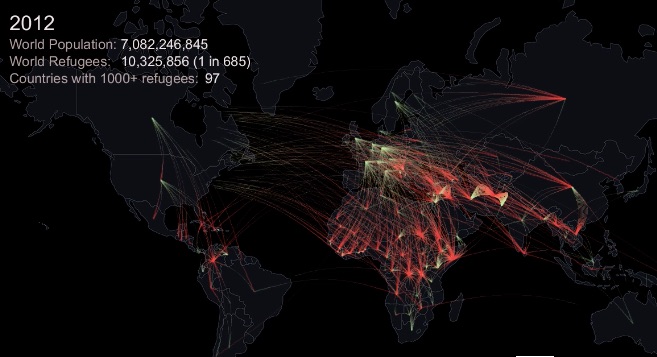
Brian Foo is a programmer and visual artist who has been conducting a series of music experiments at Date Driven DJ that combine data, algorithms, and borrowed sounds.  His video below (screenshot above), ‘Distance from home‘, which is also available on vimeo, uses refugee data from the United Nations from 1975 to 2012 to create a truly remarkable audio visualization.

Brian explained that his composition was inspired by The Refugee Project, and that it follows a series of algorithms:

Each year between 1975 and 2012 correlates to a 4-second segment in the song.

The annual global aggregate volume of refugee migration controls the quantity of instruments playing. The higher the volume of refugee migration, the more instruments are added to the song.

The annual average distance of refugee migration controls the duration and pitch of the instruments. Longer distances yield instruments that play longer and lower-pitch notes (e.g. long distances: , short distances: ).

The annual amount of countries with 1000+ refugees control the variety of instruments playing, where the more countries with 1000+ refugees, the more variety of instruments are playing in the song.

Thanks to Jaimie for bringing this project to my attention – which assumes a new significance as so many politicians and commentators foment fear, anger and rejection towards refugees seeking to escape war, misery and violence.  For a counterpoint, try this.

More tortured geographies

Route Map 2

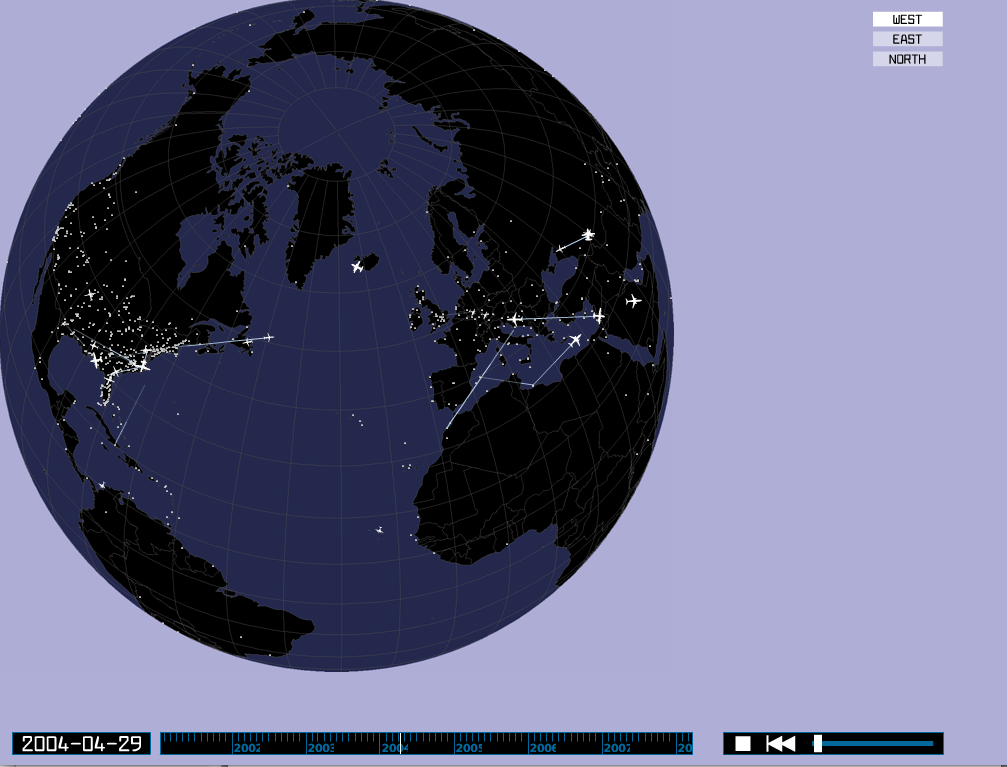
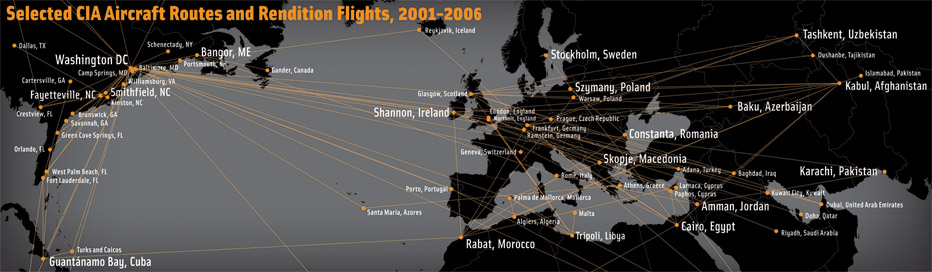
There have been several attempts to reconstruct the geography of the CIA’s program of extraordinary rendition. I’ve long admired the work of my good friend Trevor Paglen, described in his book with A.C. ThompsonTorture Taxi: on the trail of the CIA’s rendition flights, available in interactive map form through Trevor’s collaboration with the Institute for Applied Autonomy as Terminal Air. (I’ve commented on the project before, here and especially here).

terminal-air

And you can only applaud Trevor’s chutzpah is displaying the results of his work on a public billboard:

paglenemerson-cia-flights-2001-6

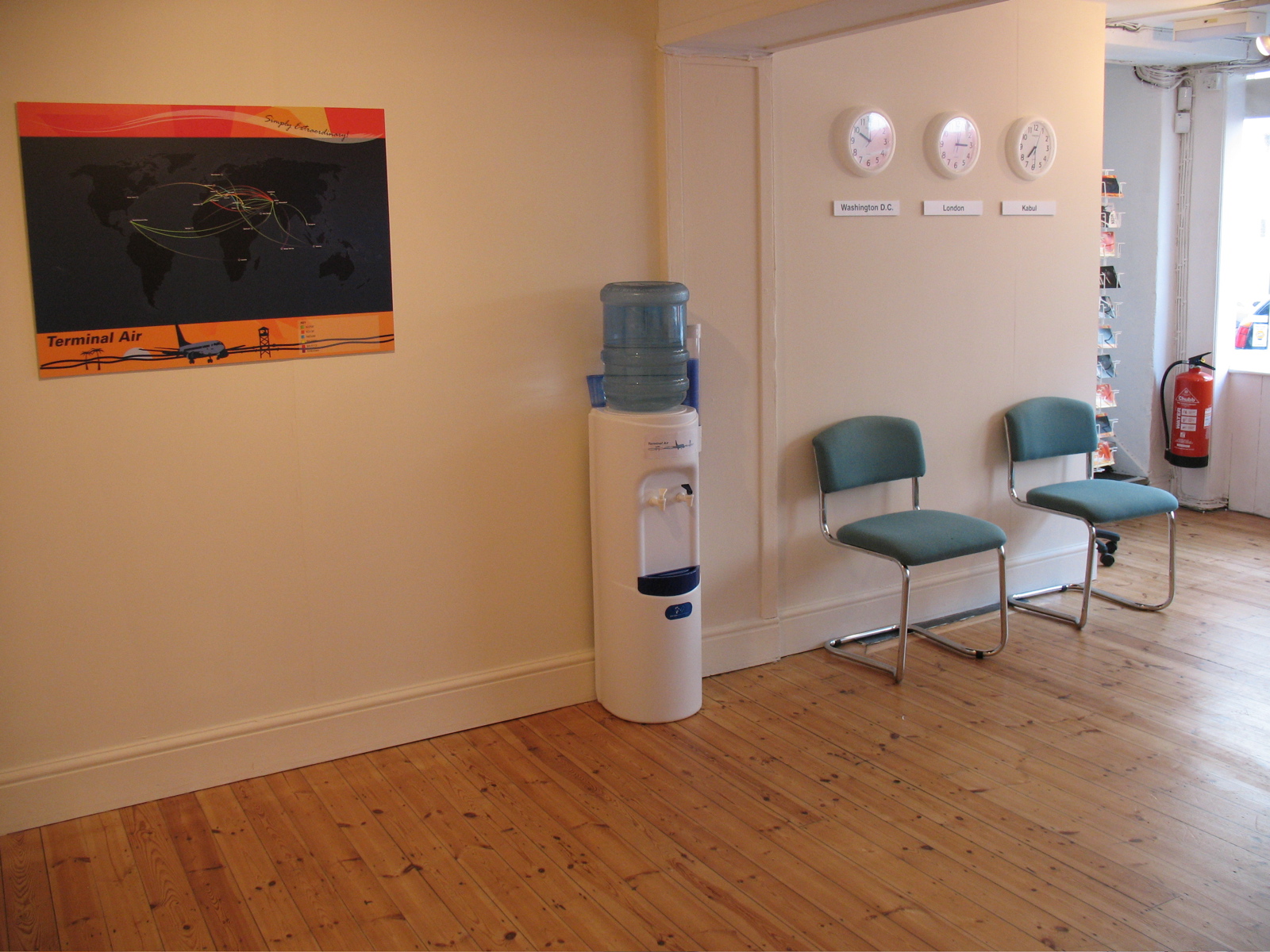
The project, which involved the painstaking analysis of countless flight records and endless exchanges with the geeks who track aircraft as a hobby, triggered an installation in which the CIA was reconfigured as a ‘travel agency‘:

Terminal Air travel agency

At the time (2007), Rhizome – which co-sponsored the project – explained:

Terminal Air is an installation that examines the mechanics of extraordinary rendition, a current practice of the United States Central Intelligence Agency (CIA) in which suspected terrorists detained in Western countries are transported to so-called “black sites” for interrogation and torture. Based on extensive research, the installation imagines the CIA office through which the program is administered as a sort of travel agency coordinating complex networks of private contractors, leased equipment, and shell companies. Wall-mounted displays track the movements of aircraft involved in extraordinary rendition, while promotional posters identify the private contractors that supply equipment and personnel. Booking agents’ desks feature computers offering interactive animations that enable visitors to monitor air traffic and airport data from around the world, while office telephones provide real-time updates as new flight plans are registered with international aviation authorities. Seemingly-discarded receipts, notes attached to computer monitors, and other ephemera provide additional detail including names of detainees and suspected CIA agents, dates of known renditions, and images of rendition aircraft. Terminal Air was inspired through conversations with researcher and author Trevor Paglen (Torture Taxi: On the Trail of the CIA’s Rendition Flights – Melville House Publishing). Data on the movements of the planes was compiled by Paglen, author Stephen Grey (Ghost Plane: The True Story of the CIA Torture Program – St. Martin’s Press) and an anonymous army of plane-spotting enthusiasts.

There’s a short video documenting the project on Vimeo here and embedded below (though strangely Trevor isn’t mentioned and doesn’t appear in it):

Although Trevor subsequently explained why he tried to ‘stay away from cartography and “mapping” as much as possible’ in his work, preferring instead the ‘view from the ground’, the cartography of all of this matters in so many ways – from the covert complicity of many governments around the world in a global geopolitics of torture through to the toll exerted on the bodies and minds of prisoners as they were endlessly shuffled in hoods and chains over long distances from one black site to another.

And now, thanks to the equally admirable work of the Bureau of Investigative Journalism, it’s possible to take the analysis even further.  Here is Crofton Black and Sam Raphael introducing their project, ‘The boom and bust of the CIA’s secret torture sites‘:

In spring 2003 an unnamed official at CIA headquarters in Langley sat down to compose a memo. It was 18 months after George W Bush had declared war on terror. “We cannot have enough blacksite hosts,” the official wrote. The reference was to one of the most closely guarded secrets of that war – the countries that had agreed to host the CIA’s covert prison sites.

Between 2002 and 2008, at least 119 people disappeared into a worldwide detention network run by the CIA and facilitated by its foreign partners.

Lawyers, journalists and human rights organisations spent the next decade trying to figure out whom the CIA had snatched and where it had put them. A mammoth investigation by the US Senate’s intelligence committee finally named 119 of the prisoners in December 2014. It also offered new insights into how the black site network functioned – and gruesome, graphic accounts of abuses perpetrated within it.

Many of those 119 had never been named before.

The report’s 500-page summary, which contained the CIA official’s 2003 remarks, was only published after months of argument between the Senate committee, the CIA and the White House. It was heavily censored, while the full 6,000-page study it was based on remains secret. All names of countries collaborating with the CIA in its detention and interrogation operations were removed, along with key dates, numbers, names and much other material.

In nine months of research, the Bureau of Investigative Journalism and The Rendition Project have unpicked these redactions to piece together the hidden history of the CIA’s secret sites. This account unveils many of the censored passages in the report summary, drawing on public data sources such as flight records, aviation contracts, court cases, prisoner testimonies, declassified government documents and media and NGO reporting.

Although many published accounts of individual journeys through the black site network exist, this is the first comprehensive portrayal of the system’s inner dynamics from beginning to end.

CIA black sites (BOIJ:REndition Project)

At present the mapping is rudimentary (see the screenshot above), but the database matching prisoners to black sites means that it ought to be possible to construct a more fine-grained representation of the cascade of individual movements.  The Rendition Project has already identified more than 40 rendition circuits involving more than 60 renditions of CIA prisoners: see here and the interactive maps here.

Danse macabre

Patterns of life 3 JPEG

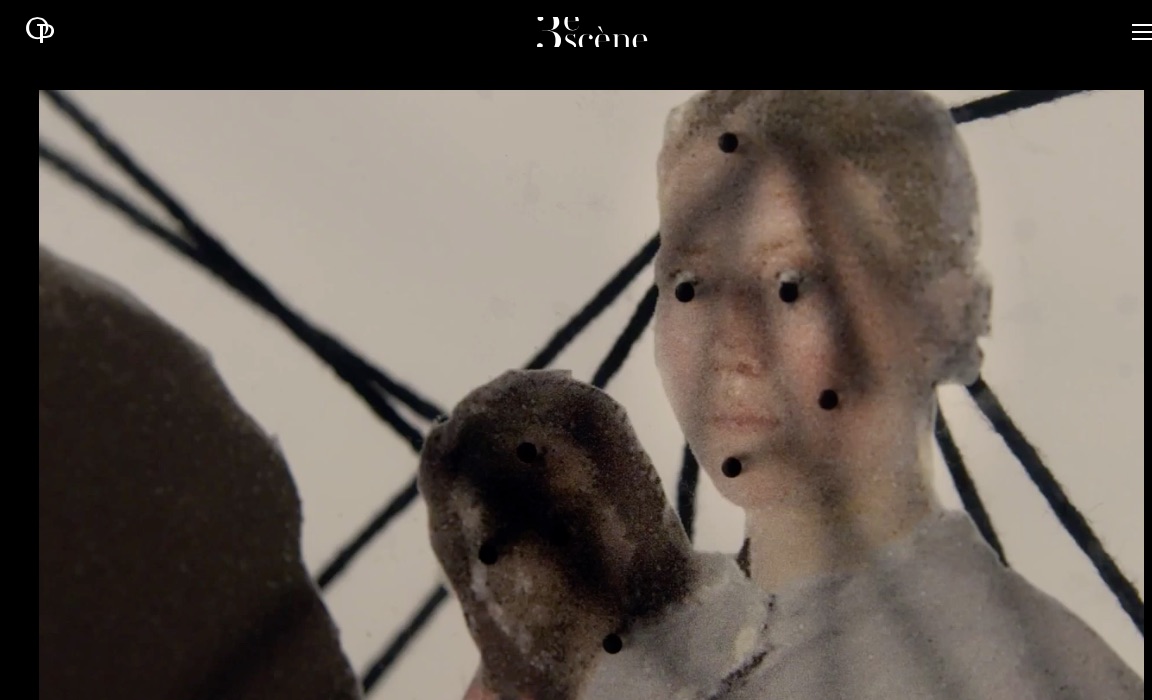
Grégoire Chamayou writes to say that after our conversations in Irvine last year he has worked with an artist friend, Julien Prévieux (who won the Prix Marcel Duchamp in 2014) and the Opéra national de Paris to turn his ideas about schematic bodies and patterns of life into a short film: Patterns of Life.

I’ve embedded it below, but if the link doesn’t work you can watch it here or on YouTube here. You will soon see why Anne Buttimer once described Torsten Hågerstrand‘s time-geography diagrams as a danse macabre.  The subtitles are in French but the commentary is in English.

I find the combination of intellectual imagination and performance work absolutely compelling – see my comments on ‘Bodies on the line’ here, for example.

Art in another age of mechanical destruction

Paglen (Untitled, Predators, Indian Springs)

Anthony Downey‘s beautifully illustrated and generously hyperlinked essay on The legacy of the war on terror for Tate Etc (34) (2015) is here.

For centuries artists have both responded to and reflected on political actions and events that shape society. Now they have risen to the challenge of questioning the moral ambiguity and culpability of governments waging the war on terror, whose methods may, according to this writer, have done more to weaken democracy than any terrorist.

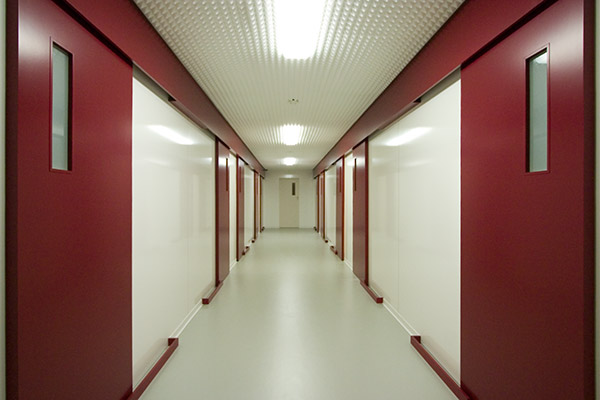
The essay considers the art works of Trevor Paglen (see his Untitled, Predators, Indian Springs, above) Christoph Büchel and Gianni Motti, Ayreen Anastas and Rene Gabri, Gregor Schneider, (see his Passageway No 1 from White Torture below), Wafaa Bilal, Coco Fusco, Hasan Elahi and Gerhard Richter.

20150519_photo1

If you know Anthony’s previous work (for example his essay on ‘Exemplary subjects: Camps and the politics of representation’), or his Art and Politics now (2014), you will not be surprised to find that – as the image above suggests – there’s much in this essay about Guantanamo — but also much more besides.

Here is the Introduction:

In the months after the attacks on the World Trade Centre on 11 September 2001 a significant number of artists and cultural practitioners compared the events, in all their visual impact and operatic pitching of good against evil, with a work of art. These comments were dismissed at the time as reactionary and in bad taste, but they did reveal an imminent desire to develop a degree of distance – be it aesthetic or otherwise – from the emotive, ‘spectacular’ and brutal realities that unfolded on that fateful day. In the months and years that followed, under the political logic of a so-called war on terror, we saw yet another unprecedented attack, this time on the legal systems protecting basic civil rights. The war on terror segued, in short order, into an assault on human rights. For some, terrorism has become the single biggest challenge facing democratically elected governments worldwide. For others, it is the political reaction to it that has done more to weaken democracy than any act of terror.

Executed as it was in the name of justice, the war on terror has resulted in a nominal state of emergency being declared across North America and Europe. Since 2001 we have witnessed the repeated suspension of due legal process, the revocation of constitutional law, the institutionalisation of torture, the withdrawal of civil rights, the deployment of mass surveillance, the routine collection of information on innocent citizens and arbitrary detention without trial for countless people worldwide.

Contemporary artists, in examining the ambiguity of this state of affairs, often create narratives and forms of speculative visual rhetoric that expose the anxieties surrounding these acts.

Visual occupations and a counter-politics of visuality

Most readers will know Eyal Weizman‘s searing account of the cruel intersections between the politics of visibility and the politics of verticality in occupied Palestine, Hollow Land: Israel’s architecture of occupation.

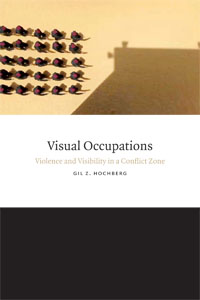
But there are other, no less intimate and intrusive dimensions to the politics of visibility for a people under military (and civilian) occupation that amount to what Gil Hochberg calls an ‘uneven distribution of “visual rights”‘.  In her brilliant new book from Duke University Press, Visual occupations: violence and visibility in a conflict zone, she explores ‘the political importance of various artistic attempts to redistribute the visible’ (my emphasis) and, in effect, to put in place a counter-politics of visuality.

978-0-8223-5887-9_prIn Visual Occupations Gil Z. Hochberg shows how the Israeli Occupation of Palestine is driven by the unequal access to visual rights, or the right to control what can be seen, how, and from which position. Israel maintains this unequal balance by erasing the history and denying the existence of Palestinians, and by carefully concealing its own militarization. Israeli surveillance of Palestinians, combined with the militarized gaze of Israeli soldiers at places like roadside checkpoints, also serve as tools of dominance. Hochberg analyzes various works by Palestinian and Israeli artists, among them Elia Suleiman, Rula Halawani, Sharif Waked, Ari Folman, and Larry Abramson, whose films, art, and photography challenge the inequity of visual rights by altering, queering, and manipulating dominant modes of representing the conflict. These artists’ creation of new ways of seeing—such as the refusal of Palestinian filmmakers and photographers to show Palestinian suffering or the Israeli artists’ exposure of state manipulated Israeli blindness —offers a crucial gateway, Hochberg suggests, for overcoming and undoing Israel’s militarized dominance and political oppression of Palestinians.

Here’s the Contents List:

Introduction. Visual Politics at a Conflict Zone

Part I. Concealment

1. Visible Invisibility: On Ruins, Erasure, and Haunting
2. From Invisible Spectators to the Spectacle of Terror: Chronicles of a Contested Citizenship

Part II. Surveillance

3. The (Soldier’s) Gaze and the (Palestinian) Body: Power, Fantasy, and Desire in the Militarized Contact Zone
4. Visual Rights and the Prospect of Exchange: The Photographic Event Placed under Duress

Part III. Witnessing

5. “Nothing to Look At”; or, “For Whom Are You Shooting?”: The Imperative to Witness and the Menace of the Global Gaze
6. Shooting War: On Witnessing One’s Failure to See (on Time)

Closing Words

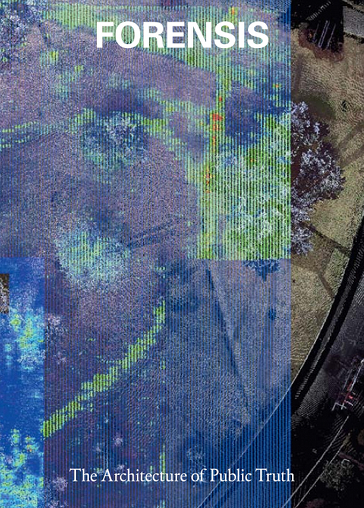
2014_cover_publication_forensisIt’s a compelling book, and I’m struck by another parallel with Eyal’s work.  In Hollow Land Eyal showed the central role that architecture and architects play in Israel’s illegal occupation of the West Bank, but in subsequently developing his collaborative Forensic Architecture project he effectively reverse-engineers architecture’s dominant imaginary to use built forms and spatial formations as a way of revealing prior trajectories of violence to a public forum.  That too is a counter-politics of visuality.

Der Himmel über Berlin

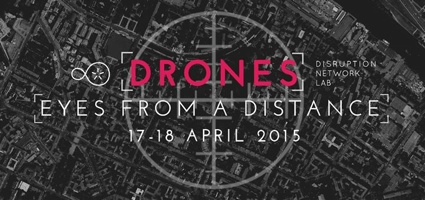
At the end of February Tatiana Bazzichelli, director and curator of the Disruption Network Lab, invited me to be a keynote speaker at Eyes from a Distance: on drone systems and their strategies in Berlin in April.

Disruption Network Lab is an ongoing platform of events and research focused on art, hacktivism and disruption. The Laboratory takes shape through a series of conference events at Studio 1, Kunstquartier Bethanien in Berlin.

The goal of the Disruption Network Lab is to present and generate new possible routes of social and political action within the framework of hacktivism, digital culture and network economy, focusing on the disruptive potential of artistic practices. The Disruption Network Lab is a conceptual and practical zone where artists, hackers, networkers, critical thinkers and entrepreneurs enter into a dialogue. The programme is developed through artistic presentations, theoretical debates and keynote events. This series of events establishes local and translocal partnerships with other spaces and institutions.

0i1drones5_3907706133_o

The specific aim of Eyes from a Distance was unerring:

What is the politics and the regime of power beyond drone-systems? Which are the consequences both on militant networks and civil society of an increasing automatism of conflicts? Can we track down the hidden strategies that move target-killings? Can we understand better drone technology? This event combines reflections on the political and technological infrastructure of drone-systems, the use of them in massive and weaponised military programmes, and the artistic and activist response to this.

I was already committed to presentations at the Balsillie School/CIGI and to the AAG Conference in Chicago so, with immense reluctance, I had to decline.  Now I know what I missed – not only the wonderful city of Berlin but also a brilliant programme that would have kept me inside on both evenings.

You can find two video clips (one by Brandon Bryant, which I’ve embedded above) published as part of the documentation of the meeting here, and over at We Make Money Not Art, Regine has provided three detailed reports from the meeting (with useful links): The Grey Zone: the (il)legitimacy of targeted killing by drones, Eyes from a Distance: personal encounters with military drones, and Tracking Drones, reporting lives.

Intersecting with the themes raised by Eyes from a Distance, I highly recommend a new essay/work-in-progress by Sara Matthews on ‘Visual Itineraries of the Sovereign: The Drone Gaze‘.  It was originally developed for a panel on “The Ethics and Itineraries of Visual Data” at the meeting of the Society for Cinema and Media Studies in Montreal in March.

Bodies on the line

The more I think about corpography (see also ‘Corpographies under the DOWNLOADS tab) – especially as part of my project on casualty evacuation from war zones – the more I wonder about Grégoire Chamayou‘s otherwise artful claim that with the advent of armed drones the ‘body becomes the battlefield’.  He means something very particular by this, of course, as I’ve explained before (see also here).

But let me describe the journey I’ve been taking in the last week or so that has prompted this post. Later this month I’m speaking on ‘Wounds of war, 1914-2014‘, where I plan to sketch a series of comparisons between casualty evacuation on the Western Front (1914-18) and casualty evacuation from Afghanistan.  I’ve already put in a lot of work on the first of these, which will appear on these pages in the weeks and months ahead, but it was time to find out more about the second.
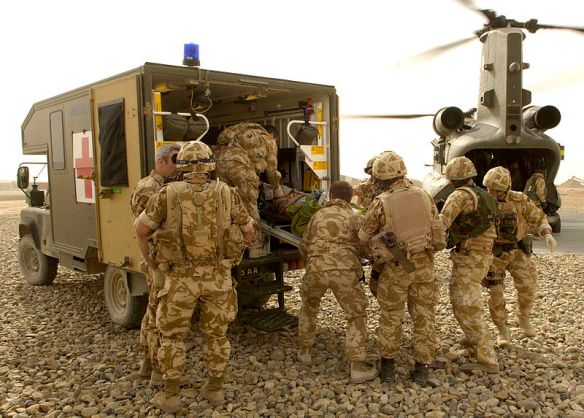
800px-Medical_Emergency_Response_Team_Recovers_a_Casualty_in_Afghanistan_MOD_45151884

En route I belatedly discovered the truly brilliant work of David Cotterrell who is, among many other things, an installation artist and Professor of Fine Art at Sheffield Hallam University.  He became interested in documenting the British military casualty evacuation chain from Afghanistan, and in 2007 secured access to the Joint Medical Forces’ operations at Camp Bastion in Helmand.  He underwent basic training, a course in even more basic battlefield first-aid, and then found himself on an RAF transport plane to Bastion.  The Role 3 Hospital was, as he notes, a staging-ground. ‘Field hospitals are islands between contrasting environments,’ he wrote in his diary, ‘between the danger and dirt of the Forward Operating Bases and the order and convention of civilian healthcare.’  You can read a long, illustrated extract from the diary (3 – 26 November 2007) here, follow the photo-essay as a slideshow here, and explore David’s many other projects on his own website here.
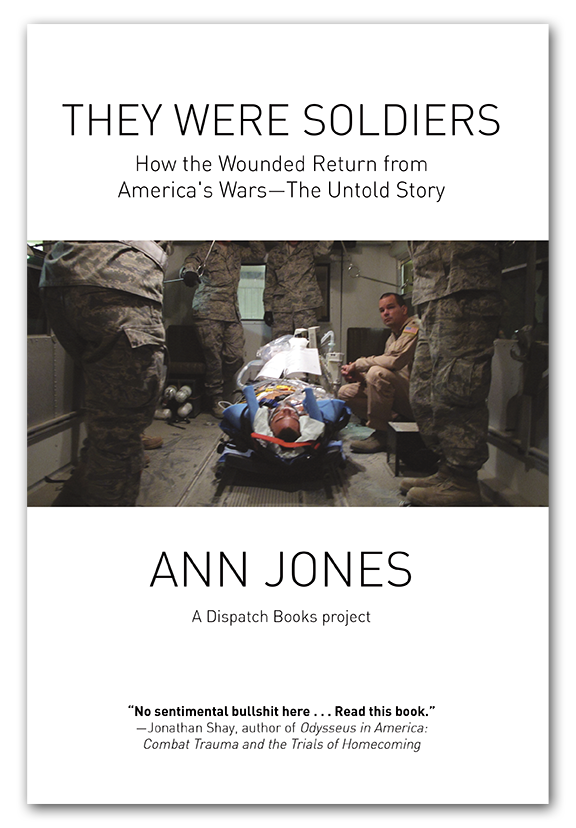
THEY-WERE-SOLDIERS_by-Ann-Jones_72The diary is immensely interesting and informative in its own right, not least about the exceptional personal and professional difficulties involved in documenting the evacuation process.  Here there’s a helpful comparison to be made with journalist Ann Jones‘s no less brilliant They were soldiers: how the wounded return from America’s wars (more on this in a later post), which starts at the US military’s own Level III Trauma Center, the Craig Joint Theater Hospital at Bagram, and moves via Landstuhl Regional Medical Center in Germany, the largest US hospital outside the United States, to the Walter Reed Army Medical Center in Washington DC.

David’s visual record is even more compelling, as you would expect from a visual artist, not only in its documentary dimension but also in the installations that have been derived from it.  In Serial Loop, for example, we are confronted with a looped film showing the endless arrival of casualties at Bastion: ‘The sound of a continuously arriving and departing Chinook helicopter accompanies images of a bleak and wasted landscape; the banality of the film’s fixed perspective masks the dramas that unfold within the ambulances as they travel to triage.’

9-liner explores what David calls ‘the abstraction of experience within conflict’:

9-Liner explores the dislocation between the parallel experiences of casualties within theatre. It is a quiet study of a dramatic event: the attempt to bring an injured soldier to the tented entrance of the desert field hospital. The screens show apparently unrelated information. JCHAT – a silent scrolling codified message – runs on a central screen. Our interpretation of it is enabled through its relationship between one of two radically different but equally accurate views of the same event. To the left we see the Watchkeeper – a soldier manning phones and reading computer screens in a crowded office. On the right we view the MERT flight – the journey of the Medical Emergency Response Team in a Chinook helicopter.

SHU’s REF submission includes this summary of David’s work (one of the very few useful things to come out of that otherwise absurdist exercise):

The research made clear that soldiers recovering from life-changing injuries had limited means of reconstructing the narrative of their transformative experiences. From the time of wounding through to secondary operations in the UK, many soldiers remained sedated or unconscious for a period of up to five days. The radical physical transformation that had occurred during this period was not adequately reconciled through medical notes, and the embargo on photographic documentation of incident and subsequent medical procedures served further to obscure this period of lost memory.

A culture of secrecy meant that medical professionals were unable to access documentation of the expanded care pathway with which they, and their colleagues, were engaged. This fragmentation of experience and understanding within the process of evacuation, treatment and rehabilitation meant that the assessment of the contradictions and disorientation experienced by casualties and medical practitioners was denied to front-line staff.

Family members, colleagues and members of the public outside the immediate environment of the military were unable to visualise or understand the transformative effects of conflict on directly affected civilians and soldiers. Partly as a result, the scope for public debate to engage meaningfully with the longer term societal cost of contemporary conflict was limited.

The submission goes on to list an impressive series of debriefings, presentations to military and medical professionals, major exhibitions, and follow-through research in Birmingham.
5-soldiers_header

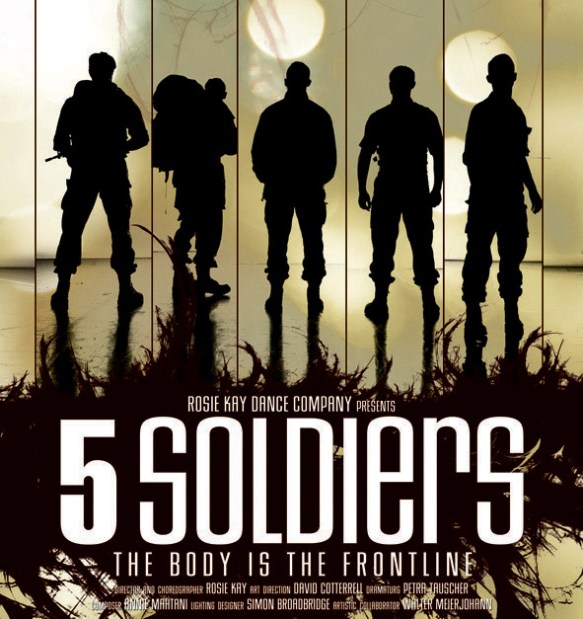
And it’s one of those follow-throughs that prompted me to think some more about corpographies.  I’d noted the connection between corpography and choreography in my original post, but David’s extraordinary collaboration with choreographer Rosie Kay and her dance company gives that a much sharper edge.  Again, there’s a comparison to be drawn – this time with Owen Sheers‘s impressively researched and executed body of work, not only the astonishing Pink Mist but also The Two Worlds of Charlie F (2012)which was a stage play based on the experiences of wounded soldiers who also made up the majority of the cast (see my discussion of these two projects here).

5 Soldiers started life as a stage presentation in 2010 (watch some extracts here):

A dance theatre work with 5 dancers, it looks at how the human body is essential to, and used in, warfare. 5 SOLDIERS explores the physical training that prepares you for war, as well as the possible effects on the body, and the injury caused by warfare.

Featuring Kay’s trademark intense physicality and athleticism, 5 SOLDIERS weaves a journey of physical transformation, helping us understand how soldiers are made and how war affects them.

5 SOLDIERS is a unique collaboration between award-winning choreographer Rosie Kay, visual artist David Cotterrell and theatre director Walter Meierjohann. It follows an intense period of research, where Rosie learnt battle training with The 4th Battalion The Rifles and David spent time in Helmand Province with the Joint Forces Medical Group.

Rosie explained her commitment to the project (and her training with The Rifles) like this:

“I wanted to look at how the physicality of a soldier’s job defines them –like a dancer, the soldier is drilled, trained, their responses becoming automatic, but can anything prepare you for the realities of war? It is young soldiers and their bodies that are the ultimate weapon in war – their strength and weaknesses may win or lose a battle, their ability to harm or injure others is key to victory. While war is surrounded with weaponry, uniforms, history and ceremony, the real business is human, dirty, messy, painful and happening right now.”

(She is, not coincidentally, an affiliate of the School of Anthropology at Oxford).

5 Soldiers installation PNG

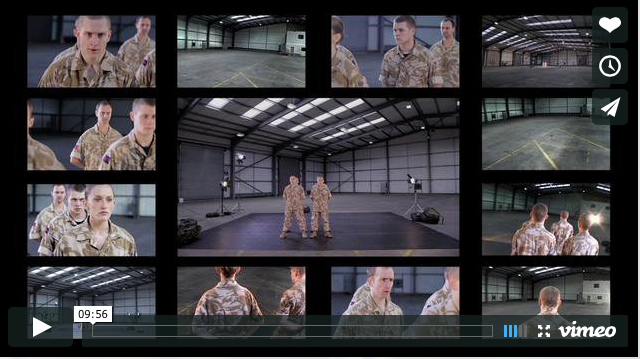
And now there’s a film version that works as a multi-screen installation (screen shot above).

Instead of just creating a short film, the team wanted the web user to get a truly interactive way to watch dance, and actually feel that they can go inside the minds and the body of the work. The 80-minute work was cut to just 10 minutes long, and the company spent one week filming in a huge aircraft hangar at Coventry Airport…

Using a variety of cutting edge filming techniques, the collaborative team have created a 13 angle edit that takes you into the heart of the work, follows each of the dancers, and zooms out so that the performers appear to be like ants in a huge empty landscape.

You can see the interactive, multi-perspectival version here.  This relied on helmetcams, and there’s a fine, more general commentary on this in Kevin McSorley‘s ‘Helmetcams, militarized sensation and “somatic war”‘ here.  But here’s the short, ‘director’s cut’ version:

And look at the tag-line: ‘The body is the frontline’.  It’s not only drones that make it so.
A short history of schematic bodies

While I was in Irvine last month for the Secrecy and Transparency workshop, I had a series of rich conversations with Grégoire Chamayou — who also made a brief but brilliant presentation on targeting, signature strikes and time-space tracking.  He now writes to say that he has elaborated his ideas in a longer contribution to Léopold Lambert‘s Funambulist papers: ‘A very short history of schematic bodies‘.

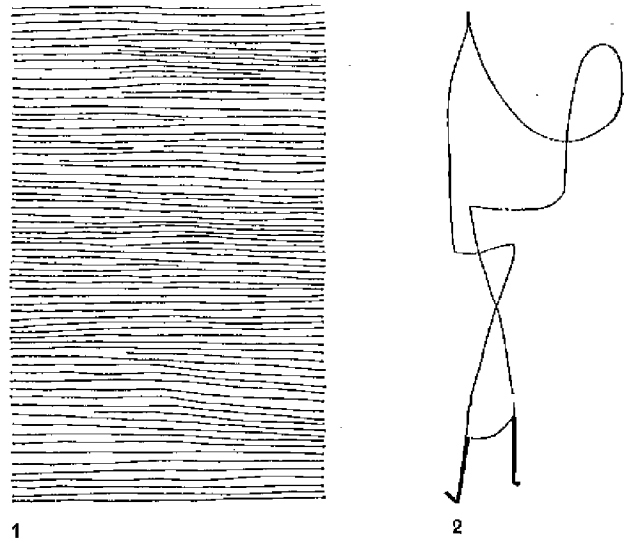
(Even more) briefly, Grégoire connects Torsten Hågerstrand‘s time geography – which Anne Buttimer once saw as a danse macabre – to the activity-based intelligence that supposedly ‘informs’ CIA-directed drone strikes [see my ‘Lines of descent’ essay: DOWNLOADS tab] via three diagrams drawn from Paul Klee.

16

The first two (above) distinguish (1) ‘dividuals‘ from (2) ‘individuals‘: so, following Deleuze, Grégoire distinguishes (1) ‘societies of control articulated through the dyad of “dividuals” and databanks’ from (2) ‘disciplinary societies structured around a relationship between the individual and the mass.’ Seen thus, Hagerstrand’s project mapped the reverse move from (1) to (2), from ‘statistical dividuality’ to ‘chronospatial individuality’.

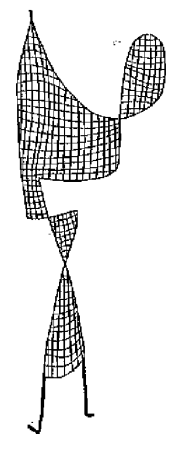
But Grégoire suggests that targeting involves a third fabrication, a co-construction of (1) and (2), thus:

17

He writes:

The corresponding object of power here is neither the individual taken as an element in a mass, nor the dividual appearing with a code in a databank, but something else: a patterned individuality that is woven out of statistical dividualities and cut out onto a thread of reticular activities, against which it progressively silhouettes in time as a distinctive perceptible unit in the eyes of the machine.

The production of this form of individuality belongs neither to discipline nor to control, but to something else: to targeting in its most contemporary procedures, whose formal features are shared today among fields as diverse as policing, military reconnaissance and marketing. It might well be, for that matter, that we are entering targeted societies.

This speaks directly to current theses about the individuation of military violence as one (and only one) modality of later modern war, but we need to remember that targeting appears at the interface of the market and the military, as Sam Weber shows in Targets of opportunity.  

It’s also important to think through the ‘body’ that is made to appear in the sights and as a sight; it’s not a fleshy body but a digital-statistical trace that is literally ‘touched’ by the cross-hairs (the apparatus of the drone as prosthesis).  As I wrote in ‘Drone geographies’ (DOWNLOADS tab),

[People] are brought within the militarized field of vision through the rhythmanalysis and network analysis of a suspicious ‘pattern of life’, a sort of weaponized time-geography… 

Killing is made the culmination of a natural history of destruction – in precisely not the sense intended by W.G. Sebald – and the targets are rendered as ‘individuals’ in a calculative rather than corporeal register.

Here Ian Hacking‘s ideas about ‘making up people‘ are also relevant.  In his classic British Academy lecture, ‘Kinds of people: moving targets‘, he described how ‘a new scientific classification may bring into being a new kind of person’ – in this case, the target – and how ‘a classification may interact with the people classified.’  A signature strike is surely the deadliest version of this ‘interaction’…

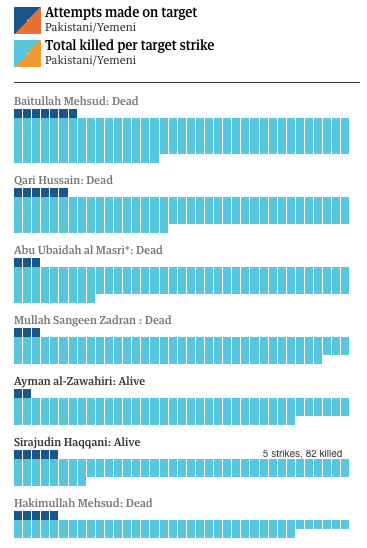
Incidentally, anyone who thinks that so-called ‘personality strikes’ are somehow less deadly needs to read REPRIEVE‘s latest report, You only die twice: multiple kills in the US drone program.  Spencer Ackerman has a good summary (and graphic, extracted below) here, describing the multiple deaths involved in the search for specific, named targets:

'Personality strikes' in Pakistan