Little Boys and Blue Skies

These are very preliminary notes and ideas for my presentation at “Through Post-Atomic Eyes” in Toronto next month: I would really – really – welcome any comments, suggestions or advice.  I don’t usually post presentations in advance, and this is still a long way from the finished version, but in this case I am venturing into (irradiated) fields unknown to me until a few months ago…
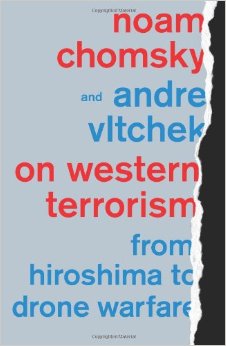
CHOMSKY On Western terrorismAt first sight, any comparison between America’s nuclear war capability and its drone strikes in Afghanistan, Iraq, Pakistan, Somalia, Syria and Yemen seems fanciful. The scale of investment, the speed and range of the delivery systems, the nature of the targets, the blast radii and precision of the munitions, and the time and space horizons of the effects are so clearly incommensurable. It’s noticeable that the conversation between Noam Chomsky and Andre Vltchek published as On Western Terrorism: from Hiroshima to drone warfare (2013) says virtually nothing about the two terms in its subtitle.

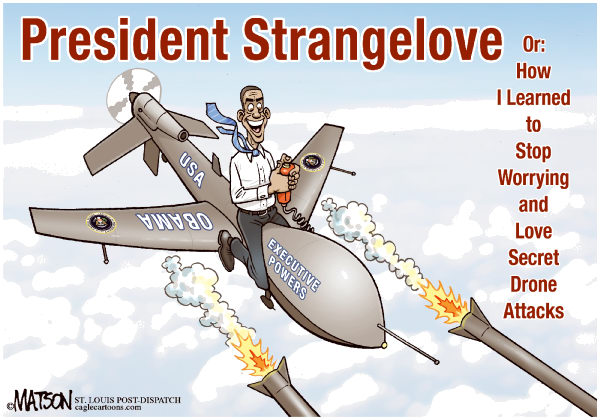
Yet nuclear weapons and drone strikes have both been attended by intense diplomatic, geopolitical and geo-legal manoeuvres, they have both sparked major oppositional campaigns by activist organisations, and they have both had major impacts on popular culture (as the two images below attest).

dr-strangelove-still-580

President-Strangelove

But there are other coincidences, connections and transformations that also bear close critical examination.

When Paul Tibbets flew the Enola Gay across the blue sky of Hiroshima on 6 August 1945 one of his major concerns was to execute a fast, tight 155 degree turn to escape the effects of the blast from ‘Little Boy’.  There is some dispute over the precise escape angle – there’s an exhaustive discussion in the new preface to Paul Nahin‘s Chases and escapes: the mathematics of pursuit and evasion (second edition, 2007) – but the crucial point is the concern for the survival of the aircraft and its crew.

Enola Gay co-pilot [Robert Lewis]'s sketch after briefing of approach and 155 turn by the B-29s weaponeer William Parsons, 4 August 1945

Tibbets successfully made his escape but four years later, when the US Atomic Energy Commission was developing far more powerful bombs, the Air Force became convinced that escape from those blasts would be impossible. And so it implemented Project Brass Ring which was intended to convert B-47 Stratojet bombers into remotely-piloted aircraft capable of delivering atomic bombs without any loss of American lives.  (What follows is taken from Delmer Trester, ‘Thermonuclear weapon delivery by unmanned B-47: Project Brass Ring‘; it was included in A history of the Air Force Atomic Energy Program, 1949-1953, which can be downloaded here; you can obtain a quick overview here).

‘It appeared that the Air Force would need some method to deliver a 10,000-pound package over a distance of 4,000 nautical miles with an accuracy of at least two miles from the center of the target. It was expected the package would produce a lethal area so great that, were it released in a normal manner, the carrier would not survive the explosion effects. Although not mentioned by name, the “package” was a thermonuclear device – the hydrogen or H-bomb…

B-47 Stratojet bomber (USAF)

‘The ultimate objective was to fashion a B-47 carrier with completely automatic operation from take-off to bomb drop… The immediate plan included the director B-47A aircraft as a vital part of the mission. Under direction from the mother aircraft, the missile would take off, climb to altitude and establish cruise speed conditions. While still in friendly territory, the crew aboard the director checked out the missile and committed its instruments to automatically accomplish the remainder of the mission. This was all that was required of the director. The missile, once committed, had no provision for returning to its base… either the B-47 became a true missile and dived toward the target … or a mechanism triggered the bomb free, as in a normal bombing run.’

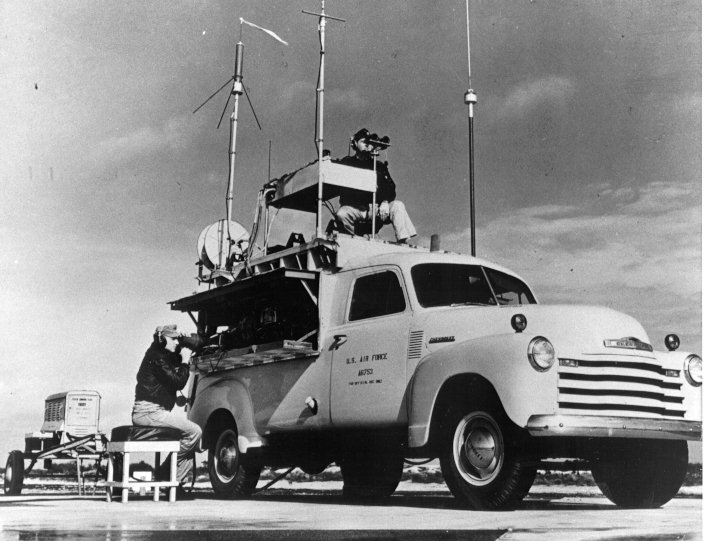
This was a re-run of Operation Aphrodite, a failed series of experiments carried out in the closing stages of the Second World War in Europe, and – as the images below show – after the war the Air Force had continued to experiment with B-17 aircraft remotely piloted from both ‘director aircraft’ [top image; the director aircraft is top right] and ‘ground control units’ [bottom image].  These operated under the aegis of the Air Force’s Pilotless Aircraft Branch which was created in 1946 in an attempt to establish the service’s proprietary rights over missile development.
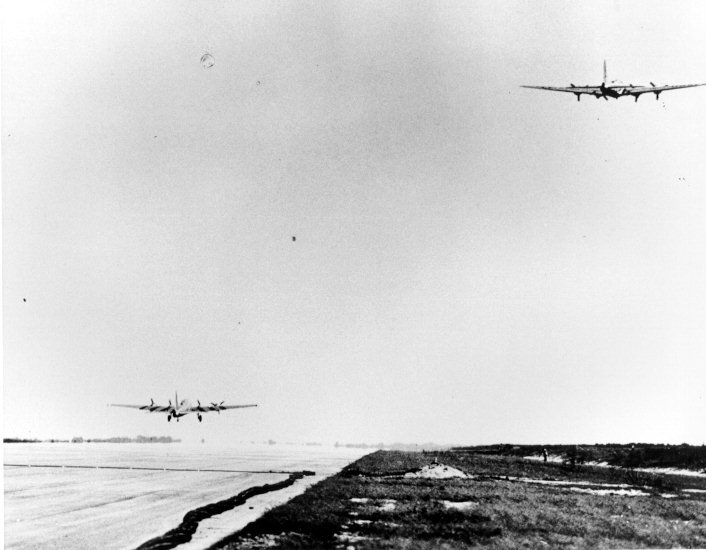
B-17 drones

Ground control unit for B-17 drone

But the Brass Ring team soon discovered that their original task had swelled far beyond its original, taxing specifications: in October 1951 they were told that ‘the super-bomb’ would weigh 50,000 lbs. They modified their plans (and planes) accordingly, and after a series of setbacks the first test flight was successful:

‘The automatic take-off, climb and cruise sequence was initiated remotely from a ground control station. The aircraft azimuth, during take-off, was controlled by an auxiliary control station at the end of the runway. Subsequent maneuvers, descent and landing (including remote release of a drag parachute and application of brakes) were accomplished from the ground control station. The test was generally satisfactory; however, there were several aspects – certain level flight conditions, turn characteristics and the suitability of the aircraft as a “bombing platform” – which required further investigation.’

This was part of a larger imaginary in which, as Life had commented in its issue of 20 August 1945, echoing USAAF General Henry H. ‘Hap’ Arnold, ‘robot planes … and atomic bombs will do the work today done by fleets of thousands of piloted bombers.’ (Arnold thought this a mixed blessing, and in an essay ghost-written with William Shockley he noted that nuclear weapons had made destruction ‘too cheap and easy’ – one bomb and one aircraft could replace hundreds of bombs and vast fleets of bombers – and a similar concern is often raised by critics of today’s Predators and Reapers who argue that their remote, often covert operations have lowered the threshold for military violence).
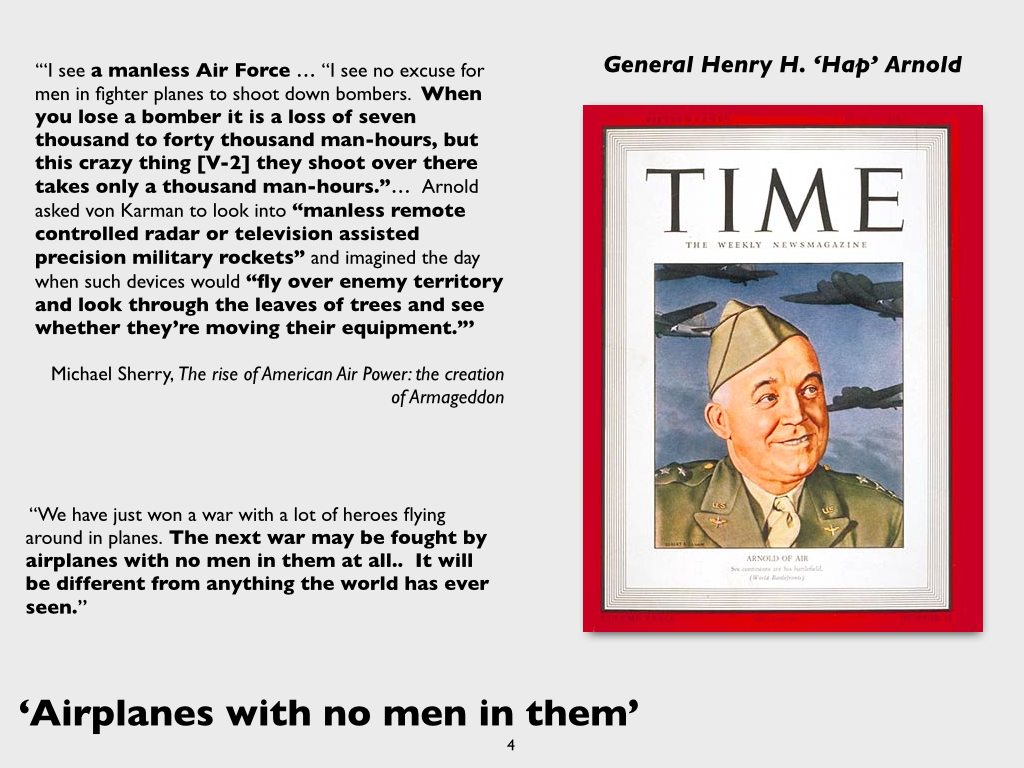
Henry H Hap Arnold.001

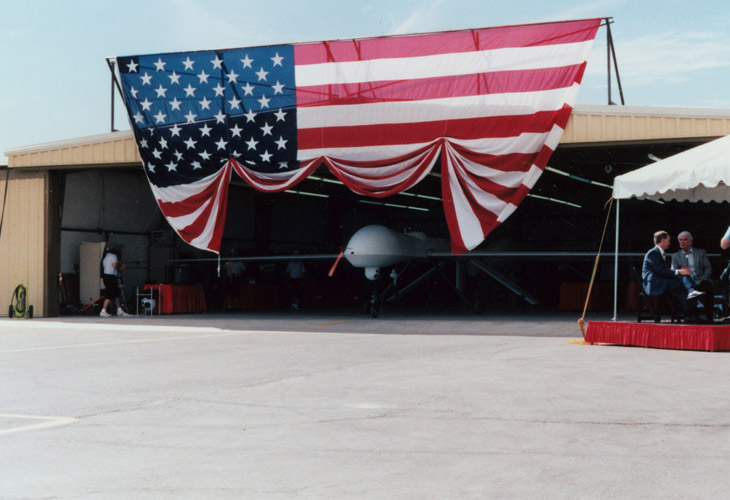
Brass Ring was abandoned on 13 March 1953, once the Air Force determined that a manned aircraft could execute the delivery safely (at least, for those on board).  It would be decades before another company closely associated with nuclear research – General Atomics (more here) – supplied the US Air Force with its first MQ-1 Predators.
1994-august

These were originally conceived as unarmed, tactical not strategic platforms, designed to provide intelligence, surveillance and reconnaissance for conventional strike aircraft. But the concern with American lives became a leitmotif of both programs, and one of the foundations for today’s remote operations is the ability (as the USAF has it) to ‘project power without vulnerability’.
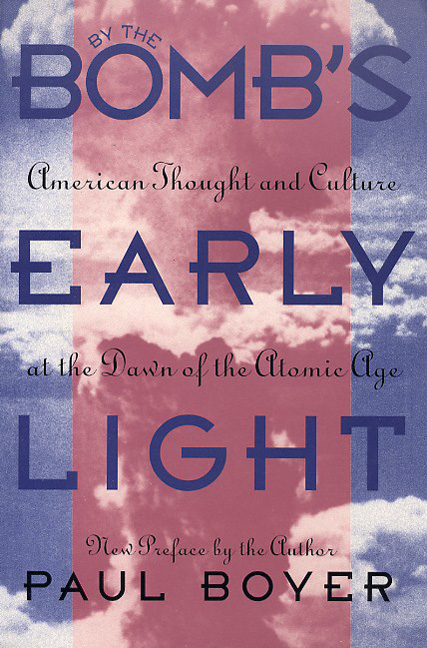
BOYER By the bomb's early lightThe visible effects of bombing Hiroshima and Nagasaki on the Japanese population were the subject of strict censorship – still photographs were never published, while Japanese media and even US military film crews had their documentary footage embargoed – and public attention in the United States was turned more or less immediately towards visualising ‘Hiroshima USA’ (Paul Boyer is particularly good on this; there are also many images and a good discussion here). Even the US Strategic Bombing Survey indulged in the same speculation: ‘What if the target for the bomb had been an American city?’ it asked in its June 1946 report. ‘The casualty rates at Hiroshima and Nagasaki, applied to the massed inhabitants of Manhattan, Brooklyn, and the Bronx, yield a grim conclusion.’ Although the original targets had been Asian cities it was American cities that were designated as future victims.  ‘Physically untouched by the war’ (apart from Pearl Harbor), Boyer wrote,

‘the United States at the moment of victory perceived itself as naked and vulnerable.  Sole possessors and users of a devastating instrument of mass destruction, Americans envisioned themselves not as a potential threat to other peoples, but as potential victims.’

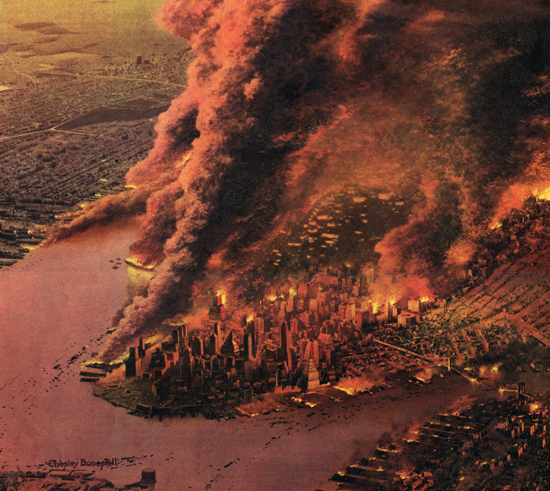
This was the abiding anxiety instilled by the national security state and orchestrated through its military-industrial-media-entertainment complex throughout the post-war decades.  Perhaps the most famous sequence of images – imaginative geographies, I suppose –accompanied an essay by John Lear in Collier’s Magazine in August 1950, ‘Hiroshima USA: Can anything be done about it?‘, showing a series of paintings by Chesley Bonestell and Birney Lettick imagining the effects of a nuclear strike on New York:

Hiroshima USA 11950-aug-6-colliers-p12-sm

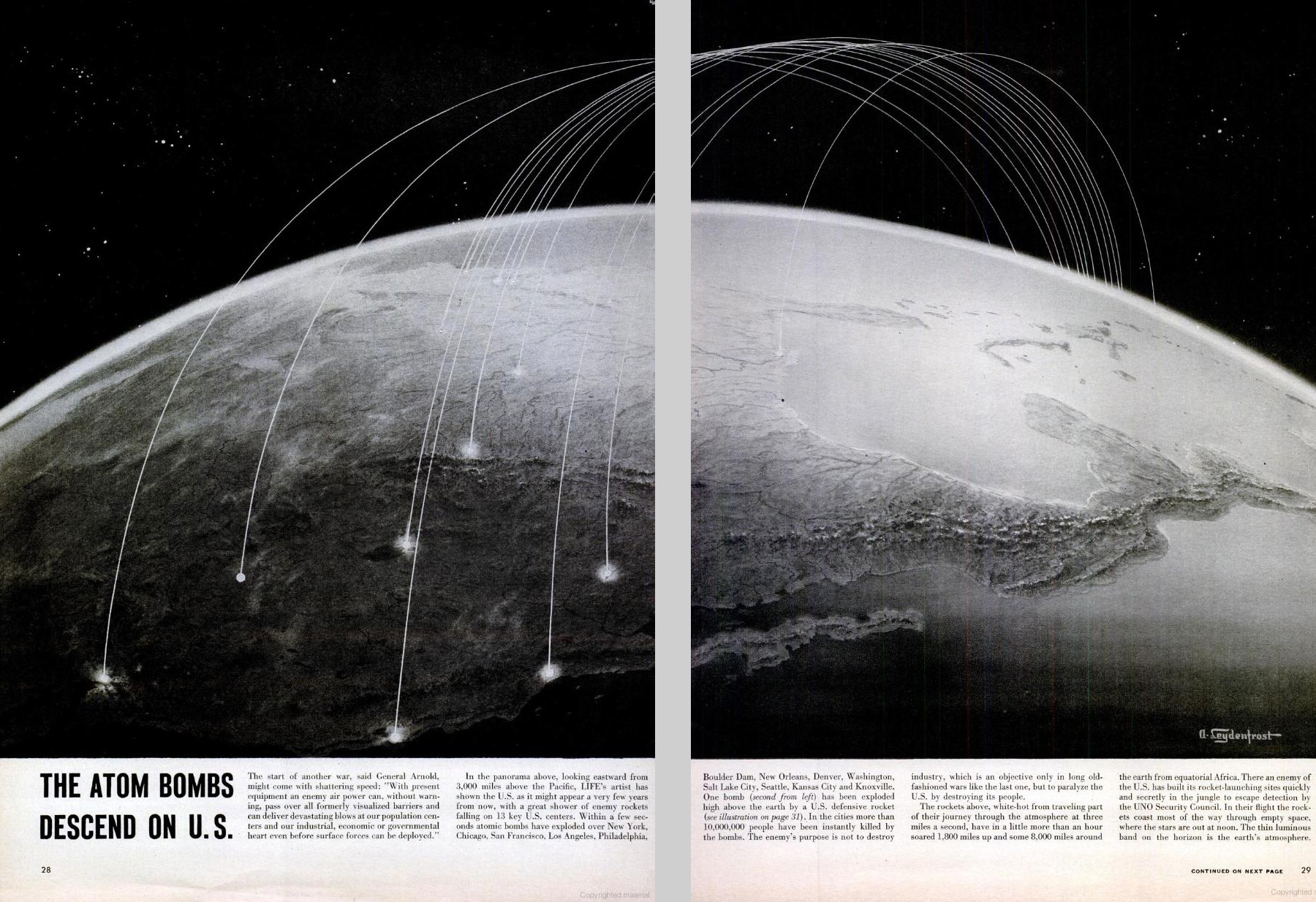
Similar sequences, often accompanied by maps, were produced for many other cities (and the simulations continue: see, for example, here).  The images below, from Life on 19 November 1945, come from ‘The 36-Hour War’ (see here for a commentary) that envisaged a nuclear attack on multiple cities across the USA, including Washington DC, from (presumably Soviet) ‘rocket-launching sites [built] quickly and secretly in the jungle’ of equatorial Africa:
1945-Life-36-Hour-War-2

1945-Life-36-Hour-War-1

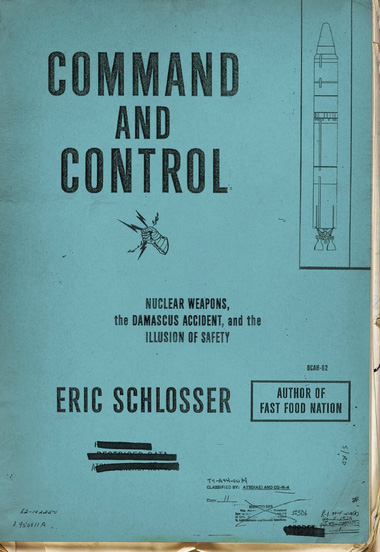
Schlosser-Command-and-Control-bookAs it happened, American cities did indeed become targets – for the US Air Force.  According to Eric Schlosser, under General Curtis Le May the goal was

to build a Strategic Air Command that could strike the Soviet Union with planes based in the United States and deliver every nuclear weapon at once. SAC bomber crews constantly trained and prepared for that all-out assault. They staged mock attacks on every city in the United States with a population larger than twenty-five thousand, practicing to drop atomic bombs on urban targets in the middle of the night. San Francisco was bombed more than six hundred times within a month.
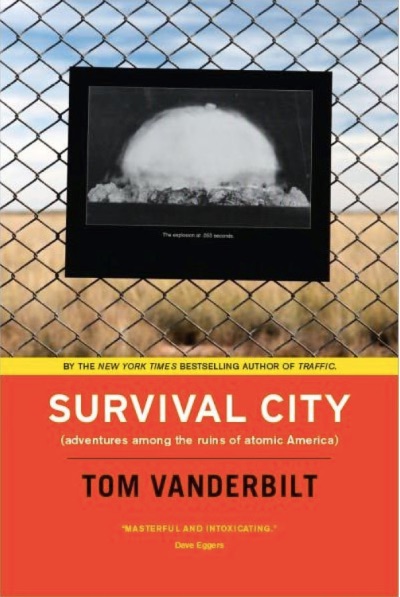
VANDERBILT Survival CityTests were also conducted at the Nevada Proving Ground, ‘the most nuclear-bombed place on the planet’, to determine the likely effects.  One of the purposes of the Strategic Bombing Survey’s Physical Damage Division had been to document the effects of the bombs on buildings in Hiroshima and Nagasaki – to read them as ‘blueprints for the atomic future‘ – and both Japanese and American medical teams had been sent in shortly after the blasts to record their effects on bodies (from 1947 their work was subsumed under the Atomic Bomb Casualty Commission).  It was now imperative bring the two together and to bring their results home.  And so, starting in 1953 with ‘Operation Doorstep’, mannequins were placed inside single-family houses at the Nevada site to calculate the prospects for the survival of what Joseph Masco calls the American ‘nuclearised’ family in the event of a nuclear attack; they subsequently went on public exhibition around the country with the tag line:

‘These mannikins could have been real people; in fact, they could have been you.’

In the Second World War experimental bombing runs had been staged against mock German and Japanese targets at the Dugway Proving Ground but – significantly – the buildings had no occupants: as Tom Vanderbilt wryly remarks, now ‘the inhabitants had been rewritten into the picture’ because the objective was to calibrate the lives of Americans.

Rachele Riley Mannequins

I have borrowed this image from the mesmerising work of artist Rachele Riley, whose project on The evolution of silence centres on Yucca Flat in the Nevada Test Site and raises a series of sharp questions about both the imagery and the soundscape of the nuclear age.

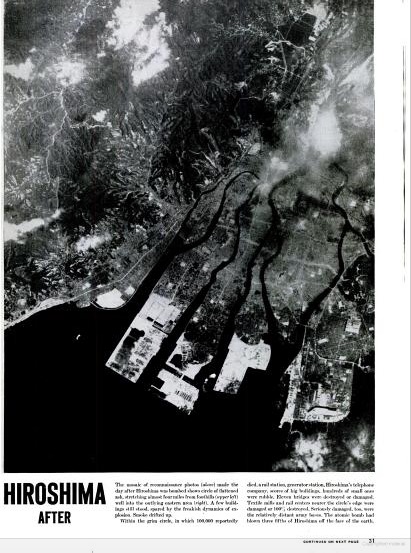
The power of the image – ‘the nuclear sublime’ – was one of the central objectives of the attacks on Hiroshima and Nagasaki: ‘the weapon’s devastating power had to be seen to be believed,’ as Kyo Maclear observed, and it had to be seen and believed in Moscow as well as in Tokyo.  Here the visual economies of nuclear attacks are radically different from drone strikes. In the immediate aftermath there was no shortage of atomic ‘views from the air’ –  aerial photographs of the vast cloud towering into the sky and of Hiroshima before and after the bomb.  Here is Life (sic) on 20 August 1945:

LIFE:Hiroshima 1

LIFE:Hiroshima 2LIFE:Hiroshima 3

Yet for the most part, and with some significant exceptions, aerial views are singularly absent from today’s drone wars. To Svea Braeunert (‘Bringing the war home: how visual artists return the drone’s gaze‘) that is all the more remarkable because drone strikes are activated by what video artist Harun Farocki called operative images: but that is also the reason for the difference. Aerial photographs of Hiroshima or Nagasaki reveal a field of destruction in which bodies are conspicuously absent; the resolution level is too coarse to discern the bomb’s victims.

But the video feeds from a Predator or Reaper, for all their imperfections, are designed to identify (and kill) individuals, and their aerial gaze would – if disclosed – reveal the bodies of their victims. That is precisely why the videos are rarely released (and, according to Eyal Weizman, why satellite imagery used by investigators to reconstruct drone strikes is degraded to a resolution level incapable of registering a human body – which remains ‘hidden in the pixels‘ – and why their forensic visual analysis is forced to focus on buildings not bodies).

OMAR FAST %000 Feet is Best

One might expect visual artists to fill in the blank. Yet – a further contrast with Hiroshima – apart from projects like Omar Fast’s ‘5,000 Feet is Best’ (above) and Thomas van Houtryve’s ‘Blue Sky Days’ (below) there have been precious few attempts to imagine drone strikes on American soil.
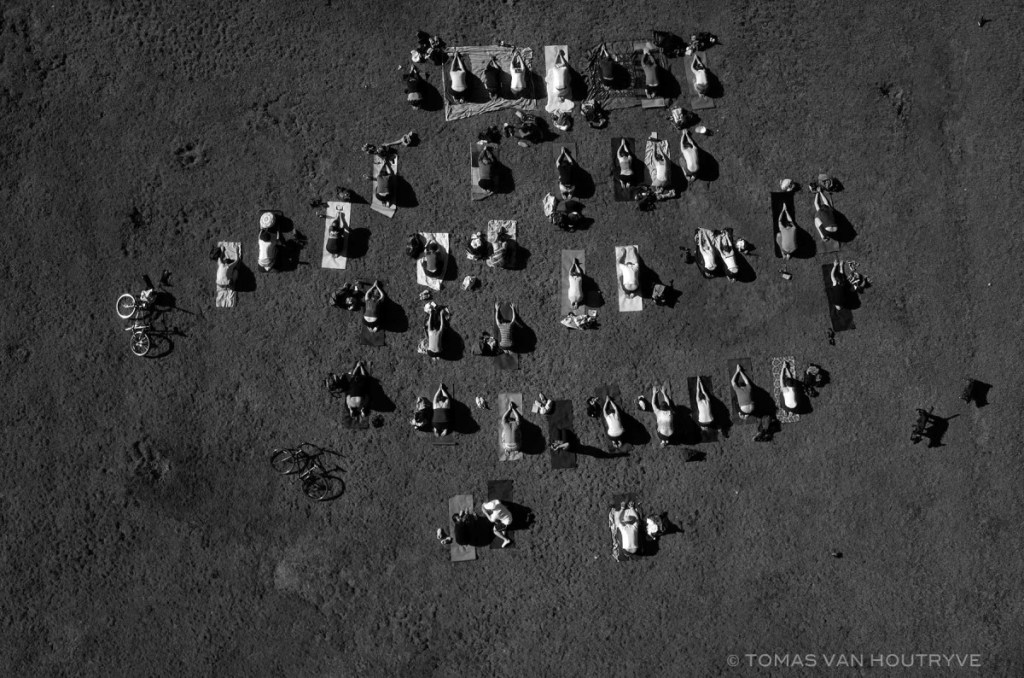
van HOUTRYVE Blue Sky Days

Perhaps this is because they are so unlikely: at present these remote platforms can only be used in uncontested air space, against people or states who are unable (or in the case of Pakistan, unwilling) to defend themselves. But there has been a protracted debate about such strikes on American citizens (notably the case of Anwar al-Awlaki) and a concerted attempt to focus on the rules followed by the CIA and JSOC in their programs of targeted killing (which has artfully diverted public attention to Washington and away from Waziristan).

There is also a visceral, visible continuity between the two: just as in Hiroshima and Nagasaki, there has been little public concern over the victims of drone strikes, the vast majority of whom have once again been Asian.

If the targeting process continues to be racialised, it also continues to be bureaucratised. After the Second World War the US Air Force was determined to speed up its targeting cycle, and in 1946 started to compile a computerised database of potential targets in the Soviet Union; this was soon extended to Soviet satellites and Korea, and by 1960 the Bombing Encyclopedia of the World (now called the ‘Basic Encyclopedia’) contained 80,000 Consolidated Target Intelligence Files. These were harvested to plan Strategic Air Command’s nuclear strikes and to calibrate Damage and Contamination Models. One of the analysts responsible for nominating targets later described the process as ‘the bureaucratisation of homicide’. Similar criticisms have been launched against the ‘disposition matrix’ used by the CIA to nominate individuals authorised for targeted killing (see here and here); most of these are in Pakistan, Somalia, and Yemen, though there are other kill lists, including Joint Prioritised Effects Lists compiled by the US military for war zones in Afghanistan and Iraq. In both cases the target files are in principle global in reach, and both nuclear strikes and targeted killings (outside established war zones) are judged to be sufficiently serious and ‘sensitive’ to require direct Presidential approval.

Speeding up the targeting cycle has involved more than the pre-emptive identification of targets. In contrast to the fixed targets for nuclear strikes, today’s Predators and Reapers are typically directed against mobile targets virtually impossible to locate in advance. Pursuing these fleeting ‘targets of opportunity’ relies on a rapidly changing and expanding suite of sensors to identify and track individuals in near-real time. In 2004 the Defense Science Board recommended the Pentagon establish ‘a “Manhattan Project”-like program for ID/TTI’ [identification, tagging, tracking and locating], and one year later a Technical Advisor working for the National Security Agency’s Target Reconnaissance and Survey Division posed the following question:
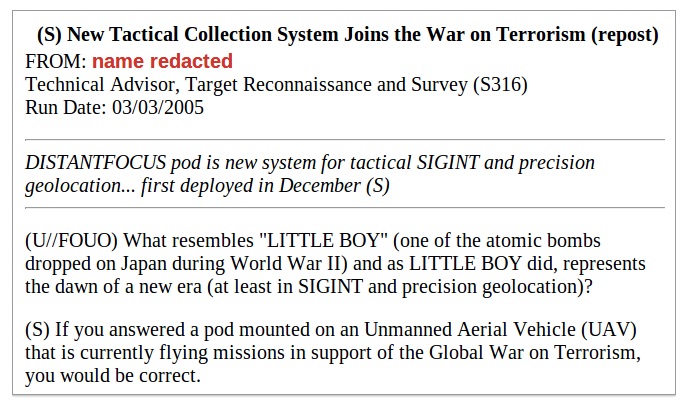
NSA's Little Boy

The onboard sensor suite in the pod has since become ever more effective in intercepting and monitoring electronic communications as part of a vast system of digital data capture, but Predators had already been armed with Hellfire missiles to compress the kill-chain still further, and to many commentators the most radical innovation in later modern war has been the fusion of sensor and shooter in a single platform. The new integrated systems were first trialled – on a Predator flown by test pilots from General Atomics – in February 2000 at Indian Springs Auxiliary Field. The main objective was to hunt and kill Osama bin Laden, and at the request of the Air Force and the CIA a series of tests was carried out.

First, the Air Force wanted to determine whether the Predator could withstand a missile being fired from beneath its insubstantial wings (a ghostly echo of earlier anxieties over the survivability of the Enola Gay and its successors – though plainly much reduced by the absence of any pilot on board).

Second, the CIA wanted to assess the likely effects of a Hellfire strike on the occupants of a single-storey building like those found in rural Afghanistan (nuclear tests had used mannequins and pigs as human surrogates; these used plywood cut-outs and watermelons).
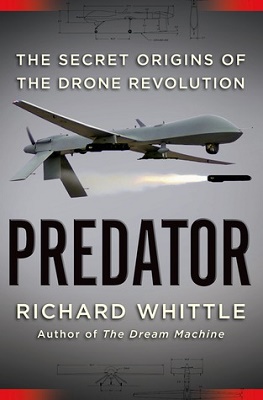
predatorBoth sets of tests were eventually successful (see also here) but, as Richard Whittle shows in consummate detail, a series of legal and diplomatic obstacles remained. In order to secure satellite access over Afghanistan, previous Predator flights to find bin Laden had been flown from a ground control station at Ramstein Air Base in Germany. But using a Predator to kill bin Laden was less straightforward. After protracted debate, US Government lawyers agreed that a Predator armed with a missile would not violate the 1987 Intermediate-Range Nuclear Forces Treaty, which eliminated nuclear and conventional missiles with intermediate ranges but which – unhelpfully for the CIA – defined missiles as ‘unmanned, self-propelled … weapon-delivery vehicles’; the lawyers determined that the Predator was merely a platform and, unlike a cruise missile, had no warhead so that it remained outside the Treaty. But they also insisted that the Status of Forces Agreement with Germany would require Berlin’s consent for the activation of an armed Predator. (The United States stored tactical nuclear warheads at Ramstein until 2005; although the US insisted it retained control over them, in the event of war they were to have been delivered by the Luftwaffe as part of a concerted NATO nuclear strike).
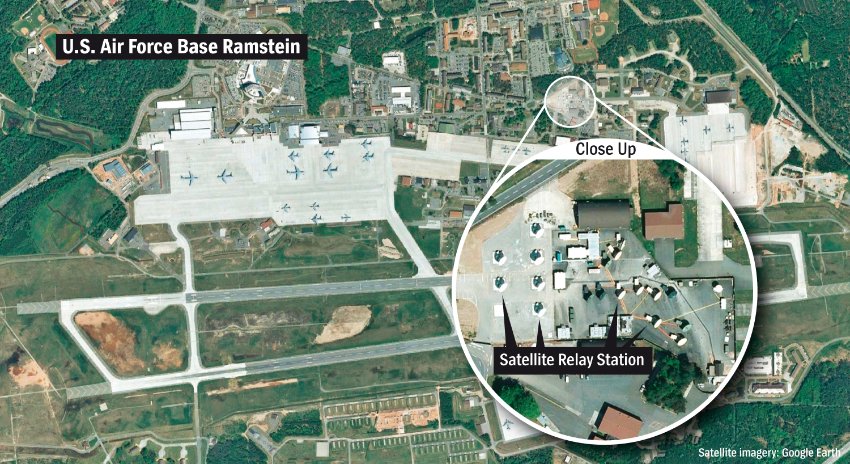
RAMSTEIN English captions

The need to bring Berlin onside (and so potentially compromise the secrecy of the project) was one of the main reasons why the ground control station was relocated to Indian Springs, connected to the satellite link at Ramstein through a fibre-optic cable under the Atlantic:
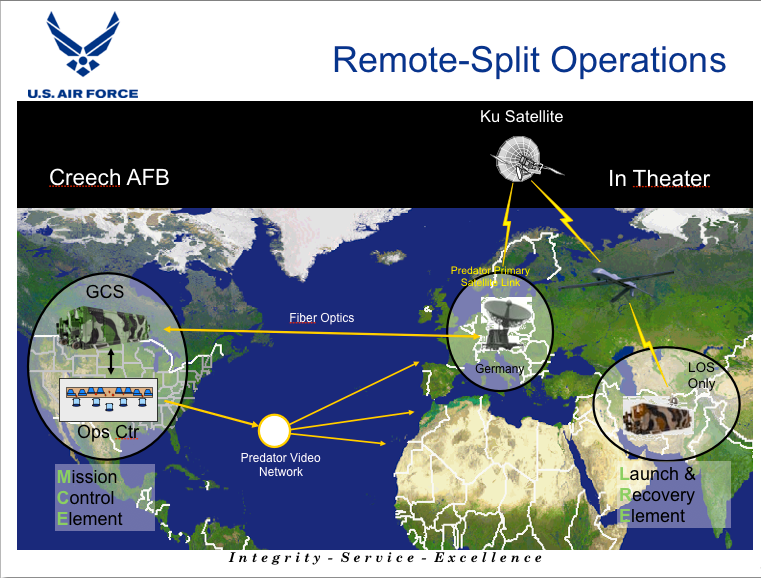
remote-split-operations-usaf

In fact, since 1952 Indian Springs had been a key portal into the Nevada Test Site – its purpose was to support both US Atomic Energy Commission nuclear testing at the Nevada Proving Grounds and US Air Force operations at the Nellis Air Force Base’s vast Gunnery and Bombing Range – and in June 2005 it morphed into Creech Air Force Base: the main centre from which ‘remote-split’ operations in Afghanistan, Pakistan and elsewhere are flown by USAF pilots. Most of the covert operations are directed by the CIA (some by Joint Special Operations Command), but the Predators and Reapers are used for more than targeted killing; the primary missions are still to provide ISR for conventional strikes and now also close air support for ground troops.
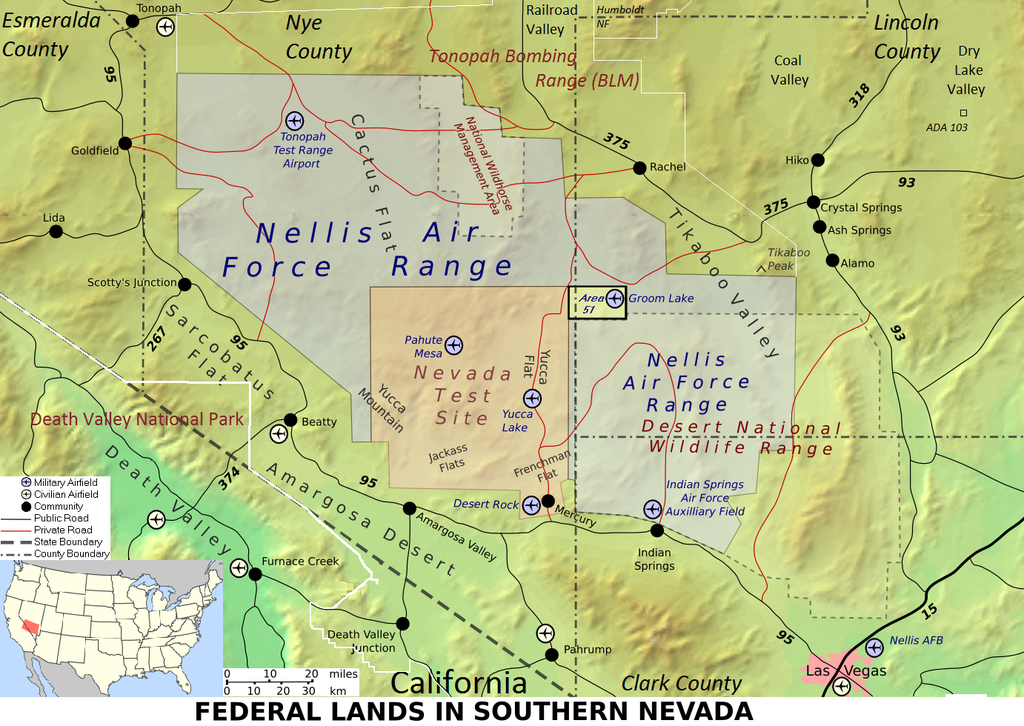
Wfm_area51_map_en

The geographies overlap, coalesce and – even allowing for the differences in scale – conjure up a radically diffuse and dispersed field of military violence.  When Tom Vanderbilt described ‘a war with no clear boundaries, no clear battlefields … a war waged in such secrecy that both records and physical locations are often utterly obscured’ he was talking about nuclear war.  But exactly the same could be said of today’s drone wars, those versions of later modern war in which the body becomes the battle space (‘warheads on foreheads’) and the hunting ground planetary: another dismal iteration of the ‘everywhere war’ (see here and here).

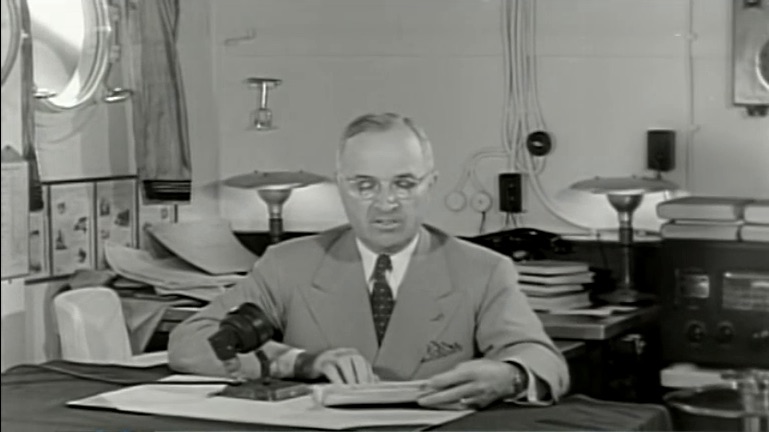
For all these connections and intersections, a key divide is the issue of civilians and casualties. On 9 August 1945 President Truman (below) described Hiroshima as a ‘military base’ selected ‘because we wished in this first attack to avoid, insofar as possible, the killing of civilians’.
TRUMAN Hiroshima speech

This was simply untrue, and similar – often no less deceptive – formulations are routinely used to justify US drone strikes and to minimise what is now called ‘collateral damage’. Still, the scale of civilian casualties is clearly different: usually dozens rather than hundreds of thousands.

And yet, there is something irredeemably personal and solitary about the response to death from either cause; parents searching for the bodies of their children in the ruins are as alone in Dhatta Khel as they were in Hiroshima.  When Yukiko Hayashi [her real name is Sachiko Kawamura] describes the anguish of a young woman and her father finding the remains of their family – the poem, ‘Sky of Hiroshima‘, is autobiographical – it is surely not difficult to transpose its pathos to other children in other places:

Daddy squats down, and digs with his hands
Suddenly, his voice weak with exhaustion, he points
I throw the hoe aside
And dig at the spot with my hands
The tiles have grown warm in the sun
And we dig
With a grim and quiet intent

Oh…
Mommy’s bone
Oh…
When I squeezed it
White powder danced in the wind
Mommy’s bone
When I put it in my mouth
Tasted lonely
The unbearable sorrow
Began to rise in my father and I
Left alone
Screaming, and picking up bones
And putting them into the candy box
Where they made a rustle

My little brother was right beside my mommy
Little more than a skeleton
His insides, not burnt out completely
Lay exposed…
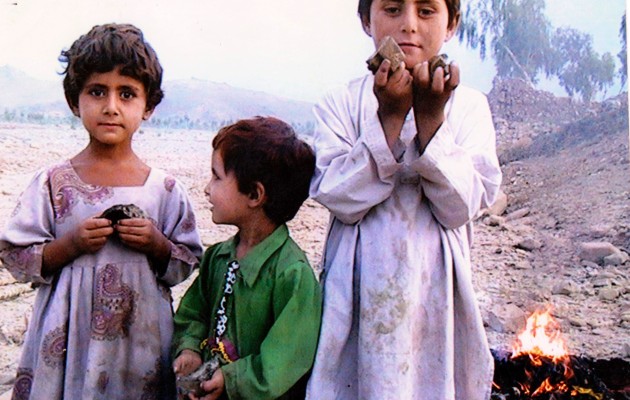
NOOR BEHRAM Orphans Dande Darpa Khel 21 August 2009

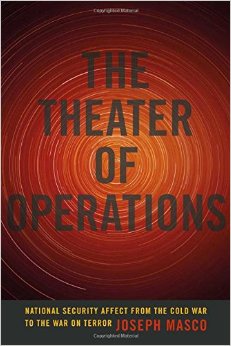
MASCO Theater of OperationsIn The Theater of Operations Joseph Masco draws a series of distinctions between the US national security state inaugurated by the first atomic bombs and the counter-terror state whose organs have proliferated since 9/11.

He properly (and brilliantly) insists on the affects instilled in the American public by the counter-terror state as vital parts of its purpose, logic and practice – yet he says virtually nothing about the affects induced amongst the vulnerable populations forced to ‘live under drones’ and its other modes of military and paramilitary violence.

In Waziristan no air raid sirens warn local people of a strike, no anti-aircraft systems protect them, and no air-raid shelters are available for them to seek refuge.
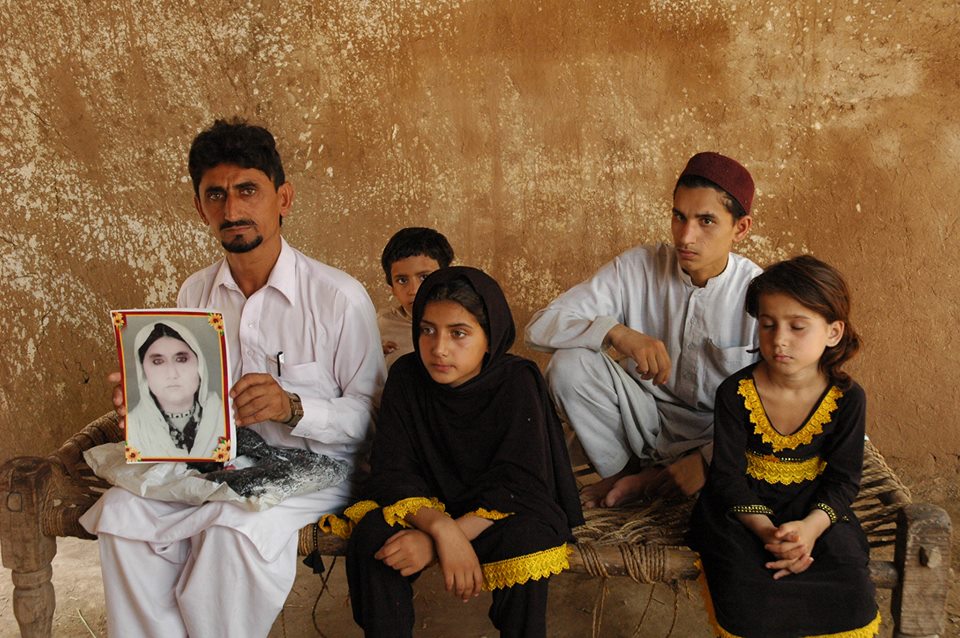
1374361_10151671014096363_1647526274_n

Hence young Zubair Rehman’s (above, top right) heartbreaking admission after a drone killed his grandmother as she tended the fields in Ghundi Kala in North Waziristan (see here and here):

‘I no longer love blue skies. In fact, I now prefer grey skies. The drones do not fly when the skies are grey.’
Post-atomic eyes

Postcard

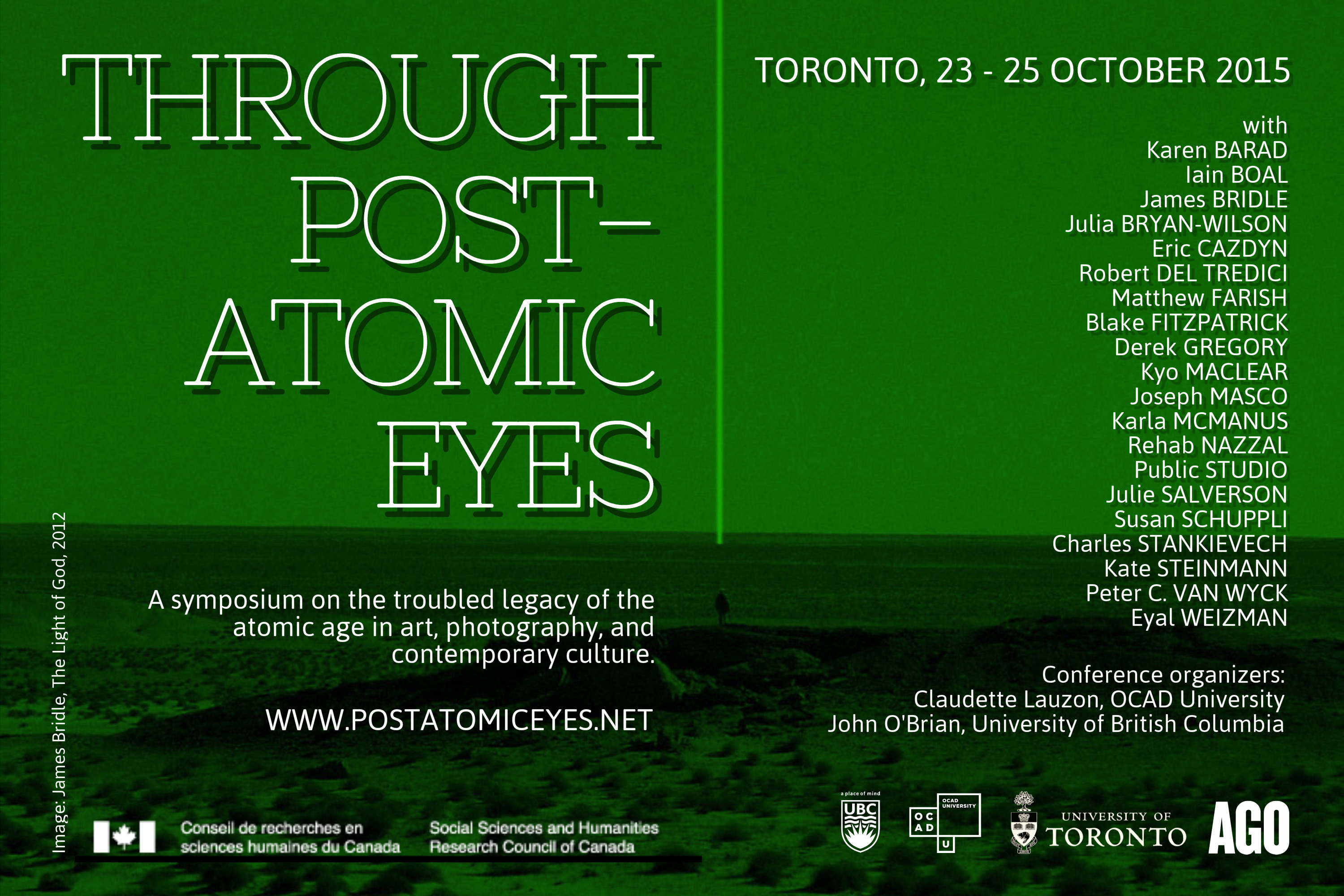
I’m speaking at a conference called “Through Post-Atomic Eyes” in Toronto next month.

Through Post-Atomic Eyes brings together an interdisciplinary group of artists and scholars to explore the complex legacy of the atomic age in contemporary art and culture. In what ways do photography and other lens-based art practices shed light on this legacy in the 21st century, and how has atomic culture shaped contemporary intersections of photography, nuclear industries, and military techno-cultures? Join us as we explore some of the most urgent issues of our time, from climate change and the Anthropocene to surveillance culture and the advent of drone warfare, through a post-atomic lens.

Through Post-Atomic Eyes is scheduled to coincide with John O’Brian’s groundbreaking exhibition, Camera Atomica, the first substantial exhibition of nuclear photography to encompass the postwar period from the bombings of Hiroshima and Nagasaki in 1945 to the meltdown at Fukushima in 2011. Now on view at the Art Gallery of Ontario (until November 15, 2015).

(John’s exhibition at the AGO follows a successful showing in London late last year: see my post here).

I confess that when I received the Toronto invitation I was at a loss: how was I supposed to view drone warfare through post-atomic eyes?  At first sight, any comparison between America’s nuclear war capability and its drone strikes in Afghanistan, Iraq, Pakistan, Somalia, Syria and Yemen seems fanciful. The scale of investment, the speed and range of the delivery systems, the nature of the targets, the blast radii and precision of the munitions, and the time and space horizons of the effects are so clearly incommensurable.  So I dragged my feet, accepting the invitation because the other presenters (see the poster above) include so many people whose work I admire, but not making much progress.

Eventually I realised that the root problem was that, while I had extensive research on genealogies of bombing under my belt, I knew next to nothing about The Bomb.  So, while I’ve been burrowing away in the archives in London for my project on casualty evacuation 1914-2014 and also inching my “Dirty Dancing’ essay into the home straight, I’ve also been reading and reading and reading.  So much wonderful, sobering material out there, some of which surfaced in my recent posts on Hiroshima and the metastases of nuclear weapons since then.

And, as I’ll try to show in detail in my next post, I’ve found a startling series of coincidences, convergences and transformations.  I now have a rough shape for my presentation, which I’m calling “Little Boys and Blue Skies“: a title which, as you’ll soon see, traces an arc from bombing Hiroshima to bombing Waziristan.  Watch this space.

Viewfinders

Hiroshima

Two short, accessible essays on bombing that appeared in the New York Times recently; they resonate with my work on the genealogies and geographies of aerial violence, and they are both beautifully composed and immensely suggestive.

First, Teju Cole on ‘The Unquiet Sky‘:

A view from a great height is irresistible. It is twinned with the ancient dream of flight. For millenniums, we have imaginatively soared above our material circumstances and dramatized this desire in tales from Icarus to Superman. Things look different from way up there. What was invisible before becomes visible: how one part of the landscape relates to another, how nature and infrastructure unfold. But with the acquisition of this panoptic view comes the loss of much that could be seen at close range. The face of the beloved is but one invisible detail among many.

The essay closes with a reflection on two aerial photographic projects, the collection of drone-shot images exhibited at Dronestagram and James Bridle‘s reconstruction of drone-strike imagery at Dronestagram:

The two Dronestagrams, the sanguine and the melancholic, add to our ever increasing archive of possible landscapes. Imagine all those pictures stitched together into a single image. In this ideal aerial view, neither the pervasive violence nor the sometimes cloying prettiness would be visible. Conquest and sentimentality would both be irrelevant. In other words, the image might be like the ‘‘blue marble’’ photograph of Earth, taken from the Apollo 17 spacecraft in 1972. It is our world, serene and self-contained, seen in one glance. It is not a view that excites us into plans for bombing our enemies, for it includes us as well. It is a view that reminds us of how mighty we are, how fragile, how delicately connected and how beautiful.

Actually, I don’t see the ‘blue marble’ photograph in that way at all: as I argued in Geographical Imaginations, this is the global North inspecting the global South (it was, after all, shot from a NASA platform).  But Teju’s penultimate sentence is key, and it intersects with thoughts suggested by the second essay.

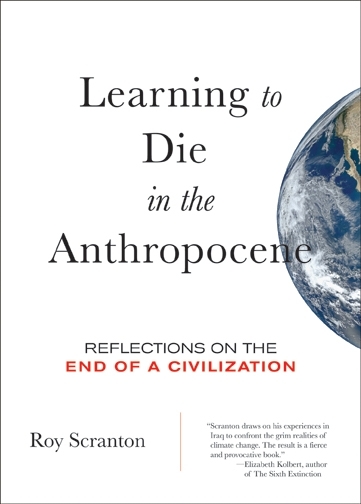
87286100064510LSecond, then, Paul Saint-Amour‘s ‘Waiting for the bomb to drop‘.  Spiralling through some of my favourite authors, Paul ends with a reflection on Roy Scranton‘s ‘Learning how to die in the Anthropocene‘ (see here and here too), which he suggests may be the equivalent of Virginia Woolf‘s ‘“Thoughts on Peace in an Air Raid” for our day’:

[I]n scaling up from one person to all humanity, we pass through a middle range — the social and political, Woolf’s home turf — where both connections and distinctions between people come into play. Yes, we are all at risk in climate change. But like our exposure to military violence, that risk is distributed unevenly. It falls disproportionately on those with the least protection from extreme weather, rising sea levels, hunger, drought, disease, displacement and the conflicts that can arise from all of these. Simply put, it falls most heavily on the poor.

With philosophy’s help, I am prepared to tell myself, “I must learn how to die.” I may even be ready to say to humanity, “We as a species must learn how to die.” But it is a different thing altogether to say to another person, “Because of how I live, or because of actions undertaken in my name, you need to learn how to die more than I do. And you must bear, more than I do, the cognitive and emotional burdens of a life lived in the shadow of imminent death.” This is what the rich are saying every day to the poor. It’s what whites in the United States and elsewhere are saying every day to people of color. It’s what citizens of drone states are saying to those a hemisphere away, under the drones.

Warning: Graphic Content

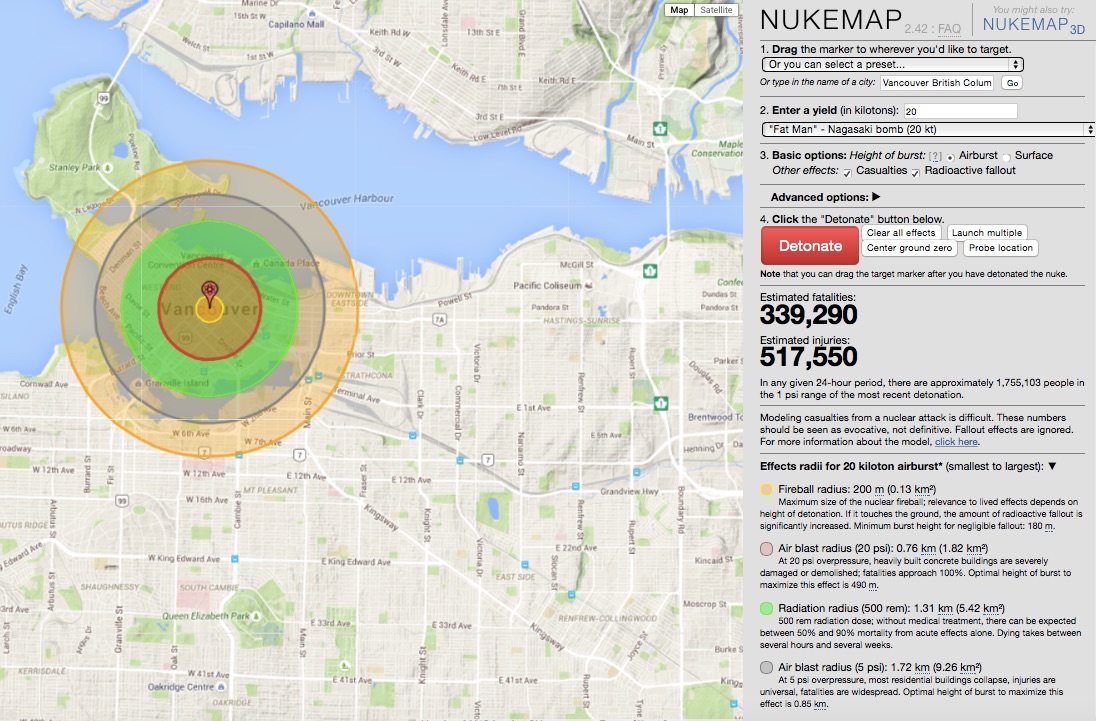
Following my last post on ‘The blue sky of Hiroshima’, I’ve received several e-mails from readers wondering at the size of the blast radius from ‘Little Boy’ (15 kilotons) shown on the image from NUKEMAP; there’s another one below, which shows the blast radius from ‘Fat Man’ (21 kilotons) originally detonated over Nagasaki and here projected on to Vancouver (for a critical note on these projections, by the way, see my original post).

Fat Man Vancouver NUKEMAP JPEG

If, like my correspondents, you are surprised at the ‘small’ size of the radii: you are right (though don’t ignore the numbers on the right…). Several years ago Maximilian Bode created this infographic to show the exorbitant increase in the destructive capacity of nuclear weapons since those two bombs were exploded over Japan 70 years ago:

1-nuclear-bomb-power

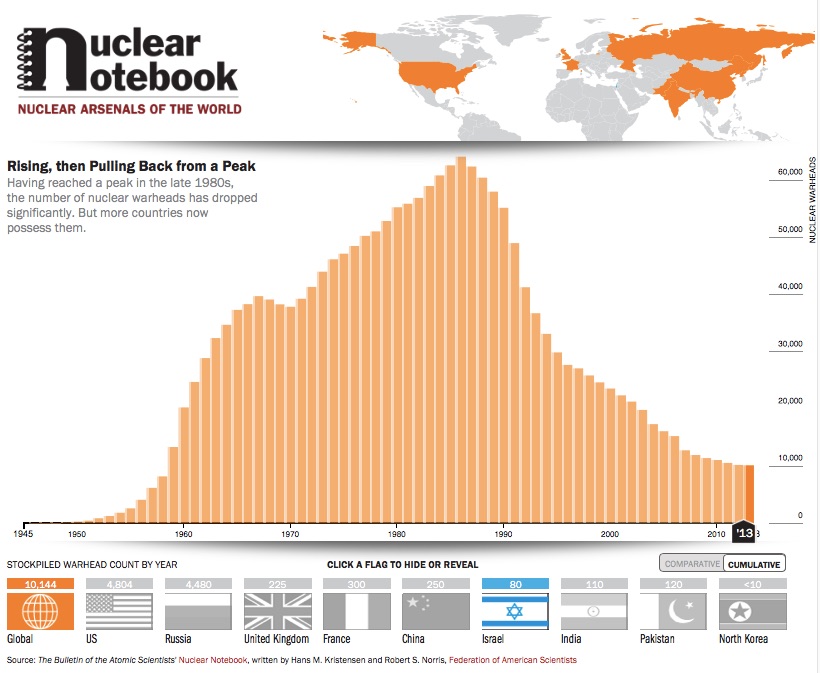
Many of today’s warheads are much smaller – the missiles carried on Trident, for example, are around 100 kilotons.   But that’s small comfort.  If you want to know how many nuclear warheads there are in the world today, this chart from the Nuclear Notebook produced for the Bulletin of Atomic Scientists will give you a rough idea (the interactive version is here):

Nuclear notebook JPEG

And finally Ehsan Rezaie has produced this video for Orbital Mechanics which plots (‘animates’ doesn’t seem the appropriate verb somehow) every nuclear detonation from 1945 on; you can also access this on Vimeo if the embed doesn’t work: search for ‘Trinity’:

The blue sky of Hiroshima

1946_08_31_001_CV1__xx_KA-880-1

It’s the bleakest of anniversaries – the bombing of Hiroshima 70 years ago today – and there is no shortage of commentary (see, for example, here and here).  John Hersey‘s book-length essay on Hiroshima, which filled most of  the 31 August 1946 issue of the New Yorker and has been republished online here.

At exactly fifteen minutes past eight in the morning, on August 6, 1945, Japanese time, at the moment when the atomic bomb flashed above Hiroshima, Miss Toshiko Sasaki, a clerk in the personnel department of the East Asia Tin Works, had just sat down at her place in the plant office and was turning her head to speak to the girl at the next desk. At that same moment, Dr. Masakazu Fujii was settling down cross-legged to read the Osaka Asahi on the porch of his private hospital, overhanging one of the seven deltaic rivers which divide Hiroshima; Mrs. Hatsuyo Nakamura, a tailor’s widow, stood by the window of her kitchen, watching a neighbor tearing down his house because it lay in the path of an air-raid-defense fire lane; Father Wilhelm Kleinsorge, a German priest of the Society of Jesus, reclined in his underwear on a cot on the top floor of his order’s three-story mission house, reading a Jesuit magazine, Stimmen der Zeit; Dr. Terufumi Sasaki, a young member of the surgical staff of the city’s large, modern Red Cross Hospital, walked along one of the hospital corridors with a blood specimen for a Wassermann test in his hand; and the Reverend Mr. Kiyoshi Tanimoto, pastor of the Hiroshima Methodist Church, paused at the door of a rich man’s house in Koi, the city’s western suburb, and prepared to unload a handcart full of things he had evacuated from town in fear of the massive B-29 raid which everyone expected Hiroshima to suffer. A hundred thousand people were killed by the atomic bomb, and these six were among the survivors. They still wonder why they lived when so many others died. Each of them counts many small items of chance or volition—a step taken in time, a decision to go indoors, catching one streetcar instead of the next—that spared him. And now each knows that in the act of survival he lived a dozen lives and saw more death than he ever thought he would see. At the time, none of them knew anything.

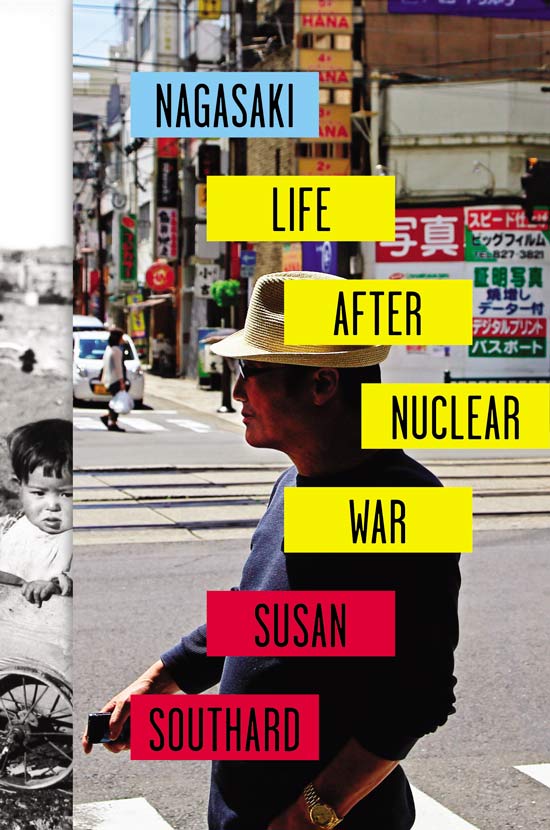
It’s worth comparing this with the opening scene of Kamila Shamsie‘s brilliant novel Burnt Shadows which imagines the second atomic bomb dropped on Nagasaki three days later.  Given the map I reproduce below, it’s also worth reading her short essay on the effect of using Google Earth to ‘map’ the bombing here; and since Nagasaki too often disappears from critical view, try Susan Southard‘s recently published Nagasaki: life after nuclear war (Viking/Penguin, 2015) – you can read a long extract here and here.

Nagasaki-Cover

For a brave attempt to bring the the two bombings into the same narrative frame, see Paul Ham‘s Hiroshima Nagasaki (2012/2014): there’s a helpful review essay by H. Bruce Franklin here, and The Atlantic has just published an extract, ‘The bureaucrats who singled out Hiroshima for destruction’ here.

Joyce C. Stearns, a scientist representing the Air Force, named the four shortlisted targets in order of preference: Kyoto, Hiroshima, Yokohama, and Kokura. They were all “large urban areas of more than three miles in diameter;” “capable of being effectively damaged by the blast;” and “likely to be unattacked by next August.”… Tokyo had been struck from the list because it was already “rubble,” the minutes noted…

Captain William “Deak” Parsons, associate director of Los Alamos’s Ordnance Division, gave another reason to drop the bomb on a city center: “The human and material destruction would be obvious.” An intact urban area would show off the bomb to great effect. Whether the bomb hit soldiers, ordnance, and munitions factories, while desirable from a publicity point of view, was incidental to this line of thinking—and did not influence the final decision.

(You’ll have to read the extract to see why Kyoto was eventually removed from the list).

hiroshima-nagasaki

For subsequent analysis, a good place to start is Alex Wellerstein‘s Restricted Data: the nuclear secrecy blog, which includes a series of excellent posts on sources and visualizations, on the Manhattan Project and what happened at Los Alamos, and most recently an essay which asks ‘Where there alternatives to the atomic bombings?‘ and gives lots of background to those terrible events.

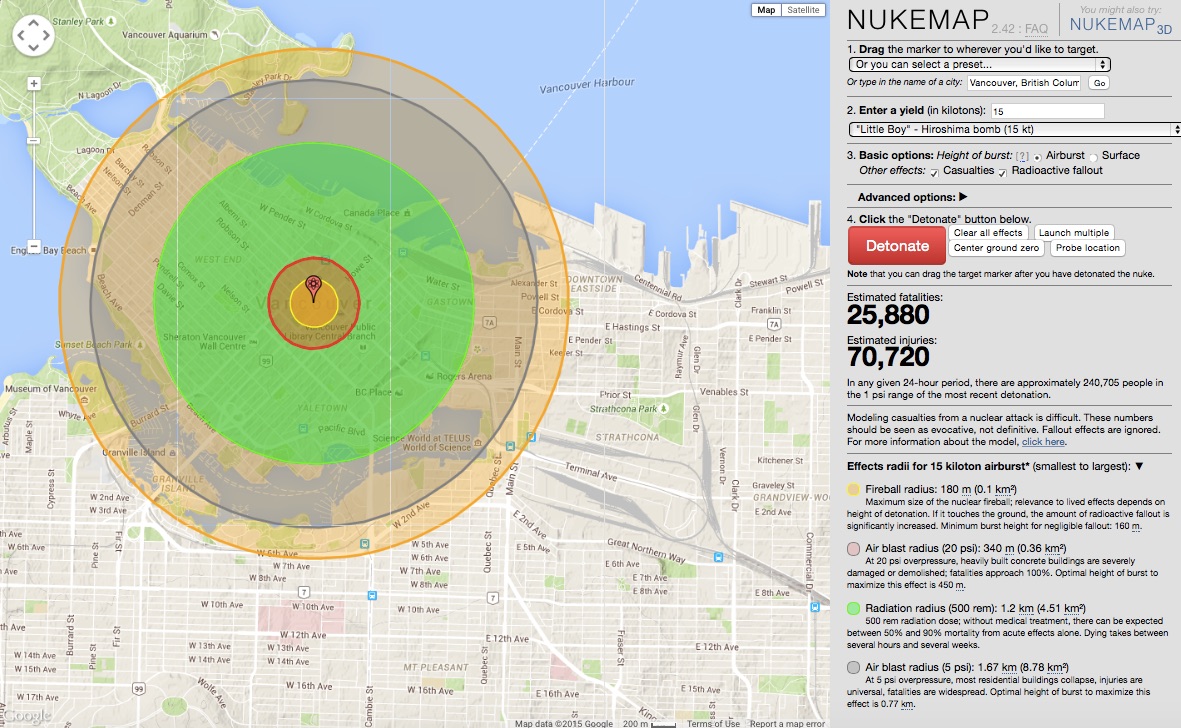
Among Alex’s visualizations is NUKEMAP, which simulates the dropping of ‘Little Boy’ on other towns and cities.  Here is downtown Vancouver (for a discussion of airbursts, see Alex’s post here).

Little Boy VANCOUVER JPEG

Elsewhere, there’s a special issue of Critical Military Studies on the anniversary, and all the articles are open access:

The most modern city in the world: Isamu Noguchi’s cenotaph controversy and Hiroshima’s city of peace: Ran Zwigenberg
Unbearable light/ness of the bombing: normalizing violence and banalizing the horror of the atomic bomb experiences: Yuki Miyamoto
Remembering nukes: collective memories and countering state history: Stefanie Fishel
Contested spaces of ethnicity: zainichi Korean accounts of the atomic bombings: Erik Ropers
Hiroshima and two paradoxes of Japanese nuclear perplexity: Thomas E. Doyle II
Re-imagining Hiroshima in Japan: elin o’Hara slavik
Memory and survival in everyday textures – Ishiuchi Miyako’s Here and Now: Atomic Bomb Artifacts, ひろしま/ Hiroshima 1945/2007: Makeda Best
Nagasaki Re-Imagined: the last shall be first: Kathleen Sullivan

There’s also a special issue of Thesis Eleven, (August 2015: 129 (1)) edited by Brad Evans and Keith Tester in association with the Histories of Violence ‘Disposable Life’ project; articles include:

Susan Neiman, Forgetting Hiroshima, remembering Auschwitz: Tales of two exhibits
Keith Tester, Hiroshima: Remembering and forgetting, everything and nothing
Michael J Shapiro, Hiroshima temporalities
Maja Zehfuss, (Nuclear) war and the memory of Nagasaki: Thinking at the (impossible) limit
Hiro Saito, The A-bomb victims’ plea for cosmopolitan commemoration: Toward reconciliation and world peace
Arne Johan Vetlesen, Post-Hiroshima reflections on extinction
Henry A Giroux, Hiroshima and the responsibility of intellectuals: Crisis, catastrophe, and the neoliberal disimagination machine

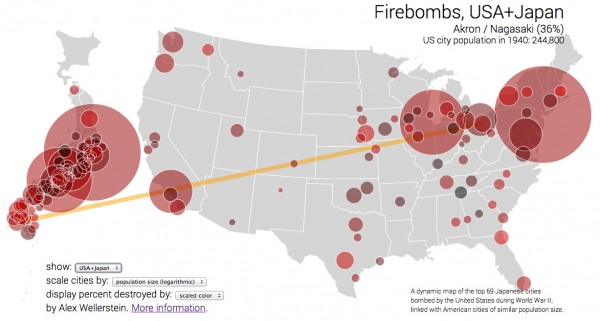
I have just two things to add.  The first is to draw attention to the firebombing of Japanese cities that preceded Hiroshima and Nagasaki (Alex compares them in an interesting commentary here and provides a series of compelling comparative interactives here: I’ve pasted an example below, and provided a short commentary here).

firebombs-usa-interactive-600x321

In fact, as my quotation from Paul Ham reveals, Hiroshima and Nagasaki were targeted precisely because they had been left alone during the previous attacks and would provide effective laboratories to test the effects of nuclear blasts.  On the firebombing campaign, see the painstaking work of Cary Karacas and his colleagues here (my commentaries on the project are here and here; see also their essay on the firebombing of Tokyo and its legacy here); their website includes both a Hiroshima archive and a Nagasaki archive.

Second, I’ve emphasised the comparative effort to ‘bring the war home’, to imagine the effects of Little Boy and Fat Man on other cities around the world.  There are obvious dangers in such an exercise – is our capacity for empathy so limited than we have to rely on a sort of critical narcissism: ‘imagine if it happened to us‘? – but perhaps the most significant objection is that such cartographic conceits can erase not only the bodies incinerated and maimed (through the very abstraction of cartography) but also the racialization of these unmarked bodies.  In the characteristically thoughtful introduction to his new book, Tense Future: Modernism, Total War, Encyclopedic Form (2015), Paul K. Saint Amour writes about ‘traumatic earliness’ – about the sense of anticipation, foreboding or bukimi that gripped the people of Hiroshima in the months before their collective deaths: that ‘uneasy combination of continued good fortune [escaping the firebombing] and expectation of catastrophe’.  But the ground had already been prepared in the United States, not only scientifically – the endless calculations, calibrations and experiments at Los Alamos – but also culturally.

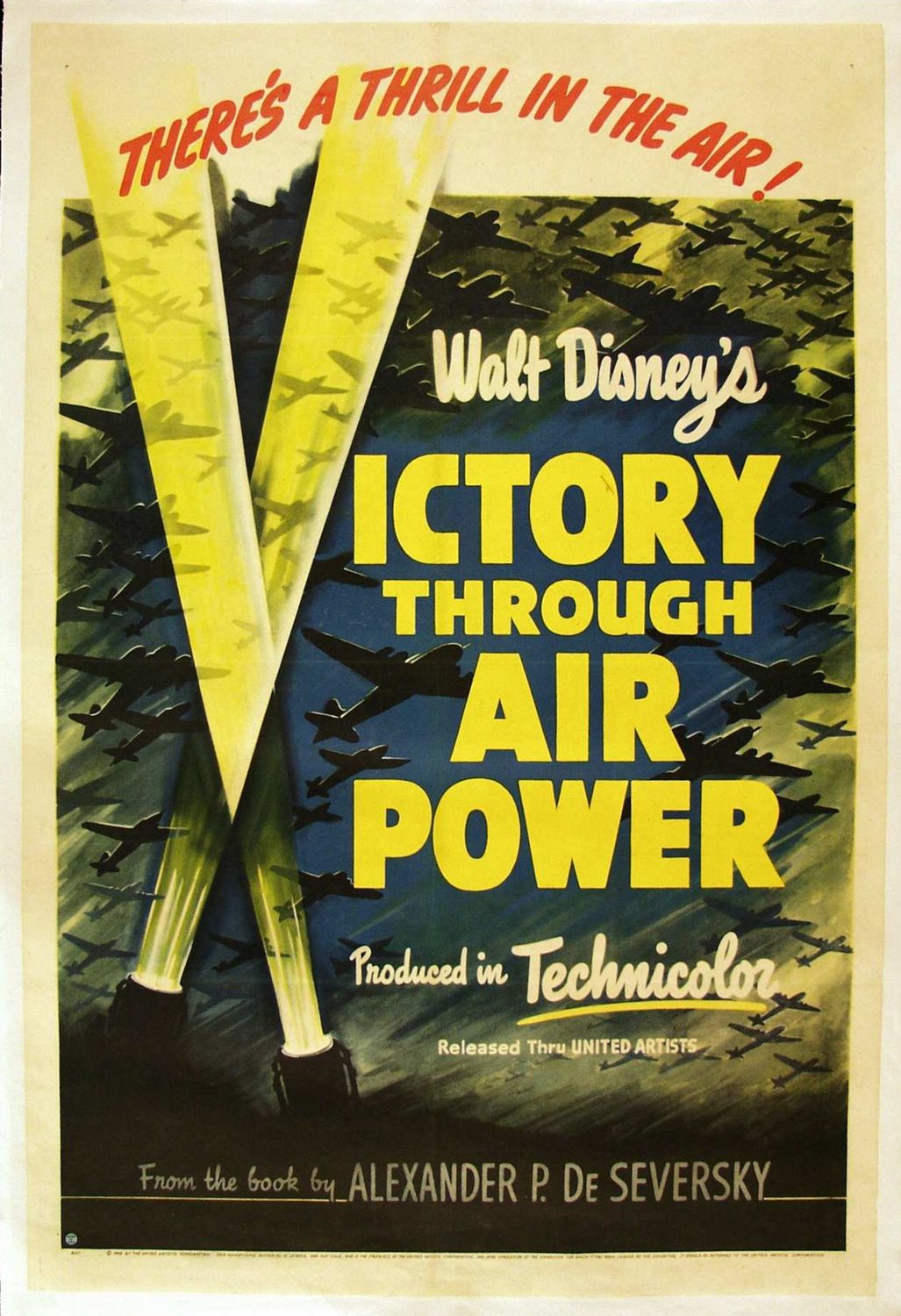
Victory_through_air_power_xlg

Michael Sherry‘s The rise of American Air Power: the creation of Armageddon (1987) and Paul Williams‘s Race, ethnicity and nuclear war (2011) are indispensable here – and there’s a sharp, contemporary commentary from Arthur Chu here –  but a vivid example is provided by Alex de Seversky‘s Victory through Air Power (1942) and, in particular, its celebration in Walt Disney‘s film version released in 1943.  For Disney, there was not only ‘a thrill in the air’ but an exuberant delight at death and destruction on the Japanese ground.  You can watch the whole thing below (or on YouTube) but to see what I mean start at 1.07 and watch right through the bombing to the anthropomorphism of the American eagle and the Japanese octopus that follows it.  There’s also a short commentary by Henry Giroux here.

Note: My title is taken from this poem by Yukiko Hayashi; if you click on nothing else, please click on this.

Kill Chain

COCKBURN Kill chain 1

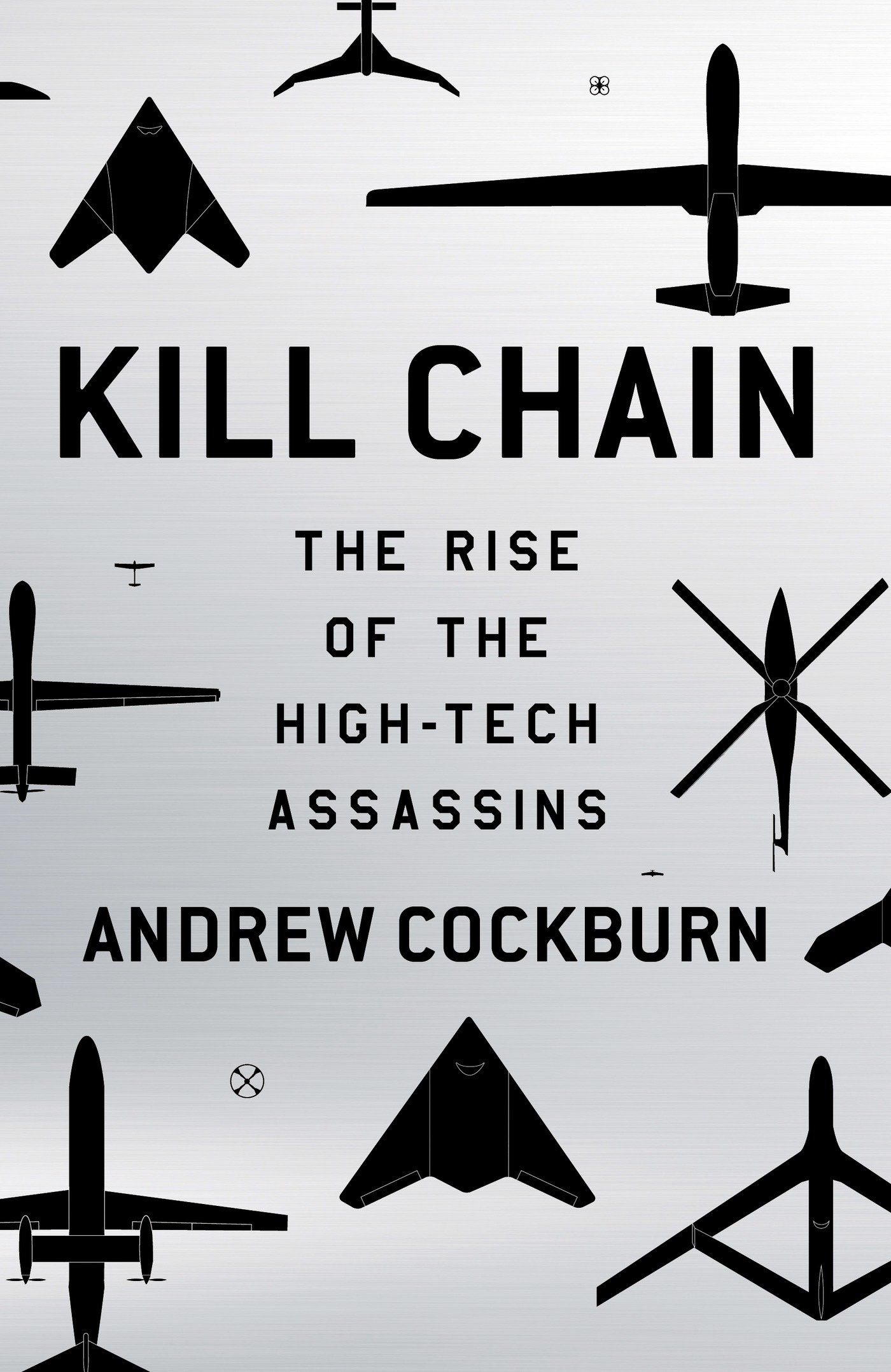
Yet more on targeted killing/assassination: new from Verso and Henry Holt in March, Andrew Cockburn‘s Kill Chain: the rise of the high-tech assassins.

Kill Chain uncovers the real and extraordinary story of drone warfare, its origins in long-buried secret programs, the breakthroughs that made drone operations possible, the ways in which the technology works, and, despite official claims, does not work. Through the well-guarded world of national security, the book reveals the powerful interests—military, CIA, and corporate—that have led the drive to kill individuals by remote control. Most importantly of all, the book describes what has really happened when the theories underpinning the strategy—and the multi billion-dollar contracts they spawn—have been put to the test.

Andrew is the author of the brilliant Rumsfeld: an American disaster, and he’s also been writing around the issue of military and paramilitary violence for some time.  There’s an early review of Kill Chain from Kirkus here, and Andrew discusses writing the book in a short audio clip here.

If you can’t wait until March, there’s a taster in ‘Drones, baby, drones‘, which appeared in the London Review of Books (8 March 2012); if you aren’t a subscriber you can obtain 24-hour access free of charge.

Time and again, the military has claimed that advances in technology have finally made warfare predictable and precise. That was the promise of Igloo White in Vietnam [see my ‘Lines of descent’: DOWNLOADS tab], the video-game spectacle of the Gulf War, the war for Kosovo and the counter-guerrilla wars of the past ten years. Time and again, the military’s claims have been disproved. Will drones change everything? Robert Gates, secretary of defence from 2006 to 2011, expressed the official view in his address to the CIA Officers Memorial Foundation annual dinner last March. Confessing that he hadn’t initially done enough to quash resistance to innovation from ‘flyboys in silk scarves’, Gates said: ‘From now on, it’s drones, baby, drones.’

In the audio clip Andrew insists that the full-motion video feeds from Predators and Reapers are far less clear than most commentators make out, and in subsequent contributions Andrew has perceptively linked the fantasies of the God-trick with militarized vision more generally: see, for example, his ‘Tunnel vision‘ (about the comparative merits of the A10 and the B1 bomber) which appeared in Harper’s in February 2014 and ‘Flying Blind‘, which appeared on Harper’s blog in September.

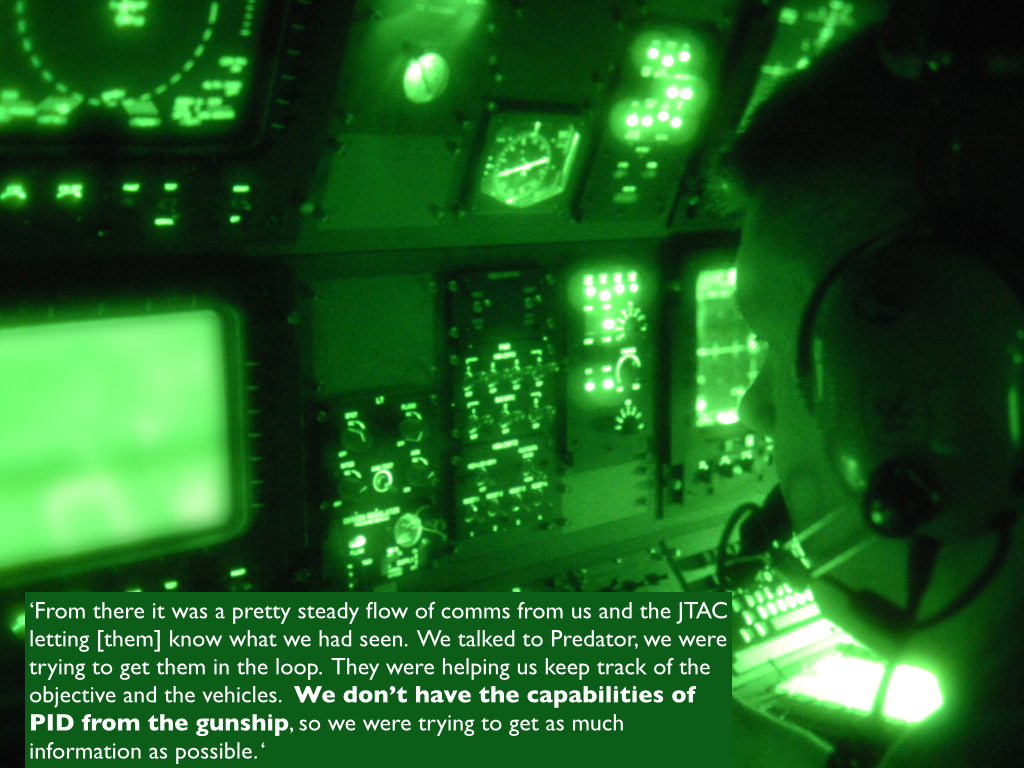
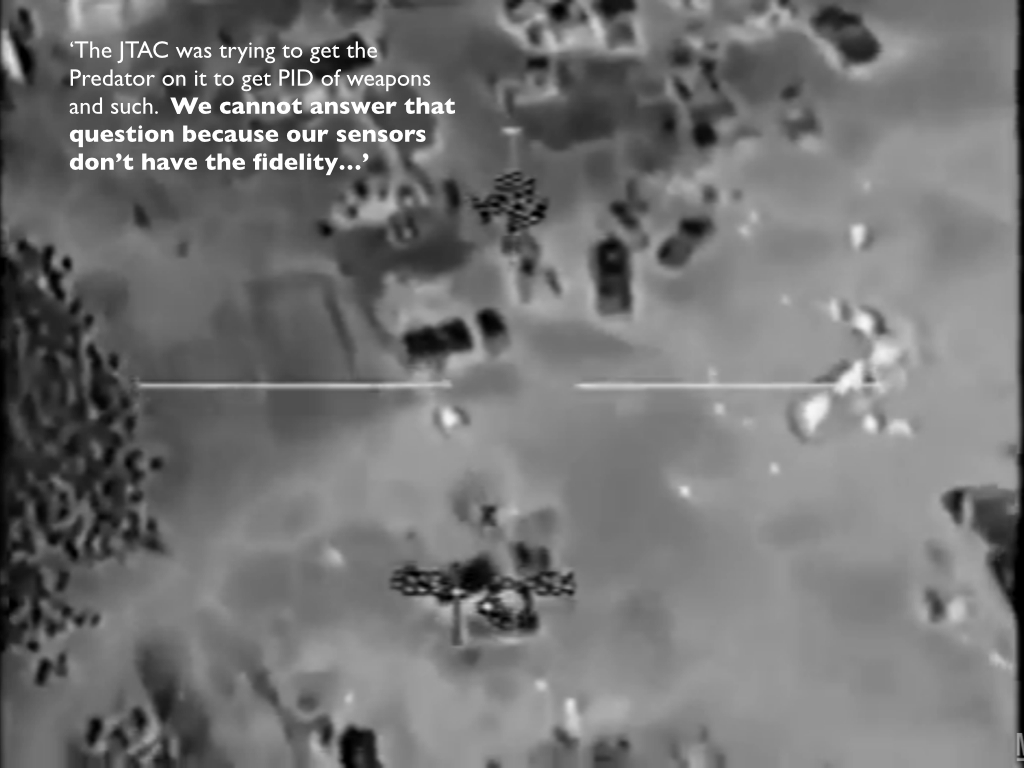
I’m not convinced that the A-10 is able to ‘observe the battleground with such precision, and safely to target enemy forces a stone’s throw away from friendly troops’ as Andrew maintains, but his more general point is a sharp one.  Too often we forget that other aircraft rely on optical sensors and video screens too, not only Predators and Reapers, and that these political technologies differ from platform to platform, as the following slides from ‘Angry eyes’ indicate (where the captain of an AC-130 gunship in fact defers to the crew of a Predator):

Angry eyes VISION.001

Angry eyes VISION.002

And, as Andrew also makes clear, these technologies produce their own interpellations:

Video will often supply a false clarity to preconceived notions. One A-10 pilot described to me an afternoon he spent circling high over southern A ghanistan in May 2010, watching four people—tiny figures on his cockpit screen—clustering at the side of a road before they retreated across a field to- ward a house. Everything about their movements suggested a Taliban I.E.D.- laying team. Then the door to the house opened and a mother emerged to hustle her children in to supper.

“On the screen,” he explained, “the only way to tell a child from an adult is when they are standing next to each other. Otherwise everyone looks the same.”

“We call the screens face magnets,” remarked another veteran, Lieutenant Colonel Billy Smith, a former A-10 squadron commander who flew tours over Bosnia, Iraq, and Afghanistan. “They tend to suck your face into the cockpit, so you don’t pay attention to what’s going on outside.”

All of this intersects with my continuing work on militarized vision, and in the next several weeks I’ll be uploading a series of new essays that deal with drone strikes in Pakistan [based on my ‘Dirty dancing‘ presentations], the Sangin Valley in Afghanistan (a ‘friendly fire’ incident), and an air strike in Uruzgan in Afghanistan that was orchestrated by a drone [based on my ‘Angry Eyes’ presentations]. So watch this space…

Incidentally, ‘kill chain’ is both the extended, networked apparatus that leads from air targeting to execution – for all platforms, remote and conventional – and the injunction that is typed into US military chat rooms (mIRC) to close down ‘chatter’ that might distract pilots once they are cleared to engage (see my discussion here).

Degrees of intimacy

Drone warsNext month Cambridge University Press is publishing a book of essays edited by Peter Bergen and Daniel Rothenberg, Drone wars: transforming conflict, law and policy, due out from Cambridge University Press at the end of the year.  Here’s the blurb:

Drones are the iconic military technology of many of today’s most pressing conflicts, a lens through which U.S. foreign policy is understood, and a means for discussing key issues regarding the laws of war and the changing nature of global politics. Drones have captured the public imagination, partly because they project lethal force in a manner that challenges accepted rules, norms, and moral understandings. Drone Wars presents a series of essays by legal scholars, journalists, government officials, military analysts, social scientists, and foreign policy experts. It addresses drones’ impact on the ground, how their use adheres to and challenges the laws of war, their relationship to complex policy challenges, and the ways they help us understand the future of war. The book is a diverse and comprehensive interdisciplinary perspective on drones that covers important debates on targeted killing and civilian casualties, presents key data on drone deployment, and offers new ideas on their historical development, significance, and impact on law and policy. Drone Wars documents the current state of the field at an important moment in history when new military technologies are transforming how war is practiced by the United States and, increasingly, by other states and by non-state actors around the world.

And here is the Contents List:

Part I. Drones on the Ground:

1. My guards absolutely feared drones: reflections on being held captive for seven months by the Taliban David Rohde
2. The decade of the drone: analyzing CIA drone attacks, casualties, and policy Peter Bergen and Jennifer Rowland
3. Just trust us: the need to know more about the civilian impact of US drone strikes Sarah Holewinski
4. The boundaries of war?: Assessing the impact of drone strikes in Yemen Christopher Swift
5. What do Pakistanis really think about drones? Saba Imtiaz

Part II. Drones and the Laws of War:

6. It is war at a very intimate level USAF pilot
7. This is not war by machine Charles Blanchard
8. Regulating drones: are targeted killings by drones outside traditional battlefields legal? William Banks
9. A move within the shadows: will JSOC’s control of drones improve policy? Naureen Shah
10. Defending the drones: Harold Koh and the evolution of US policy Tara McKelvey
Part III. Drones and Policy Challenges:
11. ‘Bring on the magic’: using drones in combat Michael Waltz
12. The five deadly flaws of talking about emerging military technologies and the need for new approaches to law, ethics, and war P. W. Singer
13. Drones and cognitive dissonance Rosa Brooks
14. Predator effect: a phenomenon unique to the war on terror Meg Braun
15. Disciplining drone strikes: just war in the context of counterterrorism David True
16. World of drones: the global proliferation of drone technology Peter Bergen and Jennifer Rowland

Part IV. Drones and the Future of Warfare:

17. No one feels safe Adam Khan
18. ‘Drones’ now and what to expect over the next ten years Werner Dahm
19. From Orville Wright to September 11: what the history of drone technology says about the future Konstantin Kakaes
20. Drones and the dilemma of modern warfare Richard Pildes and Samuel Issacharoff
21. How to manage drones, transformative technologies, the evolving nature of conflict and the inadequacy of current systems of law Brad Allenby
22. Drones and the emergence of data-driven warfare Daniel Rothenberg

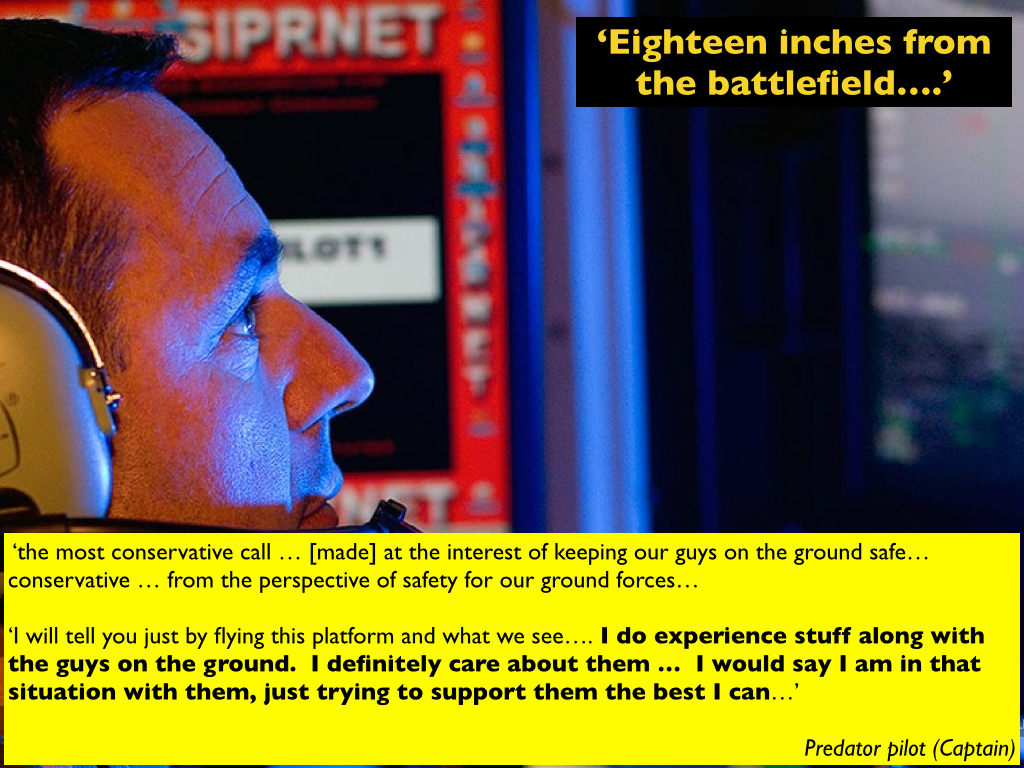
Over at Foreign Policy you can find an early version of Chapter 6, which is an interview with a drone pilot conducted by Daniel Rothenberg.  There are two passages in the interview that reinforce the sense of the bifurcated world inhabited by drone crews that I described in ‘From a view to a kill’ and ‘Drone geographies’ (DOWNLOADS tab).  On the one side the pilot confirms the inculcation of an intimacy with ground troops, particularly when the platforms are tasked to provide Close Air Support, which is in some degree both reciprocal and verbal:

“Because of the length of time that you’re over any certain area you’re able to engage in lengthy communications with individuals on the ground. You build relationships. Things are a little more personal in an RPA than in an aircraft that’s up for just a few hours. When you’re talking to that twenty year old with the rifle for twenty-plus hours at a time, maybe for weeks, you build a relationship. And with that, there’s an emotional attachment to those individuals.

“You see them on a screen. That can only happen because of the amount of time you’re on station. I have a buddy who was actually able to make contact with his son’s friend over in the AOR [area of responsibility]. If you don’t think that’s going to make you focus, then I don’t know what will.

“Many individuals that have been over there have said, ‘You know, we were really happy to see you show up’; ‘We knew that you were going to keep us from being flanked’; ‘We felt confident in our ability to move this convoy from ‘A’ to ‘B’ because you were there.’ The guy on the ground and the woman on the ground see how effective we are. And it gives them more confidence.”

GREGORY Angry Eyes Extract.001

[The image above is taken from my ‘Angry Eyes’ presentation; the Predator pilot in this instance was involved in orchestrating the air strike in Uruzgan province, Afghanistan on 21 February 2010, and the quotation is taken from the US Army investigation into the incident.  I’m converting the presentation into the final chapter for The everywhere war, and I’ll post the draft as soon as I’m finished.]

But when the pilot in Rothenberg’s interview goes on to claim that ‘Targeting with RPAs is very intimate’ and that ‘It is war at a very intimate level’, he reveals on the other side an altogether different sense of intimacy: one that is strictly one-sided, limited to the visual, and which resides in a more abstracted view:

“Flying an RPA, you start to understand people in other countries based on their day-to-day patterns of life. A person wakes up, they do this, they greet their friends this way, etc. You become immersed in their life. You feel like you’re a part of what they’re doing every single day. So, even if you’re not emotionally engaged with those individuals, you become a little bit attached. I’ve learned about Afghan culture this way. You see their interactions. You’re studying them. You see everything.”

The distinction isn’t elaborated, but the claims of ‘immersion’ and becoming ‘part of what they’re doing every day’ are simply astonishing, no?  You can find more on the voyeurism of ‘pattern of life analysis’ and the remarkable conceit that ‘you see everything’ here.

GREGORY Drones and the everywhere war 2014 Homeland insecurities.001

[The image above is taken from my ‘Drone geographies’ presentation]

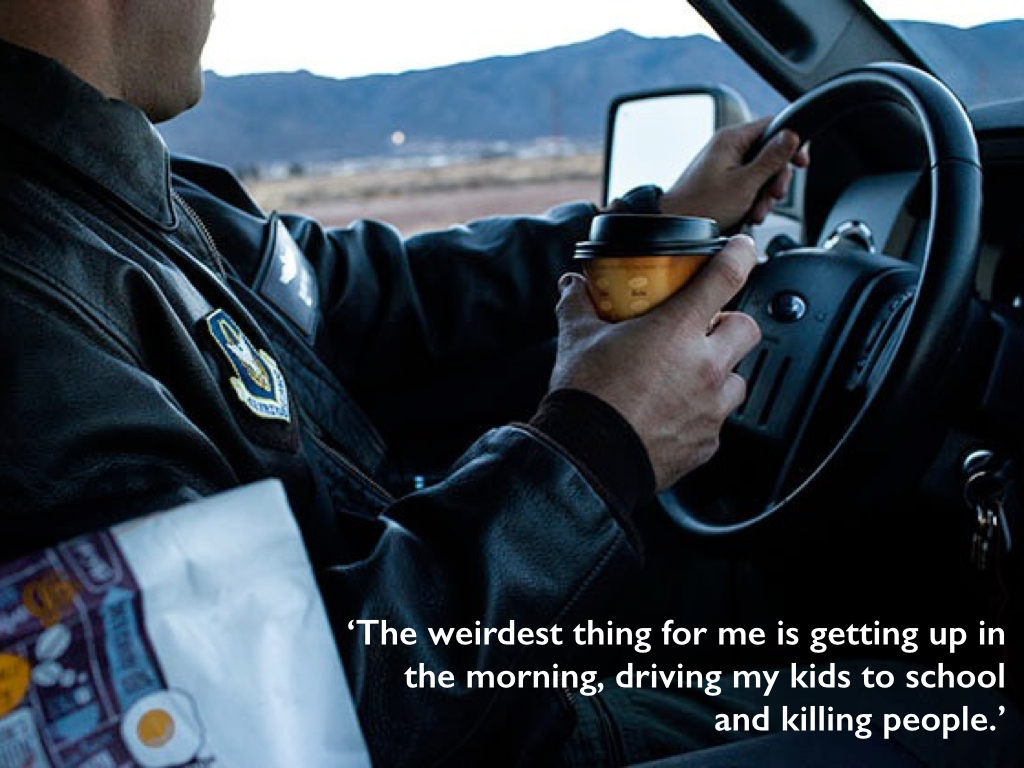
The interview emphasises a different bifurcation, which revolves around the alternation between ‘work’ and ‘home’ when remote operations are conducted from the United States:

“”When you’re doing RPA operations, you’re mentally there, wherever there is. You’re flying the mission. You’re talking to folks on the ground. You’re involved in kinetic strikes. Then you step out the ground control station (GCS) and you’re not there anymore…

“Those are two very, very different worlds. And you’re in and out of those worlds daily. I have to combine those two worlds. Every single day. Multiple times a day. So, I am there and then I am not there and then I am there again. The time between leaving the GCS [Ground Control Station] and, say, having lunch with my wife could be as little as ten minutes. It’s really that fast.”

You can find much more on these bifurcations in my detailed commentary on Grégoire Chamayou‘s Théorie du drone here and in ‘Drone geographies’ (DOWNLOADS tab).

There’s one final point to sharpen.  In my developing work on militarized vision, and especially the ‘Angry eyes’ presentation/essay,  I’ve tried to widen the focus beyond the strikes carried out by Predators and Reapers to address the role they play in networked operations where the strikes are carried out by conventional strike aircraft.  Here is what Rothenberg’s pilot says about what I’ve called the administration of military violence (where, as David Nally taught me an age ago, ‘administration’ has an appropriately double meaning):

‘”Flying an RPA is more like being a manager than flying a traditional manned aircraft, where a lot of times your focus is on keeping the shiny side up; keeping the wings level, putting the aircraft where it needs to be to accomplish the mission. In the RPA world, you’re managing multiple assets and you’re involved with the other platforms using the information coming off of your aircraft.

“You could use the term ‘orchestrating’; you are helping to orchestrate an operation.”

***

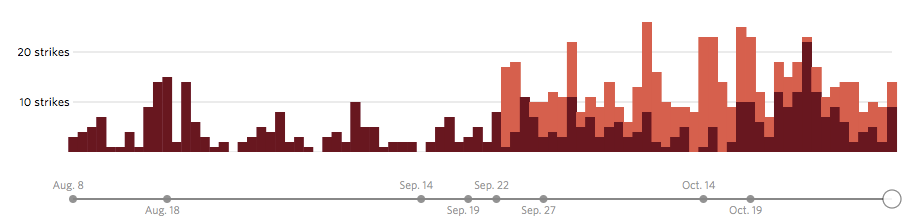
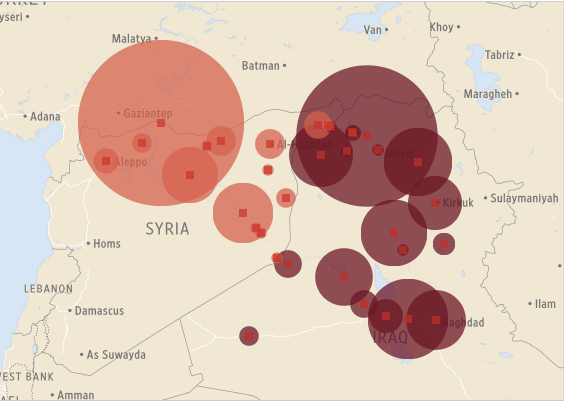
Drone wars appears just as remote operations over Iraq and Syria are ramping up: you can find an excellent review by Chris Cole at Drone Wars UK here, ‘Drones in Iraq and Syria: What we know and what we don’t.’  The images below are from the Wall Street Journal‘s interactive showing all air strikes reported by US Central Command 8 August through 3 November 2014:

Air strikes in Iraq and Syria

During this period  769 coalition air strikes were reported: 434 in Syria (the dark columns), including 217 on the besieged border city of Kobane, and 335 in Iraq (the light columns), including 157 on Mosul and the Mosul Dam.

Air strikes in Iraq and Syria August-November 2014

But bear in mind these figures are for all air strikes and do not distinguish between those carried out directly by drones and those carried out by conventional strike aircraft.  As Chris emphasises:

‘Since the start of the bombing campaign, US drones have undertaken both surveillance and strike missions in Iraq and Syria but military spokespeople have refused to give details about which aircraft are undertaking which strikes repeatedly using the formula “US military forces used attack, fighter, bomber and remotely-piloted aircraft to conduct airstrikes.”’

Although the USAF has used a mix of MQ-1 (Predator) and MQ-9 (Reaper) drones, F-15E, F-16, F/A-18 and F-22 fighters, B-1 bombers, AC-130 gunships and AH-64 Apache helicopters in these operations, it seems likely that its capacity to use remote platforms to provide intelligence, surveillance and reconnaissance is limited by its continuing commitments in Afghanistan (though Britain’s Royal Air Force has now deployed its Reapers for operations in both Iraq and Syria).

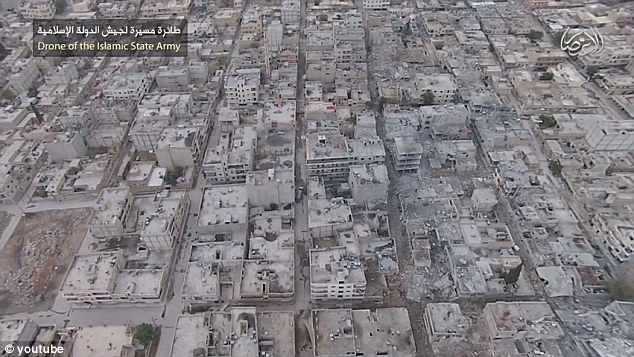
IS (Islamic State) claims to have its own drones too.  In February it released video of its aerial surveillance of Fallujah in Iraq, taken from a DJI Phantom FC40 quadcopter, in August it released video of Taqba air base in Syria taken from the same platform, tagged as ‘a drone of the Islamic State army’, and in September a propaganda video featuring hostage John Cantile showed similar footage of Kobane (below).

1414438887900_wps_7_IS_have_released_a_new_vi

These image streams are all from commercial surveillance drones, but in September the Iranian news agency Fars reported that Hezbollah had launched an air strike from Lebanon against a command centre of the al-Nursra Front outside Arsal in Syria using an armed (obviously Iranian) drone.

You can find Peter Bergen’s and Emily Schneiders view on those developments here, and a recent survey of the proliferation of drone technologies among non-state actors here.

The details of both the state and non-state air strikes remain murky, but I doubt that much ‘intimacy’ is claimed for any of them.

Flash photography

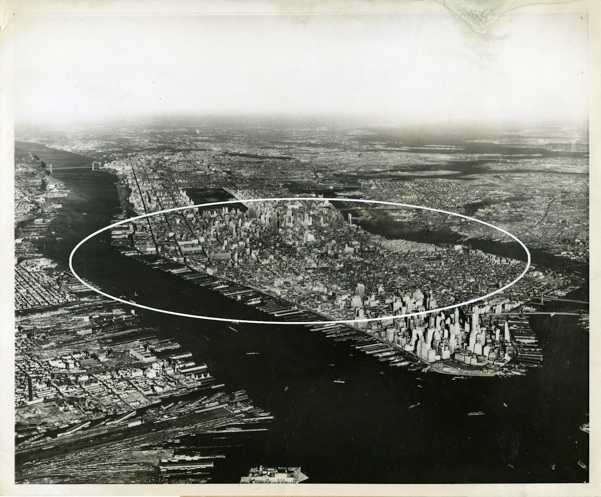
d Press Photo-H-Bomb Can Destroy City, New York, March 31 1954

News from John O’Brian of an important exhibition and book.  The exhibition is After the Flash: photography from the atomic archive, which runs from 10 October through 20 December 2014 at WORK gallery, 10A Acton Street in London.

Photography plays a crucial role in shaping public perceptions of the atomic age and its legacy of anxiety. Cameras not only record nuclear events, but also assist in their production—whether as agents of scientific measurement, propaganda or protest. They witness the unseeable on our behalf, giving form to the invisible forces and forbidden sites that haunt popular conceptions of the nuclear world.

After The Flash: Photography from the Atomic Archive explores the intertwined histories of photography and nuclear technologies, and the camera’s role in constructing the public image of atomic energy and ‘the bomb’. The exhibition contrasts the ‘technological sublime’ that dominates much nuclear-themed photography—from mushroom clouds to cooling towers—with representations of personal encounters and experiences, tracing the hazy lines between spectacle and humanitarian documentation. Photographic fragments offer insight into broader nuclear narratives and reveal recurring tensions between invisibility and visibility, and obliteration and transformation.

The exhibition comprises three sections. Cameras and Clouds reflects on the mutual development of photography and nuclear technologies, and the camera’s role in producing abstracted spectacle, social documentary and scientific record. The second section, At Work in the Fields of the Bomb, identifies the physical and ideological structures relating to nuclear applications, demonstrating the seepage of atomic landscapes and themes into existing social, economic and political narratives; this section draws its title from Robert Del Tredici’s landmark 1987 photographic study of the US nuclear weapons industry. Thirdly, The Culture of Contamination explores individual and social engagement with nuclear imagery and issues, ranging from anti-war protest to homemade fallout shelters and pop cultural appropriations. Anxiety finds an outlet in kitsch as the mythologies of nuclear power permeate culture on both official and vernacular levels..

Drawing on the extensive personal ‘atomic archive’ of art historian and curator John O’Brian, After The Flash focuses on North American visual culture in the early decades of the Cold War from the 1940s to the 1960s, coinciding with the emerging ‘golden age’ of photojournalism.

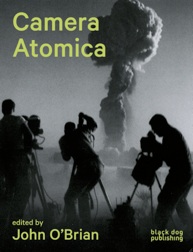
book_coverThe exhibition in turn marks the publication of John’s edited book Camera Atomica, out later this month.  It includes contributions from Julia Bryan-Wilson, Iain Boal and Gene Ray, Douglas Coupland, Blake Fitzpatrick, Susan Schuppli [of Forensic Architecture fame!] and Hiromitsu Toyosaki.

Camera Atomica is co-published by Black Dog Publishing and the Art Gallery of Ontario, and precedes a photographic exhibition at the AGO in 2015.

Gazonto

I’ve discussed the political-aesthetic practice of transposition before – superimposing war ‘over there’ on a city ‘over here’ – in relation to both Baghdad and Gaza.  For the most part, these have been cartographic exercises or art performances (see the closing sections of  ‘War and peace’ [DOWNLOADS tab] for some more examples).

Film-maker John Greyson has just released this short video, Gazonto, which is doubly different.  It takes the rash of video games about Gaza – many of which glorify successive Israeli assaults – and turns them to critical account, and it re-locates the air strikes from Gaza to Toronto (the flipping of the map near the beginning is inspired).

More here; if you are trying to remember where you’ve heard of John before, he was arrested and jailed in Egypt last summer, en route to Gaza with Tarek Loubani, an ER doctor who is one of the main architects of the Canada-Gaza collaboration that is responsible for taking Canadian doctors to Gaza to train local physicians.  They spent fifty days in a Cairo jail after John was seen filming Tarek treating demonstrators who had been shot by police in Ramses Square, where they had been protesting the military coup.  It was never clear which was the greater crime – treating the demonstrators or witnessing the emergency treatment.

This, of course, is one of the many appalling back-stories spawned by the intimacy between the al-Sisi government in Egypt and the Netanyahu government in Israel: what the splendid Richard Falk calls ‘neighbourly crimes of complicity’.  Geopolitics is rooted in these ‘accommodations’, and it cultivates all sorts of deadly blossoms.

But the tendrils reach far beyond the region, and many readers will appreciate why it is so important for a Canadian film-maker to re-stage the attacks on Gaza in a Canadian city.  For those who don’t, check out this report on the Harper government’s own video, released as the Israeli assault on Gaza was intensifying, affirming Canada’s support for Israel “Through Fire and Water”.   Really.

While I’m on this subject, Laleh Khalili has an excellent essay at the Society & Space open site to accompany the virtual issue on Israel/Palestine.  It’s called ‘A habit of destruction’:

The devastation to which Gaza has been subjected in the last few weeks seems to be yet another repetition of Israeli settler-colonial apparatus’ habit of destruction. Gaza has become emblematic of this habit, because in recent years it has so frequently been subjected to bombing while under a state of siege, but like all settler-colonialisms, the violence of the state is rooted not in an episodic “cycle of violence” but in the very ideology and practice of the settler-colonial movement…. 

The lesson of the most recent Israeli assault on Gaza, as in all previous assaults, is that civilians are not “collateral” or accidental casualties of war between combatants, but the very object of a settler-colonial counterinsurgency. The ultimate desire of such asymmetric warfare is to transform the intransigent population into a malleable mass, a docile subject, and a yielding terrain of domination.

And, as she concludes, ‘That ever so frequently the Israeli military plunges Palestinians into conflagrations of lead and steel and concrete dust and destruction is the clearest sign that it has failed at making Palestinians into such a docile population.’

MAP and the meat-grinder

I’ve updated my previous posts on the medical geographies of Gaza several times (see herehere and here), and I’ve drawn on the testimony of Dr Mads Gilbert in extenso, but this testimony from another brave volunteer doctor deserves its own notice.

I met Ghassan Abu Sitta at a wonderful workshop in Paris in December 2012 on War and Medicine, and I learned so much from that one meeting (from everyone there: see my note about War and therapeutic geographies) that I was inspired to develop my own research project on the medical evacuation of casualties from war zones, 1914-2014.

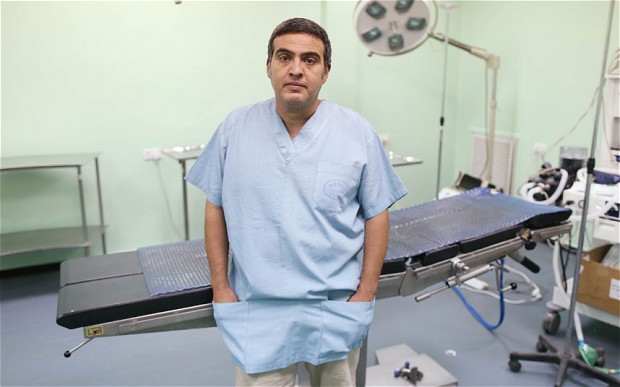
Ghassan Abu Sitta

Ghassan is a reconstructive surgeon who used to work at Great Ormond Street in London but is now based in Beirut.  He’s recently returned from Gaza where he worked as a Medical Aid for Palestinians (MAP) volunteer at al Shifa hospital carrying out five, six and sometimes seven surgeries a day.

You can read some of the background in this excellent report by Robert Tait for Britain’s Telegraph, published ten days ago and from which I’ve borrowed the photograph above, but Ghassan has just been interviewed in depth by Yazan al-Saadi for Al Akhbar; you can read the full version here.

Ghassan says the attack on Gaza was like ‘a meat-grinder’, which he attributes to:

The amount of ordinance that the Israelis fired, the indiscriminate use of these bombs that are capable of bringing down whole buildings, the use of artillery shelling which is indiscriminate because the shell will hit the first thing it reaches, the fact that they were attacking from the air, from the sea, and by land with artillery at the same time. And there was a night they were doing this and then they lit all of Gaza’s sky with these flares just so people will know that this is what’s happening.

He also provides compelling testimony of his experience at al-Shifa, the main trauma centre for Gaza, that adds important detail to the accounts I’ve noted previously:

‘It looked like a refugee camp. The campus of the hospital has a lot of the families that escaped the bombing or lost their houses and they were living inside the walls of the hospital. Everywhere you go you see makeshift dwellings made out of laundry lines and bed sheeting turned into tents. And the hospital was completely full. Single rooms had four beds in them. In some wards we had two patients per bed.

‘The difference between this conflict and the one before is that nobody was allowing the patients out. So you had 7,000 injured – at the time I was there it was 6,000 and by the time the conflict ended the injured were 10,000. An overwhelming majority have still not been able to get out of Gaza. There have been some numbers, but not significant numbers to break the back of this problem….

‘The contingency plans were that all diesel was kept for the al-Shifa Hospital, so people did not have electricity at home, they would donate the diesel to the hospital. The wells that supply Shifa, like the rest of the water in Gaza, had become so contaminated with sea water, it’s salty. People do the best with what they have….

‘… the majority of the killing was happening because they were dropping ammunition designed to penetrate mountain caves. [The Israelis] were dropping them on civilian dwellings made out of breeze block. And so these four or five storey buildings were being pulverized by these one-ton bombs. That was what was wiping out whole families. And in Gaza, because land is so much in shortage, people come along and build their house, they build enough foundations that when their kids grow up, they can build a floor on top. So when you take out a four storey building, you take out four generations of a family. That was what happened to, I think, 60 families that have been completely wiped out…

The graphic below shows 26 members of just one extended family, the Abu Jame family, killed at home in Bani Suheila on 20 July; it comes from a sequence that is shockingly far too large to reproduce here, compiled by B’Tselem and available here. The infographic lists ‘members of families killed in their homes in 59 incidents of bombing or shelling’ in which 458 people were killed, including 108 women under the age of 60, 214 minors, and 18 people over the age of 60.  If you follow the link, you can hover over each image for the names and ages of those killed.

abu_jame3

Ghassan continues:

‘… they started inventing these humanitarian ceasefires, where people would go out and they would start killing them. We had this on the day of Eid, they said there was a humanitarian ceasefire and the kids went out to a local fair ground and they bombed them. The other time was in al-Shujayeh market, there was a humanitarian ceasefire, they got them into the market, they killed them, then they waited for the ambulances to get there, and then they shelled the ambulances again.

‘So the issue isn’t the type of weapons, but the intent to kill. The amount of ordinance they used and the tonnage of the bombs they used were intended to wipe out whole neighborhoods. That’s what they have done. They have completely wiped out Shejayeh, they wiped out Khuza’a, they wiped out a big part of Rafah, a big part of Khan Younes, and parts of Beit Hanoun….

‘ All the areas around the hospital were being bombed all the time. You would hear it. We heard something we knew it was close, but didn’t know how close it was. We then got a call to the emergency room and we were told that the administration and the out patients building had been hit – a lot of families had taken refuge in that area – so we had to go and help.’

Asked directly whether Hamas or other factions were firing rockets from the vicinity of the hospital, Ghassan is unequivocal:

‘Around Shifa? No, no, no. But in other places you would see them in the sky or hear them. You would learn to distinguish the whoosh of the rocket. Gaza is so small and so flat, I mean you are not going to hide them in the mountains or the jungle because there are no mountains or jungle. People are literally on top of each other. It’s going to happen. But around the hospital there were none.’