Theory of the drone 8: From invisibility to vulnerability

This is the eighth in a series of posts on Grégoire Chamayou‘s Théorie du drone and covers the third chapter in Part II, Ethos and psyche.

3: Crisis in military ethos

The track that Chamayou beats in this chapter is (perhaps appropriately) a tortured one: it twists from the invulnerability of the hunter through his defencelessness to his vulnerability to psychic harm.  And, as you’ll see, those gendered pronouns are a critical part of his argument.
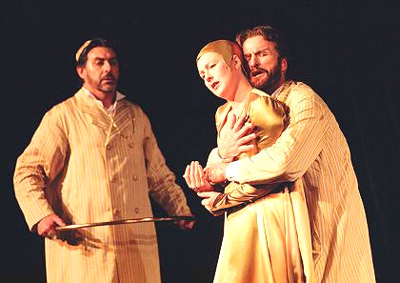
Gyges (left) from Der König Kandaules

He begins with the story of Gyges.  In classical mythology Gyges was a shepherd who discovered a magical ring that could make him invisible.  Armed with his new power, Gyges eventually killed the king, married the queen and seized the throne.  ‘Invisibility’, Chamayou notes, ‘conferred upon him a kind of invulnerability.’  In Plato’s Republic the story is used to ask searching questions about virtue and justice: what happens to morality, to virtue, if it becomes possible to evade responsibility for one’s actions?

The dilemma is no longer confined to the realm of story-telling or philosophical speculation, Chamayou argues, because the thought-experiment has been realised through the political technology of the drone.  The modern answer to Plato’s question is now all too clear: invisibility produces not only invulnerability but also impunity.  In fact, in an Op-Ed last year on ‘The moral hazard of drones’ two American academics, John Kaag and Sarah Kreps, suggested that the myth of Gyges does indeed find its most telling contemporary application in the use of drones for remote killing:

One might argue that the myth of Gyges is a suitable allegory to describe the combatants who have attacked and killed American civilians and troops in the last 10 years. A shepherd from the Middle East discovers that he has the power of invisibility, the power to strike a fatal blow against a more powerful adversary, the power to do so without getting caught, the power to benefit from his deception. These, after all, are the tactics of terrorism.

But the myth of Gyges is really a story about modern counterterrorism, not terrorism.

We believe a stronger comparison can be made between the myth and the moral dangers of employing precision guided munitions and drone technologies to target suspected terrorists. What is distinctive about the tale of Gyges is the ease with which he can commit murder and get away scot-free. The technological advantage provided by the ring ends up serving as the justification of its use.

Terrorists, whatever the moral value of their deeds, may be found and punished; as humans they are subject to retribution, whether it be corporal or legal. They may lose or sacrifice their lives. They may, in fact, be killed in the middle of the night by a drone. Because remote controlled machines cannot suffer these consequences, and the humans who operate them do so at a great distance, the myth of Gyges is more a parable of modern counterterrorism than it is about terrorism.

[You can find a different version of their critique of drone warfare, which mercifully leans on materiality rather than mythology, in ‘The use of unmanned aerial vehicles in contemporary conflict: a legal and ethical analysis’, Polity  44 (2012) 260-85, available on open access here; as I’ll show in a later post, that essay intersects more directly and substantially with Chamayou’s own critique].

Chamayou accepts the force of Plato’s original question, and evidently applauds the way in which Kaag and Kreps bring it to bear on the present,  but he thinks there is another way of putting it.  Not ‘can the invisible person be virtuous?’ but ‘what sort of “virtue” is invoked by the modern Gyges?’

He develops his answer through a thumb-nail sketch of what he sees as both a crisis in and a transformation of military ethos.  Traditional military ethos privileged courage, sacrifice and heroism, qualities that worked to make killing (Chamayou actually says ‘butchery’) acceptable, even glorious.  These virtues gave war what Clausewitz saw as its presumptive moral force, which depended on a fundamental reciprocity (sometimes called the combatant’s privilege): in order to kill with honour, the soldier must be prepared to die.  War then becomes the supreme ethical experience: ‘To wage war is to learn to die.’

But what happens, Chamayou wants to know, when all of this (apart from the killing) becomes unnecessary? When it becomes possible to kill without the risk of dying?  If the combatant’s privilege is annulled, doesn’t killing become the height of cowardice and dishonour? In the contemporary age of what Edward Luttwak called ‘post-heroic war’ – what former Air Chief Marshall Brian Burridge famously and more bluntly described as ‘virtue-less war’ – those traditional military virtues are threatened.  In short, it’s not only those living under drones who see these new weapons as cowardly, and Chamayou believes that the contradiction between the new technical means of waging war and the traditional ideology that is supposed to inform its prosecution has provoked a profound crisis in the military ethos.

In fact, he says, some of the fiercest critics of remote killing are pilots of conventional strike aircraft. Chamayou cites this song written by two F-16 pilots, Chris Kurek and Rob Raymond, who perform as Dos Gringos (more here – really):

They shot down a Predator, that’s one less slot for me
They shot down a Predator and it filled my heart with glee
I had a smile when I logged on to AFPC
They shot down a Predator, that’s one less slot for me

They shot down a Predator and I say let’s send some more
Let’s fly ‘em over Baghdad and then see what’s in store
‘Cause I heard that the Air Force wants another 24
They shot down a Predator and I say let’s send some more

They shot down a Predator and I wonder how that feels
For that operator who lost his set of wheels
It must feel so defenseless; it’s like clubbing baby seals
They shot down a Predator and I wonder how that feels

As this clip makes clear, the hostility is about more than military values: the USAF now trains more crews for remote operations than for flying conventional aircraft.  But the values in question are given a particular inflection.  It would be a mistake to read ‘clubbing baby seals’ in the last verse as a reference to striking a target that can’t strike back.  After all, the song is about a Predator being shot down, and so it homes in on their inability to fight back: on their inability to engage in combat.

What is at stake here, Chamayou suggests, is a series of ‘manly’ and masculinist virtues and even virilities.  The complaint is that Unmanned Aerial Vehicles are literally ‘un-manned’ – their ‘pilots’ are not real pilots and not even real men. (You can find much more on this martial emasculation in Mary Manjikian, ‘Becoming Unmanned’ [International Feminist Journal of Politics (2013) doi: 10.1080/14616742.2012.746429]).

Even so, Chamayou is sceptical about the history being (re)written through these and similar objections.  Before announcing the end of the era of ‘manly’, heroic warfare, he suggests (in an obvious echo of Bruno Latour), we ought to ask whether ‘we’ moderns have ever fought heroic wars.  He draws attention to Walter Benjamin‘s scathing critique of a collection of essays edited by Ernst Jünger under the title War and Warrior in 1930:

‘These authors nowhere observe that the new warfare of technology and material [Materialschlacht] which appears to some of them as the highest revelation of existence,dispenses with all the wretched emblems of heroism that here and there have survived the [First] WorldWar.’
UK Approach to Unmanned Aircraft SystemsFaced with this storm of criticism, Chamayou suggests, military ethicists have found it necessary to erect an altogether different version of virtuous war.  If the drone is to be considered ‘virtuous’, several writers have argued, it is first and foremost because it rules out the possibility of casualties on ‘our’ side. Chamayou will have more to say about this in a later chapter on combatant immunity, but for now he finds confirmation in a Ministry of Defence report on The UK Approach to Unmanned Aircraft Systems in 2011 that, even as it acknowledged the ethical issues involved in abandoning the combatant’s privilege, nevertheless concluded that ‘use of unmanned aircraft prevents the potential loss of aircrew lives and is thus in itself morally justified.’

Statements like this bring into view an ongoing transformation from an ethic of sacrifice and courage to an ethic of auto-preservation (and, Chamayou adds, of cowardice): a sort of Revolution in Moral-Military Affairs.  The scale of traditional values is reversed, and in an Orwellian inversion words come to mean their opposite.  What used to be called cowardice is now called bravery, assassination becomes combat, and the spirit of sacrifice is turned into an object of opprobrium.  In Chamayou’s view we are witnessing not so much ‘virtue-less war’ as a vast operation to re-define the ‘virtues’ of war.

Dist_Warfare_Medal_800_t700

Chamayou fastens on the the Pentagon proposal late last year to award combat medals to drone operators.  Finally announcing the Distinguished Warfare Medal in February 2013, the Pentagon issued this statement:

Modern technology enables service members with special training and capabilities to more directly and precisely impact military operations at times far from the battlefield.  The Distinguished Warfare Medal will be awarded in the name of the secretary of defense to service members whose extraordinary achievements, regardless of their distance to the traditional combat theater, deserve distinct department-wide recognition.  

 “I have seen first-hand how modern tools like remotely piloted platforms and cyber systems have changed the way wars can be fought,” said Secretary of Defense Leon E. Panetta.  “We should also have the ability to honor extraordinary actions that make a true difference in combat operations, even if those actions are physically removed from the fight.”

The proposal set off a firestorm of protest in Congress and within the Air Force and online military forums.   It was withdrawn for review in less than a month and rescinded by Panetta’s successor in April.

The saga doesn’t quite do the work Chamayou wants it to do.  He uses it to reflect on the meaning of ‘bravery in combat’ – after all, he asks, what can bravery mean in circumstances ‘physically removed from the fight’? – but the Pentagon statement made it clear that the medal was to be awarded ‘for actions in any domain but not involving acts of valor.’

Still, this does not diminish the force of Chamayou’s main line of inquiry.  From the testimony of drone operators, he concludes that bravery consists not in them putting their lives on the line but in seeing the consequences of their actions online.  Drone crews are supposed to be so deeply affected by the high-resolution full-motion video feeds from their Predators and Reapers, which show in intimate detail the corporeal results of the strikes for which they are responsible, that they become highly vulnerable to Post-Traumatic Sress Disorder.  Traditionally bravery involved putting your physical body in danger; Chamayou says that it now it seems to involve putting your psychic being at risk.

This amounts to the elevation of what he calls a ‘purely psychic heroism’.  In previous wars the soldier was both the vector of violence and its potential victim, because the reciprocity of combat called on warriors to be at once executioner and potential victim.  Today the remote warrior is still required to be the executioner, but he can also become the psychological victim of his duty as executioner.

Jane Addams and delegates to the Hague conference in 1915

Chamayou is troubled by this for two reasons.

First, the idea of psychic vulnerability – of the damage inflicted on soldiers by the trauma of killing – was given form and substance in the First World War. In 1915  Jane Addams (above) – who will, I suspect, be known to most human geographers for her other achievements, particularly her work at Hull House in Chicago – returned from the International Congress of Women at the Hague to deliver a stunning address at Carnegie Hall on “The Revolt against War”.  In it, Chamayou tells us, she spoke of nurses treating ‘delirious soldiers [who] are again and again possessed by the same hallucination – that they are in the act of pulling their bayonets out of the bodies of men they have killed’, and of five young soldiers who committed suicide ‘not because they were afraid of being killed but because they were afraid they might be put into a position where they would have to kill someone else.’  To overcome these inhibitions, she noted, soldiers were routinely given a shot of rum before they went over the top.  Addams used these testimonies to develop a courageous and principled critique of military violence, and in 1931 she was awarded the Nobel Peace Prize.  (Read her Peace and Bread in time of war here). To Chamayou’s evident disgust, the trauma of war that Addams and others exposed is now being recycled into a legitimation of targeted killing.  Like a snake eating its tail, trauma is being mobilised to restore to war the ethico-heroic temper Addams insisted it had lost through trauma.

But, second, as I’ll show in the next post in this series, Chamayou is deeply sceptical of what he calls ‘the psychopathologies of the drone’.

One last comment before I go.  I don’t think the deployment of armed drones is provoking a wholesale transformation of military ethics, because that would be to absolutise their use.  The Air Force still flies conventional strike aircraft, troops are still deployed on the ground (including Special Forces) and – as the controversy over the medal confirms – the Pentagon still insists on a difference between distinguished service and bravery.  I don’t mean that drones do not raise serious ethical questions; of course they do, and I am dismayed at how often these are trumped by arguments about the legality of military violence.  But military violence takes many different forms, and it’s important not to lose sight of the larger killing fields in which drones are embedded.
Theory of the drone 7: Historical precedent and postcolonial amnesia

This is the seventh in a series of posts on Grégoire Chamayou‘s Théorie du drone; this one covers the second chapter of Part II, Ethos and psyche.

2. ‘That others may die’

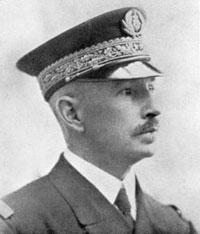
Raoul CASTEXChamayou opens with a quotation from a French naval officer, Raoul Castex, on early submarine warfare.  Castex was a naval strategist of the first water (he rose to the rank of Admiral, though he was a captain when he wrote the essay Chamayou cites).  His views were canvassed as widely as those of Alfred Thayer Mahan, and they were set out in detail in his five-volume Théories strategiques published by the Société d’Editions Géographiques, Maritimes et Coloniales between 1929 and 1935.  This was hailed as recently as 1995 in a report prepared for US Navy Doctrine Command by James Tritten as ‘perhaps the most complete theoretical survey of maritime strategy to ever appear.’

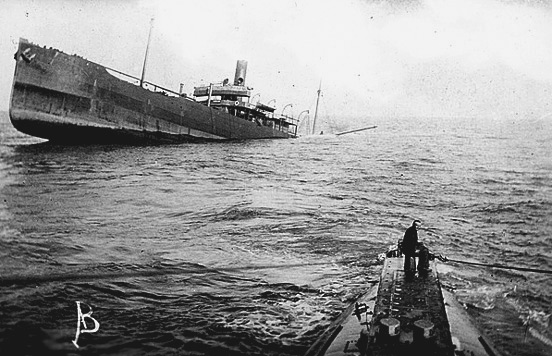
Castex was not fêted so enthusiastically in the 1920s, however, when his ‘synthesis on submarine warfare’ was seen as a defence of unrestricted German submarine attacks during the First World War.  The first attacks had been against warships, but by early 1915 – and in large measure as a response to Britain’s naval blockade – the focus switched to merchant shipping.  In the course of the war Britain lost over 12 million tons of merchant shipping to U-boats.  In Castex’s view, the success of these attacks showed that the submarine was the instrument that would overturn Britain’s naval supremacy.

Tramp steamer sinking after U-boat attack

Britain bridled at the suggestion, and Castex’s supposedly exculpatory views were quoted in (mis)translation by Britain’s First Lord of the Admiralty at the Committee on Limitation of Armaments in Washington in December 1921; they were repudiated by the senior French naval delegate and provoked a fierce political and public controversy in Britain.  The British delegation had gone to the Washington conference to demand the total abolition of submarine warfare: submarines were virtually impossible to detect, and there was little defence against them (depth charges became available in early 1916, but these had minimal effect).  Before the War, Admiral Sir Arthur Wilson had denounced submarines as “unfair, underhand, and damned un-British”, and during the war there were repeated condemnations of the sinking of merchantmen (and arguments over their ‘noncombatant’ status).   By 1921 the focus of debate had switched back to military targets, and the Admiralty was gravely concerned that the ‘battlefleets of the world” – crucially, of course, those of the Royal Navy – “would be at the mercy of  flotillas of submarines of improved design.”  Britain’s position was opposed by France, Italy and Japan, and the attempt at abolition failed.  Chamayou doesn’t bother with any of this detail – it’s all back-story and you can find much more here – but its relevance for drone warfare and campaigns against it should be obvious.

In his synthesis Castex noted that the practitioners of submarine warfare believed that it had finally realised the dream of risk-less warfare. Here is the passage that Chamayou cites (and its prefiguration of Chamayou’s hunting thematic could not be plainer):

‘They were invulnerable.  War should be a game for them, a sport, a kind of hunting, where, having delivered and spread murder, all that would be left for them to do would be to revel in the sight of their victims’ agony.  Meanwhile they would be safe from retaliation and, once back in port, they would busy themselves with stories of their hunting prowess.’

In Chamayou’s view, drones have reincarnated this myth – and these sentiments – in even stronger terms.  They have transformed the meaning of ‘going to war’; the traditional model of combat is now being displaced by an altogether different ‘state of violence’ that degenerates into slaughter or hunting.  One no longer fights the enemy, Chamayou contends, the enemy is simply eliminated as though one were shooting rabbits.

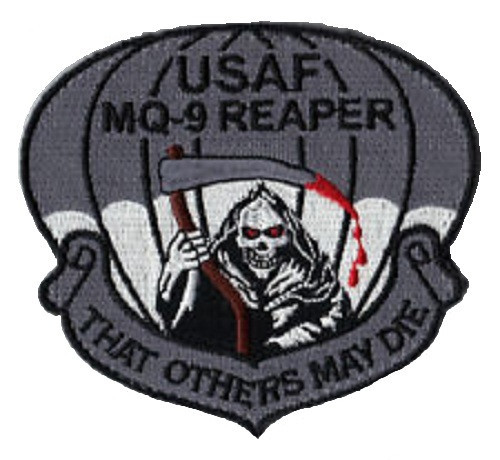
In the sixteenth century Chamayou says that the iconography of Death often portrayed a soldier fighting a skeleton – most famously in Holbein’s Dance of Death – in a struggle that was always pointless because Death mocked his adversary and always triumphed in the end.   The imagery has now been appropriated in this unofficial patch produced for Reaper crews, where the soldier now assumes the position of Death itself (and becomes synonymous with the MQ-9 Reaper); the slogan – which is in fact a parody of “That others may live”, used as a patch by the USAF’s Pararescue teams  – gives Chamayou the title for his chapter.

That others might die

In a sense, then, both the submarine and the drone trumpet asymmetry as virtue.  And as that parallel implies, the pursuit of asymmetry is by no means novel.  Here is Sebastian Junger:

JUNGER WarA man with a machine gun can conceivably hold off a whole battalion, at least for a while, which changes the whole equation of what it means to be brave in battle…. Machine guns forced infantry to disperse, to camouflage themselves, and to fight in small and independent units. All that promoted stealth over honor and squad loyalty over blind obedience….

As a result much of modern military tactics is geared toward maneuvering the enemy into a position where they can essentially be massacred from safety. It sounds dishonorable only if you imagine that modern war is about honor: it’s not. It’s about winning, which means killing the enemy on the most unequal terms possible. Anything less simply results in the loss of more of your own men.

Historical precedent cannot issue an ethical warrant, however, and Junger admits as much.  Yet Chamayou notes that this is exactly the strategy used time and time again to justify drone warfare and to silence its critics.  His example is an essay by David Bell directed at what he called ‘the increasingly vocal critics who doubt the morality, effectiveness, and political implications of “remote control warfare.”‘

‘[C]ritics tend to present this new frontier of warfare as something largely novel — a sinister science fiction fantasy come to life, and one that has the power to radically change the political dynamics of warfare. But if our current technology is new, the desire to take out one’s enemies from a safe distance is anything but. There is nothing new about military leaders exploiting technology for this purpose. And, for that matter, there is nothing new about criticizing such technology as potentially immoral or dishonorable.  In fact, both remote control warfare, and the queasy feelings it arouses in many observers, are best seen as parts of a classic, and very old history.’

This is perfectly true, as far as it goes, and in my own work I have traced the historical curve of ‘killing at a distance’.  I accept, too, that it is reasonable to ask those who object to killing from (say) 7,500 miles away to stipulate the distance from which they do consider it acceptable to kill (though I’m not sure how Chamayou would respond to such a question).  As Bell wryly remarks, ‘None of today’s critics, as far as I know, have expressed any nostalgia for the pike, or other hand-to-hand weapons.’

BELL First Total WarBell is a professor of history at Princeton, and I greatly admire his revisionist account of The first total war which troubles the usual identification of ‘total war’ with the bloody twentieth century and insists, instead, on Napoleon as the midwife of ‘warfare as we know it’.  In fact, I’ve drawn on Bell’s work for my exploration of the French occupation of Egypt at the end of the eighteenth century.

But that’s the irony: Chamayou argues that it was precisely Europe’s colonial wars that epitomised the desire to kill others from a safe distance, whereas these are conspicuously absent from Bell’s defence of drone warfare.  They don’t loom large in The first total war either, where Bell anticipates Chamayou’s challenge.  He accepts that The first total war deals ‘only rarely with the world beyond Europe’ – the principal exception is indeed Egypt – and he acknowledges that ‘colleagues often suggested to me that the origins of modern total war are surely to be found on the early modern impperial frontier’:

‘Surely it was here, long before the French Revolution, that Europeans first dispensed with notions of chivalric restraint and waged brutal wars of extermination against supposed “savages”.  Did not Europeans learn their worst behavior from imperial encounters in Asia, Africa, and the Americas?’

His answer, in fact, is no:

‘The horrendous slaughters of the Reformation-era wars of religion began well before most European empires had developed much beyond trading posts, and the worst examples occurred in the German states, which had no colonies.  The development of the French and British overseas empires coincided with the introduction of relative moderation and restraint into European warfare, not with their disappearance.’

Bell attributes this state of affairs to the ‘dependence’ of Europeans on indigenous populations. When later imperial armies embarked on Kipling’s ‘savage wars of peace’ in the nineteenth and early twentieth centuries, he argues, ‘the colonial setting mostly offered Europeans a laboratory for testing their own preexisting ideas about war’:  ideas that had been honed, so he insists, by the Napoleonic wars that are the focus of his book.

These are convenient and far from uncontroversial claims, but three riders are necessary that, taken together, reinstate the importance of colonial and imperial modalities of power.

First, Bell’s book glosses over the extraordinary violence of the French occupation of Egypt between 1798 and 1801, including the terrible victory at the Battle of the Pyramids and the French army’s savage and exemplary response to two insurrections in Cairo (he’s not alone: remarkably, Edward Said does much the same in Orientalism).  The violence included close-quarter butchery but also stand-off artillery bombardments that rained shells down onto the city from the Citadel above.  Here is an eye-witness account of the first insurrection:

‘The situation worsened by the time of the afternoon prayer.  Violence and the atmosphere of siege increased.  At that point (the French) fired their guns and bombarded the houses and the quarters, aiming especially at al-Azhar.  They trained cannons and mortars on it, as well as on the positions of the fighters close to it, such as Ghawriya Market and al-Fahhamin.  When this bombardment fell on the people, it was something which they had never witnessed in their whole life… ’ 

Second, whatever the origins of those ‘ideas about war’ – and they were, I think, clearly multiple – they were put into often spectacular effect during the colonial wars of the nineteenth and early twentieth centuries.  And it is those wars that show the most direct continuity with the places and the peoples who are now condemned to live and die under the shadow of the drone.

Third, as Chamayou shows in his discussion of ‘Counterinsurgency from the Air’, so-called ‘air control’ in the early twentieth century was an intrinsically colonial doctrine.  The first experiments in bombing from aircraft took place over Libya before the First World War, and while bombing of civilian targets in Britain, France and Germany took place in the last years of the war, the use of airpower against peoples who had no capacity to strike back was a cornerstone of British policy in Iraq, Afghanistan and on the North-West Frontier of British India.

Chamayou argues that defenders of drone warfare who invoke the ‘nothing new under the sun’ argument do so in an attempt to relativise, even sedate contemporary violence.  They invoke historical precedent – in effect: ‘This has happened time and time again before, so why all the fuss now?’ – but then fail to describe the bloody continuity that yokes past to present.  Hence, as Chamayou concludes: ‘The drone is the weapon of an amnesiac post-colonial violence.’

My own inclination is to press this further.  In The Colonial Present I suggested that what Chamayou describes here as a version of postcoloniality – I still think that term sadly premature – is haunted by Terry Eagleton‘s  ‘terrible twins’: amnesia and nostalgia.  Or, as Eagleton put it, ‘the inability to remember and the incapacity to do anything else.’   Drone strikes in Pakistan, Yemen, Somalia and elsewhere not only suppress the wretched consequences of previous ‘air control’ regimes but also yearn for the swagger and seemingly effortless domination that they imposed.

Theory of the drone 5: Vulnerabilities

This is the fifth in a series of posts on Grégoire Chamayou‘s Théorie du drone.  My next post on the book will consider Chamayou’s second section, ‘Ethos and psyche‘, in its entirety, and when I’ve worked my way through the book in separate, detailed posts (three more sections to go after the next one) I’ll provide a critical overview of the project as a whole: I hope that will help (I must be doing something right – or wrong – since these posts have been picked up by the splendid ARmy Rumour SErvice, which – despite its equally splendid acronym – is not quite a digital child of the Wipers Times).

8: Vulnerabilities

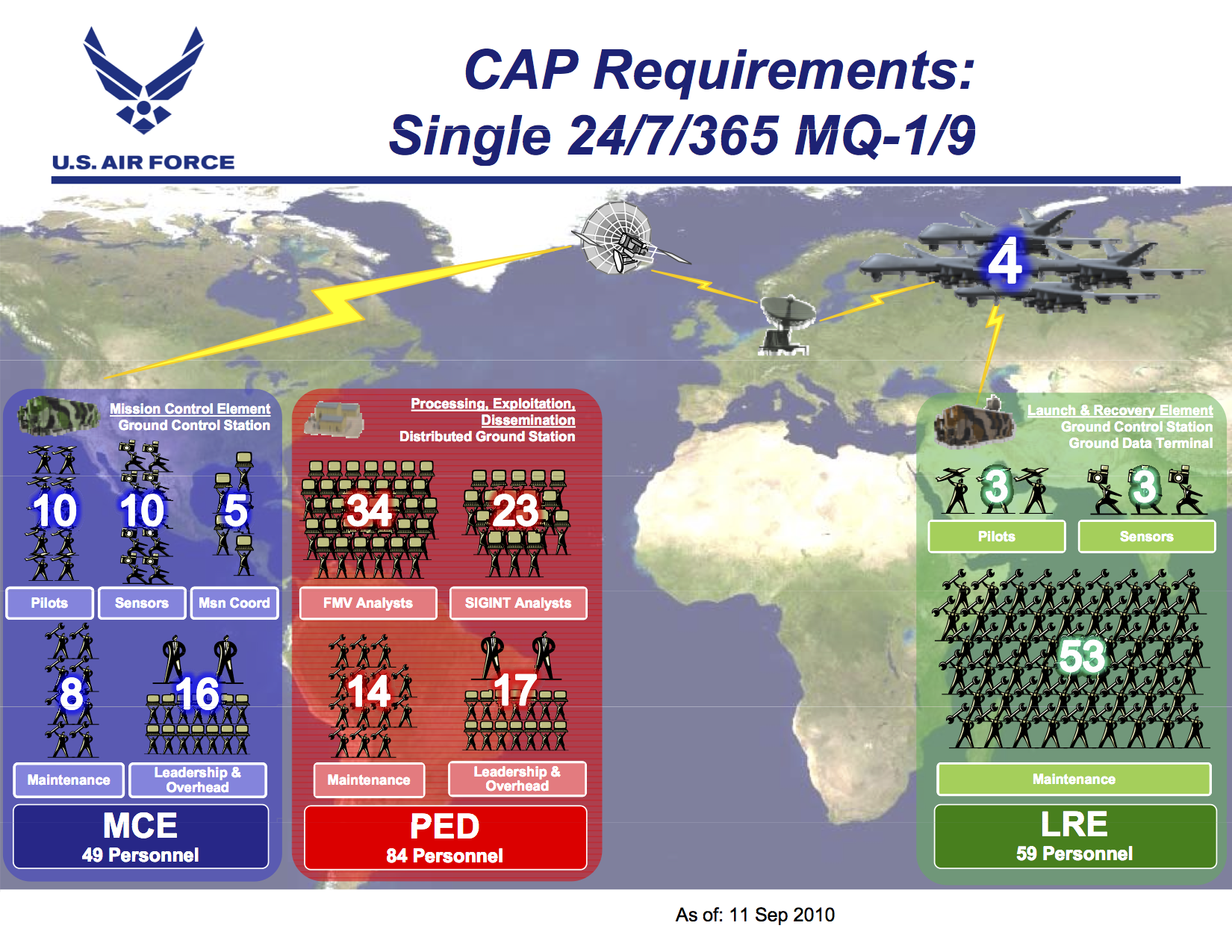
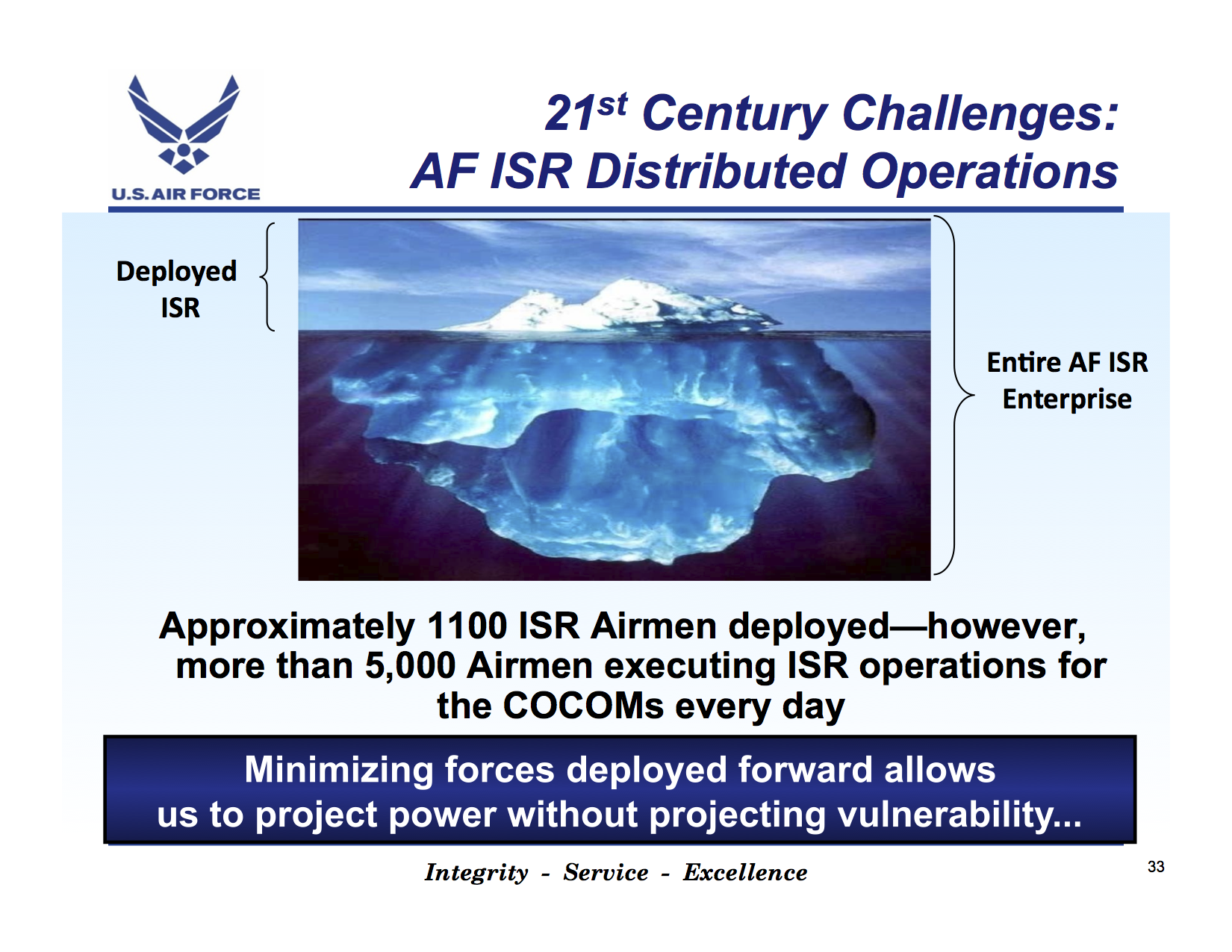
Far from being ‘unmanned’, each US Air Force combat air patrol (CAP) capable or providing coverage 24 hours a day 7 days a week involves a suite of four Predators (MQ1) or Reapers (MQ9) supported by a total of 192 personnel (the exact figures vary and are subject to change, but I’ve taken these from a June 2011 presentation by Colonel J.R. Gear, Director of the US Air Force’s Remotely Piloted Aircraft Task Force).

As you can see from his presentation slide below, most of these (133) are based outside the combat zone, and 84 of those are devoted to ‘PED’ –processing, exploiting and disseminating the feeds from the airborne sensors, especially the full-motion video (FMV) streams.

That leaves 59 who are forward deployed inside the combat zone: three pilots and three sensor operators to handle take-off and landing (which require a line-of-sight link to the aircraft because the Ku-band satellite link used for in-flight operations imposes a response delay that is too great for near-ground manoeuvres).  One of the four aircraft is held on the ground for maintenance and, given the technical problems that continue to dog what Jordan Crandall calls the wayward drone, no fewer than 53 people are involved in keeping them flying.  [More on drone crashes and glitches here, here and here].

Still, less than half the total complement (44 per cent) is in the combat zone, and all of them work from the relative safety of an airbase.

GEAR Manning Unmanned Aircraft

Hence the tag line repeatedly used by the US Air Force to advertise the core advantage of using drones: ‘projecting power without projecting vulnerability’:

Projecting power without vulerability

I’ve always liked to take metaphors stubbornly literally, and given what is happening to the polar ice we need to ask about the invulnerability of these remote operations.

Chamayou reminds us that in classical mythology and in fable invulnerability has always been a myth; so it is with the drone.  He distinguishes two sets of vulnerabilities, one technical and the other political-strategic.

(A) Technical

Chamayou says virtually nothing about the technical imperfections of the Predator and the Reaper, especially the crashes and other failures that I noticed above, but concentrates on two other issues.

(1) ‘Mastery of the air’: At present, Predators and Reapers can only operate in uncontested airspace; they are slow, noisy and far from agile, which makes them highly vulnerable to attack from ground-to-air missiles or conventional strike aircraft.  This is not a problem in Afghanistan – even during the invasion US Secretary of Defense Donald Rumsfeld was able to proclaim ‘air superiority’ by 10 October, just three days after launching the first attacks: ‘Afghan skies secure‘ – and according to some reports it never became a serious issue in Iraq either.  During Operation Southern Watch, tasked with enforcing no-fly zones over Iraq between the first Gulf War and the US-led invasion in 2003, Eric Reidel reported that

‘Predators were used as bait to stir up Iraqi fighters and air defenses. Surface-to-air missiles eventually brought down two of the drones and an Iraqi fighter jet shot down a third, but it didn’t come that easy to the enemy.’

But that was a contest against a military machine degraded by a sanctions regime.  What is now called A2/AD (anti-access, area denial) may well become a serious obstacle to future conflicts. In 2011 Colonel Dean Bushey, deputy director of the joint Unmanned Aircraft Systems Center of Excellence, told Reidel:

“We’re thinking about the next war, thinking about the next fight, thinking about the next campaign…  We’ve fought in a very permissive environment where there are no enemy attacks against our unmanned aircraft … It would be foolish for us to imagine that we could continue to fly unmanned systems in an environment that is not only friendly but is not GPS-denied, that is not communications-denied.”

With Obama’s ‘pivot to the Pacific’, the Pentagon has redoubled its efforts to harden its drones for combat (several commentators are sufficiently sceptical about the prospects that they see a renewed commitment to conventional strike-stealth aircraft rather than to UAVs).  But perhaps the sharper point is contained in Bushey’s final sentence, and Chamayou spends much more time on this second, vital vulnerability.

(2) ‘Mastery of the waves’: Chamayou documents a series of incidents in which signals were jammed or hacked.

In 2009 the Wall Street Journal reported that insurgents in Iraq had been using commercial off-the-shelf software (costing just $26) to intercept the video feeds from Predators for at least a year, and there was similar evidence from Afghanistan.  The Pentagon had known of the vulnerability since the aircraft were deployed over Bosnia in the 1990s, but had not bothered to encrypt the signals because they ‘assumed local adversaries wouldn’t know how to exploit it.’ You might think the solution – encryption of the Common Data Link feeding images to ROVERS (receivers) used by troops on the ground – would be easy, but four years after the story broke Noah Schachtman and David Axe reported that more than half the US fleet of Predators and Reapers were still broadcasting their video feeds in the clear:

”Standard unencrypted video is basically a broadcast to whoever can figure out the right carrier frequency, so essentially, we are simulcasting to battlefield commanders and the opposing force. If that opposing force knows we can see them and from where, they can take better evasive maneuvers.”

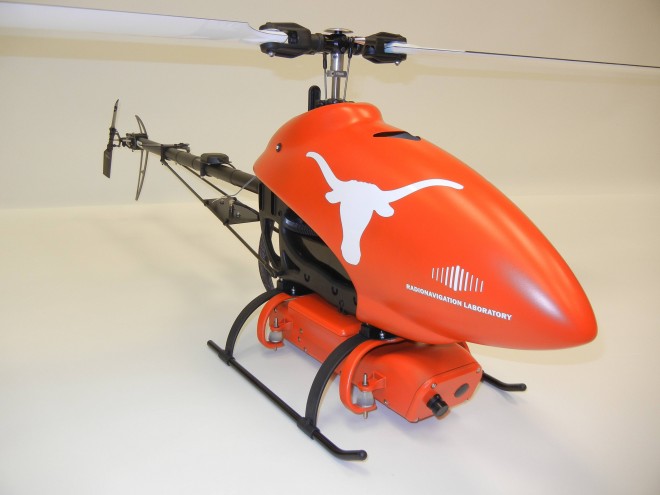
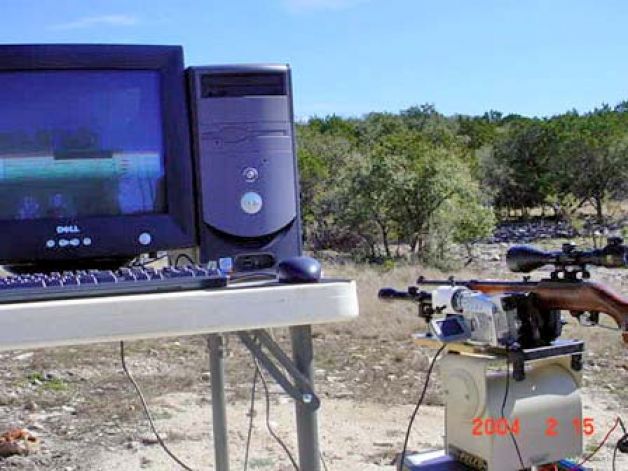
UT Adaptive Flight Hornet MiniIf signals transmitted from the drone can be hacked then, as Bushey noted, so can signals to the drone.  This is known as GPS spoofing, and the basic principle is remarkably simple; for a technical exposition that isn’t, see this research paper ‘On the requirements for successful GPS spoofing attacks’ by four Swiss computer scientists (who also propose counter-measures), but for a more user-friendly discussion see Pierluigi Paganini‘s excellent overview of ‘Hacking drones’ here.  As Chamayou says, the principle was put into practice in June 2012 , when a group of researchers from the Radionavigation Laboratory at the University of Texas at Austin successfully hijacked a small civilian helicopter-drone at the White Sands Missile Range in Nevada.  It was an experiment carried out for the Department of Homeland Security, the target was a tiny Adaptive Flight Hornet Mini (shown above) not a Predator or a Reaper, and the intercept took place at an altitude of less than 20 metres (60 feet) from a distance of 1 kilometre.  This year they intend to repeat the experiment but from a distance of 10 kilometres.  This is all part of an ongoing project to devise systems to disrupt spoofing, but Chamayou suggests that ‘the air pirates of the future’ will surely try to take control of larger drones from an even greater distance.

(B) Political-strategic

Here Chamayou is not addressing wider political, legal and ethical objections to which remote operations are indeed vulnerable – as I’ll describe in later posts – but rather the possibility of more direct responses to the deployment of drones.

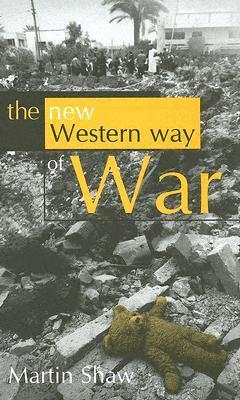
SHAW The new Western way of war(1) Reprisals: Remote operations radicalise what Martin Shaw described in 2005 as The new Western way of war: ‘risk-transfer war‘.  Although Shaw emphasised global surveillance, the minimisation of military casualties and an overwhelming reliance on airpower amongst other things – and his ‘rules of risk-transfer war’ are still essential if depressing reading – it is a sign of how far the world has turned since then that he provided no discussion of remote operations or the incorporation of drones as essential vectors of later modern war.

Perhaps for this reason Chamayou makes no mention of Shaw, but fastens on a short thesis submitted in 2009 by Major Trent Gibson of the US Marine Corps for the Master of Military Studies from Quantico, ‘Hell-bent on Force Protection’.  This was a critique of what Gibson called ‘force protection fetishism’.  He traced it back to the US military’s experience in Vietnam but argued that it was alive and well in Afghanistan and Iraq.  In a key passage quoted by Chamayou, Gibson wrote:

‘Attempts to armorize our force against all potential enemy threats … shifts the ‘burden of risk’ from a casualty-averse military force onto the populace. In doing so, we have lifted that burden from our own shoulders and placed it squarely upon those who do not possess the material resources to bear it – the civilian populace.’

Gibson was reaffirming one of the central tenets of the new counterinsurgency doctrine issued three years earlier, and he doesn’t discuss drones and remote operations either.  But what both FM 3-24 and by extension Gibson objected to was the physical separation of troops from the very people they were supposed to protect.  One of its cardinal – strategic – weaknesses – was sequestering troops inside vast, heavily defended Forward Operating Bases from which they issued out on sporadic armoured patrols.  It was, in part, on overcoming this siege mentality that the so-called “Surge” in Baghdad was predicated (see “The biopolitics of Baghdad”: DOWNLOADS tab).  General David Petraeus‘s ‘Commander’s Guidance‘ could not have been plainer:

‘Live among the people. You can’t commute to this fight. Position Joint Security Stations, Combat Outposts, and Patrol Bases in the neighborhoods we intend to secure. Living among the people is essential to securing them and defeating the insurgents.’

UAV pilot driving to workRemote operations hypostatise that ‘commute to the fight’ (see here).  Here is one UAV pilot talking to Der Spiegel:

‘In the morning you carpool or you take a bus and drive into work, you operate for an eight-hour shift, and then you drive back home… Before you were at war 24/7, and when you’re home you’re home. This is different. I do e-mails in the morning, rush to the airplane, come out, go to the [Base Exchange], get myself a hamburger, do some more e-mail, do it again, drive home.’

I’ll say more about that compartmentalisation in my next post – it’s a central concern in the next section of Théorie du drone – but Chamayou’s central point here is that the safety of ‘home’ is illusory and that the war cannot be contained within external ‘danger zones’.  He’s not talking about insurgent attacks against US air bases or crew (though one recent story, ‘A day job waiting for a kill-shot a world away’, reported that ‘the Air Force, citing what it says are credible threats, forbids pilots to disclose their last names’).  What Chamayou has in mind is the possibility of reprisals within the continental United States more generally: risk transferred back to the American public at large.  He explicitly endorses the conclusion to Mike Davis‘s Buda’s Wagon: a brief history of the car bomb, where Davis writes:

‘… every laser-guided missile falling on an apartment house in southern Beirut or a mud-walled compound in Kandahar is a future suicide truck bomb headed for the center of Tel Aviv or perhaps downtown Los Angeles.’

This is not a wild scenario.  Here is Michael Boyle on the costs and consequences of drone warfare:

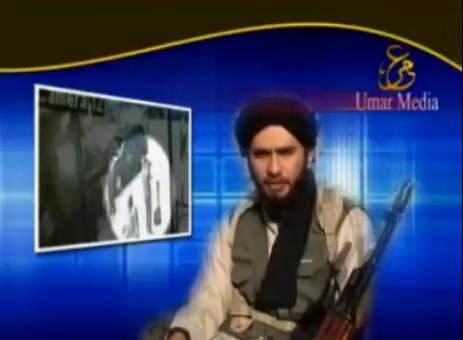
On 21 June 2010, Pakistani American Faisal Shahzad told a judge in a Manhattan federal court that he placed a bomb at a busy intersection in Times Square as payback for the US occupations of Afghanistan and Iraq and for its worldwide use of drone strikes. When the judge asked how Shahzad could be comfortable killing innocent people, including women and children, he responded: ‘Well, the drone hits in Afghanistan and Iraq, they don’t see children, they don’t see anybody. They kill women, children, they kill everybody. It’s a war and in war, they kill people. They’re killing all Muslims.’  In a videotape [below] released after his arrest, Shahzad revealed that among his motives for the attack on New York City was revenge for the death of Baitullah Mehsud, a Pakistani Taliban leader killed in a drone strike in August 2009. While his comments were reported in the American press, the Obama administration never acknowledged that it was revulsion over drone strikes—which Shahzad was rumoured to have seen at first hand when training with militant groups in Pakistan—that prompted his attack.

faisal-shahzad-martyrdom-tape

Although the incident would have strengthened his argument, Chamayou doesn’t mention it.  You can find more here; another video featured Pakistani Taliban leader Qari Hussain Mehsud claiming responsibility for what he described as retaliation against US drone attacks in the FATA (more detail here).

FUKUYAMA End of History(2) Re-purposing: Drones can be adapted for civilian use – they have been used to monitor herds of caribou and to track the progress of wild fires – and there is a rapidly expanding market for small DIY drones amongst geeks and hobbyists.  As Chamayou notes, after reading about the US Army’s small RQ-11 surveillance drone even Francis Fukyama built his own small surveillance drone in his backyard in February 2012.  What he doesn’t report, though, is the string of questions that Fukuyama raised in one of his early accounts of the project (Fukuyama now has three drones; updates including video here and here):

‘What will the world look like when not just the US but many other countries around the world operate fleets of drones; and when powerful, sophisticated drones are owned by lots of private individuals? What would our attitude be if our enemies could pick off visiting dignitaries as they stepped off the aeroplane in a supposedly friendly country, or attack soldiers in their bases in Europe or Asia? Or if Americans became vulnerable in Florida or New York? Drones might become an inexpensive delivery vehicle for terrorists or rogue states that can’t afford to deliver payloads in ballistic missiles. Some of the remotely controlled aeroplanes that hobbyists build are a third to half the size of their full-scale counterparts. As the technology becomes cheaper and more commercially available, moreover, drones may become harder to trace; without knowing their provenance, deterrence breaks down. A world in which people can be routinely and anonymously targeted by unseen enemies is not pleasant to contemplate.’

The last sentence is pretty rich: the world Fukuyama envisages is already a reality for thousands of people in Pakistan, Yemen, Somalia and elsewhere, and they have to do rather more than ‘contemplate’ it.

Still, these are Chamayou’s questions too.  It is precisely the proliferation, diffusion and and above all the down-sizing and down-marketing of small drones that interest him.  If they can be ‘demilitarised’ for civilian uses, including Fukuyama’s photographic obsessions, then he contends that it’s perfectly possible for them to be ‘re-militarised’ at remarkably low cost to constitute what Eugene Miasnikov was already calling six years ago ‘an army of suicide bombers on steroids’.  This may well be true – and, in a different vein, since October 2012 there have been (conflicting) reports of Israel shooting down two Iranian-made Hezbollah drones, so their adoption by non-state actors seems to be in train already – but it’s still a far cry from the hi-tech world of Predators and Reapers and the globalised killing machine for which they act as spears.

I’ll return to that world in my next summary and commentary on the book.

This completes my extended discussion of the eight chapters that form Part I of Théorie du drone: Techniques and tactics.

Theory of the drone 4: Pennies from Heaven

This is the fourth in a series of posts on Grégoire Chamayou‘s Théorie du drone.

7: Counter-insurgency from the air

The focus of the new US Army /US Marine Corps Counterinsurgency Manual FM 3-24 that was issued in 2006 was, naturally enough, on ground operations in which the Army and the Marine Corps would take the lead.  To the anger of many Air Force officers, air operations were relegated to a supporting role outlined in the last appendix, the last five pages of 335, which acknowledged the contribution of intelligence, surveillance and reconnaissance (ISR) from ‘air- mounted collection platforms’ and (in certain circumstances) the ‘enormous value’ of ‘precision air attacks’.

MEILINGER COIN from above

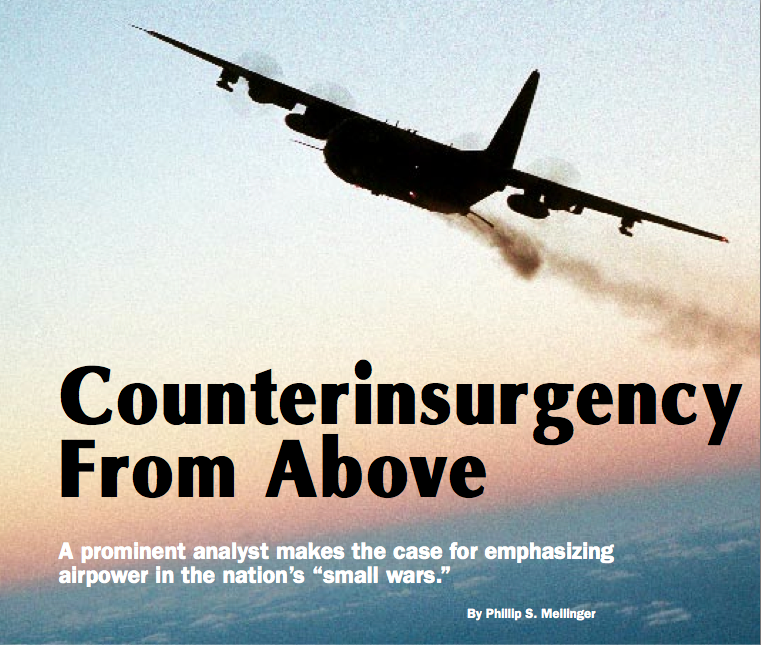
And yet in practice, as Chamayou argues, the balance was already being reversed; the incorporation of drones into counterinsurgency (COIN) was soon so advanced that there were calls (from air power advocates) for the promulgation of an official doctrine reflecting the new intrinsically three-dimensional reality.  So – to take the example Chamayou gives – Phillip Meilinger, a retired command pilot and former Dean of the School of Advanced Airpower Studies at the USAF’s Air University at Maxwell AFB, complained that the Field Manual had already been overtaken by events:

The role for airpower in COIN is generally seen as providing airlift, ISR capabilities, and precision strike. This outdated paradigm is too nar- rowly focused and relegates airpower to the support role while ground forces perform the “real” work. Worse, marginalizing airpower keeps it in support of ground-centric strategies that have proved unsuccessful.

He called for the Pentagon to

‘re-examine the paradigm that was so successful in Bosnia, Kosovo, Afghanistan, and Iraq. That was the use of air and space power, combined with [Special Operations Forces], indigenous ground forces, and overwhelming ISR. Given the outstanding results already demonstrated, an air-centric joint COIN model should be one of the first options for America’s military and political leaders.’

As the image heading his article makes clear, Meilinger – a gifted military historian – was not limiting the role of airpower to drones; far from it.  But his repeated references to the Air Force’s ‘more sophisticated and effective sensor aircraft and satellites’ signalled their indispensable importance in the transformation of counterinsurgency from a ground-centric to an air-centric model.

fm-3-24-counterinsurgency_500A similar salvo was fired at more or less the same time by Charles Dunlap, Deputy Judge Advocate General for the USAF, who castigated FM 3-24 for conceiving air power ‘as aerial artillery’ whose weapons were ‘somehow more inaccurate than other kinds of fires.’

‘In perhaps no other area has the manual been proven more wrong by the events of 2007…. [T]he profound changes in airpower’s capabilities have so increased its utility that it is now often the weapon of first recourse in COIN operations, even in urban environments.’

Dunlap was quick to say that this myopia wasn’t the result of inter-service rivalry (‘parochialism’):

‘Rather, FM 3-24 draws many of its lessons from counterinsurgency operations dating from the 1950s through the 1970s. While this approach is remarkably effective in many respects, it inherently undervalues airpower. The revolutions in airpower capabilities that would prove so effective during 2007 were unavailable to counterinsurgents in earlier eras.’ 

Those ‘revolutions’ – what Dunlap identified as ‘the precision and persistence revolutions’ – placed armed drones at the leading edge of counterinsurgency and, as Chamayou glosses these arguments, consigned previous objections to the dustbin of history.

Recalling my post yesterday about ‘pattern of life’ analysis, Dunlap argued that ‘visual observations have a grammar all their own’, and he cited with approval this paragraph from journalist Mark Benjamin‘s Killing “Bubba” from the skies’:

‘The Air Force recently watched one man in Iraq for more than five weeks, carefully recording his habits—where he lives, works, and worships, and whom he meets . The military may decide to have such a man arrested, or to do nothing at all. Or, at any moment they could decide to blow him to smithereens.’

It’s a revealing essay that accords closely with Chamayou’s central thesis: Benjamin reported that, from the Combined Air Operations Center in Qatar, ‘they are stalking prey’ and that the US Air Force had turned the art of searching for individuals into a science.

But Dunlap cooly added: ‘The last statement may be more insightful than perhaps even Benjamin realized.’  For it was not only a matter of killing, ‘blowing a man to smithereens’, and what Dunlap had in mind was not only persistent presence but also persistent threat: the ability to ‘dislocate the psychology of the insurgents’ who now never knew where or when they might be attacked.

For this reason Chamayou suggests that the drone effects a sort of détournement on the strategies and weapons of the insurgent-terrorist – the skirmish and the ambush, the IED and the suicide bomb – to become what he calls, through this radical reversal, ‘the weapon of State terrorism’.  Its short-lived engagements happen without warning and target individuals without compunction.

And yet, for all its technological sophistication, Chamayou insists that this is not a new strategy. Military historians ought to look further back, he suggests, to the policies of colonial ‘air control’ developed in the inter-war period (the image below shows a bomb dropped by the RAF on Sulaimaniyah in Iraq on 27 May 1924: more here).  He develops this argument in a later chapter, where he describes the drone as ‘the weapon of an amnesiac post-colonial violence’ (p. 136): a postcolonialism that has forgotten – or suppressed – its own wretched history.

British bomb dropped on Sulaimaniyah, Iraq, 1924

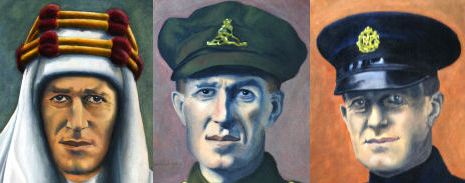
Indeed it has.  The twenty-first century version of counterinsurgency has made much of the iconic, inspirational figure of ‘Lawrence of Arabia’.  But as I’ve argued in ‘DisOrdering the Orient’ (DOWNLOADS tab):

‘… long before he resigned his Army commission and re-enlisted in the Royal Air Force as Aircraftsman Ross, [Lawrence] had been drawn to the wide open spaces of the sky as well as those of the desert. Patrick Deer suggests that in Lawrence’s personal mythology ‘air control in the Middle East offered a redemptive postscript to his role in the Arab Revolt of 1916-18’. He imagined the Arab Revolt ‘as a kind of modernist vortex,’ Deer argues, fluid and dynamic, ‘without front or back,’ and in Seven Pillars he recommended ‘not disclosing ourselves till we attack.’ To Lawrence, and to many others at the time, the intimation of a nomadic future war gave air power a special significance. ‘What the Arabs did yesterday,’ he wrote, ‘the Air Forces may do tomorrow – yet more swiftly.’  As Priya Satia has shown, this rested not only on a military Orientalism that distinguished different ways of war but also on a cultural Orientalism that represented bombing as signally appropriate to the people of these lands. This was, minimally, about intelligence, surveillance and reconnaissance. ‘According to this perverse logic’, Satia explains, ‘the RAF’s successful persecution of a village testified to their intimacy with the people on the ground, without which they would not have been able to strike it accurately.’ More than this, however, ‘the claim to empathy ultimately underwrote the entire air control system with its authoritative reassurances that bombardment was a tactic that would be respected and expected in this unique land.’ From this perspective, Satia continues, Arabs saw bombing as ‘pulling the strings of fate from the sky.’ They understood it ‘not as punishment,’ Lawrence informed his readers, ‘but as misfortune from heaven striking the community.’ And if women and children were killed in the process that was supposedly of little consequence to them: what mattered were the deaths of ‘the really important men.’’

JONGBLOED Lawrence triptych

As far as I know, Lawrence has not been invoked by any of the contemporary advocates of airpower in counterinsurgency – though he has been called ‘Lawrence of Airpower‘ – but many of these formulations and their successors, translated into an ostensibly more scientific vocabulary, reappear in contemporary debates about the deployment of drones in counterinsurgency.

In fact, Meilinger had conceded the relevance of these historical parallels. ‘It would be useful to revisit the “air control” operations employed by the Royal Air Force in the Middle East in the 1920s and 1930s,’ he wrote. ‘These operations were not always successful in objective military terms, but they were unusually successful in political terms, in part because they carried a low cost in both financial and casualty terms’ (my emphasis).

That is an extraordinary sentence, although Chamayou doesn’t quote it, because what is missing from the air power advocates’ view (so Chamayou argues) is – precisely – an apprehension of the politics of counterinsurgency in general and air strikes in particular.  Indeed, when the imaginary conjured up by Lawrence and his successors reappears in contemporary debates it is entered on both sides of the ledger: not only as economical and effective but also as cowardly and counter-productive.   Here is Colonel Keen, complaining about the bombing of Pashtun villages on the North West Frontier in 1923:

‘By driving the inhabitants of the bombarded area from their homes in a state of exasperation, dispersing them among neighbouring clans and tribes with hatred in their hearts at what they consider ‘‘unfair’’ methods of warfare … [these attacks] bring about the exact political results which it is so important in our own interests to avoid, viz., the permanent embitterment and alienation of the frontier tribes.’ 

Both Chamayou and I cite this passage, and you can find more about the colonial bombing of Waziristan in a previous post (scroll down).

This sentiment reappeared in different form in the critique of drone strikes in Pakistan’s Federally Administered Tribal Areas  – the same region described by Keen – published by David Kilcullen and Andrew Exum in the New York Times in 2009, ‘Death from above, Outrage down below‘. Their core argument was that the campaign was making the cardinal mistake of ‘personalizing’ the struggle against al-Qaeda and the Taliban – going after individuals – while causing considerable civilian casualties: ‘every one of these dead noncombatants represents an alienated family, a new desire for revenge, and more recruits for a militant movement that has grown exponentially even as drone strikes have increased.’

Estimates of combatant and civilian casualties remain contentious, of course, including those used by Kilcullen and Exum; Chamayou doesn’t discuss this in any detail, but most sources (including the Bureau of Investigate Journalism) suggest that civilian casualties in Pakistan have fallen from their peak in 2009-10.  Others have argued that drone strikes are more effective than their critics claim.  Their confidence typically rests on a combination of assertion and anecdote, but a recent quantitative study by Patrick Johnston and Anoop Sarbahi (from which I’ve borrowed the map below) purports to show that, contrary to Kilcullen and Exum’s original claim, US drone strikes between January 2007 and September 2011 reduced the incidence of militant activity in the FATA.

JOHNSTON and SARBAHI Figure 1 Drone strikes and militant activity in FATA

I mention these qualifications neither to adjudicate them nor to blunt Chamayou’s argument: simply to note that the situation is far from static or settled. Chamayou uses the Kilcullen-Exum critique, in conjunction with Kilcullen’s other, more extended contributions, to leverage two linked claims:

(1) counterinsurgency is a politico-military strategy that depends, for its effectiveness, on a sustained presence amongst a population: a politics of verticality (described in my previous post) cannot substitute for, and usually confounds, a properly population-centric campaign, which can only be won on the ground.

(2) the ‘dronisation’ of US military operations signals a shift away from counterinsurgency and towards counter-terrorism, which is a police-security strategy that prioritises an individual-centric campaign.

Chamayou owes the distinction to Kilcullen [‘Countering global insurgency’, Journal of strategic studies 28 (2005) 597-617]:

‘Under this [counter-terrorism] paradigm … terrorists are seen as unrepresentative aberrant individuals, misfits within society. Partly because they are unrepresentative, partly to discourage emulation, ‘we do not negotiate with terrorists’. Terrorists are criminals, whose methods and objectives are both unacceptable. They use violence partly to shock and influence populations and governments, but also because they are psychologically or morally flawed (‘evil’) individuals. In this paradigm, terrorism is primarily a law enforcement problem, and we therefore adopt a case-based approach where the key objective is to apprehend the perpetrators of terrorist attacks…

‘The insurgency paradigm is different. Under this approach, insurgents are regarded as representative of deeper issues or grievances within society. We seek to defeat insurgents through ‘winning the hearts and minds’ of the population, a process that involves compromise and negotiation. We regard insurgents’ methods as unacceptable, but their grievances are often seen as legitimate, provided they are pursued peacefully… We see insurgents as using violence within an integrated politico-military strategy, rather than as psychopaths. In this paradigm, insurgency is a whole-of-government problem rather than a military or law enforce- ment issue. Based on this, we adopt a strategy-based approach to counterinsurgency, where the objective is to defeat the insurgent’s strategy, rather than to ‘apprehend the perpetrators’ of specific acts.’

in Chamayou’s terms, ‘manhunting by drones’ represents the triumph, at once doctrinal and practical, of counter-terrorism over counterinsurgency.  In this optic, a space of representation substitutes for lived space: ‘The body count, the list of hunting trophies, substitutes for the strategic evaluation of the political effects of military violence.  Success is turned into statistics.  Their evaluation is disconnected from effects on the ground.’

It’s an engaging argument, but I think it’s over-stated for several reasons.

First, contemporary counterinsurgency clearly has not ceded the statistical battleground to anyone. Under David Petraeus in particular, cascades of PowerPoint slides sluiced a tidal wave of metrics over military and public audiences, and these too were often disconnected from events on the ground.  As I showed in “Seeing Red” (DOWNLOADS tab), for example, at the height of the violence in Baghdad military briefers preferred the virtual-cartographic to the visceral-physical city, ‘walking’ reporters through maps of the capital because, for all their upbeat assessments, it was far too dangerous to walk them through the real city that lay beyond the Green Zone.  And so far it has proved impossible to obtain any figures of fatalities from drone strikes in the FATA from Obama’s otherwise garrulous ‘off-the-record’ (and, remarkably, never prosecuted) officials.

Second, contemporary counterinsurgency is not only about deploying ‘soft power’ and exploiting the humanitarian-military nexus; this is a one-sided view.  Kilcullen himself conceded that ‘there’s always a lot of killing, one way or another’, in counterinsurgency, but in the wake of the nightmare that was Abu Ghraib the publicity campaign that surrounded the release of FM 3-24 directed attention to ‘hearts and minds’ – to a kinder, gentler, culturally-informed and compassionate military – rather than to bullets and bombs.   But as Petraeus reminded Noah Schachtman in November 2007,  the manual

‘doesn’t say that the best weapons don’t shoot. It says sometimes the best weapons don’t shoot. Sometimes the best weapons do shoot.”

As I showed in “The rush to the intimate” (DOWNLOADS tab), more often than one might think. Chamayou is perfectly correct to say that ‘drones are excellent at crushing bodies from a distance, but they are perfectly  inappropriate for winning “hearts and minds”‘: but counterinsurgency, even in its supposedly radically new form, involves both.

Third, for that very reason counterinsurgency has continued to incorporate air power into its operations, and ground troops and commanders in Afghanistan continue to clamour for Predators and Reapers to provide close air support.  In October 2009 the Joint Chiefs of Staff issued Joint Publication 3-24 on Counterinsurgency Operations, which was far more positive about air power than the Field Manual three years earlier:

‘Video downlink and datalink technology have revolutionized real-time air to ground employment allowing air assets to seamlessly integrate into and support the ground commander’s scheme of maneuver. Armed overwatch missions provide ground forces with the critical situational awareness, flexibility, and immediate fire support necessary to succeed in the dynamic COIN environment.’

Fourth, later modern war is intrinsically hybrid, and military operations under its sign are likely to involve an unstable and often contradictory mix of counterinsurgency and counter-terrorism. Writing a year or so into Obama’s first term, Colleen Bell and Brad Evans [in ‘Terrorism to insurgency: Mapping the post-intervention security terrain’, Journal of intervention and statebuilding 4 (4) (2010) 371-390] described a reverse movement from counter-terrorism to counterinsurgency in Afghanistan:

‘Counterterrorist interventionism has, until relatively recently, been principally rooted in an exterminatory logic that demands a sovereign commitment to the violent excision of enemies. The shift towards the problem of insurgency, however, is more expansive. It demonstrates a strategic focus on political opposition as embedded within besieged, illiberal and underdeveloped populations…. [The] focus on insurgency in terms of population represents a break from the preoccupation with terrorism as a form of incalculable danger to the mobilization of a different rationality of risk, that of insurance, which seeks to govern the future on the basis of the collective probabilities emanating from within host societies today.’

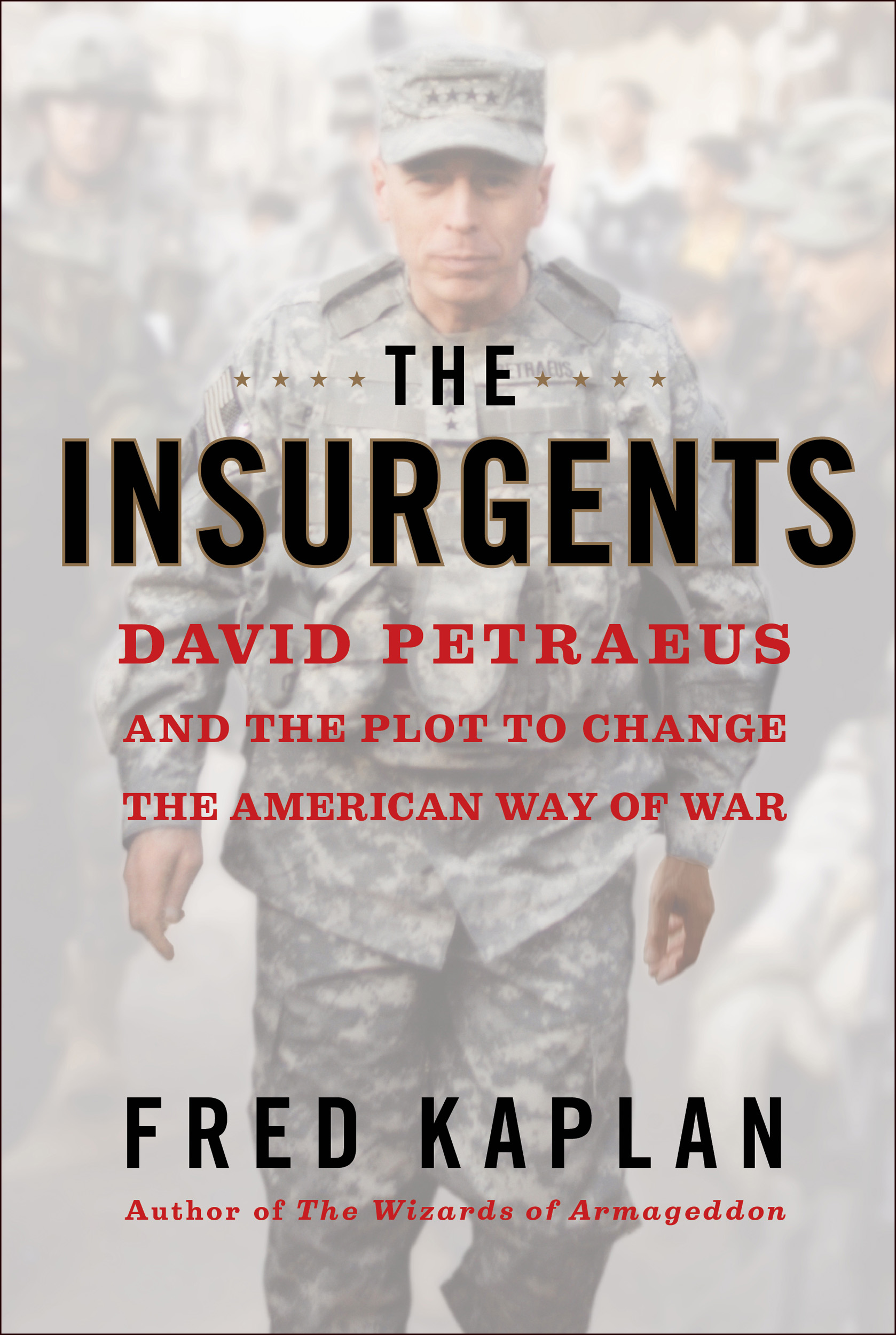
kaplan_the-insurgents_cover-finalThey treat this as a transformation of what Chamayou would call the ‘logics’ of intervention: from ‘a conventional struggle to eliminate adversaries’ to a ‘productive reconstitution of the life of a population’ (which requires ‘marking out what qualities the “good” life must possess, whilst in the process positively rendering dangerous all “other” life which does not comply with the productive remit).  In other words (their words), a switch from sovereign power to bio-power.  I have my reservations about the theoretical argument, but in any case the transformation was far from stable or straightforward.  In December 2009 Obama committed thousands of extra ground troops as part of a revitalized counterinsurgency campaign in Afghanistan; they were supported by a continued increase in drone operations. And Obama had also authorised a dramatic increase in CIA-directed drone strikes in Pakistan.  But in June 2011 he announced the withdrawal of those additional troops: as Fred Kaplan puts in The insurgents, ‘pulling the plug on COIN.’  All of this va-et-vient was, as Kaplan shows in exquisite detail, more than a philosophico-logical affair: it was also profoundly political, and included considerations of domestic US politics, concerns over the Afghan state in general and the re-election of Hamid Karzai in particular, and no doubt calculations of advantage within the US military.  In short, while Chamayou is surely right to accentuate the politics of military violence this is not confined to the ‘inside’ of counterinsurgency – COIN as ‘applied social work’, as Kilcullen once described it – because politics also provides one of its activating armatures. (I’ve discussed Kaplan’s view of drone strikes and what he sees as an emerging imaginary of ‘the world as free-fire zone’ here).

For all that, Chamayou’s dissection of the ‘reverse logics’ of these particular forms of counterinsurgency and counter-terrorism is analytically helpful, and adds another dimension to his argument about the transformation of war from battlefields to hunting grounds and from armies to individuals.   He insists that the commitment to targeted killing (by drone or, I would add, Special Forces) is a commitment to ‘an infinite eradicationism’ in which it becomes impossible to kill leaders (‘High Value Targets’) faster than they can be replaced. In his vivid image, the hydra constantly regenerates itself as a direct response  to the very strikes that seek to decapitate it.

‘Advocates for the drone as the privileged weapon against terrorism promise a war without loss or defeat.  They fail to note that this will also be war without victory’ (p. 108).

Theory of the drone 3: Killing grounds

This is the third in a series of posts on Grégoire Chamayou‘s Théorie du drone, in which I provide a detailed summary of his argument, links to some of his key sources, and reflections drawn from my soon-to-be-completed The everywhere war (and I promise to return to it as soon as I’ve finished this marathon).

5: Pattern of life analysis

Chamayou begins with the so-called ‘Terror Tuesdays‘ when President Obama regularly approves the ‘kill list’ (or disposition matrix) that authorises ‘personality strikes’ against named individuals: ‘the drones take care of the rest’.

a0018519784_2

But Chamayou immediately acknowledges that most strikes are ‘signature strikes‘ against individuals whose names are unknown but for whom a ‘pattern of life analysis‘ has supposedly detected persistent anomalies in normal rhythms of activity, which are read as signs (‘signatures’) of imminent threat.  I’ve described this as a militarized rhthmanalysis, even a weaponized time-geography, in ‘From a view to a kill’ (DOWNLOADS tab), and Chamayou also notes the conjunction of human geography and social analysis to produce a forensic mapping whose politico-epistemological status is far from secure.

The principal limitation – and the grave danger – lies in mistaking form for substance.  Image-streams are too imprecise and monotonic to allow for  fine-grained interpretation, Chamayou argues, and supplementing them by equally distant measures, like telephone contacts, often compounds the problem.  Hence Gareth Porter‘s objection, which both Chamayou and I fasten upon:

‘The phone numbers and call histories from those phones go into the database which is used to “map the networks.” But the link analysis methodology employed by intelligence analysis is incapable of qualitative distinctions among relationships depicted on their maps of links among “nodes.” It operates exclusively on quantitative data – in this case, the number of phone calls to or visits made to an existing JPEL target or to other numbers in touch with that target. The inevitable result is that more numbers of phones held by civilian noncombatants show up on the charts of insurgent networks. If the phone records show multiple links to numbers already on the “kill/capture” list, the individual is likely to be added to the list.’

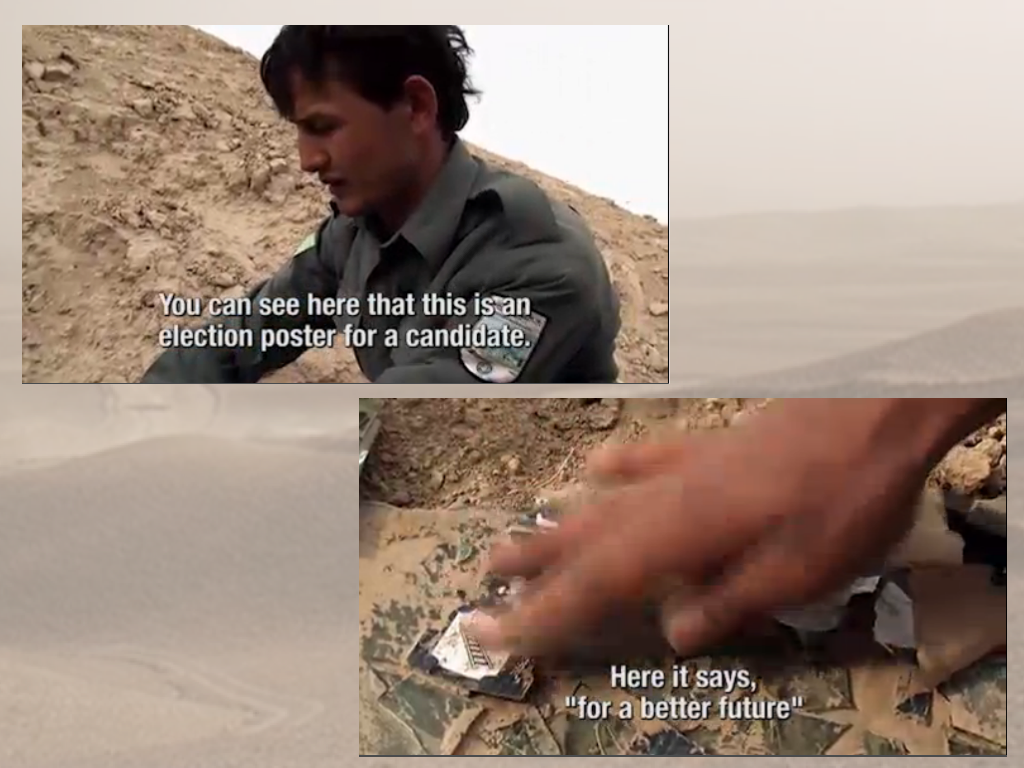
This is exactly what happened in the Takhar attack in Afghanistan on 2 September 2010 that I’ve discussed elsewhere, relying on the fine investigative work of Kate Clark, and Chamayou draws attention to it too.   The general assumption, as Kate was told by one officer, seems to be that ‘”If we decide he’s a bad person, the people with him are also bad.”

Takhar For a better future.001

These necro-methodologies raise two questions that Chamayou doesn’t address here.

The first, as Porter notes, is that ‘guilt by association’ is ‘clearly at odds with the criteria used in [international] humanitarian law to distinguish between combatants and civilians.’  You can find a much more detailed assessment of the legality of signature strikes (and what he calls their ‘evidential adequacy’)  in Kevin Jon Heller‘s fine essay, ”One hell of a killing machine”: Signature strikes and international law’ [Journal of international criminal justice 11 (2013) 89-119; I discussed a pre-publication version here].

The geo-legal ramifications of these attacks reach far beyond the killing grounds.  Earlier this month in the High Court in London one man who lost five relatives in the air strike in Takhar (as you can see on the slide above, on an election convoy) challenged the legality of the alleged involvement of Britain’s Serious and Organised Crimes Agency (SOCA) in drawing up the kill-list, the Joint Prioritized Effects List, used by the military to authorise the attack: more herehere and here. (It was the presence of names on the list that triggered the faulty network analysis).

The second is the imaginary conjured up by the very idea of a ‘pattern of life’ analysis.  I’ve written before about the way in which the screen on which the full-motion video feeds from the Predators and Reapers are displayed interpellates those who watch what is happening on the ground from thousands of miles away, and I’ve emphasised that this isn’t a purely optical affair:  that it is an embodied, techno-culturally mediated process that involves a series of structured dispositions to view the other as Other (and often dangerous Other).   But these dispositions also reside in what we might think of as a grammar of execution.  To see what I mean, here is Micah Zenko:

‘Recently, I spoke to a military official with extensive and wide-ranging experience in the special operations world, and who has had direct exposure to the targeted killing program. To emphasize how easy targeted killings by special operations forces or drones has become, this official flicked his hand back over and over, stating: “It really is like swatting flies. We can do it forever easily and you feel nothing. But how often do you really think about killing a fly?”’

Hence, of course, ‘Bugsplat’ [according to Rolling Stone, ‘the military slang for a man killed by a drone strike is “bug splat,” since viewing the body through a grainy-green video image gives the sense of an insect being crushed’], and a host of other predatory terms (see also here) that distinguish between this mere (bare) life and what Judith Butler calls ‘a life that qualifies for recognition’.

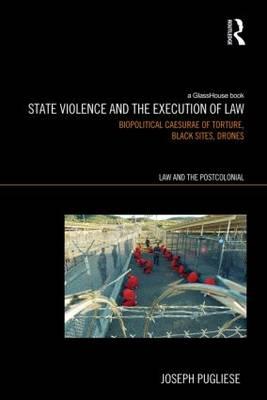
state-violence-and-the-execution-of-lawBut the same result is achieved through the nominally neutral, technical-scientific vocabulary deployed in these strikes. Joseph Pugliese captures the grammar of execution with acute insight in another fine essay, ‘Prosthetics of law and the anomic violence of drones’, [Griffith Law Review 20 (4) (2011) 931-961; you can also find it in his excellent new book State violence and the execution of law]:

‘The term ‘heat signature’ works to reduce the targeted human body to an anonymous heat-emitting entity that merely radiates signs of life. This clinical process of reducing human subjects to purely biological categories of radiant life is further elaborated by the US military’s use of the term ‘pattern of life’…

‘The military term ‘pattern of life’ is inscribed with two intertwined systems of scientific conceptuality: algorithmic and biological. The human subject detected by drone’s surveillance cameras is, in the first scientific schema, transmuted algorithmically into a patterned sequence of numerals: the digital code of ones and zeros. Converted into digital data coded as a ‘pattern of life’, the targeted human subject is reduced to an anonymous simulacrum that flickers across the screen and that can effectively be liquidated into a ‘pattern of death’ with the swivel of a joystick. Viewed through the scientific gaze of clinical biology, ‘pattern of life’ connects the drone’s scanning technologies to the discourse of an instrumentalist science, its constitutive gaze of objectifying detachment and its production of exterminatory violence. Patterns of life are what are discovered and analysed in the Petri dish of the laboratory…

‘Analogically, the human subjects targeted as suspect yet anonymous ‘patterns of life’ by the drones become equivalent to forms of pathogenic life. The operators of the drones’ exterminatory attacks must, in effect, be seen to conduct a type of scientific ethnic cleansing of pathogenic ‘life forms’. In the words of one US military officer: “Our major role is to sanitize the battlefield.”’

Later modern war more generally works through relays of biological-medical metaphors – equally obviously in counterinsurgency, as I’ve described in “Seeing Red” and other essays (DOWNLOADS tab), where the collective enemy becomes a ‘cancer’ that can only be removed by a therapeutic ‘killing to make live’ (including ‘surgical strikes’) – and Colleen Bell has provided an illuminating series of reflections in ‘Hybrid warfare and its metaphors’ [in Humanity 3 (2) (2012) 225-247] and ‘War and the allegory of medical intervention’ [International Political Sociology 6 (3) (2012) 325-8].

This immunitary logic is clearly bio-political, and its speech-acts just as plainly performative, and Pugliese draws the vital conclusion:

‘As mere patterns of pathogenic life, these targeted human subjects effectively are reduced to what Giorgio Agamben would term ‘a kind of absolute biopolitical substance’ that can killed with no concern about the possibility of juridical accountability: they are ‘bare life’ that can be killed with absolute impunity. Anonymous ‘patterns of life’ signify in contradistinction to legally named persons; they exemplify the ‘ontological hygiene’ legislated by US government policy in order to secure the reproduction of the ‘principle of scarcity with respect to agency and personhood’.

‘Situated in this Agambenian context of the extermination of human life with absolute impunity, the Predator drones must be seen as instantiating mobile ‘zones of exception’…’

Which artfully brings me to Chamayou’s next chapter…

6: Kill-box

Chamayou notes that the ‘war on terror’ loosed the dogs of war from their traditional boundaries in time and in space: at once ‘permanent war’ and, as he notes, ‘everywhere war’.

But for Chamayou it is more accurate to speak of the world turned into a ‘hunting ground’ rather than a battlefield, and this matters because two different geographies (his term) are involved.  War is defined by combat, he explains, hunting by pursuit.  Combat happens where opposing forces engage, but hunting tracks the prey, so that the place of military violence is no longer defined by a delimited space (‘the battlefield’) but by the presence of the enemy-prey who carries with him, as it were, his own mobile halo of a zone of personal hostilities.

To escape, the quarry must make itself undetectable or inaccessible – and the ability to do so depends not only on physical geography (terrain) but also on political and legal geography.  For this reason, Chamayou argues, the US has rendered contingent the sovereignty of Pakistan because it (for the most part unwillingly) provides sanctuary to those fleeing across the border from Afghanistan.  In such circumstances, what becomes crucial for the hunter is not the military occupation of territory but the ability to control trans-border spaces from a distance through the instantiation of what Eyal Weizman called the politics of verticality that has since captured the attention of Stuart Elden [“Secure the volume: vertical geopolitics and the depth of power”, Political Geography 34 (2013) 35-51], Steve Graham [“Vertical geopolitics: Baghdad and after”, Antipode 36 (1) (2004) 12-23] and others.  For this to work, as Weizman shows in the case of occupied Palestine, air power is indispensable.

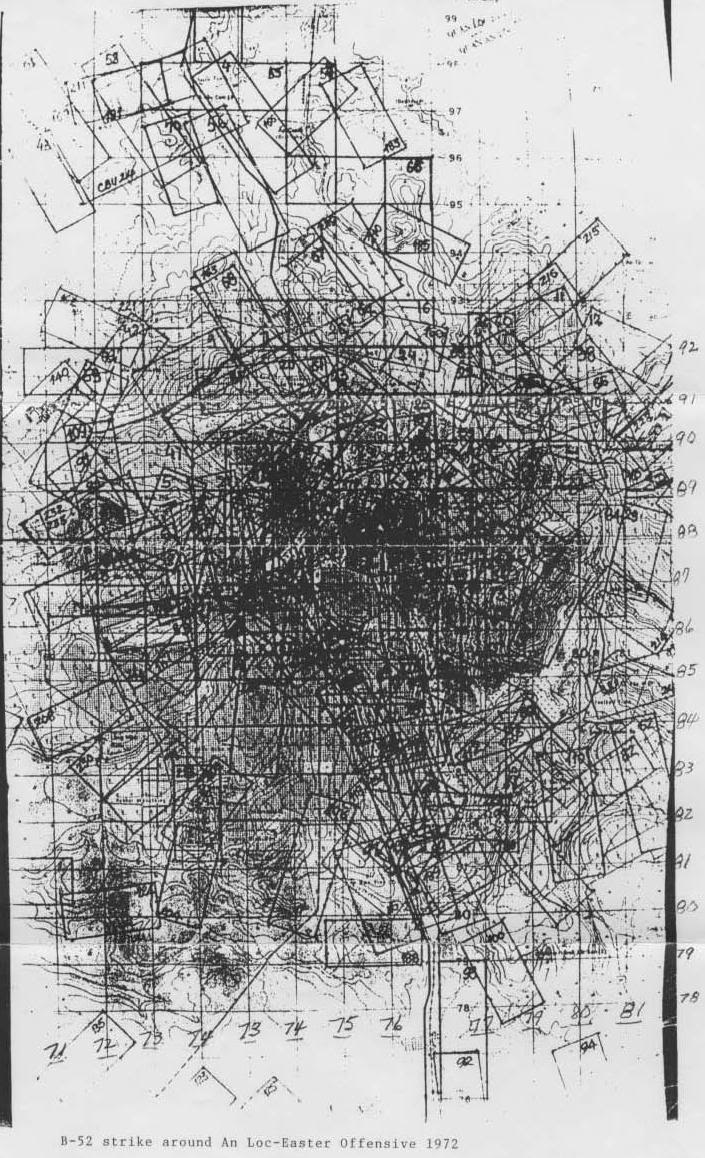
Chamayou suggests that the US has refined this capacity – in effect, finely calibrated the time and space of the hunt – through the concept of the kill-box.  I’m not so sure about this; the lineage of the ‘kill-box’ goes back to the USAF’s ‘target boxes’ [target boxes around An Loc in Vietnam in 1972 are shown below] – and two or three specified ‘boxes’ or ‘Restricted Operating Zones‘ were used to define the Predato’s’  ‘hunting grounds’ over North and South Waziristan that were tacitly endorsed by the Pakistan state.

Target boxes around An Loc 1972

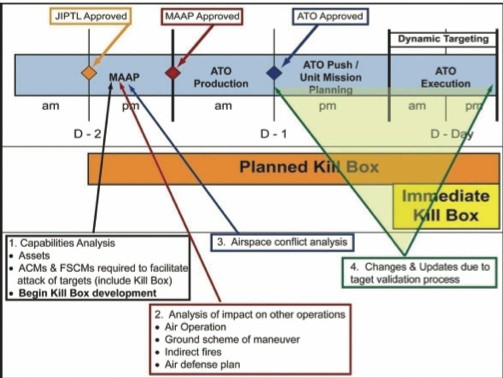
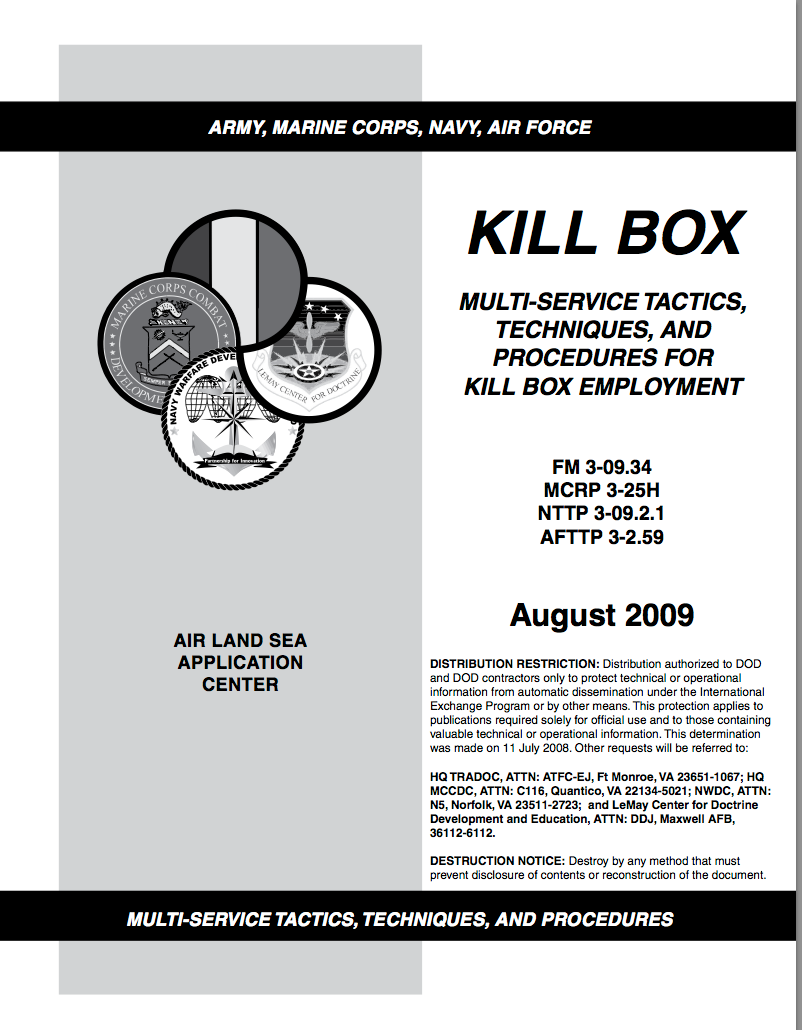
The concept of the ‘kill box’ was formalised as a joint operations doctrine in the 1990s as part of the established targeting cycle: what Henry Nash famously described in another context as ‘the bureaucratization of homicide’.  Nash worked for the USAF Air Targets Division in the 1950s and 60s, identifying targets in the USSR for nuclear attack by US Strategic Air Command, but I doubt that Chamayou would dissent from using either the verb or the noun to describe the contemporary, non-nuclear kill-chain.  (In a later post I’ll explain how this technical division of labour feeds in to what Chamayou castigates as a ‘setting aside’, a dispersal of responsibility, which functions to separate an action from its consequences: this is aggravated by the remote-split operations in which drones are embedded, and is central to Chamayou’s critique).  Here is how the relevant military manuals incorporated the development of the kill box into the targeting cycle in 2009 (ATO = Air Tasking Order):

Kill Box Development

You can find more on kill-boxes and their operationalisation here.

Kill Box TTP

Chamayou doesn’t track the development of the concept, but since then the ‘kill-box’ has been supplanted or at least supplemented by the ‘Joint Fires Area’ as a way of continuing to co-ordinate the deployment of lethal force and allowing targets to be engaged without additional communication.  Within the grid of the JFA (shown below, taken from an essay by Major James Mullin on ‘redefining the kill box’) permission to fire in specified cells is established in advance; areas are defined, targeting intervals stipulated, and the time-space cells can be opened and closed as operations proceed.

It is this capacity that Chamayou seizes upon: within the kill box targets can be engaged at will, so that the kill box, he writes, ‘is an autonomous zone of temporary killing’ (cf. the ‘free fire/specified fires zone’ in Vietnam: see my discussion of Fred Kaplan‘s recent essay, ‘The world as a free-fire zone‘).

3-D representation of Joint Fires Area using Global Area Reference System

Chamayou implies that the schema has been further refined in contemporary counterinsurgency and counter-terrorism operations: the fact that the kill-box and its successor allow for dynamic targeting across a series of scales is crucial, he says, because its improvisational, temporary nature permits targeting to be extended beyond a declared zone of conflict. The scale of the JFA telescopes down from the cell shown on the right of the figure below through the quadrant in the centre to the micro-scale ‘keypad’ (sic) on the right.

Global Area Reference System

This is more than a grid, though; the JFA is, in effect, a performative space that authorises, schedules and triggers lethal action.  Chamayou: ‘Temporary micro-cubes of lethal exception can be opened anywhere in the world, according to the contingencies of the moment, once an individual who qualifies as a legitimate target has been located.’  Thus, even as the target becomes ever more individuated – so precisely specified that air strikes no longer take the form of the area bombing of cities in World War II  or the carpet bombing of the rainforest of Vietnam – the hunting ground becomes, by virtue of the nature of the pursuit and the remote technology that activates the strike, global.

KAPLAN World as Free-Fire Zone

The system I’ve described here is one adopted by the US military, and how far its procedures are used by other agencies outside established conflict zones is unknown to me and doubtless to Chamayou too.  Are these micro-cells used to specify individual compounds or rooms, as Chamayou suggests in a thought-experiment?  For him, however, it’s the imperative logic that matters, and here Kaplan’s tag-line (above) can provide the key explanatory exhibit: ‘to kill a particular person anywhere on the planet.’   The doubled process of time-space calibration and individuation is what allows late modern war to become the everywhere (but, contra Kaplan,  not the anywhere, because specified) war.

On the one side, then, a principle of what Chamayou calls precision or specification:  ‘The zone of armed conflict, fragmented into micro-scale kill boxes, reduces itself in the ideal-typical case to the single body of the enemy-prey: the body as the field of battle.’  Yet on the other side, a principle of globalisation or homogenisation: ‘Because we can target our quarry with precision, the military and the CIA say in effect, we can strike them wherever we see fit, even outside a war zone.’

This paradoxical articulation has sparked fierce debates among legal scholars – Chamayou cites Kenneth Anderson, Michael Lewis, and Mary Ellen O’Connell – over whether the ‘zone of armed conflict’ should be geo-centred (as in the conventional battlefield) or target-centred (‘attached to the body of the enemy-prey’). Jurists are thus in the front line of the battle over the extension of the hunting ground, he writes, and ‘applied ontology’ is the ground on which they fight.  I’ll have more to say about this on my own account in a later post.

Theory of the drone 2: Hunting

This is the second in a series of posts on Grégoire Chamayou‘s Théorie du drone.

3: Theoretical principles of man-hunting

Chamayou opens his discussion with a revealing vignette.  In 2005 Texas entrepreneur John Lockwood developed a website, Live-shot.com, which promised a ‘real-time on-line hunting and shooting experience’.  The cyber-hunter was after deer and other game kept for the purpose on a 300-acre ranch near San Antonio.

LiveShot

You might think that a more relevant example would be Wafaa Bilal’s Domestic Tension described in his Shoot an Iraqi: art, life and resistance under the gun:

‘For one month, Bilal lived alone in a prison cell-sized room in the line of fire of a remote-controlled paintball gun and a camera that connected him to internet viewers around the world. Visitors to the gallery and a virtual audience that grew by the thousands could shoot at him 24 hours a day.’

Wafaa Bilal, Domestic Tension

There is a wonderful discussion of the project and its wider implications for experimental geopolitics by Alan Ingram [‘Experimental geopolitics: Wafaa Bilal’s Domestic Tension‘] in the Geographical Journal 1788 (2) (2012) 123-133.  He explains that Bilal conceived Domestic Tension as a commentary on ‘remote control warfare’ after his brother had been killed in a strike by a US helicopter gunship called in by commanders watching a video feed from a Predator in the skies over Kufa.

But Lockwood’s venture is even more revealing, particularly when juxtaposed with Domestic Tension, because it involved real-time killing (of captive deer, antelope and other animals) and after a public outcry it was eventually banned.  A full report from the Washington Post is here. Even the National Rifle Association was up in – er – arms: its spokesperson declared,  ‘We believe that hunting should be outdoors and that sitting in front of a computer three states away doesn’t qualify as hunting.’  Chamayou’s translation of one police officer’s condemnation – “It’s not hunting.  It’s killing’ – becomes ‘It’s not hunting.  It’s murder’, which artfully raises the stakes, but you get the point, which is about the hue and cry that attended killing animals on line while ‘man-hunting by remote control’ attracted considerably less public attention: then, anyway.

Live Shot

To be fair, there were critics like Dale Jamieson who saw Live Shot as symptomatic of a wider issue:

“If you look at this as being kind of a continuum or slippery slope,” said Jamieson, “you have people who enjoy the act of killing and destruction in video games, you have people who enjoy killing animals over the Internet…. But of course the next step in this is that people start killing people over the Internet. That’s the worry.”

California state Senator Debra Brown was equally forthright in her condemnation:

“What happens if this technology gets expanded to other uses?” she said. “It’s actually pretty scary. What’s the line between real life and a video game? It has all the video game feel: It’s remote, it’s disconnected from the reality of it, the hunter doesn’t have to deal with any blood or wounding or tracking.”

Chamayou doesn’t track these responses, which surely sharpen his point, but he doesn’t really need to: I haven’t been able to find any critics who drew attention to the remote killings of people that were already taking place under the unblinking eye of US Predators in Pakistan and Yemen. (Incidentally, this chapter is illustrated by an image of a Predator firing a Hellfire missile; the photograph is all over the web – for example here – but, as James Bridle has shown, this now canonical image is in fact a Photo-shopped fake, ‘a computer-generated rendering of a drone … flying over an abstracted landscape’).

For Chamayou those targeted killings are the effects of an apparatus that he describes as militarized man-hunting.  He invokes George W. Bush’s line (in a speech at the FBI in February 2003) about the ‘war on terror’ being a ‘different kind of war’ that ‘requires us to be on an international manhunt’ to argue that that within a decade what seemed to most commentators at the time to be just a folksy Texan cowboy phrase had been converted into a state doctrine of non-conventional violence that combines elements of military and police operations  without fully corresponding to either.

He suggests that US Secretary of Defense Donald Rumsfeld was already playing with the possibilities of what Eyal Weizman has called thanatotactics. Rumsfeld was convinced that ‘Israeli techniques for dealing with Palestinian resistance could be simply scaled up.’  If the IDF had turned Gaza into a laboratory for targeted killing from the air, however, how could this be done by the Pentagon on the global scale?  And – for some Pentagon insiders at least – how could this be done without having a new Phoenix program rise from the flames of what one adviser was already calling ‘preventive manhunting’?

CRAWFORD ManhuntingThis is where those ‘theoretical principles’ start to emerge.  Some of the most difficult issues concern the provision of a legal armature, as I’ll discuss in a later post (and it is these that interest me the most), but what Chamayou has more directly in mind here is the formulation of a military (rather than policing: the difference, as we’ll see, is crucial) doctrine to guide these operations.  He suggests that its most developed form drew upon the work of a private-sector consultant, George Crawford, who published Manhunting: reversing the polarity of warfare in 2008 and a subsequent report for the Joint Special Operations University, Manhunting: counter-network organization for irregular warfare  in 2009.

CRAWFORD Manhunting 2

Crawford’s report included a ‘chronology of American manhunting operations’, and out of that remarkably long history Chamayou fastens on the Pancho Villa Expedition in 1916.  This was a massive (and spectacularly unsuccessful) ground operation across the US/Mexico border, in which thousands of US troops under the command of General Pershing penetrated deep into Mexico in an effort to capture the Mexican revolutionary leader Pancho Villa (who had conducted a series of cross-border raids into New Mexico).

Chamayou doesn’t mention it, perhaps because it would complicate the clean lines of his narrative, but the expedition included air support from the eight planes of the 1st Aero Squadron (below) in what was to become ‘the first combat engagement of American Army pilots and airplanes’ (more here and here).  Their principal function, as with the use of military aircraft on the Western Front, was reconnaissance, but if this was a distant forerunner of US aerial surveillance of the southern border it was a dismal failure.  According to Pershing:

“[T]he aeroplanes have been of no material benefit so far, either in scouting or as a means of communication.  They have not at all met my expectations.  The further south Villa goes into the mountains the more difficult will be their tasks, and I have no doubt we shall soon be compelled to abandon them for either scouting the enemy or keeping in touch with the advance columns.”

HighFlight-1stAeroSqn9-1

But the entire expedition was a failure, and the crucial lesson, spelled out by Crawford and repeated by Chamayou, was the imperative to reverse the polarity: instead of deploying large numbers of ‘boots on the ground’ – what Crawford ridiculed as using an elephant gun to swat ‘the terrorist mosquito’ – operations against non-state actors should be conducted by small teams networked into a targeted killing operation.  This changes the terms of war not so much because the conflict is asymmetric, or even because it’s not about territorial gain, but rather because war is transformed from the classical paradigm of a duel into something quite other: ‘a hunter who advances, and a prey who flees or hides’.

The (tactical) rules of the game are quite different; the hunter must engage to win, while the fugitive must evade to win.  Crawford:

Firepower becomes less significant in terms of mass, while the precision and discretion with which firepower is employed takes on tremendous significance, especially during influence operations. Why drop a bomb when effects operations or a knife might do? Maneuver adopts new concept and form. In manhunting, friendly forces seek to engage the enemy. Like a lone insurgent, the enemy seeks to avoid the allied force, biding time until he has an opportunity to strike at vulnerable, unprotected, or noncombat assets.

The first task is thus not to immobilise but to identify and locate the enemy, which implies an apparatus of detection.  ‘Man-hunting’ thus becomes, in Crawford’s eyes at any rate, an intelligence-based operation directed towards identifying pivotal nodes (which is to say key leaders or ‘High Value Targets’) in the virtual and physical spaces of social networks.  Here Chamayou cites John Dodson‘s attempt – one of countless others – to provide a statistical methodology for ‘man-hunting’:

‘Nexus Topography is an extension of the common practice of Social Network Analysis (SNA) used to develop profiles of [High Value Targets]. Currently, SNA examines the links in a social group, whereas, Nexus Topography is a template that can be used to construct a map of relationships in different social environments. Nexus Topography maps social forums or environments, which bind individuals together (this can be extended to include Dark Networks and Small Worlds).

Network analysis, in multiple forms, is a staple of geo-spatial intelligence and contemporary counterinsurgency and counter-terrorism.  But how far Crawford’s specific proposals directly informed US military operations is another question, and one Chamayou doesn’t address.  I suspect their influence was at best indirect.  Even so, pursuing their logic enables Chamayou to conclude that militarized man-hunting is not about responding to specific attacks but instead providing ‘pre-emptive security’ against emergent threats.  On this new terrain ‘war’ becomes a vast campaign of extra-judicial killing, for which (as he says) the ‘Predator’ and the ‘Reaper’ live up to their names.  Hence the next chapter,which traces the next set of principles:

4: Surveillance and annihilation

FOUCAULT Surveillir et punirThe English translation doesn’t capture Chamayou’s substitution, which is a play on the French title of Michel Foucault‘s Discipline and punish: Surveillir et punir.

The reference to Foucault is entirely apposite.  Chamayou’s central point here is that, within the apparatus of militarized man-hunting, ‘detection’ is above all a visual modality (and much of Foucault’s work involved a sustained interrogation of the gaze). Chamayou argues that drones promise something like a ‘God’s eye view’; their protagonists claim that their near real-time, full-motion and increasingly high-definition video feeds have revolutionised the capacity to provide a constant view of the enemy.

This is all familiar ground, to me at any rate, and in this chapter Chamayou draws on my own work (and others’) to tease out six core principles.  I discuss all of them in ‘From a view to a kill’ and ‘Lines of descent’ [DOWNLOADS tab], so here I will simply list them in summary form:

1: Persistent stare or permanent watch – Predators and Reapers have long ‘dwell-times’ and in principle permit protracted surveillance;

2: Totalisation of perspectives or synoptic view – ‘wide-area surveillance’  promises to be able to ‘quilt’ multiple images together;

3: Complete archive – the question of data retrieval and analysis is immensely difficult, which is why the US Air Force has consistently worried about ‘swimming in sensors, drowning in data’, and why specialist image analysts have experimented with TV/video archival and retrieval techniques;

4: Data fusion from multiple sensors;

5: ‘Pattern of life’ analysis;

6: Detection of anomalies and pre-emption.

The classical names given to these new political technologies of vision – like Gorgon Stare and Argus (in Greek mythology the hundred-eyed giant, which in DARPA-speak becomes Autonomous Real-time Ground Ubiquitous Surveillance) – confirm the premium placed on visibility or even hypervisibility.

Gorgon Stare

But Chamayou argues that this political technology is far more ‘economical’ than Bentham’s Panopticon, which Foucault uses so powerfully to figure modern surveillance, because it requires neither spatial partitions nor architectural demarcations. It is what Zygmunt Bauman might call a ‘liquid’ technology, since it needs only airspace to function (though the current interest in A2/AD (‘anti-access/areal denial’) is a sharp reminder that at present – and even for the foreseeable future – Predators and Reapers can only hunt in uncontested air space).

And even more unlike the Panopticon, this political technology is not directed towards enclosure or confinement.  Just as the Gorgon’s stare petrified its enemies to death, turning them into stone, so this too is a deadly gaze. Video feeds trigger missile launches: ‘No longer surveillir et punir but surveiller et anéantir’ (annihilation) (p. 67).

(Incidentally, how far the US will continue to fund some of these systems is unclear: recent reports suggest that the Pentagon is scaling back its funding for the Gorgon Stare, but the Air Force is still promoting the ARGUS-IS as its next-generation sensor technology).

Living Under DronesThe shadows cast by these capacities are far longer than the supposedly ‘precision strikes’ they facilitate: they impose a new landscape of threat and dread. Here Chamayou invokes the Stanford/NYU report Living under drones (2012) to conclude that the presence of Predators and Reapers terrifies whole populations who live under them (see also my commentary here).  Above and beyond the deaths and physical injuries they inflict, and the rubble, the rage and the bereavements they produce, Chamayou concludes that drones also produce ‘a psychic enclosure whose boundaries are no longer defined by bars, barriers or walls but by the invisible circles described overhead by the ceaseless gyrations of these flying sentinels’ (literally, ‘watch-towers’).

As Chamayou’s patient excavation of these various principles proceeds, it becomes clear that the ‘doctrine’ that is coming in to view is much more than doctrine as the military understands the term.  For the Pentagon, doctrine consists of those ‘fundamental principles by which the military forces or elements thereof guide their actions in support of national objectives. It is authoritative but requires judgment in application.’  The appeal to its authoritative status is significant, of course, and speaks directly to (or rather from) from the military chain of command.

CHAMAYOU ManhuntsBut what Chamayou is after in what elsewhere he calls ‘the manhunt doctrine‘ is something that transcends the military (this form of ‘man-hunting’ deliberately blurs the distinctions between conventional military and police operations to produce what Chamayou calls ‘hybrid operations, monstrous offspring [enfants terribles] of the police and the military, of war and peace’) and seeks to expose the political technologies, the discursive systems and the scopic regimes from which it derives its wider authority and through which it exercises its powers.

In doing so it follows directly from his previous work, Les chasses à l’homme (in English, Manhunts), which promises a philosophical history – or, as I said in my previous post, a genealogy.  But Théorie du drone is more than the next chapter, because it has much to say about the transformation of ‘techno-war’ into something radically different, a modality of later modern war that is focused more than ever on the identification, pursuit and elimination of individuals.

To be continued.

Theory of the drone 1: Genealogies

Grégoire ChamayouThis is the first of a series of posts as I work my way through Grégoire Chamayou‘s Théorie du drone (2013), which has finally arrived on my desk.  I’ve loosely summarised the project and its relation to Chamayou’s previous work before, and in these notes I’ll combine a summary of his argument with some extended readings and excerpts from his sources and some comments of my own.  I hope readers will find these useful; they are an aide-memoire for me, and a way of working out some of my own ideas too, but do let me know if all this is helpful (especially for those with no French).

I’m pleased to say that he draws on several of my essays about drone warfare, including ‘From a view to a kill’, ‘Lines of descent’, and even ‘The everywhere war’ (all available under the DOWNLOADS tab), so I won’t re-trace in any detail our (considerable) common ground.

The first section of Theory of the drone is devoted to Techniques and Tactics and, as I noted previously, it’s good to read a philosopher engaging with the materialities and corporealities of contemporary war in such close detail.  I’ll start with the first two chapters, which read together provide some more lines of flight for today’s remote operations.  I don’t call these ‘genealogies’ lightly: as you’ll see next time, there are definite and deliberate echoes of Foucault in the argument (though Chamayou is no disciple).

1: ‘Methodologies for hostile environments’

It’s become a truism to say that drones are ideally suited for ‘dirty, dangerous or difficult’ tasks, and Chamayou begins with an interesting article written by John W. Clark for the New Scientist in 1964 on ‘Remote control in hostile environments’.

Clark described the development of technologies ‘of manipulation at a distance – what he called ‘telechirics’ (a term that Chamayou appropriates for his own purposes, from the Greek tele meaning ‘distance’ and kheir meaning ‘hand’) – so that people no longer had to expose themselves to danger to earn a living: from the extremes of outer space, exposure to nuclear radiation and deep ocean exploration to more mundane, everyday projects like fire-fighting, tunnelling, or mining. The key advance was the use of ‘a vehicle operating in the hostile environment under remote control by a man in a safe environment’.

Clark emphasised the remoteness – ‘there is no direct connection between the operator and his machine’ – because in his view the system depended on the capacity of the human operator ‘to “identify himself” with his remotely-controlled machine, even though it may be completely non-anthropomorphic in appearance and configuration’. In effect, Clark wrote, ‘his consciousness is transferred to an invulnerable mechanical body’ which implies, in turn, that ‘systems of this type are no substitutes for human judgment’. (For this reason, while Clark believed that a ‘telechiric system’ could be provided with a variety of sensors, vision – ‘by far our most valuable sense’ – was typically provided through a single-channel, closed-circuit television system). Indeed, the capacity for judgment is enhanced by partitioning space, as Chamayou notes, placing the operator in a ‘safe zone’ outside the ‘danger zone’.  The danger zone is a site of surveillance and intervention (‘by a cable or by a radio-link’), Chamayou underlines, but not a site of habitation.

It’s not difficult to see how these propositions can be carried over to the use of  combat drones.  Interestingly, Clark had been employed by the Hughes Aircraft Company where he originally developed his ideas on ‘remote handing’ (what he then called mobotry). He had noted that ‘the electronic techniques which have been developed in recent years, primarily in connection with guided missiles and radar, are finding increasing application in connection with remotely controlled systems for accomplishing physical operations within areas which are uninhabitable due to the presence of a hostile environment’, and in the closing section of the research paper he noted that ‘a remotely-controlled street-sweeper employing television for guiding and steering and a simple frequency coded command system has recently completed successful tests.’

Where? The Air Force Special Weapons Center in Albuquerque, which was dedicated to R& D of atomic and other ‘unconventional’ weapns (which was presumably not especially interested in keeping the streets clean).  And at the end of the 1980s Clark’s old employer, Hughes Aircraft, would buy a fledgling drone manufacturing company, Leading Systems, from Abe Karem (‘the dronefather‘), and then promptly sell it on to General Atomics which, with Karem’s assistance, became the company responsible for the Predator.

These details are not included in Chamayou’s discussion – and I don’t mean this as a criticism: I admire both the brevity and the clarity of his account – and in fact no links to the military appeared in the New Scientist article. But Chamayou has found a subsequent, anonymous and remarkably telling comment on the article. Among the scenarios canvassed by Clark, this contributor wrote, one was conspicuous by its absence:

‘The minds of telechiricists are grappling with the problems of employing remotely-controlled machines to do the peaceful work of man amid the hazards of heat, radiation, space and the ocean floor. Have they got their priorities right? Should not their first efforts towards human safety be aimed at mankind’s most hazardous employment – the industry of war?… Why should twentieth-century men continue to be stormed at by shot and shell when a telechiric Tommy Atkins could take his place? ‘All conventional wars might eventually be conducted telechirically, armies of military robots battling it out be remote control, victory and defeat being calculated and apportioned by neutral computers, while humans sit safely at home watching on TV the lubricating oil staining the sand in sensible simile of their own blood.’

Sand? Chamayou doesn’t mention it [‘sand’ in his French translation becomes ‘dust’], but in fact the anonymous author opened his commentary by noting that the publication of Clark’s original article ‘coincided with the flare-up in the Yemen…’  The ‘flare-up’ was part of a civil war in Yemen, in which royalists (supported by Saudi Arabia) were pitted against republicans (supported by Egypt) and Britain was engaged in a series of irregular, covert operations that were repeatedly denied in Parliament.

And so it’s no accident, I think, that the anonymous contributor goes on to emphasize the importance of telechirics for asymmetric warfare:

‘Far-flung imperial conquests which were ours because we had the Maxim gun and they had the knobkerrie will be recalled by new bloodless triumphs coming our way because we have telechiric yeomanry and they, poor fuzzy-wuzzies, have only napalm and nerve-gas.’

By this means, Chamayou concludes, asymmetric warfare becomes unilateral: people still die, to be sure, but on one side only.  And, as those hideous remarks I’ve just quoted make plain, the divide is profoundly racialized.

2: Genealogy of the Predator

My own inclination would be to make that plural – genealogies – and to identify multiple lines of descent, some of which (I think plausibly) can be traced back to the early twentieth century.

But Chamayou excludes many of them, including ‘target drones’ and – more directly relevant – various ‘aerial torpedoes’, which he sees as forerunners of the cruise missile (which can only be launched once) rather than the combat drone (which can be used many times over). This distinction is useful, but it’s complicated by Project Aphrodite’s experiments with explosive-filled US bombers in the dog days of the Second World War, whose use of remote control and visual links – they’ve sometimes been called ‘video bombers’ – anticipates key elements of today’s remote operations (see also herehere, here and here).

Chamayou does notice the American use of drones for aerial surveillance over North Vietnam – though he makes nothing of other elements, including the development of ‘pattern of life’ analysis and the installation of the sensor-shooter systems of the ‘electronic battlefield’ along the Ho Chi Minh Trail, both of which (as I argued in ‘Lines of descent’) were key elements in the much later development of unmanned aerial systems.

But these developments came to nothing, Chamayou contends, and in the 1970s the development of military drones was virtually abandoned by the US: it was Israel that showed the way to the future.

During the Yom Kippur War of 1973 the Israelis used ‘decoy drones’ to draw the fire of missile batteries and then sent in conventional strike aircraft before the Egyptians could re-load: Chamayou doesn’t note it, but those drones were designed and built in under a month by Abe Karem and his team.  In 1982 the IDF repeated the tactic against Syrian batteries defending Palestinian strongholds in the Bekaa Valley.

NYT Beirut barracks bombing 1983But Israel literally showed the US the way to the future in another, much more remarkable incident in 1983. Here is the original account (by Jim Schechter) on which Chamayou draws from Popular Science in October 1987:

‘Two days after a terrorist bomb destroyed the [US] Marine barracks in Beirut in October 1983, Marine Commandant Gen. P. X. Kelley secretly flew to the scene. No word of his arrival was leaked. Hours later in Tel Aviv the Israelis played back the tape for the shocked Marine general. The scene, they explained, was transmitted by a Mastiff RPV circling out of sight above the barracks.’

Peter Hellman in ‘The little airplane that could’ (in Discover, February 1987) fills in some of the details.  Kelley ‘had been photographed during his outdoor movements in Beirut — his head targeted in cross hairs‘ (my emphasis).  He explains:

‘Unobserved by the Marines, a miniaturized Israeli RPV (remotely piloted vehicle) called Mastiff had circled 5,000 feet overhead during Kelley’s visit. Despite its twelve-foot wing span (just a shade longer than a California condor’s), at that altitude the Mastiff couldn’t be seen by the naked eye. And with its fiber-glass body, it was almost impossible to detect by radar. Nor could the putt-putt of its two-cylinder 22-horsepower engine be heard. But a zoom-lensed video camera peering down from a clear plastic bubble in its belly had a splendid view of the touring general. On a signal from controllers more than 50 miles away, the mini-RPV left as furtively as it had come, and flew into a net set up outside its mobile ground station.

As Schechter laconically put it, the Americans got the message, and in the 1980s their interest in developing remotely piloted aircraft for ISR (intelligence, surveillance and reconnaissance) dramatically increased.

There are all sorts of other connections between the US and Israel when it comes to both the development of UAVs and their later use for targeted killing.  What Chamayou is most interested in is precisely the development of UAVs as hunter-killers, which (as I’ll explain in my next post in the series) he links to the transformation of warfare into man-hunting.  And, as I’ll try to show, that’s when things start to get extremely interesting…

Wandering in the ruins

Love-charm of bombsI’ve noted Lara Feigel‘s wonderful The love-charm of bombs before, and now there’s a short interview with her at the New York Times Arts blog here:

I was originally planning to write an academic study of war literature. But I kept finding that I was reading about the writers’ lives, rather than reading about their books, and especially about their passionate wartime love affairs. Once I had spent time in their archives and read their wartime letters and diaries, I started to think that it’s impossible fully to understand classic novels like Graham Greene’s “The End of the Affair” or Bowen’s “The Heat of the Day” without knowing about their lives, and seeing these books as urgent messages, written to lovers, and written out of an extraordinary time. A lot of parallels and shared experiences were emerging in the research, so it seemed obvious to tell the stories simultaneously, threading them together as in a novel.

Lara explains that, although she was trained as a literary critic and historian,

I enjoyed the challenge of acquiring new kinds of knowledge in researching this book. I read a few military accounts of the war, but I learned a lot of the war news from reading contemporary diaries and newspapers. I wanted only to convey as much as well-informed people knew at the time. After all, my writers weren’t military experts, just people who found themselves living through a complicated and long-drawn-out war.

I know just what she means (and for more on another project in which Lara crosses established boundaries, see this meeting of minds between neuroscientists, artists, philosophers and analysts, which she co-organized with Lisa Apignanesi).  In a similar sort of way I’m a geographer ‘by training’, whatever that might mean, but I’m content with the description largely because it gives me the freedom to pursue ideas and issues wherever they take me, often far beyond the bounds of any recognisable or at any rate nominal ‘geography’ – except that I always remember Dick Chorley‘s frequently repeated injunction when I was an undergraduate at Cambridge: “To ask, ‘Is that Geography?’ is the most un-geographical of questions.”  So I think geography is a discipline in the Foucauldian sense – it works to produce disciplinary subjects through a network of formal institutions (including university departments) and journals, through a canon of texts, and through a systematic series of examinations – but that’s about it.  I don’t think this makes Geography any different from a host of other ‘disciplines’, needless to say: it’s a route of entry into a rich and constantly changing intellectual-practical world, and unlike Richard Hartshorne and others of his ilk I insist that there’s a lot to be said for deviating from the path (or rather Path) and acquiring those ‘new kinds of knowledge’ that Lara talks about.

With that sort of license comes responsibility, too, of course, but that doesn’t mean conformity.  I’ve always liked E.P. Thompson‘s image of himself, working for the first time on early eighteenth- rather than ninteenth-century Britain in Whigs and Hunters – his best book – as a parachutist landing in occupied territory (occupied not least by Jack Plumb), burying his silk under a tree and night after night moving stealthily through the surrounding landscape, gradually coming to know it better and better: but on his own terms.  Perhaps he was channelling his late brother Frank who parachuted into Bulgaria during the Second World War to provide support to the partisans and who was summarily executed for his pains.

PIETTE Imagination at warWhich brings me back to Lara.  Asked to recommend a book about literature during the Second World War, she suggests Adam Piette‘s Imagination at war: British fiction and poetry 1939-1945 (1995): ‘a wonderful account of the oddness of the literary responses to the Second World War.’  D.J. Taylor wasn’t so sure, though I found Adam’s discussion of the war in the desert very helpful in enlarging my own view of those campaigns for ‘The natures of war’.

I know the sequel better, The Literary Cold War, 1945 to Vietnam (2009), which includes an invigorating discussion of Graham Greene‘s The Quiet American amongst many other good things (a novel much on my mind of late).  Adam runs the Cultures of the Cold War network whose website opens with a rapid-fire quotation from E.L. Doctorow:  ‘The bomb first was our weapon. Then it became our diplomacy. Next it became our economy. Now it’s become our culture. We’ve become the people of the bomb.’ Unfortunately, it appears the website then ran out of energy (sic), though there’s a useful Bibliography.

For me, the book I most admire is Patrick Deer‘s Culture in Camouflage: war, empire and modern British literature (2009).  He paints on a larger canvas than Imagination at war – the book covers the period 1914-1945, and there are definite advantages in doing so – and he seems to have read everything and to have thought about it all in depth and detail.  I was first drawn to it by his chapters on the Second World War, but as I re-work “Gabriel’s Map” for what I think, hope and pray will be a second new book (really), provisionally called War material, I’ve plunged back into his earlier accounts of the First World War.  They are brimful of incisive readings and artful insights.

“Gabriel’s Map” is all about the dialectic between the scopic regime constructed through the topographic map, the aerial photograph and the field sketch on the Western Front (‘cartography’) and the sensuous, haptic and thoroughly embodied knowledge of the troops on – and in – the ground (‘corpography’).  Here’s Patrick:  ‘If the emblematic figure for the collapse of vision was No Man’s Land, it was the strategist’s map that came to represent the struggle to recapture oversight, to survey and order the mud, chaos and horror of battle.’ So I’m now thinking much more about the very idea of No Man’s Land and the multiple ways in which soldiers apprehended its gouged terrain.

More on all that very soon, but here I just want to say that Culture in camouflage is gloriously intellectually promiscuous and also a rattling good read.  If you want to explore the idea of ‘war culture’ I’d recommend starting here, and returning to it again and again.  But pack Lara’s book for the journey because she also has much to show us not only about how to travel but also how to write.

The security archipelago

AMAR Security archipelagoA new book from the ever-creative Paul Amar coming this summer from Duke: The Security Archipelago: Human-Security States, Sexuality Politics, and the End of Neoliberalism. Paul wins the prize for getting the most buzz-words into a single title. Our paths crossed most recently in Beirut, at a lively conference at AUB on Security of/in the city, and last year in Lund for a workshop on the Arab uprisings.  For the next two years he’s heading a regional working-group for the Arab Council of the Social Sciences called “Producing the Public: Spaces and Power” (more on this soon).

Paul is a wonderfully engaging speaker and a brilliant writer, but if you don’t know his work you can get a small taste of his argument in this paper on ‘Turning the gendered politics of the human security state inside out?’ for an IPSA-EPCR panel on ‘Governing life globally’ in Sao Paolo and from this excellent interview on ‘Middle East Masculinities’ at Jadaliyya at about the same time; there are other PDFs available from his webpage at UC Santa Barbara here.

The book paints on a canvas that stretches far beyond the ‘Middle East’:

In The Security Archipelago, Paul Amar provides an alternative historical and theoretical framing of the refashioning of free-market states and the rise of humanitarian security regimes in the Global South by examining the pivotal, trendsetting cases of Brazil and Egypt. Addressing gaps in the study of neoliberalism and biopolitics, Amar describes how coercive security operations and cultural rescue campaigns confronting waves of resistance have appropriated progressive, antimarket discourses around morality, sexuality, and labor. The products of these struggles—including powerful new police practices, religious politics, sexuality identifications, and gender normativities—have traveled across an archipelago, a metaphorical island chain of what the global security industry calls “hot spots.” Homing in on Cairo and Rio, Amar reveals the innovative resistances and unexpected alliances that have coalesced in new polities emerging from the Arab Spring and South America’s Pink Tide. These have generated a shared modern governance model that he terms the “human-security state.”

Richard Falk describes it as ‘an extraordinary book that revolutionizes the way to think about security’ – and about time too.  Like much high-flying academic commentary on war, much of the critical debate around security displays a theoretical sophistication that is not matched by analytical substance.   Paul’s work has always avoided that trap, and Jack Halberstam‘s endorsement makes it plain that this is a book that combines erudition with empirical heft:

Paul Amar works in English, Arabic, and Portuguese [and in Spanish too], and he studies security regimes in a comparative framework encompassing the Middle East, North and South America, and Europe. Combining research that he has done in Brazil and Egypt on the emergence of new forms of security and new grammars of protest politics with the unfolding stories of an economic boom in Brazil and political change in Egypt, Amar has written an up-to-the-moment account of the ‘human-security state’ and its opponents.

Here’s a list of the Contents:

Introduction. The Archipelago of New Security-State Uprisings
1. Mooring a New Global Order between Cairo and Rio de Janeiro: World Summits and Human-Security Laboratories
2. Policing the Perversions of Globalization in Rio de Janeiro and Cairo: Emerging Parastatal Security Regimes Confront Queer Globalisms
3. Muhammad Atta’s Urbanism: Rescuing Islam, Saving Humanity, and Securing Gender’s Proper Place in Cairo
4. Saving the Cradle of Samba in Rio de Janeiro: Shadow-State Uprisings, Urban Infranationalisms, and the Racial Politics of Human Security
5. Operation Princess in Rio de Janeiro: Rescuing Sex Slaves, Challenging the Labor-Evangelical Alliance, and Defining the Sexuality Politics of an Emerging Human-Security Superpower
6. Feminist Insurrections and the Egyptian Revolution: Harassing Police, Recognizing Classphobias, and Everting the Logics of the Human-Security State in Tahrir Square 200
Conclusion. The End of Neoliberalism?

Falling downwards?

058602-FC222Richard Holmes, author – amongst many other books – of Tommy: the British soldier on the Western Front, which I’ve read with the keenest interest for my “Gabriels’s Map” project, has a wonderfully readable new book out that intersects with my “Killing Space” project on bombing: Falling upwards: how we took to the air. It’s a history of ballooning (of sorts).

Although Holmes does address the military uses of hot-air balloons, he is something of a romantic and there’s more here on the delights and dangers (for those in the air) than the prospect of war from the air they helped to usher in.

But early in the book he describes a collection of balloon memorabilia made by Sophia Banks (sister of Joseph) that included a British cartoon from December 1784 entitled “The Battle of the Balloons’ (you can see a watermarked copy here):

This shows four balloons, two flying the French fleur de lys and two the British Union Jack, manoeuvring for aerial combat. Their crews are armed with muskets, but also, more menacingly, with broadside cannons. Their muzzles point through portholes cut in the balloon wickerwork.  Here the balloon is already conceived of as a weapon of war, comparable to the navy’s ships of the line.

Less than ten years later the French would establish the first military balloon regiment, but others insisted on the essentially pacific nature of ballooning and, indeed, of manned flight more generally. In his ‘Letter on Flight’ (1864) Victor Hugo, a good friend of the celebrated aeronaut Nadar, waxed lyrical (the appropriate Icarian verb, as it turned out) on the changes the balloon would inaugurate:

‘It will bring the immediate, absolute, instantaneous, universal and perpetual abolition of all frontiers, everywhere… Armies will vanish, and with them the horrors of war, the exploitation of nations, the subjugations of populations. It will bring an immense and totally peaceful revolution. It will bring a sudden golden dawn, a brisk flinging open of the ancient cage door of history, a flooding in of light. It will mean the liberation of all mankind.’

Fu-Go-bomb-balloonIf only.  There is, after all, a counter-history of ‘falling downwards’: the first bombing from the air involved unmanned balloons loaded with shrapnel launched by Austria during the siege of Venice in 1849 (though they apparently had little effect); during the American Civil War and the First World War observation balloons were a vital means of surveillance and artillery ranging; and in retaliation for the bombing of Tokyo, in the dog days of World War II the Japanese experimented with using incendiary balloons (‘fire balloons’ or ‘balloon bombs’ – see right) to attack the west coast of Canada and the United States (more here). The only one of these to appear in Holmes’s account is a splendid discussion of ballooning in the Civil War; his collection of ‘balloon stories’, as he modestly describes his project, stops at the end of the nineteenth century (and is concerned, above all, with the experience of balloonists, so ’empty’ balloons don’t count for much).

For all that, the Janus-faced history of the balloon, one peaceful and the other stridently martial, has implications for contemporary discussions of another aerial object: the drone.  The specificity of the object matters, of course, since it has particular capacities and dispositions – but their realization depends on the networks in which they are embedded.  As with balloons, so with drones.