Counter-mapping and ecologies of military power

ecologies-of-power

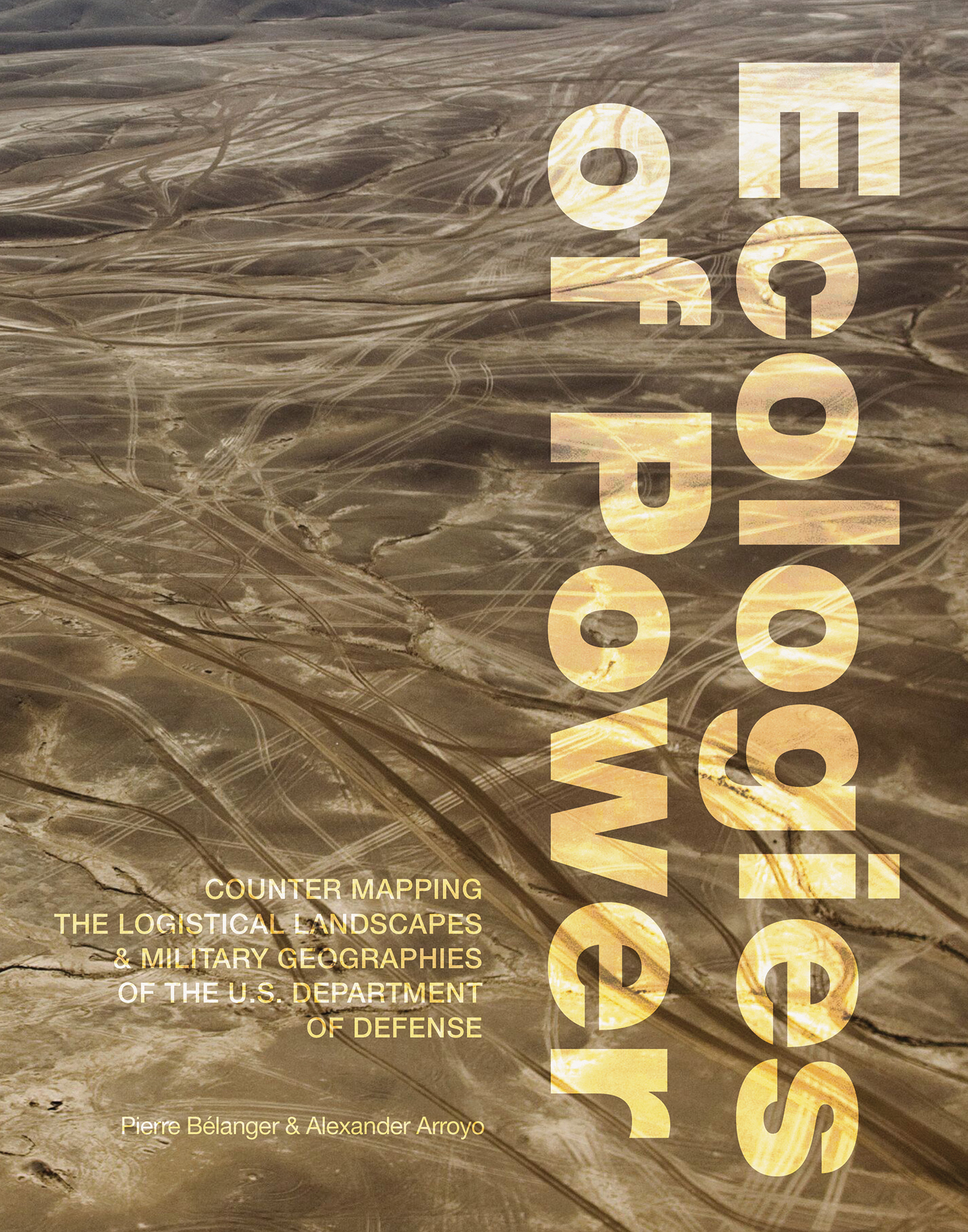
Just caught up with Ecologies of Power by Pierre Bélanger and Alexander Arroyo (MIT Press), which – as the subtitle reveals – is a fascinating countermapping of the Pentagon’s logistical landscapes and military geographies:

This book is not about war, nor is it a history of war. Avoiding the shock and awe of wartime images, it explores the contemporary spatial configurations of power camouflaged in the infrastructures, environments, and scales of military operations. Instead of wartime highs, this book starts with drawdown lows, when demobilization and decommissioning morph into realignment and prepositioning. It is in this transitional milieu that the full material magnitudes and geographic entanglements of contemporary militarism are laid bare. Through this perpetual cycle of build up and breakdown, the U.S. Department of Defense –the single largest developer, landowner, equipment contractor, and energy consumer in the world – has engineered a planetary assemblage of “operational environments” in which militarized, demilitarized, and non-militarized landscapes are increasingly inextricable.

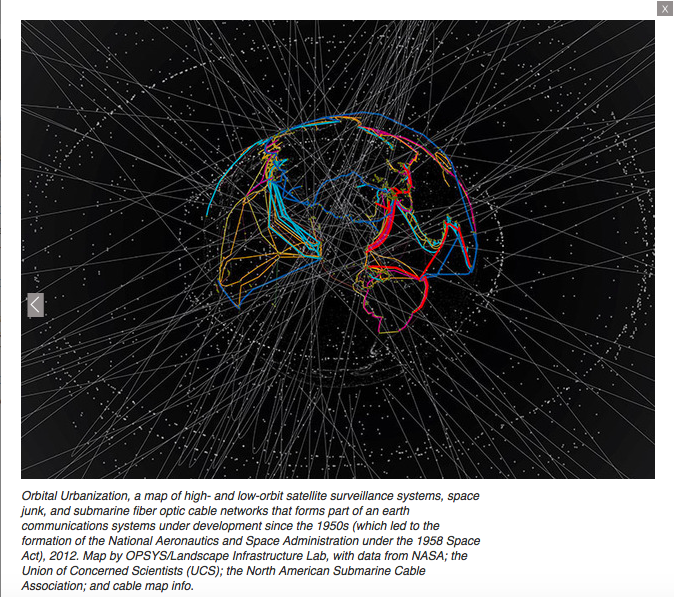
In a series of critical cartographic essays, Pierre Bélanger and Alexander Arroyo trace this footprint far beyond the battlefield, countermapping the geographies of U.S. militarism across five of the most important and embattled operational environments: the ocean, the atmosphere, the highway, the city, and the desert. From the Indian Ocean atoll of Diego Garcia to the defense-contractor archipelago around Washington, D.C.; from the A01 Highway circling Afghanistan’s high-altitude steppe to surveillance satellites pinging the planet from low-earth orbit; and from the vast cold chain conveying military perishables worldwide to the global constellation of military dumps, sinks, and scrapyards, the book unearths the logistical infrastructures and residual landscapes that render strategy spatial, militarism material, and power operational. In so doing, Bélanger and Arroyo reveal unseen ecologies of power at work in the making and unmaking of environments—operational, built, and otherwise—to come.
orbital-urbanization

Here is the legendary Claude Raffestin on the project:

Among its remarkable achievements, Ecologies of Power offers a new way of analyzing and representing the complex apparatus commonly called ‘war’ through its military infrastructures, logistical territories, and the material, energetic, informational, and financial flows that make and move through them. Deftly traversing a multitude of scales and landscapes, the book mobilizes a vast body of transdisciplinary work on the complex subject of power and its modes of spatial and semiotic representation. This ambitious and long-awaited volume is an essential reference for all scholars across the arts and sciences whose work aims to rethink how we engage—and disengage from—contemporary forms of conflict.

You can get an illustrated preview from Regine at We make money not war here.  She lists the book’s five core case studies:

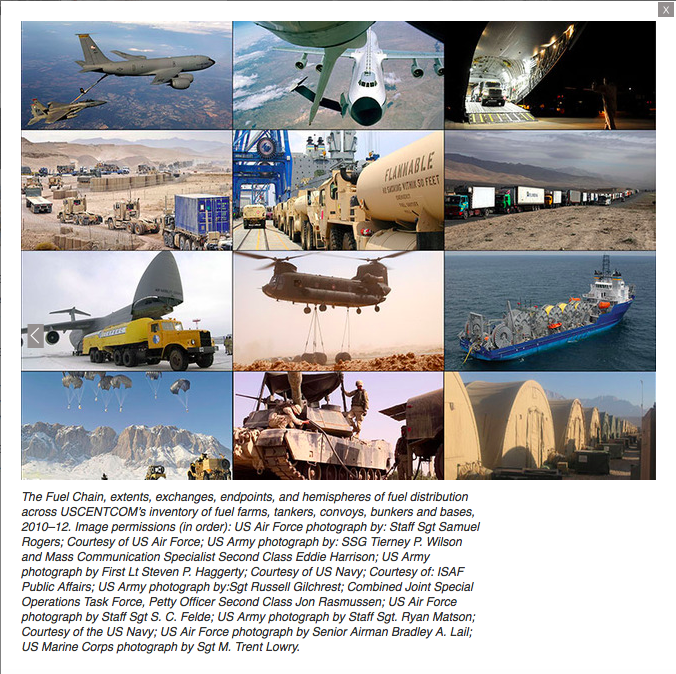
  • The first case study is Diego Garcia, an atoll in the Indian Ocean. Strategically located between East Africa, the Middle East and Southeast Asia, the atoll is a vital anchor for the Afghanistan campaign and for supplying US naval forces with fuel.
fuel-chain

  • A second case looks at the high number of blast trauma and death from improvised explosive devices in the Helmand Valley and investigates the intimate connections between the use of IED by local groups and the production and movements of opium.
  • The third case study… looks at nutritional politics and at DoD’s surveys of rare earths and other high-volume minerals in the territories the U.S. attempts to control.
  • A fourth case study explores the complexities and ‘indeterminacies’ inherent to technological systems such as drones.
  • The last case study zooms in on Washington D. C.’s landscape of defense apparatus.

The images I’ve used here are from the Graham Foundation‘s webpage on the project.
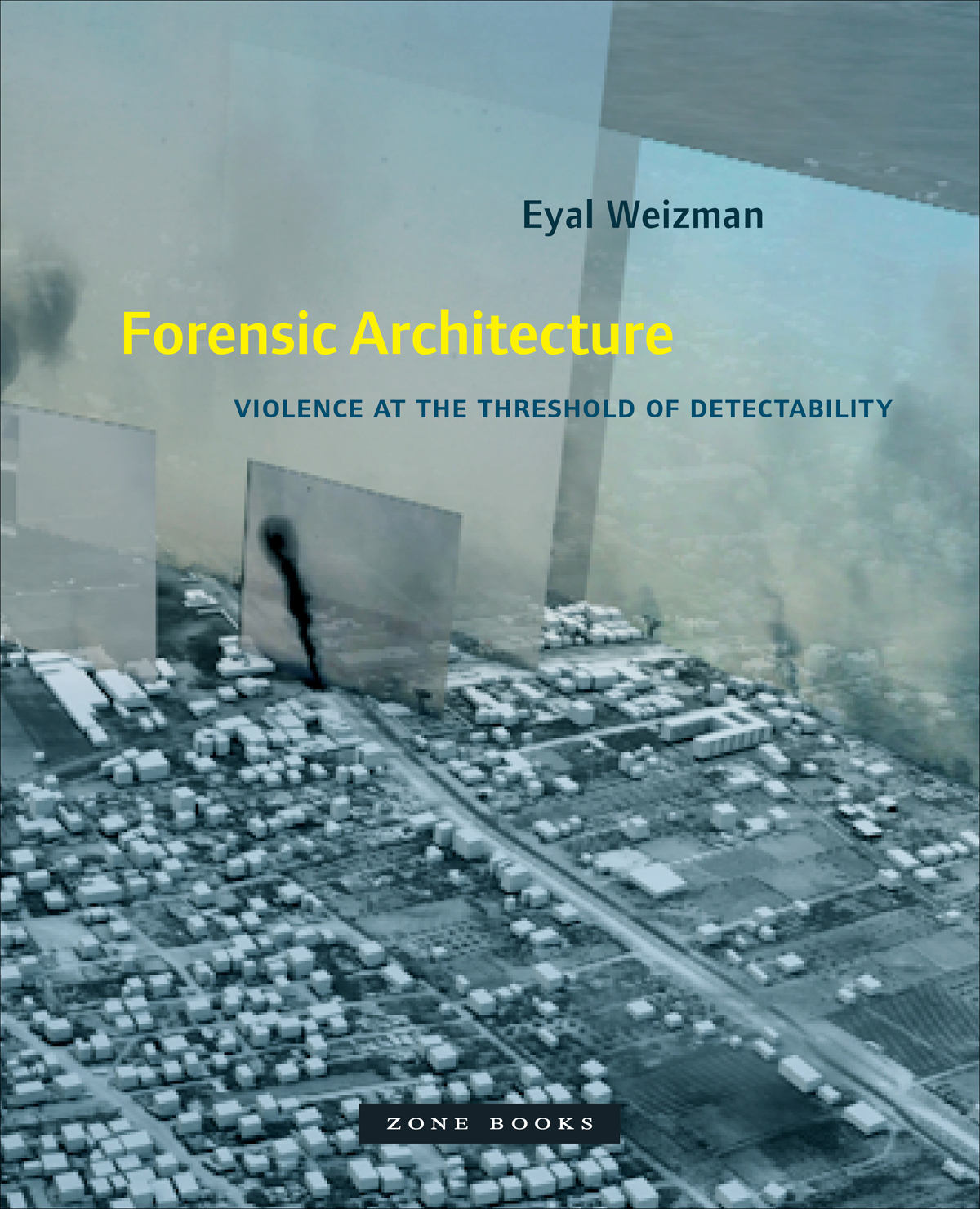
Forensic Architecture

weizman-forensic-architecture

Here’s something (one thing) to look forward to next year: Eyal Weizman‘s richly illustrated Forensic Architecture: violence at the threshold of detectability, due from Zone/MIT Press in April:

In recent years, a little-known research group called Forensic Architecture has begun using novel research methods to undertake a series of investigations into human rights abuses. Today, the group provides crucial evidence for international courts and works with a wide range of activist groups, NGOs, Amnesty International, and the UN.

Forensic Architecture has created a new form of investigative practice, using architecture as an optical device to investigate armed conflicts and environmental destruction. In Forensic Architecture, Eyal Weizman, the group’s founder, provides an in-depth introduction to the history, practice, assumptions, potentials, and double binds of this practice. Weizman has collected an extensive array of images, maps, and detailed documentation that records the intricate work the group has performed across the globe. Weizman offers Forensic Architecture case studies that include the analysis of the shrapnel fragments in a room struck by drones in Pakistan, the resolution of a contested shooting in the West Bank, the architectural reconstruction of a secret Syrian detention center from the memory of its survivors, a blow-by-blow account of a day-long battle in Gaza, and an investigation of environmental violence in the Guatemalan highlands. With these case studies, Weizman explains in image and text how the Forensic Architecture team uses its research and investigative methods to confront state propaganda and secrets and to expose ever-new forms of state violence.

Weizman’s Forensic Architecture, stunning and shocking in its critical narrative, powerful images, and daring investigations, presents a new form of public truth, technologically, architecturally, and aesthetically produced.

I’ve noted the impressive work of Forensic Architecture on many occasions, but if you are unfamiliar with the research agency (as Eyal now calls it) you can find out more here.

There’s also a revealing conversation between Eyal, Yve-Alain Bois, Michel Feher and Hal Foster on Forensic Architecture in October 156 (Spring 2016) 117-140, and you can watch Eyal’s 2015 Wall Exchange on Forensic Architecture (referred to in the conversation) here.

Kill Boxes

161119killboxes-cover-front-draft-2-final-643x1024

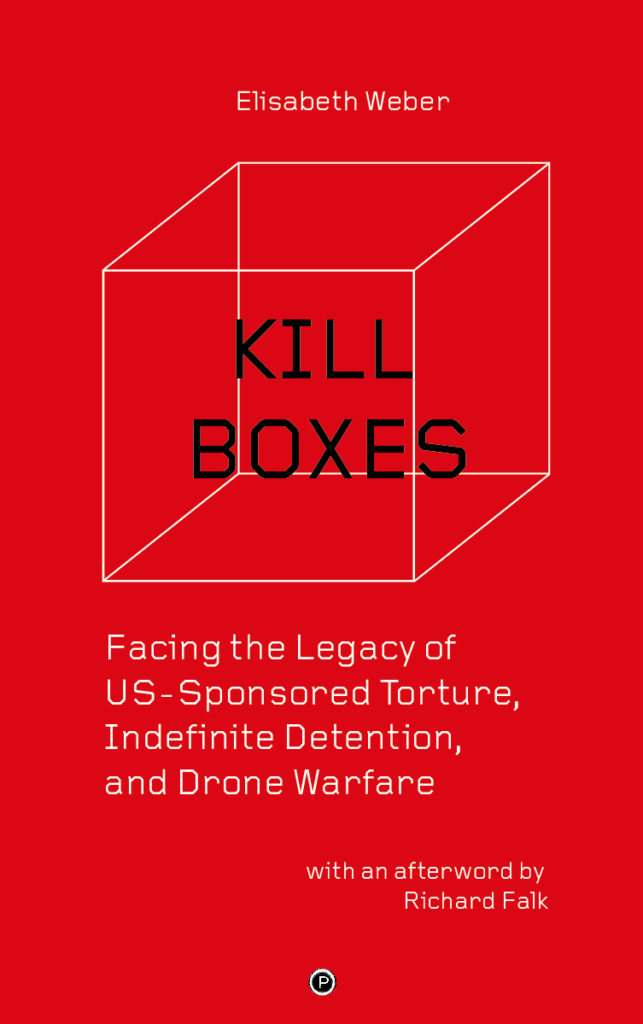
As 2016 lurches towards its end, I’ve received notice of a number of books that once I would have hoped would be of purely historical interest.  No longer.  So we’ll start with Elisabeth Weber‘s Kill-boxes: facing the legacy of US-sponsored torture, indefinite detention and drone warfare coming soon from Punctum Books:

Kill Boxes addresses the legacy of US-sponsored torture, indefinite detention, and drone warfare by deciphering the shocks of recognition that humanistic and artistic responses to violence bring to consciousness if readers and viewers have eyes to face them.

Beginning with an analysis of the ways in which the hooded man from Abu Ghraib became iconic, subsequent chapters take up less culturally visible scenes of massive violations of human rights to bring us face to face with these shocks and the forms of recognition that they enable and disavow. We are addressed in the photo of the hooded man, all the more so as he was brutally prevented, in our name, from returning the camera’s and thus our gaze. We are addressed in the screams that turn a person, tortured in our name, into howling flesh. We are addressed in poems written in the Guantánamo Prison camp, however much American authorities try to censor them, in our name. We are addressed by the victims of the US drone wars, however little American citizens may have heard the names of the places obliterated by the bombs for which their taxes pay. And we know that we are addressed in spite of a number of strategies of brutal refusal of heeding those calls.

Providing intensive readings of philosophical texts by Jean Améry, Jacques Derrida, and Christian Thomasius, with poetic texts by Franz Kafka, Paul Muldoon, and the poet-detainees of Guantánamo Bay Prison Camp, and with artistic creations by Sallah Edine Sallat, the American artist collective Forkscrew and an international artist collective from Pakistan, France and the US, Kill Boxes demonstrates the complexity of humanistic responses to crimes committed in the name of national security. The conscious or unconscious knowledge that we are addressed by the victims of these crimes is a critical factor in discussions on torture, on indefinite detention without trial, as practiced in Guantánamo, and in debates on the strategies to circumvent the latter altogether, as practiced in drone warfare and its extrajudicial assassination program.

The volume concludes with an Afterword by Richard Falk.

You can read the Introduction here.

For King and Countryside

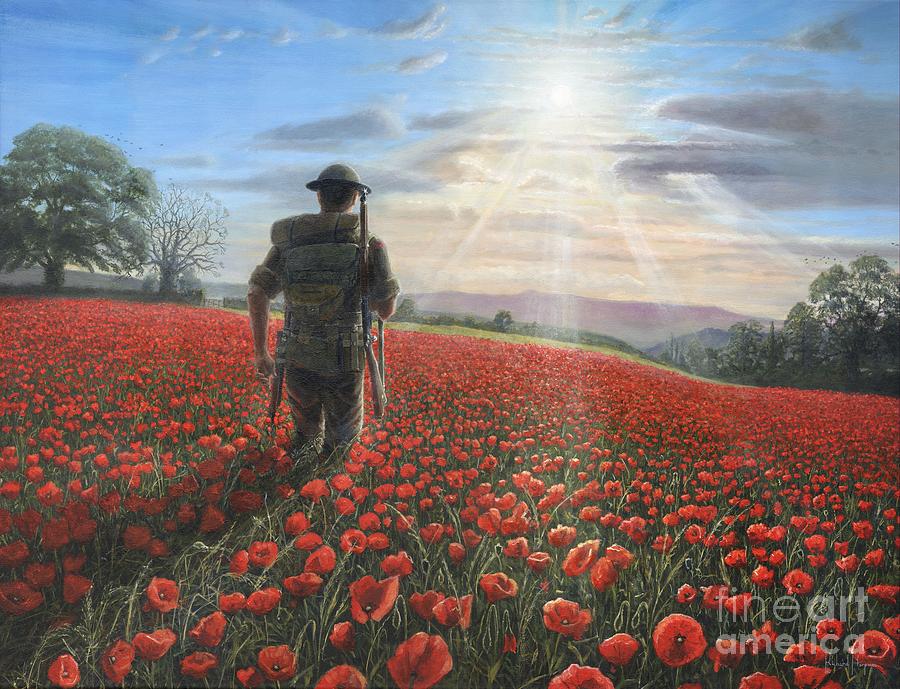
Richard Harpum/Tommy

‘For the British soldier in the First World War, nature was always a matter of life and death’:  John Lewis-Stempel

When I was working on ‘Gabriel’s map’, and later on ‘The natures of war’ (both available under the DOWNLOADS tab), I immersed myself in the ways in which industrialised war violated the rural landscapes of Belgium and France on the Western Front during the First World War.  But I also noticed there (as in other war zones) the redemptive possibilities of ‘the natural world’:

A few miles behind No Man’s Land lay an agrarian landscape that would have been familiar to most European troops – though not to the considerable contingents from other continents – and many of them took refuge in a reassuring rurality whenever they were removed from the front line. Moving up to the trenches from Belancourt on a glorious June afternoon in 1916 the young Max Plowman exulted in the scene:

‘The tall corn is ripening, and between its stalks poppies and cornflowers glow with colour. Through the valley we are descending a noisy stream finds its way, and on the hills beyond, great elm-trees stand like wise men brooding. It is a lush green country, full of beauty. The war seems far away.’

Pastoral conceits like these – and they were by no means uncommon – were testaments to the horrors that closed in as the troops neared what Plowman later called ‘the palsied zone’. As he and his men marched towards Fricourt, they crossed the old front line. ‘The country here is stricken waste: the trees that formed an avenue to the road are now torn and broken stumps, some still holding unexploded shells in their shattered trunks, others looped about with useless telegraph-wire.’ Later still, he described the sun glaring down ‘on earth that has lost its nature, for, pitted everywhere with shell-holes, it crumbles and cracks as though it has been subject to earthquake.’ As the landscape ‘lost its nature’ – a loss for which the all too human violence of war was responsible – so it also appeared less human. Yet even there, in the midst of all that, it was still possible to find sights and sounds that evoked the pastoral: the cornflower blue sky, the crimson rose, the fluting song of the lark. But these were all fleeting moments, and when he was finally relieved Plowman wrote that ‘it is cheering to be going westward: the farther you go in this direction the more human the world becomes.’  The opposition between the ‘un-natural’ and the ‘human’ really pits the savage against the domesticated, but passages like these are double-edged. They form a repertoire of ‘Arcadian resources’ in Paul Fussell’s resonant phrase, which function as what he saw as a characteristically ‘English mode of both fully gauging the calamities of the Great War and imaginatively protecting oneself against them’. Protection here is about more than solace, I think, because opposing these imaginative geographies works to repress the transformation of the domesticated into the savage which confirmed what Claire Keith saw as ‘the frightful interdependence of human death and environmental death’.

where-poppies-blow

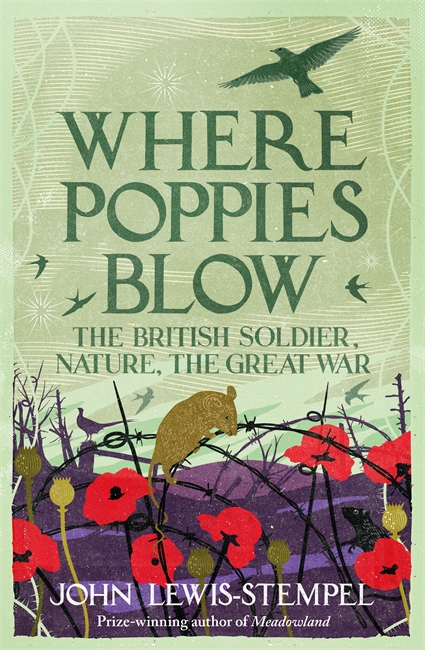
Those redemptive, even Arcadian moments have now been gathered and pressed within the pages of a new book: John Lewis-Stempel‘s Where Poppies Blow: the British solider, Nature, the Great War (2016):

Where Poppies Blow is the unique story of the British soldiers of the Great War and their relationship with the animals and plants around them. This connection was of profound importance, because it goes a long way to explaining why they fought, and how they found the will to go on.

At the most basic level, animals and birds provided interest to fill the blank hours in the trenches and billets – bird-watching, for instance, was probably the single most popular hobby among officers. But perhaps more importantly, the ability of nature to endure, despite the bullets and blood, gave men a psychological, spiritual, even religious uplift.

Animals and plants were also reminders of home. Aside from bird-watching, soldiers went fishing in village ponds and in flooded shell holes (for eels), they went bird nesting, they hunted foxes with hounds, they shot pheasants for the pot, and they planted flower gardens in the trenches and vegetable gardens in their billets.

In an interview, the author explains:

When the poet Edward ‘Adlestrop’ Thomas was asked why he was volunteering for service in the Great War, he picked up a handful of earth and said, ‘Literally, for this’. Men went to fight for King and Countryside, as much as King and Country. Nature worship was almost a religion in Edwardian England.

And when men arrived in France, they lived in trenches – inside the earth. ‘Certainly I have never lived so close to nature before or since’, Corporal Fred Hodges of the Lancashires observed, in words that spoke for the generation in khaki.

There was no escape from Nature 1914-18. Skylarks, say, buoyed men’s spirits -one Scottish miner said about the Western Front ‘What hell it would be without the birds’- and some Nature killed the soldiers. We think of the Great War as the first modern war; actually, it was The Last Ancient War. Disease, courtesy of rats and lice, was diabolical.

But I suppose, above all else, Nature healed the mind. Men looked at the poppies growing in the mud and the swallows which shared their dug-out and saw hope – a future for themselves and humankind.

You can capture exactly that sense in some of John Masefield‘s poetry, written when he was serving as a medical orderly – the book begins with his ‘August, 1914’ – and you can read more in the Preface and the first chapter of Where Poppies Blow (the splendidly titled ‘For King and Countryside’) available here.  As the remark I’ve used as my epigraph makes clear, though, there was always (and remains) a desperately dark side to the entanglements with a militarised nature.

Doctors at War

DE ROND Doctors at war

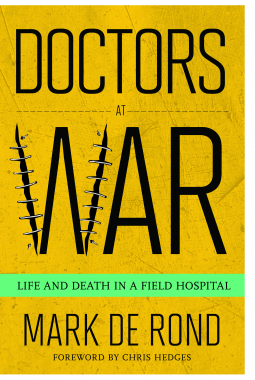
Mark de Rond‘s Doctors at War: life and death in a field hospital is due from Cornell University Press in March:

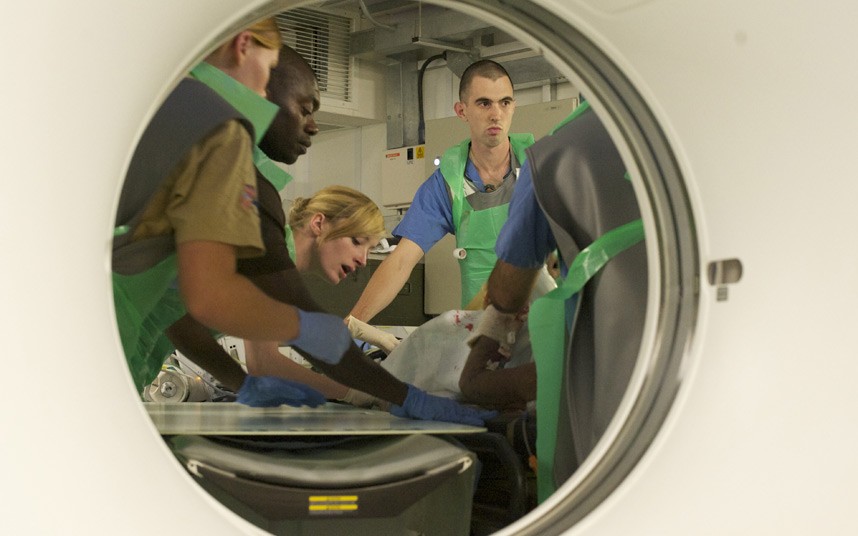
Doctors at War is a candid account of a trauma surgical team based, for a tour of duty, at a field hospital in Helmand, Afghanistan [Camp Bastion]. Mark de Rond tells of the highs and lows of surgical life in hard-hitting detail, bringing to life a morally ambiguous world in which good people face impossible choices and in which routines designed to normalize experience have the unintended effect of highlighting war’s absurdity. With stories that are at once comical and tragic, de Rond captures the surreal experience of being a doctor at war. He lifts the cover on a world rarely ever seen, let alone written about, and provides a poignant counterpoint to the archetypical, adrenaline-packed, macho tale of what it is like to go to war.

Here the crude and visceral coexist with the tender and affectionate. The author tells of well-meaning soldiers at hospital reception, there to deliver a pair of legs in the belief that these can be reattached to their comrade, now in mid-surgery; of midsummer Christmas parties and pancake breakfasts and late-night sauna sessions; of interpersonal rivalries and banter; of caring too little or too much; of tenderness and compassion fatigue; of hell and redemption; of heroism and of playing God. While many good firsthand accounts of war by frontline soldiers exist, this is one of the first books ever to bring to life the experience of the surgical teams tasked with mending what war destroys.

Camp Bastion (Mark de Rond)

In a faraway land where the rains were dry and the trees blue and the air bittersweet, and where ants were like dogs and birdsong was not, there life went for a song. Everyone and everything died young. Safeguarding its sandy southern perimeter was a coalition of The Free sandbagged in a ghetto the size of a small city. Camp Bastion was the hub in an operation designed to secure for others the freedoms they would have wished for themselves had they been less primitive. The lowlands that surrounded the camp belonged to a warrior people who walked these sands ever since Ibrahim bedded his maidservant and sent her and her firstborn to fend for themselves. The ensuing tiff was never laid to rest. These were Ishmael’s brood.

Inside the camp was a field hospital that, while small, was said to be the world’s bloodiest. It was living proof of reason applied to predicament to save daily those left limbless on account of another of menfolk’s bright ideas. This most progressive of all wars featured sophisticated body armor and capable, rapid air evacuation, meaning that casualties presented alive with injuries more severe than ever seen before in the living. Whether all of the most seriously injured wished to be rescued is another matter altogether, and one they no longer had any say in.

Here is the Contents:

Foreword by Chris Hedges

By Way of Introduction

1 Hawkeye

2 Reporting for Duty

3 Camp Bastion

4 A Reason to Live

5 Legs

6 Apocalypse Now and Again

7 Boredom

8 Christmas in Summer

9 A Record-Breaking Month

10 Kandahar

11 War Is Nasty

12 Way to Start Your Day

13 Back Home

Epilogue

‘In Doctors at War, Mark de Rond shines a light on a reality we are not supposed to see. It is a reality, especially in an age of endless techno war, we must confront if we are to recover the human’ — from the Foreword by Chris Hedges.  More here.

The Drone Memos

jaffer-drone-memos

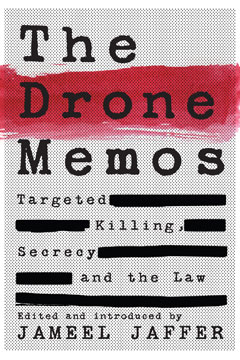
From the New Press on 15 November, Jameel Jaffers The Drone Memos: targeted killing, secrecy and the law:

The Drone Memos collects for the first time the legal and policy documents underlying the U.S. government’s deeply controversial practice of “targeted killing”—the extrajudicial killing of suspected terrorists and militants, typically using remotely piloted aircraft or “drones.” The documents—including the Presidential Policy Guidance that provides the framework for drone strikes today, Justice Department white papers addressing the assassination of an American citizen, and a highly classified legal memo that was published only after a landmark legal battle involving the ACLU, the New York Times, and the CIA—together constitute a remarkable effort to legitimize a practice that most human rights experts consider to be unlawful and that the United States has historically condemned.

In a lucid and provocative introduction, Jameel Jaffer, who led the ACLU legal team that secured the release of many of the documents, evaluates the “drone memos” in light of domestic and international law. He connects the documents’ legal abstractions to the real-world violence they allow, and makes the case that we are trading core principles of democracy and human rights for the illusion of security.

From Jameel’s introduction:

This book is possible because the secrecy surrounding American drone strikes has begun, at the margins, to erode. The documents collected here shed light on how a president committed to ending the abuses associated with the Bush administration’s “war on terror” came to dramatically expand one of the practices most identified with that war, and they supply a partial view of the legal and policy framework that underlies that practice. But while many of the documents collected here were meant to be defenses of the drone campaign, ultimately they complicate, at the very least, the government’s oft-repeated argument that the campaign is lawful.

To be sure, even the existence of these documents is an indication of the extent to which the drone campaign is saturated with the language of law. Perhaps no administration before this one has tried so assiduously to justify its resort to the weapons of war. But the rules that purportedly limit the government’s actions are imprecise and elastic; they are cherry picked from different legal regimes; the government regards some of them to be discretionary rather than binding; and even the rules the government concedes to be binding cannot, in the government’s view, be enforced in any court. If this is law, it is law without limits—law without constraint.

Ryan Goodman provides ’10 Questions to Ask Yourself When Reading Jameel Jaffer’s “The Drone Memos”’ here.  For me, the two most crucial on the list – which anyone writing about drones and limiting the discussion to targeted killing needs to ask themselves (and rarely does) – are these:

Despite the title of the book, how much of the discussion and issues raised are really about drones per se? How much applies to cruise missiles, night raids, and other forms of direct lethal action? What analytic or rhetorical work is being done by focusing on “drones”?

Despite the title of the book, how much of the discussion and issues raised are limited to pre-planned targeted killing? What about dynamic strikes when a moment of opportunity arises, or so-called signature strikes? What analytic or rhetorical work is being done by focusing on “targeted killing”?

UPDATE:  For an excerpt from Jameel’s introduction, see this article, ‘How the US justifies drone strikes: targeted killing, secrecy and the law‘, from The Guardian:

As the 2016 presidential primaries were getting under way, sporadic and sketchy reports of strikes in remote regions of the world provided a kind of background noise – a drone in a different sense of the word – to which Americans had become inured.

Senior officials in the administration of President Barack Obama variously described drone strikes as “precise,” “closely supervised,” “effective,” “indispensable,” and even the “only game in town” – but what they emphasized most of all is that the drone strikes they authorized were lawful.

In this context, though, “lawful” had a specialized meaning. Except at the highest level of abstraction, the law of the drone campaign had not been enacted by Congress or published in the US Code. No federal agency had issued regulations relating to drone strikes, and no federal court had adjudicated their legality. Obama administration officials insisted that drone strikes were lawful, but the “law” they invoked was their own. It was written by executive branch lawyers behind closed doors, withheld from the public and even from Congress, and shielded from judicial review…

Now the lethal bureaucracy whose growth Obama personally oversaw will be turned over to a new administration. The powers Obama claimed will be wielded by another president. Perhaps as significant is the jarring fact that the practice of targeted killing – assassination, as it would once have been called, without a second thought – no longer seems remarkable, and the fact that the United States now boasts a legal and bureaucratic infrastructure to sustain this practice. Eight years ago the targeted-killing campaign required a legal and bureaucratic infrastructure, but now that infrastructure will demand a targeted-killing campaign. The question the next president will ask is not whether the powers Obama claimed should be exploited, but where, and against whom.

Choreographies of 21st Century Wars

5 soldiers rosie kay

As regular readers will know, I’m keenly interested in the intersections between performance works and the critique of military violence – using performance not only as a way of engaging audiences and creating publics but also as an intrinsic part of the research process itself.

Much of my own work has focussed on theatre, and I’ve commented on the multiple meanings of  ‘theatre of war’ on several occasions (see here, here and here, though I know there’s much more to say about that).

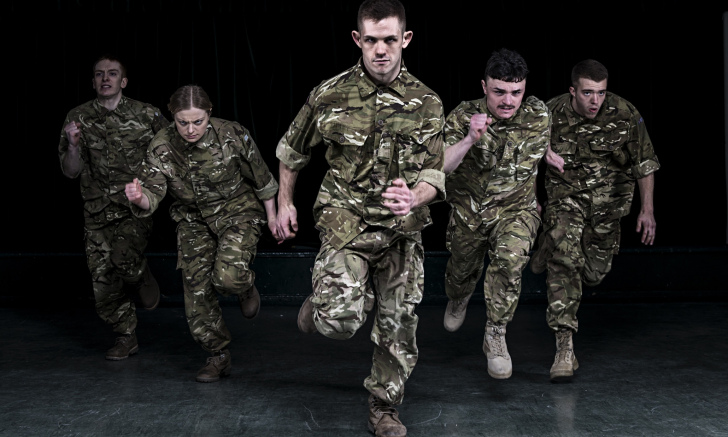
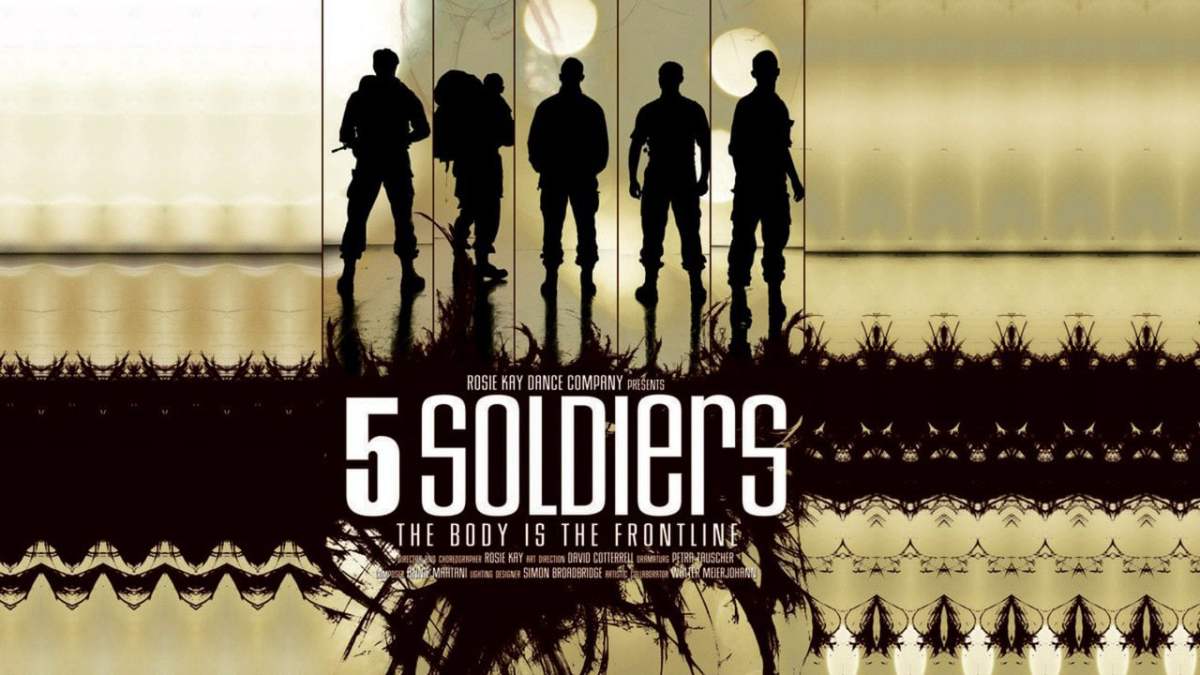
But I’ve also drawn attention to the role of dance – notably Rosie Kay‘s collaborative project with visual artist David Cotterrell, 5 Soldiers: The Body is the Frontline (see my post on ‘Bodies on the linehere; more on the production here and here).

5-soldiers

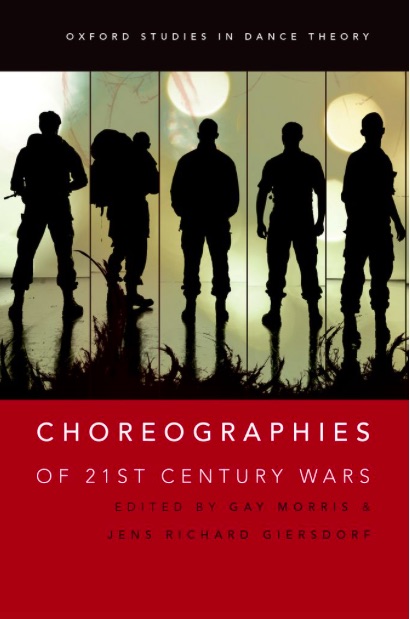
All of which will explain my interest in this new collection of essays (which includes a contribution from Rosie Kay), Choreographies of 21st Century Wars, edited by Gay Morris and Jens Richard Giersdorf:

Wars in this century are radically different from the major conflicts of the 20th century–more amorphous, asymmetrical, globally connected, and unending. Choreographies of 21st Century Wars is the first book to analyze the interface between choreography and wars in this century, a pertinent inquiry since choreography has long been linked to war and military training. The book draws on recent political theory that posits shifts in the kinds of wars occurring since the First and Second World Wars and the Cold War, all of which were wars between major world powers. Given the dominance of today’s more indeterminate, asymmetrical, less decisive wars, we ask if choreography, as an organizing structure and knowledge system, might not also need revision in order to reflect on, and intercede in, a globalized world of continuous warfare. In an introduction and sixteen chapters, authors from a number of disciplines investigate how choreography and war in this century impinge on each other. Choreographers write of how they have related to contemporary war in specific works, while other contributors investigate the interconnections between war and choreography through theatrical works, dances, military rituals and drills, the choreography of video war games and television shows. Issues investigated include torture and terror, the status of war refugees, concerns surrounding fighting and peacekeeping soldiers, national identity tied to military training, and more. The anthology is of interest to scholars in dance, performance, theater, and cultural studies, as well as the social sciences.

choreographies-of-21st-century-wars

Here is the Contents list:

Introduction: Contemporary Choreographies of Wars, Gay Morris and Jens Richard Giersdorf
Chapter 1: Access Denied and Sumud: Making a Dance of Asymmetric Warfare, Nicholas Rowe
Chapter 2: Questioning the Truth: Rachid Ouramdane’s Investigation of Torture in Des Témoins Ordinaires/Ordinary Witnesses, Alessandra Nicifero
Chapter 3: “There’s a Soldier in All of Us”: Choreographing Virtual Recruitment, Derek A. Burrill
Chapter 4: African Refugees Asunder in South Africa: Performing the Fallout of Violence in Every Day, Every Year, I am Walking, Sarah Davies Cordova
Chapter 5: From Temple to Battlefield: Bharata Natyam in the Sri Lankan Civil War, Janet O’Shea
Chapter 6: Choreographing Masculinity in Contemporary Israeli Culture, Yehuda Sharim
Chapter 7: Affective Temporalities: Dance, Media, and the War on Terror, Harmony Bench
Chapter 8: Specter of War, Spectacle of Peace: The Lowering of Flag Ceremony at Wagah and Hussainiwala Borders, Neelima Jeychandran
Chapter 9: A Choreographer’s Statement, Bill T. Jones
Chapter 10: Dancing in the Spring: Dance, Hegemony and Change, Rosemary Martin
Chapter 11: War and P.E.A.C.E, Maaike Bleeker & Janez Janša
Chapter 12: The Body is the Frontline, Rosie Kay and Dee Reynolds
Chapter 13: Geo-Choreography and Necropolitics: Faustin Linyekula’s Studios Kabako, Democratic Republic of Congo, Ariel Osterweis
Chapter 14: Re: moving bodies in the Mexico-USA drug, border, cold, and terror wars, Ruth Hellier-Tinoco
Chapter 15: After Cranach: War, Representation and the Body in William Forsythe’s Three Atmospheric Studies, Gerald Siegmund
Chapter 16: The Role of Choreography in Civil Society under Siege: William Forsythe’s Three Atmospheric Studies, Mark Franko

There’s obviously a lot more to say about choreographing war too…

Governing from the skies

HIPPLER Governing from the skies

Forthcoming from Verso in January, the English translation of Thomas Hippler‘s Le gouvernement du ciel:

The history of the war from the past one hundred years is a history of bombing.

Ever since its invention, aviation has embodied the dream of perpetual peace between nations, yet the other side of this is the nightmare of an unprecedented deadly power. A power initially deployed on populations that the colonizers deemed too restive, it was then used to strike the cities of Europe and Japan during World War II.

With air war it is now the people who are directly taken as target, the people as support for the war effort, and the sovereign people identified with the state. This amounts to a democratisation of war, and so blurs the distinction between war and peace.

This is the political shift that has led us today to a world governance under United States hegemony defined as ‘perpetual low-intensity war’, which is presently striking regions such as Yemen and Pakistan, but which tomorrow could spread to the whole world population.

Air war thus brings together the major themes of the past century: the nationalization of societies and war, democracy and totalitarianism, colonialism and decolonization, Third World-ism and globalization, and the welfare state and its decline in the face of neoliberalism. The history of aerial bombing offers a privileged perspective for writing a global history of the twentieth century.

I drew on this for my Reach from the Skies lectures in Cambridge earlier this year – it really is a must-read, though I’m not persuaded by the arguments in the closing pages… as you’ll see when I post the text of those lectures in the near future.

Nature is a battlefield

And while I’m on the subject of ‘The Natures of War’, that essay describes how ‘nature’ – yes, I do know how complicated that word is – is much more than a ‘resource bank’ over which war is waged (resource wars, conflict commodities and the rest) but also a medium through which military violence is effected: the mud of the Western Front, the deserts of North Africa and the rainforests of Vietnam.

nature-is-a-bettlefield

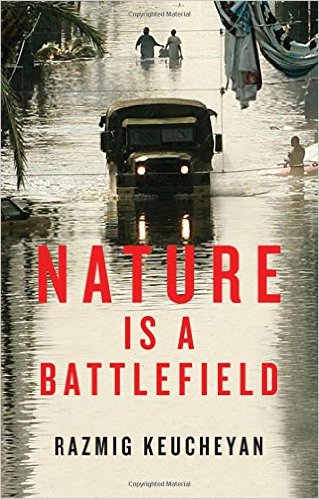
This month Polity publishes Razmig Keucheyan‘s Nature is a Battlefield: Towards a Political Ecology (originally published in French in 2014):

In the midst of the current ecological crisis, there is often lofty talk of the need for humanity to ‘overcome its divisions’ and work together to tackle the big challenges of our time. But as this new book by Razmig Keucheyan shows, the real picture is very different. Just take the case of the siting of toxic waste landfills in the United States: if you want to know where waste is most likely to be dumped, ask yourself where Blacks, Hispanics, Native Americans and other racial minorities live and where the poorest neighbourhoods are. This kind of ‘environmental racism’ is by no means restricted to the United States: it is very much a global phenomenon.

Keucheyan show how the capitalist response to the crisis has been marked by a massive expansion in ‘environmental finance’. From ‘carbon markets’ to ‘pollution permits’, ‘climate derivatives’ and ‘catastrophe bonds’, we are seeing a proliferation of nature-related financial products. Instead of tackling the root of the problem, the neoliberal strategy seeks to profit from environmental risks.

Moreover, with the rise in natural disasters, resource scarcity, food crises, the destabilization of the poles and oceans and the prospect of tens of millions of ‘climate refugees’, Western powers are increasingly adopting a military response to ecological problems. The Cold War is over: welcome to the ‘green wars’. From New Orleans to the Siachen glacier via the Arctic floes, Keucheyan explores the landmark sites of this new ‘climate geostrategy’.

The first chapter addresses ‘Environmental racism’; the second ‘Financialising nature: insuring climatic risks’; it’s the final chapter that most interests me, ‘Green wars or the militarisation of ecology’:

A doctrine emerges
A benevolent dictatorship
Chaos specialists
Terrorism and climate change
The new military ecology
Conservation and counter-insurgency
Econationalism
Agent Orange
From the Cold War to green wars
The end of conventional wars?
Double movement
Climate refugees
Nuclear deterrence and ecological crisis
War and biofuels
The oceans destabilised
The scramble for the Arctic
The North Pole and globalisation
Commodifying the thaw
The speed of the circulation of capital

Razmig is probably best known in the English-speaking world for his mapping of contemporary critical theory, Left Hemisphere (Verso, 2013).

Blank verse

douglas-alamein-to-zem-zem-001

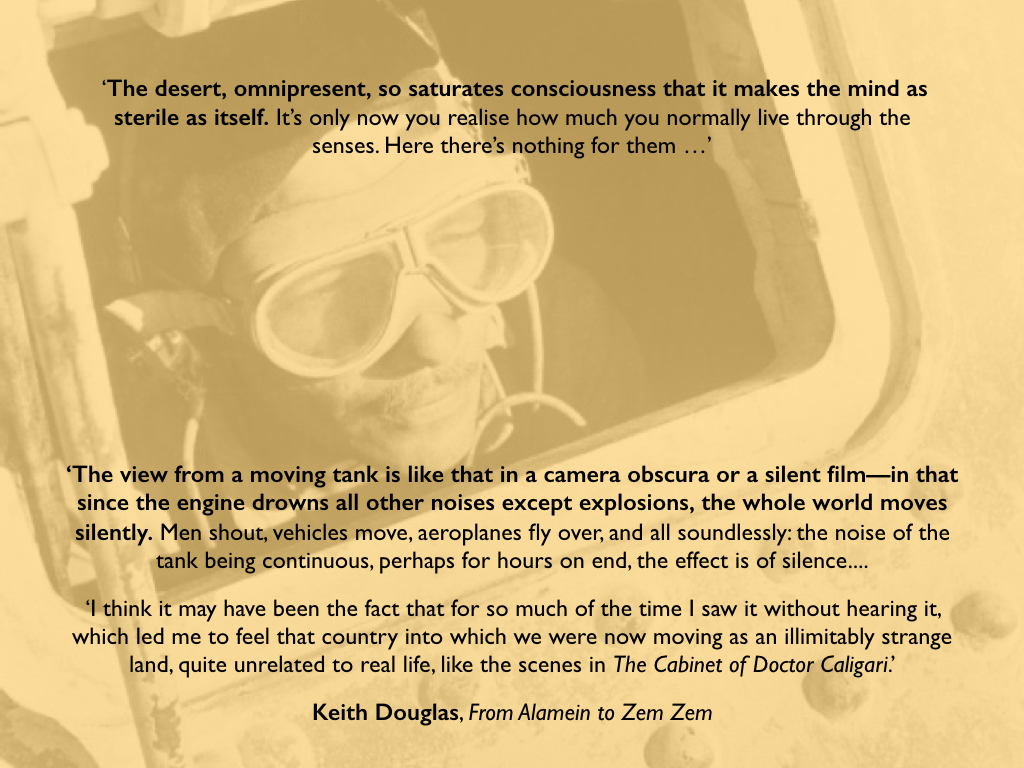
When I was working on ‘The natures of war’ (DOWNLOADS tab; the slide above is from my presentation) I stumbled across the poetry of Keith Douglas and his prose account of the desert war, From Alamein to Zem Zem (see my post here).

I was familiar with the soldier-poets of the First World War, of course, but I confess I had no idea how much fine poetry had emerged from the deserts of North Africa in the 1940s.  Ironically, Edmund Blunden was Douglas’s tutor at Oxford….

douglas-alamein-to-zem-zem

The LA Review of Books recently published an appreciation of Douglas’s importance by Steven Isenberg here:

Douglas wrote Alamein to Zem Zem (1946), his account of men and tanks in North Africa, so close in time and space to the desert battlegrounds that it pulses with ebullient immediacy. He became the answer to his own question: “Why are there no poets like [Wilfred] Owen and Sassoon who lived with the fighting troops and wrote of their experience while enduring them?”