War and demise

Tanisha Fazal has an important article in the latest International Security: ‘Dead wrong? Battle deaths, military medicine and exaggerated reports of war’s demise.’

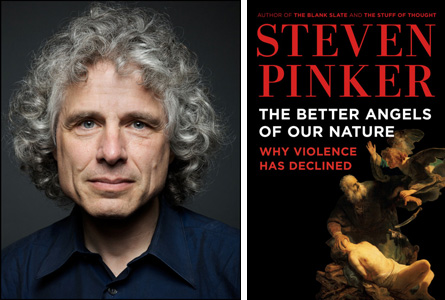
It is, in part, an artful response to what must surely seem the increasingly astonishing claim that we live in a time of unprecedented peace.  It depends, in part, on who ‘we’ are, of course, but the general thesis has been shouted from the rooftops by (for example) Joshua Goldstein‘s Winning the war on war (2011) and Steven Pinker‘s The better angels of our nature (2011).  Pinker’s thesis is the more general, to be sure: he claims a decline in ‘violence’ in general, not only in military and paramilitary violence.

StevenPinker

Tanisha’s argument hinges on the reliance on ‘battle deaths’ as an index of the incidence of war; these statistics are a minefield of their own, though they are used by most of the major databases, but Tanisha argues that many contemporary wars have been distinguished by a diminution in battle deaths and a marked increase in the numbers of wounded who now survive injuries that would previously have killed them.

She identifies four key changes.  The first two are pre-emptive: soldiers in advanced militaries are now healthier, and so they  can survive disease and injury much better than in the past, and they are equipped with protective equipment that reduces their vulnerability (she’s thinking here not only of MRAPs but more particularly of personal equipment that affords the head and trunk some protection against blast injuries).

scr_110506-D-6767M-002

The second two are reactive, and their emphasis on military medicine and evacuation chains intersects directly with my present research on combat casualty care 1914-2014 (see here and here).  From Tanisha’s summary over at Political violence @ a Glance:

‘… battlefield medicine itself has improved via the availability of anesthetics and antibiotics, which make for more effective surgeries as well as a greater likelihood of avoiding or surviving post-operative infections. Similarly, the return of the tourniquet as part of a general focus on hemostatics appears to have dramatically reduced the percentage of soldiers dying from preventable blood loss.

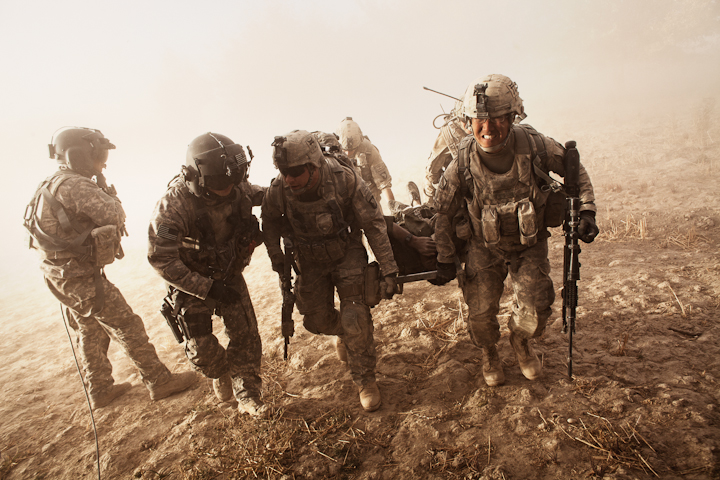
‘… military evacuation practices have gone from soldiers laying on the ground for weeks waiting for transport by stretchers to mechanized ambulances to medevac helicopters. States invest heavily in military transport for this purpose today; NGOs like the ICRC, however, were at the vanguard of this particular shift.’

Medevac

That last sentence raises a series of other, crucial questions that I’m also trying to address in my own project: not only the involvement of civilian/humanitarian organisations (and here I’m presently exploring the role of the Friends Ambulance Service on the Western Front in the First World War and in the Western Desert in the Second) but also the part played by militaries in caring for civilian casualties.  How far have they enjoyed the benefits of improved military medicine and trauma care, and how far down the evacuation chain do they move before they are diverted to (often less advanced) civilian hospitals and clinics?

MAP and the meat-grinder

I’ve updated my previous posts on the medical geographies of Gaza several times (see herehere and here), and I’ve drawn on the testimony of Dr Mads Gilbert in extenso, but this testimony from another brave volunteer doctor deserves its own notice.

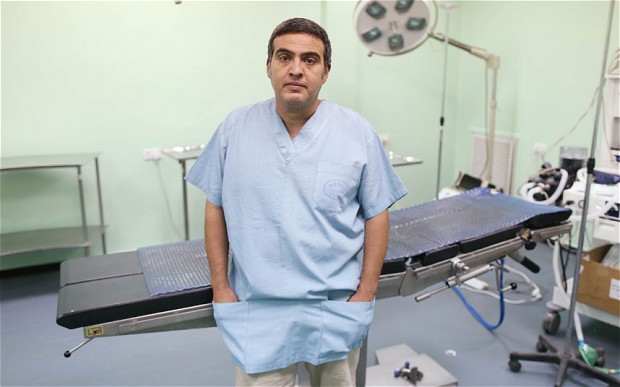
I met Ghassan Abu Sitta at a wonderful workshop in Paris in December 2012 on War and Medicine, and I learned so much from that one meeting (from everyone there: see my note about War and therapeutic geographies) that I was inspired to develop my own research project on the medical evacuation of casualties from war zones, 1914-2014.

Ghassan Abu Sitta

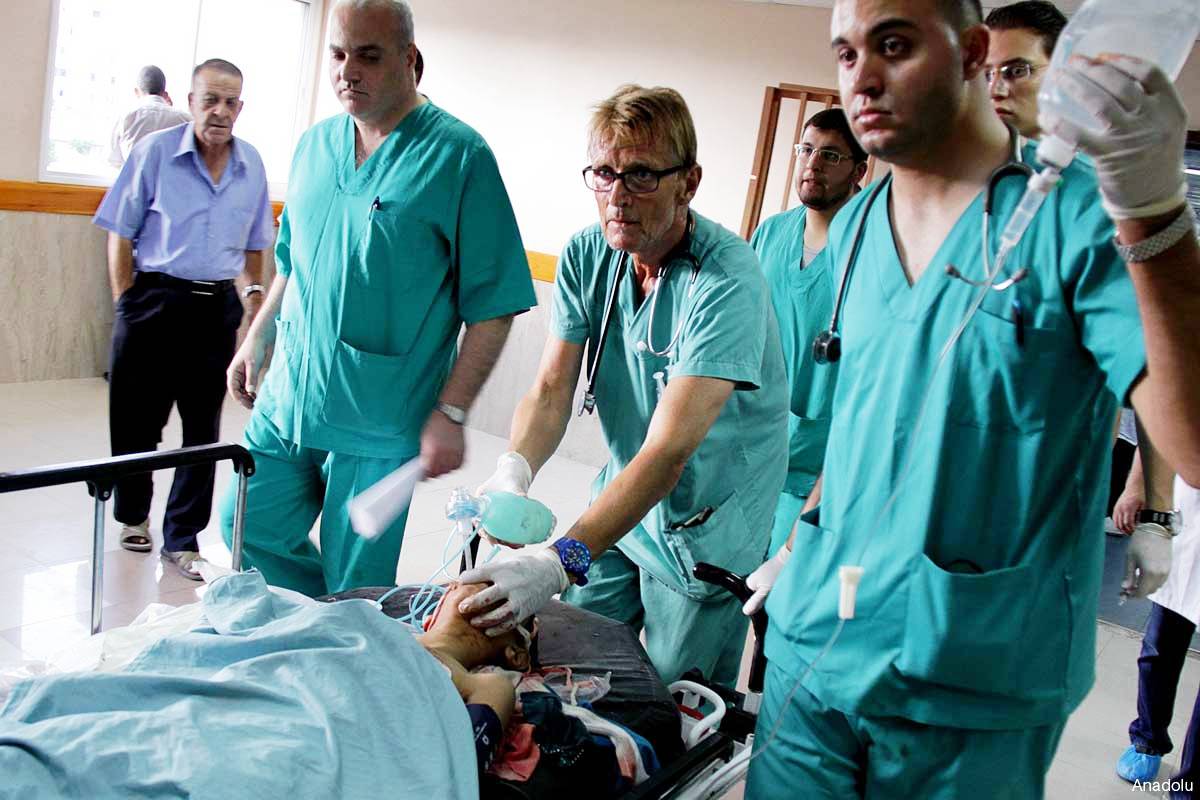
Ghassan is a reconstructive surgeon who used to work at Great Ormond Street in London but is now based in Beirut.  He’s recently returned from Gaza where he worked as a Medical Aid for Palestinians (MAP) volunteer at al Shifa hospital carrying out five, six and sometimes seven surgeries a day.

You can read some of the background in this excellent report by Robert Tait for Britain’s Telegraph, published ten days ago and from which I’ve borrowed the photograph above, but Ghassan has just been interviewed in depth by Yazan al-Saadi for Al Akhbar; you can read the full version here.

Ghassan says the attack on Gaza was like ‘a meat-grinder’, which he attributes to:

The amount of ordinance that the Israelis fired, the indiscriminate use of these bombs that are capable of bringing down whole buildings, the use of artillery shelling which is indiscriminate because the shell will hit the first thing it reaches, the fact that they were attacking from the air, from the sea, and by land with artillery at the same time. And there was a night they were doing this and then they lit all of Gaza’s sky with these flares just so people will know that this is what’s happening.

He also provides compelling testimony of his experience at al-Shifa, the main trauma centre for Gaza, that adds important detail to the accounts I’ve noted previously:

‘It looked like a refugee camp. The campus of the hospital has a lot of the families that escaped the bombing or lost their houses and they were living inside the walls of the hospital. Everywhere you go you see makeshift dwellings made out of laundry lines and bed sheeting turned into tents. And the hospital was completely full. Single rooms had four beds in them. In some wards we had two patients per bed.

‘The difference between this conflict and the one before is that nobody was allowing the patients out. So you had 7,000 injured – at the time I was there it was 6,000 and by the time the conflict ended the injured were 10,000. An overwhelming majority have still not been able to get out of Gaza. There have been some numbers, but not significant numbers to break the back of this problem….

‘The contingency plans were that all diesel was kept for the al-Shifa Hospital, so people did not have electricity at home, they would donate the diesel to the hospital. The wells that supply Shifa, like the rest of the water in Gaza, had become so contaminated with sea water, it’s salty. People do the best with what they have….

‘… the majority of the killing was happening because they were dropping ammunition designed to penetrate mountain caves. [The Israelis] were dropping them on civilian dwellings made out of breeze block. And so these four or five storey buildings were being pulverized by these one-ton bombs. That was what was wiping out whole families. And in Gaza, because land is so much in shortage, people come along and build their house, they build enough foundations that when their kids grow up, they can build a floor on top. So when you take out a four storey building, you take out four generations of a family. That was what happened to, I think, 60 families that have been completely wiped out…

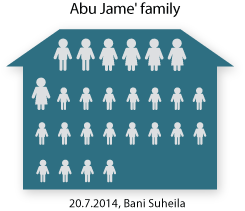
The graphic below shows 26 members of just one extended family, the Abu Jame family, killed at home in Bani Suheila on 20 July; it comes from a sequence that is shockingly far too large to reproduce here, compiled by B’Tselem and available here. The infographic lists ‘members of families killed in their homes in 59 incidents of bombing or shelling’ in which 458 people were killed, including 108 women under the age of 60, 214 minors, and 18 people over the age of 60.  If you follow the link, you can hover over each image for the names and ages of those killed.

abu_jame3

Ghassan continues:

‘… they started inventing these humanitarian ceasefires, where people would go out and they would start killing them. We had this on the day of Eid, they said there was a humanitarian ceasefire and the kids went out to a local fair ground and they bombed them. The other time was in al-Shujayeh market, there was a humanitarian ceasefire, they got them into the market, they killed them, then they waited for the ambulances to get there, and then they shelled the ambulances again.

‘So the issue isn’t the type of weapons, but the intent to kill. The amount of ordinance they used and the tonnage of the bombs they used were intended to wipe out whole neighborhoods. That’s what they have done. They have completely wiped out Shejayeh, they wiped out Khuza’a, they wiped out a big part of Rafah, a big part of Khan Younes, and parts of Beit Hanoun….

‘ All the areas around the hospital were being bombed all the time. You would hear it. We heard something we knew it was close, but didn’t know how close it was. We then got a call to the emergency room and we were told that the administration and the out patients building had been hit – a lot of families had taken refuge in that area – so we had to go and help.’

Asked directly whether Hamas or other factions were firing rockets from the vicinity of the hospital, Ghassan is unequivocal:

‘Around Shifa? No, no, no. But in other places you would see them in the sky or hear them. You would learn to distinguish the whoosh of the rocket. Gaza is so small and so flat, I mean you are not going to hide them in the mountains or the jungle because there are no mountains or jungle. People are literally on top of each other. It’s going to happen. But around the hospital there were none.’

Peace in our time

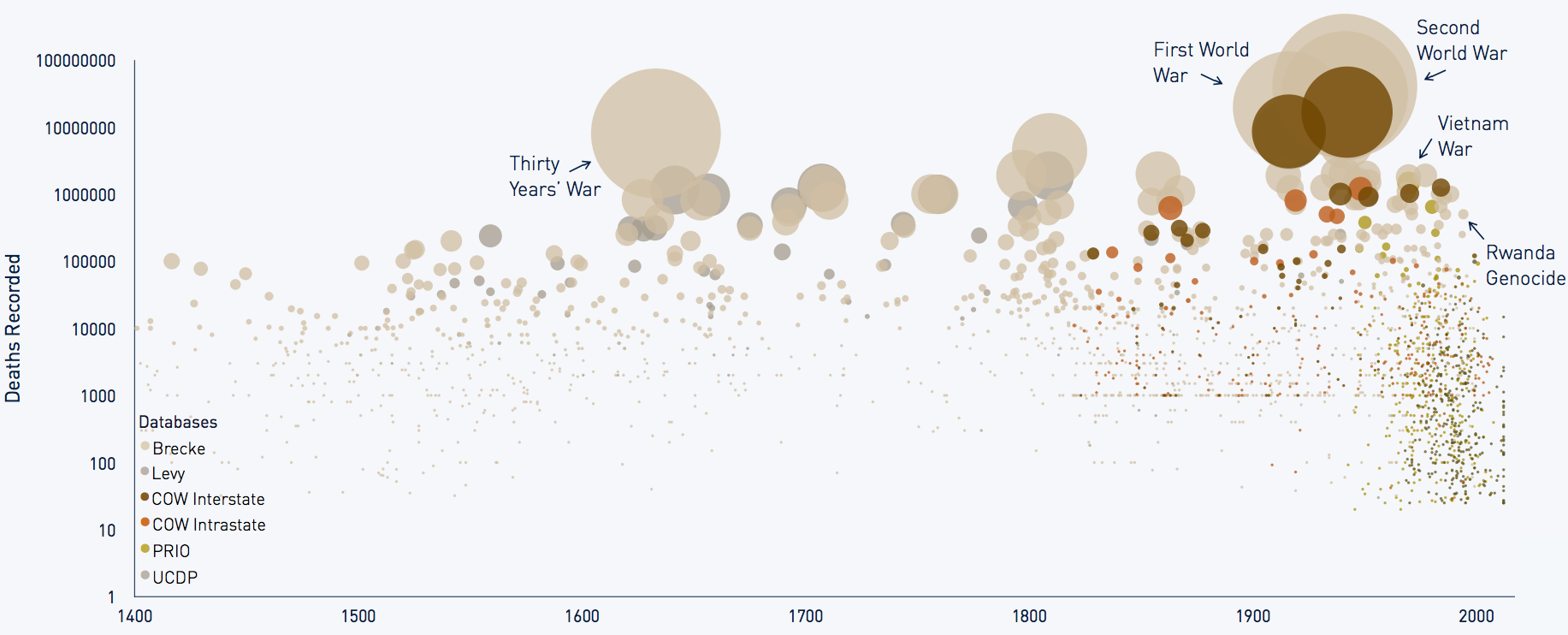
I’ve talked about charting armed conflict around the world before.  Max Rosen has a series of data visualisations – ‘Our World in Data‘ – including several on war and peace.  They include this one, drawn from multiple sources and collated (and designed) by the Hague Centre for Strategic Studies, showing global war deaths – the size of the bubble refers to the proportion of the world population killed:

ourworldindata_global-war-deaths-1400-today-size-of-the-bubble-shows-percentage-of-world-population-killed-–-the-hague-centre-for-strategic-studies0

There are of course all sorts of problems in this sort of exercise – calculating ‘war deaths’ is a political and intellectual minefield of its own – but you can find the sources used for the graphic here (click on the button on the right).

You can also download the Hague Centre’s graphics in a single pdf, ‘Peace and Conflict across time’, here (again, click on the button on the right): the display arranges the graphics into two sets – ‘Decline of Conflict’ and ‘Drivers of Peace’.  No doubt Stephen Pinker would approve.

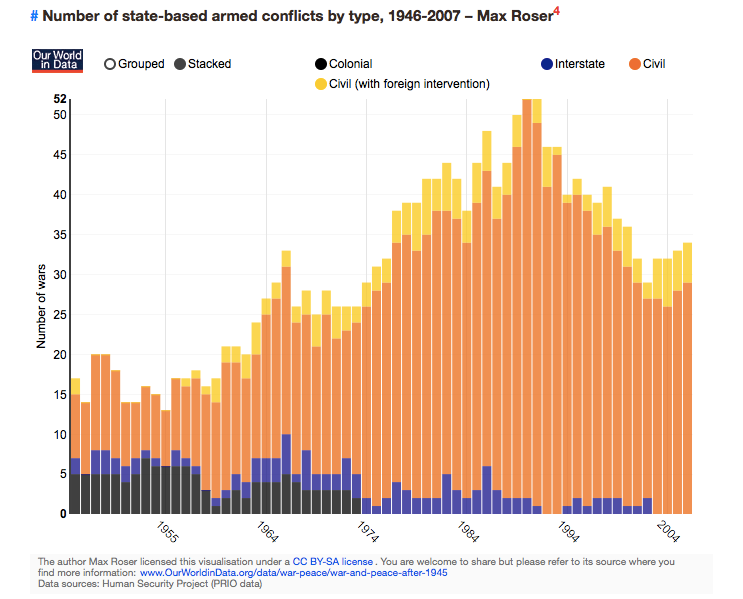
Max provides a more detailed analysis of conflicts post-1945 here, including this image (which extends only to 2004), and which is precisely the sort of thing that has licensed the debates over the decline of inter-state wars and the rise of (often transnational) ‘new wars’:

State-based armed conflicts

Before cheering the demise of inter-state war, however, we need to reflect on the multiple ways in which states and their advanced militaries are able to inflict violence by stealth (including cyber-attack), by proxy and by other other means (including economic warfare)…

Destructive Edge

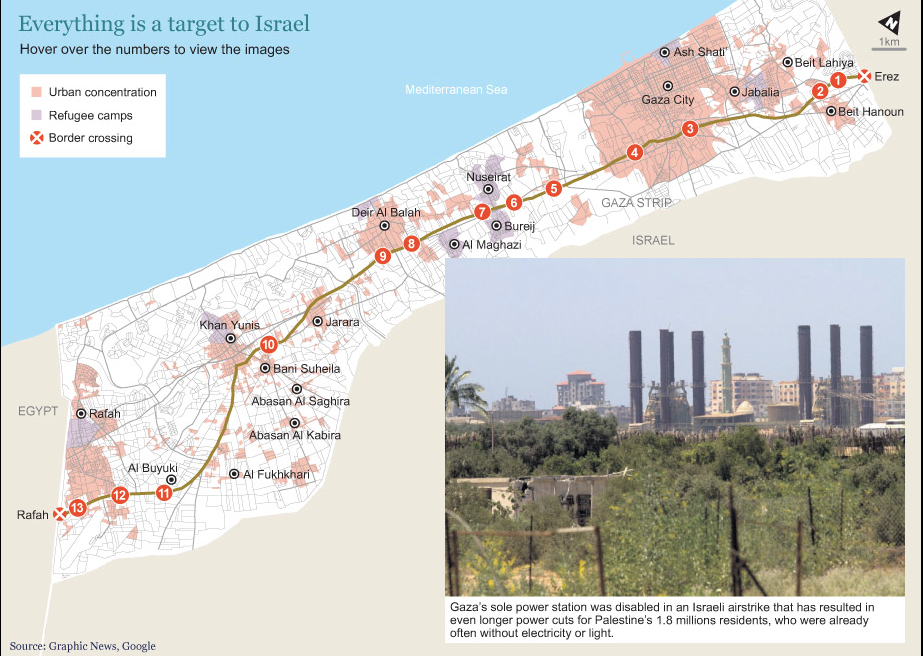
In a previous post on ‘The Death Zone‘, I suggested readers compare Israel’s extended ‘buffer zone’ in Gaza by following the line of the main highway, Saladin Street.  Hugh Naylor has followed that route on the ground – what he calls ‘Desolation Road’ – and his report is accompanied by an interactive map showing some of the vast panorama of destruction:

Screen Shot 2014-08-08 at 10.01.01

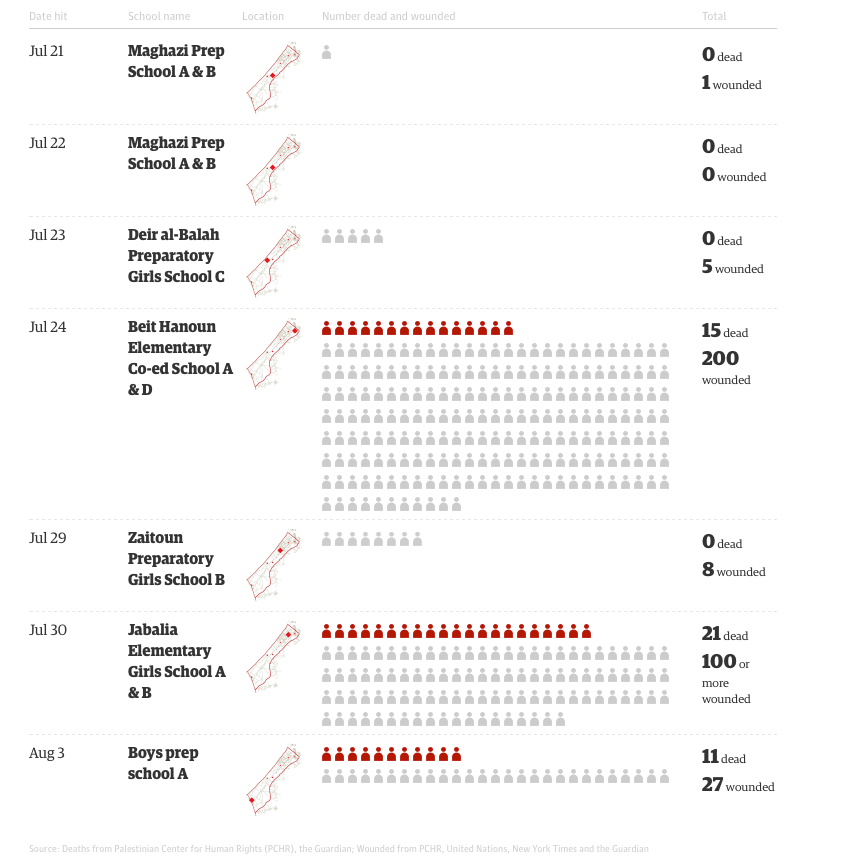
I’ll have more to say about the caption – about the Israeli military’s targeting in Gaza – shortly.  The Guardian has just published a graphic by Nadja Popovich showing the UNRWA-run schools sheltering refugees (many of them from the expanded ‘buffer zone’) that were struck by the Israeli military:

Gaza schools hit by Israeli military

 Amnesty International reports growing evidence that health facilities and workers were deliberately targeted by the Israeli military:

Testimonies from doctors, nurses, and ambulance workers who have spoken to Amnesty International paint a disturbing picture of hospitals and health professionals coming under attack by the Israeli army in the Gaza Strip, where at least six medics have been killed. There is growing evidence that health facilities or professionals have been targeted in some cases.

Since Israel launched Operation “Protective Edge” on 8 July, the Gaza Strip has been under intensive bombardment from the air, land and sea, severely affecting the civilian population there. As of 5 August, according to the UN Office for the Coordination of Humanitarian Affairs, 1,814 Palestinians had been killed in the Gaza Strip, 86 per cent of them civilians. More than 9,400 people have been injured, many of them seriously. An estimated 485,000 people across the Gaza Strip have been displaced, and many of them are taking refuge in hospitals and schools.

Amnesty International has received reports that the Israeli army has repeatedly fired at clearly marked ambulances with flashing emergency lights and paramedics wearing recognizable fluorescent vests while carrying out their duties. According to the Palestinian Ministry of Health, at least six ambulance workers, and at least 13 other aid workers, have been killed as they attempted to rescue the wounded and collect the dead. At least 49 doctors, nurses and paramedics have been injured by such attacks; at least 33 other aid workers were also injured. At least five hospitals and 34 clinics have been forced to shut down due to damage from Israeli fire or continuing hostilities in the immediate area.

Hospitals across the Gaza Strip suffer from fuel and power shortages (worsened by the Israeli attack on Gaza’s only power plant on 29 July), inadequate water supply, and shortages of essential drugs and medical equipment. The situation was acute before the current hostilities, due to Israel’s seven-year blockade of Gaza, but have been seriously exacerbated since…

Amnesty International is aware of reports that Palestinian armed groups have fired indiscriminate rockets from near hospitals or health facilities, or otherwise used these facilities or areas for military purposes. Amnesty International has not been able to confirm any of these reports. While the use of medical facilities for military purposes is a severe violation of international humanitarian law, hospitals, ambulances and medical facilities are protected and their civilian status must be presumed. Israeli attacks near such facilities – like all other attacks during the hostilities – must comply with all relevant rules of international humanitarian law, including the obligation to distinguish between civilians and civilian objects and military targets, the obligation that attacks must be proportional and the obligation to give effective warning. Hospitals and medical facilities must never be forced to evacuate patients under fire.

20140801_ambulance_520

The report includes detailed testimony from Palestinian paramedics and ambulance crews who describe the extraordinary difficulty and danger they faced in attending to casualties from Israeli shelling (see also my post on ‘Gaza 101‘, the emergency number for Gaza, and the update here).  Not surprisingly, Israel has rejected Amnesty’s claims and denied targeting hospitals, but when Netanyahu’s spokesperson, Mark Regev, explained that ‘What we’ve had to do on a number of occasions is to hit terrorist targets in the immediate vicinity of hospitals and things like that, where they’ve abused them,’ he failed to address the violations of international law summarised in the last paragraph above.

There’s more.  B’Tselem, now back on line, is also providing detailed testimony from Gaza, including (so far) two ambulance drivers, Rami ‘Abd al-Haj ‘Ali and Ahmad Sabah.  Here is an extract from the first statement (all testimonies are linked to B’Tselem’s interactive map):

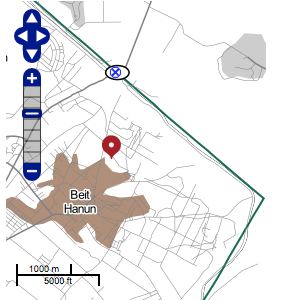
B'Tselem map Beit HanounOn Friday afternoon, 25 July 2014, I was working at the medical emergency call center in Beit Hanoun. At around 4:30 P.M., we received a call reporting injured people in al-Masriyin Street in Beit Hanoun. We asked the International Red Cross to coordinate our going there. About 15 minutes after we received the call, we got authorization and an ambulance headed over there with paramedics ‘Aaed al-Bura’i, 25, Hatem Shahin, 38, and driver Jawad Bdeir, 52. The team didn’t make it to the wounded people. Soon after they reached the street, they reported back that a tank had fired at them and they were injured. They asked for another team to come and rescue them.

The call center coordinated the arrival of another team with the International Red Cross and got authorization to go rescue the injured team. I drove the second ambulance, and there were two medics with me – Muhammad Harb, 31, and Yusri al-Masri, 54. The street is only about 200-300 meters from the call center, so we were there within minutes. When we reached the entrance to the street, we were surprised to see three tanks and a military bulldozer in the street, about 100 meters away.

Suddenly, with no warning, they opened heavy machine-gun fire at us. The bullets penetrated the ambulance. I tried to turn the ambulance around to get out of there, but the steering wheel must have been hit. Suddenly, I felt sharp pain in my leg and realized I’d been hit by a bullet or shrapnel. Then the windshield shattered. Because I couldn’t turn the ambulance around, I decided to try reversing. They kept firing as I backed up, until we got far enough away. When they stopped, I managed to turn us around and head back to the center.

On the way there we met Hatem Shahin, one of the paramedics from the first ambulance. He’d been hit by shrapnel in his shoulder and leg. He told us that a shell fired from a tank had hit the front part of the ambulance. He said he’d managed to get away but the other paramedic, ‘Aaed, had been hit. He told us that after he ran away from there, he saw the tank fire another shell at the ambulance, completely destroying it. He thought ‘Aaed must have been killed, but we didn’t know for sure.

The next day, on Saturday, a ceasefire was declared from 8:00 A.M. to 8:00 P.M. An ambulance team went to the spot and found ‘Aaed’s body in the burnt ambulance.

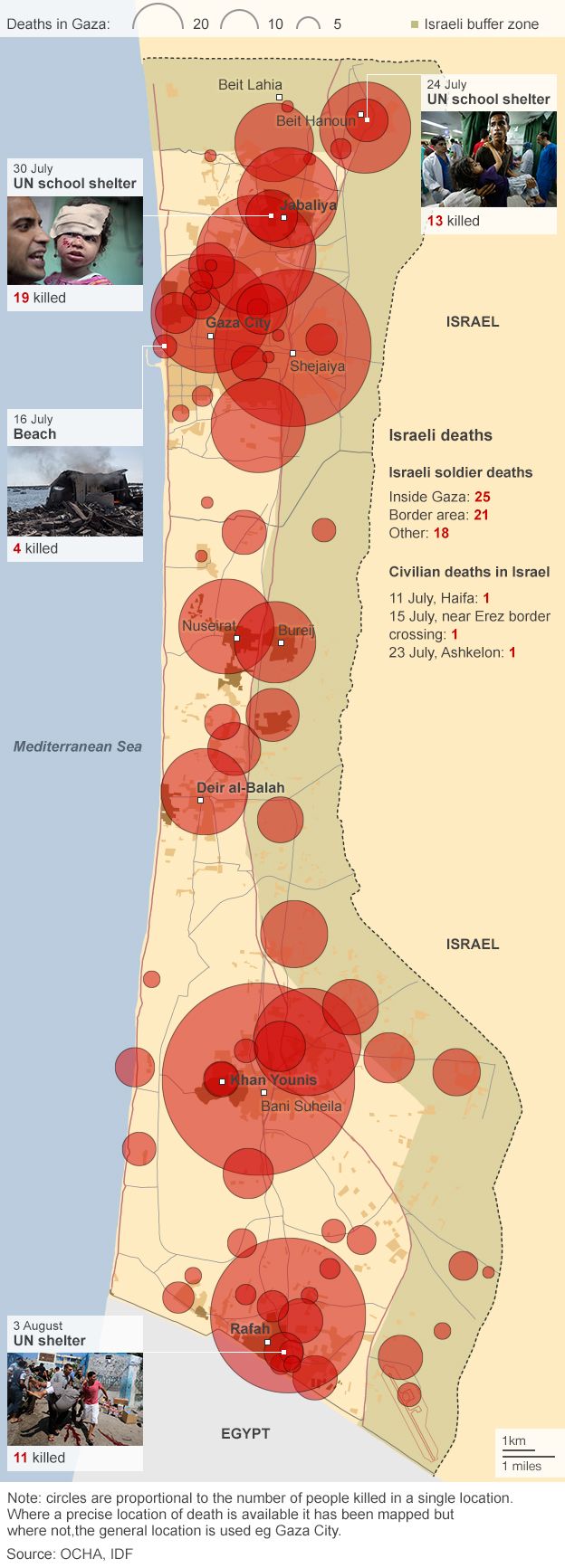
To put all of this in context, the BBC has mapped the deaths of 1,890 Palestinians – ‘mostly civilians’, as its accompanying chart shows – killed during the Israeli offensive to 6 August.  As you can see, Palestinians were killed ‘right across Gaza’ – not only in the expanded buffer zone shown on the map, though the carnage in Beit Hanoun and Shejaiya is clearly visible – with high concentrations also produced in the killing grounds of Gaza City and Khan Younis:

w640

Finally, in case you’re puzzled by the title for this post: Israel’s attack on Gaza is codenamed Tzuk Eitan in Hebrew, meaning ‘Firm Cliff’ or ‘Resolute Cliff’.  According to Yagiv Levy, ‘The operation’s name signals the power, commitment and resilience of the Israeli people.’  But the official English-language version, ‘Protective Edge’, was changed ‘to give it a more defensive connotation’ (really). As Steven Poole explains, ‘the bombing was supposedly “protective”, though not of those bombed’. All of this is of course in line with the designation of the Israeli military as the ‘Israeli Defence Forces’.

I decided I’d prefer to use a version that provides a more accurate rendering of what has happened – in Hebrew, English or Arabic.

Lives, damned lives and statistics

The New Statesman is carrying a ‘reply‘ from a Professor Alan Johnson (Edge Hill University: it’s not clear to me if he’s still there) to a post by Jason Cowley on Gaza.  He doesn’t address Cowley’s substantive points about Gaza, but ends like this:

Today, there are forms of anti-Zionism that demonise Israel and fuel hate, from the academic theory of Judith Butler and Gianni Vattimo to the historiography of Shlomo Sand, from the popular street phenomenon of the “quenelle” to the ugly rise of “Holocaust inversion”.

To link Butler, Vattimo and Sand to fascist gestures like the quenelle is a lazy and offensive manoeuvre.  I leave the other scholars he mentions to those who know their work better than me: Johnson presumably has this interview with Vattimo in his sights, which is indeed reprehensible though scarcely representative of his corpus as a whole, but Sand is a distinguished historian whose counter-narrative to Zionism cannot be gratuitously dismissed, even if Johnson and his friends at the British Israel Communications and Research Centre don’t like it.

9781844675449-frontcover-01d22beb799d6fe99f8cd54193ff10f5But to suggest that ‘the academic theory of Judith Butler‘ somehow ‘demonises Israel and fuel[s] hate’ is intellectually vacuous.  What part of her ‘theory’ does Johnson have in mind? Her work on gender and subjectivity?  Her discussions of performativity? Her careful, ethical arguments about what constitutes a ‘grievable life’ in Precarious lives and Frames of war?

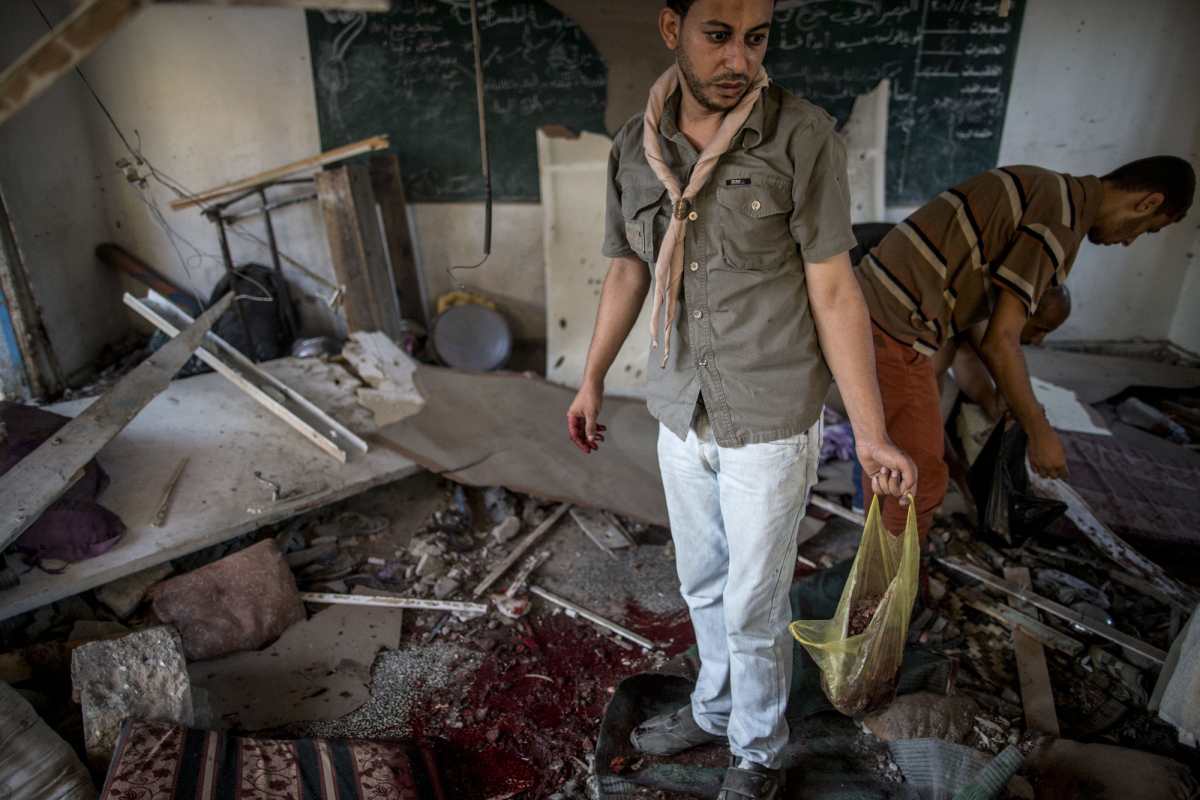
Those last two books do bear directly on the asymmetric horror that is being visited on the people of Gaza.  Readers may have seen the video of UNRWA spokesman Chris Gunness dissolving into tears as he tries to talk about the Israeli shelling of Jabalia Elementary Girls School early on Wednesday morning, when children were killed as they slept next to their parents.  We should pause here to acknowledge the extraordinarily brave and vital work the men and women of UNWRA perform day after day and night after night under the most exacting conditions (and if we are to talk about ‘demonisation’ we should certainly talk about the abuse hurled at UNWRA by the Israeli right). During the attack on the school, at least 15 people were killed and more than 100 wounded.  The location of the school and its humanitarian re-purposing as shelter for more than 3,000 people forced from their homes by the offensive had been communicated to the Israeli military 17 times before the attack. After the interview, Chris composed himself and had this to say:

“My feelings pale into insignificance compared to the enormity of the tragedy confronting each and every other person in Gaza at this time.

“It’s important to humanise the statistics and to realise that there is a human being with a heart and soul behind each statistic and that the humanity that lies behind these statistics should never be forgotten.”

This is a perfect expression of what Butler has in mind, and urges us to have in mind.  There’s no ‘hate’ there, and there isn’t in Butler’s work either: just a caring expression for grievable lives so cruelly lost.

TOPSHOTS-PALESTINIANS-ISRAEL-CONFLICT-GAZA

What Butler has provided, on several occasions, is a thoughtful, measured critique of political Zionism and of the policies and practices of successive Israeli governments that have diminished, dispossessed and, yes, demonised the Palestinian people (see a previous, brief post here). I suspect Johnson would see this as the work of a ‘self-hating Jew’, an old canard, but what then would her critics accept as a legitimate criticism of Israel?  And if we have to resurrect that line of argument, might not actions like the shelling of a school crowded with refugees be the work of a self-demonising state?

BUTLER Parting waysButler’s reflections have been brought together in her Parting ways: Jewishness and the critique of Zionism (2012), which is a principled statement of an oppositional – not defamatory – ethics and politics.  As it happens, Society and Space has just published an exceptionally thoughtful review of the book by Lisa Bhungalia which explicitly connects Butler’s vision of ‘co-habitation‘, which Butler sees as not only consistent with but arising from an indelibly Jewish tradition, to the latest Israeli attack on Gaza (where her sharpening of the concept of precarity is also surely crucial: see also ‘Precarious life and the obligations of cohabitation’, a lecture Butler delivered at Stockholm’s Nobel Museum in May 2011: you can download it here).

There are, as Lisa notes, dangers in turning ‘resistance to Zionism into a “Jewish” value’, as Butler herself acknowledges, but in the end

‘Butler puts forth a compelling political vision for Palestine/Israel predicated on an acknowledgment of historical injustice and the instatement of new polity that would presuppose an end to settler colonialism – yet at the same time, this vision is derived, in large part, from a Jewish philosophical tradition. Justice still remains a Jewish value.’

Words understandably failed Chris Gunness this week.  And when a Jewish scholar who works so respectfully with the writings of Hannah Arendt, Walter Benjamin, Martin Buber, Primo Levi and Emmanuel Levinas is accused of ‘fuelling hate’ and so egregiously linked to the rise of popular fascism then all possibility of critical engagement seems lost.

And yet. Butler talks about being critical as being ‘willing to examine what we sometimes presuppose in our way of thinking, and that gets in the way of making a more livable world.’  She has done precisely that in Parting ways.  Perhaps Professor Johnson, instead of recycling the hasbara formularies of the Israeli military, might do the same.

All white on the Western Front?

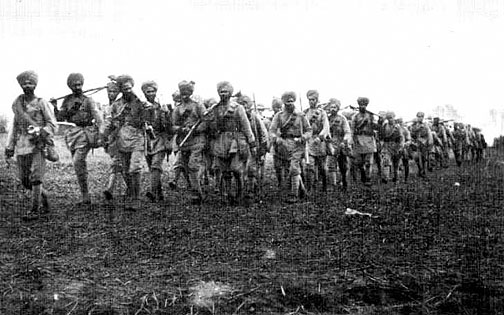
Indian troops at Ypres

There is a telling anecdote in Lyn Macdonald‘s account of The Somme:

Climbing on to the firestep, the Staff Captain cautiously raised his head above the parapet and looked across. ‘Good God!’ he exclaimed. ‘I didn’t know we were using Colonial troops!’ Pretor-Pinney made no reply. Hoyles and Monckton exchanged grim looks. ‘Dear God,’ muttered Monckton, when the Colonel and the visitor had moved away to a safe distance, ‘has the bastard never seen a dead man before?’ It was a rhetorical question. Lying out in the burning sun, soaked by the frequent showers of a week’s changeable weather, the bodies of the dead soldiers had been turned black by the elements. The Battalion spent the rest of the day burying them.

In fact, it’s doubly revealing.  On one side, it confirms the (I think simplistic) stereotype of the General Staff and their distance from death; but on the other side it also speaks to what Santanu Das, writing in the Guardian, calls ‘the colour of memory’:

In 1914, Britain and France had the two largest empires, spread across Asia and Africa, and an imperial war necessarily became a world war.

More than 4 million non-white men were recruited into the armies of Europe and the US. In a grotesque reversal of Joseph Conrad’s vision, thousands of Asians, Africans and Pacific Islanders were voyaging to the heart of whiteness and far beyond – to Mesopotamia, East Africa, Gallipoli, Persia and Palestine. Two million Africans served as soldiers or labourers; a further 1.3 million came from the British “white” dominions. The first shot in the war was fired in Togoland, and even after 11 November 1918 the war continued in East Africa.

A South African labourer said he went to war to “see different races”. If one visited wartime Ypres, one would have seen Indian sepoys, tirailleur Senegalese, Maori Pioneer battalions, Vietnamese troops and Chinese workers.

Today, one of the main stumbling blocks to a truly global and non-Eurocentric archive of the war is that many of these 1 million Indians, or 140,000 Chinese, or 166,000 West Africans, did not leave behind diaries and memoirs. In India, Senegal or Vietnam there is nothing like the Imperial War Museum; when a returned soldier or village headman died, a whole library vanished.

Moreover, as the former colonies became nation states, nationalist narratives replaced imperial war memories. Stories that did not fit were airbrushed. In Europe, communities turned to their own dead and damaged.

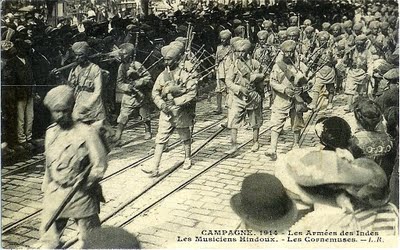
WWI Sikhs Bagpipes

In ‘Gabriel’s Map’ I began in East Africa in 1914 with an Indian Army contingent – whose staff officers included, in William Boyd‘s An Ice-Cream War,  the young Gabriel Cobb – sent to seize German East Africa defended by the local Schutztruppen under German command.  But as I travelled back to the Western Front the colonial troops who also served there slipped from the record.  Yet by the end of September 1914 two Indian divisions and a cavalry brigade had already arrived in France (see above), and in October the first sepoys were sent into battle at Ypres.  If British, French and German troops were shocked at the devastation of a European countryside that was, in its essentials, once familiar to them, what could the freezing cold, the endless mud and the splintered trees have meant to these men (who usually arrived unprepared and ill-equipped for the winter)?

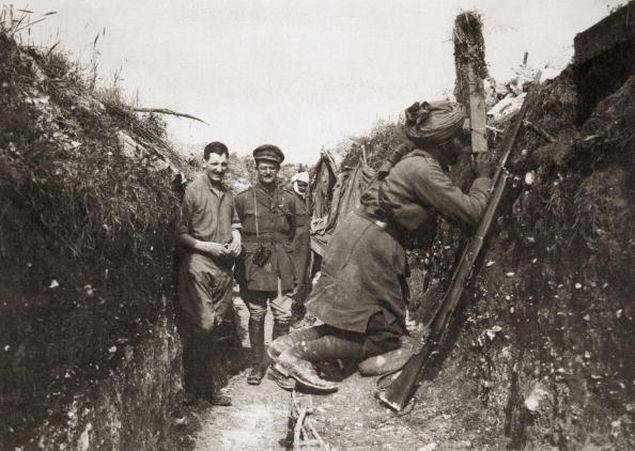
sepoysinthetrenches_0_1I suspect a satisfying answer has to wait for Santanu’s next book, India, Empire and the First World War: words, images and objects (Cambridge University Press, 2015). But in the meantime the whitening of the Western Front (and other theatres of the War) can be resisted through other sources. Some of them are listed in his brief essay on ‘The Indian sepoy in the First World War’ for the the British Library (and you can find ‘Experiences of colonial troops’, adapted from his Introduction to Race, empire and First World War writing [Cambridge University Press, 2011] here).

In addition Christian Koller‘s ‘The recruitment of colonial troops in Africa and Asia and their deployment in Europe during the First World War’, Imigrants & Minorities 26 (1/2) (2008) 111-133 [open access pdf here] provides a helpful context and more references (including French and German sources), and Gajendra Singh‘s The testimonies of Indian soldiers and the two world wars: between self and sepoy (Bloomsbury, 2014)  is a wider, though inevitably selective account of the fabrication of Indian military identities under the Ra (the chapter on ‘Throwing snowballs in France’ is also available in Modern Asian Studies 48 (4) (2014): it’s an artful discussion of the (mis)fortunes of a chain letter – this is the ‘snowball’ in question – that ran foul of the military censor).  The Round Table 103 (2) (2014) is a special issue devoted to ‘The First World War and the Empire-Commonwealth’.

http://www.oucs.ox.ac.uk/ww1lit/collections/item/3770?CISOBOX=1&REC=3

Finally, I’m working my way through Andrew Tait Jarboe‘s excellent PhD thesis, Soldiers of empire: Indian sepoys in and beyond the metropole during the First World War, 1914-1919 (Northeastern, 2013): during my current research on military-medical machines 1914-2014 I’ve found a number of references to the treatment of wounded Indian troops on the Western Front – their evacuation on hospital trains and their treatment in segregated hospitals – and Andrew’s third chapter (‘Hospital’) provides an illuminating reading of what was happening:

‘Between 1914-18, the British established segregated hospitals for wounded Indian soldiers in France and England… [T]hese hospitals were not benign institutions of healing. Like hospitals that repaired the bodies of English soldiers, Indian hospitals played a crucial role in sustaining the war-making capacity of the British Empire. Indian hospitals in Marseilles or Brighton also served an imperial purpose. As sites of propaganda, they reaffirmed the ideologies of imperial rule for audiences at home, abroad, and within the hospital wards. Yet even while the British Empire succeeded to a considerable extent in exploiting the manpower of India, … wounded sepoys were rarely ever mere pawns on the imperial chessboard. Hospital authorities were committed to two policies: returning sepoys to the front, and protecting white prestige. Wounded sepoys found ways of resisting both. In this way, Indian hospitals readily became what British authorities hoped they would not: spaces where imperial subalterns contested the policies and ideologies of imperial rule.’

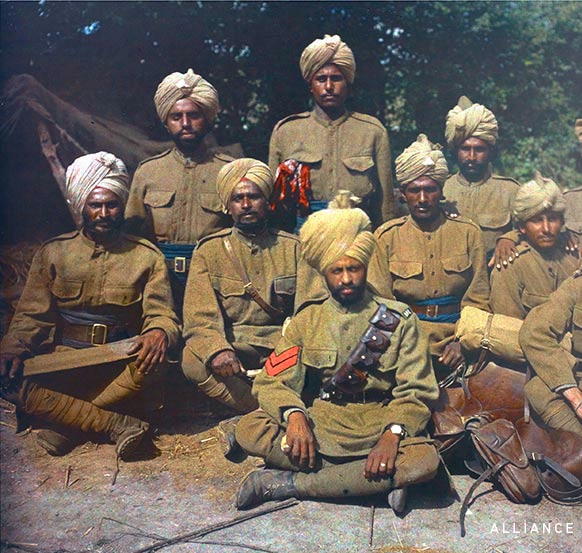
Sikhs WW1

For imagery of non-European troops on the Western front and elsewhere, try this page at the Black Presence in Britain.  More wide-ranging is the exhibition organised by the Alliance française de Dhaka, War and the colonies 1914-1918, that you can visit online here (I’ve taken the image above from that collection).

All of this, clearly, adds another dimension to Patrick Porter‘s lively discussion of Military Orientalism: Eastern war through Western eyes (2009).  But it’s not only an opportunity to reverse (and re-work) that subtitle.  The Times of India reports a campaign to change ‘the colour of memory’ by instituting 15 August as a Remembrance Day in India:

“This will be our Remembrance Day. We have attended such memorial functions in France where heads of different states converge and the civilian turnout is quite big. But we don’t see a single Indian face there—quite an irony, given the fact that 1, 40,000 Indians defended French soil from German aggression in the Great War, and many never returned home. That’s why we, NRIs from France, came up with this project,” says a representative of Global Organization for People of Indian Origin (GOPIO), France.

38761185.cms

Scoping Afghanistan

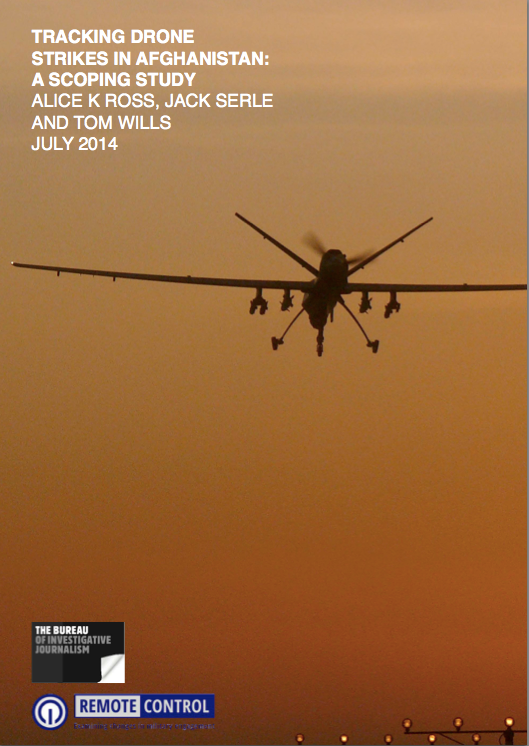
BOIJ Tracking drone strikes in AfghanistanThe marvellous Bureau of Investigative Journalism has just published a preliminary report on its new study  of drone strikes in Afghanistan, ‘the most heavily drone-bombed country in the world.’  The study, carried out with the support of the Remote Control Project, has been prompted by analyses which show that ISAF has persistently under-estimated civilian casualties from its strikes (‘“We only count that which we see… You can do a tremendous amount of forensics … [but] seldom do we see the actual bodies.”)

I have my doubts about the wisdom of severing ‘drone strikes’ from air strikes carried out by conventional aircraft that are networked in to ISR feeds from drones; I’ve elaborated this before, and it is a crucial part of my own work on militarised vision, where I’m working through the military investigations into air strikes in Kunduz, Sangin and Uruzgan.  I’ll start posting about this work next month.

The irony, I think, is not (quite) that we know so little about the ostensibly ‘public’ strikes in Afghanistan compared with the ‘covert’ campaigns in Pakistan, Yemen, Somalia and elsewhere: it is, rather, that we know a lot about how the USAF (though not the RAF) conducts strikes in Afghanistan but remarkably little about the victims, whereas in Pakistan we know much less about how the strikes are carried out (apart from the bureaucratisation of ‘kill lists’ in Washington) and, thanks to the work of the Bureau, much more about the victims.

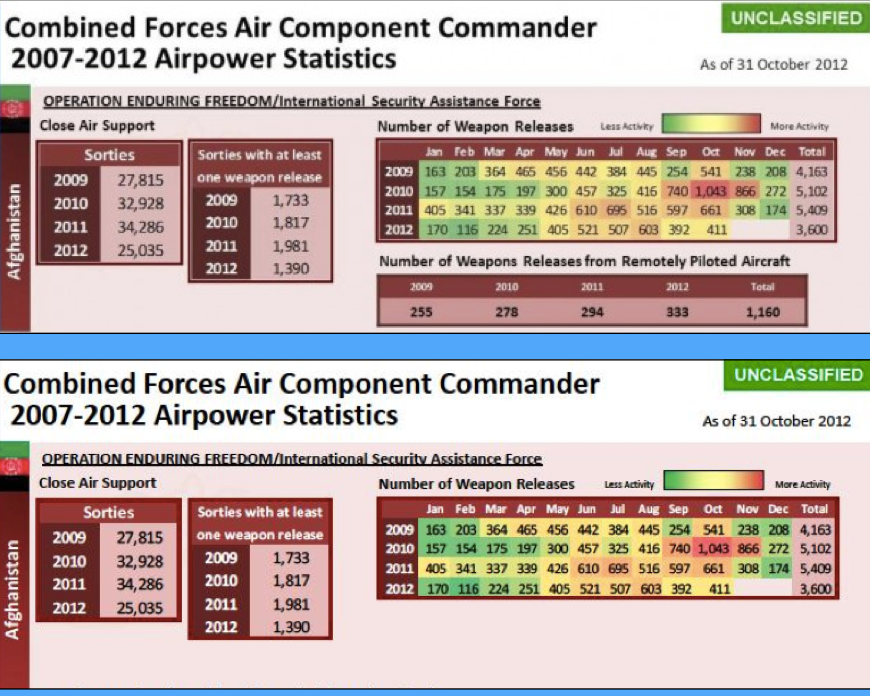
It is true, though, that while the official US military investigations released through FOIA requests are often immensely informative, even in redacted form (more on this next month), there is often also a remarkable reluctance to release even basic information to the public.  Spot the difference between these two tables; the first release (on top) was subsequently overwritten by the second (below)…

Airpower statistics 2007-2012

As I say, more to come.  In the meantime, the ‘scoping study ‘ from the Bureau is here, and well worth reading.

Footnotes to Gaza 101

gazajuly23

Updates on Gaza 101 (at the risk of stating the obvious, the title for this post is a riff on Joe Sacco‘s brilliant Footnotes in Gaza [2009])

(1) Another powerful interview with Dr Mads Gilbert from al-Shifa Hospital, the main trauma centre in Gaza, and an excellent question:

“What would have happened if Palestinian fighters had bombed an Israeli hospital and killed five patients?  The world would have turned upside down. What is this second-hand, or even third-hand or fourth-hand citizenship in the world for the Palestinians?”

And in Gaza it’s way more than five (though that is clearly how so many governments around the world, including Canada, rank Palestinian citizenship).

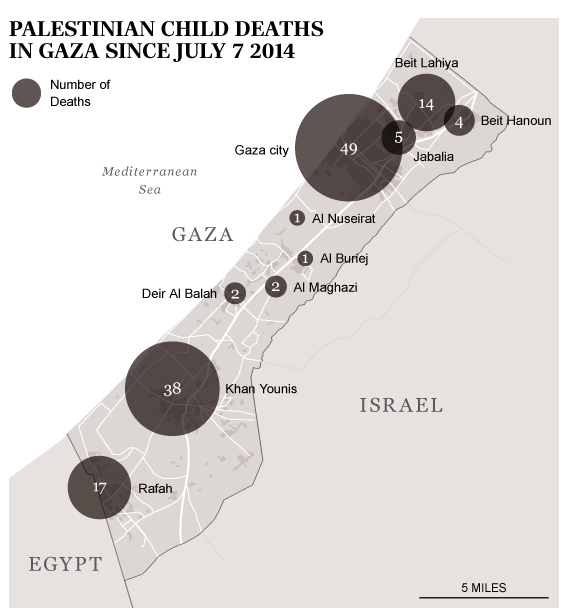
Palestinian child deaths

(2)  By ‘citizenship in the world’ Gilbert is getting at the differential calculus that constitutes what Judith Butler calls ‘a grievable life’, and here Maya Mikdashi sharpens a (different) point I’ve made in relation to air strikes in the Federally Administered Tribal Areas and elsewhere: that not only the dead and injured women and children [see the map above, also available here] but also the dead and injured men are worthy of our grief.

Palestine men and women and children are one people— and they are a people living under siege and within settler colonial conditions. They should not be separated in death according to their genitalia, a separation that reproduces a hierarchy of victims and mournable deaths. Jewish Israelis (including soldiers and settlers) occupy the highest rungs of this macabre ladder, Palestinian men the lowest. This hierarchy is both racialized and gendered, a twinning that allows Palestinian womenandchildren to emerge and be publicly and internationally mourned only in spectacles of violence, or “war”—but never in the slow and muted deaths under settler colonial conditions—the temporality of the “ceasefire.” To insist on publicly mourning all of the Palestinian dead, men and women and children—at moments of military invasion and during the every day space of occupation and colonization— is to insist on their right to have been alive in the first place.

(3) Finally – if only it were the end to all this – here is the splendid Richard Falk on the chronic failure of international law to protect – let alone provide justice for – the Palestinian people.  This is how he begins:

What has been happening in Gaza cannot usefully be described as “warfare”. The daily reports of atrocities situate this latest Israeli assault on common humanity within the domain of what the great Catholic thinker and poet, Thomas Merton, caIled “the unspeakable”. Its horror exceeds our capacity to render the events through language.

Up to  a point; I said something similar but much less eloquently in ‘Gaza 101’.  Trauma ruptures language, to be sure, but these words from Ann Jones are also worth reflecting on (they come from her They were soldiers):

The worst we can say of war is that it is “unspeakable,” which in fact it is not. But we don’t speak of it because that would involve so many nasty words we don’t want to use and elicit so many things we don’t want to know, so many things we think we can’t do anything about now that the government answers only to the powerful few…


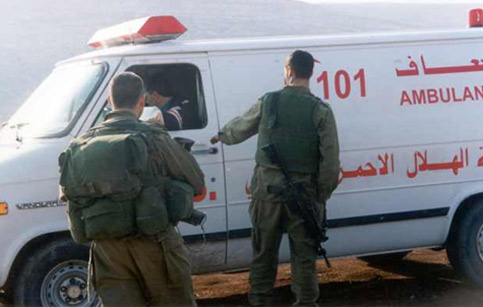
Gaza 101

pcrs483

101 is the emergency number for Gaza and the rest of occupied Palestine.  And perhaps I should begin with that sentence: I say ‘the rest of occupied Palestine’ because, despite Israel’s ‘disengagement’ from Gaza in 2005, Israel continues to exercise effective control over the territory which means that Gaza has continued to remain under occupation.  It’s a contentious issue – like Israel’s duplicitous claim that the West Bank is not ‘occupied’ either (even by its illegal settlers) merely ‘disputed’ – and if you want the official Israeli argument you can find it in this short contribution by a former head of the IDF’s International Law Department here and here.  The value of that essay – apart from illustrating exactly what is meant by chutzpah – is its crisp explanation of why the issue matters:

‘This does not necessarily mean that Israel has no legal obligations towards the population of the Gaza Strip, but that to the extent that there are any such legal obligations, they are limited in nature and do not include the duty to actively ensure normal life for the civilian population, as would be required by the law of belligerent occupation…’

Certainly, one of the objectives of Israel’s ‘disengagement’ was to produce what its political and military apparatus saw as ‘an optimal balance between maximum control over the territory and minimum responsibility for its non-Jewish population’.  That concise formulation is Darryl Li‘s, which you can find in his excellent explication of Israel’s (de)construction of Gaza as a ‘laboratory’ for its brutal bio-political and necro-political experimentations [Journal of Palestine Studies 35 (2) (2006)]. (Another objective was to freeze the so-called ‘peace process’, as Mouin Rabbani explains in the latest London Review of Books here; his essay also provides an excellent background to the immediate precipitates of the present invasion). Still, none of this entitles Israel to evade the obligations of international law.  Here it’s necessary to recall Daniel Reisner‘s proud claim that ‘If you do something for long enough, the world will accept it… International law progresses through violations’: Reisner also once served as head of the IDF’s International Law Department, and the mantra remains an article of faith that guides IDF operations.  But as B’Tselem, the Israeli Information Center for Human Rights in the Occupied Territories, insisted in an important opinion published at the start of this year:

Even after the disengagement, Israel continues to bear legal responsibility for the consequences of its actions and omissions concerning residents of the Gaza Strip. This responsibility is unrelated to the question of whether Israel continues to be the occupier of the Gaza Strip.

But there’s more.  International humanitarian law – no deus ex machina, to be sure, and far from above the fray – not only applies during Israel’s military offensives and operations, including the present catastrophic assault on Gaza, but provides an enduring set of obligations.  For as Lisa Hajjar shows in a detailed discussion re-published by Jadaliyya last week, Israel’s attempts to make Gaza into a space of exception – ‘neither sovereign nor occupied’ but sui generis – run foul of the inconvenient fact that Gaza remains under occupation. Israel continues to control Gaza’s airspace and airwaves, its maritime border and its land borders, and determines what (and who) is allowed in or out [see my previous post and map here].  As Richard Falk argues, ‘the entrapment of the Gaza population within closed borders is part of a deliberate Israeli pattern of prolonged collective punishment’ – ‘a grave breach of Article 33 of the Fourth Geneva Convention’ – and one in which the military regime ruling Egypt is now an active and willing accomplice.

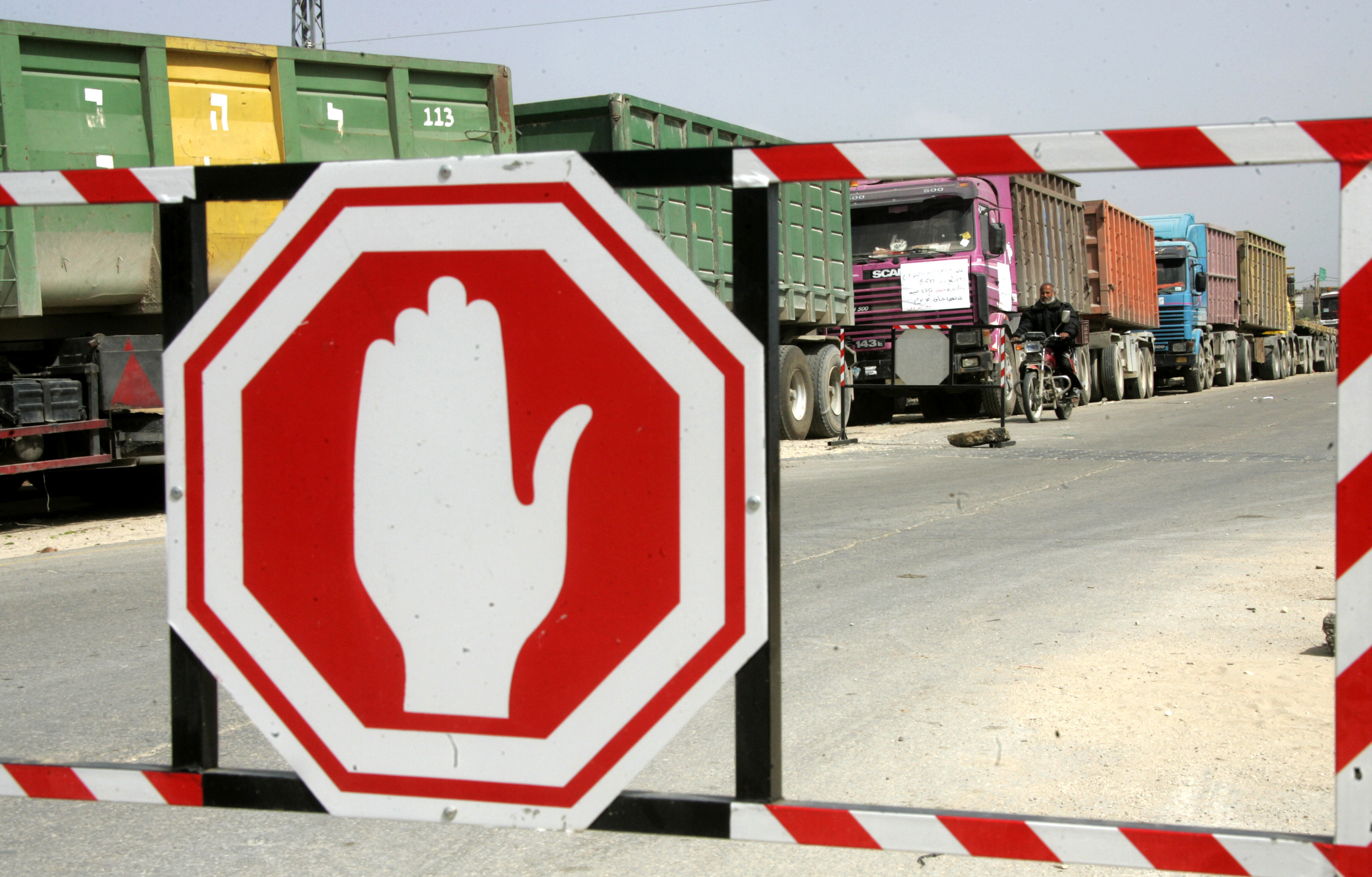
Karam abu Salem crossing

So: Gaza 101.  Medical equipment and supplies are exempt from the blockade and are allowed through the Karam Abu Salem crossing (after protracted and expensive security checks) but the siege economy of Gaza has been so cruelly and deliberately weakened by Israel that it has been extremely difficult for authorities to pay for them.  Their precarious financial position is made worse by direct Israeli intervention in the supply of pharmaceuticals.  Corporate Watch reports that

When health services in Gaza purchase drugs from the international market they come into Israel through the port of Ashdod but are not permitted to travel the 35km to Karam Abu Salem directly. Instead they are transported to the Bitunia checkpoint into the West Bank and stored in Ramallah, where a permit is applied for to transport them to Gaza, significantly increasing the length and expense of the journey.

There’s more – much more: you can download the briefing here – but all this explains why Gaza depends so much on humanitarian aid (and, in the past, on medical supplies smuggled in through the tunnels).  Earlier this summer Gaza’s medical facilities were facing major shortfalls; 28 per cent of essential drugs and 54 per cent of medical disposables were at zero stock.

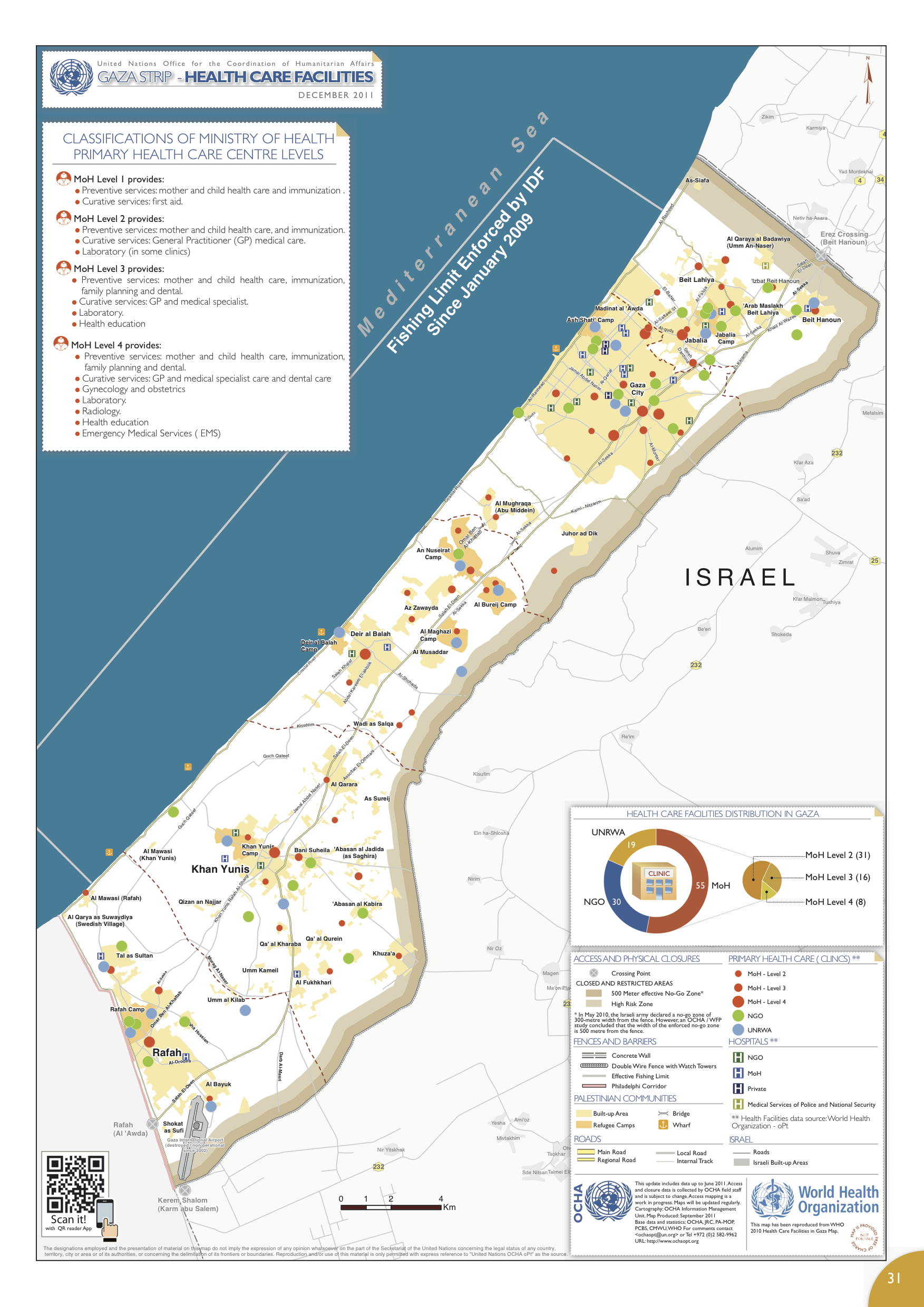
ochaopt_atlas_health_care_december2011

Medical care involves more than bringing in vital supplies and maintaining infrastructure (the map of medical facilities above is taken from the UN’s humanitarian atlas and shows the situation in December 2011; the WHO’s summary of the situation in 2012 is here).  Medical care also involves unrestricted access to electricity and clean water; both are compromised in Gaza, and on 1 January 2014 B’Tselem reported a grave deterioration in health care as a result:

‘The siege that Israel has imposed on the Gaza Strip since Hamas took over control of the security apparatus there in June 2007 has greatly harmed Gaza’s health system, which had not functioned well beforehand…. The reduction, and sometimes total stoppage, of the supply of fuel to Gaza for days at a time has led to a decrease in the quality of medical services, reduced use of ambulances, and serious harm to elements needed for proper health, such as clean drinking water and regular removal of solid waste. Currently, some 30 percent of the Gaza Strip’s residents do not receive water on a regular basis.’

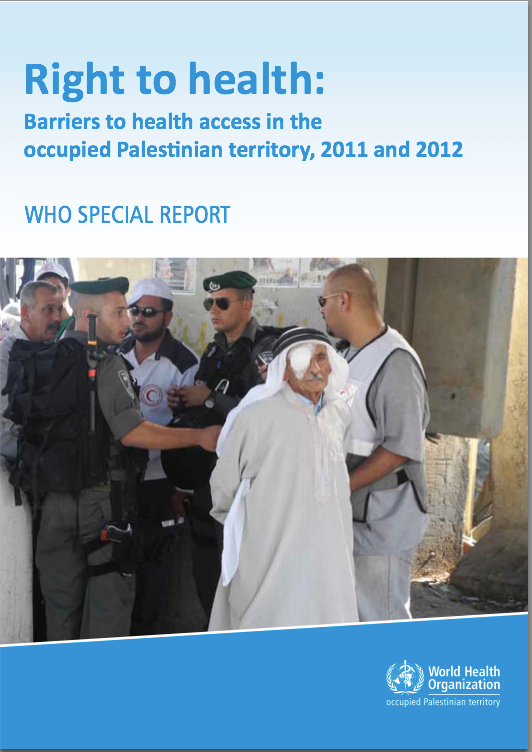
WHO Right to healthIn-bound transfers are tightly constrained, but so too are out-bound movements.  Seriously ill patients requiring advanced treatment had their access to specialists and hospitals outside Gaza restricted:

‘Israel has cut back on issuing permits to enter the country for the hundreds of patients each month who need immediate life-saving treatment and urgent, advanced treatment unavailable in Gaza. The only crossing open to patients is Erez Crossing, through which Israel allows some of these patients to cross to go to hospitals inside Israel [principally in East Jerusalem], and to treatment facilities in the West Bank, Egypt, and Jordan. Some patients not allowed to cross have referrals to Israeli hospitals or other hospitals. Since Hamas took over control of the Gaza Strip, the number of patients forbidden to leave Gaza “for security reasons” has steadily increased.’

As in the West Bank, Israel has established a labyrinthine system to regulate and limit the mobility of Palestinians even for medical treatment.  Last month the World Health Organization explained the system and its consequences (you can find a detailed report with case studies here):

‘In Gaza, patients must submit a permit application at least 10 days in advance of their hospital appointment to allow for Israeli processing. Documents are reviewed first by the health coordinator but final decisions are made by security officials. Permits can be denied for reasons of security, without explanation; decisions are often delayed. In 2013, 40 patients were denied and 1,616 were delayed travel through Erez crossing to access hospitals in East Jerusalem, Israel, the West Bank and Jordan past the time of their scheduled appointment. If a patient loses an appointment they must begin the application process again. Delays interrupt the continuity of medical care and can result in deterioration of patient health. Companions (mandatory for children) must also apply for permits. A parent accompanying a child is sometimes denied a permit, and often both parents, and the family must arrange for a substitute, a process which delays the child’s treatment.’

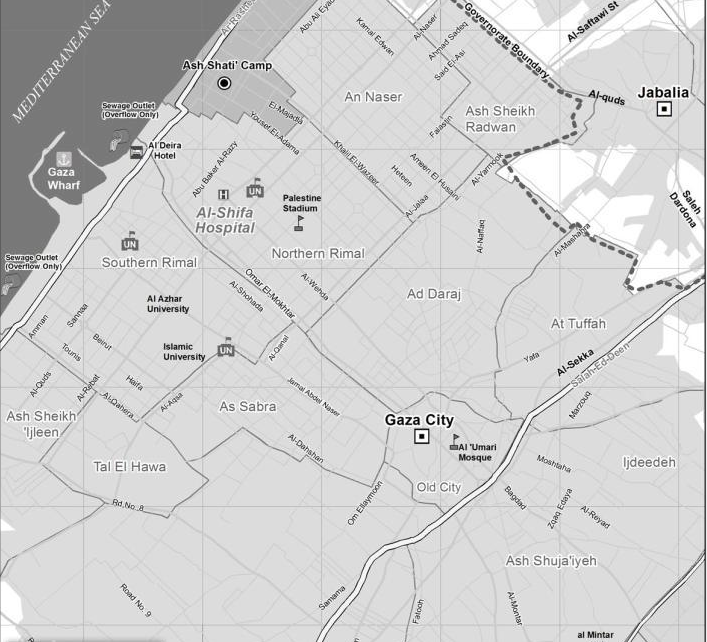
On 17 June Al-Shifa Hospital, the main medical facility in Gaza City (see map below), had already been forced to cancel all elective surgeries and concentrate on emergency treatment.  On 3 July it had to restrict treatment to life-saving emergency surgery to conserve its dwindling supplies. All of this, remember, was before the latest Israeli offensive.  People have not stopped getting sick or needing urgent treatment for chronic conditions, so the situation has deteriorated dramatically.  The care of these patients has been further compromised by the new, desperately urgent imperative to prioritise the treatment of those suffering life-threatening injuries from Israel’s military violence.

al-Shifa and Shuja'iyeh map

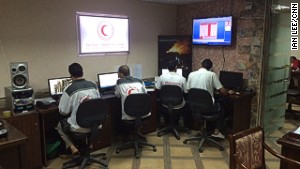
Trauma surgeons emphasise the importance of the ‘golden hour’: the need to provide advanced medical care within 60 minutes of being injured.  Before the IDF launched its ground invasion, there were three main sources of injury: blast wounds from missiles, penetrating wounds from artillery grenades and compression injuries from buildings collapsing.  But this is only a typology; many patients have multiple injuries. ‘We are not just getting patients with one injury that needs attending,’ said the head of surgery at Al-Shifa, ‘we are getting a patient with his brain coming out of his skull, his chest crushed, and his limbs missing.’  All of these injuries are time-critical and require rapid intervention. Ambulance control centre central GazaAnd yet the Ministry of Health reckons that Gaza’s ambulance service is running at 50 per cent capacity as a result of fuel shortages.  That figure must have been reduced still further by the number of ambulances that have been hit by Israeli fire (for more on paramedics in Gaza, and the extraordinary risks they run making 20-30 trips or more every day, see here and this report from the Telegraph‘s David Blair here).  When CNN reporters visited the dispatch centre at Jerusalem Hospital in Gaza City last Tuesday, they watched a a screen with illuminated numbers recording 193 killed and 1,481 injured and the director of emergency services dispatching available ambulances to the site of the latest air strike (by then, there had already been over 1,000 of them).  But the system only works effectively when there is electricity…

628x471

Power supplies were spasmodic at the best of times (whenever those were); they have been even more seriously disrupted by the air campaign, and since the start of the ground assault Gaza has lost around 90 per cent of its power generating capacity.  Nasouh Nazzal reports that many hospitals have been forced to switch to out-dated generators to light buildings and power equipment:

“The power generators in Gaza hospitals are not trusted at all and they can go down any moment. If power goes out, medical services will be basically terminated,” [Dr Nasser Al Qaedrah] said. He stressed that the old-fashioned types of power generators available in Gaza consume huge quantities of diesel, a rare product in the coastal enclave.

On occasion, Norwegian ER surgeon Mads Gilbert told reporters, if the lights go out in the middle of an operation ‘[surgeons] pick up their phones, and they use the light from the screen to illuminate the operation field.’ (He had brought head-lamps with him from Bergen but found they were on Israel’s banned list of ‘dual-use’ goods). As the number of casualties rises, the vast majority of them civilians, so hospitals have been stretched to the limit and beyond.  According to Jessica Purkiss, the situation was already desperate a week ago:

“The number of injuries is huge compared to the hospitals’ capacity,” said Fikr Shalltoot, the Gaza program director for Medical Aid for Palestinians, an organization desperately trying to raise funds to procure more supplies. “There are 1,000 hospital beds in the whole of Gaza. An average of 200 injuries are coming to them every day.”

As in so many other contemporary conflicts – Iraq, Libya, Syria – hospitals themselves had already become targets for military violence.  For eleven days Al-Wafa Hospital in Shuja’iyeh in eastern Gaza City (see the map above), the only rehabilitation centre serving the occupied territories, was receiving phone calls from the IDF warning them that the building was about to be bombed.  [In case you’re impressed by the consideration, think about Paul Woodward‘s observation: ‘I grew up in Britain during the era when the Provisional IRA was conducting a bombing campaign in Northern Ireland and on the mainland. I don’t remember the Provos ever being praised for the fact that they would typically phone the police to issue a warning before their bombs detonated. No one ever dubbed them the most humane terrorist organization in the world.’] The staff refused to evacuate the hospital because their patients were paralysed or unconscious. The Executive Director, Dr Basman Alashi, explained:

‘We’ve been in this place since 1996. We are known to the Israeli government. We are known to the Israeli Health Center and Health Ministry. They have transferred several patients to our hospital for rehabilitations. And we have many success stories of people come for rehabilitation. They come crawling or in a wheelchair; they go out of the hospital walking, and they go back to Israel saying that al-Wafa has done miracle to them. So we are known to them, who we are, what we are. And we are not too far from their border. Our building is not too small. It’s big. It’s about 2,000 square meters. If I stand on the window, I can see the Israelis, and they can see me. So we are not hiding anything in the building. They can see me, and I can see them. And we’ve been here for the last 12 or 15 years, neighbors, next to each other. We have not done any harm to anybody, but we try to save life, to give life, to better life to either an Arab Palestinian or an Israeli Jew.’

el-Wafa.03

But just after 9 p.m. on 17 July shells started falling:

‘… the fourth floor, third floor, second floor. Smoke, fire, dust all over. We lost electricity… luckily, nobody got hurt. Only burning building, smoke inside, dust, ceiling falling, wall broke, electricity cutoff, water is leaking everywhere. So, the hospital became [uninhabitable].’

Seventeen patients were evacuated and transferred to the Sahaba Medical Complex in Gaza City. Sharif Abdel Kouddos takes up the story:

‘The electricity went out, all the windows shattered, the hospital was full of dust, we couldn’t see anything,’ says Aya Abdan, a 16-year-old patient at the hospital who is paraplegic and has cancer in her spinal cord. She is one of the few who can speak.

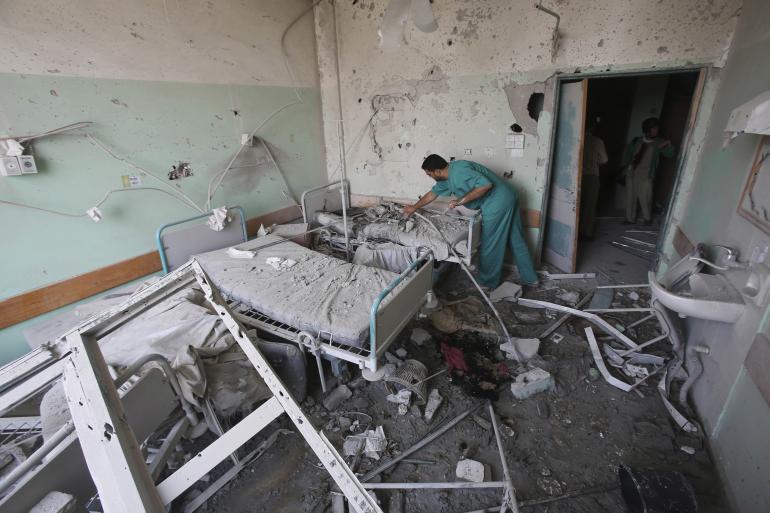
It is, of course, literally unspeakable.  But this was not an isolated incident – still less ‘a mistake’ – and other hospitals have been bombed or shelled.  According to the Ministry of Health, 25 health facilities in Gaza have been partially or totally destroyed. Just this morning it was reported that Israeli tanks shelled the al-Aqsa Hospital in Deir al-Balah in central Gaza, killing five and injuring 70 staff and patients. The Guardian reports that ambulances which tried to evacuate patients were forced to turn back by continued shelling.  According to Peter Beaumont:

‘”People can’t believe this is happening – that a medical hospital was shelled without the briefest warning. It was already full with patients,” said Fikr Shalltoot, director of programmes at Medical Aid for Palestinians in Gaza city.’

mads-gilbert-at-al-shifa-hospital

The hospitals that remain in operation are overwhelmed, with doctors making heart-wrenching decisions about who to treat and who to send away, refusing ‘moderately injured patients they normally would have admitted in order to make room for the more seriously wounded.’  Mads Gilbert (centre in the image above) again:

Oh NO! not one more load of tens of maimed and bleeding, we still have lakes of blood on the floor in the ER, piles of dripping, blood-soaked bandages to clear out – oh – the cleaners, everywhere, swiftly shovelling the blood and discarded tissues, hair, clothes,cannulas – the leftovers from death – all taken away…to be prepared again, to be repeated all over. More then 100 cases came to Shifa last 24 hrs. enough for a large well trained hospital with everything, but here – almost nothing: electricity, water, disposables, drugs, OR-tables, instruments, monitors – all rusted and  as if taken from museums of yesterdays hospitals.

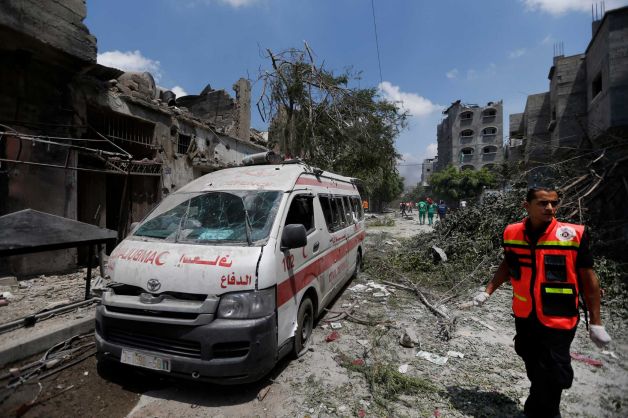
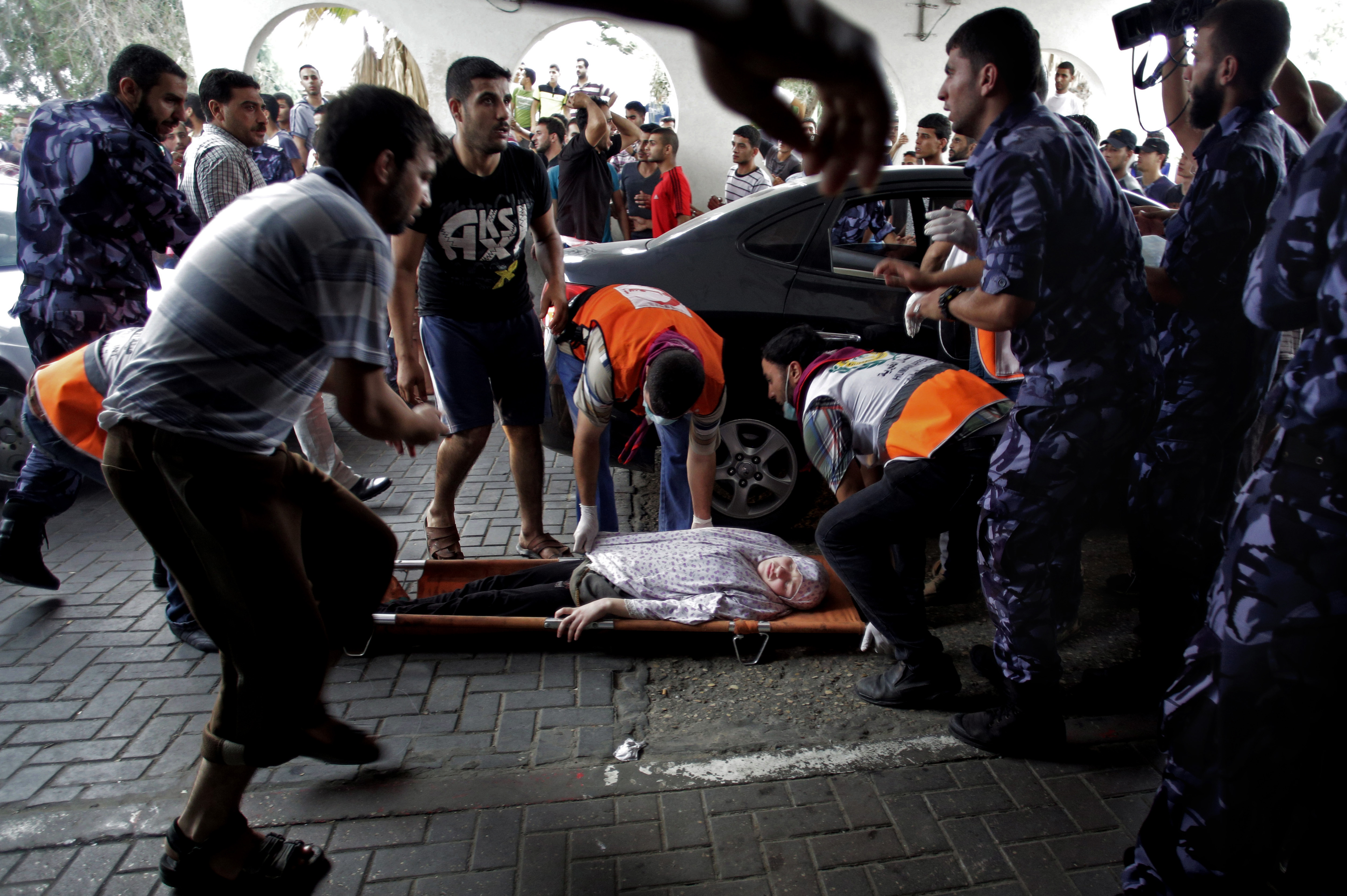
Al-Shifa, where he is working round the clock, has only 11 beds in its ER and just six Operating Rooms.  On Saturday night, when the Israeli army devastated the suburb of Shuja’ieyh, its ‘tank shells falling like hot raindrops‘, al-Shifa had to deal with more than 400 injured patients. Al-Shifa is Gaza’s main trauma centre but in other sense Gaza’s trauma is not ‘centred’ at all but is everywhere within its iron walls.  Commentators repeatedly describe Gaza as the world’s largest open-air prison – though, given the cruelly calculated deprivation of the means of normal life, concentration camp would be more accurate – but it is also one where the guards routinely kill, wound and hurt the prisoners. The medical geography I’ve sketched here is another way of reading Israel’s bloody ‘map of pain‘. I am sickened by the endless calls for ‘balance’, for ‘both sides’ to do x and y and z, as though this is something other than a desperately unequal struggle: as though every day, month and year the Palestinians have not been losing their land, their lives and their liberties to a brutal, calculating and manipulative occupier.  I started this post with an image of a Palestinian ambulance; the photograph below was taken in Shuja’ieyh at the weekend.  It too is an image of a Palestinian ambulance.

Shujaiyeh.01
For updates see here; I fear there will be more to come. In addition to the links in the post above, this short post is also relevant (I’ve received an e-mail asking me if I realised what the initial letters spelled…. Duh.)

Writing the wounds of war

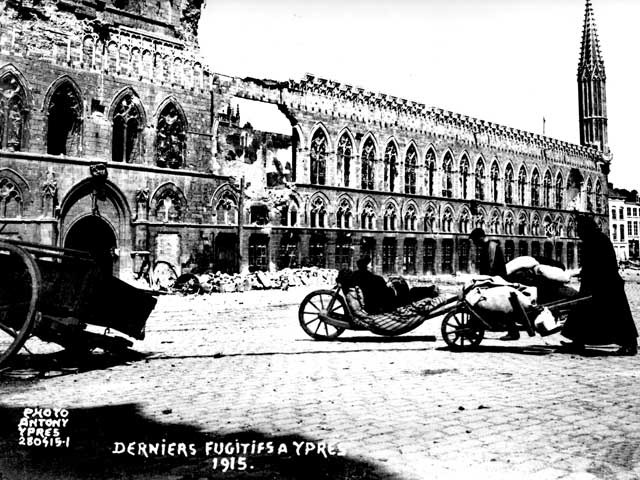
ramc-ypres-1915

Apart from trying to keep up with developments in Syria and Iraq – on which more shortly – I’ve also been continuing my reading on medical care on the Western Front.  I’ve now finished The Backwash of War, and what a bleak little book it is.  There’s very little about medical care – largely because in many respects there seems to have been very little of it in Ellen La Motte‘s field hospital – and much of the discussion is a deeply disturbing account of the cynicism of military violence: the generals who visit only to pin medals on the blankets of the dying, the contempt between medical orderlies and patients (who have no time for those who are not serving on the front lines), and the seemingly endless, agonising deaths of patients.  But that was precisely what gave the author her title:

The sketches were written in 1915 and 1916, when the writer was in a French military field hospital, a few miles behind the lines, in Belgium. War has been described as “months of boredom, punctuated by moments of intense fright.” During this time at the Front, the lines moved little, either forward or backward, but were deadlocked in one position. Undoubtedly, up and down the long reaching kilometers of “Front” there was action, and “moments of intense fright” which produced fine deeds of valor, courage and nobility. But where there is little or no action there is a stagnant place, and in that stagnant place is much ugliness. Much ugliness is churned up in the wake of mighty, moving forces, and this is the backwash of war. Many little lives foam up in this backwash, loosened by the sweeping current, and detached from their environment. One catches a glimpse of them—often weak, hideous or repellent. There can be no war without this backwash.

In some part, perhaps, La Motte’s account reflects differences between British and French medical provision.  Lyn Macdonald‘s The roses of no man’s land (which contains all sorts of insights into the geographies of medical evacuation and provision en passant) suggests that ‘Lying wounded on the battlefield [at Verdun] a French soldier was as good as dead, for there was little chance of his being brought in, and if he had the good luck to be rescued and taken to a hospital there was only one chance in three that he would leave it alive.’   By the end of the war, she continues, of France’s 1,300,000 war dead more than 400,000 had died of their wounds: ‘a proportion that was larger by far than those of any other nation and was due in considerable measure to the makeshift conditions and lack of skilled care in all but a few of the hospitals.’
The politics of wounds

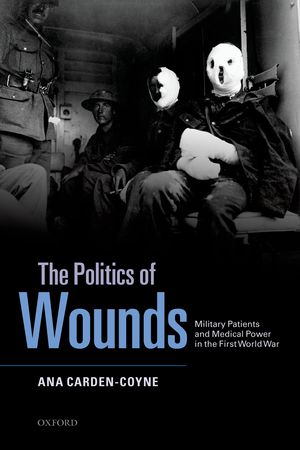
This isn’t to romanticise the experience of those wounded in other armies, of course, but it adds another dimension to what Ana Carden-Coyne calls ‘the politics of wounds’.   Her new book, due out in the fall, The politics of wounds: military patients and medical power in the First World War (Oxford University Press), is high on my reading list for my new research project:

The Politics of Wounds explores military patients’ experiences of frontline medical evacuation, war surgery, and the social world of military hospitals during the First World War. The proximity of the front and the colossal numbers of wounded created greater public awareness of the impact of the war than had been seen in previous conflicts, with serious political consequences.

Frequently referred to as ‘our wounded’, the central place of the soldier in society, as a symbol of the war’s shifting meaning, drew contradictory responses of compassion, heroism, and censure. Wounds also stirred romantic and sexual responses. This volume reveals the paradoxical situation of the increasing political demand levied on citizen soldiers concurrent with the rise in medical humanitarianism and war-related charitable voluntarism. The physical gestures and poignant sounds of the suffering men reached across the classes, giving rise to convictions about patient rights, which at times conflicted with the military’s pragmatism. Why, then, did patients represent military medicine, doctors and nurses in a negative light? The Politics of Wounds listens to the voices of wounded soldiers, placing their personal experience of pain within the social, cultural, and political contexts of military medical institutions. The author reveals how the wounded and disabled found culturally creative ways to express their pain, negotiate power relations, manage systemic tensions, and enact forms of ‘soft resistance’ against the societal and military expectations of masculinity when confronted by men in pain. The volume concludes by considering the way the state ascribed social and economic values on the body parts of disabled soldiers though the pension system.

But all this is about military patients: what of civilians who are wounded or become ill in war zones?  The BackWash of War provides one vignette that is worth reporting in full.  It’s titled ‘The Belgian Civilian’:

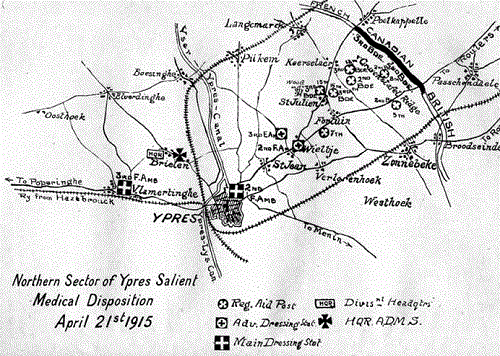
‘A big English ambulance drove along the high road from Ypres, going in the direction of a French field hospital, some ten miles from Ypres. Ordinarily, it could have had no business with this French hospital, since all English wounded are conveyed back to their own bases, therefore an exceptional case must have determined its route. It was an exceptional case—for the patient lying quietly within its yawning body, sheltered by its brown canvas wings, was not an English soldier, but only a small Belgian boy, a civilian, and Belgian civilians belong neither to the French nor English services. It is true that there was a hospital for Belgian civilians at the English base at Hazebrouck, and it would have seemed reasonable to have taken the patient there, but it was more reasonable to dump him at this French hospital, which was nearer. Not from any humanitarian motives, but just to get rid of him the sooner. In war, civilians are cheap things at best, and an immature civilian, Belgian at that, is very cheap. So the heavy English ambulance churned its way up a muddy hill, mashed through much mud at the entrance gates of the hospital, and crunched to a halt on the cinders before the Salle d’Attente, where it discharged its burden and drove off again.
Medical Provision, Ypres, 1915

‘The surgeon of the French hospital said: “What have we to do with this?” yet he regarded the patient thoughtfully. It was a very small patient. Moreover, the big English ambulance had driven off again, so there was no appeal. The small patient had been deposited upon one of the beds in the Salle d’Attente, and the French surgeon looked at him and wondered what he should do. The patient, now that he was here, belonged as much to the French field hospital as to any other, and as the big English ambulance from Ypres had driven off again, there was not much use in protesting….

‘A Belgian civilian, aged ten. Or thereabouts. Shot through the abdomen, or thereabouts. And dying, obviously. As usual, the surgeon pulled and twisted the long, black hairs on his hairy, bare arms, while he considered what he should do. He considered for five minutes, and then ordered the child to the operating room, and scrubbed and scrubbed his hands and his hairy arms, preparatory to a major operation. For the Belgian civilian, aged ten, had been shot through the abdomen by a German shell, or piece of shell, and there was nothing to do but try to remove it. It was a hopeless case, anyhow. The child would die without an operation, or he would die during the operation, or he would die after the operation….

‘After a most searching operation, the Belgian civilian was sent over to the ward, to live or die as circumstances determined. As soon as he came out of ether, he began to bawl for his mother. Being ten years of age, he was unreasonable, and bawled for her incessantly and could not be pacified. The patients were greatly annoyed by this disturbance, and there was indignation that the welfare and comfort of useful soldiers should be interfered with by the whims of a futile and useless civilian, a Belgian child at that. The nurse of that ward also made a fool of herself over this civilian, giving him far more attention than she had ever bestowed upon a soldier. She was sentimental, and his little age appealed to her—her sense of proportion and standard of values were all wrong. The Directrice appeared in the ward and tried to comfort the civilian, to still his howls, and then, after an hour of vain effort, she decided that his mother must be sent for. He was obviously dying, and it was necessary to send for his mother, whom alone of all the world he seemed to need. So a French ambulance, which had nothing to do with Belgian civilians, nor with Ypres, was sent over to Ypres late in the evening to fetch this mother for whom the Belgian civilian, aged ten, bawled so persistently.

‘She arrived finally, and, it appeared, reluctantly. About ten o’clock in the evening she arrived, and the moment she alighted from the big ambulance sent to fetch her, she began complaining. She had complained all the way over, said the chauffeur…. She had been dragged away from her husband, from her other children, and she seemed to have little interest in her son, the Belgian civilian, said to be dying. However, now that she was here, now that she had come all this way, she would go in to see him for a moment, since the Directrice seemed to think it so important….

‘She saw her son, and kissed him, and then asked to be sent back to Ypres. The Directrice explained that the child would not live through the night. The Belgian mother accepted this statement, but again asked to be sent back to Ypres. The Directrice again assured the Belgian mother that her son would not live through the night, and asked her to spend the night with him in the ward, to assist at his passing. The Belgian woman protested.

“If Madame la Directrice commands, if she insists, then I must assuredly obey. I have come all this distance because she commanded me, and if she insists that I spend the night at this place, then I must do so. Only if she does not insist, then I prefer to return to my home, to my other children at Ypres.”

‘However, the Directrice, who had a strong sense of a mother’s duty to the dying, commanded and insisted, and the Belgian woman gave way. She sat by her son all night, listening to his ravings and bawlings, and was with him when he died, at three o’clock in the morning. After which time, she requested to be taken back to Ypres. She was moved by the death of her son, but her duty lay at home. Madame la Directrice had promised to have a mass said at the burial of the child, which promise having been given, the woman saw no necessity for remaining.

“My husband,” she explained, “has a little estaminet, just outside of Ypres. We have been very fortunate. Only yesterday, of all the long days of the war, of the many days of bombardment, did a shell fall into our kitchen, wounding our son, as you have seen. But we have other children to consider, to provide for. And my husband is making much money at present, selling drink to the English soldiers. I must return to assist him.”
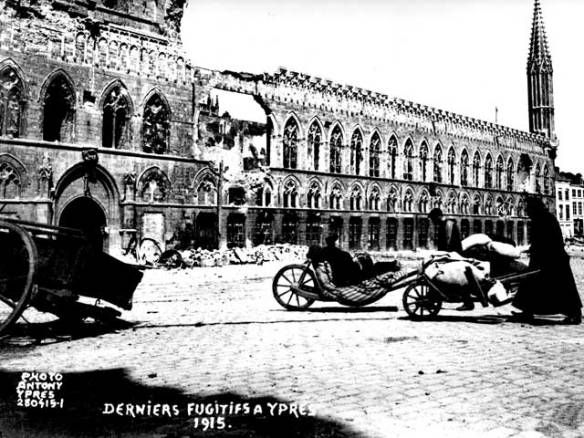
YPRES 1915

‘So the Belgian civilian was buried in the cemetery of the French soldiers, but many hours before this took place, the mother of the civilian had departed for Ypres. The chauffeur of the ambulance which was to convey her back to Ypres turned very white when given his orders. Everyone dreaded Ypres, and the dangers of Ypres. It was the place of death. Only the Belgian woman, whose husband kept an estaminet, and made much money selling drink to the English soldiers, did not dread it. She and her husband were making much money out of the war, money which would give their children a start in life. When the ambulance was ready she climbed into it with alacrity, although with a feeling of gratitude because the Directrice had promised a mass for her dead child.

“These Belgians!” said a French soldier. “How prosperous they will be after the war! How much money they will make from the Americans, and from the others.”‘

It would obviously be absurd to generalise from one vignette, but there’s clearly a different politics at work in this narrative,  and a complex set of political geographies too.  For a careful reading of La Motte’s account, in parallel with Mary Borden‘s The forbidden zone, you could do no better than Margaret Higonnet‘s introduction to her Nurses at the front: writing the wounds of the great war.  I’ve now started on a series of accounts about the work of field ambulances, and one which resonates with the events described in La Motte’s vignette is William Boyd‘s letters from 7 March to 15 August 1915 published as With a field ambulance at Ypres (1916), which you can download free here.

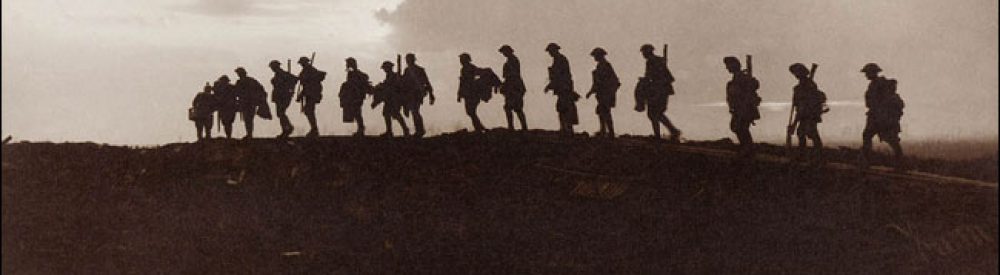
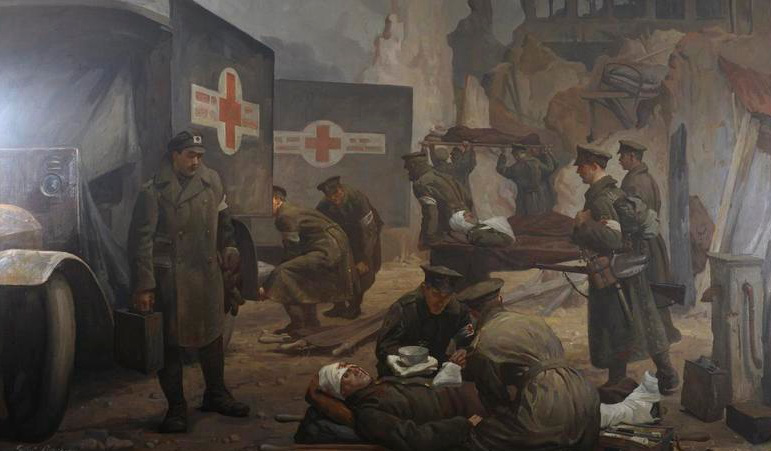
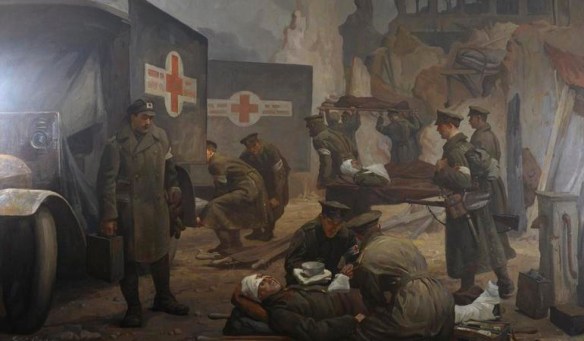
But all this – important – talk about writing the wounds of war should not blind us (me) to the role of visualising the wounds of war, and to the work done by artfully composed (and surely sanitised) images like the one that heads this post…