More terror from the skies

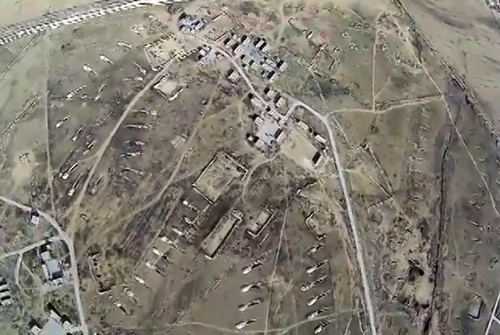
IS drone imagery Syria

Commentators have been worrying away at the likelihood of terrorist groups turning to small commercial drones not only for surveillance – IS have been doing that for some time now (see the image above) – but also for air strikes (see, for a recent example, Robert J Bunker‘s report for the US Army War College here).  The surveillance capabilities of quadcopters have been used to direct attacks by IS ground forces, including vehicles carrying suicide bombs, but the Pentagon now reports that the drones have also been equipped with improvised explosive devices (IEDs).

In response, the Pentagon has asked for $20 million for its Joint Improvised-Threat Defeat Agency to develop counter-measures: to ‘identify, acquire, integrate and conduct testing’ of methods that are able to ‘counter the effects of unmanned aerial systems and the threats they pose to U.S. forces.’

Perhaps they should also look closer to home.  Two men in Connecticut have contested the right of the Federal Aviation Administration to investigate their use of ‘recreational drones’ equipped with a handgun and a flamethrower.  Here’s a video clip:

And other commentators are already looking beyond war zones: systems like these enable groups like IS – and individuals – to carry the fight far beyond the territory they control and into the heart of cities in North America, Europe and elsewhere.

The Last Dance

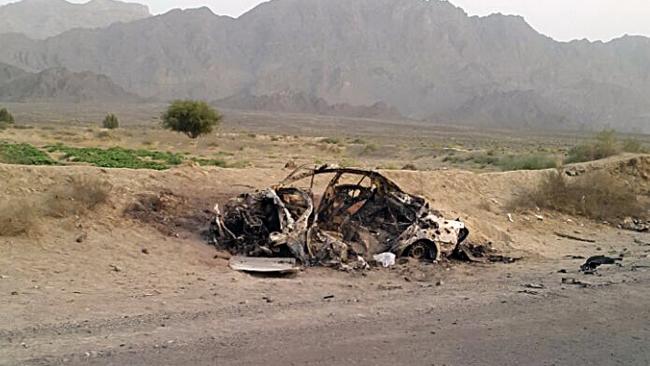
Mansour strike photo

I have – at long last – finished the longform version of “Dirty dancing: drones and death in the borderlands“, which analyses drone strikes in Pakistan’s Federally Administered Tribal Areas and situates them within a wider context of military violence in the region.  You can find it under the DOWNLOADS tab, but I’ve pasted the conclusion below; there’s also a video of the last presentation I gave under that title here.

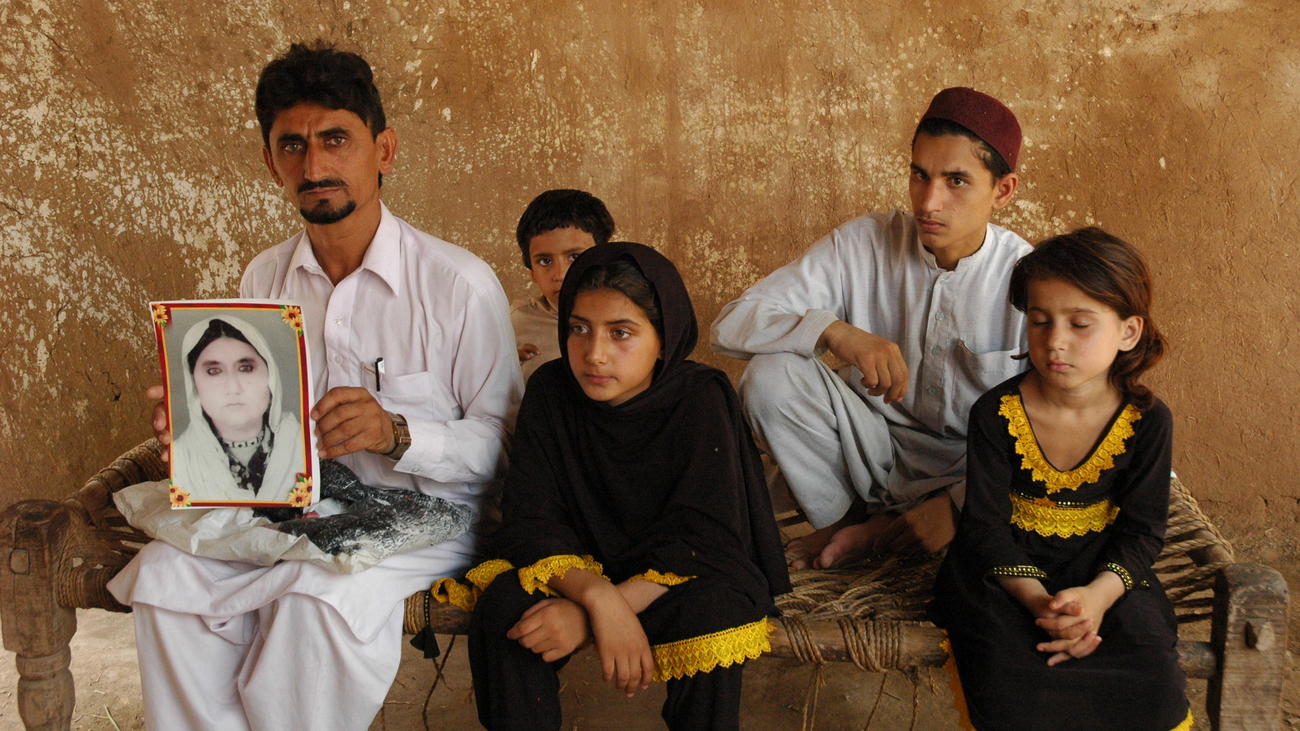
To make sense of the conclusion, I should explain that the essay opens by juxtaposing the killing of two people, Baitullah Mehsud (leader of the Pakistan Taliban) and Mamana Bibi (a village midwife), to pose the question: what kinds of spaces are the FATA made to be for incidents like these – incidents as unlike as these – to be possible?

My answer works with two framing devices.

The first is the space of exception – a space in which people are knowingly and deliberately exposed to death through the political-juridical removal of legal protections and affordances that would otherwise be available to them.  My version of this is different from that proposed by Giorgio Agamben, and far from invoking a suspension of the law I explore three legal geographies that have been used to prepare the ground for aerial violence in the borderlands.

The second is the space of execution; here I riff off Owen Sheers‘ perceptive remark about ‘the territory of the screen’ (as I note, ‘Killing somebody with a Hellfire missile controlled from thousands of miles away depends upon a screen – or more accurately a series of screens – on which the image of a human body will eventually be touched by the cross-hairs of a targeting pod’).  Owen’s phrase is much more than metaphor, so I treat ‘territory’ as a (bio)political technology whose calibrations enable states to assert, enact and enforce a claim over bodies-in-space (you can no doubt hear the echoes of Stuart Elden) and then explore the technicity involved in three of its screen elements that jointly transform the FATA into a space of execution: kill lists, signals intercepts and visual feeds.

***

Mamana Bibi's surviving family

Here, then, is the conclusion:

The production of the borderlands as spaces of exception and spaces of execution are attempts to force those who live there into particular subject-positions as a means of subjugation. These positions are partial and precarious but the project to establish them as legitimate and rational has consequences that are material and affective. They clearly affect those targeted – people like Baitullah Mehsud – whose political agency exceeds in terrifying ways the normative space allowed them by the state of Pakistan and the United States and in so doing brings their actions to the attention of both. But they also impact the rest of the population in the FATA, constricting their mobilities and stoking their fears to such a degree that ‘normal life’ for many of them threatens to become a memory or a fantasy. Their existence is rendered more precarious because the subject-positions to which they are so brutally assigned are racialized. These are ‘tribal peoples’, different from those who inhabit ‘mainland Pakistan’, while the United States writes off their incidental deaths as ‘collateral damage’ whose anonymity confers on them no individuality only a collective ascription. When a CIA-directed drone strike on a compound in the Shawal Valley of South Waziristan on 15 January 2015 was found to have killed not only a deputy leader of al-Qaeda in the Indian subcontinent and a local Taliban commander but also two hostages, an American development contractor and an Italian aid worker, a ‘grim-faced’ and ‘visibly moved’ Obama made a personal and public apology. [i] The rarity of the gesture is revealing. For the value of their lives was acknowledged and their deaths were made grievable in ways that others – which is to say Others – were not. Nobody has ever accepted responsibility or apologised for the death of Mamana Bibi or any of the other innocent victims of aerial violence.

For this reason it is important to resist those versions of the space of exception that are complicit in the denial of agency to those who live within its confines. The state of Pakistan administers the inhabitants of the FATA through Political Agents: but this does not remove (though it does diminish) their own political agency. Pakistan’s armed forces conduct clearing operations that ruthlessly drive people from their homes and into camps for displaced persons: but this does not turn the FATA into one vast ‘camp’. The presence of US drones strips those who live under them of their well-being and dignity: but this does not reduce them to ‘bare life’. Similarly, the emergent subject that is produced within the space of execution, apprehended as a network trace, a sensor signature and a screen image, is a cipher that stands in for – and in the way of – a corporeal actor whose existence is not measured by the calculative alone.

***

This version, or something very much like it, will appear in a collection edited by Caren Kaplan and Lisa Parks, Life in the Age of Drones.  But an (even longer!) version will eventually appear in my own book, with images and maps (you can find many of them scattered through my previous posts: for example here, here and here), so I really would welcome any comments or suggestions if you have time to read the full thing: derek.gregory@ubc.ca.


Vertical fields

I’ve just been reading and thinking about Lisa Parks‘s short but immensely suggestive essay, ‘Drones, Vertical Mediation, and the Targeted Class’, in Feminist Studies 42 (2016) 227-35. Lisa develops her ideas about vertical mediation but at the end of the essay she illustrates them through an art installation staged in Beirut last spring. This is what she says:

In an effort to publicize the drone’s vertical mediations—the way the technology uses the vertical field in efforts to materially reform life on earth—I collaborated with a group of Lebanese and Slovenian artists (Marc Abou Farhat, Tadej Fius, Elie Mouhanna, and Miha Vipotnik) to create a multimedia installation titled Spectral Configuration. The installation was part of the Vertical Collisions exhibition at the Station Art Gallery in Beirut in May 2015. The installation’s centerpiece is a massive, elevated, four-meter-long, supine human body, hand-crocheted out of thin aluminum wire. As it soars in mid-air, the wiry surface of this colossal corpse turns translucent as multiple media projections, made from video footage leaked from the US military-industrial complex, flicker around and upon it. These electromagnetic projections envelop the silvery drone-like body within the luminous footprint of world his- tory and militarization, cycling through a series of spectral suspects, framed targets, and aerial strikes that appear in visible light and infrared.

Circumnavigating the earth on an endless flight path, this “spectral configuration” not only captures and reflects light and heat waves, it remediates life on earth, altering one’s disposition to the sky, the ground, and the skin…  To make Spectral Configuration, we used the same global information networks, geospatial images, and video-capture technologies utilized each day by US drone operators. The difference, however, was that we commandeered these devices to conceptualize and produce a form and an event that would question the militarization of the vertical field by enacting it on a micro-scale and trying to make its effects intelligible and palpable to publics beyond drone war. By staging the militarization of the vertical field in a country adjacent to, yet not subject to drone war (Lebanon), Spectral Configuration also spoke to the exploitation of borders and associative relations by US drone operators and aroused concerns about the usage of the technology in the region.

The Body of War

Here is a call for papers for a wonderfully creative international symposium, The Body of War: Drones and Lone Wolves,  to be held at the University of Lancaster  on 24-25 November 2016.  It’s part of the ongoing States of Exceptions project (for Part I, see here).

I’ve just agreed to give a keynote; it’s an interdisciplinary event, and the organisers tell me they are keen to encourage the participation of early career scholars.

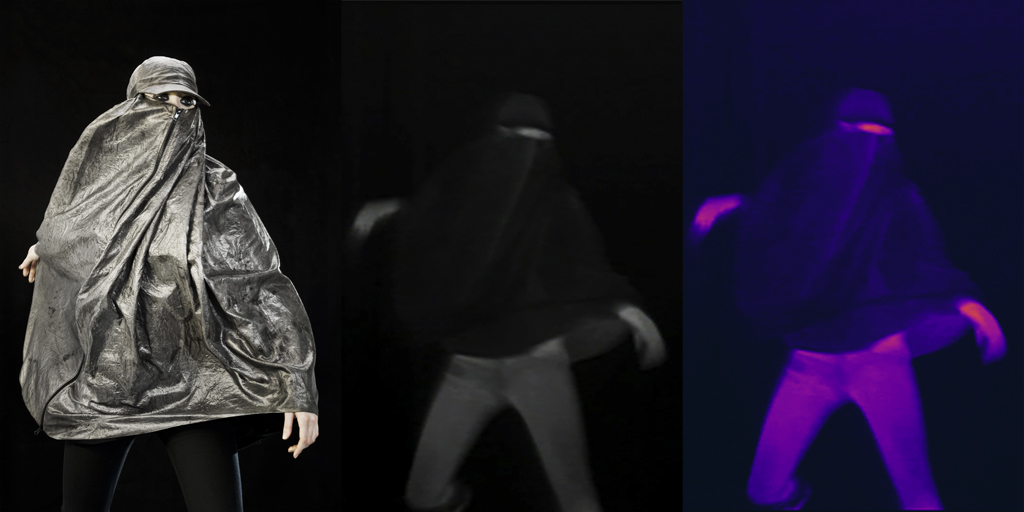
Anti-drone Burqa (Adam Harvey)

Anti-drone Burqa (Adam Harvey)

“The discriminatory concept of the enemy as a criminal and the attendant implication of justa causa run parallel to the intensification of the means of destruction and the disorientation of theaters of war. Intensification of the technical means of destruction opens the abyss of an equally destructive legal and moral discrimination. […] Given the fact that war has been transformed into a police action against troublemakers, criminals, and pests, justification of the methods of this “police bombing” must be intensified. Thus, one is compelled to push the discrimination of the opponent into the abyss.”

Carl Schmitt, The Nomos of the Earth (1950)

13 November 2015: three suicide bombers blew themselves up near the Stade de France in Saint-Denis, Paris, killing themselves and a bystander, and triggering a series of violent actions that caused 130 casualties. 15 November 2015: the President of France, François Hollande, after defying the attacks ‘an act of war’ by the Islamic State, launched a three-month state of emergency and ‘Opération Chammal’, a huge airstrike campaign against ISIL targets in Syria.

These two violent actions design a deformed and limitless theater of war, within which all distinctions and limitations elaborated by International Law seem to disappear. It is not merely the loss of the fundamental distinction between combatants and civilians, that both suicide bombers and airstrike bombings signal. In the current situation, all the fundamental principles that gave birth to the Laws of War seem to collapse: spatial and temporal limitations of hostilities, proportionality of military actions, discrimination of targets, weapons and just methods to use them. In this way, the ‘enemy’, from a juridical concept, is transformed into an ‘ideological object’; his figure, pushed to a climax from both these ‘invisible’ and ‘mobile’ fronts, becomes absolute and de-humanized. Hollande, Cameron and Obama’s unwillingness to use ground troops against the ‘uncivilized’ (Kerry 2015) is mirrored by the ISIL call to intensify suicide missions against the ‘cowards’ (Dābiq, 12: 2015).

But what lies behind the asymmetric confrontation between airstrikes and ‘humanstrikes’, behind the blurring of the distinction between the state of war and state of peace? What notion of humanity are the physical disengagement of the Western powers (with their tele-killing via drones and airstrikes) and the physical engagement of suicide bombers (ready to turn their bodies into a weapon) trying to convey? In other words, how and to what extent is there a connection between the automatization and biopoliticization of war operated by Western powers and the sacrificial nature of the conflict adopted by those who want to fight these powers?

In this second part of the “States of Exceptions” project, our intention is to explore these questions in order to map the crucial transformations of warfare, of its ethical principles and methods of engagement.

We invite potential participants to submit abstracts of no more than 250 words by 31 July 2016 drawing upon, but not limited to, such issues as:

  • Theatres of War: The New Spatialities and Temporalities of Warfare
  • Mirror Images? Drones vs. Suicide Bombers
  • Phenomenology of Drones
  • New Perspectives on Ethics, Horror & Terror
  • The Ubiquity of the Enemy: Lone Wolves and Self-Representing Terror
  • The Collapse of International Law: What Enemy? Which Proportionality?
  • The Body as a Weapon: The Immanentization of Martyrdom
  • Phenomenology of Lone Wolves
  • The End of Law: Rethinking Limitation, Proportionality and Discrimination

Please send abstracts with “States of Exception II” in subject line to bisagroup.cript@gmail.com

The machinery of (writing about) bombing

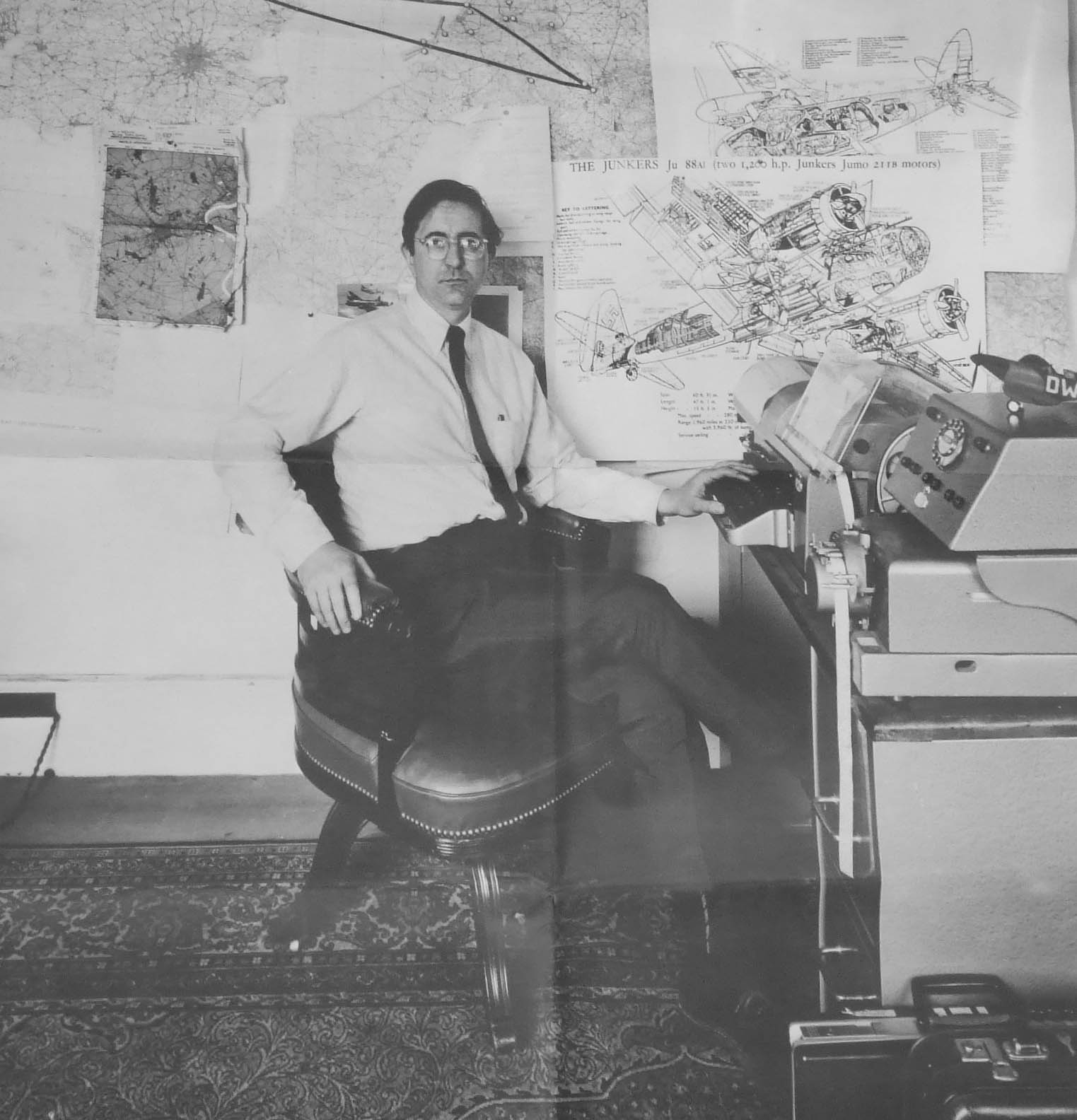
I began the first of my Tanner Lectures – Reach from the Sky – with a discussion of the machinery of bombing, and I started by describing an extraordinary scene: the window of a Georgian terrace house in London being popped out – but not by a bomb.  The year was 1968, and the novelist Len Deighton was taking delivery of the first word-processor to be leased (not even sold) to an individual.

As Matthew Kirschenbaum told the story in Slate:

The IBM technician who serviced Deighton’s typewriters had just heard from Deighton’s personal assistant, Ms. Ellenor Handley, that she had been retyping chapter drafts for his book in progress dozens of times over. IBM had a machine that could help, the technician mentioned. They were being used in the new ultramodern Shell Centre on the south bank of the Thames, not far from his Merrick Square home.

A few weeks later, Deighton stood outside his Georgian terrace home and watched as workers removed a window so that a 200-pound unit could be hoisted inside with a crane. The machine was IBM’s MTST (Magnetic Tape Selectric Typewriter).

It was a lovely story, because the novel Deighton was working on – almost certainly the first to be written on a word-processor – was his brilliant account of bombing in the Second World War, Bomber.  It had started out as a non-fiction book (and Deighton has published several histories of the period) but as it turned into a novel the pace of research never slackened.

Deighton recalls that he had shelved his original project until a fellow writer, Julian Symons, told him that he was ‘the only person he could think of who actually liked machines’:

I had been saying that machines are simply machines… That conversation set me thinking again about the bombing raids. And about writing a book about them. The technology was complex but not so complex as to be incomprehensible. Suppose I wrote a story in which the machines of one nation fought the machines of another? The epitome of such a battle must be the radar war fought in pitch darkness. To what extent could I use my idea in depicting the night bombing war? Would there be a danger that such a theme would eliminate the human content of the book? The human element was already a difficult aspect of writing such a story.

And so Bomber was born.

The novel describes the events surrounding an Allied attack during the night of 31 June (sic) 1943 – the planned target was Krefeld, but the town that was attacked, a ‘target of opportunity’, was ‘Altgarten’.  And like the bombing raid, it was a long haul.  As Deighton explained:

I am a slow worker so that each book takes well over a year—some took several years—and I had always ‘constructed’ my books rather than written them. Until the IBM machine arrived I used scissors and paste (actually Copydex one of those milk glues) to add paras, dump pages and rearrange sections of material. Having been trained as an illustrator I saw no reason to work from start to finish. I reasoned that a painting is not started in the top left hand corner and finished in the bottom right corner: why should a book be put together in a straight line?

Deighton’s objective, so he said, was ‘to emphasize the dehumanizing effect of mechanical warfare. I like machines but in wars all humans are their victims.’

I pulled all this together in this slide:

Len Deighton BOMBER (Tanner Lecture 1).001

I then riffed off Deighton’s work in two ways.

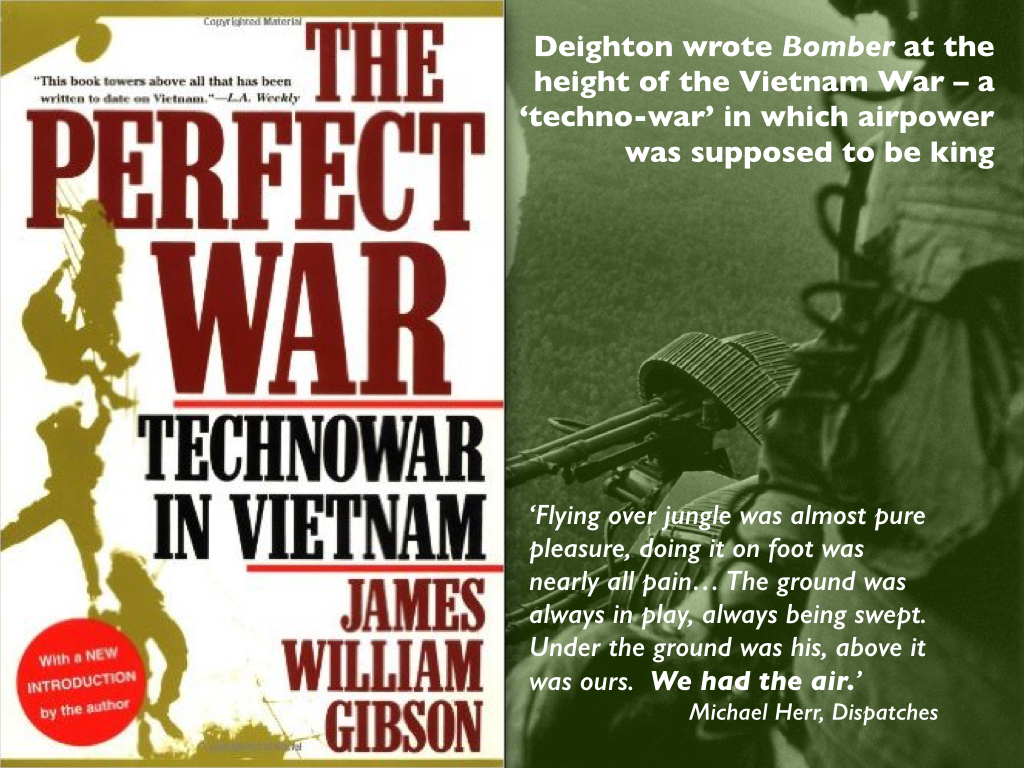
First, I noted that Bomber was written at the height of the Vietnam War, what James Gibson calls ‘techno-war’:

Len Deighton TECHNOWAR (Tanner 2).001

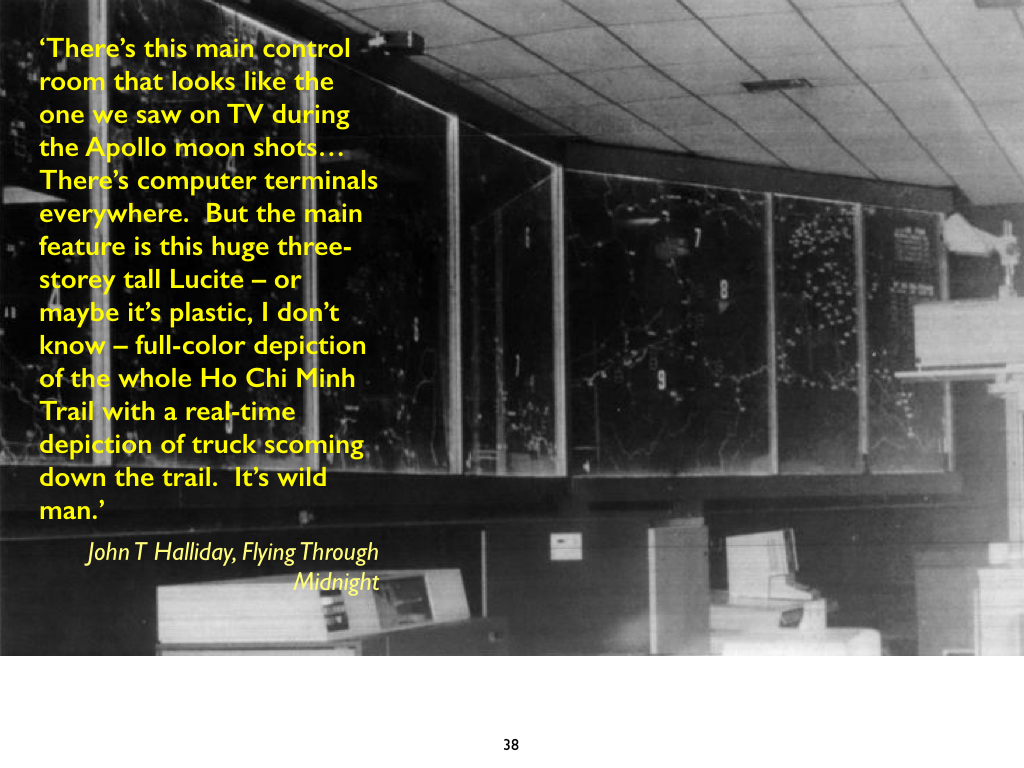
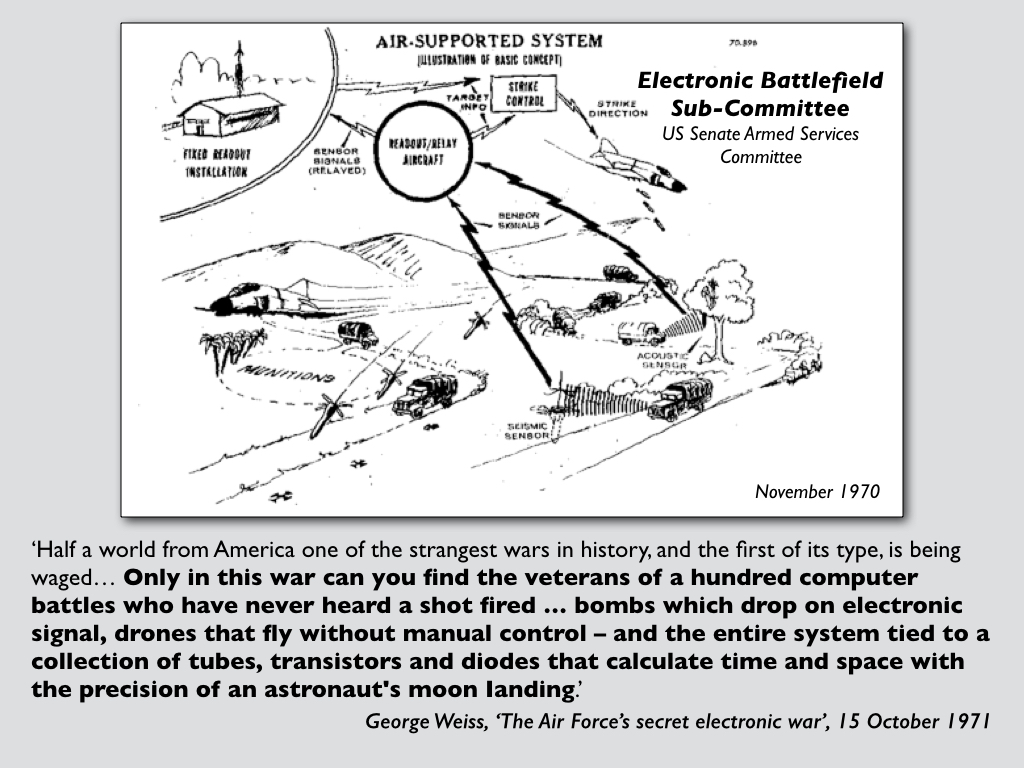
I focused on the so-called ‘electronic battlefield’ that I had discussed in detail in ‘Lines of descent’ (DOWNLOADS tab), and its attempt to interdict the supply lines that snaked along the Ho Chi Minh Trail by sowing it with sensors and automating bombing:

Electronic battlefield 1 (Tanner Lectures).001 Electronic battlefield 2 (Tanner Lectures).001

The system was an expensive failure – technophiles and technophobes alike miss that sharp point – but it prefigured the logic that animates today’s remote operations:

Electronic battlefield 3 (Tanner Lectures).001

Second – in fact, in the second lecture – I returned to Bomber and explored the relations between Deighton’s ‘men and machines’.  There I emphasised the intimacy of a bomber crew in the Second World War (contrasting this with the impersonal shift-work that characterises today’s crews operating Predators and Reapers).  ‘In the air’, wrote John Watson in Johnny Kinsman, ‘they were component parts of a machine, welded together, dependent on each other.’  This was captured perfectly, I think, in this photograph by the inimitable Margaret Bourke-White:

Men-machines (BOURKE-WHITE) Tanner Lectures).001

Much to say about the human, the machine and the cyborg, no doubt, but what has brought all this roaring back is another image of the entanglements between humans and machines that returns me to my starting-point.  In a fine essay in The Paris Review, ‘This faithful machine‘, Matthew Kirschenbaum revisits the history of word-processing.  It’s a fascinating read, and it’s headed by this photograph of Len Deighton working on Bomber in his study:

deighton-home-office-1

Behind him you can see giant cut-away diagrams of British and German bombers, and on the left a Bomber Command route map to ‘the target for tonight’ (the red ribbon crossing the map of Europe), and below that a target map.  ‘Somber things,’ he called them in Bomber:

‘inflammable forest and built-up areas defined as grey blocks and shaded angular shapes.  The only white marks were the thin rivers and blobs of lake.  The roads were purple veins so that the whole thing was like a badly bruised torso.’

More on all that in my ‘Doors into nowhere’ (DOWNLOADS tab), and much more on the history of word-processign in Matthew’s Track Changes: A Literary History of Word Processing just out from Harvard University Press:

The story of writing in the digital age is every bit as messy as the ink-stained rags that littered the floor of Gutenberg’s print shop or the hot molten lead of the Linotype machine. During the period of the pivotal growth and widespread adoption of word processing as a writing technology, some authors embraced it as a marvel while others decried it as the death of literature. The product of years of archival research and numerous interviews conducted by the author, Track Changes is the first literary history of word processing.

Matthew Kirschenbaum examines how the interests and ideals of creative authorship came to coexist with the computer revolution. Who were the first adopters? What kind of anxieties did they share? Was word processing perceived as just a better typewriter or something more? How did it change our understanding of writing?

Track Changes balances the stories of individual writers with a consideration of how the seemingly ineffable act of writing is always grounded in particular instruments and media, from quills to keyboards. Along the way, we discover the candidates for the first novel written on a word processor, explore the surprisingly varied reasons why writers of both popular and serious literature adopted the technology, trace the spread of new metaphors and ideas from word processing in fiction and poetry, and consider the fate of literary scholarship and memory in an era when the final remnants of authorship may consist of folders on a hard drive or documents in the cloud.

And, as you’d expect, it’s available as an e-book.

Dancing with drones

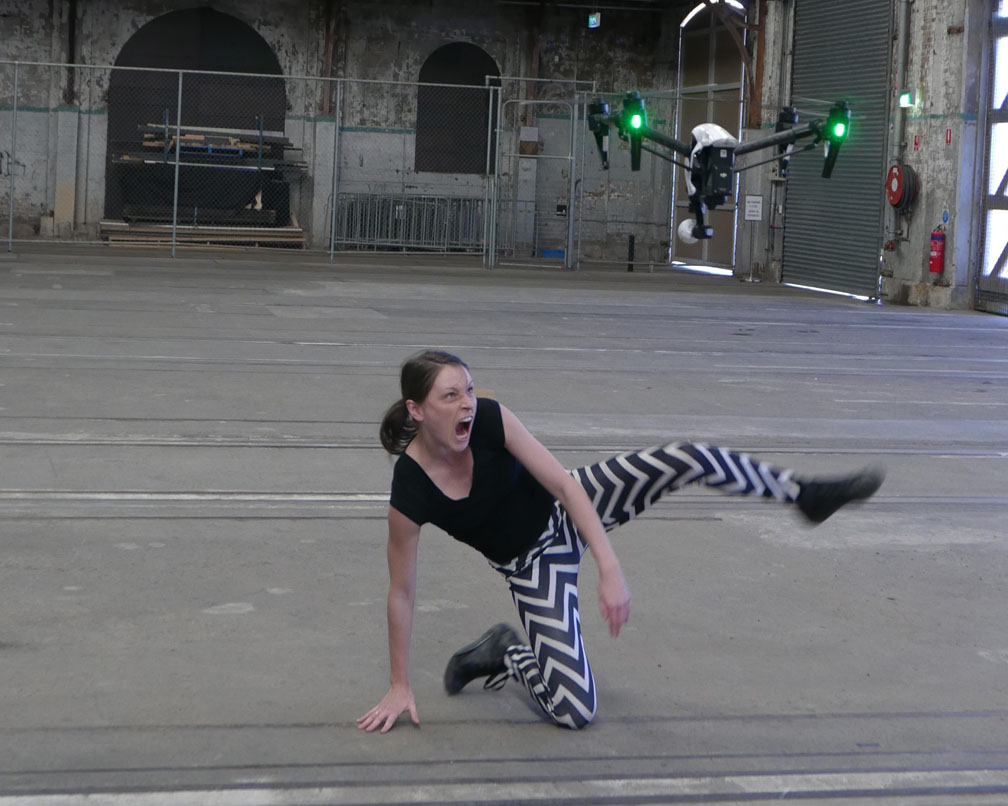
As I near the end – at last! – of my essay on drone strikes in Pakistan, “Dirty Dancing“, I’ve stumbled – the mot juste, given how long it’s taken me to finish the thing – on two very different performance works, both called ‘Dancing with Drones‘.

Dancing with drones 1

First, a dance-technology collaboration from Australia between dancer Alison Plevey and artists Josephine Starrs and Leon Cmielewski.  This is from a thoughtful commentary by Ann Finnegan:

Of drone warfare, Grégoire Chamayou has written the world is a ‘hunting ground.’ ‘The target is unable to retaliate, no quarter can be given in last-minute surrender, and only one side risks being killed’. Chamayou is writing of the extreme circumstance of war, but in many respects, Plevey in her dance-off with the drone, is hunted, a contemporary Acteon, who in Greek myth was hunted by a pack of dogs intent on tearing him to pieces. Plevey comes across as the innocent, occupying a subject position that could be occupied by anyone. While there is a charm to the mimetic sequences and to the innocence of the initial scenes of ‘playing chasey’ with the drone, the dance-game is also akin to those more vicious games of children that quickly turn.

Filmed in big nature, down by a river in the wilds of Bundanon estate [in New South Wales], the dancer-drone partnership is intriguing, somewhat bizarre, an unlikely dance duo, initially suggesting disturbed bucolic innocence. Two regimes of movement seemingly accommodate each other: the curious drone, the responsive human. There’s a mixture of charm and mild annoyance; the drone hobby toy friendly in size, rising and falling in sequences akin to the flapping of a butterfly’s wings, no more a menace than the buzzing of a gnat or a bee.

As the dance progresses [and the video projection moves back to Carriageworks in Sydney] the emotional register shifts: pleasure, annoyance, charm, resistance, and eventually submissive acceptance. The disturbing note is that the drone is an invasive species, a technologized interface with nature, intruding into the peaceful ecology with a movement regime that progressively subjugates the human. Given its range of movement, from hovering physical intimacy to the dramatic shifts of its vertical climbs, the drone is an unequal dance partner, an undefeatable adversary. What the dance sequence makes clear is that no matter how brilliant her dance, no matter how fluid, graceful and subtle her human body movements, she will be no match for the superior movements of a drone piloted at a distance by an unseen program or programmer…

Chamayou doesn’t shirk from calling out the ‘inhuman operation [of] a mobile battlefield that potentially spans the globe’, of the potential for drones to target anyone, anywhere, from any satellite mapped point of the world. Furthermore, drones have a capacity for actions at a distance, the like of which the world hasn’t seen before: the ability to group, hover, pursue. If computer were touted in the 1990s as multipurpose machines incorporating calculators, typewriters, cameras, CD players, graphic interfaces, radio, and so on, drones combine a camera with several movement modes: the up and down of helicopters, with the horizontal lines of flight of arrows, missiles and aeroplanes.

The darker notes of Plevey and Cmielewski-Starrs’ collaboration drive these points home, especially when the performance arena is invaded by the live presence of a drone. Plevey is no longer alone on stage dancing with and against the cinematic image of herself and the drone. Her drone combatant has now physically entered the space. This radically recalibrates the experience of the audience, who no doubt subliminally reason that relative safety precautions have been taken. After all, viewing big, dangerous nature from a point of safety has always been key to enjoyment of the sublime. Though the appearance of the drone will most likely trigger a rapidly suppressed involuntary adrenalin reaction—the fight or flight response—this suppression, as in the experience of the sublime, is part of the work’s physical thrill. Whilst certainly the onstage drone is not of war machine scale, not loaded with weaponry, nor combat ready, any audience member would still be very much aware of its capacity to harry, and select quarry other than the dancer onstage.

The gendered aspect of the performance, with an unarmed female quarry, draws further allusions to inadvertent attacks on civilians in combat zones.

The second work comes from a team in Hungary.  Initially a team led by Tamás Vicsek from the Department of Biological Physics at Eötvös University in Budapest created what they called ‘flying robots that communicate with each other directly and solve tasks collectively in a self-organized manner, without human intervention.’  Then, in collaboration with Nina Kov, an artist and choreographer based in the UK, the team developed ‘tools facilitating the interactivity between drones and humans’ and – in stark contrast to the first performance work – staged a ‘cooperation between [a] group of drones and humans through movement, which is instinctive and enjoyable…’  The result is a multi-media entertainment that is intended to show ‘the peaceful, civil and creative applications of drones, made possible by the collaboration between high level scientists and artists.’

You can see some of the preparations for the production in this video from YouTube:

And the stage performance at the Sziget Festival in 2015 in this one:

But you really ought to watch the video here, which opens with the disarming statement that

‘No computer-generated images were used.  No pilots, no pre-programmed routes, only dance and interactions.’

You won’t be surprised to learn that ‘Dirty Dancing” is closer in spirit to the first performance.  But both projects provide considerable food for thought about the incorporation of performance as a vital moment in analytical research, no?  (For my own, beginning attempts at a performance-work see here; this is drama, but I’ll be working with Wall Scholar Peter Klein on a musical collaboration around parallel themes, and now I’m starting to think about video and dance too…  But not until ‘Dirty Dancing’ is done!).

In continent

160311024028-drone-warfare-film-eye-in-the-sky-sesay-pkg-00001425-super-169

Over at the LA Review of Books Will Govinsky has a fine essay on Eye in the Sky called ‘The beauty of an imperial dilemma‘.  It begins with the image of a French gunboat firing shots into the African rainforest from Joseph Conrad‘s Heart of Darkness:

The ship’s absurdly one-sided battle becomes, for Marlow, an emblem of pointless, indiscriminate imperial violence: “[T]here she was, incomprehensible, firing into a continent.”

Will’s point is about the parallel between the anonymity of imperial violence in the African rainforest and the anonymity of the US (un)targeted killing program:

The chilling anonymity of this “targeted” drone program’s victims, crossed with the sanguine official line, again recalls Conrad’s French warship. “There was a touch of insanity in the proceeding,” Marlow says, which “was not dissipated by somebody on board assuring me earnestly there was a camp of natives ­— he called them enemies! — hidden out of sight somewhere.”

Conrad’s critique of European imperial violence moves with notorious swiftness from the opacity of the victim to the opacity at the heart of the colonizer. Marlow does not know who exactly are the victims of the French warship’s shells, but Conrad’s racism, as Chinua Achebe famously argued, precludes his narrator from caring that much. Marlow’s concern is not for the mangled bodies on the receiving end of colonial violence, but for the deplorable madness at the heart of the imperialist himself.

As I’ve described elsewhere, the genealogy can be traced across multiple theatres.  Here, for example, is Arnold Bennett on the Western Front:

Of the target I am absolutely ignorant.001

And here is Frederic Downs describing a US artillery bombardment in Vietnam – Francis Ford Coppola‘s setting for Heart of Darkness – in terms which loop back directly to Will’s (Conrad’s) point about anonymity, impersonality and the madness of it all:

The coordinates for that location and the time for firing would be relayed to the gun crews. At the specified time, the gun crews would be awakened. Perhaps it would be just after midnight. As the minutes ticked closer to a time set by an unknown intelligence the men would load the artillery pieces, anticipating the release of their impersonal death into a grid square. The gun commander would give the order to fire and the night would explode with man’s lightning and thunder. After the prescribed rounds, the guns would cease, the cleanup would begin, and the men would go back to their bunks. Thinking what? Within the range of those guns, within a specified area, the Central Highlands had for a brief moment changed from the jungle it had been for thousands of years into the particular insanity of man.

artillery

In these two cases, clearly, the gunners were firing blind – but what lay behind their guns was a stream of co-ordinates.

This raises two issues that bear directly on the use of today’s remote platforms.

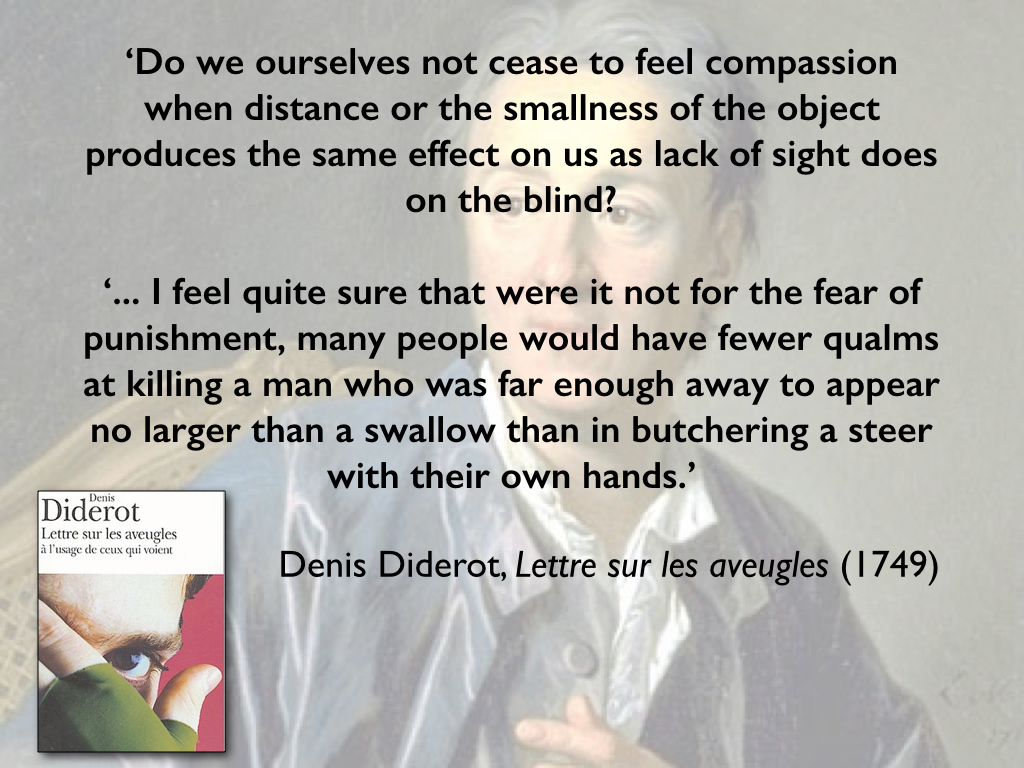
The first is about the ethics of killing at a distance which, as Will notes, also has a (far longer) genealogy.  He cites Chateaubriand‘s question – ‘If, merely by wishing it, you could kill a man in China and inherit his fortune in Europe, being assured by supernatural means that the deed would remain forever unknown, would you allow yourself to form that project?’ – and explains that ‘killing the mandarin’ became shorthand in French for committing ‘an evil action in the hope that it will remain unknown.’

But the US targeted killing program is hardly unknown, and my own preference – which turns out to be closely related to tuer le mandarin – is to turn to Denis Diderot:

Diderot.001

The intimate connection between distance and blindness can be read again and again in accounts of bombing during the Second World War, most directly here:

Distance and blindess.001

But again, what lay behind ‘the distance and the blindness’ was a stream of intelligence.

Recognising the importance of those intelligence streams – and conceding that ‘crunching petabytes of metadata just wouldn’t make for good cinema’ – Will’s key point (and the second issue) is that in its representation of a drone strike in East Africa Eye in the Sky artfully reverses Conrad’s trope:

It asks what we would do if we knew everything. In a taut 102 minutes, the film condenses the ambiguities of drone warfare into a balance sheet of nigh certainties.

eye-in-the-sky

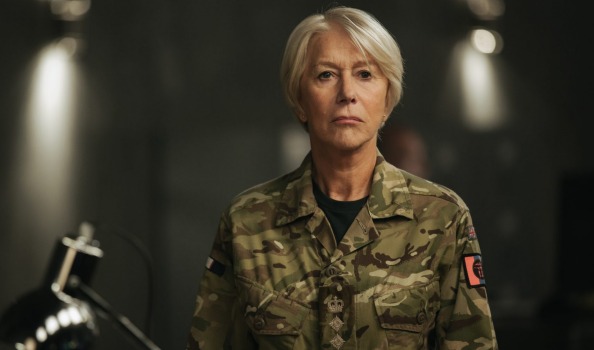
In a fine passage, he suggests the film offers the fantasy

of perfect, visual knowledge — a platform for the terrible beauty of a globe-girdling ethical dilemma. Poised, confident, her silver hair luminescent in the metallic grey-blue glow of her theater-like command center, [Helen] Mirren’s Col. Powell gathers up in her steely 10,000-mile stare the awful knowledge of her options.

But – as I argued in my own commentary on Eye in the Sky – this is indeed a fantasy.  The video feeds from remote platforms do not render the battle space transparent, and the make-believe that they do, Will concludes, renders the film ‘less a representation of drone warfare than a grotesque abstraction of it.’  Hence his brilliantly sobering conclusion:

We need plots that provide the narrative space to ask questions: whether the very terms of our dilemmas are spurious; whether firing into continents, day in and day out, can be anyone’s prerogative, let alone ours.

Grim Reapers

cegrab-20160505-002509-0-1-589x442

Sky News has a report on Launch & Recovery crews responsible for US/UK drone operations against IS in Iraq and Syria based “somewhere in the Middle East”.

Much of it will be all too familiar to most readers:

Relentlessly watching their prey. Monitoring every movement a high profile Islamic State target makes.

In the words of the American officer I speak to, “we are the unblinking eye”…

“We are going to be on that target as long as the weather allows and as long as the mission allows.

In many cases there is more than one asset on that individual.

“You know when he’s going to go to the bathroom, you know when he’s going to go to eat, you know when he’s going to go to prayer time.

“You know where he goes, his associates.

“That’s all about building that picture so that we know and we can project when he’s going and where he’s going to be.”

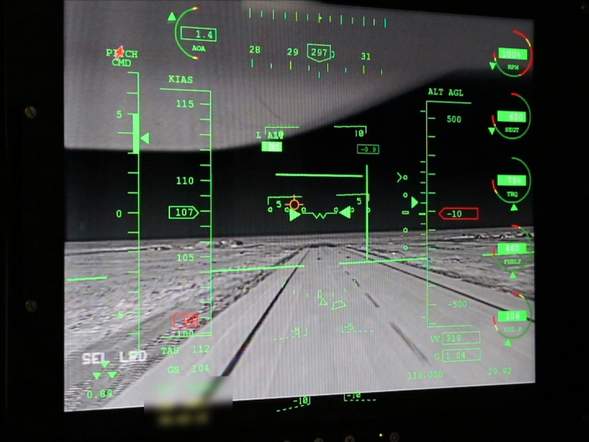
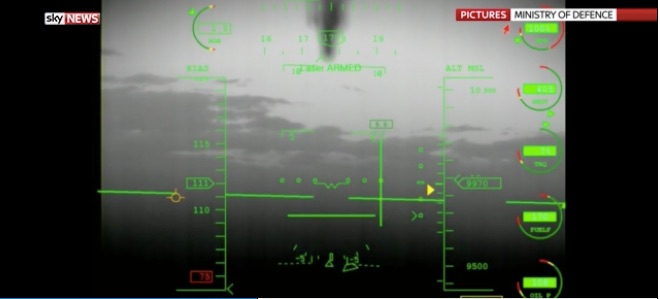
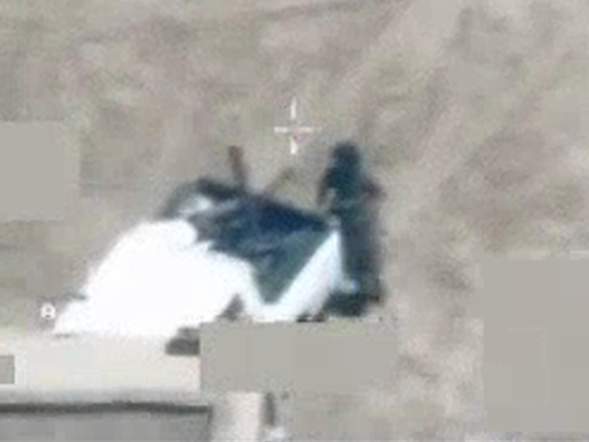
But the video embedded in the report repays close attention, not least for the brief glimpses of the video feeds from the drones themselves.

Drone airborne JPEG

The first two images (above) are clips from the video used by the pilot to control the aircraft – a view of the runway before take-off and an airborne view before control is handed off to the crew who will fly the assault mission from ground control stations in either the US or the UK – while the third (below) is from the imagery used to identify a ‘possible target’.  The comparison between this last image and the equally ‘High Definition’ imagery released from an Italian MQ-9 Reaper late last year is instructive: see my post here.

cegrab-20160505-002219-0-1-589x442

You can find updates on the UK campaign in Iraq and Syria at Drone Wars UK here and here.

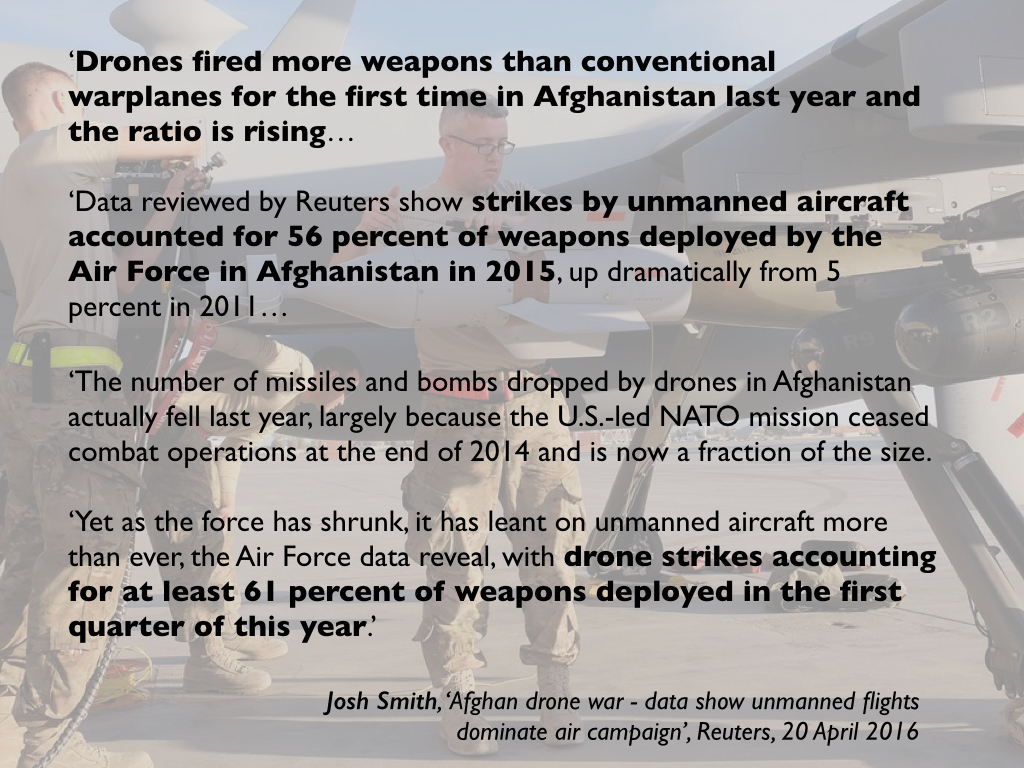
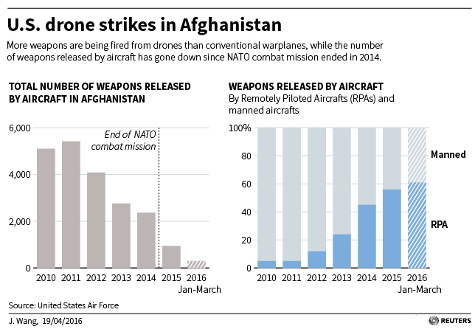
As Chris Cole reports there, too, the use of remote platforms [RPAs] to strike targets in Afghanistan has increased dramatically following the draw-down of US and NATO forces:

Drones in Afghanistan 2016.001

afghanistan-drones-sized

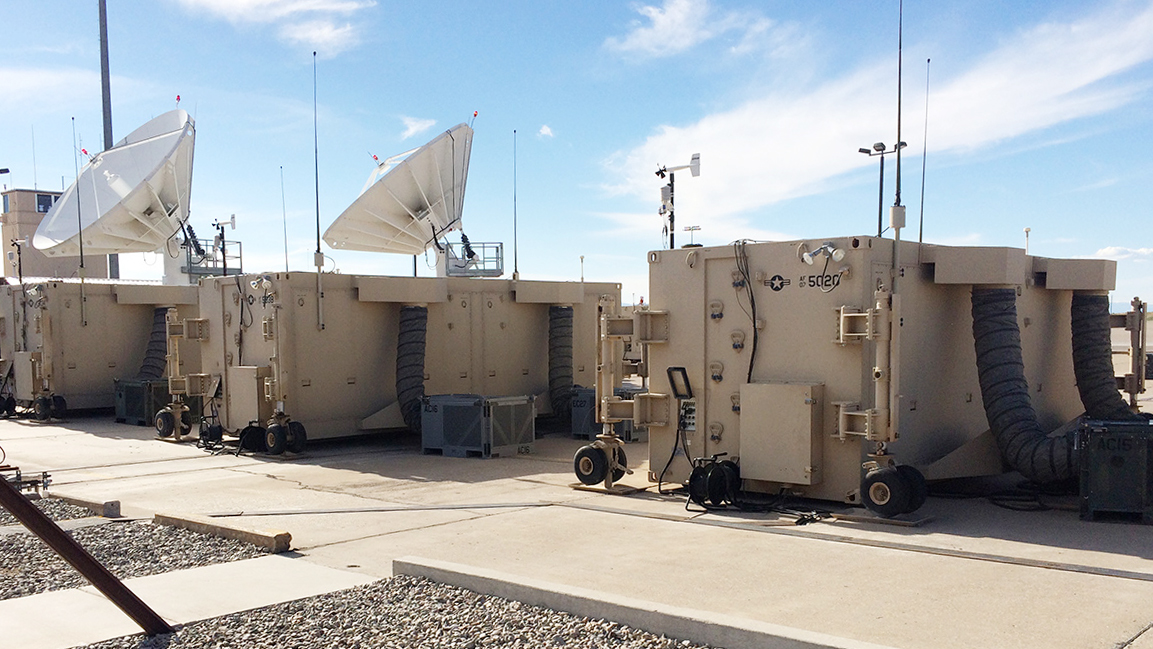
It is surely not coincidental that last month the US Air Force renamed eight of its RPA reconnaissance squadrons ‘attack squadrons’:

‘Eight RPA reconnaissance squadrons [based at Holloman AFB in New Mexico, Whiteman AFB in Missouri, and Creech AFB in Nevada] will be redesignated as attack squadrons [and]… Air Force Chief of Staff Gen. Mark A. Welsh III authorized RPA aircrews to log combat time when flying an aircraft within designated hostile airspace, regardless of the aircrew’s physical location.

The changes were two of many recommendations that emerged as part of Air Combat Command’s Culture and Process Improvement Program, which seeks to address a number of issues affecting operations and the morale and welfare of Airmen across the RPA enterprise….

“Aerial warfare continues to evolve. Our great RPA Airmen are leading that change. They are in the fight every day,” Welsh said. “These policy changes recognize the burdens they bear in providing combat effects for joint warfighters around the world.”’

Hollow men?

eye-in-sky-group

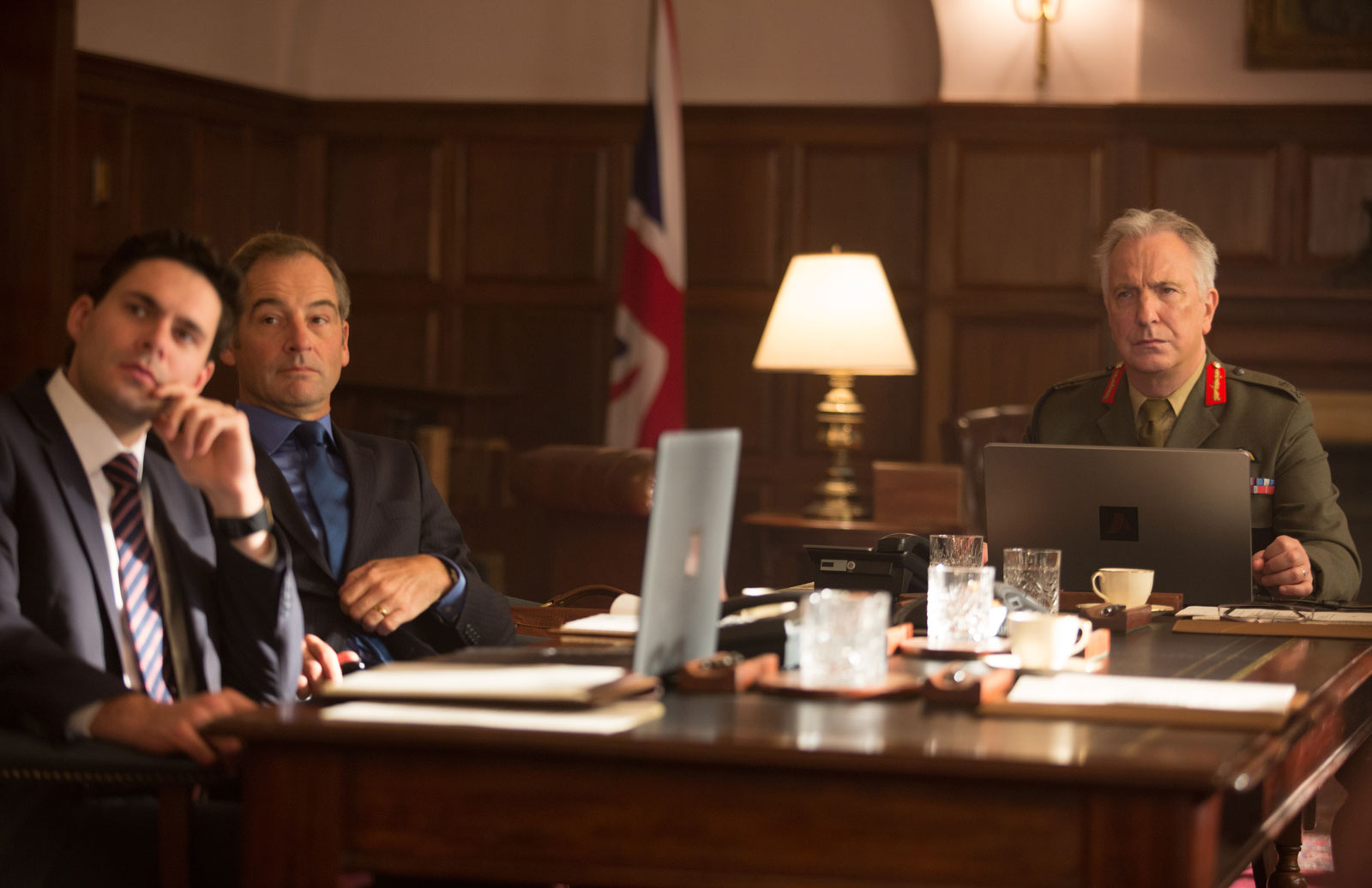
In my commentary on Eye in the Sky I emphasised the dispersed geography of command and responsibility involved, and it turns out that was a key concern of the film’s director Gavin Hood.  In an interview with Dan Gettinger for Bard’s Center for the Study of the Drone, he explains:

‘… we obviously designed the film frankly as a thought experiment; it is based on a very specific set of circumstances … these circumstances are not the circumstances of every drone strike. As you know, it is not the case that in every single drone strike the question of whether to fire or to not fire is referred all the way up the kill chain to the foreign secretary, or the prime minister, or in the case of the United States, the secretary of state, secretary of defense, or indeed the president. Depending on the geographical location of these strikes, different rules apply. If you are striking within an already defined conflict zone with clear rules of engagement, in areas such as Iraq or Afghanistan, then sadly this level of debate does not always happen. It very much depends on who is being targeted and where that target is taking place, as to whether the authorization of the strike is referred high up the kill chain.

In our case, in the case of the film, we wanted to create a scenario in which as much discussion as possible was possible within our film. We didn’t want to make a film where the discussion ended at the local commander level. That is a story that can and should be told—the story of the strikes over the tribal areas of Pakistan, for example, where signature strikes take place and where many civilians have been killed—but what we felt was helpful was to make a film which would allow many different points of view to be represented in order to help the conversation that is already underway, but which the public is not necessarily particularly aware of.’

See also David Cole‘s ‘Killing from the Conference Room’ here.

3054521-inline-i-1-lr-meet-the-new-maverick

It was partly for the same reason that Ainsley O’Connell travelled to Holloman Air Force Base in New Mexico for Fast Company: to see what the training program for the crews that operate the Air Force’s remote platforms reveals about today’s management.

Her extended report riffs off Tom Cruise‘s Maverick in Top Gun, and his boast that – like all pilots of conventional strike aircraft – ‘You don’t have time to think up there… If you think, you’re dead.’  In contrast, Ainsley reports:

The new Maverick represents the future of work in a fully global world dominated by complex machines, complex communications, and fluid, remote teams. A body of economic research produced over the last 15 years suggests that organizations are shifting to a model of work characterized by continuous learning and flat teams with complementary skill sets. In this model there is room for autonomy and improvisation, but it takes place in the context of managerial surveillance and shared goals. The military, though still wedded to its lock-step hierarchies, is not immune to the trend. And RPA crews, despite their image as video gamers operating in the dark, are arguably one of the best case studies for how the future of work will affect war and conflict.

She finds that remote crews have to develop not only ‘air awareness’ – since they don’t have the physical sensations of flight or situation available to conventional pilots – but also ‘social awareness’: the ability to collaborate and communicate with military actors across the network.

I discuss the layered bureaucracy – and its imperfect network – in more detail in ‘Reach from the sky‘ and will post the text of those two lectures soon (see also here).

In the meantime, there is an earlier report on the training program at Holloman by Corey Mead for the Atlantic here.

Death sentences

Living under drones is both a chilling report and a nightmare reality.  In November 2014, in a New Yorker essay called ‘The unblinking stare‘, Steve Coll reported a conversation with Malik Jalal from North Waziristan:

‘Drones may kill relatively few, but they terrify many more…  They turned the people into psychiatric patients. The F-16s might be less accurate, but they come and go.’

Now Reprieve has put a compelling face to the name – to a man who believes, evidently with good reason, that he has been included in the CIA’s disposition matrix that lists those authorised for targeted killing.
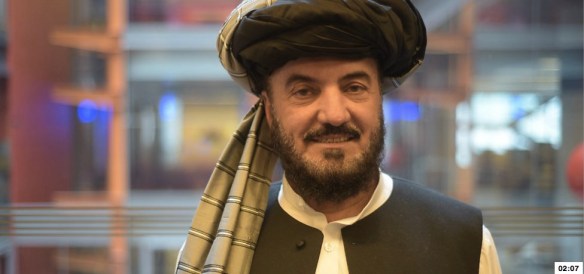
Malik Jalal JPEG

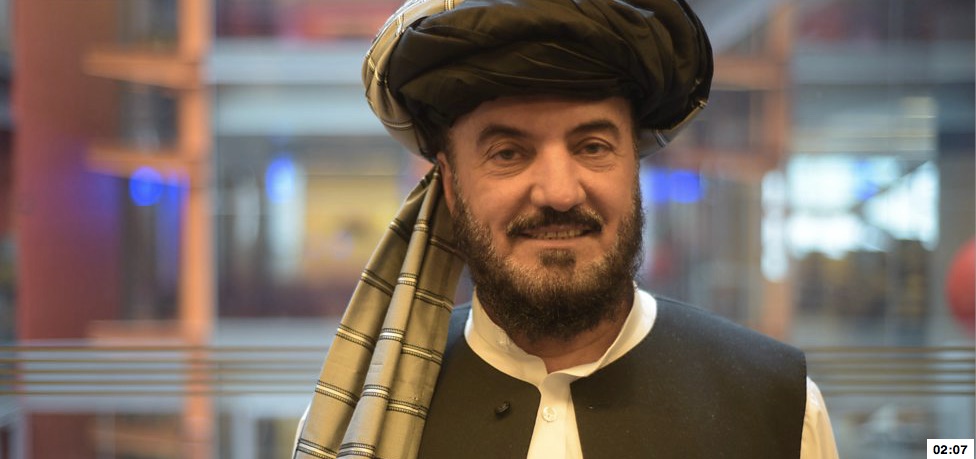
‘Malik’ is an honorific reserved for community leaders, and Jalal is one of the leaders of the North Waziristan Peace Committee (NWPC).  Its main role is to try to keep the peace between the Taliban and local authorities, and it was in that capacity that he attended a Jirga in March 2011.  He says this was on 27 March, but I think it must have been the strike that killed 40 civilians at Datta Khel on 17 March (see the summary from the Bureau of Investigative Journalism here and my post here).

Here are the relevant passages from my ‘Dirty dancing’ essay, following from a discussion of Pashtunwali and customary law in the Federally Administered Tribal Areas (I’ve omitted the footnotes and references):

***

‘In short, if many of the Pashtun people in the borderlands are deeply suspicious of and even resentful towards Islamabad (often with good reason) they are ‘neither lawless nor defenceless.’

‘Yet the trope of ‘lawlessness’ persists, and it does important work. ‘By alleging a scarcity of legal regulation within the tribal regions,’ Sabrina Gilani argues, ‘the Pakistani state has been able to mask its use of more stringent sets of controls over and surveillance within the area.’ The trope does equally important work for the United States, for whom it is not the absence of sovereign power from the borderlands that provides the moral warrant for unleashing what Manan Ahmad calls its ‘righteous violence’. While Washington has repeatedly urged Islamabad to do much more, and to be less selective in dealing with the different factions of the Taliban, it knows very well that Pakistan has spasmodically exercised spectacular military violence there. But if the FATA are seen as ‘lawless’ in a strictly modern sense – ‘administered’ but not admitted, unincorporated into the body politic – then US drone strikes become a prosthetic, pre-emptive process not only of law enforcement but also of law imposition. They bring from the outside an ‘order’ that is supposedly lacking on the inside, and are reconstituted as instruments of an aggressively modern reason that cloaks violence in the velvet glove of the law.
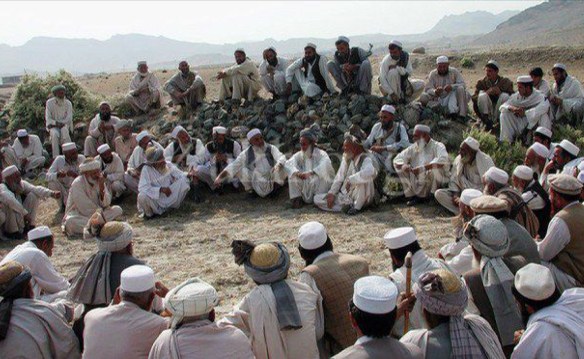
Print

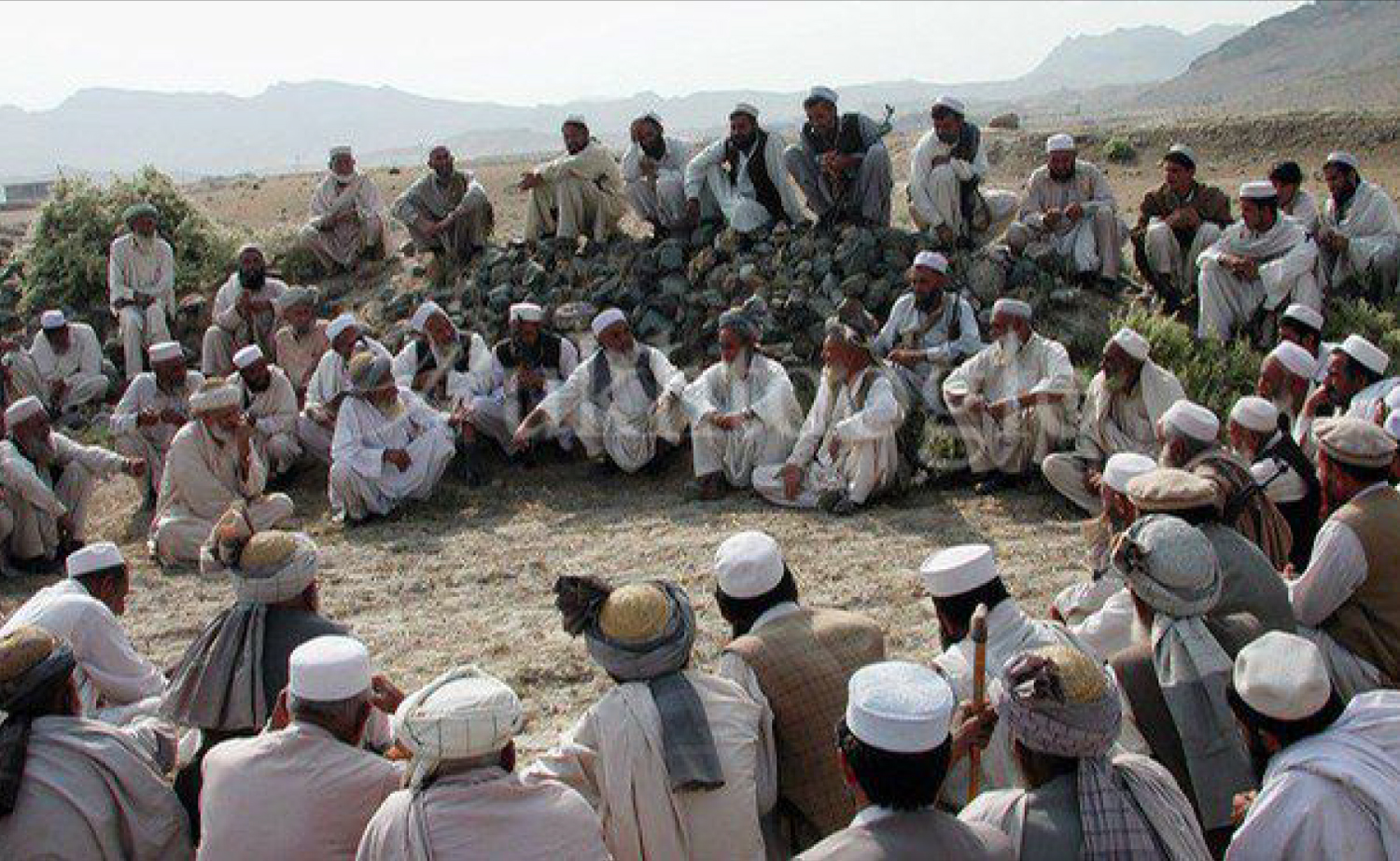
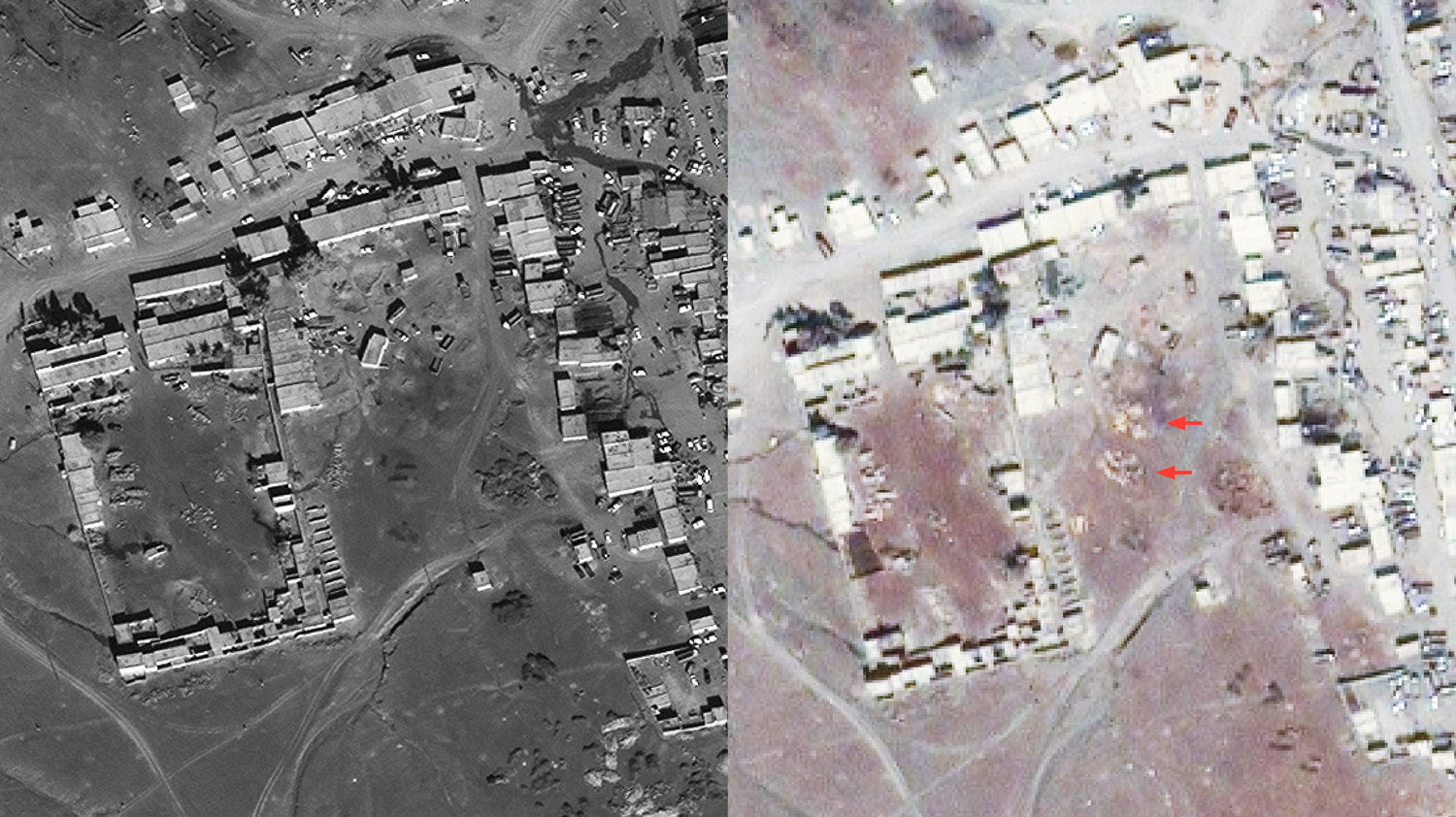
And yet the CIA’s own willingness to submit to the principles and procedures of modern law is selective and conditional; we know this from the revelations about torture and global rendition, but in the borderlands the agency’s disregard for the very system it purports to defend also exposes any group of men sitting in a circle with guns to death: even if they are gathered as a Jirga. On 27 January 2011 CIA contractor Raymond Davis was arrested for shooting two young men in Lahore. The targeted killing program was suspended while the United States negotiated his release from custody, agreeing to pay compensation to the victims’ families under Sharia law so that he could be released from the jurisdiction of the court. On 16 March, the day after Davis’s release, a Jirga was convened in Dhatta Khel in North Waziristan. A tribal elder had bought the rights to log an area of oak trees only to discover that the land also contained chromite reserves; the landowner was from a different tribe and held that their agreement covered the rights to the timber but not the minerals, and the Jirga was called to resolve what had become an inter-tribal dispute between the Kharhtangi and the Datakhel. Maliks, government officials, local police and others involved in the affair gathered at the Nomada bus depot – a tract of open ground in the middle of the small town – where they debated in two large circles. Agreement was not reached and the Jirga reconvened the next morning. Although four men from a local Taliban group were present, the meeting had been authorised by the local military commander ten days earlier and was attended by a counsellor appointed by the government to act as liaison between the state, the military and the maliks. It was also targeted by at least one and perhaps two Predators. At 11 a.m. multiple Hellfire missiles roared into the circles. More than forty people were killed, their bodies ripped apart by the blast and by shattered rocks, and another 14 were seriously injured.
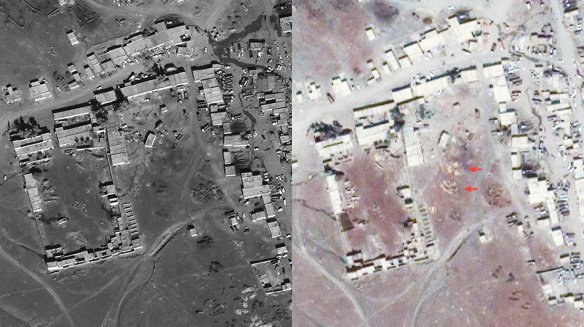
Dhatta Khel before and after drone strike (Forensic Architecture)

There is no doubt that four Taliban were present: they were routinely involved in disputes between tribes with competing claims and levied taxes on chromite exports and the mine operators. But the civilian toll from the strike was wholly disproportionate to any conceivable military advantage, to say nothing of the diplomatic storm it set off, and several American sources told reporters that the attack was in retaliation for the arrest of Davis: ‘The CIA was angry.’ If true, this was no example of the dispassionate exercise of reason but instead a matter of disrespecting the resolution offered by Sharia law and disordering a customary judicial tribunal. Even more revealing, after the strike an anonymous American official who was supposedly ‘familiar with the details of the attack’ told the media that the meeting was a legitimate military target and insisted that there were no civilian casualties. Serially: ‘This action was directed against a number of brutal terrorists, not a county fair’; ‘These people weren’t gathering for a bake sale’; ‘These guys were … not the local men’s glee club’; ‘This was a group of terrorists, not a charity car wash in the Pakistani hinterlands.’ The official – I assume it was the same one, given the difference-in-repetition of the statements – provided increasingly bizarre and offensively absurd descriptions of what the assembly in Datta Khel was not: he was clearly incapable of recognising what it was. Admitting the assembly had been a properly constituted Jirga would have given the lie to the ‘lawlessness’ of the region and stripped the strike of any conceivable legitimacy. The area was no stranger to drone attacks, which had been concentrated in a target box that extended along the Tochi valley from Datta Khel through Miran Shah to Mir Ali, but those responsible for this attack were clearly strangers to the area.

***

‘Like others that day,’ Jalal concedes, ‘I said some things I regret. I was angry, and I said we would get our revenge. But, in truth, how would we ever do such a thing? Our true frustration was that we – the elders of our villages – are now powerless to protect our people.’

This was the fourth in a series of strikes that Jalal believes targeted him:

‘I have been warned that Americans and their allies had me and others from the Peace Committee on their Kill List. I cannot name my sources [in the security services], as they would find themselves targeted for trying to save my life. But it leaves me in no doubt that I am one of the hunted.’

He says he is an opponent of the drone wars – but if that were sufficient grounds to be included on the kill list it would stretch into the far distance.

He also says that the Americans ‘think the Peace Committee is a front’ working to create ‘a safe space for the Pakistan Taliban.’

‘To this I say: you are wrong. You have never been to Waziristan, so how would you know?’

And he describes the dreadful impact of being hunted on him and his family:

‘I soon began to park any vehicle far from my destination, to avoid making it a target. My friends began to decline my invitations, afraid that dinner might be interrupted by a missile.

‘I took to the habit of sleeping under the trees, well above my home, to avoid acting as a magnet of death for my whole family. But one night my youngest son, Hilal (then aged six), followed me out to the mountainside. He said that he, too, feared the droning engines at night. I tried to comfort him. I said that drones wouldn’t target children, but Hilal refused to believe me. He said that missiles had often killed children. It was then that I knew that I could not let them go on living like this.’

And so he has travelled to Britain to plead his case:

‘I came to Britain because I feel like Britain is like a younger brother to America. I am telling Britain that America doesn’t listen to us, so you tell them not to kill Waziristanis.’

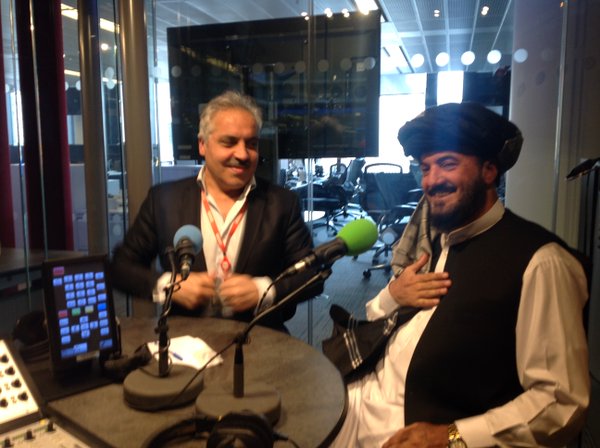
You can hear an interview with him on BBC’s Today programme here.
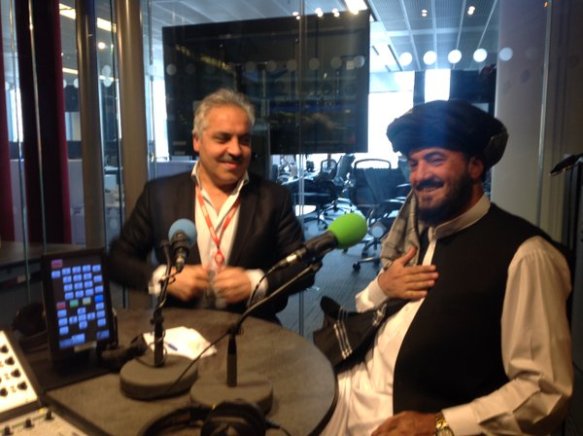
CfvlDFAXIAAT7Yk

In you think Britain is distanced from all this, read Reprieve‘s latest report on ‘Britain’s Kill Listhere (which focuses on the Joint Prioritised Effects List in Afghanistan and its spillover into Pakistan) and Vice‘s investigation into the UK’s role in finding and fixing targets in Yemen here.