Flying lessons

Reach from the Sky PERFORMANCE WORK

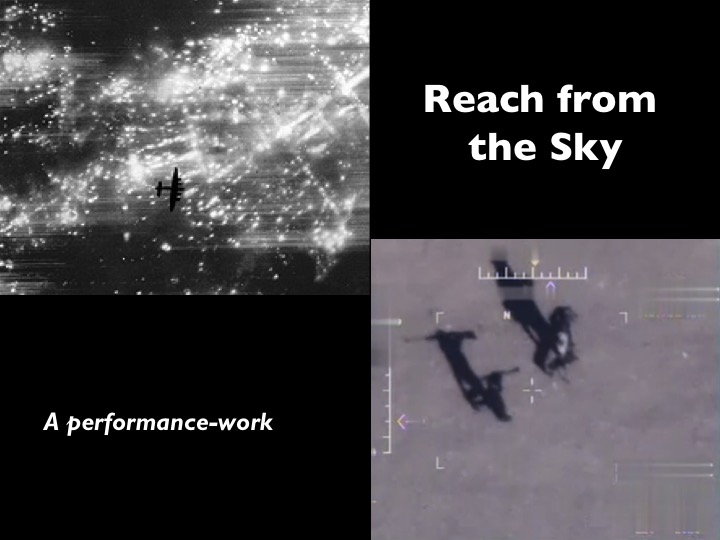
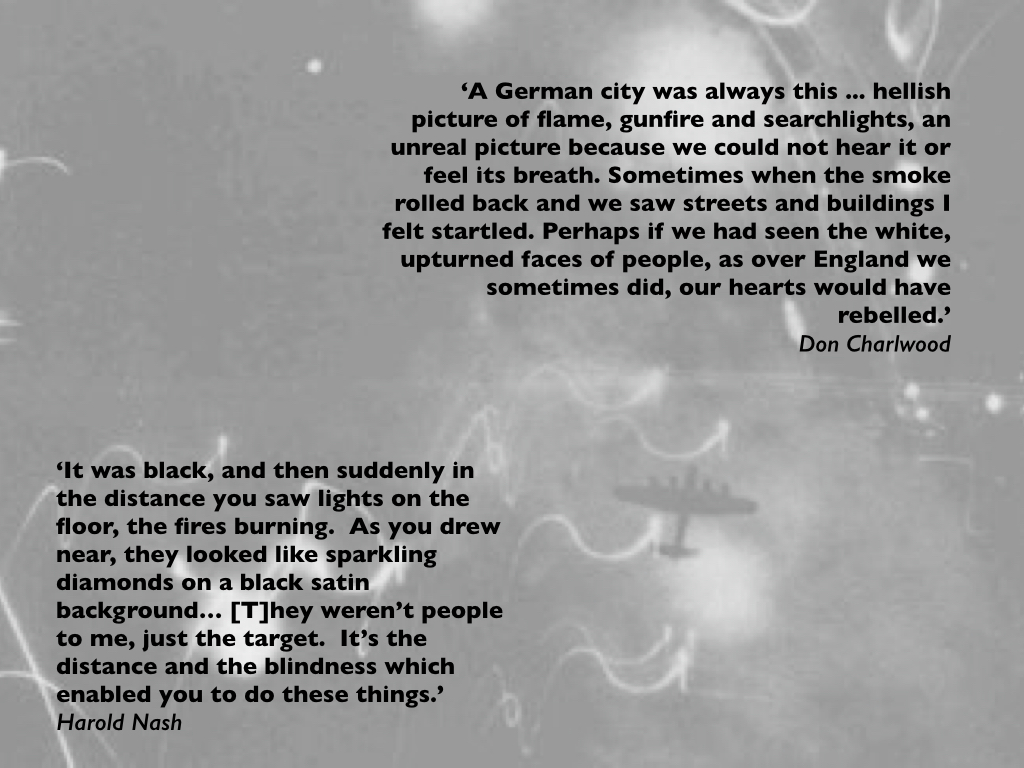
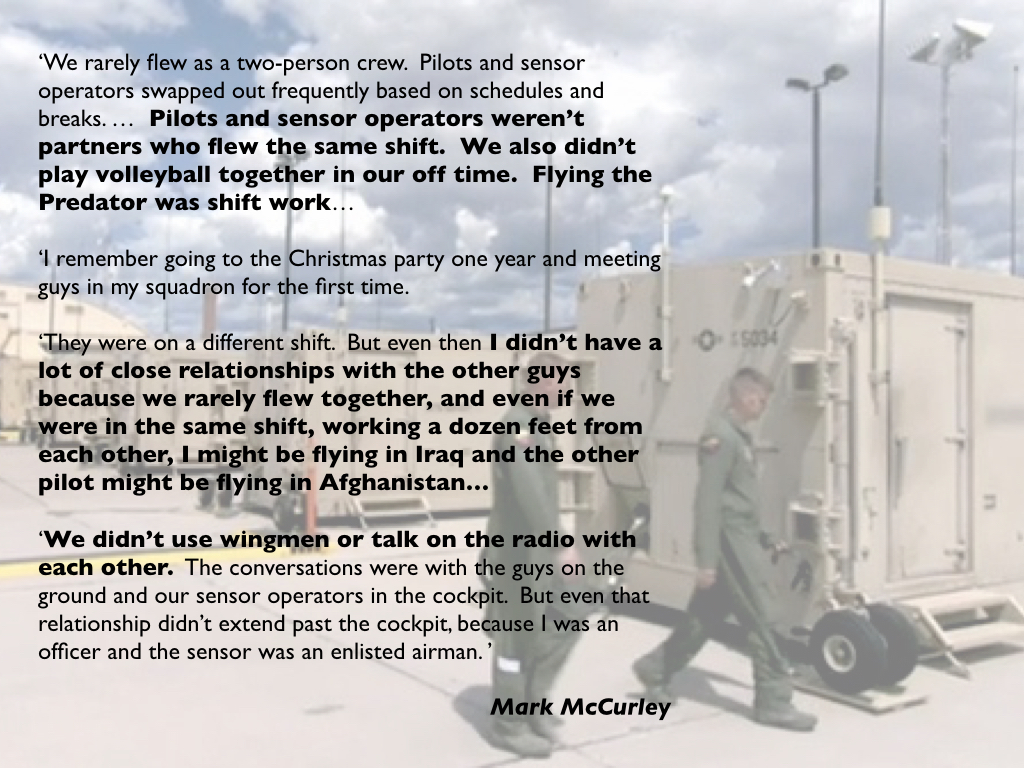
To complement the comparison implicit in my last post – between ‘manned’ and ‘unmanned’ military violence – I’ve added a presentation to those available under the DOWNLOADS tab.  I prepared it last month for an event at the Peter Wall Institute for Advanced Studies, where I performed it with my good friend Toph Marshall.  It’s part of my performance-work on bombing, and stages two cross-cutting monologues between a veteran from RAF Bomber Command who flew missions over France and Germany in the Second World War and a pilot at Creech Air Force Base in Nevada operating a Predator over Afghanistan.  As the title implies, it dramatises many of the themes I discuss in more analytical terms in my Tanner Lectures, ‘Reach from the Sky’.

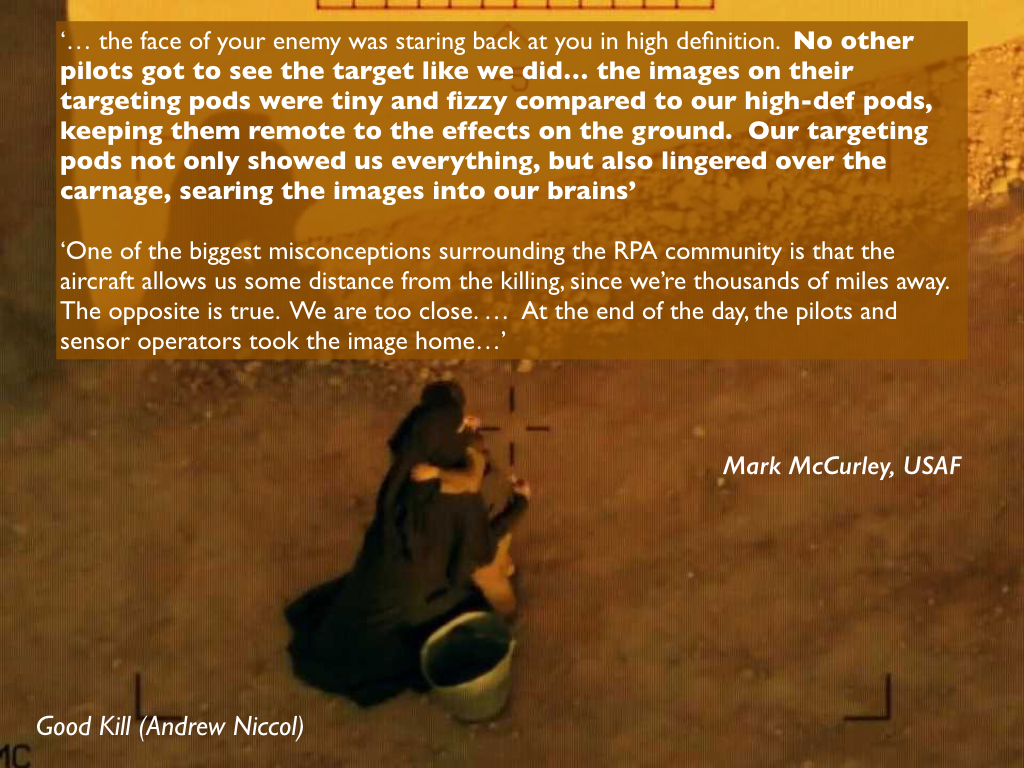
For the performance, each speech was complemented by back-projected images.  Virtually all of the words were taken from ‘found texts’ – memoirs, diaries, letters and interviews – and the only consciously fictional lines were lifted from Andrew Niccol‘s Good Kill (and I’m sure that they originated in an interview with a real pilot).

It’s imperfect in all sorts of ways, and it is still very much a work in progress, but I’m posting it because it might be helpful for anyone teaching about aerial violence and its history.  If it is – or even (especially) if it is isn’t – I hope you’ll let me know.

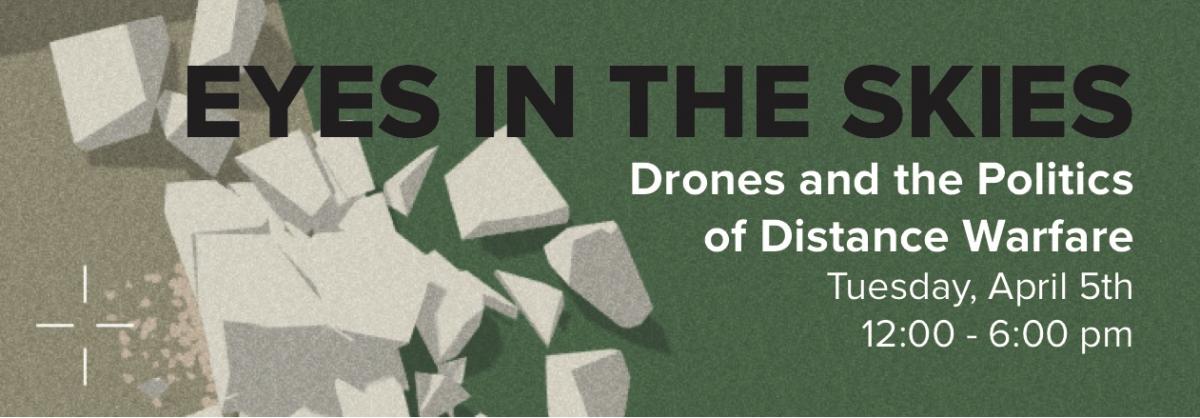
Eyes in the Skies

eyes_in_the_skies_pic

I’m just back from a wonderful time at UC Davis, where I was speaking at a symposium called “Eyes in the skies: drones and the politics of distance warfare.”  It was a creative program, packed with insights from Caren Kaplan and Andrea Miller, Priya Satia and Joe Delappe.

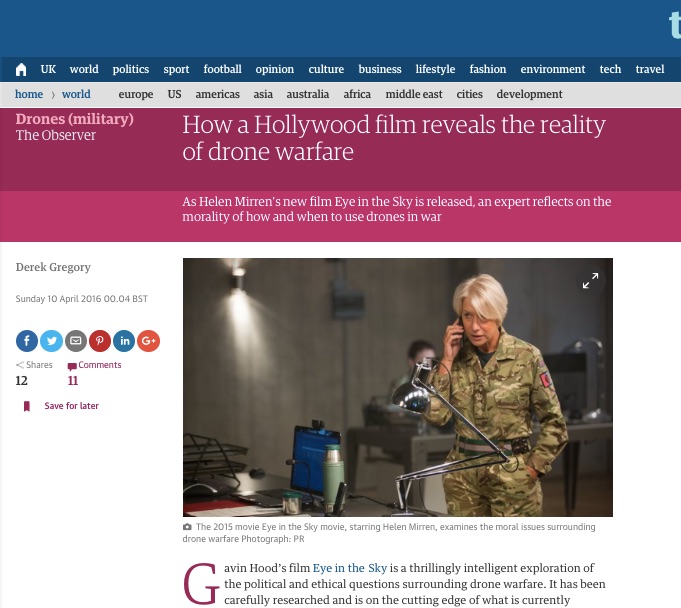
On my way back to Vancouver on Wednesday I received an invitation from Britain’s Guardian (in fact, the Sunday version, the Observer) to write something around that very question using the Gavin Hood film “Eyes in the sky” as a peg.

It’s just been published and you can find it here.
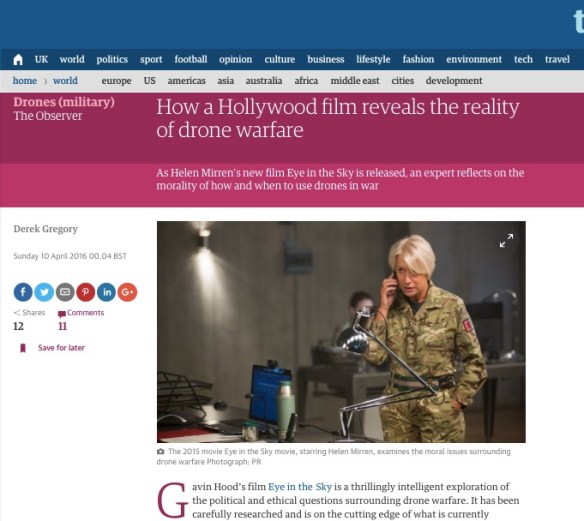
GREGORY Observer

At Davis I’d been giving what I think will be my final presentation of “Angry Eyes” (see here and here), so I was still preoccupied with remote platforms and close air support – not the contradiction it sounds – rather than targeted killing (which is the focus of the film).  The published version has, inevitably, been edited, so I’m pasting the full-length version below and added some links that might help.  There are still lots of short-cuts and elisions, necessarily so for anything of this length, so I hope readers will forgive the inevitable simplifications.

***

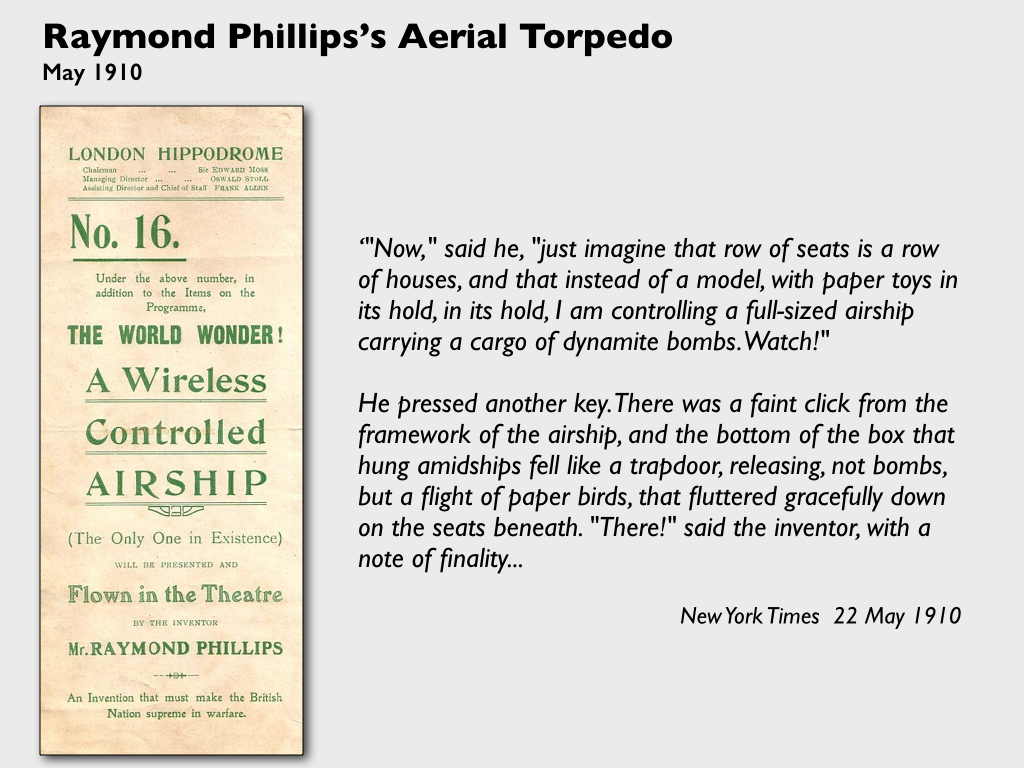
Gavin Hood’s Eye in the Sky is a thrillingly intelligent exploration of the political and ethical questions surrounding drone warfare. It’s been carefully researched and is on the cutting-edge of what is currently possible. But there’s a longer history and a wider geography that casts those issues in a different light.  As soon as the Wright Brothers demonstrated the possibility of human flight, others were busy imagining flying machines with nobody on board.  In 1910 Raymond Phillips captivated crowds in the London Hippodrome with a remotely controlled airship that floated out over the stalls and, when he pressed a switch, released hundreds of paper birds on the heads of the audience below. When he built the real thing, he promised, the birds would be replaced with bombs. Sitting safely in London he could attack Paris, Berlin – or Manchester (a possibility that understandably prompted questions about navigation).

There has always been something hideously theatrical about bombing, from the Hendon air displays in the 1920s featuring attacks on ‘native villages’ to the Shock and Awe visited on the inhabitants of Baghdad in 2003. The spectacle now includes the marionette movements of Predators and Reapers whose electronic strings are pulled from thousands of miles away. And it was precisely the remoteness of the control that thrilled the crowds in the Hippodrome. But what mattered even more was surely the prospect Phillips made so real: bombing cities and attacking civilians far from any battlefield.

Remoteness’ is in any case an elastic measure. Human beings have been killing other human beings at ever greater distances since the invention of the dart, the spear and the slingshot. Pope Urban II declared the crossbow illegal and Pope Innocent II upheld the ban in 1139 because it transformed the terms of encounter between Christian armies (using it against non-Christians was evidently a different matter). The invention of firearms wrought another transformation in the range of military violence, radicalized by the development of artillery, and airpower another. And yet today, in a world selectively but none the less sensibly shrunken by the very communications technologies that have made the deployment of armed drones possible, the use of these remote platforms seems to turn distance back into a moral absolute.

But if it is wrong to kill someone from 7,500 miles away (the distance from Creech Air Force Base in Nevada to Afghanistan), over what distance is it permissible to kill somebody?  For some, the difference is that drone crews are safe in the continental United States – their lives are not on the line – and this has become a constant refrain in the drone debates. In fact, the US Air Force has been concerned about the safety of its aircrews ever since its high losses during the Second World War. After Hiroshima and Nagasaki the Air Force experimented with using remotely controlled B-17 and B-47 aircraft to drop nuclear bombs without exposing aircrews to danger from the blast, and today it lauds its Predators and Reapers for their ability to ‘project power without vulnerability’.

It’s a complicated boast, because these remote platforms are slow, sluggish and easy to shoot down – they won’t be seen over Russian or Chinese skies any time soon. They can only be used in uncontested air space – against people who can’t fight back – and this echoes Britain’s colonial tactic of ‘air policing’ its subject peoples in the Middle East, East Africa and along the North-West Frontier (which, not altogether coincidentally, are the epicentres of todays’ remote operations). There are almost 200 people involved in every combat air patrol – Nick Cullather once described these remote platforms as the most labour intensive weapons system since the Zeppelin – and most of them are indeed out of harm’s way. It’s only a minor qualification to say that Predators and Reapers have a short range, so that they have to be launched by crews close to their targets before being handed off to their home-based operators. This is still remote-control war, mediated by satellite links and fiber-optic cables, but in Afghanistan the launch and recovery and the maintenance crews are exposed to real danger. Even so, Grégoire Chamayou insists that for most of those involved this is hunting not warfare, animated by pursuit not combat [see here, here and here].

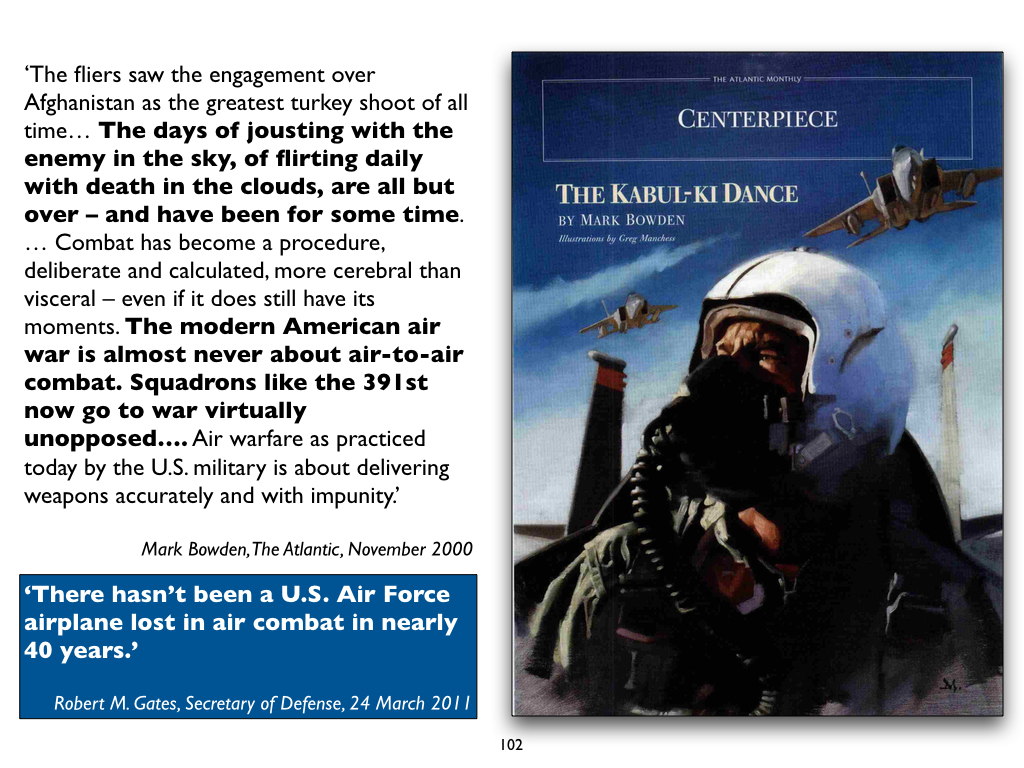
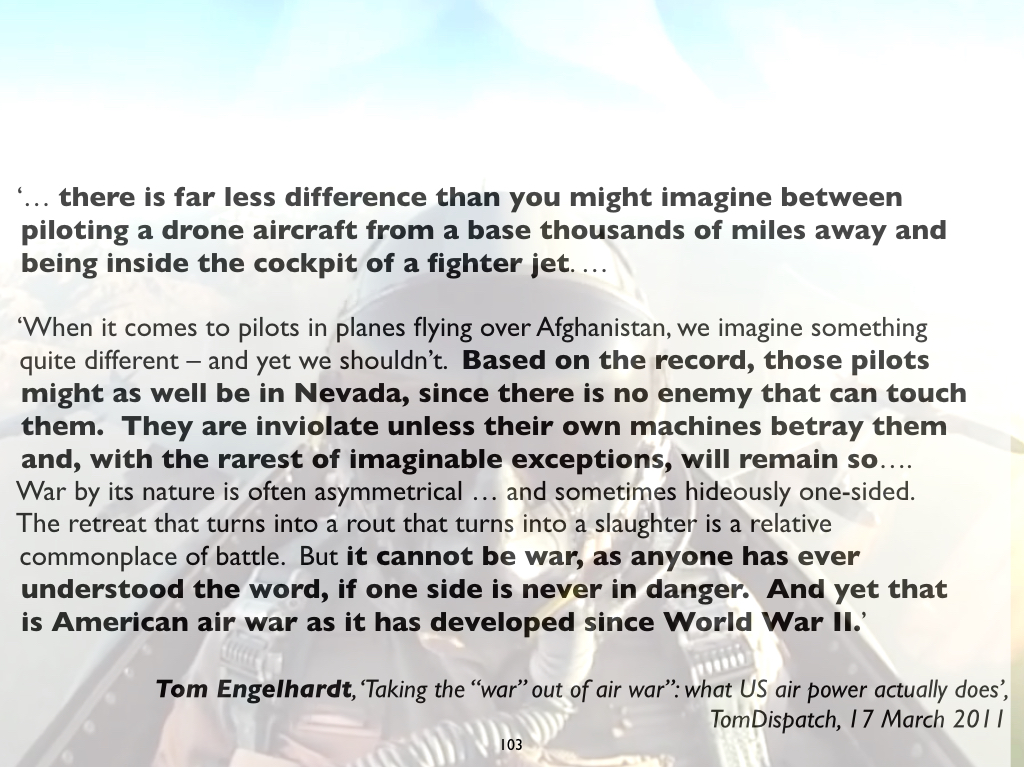
Yet it’s important not to use this aperçu to lionize conventional bombing. There is an important sense in which virtually all aerial violence has become remarkably remote. It’s not just that bombing has come to be seen as a dismal alternative to ‘boots on the ground’; advanced militaries pick their fights, avoid symmetrical warfare and prefer enemies whose ability to retaliate is limited, compromised or degraded. When he was Secretary of Defense Robert Gates acknowledged that the US had not lost a pilot in air combat for forty years. ‘The days of jousting with the enemy in the sky, of flirting daily with death in the clouds, are all but over,’ writes the far-from-pacifist Mark Bowden, ‘and have been for some time.’ The US Air Force goes to war ‘virtually unopposed’. In short, the distance between the pilot in the box at Creech and the pilot hurtling through the skies over Afghanistan is less than you might think. ‘Those pilots might as well be in Nevada’, says Tom Engelhardt, ‘since there is no enemy that can touch them.’

This suggests that we need to situate armed drones within the larger matrix of aerial violence.  Bombing in the major wars of the twentieth century was always dangerous to those who carried it out, but those who dropped bombs over Hamburg or Cologne in the Second World War or over the rainforests of South Vietnam in the 1960s and 70s were, in a crucial sense, also remote from their targets. Memoirs from Bomber Command crews confirm that the target cities appeared as lights sparkling on black velvet, ‘like a Brocks firework display.’ ‘The good thing about being in an aeroplane at war is that you never touch the enemy’, recalled one veteran. ‘You never see the whites of their eyes. You drop a four-thousand-pound cookie and kill a thousand people but you never see a single one of them.’ He explained: ‘It’s the distance and the blindness that enables you to do these things.’ The crews of B-52 bombers on Arc Light missions dropped their loads on elongated target boxes that were little more than abstract geometries. ‘Sitting in their air-conditioned compartments more than five miles above the jungle’, the New York Times reported in 1972, the crews ‘knew virtually nothing about their targets, and showed no curiosity.’ One of them explained that ‘we’re so far away’ that ‘it’s a highly impersonal war for us.’

Distance no longer confers blindness on those who operate today’s drones. They have a much closer, more detailed view of the people they kill. The US Air Force describes their job as putting ‘warheads on foreheads’, and they are required to remain on station to carry out a battle damage assessment that is often an inventory of body parts.  Most drone crews will tell you that they do not feel thousands of miles away from the action: just eighteen inches, the distance from eye to screen.

Their primary function is to provide intelligence, surveillance and reconnaissance. This was exactly how the Wright brothers thought military aircraft would be used – in July 1917 Orville insisted that ‘bomb-dropping’ would be at best a minor role and almost certainly useless, though he was speaking before the major air offensives in the final year of the war and could have had no inkling of what was to come in the Second World War. The Predator and its precursors were designed to identify targets for conventional strike aircraft over the Balkans in the 1990s, and thirty years later it is still those ‘eyes in the sky’ that make the difference. Although drones have been armed since 2001, until late 2012 they were directly responsible for only 5-10 per cent of all air strikes in Afghanistan. But they were involved in orchestrating many more. Flying a Predator or a Reaper ‘is more like being a manager’, one pilot explained to Daniel Rothenberg: ‘You’re managing multiple assets and you’re involved with the other platforms using the information coming off of your aircraft.’ In principle it’s not so different from using aircraft to range targets for artillery on the Western Front, but the process has been radicalized by the drone’s real-time full-motion video feeds that enable highly mobile ‘targets of opportunity’ to be identified and tracked. In the absence of ground intelligence, this becomes crucial: until drones were relocated in sufficient numbers from Afghanistan and elsewhere to enable purported IS-targets in Syria to be identified, most US aircraft were returning to base without releasing their weapons.

Armed drones are used to carry out targeted killings, both inside and outside areas of ‘active hostilities’, and to provide close air support to ground troops. Targeted killing has spurred an intense critical debate, and rightly so – this is the focus of Eye in the sky too – but close air support has not been subject to the same scrutiny. In both cases, video feeds are central, but it is a mistake to think that this reduces war to a video game – a jibe that in any case fails to appreciate that today’s video games are often profoundly immersive.   In fact, that may be part of the problem. Several studies have shown that civilian casualties are most likely when air strikes are carried out to support troops in contact with an enemy, and even more likely when they are carried out from remote platforms. I suspect that drone crews may compensate for their physical rather than emotional distance by ‘leaning forward’ to do everything they can to protect the troops on the ground. This in turn predisposes them to interpret every action in the vicinity of a ground force as hostile – and civilians as combatants – not least because these are silent movies: the only sound, apart from the clacking of computer keys as they talk in secure chat rooms with those watching the video feeds, comes from radio communications with their own forces.

In contrast to those shown in Eye in the Sky, those feeds are often blurry, fuzzy, indistinct, broken, compressed -– and, above all, ambiguous. How can you be sure that is an insurgent burying an IED and not a farmer digging a ditch?  The situation is more fraught because the image stream is watched by so many other eyes on the ground, who all have their own ideas about what is being shown and what to do about it.  Combining sensor and shooter in the same (remote) platform may have ‘compressed the kill-chain’, as the Air Force puts it, and this is vital in an era of ‘just-in-time’, liquid war where everything happens so fast. Yet in another sense the kill-chain has been spectacularly extended: senior officers, ground force commanders, military lawyers, video analysts all have access to the feeds. There’s a wonderful passage in Brian Castner‘s All the ways we kill and die that captures the dilemma perfectly. ‘A human in the loop?’, Castner’s drone pilot complains.

‘Try two or three or a hundred humans in the loop. Gene was the eye of the needle, and the whole war and a thousand rich generals must pass through him… If they wanted to fly the fucking plane, they could come out and do it themselves.’

This is the networked warfare, scattered over multiple locations around the world, shown in Eye in the Sky. But the network often goes down and gets overloaded – it’s not a smooth and seamlessly functioning machine – and it is shot through with ambiguity, uncertainty and indecision.  And often those eyes in the sky multiply rather than disperse the fog of war.

Viewing Eyes in the Sky


This image released by Bleecker Street shows Phoebe Fox, left, and Aaron Paul in a scene from "Eye In the Sky." (Keith Bernstein/Bleecker Street via AP)

This image released by Bleecker Street shows Phoebe Fox, left, and Aaron Paul in a scene from “Eye In the Sky.” (Keith Bernstein/Bleecker Street via AP)

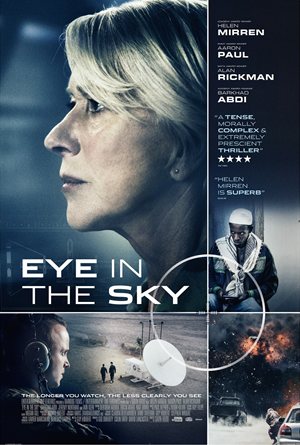
The New York Review of Books has a characteristically thoughtful response by David Cole to Gavin Hood‘s newly released Eye in the Sky: ‘Killing from the Conference Room‘.

The film traces the arc of a joint US/UK drone strike in Nairobi, told from the viewpoints of those charged with authorising and executing the kill.  The nominal target is a safehouse, and the two al-Shabab leaders inside (conveniently one American citizen and one British citizen); less conveniently, after the strike has been authorised a young girl sets up a bread stand in front of the house.

It’s a more complicated scenario than the serial drone strikes dramatized in Andrew Niccol‘s  Good Kill – because here the politicians are brought into the frame too – and David sees it as a twenty-first century version of the ‘trolley-problem’:

Eye in the SkyIn the classic version of the problem, a runaway train is hurtling down a track on which five people are tied; they will die if the train is not diverted. By pulling a lever, you can switch the train to an alternate track, but doing so will kill one person on that track. Should you pull the switch and be responsible for taking a human life, or do nothing and let five people die?

In Eye in the Sky, the question is whether to [use a drone to] strike the compound, thereby preventing an apparent terrorist attack and potentially saving many lives, though the strike itself might kill the young girl as well as the suspected terrorists. If the operation is delayed to try to avoid endangering the girl, the terrorists may leave the compound, and it may become impossible to prevent the suicide mission. But it’s also possible that the girl will finish selling her bread and leave the danger zone before the suspects depart. If the terrorists leave the compound, an opportunity to capture or kill them without harming others may arise. And of course, the suicide mission itself might fail. As a Danish proverb holds, predictions are hazardous, especially about the future. But a decision must nonetheless be made, and the clock is ticking.

As he points out, there’s no right, neat answer:

There are only competing intuitions, based on utilitarian calculations, the difference, or lack thereof, between act and omission, and the like. In Eye in the Sky, and all the more so in the real world, the choices are never as clearly delineated as in the “trolley problem”; decisions must be made in the face of multiple unknowns. The girl may die and the terrorists may get away and kill many more. But what the film makes clear is that, notwithstanding today’s most sophisticated technology, which allows us to see inside a compound in Africa from half a world away, to confirm positive identifications with facial imaging technology, to make joint real-time decision about life and death across several continents, and then to pinpoint a strike to reduce significantly the danger to innocent bystanders, the dilemmas remain. Technology cannot solve the moral and ethical issues; it only casts them into sharper relief.

Consider, for example, the implications of the purported accuracy of armed drones. The fact that it is possible to conduct “surgical” strikes and to maintain distance surveillance for extended periods of time increases the moral and legal obligation to avoid killing innocents. When the only way to counter an imminent threat was with more blunt explosives or by sending in ground forces, attacks entailing substantial harm to civilians were nonetheless sometimes warranted. As technology makes it increasingly feasible to strike with precision, risks to civilian lives that were once inescapable can now be avoided. And if they can be avoided, mustn’t they be? Thus, when President Barack Obama in May 2013 announced a standard for targeted killings away from traditional battlefields, he said he would authorize such strikes only when there was a “near-certainty that no civilians will be killed or injured—the highest standard we can set.” Precisely because they are so discriminating, drones may demand such a standard. Yet as the film shows, that standard can be very difficult to uphold, even under the best of circumstances.

Given my own interest in the film, I’ll share my thoughts as soon as I’ve seen it.

Note: In the most recent US strike against al-Shabab on 5 March, in which drones and conventional strike aircraft were used to kill perhaps 150 people (or perhaps not) at a training camp 120 miles north of Mogadishu, it seems clear that few doubts were entertained (but see Glenn Greenwald here).

Killboxes and drone shadows

After the AAG Conference in San Francisco next month I’m heading across to UC Davis for a conference on ‘Eyes in the skies: Drones and the politics of distance warfare‘, organised by Caren Kaplan (5 April if you’re in the area).  The event is sponsored by the Mellon Sawyer Seminar on Surveillance Democracies and the Mellon Research Initiative in Digital Cultures.

The program includes a presentation from Joseph DeLappe and a panel on his work.  His own presentation is on Killbox, a game on/about drone warfare.

Killbox is an online game and interactive installation that critically explores the nature of drone warfare, its complexities and consequences. It is an experience which explores the use of technology to transform and extend political and military power, and the abstraction of killing through virtualisation.

Killbox involves audiences in a fictionalized interactive experience in virtual environments based on documented drones strikes in Northern Pakistan.

The work is an international collaboration between U.S. based artist/activist, Joseph DeLappe and Scotland-based artists and game developers, Malath Abbas, Tom Demajo and Albert Elwin.

If you want to know more about kill-boxes, incidentally, I provided a detailed discussion in one of my commentaries on Grégoire Chamayou‘s Théorie du drone – you can find it here: scroll down –  and there’s a recent essay by Scott Beauchamp for the Atlantic on ‘the moral cost of the kill-box’ here:

Kill boxes might have been one strategic reason why the Gulf War only lasted 100 hours.

In particular, kill boxes proved an efficient way for the Air Force to dismantle opposing militaries. This worked in 1991, and again during the first years of the wars in Iraq and Afghanistan. In these early stages, using a kill box required positive identification of an enemy target, a process called PID, before engaging. “We have to visually identify the target and we have to determine whether it’s a hostile [military] target. We determine that it’s not friendly by using visual recognition features and through ground elements of the nearest friendly positions,” Air Force Major Greg Defore told National Defense Magazine in 2003. In other words: Servicemen look at who or what they’re going to shoot with their own eyes before shooting to make sure the person or object is actually the part of the enemy’s military forces. “You may be 100 percent sure that a vehicle is not a friendly and still not engage. It could, for instance, be a humanitarian food truck or a farm vehicle,” Defore said.

This strategy worked well during the initial invasion of Iraq, but only because the opposing team was wearing a jersey, so to speak. It was possible to look at a truck and know whether or not it was hostile. But as a conventional war degenerated into a complex quagmire of militants engaged in guerilla warfare, that sort of certainty wasn’t possible any longer. As Major James MacGregor explains in his paper, “Bringing the Box into Doctrine: Joint Doctrine and the Kill Box,” an officer from 1918 would have, with a little help, been able to understand the maps of the Gulf War: Enemy forces are here, friendly forces over here, that sort of thing. But today, the enemy could be anyone, anywhere. This type of warfare doesn’t naturally lend itself well to kill boxes. As the American military started using kill boxes in conjunction with drones in targeted killings, it effectively grafted a strategy from the past onto the present, a la Frankenstein. The military began using kill boxes in the so-called war on terror as a technique to exert force in “ungoverned spaces,” territories that are not controlled by a state and are populated by people who might not share American cultural values. Kill boxes are only used in places that are very different from the United States; military forces would never initiate a kill box Manchester or Ann Arbor, for example, even if a suspected terrorist lived there. Too many innocent people would be killed. The innocent people living in Afghanistan or Yemen, however, are apparently judged by a different standard. And this is the moral cost of the kill box: When used widely and indiscriminately, the tactic devalues human life.

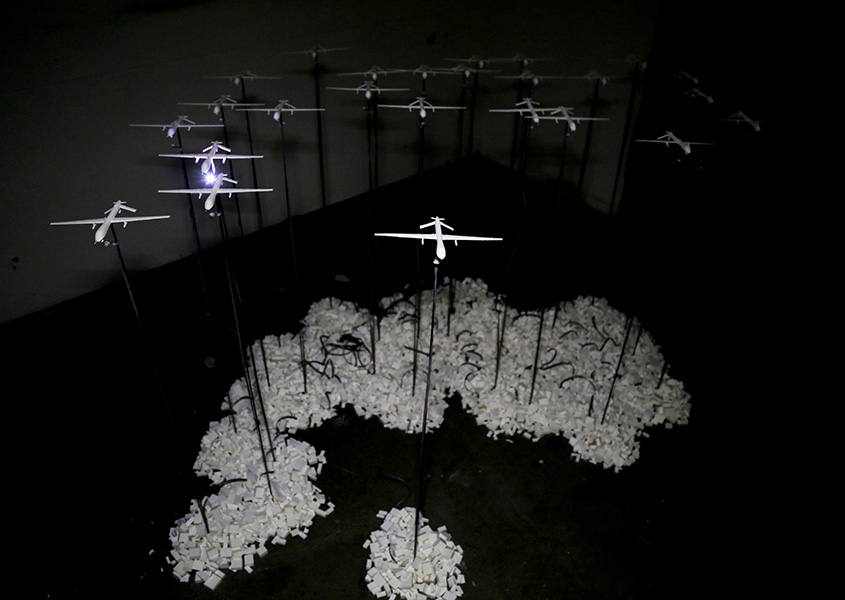
75_drone-shadow-charlie-3

Joseph has several other projects that address drone warfare, the most interesting of which (to me, anyway) is his ongoing visualization of drone strikes around Mir Ali in the Federally Administered Tribal Areas of Pakistan (see above):

A collaborative project to create a large-scale installation to map, via sculptural and electronic components, the history of ongoing US drone strikes in the North Waziristan region of Pakistan. The work shown here includes 25 3-D printed paper reproductions of MQ9 Predator Drones, arranged in a pattern of documented drone strikes around the town of Mir Ali. This is a prototype for a much larger installation that, when completed, will feature over 405 paper drones – one each representing every documented drone strike in Pakistan. The drones will be arranged to create a map of drone strikes – each drone is individually lit by an addressable LED light which will go off in a staccato pattern – in the final installation the staccato pattern will be interrupted over time by individual drones strikes being highlighted in red and the incorporation of an LED panel on the wall that will note the location, date and number of people killed.

There’s a preview of the prototype, ‘Drone Shadow’, on YouTube:

Standing on occupied ground

This is Reading Week at UBC, so I’m doing just that…  At the AAG Annual Meeting in San Francisco there is a Plenary Session on Friday 1 April (sic) on Forging Solidarity: Taking a stand on Palestine:

In July 2015 the International Critical Geography Group convened its seventh conference in the occupied city of Ramallah, Palestine. The conference brought together scholars and activists committed to combating social exploitation and oppression. Altogether four hundred participants from over forty countries energetically took up issues on and beyond the violent frontlines of class, gender, race, sexual, and colonial divisions. Yet they also took critical steps beyond discussion and debate of our intellectual work towards concrete collective action. An example of this was the overwhelmingly vote of conference participants for a strong resolution to sign onto the Palestinian Academic and Cultural Boycott and the broader Boycott Divestment and Sanctions (BDS) campaign against Israel. The resolution adopted is both a political statement in solidarity with the anti-colonial struggle of our Palestinian comrades but also an agenda for a broader commitment to anti-capitalist, decolonial, anti-racist, feminist and queer social movements and struggles around the world against growing social, economic and political precarity, rising authoritarianism, encroachment of fundamental rights, dispossession, structural adjustment in the south and north, revanchism, ongoing colonization of public space, land and resources, the privatization of the commons, as well as structural and state-sanctioned violence against racialized, gendered, queer bodies, and other targeted bodies and communities.

Building on the momentum generated by the conference and this resolution, this discussion panel aims to open up a serious discussion about BDS and the academic boycott of Israel within the Association of American Geographers. This is, we believe, particularly relevant in light of the current situation in Palestine/Israel but also taking into consideration how academics from other professional organisations such as the American Anthropological Association, the Association for Asian American Studies, the American Studies Association and the Native American Studies Association, as well as a number of student councils worldwide, have already endorsed this call for solidarity. Our distinguished panel of scholars and activists will speak out about the importance and the urgency to adopt a political stand on Palestine and to further the work of decolonizing the discipline of geography. In doing so, we hope to reaffirm a commitment to critical scholarship and praxis by encouraging and enabling spaces of political and conceptual possibility for geographers in solidarity with ongoing socio-political, economic and environmental struggles around the globe.

w512

In the wake of that ICG Conference in Ramallah, David Lloyd‘s moving reflections on another conference/workshop in the same city, ‘Walter Benjamin in Palestine‘, repay careful reading:

Activism is in fact the antagonist of complacency and of the satisfaction with familiar protocols that dulls thinking and makes the institutionalized academic a little stupid. But activism is not always expressed in headlong mobilization or fervent debates, nor is thought only the forethought that shapes or the afterthought that reflects on practice. As “Benjamin in Palestine” exemplified, it can also take the form of deliberate thinking in common whose very exercise is a form of resistance, however limited. As the BDS movement continues to advance, perhaps workshops like these, which step beyond mere “severance of relations” (as Benjamin described the act of striking) to shape conditions for new modes of relation, may offer a way to think the future of our resistance to Israeli apartheid. Perhaps too it offers a model also for an alternative to the insidious corporatization of our intellectual and creative lives under the neoliberal dispensation we all confront, wherever we reside, and not only in occupied Palestine. That, indeed, may be the insight we have been gifted by those who daily struggle for the right to education in the face of dispossession.

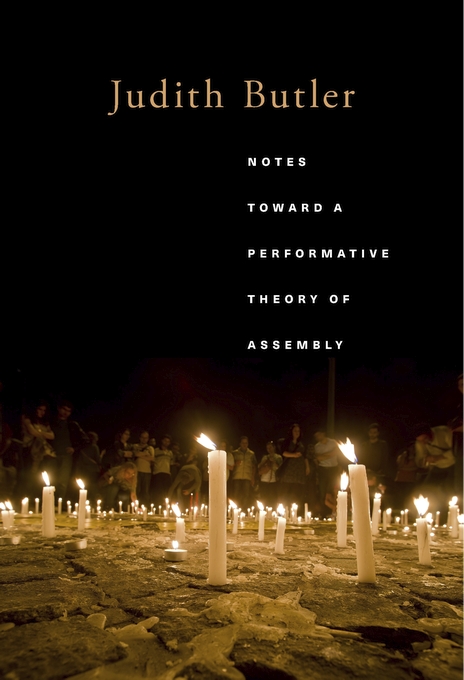
BUTLER NotesIn its way this, too, is a modestly performative politics of assembly.  So it’s good to see that panelists at the AAG plenary include this year’s Honorary Geographer, Judith Butler; full list is here.  You can find Judith’s previous remarks on BDS (at Brooklyn College) here.

You can also find out much more about the American Anthropological Association’s stand (last year) here; the statement that accompanied the successful resolution is here; a series of FAQs (“Yes, but…”) is here; and other resources are here.

It’s opportune, too, that the latest issue of borderlands should be devoted to The politics of suffering – with a special focus on occupied Palestine.  Among the many truly excellent essays three stand out for me.

First, Suvendrini Perera‘s accomplished contrapuntal reading of transnational justice, ‘Visibility, Atrocity and the Subject of Postcolonial Justice‘, which proceeds’ through a series of key sites – Congo, Belgium, Nuremberg, Israel, Gaza – that links past and present, colonial and colonizing worlds’, and then focuses on the deaths of tens of thousands of civilians on the beaches of Mullivaikkal in northeast Sri Lanka:

In the context of the 2009 atrocities in Lanka, in this paper I attempt to think through a set of questions about visibility, witness, suffering, accountability and disposability as they are played out in the relations between the necro-geo-politics of global institutions and the patchworks of local and transnational movements that attempt to materialize peoples’ suffering and realize the possibility of justice within fragile and compromised frameworks.

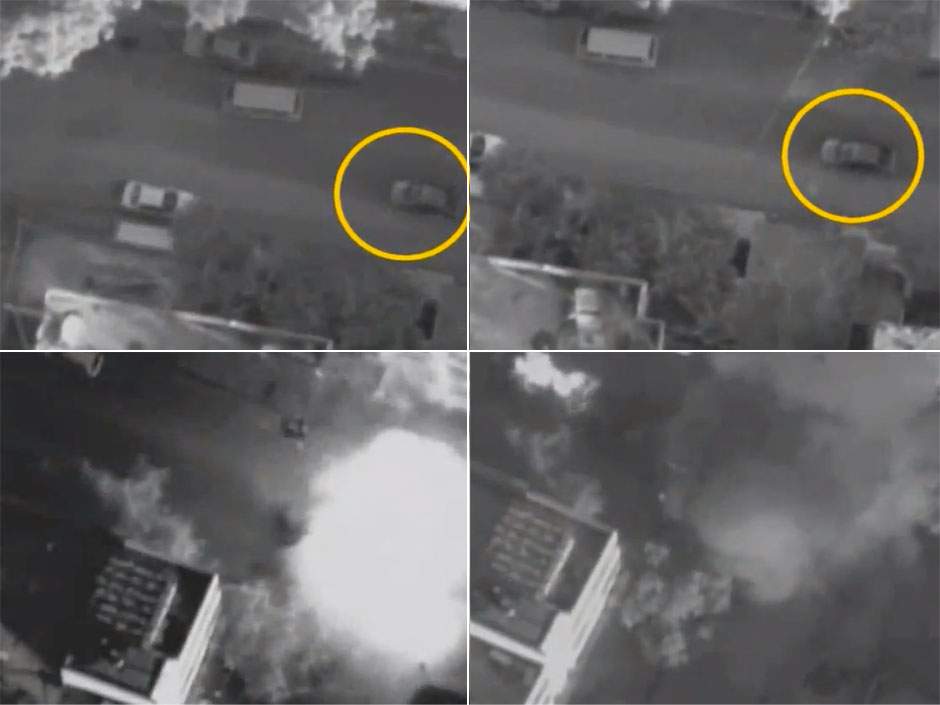
Drone feed Gaza city November 2012

Second, Joseph Pugliese‘s characteristically innovative ‘Forensic ecologies of occupied zones and Geographies of dispossession: Gaza and occupied East Jerusalem‘:

In this essay, I work to develop what I term multi-dimensional matrices of suffering that envisage the understanding of suffering beyond the locus of the human subject. In my theorising of multi-dimensional matrices of suffering, I proceed to conceptualise the suffering experienced in occupied zones as both relational and distributed. In the occupied zone, suffering encompasses complex, multi-dimensional vectors that bind humans, animals, animate and non-animate objects and entities, buildings and land. In the context of the regimes of violence that inscribe occupied zones, I situate suffering, and a range of other affects, in ecological configurations that, through a range of forensic indices, evidence the impact of these regimes of violence on the broad spectrum of entities that comprise a particular occupied zone. The conceptualisation of suffering and trauma in occupied zones in terms of its relational multi-dimensionality, its site-specific matrices and relational distribution across ecologies, I conclude, enables an understanding of suffering that moves beyond anthropocentric approaches. I situate my analysis in the context of Israel’s drone-enabled regime of unrelenting surveillance, occupation and military control over Gaza [see image above] and its continuing occupation of East Jerusalem.

It really is a tour de force, only too literally so, and builds not only on Joe’s brilliant State violence and the execution of law and his previous research but also on Jane Bennett‘s work and – as the title signposts – on Eyal Weizman‘s project of forensic architecture.  It’s doubly important because so much critical writing on military drones has virtually nothing to say about Israel’s use (and sale) of them.

Finally, Jasbir Puar‘s ‘The ‘right’ to maim: Disablement and inhumanist biopolitics in Palestine‘:

This essay argues that Israel manifests an implicit claim to the ‘right to maim’ and debilitate Palestinian bodies and environments as a form of biopolitical control and as central to a scientifically authorized humanitarian economy. In this context, the essay tracks the permeating relations between living and dying that complicate Michel Foucault’s foundational mapping of biopower, in this case, the practice of deliberate maiming. In doing so it demonstrates the limitations of the idea of ‘collateral damage’ that disarticulates the effects of warfare from the perpetration of violence, and notes that the policy of maiming is a productive one, a form of weaponized epigenetics through the profitability of a speculative rehabilitative economy.

This too is meticulously argued and imaginatively constructed, and adds important dimensions to my posts about Israel’s war on Gaza and, in particular, my preliminary speculations about the prosthetics of military violence.

‘Reach from the sky’ ONLINE

Tanner_Lecture_2016_FINAL

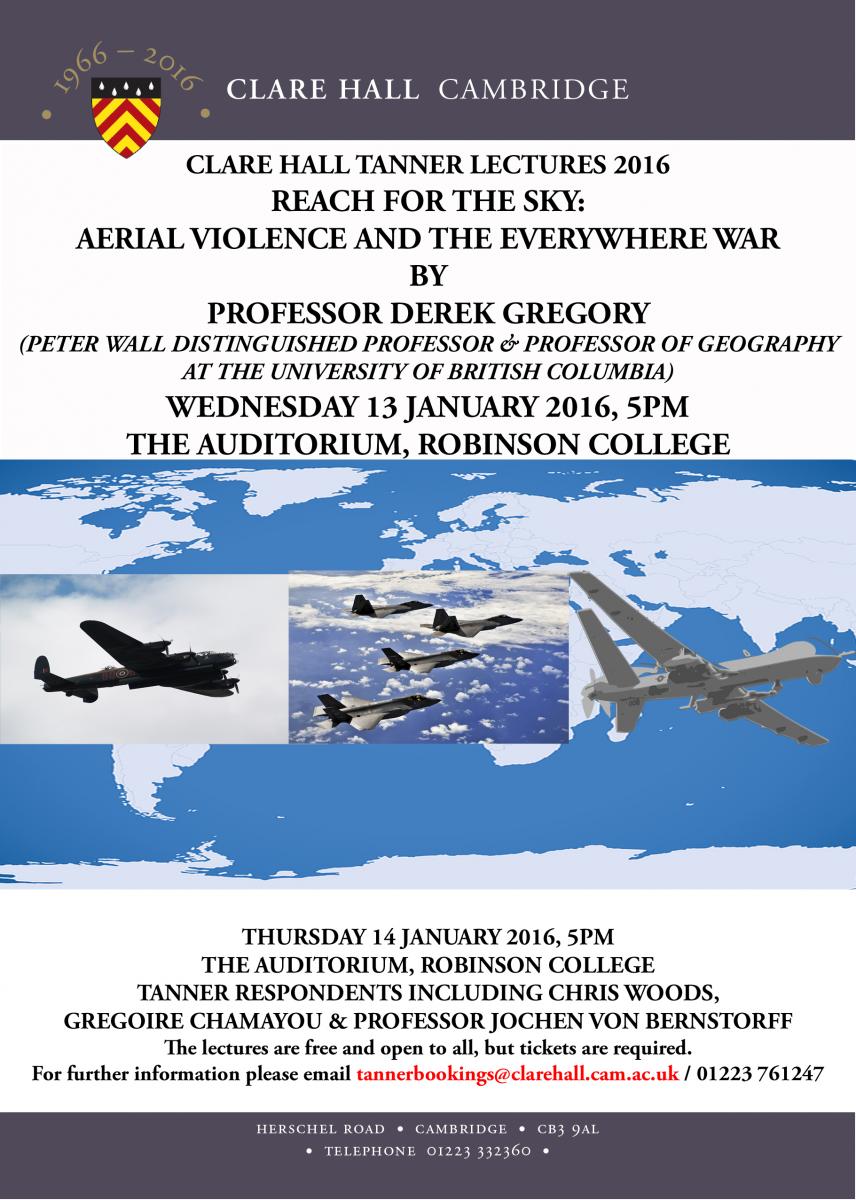
The video of my two Tanner Lectures, Reach from the sky: aerial violence and the everywhere war, delivered in Cambridge last month, is now available on the Clare Hall website.  The first, ‘Good bomb, bad bomb’ is here, and the second, ‘Killing Space’, is here, while the responses from Grégoire Chamayou, Jochen von Bernstorff and Chris Woods are here.

I’m immensely grateful to the video team, who were exceptionally helpful and remarkably accomplished.

I’m now hard at work on the long-form version…  And yes, I have – just! – notice the mistake on the poster.  It was indeed ‘Reach from the sky.’  Per ardua….

There’s also a short and kind reflection on the lectures from Alex Jeffrey over at Placing Law here.

Targeted killings

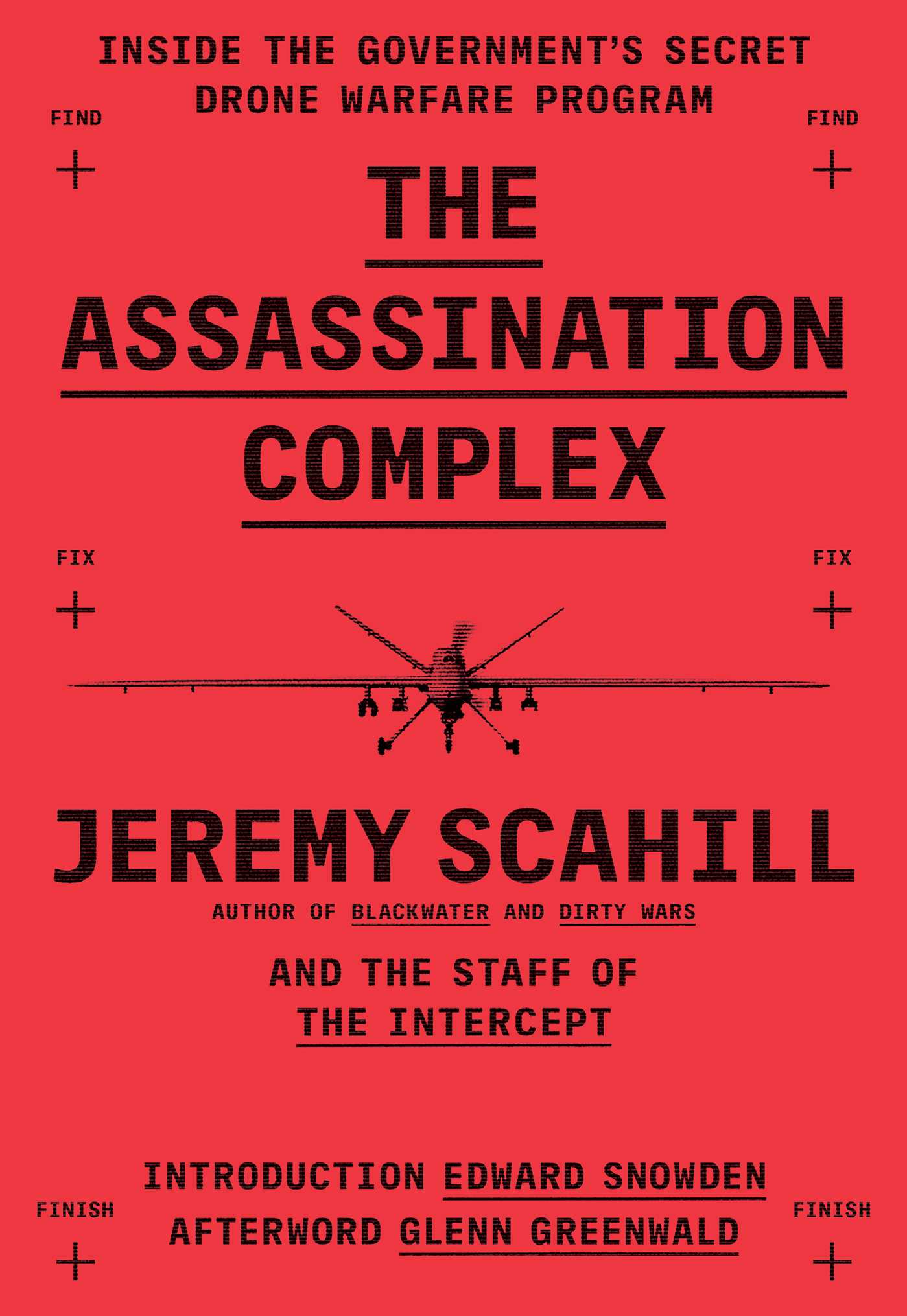
Coming from Simon and Schuster in May, a new book by Jeremy Scahill and his team at The InterceptThe Assassination Complex: Inside the Government’s Secret Drone Warfare Program.

the-assassination-complex-9781501144134_hrMajor revelations about the US government’s drone program—bestselling author Jeremy Scahill and his colleagues at the investigative website The Intercept expose stunning new details about America’s secret assassination policy.

When the US government discusses drone strikes publicly, it offers assurances that such operations are a more precise alternative to troops on the ground and are authorized only when an “imminent” threat is present and there is “near certainty” that the intended target will be killed. The implicit message on drone strikes from the Obama administration has been trust, but don’t verify.

The online magazine The Intercept exploded this secrecy when it obtained a cache of secret slides that provide a window into the inner workings of the US military’s kill/capture operations in Afghanistan, Yemen, and Somalia. Whether through the use of drones, night raids, or new platforms yet to be employed, these documents show assassination to be central to US counterterrorism policy.

The classified documents reveal that Washington’s fourteen-year targeted killing campaign suffers from an overreliance on flawed signals intelligence, an apparently incalculable civilian toll, and an inability to extract potentially valuable intelligence from terror suspects. This campaign, carried out by two presidents through four presidential terms, has been deliberately obscured from the public and insulated from democratic debate. The Assassination Complex allows us to understand at last the circumstances under which the US government grants itself the right to sentence individuals to death without the established checks and balances of arrest, trial, and appeal.

The book will include original contributions from Glenn Greenwald and Edward Snowden.

From NYU Press in July, a collection of essays edited by Kerstin Fisk and Jennifer Ramos that connects drone warfare to the Obama administration’s doctrine of ‘preventive force’ and the tangled legal armature that surrounds it: Preventive Force: Drones, Targeted Killing, and the Transformation of Contemporary Warfare.

Preventive ForceMore so than in the past, the US is now embracing the logic of preventive force: using military force to counter potential threats around the globe before they have fully materialized. While popular with individuals who seek to avoid too many “boots on the ground,” preventive force is controversial because of its potential for unnecessary collateral damage. Who decides what threats are ‘imminent’? Is there an international legal basis to kill or harm individuals who have a connection to that threat? Do the benefits of preventive force justify the costs? And, perhaps most importantly, is the US setting a dangerous international precedent?

In Preventive Force, editors Kerstin Fisk and Jennifer Ramos bring together legal scholars, political scientists, international relations scholars, and prominent defense specialists to examine these questions, whether in the context of full-scale preventive war or preventive drone strikes. In particular, the volume highlights preventive drones strikes, as they mark a complete transformation of how the US understands international norms regarding the use of force, and could potentially lead to a ‘slippery slope’ for the US and other nations in terms of engaging in preventive warfare as a matter of course. A comprehensive resource that speaks to the contours of preventive force as a security strategy as well as to the practical, legal, and ethical considerations of its implementation, Preventive Force is a useful guide for political scientists, international relations scholars, and policymakers who seek a thorough and current overview of this essential topic.

Contents are listed here.

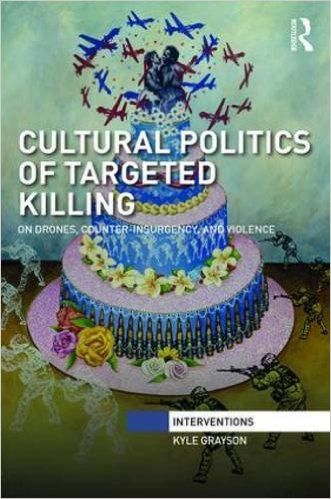
That same month comes the book I most want to read – but the eye-popping price from Routledge makes me wonder whether some mega-publishers see books as anything other than commodities.  It’s Kyle Grayson‘s Cultural Politics of Targeted Killing: On Drones, Counter-Insurgency, and Violence (hardcover only: madness).

GRAYSON Cultural politics of targeted killingThe deployment of remotely piloted air platforms (RPAs) – or drones – has become a defining feature of contemporary counter-insurgency operations. Scholarly analysis and public debate has primarily focused on two issues: the legality of targeted killing and whether the practice is effective at disrupting insurgency networks, and the intensive media and activist scrutiny of the policy processes through which targeted killing decisions have been made. While contributing to these ongoing discussions, this book aims to determine how targeted killing has become possible in contemporary counter-insurgency operations undertaken by liberal regimes.

Each chapter is oriented around a problematisation that has shaped the cultural politics of the targeted killing assemblage. Grayson argues that in order to understand how specific forms of violence become prevalent, it is important to determine how problematisations that enable them are shaped by a politico-cultural system in which culture operates in conjunction with technological, economic, governmental, and geostrategic elements. The book also demonstrates that the actors involved – what they may be attempting to achieve through the deployment of this form of violence, how they attempt to achieve it, and where they attempt to achieve it – are also shaped by culture.

The book demonstrates how the current social relations prevalent in liberal societies contain the potential for targeted killing as a normal rather than extraordinary practice.

Contents:

Chapter One: The Cultural Politics of the Targeted Killing Assemblage

Chapter Two: Beyond the Exception: The Legal Problematisation of Targeted Killing

Chapter Three: The Politics of Targeted Killing

Chapter Four: Science, Capitalism, and the RPA

Chapter Five: The Aesthetic Subjects of Targeted Killing

Chapter Six: The Quotidian Geopolitics of Targeted Killing Strikes

Chapter Seven: Concluding Remarks on the Cultural Politics of Targeted Killing

(Amazon says July, but the publisher says ‘2017’ so perhaps somebody in Taylor & Francis’s counting-house might have a serious think between now and publication; they clearly take ‘making a killing’ all too seriously).

Rooting for the uprooted

There’s an excellent account by Michael Hodges of Eyal Weizman‘s Forensic Architecture project (he now calls it a research agency) over at Wired UK.  Unlike some media versions, this is fully – and appropriately – embodied and materialised, following Eyal through East Jerusalem and into the West Bank in August 2015.  He explains:

“The idea is to use forensic architecture as a method that extends deep into the facts and looks at them and maps them out to see the materialisation of political forces. Forensic Architecture assumes that every bit of material reality is the product of a complex force field that extends in space and time. So you can take an inanimate object and see into it, almost like a crystal ball.”

That’s as good a summary of the project as you’ll find, but en route you also understand the ‘situatedness’ of the project – that’s an inadequate formulation, I increasingly think, since it’s also about extending deep into what, for want of a batter word, we might call the field: it’s about the rootedness of Forensic Architecture in the lives of the uprooted.

FA Waziristan 2010 reconstruction

In consequence, what also comes into view during the report is the passionate commitment of its investigators to the witnesses whose experiences they recover:

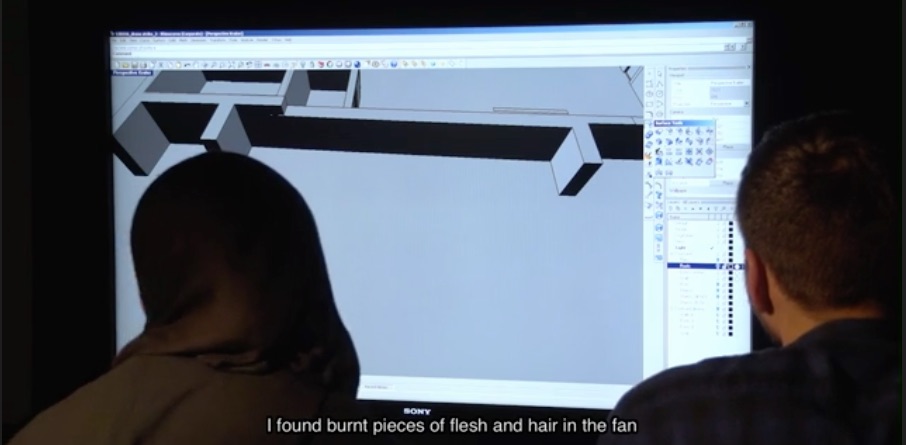
“We understand the relationship between memory, architecture and violence,” Weizman says. “Take the woman who survived the drone strike in Waziristan [above; see also the video here: scroll down to case 2]. She was very traumatised; she lost relatives in there. We returned her digitally to the site of the attack and built it together with her, reconstructed her family house that had been hit by the drone [above]. During the modelling process she was meticulous about every window, every object we placed in there, every person. But she was very obsessed with a fan. In the beginning she said it was on the ceiling. Then she said no, it was a standing fan. She asked us to move it to the left and then to the right and then back again, until we were wondering, what is it about the fan? But when we made her walk through the space she recollected exactly where it had been, and that after the strike had killed her family she had found bits of human flesh on the blades of the fan. You see, the fan acted as an anchor for her memory and in the end we reassembled that memory in a digital space.”

And as you follow Eyal through occupied Palestine, you also realise that there is something vitally defiant in so thoroughly challenging Israel’s rhetorical claim to the ‘facts on the ground’.

Drone observations

I’m just back from a lovely week at Dartmouth, so there’s lots to catch up on.  This post is confined to (yet more) notes on writing about drones.  It’s selective, partly because I’m sure I’ve missed all sorts of important recent contributions – and if I have please let me know – but partly because so many supposedly critical interventions retrace familiar steps unburdened by substantive research.

This is far from the case with this one.  Part of the purpose of my stay in Dartmouth was to spend time with Kate Kindervater, one of the first cohort of five post-docs at Dartmouth’s new Society of Fellows (selected from 1700 applicants!).   She completed her PhD at the University of Minnesota last year on ‘Lethal Surveillance: Drones and the Geo-History of Modern War‘.

Interdisciplinary both in scope and method, my dissertation, Lethal Surveillance: Drones and the Geo-History of Modern War, examines the history of drone technology from the start of the 20th century to the present in order to understand the significance of the increasing centrality of drones to current American military engagements and security practices more generally. Much of the scholarship on drones and many other contemporary military technologies tends to view the technology as radically new, missing both the historical development of these objects as well as the perspectives and rationalities that are embedded in their use. For this research, I focused on three main periods of drone research and development: the early years of World War I and II in the UK, the Cold War, and the 1990s. In studying this history of the drone, I found that two key trends emerge as significant: the increasing importance of information to warfare under the rubric of intelligence, reconnaissance and surveillance; and a shift toward more dynamic, speedier, and individualized targeting practices. I argue that the widespread use of drones today thus represents the culmination of attempts in war to effectively link these two trends, creating a practice I call lethal surveillance — with the armed Predator effectively closing the loop between identifying and killing targets. The concept of lethal surveillance, which in my dissertation I place squarely within the histories of modern scientific thinking and Western liberal governance, allows us to see how techniques of Western state power and knowledge production are merging with practices of killing and control in new ways, causing significant changes to both the operations of the state and to practices of war. Framing the drone through the lens of lethal surveillance, therefore, allows us to see the longer histories the drone is embedded in as well as other security practices it is connected to.

We had lots of really good conversation, and while I was at Dartmouth Kate had a paper published at Security dialogue, drawing from her thesis: ‘The emergence of lethal surveillance: Watching and killing in the history of drone technology’:

This article examines the history of the development of drone technology to understand the longer histories of surveillance and targeting that shape contemporary drone warfare. Drawing on archival research, the article focuses on three periods in the history of the drone: the early years during World Wars I and II, the Cold War, and the 1990s. The history of the drone reveals two key trends in Western warfare: the increasing importance of intelligence, surveillance, and reconnaissance (ISR) and the development of dynamic targeting. These trends converge today in a practice of lethal surveillance where ISR capabilities are directly linked to targeted killing, effectively merging mechanisms of surveillance and knowledge production with decisions on life and death. Taking this history of lethal surveillance into account not only reframes current debates on drone warfare, but also connects the drone to other practices of security and control.

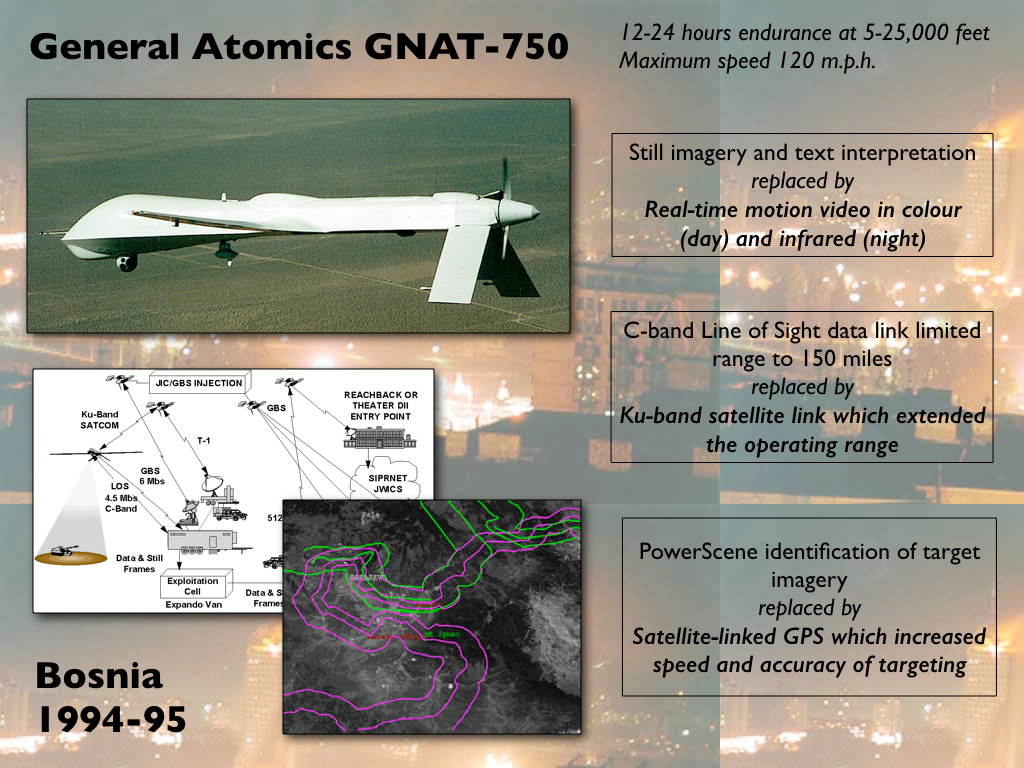
Kate is absolutely right to trace through the trajectories of ISR and dynamic targeting, and I applaud the way in which she doesn’t move directly from colonial ‘air policing’ and ‘pilotless bombing’ (in the case that interests her the most, in Iraq in the 1920s) to today’s remote operations but insists on the pivotal importance of the Cold War and, post-1989, Kosovo.  Kosovo is particularly interesting, I think, and here is my own summary take on developments there:

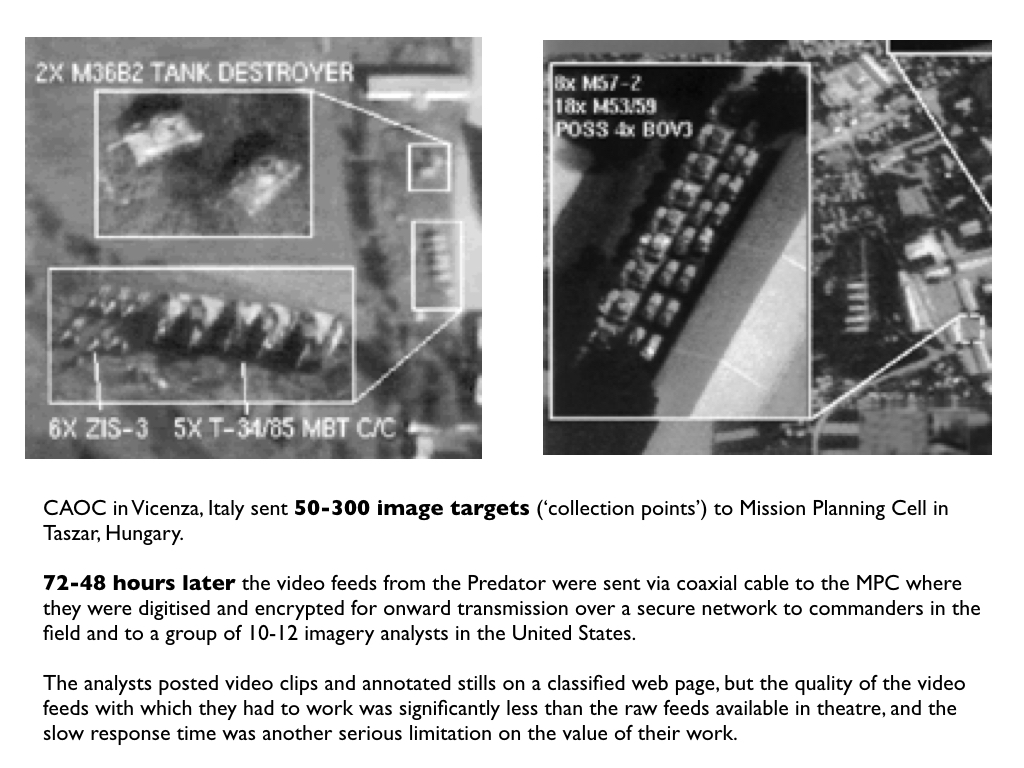
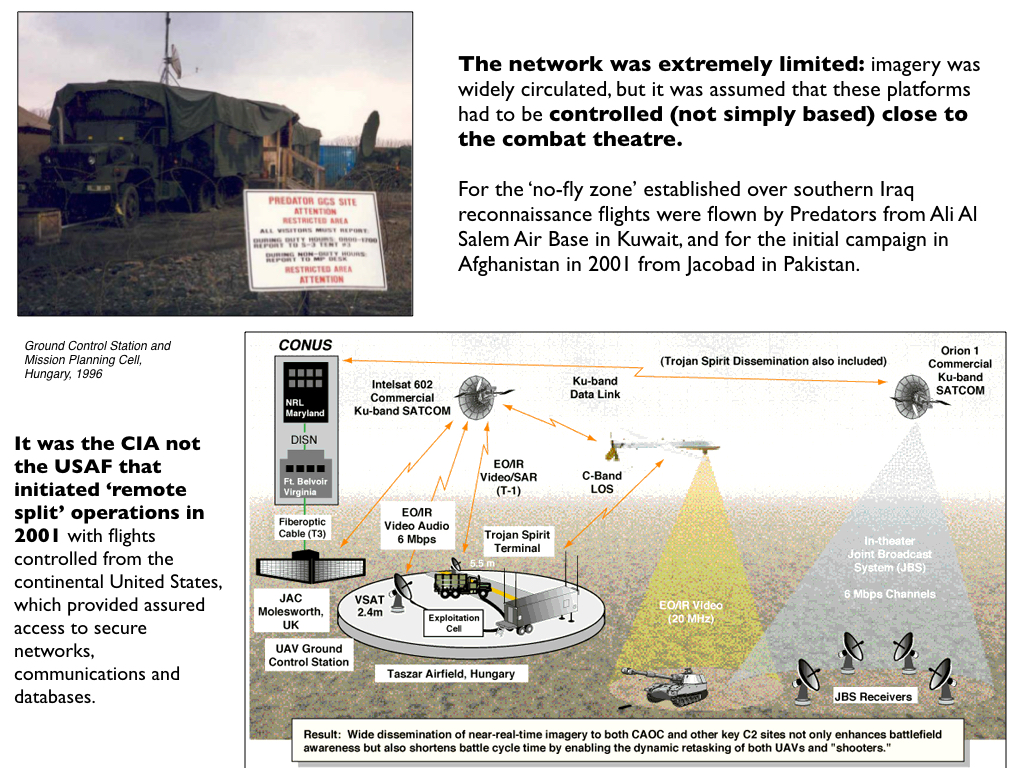
Predator precedents in Bosnia.001 Predator precedents in Bosnia.002 Predator precedents in Bosnia.003

Another exceptionally interesting paper is Cara Daggett‘s ‘Drone disorientations: how unmanned weapons queer the experience of killing in war’, which appeared in the International journal of feminist politics 17 (3) (2015) 361-379:

Killing with drones produces queer moments of disorientation. Drawing on queer phenomenology, I show how militarized masculinities function as spatiotemporal landmarks that give killing in war its “orientation” and make it morally intelligible. These bearings no longer make sense for drone warfare, which radically deviates from two of its main axes: the home–combat and distance–intimacy binaries. Through a narrative methodology, I show how descriptions of drone warfare are rife with symptoms of an unresolved disorientation, often expressed as gender anxiety over the failure of the distance–intimacy and home–combat axes to orient killing with drones. The resulting vertigo sparks a frenzy of reorientation attempts, but disorientation can lead in multiple and sometimes surprising directions – including, but not exclusively, more violent ones. With drones, the point is that none have yet been reliably secured, and I conclude by arguing that, in the midst of this confusion, it is important not to lose sight of the possibility of new paths, and the “hope of new directions.”

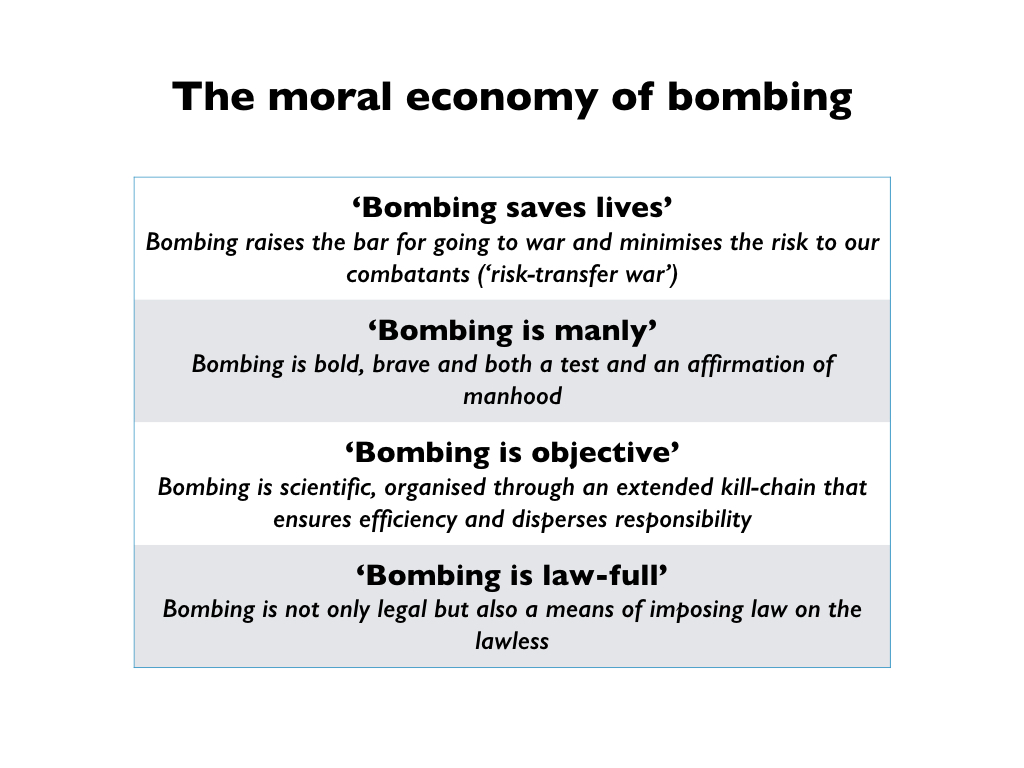
There have been several commentaries that take the ‘un-manning’ of remote operations literally and seriously, and I drew on several of them in accounting for the moral economy of bombing in my Tanner Lectures last month: the (hideous) claim that bombing is, in all sorts of ways, virile and manly – so that, by extension, those who fly today’s Predators and Reapers are neither since they are never in harm’s way.  It’s an alarming argument, since it inadvertently legitimates (and even celebrates) the masculinism of conventional bombing, misses the new reality of today’s air wars, and ignores a crucial observation made by Robert Gates [the slides below are from my Tanner Lectures]:

Unopposed air war.001Unopposed air war 2.001

Cara’s argument is much more artful than that, and well worth thinking through.

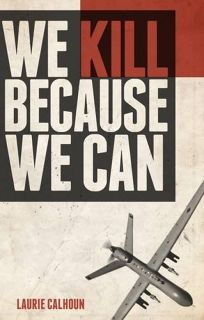
As both writers know, the use of military drones is not confined to targeted killing (though so many continue to write as though that were the case).  That said, Laurie Calhoun‘s We kill because we can: from soldiering to assassination in the drone age (Zed Books, 2015) is as deft an examination of the issues that you can find:

Welcome to the Drone Age. Where self-defense has become naked aggression. Where courage has become cowardice. Where black ops have become standard operating procedure. In this remarkable and often shocking book, Laurie Calhoun dissects the moral, psychological and cultural impact of remote-control killing in the twenty-first century. Can a drone operator conducting a targeted killing be likened to a mafia hitman? What difference, if any, is there between the Trayvon Martin case and the drone killing of a teen in Yemen? We Kill Because We Can takes a scalpel to the dark heart of Western foreign policy in order to answer these and many other troubling questions.

CALHOUN We kill because we canPreface
Introduction

Part I: Find
1. Drone Nation
2. From Black Ops to Standard Operating Procedure
3. The Logic of Targeted Killing
4. Lethal Creep

Part II: Fix
5. Strike First, Suppress Questions Later
6. The New Banality of Killing
7. The Operators
8. From Conscience to Oblivion

Part III: Finish
9. Death and Politics
10. Death and Taxes
11. The Death of Military Virtue
12. Tyrants Are as Tyrants Do

Conclusion
Postface
Appendix: Drone Killing and Just War Theory

You can find an extended interview with Laurie here.

Finally – and as you’ll soon see from an upcoming post – I can’t seem to stop wandering through the nuclear wastelands.  I described the role that drones played in the early development of Strategic Air Command (through its “Project Brass Ring”) and in monitoring US atomic tests in the Marshall Islands in my “Little Boys and Blue Skies” presentation at Toronto last fall (see DOWNLOADS tab and the extended post here), which I reworked for one of my presentations at Dartmouth.  Over at Bard College’s Center for the Study of the Drone, Dan Gettinger replays the same little-known story – though he doesn’t play it forward to the atomic tests that took place at the Nevada Proving Grounds and the role of Indian Springs as a base for those early drone missions in the continental United States.  Indian Springs is now Creech Air Force Base, of course, one of the central nodes for today’s remote operations.

Still reaching from the skies…

Sorry for the long silence – I’ve had my head down since soon after Christmas preparing the Tanner Lectures which I gave this past week in Cambridge [‘Reach from the sky: aerial violence and the everywhere war’].  The lectures were recorded and the video will be available on the Clare Hall website in a fortnight or so: more when I know more.

In outline – and after a rare panic attack the night before, which had me working until 2.30 in the morning –  I organised the two Lectures like this:

ONE

Prelude: The historical geography of bombing

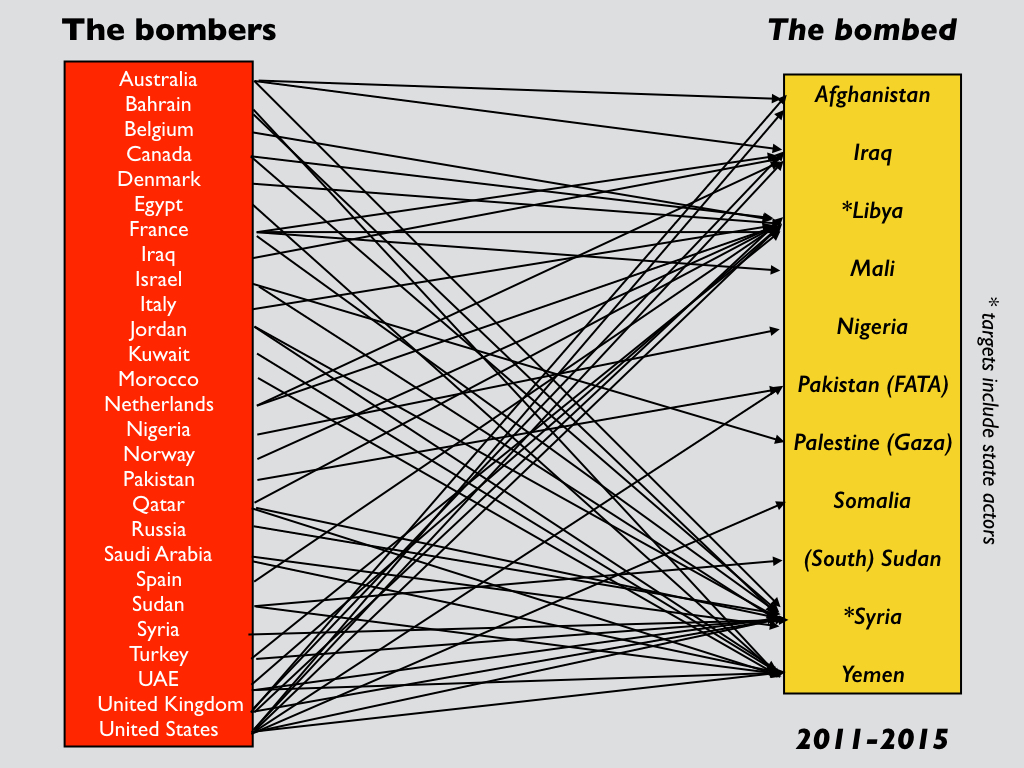
Bombing is back in the headlines but it never really left – and yet those who remain advocates of aerial violence don’t seem to have learned from its dismal history.  They also ignore the geographies that have been intrinsic to its execution, both the division between ‘the bombers and the bombed’ (the diagram below is an imperfect and fragmentary example of what I have in mind) and the pulsating spaces through which bombing is performed.

The bombers and the bombed.001

Good bomb, bad bomb

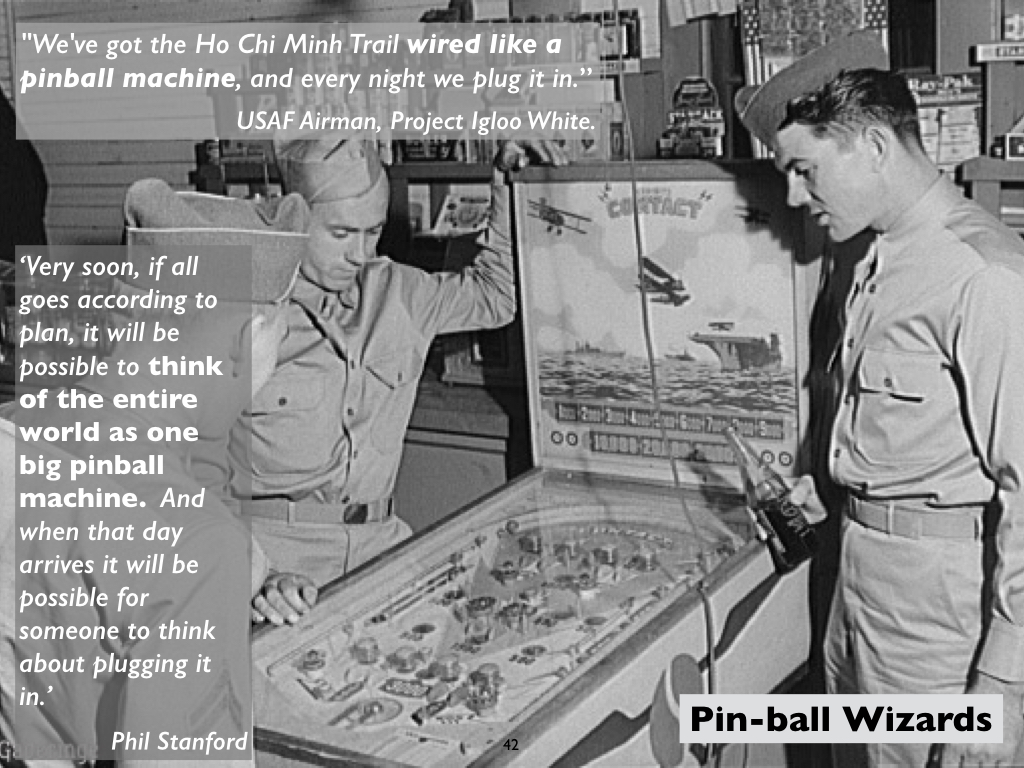
(with apologies to Mahmood Mamdani….)  In the first part I traced The machinery of bombing from before the First World War through to today’s remote operations.  Even though most early commentators believed that the primary role of military aircraft would be in reconnaissance, it was not long before they were being used to orchestrate artillery fire and to conduct bombing from the air. This sequence parallels the development of the Predator towards the end of the twentieth century.  In fact, almost as soon as the dream of flight had been realised the possibility of ‘unmanned flight’ took to the air.  Perhaps the most significant development, though, because it directs our attention to the wider matrix within which aerial violence takes place, was the development of the electronic battlefield in Laos and Cambodia. I’ve written about this in detail in ‘Lines of Descent‘ (DOWNLOADS tab); the electronic battlefield was important not because of what it did – the interdiction program on the Ho Chi Minh Trail was a spectacular failure (something which too many historians have failed to recognise)  – but because of what it showed: it conjured up an imaginative landscape, an automated killing field, in which sensors and shooters were linked through computer systems and automatic relays.  Contemporaries described the system as a vast ‘pinball machine’ (see the image below: you can have no idea how long it took me to track it down…).
Pinball wizards.001

The analogy allowed me to segue into the parallel but wholly inadequate characterisation of today’s remote operations as reducing military violence to a video game.

That is an avowedly ethical objection, of course, so I then turned to The moral economy of bombing.  Here I dissected four of the main ways in which bombing has been justified.  These have taken different forms at different times, and they intersect and on occasion even collide.  But they have been remarkable persistent, so in each case I tracked the arguments involved and showed how they have been radicalised or compromised by the development of Predators and Reapers.

Moral economy of bombing.001

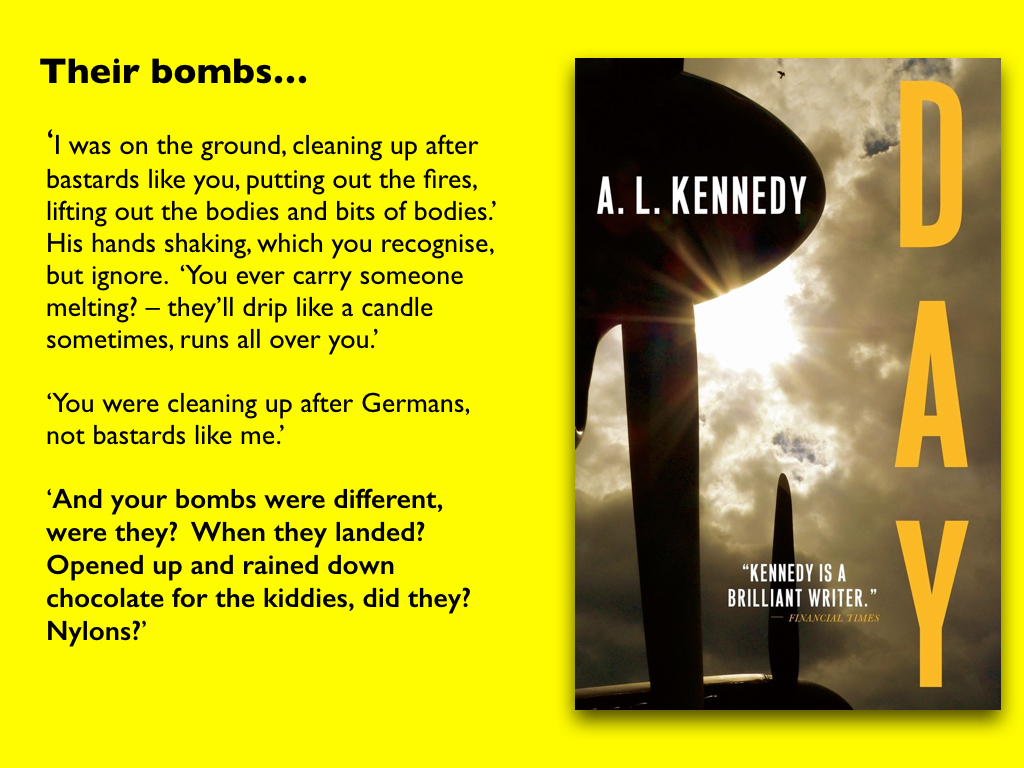
All of these justifications applied to ‘our bombs’, needless to say, which become ‘good bombs’, not to ‘their bombs’ – the ‘bad bombs’.

Their bombs.001

TWO

Killing Space

Phillips' Aerial Torpedo.001

I started the second lecture by discussing The deconstruction of the battlefield; the wonder of Raymond Phillips’s fantasies of ‘aerial torpedoes‘ before the First World War was not so much their promise of ‘bomb-dropping by wireless’ but the targets:

Phillips' bomb-dropping by wireless.001

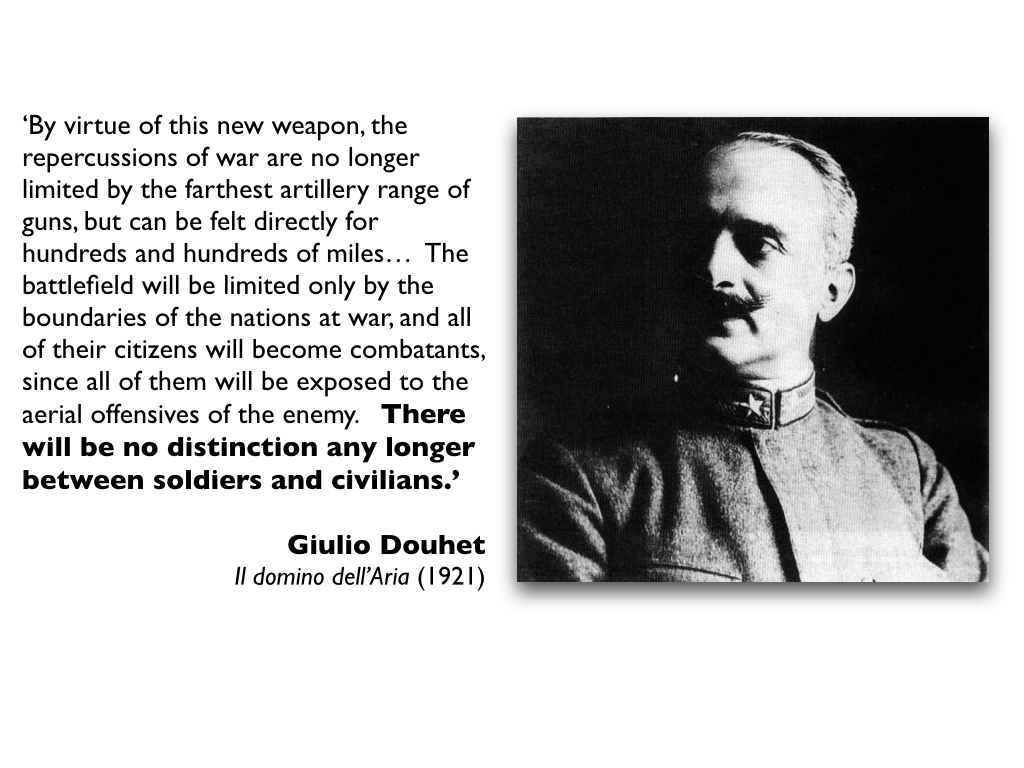
It was this radical extension of the battle space that counted.  In the event,  it was not British airships that dropped bombs on Berlin but German Zeppelins that bombed London and Paris, but the lesson was clear:

Douhet.001

To explore the formations and deformations of the battlespace in more detail, I used the image of The dark heart of bombing to describe a battlespace that alternately expanded and contracted.  So Allied bombing in the Second World war extended its deadly envelope beyond Germany, Italy and Japan into Belgium, Bulgaria, Denmark, France, the Netherlands, Norway and Romania; later the United States would bomb North Vietnam but reserved most of its ordnance for South Vietnam, Laos and Cambodia; and US air strikes in Afghanistan and Iraq would eventually spill over into Pakistan, Syria and elsewhere.  In the course of those air wars, the accuracy of targeting improved until it was possible to aim (if not always to hit) point-targets – individual buildings and eventually individual people – but this contraction of the killing space was accompanied by its expansion.  These ‘point-targets’ were selected because they were vital nodes that made possible the degradation or even destruction of an entire network.  Hence, for example, the Israeli attack on the Gaza power station (more in a previous post here):

Gaza Power Strip.001

A similar argument can be made about the US Air Force’s boast that it can now put ‘warheads on foreheads’, and I linked the so-called individuation of warfare to the US determination to target individuals wherever they go – to what Jeremy Scahill and others describe as the production of a newly expanded ‘global battlefield’.  What lies behind this is more than the drone, of course, since these killing fields rely on a global system of surveillance orchestrated by the NSA, and I sketched its contours and showed how they issued in the technical production of an ‘individual’ not as a fleshy, corporeal person but as a digital-statistical-spatial artefact (what Ian Hacking once called ‘making people up’ and what Grégoire Chamayou calls ‘schematic bodies‘).

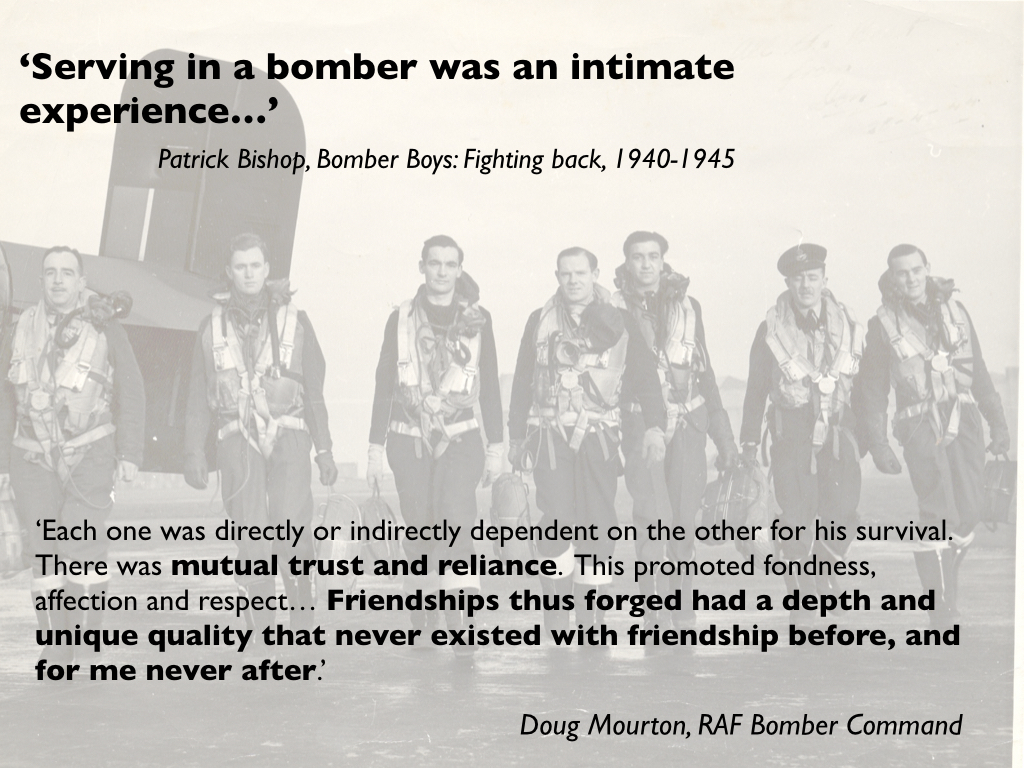
Next I explored a different dialectical geography of the battlespace: Remote splits: intimacy and detachment.  I started with RAF Bomber Command and traced in detail the contrast between the intimacy between members of bomber crews (a mutual dependence reinforced by the bio-convergence between their bodies and the machinery of the bomber itself) and the distance and detachment through which they viewed their targets.

Bioconvergence and the bomber crew.001

Intimacy in Bomber Command.001

The Good Wife.001

Cockpit dials.001

Distance and blindness.001

There’s much more on this in ‘Doors into nowhere‘ (DOWNLOADS tab), though I think my discussion in the Lectures breaks new ground. All of this is in stark contrast to today’s remote operations, where – as Lucy Suchman reminds us – there remains a remarkable (though different) degree of bioconvergence and yet now a persistent isolation and anomie is felt by many pilots and sensor operators who work in shifts:

Anomie and the drone.001

This is thrown into relief by the closeness remote operators feel to the killing space itself, an immersion made possible through the near real-time full-motion video feeds, the internet relay chatter and the radio communications with troops on the ground (where there are any). In contrast to the bomber crews of the Second World War – or those flying over the rainforests of Vietnam, Laos and Cambodia – there is a repeated insistence on a virtualized proximity to the target.

Good Kill in high-definition.001

But I used a discussion of Andrew Niccol‘s Good Kill to raise a series of doubts about what drone crews really can see, as a way into the next section, Sweet target, which provided an abbreviated presentation of the US air strike in Uruzgan I discuss in much more (I hope forensic) detail in Angry Eyes (see here and here).  That also allowed me to bring together many of the key themes I had isolated in the course of the two lectures.

As I approached my conclusion, I invoked Thomas Hippler‘s Le gouvernement du ciel: Histoire globale des bombardements aériens, (I’ve just discovered that Verso will publish the English-language version later this year or early next: Governing from the skies: a global history of aerial bombing):

Hippler Neo-douhetism.001

I’m not convinced that the military and paramilitary violence being visited on people today is all ‘low-intensity’ (Gaza? Afghanistan? Iraq? Syria? Yemen?).  But neither do I think it’s ‘de-territorialised’, unless the word is flattened into a conventionally Euclidean frame.  Hence, following Stuart Elden‘s lead, I treated territory as a political-juridical technology whose calibrations and enclosures assert, enable and enforce a claim over bodies-in-spaces.  And it was those ‘bodies-on-spaces’ that brought me, finally, to The loneliest space of all:  the irreducible, truly dreadful loneliness of death and grief:

Counting the dead.001

Behind the body-counts and the odious euphemisms of collateral damage and the rest lies the raw, inconsolable loss so exquisitely, painfully rendered in ‘Sky of Horoshima‘…

In the coming days I’ll post some of the key sections of the Lectures in more detail, which I’ll eventually develop into long-form essays.

I learned a lot from the expert and wonderfully constructive commentaries after the Lectures from Grégoire Chamayou, Jochen von Bernstorff and Chris Woods, and I’ll do my best to incorporate their suggestions into the final version.

In his response Grégoire traced my project on military violence in general and bombing/drones in particular back to a series of arguments I’d developed in Geographical imaginations in 1994 about vision, violence and corporeality; I had overlooked these completely, full of the conceit that my work had never stood still…. I shall go back, re-read and think about that some more, since some of the ideas that Grégoire recovered (and elaborated) may be even more helpful to me now.  Jochen and Chris also gave me much food for thought, so I shall be busy in the coming months, and I’m immensely grateful to all three of them.