Seeing ‘Through Post-Atomic Eyes’

All the videos from Through Post-Atomic Eyes last October are now available on YouTube here, including my “Little Boys and Blue Skies: drones through post-atomic eyes. My slide deck is available under the DOWNLOADS tab.

This is the sawn-off 30-minute version; I’ll be giving an extended version when I’m at Dartmouth later this month – and I’m really looking forward to that.

Reach from the Sky


Reach from the sky JPEG.001

I now have more details to share about my Tanner Lectures in Cambridge next month, Reach from the sky: aerial violence and the everywhere war.

First, here is a preliminary summary (not an easy thing to provide, since the two presentations are still very much in formation: but it will give you a rough idea of what I want to address).

Bombing is back in the headlines – but then it never really left. Over the last hundred years, bombing has become the preferred military option for many states, but it has supposedly been radically transformed over the last decade or so by the introduction of unmanned aerial vehicles (‘drones’). Their use has sparked a vigorous debate, inside and outside military circles, but commentators have rarely situated Predators, Reapers and other drones within the longer history of aerial violence or the larger matrix of armed conflict within which they have been deployed.

These lectures seek to fill both those gaps by addressing two fundamental questions. The first lecture, Good bomb, bad bomb, asks how people – both those who carry out air strikes and those publics who endorse them – have been persuaded of the propriety of aerial violence. Four responses run like red threads throughout the long history of bombing from the air: bombing saves lives, especially when compared with ‘boots on the ground’; bombing is bold, brave and ‘separates the men from the boys’; bombing is scientific, objective and precise, organised through an extended ‘kill-chain’ that ensures efficiency and disperses responsibility; and bombing is ‘law-full’, not only legal but also a means of imposing law on those who lack its ordering. These claims only apply to our bombs of course, not theirs, and these arguments and the practices that lie behind them have been substantially re-worked by today’s drone wars.

The second lecture, Killing space, asks what spaces have been produced through the changing ‘destruction line’ that has animated military targeting and military violence. Here there are two issues of crucial importance. One concerns the locus of targeting: in particular the range of aerial violence, the emergence of ‘wars without fronts’ and the extension of military violence beyond any demarcated battlefield, and the subsequent ‘individuation of warfare’ in which targets have contracted from areas and boxes to groups and individuals even as they have expanded through their location within networks that transmit and amplify the effects of individual strikes. The other concerns the grammar of targeting: in particular the reification and abstraction of targets, the rise of dynamic targeting and the incorporation of real-time intelligence, surveillance and reconnaissance, and the increased reliance on digital signatures for the cultivation of the killing fields.

Answers to these questions have much to tell us about the changing contours of modern war and the adjudication of what is to count as a ‘grievable life’ in the twenty-first century.

The lectures draw on a series of presentations, essays (most of them available under the DOWNLOADS tab) and posts, but they will also break new ground – and lots of it.  I’ll be going back to the origins of bombing before the First World War, tracing some of the parallels between bombing on the Western Front and the late modern deployment of Predators and Reapers, tracking the development of drones since the Second World War, and coming right up to the multiple forms of aerial violence currently being visited on Afghanistan, Iraq, Syria and elsewhere.  The lectures will also be packed with images (and even poetry).

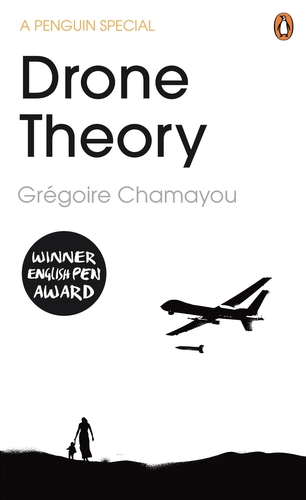
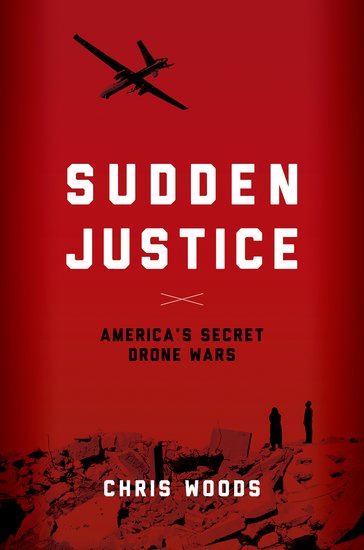
The format: I’ll give two 50-minute presentations starting at 5 p.m. on Wednesday 13 January, separated by a refreshment break (!) and followed by a reception.  Then at 5 p.m. on Thursday 14 January a panel of four respondents – which will include Chris Woods, (author of Sudden Justice: America’s secret drone wars), Grégoire Chamayou (author of A theory of the drone/Drone theory) and Jochen von Bernstorff, (Professor of Constitutional Law, Public International Law and Human Rights in Tübingen) will provide their reactions and comments, to be followed by a general discussion and debate.

The place: The lectures are organised by Clare Hall but will be given at the Robinson College Auditorium.  Admission is free but you will need a ticket from:

tannerbookings@clarehall.cam.ac.uk (Tel: 01223 761247)

I’m told that the tickets are going fast (really).  I’ll post updates on my progress; after the event I’ll post the presentation slides, and there will also be a published version at a later date.

Matters of definition

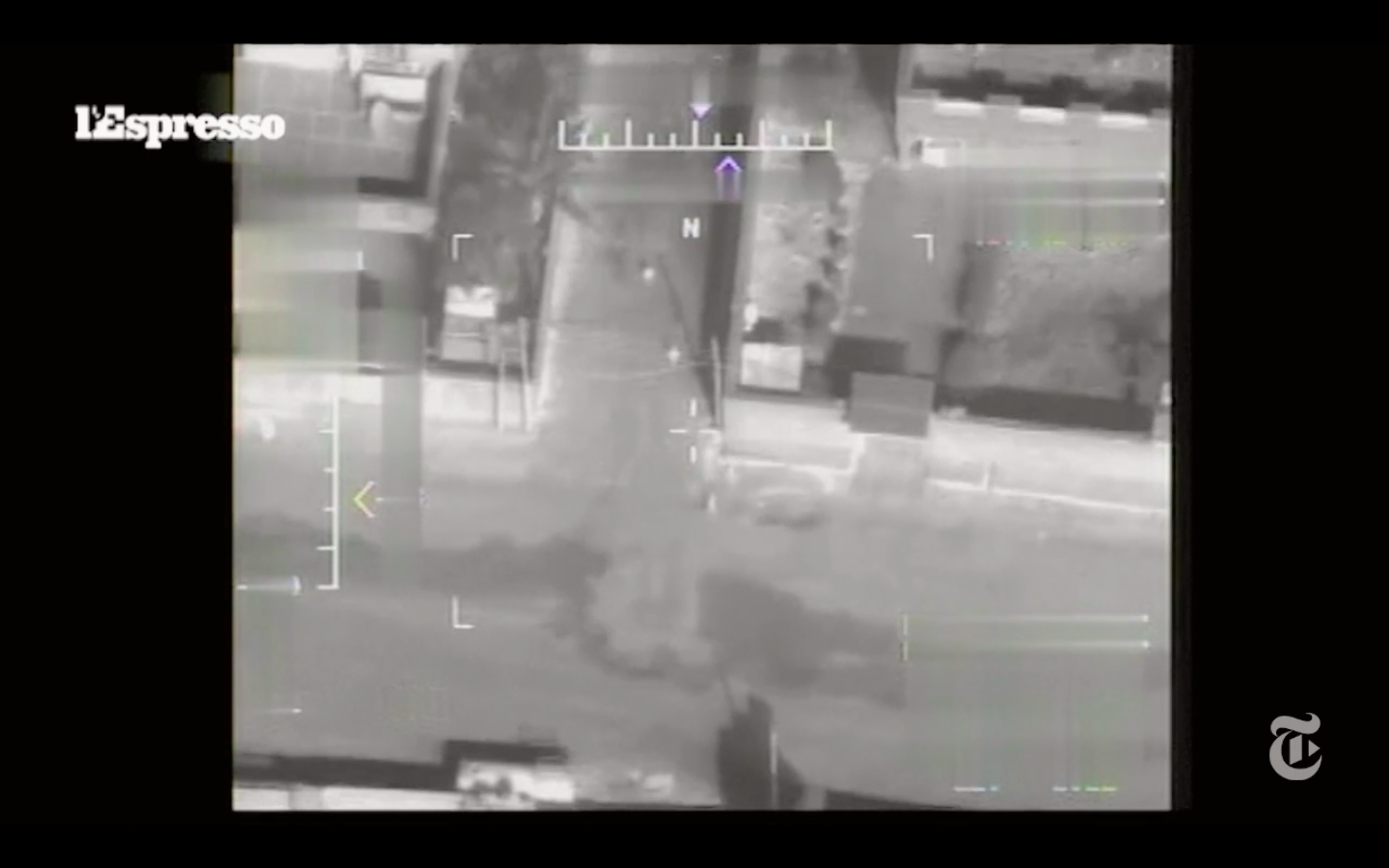
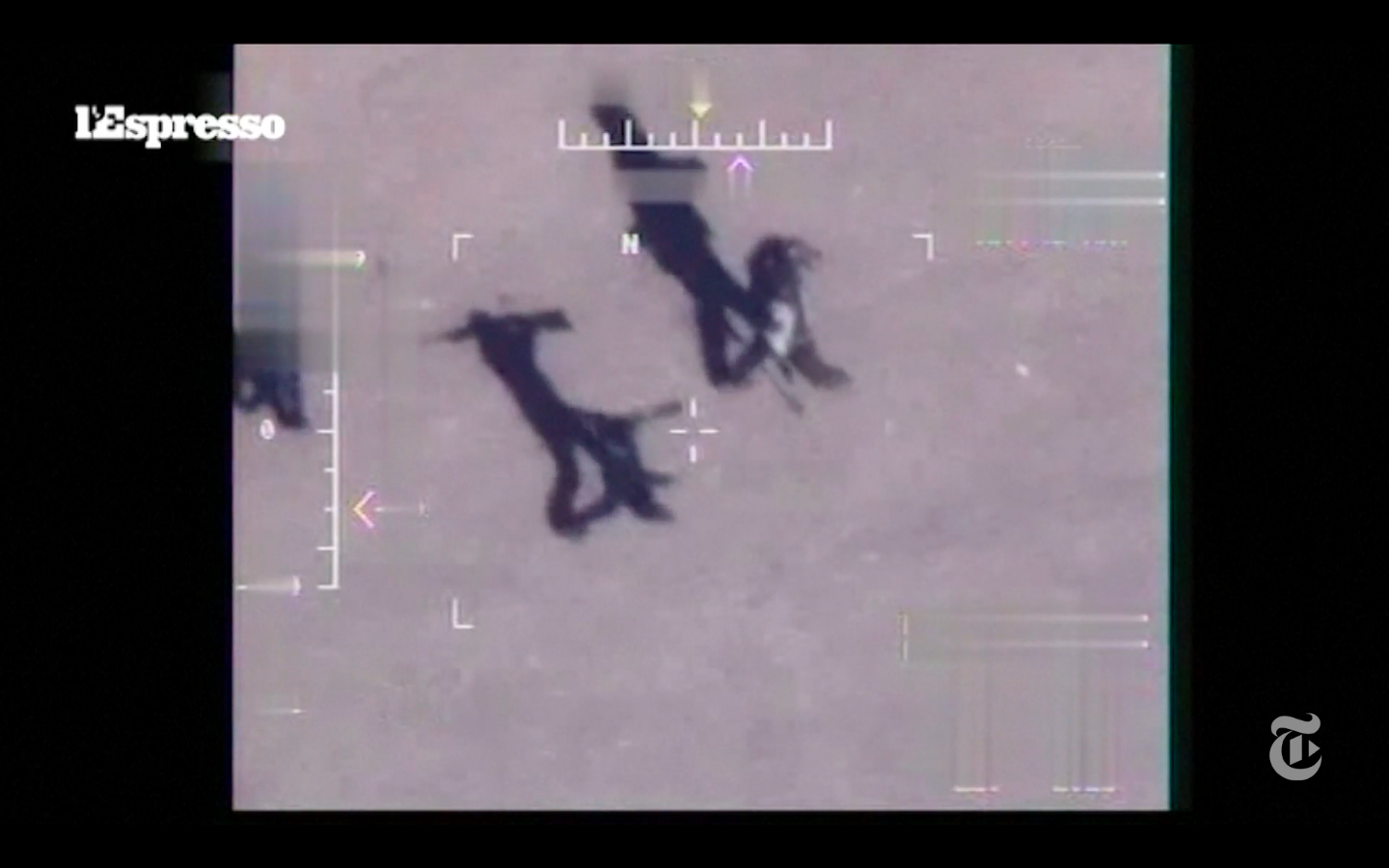
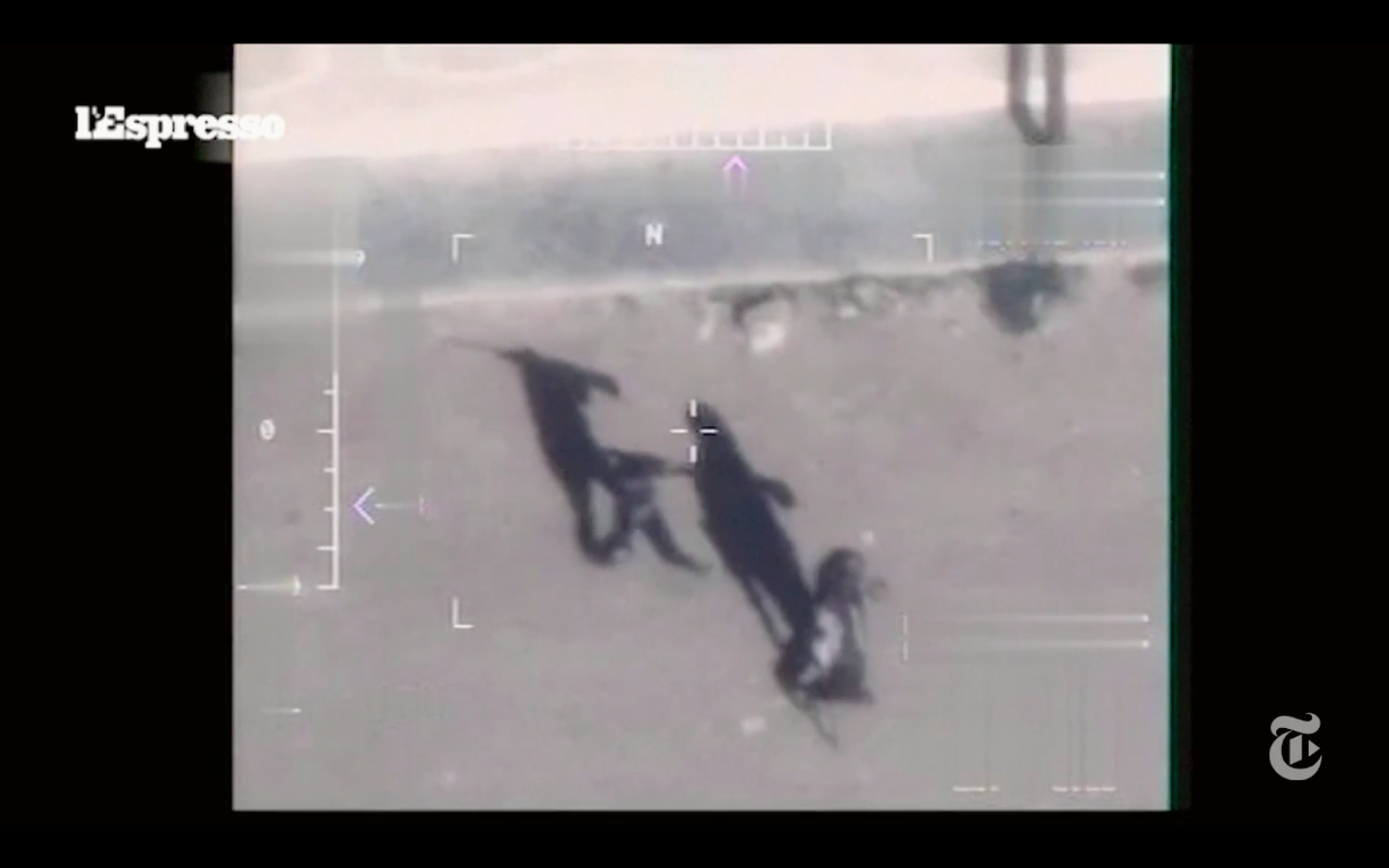
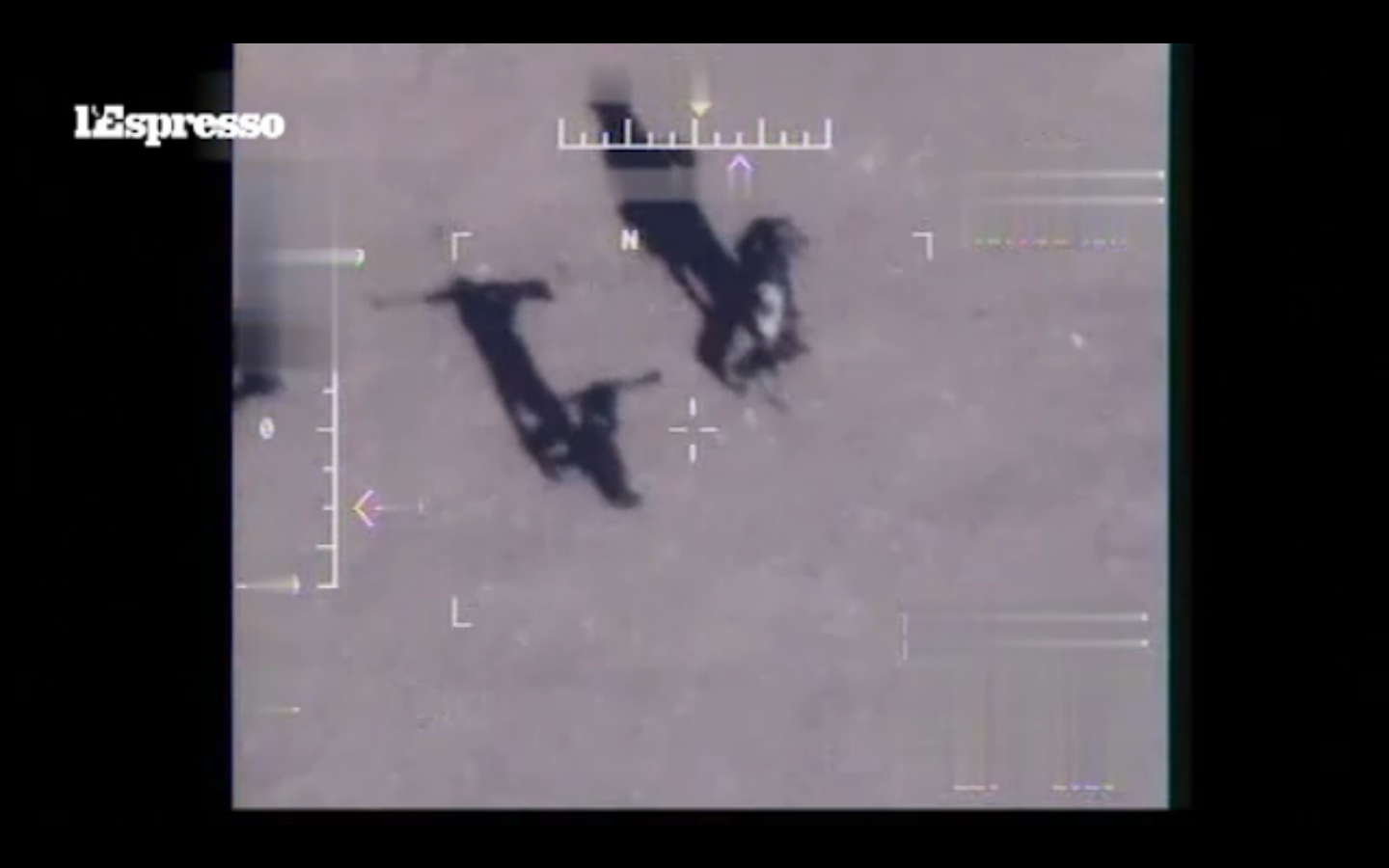
Since my post on the use of drones to provide intelligence, surveillance and reconnaissance over Iraq and Syria I’ve been thinking about the image stream provided by Predators and Reapers.  Then I used an image from what I think must be an MQ-9 Reaper operated by France which was in full colour and – this is the important part – in high definition.  Over the weekend the New York Times published a report, culled from the Italian magazine L’Espresso, which – together with the accompanying video clip (the link is to the Italian original not the Times version) – confirmed the power of HD full motion video, this time from a Reaper operated by Italy:

The footage … begins with grainy black-and-white images of an airstrike on what appears to have been a checkpoint on a road in northern Iraq, beneath a huge black flag.

Then there is something altogether different: high-resolution, color video of four distinct armed figures walking out of a house and along the streets of a town. At one stage, the picture suddenly zooms in on two of the suspected militants to reveal that one of them is almost certainly a child, propping a rifle on his shoulder that indicates how small he is relative to the man next to him. The images are so clear that even the shadows of the figures can be examined.

Italian Drone video BItalian drone video CItalian drone video AItalian drone video DItalian drone video I

But the significance of all this is less straightforward than it might appear.

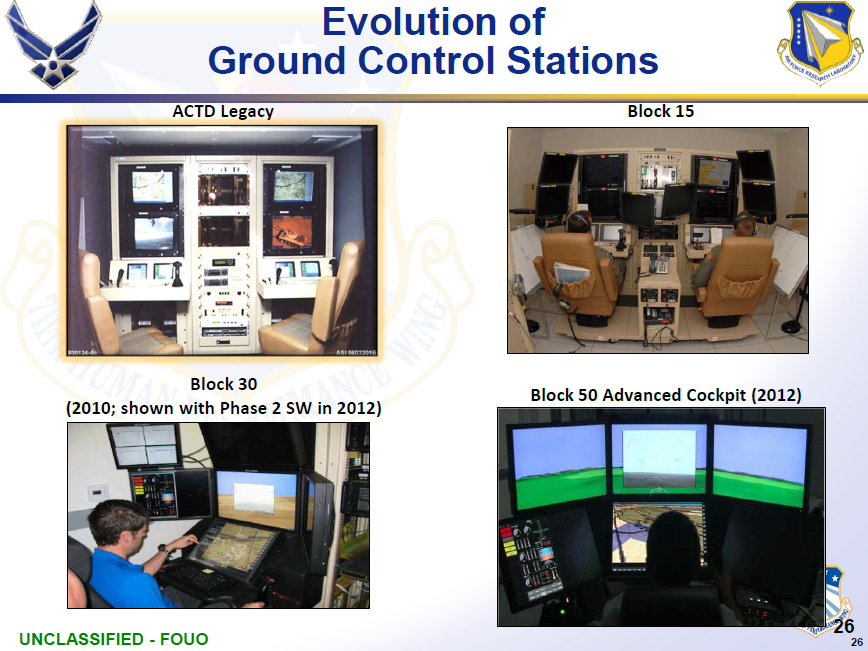
First, not all drones have this HD capability.  We know from investigations into civilian casualty incidents in Afghanistan that the feeds from Predators but also early model (‘Block’) Reapers are frequently grainy and imprecise.  Sean Davies reports that the video compression necessary for data transmission squeezed 560 x 480 pixel resolution images into 3.2 MBps at 30 frames per second whereas the newer (Block 5) Reapers provide 1280 x 720 pixel resolution images resolution images at 6.4 MBps.  The enhanced video feeds can be transmitted not only to the Ground Control Stations from which the aircraft are flown – and those too have been upgraded (see image below) – but also to operations centres monitoring the missions and, crucially, to ruggedized laptops (‘ROVERs’) used by special forces and other troops on the ground.

ground-control-stations

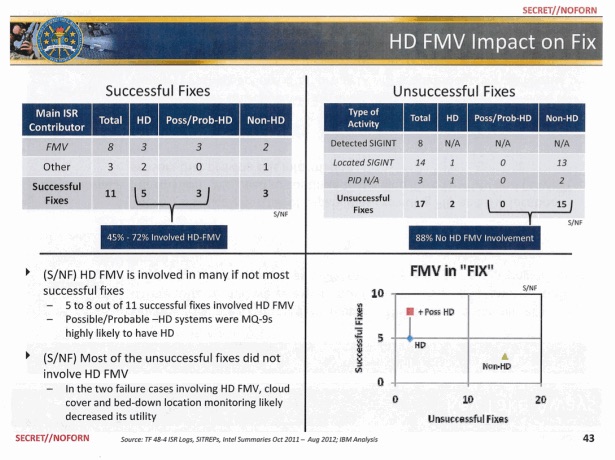
The significance of HD full-motion video is revealed in the slide below, taken from a briefing on ‘small footprint operations’ in Somalia and Yemen prepared in February 2013 and published as part of The Intercept‘s Drone Papers, which summarises its impact on the crucial middle stage of the ‘find, fix, finish‘ cycle of targeted killing:

HD FMV impact on Fix

As you can see, HD FMV was involved in as many as 72 per cent of the successful ‘fixes’ and was absent from 88 per cent of the unsuccessful ones.

Second, Eyal Weizman cautions that the image stream shown on the Italian video was captured ‘either very early or very late in the day.  Without shadows we could not identify these as weapons at all.’  Infra-red images captured at night could obviously not provide definition of this quality, but even so-called ‘Day TV’ would not show clear shadows at most times of the day. In Eyal’s view, ‘showing these rare instances could skew our understanding of how much can be seen by drones and how clear what we see is.’

Third, no matter how high the resolution of the video feeds, we need to remember that their interpretation is a techno-cultural process.  One of the figures shown in the Italian video ‘is almost certainly a child’, reports the New York Times.  So bear in mind this exchange between the crew of a Predator circling over three vehicles travelling through the mountains of Uruzgan in February 2010 (see also here and here):

1:07 􏰀(MC):􏰀 screener􏰀 said 􏰀at least 􏰀one 􏰀child 􏰀near 􏰀SUV􏰀

1:07 􏰀(Sensor):􏰀 bull􏰀 (expletive 􏰀deleted)…where!?􏰀

1:07 􏰀(Sensor): 􏰀send 􏰀me 􏰀a 􏰀(expletive􏰀deleted) 􏰀still,􏰀􏰀 I􏰀 don’t 􏰀think 􏰀they 􏰀have 􏰀kids 􏰀out 􏰀at 􏰀this 􏰀hour, 􏰀I 􏰀know􏰀 they’re 􏰀shady 􏰀but􏰀 come􏰀 on􏰀

1:07􏰀 (Pilot):􏰀 at 􏰀least 􏰀one 􏰀child…􏰀Really?􏰀 Listing 􏰀the􏰀 MAM [Military-Aged Male], 􏰀uh, 􏰀that 􏰀means 􏰀he’s 􏰀guilty􏰀

1:07􏰀 (Sensor):􏰀 well 􏰀may be􏰀 a 􏰀teenager 􏰀but 􏰀I 􏰀haven’t􏰀 seen􏰀 anything 􏰀that 􏰀looked 􏰀that 􏰀short, 􏰀granted 􏰀they’e􏰀 all 􏰀grouped 􏰀up 􏰀here,􏰀 but.􏰀..

1:07 􏰀(MC): 􏰀They’re 􏰀reviewing􏰀

1:07 􏰀(Pilot):􏰀Yeah 􏰀review 􏰀that􏰀 (expletive 􏰀deleted)…why􏰀 didn’t 􏰀he 􏰀say􏰀 possible􏰀 child,􏰀 why􏰀 are􏰀 they􏰀 so 􏰀quick􏰀 to 􏰀call 􏰀(expletive􏰀 deleted) 􏰀kids 􏰀but􏰀 not 􏰀to 􏰀call 􏰀(expletive􏰀deleted) 􏰀a 􏰀rifle􏰀….

03:10 􏰀(Pilot):􏰀 And 􏰀Kirk􏰀97, 􏰀good 􏰀copy􏰀 on􏰀 that.􏰀 We 􏰀are 􏰀with 􏰀you.􏰀 Our 􏰀screener􏰀 updated􏰀 only􏰀 one􏰀 adolescent 􏰀so 􏰀that’s 􏰀one􏰀 double 􏰀digit􏰀 age 􏰀range.􏰀 How􏰀 Copy?􏰀

03:10 􏰀(JAG25):􏰀We’ll􏰀 pass 􏰀that 􏰀along 􏰀to 􏰀the 􏰀ground 􏰀force􏰀 commander.􏰀 But 􏰀like 􏰀I 􏰀said, 􏰀12 􏰁13 􏰀years 􏰀old 􏰀with􏰀 a 􏰀weapon 􏰀is􏰀 just 􏰀as􏰀 dangerous.􏰀􏰀

In other words – it’s more than a matter of high definition; it’s also a matter of political and cultural definition.

Atomic soldiers and the nuclear battlefield

As promised, I’ve posted the slides from my presentation on “Little Boys and Blue Skies: drones through post-atomic eyes” under the DOWNLOADS tab.  Given my previous posts (here and here) these ought to be reasonably self-explanatory, but I’ve added a series of images derived from Matt Farish‘s brilliant presentation “Beneath the bombs” at the same conference and these probably need explanation.

Tumbler-Snapper 1 June 1952.001

One of the central themes of my presentation was the emphasis placed on American lives by those who planned the attacks on Hiroshima and Nagasaki – which is why the crew of the Enola Gay had to execute such a tight turn to escape the shock waves from the blast – and by American commentators who almost immediately contemplated the possibility of a nuclear attack on the continental United States.

The same was true of those who prepared for subsequent nuclear strikes (which is why the US Air Force experimented with drones to ‘deliver’ the bombs) and by those who orchestrated subsequent nuclear tests in the Marshall Islands and in Nevada (which is why the US Air Force and the US Navy used drones to fly through the atomic clouds to collect samples).

As I showed in the presentation, these same priorities have been extended to today’s use of armed drones by the US Air Force, which repeatedly cites its Predators and Reapers as ‘projecting power without vulnerability’.

All of this will be clear from my slides and posts.

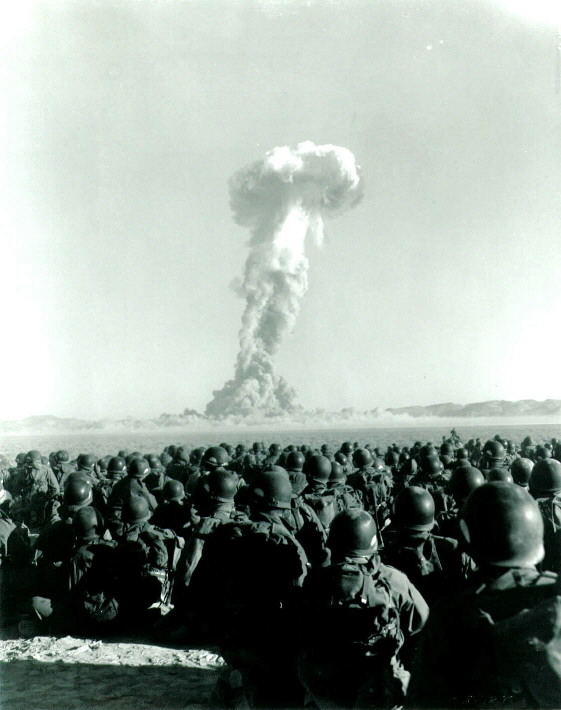
Troops watching atomic test, Yucca Flat, November 1951

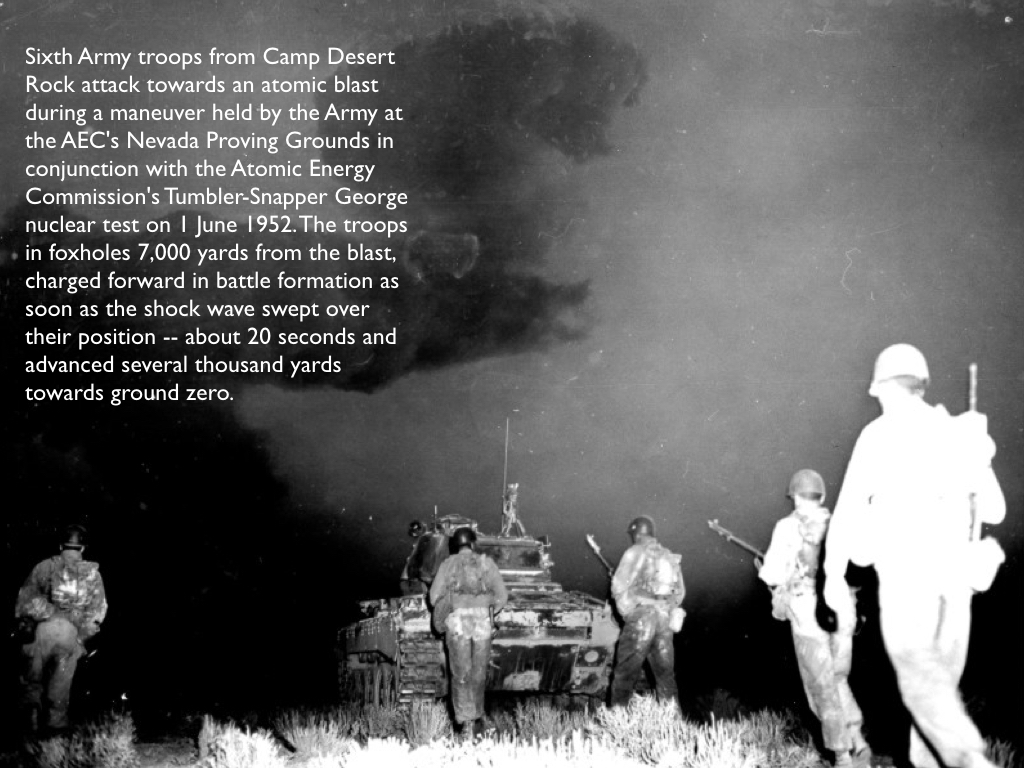
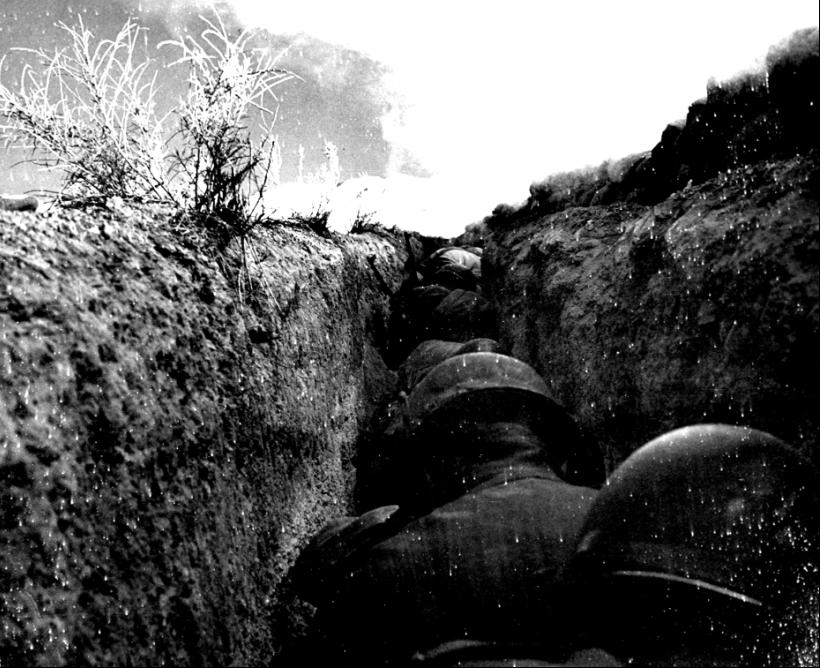
But what I didn’t know was that the US Army and Marine Corps had no such qualms about exposing the bodies of their soldiers and marines to the dangers of atomic tests.  Matt described a series of exercises in Nevada – Desert Rock – held between 1951 and 1957 in which ground troops not only watched the tests from a distance (this I did know: see the image above) but were also ordered forward to secure the blast area.  Here is an official video (watch from 3.00).

This is a silent film, but if you prefer a video with a jaunty, reassuring commentary you can find one from the Internet Archive here.  It’s accompanied by this transcript of an interview between a sergeant and a training officer before a blast:

Question. “How many of your men would volunteer to go up and be in the foxholes?” (one-half mile from ground zero)

Answer. “I guess about half a dozen.”

Question. “It’s quite a loud noise when that bomb goes off … would it do them any harm?”

Answer. “No sir, not the noise, no.”

Question. “How about the radiation? Do you think there is much danger?”

Answer. “Radiation is the least of their worries that the men are thinking about.”

Question. “I think most thought radiation was the greatest danger, didn’t they? Where did they learn differently?”

Answer. “They were, prior to our instructions here. We received a very thorough briefing.”

royal_nevada_atomic_soldiers_19550418_courtesy_las_vegas_news_bureau_WEB-300x300

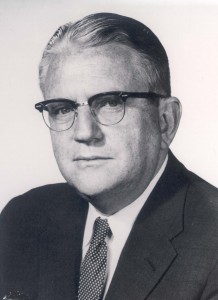
Part of the purpose of the tests was indeed to show how safe the tests were.  As Dr Richard Meiling, the chair of the Armed Forces Medical Policy Council, explained in a memorandum to the Pentagon on 27 June 1951:

‘Fear of radiation … is almost universal among the uninitiated and unless it is overcome in the military forces it could present a most serious problem if atomic weapons are used…. It has been proven repeatedly that persistent ionizing radiation following air bursts does not occur, hence the fear that it presents a dangerous hazard to personnel is groundless.’

Meiling-Richard-L.-218x300Meiling recommended that ‘positive action be taken at the earliest opportunity to demonstrate this fact in a practical manner’, ideally by deploying a Regimental Combat Team ‘approximately twelve miles from the designated ground zero of an air blast and immediately following the explosion . . . they should move into the burst area in fulfillment of a tactical problem.’

In effect, Meiling wanted to conduct an extended psychological experiment in which the Test Site would become a vast human – as much as physical – laboratory.

Simon 1953 EMP shock test

According to a report from the Human Resources Research Organization:

By means of attitude measurement methods measuring psychological effects of stress, both applied at critical points during the maneuver, an attempt was made:

1. To evaluate effects of atomic indoctrination on troop participants; and

2. To estimate effects of the detonation together with its accompanying affects on performance.

One Army officer, Captain Richard Taffe, provided a remarkably cheery first-hand account for Collier’s on 26 January 1952:

I walked through an atom-bombed area. I didn’t get burned, I didn’t become radioactive, and I didn’t become sterile. And neither did the 5,000 guys with me. Furthermore, I wasn’t scared—either while taking my walk through the blasted miles, or while watching the world’s most feared weapon being exploded seven miles in front of me.

But, I’ve been asked a hundred times since the Desert Rock maneuvers at Yucca Flats in the Nevada atomic test site, “What was it like?”…

Suddenly it came. A gigantic flash of white light, bright as a photoflash bulb exploding in our eyes—even with our backs turned. The order “Turn” screamed over the public address system and 5,000 soldiers spun and stared. As we turned, it was as though someone had opened the door of a blast furnace as the terrific heat reached us. There, suspended over the desert floor, was the fireball which follows the initial flash of an atomic bomb.

Hung there in the sky, the tremendous ball of flame was too blinding to stare at, and suddenly there was much more to see.

Sucked into that fireball were the tons of debris from the desert floor. Almost at once dust clouds climbed hundreds of yards off the ground for miles in each direction. Then the familiar column of dirty gray smoke formed and started to rise.

Up to this point we had seen, but we had not heard and we had not felt, the explosion.

But then came the shock wave. The ground beneath us started to heave and sway. Not back and forth as you might expect, but sideways. The earthquakelike movement of the ground rocked us on our haunches and, had we been standing, it could have knocked us down.

About that time, our heads were snapped back with the force of the terrible blast as the sound finally crossed those seven miles and reached us. The tremendous crack was a louder one than most of us had ever heard before. And right behind it came another crack—there seemed to be some debate as to whether this was an echo or another chain reaction in the fireball.

From the throats of everyone there came noises. Noises, not words. I listened particularly for the first coherent statement, but, like myself, few people could voice normal exclamations. It was not something normal and words just wouldn’t come out—only unintelligible sounds.

The first words I did hear came from a caustic corporal behind me, who said, almost calmly, “Well, I finally located that damned Ground Zero.”

Our roar of laughter broke the tension, but the spectacle was far from over.

The horror turned to beauty. It isn’t difficult to associate the word beautiful with such a lethal exhibition, because from this point on, the atomic blast became just that—beautiful. A column rose from where the fireball had dimmed, crawled through the brown doughnut above the fireball, and boiled skyward. The dirty gray of the stem was rapidly offset by the purple hues and blues of the column. Then came the mushroom—the trade-mark of an atomic bomb.

Capped in pure white, the seething mushroom emitted browns, blood orange, pastel pinks, each fighting its way to the surface only to be sucked to the bottom and then back into the middle of the mass of white. Within minutes, the top was at 30,000 feet and then the huge cloud broke loose from the stem and drifted in the wind toward Las Vegas. . . .

This explosion had three lethal qualities. They were: blast, heat and radiation. The greatest fear the public has today in connection with the atom bomb probably is radiation. People forget that it caused only 15 per cent of the 140,000 deaths at Hiroshima.

One second after an air burst of an atom bomb, 50 per cent of the radiation is gone. All danger of lingering radiation has disappeared after 90 seconds.

As to the other two qualities, blast caused 60 per cent of the deaths at Hiroshima. Heat and the accompanying fires accounted for the other 25 per cent. . . .

As we moved up the road in the trucks, the effects of the blast became more apparent. About two miles from Ground Zero—and incidentally the bomber dropped his lethal egg in the proverbial bucket, right on the target—it became obvious that a terrible force had been at work.

At one of the closest positions we again left the trucks and walked through the charred area. Despite the devastation, there was no doubt that a successful attack could have been made by friendly troops directly through the blasted area—immediately after the explosion.

You can find much more here (scroll way down).  The purpose of reports like this was clearly to ‘indoctrinate’ a far wider audience than the US military.

All of this raises two questions.  One is about the radical difference between saving the lives of airmen and risking the lives of ground troops; the answer surely lies only partly in the insistence that there was no risk at all – since the Air Force clearly believed otherwise – and so must also lie in a dismal cost-benefit analysis that reckoned the cost (and time) involved in training aircrew against that involved in training ground troops.

The other is about what could possibly have required a ‘successful attack’ on ground zero and what would have been left for those troops to ‘secure’ after the blast…

Note: If you wonder about the long-term effects of the tests on residents of the area around the Nevada Test Site, see Harvey Wasserman and Norman Solomon, Killing our own: the disaster of America’s experiencewith atomic radiation, which is open access here (see chapter 3: ‘Bringing the bombs home’).

The US Advisory Committee on Human Radiation Experiments provided a report on the effects on ground troops in The Human Radiation Experiments (1996) (Ch 10: ‘Atomic veterans: human experimentation in connection with bomb tests’).

“I’ve looked at clouds from both sides now…”

Eyal Weizman‘s stunning Wall Exchange, “Forensic Architecture”, which he presented at the Vogue Theatre in Vancouver earlier this month, is now up on YouTube here and embedded below.

If you are puzzled by my riff on Joni Mitchell, start around 46:10 (though you’ll miss a lot if you do…).

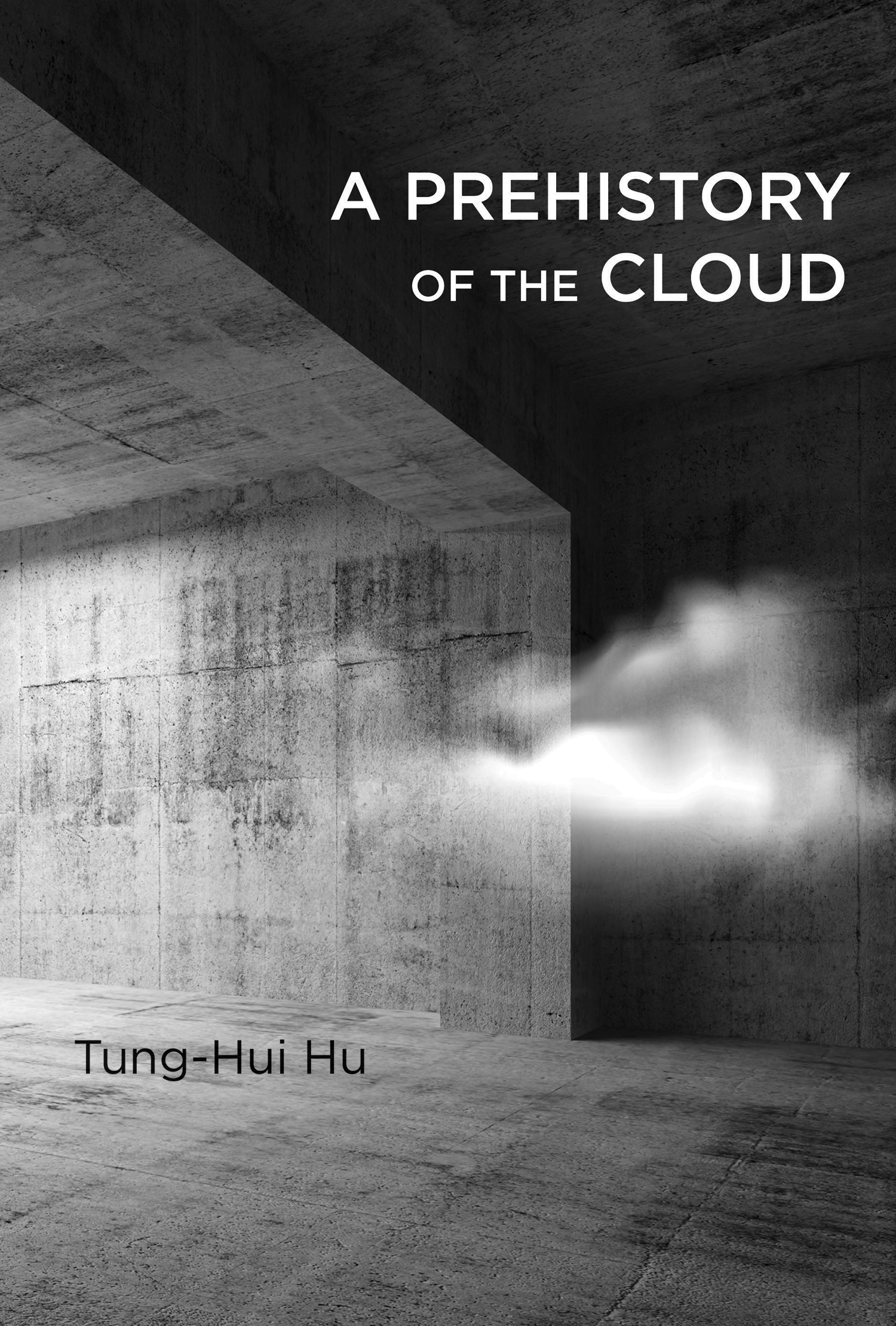
And while we’re on the subject of clouds, you’ll find a remarkable analysis of a different sort of militarized cloud in Tung-Hui Hu‘s A Prehistory of the Cloud from MIT:

We may imagine the digital cloud as placeless, mute, ethereal, and unmediated. Yet the reality of the cloud is embodied in thousands of massive data centers, any one of which can use as much electricity as a midsized town. Even all these data centers are only one small part of the cloud. Behind that cloud-shaped icon on our screens is a whole universe of technologies and cultural norms, all working to keep us from noticing their existence. In this book, Tung-Hui Hu examines the gap between the real and the virtual in our understanding of the cloud.

Hu shows that the cloud grew out of such older networks as railroad tracks, sewer lines, and television circuits. He describes key moments in the prehistory of the cloud, from the game “Spacewar” as exemplar of time-sharing computers to Cold War bunkers that were later reused as data centers. Countering the popular perception of a new “cloudlike” political power that is dispersed and immaterial, Hu argues that the cloud grafts digital technologies onto older ways of exerting power over a population. But because we invest the cloud with cultural fantasies about security and participation, we fail to recognize its militarized origins and ideology. Moving between the materiality of the technology itself and its cultural rhetoric, Hu’s account offers a set of new tools for rethinking the contemporary digital environment.

Prehistory of the Cloud

Here is Lisa Parks on what is surely one of the must-reads of the year:

“Hu’s riveting genealogy of the cloud takes us into its precursors and politics, and boldly demonstrates how fantasies of sovereignty, security, and participation are bound up in it. Much more than a data center, the cloud is a diffuse and invisible structure of power that has yielded a data-centric order. Imaginative and lucidly written, this book will be core to digital media studies.”

“What is that sound high in the air?”

Coming from MIT in April next year, a new book by the ever-creative anthropologist Hugh Gusterson, Drone: remote control warfare.

GUSTERSON DroneDrones are changing the conduct of war. Deployed at presidential discretion, they can be used in regular war zones or to kill people in such countries as Yemen and Somalia, where the United States is not officially at war. Advocates say that drones are more precise than conventional bombers, allowing warfare with minimal civilian deaths while keeping American pilots out of harm’s way. Critics say that drones are cowardly and that they often kill innocent civilians while terrorizing entire villages on the ground. In this book, Hugh Gusterson explores the significance of drone warfare from multiple perspectives, drawing on accounts by drone operators, victims of drone attacks, anti-drone activists, human rights activists, international lawyers, journalists, military thinkers, and academic experts.

Gusterson examines the way drone warfare has created commuter warriors and redefined the space of the battlefield. He looks at the paradoxical mix of closeness and distance involved in remote killing: is it easier than killing someone on the physical battlefield if you have to watch onscreen? He suggests a new way of understanding the debate over civilian casualties of drone attacks. He maps “ethical slippage” over time in the Obama administration’s targeting practices. And he contrasts Obama administration officials’ legal justification of drone attacks with arguments by international lawyers and NGOs.

People of the bombI met Hugh at a conference on Orientalism and War in Oxford several years ago, and I’ve recently been reading his Nuclear Rites: a weapons laboratory and the end of the Cold War and People of the Bomb: Portraits of America’s Nuclear Complex as I continue my wanderings through the nuclear wastelands.

The coincidence between Hugh’s previous projects and his new one intersects with my presentation on “Little Boys and Blue Skies” in Toronto last week – see here and here – which sketched out a series of entanglements between drones and the nuclear wastelands (hence the Eliot quotation which serves as my title for this post).

Drones and atomic clouds

I’m off to Toronto on Thursday to speak at the symposium “Through Post-Atomic Eyes“.  I posted some of my earlier notes for my presentation, ‘Little Boys and Blue Skies: Drones through post-atomic eyes‘, and since then I’ve been digging deeper into the strange intersections between nuclear weapons and today’s Predators and Reapers.

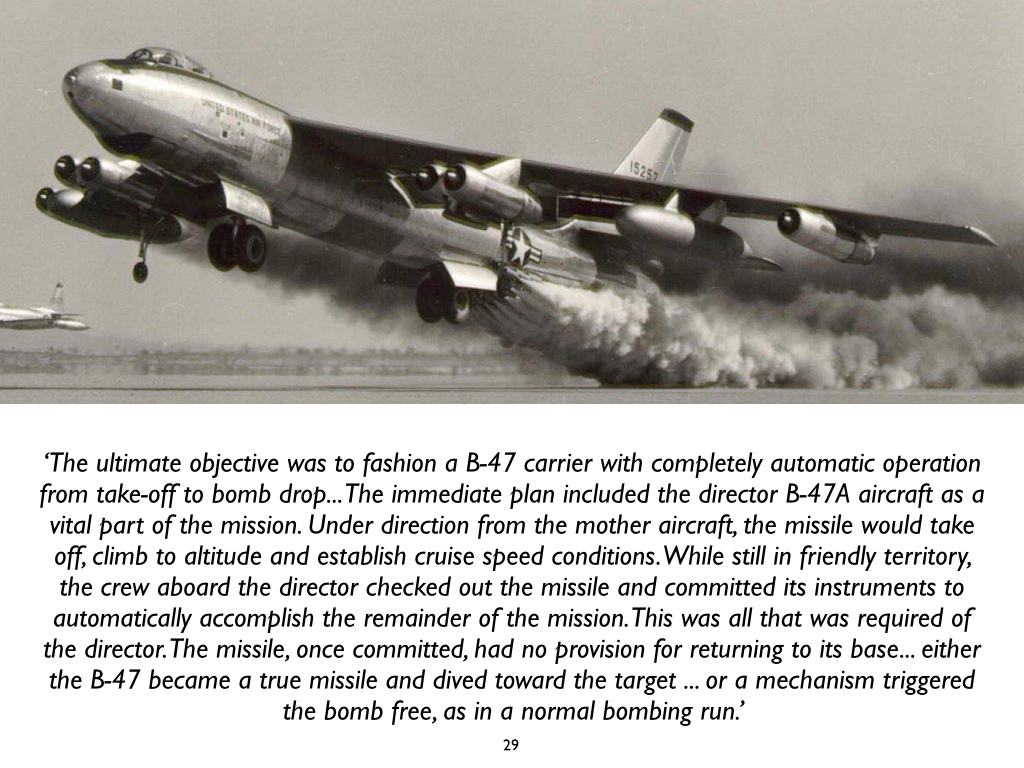
In my original post I described the US Air Force’s early attempts to devise a way of delivering atomic bombs from remotely piloted aircraft – notably Project Brass Ring:

B-47 drone.001

Following a tip from Matt Farish (who will also be speaking at the conference) I’ve now discovered that drones were also used to monitor the ‘atomic clouds’.

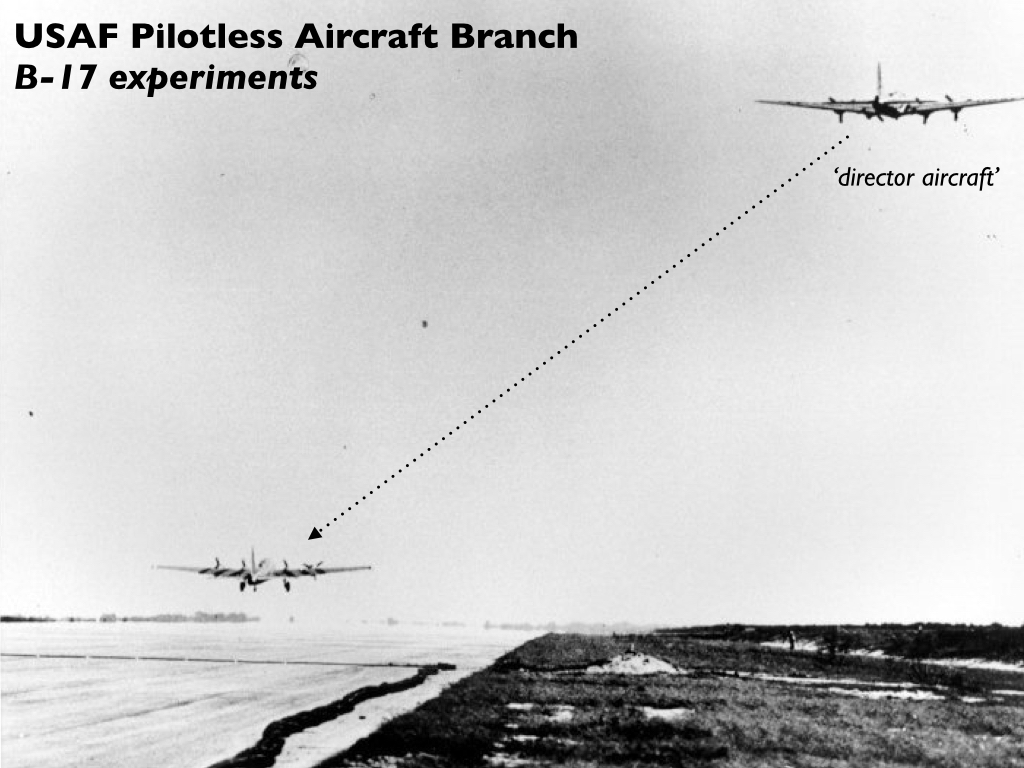
Shortly after the Second World War the US Air Force’s Pilotless Aircraft Branch resumed its experiments with remotely controlling B-17 bombers from ‘director aircraft’ and from ground stations:

B17 experiments.001

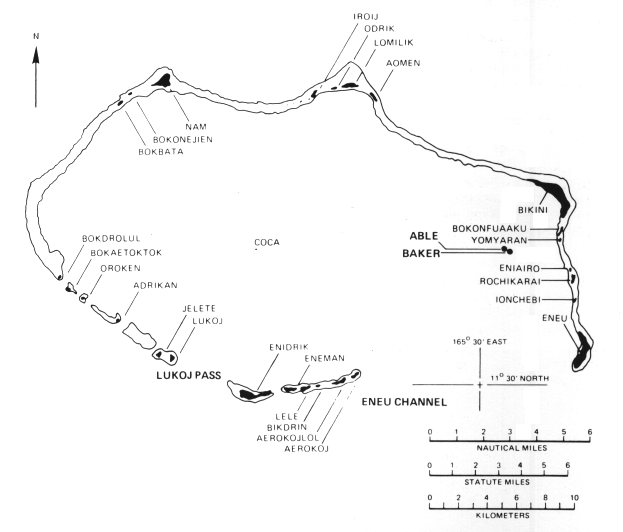
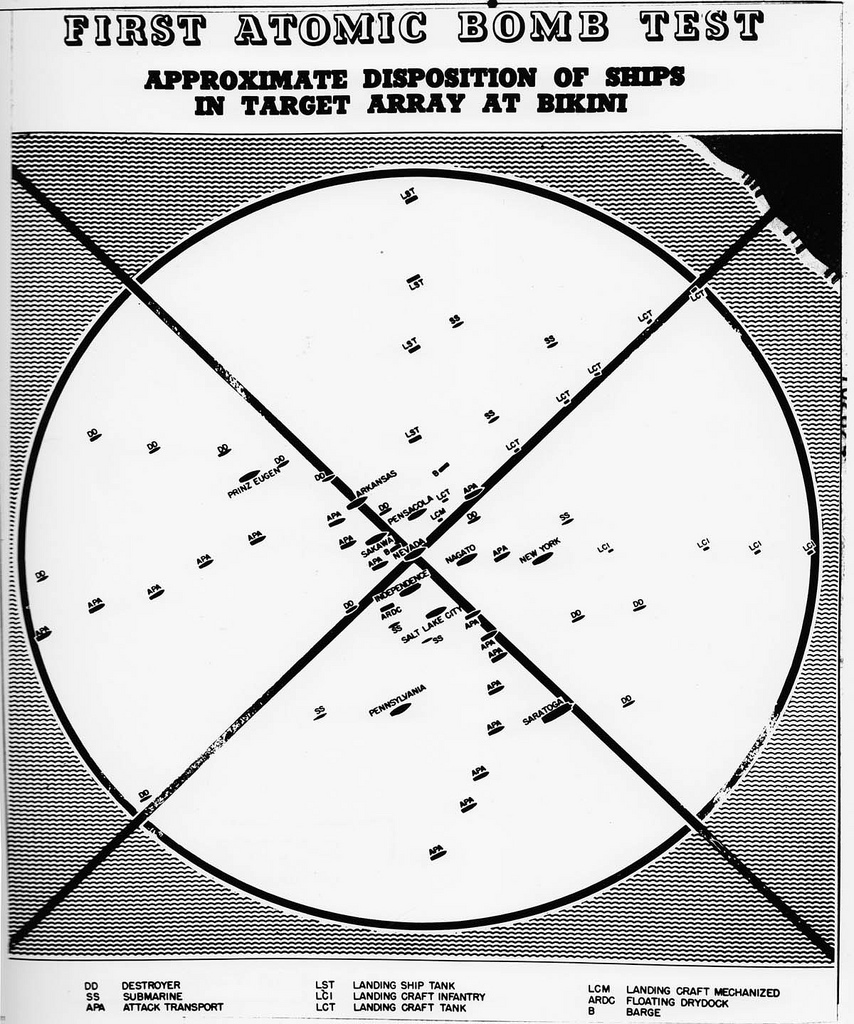
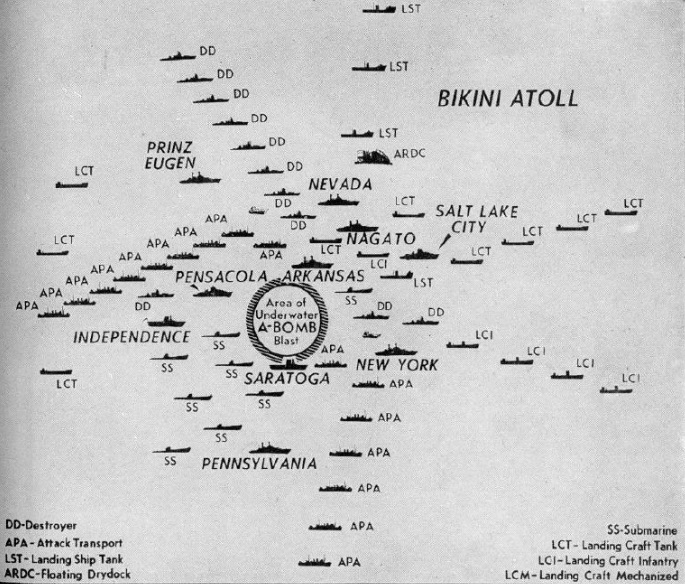
By July 1946 six to them were being successfully operated by the Army Air Group’s Drone Unit, and they were in action over Bikini Atoll in the Marshall Islands for the series of nuclear tests known as Operation Crossroads.   The first test (Able) was carried out on 1 July 1946, when a B-29 Superfortress (“Dave’s Dream”) dropped a plutonium bomb of the same power used against Nagasaki from a height of 30,000 feet on a target fleet of 90 obsolete ships; it was an air burst, detonating 520 feet above the ships (the aim point was the battleship USS Nevada, perhaps appropriately enough given that state’s use for nuclear testing in the decades ahead; it was painted bright red to make it visible to the bombardier, but the bomb missed it y 1870 feet).

Bikini2

Operation Crossroads Target Array

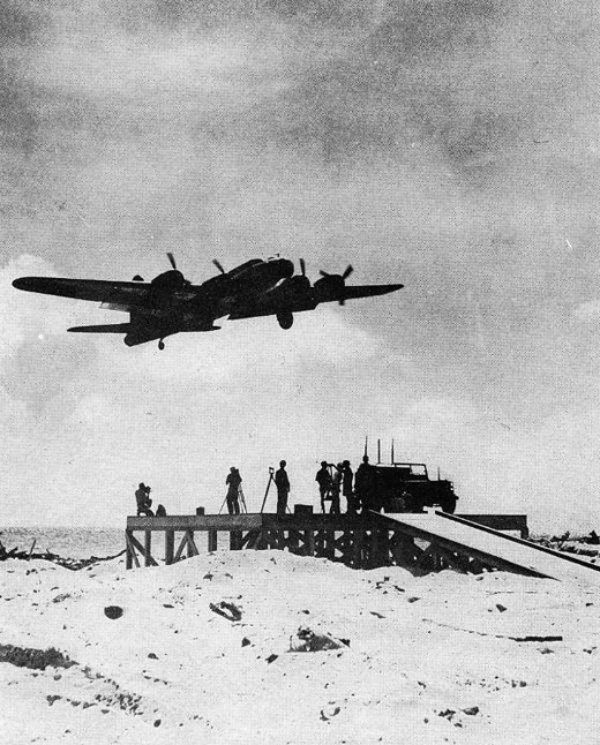
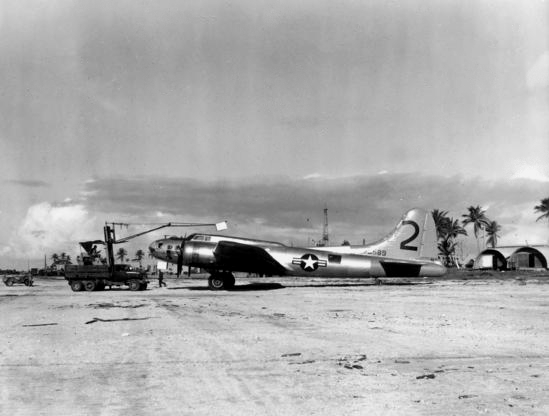
The B-17s were on station 20-30 miles away, and they were the first to approach the target area.  Eight minutes after Mike Hour one of them entered the cloud at 24,000 feet, followed by three others at 30,000 feet, 18,000 feet and 13,000 feet.  The image below shows a B-17 landing at Eniwetok under ground control:

B-17 drone Bikini

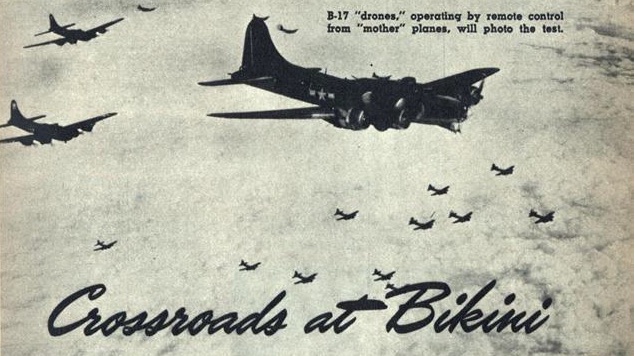
There was nothing secret about their use – like the bomb itself, making the drones public was a vital part of demonstrating American military and technical superiority.  Here, for example, is an image from Mechanix Illustrated in June 1946 describing Operation Crossroads :

Crossroads at Bikini Mexhanix Illustrated June 1946

According to Bombs at Bikini, the official (public) report on Operation Crossroads, prepared for Join Task Force One and published in 1947:

A number of Army Air Forces officials believe that the drone-plane program undertaken for Crossroads advanced the science of drone-plane operations by a year or more. To be sure, a fewwar-weary B-17’s had been flown without crews during the latter part of the recent war [Operation Aphrodite], but they and their cargoes of explosives were deliberately crash-landed. Also, a few B-17’s had been landed by remote control; but pilots were aboard, ready to take over control in case of trouble. Operation Crossroads was the first operation in which take-off, flight, and landing were accomplished with no one aboard. The feat was an impressive one; many experts had thought it could never be accomplished with planes of this size.

As this video clip shows (start at 6.01), take-off was under the control of a ‘ground beep pilot’, who then handed over to a ‘beep television control pilot’ in an accompanying director aircraft (‘the mother ship’), who handed back to the ground beep pilot for the landing.  This parallels today’s ‘remote-split operations’, though on a greatly reduced spatial scale, where a Launch and Recovery crew stationed in or near the combat zone is responsible for take-off and landing while the mission is flown by a ground control crew in the continental United States):

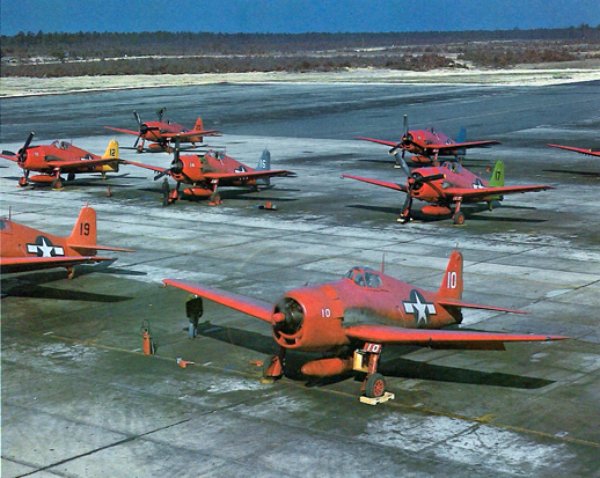
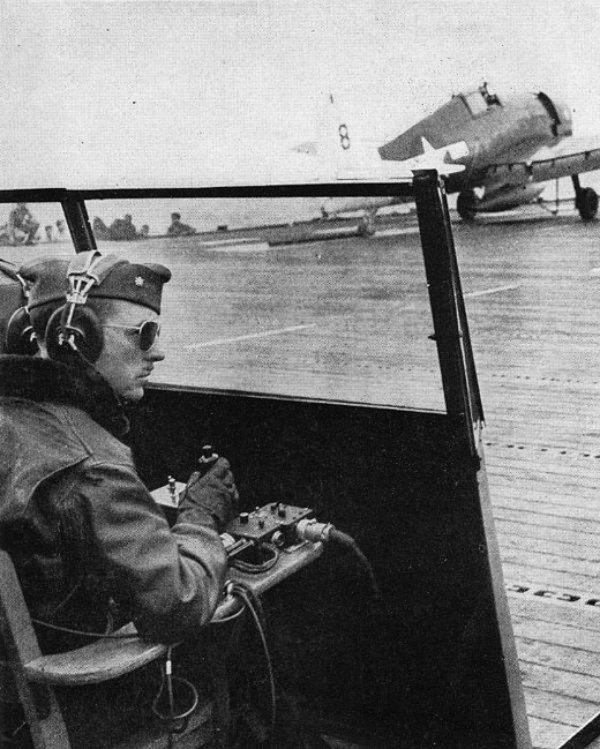
The B-17 drones operated in concert with the US Navy’s F6F-5 Hellcat drones which made transits of the cloud at 20,000 feet, 15,000 feet and 10,000 feet (see the first image below; the tail fins are painted different colours to indicate different control frequencies: more here).  The second image shows a pilot on the deck of the aircraft carrier Shangri-La controlling an F6F-5 before take-0ff; landing on the deck of a carrier was difficult enough at the best of times and with a skilled crew on board, and not surprisingly the Navy drones returned to Roi island, part of Kwajalein Atoll.

Hellcats-Bikini-1946.jpg__600x0_q85_upscale

shangri-la.jpg__600x0_q85_upscale

Paul Hoversten reports:

No manned aircraft flew over the center of the blast, called Zeropoint, until four hours later, although manned boats were on the scene after two hours.  Drones were also flown after the second test, Baker, on July 25, which was an underwater shot suspended from a target ship in Bikini’s lagoon.

Bikini atoll target disposition

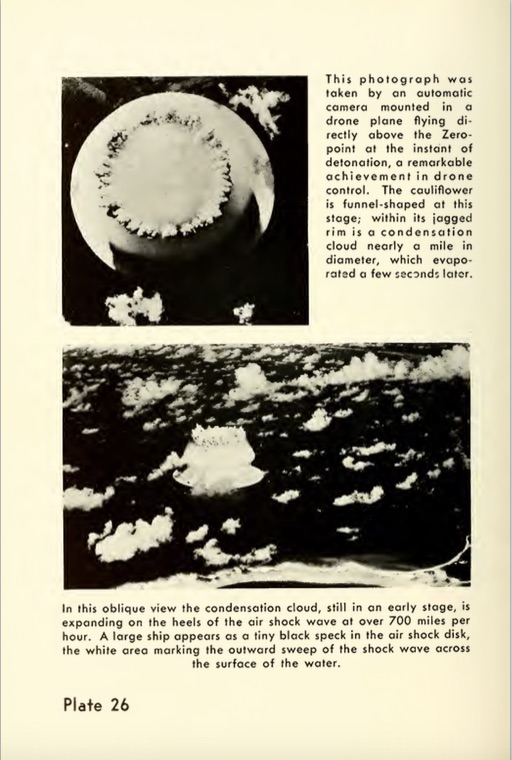
In each case the drones were tasked to take air samples from the cloud (using filters housed in boxes under the wings) and to photograph the cloud formation:

Bikini 4

As the official pictorial record boasted (its very existence underlining the importance of a controlled ‘publicness’ to these tests):

Drone planes penetrated where no man could have ventured, flew through the mushroom cloud on photographic missions, sampled its poisonous content, televised to remote onlookers their instrument panel readings for flight analysis.

The samples were crucial, and drones remained of vital importance in collecting them.  The image below shows the air filters being removed from a remotely operated B-17 used in Operation Sandstone (a series of nuclear tests conducted by the Atomic Energy Commission at Eniwetok Atoll in 1948):

Boeing_B-17_drone_at_Eniwetok_1948

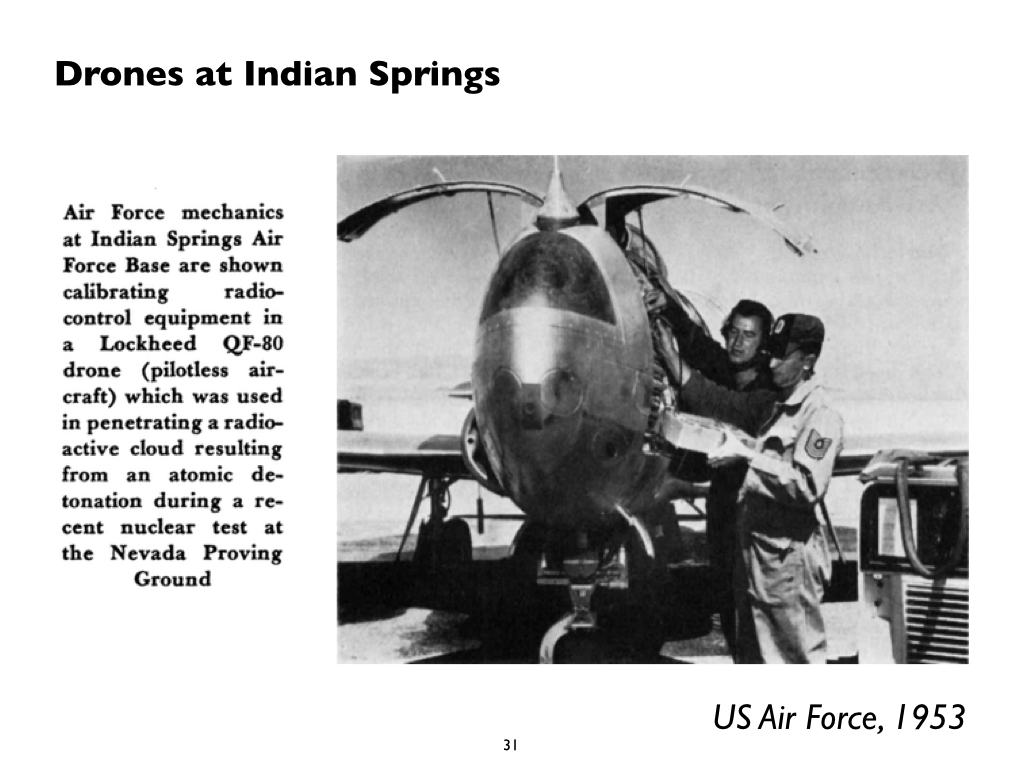
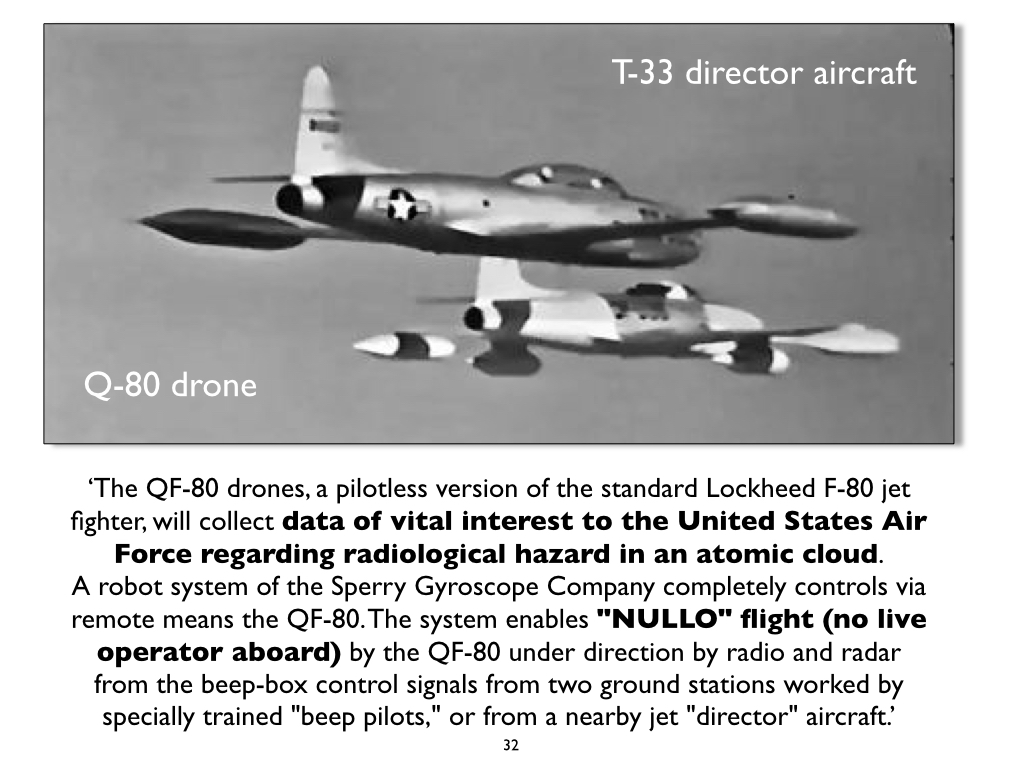
The capstone attempt to deliver atomic bombs by remote controlled aircraft, Project Brass Ring, was abandoned in March 1951 when the Air Force determined that a manned aircraft could execute the bomb delivery safely (at least for those on board), but drones continued to be used during atomic tests.  In 1953 QF-80 drones were in use at Indian Springs, the Air Force portal to the Nevada Proving Grounds (the full story is here):

Drones at Indian Springs.001Drones at Indian Springs 2.001

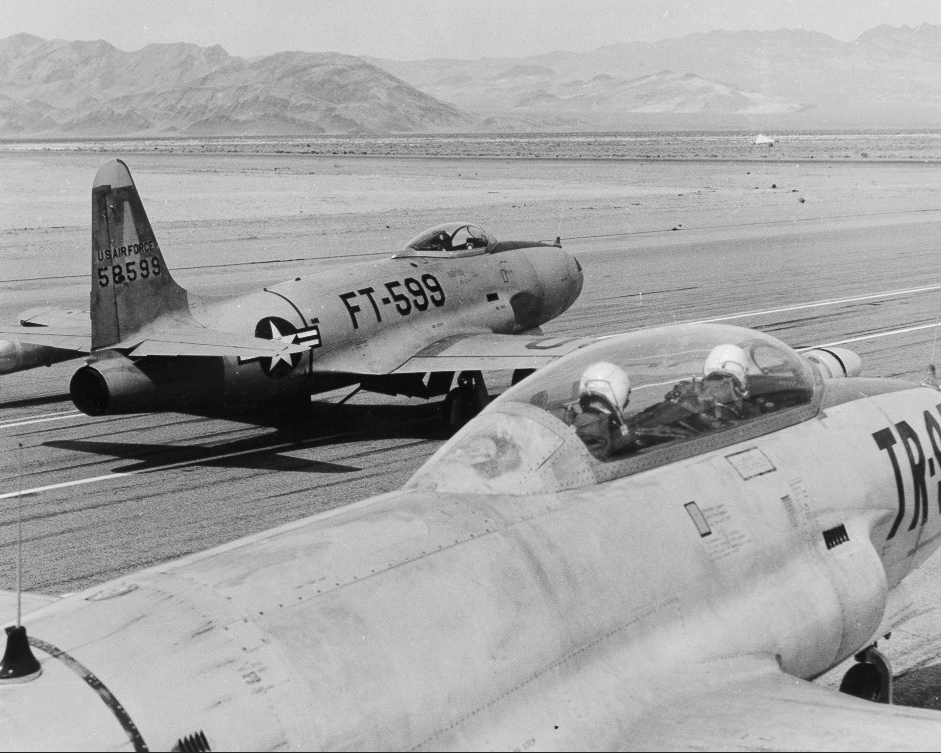
Lockheed QF-80 drone (FT-599) and director aircraft (a Lockheed DT33) ready for take-off at Indian Springs

Lockheed QF-80 drone (FT-599) and director aircraft (a Lockheed DT33) ready for take-off at Indian Springs

This was the first time ‘jet drones’ had been used during continental tests.  NULLO (‘No Live Operator Onboard’) operations used the same system of hand offs between beep pilots and director aircraft that had been used for the B-17s, but Sperry claimed that its precision marked a new milestone in remote operations.  Here’s a video of the drones in operation – and the effects of the blast on the aircraft:

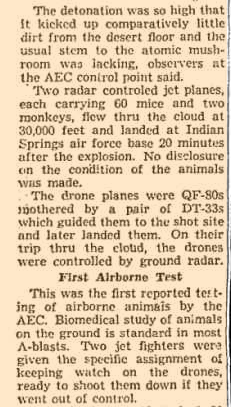
But some tests were designed to evaluate the effects of the blast and the cloud on living creatures.  Here is a clipping from the Chicago Tribune, reporting on a test carried out over Nevada on 6 April 1953 – in fact the mission shown in the last still photograph above.  Note that the radiation effects were expected to be so powerful that all air traffic was excluded from an area of 100,00 square miles:

Chicago Tribune 6 April 1953

Today Indian Springs is known as Creech Air Force Base: the operating hub for the US Air Force’s MQ-1 Predators and MQ-9 Reapers…

Tanner respondents

I’m delighted that Grégoire Chamayou and Chris Woods have both accepted invitations to act as discussants and interlocutors for my Tanner Lectures, “Reach from the Sky: aerial violence and the everywhere war“, in Cambridge in January.

The format for the Lectures is for me to give two presentations on the first day; the next day a panel of four respondents offers reactions and comments, and then we open up into general debate and discussion.

9780241970355I provided a series of detailed commentaries on Grégoire’s variously titled Drone Theory/A Theory of the Drone when it was originally published in French (see here for a full listing: scroll down), and we met last year at a wonderful workshop on Secrecy and Transparency at the Humanities Research Institute at Irvine, so I’m thrilled that the tables will be reversed.  Grégoire’s creative imagination seems to know no bounds – see, for example, here and here – and we keep in close touch so I know this will be a rewarding conversation.

9780190202590I’ve never met Chris, but I’m really looking forward to doing so: he has worked with the Bureau of Investigative Journalism; his Sudden Justice: America’s secret drone wars is the gold standard for books about the conduct of US remote operations; and he is now busy at Airwars monitoring coalition air strikes over Iraq and Syria.  I greatly admire Chris’s combination of probing analysis and lucid prose, and his determination to bring the results to the widest possible public audience is an inspiration.

More on other respondents later.

The Drone Papers

Drone Papers header JPEG

The Intercept has released a new series of documents – not from Edward Snowden – that provide extraordinary details about the Obama administration’s targeted killing operations (especially in Afghanistan, Yemen and Somalia).

I haven’t had a chance to work through them yet – today is taken up with teaching and Eyal Weizman‘s visit for tonight’s Wall Exchange – but I imagine that readers who don’t already have their heads up will welcome a head’s up.

The reports include a considerable number of informative graphics (taken from briefing slides) together with analysis.  Here is the full list:

The Assassination Complex (by Jeremy Scahill)

A visual glossary (by Josh Begley)

The Kill Chain (by Jeremy Scahill)

Find, Fix, Finish (by Jeremy Scahill)

Manhunting in the Hindu Kush (by Ryan Devereaux)

Firing Blind (by Cora Currier and Peter Maass)

The Life and Death of Objective Peckham (by Ryan Gallagher)

Target Africa (by Nick Turse)

More to come when I’ve worked through the reports, slides and analyses.

Angry Eyes (2)

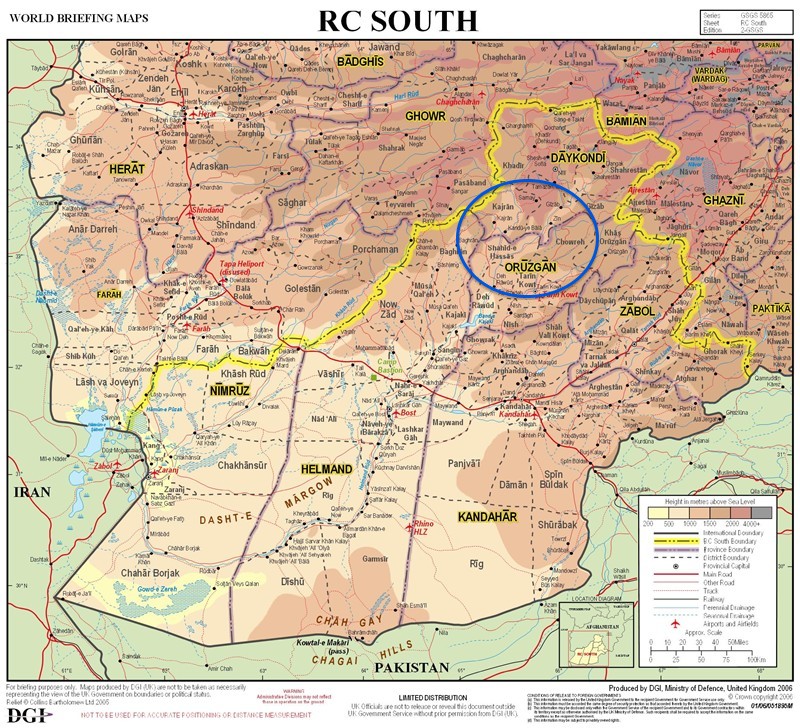
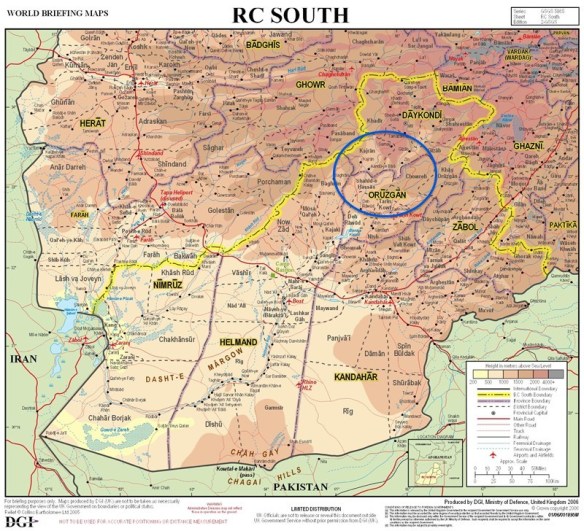
MAP isaf-rc-south

This is the second installment of my analysis of an air strike orchestrated by a Predator in Uruzgan province, Afghanistan on 21 February 2010; the first installment is here.

(4) Command and control?

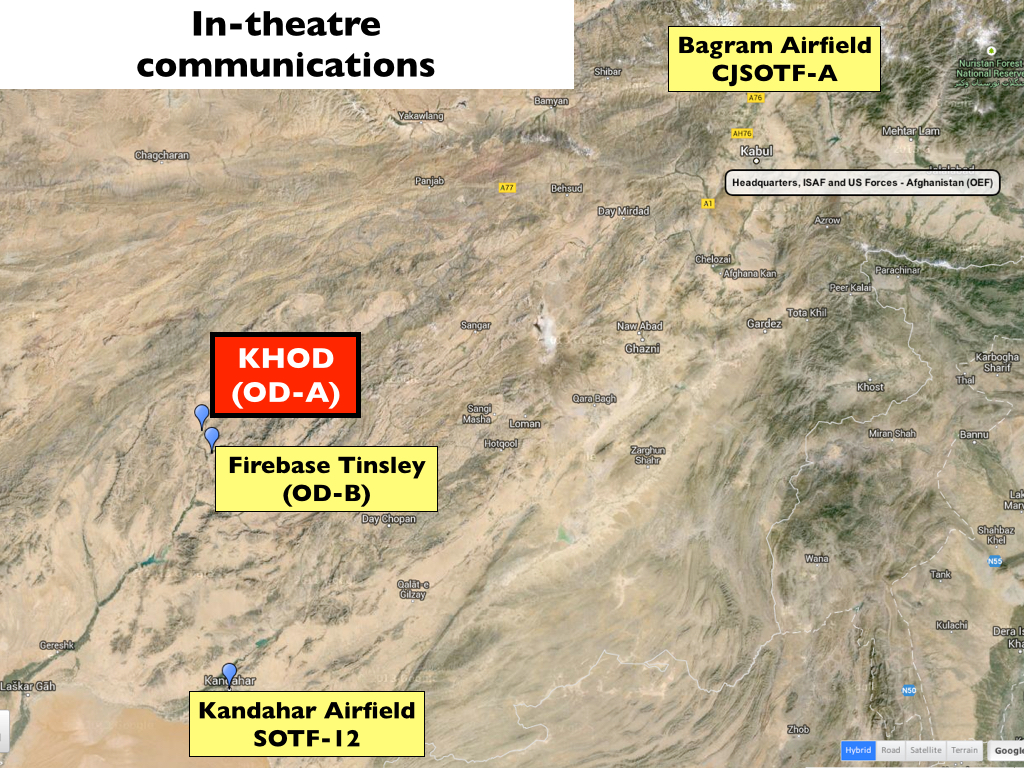
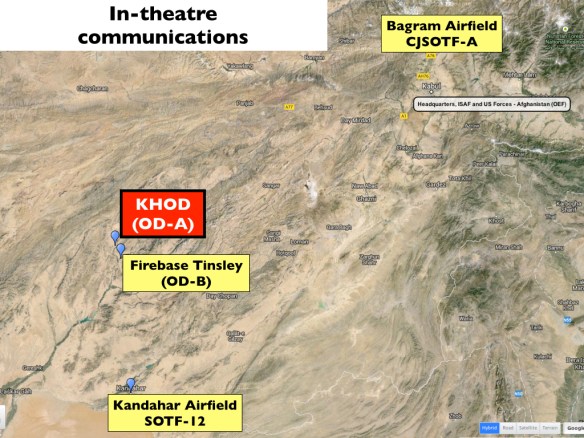
What was happening in and around Khod was being followed not only by flight crews and image analysts in the continental United States but also by several Special Forces command posts or Operations Centers in Afghanistan.  In ascending order these were:

(1) the base from which ODA 3124 had set out at Firebase Tinsley (formerly known as Cobra);

(2) Special Operations Task Force-12 (SOTF-12), based at Kandahar;

(3) Combined Joint Special Operations Task Force – Afghanistan (CJSOTF-A) based at Bagram.
GREGORY Angry Eyes 2015 IMAGES.064

Once the ODA 3124 left the wire, command and support passed to SOTF-12; the OD-B at Tinsley had limited resources and limited (and as it happens intermittent) communications access and could only monitor what was happening.

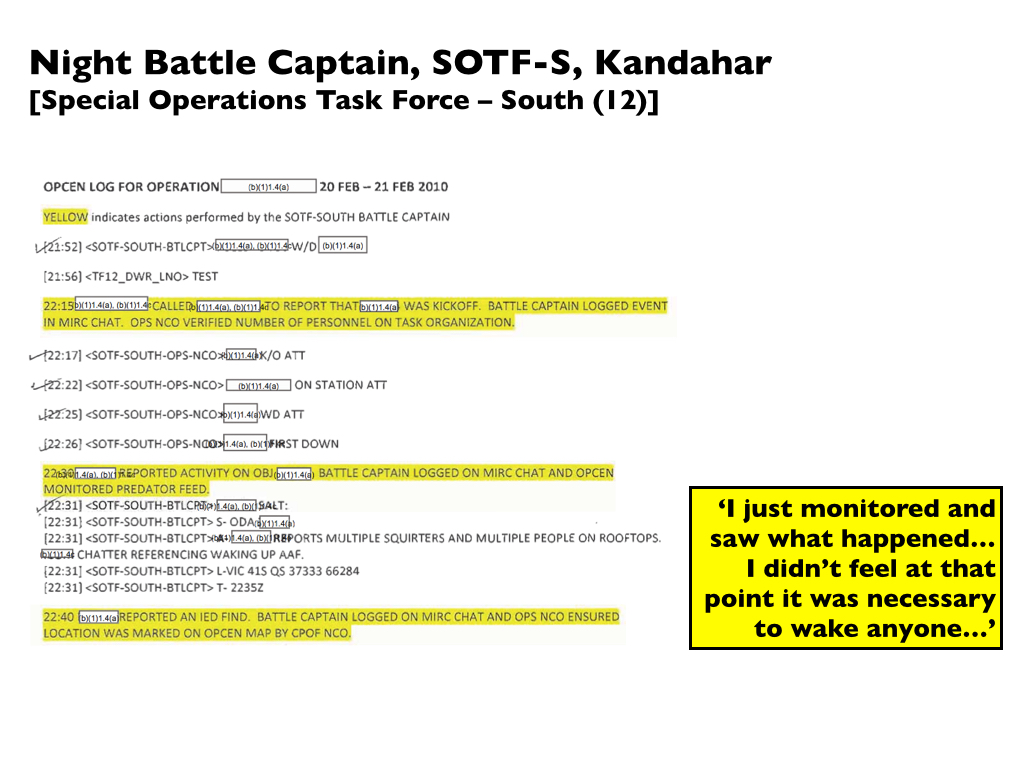
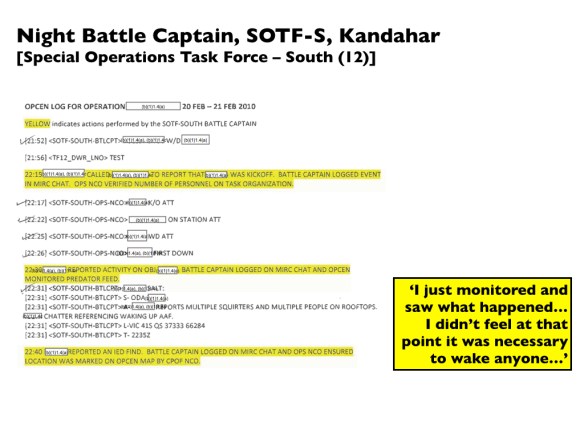
That was normal, but in fact both higher commands did more or less the same: and the investigating team was clearly appalled.  At SOTF-12 all senior (field grade) officers were asleep during the period of ‘highest density of risk and threatening kinetic activity’ (although they had established ‘wake-up criteria’ for emergency situations).  The Night Battle Captain had been in post for just three weeks and had been given little training in his role; he received a stream of SALT reports from the Ground Force Commander of ODA 3124 (which detailed Size of enemy force, Activity of enemy force, Location and Time of observation) but simply monitored the developing situation – what one investigating officer characterised as ‘a pretty passive kind of watching’.
GREGORY Angry Eyes 2015 IMAGES.065

The same was true at CJSOTF-A (the staff there monitored 15-25 missions a day, but this was the only active operation that had declared a potential Troops in Contact).

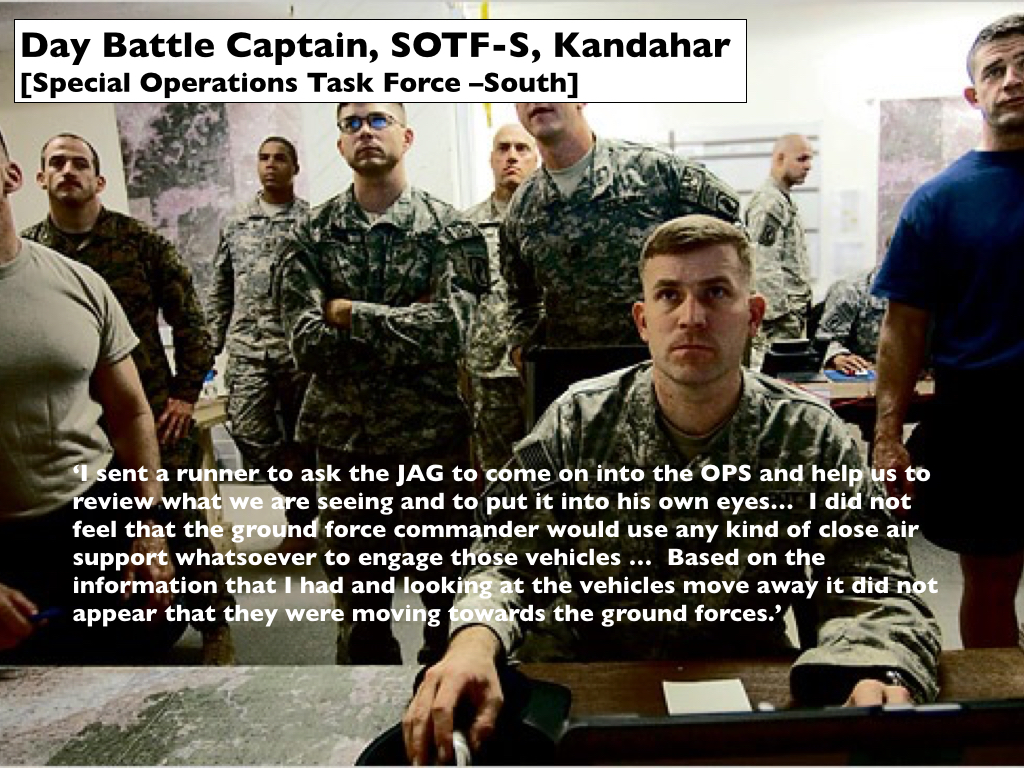
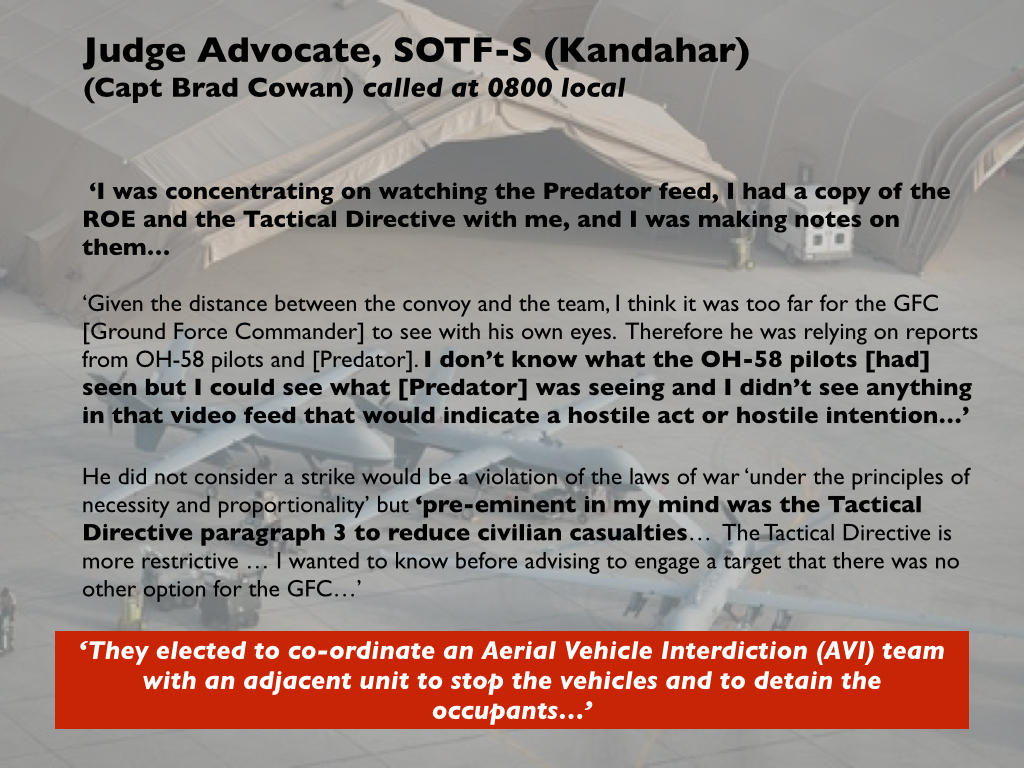
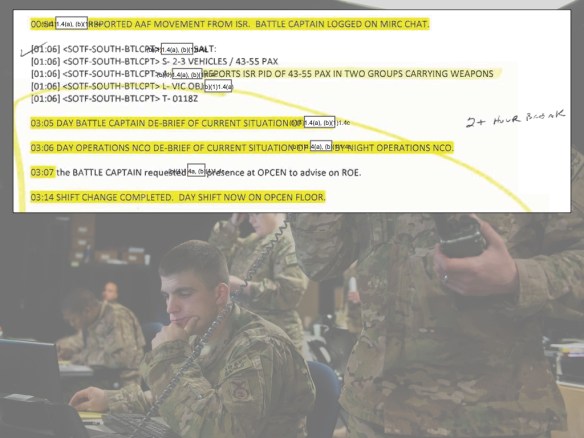
When the more experienced Day Battle Captain entered the Joint Operations Center at Kandahar and was briefed by the Night Battle Captain he was sufficiently concerned to send a runner to ask the Judge Advocate, a military lawyer, to come to the JOC.  He believed the occupants of the vehicles were hostile but was not convinced that they posed an immediate threat to troops on the ground:  ‘I wanted to hear someone who was extremely smart with the tactical directive and use of CAS [Close Air Support] in a situation I hadn’t seen before’.

This was a smart call for many reasons; the commander of US Special Forces, Brigadier General Edward Reeder, told the inquiry: ‘Honestly I don’t take a shit without one [a JAG], especially in this business’.  Significantly, the Safety Observer at Creech testified that there was no ‘operational law attorney’ available onsite for aircrews conducting remote operations; conversely, JAGs were on the operations floor of CENTCOM’s Combined Air and Space Operations Centre at Ul Udeid Air Base and, as this case shows, they were available at operations centers established by subordinate commands in-theatre.
GREGORY Angry Eyes 2015 IMAGES.073

GREGORY Angry Eyes 2015 IMAGES.074

The JAG at Kandahar was not routinely called in for ‘Troops in Contact’ but on this occasion he was told ‘my Legal Opinion [was] needed at the OPCENT and that it wasn’t imminent but they wanted me to rush over there right away…’

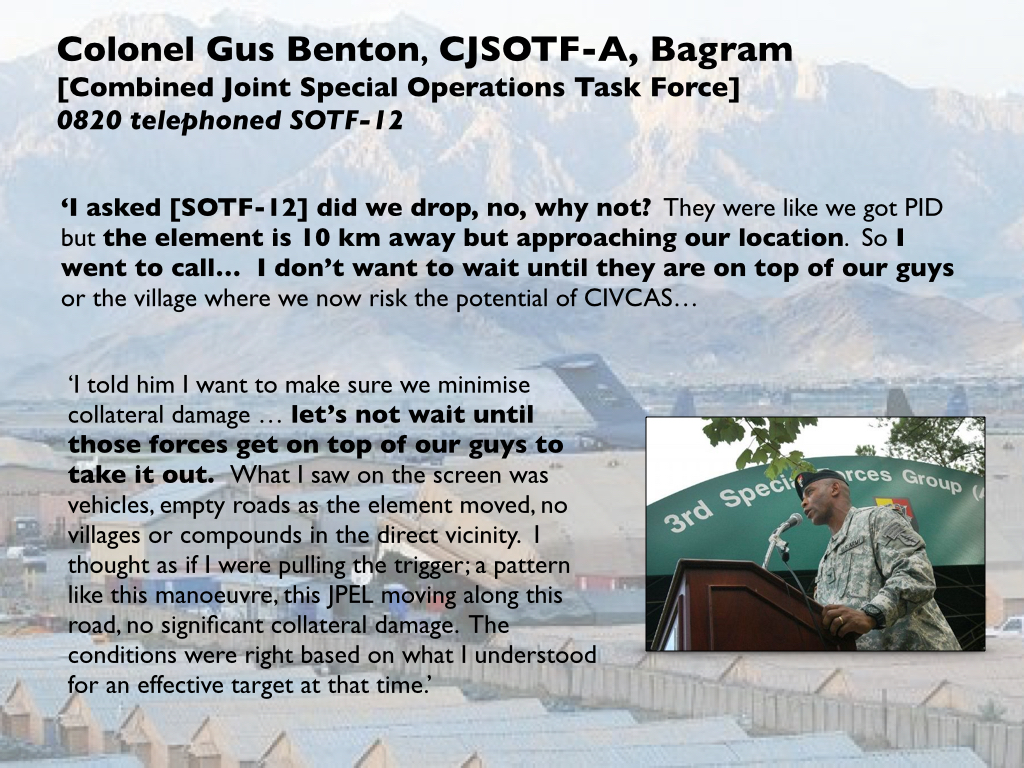
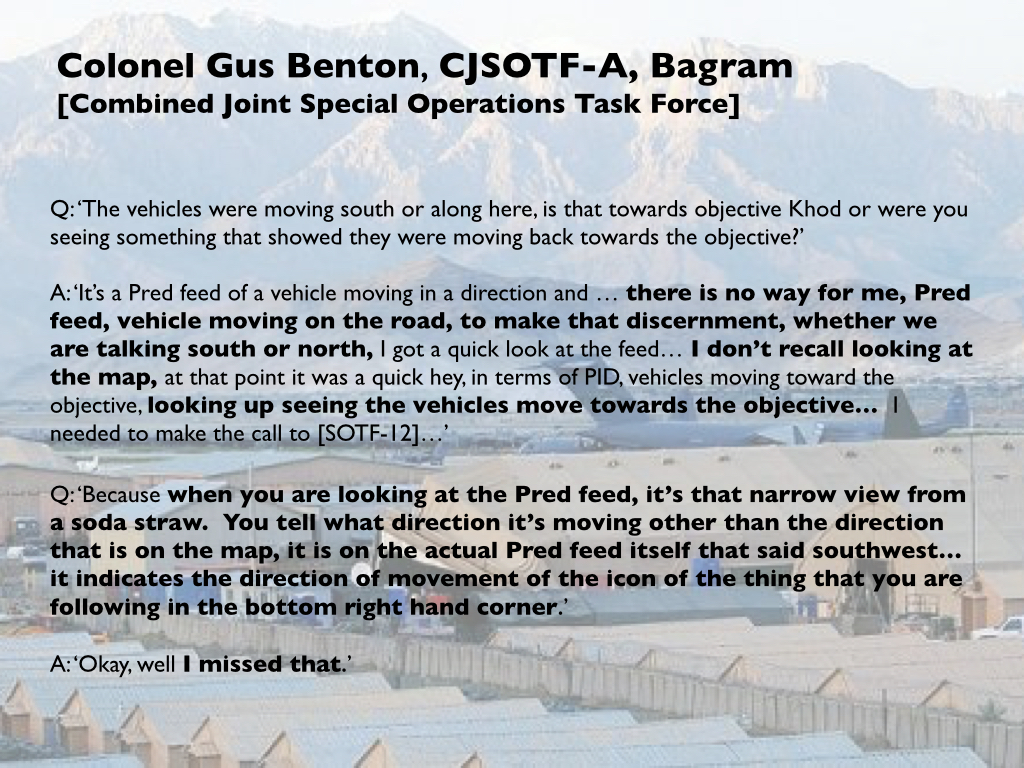
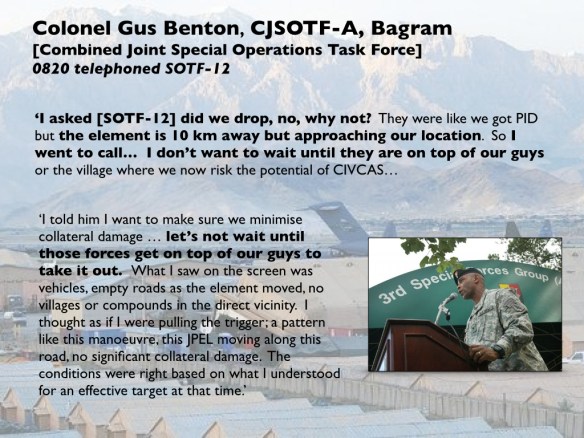
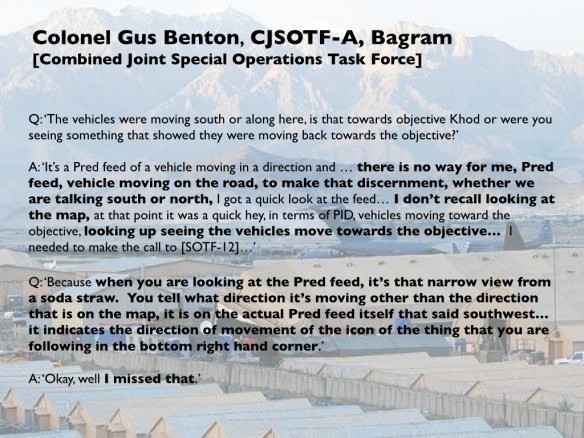
Meanwhile up at Bagram Colonel Gus Benton, the commanding officer of CJSOTF-A, was being briefed by his second-in-command who understood that the Ground Force Commander’s intention was to allow the three vehicles to move closer to his position at Khod.  He thought that made sound tactical sense.

‘I said that … is what we did, we let them come to us so we can get eyes on them. During my time I never let my guys engage with CAS if they couldn’t see it. I said that is great and COL [Benton] said “that is not fucking great” and left the room.’

At 0820, ten minutes after the JAG entered the JOC at Kandahar, while he was watching the Predator feed, the phone rang: it was Benton.  He demanded Lt Colonel Brian Petit, the SOTF-12 commander, be woken up and brought to the phone:
GREGORY Angry Eyes 2015 IMAGES.076

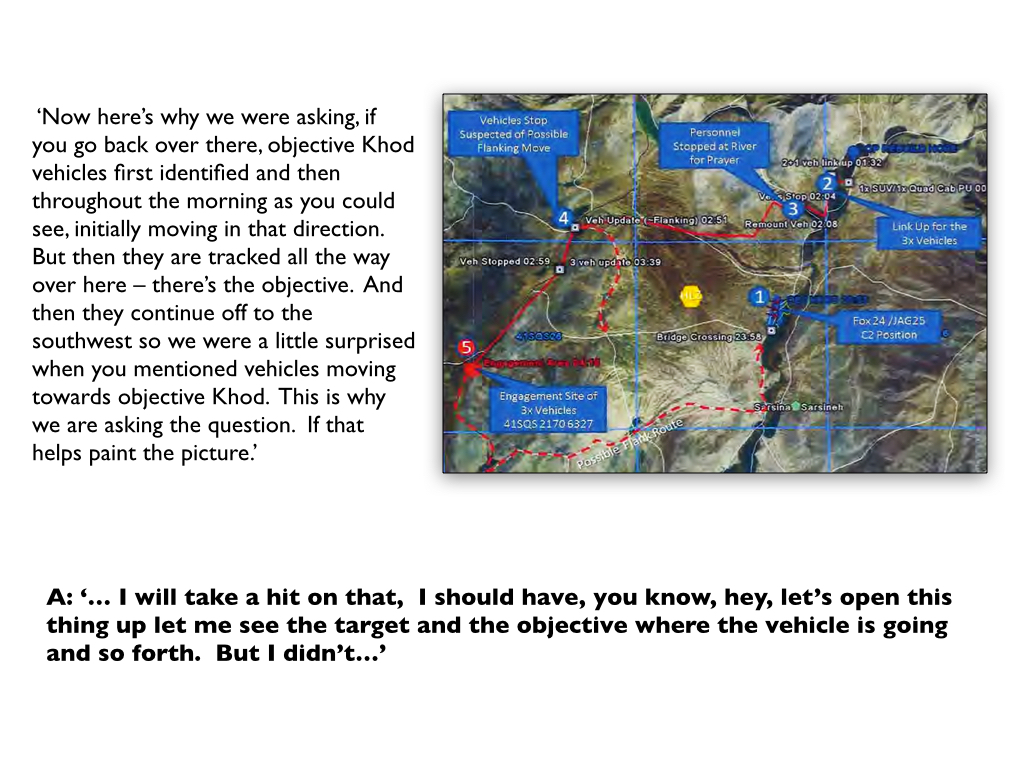
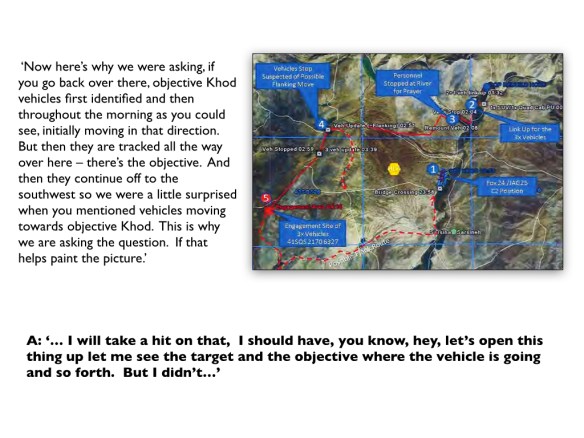
He spectacularly mis-read the situation (not least because he mis-read the Predator feed).  It was true that the vehicles were in open country, and not near any compounds or villages; but Benton consistently claimed that the vehicles were ‘travelling towards our objective’ whereas – as MG McHale’s investigating team pointed out to him – they were in fact moving away from Khod.
GREGORY Angry Eyes 2015 IMAGES.077

GREGORY Angry Eyes 2015 IMAGES.078

There had also been some, inconclusive discussion of a possible ‘High Value Target’ when the vehicles were first tracked, but the presence of a pre-approved target on the Joint Prioritised Effects List (Benton’s ‘JPEL moving along this road’) had never been confirmed and the Ground Force Commander had effectively discarded it (‘above my authority’, he said).

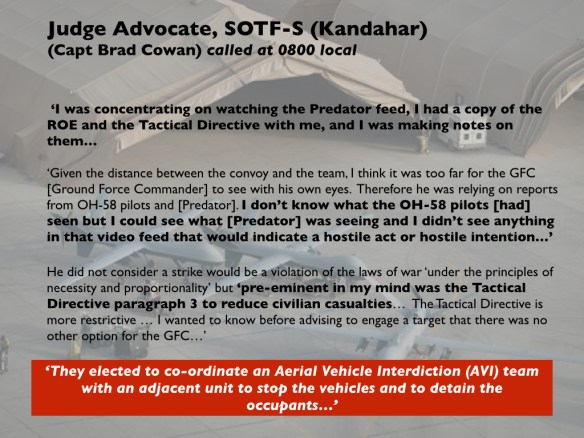
Certainly, the JAG at Kandahar read the situation differently:
GREGORY Angry Eyes 2015 IMAGES.075

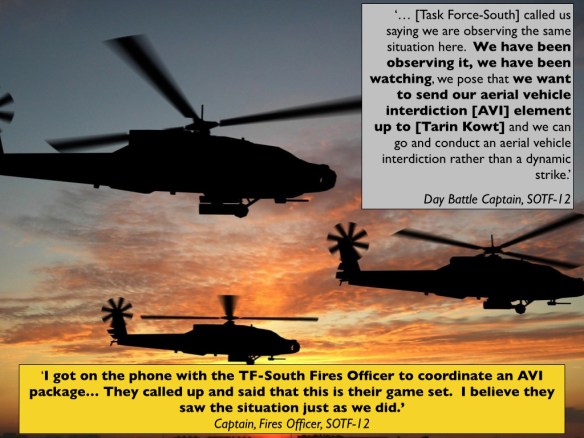
When Benton rang off, the JAG went over to the Day Battle Captain and Lt Col Petit and recommended an Aerial Vehicle Interdiction (AVI) team be called in for a show of force to stop the vehicles without engaging the occupants in offensive action.

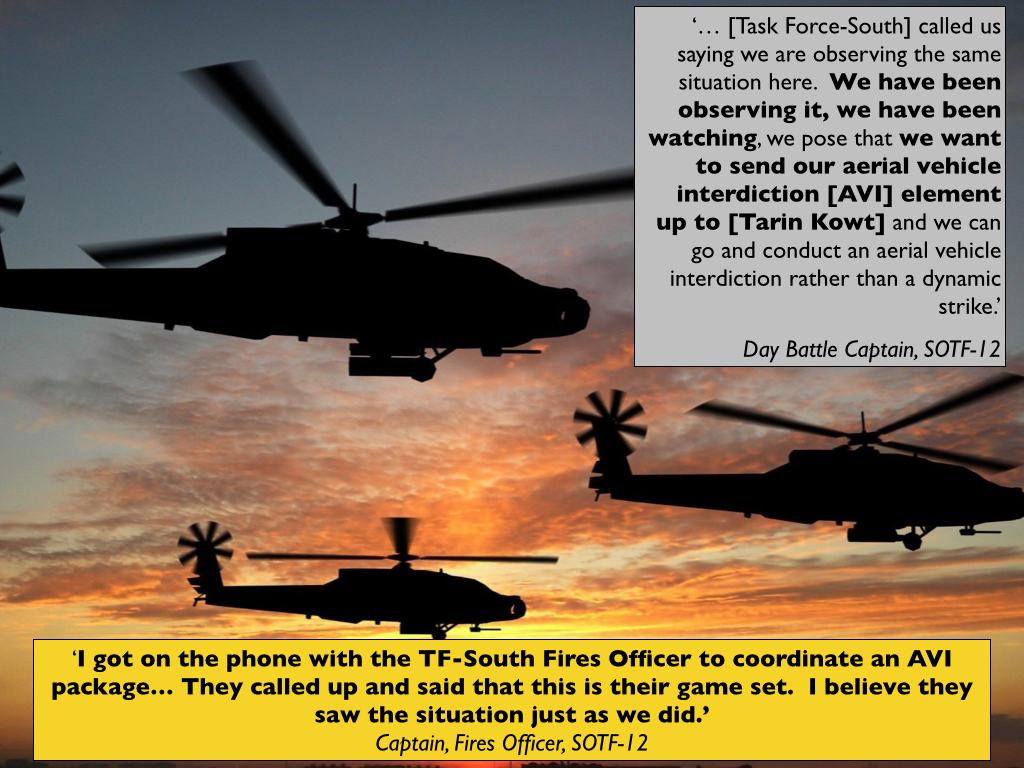
They agreed; in fact another Task Force also watching the Predator feed called to make the same suggestion, and the Fires Officer set about arranging to use their Apache helicopters to conduct an AVI:
GREGORY Angry Eyes 2015 IMAGES.079

The Fires Officer had been responsible for setting up the Restricted Operating Zone for aircraft supporting the ODA – de-conflicting the airspace and establishing what aircraft would be available – but its management was de-centralised:

‘I establish the ROZ, give the initial layout of what assets are going on, and then I pass that to the JTAC [Joint Terminal Attack Controller with the Ground Force Commander at Khod].  I pass the frequencies to the assets and the JTAC controls them from there.’

At 0630, long before all this frantic activity at Kandahar, the two OH-58s had arrived at a short hold location beyond the ‘range of enemy visual and audio detection’, and at 0730 they had left to refuel at Tarin Kowt.  The Day Battle Captain and the Fires Officer both thought they were still off station.  In fact, the helicopters had returned to hold at Tinsley/Cobra at 0810 and flat pitched to conserve fuel (which means they landed and left the rotor blades spinning but with no lift); thirty minutes later the JTAC called them forward and the Predator began to talk them on to the target.

The Day Battle Captain had another reason for thinking he and his colleagues in the JOC had more time.  He maintained that the helicopters had been brought in not to engage the three vehicles but to provide air support if and when the ‘convoy’ reached Khod and the precautionary ‘AirTic’ turned into a real TIC or Troops in Contact:

‘… the CAS brought on station for his [the Ground Force Commander’s] use was not for the vehicles but for what we thought was going to be a large TIC on the objective. The weapons team that was pushed forward to his location was not for the vehicles, it was for the possibility of a large TIC on the objective based on the ICOM chatter that we had.’

That chimes with Benton’s second-in-command at Bagram, who also thought the Ground Force Commander was waiting for the ‘convoy’ to reach Khod, but neither witness explained the basis for their belief.  It was presumably a string of transmissions from the JTAC to the Predator crew: at 0538 he told them the Ground Force Commander wanted to ‘keep tracking them and bring them in as close as we can until we have CCA up’ (referring to the Close Combat Attack helicopters, the OH-58s); shortly before 0630 he confirmed that the Ground Force Commander’s intent was to ‘permit the enemy to close, and we’ll engage them closer when they’re all consolidated’; and at 0818 he was still talking about allowing the vehicles to ‘close distance.’

Yet this does not account for the evident urgency with which the Day Battle Captain and the JAG were concerned to establish ‘hostile intent’ and ‘immediate threat’.  When the vehicles were first spotted they were 5 km from Khod, and when they were attacked they were 12 km away across broken and difficult terrain: so what was the rush if the Ground Force Commander was continuing to exercise what the Army calls ‘tactical patience’ and wait for the vehicles to reach him and his force?

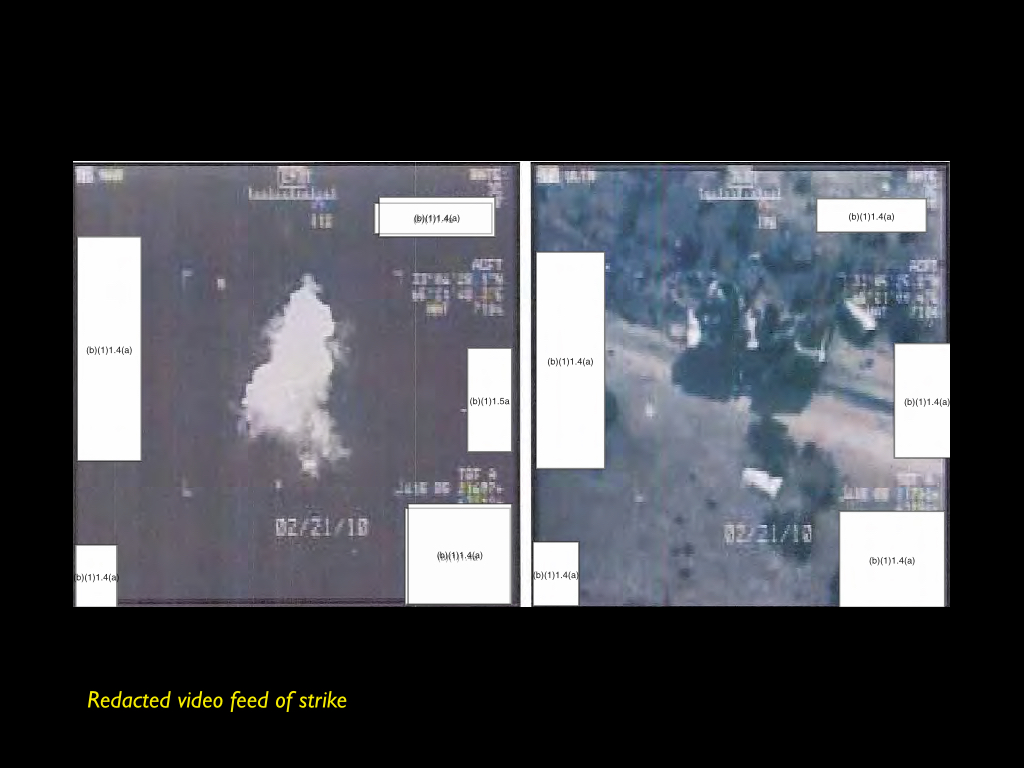
In fact, the messages from the Ground Force Commander had been mixed; throughout the night the JTAC had also repeatedly made it clear that the ODA commander’s intent was ‘to destroy the vehicles and the personnel’.  The Ground Force Commander insisted that ‘sometime between 0820 and 0830’ he sent a SALT report to SOTF-12 to say that he was going to engage the target.  Unfortunately there is no way to confirm this, because SOTF’s text records of the verbal SALT reports stopped at 0630 for reasons that were never disclosed (or perhaps never pursued), but it would explain why the JTAC’s log apparently showed the JAG contacting him at 0829 to confirm there were no women and children on the target.  It would also account for testimony by one of the screeners, who realised that the helicopters were cleared to engage at 0835, ten minutes before the strike, when the NCO responsible for monitoring the Predator feed at SOTF-12 ‘dropped’ into the ‘ISR’ (I presume the relevant chat room window), and in response:

‘The MC [Mission Intelligence Co-ordinator at Creech] passed that the OH58 were cleared to engage the vehicles. We were all caught off guard… It seemed strange because we had called out that these vehicles were going west. I don’t know how they determined these vehicles to be hostile… I brought up a whisper [private chat] with the MC, I said are you sure, what are the time frames when they will be coming in, and the MC responded saying we don’t know their ETA and at that moment the first vehicle blew up…’

Should those watching the events unfold have been taken aback when the vehicles were attacked?  According to the pilot of the Predator, he and his crew were surprised at the rapid escalation of events:

‘The strike ultimately came a little quicker than we expected…. we believed we were going to continue to follow, continue to pass up feeds… When he decided to engage with the helos when they did, it happened very quickly from our standpoint. I don’t have a lot of info or situational awareness of why the JTAC decided to use them when they did. When they actually came up … the JTAC switched me on frequencies. So we weren’t talking on the frequency I was talking to him on a different frequency to coordinate with the helos.

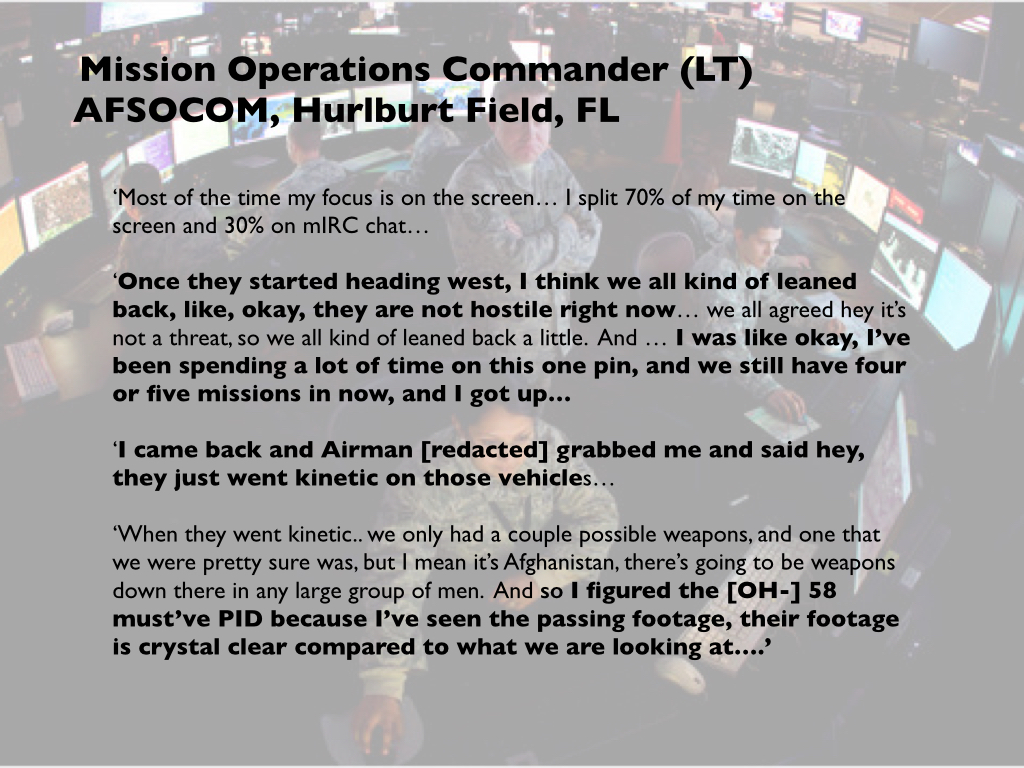
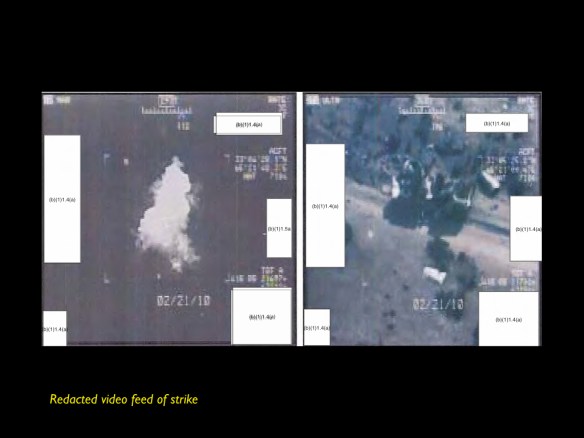
But their surprise was as nothing compared to the reaction of most observers when the first vehicle exploded.  The officer in charge of the screeners and imagery analysts who had been scrutinising the Predator feed at Air Force Special Operations Command at Hurlburt Field in Florida couldn’t believe it:

GREGORY Angry Eyes 2015 IMAGES.088

The Day Battle Captain testified:

‘I did not feel that the ground force commander would use any kind of close air support whatsoever to engage those vehicles… Based on the information that I had and looking at the vehicles move away it did not appear that they were moving towards the ground forces…

… as we were watching the Predator feed the first vehicles exploded. And everyone in the OPSCEN was immediately shocked… The amount of time from when that course of action approved by the SOTF commander to when we actually saw the strike occur there was no time, there was not adequate time to inform the ground commander that that was the course of action decided by the CJSOTF commander… I have phones ringing left and right, talking to people, trying to explain things, you know we look up on the screen and it happened…’
GREGORY Angry Eyes 2015 IMAGES.089

The Fires Officer:

‘I don’t think at any time anyone communicated to the GFC [Ground Force Commander] not to strike these vehicles because it is not something that we normally do. We feel that if he is in contact with the Predator and the OH-58s that we sent out to screen which we were not aware of and he is on the ground he generally has a pretty good picture of what is going on. He might be more privy to some conversation that he had with the OH-58 than what we know about. We normally give the GFC pretty big leeway on how they operate and the same with the JTAC because he has control of the assets and I am not going to try to take his assets away.’

In short, the investigation concluded that the Ground Force Commander never knew that an Aerial Vehicle Interdiction was being arranged, and neither of his higher commands were aware that he had cleared the helicopters to attack the three vehicles.

But, as I will show next, what lay behind these failures of communication was a de-centralised, distributed and dispersed geography of militarised vision whose fields of view expanded, contracted and even closed at different locations engaged in the administration of military violence.  Far from being a concerted performance of Donna Haraway‘s ‘God-trick’ – the ability to see everything from nowhere – this version of networked war was one in which nobody had a clear and full view of what was happening.

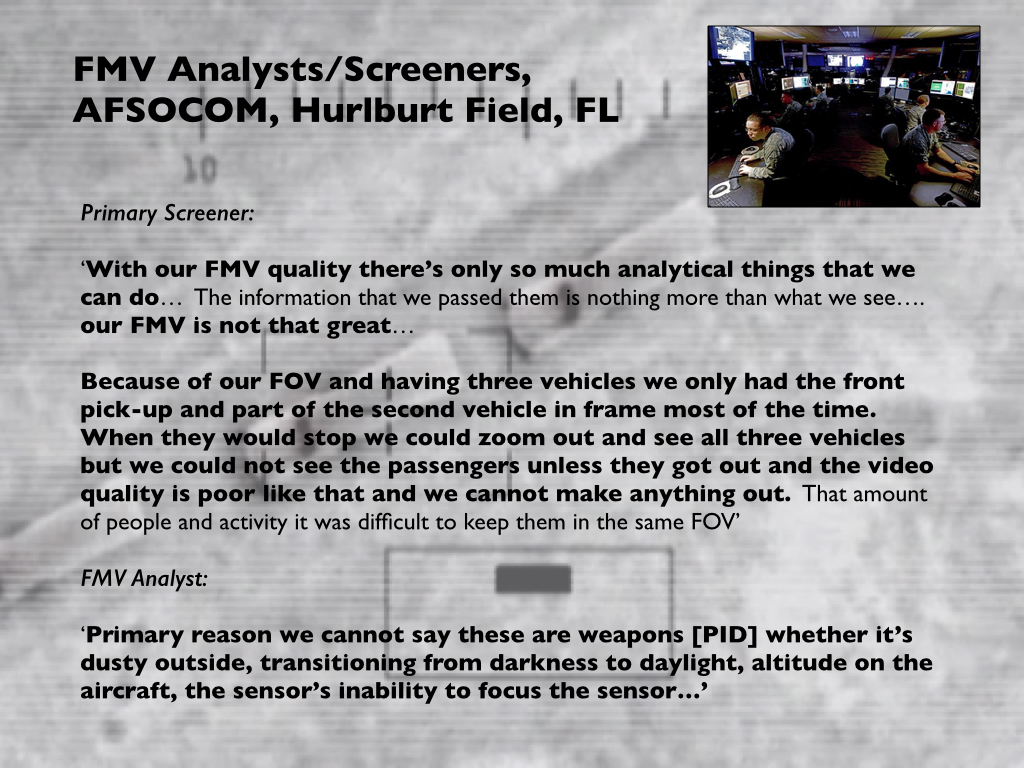
Part of this can be attributed to technical issues – the different fields of view available on different platforms, the low resolution of infra-red imagery (which Andrew Cockburn claims registers a visual acuity of 20/200, ‘the legal definition of blindness in the United States’), transmission interruptions, and the compression of full-colour imagery to accommodate bandwidth pressure.  So for example:
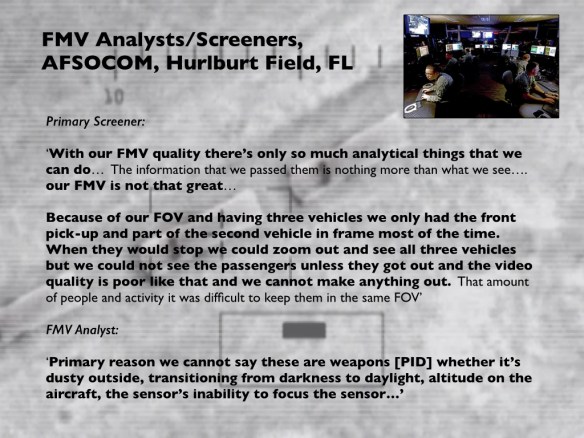
GREGORY Angry Eyes 2015 IMAGES.125

But it is also a matter of different interpretive fields.  Peter Asaro cautions:
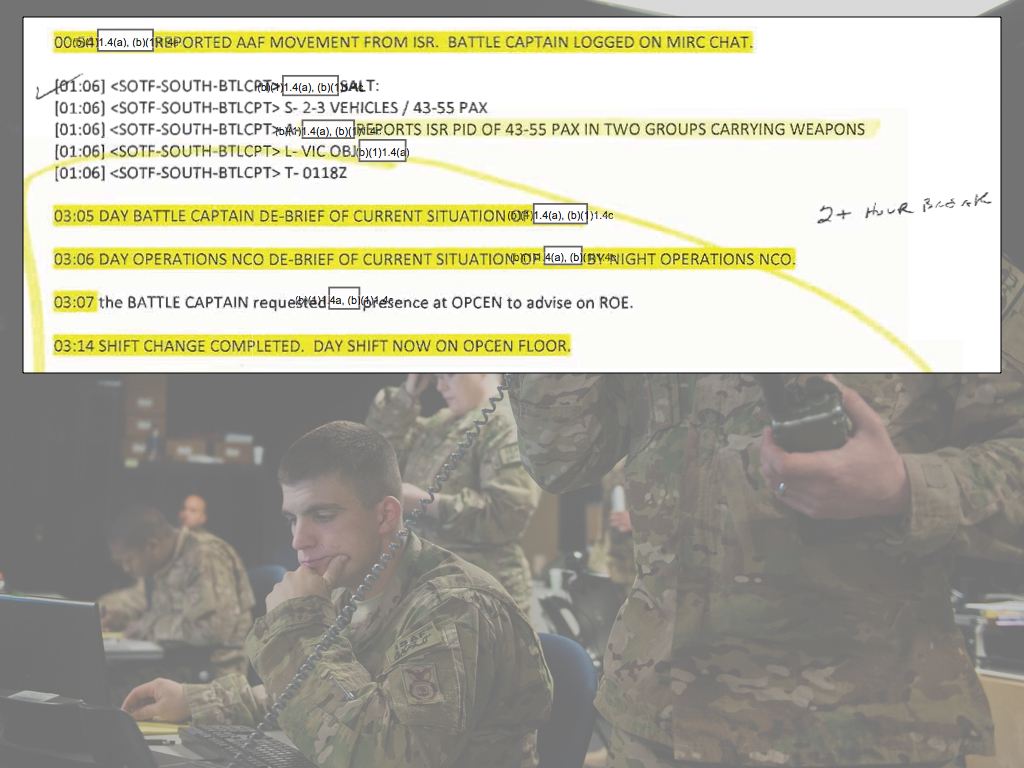
‘The fact that the members of this team all have access to high-resolution imagery of the same situation does not mean that they all ‘‘see’’ the same thing. The visual content and interpretation of the visual scene is the product of analysis and negotiation among the team, as well as the context given by the situational awareness, which is itself constructed.’

The point is a sharp one: different visualities jostle and collide, and in the transactions between the observers the possibility of any synoptic ‘God-trick’ disappears.  But it needs to be sharpened, because different people have differential access to the distributed stream of visual feeds, mIRC and radio communications.  Here the disposition of bodies combines with the techno-cultural capacity to make sense of what was happening to fracture any ‘common operating picture’.   As one officer at Kandahar put it:

‘We didn’t have eyes on, minus ISR platform, that we can all see, who watches what? All the discrepancies between who watches what. What I see may be different from what someone else might interpret on the ISR… ISR is not reliable; it is simply a video platform.’

He was talking specifically about the multiple lines of communication (and hence bases for interpretation) within his Operations Center: now multiply that across sites scattered across Afghanistan and the continental United States and it becomes clear that the contemporary ‘fog of war’ may be as much the result of too much information as too little.

To be continued.