Casualties of war

As most readers will know, there has been a lively debate – at once profoundly philosophical and intensely practical – about what counts as a ‘grievable’ (and indeed survivable) life after military and paramilitary violence, and on the calculus of war-time casualties.

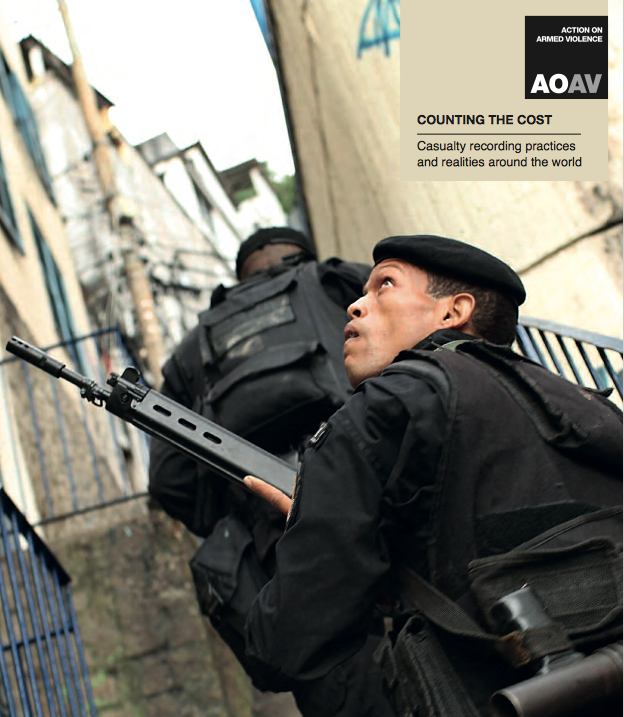
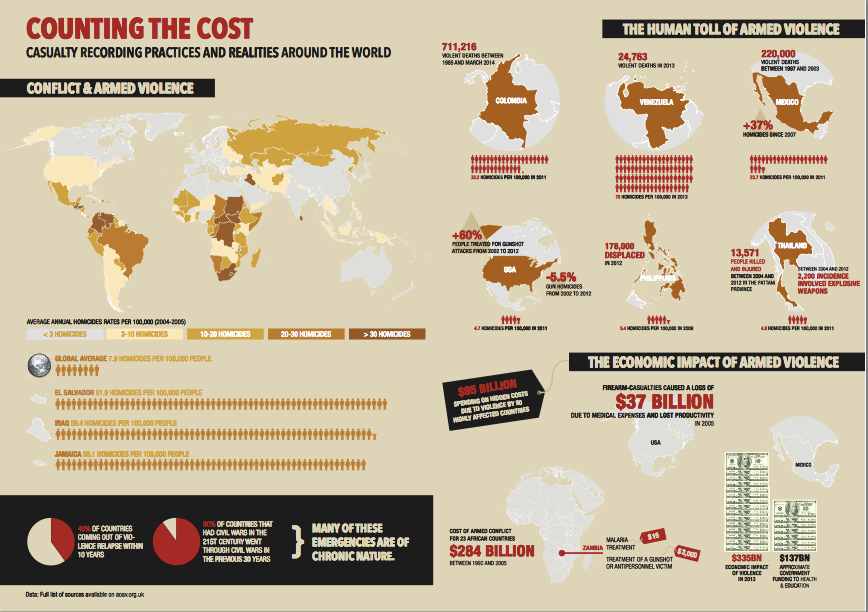
Two reports released yesterday conclude that recording and analysing data on the casualties of conflict and armed violence (both those killed and those who survive their wounds) can improve the protection of civilians and save lives.  The first, by Action on Armed Violence, is called Counting the Cost and surveys ‘casualty recording practices and realities around the world’:

Counting the costThe AOAV report shows that transparent and comprehensive information on deaths and injuries can protect civilians and save lives. The numbers of casualties have always been a contentious issue, generally dominated by secretive counting criteria, and public numbers that have been dictated more by political agendas than evidence. In other cases, the arguments have been dictated simply by the use of different estimating techniques. An example in this sense has been the debate on the total number of people that were killed during the Iraq War between Iraq Body Count and a survey published in the Lancet medical journal. The Lancet estimated over 650,000 deaths due to the war, more than 10 times the number of deaths estimated by the Iraq Body Count for the same period. A series of articles arguing for one or the other have highlighted how different systems to estimate number of deaths can lead to very different end results.

What the AOAV new report confirms is that when transparency both in the numbers produced as well as the techniques used to record them are clear and public, the debates around these numbers can be overcome. For Serena Olgiati, report co-author, “transparency makes it clear that this data is not a political weapon used to accuse opponents, but rather a practical tool that allows states to recognise the rights of the victims of violence.”

I have a more reserved view about a ‘transparent’ space somehow empty of politics – and we all know what the first casualty of war is – but the report is more artful than the press release suggests: it begins by invoking Walter Benjamin on Klee’s Angel of History:

“There is a painting by Klee called Angelus Novus. It shows an angel who seems about to move away from something he stares at. His eyes are wide, his mouth is open, his wings are spread. This is how the angel of history must look. His face is turned toward the past. Where a chain of events appears before us, he sees on single catastrophe, which keeps piling wreckage upon wreckage and hurls it at his feet. The angel would like to stay, awaken the dead, and make whole what has been smashed. But a storm is blowing from Paradise and has got caught in his wings; it is so strong that the angel can no longer close them. This storm drives him irresistibly into the future to which his back is turned, while the pile of debris before him grows toward the sky. What we call progress is this storm1.

The philosopher Walter Benjamin wrote these words in 1940 as he saw Europe engulf in flames. Within the year he had taken his own life on the French-Spanish border, the threat of deportation to a Jewish concentration camp seemingly too great for him to bear.

They are words that resonate as much today as they did then. Syria is engulfed in flames, Iraq descends back into the abyss and gun violence takes thousands of lives a week. The single catastrophe the Angelus Novus sees in the 21st century has to be the terrible harm caused by armed violence, a harm estimated to take over half a million lives a year.

Seeing this harm in its entirety is a gruelling task. Recording the true toll of armed violence reveals hard truths: it tells of underlying prejudices, of racism, of sexism: humanity’s ugliness. But only by turning behind us and calculating how many people have died and have been injured in a conflict, in a slum area, in a city in the grip of violence, can we ever begin to address the impact that armed violence has.

The report provided an analytical overview and a series of case studies (Colombia, Thailand and the Phillipines).

Counting the Cost Infographic

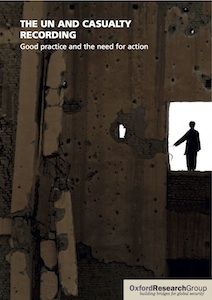
The second report is from the Oxford Research Group and is part of its Every Casualty program (see my post here).  In this report the ORG reviews the United Nations and Casualty Recording:

ORG-UN-and-CR Cover_1It concludes that when the UN systematically records the direct civilian casualties of violent conflict, and acts effectively on this information, this can help save civilian lives. However, casualty recording is not currently a widespread practice within the UN system.

The report recommends that the advancement of casualty-recording practice by the UN in conflict-affected countries should be pursued, as this would have clear benefits to the work of a range of UN entities, and so to the people that they serve.

This report looks at experiences of, and attitudes towards, casualty recording from the perspectives of UN staff based in New York and Geneva that we interviewed. It includes a case study of UN civilian casualty recording by the UN Assistance Mission in Afghanistan’s Human Rights unit. Finally, the report discusses challenges to UN casualty recording, and how these might be met.

Exorbitant witnessing

PLIThe first issue of the Cambridge journal of postcolonial literary inquiry, edited by Ato Quayson, on ‘New topographies of the postcolonial’, is available as an open access edition here.

The Cambridge Journal of Postcolonial Literary Inquiry is a new peer-review journal that aims to deepen our grasp of postcolonial literary history while enabling us to stay comprehensively informed of all critical developments in the field. The journal will provide a forum for publishing research covering the full spectrum of postcolonial critical readings and approaches, whether these center on established or lesser known postcolonial writers or draw upon fields such as Modernism, Medievalism, Shakespeare and Victorian Studies that have hitherto not been considered central to postcolonial literary studies, yet have generated some of the best insights on postcolonialism. The Journal aims to be critically robust, historically nuanced, and will put the broadly defined areas of literature and aesthetics at the center of postcolonial exploration and critique. Essays of up to 8000 words on any aspect of postcolonial literature, literary history and aesthetics should be sent to The Editor at pli@cambridge.org.

The special issue includes a fine essay by Debjani Ganguly,The world novel, mediated wars and exorbitant witnessing‘, which provides close and illuminating readings of Art Spiegelman‘s Maus and In the shadow of no towers and Michael Ondaatje‘s Anil’s Ghost and connects them to what she calls ‘our era of humanitarian wars’ (see p. 16 for her characterization).  Here is the abstract:

This essay traces the emergence of a new contemporary novel form at the conjunction of global violence in the wake of the Cold War, digital hyperconnectivity, and a mediated infrastructure of sympathy. Since the first Gulf War, and more so, in the rhetoric presaging the wars in Iraq and Afghanistan, we have come to accept that there is very little difference between the technologies used to wage war and those used to view it. This essay argues that the novels of our time are not contiguous with contemporary cinematic or televisual or new media genres in representing the immediacy of violence, but are rather texts that graph the sedimented and recursive history of such mediation. Their alternative way of documenting “witness”—that is, of abstracting the architectonics of testimonial work—urges us to focus not so much on the question of visibility—and its stock thematics of overexposure and desensitization—as on the legibility of this new mode of witnessing. The distinction between visibility and legibility amounts to calibrating differently the work of witnes- sing in novels, their textual and tropological play with multiple modes of spectatorship and engagement, and their distinctively different braiding of the factual and the evidentiary in comparison with genres of the visual.

Disposable life

Histories of violence banner

Histories of Violence launches its tremendously important (and equally ambitious) Disposable Life project, which Brad Evans explains like this:

“Mass violence is poorly understood if it simply refers to casualties on battlefields or continues to be framed through conventional notions of warfare. We need to interrogate the multiple ways in which entire populations are rendered disposable on a daily basis if we are to take seriously the meaning of global citizenship in the 21st Century”. (Brad Evans, Project Director)

 Throughout the Twentieth Century, violence was ceaselessly waged against targeted populations deemed to be “disposable”. The years 2014-2016 will be a poignant moment to reflect upon the historical significance and contemporary meaning of these mass atrocities. The period begins with the 20th anniversary of the Zapatista uprising which provided a contemporary frame on the history of indigenous and racial persecution. April 2014 will mark the 20th anniversary of the Rwandan genocide which exposed to a watching global community the horrifying legacy of colonialism, along with its lasting and unresolved implications. June 2014 bears witness to the 100th anniversary of the outbreak of World War I which remains one of the bloodiest conflicts in human history. Onto January 2015, we confront the historical memory of the violence of Auschwitz which taught us the shame of being human. The year also witnesses the 70th anniversaries of the bombings of Hiroshima & Nagasaki that still serve as a horrifying reminder of the devastating potential of weapons of mass destruction and the capacity to reason widespread destruction; the 100th anniversary of the Armenian “genocide” which remains a source of contention and passionate debate in terms of its definition and political vocabulary; the 65th anniversary of the start of the Korea War that continues to have profound impact upon global ideas of security and peaceful co-habitation; the 60th anniversary of the official start of Vietnam War (from United States perspective) whose targeted violence against local populations and biospheres in particular fundamentally challenged claims of Western superiority and enlightenment; along with the 40th anniversary of the beginning of the “killing fields” in Cambodia which remains one of the most violent experimental episodes in the history of human existence.

There is no doubt a need to collectively memorialise these traumatic events and remember the devastating loss of life. Any attempt to create more just futures must have an appreciation of these histories of violence. There is also a need however to move beyond the historicity of memorialisation to critically question their contemporary significance in terms of providing a more honest and somber reflection of the present conjuncture. This requires us to move beyond the dominant Western tropes for conceptualising such violence as either exceptional in history or the result of a failure of liberal modernity. Disposability may take many different forms. It cannot be reduced to simplistic explanations. Nor can it be properly understood without engaging its underlying causes that may be of a political, economic, cultural, social, psychological and identity based nature. Only then might we start to rethink the terms of global citizenship in the 21st Century. With this in mind, the initiative is compelled to ask: Are there, for instance, aspects of contemporary global society that make it possible to think and act in ways that render specific populations disposable? How might we commemorate these tragic events in ways that will cultivate a deeper understanding of the conditions that give rise to extreme violence? Is it correct to argue that we now live in a post-colonial and post-racial moment? Or are there continued remnants from the brutality of colonialism that shapes relations amongst people today? What challenges does the notion of disposability pose for the integrity of social research? How should we engage the broader public in critical education and discussion around the various forms that violence has taken in the past and continues to take in the present? And how might we forge a truly trans-disciplinary pedagogy that connects the arts, humanities and social sciences such that we may engage more critically with the meaning of violence and the disposability of populations in the 21st Century?

This is excellent stuff, and from my point of view a critical question concerns the ways in which notions of ‘disposability’ circulate between (or perhaps more accurately among) the ‘battlefields and warfare’ with which the paragraph begins and the other spaces and spheres of social life to which it opens out.  I think this requires histories of violence, to be sure, but also geographies of violence – in short, historical geographies of violence.

The Project is launched with a short video from Cynthia Enloe, who ‘provides her original interpretation of the paradigm by exploring the meaning of disposability in the terms of the ways life continually appears arbitrary and nameless. For Enloe, not only does the problem of disposability point to contemporary forms of banality as earlier critiqued by Hannah Arendt, it allows us to rethink what it means to be humane in the 21st Century.’

For a partial list of future contributors, book projects and recommended readings, see here.  And keep watching that space!

Humanity

HumanityStarting this month, I’ve joined the Editorial Board of the journal Humanity: An International Journal of Human Rights, Humanitarianism, and Development.  It includes a host of people whose work I admire, including Costas Douzinas, Samera Esmeir, Didier Fassin, James Ferguson, Barbara Harlow, Paul Kahn, Thomas Keenan, Martti Koskenniemi, Andrew Lakoff, Liisa Malkki and Mariella Pandolfi, so I’m really excited about all this.

Here’s the Mission Statement (the journal started in October 2010):

In recent decades, the traditional politics of ideological contest has been displaced by a politics of humanity. In many realms, left and right have given way to life and death. In both domestic and international contexts, the languages of human rights and humanitarianism are often spectacularly marshaled as moral claims to bolster multifarious policies and practices. And development—a central Cold War discourse—has evolved beyond strictly economic or institutional concerns to encompass matters once targeted in human rights activism and has expanded to address the acute humanitarian crises once treated as more episodic and temporary conditions.

The distinctions among human rights, humanitarianism, and development—which were once largely discrete categories—have blurred under the pressures of contemporary international politics, resource wars, and global policy. The integration of human rights, humanitarianism, and development under the rubric of “humanity” has meant, for better and worse, the erosion of the traditional meanings and applications of each. This convergence of the three concepts within a larger politics of humanity is arguably one of the signature phenomena of our time.

The global politics of humanity legitimates itself not on the old foundation of international humanitarian law or the more recent elaboration of international human rights; rather, it derives its legitimacy from its promise to generate new legal and political orders, to shape new social realities and relations, to establish new economic imperatives and interests, and to forge new cultural connections and values. And while the global politics of humanity is emphatically a politics of redemption, at least in its urge to mend, ameliorate, or even transform circumstances of disorder and atrocity, the very aspirational quality of the politics of humanity that lends it appeal often immunizes it from critical inquiry. The humanity to which activists and governments appeal—or hope to bring about—is never the same in each context, or even for all actors in the same project. These unacknowledged tensions, indeed, help define this novel form of global politics.

The goal of Humanity is to provide a single forum for the dispassionate, analytically focused examination of these trends and the political transformations that have reshaped the terms of liberation and idealism as well as the practices of domination and control.

For a number of years now, scholars working in their respective fields, publishing mostly in disciplinary journals, have been analyzing this convergence—its formative history and future implications. Many powerful insights about these ongoing transformations have emerged from diverse fields such as anthropology, history, law, literature, philosophy, and sociology. Too often, however, this work has remained cloistered from scholars in other fields and the world of practice, even though much of it shares a common intellectual genealogy; and the centripetal force of the disciplines has tended to perpetuate these divisions, even though all of them have a common stake in the world. By encouraging novel approaches to the problems of “humanity” and inviting our readers and contributors to venture beyond their usual disciplines, we hope to clear some of the obstacles to conversation among scholars in various disciplines and between academics and practitioners. Humanity will provide an interdisciplinary forum to facilitate inquiry into the movement of human rights, humanitarianism, and development towards a politics of humanity—because “humanity” itself is a multidisciplinary question.

Most treatments of human rights, humanitarianism, and development—popular, scholarly, and activist—tend to remain tightly tethered to the agendas of the causes that gave them their original purpose and continuing energy. Our belief, as the editors of Humanity, is that the purposes of reflective activity and critique are not necessarily to refine and reform policies and to discover best practices. Advocacy and reform have their place, of course; but so too should analysis and critique, not just of methods, metrics, and goals but also of ideals and ideologies.

The mission of Humanity is to explore, from as many perspectives as possible, the multiple ways that invocations of “humanity” never tell the whole truth about the practices and people they defend or advance. For Humanity, “humanity” will always be a problem.

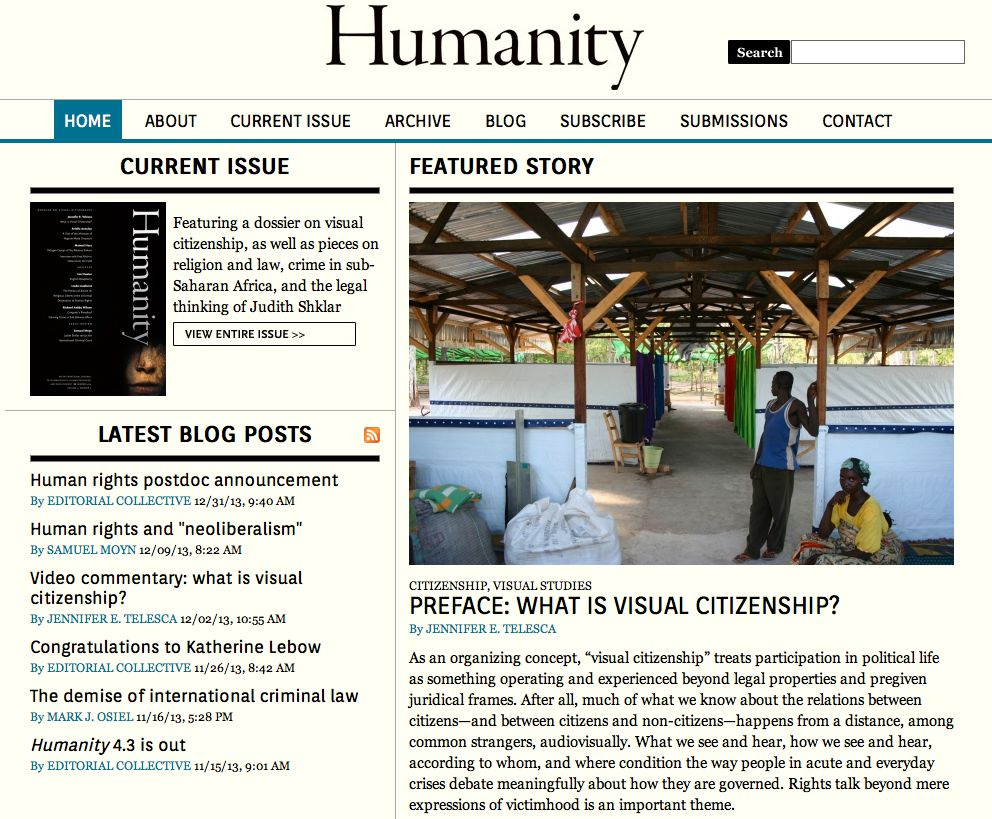
You can find out much more from Humanity Online here, which includes a preview of the latest issue on Visual Citizenship, featuring a downloadable introduction by  Jennifer Telesca, and a lively blog:

Humanity:2

A mile in these shoes

I’m just back from Beirut, and trying to catch up.  Every day I went for a walk along the Corniche, and on the second morning a young Syrian boy asked if he could clean my shoes.  I was wearing trainers, but told him that I’d pay him anyway and he could clean my shoes next time I came out; he refused to take the money until I had agreed where and when I would present myself for the service.  Heart-warming and hear-breaking, and I can’t get him out of my mind.  So here is a quick up-date on the situation (see also my previous posts here and here).

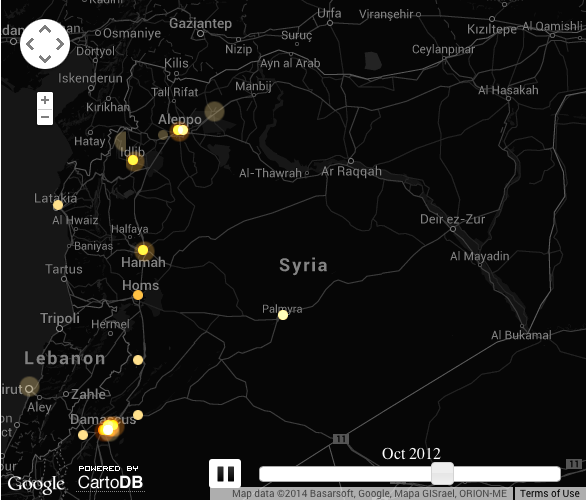
Syria civil war casualties

First, this week Foreign Policy published this sobering animated map of casualties from the civil war in Syria based on data from the Human Rights Data Analysis Group:

It visualizes the approximately 74,000 people who died from March 2011 to November 2013. Every flare represents the death of one or more people, the most common causes being shooting, shelling, and field execution. The brighter a flare is, the more people died in that specific time and place. The data used are drawn from the Violations Documentation Center (VDC), the documentation arm of the Local Coordination Committees in Syria which has been one of the eight sources on which HRDAG has based its count. In a June 2013 report, HRDAG cited VDC as the most thorough accounting of casualties in Syria, though the dataset has been found to contain some inconsistencies…

What the map demonstrates is the escalation of the conflict — with data from March 2011 through the VDC’s Nov. 21, 2013 report — and its quick descent from being a smattering of violence to a multi-front war with militias challenging the military (and other militias) almost everywhere at once. What it can’t show, of course, is the horror and destruction of this war.

My image is just a screen grab, of course, so you need to visit the original to see the overall, devastating effect.

For more detail, I recommend Syria Deeply, a new digital platform that attempts to combine citizen journalism with professional analysis; there’s a profile of the project at start-up over at Fast Company here and a more recent commentary from its founder Lara Setrakian here. I think there are lessons to be learned here about the way publics can be created and brought to engage with conflicts, and that goes for academics as well as journalists.

Second, it’s much harder to find information about those who have been wounded in the conflict – one of my present preoccupations: see here and here – but while I was in Beirut Lebanon’s Daily Star published an interesting report on NGOs working in the borderlands to treat casualties from the war zone.  In the Bekaa Valley the International Committee of the Red Cross has treated over 700 people since 2012, while a 20-bed clinic run by Lebanon’s Ighatheyya has treated 135 people since it opened five months ago in Kamed al-Loz.  The casualties include pro- and anti-Assad fighters (according to the ICRC, ‘When we know the patients are from opposing sides we separate them by placing them on different floors … We make sure they don’t know the other is there’) and civilians alike.  Many of them are suffering from infected wounds because they were initially treated in makeshift facilities in tents or private houses, which is why the perilous journey across the border is so vitally important. Neither the ICRC nor Ighatheyya make cross-border runs.  The Star‘s reporters explain:

Many patients are lawfully retrieved from the border by the Lebanese Red Cross, who then take them to a number of cooperating hospitals across the Bekaa Valley for treatment. According to a well-informed source, the ICRC has contracted four hospitals, in Chtaura, Jib Jenin, Baalbek and Hermel, to care for war wounded Syrians.

After surgery patients are often referred to clinics run by other non-governmental organizations, such as Ighatheyya, who oversee the patients’ convalescence…. Ighatheyya is [also] in the process of building a fully equipped 30-bed hospital in the border town of Arsal, where many refugees and combatants cross into Lebanon.

Another major locus of emergency medical treatment is Tripoli, just 30 km from the border and the primary treatment centre for Syrians seeking emergency medical assistance in northern Lebanon.  Médecins Sans Frontières, which also operates from four locations in the Bekaa Valley, has been supporting local clinics and hospitals here since February 2012 (and it’s been working inside Syria since March 2011).

NGOs are not the only organisations on the field.  Last summer NBC described the operation of a new clinic set up by the Syrian National Opposition to treat opposition fighters.  It too is in the Bekaa Valley, which is for the most part controlled by Hezbollah – which is of course militantly pro-Asad.  Four days after the clinic opened a local militia aligned with Hezbollah broke into the compound and forced a rapid evacuation, and early last summer armed men attacked an ambulance transporting a patient to surgery and kidnapped him: ‘Since then, the Lebanese Red Cross has refused to transport the clinic’s patients in ambulances through certain Hezbollah-dominated areas without an army escort. And private cars carrying patients through those areas have been shot at.’

For more on the transnational ‘therapeutic geographies’ involved in the wars in Iraq and Syria, see Omar Dewachi, Mac Skelton, Vinh-Kim Nguyen, Fouad Fouad, Ghassan Abu Sitta, Zeina Maasri and Rita Giacaman, ‘The Changing Therapeutic Geographies of the Iraqi and Syrian Wars’, forthcoming in The Lancet.  And for a discussion of the regional geopolitics of all this, including a corrective to the claim that the war in Syria is simply ‘spilling over’ into Lebanon, see Bélen Fernández over at warscapes here.

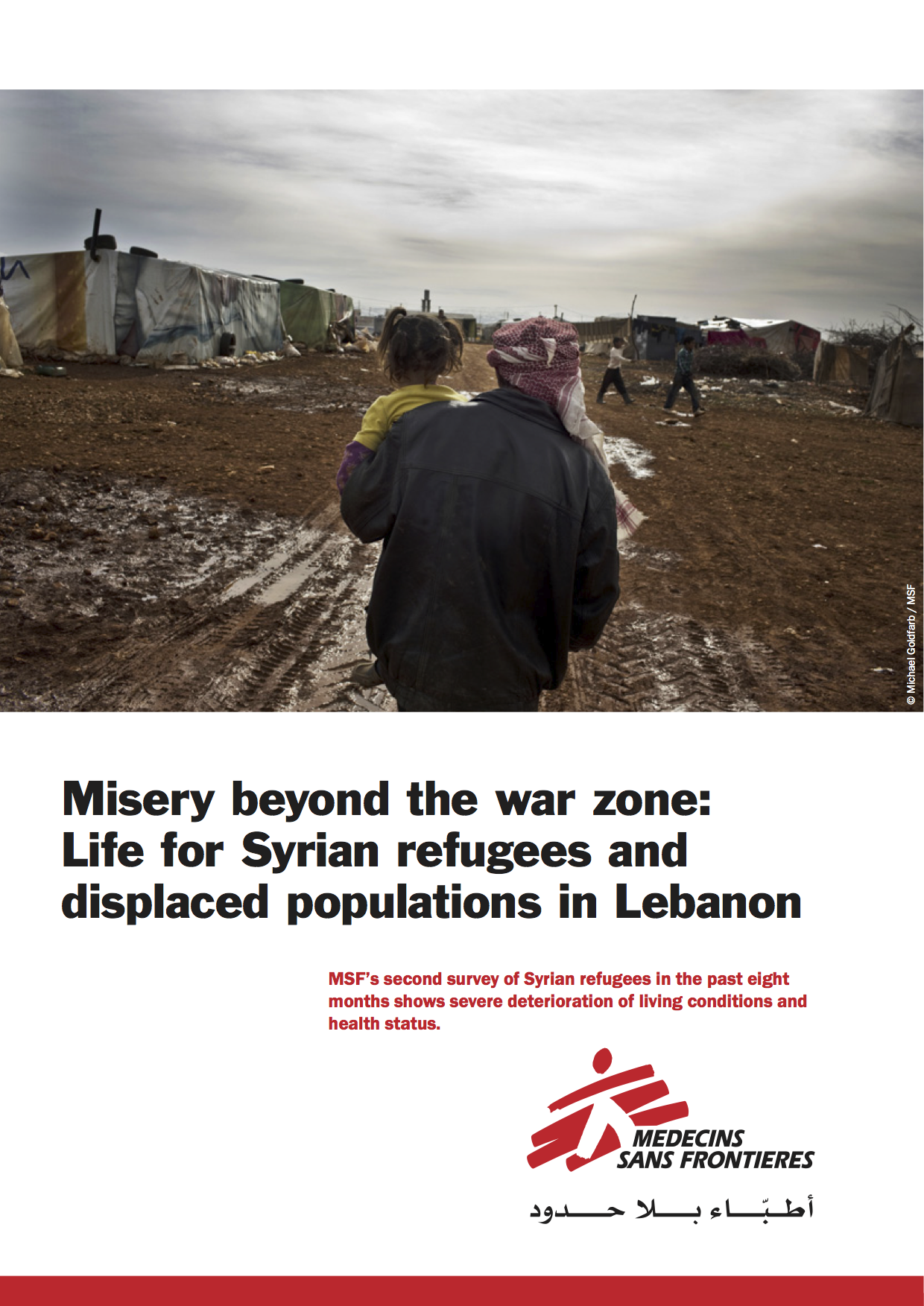
Syria-Lebanon-Report-2013 (dragged)As MSF emphasises, refugees from the conflict in Syria need more than emergency treatment for war wounds: ‘The epidemiological profile of populations does not change when they cross borders; those who needed medications for chronic conditions in Syria still need them in Lebanon.’  And, clearly, they have other pressing needs too:

‘[T]the gaps in service that existed [in June 2012] have not been sufficiently addressed but have in fact widened as more people have streamed across the border. Living conditions among the majority of refugees and Lebanese returnees remain extremely precarious, particularly with winter arriving. More than 50% of those interviewed, whether they were officially registered or not, are housed in substandard structures — inadequate collective shelters, farms, garages, unfinished buildings and old schools — that provide paltry, if any, protection against the elements. The rest are renting houses, but many of those people, now separated from their lives and livelihoods, are struggling to pay the rent. The medical picture has deteriorated as well. More than half of all interviewees (52%) cannot afford treatment for chronic disease care, and nearly one-third of them have had to suspend treatment already underway because it was too expensive to continue. For those who are and are not registered alike, the costs attached to essential primary health care, ante-natal care and institutional deliveries are prohibitive. Among non-registered returnees and internally displaced Lebanese, 63% received no assistance whatsoever from any NGO.’

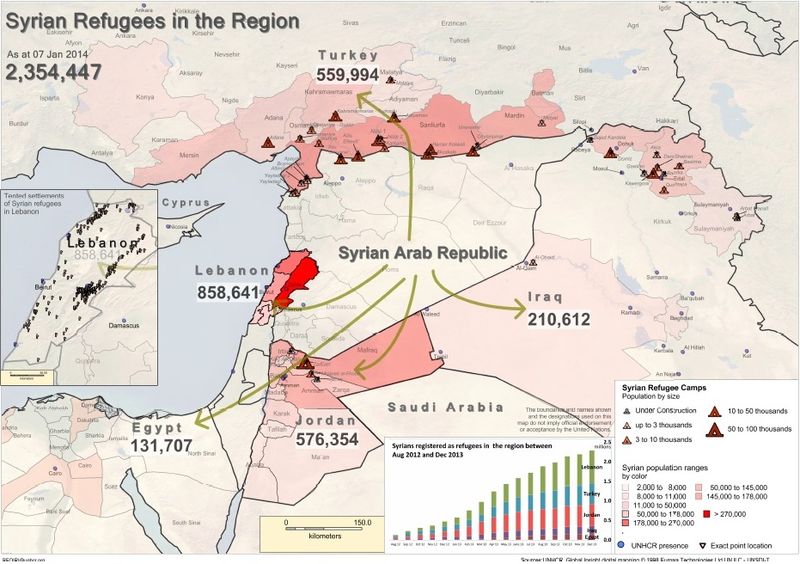
Here’s a recent map of Syrian refugee flows:

Syrian refugee flows to December 2013

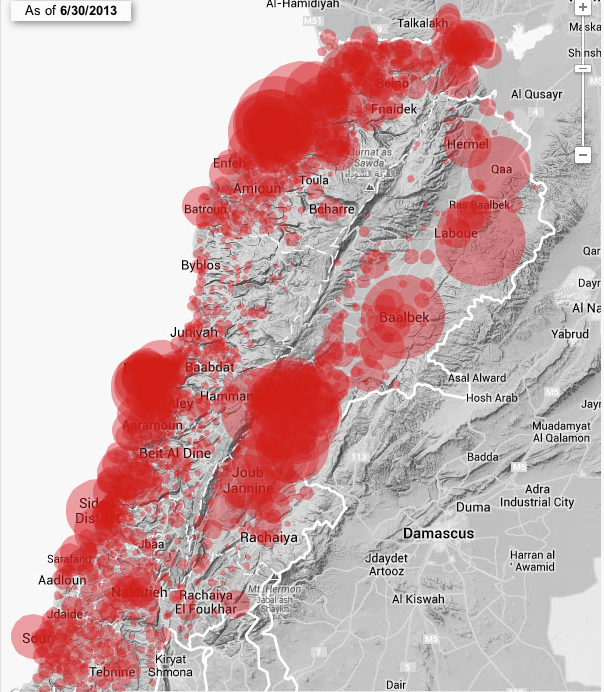
For more detail, UNHCR’s tabulations of Syrian refugees in Lebanon can be found here, and there’s a remarkable interactive map here (again, the image below is just a screen grab).

Syrian refugees in Lebanon summer 2013

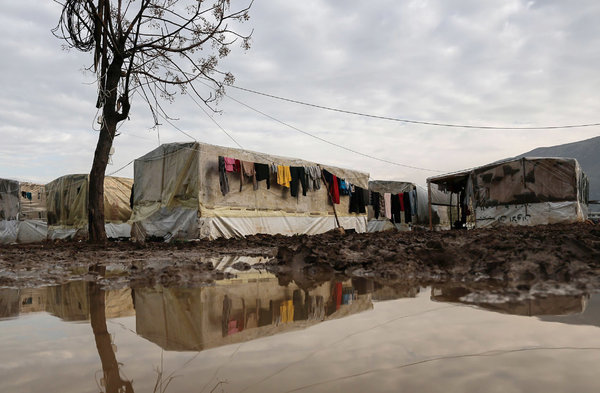
The number of registered refugees in Lebanon – and, as that MSF report indicates, registration is itself a deeply problematic process and the numbers understate the gravity of the situation – is now around one million; Lebanon’s population is four million, so one person in five is a refugee.  But wary of its experience with the Palestinian refugee camps – on which Adam Ramadan‘s work is indispensable: his book is due out later this year, but in the meantime see ‘In the ruins of Nahr al-Barid: Understanding the meaning of the camp‘, Journal of Palestine Studies 40 (1) (2010) and  ‘Spatialising the refugee camp‘, Transactions of the Institute of British Geographers 38 (1) (2013) 65-77 – Lebanon has refused to sanction camps for Syrian refugees: hence those ‘tented settlements’ on the map above (and see the image below).

24iht-m24-lebanon-refugees-articleLarge-v3

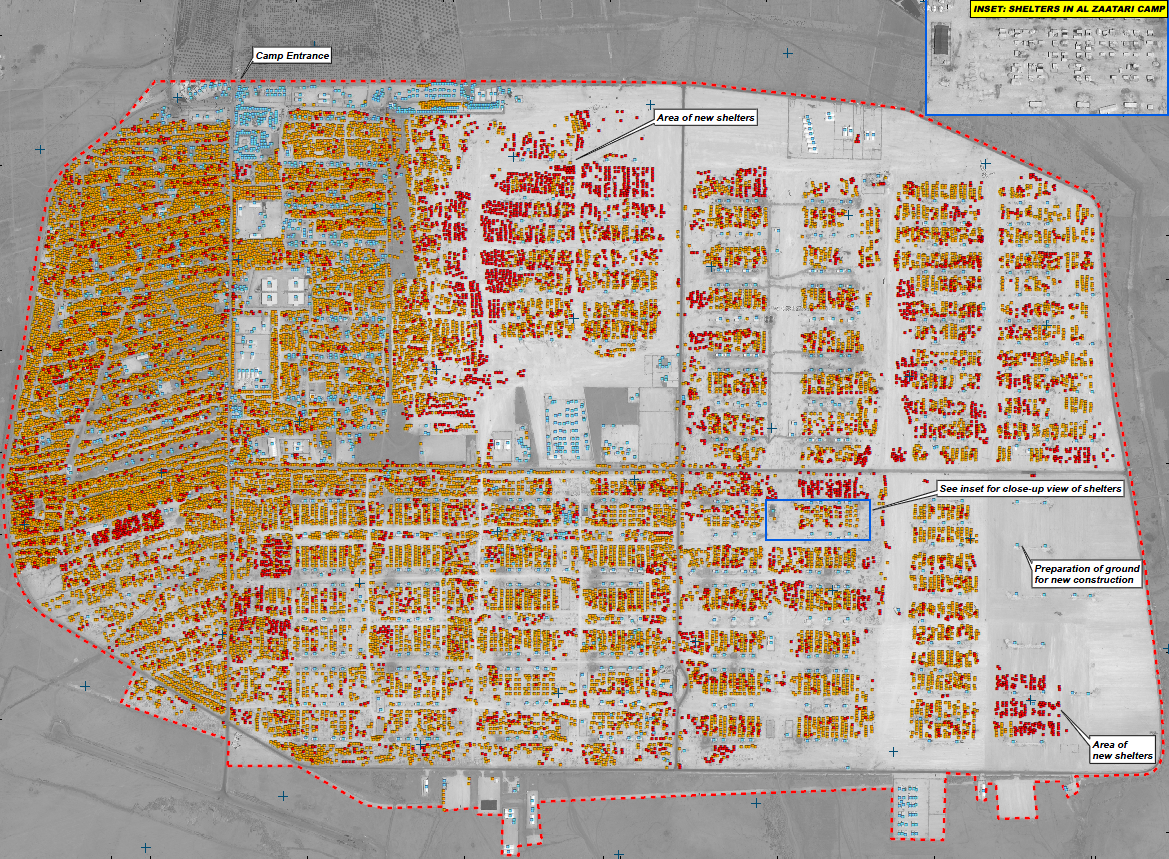
This strategy, or lack of it, is in marked contrast to Jordan, where Al- Za’atari, which opened in July 2012, will soon become the largest refugee camp in the world (below): you can find a sequence of satellite images showing its explosive growth here.

al-zataari-may-2013

But Lebanon is adamant that it will not sanction any intimations of permanence.  Norimitsu Onishi reported recently in the New York Times that

Those fears have forced the refugees to try to squeeze into pre-existing buildings and blend into the landscape. Those with means rent apartments. But hundreds of thousands are living in garages and occupying the nooks and crannies of buildings under construction. Abandoned buildings, including universities and shopping malls, have been taken over in their entirety by refugees.

Here, as usual, there are pickings to be had.  Last year Tracy McVeigh reported in the Guardian that

‘While there are widespread reports of extraordinary acts of generosity and kindness by Lebanese towards Syrian refugees, many people here are making money from Syria’s war. Landlords are getting rents for barely habitable properties, stables and outhouses. There are hefty profits to be made in the gun-running business, and refugees are easily exploited as cheap labour. The government is getting military resources from America and Europe, which are keen to see it able to protect its borders. But many others are losing out – those who are trying to house and feed large families along with their own.’

And that includes young boys looking for shoes to clean on the waterfront in Beirut.  If you want to donate more than the cost of a shoe-clean, you can reach Oxfam here, the International Rescue Committee here and UNHCR here.

Theory of the drone 11: Necro-ethics

This is the 11th in a series of extended posts on Grégoire Chamayou‘s Théorie du drone and covers the first two of three chapters that constitute Part III: Necro-ethics.

The title recalls Achille Mbembe‘s seminal essay on ‘Necropolitics’ [Public culture 15 (1) (2003) 11-40], where he cuts the umbilical cord between sovereignty and the state (and supranational institutions) and, inspired by Michel Foucault and Giorgio Agamben, argues that ‘the ultimate expression of sovereignty resides, to a large degree, in the power and the capacity to dictate who may live and who must die.’  Necropolitics is thus about ‘contemporary forms of subjugation of life to the power of death’ – and at the limit the creation of what Mbembe calls ‘death-worlds’.

AlexisLeran-AchilleMbembe5Mins658

Mbembe develops his thesis in part – and for good reason – in relation to the Israeli occupation of Palestine.  I imagine readers will know that the Israeli Defence Force (IDF) advertises itself, incredibly, as ‘the most moral army in the world’, and although Chamayou’s ultimate objectives are different he too begins with a critical interrogation of one version of that claim (you can find much more about it in Muhammad Ali Khalidi‘s fine essay on Gaza in the Journal of Palestine Studies 39 (3) (2010) available on open access here).

1: Combatant immunity

Chamayou argues that what distinguishes contemporary forms of imperial military violence is not so much the asymmetry of the conflict or the differential distribution of vulnerability which results as the norms that are invoked to regulate its conduct.  Towards the end of the twentieth century, he suggests, the ‘quasi-invulnerability’ of the dominant force was transformed into an over-arching politico-ethical framework.  This first came into view during NATO’s intervention in Kosovo in 1999 when force protection was established as the key consideration: not only was the NATO campaign largely confined to bombing from the air (so that, apart from Special Forces, there were few boots – and, more to the point, NATO bodies – on the ground) – but pilots were ordered not to fly below 15,000 feet.  This kept them safely beyond the range of anti-aircraft fire, even as it reduced the accuracy of air strikes and endangered the lives of those the intervention was supposed to save.

nato-bombs-convoy

This seems to violate conventional notions of a just or ethical war, effectively turning ‘humanitarian intervention’ on its head, but Chamayou claims that in fact it heralded the explicit formulation of a principle of ‘imperial combatant immunity’.  Enter the IDF, stage right.  This new doctrine was set out in detail in an essay by Asa Kasher  and Amos Yadlin, writing from the ‘Department of Professional Ethics and Philosophy of Practice’ at Tel Aviv University and the IDF College of National Defense, and published as ‘Military ethics of fighting terror: an Israeli perspective’, Journal of military ethics 4 (1) (2005) 3-32.  As their affiliation shows, this was not an abstract, academic discussion; Chamayou notes, in an artful twist on Yves Lacoste (La géographie, ça sert, d’abord, à faire la guerre), ‘What use is moral philosophy?  Among other things, to wage war…’ (‘A quoi sert la philosophie morale?  Entre autres choses, à faire la guerre’) (p. 184).

In that essay Kasher and Yadlin proposed a comprehensive reformulation of military ethics – and, by extension, international law – but Chamayou fastens on their reworking (or demolition) of  the established principle of distinction.  He cites their central thesis, thus:

One major issue is the priority given to the duty to minimize casualties among the combatants of the state when they are engaged in combat acts against terror.  According to the ordinary conception underlying the distinction between combatants and noncombatants, the former have a lighter package of state duties than the latter. Consequently, the duty to minimize casualties among combatants during combat is last on the list of priorities or next to last, if terrorists are excluded from the category of noncombatants. We reject such conceptions, because we consider them to be immoral. A combatant is a citizen in uniform. In Israel, quite often he is a conscript or on reserve duty. His blood is as red and thick as that of citizens who are not in uniform. His life is as precious as the life of anyone else. A democratic state may send him to a battlefront only because it has a duty to defend its citizens and it cannot do this without some of them defending the others, within the framework of a just system of conscription and reserve duty. The state ought to have a compelling reason for jeopardizing a citizen’s life, whether or not he or she is in uniform. The fact that persons involved in terror are depicted as noncombatants is not a reason for jeopardizing the combatant’s life in their pursuit. He has to fight against terrorists because they are involved in terror. They shoulder the responsibility for their encounter with the combatant and should therefore bear the consequences. 

(It turns out that there are limits to the privileges accorded to citizen-soldiers: more recently Ha’aretz reports that Kasher suggested in early 2012 that medical experiments can be carried out on them, even if they are not fully informed of the details, in order to ‘build the military force’, though Kasher has contested these accusations and insisted that his opinion stipulated a series of ‘conditions’ that had to be met).

I didn’t mention Lacoste casually, because part of Kasher and Yadlin’s argument turns on territory: on the duties imposed by belligerent occupation (‘when a person resides in a territory that is under effective control of the state’).  This is a Trojan Horse, needless to say, because they clearly have Gaza in their sights, and their proposal seeks to further the egregious fiction that Israel’s ‘withdrawal’ in 2005 meant that the Palestinians effectively imprisoned in Gaza are no longer subject to Israeli occupation (for more on ‘Gaza under siege’, see here).  Chamayou doesn’t dwell on this, but the emphasis on ‘effective control’ could – if you accept Kasher and Yadlin’s grotesque argument (which they insist is a general one) – be brought to bear on the US campaign of targeted killing in the Federally Administered Tribal Areas of Pakistan, in Yemen and in Somalia and be made to intersect with the usual rhetoric about ‘ungoverned spaces’ and ‘lawless zones’.

Kasher and Yadlin summarize their proposed hierarchy of privileges by setting out a tariff according to which militaries would administer injury in priority sequence:

(d.1) Minimum injury to the lives of citizens of the state who are not combatants during combat;

(d.2) Minimum injury to the lives of other persons (outside the state) who are not involved in terror, when they are under the effective control of the state;

(d.3) Minimum injury to the lives of the combatants of the state in the course of their combat operations;

(d.4) Minimum injury to the lives of other persons (outside the state) who are not involved in terror, when they are not under the effective control of the state;

(d.5) Minimum injury to the lives of other persons (outside the state) who are indirectly involved in terror acts or activities;

(d.6) Injury as required to the liberties or lives of other persons (outside the state) who are directly involved in terror acts or activities.

Chamayou concludes that the core principle they seek to advance involves replacing the distinction between civilians and combatants by a hierarchical distinction between citizens and aliens: an unbridled nationalism masquerading as ethics (p. 187).  In other words, within the frontier of state control  – Chamayou says ‘ state sovereignty’, but that’s not quite what Kasher and Yadlin say – some lives are more precious than others,  while beyond that line inferior lives (including those of what they call ‘bystanders’) are to be exposed to violence and ultimately sacrificed: as they put it, ‘the state should give priority to saving the life of a single citizen, even if the collateral damage caused in the course of protecting that citizen is much higher…’
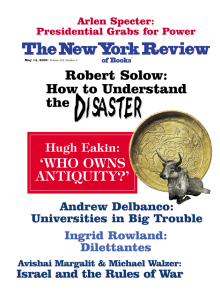
nyrb051409Their proposals had a slow fuse but they eventually set off a firestorm of protest.  Responding to a shorter version of the main essay [‘Assassination and preventive killing’, SAIS Review of International Affairs 25 (1) (2005)  41-57] and writing in the New York Review of Books (14 May 2009), Avishai Margalit and Michael Walzer were unequivocally appalled:

‘Their claim, crudely put, is that in such a war the safety of “our” soldiers takes precedence over the safety of “their” civilians.  Our main contention is that this claim is wrong and dangerous. It erodes the distinction between combatants and noncombatants, which is critical to the theory of justice in war (jus in bello).’

They continued:

‘The point of just war theory is to regulate warfare, to limit its occasions, and to regulate its conduct and legitimate scope. Wars between states should never be total wars between nations or peoples. Whatever happens to the two armies involved, whichever one wins or loses, whatever the nature of the battles or the extent of the casualties, the two nations, the two peoples, must be functioning communities at the war’s end. The war cannot be a war of extermination or ethnic cleansing. And what is true for states is also true for state-like political bodies such as Hamas and Hezbollah, whether they practice terrorism or not. The people they represent or claim to represent are a people like any other.

The main attribute of a state is its monopoly on the legitimate use of violence. Fighting against a state is fighting against the human instruments of that monopoly—and not against anyone else….

The crucial means for limiting the scope of warfare is to draw a sharp line between combatants and noncombatants. This is the only morally relevant distinction that all those involved in a war can agree on. We should think of terrorism as a concerted effort to blur this distinction so as to turn civilians into legitimate targets. When fighting against terrorism, we should not imitate it.’

In contrast,

‘For Kasher and Yadlin, there no longer is a categorical distinction between combatants and noncombatants. But the distinction should be categorical, since its whole point is to limit wars to those—only those—who have the capacity to injure (or who provide the means to injure)….

‘This is the guideline we advocate: Conduct your war in the presence of noncombatants on the other side with the same care as if your citizens were the noncombatants. A guideline like that should not seem strange to people who are guided by the counterfactual line from the Passover Haggadah, “In every generation, a man must regard himself as if he had come out of Egypt.”

Menahem YaariTheir critique found vigorous support from Menahem Yaari, a theoretical economist whose work has addressed (amongst other things) questions of justice, uncertainty and risk, but who wrote in a subsequent issue (8 October 2009) in his capacity as President of the Israel Academy of Sciences and Humanities:

‘A military code of conduct that discriminates, in cases of hazards being inflicted upon innocent civilians, on the basis of whether these civilians are “ours” or “theirs” is all the more worrisome when viewed against a general background of growing ethnocentric and xenophobic attitudes in Israel’s traditional establishment. We see an ongoing drift from universalism and humanism toward parochialism and tribalism.’

Picking up from that last sentence, Chamayou believes that this drift has accelerated and that it is by no means confined to Israel’s ‘traditional establishment’.  In his view, the ‘evisceration’ of the core principles of international humanitarian law by a ‘nationalism of self-preservation’ has become ‘the primary guiding principle of the necro-ethics of the drone’ (p. 189).

2: Humanitarian weapon

Chamayou seeks to trace a line of descent from the previous arguments to those advanced more recently by academics who directly address (and defend) the US use of drones.  He has two men in mind: Avery Plaw, an Associate Professor of Political Science at UMass – Dartmouth, and Bradley Jay Strawser, an Assistant Professor of Philosophy in the Defense Analysis Department at the US Naval Postgraduate School at Monterey.

UMass_Drone-crop

Plaw has collaborated with several colleagues to track and evaluate drone strikes in Pakistan and is involved in the UMass DRONE project (I’ve commented on this before), but it’s an Op-Ed in the New York Times on 14 November 2012 that catches Chamayou’s attention.  ‘Drones save lives, American and others’ was the headline, and Chamayou is bemused: ‘How can an instrument of death save lives?’

The question seems to invite a biopolitical response – ‘killing in order to let live’, as Mbembe and others would no doubt have it, and Chamayou doesn’t quite provide that – but neither does Plaw quite say what the headline implies.  He suggests that ‘drone strikes are the best way to remove an all-too-real threat to American lives’ and that ‘there is evidence that drone strikes are less harmful to civilians than other means of reaching Al Qaeda and affiliates in remote, lawless regions’. Perhaps this amounts to the same thing, but it’s not quite the cold calculus that Chamayou attributes to Plaw.  And as I read his (brief) intervention, the ‘American lives’ that Plaw sees as being at risk are not those of, say, ground troops in Afghanistan but of civilians in the continental United States threatened by attacks from al-Qaeda and its affiliates  – though even then Plaw would have to explain how they are ‘saved’ by attacks on the Taliban and other militant groups which scarcely pose a trans-continental danger.

'Nobody dies' Popular Science November 1997

In any event, Chamayou challenges what he sees as the paradoxically vitalist claim that serves as the first principle of contemporary necro-ethics: drones are ‘humanitarian’ because they save lives – and specifically ‘our’ lives (p. 192), which he sees encapsulated even more succinctly than in Plaw’s Op-Ed by the tag-line in the image above (from Popular Science in November 1997): ‘Nobody dies – except the enemy.’

STRAWSER Killing by remote controlThis is where he turns to – and on – Strawser.  Like Plaw, he has had his views publicised in the media –see Rory Carroll on ‘The philosopher making the moral case for US drones’  in the Guardian here and Strawser’s hasty qualification here – but Chamayou directs his attention to Strawser’s essay ‘Moral Predators: the duty to employ uninhabited aerial vehicles’, Journal of military ethics 9 (4) (2010) 342-68.  More recently, by the way, he’s edited a collection of essays, Killing by remote control: the ethics of an unmanned military (Oxford University Press, 2013), which includes an essay by Plaw on ‘Counting the dead: the proportionality of predation in Pakistan’ and an exchange between Kasher and Plaw, in which the (I think substantial) differences between the two are clarified.  These centre on the principle of distinction: the requirement to discriminate between combatants and civilians.  Kasher makes no secret of what he calls his ‘negative attitude to the principle of distinction as it is commonly understood and practically applied’ (which doesn’t leave much room for a positive attitude).  ‘Humanitarian’, he insists, means ‘an attitude towards human beings as such, not toward a certain group of people’ – given the way in which the IDF treats Palestinians, this strikes me as pretty thick – so that the principle of distinction is really ‘civilarian’ (his term) and fails to respect ‘the human dignity of combatants in the broad sense of men and women in uniform’ (which isn’t a ‘broad sense’ at all, of course: Kasher’s combatants all wear uniform).  ‘A democratic state [sic] owes its citizens in military uniform a special justification for jeopardizing their life when they do it not for the relatively simple reason of defending their fellow citizens,’ he argues, ‘but when they are required to do it for the sake of saving the life of enemy citizens who are not combatants.’  The recourse to drones, he concludes, ‘circumvents such difficulties’.

Similarly, though not identically, Strawser regards the drone as not simply a morally permissible weapon but rather as a morally compulsory one.  He proposes a Principle of Unnecessary Risk , according to which ‘it is wrong to command someone to take on unnecessary potentially lethal risks in an effort to carry out a just action for some good’, and then extrapolates more or less directly to the compulsion to employ Unmanned Aerial Vehicles (UAVs):

‘We have a duty to protect an agent engaged in a justified act from harm to the greatest extent possible, so long as that protection does not interfere with the agent’s ability to act justly. UAVs afford precisely such protection. Therefore, we are obligated to employ UAV weapon systems if it can be shown that their use does not significantly reduce a warfighter’s operational capability.’

Strawser then qualifies his basic Principle: ‘the just warrior’s increased protection (which a UAV provides) should not be bought at an increased risk to noncombatants.’   In effect, Chamayou argues, Strawser makes Kasher and Yadlin’s principle of self-preservation subordinate to the minimisation of risks to non-combatants.  But when Strawser insists that ‘if using a UAV in place of an inhabited weapon platform in anyway whatsoever decreases the ability to adhere to jus in bello principles [of proportionality and distinction], then a UAV should not be used,’ Chamayou believes he is also playing his ‘get out of jail free’ card.  For Strawser claims that ‘there is good reason to think just the opposite is true: that UAV technology actually increases a pilot’s ability to discriminate’.   In support, Strawser cites an Israeli pilot –

‘The beauty of this seeker is that as the missile gets closer to the target, the picture gets clearer . . .The video image sent from the seeker via the fiber-optic link appears larger in our gunner’s display. And that makes it much easier to distinguish legitimate from non-legitimate targets’ 

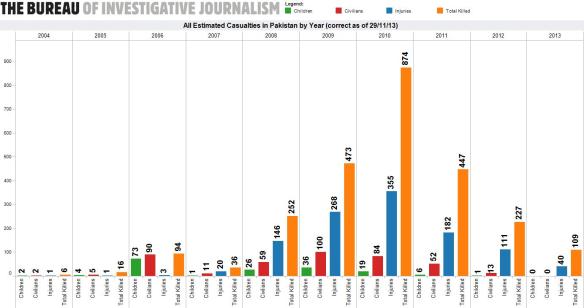
– and Plaw’s analysis of drone strikes in Pakistan from 2004 to 2007.  Strawser concedes that the claim for enhanced distinction is an empirical one; Plaw’s analysis needs a fuller examination than I can provide in this post, but it’s important to note that 2007 is a significant cut-off.  As the chart below shows, from the splendid Bureau of Investigative Journalism, this is long before the Obama administration ramped up the attacks on the Federally Administered Tribal Areas.  Plaw’s chapter in Killing by remote control extends his analysis to 2011 and concludes that US drone strikes – particularly when weighed against casualties from insurgent attacks or Pakistan military operations in the region – most often meet the demands of proportionality; but the discussion doesn’t directly address discrimination.
All-Totals-Dash47

What Strawser does, Chamayou concludes, is offer a technical resolution of an ethical dilemma: it is not necessary to subordinate one principle to another – minimisation of risk to combatants (‘citizen-soldiers’) or minimisation of risk to non-combatants (‘alien’ or otherwise) – because this new technology of killing promises to satisfy both.  In effect, drones are supposed to introduce a new, intrinsically ethical symmetry to asymmetric warfare: they save ‘our’ lives and ‘their’ lives.  They combine the power to kill and to save, to wound and to care, a weapon at once humanitarian and military – ‘humilitaire’, as Chamayou has it.  (Others have made a case for the humanitarian uses of unarmed drones, but their arguments are a far cry from military applications).

Yet if this new military power saves lives, Chamayou demands, what is it saving them from?  His answer: from itself, from its own power to kill.  And if this seems the lesser evil, in Eyal Weizman‘s terms the ‘result of a field of calculations that seeks to compare, measure and evaluate different bad consequences’, then we need to remind ourselves, with Hannah Arendt, how quickly ‘those who choose the lesser evil forget … that they chose evil.’

Chamayou turns to Weizman deliberately; that ‘field of calculations’, the calculus that is focal to the construction through calibration of our ‘humanitarian present’, is the target of Chamayou’s next and final chapter in his critique of necro-ethics – of which more very soon.

UPDATE: Today’s Guardian has a video debate between Seumas Milne and Peter Lee (Portsmouth University): ‘Is the use of unmanned military drones ethical or criminal?’ Lee claims that, ‘used correctly’, this new technology and in particular the MQ-9 Reaper is ‘the most potentially ethical use of air power yet devised.’
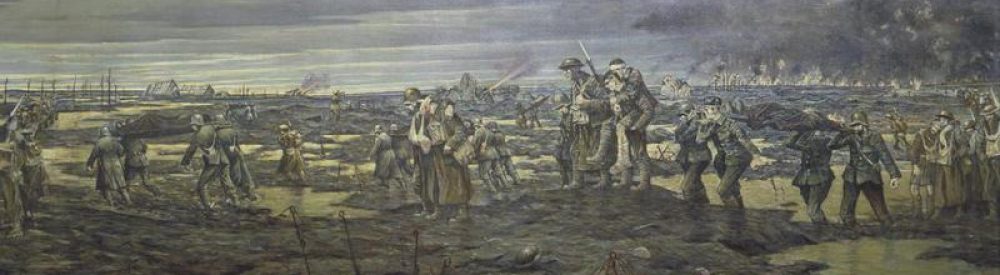
Precarious journeys

Much of last week was taken up with working out a new project for the next round of the Social Science and Humanities Research Council’s Insight Grant programme.  A ‘Notification of Intent’ to apply is required (I’m deliberately not saying ‘needed’) before you can actually apply in October – but since the NOI requires a plain-language summary and a figure for the total budget most of the planning has to be done months before the application.  I could fill a whole blog – and other non-digital receptacles – about the sense in all that; suffice to say I hit the button ten seconds (sic) before the electronic shutters came down.

The application is for a project called Medical-Military Machines and the Casualties of War: Genealogies and Geographies of Care.

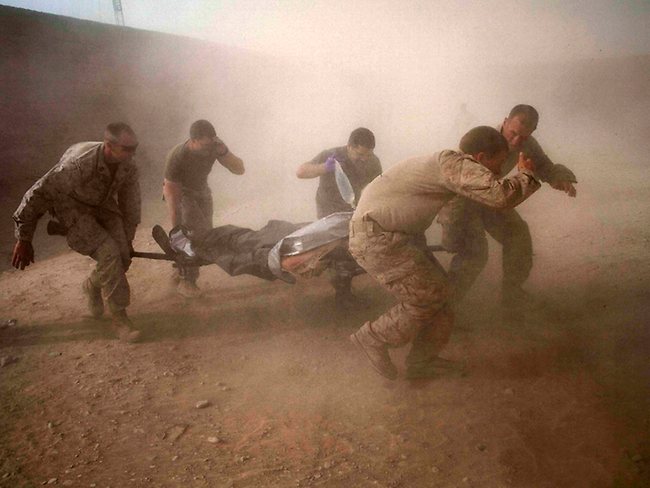
859084-dust-off-inside-afghanistan-039-s-medevac

One of the central claims made by protagonists of later modern war is that its conduct is accurate and proportionate, legal and ethical, thereby raising the bar for ‘just’ or, as James Der Derian has it, ‘virtuous’ war (and as most readers will know, he would insist on those scare-quotes).  It has done so, its advocates argue, by limiting casualties through new modes of intelligence, surveillance and reconnaissance, new weapons systems, and new modes of accountability.  I explore these issues in my ongoing SSHRC project, Killing Space (DOWNLOADS tab)not least through my continuing study of drones (much more to come!) and this project maps its other, vitally important dimension – a sort of ‘Caring Space’ – in order to provide an indispensable substantive test for these claims.

The project concerns the provision of medical care for those wounded by military and paramilitary violence, casualties who are often overlooked in vexed but vital debates over ‘body counts’ and what constitutes (following Judith Butler) a grievable life.  I’m not going to ignore those matters, far from it, but my main concern will be on the survivors of military violence.  As I’ll explain in a moment, I want to analyse both combatant and civilian casualties, and so confound the simplistic politics in which the right is supposed to care about the one and the left about the other.

The project will involve both genealogy and geography.  I’m using ‘genealogy’ in something like the Foucauldian sense, but all I’ll say here is that historical depth is plainly essential to specify what is (and is not) novel about the ways in which advanced militaries wage war.  So the project will involve four case studies focusing on the United States and its allies.  The first three are the Western Front in World War I, North Africa in World War II, and South Vietnam (1963-1975) .  In this traverse from ‘total war’ to James Gibson’s ‘techno-war’ I’m planning to leverage my work on ‘The natures of war’.  While researching that presentation and long-form essay – which will eventually appear in War Material – I found  a treasure-trove of sources that I want to explore in much more depth and detail for this new project.  The fourth case study will involve the cluster of wars in the Greater Middle East post 9/11, and while much of this has been familiar ground for me ever since I started writing The colonial present, there are many new issues to address – including the deliberate targeting of hospitals and medical doctors by some factions and what Omar Dewachti calls the ‘therapeutic geographies’ involved in the transnational movement of war casualties from (say) Iraq, Libya and Syria to hospitals in Lebanon, Jordan and India.

The project has three components that address different geographies of casualty care.

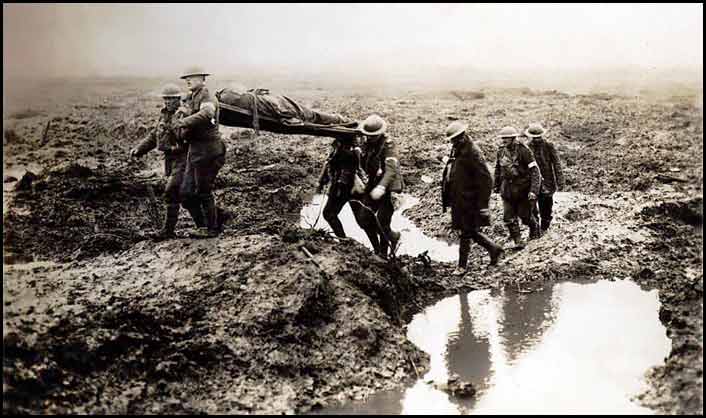
Stretcher-bearers

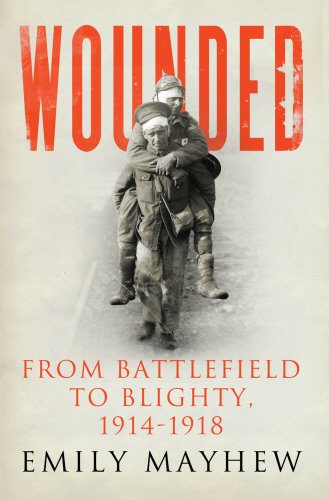
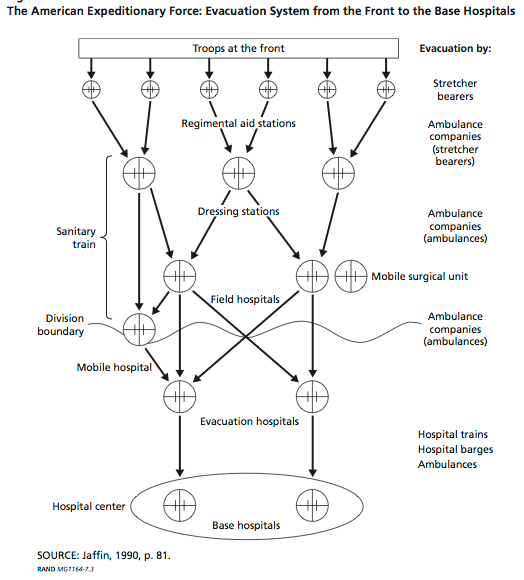
MAYHEW Wounded(1) Modern military medicine has sought to provide immediate care for troops injured in combat as close to the site of the injury as possible by deploying medical personnel and equipment in forward positions, and establishing evacuation routes for more seriously injured patients to higher-order medical facilities in the rear.  These systems have been transformed by technical advances designed to increase the time-space compression of treatment: the more widespread use of motorized ambulances in the Western Desert, for example, and helicopters for medical evacuation (‘dust-off’) in Vietnam and later conflicts. I plan to reconstruct these networks and their transnational extensions and to calibrate the changing transit times, and then to turn these skeletal geometries into human geographies through diaries, letters and, as we near the present, interviews, that I hope will bring into view the multiple people involved in these precarious, fleshy, and profoundly intimate journeys.  My inspiration for this is a series of thought-provoking essays in the Journal of the Royal Army Medical Corps (really), which provide a way in to the geometries and networks, and (very different) Emily Mayhew‘s Wounded: from Battlefield to Blighty, 1914-1918, due out next month, which uses the idea of a ‘journey’ in what could develop into a sort of phenomenology of care; I’ll say some more about some of this in a later post.

AEF Evacuation system WWI

The other two components follow from a remark made by Michel Foucault in ‘The Eye of Power’.  There he suggested that ‘doctors, along with the military, were the first managers of collective space’, but he assigned them to different spaces (‘campaigns’ versus ‘habitations’). Instead I want to explore what happens when military and medicine are called upon to imagine and manage the same space and install what, following the example of Mark Harrison, I’m calling a ‘medical-military machine’ in a war-zone.  So I’ll be following two tracks that are usually kept separate – civilian and combatant casualties (and here I want to extend the ongoing debates over their distinction from an abstract legal to a substantive therapeutic terrain) – and tracing the junctions where they intersect, in order to establish two other, complementary and sometimes countervailing geographies of care.

Medevac

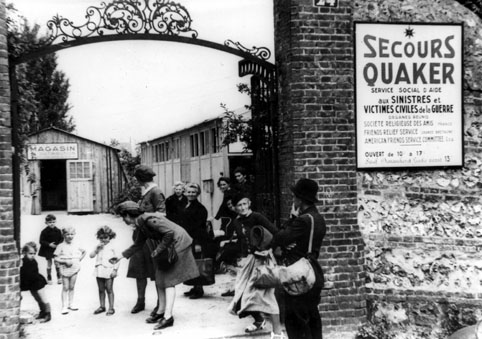
(2) There is an important sense in which modern war has always been ‘war amongst the people’: this is not a late twentieth-century preoccupation.  Images of ‘No Man’s Land’ on the Western Front distract attention from the injuries suffered by civilian populations who continued to inhabit houses and work farms behind the front lines, for example, while ground and air offensives in South Vietnam produced hundreds of thousands of civilian casualties.  So a second question is this: in what ways and in what places have militaries assumed medical responsibility for civilian casualties before and beyond the parameters of the Medical Civic Action Programs of contemporary counterinsurgency?

Secours Quaker

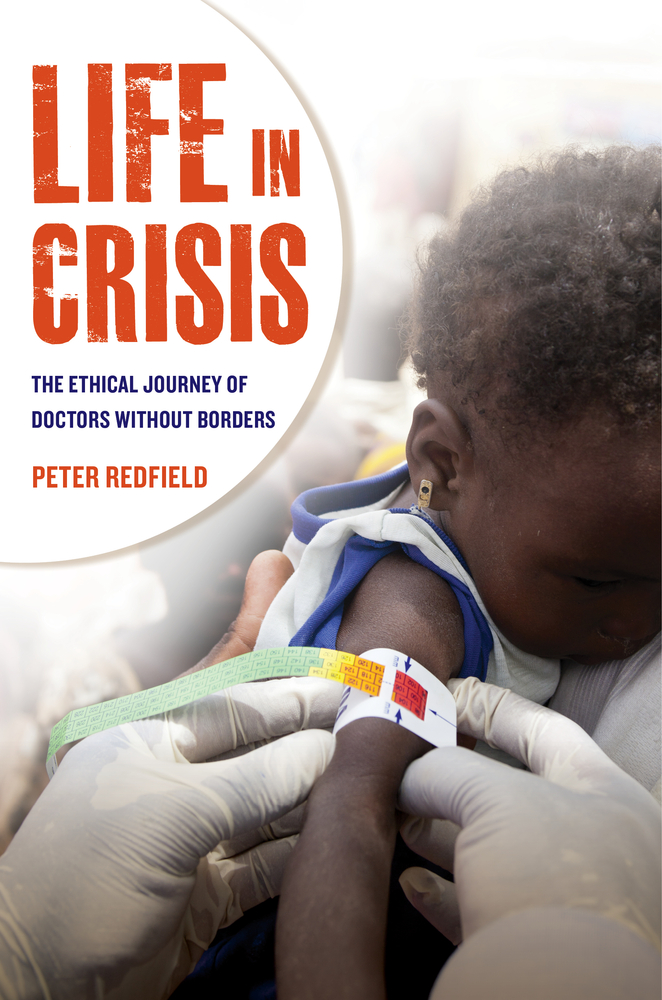
REDFIELD Life in Crisis MSF(3) Conversely, the military has not been the only agency making medical interventions in war-zones, and this is not a late twentieth century development either.  Civilian hospitals are increasingly important in today’s urban wars (where they often become targets too), but I want to pay particular attention to the work of international agencies.  I plan to analyse two voluntary organisations, the Friends’ Ambulance Unit and the American Field Service in the two world wars, and (I hope) two contemporary NGOs, the most obvious candidates being the International Committee of the Red Cross and Médecins sans Frontières.  I’m not assuming any direct filiations, and I’ll no doubt find all sorts of differences between them (particularly between the earlier and the later ones), but I’m particularly interested in the tensions between what at the moment I see as a common, more or less cosmopolitan engagement and the imperative to provide place-specific casualty care (and the logistics of doing so).   So a third question revolves around the rise of a ‘militarized humanism’ and the emergence of what Didier Fassin calls  ‘humanitarian reason’ as, perhaps, a form of governmentality.

http://vimeo.com/66342865

This really is just a bare-bones summary, and since I have another two months to flesh it out I’d really welcome any advice, suggestions or criticisms.  As I’ve described the project here you can see, I hope, that my case-studies and the questions I think they’ll enable me to address arise at the intersections of medical and military geography but also involve political, cultural and legal geographies.  And, as ever, those geographies all have a stubbornly little g: this really isn’t a disciplinary project.

Saviours and victims

Bhakti Shringarpure has a wide-ranging conversation with Mahmood Mamdani over at Warscarpes.  It covers a lot of ground, but one of the central threads is Mamdani’s insistence on conducting a ‘history of violence’, which is to say a history of the present (Darfur, Ruanda) in ways that disclose the historical context for today’s horrors.

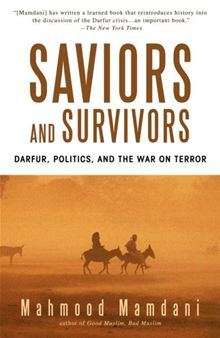
MAMDANI Saviors and survivorsHence Saviors and Survivors: Darfur, Politics and the War on Terror, in which Mamdani argued that the crisis in Darfur had to be read as a vicious gavotte of insurgency and counterinsurgency rather than genocide (as many commentators in the West insist).  Explaining his insistence on a dispersed, situated agency, Mamdani sets himself against what he calls the ‘new’ narrative of human rights:

‘The conventional approach, the approach used by the contemporary human rights movement, has been to document the atrocities, [to take] testimony, to identify perpetrators, to name and shame. The perpetrator is portrayed as someone with all the agency in the world. The victim is someone with no agency. That’s the narrative….  The old human rights movement, which was born with the French revolution – human rights of man, the citizen – it sought to empower the victim and to focus on issues. This new one seeks to empower saviors to salvage this helpless victim.’

He also talks about the politics of writing (and about the part his Harvard room-mate, Michael Ignatieff, played in the development of his own style), about audiences and public intellectuals, about the book through which I first came to know his work, Good Muslim, Bad Muslim: America, the Cold War and the roots of terror, the role Edward Said had in its publication, and his own ‘voyage in’, and he ends with this reflection on teaching at Columbia:

The downside of American students is this thing which runs through – seems to run through – the Western experience, but seems particularly crystallized in the American case, which is this notion that you can save the world. And this determination to save the world. This conviction that they know what’s good for the world, and they know what’s good for you, better than you know. So it’s almost like the medieval Christians who burnt people to save their souls.

They can be like the modern counterpart of the missionaries. They are not particularly interested in the problem: They are there to give you the solution. By the time they leave the university, they are imbued with the sense of what should be the solution. I always tell them that, before you get unleashed upon the world, let me have a chance to talk to you. Get them to realize that the real question is not, “What’s the solution?” – it’s “What’s the problem?” And the elements of any sustainable solution have to be found inside the problem.

But it’s not a peculiarly American conceit.  One of the characteristic gestures of modern colonialism and imperialism has been, precisely, to insist on its mission to bring ‘order’ from the outside to save those souls who would otherwise be condemned to their own chronic ‘disorder’.  This has been on view most recently in Tony Blair’s athletic support for the military intervention in Egypt: ‘Bringing about stability in the Middle East is not somebody else’s job, it’s ours.’  Perhaps it’s time somebody wrote Good Christian, Bad Christian.

The security archipelago

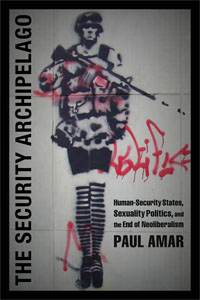
AMAR Security archipelagoA new book from the ever-creative Paul Amar coming this summer from Duke: The Security Archipelago: Human-Security States, Sexuality Politics, and the End of Neoliberalism. Paul wins the prize for getting the most buzz-words into a single title. Our paths crossed most recently in Beirut, at a lively conference at AUB on Security of/in the city, and last year in Lund for a workshop on the Arab uprisings.  For the next two years he’s heading a regional working-group for the Arab Council of the Social Sciences called “Producing the Public: Spaces and Power” (more on this soon).

Paul is a wonderfully engaging speaker and a brilliant writer, but if you don’t know his work you can get a small taste of his argument in this paper on ‘Turning the gendered politics of the human security state inside out?’ for an IPSA-EPCR panel on ‘Governing life globally’ in Sao Paolo and from this excellent interview on ‘Middle East Masculinities’ at Jadaliyya at about the same time; there are other PDFs available from his webpage at UC Santa Barbara here.

The book paints on a canvas that stretches far beyond the ‘Middle East’:

In The Security Archipelago, Paul Amar provides an alternative historical and theoretical framing of the refashioning of free-market states and the rise of humanitarian security regimes in the Global South by examining the pivotal, trendsetting cases of Brazil and Egypt. Addressing gaps in the study of neoliberalism and biopolitics, Amar describes how coercive security operations and cultural rescue campaigns confronting waves of resistance have appropriated progressive, antimarket discourses around morality, sexuality, and labor. The products of these struggles—including powerful new police practices, religious politics, sexuality identifications, and gender normativities—have traveled across an archipelago, a metaphorical island chain of what the global security industry calls “hot spots.” Homing in on Cairo and Rio, Amar reveals the innovative resistances and unexpected alliances that have coalesced in new polities emerging from the Arab Spring and South America’s Pink Tide. These have generated a shared modern governance model that he terms the “human-security state.”

Richard Falk describes it as ‘an extraordinary book that revolutionizes the way to think about security’ – and about time too.  Like much high-flying academic commentary on war, much of the critical debate around security displays a theoretical sophistication that is not matched by analytical substance.   Paul’s work has always avoided that trap, and Jack Halberstam‘s endorsement makes it plain that this is a book that combines erudition with empirical heft:

Paul Amar works in English, Arabic, and Portuguese [and in Spanish too], and he studies security regimes in a comparative framework encompassing the Middle East, North and South America, and Europe. Combining research that he has done in Brazil and Egypt on the emergence of new forms of security and new grammars of protest politics with the unfolding stories of an economic boom in Brazil and political change in Egypt, Amar has written an up-to-the-moment account of the ‘human-security state’ and its opponents.

Here’s a list of the Contents:

Introduction. The Archipelago of New Security-State Uprisings
1. Mooring a New Global Order between Cairo and Rio de Janeiro: World Summits and Human-Security Laboratories
2. Policing the Perversions of Globalization in Rio de Janeiro and Cairo: Emerging Parastatal Security Regimes Confront Queer Globalisms
3. Muhammad Atta’s Urbanism: Rescuing Islam, Saving Humanity, and Securing Gender’s Proper Place in Cairo
4. Saving the Cradle of Samba in Rio de Janeiro: Shadow-State Uprisings, Urban Infranationalisms, and the Racial Politics of Human Security
5. Operation Princess in Rio de Janeiro: Rescuing Sex Slaves, Challenging the Labor-Evangelical Alliance, and Defining the Sexuality Politics of an Emerging Human-Security Superpower
6. Feminist Insurrections and the Egyptian Revolution: Harassing Police, Recognizing Classphobias, and Everting the Logics of the Human-Security State in Tahrir Square 200
Conclusion. The End of Neoliberalism?

Dis-placement

IDPs 2012

global-overview-2012-hpThe Internal Displacement Monitoring Centre in Geneva has released the map I’ve reproduced above.  From their research, the IDMC reckons that last year 28.8 million people were displaced by armed violence, conflict and human rights violations, an increase of 6.5 million over the previous year.  The conflicts in Syria (which now has more than 3.8 million IDPs] and the Democratic Republic of Congo (which now has around 2.6 million IDPs) accounted for about half the increase; the vast majority of displaced persons are women and children.  You can download the detailed Global Overview here, and you can find more on the geographies of internal displacement through the Brookings-LSE Project on Internal Displacement here.

The increases are dramatic, but the eruption of new wars and the continuation of chronic conflicts make it all too easy to overlook the legacy of displacement – all those left stranded in the wake of war and its penumbra of sometimes silent violence.  In the case of Iraq, for example, and even after returning people have been taken into account, Elizabeth Ferris, co-director of the Brookings-LSE project, has recently suggested that“perhaps three million people, 10 percent of Iraq’s population, remain displaced – and forgotten.”  In its recent report on Iraq ten years after the US-led invasion, and specifically on what it calls “the humanitarian impact”, IRIN highlights the ‘forgotten displacement crisis‘ (see also the workshop report from Oxford’s Refuges Study Centre here).  And don’t lose sight of  all those who have sought refuge from the Syrian conflict in Iraq (more than 140,000), especially in the northern governorates.

Lost in all the numbers, too, is the way in which violence severs those intimate ties, material and affective, between particular people and particular places: ties that are intrinsic to local knowledge (and often the means of survival) and to identity.  Geographers have written about place (and its – I think misconceived – duals, ‘placelessness’ and ‘non-places’), but many of these classical discussions have been so romanticised (I’m thinking of books like Yi-Fu Tuan‘s Space and place) that they have somehow failed to engage with the enormity of forced dis-placement.  I’m not saying that human geographers have been indifferent to internal displacement, still less to refugees – far from it – but the absence of a close engagement with the concept that is in many ways at the heart of displacement is none the less a striking absence from all those paeans to place.

Even Tim Creswell‘s fine work – I’m thinking of his ‘Weeds, plagues, and bodily secretions: A geographical interpretation of metaphors of displacement’ in the Annals of the Association of American Geographers (1997) – engages more with language than with landscape and is more at home with Anglo-American displacements.  But, perhaps prophetically, the last of his three poems on ‘Displacements’ in the latest Geographical Review [103 (2) 2013] includes the hope that

‘the color 

and screech of Mysore and Mogadishu

do not dwindle into cartographic memory…’