MAP and the meat-grinder

I’ve updated my previous posts on the medical geographies of Gaza several times (see herehere and here), and I’ve drawn on the testimony of Dr Mads Gilbert in extenso, but this testimony from another brave volunteer doctor deserves its own notice.

I met Ghassan Abu Sitta at a wonderful workshop in Paris in December 2012 on War and Medicine, and I learned so much from that one meeting (from everyone there: see my note about War and therapeutic geographies) that I was inspired to develop my own research project on the medical evacuation of casualties from war zones, 1914-2014.

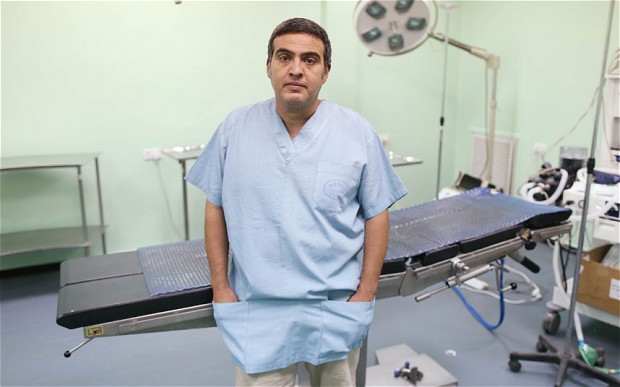
Ghassan Abu Sitta

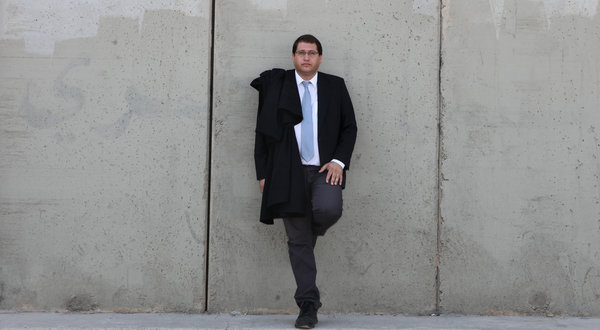
Ghassan is a reconstructive surgeon who used to work at Great Ormond Street in London but is now based in Beirut.  He’s recently returned from Gaza where he worked as a Medical Aid for Palestinians (MAP) volunteer at al Shifa hospital carrying out five, six and sometimes seven surgeries a day.

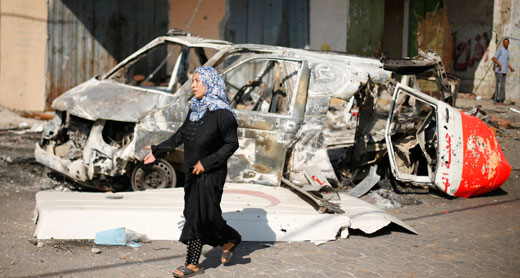
You can read some of the background in this excellent report by Robert Tait for Britain’s Telegraph, published ten days ago and from which I’ve borrowed the photograph above, but Ghassan has just been interviewed in depth by Yazan al-Saadi for Al Akhbar; you can read the full version here.

Ghassan says the attack on Gaza was like ‘a meat-grinder’, which he attributes to:

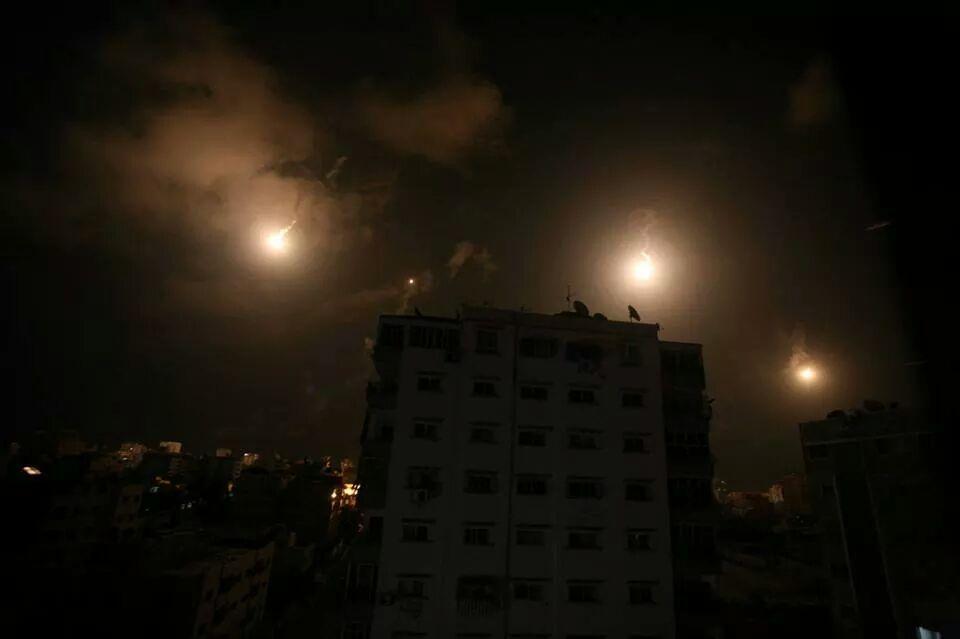
The amount of ordinance that the Israelis fired, the indiscriminate use of these bombs that are capable of bringing down whole buildings, the use of artillery shelling which is indiscriminate because the shell will hit the first thing it reaches, the fact that they were attacking from the air, from the sea, and by land with artillery at the same time. And there was a night they were doing this and then they lit all of Gaza’s sky with these flares just so people will know that this is what’s happening.

He also provides compelling testimony of his experience at al-Shifa, the main trauma centre for Gaza, that adds important detail to the accounts I’ve noted previously:

‘It looked like a refugee camp. The campus of the hospital has a lot of the families that escaped the bombing or lost their houses and they were living inside the walls of the hospital. Everywhere you go you see makeshift dwellings made out of laundry lines and bed sheeting turned into tents. And the hospital was completely full. Single rooms had four beds in them. In some wards we had two patients per bed.

‘The difference between this conflict and the one before is that nobody was allowing the patients out. So you had 7,000 injured – at the time I was there it was 6,000 and by the time the conflict ended the injured were 10,000. An overwhelming majority have still not been able to get out of Gaza. There have been some numbers, but not significant numbers to break the back of this problem….

‘The contingency plans were that all diesel was kept for the al-Shifa Hospital, so people did not have electricity at home, they would donate the diesel to the hospital. The wells that supply Shifa, like the rest of the water in Gaza, had become so contaminated with sea water, it’s salty. People do the best with what they have….

‘… the majority of the killing was happening because they were dropping ammunition designed to penetrate mountain caves. [The Israelis] were dropping them on civilian dwellings made out of breeze block. And so these four or five storey buildings were being pulverized by these one-ton bombs. That was what was wiping out whole families. And in Gaza, because land is so much in shortage, people come along and build their house, they build enough foundations that when their kids grow up, they can build a floor on top. So when you take out a four storey building, you take out four generations of a family. That was what happened to, I think, 60 families that have been completely wiped out…

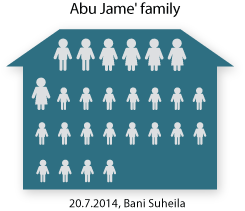
The graphic below shows 26 members of just one extended family, the Abu Jame family, killed at home in Bani Suheila on 20 July; it comes from a sequence that is shockingly far too large to reproduce here, compiled by B’Tselem and available here. The infographic lists ‘members of families killed in their homes in 59 incidents of bombing or shelling’ in which 458 people were killed, including 108 women under the age of 60, 214 minors, and 18 people over the age of 60.  If you follow the link, you can hover over each image for the names and ages of those killed.

abu_jame3

Ghassan continues:

‘… they started inventing these humanitarian ceasefires, where people would go out and they would start killing them. We had this on the day of Eid, they said there was a humanitarian ceasefire and the kids went out to a local fair ground and they bombed them. The other time was in al-Shujayeh market, there was a humanitarian ceasefire, they got them into the market, they killed them, then they waited for the ambulances to get there, and then they shelled the ambulances again.

‘So the issue isn’t the type of weapons, but the intent to kill. The amount of ordinance they used and the tonnage of the bombs they used were intended to wipe out whole neighborhoods. That’s what they have done. They have completely wiped out Shejayeh, they wiped out Khuza’a, they wiped out a big part of Rafah, a big part of Khan Younes, and parts of Beit Hanoun….

‘ All the areas around the hospital were being bombed all the time. You would hear it. We heard something we knew it was close, but didn’t know how close it was. We then got a call to the emergency room and we were told that the administration and the out patients building had been hit – a lot of families had taken refuge in that area – so we had to go and help.’

Asked directly whether Hamas or other factions were firing rockets from the vicinity of the hospital, Ghassan is unequivocal:

‘Around Shifa? No, no, no. But in other places you would see them in the sky or hear them. You would learn to distinguish the whoosh of the rocket. Gaza is so small and so flat, I mean you are not going to hide them in the mountains or the jungle because there are no mountains or jungle. People are literally on top of each other. It’s going to happen. But around the hospital there were none.’

Destructive Edge

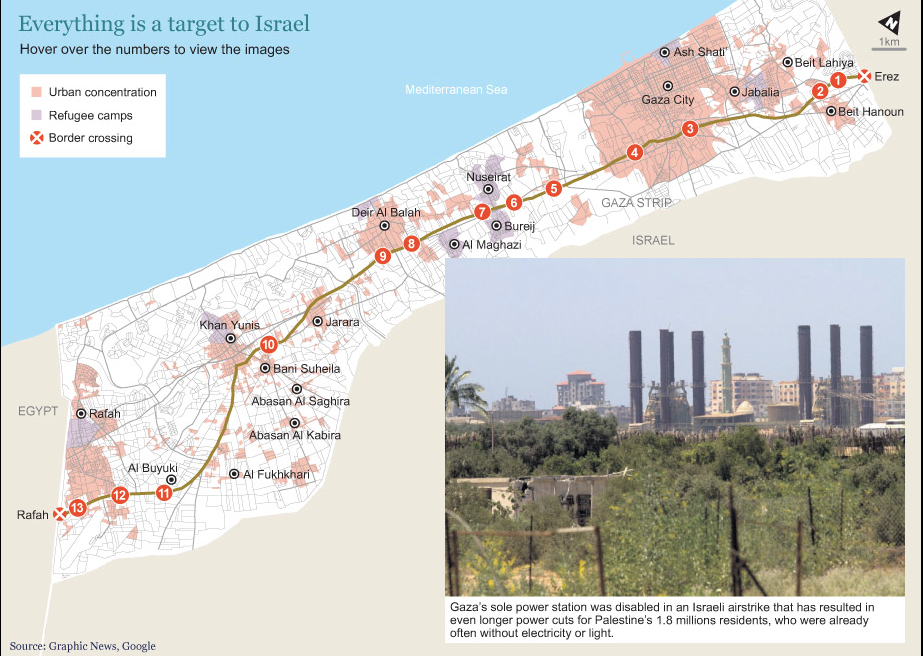
In a previous post on ‘The Death Zone‘, I suggested readers compare Israel’s extended ‘buffer zone’ in Gaza by following the line of the main highway, Saladin Street.  Hugh Naylor has followed that route on the ground – what he calls ‘Desolation Road’ – and his report is accompanied by an interactive map showing some of the vast panorama of destruction:

Screen Shot 2014-08-08 at 10.01.01

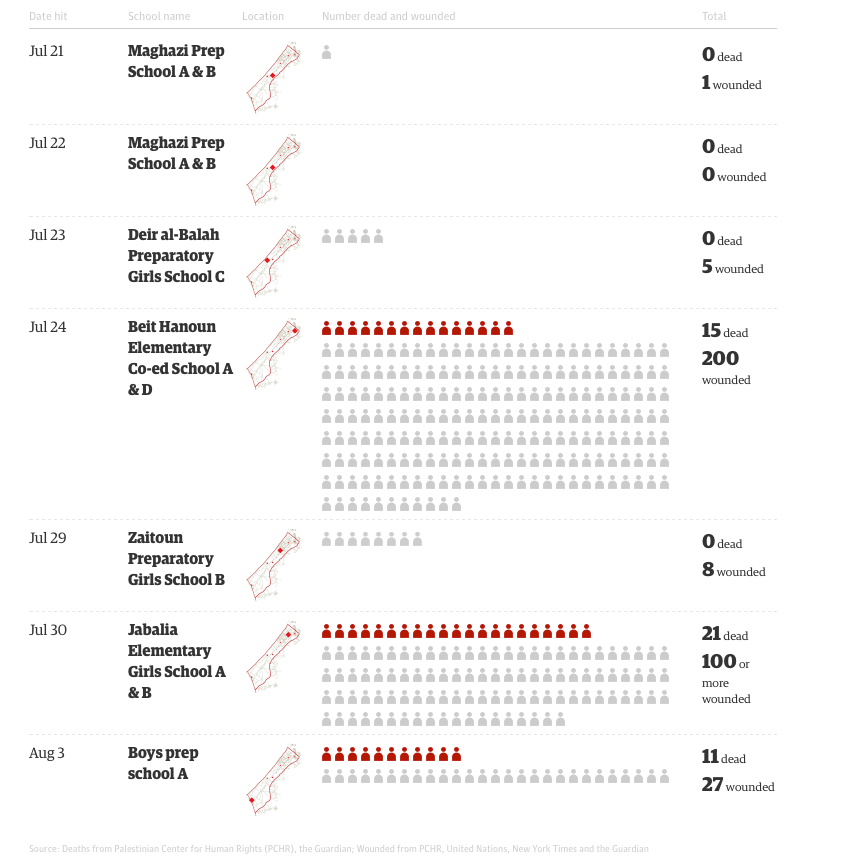
I’ll have more to say about the caption – about the Israeli military’s targeting in Gaza – shortly.  The Guardian has just published a graphic by Nadja Popovich showing the UNRWA-run schools sheltering refugees (many of them from the expanded ‘buffer zone’) that were struck by the Israeli military:

Gaza schools hit by Israeli military

 Amnesty International reports growing evidence that health facilities and workers were deliberately targeted by the Israeli military:

Testimonies from doctors, nurses, and ambulance workers who have spoken to Amnesty International paint a disturbing picture of hospitals and health professionals coming under attack by the Israeli army in the Gaza Strip, where at least six medics have been killed. There is growing evidence that health facilities or professionals have been targeted in some cases.

Since Israel launched Operation “Protective Edge” on 8 July, the Gaza Strip has been under intensive bombardment from the air, land and sea, severely affecting the civilian population there. As of 5 August, according to the UN Office for the Coordination of Humanitarian Affairs, 1,814 Palestinians had been killed in the Gaza Strip, 86 per cent of them civilians. More than 9,400 people have been injured, many of them seriously. An estimated 485,000 people across the Gaza Strip have been displaced, and many of them are taking refuge in hospitals and schools.

Amnesty International has received reports that the Israeli army has repeatedly fired at clearly marked ambulances with flashing emergency lights and paramedics wearing recognizable fluorescent vests while carrying out their duties. According to the Palestinian Ministry of Health, at least six ambulance workers, and at least 13 other aid workers, have been killed as they attempted to rescue the wounded and collect the dead. At least 49 doctors, nurses and paramedics have been injured by such attacks; at least 33 other aid workers were also injured. At least five hospitals and 34 clinics have been forced to shut down due to damage from Israeli fire or continuing hostilities in the immediate area.

Hospitals across the Gaza Strip suffer from fuel and power shortages (worsened by the Israeli attack on Gaza’s only power plant on 29 July), inadequate water supply, and shortages of essential drugs and medical equipment. The situation was acute before the current hostilities, due to Israel’s seven-year blockade of Gaza, but have been seriously exacerbated since…

Amnesty International is aware of reports that Palestinian armed groups have fired indiscriminate rockets from near hospitals or health facilities, or otherwise used these facilities or areas for military purposes. Amnesty International has not been able to confirm any of these reports. While the use of medical facilities for military purposes is a severe violation of international humanitarian law, hospitals, ambulances and medical facilities are protected and their civilian status must be presumed. Israeli attacks near such facilities – like all other attacks during the hostilities – must comply with all relevant rules of international humanitarian law, including the obligation to distinguish between civilians and civilian objects and military targets, the obligation that attacks must be proportional and the obligation to give effective warning. Hospitals and medical facilities must never be forced to evacuate patients under fire.

20140801_ambulance_520

The report includes detailed testimony from Palestinian paramedics and ambulance crews who describe the extraordinary difficulty and danger they faced in attending to casualties from Israeli shelling (see also my post on ‘Gaza 101‘, the emergency number for Gaza, and the update here).  Not surprisingly, Israel has rejected Amnesty’s claims and denied targeting hospitals, but when Netanyahu’s spokesperson, Mark Regev, explained that ‘What we’ve had to do on a number of occasions is to hit terrorist targets in the immediate vicinity of hospitals and things like that, where they’ve abused them,’ he failed to address the violations of international law summarised in the last paragraph above.

There’s more.  B’Tselem, now back on line, is also providing detailed testimony from Gaza, including (so far) two ambulance drivers, Rami ‘Abd al-Haj ‘Ali and Ahmad Sabah.  Here is an extract from the first statement (all testimonies are linked to B’Tselem’s interactive map):

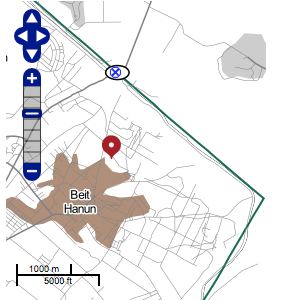
B'Tselem map Beit HanounOn Friday afternoon, 25 July 2014, I was working at the medical emergency call center in Beit Hanoun. At around 4:30 P.M., we received a call reporting injured people in al-Masriyin Street in Beit Hanoun. We asked the International Red Cross to coordinate our going there. About 15 minutes after we received the call, we got authorization and an ambulance headed over there with paramedics ‘Aaed al-Bura’i, 25, Hatem Shahin, 38, and driver Jawad Bdeir, 52. The team didn’t make it to the wounded people. Soon after they reached the street, they reported back that a tank had fired at them and they were injured. They asked for another team to come and rescue them.

The call center coordinated the arrival of another team with the International Red Cross and got authorization to go rescue the injured team. I drove the second ambulance, and there were two medics with me – Muhammad Harb, 31, and Yusri al-Masri, 54. The street is only about 200-300 meters from the call center, so we were there within minutes. When we reached the entrance to the street, we were surprised to see three tanks and a military bulldozer in the street, about 100 meters away.

Suddenly, with no warning, they opened heavy machine-gun fire at us. The bullets penetrated the ambulance. I tried to turn the ambulance around to get out of there, but the steering wheel must have been hit. Suddenly, I felt sharp pain in my leg and realized I’d been hit by a bullet or shrapnel. Then the windshield shattered. Because I couldn’t turn the ambulance around, I decided to try reversing. They kept firing as I backed up, until we got far enough away. When they stopped, I managed to turn us around and head back to the center.

On the way there we met Hatem Shahin, one of the paramedics from the first ambulance. He’d been hit by shrapnel in his shoulder and leg. He told us that a shell fired from a tank had hit the front part of the ambulance. He said he’d managed to get away but the other paramedic, ‘Aaed, had been hit. He told us that after he ran away from there, he saw the tank fire another shell at the ambulance, completely destroying it. He thought ‘Aaed must have been killed, but we didn’t know for sure.

The next day, on Saturday, a ceasefire was declared from 8:00 A.M. to 8:00 P.M. An ambulance team went to the spot and found ‘Aaed’s body in the burnt ambulance.

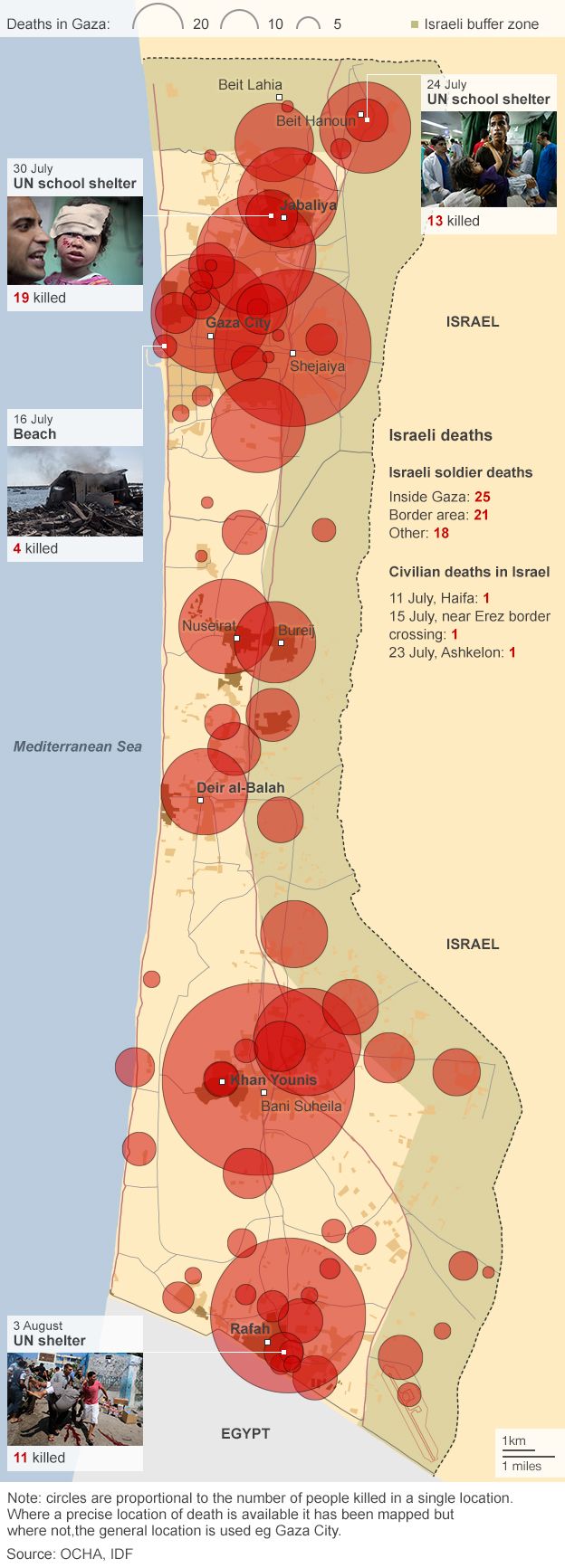
To put all of this in context, the BBC has mapped the deaths of 1,890 Palestinians – ‘mostly civilians’, as its accompanying chart shows – killed during the Israeli offensive to 6 August.  As you can see, Palestinians were killed ‘right across Gaza’ – not only in the expanded buffer zone shown on the map, though the carnage in Beit Hanoun and Shejaiya is clearly visible – with high concentrations also produced in the killing grounds of Gaza City and Khan Younis:

w640

Finally, in case you’re puzzled by the title for this post: Israel’s attack on Gaza is codenamed Tzuk Eitan in Hebrew, meaning ‘Firm Cliff’ or ‘Resolute Cliff’.  According to Yagiv Levy, ‘The operation’s name signals the power, commitment and resilience of the Israeli people.’  But the official English-language version, ‘Protective Edge’, was changed ‘to give it a more defensive connotation’ (really). As Steven Poole explains, ‘the bombing was supposedly “protective”, though not of those bombed’. All of this is of course in line with the designation of the Israeli military as the ‘Israeli Defence Forces’.

I decided I’d prefer to use a version that provides a more accurate rendering of what has happened – in Hebrew, English or Arabic.

Legal geographies and the assault on international law

I suspect anyone interested in international/transnational legal geographies will know of Jens David Ohlin‘s work already (he’s Professor of Law at Cornell and recently co-edited Targeted Killings: Law and Morality in an Asymmetrical World [Oxford, 2012]).  If not, check out his page on ssrn for recent papers; I’ve found three particularly helpful in thinking about US air strikes in Afghanistan and Pakistan and, more recently, the Israeli offensive against Gaza (more on this and the space of exception soon, I promise):

Targeting and the concept of intent (2013); Acting as a sovereign versus acting as a belligerent (2014); and The combatant’s privilege in asymmetric and covert conflicts (2014)

I’ve just received news of his new book out early in the New Year, whose relevance will be apparent from its title: The assault on international law.

OHLIN Assault of international lawInternational law presents a conceptual riddle. Why comply with it when there is no world government to enforce it? The United States has a long history of skepticism towards international law, but 9/11 ushered in a particularly virulent phase of American exceptionalism. Torture became official government policy, President Bush denied that the Geneva Conventions applied to the war against al-Qaeda, and the US drifted away from international institutions like the International Criminal Court and the United Nations.

Although American politicians and their legal advisors are often the public face of this attack, the root of this movement is a coordinated and deliberate attack by law professors hostile to its philosophical foundations, including Eric Posner, Jack Goldsmith, Adrian Vermeule, and John Yoo. In a series of influential writings they have claimed that since states are motivated primarily by self-interest, compliance with international law is nothing more than high-minded talk. Theses abstract arguments then provide a foundation for dangerous legal conclusions: that international law is largely irrelevant to determining how and when terrorists can be captured or killed; that the US President alone should be directing the War on Terror without significant input from Congress or the judiciary; that US courts should not hear lawsuits alleging violations of international law; and that the US should block any international criminal court with jurisdiction over Americans. Put together, these polemical accounts had an enormous impact on how politicians conduct foreign policy and how judges decide cases – ultimately triggering America’s pernicious withdrawal from international cooperation.

In The Assault on International Law, Jens Ohlin exposes the mistaken assumptions of these ‘New Realists,’ in particular their impoverished utilization of rational choice theory. In contrast, he provides an alternate vision of international law based on a truly innovative theory of human rationality. According to Ohlin, rationality requires that agents follow through on their plans even when faced with opportunities for defection. Seen in this light, international law is the product of nation-states cooperating to escape a brutish State of Nature–a result that is not only legally binding but also in each state’s self-interest.

Michael Sfard

But not all assaults on international law derive from the United States and from professors hostile to its philosophical foundations.  I urge you to read Michael Sfard‘s coruscating Op-Ed from Ha’artez on 4 August, ‘A “targeted assassination” of international law‘ (which is also available here if it disappears behind a paywall).  Michael is an Israeli human rights lawyer, specializing in international humanitarian law and dealing directly with the Israeli occupation of Palestine, and he is also the legal adviser to Yesh Din: Volunteers for Human Rights:

Israelis are surprised. Did I say surprised? Downright shocked. Even before the dust from the fighting has settled, even before this “most just of all wars” has ended, even as the most moral army in the world is still mired in Gaza – there is already talk of war crimes and an international investigation.

We, who didn’t carpet-bomb even though we could have, who dropped fliers and made phone calls and knocked on the roof; we, who agreed to the humanitarian cease-fire that Hamas violated; we, who took more precautions than any other nation would have done – we are once again being accused of war crimes. Once again, the same old song is being sung: decisions about opening an international investigation, talk of the International Criminal Court, fear of arrests in Europe. And we don’t understand why we deserve all this.

It is possible to console ourselves by accepting the explanation that the television journalists keep repeating to us: that the world is anti-Semitic and two-faced and supports Hamas. But this would constitute a regrettable evasion of the tough questions. It would constitute an effort to flee the pointed discussion Israeli society ought to be holding about the way we have waged armed conflicts with our enemies over the last decade.

Since the Second Lebanon War of 2006, the Israel Defense Forces has adopted an extremely problematic combat doctrine for conflicts that take place in urban areas with dense civilian populations, and in which the enemy is seen as an illegitimate terrorist entity (Hezbollah in Lebanon and Hamas in Gaza). This combat doctrine is supported by a legal theory developed by the IDF’s international legal division, which interprets the laws of war in a manner that is shockingly different from their accepted interpretation by experts in the field worldwide. Its direct result is massive civilian casualties and the destruction of civilian neighborhoods.

This combat doctrine consists of two elements, each of which is a declaration of war against the fundamental principles of the laws of armed combat. The first element redefines what constitutes a legitimate target for attack, such that it now includes not only classic military targets (bases, combatants, weapons stockpiles and so forth), but also facilities and objects whose connection to the enemy organization is nonmilitary in nature….

The second element is even more far-reaching: It holds that when fighting in urban areas, we are entitled to treat the entire area as a legitimate target and bombard it via air strikes or artillery shelling – as long as we first warn all the residents of our intention to do so and give them time to leave. The IDF first used this method in Beirut’s Dahiya neighborhood during the Second Lebanon War. Before bombing, the army dropped fliers telling the residents to leave. Then the bombs were dropped, and most of Dahiya’s houses were destroyed.

This doctrine was applied, to varying degrees, in Operations Cast Lead and Protective Edge as well, primarily in Gaza City’s Shujaiyeh neighborhood. It does not take into consideration the question of whether the prior warning given the population is effective – i.e., whether the population can in fact leave, whether solutions have been found for the elderly, the ill and the children. Nor is it accompanied by the creation of a safe corridor through which people can flee to someplace that won’t be fired on, and where civilians have what they need to survive.

The terrifying result of this combat doctrine, in both Cast Lead and Protective Edge, was piles of bodies of women, children and men who weren’t involved in the fighting….

The IDF’s lawyers, who provide legal support for this combat doctrine, are conducting a “targeted assassination” of the principles of international law: the principle of distinction, which requires differentiation between military targets (which are legitimate) and civilian targets (which aren’t); the principle of proportionality, which forbids attacking even a legitimate target if the anticipated harm to civilians is excessive in comparison to the military benefit from the target’s destruction; and the need to take effective, rather than merely symbolic, precautions.

More soon.

Handling the news

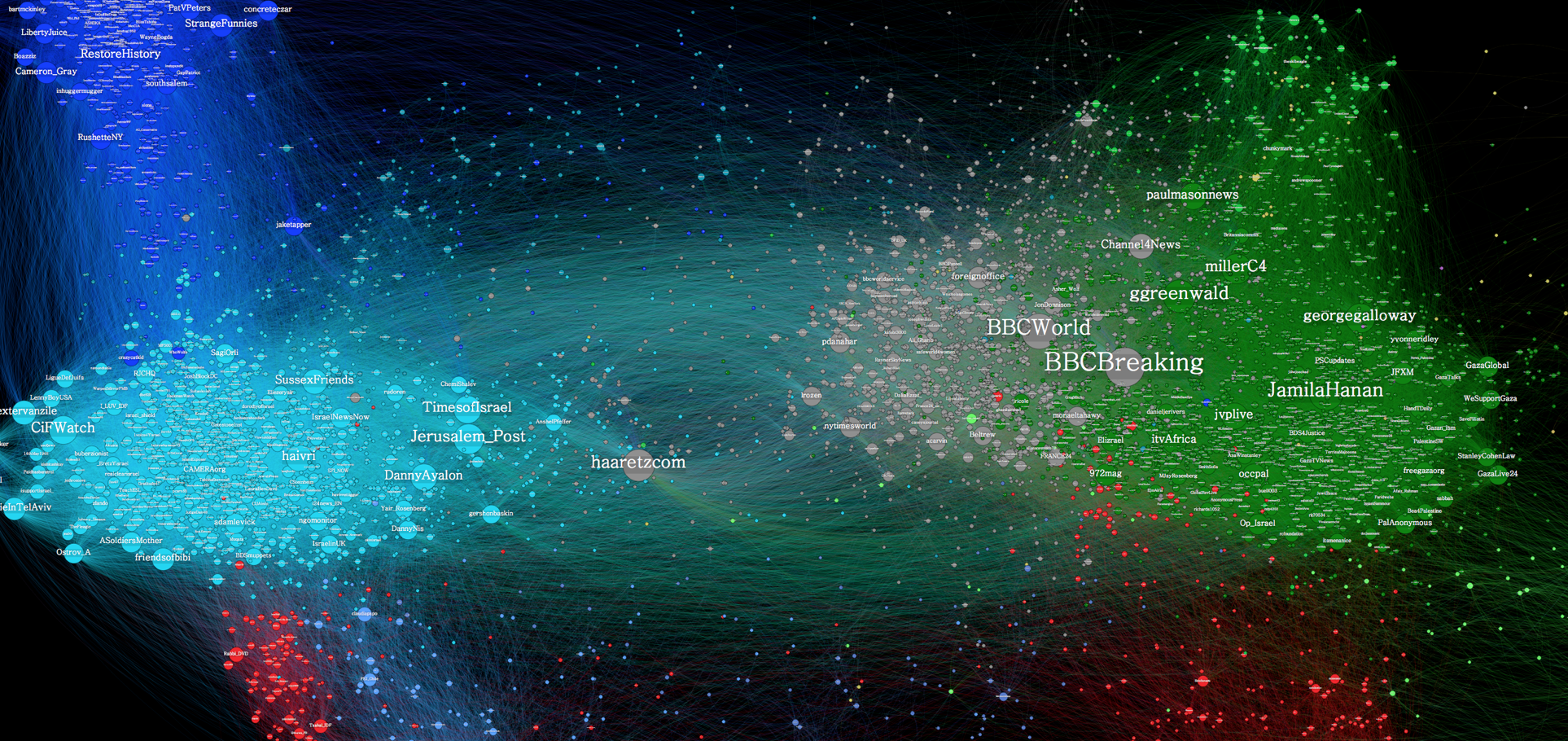
A follow-up to Virtual Gaza : Gilad Lotan, chief data scientists at beteaworks, has provided a mapping of the intersections between mainstream media news media and social media here, including a discussion of what he calls ‘personalising propaganda’.

Twitter handles responding to UNRWA school shelling 25-30 July

The Israeli liberal newspaper Ha’aretz appears between the broadly ‘pro-Palestinian’ networks on the right and the ‘pro-Israeli’ on the left.  These are his designations not mine (BBC? the New York Times??!!), but the mappings are of Twitter handles responding between 25-30 July to the Israeli shelling of an UNRWA school in Beit Hanoun – a particular event that sparked a particular series of reports – not the war as a whole.  And we should also remember that there is often a significant difference between reporting in the English-language and Hebrew editions of Ha’aretz

The Death Zone

9780804778336I’ve praised Laleh Khalili‘s Time in the shadows before, and Jadaliyya has now reprinted an excerpt that is of renewed urgency in the face of the Israeli assault on Gaza.  Laleh explains:

I wrote Time in the Shadows in order to puzzle out why the counterinsurgency practices of enormously powerful state militaries—the US and Israel at the time I was writing the book—so often invoked law and humanitarianism, rather than naked force. And why so much of their war-fighting pivoted around the mass confinement not only of combatants but civilians. I was also struck by the similarities in the practices of confinement not only between Israel and the US but with historical accounts of colonial confinement effected by Britain and France.

For me, what was striking, insidious, devastating, was the less flashy, less visible, practices that were foundational to detention of suspected combatants and incarceration—whether in situ or through resettlement—of troublesome civilians. These practices—law, administration, demographic and anthropological mapping, offshoring—all sounded so dry, so rational, and yet they were grist to the mill of liberal counterinsurgents in so many ways. And the other similarity across a century and several continents seemed to be the repetition ad nauseam of the language of “protection” and of “security” to frame or rename or euphemise atrocities.

Among the technologies that best embody this language of protection used to violently pacify a population in counterinsurgencies are the separation wall and the various “protective” zones invented by the Israeli military to fragment the Palestinian territories and ensure panopticon-like surveillance and monitoring capability over these fragmented zones. These technologies have specific histories and are mirrored in so many different contexts. The following excerpt is an attempt at situating the wall and the various zones in both a longer historical continuum with colonial practices, while also reflecting on the settler-colonial specificities of their present form.

Laleh describes seam zones, security zones until, finally, she arrives at death zones:

Brigadier General Zvika Fogel, the former head of Southern Command, explained that after the Second Intifada, the Southern Command unofficially declared death zones in Gaza, where anyone entering could be shot: “We understood that in order to reduce the margin of error, we had to create areas in which anyone who entered was considered a terrorist.”

Asked about the legal basis for this, Fogel said:

“When you want to use something, you have no problem finding the justification, especially when we hit those we wanted to hit when we used them at the start of the events. If at the beginning we could justify it operationally, then even if there were personnel from the Advocate General’s Office or from the prosecution, it was easy to bend them in the face of the results…
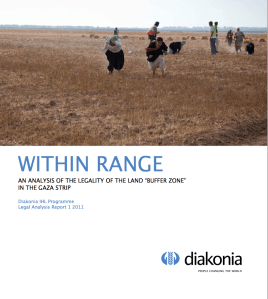
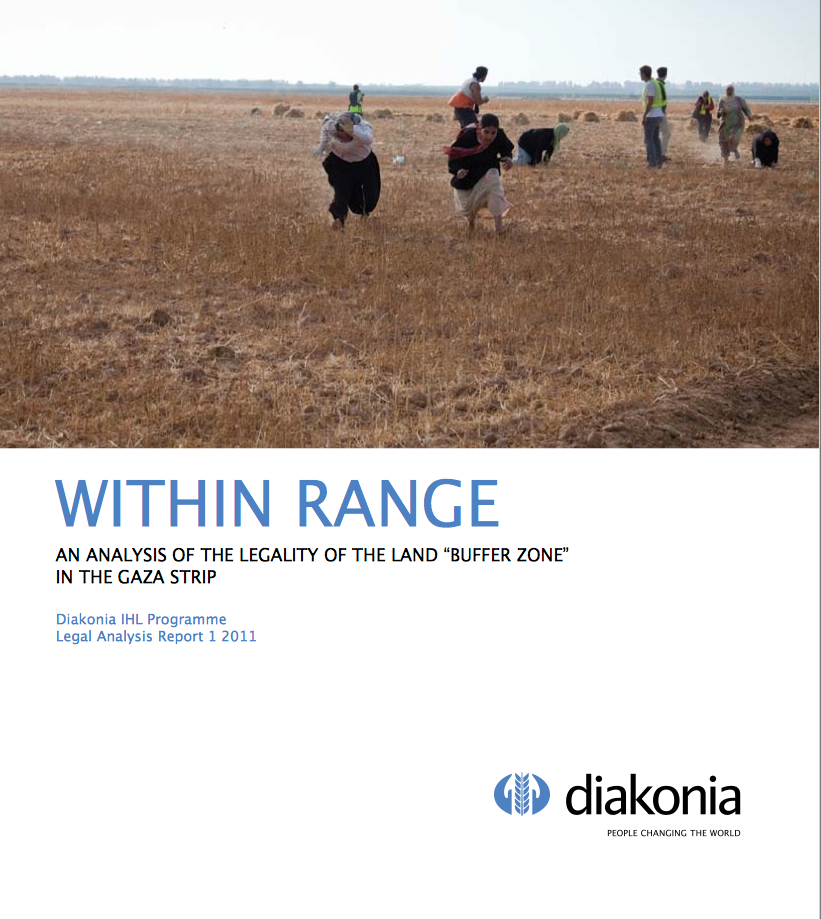
Within Range DIAKONIAAccording to the Internal Displacement Monitoring Centre,  the Israeli military unilaterally implemented an undefined “no-go” zone inside Gaza in 2000.  It started to level lands near the border fence (which had been put in place in 1994), particularly around Rafeh, and ‘by mid-2006 Israel was leveling lands 300 to 500 meters from the fence.’  In 2010 the World Food Programme in collaboration with OCHA produced a report, ‘Between the Fence and a Hard Place‘, documenting the hardships and the horrors and in 2011 Diakonia produced a detailed report on the (il)legal armature of the buffer zone, ‘Within Range‘.  It concluded:

The use of force based on military necessity must be engaged in good faith and consistent with other rules of IHL, in particular the principles of distinction and proportionality and precautions in and during attack. This does not appear to be the case in the “buffer zone” as the violations to IHL are flagrant, frequent and grave. Israel remains the Occupying Power in the Gaza Strip. In this capacity, it must protect the safety and well-being of the Palestinian population and take Palestinian needs into account. In addition, Israel must also protect Israeli civilians and soldiers, but it is not allowed to do so at disproportionate expense to Palestinian civilian lives and property.

While acknowledging Israel’s security concerns regarding attacks on Israel from the Gaza Strip, the facts and information available show that the unilateral expansion of the “buffer zone” and its enforcement regime result in violations of international humanitarian law and grave infringement of a number of rights of Palestinians.

In 2012 OCHA estimated that up to 35 per cent of Gaza’s agricultural land had been affected by these restrictions at various times, and the Gazan economy had sustained a loss of around 75,000 MT of agricultural produce each year ($50 million p.a.)

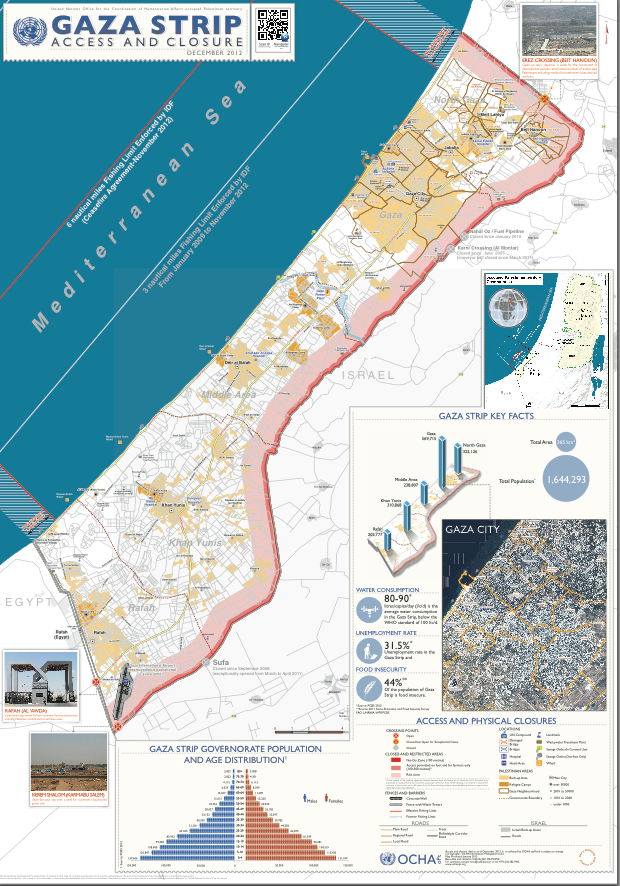
The situation in December 2012 is set out on the map below, which shows what the Israeli military defined as ‘Access Restricted Areas’ (ARA) which, on the landward side, comprised three zones:

(1) A ‘No-Go Zone’, 100 metres wide, which was cleared of all vegetation and all built structures;

(2) A ‘restricted zone’, a further 100-300 metres wide, where access was permitted on foot and for farmers only;

(3) A ‘risk zone’…

GAZA December 2012 OCHA1

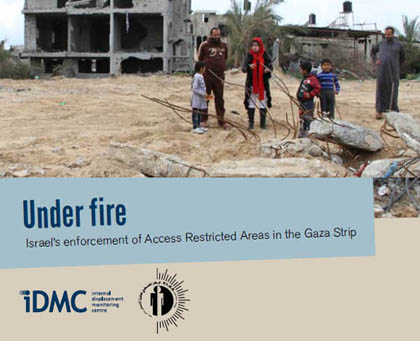
You can download a hi-res version here (see also Léopold Lambert‘s maps and commentary here).  In practice, the UN Office of the Commissioner for Human Rights explained, ‘the “no go zone’’ on land was at times enforced a few hundred metres beyond this, with a “high risk zone” extending sometimes up to 1,500 metres.’  In November 2012 these restrictions were supposed to be eased, as part of the agreement ending the Israeli offensive earlier that month.  But as the Commissioner reported, ‘there has been an increased level of uncertainty regarding the access restrictions imposed on land since this date.’  In the spring UN monitoring teams reported that in most cases farmers could not enter lands within 300 metres of the fence and that the Israeli military fired warning shots if they attempted to do so, that in some places the exclusion zone extended beyond 300 metres, and that there was continued concern about the presence of unexploded ordnance in the border areas. The map produced by Gisha: Legal Center for Freedom and Movement for September 2013, ‘Mapping movement and access‘, reflects these realities, and you can find a detailed report from the Palestinian Center for Human Rights and the IDMC, Under Fire: Israel’s enforcement of access restricted areas in the Gaza Strip (February 2014) here.
under-fire-cover-small

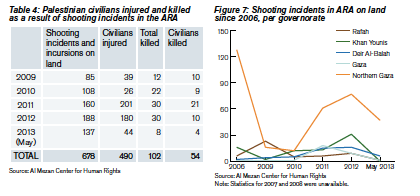
Unexploded ordnance is a matter of grave concern, but there has also been a history of live-fire incidents (see the graph below).  Since December 2013 and before the current Israeli offensive the number of live-fire casualties near the fence was increasing again. In a ten week period between December 2013 and March 2014 B’Tselem field researcher Muhammad Sabah documented 55 civilians injured near the fence: 43 by live fire; 10 by rubber bullets; and two hit by teargas canisters [I can’t link to the report at the moment because the B’Tselem website is under attack and has been taken off the grid; I can now – it’s here].

Shooting incidents in ARA, Gaza

These live-fire incidents are sometimes carried out from remote-controlled stations; the system is called ‘Spot and Strike‘.  Michael Morpurgo, the creator of “War Horse”, saw its effects when he visited Gaza in November 2010 as a representative of Save the Children:

“I stood in among the ruins watching the kids at work, coming and going with their donkeys and carts. They didn’t seem worried, so I wasn’t worried… I heard the shots, then the screaming, saw the kids running to help their wounded friends. Now I really was outside the comfort zone of fiction. A doctor from Medecins Sans Frontieres told me that the shots were not fired by snipers from the watchtowers on the wall, as I had supposed, but that these scavengers were routinely targeted, electronically from Tel Aviv, which was over 25 kilometres away – ‘Spot and Strike’, the Israelis call it.

“It was like a video game – a virtual shooting, only it wasn’t: there was blood, his trousers were soaked in it, the bullets were real. I saw the boy close to, saw his agony as the cart rushed by me. Many like him, the doctor told me, ended up maimed for life. Here was a child, caged and under siege, being deliberately targeted, his right to survival, the most basic of all children’s rights, being utterly ignored. Unicef says that 26 children were shot like this in 2010. The boy I saw was called Shamekh, I discovered. He lives in a house with 15 family members, and was out there earning what money he could, in the only way he knew how.’

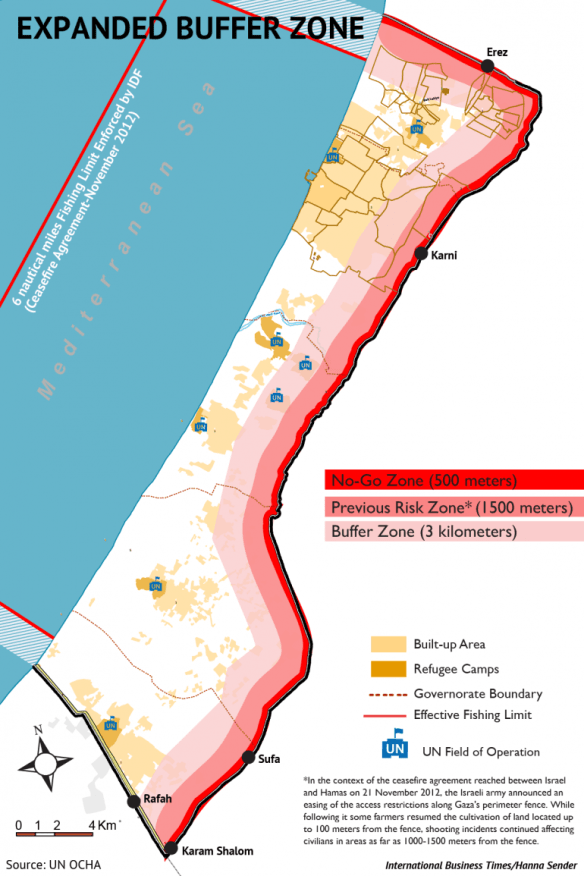
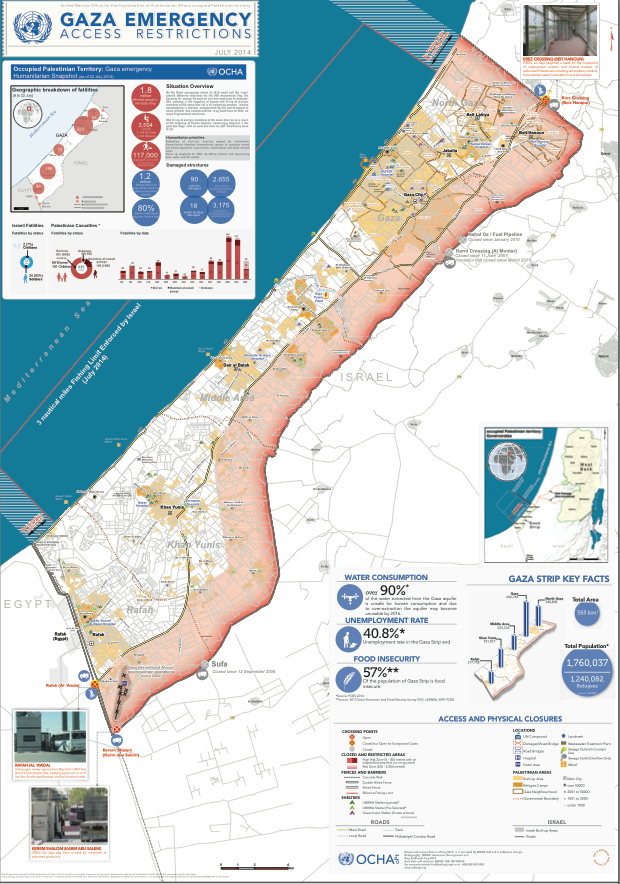
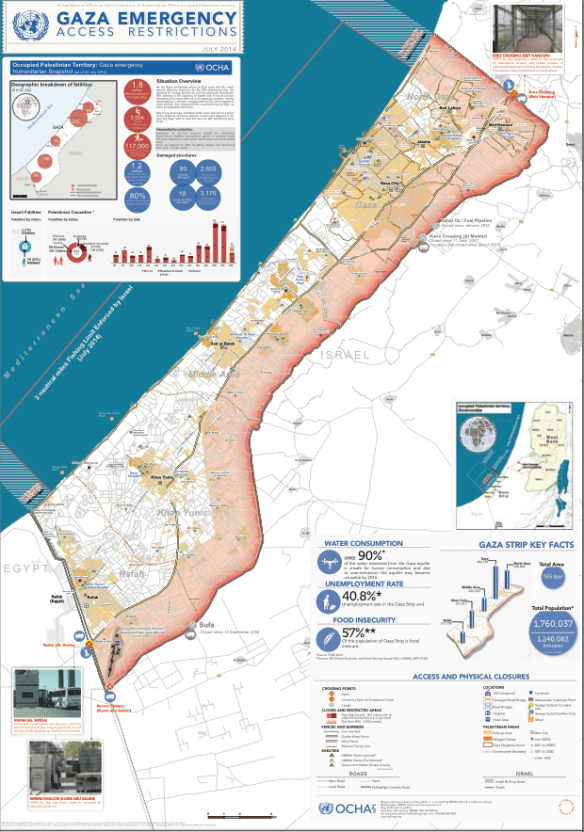
Today, there is a palpable sense in which the whole of Gaza has become a death zone.  First, Israel has declared a three-kilometre ‘buffer zone’ inside Gaza’s borders which now effectively places 44 per cent of the territory off limits (you can download the OCHA map below here; the second map makes the situation clearer, though it inevitably sacrifices detail).  Compare this with the previous map by following the line of the road south-north.
GAZA Access Restrictions JULY 2014

ocha_opt_gaza_access_and_closure_map_december_2012_geopdf_mobile_buffer

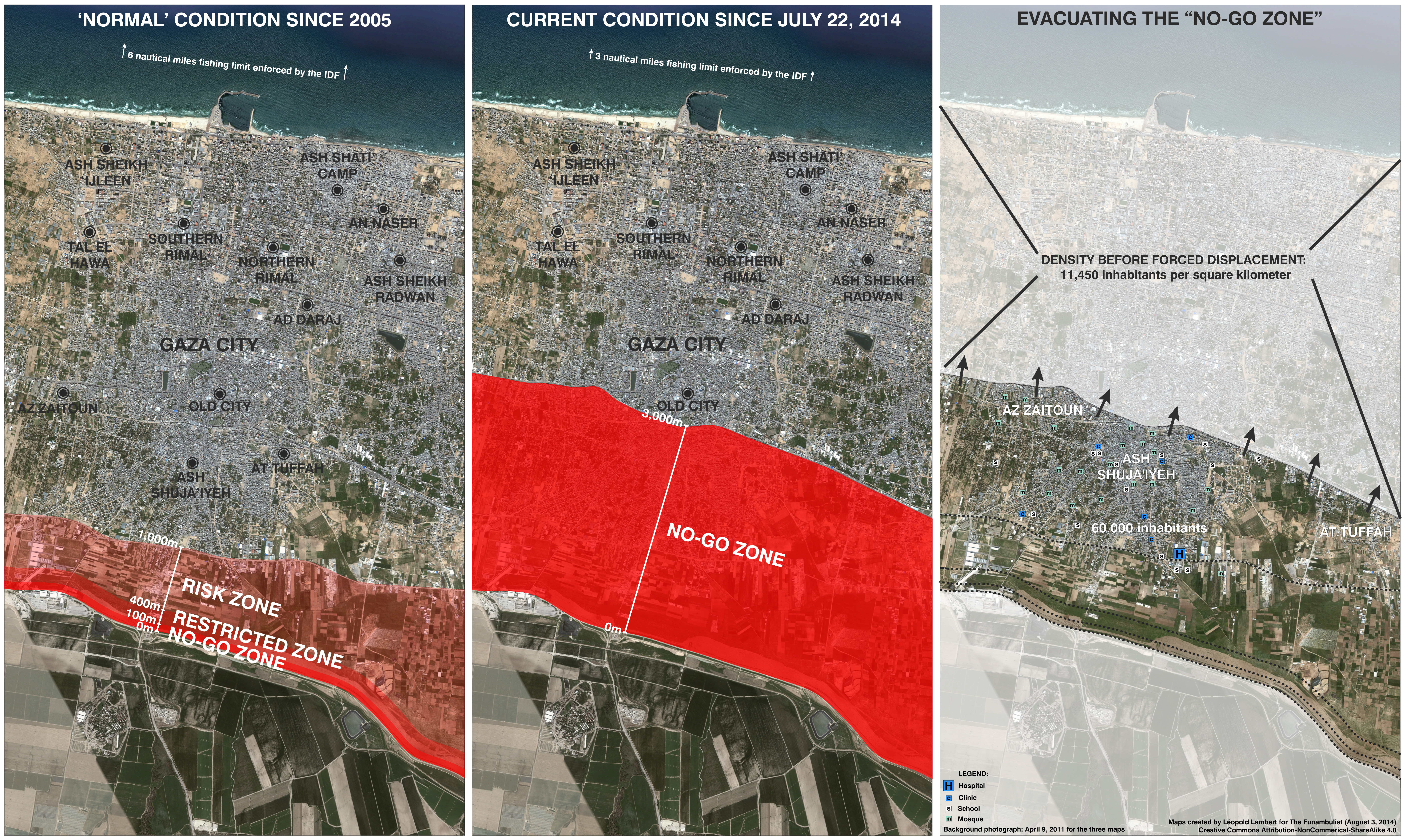
Léopold Lambert has provided this close-in triptych which exposes the enormity of the expansion and the knock-on effects of the forced displacement:

Gaza

Mohammed Omer reports:

Anyone within the zone has been warned by the Israeli military to leave or risk being bombed.

This buffer zone has only exacerbated Gaza’s siege. To the east, Palestinians in Gaza are fenced in by Israeli artillery tanks, mortars, cannon shells and snipers. On Gaza’s western side, Israeli warships form a blockade and allow only a three-mile fishing zone. To the north resides more military checkpoints and soldiers. To the south, the Egyptian military has closed off the Rafah border.

The buffer zone has tightened the Israeli chokehold around Gaza’s small strip of land.

Damage in the Gaza stripThis is, as Jesse Rosenfed reports, a ‘No Man’s Land’ in exactly the expanded sense proposed by Noam Leshem and Al Pinkerton:

What that means on the ground is scenes of extraordinary devastation in places like the Al Shajaya district approaching Gaza’s eastern frontier, and Beit Hanoun in the north. These were crowded neighborhoods less than three weeks ago. Now they have been literally depopulated, the residents joining more than 160,000 internally displaced people in refuges and makeshift shelters. Apartment blocks are fields of rubble, and as I move through this hostile landscape the phrase that keeps ringing in my head is “scorched earth.”

It’s not like Israel didn’t plan this. It told tens of thousands of Palestinians to flee so its air force, artillery and tanks could create this uninhabitable no-man’s land of half-standing, burned-out buildings, broken concrete and twisted metal. During a brief humanitarian ceasefire some Gazans were able to come back to get their first glimpse of the destruction this war has brought to their communities, and to sift through their demolished homes to gather clothes or other scattered bits of their past lives. But many were not even able to do that.

Satellite imagery has confirmed the scale of the devastation; the map (right) is based on just three areas within the expanded ‘buffer zone’ and was compiled from imagery taken before the intensification of the onslaught.  You can find details of the UNITAR/UNOSAT programme and image files here.  If you can bear to get closer, there are photographs taken on the ground here and here.

Second, the Israeli military have not confined their operations to the expanded buffer zone, and those who have – somehow – found sanctuary outside its limits (but of necessity still within the closed and shuttered confines of Gaza) have found that they are pursued by aircraft and tanks.  The image below, taken from the same source (and same date) used to compile the map above, shows a wide arc of damage in central Gaza far beyond the ‘zone’ (see also my previous posts herehere and here; you can also find a detailed interactive photo-map of the whole territory from the New York Times here).

Damage Assessment Gaza City 25 July 2014

‘The problem,’as one young resident explained to Anne Barnard, ‘is that when we are fleeing from the shelling, we still find the shelling around us.’  Stories abound of families seeking refuge only to find death waiting for them.  One man told Alexandra Zavis that his brother, four sisters, brother-in-law and five young children escaped from eastern Gaza to what they thought was a safe place in central Gaza City, only to be killed when the top floors of the building collapsed after an Israeli air strike the very next day.  Others tell similar stories – one family moving twice before eventually ten of them were killed.  And then there are all those who have sought refugee in UNRWA camps, many of them schools, or who have been rushed to hospitals for treatment, only to be bombed and shelled there too.

Ha’aretz‘s headline on 31 July says it all: ‘The Gaza battlefield is crowded with the displaced and the homeless.’  So it is.  And still they are bombed and shelled.  As UNRWA’s Chris Gunness put it, ‘Gaza is unique in the annals of modern warfare in being a conflict zone with a fence around it, so civilians have no place to flee.’

In his seminal essay on ‘Necropolitics‘, written more than ten years ago, Achille Mbembe had this to say:

Late-modern colonial occupation differs in many ways from early-modern occupation, particularly in its combining of the disciplinary, the biopolitical, and the necropolitical. The most accomplished form of necropower is the contemporary colonial occupation of Palestine… 

Entire populations are the target of the sovereign. The besieged villages and towns are sealed off and cut off from the world. Daily life is militarized… The besieged population is deprived of their means of income. Invisible killing is added to outright executions…

I have put forward the notion of necropolitics and necro-power to account for the various ways in which, in our contemporary world, weapons are deployed in the interest of maximum destruction of persons and the creation of death-worlds, new and unique forms of social existence in which vast populations are subjected to conditions of life conferring upon them the status of living dead.

Gaza has been systematically turned not only into a prison, then, but also into a camp: and the lives of those within have been have been subjected to a ruthless bio-political programme that, at the limit, has become a calculated exercise in necro-politics.  This confirms Paul Di Stefano‘s claim that that, for the Israeli military, Gaza has been transformed into ‘a state of exception where normal rights do not apply. Within this liminal space, Palestinian bodies are viewed as obstacles to be destroyed or controlled in the maintenance of the colonial order.’
BDS

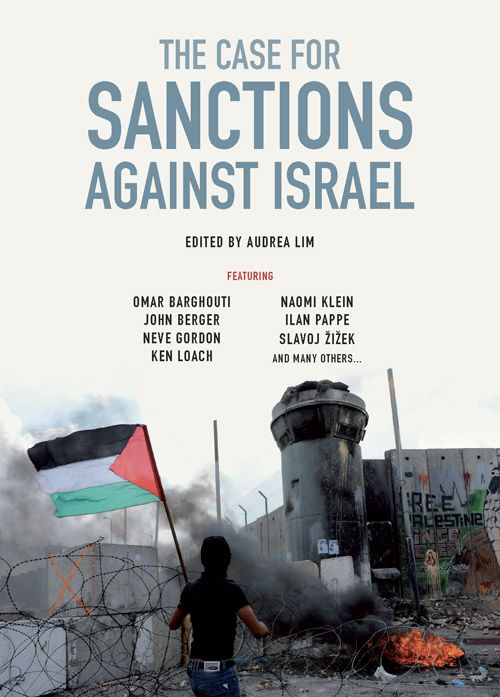
w640A follow-up to ‘Bombed, Destroyed, Slaughtered‘: Verso has now made available its 2012 anthology, The case for sanctions against Israel, as a free download here:

In July 2011, Israel passed legislation outlawing the public support of boycott activities against the state, corporations, and settlements, adding a crackdown on free speech to its continuing blockade of Gaza and the expansion of illegal settlements. Nonetheless, the campaign for boycott, divestment, and sanctions (BDS) continues to grow in strength within Israel and Palestine, as well as in Europe and the US.

This essential intervention considers all sides of the movement—including detailed comparisons with the South African experience—and contains contributions from both sides of the separation wall, along with a stellar list of international commentators. With contributions by Ra’anan Alexandrowicz, Merav Amir, Hind Awwad, Mustafa Barghouthi, Omar Barghouti, Dalit Baum, Joel Beinin, John Berger, Angela Davis, Nada Elia, Marc H. Ellis, Noura Erakat, Neve Gordon, Ran Greenstein, Ronald Kasrils, Jamal Khader, Naomi Klein, Paul Laverty, Mark LeVine, David Lloyd, Ken Loach, Haneen Maikey, Rebecca O’Brien, Ilan Pappe, Jonathan Pollak, Laura Pulido, Lisa Taraki, Rebecca Vilkomerson, Michael Warschawski, and Slavoj Žižek.

Lives, damned lives and statistics

The New Statesman is carrying a ‘reply‘ from a Professor Alan Johnson (Edge Hill University: it’s not clear to me if he’s still there) to a post by Jason Cowley on Gaza.  He doesn’t address Cowley’s substantive points about Gaza, but ends like this:

Today, there are forms of anti-Zionism that demonise Israel and fuel hate, from the academic theory of Judith Butler and Gianni Vattimo to the historiography of Shlomo Sand, from the popular street phenomenon of the “quenelle” to the ugly rise of “Holocaust inversion”.

To link Butler, Vattimo and Sand to fascist gestures like the quenelle is a lazy and offensive manoeuvre.  I leave the other scholars he mentions to those who know their work better than me: Johnson presumably has this interview with Vattimo in his sights, which is indeed reprehensible though scarcely representative of his corpus as a whole, but Sand is a distinguished historian whose counter-narrative to Zionism cannot be gratuitously dismissed, even if Johnson and his friends at the British Israel Communications and Research Centre don’t like it.

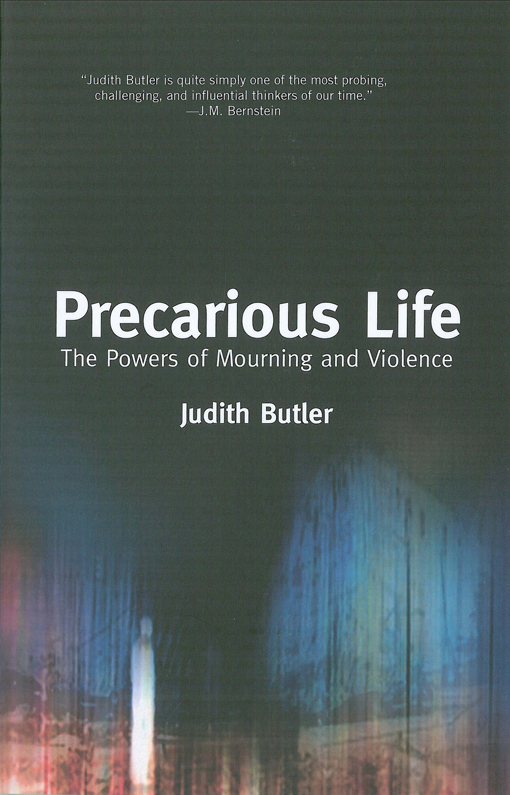
9781844675449-frontcover-01d22beb799d6fe99f8cd54193ff10f5But to suggest that ‘the academic theory of Judith Butler‘ somehow ‘demonises Israel and fuel[s] hate’ is intellectually vacuous.  What part of her ‘theory’ does Johnson have in mind? Her work on gender and subjectivity?  Her discussions of performativity? Her careful, ethical arguments about what constitutes a ‘grievable life’ in Precarious lives and Frames of war?

Those last two books do bear directly on the asymmetric horror that is being visited on the people of Gaza.  Readers may have seen the video of UNRWA spokesman Chris Gunness dissolving into tears as he tries to talk about the Israeli shelling of Jabalia Elementary Girls School early on Wednesday morning, when children were killed as they slept next to their parents.  We should pause here to acknowledge the extraordinarily brave and vital work the men and women of UNWRA perform day after day and night after night under the most exacting conditions (and if we are to talk about ‘demonisation’ we should certainly talk about the abuse hurled at UNWRA by the Israeli right). During the attack on the school, at least 15 people were killed and more than 100 wounded.  The location of the school and its humanitarian re-purposing as shelter for more than 3,000 people forced from their homes by the offensive had been communicated to the Israeli military 17 times before the attack. After the interview, Chris composed himself and had this to say:

“My feelings pale into insignificance compared to the enormity of the tragedy confronting each and every other person in Gaza at this time.

“It’s important to humanise the statistics and to realise that there is a human being with a heart and soul behind each statistic and that the humanity that lies behind these statistics should never be forgotten.”

This is a perfect expression of what Butler has in mind, and urges us to have in mind.  There’s no ‘hate’ there, and there isn’t in Butler’s work either: just a caring expression for grievable lives so cruelly lost.

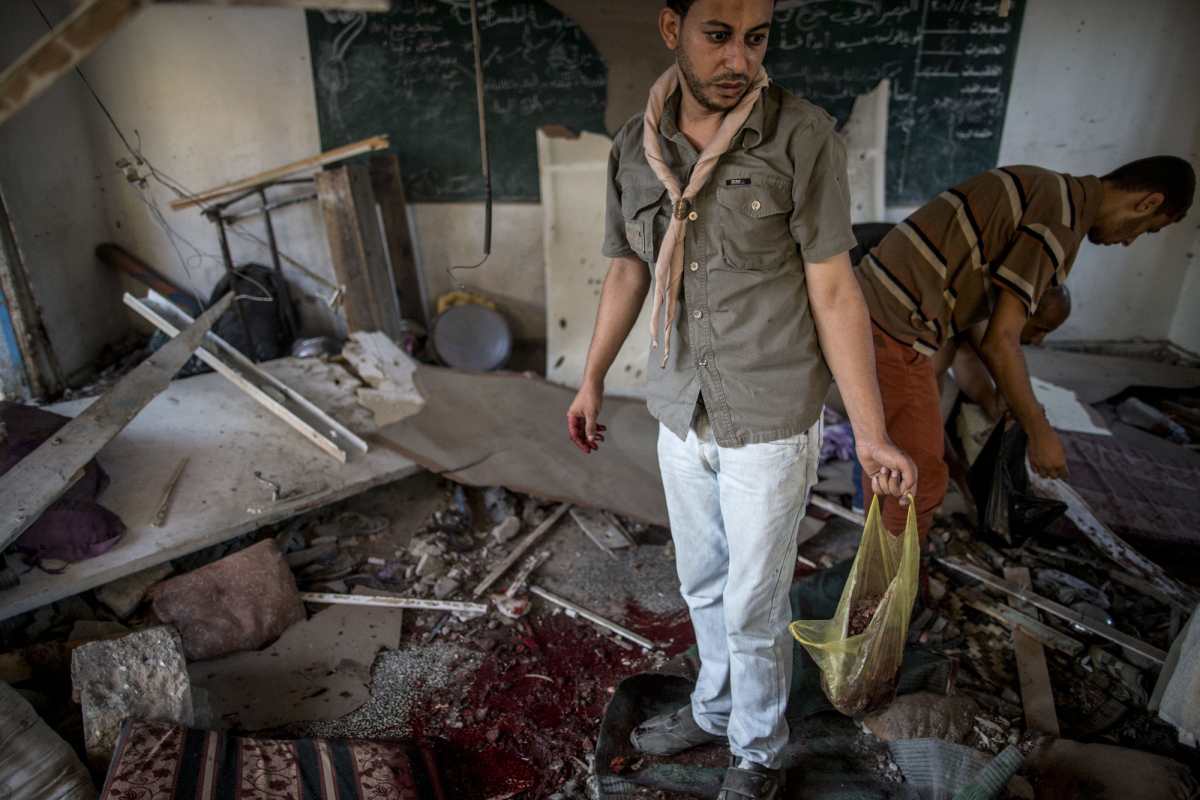
TOPSHOTS-PALESTINIANS-ISRAEL-CONFLICT-GAZA

What Butler has provided, on several occasions, is a thoughtful, measured critique of political Zionism and of the policies and practices of successive Israeli governments that have diminished, dispossessed and, yes, demonised the Palestinian people (see a previous, brief post here). I suspect Johnson would see this as the work of a ‘self-hating Jew’, an old canard, but what then would her critics accept as a legitimate criticism of Israel?  And if we have to resurrect that line of argument, might not actions like the shelling of a school crowded with refugees be the work of a self-demonising state?

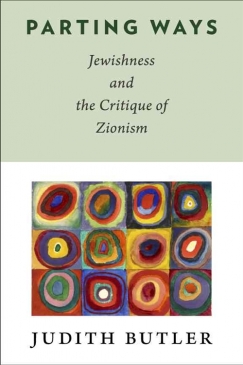
BUTLER Parting waysButler’s reflections have been brought together in her Parting ways: Jewishness and the critique of Zionism (2012), which is a principled statement of an oppositional – not defamatory – ethics and politics.  As it happens, Society and Space has just published an exceptionally thoughtful review of the book by Lisa Bhungalia which explicitly connects Butler’s vision of ‘co-habitation‘, which Butler sees as not only consistent with but arising from an indelibly Jewish tradition, to the latest Israeli attack on Gaza (where her sharpening of the concept of precarity is also surely crucial: see also ‘Precarious life and the obligations of cohabitation’, a lecture Butler delivered at Stockholm’s Nobel Museum in May 2011: you can download it here).

There are, as Lisa notes, dangers in turning ‘resistance to Zionism into a “Jewish” value’, as Butler herself acknowledges, but in the end

‘Butler puts forth a compelling political vision for Palestine/Israel predicated on an acknowledgment of historical injustice and the instatement of new polity that would presuppose an end to settler colonialism – yet at the same time, this vision is derived, in large part, from a Jewish philosophical tradition. Justice still remains a Jewish value.’

Words understandably failed Chris Gunness this week.  And when a Jewish scholar who works so respectfully with the writings of Hannah Arendt, Walter Benjamin, Martin Buber, Primo Levi and Emmanuel Levinas is accused of ‘fuelling hate’ and so egregiously linked to the rise of popular fascism then all possibility of critical engagement seems lost.

And yet. Butler talks about being critical as being ‘willing to examine what we sometimes presuppose in our way of thinking, and that gets in the way of making a more livable world.’  She has done precisely that in Parting ways.  Perhaps Professor Johnson, instead of recycling the hasbara formularies of the Israeli military, might do the same.

Darkness Descending

I woke this morning to media reports of the continued carnage in Gaza and to headlines recycled from Associated Press announcing that Israel had struck ‘symbols of Hamas power’.  Front and centre in the frenzied assault was an attack on Gaza’s only power station: but its importance is hardly ‘symbolic’.

1509120862In Targets of opportunity Samuel Weber wrote: ‘Every target is inscribed in a network or chain of events that inevitably exceeds the opportunity that can be seized or the horizon that can be seen.’

In ‘In another time-zone…’ (DOWNLOADS tab) I elaborated his comment in relation to so-called ‘deliberative targeting’, which ‘places a logistical value on targets through their carefully calibrated, strategic position within the infrastructural networks that are the very fibres of modern society’:

The complex geometries of these networks then displace the pinpoint co-ordinates of ‘precision’ weapons and ‘smart bombs’ so that their effects surge far beyond any immediate or localised destruction. Their impacts ripple outwards through the network, extending the envelope of destruction in space and time, and yet the syntax of targeting – with its implication of isolating an objective – distracts attention from the cascade of destruction deliberately set in train. In exactly this spirit, British and American attacks on Iraqi power stations in 2003 were designed to disrupt not only the supply of electricity but also the pumping of water and the treatment of sewage that this made possible, with predictable (and predicted) consequences for public health. Similarly, on 28 June 2006, during the IDF’s Operation Summer Rains, Israeli missiles destroyed all six transformers of Gaza’s only power station (which provided over half of Gaza’s power). Being powerless in Gaza was as devastating as in Iraq:

‘The lack of electricity means sewage cannot be treated, increasing the risk of disease spreading, and hospitals cannot function normally. It means ordinary Gazans cannot keep perishable food because their fridges do not work. At night, they are plunged into complete darkness when the electricity cuts off. They rely on candles and paraffin lamps. Many residents have also been left with an irregular water supply as they need electricity to pump water up from nearby wells or from ground floor level to higher floors in blocks of flats.’

In attacking the power station – a repeated and familiar target, and so not one struck ‘by accident’ – the IDF knows very well that in the days, weeks and months to come hundreds, even thousands of people will get sick or even die as sewage plants and water pumps fail, as refrigeration systems stop, and as essential surgeries and life-support systems are interrupted.

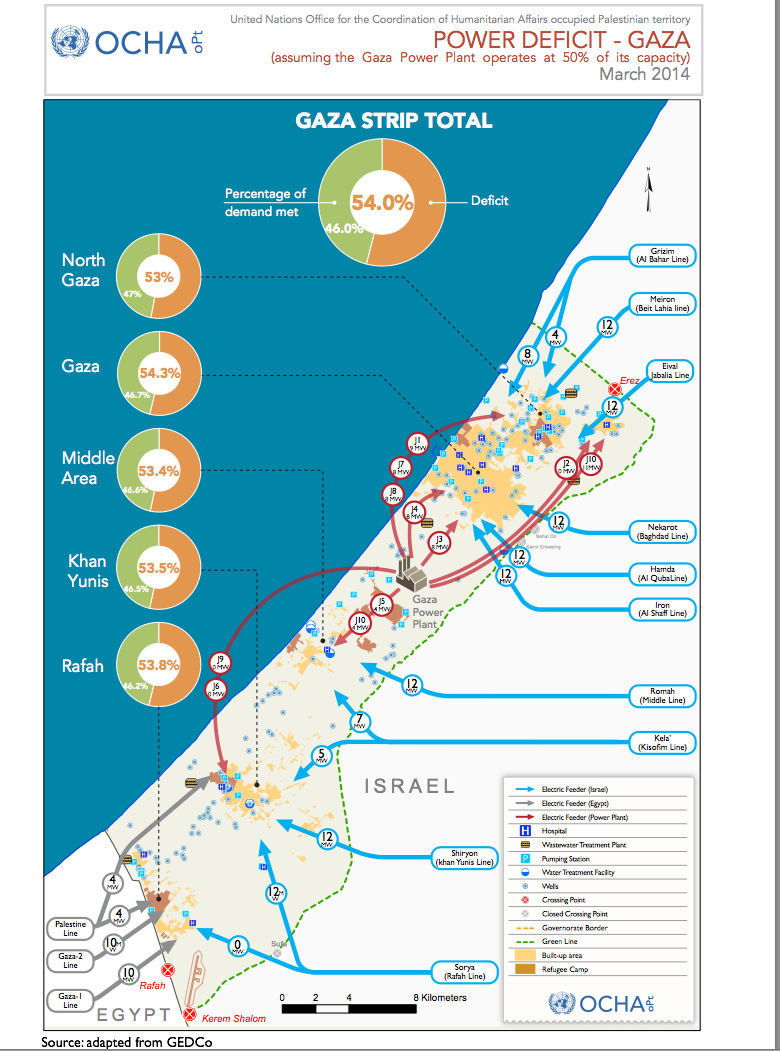
The situation before the latest Israeli offensive was highly precarious, as the map below shows; you can download a hi-res version here (if you have power), and the accompanying one-page report spells out the implications.  Israeli restrictions on the importation of spare parts mean that the power plant has never been restored to full capacity after the previous attacks, and since June 2013 the situation has been exacerbated by ‘the halt in the smuggling of Egyptian-subsidized fuel used to operate the [power plant] via the tunnels’ (last year the differential was 3.2 shekels/litre compared with 7.1 shekels/litre for fuel imported from Israel).

GAZA power deficit

At full capacity, Fares Akram reports, the power station should supply 80 megawatts of electricity; before the most recent Israeli offensive it was already degraded, producing at most only 50-60 megawatts.  It was damaged by Israeli shelling three times last week, and the effects tore into what was left of the fabric of everyday life.  Listen to Atef Abu Saif, writing in his ‘Diary of a Palestinian’ on Saturday 26 July (and read the whole thing: it is an astonishing and eloquent testimony to the depravity of the onslaught):

It has now been 40 hours with no electricity. The water was also cut off yesterday. Electricity is a constant issue in Gaza. Since the Strip’s only power station was bombed in 2008, Gazans have had at best 12 hours of electricity a day. These 12 hours could be during the day, or while you are fast asleep; it’s impossible to predict. Complaining about it gets you nowhere. For three weeks we’ve barely had two or three hours a day. And right now, we would be happy with just one.

These blackouts affect every part of your life. Your day revolves around that precious moment the power comes back on. You have to make the most of every last second of it. First, you charge every piece of equipment that has a battery: your mobile, laptop, torches, radio, etc. Second, you try not to use any equipment while it’s being charged – to make the most of that charge. Next you have to make some hard decisions about which phone calls to take, which emails or messages to reply to. Even when you make a call, you have to stop yourself from straying into any “normal” areas of conversation – they’re a waste of power.

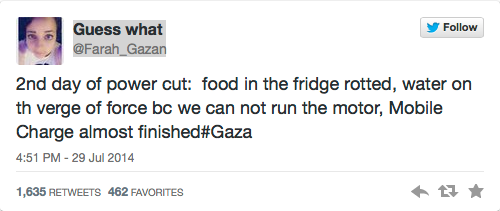
And remember that without those mobiles and laptops much of what the IDF has done would not reach the outside world: see this report , for example, which describes how 16 year old Farah Baker (@Farah_Gazan), ‘one of Gaza’s most powerful online voices’ with over 70,000 Twitter followers, was abruptly silenced when she was unable to charge her phone.

Gaza tweet power cut

Last night the power plant was hit by Israeli tank shells again – the IDF spokesman insists that the plant ‘was not a target’: just how many times do you have to strike something before you recognise what it is? – and now it has been forced to shut down completely.  You can watch a video interview with Sara Badiei, an ICRC water and sanitation engineer in Gaza, who describes the knock-on effects of the power shut-down here:

‘If there is no electricity, there is no water, and I want to make that clear… Water needs to be pushed down the lines, down these tubes, you need pumps to be able to run to bring the water out of the well, to push it down the line and to deliver it to the population.  If there’s no electricity, that can’t happen…’

Gaza also relies on 10 power lines from Israel and Egypt to provide an additional 120 megawatts but 8 of these have been cut by Israeli shelling.  In the interview, Sara explains that it takes 5-7 days to repair each line and it is, of course, extremely dangerous work in a war-zone under constant Israeli shelling.

This is not ‘symbolic’: it is infrastructural war of the most vicious kind, waged without restraint or remorse.  In the past, some Israeli politicians have demanded that Israel shut off the power (and water) supply to Gaza – for some of the international legal considerations, see Kevin Jon Heller’s careful review for Opinio Juris – but what has happened today isn’t about turning switches on or off.  Here is Harriet Sherwood in the Guardian:

The power plant is finished,” said its director, Mohammed al-Sharif, signalling a new crisis for Gaza’s 1.7 million people, who were already enduring power cuts of more than 20 hours a day.

Amnesty International said the crippling of the power station amounted to “collective punishment of Palestinians”. The strike on the plant will worsen already severe problems with Gaza’s water supply, sewage treatment and power supplies to medical facilities.

“We need at least one year to repair the power plant, the turbines, the fuel tanks and the control room,” said Fathi Sheik Khalil of the Gaza energy authority. “Everything was burned.”

Since I published the original version of this post, Human Rights Watch has documented – on 10 August – the cascading effects of the strike on the power plant:


It has drastically curtailed the pumping of water to households and the treatment of sewage, both of which require electric power. It also caused hospitals, already straining to handle the surge of war casualties, to increase their reliance on precarious generators. And it has affected the food supply because the lack of power has shut off refrigerators and forced bakeries to reduce their bread production.

“If there were one attack that could be predicted to endanger the health and well-being of the greatest number of people in Gaza, hitting the territory’s sole electricity plant would be it,” said , deputy Middle East and North Africa director at Human Rights Watch. “Deliberately attacking the power plant would be a war crime.”…

Ribhi al-Sheikh, deputy head of the Palestine Water Authority, said the lack of electricity had idled wells – except where generators were able to provide some back-up power – as well as water treatment and desalination plants. Idling wells endangers crops that require water at the hottest time of year.

Most urban households in Gaza need electricity to pump water to rooftop tanks. Ghada Snunu, a worker for a nongovernmental organization, said on August 4 that her home in Gaza City had been without electricity since the attack on the power plant, forcing her family to buy water in jerry cans and to conserve the used household water to empty the toilets. The collapse of electricity service meant that many Gazans lacked access to the 30 liters of water that is the estimated amount needed per capita daily for drinking, cooking, hygiene and laundering, said Mahmoud Daher, head of the Gaza office of the UN World Health Organization.

This is how Israel exercises its ‘right to defend itself’ and how ‘the most moral army in the world’ is set loose on civilians.

BttGzghCcAAwxuT.jpg-large

In the case of targeted killing (see ‘Drone geographies’, DOWNLOADS tab), the same network effects obtain:

‘…by fastening on a single killing – through a ‘surgical strike’ – all the other people affected by it are removed from view. Any death causes ripple effects far beyond the immediate victim, but to those that plan and execute a targeted killing the only effects that concern them are the degradation of the terrorist or insurgent network in which the target is supposed to be implicated. Yet these strikes also, again incidentally but not accidentally, cause immense damage to the social fabric of which s/he was a part – the extended family, the local community and beyond – and the sense of loss continues to haunt countless (and uncounted) others.’

This tactic, too, has been honed by the IDF, though not exactly refined.  Last year Craig Jones noted:

Since September 29th 2000, Israel has killed 438 Palestinians using the method of targeted killing. Of these, 279 were the ‘object’ of attack, meaning that Israel intentionally targeted them. The other 159 were ‘collateral damage’, chalked up to accidental or incidental consequences of targeting the other 279.

Rummaging around today, I’ve discovered another version of Sam Weber’s thesis with which I began, thanks to Jon Cogburn.  It’s a poem by the late (nationalist) Israeli poet Yehuda Amichai (who died in 2000) called ‘The Diameter of the Bomb’ (translated here by Chana Bloch):

The diameter of the bomb was thirty centimeters
and the diameter of its effective range about seven meters,
with four dead and eleven wounded.
And around these, in a larger circle
of pain and time, two hospitals are scattered
and one graveyard. But the young woman
who was buried in the city she came from,
at a distance of more than a hundred kilometers,
enlarges the circle considerably,
and the solitary man mourning her death
at the distant shores of a country far across the sea
includes the entire world in the circle.
And I won’t even mention the crying of orphans
that reaches up to the throne of God and
beyond, making a circle with no end and no God.

The poem was written in 1972, and in 2006 was the inspiration for a documentary film, also called The Diameter of the Bomb, about the aftermath of a suicide bombing in Jerusalem.  But its power reaches beyond place and time.  And that, in case anyone is wondering, is symbolic.

Gaza: a history

FILIU Gaza

New from Hurst (UK)/Oxford (US), a translation of Jean-Pierre Filiu‘s Histoire de Gaza (Fayard, 2012): Gaza: a history.

Through its millennium–long existence, Gaza has often been bitterly disputed while simultaneously and paradoxically enduring prolonged neglect. Jean-Pierre Filiu’s book is the first comprehensive history of Gaza in any language.

Squeezed between the Negev and Sinai deserts on the one hand and the Mediterranean Sea on the other, Gaza was contested by the Pharaohs, the Persians, the Greeks, the Romans, the Byzantines, the Arabs, the Fatimids, the Mamluks, the Crusaders and the Ottomans. Napoleon had to secure it in 1799 to launch his failed campaign on Palestine. In 1917, the British Empire fought for months to conquer Gaza, before establishing its mandate on Palestine.

In 1948, 200,000 Palestinians sought refuge in Gaza, a marginal area neither Israel nor Egypt wanted. Palestinian nationalism grew there, and Gaza has since found itself at the heart of Palestinian history. It is in Gaza that the fedayeen movement arose from the ruins of Arab nationalism. It is in Gaza that the 1967 Israeli occupation was repeatedly challenged, until the outbreak of the 1987 intifada. And it is in Gaza, in 2007, that the dream of Palestinian statehood appeared to have been shattered by the split between Fatah and Hamas. The endurance of Gaza and the Palestinians make the publication of this history both timely and significant.

Here is the Contents list; despite the title of Part III, the book traces the story up to 2012 (the last chapter):

Part I – Gaza Before the Strip
Chapter 1 – The Crossroads of Empires
Chapter 2 – The Islamic Era
Chapter 3 – The British Mandate
Part II – 1947-1967: The Age of Mourning
Chapter 4 – The Catastrophe
Chapter 5 – Refugees and Fedayin
Chapter 6 – The First Occupation
Chapter 7 – Nasser’s Children
Part III – The Crushed Generation
Chapter 8 – The Four Years of War
Chapter 9 – The Era of the Notables
Chapter 10 – The Alien Peace
Chapter 11 – The New Wave
Part III – 1987-2007 The Generation of the Intifadas
Chapter 12 – The Revolt of the Stones
Chapter 13 – A Sharply Limited Authority
Chapter 14 – Days of Fury
Chapter 15 – One Palestine Against Another
Chapter 16 – Five Years in the Ruins

Here’s Mark Levine:

‘Anyone familiar with Jean-Pierre Filiu’s scholarship knows well his talent for taking complex historical processes and bringing their relevance for the present day to the front burner. Never have such skills been more needed than in addressing the still poorly understood history of Gaza. And Filiu succeeds admirably. Providing a wonderful synopsis of a century’s worth of history, his discussion of the more direct roots of the present violent dynamics, beginning with the “crushed generation” of the Six Day War and continuing through the travails of Gaza’s burgeoning hiphop scene, demonstrates just how historically and culturally rich remains this much abused land. A clear must-read for all those seeking to think outside the existing outdated prisms for studying history, and the future of Gaza and Palestine/Israel writ large.’ 

Gilbert Achcar writes:

‘Jean-Pierre Filiu is a scholar of international reputation and a champion of the downtrodden. This book will make you wonder how there could be such a paucity of works on Gaza, despite its centrality to Palestinian history, and help the reader better appreciate the plight of Gaza’s population.’

Filiu is Professor of Middle East Studies at Sciences-Po, but he’s more than a scholar; a former diplomat, he’s also published two graphic novels and written two popular songs.  This one is about Gaza, and it’s timely too:

Virtual Gaza

idffacebook

I had originally thought The everywhere war would include a reworked and extended version of my discussion of cyberwarfare and Stuxnet which appeared in the Geographical Journal (DOWNLOADS tab), but the chapter is now about ‘virtual’ battlespaces more generally – which are far from being purely ‘virtual’, of course – and includes some of the jottings I’ve made on the role of digital media in later modern war (see here and here).  With that in mind – but rather more than that in mind – I should update the part they are playing in Israel’s latest war on Gaza where, as the Wall Street Journal‘s headline on 23 July had it, ‘Israel and Hamas take fight to social media’.

The IDF is no stranger to information warfare and to the power of social media.  John Timpane explains the back-story succinctly:

In November 2012, Israel launched Operation Pillar of Defense – on Twitter. It thereby became the first nation to initiate hostilities by social media. Starting with a YouTube video of the aerial assassination of Hamas leader Ahmed al-Jabari, Pillar of Defense escalated the social-media war. The Israeli Defense Force (Twitter following: 292,000) tweeted times and places of rocket strikes against Israel. A rag-tag bunch of pro-Hamas Twitter feeds (such as the oft-shut-down @alqassam, with 11,000-plus followers), Facebook pages, and YouTube videos published images of torn bodies and bombed schools.

As of 2014, “both sides,” says [Lawrence] Husick, “have become remarkably more sophisticated in how they use social media to engage with the rest of the world.”

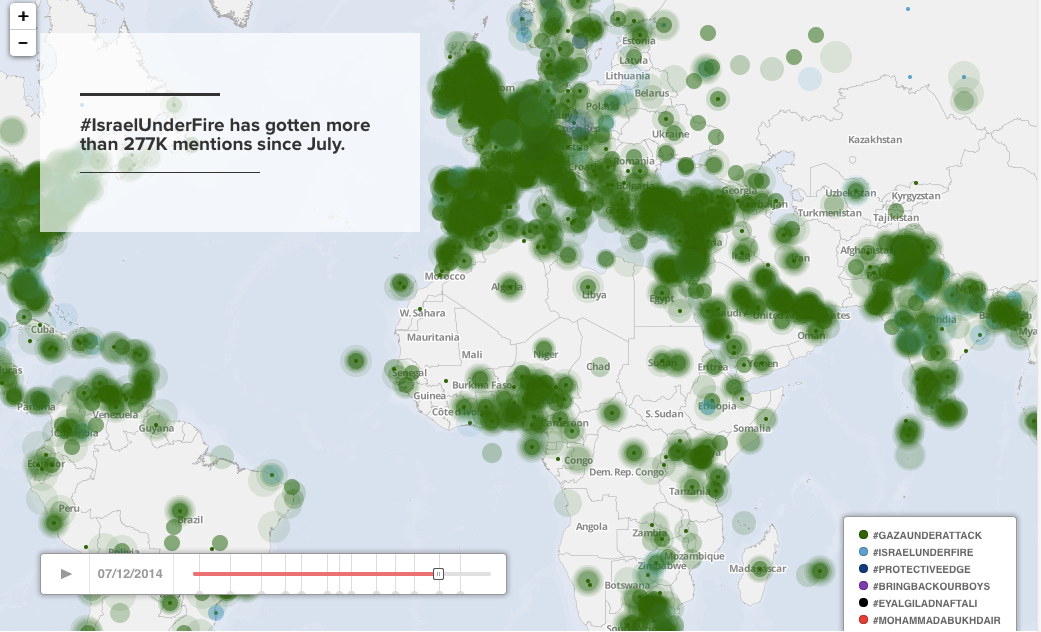
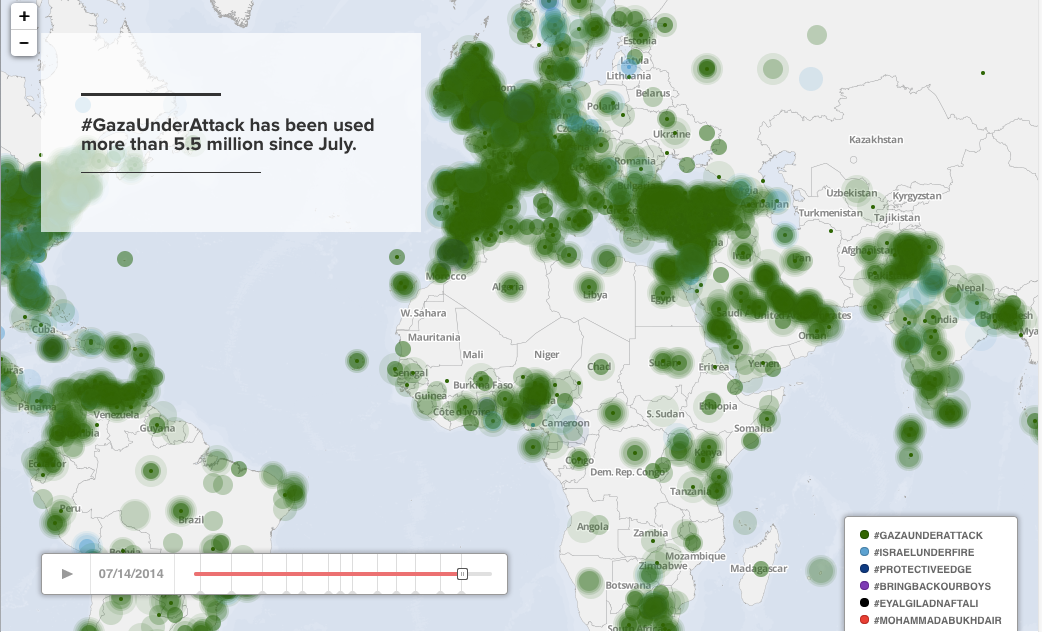
To provide some idea of the scale of operations, al-Jazeera has produced this remarkable representation of the unfolding of a global Twitterstorm about the war; what appears below are screenshots and you really need to watch the whole thing:

#Israelunderfire

#Gaza under attack

The resources each side has at its disposable are far from equal.  According to Harriet Sherwood:

The propaganda war between Israel and the Palestinians is not new, but this battle-round is being fought with unprecedented ferocity. And like the asymmetry in the military conflict, the strength and resources of the Israel social media troops outweigh those of Hamas and other Palestinian organisations.

And those asymmetries have increased. Max Schindler reports,

With dueling Twitter hashtags, Facebook posts and YouTube channels, the Israeli Defense Forces and Hamas, the Palestinian militant group, are trading not just fire but also barbs over social media, in an attempt to win hearts and minds around the world. But Hamas, barred from certain platforms, faces additional challenges in the Internet war.

In this round of violence, the social media battle has become increasingly important. Israel’s ability to wage its campaign in Gaza depends on the level of international criticism it sustains.

On Wednesday, Twitter suspended several accounts used by Hamas…. Twitter’s terms of service block use of the website to “a person barred from receiving services under the laws of the United States or other applicable jurisdiction.” Hamas is classified as a terrorist organization by the State Department, denying it access to American commercial products…. Facebook maintains a similar policy, and has deleted dozens of Hamas accounts due to American government restrictions.

All of this has still wider implications because many of the tweets and the cell-phone videos uploaded to YouTube(see below) re-circulate through mainstream media too – though my strong suspicion is that the cautionary ‘cannot be verified‘ tag is used more often to diminish the suffering of people in Gaza than to call into question the IDF’s hasbara (public diplomacy/propaganda, take your pick).

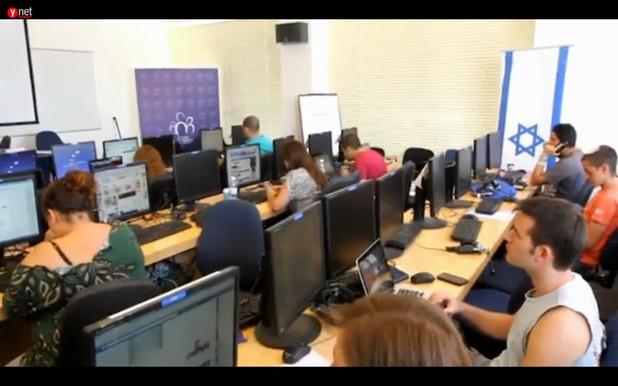
These are more than military (or paramilitary) media operations, but the remainder is not only the work of individual ‘citizen-journalists’.  Ali Abunimah reports on a social media ‘war room’, set up on the first day of the current offensive by students at the Interdisciplinary Center Herzliya, a private university, to ‘explain’ Israel’s actions to overseas audiences: ‘israelunderfire’ originated here.  Some 400 volunteers from around the world are now involved in targeting online forums and producing their own (dis)infographics (more – and affirmative – reporting from the the Jerusalem Post here).

IDC Herzliya %22War Room%22

But most of the running is being made by the  IDF’s own concerted media campaign, and as I noted earlier Rebecca Stein has provided a timely analysis of ‘How Israel militarized social media’ that debunks some of the myths that have grown up around its ‘success’ (see also the link to her previous work here):

‘What’s been lost in this coverage – in this story of surprise — is the history of the Israel’s army presence on social media. For in fact, the military’s move to social media as a public relations platform has been rife with improvisation and failure, a process that runs counter to IDF narratives about its innovative work in this regard (the IDF lauding itself as a military early adopter). The army’s interest in the wartime potential of social media can be traced to the first few days of the 2008-2009 Gaza incursion….

In the years that followed, the IDF investment in social media would grow exponentially both in budgetary and manpower allocations, building on this ostensible wartime triumph.

But the process was rife with challenges and missteps…

Today, Israelis are also concerned about losing the media war. But they tell the story differently. In their rendering, the Israeli media problem is a by-product of damning or doctored images (this was the spirit of Netanyahu’s infamous “telegenically dead” remarks), of Palestinian media manipulation, of global anti-Israeli cum anti-Semitic bias. The Israeli media manages these problems by removing most traces of Palestinian dead and wounded from national news broadcasts.’

This feeds in to a deeper narrative in which both Palestinian casualties and Israeli culpability disappear from view, deftly characterised by Yonatan Mendel:

‘”We can forgive the Arabs for killing our children,” Golda Meir said in 1969, ‘but we cannot forgive them for forcing us to kill their children.’ Forty-five years on, in the third week of the Israeli attack on Gaza, with more than 800 Palestinians killed, about a quarter of them children, Israel’s government, its media and Israeli society have turned Meir’s idea of Israel being ‘forced’ to do unacceptable things into a vast and dangerous superstition. It refuses to take responsibility for the killing, just as it refused to take responsibility for the military occupation and the blockade: these, it tells itself, are what it has been forced into. Killing in Gaza in 2014, killing in 2012, and in 2008. But Israel has convinced itself, despite the rising numbers of dead, that isn’t killing anyone in Gaza. Hamas are the people doing the killing; they are responsible for the siege, the destruction, the underdevelopment, the poverty, the absence of peace talks, the postponement of a ceasefire and the use of UNRWA schools for military purposes.’

One final, crucial qualification. Even as he explains how the IDF and Hamas are fighting a media war, a battle to control the story on social media, John Tirmane insists that ‘the real war is of steel and fire, flesh and blood.’  What the countervailing voices of the ‘Twitterstorm’ seek to enable and to disable is an all too material firestorm.