Cracks in the Wall?

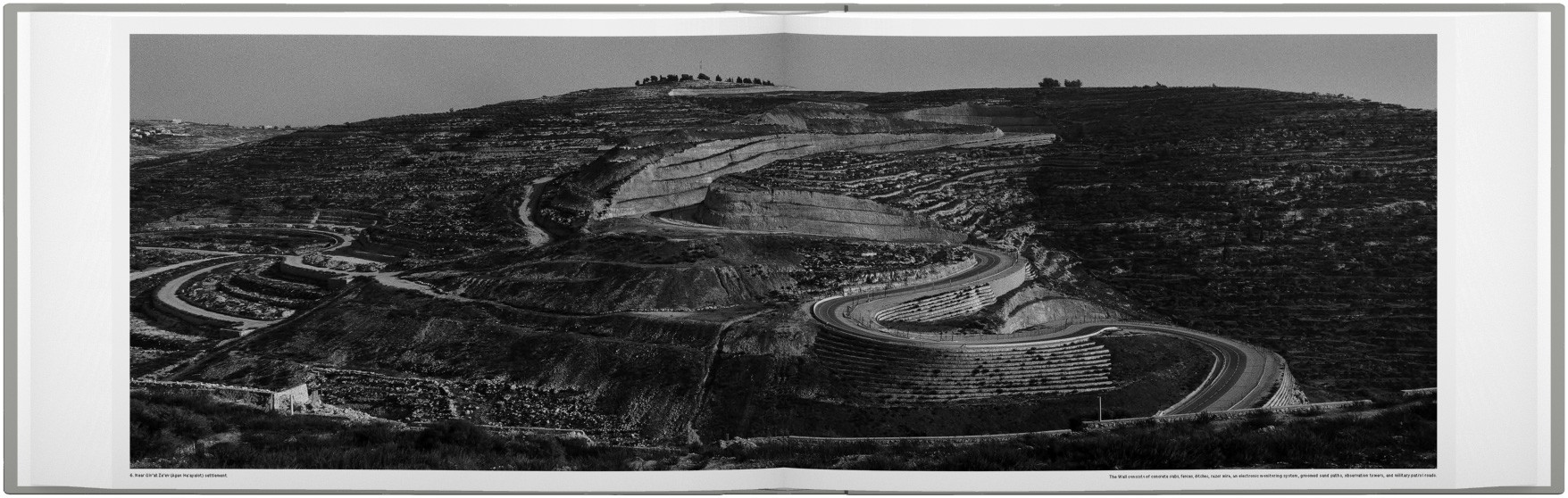
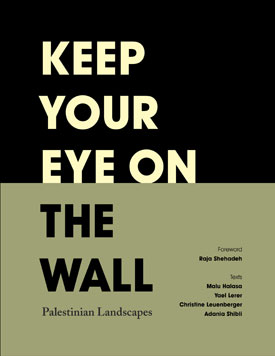
Keep-Your-Eye-on-the-WallThere’s a fine series of reflections by Andrew Ryder at Warscapes on a new book of photographs and essays on the Wall that Israel has built deep inside the occupied West Bank, Keep your eye on the Wall: Palestinian landscapes.  As Andrew notes,

‘The wall is a nuisance and eyesore; it is a scar in the natural landscape and the social body. It is congealed theft, and an act of violence.’

Eyal Weizman‘s Hollow Land tells us much about the way in which Israel’s neo-colonial project is inscribed through a series of visual practices – a scopic regime of extraordinary, ever-present and brooding violence – but Andrew’s commentary reminds us of another, no less artful politics of looking.  He engages in a wonderfully suggestive, deeply critical way with the aesthetics of dispossession and oppression:

While I found many of the photos in this book upsetting, I think that a traditionally aesthetic standpoint toward the wall, a disinterested interest, is particularly horrifying because it occludes something that was always obvious to me every time I looked at the wall, which was its manifest injustice.

Throughout the book, there are moments that the wall appears too static, imposing and impermeable. I found a lack of witness to the gaps and even the fragility of the structure. There seems little evidence of soldiers, checkpoints, settlements, refugee camps or the other evidence of dynamism or vulnerability in the territorial apparatus that the Israeli state has constructed.

The gaps I understand, but fragility?  vulnerability?  If only.  As Shakespeare put in in A Midsummer Night’s Dream,

O wicked Wall through whom I see no bliss!
Cursed be thy stones for thus deceiving me!
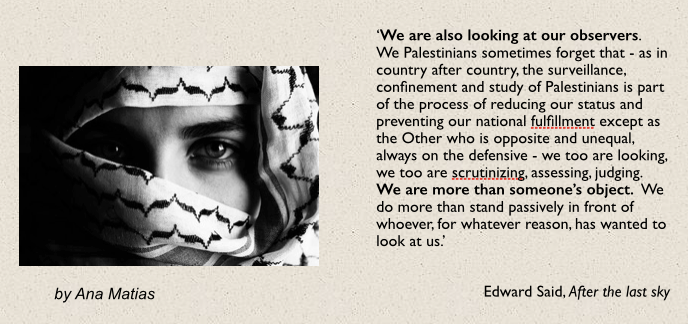
Others have travelled this route before, of course: I’ve already noted other critical reflections on the political and ethical snares set by any attempt to photograph the monstrosity.  And yet the collection that Andrew discusses is well-titled.  As Edward Said reminded his readers:
Observer and observed
For a different take on the political aesthetics of the occupied landscape – though not on the Wall – see Daniel Bertrand Monk’s An aesthetic occupation: the immediacy of architecture and the Palestine conflict (2002).

Theory of the drone 11: Necro-ethics

This is the 11th in a series of extended posts on Grégoire Chamayou‘s Théorie du drone and covers the first two of three chapters that constitute Part III: Necro-ethics.

The title recalls Achille Mbembe‘s seminal essay on ‘Necropolitics’ [Public culture 15 (1) (2003) 11-40], where he cuts the umbilical cord between sovereignty and the state (and supranational institutions) and, inspired by Michel Foucault and Giorgio Agamben, argues that ‘the ultimate expression of sovereignty resides, to a large degree, in the power and the capacity to dictate who may live and who must die.’  Necropolitics is thus about ‘contemporary forms of subjugation of life to the power of death’ – and at the limit the creation of what Mbembe calls ‘death-worlds’.

AlexisLeran-AchilleMbembe5Mins658

Mbembe develops his thesis in part – and for good reason – in relation to the Israeli occupation of Palestine.  I imagine readers will know that the Israeli Defence Force (IDF) advertises itself, incredibly, as ‘the most moral army in the world’, and although Chamayou’s ultimate objectives are different he too begins with a critical interrogation of one version of that claim (you can find much more about it in Muhammad Ali Khalidi‘s fine essay on Gaza in the Journal of Palestine Studies 39 (3) (2010) available on open access here).

1: Combatant immunity

Chamayou argues that what distinguishes contemporary forms of imperial military violence is not so much the asymmetry of the conflict or the differential distribution of vulnerability which results as the norms that are invoked to regulate its conduct.  Towards the end of the twentieth century, he suggests, the ‘quasi-invulnerability’ of the dominant force was transformed into an over-arching politico-ethical framework.  This first came into view during NATO’s intervention in Kosovo in 1999 when force protection was established as the key consideration: not only was the NATO campaign largely confined to bombing from the air (so that, apart from Special Forces, there were few boots – and, more to the point, NATO bodies – on the ground) – but pilots were ordered not to fly below 15,000 feet.  This kept them safely beyond the range of anti-aircraft fire, even as it reduced the accuracy of air strikes and endangered the lives of those the intervention was supposed to save.

nato-bombs-convoy

This seems to violate conventional notions of a just or ethical war, effectively turning ‘humanitarian intervention’ on its head, but Chamayou claims that in fact it heralded the explicit formulation of a principle of ‘imperial combatant immunity’.  Enter the IDF, stage right.  This new doctrine was set out in detail in an essay by Asa Kasher  and Amos Yadlin, writing from the ‘Department of Professional Ethics and Philosophy of Practice’ at Tel Aviv University and the IDF College of National Defense, and published as ‘Military ethics of fighting terror: an Israeli perspective’, Journal of military ethics 4 (1) (2005) 3-32.  As their affiliation shows, this was not an abstract, academic discussion; Chamayou notes, in an artful twist on Yves Lacoste (La géographie, ça sert, d’abord, à faire la guerre), ‘What use is moral philosophy?  Among other things, to wage war…’ (‘A quoi sert la philosophie morale?  Entre autres choses, à faire la guerre’) (p. 184).

In that essay Kasher and Yadlin proposed a comprehensive reformulation of military ethics – and, by extension, international law – but Chamayou fastens on their reworking (or demolition) of  the established principle of distinction.  He cites their central thesis, thus:

One major issue is the priority given to the duty to minimize casualties among the combatants of the state when they are engaged in combat acts against terror.  According to the ordinary conception underlying the distinction between combatants and noncombatants, the former have a lighter package of state duties than the latter. Consequently, the duty to minimize casualties among combatants during combat is last on the list of priorities or next to last, if terrorists are excluded from the category of noncombatants. We reject such conceptions, because we consider them to be immoral. A combatant is a citizen in uniform. In Israel, quite often he is a conscript or on reserve duty. His blood is as red and thick as that of citizens who are not in uniform. His life is as precious as the life of anyone else. A democratic state may send him to a battlefront only because it has a duty to defend its citizens and it cannot do this without some of them defending the others, within the framework of a just system of conscription and reserve duty. The state ought to have a compelling reason for jeopardizing a citizen’s life, whether or not he or she is in uniform. The fact that persons involved in terror are depicted as noncombatants is not a reason for jeopardizing the combatant’s life in their pursuit. He has to fight against terrorists because they are involved in terror. They shoulder the responsibility for their encounter with the combatant and should therefore bear the consequences. 

(It turns out that there are limits to the privileges accorded to citizen-soldiers: more recently Ha’aretz reports that Kasher suggested in early 2012 that medical experiments can be carried out on them, even if they are not fully informed of the details, in order to ‘build the military force’, though Kasher has contested these accusations and insisted that his opinion stipulated a series of ‘conditions’ that had to be met).

I didn’t mention Lacoste casually, because part of Kasher and Yadlin’s argument turns on territory: on the duties imposed by belligerent occupation (‘when a person resides in a territory that is under effective control of the state’).  This is a Trojan Horse, needless to say, because they clearly have Gaza in their sights, and their proposal seeks to further the egregious fiction that Israel’s ‘withdrawal’ in 2005 meant that the Palestinians effectively imprisoned in Gaza are no longer subject to Israeli occupation (for more on ‘Gaza under siege’, see here).  Chamayou doesn’t dwell on this, but the emphasis on ‘effective control’ could – if you accept Kasher and Yadlin’s grotesque argument (which they insist is a general one) – be brought to bear on the US campaign of targeted killing in the Federally Administered Tribal Areas of Pakistan, in Yemen and in Somalia and be made to intersect with the usual rhetoric about ‘ungoverned spaces’ and ‘lawless zones’.

Kasher and Yadlin summarize their proposed hierarchy of privileges by setting out a tariff according to which militaries would administer injury in priority sequence:

(d.1) Minimum injury to the lives of citizens of the state who are not combatants during combat;

(d.2) Minimum injury to the lives of other persons (outside the state) who are not involved in terror, when they are under the effective control of the state;

(d.3) Minimum injury to the lives of the combatants of the state in the course of their combat operations;

(d.4) Minimum injury to the lives of other persons (outside the state) who are not involved in terror, when they are not under the effective control of the state;

(d.5) Minimum injury to the lives of other persons (outside the state) who are indirectly involved in terror acts or activities;

(d.6) Injury as required to the liberties or lives of other persons (outside the state) who are directly involved in terror acts or activities.

Chamayou concludes that the core principle they seek to advance involves replacing the distinction between civilians and combatants by a hierarchical distinction between citizens and aliens: an unbridled nationalism masquerading as ethics (p. 187).  In other words, within the frontier of state control  – Chamayou says ‘ state sovereignty’, but that’s not quite what Kasher and Yadlin say – some lives are more precious than others,  while beyond that line inferior lives (including those of what they call ‘bystanders’) are to be exposed to violence and ultimately sacrificed: as they put it, ‘the state should give priority to saving the life of a single citizen, even if the collateral damage caused in the course of protecting that citizen is much higher…’
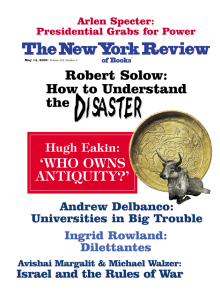
nyrb051409Their proposals had a slow fuse but they eventually set off a firestorm of protest.  Responding to a shorter version of the main essay [‘Assassination and preventive killing’, SAIS Review of International Affairs 25 (1) (2005)  41-57] and writing in the New York Review of Books (14 May 2009), Avishai Margalit and Michael Walzer were unequivocally appalled:

‘Their claim, crudely put, is that in such a war the safety of “our” soldiers takes precedence over the safety of “their” civilians.  Our main contention is that this claim is wrong and dangerous. It erodes the distinction between combatants and noncombatants, which is critical to the theory of justice in war (jus in bello).’

They continued:

‘The point of just war theory is to regulate warfare, to limit its occasions, and to regulate its conduct and legitimate scope. Wars between states should never be total wars between nations or peoples. Whatever happens to the two armies involved, whichever one wins or loses, whatever the nature of the battles or the extent of the casualties, the two nations, the two peoples, must be functioning communities at the war’s end. The war cannot be a war of extermination or ethnic cleansing. And what is true for states is also true for state-like political bodies such as Hamas and Hezbollah, whether they practice terrorism or not. The people they represent or claim to represent are a people like any other.

The main attribute of a state is its monopoly on the legitimate use of violence. Fighting against a state is fighting against the human instruments of that monopoly—and not against anyone else….

The crucial means for limiting the scope of warfare is to draw a sharp line between combatants and noncombatants. This is the only morally relevant distinction that all those involved in a war can agree on. We should think of terrorism as a concerted effort to blur this distinction so as to turn civilians into legitimate targets. When fighting against terrorism, we should not imitate it.’

In contrast,

‘For Kasher and Yadlin, there no longer is a categorical distinction between combatants and noncombatants. But the distinction should be categorical, since its whole point is to limit wars to those—only those—who have the capacity to injure (or who provide the means to injure)….

‘This is the guideline we advocate: Conduct your war in the presence of noncombatants on the other side with the same care as if your citizens were the noncombatants. A guideline like that should not seem strange to people who are guided by the counterfactual line from the Passover Haggadah, “In every generation, a man must regard himself as if he had come out of Egypt.”

Menahem YaariTheir critique found vigorous support from Menahem Yaari, a theoretical economist whose work has addressed (amongst other things) questions of justice, uncertainty and risk, but who wrote in a subsequent issue (8 October 2009) in his capacity as President of the Israel Academy of Sciences and Humanities:

‘A military code of conduct that discriminates, in cases of hazards being inflicted upon innocent civilians, on the basis of whether these civilians are “ours” or “theirs” is all the more worrisome when viewed against a general background of growing ethnocentric and xenophobic attitudes in Israel’s traditional establishment. We see an ongoing drift from universalism and humanism toward parochialism and tribalism.’

Picking up from that last sentence, Chamayou believes that this drift has accelerated and that it is by no means confined to Israel’s ‘traditional establishment’.  In his view, the ‘evisceration’ of the core principles of international humanitarian law by a ‘nationalism of self-preservation’ has become ‘the primary guiding principle of the necro-ethics of the drone’ (p. 189).

2: Humanitarian weapon

Chamayou seeks to trace a line of descent from the previous arguments to those advanced more recently by academics who directly address (and defend) the US use of drones.  He has two men in mind: Avery Plaw, an Associate Professor of Political Science at UMass – Dartmouth, and Bradley Jay Strawser, an Assistant Professor of Philosophy in the Defense Analysis Department at the US Naval Postgraduate School at Monterey.

UMass_Drone-crop

Plaw has collaborated with several colleagues to track and evaluate drone strikes in Pakistan and is involved in the UMass DRONE project (I’ve commented on this before), but it’s an Op-Ed in the New York Times on 14 November 2012 that catches Chamayou’s attention.  ‘Drones save lives, American and others’ was the headline, and Chamayou is bemused: ‘How can an instrument of death save lives?’

The question seems to invite a biopolitical response – ‘killing in order to let live’, as Mbembe and others would no doubt have it, and Chamayou doesn’t quite provide that – but neither does Plaw quite say what the headline implies.  He suggests that ‘drone strikes are the best way to remove an all-too-real threat to American lives’ and that ‘there is evidence that drone strikes are less harmful to civilians than other means of reaching Al Qaeda and affiliates in remote, lawless regions’. Perhaps this amounts to the same thing, but it’s not quite the cold calculus that Chamayou attributes to Plaw.  And as I read his (brief) intervention, the ‘American lives’ that Plaw sees as being at risk are not those of, say, ground troops in Afghanistan but of civilians in the continental United States threatened by attacks from al-Qaeda and its affiliates  – though even then Plaw would have to explain how they are ‘saved’ by attacks on the Taliban and other militant groups which scarcely pose a trans-continental danger.

'Nobody dies' Popular Science November 1997

In any event, Chamayou challenges what he sees as the paradoxically vitalist claim that serves as the first principle of contemporary necro-ethics: drones are ‘humanitarian’ because they save lives – and specifically ‘our’ lives (p. 192), which he sees encapsulated even more succinctly than in Plaw’s Op-Ed by the tag-line in the image above (from Popular Science in November 1997): ‘Nobody dies – except the enemy.’

STRAWSER Killing by remote controlThis is where he turns to – and on – Strawser.  Like Plaw, he has had his views publicised in the media –see Rory Carroll on ‘The philosopher making the moral case for US drones’  in the Guardian here and Strawser’s hasty qualification here – but Chamayou directs his attention to Strawser’s essay ‘Moral Predators: the duty to employ uninhabited aerial vehicles’, Journal of military ethics 9 (4) (2010) 342-68.  More recently, by the way, he’s edited a collection of essays, Killing by remote control: the ethics of an unmanned military (Oxford University Press, 2013), which includes an essay by Plaw on ‘Counting the dead: the proportionality of predation in Pakistan’ and an exchange between Kasher and Plaw, in which the (I think substantial) differences between the two are clarified.  These centre on the principle of distinction: the requirement to discriminate between combatants and civilians.  Kasher makes no secret of what he calls his ‘negative attitude to the principle of distinction as it is commonly understood and practically applied’ (which doesn’t leave much room for a positive attitude).  ‘Humanitarian’, he insists, means ‘an attitude towards human beings as such, not toward a certain group of people’ – given the way in which the IDF treats Palestinians, this strikes me as pretty thick – so that the principle of distinction is really ‘civilarian’ (his term) and fails to respect ‘the human dignity of combatants in the broad sense of men and women in uniform’ (which isn’t a ‘broad sense’ at all, of course: Kasher’s combatants all wear uniform).  ‘A democratic state [sic] owes its citizens in military uniform a special justification for jeopardizing their life when they do it not for the relatively simple reason of defending their fellow citizens,’ he argues, ‘but when they are required to do it for the sake of saving the life of enemy citizens who are not combatants.’  The recourse to drones, he concludes, ‘circumvents such difficulties’.

Similarly, though not identically, Strawser regards the drone as not simply a morally permissible weapon but rather as a morally compulsory one.  He proposes a Principle of Unnecessary Risk , according to which ‘it is wrong to command someone to take on unnecessary potentially lethal risks in an effort to carry out a just action for some good’, and then extrapolates more or less directly to the compulsion to employ Unmanned Aerial Vehicles (UAVs):

‘We have a duty to protect an agent engaged in a justified act from harm to the greatest extent possible, so long as that protection does not interfere with the agent’s ability to act justly. UAVs afford precisely such protection. Therefore, we are obligated to employ UAV weapon systems if it can be shown that their use does not significantly reduce a warfighter’s operational capability.’

Strawser then qualifies his basic Principle: ‘the just warrior’s increased protection (which a UAV provides) should not be bought at an increased risk to noncombatants.’   In effect, Chamayou argues, Strawser makes Kasher and Yadlin’s principle of self-preservation subordinate to the minimisation of risks to non-combatants.  But when Strawser insists that ‘if using a UAV in place of an inhabited weapon platform in anyway whatsoever decreases the ability to adhere to jus in bello principles [of proportionality and distinction], then a UAV should not be used,’ Chamayou believes he is also playing his ‘get out of jail free’ card.  For Strawser claims that ‘there is good reason to think just the opposite is true: that UAV technology actually increases a pilot’s ability to discriminate’.   In support, Strawser cites an Israeli pilot –

‘The beauty of this seeker is that as the missile gets closer to the target, the picture gets clearer . . .The video image sent from the seeker via the fiber-optic link appears larger in our gunner’s display. And that makes it much easier to distinguish legitimate from non-legitimate targets’ 

– and Plaw’s analysis of drone strikes in Pakistan from 2004 to 2007.  Strawser concedes that the claim for enhanced distinction is an empirical one; Plaw’s analysis needs a fuller examination than I can provide in this post, but it’s important to note that 2007 is a significant cut-off.  As the chart below shows, from the splendid Bureau of Investigative Journalism, this is long before the Obama administration ramped up the attacks on the Federally Administered Tribal Areas.  Plaw’s chapter in Killing by remote control extends his analysis to 2011 and concludes that US drone strikes – particularly when weighed against casualties from insurgent attacks or Pakistan military operations in the region – most often meet the demands of proportionality; but the discussion doesn’t directly address discrimination.
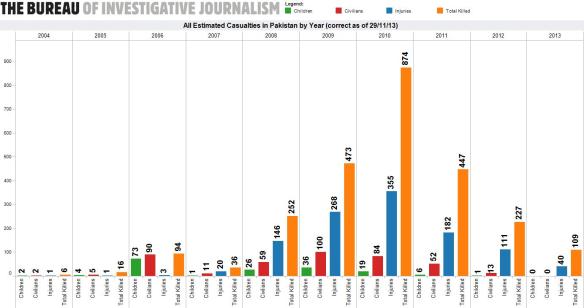
All-Totals-Dash47

What Strawser does, Chamayou concludes, is offer a technical resolution of an ethical dilemma: it is not necessary to subordinate one principle to another – minimisation of risk to combatants (‘citizen-soldiers’) or minimisation of risk to non-combatants (‘alien’ or otherwise) – because this new technology of killing promises to satisfy both.  In effect, drones are supposed to introduce a new, intrinsically ethical symmetry to asymmetric warfare: they save ‘our’ lives and ‘their’ lives.  They combine the power to kill and to save, to wound and to care, a weapon at once humanitarian and military – ‘humilitaire’, as Chamayou has it.  (Others have made a case for the humanitarian uses of unarmed drones, but their arguments are a far cry from military applications).

Yet if this new military power saves lives, Chamayou demands, what is it saving them from?  His answer: from itself, from its own power to kill.  And if this seems the lesser evil, in Eyal Weizman‘s terms the ‘result of a field of calculations that seeks to compare, measure and evaluate different bad consequences’, then we need to remind ourselves, with Hannah Arendt, how quickly ‘those who choose the lesser evil forget … that they chose evil.’

Chamayou turns to Weizman deliberately; that ‘field of calculations’, the calculus that is focal to the construction through calibration of our ‘humanitarian present’, is the target of Chamayou’s next and final chapter in his critique of necro-ethics – of which more very soon.

UPDATE: Today’s Guardian has a video debate between Seumas Milne and Peter Lee (Portsmouth University): ‘Is the use of unmanned military drones ethical or criminal?’ Lee claims that, ‘used correctly’, this new technology and in particular the MQ-9 Reaper is ‘the most potentially ethical use of air power yet devised.’

Stilled life

In my last post I drew attention to China Miéville‘s essay on the Israeli Wall that gashes occupied Palestine which was, in part, a portfolio of photographs, and to Helga Tawil-Souri‘s anguished questions about photographing the monstrosity:

What am I supposed to do with a string of images? How will I put them back together to tell a story when there is no story to be told anymore? Photographing it, filming it, trying to write about it, only contradicts its very nature: a time-space of interruption, of suspension.

Others have reflected on these issues too: see, for example, Simon Faulkner, ‘The most photographed wall in the world’, Photographies 5 (2) (2012) 223-42:

On the one hand, the Wall has become a patently visible structure around which to galvanize opposition to the Israeli occupation. On the other, this very visibility is a problem in that it has tended to reduce the occupation to the Wall.

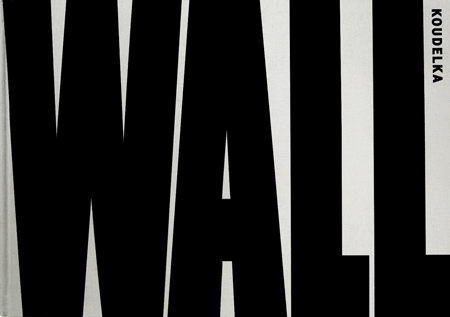
WALL

But I’m particularly taken by the work of the Czech (‘I’m not Czech like the Czechs’) engineer-turned-photographer Josef Koudelka whose Wall (published by Aperture last month) records his own encounters with the structure between 2008 and 2012 and whose gaze reaches beyond the wall itself into the wider landscape of occupation, exaction and repression.

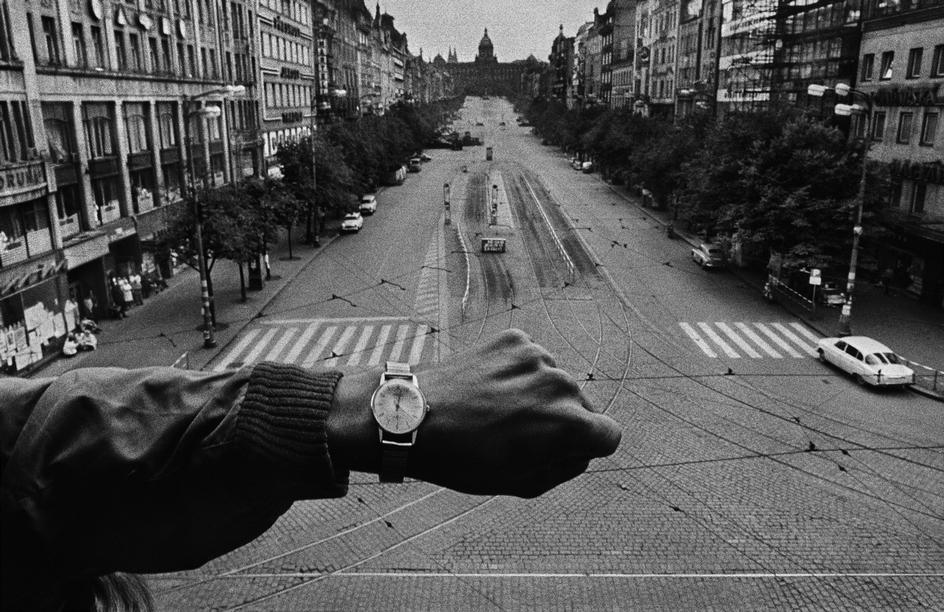
Koudelka’s work first captured public attention in 1968 when he courageously documented the Soviet-led occupation of Czechoslovakia.  ‘I grew up behind a wall,’ he told Ha’aretz, ‘and because of that experience I am very sensitive to all the people who grew up behind a wall.’

KOUDELKA Prague 68

His publisher explains that the new book is part of a larger project, This Place, initiated by photographer Frédéric Brenner:

This Place explores Israel as place and metaphor through the eyes of 12 acclaimed photographers, who were invited to look beyond dominant political narratives and to explore the complexity of the place – not to judge, but to question and to reveal.

It’s not easy to track down much information about the project, which included photographers like Jeff Wall and Gilles Peress, but a New York Times report from December 2011 described Koudelka’s response:

Though he is not a political person, he said, “it is not easy for me in this country. I don’t see things that make me very cheerful.” He said he was focusing on “the crime against the landscape, in the most holy landscape for humanity.”

KOUDELKA Wall

And over at the New York Review of Books blog David Shulman has an exceptionally fine meditation on the wall and Koudelka’s Wall, which includes a series of images from the book:

Koudelka’s pictures have an eerie, meditative texture. Many of them are structured around the glaring contrast between the Wall, always intrusive, harsh, ophidian, and the organic, still living world of hills, terraces, and valleys on either side of it. Paradoxically, these photographs are beautiful, almost too beautiful, to look at—despite, or perhaps because of, the raw wound they reveal. Look, for example, at the graveyard of decimated olive trees in an area earmarked for annexation to the east of Jerusalem. I have known Palestinian farmers who treat their olive trees—sometimes their main life support—like beloved children, and who sit in mourning when a tree is killed by settlers or soldiers…

To my mind the most powerful of Koudelka’s images is the final one in the book: Wall to the left, Wall to the right, a menacing emptiness in between, a lifeless place fixed in concrete and leading nowhere, despite the sadly hopeful sign pasted on the left-hand wall, pointing one way to Jerusalem, and the other way to Rachel’s Tomb, where the Matriarch Rachel weeps for her children.

And yet, as Shulman implies and James Johnson reiterates here, these images are empty of life and, at the limit, the panoramic gaze seems to ‘depersonalise suffering’… (which, if you follow Eyal Weizman‘s Hollow Land, should come as no surprise, though I think it’s also possible to read these photographs in other, mournful – indeed, haunted – ways).  More from Shulman in his Dark Hope: working for peace in Israel and Palestine (2003).


Another brick in the wall

When I was writing the Israel/Palestine chapters in The Colonial Present the vast, wretched landscape of occupation and repression was numbingly new to me (though it shouldn’t have been). I found little help from mainstream geography, with some honourable exceptions, and I vividly remember my first visit to the West Bank with Steve Graham, Eyal Weizman and others.  You would think I would have been prepared: I’d certainly read everything I could lay my hands on.

Wall

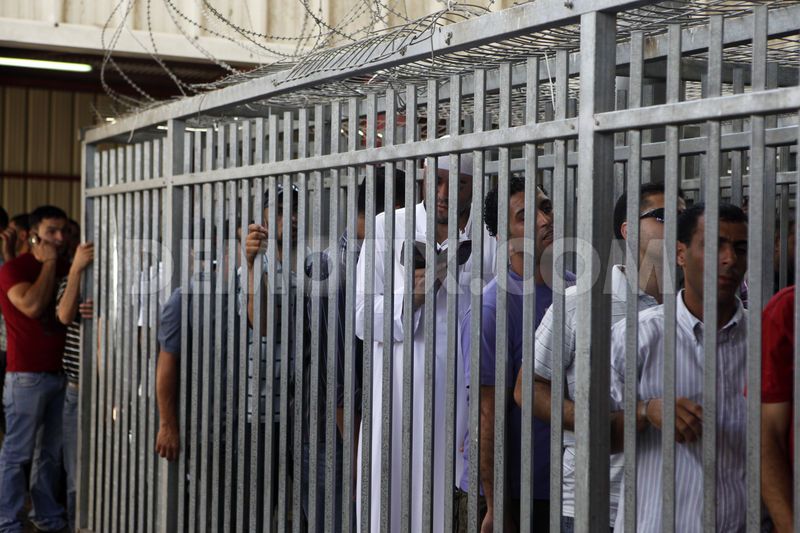
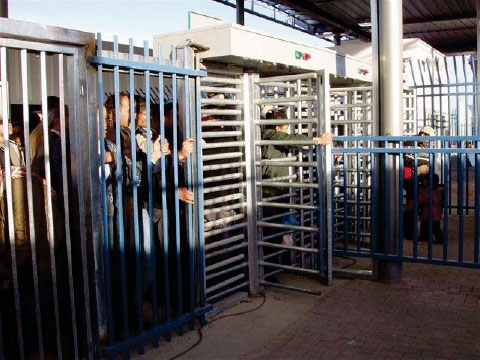
But nothing prepares you for the enormity of the occupation, its monstrous violence and everyday humiliations, and the sight of the wall snaking across the landscape – what Ariella Azoulay and Adi Ophir call ‘the Monster’s Tail’ – remains one of the most appalling impositions I have ever seen.  Neither was I ready for the iron-clad violence of the Qalandiyya checkpoint, whose enclosures, grills and bars that would not have been out of place in an abbatoir could barely contain the brooding militarised violence of those who constructed it: but of course they weren’t supposed to.

1379713379-palestinians-wait-at-qalandia-checkpoint_2738542

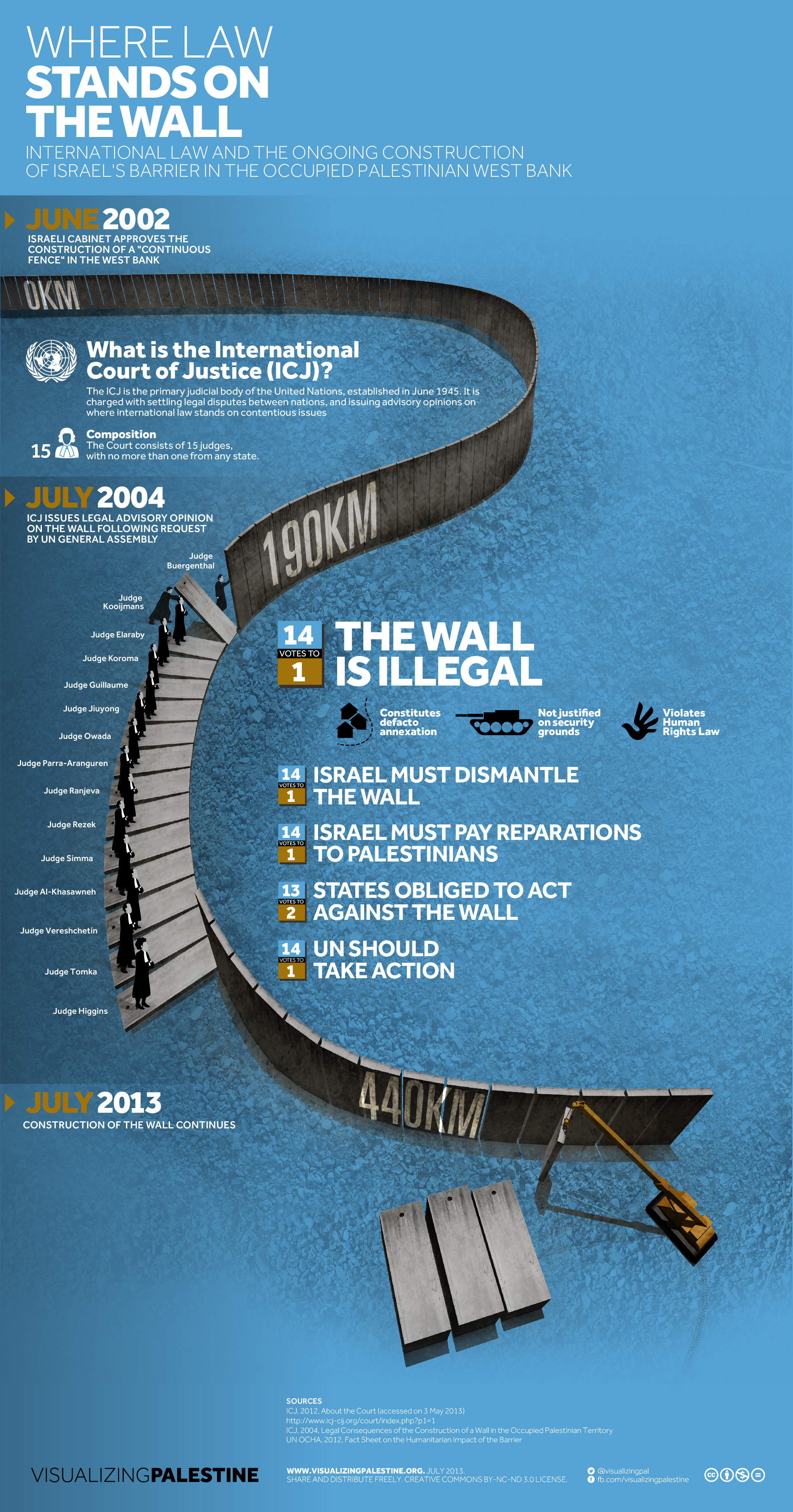
Since then, much of this has become all too familiar – which is part of the problem – but there are now many more geographers doing vitally important work on occupied Palestine.  Visualizing Palestine has recently added this new infographic about the wall to its excellent portfolio:

VP Where Law stands on the Wall

The focus adds yet another dimension to contemporary discussions about international law and what Michael Smith calls ‘geo-legalities’.  I’m keenly interested in those arguments, but today I’m led down this path by a new essay –part prose, part photography – composed by China Miéville for the Palestinian Literature Festival and performed by him at Nablus.

MIEVILLE Beyond equal rightsMiéville is best known as a novelist (and one with an intriguing geographical sensibility at that), but he’s no stranger to international law either: his Between Equal Rights: a Marxist theory of international law (2006) has been widely acclaimed. Yet this morning I’m seized by his photo-literary apprehension of the familiar unreality of the landscape of occupation:

Yes, we know the holy land is now a land of holes, and lines, a freakshow of topography gone utterly and hideously mad, that the war against Palestinians is also a war against everyday life, against human space, a war waged with all expected hardware, with violent weaponized absurdism, with tons and tons of concrete and girders.  This is truism, and/but true.

His experience of crossing the line reminds me of my own, though he captures its Kafka-esque horror far more vividly:

And in its wedge of shadow the long stupid zigzag of the checkpoint between Bethlehem and Jerusalem is indicated with a sign, there on the Bethlehem side. Entrance, it says, white on green, and points to the cattle run. Inside are all the ranks of places to wait, the revolving grinder doors, green lights that may or may not mean a thing, the conveyor belts and metal detectors and soldiers and more doors, more metal striae, more gates.

Finally, for those who emerge on the city side, who come out in the sun and go on, there is a sign they, you, we have seen before. White on green, pointing back the way just come.

Entrance, it says. Just like its counterpart on the other side of a line of division, a non-place.

No exit is marked.

The arrows both point in. Straight towards each other. The logic of the worst dream. They beckon. They are for those who will always be outside, and they point the way to go. Enter to discover you’ve gone the only way, exactly the wrong way.

Entrance: a serious injunction. A demand. Their pointing is the pull of a black hole. Their directions meet at a horizon. Was it ever a gateway between? A checkpoint become its own end.

This is the plan. The arrows point force at each other like the walls of a trash compactor. Obey them and people will slowly approach each other and edge closer and closer from each side and meet at last, head on like women and men walking into their own reflections, but mashed instead into each other, crushed into a mass.

Entrance, entrance. These directions are peremptory, their signwriters voracious, insisting on obedience everywhere, impatient for the whole of Palestine to take its turn, the turn demanded, until every woman and man and child is waiting on one side or the other in long long lines, snaking across their land like the wall, shuffling into Israel’s eternal and undivided capital, CheckPointVille, at which all compasses point, towards which winds go, and there at the end of the metal run the huge, docile, cow-like crowds will in this fond, politicidal, necrocidal, psyche-cidal fantasy, meet and keep taking tiny steps forward held up by the narrowness of the walls until they press into each others’ substance and their skins breach and their bones mix and they fall into gravity one with the next. Palestine as plasma. Amorphous. Amoebal. Condensed. Women and men at point zero. Shrunken by weight, eaten and not digested. An infinite mass, in an infinitely small space.

If you can bear to read more about this ‘non-place’, as Mieville calls it, try Helga Tawil-Souri, ‘Qalandia checkpoint as space and nonplace’, Space and culture 14 (1) (2011) 4-26; Irus Braverman, ‘Civilized borders: a study of Israel’s new crossing administration’, Antipode 43 (2) (2011) 264-95; Hagar Kotef and Merav Amir, ‘Between imaginary lines: violence and its justifications at the military checkpoints in occupied Palestine’, Theory, culture and society 28 (1) (2011) 55-50; and Merav Amir, ‘The making of a void sovereignty: political implications of the military checkpoints in the West Bank’. Environment and Planning D: Society & Space 31 (2013) 227-44.

qalandia_b

These are all behind paywalls, and if you can’t pass through those walls – and even if you can – I also recommend an open access essay by Helga Tawil-Souri, ‘Qalandia: an autopsy’, Jerusalem Quarterly 45 (2011) available here.  It’s a brilliant essay, and apart from what it has to tell us about the checkpoint (or ‘terminal’, as the Israelis prefer), like Miéville’s it also has much to teach us about the power of prose and the material politics of representation:

 Qalandia is dead because this time I find it impossible to photograph. I am paralyzed. Where do I stand? What do I document? Why am I even bothering? What am I supposed to do with a string of images? How will I put them back together to tell a story when there is no story to be told anymore? Photographing it, filming it, trying to write about it, only contradicts its very nature: a time-space of interruption, of suspension.  The checkpoint disjoints, tears the limbs off of my body; to want to tell its ‘story’ is a form of re-con-joining. I cannot. It has taken that right away from us.

Unfinished business

I’m sorry for the long silence: the past two weeks have been unusually busy, with a stream of wonderful visitors to the Peter Wall Institute for Advanced Studies, including Philippe Descola, Anne-Christine Taylor and Bruno Latour.  More on this soon, but during a series of conference presentations – in which, more or less in passing, I mentioned Joshua Oppenheimer‘s The act of killing (2012) (see here and here) – I was told of another, related project that readers will find interesting.

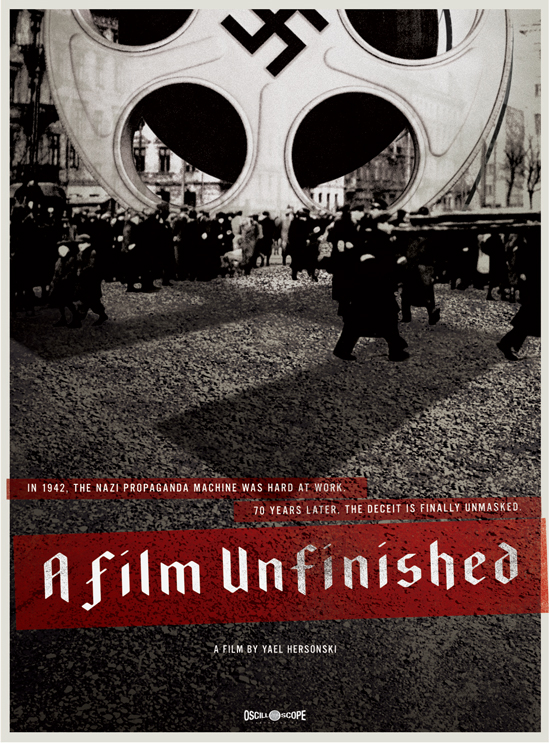
This is Yael Hersonski‘s A Film Unfinished [Shtikat Haarchion] (2010).  The centre of the documentary – you can hardly say its ‘heart’ – is an unfinished propaganda film shot by the Nazis in 1942, Das Ghetto, which purported to portray the Warsaw Ghetto.  It was found in an archive in East Germany in 1954, but in 1988 two discarded film cans containing 30 minutes of outtakes were discovered – scenes left on the cutting room floor – which radically transformed the interpretation of the film and revealed the elaborate staging of its scenes.  You can obtain another overview of the project here, which includes a number of stills from A Film Unfinished.

A film unfinished

The parallel with Oppenheimer’s project is drawn by Hersonski’s re-staging of an interview with one of the original cameramen, Willy Wist (he died in 1999 but Hersonski works from a transcript she found by chance in an archive in Ludwigsburg), and by her decision to invite five survivors of the Ghetto to watch the out-takes and to record their reactions.

This is from Jeannette Catsoulis‘s thoughtful review in the New York Times:

What if I see someone I know?jpg“What if I see someone I know?” one woman asks [she does], hardly daring to look. As the flickering atrocities play across the survivors’ faces — one film observing another — Ms. Hersonski silently creates space for memories. More than just valuable reality checks (“When did you ever see a flower? We would have eaten a flower!”), these recollections anchor the past to the present, and the images to human experience, in a way that shifts our perception of the Warsaw film. Whether cringing at the sight of naked men and women being forced at gunpoint into a ritual bath, or contemptuously dismissing the Nazis’ efforts to highlight Jewish privilege (“My mother wore her beautiful coat, and sometimes a hat. So what?”), the survivors seem to speak for those who cannot.

Here is the trailer.  The whole film is available on YouTube but I can’t embed it because it has a restricted rating, so you need to confirm you are old enough to watch it: here.

Catsoulis suggests that the film is concerned with the difference between watching and seeing, and in this sense the other obvious parallel is with Giorgio Agamben‘s philosophico-ethical probings of the witness and the camp.  Hersonski herself says that her film ‘first emerged out of my theoretical preoccupation with the notion of the “archive”, and the unique nature of the witnessing it bears.’ (She elaborates this in an interview with Max Goldberg here and there is also a really excellent interview with Lalev Melamed, ‘A Film Unraveled’, in the International journal of politics, culture and society 26 (13) 9-19, which includes an interesting comparison between Hersonski and Harun Farocki).

Witnessing is of more than historical significance, of course, and in an extended interview with Clyde Fitch – in which he asks her about complicity and guilt – Hersonski deflects his question from the past to our own present:

I’m asking myself a different question. I’m asking myself: What is my ethical position when I’m sitting very comfortably in my living room and seeing whatever is happening a few kilometers from my city in the occupied territories?…

What can I do? No, it’s not a rhetorical question. I’m seeing this and other events unfold — I’m watching it, I know about it, I know it’s there. I’m not talking about politics right now, by the way, just images of people suffering. And, as the images of people suffering in my own country go, you become a witness. Then what do you do as a witness? It’s a terrible question — it’s a haunting, torturing question. It’s our essential question.

I think that it was also a major reason why I made this film — because the Holocaust not only confronted humanity with an inconceivable horror but it also did mark the very beginning of the systematic implementation on film of that horror. And I think that something changed in our perception — I don’t know even how to define this something — after we saw images from the camps, something that we hadn’t witnessed before. It seems that documentation became more technically advanced, more massive, since then.

Well, as long as this bombardment of images becomes more intense, we will become more and more incapable of really seeing suffering, or war.

Fitch describes the film as ‘an act of anthropology’ – something which our three guests at the Wall would surely recognise too.

Hard rain

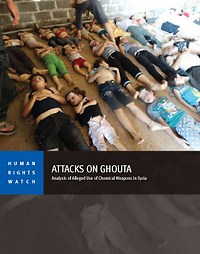
Human Rights WatchSome more forensic geography from Human Rights Watch (I’ve long though that some of the very best human geography is produced by organisations like HRW).

Attacks on Ghoutta (22 pp) analyses the chemical weapons attacks on the suburbs of Ghoutta on 21 August 2013.  Here is the Executive Summary:

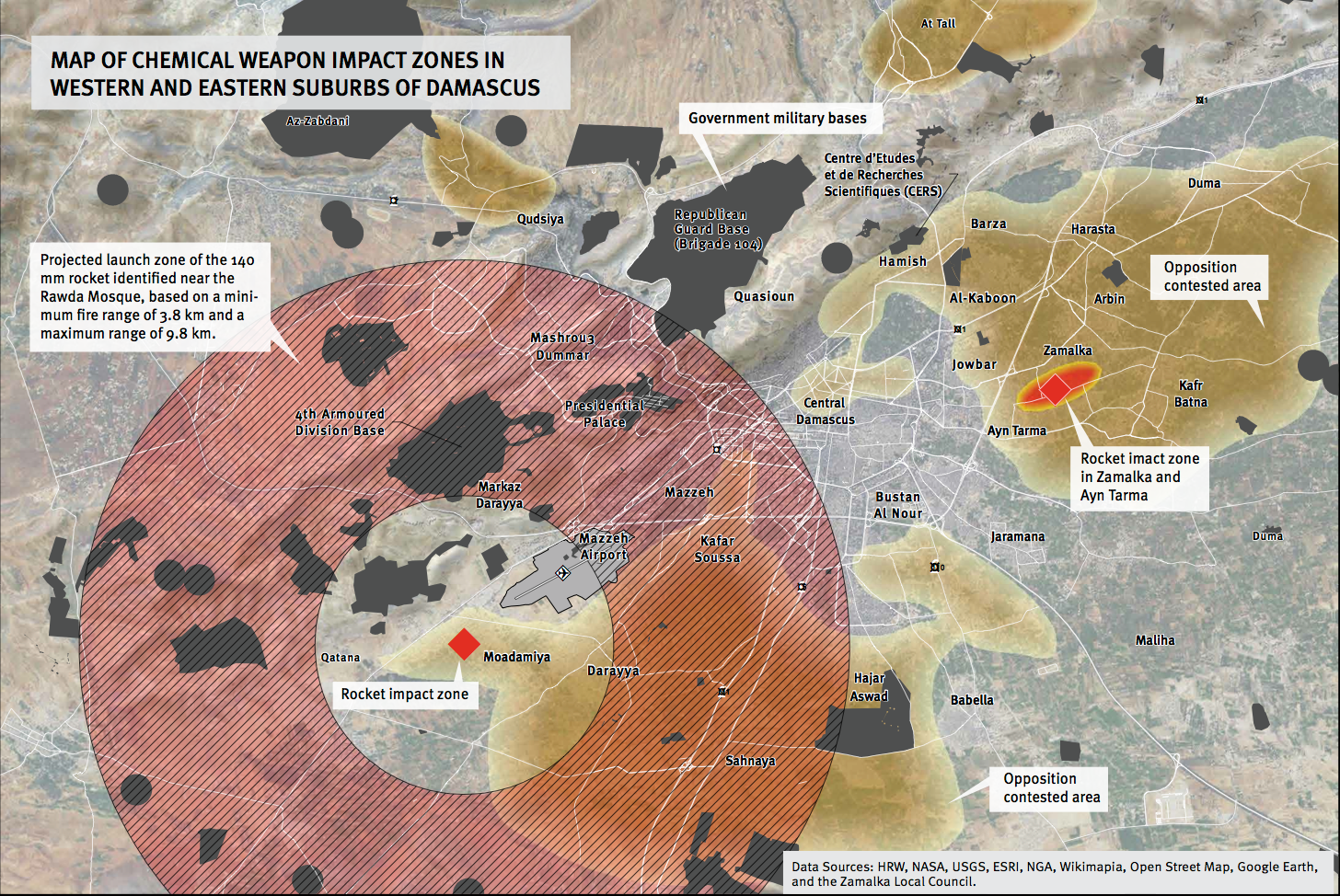
This report details two alleged chemical weapons attacks in Syria on the opposition-controlled Damascus suburbs of Eastern and Western Ghouta, located 16 kilometers apart, on the morning of August 21, 2013. The attacks killed hundreds of civilians, including large numbers of children. Human Rights Watch analyzed witness accounts of the rocket attacks, information on the likely source of the attacks, the physical remnants of the weapon systems used, and the medical symptoms exhibited by the victims of the attack as documented by medical staff.

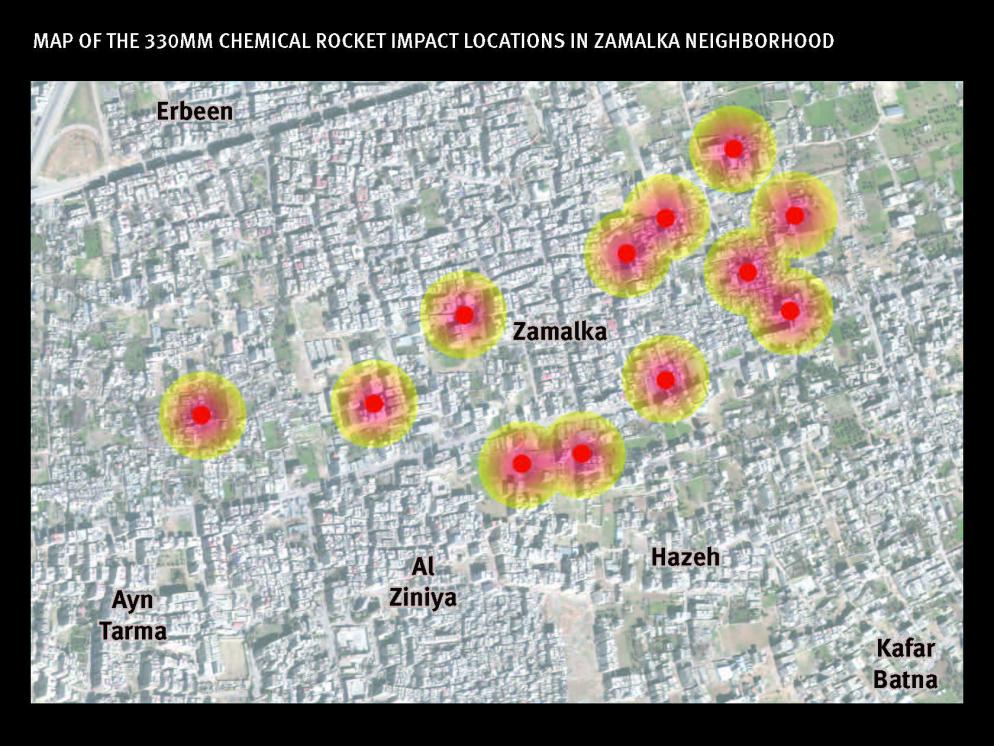
zamalaka_mapOur investigation finds that the August 21 attacks were likely chemical weapons attacks using a surface-to-surface rocket system of approximately 330mm in diameter—likely  Syrian-produced—and a Soviet-era 140mm surface-to-surface rocket system to deliver a nerve agent. Evidence suggests the agent was most likely Sarin or a similar weapons-grade nerve agent. Three local doctors told Human Rights Watch that victims of the attacks showed symptoms which are consistent with exposure to nerve gas, including suffocation; constricted, irregular, and infrequent breathing; involuntary muscle spasms; nausea; frothing at the mouth; fluid coming out of noses and eyes; convulsing; dizziness; blurred vision; and red and irritated eyes, and pin-point pupils.

The evidence concerning the type of rockets and launchers used in these attacks strongly suggests that these are weapon systems known and documented to be only in the possession of, and used by, Syrian government armed forces. Human Rights Watch and arms experts monitoring the use of weaponry in Syria have not documented Syrian opposition forces to be in the possession of the 140mm and 330mm rockets used in the attack, or their associated launchers.

The Syrian government has denied its responsibility for the attack, and has blamed opposition groups, but has presented no evidence to back up its claims. Based on the available evidence, Human Rights Watch finds that Syrian government forces were almost certainly responsible for the August 21 attacks, and that a weapons-grade nerve agent was delivered during the attack using specially designed rocket delivery systems. The scale and coordinated nature of the two attacks; against opposition-held areas; the presence of government-controlled potential launching sites within range of the targets; the pattern of other recent alleged chemical weapon attacks against opposition-held areas using the same 330mm rocket delivery system; and the documented possession of the 140mm and 330mm rocket systems able to deliver chemical weapons in the government arsenal—all point towards Syrian government responsibility for the attacks.

Human Rights Watch has investigated alternative claims that opposition forces themselves were responsible for the August 21 attacks, and has found such claims lacking in credibility and inconsistent with the evidence found at the scene. Claims that the August 21 deaths were caused by an accidental explosion by opposition forces mishandling chemical weapons in their possession are inconsistent with large numbers of deaths at two locations 16 kilometers apart, and documentation of rocket attacks on the sites that morning, as evidenced by witness accounts, the damage visible on the rockets themselves, and their impact craters.

Chemical weapon impact zones, Ghoutta (HRW)

Three quick observations.

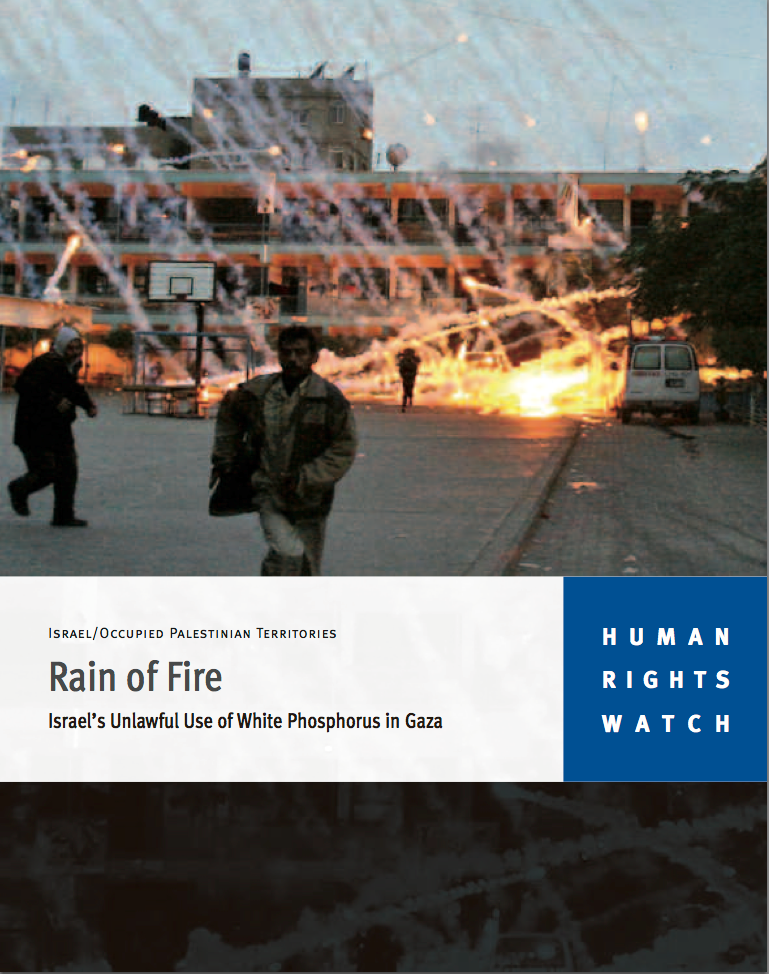
HRW Rain of FireHRW used a range of sources to conduct its analysis-from-a-distance, including Skype interviews, video and photographic footage, and satellite imagery, and consulted with scientific experts on chemical warfare, key analysts from its own Arms Division and independent arms experts. I rehearse all this because when HRW carried out its searching analysis of the unlawful use of white phosphorus by the Israel Defense Force in Gaza, Rain of Fire, a forensic analysis that was cited multiple times in the Goldstone report, the defenders of the IDF (there’s a phrase) unleashed a desperate campaign to discredit HRW’s expert Marc Garlasco.  You can find a discussion in Eyal Weizman‘s The least of all possible evils (see also here). This time round, of course, the government of Israel has joined the (I think convincing) chorus identifying the Syrian Army as the culprits: but it will be interesting to see whether it has also been magically converted to the propriety of HRW’s forensic analysis.

I link the two reports for a second reason, which is the disgracefully selective and self-serving nature of the ‘humanitarian’ condemnation of chemical weapons.  Here is President Obama speaking yesterday:

‘…the world saw in gruesome detail the terrible nature of chemical weapons, and why the overwhelming majority of humanity has declared them off-limits — a crime against humanity, and a violation of the laws of war.’

He conceded that this wasn’t always the case:

‘In World War I, American GIs were among the many thousands killed by deadly gas in the trenches of Europe. In World War II, the Nazis used gas to inflict the horror of the Holocaust. Because these weapons can kill on a mass scale, with no distinction between soldier and infant, the civilized world has spent a century working to ban them. And in 1997, the United States Senate overwhelmingly approved an international agreement prohibiting the use of chemical weapons, now joined by 189 governments that represent 98 percent of humanity.

On August 21st, these basic rules were violated, along with our sense of common humanity.’

But what a selective mobilisation of history, in which the US rises from victim to saviour.  Now I agree that the use of chemical weapons in Syria is vile – but so too was  Israel’s use of white phosphorus in Gaza ( in the same speech Obama reaffirmed the US’s “unshakable support” for Israel), the US-led coalition’s use of depleted uranium munitions in Iraq (which goes back to 1991; see also Omar Dewachi on ‘the toxicity of everyday life’ here), Iraq’s use of nerve gas against Iran in 1988 (in which we now have proof that the US was complicit), the US deployment of chemical herbicides in Vietnam, Laos and Cambodia… the list goes on and on.

And this brings me to my third (no less obvious) observation: showing who used chemical weapons is a far cry from knowing what to do about it – especially when the network of responsibility and complicity is so hideously extensive.

***

Update: I’ve been so busy trying to finish two desperately overdue essays and to prepare for the start of a new term (I’ve posted the new outlines for my undergraduate and graduate courses under the TEACHING tab) that I haven’t had a chance to return to my reading of Théorie du drone, but I’m determined to do so very soon.

Dignity and destruction in Gaza

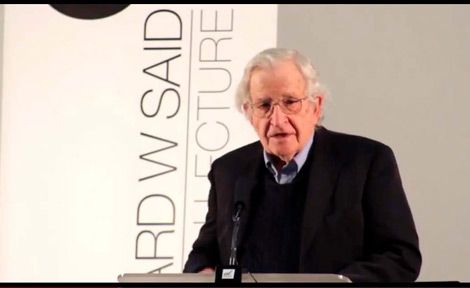
Noam Chomsky delivering the 2013 Edward Said Memorial Lecture

Edward Said died ten years ago in September, and earlier this month Noam Chomsky delivered the 2013 Edward Said Memorial Lecture in London: Violence and dignity: reflections on the Middle East.  The text that formed the basis for the lecture is here, and you can watch a video of the lecture here with introductions by Omar Al Qattan and Mariam Said.

It’s a wide-ranging lecture, but Chomsky returns again and again to the plight of the people of Gaza – and to the disgraceful actions of all those (inside Israel and out) who would rob them of their dignity, their independence and even their life.

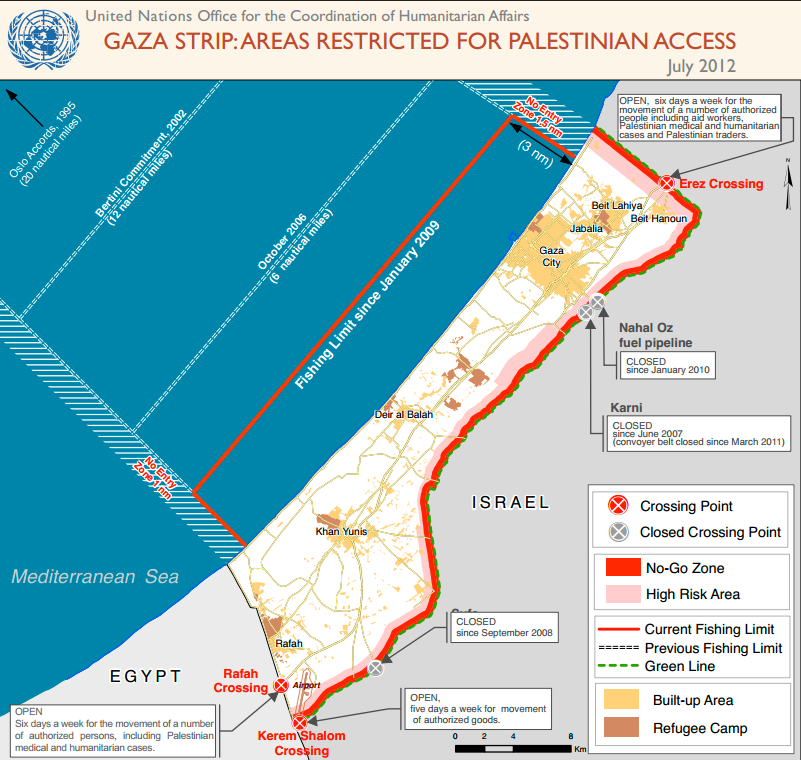
Throughout these years Gaza has been a showcase for violence of every imaginable kind. The record includes such sadistic and carefully planned atrocities as Operation Cast Lead — “infanticide,” as it was called by the remarkable Norwegian physician Mads Gilbert who worked tirelessly at Gaza’s al-Shifa hospital with his dedicated Palestinian and Norwegian colleagues right through the criminal assault — a fair term, considering the hundreds of children massacred. And from there the violence ranges through just about every kind of cruelty that humans have used their higher mental faculties to devise, up to the pain of exile that Edward Said wrote about so eloquently. This is particularly stark in Gaza, where older people can still look across the border towards the homes a few miles away from which they were driven — or could if they were able to approach the border without being killed. One form of punishment has been to close off the Gaza side of the border area, including almost half the arable land, according to the leading academic scholar of Gaza, Harvard’s Sara Roy.

While a showcase for the human capacity for violence, Gaza is also an inspiring exemplar of the demand for dignity. The first phrase one hears in Gaza when asking about personal aspirations is for a life of dignity. The distinguished human rights lawyer Raji Sourani writes from his Gaza home that “What has to be kept in mind is that the occupation and the absolute closure is an ongoing attack on the human dignity of the people in Gaza in particular and all Palestinians generally. It is systematic degradation, humiliation, isolation and fragmentation of the Palestinian people.” While the bombs were once again raining down on defenseless civilians in Gaza last November he repeated that “We demand justice and accountability. We dream of a normal life, in freedom and dignity.”

Gaza Strip restrictions

Last fall the brilliant Sara Roy gave another Said Memorial Lecture, this time at the Palestine Center in Washington DC, A deliberate cruelty: rendering Gaza unviable.  She spoke of Edward’s commitment to Gaza and its people:

Edward and I would always speak about Gaza, in fact every time we met. He felt a profound connection to the place and to the people that seemed to be a permanent part of him. Edward had great compassion and great respect for Gaza’s people. He embraced their suffering and took pride in their courage, in the dignified way they continued to move forward. Yet he feared one thing perhaps most of all: the separation and isolation that now engulfs Gaza and threatens, if it hasn’t already, to sever the Palestinians there from Palestinians elsewhere, forcing them, in the words of Hannah Arendt, to “live outside the common world,” deprived of profession and of citizenship, “without a deed by which to identify or specify [themselves].”

Edward raged against the division of his people and against the kind of loss that such division could bring: disunity, abandonment, irrelevance. In The Origins of Totalitarianism, Arendt argues that the fundamental deprivation of human rights is expressed first and most powerfully in “the deprivation of a place in the world which makes opinions significant and actions effective. Something much more fundamental than freedom and justice… is at stake when belonging to the community into which one is born is no longer a matter of course and not belonging no longer a matter of choice…” “This extremity and nothing else,” she writes, “is the situation of people deprived of human rights. They are deprived not of the right to freedom but of the right to action.” “Over the last 45 years Gaza’s trajectory has been striking; from a territory economically integrated into, and deeply dependent upon, Israel and deeply tied to the West Bank, to an area largely marginalized from Israel and the West Bank, an isolated (and disposable) enclave – subject to consistent military attacks – with which Israel and the West Bank have fewer formal economic or political ties than they once did. And from a captive economy restricted to fluctuating levels of growth (at best) but still possessed of the capacity to produce and innovate (within limitations), to an economy increasingly deprived of that capacity, characterized by unprecedented levels of unemployment and impoverishment, with three-quarters of its population needing humanitarian assistance. These damaging transformations among others I shall discuss are becoming increasingly institutionalized and permanent, shaping a future that is both partial and disfigured. What is happening to Gaza is, in my view, catastrophic; it is also deliberate, considered and purposeful.

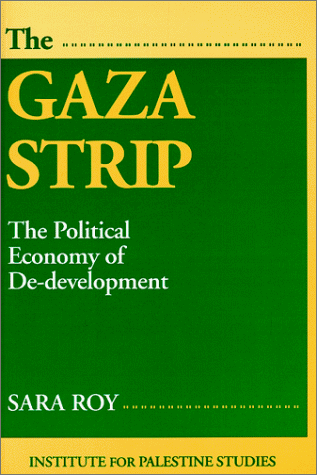
ROY Gaza StripHer lecture is spell-binding –though I hope that once and for all it breaks the spell of Israel’s ‘withdrawal’ from Gaza.  The map above comes from a UN report, Gaza in 2020: a liveable place? that is summarised here, and the text and a video of Sara’s lecture are available here and here.  The text will form part of Sara’s introduction to a new edition of The Gaza Strip: the Political Economy of De-development.

Marc Ellis provides a wonderful summary of and meditation on Sara’s passionately analytical lecture at Mondoweiss here, and you can access Sara’s A Land Diminished: reflections on Gaza’s landscape (2011) here (it also appears as a chapter in an important collection from the Ibrahim Abu-Lughod Institute of International Studies at Birzeit University, Gaza, Palestine: Out of the margins, which is available here).

Dronesong

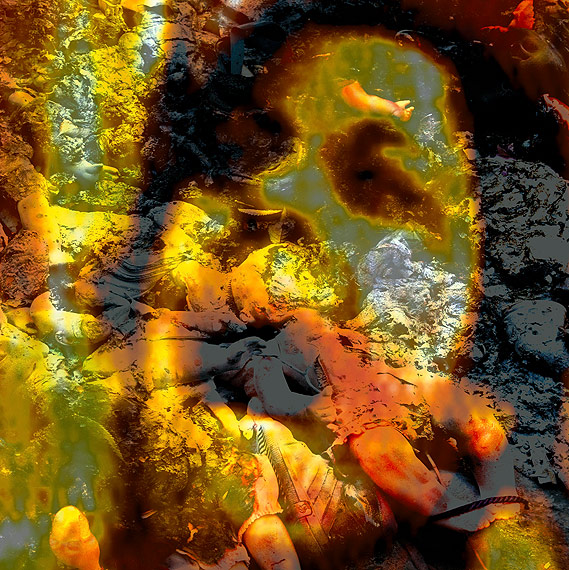
shawa-cast-lead‘In 1990,’ Palestinian pop-artist Laila Shawa recalls, ‘I had breast cancer.’

While undergoing radiotherapy, I watched on television the precision bombing of Baghdad by US airplanes, forever linking the two events in my mind and in my art. The body woman and the body land amalgamate; the invasion of one is equated with the invasion of the other and the implicit fact that both leave scars.”

Jo Long made a parallel, beautifully nuanced argument in her ‘Border Anxiety’ essay in Antipode in 2006, but you can literally see what Laila Shaw means in the extraordinary Cast Lead (2011; above left).

Laila is probably still best known for her silkscreen cycle Walls of Gaza (1992-95)a different take on graffiti to most geographers’, since she insists that the situation was unique:

I believe the Gaza Graffiti differs completely from urban graffiti that one sees in big cities around the world. In Gaza, graffiti on the wall was the only method available to Palestinians to communicate with each other. The Israeli occupiers banned any form of media in Gaza, such as newspapers, radio, or television. The writing is cursive, spontaneous and hurried. It changed almost daily to update whatever was happening in Gaza.

In the Walls cycle she juxtaposed images of Palestinian children and graffiti from Gaza to expose the trauma of war and occupation, a theme to which she returned in Target (2009), a variation on an iconic panel from Walls, in which a photograph of a young child is superimposed against a graffiti-covered wall with a cross-hair centred on his face.  ‘War deprives children of their childhood,’ she says.

Much of her work depends on mixed media juxtapositions like this, which she mobilizes to brilliant effect. She explains:

‘Today, when we are desensitized by the surfeit of media violence, new strategies are needed to overcome people’s apathy and weariness for compassion.’

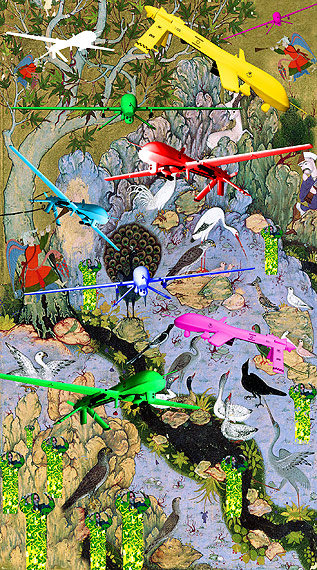
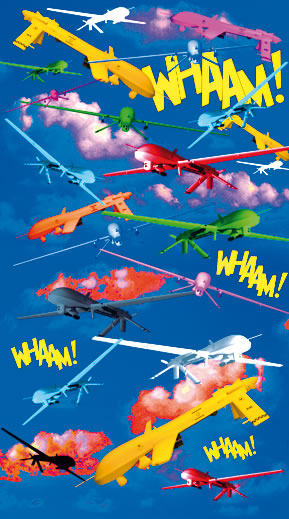
Last year she had an exhibition at London’s October Gallery, The Other Side of Paradise, which was in part provoked by a documentary on a female suicide bomber but which also included the extraordinary images shown below, Birds of Paradise and Gaza Sky, which speak directly to my previous post about other ways of visualizing drones.

SHAWA Birds of Paradise

SHAWA Gaza Sky

Laila was born in Gaza, but Gaza Sky strikes me as problematic; Israel doesn’t use Predators, so far as I know, but manufactures its own Heron drones and leases/sells them to other states.  Still, the image captures occupied Palestine since – for me – the reference isn’t only to Roy Lichtenstein‘s Whaam but also to Mahmoud Darwish‘s moving poem The earth is closing on us (which Edward Said used for his collaboration with Jean Mohr, After the last sky):

Where should we go after the last border? Where should the birds fly after the last sky?

I’m left wondering about how to draw together my first and last paragraphs – how to bring these ‘birds’ and the bodies on which they feed into the same frame.  This isn’t a compositional problem for my writing; it’s a political-aesthetic one.  So I start to think about Laila’s Target again.  For The social life of bombs, I plan to end the performance-work with a back-projected image of three children asleep under a checkered counterpane; all you you can hear is the rhythmic sound of their breathing.  As the camera moves in, it becomes clear that each checkered square is in motion; the sound gets louder.  Closer still, and each square becomes a video feed from a drone. Closer still, and one square fills the whole screen: the compound in which the children are sleeping, seen from high above (and far away).  By now the sound of breathing is incredibly loud; suddenly, an even louder explosion.  When the smoke clears, the sound dies away, and the lights slowly come up, we see three small figures, clutching the remains of their bedding – a re-staging and reworking of Noor Behram‘s to me iconic photograph of the three Bismullah children, the sole survivors of a drone strike in Waziristan.  But it could, of course, be Gaza.  Or Yemen.  Or Somalia…

Un-habitation

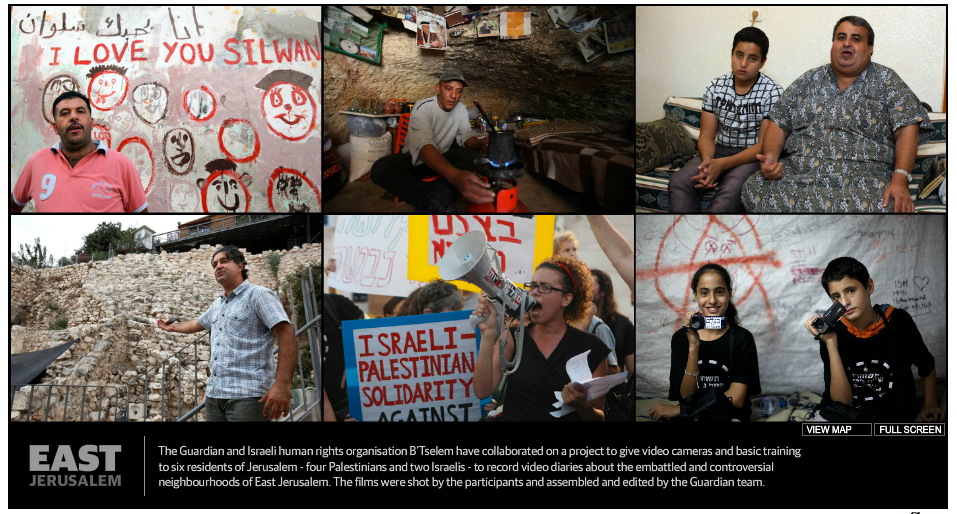
When Chris Harker was working on his PhD thesis at UBC I remember saying that while I admired the work of the Israeli Committee against House Demolitions a more accurate title would be Home Demolitions – simply because this would convey that much more was being so brutally and callously destroyed than bricks and mortar.  The practice is, of course, another vile dimension of the calculated (and illegal) colonisation of the West Bank by Israeli settlers, and Just Vision‘s latest film, My Neighborhood, puts the two together – erasure and occupation – in East Jerusalem.  But here too there are small signs of solidarity between Palestinians and Israelis that are vital for any prospect of ‘cohabitation‘…

My Neighbourhood

And now you can now watch the whole film on the Guardian website here.  Much more on East Jerusalem from the Civic Coalition for Palestinian Rights in Jerusalem here, from Settlement Watch (“Eyes on the Ground in East Jerusalem”) here and from B’Tselem: the Israeli Information Center for Human Rights in the Occupied Territories here.

In 2011 the Guardian joined forces with B’Tselem to produce six short video diaries under the umbrella title Living in East Jerusalem, and these are still online here.

Living in East Jerusalem Video Diaries

Benhabib on Butler

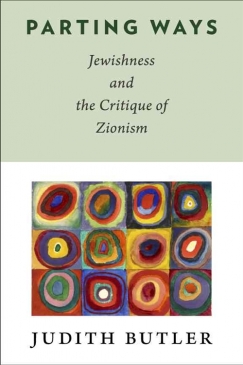
BUTLER Parting waysWhen I first became interested in critical theory (an age ago now), I found Seyla Benhabib‘s work – and especially Critique, norm and utopia (1986) – wonderfully clear and immensely helpful. She has recently published an extended review essay on Judith Butler‘s Parting Ways: Jewishness and the critique of Zionism in Constellations (2012) (open access – at least for now).  It’s a characteristically careful, lapidary essay, which works towards this climactic conclusion:

Is there any hope then? I believe there is but not through boycott, divestment and sanctions movements, which are based upon a false analogy between the Israeli-Palestinian conflict and the South African struggle, but through continued, sustained, and deep engagement with all countries in the region. Even if the Arab Spring in Egypt brought into power a conservative Islamist party, building and drawing upon its years of resistance to the Mubarrak regime, it was a new generation of Egyptians who first put their lives on the line and who showed us one more time that the legacy of revolutions is, as Hannah Arendt would say, “like a fata morgana” that appears to travelers in the desert in unexpected ways. This young literate generation of men and women are present everywhere in the Arab world; they are networked throughout Europe and the USA and in many other countries as well via migratory nets of kin and family. Today this new generation has not yet found its political voice and they continue to fight behind the Islamic flag to the chants of “Allah is great.”

Israelis, who for a long time considered themselves as the sole democratic peoples in the Arab world, have been taken aback by this evolution. But many have rejoiced in it as well. Protests against Israeli government policies, inspired by Tahrir Square erupted in the summer of 2011 in Tel-Aviv, with thousands of young people chanting for social justice, housing, and jobs. Hundreds of Arab citizens of Israel participated in such protests. The number of Arab youth who are now perfectly bi-lingual is growing and, along with it, their political capacity to engage Israeli society directly. Many Palestinian Arabs living in occupied East Jerusalem would much rather become Israeli citizens in an open and gender-egalitarian society than live under the Islamist rule of a Hamas party. The racist attacks by Israeli religious youth this past summer against Palestinians in the old city of Jerusalem galvanized an entire country around anti-racist teach-ins and demonstrations.

Any call for “cohabitation” between the Israeli and Palestinian peoples that does not balance the continuing paranoia of extinction on the part of Israeli Jews with the legitimate claims and aspirations of the Palestinian people is a non-starter. This means that Israelis themselves will need to think hard and fast about the mess they have created in aspiring to maintain a “Jewish state” on the one hand and continuing to occupy the territories of the West Bank on the other. But the facts on the ground are moving in a different direction and much to the chagrin of liberal Zionists who still advocate a two-state solution: given the military and economic dependence of the West Bank territories upon Israel, maybe the time has come to call for a “confederation of Israeli and Palestinian peoples,” with two parliaments and two separate electoral systems but a common defense and security policy over territory and airspace, and shared water and other natural resources. Under such a scenario, the considerable achievements of the Israeli state and society in economic, technological, medical, and intellectual areas would not need to be dismantled but Israeli sovereignty would be disaggregated and nested into a joint confederal model.

My own instincts are closer to Butler than Benhabib, but her problematisation of Israel’s exceptionalist claims to ‘democracy’ and her investment in a wider political geography (including the Arab uprisings) is surely essential for any project of what Butler calls, following in some part Hannah Arendt,’cohabitation’.

But the very term ‘cohabitation’ is also unsettled (the mot juste) by a vital ‘fact on the ground’ that Rashid Khalidi identifies in the New York Times with vigour and precision: ‘The overwhelming dominance of Israel over the Palestinians means that the conflict is not one that demands reciprocal concessions from two equal parties.’