The video from our War Stories event in Vancouver last month – including Farah Nosh‘s narration of her wonderful photographs, a superb capsule genealogy of PTSD from Ann Jones, my discussion of casualty evacuation over the last hundred years, a drama staged by veterans from Afghanistan and directed by George Belliveau, Contact! Unload!, and a lively Q&A with the audience moderated by Peter Klein is now available here.
My lecture, Precarious journeys, has also been carved out for the Peter Wall Institute website here. The idea behind the event was, in large measure, to think through the multiple ways in which modern war is narrated, which is why we had such a rich and diverse portfolio of performers and why I take the turns I do… Regular readers will probably recognize that the arc of my presentation draws on my current research on evacuation from the Western Front in the First World War, on evacuation from Afghanistan today, and on my admiration for Harry Parker‘s Anatomy of a Soldier (see my ‘Object lessons’ here and the slides available under the DOWNLOADS tab).
More in an interview with Charlie Smith from the Georgia Straight here.
This is the second in a new series of posts on military violence against hospitals and medical personnel in conflict zones. It examines the US attack on the Trauma Centre run by Médecins Sans Frontières (MSF) in Kunduz on 3 October 2015. I provided preliminary discussions here (on the conduct of US military investigations into civilian casualty incidents), here (on MSF’s own investigation into the attack), here (on the Executive Summary of the US military investigation), here (on two first-hand accounts from MSF personnel), here and here on the final report, and here (on the likelihood that the attack constituted a war crime). This post draws on those discussions but also on a close reading of the redacted report of the US military investigation [all page references refer to that report], on work by investigative journalists, and on ancillary materials and commentaries.
One year ago today, in the early hours of the morning of 3 October 2015, a US AC-130U gunship (‘Spooky’) launched a concentrated attack on the Trauma Centre in Kunduz run by Médecins Sans Frontières. In an otherwise probing report on what happened, the Washington Post claimed that the gunship has sensors ‘that give it a “God’s eye” of the battlefield’. Here I explore some of the multiple ways in which such a view was – and remains – impossible. For militarized vision, like any other optical modality, is never a purely technical affair. A series of cascading technical errors bedevilled the US attempt to re-take Kunduz from the Taliban, who had swept into the city a few days earlier, but these were compounded by a series of profoundly human decisions and interactions and it was the intimate entanglement of the technical and the human that determined the hideous outcome.
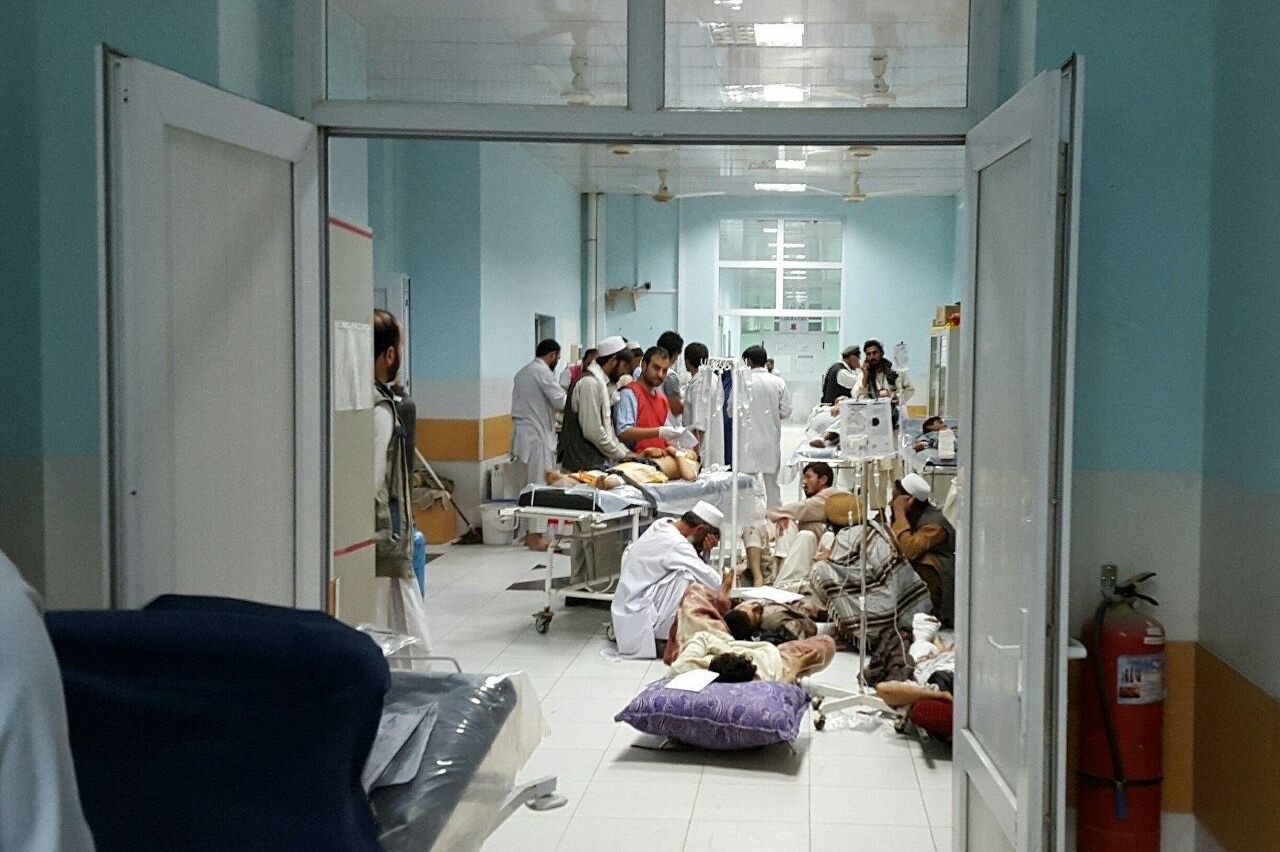
At least 42 people were killed, including 24 patients, 14 medical staff and 4 caretakers. Many others were wounded and traumatized. Here is Dr Evangeline Cua, a Philippina surgeon who was on duty when the attack started:
We were like two headless chickens running in total darkness — me and the surgeon who assisted me in an operation. The nurses who were with us a moment ago had run outside the building, braving the volley of gunshots coming from above. I was coughing, half-choked by dust swirling around the area. Behind my surgical mask, my mouth was gritty, as if somebody forced me to eat sand. I could hear my breath rasping in and out. Layers of smoke coming from a nearby room made it hard to see where we were. Blinking around, I caught sight of a glow, from a man’s hand holding a phone. He seemed mortally wounded but was still trying to send a message…perhaps to a loved one?
I stood transfixed, not knowing where to turn or what to do. All around us, bombing continued in regular intervals, shaking the ground, sending debris sweeping and flying. One. Two. Three. I tried to count but there seems to be no abatement to the explosions. I stopped counting at eight and silently prayed that we could get out of there alive.
Fire licked at the roof at one end of the building, dancing and sparkling in the dark, reaching towards the branches of the trees nearby. The ICU was burning. Outside, only the constant humming from above pointed to the presence of something. An aircraft? Airstrike? Why the hospital? Why us? Then, without warning, another tremendous, ear splitting blast shook the building. The ceiling came crashing down on us and the last remaining lights were turned off, sending us to total darkness. I screamed in terror as wires pinned me to the ground. That was the last thing I could remember.
What follows is an attempt to answer those questions. It is fraught with uncertainty: the most detailed investigation to date has been carried out by the US military, but the redacted version of the final report that has been released to the public is (by the standards of other US military investigations) profoundly unsatisfactory – redacted with a brutishly heavy hand. Time and time again, ironically, references to the time of events have been removed; transcripts of radio communications and interviews by the investigating panel that have been released in other cases have been suppressed; and some redactions seem to have been made not for reasons of privacy or security but to avoid embarrassment (more here; you can download the report from US Central Command’s Freedom of Information Act (FOIA) library here).
All of this reinforces MSF’s original call for an independent investigation. I understand May Jeong‘s pessimism:
A former Afghan special forces commander who was at the command and control center in Kunduz during the fight assured me I would never get to the bottom of the attack. The reason why I couldn’t figure out exactly what had happened, he said, was the fog of war. “Ground truth is impossible to know. Even those who were there wouldn’t be able to tell you what they saw.”
But when the ‘fog of war’ – so often a convenient cover for all manner of horrors – is deliberately thickened – when visibility is ruthlessly reduced by redaction – then perfectly proper public interest is trumped by political and military expediency.
***
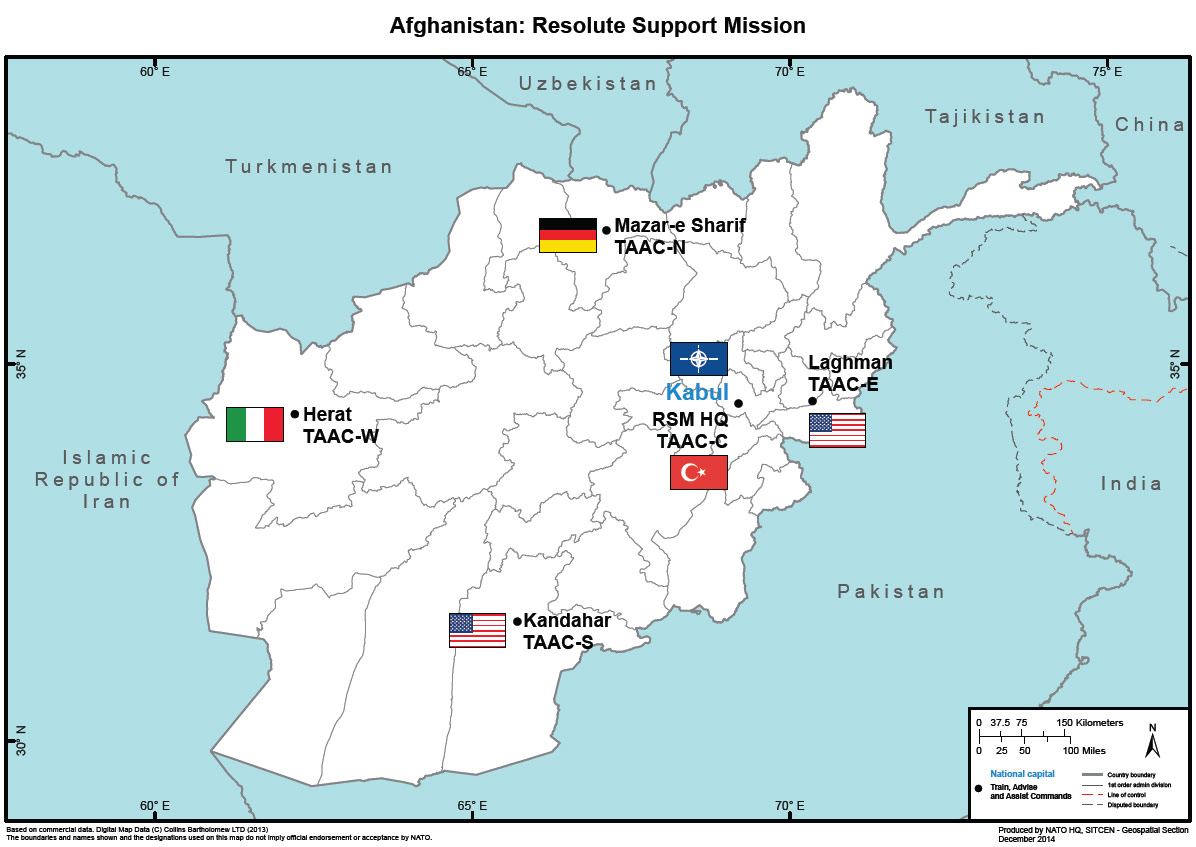
When the NATO-led combat mission to Afghanistan conducted by the International Security Assistance Force (ISAF) finished at the end of 2014 it was replaced by a much smaller advisory mission, Resolute Support, which was ‘to provide further training, advice and assistance for the Afghan security forces and institutions’. Resolute Support was authorized by a Status of Forces agreement between NATO and the Afghan government in Kabul. Its central hub was Kabul/Bagram, with four ‘spokes’ formed by four other ‘Train Assist Advise’ Commands to support four Afghan National Army Corps outside the capital (more here and here):
US troops were the major contributor to Resolute Support, but they were also assigned to the United States’s continuing (‘concurrent and complementary’) counter-terrorism mission now designated as ‘Operation Freedom’s Sentinel’. Until March 2016 both missions were under the overall command of General John Campbell.
By September 2015 the focus of US concern in Afghanistan was Helmand in the south – where the Taliban were on the ascendant, forcing Afghan government forces to retreat as they seized control of key districts and gained control of the Kajaki dam – and US Special Forces were rushed to Camp Bastion after the fall of Musa Qala gave the insurgents a strategic advantage.
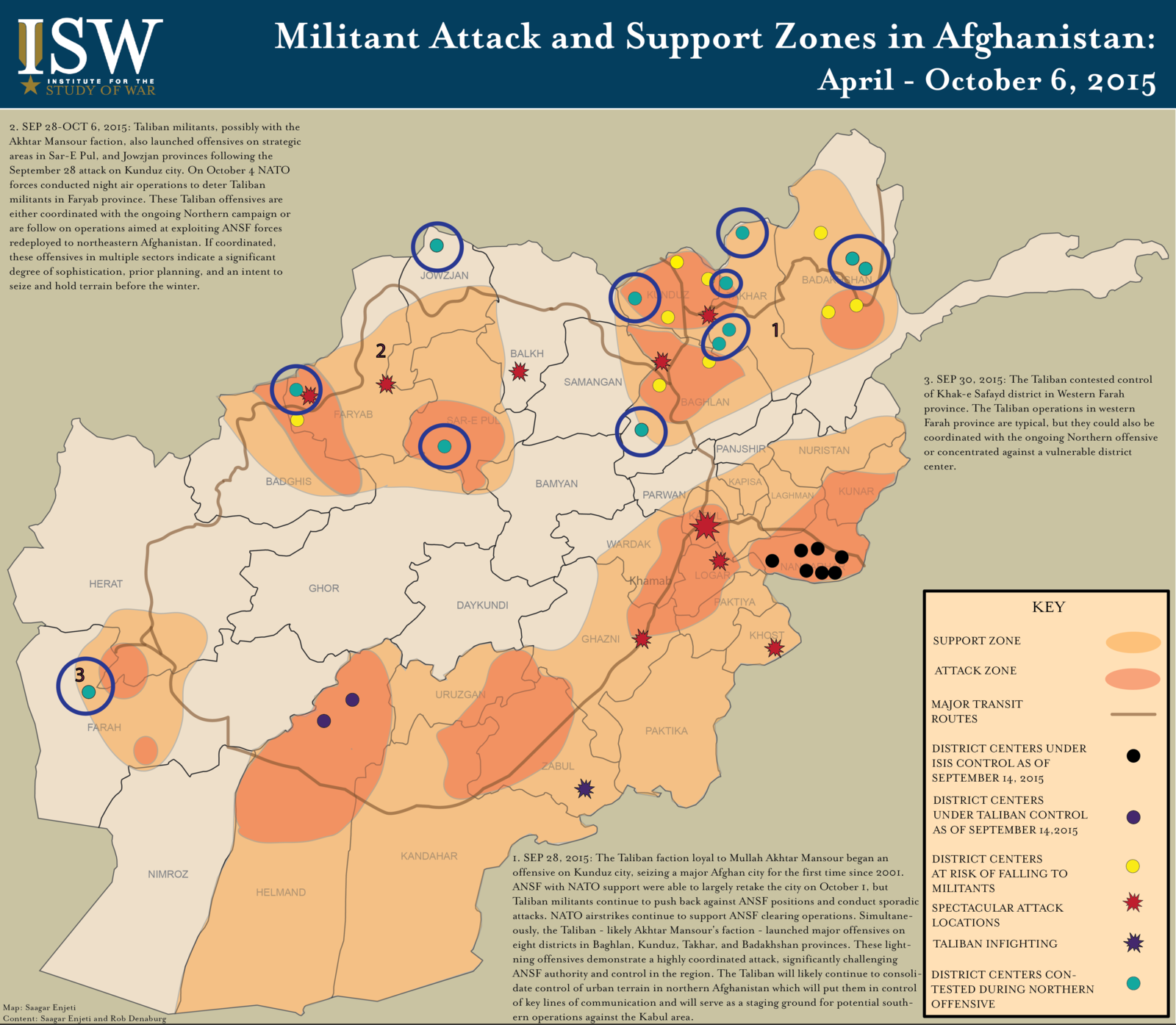
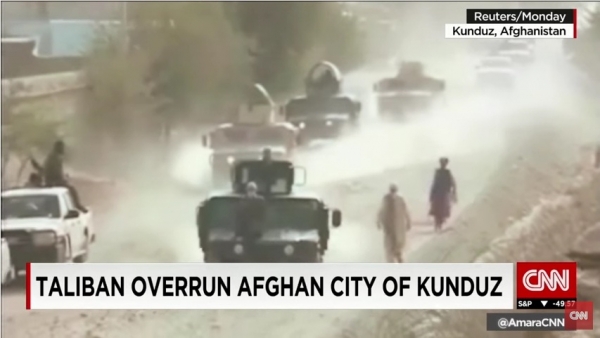
By contrast, Kunduz in the north was regarded as ‘secure’ [135] after a series of combat operations at the start of the fighting season earlier in the year. As late as 13 August Brigadier-GeneralWilson Shoffner, Deputy Chief of Staff for Communications with Resolute Support, declared that although there had been ‘an attempt by the Taliban to try to stretch the Afghan security forces in the north’ the city of Kunduz ‘is not now and has not been in danger of being overrun by the Taliban’ (he also described the situation at Kajaki as merely a ‘local security challenge’). But those previous operations in Kunduz had targeted Taliban operations areas and did not extend to support zones outside the city.
Obeid Alireports that during the summer the Taliban continued to make inroads until they controlled areas to the south west, north west and south east of the city.
On 28 September 2015, the Taliban stormed various ANSF locations in Kunduz city from the three different directions they had spent so long preparing… The simultaneous attacks on the city and the collapse of check posts at the city ‘gateways’ destroyed the confidence of the ANSF inside the city in their ability to stand against this unexpected offensive. In the face of the well-organised and coordinated insurgent operation, most held out for only a few hours. A chaotic environment quickly spread and government officials, ALP [Afghan Local Police] commanders and some of the ANA [Afghan National Army] officers, fled to the military base at the airport [Camp Pamir], leaving Kunduz effectively leaderless.
Kunduz was a spectacular, strategic prize: the first city to fall to the mujaheddin in 1998 and the first time the Taliban had seized a major city since 2001, its capture signalled both a resilient Taliban and a faltering government footprint in the region.
•••
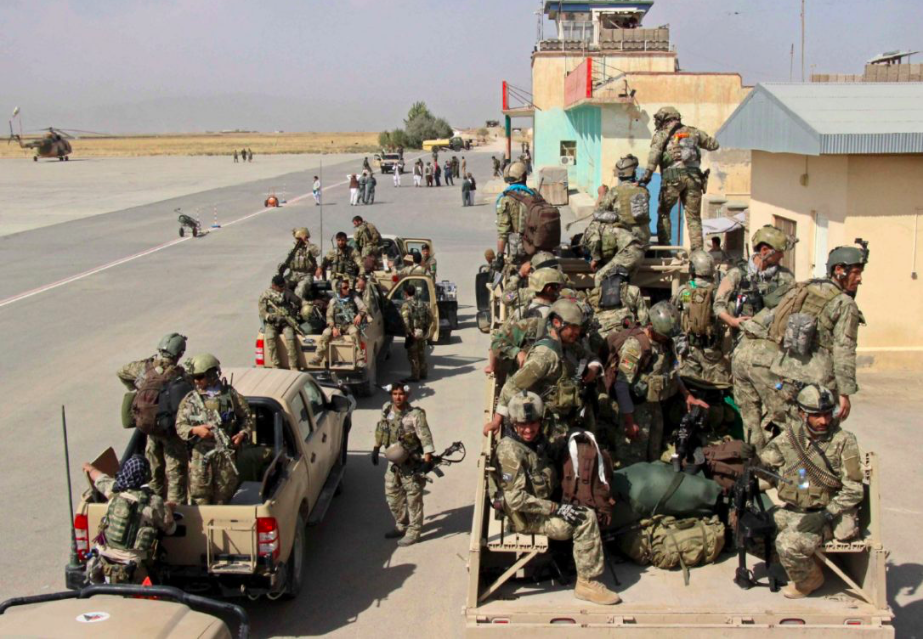
On 28 Septemberthere was a detachment of US Special Forces (‘Green Berets’) based at Kunduz airfield as part of the Train, Assist, Advise mission. Like every Operational Detachment – Alpha (OD-A) it consisted of just 12 soldiers, all cross-trained and capable of operating for extended periods of time with little or no support. On 29 September their superior command – the US Special Operations Task Force in Afghanistan – ordered two other OD-As to Kunduz. While they were in the air the OD-A on the ground sketched out a contingency plan (‘Kunduz City Foothold Establishment’) to assist the Afghan forces to return to the city and secure the Kunduz City Hospital and the Prison. There were repeated US airstrikes against Taliban positions in and around the city throughout the day, but by the time the OD-A reinforcements, together with other Afghan troops including Afghan Special Security Forces (below), arrived in the evening it was clear that the original plan was unworkable and their immediate priority had to be the defence of the airfield [032, 382].
The US reinforcements included Major Michael Hutchinson, who assumed overall command of the combined OD-As (he was identified as the Ground Force Commander by the New York Times). He had misgivings about the mission but accepted that ‘we can’t lose the provincial capital’ [377]. The next day a revised plan (‘Kunduz Clearing Patrol’) was submitted to the Special Operations Task Force for approval, which was granted that night, and the OD-As requested that Afghan Special Security Forces be accorded ‘designated special status’ that would permit the Green Berets to extend their own envelope of self-defence and assume a direct combat role (including calling in air strikes) to defend their partner forces if they came under attack [046-7].
By this time Médecins Sans Frontières had been in contact with both US and Afghan forces to ensure that they were aware of the location and status of its Trauma Centre in Kunduz. It was in the eye of the storm. Dr Kathleen Thomas, an Australian doctor in charge of the Emergency Room and the Intensive Care Unit, explained:
We all knew that at times, our hospital was in the middle of the rapidly changing front line – we could feel it. When the fighting was close – the shooting and explosions vibrated the walls. I was scared – we were all scared. When a loud “BOOM” would sound a bit closer to the hospital, we would all drop to the floor away from the large windows that lined the ICU walls. We also tried to move the patients and large (flammable) oxygen bottles away all from the windows, but the layout of the ICU prohibited doing this effectively. I worried constantly about the exposure from those windows – yet never thought to worry about the exposure from the roof.
Most of the patients were civilians. Of the combatants, MSF reported that most of them were from the Afghan army and police, as had been the case since the Trauma Centre opened, but once the city fell on 28 September ‘this shifted to primarily wounded Taliban combatants.’ The Afghan government speedily arranged the transfer of all its patients (apart from the most severely wounded cases) to another hospital.
By that night the Taliban announced that it was in control of the district. Kathleen Thomasdescribed the scene:
The first day was chaos – more than 130 patients poured through our doors in only a few hours. Despite the heroic efforts of all the staff, we were completely overwhelmed. Most patients were civilians, but some were wounded combatants from both sides of the conflict. When I reflect on that day now, what I remember is the smell of blood that permeated through the emergency room, the touch of desperate people pulling at my clothes to get my attention begging me to help their injured loved ones, the wailing, despair and anguish of parents of yet another child lethally injured by a stray bullet whom we could not save, my own sense of panic as another and another and another patient was carried in and laid on the floor of the already packed emergency department, and all the while in the background the tut-tut-tut-tut of machine guns and the occasional large boom from explosions that sounded way too close for comfort.
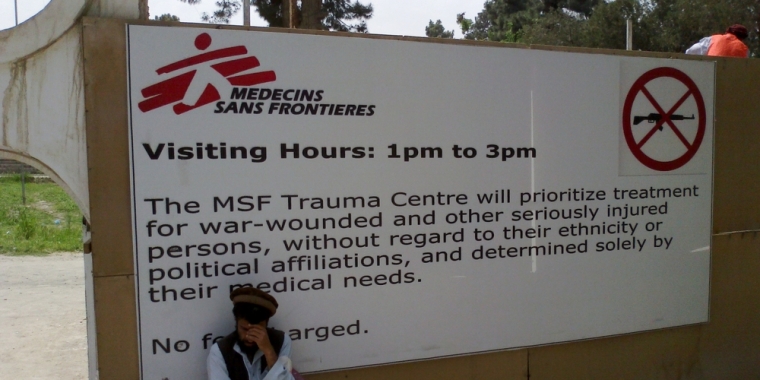
Although the Trauma Centre had been on US Central Command’s ‘No-Strike List’ since October 2014 MSF now re-supplied its GPS coordinates and reminded the Ministry of Defence in Kabul that ‘MSF and its personnel observes strict neutrality and impartiality in the name of universal medical ethics and rights of populations affected by conflicts to humanitarian assistance’ and claimed ‘full respect of these principles and rules in order to be able to continue responding to the humanitarian and medical needs of all Afghans’ [144]. On 29 September MSF issued what would prove to be a remarkably optimistic statement:
We are in contact with all parties to the conflict and have received assurances that our medical personnel, patients, hospital and ambulances will be respected. With the government provincial hospital not currently functioning, MSF’s hospital is now the only place in Kunduz where people in need of urgent trauma care can receive it.
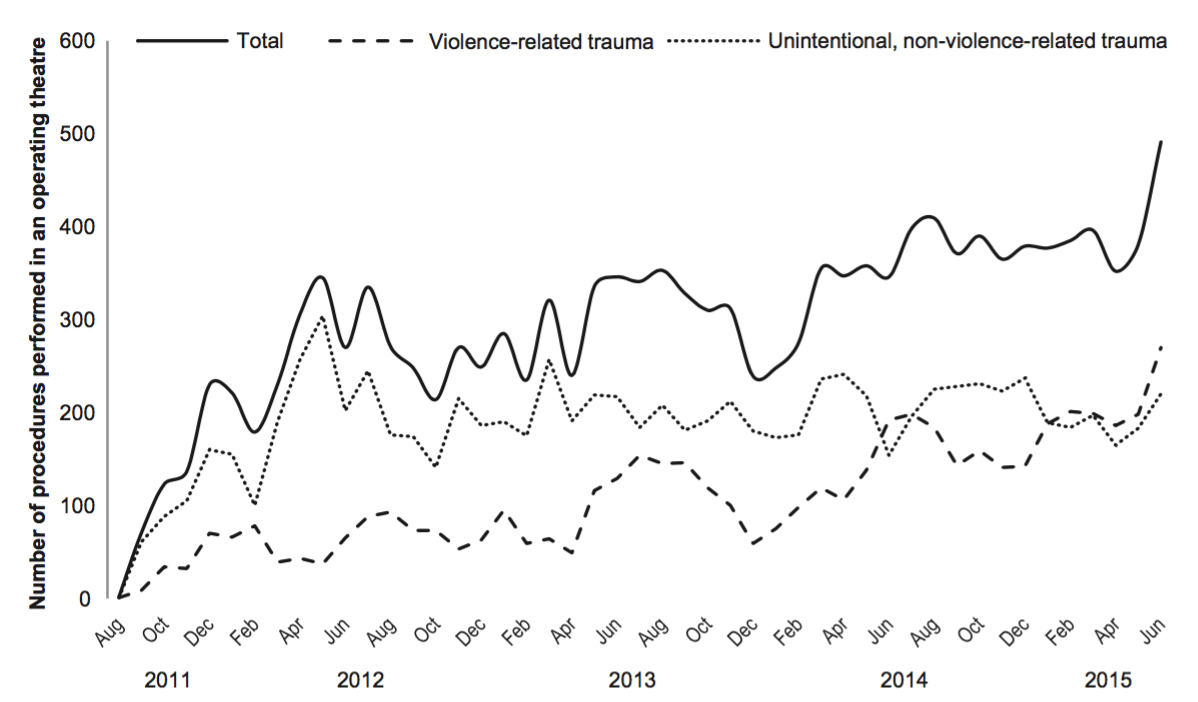
MSF had withdrawn from Afghanistan in August 2004 – after the targeted killing of five of its aid workers in June, the government’s failure to arrest those responsible, and Taliban threats to target organizations like MSF that they falsely claimed ‘work for US interests’ – and returned five years later with agreements from the US-led coalition, the Afghan government and the Taliban to respect the de-militarization of its hospitals (including a strict ‘no-weapons’ policy inside them). Initially MSF assumed responsibility for two public hospitals in Kabul and Helmand; two years later it opened its Trauma Centre in Kunduz inside the old Spinzer cotton factory. It soon became immensely important:
[Source: Miguel Trelles, Barclay T Stewart and others, ‘Averted health burden over 4 years at Médecins Sans Frontières (MSF) Trauma Centre in Kunduz, Afghanistan, prior to its closure in 2015’, Surgery (2016) in press]
Between August 2011 and August 2015 the Trauma Centre cared for 6,685 patients; roughly one-third were suffering from ‘violence-related trauma’, which included land mines and bomb blasts, gunshots, stabbings, assaults, rape and torture; one quarter of those were children. Procedures for complex wounds were the most common – debridement (excision), removed of shrapnel, care of burns – followed by orthopaedic procedures (including amputation). Those injuries increased dramatically in the months before the city fell to the Taliban. Miguel Trelles and his collaborators estimate that during this period the Trauma Centre averted 154, 254 ‘Disability Adjusted Life Years’; more prosaically:
The MSF Kunduz Trauma Centre provided surgical care for a large number of wounded and injured patients in the region. The surgical epidemiology is consistent with reports from other areas of prolonged insecurity in that unintentional, traumatic, non–war-related injuries generally outnumber those from violence. Nevertheless … the Trauma Centre provided surgical care for many adults and children injured directly by conflict (eg, injuries due to gunshots, land mines, bomb blasts). The health burden averted by surgical care at the Trauma Centre was large…
And yet, despite the importance of the Trauma Centre and its inclusion on a centralized No-Strike List that database was not consulted during the operational vetting and legal approval of the two plans drawn up by the OD-As [032, 045] (which, to be fair, had never been in the city and had no direct knowledge of the terrain; their Joint Terminal Attack Controllers had tried to print hard copy of ISR imagery before they set out from Camp Pamir but the base’s only printer was so old all it could produce were ‘giant magenta blobs’ that were completely useless [383] – so initially they relied on a single 1:50,00 map to plan and execute their operations [048]).
In fact – the irony is extraordinary – one member of the Special Operations Task Force testified that even they had no access to the No-Strike List and only discovered the existence of the Trauma Centre by accident, when ‘somebody was looking for additional medical facilities for use as emergency means to treat our own casualties’ if they could not make it back to Camp Pamir and the Forward Surgical Team based there [217, 219]. It was only then, late in the night of 29 September, that the Trauma Centre was added to the database maintained by the ISR [Intelligence, Surveillance and Reconnaissance] Tactical Controllers at the Special Operations Task Force at Bagram; early the next morning e-mails with this information were sent to ‘all ISR assets supporting operations in Kunduz’ [213].
***
On 30 September there was a secure videoconference between General Campbell, his Afghan counterpart and Major Hutchinson. It was clear that Campbell was exasperated at the conduct of the Afghan forces and attached great importance to re-taking the city. Fired up, Hutchinson briefed his men on the planned Kunduz Clearing Patrol, relaying the spirit of Campbell’s comments and telling them this was ‘a no fail mission’, that ‘all of the civilians have fled and only the Taliban are in the city’, and that ‘everything is a threat’ [256]. That night, once the mission had been approved, the Green Berets fought their way into the city alongside the Afghan Special Security Forces, with Close Air Support from US aircraft including an AC-130 gunship that ‘continuously called out and engaged [Taliban] ambush sites’ [325]. This seems to have been the same aircraft and crew that returned on 2/3 October; the sensor operator described that fateful mission as their third flight over Kunduz, following two others on 2 September and 30 September, the last when they provided armed overwatch for a US convoy into the city centre and engaged the Taliban at multiple locations. Indeed, he claimed that those previous missions had provided them with ‘good situational awareness’ of Kunduz and the ‘patterns of life’ of both civilians and insurgents [362].
Before dawn on 1 October the US and Afghan troops had cleared several key buildings and established a defensive strongpoint in the Provincial Chief of Police Compound [PCOP]. They hunkered down and came under repeated mortar, rocket-propelled grenade and automatic weapons fire, and throughout that day and the next their Joint Terminal Attack Controller called in multiple strikes from F-16 aircraft, many of them ‘danger close’, in immediate proximity to the PCOP [332].
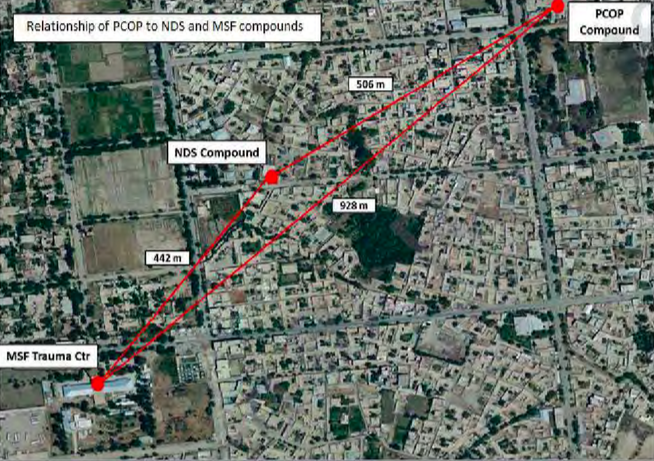
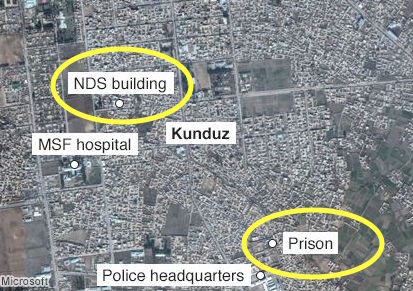
By the end of the afternoon on 2 Octoberseveral Afghan troops had been wounded. Their commander was all for taking the casualties back to Camp Pamir immediately, but Hutchinson persuaded them that this was madness: they were stable so the medical evacuation should wait for the cover of darkness. The Afghan Special Security Forces agreed; while they were at Pamir they would re-supply and then return to attack a command and control centre they said had been established by the Taliban in the National Directorate of Security compound (NDS) to the south west of the PCOP which the Afghan SSF also referred to as ‘the NDS prison’ [386-8]. The investigation report includes this map showing the relationship of the PCOP to the NDS Compound and the MSF Trauma Centre:
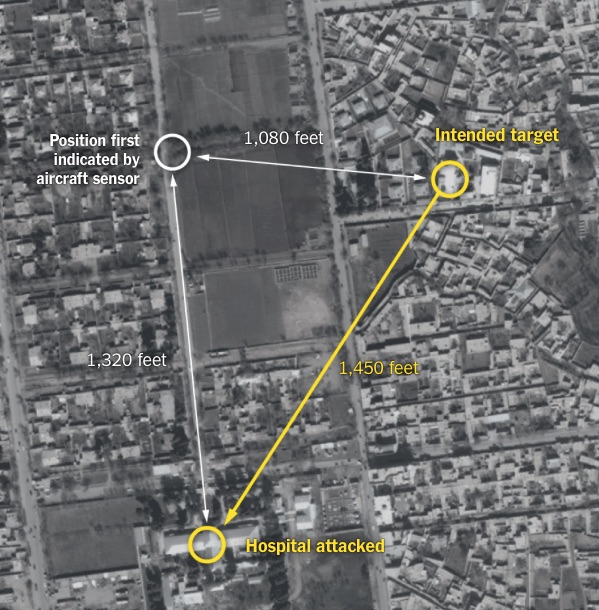
[A similar map included in a detailed analysis by The Intercept mis-locates the PCOP – almost certainly confusing it with the NDS Prison that the Operations Center in Bagram wrongly assumed was the intended target of the air/ground operation: see below]
The Afghan Special Security Forces were assured that Close Air Support would be extended to the convoy once they had returned to the ‘self-defence perimeter’ beyond the PCOP – a ‘bubble’, Hutchinson called it, roughly defined by the range of the heavy machine guns and anti-aircraft guns used by the Taliban [387].
But by then the F-16s providing close air support were running low on munitions and in the early evening, with the situation in Kunduz remaining precarious, the Special Operations Task Force scrambled the AC-130 gunship from Bagram to take over.
***
The AC-130 (call-sign ‘Hammer’) was a mission in a hurry and the aircraft took off without a proper briefing or any geospatial intelligence products. All the aircrew had was the grid location of the PCOP and the call sign and contact frequency for the OD-As [052]. By then, superior commands had received the e-mail detailing the location of the Trauma Centre, and at 1847 the Fires Officer from Combined Joint Special Operations e-mailed a package of ‘mission products’ to the Electronic Warfare Officer onboard the AC-130 which included that information. But en route to Kunduz one of the aircraft’s communications systems failed and the message never arrived; when the aircrew did not acknowledge receipt, the Fires Officer at Bagram made no attempt to pass the information over the radio (which was working) [052].
At 0130 on 3 October the Afghan convoy left on its evacuation and re-supply mission, and Hutchinson contacted the AC-130 through his Joint Terminal Attack Controller (JTAC) to ask them to carry out a ‘defensive [infrared] scan’ of the area of operations. Specifically, he wanted to prepare the ground ahead of the convoy’s return: if they were ambushed and ‘got fixed in place what I wanted to do was to reduce heavy weapons and strongpoints so that they would be able to effectively maneuver on to the objective’ [390]. To that end he supplied the aircraft with a grid location for the NDS compound.
It is unclear – from the redacted report, at least – how the co-ordinates of the target were obtained. Hutchinson said that when the Afghan Special Security Forces showed him their plan for securing the NDS compound it included ‘a grid [which] said, I think, NDS prison’, but when he plotted the location he realised it was not the Prison to the south that was one of the objectives included in the original plan to establish a foothold in the city. Hutchinson riffed on the multiple NDS facilities throughout Kunduz, but this begs a crucial question: how did he plot the grid to confirm the location? He claimed to have been working from the 1:50,00 map spread out on the hood of his armoured vehicle, which could hardly have provided the co-ordinates required for a precision strike. The Joint Terminal Attack Controllers would have had access to digital imagery stored on their laptops, but by this stage they were running low on batteries and cannibalising the radios of other Green Berets to keep communications with the AC-130 open [334, 383]. ‘The worst part of it,’ Hutchinson said, was that the day after the strike they found a detailed 1:10,000 map produced by a Provincial Reconstruction Team in 2013 ‘with nice crisp imagery, and it had everything labelled with 10-digit grids’ [397]. The commanders of the other two OD-As remembered it differently, both testifying that the map was found in the provincial governor’s office on 1 October.
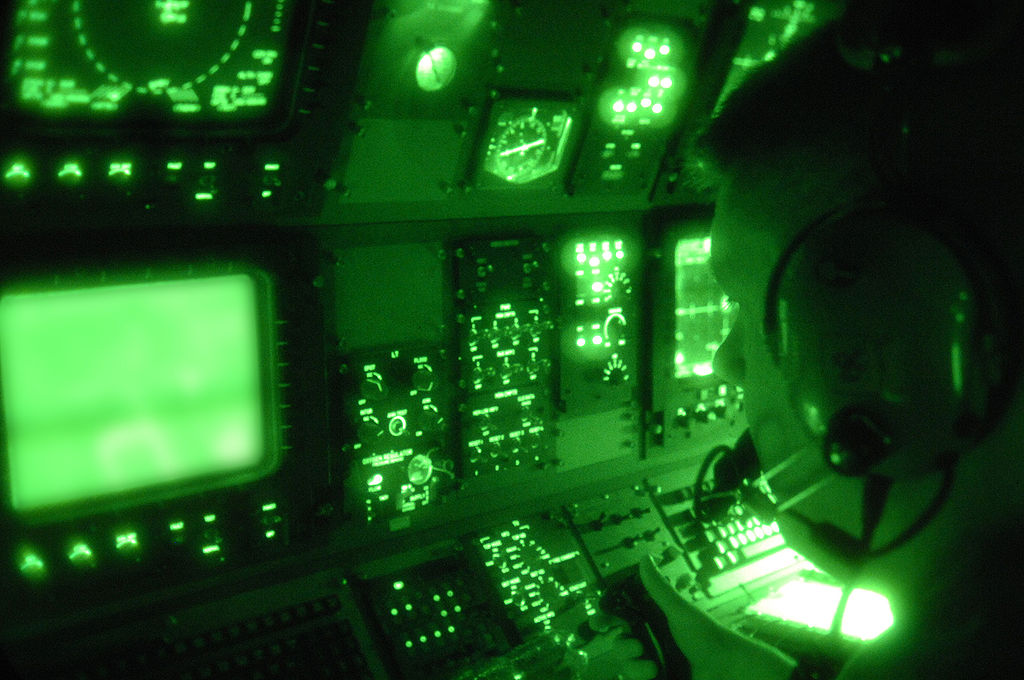
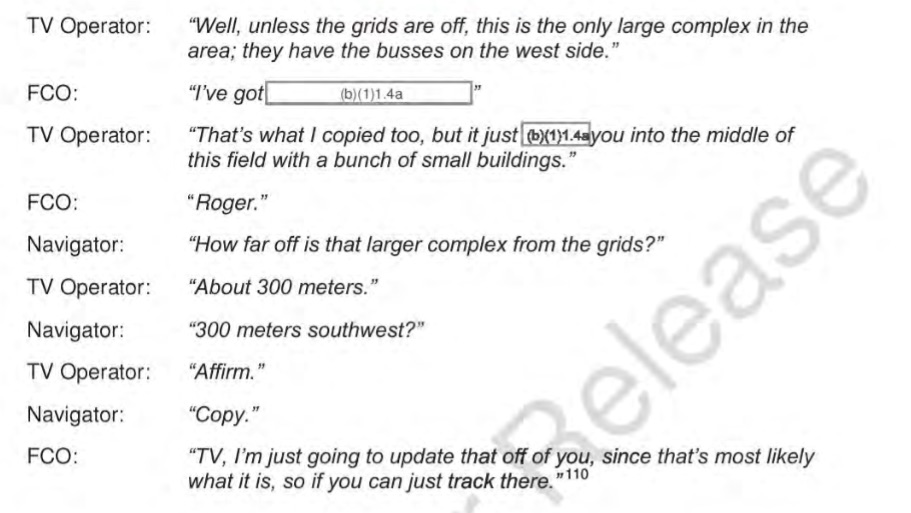
All this matters because when the TV sensor operator on the AC-130 (above) inputted the grids that were passed by Hutchinson via his JTAC he found ‘it put me in a field with residential buildings’. The AC-130 has a sophisticated sensor suite, including high resolution sensors (an All Light Level Television system, infrared detection set and strike radar to permit all weather/night target acquisition). But reading between the redactions in the investigation report there is some suggestion that there are also known technical issues with the system (perhaps distortion introduced by the aircraft’s height and/or orbit, because the AC-130 had been forced out of its overhead orbit at 2220 by taking evasive action against a surface-to-air threat): ‘Nothing in the immediate location matched the target but from training I was aware that at significant [redacted]…’ [363].
So the sensor operator widened the search and found a large compound 300 metres to the south that appeared to match the description of the target. It was not difficult to find: the Trauma Centre had its own generator and was the only building in the city that was still brightly illuminated. At first sight the sensor operator said ‘there was nothing else near the original location that could match the description of a prison.’
‘As we got closer,’ s/he continued,
I observed multiple [redacted: this is surely MAMs or ‘military-aged males’, a term the US military was supposed to have discontinued, which would explain the otherwise puzzling deletion] walking in between buildings [redacted] entrances with [redacted: guards?] posted. After passing back the information to the JTAC he said the compound was under enemy control and that those [redacted: MAMs?] were declared hostile [363].
The navigator had informed the JTAC that the grids had originally plotted to the middle of a field but they now had a large compound in their sights, a T-shaped structure with an arch gate and nine people ‘roaming outside’. The Green Berets conferred with the Afghan Special Security Forces in the PCOP who confirmed that this was the NDS compound, and the Fire Control Officer on the AC-130 adjusted the target location in the fire control system accordingly [054, 242].
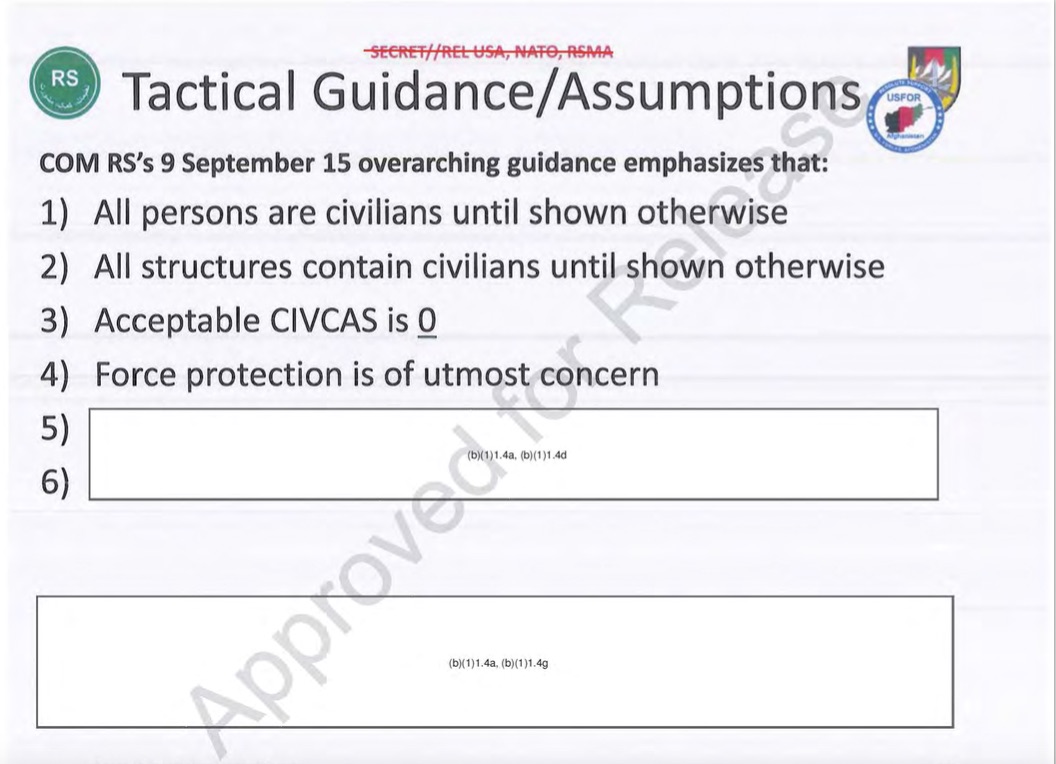
But the sensor operator, more mindful of the Tactical Guidance issued by General Campbell (below), testified that he wanted ‘to make sure we were not inadvertently declaring civilians hostile’.
So he re-entered the original co-ordinates (‘to determine any system [redacted: error?]’) – by then the AC-130 had moved to a more accurate, overhead orbit [057] – and this time the sensor homed in on a second compound:
a much smaller compound with two large buildings, what appeared to be a third smaller shack, two overhangs, a wall surrounding, what appeared to be guard towers at the four corners with a single entrance on the south side of the compound and was unable to observe any movement in that compound [363].
This underscored his concerns. ‘Now that we are closer,’ he told the rest of the crew,
even though that compound [is] the only one that’s limited and has activity, if you look in the TV’s screen you can see this hardened structure [the second compound] that looks very large and could also be more like a prison with cells. So I just want to verify that before we start declaring people hostile, that we are 100 per cent sure that this is the correct compound [057].
He asked the navigator to request a more detailed target description from the Joint Terminal Attack Controller (though the JTAC was not told that the aircraft’s sensors had now identified two different compounds from the same grids).
The JTAC came back with a target description of multiple buildings with a wall surrounding, and a main gate with an arch shape. I asked for further clarification on which side of the compound that gate was on, to which he replied the North side of the compound. The gate I was able to make out at the first compound was on the north side and matched the target description [363].
The first compound was the MSF Trauma Centre; the second was the NDS compound.
***
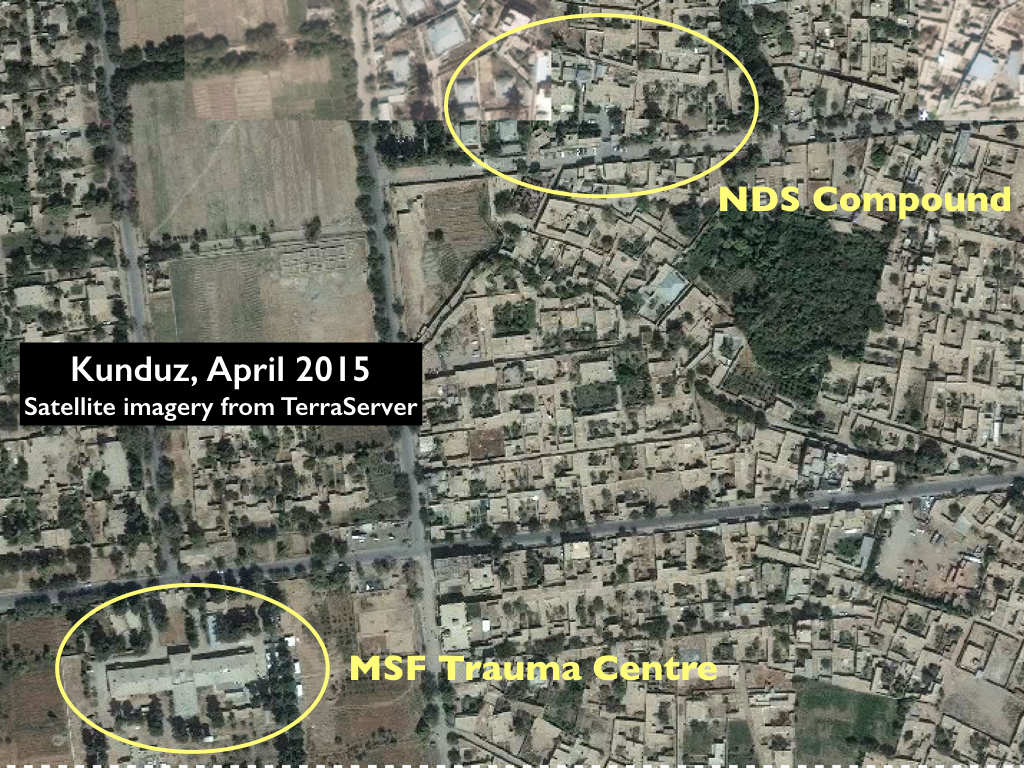
The redacted version of the investigation report includes a satellite image of the MSF Trauma Centre but conspicuously failed to include a corresponding image of the NDS compound. Yet from TerraServer’s satellite imagery (below) it is clear that the two are radically different, and in fact the gate on the NDS compound faced south not north.
Neither Hutchinson nor his JTAC had access to real-time imagery from the AC-130 because the same antenna that prevented the aircraft receiving the e-mail with the No-Strike List also prevented it from transmitting a video feed to the JTAC’s laptop, and so both the aircrew and the US forces on the ground had to rely on verbal descriptions. The investigation report calls the characterisation of the target building ‘a vague description’ [034] but, as Mathieu Aikinspointed out in a superb analysis of the strike, ‘it’s actually a rather specific description that corresponds to MSF’s distinctive layout.’ Indeed, whenthe aircrew compared the two compounds they were persuaded by the description of a ‘T-shaped structure’ that they had identified the correct target.
Once the AC-130 aircrew’s description of the Trauma Centre had been confirmed by the Afghan Special Security Forces as the NDS compound, the circle was closed. As Hutchinson testified, he had a report from the AC-130 ‘that describes a target, the disposition of the target and the pattern of life on it that’s completely consistent with what I’ve heard from the Afghans…’ Whether the Afghans deliberately substituted a description of the Trauma Centre for the NDS compound remains an open question. From their own (separate) interviews in Kunduz, both May Jeong and Mathieu Aikins repeatedly raise this as a distinct possibility. Some informants insisted that the Trauma Centre had been overrun by the Taliban, confirmed (so they said) by raw intelligence and communications intercepts, even that it was being used as a firing position – a claim that was repeated by the government in Kabul in the immediate aftermath of the strike – while others complained that MSF treated Taliban casualties who then returned to the fray: ‘patching up fighters and sending them back out.’ Much of this is ex post facto rationalisation; clearly many Afghans regarded the attack on the Trauma Centre as perfectly justified. But Aikins asks a more pointed question: Did Afghan forces, out of longstanding mistrust of MSF, draw the United States into a terrible tragedy?’
If they did, then it had to have been a spur-of-the-moment decision to take advantage of a developing situation, since the Afghan Special Security Forces had originally provided the correctgrids for the NDS compound.
More telling, I suspect, is that from 0100 until well into the attack on the Trauma Centre the only people who had the co-ordinates for the target now in the sights of the AC-130 were the aircrew, who did not pass the grid location for what they had incorrectly identified as the target back to Hutchinson. And yet the ground force commander had already told the navigator he had ‘great confidence in the grids passed [057]’, and it is astonishing that this did not prompt a more extensive discussion among the aircrew since the original grids had plotted first to an open field and second to the NDS compound but never to the Trauma Centre that had now been designated as the target.
Neither did the aircrew pass the revised grids back to the Special Operations Task Force who were monitoring events from Bagram. Repeating Hutchinson’s earlier mistaken assumption, the staff in the Operations Center at Bagram believed the target (‘the NDS prison’) was the Prison in the south of the city which had been included in the original Kunduz City Foothold Establishment plan, and they tasked an MQ-1 Predator to provide surveillance over that location [059].
Hutchinson could not view the video feed from the Predator, since the laptops in the PCOP were desperately short of batteries, but the Special Operations Task Force did have access to the drone’s real-time imagery. Nothing was happening around the Prison, and confident that this was the strike location nobody at Bagram attempted to confirm the coordinates until the attack on the Trauma Center was well under way. At 0207 they heard a sudden, direct transmission from the AC-130 – ‘unreadable numbers followed by going hot/rounds away’ – and ‘the quickness of the going hot call’ suggested to one experienced JTAC at Bagram that ‘there was possibly a dire situation on the ground.’ But ‘the passing of engagement grids was broken, unreadable’, and s/he immediately ‘made multiple attempts to get a resend of [the] grid of engagement’. Those requests ‘were either not acknowledged or met with “still engaging/hot”‘, but this was ‘not uncommon due to the task saturation during coordination and employment by ground JTACs and aircraft’. Meanwhile another JTAC in the Operations Centre, realising that ‘no activity was noted at the facility’ – presumably by the Predator on station over the Prison; the Taliban had reportedly freed all the prisoners when they took the city – tasked the Predator crew to ‘find the engagement area’ [261-4]. At 0220 they were successful, and once the new grids had been checked the Operations Center realised that the AC-130 was attacking the Trauma Center.
***
Hutchinson provided two contradictory rationales for the attack. One was offensive: his JTAC relayed to the AC-130 that Hutchinson’s intent was to ‘soften the target’ (meaning the NDS compound) for the Afghan convoy returning from Camp Pamir. When the aircrew asked for clarification they were told they were to ‘destroy targets of opportunity that may impede partner forces’ success’ [059]. When he was questioned by the investigating officers, Hutchinson represented this as pre-emptive and precautionary: ‘If they were going to take contact I did not want to play twenty questions while they were taking fire’ [391]. The other was unambiguously defensive: the immediate trigger for Hutchinson to clear the AC-130 to open fire was the sound of automatic gunfire from the east-west road near the NDS compound.
What did it for me in the end was when I believed the [redacted] convoy to be at that parallel cross street … or the perpendicular cross street … to the facility, I heard sustained automatic weapons fire … and it was coming from that general direction. And so I asked the [redacted] are they in contact yet. He can’t get through [to] them at first, and so I think okay, so that’s a sign they’re probably in contact… Fire continues and I ask him again and he says strike now, assume they are decisively engaged’ [393-4].
It’s not clear from the redactions who Hutchinson was talking to, but it was almost certainly someone from the Afghan Special Security Forces in the PCOP. What is certain – and known to the aircrew on the AC-130, who were also tracking the convoy, but not to Hutchinson – was that the convoy was nowhere near the NDS compound or even the Trauma Centre at that time but 9 km away, still within the northern perimeter of the airfield.
Hutchinson’s attention was on the sound of gunfire. He explained that most of the fire directed against his forces in the PCOP compound had been from the west, and it was ‘unthinkable’ that ‘there would have been anything functional over there in terms of essential services’ [394] – like a hospital.
And so, at 0202 Hutchinson had his JTAC instruct the AC-130 to strike the ‘objective building first’ and then to provide ‘suppressing fire’ (which the JTAC later described as a ‘PAX cocktail’ and the aircrew translated as ‘MAMs’ [military-aged males]). Again the aircrew sought clarification; they wanted to be sure that their target was the ‘large T-shaped building in the centre of the compound’ and that ‘we are [also] cleared on people in this compound.’ It was and they were; at 0208 the first round was fired as the Electronic Warfare Officer announced the grids over the radio: the garbled transmission received at Bagram [064-6].
***
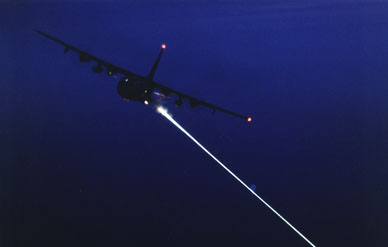
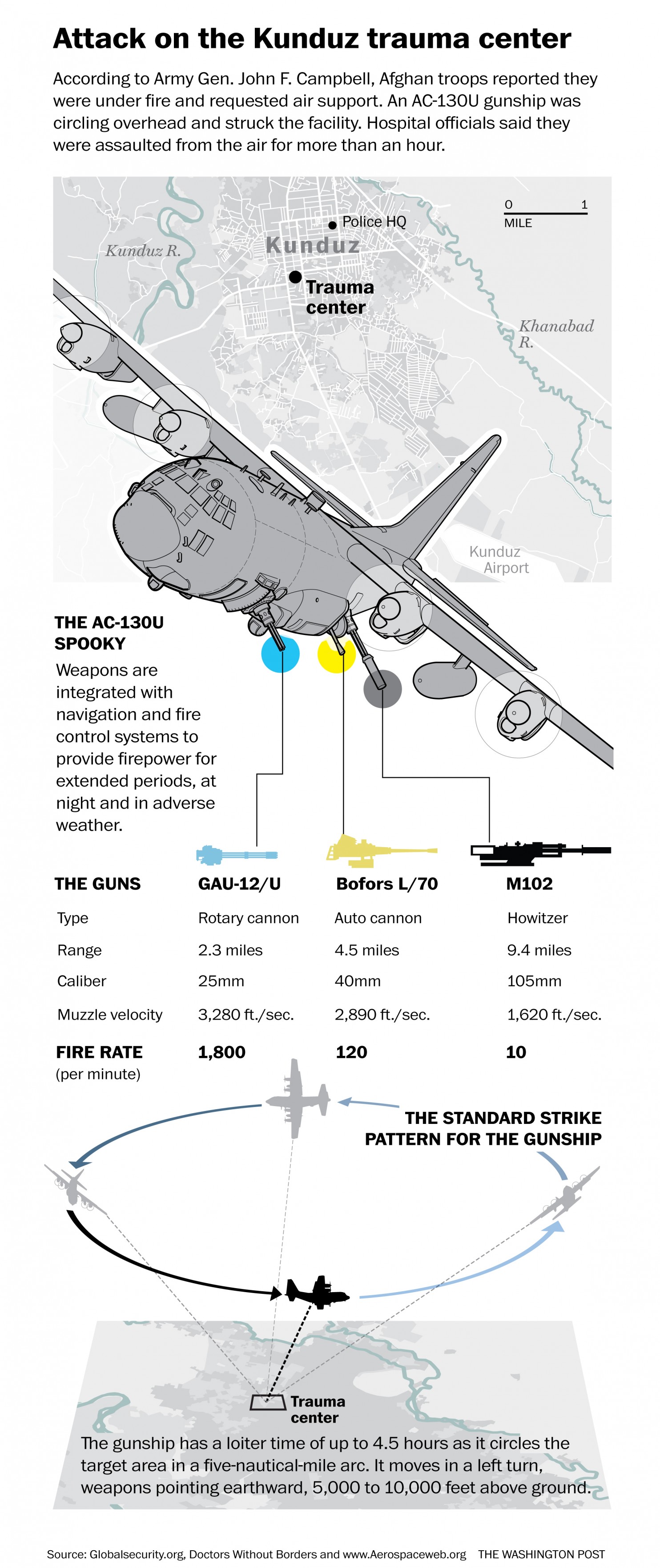
The AC-130 made five passes over the Trauma Centre at 15-minute intervals, firing a total of 211 rounds. But ’rounds’ fails to convey the scale of the ordnance involved. As May Jeongnotes, the AC-130 is ‘built around a gun’; it is, after all, a gunship. It has a 105 mm M102 Howitzer that fires high explosive shells at 10 rounds a minute (reputedly the largest gun ever operated from a US aircraft); a 40 mm Bofors cannon that fires 120 rounds a minute; and a 25mm 5-barrelled Gatling cannon that fires incendiary rounds at 1,800 rounds a minute. YouTube has a video of a live-firing exercise carried out by the 4th Special Operations Squadron in 2016 that is truly chilling:
All these weapons are side-firing; the AC-130 performs a slow left-banking pylon turn in a five-mile orbit to keep its weapons on target for much longer than a conventional strike aircraft:
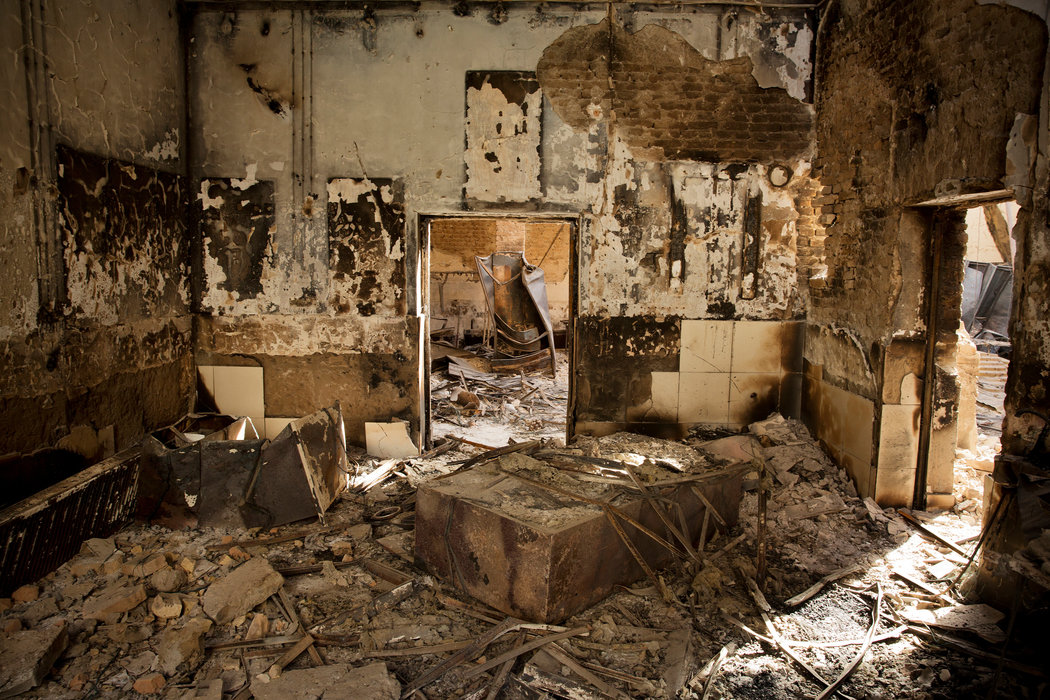
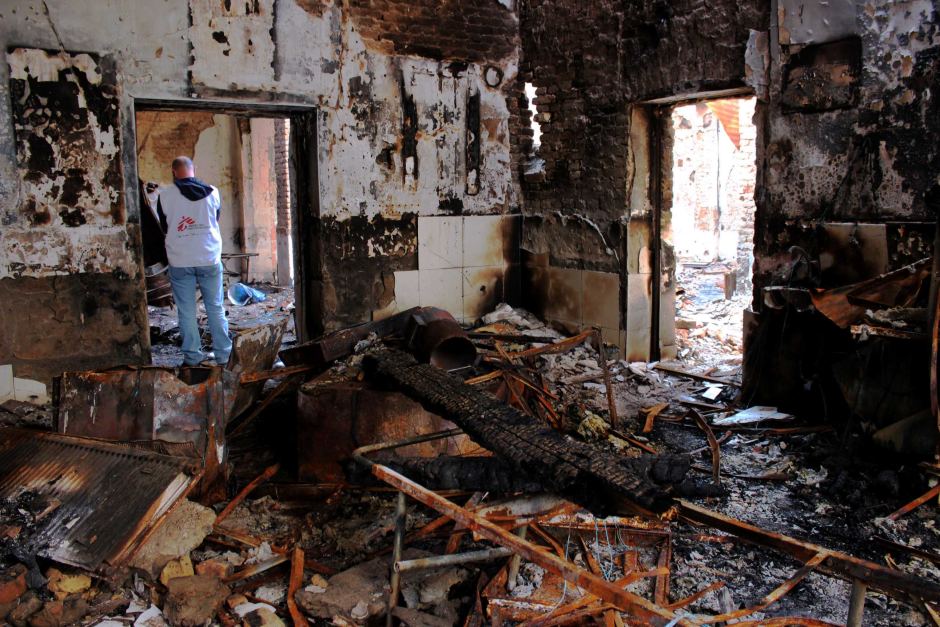
The results on the ground were catastrophic.
All the patients in the ICU died except one, alongside the caretakers who were with them; one doctor, three nurses and a cleaner who were in the ICU were also killed. Here is Kathleen Thomas again:
I hope with all my heart that the three sedated patients in ICU, including our ER nurse Lal Mohammad, were deep enough to be unaware of their deaths — but this is unlikely. They were trapped in their beds, engulfed in flames.
The same horror that rocked the ICU rocked the rest of the main building as the plane hit with alarming precision. Our ER nurse Mohibulla died. Our ER cleaner Najibulla died. Dr. Amin suffered major injuries but managed to escape the main building, only to then die an hour later in the arms of his colleagues as we desperately tried to save his life in the makeshift operating theater set up in the kitchen next to the morning meeting room. The OT nurse, Abdul Salam, died. The strikes continued further down the building, tearing through the outpatients department, which had become a temporary sleeping area for staff. Dr. Satar died. The medical records officer Abdul Maqsood died. Our pharmacist Tahseel was lethally injured. He also made it to safety in the morning meeting room, only to die soon after, having bled to death. Two of the hospital watchmen Zabib and Shafiq also died.
Our colleagues didn’t die peacefully like in the movies. They died painfully, slowly, some of them screaming out for help that never came, alone and terrified, knowing the extent of their own injuries and aware of their impending death. Countless other staff and patients were injured; limbs blown off, shrapnel rocketed through their bodies, burns, pressure wave injuries of the lungs, eyes, and ears. Many of these injures have left permanent disability. It was a scene of nightmarish horror that will be forever etched in my mind.
***
The loss of life and the destruction of the hospital was appalling. But the effects of the air strike have reverberated far beyond the Trauma Centre and the events of 3 October. In February this year Sophia Jonestold the troubling story of a father of four who lost his right arm and the sight of one eye when he was caught in cross-fire between the Taliban and the Afghan army. With the destruction of the Trauma Centre in Kunduz there were no local hospitals capable of treating his life-threatening injuries, and it took him two agonising days to travel 200 miles to the Surgical Center for War Victims run by another NGO, Emergency, in Kabul – now ‘the only free, specialized trauma hospital of its kind treating war victims in Afghanistan.’ Like MSF, Emergency is absolutely clear that ‘we cannot be on one side of the war’: ‘a patient is a patient’. Like MSF, most of Emergency’s patients are civilians. But, as Luke Mogelsonfound in the spring of 2012,
At Emergency’s hospital in Kabul, it’s not unusual to find Afghan national security forces recovering in the same ward as Taliban insurgents, and after a while, the ideas that make enemies of the two men lose their relevance; the daily spectacle of their impact on human bodies invalidates them.
That was then. ‘After Kunduz’, Emergency’s program co-ordinator now concedes, ‘anything is possible.’ It would be truly, desperately awful if one of the casualties of the air strike on the Trauma Centre turned out to be the core principle of medical neutrality.
One year after Kunduz, Christopher Stokes, MSF’s General Director, warned that ‘A war without limits leads to a battlefield without doctors.’ MSF pledged not to allow that to happen. They must not stand alone.
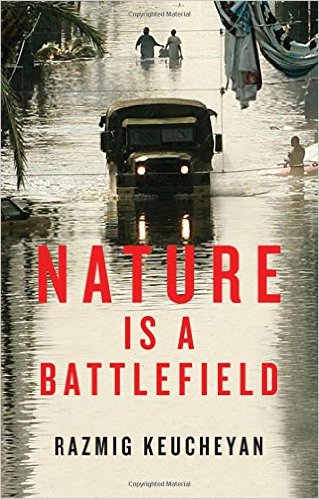
And while I’m on the subject of ‘The Natures of War’, that essay describes how ‘nature’ – yes, I do know how complicated that word is – is much more than a ‘resource bank’ over which war is waged (resource wars, conflict commodities and the rest) but also a medium through which military violence is effected: the mud of the Western Front, the deserts of North Africa and the rainforests of Vietnam.
In the midst of the current ecological crisis, there is often lofty talk of the need for humanity to ‘overcome its divisions’ and work together to tackle the big challenges of our time. But as this new book by Razmig Keucheyan shows, the real picture is very different. Just take the case of the siting of toxic waste landfills in the United States: if you want to know where waste is most likely to be dumped, ask yourself where Blacks, Hispanics, Native Americans and other racial minorities live and where the poorest neighbourhoods are. This kind of ‘environmental racism’ is by no means restricted to the United States: it is very much a global phenomenon.
Keucheyan show how the capitalist response to the crisis has been marked by a massive expansion in ‘environmental finance’. From ‘carbon markets’ to ‘pollution permits’, ‘climate derivatives’ and ‘catastrophe bonds’, we are seeing a proliferation of nature-related financial products. Instead of tackling the root of the problem, the neoliberal strategy seeks to profit from environmental risks.
Moreover, with the rise in natural disasters, resource scarcity, food crises, the destabilization of the poles and oceans and the prospect of tens of millions of ‘climate refugees’, Western powers are increasingly adopting a military response to ecological problems. The Cold War is over: welcome to the ‘green wars’. From New Orleans to the Siachen glacier via the Arctic floes, Keucheyan explores the landmark sites of this new ‘climate geostrategy’.
The first chapter addresses ‘Environmental racism’; the second ‘Financialising nature: insuring climatic risks’; it’s the final chapter that most interests me, ‘Green wars or the militarisation of ecology’:
A doctrine emerges
A benevolent dictatorship
Chaos specialists
Terrorism and climate change
The new military ecology
Conservation and counter-insurgency
Econationalism
Agent Orange
From the Cold War to green wars
The end of conventional wars?
Double movement
Climate refugees
Nuclear deterrence and ecological crisis
War and biofuels
The oceans destabilised
The scramble for the Arctic
The North Pole and globalisation
Commodifying the thaw
The speed of the circulation of capital
Razmig is probably best known in the English-speaking world for his mapping of contemporary critical theory, Left Hemisphere (Verso, 2013).
Joe Pugliese has sent me a copy of his absorbing new essay, ‘Drone casino mimesis: telewarfare and civil militarization‘, which appears in Australia’s Journal of sociology (2016) (online early). Here’s the abstract:
This article stages an examination of the complex imbrication of contemporary civil society with war and militarized violence. I ground my investigation in the context of the increasing cooption of civil sites, practices and technologies by the United States military in order to facilitate their conduct of war and the manner in which drone warfare has now been seamlessly accommodated within major metropolitan cities such as Las Vegas, Nevada. In the context of the article, I coin and deploy the term civil militarization. Civil militarization articulates the colonizing of civilian sites, practices and technologies by the military; it names the conversion of such civilian technologies as video games and mobile phones into technologies of war; and it addresses the now quasi-seamless flow that telewarfare enables between military sites and the larger suburban grid and practices of everyday life. In examining drone kills in the context of Nellis Air Force Base, Las Vegas, I bring into focus a new military configuration that I term ‘drone casino mimesis’.
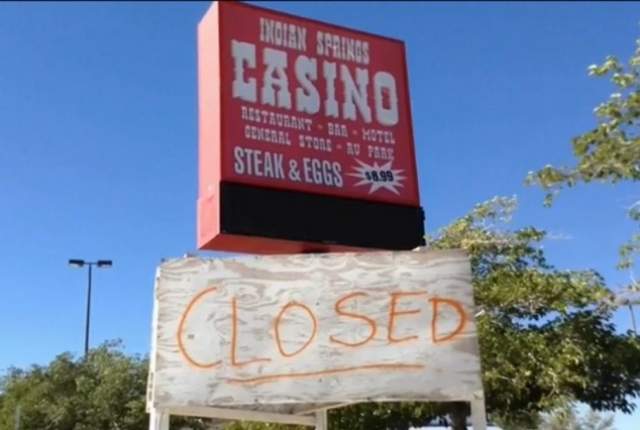
I’m particularly interested in what Joe has to say about what he calls the ‘casino logic and faming mimesis’ of ‘the drone habitus’. Most readers will know that ‘Nellis’ (more specifically, Creech Air Force Base, formerly Indian Springs), for long the epicentre of the US Air Force’s remote operations, is a short drive from Las Vegas – and those who have seen Omar Fast‘s 5,000 Feet is Best will remember the artful way in which it loops between the two.
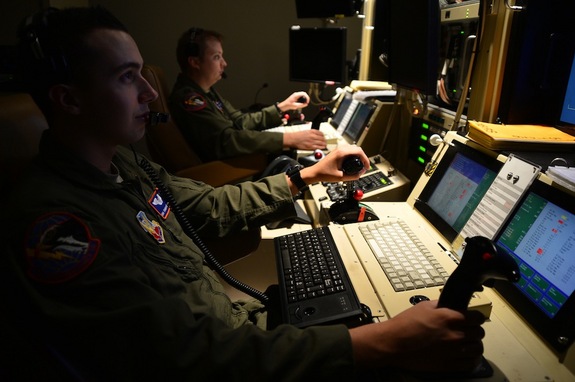
Two passages from Joe’s essay have set me thinking. First Joe moves far beyond the usual (often facile) comparison between the video displays in the Ground Control Station and video games to get at the algorithms and probabilities that animate them:
‘…there are mimetic relations of exchange between Las Vegas’s and Nellis’s gaming consoles, screens and cubicles.
‘Iconographically and infrastructurally, casino gaming and drone technologies stand as mirror images of each other. My argument, however, is not that both these practices and technologies merely ‘reflect’ each other; rather, I argue that gaming practices and technologies effectively work to constitute and inflect drone practices and technologies on a number of levels. Casino drone mimesis identifies, in new materialist terms, the agentic role of casino and gaming technologies precisely as ‘actors’ (Latour, 2004: 226) in the shaping and mutating of both the technologies and conduct of war. Situated within a new materialist schema, I contend that the mounting toll of civilian deaths due to drone strikes is not only a result of human failure or error – for example, the misreading of drone video feed, the miscalculation of targets and so on. Rather, civilian drone kills must be seen as an in-built effect of military technologies that are underpinned by both the morphology (gaming consoles, video screens and joysticks) and the algorithmic infrastructure of gaming – with its foundational dependence on ‘good approximation’ ratios and probability computation.’
And then this second passage where Joe develops what he calls ‘the “bets” and “gambles” on civilian life’:
‘[Bugsplat’ constitutes a] militarized colour-coding system that critically determines the kill value of the target. In the words of one former US intelligence official:
You say something like ‘Show me the Bugsplat.’ That’s what we call the probability of a kill estimate when we are doing this final math before the ‘Go go go’ decision. You would actually get a picture of a compound, and there will be something on it that looks like a bugsplat actually with red, yellow, and green: with red being anybody in that spot is dead, yellow stands a chance of being wounded; green we expect no harm to come to individuals where there is green. (Quoted in Woods, 2015: 150)
Described here is a mélange of paintball and video gaming techniques that is underpinned, in turn, by the probability stakes of casino gaming: as the same drone official concludes, ‘when all those conditions have been met, you may give the order to go ahead and spend the money’ (quoted in Woods, 2015: 150). In the world of drone casino mimesis, when all those gaming conditions have been met, you spend the money, fire your missiles and hope to make a killing. In the parlance of drone operators, if you hit and kill the person you intended to kill ‘that person is called a “jackpot”’ (Begley, 2015: 7). Evidenced here is the manner in which the lexicon of casino gaming is now clearly constitutive of the practices of drone kills. In the world of drone casino mimesis, the gambling stakes are high. ‘The position I took,’ says a drone screener, ‘is that every call I make is a gamble, and I’m betting on their life’ (quoted in Fielding-Smith and Black, 2015).
There is much more to Joe’s essay than this, but these passages add considerably to my own discussion of the US targeted killing program in the Federally Administered Tribal Areas of Pakistan in ‘Dirty dancing’. You can find the whole essay under the DOWNLOADS tab, but this is the paragraph I have in mind (part of an extended discussion of the ‘technicity’ of the US targeted killing program and its reliance on kill lists, signals intercepts and visual feeds):
The kill list embedded in the [disposition] matrix has turned out to be infinitely extendable, more like a revolving door than a rolodex, so much so that at one point an exasperated General Kayani demanded that Admiral Mullen explain how, after hundreds of drone strikes, ‘the United States [could] possibly still be working its way through a “top 20” list?’ The answer lies not only in the remarkable capacity of al Qaeda and the Taliban to regenerate: the endless expansion of the list is written into the constitution of the database and the algorithms from which it emerges. The database accumulates information from multiple agencies, but for targets in the FATA the primary sources are ground intelligence from agents and informants, signals intelligence from the National Security Agency (NSA), and surveillance imagery from the US Air Force. Algorithms are then used to search the database to produce correlations, coincidences and connections that serve to identify suspects, confirm their guilt and anticipate their future actions. Jutta Weber explains that the process follows ‘a logic of eliminating every possible danger’:
‘[T]he database is the perfect tool for pre-emptive security measures because it has no need of the logic of cause and effect. It widens the search space and provides endless patterns of possibilistic networks.’
Although she suggests that the growth of ‘big data’ and the transition from hierarchical to relational and now post-relational databases has marginalised earlier narrative forms, these reappear as soon as suspects have been conjured from the database. The case for including – killing – each individual on the list is exported from its digital target folder to a summary Powerpoint slide called a ‘baseball card’ that converts into a ‘storyboard’ after each mission. Every file is vetted by the CIA’s lawyers and General Counsel, and by deputies at the National Security Council, and all ‘complex cases’ have to be approved by the President. Herein lies the real magic of the system. ‘To make the increasingly powerful non-human agency of algorithms and database systems invisible,’ Weber writes, ‘the symbolic power of the sovereign is emphasised: on “Terror Tuesdays” it (appears that it) is only the sovereign who decides about life and death.’ But this is an optical illusion. As Louise Amoore argues more generally, ‘the sovereign strike is always something more, something in excess of a single flash of decision’ and emerges instead from a constellation of prior practices and projected calculations.
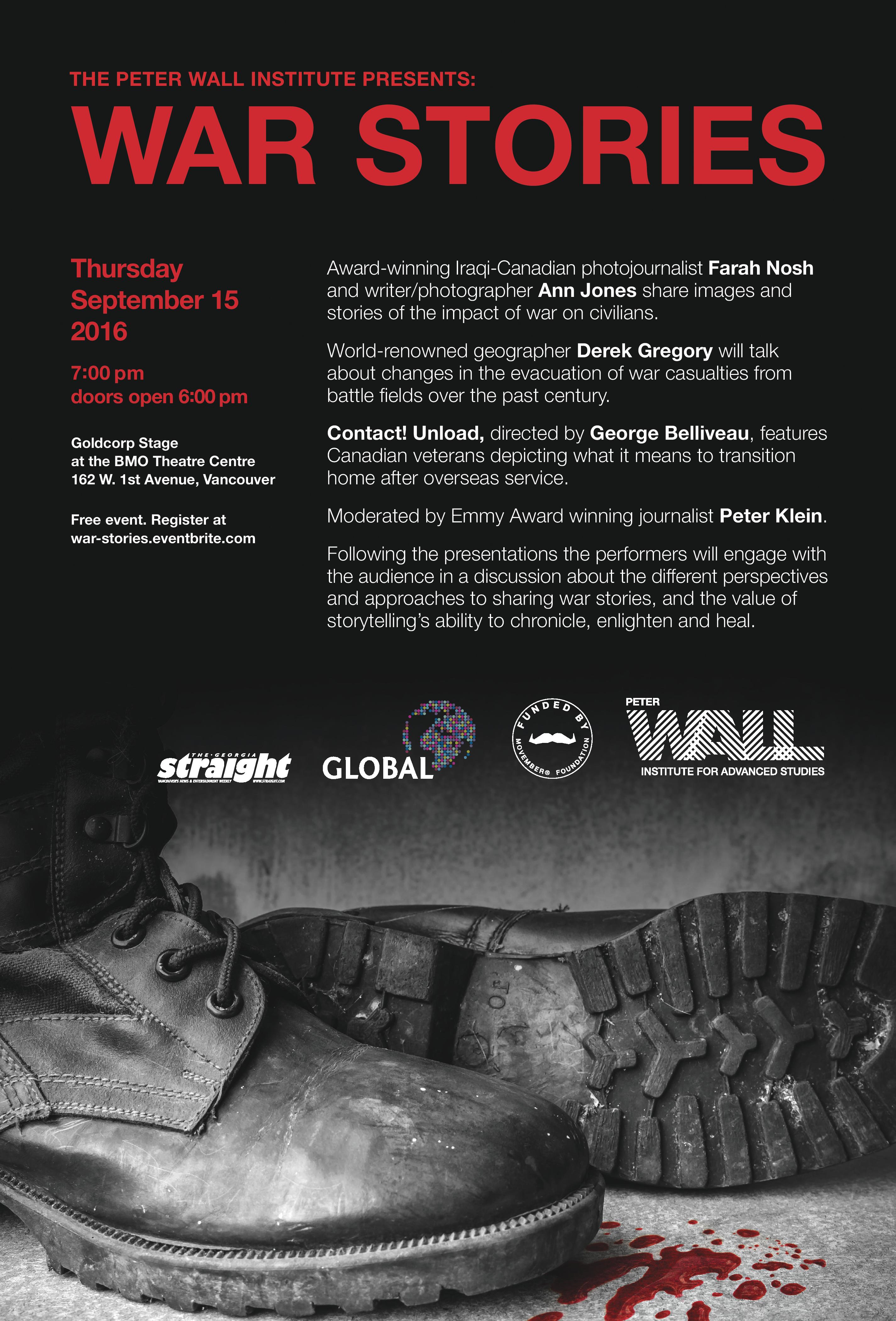
Thursday 15 September 7 – 9.30 p.m. on the Goldcorp Stage at the BMO Theatre Centre – 162 West 1st Avenue, Vancouver:
War stories from Afghanistan, Iraq and other conflict zones told by foreign correspondents, combat veterans and scholars.
Award-winning Iraqi-Canadian photojournalist Farah Nosh and writer/photographer Ann Jones will share images and stories of the impact of war on civilians. Wall Distinguished Professor and geographer Derek Gregorywill discuss changes in the evacuation of war casualties from battlefields over the past century. Contact! Unload, a play directed by Wall Scholar George Belliveau, will feature Canadian veterans depicting what it means to transition home after overseas service. The play highlights Marv Westwood’s Veteran’s Transition Program and artist Foster Eastman’s Lest We Forget Canada! mural. Moderated by Emmy Award winning journalist Peter Klein.
Following the presentations the performers will engage with the audience in a discussion about the different perspectives and approaches to sharing war stories, and the value of storytelling’s ability to chronicle, enlighten and heal.
Register here (free). I’m really excited about this – I admire the work of Farah Noshand Ann Jones enormously, I’m looking forward to the extracts from Contact! Unload – I’m still thinking about Rosie Kay‘s Bodies on the line and Owen Sheers‘ wonderful work in a similar vein – and Peter Klein will be a wonderful interlocutor. Do come if you can.
UPDATE: We’re sold out, but there is a wait list. And you can find more on WAR STORIES from the wonderful Charlie Smith at the Georgia Straighthere.
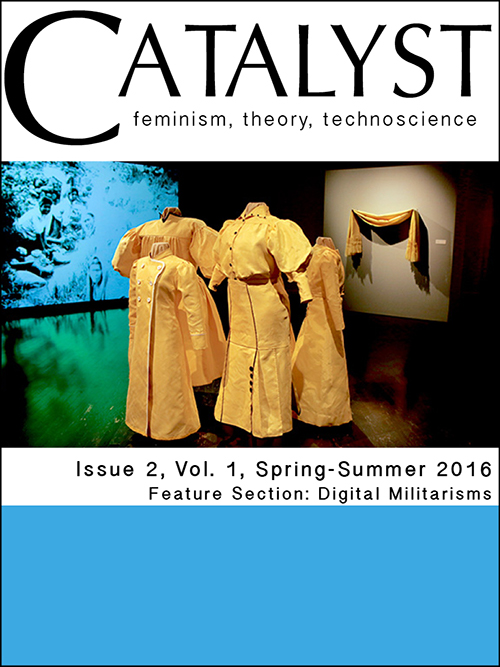
News from Lucy Suchman of a special issue of Catalyst: Feminism, Theory, and Technoscience on Digital Militarisms. Here is a list of the articles plus abstracts; all are available for download here (open access).
Configuring the Other: Sensing War through Immersive Simulation – Lucy Suchman
This paper draws on archival materials to read two demonstrations of FlatWorld, an immersive military training simulation developed between 2001 and 2007 at the University of Southern California’s Institute for Creative Technologies. The first demonstration is a video recording of a guided tour of the system, staged by its designers in 2005. The second is a documentary created by the US Public Broadcasting Service as part of their “embedded” media coverage of the system while it was installed at California’s Camp Pendleton in 2007. I critically attend to the imaginaries that are realized in the simulation’s figurations of places and (raced, gendered) bodies, as well as its storylines. This is part of a wider project of understanding how distinctions between the real and the virtual are effectively elided in technoscientific military discourses, in the interest of recognizing real/virtual entanglements while also reclaiming the differences that matter.
***
Military Utopias of Mind and Machine – Emily Cohen Ibañez
The central locus of my study is southern California, at the nexus of the Hollywood entertainment industry, the rapidly growing game design world, and military training medical R&D. My research focuses on the rise of military utopic visions of mind that involve the creation of virtual worlds and hyper-real simulations in military psychiatry. In this paper, I employ ethnography to examine a broader turn to the senses within military psychology and psychiatry that involve changes in the ways some are coming to understand war trauma, PTSD, and what is now being called “psychological resilience.” In the article, I critique assumptions that are made when what is being called “a sense of presence” and “immersion” are given privileged attention in military therapeutic contexts, diminishing the subjectivity of soldiers and reducing meaning to biometric readings on the surface of the body. I argue that the military’s recent preoccupation with that which can be described as “immersive” and possessing a sense of presence signals a concentrated effort aimed at what might be described as a colonization of the senses – a digital Manifest Destiny that envisions the mind as capital, a condition I am calling military utopias of mind and machine. Military utopias of mind and machine aspire to have all the warfare without the trauma by instrumentalizing the senses within a closed system. In the paper, I argue that such utopias of control and containment are fragile and volatile fantasies that suffer from the potential repudiation of their very aims. I turn to storytelling, listening, and conversations as avenues towards healing, allowing people to ascribe meaning to difficult life experiences, affirm social relationships, and escape containment within a closed language system.
*** Simulated War: Remediating Trauma Narratives in Military Psychotherapy – Marisa Renee Brandt
How have the politics of therapy been reconfigured during the so-called Global War on Terror? What role have the new virtual reality therapies that so resemble other forms of military simulation played in this reconfiguration? In this article, I draw upon feminist science and technology’s (STS) theorization of human-machine interaction into order to interrogate how contemporary therapies for treating post-traumatic stress disorder (PTSD) reconfigure agency in the practice of healing. Analyzing trauma therapy as a site of reconfiguration, I show how new exposure-based therapies for PTSD—both with and without virtual reality—configure aspects of human subjectivity, such as memory, affect, and behavior, as objects for technological intervention. Through comparative analysis of different modalities of PTSD treatment, I show that the politics of therapy is especially enacted through the therapeutic remediation of trauma narratives: the mediational practices through which a traumatic memory is made available for therapeutic reworking. Therapeutic remediation practices configure therapists, patients, and nonhuman actants as subjects and objects with different forms of agency.
*** Weaponizing Affect: A Film Phenomenology of 3D Military Training Simulations during the Iraq War – D. Andy Rice
This article critically considers the relation between simulation design and human experience through the analysis of three-dimensional military training simulation scenarios developed between 2003 and 2012 at the Fort Irwin National Training Center in the Mojave Desert of California. Following news reports of torture at Abu Ghraib, the US military began to implement “cultural awareness” training for all troops set to deploy to the Middle East. The military contracted with Hollywood special-effects studios to develop a series of counterinsurgency warfare immersive-training simulations, including hiring Iraqi-American and Afghan-American citizens to play villagers, mayors, and insurgents in scenarios. My primary question centers on the military technoscience of treating human bodies as variables in a reiterative simulation scenario. I analyze interviews with soldiers and actors, my own experiences videotaping training simulations at the fort, and the accounts of many other visiting journalists and filmmakers across time. From this, I contend that the stories participants tell about simulation experiences constitute one key outcome of the simulation itself, blunting dissent and aiding the fort’s long-term efforts to retain clout and funding in the face of wars whose intensity fluctuates. I treat the ongoing cinematic performances on the fort as a kind of “simulation body” unbounded by skin, a theoretical framework drawn from Vivian Sobchack’s (1992) film phenomenological concept of the “film body” and affect theory grounded in the work of Kara Keeling (2007), as well as Eve Sedgwick (2003), Sedgwick and Adam Frank (1995), and Lisa Cartwright (2008), by way of American behavioral psychoanalyst Silvan Tomkins (2008).
***
Tactical Tactility: Warfare, Gender, and Cultural Intelligence – Isra Ali
The participation of women in the landscape of warfare is increasingly visible; nowhere is this more evident than in the US military’s global endeavors. The US military’s reliance on cultural intelligence in its conceptualization of engagement strategies has resulted in the articulation of specific gendered roles in warfare. Women are thought to be particularly well suited to non-violent tactile engagements with civilians in war zones in Iraq and Afghanistan because of gender segregation in public and private spaces. Women in the military have consequently been able to argue for recognition of their combat service by framing this work in the war zone as work only women can do. Women reporters have been able to develop profiles as media producers, commentators, and experts on foreign policy, women, and the military by producing intimate stories about the lives of civilians only they can access. The work soldiers and reporters do is located in the warzone, but in the realms of the domestic and social, in the periods between bursts of violent engagement. These women are deployed as mediators between civilian populations in Afghanistan and Iraq and occupying forces for different but related purposes. Soldiers do the auxiliary work of combat in these encounters, reporters produce knowledge that undergirds the military project. Their work in combat zones emphasizes the interpersonal and relational as forms of tactile engagement. In these roles, they are also often mediating between the “temporary” infrastructure of the war zone and occupation, and the “permanent” infrastructure of nation state, local government, and community. The work women do as soldiers and reporters operates effectively with the narrative of militarism as a means for liberating women, reinforcing the perception of the military as an institution that is increasingly progressive in its attitudes towards membership, and in its military strategies. When US military strategy focuses on cultural practice in Arab and Muslim societies, commanders operationalize women soldiers in the tactics of militarism, the liberation of Muslim women becomes central in news and governmental discourses alike, and the notion of “feminism” is drawn into the project of US militarism in Afghanistan and Iraq in complex ways that elucidate how gender, equality, and difference, can be deployed in service of warfare.
*** A Drone Manifesto: Re-forming the Partial Politics of Targeted Killing –Katherine Fehr Chandler
Debates about today’s unmanned systems explain their operation using binary distinctions to delimit “us” and “them,” “here” and “there,” and “human” and “machine.” Yet the networked actions of drone aircraft persistently undo these oppositions. I show that unmanned systems are dissociative, not dualistic. I turn to Haraway’s “A Cyborg Manifesto” (1991) to reflect on how drones rework limits ranging from the scale of bodies to geopolitical territories, as well as the political challenges they entail. The analysis has two parts. The first considers how Cold War drones fit into cybernetic discourse. I examine the Firebee, a pilotless target built in the aftermath of World War II, and explore how the system acts as if it were guided by machine responses even though human control remains integral to its operation. The second part considers how contemporary discussions of drone aircraft, both for and against the systems, rely on this dissociative logic. Rather than critiquing unmanned aircraft as dehumanizing, I argue that responses to drones must address the interconnections they produce and call for a politics that puts together the dissociations on which unmanned systems rely.
*** Introduction to Attachments to War: Violence and the Production of Biomedical Knowledge in Twenty-first Century America – Jennifer Terry
This is an excerpt from Jennifer Terry’s book, Attachments to War: Violence and the Production of Biomedical Knowledge in Twenty-first Century America, forthcoming 2017.
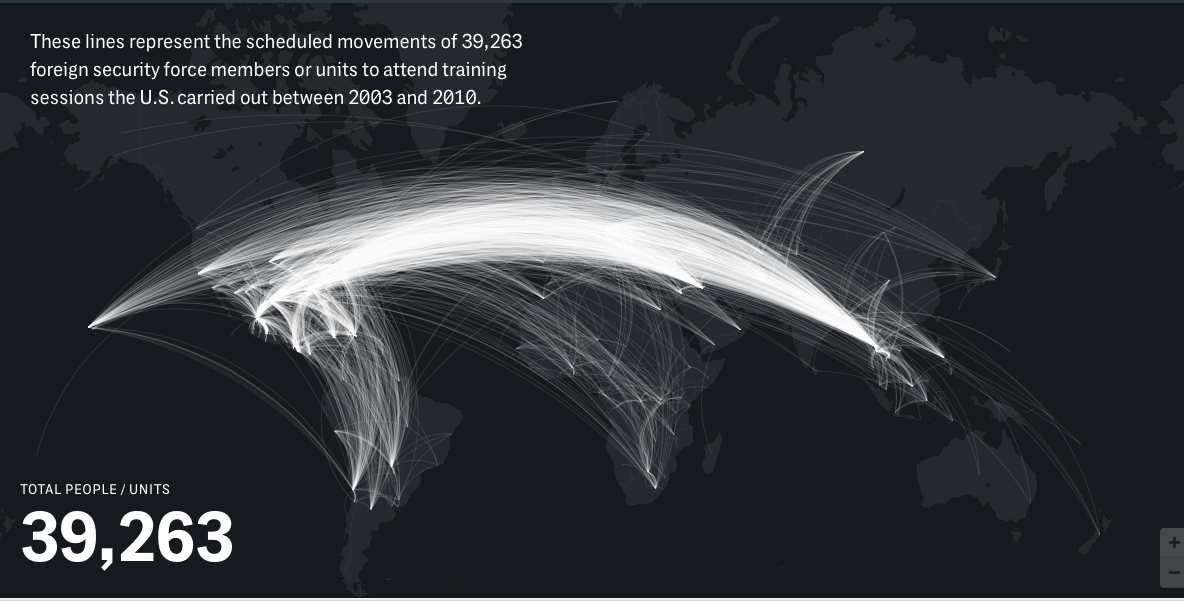
I’ve written about US military bases overseas before – via David Vine‘s brilliant, painstaking work (see here and here) – but a new study from The Intercept has revealed another, much less visible geography of ‘offshoring’ military violence: the training of foreign military, police and security personnel by the United States.
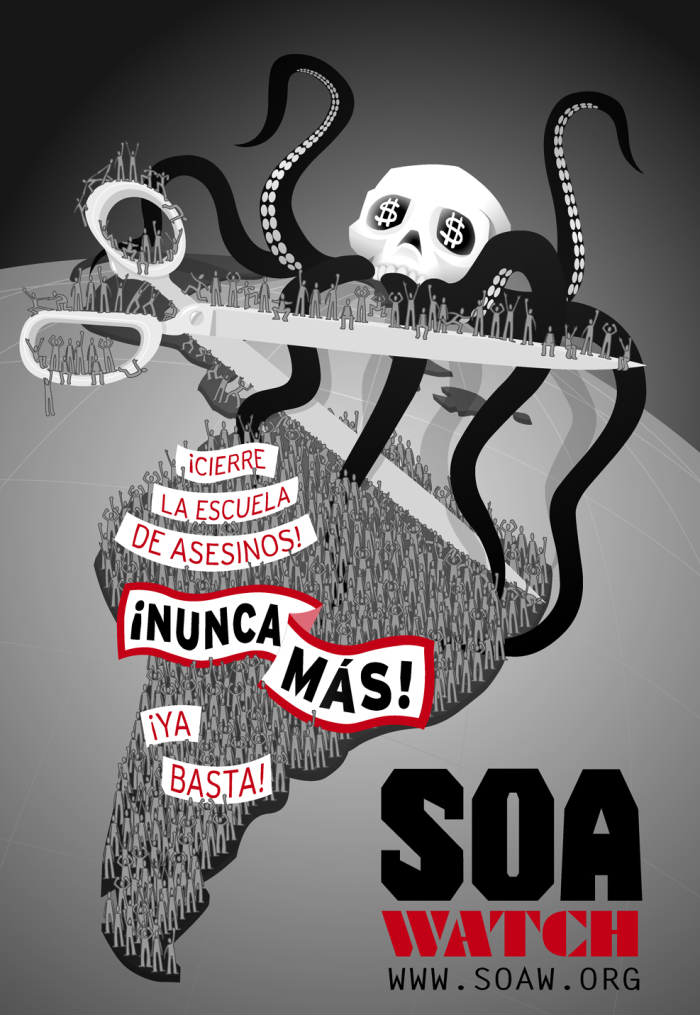
I imagine most readers will know of the infamous ‘School of the Americas‘ at Fort Benning (since renamed the ‘Western Hemisphere Institute for Security Cooperation’) – if you don’t, read Juanita Sundberg in Antipode 39 (1) (2007) 144-66 or Sara Koopman in Antipode 40 (5) (2008) 825-47 on transnational protests against the School – but the network of global military and paramilitary collaboration is much more extensive:
The data show training at no fewer than 471 locations in 120 countries — on every continent but Antarctica — involving, on the U.S. side, 150 defense agencies, civilian agencies, armed forces colleges, defense training centers, military units, private companies, and NGOs, as well as the National Guard forces of five states. Despite the fact that the Department of Defense alone has poured some $122 billion into such programs since 9/11, the breadth and content of this training network remain virtually unknown to most Americans.
The contours of this sprawling system were discovered by analyzing 6,176 diplomatic cables that were released by WikiLeaks in 2010 and 2011. While the scope of the training network may come as a surprise, the most astounding fact may be that it is even larger than the available data show, because the WikiLeaks cables are not comprehensive. They contain, for example, little information on training efforts in Colombia, the single-largest recipient of U.S. training covered by the human rights vetting process that produced these records. Other large recipients of U.S. security assistance, such as Pakistan, are vastly underrepresented in the cables for reasons that remain unclear.
My image at the top of this post is just a screenshot and you really should visit the original because it’s an interactive and you can use your mouse to get much more detail.
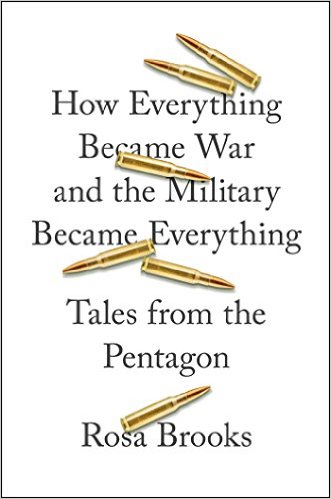
The first serious book to examine what happens when the ancient boundary between war and peace is erased.
Once, war was a temporary state of affairs—a violent but brief interlude between times of peace. Today, America’s wars are everywhere and forever: our enemies change constantly and rarely wear uniforms, and virtually anything can become a weapon. As war expands, so does the role of the US military. Today, military personnel don’t just “kill people and break stuff.” Instead, they analyze computer code, train Afghan judges, build Ebola isolation wards, eavesdrop on electronic communications, develop soap operas, and patrol for pirates. You name it, the military does it.
Rosa Brooks traces this seismic shift in how America wages war from an unconventional perspective—that of a former top Pentagon official who is the daughter of two anti-war protesters and a human rights activist married to an Army Green Beret. Her experiences lead her to an urgent warning: When the boundaries around war disappear, we risk destroying America’s founding values and the laws and institutions we’ve built—and undermining the international rules and organizations that keep our world from sliding towards chaos. If Russia and China have recently grown bolder in their foreign adventures, it’s no accident; US precedents have paved the way for the increasingly unconstrained use of military power by states around the globe. Meanwhile, we continue to pile new tasks onto the military, making it increasingly ill-prepared for the threats America will face in the years to come.
By turns a memoir, a work of journalism, a scholarly exploration into history, anthropology and law, and a rallying cry, How Everything Became War and the Military Became Everything transforms the familiar into the alien, showing us that the culture we inhabit is reshaping us in ways we may suspect, but don’t really understand. It’s the kind of book that will leave you moved, astonished, and profoundly disturbed, for the world around us is quietly changing beyond recognition—and time is running out to make things right.
I have – at long last – finished the longform version of “Dirty dancing: drones and death in the borderlands“, which analyses drone strikes in Pakistan’s Federally Administered Tribal Areas and situates them within a wider context of military violence in the region. You can find it under the DOWNLOADS tab, but I’ve pasted the conclusion below; there’s also a video of the last presentation I gave under that title here.
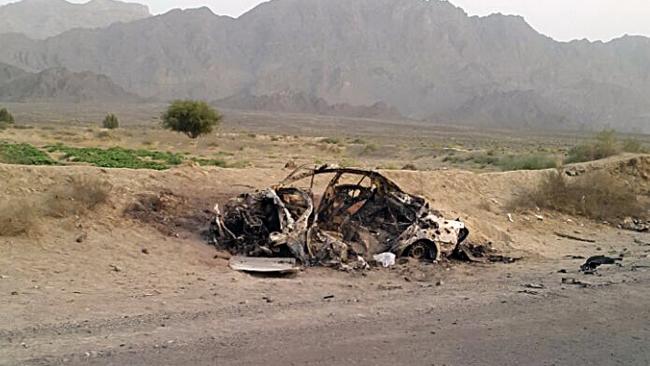
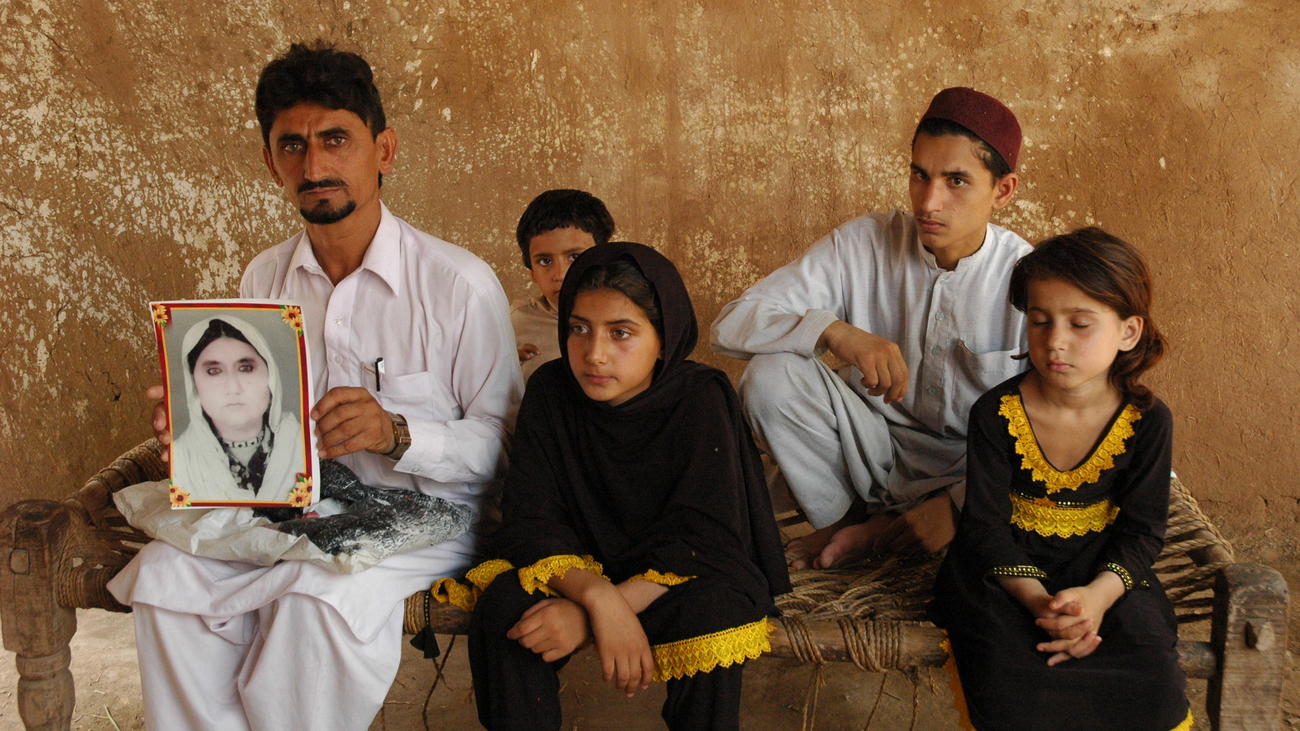
To make sense of the conclusion, I should explain that the essay opens by juxtaposing the killing of two people, Baitullah Mehsud (leader of the Pakistan Taliban) and Mamana Bibi (a village midwife), to pose the question: what kinds of spaces are the FATA made to be for incidents like these – incidents as unlike as these – to be possible?
My answer works with two framing devices.
The first is the space of exception – a space in which people are knowingly and deliberately exposed to death through the political-juridical removal of legal protections and affordances that would otherwise be available to them. My version of this is different from that proposed by Giorgio Agamben, and far from invoking a suspension of the law I explore three legal geographies that have been used to prepare the ground for aerial violence in the borderlands.
The second is the space of execution; here I riff off Owen Sheers‘ perceptive remark about ‘the territory of the screen’ (as I note, ‘Killing somebody with a Hellfire missile controlled from thousands of miles away depends upon a screen – or more accurately a series of screens – on which the image of a human body will eventually be touched by the cross-hairs of a targeting pod’). Owen’s phrase is much more than metaphor, so I treat ‘territory’ as a (bio)political technology whose calibrations enable states to assert, enact and enforce a claim over bodies-in-space (you can no doubt hear the echoes of Stuart Elden) and then explore the technicity involved in three of its screen elements that jointly transform the FATA into a space of execution: kill lists, signals intercepts and visual feeds.
***
Here, then, is the conclusion:
The production of the borderlands as spaces of exception and spaces of execution are attempts to force those who live there into particular subject-positions as a means of subjugation. These positions are partial and precarious but the project to establish them as legitimate and rational has consequences that are material and affective. They clearly affect those targeted – people like Baitullah Mehsud – whose political agency exceeds in terrifying ways the normative space allowed them by the state of Pakistan and the United States and in so doing brings their actions to the attention of both. But they also impact the rest of the population in the FATA, constricting their mobilities and stoking their fears to such a degree that ‘normal life’ for many of them threatens to become a memory or a fantasy. Their existence is rendered more precarious because the subject-positions to which they are so brutally assigned are racialized. These are ‘tribal peoples’, different from those who inhabit ‘mainland Pakistan’, while the United States writes off their incidental deaths as ‘collateral damage’ whose anonymity confers on them no individuality only a collective ascription. When a CIA-directed drone strike on a compound in the Shawal Valley of South Waziristan on 15 January 2015 was found to have killed not only a deputy leader of al-Qaeda in the Indian subcontinent and a local Taliban commander but also two hostages, an American development contractor and an Italian aid worker, a ‘grim-faced’ and ‘visibly moved’ Obama made a personal and public apology. [i] The rarity of the gesture is revealing. For the value of their lives was acknowledged and their deaths were made grievable in ways that others – which is to say Others – were not. Nobody has ever accepted responsibility or apologised for the death of Mamana Bibi or any of the other innocent victims of aerial violence.
For this reason it is important to resist those versions of the space of exception that are complicit in the denial of agency to those who live within its confines. The state of Pakistan administers the inhabitants of the FATA through Political Agents: but this does not remove (though it does diminish) their own political agency. Pakistan’s armed forces conduct clearing operations that ruthlessly drive people from their homes and into camps for displaced persons: but this does not turn the FATA into one vast ‘camp’. The presence of US drones strips those who live under them of their well-being and dignity: but this does not reduce them to ‘bare life’. Similarly, the emergent subject that is produced within the space of execution, apprehended as a network trace, a sensor signature and a screen image, is a cipher that stands in for – and in the way of – a corporeal actor whose existence is not measured by the calculative alone.
***
This version, or something very much like it, will appear in a collection edited by Caren Kaplan and Lisa Parks, Life in the Age of Drones. But an (even longer!) version will eventually appear in my own book, with images and maps (you can find many of them scattered through my previous posts: for example here, here and here), so I really would welcome any comments or suggestions if you have time to read the full thing: derek.gregory@ubc.ca.
Here is a call for papers for a wonderfully creative international symposium, The Body of War: Drones and Lone Wolves, to be held at the University of Lancaster on 24-25 November 2016. It’s part of the ongoing States of Exceptions project (for Part I, see here).
I’ve just agreed to give a keynote; it’s an interdisciplinary event, and the organisers tell me they are keen to encourage the participation of early career scholars.
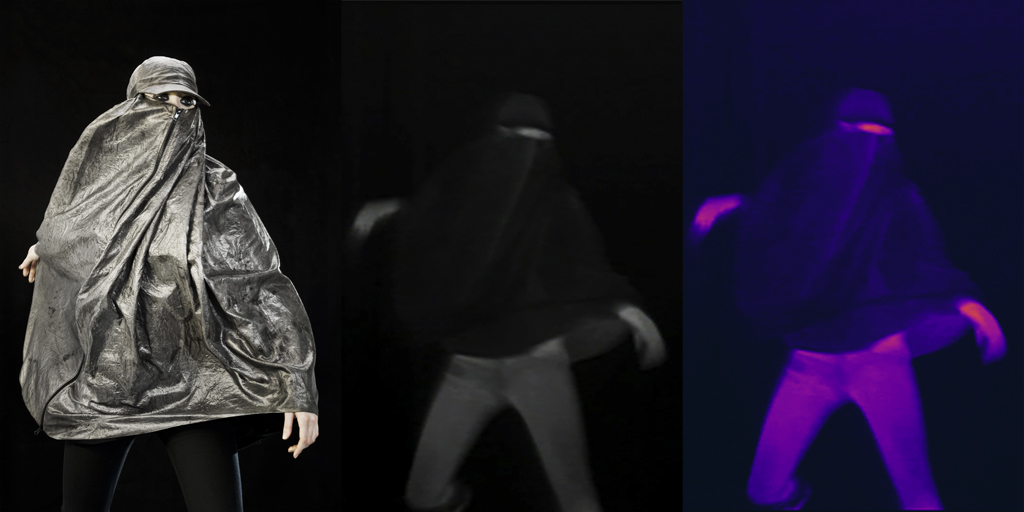
Anti-drone Burqa (Adam Harvey)
“The discriminatory concept of the enemy as a criminal and the attendant implication of justa causa run parallel to the intensification of the means of destruction and the disorientation of theaters of war. Intensification of the technical means of destruction opens the abyss of an equally destructive legal and moral discrimination. […] Given the fact that war has been transformed into a police action against troublemakers, criminals, and pests, justification of the methods of this “police bombing” must be intensified. Thus, one is compelled to push the discrimination of the opponent into the abyss.”
Carl Schmitt, The Nomos of the Earth (1950)
13 November 2015: three suicide bombers blew themselves up near the Stade de France in Saint-Denis, Paris, killing themselves and a bystander, and triggering a series of violent actions that caused 130 casualties. 15 November 2015: the President of France, François Hollande, after defying the attacks ‘an act of war’ by the Islamic State, launched a three-month state of emergency and ‘Opération Chammal’, a huge airstrike campaign against ISIL targets in Syria.
These two violent actions design a deformed and limitless theater of war, within which all distinctions and limitations elaborated by International Law seem to disappear. It is not merely the loss of the fundamental distinction between combatants and civilians, that both suicide bombers and airstrike bombings signal. In the current situation, all the fundamental principles that gave birth to the Laws of War seem to collapse: spatial and temporal limitations of hostilities, proportionality of military actions, discrimination of targets, weapons and just methods to use them. In this way, the ‘enemy’, from a juridical concept, is transformed into an ‘ideological object’; his figure, pushed to a climax from both these ‘invisible’ and ‘mobile’ fronts, becomes absolute and de-humanized. Hollande, Cameron and Obama’s unwillingness to use ground troops against the ‘uncivilized’ (Kerry 2015) is mirrored by the ISIL call to intensify suicide missions against the ‘cowards’ (Dābiq, 12: 2015).
But what lies behind the asymmetric confrontation between airstrikes and ‘humanstrikes’, behind the blurring of the distinction between the state of war and state of peace? What notion of humanity are the physical disengagement of the Western powers (with their tele-killing via drones and airstrikes) and the physical engagement of suicide bombers (ready to turn their bodies into a weapon) trying to convey? In other words, how and to what extent is there a connection between the automatization and biopoliticization of war operated by Western powers and the sacrificial nature of the conflict adopted by those who want to fight these powers?
In this second part of the “States of Exceptions” project, our intention is to explore these questions in order to map the crucial transformations of warfare, of its ethical principles and methods of engagement.
We invite potential participants to submit abstracts of no more than 250 words by 31 July 2016 drawing upon, but not limited to, such issues as:
Theatres of War: The New Spatialities and Temporalities of Warfare
Mirror Images? Drones vs. Suicide Bombers
Phenomenology of Drones
New Perspectives on Ethics, Horror & Terror
The Ubiquity of the Enemy: Lone Wolves and Self-Representing Terror
The Collapse of International Law: What Enemy? Which Proportionality?
The Body as a Weapon: The Immanentization of Martyrdom
Phenomenology of Lone Wolves
The End of Law: Rethinking Limitation, Proportionality and Discrimination
Please send abstracts with “States of Exception II” in subject line to bisagroup.cript@gmail.com










 geographical imaginations