Theory of the drone 3: Killing grounds

This is the third in a series of posts on Grégoire Chamayou‘s Théorie du drone, in which I provide a detailed summary of his argument, links to some of his key sources, and reflections drawn from my soon-to-be-completed The everywhere war (and I promise to return to it as soon as I’ve finished this marathon).

5: Pattern of life analysis

Chamayou begins with the so-called ‘Terror Tuesdays‘ when President Obama regularly approves the ‘kill list’ (or disposition matrix) that authorises ‘personality strikes’ against named individuals: ‘the drones take care of the rest’.

a0018519784_2

But Chamayou immediately acknowledges that most strikes are ‘signature strikes‘ against individuals whose names are unknown but for whom a ‘pattern of life analysis‘ has supposedly detected persistent anomalies in normal rhythms of activity, which are read as signs (‘signatures’) of imminent threat.  I’ve described this as a militarized rhthmanalysis, even a weaponized time-geography, in ‘From a view to a kill’ (DOWNLOADS tab), and Chamayou also notes the conjunction of human geography and social analysis to produce a forensic mapping whose politico-epistemological status is far from secure.

The principal limitation – and the grave danger – lies in mistaking form for substance.  Image-streams are too imprecise and monotonic to allow for  fine-grained interpretation, Chamayou argues, and supplementing them by equally distant measures, like telephone contacts, often compounds the problem.  Hence Gareth Porter‘s objection, which both Chamayou and I fasten upon:

‘The phone numbers and call histories from those phones go into the database which is used to “map the networks.” But the link analysis methodology employed by intelligence analysis is incapable of qualitative distinctions among relationships depicted on their maps of links among “nodes.” It operates exclusively on quantitative data – in this case, the number of phone calls to or visits made to an existing JPEL target or to other numbers in touch with that target. The inevitable result is that more numbers of phones held by civilian noncombatants show up on the charts of insurgent networks. If the phone records show multiple links to numbers already on the “kill/capture” list, the individual is likely to be added to the list.’

This is exactly what happened in the Takhar attack in Afghanistan on 2 September 2010 that I’ve discussed elsewhere, relying on the fine investigative work of Kate Clark, and Chamayou draws attention to it too.   The general assumption, as Kate was told by one officer, seems to be that ‘”If we decide he’s a bad person, the people with him are also bad.”
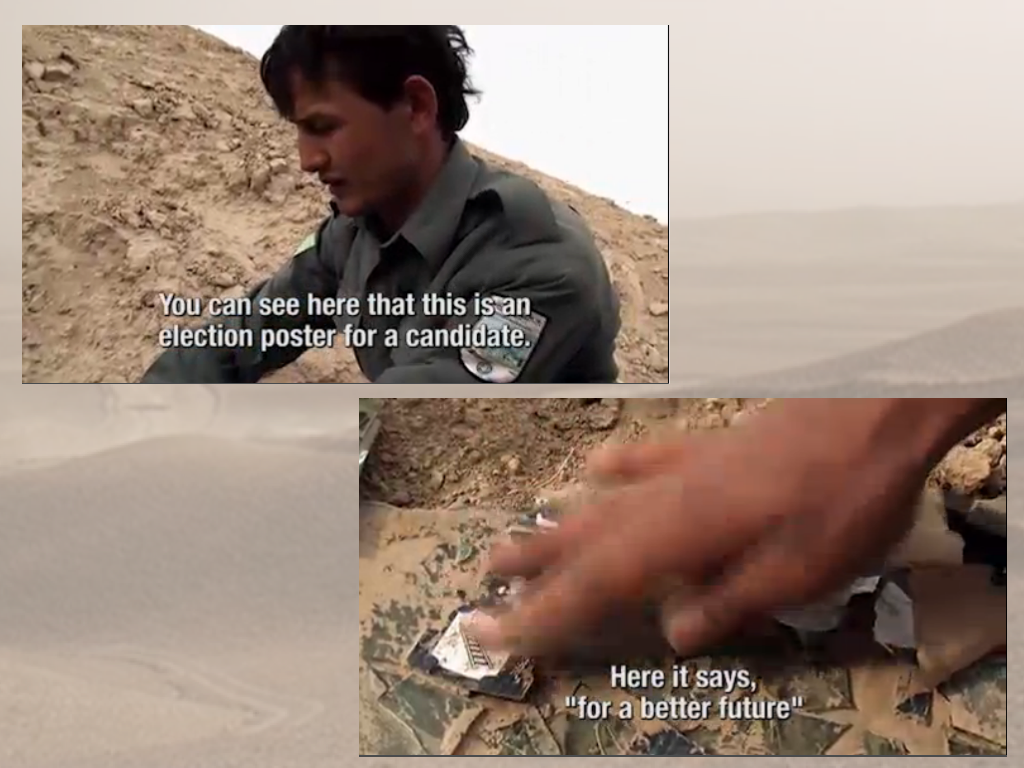
Takhar For a better future.001

These necro-methodologies raise two questions that Chamayou doesn’t address here.

The first, as Porter notes, is that ‘guilt by association’ is ‘clearly at odds with the criteria used in [international] humanitarian law to distinguish between combatants and civilians.’  You can find a much more detailed assessment of the legality of signature strikes (and what he calls their ‘evidential adequacy’)  in Kevin Jon Heller‘s fine essay, ”One hell of a killing machine”: Signature strikes and international law’ [Journal of international criminal justice 11 (2013) 89-119; I discussed a pre-publication version here].

The geo-legal ramifications of these attacks reach far beyond the killing grounds.  Earlier this month in the High Court in London one man who lost five relatives in the air strike in Takhar (as you can see on the slide above, on an election convoy) challenged the legality of the alleged involvement of Britain’s Serious and Organised Crimes Agency (SOCA) in drawing up the kill-list, the Joint Prioritized Effects List, used by the military to authorise the attack: more herehere and here. (It was the presence of names on the list that triggered the faulty network analysis).

The second is the imaginary conjured up by the very idea of a ‘pattern of life’ analysis.  I’ve written before about the way in which the screen on which the full-motion video feeds from the Predators and Reapers are displayed interpellates those who watch what is happening on the ground from thousands of miles away, and I’ve emphasised that this isn’t a purely optical affair:  that it is an embodied, techno-culturally mediated process that involves a series of structured dispositions to view the other as Other (and often dangerous Other).   But these dispositions also reside in what we might think of as a grammar of execution.  To see what I mean, here is Micah Zenko:

‘Recently, I spoke to a military official with extensive and wide-ranging experience in the special operations world, and who has had direct exposure to the targeted killing program. To emphasize how easy targeted killings by special operations forces or drones has become, this official flicked his hand back over and over, stating: “It really is like swatting flies. We can do it forever easily and you feel nothing. But how often do you really think about killing a fly?”’

Hence, of course, ‘Bugsplat’ [according to Rolling Stone, ‘the military slang for a man killed by a drone strike is “bug splat,” since viewing the body through a grainy-green video image gives the sense of an insect being crushed’], and a host of other predatory terms (see also here) that distinguish between this mere (bare) life and what Judith Butler calls ‘a life that qualifies for recognition’.
state-violence-and-the-execution-of-lawBut the same result is achieved through the nominally neutral, technical-scientific vocabulary deployed in these strikes. Joseph Pugliese captures the grammar of execution with acute insight in another fine essay, ‘Prosthetics of law and the anomic violence of drones’, [Griffith Law Review 20 (4) (2011) 931-961; you can also find it in his excellent new book State violence and the execution of law]:

‘The term ‘heat signature’ works to reduce the targeted human body to an anonymous heat-emitting entity that merely radiates signs of life. This clinical process of reducing human subjects to purely biological categories of radiant life is further elaborated by the US military’s use of the term ‘pattern of life’…

‘The military term ‘pattern of life’ is inscribed with two intertwined systems of scientific conceptuality: algorithmic and biological. The human subject detected by drone’s surveillance cameras is, in the first scientific schema, transmuted algorithmically into a patterned sequence of numerals: the digital code of ones and zeros. Converted into digital data coded as a ‘pattern of life’, the targeted human subject is reduced to an anonymous simulacrum that flickers across the screen and that can effectively be liquidated into a ‘pattern of death’ with the swivel of a joystick. Viewed through the scientific gaze of clinical biology, ‘pattern of life’ connects the drone’s scanning technologies to the discourse of an instrumentalist science, its constitutive gaze of objectifying detachment and its production of exterminatory violence. Patterns of life are what are discovered and analysed in the Petri dish of the laboratory…

‘Analogically, the human subjects targeted as suspect yet anonymous ‘patterns of life’ by the drones become equivalent to forms of pathogenic life. The operators of the drones’ exterminatory attacks must, in effect, be seen to conduct a type of scientific ethnic cleansing of pathogenic ‘life forms’. In the words of one US military officer: “Our major role is to sanitize the battlefield.”’

Later modern war more generally works through relays of biological-medical metaphors – equally obviously in counterinsurgency, as I’ve described in “Seeing Red” and other essays (DOWNLOADS tab), where the collective enemy becomes a ‘cancer’ that can only be removed by a therapeutic ‘killing to make live’ (including ‘surgical strikes’) – and Colleen Bell has provided an illuminating series of reflections in ‘Hybrid warfare and its metaphors’ [in Humanity 3 (2) (2012) 225-247] and ‘War and the allegory of medical intervention’ [International Political Sociology 6 (3) (2012) 325-8].

This immunitary logic is clearly bio-political, and its speech-acts just as plainly performative, and Pugliese draws the vital conclusion:

‘As mere patterns of pathogenic life, these targeted human subjects effectively are reduced to what Giorgio Agamben would term ‘a kind of absolute biopolitical substance’ that can killed with no concern about the possibility of juridical accountability: they are ‘bare life’ that can be killed with absolute impunity. Anonymous ‘patterns of life’ signify in contradistinction to legally named persons; they exemplify the ‘ontological hygiene’ legislated by US government policy in order to secure the reproduction of the ‘principle of scarcity with respect to agency and personhood’.

‘Situated in this Agambenian context of the extermination of human life with absolute impunity, the Predator drones must be seen as instantiating mobile ‘zones of exception’…’

Which artfully brings me to Chamayou’s next chapter…

6: Kill-box

Chamayou notes that the ‘war on terror’ loosed the dogs of war from their traditional boundaries in time and in space: at once ‘permanent war’ and, as he notes, ‘everywhere war’.

But for Chamayou it is more accurate to speak of the world turned into a ‘hunting ground’ rather than a battlefield, and this matters because two different geographies (his term) are involved.  War is defined by combat, he explains, hunting by pursuit.  Combat happens where opposing forces engage, but hunting tracks the prey, so that the place of military violence is no longer defined by a delimited space (‘the battlefield’) but by the presence of the enemy-prey who carries with him, as it were, his own mobile halo of a zone of personal hostilities.

To escape, the quarry must make itself undetectable or inaccessible – and the ability to do so depends not only on physical geography (terrain) but also on political and legal geography.  For this reason, Chamayou argues, the US has rendered contingent the sovereignty of Pakistan because it (for the most part unwillingly) provides sanctuary to those fleeing across the border from Afghanistan.  In such circumstances, what becomes crucial for the hunter is not the military occupation of territory but the ability to control trans-border spaces from a distance through the instantiation of what Eyal Weizman called the politics of verticality that has since captured the attention of Stuart Elden [“Secure the volume: vertical geopolitics and the depth of power”, Political Geography 34 (2013) 35-51], Steve Graham [“Vertical geopolitics: Baghdad and after”, Antipode 36 (1) (2004) 12-23] and others.  For this to work, as Weizman shows in the case of occupied Palestine, air power is indispensable.

Chamayou suggests that the US has refined this capacity – in effect, finely calibrated the time and space of the hunt – through the concept of the kill-box.  I’m not so sure about this; the lineage of the ‘kill-box’ goes back to the USAF’s ‘target boxes’ [target boxes around An Loc in Vietnam in 1972 are shown below] – and two or three specified ‘boxes’ or ‘Restricted Operating Zones‘ were used to define the Predato’s’  ‘hunting grounds’ over North and South Waziristan that were tacitly endorsed by the Pakistan state.
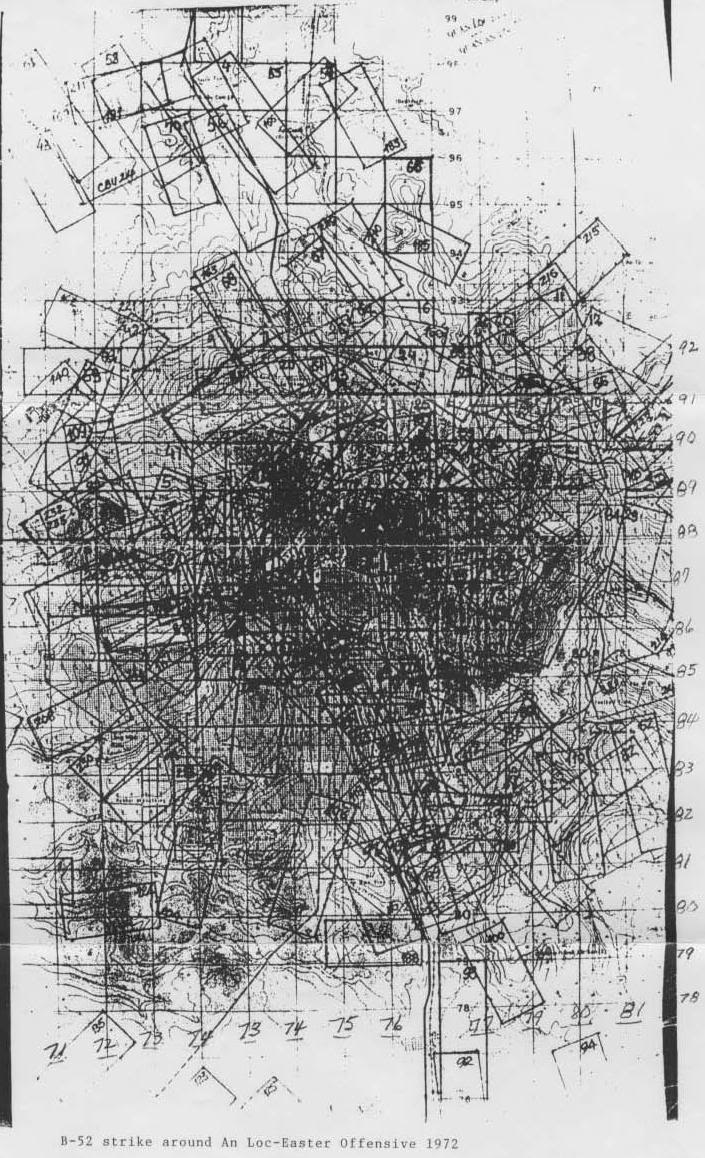
Target boxes around An Loc 1972

The concept of the ‘kill box’ was formalised as a joint operations doctrine in the 1990s as part of the established targeting cycle: what Henry Nash famously described in another context as ‘the bureaucratization of homicide’.  Nash worked for the USAF Air Targets Division in the 1950s and 60s, identifying targets in the USSR for nuclear attack by US Strategic Air Command, but I doubt that Chamayou would dissent from using either the verb or the noun to describe the contemporary, non-nuclear kill-chain.  (In a later post I’ll explain how this technical division of labour feeds in to what Chamayou castigates as a ‘setting aside’, a dispersal of responsibility, which functions to separate an action from its consequences: this is aggravated by the remote-split operations in which drones are embedded, and is central to Chamayou’s critique).  Here is how the relevant military manuals incorporated the development of the kill box into the targeting cycle in 2009 (ATO = Air Tasking Order):
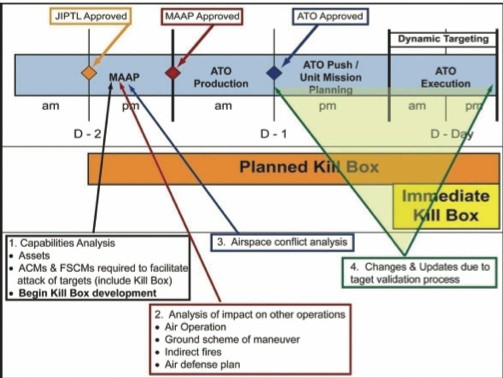
Kill Box Development

You can find more on kill-boxes and their operationalisation here.
Kill Box TTP

Chamayou doesn’t track the development of the concept, but since then the ‘kill-box’ has been supplanted or at least supplemented by the ‘Joint Fires Area’ as a way of continuing to co-ordinate the deployment of lethal force and allowing targets to be engaged without additional communication.  Within the grid of the JFA (shown below, taken from an essay by Major James Mullin on ‘redefining the kill box’) permission to fire in specified cells is established in advance; areas are defined, targeting intervals stipulated, and the time-space cells can be opened and closed as operations proceed.

It is this capacity that Chamayou seizes upon: within the kill box targets can be engaged at will, so that the kill box, he writes, ‘is an autonomous zone of temporary killing’ (cf. the ‘free fire/specified fires zone’ in Vietnam: see my discussion of Fred Kaplan‘s recent essay, ‘The world as a free-fire zone‘).

3-D representation of Joint Fires Area using Global Area Reference System

Chamayou implies that the schema has been further refined in contemporary counterinsurgency and counter-terrorism operations: the fact that the kill-box and its successor allow for dynamic targeting across a series of scales is crucial, he says, because its improvisational, temporary nature permits targeting to be extended beyond a declared zone of conflict. The scale of the JFA telescopes down from the cell shown on the right of the figure below through the quadrant in the centre to the micro-scale ‘keypad’ (sic) on the right.

Global Area Reference System

This is more than a grid, though; the JFA is, in effect, a performative space that authorises, schedules and triggers lethal action.  Chamayou: ‘Temporary micro-cubes of lethal exception can be opened anywhere in the world, according to the contingencies of the moment, once an individual who qualifies as a legitimate target has been located.’  Thus, even as the target becomes ever more individuated – so precisely specified that air strikes no longer take the form of the area bombing of cities in World War II  or the carpet bombing of the rainforest of Vietnam – the hunting ground becomes, by virtue of the nature of the pursuit and the remote technology that activates the strike, global.

KAPLAN World as Free-Fire Zone

The system I’ve described here is one adopted by the US military, and how far its procedures are used by other agencies outside established conflict zones is unknown to me and doubtless to Chamayou too.  Are these micro-cells used to specify individual compounds or rooms, as Chamayou suggests in a thought-experiment?  For him, however, it’s the imperative logic that matters, and here Kaplan’s tag-line (above) can provide the key explanatory exhibit: ‘to kill a particular person anywhere on the planet.’   The doubled process of time-space calibration and individuation is what allows late modern war to become the everywhere (but, contra Kaplan,  not the anywhere, because specified) war.

On the one side, then, a principle of what Chamayou calls precision or specification:  ‘The zone of armed conflict, fragmented into micro-scale kill boxes, reduces itself in the ideal-typical case to the single body of the enemy-prey: the body as the field of battle.’  Yet on the other side, a principle of globalisation or homogenisation: ‘Because we can target our quarry with precision, the military and the CIA say in effect, we can strike them wherever we see fit, even outside a war zone.’

This paradoxical articulation has sparked fierce debates among legal scholars – Chamayou cites Kenneth Anderson, Michael Lewis, and Mary Ellen O’Connell – over whether the ‘zone of armed conflict’ should be geo-centred (as in the conventional battlefield) or target-centred (‘attached to the body of the enemy-prey’). Jurists are thus in the front line of the battle over the extension of the hunting ground, he writes, and ‘applied ontology’ is the ground on which they fight.  I’ll have more to say about this on my own account in a later post.
War crimes

GOW War and war crimesWhile we’re on the subject of war crimes – and, as you’ll see shortly, my visit to Poland and the Czech Republic gave me new opportunities to reflect on the enormity of violence  – news of a new book from James Gow, Professor of International Peace and Security at King’s College London, War and War Crimes: the military, legitimacy and success in armed conflict (Hurst, April 2013):

The laws of war have always been concerned with issues of necessity and proportionality, but how are these principles applied in modern warfare? What are the pressures on practitioners where an increasing emphasis on legality is the norm? Where do such boundaries lie in the contexts, means and methods of contemporary war? What is wrong, or right, in the view of military-political practitioners, in how those concepts relate to today’s means and methods of war? These are among the issues addressed by James Gow in his compelling analysis of war and war crimes, which draws upon research conducted over many years with defence professionals from all over the world. Today more than ever, military strategy has to embrace justice and law, with both being deemed essential prerequisites for achieving success on the battlefield. And in a context where legitimacy defines success in warfare, but is a fragile and contested concept, no group has a greater interest in responding to these pressures and changes positively than the military. It is they who have the greatest need and desire to foster legitimacy in war by getting the politics-law-strategy nexus right, as well as developing a clear understanding of the relationship between war and war crimes, and calibrating where war becomes a war crime.

There is a considerable literature on war crimes, both general discussions of international law and tribunals and specific accounts of serial violations, but Gow’s book promises to open up a different dimension. One of the diagnostic features of later modern war is its reflexivity, a keen interest in monitoring the conduct of conduct and a close attention to public attention, twin developments which help to account for the close involvement of military lawyers in the ‘prosecution of the target’ and the rapid growth of ‘media operations’ across a range of social platforms.  So I’m interested in this plaudit from Jeremy Jarvis at the Royal College of Defence Studies:

‘At the heart of this authoritative examination of the legitimacy of war and its conduct in the twenty-first century, James Gow refreshingly gives voice to the military judgment of professionals from around the world, as military officers themselves best understand the moral dilemmas they face and can best explain the context, at the strategic and tactical levels, which is so crucial to determining whether war crimes have been committed.’

I think there’s rather more to it than that, needless to say, but it’s certainly important to understand how the kill-chain has been ‘lawyered up’: much more on all this from Craig Jones at War, law and space.

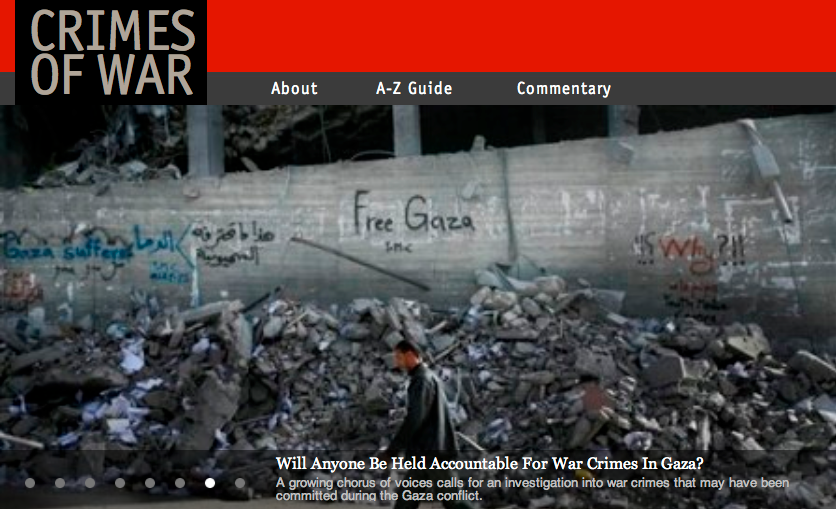
Crimes of War

If you want an easily accessible resource then Crimes of War, a collaboration between lawyers journalists and scholars provides both an A-Z Guide and a Commentary on current events.  It’s indispensable, as are the provocative posts (which address a wider range of topics than war crimes) at Lawfare and Opinio Juris.

Dirty dancing and spaces of exception in Pakistan

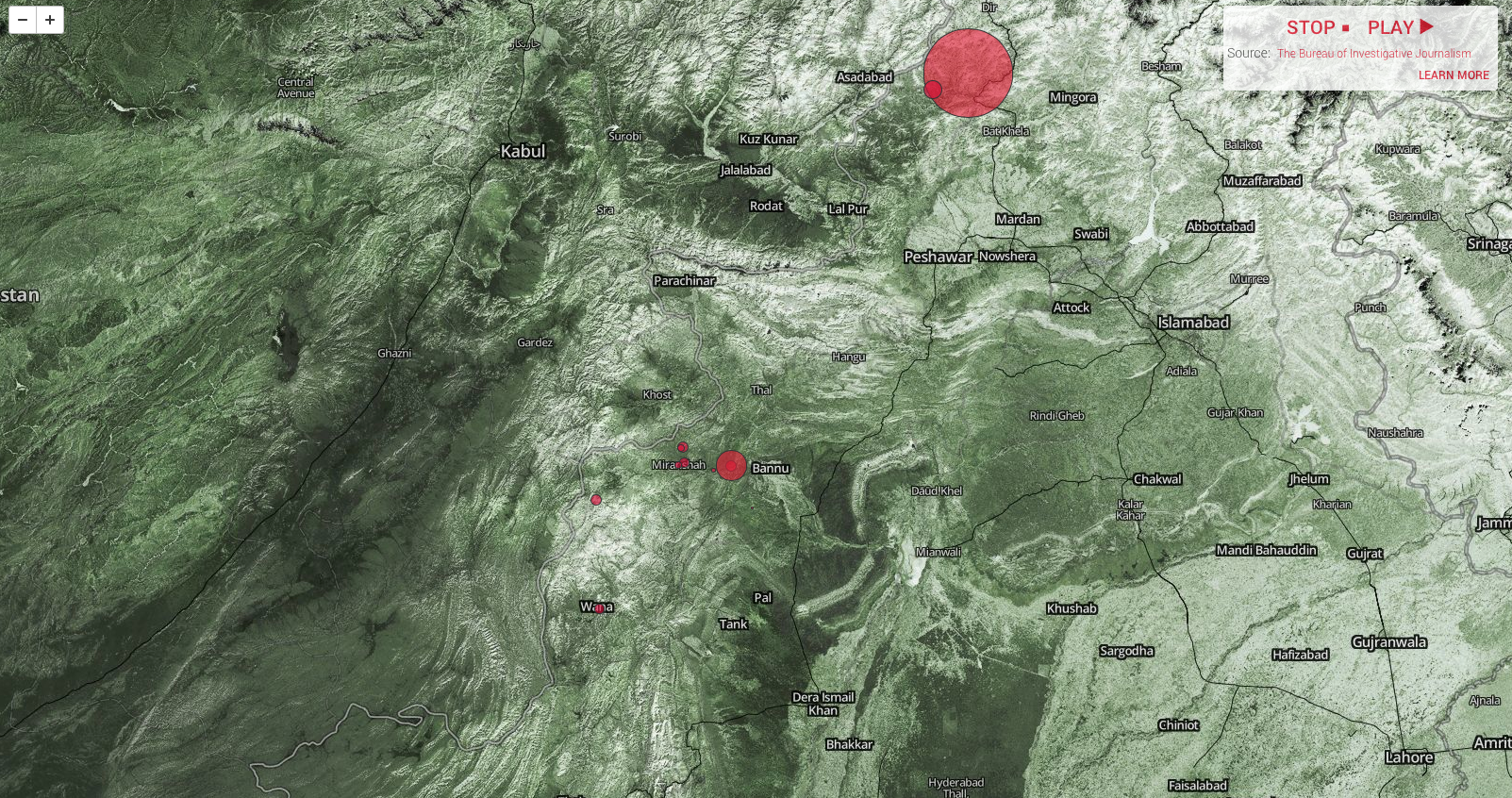
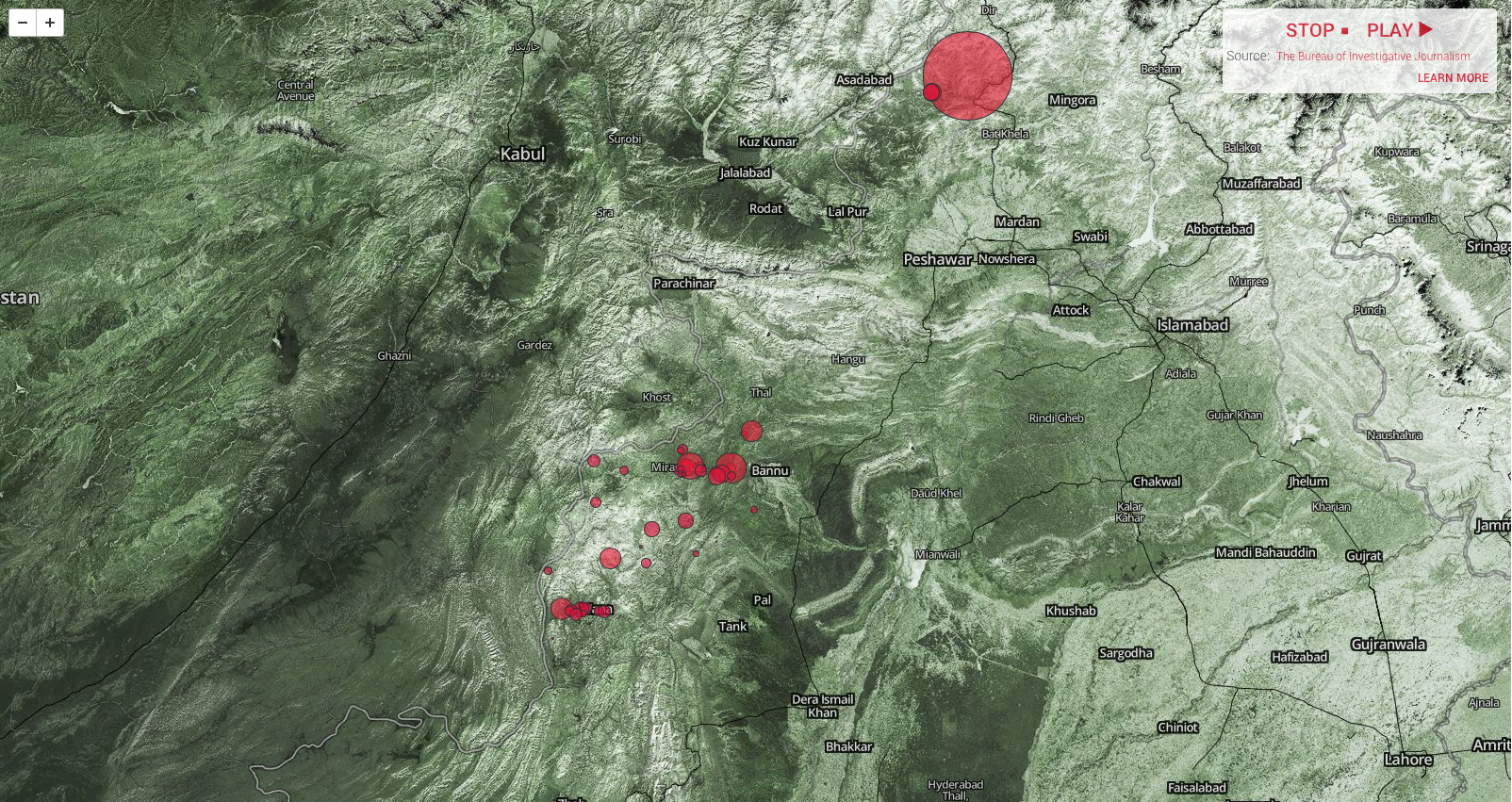
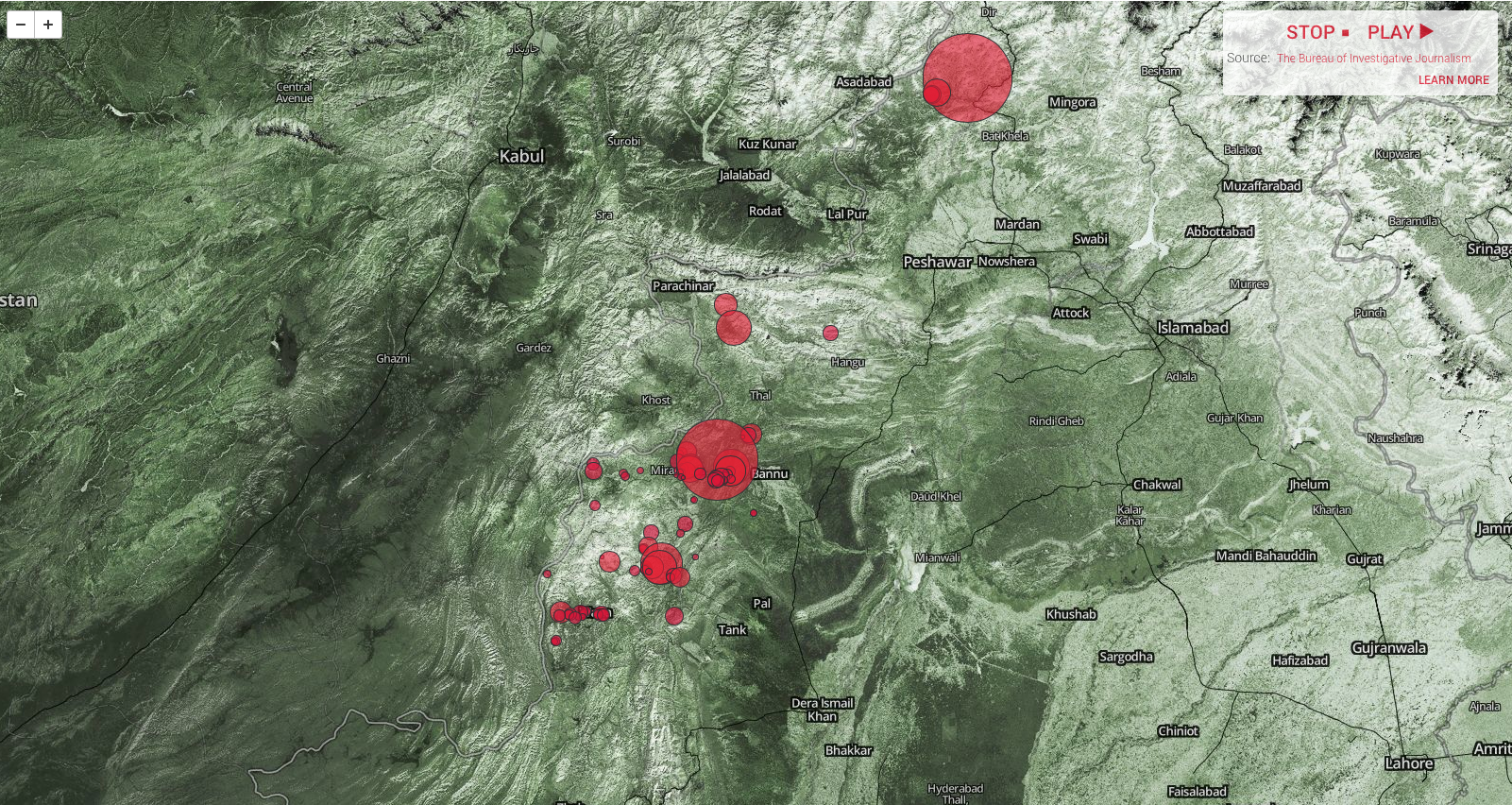
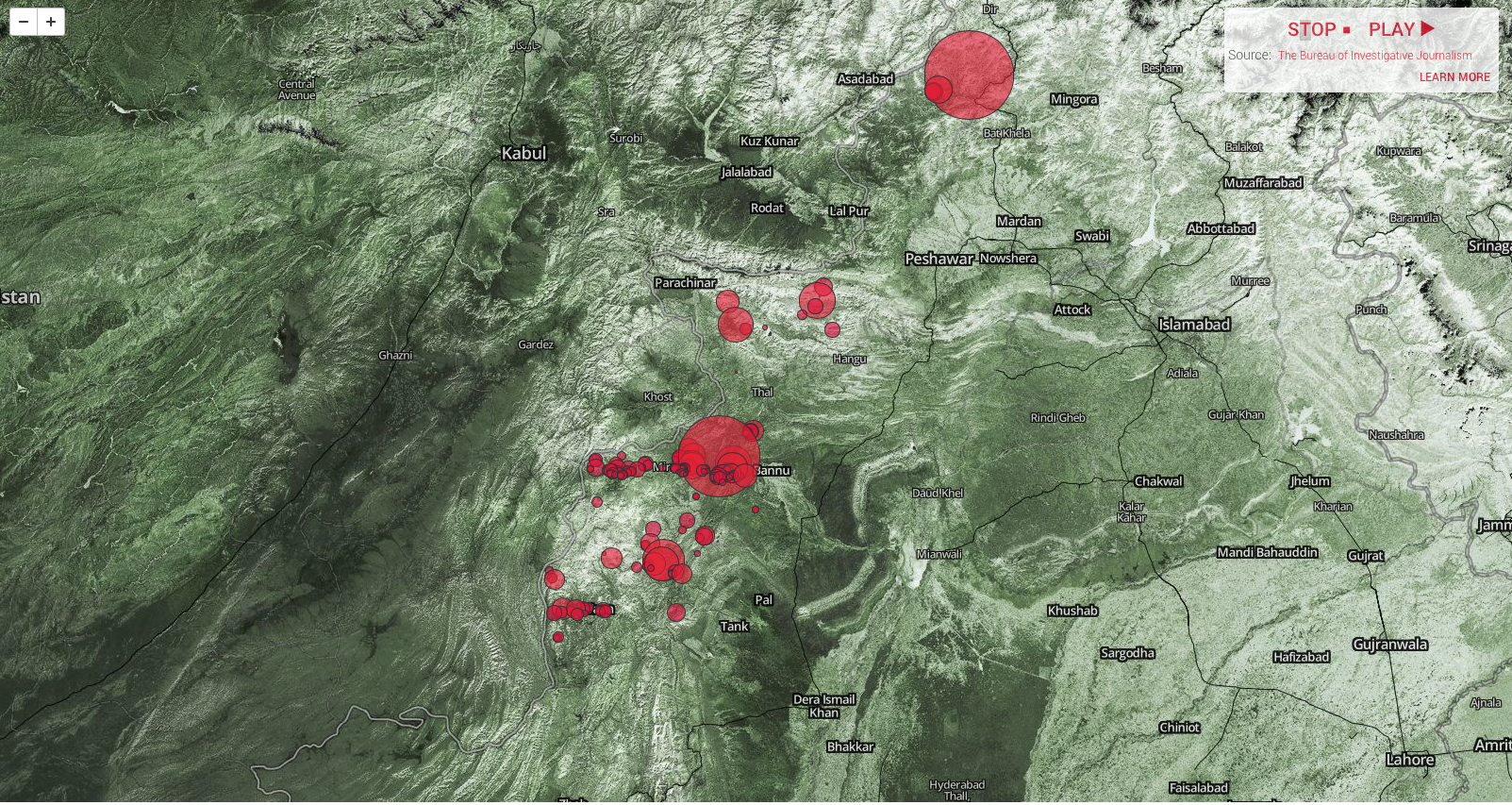
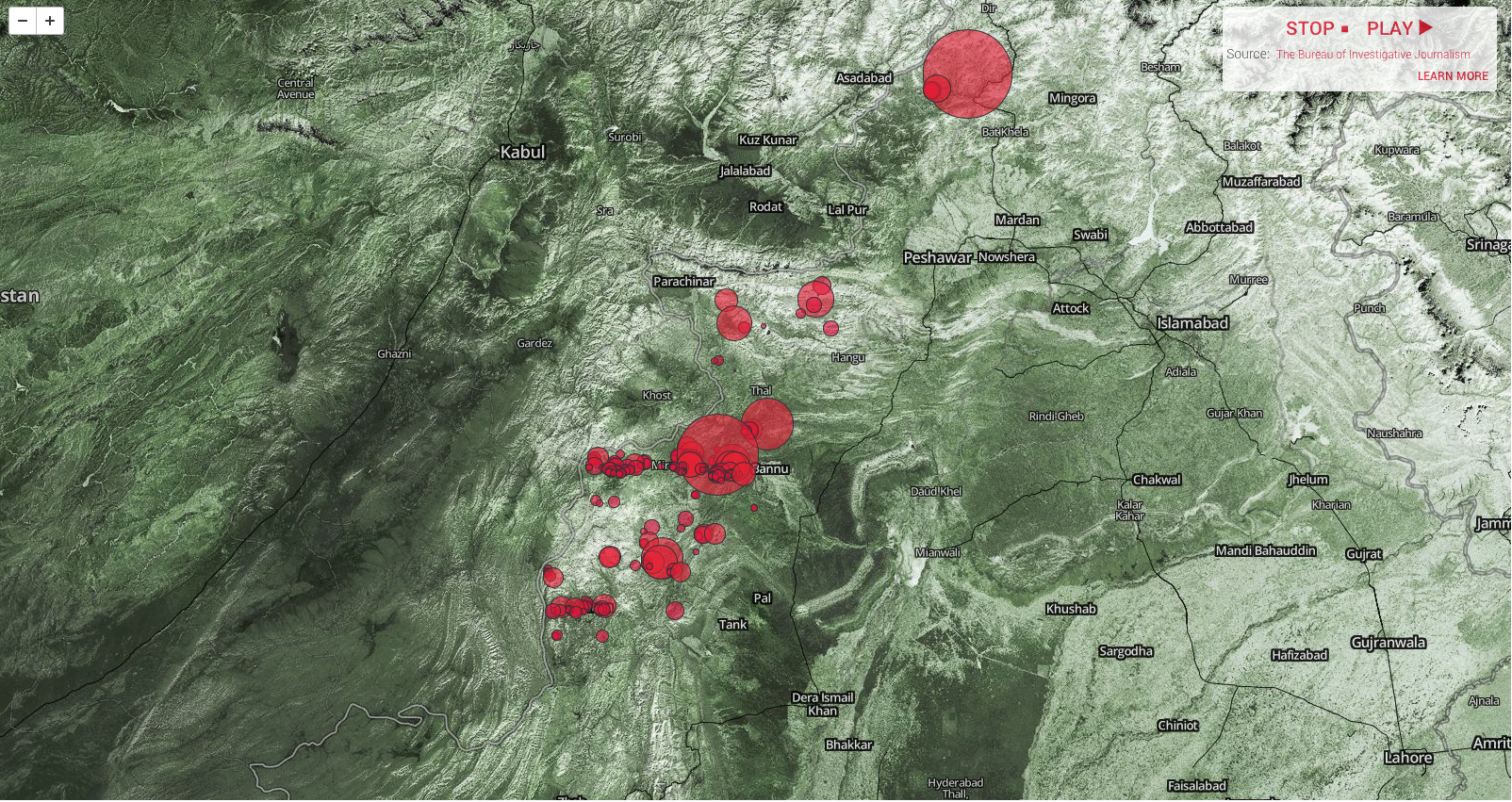
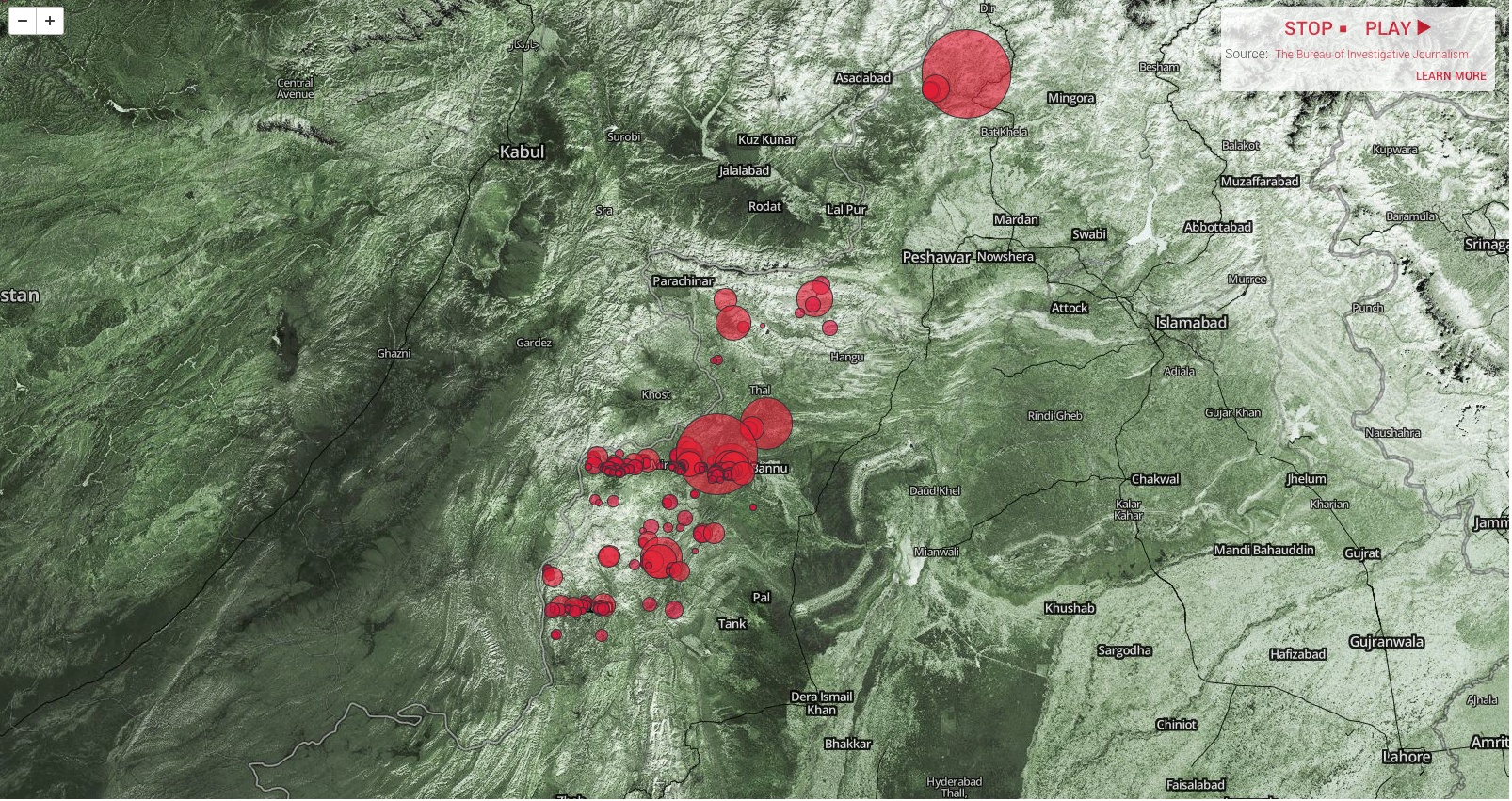
Following up my post on the air campaigns waged by the United States and by Pakistan inside the Federally Administered Tribal Territories and the North-West Frontier Province (now Khyber Pakhtunkhwa), here are some screenshots from Chris Herwig‘s remarkable cartographic animation of casualties from US drone strikes from 2004 through to the present (data from the Bureau of Investigative Journalism):

Casualties from US drone strikes to end December 2007

Casualties from US drone strikes to end December 2007

Casualties from US drone strikes to end December 2008

Casualties from US drone strikes to end December 2008

Casualties from US drone strikes to end December 2009

Casualties from US drone strikes to end December 2009

Casualties from US drone strikes to end December 2010

Casualties from US drone strikes to end December 2010

Casualties from US drone strikes to end December 2011

Casualties from US drone strikes to end December 2011

Casualties from US drone strikes to end December 2012

Casualties from US drone strikes to end December 2012

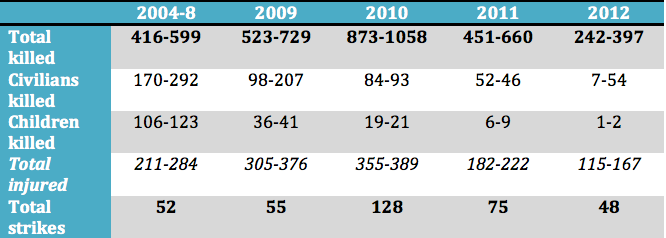
You can see the rapid escalation of strikes in 2009-2010 and their contraction in 2011-2012.  There is also a tendency for later strikes to cause fewer casualties; the Bureau suggests that this may have been the result of a deliberate decision to limit civilian casualties (the CIA was already reported to be using new, smaller missiles with a restricted blast field and minimal shrapnel by the spring of 2010, so the later change is likely to be down to a mix of better intelligence and greater circumspection) and, more recently, of a switch away from ‘signature strikes’ – the two are of course related – and John Brennan, who was one of the main boosters of the programme’s expansion, now claims that drone strikes are a weapon ‘of last resort’.  Maybe; most sources agree that even as the numbers of deaths dwindled, so too did their tactical significance.  By February 2011 it was clear that fewer and fewer were so-called ‘high-value targets’ and more and more were simply foot-soldiers.

Here are the Bureau’s raw figures:

Drone strikes in Pakistan (BoJ)

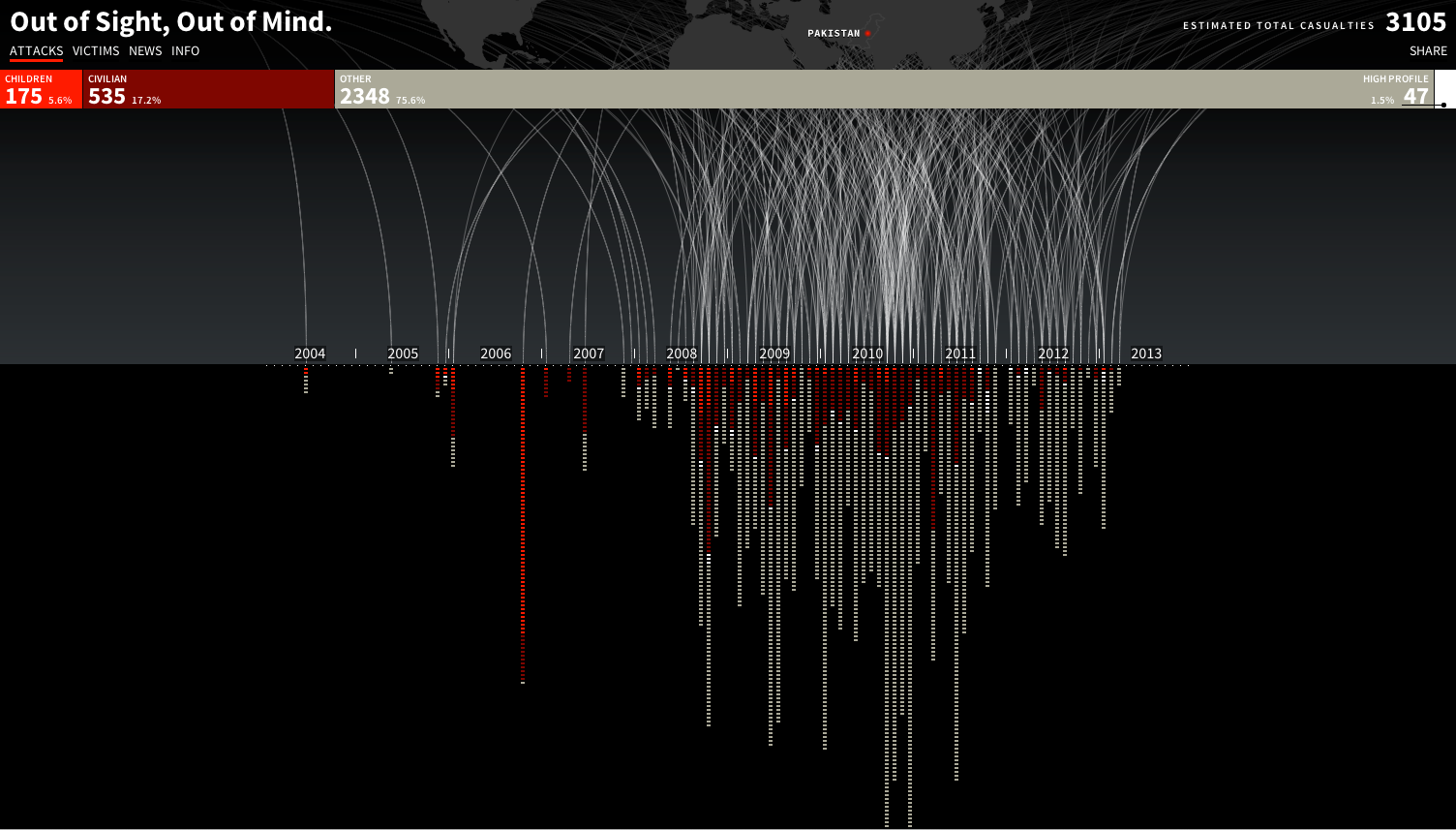
You can find an interactive animation of the Bureau’s tabulations from Pitch Interactive here (thanks to Steve Legg for the tip); the screenshot below doesn’t do justice to the political-aesthetic effect of seeing this in full motion (or of clicking on each strike for the details):

Drone strikes in Pakistan PITCH INTERACTIVE

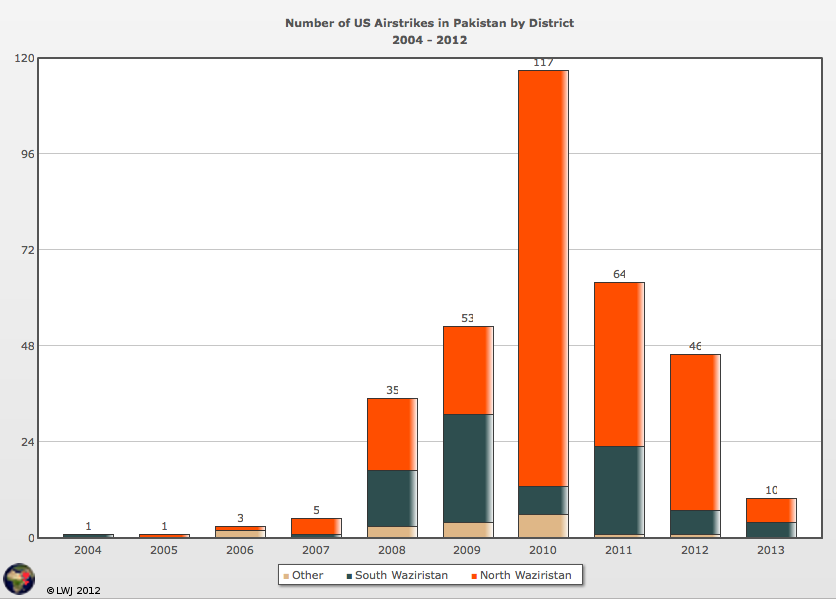
The maps also show that the strikes have been concentrated on North Waziristan, increasingly so since 2010, the locus of the Haqqani Network (which is a longstanding ally of Pakistan’s Inter Services Intelligence), with a secondary concentration on South Waziristan (a key locus of Tehrik-i-Taliban).  Here’s a tabulation from the Long War Journal, and although the strike numbers are marginally different from the Bureau’s the geographical concentration is clear:

US air strikes in FATA by district

What the maps can’t convey is the intricate, inconstant gavotte between Pakistan’s various military campaigns and US air strikes in the borderlands since 2004.  In the wake of 9/11 and the US-led invasion of Afghanistan, and in response to increasing pressure from Washington, the Pakistan Army launched a number of offensives against militants in the Federally Administered Tribal Areas (FATA).  In April 2004, after fierce fighting in the mountains of South Waziristan, Islamabad concluded a peace accord with Nek Muhammad, a key militant leader in the agency.  But he was killed just two months later, the first casualty of a US drone strike in Pakistan, and the agreement immediately collapsed.   In 2005 similar, fragile agreements were negotiated with Baitullah Mehsud, Nek’s successor, and other militant leaders, but these were soon broken.  Accords were also signed in North Waziristan in 2006 and 2007 but these too were short-lived.  In 2008 a peace accord was signed with the Tehrik-i-Taliban but heavy fighting continued, with major ground and air operations in the agencies to the north of the Khyber Pass.  In 2009 Pakistan’s military campaign became even more aggressive. Much of its effort was focused on the northern districts, especially around the Swat Valley, but attention then switched back to South Waziristan.  During the summer the Pakistan Air Force carried out regular air strikes in the region; in August 2009 Baitullah Mehsud was killed in a US drone strike.  In October 30,000 ground troops entered the region, and US drone strikes in South Waziristan immediately juddered to a (temporary) halt.  These operations drove large numbers of militants into Orakzai, which in recent years has been a major target of air strikes by the Pakistan Air Force.

The previous paragraph is little more than a caricature of a highly complex and evolving battlespace, but the gavotte I’ve described has been artfully – if intermittently – choreographed by the US and by Pakistan in fraught concert: so much so that Joshua Foust writes of the ‘Islamabad drone dance’.

This may surprise some readers; earlier this month Ben Emmerson QC, the UN Special Rapporteur on Counterterrorism and Human Rights, concluded a three-day visit to Pakistan by reaffirming what he described as ‘the position of the government of Pakistan’ that drone strikes in the FATA ‘are a violation of Pakistan’s sovereignty and territorial integrity.’  Emmerson met with officials from the Ministry of Foreign Affairs, the Ministry of Defence and the Secretariat of the FATA – but not, significantly, with anyone from the military or the ISI – who told him that ‘reports of continuing tacit consent by Pakistan to the use of drones on its territory by any other State are false’ and that ‘a thorough search of Government records had revealed no indication of such consent having been given.’ Certainly, the government has repeatedly protested the strikes in public, and the National Assembly passed resolutions in May 2011 and April 2012 condemning them.  But Foust insists that Emmerson has been an unwitting participant in the dance.

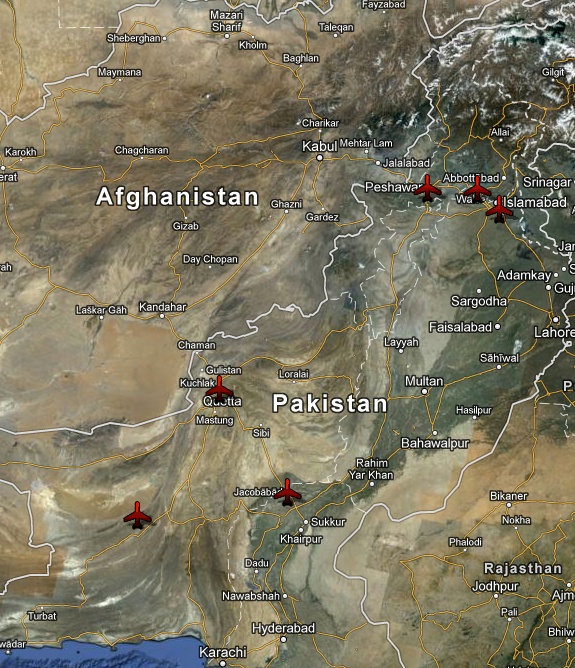
We know, from the Wikileaks cache of diplomatic cables from the US Embassy in Islamabad, that in August 2008 Prime Minister Yousaf Raza Gillani told the Ambassador that he approved of the drone strikes as part of ongoing offensives in the FATA – ‘I don’t care if they do it as long as they get the right people’ – and that ‘We’ll protest it in the National Assembly and then ignore it.’  But this was more than ‘tacit consent’.  Foust reminds us that, until comparatively recently, US drones were being launched or supported from at least six different air bases inside Pakistan, shown below, including Islamabad, Jacobabad, Peshawar, Quetta and Tarbela Ghazi; the US was ordered to leave Shamsi and had its lease terminated in December 2011.

US bases inside Pakistan

Admiral Mullen greets General Kayani, August 2008But there’s more. Pakistan had agreed that the focus of the US strikes would be North and South Waziristan.  Earlier that same year, March 2008, the Chairman of the Joint Chiefs of Staff Admiral Mullen asked General Kayani, Pakistan’s Chief of Army Staff,  for help in approving ‘a third Restricted Operating Zone for US aircraft over the FATA’, and writing in the Washington Post in November 2010 Greg Miller confirmed that these ‘flight boxes’ were confined to North and South Waziristan (although the US had unsuccessfully pressed for permission to extend the flights over Quetta, outside the FATA).  The geometry of those boxes is not known, though it would not be difficult to superimpose two likely rectangles over the previous map sequence. Operational details are, not surprisingly, far from clear.  According to a report in the Wall Street Journal on 26 September 2012, the CIA sends a fax to the ISI every month detailing strike zones and intended targets – replies apparently stopped early last year, but the US interprets the silence as ‘tacit consent’ since Pakistan immediately de-conflicts the air space to allow the Predators to carry out their surveillance – and a report in the New York Times earlier this month claimed that the US still provides the Pakistan military with 30 minutes notice of an imminent strike in South Waziristan (but no advance notice for strikes in North Waziristan because the Haqqani Network enjoys such close ties with the ISI that the CIA fears their targets would be warned of the attack).

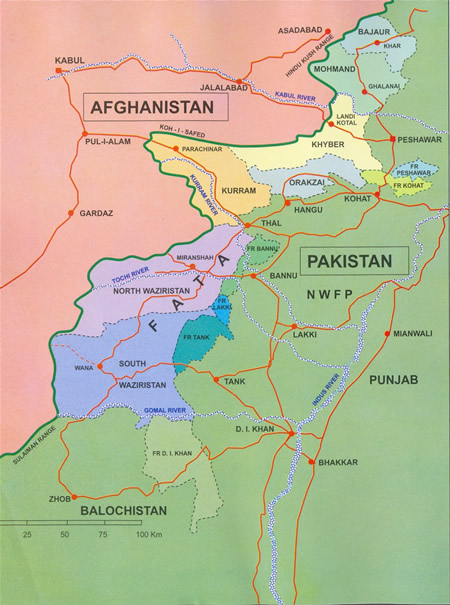
The focus on the FATA follows not only from the militant groups that are based there; it also derives from the exceptional legal status of the borderlands.  Under British colonial rule, this was a buffer zone whose inhabitants were allowed a measure of nominal autonomy; colonial power was exercised indirectly through the authority vested in tribal leaders (who received subsidies from the British), and the special Frontier Crimes Regulations – in practice corrupt and draconian – were codified by Lord Curzon in 1901.  After partition and independence in 1947 Pakistan retained the 1901 Regulations, so that the President – who has direct executive control of the FATA – appoints a Political Agent for each agency who has absolute authority to adjudicate criminal and civil affairs; ordinary Acts of Parliament do not apply to the FATA unless the President expressly declares that they do. Limited reforms were introduced in August 2011, including the right to political mobilisation, but some commentators raised doubts about their implementation.  Preventive detention and collective punishment remain in force and the writ of the courts is still severely restricted.

FATA and NWFP map

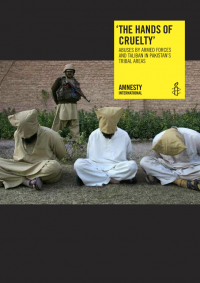
AMNESTY The Hands of Cruelty Abuses by Armed Forces and Taliban in Pakistan s Tribal AreasThese special measures were reinforced by the simultaneous passage of the Actions (in Aid of Civil Power) Regulations in 2011, a quid pro quo demanded by the military, which allowed the Pakistan Armed Forces to carry out ‘law enforcement duties [and] to conduct law enforcement operations’, granted them sweeping powers of pre-emptive arrest and detention without charge, and forbade the high court from intervening.  According to one local politician, these new Regulations are ‘even more dangerous’ than the Frontier Crimes Regulations: ‘It is a system of martial law over the Tribal Areas.’  A new report from Amnesty International (from which I’ve taken these accounts) borrows its title, The Hands of Cruelty, from a despairing claim made by a lawyer from Peshawar: ‘The hands of cruelty extend to the Tribal Areas, but the hands of justice cannot reach that far.’

(Given the – I think abusive – attack on Amnesty’s report by Abdullah Mansoor at Global Research as ‘malicious’ and ‘misinformation’ that virtually ignores the violence perpetrated by the Taliban and other militant groups, I should also draw readers’ (and his) attention to Amnesty’s previous report, As if Hell fell on me, which provides a detailed indictment of exactly that).

In short, the FATA constitute a space of exception in precisely the sense given to that term by Giorgio Agamben: the normal rights and protections under the law are withdrawn from a section of the population by the law.  To see what this has to do with the geography of US drone strikes we can turn to an attack on 19 November 2008 on a residential compound in Indi Khel, 22 miles outside Bannu and about two hours by road from Peshawar.  Five alleged militants were killed and four civilians injured: not a large toll compared to other strikes, and yet the public reaction across Pakistan was extraordinary.

Drone strike at Indi Khel, Bannu, 19 November 2008

A diplomatic cable from US Ambassador Anne Patterson on 24 November explained the widening gap between what she called ‘private GOP [Government of Pakistan] acquiescence and public condemnation for U.S. action’:

‘According to local press, the alleged U.S. strike in Bannu on November 19 marked the first such attack in the settled areas of the Northwest Frontier Province, outside of the tribal areas. The strike drew a new round of condemnation by Prime Minister Gilani, coalition political parties, opposition leaders, and the media.

‘According to Pakistani press, the strike killed four people, including a senior Al-Qaida member, and injured five others. The first strike within “Pakistan proper” is seen as a watershed event, and the media is suggesting this could herald the spread of attacks to Peshawar or Islamabad. Even politicians who have no love lost for a dead terrorist are concerned by strikes within what is considered mainland Pakistan.’

The language is truly extraordinary, with its distinction between the FATA and ‘Pakistan proper’, even ‘mainland Pakistan’. In short: (imaginative) geography matters.  Not for nothing are the FATA known in Urdu as ilaqa ghair, which means ‘alien’ or ‘foreign’ lands.

The plight of the people in the FATA is exacerbated by the forceful imposition of a second, transnational legal regime: the right asserted by the United States to carry its fight against al Qaeda and its war against the Taliban across the border from the ‘hot’ zone in Afghanistan into militant sanctuaries in Pakistan.  This is part of a larger argument about the advanced deconstruction of the traditional, bounded battlefield – here Frédéric Megret‘s work is indispensable – and the production of a global battlespace, processes that have been accelerated by the remote operations permitted by drones.  But it remains both an assertion and an argument.  Although international law is not a deus ex machina, a neutral court of appeal above the fray, it nonetheless has a developed body of precepts that are supposed to regulate armed conflicts between states, and there are also protocols and tribunals that govern armed conflicts between governments and non-state actors within the territorial boundaries of a state (the former Yugoslavia or Ruanda, for example).  But conflicts between states and transnational non-state actors pose new and difficult questions, and perhaps even map a ‘legal void’.  Significantly, as Eyal Benvenisti points out in the Duke Journal of International and Comparative Law,

Concurrently with the successful efforts to impose restraints on intra-state asymmetric warfare, we have been witnessing efforts by the same powerful countries that pressed for intra-state conflict regulation to deregulate inter-state asymmetric warfare or what may be called “transnational” warfare.

I will leave a review of these debates, at once legal and political, for another day; among the most relevant recent contributions are Kenneth Anderson, ‘Targeted killing and drone warfare: how we came to debate whether there is a legal geography of war’ (2011), available here; Laurie Blank, ‘Defining the battlefield in contemporary conflict and counterterrorism: understanding the parameters of the zone of combat’, Georgia Journal of International and Comparative Law 39  (1) (2010-11), available here; Jennifer Daskal, ‘The geography of the battlefield: a framework for detention and targeting outside the “hot” conflict zone’ (2012), available here;  Noam Lubell and Nathan Derejko, ‘A global battlefield? Drones and the geographical scope of armed conflict’, Journal of International Criminal Justice 11 (1) (2013) 65-88 (abstract here).  In this twilight zone, where Washington at once admits its actions through a never-ending string of off-the-record briefings and yet denies any responsibility for their collateral outcomes, there are no inquiries into ‘mistakes’, no culpability for wrong-doing, and no compensation or restitution for the innocent victims.

Whatever you make of the rights and wrongs of all this, what matters for my present purposes is that these two legal regimes, one national and the other transnational, work in concert to expose the people of the Federally Administered Tribal Areas to military and paramilitary violence and, ultimately, death.

It’s more than a matter of law, of course (and in any case we shouldn’t confuse legality with legitimacy).  Within these exceptional spaces there has been active, tactical collaboration between the US and Pakistan.  Another diplomatic cable reported a meeting on 22 January 2008 with General Kayani, who asked US Central Command to provide ‘continuous Predator coverage of the conflict area’ in South Waziristan, but was offered only Joint Terminal Attack Controllers to direct PAF air strikes by F-16s – an offer which was refused because of a reluctance to allow US ground forces to operate inside Pakistan.  But in September and October 2009 small teams of US Special Forces were deployed to provide intelligence, surveillance and reconnaissance (ISR) support to the Pakistan Army, which included a ‘live downlink of unmanned aerial vehicle (UAV) full motion video.’ (What is interesting about all these exchanges is the degree of collaboration they reveal not only between the US and Pakistan but also between the CIA and the US military, especially Joint Special Operations Command; this is not surprising, given the hybridisation of military and paramilitary violence and the close involvement of the military in supplying, servicing and even flying the drones used in CIA-directed strikes).

There have been several reports of continuing collaboration between American and Pakistani intelligence operatives working on the ground in Pakistan, and one source – who purported to run a network of agents and ‘spotters’ in North and South Waziristan – told Reuters in January 2012 that ‘Our working relationship is a bit different from our political relationship.  It’s more productive.’  He claimed that the US and Pakistan agreed priority target lists between them, and that it took little more than two or three hours between the location of a targeted individual and the firing of missiles.  These claims are impossible to verify, but the emphasis on a working relationship rings true.

FATA flagPerhaps the most chilling of the Wikileaks cables is this (redacted) message sent from Islamabad in February 2009, reporting a discussion with a senior member of the FATA Secretariat, who enthusiastically recommended the practice of ‘double tap‘ – follow-up strikes targeting rescuers – and endorses the rationale for signature strikes against unknown, un-named targets:

9.  (S)  XXXXXXXXXXXX remains a strong advocate of U.S. strikes. In fact, he suggested to PO that the U.S. consider follow-on attacks immediately after an initial strike.  He explained that after a strike, the terrorists seal off the area to collect the bodies; in the first 10-24 hours after an attack, the only people in the area are terrorists, so “you should hit them again-there are no innocents there at that time.”  His sources report that the reported September 29 strike in South Waziristan had been particularly successful; “you will see that you hit more than has been reported in the press both in terms of quantity and quality.”  XXXXXXXXXXXX also drew a diagram essentially laying out the rationale for signature strikes…

Here you can see two perspectives on administrative killing, one from Pakistan and the other from the United States, converging onto a single target.

The cables from which I’ve quoted are all four or five years old, but this reflects the shutters coming down after the subsequent assault on Wikileaks and the arrest of  Bradley Manning – the reports from seasoned investigative journalists are much more recent.  I suppose you might conclude that none of them contradicts that artful word that does so much silent work in the official statement repeated by Emmerson, in which Pakistan denies reports of continuing tacit consent.  But given what I’ve shown about the deadly dance over those five years, do you really think the music has stopped?

Nieto’s Challenge

Many readers will remember Hillary Clinton‘s off-the-cuff claim last fall that “We face an increasing threat from a well-organised network, drug-trafficking threat that is, in some cases, morphing into or making common cause with what we would consider an insurgency in Mexico.”  In “The everywhere war” (DOWNLOADS tab) I used her comment – together with a host of other sources inside and outside the state – to suggest some of the ways in which conceptions of war were being transformed in the borderlands; so too the military/policing distinction.

But a new report from the International Crisis Group, Peña Nieto’s Challenge: Criminal cartels and rule of law in Mexico, suggests that – in the midst of calls to increase the militarization of the US southern border – at least some State Department officials are having second thoughts.  Indeed, the report claims that Clinton’s remark was seen at the time ‘as a misstatement by many in the State Department, aimed more at linking the kinds of violence and weapons used and the seriousness of the danger they posed rather than describing the nature of the cartels or their objectives.’  And now, in an interview with the Group, John Feeley, Principal Deputy Assistant Secretary of State for Western Hemisphere Affairs, insisted:

‘The violence associated with the criminal activities of the transnational criminal organisations (TCOs) in Mexico is not a national security problem or an insurgency that threatens to destabilise the Mexican government. Clearly, the violence … is a very serious public security problem that has important social and economic repercussions.’ 

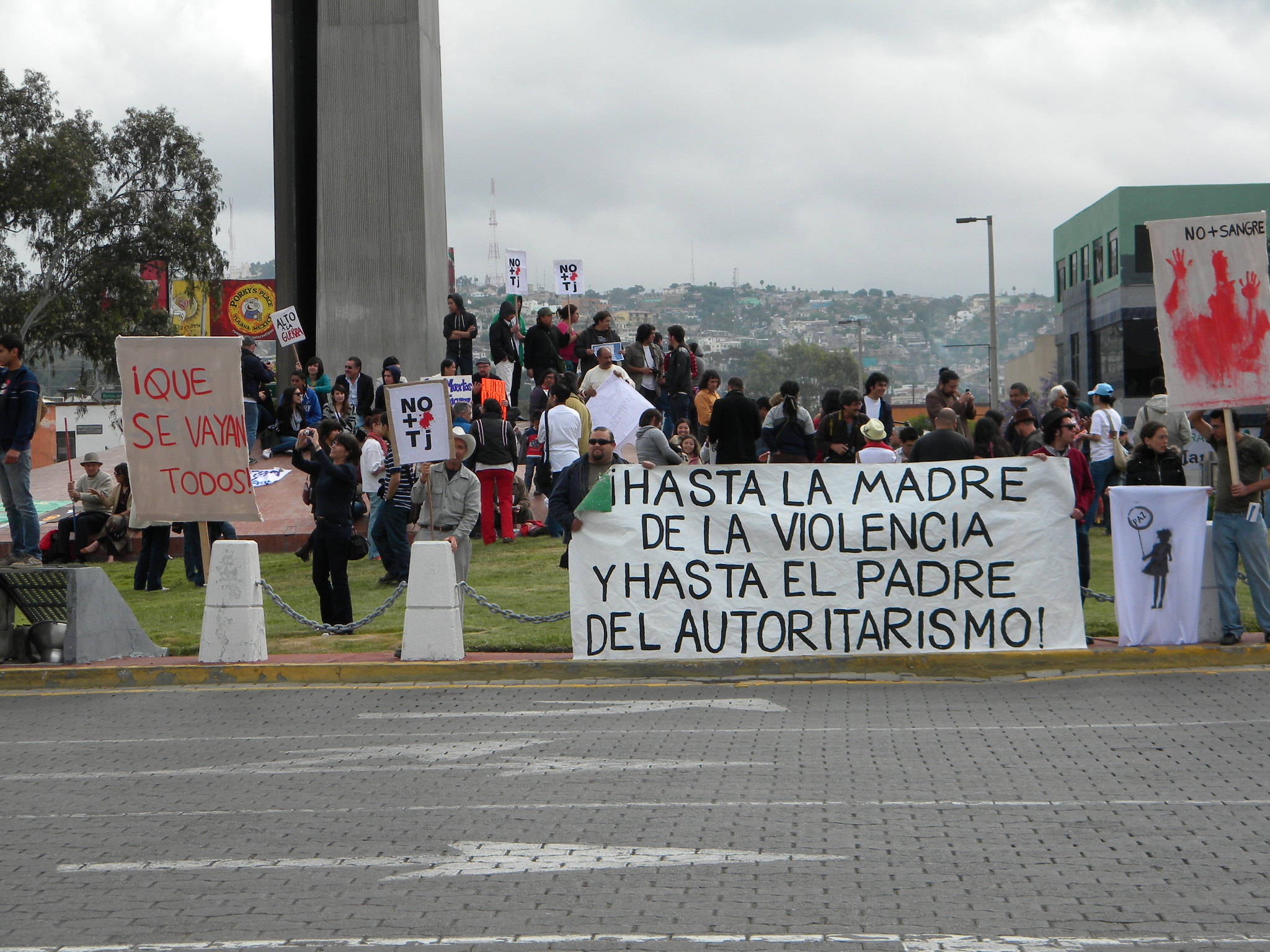
For all that, it’s surely more than a ‘public security problem’ and it also has the most acute political repercussions too:

no_more_blood

The report spells out many of those repercussions for the democratic constitution of Mexico – though whether Nieto (Mexico’s new President) will pay any attention to it is another question.  But its fundamental argument is captured in these paragraphs:

The development of cartels into murder squads fighting to control territory with military-grade weapons challenges the Mexican state’s monopoly on the use of force in some regions. The brutality of their crimes undermines civilian trust in the government’s capacity to protect them, and the corruption of drug money damages belief in key institutions. Cartels challenge the fundamental nature of the state, therefore, not by threatening to capture it, but by damaging and weakening it. The military fight-back has at times only further eroded the trust in government by inflicting serious human rights abuses. Some frustrated communities have formed armed “self- defence” groups against the cartels. Whatever the intent, these also degrade the rule of law. 

There has been fierce discussion about how to legally define the fighting. The violence has been described as a low-intensity armed conflict, a kind of war, because of the number of deaths and type of weapons used. The criminal groups have been described as everything from gangs, drug cartels and transnational criminal organisa- tions, to paramilitaries and terrorists. The Mexican government, much of the international community and many analysts reject the idea there is anything other than a serious criminal threat, even though those criminal groups use military and, at times, vicious terror tactics. The army and marines, too, thrown into the breach with limited police training and without efficient policing methods, have often used intense and lethal force to fight the groups, killing more than 2,300 alleged criminals in a five-year period.

Within the grey world of fighting between rival cartels and security forces, there is much confusion as to who the victims of the violence are, and who killed them or made them disappear. Estimates of the total who have died in connection with the fighting over the last six years range from 47,000 to more than 70,000, in addition to thousands of disappearances. Cartel gunmen often dress in military uniforms and include corrupt police in their ranks, so people are unsure if they are facing criminals or troops. A victims movement is demanding justice and security. Mexico has also lost hundreds of police and army officers, mayors, political candidates, judges, journalists and human rights defenders to the bloodshed that is taking a toll on its democratic institutions.

Torture, violence and human rights

LISA HAJJAR TortureJadaliyya has an interview with Lisa Hajjar about her new book, Torture: a sociology of violence and human rights, plus an extract from the book.  As she says herself,

Torture is my great and terrible obsession. I think, read, write, and talk about torture all the time, as anyone who knows me can attest. I was inspired to write this book in order to share my knowledge, my passion, and—to be blunt—my anger about torture with college students, although hopefully people who are not students also will find it interesting. This book, like others in the Routledge series, Framing Twenty-First Century Social Issues, is geared primarily to college classroom teaching; it costs less than ten dollars, is about sixty pages long, has discussion questions at the end of each chapter, and a glossary of key terms and concepts at the back.

Of course everyone who writes books hopes lots of people will read them. But my inspiration for writing this book is partly instrumental: I hope that many students will be assigned Torture in a class, and that reading it will inspire them to contribute to changing the national conversation about torture. The national conversation in the US continues to be dominated by those who propagate falsehoods, like the ludicrous assertion that torture produces “good intelligence,” or that waterboarding is not “torture” if Americans do it, or that some people have no right not to be tortured. I wrote this book in order to arm students with information and analysis so that they might be intellectually empowered to be boldly, aggressively, and unapologetically anti-torture. This book is a cri de couer to the next generation of leaders and voters.

You can also access one of Lisa’s early essays here.

Posted in law

The new peace

The text of a lecture given by Mary Kaldor, Professor of Global Governance at the LSE,  at Tufts University on October 2012, when she was awarded the Dr Jean Mayer Global Citizens Award, named for Tufts’ former President and Chancellor.  The lecture also coincided with the publication of the third edition of Kaldor’s New and Old Wars: organized violence in a global era.

She emphasises that this lecture is a work in progress, a way-station en route to a book she is writing with Christine Chinkin, Professor of International Law who is also at the LSE.  Building on her discussion of ‘new wars’, and on her collaboration with Shannon Beebe, The ultimate weapon is no weapon: Human security and the new rules of war and peace, Kaldor argues for a ‘new peace’ in these terms:

I am arguing for international law that prohibits the use of force, as in domestic contexts, except in the very limited case of individual self-defence. The only argument for the international use of force is the scaling up of individual self-defence, e.g. genocide or massive violations of human rights. But in this case, the conduct of force is not the same as war-fighting. It is defensive, aimed at protection. Those responsible for the attacks are to be arrested where possible rather than killed. Any international use of force would take place under the authority of a reformed United Nations Security Council. Such an approach would require something like international emergency services rather like in a domestic context, we have police, fire fighters and emergency medical services.

In case this sounds excessively utopian, it is worth noting that something along these lines has been developing in parallel with the War on Terror. All sorts of new techniques have been developed in wars in the Balkans and Africa – safe havens, humanitarian corridors, the establishment of courts to try war crimes. New types of security capabilities are being developed by the European Union and in the thinking about civilian protection in the United Nations. New commitments to humanitarian intervention or Responsibility to Protect have been adopted by the African Union. Many international missions, not all successful of course, have been taking place alongside the War on Terror and have involved a learning experience. We tend to focus on Iraq and Afghanistan because they are so visible but they may well turn out to be exceptions as a consequence of a more traditional war-fighting military intervention.

To put it more simply, in difficult situations like for example Syria, it is important to identify an alternative between old-fashioned military intervention where the aim is to win and where many get killed and there is a risk of escalation, and doing nothing. Or in the case of the War on Terror, it is about taking the problem of terrorism seriously. When terrorists are treated as enemies in a war, they are elevated and legitimised. In the case of the drone attacks, for example, it is not just a problem that mistakes are made and civilians sometimes get killed, more importantly, it escalates the violence. It provides an argument and justification for mobilising more recruits to extremist causes. What I worry about is that the combination of the economic crisis and what is happening the Middle East could portend a spreading protracted new war in large parts of the world.

I think there is a slippage between the first and last paragraphs of this extract: to claim that, in the circumstances Kaldor outlines, ‘the conduct of force is not the same as war-fighting’ is to ring-fence ‘war’ in ways that are increasingly problematic, as that last sentence concedes.  And to assume that a re-calibrated international law can somehow insulate the one from the other is utopian, isn’t it?

Targeted killings and signature strikes

And so what Tom Junod calls the lethal presidency continues…  though it surely would have done whoever occupied the White House for the next four years.

Much of the discussion of US targeted killing has centred on both its status under international law and on the quasi-judicial armature through which various government agencies, including the Pentagon and the Central Intelligence Agency, draw up and adjudicate their kill lists of named individuals who are liable to a ‘personality strike’. But the majority of US targeted killings turn out to be ‘signature strikes’.

Signature strikes were initiated under President George W. Bush, who authorised more permissive rules of engagement in January/February 2008.  According to Eric Schmitt and David Sanger, writing in the New York Times,

[A] series of meetings among President Bush’s national security advisers resulted in a significant relaxation of the rules under which American forces could aim attacks at suspected Qaeda and Taliban fighters in the tribal areas near Pakistan’s border with Afghanistan.

The change, described by senior American and Pakistani officials who would not speak for attribution because of the classified nature of the program, allows American military commanders greater leeway to choose from what one official who took part in the debate called “a Chinese menu” of strike options.

Instead of having to confirm the identity of a suspected militant leader before attacking, this shift allowed American operators to strike convoys of vehicles that bear the characteristics of Qaeda or Taliban leaders on the run, for instance, so long as the risk of civilian casualties is judged to be low.

Under Obama signature strikes increased in frequency, and Micah Zenko notes that the President’s initial reluctance soon yielded to endorsement:

According to Daniel Klaidman, when Obama was first made aware of signature strikes, the CIA’s deputy director clarified: “Mr. President, we can see that there are a lot of military-age males down there, men associated with terrorist activity, but we don’t necessarily know who they are.” Obama reacted sharply, “That’s not good enough for me.” According to one adviser describing the president’s unease: “‘He would squirm … he didn’t like the idea of kill ‘em and sort it out later.’” Like other controversial counterterrorism policies inherited by Obama, it did end up “good enough,” since he allowed the practice to stand in Pakistan, and in April authorized the CIA and JSOC to conduct signature strikes in Yemen as well.

Today signature strikes are frequently triggered not on the fly – a sudden response to an imminent threat – but by a sustained ‘pattern of life’ that arouses the suspicion of distant observers and operators. This depends on persistent surveillance – on full motion video feeds and a suite of algorithms that decompose individual traces and networks – some of which involve a weaponized version of Hägerstrand’s time-geography: see, for example, GeoTime 5 here.

We know even less about the legal authority for these attacks, but Kevin Jon Heller has a new essay on their legality up at the wonderful open access resource that is SSRN [Social Science Research Network]  here, and there are preliminary responses at Opinio Juris here.  This is the abstract:

The vast majority of drone attacks conducted by the U.S. have been signature strikes – strikes that target “groups of men who bear certain signatures, or defining characteristics associated with terrorist activity, but whose identities aren’t known.” In 2010, for example, Reuters reported that of the 500 “militants” killed by drones between 2008 and 2010, only 8% were the kind “top-tier militant targets” or “mid-to-high-level organizers” whose identities could have been known prior to being killed. Similarly, in 2011, a U.S. official revealed that the U.S. had killed “twice as many ‘wanted terrorists’ in signature strikes than in personality strikes.” 

Despite the U.S.’s intense reliance on signature strikes, scholars have paid almost no attention to their legality under international law. This article attempts to fill that lacuna. Section I explains why a signature strike must be justified under either international humanitarian law (IHL) or international human rights law (IHRL) even if the strike was a legitimate act of self-defence under Article 51 of the UN Charter. Section II explores the legality of signature strikes under IHL. It concludes that although some signature strikes clearly comply with the principle of distinction, others either violate that principle as a matter of law or require evidence concerning the target that the U.S. is unlikely to have prior to the attack. Section III then provides a similar analysis for IHRL, concluding that most of the signature strikes permitted by IHL – though certainly not all – would violate IHRL’s insistence that individuals cannot be arbitrarily deprived of their right to life.

The most interesting section (for me) is Kevin’s discussion of ‘evidentiary adequacy’.  Most of the examples he discusses appear to be derived from CIA-directed strikes in Pakistan – drawing on the Stanford/NYU report on Living under drones – and, for that very reason, are remarkably limited. But we know much more about problems of evidence – and inference – from strikes conducted by the US military in Afghanistan…

The first point to make, then, is that targeted killings are also carried out by the US military – indeed, the US Air Force has advertised its ability to put ‘warheads on foreheads‘ – and a strategic research report written by Colonel James Garrett for the US Army provides a rare insight into the process followed by the military in operationalising its Joint Prioritized Effects List (JPEL). Wikileaks has provided further information about JSOC’s Task Force 373 – see, for example, here and here – but the focus of Garrett’s 2008 report is the application of the legal principles of necessity and proportionality (two vital principles in the calculus of International Humanitarian Law (IHL) discussed by Kevin) in counterinsurgency operations.  Garrett describes ‘time-sensitive targeting procedures’ used by the Joint Targeting Working Group to order air strikes on ‘high-value’ Taliban and al-Qaeda leaders in Afghanistan, summarised in this diagram:

Notice that the members included representatives from both Combined Joint Special Operations Task Force (CJSOTF) and the CIA (‘Other Government Agency’, OGA).  This matters because Joint Special Operations Command (JSOC) – once commanded by General Stanley McChrystal – and the CIA, even though they have their own ‘kill lists’, often co-operate in targeted killings and are both involved in strikes outside Afghanistan.  Indeed, there have been persistent reports that many of the drone strikes in Pakistan attributed to the CIA – even if directed by the agency – have been carried out by JSOC.  Here is Jeremy Scahill citing a ‘military intelligence source’:

“Some of these strikes are attributed to OGA [Other Government Agency, intelligence parlance for the CIA], but in reality it’s JSOC and their parallel program of UAVs [unmanned aerial vehicles] because they also have access to UAVs. So when you see some of these hits, especially the ones with high civilian casualties, those are almost always JSOC strikes.”

Garrett’s discussion clearly refers to ‘personality strikes’, but – second – the distinction between the evidential/inferential apparatus used for a ‘personality strike’ and for a ‘signature strike’ is by no means clear-cut.  Kate Clark‘s report for the Afghan Analysts Network describes the attempted killing of Muhammad Amin, the Taliban deputy shadow governor of Takhar province.  On 2 September 2010 ISAF announced that a ‘precision air strike’ earlier that morning had killed him and ‘nine other militants’.  The target had been under persistent surveillance from remote platforms – what Petraeus later called ‘days and days of the unblinking eye’ – until two strike aircraft repeatedly bombed the convoy in which he was travelling.  Two attack helicopters were then ‘authorized to re-engage’ the survivors. The victim was not the designated target, however, but Zabet Amanullah, the election agent for a parliamentary candidate; nine other campaign workers died with him. Clark’s painstaking analysis clearly shows that one man had been mistaken for the other, which she attributed to an over-reliance on ‘technical data’ – on remote signatures.  Special Forces had concentrated on tracking cell phone usage and constructing social networks. ‘We were not tracking the names,’ she was told, ‘we were targeting the telephones.’

This is unlikely to be an isolated incident.  Here for example is Gareth Porter:

‘…the link analysis methodology employed by intelligence analysis is incapable of qualitative distinctions among relationships depicted on their maps of links among “nodes.” It operates exclusively on quantitative data – in this case, the number of phone calls to or visits made to an existing JPEL target or to other numbers in touch with that target. The inevitable result is that more numbers of phones held by civilian noncombatants show up on the charts of insurgent networks. If the phone records show multiple links to numbers already on the “kill/capture” list, the individual is likely to be added to the list.’

In the Takhar case, despite informed protests to the contrary, ISAF insisted that they had killed their intended target (added emphases are mine):

PBS/Frontline screened a Stephen Grey/Dan Edge documentary on the Takhar incident last year, Kill/Capture, from which the images below are taken (reworked for my presentation on Lines of descent) and which, like Kate Clark’s remarkable report on which it drew, gave the lie to the ISAF statement; the film included an Afghan Police video of the aftermath of the attack: more here, video here, and transcript here.

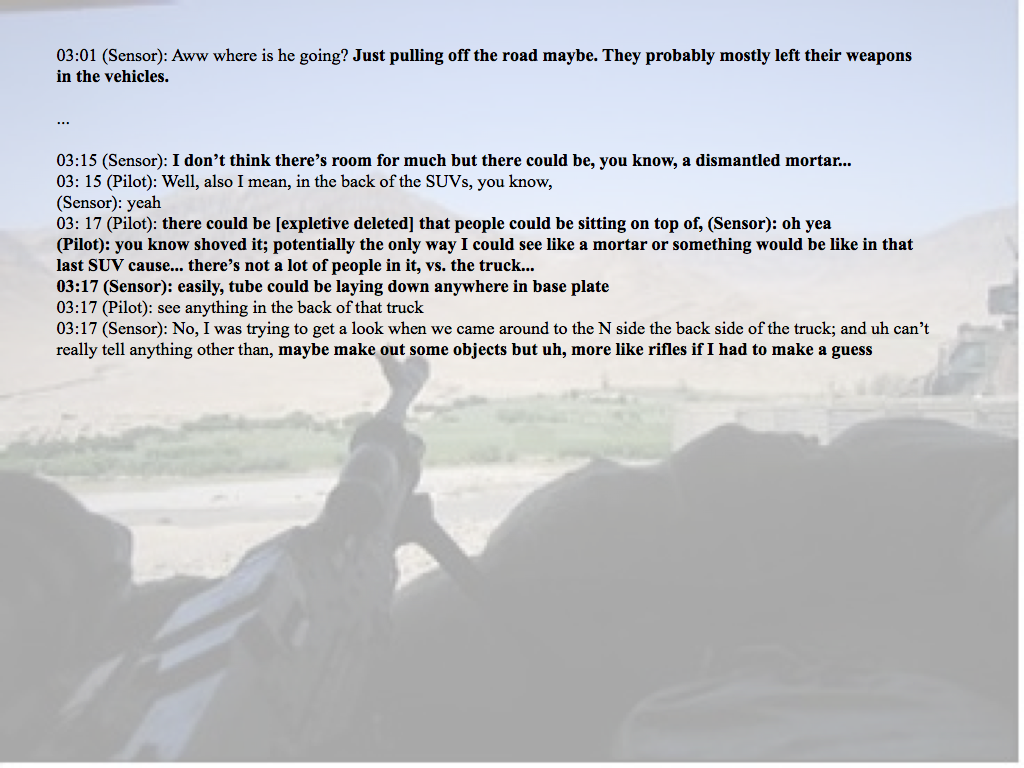
Finally, there is a persistent propensity to read hostile intent into innocent actions. In ‘From a view to a kill’ (DOWNLOADS tab) I describe in detail an attack launched on 21 October 2010 near Shahidi Hassas in Uruzgan province in central Afghanistan.  In the early morning a Predator was tasked to track three vehicles travelling down a mountain road, several miles away from a Special Forces unit moving in to search a village for an IED factory.

The Predator crew in Nevada had radio contact with the Special Forces Joint Terminal Attack Controller and they were online with image analysts at the Air Force’s Special Operations Command headquarters in Florida. At every turn the flight crew converted their observations into threat indicators: thus the two SUVs and a pick-up truck became a ‘convoy’, cylindrical objects ‘rifles’, adolescents ‘military-aged males’ and praying a Taliban signifier (‘seriously, that’s what they do’).

After three hours’ surveillance two Kiowa helicopters were called in, and during the attack at least 23 people were killed and more than a dozen wounded.  Only after the smoke had cleared did the horrified Predator crew re-cognize the victims as civilians, including women and children.

I’m including a much fuller account in The everywhere war, based on a close reading of the redacted investigative report by Major General Timothy McHale released under a FOI request (the images above are all taken from my Keynote presentation based on the report), and you can also find David McCloud‘s spine-chilling analysis for the LA Times here.  But even in this abbreviated form it’s clear that the cascade of (mis)interpretations offered by the flight crew mimics Kevin’s list of ‘signatures’, where some would be categorised as ‘possibly adequate’ and others as ‘inadequate’.

All of these materials relate to air strikes inside a war zone, so that their modalities are different – in Afghanistan remote platforms like the Predator and the Reaper are one element in a networked ‘killing machine’, and they work in close concert with ground forces and conventional strike aircraft – and the legal parameters are not as contentious as those that govern ‘extra-territorial’ strikes in Pakistan, Somalia or Yemen (which are Kevin’s primary concern).  But they all raise questions about the evidential and inferential practices that are incorporated into the kill-chain that are clearly capable of wider application and concern.

Those questions raise other issues too.  It seems clear, from the examples I’ve given, that to isolate a single platform (the drone) is to contract the scrutiny of military and paramilitary violence that, under the conditions of late modern war, is typically networked.  And to determine the legal status of targeted killing must not foreclose on wider political and ethical decisions: to accept late modern war’s avowed reflexivity is too often to equate legality with legitimacy.

Genealogies of law and violence

A day or two ago I tried to show why I think it important to recover the history of bombing in order to stage an effective critique of its contemporary use.  But Dan Clayton has written to provide a compelling and more general reason to recover the historical arc of contemporary military violence, with this quotation from Michel Foucault‘s (1971) essay on ‘Nietzsche, Genealogy, History’:

“Humanity does not gradually progress from combat to combat until it arrives at universal reciprocity, where the rule of law finally replaces warfare; humanity installs each of its violences in a system of rules and thus proceeds from domination to domination.”

This essay can now be read in conjunction with Foucault’s recently published lectures on La volonté de savoir.  As Stuart Elden explains:

‘Despite Foucault’s oft-cited interest in Nietzsche, only a couple of pieces on him were ever published. The most sustained is the ‘Nietzsche, Genealogy, History’ piece published in 1971. Here [in the Lectures] Foucault develops different themes, especially concerning the history of truth, though there are moments where related issues emerge. Foucault uses Nietzsche to trace the invention of knowledge, and the later invention of truth, suggesting that for Nietzsche truth relates to the will “under the form of constraint and domination… not liberty but violence” (p. 206). He suggests that, following Nietzsche, and “against the warm softness of a phenomenon, we must develop the murderous tenacity of knowledge” (p. 198). His reading is influenced by works across Nietzsche’s career, especially early manuscripts on truth and The Birth of Tragedy, rather than just On the Genealogy of Morality.’

There’s a really helpful long review essay on the lectures by Michael Berhrent in Foucault Studies 13 (2012) 157-178 here (scroll down).

ASAP and experimental geopolitics

My last post trafficked, amongst other things, in a geography of time-space compression, so it’s time (and space) to introduce ASAP: a title chosen by Tina di Carlo, former curator of architecture and design at New York’s Museum of Modern Art and a graduate of Eyal Weizman‘s Research Architecture programme at Goldsmith’s, to echo the English ‘as soon as possible’ – ‘to evoke a sense of urgency and speed where space collapses in time’ – and, more precisely, to signal the Archive of Spatial Aesthetics and Praxis.  Established in 2010, this is a virtual Aladdin’s cave of projects and practices, texts and objects.

You can fossick for your own favourites – everything is accessible from the starting grid – but here are two of mine.  The first is Teddy Cruzs Political Equator project.  This uses the US/Mexico border – specifically  Tijuana/San Diego – as a platform to describe an arc through other global borderlands all located between 30 and 36 degrees North:

Along this imaginary border encircling the globe lie some of the world’s most contested thresholds: the US–Mexico border at Tijuana/San Diego, the most intensified portal for immigration from Latin America to the United States; the Strait of Gibraltar, where waves of migration flow from North African flow into Europe; the Israeli-Palestinian border that divides the Middle East, along with the embattled frontiers of Afghanistan, Iran, Iraq, and Syria, and Jordan; the Line of Control between the Indian state of Kashmir and Azad or free Kashmir on the Pakistani side; the Taiwan Strait where relations between China and Taiwan are increasingly strained as the Pearl River Delta has rapidly ascended to the role of China’s economic gateway for the flow of foreign capital, supported by the traditional centers of Hong Kong and Shanghai and the paradigmatic transformations of the Chinese metropolis also characterized by urbanities of labor and surveillance.

You can find full details of the associated meetings (‘conversations’), videos and more at the project website here.

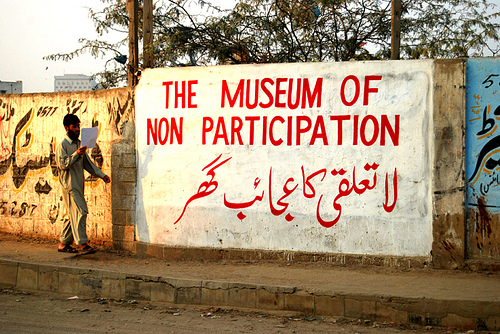
Second is Karen Mirza and Brad Butler‘s Museum of Non-Participation.   This is a travelling project that started in Islamabad in 2007.  The two artists watched the demonstrations by the Lawyers’ Movement against the dismissal of the Chief Justice by the Musharaf regime and the violent response by the military/police from a window in the National Art Gallery – more about the protests here and here – and went on to develop a multi-sited, multi-voiced project that has been staged in Karachi, in London’s Bethnal Green and elsewhere.  One of its central aims is to contest the dominant narrative (and geographical imagination) of Pakistan as a ‘rogue state’ and to find (in part, I think, through a contrapuntal rendering of London and Karachi) ‘other languages and other voices’ to convey everyday life under the sign of the postcolonial.

ASAP explains:

The Museum of Non Participation began as a critique and ultimately exploration of the political agency of the Museum through what the artists call the space of the NON… which is at once a radical critique of the Museum which often and has historically stood by as a mute witness [and [a redefinition] of [its] traditional architectural typology, transforming it from a shelter that houses objects to a literal sign that travels around.

You can download a detailed (30pp) feature from Kaleidoscope here.

The Museum was in Vancouver this month, where it included a screening of Deep State (2012) , a film developed in collaboration with China Miéville (and my thanks to Jorge Amigo for the notice). Here is a preview:

http://vimeo.com/50834391

The film takes its title from the Turkish term ‘Derin Devlet’, meaning ‘state within the state’. Although its existence is impossible to verify, this shadowy nexus of special interests and covert relationships is the place where real power is said to reside, and where fundamental decisions are made – decisions that often run counter to the outward impression of democracy.

Amorphous and unseen, the influence of this deep state is glimpsed at regular points throughout the film – most clearly surfacing in its reflexive responses to popular protest, and in legislated acts of violence and containment, but also rumbling and reverberating, deeper down, in an eternally recurring call-and-response between rhetorical positions and counter-languages, in which a raised fist, a thrown rock, a crowd surge, an occupation provoke a corresponding reaction in the form of a police charge, a baton attack, a pepper spray, assassinations.
There’s an interview with Mirza and Butler about the film here, where Mirza explains that when she read Miéville’s The city in the city she was struck by the ‘condition of unseeing in the midst of seeing’ which is at the heart of the book. Miéville’s extraordinary combination of a radical reading of international law  – in his Between equal rights: a Marxist theory of international law (2006) and also, for example, here –and what he calls his ‘weird fiction’ was not only a ‘compelling combination’ but also a creative platform from which to develop a script and then the screenplay. Michael Turner provides both a sympathetic account of the Museum project and a spirited critique of the Vancouver screening here (there’s also a constructive response: scroll down).
You can, I hope, see why these two projects – from borderlands to international law – interest me.  They are also vivid examples of the connections Alan Ingram is so deftly pursuing between contemporary art and what he calls ‘experimental geopolitics’ (a term I find much more appealing than critical geopoltiics….)

The Code breakers

Lincoln signing General Order No. 100 (Mort Künstler)

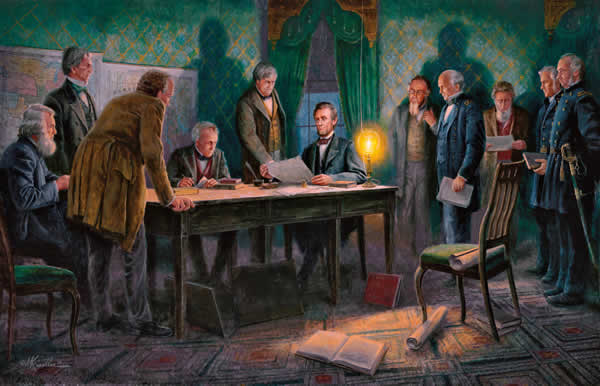
In 1863, under the authority of Abraham Lincoln, the United States published Instructions for the Government of the Armies of the United States in the Field, General Order 100.  It was drawn up by a law professor at Columbia, Francis Lieber, and approved by a committee of Union officers, and sought to codify the practices of customary international law.  It was signed by Lincoln on 24 April 1863, and the full text is here.

The Lieber Code, as it became known (Lieber himself called it ‘Old Hundred’), continues to casts its spell over international law and its historians.  Its most recent incantation is John Fabian Witt‘s artfully titled Lincoln’s Code: the laws of war in American History (Free Press, 2012). It’s a superb historical monograph, beautifully written and richly illustrated, that travels from the American Revolution via the fulcrum of the Civil War to the eve of the First World War – Witt is both a professor of Law at Yale and a member of the History department – but, not surprisingly, it’s the book’s contemporary echoes that have resonated with many readers.  (Witt once hailed Lincoln as ‘probably our most important law-of-war president, having crafted the very rules that George W. Bush and his Justice Department tried to destroy’).

In an interview in today’s New York Times, however, Witt insists that the Bush administration – in its assault on the Geneva Conventions, its establishment of GITMO, and its elaborate parsing of what does and does not legally constitute torture – did not mark a departure from historical precedent:

“It’s not an aberration that American lawyers closely tied to the administration went to work on transforming the laws of war to suit the felt strategic imperatives of the moment,” he said. “That is the kind of thing we see going all the way back.”

The Lieber Code, he argues, was not a neutral instrument: it was ‘developed by a side for the purpose of helping it win a war.’  And so while Witt documents its role as what he calls a ‘humanitarian shield’ defending ‘civilized war’ – the Code enshrined a distinction between combatants and civilians (or ‘private citizens’), and proscribed assassination, torture and poisons – he argues that it was also designed to function offensively as ‘an instrument of justice.’  The Code itself proclaimed that ‘the more vigorously wars are pursued the better it is for for humanity.  Sharp wars are brief.’ (This was before the age of air power – though balloons were used during the Civil War – but it was exactly this belief in ‘sharpening’ war that underwrote the later faith in bombing as an alternative to the protracted carnage of the trenches).

Now ‘justice’ is a weasel-word,  especially in the mouths of weasels in the White House – it’s no surprise that Max Boot is such a fan of Witt’s cheerleading for ‘the United States’s long history of leadership in creating the laws of war’.  It turns out that among the practices that escaped the Lieber Code’s censure were the starvation of civilians and the bombardment of towns without warning (‘Surprise may be a necessity’), and most of its other provisions and protections could be set aside on grounds of ‘military necessity’.  Eric Posner provides an incisive dissection of those implications in relation to Sherman’s infamous march through Georgia and South Carolina and much more besides in Slate here.

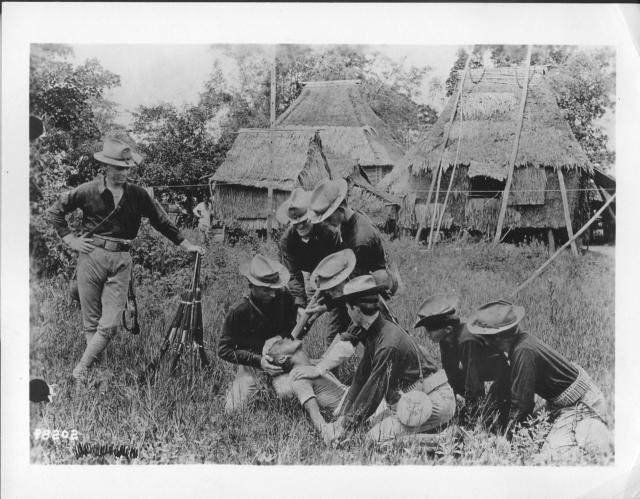
The climax of the book is certainly not its epilogue but Witt’s discussion of the exemplary violence displayed by the United States during the Philippine War (1899-1902).  Here ‘Old Hundred’ was cited to justify extraordinarily brutal measures.  General James Bell made clear his preference for ‘a short and severe war’ over ‘a benevolent war infinitely prolonged’, and some – perhaps many – officers treated this as a declaration of open season on their prisoners of war.  The most shocking method of interrogation was the ‘water cure’ (shown below) – the contemporary resonances don’t need any amplification from me – and yet torture was expressly outlawed under the Lieber Code.  A number of commanders were successfully prosecuted for the offence, including Major Edwin Glenn, who openly prided himself on leading a mobile team of ‘water cure’ experts.

So does this mean that the Code’s ‘defensive shield’ tempered its aggressive sword? In 1914 Glenn was selected by the War Department to be the lead author to update its field manual on the laws of war, and it was that version of the Rules of Land Warfare that guided military operations in World War I and World War II and was cited time and time again at Nuremberg.  ‘No one noted that they had been crafted by a convicted torturer,’ Witt observes, ‘a man whom we would today … call a war criminal.’

Yet Witt is quick to strike down the low-hanging fruit, the easy conclusion that the laws of war are thus ‘shot through with hypocrisy’:

‘For the most striking thing about Glenn’s Rules of Land Warfare is not the identity of its author but the restraint of its terms.  The manual bore few traces of its author’s terrible past….

‘Glenn adopted Lieber’s term “war crime”s for the first time in an official American document.  And as for torture, Glenn faithfully reproduced precisely the section of the 1863 Code that Judge Advocate General Davis had cited when he recommended that the president uphold Glenn’s own conviction and sentence. “Military necessity”, the Rules of Land Warfare stated, “does not admit of … torture to extort confessions.” Following Lieber’s Old Hundred, the Rules banned coercive means to obtain information from prisoners of war.

A draft 2011 statement on ‘Lincoln’s Code’ prepared by Witt for a Harvard workshop is here, and you can access 70 images from his book (from which I took the image above) together with its bibliography here.  His February 2011 Inaugural Lecture as the Allen H. Duffy Class of 1960 Professor of Law at Yale – Lincoln’s Code: the puzzling history of the laws of war – is available on vimeo here.