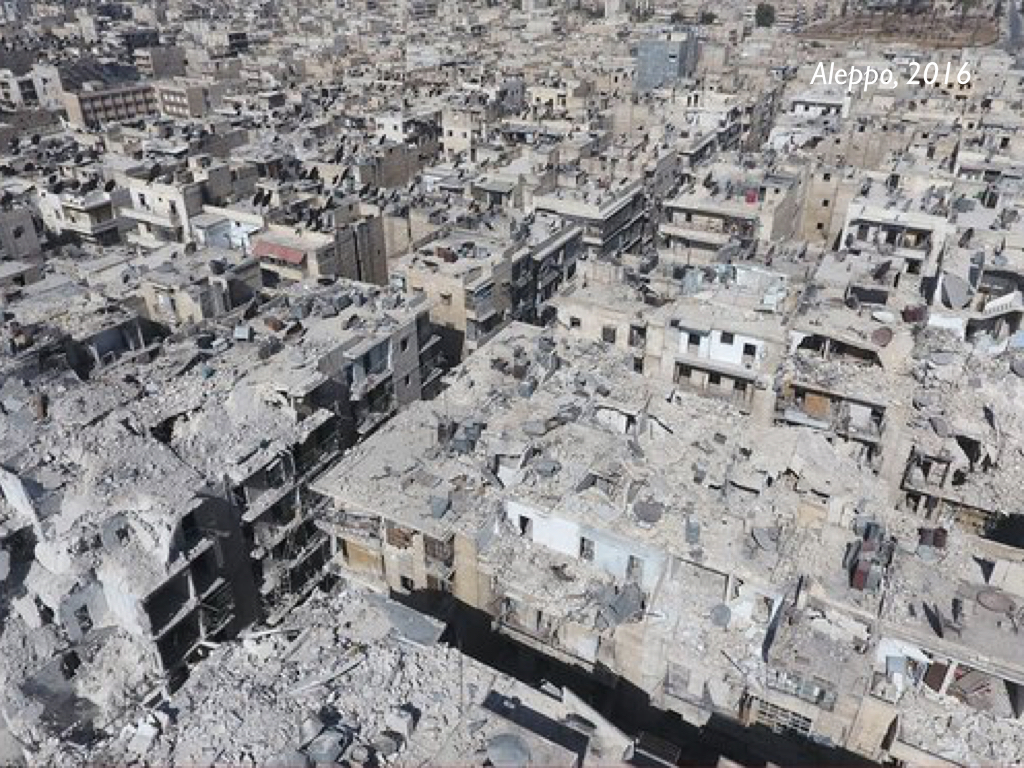
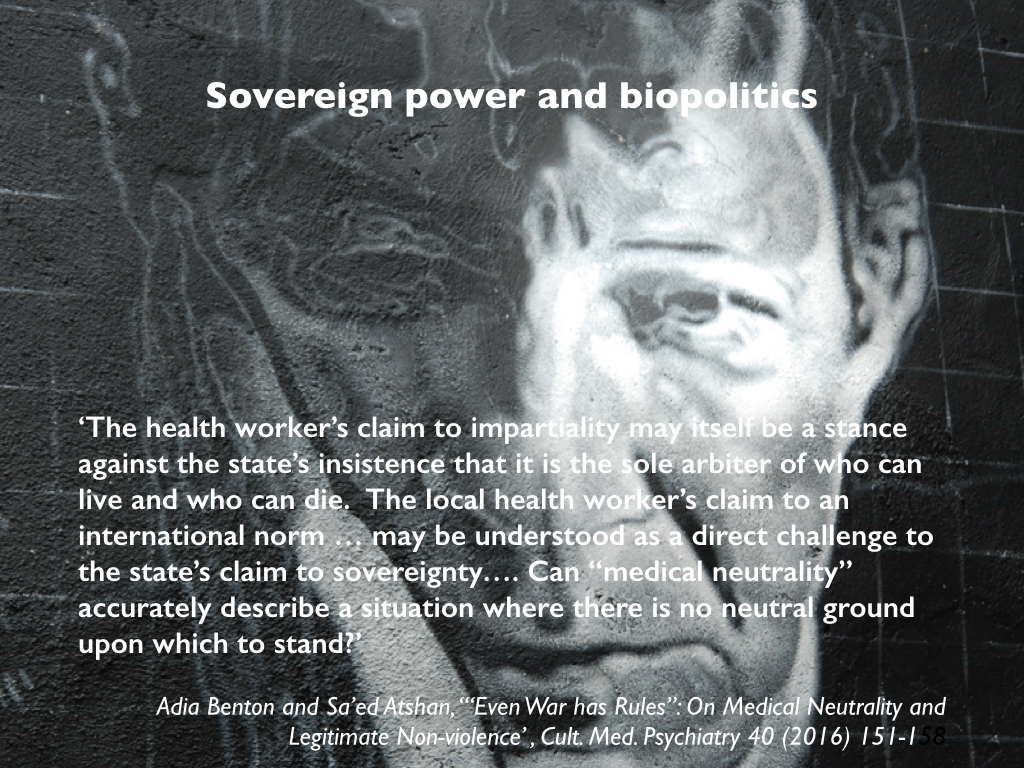
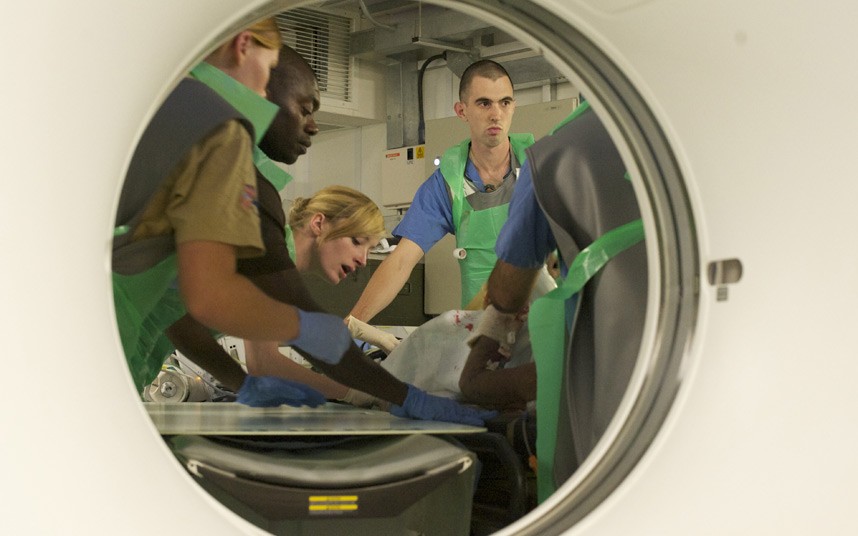
Breaking Aleppo

screen-shot-2017-02-13-at-10-37-53The Atlantic Council has issued a new report, Breaking Aleppo, which uses satellite imagery, CCTV clips, social media and video from the Russian Ministry of Defence and the RT network to explore the siege of eastern Aleppo and in particular attacks on civilian targets and infrastructure.

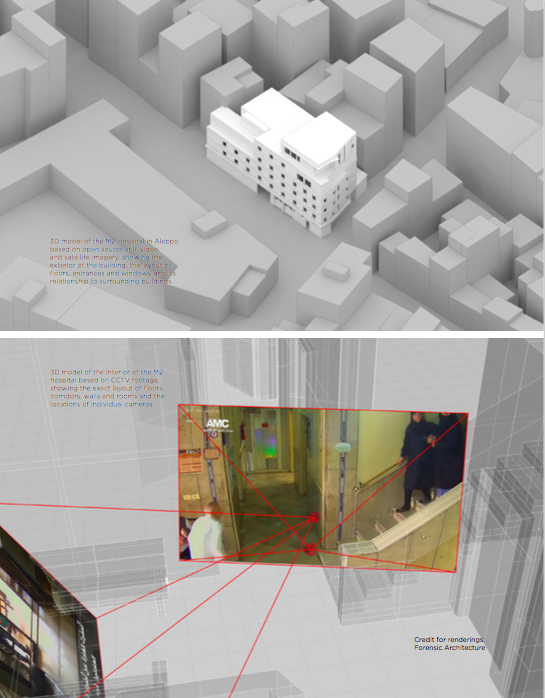
It includes an analysis by Forensic Architecture of the bombing of the ‘M2’ hospital in the Maadi district of Aleppo on 16 July 2016.

Here is part of that analysis employing Forensic Architecture’s signature methodology:

One strike [on M2] was reported on July 14; on July 16, another attack was reported, again with CCTV footage showing the moment of the attack from multiple angles. In this incident, photographs and videos from the attack allowed locations in the photographs to be firmly identified, allowing analysts to confirm that the locations featured were indeed M2 Hospital. To begin this process, a photograph taken outside the hospital after the attack, showing debris and damaged vehicles, was geolocated.

forensic-architecture-analysis-of-attack-on-m2-hospital

A video published by the Aleppo Media Center (AMC) showed the aftermath of the attack, with patients being evacuated to another medical center. During the video, a sequence showed one patient being transported through the building into an ambulance waiting outside the building. It was possible to match the balcony visible in the geolocated photograph to a balcony in the background of the exterior shot in the Aleppo Media Center video.

By following the journey of the patient in the AMC video back to its starting point inside the hospital building, it was then possible to match the route to CCTV footage showing the moment of the attack, also posted on YouTube by AMC.

This CCTV footage, from the same cameras that captured the June 24 bombing, clearly shows that the building was damaged on July 16; parts of the video show the explosion throwing debris through the air with civilians, sta , and patients caught in the attack. The images show the moment a civilian is hit by a large piece of material flung through the air by the explosive force of the attack….

Taken together, these images from multiple sources over a period of several months confirm that the M2 hospital was repeatedly struck between June and December 2016.

But this doesn’t do justice to Forensic Architecture’s analysis of the strikes on M2; for that, you can go here and also watch the video here (its privacy settings prevent me from embedding it):

From June to December 2016, according to the Syrian American Medical Society (SAMS), the Omar Bin Abdul Aziz Hospital, also known as M2, has been subject to 14 strikes by pro-government forces. The strikes have been predominantly by air to surface missiles, but also included illegal cluster munitions, barrel bombs, naval mines, and artillery. The hospital sustained significant damage in this 6 month period which has put it out of service numerous times.

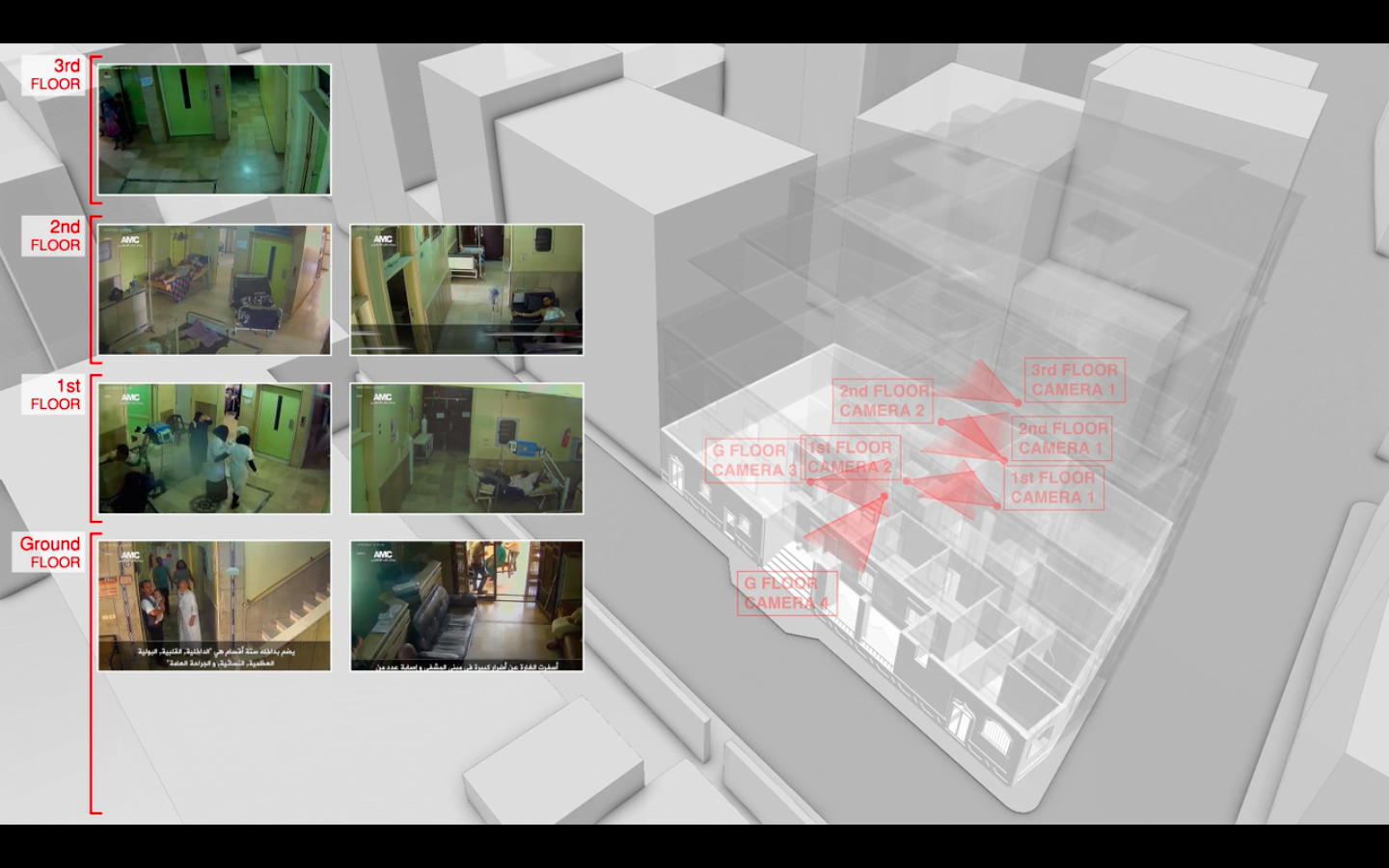
Photographs and videos taken in and around the hospital allow us to analyze some of the consequences of the strikes. Each piece of footage captures only a small part of the building, but composing and cross referencing them allows us to reconstruct the architecture of the building as a 3D model and locate the images of the bombings and their damage.The model becomes the medium through which we can navigate between the different images and videos of the incidents.

There are a number of CCTV cameras in the hospital that are continuously on, capturing every strike. We locate each camera and its orientation in the building. We integrate footage from the CCTV cameras, handheld videos, and photographs within virtual space. Locating each video clip in space provides a tangible link between them, verifying their place and constructing their relation to each other.

One essential video which moves from inside-outside becomes a hinge to the geolocation of the hospital. By analyzing what we can see in the video we can demonstrate a common disposition of the built environment in satellite imagery. Due to the spatial link we created, we are able to anchor all footage to this exact location. We therefore establish the location and multiplicity of strikes and as a result raise questions about intent.

fa-analysis-of-m2

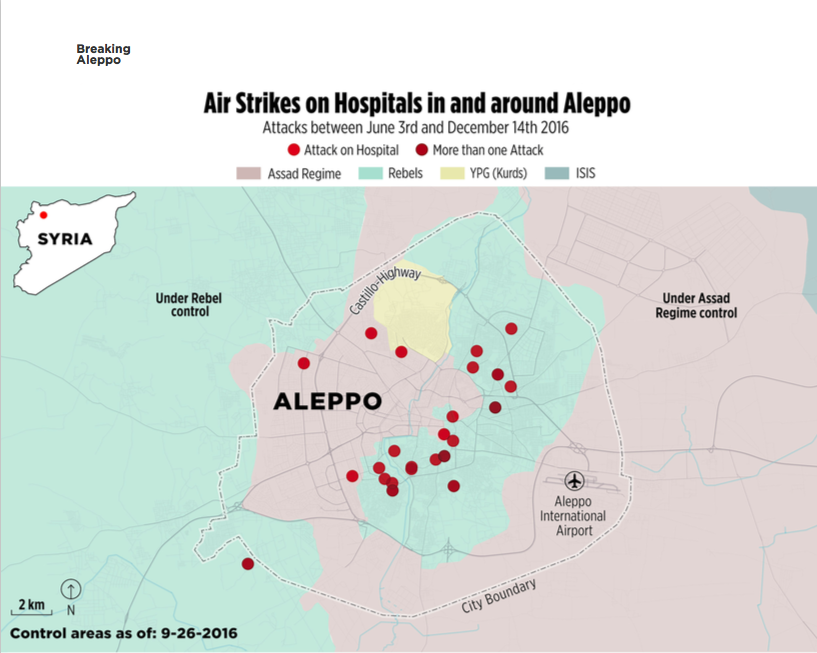
The video embeds a series of video clips and CCTV footage within the model of the hospital.  It concludes with a grim roll call of the strikes on M2 – 14 strikes in six months.  Remember that this was just one hospital attacked repeatedly – and as the map from Breaking Aleppo below shows, it was but one of many hospitals targeted.

The report takes the scale and systematicity of the attacks together with the Assad government’s ‘intimate knowledge of the terrain’ and its regular confiscation of medical supplies from humanitarian aid convoys to opposition-controlled areas across Syria as evidence that hospitals were being deliberately targeted ‘as part of a strategy intended to break the will and infrastructure of the resistance.’

You can find a version of the report with video embeds here.

Here is its key summary:

According to the Syrian Network for Human Rights (SNHR), Aleppo was hit by 4,045 barrel bombs in 2016, with 225 falling in December alone. A record of attacks compiled by the first responder organization Syrian Civil Defence, known as the ‘White Helmets’, covering the period from September 19, 2016 until the evacuation in mid-December showed 823 distinct reported incidents, ranging from cluster-munition attacks to barrel bombs. By comparing satellite images of the east of the city taken on October 18 with those taken on September 19, HRW was able to identify 950 new distinct impact sites—an average of more than one blast an hour, day and night, for a month.

Over the course of the year, the SNHR recorded 506 civilian fatalities from barrel bomb attacks, including 140 children and 63 women. Separately, the Violations Documentation Center recorded the death by military action of 3,497 civilians in Aleppo from June to mid-December 2016.

This evidence was gathered by multiple, independent witnesses using a variety of sources, from on-the-ground contacts up to satellite photographs. The sources reinforce and corroborate one another. They reveal a collage of thousands of mostly indiscriminate attacks, and their devastating impact on life and death in Aleppo during the siege.

The scale of attacks on Aleppo makes it almost impossible to compile a robust and verified record of every attack on the city. But drawing on a broad range of information, it is possible to see that an extensive aerial campaign was waged in Aleppo, and that a high proportion of the munitions deployed against the city and its population were indiscriminate.

The indiscriminate strikes were not one-sided: armed opposition groups also engaged in rocket attacks on civilians in western, government-held Aleppo. Casualty numbers are more difficult to find, but the SNHR reported sixty-four civilian deaths during the period from April 20 to April 29, 2016, and the Syrian Observatory for Human Rights recorded seventy-four civilian deaths during the opposition offensive to break the siege of Aleppo in late October 2016. The indiscriminate nature of the attacks is equally disturbing, and subject to analysis and judgement under the same international laws as any other attack on civilians in the conflict. However, there is little equivalence between the two sides when considering the scale and resources employed in the conflict.

aleppo-hospitals-bombed-3-june-to-14-december-2016

The report insists that

Aleppo was not broken in the darkness. Numerous witnesses provided evidence, some of it conflicting but much of it consistent, to substantiate claims of chemical attacks, barrel bombs, air strikes on hospitals and schools, and the deaths of thousands of civilians.

Its authors summarise an extraordinary campaign of disinformation that has three prongs: ‘denying the deeds’; ‘militarizing the victims’; and ‘attacking the witnesses’. I was astonished at the extent – and the mendacity – of this ‘campaign against the evidence’, as Breaking Aleppo calls it, when I first encountered it while analysing attacks on hospitals and medical workers in Syria.  It was (is) by no means confined to the alt.right and the devotees of Trump’s ‘alternative facts’ but reaches across to the far left, including an uncomfortable number of academics who have been willing to forego any critical understanding in order to absolve Russia and Syria of any and all culpability.

You can find my own arguments in previous posts here and here.

Human Rights Watch has also just issued a report on co-ordinated chemical attacks – illegal under international law – conducted by Syrian government forces as they advanced into eastern Aleppo between 17 November and 13 December 2016.

Striking Syria

screen-shot-2017-01-17-at-11-48-35

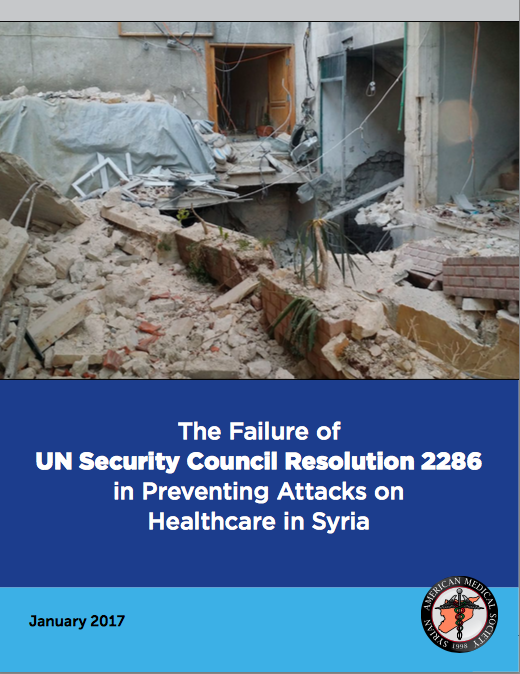
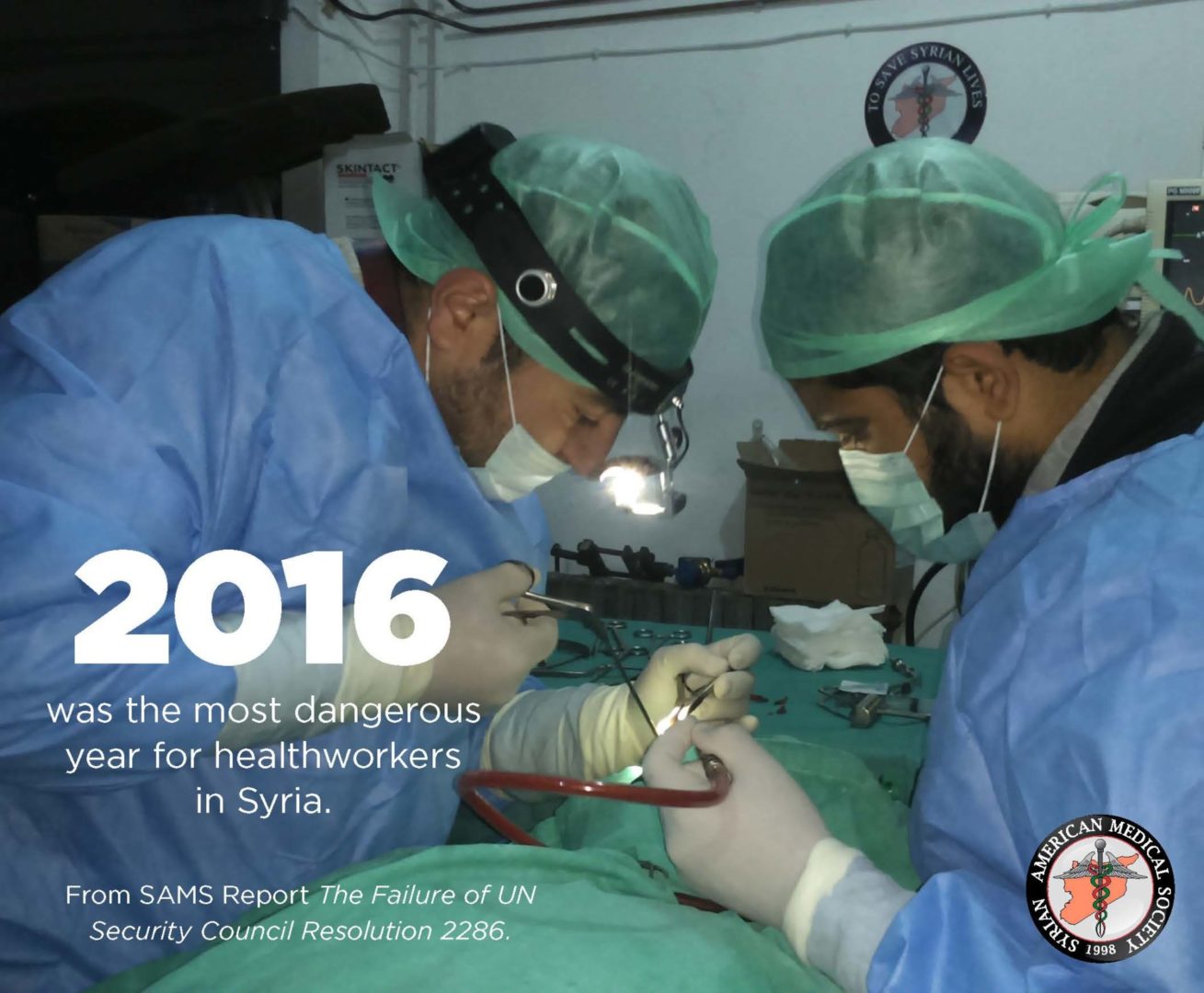
The Syrian-American Medical Society (SAMS) has published a grim report documenting the pattern of attacks on healthcare in Syria following the passage of UN Security Council Resolution 2286 on 3 May 2016 condemning attacks on medical facilities and personnel in conflict zones.  The Resolution was a general one; several states drew attention to Israel’s assault on medical facilities in Gaza, and to the US airstrike on the MSF Trauma Centre in Kunduz (Afghanistan) (see here and here).

The Resolution had the urgent support of a host of humanitarian NGOs; it was co-sponsored by more than 80 member states, and it was adopted unanimously by the Security Council.  At the time the UN Secretary-General Ban Ki-Moon described attacks on hospitals as a war crime, and declared:

When so-called surgical strikes are hitting surgical wards, something is deeply wrong… Even wars have rules…  The Council and all Member States must do more than condemn such attacks. They must use every ounce of influence to press parties to respect their obligations.

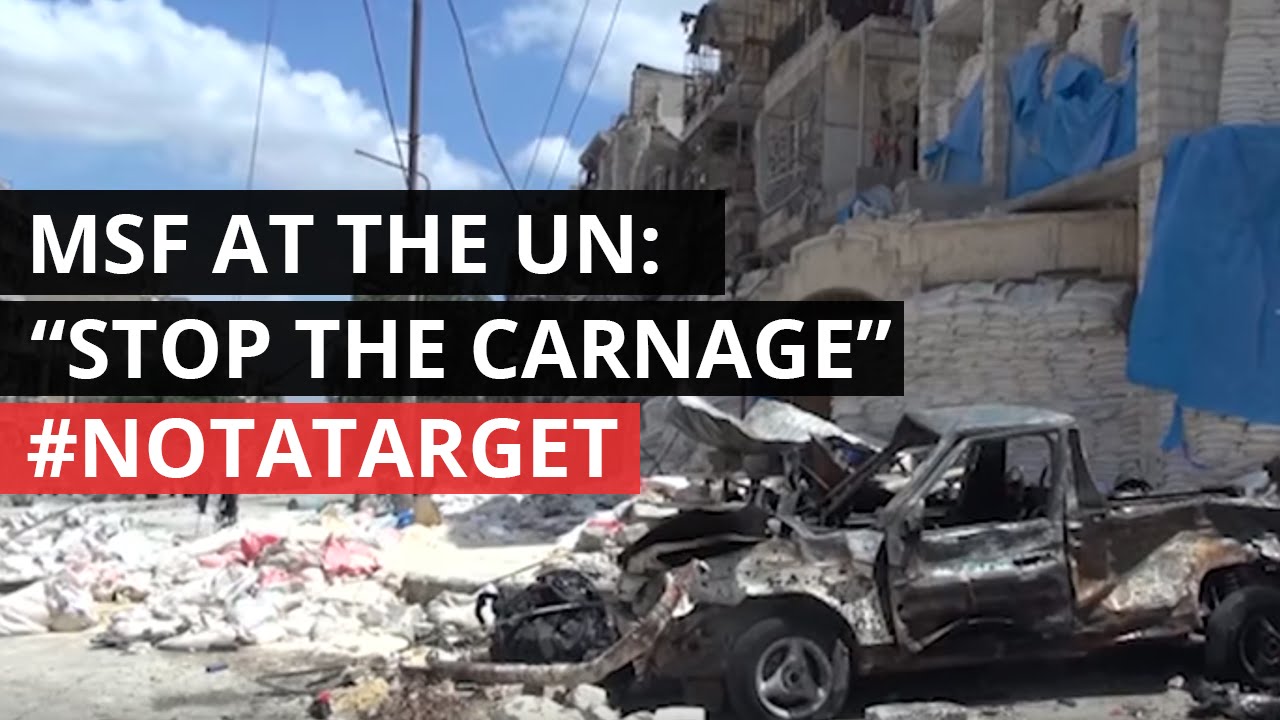
msf-at-the-un

And yet this is what SAMS found in Syria:

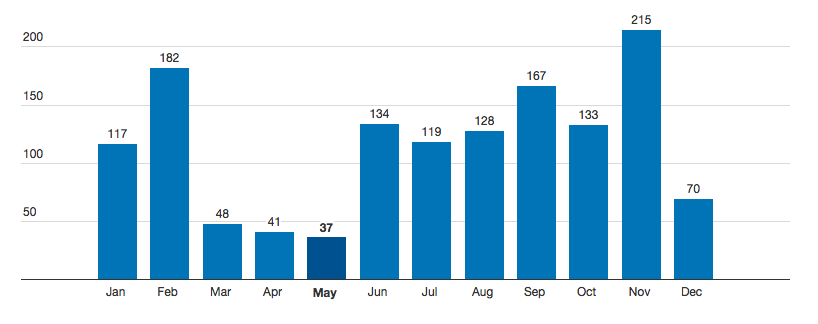
  • In 2015, the rate of targeting of medical facilities and personnel was one attack every four days.
  • In October 2015, following Russia’s intervention in support of the Syrian government, this rate doubled to one attack every 48 hours.
  • In November 2016 the rate virtually doubled again to one attack every 29 hours.

SAMS estimates that there were 252 attacks on medical facilities and personnel in 2016; 199 of them took place after the passage of UNSC Resolution 2286.

Between June and December  SAMS identified 172 attacks (all detailed in an appendix to the report): 168 of them were carried out by the Syrian government and its allies; one by non-state opposition forces; one by Islamic State; and two by unidentified parties.  Aleppo and Idlib were the principal targets: eastern Aleppo alone received a numbing 42 per cent of all attacks.

In case you are wondering about the sources for these claims, the report explains:

SAMS maintains rigid documentation standards in collaboration with partners in the WHO Health Cluster in Turkey and the Johns Hopkins University Bloomberg School of Public Health’s Center for Health and Human Rights. Our reporters on the ground rely on rst- hand testimony and photo documentation from medical sta and record the date, time, location, damages, casualties, impact on service delivery, weapon(s) used, and perpetrator of each incident. Any other source of information is not considered.

syria-attacks-graphics-03_page_6-e1484145301958

Dr Ahmad Tarakji, President of SAMS, reaches this bleak and compelling conclusion:

The failure of the international community to hold the perpetrators of these attacks accountable sends a dangerous message: that there are no lines, no limits, and no boundaries to the atrocities that are being committed against the Syrian people.

You can find more details about the targeting of doctors and hospitals in my post on the weaponisation of healthcare in Syria here; there is also a response to the passage of UNSC Resolution 2286 and its implementation by the Safeguarding Health in Conflict coalition (in September 2016) here.

Meanwhile Chris WoodsAirwars team has just released its preliminary assessment of civilian casualties from air strikes carried out by the US-led coalition and by Syrian/Russian air forces:

Syria’s civilians were under constant threat from Coalition air strikes throughout 2016, with 38% more casualty events reported in Syria than Iraq over the year. This may however reflect improved local reporting by Syrian monitors.

Overall, minimum likely civilian deaths in Syrian incidents graded by Airwars as Fair or Confirmed doubled in 2016. Across 136 incidents, between 654 and 1,058 civilians were claimed killed in total. Airwars estimates that a minimum of 818 civilians were likely injured in Fair and Confirmed events in Syria alone.

There were major spikes in February, in June and July (the Manbij campaign) and November the Raqqa campaign), all of them focused on areas held by Islamic State.

As for Syrian/Russian air strikes:

Airstrikes carried out by Moscow pummeled rebel-held areas of Syria throughout 2016, with many hundreds of civilians credibly reported killed.

Overall, there were 1,452 separate claimed civilian casualty events allegedly carried out by Russia during 2016. Between 6,228 and 8,172 civilians reportedly died in these events. Many of these incidents are likely to have been the result of actions by the Assad regime. Even so, civilian deaths from Russian strikes in 2016 far outpaced those from Coalition actions.

The pattern of civilian casualties from Russian air strikes:

screen-shot-2017-01-17-at-12-11-37

But at least three caveats are necessary.  First, these are provisional calculations:  ‘With so many allegations to assess, Airwars has a significant case backlog’, and the team has so far only completed a detailed analysis of the first four months of 2016.

Second, the report provides no separate listing of air strikes carried out by the Syrian Arab Air Force. The Airwars team concedes a ‘very high level of confusion – especially between Russia and the regime’.  Here is Kinda Haddad: ‘For many incidents we have some sources blaming the regime and others Russia – and we can’t really tell who is responsible as they use similar planes and weaponry.’  One major exception to that must be the use of barrel bombs dropped by the SAAF’s helicopters.

Third, these tabulations identify immediate casualties from the strikes: one of the reasons for attacking doctors and hospitals, as I explained previously, is to multiply subsequent and distant casualties – to deny those wounded (or simply sick) life-saving medical treatment.  So these casualty lists are minima – and not only as a result of the general problems of casualty accounting in conflict zones.

The Death of the Clinic

This is the fifth in a new series of posts on military violence against hospitals and medical personnel in conflict zones. It follows directly from my analysis of the situation in Syria here.

President Bashar al-Assad has consistently denied that his forces have attacked hospitals or doctors.  In an interview with SBS Australia on 1 July 2016 he asked his interviewer:

‘… the very simple question is: why do we attack hospitals and civilians?… No government in this situation has any interest in killing civilians or attacking hospitals. Anyway, if you attack hospitals, you can use any building to be a hospital. No, these are anecdotal claims, mendacious statements …’

president-al-assad-interview-sbs-australia-4

There are at least four answers to Assad’s disingenuous question (if you falter at the adjective, see here).

(1) Silencing the witnesses

When Widney Brown from Physicians for Human Rights testified at the Tom Lantos Human Rights Commission on 31 March 2016 she provided one clear and compelling rationale for Assad’s attacks on doctors:

‘… attacks on doctors silence particularly powerful witnesses. When the Syrian government denies its use of chemical weapons, cluster munitions, starvation, or torture, doctors can bear witnesses to these violations because they have seen and treated the victims.’

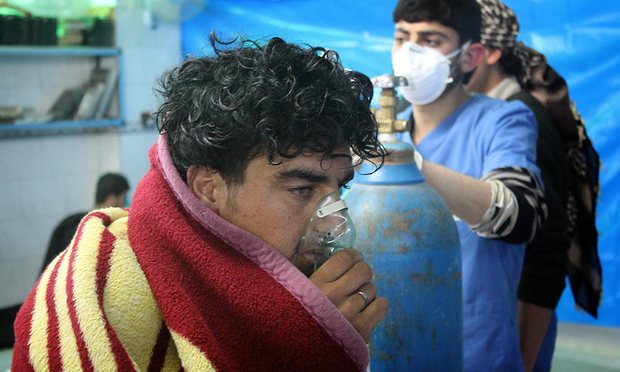
syrian-man-receiving-treatment-following-a-gas-attack

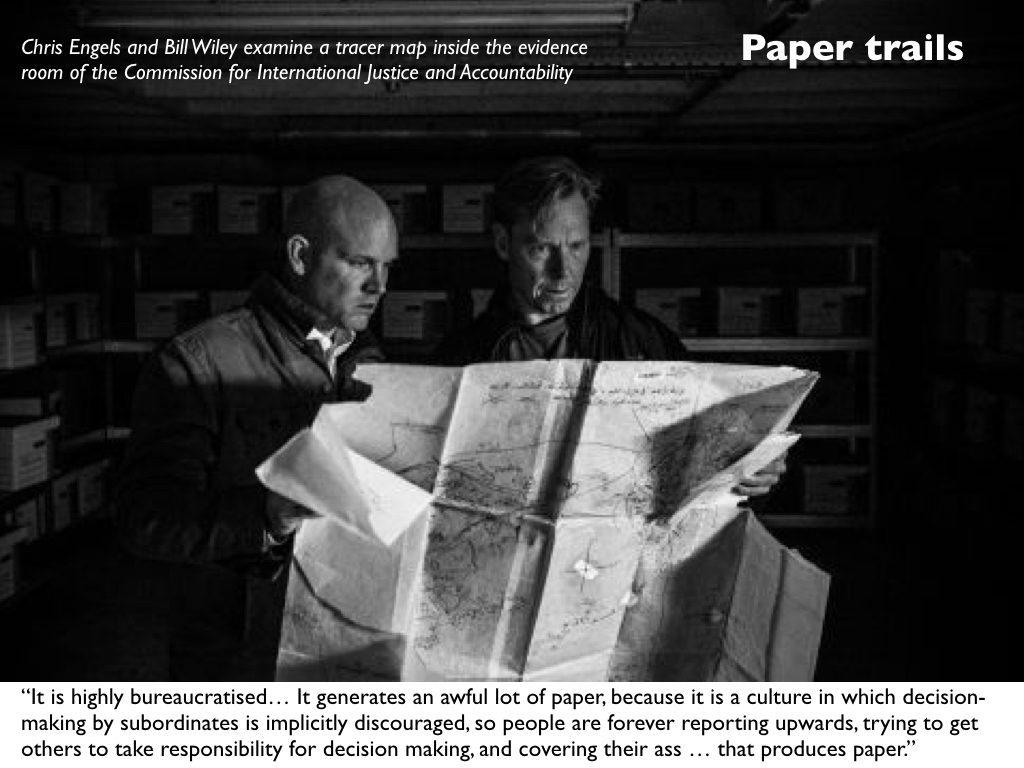
To be sure, there are other witnesses and even paper trails and photographic records.  Ben Taub, who has done so much to bring ‘Syria’s war on doctors‘ to the attention of a wider public, has also provided a detailed account of the work done by Bill Wiley and the Commission for International Justice and Accountability whose volunteers have smuggled over 600,000 documents out of Syria detailing mass torture and killings by the regime.

cija-syria-001

The war crimes have not been confined to attacks on hospitals in opposition-held areas.  A photographer known only as ‘Caesar’, who had been attached to the Defence Ministry’s Criminal Forensic Division, smuggled out thousands of high-resolution digital images exposing the horrors of the regime’s own military hospitals:

The pictures, most of them taken in Syrian military hospitals, show corpses photographed at close range – one at a time as well as in small groupings. Virtually all of the bodies – thousands of them – betray signs of torture: gouged eyes; mangled genitals; bruises and dried blood from beatings; acid and electric burns; emaciation; and marks from strangulation…

These unfortunates may have lived and died in different ways, but they were bound in death by coded numerals scribbled on their skin with markers, or on scraps of paper affixed to their bodies. The first set of numbers (for example, 2935 in the photographs at bottom) would denote a prisoner’s I.D. The second (for example, 215) would refer to the intelligence branch responsible for his or her death. Underneath these figures, in many cases, would appear the hospital case-file number (for example, 2487/B)…

[T]he system of organizing and recording the dead served three ends: to satisfy Syrian authorities that executions were carried out; to ensure that no one was improperly discharged; and to allow military judges to represent to families—by producing official-seeming death certificates—that their loved ones had died of natural causes. In many ways, these facilities were ideal for hiding “unwanted” individuals, alive or dead. As part of the Ministry of Defense, the hospitals were already fortified, which made it easy to shield their inner workings and keep away families who might come looking for missing relatives. “These hospitals provide cover for the crimes of the regime,” said Nawaf Fares, a top Syrian diplomat and tribal leader who defected in 2012. “People are brought into the hospitals, and killed, and their deaths are papered over with documentation.” When I asked him, during a recent interview in Dubai, Why involve the hospitals at all?, he leaned forward and said, “Because mass graves have a bad reputation.”

(2) Multiplying the casualties

This is a radicalisation of an old strategy.  As Sam Weber pointed out in Targets of opportunity (2005), ‘every target is inscribed in a network or chain of events that inevitably exceeds the opportunity that can be seized or the horizon that can be seen.’  So, for example, when the United States or Israel bombs a power plant it often as not explains that it has been careful to bomb in the small hours when only a skeleton staff was in the building in order to minimise collateral damage.  But this begs the question: why bomb the power plant at all?  In most instances the degradation of the electricity supply means that it becomes impossible to pump water or treat sewage; refrigerators fail and food perishes; hospitals are forced to use unreliable generators. The result – the intended, carefully calculated result – is that casualties rise at considerable distances from the target and over an extended period of time.

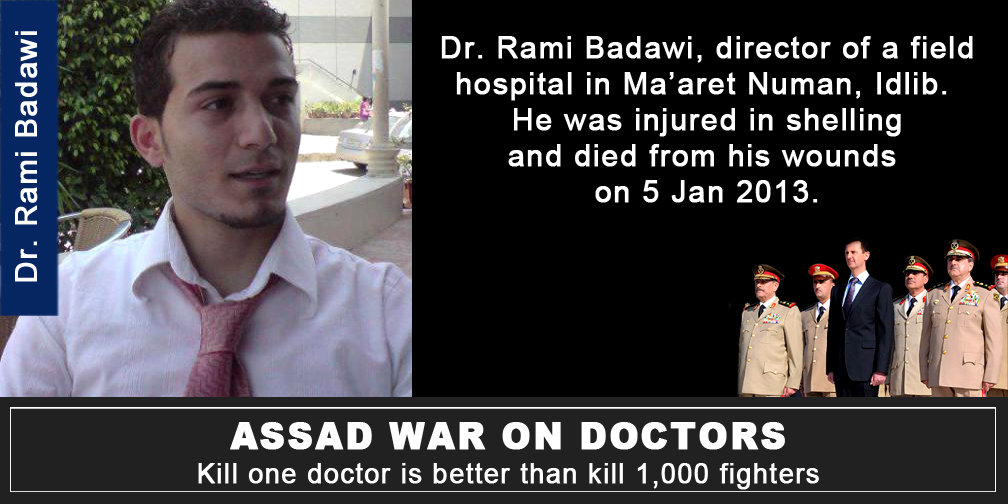
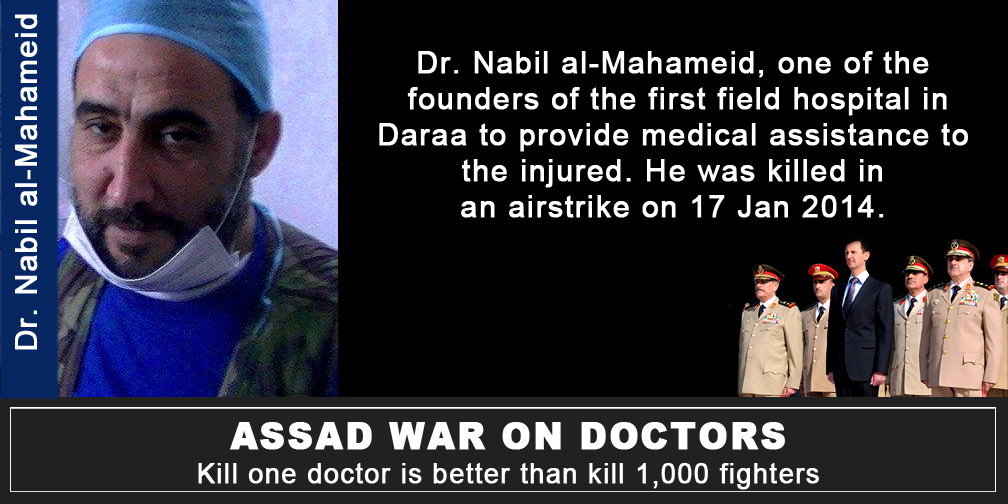
Similarly, Dr Abdulaziz Adel notes:  ‘Kill a doctor and you kill thousands.’  Simply put, patients who are sick or injured then go without treatment and in many cases their lives are put at risk.  (The images below are from Collateral Damage: more here).

syria_assad_war_crimes_murder_bomb67

syria_assad_war_crimes_murder_bomb15

syria_assad_war_crimes_murder_bomb37

Dr Rami Kalazi, a neurosurgeon from East Aleppo, agrees:

‘They are the artery of life in the city. Can you imagine a life in city without hospitals? Who will treat your kids? Who will make the surgeries for the injured people? So, they are targeting these hospitals because they know, if these hospitals were completely destroyed, the life will be completely destroyed.’

(3) ‘Moral[e] bombing’

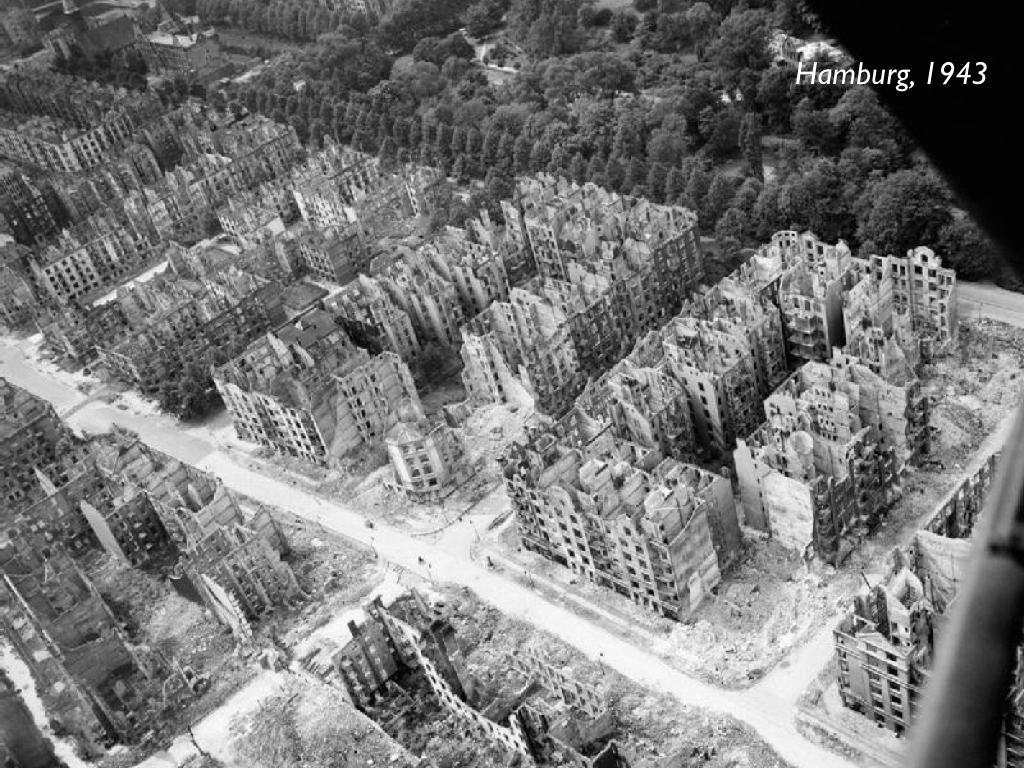
This too is an old strategy.  The architects of ‘area bombing’ during the combined bomber offensive against Germany during the Second World War described it as ‘moral [sic] bombing’: a sustained and systematic attempt to undermine the morale of the enemy population so that they would demand their leaders sue for peace.  If this was a tried and tested strategy, however, the test showed that it was a complete failure (see my ‘Doors into nowhere’: DOWNLOADS tab).

morale-bombing-001

morale-bombing-002

But the lesson was lost in Syria, where attacks on hospitals have had a central place.  As Samir Puri argues, the strategy behind the joint Syrian and Russian air campaign seems to be:

“If there is a total collapse of any kind of trauma care, those are the sort of things that can contribute to collapsing morale very suddenly. The morale of a besieged force can look robust until it collapses.”

And Syria is not unique in contemporary wars: Israel has deployed the same strategy in its repeated assaults on Gaza (see here, here and here for ‘Operation Protective Edge’ in 2014), and the Saudi-led coalition has attacked more than 70 hospitals and health facilities in Yemen since March 2015 (in this latter case Russian media have reported MSF’s objections to the ‘utter disregard for civilian life’ without dissent: see for example here).

flashback-gaza-2014-001

‘Preventing medicine’, as Annie Sparrow puts it, has become ‘a new weapon of mass destruction’.

(4) ‘Violence legislates’

Following the attack on the UN aid convoy delivering supplies to a Syrian Red Crescent warehouse outside East Aleppo on 19 September 2016, 101 humanitarian organisations issued a joint appeal to the United Nations on 22 September; in part it read:

‘Deliberate attacks on humanitarian workers and civilians are war crimes. This must mark a turning point: the UN Security Council cannot allow increasingly brazen violations of international humanitarian law to continue with impunity.

‘Heads of state are gathered in New York this week for the United Nations General Assembly. Each one that accepts a lack of accountability for perpetrators and facilitators of war crimes colludes in the ongoing dissolution of international humanitarian law’ (my emphases).

The first paragraph is damning enough.  Ben Taub in the New Yorker again:

Nowhere has the supposed deterrent of eventual justice proved so visibly ineffective as in Syria. Like most countries, Syria signed the Rome Statute, which, according to U.N. rules, means that it is bound by the “obligation not to defeat the object and purpose of the treaty.” But, because Syria never actually ratified the document, the International Criminal Court has no independent authority to investigate or prosecute crimes that take place within Syrian territory. The U.N. Security Council does have the power to refer jurisdiction to the court, but international criminal justice is a relatively new and fragile endeavor, and, to a disturbing extent, its application is contingent on geopolitics.

But the sting comes in the second paragraph.  As I’ve noted before, international humanitarian law is not a neutral court of appeal, a deus ex machina above the fray, but has always been closely entangled with military violence.  In many respects it travels in the baggage train, constantly pulled by the trajectory of the very violence it supposedly seeks to regulate (or facilitate, depending on your point of view).  In short, as Eyal Weizman has it, ‘violence legislates‘.

There is good reason to fear that the systematic violation of medical neutrality is intended to force its dissolution.  Thomas Arcaro writes: ‘Humanitarian principles like neutrality and impartiality that once seemed so self-evident have been drawn into question, especially on the politically and ethnically complex battlefields of Iraq and Syria.’

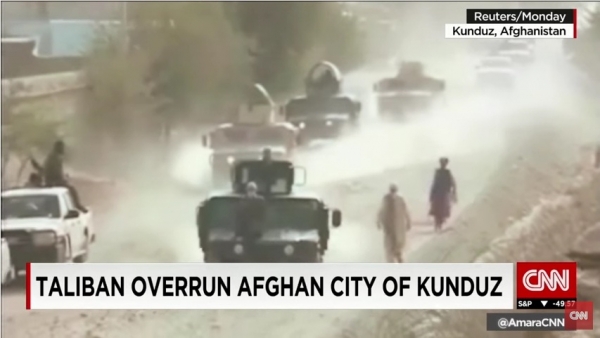
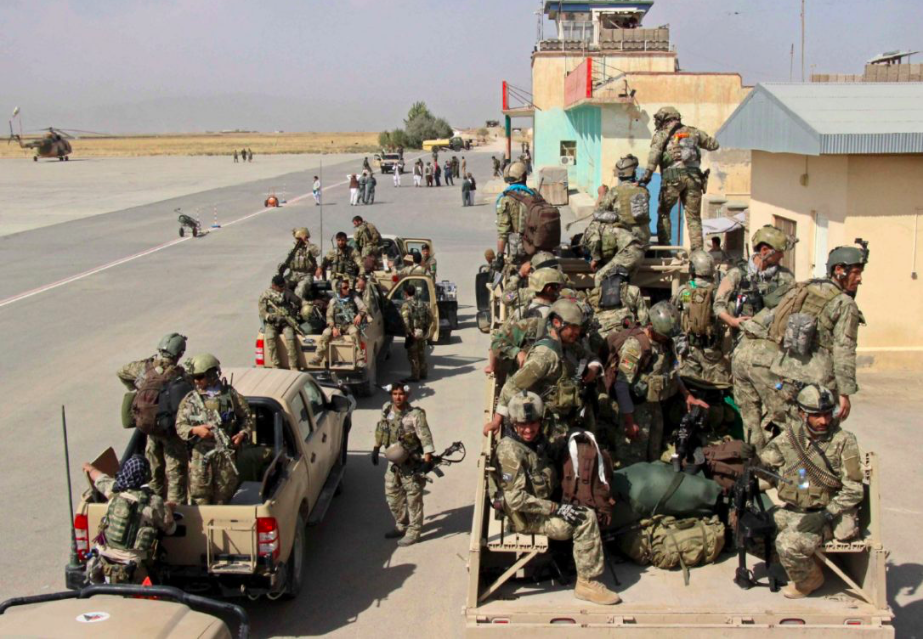
And not only there.  In the case of the US airstrike on the MSF Trauma Centre in Kunduz in 2015, I’ve suggested that some key Afghan officers and politicians chafed at the protections afforded to wounded Taliban combatants by international humanitarian law.  They also alleged that the Trauma Centre had breached its conditional immunity because the Taliban had overrun the hospital and were firing at US and Afghan forces from its precincts.  There is no evidence to support that assertion, but it is an increasingly familiar claim.  On 7 December 2016 US Central Command justified a ‘precision strike’ requested by Iraqi forces on a building within the al-Salem hospital complex in Mosul by claiming that IS fighters had used it as a base to launch heavy and sustained machine-gun and rocket-propelled grenade attacks.  That would certainly have compromised the hospital’s immunity, but international humanitarian law still requires a warning to be issued before any attack and a proportionality analysis to be conducted; Colonel John Dorrian said that the US Air Force did not ‘have any reason to believe civilians were harmed’ but conceded that it was ‘very difficult to ascertain with full and total fidelity’ whether any medical staff or patients were in the building at the time of the air strike.

But what the Syrian case suggests is a new impatience with medical neutrality tout court: not only a hostility towards the treatment of wounded and sick combatants but also an unwillingness to extend sanctuary to wounded and sick civilians.

people-on-war-2016

And that reluctance is not confined to the Assad regime and its allies.    A survey carried out for the International Committee of the Red Cross between June and September makes for alarming reading – even once you’ve overcome your scepticism about public opinion polls.  As Spencer Ackerman reports:

Areas in active conflict record greater urgency over questions of civilian protection in wartime than do the great powers that often conduct or participate in those conflicts. In Ukraine, 83% believe everyone wounded and sick during a conflict has a right to health care, compared with 62% of Russians. A full 100% of Yemenis endorse the proposition, as do 81% of Afghans, 66% of Syrians and 42% of Iraqis – compared with 49% of Americans, 53% of Britons, 37% of the Chinese and 67% of the French.

It’s that last clause that is so disturbing: for the last four states listed are all permanent members of the UN Security Council…

So what, then, are we to make of what I’ve been calling ‘the exception to the exception’?

The exception to the exception

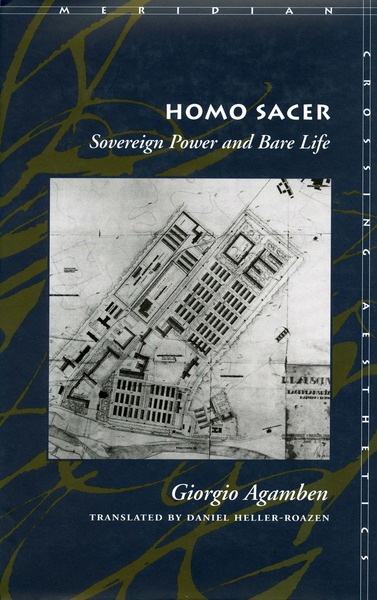
homo-sacerI think it’s a mistake to treat ‘the camp’, following Giorgio Agamben‘s vital work, as the exemplary, diagnostic site of the modern space of exception; the killing fields of today’s wars (themselves spaces of indistinction, where it is never clear where war stops and peace begins, where the geometry of the battlefield or, better, ‘battlespace’ becomes ever more fractured and blurred, and where the partitions between international and internal conflicts have been reduced to rubble) are also spaces within which groups of people are deliberately and knowingly exposed to death through the removal of legal protections that would ordinarily be afforded to them.  In short, killing and injuring become legally permissible.

Those exposed groups include both combatants and civilians, but their fate is not determined solely by the suspension of national laws (the case that concerns Agamben) because international humanitarian law continues to afford them some minimal protections.  One of its central provisions has been medical neutrality: yet if, through its serial violations in Syria and elsewhere, we are witnessing the slow ‘death of the clinic’ – which I treat as a topological figure which extends from the body of the sick or wounded through the evacuation chain to the hospital itself – and the extinction of ‘the exception to the exception’, the clinic as a (conditionally) sacrosanct space – then I think it’s necessary to add further twists to Agamben’s original conception.

As Adia Benton and Sa’ed Ashtan have argued, medical neutrality – the exception to the exception – represents a fraught attempt to restrict the state’s recourse to military violence: it is a limitation on and has now perhaps become even an affront to sovereign power and the state’s insistence that it is ‘the sole arbiter of who can live and who can die’.

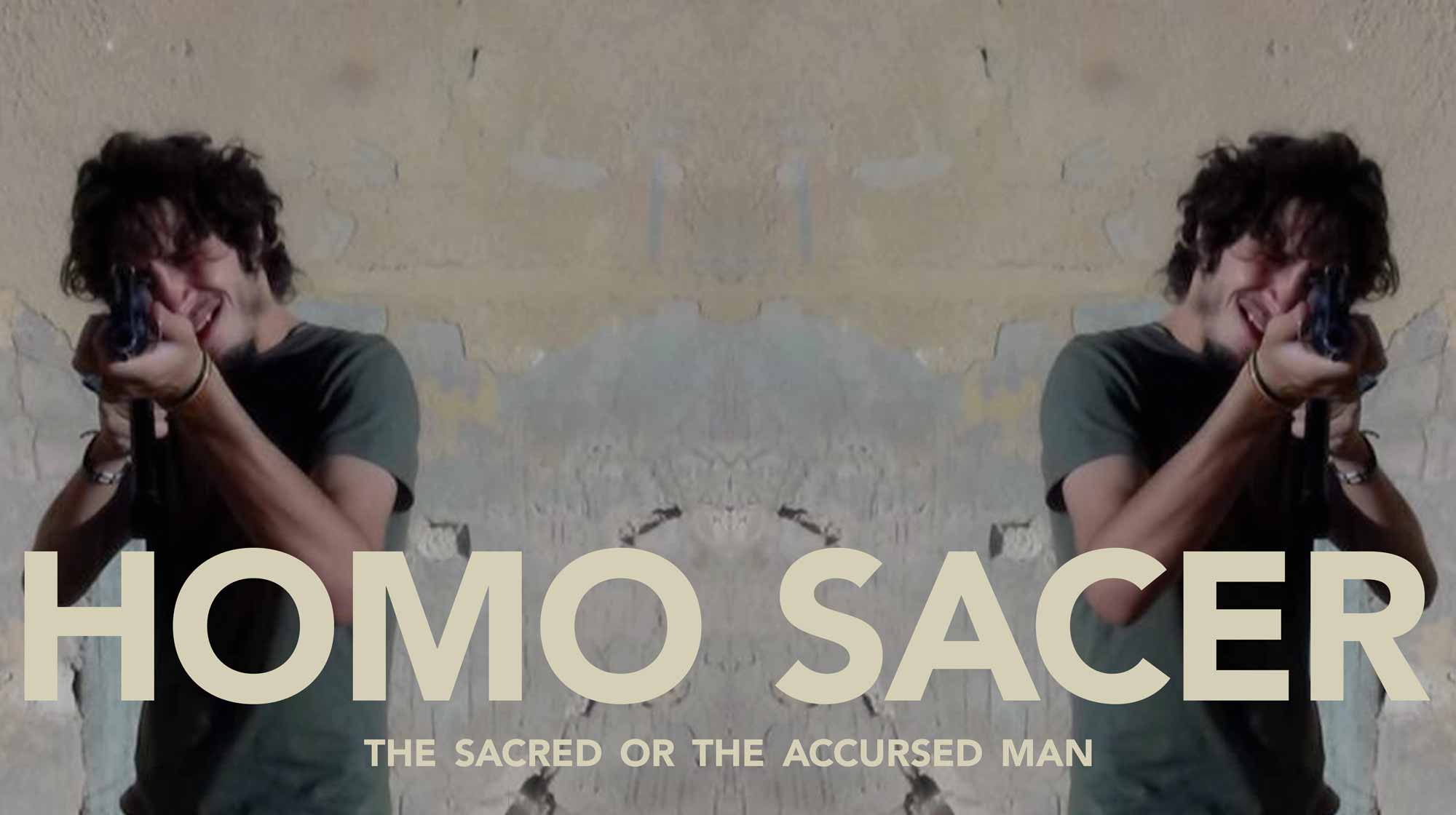
Agamben describes the inhabitants of the space of exception as so many homines sacri – where sacer has the double meaning of both ‘sacred’ and ‘accursed’ – and it may be that in today’s killing fields doctors, nurses and healthcare workers are being transformed into new versions of homo sacer: once ‘sacred’ for their selfless devotion to saving lives, they are now ‘accursed’ for their principled dedication to medical neutrality.


homo-sacer_lode-kuylenstierna_press_gun

Yet the precarity of their existence under conditions of detention and torture, siege and airstrike, has not reduced them to what Agamben calls ‘bare life’.  They care – desperately – whether they live or die; they have improvised a series of survival strategies; they have not been silent in the face of almost unspeakable horror; and they have developed new forms of solidarity, support and sociality.

bodies-in-alliance-001

‘Your turn, doctor’

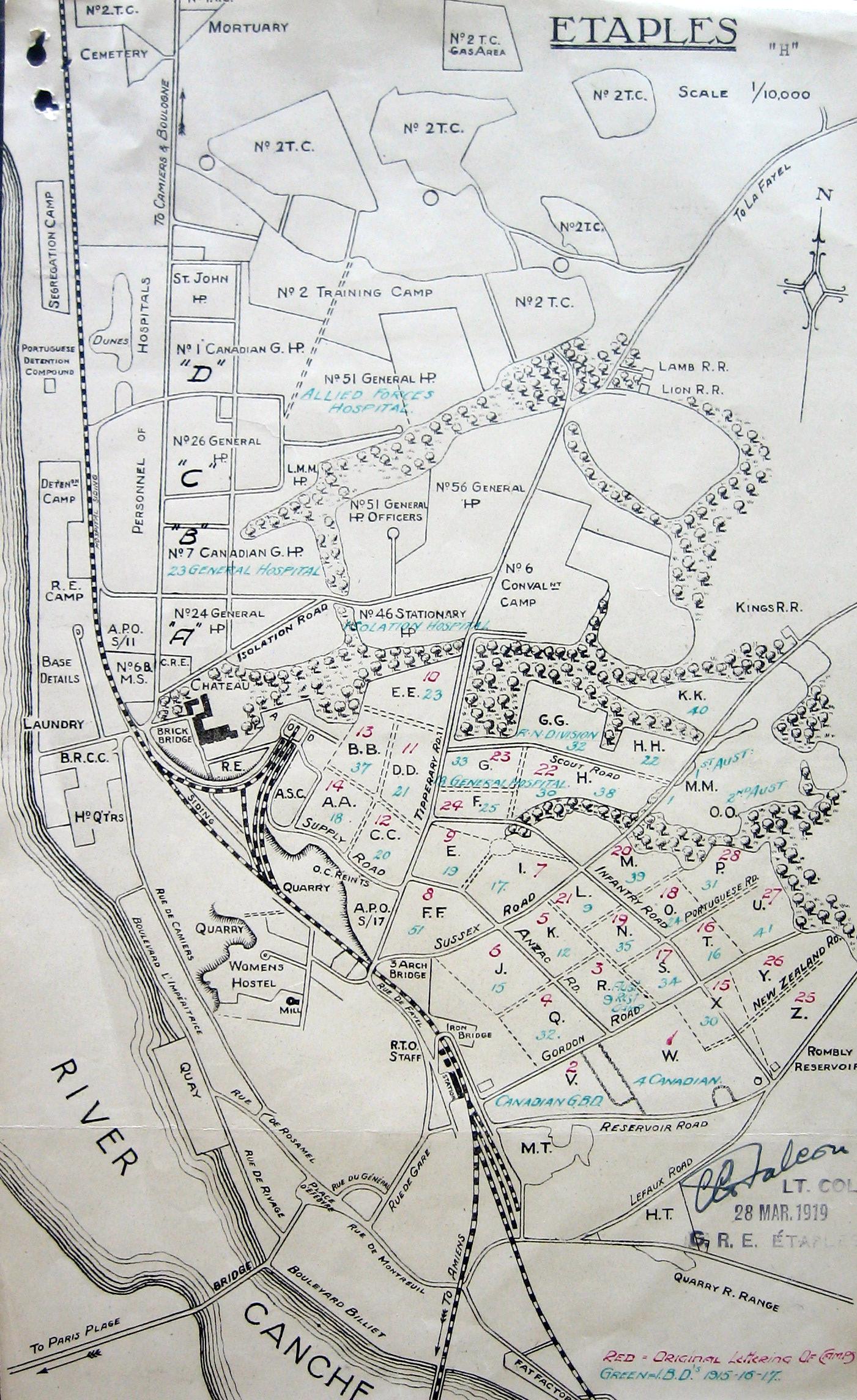
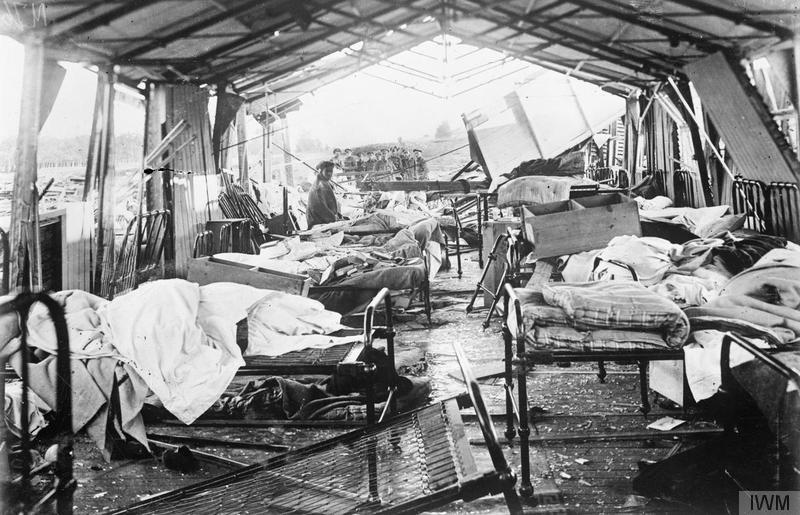
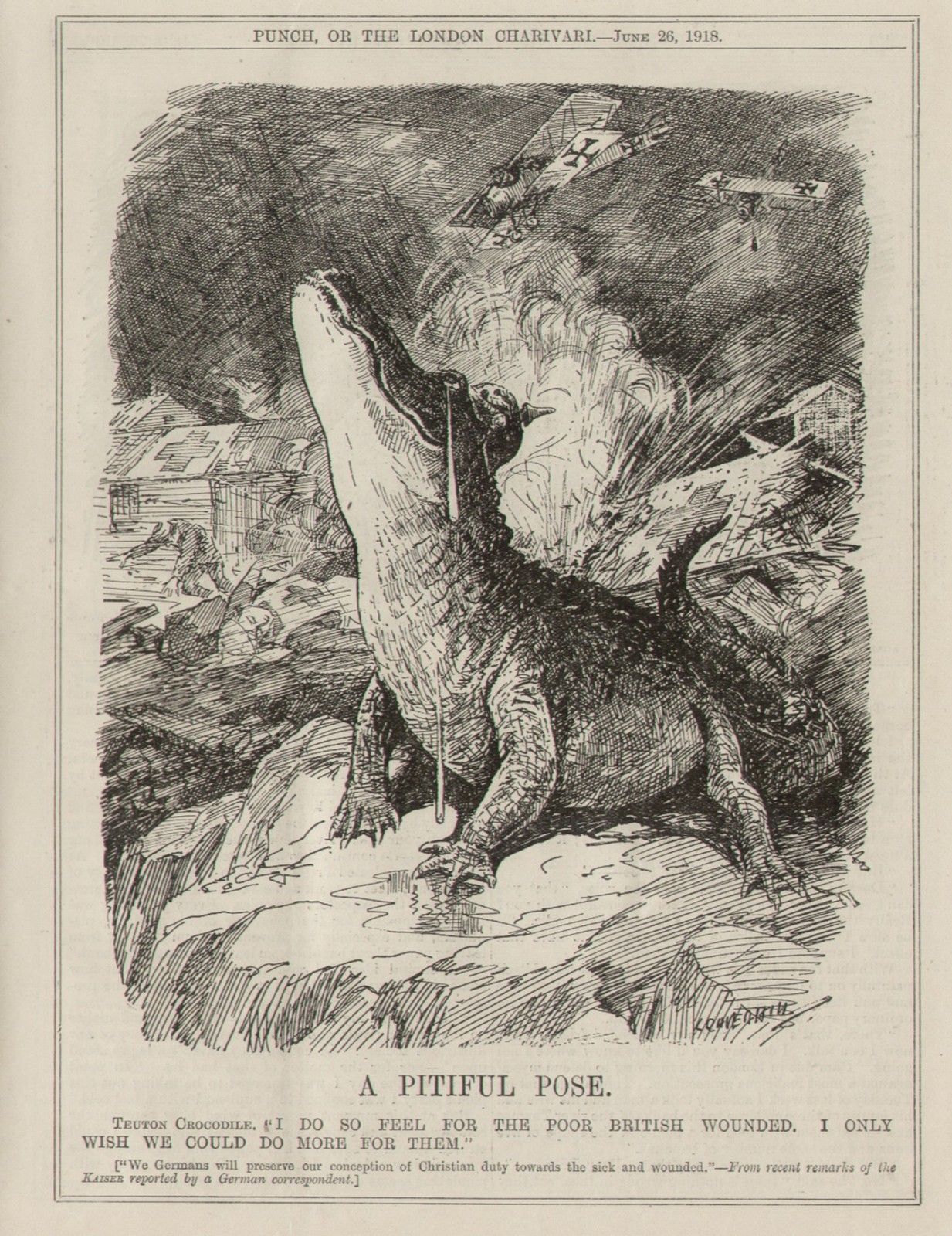
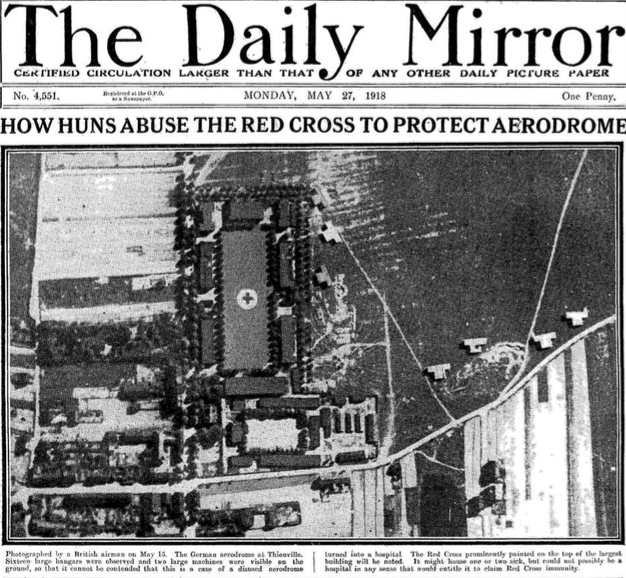
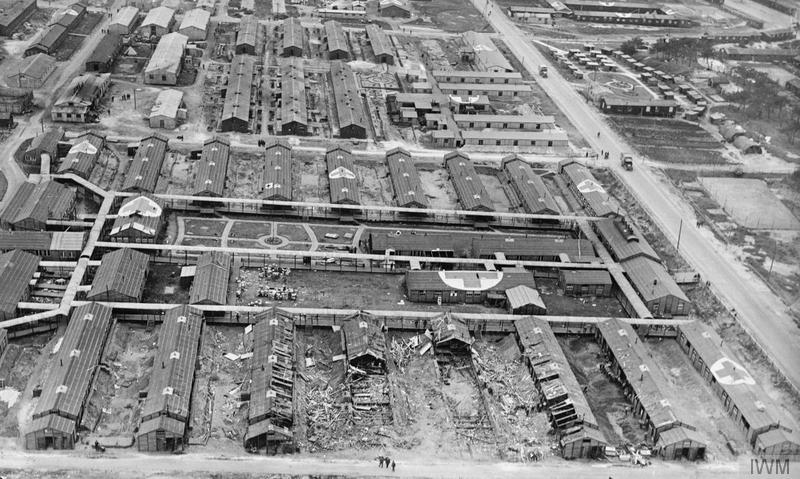
This is the fourth in a new series of posts on military violence against hospitals and medical personnel in conflict zones.  It follows from my analysis of air strikes on base hospitals on the coast of France in 1918 here, and of the US air strike on the MSF Trauma Centre in Kunduz, Afghanistan in 2015 here and here.  This post, together with the next in the series, is about Syria.  They all derive from a new presentation – still in active development – called ‘The Death of the Clinic: surgical strikes and spaces of exception’ that will eventually become an essay in my next book, so I would appreciate any comments or suggestions.

The eye of the storm 

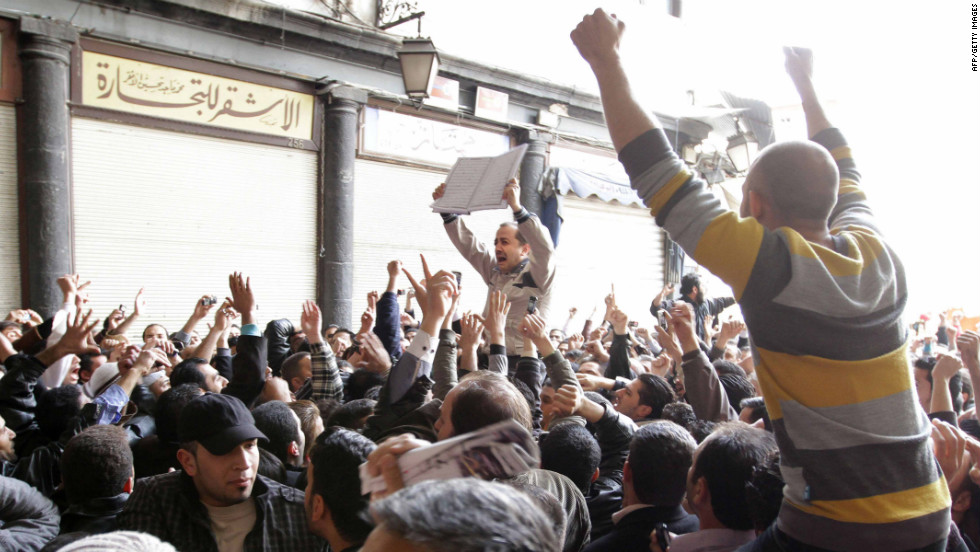
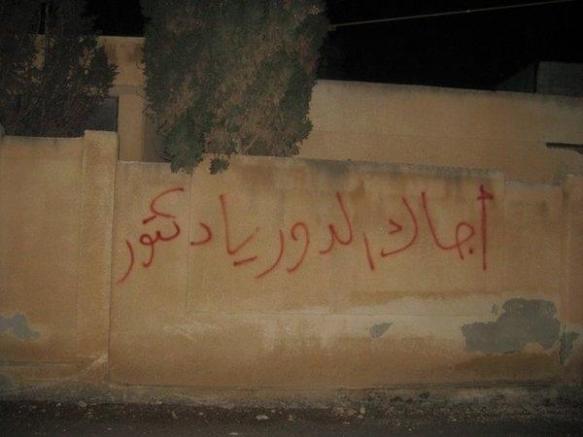
Syria’s civil war has multiple origins, but one of the most incendiary incidents took place on 16 February 2011 in the city of Dara’a 80 km south of Damascus near the Jordanian border.  Inspired by the spread of the Arab uprisings east across the Maghreb from Tunisia, and the threat they posed to a succession of autocratic regimes, a group of local teenagers decided to daub slogans on the wall of their high school.  One of them, a brave 15-year old (who now lives with his family in Jordan), painted this:
your-turn-doctor

‘Ejak el door ya Doctor’ – ‘Your turn, doctor’.

The doctor in question was Bashar al-Assad, Syria’s president, who had trained as an opthalmologist in Damacus and London.  In the months to come, Assad would give that slogan a viciously ironic twist.

The immediate response of the security forces to the graffiti was swift and draconian; the boys were rounded up, imprisoned and tortured (see herehere and here).  When their relatives protested to the officer in charge he told them:

‘Forget your children.  Just make more children. And if you don’t know how to make more, I’ll send someone to show you.’

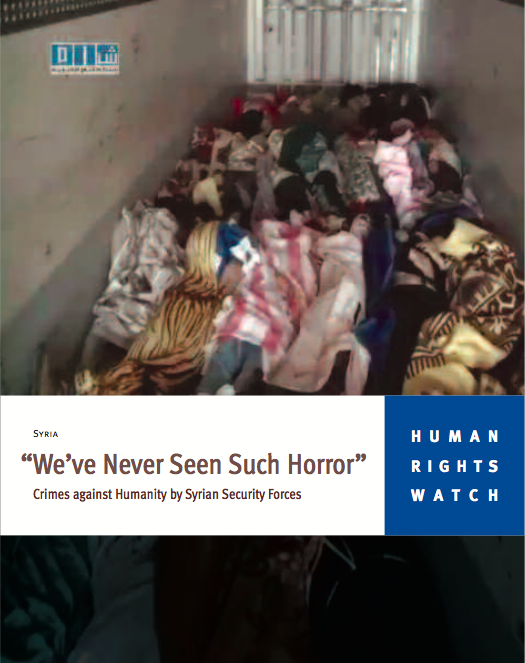
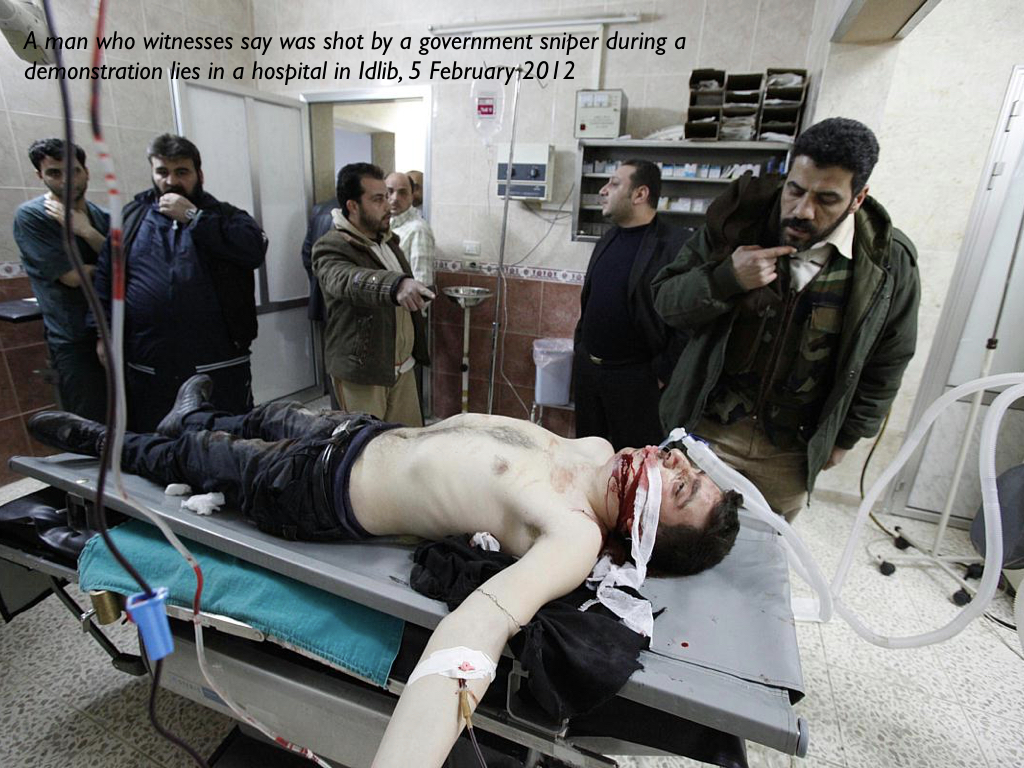
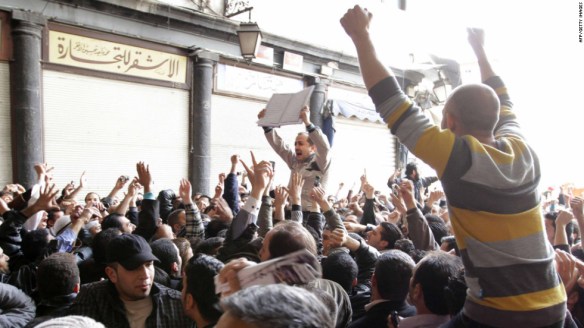
hrw-weve-never-seen-such-horrorLocal people took to the streets, and as the demonstrations spread on 22 March security forces entered the National Hospital in Dara’a, cleared it of all non-essential medical staff and stationed snipers on the roof who were under orders to fire on protesters.  The hospital remained until military control until May 2013; admissions were restricted and snipers continued to fire on the sick and wounded who tried to approach the hospital.  On 8 April security forces opened fire on thousands of demonstrators approaching a roadblock; ambulances were prevented from reaching the wounded, and a doctor, a nurse and an ambulance driver were killed when they tried to get through (UN Human Rights Council: ‘Assault on Medical Care in Syria’, 13 September 2013: download here; see also the Human Rights Watch report, ”We’ve never seen such horror’ here).
daraa-is-syria-in-damascus-2011

Others took up the cry, taking to the streets and chanting ‘Dara’a is Syria‘.  In many other areas the government stationed snipers, armoured personnel carriers, tanks and heavy artillery at hospitals; doctors suspected of treating protesters were arrested and tortured; security forces forcibly removed patients from hospitals, ‘claiming bullet or shrapnel wounds as evidence of participation in opposition activities’; and ambulances transporting casualties were attacked and pharmacies looted.

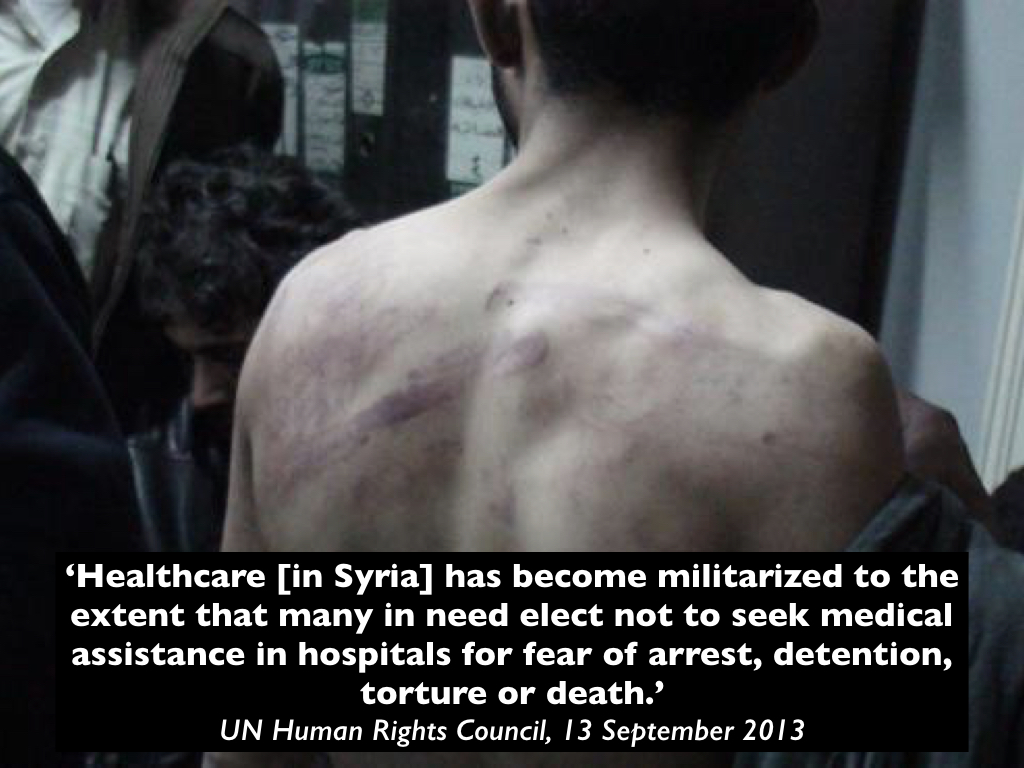
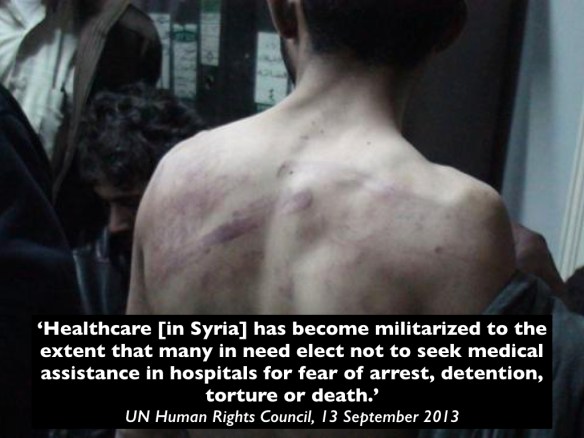
The UN Human Rights Council concluded:
healthcare-has-become-militarised-001

This was, sadly, hardly novel.  In 2006, at the height of sectarian violence in occupied Baghdad, for example, Muqtada al-Sadr‘s Shi’a militia controlled the Health Ministry and manipulated the delivery of healthcare in order to marginalise and even exclude the Sunni population.  As Amit Paley reported:

‘In a city with few real refuges from sectarian violence – not government offices, not military bases, not even mosques – one place always emerged as a safe haven: hospitals…

‘In Baghdad these days, not even the hospitals are safe. In growing numbers, sick and wounded Sunnis have been abducted from public hospitals operated by Iraq’s Shiite-run Health Ministry and later killed, according to patients, families of victims, doctors and government officials.

‘As a result, more and more Iraqis are avoiding hospitals, making it even harder to preserve life in a city where death is seemingly everywhere. Gunshot victims are now being treated by nurses in makeshift emergency rooms set up in homes. Women giving birth are smuggled out of Baghdad and into clinics in safer provinces.’

He described hospitals as ‘Iraq’s new killing fields’, but in Syria the weaponisation of health care has been radicalised and explicitly authorized by the state.

Counterterrorism and the criminalisation of health care

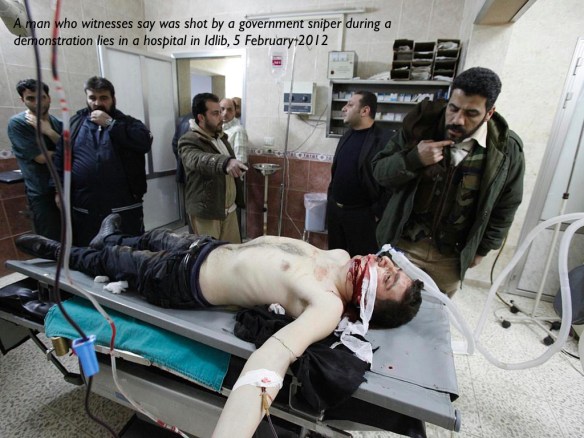
Doctors were systematically targeted for treating anyone who opposed the government.  In April 2012 one surgeon from Idlib told Annie Sparrow:

‘We were detained in the hospital for several days. Tanks parked out front, artillery in the wards, snipers on the roofs shooting patients who tried to come. They took our names, and summoned three of the five security branches – state, political and military. I was interrogated and forced to sign several commitments not to treat anyone not pro-regime. Of course, as soon as I was released I violated it immediately…the city was full of wounded and sick people. Soon after that a friend who worked in military security let me know I was now “wanted” [for my work], the charge being that I was the leader of a terrorist group. So I went into hiding, and moved my family to Turkey. In retaliation my brother was executed.’
shot-by-a-sniper-001

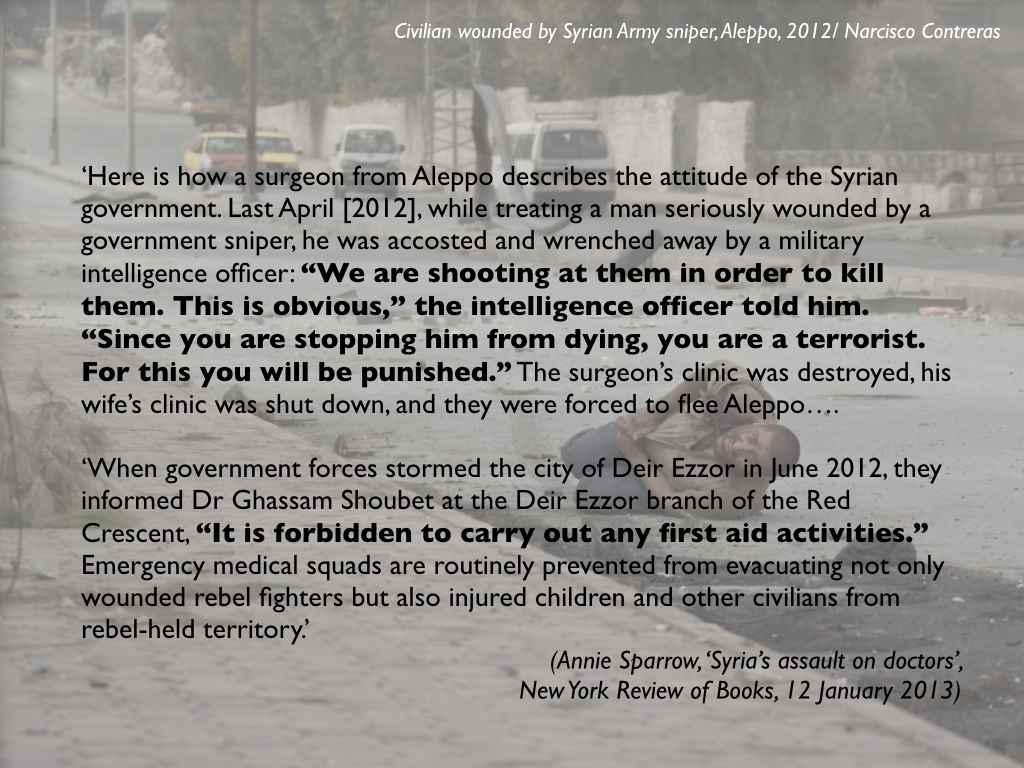
The State of Emergency that had been in force in Syria since 1962 was abruptly ended on 21 April 2012.  But on 2 July a new Counter-terrorism Law came into force that criminalised all medical aid to the opposition.  Here is Annie Sparrow again:

it-is-forbidden-to-carry-out-any-first-aid-activities-001

The parallels with the objections voiced by some members of Afghanistan’s security services against MSF’s work in Kunduz are only too clear: but in Syria they have been given explicit state sanction enforced through the law.

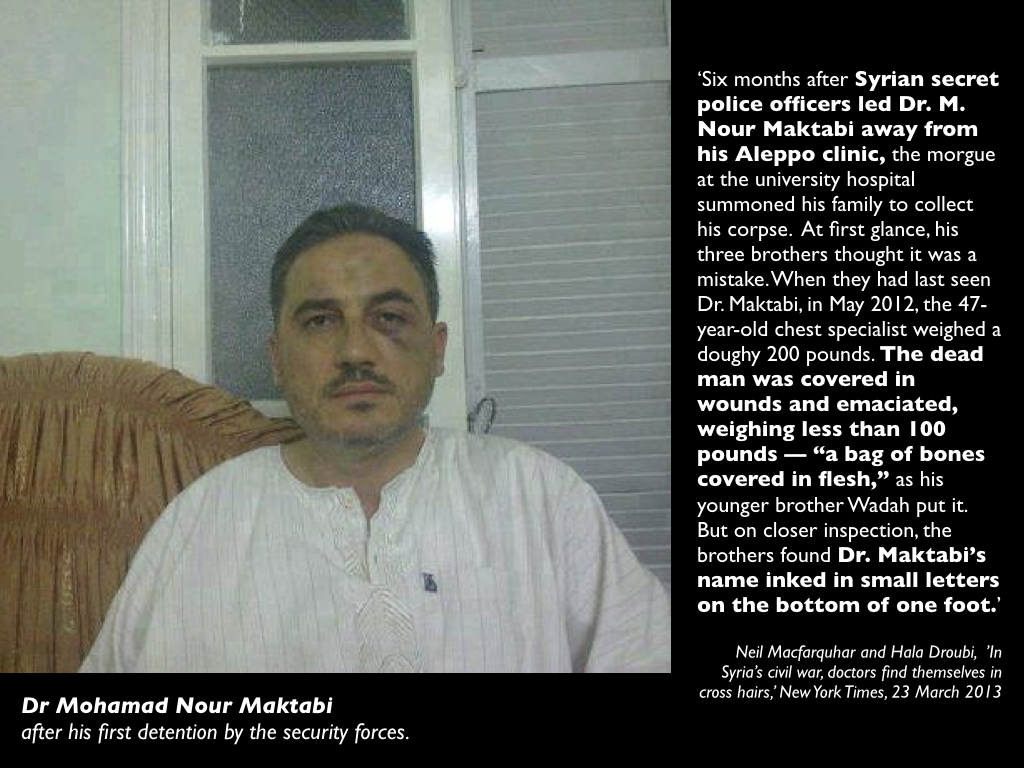
As Neil Macfarquhar and Hala Droubi reported for the New York Times in March 2013, doctors repeatedly found themselves in the cross-hairs.  Here, for example, is the case of Dr Mohamad Nour Maktabi:
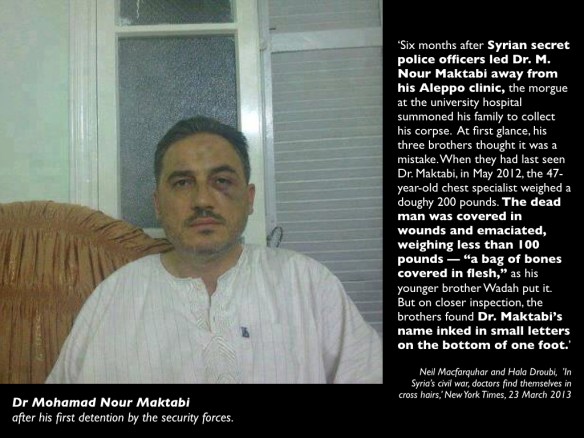
doctors-in-the-crosshairs-001

The Counter-terrorism Law also declared that all medical facilities operating in opposition-held areas without government permission were illegal – and thereby transformed them (under Syrian law, at least) into legitimate targets of military violence.

Air wars and ‘surgical strikes’

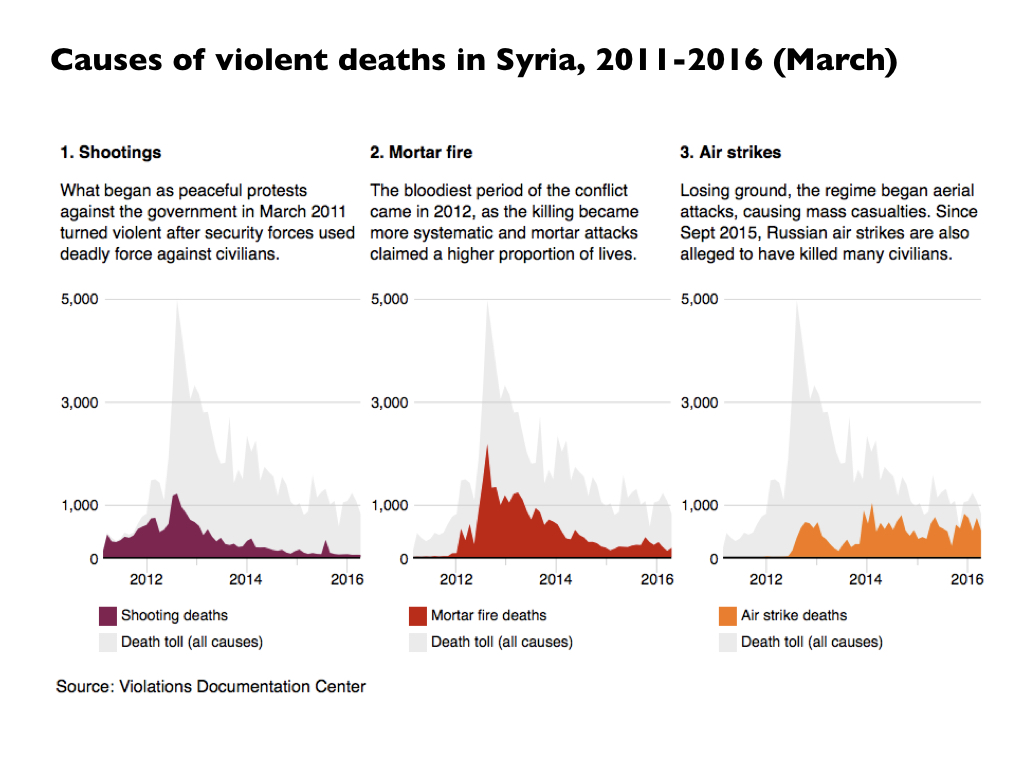
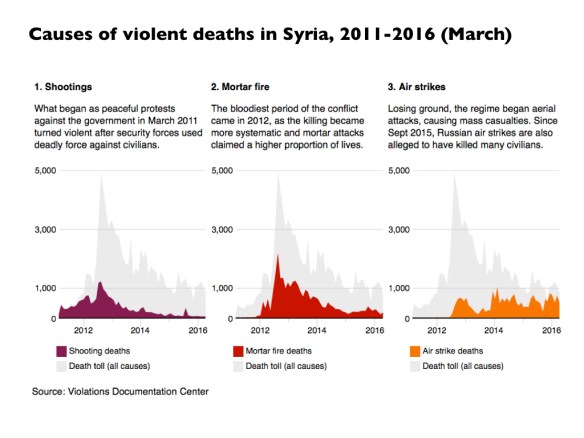
The nature of military and paramilitary violence has changed during the course of the war; shooting and mortar-fire have increasingly been supplemented by air strikes.
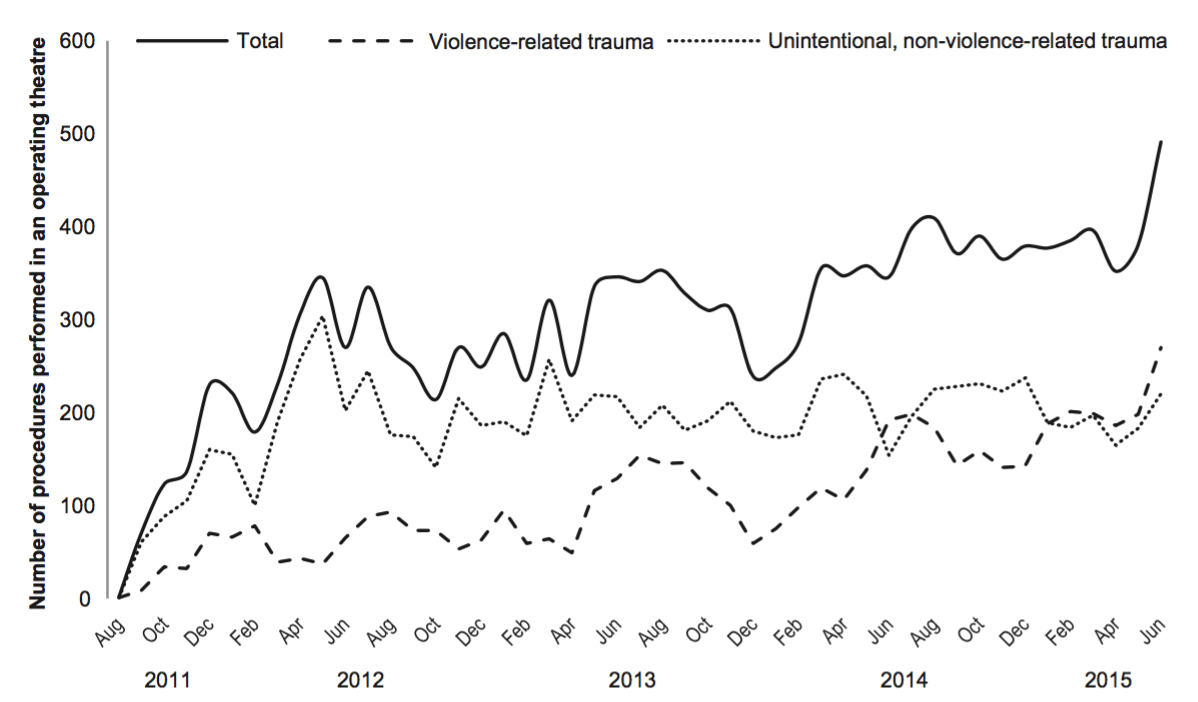
causes-of-violent-death-in-syria-2011-2016-001

Even in the early stages of the war doctors were confronting what one trauma specialist called ‘unimaginable injuries’.  Dr Rami Kalazi, a neurosurgeon in east Aleppo, explained:

‘In the beginning, we saw new injuries that we did not know how to treat. Fortunately, at the beginning of the revolution and when we began working in field hospitals, there was more freedom of movement. In 2012 and 2013, there was no such thing as “barrel bombs” and there was no violent shelling from airplanes, so many visiting foreign doctors came…

‘But even so, they told us that they were seeing injuries that they had never seen before in books or textbooks or in the hospitals where they worked in their home countries. Unfortunately, reality forces you to learn.’

But air strikes transformed the calculus of injury.  Many more casualties resulted from each attack, and the wounds of those who survived were often far more serious.

The US-led coalition has carried out multiple airstrikes primarily in areas controlled by IS, and the campaign has caused (minimally) hundreds and probably several thousand civilian casualties – see my analysis of specific US air strikes here and here, for example –  but the Syrian Arab Air Force has concentrated its fire on areas controlled by other rebel groups (see Jeffrey White‘s analysis here).

A favourite tactic has been the deployment of ‘barrel bombs‘ – in effect, aerial IEDs: oil drums filled with high explosive and cut rebar to act as shrapnel – dropped from helicopters (see Human Rights Watch here).  Basel al-Junaidi described witnessing their impact:

I saw the aftermath of a barrel bomb. I saw human remains scattered in the street; I heard the screaming. I’m trained as a doctor, but I was unable to act. I just stood there, petrified. The West thinks we’re used to this, but we aren’t of course. We’re like anyone else – we use computers and cars, not camels and tents…

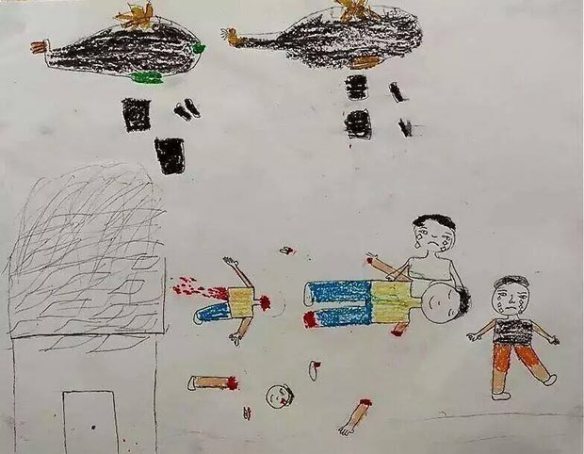
Another doctor who worked in Syria said he kept ‘a drawing from a second grader in Aleppo, showing helicopters bombing the city, blood and destruction below.’  Chillingly, ‘the dead children are smiling while the living ones are crying.’
the-dead-children-are-smiling

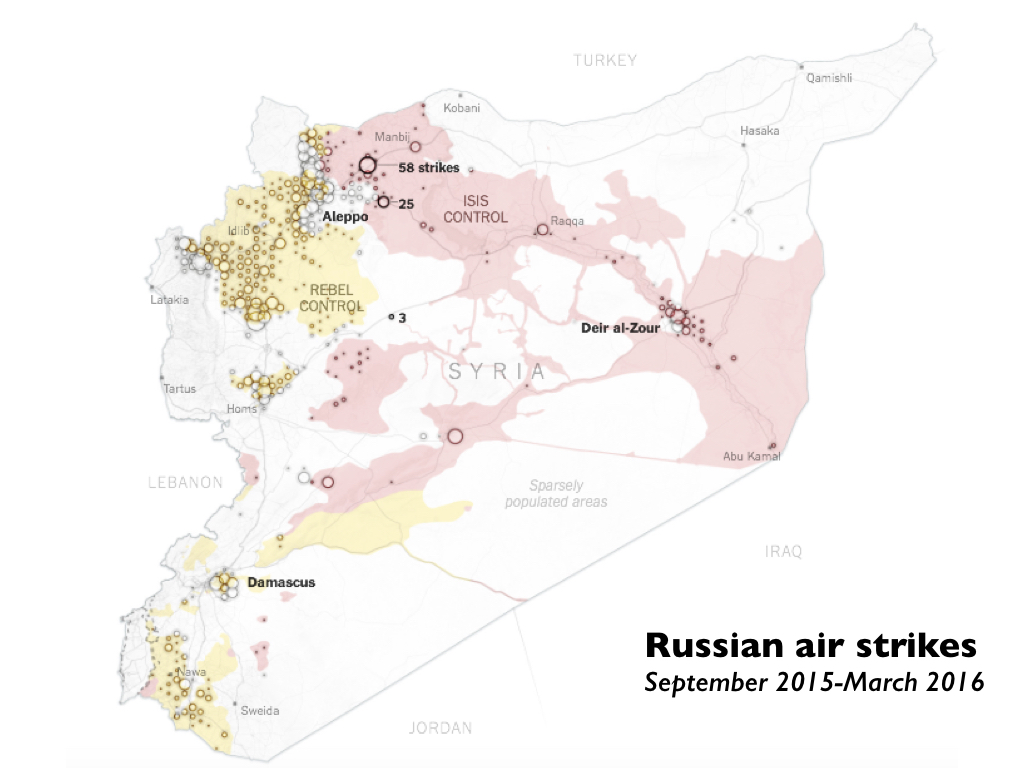
From September 2015) the Russian Air Force, often acting in concert with the Syrian Arab Air Force, has also concentrated on targets in areas controlled by other opposition groups:
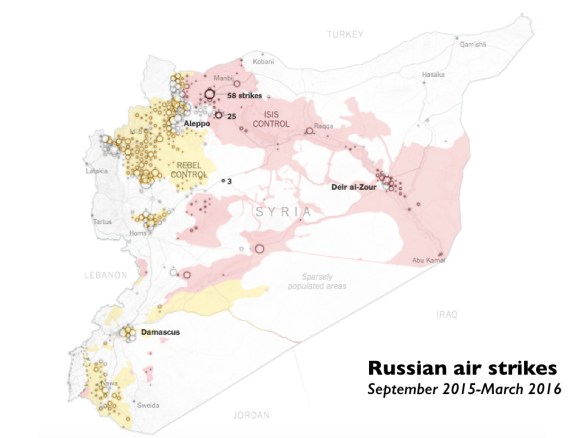
russian-air-strikes-in-syria-to-march-2016-001

Russia has routinely denied these charges, but from 30 September to 12 October 2015 its Ministry of Defence published videos of 43 airstrikes. Bellingcat, aided by crowdsourcing, identified the exact location of 36 of them and overlaid them on the ministry’s own map identifying which groups controlled what parts of the country (see the full report, ‘Distract, Deceive, Destroy’, here):

‘The result revealed inaccuracy on a grand scale: Russian officials described 30 of these videos as airstrikes on Isis positions but in only one example was the area struck in fact under the control of Isis, even according to the Russian MoD’s own map.’

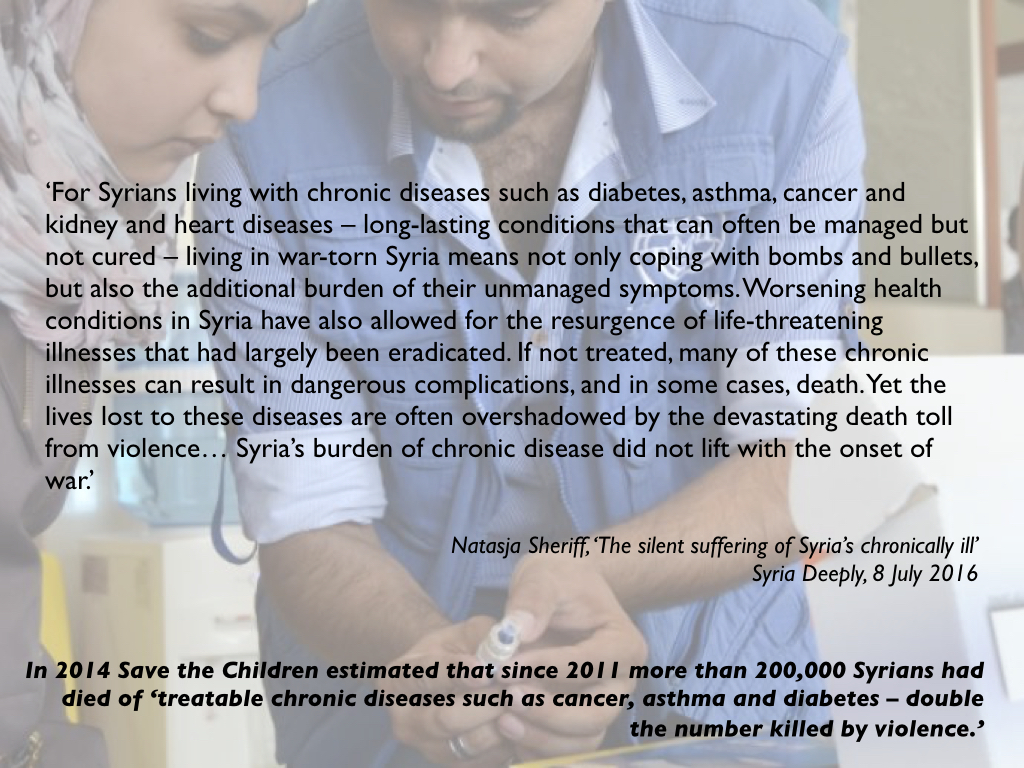
The effect of these air strikes has been devastating on the population at large.  To make matters even worse, air strikes cannot target individual doctors and have instead frequently been directed against hospitals and other medical facilities.   This compromises not only trauma care for the wounded but also the treatment of chronic and infectious diseases:
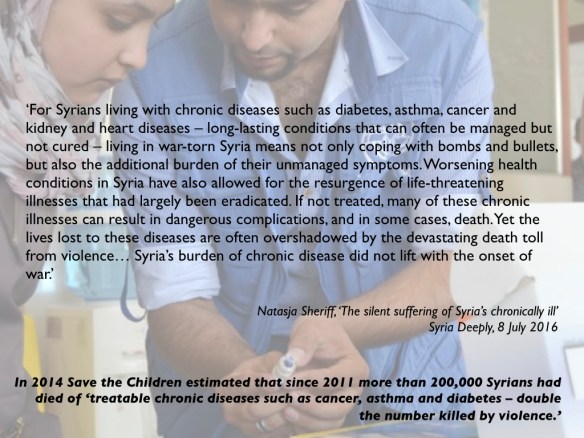
chronic-diseases-and-the-syrian-civil-war-001

(You can find a discussion of the problem of infectious diseases in Sima L. Sharara and Souha S. Kanj, ‘War and infectious diseases: challenges of the Syrian Civil War’, PLOS Pathogens 10 (11) (2014) here).

Hospitals and bomb sights

Doctors and other medical staff had to adjust to a new, sickening vulnerability.  Here is one OB/GYN who was still working in a hospital in East Aleppo when she was interviewed on Public Radio International in August 2016:

Carol Hills, PRI: Doctor Farida, did I just hear a noise there? Was that some sort of attack that I just heard?
Dr Farida Almouslem: It’s attack. [Laughs]. It’s normal. It’s away from me. Not next to me. These noises are all the time.
Hills: Do you and the doctors and patients you work with feel safe inside the place where you’re working?
Dr Farida: No. It’s not safe. I work at the third floor in my hospital. And many times the wall was perforated. So every woman came to the hospital, she knows that there is a danger on her life. So they just give the delivery, or give the birth, and then go home. She escapes to home because she knows our hospital is always targeted.

Other doctors in opposition-held areas said the same.  Here is Dr Mohamed Tennari, director of an above-the-ground field hospital in Idlib:

‘When I am in the hospital, I feel like I am sitting on a bomb. It is only a matter of time until it explodes. It is wrong − a hospital should not be the most dangerous place.  I wish I could say that targeting a hospital in Syria is unique, but is not.’

In fact, it’s far from unique: Physicians for Human Rights has issued a report detailing Attacks on Doctors, Patients and Hospitals hospitals and provided a interactive map of attacks on healthcare in Syria.

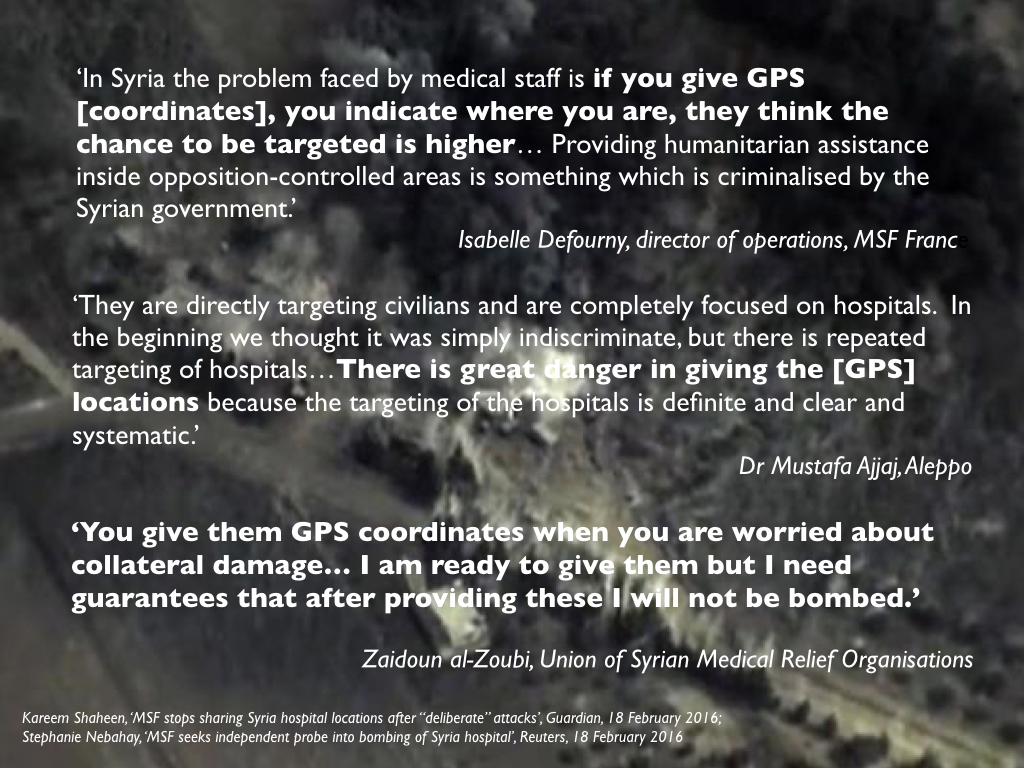
In the face of these escalating attacks, hospitals in opposition-held areas have tried to conceal their locations from the Syrian government.  In contrast to the protocol adopted by the MSF Trauma Centre in Kunduz, they have been markedly reluctant to provide their GPS coordinates (and see MSF’s explicit comparison between what happened in Kunduz and the situation in Syria here):
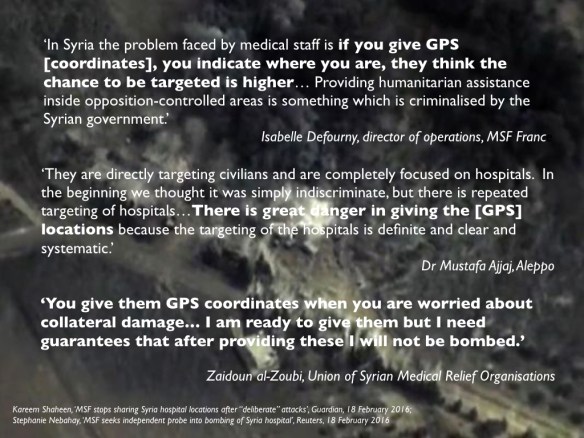
gps-coordinates-and-surgical-strikes-001

But this has trapped them in a grim Catch-22.  Michiel Hofman of Médecins sans Frontières – which is not permitted to operate in government-controlled areas in Syria – explains:

‘Hospitals that MSF supports in Syria are bereft of the possible protection of being clearly marked as a hospital or sharing of GPS coordinates, as the Syrian government passed an anti-terrorist law in 2012 that made illegal the provision of  humanitarian assistance – including medical care – to the opposition, forcing most health structures to go underground and operate without governmental medical registration. The bombing parties can then conveniently claim they were unaware it was a hospital they hit.’

More often, the Syrian government and its allies routinely describe the bombed building as a ‘so-called hospital’.  After an air strike on an MSF-supported hospital near Maarat al-Numan in Idlib on 15 February 2016 Bashar Jaafari, Syria’s ambassador to the United Nations, made this statement:

‘The so-called hospital was installed without any prior consultation with the Syrian government by the so-called French network called MSF which is a branch of the French intelligence operating in Syria… They assume the full consequences of the act because they did not consult with the Syrian government. They did not operate with the Syrian government permission.’

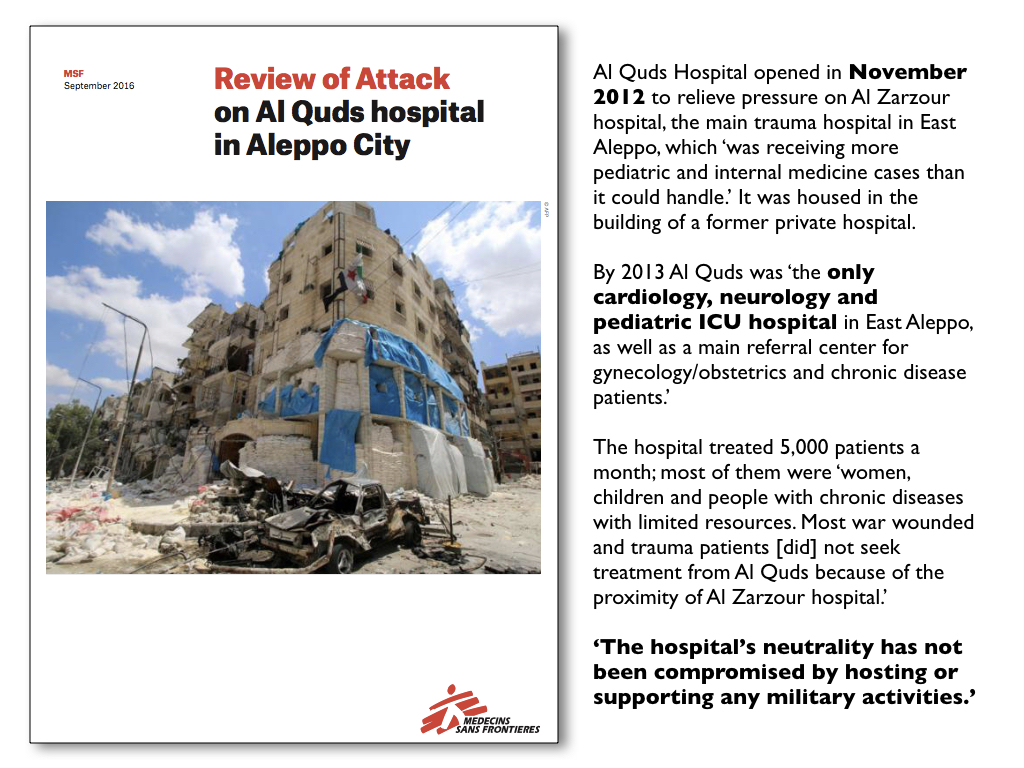
The allies of the Syria government are not confined to Russia and Iran.  On 27 April 2016 the Al Quds hospital in Aleppo was hit by two air strikes that killed 55 people  – among them two specialists, including Dr Muhammad Waseem Maaz, Al Quds’s pediatrician – and severely damaged the hospital. When it partially reopened 20 days later its capacity was reduced from 34 to 12 beds.  MSF conducted a detailed review of the operations of the hospital and the circumstances of the attack:
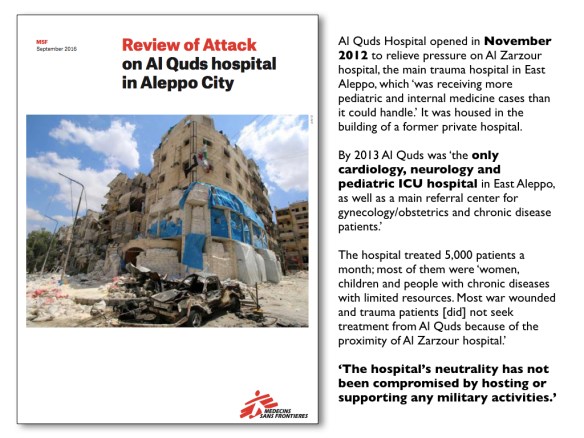
al-quds-hospital-attack-001

Here is Professor Tim Anderson on what he calls ‘The “Aleppo Hospital” Smokescreen‘ (and for reasons that will become obvious I am so tempted to put scare-quotes around the title that adorns his post; the Department of Political Economy at the University of Sydney lists him as a Senior Lecturer not a Professor, but perhaps anxiety over the appellation ‘Doctor’ is contagious):

‘…the story of Russian or Syrian air attacks on the ‘al Quds hospital’ gained prominence in the western media… CCTV showed people leaving this ‘hospital’ before an explosion.

‘The building is in the southern al-Sukkari district, which has been a stronghold of Jabhat al Nusra for some years. Many Aleppans had never heard of ‘al Quds hospital’. Dr Antaki [Aleppo Medical Association in Western Aleppo] says: “This hospital did not exist before the war. It must have been installed in a building after the war began”…. This facility was not a state-run or registered facility.’

Anderson is joined in his disinformation effort by Eva Bartlett writing in the ‘OffGuardian’:

Dr. Zahar Buttal, Chairman of the Aleppo Medical Association … said: “The media says the only pediatrician in Aleppo was killed in a hospital called Quds. In reality, it was a field hospital, not registered.”

As for the pediatrician, “We checked the name of the doctor and didn’t find him registered in Aleppo Medical Association records.”…

… central to the lies were the bias and propaganda of the very partial, corporate-financed Médecins Sans Frontières (MSF), which supports areas in Syria controlled by terrorists, specifically Jabhat al-Nusra…’

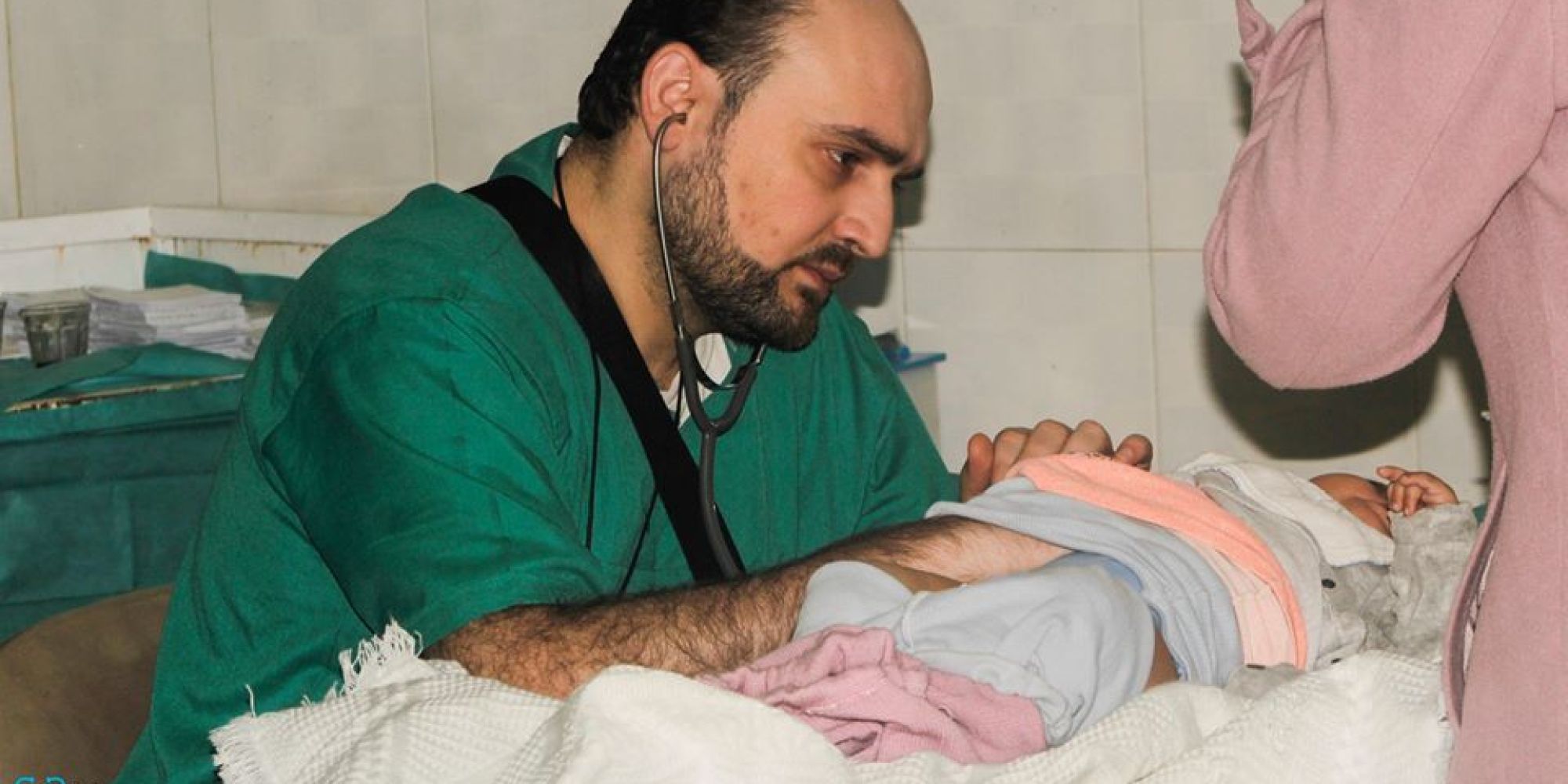
To repeat: the Syrian government has refused to register or recognise any hospitals operating in areas outside its control – hence the snide reference to ‘so-called hospitals’ and Anderson’s meretricious scare-quotes – and it does not permit MSF to operate in areas under its control (despite repeated requests).  As for the disappearance of Dr Muhammad Waseem Maaz from the Syrian government’s registry (though I have no doubt he was on other lists maintained by the regime) the director of the Children’s Hospital in Aleppo provides a graceful tribute to him here.  And here is the doctor whose death these commentators dismiss so lightly (if you have the stomach for it, you can see his last moments caught on CCTV here):

dr-muhammad-waseem-maaz

What, apart from the grotesque stipulations of the Syrian state, makes them think it proper to withdraw medical care from those living – surviving – in rebel-held areas?  International humanitarian law is unequivocal: they are entitled to medical treatment and to be protected whilst it is provided to them.

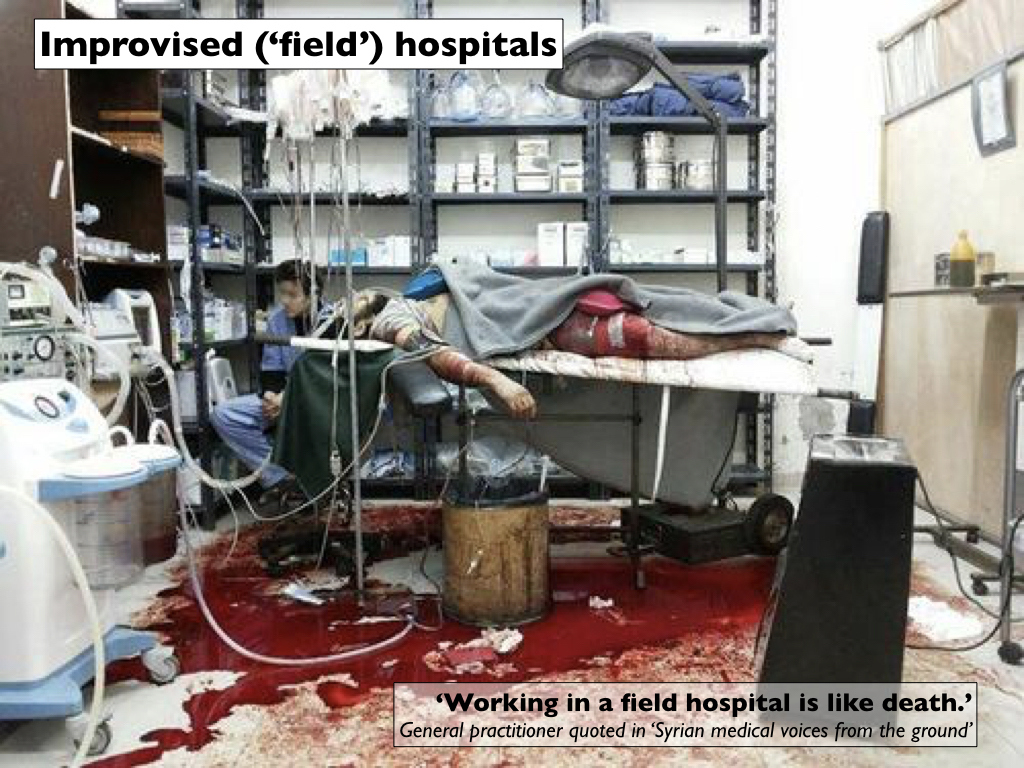
In rebel-held areas medical care has increasingly moved outside what were once established hospitals into the clandestine ‘field hospitals’ referred to above, which have been given numbered code-names to conceal their locations.  Some, like those established by MSF, follow strict medical protocols and, according to a study of one operating in Jabal al-Akrad by Miguel Trelles and his colleagues, they have (for a time) been able to provide high-quality medical care with remarkable survival rates (‘Providing surgery in a war-torn context: the Médecins Sans Frontières experience in Syria’, Conflict and Health (December 2015)).  As the attacks on them have increased and qualified personnel and medical supplies have become scarce, however, many have become exercises in improvisation:
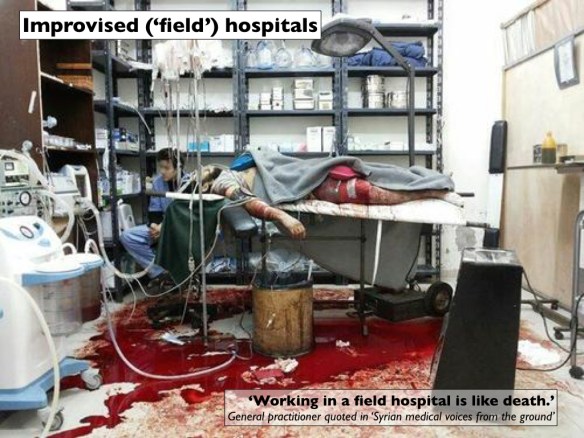
field-hospitals-001

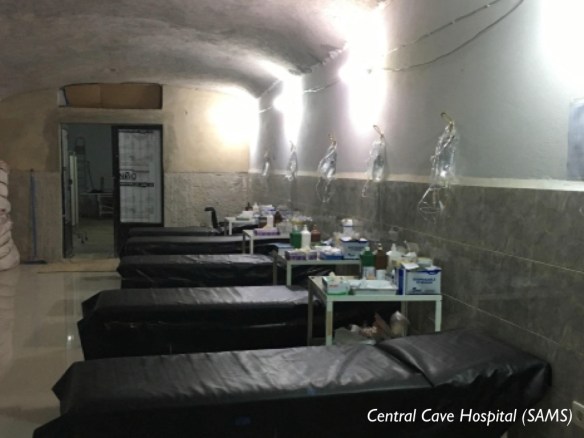
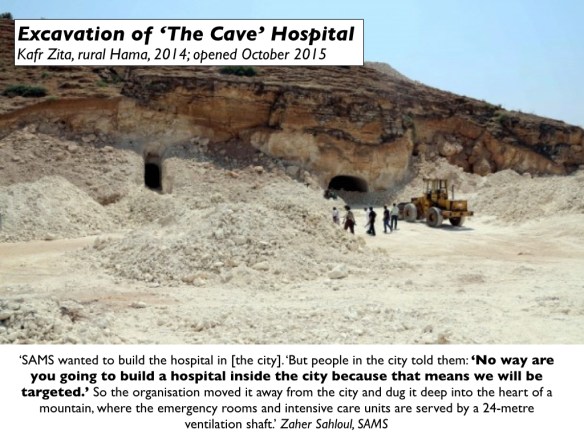
Some of these hospitals have literally gone underground.  ‘‘In our worst dreams – in our worst nightmares – we never thought we would have to fortify hospitals,’ declared Dr Zaidoun al-Zoabi of the Union of Medical Care and Relief Organizations. ‘It’s not humane. It’s impossible to comprehend.’

Subterranean locations have been used not only to protect the hospitals but also to protect local populations.  Charles Davis reported that

‘whether it’s a vehicle or a building, anything that’s identifiable as providing medical care is ripe for an airstrike, so that staff have now taken to covering up any distinguishing characteristics. Even so, [Dr Abdulaziz Adel, a surgeon in East Aleppo, admits that] local residents are “always begging us to go away, take your hospital away from us or otherwise we’ll be a target.”‘

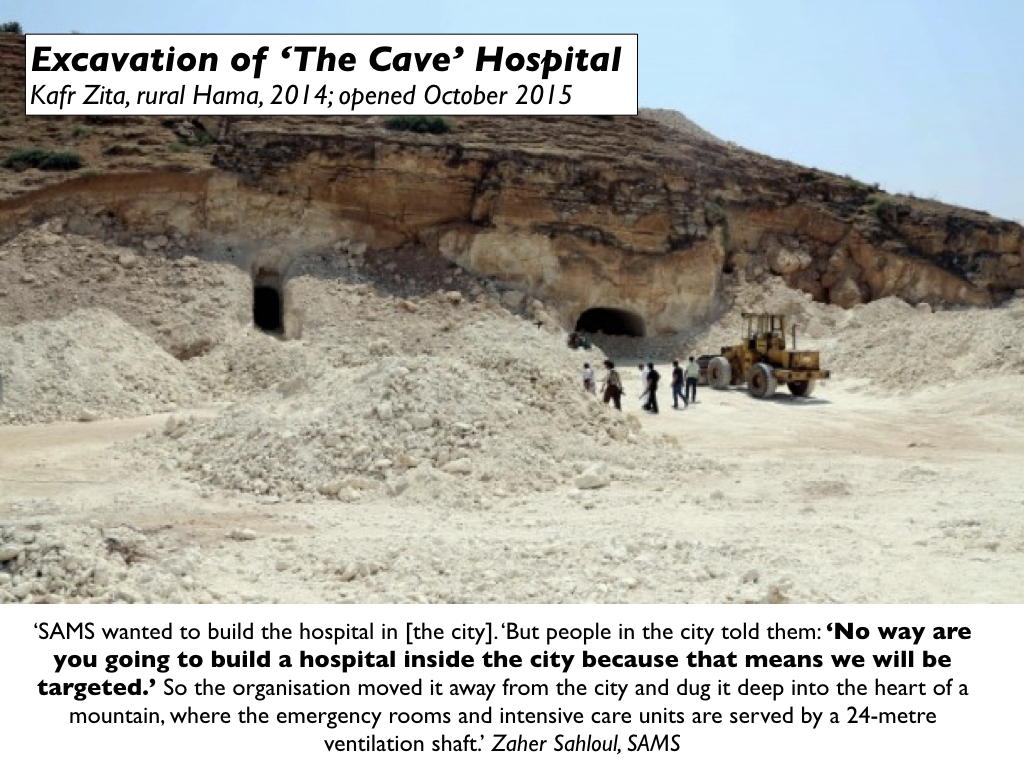
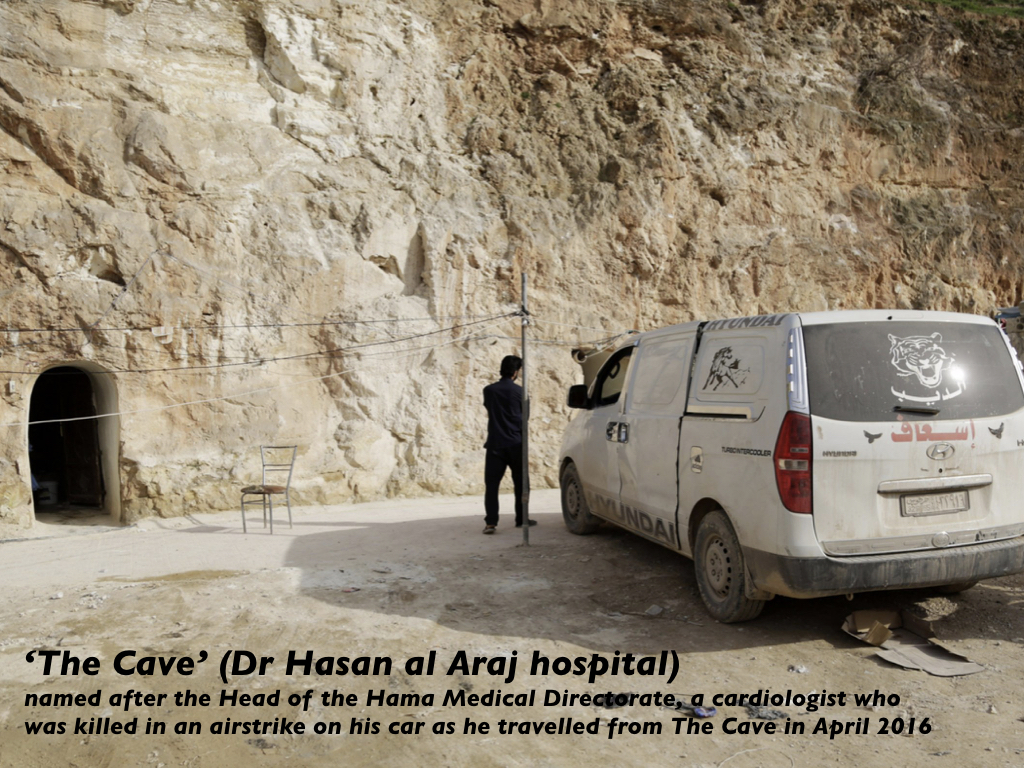
When the Syrian-American Medical Society proposed to build a hospital in Hama in 2014, local people begged them to locate it outside the city and so SAMS excavated what became the Dr Hasan al Araj Hospital, better known as ‘The Cave’:
the-cave-hospital-001

the-cave-hospital-002

the-cave-hospital-003

Supply chains and kill-chains

As the civil war ground on, even the most basic medical supplies became scarce and obtaining them ever more dangerous.  In March 2015 MSF reported that:

‘Even if it is available, many suppliers do not want to risk selling material like gauze or surgical threads when they know it is going to be sent into North Homs. Gauze is considered synonymous with war surgery, and often a supplier is not willing to take the risk of being arrested or shut down for supplying a besieged area.’
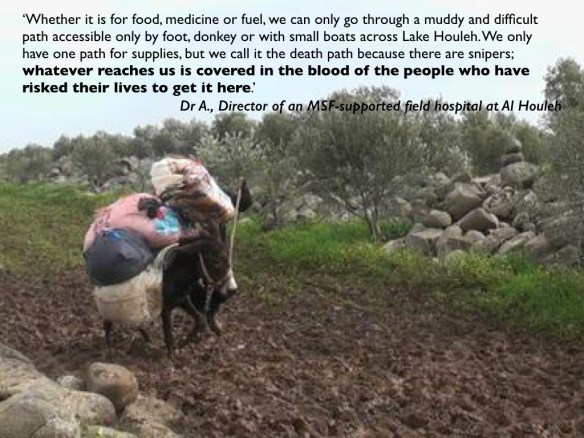
bloody-supply-chains-001

You can read more here and here.  One doctor told MSF:

‘It is precious, dangerous, incriminating. There are secret outlets supplying us with gauze.’

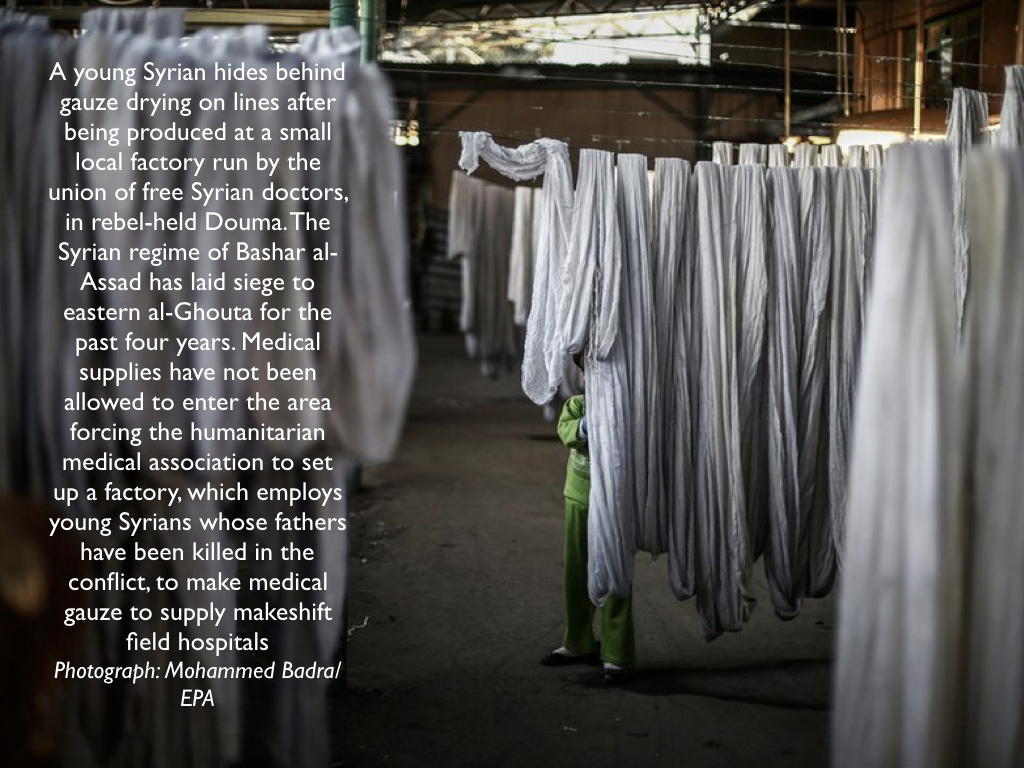
At the end of last year the Guardian provided this image of one of the secret factories:

gauze-factory-001

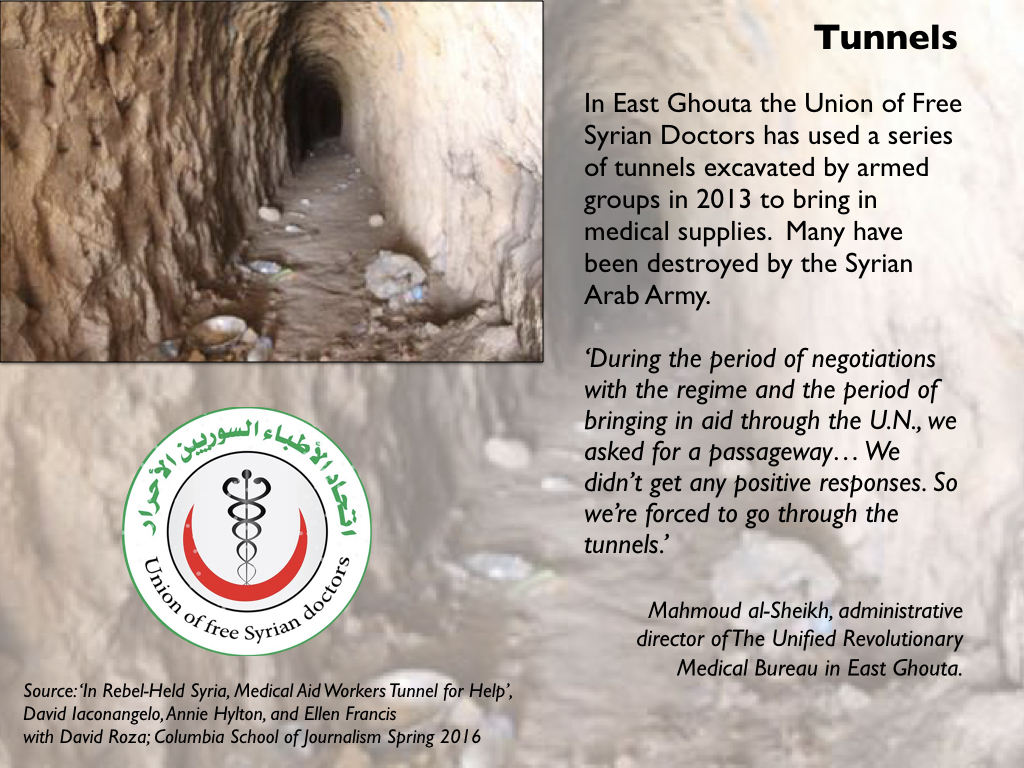
In East Ghouta, hospitals have been forced to use tunnels to bring in medical supplies (more from Ellen Francis and her colleagues here):
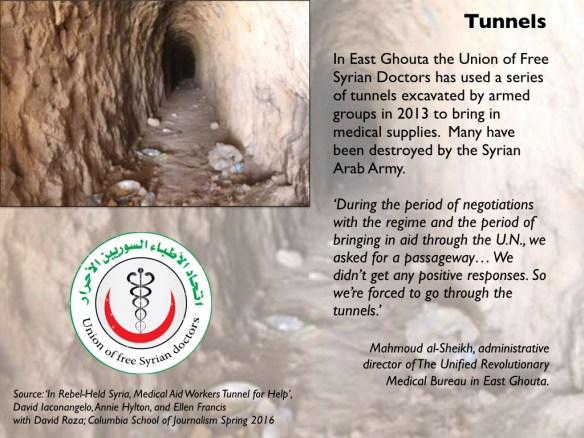
tunnels-and-the-siege-economy-in-aleppo-001

The risks are formidable and the costs have been almost prohibitive.  Ellen Francis and her colleagues at Columbia’s Graduate School of Journalism report that in January 2014 the Free Syrian Army and the Syrian Arab Army agreed an uneasy and ragged cease-fire in Barzeh, a small town on the northern edge of Damascus. There a team from the Union of Free Syrian Doctors was able to buy medical supplies from merchants who travelled out from the capital.

The merchants paid a 20 per cent ‘customs fee’ to Syrian Army soldiers; the agents for the doctors then paid a ‘tax’ to get the supplies through the Harasta checkpoint on the Army-controlled highway, and then a ‘toll’ to the rebels (‘tunnel lords’) who controlled the tunnels into Ghouta.

The combined fees inflated the price of medical supplies.  A litre of serum used to help the body replenish lost blood cost $1 in government-controlled areas and $3.50 to $10 via the tunnel route. Ghouta was using about 10,000 litres of serum per month.  The supply chain was subsequently severed once Barzeh itself came under siege and was cut off from Damascus.

Some humanitarian aid has crossed the lines by more conventional routes – conventional for a war zone at any rate – but medical supplies have routinely been removed from aid convoys.  On 19 May 2016 the UN Secretary-General reported to the Security Council:

‘[By May] 2016, WHO [had] submitted 21 individual requests to the Government of the Syrian Arab Republic to deliver medical supplies to 82 locations in 10 governorates. The Government approved five requests [while] 16 requests remained unanswered.

‘The removal of life-saving medicines and medical supplies continued, with nearly 47,459 treatments removed from convoys in April intended for locations in Homs, Aleppo and Rif Dimashq governorates. Removed items included surgical supplies, emergency kits, trauma kits, mental health medicines, burn kits and multivitamins. Removals extended to basic items, such as antibacterial soap, which was removed from midwifery kits. Items were also removed from other kits, notably surgical tools…’

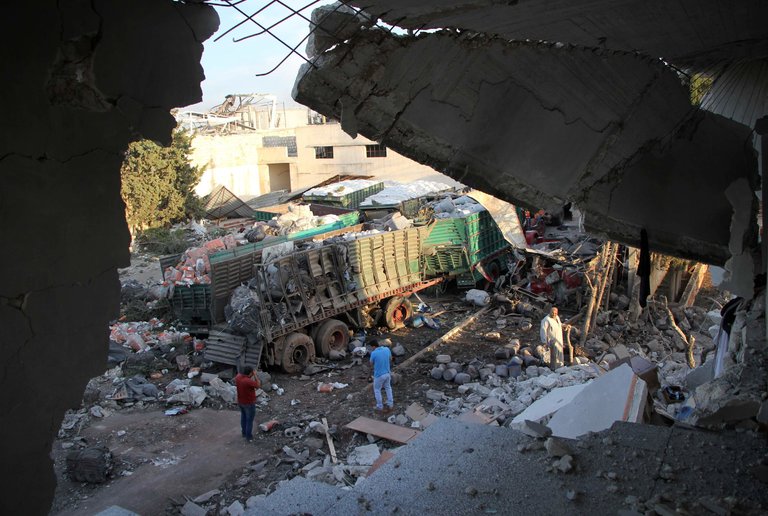
Even then, aid convoys are not safe.  Four months later to the day a UNICEF aid convoy delivering supplies to a Syrian Red Crescent warehouse at Urum al-Kubra in Aleppo was attacked from the air, killing at least 18 people and destroying 18 of the 31 trucks.  Most analysts have concluded that the Russian Air Force was responsible, perhaps acting in concert with the Syrian Arab Air Force – see for example here and here– but the Russian Ministry of Defence and the usual suspects have variously blamed spontaneous combustion, a ground attack by rebels and a US drone attack.
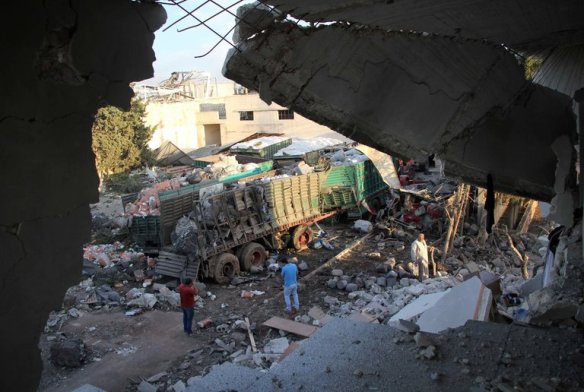
un-convoy-attacked-in-aleppo

These shortages are threaded into dispersed and precarious siege economies that gravely affect the health of local populations.  In December 2015 an estimated 400,000 people were surviving without access to life-saving aid in 15 besieged locations across Syria; the figures gathered by Siege Watch are even higher.

Surrounded by 6,000 land-mines and 65 sniper-controlled checkpoints, Madaya’s 40,000 inhabitants have been under siege since July 2015; 32 people died of starvation and malnutrition in December 2015 alone.  One resident interviewed by Amnesty International in January 2016 described the catastrophic situation:

‘Every day I wake up and start searching for food. I lost a lot of weight, I look like a skeleton covered only in skin. Every day, I feel that I will faint and not wake up again… I have a wife and three children. We eat once every two days to make sure that whatever we buy doesn’t run out. On other days, we have water and salt and sometimes the leaves from trees. Sometimes organizations distribute food they have bought from suppliers, but they cannot cover the needs of all the people.

‘In Madaya, you see walking skeletons. The children are always crying. We have many people with chronic diseases. Some told me that they go every day to the checkpoints, asking to leave, but the government won’t allow them out. We have only one field hospital, just one room, but they don’t have any medical equipment or supplies.’

An aid convoy was allowed in four days after this interview.

There are also grave shortages of skilled medical personnel.  The doctors who remain in opposition-held areas have all had to learn new skills sometimes far beyond their original training.  In March 2015 one young surgeon working in an MSF-supported hospital east of Damascus recalled:

‘There was a pregnant woman who was trapped during the time we were under full siege. She was due to deliver soon. All negotiation attempts to get her out failed. She needed a cesarean operation, but there was no maternity hospital we could get her to, and I had never done this operation before.

A few days before the expected delivery date, I was trying to get a working internet connection to read up information on doing a C-section. The clock was ticking and my fear and stress started to peak. I wished I could stop time, but the woman’s labour started…’

In 2015 OCHA estimated that more than 40 per cent of pregnant women in these areas now scheduled C-sections to reduce the risk of an attack preventing them from obtaining care.

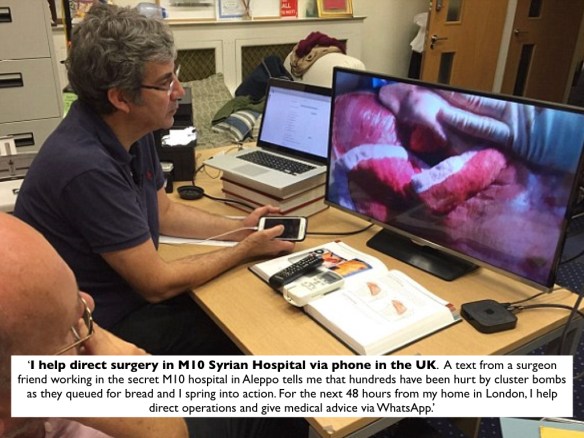
In some cases doctors can call on skilled overseas help via Skype from consultants on call 24/7 in the United States, Canada and the United Kingdom.  Ben Taub has written movingly of the extraordinary efforts of what he calls ‘the shadow doctors’ enlisted in ‘the underground race to spread medical knowledge as the Syrian regime erases it.’  One of the most active is Britain’s Dr David Nott:

dr-david-nott-and-remote-surgery-001

dr-david-nott-and-remote-surgery-002

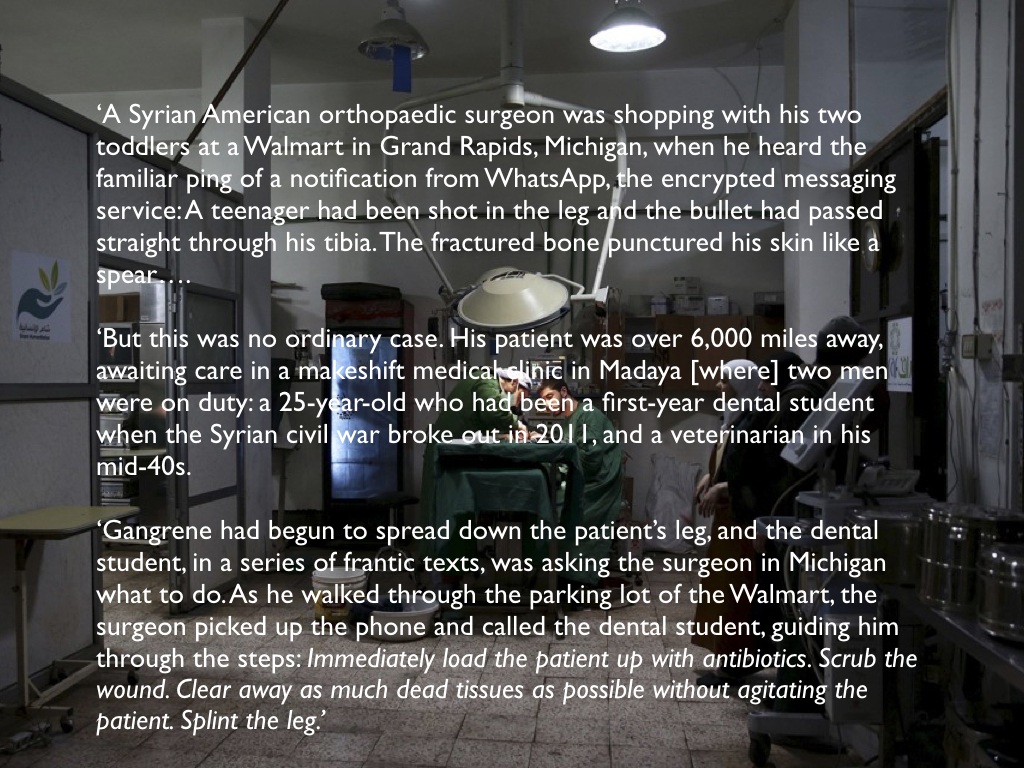
But not all those seeking specialist help are qualified surgeons.  In the field hospital serving the besieged town of Madaya medical care has been provided by a dentist, a dental student and a veterinarian.  Avi Asher-Schapiro reports:

‘The five-year civil war has plunged the Madaya clinicians into the deep end, forcing them to perform medical procedures that push them far beyond their training. They have treated countless gunshot victims, performed seven amputations, over a dozen C-sections, and diagnosed everything from meningitis to cancer.’

As he explains, this remarkable trio has also relied on remote medicine:
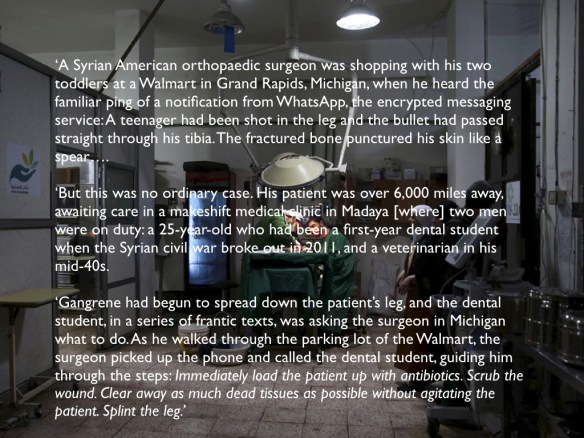
madaya-remote-medicine-001

These are all extraordinary responses to near-impossible, life-threatening situations.  But their successes have been short-lived.

The Madaya clinic was forced to close in November 2016:
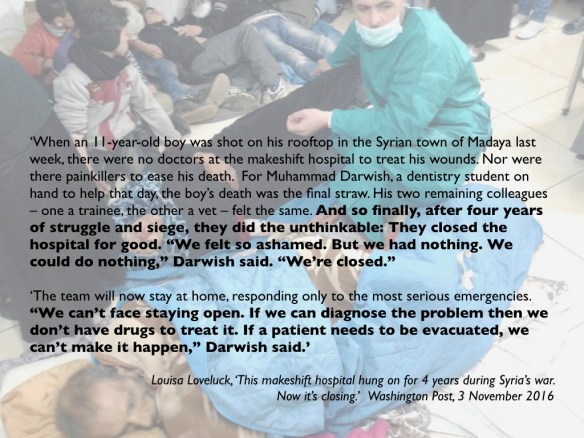
closure-of-madaya-clinic-001

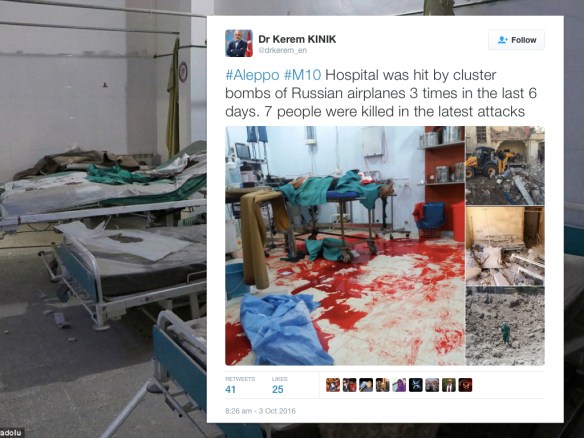
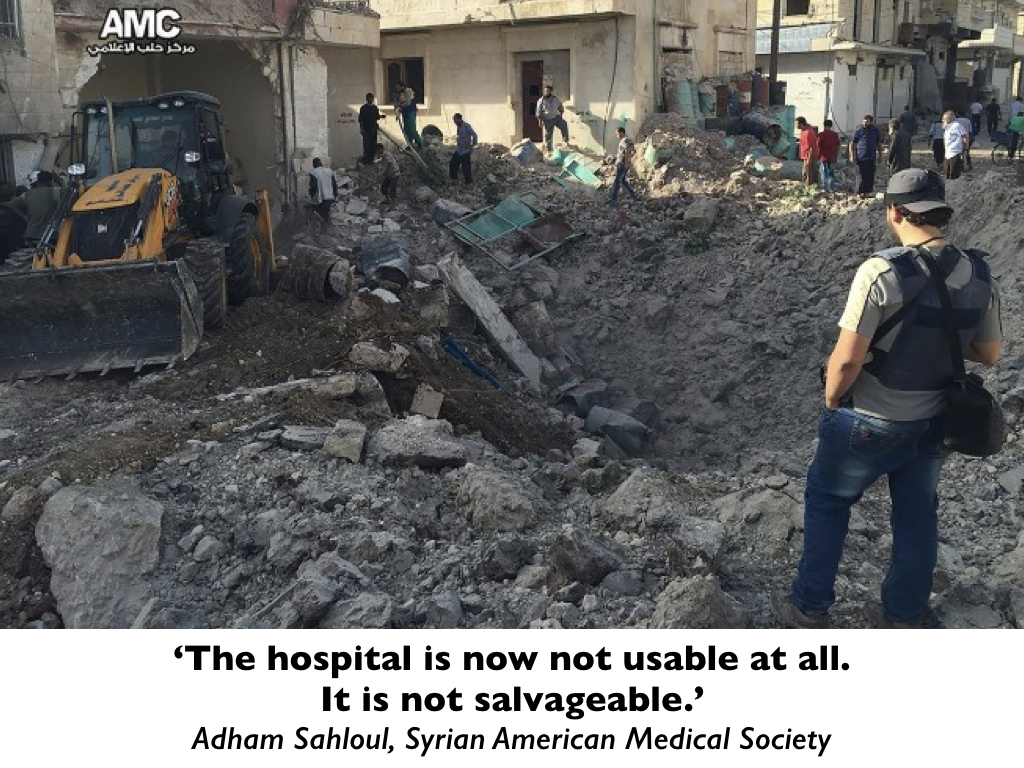
And the M10 hospital where Nott helped direct surgery – the largest trauma and ICU centre in East Aleppo – was hit by successive, catastrophic air strikes.  First, an attack on 28 September 2016 left only half the hospital operational.  On 1 October Xisco Villalonga, MSF’s Director of Operations, reported that

‘Bombs are raining from Syria-led coalition planes and the whole of east Aleppo has become a giant kill box.’

That night multiple strikes on M10 killed two people and injured ten others; the hospital had to be evacuated because one crater was so deep there were fears that the rest of the building would collapse.
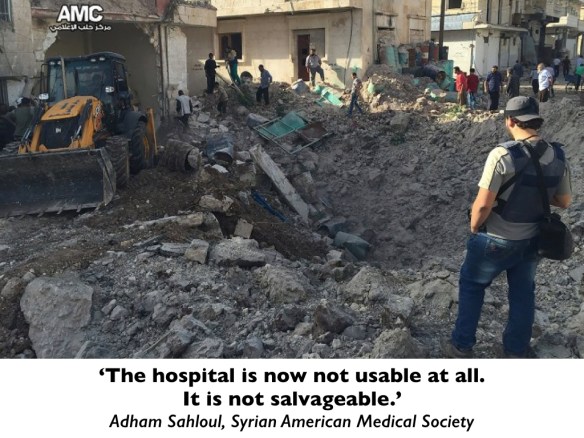
m10-hospital-bombed-001

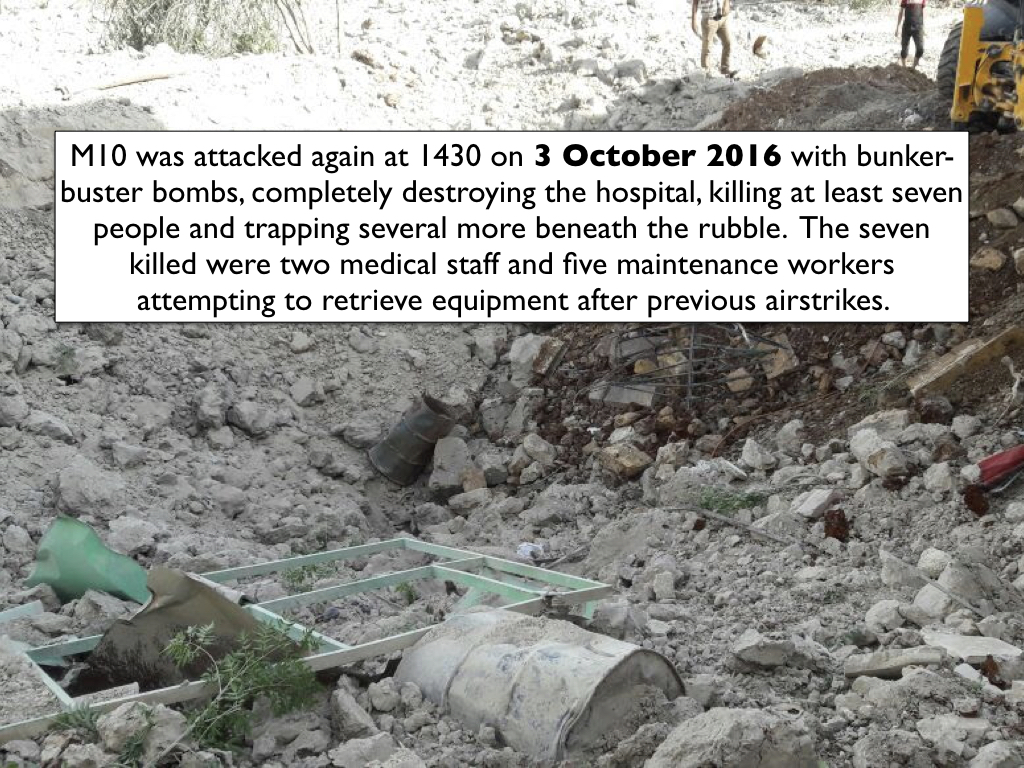
But the ordeal was not over: there were further, devastating strikes on 3 October:
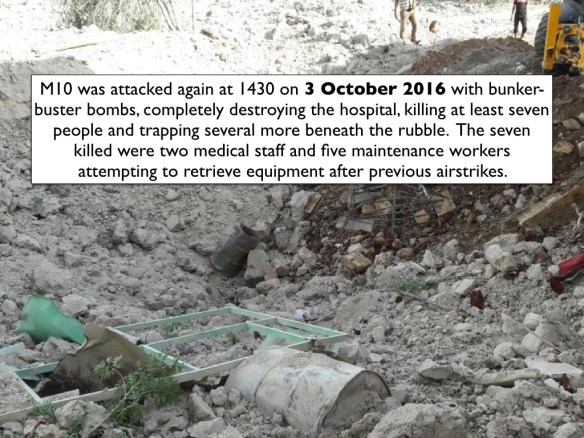
m10-hospital-bombed-002

m10-hospital-bombed-003

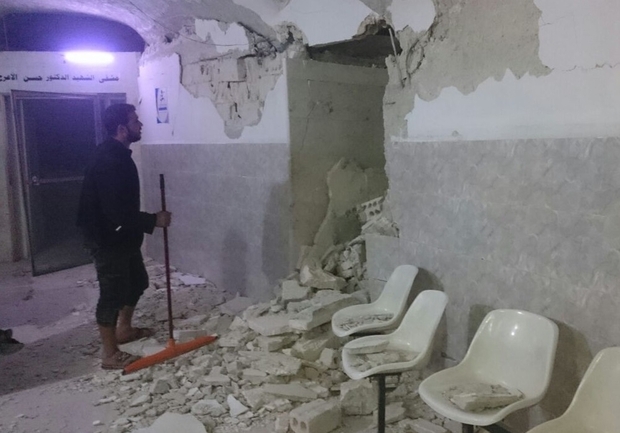
The underground hospitals have fared no better.  ‘The Cave’ – 15 metres inside a mountain, remember – was hit by two ‘bunker-buster’ bombs at 1500 on 2 October 2016. After 35 staff and patients had been evacuated a second strike occurred in the early evening involving missiles and cluster bombs. The E.R. was wrecked, ceilings collapsed, cement walls crumbled and generators, water tanks and medical equipment were destroyed (see image below).  Nobody was seriously injured but the hospital sustained critical damage and has been closed indefinitely. It used to treat 300 patients and perform 150 surgeries a month.

Cave Hospital hit by bunker-buster bombs

The exception to the exception

Once safe places under the protection of international humanitarian law – the exception to the space of exception that is the conflict zone – hospitals have become the targets of a new and extraordinarily vicious modality of modern war.  The systematic attacks on hospitals have not only threatened the lives of patients and healthcare workers; they have also made many patients reluctant to seek medical treatment at all.  In February 2015 a report from the Centre for Public Health and Human Rights at Johns Hopkins University was already warning of the consequences:

‘Unless they feel their life is in danger, many people won’t go to hospital because it is targeted for bombardment’ [Physician, Aleppo]. Two physicians reported that fear of travel and an understanding that the hospital is a target has led to a 50% decrease in clinic visits and surgery cases, even though the level of violence has not decreased.

Dr Farida, the OB/GYN in East Aleppo interviewed earlier, no longer has a hospital to work in – the last remaining hospital was reduced to rubble and closed on 18 November – and she now provides what medical care she can from a basement:

‘People know it’s a basement, but they are afraid to come here because they know any health facility is deliberately targeted by the regime. For women, they are afraid to come — but they don’t have any other option. When they don’t have a car or fuel to come here, they have to give birth at home. Women are bleeding at home and babies are born dehydrated without oxygen.’

Those that do make the precarious journey to a field hospital or other medical facility almost always now find that their care is compromised by the shortage or even the absence of doctors, nurses, medical supplies and even the most basic medical equipment.  So doctors use ordinary sewing cotton instead of surgical thread; local anaesthetic where they would normally use a general, or even home-made, improvised variants.  Dr Zaher Sahloul, who still tries to provide help to colleagues in Syria from his home in Chicago via WhatsApp, explains:

‘We operate on the mindset that they have basic things we take for granted… The reality is, they don’t have 90 percent of the things we think they have. They know better what they have and what they can do with it. These people are facing decisions we will never face in our lives. If you have 10 patients dying, who will you see first? Do you use spoiled gauze and dirty tubes at the risk of infection? It’s Hell for them.’

As I write, the Syrian Arab Army and its supporting militias are advancing into East Aleppo, where air strikes and artillery bombardments have left more than 250,000 people without access to any form of advanced medical care.  The World Health Organisation announced that ‘although some health services are still available through small clinics, residents no longer have access to trauma care, major surgeries, and other consultations for serious health conditions.’

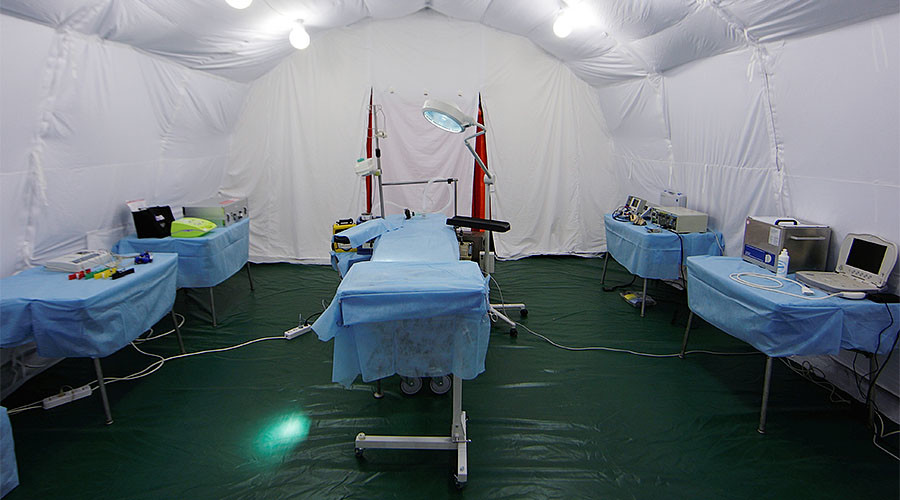
The final irony – although in this catalogue of horrors it probably isn’t the last at all – is that the Kremlin has announced that it will send two mobile hospitals to treat patients from East Aleppo.  The Defence Ministry will operate ‘a special 100-bed clinic with trauma equipment for treating children’ and the Emergencies Ministry will provide a 50-bed clinic capable of treating 200 outpatients a day.
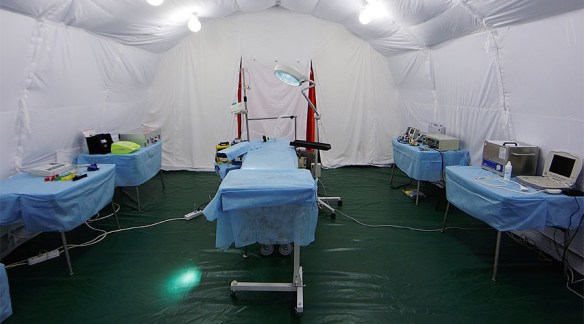
russian-mobile-hospital

While the Kremlin congratulates itself on its ‘humanity’, we need to remember that this minimalist contribution would not have been necessary at all had medical neutrality been respected and doctors and nurses, hospitals and clinics not been so ruthlessly, systematically and deliberately targeted in the first place.

UPDATE:  On 5 December the Defence Ministry’s mobile hospital (set up in West Aleppo to treat patients from East Aleppo) came under mortar fire from the crumbling opposition-held area to the east; one Russian doctor and two paramedics were killed.  It’s not clear whether the hospital was deliberately targeted – there have been accusations that the co-ordinates of the hospital must have been given to the militants for it to have been hit ‘right at the moment when it started working‘ – or whether it was caught in the indiscriminate shelling and mortar-fire that has hit other hospitals in West Aleppo.
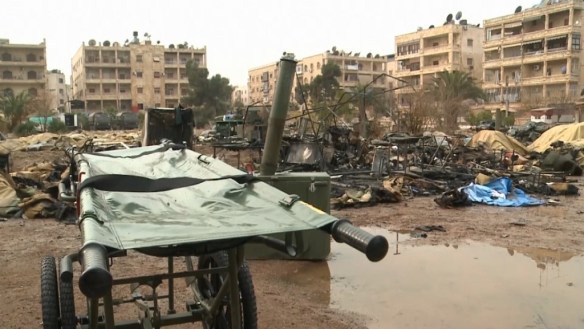
russian-mobile-hospital-attacked-in-aleppo

But I should make two things clear.  First, attacks on hospitals in West Aleppo – even though I don’t think they have exhibited anything like the scale or the systematicity of those directed against medical facilities and healthcare workers in opposition-held areas – are as reprehensible as those on hospitals in the East.  Second, the muted response from the US-led coalition to the shelling of the Russian field hospital is deeply disturbing.  The International Committee of the Red Cross announced after the attack that ‘all sides to the conflict in Syria are failing in their duties to respect and protect healthcare workers, patients, and hospitals, and to distinguish between them and military objectives.’  The Russian Ministry of Defence dismissed this as a ‘cynical’ display of indifference to the deaths of its doctors, but I don’t read it like that at all – what is cynical is the partisan appeal to medical neutrality when it suits, and its systematic violation when it doesn’t.

To be continued

Fighting over Kunduz

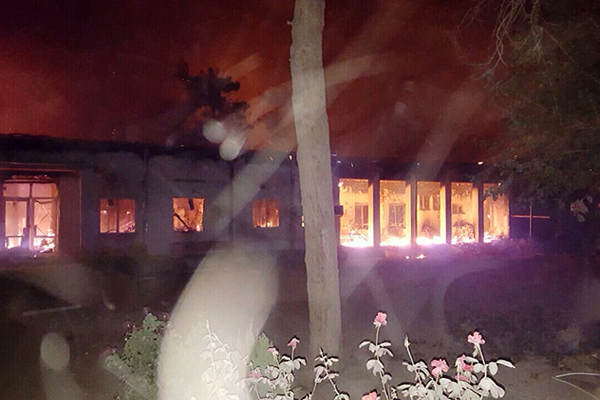
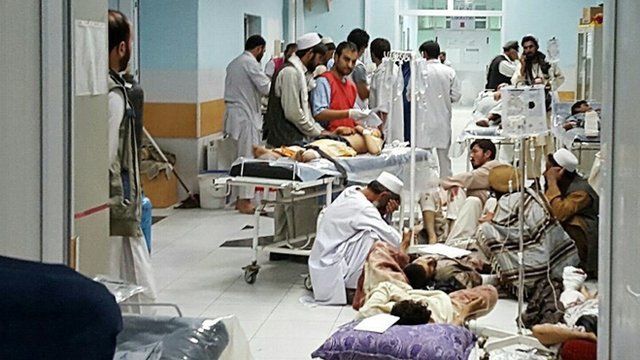
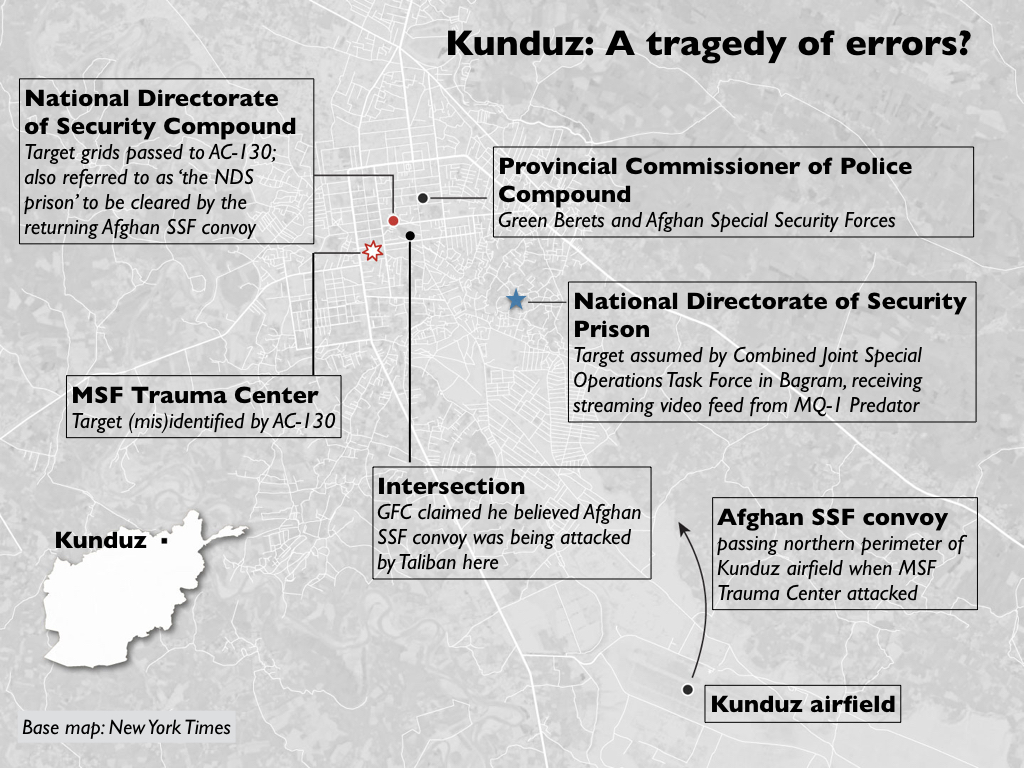
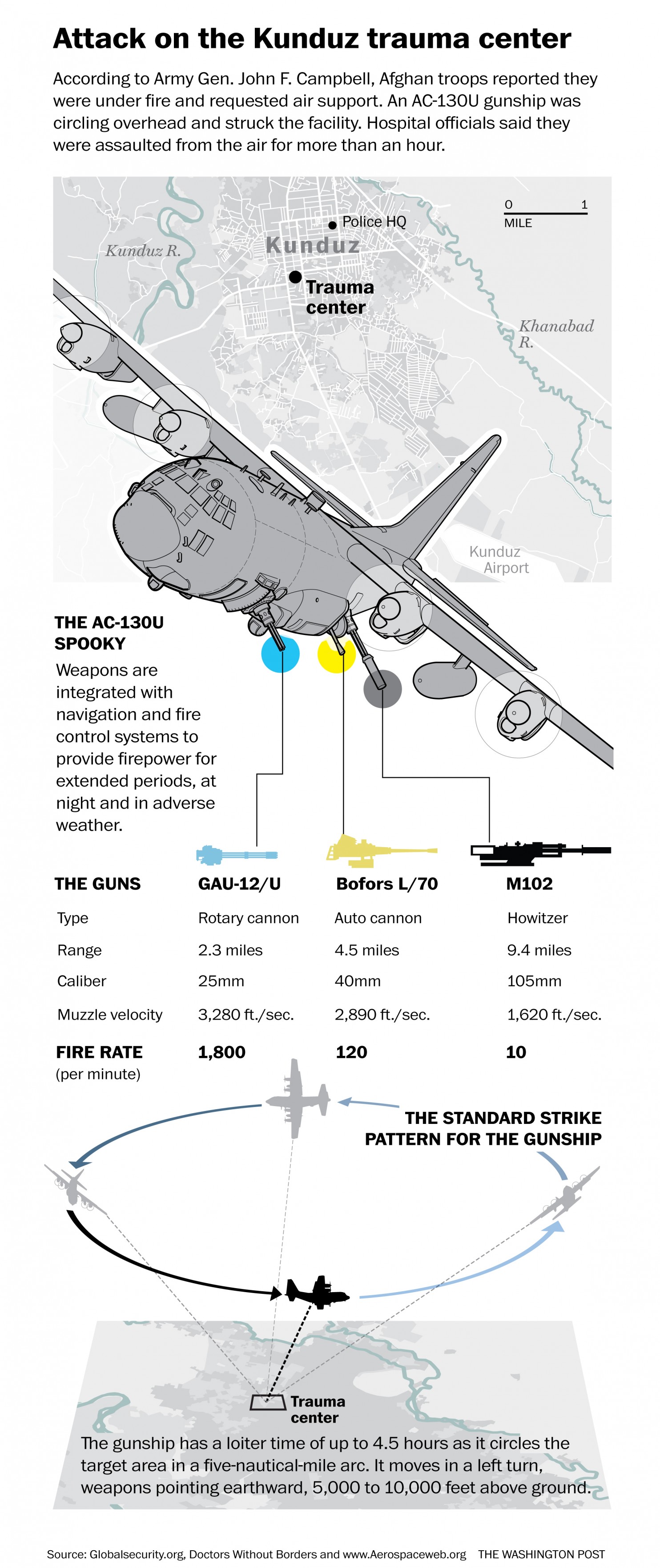
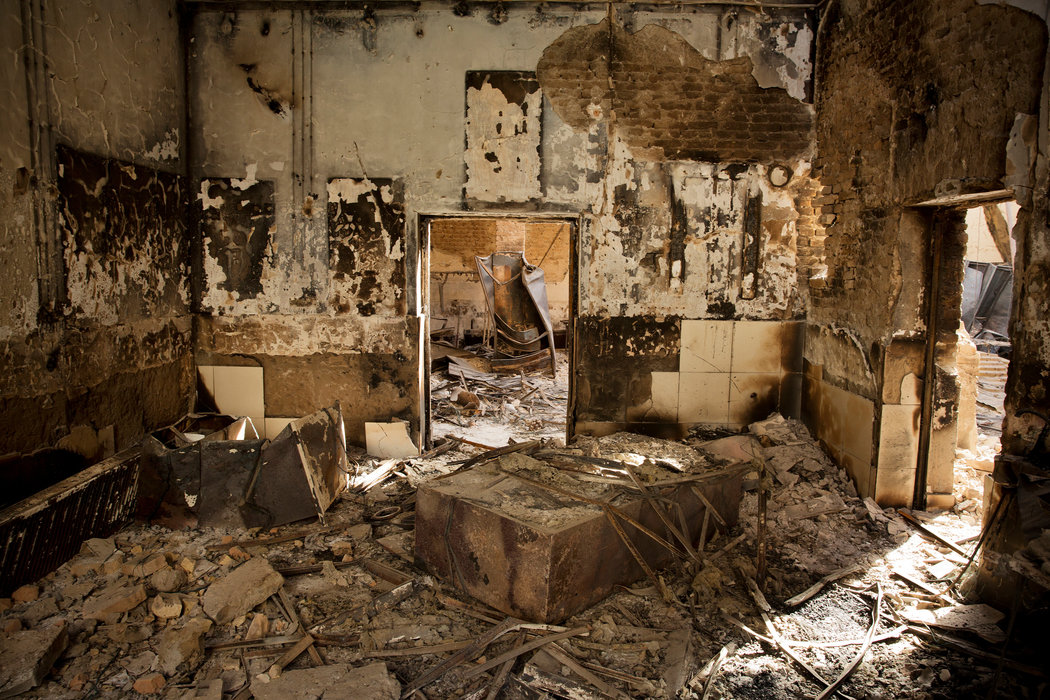
This is the third in a new series of posts on military violence against hospitals and medical personnel in conflict zones. It examines some of the key issues arising from the US attack on the Trauma Centre run by Médecins Sans Frontières (MSF) in Kunduz on 3 October 2015; it follows directly from my detailed analysis of the attack here and prepares the ground for a still more detailed analysis of attacks on hospitals, doctors and casualties in Syria to follow.

There are at least four main issues arising from the US attack on the MSF Trauma Centre in Kunduz that spiral out into a wider argument about what I will later call ‘The Death of the Clinic’.  I’m treating ‘the clinic’ here as a topological figure that extends from the body of the wounded through the evacuation chain to the hospital itself.  The clinic has been accorded a privileged status within the space of exception that is the modern conflict zone – a complicated, fractured space in which killing is made permissible subject to the protocols of international humanitarian law –  so that the clinic becomes an exception to the exception and its inhabitants granted a conditional immunity from attack.

msf-trauma-centre-burning

It’s important to understand that this legal armature is not immutable, and that changes (and challenges) to it arise through both (geo)political and military actions; international humanitarian law is not a deus ex machina, somehow above the fray, but is thoroughly entangled with the prosecution of military violence.  More on this to come, but for now it will be enough to list some of the major protections accorded to the clinic in war-time.

The first Geneva Convention (1864) (‘the Red Cross Convention’):

Ambulances and military hospitals shall be acknowledged to be neuter, and, as such, shall be protected and respected by belligerents so long as any sick or wounded may be therein.  Such neutrality shall cease if the ambulances or hospitals should be held by a military force … A distinctive and uniform flag shall be adopted for hospitals, ambulances and evacuations.

Under the Hague Regulations (1899/1907) that were in force during the hospital raids in France at the end of the First World War:

… all necessary steps must be taken to spare, as far as possible, … hospitals, and places where the sick and wounded are collected, provided they are not being used at the time for military purposes. It is the duty of the besieged to indicate the presence of such buildings or places by distinctive and visible signs, which shall be notified to the enemy beforehand.

Geneva Conventions 1949 care of woundedUnder the Geneva Conventions (1949) – whose provisions applied to the attack on the MSF Trauma Centre a hundred years later – there is a similar immunity granted to the military-medical machine:

The protection to which fixed establishments and mobile medical units of the Medical Service are entitled shall not cease unless they are used to commit, outside their humanitarian duties, acts harmful to the enemy. Protection may, however, cease only after a due warning has been given, naming, in all appropriate cases, a reasonable time limit and after such warning has remained unheeded.

And this is explicitly extended beyond the military-medical machine to institutions like the MSF Trauma Centre:

Civilian hospitals organized to give care to the wounded and sick, the infirm and maternity cases, may in no circumstances be the object of attack but shall at all times be respected and protected by the Parties to the conflict.

The protection to which civilian hospitals are entitled shall not cease unless they are used to commit, outside their humanitarian duties, acts harmful to the enemy. Protection may, however, cease only after due warning has been given, naming, in all appropriate cases, a reasonable time limit and after such warning has remained unheeded.

In so doing the treatment of hostile combatants is also explicitly provided for and protected:

The fact that sick or wounded members of the armed forces are nursed in these hospitals, or the presence of small arms and ammunition taken from such combatants and not yet been handed to the proper service, shall not be considered to be acts harmful to the enemy.

The language and specifications change, but there is nevertheless a consistent thread running through these provisions.  It has been stretched – and perhaps broken – by the attack on the MSF Trauma Centre, and here I’ll focus on four issues that have proved contentious.  First, the visual identification of the Trauma Centre; second, the alleged breach of its conditional immunity; third, the construal of the attack as a war crime; and fourth, the putative rejection of medical neutrality altogether.

(1) Visual identification

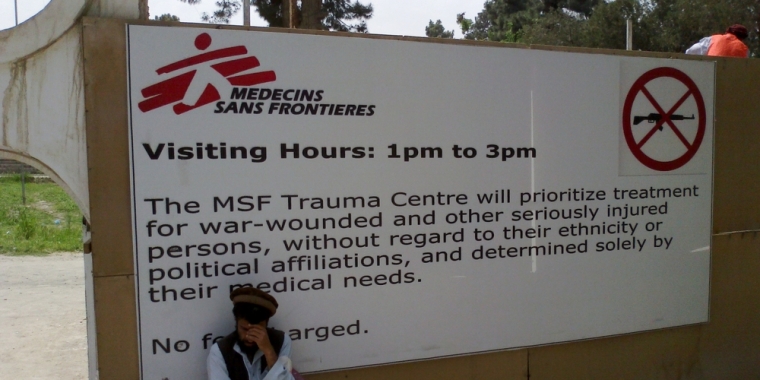
International humanitarian law (IHL) requires those responsible for hospitals ‘to indicate their presence’ – the language varies – in order to ensure their protection, and here the US military investigation made this finding (all page numbers in brackets refer to the redacted report):

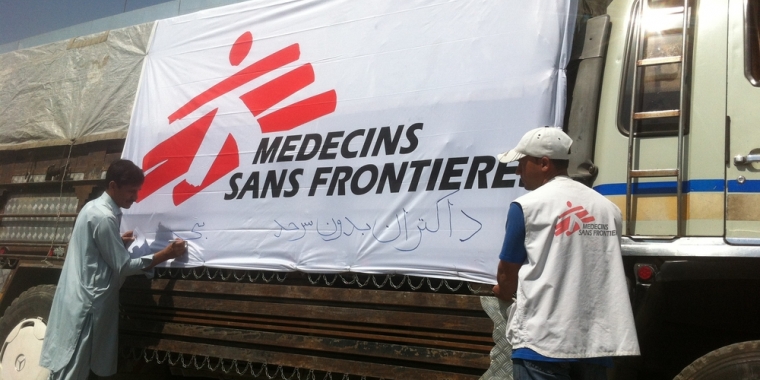
The center roof of the MSF Trauma Center was marked with two rectangular MSF flags… The front and sides of the MSF hospital were marked from the street view and a MSF flag flew in the courtyard.  The MSF Trauma Center was not marked with any internationally recognized symbols such as a red cross, red crescent or a red “H”.  If it had been marked with these symbols, it is possible the Trauma Center would not have been engaged. (082)

This counterfactual does not loom large in the report or its recommendations, but Charles Dunlap (at Lawfire) has seized upon it to berate MSF:

Ask yourself: wasn’t it a mistake for [MSF] – and a serious one – not to have marked its facility in accordance with Protocol III to the Geneva Conventions which designates “the only emblems recognized by nations signifying the protected status of individuals or objects bearing them during armed conflict”?  Had, for example, the hospital been marked with large Red Crosses/Red Crescents or one of the other internationally-recognized symbols (as the U.S. does) or something that would make its protected use clear from the air, isn’t it entirely plausible that the aircrew (or someone) might have recognized the error and stopped the attack before it began?

Put another way, isn’t it foreseeable that in an exceptionally chaotic combat situation (where a belligerent is making use of civilian buildings to conduct combat operations) that mistakes could occur in identifying a protected structure absent Protocol III markings or at least something to make it identifiable at a distance, especially when it’s known that attacking aircraft are being used?  Wouldn’t reasonably prudent persons have marked their medical facility with an internationally-recognized symbol or something of similar clarity to the warring parties?  Wouldn’t due care demand it in that situation?

In accusing MSF of ‘imprudence’ and even recklessness Dunlap applies a double standard.  He repeatedly insists that the US and the Afghan militaries confronted ‘an extraordinarily intense situation’ in Kunduz, that they faced ‘terrible urgency’ and ‘enormous pressure’ as they operated ‘in the turmoil of a war zone’ – all of which is undoubtedly true – but he uses this to excuse their mistakes while refusing to extend the same privilege to MSF.

_85907418_85907417

Let me remind you of Dr Kathleen Thomas‘s account of working in the ER (above) once the city had fallen to the Taliban:

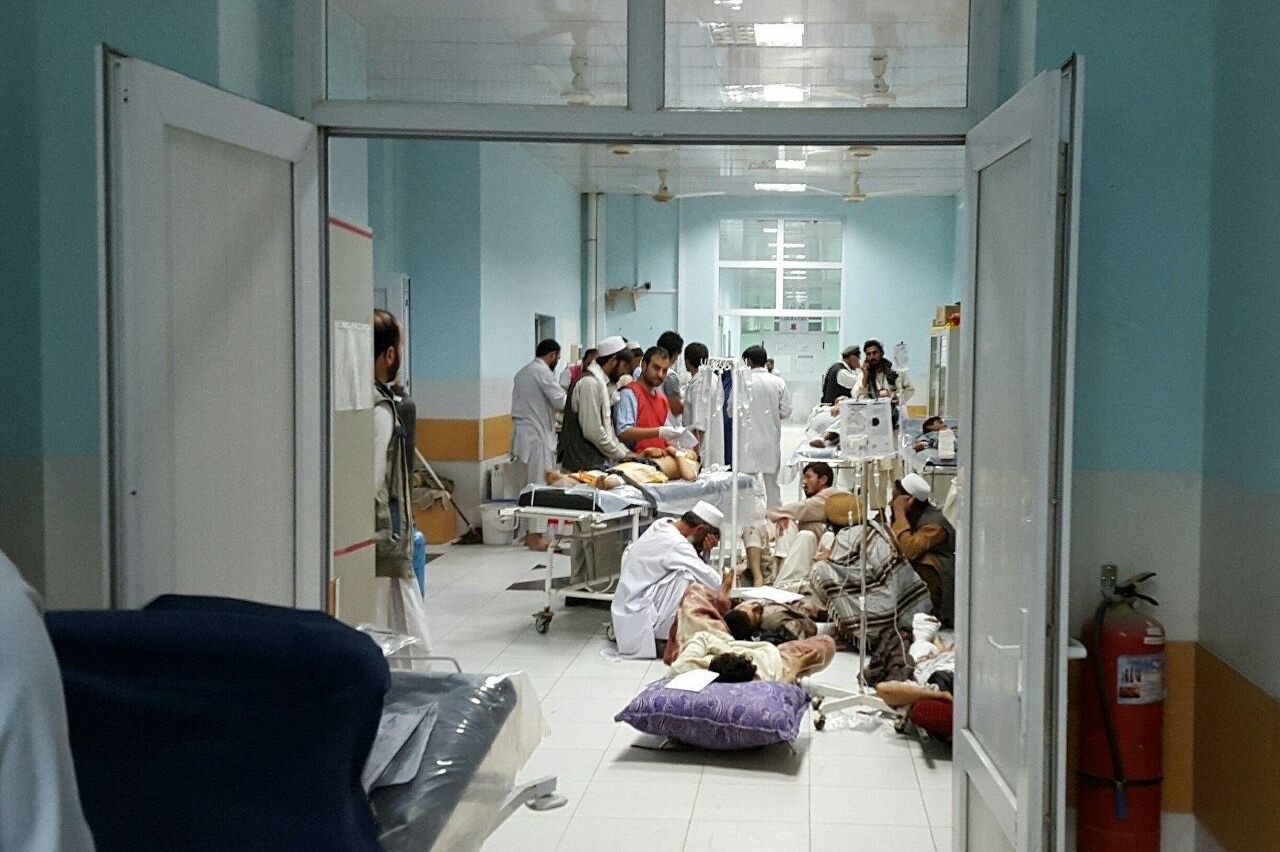
The first day was chaos – more than 130 patients poured through our doors in only a few hours. Despite the heroic efforts of all the staff, we were completely overwhelmed. Most patients were civilians, but some were wounded combatants from both sides of the conflict. When I reflect on that day now, what I remember is the smell of blood that permeated through the emergency room, the touch of desperate people pulling at my clothes to get my attention begging me to help their injured loved ones, the wailing, despair and anguish of parents of yet another child lethally injured by a stray bullet whom we could not save, my own sense of panic as another and another and another patient was carried in and laid on the floor of the already packed emergency department, and all the while in the background the tut-tut-tut-tut of machine guns and the occasional large boom from explosions that sounded way too close for comfort.

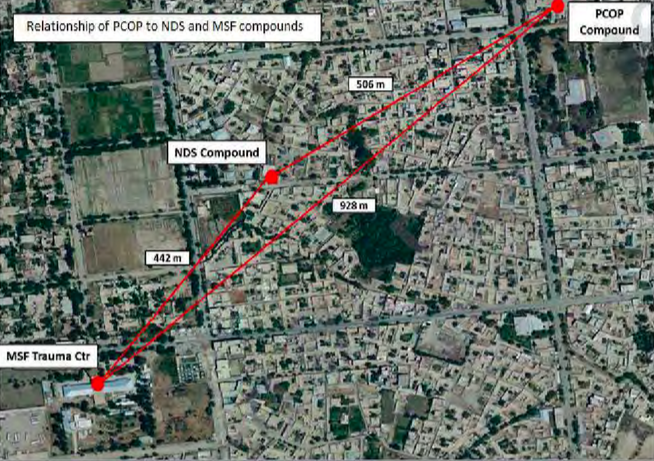
In any case, MSF had clearly ‘indicated their presence’ to both the US and Afghan authorities by providing them with the GPS co-ordinates of the Trauma Centre (see my previous discussion here). Dunlap finds this ‘commendable’ but ‘legally problematic’.

Instead, he is fixated on the absence of a Red Cross flag from the roof, in which case he might reflect on another passage from the report.  On 2 October, the day before the air strike, MSF phoned the Special Operations Task Force in Bagram to develop a contingency plan: while the Taliban were respecting the neutrality of the Trauma Centre and ‘treating the government casualties well’, they wanted to know the feasibility of extracting their patients should conditions deteriorate.  During that conversation they were advised to ‘take the signs normally affixed to the sides of the trucks and to install them on the top of the vehicles for easy identification by aircraft during this or any future MSF resupply operations‘ (503; my emphasis).  This surely makes it clear that the US military anticipated no difficulty in recognising MSF’s flag and logo as symbols of medical neutrality.

msf153147

(2)  Conditional immunity

IHL makes it clear that treating wounded combatants does not compromise the protections afforded to a medical facility; that occurs only if it is used as a base from which ‘to commit, outside their humanitarian duties, acts harmful to [one of the belligerents]’.  I’ll address the intervening clause – ‘outside their humanitarian duties’ – under (4) and confine my discussion here to the alleged militarisation of the clinic.

msf153705-1

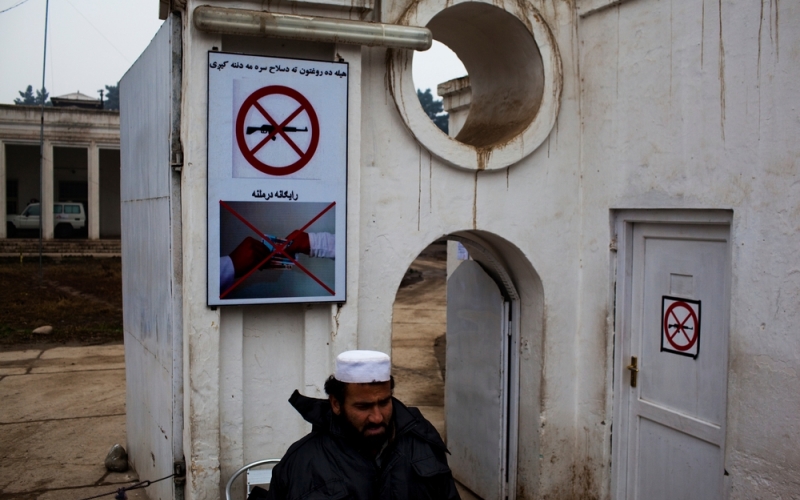
MSF’s internal review found that its unambiguous ‘no weapons‘ policy was adhered to:

All of the MSF staff reported that the no weapons policy was respected in the Trauma Centre. [Since the KTC opened, there were some rare exceptions when a patient was brought to the hospital in a critical condition and the gate was opened to allow the patient to be delivered to the emergency room without those transporting the patient being first searched. In each of these instances, the breach of the no weapon policy was rapidly rectified.]  In the week prior to the airstrikes, the ban of weapons inside the MSF hospital in Kunduz was strictly implemented and controlled at all times and all MSF staff positively reported in their debriefing on the Taliban and Afghan army compliance with the no-weapon policy.

The US military investigation accepted this was indeed the case:

Evidence provided to the investigation team supports the MSF internal initial report’s characterization that their no-weapons policy was adhered to with rare exceptions (038, note 15).

msf112743

Mathieu Aikins‘s interviewees also confirmed the absence of weapons from the Trauma Centre:

Though the MSF hospital was crowded with fighters, whether patients or caretakers (each patient was allowed one), staff members and civilians who were present said the insurgents respected the rules. They left their weapons outside or handed them over at the gun lockers at the entrance. One employee recalled seeing a fighter give up his weapon but forget his ammunition vest; when the employee nervously approached the fighter about it, the man apologized profusely and handed it over. “We had respect for the hospital, as they were serving the people,” said Shahid, the Taliban commander. “I myself went there once when one of our men was wounded, and before entering we submitted our weapons outside.”
Aikins goes on to report that patients were allowed to retain their cellphones, and some of their caretakers retained hand-held radios whose transmissions were intercepted by Afghan special forces.  They in turn concluded that not only were the Taliban inside the hospital but were using it as a base: ‘They had raised their flag and established their headquarters there.’  On 1 October, presumably in response to these reports, the Pentagon contacted MSF in New York to ask whether ‘they had a large number of Taliban “holed up”’ in the Trauma Centre, and were assured that the only Taliban inside the hospital were wounded patients.

But the suspicions clearly remained, and festered to such a degree that some of those on the ground were convinced that the hospital had been overrun by Taliban fighters.  Associated Press reported that the radio intercepts prompted US analysts to request ‘specific intelligence-gathering flights over the hospital’ – their outcome has never been disclosed – and on 1 October a senior Special Forces commander (whether in Kabul or in Kunduz is unclear) wrote in his daily log that the Trauma Centre was under Taliban control and that he planned to clear it in the coming days.   At least some of the Green Berets in Kunduz agreed with his assessment: ‘They were using it as a C2 node … They had already removed and ransomed the foreign doctors, and they had fired on partnered personnel from there.’  Indeed, after the attack a senior US officer in Kabul was told – by whom has been redacted – that ‘there were three dead Military-Aged Males near the hospital, identified as Taliban by the local population.  They were using the hospital as a command post (using its protected status)’ (275).

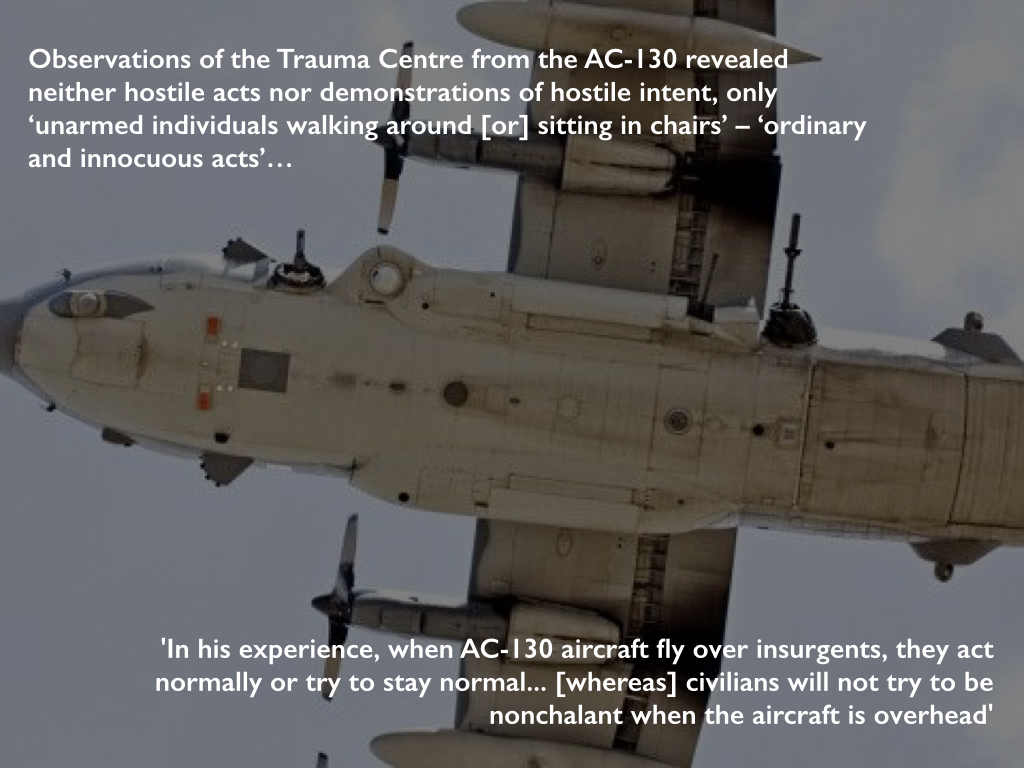
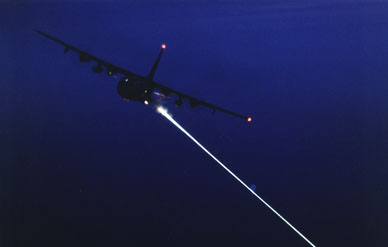
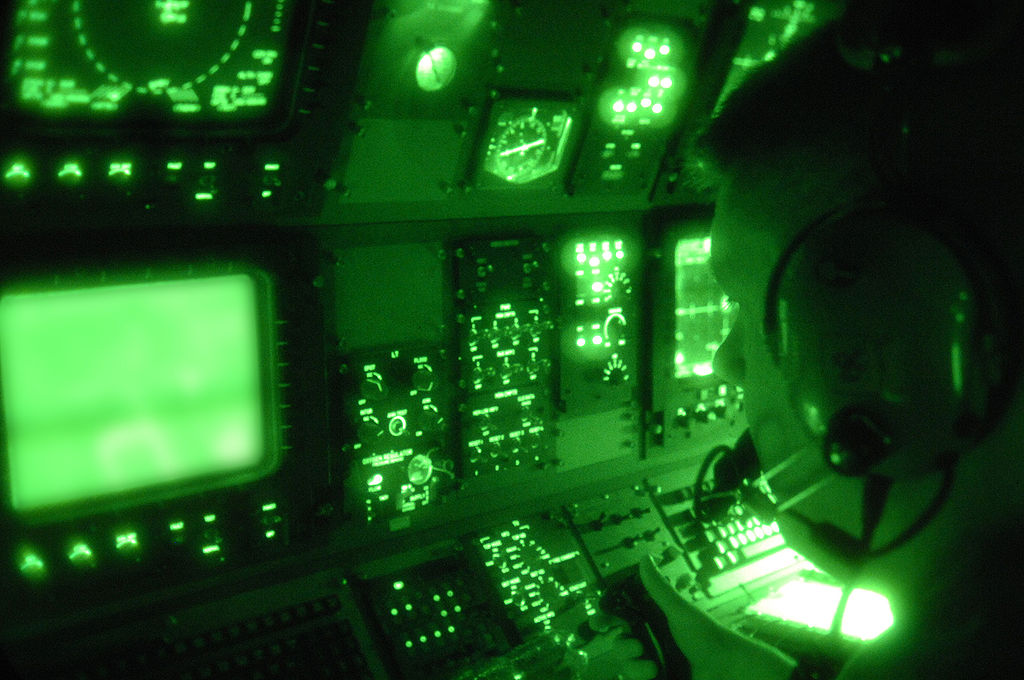
observations-from-ac-130-001

But all of this was fantasy, and the investigation discounted it.  Although US intelligence reported that insurgents were present at the hospital at the time of the strike, the investigation accepted that this was for medical treatment and they could trace ‘no specific intelligence reports that confirm[ed] insurgents were using the MSF Trauma Center as an operational  C2 [command and control] node, weapons cache or base of operations’ (085).  In addition, they determined that observations made from the AC-130 revealed neither substantive hostile acts nor demonstrations of hostile intent –  only ‘unarmed individuals walking around [or] sitting in chairs’ (085).  The report describes these as ‘ordinary and innocuous acts’ (055), but to at least one member of the aircrew that was in itself grounds for suspicion: ‘In his experience, when AC-130 aircraft fly over insurgents, they act normally or try to stay normal… [whereas] civilians will not try to be nonchalant when the aircraft is overhead’ (093, note 304).  Damned if you do, and damned if you don’t: when everything is construed as hostile, even the most innocent acts are transformed into somcething sinister.

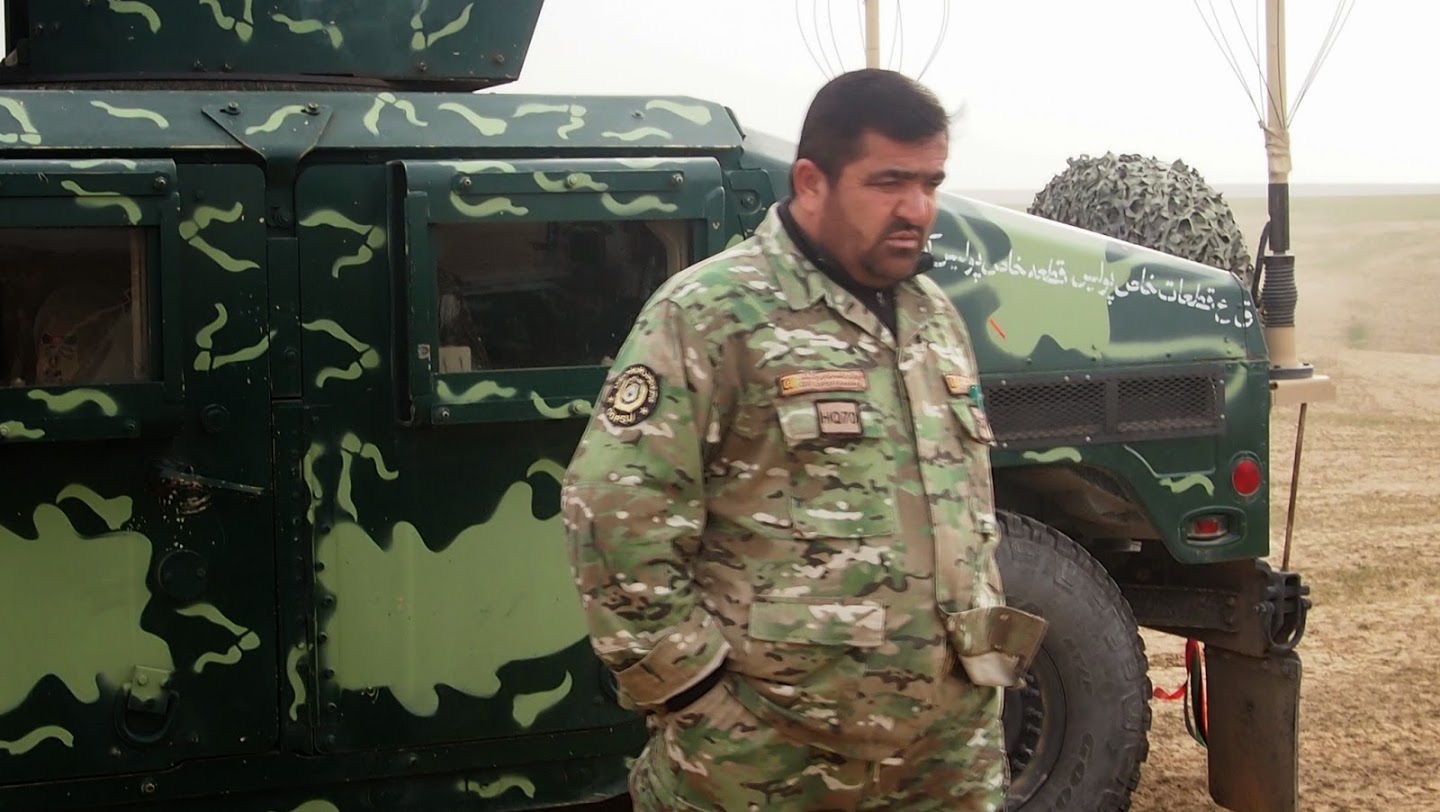
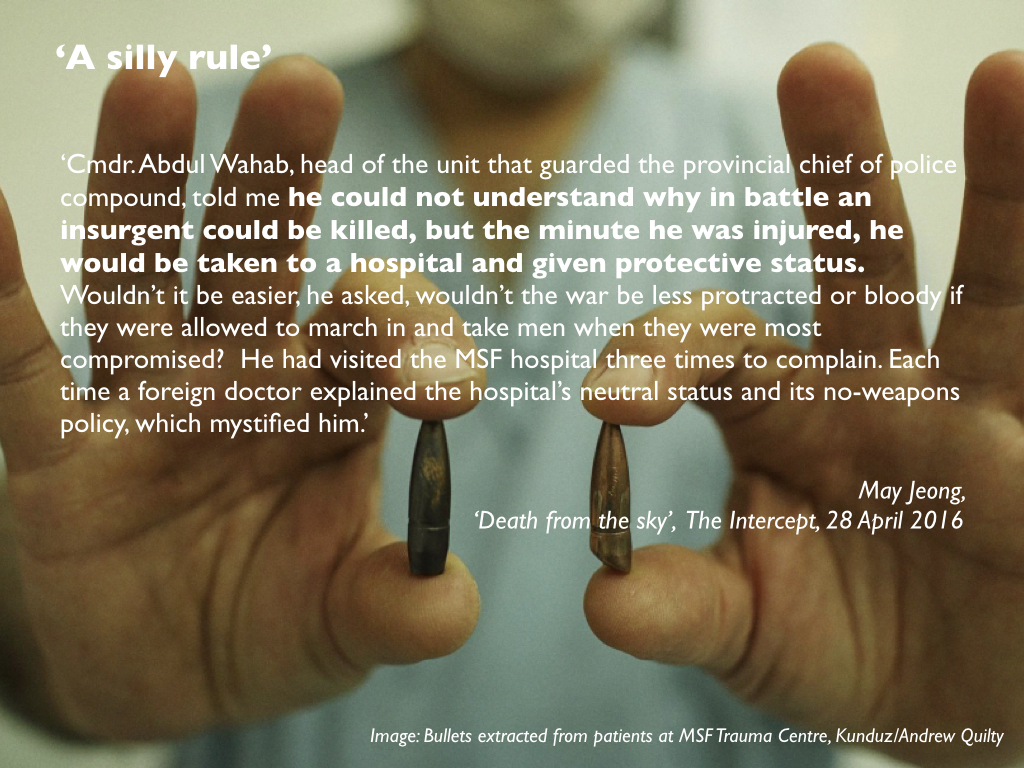
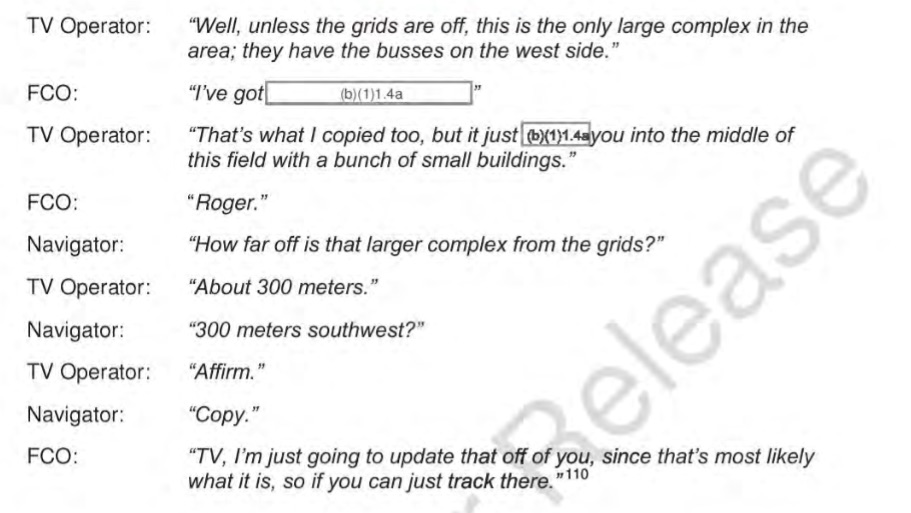
The claims made by Afghan forces were even wilder.  Here is May Jeong in The Intercept:

On the night of the hospital strike, a unit commander with the Ministry of Defense special forces was at the police headquarters taking fire from the direction of the hospital. “Vehicles were coming out of there, engaging, then retreating,” he told me. When I pointed out that he couldn’t have seen the gate of the hospital from where he was, several hundred meters away, he said that he was sure because he had personally interrogated a cleaner who told him that the hospital was full of “armed men using it as a cover.” The cleaner told the commander that there were Pakistani generals using the hospital as a recollection point and that they had set up a war room there. When I challenged his line of vision again, he responded, “Anyone can claim anything. The truth is different.”
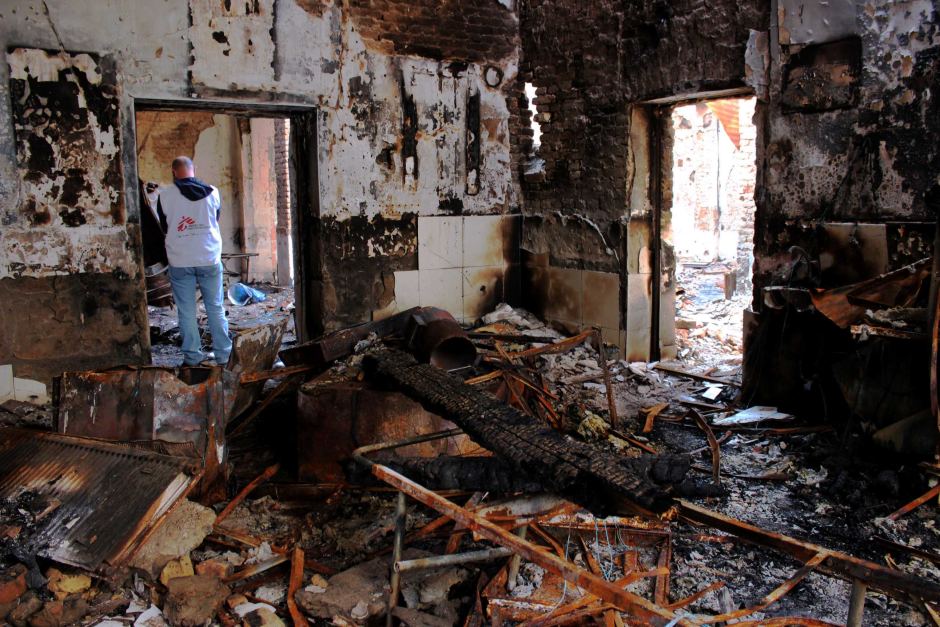
afghanistan_kunduz_3459341b

[Amrullah] Saleh, [former head of the National Security Directorate and] the author of the 200-page Afghan commission report on the fall of Kunduz … believed that the “hospital sanctity had been violated” and held out as evidence 130 hours of recorded conversations with more than 600 interlocutors. “I spoke with the MSF country director,” Saleh told me recently. “They don’t deny that the hospital was infiltrated by the Taliban.”

But of course they did deny it: repeatedly, emphatically and convincingly.

(3) War crimes?

The US military investigation was unequivocal: it found multiple violations of the military’s own Rules of Engagement and of international humanitarian law.

The first rule of customary international humanitarian law, now codified in the Additional Protocols to the Geneva Conventions, is distinction:

The parties to the conflict must at all times distinguish between civilians and combatants. Attacks may only be directed against combatants. Attacks must not be directed against civilians.

The investigation found that both the Ground Force Commander (GFC) and the aircraft commander failed to exercise this core principle:

Neither commander distinguished between combatants and civilians nor a military objective and protected property. Each commander had a duty to know, and available resources to know that the targeted compound was protected property’ (075-6).

A second core principle is proportionality:

Launching an attack which may be expected to cause incidental loss of civilian life, injury to civilians, damage to civilian objects, or a combination thereof, which would be excessive in relation to the concrete and direct military advantage anticipated, is prohibited.

The investigation found this to have been disregarded too:

The GFC and the aircraft commander failed to exercise the principle of proportionality in relation to the direct military advantage (076).

Both principles are deceptively simple, and in ‘The Passions of Protection: Sovereign Authority and Humanitarian War’ Anne Orford reminds us that IHL ‘immerses its addressees in a world of military calculations.’  In practical terms the distinction between civilians and combatants in today’s conflicts is rarely straightforward, but in this case the No-Strike List plainly recognised the protected status of the Trauma Centre and there is no convincing evidence that its immunity had been compromised.  In addition, the balance between loss of civilian life and military advantage is weighed on the military’s own scales – ‘expected’; ‘excessive’; ‘anticipated’: these are not self-evident calculations – but even if the GFC or the aircraft commander had grounds to believe the Taliban were firing from the hospital the Pentagon’s own Law of War Manual (which is not without its own controversies: see here and, specifically on proportionality, here and here) advises under §7.10.3.2 that

The obligation to refrain from use of force against a medical unit acting in violation of its mission and protected status without due warning does not prohibit the exercise of the right of self-defense. There may be cases in which, in the exercise of the right of self-defense, a warning is not “due” or a reasonable time limit is not appropriate. For example, forces receiving heavy fire from a hospital may exercise their right of self-defense and return fire.  Such use of force in self-defense against medical units or facilities must be proportionate.
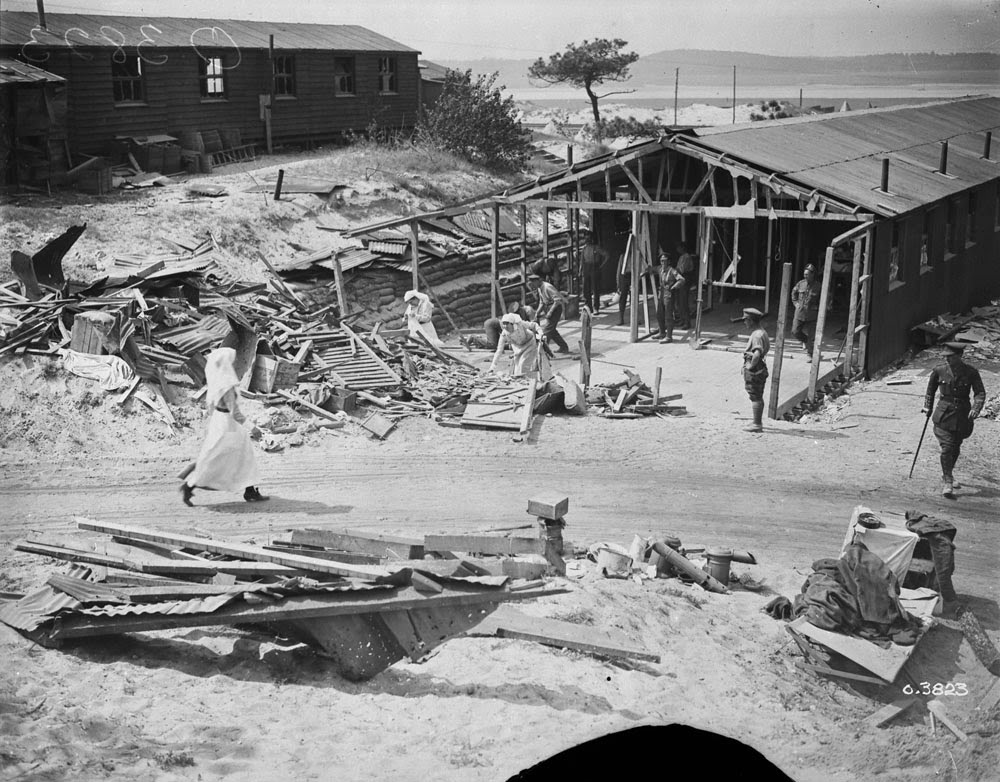
Not only was there was no evidence of hostile let alone ‘heavy fire’ from the Trauma Centre but the AC-130 was also monitoring the progress of the Afghan Special Forces convoy that it was tasked with protecting and knew perfectly well that it was still within the perimeter of the airfield.  This was not a time-sensitive target (the report makes that crystal clear) and neither the GFC nor the aircraft commander had reason to believe that any putative threat to Afghan or US forces was so grave and so sustained that it called for an air strike involving multiple passes by the AC-130 – over 30 minutes according to the US military, an hour according to MSF – delivering such intense fires that the building was virtually destroyed.

For these reasons many commentators – and MSF (‘Under the clear presumption that a war crime has been committed, MSF demands that a full and transparent investigation into the event be conducted by an independent international body’) – have insisted that the attack was a war crime.

not-a-war-crime-3-jpeg

not-a-war-crime-2-jpeg

But others (including the US military) have concluded that it was not.  US Central Command’s initial summary – produced before the redacted report was released – accepted that there had been breaches of both the Rules of Engagement and of IHL (‘the law of armed conflict’) but noted that

the investigation did not conclude that these failures amounted to a war crime.  The label “war crimes” is typically reserved for intentional acts – intentionally targeting of civilians or intentionally targeting protected objects.  The investigation found that the tragic incident resulted from a combination of unintentional human errors, process errors and equipment failures, and that none of the personnel knew that they were striking a medical facility.

The report has been so heavily redacted so that this legal discussion is unavailable (see also the commentary by Sarah Knuckey and two of her students here).  We do know that the investigation team included an unnamed legal advisor from US Central Command (CENTCOM) and that its report was subject to legal review by the Staff Judge Advocate, who accepted its findings as ‘legally sufficient’ with several, redacted exceptions  – though there is no way of knowing what they were (007-009).  We know too that General John Campbell, who ordered the investigation as commander of US Forces in Afghanistan, subsequently disapproved a number of findings and recommendations ‘not related to the proximate cause of the strike’ (002) but, again, the details have been excised.

General Votel at Pentagon press briefing on MSF attack

General Joseph Votel, commander of CENTCOM, repeated the summary statement’s disavowal of war crimes at a Pentagon Press Briefing on 29 April 2016, and in responding to a storm of questions from plainly incredulous reporters (above) he elaborated:

… an unintentional action takes it out of the realm of actually being a deliberate war crime against persons or protected locations…. They were absolutely trying to do the right thing; they were trying to support our Afghan partners; there was no intention on any of their parts to take a short cut, or to violate any rules that were laid out for them. And they were attempting to do the right thing.  Unfortunately, they made a wrong judgment in this particular case…

Jens David Ohlin explains the disputation (which Faye Donnelly helpfully re-casts as one between two contending narratives whose speech-acts struggle to realize their performative force):

The problem is that the killing of the innocent civilians was not intentional, it was accidental. As a matter of criminal law, it was either reckless or negligent … but the civilian killings were not performed with purpose.

The Rome Statute of the International Criminal Court provides for war crimes prosecutions for ‘intentionally directing’ or ‘intentionally launching’ attacks that contravene international humanitarian law (in effect, criminalizing the rules of IHL).  Jens discusses this in relation to attacks on civilians, but the Statute also proscribes ‘intentionally directing attacks against buildings, material, medical units and personnel’ or against ‘personnel, installations, material, units or vehicles involved in a humanitarian assistance or peacekeeping mission’.

In every case the emphasis is on intentionality, and yet intentionality – as philosophers have demonstrated time and time again – is not the simple, settled matter some legal scholars assume it to be.  Jens’s central point is that common-law cultures identify intentionality with purpose or knowledge whereas civil-law cultures widen its sphere to include a conscious disregard of risk or ‘recklessness’.  The full argument is here – including an intricate disection of the (geo)politics involved in drafting the Geneva Conventions and the Additional Protocols – but the sharp conclusion is that (for Jens, at least) the strike on the Trauma Centre would not constitute a war crime under the first count (he accepts that neither the GFC nor the aircraft commander possessed the knowledge or the purpose) but could under the second (their actions, and those of others, were reckless).  I should add that he recommends the recognition of a new war crime to explicitly address the second count and thereby signal ‘the moral difference between intentionally killing civilians and recklessly killing them.’

kunduz-msf-a-tragedy-of-errors-001


The investigation report provides endless, explicit examples of a thoroughly compromised ‘risk management process’ by multiple actors at multiple sites, and this dispersal of responsibility in Kunduz (see map above) and Bagram further complicates the legal situation.  Peter Margulies – who does not accept that ‘the lack of intent among US personnel is determinative’ – concedes that ‘the cascading systemic errors in the hospital attack impede the attribution of culpable awareness to one or more specific individuals.’ In his view,

CENTCOM would have been better served by acknowledging that intent was not required [for the commitment of a war crime], but that awareness of risk was distributed among many organizational components, without full awareness concentrated in one or more individuals who could be charged criminally.

Adil Ahmad Haque notes that Additional Protocol I to the Geneva Conventions requires attackers to do ‘everything feasible’ to verify that their target is a military objective and instructs them in cases of doubt to presume that it is civilian – the Law of War Manual doesn’t follow this standard, but the investigation report does –  and here there is such clear evidence of recklessness on the part of many of the US forces involved (whose evidence is shot through with technical failures and radical uncertainty) that, in his view, their decision to press on with the attack ‘was unlawful, irrespective of their good faith.’

(4) Medical neutrality at risk

I noted above that hospitals only lose their protected status if they are used ‘to commit, outside their humanitarian duties, acts harmful to [one of the belligerents]’.  It’s a telling provision because its intermediate clause can be read as a tacit acknowledgement that those humanitarian duties – treating the sick and wounded – could otherwise be construed as acts harmful to their enemies.

And there is evidence that this is exactly how both the Afghan government and its military viewed MSF’s activities.  When Mathieu Aikins visited Kunduz after the air strike he reported:

Some members of the Afghan government and security forces there had little respect for MSF’s neutrality and resented its treatment of wounded Taliban. When I visited Kunduz in November, their anger was still surprisingly raw, despite the recent destruction of the hospital. “They give them medicine; they transport and treat their injured,” [Colonel Abdullah] Gard, the commander of the [Ministry of Interior’s] quick-reaction force, told me. “Their existence is a big problem for us…. The people that work there are traitors, all of them.”

abdullah-gard

Gard (seen above) and one of his colleagues told May Jeong exactly the same:

Gard spoke of MSF with the personal hatred reserved for the truly perfidious. He accused the group of “patching up fighters and sending them back out,” a line I heard repeatedly. Cmdr. Abdul Wahab, head of the unit that guarded the provincial chief of police compound, told me he could not understand why in battle an insurgent could be killed, but the minute he was injured, he would be taken to a hospital and given protective status. Wouldn’t it be easier, he asked, wouldn’t the war be less protracted or bloody if they were allowed to march in and take men when they were most compromised? He had visited the MSF hospital three times to complain. Each time a foreign doctor explained the hospital’s neutral status and its no-weapons policy, which mystified him.

In short, it seems that some (perhaps many) in the Afghan security forces – particularly after the humiliation of being forced out of Kunduz – believed that the Taliban were legitimate targets wherever they were and that the fight against them was being hamstrung by what one officer described to Jeong as a ‘silly rule’.

kunduz-a-silly-rule-001

This becomes material because, as I showed previously, the intended target for the air strike was a National Directorate of Security compound whose co-ordinates had been passed to Major Michael Hutchinson, the Ground Force Commander, by Afghan Special Security Forces (who, like him, were unfamiliar with the city): they had identified the NDS compound as a Taliban command and control node, and planned to clear it on their return from the airfield following a casualty evacuation.  The AC-130 was supposed to provide Close Air Support, but a series of technical difficulties compromised the accuracy of its sensors and several hours after the Afghan Special Security Forces had left in an armoured convoy with their three casualties the aircrew were still unsure of the location of the target and so requested a verbal description of the NDS compound.  This was provided by Afghan forces still inside the Provincial Chief of Police compound: their description matched the MSF Trauma Centre much more closely than the NDS compound, and the aircrew fixed on this as their target.

doctors-with-enemies-nyt

It’s impossible to know whether this was a mistake or misdirection, and the report fails to identify who provided the description.  Hutchinson was shown various photographs but explained that ‘it was dark when everything happened’; he couldn’t remember the name of the Afghan liaison officer and – the redactions make his responses difficult to follow at this point – he wasn’t always sure who he was talking to since he had to rely on interpreters (387-8).  But the description obviously had to come from someone who knew the city (which would include Gard and Wahab), and both Aikins and Jeong clearly believe that misdirection is not only possible but also extremely likely.  ‘That hospital is in the service of the Taliban,’ Gard told Aikins. ‘I swear to God, if they make it a hundred times, we’ll destroy it a hundred times.’  Hence the headline for Aikins’s searching New York Times report (above): ‘Doctors with enemies: did Afghan forces target the MSF hospital?‘ I should note that David Glazier dismisses all this as ‘highly speculative’ and insists that ‘it simply defies logic’.  While the claim is speculative it surely doesn’t defy logic, and Aikins and Jeong make at least a plausible if not definitive case).  They are clearly not alone in their suspicions: MSF’s very first question in response to the investigation report was this:

‘What was the physical description of the intended target provided by the Afghan forces and how did it match the description of the MSF hospital?’

gard-that-hospital-is-in-the-service-of-the-taliban-001

The studied refusal to recognise medical neutrality – if that is what this was – emerges from a long history of friction between MSF and the government in Kabul, and it threads its way out into a wider history and geography of deliberate attacks against medical facilities elsewhere in Afghanistan, and – among other recent places – in Gaza (by the Israeli military), in Syria (primarily by the Russian and Syrian Arab Air Forces) and in Yemen (primarily by the Saudi-led coalition which is advised by the United Kingdom on targeting).  In February 2014 Thanassis Cambanis was already writing that ‘medical care is now a tool of war’, and in a report issued in May 2016 the World Health Organisation counted almost 600 attacks against medical facilities, doctors and nurses in 19 countries since then.  These shocking statistics, which are inevitably imperfect, include attacks by non-state actors, among them the Taliban and Islamic State, but I have emphasised the complicity of state actors – including leading members of the UN Security Council – because it is their actions that determine the course of international humanitarian law and because they are ultimately responsible for what MSF’s president Joanne Liu saw in the wake of the attack on its Trauma Centre in Kunduz as  ‘not just an attack on our hospital’ but ‘an attack on the Geneva Conventions.’

msf-kunduz-battlefields-without-doctors

In a letter to the UN Security Council issued on 22 September 2016, after a direct and deliberate attack on a humanitarian convoy delivering aid to eastern Aleppo, more than 100 humanitarian organisations noted that:

‘Each [head of state] that accepts a lack of accountability for perpetrators and facilitators of war crimes colludes in the ongoing dissolution of international humanitarian law.’

That dissolution can be seen as a defiant reassertion of the absolutism of sovereign power, because ‘medical neutrality’ is not a neutral claim.  Adia Benton and Sa’ed Ashtan persuasively argue that:

The health worker’s claim to impartiality may itself be a stance against the state’s insistence that it is the sole arbiter of who can live and who can die. The local health worker’s claim to an international norm … may be understood as a direct challenge to the state’s claim to sovereignty…. Can ‘‘medical neutrality’’ accurately describe a situation where there is no neutral ground upon which to stand? (‘‘‘Even War has Rules’’: On Medical Neutrality and Legitimate Non-violence’ , Cult. Med. Psychiatry 40 (2016) 151-158).

As the spectral presence of Giorgio Agamben in my slide below implies, this has the liveliest implications for how we are to understand the space of exception and the refusal of its victims to be reduced to the passivity of ‘bare life’.

medical-neutrality-sovereign-power-and-biopolitics-001

As I will show in the next post in this series, Syria is the most egregious contemporary case.  If some members of the Afghan security forces wilfully misled the Americans into targeting the MSF Trauma Centre in Kunduz, then it seems clear that they objected to the protection extended by IHL to wounded Taliban combatants and those who treat them (though many of those killed in the attack were civilians, despite Alan Dershowitz‘s tawdry attempt to suggest that MSF ‘favoured Taliban fighters over civilian patients’: see Kevin Jon Heller’s magisterial response here).  But in Syria not only has the provision of medical aid to those in rebel-held areas been explicitly criminalised by the state’s new Counterterrorism Law which came into effect in July 2012 – the space of exception is far from being a ‘legal “black hole” – but the ban extends to those providing medical aid to sick or wounded civilians.  And make no mistake: there have been no mistakes.  The murder of doctors and nurses and the bombing of hospitals and clinics in Syria has been deliberate and systematic.  The exception to the exception contracts to its vanishing point.

To be continued.


Doctors at War

DE ROND Doctors at war

Mark de Rond‘s Doctors at War: life and death in a field hospital is due from Cornell University Press in March:

Doctors at War is a candid account of a trauma surgical team based, for a tour of duty, at a field hospital in Helmand, Afghanistan [Camp Bastion]. Mark de Rond tells of the highs and lows of surgical life in hard-hitting detail, bringing to life a morally ambiguous world in which good people face impossible choices and in which routines designed to normalize experience have the unintended effect of highlighting war’s absurdity. With stories that are at once comical and tragic, de Rond captures the surreal experience of being a doctor at war. He lifts the cover on a world rarely ever seen, let alone written about, and provides a poignant counterpoint to the archetypical, adrenaline-packed, macho tale of what it is like to go to war.

Here the crude and visceral coexist with the tender and affectionate. The author tells of well-meaning soldiers at hospital reception, there to deliver a pair of legs in the belief that these can be reattached to their comrade, now in mid-surgery; of midsummer Christmas parties and pancake breakfasts and late-night sauna sessions; of interpersonal rivalries and banter; of caring too little or too much; of tenderness and compassion fatigue; of hell and redemption; of heroism and of playing God. While many good firsthand accounts of war by frontline soldiers exist, this is one of the first books ever to bring to life the experience of the surgical teams tasked with mending what war destroys.

Camp Bastion (Mark de Rond)

In a faraway land where the rains were dry and the trees blue and the air bittersweet, and where ants were like dogs and birdsong was not, there life went for a song. Everyone and everything died young. Safeguarding its sandy southern perimeter was a coalition of The Free sandbagged in a ghetto the size of a small city. Camp Bastion was the hub in an operation designed to secure for others the freedoms they would have wished for themselves had they been less primitive. The lowlands that surrounded the camp belonged to a warrior people who walked these sands ever since Ibrahim bedded his maidservant and sent her and her firstborn to fend for themselves. The ensuing tiff was never laid to rest. These were Ishmael’s brood.

Inside the camp was a field hospital that, while small, was said to be the world’s bloodiest. It was living proof of reason applied to predicament to save daily those left limbless on account of another of menfolk’s bright ideas. This most progressive of all wars featured sophisticated body armor and capable, rapid air evacuation, meaning that casualties presented alive with injuries more severe than ever seen before in the living. Whether all of the most seriously injured wished to be rescued is another matter altogether, and one they no longer had any say in.

Here is the Contents:

Foreword by Chris Hedges

By Way of Introduction

1 Hawkeye

2 Reporting for Duty

3 Camp Bastion

4 A Reason to Live

5 Legs

6 Apocalypse Now and Again

7 Boredom

8 Christmas in Summer

9 A Record-Breaking Month

10 Kandahar

11 War Is Nasty

12 Way to Start Your Day

13 Back Home

Epilogue

‘In Doctors at War, Mark de Rond shines a light on a reality we are not supposed to see. It is a reality, especially in an age of endless techno war, we must confront if we are to recover the human’ — from the Foreword by Chris Hedges.  More here.

50 Feet from Syria

50-feet-from-syria

As I continue my work on the targeting of hospitals and ambulances, doctors and nurses, and on the precarious provision of medical care in Syria, I’ve been watching Skye Fitzgerald‘s remarkable documentary 50 Feet from Syria, which is now available on iTunes and (in some places) on Netflix:

With a suitcase full of donated stainless-steel bone implants, Syrian-American surgeon Hisham Bismar arrives at a Turkish hospital on the Syrian border, ready for anything. What he finds is horror, chaos, and an ocean of refugees in need of medical care: colleagues who perform operations without anesthesia, stories of Syrian government snipers targeting pregnant women and children, and images of 55 gallon barrels filled with shrapnel and TNT deliberately dropped on civilians.

With dull drill bits and ill-fitting bone and joint implants Bismar repairs the bodies of the wounded fortunate enough to find their way to the hospital – both civilians and fighters. Amongst this remarkable work, remarkable people abound: “M”, a ‘Turkish Schindler’ selflessly crossing the border each day to retrieve the wounded and ferry them to the care of surgeons, and “AM” a hero among his peers for his willingness to live for years in Syrian field hospitals repeatedly bombed by the Assad regime.

50 Feet From Syria is a portrait of a quiet and determined man, performing intricate acts of medical necessity undeterred by the chaos and complexity of war around him. The film serves as a snapshot in time for the current plight of Syrian refugees. It also indelibly communicates the human cost of one of the most brutal, dehumanizing conflicts in modern history that continues to destroy and displace millions of lives.

It’s a stark reminder of the circumstances in which, once you turn from killing to caring, 5,000 feet isn’t the best….

Someone who has demonstrated the variability of distance in these situations is the remarkable British surgeon David Nott, who has both worked in field hospitals inside Syria and also advised colleagues in Aleppo and elsewhere from London by Skype and whatsapp (the most intimate of remote medicines):

You can read much more on his work – and on the medical underground in Syria more generally – in Ben Taub‘s compelling account of ‘The shadow doctors’ at the New Yorker here.

I’ve drawn on these and many other accounts for my ‘Surgical strikes and modern war’: much more to come very soon.

War Stories

The video from our War Stories event in Vancouver last month – including Farah Nosh‘s narration of her wonderful photographs, a superb capsule genealogy of PTSD from Ann Jones, my discussion of casualty evacuation over the last hundred years, a drama staged by veterans from Afghanistan and directed by George Belliveau, Contact! Unload!, and a lively Q&A with the audience moderated by Peter Klein is now available here.

war_stories3b-page-001

My lecture, Precarious journeys, has also been carved out for the Peter Wall Institute website here. The idea behind the event was, in large measure, to think through the multiple ways in which modern war is narrated, which is why we had such a rich and diverse portfolio of performers and why I take the turns I do…  Regular readers will probably recognize that the arc of my presentation draws on my current research on evacuation from the Western Front in the First World War, on evacuation from Afghanistan today, and on my admiration for Harry Parker‘s Anatomy of a Soldier (see my ‘Object lessons’ here and the slides available under the DOWNLOADS tab).

More in an interview with Charlie Smith from the Georgia Straight here.

Killing over Kunduz

This is the second in a new series of posts on military violence against hospitals and medical personnel in conflict zones.  It examines the US attack on the Trauma Centre run by Médecins Sans Frontières (MSF) in Kunduz on 3 October 2015.  I provided preliminary discussions here (on the conduct of US military investigations into civilian casualty incidents), here (on MSF’s own investigation into the attack), here (on the Executive Summary of the US military investigation), here (on two first-hand accounts from MSF personnel), here and here on the final report, and here (on the likelihood that the attack constituted a war crime).   This post draws on those discussions but also on a close reading of the redacted report of the US military investigation [all page references refer to that report], on work by investigative journalists, and on ancillary materials and commentaries. 

spooky-mainOne year ago today, in the early hours of the morning of 3 October 2015, a US AC-130U gunship (‘Spooky’) launched a concentrated attack on the Trauma Centre in Kunduz run by Médecins Sans Frontières.  In an otherwise probing report on what happened,  the Washington Post claimed that the gunship has sensors ‘that give it a “God’s eye” of the battlefield’.  Here  I explore some of the multiple ways in which such a view was – and remains – impossible.  For militarized vision, like any other optical modality, is never a purely technical affair.  A series of cascading technical errors bedevilled the US attempt to re-take Kunduz from the Taliban, who had swept into the city a few days earlier, but these were compounded by a series of profoundly human decisions and interactions and it was the intimate entanglement of the technical and the human that determined the hideous outcome.

At least 42 people were killed, including 24 patients, 14 medical staff and 4 caretakers.  Many others were wounded and traumatized.  Here is Dr Evangeline Cua, a Philippina surgeon who was on duty when the attack started:

msf164464-profileWe were like two headless chickens running in total darkness — me and the surgeon who assisted me in an operation. The nurses who were with us a moment ago had run outside the building, braving the volley of gunshots coming from above. I was coughing, half-choked by dust swirling around the area. Behind my surgical mask, my mouth was gritty, as if somebody forced me to eat sand. I could hear my breath rasping in and out. Layers of smoke coming from a nearby room made it hard to see where we were. Blinking around, I caught sight of a glow, from a man’s hand holding a phone. He seemed mortally wounded but was still trying to send a message…perhaps to a loved one?

I stood transfixed, not knowing where to turn or what to do. All around us, bombing continued in regular intervals, shaking the ground, sending debris sweeping and flying. One. Two. Three. I tried to count but there seems to be no abatement to the explosions. I stopped counting at eight and silently prayed that we could get out of there alive.

Fire licked at the roof at one end of the building, dancing and sparkling in the dark, reaching towards the branches of the trees nearby. The ICU was burning.  Outside, only the constant humming from above pointed to the presence of something. An aircraft? Airstrike? Why the hospital? Why us? Then, without warning, another tremendous, ear splitting blast shook the building. The ceiling came crashing down on us and the last remaining lights were turned off, sending us to total darkness. I screamed in terror as wires pinned me to the ground. That was the last thing I could remember.

What follows is an attempt to answer those questions.  It is fraught with uncertainty: the most detailed investigation to date has been carried out by the US military, but the redacted version of the final report that has been released to the public is (by the standards of other US military investigations) profoundly unsatisfactory – redacted with a brutishly heavy hand.  Time and time again, ironically, references to the time of events have been removed; transcripts of radio communications and interviews by the investigating panel that have been released in other cases have been suppressed; and some redactions seem to have been made not for reasons of privacy or security but to avoid embarrassment (more here; you can download the report from US Central Command’s Freedom of Information Act (FOIA) library here).

All of this reinforces MSF’s original call for an independent investigation.  I understand May Jeong‘s pessimism:

A former Afghan special forces commander who was at the command and control center in Kunduz during the fight assured me I would never get to the bottom of the attack. The reason why I couldn’t figure out exactly what had happened, he said, was the fog of war. “Ground truth is impossible to know. Even those who were there wouldn’t be able to tell you what they saw.”

But when the ‘fog of war’ – so often a convenient cover for all manner of horrors – is deliberately thickened – when visibility is ruthlessly reduced by redaction – then perfectly proper public interest is trumped by political and military expediency.

***

When the NATO-led combat mission to Afghanistan conducted by the International Security Assistance Force (ISAF) finished at the end of 2014 it was replaced by a much smaller advisory mission, Resolute Support, which was ‘to provide further training, advice and assistance for the Afghan security forces and institutions’.  Resolute Support was authorized by a Status of Forces agreement between NATO and the Afghan government in Kabul.  Its central hub was Kabul/Bagram, with four ‘spokes’ formed by four other ‘Train Assist Advise’ Commands to support four Afghan National Army Corps outside the capital (more here and here):

resolute-support

US troops were the major contributor to Resolute Support, but they were also assigned to the United States’s continuing (‘concurrent and complementary’) counter-terrorism mission now designated as ‘Operation Freedom’s Sentinel’.  Until March 2016 both missions were under the overall command of General John Campbell.

By September 2015 the focus of US concern in Afghanistan was Helmand in the south – where the Taliban were on the ascendant, forcing Afghan government forces to retreat as they seized control of key districts and gained control of the Kajaki dam – and US Special Forces were rushed to Camp Bastion after the fall of Musa Qala gave the insurgents a strategic advantage.

By contrast, Kunduz in the north was regarded as ‘secure’ [135] after a series of combat operations at the start of the fighting season earlier in the year.  As late as 13 August Brigadier-General Wilson Shoffner, Deputy Chief of Staff for Communications with Resolute Support, declared that although there had been ‘an attempt by the Taliban to try to stretch the Afghan security forces in the north’ the city of Kunduz ‘is not now and has not been in danger of being overrun by the Taliban’ (he also described the situation at Kajaki as merely a ‘local security challenge’).  But those previous operations in Kunduz had targeted Taliban operations areas and did not extend to support zones outside the city.

isw-taliban-attack-and-supply-zones-in-kunduz

Obeid Ali reports that during the summer the Taliban continued to make inroads until they controlled areas to the south west, north west and south east of the city.

On 28 September 2015, the Taliban stormed various ANSF locations in Kunduz city from the three different directions they had spent so long preparing… The simultaneous attacks on the city and the collapse of check posts at the city ‘gateways’ destroyed the confidence of the ANSF inside the city in their ability to stand against this unexpected offensive. In the face of the well-organised and coordinated insurgent operation, most held out for only a few hours. A chaotic environment quickly spread and government officials, ALP [Afghan Local Police] commanders and some of the ANA [Afghan National Army] officers, fled to the military base at the airport [Camp Pamir], leaving Kunduz effectively leaderless.

taliban-has-captured-the-city-of-kunduz-late-sep-28-monday

Kunduz was a spectacular, strategic prize: the first city to fall to the mujaheddin in 1998 and the first time the Taliban had seized a major city since 2001, its capture signalled both a resilient Taliban and a faltering government footprint in the region.

•••

On 28 September there was a detachment of US Special Forces (‘Green Berets’) based at Kunduz airfield as part of the Train, Assist, Advise mission.  Like every Operational Detachment – Alpha (OD-A) it consisted of just 12 soldiers, all cross-trained and capable of operating for extended periods of time with little or no support.  On 29 September their superior command – the US Special Operations Task Force in Afghanistan – ordered two other OD-As to Kunduz.  While they were in the air the OD-A on the ground sketched out a contingency plan (‘Kunduz City Foothold Establishment’) to assist the Afghan forces to return to the city and secure the Kunduz City Hospital and the Prison.  There were repeated US airstrikes against Taliban positions in and around the city throughout the day, but by the time the OD-A reinforcements, together with other Afghan troops including Afghan Special Security Forces (below), arrived in the evening it was clear that the original plan was unworkable and their immediate priority had to be the defence of the airfield [032, 382].

afghan-special-forces-arrive-at-kunduz-airfield-29-september-2015

The US reinforcements included Major Michael Hutchinson, who assumed overall command of the combined OD-As (he was identified as the Ground Force Commander by the New York Times).  He had misgivings about the mission but accepted that ‘we can’t lose the provincial capital’ [377].   The next day a revised plan (‘Kunduz Clearing Patrol’) was submitted to the Special Operations Task Force for approval, which was granted that night, and the OD-As requested that Afghan Special Security Forces be accorded ‘designated special status’ that would permit the Green Berets to extend their own envelope of self-defence and assume a direct combat role (including calling in air strikes) to defend their partner forces if they came under attack [046-7].

By this time Médecins Sans Frontières had been in contact with both US and Afghan forces to ensure that they were aware of the location and status of its Trauma Centre in Kunduz.  It was in the eye of the storm.  Dr Kathleen Thomas, an Australian doctor in charge of the Emergency Room and the Intensive Care Unit, explained:

We all knew that at times, our hospital was in the middle of the rapidly changing front line – we could feel it. When the fighting was close – the shooting and explosions vibrated the walls. I was scared – we were all scared. When a loud “BOOM” would sound a bit closer to the hospital, we would all drop to the floor away from the large windows that lined the ICU walls. We also tried to move the patients and large (flammable) oxygen bottles away all from the windows, but the layout of the ICU prohibited doing this effectively. I worried constantly about the exposure from those windows – yet never thought to worry about the exposure from the roof.

kunduz_2

Most of the patients were civilians.  Of the combatants, MSF reported that most of them were from the Afghan army and police, as had been the case since the Trauma Centre opened, but once the city fell on 28 September ‘this shifted to primarily wounded Taliban combatants.’  The Afghan government speedily arranged the transfer of all its patients (apart from the most severely wounded cases) to another hospital.

By that night the Taliban announced that it was in control of the district.  Kathleen Thomas described the scene:

The first day was chaos – more than 130 patients poured through our doors in only a few hours. Despite the heroic efforts of all the staff, we were completely overwhelmed. Most patients were civilians, but some were wounded combatants from both sides of the conflict. When I reflect on that day now, what I remember is the smell of blood that permeated through the emergency room, the touch of desperate people pulling at my clothes to get my attention begging me to help their injured loved ones, the wailing, despair and anguish of parents of yet another child lethally injured by a stray bullet whom we could not save, my own sense of panic as another and another and another patient was carried in and laid on the floor of the already packed emergency department, and all the while in the background the tut-tut-tut-tut of machine guns and the occasional large boom from explosions that sounded way too close for comfort.

Although the Trauma Centre had been on US Central Command’s ‘No-Strike List’ since October 2014 MSF now re-supplied its GPS coordinates and reminded the Ministry of Defence in Kabul that ‘MSF and its personnel observes strict neutrality and impartiality in the name of universal medical ethics and rights of populations affected by conflicts to humanitarian assistance’ and claimed ‘full respect of these principles and rules in order to be able to continue responding to the humanitarian and medical needs of all Afghans’ [144].  On 29 September MSF issued what would prove to be a remarkably optimistic statement:

We are in contact with all parties to the conflict and have received assurances that our medical personnel, patients, hospital and ambulances will be respected.  With the government provincial hospital not currently functioning, MSF’s hospital is now the only place in Kunduz where people in need of urgent trauma care can receive it.

msf153705-1

MSF had withdrawn from Afghanistan in August 2004 – after the targeted killing of five of its aid workers in June, the government’s failure to arrest those responsible, and Taliban threats to target organizations like MSF that they falsely claimed ‘work for US interests’ – and returned five years later with agreements from the US-led coalition, the Afghan government and the Taliban to respect the de-militarization of its hospitals (including a strict ‘no-weapons’ policy inside them). Initially MSF assumed responsibility for two public hospitals in Kabul and Helmand; two years later it opened its Trauma Centre in Kunduz inside the old Spinzer cotton factory.  It soon became immensely important:

operative-volume-at-msf-trauma-centre-kunduz-2011-2015-trelles

[Source: Miguel Trelles, Barclay T Stewart and others, ‘Averted health burden over 4 years at Médecins Sans Frontières (MSF) Trauma Centre in Kunduz, Afghanistan, prior to its closure in 2015’, Surgery (2016) in press]

Between August 2011 and August 2015 the Trauma Centre cared for 6,685 patients; roughly one-third were suffering from ‘violence-related trauma’, which included land mines and bomb blasts, gunshots, stabbings, assaults, rape and torture; one quarter of those were children.  Procedures for complex wounds were the most common – debridement (excision), removed of shrapnel, care of burns – followed by orthopaedic procedures (including amputation).  Those injuries increased dramatically in the months before the city fell to the Taliban.  Miguel Trelles and his collaborators estimate that during this period the Trauma Centre averted 154, 254 ‘Disability Adjusted Life Years’; more prosaically:

The MSF Kunduz Trauma Centre provided surgical care for a large number of wounded and injured patients in the region. The surgical epidemiology is consistent with reports from other areas of prolonged insecurity in that unintentional, traumatic, non–war-related injuries generally outnumber those from violence. Nevertheless … the Trauma Centre provided surgical care for many adults and children injured directly by conflict (eg, injuries due to gunshots, land mines, bomb blasts). The health burden averted by surgical care at the Trauma Centre was large…

And yet, despite the importance of the Trauma Centre and its inclusion on a centralized No-Strike List that database was not consulted during the operational vetting and legal approval of the two plans drawn up by the OD-As [032, 045] (which, to be fair, had never been in the city and had no direct knowledge of the terrain; their Joint Terminal Attack Controllers had tried to print hard copy of ISR imagery before they set out from Camp Pamir but the base’s only printer was so old all it could produce were ‘giant magenta blobs’  that were completely useless [383] – so initially they relied on a single 1:50,00 map to plan and execute their operations [048]).

In fact – the irony is extraordinary – one member of the Special Operations Task Force testified that even they had no access to the No-Strike List and only discovered the existence of the Trauma Centre by accident, when ‘somebody was looking for additional medical facilities for use as emergency means to treat our own casualties’ if they could not make it back to Camp Pamir and the Forward Surgical Team based there [217, 219].  It was only then, late in the night of 29 September, that the Trauma Centre was added to the database maintained by the ISR [Intelligence, Surveillance and Reconnaissance] Tactical Controllers at the Special Operations Task Force at Bagram; early the next morning e-mails with this information were sent to ‘all ISR assets supporting operations in Kunduz’ [213].

***

us-army-personnel-leave-a-truck-inside-afghan-military-base-kunduz-1-oct-2015

On 30 September there was a secure videoconference between General Campbell, his Afghan counterpart and Major Hutchinson.  It was clear that Campbell was exasperated at the conduct of the Afghan forces and attached great importance to re-taking the city.  Fired up, Hutchinson briefed his men on the planned Kunduz Clearing Patrol, relaying the spirit of Campbell’s comments and telling them this was ‘a no fail mission’, that ‘all of the civilians have fled and only the Taliban are in the city’, and that ‘everything is a threat’ [256].  That night, once the mission had been approved, the Green Berets fought their way into the city alongside the Afghan Special Security Forces, with Close Air Support from US aircraft including an AC-130 gunship that ‘continuously called out and engaged [Taliban] ambush sites’ [325].  This seems to have been the same aircraft and crew that returned on 2/3 October; the sensor operator described that fateful mission as their third flight over Kunduz, following two others on 2 September and 30 September, the last when they provided armed overwatch for a US convoy into the city centre and engaged the Taliban at multiple locations.  Indeed, he claimed that those previous missions had provided them with ‘good situational awareness’ of Kunduz and the ‘patterns of life’ of both civilians and insurgents [362].

Before dawn on 1 October the US and Afghan troops had cleared several key buildings and established a defensive strongpoint in the Provincial Chief of Police Compound [PCOP].  They hunkered down and came under repeated mortar, rocket-propelled grenade and automatic weapons fire, and throughout that day and the next their Joint Terminal Attack Controller called in multiple strikes from F-16 aircraft, many of them ‘danger close’, in immediate proximity to the PCOP [332].

nyt-map-kunduz-ops

By the end of the afternoon on 2 October several Afghan troops had been wounded.  Their commander was all for taking the casualties back to Camp Pamir immediately, but Hutchinson persuaded them that this was madness: they were stable so the medical evacuation should wait for the cover of darkness.  The Afghan Special Security Forces agreed; while they were at Pamir they would re-supply and then return to attack a command and control centre they said had been established by the Taliban in the National Directorate of Security compound (NDS) to the south west of the PCOP which the Afghan SSF also referred to as ‘the NDS prison’ [386-8].  The investigation report includes this map showing the relationship of the PCOP to the NDS Compound and the MSF Trauma Centre:

map-pcop-msf-and-nds-in-kunduz

[A similar map included in a detailed analysis by The Intercept mis-locates the PCOP – almost certainly confusing it with the NDS Prison that the Operations Center in Bagram wrongly assumed was the intended target of the air/ground operation: see below]

The Afghan Special Security Forces were assured that Close Air Support would be extended to the convoy once they had returned to the ‘self-defence perimeter’ beyond the PCOP – a ‘bubble’, Hutchinson called it, roughly defined by the range of the heavy machine guns and anti-aircraft guns used by the Taliban [387].

But by then the F-16s providing close air support were running low on munitions and in the early evening, with the situation in Kunduz remaining precarious, the Special Operations Task Force scrambled the AC-130 gunship from Bagram to take over.

***

The AC-130 (call-sign ‘Hammer’) was a mission in a hurry and the aircraft took off without a proper briefing or any geospatial intelligence products.  All the aircrew had was the grid location of the PCOP and the call sign and contact frequency for the OD-As [052].  By then, superior commands had received the e-mail detailing the location of the Trauma Centre, and at 1847 the Fires Officer from Combined Joint Special Operations e-mailed a package of ‘mission products’ to the Electronic Warfare Officer onboard the AC-130 which included that information.  But en route to Kunduz one of the aircraft’s communications systems failed and the message never arrived; when the aircrew did not acknowledge receipt, the Fires Officer at Bagram made no attempt to pass the information over the radio (which was working) [052].

At 0130 on 3 October the Afghan convoy left on its evacuation and re-supply mission, and Hutchinson contacted the AC-130 through his Joint Terminal Attack Controller (JTAC) to ask them to carry out a ‘defensive [infrared] scan’ of the area of operations.  Specifically, he wanted to prepare the ground ahead of the convoy’s return: if they were ambushed and ‘got fixed in place what I wanted to do was to reduce heavy weapons and strongpoints so that they would be able to effectively maneuver on to the objective’ [390].  To that end he supplied the aircraft with a grid location for the NDS compound.

It is unclear – from the redacted report, at least – how the co-ordinates of the target were obtained. Hutchinson said that when the Afghan Special Security Forces showed him their plan for securing the NDS compound it included ‘a grid [which] said, I think, NDS prison’, but when he plotted the location he realised it was not the Prison to the south that was one of the objectives included in the original plan to establish a foothold in the city. Hutchinson riffed on the multiple NDS facilities throughout Kunduz, but this begs a crucial question: how did he plot the grid to confirm the location?  He claimed to have been working from the 1:50,00 map spread out on the hood of his armoured vehicle, which could hardly have provided the co-ordinates required for a precision strike.  The Joint Terminal Attack Controllers would have had access to digital imagery stored on their laptops, but by this stage they were running low on batteries and cannibalising the radios of other Green Berets to keep communications with the AC-130 open [334, 383].  ‘The worst part of it,’ Hutchinson said, was that the day after the strike they found a detailed 1:10,000 map produced by a Provincial Reconstruction Team in 2013 ‘with nice crisp imagery, and it had everything labelled with 10-digit grids’ [397].  The commanders of the other two OD-As remembered it differently, both testifying that the map was found in the provincial governor’s office on 1 October.

ac-130u_sensor_operator

All this matters because when the TV sensor operator on the AC-130 (above) inputted the grids that were passed by Hutchinson via his JTAC he found ‘it put me in a field with residential buildings’.  The AC-130 has a sophisticated sensor suite, including high resolution sensors (an All Light Level Television system, infrared detection set and strike radar to permit all weather/night target acquisition).  But reading between the redactions in the investigation report there is some suggestion that there are also known technical issues with the system (perhaps distortion introduced by the aircraft’s height and/or orbit, because the AC-130 had been forced out of its overhead orbit at 2220 by taking evasive action against a surface-to-air threat): ‘Nothing in the immediate location matched the target but from training I was aware that at significant [redacted]…’ [363].

So the sensor operator widened the search and found a large compound 300 metres to the south that appeared to match the description of the target.  It was not difficult to find: the Trauma Centre had its own generator and was the only building in the city that was still brightly illuminated.  At first sight the sensor operator said ‘there was nothing else near the original location that could match the description of a prison.’

msf-kunduz-attack

‘As we got closer,’ s/he continued,

I observed multiple [redacted: this is surely MAMs or ‘military-aged males’, a term the US military was supposed to have discontinued, which would explain the otherwise puzzling deletion] walking in between buildings [redacted] entrances with [redacted: guards?] posted. After passing back the information to the JTAC he said the compound was under enemy control and that those [redacted: MAMs?] were declared hostile [363].

The navigator had informed the JTAC that the grids had originally plotted to the middle of a field but they now had a large compound in their sights, a T-shaped structure with an arch gate and nine people ‘roaming outside’.  The Green Berets conferred with the Afghan Special Security Forces in the PCOP who confirmed that this was the NDS compound, and the Fire Control Officer on the AC-130 adjusted the target location in the fire control system accordingly [054, 242].

unless-the-grids-are-off

But the sensor operator, more mindful of the Tactical Guidance issued by General Campbell (below), testified that he wanted ‘to make sure we were not inadvertently declaring civilians hostile’.

resolute-support-tactical-guidance-jpeg

So he re-entered the original co-ordinates (‘to determine any system [redacted: error?]’) – by then the AC-130 had moved to a more accurate, overhead orbit [057] – and this time the sensor homed in on a second compound:

a much smaller compound with two large buildings, what appeared to be a third smaller shack, two overhangs, a wall surrounding, what appeared to be guard towers at the four corners with a single entrance on the south side of the compound and was unable to observe any movement in that compound [363].

This underscored his concerns.  ‘Now that we are closer,’ he told the rest of the crew,

even though that compound [is] the only one that’s limited and has activity, if you look in the TV’s screen you can see this hardened structure [the second compound] that looks very large and could also be more like a prison with cells. So I just want to verify that before we start declaring people hostile, that we are 100 per cent sure that this is the correct compound [057].

He asked the navigator to request a more detailed target description from the Joint Terminal Attack Controller (though the JTAC was not told that the aircraft’s sensors had now identified two different compounds from the same grids).

The JTAC came back with a target description of multiple buildings with a wall surrounding, and a main gate with an arch shape. I asked for further clarification on which side of the compound that gate was on, to which he replied the North side of the compound. The gate I was able to make out at the first compound was on the north side and matched the target description [363].

The first compound was the MSF Trauma Centre; the second was the NDS compound.

***

The redacted version of the investigation report includes a satellite image of the MSF Trauma Centre but conspicuously failed to include a corresponding image of the NDS compound.  Yet from TerraServer’s satellite imagery (below) it is clear that the two are radically different, and in fact the gate on the NDS compound faced south not north.

kunduz-imagery-001

kunduz-imagery-002

kunduz-imagery-003

Neither Hutchinson nor his JTAC had access to real-time imagery from the AC-130 because the same antenna that prevented the aircraft receiving the e-mail with the No-Strike List also prevented it from transmitting a video feed to the JTAC’s laptop, and so both the aircrew and the US forces on the ground had to rely on verbal descriptions.  The investigation report calls the characterisation of the target building ‘a vague description’ [034] but, as Mathieu Aikins pointed out in a superb analysis of the strike, ‘it’s actually a rather specific description that corresponds to MSF’s distinctive layout.’  Indeed, when the aircrew compared the two compounds they were persuaded by the description of a ‘T-shaped structure’ that they had identified the correct target.

Once the AC-130 aircrew’s description of the Trauma Centre had been confirmed by the Afghan Special Security Forces as the NDS compound, the circle was closed.  As Hutchinson testified, he had a report from the AC-130 ‘that describes a target, the disposition of the target and the pattern of life on it that’s completely consistent with what I’ve heard from the Afghans…’  Whether the Afghans deliberately substituted a description of the Trauma Centre for the NDS compound remains an open question.  From their own (separate) interviews in Kunduz, both May Jeong and Mathieu Aikins repeatedly raise this as a distinct possibility.  Some informants insisted that the Trauma Centre had been overrun by the Taliban, confirmed (so they said) by raw intelligence and communications intercepts, even that it was being used as a firing position – a claim that was repeated by the government in Kabul in the immediate aftermath of the strike – while others complained that MSF treated Taliban casualties who then returned to the fray: ‘patching up fighters and sending them back out.’  Much of this is ex post facto rationalisation; clearly many Afghans regarded the attack on the Trauma Centre as perfectly justified.  But Aikins asks a more pointed question: Did Afghan forces, out of longstanding mistrust of MSF, draw the United States into a terrible tragedy?’

If they did, then it had to have been a spur-of-the-moment decision to take advantage of a developing situation, since the Afghan Special Security Forces had originally provided the correct grids for the NDS compound.

More telling, I suspect, is that from 0100 until well into the attack on the Trauma Centre the only people who had the co-ordinates for the target now in the sights of the AC-130 were the aircrew, who did not pass the grid location for what they had incorrectly identified as the target back to Hutchinson.  And yet the ground force commander had already told the navigator he had ‘great confidence in the grids passed [057]’, and it is astonishing that this did not prompt a more extensive discussion among the aircrew since the original grids had plotted first to an open field and second to the NDS compound but never to the Trauma Centre that had now been designated as the target.

Neither did the aircrew pass the revised grids back to the Special Operations Task Force who were monitoring events from Bagram.  Repeating Hutchinson’s earlier mistaken assumption, the staff in the Operations Center at Bagram believed the target (‘the NDS prison’) was the Prison in the south of the city which had been included in the original Kunduz City Foothold Establishment plan, and they tasked an MQ-1 Predator to provide surveillance over that location [059].

nds-compound-and-prison-in-kunduz

Hutchinson could not view the video feed from the Predator, since the laptops in the PCOP were desperately short of batteries, but the Special Operations Task Force did have access to the drone’s real-time imagery.  Nothing was happening around the Prison, and confident that this was the strike location nobody at Bagram attempted to confirm the coordinates until the attack on the Trauma Center was well under way.  At 0207 they heard a sudden, direct transmission from the AC-130 – ‘unreadable numbers followed by going hot/rounds away’ – and ‘the quickness of the going hot call’ suggested to one experienced JTAC at Bagram that ‘there was possibly a dire situation on the ground.’  But ‘the passing of engagement grids was broken, unreadable’, and s/he immediately ‘made multiple attempts to get a resend of [the] grid of engagement’.  Those requests ‘were either not acknowledged or met with “still engaging/hot”‘, but this was ‘not uncommon due to the task saturation during coordination and employment by ground JTACs and aircraft’.   Meanwhile another JTAC in the Operations Centre, realising that ‘no activity was noted at the facility’ – presumably by the Predator on station over the Prison; the Taliban had reportedly freed all the prisoners when they took the city – tasked the Predator crew to ‘find the engagement area’ [261-4].  At 0220 they were successful, and once the new grids had been checked the Operations Center realised that the AC-130 was attacking the Trauma Center.

***

Hutchinson provided two contradictory rationales for the attack.  One was offensive: his JTAC relayed to the AC-130 that Hutchinson’s intent was to ‘soften the target’ (meaning the NDS compound) for the Afghan convoy returning from Camp Pamir.  When the aircrew asked for clarification they were told they were to ‘destroy targets of opportunity that may impede partner forces’ success’ [059].  When he was questioned by the investigating officers, Hutchinson represented this as pre-emptive and precautionary: ‘If they were going to take contact I did not want to play twenty questions while they were taking fire’ [391].  The other was unambiguously defensive: the immediate trigger for Hutchinson to clear the AC-130 to open fire was the sound of automatic gunfire from the east-west road near the NDS compound.

What did it for me in the end was when I believed the [redacted] convoy to be at that parallel cross street … or the perpendicular cross street … to the facility, I heard sustained automatic weapons fire … and it was coming from that general direction. And so I asked the [redacted] are they in contact yet. He can’t get through [to] them at first, and so I think okay, so that’s a sign they’re probably in contact… Fire continues and I ask him again and he says strike now, assume they are decisively engaged’ [393-4].

It’s not clear from the redactions who Hutchinson was talking to, but it was almost certainly someone from the Afghan Special Security Forces in the PCOP.  What is certain – and known to the aircrew on the AC-130, who were also tracking the convoy, but not to Hutchinson – was that the convoy was nowhere near the NDS compound or even the Trauma Centre at that time but 9 km away, still within the northern perimeter of the airfield.

Hutchinson’s attention was on the sound of gunfire.  He explained that most of the fire directed against his forces in the PCOP compound had been from the west, and it was ‘unthinkable’ that ‘there would have been anything functional over there in terms of essential services’ [394] – like a hospital.

And so, at 0202 Hutchinson had his JTAC instruct the AC-130 to strike the ‘objective building first’ and then to provide ‘suppressing fire’ (which the JTAC later described as a ‘PAX cocktail’ and the aircrew translated as ‘MAMs’ [military-aged males]).   Again the aircrew sought clarification; they wanted to be sure that their target was the ‘large T-shaped building in the centre of the compound’ and that ‘we are [also] cleared on people in this compound.’  It was and they were; at 0208 the first round was fired as the Electronic Warfare Officer announced the grids over the radio: the garbled transmission received at Bagram [064-6].

***

ac-130h-u_007-ts600

The AC-130 made five passes over the Trauma Centre at 15-minute intervals, firing a total of 211 rounds.  But ’rounds’ fails to convey the scale of the ordnance involved.  As May Jeong notes, the AC-130 is ‘built around a gun’; it is, after all, a gunship.  It has a 105 mm M102 Howitzer that fires high explosive shells at 10 rounds a minute (reputedly the largest gun ever operated from a US aircraft); a 40 mm Bofors cannon that fires 120 rounds a minute; and a 25mm 5-barrelled Gatling cannon that fires incendiary rounds at 1,800 rounds a minute.  YouTube has a video of a live-firing exercise carried out by the 4th Special Operations Squadron in 2016 that is truly chilling:

All these weapons are side-firing; the AC-130 performs a slow left-banking pylon turn in a five-mile orbit to keep its weapons on target for much longer than a conventional strike aircraft:

w2300-kunduzhosp1011-plane

The results on the ground were catastrophic.

15hospital-1-master1050

6988426-3x2-940x627

All the patients in the ICU died except one, alongside the caretakers who were with them; one doctor, three nurses and a cleaner who were in the ICU were also killed.  Here is Kathleen Thomas again:

I hope with all my heart that the three sedated patients in ICU, including our ER nurse Lal Mohammad, were deep enough to be unaware of their deaths — but this is unlikely. They were trapped in their beds, engulfed in flames.

The same horror that rocked the ICU rocked the rest of the main building as the plane hit with alarming precision. Our ER nurse Mohibulla died. Our ER cleaner Najibulla died. Dr. Amin suffered major injuries but managed to escape the main building, only to then die an hour later in the arms of his colleagues as we desperately tried to save his life in the makeshift operating theater set up in the kitchen next to the morning meeting room.  The OT nurse, Abdul Salam, died. The strikes continued further down the building, tearing through the outpatients department, which had become a temporary sleeping area for staff. Dr. Satar died. The medical records officer Abdul Maqsood died. Our pharmacist Tahseel was lethally injured. He also made it to safety in the morning meeting room, only to die soon after, having bled to death. Two of the hospital watchmen Zabib and Shafiq also died.

Our colleagues didn’t die peacefully like in the movies. They died painfully, slowly, some of them screaming out for help that never came, alone and terrified, knowing the extent of their own injuries and aware of their impending death. Countless other staff and patients were injured; limbs blown off, shrapnel rocketed through their bodies, burns, pressure wave injuries of the lungs, eyes, and ears. Many of these injures have left permanent disability. It was a scene of nightmarish horror that will be forever etched in my mind.

cvwb2clwuaaw4si-jpg-medium

***

The loss of life and the destruction of the hospital was appalling.  But the effects of the air strike have reverberated far beyond the Trauma Centre and the events of 3 October.  In February this year Sophia Jones told the troubling story of a father of four who lost his right arm and the sight of one eye when he was caught in cross-fire between the Taliban and the Afghan army.  With the destruction of the Trauma Centre in Kunduz there were no local hospitals capable of treating his life-threatening injuries, and it took him two agonising days to travel 200 miles to the Surgical Center for War Victims run by another NGO, Emergency, in Kabul – now ‘the only free, specialized trauma hospital of its kind treating war victims in Afghanistan.’  Like MSF, Emergency is absolutely clear that ‘we cannot be on one side of the war’: ‘a patient is a patient’.  Like MSF, most of Emergency’s patients are civilians.  But, as Luke Mogelson found in the spring of 2012,

At Emergency’s hospital in Kabul, it’s not unusual to find Afghan national security forces recovering in the same ward as Taliban insurgents, and after a while, the ideas that make enemies of the two men lose their relevance; the daily spectacle of their impact on human bodies invalidates them.

That was then.  ‘After Kunduz’, Emergency’s program co-ordinator now concedes, ‘anything is possible.’  It would be truly, desperately awful if one of the casualties of the air strike on the Trauma Centre turned out to be the core principle of medical neutrality.

One year after Kunduz, Christopher Stokes, MSF’s General Director, warned that ‘A war without limits leads to a battlefield without doctors.’  MSF pledged not to allow that to happen.  They must not stand alone.

To be continued

The hospital raids

This is the first in a new series of posts on military violence against hospitals and medical personnel in conflict zones.  I’ve discussed these issues on multiple occasions in the past – in relation to Afghanistan, Gaza and Syria – but I’m now working towards a presentation – and ultimately an extended essay – that brings this all together (including a detailed analysis of the US air strike on the MSF Trauma Centre in Kunduz).  It will have its first outing (“Surgical Strikes and Modern War”) at NUI Galway next month.

It was a clear, moonlit night and the hospitals – many of them provided by humanitarian organisations – were brightly lit as the nurses moved about the wards caring for their patients; elsewhere the hard-pressed surgeons were still operating on the maimed bodies of the wounded.  At 10 p.m. they heard the sound of approaching aircraft: first the clatter of gunfire and then, after the hospitals were plunged into precautionary darkness, the whistle of bombs falling.  The hospitals were hit repeatedly, and two hours later – when the flames had burned themselves out and the smoke cleared – several nurses had been killed and hundreds of patients had been killed or injured; multiple wards had been severely damaged.  Ten days later the aircraft returned; one hospital was totally destroyed and elsewhere operating rooms and wards were destroyed or damaged.

The scene is all too familiar: but this is not Gaza in 2014, Afghanistan in 2015 or Syria in 2016.  This is Étaples on the coast of France, 25 km south of Boulogne, in May 1918.

etaples-bombing-2-lowe_field_hospital_bombed_lac_pa_003747_a003747_v8-jpg_pv4a5fab25f240997c

On the Western Front it was common for stretcher-bearers to come under fire as they retrieved the wounded from No Man’s Land or carried them through the trenches and down the roads to aid posts and dressing stations; those places were often shelled since they were close to the front lines.  On 13 September 1914 Travis Hampson – a Medical Officer with a Field Ambulance – noted:

As one of our buses drove out onto the road to pick up some wounded gunners from the battery opposite, one landed on the road in front of it, and one behind, but not near enough to do any damage. With their glasses they must have been able to distinguish the white tilt and red cross, but we can’t grumble about being shelled if we are put amongst ammunition columns and batteries.

So too with the Casualty Clearing Stations (CCS) which had moved close to the front lines to speed up the treatment of what were often catastrophic wounds and to minimise the risk of infection.  Here is Kate Luard writing in her diary at Brandhoek on 18 August 1917:

He [the enemy] played about all night till daylight. There were several of him. He went to C.C.S.’s behind us. At one he wounded three Sisters and blew their cook-boy to pieces. The Sisters went to the Base by Ambulance Train this morning. At the other he wounded six Medical Officers among other casualties. A dirty trick, because he has maps and knows which are hospitals back there. Here we are in a continuous line of camps, batteries, dumps, etc., and he may not know.

In fact, her CCS was judged to be too close for comfort  and was ordered to evacuate a few days later.

Luard’s last sentence reinforces Hampson’s; in general (so she suggests) the Red Cross was respected.  The following year she wrote about German air raids on the CCS:

Jerry comes every night again and drops below the barrage, seeking whom he may devour: I think he gets low enough to see our huge Red Cross, as even when some of our lads butt in and engage him with their machine-guns, he hasn’t dropped anything on us.

For the most part, then, it seems that attacks on medical sites and personnel were the result of the inaccuracy of shellfire and bombing (especially at night) compounded by the close proximity of aid posts, dressing stations, CCS and ambulance trains to the fighting.

Yet the hospital raids in the last year of the war seemed to be something else.  Étaples was distant from the fighting, the site of a vast collection of ‘base hospitals’ – ‘the Land of Hospitals’, Sister Elsie Tranter called it, ‘a stretch of six kilometres of hospitals’ – to which wounded soldiers were sent from casualty clearing stations near the rapidly moving front: some to be treated and returned to active service, others to be evacuated across the Channel on hospital ships.

etaples-map

As soon as the news broke, the British press were up in arms at what the Times lost no time in calling ‘German savagery at its worst’:

‘During the recent fine weather our airmen have … made every use of the still air and the good visibility to attack and harass the enemy by bombing his camps, billets, rail-heads, batteries, dumps, roads and all points of military importance in the battle area and immediately behind.  At the same time, the German airmen have also been making use of the favourable conditions by having recourse to their old trick of bombing hospitals.

‘There is one place in France, faraway from the battle area, where we have a large group of hospitals.  The hospital tents there cover a great area of ground.  The Germans are perfectly aware of the character of the place, and they selected it as the object of a bombing raid last year.  They have again been attacking it, and the size of the tract of ground covered with hospital outfits and the entire absence of any concealment make it a mark which no airman could possibly miss.  An airman blind and drunk could let bombs fall from any height in any wind and weather, and they must land somewhere amongst the attendants’ quarters or on the tents where the nursing sisters move among the rows of cots with their helpless occupants.

‘On Sunday night the Germans attacked the place with all the ferocity of which they are capable… The scenes inside the tents were of the most piteous description, and the total casualties to patients, sisters, medical officers and attendants must have far exceeded those of any London air raid.  The redeeming feature of the whole horrible affair was the magnificent behaviour of the hospital staff…’ [Times, 24 May 1918]

This too is a familiar narrative, and one that would be repeated in countless wars to come: ‘we’ attack military targets with precision, ‘they’ attack civilian targets with abandon; their aircrew are cowards, our victims are heroes.

The press provided photographic evidence of the aftermath of the raids:

sjab-ward-destroyed-by-air-raids-etaples-may-1918

One of the German pilots was shot down – ‘and is now being cared for in the hospital he bombed’, thundered the Times – and his protestations were summarily dismissed:

‘He tried at first to excuse himself by saying that he saw no Red Cross.  When challenged with the fact that he knew that he was attacking hospitals he endeavoured to plead that hospitals should not be placed near railways, or if they are, they must take the consequences.  Apart from the fact that hospitals must be near railways for the transport of their patients, in this case, as in the others, the raiders were not attacking the railway but came deliberately to bomb the hospital.’

Punch dismissed German remorse as crocodile tears:

punch-26-june-1918

There were repeated angry calls for reprisals. Arthur Conan Doyle urged that the captured pilot be shot ‘with a notice that such will be the fate of all airmen who are captured in such attempts’ and recommended that German prisoners of war ‘at once be picketed among the tents’ to deter future raids [Times, 27 May 1918].  Sir James Bell went further.  Although his son had been killed in one of the raids, reprisals were not about revenge, he said, but were a strictly ‘military matter’.  He recommended ‘bombing German hospitals and killing their wounded’ to stop the outrages [Times, 5 June 1918].

Finally, the press trumped arguments about the presence of Red Crosses on the hospitals.  The Hague Convention required belligerents to take ‘all the necessary measures … to spare, as far as possible, … hospitals, and places where the sick and wounded are collected, on the understanding that they are not being used at the same time for military purposes’ and required them to mark such places with ‘distinctive and visible signs’.

But far from respecting these protocols there was photographic evidence that the Germans were abusing the Red Cross to protect their own military installations:

dm-27-may-1918

The aerial photograph was taken on 15 May 1918, and the caption described this as an active aerodrome at Thionville; the large building displaying the Red Cross ‘might house one or two sick’ but the Mirror insisted it ‘could not possibly be a hospital in any sense that would enable it to claim Red Cross immunity.’

And so, in her diary entry for 24 June 1918, Sister Edith Appleton wondered

‘if there is any truth in what they say about the bombing of hospitals – that in German territory the flying men have seen what are without doubt aeroplane hangers and ammunition dumps marked with huge red crosses. They are not near a railway and are so placed that they simply cannot be hospitals. I suppose they think we do the same and they bomb us on the chance of it. Of course we bomb their hangers and dumps – we should be fools if we didn’t! I am quite sure though that they do know what is a real hospital. They can see the wounded men walking about and some lying out in beds.’

Yet the press reports were studiedly disingenuous.  Étaples was indeed physically removed from the fighting – ‘far away from the battle’, as the Times‘s correspondent noted – but it was functionally and logistically absolutely central to the Allied military machine because it was the site of multiple Infantry Base Depots.  It was a vital transit and training camp – all those ‘TCs’ scattered across the map (above).

‘The Base!’ Edmund Blunden exclaimed in Undertones of War: ‘dismal tents, huge wooden warehouses, glum roadways, prisoning wire.’  He associated it, ‘as millions do, with “The Bull-Ring”, that thirsty, savage, interminable training-ground’ among the dunes where new recruits and newly discharged patients were put through their paces and ‘toughened up’ by unrelenting instructors.  When American military surgeon Harvey Cushing drove past its camps in 1917 they were ‘full of men rushing about like so many ants and all the color of the soil; drilling in the sand, practicing with machine guns, throwing bombs [grenades], having bayonet exercise, digging trenches and I know not what all.’  [For a thoughtful account of the oppressive conditions endured by troops during their two-week stints at the base and their contribution to the mutiny of 1917, see Douglas Gill and Gloden Dallas, ‘Mutiny at Étaples base 1917’, Past and Present 69 (1975) 88-112: ‘A corporal encountered several men returning to the front with wounds which were far from being healed. “When I asked why they had returned in that condition they invariably replied: ‘To get away from the Bull Ring’.”‘]

pe-in-the-bull-ring-at-etaples

bayonet-practice-in-bull-ring-at-etaples-iwm

troops-practice-bayonet-charge-in-the-bull-ring-at-etaples

In a letter to his mother Wilfred Owen described the base as ‘a vast, dreadful encampment’:

It seemed neither France nor England, but a kind of paddock where the beasts are kept a few days before the shambles [slaughter] … Chiefly I thought of the very strange look on all the faces in that camp; an incomprehensible look, which a man will never see in England …; nor can it be seen in any battle.  But only in Étaples. It was not despair, or terror, it was more terrible than terror, for it was a blindfold look, and without expression, like a dead rabbit’s.

The training camps were a sea of bell tents (below) – like many of the hospitals – and the captured airmen insisted that this had been their objective: ‘the number of bell tents convinced them this was not [a hospital] as patients would not be in bell tents.’

etaples-2

Étaples had been targeted before.  Vera Brittain, who was a nurse with the Voluntary Aid Detachment at No 24 General Hospital, described the ‘ceaseless and deafening roar [that] filled the air’ during the German  offensive in the spring: ‘Motor lorries and ammunition waggons crashed endlessly along the road; trains with reinforcements thundered all day up the line, or lumbered down more slowly with their heavy freight of wounded…’

olive-mudie-cooke-unloading-ambulance-train-at-etaples-by-night

Images like this painting (above) by Olive Mudie-Cooke – a VAD convoy unloading an ambulance train at Étaples – are immensely powerful, but they ought not to blind us to the movement of men and matériel in the other direction.  As Vera Brittain knew only too well, there were in consequence frequent air raids on the lines of communication:

Certainly no Angels of Mons were watching over Etaples, or they would not have allowed mutilated men and exhausted women to be further oppressed by the series of nocturnal air-raids which for over a month supplied the camps beside the railway with periodic intimations of the less pleasing characteristics of a front-line trench.  The offensive seemed to have lasted since the beginning of creation, but must have actually been on for less than a fortnight, when the lights suddenly went out one evening…  Instead of the usual interval of silence followed by the return of the lights, an almost immediate series of crashes showed this alarm to be real…

Gradually, after another brief burst of firing, the camp became quiet, though the lights were not turned on again that night.  Next day we were told that most of the bombs had fallen on the village; the bridge over the Canche, it was reported, had been smashed, and the train service had to be suspended while the engineers performed the exciting feat of mending it in less than twelve hours.

bridge-over-the-canche-at-etaples

The bridge was of overwhelming strategic importance: by the time of the spring offensive a hundred military trains were passing over it every day.  Here is H.A. Jones in the official history of The war in the air (citing Colonel M.G. Taylor):

The enemy advance against the British on the Somme and on the Lys in March and April had endangered the railway system. ‘The culmination was reached in May 1918, when the great lateral line from St. Just, via Amiens, to Hazebrouck had to be abandoned as a railway route owing to enemy shell fire. Our armies were then penned into a narrow strip of country, possessing only one lateral railway communication, through Abbeville and Boulogne. Most of the forward engine depots had been lost, and several of the important engine depots remaining were so close to the enemy as to be practically useless, and our one lateral, along which all reserves and reinforcements drawn from one part of the front to be thrown in at another had to be moved, was threatened daily and nightly by persistent air attacks on the bridge over the Canche river at Etaples.

The Germans knew the importance of destroying, and the British of protecting, this line of communications.

bridge-over-river-canche-at-etaples-damage-from-enemy-bombing-at-south-end-1918

Vera Brittain had returned to London when the Times published its report on the air raids in May. ‘It was clear from the guarded communiqué that this time the bombs had dropped on the hospitals themselves,’ she wrote, ‘causing many casualties and far more damage than the breaking of the bridge over the Canche in the first big raid.’  Cushing also recorded the enormity of the raid:

Étaples has had a bad hit – much worse than we had supposed… For two hours the raiders kept it up, returning again and again like moths around a flame.

But he knew Étaples of old and reckoned the objective was the same as before: not even the camps but the railway. ‘They were doubtless after the railroad and perhaps the bridge half a mile below.’

The official British history was similarly unequivocal:

During the night of the 19th/20th of May, at the time when the last of the German aeroplane raids was being made on London, fifteen bombers attacked the Etaples bridge. Only one bomb fell close and this did no damage: most of them exploded in neighbouring hospitals and camps with terrible effect… One of the German bombers was shot down, and the captured crew insisted that they did not know that hospitals were situated near the railway. They also expressed surprise, not without reason, that large hospitals should be placed close to air targets of first-rate military importance.

Certainly, the casualties were not confined to the hospital area:

casualties-from-etaples-bombing-1920-may-1918

Two Infantry Base Depots suffered direct hits; 53 per cent of military casualties were outside the hospital area.

In fact, behind the scenes the British military and the intelligence service accepted that the hospitals were probably not the intended targets of the raid on 19-20 May or the second raid on 31 May/1 June. Here is the aftermath of that second raid on one Canadian hospital:

no-9-canadian-stationary-hospital-etaples-31-may-1918-iwm

major-general_john_maitland_salmondAlthough Sir Douglas Haig firmly believed the hospitals were deliberately targeted in the second raid – he complained that ‘special measures’ had been taken after the air raid on the night of 19-20 May, with ‘Red Crosses repainted so that there could be no possible doubt as to the hospital area’ [see the image below] – Major-General John Salmond [right], who commanded the newly designated Royal Air Force in France, ‘considered it extremely improbable that Red or White Crosses would be distinctly visible at the height from which hostile pilots drop their bombs, usually 5,000 feet or over.’

etaples-hospital-after-bombing-may-1918-iwm

The same (classified) report dated 29 June 1918 conceded that no definitive conclusion could be reached, but its author, the Director of Military Operations at the War Office Sir Percy Radcliffe, was none the less adamant that

We have no right to have hospitals mixed up with reinforcement camps, and close to railways and important bombing objectives, and until we remove the hospitals from vicinity of these objectives and place them in a region where there are no important objectives. I do not think we can reasonably accuse the Germans.

Indeed, Vera Brittain had prefaced her account of the May raids with a revealing rider.  ‘The persistent German raiders,’ she wrote, ‘had at last succeeded in their intention of smashing up the Étaples hospitals’ which ‘had so satisfactorily protected the railway line for three years without further trouble or expense to the military authorities‘ (my emphasis).  Now she was scarcely a spokeswoman for the British military, but her remark gestures towards the possibility of a remarkably cynical extension of the medical exemption to cover military objectives.

A hundred years later these same arguments about intentionality, accuracy, co-location and the protection (or otherwise) of a Red Cross would reappear in different guises.  But they would also be joined by others that revealed an aggressive refusal to accept the principle of medical neutrality at all.

To be continued