‘By our algorithms we shall know them’

191webcoverweb

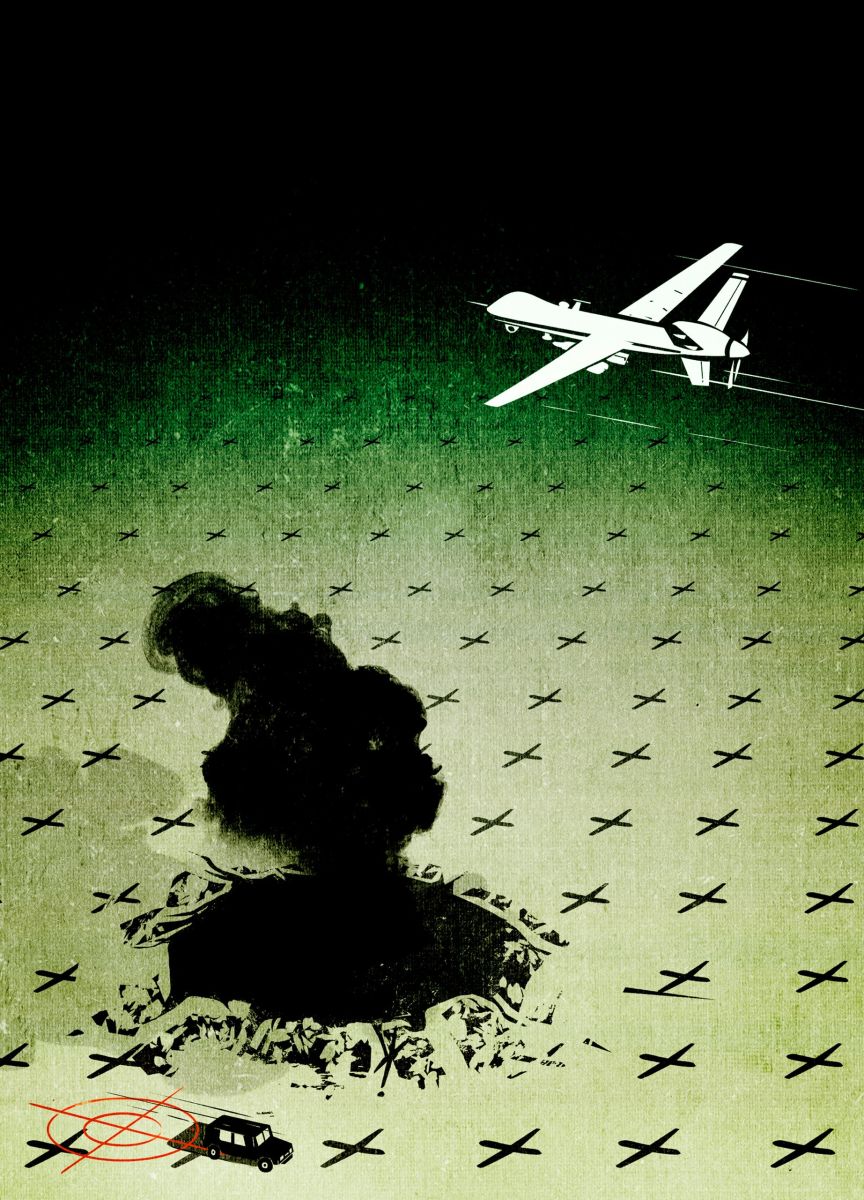
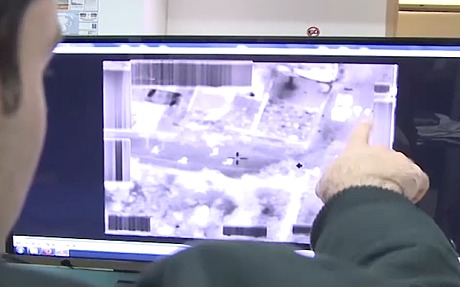
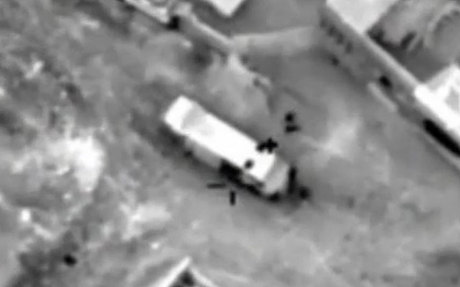
Radical Philosophy 191 is out now, including two contributions of particular interest to me as I continue to grapple with the surveillance apparatus that (mis)informs US drone strikes in the Federally Administered Tribal Areas.  This has come into sharper view after Obama’s rare admission of not only a strike in the FATA but of a mistake in targeting – though his statement was prompted by the death of an American and Italian hostage not by the previous deaths of innocent Pakistanis.

First, Grégoire Chamayou‘s ‘Oceanic enemy: a brief philosophical history of the NSA‘ which traces a path from the sonic surveillance of submarines off Barbados in 1962 to ‘pattern of life’ analysis in Afghanistan, Iraq and Pakistan, and which – not surprisingly – intersects with his Theory of the drone in all sorts of ways:

‘The premiss is the same as before: ‘in environments where there is no visual difference between friend and enemy, it is by their actions that enemies are visible.’ Today the task of establishing a distinction between friend and enemy is once again to be entrusted to algorithms.’

Second, Claudia Aradau‘s ‘The signature of security: big data, anticipation, surveillance‘ shatters the crystal balls of the intelligence agencies:

‘We are not crystal ball gazers. We are Intelligence Agencies’, noted the former GCHQ director Iain Lobban in a public inquiry on privacy and security by the Intelligence and Security Committee of the UK Parliament (ISC) in the wake of the Snowden revelations about mass surveillance….

I argue here that the disavowal of ‘crystal ball gazing’ is as important as the image of finding the clue through the data deluge in order to locate potential dangerous events or individuals in the future. Intelligence work is no stranger to the anticipation of the future – rather, it justifies itself precisely through the capacity to peer into the future in order to prevent or pre-empt future events from materializing. Big data has intensified the promise of anticipating the future and led to ‘exacerbat[ing] the severance of surveillance from history and memory’, while ‘the assiduous quest for pattern-discovery will justify unprecedented access to data’. ‘Knowledge discovery’ through big-data mining, and prediction through the recording of datafied traces of social life, have become the doxa of intelligence and security professionals. They claim that access to the digital traces that we leave online through commercial transactions or social interactions can hold a reading of the future. They repeat the mantra of data scientists and private corporations that the ‘digital bread crumbs’ of the online world ‘give a view of life in all its complexity’ and ‘will revolutionize the study of human behaviour’.

Unlike statistical technologies of governing populations, big data scientists promise that through big data ‘we can escape the straightjacket of group identities, and replace them with more granular predictions for each individual’. To resist their unreasonable promise of predicting crises, preventing diseases, pre-empting terrorist attacks and overall reshaping society and politics, I recast it as divination rather than detection. Big-data epistemics has more in common with the ‘pseudo-rationality’ of astrology than the method of clues. As such, it renders our vocabularies of epistemic critique inoperative…

‘There is nothing irrational about astrology’, concluded Adorno, ‘except its decisive contention that these two spheres of rational knowledge are interconnected, whereas not the slightest evidence of such an interconnection can be offered.’ The irrationality of big-data security is not in the data, its volume or messiness, but in how a hieroglyph of terrorist behaviour is produced from the data, without any possibility of error.

You can obtain the pdfs of both essays by following the links above – but they are time-limited so do it now.

Dirty Dancing online

I had a wonderful time at the Balsillie School at Waterloo last week – good company, constructive conversations and endless hospitality – and I’m truly grateful to Simon Dalby, Jasmin Habib and all the graduate students who made my visit so enjoyable.  I finished by giving one of the Centre for Global Governance Innovation (CIGI)’s Signature Lectures.

This was the latest (and near-final) version of “Dirty dancing: drones and death in the borderlands”.   The argument has developed considerably since my first presentations; I’ll upload the written version once it’s finished, but CIGI has posted the lecture and Q&A online here.  I’ve also embedded the YouTube version below, but if that doesn’t work try here.

My thanks to the AV technicians who made this possible: their help with the production followed by their assured and rapid-fire editing beats anything I’ve encountered anywhere.

In this version, I begin with two CIA-directed drone strikes in Pakistan’s Federally Administered Tribal Areas, one on Baitullah Mehsud (the leader of Tehrik-i-Taliban) and the other on ‘Mamana’ Bibi, an innocent grandmother and midwife, and ask what it is that makes strikes like these – which is to say strikes as unlike these – possible.  My answer turns on the kinds of space the FATA been made out to be: in particular, a space of exception in which people are knowingly and deliberately exposed to death, and a territory conceived as a political technology through which power lays claim to bodies-in-space.

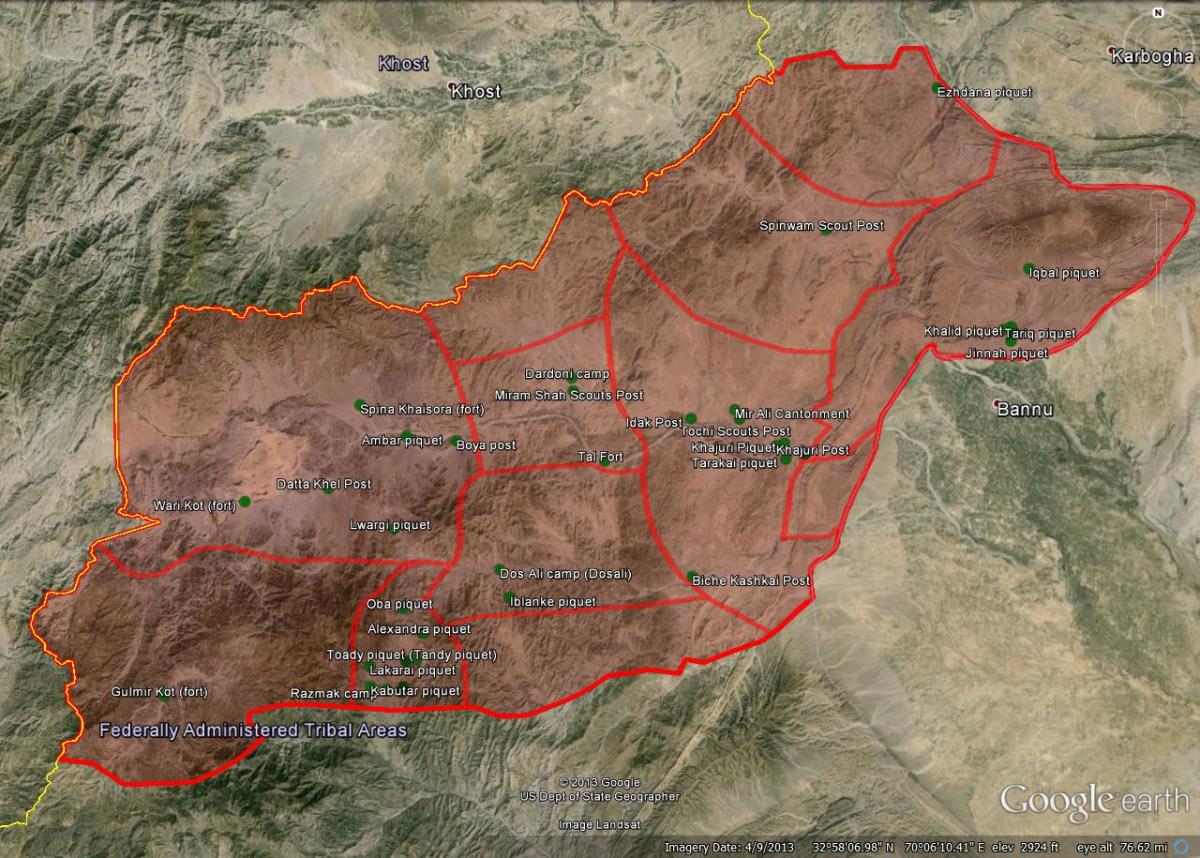
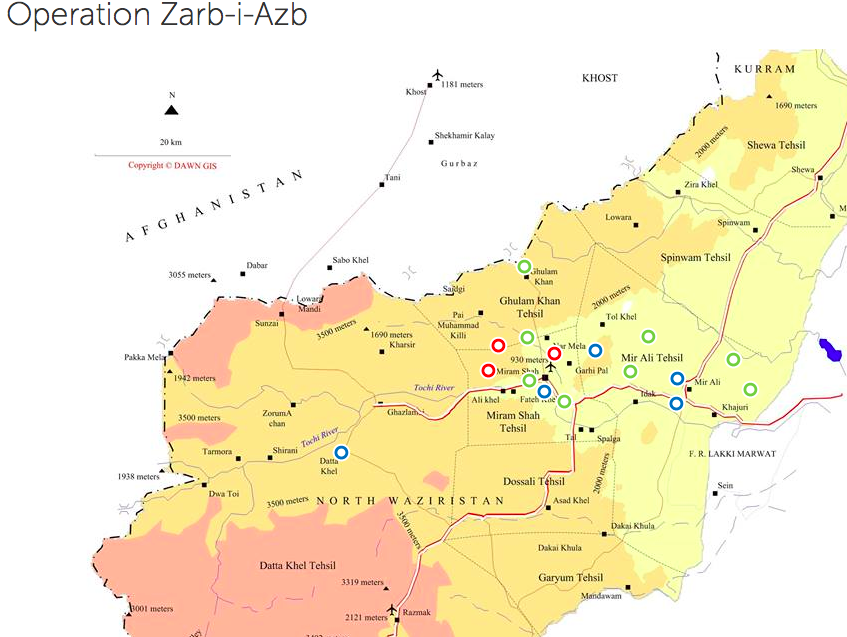
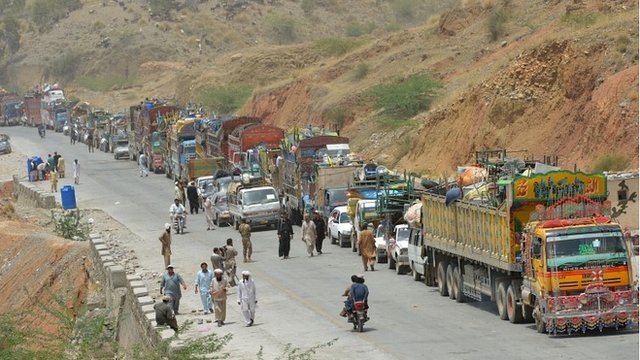
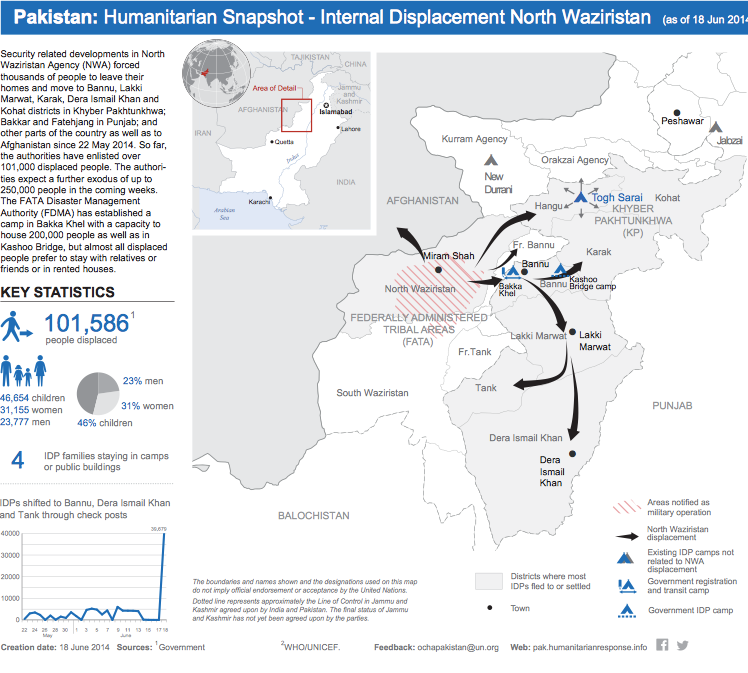
Unlike Giorgio Agamben‘s original formulation, though, my discussion of the space of exception focuses not on violence authorised through the suspension of the law but rather violence that operates inside the law: so I look at the legal regimes, both international and national, that affect military and paramilitary violence in the FATA.  A further difference is that this exceptional state of affairs is provoked not by an event but by a margin: by the construction of the FATA as a liminal zone, borderlands that are outside ‘Pakistan proper’ or ‘mainland Pakistan’.  Many commentators (including me) trace the origin of aerial violence to the British Raj, its Frontier Crimes Regulations and its ‘policing’ of the North-West Frontier.  This is important, but the line of descent to today’s air strikes is not direct.  In particular, it is important to bring into view the cross-border incursions made by Soviet and Afghan aircraft during the occupation of Afghanistan.  Thousands of people were killed and injured during these attacks, and this constitutes an important horizon of memory, but no less important is the response of the Pakistan Air Force: their US-supplied jets intercepted incoming aircraft and either escorted them out of Pakistani air space or, towards the end of the 1980s, engaged them in combat.  This begs an obvious question: if Pakistan objects to the US strikes – carried out by drones that are slow, noisy and sluggish – why does its Air Force not shoot them down?  Since today’s drones cannot be used in contested air space – bluntly, they can only be used against defenceless people – why does Pakistan elect to render the people of FATA defenceless?  This immediately brings into view the other source of aerial violence in the borderlands: the ongoing offensives in the FATA launched by the Pakistan Air Force (in concert with large-scale ground operations).  Even though the Pakistan Air Force has its own reconnaissance drones, some of which are now armed, these are not attempts to put ‘warheads on foreheads’, as the US Air Force would have it, but wide-area assaults conducted by conventional strike aircraft and attack helicopters – as I show in the case of Mir Ali and Miran Shah during Operation Zarb-i-Azb (see here and here and here).

To complete the sequence and add the US drone strikes, I trace the intimate collaboration between both the CIA and the US Air Force and between Washington and Islamabad.  The diplomatic cables released by Wikileaks show time and time again that many of the negotiations about access to ‘flight boxes’ over North and South Waziristan were conducted by the Chairman of the Joint Chiefs of Staff and the commander of US Central Command.  I show, too, how the collaboration between Washington and Islamabad continued until at least 2013.

Hacking.001

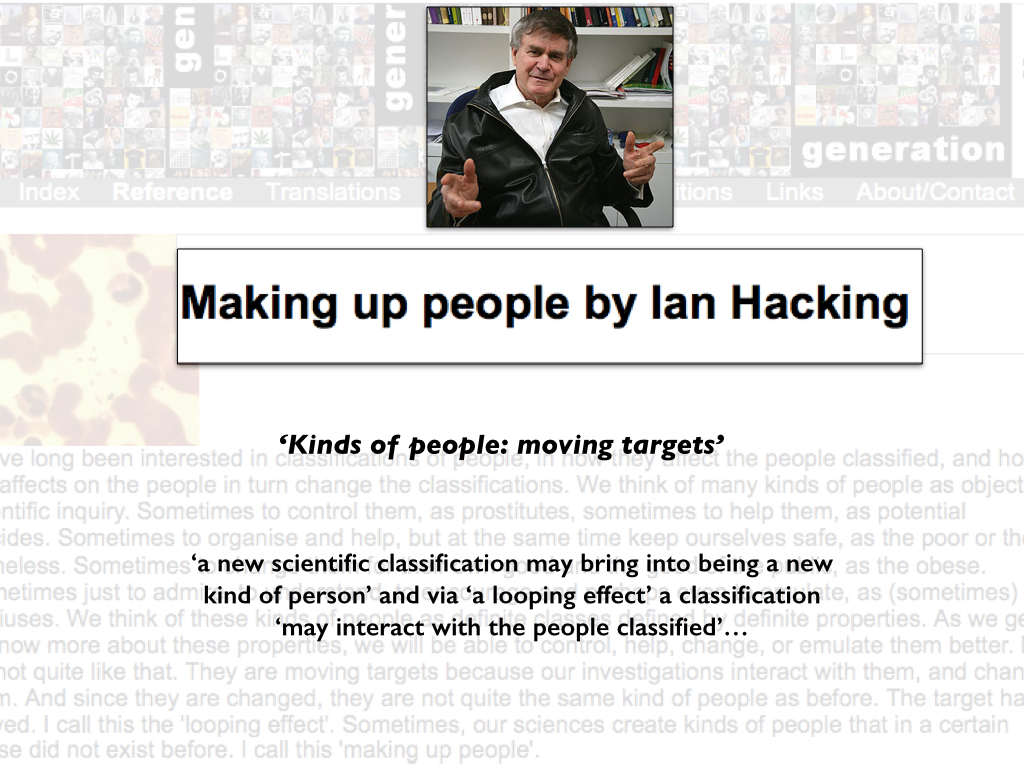
In order for the CIA-directed strikes to be possible, however, the FATA must also be turned into a territory in something like the sense proposed by Stuart Elden.  So I describe the multiple ways in which data is harvested by the NSA and other agencies to produce what Rob Kitchin and Martin Dodge call code/space: the algorithmic combination of sensors, traces and intercepts to summon into being a body-as-target (for more, see here: scroll down), and to produce the space of the target where fleshy bodies disappear and are replaced by codes, co-ordinates and cross-hairs.  This is another version of what Ian Hacking calls ‘making up people’: there is an important sense, then, in which the supposed ‘individuation’ of later modern war depends on the selective and active production (and destruction) of an ‘individual’.

The questions and comments after the lecture were immensely helpful, and as I turn this into its final, written version I’d be grateful for any further comments if you watch the video.

Drone networks

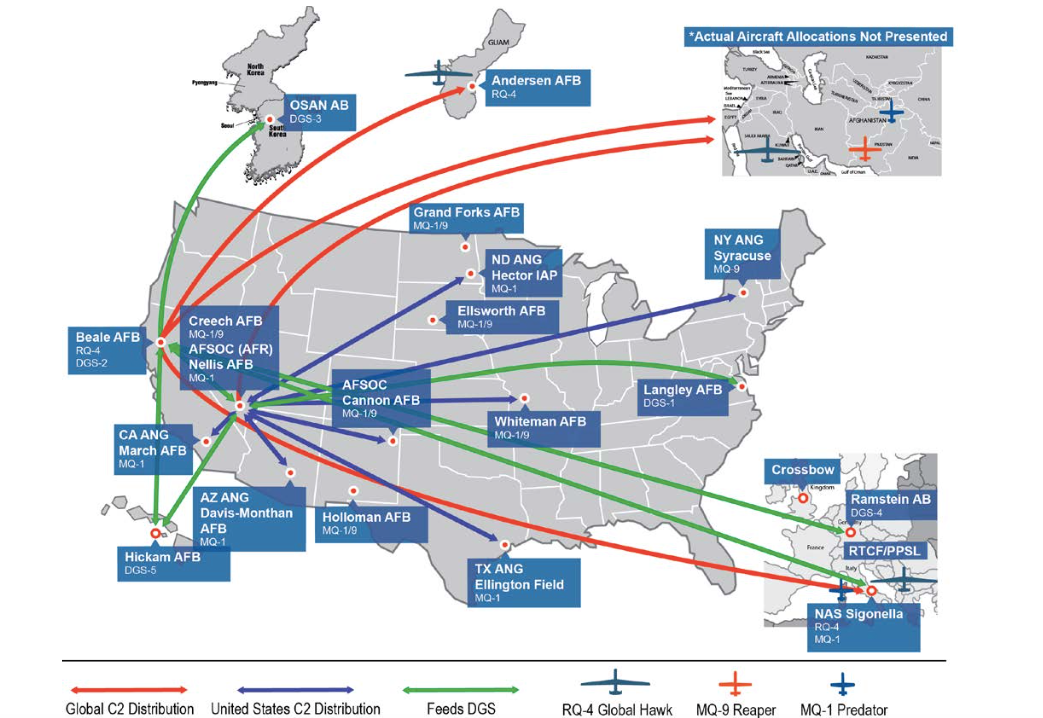
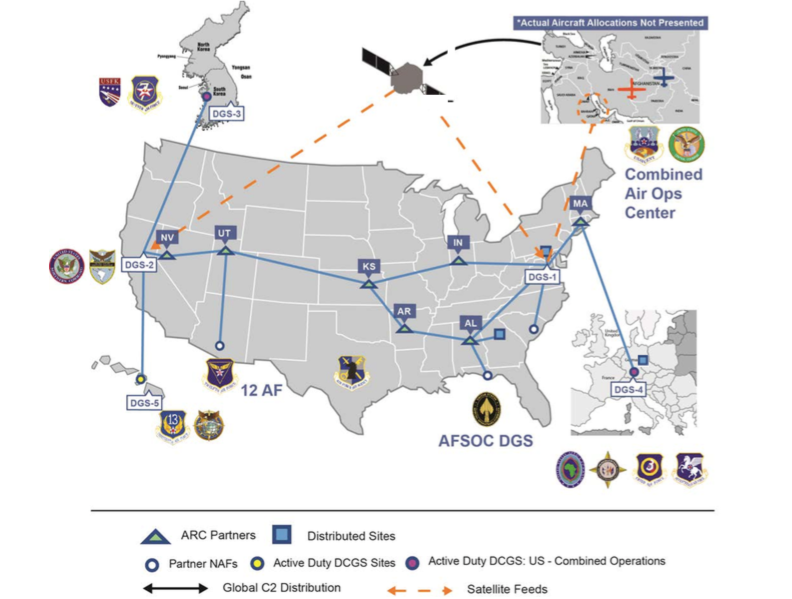
Three contributions to the debates over drones and military violence.  First, my friends at the Bard Center for the Study of the Drone have published Dan Gettinger‘s essay on ‘Drone Geography: mapping a system of intelligence‘.  It’s a superb sketch of the intelligence network in which the US Air Force’s drones are embedded (you can read my complementary take on ‘Drone geographies’ under the DOWNLOADS tab).  Let me add just one map to the illustrations that stud his essay.  It’s taken from the Air Force’s RPA Vector report for 2013-28, published last February, and it shows the architecture of remote split operations within and beyond the United States.  It’s helpful (I hope) because it shows how the Ground Control Stations in the continental United States feed in to the Distributed Common Ground System that provides image analysis and exploitation (shown in the second map, which appears in a different form in Dan’s essay).  I’m having these two maps combined, and I’ll post the result when it’s finished.

RSO architecture (USAF) 1

Distributed Common Ground System (USAF) 2

Dan is right to emphasise the significance of satellite communications; much of the discussion of later modern war and its derivatives has focused on satellite imagery, and I’ve discussed some of its complications in previous posts, but satellite communications materially shape the geography of remote operations.  The Pentagon has become extraordinarily reliant on commercial providers (to such an extent that Obama’s ‘pivot to the Pacific’ may well be affected), and limitations of bandwidth have required full-motion video streams from Predators and Reapers (which are bandwidth hogs) to be compressed and image quality to be degraded.  Steve Graham and I are currently working on a joint essay about these issues.

One caveat: this is not the only network in which US remote operations are embedded.  In my essay on ‘Dirty Dancing’ (now racing towards the finish line) I argue that the CIA-directed program of targeted killing in the Federally Administered Tribal Areas of Pakistan cannot be severed from the multiple ways in which the FATA have been configured as both borderlands and battlefields and, in particular, from the cascade of military operations that have rendered the FATA as a space of exception (in something both more and less than Agamben’s sense of the term).  Here I’ve learned much from an excellent essay by Elizabeth Cullen Dunn and Jason Cons, ‘Aleatory sovereignty and the rule of sensitive spaces’, Antipode 46 (1) (2014) 92-109).  They complicate the claim that spaces of exception always derive from a single locus of sovereign power (or ‘the sovereign decision’).  Instead, they  suggest that borderlands are ‘contested spaces’ where ‘competing’ powers ‘collide’.  In the FATA multiple powers have been involved in the administration of military violence, but on occasion – and crucially – they have done so in concert and their watchword has been a qualified and covert collaboration. In particular, the FATA have been marked by a long and chequered gavotte between the militaries and intelligence services of the United States and Pakistan which, since the 1980s, has consistently put at risk the lives of the people of the borderlands.  And in my essay on ‘Angry Eyes’ (next on my screen) I argue that the US military’s major use of Predators and Reapers in Afghanistan – orchestrating strikes by conventional aircraft and providing close air support to ‘troops in contact’ – depends on communication networks with ground troops in theatre, and that this dispersed geography of militarised vision introduces major uncertainties into the supposedly ‘precise’ targeting process.

CHAMAYOU Theory of the droneSecond: Elliott Prasse-Freeman has an extended review of the English translation of Grégoire Chamayou‘s Theory of the drone – called ‘Droning On‘ – over at the New Inquiry (you can access my own commentaries on the French edition here: scroll down).  His central criticism is this:

While his title promises theory, we instead are treated to a digression on the military and social ethics of attacks from the air, in which Chamayou asks without irony, “can counterinsurgency rise to the level of an aero-policy without losing its soul?” What offends Chamayou is the “elimination, already rampant but here absolutely radicalized, of any immediate relation of reciprocity” in warfare. This, we are told, is the problem.

Promised a theory of the drone, how do we arrive at a theory of the noble soldier?…

And so, dispatching with the dream of the drone … Chamayou assumes the concerns not of the brutalized but of military leaders and soldiers.

He continues in terms that resonate with my argument in ‘Dirty Dancing’:

By combining knowing (intelligence, surveillance, reconnaissance), sighting (targeting in movement and in the moment), and eliminating (“putting warheads on foreheads”), the drone constitutes an assemblage of force (as drone-theorist Derek Gregory puts it) that promises a revolution in control and allows the US war apparatus to imagine space and politics in new ways. Because the body of the accused can ostensibly be precisely seen, it can be seen as itself carving out a body-sized exception to state sovereignty over the territory on which that body moves. In this way, eliminating the body does not constitute an assault on the territory of the state, as these bodies are presented as ontologically (and hence quasi-legally) disconnected from that territory.  Geographer Stuart Elden in Terror and Territory (2009) points out the significant overlap between who are labeled ‘terrorists’ and movements fighting for their own political spaces – which hence necessarily violate extant states’ ‘territories’ (and hence the entire international order of states): to violate territory is to terrorize. The US is hence remarkably concerned in its arrogation of a position of supra-sovereignty to ensure that it overlaps with ‘classic’ state sovereignty, and by no means violates the norm of territorial integrity (well-defined borders): by harboring or potentially harboring unacceptable transnational desires, the militant uproots himself, and risks being plucked out and vaporized in open space that belongs only to him. The exception to sovereignty provides the drone the opportunity to extend this exception into temporal indefiniteness: wars are not declared, aggressions are not announced—the fleet, fusing police and military functions, merely watches and strikes, constantly pruning the ground of human weeds.

In ‘Dirty Dancing’ I’m trying to prise apart – analytically, at least – the space of exception, conceived as one in which a particular group of people is knowingly and deliberately exposed to death through the political-juridical removal of legal protections and affordances that would otherwise be available to them, and territory conceived (as Stuart suggests) as a political-juridical technology, a series of calculative practices that seeks to calibrate and register a claim over bodies-in-spaces.  That’s why Dan Gettinger’s essay is so timely too, and why I’ve been thinking about the FATA as a performance of what Rob Kitchin and Martin Dodge call ‘code/space’, why I’ve been working my way through the files released by Edward Snowden, and why I’ve been thinking so much about Louise Amoore‘s superb critique of The politics of possibility: risk and security beyond probability (2013).

Screen Shot 2015-01-07 at 10.03.16 AM

Although Louise doesn’t address drone strikes directly, her arguments are full of vital insights into the networks that are mobilised through them.  ‘The sovereign strike is always something more, something in excess of a single flash of decision’, she insists, and when she writes that —

those at risk (which is to say those who are to be put at risk by virtue of their inferred riskiness) are ‘not strictly “included by means of their own exclusion”, as Agamben frames the exception, they are more accurately included by means of a dividuated and mobile drawing of risk fault lines’

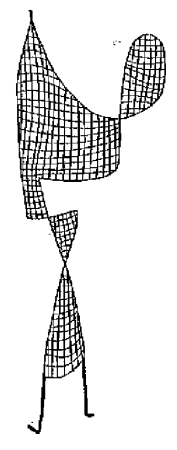
17— it’s a very short journey back to Grégoire Chamayou‘s reflections on the strange (in)dividual whose ‘schematic body’ emerges on the targeting screen of the Predator or Reaper.  Louise writes of ‘the appearance of an emergent subject’, which is a wonderfully resonant way of capturing the performative practices through which targets are produced: ‘pixelated people’, she calls them, that emerge on screens scanning databanks but which also appear in the crosshairs…

And finally, Corporate Watch has just published a report by Therezia Cooper and Tom Anderson, Gaza: life beneath the drones.  This brings together a series of interviews conducted in 2012 – when ‘drones killed more people in Gaza than any other aircraft’ – that were first published in serial form in 2014.  The report includes a tabulation of deaths from Israeli military action in Gaza and those killed directly by drones (2000-2014) and a profile of some of the companies involved in Israel’s military-industrial complex.

The prosthetics of military violence

Neve Gordon‘s review of Grégoire Chamayou‘s A theory of the drone on Al-Jazeera is now available in a more extended form at Counterpunch here.  It’s a succinct summary of the book’s main theses, though there’s not much critical engagement with them (you can access my own series of commentaries here [scroll down]).  He closes his review like this:

Because drones transform warfare into a ghostly teleguided act orchestrated from a base in Nevada or Missouri, whereby soldiers no longer risk their lives, the critical attitude of citizenry towards war is also profoundly transformed, altering, as it were, the political arena within drone states.

Drones, Chamayou says, are a technological solution for the inability of politicians to mobilize support for war. In the future, politicians might not need to rally citizens because once armies begin deploying only drones and robots there will be no need for the public to even know that a war is being waged. So while, on the one hand, drones help produce the social legitimacy towards warfare through the reduction of risk, on the other hand, they render social legitimacy irrelevant to the political decision making process relating to war. This drastically reduces the threshold for resorting to violence, so much so that violence appears increasingly as a default option for foreign policy. Indeed, the transformation of wars into a risk free enterprise will render them even more ubiquitous than they are today.

Neve is the author of the indispensable Israel’s occupation, and while these paragraphs closely follow A theory of the drone the title of the book is in the singular – and so I’m left wondering about military violence that isn’t orchestrated from Nevada or Missouri and what other ‘theories of the drone’ are needed to accommodate a ‘drone state’ like Israel (not that I’m sure what a ‘drone state’ is…)?
Shoot and Strike

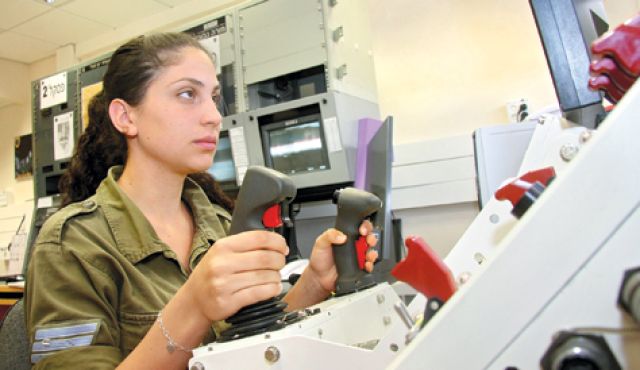
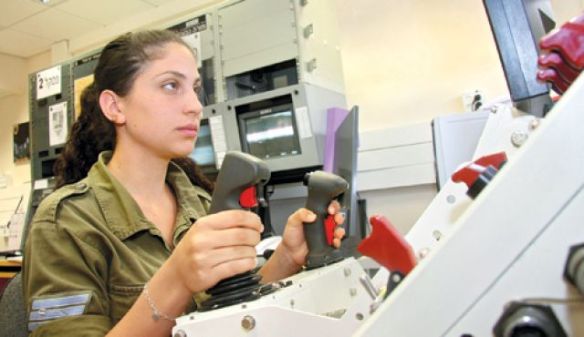
The Israeli military is no stranger to what, following Joseph Pugliese, I’ll call prosthetic violence. While Israel remains a leading manufacturer of drones (see here and here), and routinely deploys them over the occupied territories, it also enforces its ‘Death Zone‘ in Gaza through an automated, ground-based ‘Spot and Strike’ shooting system:

The soldiers, trainees in the course for the “Spot and Strike” system, sit in a tower facing the wilderness of the southern Negev, at the far edge of the Field Intelligence School at the Sayarim base, not far from Ovda. Between their tower and the wide-open desert stands another tower topped by a metal dome. With the press of a button the dome opens to reveal a heavy machine gun. Small tweaks of the joystick aim the barrel. To the right of the gun is a camera, which transmits a clear picture of the target onto a screen opposite the soldier. A press of the button and the figure in the crosshairs is hit by a 0.5-inch bullet.

This dovetails (wrong bird) with a discussion of online shooting in A theory of the drone, but here is risk-transfer war waged over extremely short distances.  ‘Remoteness’ is as much an imaginative as a physical condition, and one that is constantly manipulated so that the threat from Hamas’s rockets and tunnels becomes ‘danger close’ even as the hideous consequences of Israel’s own military offensives become distanced (unless, of course, you choose to turn killing into a spectator sport).  In Israel, it seems, these prosthetic assemblages – of which drones are a vital part – serve to animate a deeply militarised society in which evidence of a martial stance is precisely a prerequisite for its claims to legitimacy.

PUGLIESE State violence

So we clearly need a more inclusive analysis of the prosthetics of military violence – the bio-technical means by which its range is extended – that acknowledges the role of drones for more than ‘targeted killing’ and which incorporates other emergent modalities altogether, including cyberwarfare.  One of the best places to start thinking through these issues, in relation to drones at any rate, is Joseph’s tour de force, State violence and the execution of law (2013), which emphasises how ‘through a series of instrumental mediations, the biological human actor becomes coextensive with the drone that she or he pilots from the remote ground control station’ (p. 184) (I connected this to Grégoire’s theses here).

The experience may be more conditional than this allows, though.  Timothy Cullen‘s study of USAF crews training to operate the MQ-9 Reaper found that the sense of ‘co-extension’ – or bioconvergence – was much stronger among sensor operators than pilots:

After a couple hundred hours of flight experience and a sense of comfort with the modes, interfaces, and capabilities of the sensor ball, sensor operators began to feel like they were a part of the machine. With proficiency as a “sensor,” sensor operators found themselves shifting and straining their bodies in front of the [Heads Up Display] to look around an object.  As pilots flew closer to a target, the transported operators tilted their heads in anticipation of the camera’s [redacted].  Feelings of remote presence helped sensor operators move their bodies, and instructors believed that operators who felt as if they were “flying the sensor” could hold their attention longer on a scene…

Both pilots and sensor operators said pilots did not transport themselves conceptually into the machine to the same extent as a sensor operator. Nor did pilots attain similar feelings of connection and control with Reaper as they did with their previous aircraft.

The term ‘prosthetics’ implies these are at once extensions and embodiments of a military violence whose prosthetics also assume more mundane bioconvergent forms.  This is an obvious but in most cases strangely overlooked point.  Joseph mentions it in passing, juxtaposing his ‘mobilisation of the prosthetic trope’ with ‘the material literality of prosthetics: drones as the militarized prosthetics of empire inherently generate civilian amputees in need of prosthetic limbs’ (p. 214).  There’s also a suggestive discussion in Jennifer Fluri‘s ‘States of (in)security’, which devotes a whole section to what she calls ‘prosthetics biopower’ and the multiply corporeal geographies of contemporary wars [Environment and Planning D: Society & Space 32 (2014) 795-814].  Although Jennifer doesn’t directly connect these intimacies to distant vectors of military violence, the implication (and invitation) is clearly there.

So let me try to supplement her observations, drawing in part on my project on military-medical machines that treats (among other theatres of war) the evacuation of injured soldiers and civilians in Afghanistan.  It’s important to trace the two pathways, as I’ll show in a moment (and I’ll say much more about this in a later post), but it’s also necessary to remember, as Sarah Jain crisply observes in her classic essay on ‘The prosthetic imagination‘ (p. 36), that ‘it usually is not the same body that is simultaneously extended and wounded’  [Science, technology and human values 24 (1) (1999) 31-54].  That said, there is a distinctively corporeal geography to those that are.
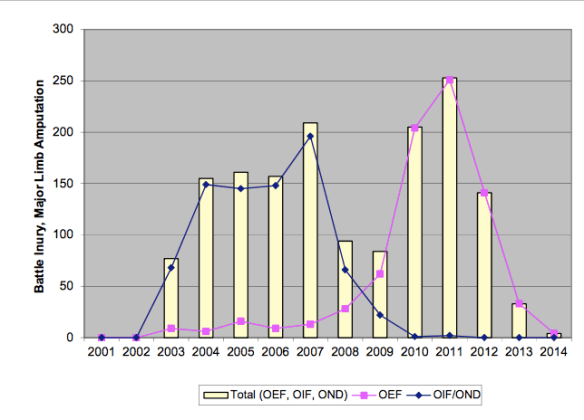
US military Limb amutations in Afghanistan and Iraq PNG

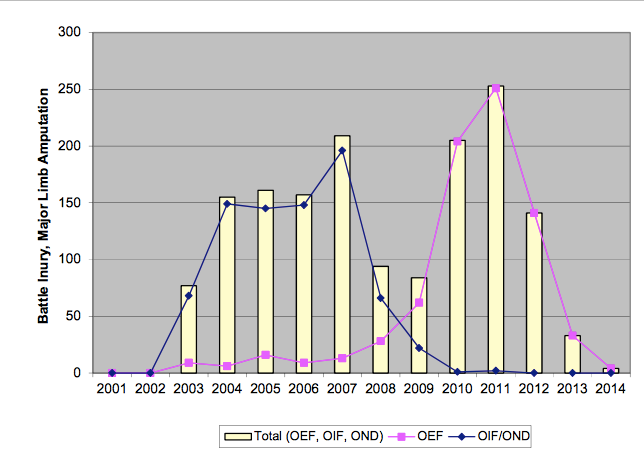
Major limb amputations (US military) in Iraq (OIF) and Afghanistan (OEF) 2001-2014 (Source: Congressional Research Services US Military Casualty Statistics, November 2014)

The incidence of devastating injuries to the limbs of troops in Iraq and Afghanistan (see the graph above; for comparable UK figures, see here) – mainly from IEDs – has been acknowledged in the role played by amputees in mission rehearsal exercises and pre-deployment training since 2005 (see here for an excellent general account).
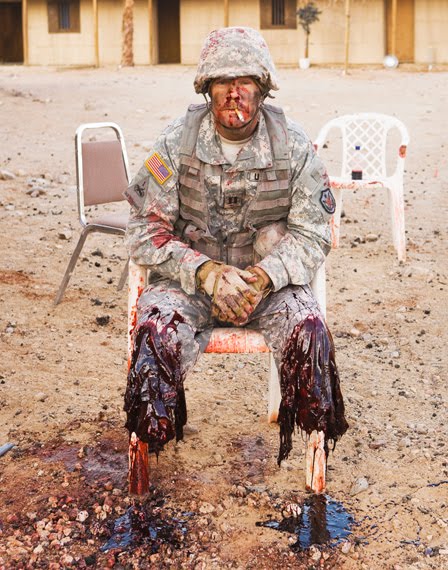
Peter Bohler:Fort Irwin training

Private contractors like Amputees in Action pride themselves on providing ‘de-sensitising’ exposure to ‘catastrophic injury amputations’ and replicating the latest field injuries for these exercises.  There is a risk in re-enrolling war veterans, as the company concedes:

Every amputee is vetted and put through specialist training beforehand to see if they are up to the job. For some it is too close to the mark, too realistic. The last thing we want to do is traumatize someone, stymie their rehabilitation.

These simulations have been used to prepare ordinary soldiers for the situations they will face – today it’s not only the ‘golden hour’ between injury and surgery that is crucial but also (and much more so) the ‘platinum ten minutes’ immediately following the incident, so the first response is vital. They have also been used to ready trauma teams for the war zone: the BBC has a report on the Royal Army Medical Corps’s mock ‘Camp Bastion’ at Strenshall in Yorkshire here.

These various exercises incorporate the latest advances in evacuation and trauma care, which have meant that today’s soldiers are far more likely to survive even the most life-threatening wounds than those who fought in previous conflicts, but the horrors experienced by young men and women in the military who lose arms and legs – sometimes all of them – are truly hideous:  read, for example, Anne Jones‘s mesmerising and deeply moving account of  They Were Soldiers: How the wounded return from America’s wars (you can get an idea from her ‘Star-spangled Baggage’ here).  Their road to rehabilitation is far longer, and infinitely more painful, than the precarious journey through which they returned to the United States (see also my ‘Bodies on the line‘).
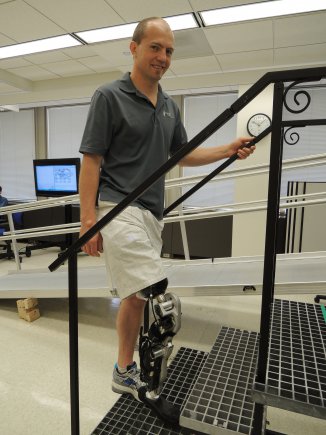
Zac Vawter at the Rehabilitation Institute of Chicago

Researchers unveiled the world’s first thought-controlled bionic leg  on 25 September 2013  funded through the US Army Medical Research and Materiel Command’s (USAMRMC) Telemedicine and Advanced Technology Research Center (TATRC) and developed by researchers at the Rehabilitation Institute of Chicago (RIC) Center for Bionic Medicine. 

There is some light in the darkness – ongoing experiments with state-of-the-art, ‘bionic’ prosthetics animated by microprocessors in the US, the UK and elsewhere that restore far more stability, mobility and movement than would have been possible even five years ago (see above, and here and here for the US, here and here for the UK).  In the 1980s less than 2 per cent of US soldiers who had suffered major limb amputations returned to duty; by 2006 that had increased to over 16 per cent (see also here and here).  There are several reasons for the change, but in 2012 Jason Koebler reported:

According to the Army, at least 167 soldiers who have had a major limb amputation (complete loss of an arm, leg, hand, or foot) have remained on active duty since the start of the Afghanistan and Iraq wars, with some returning to battle. Many others have returned overseas to work in support roles behind the lines.

“When we have someone we know wants to return, their rehab is geared that way,” says John Fergason, chief of prosthetics at the Army Center for the Intrepid at Fort Sam in Houston, Texas.

Kevin Carroll, vice president of Prosthetics at Hanger, a company that makes artificial limbs, says prosthetics have become more comfortable to wear and closer in range of motion to natural limbs.  “Unfortunately, when you have war, you have casualties, but with that comes innovation,” he says. Artificial joints are getting better at approximating the knee, elbow, wrist, and ankle, and microprocessors embedded in prostheses are able to pick up and adjust for impacts from walking, running, jumping, and climbing.

“The person doesn’t have to worry about the prosthetic device, they’re worrying about the task in front of them,” Carroll says. “If they want to go back to be with their troops, that’s an option for many soldiers these days.”

Notice, though, that these advances in prosthetic design and manufacture are part of an intimate conjunction between military violence and military medicine, in which materials science, bio-engineering, electronics and computer science simultaneously provide new means of bodily injury and new modalities of bodily repair.  This is captured in the title of David Serlin‘s thought-provoking essay, ‘The other arms race’ [in Lennard Davis (ed), The Disability Studies Reader (second edition, 2006) 49-65; this essay is not included in the latest edition, but see also the collection David edited with Katherine OttArtificial parts, practical lives: modern histories of prosthetics (2002) and his own Replaceable You: engineering the body in postwar America (2004)].  You can also find an excellent brief historical review of ‘Prosthetics under trials of war’ here.
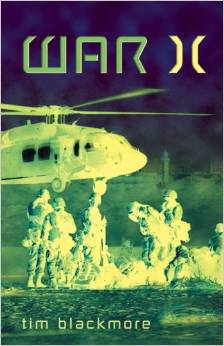
War XAnd, given the circuits within the military-medical machine, there may be more to come.  There are those who anticipate a future in which prosthetics will not only reinstate but also increase a soldier’s capabilities.  Koebler cites Jonathan Moreno, a bioethicist at the University of Pennsylvania, who ‘talks about a future where prosthetics are “enhancers” that allow soldiers to be stronger, faster, and more durable than their peers.’  These fantasies feed through the masculinist imaginary of the post-human cyborg soldier (sketched an age ago by Chris Hables Gray and revisited here) to the prosthetics of military violence with which I began. Here Tim Blackmore‘s War X: Human extensions in battlespace (2011) is also relevant.

But Koebler is quick to add that all this is still a distant prospect:

“I know the question is often, ‘How close are we to true bionic or having artificial limbs that are more versatile than natural ones?'” Fergason says. “Frankly, we’re not that close. You’re not going to see anyone decide, ‘Boy, I think I’d like to get a bionic leg because they’re so fantastic.’

“We love to read about the super-soldier, but that’s not the case right now. Amputation is so complex in what it does to your body that it’s a very long recovery,” he adds.

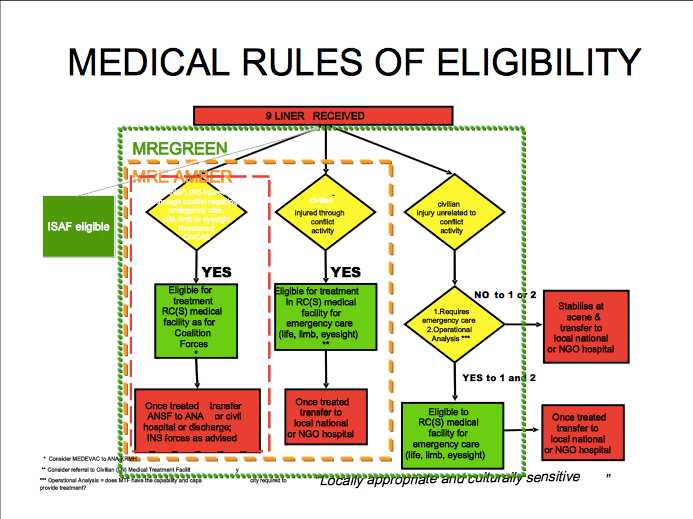
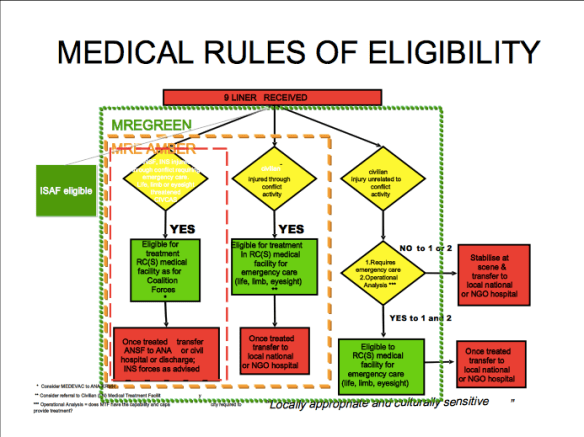
So what, then, of civilians?  Under ISAF’s Medical Rules of Eligibility Afghan civilians who were injured during military operations and/or needed ‘life, limb or eyesight saving care’ could be admitted to the international medical system, and were eligible for emergency casualty evacuation and treatment at one of the Category III advanced trauma centres at Bagram or Camp Bastion.
Medical Rules of Eligibility PNG

As soon as possible, however, Afghans were to be treated by Afghans and so, after surgical intervention they had to be transferred to the local healthcare system.  The same applied to the Afghan National Army and police.  In consequence, the drawdown of international forces – which also includes their medevac and trauma teams – has left the local population desperately vulnerable to the after-effects of continuing and residual military and paramilitary violence (see here and here).

The inadequacies and insufficiencies of the Afghan healthcare system have prompted a number of NGOs to fill the gap between the radically different systems, and they have done – and continue to do –  immensely important work.

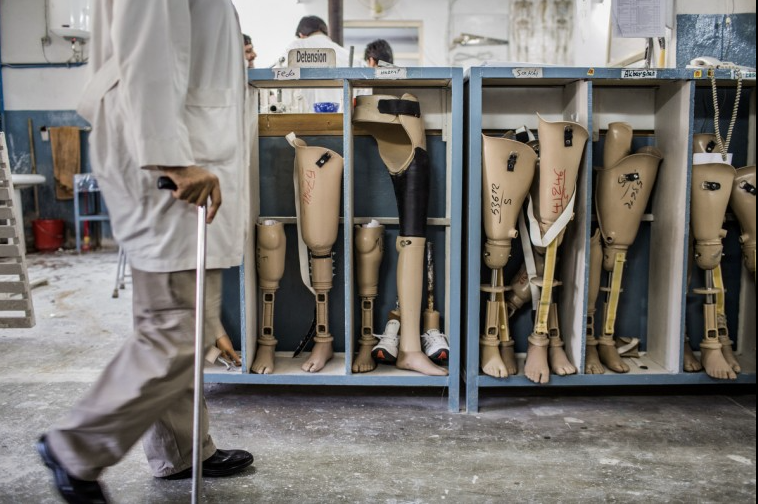
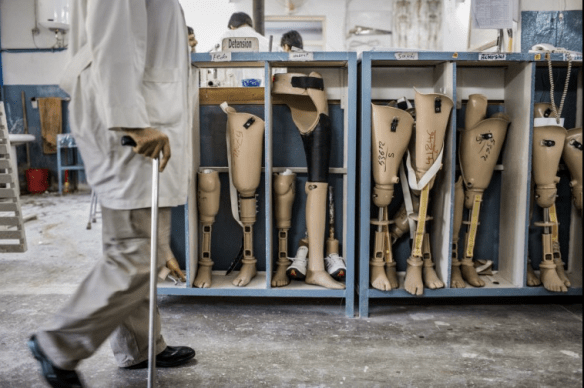
But compare the prosthetics available to US soldiers with those supplied to Afghan civilians.  I don’t mean to minimise the invaluable work done by hard-pressed and underfunded NGOs, but the image below is from the ICRC‘s Orthopedic Center in Kabul (see also here).  There are other centres supported by the ICRC in Faizabad, Gulbahar, Herat, Jalalabad, Lashkar Gah, and Mazar-e-Sharif, together with a manufacturing facility in Kabul, and other NGOs are active elsewhere  – Médecins sans Frontières runs a similar facility in Kunduz, for example.
ICRC Orthopedic Center Kabul PNG

In addition to these facilities, there have been some ingenious work-arounds.  Carmen Gentile describes how US soldiers at Forward Operating Base Kasab in Kandahar were moved by the plight of Mohammed Rafiq, an eight-year old boy whose legs were blown off by an IED.  ‘Since we couldn’t get a supply of commercially made legs, we decided that maybe we could make them ourselves,’ explained Major Brian Egloff, a US Army surgeon at the base.

Using scrap tubing and some ingenuity, Egloff fitted Rafiq with small prosthetic legs. Rafiq was now able to get around the village…

Egloff did not end his work with Rafiq. He knew there must be other amputees living in the area…  Soldiers on patrol had noticed “a lot of guys with amputations that had no prosthetic legs and were reduced to crawling around on the ground and relying on the charity of strangers just to get by,” he says.  Afghans heard about what was done for Rafiq and asked for help for others. Egloff made the legs from material readily available in any welding shop, he says, mostly scrap aluminum tubing for the legs and aluminum plates for the prosthetic feet. A spring-loaded hinge served as the ankle joint.  “It’s a very simple design, nothing complicated,” he says.

These legs were intended to be temporary replacements until ‘a professionally fitted prosthetic’ was available, but the same report notes that ‘getting to a provincial capital, where most hospitals are located, is not easy for many Afghans and the routes are dangerous.’  There’s much more about inaccessibility in MSF’s Between rhetoric and reality: the ongoing struggle to access healthcare in Afghanistan (February 2014).

Like Mohammed – and many ISAF and Afghan soldiers – many of these amputees are the victims of IEDs or even land mines left over from the Soviet occupation (for a global review of the rehabilitation of people maimed by the explosive remnants of war [ERW], see this 2014 report from the International Campaign to Ban Landmines–Cluster Munition Coalition).

But some of them will be the victims of air strikes from or orchestrated by Predators and Reapers: in recent years Afghanistan has been the most heavily ‘droned’ theatre of operations in the world.  In some cases they were caught in the blast, but in others they were the victims of what Rob Nixon calls ‘slow violence‘.  According to a report by Sune Engel Rasmussen in the Guardian:

Since 2001, the coalition has dropped about 20,000 tonnes of ammunition over Afghanistan. Experts say about 10% of munitions do not detonate: some malfunction, others land on sandy ground. In rural areas, children often bring in vital income to households, but collecting scrap metal or herding animals can be fraught with unpredictable risks. Of all Afghans killed and maimed by unexploded ordnance, 75% are children…

Their future is usually bleak.  Erin Cunningham reports that ‘even as the population of Afghans who are missing limbs grows, amputees face discrimination and the harsh stigma of being disabled.’

“Socially and financially, their lives are destroyed,” Emanuele Nannini, program director at the Italian nonprofit Emergency, which operates health-care centers across Afghanistan, said of Afghan amputees.

From January to June [2014], Emergency’s Center for War Trauma Victims in Lashkar Gah, the capital of Helmand province in southern Afghanistan, performed 69 amputations. The fiercest fighting between the two sides usually takes place in the warmer summer months.

Emergency then sends the amputees to the nearby International Committee for the Red Cross orthopedic facility for long-term rehabilitation. The patients receive vocational training and other support to reintegrate them into society. The ICRC said that between April and June this year, it admitted 351 amputee patients to its facilities across Afghanistan.

But for the most part, amputees “are completely dependent on their families, and they become a huge burden,” said Nannini, who is based in Kabul. “The real tragedy starts when they go home. If they don’t have a strong family, they become beggars.”

Emergency runs two other surgical centers, in Kabul and Anabah, as well as a number of clinics and first aid posts in the villages; at Lashkar Gah six out of every ten admissions are victims of bombs, land mines or bullets.

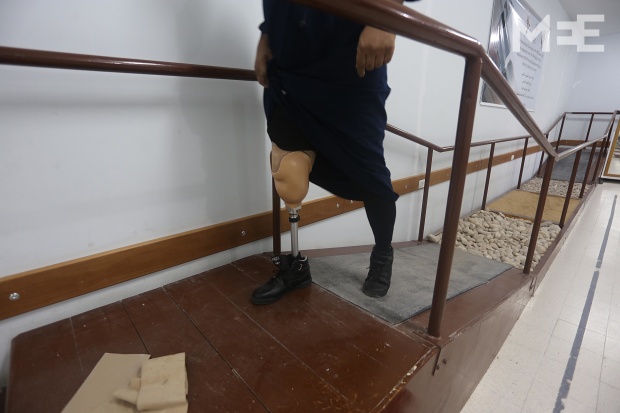
The story is, if anything, even worse across the border in Pakistan’s Federally Administered Tribal Areas, whose inhabitants are also subject to explosive violence from the Taliban and other groups, and from CIA-directed drone strikes and air and ground attacks by Pakistan’s military.  As Madiha Tahir has shown, the victims usually disappear from public attention, at least in the United States:

What is the dream?

I dream that my legs have been cut off, that my eye is missing, that I can’t do anything … Sometimes, I dream that the drone is going to attack, and I’m scared. I’m really scared.

After the interview is over, Sadaullah Wazir pulls the pant legs over the stubs of his knees till they conceal the bone-colored prostheses.

The articles published in the days following the attack on September 7, 2009, do not mention this poker-faced, slim teenage boy who was, at the time of those stories, lying in a sparse hospital in North Waziristan, his legs smashed to a pulp by falling debris, an eye torn out by shrapnel….

Did you hear it coming?

No.

What happened?

I fainted. I was knocked out.
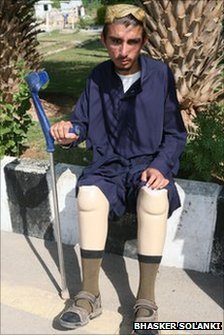
sadulla1As Sadaullah, unconscious, was shifted to a more serviceable hospital in Peshawar where his shattered legs would be amputated, the media announced that, in all likelihood, a senior al-Qaeda commander, Ilyas Kashmiri, had been killed in the attack. The claim would turn out to be spurious, the first of three times when Kashmiri would be reported killed.

Sadaullah and his relatives, meanwhile, were buried under a debris of words: “militant,” “lawless,” “counterterrorism,” “compound,” (a frigid term for a home). Move along, the American media told its audience, nothing to see here. Some 15 days later, after the world had forgotten, Sadaullah awoke to a nightmare.

Do you recall the first time you realized your legs were not there?

I was in bed, and I was wrapped in bandages. I tried to move them, but I couldn’t, so I asked, “Did you cut off my legs?” They said no, but I kind of knew.

Zeeshan-ul-hassan Usmani and Hira Bashir listed some of the long-term implications in a report completed last December for the Costs of War project:

Drone injuries are catastrophic ones.  Wounded survivors of drone attacks have often lost limbs and are usually left with intense and unmanaged pain, and some desire death. Those who survive with severe disabilities face a difficult situation given lack of accommodation for people with disabilities in Pakistan. FATA is an extremely difficult terrain for a disabled person. A walk out for the morning naan (traditional bread) may require navigating through a twisty mud track, with regular dips and bumps. The traditional mud houses of the area themselves have a mud floored haweli (an open-air area onto which all the rooms usually open up). A person with a leg amputation cannot use a regular wheel chair, go to school or hospital, or even use a toilet on his own. Disability of the primary breadwinner can change the course of life for an entire family, since most village jobs are physical ones.

Here too the barriers are more than physical.  In 2011 Farooq Rathore and Peter New described how disability remains a stigma in many sectors of Pakistani society, and rehabilitation medicine is still underdeveloped.

The leading prosthetics center is the Armed Forces Institute for Rehabilitation Medicine at Rawalpindi – whose rehabilitation services for injured soldiers are reportedly ‘the best in the country‘ – but it ‘still manufactures prostheses and orthoses with wood, leather, and metal.’  For injured civilians, the outlook is still more grim.  In 2012 a plan was announced to appoint orthotic specialists and physiotherapists at district hospitals throughout the FATA:

The prolonged United States-led war against terrorism has left a large number of people disabled in Pakistan, compelling the government to institute a rehabilitation plan that will include imparting vocational skills…

“We plan to enhance the physical rehabilitation services for the victims of terrorism to save them from permanent disability,” [Mahboob ur Rehman, head of the physiotherapy department at the Hayatabad Medical Complex (HMC)in Peshawar] told IPS.

The decade-long armed conflict has resulted in injuries to thousands of people from blasts, shelling and drone attacks, with the majority of the victims needing prosthetic and orthotic management to help regain the ability to walk, he said.

But it turns out that the emphasis is as much on ‘wheelchairs and sewing machines’ as it is on even the most basic prosthetics.

Once again, NGOs have provided vital services in the most difficult circumstances.  In 1979 the ICRC established a Paraplegic Rehabilitation Center in Peshawar for victims of the Afghan war, for example, which was subsequently transferred to the control of the Khyber-Pakhtunkhwa provincial government.  It has achieved some notable successes, but here too the focus is on physical therapy and it is outside the FATA so that access is difficult for many people.

And so, finally, to Gaza.  Here the differences with Afghanistan and Pakistan are striking.  Throughout the Israeli assault last summer, as I showed in detail here, medical services were severely compromised, and hospitals and medical centres actively targeted.  The only rehabilitation hospital, El-Wafa, was destroyed.  The injuries were also aggravated by the use of Dense Inert Metal Explosives (DIME) – developed for the US Air Force in 2006 – and which, according to a Briefing Note issued by the Palestinian human rights organisation Al-Haq, were fired from Israeli drones.
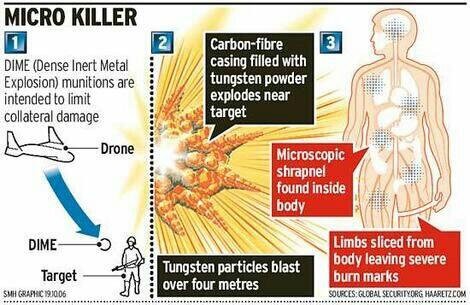
DIME blast injuries

These experimental weapons are supposed to decrease collateral damage by constricting the lethal blast radius.  But inside that perimeter the explosive blast is concentrated and magnified:

The injuries of victims who have been in contact with experimental DIME weapons are distinguishable from injuries sustained by non-experimental weapons. While signs of solid shrapnel or metal fragments are typical of amputations sustained from traditional explosives, physicians in the Gaza Strip are witnessing gruesome amputations caused by a metal vapor or residue which indicate the detonation of an extreme force in a small radius. In fact, as a result of these weapons, reported cases in the Gaza Strip include entire bodies cut in half, shattered bones, and skin, muscle and bones turned into charcoal due to the destructive burns associated with the weaponry’s extreme force and high temperature.

The lacerations are so severe that many victims bleed out and die.

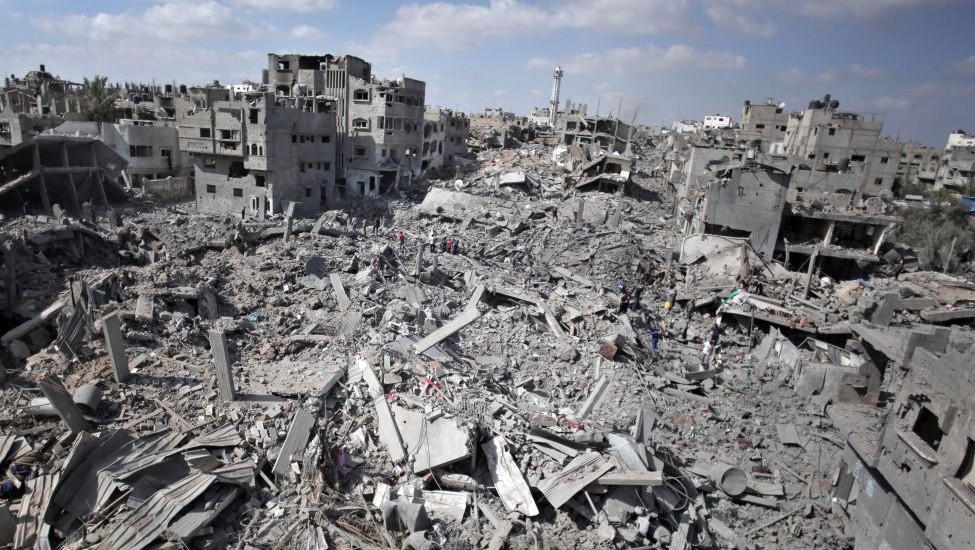
The scale of destruction in Gaza also presents a radically different landscape for survivors of blast injuries.  If the terrain in FATA is formidably difficult for anyone using prosthetics or in a wheelchair, imagine what it must be like to be confronted with this:
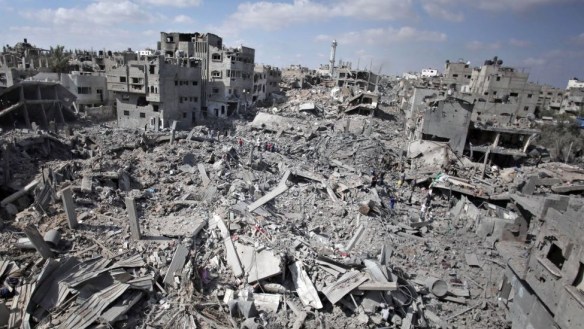
al Shejaiya Gaza 2014

When you look at that, bear in mind that when the assault came to an end there were still around 7,000 unexploded bombs and other explosive remnants of war beneath the rubble.

These are all dreadful effects and yet, compared to Afghanistan and Pakistan, the situation for prosthetics and rehabilitation seems somewhat better.  The prosthetics are more advanced, and some patients have been able to travel to Beirut, Amman and on occasion into Israel for treatment.  But there are still formidable obstacles in the essential provision of continuing local care.  Bayan Abdel Wahad reports from the Artificial Limb Centre, the only one of it kind in Gaza:

The number of patients who have benefited from the service of prosthetic replacement which the Centre provides for free is about 300 people who have been injured as a result of the Israeli bombardments in the past five years. However, a number of people injured in the last war – Operation Protective Edge – have not been able to come to the center yet because they are still bed-ridden due to several injuries whose treatment takes precedence over prosthetic replacement…. The technical coordinator at the center, Nivine al-Ghusain, said that “despite all the difficulties we face in funding and getting the materials necessary to manufacture the artificial limbs, we will continue in our work.” She [said] that the Centre takes upon itself the maintenance of the prosthesis from time to time “in addition to changing it based on the patients’ needs.”
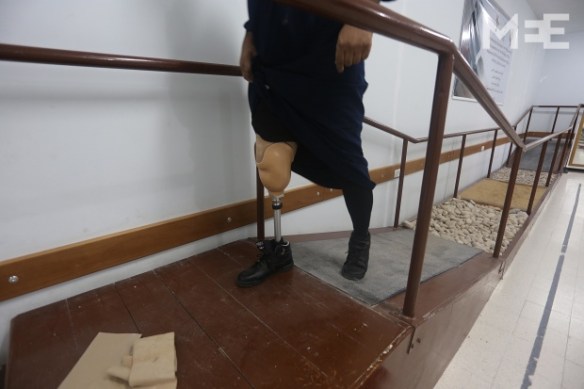
15_0

The Centre relies on the ICRC for components and raw materials from France, Germany, Switzerland and the United States, but there are continuing difficulties in importing these via Israel or Egypt.  In December 2014 the Center was treating around 950 amputees.

Reports about the cultural and social response to these visible victims of military violence are mixed. Guillaume Zerr, who directs Handicap International’s operations in Gaza, told Reuters that ‘there can be less acceptance of their condition than in other regions of the world’, whereas one young man – a double amputee – insisted that ‘I feel more love, support and sympathy from people now than before my injuries, and Gazan society is non-discriminating toward me.’  Perhaps this is, at least in part, because he, like others wounded in Gaza, can provide an unambiguous narrative, ‘to tell the story behind the loss of his legs’.  I remember Omar Dewachi explaining to me how patients from Iraq, Libya or Syria who are treated in Beirut for their wounds have to return home with a narrative that can explain what happened to them in terms that will satisfy whichever side in those civil wars might call them to account.  Such narratives are important not only for their rehabilitation (and here they are vital) but also for their very survival.  This is presumably more straightforward in Gaza, but this ‘politics of the wound’ is also always a geopolitics of the wound.

One last thought.  I’m struck by how often the term ‘asymmetric war’ is used to imply that conflicts of this sort are somehow unfair – to those who possess overwhelming firepower.  But war is about more than firepower, more even than killing, and I hope I’ve shown that the differences between the continuing care and rehabilitation available to those who are maimed in these wars reveal not only a different prosthetics of military violence but also a new and grievous asymmetry in its enduring consequences.


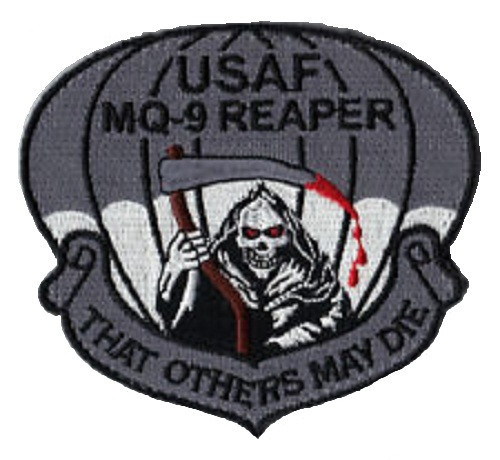
‘That others may die’

As I am (at last) moving into the finishing stages of my ‘Dirty Dancing’ essay on CIA-directed drone strikes in Pakistan’s Federally Administered Tribal Areas, it’s time to round up some of the latest work on drones and civilian casualties across multiple theatres.

tumblr_nhlv56QBGc1t8pecvo1_1280

First, Afghanistan: the principal theatre of US remote operations.  I’ve noted Larry Lewis‘s remarkable work before (here and here), based on classified sources, and in particular this claim (see also here):

Drone strikes in Afghanistan were seen to have close to the same number of civilian casualties per incident as manned aircraft, and were an order of magnitude more likely to result in civilian casualties per engagement.

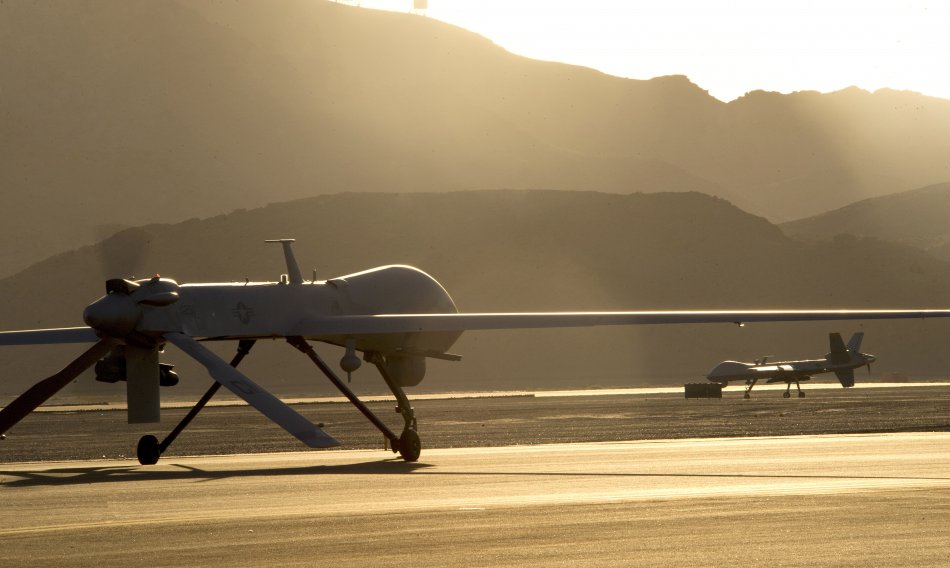
usaf_mq_9_reaper_1024x1024As I said at the time, the distinction between an ‘incident’ and an ‘engagement’ is crucial, though most commentators who have seized on Larry’s work have ignored it and focused on the dramatic difference in civilian casualties per engagement. Despite my best efforts, the Pentagon were unwilling to clarify the difference, so here is what Larry himself has told me:

An engagement is probably intuitively what you would expect – the use of force against a target. The distinction is the term incident, which is borrowed from ISAF definitions. I should have said “civilian casualty incident.” This refers to an engagement that results in civilian casualties.

This means that, if you look at the collection of civilian casualty incidents, the average number of civilian casualties is close to the same for manned and unmanned platforms. At the same time, the rate of civilian casualties for the two platforms is markedly different, with unmanned platforms being ten times more likely to cause civilian casualties than manned platforms. That doesn’t mean that drones caused more civilian casualties than manned aircraft, by the way, since the denominators (number of engagements of manned aircraft versus drones) can and in fact were very different. But it does suggest that the relative risk of civilian casualties was higher for one kind of platform versus the other.

And this is in the specific context of Afghanistan and for a specific time. I wouldn’t want to say that this specific rate would be repeated, necessarily. Yet there were certain risk factors I observed in the civilian casualty incidents that I would expect to continue to be factors unless steps were taken to mitigate them.

Larry’s most recent report, Improving lethal action: learning and adapting in US Counterterrorism Operations, is available here.  It includes an analysis of the Uruzgan air strike that is central to my ‘Angry Eyes’ essay (next on my to-do list).

[The short clip above is from Baden Pailthorpe‘s stunning animation MQ-9 Reaper (That Others May Die) (2014) – you can find much more here]

You might think that all of this is now of historical interest since President Obama has declared the end of the Afghanistan war.  Not so.  Here is John Knefel writing in Rolling Stone this week:

Though many Americans may not have realized it, December 28th marked what the U.S. government called the official end of the war in Afghanistan. That war has been the longest in U.S. history – but despite the new announcement that the formal conflict is over, America’s war there is far from finished. In fact, the Obama administration still considers the Afghan theater an area of active hostilities, according to an email from a senior administration official – and therefore exempts it from the stricter drone and targeted killing guidelines the president announced at a major speech at the National Defense University in 2013.

“Afghanistan will continue to be considered an ‘area of active hostilities’ in 2015,” the official tells RS. “The PPG does not apply to areas of active hostilities.” (PPG stands for Presidential Policy Guidelines, the formal name for the heightened drone rules.)

That perplexing distinction – that formal combat operations are over but that the U.S. still remains in an armed conflict – in many ways exemplifies the lasting legacy of Obama’s foreign policy.

If you assume the situation in Pakistan is somehow less ambiguous, read Ryan Goodman on ‘areas of active hostilities’ over at Just Security here (I’m having to sort all this out for ‘Dirty Dancing’, of course).

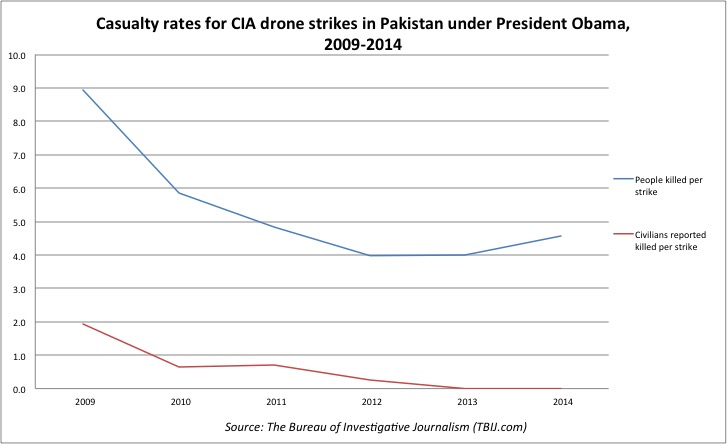
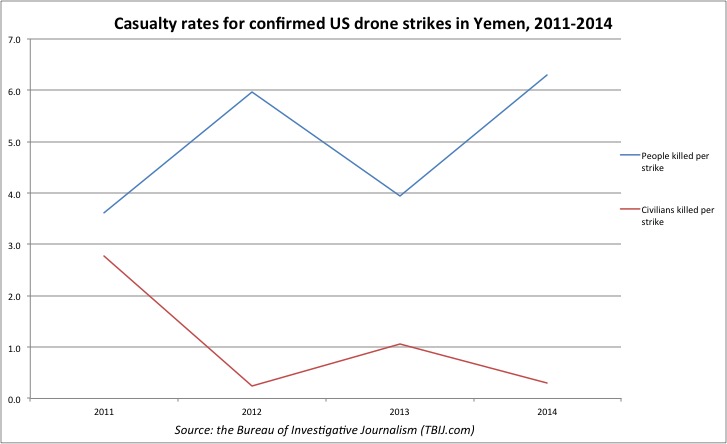
Second, the Bureau of Investigative Journalism has released its end-of-year report on US drone strikes in Pakistan, Yemen and Somalia in 2014, which includes these tabulations of casualty rates for the first two countries:

cas-rates-cia-pak-09-14

cas-rate-yemen-02-14

The Bureau comments:

While there have been more strikes [in Pakistan] in the past six years, the casualty rate has been lower under Obama than under his predecessor. The CIA killed eight people, on average, per strike during the Bush years. Under Obama, it is less than six. The civilian casualty rate is lower too – more than three civilians were reported killed per strike during the past presidency. Under Obama, less than one.  There were no confirmed civilian casualties in Pakistan in the past year, as in 2013….

The frequency of strikes [in Yemen] may have fallen in 2014 but more people were killed, on average, per strike than in any previous year.  The casualty rate for last year even outstrips 2012 – the bloodiest year recorded in the US’s drone campaign in Yemen when at least 173 people were reported killed in 29 strikes. In 2014 at least 82 people were reported to have died in just 13 strikes.

You can find the Long War Journal‘s tabulations for Pakistan here and Yemen here.

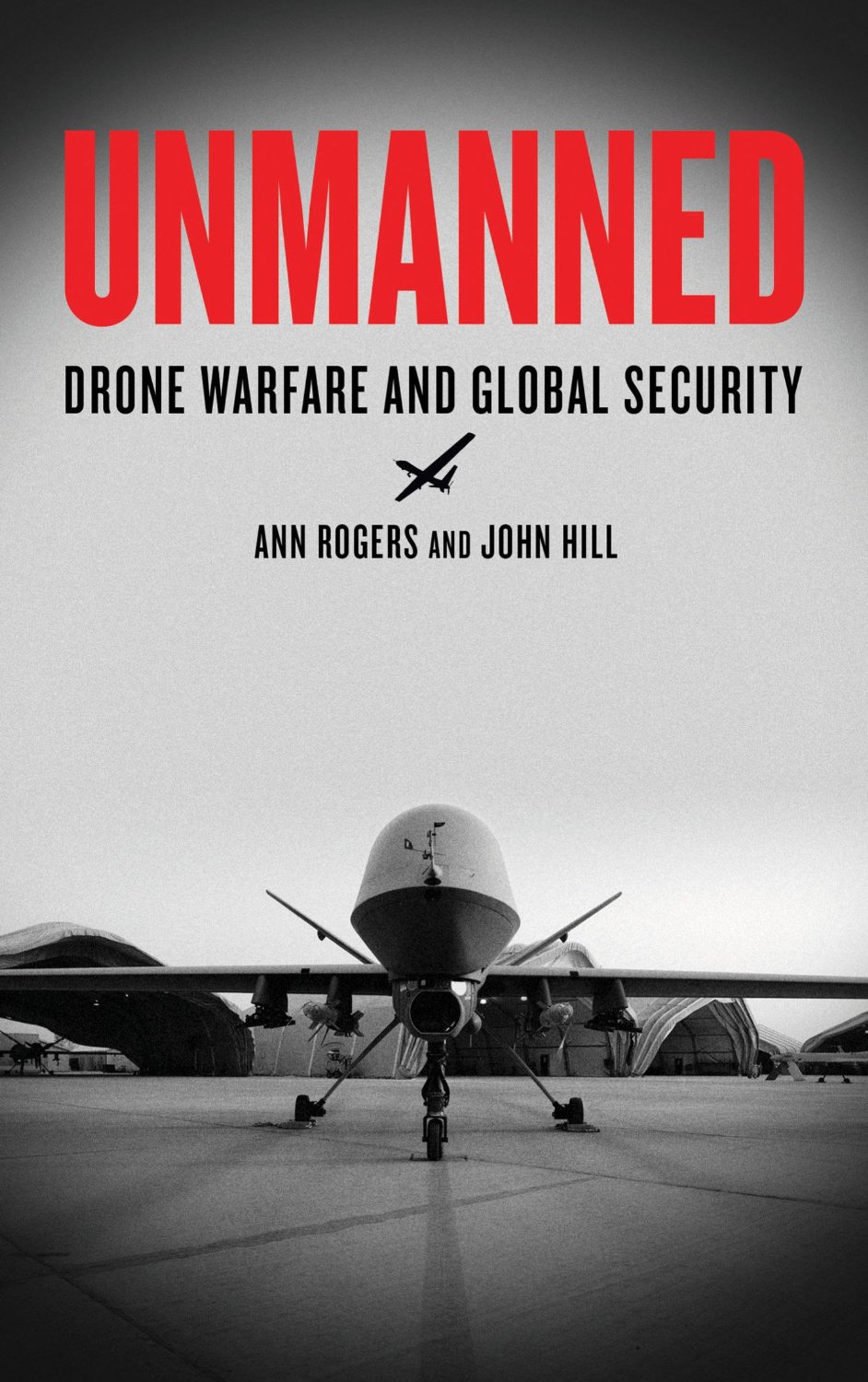
unammed-rogershillThird, Israel.  I’ve commented previously on an interview with an Israeli drone pilot, but it’s been difficult to put his observations in context (though see here and scroll down to the tabulations). Now Ann Rogers, who wrote Unmanned: drone warfare and global security (Pluto, 2014) with John Hill – as good an introduction to drone wars as you will find – has just released an essay on ‘Investigating the Relationship Between Drone Warfare and Civilian Casualties in Gaza‘.  It’s in a special issue of the open-access Journal of Strategic Security 7 (4) (2014) on ‘Future challenges in drone geopolitics’.  Here’s the abstract:

Unmanned aerial vehicles (UAVs), better known as drones, are increasingly touted as ‘humanitarian’ weapons that contribute positively to fighting just wars and saving innocent lives. At the same time, civilian casualties have become the most visible and criticized aspect of drone warfare. It is argued here that drones contribute to civilian casualties not in spite of, but because of, their unique attributes. They greatly extend war across time and space, pulling more potential threats and targets into play over long periods, and because they are low-risk and highly accurate, they are more likely to be used. The assumption that drones save lives obscures a new turn in strategic thinking that sees states such as Israel and the US rely on large numbers of small, highly discriminating attacks applied over time to achieve their objectives. This examination of Israel’s 2014 war in Gaza argues that civilian casualties are not an unexpected or unintended consequence of drone warfare, but an entirely predictable outcome.

Drone-flying-above-me-Friday-afternoon-400-x-300It’s an interesting essay, but I fear that it takes the Israeli military at its word.  Ann repeatedly refers to Israel’s ‘discriminating’ targeting:

‘The central point is that drones enabled the IDF to undertake detailed, extensive, and discriminating targeting of Gaza, before and during the actual fighting. The killing of civilians may be down to differing interpretations of military necessity, or in some cases, in how combatants and non-combatants are distinguished from one another. But it is the drone gaze that enables these targets to be ‘called into being’ (p. 102)…

‘As Israeli targeting of Gaza appears to have been highly discriminating, a more serious problem may lie in how its view of legitimate attacks differs from the global “norm.” (p. 104).’

I commented on Israeli attacks on hospitals and ambulances last summer here, here and here, and on the wholesale destruction of  Gaza here and here, so I confess I am at a loss for words.  But she is right to emphasise the operative power of international humanitarian law and its protocols of distinction (discrimination) and proportionality – though, as often as not, these seem to have been inoperative in anything other than a rhetorical sense.  For much more on this, and the way in which military lawyers are incorporated into Israel’s kill-chains, you should click across to Craig Jones‘s War, Law and Space.  All of which makes the Palestinian decision to seek membership of the International Criminal Court all the more important (there’s a good commentary on the wider legal issues by David Luban at Jus Security here and by a clutch of commentators at the Middle East Research and Information Project‘s blog here).  Perhaps not surprisingly, Daniel Reisner, the former head of the Israeli military’s International Law Department, has condemned the Palestinian application as ‘a belligerent act within the framework of the non-physical and kinetic world of lawfare.’

Finally, the US-led air strikes on IS/ISIL targets in Iraq and Syria.  Here we know much less than we should, not least because the Pentagon knows much less than it should.  Here is Nancy Youssef reporting earlier this week:

In a war fought largely from the air and in places no one can safely go, the impact is as opaque as the war itself, making it difficult to measure whether the U.S. and coalition effort is working.

“We don’t have the ability to count the nose of every guy we schwack,” as Pentagon spokesman Adm. John Kirby told reporters Tuesday, using military jargon [sic] for killing. “That’s not the goal.”

Presumably, that also means the Pentagon can’t count how many civilians it has accidentally killed in the name of ridding the region of ISIS.

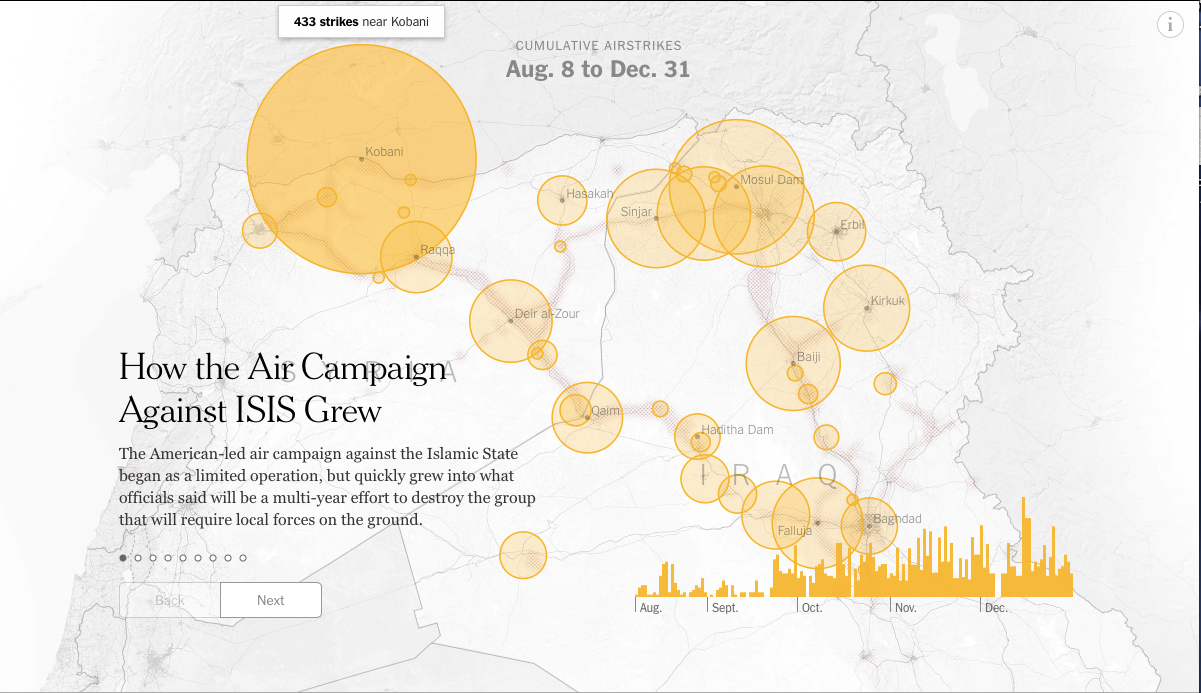
Drone Wars UK has an excellent survey of the logistics of air operations over Iraq and Syria from Chris Cole here, and the New York Times has produced a useful interactive map of US-led air strikes from which I’ve snipped this summary:

Iraq:Syria air strikes 4 August to 31 December 2014

We don’t know how many of these were carried out by drones or even orchestrated by them, but as their limitations are becoming clearer it’s reasonable to assume that most involved conventional strike aircraft.  We do know that targeting involves the analysis of video feeds from both remote and conventional platforms, and that CENTCOM has had considerable difficulty in juggling the competing demands for ISR from Afghanistan and from Iraq/Syria.

According to a report this week from W.J. Hennigan, who visited the USAF’s 480th Intelligence, Surveillance and Reconnaissance Wing at Langley Air Force Base in Virginia:

In a vast windowless room, several dozen intelligence analysts worked under the glow of more than 100 computer screens, quietly studying video streaming from U.S. drones and spy planes hunting for Islamic State militants in Iraq and Syria.

One team searched the incoming video to find a firefight underway between Iraqi security forces and militants somewhere south of the insurgent-held city of Mosul in northern Iraq.

For four hours, the analysts pored over the imagery before identifying 20 positions where the militants were dug in with machine guns and other weaponry. After the analysts called in the coordinates, 15 jets from five countries pounded the targets with more than two dozen bombs.

The Dec. 5 airstrike, one of 462 last month, underscores the Pentagon’s increased reliance on personnel far from the battlefield…  Air Force analysts here stand — or rather sit — on the virtual front lines by tracking Islamic State fighters in a war zone some 6,000 miles away.

But here’s the rub:

Unlike in past wars, when U.S. troops on the ground helped provide targeting information and intelligence, commanders in the battle against Islamic State rely chiefly on airborne surveillance, captured communications chatter, signals intelligence and other material that is processed by analysts here.

U.S. officers said the video-watching analysts working half a world away are no match for spotters and other troops feeding intelligence from the front lines.

“We don’t have anywhere near the level of intelligence we used to,” Lt. Col. Marc Spinuzzi, a senior intelligence officer, wrote in an email from Baghdad. The analysts are under “a lot of pressure … to clearly distinguish friend from foe, and to pick out the enemy from the civilian population” on the battlefield.

That is precisely how mistakes are made and civilians killed.  And, as Robert Naiman pointed out,

“There is a big danger here that U.S. air strikes in Syria are going to resemble the drone strikes in Pakistan and Yemen in the sense that there is no accountability for who is killed. We have reports of civilian casualties from people in the area and the U.S. government says, ‘No, they are bad guys.’ There has to be some public accountability for what happens when there are allegations of civilian casualties.”

At least the Pentagon has now gone some way towards recognising the problem.  Previously it had insisted that it was unaware of any civilian casualties, which is disingenuous: it beggars belief that 1,000 air strikes could have resulted in no civilian casualties – but if your ISR is inadequate it’s scarcely surprising that you would be ‘unaware’ of the consequences.  Even so, on 6 January the Pentagon announced that it had investigated 18 allegations of coalition airstrikes causing civilian casualties between 8 August and 30 December.  It determined that 13 were ‘not credible’, but was continuing to review three others; a further two, one in Iraq and one in Syria, are now the subject of formal military investigations.  But before you gold your breath, both Iraq and Syria are also exempt from the Presidential Policy Guidelines that require a ‘near certainty that no civilians will be killed or injured’.  Here is Harold Koh (really):
‘They seem to be creating this grey zone…  If we’re not applying the strict rules [to prevent civilian casualties] to Syria and Iraq, then they are of relatively limited value.’

Inhumanned

Drones_Poster_cropped

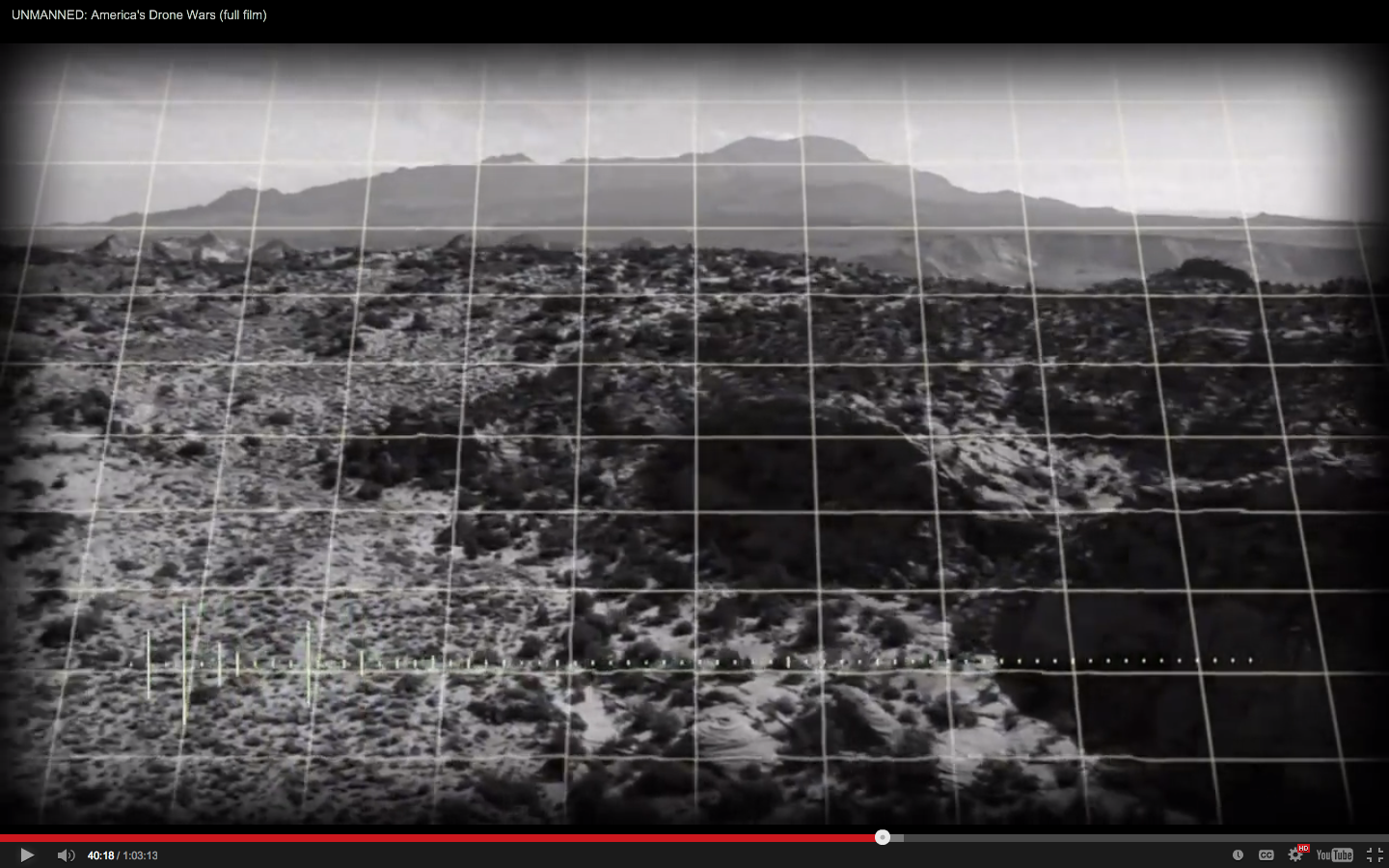
Better late than never…  I talked about Robert Greenwald‘s Unmanned before – the video documentary he produced to accompany the Stanford/NYU report Living under Drones – and I’ve now discovered you can still watch all 61 minutes here.

Beginning at 39:08 there is a harrowing account of the murder of Mamana Bibi in Waziristan on 24 October 2012.  There is a detailed investigation in Amnesty’s Will I be next? and its forensic detail is compelling, but watching and listening to the surviving members of her family adds a new dimension to the horror.

So too, though in a radically different way, does reading C. Christine Fair‘s partisan dismissal of both the Amnesty report and the testimony of the Rehman family here.  It was published under the title ‘Ethical and methodological issues in assessing drones’ civilian impacts in Pakistan’ – without a trace of irony – but for once the comments below the line give me hope…

FOOTNOTE:  I’ve been asked to elaborate that last paragraph.  Fair suggests – on the flimsiest of bases – that the strike was carried out by the Pakistan Air Force, and clumsily attempts to discredit both Reprieve and Amnesty’s research.  I’ve written before about the PAF’s repeated assaults on the FATA – here and here for example – but here is part of a report from the Guardian on the murder of Mamana Bibi that describes how Amnesty’s local researcher Mustafa Qadri went about his work:

Qadri reached out to trusted sources in North Waziristan. The family members and their neighbors were interviewed independently on multiple occasions, unaware that a human-rights group was behind the questions they were asked. Over the course of many weeks, Qadri found the family’s account to be consistent. He determined it was highly unlikely that any militants were present at the time of the strike and that the missiles were likely fired by a US drone.

“It was a number of things,” Qadri told the Guardian. “We got the missiles, the large fragments that the family has that we got analyzed by [an] expert who says this is very likely to be a Hellfire missile. We also had family members who saw drones physically. We also have the eyewitness of the family who said they heard the noise of missiles fired from the sky and then separate noises of missiles impacting on the ground. We have the evidence of a double sound, with each single strike.”

I doubt that he needs any lessons on ethics or methodology.

Keeping up with the Drones

Patrick Svensson:Unblinking stare

Several recent contributions on military drones – what Forensic Architecture calls Unmanned Aerial Violence – you might be interested in.

First, Steve Coll has a long essay in the latest New Yorker on ‘The Unblinking Stare‘ (and, yes, I do know that those watching the screens blink.  Duh) about the drone war in Pakistan.  Many readers will remember that it was the New Yorker that published Jane Mayer‘s classic essay on ‘The Predator War‘ (26 October 2009), so it’s high time for an up-date since so much has happened since then.  It’s a very helpful survey.  Much of it will not be news, but Steve does provide some interesting background to the deadly gavotte between the US and Pakistan (what I’ve called ‘dirty dancing‘; see also here):

Pakistan’s generals and politicians, who come mainly from the country’s dominant, more developed province of Punjab, treated Waziristan’s residents “as if they were tribes that were living in the Amazon,” the journalist Abubakar Siddique, who grew up in the region and is the author of “The Pashtun Question,” told me.

In 2002, Musharraf sent Pakistan’s Army into South Waziristan to quell Al Qaeda and local sympathizers. In 2004, the Army intensified its operations, and, as violence spread, Musharraf allowed the C.I.A. to fly drones to support Pakistani military action. In exchange, Musharraf told me, the Bush Administration “supplied us helicopters with precision weapons and night-operating capability.” He added, “The problem was intelligence collection and targeting. . . . The Americans brought the drones to bear.”

Musharraf allowed the C.I.A. to operate drones out of a Pakistani base in Baluchistan. He told me that he often urged Bush Administration officials, “Give the drones to Pakistan.” That was not possible, he was told, “because of high-technology transfer restrictions.”

We know that close co-operation and even co-ordination between Washington and Islamabad was still the order of the day until at least 2011.  We know, too, that local people live under a double threat, and the essay reports on a group interview in Islamabad with half a dozen young men, mainly university students, from Waziristan.  On one side, recalling the Stanford/NYU ‘Living under dronesreport:

Being attacked by a drone is not the same as being bombed by a jet. With drones, there is typically a much longer prelude to violence. Above North Waziristan, drones circled for hours, or even days, before striking. People below looked up to watch the machines, hovering at about twenty thousand feet, capable of unleashing fire at any moment, like dragon’s breath. “Drones may kill relatively few, but they terrify many more,” Malik Jalal, a tribal leader in North Waziristan, told me. “They turned the people into psychiatric patients. The F-16s [of the Pakistan Air Force] might be less accurate, but they come and go.”

On the other side:

Families in North Waziristan typically live within large walled compounds. Several brothers, their parents, and their extended families might share a single complex. Each compound may contain a hujra, or guesthouse, which usually stands just outside the main wall. In the evening, men gather there to eat dinner and talk war and politics. A rich man signals his status by building a large hujra with comfortable guest rooms for overnight visitors. The less well-heeled might have a hujra with just two rooms, carpets, rope cots, and cushions.

Taliban and Al Qaeda commanders moved from hujra to hujra to avoid detection. The available records of drone strikes make clear that the operators would regularly pick up commanders’ movements, follow them to a hujra attached to a private home, watch for hours—or days—and then fire. Many documented strikes took place after midnight, when the target was presumably not moving, children were asleep, and visitors would have returned home.

North Waziristan residents and other Pakistanis I spoke with emphasized how difficult it would be for a drone operator to distinguish between circumstances where a Taliban or Al Qaeda commander had been welcomed into a hujra and where the commander had bullied or forced his way in. If the Taliban “comes to my hujra and asks for shelter, you have no choice,” Saleem Safi, a journalist who has travelled extensively in Waziristan, told me. “Now a potential drone target is living in a guest room or a guesthouse on your compound, one wall away from your own house and family.”

“You can’t protect your family from a strike on a hujra,” another resident of North Waziristan said. “Your children will play nearby. They will even go inside to play.” The researcher in Islamabad said, “There is always peer pressure, tribal pressure, to be hospitable.” He went on, “If you say no, you look like a coward and you lose face. Anyway, you can’t say no to them. If a drone strike does take place, you are a criminal in the courts of the Taliban,” because you are suspected of espionage and betrayal. “You are also a criminal to the government, because you let the commander sleep in your hujra.” In such a landscape, the binary categories recognized by international law—combatant or noncombatant—can seem inadequate to describe the culpability of those who died. Women, children, and the elderly feel pressure from all sides. A young man of military age holding a gun outside a hujra might be a motivated Taliban volunteer, a reluctant conscript, or a victim of violent coercion.
This speaks directly to a general point made by Christiane Wilke: in today’s wars the requirement that combatants identify themselves as combatants (a standard obligation of international humanitarian law) has effectively been transferred to civilians, so that it becomes their responsibility to make themselves known as non-combatants.  Even to an unblinking eye at 20,000 feet.
Screen_shot_2014-1_3111155c

Second, this week the Telegraph carried a video and an interview with ‘Major Yair’, the pseudonym for the pilot of a Israeli Heron TP drone based near Tel Aviv.  He reports that roughly 65 per cent of Israeli air operations are conducted by drones.  ‘Yair’ served in all three Israeli assaults on Gaza and he says nothing about Israel’s targeted killing – the focus is on the provision of Close Air Support.  But the claims he makes will be all too familiar to those familiar with USAF air strikes in Afghanistan:

As Israeli ground units pressed into Gaza, they would call Major Yair for close air support. “They’d be saying ‘we keep getting fire from within those buildings’ and I’m sitting at a distance – on a neat floorspace with screens and air conditioning systems – but you’re sweating and it’s ‘what do I do, what do I do’? How do I not cause more damage than help?”

I’ve repeatedly noted the affinity – even proximity – USAF crews working out of Creech Air Force Base in Nevada feel with troops on the ground in Afghanistan.  But ‘Yair’ doesn’t elaborate on the Israeli ground assault.  Instead, remarkably, persistently – unblinkingly, you might say – he circles around his own last sentence:

Major Yair stressed how he was constrained by rules of engagement designed to avoid innocent deaths. Hamas operatives, he added, routinely exploited this restraint by hiding behind civilians. One sequence shot by a Heron showed four men preparing to launch a salvo of rockets under a screen of trees. Seconds later, the men were shown running to a nearby street filled with children.

“They’re untouchable now,” said Major Yair, pointing at the screen. “I know that no mission commander, under current directions given by the chief of staff, will engage in this situation. No way.”

He added: “It is sometimes frustrating because you feel that you’re fighting with your hands tied. There are a lot of situations where you see your targets, but you will not engage because they’re next to kindergartens, because they’re driving with their wives and their kids.”

drone2_3111097c

David Blair presses him on the large number of Palestinian civilians killed in Gaza, including children, only to be told:

“We do make mistakes… but it’s nature. People make mistakes. We learn from those mistakes. You’ll see no smiling face after an incident where kids were killed. None of us wants to be in a position where he does these mistakes. We learn and try to avoid this as much as we can.”…

“You learn to live with it,” he said. “It’s not easy. I’ve made mistakes that, for many years, will come back at me. But it’s something that people have to do. It’s not easy. We do not shove it back somewhere in our minds and try to avoid talking about it. We talk about it, we support each other.”

And so, as so often happens in the United States (and elsewhere) too, our gaze is directed away from the victims and towards the torment suffered by those who inflict military violence from the air.

But, third, Corporate Watch has just published the fifth in its series of reports on living under drones in Gaza.  These eyewitness reports are indispensable because there are serious problems in using satellite imagery to reconstruct drone strikes.  Nobody is better at doing so than Forensic Architecture, but as they note, there is a threshold of detectability:

IMG_0076rsSome drone-fired missiles can drill a hole through the roof before burrowing their way deep into buildings, where their warheads explode. The size of the hole the missile leaves is smaller than the size of a single pixel in the highest resolution to which publicly-available satellite images are degraded [a square that translate sin to 50 cm by 50 cm of terrain].  The hole is thus at the “threshold of visibility” and might appear as nothing more than a slight color variation, a single darker pixel perhaps. This has direct implications for the documentation of drone strikes in satellite imagery, which is often as close to the scene as most investigators can get. When the figure dissolves into the ground of the image, it is the conditions—legal, political, technical—that degrade the image, or that keep it at a lower resolution that become the relevant material for forensic investigations.

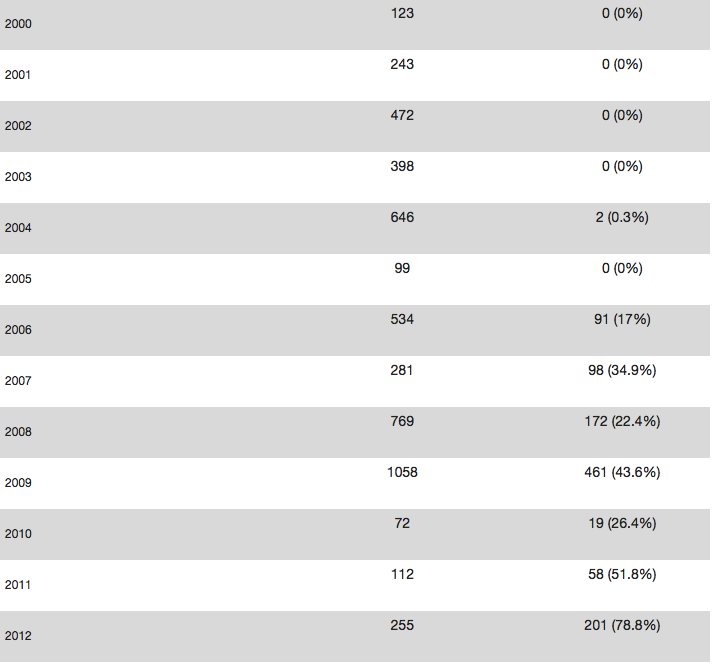
The Corporate Watch report also includes a remarkable tabulation from the Al Mezan Centre for Human Rights in Gaza, showing the numbers of people killed by the Israeli military in Gaza (col. 2) and the proportion killed by drone strikes (col. 3):

Israeli drone strikes in Gaza

I’m not sure what the sources for these tabulations might be: as Craig Jones has emphasised in a vitally important post, it’s exceptionally difficult to parse Israel’s targeted killings in occupied Palestine, and while these tabulations clearly include many other situations I have no idea how you begin to separate different killing machines in what is, after all, a networked mode of military violence in which drones are likely to perform vital surveillance operations for strikes carried out from other platforms. But the increased reliance on drones chimes with the report from David Blair.

Conflicts without borders

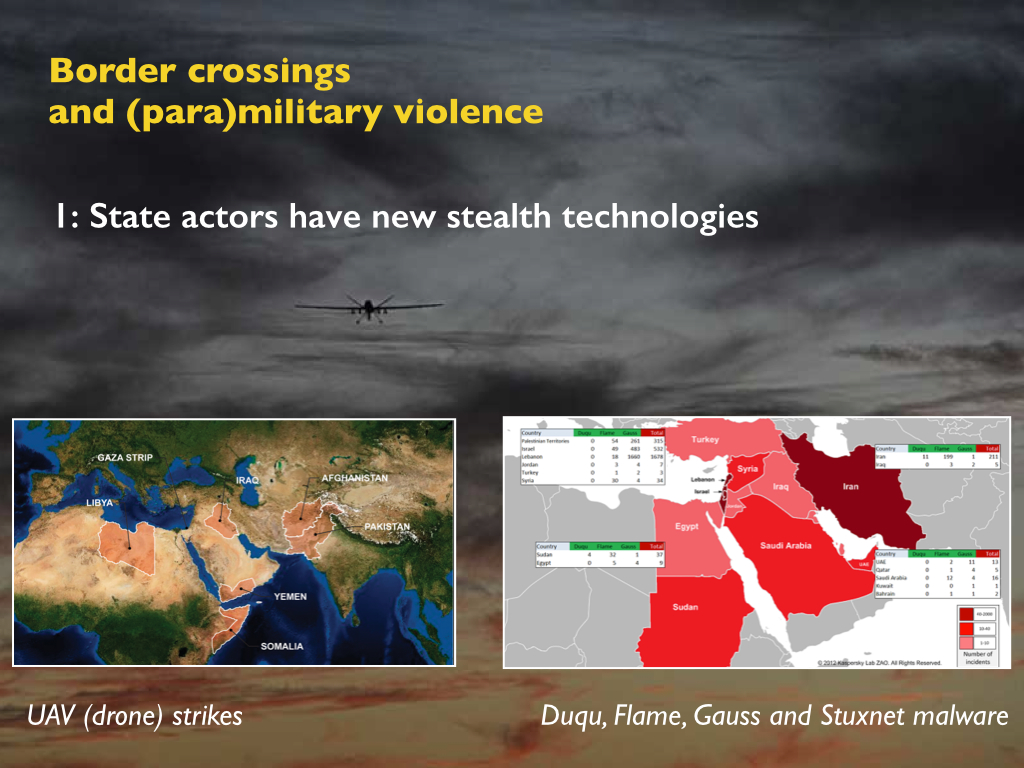
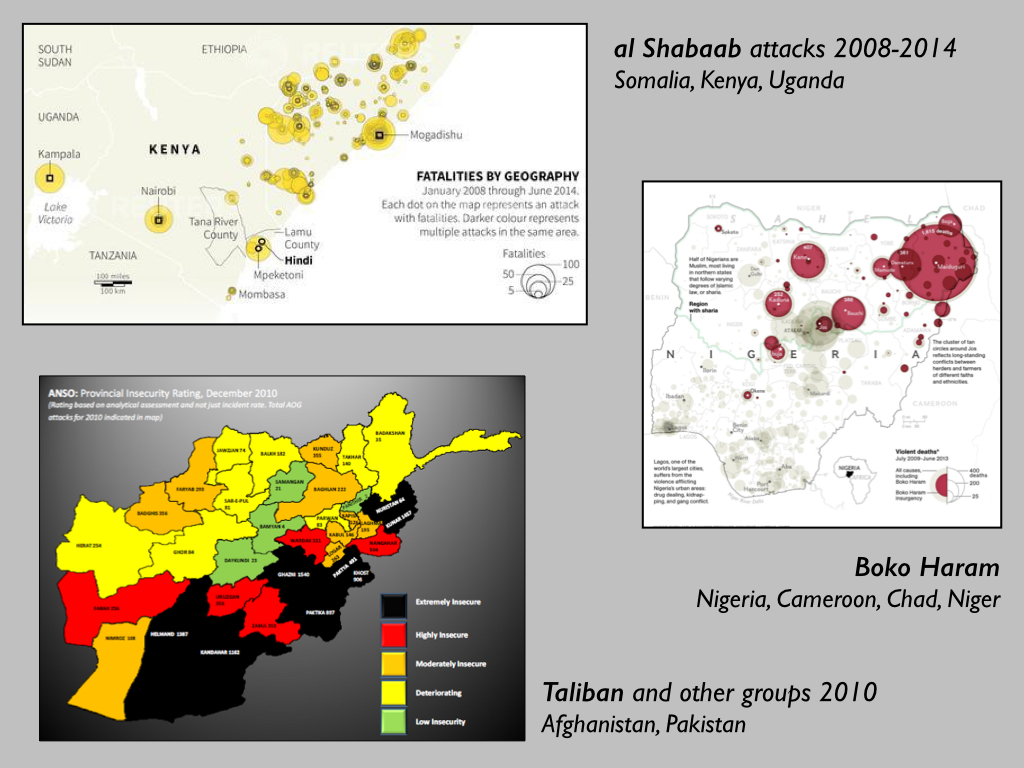
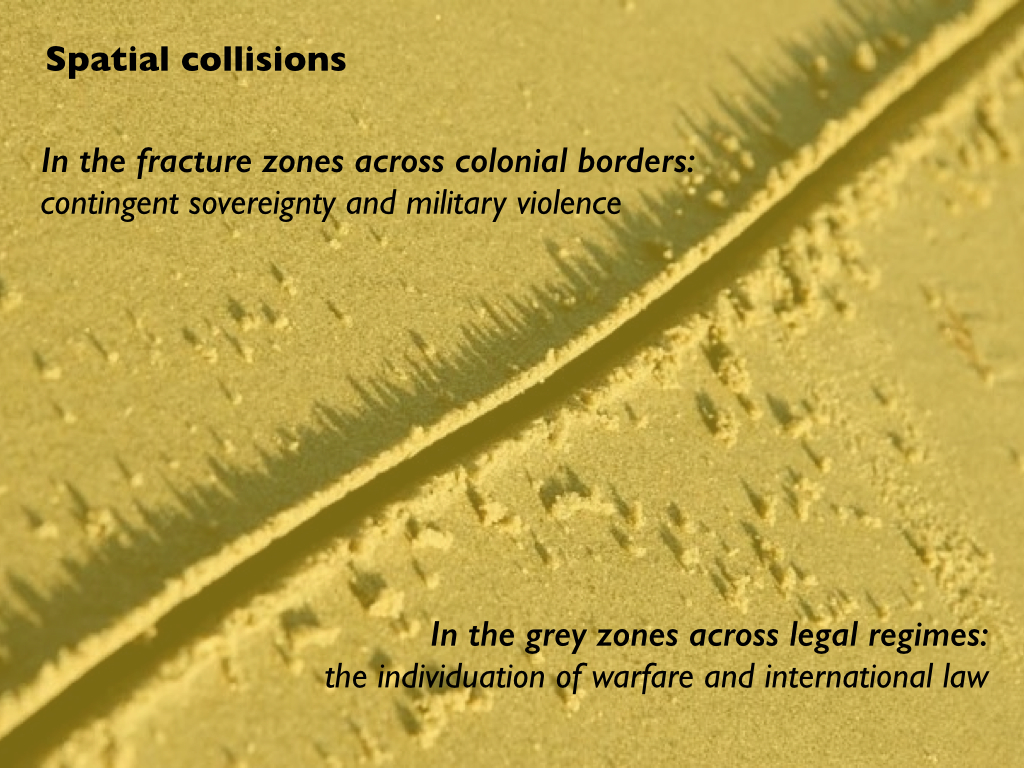
In Finland last month I gave a presentation on Law, violence and b/ordering, in which I began by making two preliminary points about border crossings and (para)military violence: trans-border incursions and transgressions have been facilitated by (i) new stealth technologies deployed by state actors and (ii)  the rise of new non-state and para-state actors.  Here are the relevant slides:

GREGORY 2 Law, violence and b:ordering.001

GREGORY 2 Law, violence and b:ordering.002

GREGORY 2 Law, violence and b:ordering.003

GREGORY Law, violence and b:ordering.003

I derived the map showing the advance of IS(IS)/ISIL from the Institute for the Study of War; say what you like about their politics (this is the Kagans we are talking about), their maps and summaries are extremely helpful.

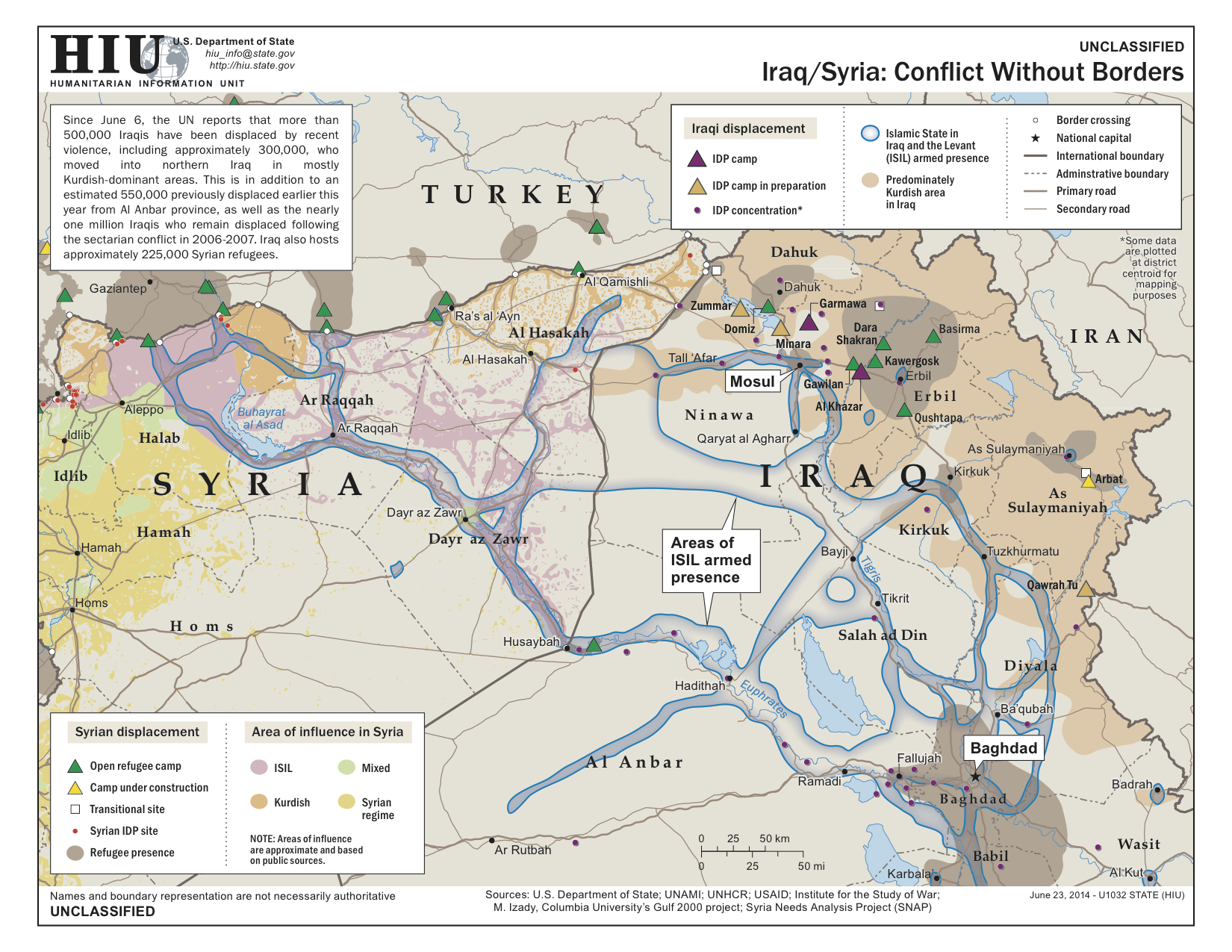
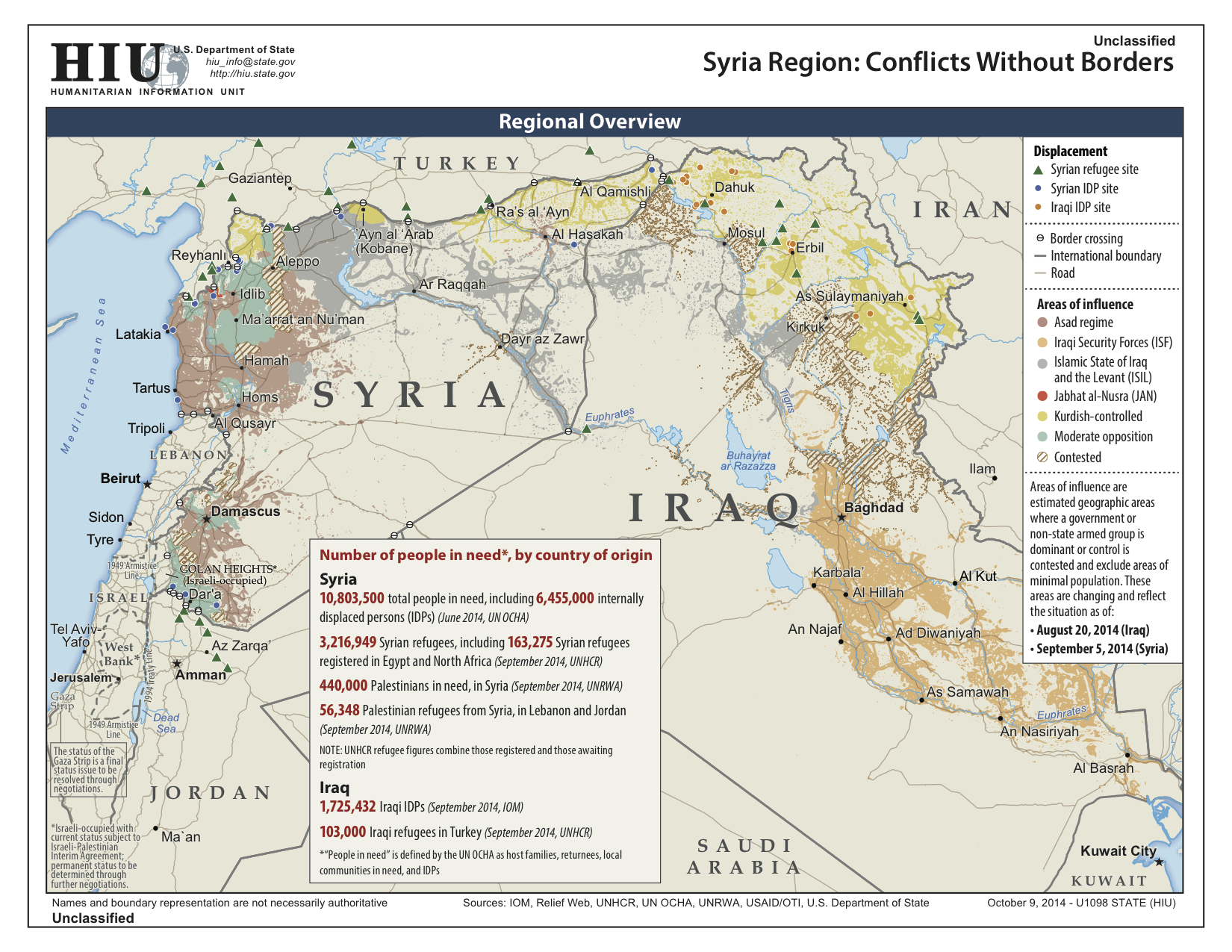
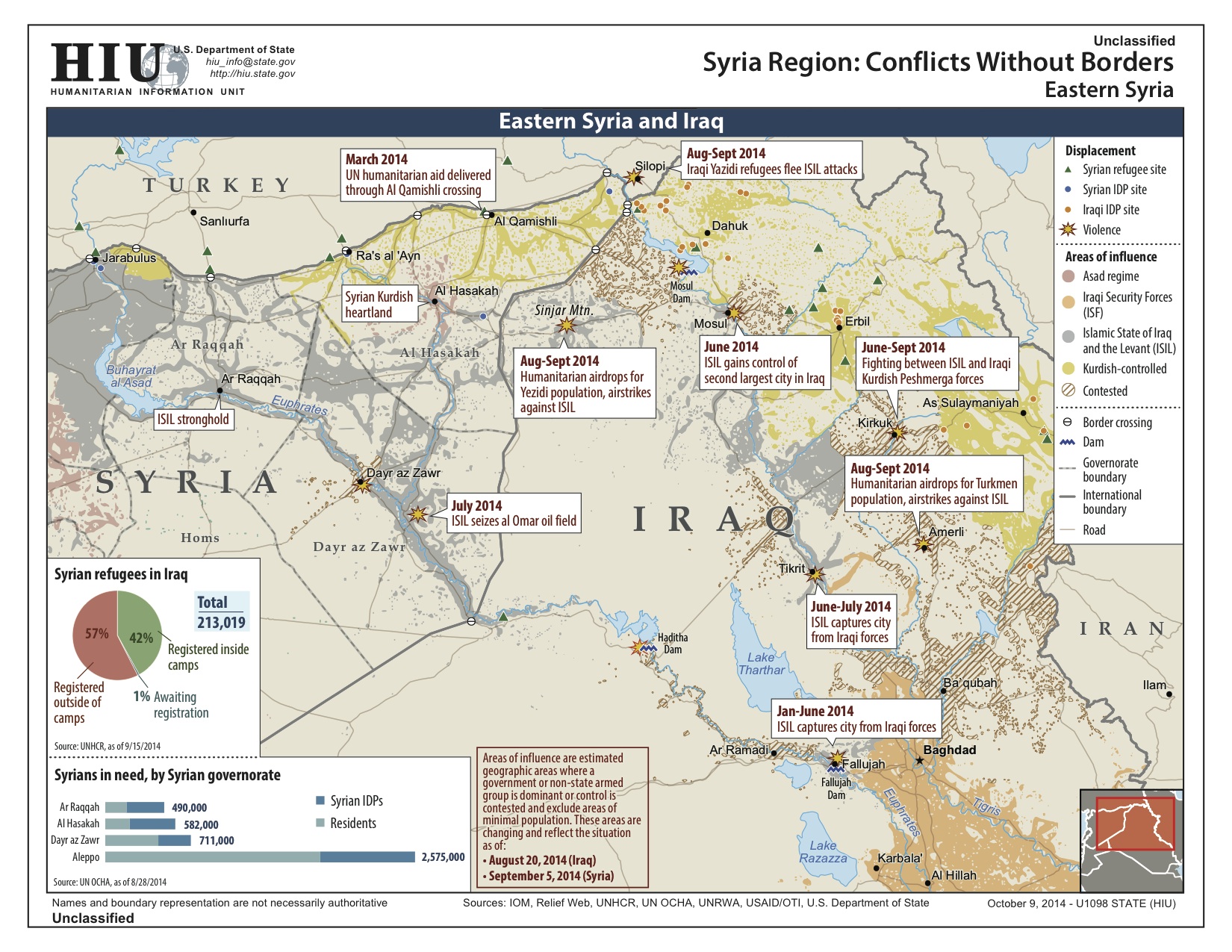
Now Public Intelligence has just published a series of (unclassified) maps of Iraq, Syria, Lebanon and Jordan produced by the Humanitarian Information Unit of the US State Department called Conflicts Without Borders:

‘Conflicts Without Borders refers to a conflict in one country that draws in other governments and non-state actors, exacerbates stresses and conflicts in the neighbouring countries, and generates displacement across borders.’

That’s a definition to think about; there are obvious ironies in the US offering a definition that I suspect is intended to exclude its own part in initiating conflicts (if so, it doesn’t work), and there is the interesting attribution of causal powers to conflicts (which ‘draw in’ other actors like so many black holes).

This map series is dated 9 October 2014; the maps provide a Regional Overview (the first map below) and then show Northern Syria and Turkey, Western Syria and Lebanon, Southern Syria and Jordan and Eastern Syria and Iraq (the second map below).

DoS-Syria-ISIL

DoS-Iraq and Syria-ISIL

You can access a single summary map for late June here (shown below):

DoS Iraq Syria Conflict June 2014

Drones, battlefields and later modern war

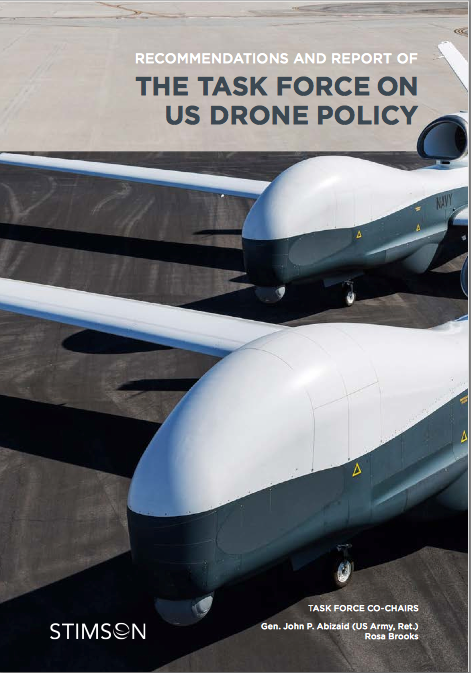
STIMSON Drone report 2014

This morning the Stimson Center issued an 81-page Recommendations and Report of the Task Force on US Drone Policy: you can access it online via the New York Times here or download it as a pdf here; Mark Mazetti‘s report for the Times is here.

Founded in 1989, the Stimson Center is a Washington-based ‘non-profit and non-partisan’ think-tank that prides itself on providing ’25 years of pragmatic solutions to global security’.  It’s named after Henry Stimson, who served Presidents Taft, Roosevelt and Truman as Secretary of War and President Hoover as Secretary of State.  The Center established its 10-member Task Force on drones a year ago, with retired General John Abizaid (former head of US Central Command, 2003-2007) and Rosa Brooks (Professor of Law at Georgetown) as co-chairs; the Task Force was aided by three Working Groups – on Ethics and Law; Military Utility, National Security and Economics; and Export Control and Regulatory Challenges – each of which is preparing more detailed reports to be published later this year.  The present Report focuses on

‘key current and emerging issues relating to the development and use of lethal UAVs outside the United States for national security purposes. In particular, we focus extensively on the use of UAVs for targeted counterterrorism strikes, for the simple reason that this has generated significant attention, controversy and concern.’

But this focus repeats and compounds the myopia of both conventional wisdom and contemporary debate.  The Report summarily (and I think properly) rejects a number of misconceptions about the use of drones, insisting that their capacity to strike from a distance is neither novel nor unique; noting that the vast majority of UAVs in the US arsenal are non-weaponized (‘less than 1 percent of … UAVs carry operational weapons at any given time’ – though their intelligence, surveillance and reconnaissance functions are of course closely tied to the deployment of weapons by conventional strike aircraft or ground forces); and arguing that ‘UAVs do not turn killing into “a video game”‘. These counter-claims are unexceptional and the Task Force presents them with clarity and conviction.

But the Report also accepts that the integration of UAVs into later modern war on ‘traditional’ or ‘hot’ battlefields [more about those terms in a moment] is, by and large, unproblematic.  Thus:

‘UAVs have substantial value for a wide range of military and intelligence tasks. On the battlefield, both weaponized and non-weaponized UAVs can protect and aid soldiers in a variety of ways. They can be used for reconnaissance purposes, for instance, and UAVs also have the potential to assist in the detection of chemical, biological, radiological and nuclear weapons, as well as ordinary explosives. Weaponized UAVs can be used to provide close air support to soldiers engaged in combat.’

A footnote expands on that last sentence:

‘In the past, warfighters on the ground under imminent threat would have to navigate a complicated command hierarchy to call for air support. The soldier on the ground would have to relay coordinates to a Forward Air Controller (FAC), who would then talk the pilot’s eyes onto a target in an extremely hostile environment. These missions have always been very dangerous for the pilot, who has to fly low and avoid multiple threats, and also for people on the ground. It is a human-error rich environment, and even today, it is not uncommon for the wrong coordinates to be relayed, resulting in the deaths of friendlies or innocent civilians. To ease these difficulties, DARPA is currently investigating how to replace the FAC and the pilot by a weaponized UAV that will be commanded by the soldier on the ground with a smartphone.’

And subsequently the Report commends the ‘robust’ targeting process put in place by the US military and the incorporation of military lawyers (JAGs) into the kill-chain:

‘The Department of Defense has a robust procedure for targeting, with outlined authorities and steps, and clear checks on individual targets. The authorization of a UAV strike by the military follows the traditional process in place for all weapons systems (be they MQ-9 Reaper drones or F-16 fighter jets). Regardless of whether particular strikes are acknowledged, the Pentagon has stated that UAV strikes, like strikes from manned aircraft, are subject to the military’s pre-strike target development procedures and post-strike assessment.

‘The process of determining and executing a strike follows a specific set of steps to ensure fidelity in target selection, strike and post-strike review.’

Targeting cycle

Both Craig Jones and I have discussed the targeting cycle [the figure above shows one of six steps in the ‘find-fix-track-target-engage-assess’ cycle, taken from JP 3-60 on Joint Targeting, issued in January 2013] and the role of operational law within it (Craig in much more detail than me), and these are all important considerations.  But the Report glosses over the fragilities of the process, which in practice is not as ‘robust’ as the authors imply.  They concede:

‘No weapons system is perfect, and targeting decisions — whether for UAV strikes or for any other weapons delivery system — are only as good as the intelligence on which they are based. We do not doubt that some US UAV strikes have killed innocent civilians. Nonetheless, the empirical evidence suggests that the number of civilians killed is small compared to the civilian deaths typically associated with other weapons delivery systems (including manned aircraft).’

cover_646That last sentence is not unassailable, but in addition I’ve repeatedly argued that it is a mistake to abstract strikes carried out by UAVs from the wider network of military violence in which their ISR capabilities are put to use:  hence my ongoing work on the Uruzgan airstrike in Afghanistan, for example, and on ‘militarised vision’ more generally.  What these studies confirm is that civilian casualties are far more likely when close air support is provided – by UAVs directly or by conventional strike aircraft – to ‘troops in contact’ (even more so when, as in both the Kunduz and Uruzgan airstrikes, it turns out that troops calling in CAS were not ‘in contact’ at all).

In short, while it’s perhaps understandable that a Task Force that included both General Abizaid and Lt-Gen David Barno (former head of Combined Forces Command – Afghanistan from 2003-2005) should regard the use of UAVs on ‘traditional’ battlefields as unproblematic, I think it regrettable that their considerable expertise did not result in a more searching evaluation of remote operations in Afghanistan and Iraq.

But what, then, of those ‘non-traditional’ battlefields?  A footnote explains:

‘Throughout this report, we distinguish between the use of UAV strikes on “traditional” or “hot” battlefields and their use in places such as Pakistan, Yemen and Somalia. These are terms with no fixed legal meaning; rather, they are merely descriptive terms meant to acknowledge that the US of UAV strikes has not been particularly controversial when it is ancillary to large-scale, open, ongoing hostilities between US or allied ground forces and manned aerial vehicles, on the one hand, and enemy combatants, on the other. In Afghanistan and Iraq, the United States deployed scores of thousands of ground troops and flew a range of close air support and other aerial missions as part of Operation Enduring Freedom, and UAV strikes occurred in that context. In Libya, US ground forces did not participate in the conflict, but US manned aircraft and UAVs both operated openly to destroy Libyan government air defenses and other military targets during a period of large scale, overt ground combat between the Qaddafi regime and Libyan rebel groups. In contrast, the use of US UAV strikes in Yemen, Pakistan and elsewhere has been controversial precisely because the strikes have occurred in countries where there are no US ground troops or aerial forces openly engaged in large scale combat.’

0202megret0

A major focus of the report is on what Frédéric Mégret (above) has called ‘the deconstruction of the battlefield‘ and the countervailing legal geographies that provide an essential armature for later modern war (though it’s surprising that the Report makes so little use of academic research on UAVs and contemporary conflicts).  The authors ‘disagree with those critics who have declared that US targeted killings [in Pakistan, Yemen and Somalia] are “illegal”’ – no surprise there either, incidentally, since one of the Working Groups included Kenneth Anderson, Charles Dunlap and Christine Fair: I’m not sure in what universe that counts as ‘non-partisan’) but they also accept that these remote operations move in a grey zone (and in the shadows):

‘The law of armed conflict and the international legal rules governing the use of force by states arose in an era far removed from our own. When the Geneva Conventions of 1949 were drafted, for instance, it was assumed that most conflicts would be between states with uniformed, hierarchically organized militaries, and that the temporal and geographic boundaries of armed conflicts would be clear.

‘The paradigmatic armed conflict was presumed to have a clear beginning (a declaration of war) and a clear end (the surrender of one party, or a peace treaty); it was also presumed the armed conflict to be confined geographically to specific, identifiable states and territories. What’s more, the law of armed conflict presumes that it is a relatively straightforward matter to identify “combatants” and distinguish them from “civilians,” who are not targetable unless they participate directly in hostilities. The assumption is that it is also a straightforward matter to define “direct participation in hostilities.”

‘The notion of “imminent attack” at the heart of international law rules relating to the use of force in state self-defense was similarly construed narrowly: traditionally, “imminent” was understood to mean “instant, overwhelming, and leaving no choice of means, and no moment for deliberation.”

‘But the rise of transnational non-state terrorist organizations confounds these preexisting legal categories. The armed conflict with al-Qaida and its associated forces can, by definition, have no set geographical boundaries, because al-Qaida and its associates are not territorially based and move easily across state borders. The conflict also has no temporal boundaries — not simply because we do not know the precise date on which the conflict will end, but because there is no obvious means of determining the “end” of an armed conflict with an inchoate, non-hierarchical network.

‘In a conflict so sporadic and protean — a conflict with enemies who wear no uniforms, operate in secret and may not use traditional “weapons” — the process of determining where and when the law of armed conflict applies, who should be considered a com- batant and what counts as “hostilities” inevitably is fraught with difficulty…

‘While the legal norms governing armed conflicts and the use of force look clear on paper, the changing nature of modern conflicts and security threats has rendered them almost incoherent in practice. Basic categories such as “battlefield,” “combatant” and “hostilities” no longer have a clear or stable meaning. And when this happens, the rule of law is threatened.’

These too are important considerations, but they are surely not confined to counter-terrorism operations in Pakistan, Yemen and Somalia: they also apply with equal force to counterinsurgency operations in Afghanistan and Iraq, and intersect with a wider and much more fraught debate over the very idea of ‘the civilian’.

There is a particularly fine passage in the Report:

‘Consider US targeted strikes from the perspective of individuals in — for instance — Pakistan or Yemen. From the perspective of a Yemeni villager or a Pakistani living in the Federally Administered Tribal Areas (FATA), life is far from secure. Death can come from the sky at any moment, and the instability and incoherence of existing legal categories means that there is no way for an individual to be certain whether he is considered targetable by the United States. (Would attending a meeting or community gathering also attended by an al-Qaida member make him targetable? Would renting a building or selling a vehicle to a member of an “associated” force render him targetable? What counts as an “associated force?” Would accepting financial or medical aid from a terrorist group make him a target? Would extending hospitality to a relative who is affiliated with a terrorist group lead the United States to consider him a target?).

‘From the perspective of those living in regions that have been affected by US UAV strikes, this uncertainty makes planning impossible, and makes US strikes appear arbitrary. What’s more, individuals in states such as Pakistan or Yemen have no ability to seek clarification of the law or their status from an effective or impartial legal system, no ability to argue that they have been mistakenly or inappropriately targeted or that the intelligence that led to their inclusion on a “kill list” was flawed or fabricated, and no ability to seek redress for injury. Their national laws and courts can offer no assistance in the face of foreign power, and far from protecting their fundamental rights and freedoms, their own states may in fact be deceiving them about their knowledge of and cooperation with US strikes. Meanwhile, geography and finances make it impossible to access US courts, and a variety of legal barriers — such as the state secrets privilege, the political question doctrine, and issues of standing, ripeness and mootness — in any case would prevent meaningful access to justice.’

This is one of the clearest summaries of the case for transparency and accountability I’ve seen, but the same scenario has also played out in Afghanistan (and in relation to the Taliban, which appears only once in the body of the Report) time and time again.  There are differences, to be sure, but the US military has also carried out its own targeted killings in Afghanistan, working from its Joint Prioritized Effects List.  The Report notes that ‘in practice, the military and CIA generally work together quite closely when planning and engaging in targeted UAV strikes: few strikes are “all military” or “all CIA”’ – which is true in other senses too – and this applies equally in Afghanistan.

In sum, then, this is a valuable and important Report – but it would have been far more incisive had its critique of ‘US drone policy’ cast its net wider to provide a more inclusive account of remote operations.  The trans-national geographies of what I’ve called ‘the everywhere war’ do not admit of any simple distinction between ‘traditional’ and ‘non-traditional’ battlefields, and trying to impose one on such a tangled field of military and paramilitary violence ultimately confuses rather than clarifies.  I realise that this is usually attempted as an exercise in what we might call legal cartography, but I also still think William Boyd‘s Gabriel was right when, in An Ice-Cream War, he complained that maps give the world ‘an order and reasonableness’ it doesn’t possess.  And we all also know that maps – like the law – are instruments of power, and that both are intimately entangled with the administration of military violence.

The Federal Administration of Military Violence

On 15 June – one week after the attack on Karachi’s international airport by the Pakistan Taliban (Tehrik-i-Taliban or TTP) and the Islamic Movement of Uzbekistan (UMI) – the Pakistan military announced its ‘comprehensive’ Operation Zarb-i-Azb in the Federally Administered Tribal Areas (FATA).  From their bases in North Waziristan, the statement announced, militants had ‘waged a war against the state of Pakistan’ and the military had been ‘tasked to eliminate these terrorists regardless of hue and color, along with their sanctuaries.’  Although the press release insisted that ‘these enemies of the state will be denied space anywhere across the country’ the epicentre of the operation was and remains North Waziristan.

NWA_PakMil_locations_all_1200

There are reportedly 60,000 troops in the region, and the main Pakistan military installations in North Waziristan are shown on the map above (taken from the AEI spinoff site, Critical Threats), but the prelude to ground operations was a concerted attack by the Pakistan Air Force on eight targets linked to planning the assault on Karachi airport.

Green Ground Red Drones Blue PAF strikes DAWN 20 June 2014

‘Operation Zarb-i-Azb’ refers to Mohammed’s sword, and its political imagery is artfully dissected by Afiya Shehrbano Zia:

‘It refers to the (‘sharp/cutting’) sword of the prophet of Islam and is a brilliant usurpation of the religious metaphor. It upstages the religious imaginary for which the Tehreek e Taliban Pakistan (TTP) claim to be fighting. After all, who would dare to vanquish the Prophet’s metaphorical sword? The appellation justifies its cause for the defense of the Islamic state, and quells the lesser purpose of the Taliban in one fell swoop. As in all cases in the instrumentalisation of religion as a propaganda tool, it also excites nationalists and seeks to rationalise another round of military operations, killings and displacements that will follow.’

There’s much more of value in her commentary, but – as Zia also acknowledges – the genealogy and geography of the offensive is no less complicated (my map comes from Dawn, 20 June 2014; green circles are Pakistan military land operations; blue are Pakistan Air Force strikes; red are US drone strikes).

First, it’s not clear whether the Pakistan military finally has the Afghan Taliban in its sights too – regarded by Islamabad as the ‘good Taliban’ because, far from threatening the state of Pakistan, it has long been used by both the military and (particularly) the intelligence service as a counter to any Indian influence over Kabul once US and ISAF forces complete their withdrawal.  And it is of course the Afghan Taliban (along with the Haqqani network) which is the principal concern of the United States.

Second, the Pakistan military – and especially the Air Force – has a long history of offensive operations in the FATA, as I’ve discussed in detail before: see here and here.  Now other commentators have noticed this: the Bureau of Investigative Journalism has tracked 15 Pakistan Air Force strikes carried out by helicopter gunships and F-16 fighters between 19 December 2013 and 15 June 2014, which killed 291-540 people (including 16-112 civilians).

The significance of this is not only that it precedes the current offensive but also that it coincides with the so-called ‘pause’ in CIA-directed drone strikes against targets in the FATA.  Chris Woods notes that PAF strikes are ‘generating casualties far in excess of any caused by CIA drones strikes’, and one resident of Mir Ali recited a grim military timetable:

“It’s like doomsday for people in Mir Ali, where death is everywhere since Saturday… They start the day with artillery shelling early in the morning. Gunship helicopters come for shelling during the day and jets strike at around 2:00-2:30 in the night.”

The military denies all reports of civilian casualties but this beggars belief, and the Bureau reports that some residents have even concluded that the drone strikes were preferable:

‘The difference between the drone strikes and the military strikes is that drones target specifically who they want to target… the wanted terrorists… people are saying that drone attacks were good compared to the military strikes.  Personally I agree, because I have seen drones, they are in the air 24 hours and they don’t attack as randomly… the place of the attack was always an area where the Taliban or terrorists were living.’

But whatever one makes of this – a calculation that would imply that the CIA had abandoned its anonymous ‘signature strikes’ – drones have not been absent from the skies over Waziristan. Pakistan has its own reconnaissance drones, and they have repeatedly been used to direct strike aircraft onto their targets (though with what accuracy it is impossible to know) and to support ground operations: the PAF boasted of their use in May, when hundreds of houses and shops were destroyed in Machis Camp and in the bazaar at Mir Ali.  And – the third complication – the US resumed its drone war on 11 and 12 June when two UAVs fired six missiles at compounds near Miram Shah, supposedly killing ten members of UMI and the Haqqani network, and again on 18 June when three compounds near Dargah Mandi were hit.  Whether these strikes were co-ordinated with Pakistan is unclear – the Foreign Office has issued its ritual denial, but it’s difficult to believe they were not connected to Pakistan’s own military operations, and here too there is a long history of what I’ve called ‘dirty dancing‘ between Washington and Islamabad that continued until at least the end of 2011.  It seems highly unlikely that the dance has ended.

_75732447_75732446

Finally, the shock waves from these various operations ripple far beyond their ostensible targets. Hundreds of thousands of people have fled, some in advance of military operations (which had been telegraphed for months), many more when the military temporarily loosened its curfew on the region. As on previous occasions, most of them fled to Bannu, some to government camps (‘Only the poorest of the poor would go to a camp in such hot and humid weather‘) but the majority to stay with family members, while some refugees have even crossed into Khost in Afghanistan to seek sanctuary. The map below is an early trace (18 June), and it shows only those who are officially registered so it excludes those lodging with their extended families; but even this anticipates hundreds of thousands more displaced people to come.

Pakistan Displaced Persons June 2014

There is also the real fear that, as Ismail Khan and Declan Walsh reported earlier this month, Taliban reprisals will focus on the Punjab, the electoral base of Prime Minister Nawaz Sharif.

All of this suggests the importance of unravelling the intimate connections between the political constitution of the Federally Administered Tribal Areas and the administration of military violence there.  This is clearly not limited to CIA-directed drone strikes, and here Zia’s reflections on a question posed by a feminist friend are worth repeating:

‘She wonders, “why this obsession with drones?” Obviously, the interest is due to a host of factors, but her query reflects the difference in modes of analysis. Her position reflects the views of women’s rights/human rights groups who consider specific military operations in one part of Pakistan as just one cog in a broader narrative about the source of the conflict. For them, this has been the cosy nexus and mutually beneficial relationship between the military establishment and the jihadi groups.

Those like Imran Khan, who foreground drones in their analysis of ‘conflict’, consider US intervention and occupation of Afghanistan as the drivers of conflict in Pakistan. But local progressive groups argue that even if militants in FATA are subdued, or US interventions are resisted, unless the policy of patronage and nurturing of jihadi groups in the rest of Pakistan is dismantled and buried, conflict at all levels will never end – drones or no drones.

This doesn’t mean that military technologies are unimportant nor that drone strikes are of marginal concern (inside or outside an ‘area of active hostilities‘): it means that we need to direct our attention to the larger matrix of political and military violence within which they are deployed, transnational and national, and to its genealogies and geographies.