Illegalities and undemocracies

121102-bds-oranges_-EI_Vredesactie

A postscript to my previous post about Palestine, solidarity and BDS.  Over at Books & IdeasBenjamin Ferron has a review essay on Ingrid Nyström and Patricia Vendramin, Le boycott (2015): Globalisation and the art of boycotting.

There’s some succinct historical context, tracing the politics of boycotts back to the late seventeenth century, but then this about the current Boycott, Disinvest, Sanctions movement:

‘Launched in 2005 at the request of Palestinian intellectuals and academics, and supported by 172 Palestinian civil society organisations, it calls for an economic, academic, cultural and political boycott of the state of Israel to protest against the colonisation and occupation of Palestinian territories, the construction of the Wall of separation and annexation, and campaign in favour of the equality of Israeli Arab and Jewish citizens, and the acknowledgement of the Palestinian refugees’ right of return. The penalisation of these actions in Israel and in France (through the so-called Alliot-Marie circular) shows that this mode of action is threatening to the intended targets or their allies.’

I knew about moves by the Cameron government in the UK and the now mercifully extinct Harper government in Canada to outlaw BDS – the irony of the former Prime Minister threatening to use ‘hate laws’ against anyone with whom he disagreed is wholly unexceptional –   but I now realise that their authoritarian response is much wider than I had imagined, and for the reasons supplied by those last eight words in the quotation.

Of particular relevance to the upcoming plenary at the AAG is this report from Glenn Greenwald at The Intercept that details attempts in the US to suppress pro-Palestinian voices and peaceful actions: ‘Greatest Threat to Free Speech in the West: Criminalizing Activism Against Israeli Occupation‘.

‘Reach from the sky’ ONLINE

Tanner_Lecture_2016_FINAL

The video of my two Tanner Lectures, Reach from the sky: aerial violence and the everywhere war, delivered in Cambridge last month, is now available on the Clare Hall website.  The first, ‘Good bomb, bad bomb’ is here, and the second, ‘Killing Space’, is here, while the responses from Grégoire Chamayou, Jochen von Bernstorff and Chris Woods are here.

I’m immensely grateful to the video team, who were exceptionally helpful and remarkably accomplished.

I’m now hard at work on the long-form version…  And yes, I have – just! – notice the mistake on the poster.  It was indeed ‘Reach from the sky.’  Per ardua….

There’s also a short and kind reflection on the lectures from Alex Jeffrey over at Placing Law here.

Bombing the USA

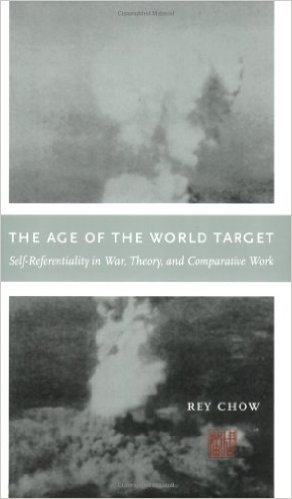
CHOW Age of the worl dtargetI’ve noted before how one of the most immediate and long-lasting effects of Hiroshima and Nagasaki on American post-atomic culture was an extraordinary sense of vulnerability: hence the steady stream of visuals imagining a nuclear attack on cities like New York and Washington.  In The Age of the World Target, Rey Chow writes about

‘…the self-referential function of virtual worlding that was unleashed by the dropping of the atomic bombs, with the United States always occupying the position of the bomber, and other cultures always viewed as the … target fields.’

But in an important sense she couldn’t be more wrong.  Here is Paul Boyer in By the Bomb’s Early Light:

‘Physically untouched by the war, the United States at the moment of victory perceived itself as naked and vulnerable. Sole possessors and users of a devastating instrument of mass destruction, Americans envisioned themselves not as a potential threat to other peoples, but as potential victims.’

Or, as Peter Galison put it, writing in Grey Room 4 (2001),

Here stands a new, bizarre, and yet pervasive species of Lacanian mirroring. Having gone through the bomb-planning and bomb-evaluating process so many times for enemy maps of Schweinfurt, Leuna, Berlin, Hamburg, Hiroshima, Tokyo, and Nagasaki, now the familiar maps of Gary, Pittsburgh, New York City, Chicago, and Wichita began to look like them.

And, as it happens, American cities did become targets – for US Strategic Air Command.
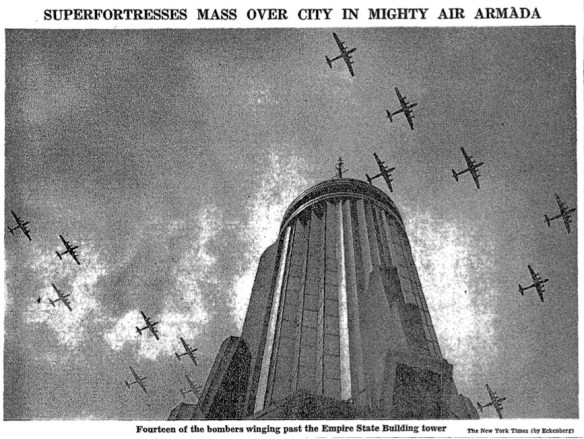
Operation Pacific NYT 17 May 1947

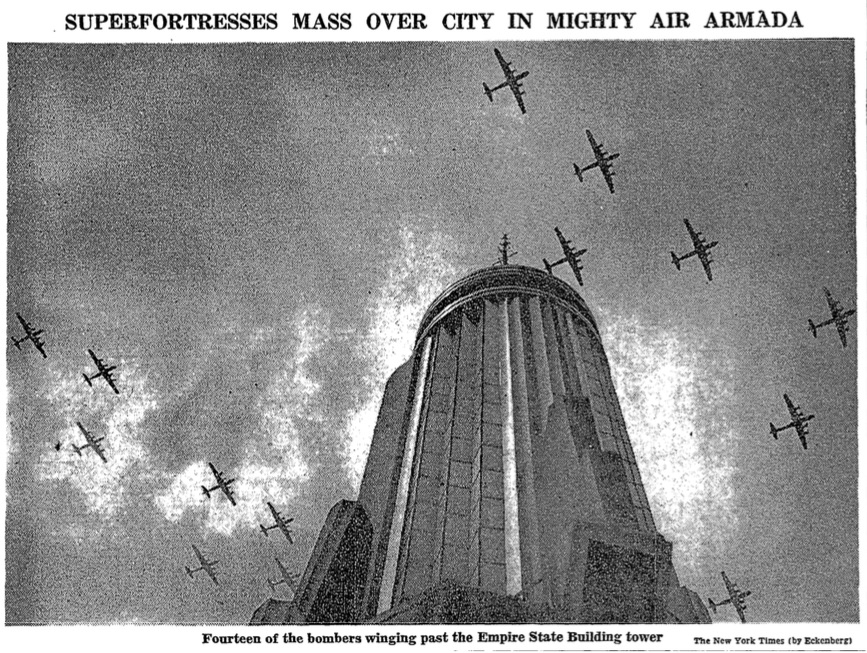
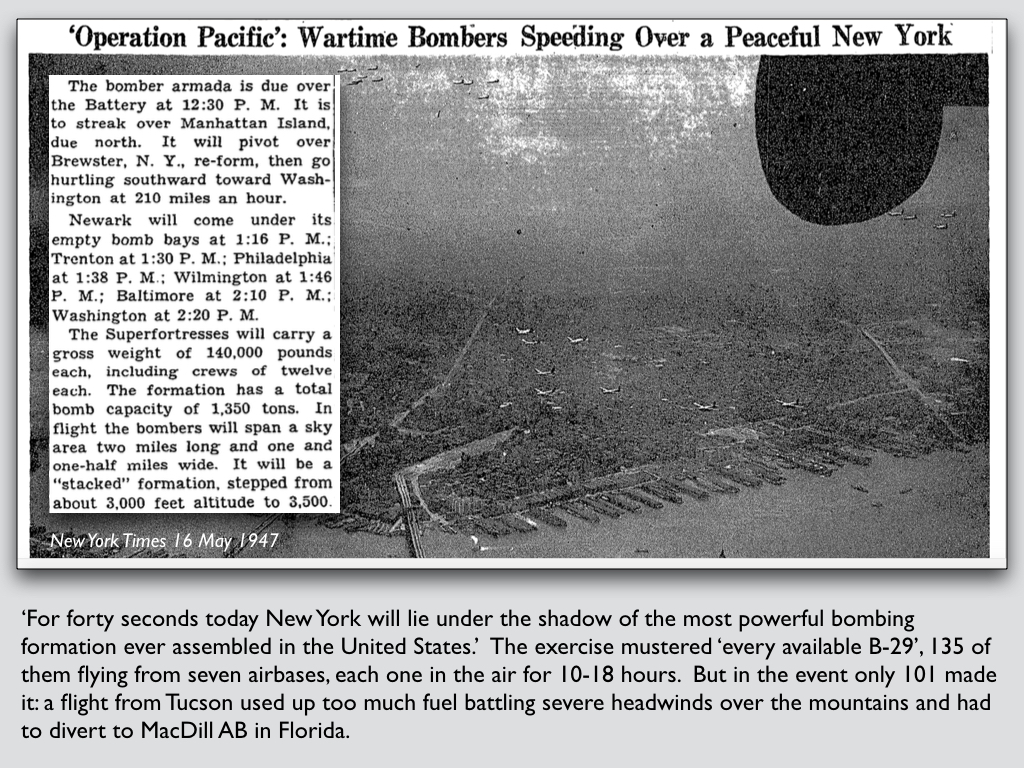
In May 1947 an exercise – ‘Operation Pacific’ – was carried out over the cities of the Eastern seaboard from New York to Washington.  Its title was not a tribute to the geospatial intelligence of the US Air Force: General George Kenney, commander of SAC, asked reporters to emphasize that this was, in its way, a peace-keeping mission, ‘an exercise not an attack’, and that the cities involved were ‘objectives’ not targets – so they weren’t candidates for inclusion in the Bombing Encyclopedia of the World

But it was a disappointment to all concerned:
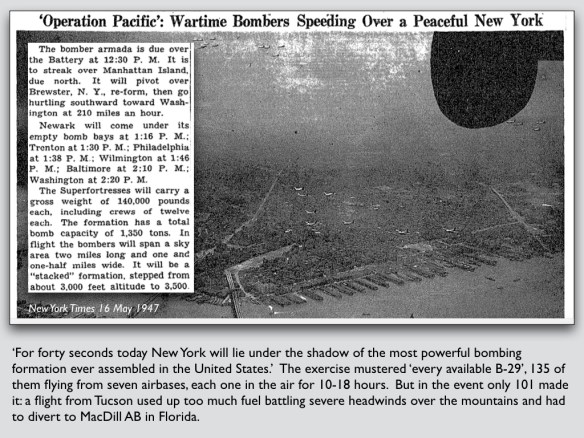
Operation Pacific, New York, May 1947.001

The public was let down by the lack of spectacle.  According to the New York Times,

‘The squadron from Fort Worth missed the rendezvous by twenty minutes… [which] destroyed the effect of a mass bombing the main-in-the-street had been led to expect…

‘Check-up from the Battery to the Yonkers line indicated that public disappointment was general if not unanimous. Brooklyn, Queens, Staten Island and the Bronx, where hundreds of thousands turned out on the streets and on rooftops, alike reported that nowhere was there acclaim or enthusiasm, except in school-yards and other places where small-fry congregated.’

The senior brass were even more dismayed.  Philip Meilinger described it as a ‘sad situation’ so ‘in August SAC tried again, against Chicago, but the performance was even worse.’

In 1948 Kenney was replaced by another veteran, Curtis LeMay, who was determined to lick SAC into shape – and preferably far from the watchful eyes of the public.  Three months after he assumed command, LeMay ordered a bombing exercise against a target field near Wright-Patterson AFB at Dayton, Ohio.  In To kill nations, Edward Kaplan bleakly observes:

‘To simulate the inaccurate maps of many Soviet targets, [LeMay] gave the bomber crews 1930s-era charts.  As LeMay suspected, because of equipment failures when taken up to operational altitudes [until then the crews had been flying at 15,000 not 40,000 feet] and gaps in training, the crews utterly failed to accomplish the mission.  Everything that could go wrong, did.  Not one crew would have bombed the target successfully.  Of 303 runs made at the target, the circular error probable was 10,100 feet, outside the effective radius of a Hiroshima-size weapon.’

LeMay ordered an intensive programme of training and practice.  A key resource was radar bomb scoring (see also here):
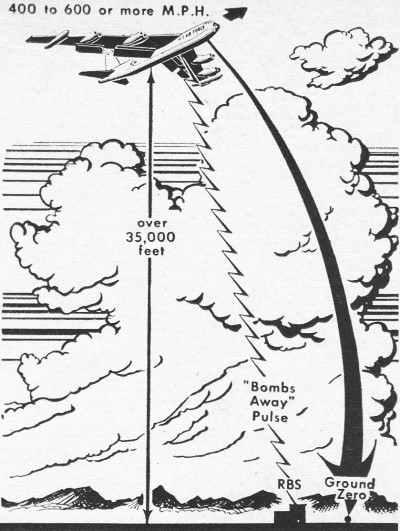
radar-scores-sac-bombing-test-pe-december-1956-2

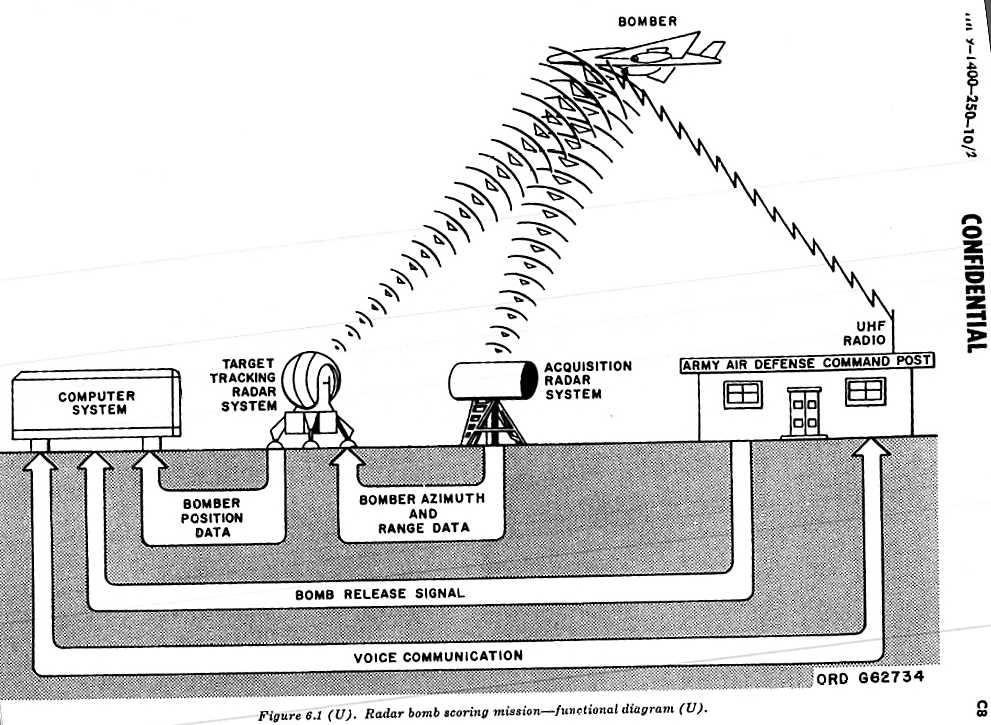
According to Sigmund Alexander, in 1947 SAC completed more than 12,000 radar bomb scoring runs; the next year the number soared to 28,049, an average of about 76 runs per day.  In 1956 Popular Electronics – from which I’ve borrowed the diagram above explained the procedure:

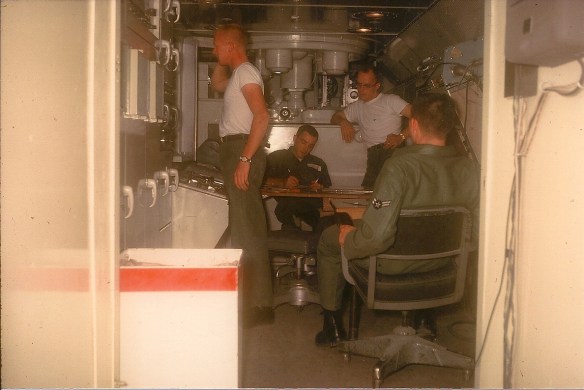
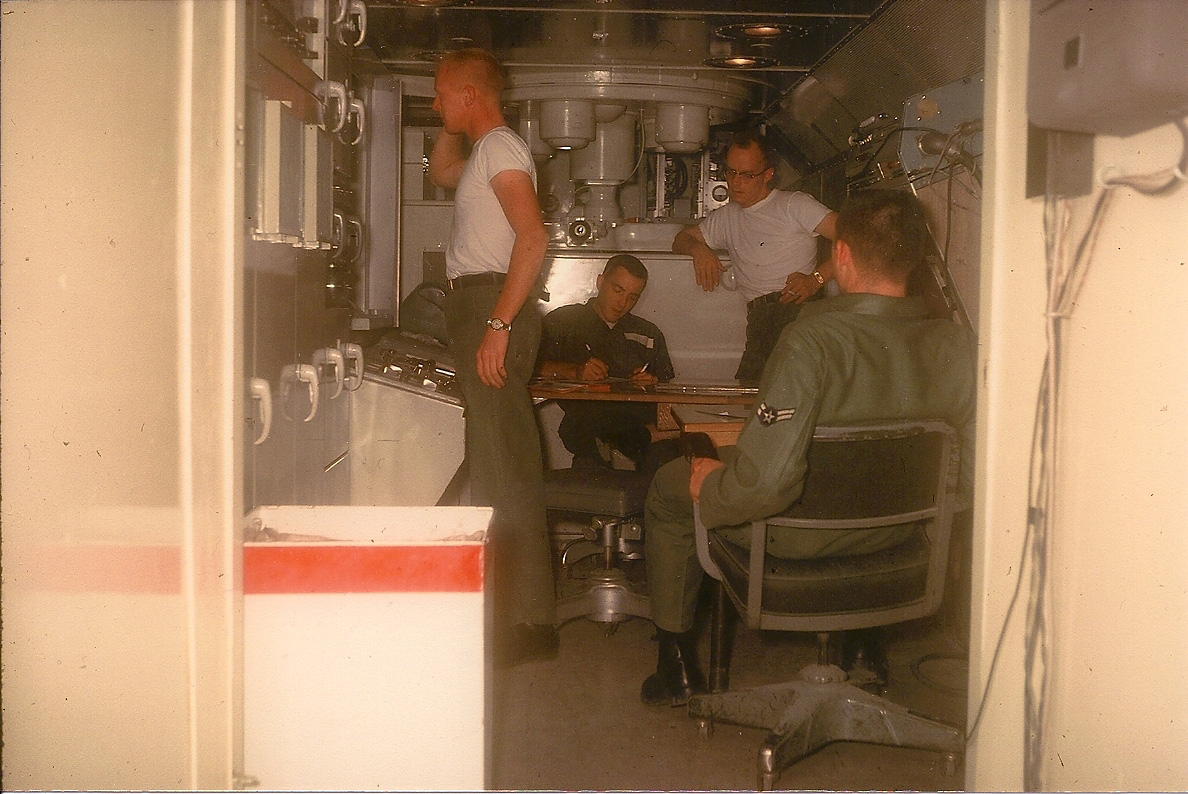
‘Airmen cried “Bombs away!” but instead of devastating blasts the only visible evidence of the crew’s ability to destroy a target was cryptic electronic signals observed by technicians at work inside a special radar station.… When the airplane signals “Bombs away!” a radar pulse is sent from the bomber to the ground station, known as a Radar Bomb Scoring (RBS) unit. The station is built inside a mobile van. A Mobile Radar Control System (MSQ) in the van uses the received pulses to track the course of the bomber, while computers determine the accuracy of “hits.” Blips across a radarscope represent the flight path of the plane. The results of the scoring computer are shown as a thin red line traced by an electronic “pen” on a sheet of blank paper. With this data, the RBS group working in the van knows just where the “bomb” hits.’
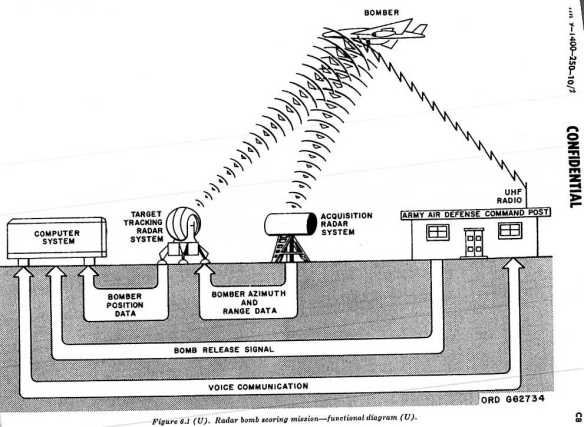
BombScoreMission-

This was virtual bombing, and it was a highly skilled affair.  Colonel Francis Potter recalls:

These practice bomb runs …  required a large amount of skill between the radar operator and the navigator to correctly identify the necessary check points to arrive at “bombs away” time on the correct heading and on time. The co-pilot would normally contact the bomb site via VHF (Very High Frequency) radio and relay the required information…. If memory serves me, we reported crew number, operator’s name, target designator, altitude, and type of release, IP (initial point, where you started the bomb run) and direction of flight at the time of “release.”  This info would be repeated to us and confirmed. Our position would be reported when over the IP point, usually some 50-60 miles out. After passing this point, directional control of the aircraft would be passed to the radar operator, who could tie it into his sighting system, and using the auto pilot small directional controls would be made. At the proper time prior to “release”, a continuous radio “tone” would be emitted which would alert the scoring site that release was imminent. At the proper time and place, the tone would stop. This was the release point. The co-pilot would announce to the site “bombs away.”  The site would then “score” the probable impact point, using wind drift and other factors that apply. After a few suspenseful moments, the site would contact us with an encoded score. We could de-code this and find that our bomb had hit XXX feet in which direction and distance from the intended point of impact. Obviously close to the desired spot was always the hoped for results. We would then return to the same IP or another in the same area and perform another run. We often stayed at the same site for several hours running one practice run after another. The scores the operator obtained would be catalogued and a probable CE (circular error) would be determined. This would be determined for each set of bomb runs and would be considered in determining the “over-all” accuracy of the individual operator.

But aircrews soon became over-familiar with the fixed targets on designated bombing ranges.  Here is Don Ross:

When the aircrew was scheduled to simulate bombing a target in our area (we had about 15 or 20 targets, which could be a barn, a building, a cross roads, a fence post, or just coordinates on a map), they would contact us and we would position the target they were going after on our plotting board, track them in and measure how well they did….

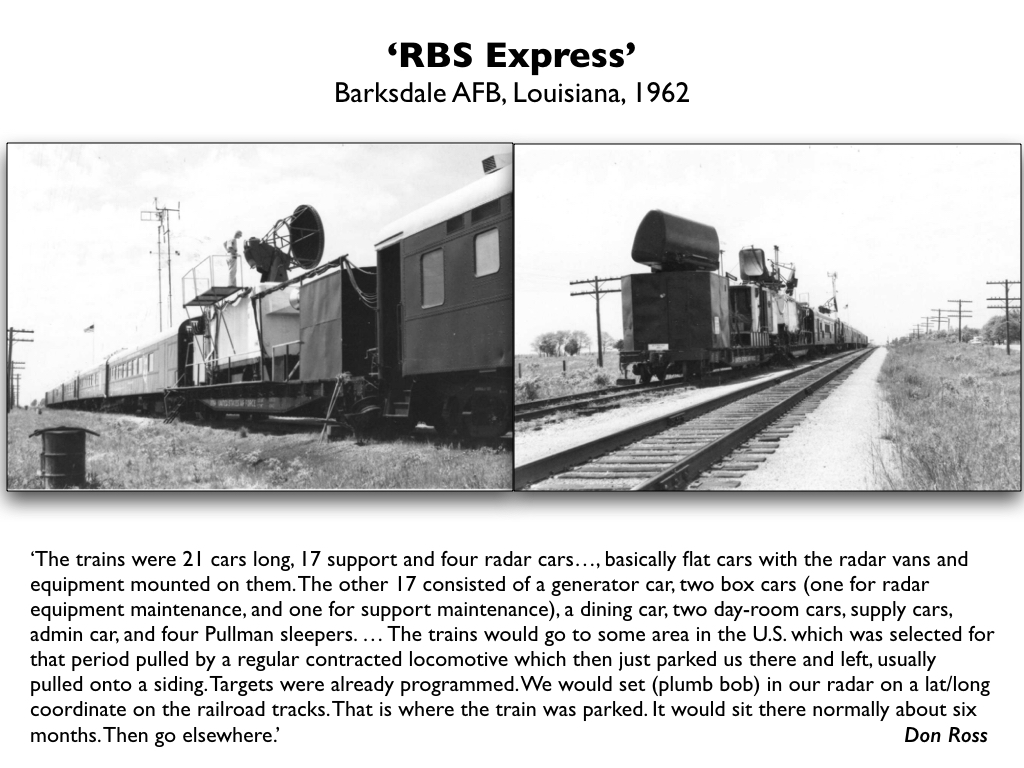
Well, the aircrews flew against these targets so often, that they became good at hitting them, Damn good. So good, they could do it in their sleep. So, to ensure they were able to actually keep remembering how to set up and find the target, SAC set up even more targets all over the country. As they were well beyond the reach of our detachments, each Squadron was given a train…

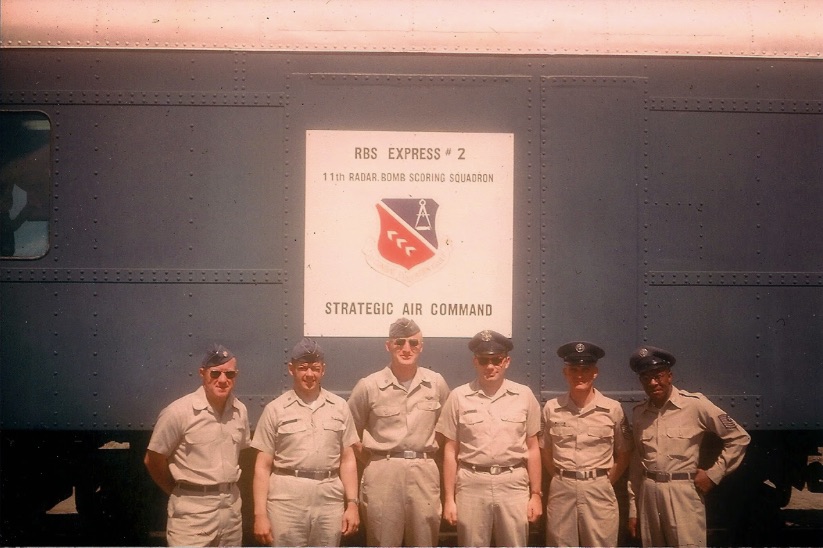
Starting in 1961, three special trains were fitted with the necessary equipment (see below; more images here and here):
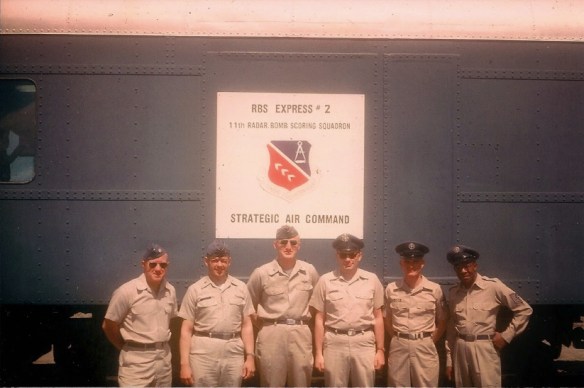
RBS Express 11th RBS Squadron

Targets would now move from city to city onboard the ‘RBS Express’:
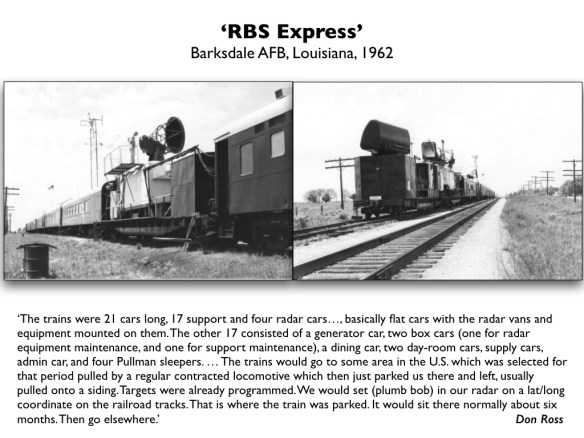
RBS Express.001

insideMSQ39

During the wars in Korea and Vietnam, radar bomb scoring was reverse-engineered to guide bombers to their targets (see my discussion of ‘Skyspot‘ in ‘Lines of Descent: DOWNLOADS tab; you can also find much more in this evaluation report from Vietnam here).

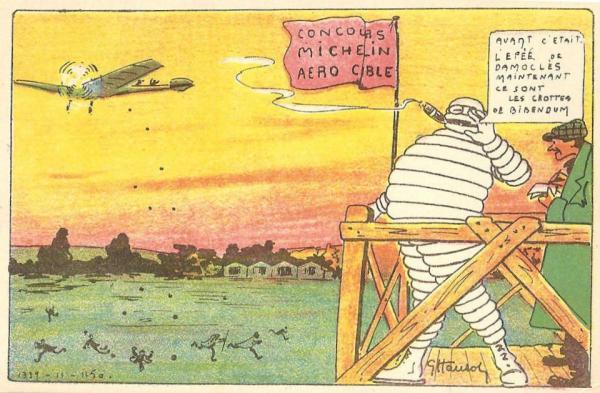
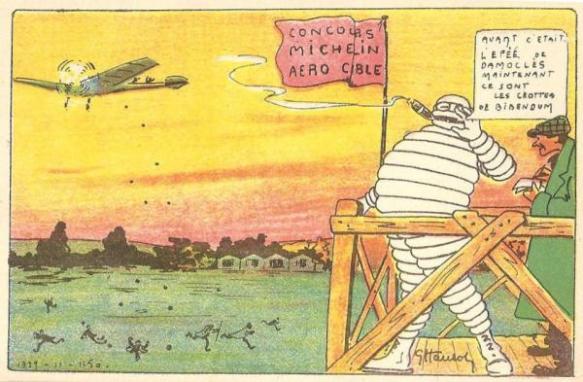
But here’s the thing.  In a previous post I described how the Michelin brothers established a bombing competition (the Aero-Cible or Air Target Competition) in 1911 to convince politicians and the public that bombing was the future of military aviation – and, no doubt, that Michelin was the company to produce the aircraft:
aero_cible_michelin_1_bib

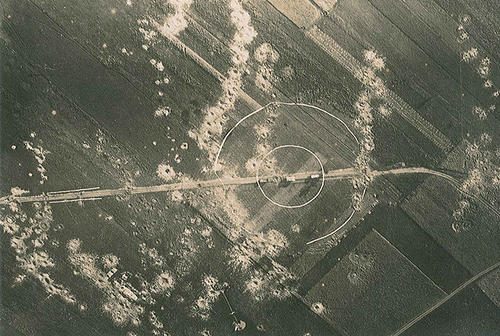
The results, incidentally, were not especially encouraging:
Michelin aero-cible

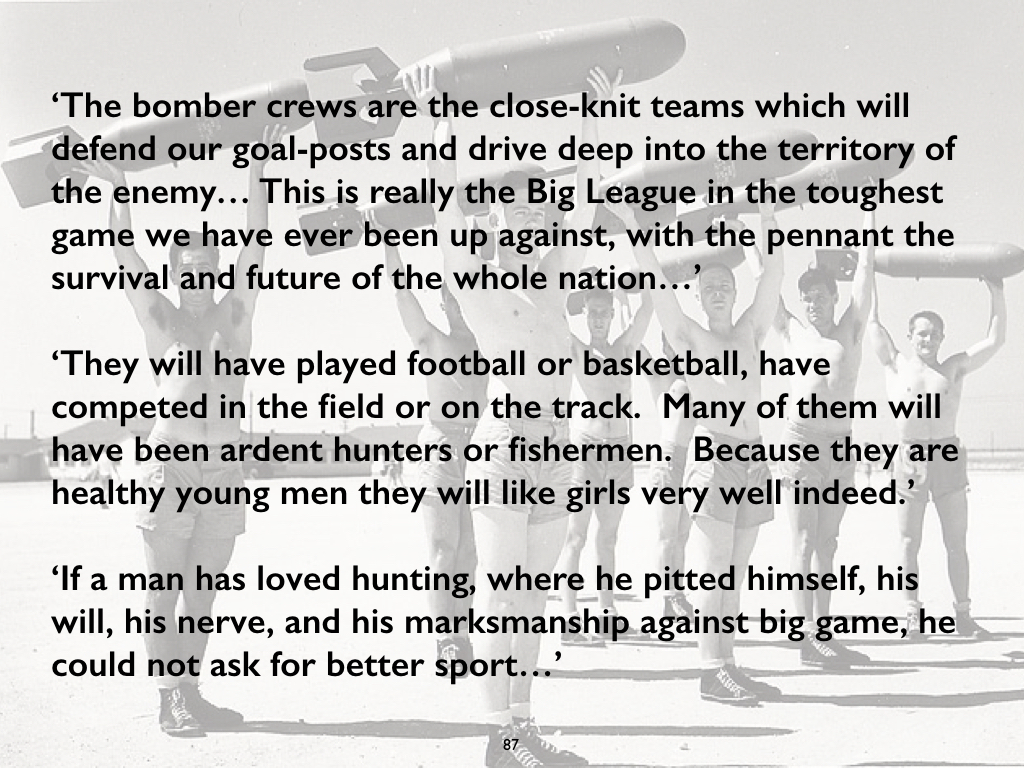
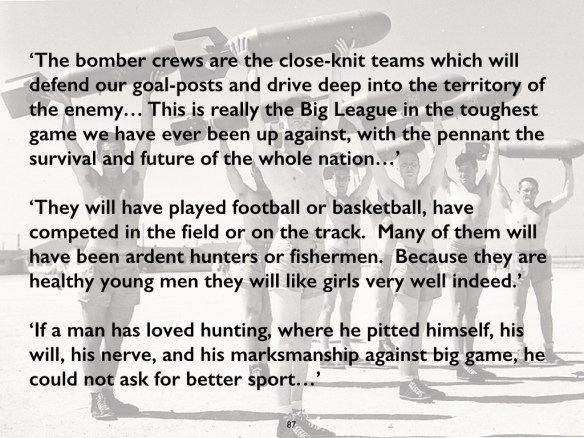
The idea of bombing as a ‘sport’ figured in my subsequent discussion of the moral economy of bombing.  Here, for example, is John Steinbeck on US bomber crews in the Second World War in Bombs Away!
The Big League.001

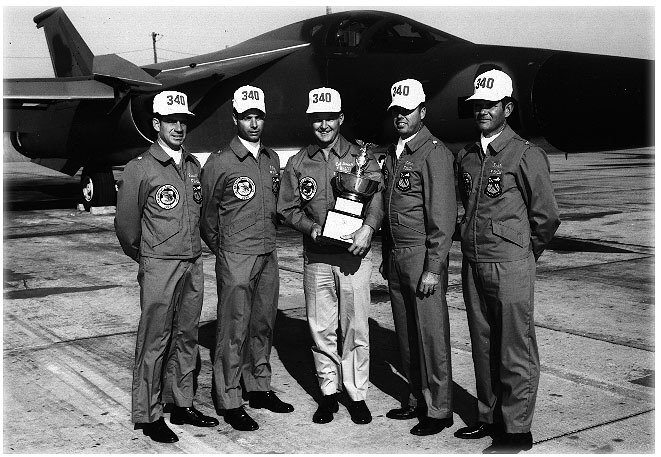
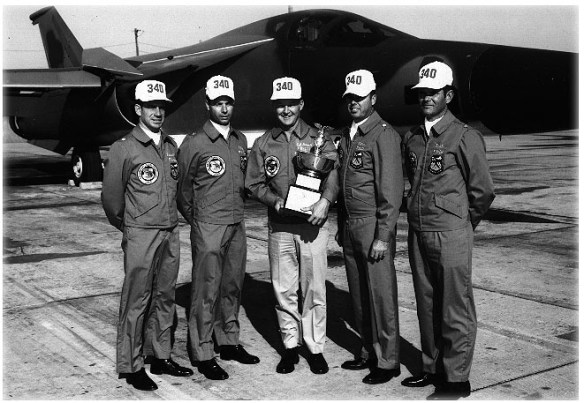
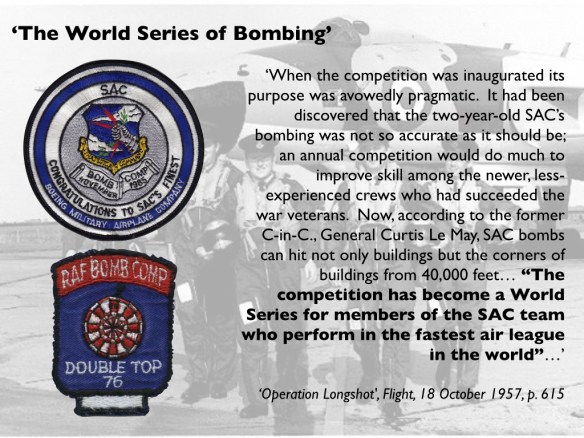
Radar bomb scoring carried this extraordinary metaphoric into the Cold War with Strategic Air Command’s inaguration of what became known as ‘Bomb Comp’, held between 1948 and 1992.  Here are the lucky winners in 1970, the 8th Air Force’s 340th Bomb Group – note the trophy and the baseball caps.
Bomb Comp Winners 8th AF 340th Bomb Group 1970

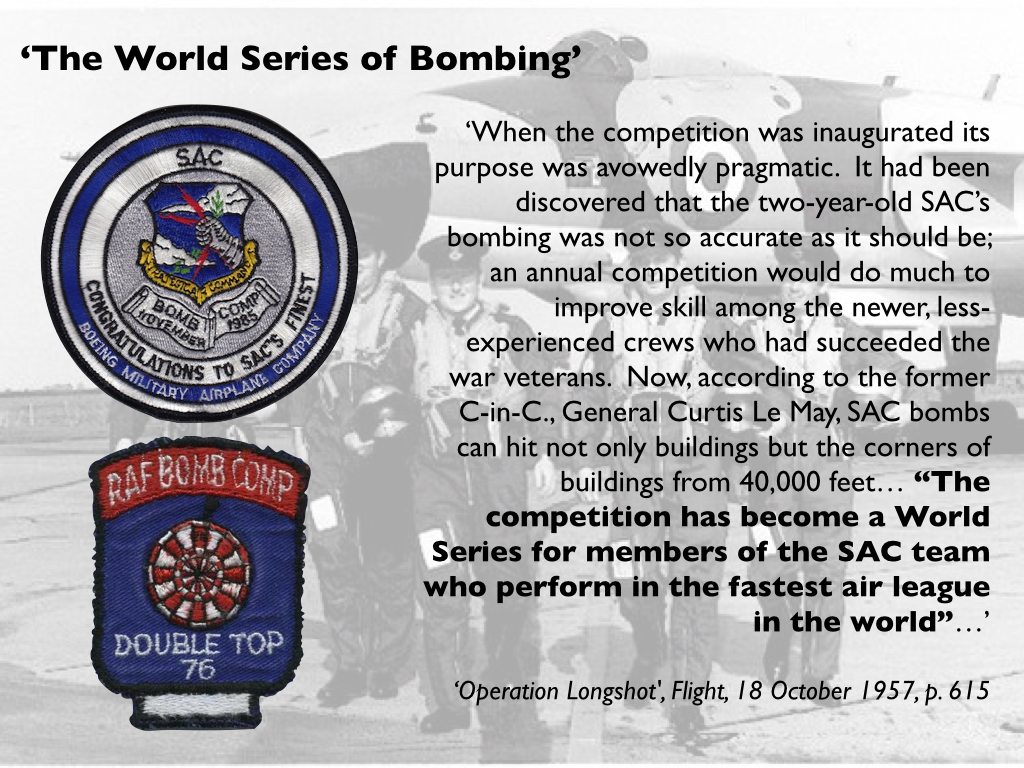
This often involved competitions with Britain’s Royal Air Force, and it became known not as Steinbeck’s ‘Big League’ but as ‘the World Series of Bombing’:
World Series of Bombing.001

You might be able to blow it up – but you couldn’t make it up.

Drone observations

I’m just back from a lovely week at Dartmouth, so there’s lots to catch up on.  This post is confined to (yet more) notes on writing about drones.  It’s selective, partly because I’m sure I’ve missed all sorts of important recent contributions – and if I have please let me know – but partly because so many supposedly critical interventions retrace familiar steps unburdened by substantive research.
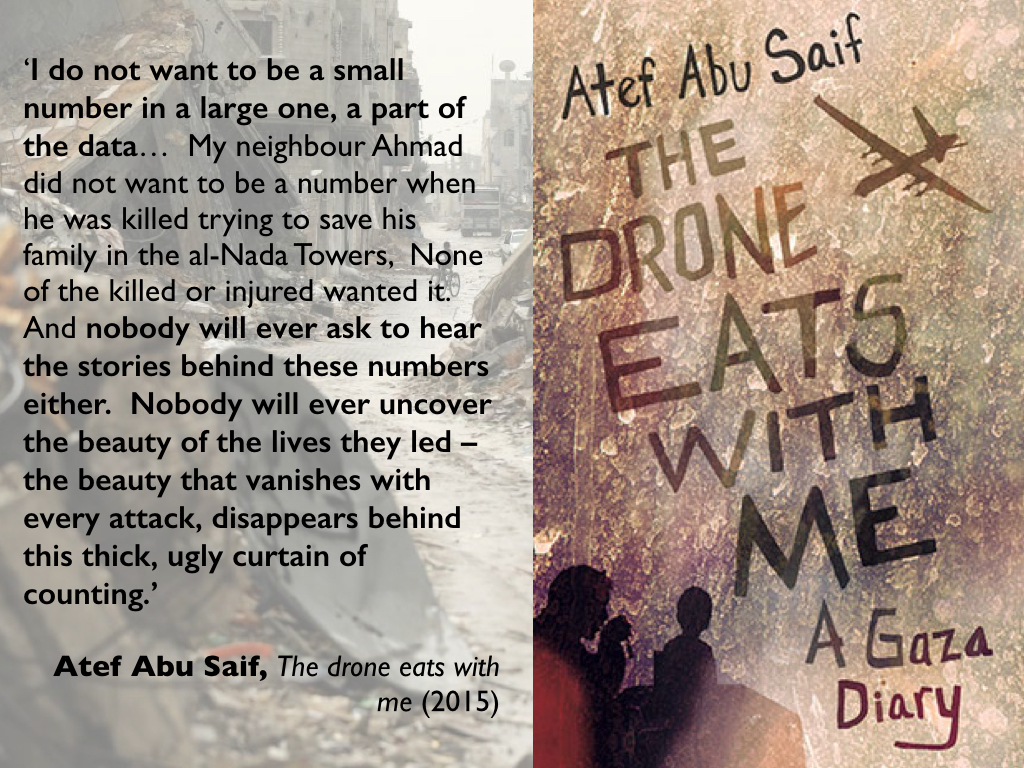
This is far from the case with this one.  Part of the purpose of my stay in Dartmouth was to spend time with Kate Kindervater, one of the first cohort of five post-docs at Dartmouth’s new Society of Fellows (selected from 1700 applicants!).   She completed her PhD at the University of Minnesota last year on ‘Lethal Surveillance: Drones and the Geo-History of Modern War‘.

Interdisciplinary both in scope and method, my dissertation, Lethal Surveillance: Drones and the Geo-History of Modern War, examines the history of drone technology from the start of the 20th century to the present in order to understand the significance of the increasing centrality of drones to current American military engagements and security practices more generally. Much of the scholarship on drones and many other contemporary military technologies tends to view the technology as radically new, missing both the historical development of these objects as well as the perspectives and rationalities that are embedded in their use. For this research, I focused on three main periods of drone research and development: the early years of World War I and II in the UK, the Cold War, and the 1990s. In studying this history of the drone, I found that two key trends emerge as significant: the increasing importance of information to warfare under the rubric of intelligence, reconnaissance and surveillance; and a shift toward more dynamic, speedier, and individualized targeting practices. I argue that the widespread use of drones today thus represents the culmination of attempts in war to effectively link these two trends, creating a practice I call lethal surveillance — with the armed Predator effectively closing the loop between identifying and killing targets. The concept of lethal surveillance, which in my dissertation I place squarely within the histories of modern scientific thinking and Western liberal governance, allows us to see how techniques of Western state power and knowledge production are merging with practices of killing and control in new ways, causing significant changes to both the operations of the state and to practices of war. Framing the drone through the lens of lethal surveillance, therefore, allows us to see the longer histories the drone is embedded in as well as other security practices it is connected to.

We had lots of really good conversation, and while I was at Dartmouth Kate had a paper published at Security dialogue, drawing from her thesis: ‘The emergence of lethal surveillance: Watching and killing in the history of drone technology’:

This article examines the history of the development of drone technology to understand the longer histories of surveillance and targeting that shape contemporary drone warfare. Drawing on archival research, the article focuses on three periods in the history of the drone: the early years during World Wars I and II, the Cold War, and the 1990s. The history of the drone reveals two key trends in Western warfare: the increasing importance of intelligence, surveillance, and reconnaissance (ISR) and the development of dynamic targeting. These trends converge today in a practice of lethal surveillance where ISR capabilities are directly linked to targeted killing, effectively merging mechanisms of surveillance and knowledge production with decisions on life and death. Taking this history of lethal surveillance into account not only reframes current debates on drone warfare, but also connects the drone to other practices of security and control.

Kate is absolutely right to trace through the trajectories of ISR and dynamic targeting, and I applaud the way in which she doesn’t move directly from colonial ‘air policing’ and ‘pilotless bombing’ (in the case that interests her the most, in Iraq in the 1920s) to today’s remote operations but insists on the pivotal importance of the Cold War and, post-1989, Kosovo.  Kosovo is particularly interesting, I think, and here is my own summary take on developments there:

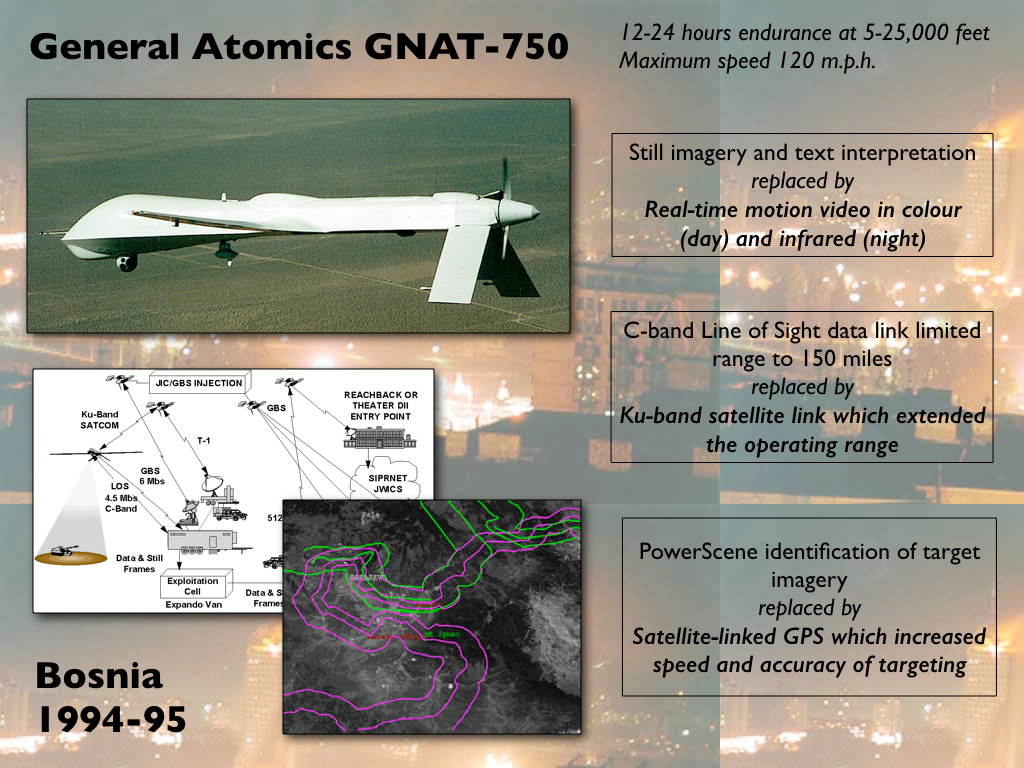
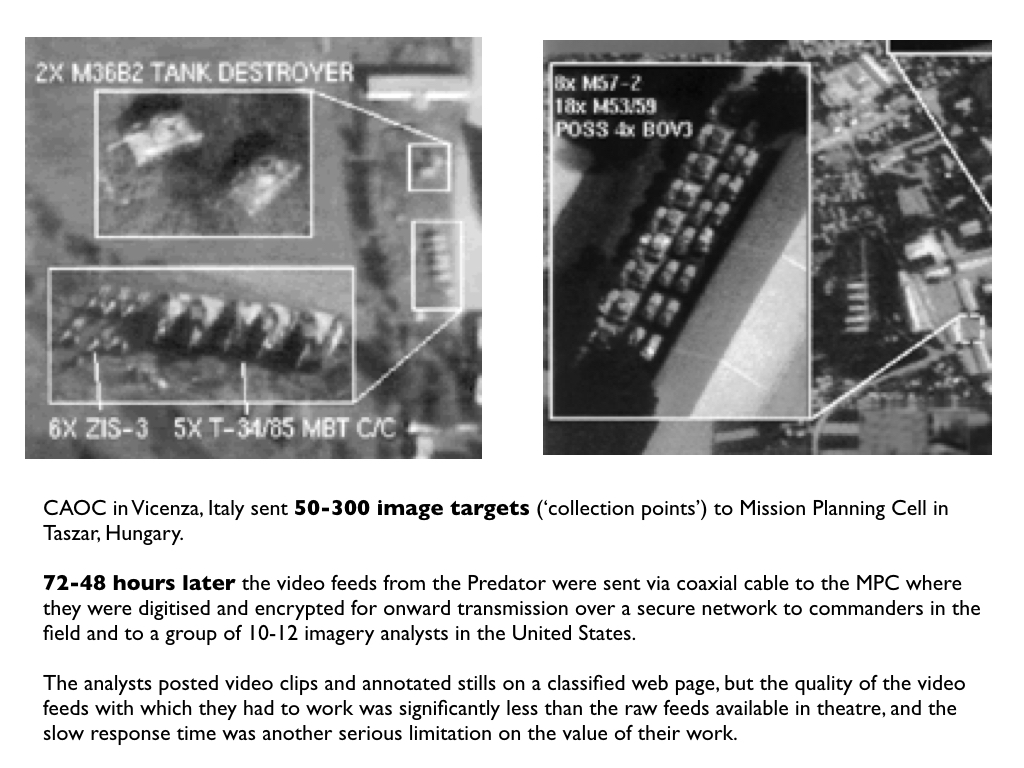
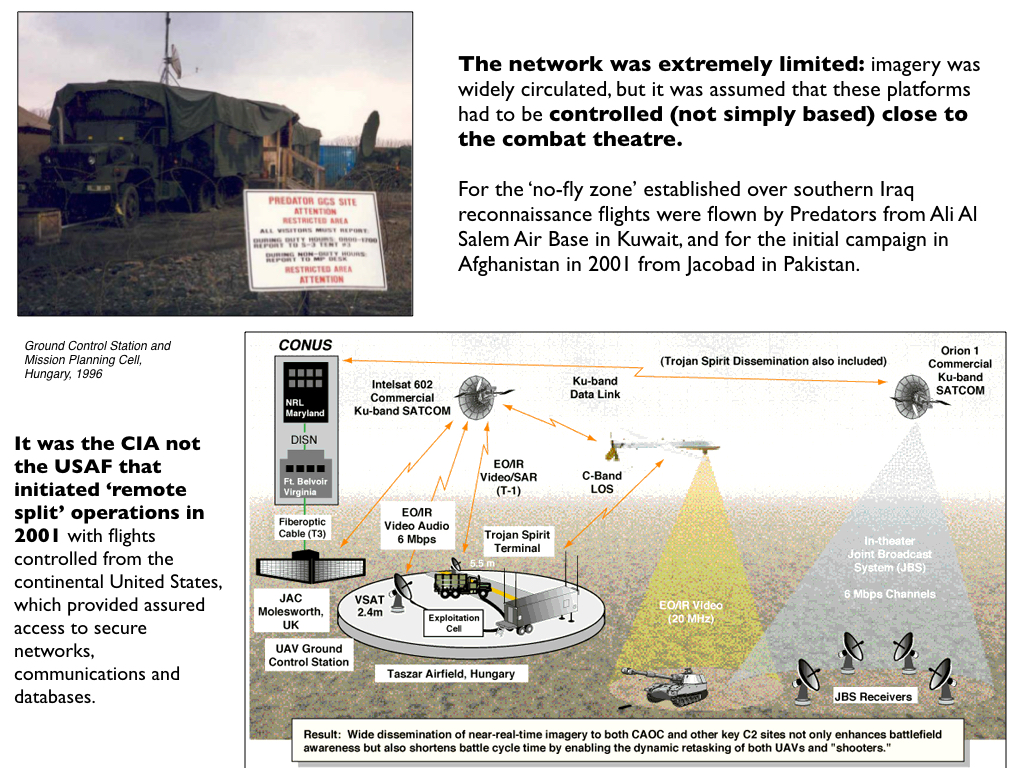
Predator precedents in Bosnia.001 Predator precedents in Bosnia.002 Predator precedents in Bosnia.003

Another exceptionally interesting paper is Cara Daggett‘s ‘Drone disorientations: how unmanned weapons queer the experience of killing in war’, which appeared in the International journal of feminist politics 17 (3) (2015) 361-379:

Killing with drones produces queer moments of disorientation. Drawing on queer phenomenology, I show how militarized masculinities function as spatiotemporal landmarks that give killing in war its “orientation” and make it morally intelligible. These bearings no longer make sense for drone warfare, which radically deviates from two of its main axes: the home–combat and distance–intimacy binaries. Through a narrative methodology, I show how descriptions of drone warfare are rife with symptoms of an unresolved disorientation, often expressed as gender anxiety over the failure of the distance–intimacy and home–combat axes to orient killing with drones. The resulting vertigo sparks a frenzy of reorientation attempts, but disorientation can lead in multiple and sometimes surprising directions – including, but not exclusively, more violent ones. With drones, the point is that none have yet been reliably secured, and I conclude by arguing that, in the midst of this confusion, it is important not to lose sight of the possibility of new paths, and the “hope of new directions.”

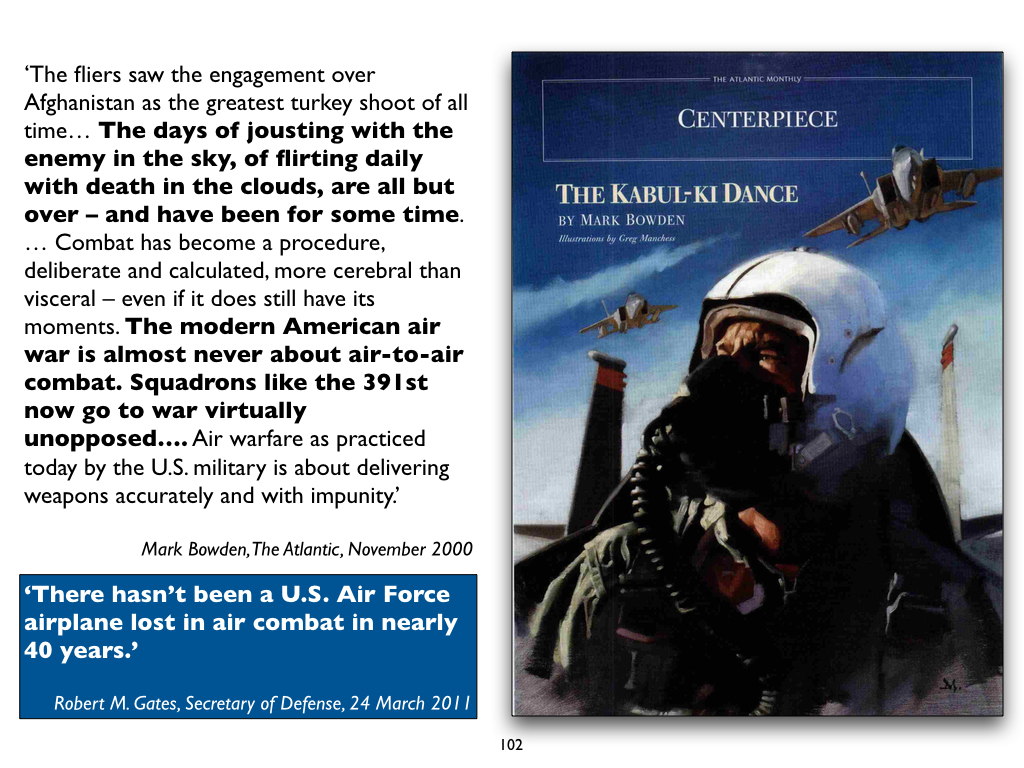
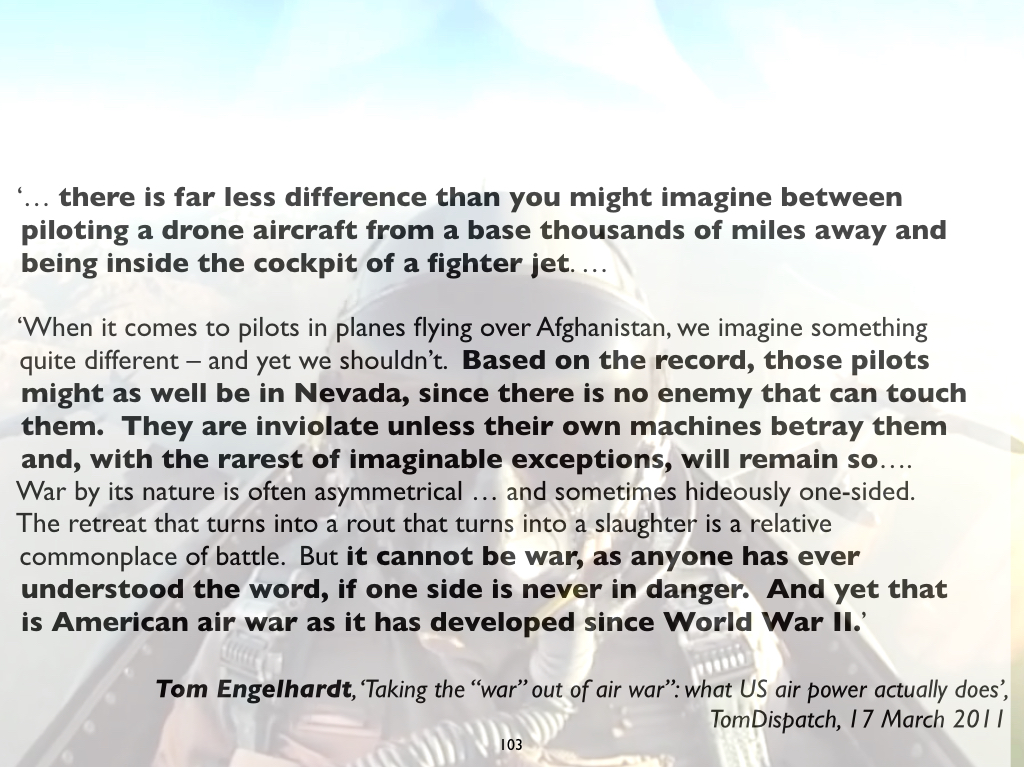
There have been several commentaries that take the ‘un-manning’ of remote operations literally and seriously, and I drew on several of them in accounting for the moral economy of bombing in my Tanner Lectures last month: the (hideous) claim that bombing is, in all sorts of ways, virile and manly – so that, by extension, those who fly today’s Predators and Reapers are neither since they are never in harm’s way.  It’s an alarming argument, since it inadvertently legitimates (and even celebrates) the masculinism of conventional bombing, misses the new reality of today’s air wars, and ignores a crucial observation made by Robert Gates [the slides below are from my Tanner Lectures]:

Unopposed air war.001Unopposed air war 2.001

Cara’s argument is much more artful than that, and well worth thinking through.

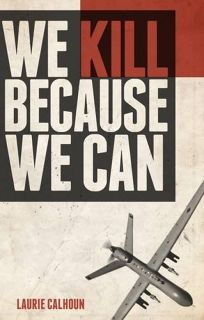
As both writers know, the use of military drones is not confined to targeted killing (though so many continue to write as though that were the case).  That said, Laurie Calhoun‘s We kill because we can: from soldiering to assassination in the drone age (Zed Books, 2015) is as deft an examination of the issues that you can find:

Welcome to the Drone Age. Where self-defense has become naked aggression. Where courage has become cowardice. Where black ops have become standard operating procedure. In this remarkable and often shocking book, Laurie Calhoun dissects the moral, psychological and cultural impact of remote-control killing in the twenty-first century. Can a drone operator conducting a targeted killing be likened to a mafia hitman? What difference, if any, is there between the Trayvon Martin case and the drone killing of a teen in Yemen? We Kill Because We Can takes a scalpel to the dark heart of Western foreign policy in order to answer these and many other troubling questions.

CALHOUN We kill because we canPreface
Introduction

Part I: Find
1. Drone Nation
2. From Black Ops to Standard Operating Procedure
3. The Logic of Targeted Killing
4. Lethal Creep

Part II: Fix
5. Strike First, Suppress Questions Later
6. The New Banality of Killing
7. The Operators
8. From Conscience to Oblivion

Part III: Finish
9. Death and Politics
10. Death and Taxes
11. The Death of Military Virtue
12. Tyrants Are as Tyrants Do

Conclusion
Postface
Appendix: Drone Killing and Just War Theory

You can find an extended interview with Laurie here.

Finally – and as you’ll soon see from an upcoming post – I can’t seem to stop wandering through the nuclear wastelands.  I described the role that drones played in the early development of Strategic Air Command (through its “Project Brass Ring”) and in monitoring US atomic tests in the Marshall Islands in my “Little Boys and Blue Skies” presentation at Toronto last fall (see DOWNLOADS tab and the extended post here), which I reworked for one of my presentations at Dartmouth.  Over at Bard College’s Center for the Study of the Drone, Dan Gettinger replays the same little-known story – though he doesn’t play it forward to the atomic tests that took place at the Nevada Proving Grounds and the role of Indian Springs as a base for those early drone missions in the continental United States.  Indian Springs is now Creech Air Force Base, of course, one of the central nodes for today’s remote operations.

Still reaching from the skies…

Sorry for the long silence – I’ve had my head down since soon after Christmas preparing the Tanner Lectures which I gave this past week in Cambridge [‘Reach from the sky: aerial violence and the everywhere war’].  The lectures were recorded and the video will be available on the Clare Hall website in a fortnight or so: more when I know more.

In outline – and after a rare panic attack the night before, which had me working until 2.30 in the morning –  I organised the two Lectures like this:

ONE

Prelude: The historical geography of bombing

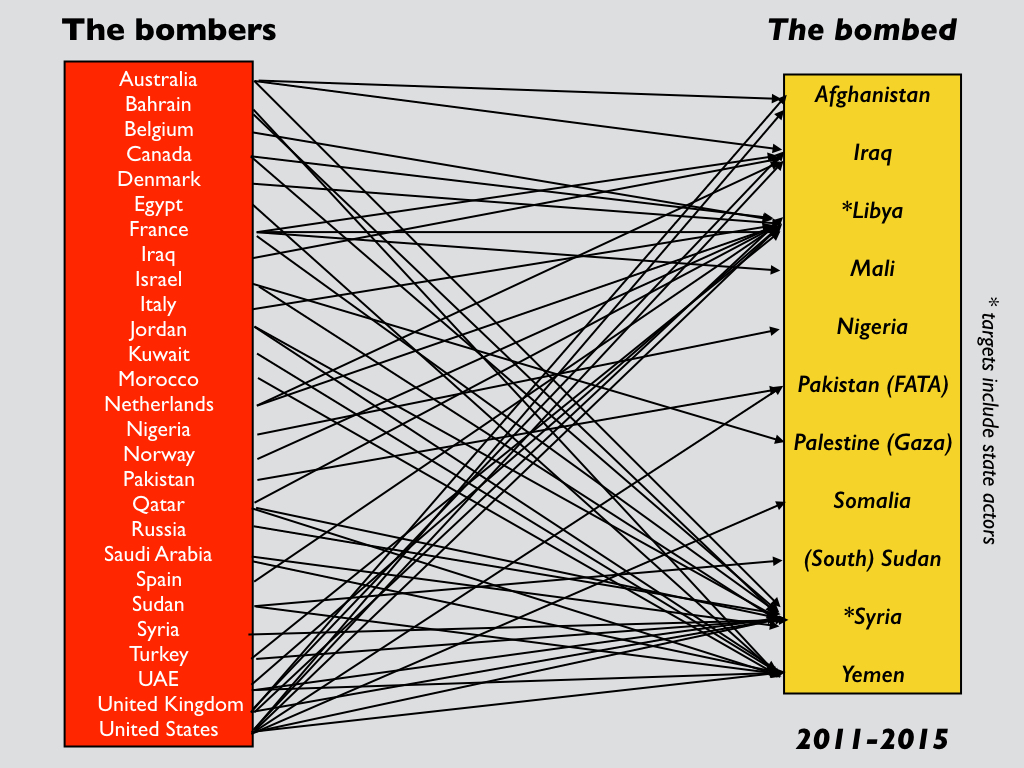
Bombing is back in the headlines but it never really left – and yet those who remain advocates of aerial violence don’t seem to have learned from its dismal history.  They also ignore the geographies that have been intrinsic to its execution, both the division between ‘the bombers and the bombed’ (the diagram below is an imperfect and fragmentary example of what I have in mind) and the pulsating spaces through which bombing is performed.

The bombers and the bombed.001

Good bomb, bad bomb

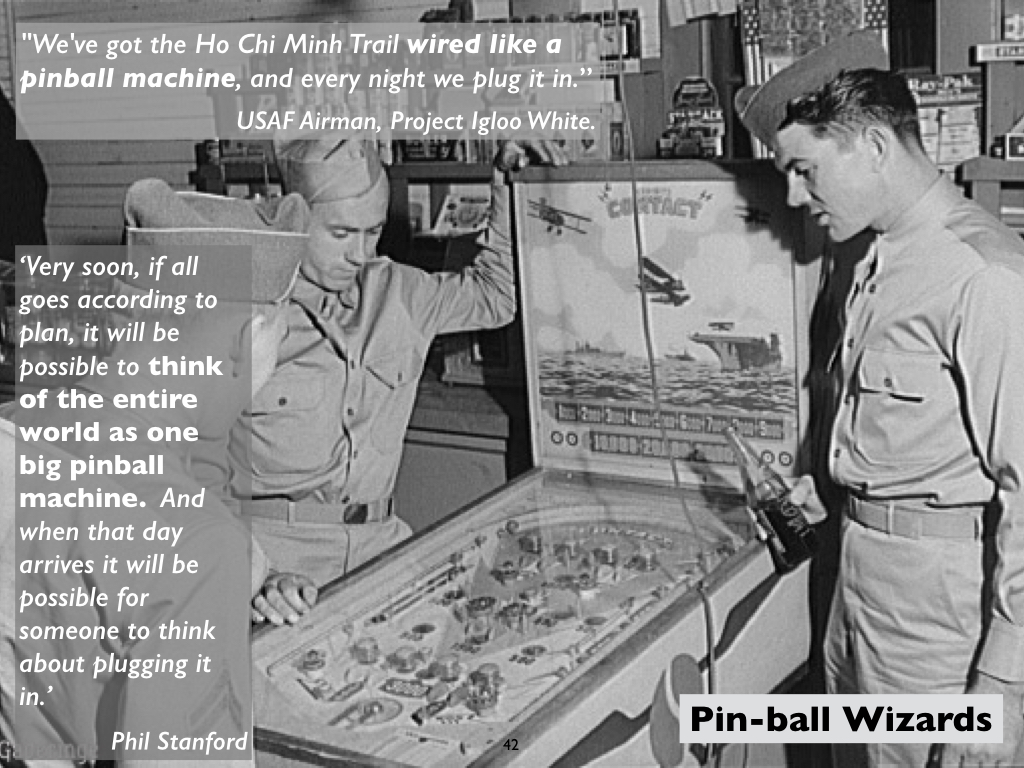
(with apologies to Mahmood Mamdani….)  In the first part I traced The machinery of bombing from before the First World War through to today’s remote operations.  Even though most early commentators believed that the primary role of military aircraft would be in reconnaissance, it was not long before they were being used to orchestrate artillery fire and to conduct bombing from the air. This sequence parallels the development of the Predator towards the end of the twentieth century.  In fact, almost as soon as the dream of flight had been realised the possibility of ‘unmanned flight’ took to the air.  Perhaps the most significant development, though, because it directs our attention to the wider matrix within which aerial violence takes place, was the development of the electronic battlefield in Laos and Cambodia. I’ve written about this in detail in ‘Lines of Descent‘ (DOWNLOADS tab); the electronic battlefield was important not because of what it did – the interdiction program on the Ho Chi Minh Trail was a spectacular failure (something which too many historians have failed to recognise)  – but because of what it showed: it conjured up an imaginative landscape, an automated killing field, in which sensors and shooters were linked through computer systems and automatic relays.  Contemporaries described the system as a vast ‘pinball machine’ (see the image below: you can have no idea how long it took me to track it down…).

Pinball wizards.001

The analogy allowed me to segue into the parallel but wholly inadequate characterisation of today’s remote operations as reducing military violence to a video game.

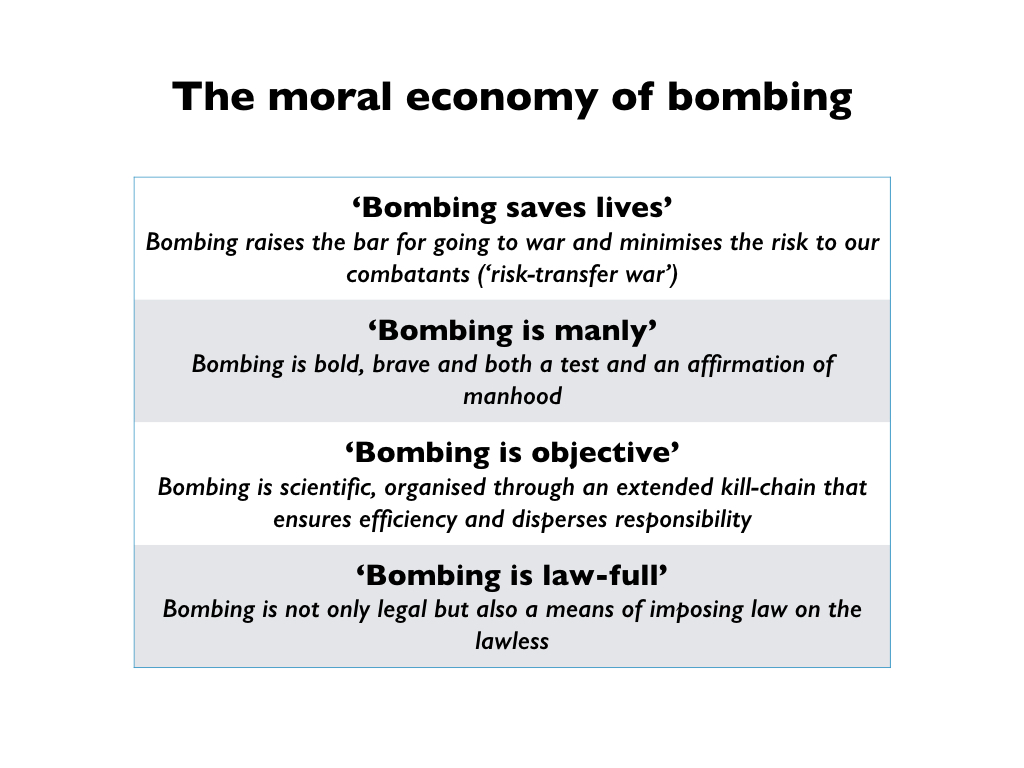
That is an avowedly ethical objection, of course, so I then turned to The moral economy of bombing.  Here I dissected four of the main ways in which bombing has been justified.  These have taken different forms at different times, and they intersect and on occasion even collide.  But they have been remarkable persistent, so in each case I tracked the arguments involved and showed how they have been radicalised or compromised by the development of Predators and Reapers.

Moral economy of bombing.001

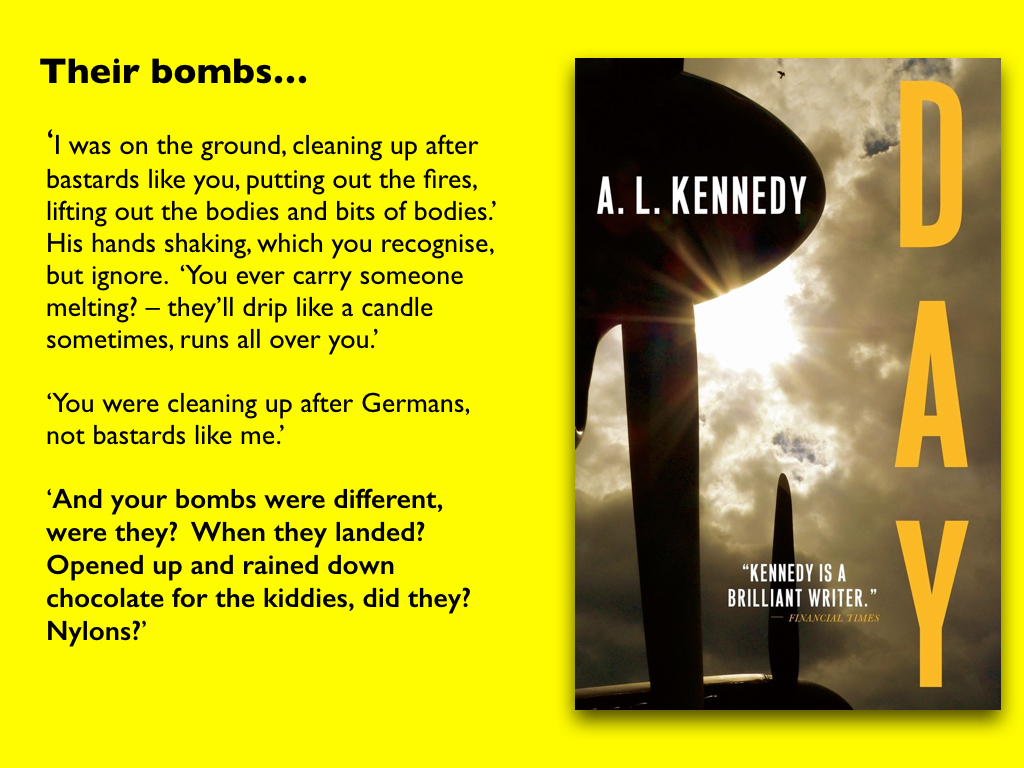
All of these justifications applied to ‘our bombs’, needless to say, which become ‘good bombs’, not to ‘their bombs’ – the ‘bad bombs’.

Their bombs.001

TWO

Killing Space

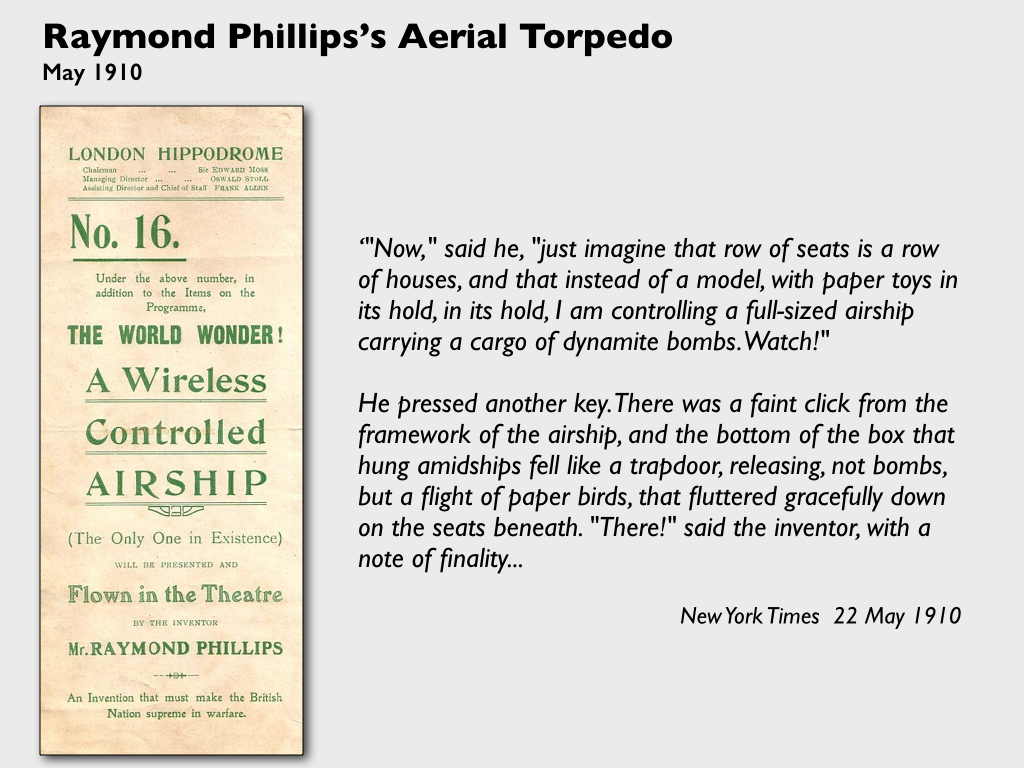
Phillips' Aerial Torpedo.001

I started the second lecture by discussing The deconstruction of the battlefield; the wonder of Raymond Phillips’s fantasies of ‘aerial torpedoes‘ before the First World War was not so much their promise of ‘bomb-dropping by wireless’ but the targets:

Phillips' bomb-dropping by wireless.001

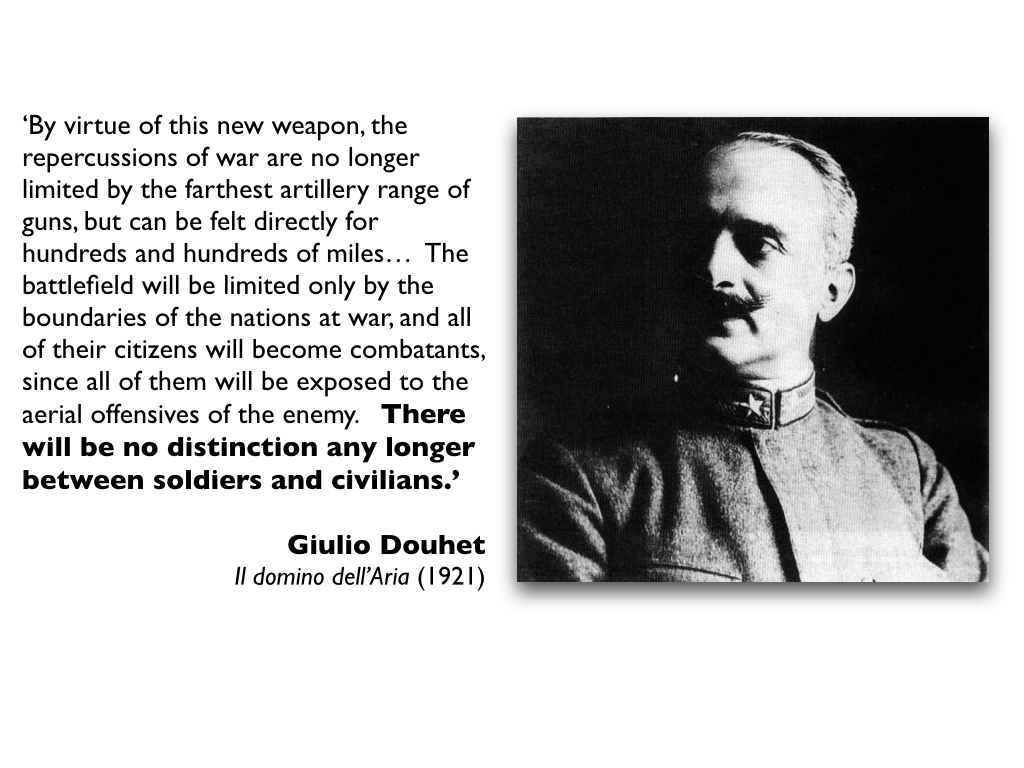
It was this radical extension of the battle space that counted.  In the event,  it was not British airships that dropped bombs on Berlin but German Zeppelins that bombed London and Paris, but the lesson was clear:

Douhet.001

To explore the formations and deformations of the battlespace in more detail, I used the image of The dark heart of bombing to describe a battlespace that alternately expanded and contracted.  So Allied bombing in the Second World war extended its deadly envelope beyond Germany, Italy and Japan into Belgium, Bulgaria, Denmark, France, the Netherlands, Norway and Romania; later the United States would bomb North Vietnam but reserved most of its ordnance for South Vietnam, Laos and Cambodia; and US air strikes in Afghanistan and Iraq would eventually spill over into Pakistan, Syria and elsewhere.  In the course of those air wars, the accuracy of targeting improved until it was possible to aim (if not always to hit) point-targets – individual buildings and eventually individual people – but this contraction of the killing space was accompanied by its expansion.  These ‘point-targets’ were selected because they were vital nodes that made possible the degradation or even destruction of an entire network.  Hence, for example, the Israeli attack on the Gaza power station (more in a previous post here):

Gaza Power Strip.001

A similar argument can be made about the US Air Force’s boast that it can now put ‘warheads on foreheads’, and I linked the so-called individuation of warfare to the US determination to target individuals wherever they go – to what Jeremy Scahill and others describe as the production of a newly expanded ‘global battlefield’.  What lies behind this is more than the drone, of course, since these killing fields rely on a global system of surveillance orchestrated by the NSA, and I sketched its contours and showed how they issued in the technical production of an ‘individual’ not as a fleshy, corporeal person but as a digital-statistical-spatial artefact (what Ian Hacking once called ‘making people up’ and what Grégoire Chamayou calls ‘schematic bodies‘).

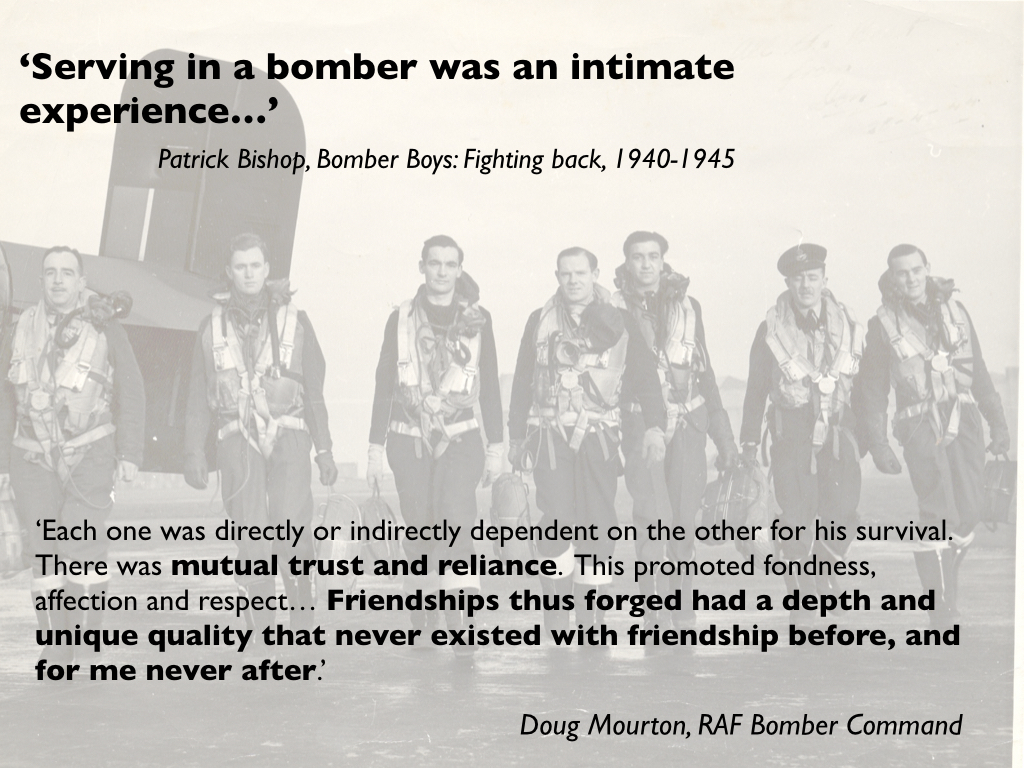
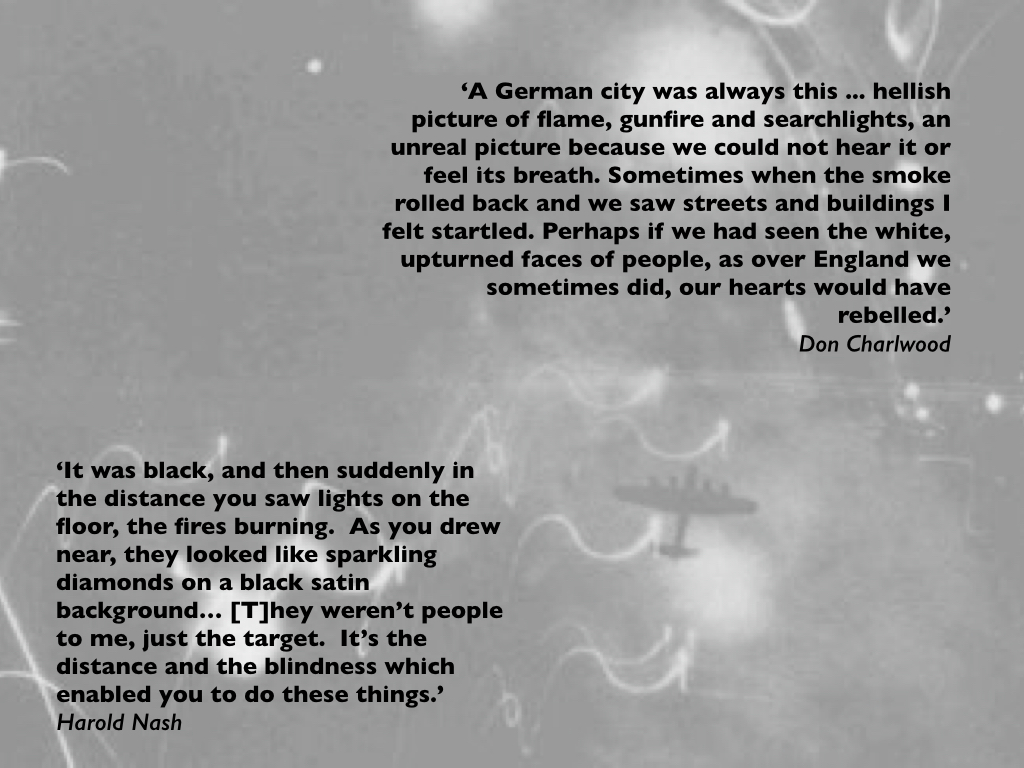
Next I explored a different dialectical geography of the battlespace: Remote splits: intimacy and detachment.  I started with RAF Bomber Command and traced in detail the contrast between the intimacy between members of bomber crews (a mutual dependence reinforced by the bio-convergence between their bodies and the machinery of the bomber itself) and the distance and detachment through which they viewed their targets.

Bioconvergence and the bomber crew.001

Intimacy in Bomber Command.001

The Good Wife.001

Cockpit dials.001

Distance and blindness.001

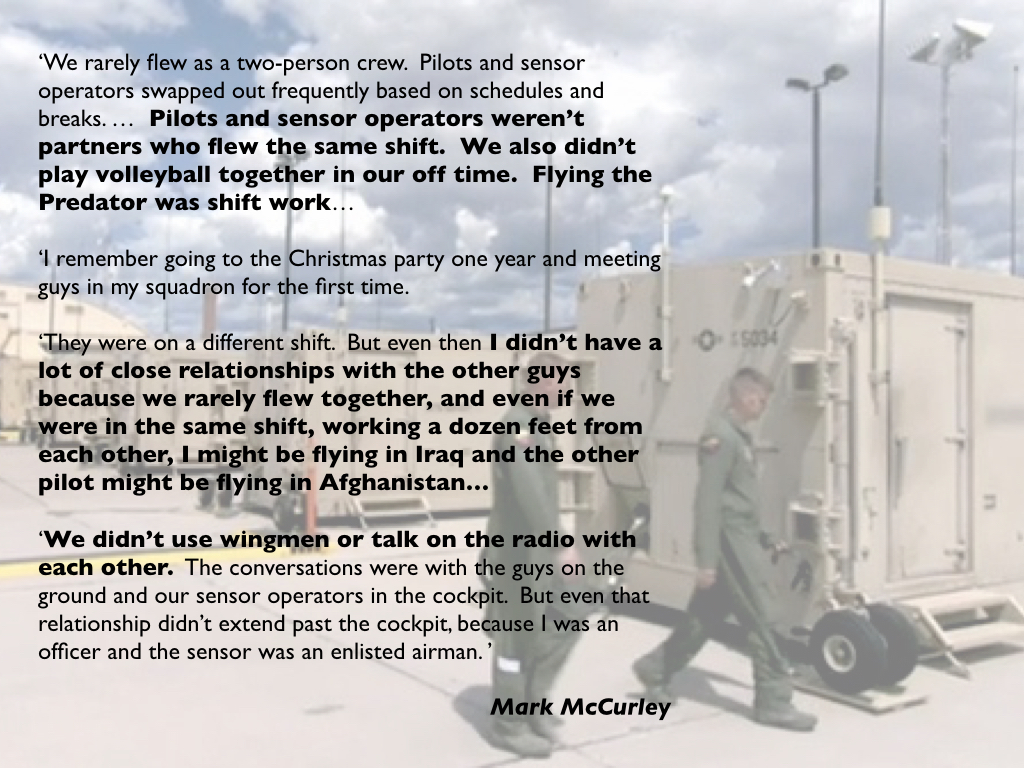
There’s much more on this in ‘Doors into nowhere‘ (DOWNLOADS tab), though I think my discussion in the Lectures breaks new ground. All of this is in stark contrast to today’s remote operations, where – as Lucy Suchman reminds us – there remains a remarkable (though different) degree of bioconvergence and yet now a persistent isolation and anomie is felt by many pilots and sensor operators who work in shifts:

Anomie and the drone.001

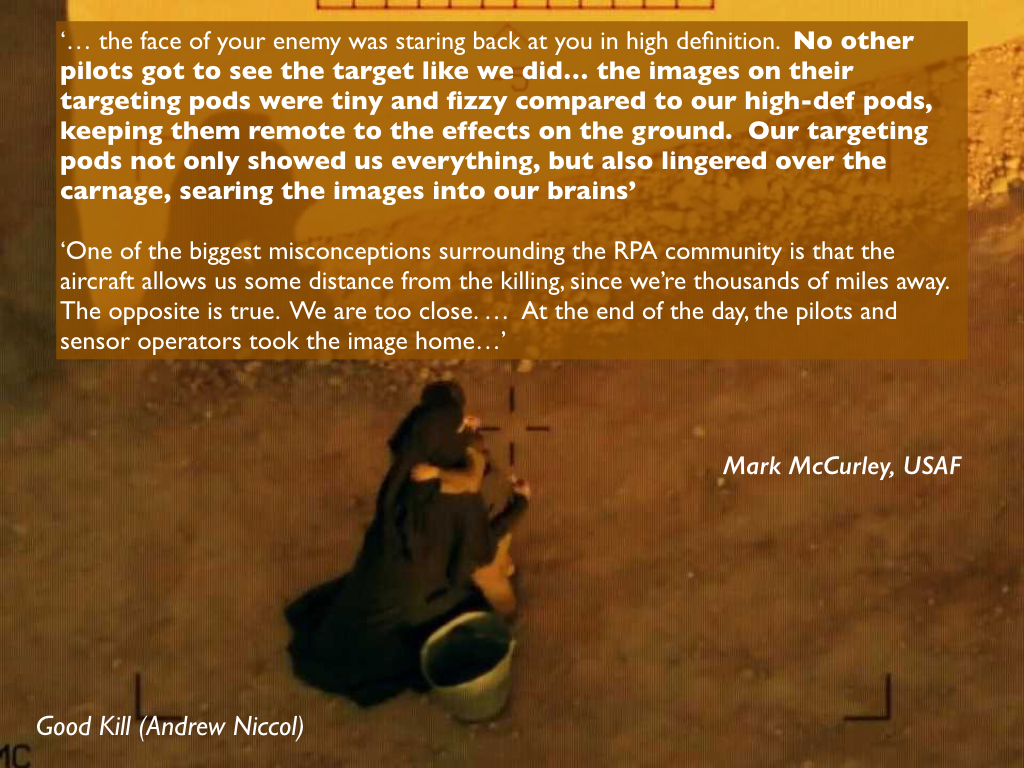
This is thrown into relief by the closeness remote operators feel to the killing space itself, an immersion made possible through the near real-time full-motion video feeds, the internet relay chatter and the radio communications with troops on the ground (where there are any). In contrast to the bomber crews of the Second World War – or those flying over the rainforests of Vietnam, Laos and Cambodia – there is a repeated insistence on a virtualized proximity to the target.

Good Kill in high-definition.001

But I used a discussion of Andrew Niccol‘s Good Kill to raise a series of doubts about what drone crews really can see, as a way into the next section, Sweet target, which provided an abbreviated presentation of the US air strike in Uruzgan I discuss in much more (I hope forensic) detail in Angry Eyes (see here and here).  That also allowed me to bring together many of the key themes I had isolated in the course of the two lectures.

As I approached my conclusion, I invoked Thomas Hippler‘s Le gouvernement du ciel: Histoire globale des bombardements aériens, (I’ve just discovered that Verso will publish the English-language version later this year or early next: Governing from the skies: a global history of aerial bombing):

Hippler Neo-douhetism.001

I’m not convinced that the military and paramilitary violence being visited on people today is all ‘low-intensity’ (Gaza? Afghanistan? Iraq? Syria? Yemen?).  But neither do I think it’s ‘de-territorialised’, unless the word is flattened into a conventionally Euclidean frame.  Hence, following Stuart Elden‘s lead, I treated territory as a political-juridical technology whose calibrations and enclosures assert, enable and enforce a claim over bodies-in-spaces.  And it was those ‘bodies-on-spaces’ that brought me, finally, to The loneliest space of all:  the irreducible, truly dreadful loneliness of death and grief:

Counting the dead.001

Behind the body-counts and the odious euphemisms of collateral damage and the rest lies the raw, inconsolable loss so exquisitely, painfully rendered in ‘Sky of Horoshima‘…

In the coming days I’ll post some of the key sections of the Lectures in more detail, which I’ll eventually develop into long-form essays.

I learned a lot from the expert and wonderfully constructive commentaries after the Lectures from Grégoire Chamayou, Jochen von Bernstorff and Chris Woods, and I’ll do my best to incorporate their suggestions into the final version.

In his response Grégoire traced my project on military violence in general and bombing/drones in particular back to a series of arguments I’d developed in Geographical imaginations in 1994 about vision, violence and corporeality; I had overlooked these completely, full of the conceit that my work had never stood still…. I shall go back, re-read and think about that some more, since some of the ideas that Grégoire recovered (and elaborated) may be even more helpful to me now.  Jochen and Chris also gave me much food for thought, so I shall be busy in the coming months, and I’m immensely grateful to all three of them.

Seeing ‘Through Post-Atomic Eyes’

All the videos from Through Post-Atomic Eyes last October are now available on YouTube here, including my “Little Boys and Blue Skies: drones through post-atomic eyes. My slide deck is available under the DOWNLOADS tab.

This is the sawn-off 30-minute version; I’ll be giving an extended version when I’m at Dartmouth later this month – and I’m really looking forward to that.

Planetary bombing

NORAD's Santa

You’ve probably read the tinsel-and-glitter story about NORAD tracking Santa Claus on Christmas Eve – like Santa’s sleigh, it goes the rounds every year – but Matt Novak provides an appropriately explosive rendition of it here.

It was a smart move for the military. When American kids asked their parents what NORAD was, the U.S. parents would be able to respond “those are the people who help Santa” rather than “those are the people who are ensuring our second strike capabilities after you and everyone in your play group are turned to dust by a nuclear attack.”

Among other plums in the pudding, Matt pulls out a syndicated story from AP in December 1955, in which the military promised that it would ‘continue to track and guard Santa and his sleigh on his trip to and from the U.S. against possible attack from those who do not believe in Christmas‘ (emphasis added).

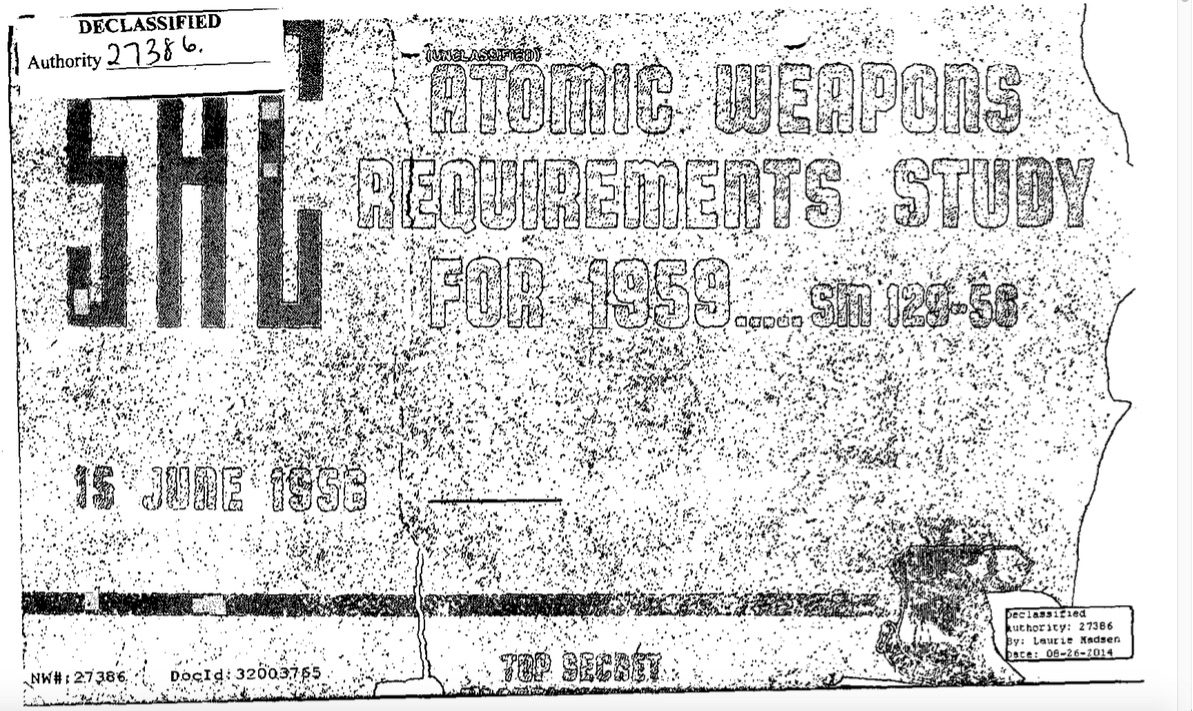
Atomic Weapons Requirements Study for 1959 JPEG

Just before Christmas this year, while NORAD was busy preparing to track Santa’s sleigh again, the National Security Archive at George Washington University released US Strategic Air Command’s Atomic Weapons Requirements Study for 1959, produced the year after that AP story.  The study

‘provides the most comprehensive and detailed list of nuclear targets and target systems that has ever been declassified. As far as can be told, no comparable document has ever been declassified for any period of Cold War history.’

Based on the Bombing Encyclopedia of the World, the Air Force planners proposed

the “systematic destruction” of Soviet bloc urban-industrial targets that specifically and explicitly targeted “population” in all cities, including Beijing, Moscow, Leningrad, East Berlin, and Warsaw. Purposefully targeting civilian populations as such directly conflicted with the international norms of the day, which prohibited attacks on people per se (as opposed to military installations with civilians nearby).

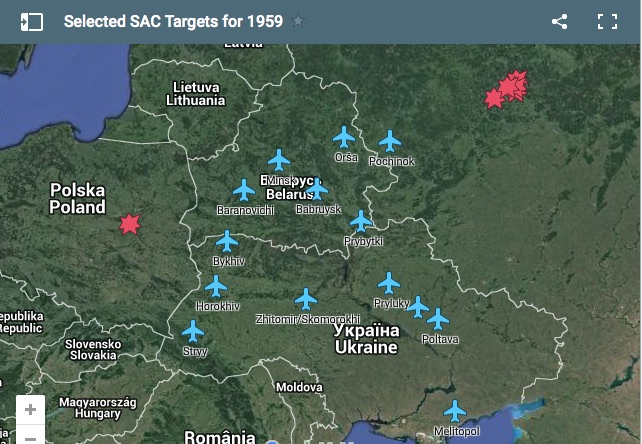
The study ‘listed over 1200 cities in the Soviet bloc, from East Germany to China, also with priorities established. Moscow and Leningrad were priority one and two respectively. Moscow included 179 Designated Ground Zeros (DGZs) while Leningrad had 145, including “population” targets.’  Every target was preceded by an eight-digit code from the Bombing Encyclopedia.

Selected SAC targets 1959 JPEG

William Burr provides an excellent, detailed commentary to accompany the Study here; you can also find more from Joseph Trevithick on this ‘catalog of nuclear death over at War is Boring here.

But all of this is prelude to the real plum in my Christmas pudding, the best paper I’ve read all year: Joseph Masco‘s ‘The Age of Fallout’ in the latest issue of History of the Present [5 (2) (2015) 137-168].

Being able to assume a planetary, as opposed to a global, imaginary is a surprisingly recent phenomenon. Although depictions of an earthly sphere are longstanding and multiple, I would argue that the specific attributes of being able to see the entire planet as a single unit or system is a Cold War creation. This mode of thinking is therefore deeply imbricated not only in nuclear age militarism, but also in specific forms of twentieth-century knowledge production and a related proliferation of visualization technologies.  A planetary imaginary includes globalities of every kind (finance, technology, international relations) – along with geology, atmosphere, glaciers, oceans, and the biosphere – as one totality.

What is increasingly powerful about this point of view is that it both relies on the national security state for the technologies, finances, and interests that create the possibility of seeing in this fashion, but also, in a single gesture, exceeds the nation-state as the political form that matters. A planetary optic is thus a national security creation (in its scientific infrastructures, visualization technologies, and governing ambitions) that transcends these structures to offer an alternative ground for politics and future making. Proliferating forms of globality – including the specific visualizations of science, finance, politics, and environment – each achieve ultimate scale and are unified at the level of the planetary. This achievement ultimately raises an important set of questions about how collective security problems can, and should, be imagined.

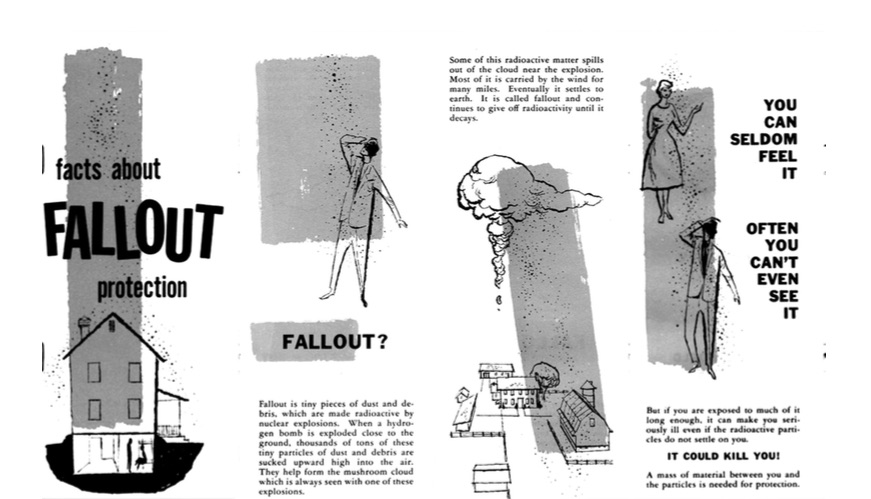
It’s a tour de force which, as these opening paragraphs show, is beautifully written too.  Joe begins with a richly suggestive discussion of the idea of ‘fallout’:

‘Fallout comes after the event; it is the unacknowledged-until-lived crisis that is built into the infrastructure of a system, program, or process. Fallout is therefore understood primarily retrospectively, but it is lived in the future anterior becoming a form of history made visible in negative outcomes.’

Its horizons are as much spatial as they are temporal – though Joe makes the sharp point that radioactive fallout was initially conceived as ‘the bomb’s lesser form’ and that it was the ‘explosive power of the bomb that was fetishized by the US military’ – and that fallout involves ‘individual actions and lived consequences, a post-sociality lived in isolation from the collective action of society or the war machine’ that mutates into what he sees as ‘an increasingly post-Foucaudian kind of governmentality’.

FALLOUT JPEG

When he elaborates the multiple registers in which radioactive fallout appears as an atmospheric toxicity Joe moves far beyond the nostrums of Peter Sloterdijk and others – which, to me anyway, seem to be based on almost wilfully superficial research – and connects it, both substantively and imaginatively, to contemporary critical discussions around global climate change and the Anthropocene.

In a cascade of maps and images, Joe shows how

Space and time are radically reconfigured in these fallout studies, constituting a vision of a collective future that is incrementally changing in unknown ways through cumulative industrial effects. The logics of a national security state (with its linkage of a discrete territory to a specific population) becomes paradoxical in the face of mounting evidence of ecological damage on a collective scale, not from nuclear war itself but rather from nuclear research and development programs. It is important to recognize that while cast as “experiments,” U.S. atmospheric nuclear tests were in reality planetary-scale environmental events.

In short, ‘since 1945 human beings have become post-nuclear creatures, marked with the signatures of nuclear weapons science.’

Towards the end of his essay, Joe says this:

In applying the lessons of the twentieth-century nuclear complex to contemporary geoengineering schemes to manage climate change, we might question 1) the claim to both newness and absolute crisis that installs a state of emergency and suspends normal forms of law and regulation; 2) a process that rhetorically reproduces the split between the event and its fallout so completely; and 3) the suggestion that geoengineering is a novel activity, that it is not an ancient practice with many antecedent examples to think with in assessing our current moment. We might also interrogate how the past fifty years of multidisciplinary work to create detailed visualizations of the planet has installed a dangerous confidence in globality itself, as increasingly high resolution visualizations come to stand in for both objectivity and sovereignty, and thus enable psychosocial feelings of control over vastly complex earth systems that remain, at best, only partially understood.

It’s an immensely provocative, perceptive paragraph; it not only makes me retrace my own wanderings through the nuclear wastelands (see here, here and here) but it also obliges me to rethink what I once called ‘the everywhere war’, to map its contours much more carefully  (the original impulse was simply to provide a counterpoint to those commentators who emphasised war time – ‘the forever war’, ‘permanent war’, ‘never-ending war’ – and who never noticed its spaces), and – particularly with that remark about ‘high resolution visualizations com[ing] to stand in for both objectivity and sovereignty’ in mind – perhaps even to see it as another dimension of Joe’s ‘Age of Fallout’.

It’s not brain surgery

I’ve often drawn attention to the biomedical and surgical metaphors that have become commonplace in attempts to sanitise and legitimise later modern war.  Reading Stephen Zunes‘s chillingly helpful commentary, ‘Republican candidates defend killing civilians to fight terrorism—and so do Democrats’, I stumbled across this exchange between Hugh Hewitt and retired neurosurgeon Ben Carson, who compares his own surgical skills to bombing (from the recent Republican Party ‘debate’ on 15 December 2015:

HUGH HEWITT: We’re talking about ruthless things tonight — carpet bombing, toughness, war. And people wonder, could you do that? Could you order air strikes that would kill innocent children by not the scores, but the hundreds and the thousands?

BEN CARSON: …..you have to be able to look at the big picture and understand that it’s actually merciful if you go ahead and finish the job, rather than death by 1,000 pricks.

HEWITT: So you are OK with the deaths of thousands of innocent children and civilian? It’s like…

CARSON: You got it. You got it.

A pity he didn’t stick to his day job.

Another Manhattan Project

I still regard Postmodern geographies as Ed Soja‘s finest book – his most considered and his most creative – and within that his essay on ‘Taking Los Angeles Apart‘ is surely the stand-out contribution.  By turns playful and passionate, it’s packed with insights about Los Angeles and late modern cities.  I discussed it at length in Geographical imaginations – the book not the blog – but the essay has come back to haunt me ever since I learned of an extraordinary new book which I know Ed would have read with the greatest interest.

KISHIK The Manhattan Project

It’s David Kishik‘s The Manhattan Project, which I stumbled across because of its title and my new-found interest in seeing drones through post-atomic eyes.  But it’s not about that Manhattan Project at all.  Instead, it riffs on Benjamin’s Arcades Project in the most astonishing of ways:

In The Manhattan Project, David Kishik dares to imagine a Walter Benjamin who did not commit suicide in 1940, but managed instead to escape the Nazis to begin a long, solitary life in New York. During his anonymous, posthumous existence, while he was haunting and haunted by his new city, Benjamin composed a sequel to his Arcades Project. Just as his incomplete masterpiece revolved around Paris, capital of the nineteenth century, this spectral text was dedicated to New York, capital of the twentieth. Kishik’s sui generis work of experimental scholarship or fictional philosophy is thus presented as a study of a manuscript that was never written.

The fictitious prolongation of Benjamin’s life will raise more than one eyebrow, but the wit, breadth, and incisiveness of Kishik’s own writing is bound to impress. Kishik reveals a world of secret affinities between New York City and Paris, the flâneur and the homeless person, the collector and the hoarder, the covered arcade and the bare street, but also between photography and graffiti, pragmatism and minimalism, Andy Warhol and Robert Moses, Hannah Arendt and Jane Jacobs. A critical celebration of New York City, The Manhattan Project reshapes our perception of urban life, and rethinks our very conception of modernity.

Another good friend who is sadly no longer with us, Allan Pred, would surely have relished that too. I’m sure Ed would have insisted that Benjamin would never have gone to New York and that, in common with Adorno, he would have sought refuge in L.A. (where else? In fact Adorno left New York for LA, though it’s impossible to think of Ed calling that ‘exile’).

You can read the Introduction to The Manhattan Project here and an extract from the first chapter here; there’s also an extended interview with David about the project here.

Finally, there’s an excellent review by Dustin Illingworth at The Brooklyn Rail here.  When Dustin says this –

Like Borges’s “Aleph,” New York is “the place where, without admixture or confusion, all the places of the world, seen from every angle, coexist.” It is therefore much to Kishik’s credit that his slim volume, a drop in the vast ocean of literature on the city, packs such a considerable theoretical punch.

– then we are back with Ed Soja’s essay, which also began with an appeal to The Aleph and also packed a considerable theoretical punch.

A lack of intelligence

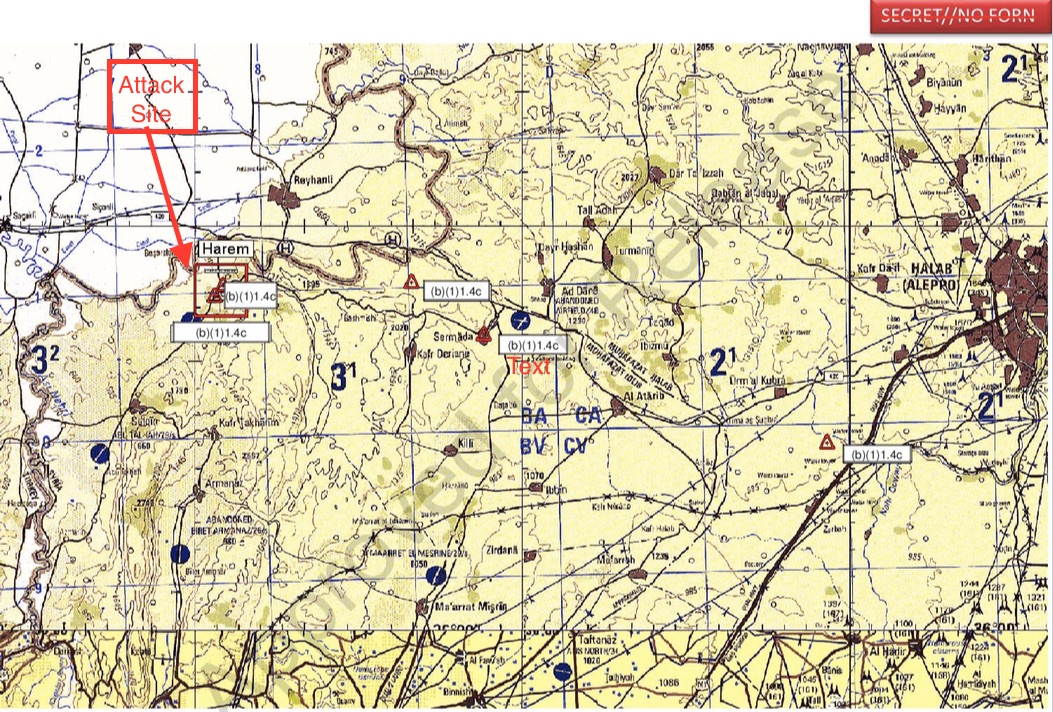
Harim Air Strike MAP annotated

The second of the three recent US air strikes I’ve been looking at took place near Harim [Harem on the map above] in Syria on the night of 5-6 November 2014.  The report of the military investigation into allegations of civilian casualties is here.

The aircraft launched multiple strikes against two compounds which had been identified as sites used as meeting places for named (though redacted) terrorists and sites for the manufacture and storage of explosives by the al-Qaeda linked ‘Khorasan Group’ (if the scare-quotes puzzle you, compare here and here).

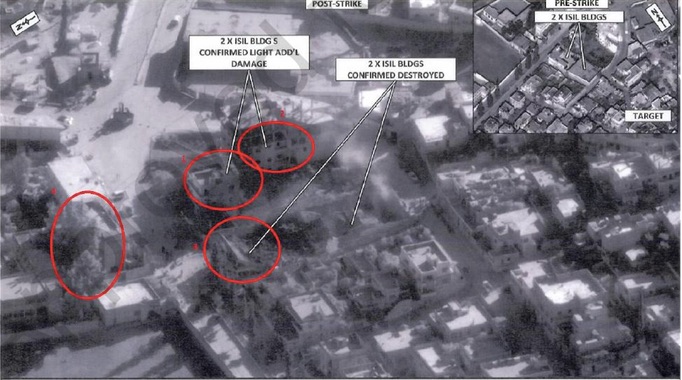
The compounds each contained several buildings and had previously been on a No Strike List under a category that includes civilian housing; they lost their protected status when ‘they were assessed as being converted to military use’ but ‘other residential and commercial structures were situated around both targets’.  An annotated image of the attack on the first compound is shown below:

Harim Air Strike on Compound 001

Although the report argues that ‘the targets were engaged in the early morning hours when the risk to civilians was minimized’ – a strange statement, since most civilians would have been asleep inside those ‘residential structures’ – US Central Command subsequently received open-source reports of from three to six civilian casualties, together with still and video imagery.  By the end of December 2014 the Combined Joint Task Force conducting ‘Operation Inherent Resolve’ had completed a preliminary ‘credibility assessment’ of the claims and found sufficient evidence to establish a formal investigation into the allegations of civilian casualties.  The investigating officer delivered his final report on 13 February 2015.

He also had access to a report from the Syrian Network for Human Rights that provided a ground-level perspective (including video) unavailable to the US military.  Its narrative is different from US Central Command, identifying the targets as being associated with An-Nussra:

The warplanes launched, at first, four missiles that hit three military points, which are located next to each other, in the northeast of the town:

1 – The Agricultural Bank, which is used by An-Nussra front as a center.
2 – The central prison checkpoint, where An-Nussra fighters were stationed.
3 – An ammunition depot in the same area.

The shelling destroyed and burned the Agricultural Bank’s building completely in addition to damaging a number of building nearby. Furthermore, a number of cars were burned while a series of explosions occurred after an explosion in the ammunition depot..
Afterwards, the warplanes targeted a fourth center with two missiles. [This target] was a building by an old deserted gas station located near the industrial school in the south of the town. The shelling destroyed the center completely as well as the gas station in addition to severely damaging the surrounding buildings. Harem residents were aided by the civil-defense teams to save people from underneath the rubble.

SNHR documented the killing of two young girls; one could not be unidentified but the other was Daniya, aged 5, who was killed along with her father who was said to be one of the An-Nussra fighters living in a house near the Agricultural Bank.  Daniya’s mother and her brother Saeed, aged 7, were seriously wounded.

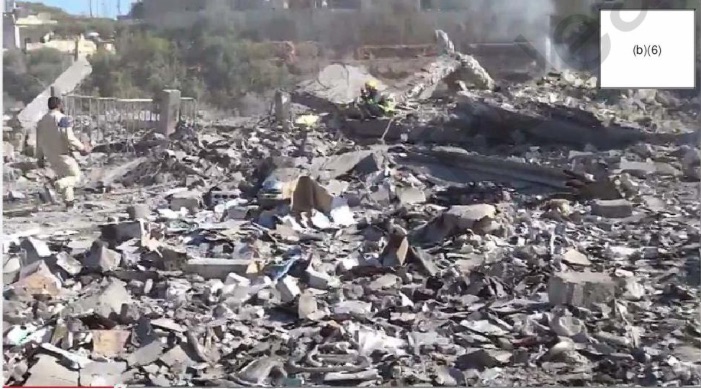
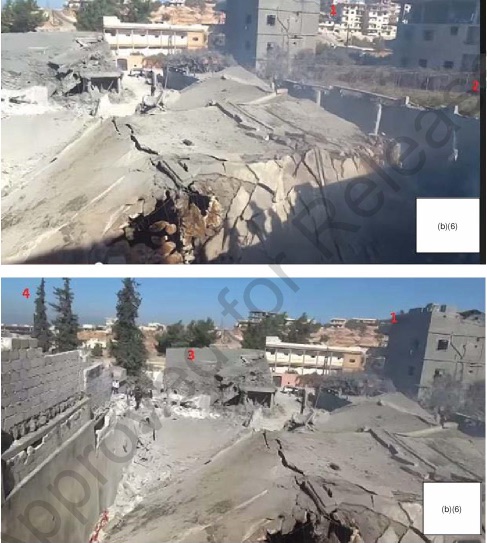
The report also included post-strike imagery from YouTube videos and Twitter feeds:

Harim VIDEO 1 jpeg

Harim VIDEO 2 jpeg

In contrast to the report on the air strike in Iraq I discussed in my previous post, this one includes no details of the attack, nor the procedures through which it was authorised and conducted – though we do know that there is a considerable military bureaucracy behind all these strikes, especially in the administration of what in this case was clearly a pre-planned rather than emergent target.  For more on the bureaucratisation of targeting, incidentally, see  Astrid Nordin and Dan Öberg, ‘Targeting the ontology of war: From Clausewitz to Baudrillard’, Millennium 43 (2) (2015) 392-410; analytically it’s right on the mark, I think, and I’ll be advancing similar arguments in my Tanner Lectures – though stripped of any reference to Baudrillard…

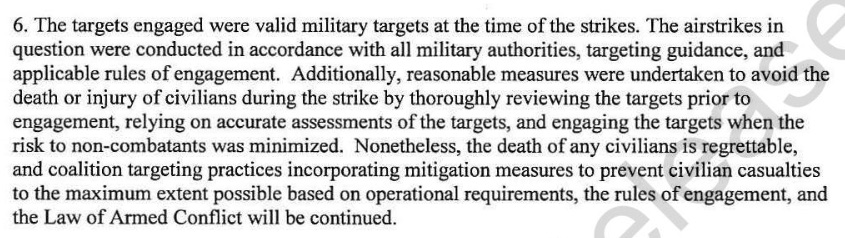
But there is one revealing sentence in the report.  Although the investigating officer had no doubt that the Harim strikes were perfectly legal, everything worked like clockwork and nothing need be changed –

Harim conclusion

– there is nevertheless a recommendation for ‘sustained ISR [intelligence, surveillance and reconnaissance] whenever practicable based on operational requirements, to ensure that no civilians are entering or exiting a facility.’  The clear implication is that these strikes – pre-planned, remember: these were not fleeting targets of opportunity – were not supported by real-time ISR.  When you add to that the reliance placed by the investigation on ground imagery from YouTube and Twitter, you begin to realise how little the US military and its allies must know about many of the targets they strike in Iraq and Syria.  (I might add that the US has not been averse to using Twitter feeds for targeting too: see Robert Gregory‘s compelling discussion in Clean bombs and dirty wars: air power in Kosovo and Libya, where he describes the central role played by Twitter feeds from Libyan rebels in identifying targets for the US Air Force and its NATO allies: by the closing months of the campaign France was deriving 80 per cent of its intelligence from social media contacts on the ground).

All this gives the lie to the cheery ‘let ’em have it’ guff from Robert Caruso, commenting on US air strikes in Syria last September:

By relying so heavily on drones in our recent counter-terror campaigns we’ve been fighting with one hand tied behind our back. But a key to the success of Monday’s strikes was the use of manned aircraft with pilots who can seek out enemy targets and make on-the-spot decisions…

it’s time to drop the drone fetish, and the limitations it imposed, and go back to using manned airpower, which is more powerful and better suited to hunting down elusive targets like ISIS.

Regular readers will know that I’m not saying that drones are the answer, or that their ability to provide persistent, real-time, full-motion video feeds in high definition makes the battlespace transparent; on the contrary (see my ‘Angry Eyes’ posts here and especially here: more to come soon).

But the absence of their ISR capability can only make a bad situation worse.  In February, the director of the National Counterterrorism Center conceded that that US had not ‘closed the gap on where we need to be in terms of our understanding, with granularity, about what is going on on the ground in Syria.’  Indeed, during the first four months of this year ‘nearly 75 percent of U.S. bombing runs targeting the Islamic State in Iraq and Syria [a total of more than 7,000 sorties] returned to base without firing any weapons’, and reports claimed that aircrews held their fire ‘mainly because of a lack of ground intelligence.’

Full-motion video cannot compensate for that absence, of course, and in any case there are serious limitations on the number of ISR orbits that are possible over Iraq and Syria given the demands for drones over Afghanistan and elsewhere: each orbit requires three to four aircraft to provide 24/7 coverage, and the global maximum the US Air Force can provide using its Predators and Reapers varies between 55 and 65 orbits (or ‘combat air patrols’).

In late August 2014 Obama authorised both manned and unmanned ISR flights over Syria, and since then the United States has been joined by the UK and France in deploying MQ-9 Reapers over Iraq and Syria, where their video feeds have helped to orchestrate missions carried out by conventional strike aircraft (see, for example, here).  In August 2015 France claimed that all its air strikes in Iraq had to be validated by ISR provided by a drone:

reaper-20150508

But that was in August, before Hollande threw caution to the winds and ramped up French air strikes in response to the Paris attacks in November – an escalation that relied on targeting packages supplied by the United States.

In any case, Predators and Reapers are also armed and in their ‘hunter-killer’ role they had executed around one quarter of all airstrikes conducted by the United States in Iraq and Syria by June 2015 and more than half the air strikes conducted by the UK in Iraq.  Although the UK only extended its bombing campaign against Islamic State to Syria this month, its Reapers had been entering Syrian airspace in steadily increasing numbers since November 2014 to provide ISR (in part, presumably, to enable the United States to orchestrate its air strikes) and in September 2015 it used one of them to carry out the UK’s first acknowledged targeted killing near Raqqa (see also here and here); the United States has also routinely used the aircraft in the extension of its multi-sited targeted killing program to Syria (see also here).

All this bombing, all this blood: and yet strategically remarkably little to show for it.   And all for a lack of intelligence…