The optics of urban ruination

Ishikawa Kōyō

News from David Fedman of a new article co-authored with Cary Karacas, ‘The optics of urban ruination‘, which complements their previous, vital work on the cartographic imaginary of bombing.  It’s published in the Journal of Urban History but you can access it here.

World War II yielded many photographs of bombed-out cities. In this paper we telescope between two sets and scales of images that represent the principal frames through which the American and Japanese publics have memorialized the incendiary bombings that laid waste to urban Japan: aerial photographs taken by the US Army Air Forces during its wartime planning, prosecution, and assessment of the raids; and the ground-level images captured by Ishikawa Kōyō, a photographer working on behalf of the Tokyo Metropolitan Police. By means of a detailed examination of the production, circulation, and consumption of these photographs— what some scholars have called an “archaeological approach” to images of ruination—we explore not only the visual rhetoric and reality of the destruction of Japan’s cities, but also how that destruction is situated in history, memory, and visual culture.

As always with their work, it’s exquisitely written, intellectually savvy and a very powerful argument.  They juxtapose the photographic ‘view from above’ that was instrumental in the planning and execution of the American air raids with Ishikawa Kōyō’s ground-level perspective.  His work is virtual unknown outside Japan and yet, as they say, has become ‘the principal visual testimony in Japan for public memory of the incendiary air raids as they were experienced on the ground’:

What followed were, according to Ishikawa, scenes from hell. His detailed account of that evening indeed repeatedly invokes infernal metaphors to describe Tokyo’s destruction. The “demon’s wings”(akuma no tsubasa) rained fire that carbonized corpses which “flowed through the streets like rapids.”  The elements also conspired against the city to whip up the red winds (akakaze) that fanned the firestorms: “immense incandescent vortices,” he wrote, “rose in a number of places, swirling, flattening, sucking whole blocks of houses into a maelstrom of fire.”

Widespread chaos, intense heat, and the realization of the need to save his own life pre-vented Ishikawa from taking any photographs. His Chevrolet destroyed by flames, he slowly made his way on foot back to the Metropolitan Police Headquarters. After resting his fatigued body, at around 2 P.M. on March 10 Ishikawa set out to document the aftermath. He saw bodies “piled like mountains” (shitai no yama o kizuiteita) and corpses burnt to the point that “you could no longer discern the sex of the body” (danjyo no kubetsu mo tsukanai shitai).

Ishikawa first told himself not to photograph such upsetting images, but then, recalling his responsibilities to capture the “reality of the scenes,” he began to snap the shutter.That day Ishikawa took thirty-three photographs of the aftermath of what came to be called the Great Tokyo Air Raid.

You can find more at Japan Air Raids, a brilliant bilingual archive, and a (harrowing) selection of Ishikawa’s images here.  If you do click on that link, heed their warning:

While photographs such as [these] provide an intimate sense of the bodily pain that was inflicted by the firebombing, they also require much of the viewer. It is one thing to look at such photographs; it is another thing altogether to comprehend or attach meaning to the actual suffering it exposes.

And – do I have to say this? – it’s worth thinking about other scenes of urban ruination.

Legal geographies and the assault on international law

I suspect anyone interested in international/transnational legal geographies will know of Jens David Ohlin‘s work already (he’s Professor of Law at Cornell and recently co-edited Targeted Killings: Law and Morality in an Asymmetrical World [Oxford, 2012]).  If not, check out his page on ssrn for recent papers; I’ve found three particularly helpful in thinking about US air strikes in Afghanistan and Pakistan and, more recently, the Israeli offensive against Gaza (more on this and the space of exception soon, I promise):

Targeting and the concept of intent (2013); Acting as a sovereign versus acting as a belligerent (2014); and The combatant’s privilege in asymmetric and covert conflicts (2014)

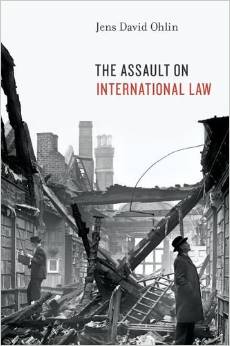
I’ve just received news of his new book out early in the New Year, whose relevance will be apparent from its title: The assault on international law.

OHLIN Assault of international lawInternational law presents a conceptual riddle. Why comply with it when there is no world government to enforce it? The United States has a long history of skepticism towards international law, but 9/11 ushered in a particularly virulent phase of American exceptionalism. Torture became official government policy, President Bush denied that the Geneva Conventions applied to the war against al-Qaeda, and the US drifted away from international institutions like the International Criminal Court and the United Nations.

Although American politicians and their legal advisors are often the public face of this attack, the root of this movement is a coordinated and deliberate attack by law professors hostile to its philosophical foundations, including Eric Posner, Jack Goldsmith, Adrian Vermeule, and John Yoo. In a series of influential writings they have claimed that since states are motivated primarily by self-interest, compliance with international law is nothing more than high-minded talk. Theses abstract arguments then provide a foundation for dangerous legal conclusions: that international law is largely irrelevant to determining how and when terrorists can be captured or killed; that the US President alone should be directing the War on Terror without significant input from Congress or the judiciary; that US courts should not hear lawsuits alleging violations of international law; and that the US should block any international criminal court with jurisdiction over Americans. Put together, these polemical accounts had an enormous impact on how politicians conduct foreign policy and how judges decide cases – ultimately triggering America’s pernicious withdrawal from international cooperation.

In The Assault on International Law, Jens Ohlin exposes the mistaken assumptions of these ‘New Realists,’ in particular their impoverished utilization of rational choice theory. In contrast, he provides an alternate vision of international law based on a truly innovative theory of human rationality. According to Ohlin, rationality requires that agents follow through on their plans even when faced with opportunities for defection. Seen in this light, international law is the product of nation-states cooperating to escape a brutish State of Nature–a result that is not only legally binding but also in each state’s self-interest.

Michael Sfard

But not all assaults on international law derive from the United States and from professors hostile to its philosophical foundations.  I urge you to read Michael Sfard‘s coruscating Op-Ed from Ha’artez on 4 August, ‘A “targeted assassination” of international law‘ (which is also available here if it disappears behind a paywall).  Michael is an Israeli human rights lawyer, specializing in international humanitarian law and dealing directly with the Israeli occupation of Palestine, and he is also the legal adviser to Yesh Din: Volunteers for Human Rights:

Israelis are surprised. Did I say surprised? Downright shocked. Even before the dust from the fighting has settled, even before this “most just of all wars” has ended, even as the most moral army in the world is still mired in Gaza – there is already talk of war crimes and an international investigation.

We, who didn’t carpet-bomb even though we could have, who dropped fliers and made phone calls and knocked on the roof; we, who agreed to the humanitarian cease-fire that Hamas violated; we, who took more precautions than any other nation would have done – we are once again being accused of war crimes. Once again, the same old song is being sung: decisions about opening an international investigation, talk of the International Criminal Court, fear of arrests in Europe. And we don’t understand why we deserve all this.

It is possible to console ourselves by accepting the explanation that the television journalists keep repeating to us: that the world is anti-Semitic and two-faced and supports Hamas. But this would constitute a regrettable evasion of the tough questions. It would constitute an effort to flee the pointed discussion Israeli society ought to be holding about the way we have waged armed conflicts with our enemies over the last decade.

Since the Second Lebanon War of 2006, the Israel Defense Forces has adopted an extremely problematic combat doctrine for conflicts that take place in urban areas with dense civilian populations, and in which the enemy is seen as an illegitimate terrorist entity (Hezbollah in Lebanon and Hamas in Gaza). This combat doctrine is supported by a legal theory developed by the IDF’s international legal division, which interprets the laws of war in a manner that is shockingly different from their accepted interpretation by experts in the field worldwide. Its direct result is massive civilian casualties and the destruction of civilian neighborhoods.

This combat doctrine consists of two elements, each of which is a declaration of war against the fundamental principles of the laws of armed combat. The first element redefines what constitutes a legitimate target for attack, such that it now includes not only classic military targets (bases, combatants, weapons stockpiles and so forth), but also facilities and objects whose connection to the enemy organization is nonmilitary in nature….

The second element is even more far-reaching: It holds that when fighting in urban areas, we are entitled to treat the entire area as a legitimate target and bombard it via air strikes or artillery shelling – as long as we first warn all the residents of our intention to do so and give them time to leave. The IDF first used this method in Beirut’s Dahiya neighborhood during the Second Lebanon War. Before bombing, the army dropped fliers telling the residents to leave. Then the bombs were dropped, and most of Dahiya’s houses were destroyed.

This doctrine was applied, to varying degrees, in Operations Cast Lead and Protective Edge as well, primarily in Gaza City’s Shujaiyeh neighborhood. It does not take into consideration the question of whether the prior warning given the population is effective – i.e., whether the population can in fact leave, whether solutions have been found for the elderly, the ill and the children. Nor is it accompanied by the creation of a safe corridor through which people can flee to someplace that won’t be fired on, and where civilians have what they need to survive.

The terrifying result of this combat doctrine, in both Cast Lead and Protective Edge, was piles of bodies of women, children and men who weren’t involved in the fighting….

The IDF’s lawyers, who provide legal support for this combat doctrine, are conducting a “targeted assassination” of the principles of international law: the principle of distinction, which requires differentiation between military targets (which are legitimate) and civilian targets (which aren’t); the principle of proportionality, which forbids attacking even a legitimate target if the anticipated harm to civilians is excessive in comparison to the military benefit from the target’s destruction; and the need to take effective, rather than merely symbolic, precautions.

More soon.

Legitimate targets?

I’ve been thinking about the description of Gaza as a space of exception in my last post, and I will elaborate (and qualify) that discussion shortly: in many ways the Israeli offensive against Gaza reinforces Achille Mbembe‘s arguments about necropolitics but, as I’ll try to show, suggests the need for a reworking of Giorgio Agamben‘s claims about the exception.

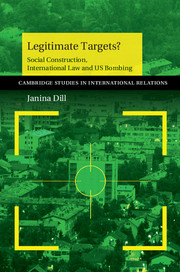
En route, I’ve been greatly taken by the work of Janina Dill (Politics and International Relations, Oxford) – particularly her discussion of Israel’s development of ‘Lawfare 2.0’ in relation to Gaza – and, as I say, I’ll have much more to say about that shortly.  But I’ve also discovered she has a book due out from Cambridge in the fall which, like her (I imagine summary) chapter in The American Way of Bombing, speaks to my own work on genealogies and geographies of bombing: Legitimate Targets? Social construction, international law and US bombing.

DILL Legitimate targets?Based on an innovative theory of international law, Janina Dill’s book investigates the effectiveness of international humanitarian law (IHL) in regulating the conduct of warfare. Through a comprehensive examination of the IHL defining a legitimate target of attack, Dill reveals a controversy among legal and military professionals about the ‘logic’ according to which belligerents ought to balance humanitarian and military imperatives: the logics of sufficiency or efficiency. Law prescribes the former, but increased recourse to IHL in US air warfare has led to targeting in accordance with the logic of efficiency. The logic of sufficiency is morally less problematic, yet neither logic satisfies contemporary expectations of effective IHL or legitimate warfare. Those expectations demand that hostilities follow a logic of liability, which proves impracticable. This book proposes changes to international law, but concludes that according to widely shared normative beliefs on the twenty-first-century battlefield there are no truly legitimate targets.

Introduction
Part I. A Constructivist Theory of International Law:
1. The challenge
2. The theory
Part II. The Definition of a Legitimate Target of Attack in International Law:
3. Positive law
4. Customary law
Part III. An Empirical Study of International Law in War:
5. The rise of international law in US air warfare
6. The changing logic of US air warfare
7. The behavioural relevance of international law in US air warfare
Part IV. An Evaluation of International Law in War:
8. The lack of normative success of international law in US air warfare
9. The impossibility of normative success for international law in war
Conclusion.

Theatre of Operations

I am at last back in Vancouver after what seemed at times like a marathon on the road (even though part of it was vacation), and there’s much to catch up on and much to report.

But I’m going to ease myself in gently with news of a forthcoming book by Joseph Masco.  Many readers will know his previous book, The Nuclear Borderlands: the Manhattan Project in post-Cold War New Mexico (Princeton, 2006), a tour de force – appropriately enough – that carried off a string of major prizes. (If you don’t know it, you can get a taste in his ‘Desert modernism’, available as a pdf from Cabinet 13 (2004) here).

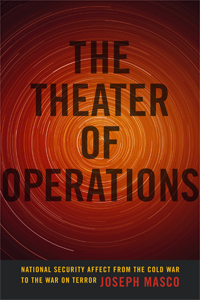
MASCO Theater of OperationsHis new book, due out from Duke University Press in November, is The Theater of Operations: National security affect from the Cold War to the war on terror:

How did the most powerful nation on earth come to embrace terror as the organizing principle of its security policy? In The Theater of Operations, Joseph Masco locates the origins of the present-day U.S. counterterrorism apparatus in the Cold War’s “balance of terror.” He shows how, after the attacks of 9/11, the U.S. Global War on Terror mobilized a wide range of affective, conceptual, and institutional resources established during the Cold War to enable a new planetary theater of operations. Tracing how specific aspects of emotional management, existential danger, state secrecy, and threat awareness have evolved as core aspects of the American social contract, he draws on archival, media, and ethnographic resources to offer a new portrait of American national security culture. Undemocratic and unrelenting, this counterterror state prioritizes speculative practices over facts, and ignores everyday forms of violence across climate, capital, and health in an unprecedented effort to anticipate and eliminate terror threats – real, imagined, and emergent.

I’ve commented on the idea of a ‘theatre of war’ on several occasions (see here and here) and in his new book Masco seems to be excavating its performative/manipulative dimensions to explore the constitution of ‘a new, planetary theatre of operations’ – something else to take into account as I race towards completing The everywhere war.  I’m also greatly taken by a genealogy that begins not with 9/11, which is emphatically not the moment when ‘everything changed’, but with the Cold War…

The Theater of Operations has won advance praise from another of my favourite authors, Peter Galison:

“We know that in the Cold War transportation infrastructures boomed, electronic infrastructures had to be hardened. We know about weapons and counter-weapons; we even have learned about the astonishing proliferation of security mechanisms put in place during the War on Terror. What Joseph Masco shows us in The Theater of Operations is an entire affective structure—the management of anxiety, resilience, steadfastness, sacrifice—that is demanded of every citizen. Alert to liquid containers above 2.4 ounces, hypervigilant to abandoned bags, suspicious loitering, or the detonation of a thermonuclear weapon—we learn to live our lives aware of tiny and apocalyptic things. With an anthropologist’s eye long attuned to life in the para-wartime state, Masco is the perfect guide to the theater of our lives in the security state.”

Joseph MascoEvidently not a person to stand still for long, Masco is already at work on a book on environmental crisis: you can dip a toe into the water at the excellent somatosphere (on science, medicine and anthropology) here, or dig out his chapter on ‘Bad weather: the time of planetary crisis’ in Martin Holbraad and Morten Axel Pedersen (eds), Times of security: ethnographies of fear, protest and the future, which came out from Routledge last summer.  The abstract (below), together with a link to an earlier essay on ‘Building the Bunker Society’ (available as a pdf), is here:

How, and when, does it become possible to conceptualize a truly planetary crisis? The Cold War nuclear arms race installed one powerful concept of planetary crisis in American culture. The science enabling the US nuclear arsenal, however, also produced unintended byproducts: notably, a radical new investment in the earth sciences. Cold War nuclear science ultimately produced not only bombs, but also a new understanding of the earth as biosphere. Thus, the image of planetary crisis in the US was increasingly doubled during the Cold War – the immediacy of nuclear threat matched by concerns about rapid environmental change and the cumulative effects of industrial civilization on a fragile biosphere. This paper examines the evolution of (and competition between) two ideas of planetary crisis since 1945: nuclear war and climate change. In doing so, the paper offers an alternative history of the nuclear age and considers the US national security implications of a shift in the definition of planetary crisis from warring states to a warming biosphere.

And while we are on the subject of ‘bad weather’, climate change and national security, the GAO recently released a report on the implications of global climate change for US military infrastructure. You can read a summary review here, which points out that while the Pentagon evidently takes climate change very seriously indeed – there has been a string of seminars, workshops and conferences testifying to that – the die-hards in the Republican Party continue to do everything they can to block even military-sponsored research into climate change.  As Representative David McKinley put it:

Our climate is obviously changing; it has always been changing. With all the unrest around the global [sic], why should Congress divert funds from the mission of our military and national security to support a political ideology? This amendment will ensure we maximize our military might without diverting funds for a politically motivated agenda.

The engorgement of ‘military might’ severed from a ‘politically motivated agenda’: you can’t make this stuff up.  Even for the theatre.

Drones, battlefields and later modern war

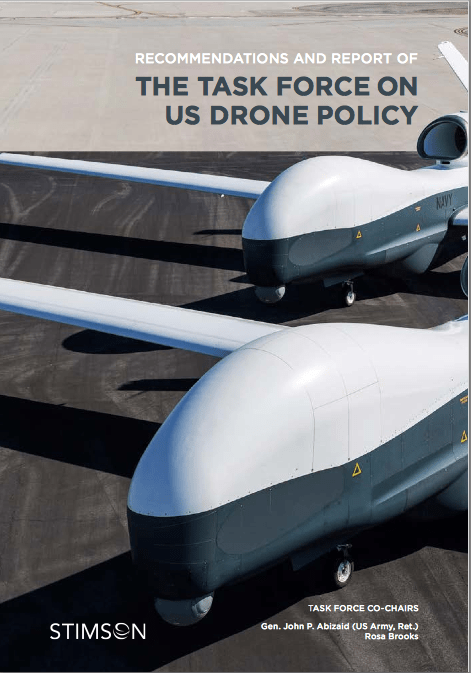
STIMSON Drone report 2014

This morning the Stimson Center issued an 81-page Recommendations and Report of the Task Force on US Drone Policy: you can access it online via the New York Times here or download it as a pdf here; Mark Mazetti‘s report for the Times is here.

Founded in 1989, the Stimson Center is a Washington-based ‘non-profit and non-partisan’ think-tank that prides itself on providing ’25 years of pragmatic solutions to global security’.  It’s named after Henry Stimson, who served Presidents Taft, Roosevelt and Truman as Secretary of War and President Hoover as Secretary of State.  The Center established its 10-member Task Force on drones a year ago, with retired General John Abizaid (former head of US Central Command, 2003-2007) and Rosa Brooks (Professor of Law at Georgetown) as co-chairs; the Task Force was aided by three Working Groups – on Ethics and Law; Military Utility, National Security and Economics; and Export Control and Regulatory Challenges – each of which is preparing more detailed reports to be published later this year.  The present Report focuses on

‘key current and emerging issues relating to the development and use of lethal UAVs outside the United States for national security purposes. In particular, we focus extensively on the use of UAVs for targeted counterterrorism strikes, for the simple reason that this has generated significant attention, controversy and concern.’

But this focus repeats and compounds the myopia of both conventional wisdom and contemporary debate.  The Report summarily (and I think properly) rejects a number of misconceptions about the use of drones, insisting that their capacity to strike from a distance is neither novel nor unique; noting that the vast majority of UAVs in the US arsenal are non-weaponized (‘less than 1 percent of … UAVs carry operational weapons at any given time’ – though their intelligence, surveillance and reconnaissance functions are of course closely tied to the deployment of weapons by conventional strike aircraft or ground forces); and arguing that ‘UAVs do not turn killing into “a video game”‘. These counter-claims are unexceptional and the Task Force presents them with clarity and conviction.

But the Report also accepts that the integration of UAVs into later modern war on ‘traditional’ or ‘hot’ battlefields [more about those terms in a moment] is, by and large, unproblematic.  Thus:

‘UAVs have substantial value for a wide range of military and intelligence tasks. On the battlefield, both weaponized and non-weaponized UAVs can protect and aid soldiers in a variety of ways. They can be used for reconnaissance purposes, for instance, and UAVs also have the potential to assist in the detection of chemical, biological, radiological and nuclear weapons, as well as ordinary explosives. Weaponized UAVs can be used to provide close air support to soldiers engaged in combat.’

A footnote expands on that last sentence:

‘In the past, warfighters on the ground under imminent threat would have to navigate a complicated command hierarchy to call for air support. The soldier on the ground would have to relay coordinates to a Forward Air Controller (FAC), who would then talk the pilot’s eyes onto a target in an extremely hostile environment. These missions have always been very dangerous for the pilot, who has to fly low and avoid multiple threats, and also for people on the ground. It is a human-error rich environment, and even today, it is not uncommon for the wrong coordinates to be relayed, resulting in the deaths of friendlies or innocent civilians. To ease these difficulties, DARPA is currently investigating how to replace the FAC and the pilot by a weaponized UAV that will be commanded by the soldier on the ground with a smartphone.’

And subsequently the Report commends the ‘robust’ targeting process put in place by the US military and the incorporation of military lawyers (JAGs) into the kill-chain:

‘The Department of Defense has a robust procedure for targeting, with outlined authorities and steps, and clear checks on individual targets. The authorization of a UAV strike by the military follows the traditional process in place for all weapons systems (be they MQ-9 Reaper drones or F-16 fighter jets). Regardless of whether particular strikes are acknowledged, the Pentagon has stated that UAV strikes, like strikes from manned aircraft, are subject to the military’s pre-strike target development procedures and post-strike assessment.

‘The process of determining and executing a strike follows a specific set of steps to ensure fidelity in target selection, strike and post-strike review.’

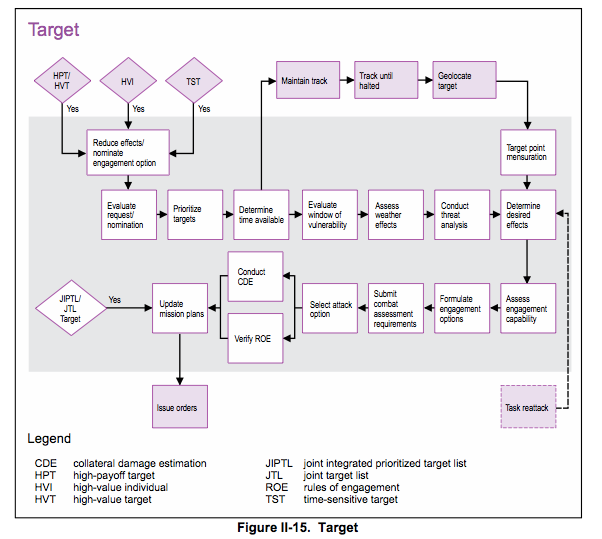
Targeting cycle

Both Craig Jones and I have discussed the targeting cycle [the figure above shows one of six steps in the ‘find-fix-track-target-engage-assess’ cycle, taken from JP 3-60 on Joint Targeting, issued in January 2013] and the role of operational law within it (Craig in much more detail than me), and these are all important considerations.  But the Report glosses over the fragilities of the process, which in practice is not as ‘robust’ as the authors imply.  They concede:

‘No weapons system is perfect, and targeting decisions — whether for UAV strikes or for any other weapons delivery system — are only as good as the intelligence on which they are based. We do not doubt that some US UAV strikes have killed innocent civilians. Nonetheless, the empirical evidence suggests that the number of civilians killed is small compared to the civilian deaths typically associated with other weapons delivery systems (including manned aircraft).’
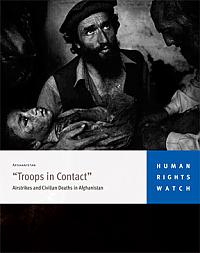
cover_646That last sentence is not unassailable, but in addition I’ve repeatedly argued that it is a mistake to abstract strikes carried out by UAVs from the wider network of military violence in which their ISR capabilities are put to use:  hence my ongoing work on the Uruzgan airstrike in Afghanistan, for example, and on ‘militarised vision’ more generally.  What these studies confirm is that civilian casualties are far more likely when close air support is provided – by UAVs directly or by conventional strike aircraft – to ‘troops in contact’ (even more so when, as in both the Kunduz and Uruzgan airstrikes, it turns out that troops calling in CAS were not ‘in contact’ at all).

In short, while it’s perhaps understandable that a Task Force that included both General Abizaid and Lt-Gen David Barno (former head of Combined Forces Command – Afghanistan from 2003-2005) should regard the use of UAVs on ‘traditional’ battlefields as unproblematic, I think it regrettable that their considerable expertise did not result in a more searching evaluation of remote operations in Afghanistan and Iraq.

But what, then, of those ‘non-traditional’ battlefields?  A footnote explains:

‘Throughout this report, we distinguish between the use of UAV strikes on “traditional” or “hot” battlefields and their use in places such as Pakistan, Yemen and Somalia. These are terms with no fixed legal meaning; rather, they are merely descriptive terms meant to acknowledge that the US of UAV strikes has not been particularly controversial when it is ancillary to large-scale, open, ongoing hostilities between US or allied ground forces and manned aerial vehicles, on the one hand, and enemy combatants, on the other. In Afghanistan and Iraq, the United States deployed scores of thousands of ground troops and flew a range of close air support and other aerial missions as part of Operation Enduring Freedom, and UAV strikes occurred in that context. In Libya, US ground forces did not participate in the conflict, but US manned aircraft and UAVs both operated openly to destroy Libyan government air defenses and other military targets during a period of large scale, overt ground combat between the Qaddafi regime and Libyan rebel groups. In contrast, the use of US UAV strikes in Yemen, Pakistan and elsewhere has been controversial precisely because the strikes have occurred in countries where there are no US ground troops or aerial forces openly engaged in large scale combat.’
0202megret0

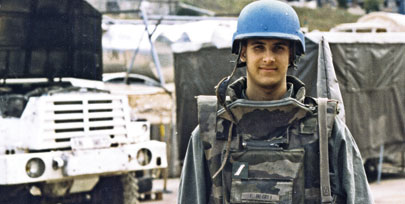
A major focus of the report is on what Frédéric Mégret (above) has called ‘the deconstruction of the battlefield‘ and the countervailing legal geographies that provide an essential armature for later modern war (though it’s surprising that the Report makes so little use of academic research on UAVs and contemporary conflicts).  The authors ‘disagree with those critics who have declared that US targeted killings [in Pakistan, Yemen and Somalia] are “illegal”’ – no surprise there either, incidentally, since one of the Working Groups included Kenneth Anderson, Charles Dunlap and Christine Fair: I’m not sure in what universe that counts as ‘non-partisan’) but they also accept that these remote operations move in a grey zone (and in the shadows):

‘The law of armed conflict and the international legal rules governing the use of force by states arose in an era far removed from our own. When the Geneva Conventions of 1949 were drafted, for instance, it was assumed that most conflicts would be between states with uniformed, hierarchically organized militaries, and that the temporal and geographic boundaries of armed conflicts would be clear.

‘The paradigmatic armed conflict was presumed to have a clear beginning (a declaration of war) and a clear end (the surrender of one party, or a peace treaty); it was also presumed the armed conflict to be confined geographically to specific, identifiable states and territories. What’s more, the law of armed conflict presumes that it is a relatively straightforward matter to identify “combatants” and distinguish them from “civilians,” who are not targetable unless they participate directly in hostilities. The assumption is that it is also a straightforward matter to define “direct participation in hostilities.”

‘The notion of “imminent attack” at the heart of international law rules relating to the use of force in state self-defense was similarly construed narrowly: traditionally, “imminent” was understood to mean “instant, overwhelming, and leaving no choice of means, and no moment for deliberation.”

‘But the rise of transnational non-state terrorist organizations confounds these preexisting legal categories. The armed conflict with al-Qaida and its associated forces can, by definition, have no set geographical boundaries, because al-Qaida and its associates are not territorially based and move easily across state borders. The conflict also has no temporal boundaries — not simply because we do not know the precise date on which the conflict will end, but because there is no obvious means of determining the “end” of an armed conflict with an inchoate, non-hierarchical network.

‘In a conflict so sporadic and protean — a conflict with enemies who wear no uniforms, operate in secret and may not use traditional “weapons” — the process of determining where and when the law of armed conflict applies, who should be considered a com- batant and what counts as “hostilities” inevitably is fraught with difficulty…

‘While the legal norms governing armed conflicts and the use of force look clear on paper, the changing nature of modern conflicts and security threats has rendered them almost incoherent in practice. Basic categories such as “battlefield,” “combatant” and “hostilities” no longer have a clear or stable meaning. And when this happens, the rule of law is threatened.’

These too are important considerations, but they are surely not confined to counter-terrorism operations in Pakistan, Yemen and Somalia: they also apply with equal force to counterinsurgency operations in Afghanistan and Iraq, and intersect with a wider and much more fraught debate over the very idea of ‘the civilian’.

There is a particularly fine passage in the Report:

‘Consider US targeted strikes from the perspective of individuals in — for instance — Pakistan or Yemen. From the perspective of a Yemeni villager or a Pakistani living in the Federally Administered Tribal Areas (FATA), life is far from secure. Death can come from the sky at any moment, and the instability and incoherence of existing legal categories means that there is no way for an individual to be certain whether he is considered targetable by the United States. (Would attending a meeting or community gathering also attended by an al-Qaida member make him targetable? Would renting a building or selling a vehicle to a member of an “associated” force render him targetable? What counts as an “associated force?” Would accepting financial or medical aid from a terrorist group make him a target? Would extending hospitality to a relative who is affiliated with a terrorist group lead the United States to consider him a target?).

‘From the perspective of those living in regions that have been affected by US UAV strikes, this uncertainty makes planning impossible, and makes US strikes appear arbitrary. What’s more, individuals in states such as Pakistan or Yemen have no ability to seek clarification of the law or their status from an effective or impartial legal system, no ability to argue that they have been mistakenly or inappropriately targeted or that the intelligence that led to their inclusion on a “kill list” was flawed or fabricated, and no ability to seek redress for injury. Their national laws and courts can offer no assistance in the face of foreign power, and far from protecting their fundamental rights and freedoms, their own states may in fact be deceiving them about their knowledge of and cooperation with US strikes. Meanwhile, geography and finances make it impossible to access US courts, and a variety of legal barriers — such as the state secrets privilege, the political question doctrine, and issues of standing, ripeness and mootness — in any case would prevent meaningful access to justice.’

This is one of the clearest summaries of the case for transparency and accountability I’ve seen, but the same scenario has also played out in Afghanistan (and in relation to the Taliban, which appears only once in the body of the Report) time and time again.  There are differences, to be sure, but the US military has also carried out its own targeted killings in Afghanistan, working from its Joint Prioritized Effects List.  The Report notes that ‘in practice, the military and CIA generally work together quite closely when planning and engaging in targeted UAV strikes: few strikes are “all military” or “all CIA”’ – which is true in other senses too – and this applies equally in Afghanistan.

In sum, then, this is a valuable and important Report – but it would have been far more incisive had its critique of ‘US drone policy’ cast its net wider to provide a more inclusive account of remote operations.  The trans-national geographies of what I’ve called ‘the everywhere war’ do not admit of any simple distinction between ‘traditional’ and ‘non-traditional’ battlefields, and trying to impose one on such a tangled field of military and paramilitary violence ultimately confuses rather than clarifies.  I realise that this is usually attempted as an exercise in what we might call legal cartography, but I also still think William Boyd‘s Gabriel was right when, in An Ice-Cream War, he complained that maps give the world ‘an order and reasonableness’ it doesn’t possess.  And we all also know that maps – like the law – are instruments of power, and that both are intimately entangled with the administration of military violence.
The God trick and the administration of military violence

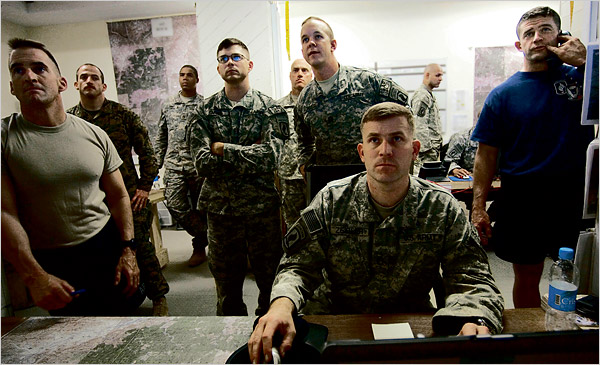
JOC staring at screen 24afghan-600

Here is the abstract for my keynote at the Lancaster symposium on Security by remote control next month; it’s a development from my presentation at the AAG in Tampa, and I’ll provide more details as I develop the argument.

The God trick and the administration of military violence

Advocates have made much of the extraordinary ability of the full motion video feeds from Predators and Reapers to provide persistent surveillance (‘the all-seeing eye’), so that they become vectors of the phantasmatic desire to produce a fully transparent battlespace.  Critics – myself included – have insisted that vision is more than a biological-instrumental capacity, however, and that it is transformed into a conditional and highly selective visuality through the activation of a distinctively political and cultural technology.  Seen thus, these feeds interpellate their distant viewers to create an intimacy with ground troops while ensuring that the actions of others within the field of view remain obdurately Other.

But the possibility of what Donna Haraway famously criticised as ‘the God-trick’ – the ability to see everything from nowhere in particular – is also compromised by the networks within which these remote platforms are deployed.  In this presentation I re-visit an air strike on three vehicles in Uruzgan province, Afghanistan, in February 2010, in which more than 20 civilians were killed in a helicopter attack prompted, in large measure, by video feeds from a Predator providing support to a Special Forces detachment in the vicinity.  Most commentaries – including mine – have treated this in terms of a predisposition on the part of the Predator crew to (mis)read every action by the victims as a potential threat.  But a close examination of the official investigations that followed, by the US Army and then the US Air Force, reveals a much more complicated situation.  The Predator was not the only ‘eye in the sky’, its feeds entered into a de-centralized, distributed and dispersed geography of vision in which different actors at different locations inside and outside Afghanistan saw radically different things, and the breaks and gaps in communication were as significant as the connections.  In short, much of later modern war may be ‘remote,’ but there’s considerably less ‘control’ than most people think.

Biometric war

The US military’s obsession with biometrics is, in part, the product of its phantasmatic desire to make the battlespace fully transparent, as its incorporation within the targeting cycle makes clear:

afghan-biometrics-cycle-1

But it’s also a vital means of furthering the profoundly biopolitical project embedded in later modern war (something that intersects, in various ways, with Mark Neocleous‘s arguments about military violence – war power/police power – and ‘ordering’):

The stated goal of the Afghan effort is no less than the collection of biometric data for every living person in Afghanistan. At a conference with Afghan officials in 2010, the commander of the U.S. Army’s Task Force Biometrics Col. Craig Osborne told the attendees that the collection of biometric data is not simply about “identifying terrorists and criminals,” but that “it can be used to enable progress in society and has countless applications for the provision of services to the citizens of Afghanistan.”

CALL-AfghanBiometrics-1I touched on some of this in a different context in ‘The biopolitics of Baghdad’ DOWNLOADS tab), and Public Intelligence has just released the U.S. Army Commander’s Guide to Biometrics in Afghanistanfrom which I’ve taken the image above, and which provides a much more detailed accounting.

The release also includes an illuminating short essay, ‘Identity dominance: the U.S. Military’s biometric war in Afghanistan‘, that provides a gloss on and a guide to the program:

In a section titled “Population Management,” the U.S. Army’s guide recommends that “every person who lives within an operational area should be identified and fully biometrically enrolled with facial photos, iris scans, and all ten fingerprints (if present).” The soldiers must also record “good contextual data” about the individual such as “where they live, what they do, and to which tribe or clan they belong.” According to the guide, popuation management actions “can also have the effect of building good relationships and rapport” by sending the message that the “census” is intended to protect them from “the influence of outsiders and will give them a chance to more easily identify troublemakers in their midst.”

For a wider, wonderfully critical commentary on biometric war, see Colleen Bell, ‘Grey’s Anatomy goes South: Global racism and suspect identities in the colonial present’, in the Canadian journal of sociology 38 (4) (2013) 465-486 available open access here.

In media res

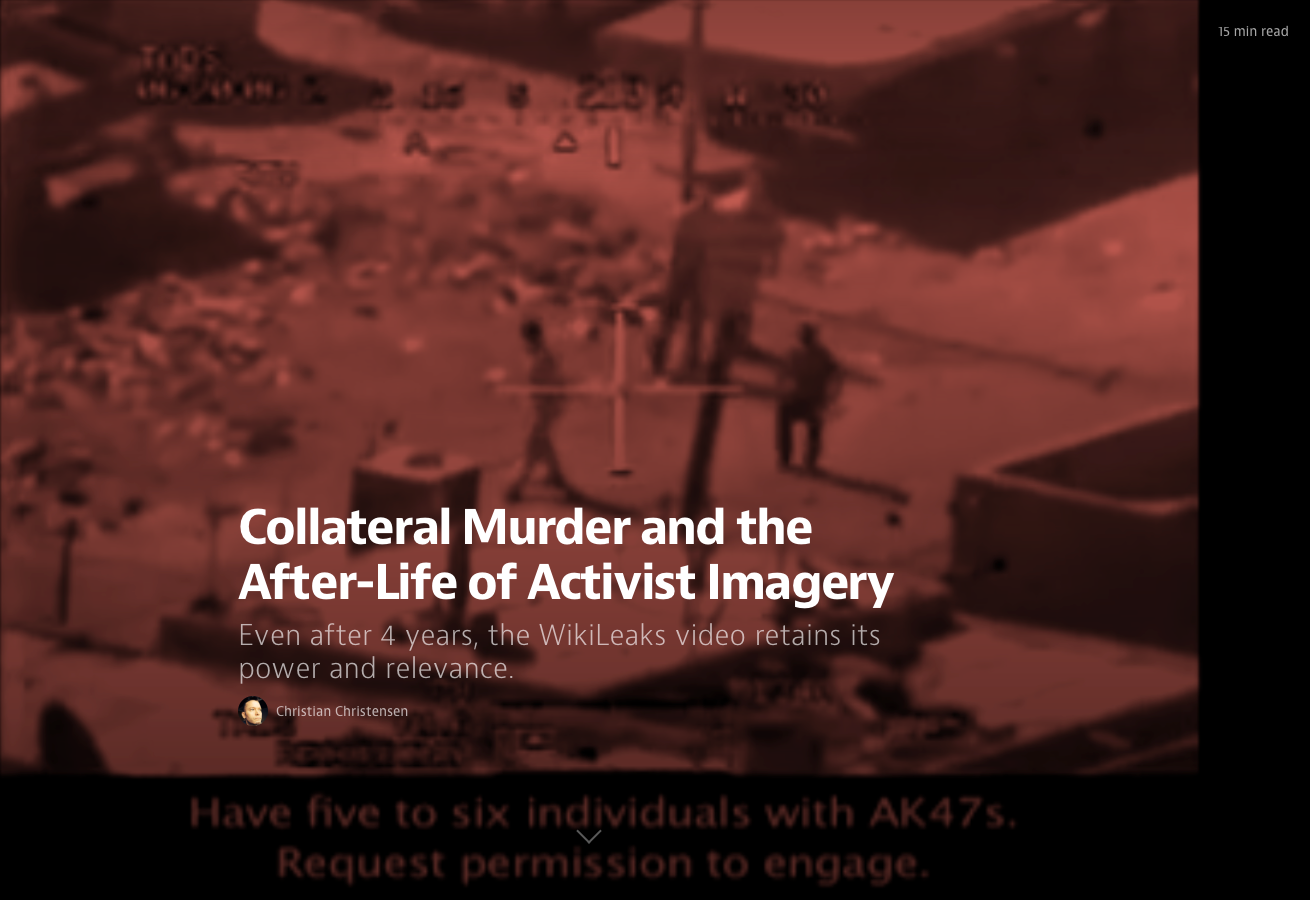
Two short essays that address the public circulation of supposedly secret information.  The first, “Collateral Murder and the After-Life of Activist Imagery”, is by Christian Christensen, and concerns the video clip released by Wikileaks as Collateral Murder in April 2010.  I’ve discussed this edited video of a US Apache helicopter attack in New Baghdad in 2007 before, together with the two documentary films that it provoked, and it forms part of my ‘Militarized Vision’ project (you can find links to the clip and to subsequent commentary in that original post).

CHRISTENSEN Collateral Murder

Christian doesn’t explore the content of the video so much as its inscription and re-inscription within public debates, part of the mediatization of later modern war.  He does make a sharp point about the status of the imagery:

One could argue that the repeated use of this imagery (and corresponding audio) has created an entirely new genre of military reporting. It is a genre with specific, often disturbing conventions: the grainy images of those on the ground, the flat, bland coloring, the “narration” of the aircraft operators which swings between the clinical and the cynical, the silence of those under surveillance or attack, the sound of the weaponry as it is discharged, and, importantly, the “overtness” of the technology, by which I mean the way in which the screen is filled with evidence of the technology being used in the form of the cross-hairs in the middle and data visible at the top and the bottom of the screen…

The Collateral Murder video not only shatters the mythology of humane warfare and benevolent US power, but also causes us to question the notion of neutral technology at the service of human development: a theme which has regained a central space in public debate in recent years.

But he also thinks there is another, no less sharp point to be made about the very act of reporting:

Within this context, the killing of two Reuters employees by the US military was particularly poignant. At the most basic level, this was the symbolic killing of Journalism (with a capital “J”) by a military unaccustomed to critical coverage or investigation at home. The killings, of course, then went unreported until Manning leaked the material and WikiLeaks published it: itself an act of journalism. With Collateral Murder, there is a layering and re-layering of meaning, and, for me, journalism lies at the heart of the clip. These are humans first, of course, and most of those killed or wounded in the attack were not journalists. But, in addition to the tragedy of human death, there is also the tragedy of what is symbolically destroyed: Transparency. Democracy. Knowledge. Critical thinking. And it took an act of journalism to bring these tragedies to light, an act of which has now itself been subjected to the full force of the state via the imprisonment of Manning, and the threat of criminal charges being brought against Assange in the US.

Incidentally, the essay is the text of Christian’s presentation to the ‘Image Operationsconference held at the Institute of Cultural Inquiry (ICI) in Berlin earlier this month; the program is here.

Image Operations

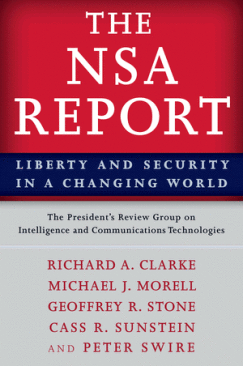
The second essay is Adam Morris‘s wide-ranging review of ‘The geopolitics of the Snowden Files‘ at the Los Angeles Review of Books.  Its immediate provocation is the publication of the Obama administration’s self-serving ‘NSA Report’:

The-NSA-Report-243x366The NSA Report — commissioned by the White House in August, published on its website in December, and now available in print via Princeton University Press— was authored by the President’s Review Group on Intelligence and Communications Technologies. As suggested by its official title, “Liberty and Security in a Changing World,” the Report was intended to advise President Obama on how to reform the data collection practices of the Intelligence Community (IC), in particular the NSA. Its authors include such veterans of the US security sector as Richard A. Clarke, Michael J. Morrell, and Peter Swire. This insiders’ perspective, in theory, is balanced by the addition to the group of constitutional lawyers Geoffrey R. Stone and Cass Sunstein. The unofficial purpose of the Report, however, was the Obama administration’s attempt to put a lid on the NSA scandal by pretending to be interested in reform. As Luke Harding points out in The Snowden Files, the Review Group was working out of the offices of the Director of National Intelligence, currently occupied by the felonious General James Clapper, w _ho knowingly lied in Congressional testimony about the bulk collection of Americans’ communication data.

The essay provides a fine, critical reading of the Report –

‘The anodyne language of these and other recommendations signals the imperial agenda out of which they are born: The NSA Report is obsessed with framing the debate over surveillance around the neopositivist vocabulary of “risk management,” but we know from history that political liberty will always suffer when a dominant regime deems a nation, its leadership or its population a “national security threat”…’

– but it also spirals off into a vigorous mapping of the context in which the NSA set about its covert operations and Edward Snowden‘s principled decision to go public (Adam also provides a commentary on Luke Harding‘s The Snowden Files: for another review, see Daniel Soar at the London Review of Books here).  And here too, of course, investigative journalism is a vital, enabling and even empowering practice.

Blurring the lines

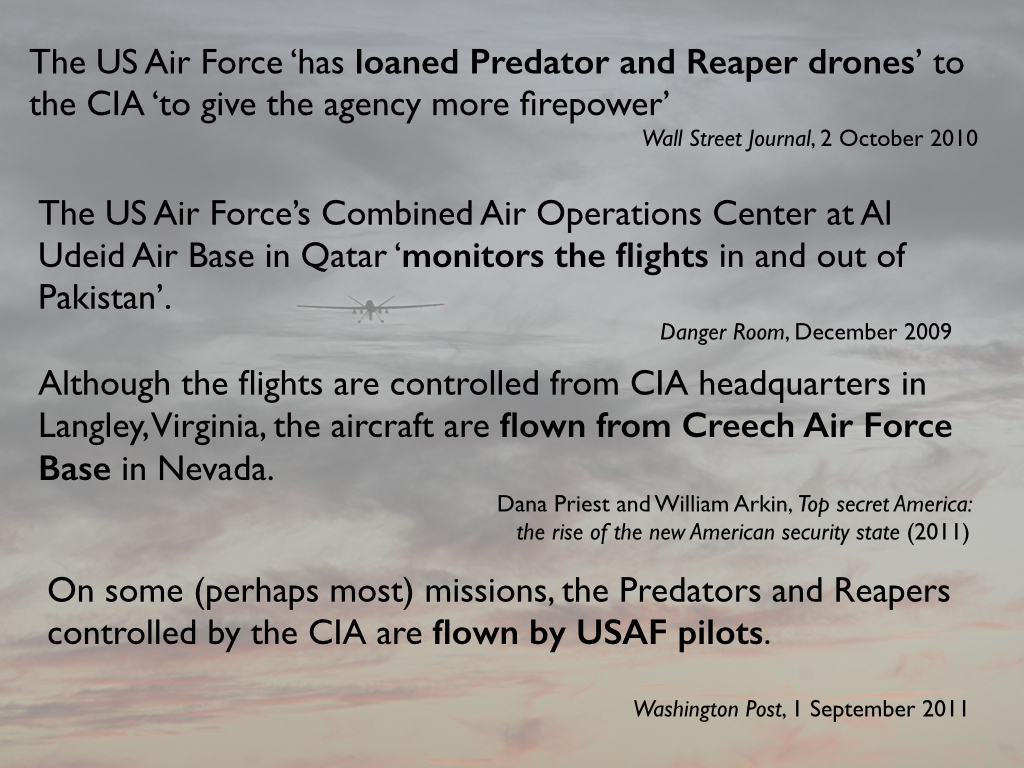
In the short-form version of ‘The everywhere war’ (DOWNLOADS tab) I emphasised the blurring of the lines between the increasingly paramilitary but nominally civilian CIA and the US military, and for the last several years I’ve been including this slide in most of my presentations about CIA-directed drone strikes in Pakistan (and I’ve been very careful to use precisely that description: ‘CIA-directed’):

CIA:USAF.001

Today’s Guardian (online) carries a report that lends support to these claims and concerns:

17th Reconnaissance SquadronA regular US air force unit based in the Nevada desert is responsible for flying the CIA’s drone strike programme in Pakistan, according to a new documentary to be released on Tuesday.

The film – which has been three years in the making – identifies the unit conducting CIA strikes in Pakistan’s tribal areas as the 17th Reconnaissance Squadron, which operates from a secure compound in a corner of Creech Air Force Base, 45 miles from Las Vegas in the Mojave desert.

Several former drone operators have claimed that the unit’s conventional air force personnel – rather than civilian contractors – have been flying the CIA’s heavily armed Predator missions in Pakistan, a 10-year campaign which according to some estimates has killed more than 2,400 people.

The film is Tonje Schei‘s documentary Drone, which has its premiere tomorrow.  You can read an interview with her about the drone wars here.  In an overlapping interview for Pakistani media, she explains:

DRONE investigates the human consequences of the US drone war. Through unique access to voices on both sides of this new technology, DRONE offers new insights into the nature of drone warfare. DRONE juxtaposes the realities of drone victims in Waziristan to drone pilots who struggle to come to terms with the new warfare. The film covers diverse and integral ground from the recruitment of young pilots at gaming conventions and the re-definition of “going to war”, to the moral stance of engineers behind the technology, the world leaders giving the secret “greenlight” to engage in the biggest targeted killing program in history, and the people willing to stand up against the violations of civil liberties and fight for transparency, accountability and justice.

You can watch a clip on Youtube, which I’ve also embedded here, in which Chris Woods (senior reporter at the Bureau of Investigative Journalism) explains why this blurring of the lines between the CIA and the military matters:

Schei’s original source was Brandon Bryant, a former USAF sensor operator who had already gone public with his own account of the traumatic business of targeted killing (see also here and here).  He decided to add to his testimony when the Obama administration proposed transferring control of the targeted killing program from the CIA to the military, a plan that has faced Congressional opposition:

“There is a lie hidden within that truth. And the lie is that it’s always been the air force that has flown those missions. The CIA might be the customer but the air force has always flown it. A CIA label is just an excuse to not have to give up any information. That is all it has ever been.”

Bryant’s account has apparently been corroborated by another six former crew members, who claimed that the 17th transitioned to its ‘new customer’ in 2004.

Sudden-Justice_webChris Woods provides much more in Sudden Justice: America’s secret drone wars, forthcoming from Hurst at the end of this year, but – for now – here is what I said in ‘The everywhere war’ in 2011 (and I can now say much more in The everywhere war!):

These considerations radically transform the battlespace as the line between the CIA and the military is deliberately blurred. Obama’s recent decision to appoint Panetta as Secretary of Defense and have General David Petraeus take his place as Director of the CIA makes at least that much clear. So too do the braiding lines of responsibility between the CIA and Special Forces in the killing of Osama bin Laden in Abbottabad in May 2011, which for that reason (and others) was undertaken in what Axe (2011) portrays as a ‘legal grey zone’ between two US codes, Title 10 (which includes the Uniformed Code of Military Justice) and Title 50 (which authorises the CIA and its covert operations) (Stone 2003). The role of the CIA in this not-so-secret war in Pakistan thus marks the formation of what Engelhardt and Turse (2010) call ‘a new-style [battlespace] that the American public knows remarkably little about, and that bears little relationship to the Afghan War as we imagine it or as our leaders generally discuss it’.


Scarry thoughts

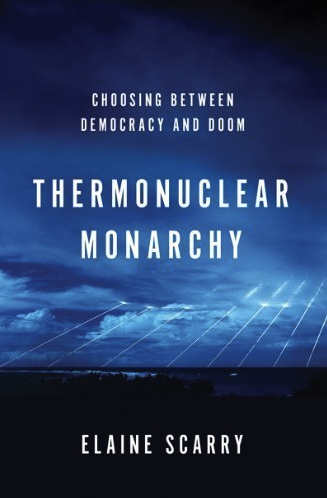
SCARRY Thermonuclear monarchyI imagine most readers will know Elaine Scarry‘s vital account of The Body in Pain.  She has produced several important books since then, of course, but Scarry explains that her latest book, Thermonuclear monarchy: choosing between democracy and doom, published last month by Norton, emerged directly from her first:

It directly emerged from “The Body in Pain,” which has a first chapter on torture and a second on war. I was trying to address the question why when people prohibit torture they make it an absolute prohibition, but when they make a prohibition on war, they always make exceptions.

I realized that nuclear weapons much more approximate the condition of torture than of war. Torture involves zero consent on the part of the injured, whereas conventional war allows many levels of consent. With nuclear weapons, there’s zero consent.

There is an excellent, wide-ranging conversation between Scarry and Sarah Gerard at The American Reader here that goes back as far as Hobbes (who turns out to be crucial for Scarry’s argument) and spools forward to today’s drone wars.  If you read just one thing this week, read that.