The other side of NSA

I’ve emphasised the networks in which drone operations take place several times on this blog, and I’ll have more to say about it (and, crucially, the satellite links involved) very shortly.  But this applies to all domains in which advanced militaries now operate.  In 2012 Army magazine (62: 6) put it like this:

The world in which U.S. forces operate is increasingly wireless and computer network-based. Rapidly evolving information technologies are expanding the speed, capacity, agility, efficiency and usefulness of modern networks. The prolif- eration of these systems is changing the way humans interact with each other and their environment, including military operations. This creates conditions that will make U.S. forces increasingly dependent on these technologies and require soldiers to counter technology-empowered and so- phisticated adversaries who can utilize commercial indus- try and the network as their primary combat developers. This broad and rapidly changing [Operational Environment] will present a plethora of potential threats and opportunities that are primarily limited by our own—and our opponents’—imagination, causing the Army to operate within a cyberspace domain and EMS [Electromagnetic Spectrum] that are increasingly congested and contested.

The authors went on to emphasise the convergence of ‘cyber and EMS capabilities’ (and, not coincidentally to my interest in satellite communications, the intersections between commercial and military systems):

Commercial and military systems are increasingly reliant on both as networks and telecommunication infrastructures expand their use of wireless means. This is particularly important for collaborative systems that require connectivity to operate effectively. The synergistic effect of these networks is a significant reason why EW [electronic warfare], EMSO [EMS operations] and cyber operations must be viewed as interrelated and interdependent.

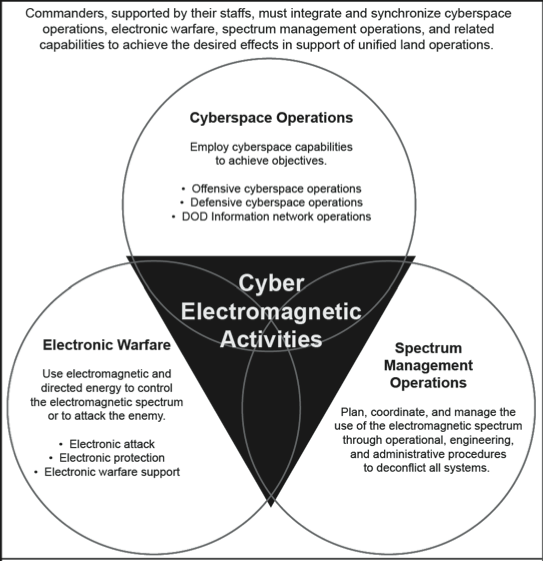
The Pentagon has now published its first Field Manual on Cyber Electromagnetic Activities (FM 3-38).  If you are still wondering what these are, and why I’ve described them as the ‘other side’ of NSA (and by extension, GCHQ and the other ‘Five Eyes’) global surveillance operations, this is what the manual says:

Cyber electromagnetic activities are activities leveraged to seize, retain, and exploit an advantage over adversaries and enemies in both cyberspace and the electromagnetic spectrum, while simultaneously denying and degrading adversary and enemy use of the same and protecting the mission command system (ADRP 3-0). CEMA consist of cyberspace operations (CO), electronic warfare (EW), and spectrum management operations (SMO).

Cyber Electromagnetic Activities

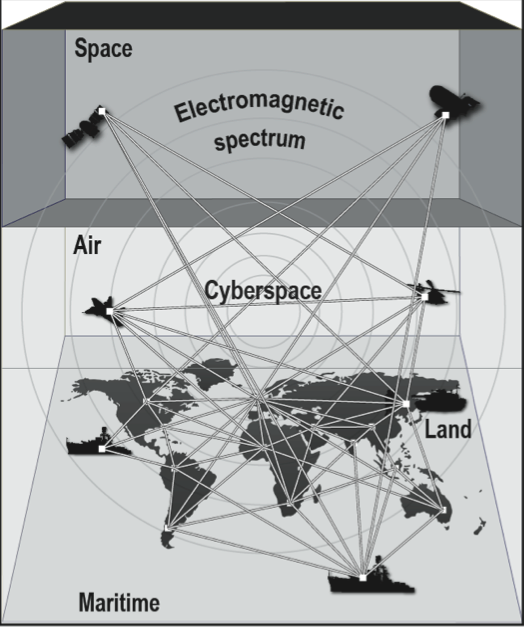
The FM – and remember this is doctrine: we have a long way to go before we are able to probe into practice – diagrams the relation between the ‘five domains’ of US military operations (air, land, sea, space and cyberspace) and the electromagnetic spectrum like this:

Five domains and the Electromagnetic Spectrum

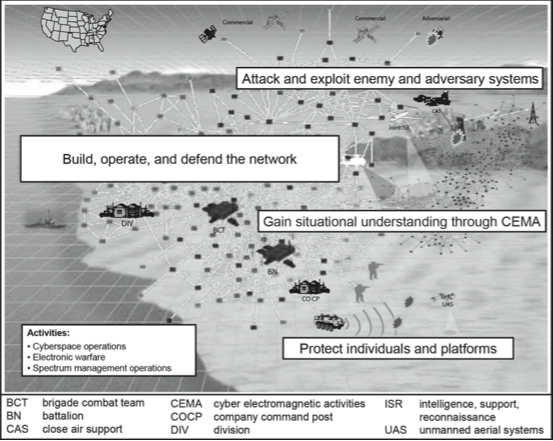
Operationally, for ‘unified land operations’ (this is a US Army manual, remember) this translates into undertaking Cyber Electromagnetic Activities (CEMA) thus:

Cyber electromagnetic activities Operational View

You can find a short discussion of the pre-history behind the Field Manual here.

I’m going to work my way through the manual in detail, and think through its implications for what I already know about cyberwar (even if Thomas Rid thinks it will never take place).  I sketched out some of my early ideas in ‘The everywhere war’ (DOWNLOADS tab), largely in relation to Stuxnet and cyber-attacks on Iran’s nuclear programme, but there have been many more developments and revelations since then, so watch this space.

A wedding turned into a funeral

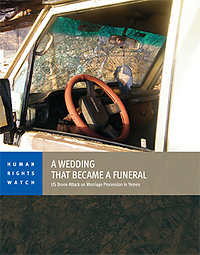
yemen0214_reportcoverHard on the heels of its report into six US targeted killings in Yemen in 2009 and 2012-13, Human Rights Watch has published a detailed analysis by Letta Tayler of another drone strike carried out by Joint Special Operations Command (JSOC) against a wedding convoy on 12 December 2013.  According to Greg Miller in the Washington Post,

The report represents the most detailed independent examination to date of a strike that has focused attention on the administration’s struggles to tighten the rules for targeted killing, provide more information about such operations to the public and gradually shift full control of the drone campaign from the CIA to the Pentagon.

There is considerable evidence of covert US-Pakistan co-operation in targeting in the Federally Administered Tribal Areas (see here and here), but in the case of Yemen the collaboration is more overt and perhaps even more formalised: Yemen’s President described a ‘joint operations room’, including agents/officers from the US, the UK, NATO and Yemen that ‘identifies in advance’ prospective targets (who are usually described as members of Al-Qaeda in the Arabian Peninsula).

In this case, as in so many others, the United States has insisted that all those killed were terrorists, but HRW’s on-the-ground interviews (and videos) tell a different story.  After a wedding feast at the home of the bride, many of the men and some of the women jumped into their vehicles to escort the bridal couple to a second celebration at in the groom’s village of al Jashem 35 km away.

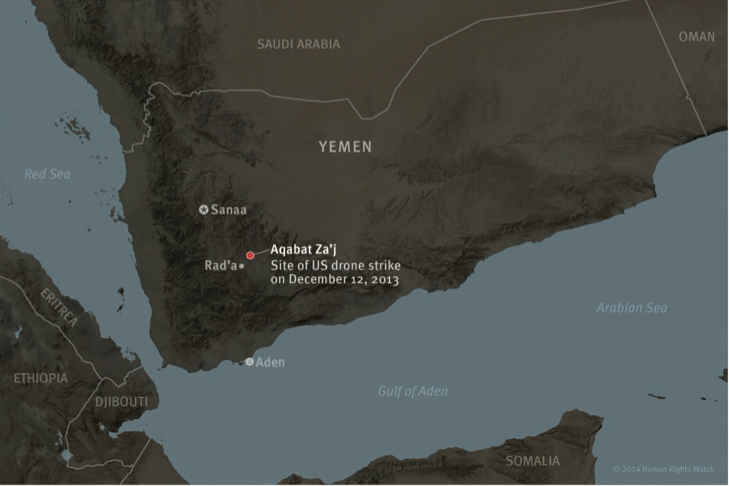
HRW Drone strike Yemen 12 December 2013

At 4.30 that afternoon four Hellfire missiles struck the vehicles, killing at least 12 men and wounding at least 15 others – who are named and identified in the HRW report, and according to relatives all civilians.

‘We were in a wedding,’ cried the groom, ‘but all of a sudden it became a funeral. …We have nothing, not even tractors or other machinery. We work with our hands. Why did the United States do this to us?’

The US isn’t saying, and HRW notes that accounts from the government of Yemen have been inconsistent – though the local governor an military commander apologies for the killings, describing them as ‘a mistake’.  Some reports agreed that some of those targeted were Al-Qaeda members – though if so, it seems they escaped: AQAP has not identified ‘martyrs’ lost in the attack, which is its invariable practice – and some claimed that the victims included ‘smugglers and arms dealers’.

2014181435057734_20

But they also all made it clear that this was a wedding convoy that was targeted, and the government of Yemen has made compensation payments to the families.

HRW discusses the implications of the killings under the different legal regimes of international humanitarian law (the ‘laws of war’) and international human rights law, but also notes that the attack seems to have violated the protocols set out by the Obama administration in May 2013.  These included the ‘near-certainty that no civilians will be killed or injured…’

NBC – which also has video of the aftermath of the strike – reported in January that the Obama administration was carrying out an ‘internal investigation’, but nothing has been forthcoming and questions from HRW were rebuffed.  All we have so far is this extraordinary statement, reported by  Rooj Alwazir for al Jazeera:

“Obviously, broadly speaking, we take every effort to minimise civilian casualties in counterterrorism operations – broadly speaking, without speaking to this one specifically,” State Department deputy spokeswoman Marie Harf said when asked about the strike.

‘Broadly speaking’, what is it about weddings that those carrying out air strikes don’t understand?

It’s not difficult to imagine what those who attended the wedding will remember of that day.  But in case it is, Reprieve (which carried out its own investigation into the strike) has published photographs of some of the victims and their families – and of a funeral of nine people.

UPDATE:  AP is now carrying sketchy information about the official investigation into the strike:

Three U.S. officials said the U.S. government did investigate the strike against al-Badani — twice — and concluded that only members of al-Qaida were killed in the three vehicles that were hit…

Lt. Gen. Joseph Votel, commander of Joint Special Operations Command, ordered an independent investigation by an Air Force general and the White House requested another by the National Counterterrorism Center. Both concluded no civilians were killed. Votel’s staff also showed lawmakers video of the operation. Two U.S. officials who watched the video and were briefed on the investigations said it showed three trucks in the convoy were hit, all carrying armed men.

The report provides no basis for the identification of the victims as non-civilians.  Human Rights Watch had already questioned the presence of armed men as indicative:

‘Nearly everyone in the procession was an adult male, and one Yemeni government source said many of the men carried military assault rifles. But these details do not necessarily point to involvement in violent militancy. Yemeni weddings are segregated, including the traditional journey to bring the bride to her new home. And Yemeni men commonly travel with assault rifles in tribal areas, including in wedding processions, when celebratory gunshots are common.’

But here is the final Catch-22:

The officials said the Pentagon can’t release details [of the strike or the investigation] because both the U.S. military and the CIA fly drones over Yemen. By statute, the military strikes can be acknowledged, but the CIA operations cannot. The officials said that if they explain one strike but not another, they are revealing by default which ones are being carried out by the CIA.

When soldiers fall

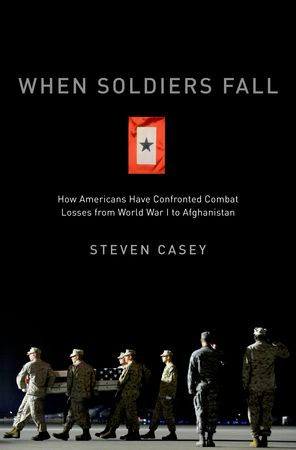
CASEY When soldiers fallNews of an important new book that feeds directly into my new project on medical-military machines and casualties of war, 1914-2014: Steven Casey‘s When Soldiers Fall: How Americans Have Confronted Combat Losses from World War I to Afghanistan (OUP, January 2014).  My own project is concerned with the precarious journeys of those wounded in war-zones (combatants and civilians) rather than those killed and the politics of ‘body-counts’, but Casey’s work presents a vigorous challenge to the usual assumptions about public responses to combat deaths:

The extent to which combat casualties influence the public’s support for war is one of the most frequently and fiercely debated subjects in current American life and has cast an enormous shadow over both the Iraq and Afghanistan conflicts. The common assumption, based largely on U.S. experience in past wars, is that the public is in some way casualty averse or casualty shy, and that as losses increase its support for a war will inexorably decline. Yet this assumption has been adopted as conventional wisdom without any awareness of one of the most important dimensions of the issue: how has the public become aware of the casualties sustained during particular wars? To what extent has the government tried to manipulate or massage the figures? When and why have these official figures been challenged by opportunistic political opponents or aggressive scoop-seeking reporters?

As Steven Casey demonstrates, at key moments in most wars what the public actually receives is not straightforward and accurate casualty totals, but an enormous amount of noise based on a mixture of suppression, suspicion, and speculation. This book aims to correct this gap in information by showing precise what casualty figures the government announced during its various wars, the timing of these announcements, and any spin officials may have placed upon these, using a range of hitherto untapped primary documents. Among the nuggets he has uncovered is that during World War I the media depended on Axis figures and that the Army and Navy did not announce casualty figures for an entire year during World War II. Organized chronologically, the book addresses the two world wars, the limited wars in Korea and Vietnam, and the recent conflicts that are part of the War on Terror. Using sources such as the private military command papers of Generals Patton, MacArthur, and Westmoreland, and previously unopened New York Times archives, it offers the first analysis of how the U.S. government has publicized combat casualties during these wars, and how these official announcements have been debated and disputed by other voices in the polity. Casey discusses factors such as changes of presidential administration, the improvement of technology, the sending of war correspondents to cover multiple conflicts, and the increasing ability to identify bodies. Casey recreates the complicated controversies that have surrounded key battles, and in doing so challenges the simplicity of the oft-repeated conventional wisdom that “as casualties mount, support decreases.” By integrating military and political history, he presents a totally new interpretation of U.S. domestic propaganda since 1917, filling a major gap left by a spate of recent books. Finally, it provides a fresh and engaging new perspective on some of the biggest battles in recent American history, including the Meuse-Argonne, D-Day, the Battle of the Bulge, China’s intervention in the Korean War, the Tet Offensive, and the recent campaigns in Iraq and Afghanistan.

Amazon has temporarily withdrawn its Kindle edition because there are technical issues that it is working with OUP to resolve: I hope this is sorted out soon…  But for now you can read an extract over at Salon, ‘How Richard Nixon reinvented American warfare (…and paved the way for Iraq and Afghanistan)’:

Determined to prop up South Vietnam in an election year, Nixon’s casualty sensitivity had not extended beyond American lives to enemy noncombatants. “Now, we won’t deliberately aim for civilians,” he told his senior advisers at one point in 1972, “but if a few bombs slop over, that’s just too bad.” In Nixon cold calculation the American electorate was principally concerned with U.S. losses; it cared far less about what happened to civilians….

In the wake of defeat, the U.S. government tried to learn the appropriate lessons. As well as reconsidering military-media relations, officials thought long and hard about the conditions under which the public would support the use of force—and the prospect of casualties—in the future. Sometimes, they looked back beyond Vietnam to an earlier era when the media had appeared more manageable and the public less skeptical. Of course, even during the two world wars and Korea, the government had always faced searching questions about the veracity of its casualty information. But Vietnam had clearly changed the rules of the game. Trust in government was much lower. The media was even keener to probe for the story behind the official narrative. And the whole debate was now even more sensitive to the human cost of war. These were all legacies that the two Bushes would have to grapple with in the post–Cold War era, as they took the United States into war against a new set of enemies.

More dirty dancing

As I work on turning my Beirut talk on drone strikes in the Federally Administered Tribal Areas (FATA) into a long-form version – which includes a detailed and critical engagement with Giorgio Agamben‘s characterisation of the state/space of exception – I’ll post some of the key arguments here.  But for now, two important developments.
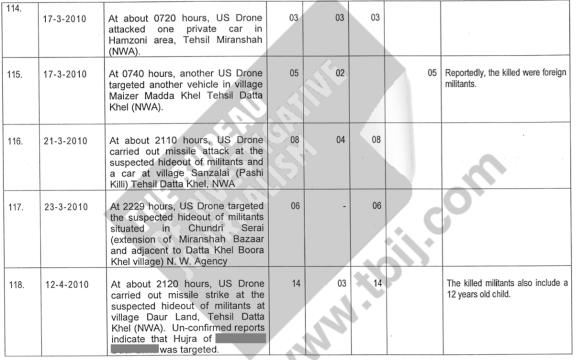
Document-excerpt

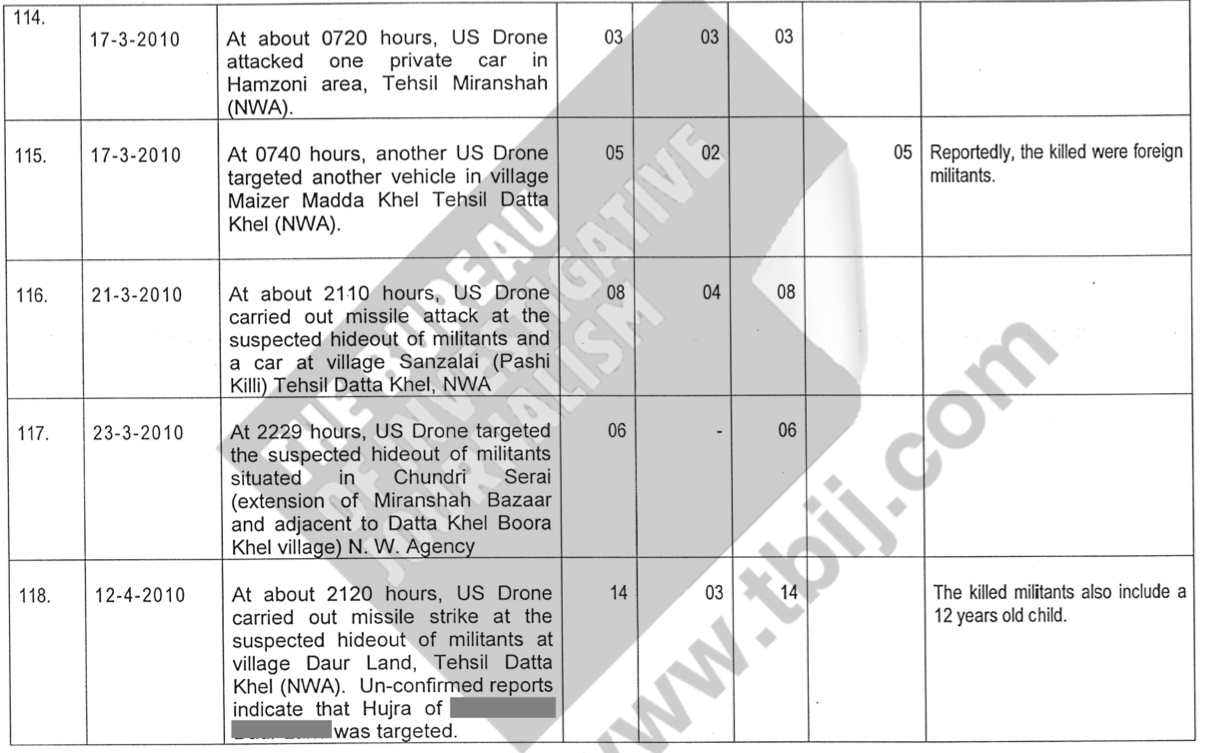
First, the Bureau of Investigative Journalism has just published a list of 330 drone strikes  between 2006 and July 2013 (data for the five strikes that took place in 2007 are missing) compiled by the Pakistan government (see extract above); this is an update of a partial release from the Bureau last summer.  The source is a series of reports filed each evening by Political Agents in the field to the FATA secretariat, and while it’s not a comprehensive listing – and Islamabad relies on other sources too – the document closely follows the Bureau’s own database compiled from other independent sources.  It also allows for a more accurate mapping of the strikes – more to come on this.

But one key difference between the list and the Bureau’s database is that, following the election of Obama, the official reports no longer attempted to classify the victims as combatants or civilians: and the coincidence may not be coincidental.  According to Chris Woods,

‘One of my sources, a former Pakistani minister, has indicated that local officials may have come under pressure to play down drone civilian deaths following the election of Barack Obama. It’s certainly of concern that almost all mention of non-combatant casualties simply disappears from this document after 2009, despite significant evidence to the contrary.’

One of the most egregious omissions is the drone strike on 24 October 2012 that killed Mamana Bibi, a grandmother tending the fields with her grandchildren.  The case was documented extensively by Amnesty International and yet, as the Bureau notes, while the date and location of the strike is recorded the report from the political agent is remarkably terse and makes nothing of her evident civilian status.

‘If a case as well-documented as Mamana Bibi’s isn’t recorded as a civilian death, that raises questions about whether any state records of these strikes can be seen as reliable, beyond the most basic information,’ said Mustafa Qadri, a researcher for Amnesty International…. ‘It also raises questions of complicity on the part of the Pakistan state – has there been a decision to stop recording civilians deaths?’

These are important questions, and in fact one of the central objectives of my own essay is to document the close, covert co-operation between the US and Pakistani authorities: what I called, in an earlier post, dirty dancing, trading partly on Jeremy Scahill’s inventory of ‘dirty wars’ and partly on Joshua Foust‘s calling out of the ‘Islamabad drone dance’.

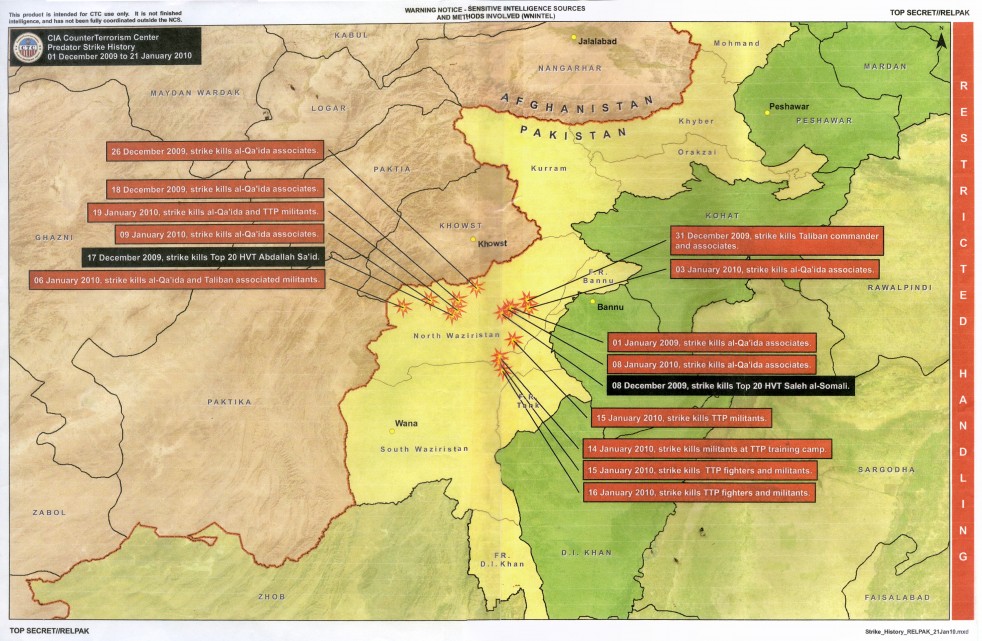
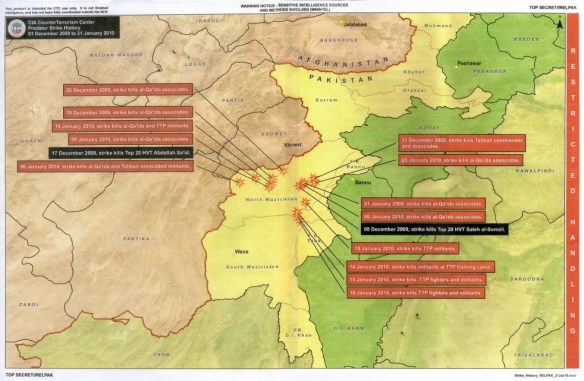
We now know that this collaboration continued at the very least until late 2011.  The CIA’s Counterterrorism Center routinely prepared reports that included maps (see below) and pre- and post-strike imagery that were briefed by the Deputy Director to Husain Haqqani, the Pakistani ambassador in Washington, and subsequently transmitted to Islamabad.
US_Pakistan_Panorama21382550661-1

And consistent with the reports from Political Agents to the FATA Secretariat, Greg Miller and Bob Woodward note that in these briefings:

Although often uncertain about the identities of its targets, the CIA expresses remarkable confidence in its accuracy, repeatedly ruling out the possibility that any civilians were killed.  One table estimates that as many as 152 “combatants” were killed and 26 were injured during the first six months of 2011. Lengthy columns with spaces to record civilian deaths or injuries contain nothing but zeroes.

The collaboration is important, because it has major implications for how one thinks about the Federally Administered Tribal Areas as a ‘space of exception’: there are multiple legal regimes through which the people who live in these borderlands are knowingly and deliberately ‘exposed to death’, as Agamben would have it.  More on this later, but for now there is a second, more substantive point to be sharpened.

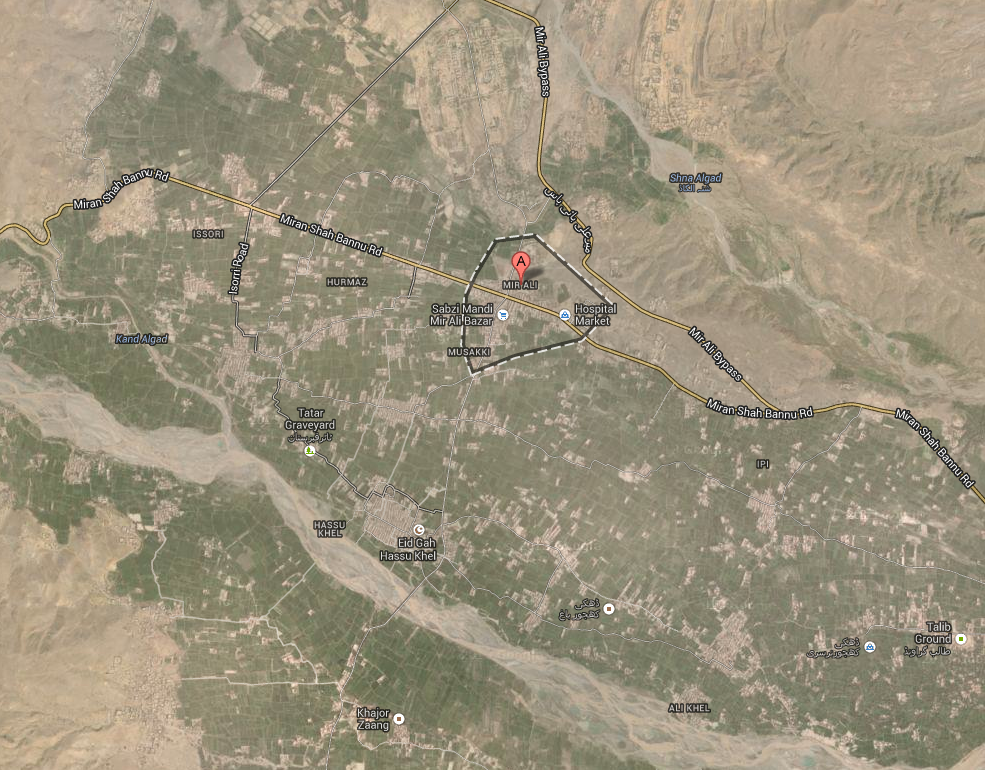
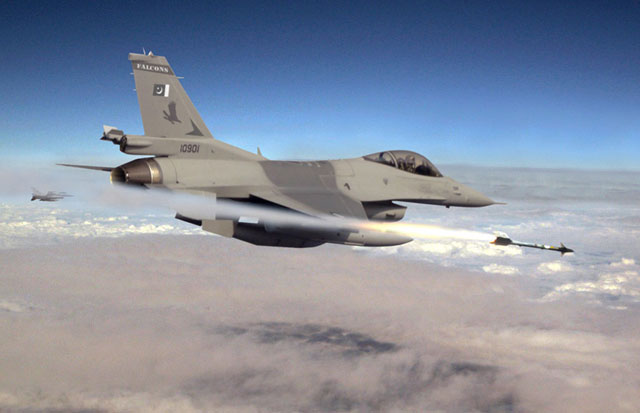
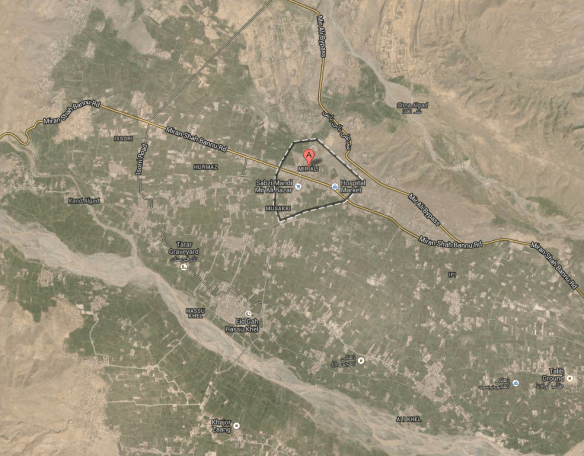
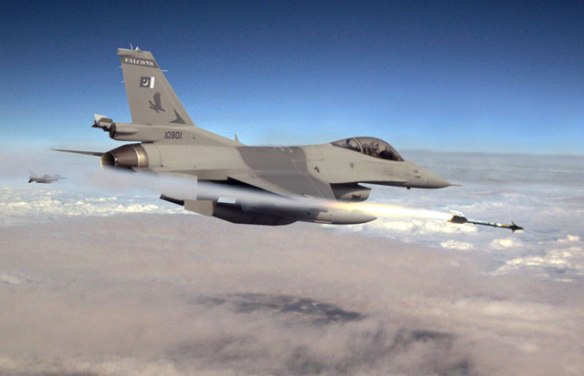
I’ve previously emphasised that the people of FATA are not only ‘living under drones‘, as the Stanford/NYU legal team put it last year, but also under the threat of air strikes from the Pakistan Air Force.  Last week the PAF resumed air strikes against leaders of the Tehrik-i-Taliban Pakistan (TTP) in North Waziristan, using first F-16 aircraft and then helicopter gunships to attack what were described as ‘eight major targets’ in the villages of Mir Ali (Hamzoni, Issori, Khadi and Nawana). Although the Air Force described the operation as a ‘blitz’, it initially claimed that only two people were killed.  A different story soon emerged.
MIR ALI

According to Pakistan’s International News, the air raids started just before midnight on 20 January, and people ‘left their homes in desperation and spent the night in the open along with children when the jets started bombing.’

There were conflicting reports about the identity of those killed. Military authorities said all the 40 people killed in the overnight aerial strikes were hardcore militants or their relatives and family members.

However, tribesmen in Mir Ali subdivision insisted that some local villagers, including women, children and elderly people, were also killed in the bombing by the PAF’s fighter aircraft and Pakistan Army’s helicopter gunships as residential areas were attacked.
848700893_1390366252

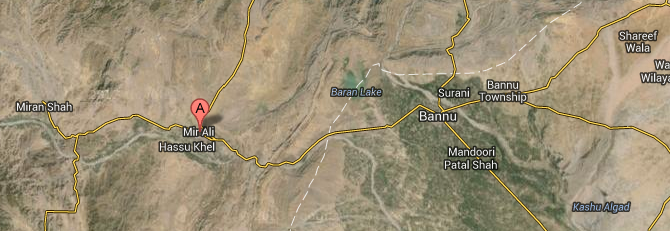
Several days later there were reports of hundreds – even thousands – of people fleeing the area in anticipation of continuing and intensifying military operations.  On 25 January the Express Tribune reported:

“Most of the families of Mir Ali Bazaar and adjacent areas have been leaving,” Abdullah Wazir, a resident of Spin Wam told The Express Tribune, adding, “women and children have been leaving with household materials, but livestock and larger items of belongings are being abandoned by these families.”

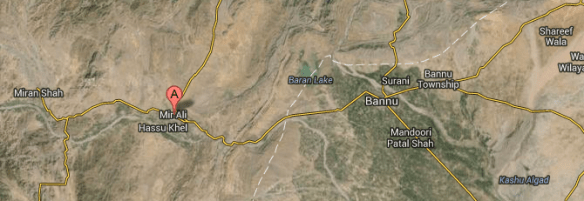
“It is difficult to find shelter in Bannu,” said Janath Noor, aged 38, who travelled there with her family. “There are problems at home and here in Bannu too.” She added that the families were forced to act independently as the political administrations in North Waziristan and Bannu have not made arrangements for the fleeing families. Some families reportedly spent the night under the open sky in Bannu town, waiting for any available shelter.

Some IDPs have also faced problems such as harassment at the hands of the police, requests for bribes, soaring rates of transport from Mir Ali and inflated rents for houses in Bannu. Some families, suspected of being militants, have had problems finding accommodation in Bannu district.
Mir Ali:Bannu

By 27 January the government estimated that 8,000 people had arrived in Bannu, while many others unable to find shelter and unwilling to sleep in the open had hone on to Peshawar and elsewhere.  But the head of the FATA Disaster Management Authority declared that ‘No military operation has been announced in the tribal area so there are no instructions to make arrangements for the internally displaced people.’

Most local people were clearly sceptical about that and, certainly, there were authoritative claims that Pakistan was being put ‘on a war footing’ to counter the surging power of the TTP.  In the same week that the air strikes were launched, Islamabad promulgated an amended Protection of Pakistan Ordinance (PPO), modelled on the imperial Rowlatt Act of 1919, that included provisions for secret courts, greater shoot-to-kill license for the police, house raids without warrants and the detention of terror suspects without charge. Rana Sanaullah, Minister for Law, Parliamentary Affairs and Public Prosecution in the Punjab and a close confidant of Prime Minister Nawaz Sharif, told the Guardian: ‘I think what will be done will be no worse than what has happened in Guantánamo Bay.’  Not surprisingly, he also offered support for the US drone strikes:

‘We believe that drone attacks damage the terrorists, very much… Inside, everyone believes that drone attacks are good; but outside, everyone condemn because the drones are American.’

And, as I’ll try to show in a later post, it’s a different inside/outside indistinction that plays a vital role in producing the FATA as a space of exception.

In plain sight

I’ve posted about camouflage before, but mainly in an historical context: the issue looms large in two recent essays, ‘Gabriel’s Map’ and the soon-to-be-completed ‘The natures of war’.  But it is, of course, of vital contemporary importance, and I’m thinking through its implications for my ‘Militarized vision‘ project.  After all, ‘seeing like a military‘ also involves what is not seen…

Here the work of Isla Forsyth is indispensable: see in particular her ‘Subversive patterning: the surgical qualities of camouflage’, Environment and Planning A 45(2013) 1037-52 and  ‘Designs on the desert: camouflage, deception and the militarization of space’, Cultural geographies, online July 2013; I also like James Philip Robertson‘s ‘Darkened surfaces”: camouflage and the nocturnal observation of Britain, 1941-45’, Environment and Planning A 45 (2013) 1053-69.

But these are all historical investigations, and for those new to contemporary camouflage Kelsey Campbell-Dollaghan has a helpful summary of advances (and failures) in ‘digital’ camouflage over at Gizmodo, ‘The history of invisibility and the future of camouflage’.

Hyperstealth Biotechnology Corp

The article takes off from the failure of the US Army’s ‘Universal Camouflage Pattern’ introduced in 2004, which was supposedly designed to work anywhere: not surprisingly, it didn’t. Cindi Katz‘s wonderfully waspish descriptions of the post-9/11 deployment of the National Guard in New York City are irresistible:

‘I’ve grown accustomed to their presence — frighteningly so — but still can’t get over their costumes. Green, woodsy camouflage. To blend with Penn Station?!’

Kelsey interviews Guy Cramer, CEO of Hyperstealth Biotechnology, ‘leaders in camouflage, concealment and deception’, and one of four finalists in the US Army’s Camo Improvement project. He has interesting things to say about fractals, pattern and scale but also about the temporal horizon of camouflage: how long does the deception have to work? Perhaps it will soon be time to head over to Penn Station again….

UPDATE: I’ve just stumbled across Stefka Hristova‘s ‘Digital Animalized Camouflage: A Zone of Biopolitical Indistinction’, from interstitial last year, which make a series of imaginative connections between digital camouflage and the state of exception: you can access it  here.

Un-Christmas reading

DOD-USRM-2013 (dragged)Two reports to put on the reading list.  The US military has been revising its Counterinsurgency manual, FM 3-24 (December 2006), and as part of that process the Joint Chiefs of Staff have now issued their updated JP 3-24 on Counterinsurgency (November 2013).  I haven’t had time to digest it yet, but air power is no longer relegated to the closing pages…

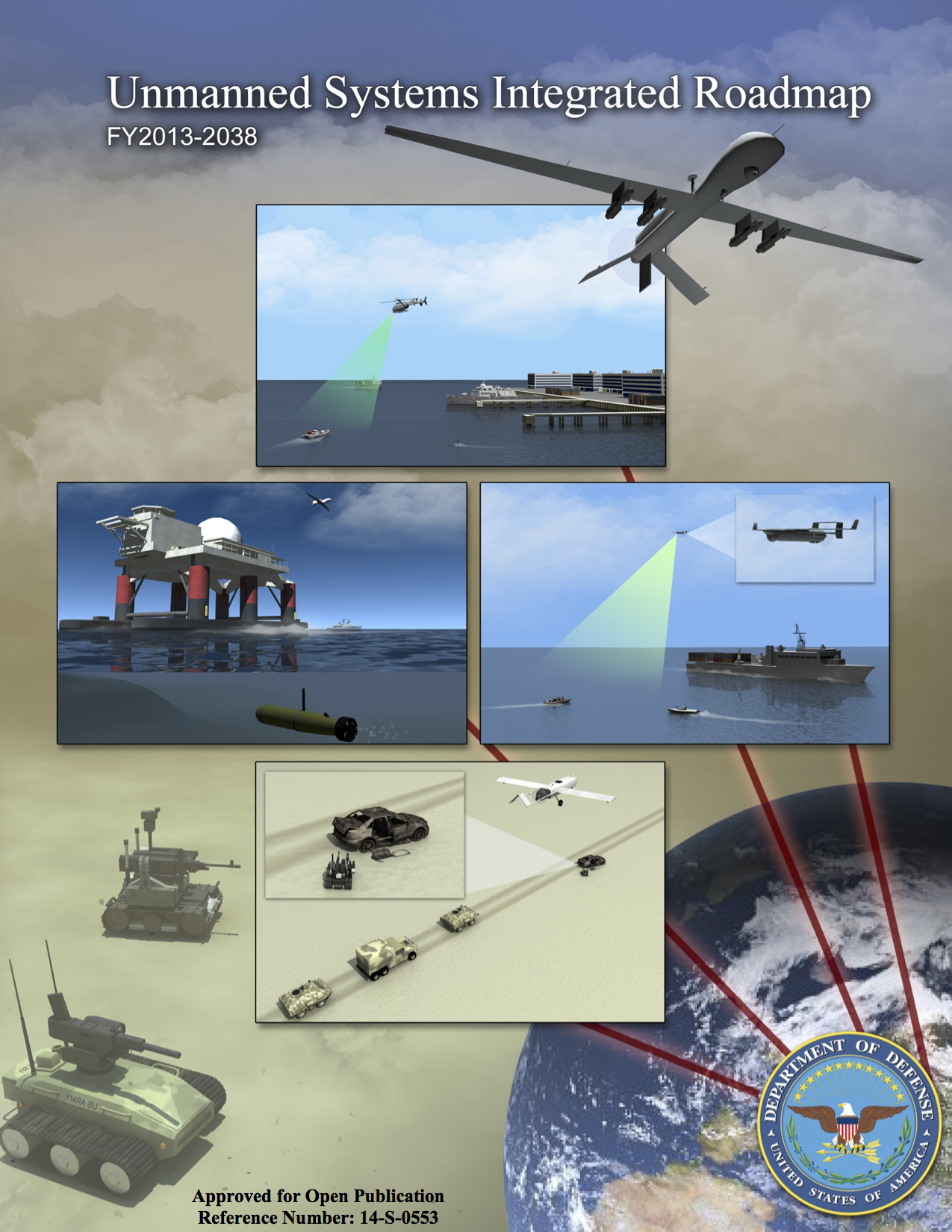
The US Air Force is also in the closing stages of its so-called Vector Report on Remotely Piloted Aircraft, which is supposed to map out the likely role of military UAVs over the next 25 years; its release has been delayed for what are described a minor last-minute changes, but just before Christmas the Pentagon released its Unmanned Systems Integrated Roadmap 2012-2038, which includes its plans for aerial, ground and maritime systems.

Eyes in the sky, boots on the ground

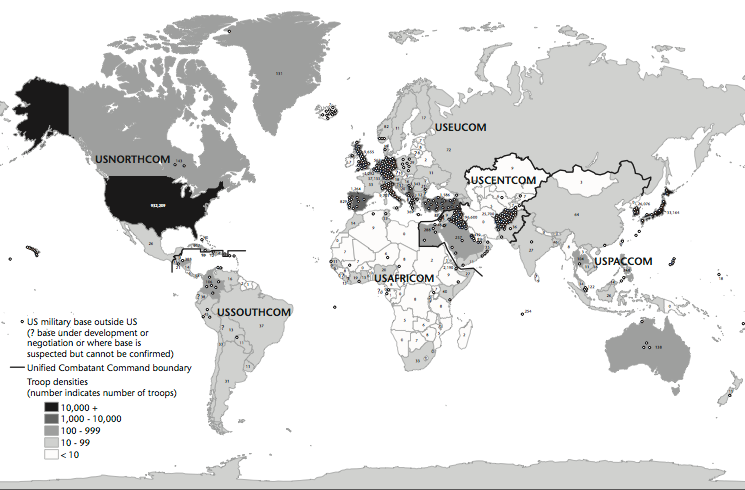
When I was working on my ‘War and peace’ essay (Trans Inst Br Geogr 35 (2010) 154–186; DOWNLOADS TAB) – which will appear, in radically revised and extended form, in The everywhere war – I included this map of US military bases outside the continental United States, based on David Vine‘s Island of shame: The Secret History of the U.S. Military Base on Diego Garcia (2009), which was in turn derived from the Pentagon’s 2007 Base Structure Report:

US military bases

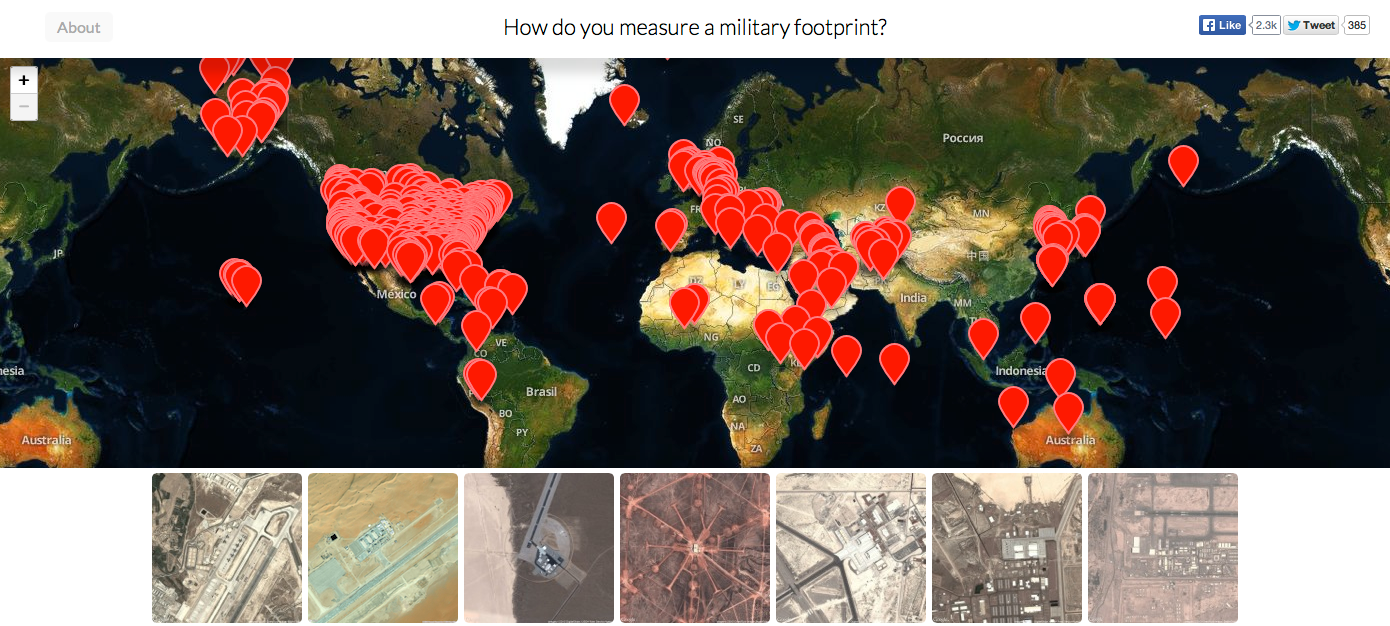
Various other versions are available around the web, but now – inspired in part by Trevor Paglen‘s Blank Spots on the Map – a new project by Josh Begley (of Dronestream fame) has worked from the 2013 Base Structure Report to produce a new base map supplemented by aerial/satellite imagery of more than 640 US military bases around the world.

It’s still a minimalist accounting, but the lacunae are produced not only by the secret installations that are systematically excluded from the Pentagon’s public accounting of what it calls its ‘real property’  – if only there could be a listing of its surreal property too (which is where Trevor comes in) – but also by the database’s predisposition towards permanence (of sorts).  You’ll see what I mean if you zoom in on Afghanistan: the main Forward Operating Bases are there but none of the firebases and combat outposts scattered across the landscape.  Still, even in this appropriately skeletal form, it’s a vivid reminder of the boots firmly planted on other people’s ground.

BEGLEY How do you measure a military footprint?

Josh includes a sharp-eyed commentary on the differences between images of the same site on different commercial platforms, and concludes his opening essay, ‘How do you measure a military footprint?’ like this:

Taken as a whole, I’d like to think this collection can begin to approximate the archipelago of militarized space often understood as empire. But I’m hesitant to say that. It seems to me that empire involves more than pushpins on a map. It is made up of human activity — a network of situated practices that preclude constellational thinking and sculpt geographies in their own image.

I’m not sure aerial photography can get at that complexity. But perhaps an outline of this footprint– of runways and bases and banal-looking buildings — might begin to chip away at the bumper-sticker simplicity much political discourse about the military-industrial complex gets reduced to.

A friend recently sent me this passage from Ananya Roy [‘Praxis in the time of Empire’, Planning Theory 5 (1) (2006) 7-29] that I’ve come to like quite a bit:

“The time of empire is war and destruction, but it is also creation, beauty, and renewal. The apparatus of empire is the military, but it is also architecture, planning, and humanitarian aid. The mandate of empire is to annihilate, but it is also to preserve, rebuild, and protect. Empire rules through coercion and violence, but it also rules through consent and culture.”

HAFFNER The view from aboveTwo quick comments.  First, if you want more on what aerial photography can get at – and in particular its historical formation as an indispensable vector of modern war – try Terrence Finnegan‘s Shooting the Front: Allied aerial reconnaissance in the First World War (2011), which has already established itself as a classic, or if you prefer a more theoretically informed survey, Jeanne Heffner‘s  The view from above: the science of social space (2013), especially Chapter 3, ‘The opportunity of war’.  War doesn’t loom as large as you’d think in Denis Cosgrove and William Fox‘s Photography and flight (2010), but you’ll also find interesting ideas in Paul Virilio‘s perceptive War and cinema.  On satellite imagery, the most relevant essay for the background to this project is probably Chris Perkins and Martin Dodge, ‘Satellite imagery and the spectacle of secret spaces‘, Geoforum 40 (4) (2009) 546-60.  The different platforms that Josh discusses (Google Earth and Bing) derive much of their imagery from DigitalGlobe: for an update on its new super-high res WorldView-3 (and its restriction to the US military and security apparatus), see Neal Ungerleider, ‘Google Earth, foreign wars and the future of satellite imagery’ here.  Among her many important essays, Lisa Parks‘ ‘Zeroing in: overhead imagery, infrastructure ruins and datalands in Iraq and Afghanistan’ is an indispensable kick-start for thinking about satellite imagery and military violence, and you can find it in Jeremy Packer and Stephen Crofts Wiley (ed) Communication matters (2013) and in Nicholas Mirzoeff‘s Visual culture reader (3rd edition, 2013).  One of my favourite essays – and the one that got me started on the intimate connections between political technologies of vision and military violence an age ago – is Chad Harris‘s ‘The omniscient eye: satellite imagery, “battlespace awareness” and the structures of the imperial gaze’, open access at Surveillance and society 4 (1/2) (2006) here.

Second, it is indeed important to think through all the ways in which the US military/security presence reaches beyond these pinpricks on the map.  These are bases for more extensive military operations, obviously, but there is also the roving US presence in outer space, air and ocean – and cyberspace – that is necessarily absent from these static arrays.  In addition – and there must be many other add-ons –  the US is hardening its borders in a transnational space, confirming the argument made explicit in the 9/11 Commission report: ‘the American homeland is the planet’.  Deb Cowen‘s seminal essay on ‘A geography of logistics’ is indispensable here, and Todd Miller provides a recent vignette on what he calls Border Patrol International here.

Oh – one more thing.  Josh’s new project has been widely advertised – from Gizmodo through the Huffington Post to the Daily Mail (really) – but if you want to see whether you’re in step with other posters and the trolls, look at the comments sections.  Sobering.  Gizmodo is particularly revealing/depressing.