Staging the landscapes of war – with noises off

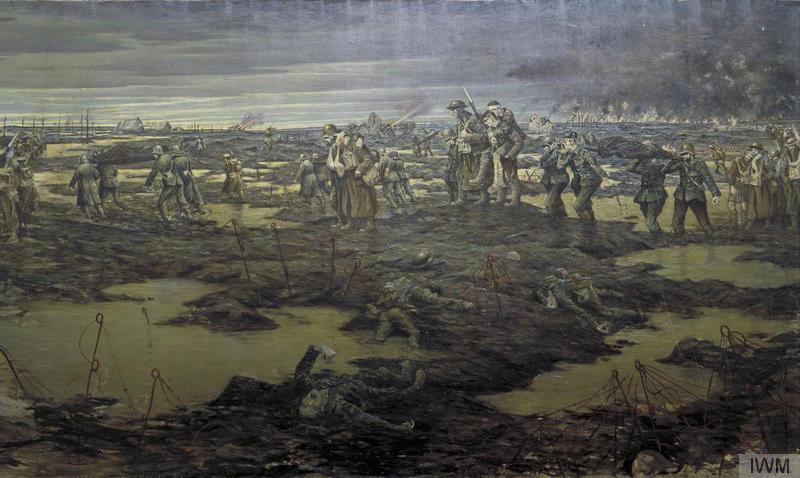
NEVINSON The harvest of battle

I’ve been tracing commentaries on Kurt Lewin‘s classic essay on what we might call the topological phenomenology of the battlefield, published in 1917 as ‘Kriegslandschaft‘ (‘landscape of war’ or, loosely, ‘warscape’), which was based on his experience on the Western Front in the First World War. I’ve been particularly interested in his account of the way in which an ordinary landscape is transformed by war.

William Boyd captured what I have in mind in The new confessions:

‘Take an idealized image of the English countryside – I always think of the Cotswolds in this connection… You know exactly the sort of view it provides. A road, some hedgerowed lanes, a patchwork of fields, a couple of small villages… The eye sweeps over these benign and neutral features unquestioningly.

‘Now, place two armies on either side of this valley. Have them dig in and construct a trench system. Everything in between is suddenly invested with new sinister potential: that neat farm, the obliging drainage ditch, the village at the crossroads become key factor sin strategy and survival. Imagine running across those intervening fields in an attempt to capture positions on that gentle slope opposite… Which way will you go? What cover will you seek? … Try it the next time you are on a country stroll and see how the most tranquil scene can become instinct with violence. It only requires a change in point of view.’
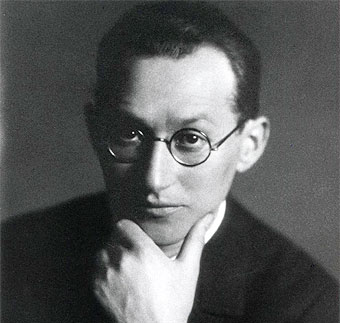
lewin_kurtI’ve discussed this passage before, but what interested Lewin was the way in which the landscape changed for the soldier as he approached the front, moving from a ‘landscape of peace’ to a ‘landscape of war’ – what he described as the production of a ‘directive landscape’.  You can find an English translation here, but it’s behind a paywall I can’t scale: Art In Translation, 1 (2)( 2009) 199-209.  (If anybody has a ladder, please let me know).

En route, I stumbled on a fascinating PhD thesis by Greer Crawley, Strategic Scenography: staging the landscape of war (University of Vienna, 2011). I’ve discussed various conceptions of the ‘theatre of war’ several times before (see for example here, here and here), but Greer provides a much fuller and richer account.  Here is the abstract:

This dissertation is concerned with the construction of ‘theatres of war’ in the target landscapes of 20th century military conflict in Europe and America. In this study of the scenography of war, I examine the notion of the staged landscape and the adoption of theatrical language and methodologies by the military. This is a multi-disciplinary perspective informed by a wide range of literature concerning perception, the aerial view, camouflage and the terrain model. It draws on much original material including declassified military documents and archival photographs. The emphasis is on the visualisation of landscape and the scenographic strategies used to create, visualise and rehearse narratives of disguise and exposure. Landscape representation was constructed through the study of aerial photographs and imaginative projection. The perceptual shifts in scale and stereoscopic effects created new optical and spatial ‘truths’. Central to this analysis is the place of the model as strategic spectacle, as stage for rehearsal and re-enactment through performance and play. This research forms the context for an exploration of the extension and translation of similar scenographic strategies in contemporary visual art practice. Five case studies demonstrate how the artist as scenographer is representing the political and cultural landscape.
2011-02-25_0648070 (dragged)

And the Contents (the summaries are Greer’s own):

Chapter 1: Scenographic strategies

Theatre of War/Strategic Fantasy/Staging the Landscape

This chapter identifies the scenographic strategies that produce the performance landscape for the rehearsal and re-enactment of the Theatre of War. The aim is to define what is meant by strategic scenography and to establish the basic theoretical foundations upon which to build my argument.

Chapter 2: The Aerial Perspective

Aerial Theatre/The Stereoscopic View

This chapter focuses on the aerial view and the methodology of the stereoscope. This analysis of the relationship between scenography and topography from an aerial perspective expands on theories of aerial perception and stereoscopy. Drawing on the experiences of the reconnaissance pilots and photo interpreters during wartime, it attempts to understand the scopic conditions under which they visualised the landscape.

Chapter 3: Strategies of Perception

Camouflage Strategies/Fake Nature/The Scenic Effects

This is a key chapter which looks at the work of Kurt Lewin’s important contribution to an understanding of the perception of landscape. The second section deals specifically with the camouflage strategies adopted by the camoufleurs when staging their illusions in the First and Second World Wars. It provides a historical overview of the main camouflage strategies and then focus on particular scenic elements, e.g. scenery, lighting, props, sound, costume.

Chapter 4: The Territory of the Model

Maps, Models and Games/ The Model as Spectacle/The Terrain Model

This chapter begins with an examination of the methodologies of the map, model and games; the role of mimesis and performativity and the representation of the terrain. What follows is a consideration of the model as a strategic spectacle and its use to represent political ideologies, commercial and military interests and utopian visions. Within an historical context, it examines how the application of new technologies and scopic regimes has expanded the scenographic possibilities of the terrain model.

Chapter 5: Artists’ Manoeuvres

Wafa Hourani and Michael Ashkin − Nomos/Gerry Judah − The Crusader/Mariele Neudecker – Seduction Chaff/Katrin Sigurdardottir – Mappings/Hans Op de Beeck – St Nazaire

This chapter is an exploration of the deployment of scenographic strategies in contemporary artistic practice. Through five case studies it examines how the artist as scenographer has adopted theatrical practices and the methodologies of the model, camera and film as means of representing the political and cultural landscape.

Greer is currently a lecturer in Scenography at Royal Holloway, University of London and in BA and MA Spatial Design at Buckinghamshire New University.  You can download her thesis here – it’s a feast of delights, with marvellous illustrations and a perceptive text.

MoratSoundsAs you can see, Greer’s work focuses on the visual, and I’m equally interested in the role of the other senses in apprehending and navigating the battlefield – hence my continuing interest in corpography (see here and here).  So I was also pleased to find a newly translated discussion of the soundscape of the Western Front: Axel Volmar,  ‘”In storms of steel”: the soundscape of World War I’, in Daniel Marat (ed), Sounds of modern history: auditory cultures in 19th and 20th century Europe (Oxford: Berghahn, 2014) pp. 227-255; a surprising amount of the text can be accessed via Google Books, but you can also download the draft version via academia.edu.  More on Axel’s work (and other downloads, in both German and English) here.

And this too takes us back to Lewin:

‘…new arrivals to the front had not only had to leave behind their home and daily life, but also the practices of perception and orientation to which they were accustomed. With entry into the danger zone of battle, the auditory perception of peacetime yields to a, in many respects, radicalized psychological experience—a shift that the Gestalt psychologist, Kurt Lewin, attempted to articulate with the term “warscape”: for the psychological subject, objects lost most of their peacetime characteristics during wartime because they were henceforth evaluated from a perspective of extreme pragmatism and exclusively in terms of their fitness for war….

‘In place of day-to-day auditory perception, which tended to be passive and unconscious, active listening techniques came to the fore: practices of sound analysis, which might be described as an “auscultation” of the acoustic warscape—the method physicians use to listen to their patients by the help of a stethoscope. In these processes, the question was no longer how the noises as such were structured (i.e. what they sounded like), but rather what they meant, and what consequences they would bring with them for the listeners in the trenches. The training of the ear was based on radically increased attentiveness.

The subject thrust to the front thus comprised the focal point of an auditory space in which locating and diagnostic listening practices became vital to survival.’

For more on sound analysis, see my discussion of sound-ranging on the Western Front here, and the discussion in ‘Gabriel’s Map’ (DOWNLOADS tab).
Degrees of intimacy

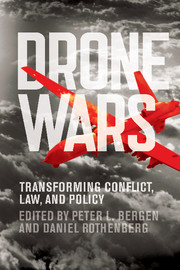
Drone warsNext month Cambridge University Press is publishing a book of essays edited by Peter Bergen and Daniel Rothenberg, Drone wars: transforming conflict, law and policy, due out from Cambridge University Press at the end of the year.  Here’s the blurb:

Drones are the iconic military technology of many of today’s most pressing conflicts, a lens through which U.S. foreign policy is understood, and a means for discussing key issues regarding the laws of war and the changing nature of global politics. Drones have captured the public imagination, partly because they project lethal force in a manner that challenges accepted rules, norms, and moral understandings. Drone Wars presents a series of essays by legal scholars, journalists, government officials, military analysts, social scientists, and foreign policy experts. It addresses drones’ impact on the ground, how their use adheres to and challenges the laws of war, their relationship to complex policy challenges, and the ways they help us understand the future of war. The book is a diverse and comprehensive interdisciplinary perspective on drones that covers important debates on targeted killing and civilian casualties, presents key data on drone deployment, and offers new ideas on their historical development, significance, and impact on law and policy. Drone Wars documents the current state of the field at an important moment in history when new military technologies are transforming how war is practiced by the United States and, increasingly, by other states and by non-state actors around the world.

And here is the Contents List:

Part I. Drones on the Ground:

1. My guards absolutely feared drones: reflections on being held captive for seven months by the Taliban David Rohde
2. The decade of the drone: analyzing CIA drone attacks, casualties, and policy Peter Bergen and Jennifer Rowland
3. Just trust us: the need to know more about the civilian impact of US drone strikes Sarah Holewinski
4. The boundaries of war?: Assessing the impact of drone strikes in Yemen Christopher Swift
5. What do Pakistanis really think about drones? Saba Imtiaz

Part II. Drones and the Laws of War:

6. It is war at a very intimate level USAF pilot
7. This is not war by machine Charles Blanchard
8. Regulating drones: are targeted killings by drones outside traditional battlefields legal? William Banks
9. A move within the shadows: will JSOC’s control of drones improve policy? Naureen Shah
10. Defending the drones: Harold Koh and the evolution of US policy Tara McKelvey
Part III. Drones and Policy Challenges:
11. ‘Bring on the magic’: using drones in combat Michael Waltz
12. The five deadly flaws of talking about emerging military technologies and the need for new approaches to law, ethics, and war P. W. Singer
13. Drones and cognitive dissonance Rosa Brooks
14. Predator effect: a phenomenon unique to the war on terror Meg Braun
15. Disciplining drone strikes: just war in the context of counterterrorism David True
16. World of drones: the global proliferation of drone technology Peter Bergen and Jennifer Rowland

Part IV. Drones and the Future of Warfare:

17. No one feels safe Adam Khan
18. ‘Drones’ now and what to expect over the next ten years Werner Dahm
19. From Orville Wright to September 11: what the history of drone technology says about the future Konstantin Kakaes
20. Drones and the dilemma of modern warfare Richard Pildes and Samuel Issacharoff
21. How to manage drones, transformative technologies, the evolving nature of conflict and the inadequacy of current systems of law Brad Allenby
22. Drones and the emergence of data-driven warfare Daniel Rothenberg

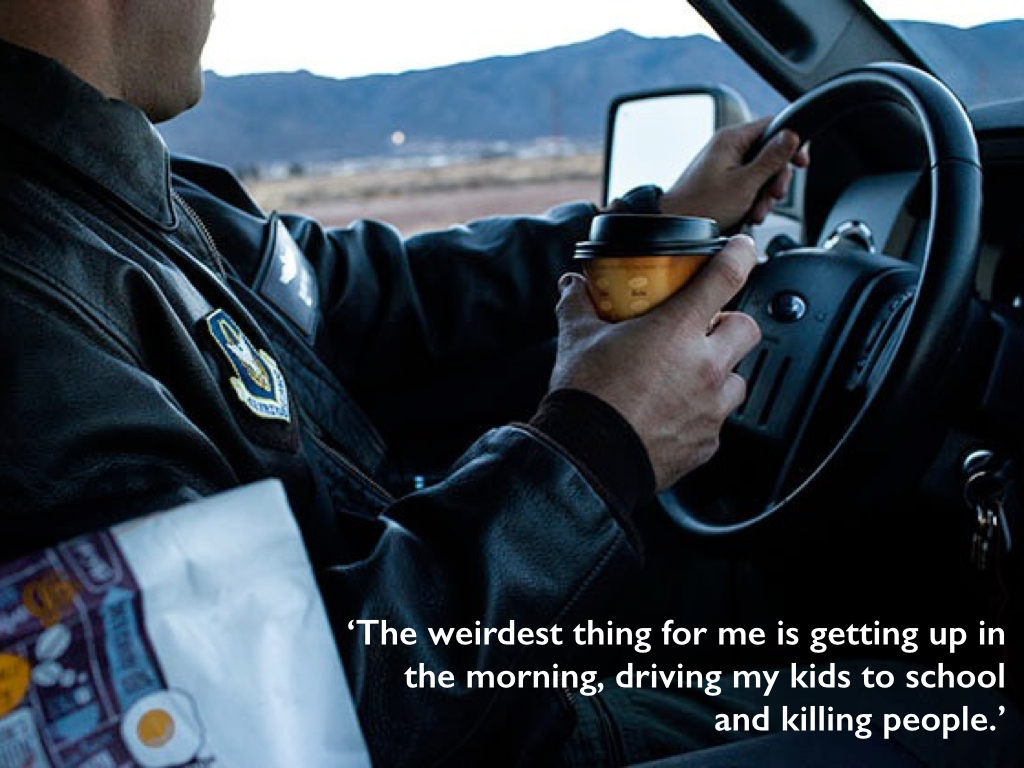
Over at Foreign Policy you can find an early version of Chapter 6, which is an interview with a drone pilot conducted by Daniel Rothenberg.  There are two passages in the interview that reinforce the sense of the bifurcated world inhabited by drone crews that I described in ‘From a view to a kill’ and ‘Drone geographies’ (DOWNLOADS tab).  On the one side the pilot confirms the inculcation of an intimacy with ground troops, particularly when the platforms are tasked to provide Close Air Support, which is in some degree both reciprocal and verbal:

“Because of the length of time that you’re over any certain area you’re able to engage in lengthy communications with individuals on the ground. You build relationships. Things are a little more personal in an RPA than in an aircraft that’s up for just a few hours. When you’re talking to that twenty year old with the rifle for twenty-plus hours at a time, maybe for weeks, you build a relationship. And with that, there’s an emotional attachment to those individuals.

“You see them on a screen. That can only happen because of the amount of time you’re on station. I have a buddy who was actually able to make contact with his son’s friend over in the AOR [area of responsibility]. If you don’t think that’s going to make you focus, then I don’t know what will.

“Many individuals that have been over there have said, ‘You know, we were really happy to see you show up’; ‘We knew that you were going to keep us from being flanked’; ‘We felt confident in our ability to move this convoy from ‘A’ to ‘B’ because you were there.’ The guy on the ground and the woman on the ground see how effective we are. And it gives them more confidence.”

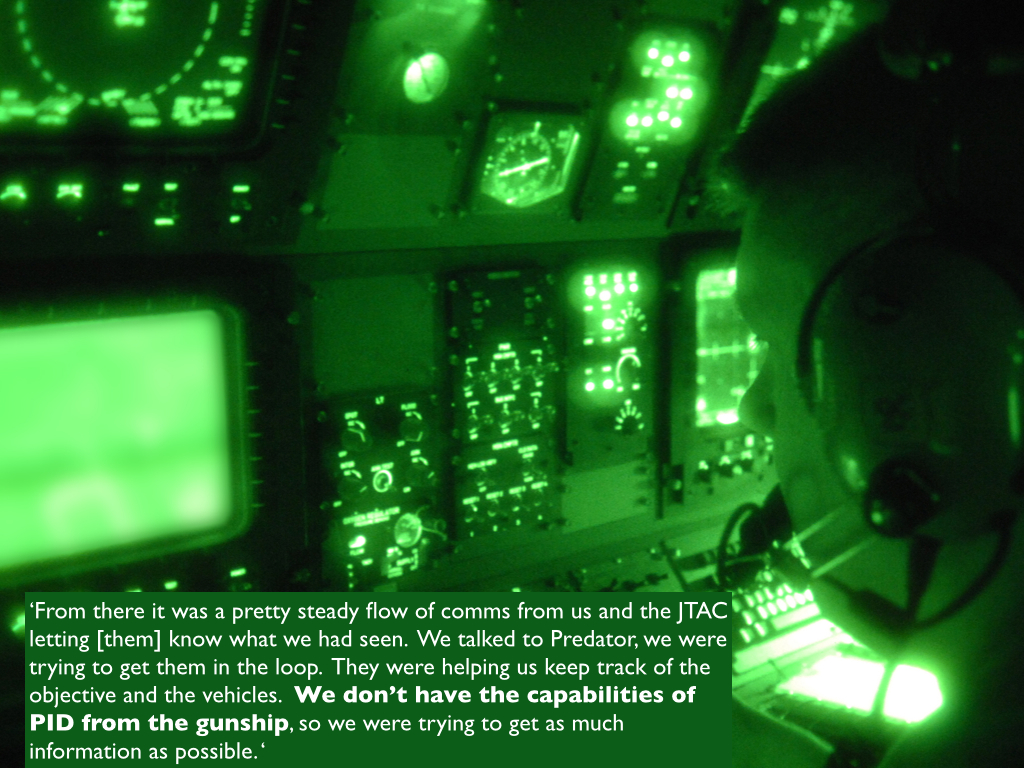
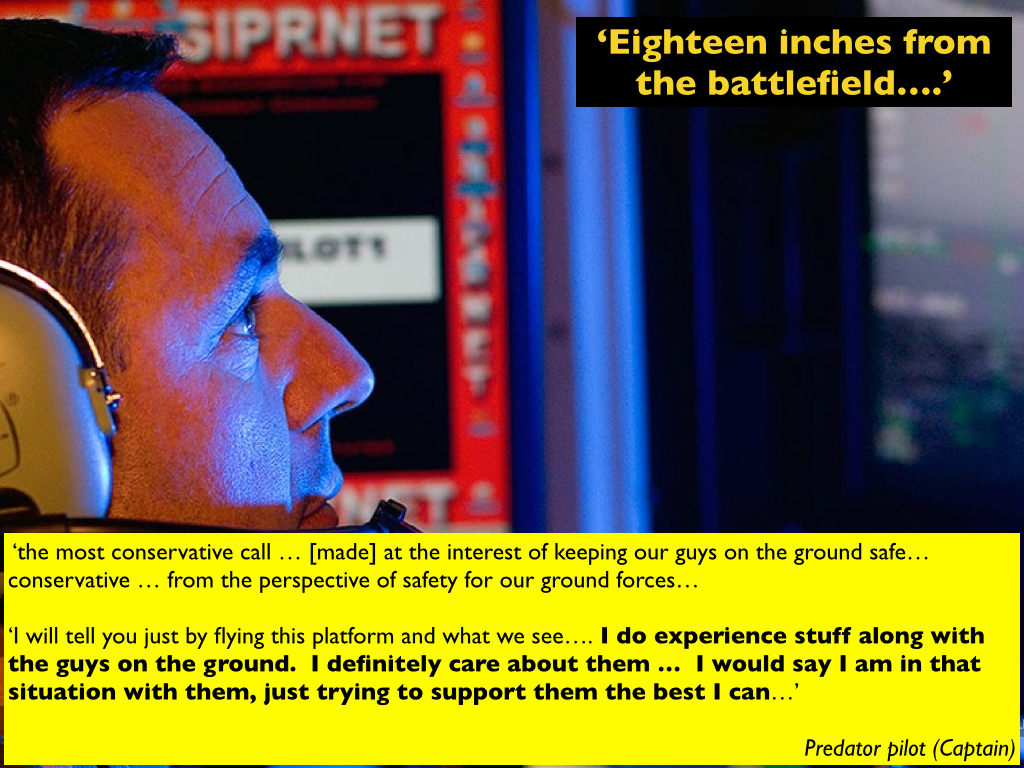
GREGORY Angry Eyes Extract.001

[The image above is taken from my ‘Angry Eyes’ presentation; the Predator pilot in this instance was involved in orchestrating the air strike in Uruzgan province, Afghanistan on 21 February 2010, and the quotation is taken from the US Army investigation into the incident.  I’m converting the presentation into the final chapter for The everywhere war, and I’ll post the draft as soon as I’m finished.]

But when the pilot in Rothenberg’s interview goes on to claim that ‘Targeting with RPAs is very intimate’ and that ‘It is war at a very intimate level’, he reveals on the other side an altogether different sense of intimacy: one that is strictly one-sided, limited to the visual, and which resides in a more abstracted view:

“Flying an RPA, you start to understand people in other countries based on their day-to-day patterns of life. A person wakes up, they do this, they greet their friends this way, etc. You become immersed in their life. You feel like you’re a part of what they’re doing every single day. So, even if you’re not emotionally engaged with those individuals, you become a little bit attached. I’ve learned about Afghan culture this way. You see their interactions. You’re studying them. You see everything.”

The distinction isn’t elaborated, but the claims of ‘immersion’ and becoming ‘part of what they’re doing every day’ are simply astonishing, no?  You can find more on the voyeurism of ‘pattern of life analysis’ and the remarkable conceit that ‘you see everything’ here.

GREGORY Drones and the everywhere war 2014 Homeland insecurities.001

[The image above is taken from my ‘Drone geographies’ presentation]

The interview emphasises a different bifurcation, which revolves around the alternation between ‘work’ and ‘home’ when remote operations are conducted from the United States:

“”When you’re doing RPA operations, you’re mentally there, wherever there is. You’re flying the mission. You’re talking to folks on the ground. You’re involved in kinetic strikes. Then you step out the ground control station (GCS) and you’re not there anymore…

“Those are two very, very different worlds. And you’re in and out of those worlds daily. I have to combine those two worlds. Every single day. Multiple times a day. So, I am there and then I am not there and then I am there again. The time between leaving the GCS [Ground Control Station] and, say, having lunch with my wife could be as little as ten minutes. It’s really that fast.”

You can find much more on these bifurcations in my detailed commentary on Grégoire Chamayou‘s Théorie du drone here and in ‘Drone geographies’ (DOWNLOADS tab).
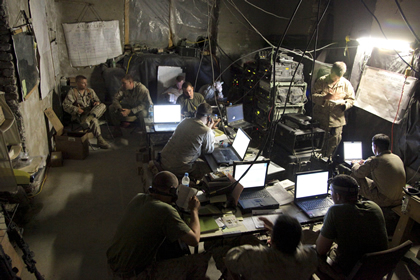
There’s one final point to sharpen.  In my developing work on militarized vision, and especially the ‘Angry eyes’ presentation/essay,  I’ve tried to widen the focus beyond the strikes carried out by Predators and Reapers to address the role they play in networked operations where the strikes are carried out by conventional strike aircraft.  Here is what Rothenberg’s pilot says about what I’ve called the administration of military violence (where, as David Nally taught me an age ago, ‘administration’ has an appropriately double meaning):

‘”Flying an RPA is more like being a manager than flying a traditional manned aircraft, where a lot of times your focus is on keeping the shiny side up; keeping the wings level, putting the aircraft where it needs to be to accomplish the mission. In the RPA world, you’re managing multiple assets and you’re involved with the other platforms using the information coming off of your aircraft.

“You could use the term ‘orchestrating’; you are helping to orchestrate an operation.”

***

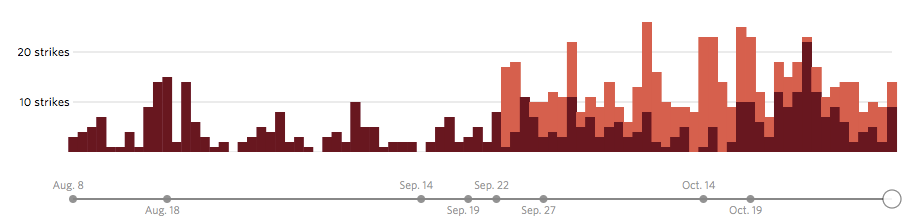
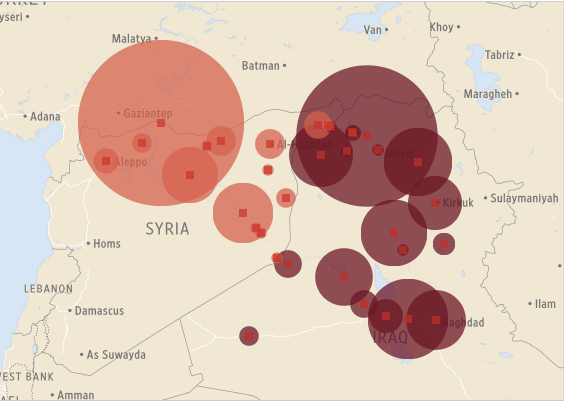
Drone wars appears just as remote operations over Iraq and Syria are ramping up: you can find an excellent review by Chris Cole at Drone Wars UK here, ‘Drones in Iraq and Syria: What we know and what we don’t.’  The images below are from the Wall Street Journal‘s interactive showing all air strikes reported by US Central Command 8 August through 3 November 2014:

Air strikes in Iraq and Syria

During this period  769 coalition air strikes were reported: 434 in Syria (the dark columns), including 217 on the besieged border city of Kobane, and 335 in Iraq (the light columns), including 157 on Mosul and the Mosul Dam.

Air strikes in Iraq and Syria August-November 2014

But bear in mind these figures are for all air strikes and do not distinguish between those carried out directly by drones and those carried out by conventional strike aircraft.  As Chris emphasises:

‘Since the start of the bombing campaign, US drones have undertaken both surveillance and strike missions in Iraq and Syria but military spokespeople have refused to give details about which aircraft are undertaking which strikes repeatedly using the formula “US military forces used attack, fighter, bomber and remotely-piloted aircraft to conduct airstrikes.”’

Although the USAF has used a mix of MQ-1 (Predator) and MQ-9 (Reaper) drones, F-15E, F-16, F/A-18 and F-22 fighters, B-1 bombers, AC-130 gunships and AH-64 Apache helicopters in these operations, it seems likely that its capacity to use remote platforms to provide intelligence, surveillance and reconnaissance is limited by its continuing commitments in Afghanistan (though Britain’s Royal Air Force has now deployed its Reapers for operations in both Iraq and Syria).

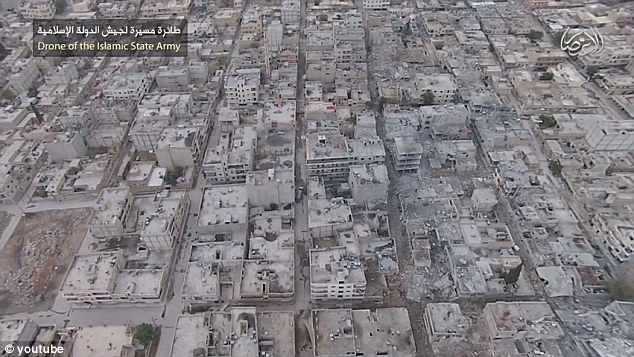
IS (Islamic State) claims to have its own drones too.  In February it released video of its aerial surveillance of Fallujah in Iraq, taken from a DJI Phantom FC40 quadcopter, in August it released video of Taqba air base in Syria taken from the same platform, tagged as ‘a drone of the Islamic State army’, and in September a propaganda video featuring hostage John Cantile showed similar footage of Kobane (below).

1414438887900_wps_7_IS_have_released_a_new_vi

These image streams are all from commercial surveillance drones, but in September the Iranian news agency Fars reported that Hezbollah had launched an air strike from Lebanon against a command centre of the al-Nursra Front outside Arsal in Syria using an armed (obviously Iranian) drone.

You can find Peter Bergen’s and Emily Schneiders view on those developments here, and a recent survey of the proliferation of drone technologies among non-state actors here.

The details of both the state and non-state air strikes remain murky, but I doubt that much ‘intimacy’ is claimed for any of them.

Under American Skies

I’ll be in Berlin in December for a conversation with James Bridle about drone wars and related issues, and I’m already looking forward to it since I’m a great admirer of his work. I particularly admire the way in which he challenges so many of our assumptions about ‘looking’ through his presentations about militarised vision and violence, and I’ve noted before the filiations between his various projects and Josh Begley‘s.

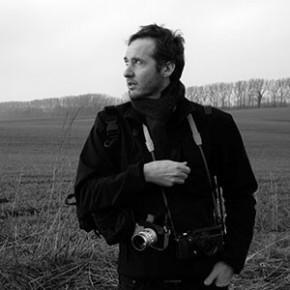
Tomas van HoutryveSo I was interested to read about photographer Tomas van Houtryves (right) project Blue Sky Days.  He begins with an arresting observation with which both James and Josh would be only too familiar:

‘Although a huge amount of [full motion video] footage has been collected [by US drones], the program is classified, and few people have ever seen images of the drone war and its casualties. This seems like a paradox in our thoroughly media-connected age. How can America be involved in a decade-long war where the sky is buzzing with cameras, and yet the public remains totally in the dark?’

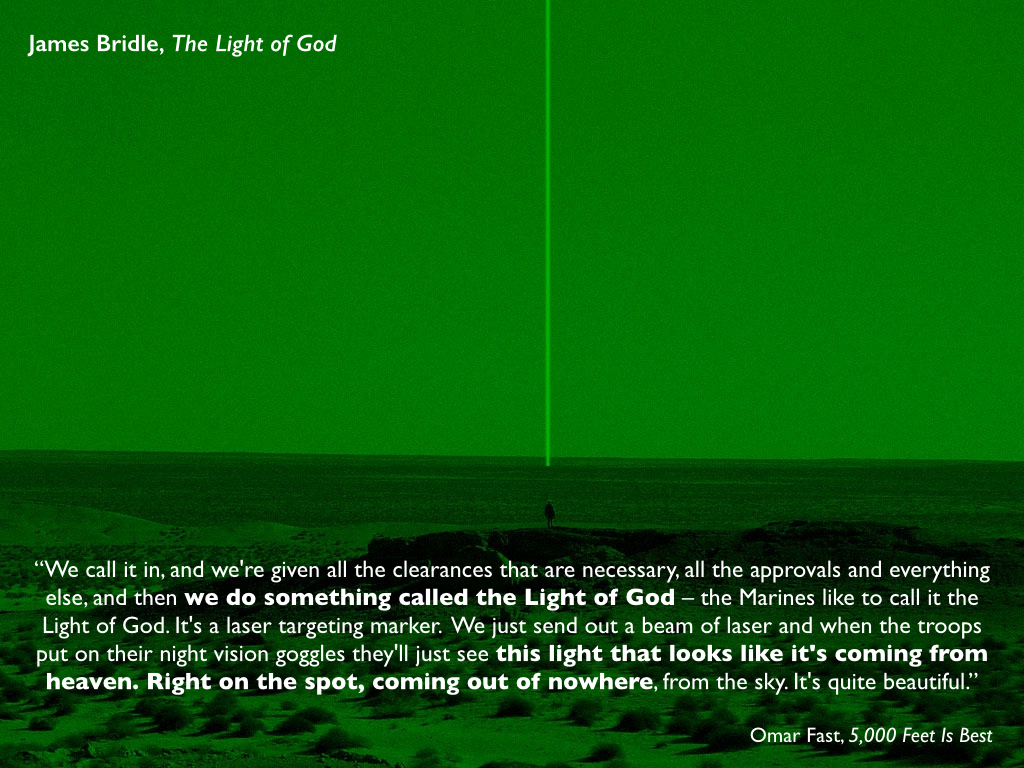
But his response to the question is distinctly different: he repatriates the drone wars from Pakistan to the United States (here the most appropriate comparison is with Omar Fast‘s 5,000 Feet is the Best).

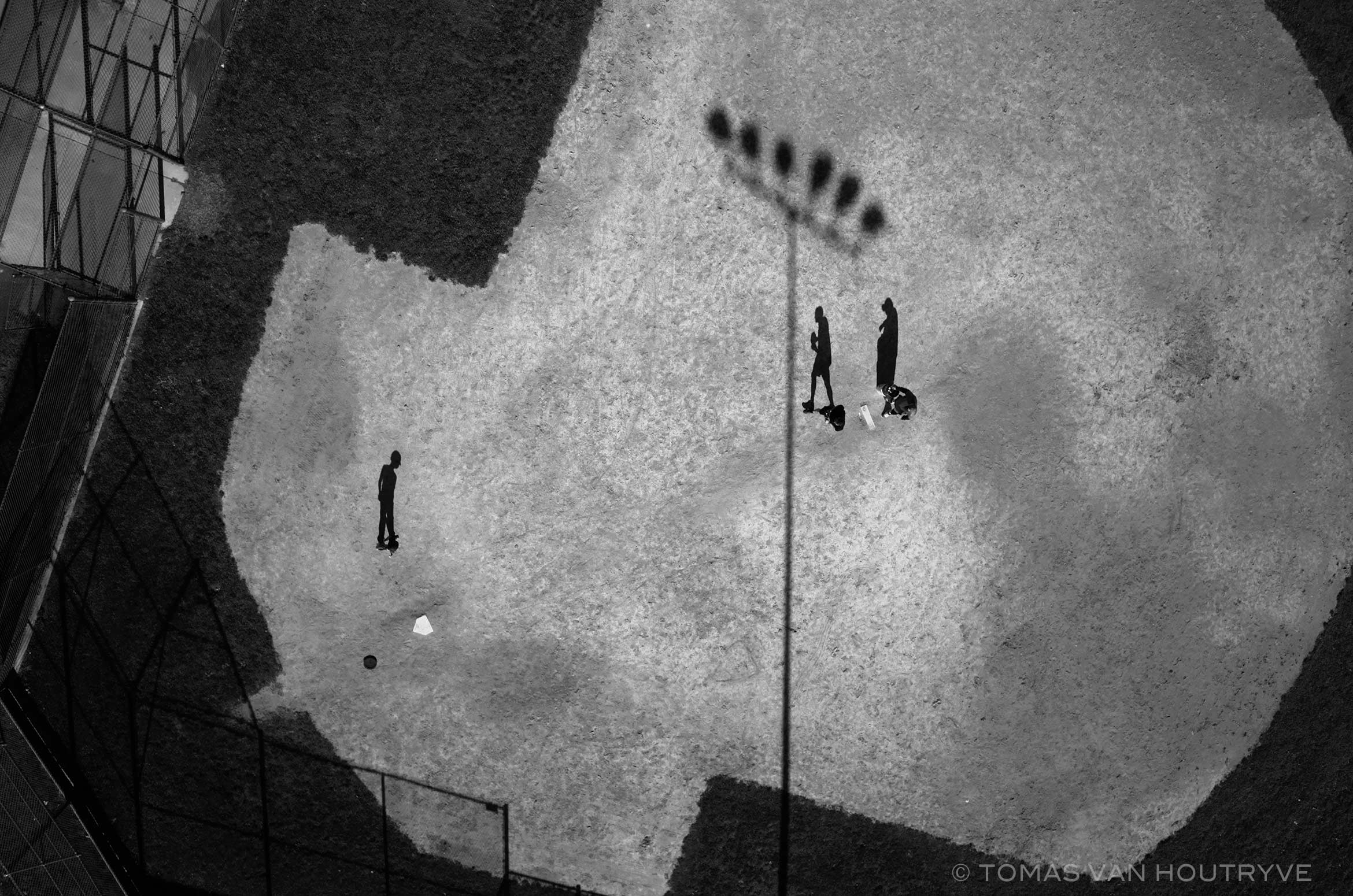
Tomas van Houtryve 1

To do so, Tomas travelled across America with a small quadcopter drone bought from Amazon.com attached to his camera.  His concept was simple, Rena Silverman explains in the New York Times:

Take the idea of foreign drone strikes and instead target similar domestic situations, putting them under surveillance using his drone in public spaces. He made a list of hundreds of different strike reports, gleaning as many details about the circumstances…

He rented a black car with tinted windows and placed himself, his drones, his batteries and lists in the car. He spent six weeks in late 2013 averaging between seven and 10 drone flights daily, sleeping in a different town every night. He would pull the car into an empty lot, get out, launch the drone for about five to 10 minutes — about as long as its power lasted — take footage, land the drone, drive away and recharge the batteries while en route to the next location…

He followed his list carefully, trying to imitate “signature strikes,” referring to a May 2012 New York Times article in which some State Department officials complained about the lax criteria for identifying a terrorist “signature.” The joke was that “three guys doing jumping jacks” could be enough suspicious activity for the C.I.A. to conclude it could be a terrorist training camp. In other words, targeting people based on behavior rather than identity.

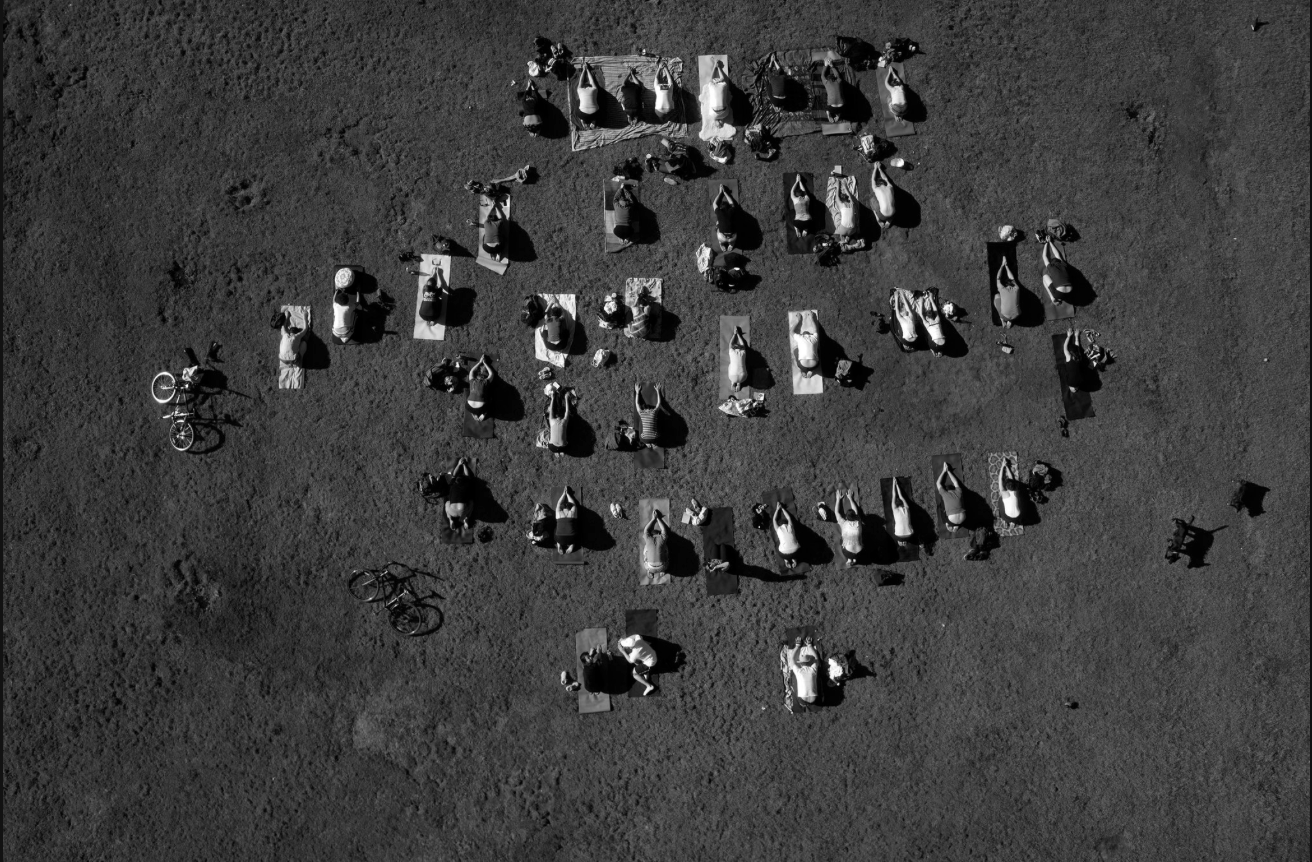
Tomas van Houtryve 2 copy

He photographed people exercising in Philadelphia, their shadows long and pinned against the grid of a park. He noticed more “signature” behavior while driving through San Francisco, where he encountered a group doing yoga [above]. When Mr. van Houtryve recently printed the image, he asked viewers if they thought the subjects were praying or exercising. It was a toss-up.

Although these images are not quite ‘what drone attacks in America would look like’, as Pete Brook suggested in WIRED – Tomas’s drone was flying much lower (‘only about six stories high’) and these images are pin-point sharp: there’s none of the ambiguity of infra-red heat signatures here – none the less that last sentence really says it all.  Images do not speak for themselves and interpretation counts for everything – which is why, as I’ve repeatedly argued, it matters so much what pilots, sensor operators and image analysts are pre-disposed to see.

It turns out that a particular incident provoked Tomas’s project – the murder of Mamana Bibi at Ghunda Kala in North Waziristan on 24 October 2012, which I described here –  and also gives it its title.

Zubair RehmanIn October 2012, a drone strike in northeast Pakistan killed a 67-year-old woman picking okra outside her house. At a briefing held in 2013 in Washington, DC, the woman’s 13-year-old grandson, Zubair Rehman, spoke to a group of five lawmakers. “I no longer love blue skies,” said Rehman, who was injured by shrapnel in the attack. “In fact, I now prefer gray skies. The drones do not fly when the skies are gray.”

There’s more from Tomas at Harper’s here, which originally co-sponsored the project with the Pulitzer Center, and you can see more of his drone’s eye view images at the National Geographic here.

There’s also a revealing interview conducted by Bard College’s Center for the Study of the Drone here; it contains all sorts of interesting observations, but one in particular resonated.  Asked about the tension between the beauty of his photographic compositions and the horror of what he is seeking to convey, Tomas says this:

‘The base subject that I’m trying to raise awareness about and get people to think about in less abstract terms is the foreign drone war. If you take the time to read through the particular airstrikes, a lot of them are quite horrifying. But on the other hand, as a photographer, I know that beauty is one of the tools that we use to get people to look at a picture. Beauty has a lot of power, so there’s a tension between trying to seduce people with the language of photography, which is beautiful composition, and trying to reveal something that might be uncomfortable or difficult to digest, once people fully grasp it.’

Another of my art icons, elin o’Hara slavick, says something very similar about her mesmerising sequence of aerial images of places bombed by the US, Bomb after bomb (see also Brian Howe‘s discussion here and my own in ‘Doors in to Nowhere’ [DOWNLOADS tab], from which I’ve taken this passage):

‘She adopts an aerial view—the position of the bombers—in order to stage and to subvert the power of aerial mastery. The drawings are made beautiful “to seduce the viewer,” she says, to draw them into the deadly embrace of the image only to have their pleasure disrupted when they take a closer look. “Like an Impressionist or Pointillist painting,” slavick explains, “I wish for the viewer to be captured by the colors and lost in the patterns and then to have their optical pleasure interrupted by the very real dots or bombs that make up the painting.”’

A tart reminder that there are multiple ways of ‘just looking‘.

Predator View

I’m in Zurich – many thanks to Benedikt Korf for the invitation and the wonderful hospitality – for a seminar with Benedikt’s doctoral students on the long form version of ‘The Natures of War’ (they have what I hope is the penultimate draft; I’ll post the final version once I’ve reworked it after the seminar) and then a public lecture: ‘Angry eyes: the militarization of vision and modern war’.

Part of my argument in the lecture is about the narrowness of ‘Predator View’, so let me explain what I mean.  My starting point is the illusion that the use of the intelligence, surveillance and reconnaissance capabilities of remote platforms like the MQ-1 Predator or the MQ-9 Reaper produces a transparent battlespace: in effect, a version of Donna Haraway‘s ‘God-trick’, the ability to see everything from nowhere in particular.  The most succinct version of this is the treatment of laser targeting as ‘the eye of God’:

Eye of God.001

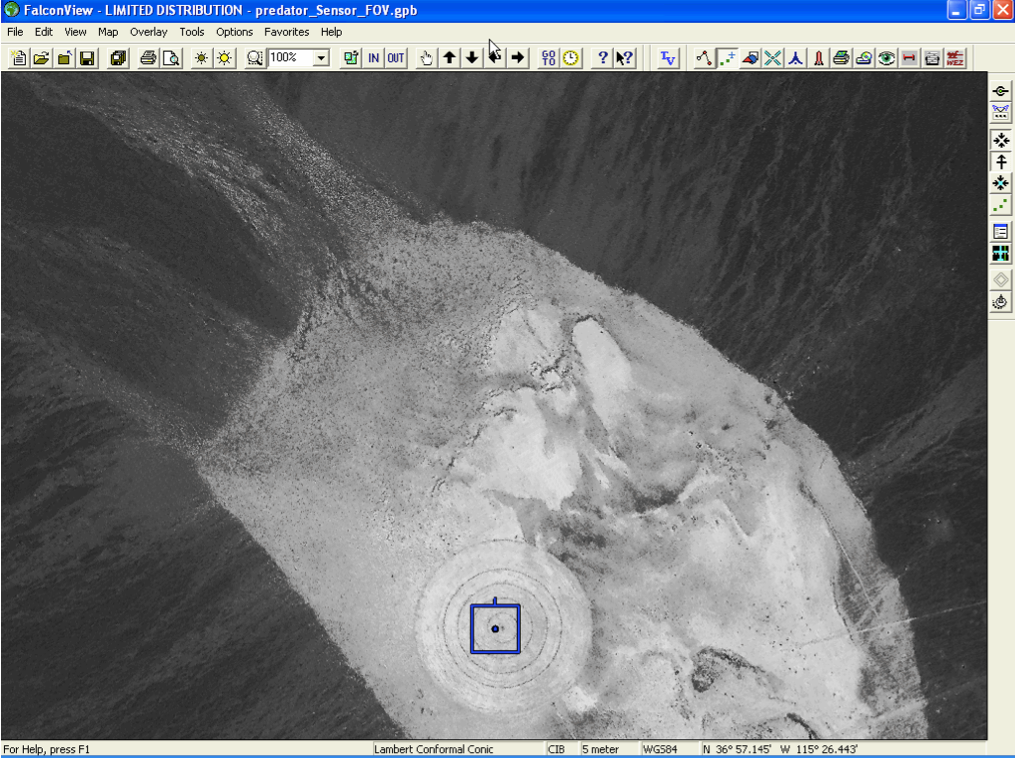
In fact, ‘Predator View’ is remarkably narrow. First, and most directly, a common complaint is that the view provided by its Full Motion Video is literally too narrow – ‘like looking through a soda straw’.  It’s for this reason that pilots and sensor operators also use FalconView, a Windows-based mapping tool that is supposed to provide them with situational awareness.  I’ve taken the image below from a presentation by Lt Col Paul Hastert (USAF) on ‘Spiral development in wartime’ – the screenshot is the FalconView image, the small square the field of view from a Predator – but the most detailed account of FalconView is Jon Lindsay‘s ‘”War upon the map”‘: User innovation in American military software’, Technology and culture 51 (3) (2010) 619-51.

FALCONVIEW and Predator FOV

There have been several later releases of FalconView, and a version is now even open source, so it’s probably not surprising that the US military also uses Google Earth.  In fact, in two of the air strikes I consider in detail it was, in part, juggling these different views that contributed to wrong targeting decisions.  (There are projects that provide a wider field of view – the nine-camera suite of Gorgon Stare is in operation and its second increment is already in use in Afghanistan – and others that integrate imagery from multiple sources, like Raytheon’s Zeus, which is intended to supplant FalconView as the ‘primary mission execution tool‘).

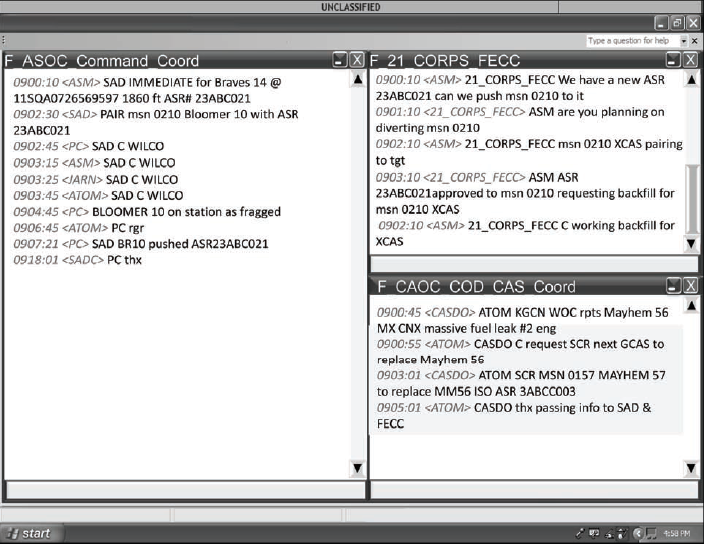
But in the air strikes that I consider those involved in these networked operations are also busy communicating via radio and – crucially – via the typed messages displayed in mIRC‘s online chat windows.  The image below is taken from the US military’s multi-service manual on Tactical Chat (see also the discussion at Public Intelligence here).

mIRC 3 chatrooms

In the case of the ‘friendly fire’ incident in the Sangin Valley in 2011, the pilot and sensor operator were unaware of crucial entries made by image analysts in mIRC and of private (or ‘whisper’) chats to the Mission Intelligence Co-ordiator.  That’s not entirely surprising.  Once permission has been given to engage a target, ‘KILL CHAIN” is typed into the room to minimise extraneous chatter that might otherwise visually distract and so ‘degrade’ the strike.  According to the Mission Intelligence Controller for the Sangin incident:

‘When we got a standby for a 9-line [strike briefing] we put [KILLCHAIN] in the mIRC room to shut down chatter so we can be heads down supporting the pilot and the sensor … as they are getting ready for a possible Hellfire shot our whatever action… That’s our job, to be their third set of eyes…’

That third set of eyes is vital, though of little use if its responses are shut down.  In this case the pilot was paying no attention to mIRC because he was fully occupied:

‘I did not see the chat in the main mission room after seeing muzzle flashes. From that point on, my focus was clear concise communications with the [Joint Terminal Attack Controller] and ensuing [Close Air Support] comms, 9 line etc. At this point I was also focused on keeping the aircraft in position to maintain FMV on the individuals. I was also getting the aircraft into the [Weapons Engagement Zone]. Winds were 30 knots out of the west so I had to make sure I kept the aircraft position and direction in cross check.’

All of this suggests that it is unduly narrow to focus the analytical gaze on the Full Motion Video feeds.

But there’s more.  Militarised vision is not limited to Predators and their successors, and it’s important to consider the clarity and resolution of the imagery captured and transmitted from other, conventional aircraft like the AC-130 (first image below), the B-1 bomber, F-15E strike aircraft or attack helicopters (second image below)  – again, this was important in two of the strikes I consider in detail.

AC-10 Uruzgan.001

MMS from attack helicopter - Uruzgan.001

This leads me to two other senses in which the critical emphasis on ‘Predator View’ is too narrow.  It’s a mistake to fasten on one incident – even what has become the iconic ‘signature strike’ coordinated by a Predator on three civilian trucks in Uruzgan – because that misses the continuities, repetitions and transformations in Close Air Support (which is where most of the mistakes are made).

Better, I think, to widen the analytical gaze, which is why I examine the Kunduz air strike on 4 September 2009 (in which no remote platform was involved), the Uruzgan air strike of 21 February 2010 (which was co-ordinated by a Predator but carried out by two attack helicopters), and the Sangin Valley air strike of 6 April 2011 (which was executed by a Predator).  The Granai strike is included because it trigged McChrystal’s Tactical Directive of 6 July 2009 to minimise civilian casualties: ‘‘We must avoid the trap of winning tactical victories – but suffering strategic defeats – by causing civilian casualties or excessive damage and thus alienating the people.’  In all three cases I’ve worked through thousands of pages of official investigations – one by the German Bundestag since the ISAF report remains classified (Kunduz), and the others by the US Army and US Air Force (Uruzgan) and the US Marine Corps (Sangin Valley).

4 US air strikes in Afghanistan.001

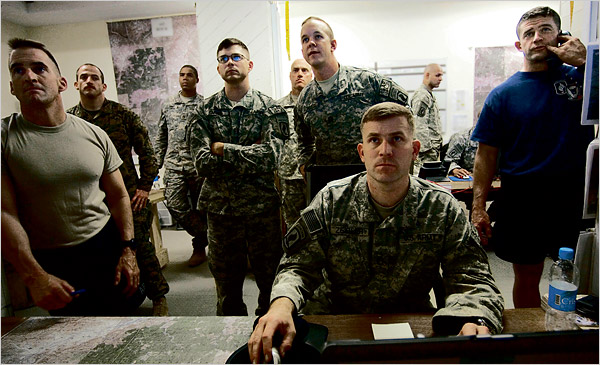
And finally, it is also necessary to consider the multiple viewing positions involved in networked military violence.  There is a de-centralised, distributed and dispersed geography of militarised vision whose fields of view expand, contract and even close at different locations engaged in the administration of military violence.  And in all three incidents it turns out that vital mistakes in the interpretation of imagery were made at operations centres in theatre on the ground.

This has prompted me to radically revise the argument I originally set out in ‘From a view to a kill’ (DOWNLOADS tab).  There my focus was on the geography shown in the first map below – like every other commentator I’ve read, incidentally – but I’ve now widened the angle to take in the geography shown in the second map and this substantially changes the story.
Dispersed vision Uruzgan (1).001

Dispersed vision Uruzgan (2).001

It was what happened at the operations centres at Special Operations Task Force 12 in Kandahar and Combined Joint Special Operations Task Force in Bagram that turned out to be every bit as important as the Predator crew’s obvious desire to ‘go kinetic’.

I make similar arguments about Kunduz, where the F-15E pilots were clearly reluctant to strike and the ground commander and JTAC at the Forward Operating Base overrode their objections.

Sangin is even more instructive, because the official investigation of this ‘friendly fire’ incident that resulted in the deaths of two Marines largely exonerated both the Predator crew and the ground commander and JTAC at the operations centre – but a detailed, spirited counter-memorandum from the US Marines commandant refuted the findings line by line, castigated the attempt to pin the blame for what happened on the young, inexperienced lieutenant leading the patrol, and excoriated the ground commander and JTAC back at the patrol base.  More on this soon.

The (long!) essay on these  strikes is the last chapter I need to complete for The everywhere war. There is a strong sense, so I shall argue, in which it was the view ‘on the ground’ that mattered much more than any ‘light of God’ from above.  And as for transparency….

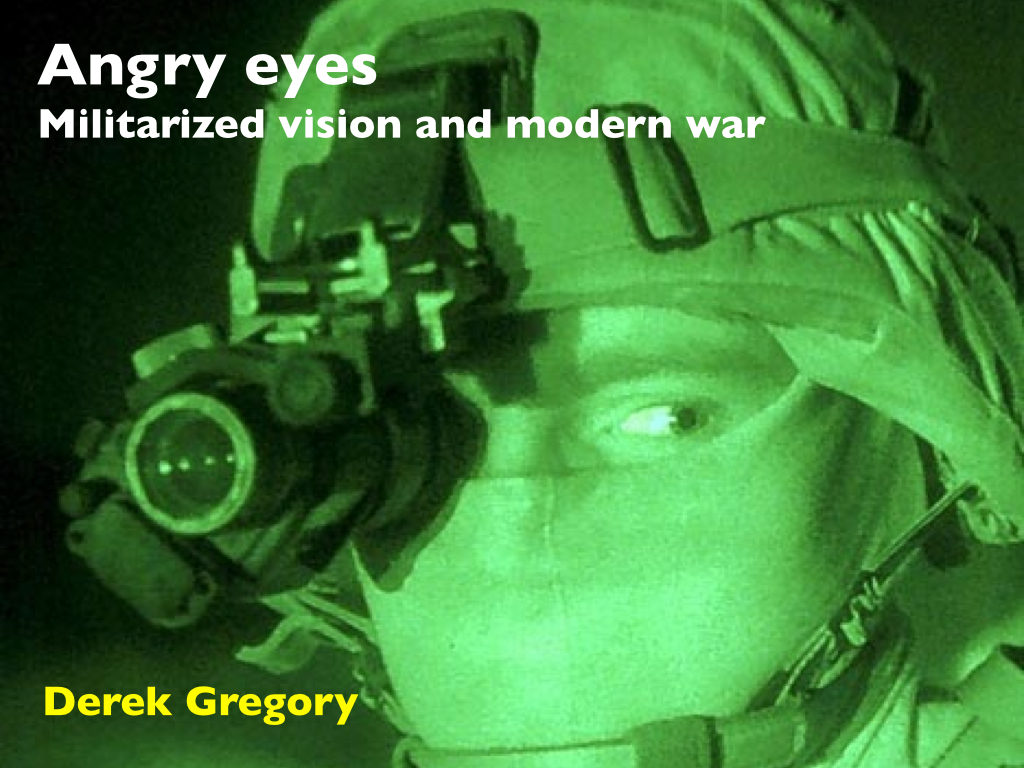
Angry eyes

GREGORY Angry eyes JPEG.001

As part of my project on Militarized Vision I’ve been drawing together my work on two air strikes in Afghanistan in which the full motion video feeds from UAVs played a central role.  The first was an air strike in Uruzgan on 21 February 2010, which was carried out by two combat helicopters but mediated by video and commentary from a Predator and other eyes in the sky (the most thorough press account is by David Cloud here).  The second was a  ‘friendly fire’ incident in the Sangin valley on 5 April 2011 when a Predator strike claimed the lives of two US Marines (you can find an excellent summary account by David Cloud and David Zucchino here).

The two reports I’ve just cited were published in the LA TimesCombat by Camera series, but a close reading of the two official investigations – thousands of pages obtained through FOIA requests – inevitably shows that the stories were more complicated than the tag-line implies.  Still, for all the differences there are some remarkably close parallels between the two, and these have prompted me to revise (in radical ways) the analysis I originally offered in “From a view to a kill” (DOWNLOADS tab).
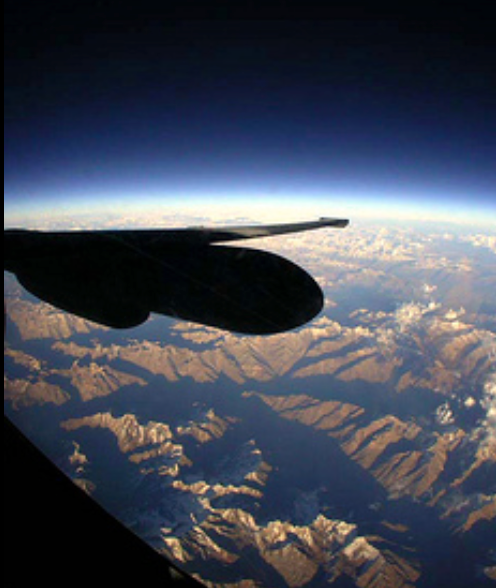
Searching for a title for the presentations I’m giving on this in October and November, I half-remembered a song called ‘Angry Eyes’.  When I tracked down the lyrics (by Kenny Loggins) I literally could not believe my eyes.  He obviously wasn’t writing about the US Air Force (or the Israeli), but it requires no great leap of the imagination to switch from love to violence:

Time, time and again
I’ve seen you starin’ out at me.

Now, then and again, I wonder
What it is that you see

[Chorus:]
With those Angry Eyes.
Well, I bet you wish you could
Cut me down with those Angry Eyes…

You want to believe that
I am not the same as you.
I can’t concieve, oh no,
What it is you’re tryin’ to do

[Chorus]

What a shot you could be if
You could shoot at me
With those Angry Eyes…

You tried to defend that
You are not the one to blame.

But I’m finding it hard, my friend,
When I’m in the deadly aim
Of those Angry Eyes.

So the presentations (here in Vancouver, and in Zurich and Bergen) will be called “‘Angry eyes’: militarized vision and modern war”.  As the image implies, there’s more to this than full motion video displays, and I’m also going to try to say something about the genealogy of what Paul K. Saint-Amour calls ‘optical war’ (and its distance from the corpographies of ‘boots on the ground‘).

More on all this later, when I’ve finished the essay that I am presently spinning off the presentations with the same title; it’s the last thing I have to do for “The everywhere war” (I hope).

The Days of the Roundtable

I’m very pleased (and relieved) to say that I’ve received two new grants for my work.

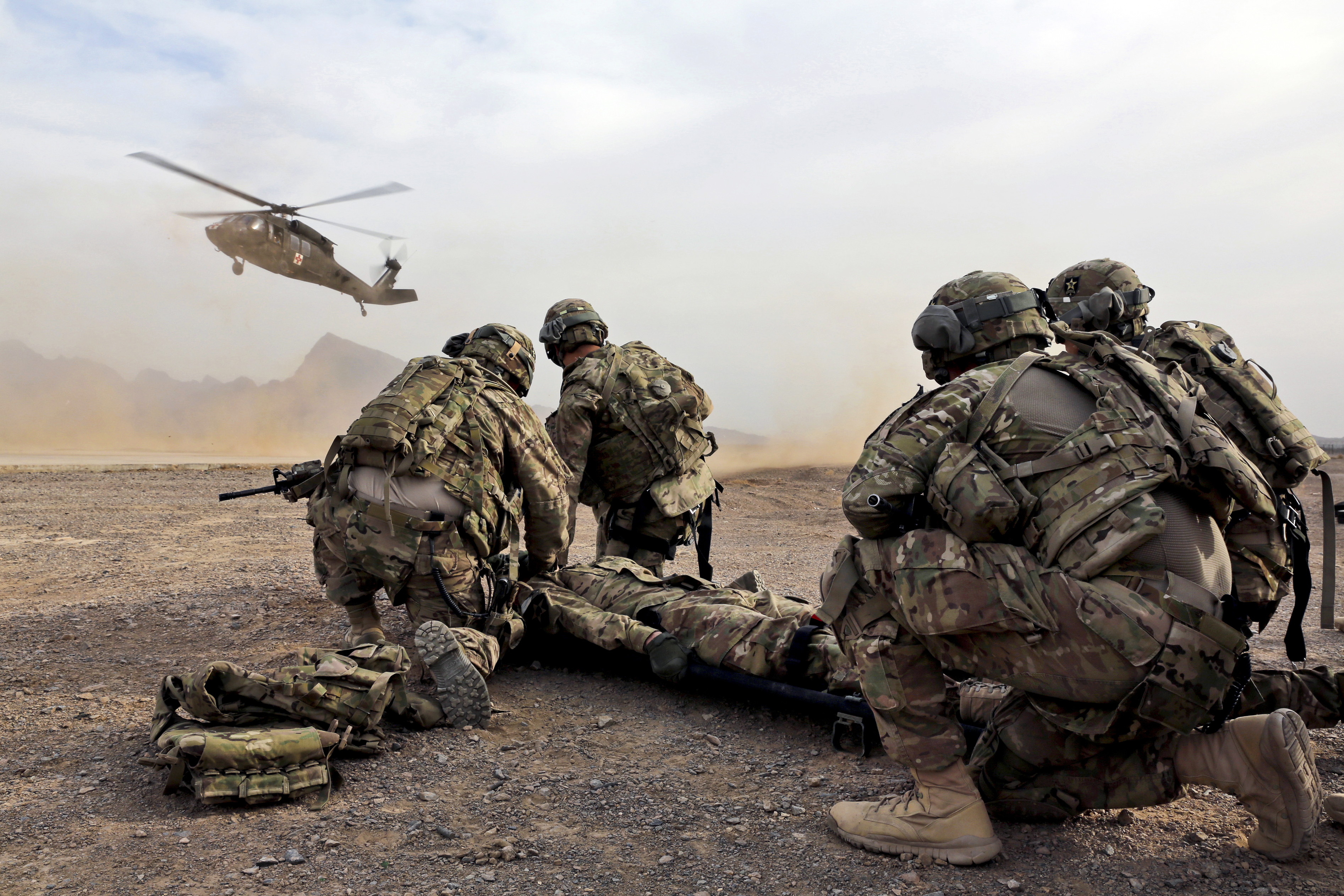
The first is an Insight Grant from the Social Science and Humanities Research Council for my project on Medical-military machines and casualties of war 1914-2014.  I’ve provided an illustrated version of the substance of the application under the DOWNLOADS tab.  The plan is to explore the human geographies of evacuation and treatment of casualties, both combatant and civilian, in four major combat zones: the Western Front 1914-1918; the Western Desert, 1942-1943; Vietnam; and Afghanistan.  Since submitting my application, though, I’ve also become interested in the medical geographies (what my good friend Omar Dewachi calls the ‘therapeutic geographies‘) in which people suffering from both war-related injuries and chronic diseases in Syria make their precarious journeys into Lebanon and Jordan for treatment.  All that in four years…

PRT Farah Conducts Medical Evacuation Training with Charlie Co., 2-211th Aviation Regiment at Forward Operating Base Farah

The second is a grant from the Peter Wall Institute for Advanced Studies at UBC to support an International Research Roundtable in May 2015 on The contours of later modern war.  This will be an invitation-only event (the grant provides for travel and accommodation for each participant), but here is the pitch.  I wrote this in an hour just before leaving for Glasgow, so forgive the rough edges:

Background

Commentators often insist that in recent years the nature of war has been transformed. Military historians who address this question display a fine-grained sensitivity to the details of armed conflict, but the imaginative (theoretical) framework they deploy usually returns to Clausewitz’s nineteenth-century theses On War. Philosophers and social scientists work with a more refined theoretical apparatus, though too often this seems to be confined to annotations of Foucault’s Paris lectures in the 1970s, and yet – unlike Foucault himself – they typically show little interest in the specifities and materialities of armed conflict. The Roundtable seeks to finesse this impasse by bringing together a group of scholars, each of whom has demonstrated both a theoretical and an empirical sensibility, to consider crucial questions about the transformations of modern war.

CREVELD Changing face of warThe objective is not to identify a single rupture – the Vietnam War, the end of the Cold War, the wars conducted in the wake of 9/11 – but to recognize that multiple temporalities are at work so that there are both continuities and contrasts to be identified and understood. Similarly, later modern war cannot be reduced to arguments about the Revolution in Military Affairs and its successor projects, which have indeed changed advanced military operations in all sorts of ways, or to the ‘new wars’ supposedly waged by non-state actors in the rubble of the Cold War and in the peripheries of empire: these twin modalities need to be thought together to provide a more inclusive understanding of the shifting contours of military and paramilitary violence.

In speaking of ‘later modern war’ the intention is to avoid the now tired discussions of the postmodern (what comes after that?), while indicating that the closing decades of the twentieth century witnessed a series of changes – political and legal, social and cultural, scientific and technical, legal and ethical – that started to distance armed conflict from the forms it had assumed during the First and Second World Wars. The term also suggests connections to the logics of what is sometimes called ‘late capitalism’ and to the evolving impositions of neo-liberal political and economic formations.

STRACHAN Changing character of warAdvanced militaries often claim that their conduct of war has become surgical, sensitive and scrupulous. The first of these relies on technical advances in intelligence, surveillance and reconnaissance (much of which now takes the form of geospatial intelligence and high-resolution, near real-time imagery) and on advances in military networks, targeting and weapons systems. The second involves the incorporation of cultural knowledge into asymmetric warfare and counter-insurgency, but it also involves a new sensitivity to public opinion: thus media operations have become central to military campaigns in an attempt to win support from populations both at home and abroad. There is also an increasing sensitivity to casualties, both combatant and civilian, and many commentators have spoken of the humanitarian armature that attends contemporary military interventions as a new ‘military humanism’. Finally, and following directly from these observations, contemporary military power is supposed to be characterized by a heightened ethical awareness and the unprecedented incorporation of international law (and military lawyers) into its operational decisions.

toc_afghan

All of these claims invite critical scrutiny, to recover their developing genealogies (how novel are they?) and to evaluate their practical consequences (what are their material effects?). They assume particular importance as interstate wars have declined, and transnational conflicts have become the dominant modality of armed conflict, as ‘war’ bleeds into terrorism, counter-terrorism and new modes of transnational policing. These changes in turn affect the sites and locations of military violence, and these in turn may be transformed not only by geopolitics and military power but also by global environmental change and the political ecologies of war. In short: is the locus of war shifting in decisive ways?

Programme

The Roundtable will address these questions through four intersecting and interlocking themes that allow for theoretical interrogation and empirical scrutiny: each of these is a stark signpost but its simplicity allows multiple questions (and the connections between them) to be addressed under each heading. In capsule form these are:

IMAGE – the role of imagery (intelligence, surveillance, reconnaissance); the images of war that circulate through media, old and new, and their role in public debate;
AGENT – the agents and vectors of military and paramilitary violence; the changing human/technological assemblages through which war is conducted;
VICTIM – the casualties of war (the dead, the wounded, the captured, the displaced); the political, cultural and legal armatures that regulate military and paramilitary violence;
LOCUS – the changing targets, spaces and ecologies of war

When they accept the invitation, each participant will be asked to provide a one-paragraph summary of their present research for posting on a dedicated website. Four weeks before the Roundtable everyone will provide a short (six page maximum) essay, written in an accessible and reference-free form, illustrated as appropriate, and drawing from their work. These may address the theme of the Roundtable in general or in detail, and will be posted on the website. Formal papers will not be presented: the emphasis will on discussion and debate.

There will be four main sessions addressing each of the four key themes:

Day 1:  Arrival

Day 2:

Morning – Walking Seminar (Stanley Park): participants will walk the Seawall as a group but in pairs, changing every 20-30 minutes, to share their research and ideas with one another.

Afternoon – IMAGE (discussion led by four participants)

Day 3:

Morning – AGENT (discussion led by four participants)

Afternoon – VICTIM (discussion led by four participants)

Evening – Public Performance: Either a staged reading of Owen Sheers’ radio play Pink Mist [about soldiers returning from Afghanistan] or George Brant’s Grounded [about a female drone operator], to be followed by public discussion led by scholars on either the Wounds of War or Drone warfare

Day 4:

Morning – Exchanges: small-group discussions (informal) about the key themes and to plan future collaborations and research projects

Afternoon – LOCUS (discussion led by four participants)

Evening – Roundtable Dinner

Day 5:  Dispersal

I also want to invite one or two visual artists to attend the Roundtable, both to take part – the visual is a vital register for both the conduct and the critique of modern war – but also to use the discussions as a provocation for their subsequent work (to be posted on and/or linked via the website).

I’ll keep you posted – I’m immensely grateful to Janis Sarra, Director of the Peter Wall Institute for Advanced Studies, and to my colleagues and friends for their support and encouragement.

I’ll keep you posted.

The God trick and the administration of military violence

JOC staring at screen 24afghan-600

Here is the abstract for my keynote at the Lancaster symposium on Security by remote control next month; it’s a development from my presentation at the AAG in Tampa, and I’ll provide more details as I develop the argument.

The God trick and the administration of military violence

Advocates have made much of the extraordinary ability of the full motion video feeds from Predators and Reapers to provide persistent surveillance (‘the all-seeing eye’), so that they become vectors of the phantasmatic desire to produce a fully transparent battlespace.  Critics – myself included – have insisted that vision is more than a biological-instrumental capacity, however, and that it is transformed into a conditional and highly selective visuality through the activation of a distinctively political and cultural technology.  Seen thus, these feeds interpellate their distant viewers to create an intimacy with ground troops while ensuring that the actions of others within the field of view remain obdurately Other.

But the possibility of what Donna Haraway famously criticised as ‘the God-trick’ – the ability to see everything from nowhere in particular – is also compromised by the networks within which these remote platforms are deployed.  In this presentation I re-visit an air strike on three vehicles in Uruzgan province, Afghanistan, in February 2010, in which more than 20 civilians were killed in a helicopter attack prompted, in large measure, by video feeds from a Predator providing support to a Special Forces detachment in the vicinity.  Most commentaries – including mine – have treated this in terms of a predisposition on the part of the Predator crew to (mis)read every action by the victims as a potential threat.  But a close examination of the official investigations that followed, by the US Army and then the US Air Force, reveals a much more complicated situation.  The Predator was not the only ‘eye in the sky’, its feeds entered into a de-centralized, distributed and dispersed geography of vision in which different actors at different locations inside and outside Afghanistan saw radically different things, and the breaks and gaps in communication were as significant as the connections.  In short, much of later modern war may be ‘remote,’ but there’s considerably less ‘control’ than most people think.

I still haven’t found what I’m looking for

U2 (USAF photograph)

Rummaging around for more people working on militarized vision, I encountered a forum on Military optics and Bodies of difference held at Berkeley’s Center for Race and Gender earlier this year, and through that the research of Katherine Chandler, who holds a Townsend Center for the Humanities Dissertation Fellowship in the Department of Rhetoric.  Her dissertation in progress is entitled Drone Flight and Failure: the United States’ Secret Trials, Experiments and Operations in Unmanning, 1936 – 1973, which promises to fill in a crucial gap in conventional genealogies of today’s remote operations.

As you’ll see if you visit her website here, Katherine is an accomplished artist as well as researcher and critic.  You can read her essay on ‘System Failures’, which includes a discussion of Trevor Paglen‘s Drone Vision and Omer Fast‘s 5,000 Feet is the Best, at The New Inquiry (August 2012) here, and find a fuller discussion of Fast’s video situated within what Katherine calls the ‘knowledge politics’ and political ecologies of remote operations on pp. 63-74 of Knowledge politics and intercultural dynamics here.

Here is the abstract for her talk at the forum, Unmanning Politics: Aerial Surveillance 1960-1973:

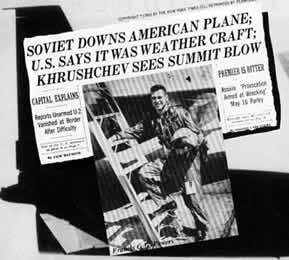
u2_spy_plane_incident_newspaper_clippingOn May 1, 1960, Francis Gary Powers’ U-2 plane was shot down over the Soviet Union while on a secret reconnaissance mission. The ensuing diplomatic fallout caused the cancellation of the Paris Summit between Dwight Eisenhower and Nikita Khrushchev. Less well known, in April 1960, Robert Schwanhausser, an engineer for Ryan Aeronautical, briefed the United States Air Force on the possibility that its Firebee target drone, used at the time for air defense training, might be re-engineered as an unmanned reconnaissance plane. In the weeks following the Powers incident, the Air Force began wholesale negotiations with Ryan Aeronautical to develop a pilotless spy plane and, on July 8, 1960, the company was given funding to begin the project. Among the noted advantages were: “political risk is minimized due to the absence of a possible prisoner” (“Alternative Reconnaissance System,” 1960). I investigate the resulting Lightning Bugs, flown for three-thousand reconnaissance missions in Southeast Asia between 1964 and 1973. 

Researching how aircraft were unmanned during the Cold War is instructive both in the ways they mimic contemporary unmanned combat aerial vehicles and trouble assumptions about them. I follow how unmanned systems operated within the logics of American Cold War politics and their perceived usefulness geopolitically – crossing borders as spy aircraft, collecting and jamming electronic signals, and gathering battlefield reconnaissance. I ask how conquest, and the ensuing assumptions of empire, colonialism and race, underlie the unmanning of military aircraft, even while these aspects were purposefully, although, unsuccessfully occluded through the idea that technologies could mitigate political risks. Moreover, unmanned reconnaissance projects were cancelled at the end of the Vietnam War and their failure provides clues about what might be left out of visions of aerial control and the ways politics, and human vulnerabilities, persisted in spite of efforts to engineer systems that would suggest otherwise.

The legitimacy of contemporary drone strikes relies on the ability of unmanned aircraft to “see” enemy targets. Yet, as Isabel Stengers has argued, any representation gives value. Looking at the few available images from these early unmanned reconnaissance flights, I move between what is seen and unseen to examine how values, particularly, secrecy and control, are formed through unmanned reconnaissance. Claiming to produce a mechanical, rather than political, view of the territories surveyed, I show how the supposedly apolitical lens of the drone occludes how politics, industry and military come together to privilege certain positions and target others.

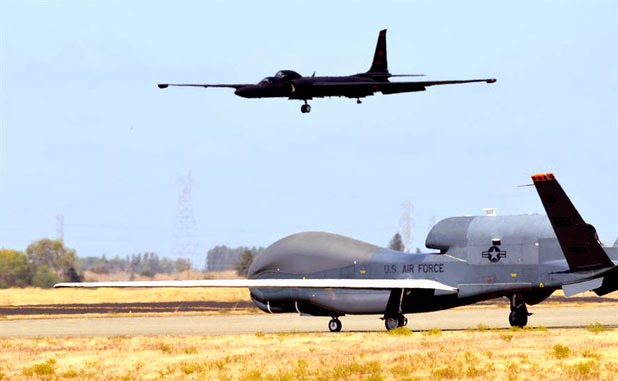
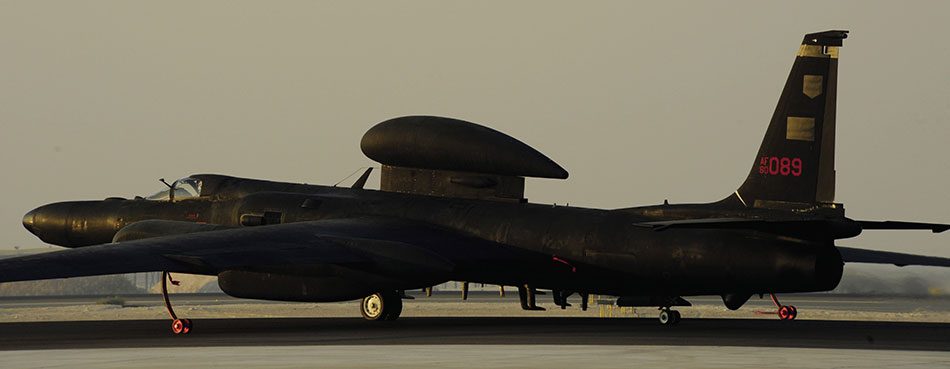
Interesting stuff – especially that first paragraph linking ‘un-manning’ to the U-2.  There is a strange irony here, because until this year the US Air Force had in fact favoured its fleet of 33 U-2 (‘Dragon Lady’) aircraft [one of which is shown at the top of the photograph] over the high-altitude Global Hawk [shown at the bottom], so much so that it had asked for permission to cancel its orders for the new Block 30 Global Hawks and place others in storage.

GlobalHawk_USAFAirmanFirstClassBobbyCummings

You may be surprised to discover that the U-2 is still flying, but the airframe has been repeatedly modified and so too has the network in which it is embedded.  One pilot explained:

“The U-2 started out only carrying a wet-film camera. Now, with today’s technology, I’m alone up there, but I may be carrying 40 to 50 Airmen via data link who are back at a (deployable ground station).”

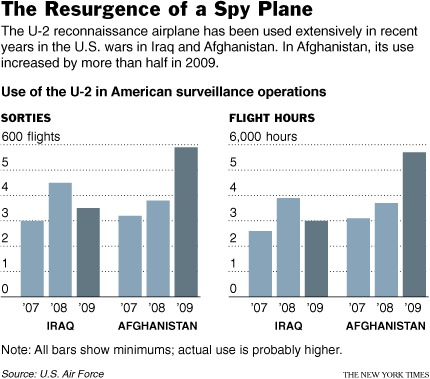
U-2 flying hours in Afghanistan and Iraq (New York Times)It’s important to remember that Predators and Reapers are not the only platforms streaming imagery to the Air Force’s Distributed Common Ground System.  The U-2 was given a new lease of life by the Gulf War in 1991, when nine U-2s flying out of the UAE  provided 50 per cent of all imagery and over 90 per cent of all ground forces targeting imagery.  During the invasion of Iraq in 2003 U-2s flew only 19 percent of the air reconnaissance missions, but they provided more than 60 per cent of the signals intelligence and 88 per cent of battlefield imagery.  The continuing wars in Afghanistan and Iraq confirmed that the U-2’s original, strategic significance had been eclipsed by its new tactical role.  Chris Pocock explains:

“The U-2 today is more a tactical intelligence gatherer…  It supports ground operations on a daily basis, flying over Afghanistan, flying around Korea, flying in the eastern Mediterranean, doing all those things every day and it’s actually not only providing intelligence that is analyzed for the benefit of those ground troops, but it’s actually in contact with those ground troops in real time.”

And that close contact – akin to the intimacy remote operators in the continental United States claim when they say they are not 7,000 miles but 18 inches from the battlespace, the distance from eye to screen – takes its toll on the U-2 pilots too.  In addition to the extraordinary pressures flying the U-2 imposes on their bodies, one USAF physician insisted that ’emotionally… they’re wrung out from that… When you’re talking to somebody on the radio and there’s gunfire in the background… you’re not taking a nap while that’s happening.’

Writing in the New York Times, Christopher Drew provided a revealing example:

Major Shontz said he was on the radio late last year with an officer as a rocket-propelled grenade exploded. “You could hear his voice talking faster and faster, and he’s telling me that he needs air support,” Major Shontz recalled. He said that a minute after he relayed the message, an A-10 gunship was sent to help.

In fact, that last clause can be generalised; the U-2 has often been deployed in close concert with other platforms, including Predators and Reapers.  Drew again:

The U-2’s altitude [70,000 feet or more], once a defense against antiaircraft missiles, enables it to scoop up signals from insurgent phone conversations that mountains would otherwise block.  As a result, Colonel Brown said, the U-2 is often able to collect information that suggests where to send the Predator and Reaper drones, which take video and also fire missiles. He said the most reliable intelligence comes when the U-2s and the drones are all concentrated over the same area, as is increasingly the case.

Part of the reason for that is that the U-2 has such an advanced imagery system:

Even from 13 miles up its sensors can detect small disturbances in the dirt, providing a new way to find makeshift mines [IEDs] that kill many soldiers.  In the weeks leading up to the [2010] offensive in Marja, military officials said, several of the … U-2s found nearly 150 possible mines in roads and helicopter landing areas, enabling the Marines to blow them up before approaching the town.

Marine officers say they relied on photographs from the U-2’s old film cameras, which take panoramic images at such a high resolution they can see insurgent footpaths, while the U-2’s newer digital cameras beamed back frequent updates on 25 spots where the Marines thought they could be vulnerable.

U-2 preparing for takeoff 'in SW Asia' (USAF/Eric Harris)

For all that,  in the last two years the Air Force’s plan to cut the Global Hawk program was repeatedly over-ridden by Congress, in response to an extraordinary campaign waged by Northrop Grumman, which launched what Mark Thompson called ‘its own ISR – intelligence, surveillance and reconnaissance – mission over Capitol Hill to decide where to strategically target cash-bombs to keep its plane, and more of them, flying for another day’: you can find a  full report at the Center for Public Integrity here.

The Air Force has now accepted the retirement of Lockheed Martin’s ageing Cold warrior, because (so it says) the cost per flying hour of the Hawk has now fallen below that of the U-2 ($24,000 vs. $32,000).  ‘U2 shot down by budget cuts’, is how PBS put it, while the Robotics Business Review triumphantly announced ‘Here comes automated warfare’.

Even so, cost per flying hour is not the whole story, as Amy Butler explains.  Part of the problem is logistical and, by extension, geopolitical: ‘Global Hawks based in Guam have to transit for hours just to reach North Korea, whereas the U-2, based at Osan air base, South Korea, has a shorter commute’ (details of the Hawk’s global basing can be found here).

A second issue is reliability, which bedevils all major UAVs and makes cost per flying hour a dubious index:

‘Intelligence, surveillance and reconnaissance collection is in high demand, and aircraft downtime is extremely worrisome for combatant commanders. In the Pacific, 55% of Global Hawk’s missions were canceled in fiscal 2013; 96% of the U-2’s missions were achieved. The U-2 was also scheduled for nearly three times as many missions. Global Hawk lacks anti-icing equipment and is not able to operate in severe weather.’

Finally, critics continue to complain that the sensors on the U-2 remain superior to those on the Hawk and provide a wider field of view.  According to a report from Eric Beidel,

The Global Hawk carries Raytheon’s Enhanced Integrated Sensor Suite, which includes cloud-penetrating radar, a high-resolution electro-optical digital camera and an infrared sensor. But the U-2’s radar can see farther partly because the plane can fly at altitudes over 70,000 feet, about 10,000 feet higher than a Global Hawk. A longer focal length also gives the U-2’s camera an edge, experts said…

Air Force Chief of Staff Gen. Norton Schwartz has said that the drone’s sensors just weren’t cutting it. Further, the U-2 can carry a larger payload, up to 5,000 pounds compared to 3,000 pounds for the Global Hawk.

“Some of the most useful sensors are simply too big for Global Hawk,” said Dave Rockwell, senior electronics analyst at Teal Group Corp. He referred to an optical bar camera on the U-2 that uses wet film similar to an old-fashioned Kodak. “It’s too big to fit on Global Hawk even as a single sensor.”

All of these technical considerations are also political ones, as Katherine’s abstract indicates, and none of them answers the other questions she poses about what can and cannot be seen…

Seeing Machines

VIRILIO Vision machineIn a series of posts on photography Trevor Paglen provides some ideas that intersect with my own work on Militarized Vision and ‘seeing like a military’.  First, riffing off Paul Virilio, Trevor develops the idea of photography as a ‘seeing machine‘:

‘Seeing machines is an expansive definition of photography. It is intended to encompass the myriad ways that not only humans use technology to “see” the world, but the ways machines see the world for other machines. Seeing machines includes familiar photographic devices and categories like viewfinder cameras and photosensitive films and papers, but quickly moves far beyond that. It embraces everything from iPhones to airport security backscatter-imaging devices, from electro-optical reconnaissance satellites in low-earth orbit, to QR code readers at supermarket checkouts, from border checkpoint facial-recognition surveillance cameras to privatized networks of Automated License Plate Recognition systems, and from military wide-area-airborne-surveillance systems, to the roving cameras on board legions of Google’s Street View” cars.

What’s more, the idea of seeing machines I’m sketching out here isn’t confined to the imaging devices and systems I’ve described in broad strokes. The definition extends to include the images (or data) produced by such imaging systems, the digital metadata associated with those images, as well as additional systems for storage, archiving, search and interpretation (either human or algorithmic). Finally, and crucially, seeing machines encompasses not only imaging systems, search, and storage capacities, it encompasses something a bit more abstract, namely the “styles” or “practices” of seeing that different imaging systems enable (i.e. the difference between what a view camera and an automated license-plate reading camera “want” to do and how they see the world differently).  Crucially, the definition of photography I’m proposing here encompasses imaging devices (“cameras” broadly understood), the data (“images” being one possible manifestation of that data) they produce, and the seeing-practices with which they are enmeshed.’

In a subsequent post on Geographies of Photography Trevor then links these seeing-practices to what he calls the production of space (and what I now prefer to think of as performances of space), and uses the example of the Reaper to illustrate what he has in mind:

What exactly is a Reaper drone? In essence, it’s a camera attached to a remote-controlled airplane. Sometimes it carries missiles. What’s particular about a Reaper drone (and other drones in its larger family, including the Predator and the Sentinel) is that airplane, pilot, navigator, analysts, and commander don’t have to be in the same place. The aircraft might be flying a combat mission in Yemen by a pilot based in Nevada, overseen by a manager in Virginia, and supported by intelligence officers in Tampa (geographer Derek Gregory has written about what he calls “Drone Geographies.”) The drone creates its own “relative” geographies, folding several noncontiguous spaces around the globe into a single, distributed, “battlefield.” The folding of space-time that the Reaper drone system enables is a contemporary version of what Marx famously called the “annihilation of space with time,” i.e. the ability to capitalize on the speed of new transportation and communications technologies to bring disparate spaces “closer” together, relatively speaking.

I think that’s more or less right: these new, networked political technologies of vision have been instrumental in the production of a non-linear and discontinuous battlespace, threaded by wormholes that connect one site to another.  But, as I’ll try to show when I eventually get to my post on Uruzgan, the process is far from seamless, the folds are more fragile than most of us realise, and the discontinuities and ruptures are as important as the connections for the administration of military violence.

Forensis

I’m putting together my presentation on ‘Seeing like a military‘ for the AAG Conference in Tampa next week, but – prompted in part by my interest in forensic architecture (see also here and here) – I’ve also been thinking about other ways of seeing (perhaps ‘re-viewing’ would be better) military violence.

2014_cover_publication_forensis_imgsize_SSo I’ve been interested to read a report over at rhizome on Forensis, an exhibition and installation curated by Anselm Franke and Eyal Weizman at the Haus der Kulteren der Welt in Berlin, on ‘Constructions of Truth in a Drone Age’:

Any act of looking or being looked at is mediated by technology. This is true of any scientific process too, where each tool or method of looking is developed with a purpose in mind which influences the data that it produces. This is precisely what forensic investigation reveals: not only the reality of an event, but also the intention of a viewing mechanism and the political weight of that intention once made visible. Representations of warfare illustrate this as successfully as any art object.

As part of the exhibition Forensis, now on view at Haus der Kulteren der Welt in Berlin, Forensic Architecture and SITU Research investigate drone strikes in situations where state-mandated degradation and pixelation of publicly available surveillance footage is a legal regulation rather than a visual constraint, and drones are designed to evade the digital image. Missiles are developed that burrow through targeted buildings, leaving holes that are smaller than a low resolution pixel. Attacking at “the threshold of visibility,” the legal, political, and technical conditions equally attempt to remain invisible. The job of forensics is then to recover them.

Anselm and Eyal traffic in the roots between forensics and the Roman forum, which they envisage as a ‘multi-dimensional space of negotiation and truth-finding in which humans and objects participated together in politics, law and the economy.’  The underlying argument of Forensis, the report suggests, is that ‘the object of forensics should be as much the looker and the act of looking as the looked-upon’ – which will be precisely my point in Tampa.