Rendering the (in)visible

Holland Cotter has a good essay at the New York Times on art and the First World War: a commentary on World War I and American Art currently on show at the Pennsylvania Academy of the Fine Arts (PAFA) in Philadelphia.

You might think it’s difficult to say something new about that (and it is), but this is an interesting – and in places even arresting – reflection:

With World War I, invisibility became a deadly weapon. Submarines turned oceans into minefields. Airplanes, used in regular combat for the first time, killed through stealth and distance. Silent death emerged: poisonous gases enveloped victims, blinding them, eating their flesh, leaving them to drown in their own fluids. Add to these grisly innovations the high-power guns that, dronelike, pulverize bodies outside the range of vision, and you can see how warfare became depersonalized. It felt like a scientific experiment, not a human engagement.

So how, he asks, did artists make this new form of war visible?

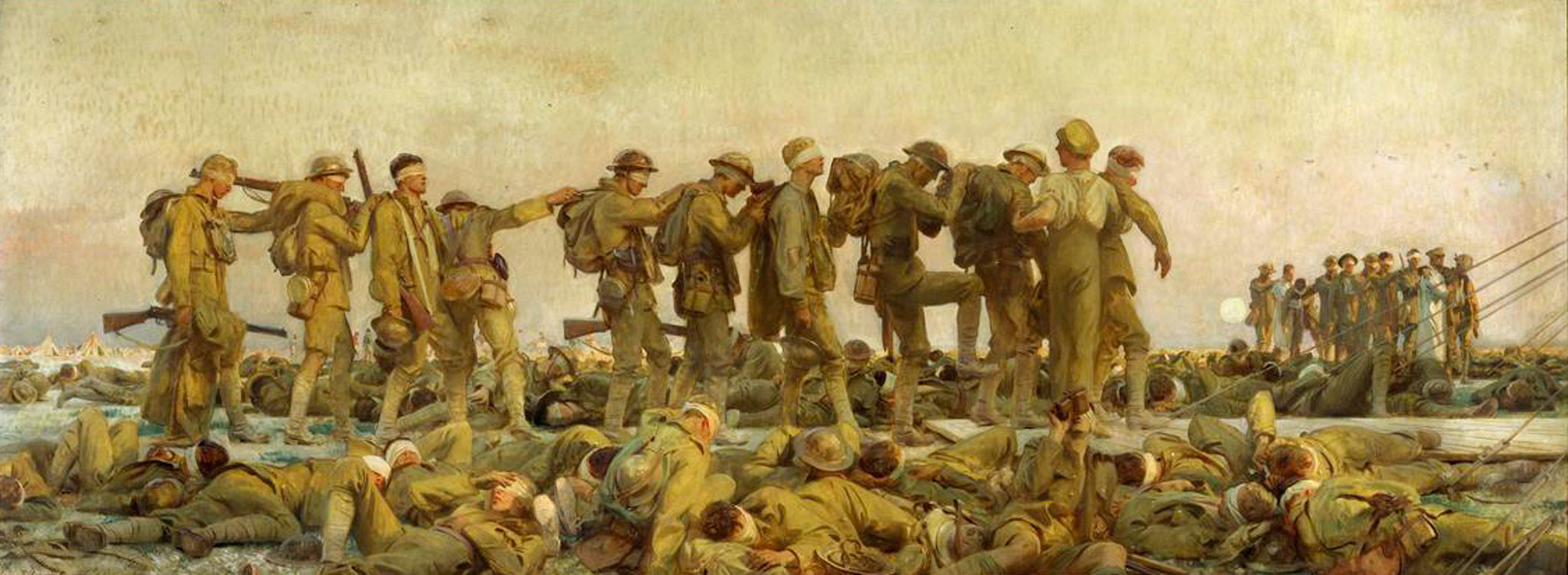
No simple answer, of course, but Cotter’s commentary on John Singer Sargent‘s iconic Gassed sharpens a point that confronts all artistic attempts to render war and its effects, the aestheticisation of violence:

The tableau is often compared to ancient Classical friezes. And like such images, based on themes of history and myth, it elevates and softens tragedy through formal beauty. That beauty is the big weakness of Sargent’s magisterially painted image. It glamorizes profound human damage. It glosses over the criminal meanness and fraudulence of a media-fed war that was “trivial, for all its vastness,” as Bertrand Russell, who lived through it, wrote.

gassed

Others have seen Gassed differently, to be sure.  Here is Michael Glover:

When it was done and displayed – it was nominated picture of the year by the Royal Academy – not everyone liked it. E M Forster thought it too heroic by half. Forster has missed the point, surely. It is indeed on a heroic scale, and its gigantism – including the fact that it is so much wider than it is high –adds a kind of plangent cinematic forcefulness to the scene, but its theme, all the same, is the brokenness, the helplessness of humanity in the face of barbarous devices. Terrible things are often slightly serio-comic too, and so it is here. This is a kind of strange perversion of blind’s man’s bluff, isn’t it? And yet these bandages are for real. These men may never see again. They may not even survive at all.

They are being led, with their eyes swathed in lint, towards a treatment tent – see those guy ropes. There is more than one line of men. They are converging from several directions. And, meanwhile, other things are going on too. In the far distance, a game of football is being played. Back left, we can see tents. There is a hanging moon. The light is a strangely grainy mustardy yellow – with just a tint of rose – that suffuses everything. We can almost smell the air.

Heroism? That jumble of broken and helpless men that occupies the entire foreground of the painting, and continues behind the stepping men, makes that claim even less credible. All this is human flotsam and jetsam, done down by the nastiness of war.

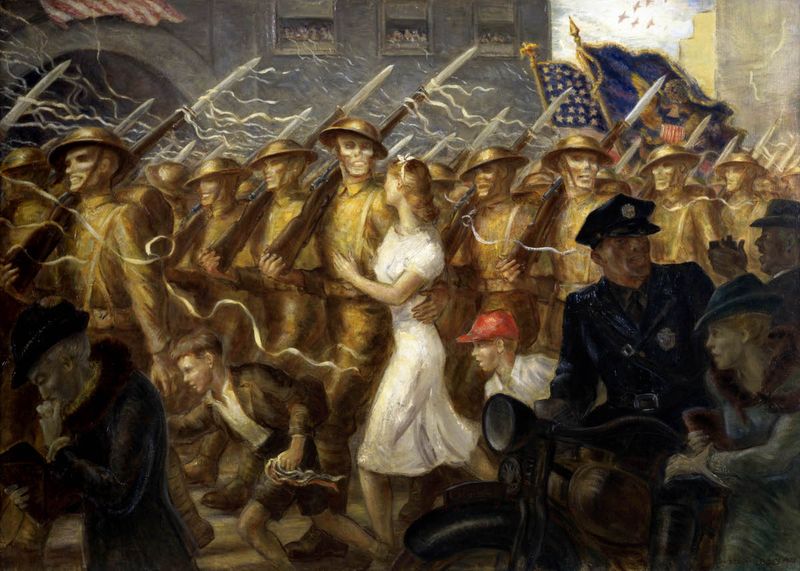
I also like Cotter’s summary of John Steuart Curry‘s Parade to War, Allegory, completed in 1938:

It shows troops [American doughboys from the First World War] marching in tight formation down a city street. Excited schoolboys run along beside them. A young woman, a sister or sweetheart, embraces a soldier as she keeps pace with him. In the foreground, a spectator cheers, but a policeman seems to be holding back another one, a distressed older woman. Maybe she sees what no one else does: All the soldiers have skulls for faces.

curry-parade-to-war

For King and Countryside

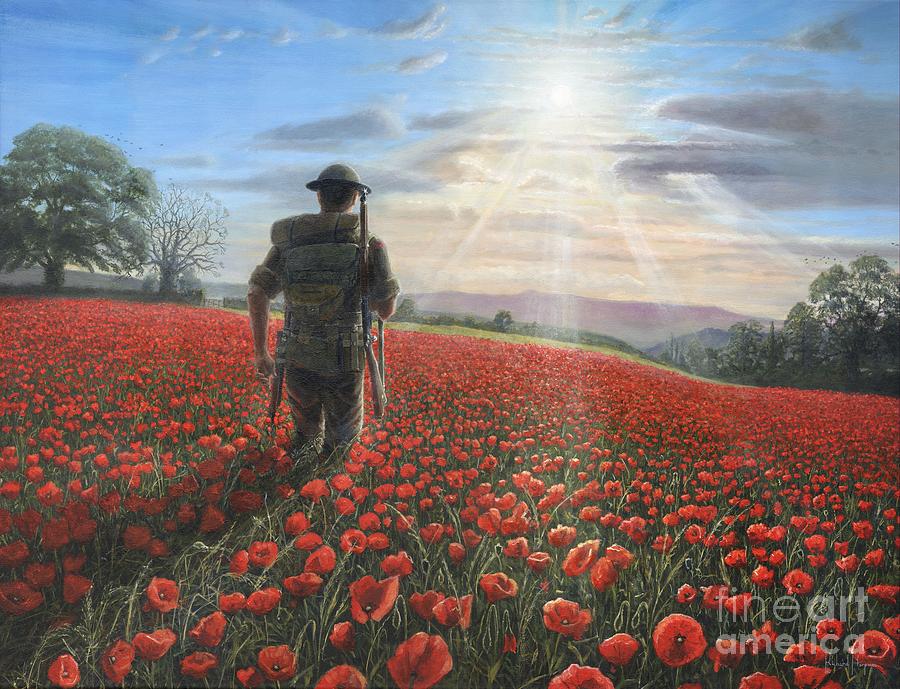
Richard Harpum/Tommy

‘For the British soldier in the First World War, nature was always a matter of life and death’:  John Lewis-Stempel

When I was working on ‘Gabriel’s map’, and later on ‘The natures of war’ (both available under the DOWNLOADS tab), I immersed myself in the ways in which industrialised war violated the rural landscapes of Belgium and France on the Western Front during the First World War.  But I also noticed there (as in other war zones) the redemptive possibilities of ‘the natural world’:

A few miles behind No Man’s Land lay an agrarian landscape that would have been familiar to most European troops – though not to the considerable contingents from other continents – and many of them took refuge in a reassuring rurality whenever they were removed from the front line. Moving up to the trenches from Belancourt on a glorious June afternoon in 1916 the young Max Plowman exulted in the scene:

‘The tall corn is ripening, and between its stalks poppies and cornflowers glow with colour. Through the valley we are descending a noisy stream finds its way, and on the hills beyond, great elm-trees stand like wise men brooding. It is a lush green country, full of beauty. The war seems far away.’

Pastoral conceits like these – and they were by no means uncommon – were testaments to the horrors that closed in as the troops neared what Plowman later called ‘the palsied zone’. As he and his men marched towards Fricourt, they crossed the old front line. ‘The country here is stricken waste: the trees that formed an avenue to the road are now torn and broken stumps, some still holding unexploded shells in their shattered trunks, others looped about with useless telegraph-wire.’ Later still, he described the sun glaring down ‘on earth that has lost its nature, for, pitted everywhere with shell-holes, it crumbles and cracks as though it has been subject to earthquake.’ As the landscape ‘lost its nature’ – a loss for which the all too human violence of war was responsible – so it also appeared less human. Yet even there, in the midst of all that, it was still possible to find sights and sounds that evoked the pastoral: the cornflower blue sky, the crimson rose, the fluting song of the lark. But these were all fleeting moments, and when he was finally relieved Plowman wrote that ‘it is cheering to be going westward: the farther you go in this direction the more human the world becomes.’  The opposition between the ‘un-natural’ and the ‘human’ really pits the savage against the domesticated, but passages like these are double-edged. They form a repertoire of ‘Arcadian resources’ in Paul Fussell’s resonant phrase, which function as what he saw as a characteristically ‘English mode of both fully gauging the calamities of the Great War and imaginatively protecting oneself against them’. Protection here is about more than solace, I think, because opposing these imaginative geographies works to repress the transformation of the domesticated into the savage which confirmed what Claire Keith saw as ‘the frightful interdependence of human death and environmental death’.

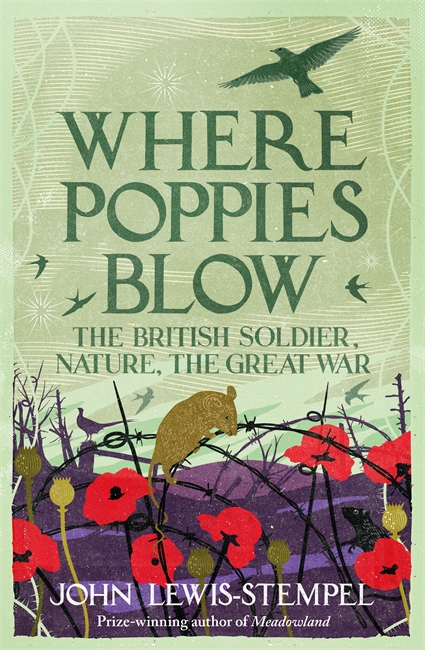
where-poppies-blow

Those redemptive, even Arcadian moments have now been gathered and pressed within the pages of a new book: John Lewis-Stempel‘s Where Poppies Blow: the British solider, Nature, the Great War (2016):

Where Poppies Blow is the unique story of the British soldiers of the Great War and their relationship with the animals and plants around them. This connection was of profound importance, because it goes a long way to explaining why they fought, and how they found the will to go on.

At the most basic level, animals and birds provided interest to fill the blank hours in the trenches and billets – bird-watching, for instance, was probably the single most popular hobby among officers. But perhaps more importantly, the ability of nature to endure, despite the bullets and blood, gave men a psychological, spiritual, even religious uplift.

Animals and plants were also reminders of home. Aside from bird-watching, soldiers went fishing in village ponds and in flooded shell holes (for eels), they went bird nesting, they hunted foxes with hounds, they shot pheasants for the pot, and they planted flower gardens in the trenches and vegetable gardens in their billets.

In an interview, the author explains:

When the poet Edward ‘Adlestrop’ Thomas was asked why he was volunteering for service in the Great War, he picked up a handful of earth and said, ‘Literally, for this’. Men went to fight for King and Countryside, as much as King and Country. Nature worship was almost a religion in Edwardian England.

And when men arrived in France, they lived in trenches – inside the earth. ‘Certainly I have never lived so close to nature before or since’, Corporal Fred Hodges of the Lancashires observed, in words that spoke for the generation in khaki.

There was no escape from Nature 1914-18. Skylarks, say, buoyed men’s spirits -one Scottish miner said about the Western Front ‘What hell it would be without the birds’- and some Nature killed the soldiers. We think of the Great War as the first modern war; actually, it was The Last Ancient War. Disease, courtesy of rats and lice, was diabolical.

But I suppose, above all else, Nature healed the mind. Men looked at the poppies growing in the mud and the swallows which shared their dug-out and saw hope – a future for themselves and humankind.

You can capture exactly that sense in some of John Masefield‘s poetry, written when he was serving as a medical orderly – the book begins with his ‘August, 1914’ – and you can read more in the Preface and the first chapter of Where Poppies Blow (the splendidly titled ‘For King and Countryside’) available here.  As the remark I’ve used as my epigraph makes clear, though, there was always (and remains) a desperately dark side to the entanglements with a militarised nature.

The evolution of warfare

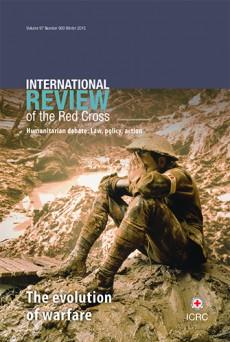
irrc-2016

The latest issue of the International Review of the Red Cross (open access here) focuses on the evolution of warfare:

To mark the 100th anniversary of the First World War, the Review asked historians, legal scholars and humanitarian practitioners to look back at the wars of the past century from a humanitarian point of view. In using what we know of the past to illuminate the present and the future, this issue of the Review adopts a long-term perspective, with the aim to illustrate the changing face of conflict by placing human suffering ‒ so often relegated to the backdrop of history ‒ front and center. It focuses on WWI and the period immediately leading up to it as a turning point in the history of armed conflict, drawing important parallels between the past and the changes we are witnessing today.

Among the highlights: an interview with Richard Overy on the history of bombing; Eric Germain, ‘Out of sight, out of reach: Moral issues in the globalization of the battlefield’; Lindsey Cameron, ‘The ICRC in the First World War: Unwavering belief in the power of law?’; Rain Liivoja, ‘Technological change and the evolution of the law of war’; Claudia McGoldrick, ‘The state of conflicts today: Can humanitarian action adapt?’; and Anna Di Lellio and Emanuele Castano, ‘The danger of “new norms” and the continuing relevance of IHL in the post-9/11 era’.

Incidentally, there may be something Darwinian about the trajectory of modern war – but I’m not sure that ‘evolution’ is exactly the right word…

War Stories

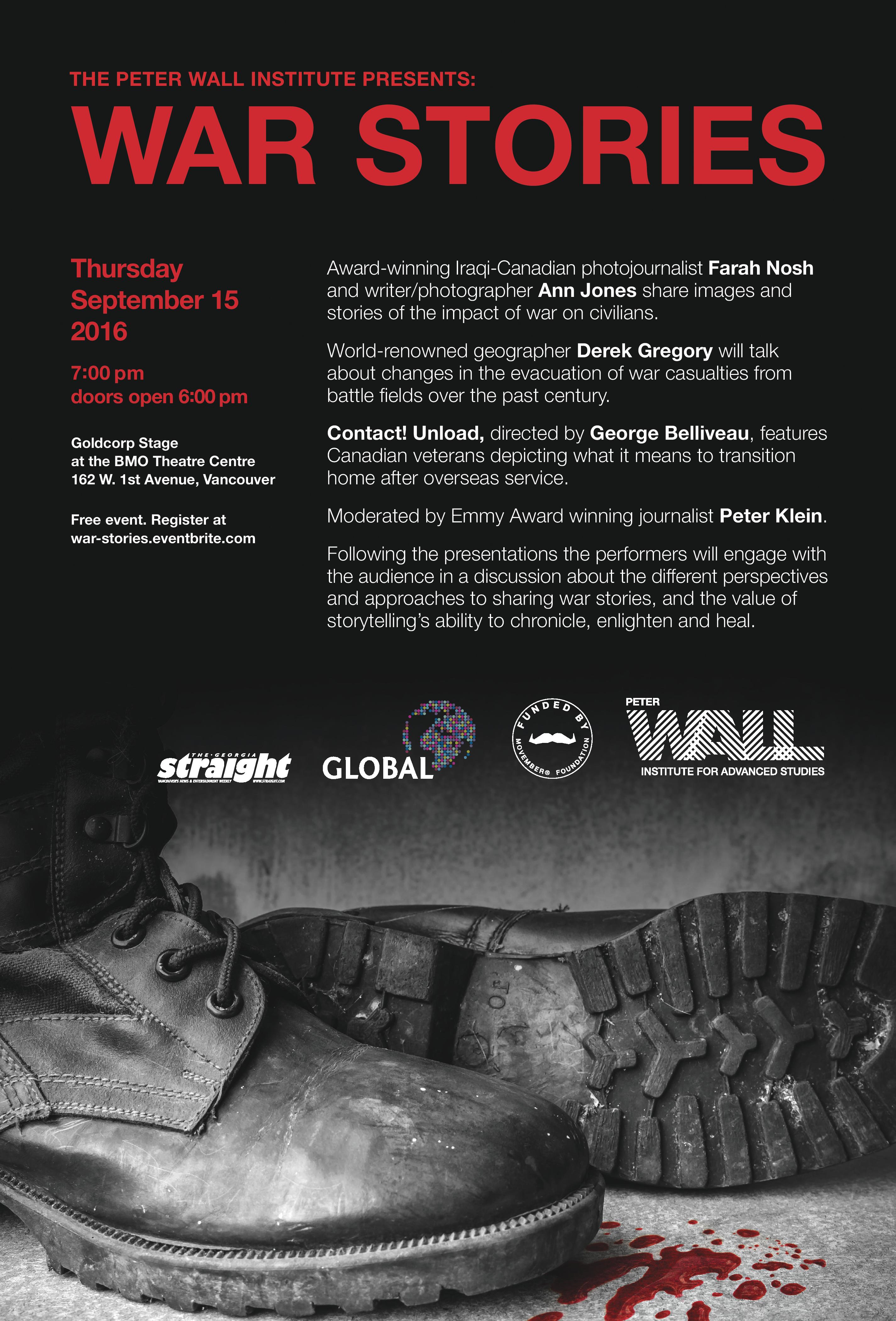
The video from our War Stories event in Vancouver last month – including Farah Nosh‘s narration of her wonderful photographs, a superb capsule genealogy of PTSD from Ann Jones, my discussion of casualty evacuation over the last hundred years, a drama staged by veterans from Afghanistan and directed by George Belliveau, Contact! Unload!, and a lively Q&A with the audience moderated by Peter Klein is now available here.

war_stories3b-page-001

My lecture, Precarious journeys, has also been carved out for the Peter Wall Institute website here. The idea behind the event was, in large measure, to think through the multiple ways in which modern war is narrated, which is why we had such a rich and diverse portfolio of performers and why I take the turns I do…  Regular readers will probably recognize that the arc of my presentation draws on my current research on evacuation from the Western Front in the First World War, on evacuation from Afghanistan today, and on my admiration for Harry Parker‘s Anatomy of a Soldier (see my ‘Object lessons’ here and the slides available under the DOWNLOADS tab).

More in an interview with Charlie Smith from the Georgia Straight here.

The hospital raids

This is the first in a new series of posts on military violence against hospitals and medical personnel in conflict zones.  I’ve discussed these issues on multiple occasions in the past – in relation to Afghanistan, Gaza and Syria – but I’m now working towards a presentation – and ultimately an extended essay – that brings this all together (including a detailed analysis of the US air strike on the MSF Trauma Centre in Kunduz).  It will have its first outing (“Surgical Strikes and Modern War”) at NUI Galway next month.

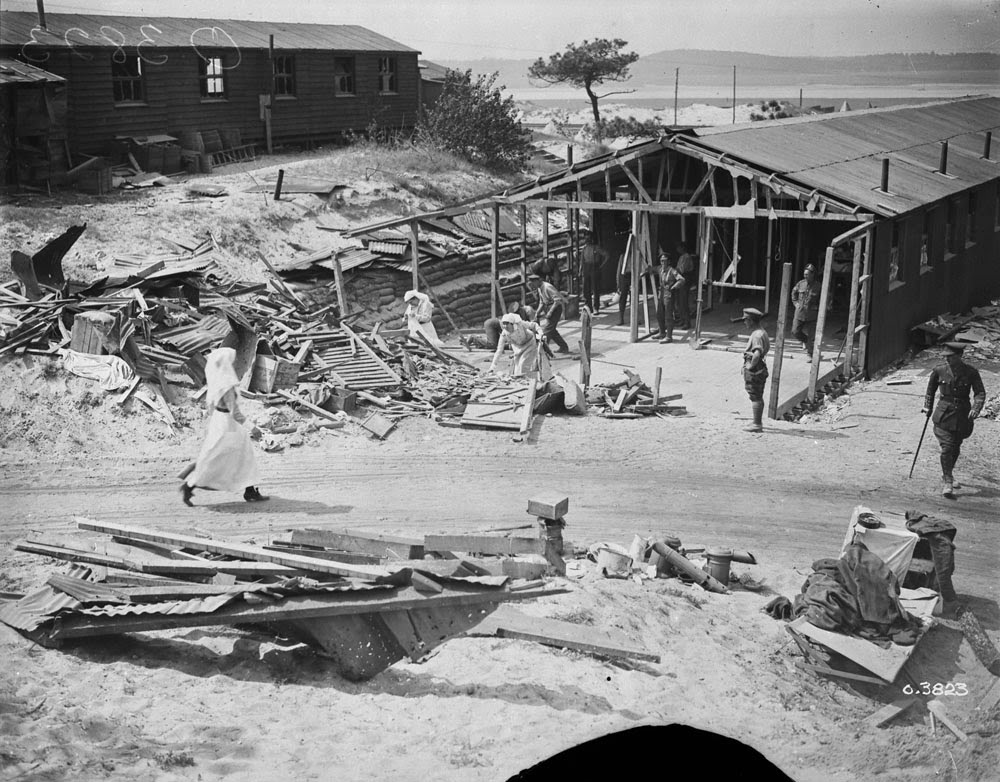
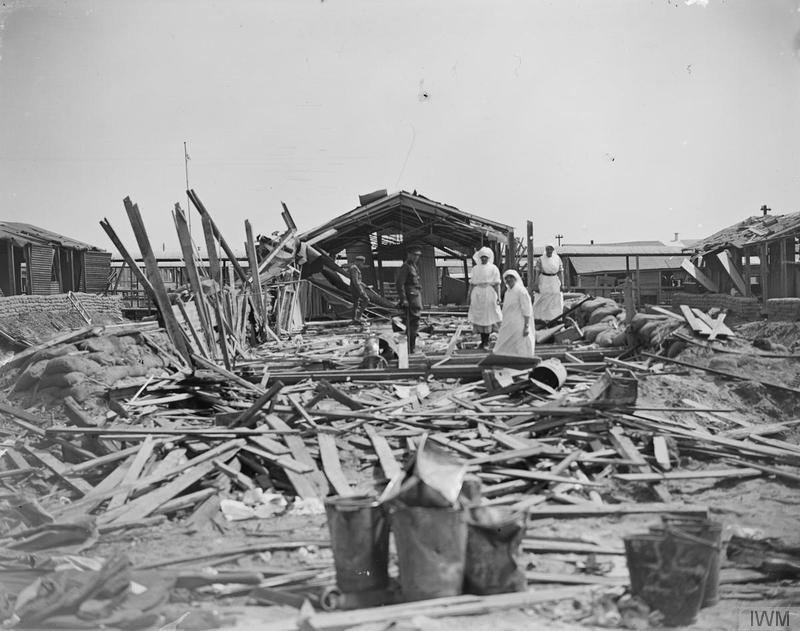
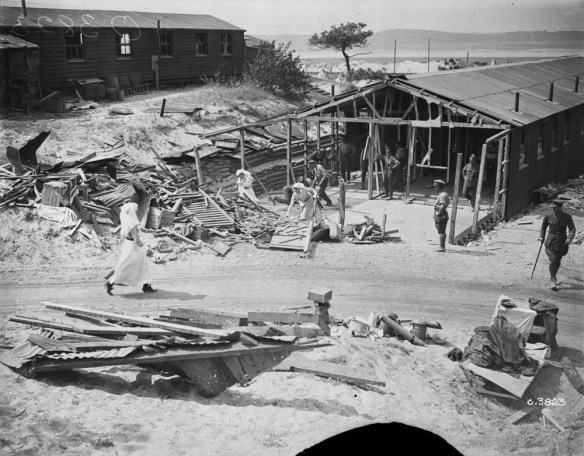
It was a clear, moonlit night and the hospitals – many of them provided by humanitarian organisations – were brightly lit as the nurses moved about the wards caring for their patients; elsewhere the hard-pressed surgeons were still operating on the maimed bodies of the wounded.  At 10 p.m. they heard the sound of approaching aircraft: first the clatter of gunfire and then, after the hospitals were plunged into precautionary darkness, the whistle of bombs falling.  The hospitals were hit repeatedly, and two hours later – when the flames had burned themselves out and the smoke cleared – several nurses had been killed and hundreds of patients had been killed or injured; multiple wards had been severely damaged.  Ten days later the aircraft returned; one hospital was totally destroyed and elsewhere operating rooms and wards were destroyed or damaged.

The scene is all too familiar: but this is not Gaza in 2014, Afghanistan in 2015 or Syria in 2016.  This is Étaples on the coast of France, 25 km south of Boulogne, in May 1918.
etaples-bombing-2-lowe_field_hospital_bombed_lac_pa_003747_a003747_v8-jpg_pv4a5fab25f240997c

On the Western Front it was common for stretcher-bearers to come under fire as they retrieved the wounded from No Man’s Land or carried them through the trenches and down the roads to aid posts and dressing stations; those places were often shelled since they were close to the front lines.  On 13 September 1914 Travis Hampson – a Medical Officer with a Field Ambulance – noted:

As one of our buses drove out onto the road to pick up some wounded gunners from the battery opposite, one landed on the road in front of it, and one behind, but not near enough to do any damage. With their glasses they must have been able to distinguish the white tilt and red cross, but we can’t grumble about being shelled if we are put amongst ammunition columns and batteries.

So too with the Casualty Clearing Stations (CCS) which had moved close to the front lines to speed up the treatment of what were often catastrophic wounds and to minimise the risk of infection.  Here is Kate Luard writing in her diary at Brandhoek on 18 August 1917:

He [the enemy] played about all night till daylight. There were several of him. He went to C.C.S.’s behind us. At one he wounded three Sisters and blew their cook-boy to pieces. The Sisters went to the Base by Ambulance Train this morning. At the other he wounded six Medical Officers among other casualties. A dirty trick, because he has maps and knows which are hospitals back there. Here we are in a continuous line of camps, batteries, dumps, etc., and he may not know.

In fact, her CCS was judged to be too close for comfort  and was ordered to evacuate a few days later.

Luard’s last sentence reinforces Hampson’s; in general (so she suggests) the Red Cross was respected.  The following year she wrote about German air raids on the CCS:

Jerry comes every night again and drops below the barrage, seeking whom he may devour: I think he gets low enough to see our huge Red Cross, as even when some of our lads butt in and engage him with their machine-guns, he hasn’t dropped anything on us.

For the most part, then, it seems that attacks on medical sites and personnel were the result of the inaccuracy of shellfire and bombing (especially at night) compounded by the close proximity of aid posts, dressing stations, CCS and ambulance trains to the fighting.

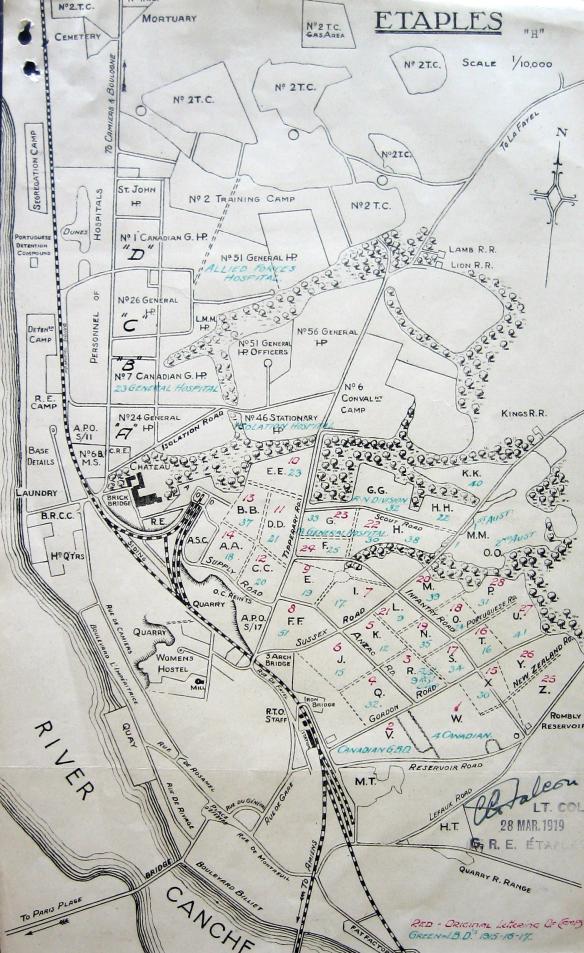
Yet the hospital raids in the last year of the war seemed to be something else.  Étaples was distant from the fighting, the site of a vast collection of ‘base hospitals’ – ‘the Land of Hospitals’, Sister Elsie Tranter called it, ‘a stretch of six kilometres of hospitals’ – to which wounded soldiers were sent from casualty clearing stations near the rapidly moving front: some to be treated and returned to active service, others to be evacuated across the Channel on hospital ships.
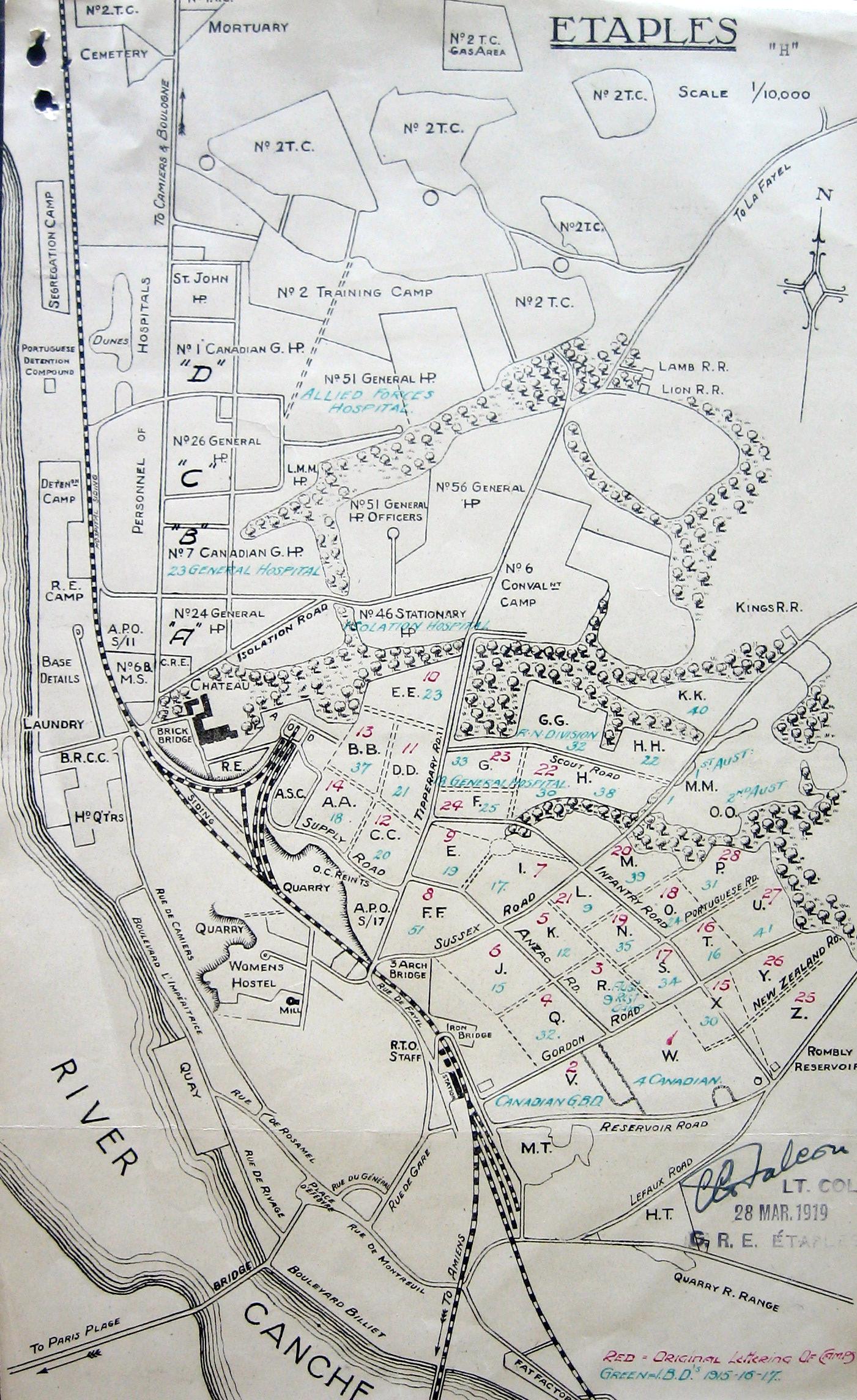
etaples-map

As soon as the news broke, the British press were up in arms at what the Times lost no time in calling ‘German savagery at its worst’:

‘During the recent fine weather our airmen have … made every use of the still air and the good visibility to attack and harass the enemy by bombing his camps, billets, rail-heads, batteries, dumps, roads and all points of military importance in the battle area and immediately behind.  At the same time, the German airmen have also been making use of the favourable conditions by having recourse to their old trick of bombing hospitals.

‘There is one place in France, faraway from the battle area, where we have a large group of hospitals.  The hospital tents there cover a great area of ground.  The Germans are perfectly aware of the character of the place, and they selected it as the object of a bombing raid last year.  They have again been attacking it, and the size of the tract of ground covered with hospital outfits and the entire absence of any concealment make it a mark which no airman could possibly miss.  An airman blind and drunk could let bombs fall from any height in any wind and weather, and they must land somewhere amongst the attendants’ quarters or on the tents where the nursing sisters move among the rows of cots with their helpless occupants.

‘On Sunday night the Germans attacked the place with all the ferocity of which they are capable… The scenes inside the tents were of the most piteous description, and the total casualties to patients, sisters, medical officers and attendants must have far exceeded those of any London air raid.  The redeeming feature of the whole horrible affair was the magnificent behaviour of the hospital staff…’ [Times, 24 May 1918]

This too is a familiar narrative, and one that would be repeated in countless wars to come: ‘we’ attack military targets with precision, ‘they’ attack civilian targets with abandon; their aircrew are cowards, our victims are heroes.

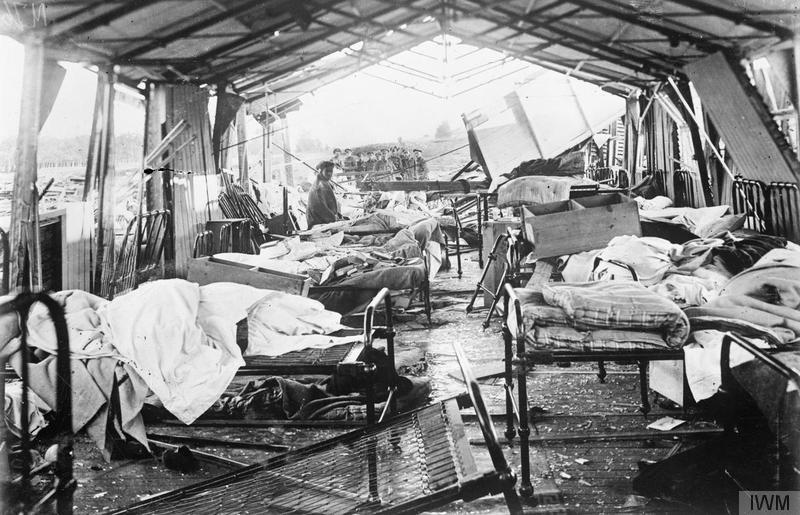
The press provided photographic evidence of the aftermath of the raids:
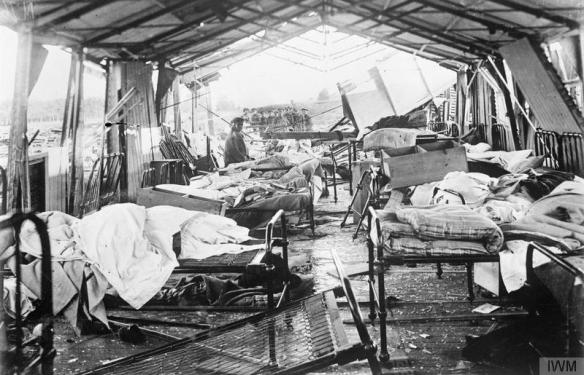
sjab-ward-destroyed-by-air-raids-etaples-may-1918

One of the German pilots was shot down – ‘and is now being cared for in the hospital he bombed’, thundered the Times – and his protestations were summarily dismissed:

‘He tried at first to excuse himself by saying that he saw no Red Cross.  When challenged with the fact that he knew that he was attacking hospitals he endeavoured to plead that hospitals should not be placed near railways, or if they are, they must take the consequences.  Apart from the fact that hospitals must be near railways for the transport of their patients, in this case, as in the others, the raiders were not attacking the railway but came deliberately to bomb the hospital.’

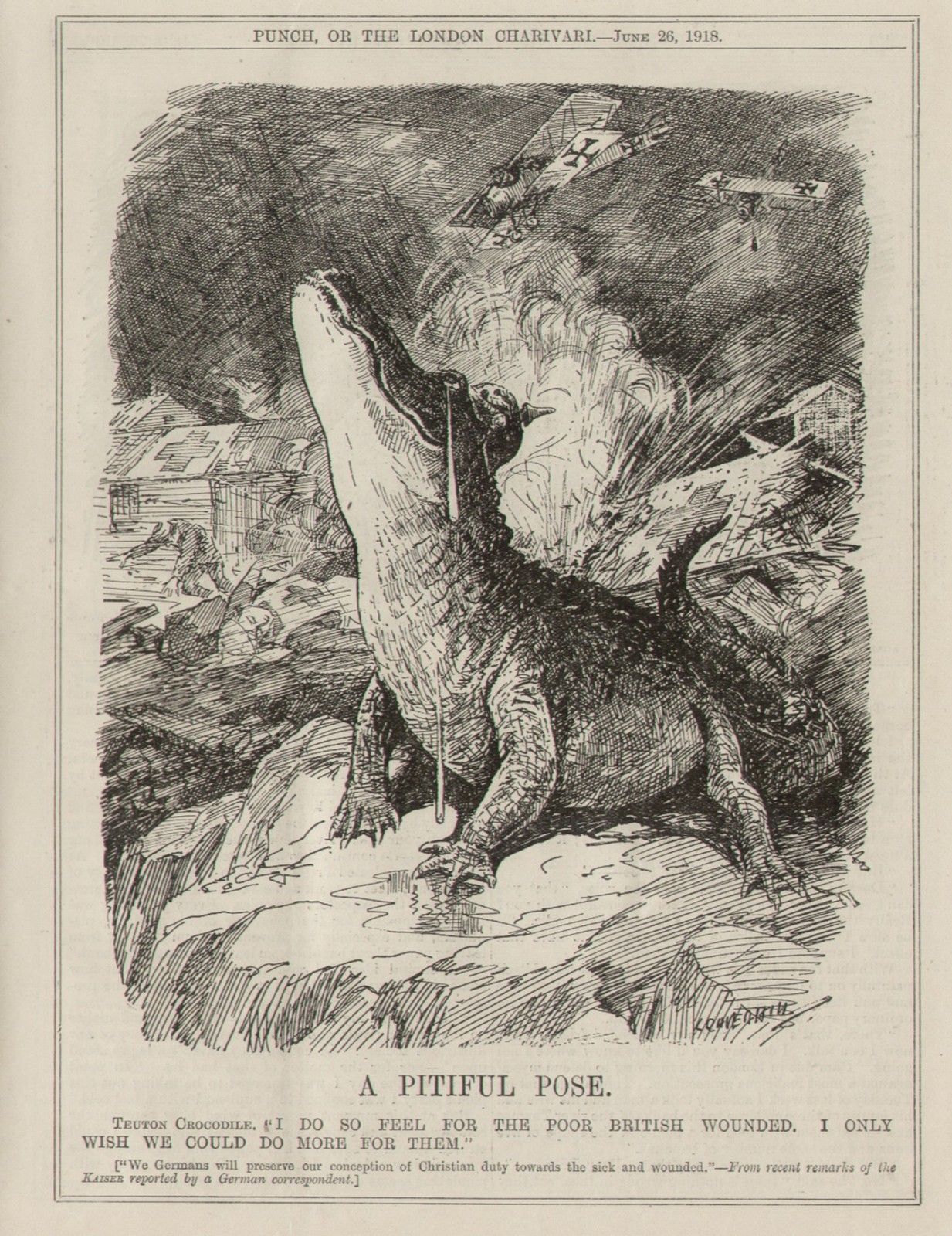
Punch dismissed German remorse as crocodile tears:
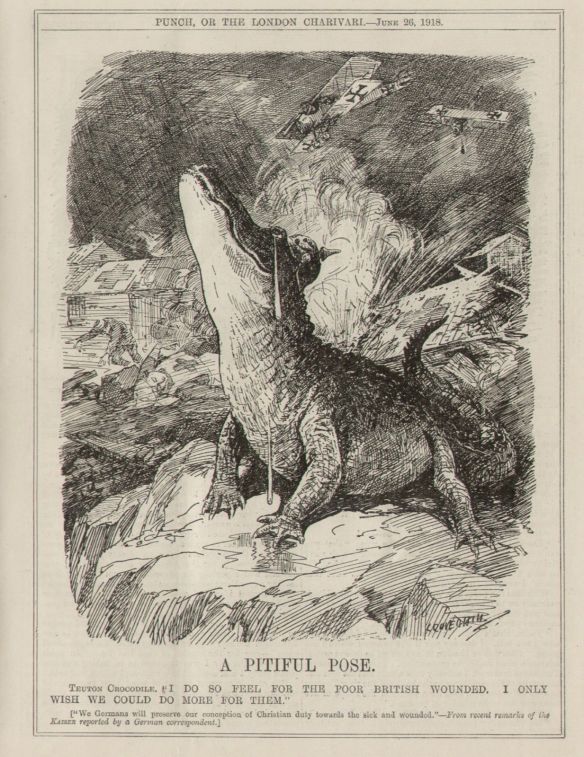
punch-26-june-1918

There were repeated angry calls for reprisals. Arthur Conan Doyle urged that the captured pilot be shot ‘with a notice that such will be the fate of all airmen who are captured in such attempts’ and recommended that German prisoners of war ‘at once be picketed among the tents’ to deter future raids [Times, 27 May 1918].  Sir James Bell went further.  Although his son had been killed in one of the raids, reprisals were not about revenge, he said, but were a strictly ‘military matter’.  He recommended ‘bombing German hospitals and killing their wounded’ to stop the outrages [Times, 5 June 1918].

Finally, the press trumped arguments about the presence of Red Crosses on the hospitals.  The Hague Convention required belligerents to take ‘all the necessary measures … to spare, as far as possible, … hospitals, and places where the sick and wounded are collected, on the understanding that they are not being used at the same time for military purposes’ and required them to mark such places with ‘distinctive and visible signs’.

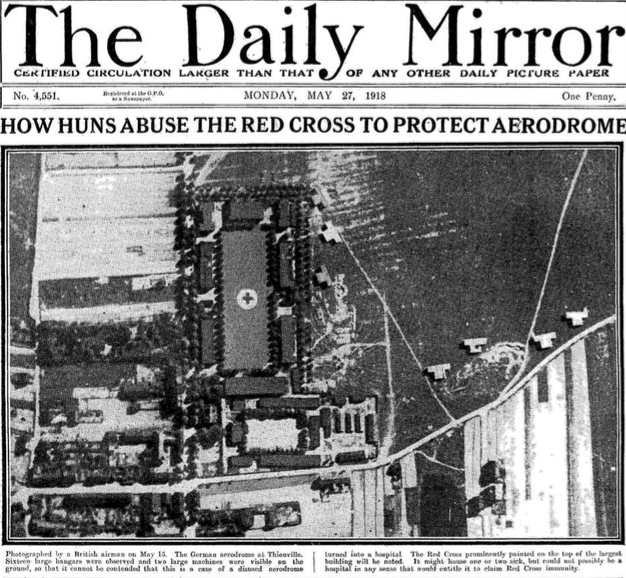
But far from respecting these protocols there was photographic evidence that the Germans were abusing the Red Cross to protect their own military installations:
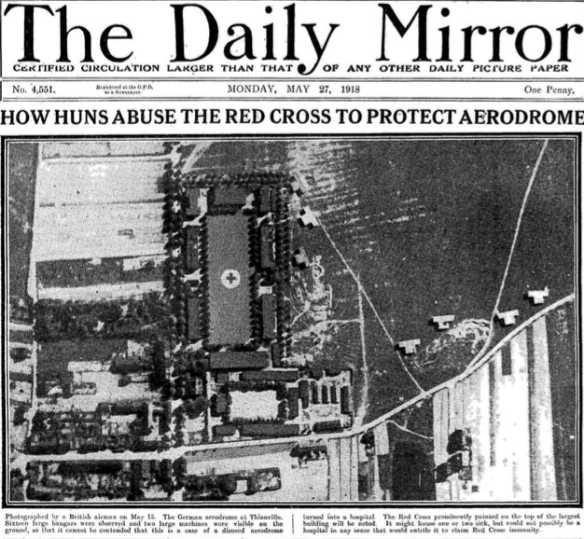
dm-27-may-1918

The aerial photograph was taken on 15 May 1918, and the caption described this as an active aerodrome at Thionville; the large building displaying the Red Cross ‘might house one or two sick’ but the Mirror insisted it ‘could not possibly be a hospital in any sense that would enable it to claim Red Cross immunity.’

And so, in her diary entry for 24 June 1918, Sister Edith Appleton wondered

‘if there is any truth in what they say about the bombing of hospitals – that in German territory the flying men have seen what are without doubt aeroplane hangers and ammunition dumps marked with huge red crosses. They are not near a railway and are so placed that they simply cannot be hospitals. I suppose they think we do the same and they bomb us on the chance of it. Of course we bomb their hangers and dumps – we should be fools if we didn’t! I am quite sure though that they do know what is a real hospital. They can see the wounded men walking about and some lying out in beds.’

Yet the press reports were studiedly disingenuous.  Étaples was indeed physically removed from the fighting – ‘far away from the battle’, as the Times‘s correspondent noted – but it was functionally and logistically absolutely central to the Allied military machine because it was the site of multiple Infantry Base Depots.  It was a vital transit and training camp – all those ‘TCs’ scattered across the map (above).

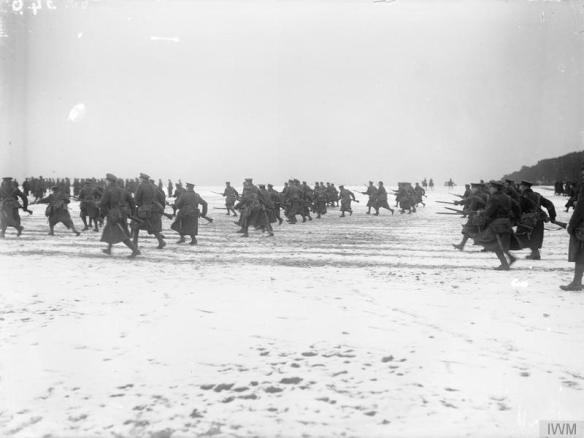
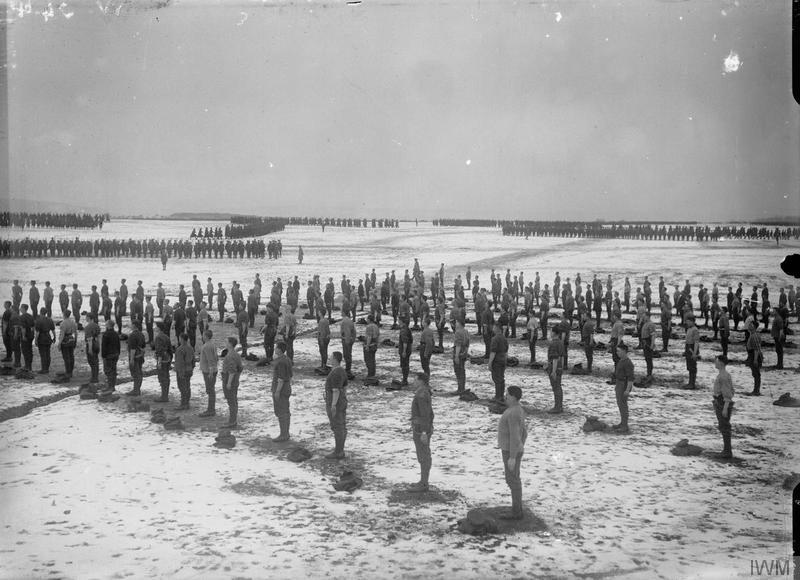
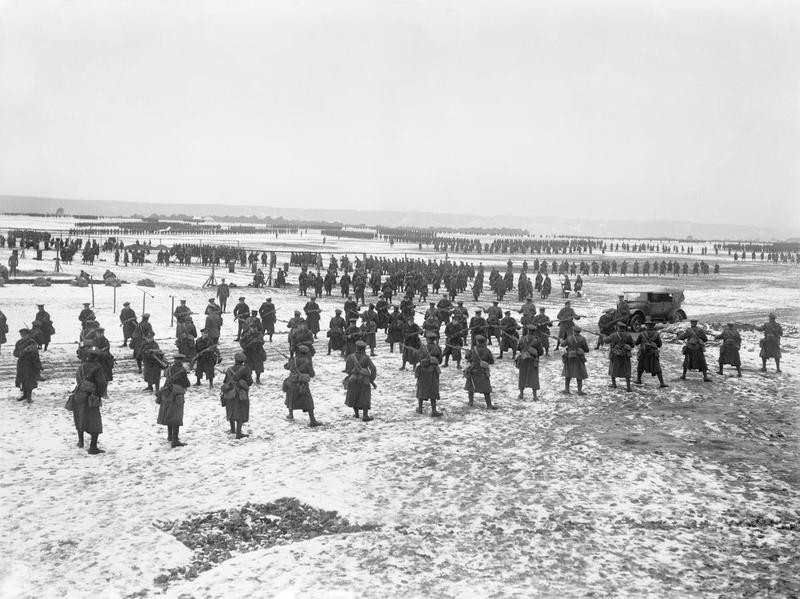
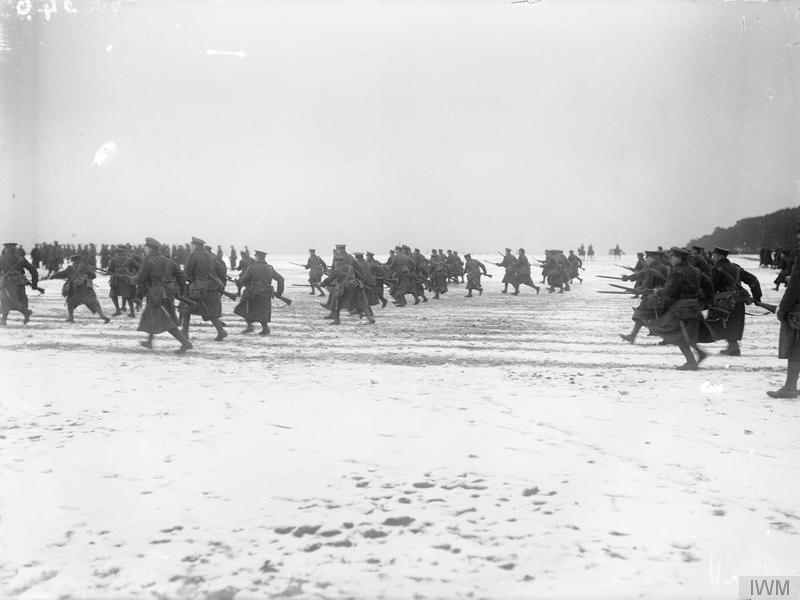
‘The Base!’ Edmund Blunden exclaimed in Undertones of War: ‘dismal tents, huge wooden warehouses, glum roadways, prisoning wire.’  He associated it, ‘as millions do, with “The Bull-Ring”, that thirsty, savage, interminable training-ground’ among the dunes where new recruits and newly discharged patients were put through their paces and ‘toughened up’ by unrelenting instructors.  When American military surgeon Harvey Cushing drove past its camps in 1917 they were ‘full of men rushing about like so many ants and all the color of the soil; drilling in the sand, practicing with machine guns, throwing bombs [grenades], having bayonet exercise, digging trenches and I know not what all.’  [For a thoughtful account of the oppressive conditions endured by troops during their two-week stints at the base and their contribution to the mutiny of 1917, see Douglas Gill and Gloden Dallas, ‘Mutiny at Étaples base 1917’, Past and Present 69 (1975) 88-112: ‘A corporal encountered several men returning to the front with wounds which were far from being healed. “When I asked why they had returned in that condition they invariably replied: ‘To get away from the Bull Ring’.”‘]
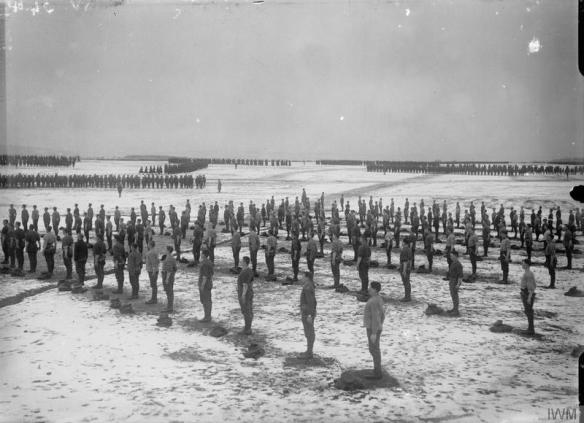
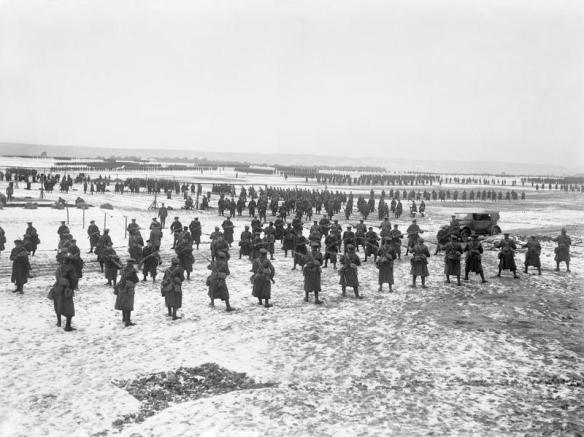
pe-in-the-bull-ring-at-etaples

bayonet-practice-in-bull-ring-at-etaples-iwm

troops-practice-bayonet-charge-in-the-bull-ring-at-etaples

In a letter to his mother Wilfred Owen described the base as ‘a vast, dreadful encampment’:

It seemed neither France nor England, but a kind of paddock where the beasts are kept a few days before the shambles [slaughter] … Chiefly I thought of the very strange look on all the faces in that camp; an incomprehensible look, which a man will never see in England …; nor can it be seen in any battle.  But only in Étaples. It was not despair, or terror, it was more terrible than terror, for it was a blindfold look, and without expression, like a dead rabbit’s.

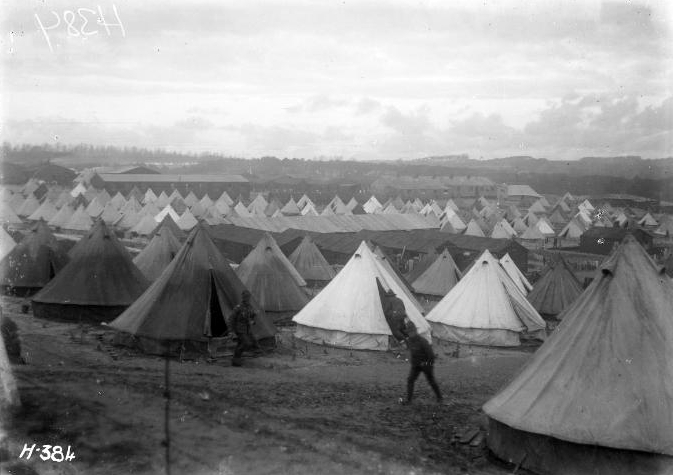
The training camps were a sea of bell tents (below) – like many of the hospitals – and the captured airmen insisted that this had been their objective: ‘the number of bell tents convinced them this was not [a hospital] as patients would not be in bell tents.’
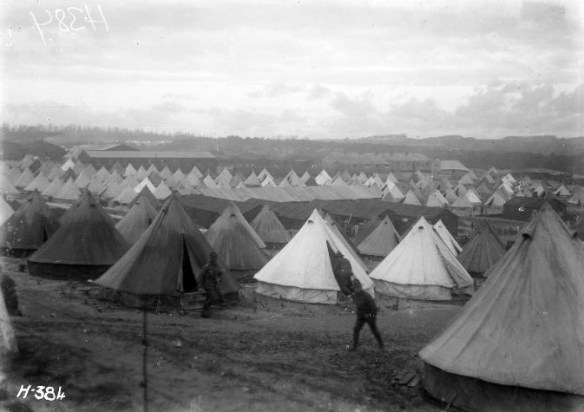
etaples-2

Étaples had been targeted before.  Vera Brittain, who was a nurse with the Voluntary Aid Detachment at No 24 General Hospital, described the ‘ceaseless and deafening roar [that] filled the air’ during the German  offensive in the spring: ‘Motor lorries and ammunition waggons crashed endlessly along the road; trains with reinforcements thundered all day up the line, or lumbered down more slowly with their heavy freight of wounded…’
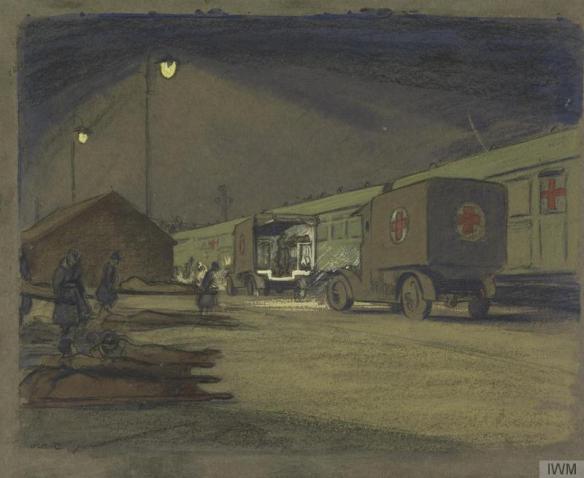
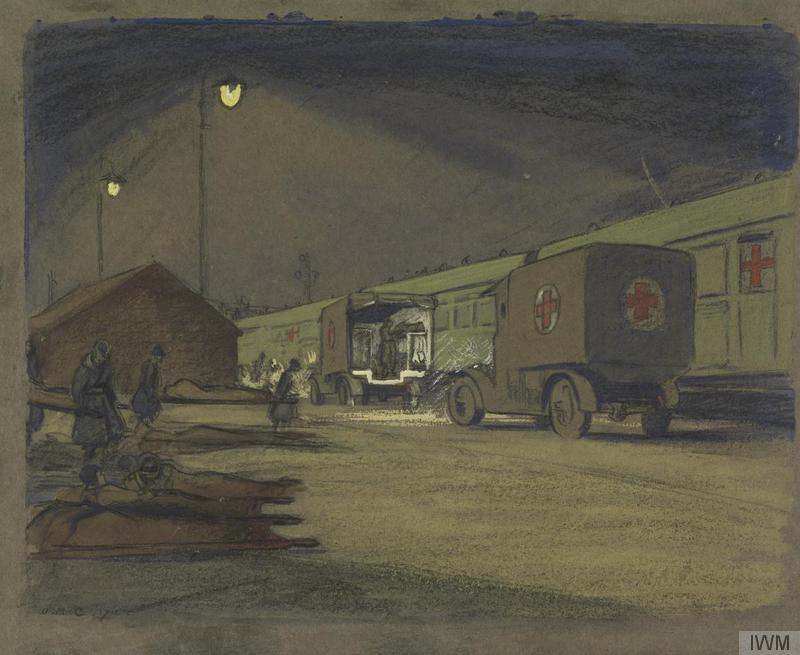
olive-mudie-cooke-unloading-ambulance-train-at-etaples-by-night

Images like this painting (above) by Olive Mudie-Cooke – a VAD convoy unloading an ambulance train at Étaples – are immensely powerful, but they ought not to blind us to the movement of men and matériel in the other direction.  As Vera Brittain knew only too well, there were in consequence frequent air raids on the lines of communication:

Certainly no Angels of Mons were watching over Etaples, or they would not have allowed mutilated men and exhausted women to be further oppressed by the series of nocturnal air-raids which for over a month supplied the camps beside the railway with periodic intimations of the less pleasing characteristics of a front-line trench.  The offensive seemed to have lasted since the beginning of creation, but must have actually been on for less than a fortnight, when the lights suddenly went out one evening…  Instead of the usual interval of silence followed by the return of the lights, an almost immediate series of crashes showed this alarm to be real…

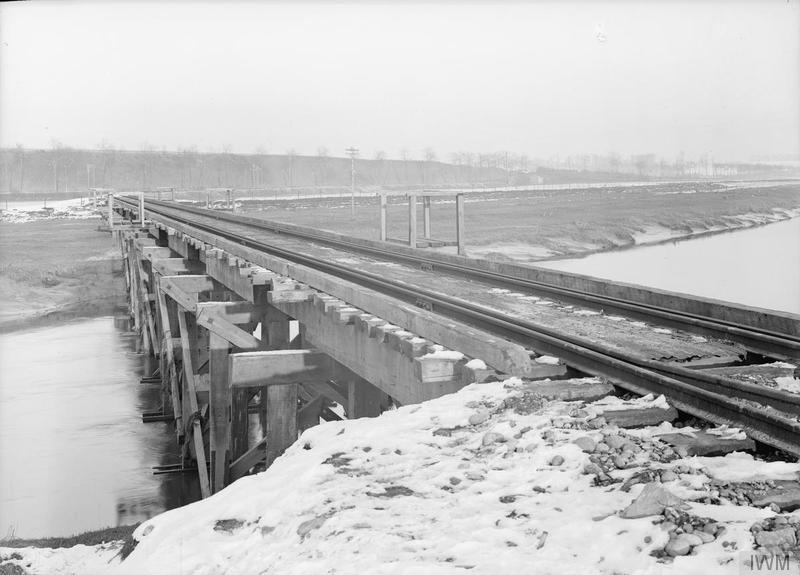
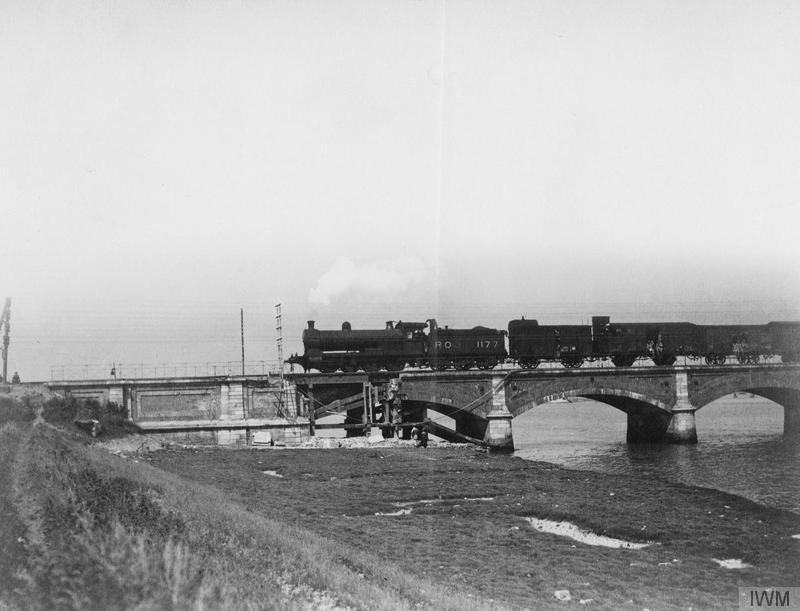
Gradually, after another brief burst of firing, the camp became quiet, though the lights were not turned on again that night.  Next day we were told that most of the bombs had fallen on the village; the bridge over the Canche, it was reported, had been smashed, and the train service had to be suspended while the engineers performed the exciting feat of mending it in less than twelve hours.
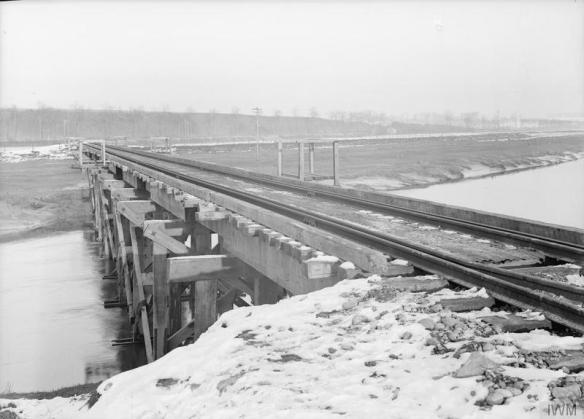
bridge-over-the-canche-at-etaples

The bridge was of overwhelming strategic importance: by the time of the spring offensive a hundred military trains were passing over it every day.  Here is H.A. Jones in the official history of The war in the air (citing Colonel M.G. Taylor):

The enemy advance against the British on the Somme and on the Lys in March and April had endangered the railway system. ‘The culmination was reached in May 1918, when the great lateral line from St. Just, via Amiens, to Hazebrouck had to be abandoned as a railway route owing to enemy shell fire. Our armies were then penned into a narrow strip of country, possessing only one lateral railway communication, through Abbeville and Boulogne. Most of the forward engine depots had been lost, and several of the important engine depots remaining were so close to the enemy as to be practically useless, and our one lateral, along which all reserves and reinforcements drawn from one part of the front to be thrown in at another had to be moved, was threatened daily and nightly by persistent air attacks on the bridge over the Canche river at Etaples.

The Germans knew the importance of destroying, and the British of protecting, this line of communications.
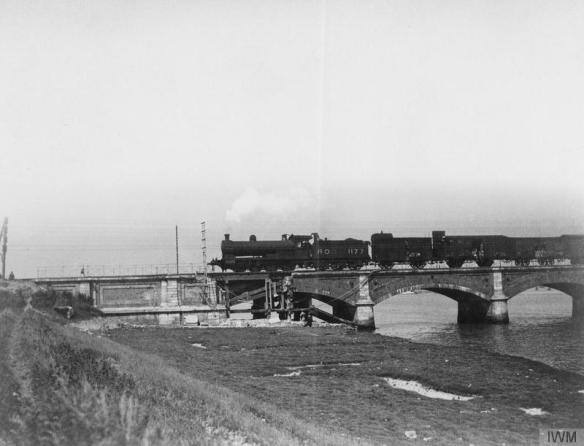
bridge-over-river-canche-at-etaples-damage-from-enemy-bombing-at-south-end-1918

Vera Brittain had returned to London when the Times published its report on the air raids in May. ‘It was clear from the guarded communiqué that this time the bombs had dropped on the hospitals themselves,’ she wrote, ‘causing many casualties and far more damage than the breaking of the bridge over the Canche in the first big raid.’  Cushing also recorded the enormity of the raid:

Étaples has had a bad hit – much worse than we had supposed… For two hours the raiders kept it up, returning again and again like moths around a flame.

But he knew Étaples of old and reckoned the objective was the same as before: not even the camps but the railway. ‘They were doubtless after the railroad and perhaps the bridge half a mile below.’

The official British history was similarly unequivocal:

During the night of the 19th/20th of May, at the time when the last of the German aeroplane raids was being made on London, fifteen bombers attacked the Etaples bridge. Only one bomb fell close and this did no damage: most of them exploded in neighbouring hospitals and camps with terrible effect… One of the German bombers was shot down, and the captured crew insisted that they did not know that hospitals were situated near the railway. They also expressed surprise, not without reason, that large hospitals should be placed close to air targets of first-rate military importance.

Certainly, the casualties were not confined to the hospital area:
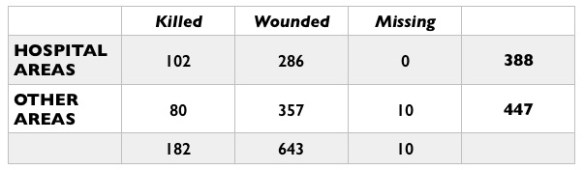
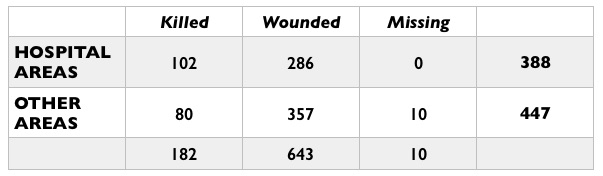
casualties-from-etaples-bombing-1920-may-1918

Two Infantry Base Depots suffered direct hits; 53 per cent of military casualties were outside the hospital area.

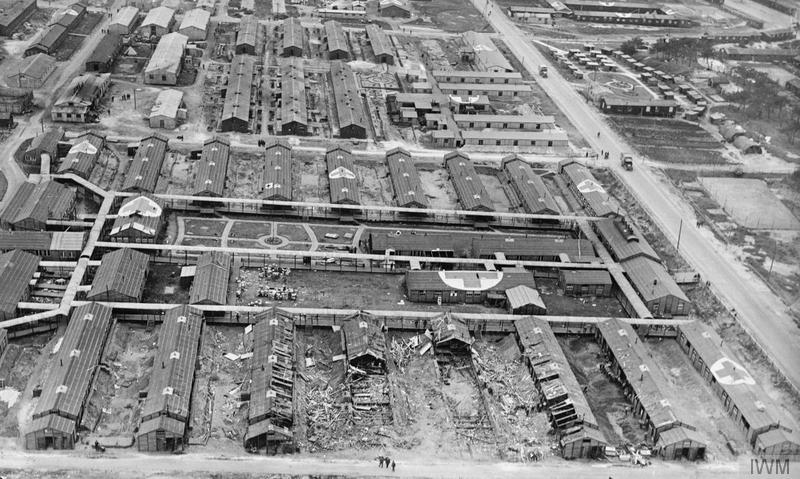
In fact, behind the scenes the British military and the intelligence service accepted that the hospitals were probably not the intended targets of the raid on 19-20 May or the second raid on 31 May/1 June. Here is the aftermath of that second raid on one Canadian hospital:
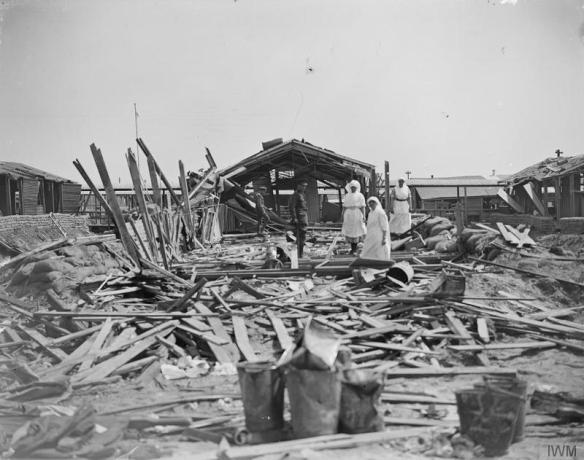
no-9-canadian-stationary-hospital-etaples-31-may-1918-iwm

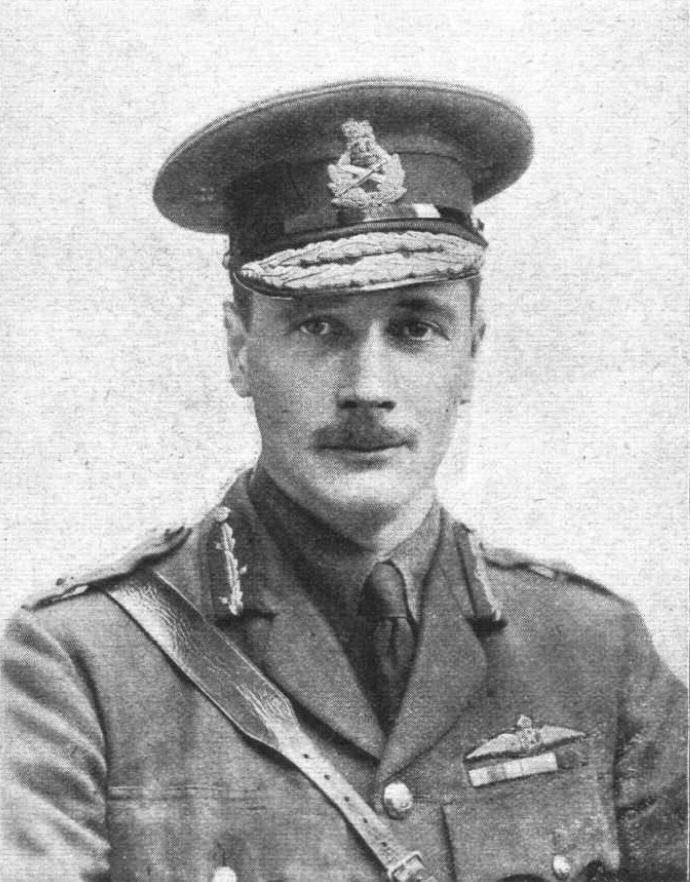
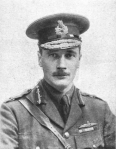
major-general_john_maitland_salmondAlthough Sir Douglas Haig firmly believed the hospitals were deliberately targeted in the second raid – he complained that ‘special measures’ had been taken after the air raid on the night of 19-20 May, with ‘Red Crosses repainted so that there could be no possible doubt as to the hospital area’ [see the image below] – Major-General John Salmond [right], who commanded the newly designated Royal Air Force in France, ‘considered it extremely improbable that Red or White Crosses would be distinctly visible at the height from which hostile pilots drop their bombs, usually 5,000 feet or over.’
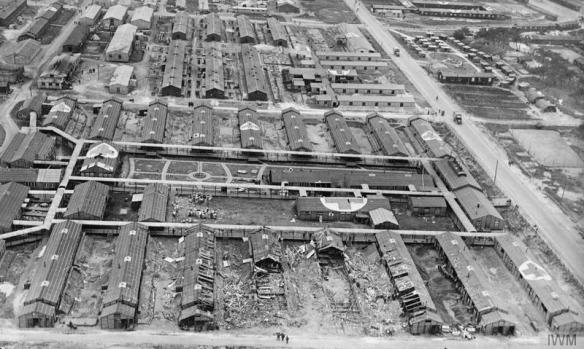
etaples-hospital-after-bombing-may-1918-iwm

The same (classified) report dated 29 June 1918 conceded that no definitive conclusion could be reached, but its author, the Director of Military Operations at the War Office Sir Percy Radcliffe, was none the less adamant that

We have no right to have hospitals mixed up with reinforcement camps, and close to railways and important bombing objectives, and until we remove the hospitals from vicinity of these objectives and place them in a region where there are no important objectives. I do not think we can reasonably accuse the Germans.

Indeed, Vera Brittain had prefaced her account of the May raids with a revealing rider.  ‘The persistent German raiders,’ she wrote, ‘had at last succeeded in their intention of smashing up the Étaples hospitals’ which ‘had so satisfactorily protected the railway line for three years without further trouble or expense to the military authorities‘ (my emphasis).  Now she was scarcely a spokeswoman for the British military, but her remark gestures towards the possibility of a remarkably cynical extension of the medical exemption to cover military objectives.

A hundred years later these same arguments about intentionality, accuracy, co-location and the protection (or otherwise) of a Red Cross would reappear in different guises.  But they would also be joined by others that revealed an aggressive refusal to accept the principle of medical neutrality at all.

To be continued
Blank verse

douglas-alamein-to-zem-zem-001

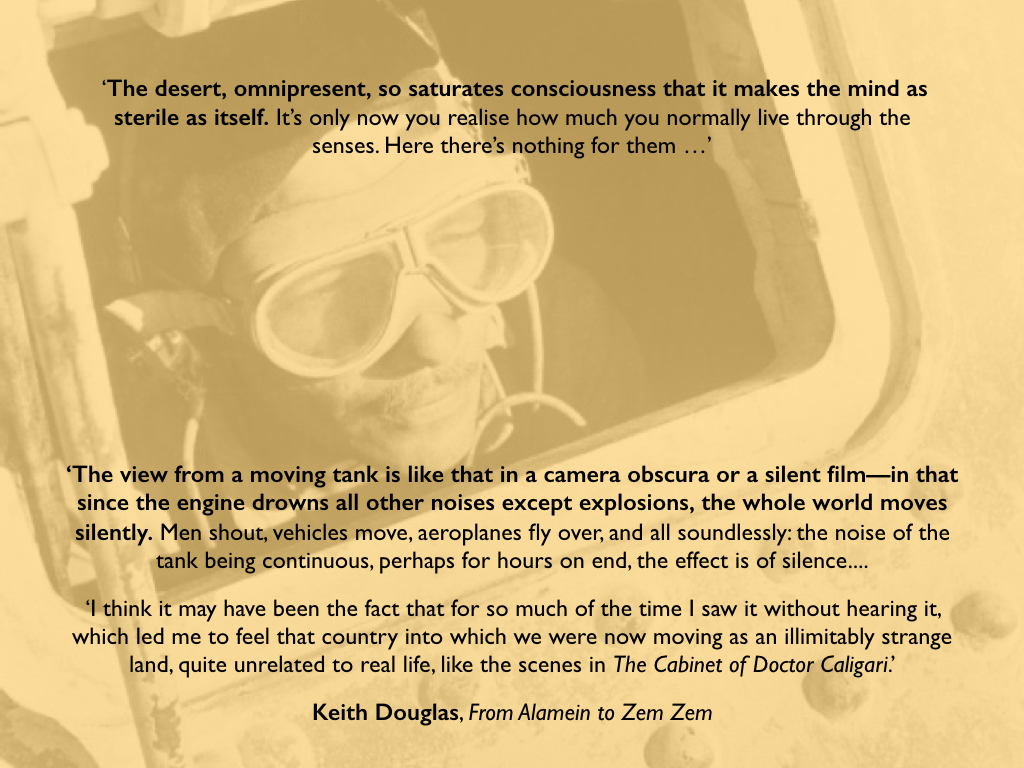
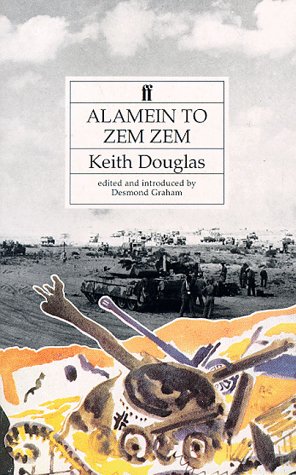
When I was working on ‘The natures of war’ (DOWNLOADS tab; the slide above is from my presentation) I stumbled across the poetry of Keith Douglas and his prose account of the desert war, From Alamein to Zem Zem (see my post here).

I was familiar with the soldier-poets of the First World War, of course, but I confess I had no idea how much fine poetry had emerged from the deserts of North Africa in the 1940s.  Ironically, Edmund Blunden was Douglas’s tutor at Oxford….

douglas-alamein-to-zem-zem

The LA Review of Books recently published an appreciation of Douglas’s importance by Steven Isenberg here:

Douglas wrote Alamein to Zem Zem (1946), his account of men and tanks in North Africa, so close in time and space to the desert battlegrounds that it pulses with ebullient immediacy. He became the answer to his own question: “Why are there no poets like [Wilfred] Owen and Sassoon who lived with the fighting troops and wrote of their experience while enduring them?”

Empire, faith and war

My time in the archives at the Imperial War Museum this summer was very productive and I made considerable headway in completing my work on casualty evacuation from the Western Front in the First World War and from North Africa in the Second – more on that later.  In the letters and diaries written from Belgium and France I found many, scattered references to the presence of non-Caucasian troops, especially from North Africa and India; as I’ve noted before, it was not all white on the Western Front.


Soldier_map

But apart from the heroic work of scholars like Santanu Das there have been few attempts to piece these fragments together.  I’ve now discovered a website, Empire, Faith and War, that aims to put the contribution of Sikhs literally on the map (though it’s much more than an exercise in cartography):

As the world turns its attention to the centenary of the Great War of 1914-18, the ‘Empire, Faith & War’ project aims to commemorate the remarkable but largely forgotten contribution and experiences of the Sikhs during this epochal period in world history.

From the blood-soaked trenches of the Somme and Gallipoli, to the deserts and heat of Africa and the Middle East, Sikhs fought and died alongside their British, Indian and Commonwealth counterparts to serve the greater good, gaining commendations and a reputation as fearsome and fearless soldiers.

Although accounting for less than 2% of the population of British India at the time, Sikhs made up more than 20% of the British Indian Army at the outbreak of hostilities. They and their comrades in arms proved to be critical in the early months of the fighting on the Western Front, helping save the allies from an early and ignominious defeat.

Wartime generations and their stories fading fast, and current and future generations losing vital links to this monumental past.

There’s probably not a single Sikh in the UK who doesn’t have a military connection in their family history. It is often because of those links to the armies of the British Raj that many Sikhs now reside in the UK.

And yet the role of Sikhs in World War One is a largely unknown aspect of the Allied war effort and indeed of the British story.

By revealing these untold stories we aim to help shed much needed light on both their sacrifice, but also on the contribution of all of the non-white allied forces from across the British Empire.

This is possibly our last opportunity to discover and record the stories of how one of the world’s smaller communities played such a disproportionately large role in the ‘war to end all wars’.

Apoorva Sripathi has a good account of the background to the project here.

The things they carried

Britain_war-xlarge_trans++ZgEkZX3M936N5BQK4Va8RWtT0gK_6EfZT336f62EI5U

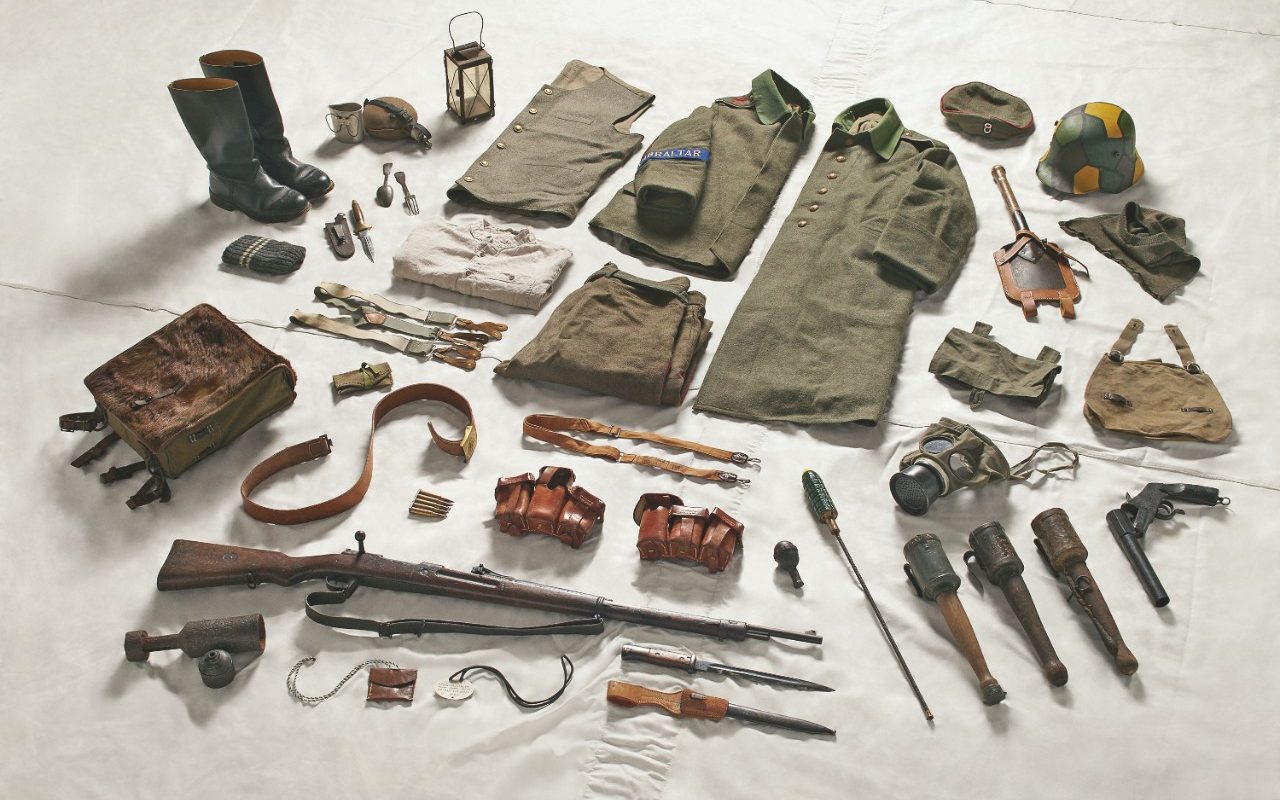
I’ve drawn attention to Thom Atkinson‘s brilliant documentation of ‘the things they carried’ – the equipment carried by infantry into battle from 1066 to 2014 – several times before (here and here): see his Soldiers’ Inventories here.

He’s now returned to the theme with a new portfolio comparing the kit issued to soldiers from Britain (above), France, Germany (below), Russia and the United States during the First World War.  You can access the images, plus a commentary from Christopher Howsehere.

War_2-xlarge_trans++gsaO8O78rhmZrDxTlQBjdPv9UtmGs4_E1E6Q7ZFHy1w

In continent

160311024028-drone-warfare-film-eye-in-the-sky-sesay-pkg-00001425-super-169

Over at the LA Review of Books Will Govinsky has a fine essay on Eye in the Sky called ‘The beauty of an imperial dilemma‘.  It begins with the image of a French gunboat firing shots into the African rainforest from Joseph Conrad‘s Heart of Darkness:

The ship’s absurdly one-sided battle becomes, for Marlow, an emblem of pointless, indiscriminate imperial violence: “[T]here she was, incomprehensible, firing into a continent.”

Will’s point is about the parallel between the anonymity of imperial violence in the African rainforest and the anonymity of the US (un)targeted killing program:

The chilling anonymity of this “targeted” drone program’s victims, crossed with the sanguine official line, again recalls Conrad’s French warship. “There was a touch of insanity in the proceeding,” Marlow says, which “was not dissipated by somebody on board assuring me earnestly there was a camp of natives ­— he called them enemies! — hidden out of sight somewhere.”

Conrad’s critique of European imperial violence moves with notorious swiftness from the opacity of the victim to the opacity at the heart of the colonizer. Marlow does not know who exactly are the victims of the French warship’s shells, but Conrad’s racism, as Chinua Achebe famously argued, precludes his narrator from caring that much. Marlow’s concern is not for the mangled bodies on the receiving end of colonial violence, but for the deplorable madness at the heart of the imperialist himself.

As I’ve described elsewhere, the genealogy can be traced across multiple theatres.  Here, for example, is Arnold Bennett on the Western Front:

Of the target I am absolutely ignorant.001

And here is Frederic Downs describing a US artillery bombardment in Vietnam – Francis Ford Coppola‘s setting for Heart of Darkness – in terms which loop back directly to Will’s (Conrad’s) point about anonymity, impersonality and the madness of it all:

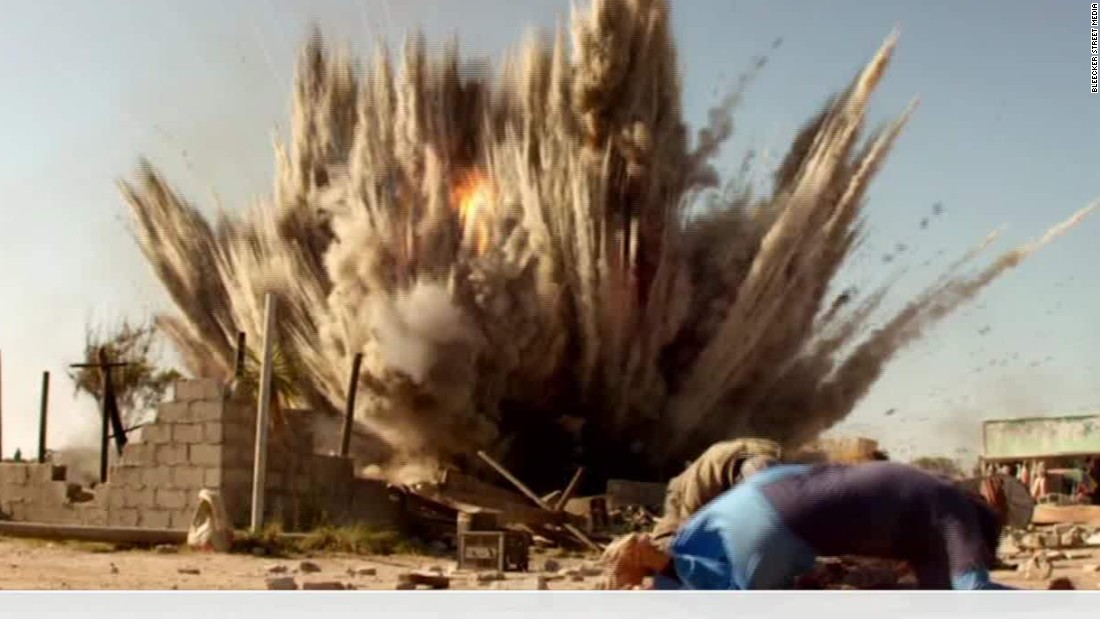
The coordinates for that location and the time for firing would be relayed to the gun crews. At the specified time, the gun crews would be awakened. Perhaps it would be just after midnight. As the minutes ticked closer to a time set by an unknown intelligence the men would load the artillery pieces, anticipating the release of their impersonal death into a grid square. The gun commander would give the order to fire and the night would explode with man’s lightning and thunder. After the prescribed rounds, the guns would cease, the cleanup would begin, and the men would go back to their bunks. Thinking what? Within the range of those guns, within a specified area, the Central Highlands had for a brief moment changed from the jungle it had been for thousands of years into the particular insanity of man.

artillery

In these two cases, clearly, the gunners were firing blind – but what lay behind their guns was a stream of co-ordinates.

This raises two issues that bear directly on the use of today’s remote platforms.

The first is about the ethics of killing at a distance which, as Will notes, also has a (far longer) genealogy.  He cites Chateaubriand‘s question – ‘If, merely by wishing it, you could kill a man in China and inherit his fortune in Europe, being assured by supernatural means that the deed would remain forever unknown, would you allow yourself to form that project?’ – and explains that ‘killing the mandarin’ became shorthand in French for committing ‘an evil action in the hope that it will remain unknown.’

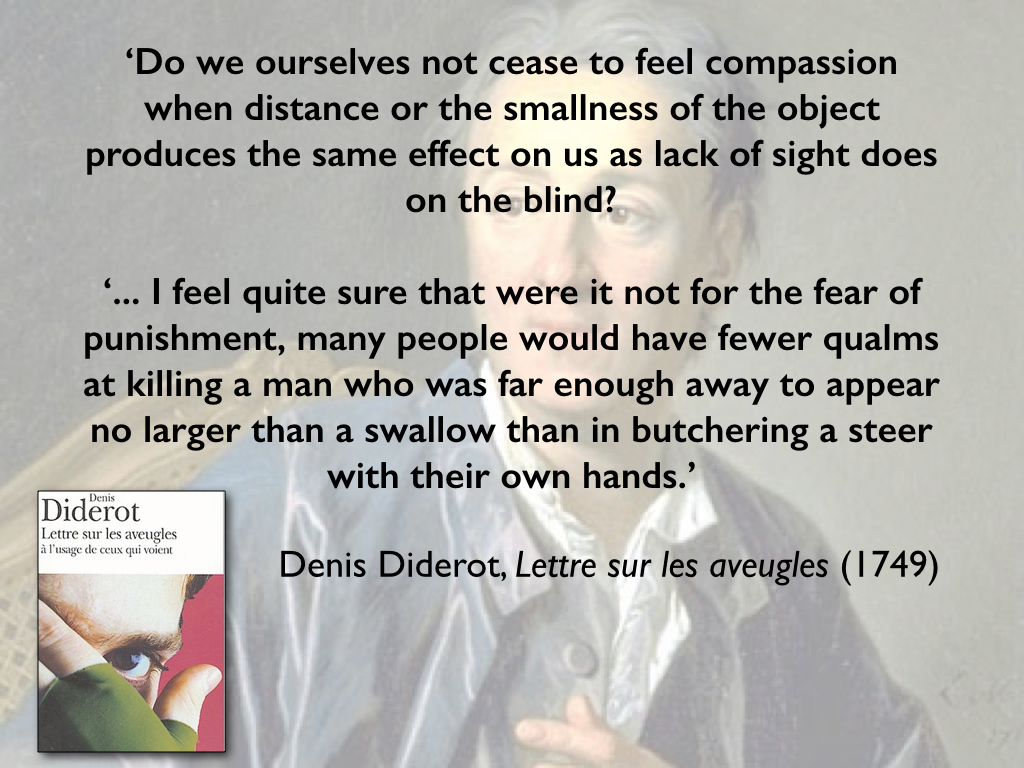
But the US targeted killing program is hardly unknown, and my own preference – which turns out to be closely related to tuer le mandarin – is to turn to Denis Diderot:

Diderot.001

The intimate connection between distance and blindness can be read again and again in accounts of bombing during the Second World War, most directly here:

Distance and blindess.001

But again, what lay behind ‘the distance and the blindness’ was a stream of intelligence.

Recognising the importance of those intelligence streams – and conceding that ‘crunching petabytes of metadata just wouldn’t make for good cinema’ – Will’s key point (and the second issue) is that in its representation of a drone strike in East Africa Eye in the Sky artfully reverses Conrad’s trope:

It asks what we would do if we knew everything. In a taut 102 minutes, the film condenses the ambiguities of drone warfare into a balance sheet of nigh certainties.

eye-in-the-sky

In a fine passage, he suggests the film offers the fantasy

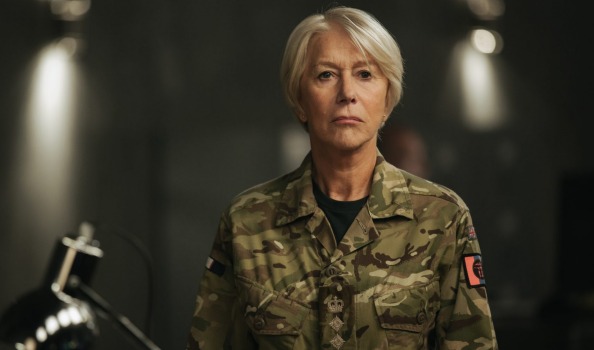
of perfect, visual knowledge — a platform for the terrible beauty of a globe-girdling ethical dilemma. Poised, confident, her silver hair luminescent in the metallic grey-blue glow of her theater-like command center, [Helen] Mirren’s Col. Powell gathers up in her steely 10,000-mile stare the awful knowledge of her options.

But – as I argued in my own commentary on Eye in the Sky – this is indeed a fantasy.  The video feeds from remote platforms do not render the battle space transparent, and the make-believe that they do, Will concludes, renders the film ‘less a representation of drone warfare than a grotesque abstraction of it.’  Hence his brilliantly sobering conclusion:

We need plots that provide the narrative space to ask questions: whether the very terms of our dilemmas are spurious; whether firing into continents, day in and day out, can be anyone’s prerogative, let alone ours.

Wounded

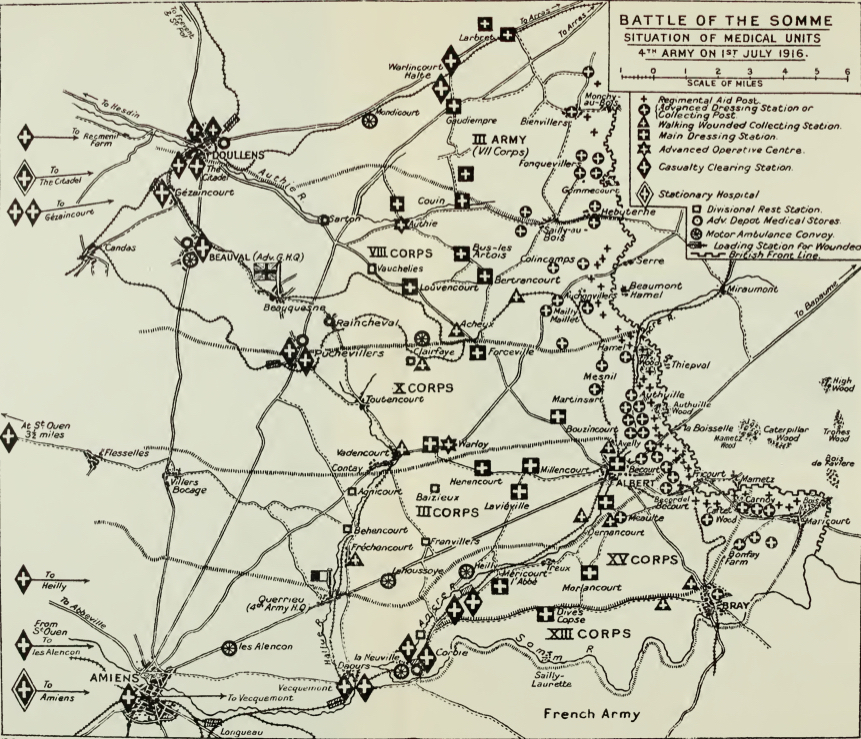
Somme medical dispositions.001

This summer London’s Science Museum is staging an exhibition that is of direct relevance to my current research on casualty evacuation from war zones over the last hundred years:  Wounded: Conflict, Casualties and Care.  It opens on 29 June and is designed to commemorate the centenary of the Battle of the Somme:

57,000 casualties were sustained by British Forces on 1 July 1916, the first day of the Battle of the Somme, creating huge and unprecedented medical challenges. Wounded: Conflict, Casualties and Care, a new exhibition opening at the Science Museum on 29 June, will commemorate the 100th anniversary of this battle and the remarkable innovations in medical practices and technologies that developed as a result of this new kind of industrialised warfare.

During the First World War ten million combatants were killed, but double that number were wounded and millions were left disabled, disfigured or traumatised by their experiences. The challenges were immense. For medical personnel near the front line treating blood loss and infection was the immediate priority in order to save lives. However medics also encountered new forms of physical and mental wounding on a scale that had never been seen before, creating huge numbers of veterans returning home with serious long term care needs.

At the centre of the exhibition will be a remarkable collection of historic objects from the Science Museum’s First World War medical collections, illustrating the stories of the wounded and those who cared for them. From stretchers adapted for use in narrow trenches to made-to-measure artificial arms fitted back in British hospitals, medical technologies, techniques and strategies were pioneered or adapted throughout the war to help the wounded along each stage of rescue and treatment. Visitors will also see unique lucky charms and improvised personal protective items carried by soldiers on the frontline alongside examples of official frontline medical equipment.

I’m looking forward to seeing this over the summer.  The organisers note that:

 Warfare has changed dramatically over the last one hundred years, but similarities remain with the military medical challenges faced today, both through the experiences of the wounded and in their treatment and care. The Wounded exhibition team has worked closely with two UK charities that were formed during the First World War, Combat Stress and Blind Veterans UK, to draw out these parallels and share the personal experiences of soldiers wounded in more recent conflicts.

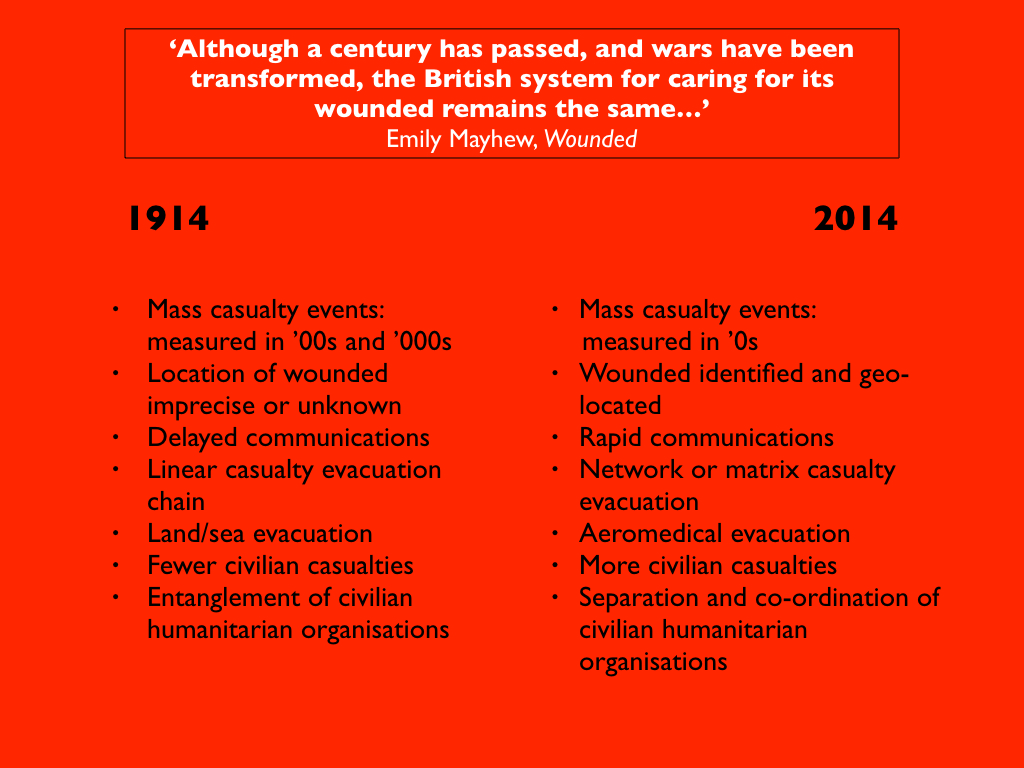
You can find some of my preliminary thoughts on casualty evacuation from the Western Front here and here, and on twenty-first century casualty evacuation in Afghanistan here and here.  Some of the differences between the two systems are summarised in this slide from a presentation on the project I gave in 2014.

WOUNDS OF WAR Vancouver Jan 2014.001

Much  more to come!