I’ve written before about the long history of drones (UAVs or RPAs, if you prefer – and the Air Force does prefer), and the unrealised intersections between remotely-controlled aircraft and early television: I’m thinking of Archibald Low‘s experiments with what he called Televista in 1914 and his trial pilotless aircraft (codenamed ‘Aerial Target”) in the dog days of the First World War. I had assumed that the connections did not materialise – and even then in very precarious ways – until the closing stages of the Second World War with the US Project Aphrodite, which I discussed briefly in ‘Lines of Descent’ (DOWNLOADS tab).
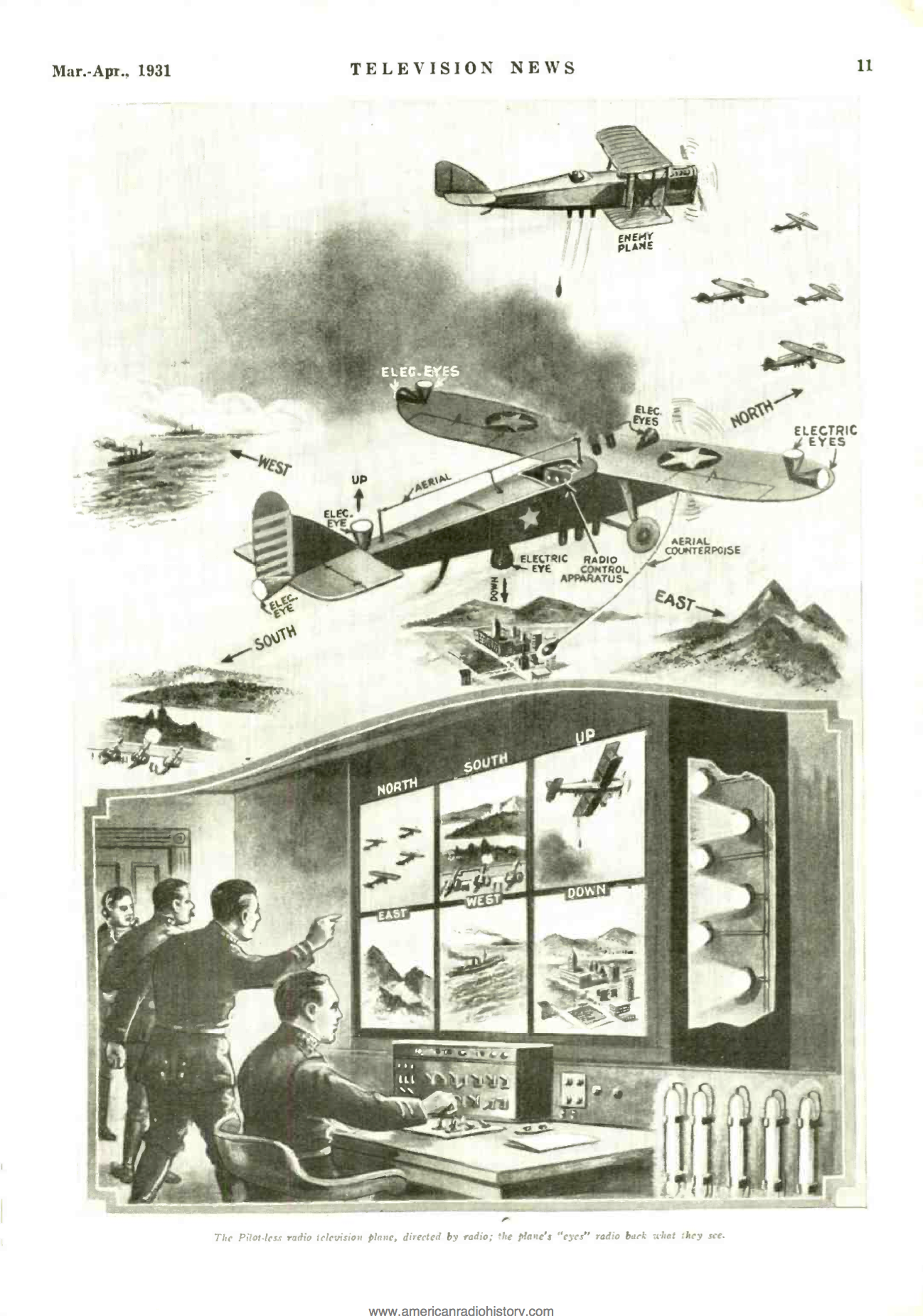
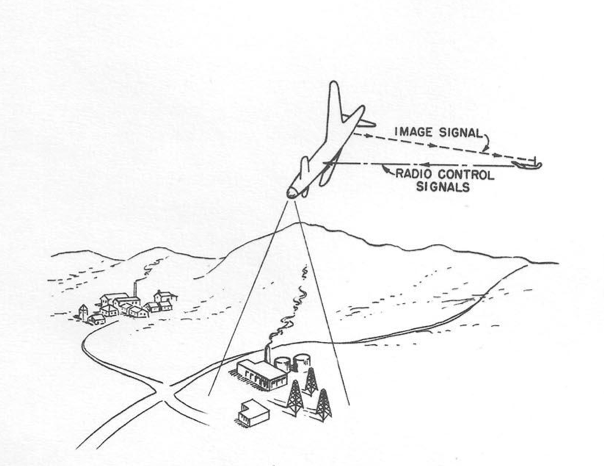
But now, via Gizmodo, I discover another way-station that was put in place in 1924. First published in The Experimenter magazine, and then republished in Television News in 1931 in its March-April issue, an article by Hugo Gernsback described the military operation of a ‘radio-controlled television plane’, directed by radio and navigated using ‘electric eyes’ that would enable ‘the control operator, although 50, 100 or possibly 500 miles away, [to] see exactly what goes on around the plane, just the same as if he himself were seated in the cockpit; with the further advantage that, sitting before a screen, he can scan six directions all at once, which no human aviator can do.’
And, just like Project Aphrodite and its modern descendants, this would be a hunter-killer mission:
‘The radio-controlled television airplane can then be directed to the spot where it is supposed to drop its bombs. Moreover, the distant-control operator can see exactly when his machine arrives over a given spot. A sighting arrangement can be attached to the plane in such a manner that, when the object to be bombed comes over the cross-wires in the range-finder, the bomb or bombs are dropped at the exact moment.’
But as the illustration indicates – and in contrast to today’s Predators and Reapers – it was assumed that the aircraft would be able to operate in contested air space – and even more effectively than a conventional aircraft:
If, for instance, an enemy airplane suddenly comes out of a cloud and starts dropping bombs on our machine below, the control operator sees this enemy machine quicker 500 miles away, than if an aviator sat in the cockpit one-quarter of a mile away from or below the enemy bomber. The control operator will send a radio signal that will immediately discharge a smoke screen from his radio television plane, hiding his craft in smoke.
Explaining the decision to republish the article, Gernsback accepted that when it first appeared ‘the ideas set forth therein might have appeared more or less fantastic’ – but ‘they are no longer considered so today’:
‘As a matter of fact, the radio-controlled airplane is with us today. Several of the leading governments have already in their possession airplanes that can now fly and stay aloft for any length of time, within reason, without a pilot or any human being on board.
‘The television adjunct will follow as a matter of course.’
Gernsback was an extraordinary man. Sometimes hailed as the father of science fiction – hence the Hugo Awards – he was keenly interested in turning his imaginative ideas into material fact. Even before the First World War he had invented a home radio set. Matthew Lasarexplains:
Gernsback’s “Telimco Wireless” didn’t receive the signals of any broadcast radio stations, since there were almost none before 1920. But it did ring a bell in an adjacent room without any connecting wires. Such was the sensation the device made that local police demanded a demonstration, following up on a fraud complaint. Satisfied that it worked, the Telimco was subsequently sold in many department stores … until the first World War, when the government banned amateur wireless transmission.
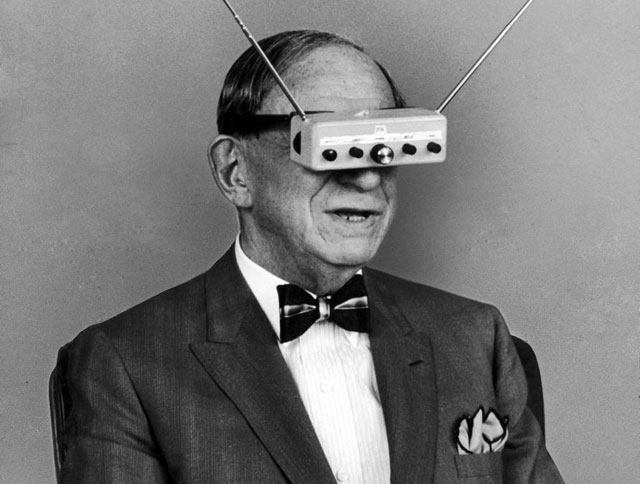
But he was soon fascinated by television; he launched Radio News and then move on to Television News as platforms for his ideas and enthusiasms. The image above shows him in 1963 wearing his ‘television glasses’. He died the following year, or he might have invented Google Glass too.
Over the years I’ve learned much from the writings of Paul K. Saint-Amour, whose work on the violent intersections between modernism and air power has helped me think through my own project on bombing (‘Killing Space’) and, in a minor key, my analysis of cartography, aerial reconnaissance and ‘corpography’ on the Western Front in the First World War. A minimalist listing would include:
Like me, Paul also has an essay in Pete Adey‘s co-edited collection, From above: war, violence and verticality (Hurst, 2013): ‘Photomosaics: mapping the Front, mapping the city’.
He has just published an important essay, ‘On the partiality of total war‘, in Critical inquiry 40 (2) (2014) 420-449, which has prompted this post. What I so admire about Paul’s writing is his combination of literary style – these essays are a joy to read, even when they address the bleakest of subjects – critical imagination and analytical acumen, and the latest essay is no exception.
His central point is that the idea of ‘total war’ – which, as he insists, was essentially an inter-war constellation – was deeply partial. It both naturalized and undermined a series of European imperialist distinctions between centre and periphery, peace and war:
‘… forms of violence forbidden in the metropole during peacetime were practiced in the colony, mandate, and protectorate, [and] … the distinction between peace and war was a luxury of the center. At the same time, by predicting that civilians in the metropole would have no immunity in future wars, it contributed to the erosion of the very imperial geography (center versus periphery) that it seemed to shore up.’
Hence the partiality of what he calls ‘the fractured problem-space of the concept’: ‘A truly total conception of war would have insisted openly on the legal, ethical, political, and technological connections between European conflagration and colonial air control’ (my emphasis).
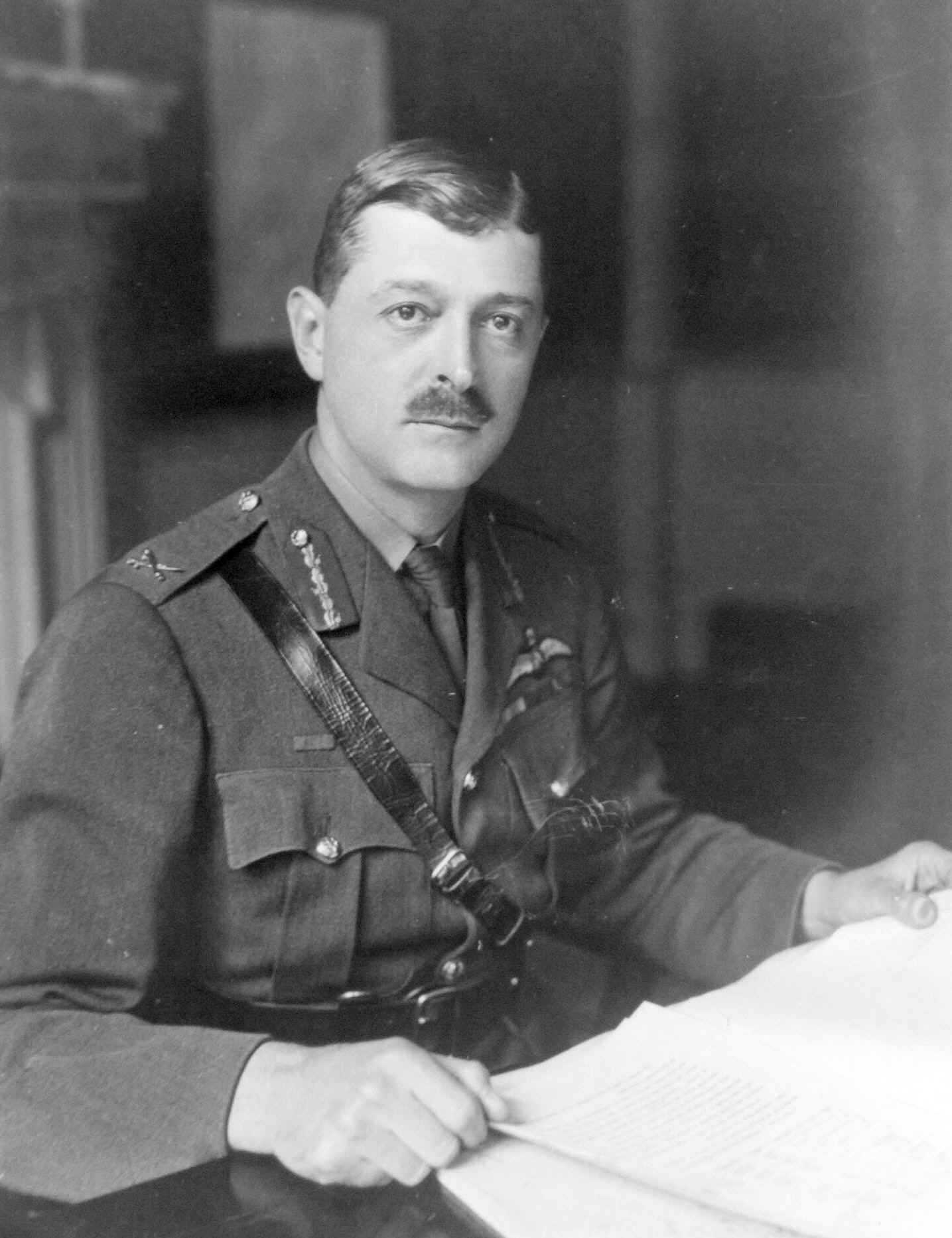
Paul advances these claims, and enters into this fraught ‘problem-space’, by tracking the figure of a Royal Air Force officer, L.E.O. Charlton (left). A veteran of the First World War, Charlton was appalled by his experience of colonial ‘air control’ in Iraq in the 1920s (‘direct action by aeroplanes on indirect information by unreliable informants … was a species of oppression’: sounds familiar) but became a strenuous advocate of bombing civilians as the ‘new factor in warfare’ in the future. Convinced that Britain was exceptionally vulnerable to air attack, the only possible defence was extraordinary air superiority capable of landing devastating ‘hammer blows’.
Now others have traced the lines of descent from Britain’s ‘air policing’ in Palestine, Iraq and the North-West Frontier in the 1920s and 30s to its bomber offensive against Germany in the 1940s – ‘Bomber’ Harris notoriously cut his teeth in both Iraq and Palestine, though one historian treats this as precision dentistry – and still others have joined the dots from yesterday’s imperial borderlands to today’s: I’m thinking of Mark Neocleous‘s (re)vision of police power (‘Air power as police power‘, Environment and Planning D: Society & Space 31 (4) (2013) 578-93 and Priya Satia‘s genealogy of ‘Drones: a history from the Middle East‘, Humanity 5 (1) (2014) 1-31.
But Paul complicates these genealogies in important ways by showing how, within British military circles, war from the air was at once prosecuted and displaced/deferred. He argues that major air power theorists of the day reserved the category of ‘war’ for conflicts between sovereign states and relegated state violence ‘against colonial, mandate and protectorate populations’ to minor categories: ‘police actions, low-intensity conflicts, constabulary missions, pacification, colonial policing’. Indeed, at the Geneva Disarmament Conference in 1923 the British delegation sought to abolish all air forces except those deployed ‘for police purposes in certain outlying regions’. The manoeuvre failed, yet it wasn’t until 1977 that the first Additional Protocol to the Geneva Convention of 1949 recognised the right of subject populations to resist colonial domination, military occupation and racial repression, nominated such acts as constituting an ‘international conflict’, and extended to them the protections of international law. Several states have refused to ratify the AP, including the United States, Israel, Iran, India and Pakistan. Charlton’s original objection was to the use of air power outside declared war zones and against civilian subject populations: an objection that many would argue continues to have contemporary resonance in the CIA-directed drone strikes in Pakistan, Yemen, Somalia and elsewhere.
But Charlton’s masters (and, ultimately, Charlton himself) ‘dissevered’ the meaning of ongoing state violence in the periphery from prospective state violence at the centre. ‘Home is the space of the total war to come‘ – the Royal Air Force evidently believed that lessons learned in the colonies could be repatriated to the metropolis – and this would necessarily involve the breaching of state borders. War from the air thus dissolved the distinctions between military and civilian spaces, as Giulio Douhet prophesied in the 1920s:
‘By virtue of this new weapon, the repercussions of war are no longer limited by the farthest artillery range of guns, but can be felt directly for hundreds and hundreds of miles… The battlefield will be limited only by the boundaries of the nations at war, and all of their citizens will become combatants, since all of them will be exposed to the aerial offensives of the enemy. There will be no distinction any longer between soldiers and civilians.’
Few military experts in Britain talked about Douhet before the 1930s, but Charlton had read him in French translation, referring to him in his Cambridge lectures published as War from the air: past, present, future (1935): John Peatycalls him ‘Douhet’s leading disciple in Britain.’ But in Charlton’s view war from the air also redrew the contours of military violence so that they no longer lined fronts but bounded areas. In principle this transformation of the target space provided for two different strategies, though in practice the differences between them were as much ideological as they were substantive. Air strikes could take the form of either area bombing, levelling whole districts of cities, or so-called ‘precision bombing’ that would dislocate strategic nodes within a networked space, and it was this that Charlton believed was the key to aerial supremacy:
‘[T]he nation conceived by air-power theorists was a discrete entity unified both by the interlocking systems, structures, and forces that would constitute its war effort and by their collective targetability in the age of the bomber. As the proxy space for total war doctrine, in other words, air-power theory provided limitless occasions for representing the national totality. The common figures of “nerve centres,” “heart,” and “nerve ganglia” all participated in the emergent trope of an integrated national body whose geographical borders, war effort, and vulnerability were all coterminous.’
In War from the air, Charlton had advocated a devastating attack on the enemy capital:
‘It is the brain, and therefore the vital point. Injury to the brain means instant death, or paralysis, whereas injury to the body or the members, especially if it be a flesh-wound, may mean nothing at all, or, at most, a grave inconvenience.’
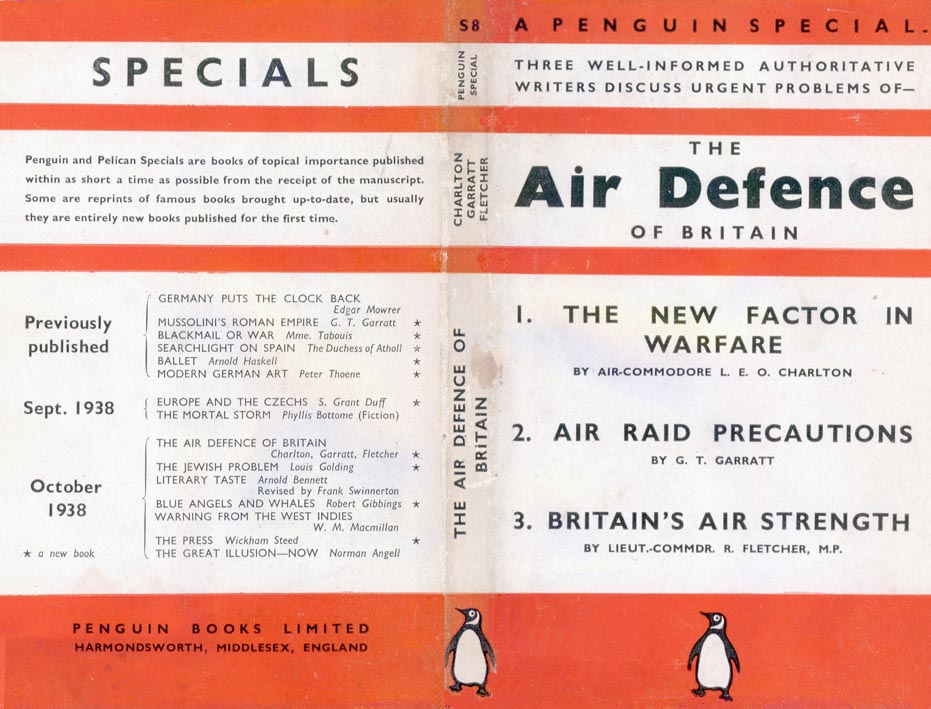
And in his contribution to The air defence of Britain, published in 1938, Charlton used the figure of the ‘national body’ to underscore what he saw as Britain’s vulnerability to air attack: ‘We are laid out, as if on an operating table, for the surgical methods of the bomber.’ As it turned out, of course, air strikes were even less ‘surgical’ than today’s aerialists try to claim, but as I showed in ‘Doors into nowhere’ (DOWNLOADS tab), these bio-physiological tropes were refined by Solly Zuckerman when he sought to provide a scientific basis for the combined bomber offensive during the Second World War.
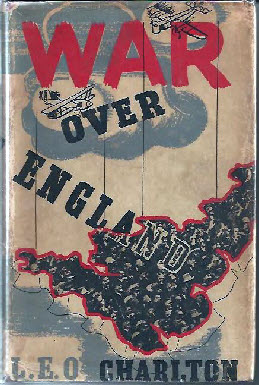
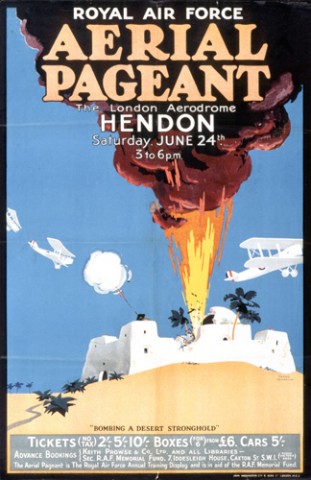
But precisely because the enabling experiments for these operations were carried out in a colonial laboratory, ‘outside the boundaries of the national body’, this couldn’t qualify as war – so this was ‘interwar’ in quite another sense too – and, Charlton notwithstanding, the ‘bombing demonstrations’ that took place in Iraq and elsewhere were not subject to much critical scrutiny or public outcry in Britain. On the contrary, within the metropole they were turned into popular entertainment at successive air displays at Hendon in North London in the 1920s (see below) (though, prophetically, by the 1930s, the pageant staged bombing runs against ‘the enemy’, and in War over England (1936) Charlton envisaged Britain forced to surrender after a devastating German air attack on, of all things, the Hendon Air Show) .
I think this argument could profitably be extended, because the desert ‘proving grounds’ had a cultural-strategic significance that, as both Priya Satia and Patrick Deerhave shown, can be unravelled through another figure who also enters this problem-space, albeit in disguise, T.E. Lawrence or ‘Aircraftsman Ross’ (I’ve suggested some of these filiations in ‘DisOrdering the Orient’)….
I hope I’ve said enough to whet your appetite. This is a rich argument about war’s geographies, at once imaginative and material, and my bare-bones’ summary really doesn’t do it justice. An introductory footnote reveals that the essay, and presumably Paul’s previous ones, will appear in a book in progress (and prospect), Archive, Bomb, Civilian: Total War in the Shadows of Modernism, forthcoming from Oxford University Press.
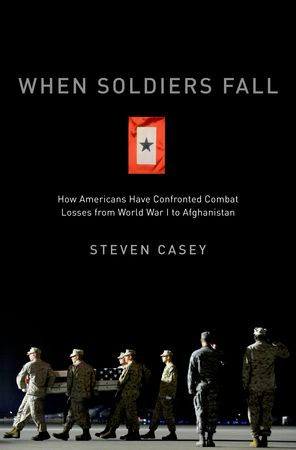
The extent to which combat casualties influence the public’s support for war is one of the most frequently and fiercely debated subjects in current American life and has cast an enormous shadow over both the Iraq and Afghanistan conflicts. The common assumption, based largely on U.S. experience in past wars, is that the public is in some way casualty averse or casualty shy, and that as losses increase its support for a war will inexorably decline. Yet this assumption has been adopted as conventional wisdom without any awareness of one of the most important dimensions of the issue: how has the public become aware of the casualties sustained during particular wars? To what extent has the government tried to manipulate or massage the figures? When and why have these official figures been challenged by opportunistic political opponents or aggressive scoop-seeking reporters?
As Steven Casey demonstrates, at key moments in most wars what the public actually receives is not straightforward and accurate casualty totals, but an enormous amount of noise based on a mixture of suppression, suspicion, and speculation. This book aims to correct this gap in information by showing precise what casualty figures the government announced during its various wars, the timing of these announcements, and any spin officials may have placed upon these, using a range of hitherto untapped primary documents. Among the nuggets he has uncovered is that during World War I the media depended on Axis figures and that the Army and Navy did not announce casualty figures for an entire year during World War II. Organized chronologically, the book addresses the two world wars, the limited wars in Korea and Vietnam, and the recent conflicts that are part of the War on Terror. Using sources such as the private military command papers of Generals Patton, MacArthur, and Westmoreland, and previously unopened New York Times archives, it offers the first analysis of how the U.S. government has publicized combat casualties during these wars, and how these official announcements have been debated and disputed by other voices in the polity. Casey discusses factors such as changes of presidential administration, the improvement of technology, the sending of war correspondents to cover multiple conflicts, and the increasing ability to identify bodies. Casey recreates the complicated controversies that have surrounded key battles, and in doing so challenges the simplicity of the oft-repeated conventional wisdom that “as casualties mount, support decreases.” By integrating military and political history, he presents a totally new interpretation of U.S. domestic propaganda since 1917, filling a major gap left by a spate of recent books. Finally, it provides a fresh and engaging new perspective on some of the biggest battles in recent American history, including the Meuse-Argonne, D-Day, the Battle of the Bulge, China’s intervention in the Korean War, the Tet Offensive, and the recent campaigns in Iraq and Afghanistan.
Amazon has temporarily withdrawn its Kindle edition because there are technical issues that it is working with OUP to resolve: I hope this is sorted out soon… But for now you can read an extract over at Salon, ‘How Richard Nixon reinvented American warfare (…and paved the way for Iraq and Afghanistan)’:
Determined to prop up South Vietnam in an election year, Nixon’s casualty sensitivity had not extended beyond American lives to enemy noncombatants. “Now, we won’t deliberately aim for civilians,” he told his senior advisers at one point in 1972, “but if a few bombs slop over, that’s just too bad.” In Nixon cold calculation the American electorate was principally concerned with U.S. losses; it cared far less about what happened to civilians….
In the wake of defeat, the U.S. government tried to learn the appropriate lessons. As well as reconsidering military-media relations, officials thought long and hard about the conditions under which the public would support the use of force—and the prospect of casualties—in the future. Sometimes, they looked back beyond Vietnam to an earlier era when the media had appeared more manageable and the public less skeptical. Of course, even during the two world wars and Korea, the government had always faced searching questions about the veracity of its casualty information. But Vietnam had clearly changed the rules of the game. Trust in government was much lower. The media was even keener to probe for the story behind the official narrative. And the whole debate was now even more sensitive to the human cost of war. These were all legacies that the two Bushes would have to grapple with in the post–Cold War era, as they took the United States into war against a new set of enemies.
I’m slowly working my war through Richard Overy‘s magisterial account of The Bombing War: Europe 1939-1945; the subtitle is a necessary reminder that this wasn’t the only ‘bombing war’ of the period, but Overy’s scope is still much wider than the usual focus on the Blitz and the combined bomber offensive against Germany. Too soon for me to work out what I think, but there’s an appreciative review by another brilliant historian of the period, Richard J. Evans, in the Guardianhere. Evans calls The Bombing War ‘probably the most important book published on the history of the second world war this century.’
Evans’s summary of bombing’s ‘surprising inefficiency’ and ‘staggering inaccuracy’ is worth repeating:
Bombing was surprisingly inefficient. As Overy shows, poor visibility, the sudden deterioration of weather conditions, malfunctioning equipment, outdated and slow-moving aircraft, pilot inexperience or crew exhaustion, and enemy action varying from anti-aircraft batteries to night-fighters or the jamming of navigation beams, all reduced the effectiveness of bomber fleets. Aircraft crashed, ran out of fuel or suffered engine failure with astonishing frequency. In its raids on Britain from January to June 1941, for example, 216 German bombers were lost and 190 damaged; 282 of these were as a result of flying accidents. The death rate among bomber crews was appallingly high (crew members in Bomber Command had a one-in-four chance of surviving their first tour of duty, and a one-in-10 chance of surviving their second) but not all of it was as a result of enemy action. At the end of 1941 Bomber Command reckoned that it was losing six aircraft to accidents for every one shot down by the enemy. The British and especially the Americans could make good these losses, and more besides; in the end, Germany’s smaller resources meant that the German air force was increasingly outproduced.
Above all, bombing was staggeringly inaccurate. Bomber fleets had to fly high to avoid anti-aircraft fire from the ground, so even if the weather was clear, they were often unable to locate their targets effectively. On one mission, Robert Kee, a bomber pilot who later became a successful historian, “bombed some incendiaries at what we hoped was Hanover” but mostly dropped his bombs on searchlight concentrations because that was all he could see through the cloud. One report, compiled in September 1941, reported that only 15% of aircraft were bombing within five miles of their target. In the last three months of 1944, it was reckoned that only 5.6% of bombs fell within a mile of the aiming point if there was cloud, despite the use of electronic navigation aids. One raid on a major oil plant saw 87% of the bombs missing their target entirely, and only two actually hitting the buildings.
There’s also a thoughtful review of The Bombing War by Keith Lowehere; Lowe’s account of the bombing of Hamburg, Inferno: the devastation of Hamburg, 1943, is another tour de force, which describes both the execution of the air raids and the consequences for those on the ground. Claire Tomalin‘s review of Inferno closed with a sentence that has haunted me ever since I read it: ‘Once you are committed to fighting, you are going to kill the innocent with whatever technology you have developed.’ Overy does discuss those consequences too, but I think it’s fair to say that the tone of his discussion is largely (though not exclusively) policy-directed – a matter of response rather than experience.
There are now a number of major studies of the effects of bombing individual cities, and Jörg Friedrich‘s The Fire: the bombing of Germany 1940-1945 is also indispensable. But for an account of the experiences of those crouching (and dying) under the bombs on an equally epic scale to Overy, albeit confined to Britain and Germany, we have to wait for Dietmar Süss‘s Death from the skies: how the British and Germans survived bombing in World War II, due from Oxford University Press next spring. Originally published in 2011 as Tod aus der Luft, the book has been a bestseller in Germany. Stefan Goebel provides a detailed review here:
‘The publication of Tod aus der Luft is to be highly welcomed, not least because it breaks into a market that for too long has been dominated by popular accounts on the one hand and official histories on the other. Süß’s extraordinary book combines the virtues of both genres: delivered with great panache, it is also based on a scrupulous examination of archival records. Potential buyers of Tod aus der Luft can expect multiple ‘two-in-one’ deals: not only is this book both sophisticated and accessible, written by an academic historian with a background in journalism, it is also a stimulating synthesis of the social, political, and cultural history of war, and a thoughtful comparative study of Britain (or ‘England’, as Süß has it) and Germany in the era of the Second World War…
‘At the centre of this comparative study are not the political systems (even though Süß has a great deal to say about their institutional structures) but the emergence of a Kriegsmoral (war morale) at the intersection of individual experiences and political mobilization. Moreover, this hefty tome is not meant to be a comprehensive ac-count of the British and German bombing campaigns of the Second World War. Rather, the author’s approach might be described as a history of the air war ‘from below’: one that is focused on the fear, experience, and memory (of people on the ground) of death and destruction….
‘The construction of a Kriegsmoral became the central preoccupation of both societies during the air war. This book offers an intriguing exploration of the comparative method; the author’s discussion of British society during the Blitz throws many aspects of the German experience of the air war into much sharper relief (and vice versa).’
Both books are, appropriately, blockbusters: Overy comes in at 880 pp and Süss at 736 pp.
As promised, I’ve added the outline of my proposed new research programme on the casualties of war to the DOWNLOADS page (scroll way down). I’ve omitted all the pages in the formal application that drove me to distraction – knowledge mobilisation plan (sic), budget justification, ‘expected outcomes’ and the rest – but if you do look at this ‘Detailed Description’ (as it has to be called), please bear in mind that:
(a) this is still very preliminary, and my work is in the earliest of stages (this is a grant application, after all);
(b) everything had to fit into a prescribed, very limited space (leaving no room for nuance); and
(c) I was more or less required to use the Harvard reference system, the enemy of all good writing.
I’ve added a few lines of clarification and a series of illustrations to liven things up (no room for those in the original), but I hope this gives you some idea of what I’m up to. And, as always, I’d welcome any comments or suggestions – preferably by e-mail to avoid the spam filters.
In working on this, I’ve stumbled into a series of unusually rich primary sources and secondary literatures, and since I’ve mentioned good writing I want to flag two texts that have kept me going throughout this process.
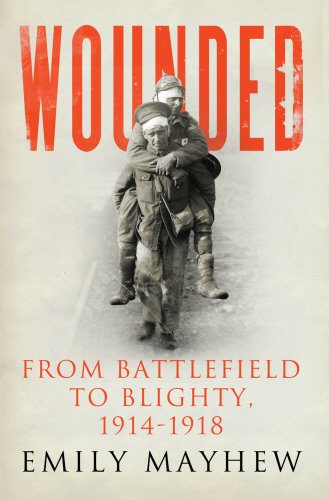
The first is Emily Mayhew‘s Wounded: from Battlefield to Blighty 1914-1918, which I noted in an earlier post; for editions outside the UK the subtitle becomes A new history of the Western Front. I’ve now read it, and admire its substance but also its style enormously. It’s based on painstaking research, literally so, and yet the main chapters read like a novel, and the analytical-bibliographic apparatus has been artfully moved to the Notes where it becomes a model of clear, concise and thought-provoking commentary rather than a cage that hobbles the narrative.
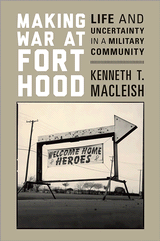
The second is Ken MacLeish‘s Making war at Fort Hood: life and uncertainty in a military community. I met Ken at a workshop in Paris last year, and if you read anything better this year – in style and substance – than his Chapter 2 (‘Heat, weight, metal, gore, exposure’) I’ d like to know about it. The combination of ethnographic sensitivity, elegant prose, and a theoretical sensibility that Ken wears with confidence and displays with the lightest of touch is simply stunning.
Since I’m off to York next week I’ll be spending the next few days preparing a new presentation on ‘Drones and the everywhere war’. I hope this will also give me time to return to my posts on Grégoire Chamayou‘s Théorie du drone which I had to put on hold while I trekked from Flanders to Afghanistan for my grant application…
I’m sorry for the long silence: the past two weeks have been unusually busy, with a stream of wonderful visitors to the Peter Wall Institute for Advanced Studies, including Philippe Descola, Anne-Christine Taylor and Bruno Latour. More on this soon, but during a series of conference presentations – in which, more or less in passing, I mentioned Joshua Oppenheimer‘s The act of killing (2012) (see here and here) – I was told of another, related project that readers will find interesting.
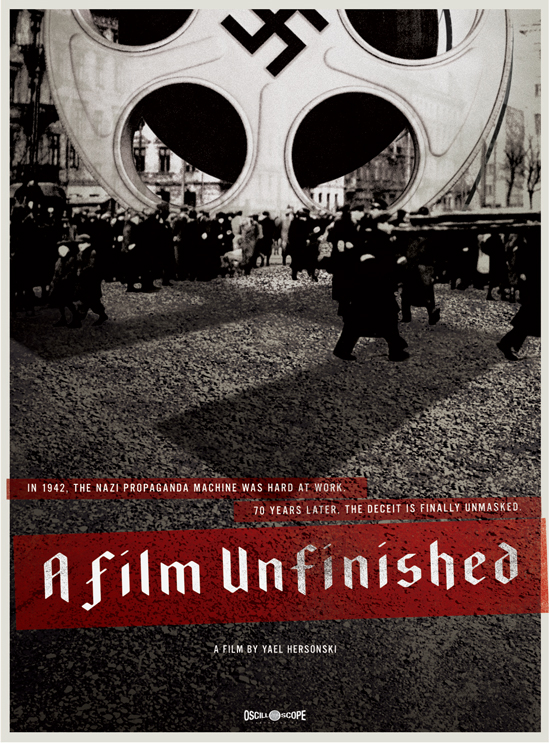
This is Yael Hersonski‘s A Film Unfinished[Shtikat Haarchion] (2010). The centre of the documentary – you can hardly say its ‘heart’ – is an unfinished propaganda film shot by the Nazis in 1942, Das Ghetto, which purported to portray the Warsaw Ghetto. It was found in an archive in East Germany in 1954, but in 1988 two discarded film cans containing 30 minutes of outtakes were discovered – scenes left on the cutting room floor – which radically transformed the interpretation of the film and revealed the elaborate staging of its scenes. You can obtain another overview of the project here, which includes a number of stills from A Film Unfinished.
The parallel with Oppenheimer’s project is drawn by Hersonski’s re-staging of an interview with one of the original cameramen, Willy Wist (he died in 1999 but Hersonski works from a transcript she found by chance in an archive in Ludwigsburg), and by her decision to invite five survivors of the Ghetto to watch the out-takes and to record their reactions.
This is from Jeannette Catsoulis‘s thoughtful review in the New York Times:
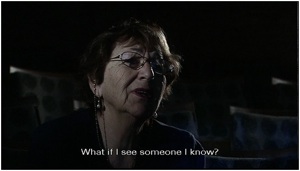
“What if I see someone I know?” one woman asks [she does], hardly daring to look. As the flickering atrocities play across the survivors’ faces — one film observing another — Ms. Hersonski silently creates space for memories. More than just valuable reality checks (“When did you ever see a flower? We would have eaten a flower!”), these recollections anchor the past to the present, and the images to human experience, in a way that shifts our perception of the Warsaw film. Whether cringing at the sight of naked men and women being forced at gunpoint into a ritual bath, or contemptuously dismissing the Nazis’ efforts to highlight Jewish privilege (“My mother wore her beautiful coat, and sometimes a hat. So what?”), the survivors seem to speak for those who cannot.
Here is the trailer. The whole film is available on YouTube but I can’t embed it because it has a restricted rating, so you need to confirm you are old enough to watch it: here.
Catsoulis suggests that the film is concerned with the difference between watching and seeing, and in this sense the other obvious parallel is with Giorgio Agamben‘s philosophico-ethical probings of the witness and the camp. Hersonski herself says that her film ‘first emerged out of my theoretical preoccupation with the notion of the “archive”, and the unique nature of the witnessing it bears.’ (She elaborates this in an interview with Max Goldberghere and there is also a really excellent interview with Lalev Melamed, ‘A Film Unraveled’, in the International journal of politics, culture and society 26 (13) 9-19, which includes an interesting comparison between Hersonski and Harun Farocki).
Witnessing is of more than historical significance, of course, and in an extended interview with Clyde Fitch – in which he asks her about complicity and guilt – Hersonski deflects his question from the past to our own present:
I’m asking myself a different question. I’m asking myself: What is my ethical position when I’m sitting very comfortably in my living room and seeing whatever is happening a few kilometers from my city in the occupied territories?…
What can I do? No, it’s not a rhetorical question. I’m seeing this and other events unfold — I’m watching it, I know about it, I know it’s there. I’m not talking about politics right now, by the way, just images of people suffering. And, as the images of people suffering in my own country go, you become a witness. Then what do you do as a witness? It’s a terrible question — it’s a haunting, torturing question. It’s our essential question.
I think that it was also a major reason why I made this film — because the Holocaust not only confronted humanity with an inconceivable horror but it also did mark the very beginning of the systematic implementation on film of that horror. And I think that something changed in our perception — I don’t know even how to define this something — after we saw images from the camps, something that we hadn’t witnessed before. It seems that documentation became more technically advanced, more massive, since then.
Well, as long as this bombardment of images becomes more intense, we will become more and more incapable of really seeing suffering, or war.
Fitch describes the film as ‘an act of anthropology’ – something which our three guests at the Wall would surely recognise too.
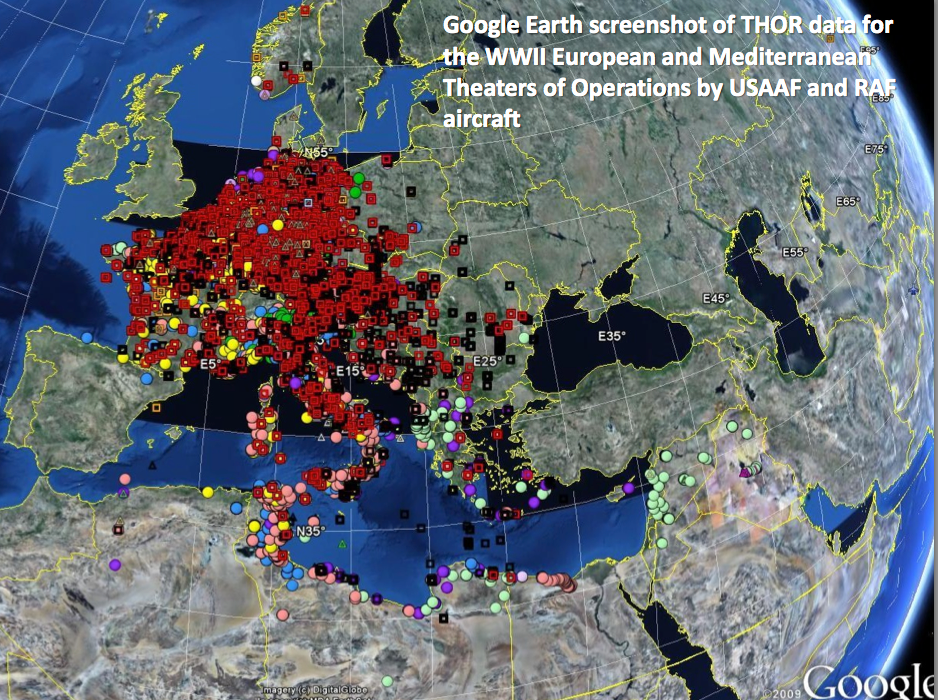
I’ve posted about this remarkable project before. The Air Force Research Institute has now made available online its historical database of air strikes. Although a USAF project, the Theater History of Operations Reportsis not confined to US airstrikes but includes allied strikes; the main focus is on World War I (from June 1916), World War II and Vietnam (from 1965-1969, though I haven’t yet checked whether this includes Laos and Cambodia).
The original description of the Project included the Korean War, Desert Storm (1991), Allied Force (1999), Afghanistan (2001 on) and Iraq (2003-11), but these are still classified and not yet available online. Here is the architect of the project, Lt Col Jenns Roberston, explaining the background:
That was a year ago. There’s now a Quick Start Guide here, and you can download the full, unclassified database and also ‘Grab and Go’ files for Google Earth. Latest background information here.
Here’s a grab of Allied bombing in Europe and the Mediterranean during World War II, though the key here is obviously to disaggregate and refine the data – which is precisely what the database allows. The red squares on the map are B-17 strikes but these overlay (for example) the orange squares of Wellington bombers so the impression at this scale is not particularly helpful.
And while we’re on the subject of World War II, don’t forget the Bomb Sight project, which maps the London Blitz in extraordinary detail: more here.
It’s important to look beyond Europe, of course. Roberston, who started work on the database in 2006, told the Air Force Timesthat he was surprised at the level of Allied bombing in the Pacific theater:
“We were blown away – no pun intended – by the level of bombing that was taking place, not only in the South Pacific but also in Burma, which is something that nobody looks at; Formosa, currently known as Taiwan; and the Philippines – how heavily those regions were bombed in the lead-up to bombing Japan proper.”
On bombing ‘Japan proper’ in World War II, as I’ve noted previously, the very best source is Japan Air Raids.org.
If anyone else is working through the disaggregated database too, do let me know how you get on.
This is the sixth in a series of posts on Grégoire Chamayou‘s Théorie du drone. I had planned to cover Part II, Ethos and psyche, in a single post, but I’ve received several requests not to speed up, so I’m continuing chapter by chapter, with supplementary readings and comments as I go.
1. Drones and kamikazes
Soon after Oliver Belcher started his research programme with me – and I’m delighted to say his thesis on ‘The afterlives of counterinsurgency’ has now been submitted – we had one of many rich conversations about what he called ‘the art of war in an age of digital reproduction’. The reference, of course, was to Walter Benjamin‘s famous essay, usually translated as ‘The work of art in an age of mechanical reproduction.’ This seems to be widely regarded as the standard, even canonical version since its inclusion in the volume of Benjamin’s essays edited by Hannah Arendt and published as Illuminations.
But it has a more complicated history. Here is Eric Larsen:
‘After fleeing the Nazi government in 1933, Benjamin moved to Paris, from where he published the first edition of “Work of Art” in 1936. This publication appeared in French translation under the direction of Raymond Aron in volume 5, no. 1 of the Zeitschrift für Sozialforschung. Benjamin subsequently rewrote the essay and after editorial work by Theodore and Margarethe Adorno it was posthumously published in its commonly recognized form in his Schriften of 1955.’
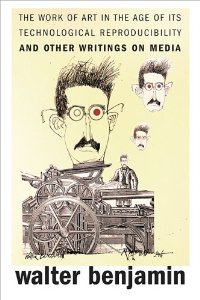
In fact there were four versions of the essay, and several critics regard the second version as the most daring of all (you can find the third version here). In the third volume of Harvard’s Selected Writings this is translated as ‘The work of art in the age of its technological reproducibility’ (1936) – it’s also available separately in the little book shown on the left – and includes this remarkable passage in an expanded Section VI:
Compared to that of the machine age, of course, this [pre-historic] technology was undeveloped. But from a dialectical stand-point, the disparity is unimportant. What matters is the way the orientation and aims of that technology differ from those of ours. Whereas the former made the maximum possible use of human beings, the latter reduces their use to the minimum. The achievements of the first technology might be said to culminate in human sacrifice; those of the second, in the remote-controlled aircraft which needs no human crew. The results of the first technology are valid once and for all (it deals with irreparable lapse or sacrificial death, which holds good for eternity). The results of the second are wholly provisional (it operates by means of experiments and endlessly varied test procedures). The origin of the second technology lies at the point where, by an unconscious ruse, human beings first began to distance themselves from nature. It lies, in other words, in play.
It’s extraordinary to read these words 75 or so years after Benjamin wrote them, and their intimations of armed drones and even the supposed ‘Playstation mentality’ that misguides those who operate them (though I think that argument misunderstands the extraordinary immersive capacity of videogames, but that’s another story that I’ve told elsewhere).
Chamayou starts his exploration of ‘Ethos and psyche’ by invoking yet another version of Benjamin’s iconic essay, but his basic point shines through the version I’ve quoted above. His purpose is to juxtapose one technology or at least its limit-case, sacrifice, which engages the human in the most direct and intimate way possible, once and for all, to another, from which (so he says) the human is disengaged in a mechanical act that is, in principle, endlessly repeatable.
Yet it turns out that this isn’t an historical succession in any simple sense at all: what Chamayou sees instead are two different genealogies – the kamikaze pilot and suicide-bomber on one side and the drone on the other – entwined in a truly deadly embrace.
The linchpin of his argument is provided by a Russian emigré engineer working for RAC, Vladimir Zworykin. Apparently alarmed by press reports in 1934 that the Japanese were considering the formation of a ‘Suicide Corps to control surface and aerial torpedoes’, Zworkyin proposed to use technology to counter the threat. Previous experiments with radio-controlled aerial torpedoes were all very well, but these were ‘blind weapons’ that inevitably lacked precision. The Japanese proposed to solve the problem by using human pilots to guide the explosive platform on to its target – Zworykin’s contrary solution was to guide the aerial torpedo through an ‘electric eye’ (a sort of proto-television).
The torpedo would be a glider,
‘carried on an airplane to the proximity of where it is to be used, and released. After it has been released the torpedo can be guided to its target with shortwave radio control, the operator being able to see the target through the “eye” [or Iconoscope] of the torpedo as it approaches.’
In 1935 Zworykin submitted a memorandum to the War and Navy Departments describing a television-controlled missile that could be guided beyond the line of sight, and five years later the US approved ‘Project Block‘ for RCA to develop TV-guided ‘assault drones’ in concert with the US Navy. When the first Japanese kamikaze units were formed they were indeed deployed against naval targets – but this wasn’t until 1944, so I’m not sure about the source of those much earlier reports that fired Zworykin’s imagination.
I described some earlier experiments with aerial torpedoes here, and you can find much more about Zworykin here and in Alexander Magoun‘s Television: the life story of a technology, pp. 78-84. He notes that the US Army Air Force was a latecomer to these experiments, and didn’t demonstrate a TV-controlled drone until October 1943, largely because its major investment was in heavy bombers capable of inflicting major destruction on cities and military-industrial targets. Project Aphrodite did experiment with the use of television to guide war-weary Flying Fortresses filled with explosives and napalm on to targets in Germany, but the attempts were largely unsuccessful and singularly irrelevant to the strategic bombing campaigns of World War II.
Nevertheless, Chamayou argues that to some degree Zworykin had identified the core principle that would later be used to develop the smart bomb and the drone. His sharper point is that the forerunner of the drone was an anti-kamikaze; sharper because this conceptual origin places the drone within a distinctive ethico-technical economy of life and death.
This ethico-technical economy can be read as an ethic of heroic sacrifice on one side and an ethic of auto-preservation on the other, each a mirror image of its other, ‘two visions of horror’. Chamayou joins several other commentators to connect the kamikaze attacks of the Second World war to suicide-bombers today, and so argues that in the global North today the cardinal opposition is usually expressed as ‘defiance of death’ versus ‘love of life’: the frequently repeated claim, as at once an explanation and a condemnation of suicide-bombing, that ‘they’ don’t value life as much as ‘we’ do. Yet, as Chamayou insists, it’s not ‘life in general’ that we value at all: it’s our lives that we cherish.
To develop this argument (which he will later elaborate in other dimensions), Chamayou cites Richard Cohen‘s editorial in the Washington Post on 6 October 2009:
As for the Taliban fighters, they not only don’t cherish life, they expend it freely in suicide bombings. It’s difficult to imagine an American suicide bomber.
He then uses anthropologist Hugh Gusterson‘s response to sharpen his point still further. Gusterson wonders, with Jacqueline Rose, why ‘dropping cluster bombs from the air is not only less repugnant [than suicide bombing]: it is somehow deemed, by Western leaders at least, to be morally superior.’ He then reverses the terms of the argument (and in going so prefigures Chamayou’s own argument about the substitution of hunting for combat in many areas of later modern warfare and about the colonial antecedents of drone strikes):
[M]any people in the Middle East feel about U.S. drone attacks the way Richard Cohen feels toward suicide bombers. The drone attacks are widely perceived in the Middle East as cowardly, because the drone pilot is killing people on the ground from the safety of an air-conditioned pod in Nevada, where there is no chance that he can be killed by those he is attacking. He has turned combat into hunting. In this regard, the drone is the culmination of a long tradition of colonial war-fighting technologies — going back at least to the machine guns with which British and French colonial soldiers mowed down spear-carrying Africans –that ensure that the “natives” die, in an unfair fight, in considerably larger numbers than the colonial soldiers.
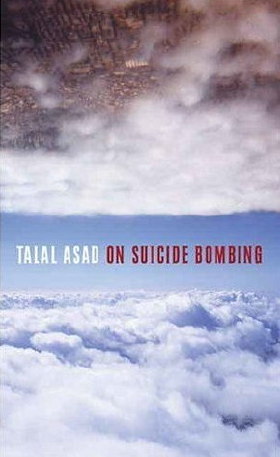
The drone operator is also a mirror image of the suicide bomber in that he too deviates, albeit in the opposite direction, from our paradigmatic image of combat as an encounter between warriors who meet as equals risking the wounding or killing of their own bodies while trying to wound or kill the others’ bodies. The honorable drama of combat lies in the symmetrical willingness of warriors to wager their bodies against each other for a cause. But now, in the words of the anthropologist Talal Asad, in his book On Suicide Bombing, U.S. “soldiers need no longer go to war expecting to die, but only to kill. In itself, this destabilizes the conventional understanding of war as an activity in which human dying and killing are exchanged.”
But there are two other twists to this story that Chamayou doesn’t pursue.
First, in his essay for the Bulletin of the Atomic Scientists Gusterson confounds Cohen’s difficulty in imagining ‘an American suicide bomber’ like this:
‘For decades loyal U.S. soldiers in nuclear missile silos have trained to launch their weapons in the expectation that they would be killed almost immediately afterwards in the ensuing nuclear war. I once interviewed a former special-forces officer who was trained to hike behind enemy lines with a tactical nuclear weapon on his back and place it near an important target. Although the weapon had a timer, he expected to die at ground zero.
If such men were the elite nuclear suicide bombers whose mission was prepared but never carried out, the Cold War turned the whole country into a suicide bomber rehearsing obsessively for the moment when we would “push the button” and take down millions of our enemies with us. Seen in this light, Americans trained for the biggest suicide bombing mission of all.’
Second, there have been ‘successful’ American suicide bombers. To some historians the first candidate is Andrew Kehoe, who set off an explosion at a schoolhouse in Bath, Michigan in May 1927, killing 44 people, before setting off dynamite in his truck and killing himself and several other people. Whether you count this as a suicide bombing in the modern sense of the term depends on the criteria you think appropriate. Many commentators exclude Kehoe and identify three other, more recent American suicide bombers: Shirwa Ahmed, who drove a car bomb into a government compound in Puntland in October 2008, killing as many as 30 people; Farah Mohamed Beledi, who killed himself and three soldiers at a military checkpoint in Mogadishu in June 2011; and Abdisalan Hussein Ali, who attacked African Union troops in Mogadishu six months later. All three were Somali-Americans who had lived in Minnesota and were recruited by al-Shabaab.
But to exclude Kehoe and claim that these three were not ‘really American’ is to immediately trigger one of Chamayou’s key arguments about the ways in which killing and dying in the age of the drone are racialized. More soon.
Coda:
As I finished up this post, I discovered a young American performance artist, Ethan Fishbane, whose show American Suicide Bomber Associationhas been staged in New York and previously in Indonesia and South Africa.
Apparently he threw one of his stage ‘bombs’ into the garbage last week and unwittingly set off a bomb scare in Manhattan.
“I felt the response [by the police] was wholly appropriate,” he said. “Even if it’s just a prop for a theater piece, they were on top of it.”
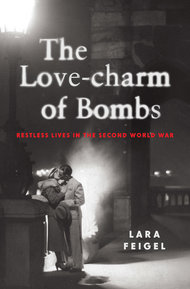
I’ve noted Lara Feigel‘s wonderful The love-charm of bombsbefore, and now there’s a short interview with her at the New York Times Arts blog here:
I was originally planning to write an academic study of war literature. But I kept finding that I was reading about the writers’ lives, rather than reading about their books, and especially about their passionate wartime love affairs. Once I had spent time in their archives and read their wartime letters and diaries, I started to think that it’s impossible fully to understand classic novels like Graham Greene’s “The End of the Affair” or Bowen’s “The Heat of the Day” without knowing about their lives, and seeing these books as urgent messages, written to lovers, and written out of an extraordinary time. A lot of parallels and shared experiences were emerging in the research, so it seemed obvious to tell the stories simultaneously, threading them together as in a novel.
Lara explains that, although she was trained as a literary critic and historian,
I enjoyed the challenge of acquiring new kinds of knowledge in researching this book. I read a few military accounts of the war, but I learned a lot of the war news from reading contemporary diaries and newspapers. I wanted only to convey as much as well-informed people knew at the time. After all, my writers weren’t military experts, just people who found themselves living through a complicated and long-drawn-out war.
I know just what she means (and for more on another project in which Lara crosses established boundaries, see this meeting of minds between neuroscientists, artists, philosophers and analysts, which she co-organized with Lisa Apignanesi). In a similar sort of way I’m a geographer ‘by training’, whatever that might mean, but I’m content with the description largely because it gives me the freedom to pursue ideas and issues wherever they take me, often far beyond the bounds of any recognisable or at any rate nominal ‘geography’ – except that I always remember Dick Chorley‘s frequently repeated injunction when I was an undergraduate at Cambridge: “To ask, ‘Is that Geography?’ is the most un-geographical of questions.” So I think geography is a discipline in the Foucauldian sense – it works to produce disciplinary subjects through a network of formal institutions (including university departments) and journals, through a canon of texts, and through a systematic series of examinations – but that’s about it. I don’t think this makes Geography any different from a host of other ‘disciplines’, needless to say: it’s a route of entry into a rich and constantly changing intellectual-practical world, and unlike Richard Hartshorne and others of his ilk I insist that there’s a lot to be said for deviating from the path (or rather Path) and acquiring those ‘new kinds of knowledge’ that Lara talks about.
With that sort of license comes responsibility, too, of course, but that doesn’t mean conformity. I’ve always liked E.P. Thompson‘s image of himself, working for the first time on early eighteenth- rather than ninteenth-century Britain in Whigs and Hunters – his best book – as a parachutist landing in occupied territory (occupied not least by Jack Plumb), burying his silk under a tree and night after night moving stealthily through the surrounding landscape, gradually coming to know it better and better: but on his own terms. Perhaps he was channelling his late brother Frank who parachuted into Bulgaria during the Second World War to provide support to the partisans and who was summarily executed for his pains.
Which brings me back to Lara. Asked to recommend a book about literature during the Second World War, she suggests Adam Piette‘s Imagination at war: British fiction and poetry 1939-1945 (1995): ‘a wonderful account of the oddness of the literary responses to the Second World War.’ D.J. Taylorwasn’t so sure, though I found Adam’s discussion of the war in the desert very helpful in enlarging my own view of those campaigns for ‘The natures of war’.
I know the sequel better, The Literary Cold War, 1945 to Vietnam (2009), which includes an invigorating discussion of Graham Greene‘s The Quiet American amongst many other good things (a novel much on my mind of late). Adam runs the Cultures of the Cold War network whose website opens with a rapid-fire quotation from E.L. Doctorow: ‘The bomb first was our weapon. Then it became our diplomacy. Next it became our economy. Now it’s become our culture. We’ve become the people of the bomb.’ Unfortunately, it appears the website then ran out of energy (sic), though there’s a useful Bibliography.
For me, the book I most admire is Patrick Deer‘s Culture in Camouflage: war, empire and modern British literature (2009). He paints on a larger canvas than Imagination at war – the book covers the period 1914-1945, and there are definite advantages in doing so – and he seems to have read everything and to have thought about it all in depth and detail. I was first drawn to it by his chapters on the Second World War, but as I re-work “Gabriel’s Map” for what I think, hope and pray will be a second new book (really), provisionally called War material, I’ve plunged back into his earlier accounts of the First World War. They are brimful of incisive readings and artful insights.
“Gabriel’s Map” is all about the dialectic between the scopic regime constructed through the topographic map, the aerial photograph and the field sketch on the Western Front (‘cartography’) and the sensuous, haptic and thoroughly embodied knowledge of the troops on – and in – the ground (‘corpography’). Here’s Patrick: ‘If the emblematic figure for the collapse of vision was No Man’s Land, it was the strategist’s map that came to represent the struggle to recapture oversight, to survey and order the mud, chaos and horror of battle.’ So I’m now thinking much more about the very idea of No Man’s Land and the multiple ways in which soldiers apprehended its gouged terrain.
More on all that very soon, but here I just want to say that Culture in camouflage is gloriously intellectually promiscuous and also a rattling good read. If you want to explore the idea of ‘war culture’ I’d recommend starting here, and returning to it again and again. But pack Lara’s book for the journey because she also has much to show us not only about how to travel but also how to write.
I’ve been reading poetry from the Second World War, mainly as part of the preparation for my talk on “The natures of war” tonight. My main focus for the last several weeks has been on the sand and dust of the Western Desert but my eyes kept straying.
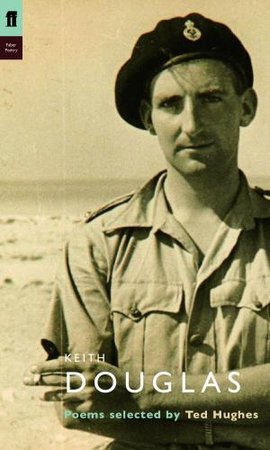
I’ve been moved by the work of Keith Douglas, amongst several other ‘desert poets’, but his “How to kill” captures the impersonality-intimacy of the killing space better than almost anything I know and has a relevance far beyond its time and place:
‘Now in my dial of glass appears
the soldier who is going to die.
He smiles, and moves about in ways
his mother knows, habits of his.
The wires touch his face: I cry
NOW. Death, like a familiar, hears
and look, has made a man of dust
of a man of flesh…’
Here is a virtualized reading of the poem (more details of what that means here)
Douglas’s body of work is remarkable. He’s often described as one of the finest poets of the war; he served as a tank commander in the Western Desert and was subsequently killed in Normandy in June 1944. There’s a compelling combination of the theatrical with the documentary (what Douglas called ‘the extrospective’) in his writing: you can see it in his poetry but also in his prose account of the desert war, From Alamein to Zem Zem (newly available in a Kindle edition), and this prompted Owen Sheers to put Douglas on the stage in a one-man play at the Old Vic, Unicorns, Almost, with Joseph Fiennes (‘Who then can live among this gentle/obsolescent breed of heroes and not weep/Unicorns almost’). Sheers also developed a documentary for BBC4,Battlefield Poet.
There’s an excellent discussion of ‘The vision of Keith Douglas’ in Tim Kendall’s Modern English war poetry (2009; available online if your library has a copy), another by Adam Piette on ‘Keith Douglas and the poetry of the Second World War’ in Cambridge’s Companion to twentieth-centuy English poetry (2007; also available online, same conditions apply) and a very good open access essay by Costas Evangelides, ‘Keith Douglas: Death’s several faces’, here.
I’ve found it hard to leave Douglas’s work alone, along with other ‘desert poets’, but this poem by Barry Conrad Amieltook me away from the sand and dust to my Killing Space project on bombing. It’s called “Death is a matter of mathematics” (Amiel was an artilleryman but there too death came from above).
Death is a matter of mathematics
It screeches down at you from dirtywhite nothingness And your life is a question of velocity and altitude, With allowances for wind and the quick, relentless pull Of gravity.
Or else it lies concealed In that fleecy, peaceful puff of cloud ahead, A streamlined, muttering vulture, waiting To swoop upon you with a rush of steel. And then your chances very as the curves Of your parabolas, your banks, your dives, The scientific soundness of your choice Of what you push or pull, and how, and when.
Or perhaps you walk oblivious in a wood, Or crawl flat-bellied over pockmarked earth, And Death awaits you in a field-gray tunic. Sights upright and aligned. Range estimated And set in. A lightning, subconcious calculation Of trajectory and deflection. With you the focal pont, The centere of the problem. The A and B Or the Smith and Jones of schoolboy textbooks.
Ten out of ten means you are dead.
Belatedly, I discovered that passages from both poets appear in Christopher Coker‘s The future of war: the re-enchantment of war in the twenty-first century. Coker argues that the poets of World War II ‘have far more to tell us about the future face of conflict than their World War I predecessors’ because they address so directly the ways in which military technology was effacing the human… This is the right time of year in many universities for me to add just one word: “Discuss”.





 geographical imaginations