Laughscream

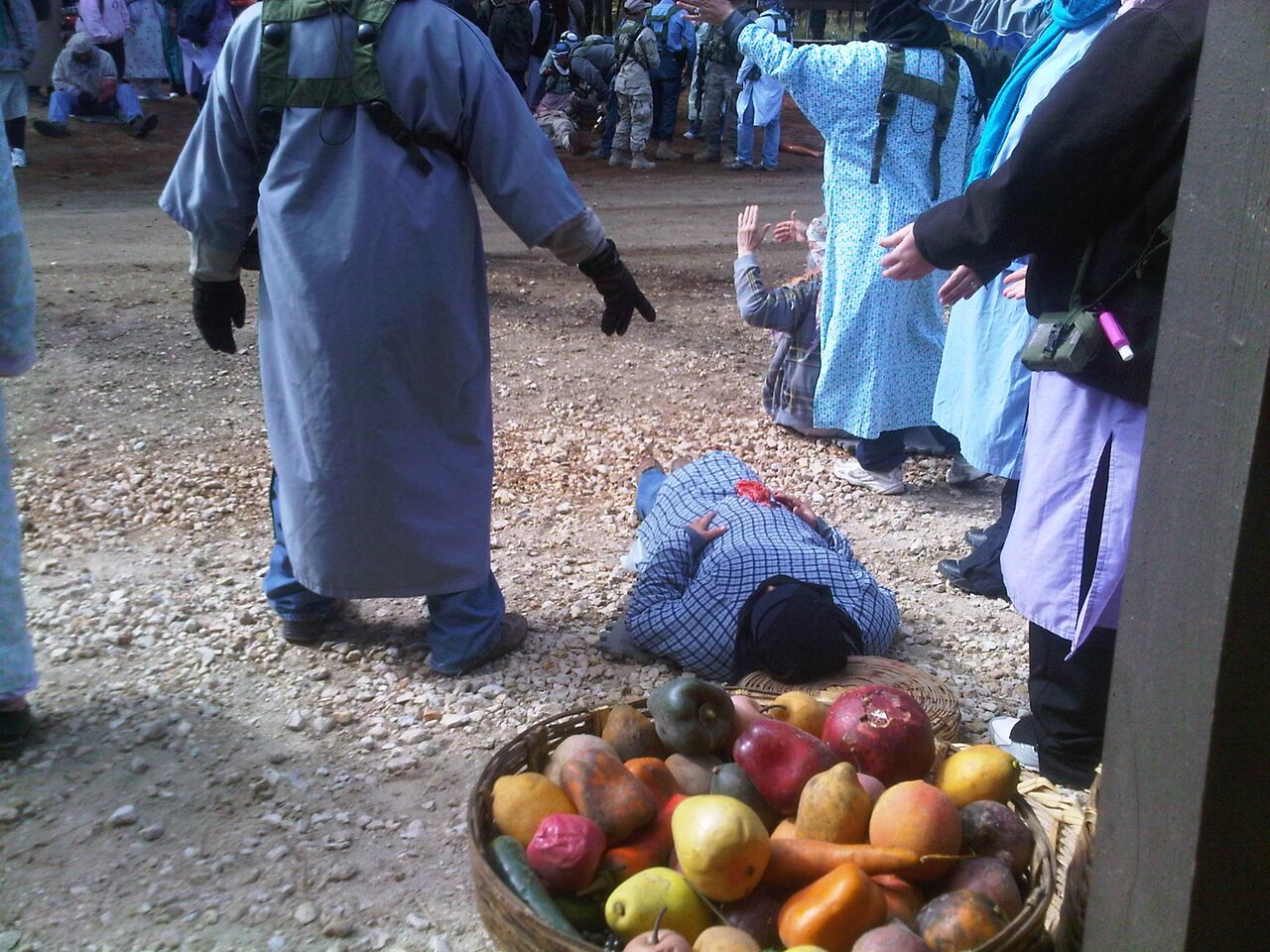
In an early phase of my work on later modern war I explored the so-called ‘cultural turn’ in US counterinsurgency and its invasive mapping of ‘human terrain’, and as part of the attempt to impel (and interpellate) US soldiers into what I called this ‘rush to the intimate’ I considered the role-playing simulations acted out in mock Iraqi villages and towns fabricated for pre-deployment training in the continental United States (see ‘The rush to the Intimate’: DOWNLOADS tab).

In the interim many more detailed studies have appeared, but one of the most imaginative and insightful can be found in Cultural Anthropology (32/1) (February 2017): Nomi Stone‘s Living the laughscream: human technology and effective maneuvers in the Iraq war (open access).

It focuses not on the US soldiers and their reactions but on the Iraqi role-players, many of whom served as US interpreters in Iraq, described by one US officer as ‘the apparatus’ or what Nomi reconceptualizes as ‘human technology’.  Their performances are carefully scripted, and yet:

Amid this artifice, role-players have been hired to enact Middle Eastern villagers authentically—not by their own measures, but rather within prescribed military terms. Role-players are asked to be exemplars of their cultures and those cultures must be synchronic, pruned of their excesses and any relationship to the outside: Iraqis, as it were, in a box. However … the Iraqis who worked for the American military first as interpreters and contractors in the 2003 Iraq War and subsequently as role-players are a somewhat unique subset of the population; indeed, they are often quite far removed from the U.S. military’s imagined characteristics of a prototypical Iraqi. Not only are many of them educated, they are also particularly versed in American culture and critical of Iraqi politics. They typically bear an ambivalent relationship to both countries as they negotiate past accusations, allegiances, and the prospect of assimilation. Many show little trust for outsiders and even less for each other, and because of their dangerous affiliations in wartime, they have learned to chameleon in most circumstances. As they are turned into stereotypes inside an archetypal village, and as they act out wartime precarity so often that their homes and their losses turn into even more estranging archetypes, they laugh.

The machine thus turns out to be made of flesh. Role-players inject new ways of being, in part through laughter, into their performances. Those interjections indicate the limits of a military fantasy that believes human beings can be wholly resourced and turned into technologies.

This is on my mind because this past term, in a series of lectures on performance and performativity – the differences between them and the dots that can join them – I returned to these role-playing exercises to flesh out (literally so) the ideas involved; above all, to emphasise how every performance is different even when the script is nominally the same, and so the contingency of the performative.

And ‘the laughscream’?

The [Iraqi role-player] knows or feels more than the military narrative of their experience can accommodate, exceeding the constricted functions prescribed for a hired cultural tool. Additionally, the laughscream acts as a refusal to be lived by the role and the role-players’ fraught wartime pasts. For those accused of betrayal and marginalized by their compatriots, pursued by Iraqi militias and not always trusted by the U.S. soldiers whom they worked for, that past is painful. As one role-player explained, reflecting on the harshness many Iraqis had endured: “We are turned inside out. At the same time, we can laugh and cry.” Indeed, for Iraqis who worked with the U.S. military, it is presently prohibitively dangerous to return to their former home, particularly amid the ascendance of the Islamic State. Meanwhile, due to their wartime choices, many now negotiate ongoing ambivalence and feel stranded between nations: although they were frequently ejected to the peripheries of their countries for working with the Americans, many strongly identify with Iraq and are ill at ease with full assimilation in America. As they continue to work for the U.S. military, some conceal that work from their families in Iraq, grappling with how they might be perceived. Amid these tensions, the laughscream functions in part as an actor, an agentive vector out.

Laughter rises to confirm that, for the role-players at least, the Iraq of the simulation is not the Iraq of their homeland. As fake guns sound, role-players repeat themselves, becoming increasingly estranged from the original object. Yet, through laughter, the archetypal and mechanical face of country and person give way to Iraqis who live impossibly hybrid and ambivalent lives in the United States to which they have aligned at such great cost. In the parodic redeployment of power as Judith Butler has conceived it, the mechanical performance of death becomes a complexly subversive act that momentarily insinuates life into the playing of a role.

But there is another reason for reading Nomi’s essay: it is so beautifully written.  If, like me, you often feel assailed by the sheer grimness of so much academic prose, provoked into your own laughscream, this is a wonderful demonstration that intellectual agility and analytical depth need not involve the death of style.

Not surprisingly, Nomi is an accomplished poet too: more at her website here.  You can also find an excellent interview about her movements in the borderlands between anthropology and artistic practice here:

My academic work and my poetry are inextricable and cross-pollinating. I was a poet first. My first collection of poems, Stranger’s Notebook (TriQuarterly, 2008) was based on my time in Djerba. I was deeply moved by Carolyn Forché’s call to comprehend the impress of the social on the poetic imagination; this led me to begin conducting ethnographic fieldwork and then to become an anthropologist.

By now, my anthropological engagement is essential to my poetry. As I explained in a poet’s statement some years ago, my philosophy of seeing is “deeply inflected by the anthropologist’s mandate to estrange the familiar and de-estrange the hitherto unknown.” Additionally, my work as an anthropologist sends me both toward moments of conceptual clarity and toward continuous re-complication: as the tidy military diagrams of culture remind us, the world is instead messy and tangled and contingent, as we each engage in the daily work of living and loving and getting by. I want my poems to demand that same complexity, and I only learned how to think it through the wonderful, arduous, and singular training that becoming an anthropologist demanded. What an astonishment to spend seven years shuttling back and forth between reading social theory about war, Empire, technology, migration, and laughter or political histories of America and Iraq and then witnessing the stagings of Empire itself, in its scatterings across the Middle East and the United States, as well as interviewing those whose lives had been demarcated and unmade by those very terms. These forms of seeing and knowing are to me humbling, and both my in-progress ethnographic manuscript and my forthcoming collection of poems, Kill Class, are the beneficiaries of that long academic journey.

Kill Class is due from Tupelo Press later this year; the collection is based on her ethnographic fieldwork across those US military training camps.  You can find her poem War Game, America’ here.

“What to do when the concepts and methods most essential to a field of scholarship are taken and deployed as instruments of war? American anthropology has struggled with this question since the Cold War era, when many fieldworkers were drawn into counterinsurgency campaigns around the globe. In this courageous and compassionate book, Kill Class, Nomi Stone offers a new way of grappling with this most difficult problem. Her stark and unflinching poems give a harrowing sense of cultural understanding made into a vehicle of state violence. At the same time, with tremendous delicacy and grace, they enter into the minds and lives of American soldiers and their Iraqi counterparts, revealing bewilderment where you would have thought to find certitudes, vulnerability where you would expect only hardness, small moments of wonder in the face of horror. The result is a truly arresting ethnography of American military culture, one that allows readers to circle at length through the cloverleaf interchanges where warfare nestles into the most mundane corners of everyday life, only to arrive at an exit where you would have expected least to find it: in an ethics of radical and transformative encounter, a way of coming undone in the company of others through the practice of sympathetic imagination.”  Anand Pandian, Johns Hopkins University

There’s also an earlier interview with her about her fieldwork (and her ideas about later modern war) over at the Wenner-Gren blog here: also well worth reading and savouring.

All this is much on my mind because over Christmas I read Alan Hollinghurst‘s The Sparsholt Affair and luxuriated in its mesmerising prose; as with other authors I admire this isn’t a purely formal (ahem) affair, though he is undoubtedly a master stylist.  Rather, you can roll the words around in your mouth, taste them and so find yourself ineluctably drawn into – rather than distracted from – the pulsing arc of the narrative: in an inversion of the metaphor with which I began, consumed by it.  So too The Swimming-Pool Library and Line of Beauty.  I get the same immersive pleasure from authors like Tom McCarthy (C is still one of my all-time favourite novels), Pat Barker (try Noonday) and Sarah Waters (oh, The Night Watch!).   This isn’t a matter of genre either; Peter May‘s Lewis trilogy is one of the finest works of crime fiction I know, along with almost anything by the ought-to-be legendary John Harvey (also a poet).

I’ve never forgotten a prescient admonition by Pierce Lewis in ‘Beyond description‘ (which appeared in the Annals of what was then the Association of American Geographers in 1985) – a lovely, lovely essay about passion and prose – in which he forestalled a possible objection: ‘we are not trained to be painters or poets, and while that is true, I do not think we should boast about it.’

For the record, I’ve written my share of God-awful prose, especially in the early stages of my career; the fault wasn’t only the dismal Harvard reference system (though it doesn’t help at all: too many names and dates crammed into brackets you have to hurdle over in a madcap race to retain the meaning of the sentence).  The colonial present was a cathartic release, in a way, because – after completing that awful opening chapter – I started to lose my academic voice.  I’m not desperate to get it back, and the two books I’m working on now will, I hope, show how far I’ve come.

But who, I wonder, are your favourite stylists?

Postscript: For my rant about the Harvard reference system, see ‘Gregory, D.’ (DOWNLOADS tab).  And there’s more on the corporeality and contextuality of (my) writing here.

Killing cities

In a perceptive commentary on the ground-breaking investigation by Azmat Khan and Anand Gopal into civilian casualties caused by the US air campaign against Islamic State (Daesh) in Iraq – see also my posts here and hereRobert Malley and Stephen Pomper write:

The Trump administration has celebrated a no-holds-barred approach to the fight against ISIS, given greater deference to ground commanders, loosened restrictions imposed by its predecessor, and expanded the fight to an ever-growing number of Middle Eastern and African theaters. This adds up to a quasi-automatic recipe for greater civilian casualties. Independent monitoring organizations have tracked the numbers, and invariably they point to a serious uptick in civilian deaths in Iraq and Syria since January 2017. The explanation lies partly in the transition in Iraq and Syria toward the final, more urban phase of the conflict in the heavily populated cities of Mosul and Raqqa. But partly only. It also lies in policy guidance, as well as in matters such as tone, attitude, and priorities set at the very top—including by the commander in chief. These have a way of trickling down and affecting performance on the battlefield.

And yet. Those dead civilians that The New York Times found not to have been counted were not counted by the Obama administration. They were not counted by people who were intent on limiting civilian casualties and ensuring transparency. That those safeguards proved inadequate even in the hands of an administration that considered them a priority raises particularly vexing questions.

Part of the problem, as they note, is the nature of the campaign itself.  This is not the sort of counterinsurgency campaign that emerged in Afghanistan and Iraq in which air power was used in support of US and allied ground troops (although we know that also produced more than its share of civilian casualties); neither is it a counterterrorism campaign directed against so-called High Value Targets who supposedly ‘present a direct and imminent threat to the United States’ (ditto; and as I discuss in ‘Dirty dancing’ – DOWNLOADS tab – ‘imminence’ turned out to be remarkably elastic, a deadly process of time-space expansion).
Ultimately, though, their anxieties turn on what they call the ‘over-militarization’ of the US response to al Qaeda and its affiliates and to IS.  They explain, succinctly, what has encouraged this militarized response (not least the lowering of the threshold for military violence allowed by remote operations):
[U]ntil this changes, an increasing number of innocent lives will suffer the consequence. Some will be counted. Others, not. All will have paid a terrible price.
In December the Bureau of Investigative Journalism confirmed an escalation in US air strikes across multiple theatres in Trump’s first year in office:
President Donald Trump inherited the framework allowing US aircraft to hit suspected terrorists outside of declared battlefields from his predecessor, Barack Obama. Bar some tinkering, his administration has largely stuck within the framework set by the previous one.

However, the quantity of operations has shot up under President Trump. Strikes doubled in Somalia and tripled in Yemen [in 2017].

In Afghanistan, where the Bureau has been monitoring US airstrikes since it was officially declared a noncombat mission at the end of 2014, the number of weapons dropped is now approaching levels last seen during the 2009-2012 surge.

Meanwhile, there are signs that the drone war may be returning to Pakistan, where attacks were also up, compared with 2016.

Much remains unclear about these actions, apart from Trump’s signature combination of machismo and ignorance, but we do know that Obama’s restrictions on the use of military force outside Afghanistan, Iraq and Syria have been loosened:

In 2013, Obama introduced measures that meant that strikes in areas of countries that were not active war-zones, such as Pakistan and Yemen, had to go through an elaborate sign-off process with the White House.

The Trump administration effectively side-stepped the restrictions by declaring parts of Somalia and Yemen to be areas of “active hostilities”.

In September NBC reported that the Trump administration was planning to allow the CIA to take a more aggressive role and to give the agency more authority to conduct (para)military operations.  In consequence a comprehensive revision of Obama’s guidelines was in prospect:

The drone playbook, known as the Presidential Policy Guidance, or PPG, includes a provision that no strike should go forward unless analysts determine that there is a near-certainty that no civilians will be harmed. And it includes a provision forbidding the addition of new detainees to the U.S. prison in Guantanamo Bay, Cuba.  The Trump administration is contemplating removing both of those restrictions.

Pakistan remains a nominally covert area of operations.  US drone strikes in the Federally Administered Tribal Areas resumed in March after a nine-month hiatus – though Trump’s latest spat with Islamabad raises questions about the sporadic but systematic co-operation that had characterised so much of the campaign – and (provocatively: again, see ‘Dirty Dancing’ for an explanation) one strike took place outside the FATA in June 2017.  The Bureau’s detailed list is here: five strikes are listed, killing 15-22 people.

In Afghanistan the Bureau noted that air strikes had doubled and that this escalation has been accompanied by a corresponding decrease in transparency (Chris Woods told me the same story for Iraq and Syria when we met in Utrecht).

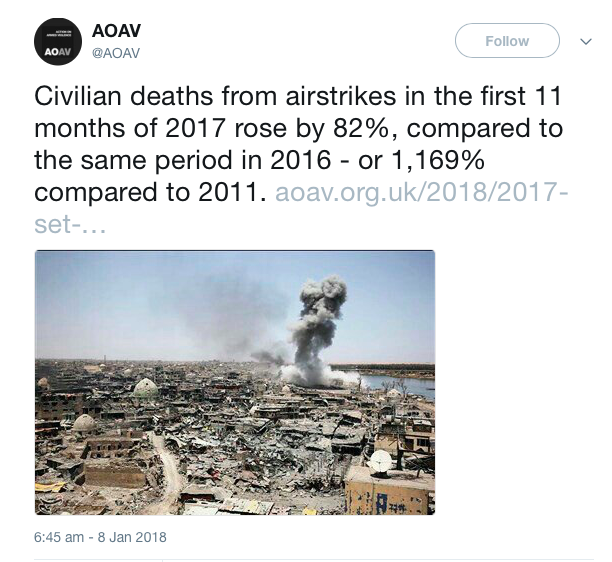
All of this confirms the report released today by Action on Armed Violence.

At least 15,399 civilians were killed in the first 11 months of 2017 according to Action on Armed Violence’s (AOAV) recording of English language media explosive violence events.  This devastating toll – up to the end of November – strongly suggests that 2017 was the worst year for civilian deathsfrom explosive weapons since AOAV’s records began in 2011.

This sharp rise, constituting a 42% increase from the same period in 2016, when 10,877 civilians were killed, is largely down to a massive increase in deadly airstrikes.

Compared to 2011, the first year of AOAV’s recording, the rise in civilians killed by explosive violence in the first 11 months of 2017 constitutes an 175% increase (5,597 died in the same period seven years ago).

On average, our records to November show that there were 42 civilian deaths per day caused by explosive violence in 2017.

The report continues:

For the first time since our recording of all English language media reports of explosive weapon attacks began, the majority of civilian deaths were by air-launched weapons. Of the total civilian deaths recorded (15,399), 58% were caused by airstrikes, mainly in Syria, Iraq and Yemen.

Civilian deaths from airstrikes in this 11-month period was 8,932 – an increase of 82% compared to the same period in 2016 when 4,902 civilians were killed, or 1,169% compared to 2011, when 704 died.

Significantly, as airstrikes are almost always used by State actors, rather than non-State groups, States were responsible for the majority of civilian deaths from explosive weapons for the first time since our records began.

Iain Overton, Executive Director of AOAV commented:

 These are stark figures that expose the lie that precision-guided missiles as used by State airforces do not lead to massive civilian harm. When explosive weapons are used in towns and cities, the results are inevitable: innocent children, women and men will die.

In the same vein, Karen McVeigh‘s summary for the Guardian quotes Chris Woods from Airwars:

This is about urban warfare and that’s why we are getting crazy numbers… War is moving into cities. It doesn’t matter whether it’s Russia or the US-led coalition or ground forces leading the assault, the outcome for civilians under attack is always dire…. We’re becoming too complacent about urban warfare, and militaries and governments are downplaying the effects.

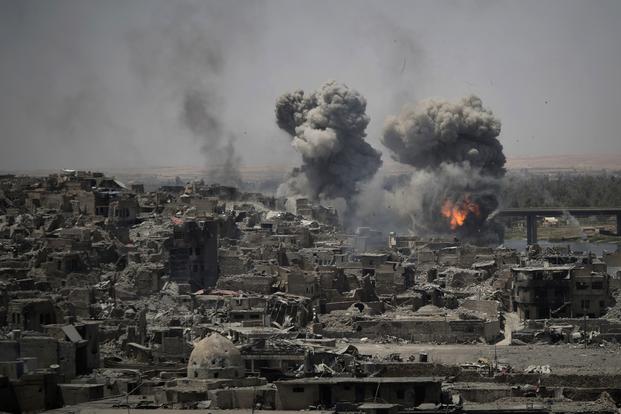
I think that’s right, though I also think war is moving back into the cities (if it ever left them); the serial military operations in Mosul and Raqqa are vivid examples of what Chris means, but they also recall the assaults on Fallujah and other cities documented in Steve Graham‘s still utterly indispensable Cities under siege.

The point is sharpened even further if we widen the angle of vision to take in air campaigns conducted by other air forces: the Syrian Arab Air Force and the Russian Air Force in Syria, or the Saudi-led coalition in Yemen.

Yet again, killing cities to save them.  As a spokesperson for Raqqa is Being Slaughtered Silently put it last summer, ‘This is very similar to the Vietnam war, where entire cities were destroyed… What is happening in Raqqa is like dropping a nuclear bomb in stages.’

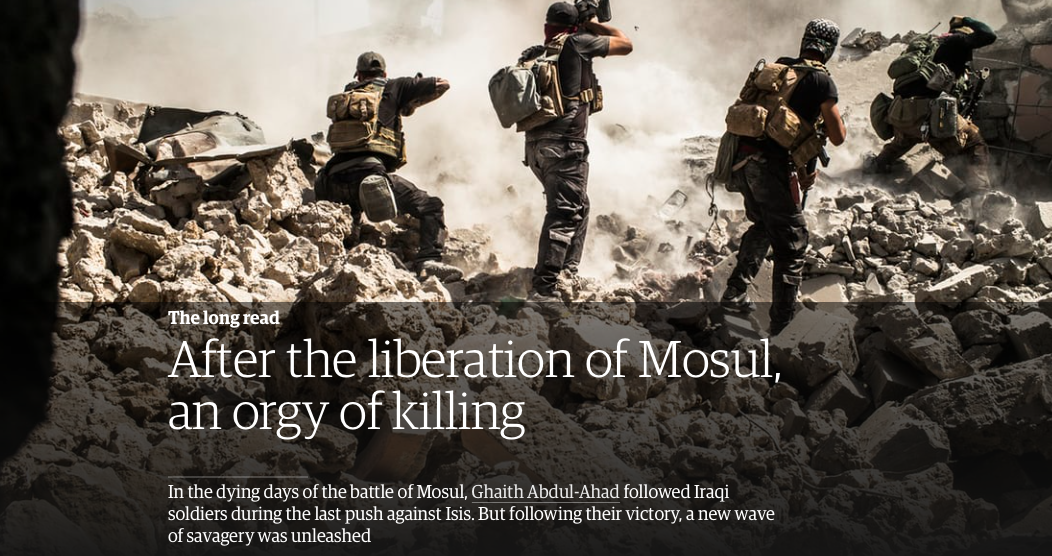
Steve’s work should also remind us that these dead cities are not produced by air strikes alone.  Once reduced to rubble they have often been disembowelled (I can think of no better word) by ground forces; it’s as though these now barely human landscapes compel or at any rate license the continued degradation of both the living and the dead:  see, for example, Kenneth Rosen on ‘The Devil’s Henchmen’ here or  Ghaith Abdul-Ahad‘s chillingly detailed report on the aftermath of the liberation of Mosul here.

I’m still astonished that all those high-minded theoretical debates on planetary urbanism somehow ignore the contemporary intensification of urbicide and urban warfare (see ‘Mumford and sons’ here).

Uncommon ground

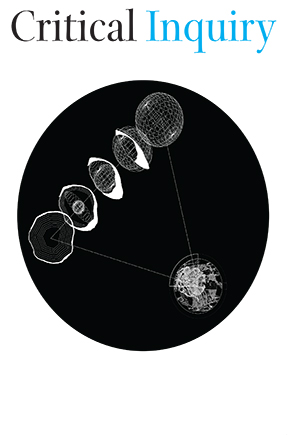
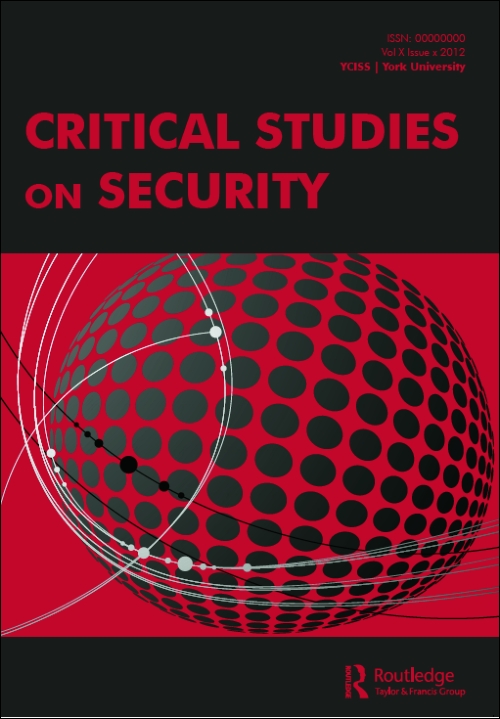
The latest issue of Critical Inquiry (44/2) (2018) has a special section on Israel/Palestine: The Occupied and the Occupier: that has its origins in the International Critical Geography Conference at Ramallah in 2015:

In the life of a scholarly journal there sometimes occur moments when radically different perspectives converge on a theme or argument. That is the case with the following group of essays. The first is written by Saree Makdisi, a Palestinian scholar who has studied the occupation of his country for many years and has attempted to analyze the institutions, languages, and political forces that sustain that occupation. The subsequent essays constitute a dossier of reflections by Israeli scholars writing from the standpoint of the occupiers, seeking to understand the history of the occupation and to reflect on the moral and political issues that accompany it. Organized by Ariel Handel and Ruthie Ginsburg, “Israelis Studying the Occupation” originated in the desire of a group of Israeli scholars to engage with Palestinians and international experts at a conference on Critical Geography that took place in Ramallah in 2015. As with so many attempts to find common ground in Israel/Palestine, this desire was frustrated. The present forum, therefore, is basically an attempt to name and locate that common ground as the occupation itself and to engage in reflection from the standpoints of both the occupied and the occupiers.

Critical Inquiry has a long history of engagement with the question of Israel/Palestine; a complete list of articles on this topic is available on our website [here] and includes work by Rashid Khalidi, Edward Said, Ariella Azoulay, Robert Griffin, Frank Gehry, Oren Yiftachel, and John Berger.

Here is the Contents list:

Saree Makdisi, Apartheid/Apartheid

Ariel Handel, Ruthie Ginsberg, Israelis studying the Occupation: an introduction

Hagar Kotef, Fragments

Hilla Dayan, For Occupation Studies, to cultivate hope

Amira Hass, Writing about the Occupation

Maya Rosenfeld, The transformation around the corner

Amal Jamal, Bypassing 1948: a critique of critical Israeli studies of occupatio

Irus Braverman, Renouncing citizehsip as protest: reflections by a Jewish Israeli ethnographer

Apart from its intrinsic importance, the forum bears directly on discussions around situated knowledges and positionality, so it’s perhaps appropriate that the issue as a whole starts with an essay by Bruno Latour, ‘On a possible triangulation of some present political positions’ (hence the cover image, reproduced above).

War Stories

New books on the radar:

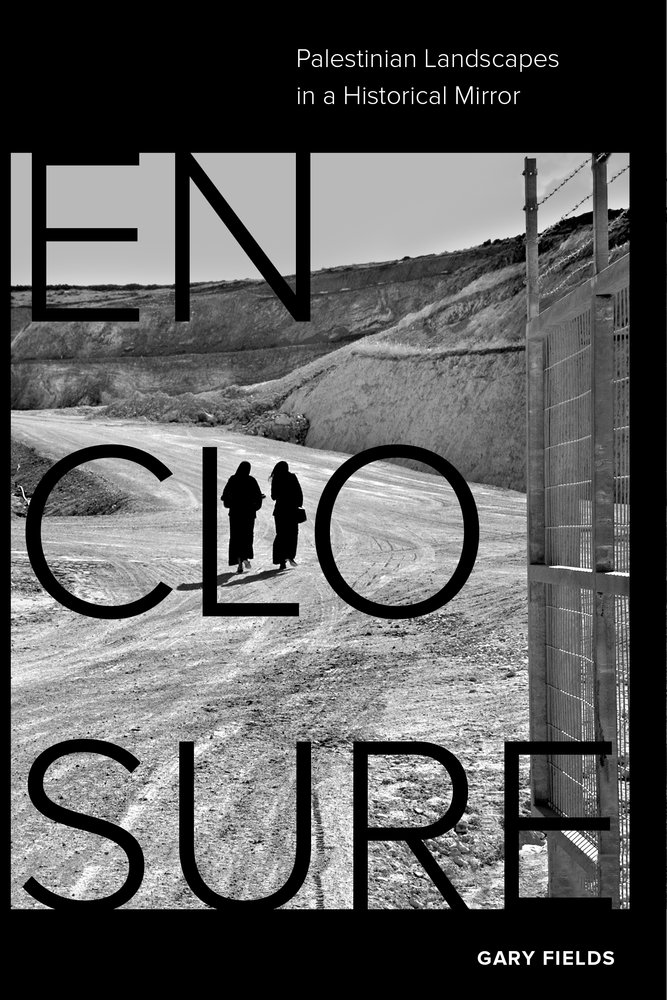
Gary Fields, Enclosure: Palestinian landscapes in a historical mirror (California, September 2017):

Enclosure marshals bold new arguments about the nature of the conflict in Israel/Palestine. Gary Fields examines the dispossession of Palestinians from their land—and Israel’s rationale for seizing control of Palestinian land—in the contexts of a broad historical analysis of power and space and of an enduring discourse about land improvement. Focusing on the English enclosures (which eradicated access to common land across the English countryside), Amerindian dispossession in colonial America, and Palestinian land loss, Fields shows how exclusionary landscapes have emerged across time and geography. Evidence that the same moral, legal, and cartographic arguments were used by enclosers of land in very different historical environments challenges Israel’s current claim that it is uniquely beleaguered. This comparative framework also helps readers in the United States and the United Kingdom understand the Israeli/Palestinian conflict in the context of their own histories.

There is an excellent review essay by the inimitable Raja Shehadeh over at the New York Review of Books for 18 January; you can read the opening chapter (‘The contours of enclosure’) here; and there’s a brief, illustrated blog post by Gary on ‘the will to resist’ here.

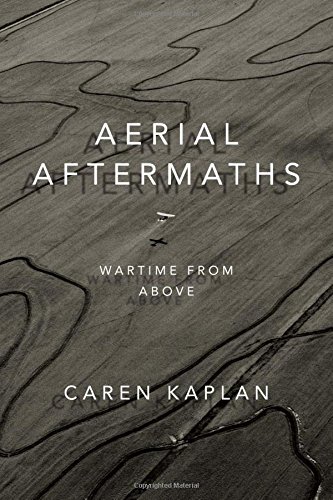
Caren Kaplan, Aerial aftermaths: wartime from above (Duke, January 2018):

From the first vistas provided by flight in balloons in the eighteenth century to the most recent sensing operations performed by military drones, the history of aerial imagery has marked the transformation of how people perceived their world, better understood their past, and imagined their future. In Aerial Aftermaths Caren Kaplan traces this cultural history, showing how aerial views operate as a form of world-making tied to the times and places of war. Kaplan’s investigation of the aerial arts of war—painting, photography, and digital imaging—range from England’s surveys of Scotland following the defeat of the 1746 Jacobite rebellion and early twentieth-century photographic mapping of Iraq to images taken in the immediate aftermath of 9/11. Throughout, Kaplan foregrounds aerial imagery’s importance to modern visual culture and its ability to enforce colonial power, demonstrating both the destructive force and the potential for political connection that come with viewing from above.

Contents:

Introduction. Aerial Aftermaths
1. Surveying Wartime Aftermaths: The First Military Survey of Scotland
2. Balloon Geography: The Emotion of Motion in Aerostatic Wartime
3. La Nature à Coup d’Oeil: “Seeing All” in Early Panoramas
4. Mapping “Mesopotamia”: Aerial Photography in Early Twentieth-Century Iraq
5. The Politics of the Sensible: Aerial Photography’s Wartme Aftermaths
Afterword. Sensing Distance

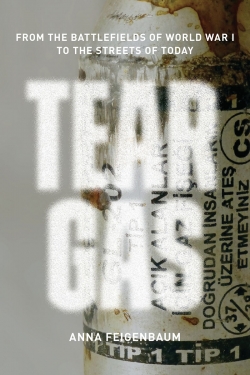
Anna Feigenbaum, Tear Gas: from the battlefields of World War I to the streets of today (Verso, November 2017):

One hundred years ago, French troops fired tear gas grenades into German trenches. Designed to force people out from behind barricades and trenches, tear gas causes burning of the eyes and skin, tearing, and gagging. Chemical weapons are now banned from war zones. But today, tear gas has become the most commonly used form of “less-lethal” police force. In 2011, the year that protests exploded from the Arab Spring to Occupy Wall Street, tear gas sales tripled. Most tear gas is produced in the United States, and many images of protestors in Tahrir Square showed tear gas canisters with “Made in USA” printed on them, while Britain continues to sell tear gas to countries on its own human rights blacklist.

An engrossing century-spanning narrative, Tear Gas is the first history of this weapon, and takes us from military labs and chemical weapons expos to union assemblies and protest camps, drawing on declassified reports and witness testimonies to show how policing with poison came to be.

I’ve trailed this before, but now it’s out; there’s an engaging and detailed review by Peter Mitchell at Review 31 here.

Victor Davis Hanson, The Second World Wars: how the first global conflict was fought and won (Basic Books, October 2017):

World War II was the most lethal conflict in human history. Never before had a war been fought on so many diverse landscapes and in so many different ways, from rocket attacks in London to jungle fighting in Burma to armor strikes in Libya.

The Second World Wars examines how combat unfolded in the air, at sea, and on land to show how distinct conflicts among disparate combatants coalesced into one interconnected global war. Drawing on 3,000 years of military history, Victor Davis Hanson argues that despite its novel industrial barbarity, neither the war’s origins nor its geography were unusual. Nor was its ultimate outcome surprising. The Axis powers were well prepared to win limited border conflicts, but once they blundered into global war, they had no hope of victory.

An authoritative new history of astonishing breadth, The Second World Wars offers a stunning reinterpretation of history’s deadliest conflict.

I was alerted to this by Joshua Rothman‘s thoughtful review in the New Yorker just before Christmas.

Tim Lenoir and Luke Caldwell, The Military-Entertainment Complex (Harvard, February 2018)

With the rise of drones and computer-controlled weapons, the line between war and video games continues to blur. In this book, the authors trace how the realities of war are deeply inflected by their representation in popular entertainment. War games and other media, in turn, feature an increasing number of weapons, tactics, and threat scenarios from the War on Terror.

While past analyses have emphasized top-down circulation of pro-military ideologies through government public relations efforts and a cooperative media industry, The Military-Entertainment Complex argues for a nonlinear relationship, defined largely by market and institutional pressures. Tim Lenoir and Luke Caldwell explore the history of the early days of the video game industry, when personnel and expertise flowed from military contractors to game companies; to a middle period when the military drew on the booming game industry to train troops; to a present in which media corporations and the military influence one another cyclically to predict the future of warfare.

In addition to obvious military-entertainment titles like America’s Army, Lenoir and Caldwell investigate the rise of best-selling franchise games such as Call of Duty, Battlefield, Medal of Honor, and Ghost Recon. The narratives and aesthetics of these video games permeate other media, including films and television programs. This commodification and marketing of the future of combat has shaped the public’s imagination of war in the post-9/11 era and naturalized the U.S. Pentagon’s vision of a new way of war.

Contents:

Induction: The Military–Entertainment Complex and the Contemporary War Imaginary

1. From Battlezone to America’s Army: The Defense Department and the Game Industry

2. Creating Repeat Consumers: Epic Realism and the Birth of the Wargame FranchiseWindows

2.1. The Ludic Affordances of Special Forces

2.2. Franchise Game Business Models

2.3. The RMA in Contemporary Wargaming

3. Coming to a Screen Near You: The RMA and Affective Entertainment

4. Press X to Hack: Cyberwar and VideogamesWindows

4.1. The Narrative Affordances of Hackers and Cyberwarfare

Discharge: Counter-Wargaming in Spec Ops: The Line

This is part of what James Der Derian famously called the Military-Industry-Media-Entertainment complex (MIME), and what I’ve called the Military-Academic-Industrial-Media complex (MAIM). Here is Colin Milburn on the book:

Locked and loaded, this astonishing account of the ‘military-entertainment complex’ exposes the links between military technologies and popular media, the alignments and affinities among defense agencies, video game companies, and Hollywood studios. With tactical precision, Tim Lenoir and Luke Caldwell show how the militarization of contemporary society is driven less by political interests than by economic interests, revealing the ways in which the entertainment industry and its commercial practices shape the imagination of postmodern warfare. This is a provocative, high-octane book about the war games of everyday life and the future of digital culture. Epic pwn.

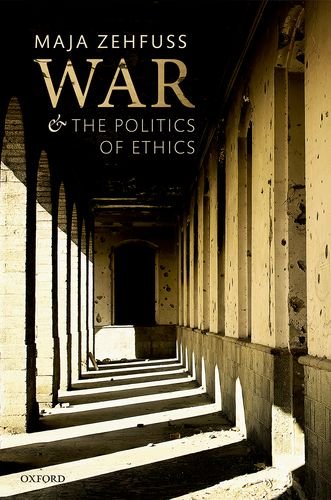
Maja Zehfuss, War and the politics of ethics (Oxford, March 2018):

Contemporary Western war is represented as enacting the West’s ability and responsibility to help make the world a better place for others, in particular to protect them from oppression and serious human rights abuses. That is, war has become permissible again, indeed even required, as ethical war. At the same time, however, Western war kills and destroys. This creates a paradox: Western war risks killing those it proposes to protect.

This book examines how we have responded to this dilemma and challenges the vision of ethical war itself, exploring how the commitment to ethics shapes the practice of war and indeed how practices come, in turn, to shape what is considered ethical in war. The book closely examines particular practices of warfare, such as targeting, the use of cultural knowledge, and ethics training for soldiers. What emerges is that instead of constraining violence, the commitment to ethics enables and enhances it. The book argues that the production of ethical war relies on an impossible but obscured separation between ethics and politics, that is, the problematic politics of ethics, and reflects on the need to make decisions at the limit of ethics.

Contents:

1: Introduction
2: The Paradox of Ethical War and the Politics of Ethics
3: Targeting: Precision Bombing and the Production of Ethics
4: Culture: Knowledge of the People as Technology of Ethics
5: Ethics Education: Ethics as Ethos and the Impossibly Good Soldier
6: The Politics of War at the Limits of Ethics

Laura Auslander and Tara Zahra (eds), Objects of War: the material culture of conflict and displacement (Cornell, May 2018)

Historians have become increasingly interested in material culture as both a category of analysis and as a teaching tool. And yet the profession tends to be suspicious of things; words are its stock-in-trade. What new insights can historians gain about the past by thinking about things? A central object (and consequence) of modern warfare is the radical destruction and transformation of the material world. And yet we know little about the role of material culture in the history of war and forced displacement: objects carried in flight; objects stolen on battlefields; objects expropriated, reappropriated, and remembered.

Objects of War illuminates the ways in which people have used things to grapple with the social, cultural, and psychological upheavals wrought by war and forced displacement. Chapters consider theft and pillaging as strategies of conquest; soldiers’ relationships with their weapons; and the use of clothing and domestic goods by prisoners of war, extermination camp inmates, freed people and refugees to make claims and to create a kind of normalcy.

While studies of migration and material culture have proliferated in recent years, as have histories of the Napoleonic, colonial, World Wars, and postcolonial wars, few have focused on the movement of people and things in times of war across two centuries. This focus, in combination with a broad temporal canvas, serves historians and others well as they seek to push beyond the written word.

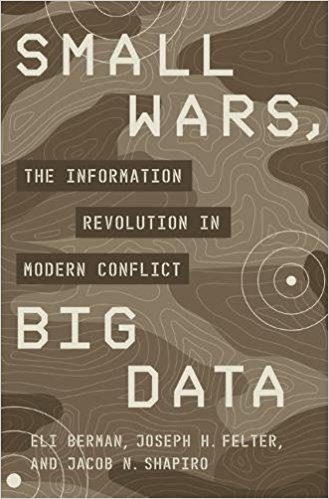
Eli Berman,‎ Joseph H. Felter andJacob N. ShapiroSmall Wars, Big Data: The Information Revolution in Modern Conflict (Princeton, June 2018):

The way wars are fought has changed starkly over the past sixty years. International military campaigns used to play out between large armies at central fronts. Today’s conflicts find major powers facing rebel insurgencies that deploy elusive methods, from improvised explosives to terrorist attacks. Small Wars, Big Data presents a transformative understanding of these contemporary confrontations and how they should be fought. The authors show that a revolution in the study of conflict–enabled by vast data, rich qualitative evidence, and modern methods―yields new insights into terrorism, civil wars, and foreign interventions. Modern warfare is not about struggles over territory but over people; civilians―and the information they might choose to provide―can turn the tide at critical junctures.

The authors draw practical lessons from the past two decades of conflict in locations ranging from Latin America and the Middle East to Central and Southeast Asia. Building an information-centric understanding of insurgencies, the authors examine the relationships between rebels, the government, and civilians. This approach serves as a springboard for exploring other aspects of modern conflict, including the suppression of rebel activity, the role of mobile communications networks, the links between aid and violence, and why conventional military methods might provide short-term success but undermine lasting peace. Ultimately the authors show how the stronger side can almost always win the villages, but why that does not guarantee winning the war.

Small Wars, Big Data provides groundbreaking perspectives for how small wars can be better strategized and favorably won to the benefit of the local population.


Peter Meusburger

My dear friend and colleague Peter Meusburger died early on Monday morning.

It was Peter who invited me to give the first Hettner Lecture in Heidelberg in 1997.  He met me at the airport in Frankfurt – a typically kind and thoughtful gesture – and we talked non-stop all the way down to Heidelberg, including a 90-minute wait while a crash on the Autobahn was cleared: we barely noticed the delay.  He had arranged a whirlwind programme, including a two-day seminar with graduate students from all over Germany, but with lots of time for informal walks and talks in the exquisite grounds of the Villa Bosch and elsewhere in the Neckar Valley.  At the end of my visit we were sitting with colleagues in the garden of one of Peter’s favourite inns in Handschuhsheim, when he asked me for my impressions.  He knew I’d never been to Germany before – I’d studied German in grammar school in the 1960s for three years, but my teacher had been a captain in the Tank Regiment during the war and when he shared photographs of German cities with us all you could see were piles of rubble (really)…  So I said I had been surprised by the lively informality of the whole event; I was still feeding on a diet of Jürgen Habermas, and it was this as much as anything that had prompted me to expect a much more abstract and, above all, I suppose hierarchical discussion.  Instead of which the whole week had been a series of wonderfully engaging conversations and debates.  As Peter pressed me for more, I recalled a remark of Heine – to the effect that when the world is falling apart, one should never worry because there would always be a German professor to put it back together again – another reference to Habermas’s architectonic schemes.  The more I elaborated my idiotically stereotypical view of German intellectual culture, the more Peter and his colleagues roared with laughter, until eventually even I realised I was missing something; wiping away his tears, Peter managed to say “We’re all Austrian…”

During the week I had come to know the old city of Heidelberg well, and every day I had passed an antiquarian bookshop.  At the very back of the shop I had found an English guidebook to Egypt, and every day I had debated with myself about buying it – at that time I was working on cultures of European and American travel to Egypt in the long nineteenth century from 1798 to 1914, a supplement to Edward Said‘s commentaries in Orientalism – and the issue was not so much getting the volume through Canada Customs as getting it past Angela’s scrutiny when I got home.  Eventually I had persuaded myself that I could afford both the price and the risk, but when I returned the book had gone.  I hadn’t mentioned it to anyone, but that evening in Handschuhsheim Peter handed me a gift to thank me for my visit.  When I unwrapped it, I found that Egyptian guidebook.

That story is typical of not only of Peter’s kindness but also his attentiveness to people.  I have no idea how long he had searched for the perfect gift, but – as always – he found it.  He was one of the most generous, humane and modest scholars I’ve ever known – always keenly interested in ideas and their implications, and ever concerned to promote the work of everyone but himself.

He invited me back to Heidelberg on multiple occasions – one of them to receive an honorary degree, which I treasure – and these subsequent visits were directly responsible for  provoking two of the biggest changes to my research in recent years: the work on bombing and more recently the work on the wounded body.

When Peter first invited me to take part in one of his “Knowledge and Space” symposia, I knew I had to do something new, and something special, for Peter: he was that kind of man.  The subject of the meeting was “Cultural Memories”, about which I protested I knew next to nothing.  But then, remembering those German cities reduced to piles of rubble, I recalled Heinrich Böll saying that when, in the immediate aftermath of the Second World War, he saw his ‘first undestroyed city’ he broke out into a cold sweat: it was Heidelberg.  This prompted me to turn to W.G. Sebald, to A Natural History of Destruction, and to produce what eventually became “Doors into nowhere: Dead cities and the natural history of destruction” as a first attempt to understand the genealogy and geography of aerial violence.

That little word ‘eventually’ in that last sentence is a leitmotif of my work, as Peter knew very well. Two years later he invited me to another symposium in the series, on “Knowledge and Power”.  This time my presentation returned to the Middle East, but to one peopled not with tourists and travellers but with soldiers and canons (as Said once put it).  By the time it came to produce an essay for the edited volume, though, I wanted to do something completely different.  Would that be OK? I asked Peter.  His reply was immediate and encouraging, even though he knew it would take me even longer than usual to submit the essay.  Again, the inspiration was literary: a quotation from William Boyd‘s An Ice-Cream War:

Gabriel thought maps should be banned. They gave the world an order and reasonableness it didn’t possess.

This prompted me to return to the skies, but this time to the reconnaissance missions flown over the Western Front to produce the aerial photographs that were the basis for the trench maps of the First World War… and then to juxtapose this planar, bird’s eye view with the corporeal, glutinous slimescape through which troops on the ground struggled and died.  The result was “Gabriel’s Map: Cartography and corpography in modern war”, which set me off on what is a continuing exploration of bodies in conflict.

I’m certain that neither of these essays, let alone the projects they launched, would have happened had it not been for Peter.  He was always immensely supportive (not only in my research but in my responses to the serial inquisitions from his technical editor; that was no small thing – they prompted a besieged Steve Legg to flee to India on one occasion; I never had to do that, but it was a close call: in “Doors into nowhere” I had referred to urbicide, and noted its origins in the Bosnian conflict, only to be asked for a reference in the original Bosnian….).

For all of those seminars and symposia Peter gathered together an eclectic mix of scholars from all fields, most of them geographers but always with some inspired and inspiring additions from left field who often made the most creative contributions of all (my favourite, and I suspect Peter’s too, was Stefan Paul‘s ‘Telling the future: reflections on the status of divination in Ancient Near Easterm politics’, by turns achingly funny and stunningly serious, a tour de force of sustained scholarship and perfect performance).    Peter understood better than anyone that creative scholarship is also always irredeemably social: that it thrives on the trust that makes risk-taking possible, and on the good humour that enables genuine debate.  That too was one of his most precious gifts.

Peter’s love for Heidelberg, the University, his colleagues – and above all his family – shone through everything he did.  One of our last conversations was about his plans for “retirement” (which would always be in scare-quotes where Peter was concerned; not because he was scared of it at all, but because it obviously was never going to happen) and his plans for remodelling the family home in his beloved Austria.

One of the very good things about the academic life, even in these increasingly neo-liberal corporations in which we labour, is the capacity to make lasting friendships around the world.  Whenever I met Peter we resumed our last conversation; I can still hear his voice, see that twinkle in his eye, find myself grinning at that smile on his face.  I shall miss his generosity of spirit, his restless intellect – but above all his friendship.

Eyes in the sky – bodies on the ground

Several months ago I was invited to contribute a short essay to Critical Studies on Security, for an ‘Interventions’ section edited by Linda Roland Danil.  Here’s the brief:

Visual representations of war and violence: considering embodiment

The recent release of a number of critically acclaimed films that involve wars of the 20th century – such as Mel Gibson’s Hacksaw Ridge (2016), and more recently, Christopher Nolan’s Dunkirk (2017) – both of them World War II films – raise questions anew about the representation of war and violence. However, an insufficiently investigated field is the specific embodied experiences of those represented. What is the embodied or “corpographic” (Gregory, 2015) experience of those represented in the films/artistic works/photographs/documentaries/etc. – and therefore what are the specific embodied dimensions of war (McSorley, 2014) that are represented? How do these representations of the embodied dimensions of war preclude the possibility of conceiving of war in a de-realized, surgical, or “virtuous” (Der Derian, 2000) manner? Such embodied experiences may also include the aftermath of war and conflict, such as through the embodied experiences of post-traumatic stress disorder (PTSD). How does an understanding of the embodied experiences of soldiers (as well as the enemy Other) feed into an understanding of the larger geopolitical dynamics at play (Basham, 2013), if at all? This call is seeking Interventions that explore specific visual representations of war and violence in relation to the above and related questions…’

I’ve written about Dunkirk earlier – and I wish I’d said more about the extraordinary, keening sound-track – so in this short essay I returned to the classic US air strike in Afghanistan in February 2010 – see here and here  – and elaborated on the visual rendering of its aftermath by the US military (see here) and in Sonia Kennebeck‘s marvellous National Bird.

You can find the result under the DOWNLOADS tab: the title is ‘Eyes in the sky – bodies on the ground’ but the pdf is simply ‘Bodies on the ground’.

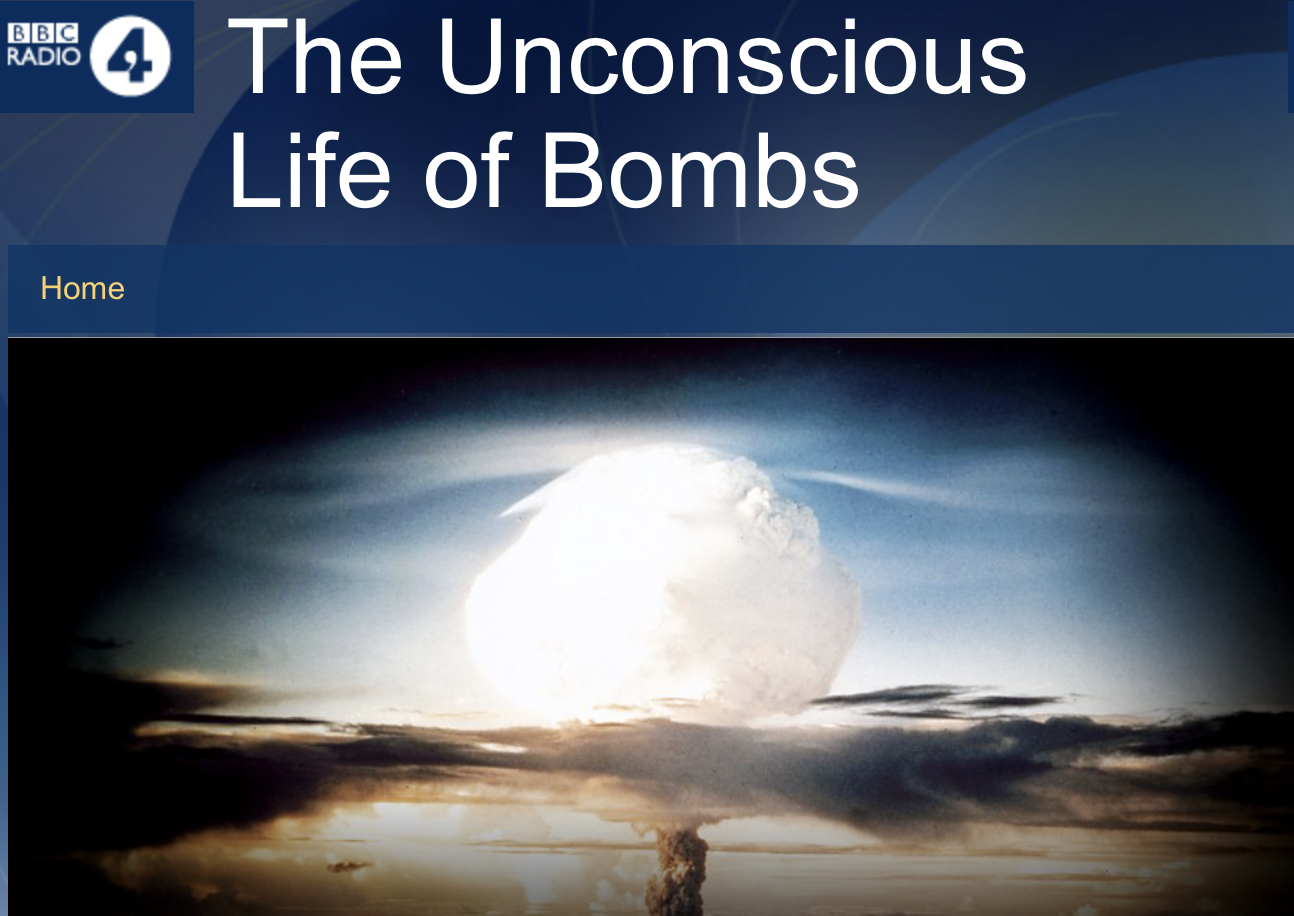
The Unconscious Life of Bombs

Last month I did a long interview with Daniel Pick for a BBC Radio 4 documentary, The Unconscious Life of Bombs.  It’s now been broadcast, and you can listen to the whole thing here.

Historian and psychoanalyst Daniel Pick of Birkbeck College, University of London tells the story of how aerial bombardment – from Zeppelins to B52s, from H-Bombs to drones – has made the unconscious mind a field of battle.

Daniel explores how, in the shadow of the First World War, Freud turned his analytical eye from desire to the ‘death drive’, and how psychoanalysts probed what might happen if another war came.

Would survivors of mass aerial bombardment hold up psychically, or would they collapse into infantile panic? Or would they become uncontrollably aggressive?

And why do humans come to be so aggressive in the first place?

When the war – and the bombers – did come to Britain, it appeared that survivors were much more stoical and defiant than had been expected.

But, as Daniel discovers, brave faces concealed a great deal of psychological damage.

With historian Lyndsey Stonebridge, he visits the Wellcome Library to see – courtesy of the Melanie Klein Trust – the case notes of the psychoanalyst Melanie Klein on her analysis of a troubled ten year old boy, ‘Richard’.

What do Klein’s notes, and Richard’s extraordinary drawings, reveal about his attitude to being bombed?

Daniel examines how, with the advent of the Cold War and the distinct possibility that bombs and missiles could destroy civilisation, technocrats trying to plan for the end of the world coped with staring into the abyss.

Finally, Daniel shows how a radical new turn in aerial bombardment opens up this field anew. Nuclear weapons can destroy the planet; but what does it do to the mind to live under the threat of ‘surgical’ attack by unmanned drones?

With: Derek Gregory, Peter Hennessy, Dagmar Herzog, Richard Overy, Lyndsey Stonebridge

Ground Truth

I’m just back from an invigorating conference on ‘The Intimacies of Remote Warfare’ at Utrecht – more on this shortly – and it was a wonderful opportunity to meet old friends and make new ones.  Chris Woods gave an outstanding review of air strikes in Iraq and Syria, and told me of an interview Airwars had conducted with Azmat Khan and Anand Gopal whose forensic investigation of civilian casualties in Iraq I discussed in a previous post.  The US-led Coalition has still not responded to their findings, even though they initially afforded a remarkable degree of co-operation.

The full interview really is worth reading, but here is Azmat explaining how their joint investigation started:

We began planning this in February 2016. By April I was on the ground [In Iraq] and I was embedding with local forces, both Shia militias and then with Peshmerga forces, in certain frontline towns. I remember early on seeing how pivotal these airstrikes were in terms of re-taking cities.

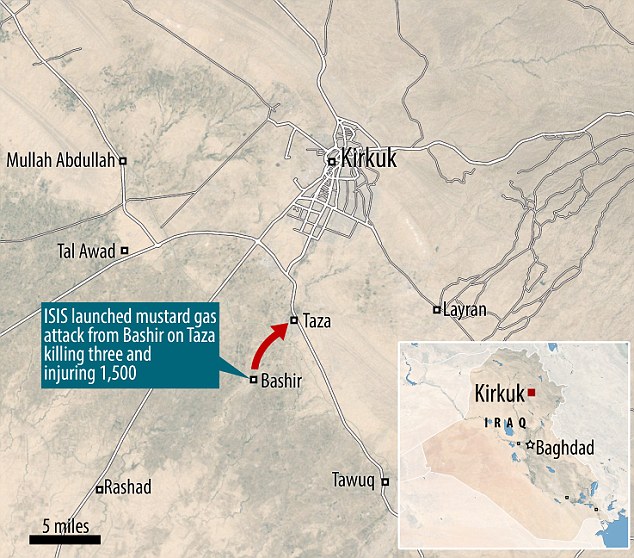
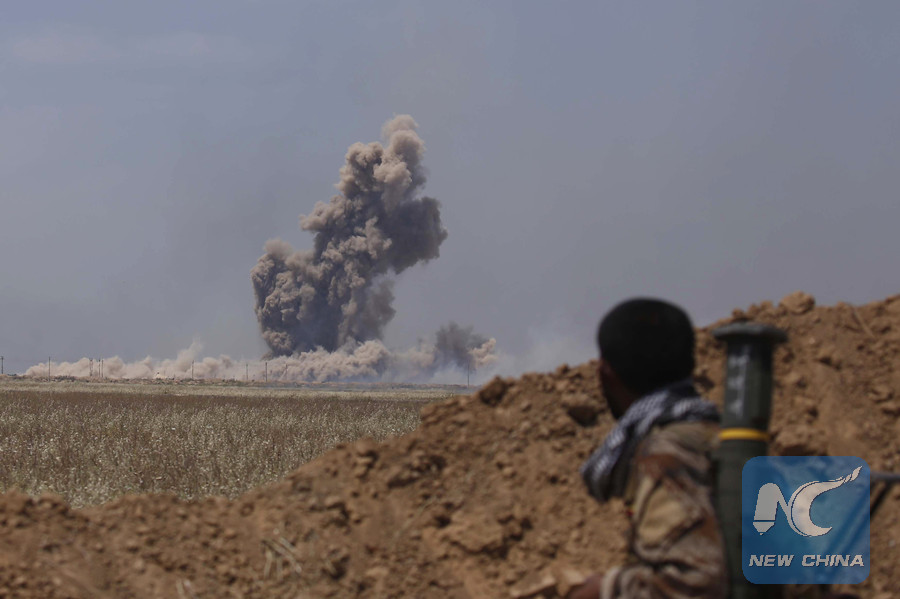
There was one town that was really important to Shias, and so dozens of Shia militias had tried to retake it — Bashir — from where ISIS had launched mortars with chemical agents into a neighboring town, Taza. I watched several Shia militias based in Taza try and fail to retake Bashir, putting in all of their troops. Then the peshmerga agreed to try and retake it, and they put in maybe a fraction of the number of troops, but were supported by Coalition airstrikes in a way the militias weren’t, and Bashir fell within hours.

It really showed me the extent to which these airstrikes played a pivotal role in re-taking territory, but also the level of devastation. Many parts of Bashir were just up in smoke, when I visited the day after it was re-taken.

Unless you were on the ground, you couldn’t get a real sense of that scale. There’d been good accounts looking at civilian casualties — but nobody had looked at both those that successfully hit ISIS targets and those that didn’t, so a systematic sample. That’s what we teamed up to do. As more cities were being retaken, we though there’s an opportunity to do this….

In terms of verifying allegations, our work went far beyond interviews and analyzing satellite imagery. In addition to interviewing hundreds of witnesses, we dug through rubble for bomb fragments, or materials that might suggest ISIS use, like artillery vests, ISIS literature, sometimes their bones, because nobody would bury them.

We also got our hands on more than 100 sets of coordinates for suspected ISIS sites passed on by local informants. Sometimes we were able to get photos and videos as well. And ultimately, we verified each civilian casualty allegation with health officials, security forces, or local administrators.

The interview also revisits the attack on the Rezzo family home, a pivot of their NYT essay, which includes even more disturbing details.  As Azmat and Anand explain, this was a strike which ought to have shown Coalition targeting at its most adept; far from it.

Khan: This is a deliberate airstrike, not a dynamic one. It was an “ISIS headquarters,” which we were told, when I was at the CAOC (Combined Air Operations Center), a very senior intelligence officer told me that a target with one of the highest thresholds to meet is usually an ISIS headquarters… In so many ways Basim’s case was the ultimate, highest most deliberative process.

Airwars: When you say the best case scenario, you mean the best case on the Coalition side in terms of what intelligence they could have, and they still screwed up in such a fundamental way?

Gopal: if there was ever a strike they could get right, this would be the one. They have weeks to plan it, they have it as an ISIS headquarters. And so you know, if it’s an ISIS headquarters, the threshold for actionable intelligence has to be much higher. It can’t just be drone footage that doesn’t see women and children.

Airwars: They identified it as a headquarters and what was the genesis of that? In the story you talk about – it’s infuriating to read – that they didn’t see women and children.

Khan: One of the things I asked at the CAOC in Qatar was how do you identify local patterns of behavior. For example, I said, under ISIS a lot of women are not leaving their homes. So when you are looking at these pattern of life videos, are you taking these variable local dynamics into account? How do you distinguish for example when you are bombing in Iraq and one of these areas, how do you distinguish between patterns of behavior that are specific to Iraq vs. bombing in Afghanistan. What are the differences?

I was told that they could not get into a great deal of detail about ISIS’ “TTPs” — tactics, techniques, and procedures — their understanding of how ISIS generally operates.  They told me that these are developed through the intelligence community, in coordination with a cultural expert, but that they could not offer more detail about it.

Gopal: At the end of the day, it appears there are no consequences for getting it wrong, so there are no incentives to try to get it right.

Drones through Post-Atomic Eyes

A post-script to my last post: the (very!) long-form version of “Little Boys and Blue Skies: Drones through Post-Atomic Eyes” is now available under the DOWNLOADS tab.  The sections are:

  1. Escape from Hiroshima
  2. Atomic clouds and drones
  3. Atomic bombs and drones
  4. American Hiroshimas
  5. Predator and prey
  6. Manhattan Projects 1.0 and 2.0
  7. Visual economies
  8. Little boys and blue skies

This is a draft, so if you have any comments or suggestions I’d be pleased to have them.

Nuclear narcissism

As Donald Trump‘s grotesque unfitness for office becomes ever clearer – though to most of us it was as plain as a pikestaff long before the election – a central vector of concern has been his proximity to the nuclear codes.  For background, I recommend Adam Shatz‘s essay in the LRB, ‘The President and the Bomb‘:

What’s really terrifying about Trump’s control of the bomb is that it’s no aberration: in fact, it’s utterly normal. Democratic politicians – presidents, and would-be presidents – have spoken with no less gusto of their willingness to ‘keep all options on the table’. When Obama said that he wouldn’t consider using nuclear weapons against Pakistan at a presidential debate in 2008, Hillary Clinton scolded him: ‘I don’t believe any president should make blanket statements with regard to use or non-use.’ The right to annihilate one’s enemies (or frenemies, as in the case of Pakistan) is a right no American leader can afford to relinquish, for fear that he or she would be accused of being a pushover, an appeaser – a pussy. (A president can only grab a pussy: he can’t be one.) When Obama tried to discuss a no-first-use declaration, his cabinet quickly dissuaded him. Although he achieved the nuclear agreement with Iran, averting a potential war, and expressed symbolic atonement on his visit to Hiroshima, he also oversaw a programme of nuclear modernisation, with a commitment to a trillion dollars in extra spending over thirty years, increasing America’s ability to crush its opponents in a first strike. Trump has happily inherited that programme, without, of course, crediting his predecessor.

Against this wretched backdrop, it’s worth revisiting America’s history of nuclear narcissism.

I first discussed this in my presentation of ‘Little Boys and Blue Skies‘ at a wonderful symposium ‘Through Post-Atomic Eyes‘ [see here, here, here and here], and I’ve now revisited it for the long-form version (which you can at last find under the DOWNLOADS tab).  Here is part of that new essay (‘Little Boys and Blue Skies: Drones through post-atomic eyes‘):

On 19 November 1945, barely 100 days after Hiroshima, Life published an illustrated essay entitled ‘The 36-Hour War’, which was informed by a report from General Henry ‘Hap’ Arnold as commander of the US Army Air Force to the Secretary of War. Although the opening paragraphs predicted that in the future ‘hostilities would begin with the explosion of atomic bombs on cities like London, Paris, Moscow or Washington’ – Arnold’s report had warned that ‘the danger zone of modern war is not restricted to battle lines’ and that ‘no one is immune from the ravages of war’ [1] – the global allusion of the text was dwarfed by Alexander Leydenfrost’s striking illustration of ‘a shower of white-hot rockets’ falling on Washington DC.

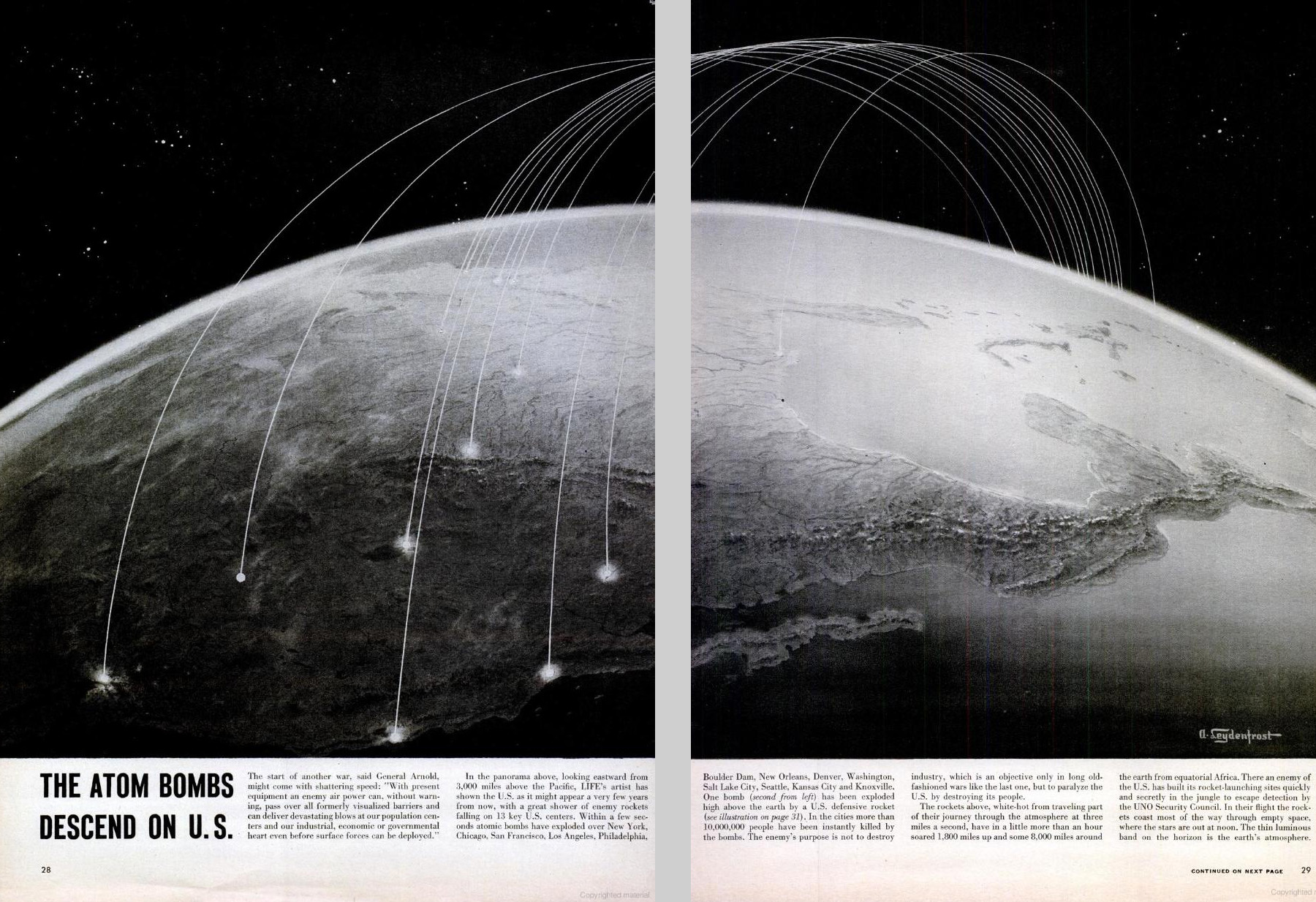
In case any reader should doubt the location of what the strapline called ‘the catastrophe of the next great conflict’, the next image sprawled across two pages and presented a vast panorama looking east across the United States from 3,000 miles above the Pacific: ‘Within a few seconds atomic bombs have exploded over New York, Chicago, San Francisco, Los Angeles, Philadelphia, Boulder Dam, New Orleans, Denver, Washington, Salt Lake City, Seattle, Kansas and Knoxville (sic)’ killing 10,000,000 people.
Arnold’s report had suggested that there were ‘insurmountable difficulties in an active defense against future atomic projectiles.’ Now Life warned that ‘low-flying robot planes’ were even more dangerous because they would be more difficult to detect by radar – and ‘radar would be no proof at all against time bombs of atomic explosive which enemy agents might assemble in the U.S’ – so that defence was more or less impossible. A counterattack could be launched (against an enemy who remained unidentified throughout the essay), but nuclear strikes would surely be followed by invasion. By then, the US would have suffered ‘terrifying damage’: ‘All cities of more than 50,000 have been levelled’ and New York’s Fifth Avenue reduced to a ‘lane through the debris.’
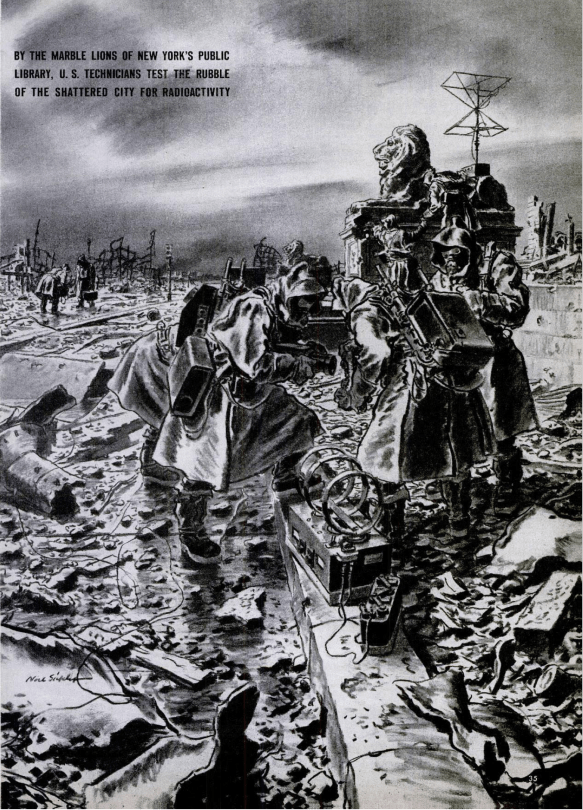
That final image was unique; it was the only one to envision a nuclear attack from the ground. Perhaps that was unsurprising; the power of the image – ‘the nuclear sublime’ – was one of the central objectives of the attacks on Hiroshima and Nagasaki. ‘The weapon’s devastating power had to be seen to be believed,’ Kyo Maclear observed, in Moscow as well as in Tokyo.  And above all, literally so, it was designed to be seen from the air. During the seven years of the US occupation of Japan the effects on the people who lived and died in the irradiated rubble were subject to strict censorship. Still photographs could not be published – professionals and amateurs were ordered to burn their films and prints (fortunately some refused and hid them instead) – while Japanese media and even US military film crews had their documentary footage embargoed. In their place were endless images of the vast cloud towering into the sky. In fact Life had published a series of aerial views of the ‘obliteration’ of Hiroshima and the ‘disembowelling’ of Nagasaki just three months before its speculations on the 36-hour war. All those high-altitude views, and the maps that accompanied them, planed away the field of bodies: all that could be seen, deliberately so, were levelled spaces and superimposed concentric circles. In the studied absence of a visual record it was left to the imagination of writers to convey the effect of the bombs on human beings. And yet, as often as not, it was the bodies of Americans that filled the frame.

Philip Morrison’s remarkable essay for the Federation of American Scientists was at once the best informed and the most exemplary. Morrison was a former student of Oppenheimer who had worked with him on the Manhattan Project, and in July 1945 he was sent to the Mariana Islands as part of the team charged with assembling Little Boy. One month later he was on the ground in Hiroshima with the US Army mission to investigate the effects of the bomb. Their report was submitted in June 1946, but Morrison’s personal essay had appeared three months earlier and had already acknowledged the impossibility of conveying the enormity of the scene in dry and distanced scientific prose. It also proposed a solution.

‘Even from pictures of the damage realization is abstract and remote. A clearer and truer understanding can be gained from thinking of the bomb as falling on a city, among buildings and people, which Americans know well. The diversity of awful experience which I saw at Hiroshima … I shall project on to an American target.’

Warning that in any future war there would be twenty such targets – and not one bomb but ‘hundreds, even thousands’ – Morrison, as befitted someone who served with the US Army’s Manhattan Engineer District (the Manhattan Project), selected Manhattan.

‘The device detonated about half a mile in the air, just above the corner of Third Avenue and East 20th Street, near Grammercy Park. Evidently there had been no special target chosen, just Manhattan and its people. The flash startled every New Yorker out of doors from Coney Island to Van Cortland Park, and in the minute it took the sound to travel over the whole great city, millions understood dimly what had happened.’

After an endless chamber of horrors – bodies of old men ‘charred black on the side towards the bomb’, men with clothing in flames, women with ‘red and blackened burns’, and ‘dead children caught while hurrying home’; toppled brownstones, roads choked with rubble – he concluded that at least 300,000 people would have died: 200,000 ‘burned and cremated’ by volunteers, and the rest ‘still in the ruins, or burned to vapour and ash.

Hard on the heels of the Army in Hiroshima was the US Strategic Bombing Survey, whose findings were rendered in the same, impersonal voice that Morrison found wanting.   But in the concluding section of its report, the authors confessed that investigators had been bothered by the same troubling question as Morrison: ‘What if the target for the bomb had been an American city?’ They provided rough and ready answers, which they accepted had ‘a different sort of validity’ from the measurable data used in the preceding sections, but they insisted that their speculative calculations were ‘not the least important part of this report’ and that they were offered ‘with no less conviction.’ Acknowledging substantial differences between Japanese and American cities, the report none the less concluded that most buildings in American cities would not withstand an atomic bomb bursting a mile or a mile and a half from them, and that the vertical densities of high-rise buildings would produce large numbers of dead, injured and desperately sick people: ‘The casualty rates at Hiroshima and Nagasaki, applied to the massed inhabitants of Manhattan, Brooklyn, and the Bronx, yield a grim conclusion.

The most vivid, visceral contrast to the dry recitations of the official reports appeared on 31 August 1946, when the New Yorker devoted an entire issue to John Hersey’s epic essay on Hiroshima. It was based on interviews he had conducted with more than 40 survivors over three weeks in April. Written when he returned to New York, beyond the scrutiny of military censors, Hersey focused on six people whose stories he told in spare, unadorned prose (he later said he chose to be ‘deliberately quiet’ so that ‘the horror could be presented as directly as possible’). The essay was cinematic in its execution, cutting from individual to individual across the shattered city, and excruciating in its painstaking detail. Their splintered accounts combined a methodical matter-of-factness – the numbing one-thing-after-another of their acts of survival – with the almost unspeakable horror of what lay beyond: ‘Under many houses, people screamed for help, but no one helped; in general, survivors that day assisted only their relatives or immediate neighbors, for they could not comprehend or tolerate a wider circle of misery.’ Two of Hersey’s respondents were doctors, which enabled him to pan out across that vast sea of casualties (‘Wounded people supported maimed people; disfigured families leaned together’) and then bring the focus back to individuals: ‘Tugged here and there in his stockinged feet, bewildered by the numbers, staggered by so much raw flesh, Dr. Sasaki lost all sense of profession and stopped working as a skillful surgeon and a sympathetic man; he became an automaton, mechanically wiping, daubing, winding, wiping, daubing, winding.’ Hersey’s narrative moved carefully through the weeks after the blast until the results of radiation sickness began to take their toll and even the signs of a precarious normality became sinister: ‘a blanket of fresh, vivid, lush, optimistic green’ as wild flowers bloomed ‘among the city’s bones.

Surely this awful litany would turn the American public’s post-atomic eyes to Japan? In fact the extraordinary success of Hersey’s essay – the print run of 300,000 sold out, ‘Hiroshima’ was reprinted in many newspapers, broadcast on the radio in nightly instalments, and when it appeared in book form it became an immediate bestseller – served not only to dispel the claims of those who had sought to minimise the horrors of Hiroshima and Nagasaki; it also redoubled the fears of an attack on the continental United States. In consequence, it was not only the New Yorker but also New York that dominated the American atomic imaginary in the late 1940s and 50s. Even the first mass-market edition of Hiroshima confirmed that the preoccupation with American lives had not sensibly diminished. Hersey later said he had wanted his readers ‘to identify with the characters in a direct way’ – ‘to become the characters enough to suffer some of the pain’ – but the artist responsible for the cover of the paperback, Geoffrey Biggs, took that literally. His image showed what he described as ‘two perfectly ordinary people’ in ‘a city like yours or mine’: who happened to be Americans in an American city:

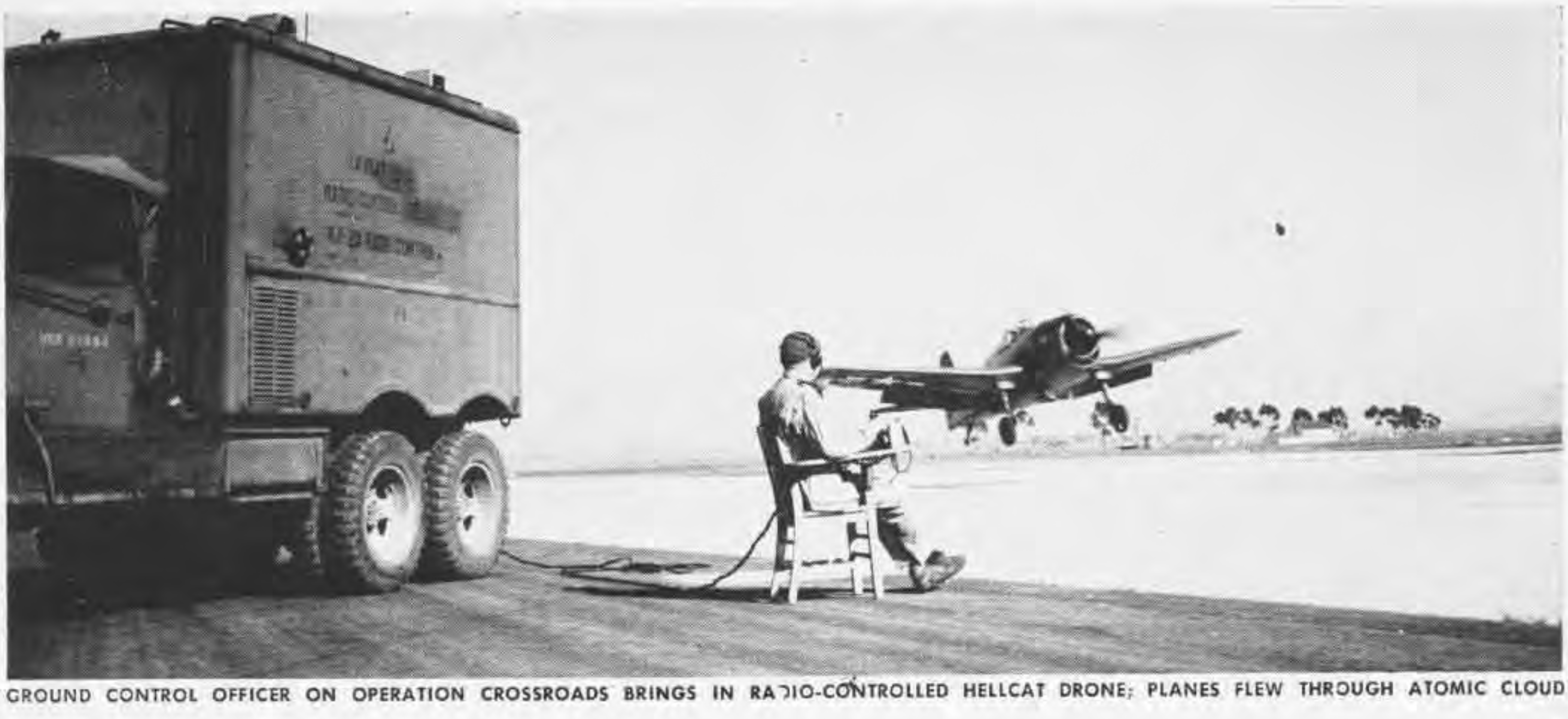
The publication of ‘Hiroshima’ was preceded by the two tests at Bikini Atoll, and in 1947 the official report on Operation Crossroads illustrated the vastly more spectacular effects of the second (Baker) shot by superimposing its towering cloud over Manhattan:

Perhaps the most iconic series of images of a post-atomic New York was painted by Chesley Bonestell and Birney Lettick. They accompanied John Lear’s contribution to Collier’s in August 1950, whose title seemed to evoke Hersey’s essay only to transpose it: ‘Hiroshima USA’. A prefatory note from the editor William Davenport insisted that nothing in the report was fantasy. While ‘the opening account of an A-bombing of Manhattan may seem highly imaginative,’ he wrote, ‘little of it is invention.’
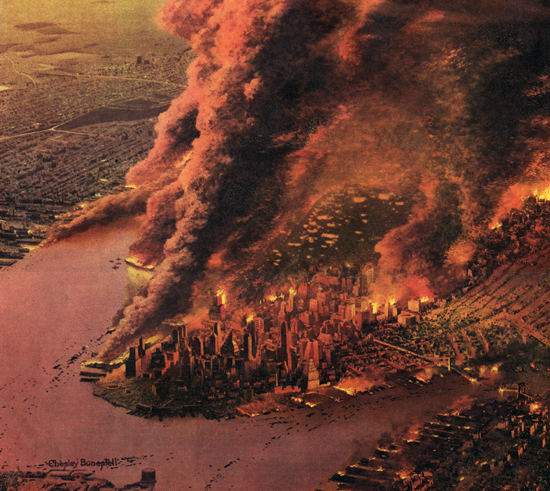
It was based on the two US military surveys of Hiroshima, interviews with officials at the Atomic Energy Commission and the Pentagon, and advice from physicists, engineers, doctors and other experts. The description that followed was apocalyptic:

‘Aerial reconnaissance was impractical immediately after the blast because of the cloud of black grime that masked the lower city. Even after that cleared, it was only possible for the police helicopter squad to get a numb impression of the devastation. Streets could not be seen plainly. Many were blotted out entirely. In an area roughly 15 blocks long and 20 blocks across – from Canal Street north to Tenth and from Avenue B to Sullivan Street – there was now an ugly brown-red scar. A monstrous scab defiling the earth…

‘Rising gradually outward from this utter ruin … was all that was left of Manhattan between Thirty-Eighth Street and Battery Park.’

As this passage implies, however, Lear’s vantage point was far from Hersey’s, who had described ‘four square miles of reddish-brown scar, where everything had been buffeted down and burned’ but who was clearly more invested in the suppurating wounds and scarred flesh of the survivors. Consistent with the official sources from which Lear drew, his emphasis was instead on the geometries of destruction: only here and there did the bodies of ‘the burned, the crushed and the broken’ flicker into view. Still, the sting was in the tail. ‘Fortunately for all of us,’ Lear concluded fifty pages after his editor’s admonitory note, ‘the report you have just read is fiction.’ But ‘if it ever does happen, the frightfulness will almost certainly be more apocalyptic than anything described in these pages.’

‘For this documentary account is a conservative application to Manhattan Island of the minimum known consequences of explosion of one of the 1945 model A-bombs. And the Russians, if they once decide to attack us, surely will drop two or three or four of the 1950 models, each of which would ruin almost twice the area here circumscribed… In fact, one of the primary assumptions of current military planning for defense of the United States is that an enemy’s first move will be to try to disable not only New York but the entire Atlantic seaboard…’

Similar scenarios were regularly offered for other cities, including Chicago in 1950, Washington in 1953, Houston in 1955 and Los Angeles in 1961, and all of them dramatized their accounts through photomontages, maps and artwork.

Significantly, the burden of these accounts was on the effects of blast, burn and destruction. Hersey’s descriptions of radiation sickness in Hiroshima were not mirrored in the United States, where the government consistently minimized its dangers. For the benefit of the Joint Committee on Atomic Energy in February 1953 the Atomic Energy Commission superimposed the blast radius from the first hydrogen bomb detonated in the Marshall Islands the previous November (‘Ivy Mike’) over a map of Washington DC, and the conceit provoked laugher from members of Congress because the ‘zero point’ was centred on the White House not the Capitol.  The high-yield thermonuclear blast of Castle Bravo on 1 March 1954 was of a different order, and its fallout contaminated thousands of square miles. To illustrate its extent the AEC superimposed the plume over the eastern seaboard of the United States. Had this bomb been detonated over Washington, then Philadelphia, Baltimore and New York would have become uninhabitable.

President Eisenhower insisted on the map remaining classified, and when the New York Times splashed across its front page ‘The H-Bomb can wipe out any city’ its map was centred on New York and emphasised physical damage and destruction:

I rehearse all this because in her reflections on ‘the age of the world target’ Rey Chow writes of ‘the self-referential function of virtual worlding that was unleashed by the dropping of the atomic bombs, with the United States always occupying the position of the bomber, and other cultures always viewed as the … target fields.’  Yet, as I have shown, a common – perhaps even the most common – American response to Hiroshima and Nagasaki in the years immediately after the war was precisely the opposite. To be sure, the preoccupation with American cities as targets was spectacularly self-referential. Peter Galison was not sure whether ‘the bombsight eye had already begun to look back’ before Hiroshima, but he had no doubt that analysts working in the atomic rubble started ‘to see America through the bombardier’s eye.’ In a further twist to the examples I have cited, he shows how this scopic regime was refracted so that US defence planning in the 1950s included a national programme of ‘self-targeting’ in which cities were required to transform large-scale maps of their communities into target zones for nuclear bombs: what Galison called a ‘new, bizarre yet pervasive form of Lacanian mirroring.’

[1] Third Report of the Commanding General of the Army Air Force to the Secretary of War (12 November 1945), p. 59

[2] ‘The 36-Hour War: Arnold report hints at the catastrophe of the next great conflict’, Life, 19 November 1945, pp. 27-35; see also Alex Wellerstein, ‘The 36-Hour War’, Restricted Data, at http://blog.nuclearsecrecy.com/2013/04/05/the-36-hour-war-life-magazine-1945, 5 April 2013.

[3] Kyo Maclear, Beclouded visions: Hiroshima-Nagasaki and the art of witness (New York: SUNY Press, 1998); Barbara Marcon, ‘Hiroshima and Nagasaki in the eye of the camera’, Third Text 25 (6) (2011) 787-97.

[4] ‘War’s ending’, Life, 20 August 1945, pp. 25-31. In an accompanying editorial on ‘The Atomic Age’, the unease of the magazine about the effects of the twin bombings haunted its uncertain prose. ‘Every step in [the] bomber’s progress has been more cruel than the last,’ the editors wrote. ‘From the very concept of strategic bombing, all the developments – night, pattern, saturation, area, indiscriminate – have led straight to Hiroshima, and Hiroshima was and was intended to be almost pure Schrecklichkeit [terror].’ The use of the German was deliberate; noting that the Hague ‘rules of war’ had been persistently violated during the war by both sides, the editorial insisted that ‘Americans, no less than Germans, have emerged from the tunnel with radically different standards and practices of permissible behaviour toward others’ (p. 32).

[5] It was this artfully staged geometry of destruction that enabled some apologists to treat Hiroshima and Nagasaki as no different from other Japanese cities that had been subject to US firebombing, and to erase the suffering of the victims of both air campaigns from the field of view.

[6] Philip Morrison, ‘If the bomb gets out of hand’, in One world or none (Federation of American Scientists, 1946) pp. 1-15; cf. The Atomic Bombings of Hiroshima and Nagasaki, Manhattan Engineer District, US Army, 29 June 1946, at http://www.atomicarchive.com/Docs/MED/index.shtml.

[7] ‘That the Survey had seldom, if ever, felt compelled to ask such a question as it pored over the ruins of Germany spoke to the sheer psychic effect of the magnitude of the new weapon’: Tom Vanderbilt, Survival City: Adventures among the ruins of Atomic America (Princeton: Princeton Architectural Press, 2002) p. 74.

[8] The effects of the atomic bombings of Hiroshima and Nagasaki (US Strategic Bombing Survey, submitted 19 June 1946; published version 30 June 1946) pp. 39-41. The published version included a selection of photographs, virtually all of them aerial views, and the only photograph showing a victim was of a Japanese soldier with superficial burns: bodies were rendered as biomedical objects. Although most of the images obtained by the Survey remained classified, many of them are now available in David Monteyne, Adam Harrison Levy and John Dower (eds) Hiroshima Ground Zero 1945 (Göttingen: Steidl, 2011).

[9] John Hersey, ‘Hiroshima’, New Yorker, 31 August 1946. Hersey later explained that he wanted ‘to write about what happened not to buildings but to bodies’ and ‘cast about for a form to do that’; he found it on the marchlands between T.S. Eliot’s The Wasteland and Thornton Wilder’s The Bridge of San Luis Rey (which he read onboard ship on his way to Japan). See John Hersey, ‘The Art of Fiction No 92’ (interview with Jonathan Dee), The Paris Review 100 (1986) 1-23. For commentaries, see Dan Gerstle, ‘John Hersey and Hiroshima’, Dissent 59 (2) (2012) 90-94; Patrick Sharp, ‘From Yellow Peril to Japanese wasteland’, Twentieth Century Literature 46 (2000) 434-52; Michael Yaavenditti, ‘John Hersey and the American conscience: the reception of “Hiroshima”’, Pacific Historical Review 43 (1974) 24-49.

[10] The Bantam edition appeared in 1948; Hersey, ‘Art of fiction’.

[11] Paula Rabinowitz, American Pulp: how paperbacks brought modernism to Main Street (Princeton NJ: Princeton University Press, 2014) p. 211.

[12] John Lear, ‘Hiroshima USA’, Collier’s, 5 August 1950, pp. 11-15, 60-63: 15.

[13] Lear, ‘Hiroshima USA’, 62. One year later the magazine devoted an entire issue to ‘The war we do not want’ purporting to describe the defeat and occupation of the Soviet Union; the conflict was punctuated by air strikes on Chicago, Detroit, New York, Philadelphia and Washington and missiles launched from submarines against Boston, Los Angeles, Norfolk (Virginia), San Francisco, and Washington. There were also Soviet nuclear strikes on London and US saturation strikes on the Soviet Union: Collier’s, 27 August 1951.

[14] Richard Hewlett and Jack Holl, Atoms for Peace and War 1953-1961: Eisenhower and the Atomic Energy Commission (Berkeley CA: University of California Press, 1989) p. 181. The map followed a press conference held by Rear Admiral Lewis Strauss, chairman of the AEC, who explained that by ‘any city’ he meant ‘the heart of Manhattan’: William Laurence, ‘Vast power bared’, New York Times, 1 April 1954. Strauss also shared with the press part of the briefing he had given the President; his reported remarks minimised any dangers from radioactivity: ‘any radioactivity falling into the test area would become harmless within a few miles’: ‘Text of statement and comments by Strauss on hydrogen bomb tests in the Pacific’, New York Times, 1 April 1954.

[15] Rey Chow, in ‘The age of the world target: atomic bombs, alterity, area studies’, in her The age of the world target: self-referentiality in warm theory and comparative work (Durham: Duke University Press, 2006) pp. 25-43: 41.