Last week I was asked to contribute a 6-700 word Op-Ed to the Washington Post‘s In Theory series on ‘othering’ and the Middle East. They wanted me to write about Edward Said‘s concept of ‘imaginative geographies’ and its implications for US foreign policy.
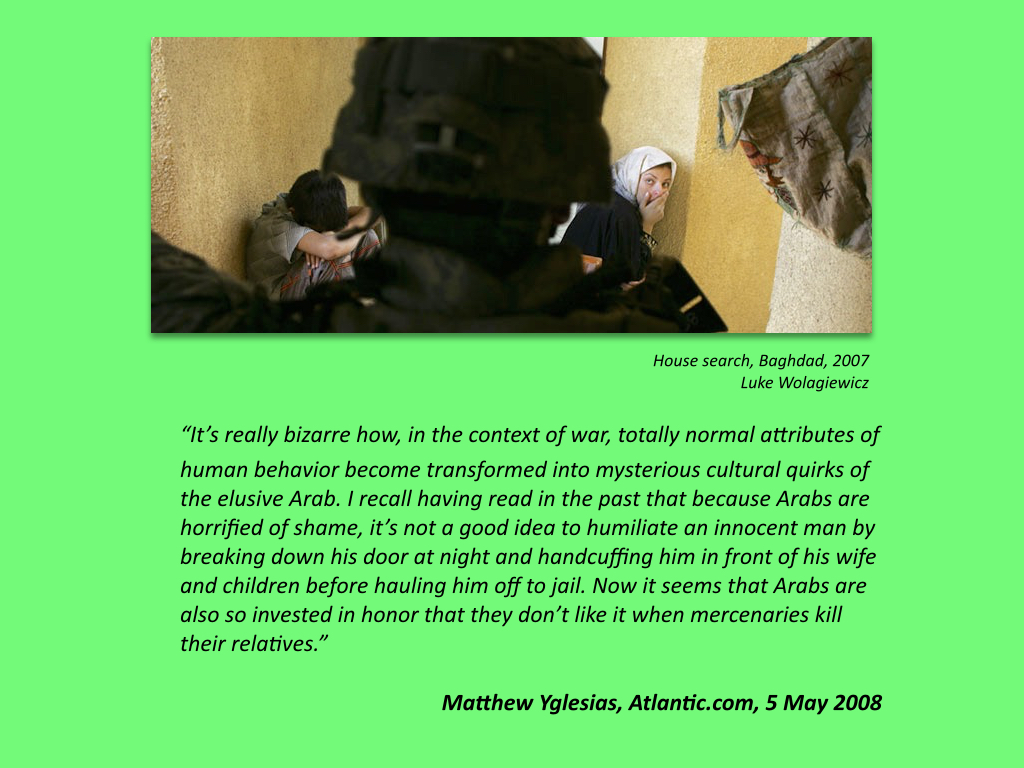
I wrote a quick draft and sent it off. The core argument was that one of the most debilitating consequences of these bipolar imaginative geographies is their refusal to recognize and value those things that we have in common with others. This wasn’t a clarion call for the reinstatement of the supposedly universal subject of humanism, of course: just a reminder that the accent on difference can blind us to the co-presence of commonality. Nothing new about that, really, and like Matthew Yglesias (below) I’ve been arguing this for an age:
Then I took the dog for a walk. By the time I returned, I had an idea for a conclusion, which was about radical narcissism, so I sent it off:
At best, we are offered a radical narcissism in which we imagine what it would be like if the suburbs of Washington, D.C., suffered air raids night after night, or if our skies were full of the sound of drones, watching and waiting to strike without warning. In imagining our lives made newly vulnerable to military violence, however, we continue to privilege “our” space and separate it from “their” space. If we can imagine such horrors happening to us, why is it so difficult to imagine them being visited on others?
This follows more or less directly from what I’d been thinking about the ways in which, in the wake of Hiroshima and Nagasaki, the United States collectively imagined itself as newly vulnerable: hence the stream of articles and illustrations in the 1940s and 50s imagining a nuclear strike on New York or Washington.
But over the weekend I took the dog for another walk, and had another thought – about the politics of affect. If we limit our understanding of imaginative geographies to the interpretative frameworks of ‘the other’ – the assumptions and conventions through which they make sense of the world – then we marginalise the affective: in particular those visceral responses to the experience of violent death and destruction which we also share to varying degrees. So it is that too often we fail to grasp the anger of somebody desperately seeking shelter from yet another air strike, the anguish of a mother or father cradling the body of their dead child, the despair of a family as they watch their home bulldozed to the ground, or the humiliation of a young man made to lower his trousers and raise his shirt by soldiers at a checkpoint. And as we attribute their response to ‘their’ unreason we continue to inflict our own, always ‘rational’ – read ‘precise’, ‘measured’, ‘scientific’ – violence upon them.
Too late for the published version, which you can find here.
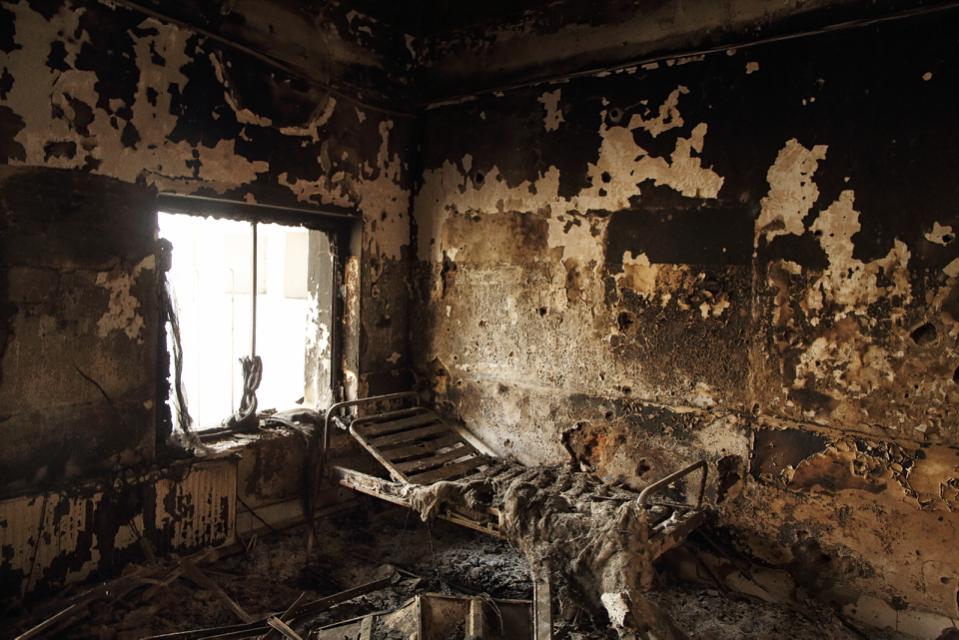
An update to my post (which I’ve updated several times) on the US air strike on the hospital in Kunduz early last month: MSF has released an internal review of the events that took place that night. It’s only a preliminary report – the inquiry is ongoing – but it makes for grim reading.
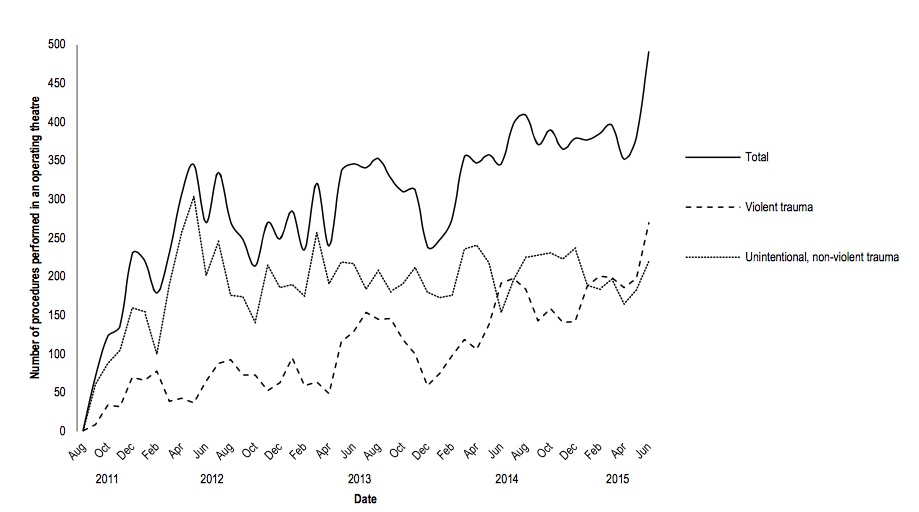
MSF opened its Kunduz Trauma Center in August 2011, providing free, high-quality surgical care to all those who needed it (for more on MSF and other medical charities in Afghanistan, see my post on ‘The prosthetics of military violence’ here).
By the end of September 2015 the original 92 beds had grown to 140 as the numbers being treated grew:
MSF is an experienced, highly regarded relief organisation and so it comes as no surprise to learn that it was fully aware of the cardinal principle of medical neutrality and took all possible steps to secure the legal and military foundations on which it operated:
MSF activities in Kunduz were based on a thorough process to reach an agreement with all parties to the conflict to respect the neutrality of our medical facility. In Afghanistan, agreements were reached with the health authorities of both the government of Afghanistan and health authorities affiliated with the relevant armed opposition groups. These agreements contain specific reference to the applicable sections of International Humanitarian Law including:
– Guaranteeing the right to treat all wounded and sick without discrimination
– Protection of patients and staff guaranteeing non-harassment whilst under medical care
– Immunity from prosecution for performing their medical duties for our staff
– Respect for medical and patient confidentiality
– Respect of a ‘no-weapon’ policy within the hospital compound
The report makes it clear that this had been clearly endorsed by all the military and paramilitary parties to the conflict.
Fighting intensified in the week before the air strike. Most of those treated since the Trauma Center opened had been from the Afghan government side, but from Monday 28 September ‘this shifted to primarily wounded Taliban combatants.’ The Afghan government speedily arranged the transfer of all its patients (apart from the most severely wounded cases) to another hospital. By that night the Taliban announced that it was in control of the district.
The next day, as the numbers seeking treatment increased yet again, MSF reconfirmed the GPS co-ordinates of the Trauma Center with both the Afghan authorities and the US military.
On Thursday 1 October MSF was asked by Carter Malkasian, a a special adviser to the Chairman of the Joint Chiefs of Staff, whether the hospital ‘had a large number of Taliban “holed up” and enquired about the safety of [MSF] staff’ and was told that its staff ‘were working at full capacity’ and that the hospital ‘was full of patients including wounded Taliban combatants’. And because the Taliban were hors de combat they were not a legitimate military target: there is absolutely no ambiguity about this.
That same day a UN civilian/military liason ‘advised MSF to remain within the GPS coordinates provided to all parties to the conflict as “bombing is ongoing in Kunduz.”’
On Friday 2 October two large MSF flags were placed on the roof of the hospital. That night the hospital was calm, there was no fighting taking place within the vicinity and MSF insists that there were no armed combatants in the buildings or the grounds of the hospital.
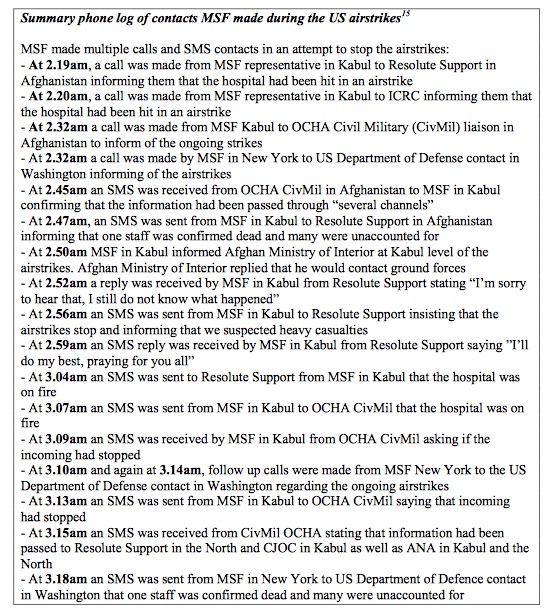
The air strikes began soon after 2 a.m. on Saturday 3 October, and throughout the attack – which lasted for over an hour – MSF made repeated attempts to stop the assault:
And yet, despite everything the US military had been told in advance and despite these repeated attempts to stop the air strikes, an AC-130 gunship made five repeated passes:
A series of multiple, precise and sustained airstrikes targeted the main hospital building, leaving the rest of the buildings in the MSF compound comparatively untouched. This specific building of the hospital correlates exactly with the GPS coordinates provided to the parties to the conflict [my emphasis].
As MSF’s Director concludes,
‘The question remains as to whether our hospital lost its protected status in the eyes of the military forces engaged in this attack – and if so, why. The answer does not lie within the MSF hospital. Those responsible for requesting, ordering and approving the airstrikes hold these answers’.
And, as the report notes, this is the view from the inside: ‘What we lack is the view from outside the hospital – what happened within the military chains of command.’
So far, controlled leaks from the US military investigation have suggested that an Afghan ‘rapid reaction force’ requested the attack, that it had been rushed to Kunduz from elsewhere in Afghanistan, arriving ‘just days before the air strike’, and that it had no experience in working with the US ground troops from the Third Special Forces Group who relayed the request for ‘aerial fires’ to the Joint Operations Center at Kunduz airfield. The Green Berets ‘were aware it was a functioning hospital,’ AP reported, ‘but believed it was under Taliban control.’ The report continues:
The Green Berets had asked for Air Force intelligence-gathering flights over the hospital, and both Green Berets and Air Force personnel were aware it was a protected medical facility, the records show, according to the two people who have seen the documents.
The analysts’ dossier included maps with the hospital circled, along with indications that intelligence agencies were tracking the location of [an] … operative [from Pakistan’s Inter-Services Intelligence directorate who was allegedly co-ordinating Taliban operations in the area] and activity reports based on overhead surveillance, according to a former intelligence official who is familiar with some of the documents. The intelligence suggested the hospital was being used as a Taliban command and control center and may have housed heavy weapons.
… the crew of the AC-130, call sign Hammer, verified their permission to fire twice before engaging the hospital. AC-130Us carry a crew of 14, often including a special forces liaison officer responsible for communicating with ground units.
And the US troops remained in contact with the AC-130 gunship throughout the attacks.
So even if you accept all these unverified claims about the intelligence (or lack of it) behind the air strikes, you surely have to wonder about the studied lack of response to the repeated calls to have the attacks stopped. Bear in mind, too, that the AC-130 has a sophisticated sensor suite on board, including IR and low-light cameras, that the hospital kept its lights on throughout the night (it was one of the few buildings in the city whose electricity was still working), and that MSF staff were advised to remain inside the co-ordinate grid they had given to the military: which turned out to be the very co-ordinates used for the attack. It seems dismally clear that the trauma center was precisely targeted and that it could not have been mistaken for any other building.
Regular readers will know that the US military has repeatedly relied on an elaborate bio-medical discourse to legitimise its actions (for a brilliant recent discussion, see Elke Schwarz‘s ‘Prescription drones: on the techno-biopolitical regimes of contemporary ‘ethical killing’’, online early at Security Dialogue); the most familiar version, hideously ironic given the events in Kunduz, is the claim that the US military has an unprecedented ability to carry out ‘surgical strikes’…
UPDATE: For an excellent analysis, see Kate Clarkat the Afghan Analysts Network here
James Bridle has posted a lightly edited version of the excellent presentation he gave to “Through Post-Atomic Eyes” in Toronto last month – Big Data, No Thanks – at his blog booktwo. It’s an artful mix of text and images and, as always with James, both repay close scrutiny.
If you look at the situation we are in now, a couple of years after the Snowden revelations, most if not all of the activities which they uncovered have been, if not secretly authorised already, signed into law and continued without much fuss.
As Trevor Paglen has said: Wikileaks and the NSA have essentially the same political position: there are dark secrets at the heart of the world, and if we can only bring them to light, everything will magically be made better. One legitimises the other. Transparency is not enough – and certainly not when it operates in only one direction. This process has also made me question my own practice and that of many others, because making the invisible visible is not enough either.
James talks about the ‘existential dread’ he feels caused not ‘by the shadow of the bomb, but by the shadow of data’:
It’s easy to feel, looking back, that we spent the 20th Century living in a minefield, and I think we’re still living in a minefield now, one where critical public health infrastructure runs on insecure public phone networks, financial markets rely on vulnerable, decades-old computer systems, and everything from mortgage applications to lethal weapons systems are governed by inscrutable and unaccountable softwares. This structural and existential threat, which is both to our individual liberty and our collective society, is largely concealed from us by commercial and political interests, and nuclear history is a good primer in how that has been standard practice for quite some time.
It’s a much richer argument than these snippets can convey. For me, the high spot comes when James talks about IBM’s Selective Sequence Electronic Calculator (really), which turns out to be the most explosive combination of secrecy and visibility that you could possibly imagine.
I’m not going to spoil it – go and read it for yourself, and then the title of this post will make horrible sense. You can read more in George Dyson‘s absorbingly intricate account of Turing’s Cathedral: the origins of the digital universe(Allen Lane/Penguin, 2012).
As promised, I’ve posted the slides from my presentation on “Little Boys and Blue Skies: drones through post-atomic eyes” under the DOWNLOADS tab. Given my previous posts (here and here) these ought to be reasonably self-explanatory, but I’ve added a series of images derived from Matt Farish‘s brilliant presentation “Beneath the bombs” at the same conference and these probably need explanation.
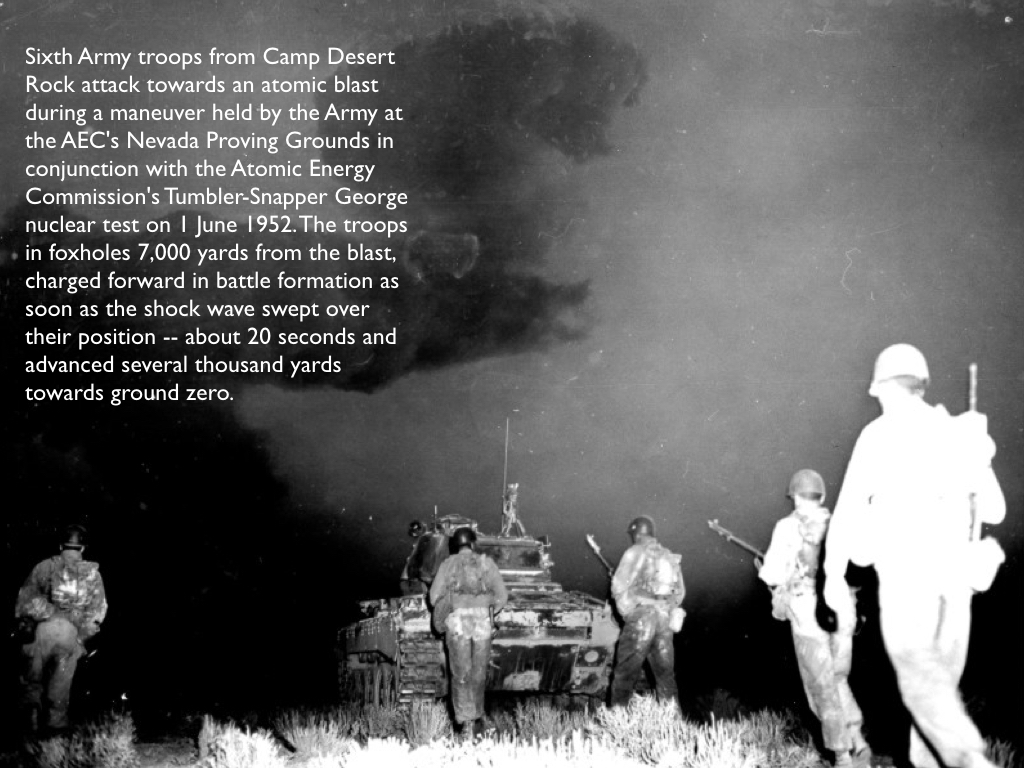
One of the central themes of my presentation was the emphasis placed on American lives by those who planned the attacks on Hiroshima and Nagasaki – which is why the crew of the Enola Gay had to execute such a tight turn to escape the shock waves from the blast – and by American commentators who almost immediately contemplated the possibility of a nuclear attack on the continental United States.
The same was true of those who prepared for subsequent nuclear strikes (which is why the US Air Force experimented with drones to ‘deliver’ the bombs) and by those who orchestrated subsequent nuclear tests in the Marshall Islands and in Nevada (which is why the US Air Force and the US Navy used drones to fly through the atomic clouds to collect samples).
As I showed in the presentation, these same priorities have been extended to today’s use of armed drones by the US Air Force, which repeatedly cites its Predators and Reapers as ‘projecting power without vulnerability’.
All of this will be clear from my slides and posts.
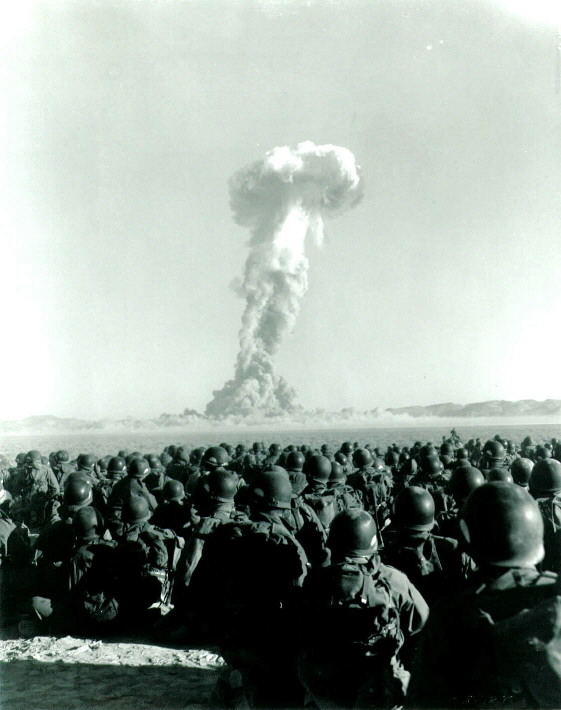
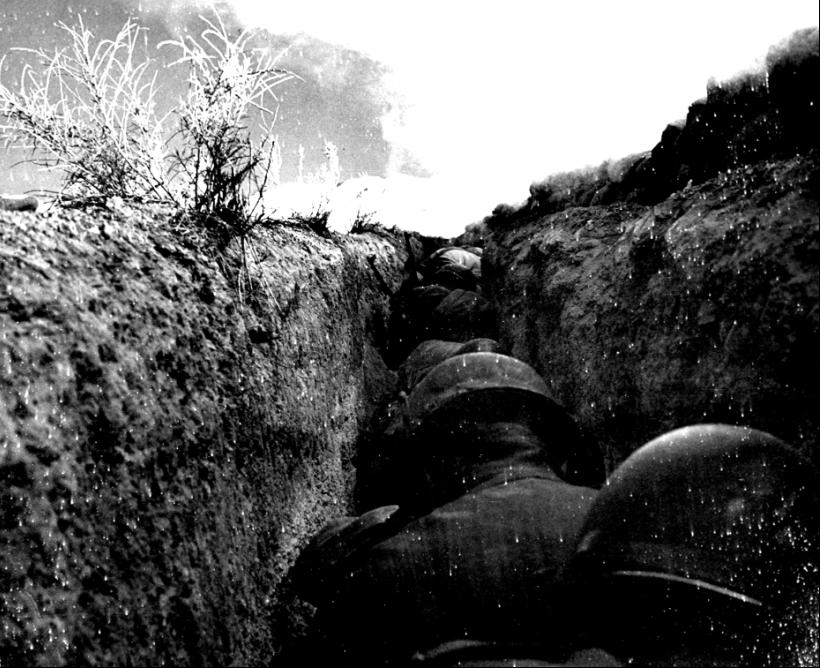
But what I didn’t know was that the US Army and Marine Corps had no such qualms about exposing the bodies of their soldiers and marines to the dangers of atomic tests. Matt described a series of exercises in Nevada – Desert Rock – held between 1951 and 1957 in which ground troops not only watched the tests from a distance (this I did know: see the image above) but were also ordered forward to secure the blast area. Here is an official video (watch from 3.00).
This is a silent film, but if you prefer a video with a jaunty, reassuring commentary you can find one from the Internet Archive here. It’s accompanied by this transcript of an interview between a sergeant and a training officer before a blast:
Question. “How many of your men would volunteer to go up and be in the foxholes?” (one-half mile from ground zero)
Answer. “I guess about half a dozen.”
Question. “It’s quite a loud noise when that bomb goes off … would it do them any harm?”
Answer. “No sir, not the noise, no.”
Question. “How about the radiation? Do you think there is much danger?”
Answer. “Radiation is the least of their worries that the men are thinking about.”
Question. “I think most thought radiation was the greatest danger, didn’t they? Where did they learn differently?”
Answer. “They were, prior to our instructions here. We received a very thorough briefing.”
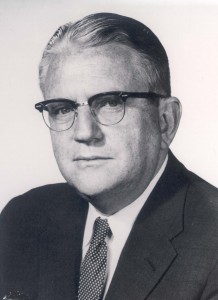
Part of the purpose of the tests was indeed to show how safe the tests were. As Dr Richard Meiling, the chair of the Armed Forces Medical Policy Council, explained in a memorandum to the Pentagon on 27 June 1951:
‘Fear of radiation … is almost universal among the uninitiated and unless it is overcome in the military forces it could present a most serious problem if atomic weapons are used…. It has been proven repeatedly that persistent ionizing radiation following air bursts does not occur, hence the fear that it presents a dangerous hazard to personnel is groundless.’
Meiling recommended that ‘positive action be taken at the earliest opportunity to demonstrate this fact in a practical manner’, ideally by deploying a Regimental Combat Team ‘approximately twelve miles from the designated ground zero of an air blast and immediately following the explosion . . . they should move into the burst area in fulfillment of a tactical problem.’
In effect, Meiling wanted to conduct an extended psychological experiment in which the Test Site would become a vast human – as much as physical – laboratory.
By means of attitude measurement methods measuring psychological effects of stress, both applied at critical points during the maneuver, an attempt was made:
1. To evaluate effects of atomic indoctrination on troop participants; and
2. To estimate effects of the detonation together with its accompanying affects on performance.
One Army officer, Captain Richard Taffe, provided a remarkably cheery first-hand account for Collier’s on 26 January 1952:
I walked through an atom-bombed area. I didn’t get burned, I didn’t become radioactive, and I didn’t become sterile. And neither did the 5,000 guys with me. Furthermore, I wasn’t scared—either while taking my walk through the blasted miles, or while watching the world’s most feared weapon being exploded seven miles in front of me.
But, I’ve been asked a hundred times since the Desert Rock maneuvers at Yucca Flats in the Nevada atomic test site, “What was it like?”…
Suddenly it came. A gigantic flash of white light, bright as a photoflash bulb exploding in our eyes—even with our backs turned. The order “Turn” screamed over the public address system and 5,000 soldiers spun and stared. As we turned, it was as though someone had opened the door of a blast furnace as the terrific heat reached us. There, suspended over the desert floor, was the fireball which follows the initial flash of an atomic bomb.
Hung there in the sky, the tremendous ball of flame was too blinding to stare at, and suddenly there was much more to see.
Sucked into that fireball were the tons of debris from the desert floor. Almost at once dust clouds climbed hundreds of yards off the ground for miles in each direction. Then the familiar column of dirty gray smoke formed and started to rise.
Up to this point we had seen, but we had not heard and we had not felt, the explosion.
But then came the shock wave. The ground beneath us started to heave and sway. Not back and forth as you might expect, but sideways. The earthquakelike movement of the ground rocked us on our haunches and, had we been standing, it could have knocked us down.
About that time, our heads were snapped back with the force of the terrible blast as the sound finally crossed those seven miles and reached us. The tremendous crack was a louder one than most of us had ever heard before. And right behind it came another crack—there seemed to be some debate as to whether this was an echo or another chain reaction in the fireball.
From the throats of everyone there came noises. Noises, not words. I listened particularly for the first coherent statement, but, like myself, few people could voice normal exclamations. It was not something normal and words just wouldn’t come out—only unintelligible sounds.
The first words I did hear came from a caustic corporal behind me, who said, almost calmly, “Well, I finally located that damned Ground Zero.”
Our roar of laughter broke the tension, but the spectacle was far from over.
The horror turned to beauty. It isn’t difficult to associate the word beautiful with such a lethal exhibition, because from this point on, the atomic blast became just that—beautiful. A column rose from where the fireball had dimmed, crawled through the brown doughnut above the fireball, and boiled skyward. The dirty gray of the stem was rapidly offset by the purple hues and blues of the column. Then came the mushroom—the trade-mark of an atomic bomb.
Capped in pure white, the seething mushroom emitted browns, blood orange, pastel pinks, each fighting its way to the surface only to be sucked to the bottom and then back into the middle of the mass of white. Within minutes, the top was at 30,000 feet and then the huge cloud broke loose from the stem and drifted in the wind toward Las Vegas. . . .
This explosion had three lethal qualities. They were: blast, heat and radiation. The greatest fear the public has today in connection with the atom bomb probably is radiation. People forget that it caused only 15 per cent of the 140,000 deaths at Hiroshima.
One second after an air burst of an atom bomb, 50 per cent of the radiation is gone. All danger of lingering radiation has disappeared after 90 seconds.
As to the other two qualities, blast caused 60 per cent of the deaths at Hiroshima. Heat and the accompanying fires accounted for the other 25 per cent. . . .
As we moved up the road in the trucks, the effects of the blast became more apparent. About two miles from Ground Zero—and incidentally the bomber dropped his lethal egg in the proverbial bucket, right on the target—it became obvious that a terrible force had been at work.
At one of the closest positions we again left the trucks and walked through the charred area. Despite the devastation, there was no doubt that a successful attack could have been made by friendly troops directly through the blasted area—immediately after the explosion.
You can find much more here (scroll way down). The purpose of reports like this was clearly to ‘indoctrinate’ a far wider audience than the US military.
All of this raises two questions. One is about the radical difference between saving the lives of airmen and risking the lives of ground troops; the answer surely lies only partly in the insistence that there was no risk at all – since the Air Force clearly believed otherwise – and so must also lie in a dismal cost-benefit analysis that reckoned the cost (and time) involved in training aircrew against that involved in training ground troops.
The other is about what could possibly have required a ‘successful attack’ on ground zero and what would have been left for those troops to ‘secure’ after the blast…
Note: If you wonder about the long-term effects of the tests on residents of the area around the Nevada Test Site, see Harvey Wasserman and Norman Solomon, Killing our own: the disaster of America’s experiencewith atomic radiation, which is open access here (see chapter 3: ‘Bringing the bombs home’).
The US Advisory Committee on Human Radiation Experiments provided a report on the effects on ground troops in The Human Radiation Experiments (1996) (Ch 10: ‘Atomic veterans: human experimentation in connection with bomb tests’).
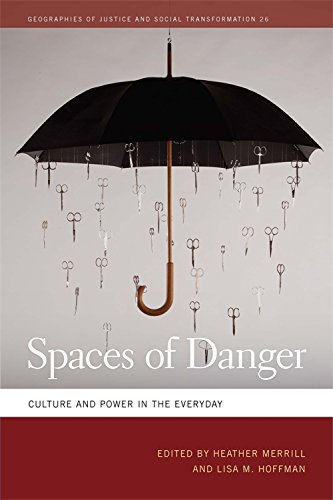
On the same day I heard the news of Ed Soja‘s untimely death I received my copy of Spaces of Danger: culture and power in the everyday, a volume in the University of Georgia Press’s Geographies of Justice and Social Transformation series. It’s a collection of essays edited by Heather Merrill and Lisa Hoffman: all of the contributors have been inspired by the work of another friend who I also miss very much, Allan Pred.
These twelve original essays by geographers and anthropologists offer a deep critical understanding of Allan Pred’s pathbreaking and eclectic cultural Marxist approach, with a focus on his concept of “situated ignorance”: the production and reproduction of power and inequality by regimes of truth through strategically deployed misinformation, diversions, and silences. As the essays expose the cultural and material circumstances in which situated ignorance persists, they also add a previously underexplored spatial dimension to Walter Benjamin’s idea of “moments of danger.”
The volume invokes the aftermath of the July 2011 attacks by far-right activist Anders Breivik in Norway, who ambushed a Labor Party youth gathering and bombed a government building, killing and injuring many. Breivik had publicly and forthrightly declared war against an array of liberal attitudes he saw threatening Western civilization. However, as politicians and journalists interpreted these events for mass consumption, a narrative quickly emerged that painted Breivik as a lone madman and steered the discourse away from analysis of the resurgent right-wing racisms and nationalisms in which he was immersed.
The Breivik case is merely one of the most visible recent examples, say editors Heather Merrill and Lisa Hoffman, of the unchallenged production of knowledge in the public sphere. In essays that range widely in topic and setting—for example, brownfield development in China, a Holocaust memorial in Germany, an art gallery exhibit in South Africa—this volume peels back layers of “situated practices and their associated meaning and power relations.” Spaces of Danger offers analytical and conceptual tools of a Predian approach to interrogate the taken-for-granted and make visible and legible that which is silenced.
Contents:
1 Introduction: Making sense of our contemporary moment of danger
PART ONE: CRITICAL SPATIALITY
Trevor Paglen: Angelus Novus (from back)
2 Katharyne Mitchell: It’s TIME: The cultural politics of memory in the current moment of danger
3 Gunnar Olsson: Skinning the Skinning
PART TWO: SITUATED PRACTICES
Trevor Paglen: From Allan’s notes on Benjamin
4 Gillian Hart: Exposing the Nationa: entanglements of race, sexuality and gender in post-apartheid nationalism
5 Heather Merrill: In other for(l)ds: situated intersectionality in Italy
6 Damani Partridge: Monumental memory, moral superiority, and contemporary disconnects: racisms and noncitizen in Europe, then and now
PART THREE: THE URBAN AND THE SPECTACULAR
Trevor Paglen: From Allan’s notes on Benjamin
7 Richard Walker: The city and economic geography: then and now
8 Shiloh Krupar: Situated spectacle: cross-sectional soil hermeneutics of the Shanghai 2010 World Expo
PART FOUR: HISTORICAL GEOGRAPHIES OF THE PRESENT
Trevor Paglen: Angelus Novus
9 Michael Watts Insurgent Spaces: power, place and spectacle in Nigeria
10 Nancy Postero: Even in plurinational Bolivia: indignity, development and racism since Morales
11 Derek Gregory: Moving targets and violent geographies
PART FIVE: BIOGRAPHICAL MONTAGE OF THE PRESENT
12 Cindi Katz: A Bronx chronicle
There’s also a warm and exquisitely written Foreword by Paul Rabinow, who co-taught a graduate course with Allan at Berkeley, which ends like this:
‘Dame Fortune smiled on me when she sent Allan Pred my way. I am forever in her debt. The glimmers of hope in these dark times continue to emanate from those rare friends, not just their magnificent work, but the way they lived – the way they patiently, unobtrusively, daringly and thoughtfully taught us how to live.’
The stunning cover image, Travelers, is by Allan’s hyper-talented daughter Michele: it shows scissors confiscated at US airports and now suspended under a vast umbrella. Spaces of Danger indeed.
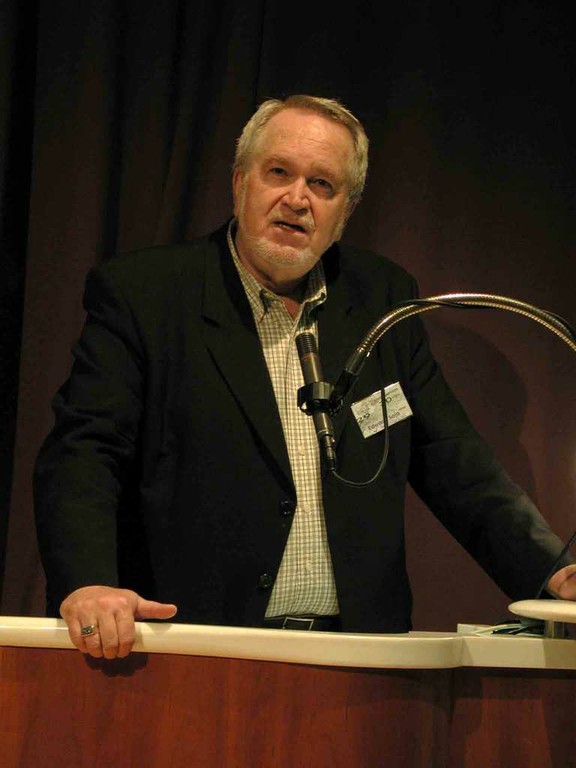
I was so sad to hear of the death of Ed Soja. A lifetime ago Ed and Maureen spent his sabbatical at Cambridge, and they rented the house next door to us. At least once a week Ed and I would meet for what we told our families were our ‘seminars’ – and so they were, though there just the two of us sitting in the yard of the pub across King Street from the back gate of Sidney Sussex College, glasses on the creaky table in front of us and the air full of smoke from Ed’s cigarettes.
They were precious times. Ed’s sharp intellect opened up all sorts of avenues I would never have noticed on my own, and while we disagreed on all sorts of things – to this day I don’t understand why Foucault’s essay on heterotopia, ‘Of other spaces’, is taken even remotely seriously – we agreed on so many more: the power of Foucault’s writing (Ed used to say he could taste the words in his mouth), his archival seriousness (at that time there were few commentators who appreciated that Foucault was an intensely empirical scholar), and his astonishingly creative imagination. Above all, we were entranced by the multiple ways in which he re-thought and re-worked ideas of space and spatiality and traced that dazzling triangle between power, knowledge and geography.
You could, of course, say exactly the same of Ed.
Our conversations soon spilled over – rather like our beers – into an equally intense discussion of Lefebvre. Ed was fascinated by the introduction to The production of space, and the schema that he would eventually elaborate in Postmodern geographies and then Thirdspace, whereas I was beginning to think through his ideas about bodies in spaces (probably a carry-over from our joint readings of Discipline and punish). But it was Ed’s probing questions, his patient encouragement and his ability to see connections that were indispensable to my intellectual journey.
Whenever the four of us had dinner together, it was always a special pleasure to listen to Maureen either puncturing Ed’s wilder bursts of fantasy – or encouraging them – with dry one-liners that to this day make me howl with laughter. I vividly remember Ed being invited to a dinner party shortly before they returned home; they had been guests there once before, and it had not been a success, but Ed gamely accepted a second invitation. Maureen flatly – and understandably – refused to go, and throughout that long afternoon Ed sat at the table alternately pleading with Maureen to relent and summoning me for a drink with the condemned man. When he got there, he found that the partners of all the other guests had suddenly developed colds, the flu or broken legs.
Ed enlivened the Department of Geography no end too, and delighted the graduate students with his healthy irreverence, his sense of intellectual adventure – and by his evident happiness at spending time with them.
Throughout all these meetings, Ed was a wonderful companion: dazzlingly well read, rigorously critical, intellectually generous, achingly funny and above all intensely passionate. He once proclaimed to me, jabbing his finger in the air for emphasis (and here I leave out Ed’s punctuating adverbs): ‘If we aren’t interested in this, why on earth should anyone else be?’
When Ed rose at a conference to ask a question it was like the towering inferno made flesh: he was so tall that just when you thought he was finally on his feet he somehow carried on rising, and he was almost always quivering with passion.
All of this came together in perhaps my favourite memory of Ed. We shared a room at an AAG meeting – I think it was in Portland – and we were entertaining ourselves by combing through a book of abstracts whose weight rivalled the London phone directory. Much of it was about as interesting: spatial science still had a deadly grip on the field. We had been reading out paper titles to one another when Ed suddenly erupted in delight. I still think he was drawn to it because he had mis-read the title; Ed was already a high priest of postmodernism, and the paper he had found was on ‘post-mortem migration’. Somebody had found a dataset on snowbirds who had fled south to escape the northern winter and died before they could return home; the data listed the states to which their bodies had been returned and tabulated the numbers. The author showed that the standard migration model of ‘intervening opportunities’ didn’t fit very well (surprisingly) and so fitted distance-decay curves to the data… You couldn’t make it up, and it exemplified everything that Ed’s wonderful, illuminating life was not.
Eyal Weizman‘s stunning Wall Exchange, “Forensic Architecture”, which he presented at the Vogue Theatre in Vancouver earlier this month, is now up on YouTube here and embedded below.
If you are puzzled by my riff on Joni Mitchell, start around 46:10 (though you’ll miss a lot if you do…).
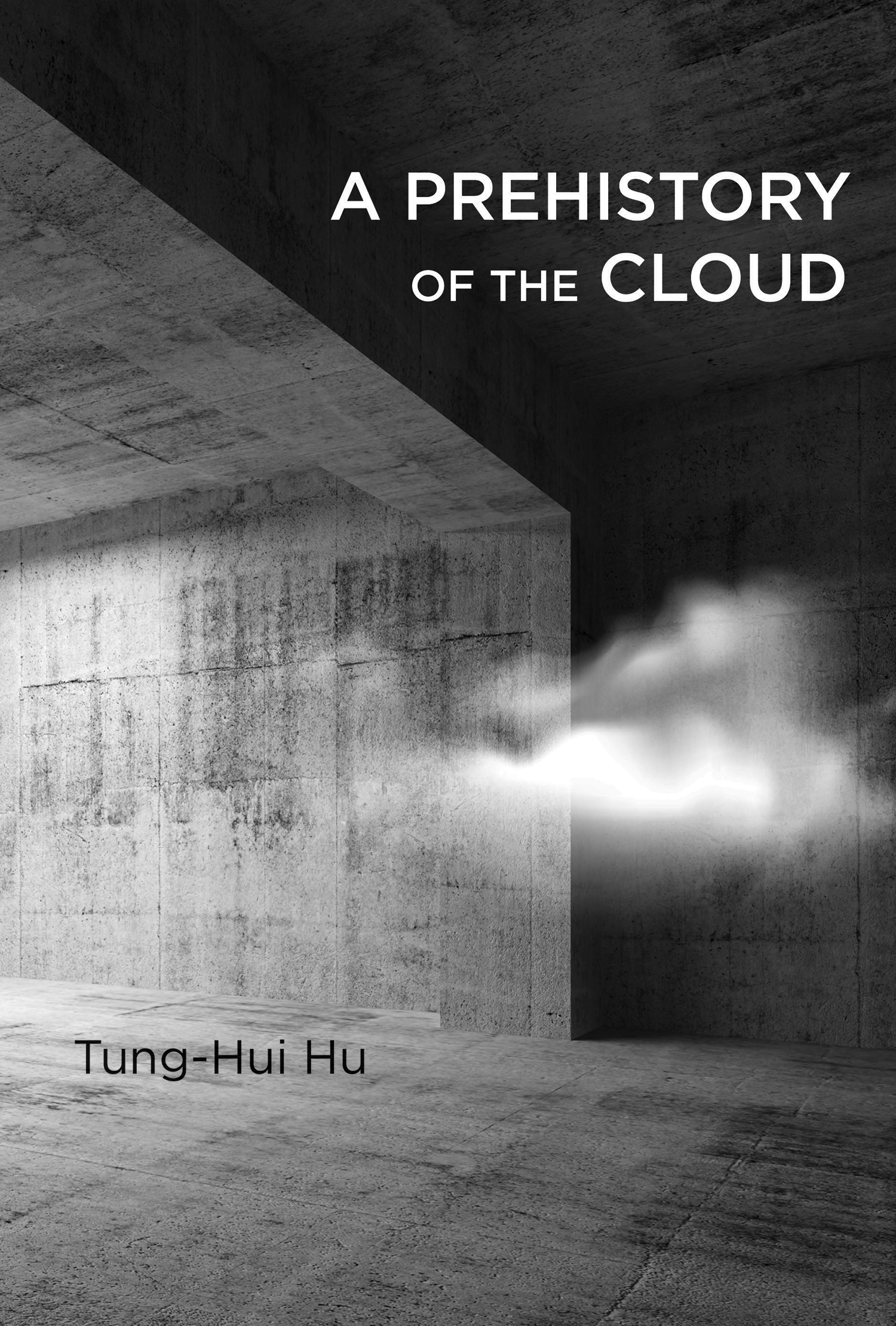
And while we’re on the subject of clouds, you’ll find a remarkable analysis of a different sort of militarized cloud in Tung-Hui Hu‘s A Prehistory of the Cloud from MIT:
We may imagine the digital cloud as placeless, mute, ethereal, and unmediated. Yet the reality of the cloud is embodied in thousands of massive data centers, any one of which can use as much electricity as a midsized town. Even all these data centers are only one small part of the cloud. Behind that cloud-shaped icon on our screens is a whole universe of technologies and cultural norms, all working to keep us from noticing their existence. In this book, Tung-Hui Hu examines the gap between the real and the virtual in our understanding of the cloud.
Hu shows that the cloud grew out of such older networks as railroad tracks, sewer lines, and television circuits. He describes key moments in the prehistory of the cloud, from the game “Spacewar” as exemplar of time-sharing computers to Cold War bunkers that were later reused as data centers. Countering the popular perception of a new “cloudlike” political power that is dispersed and immaterial, Hu argues that the cloud grafts digital technologies onto older ways of exerting power over a population. But because we invest the cloud with cultural fantasies about security and participation, we fail to recognize its militarized origins and ideology. Moving between the materiality of the technology itself and its cultural rhetoric, Hu’s account offers a set of new tools for rethinking the contemporary digital environment.
Here is Lisa Parks on what is surely one of the must-reads of the year:
“Hu’s riveting genealogy of the cloud takes us into its precursors and politics, and boldly demonstrates how fantasies of sovereignty, security, and participation are bound up in it. Much more than a data center, the cloud is a diffuse and invisible structure of power that has yielded a data-centric order. Imaginative and lucidly written, this book will be core to digital media studies.”
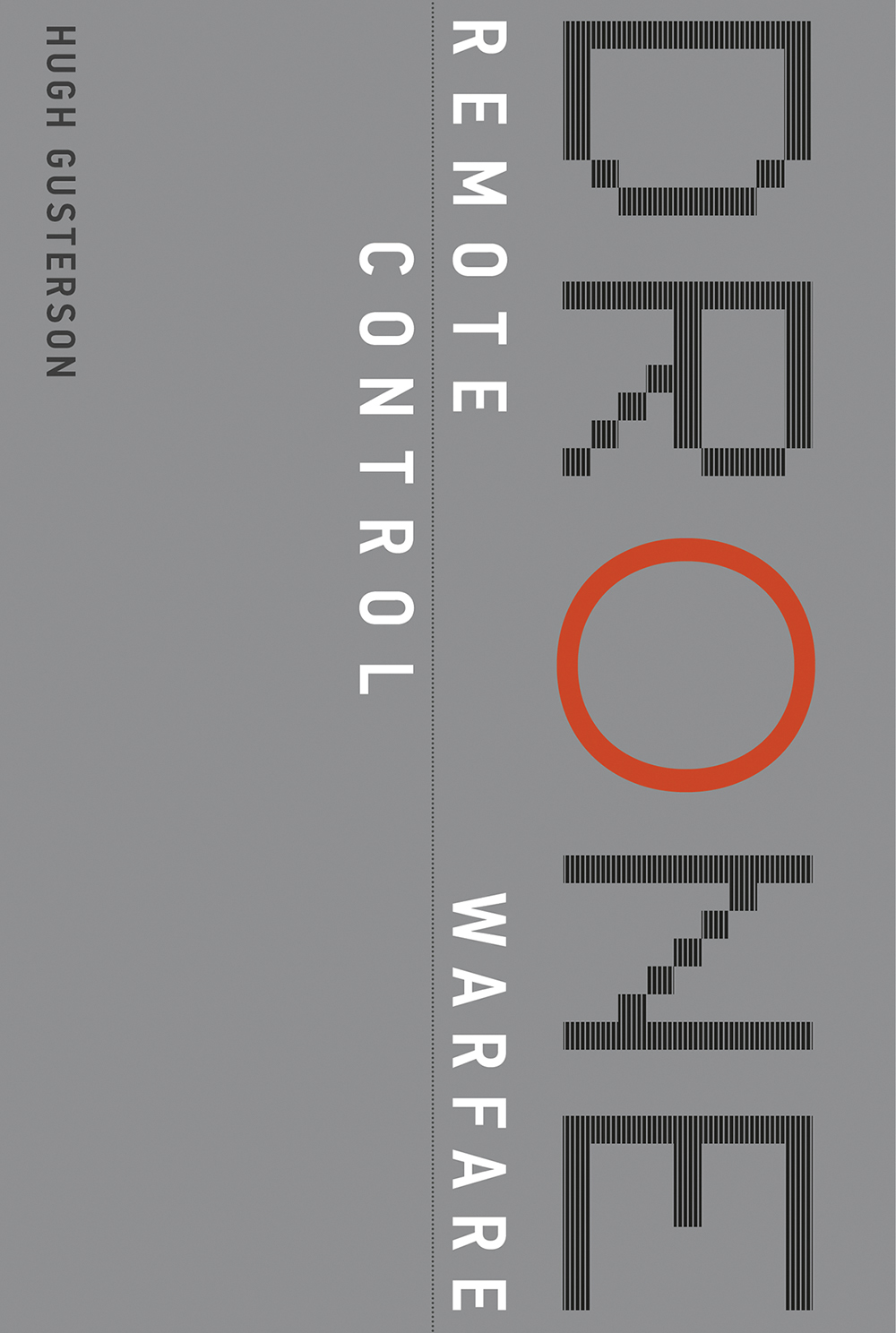
Coming from MIT in April next year, a new book by the ever-creative anthropologist Hugh Gusterson, Drone: remote control warfare.
Drones are changing the conduct of war. Deployed at presidential discretion, they can be used in regular war zones or to kill people in such countries as Yemen and Somalia, where the United States is not officially at war. Advocates say that drones are more precise than conventional bombers, allowing warfare with minimal civilian deaths while keeping American pilots out of harm’s way. Critics say that drones are cowardly and that they often kill innocent civilians while terrorizing entire villages on the ground. In this book, Hugh Gusterson explores the significance of drone warfare from multiple perspectives, drawing on accounts by drone operators, victims of drone attacks, anti-drone activists, human rights activists, international lawyers, journalists, military thinkers, and academic experts.
Gusterson examines the way drone warfare has created commuter warriors and redefined the space of the battlefield. He looks at the paradoxical mix of closeness and distance involved in remote killing: is it easier than killing someone on the physical battlefield if you have to watch onscreen? He suggests a new way of understanding the debate over civilian casualties of drone attacks. He maps “ethical slippage” over time in the Obama administration’s targeting practices. And he contrasts Obama administration officials’ legal justification of drone attacks with arguments by international lawyers and NGOs.
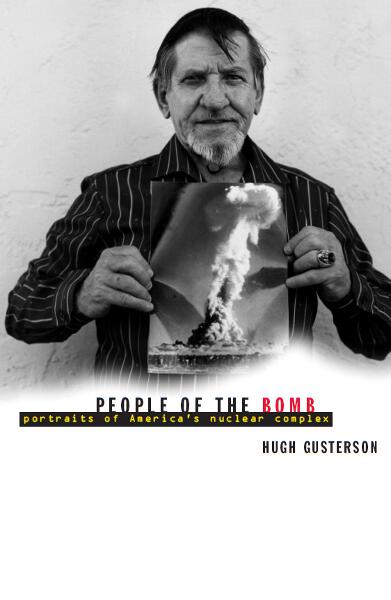
The coincidence between Hugh’s previous projects and his new one intersects with my presentation on “Little Boys and Blue Skies” in Toronto last week – see here and here – which sketched out a series of entanglements between drones and the nuclear wastelands (hence the Eliot quotation which serves as my title for this post).
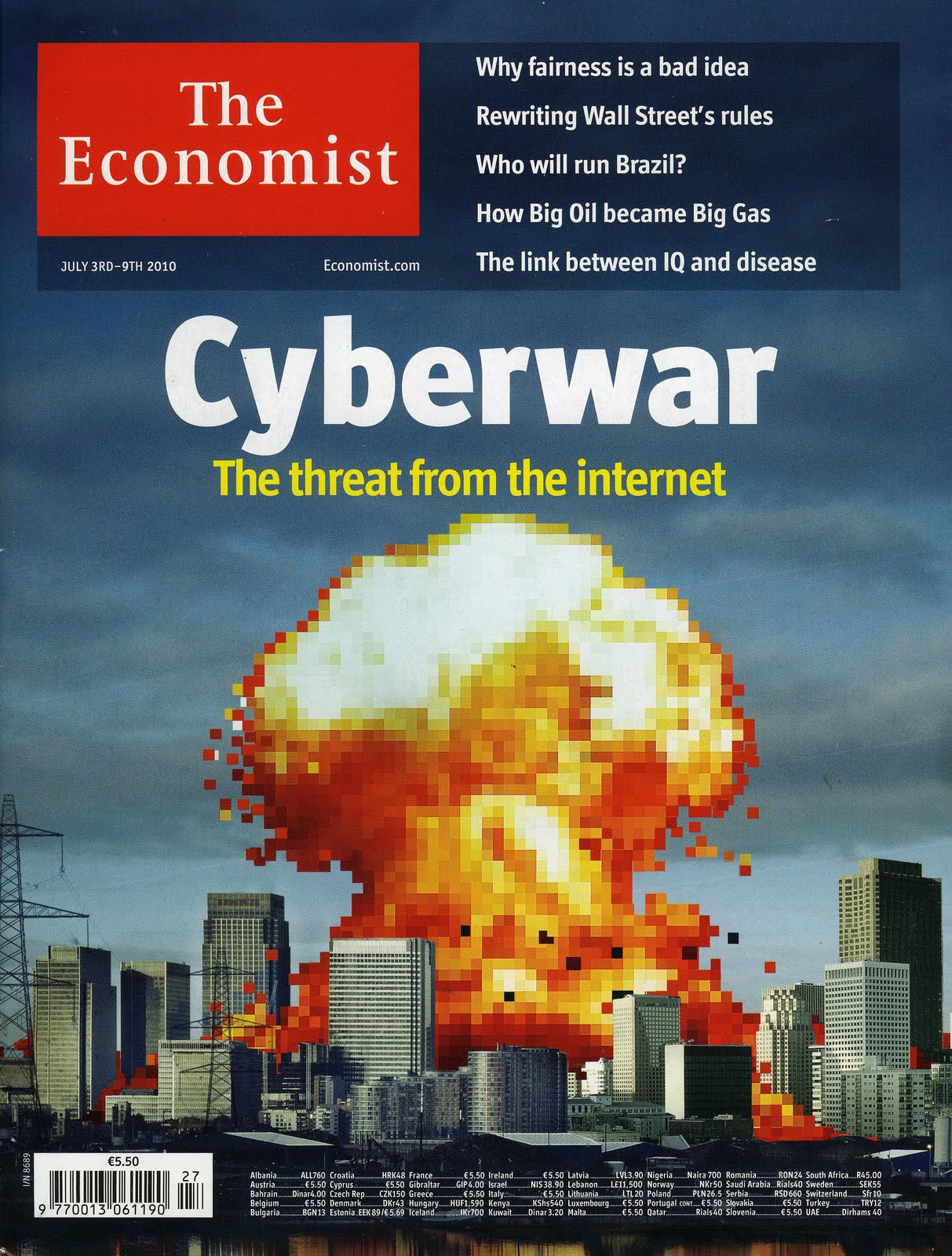
I’m in Toronto, enjoying ‘Through Post-Atomic Eyes‘ enormously: wide-ranging yet focused, creative and critical, and above all wonderfully welcoming. I’m also relieved – I’ve only been wandering in the nuclear wastelands for a matter of months, and being surrounded by scholars and artists who know so much more about these vexed issues has been truly invigorating. I’ll post the slides from my presentation shortly – in the meantime, see here and here – but while I was searching for images I re-discovered this cover from The Economist:
Since my own presentation tried to sort out the entangled geographies of nuclear weapons and drones, I would be the very last person to object to the continuity conjured up by The Economist‘s apocalyptic vision: in fact yesterday both Joseph Masco and James Bridle in two sparkling presentations emphasised the intimacy of the connections between computing, nuclear testing and the security state.
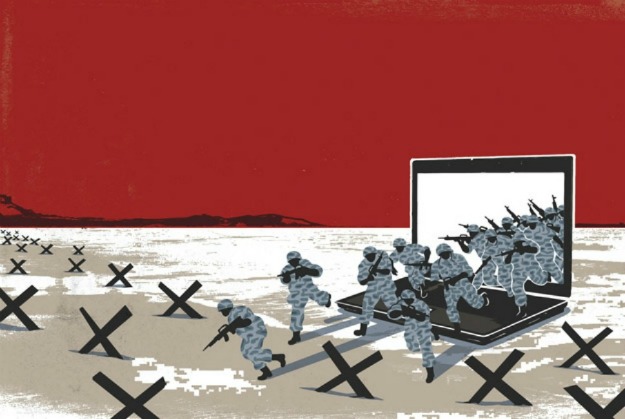
So it seems appropriate that my e-flânerie should also have led me to a special issue of CyberOrient, edited by Helga Tawil-Souri, is appropriately online now (and open access), devoted to cyberwarfare:
This special issue of CyberOrient engages with the relationships between “cyber” and “real” battlespaces, the mediatization of war, the need to expand our definition of warzones, and the importance of asking who participates in wars, to what ends, using what kinds of technologies, and for what purposes. Taken together, the five essays demonstrate the expansion and blurring of the spaces of war. As importantly, they highlight that even warfare that is “only” fought in the virtual realm is laced with violent intents and real-life repercussions. Not only can we not separate the cyber from the real so neatly, but we must not overlook that no matter how we wish to classify “new” or cyber wars, it is citizens, along with their ways of life and their cultural records, that continue to be by far the largest losers.
I’m off to Toronto on Thursday to speak at the symposium “Through Post-Atomic Eyes“. I posted some of my earlier notes for my presentation, ‘Little Boys and Blue Skies: Drones through post-atomic eyes‘, and since then I’ve been digging deeper into the strange intersections between nuclear weapons and today’s Predators and Reapers.
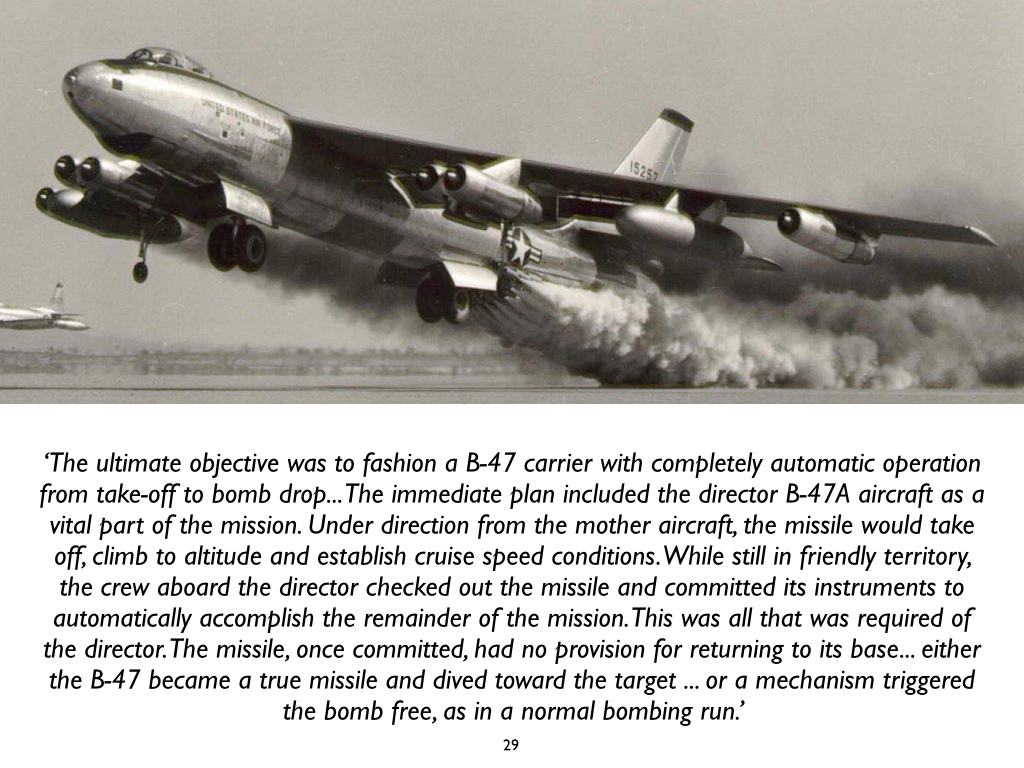
In my original post I described the US Air Force’s early attempts to devise a way of delivering atomic bombs from remotely piloted aircraft – notably Project Brass Ring:
Following a tip from Matt Farish (who will also be speaking at the conference) I’ve now discovered that drones were also used to monitor the ‘atomic clouds’.
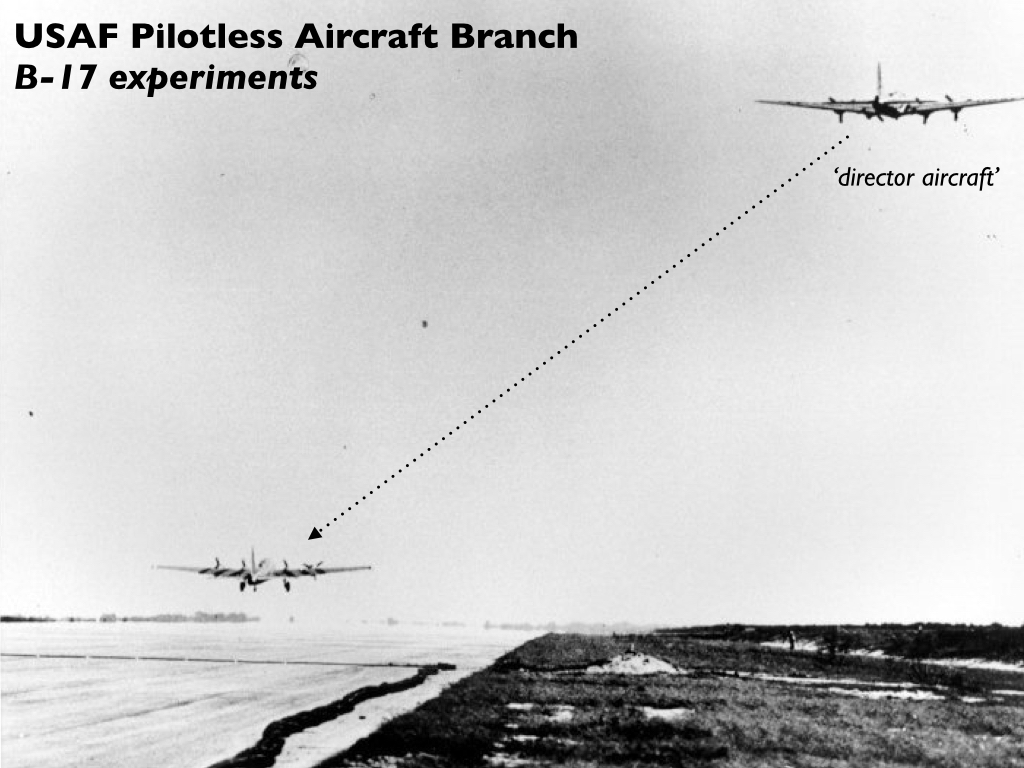
Shortly after the Second World War the US Air Force’s Pilotless Aircraft Branch resumed its experiments with remotely controlling B-17 bombers from ‘director aircraft’ and from ground stations:
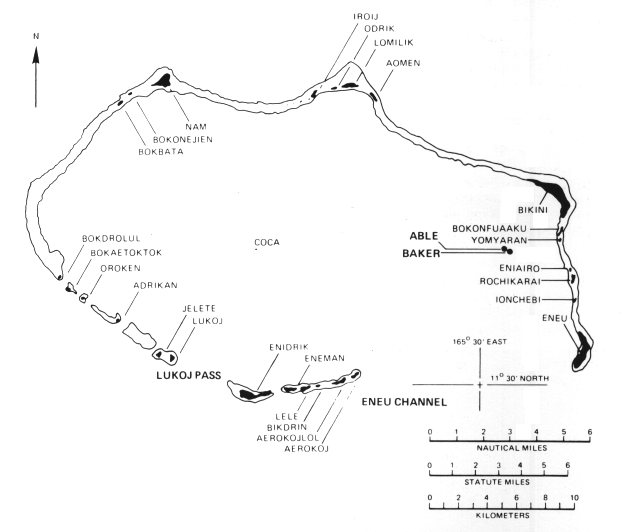
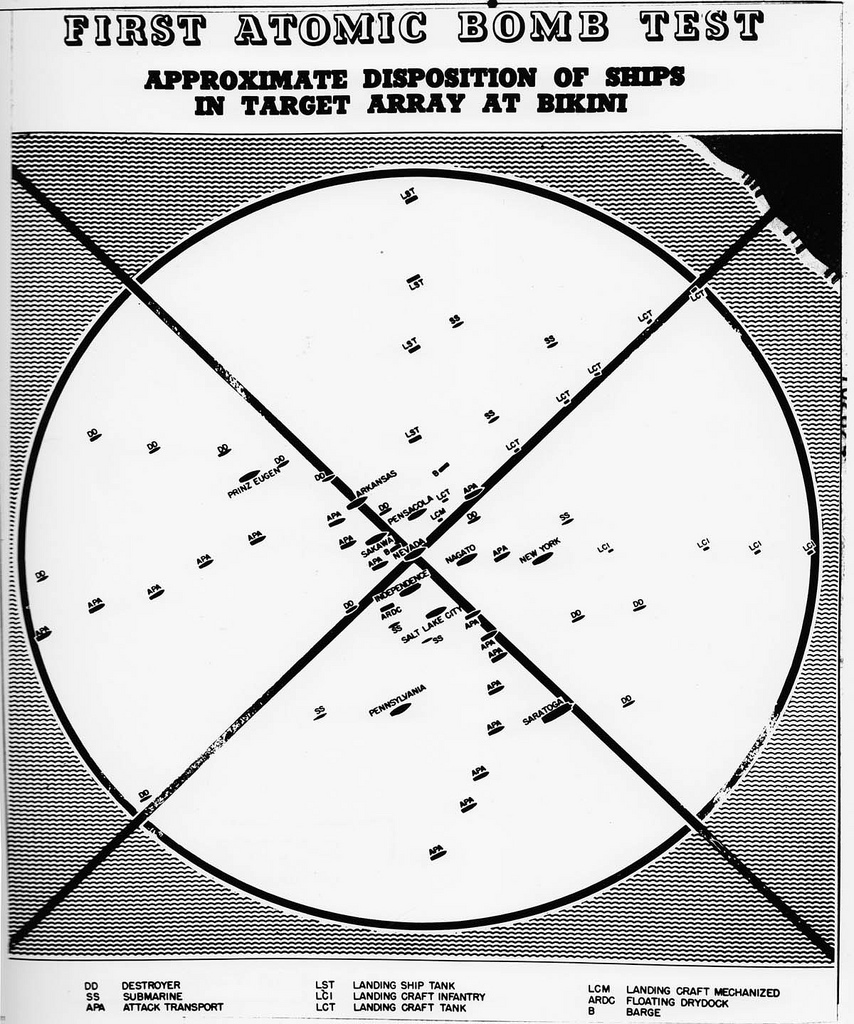
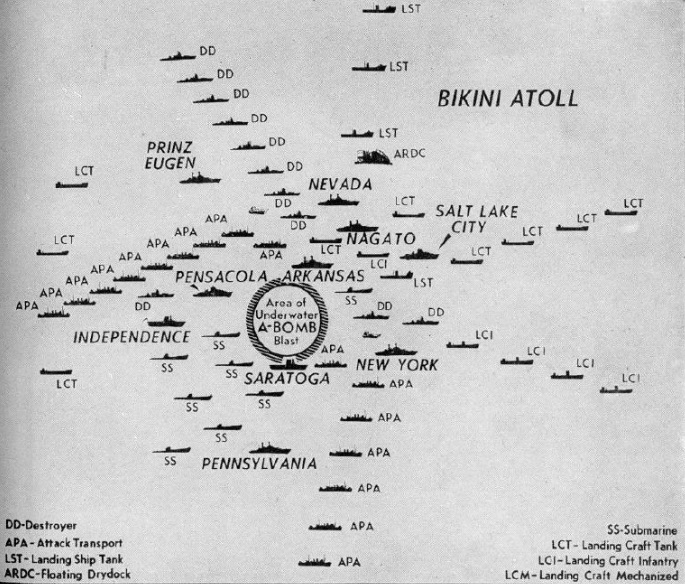
By July 1946 six to them were being successfully operated by the Army Air Group’s Drone Unit, and they were in action over Bikini Atoll in the Marshall Islands for the series of nuclear tests known as Operation Crossroads. The first test (Able) was carried out on 1 July 1946, when a B-29 Superfortress (“Dave’s Dream”) dropped a plutonium bomb of the same power used against Nagasaki from a height of 30,000 feet on a target fleet of 90 obsolete ships; it was an air burst, detonating 520 feet above the ships (the aim point was the battleship USS Nevada, perhaps appropriately enough given that state’s use for nuclear testing in the decades ahead; it was painted bright red to make it visible to the bombardier, but the bomb missed it y 1870 feet).
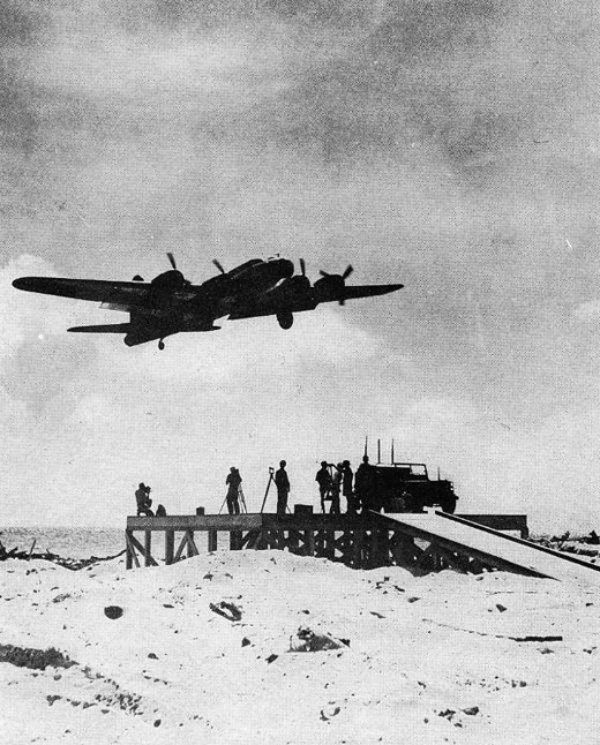
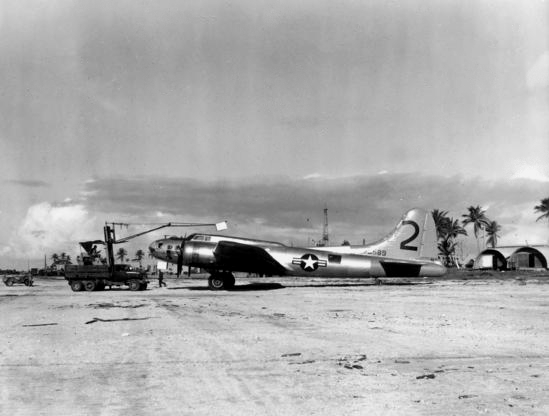
The B-17s were on station 20-30 miles away, and they were the first to approach the target area. Eight minutes after Mike Hour one of them entered the cloud at 24,000 feet, followed by three others at 30,000 feet, 18,000 feet and 13,000 feet. The image below shows a B-17 landing at Eniwetok under ground control:
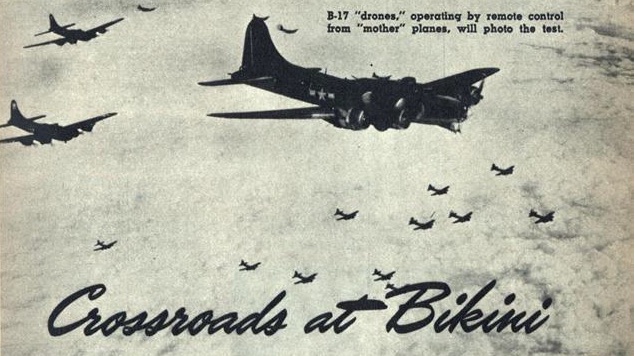
There was nothing secret about their use – like the bomb itself, making the drones public was a vital part of demonstrating American military and technical superiority. Here, for example, is an image from Mechanix Illustrated in June 1946 describing Operation Crossroads :
According to Bombs at Bikini, the official (public) report on Operation Crossroads, prepared for Join Task Force One and published in 1947:
A number of Army Air Forces officials believe that the drone-plane program undertaken for Crossroads advanced the science of drone-plane operations by a year or more. To be sure, a fewwar-weary B-17’s had been flown without crews during the latter part of the recent war [Operation Aphrodite], but they and their cargoes of explosives were deliberately crash-landed. Also, a few B-17’s had been landed by remote control; but pilots were aboard, ready to take over control in case of trouble. Operation Crossroads was the first operation in which take-off, flight, and landing were accomplished with no one aboard. The feat was an impressive one; many experts had thought it could never be accomplished with planes of this size.
As this video clip shows (start at 6.01), take-off was under the control of a ‘ground beep pilot’, who then handed over to a ‘beep television control pilot’ in an accompanying director aircraft (‘the mother ship’), who handed back to the ground beep pilot for the landing. This parallels today’s ‘remote-split operations’, though on a greatly reduced spatial scale, where a Launch and Recovery crew stationed in or near the combat zone is responsible for take-off and landing while the mission is flown by a ground control crew in the continental United States):
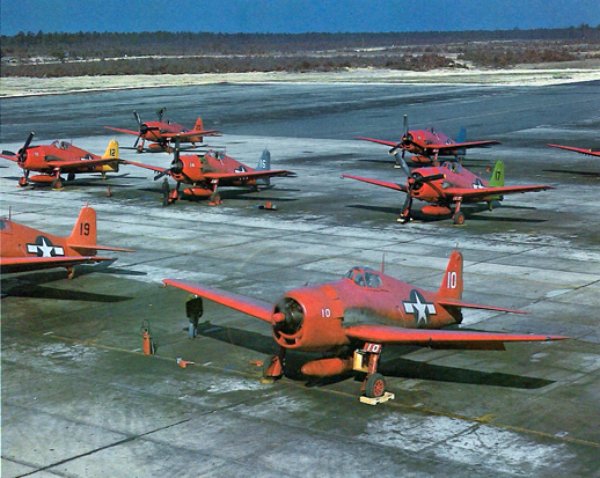
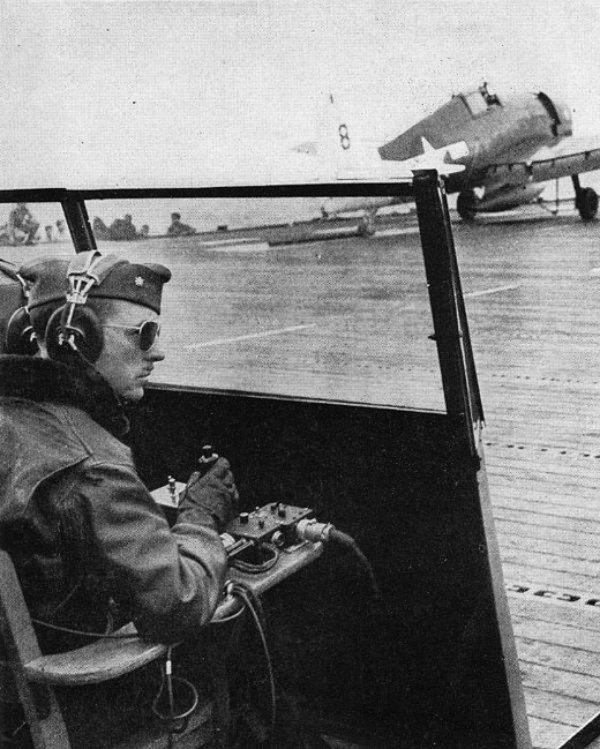
The B-17 drones operated in concert with the US Navy’s F6F-5 Hellcat drones which made transits of the cloud at 20,000 feet, 15,000 feet and 10,000 feet (see the first image below; the tail fins are painted different colours to indicate different control frequencies: more here). The second image shows a pilot on the deck of the aircraft carrier Shangri-La controlling an F6F-5 before take-0ff; landing on the deck of a carrier was difficult enough at the best of times and with a skilled crew on board, and not surprisingly the Navy drones returned to Roi island, part of Kwajalein Atoll.
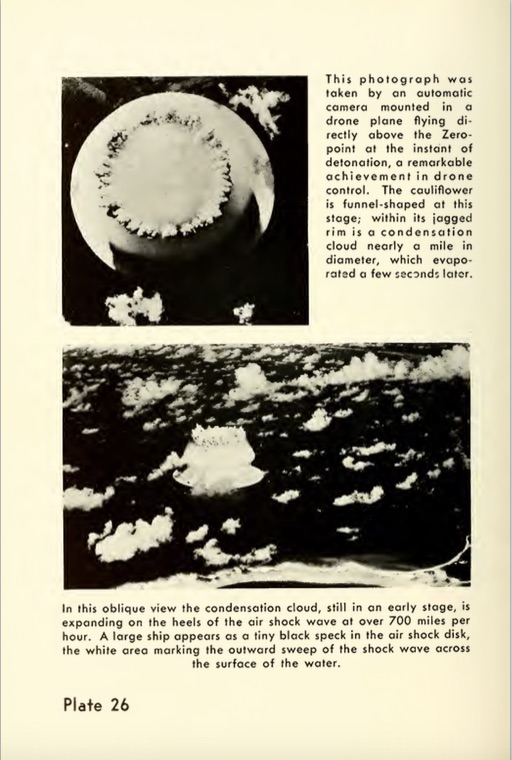
No manned aircraft flew over the center of the blast, called Zeropoint, until four hours later, although manned boats were on the scene after two hours. Drones were also flown after the second test, Baker, on July 25, which was an underwater shot suspended from a target ship in Bikini’s lagoon.
In each case the drones were tasked to take air samples from the cloud (using filters housed in boxes under the wings) and to photograph the cloud formation:
As the official pictorial record boasted (its very existence underlining the importance of a controlled ‘publicness’ to these tests):
Drone planes penetrated where no man could have ventured, flew through the mushroom cloud on photographic missions, sampled its poisonous content, televised to remote onlookers their instrument panel readings for flight analysis.
The samples were crucial, and drones remained of vital importance in collecting them. The image below shows the air filters being removed from a remotely operated B-17 used in Operation Sandstone (a series of nuclear tests conducted by the Atomic Energy Commission at Eniwetok Atoll in 1948):
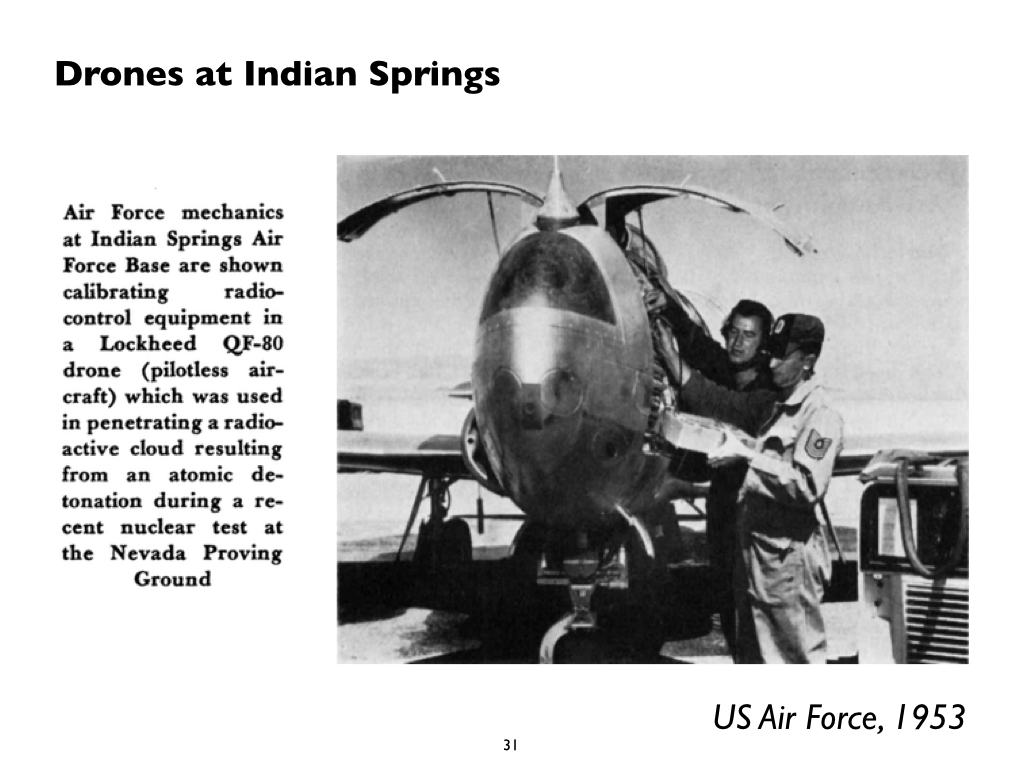
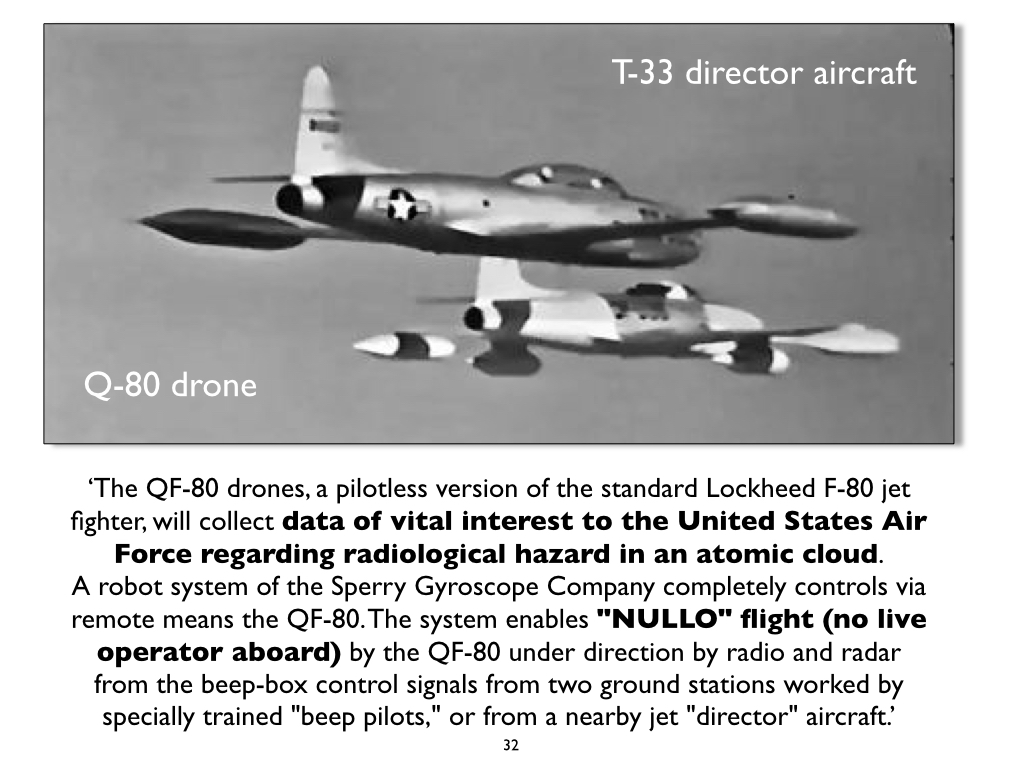
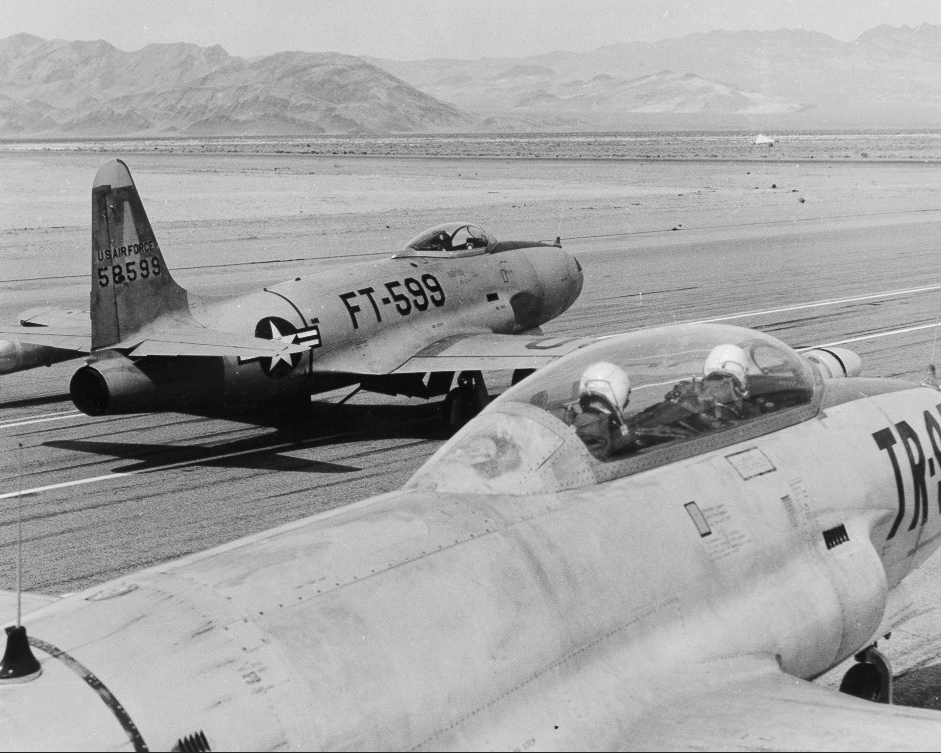
The capstone attempt to deliver atomic bombs by remote controlled aircraft, Project Brass Ring, was abandoned in March 1951 when the Air Force determined that a manned aircraft could execute the bomb delivery safely (at least for those on board), but drones continued to be used during atomic tests. In 1953 QF-80 drones were in use at Indian Springs, the Air Force portal to the Nevada Proving Grounds (the full story is here):
Lockheed QF-80 drone (FT-599) and director aircraft (a Lockheed DT33) ready for take-off at Indian Springs
This was the first time ‘jet drones’ had been used during continental tests. NULLO (‘No Live Operator Onboard’) operations used the same system of hand offs between beep pilots and director aircraft that had been used for the B-17s, but Sperry claimed that its precision marked a new milestone in remote operations. Here’s a video of the drones in operation – and the effects of the blast on the aircraft:
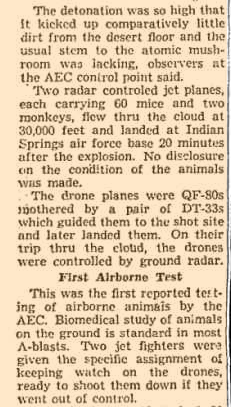
But some tests were designed to evaluate the effects of the blast and the cloud on living creatures. Here is a clipping from the Chicago Tribune, reporting on a test carried out over Nevada on 6 April 1953 – in fact the mission shown in the last still photograph above. Note that the radiation effects were expected to be so powerful that all air traffic was excluded from an area of 100,00 square miles:
Today Indian Springs is known as Creech Air Force Base: the operating hub for the US Air Force’s MQ-1 Predators and MQ-9 Reapers…




 geographical imaginations