Matters of definition

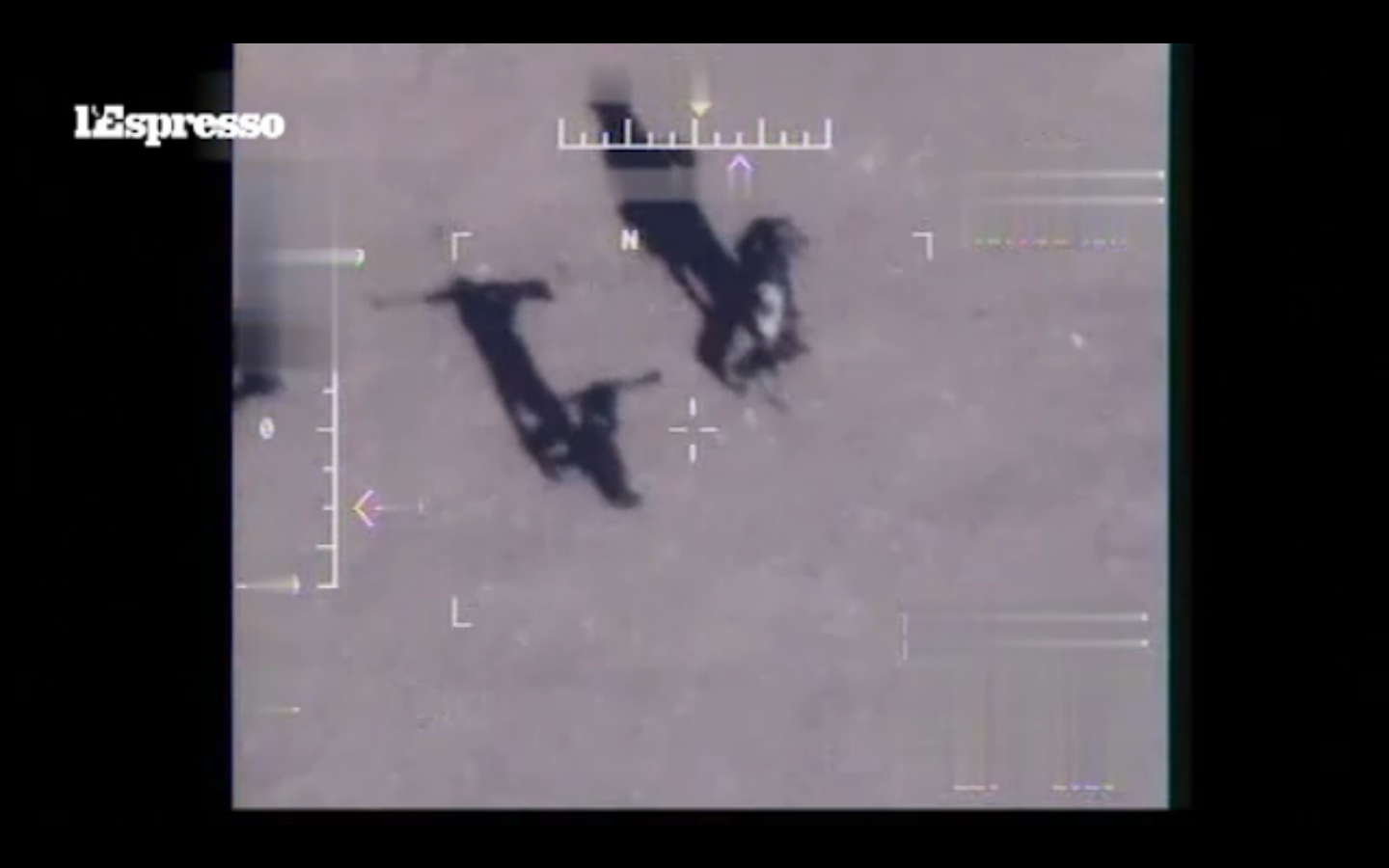
Since my post on the use of drones to provide intelligence, surveillance and reconnaissance over Iraq and Syria I’ve been thinking about the image stream provided by Predators and Reapers.  Then I used an image from what I think must be an MQ-9 Reaper operated by France which was in full colour and – this is the important part – in high definition.  Over the weekend the New York Times published a report, culled from the Italian magazine L’Espresso, which – together with the accompanying video clip (the link is to the Italian original not the Times version) – confirmed the power of HD full motion video, this time from a Reaper operated by Italy:

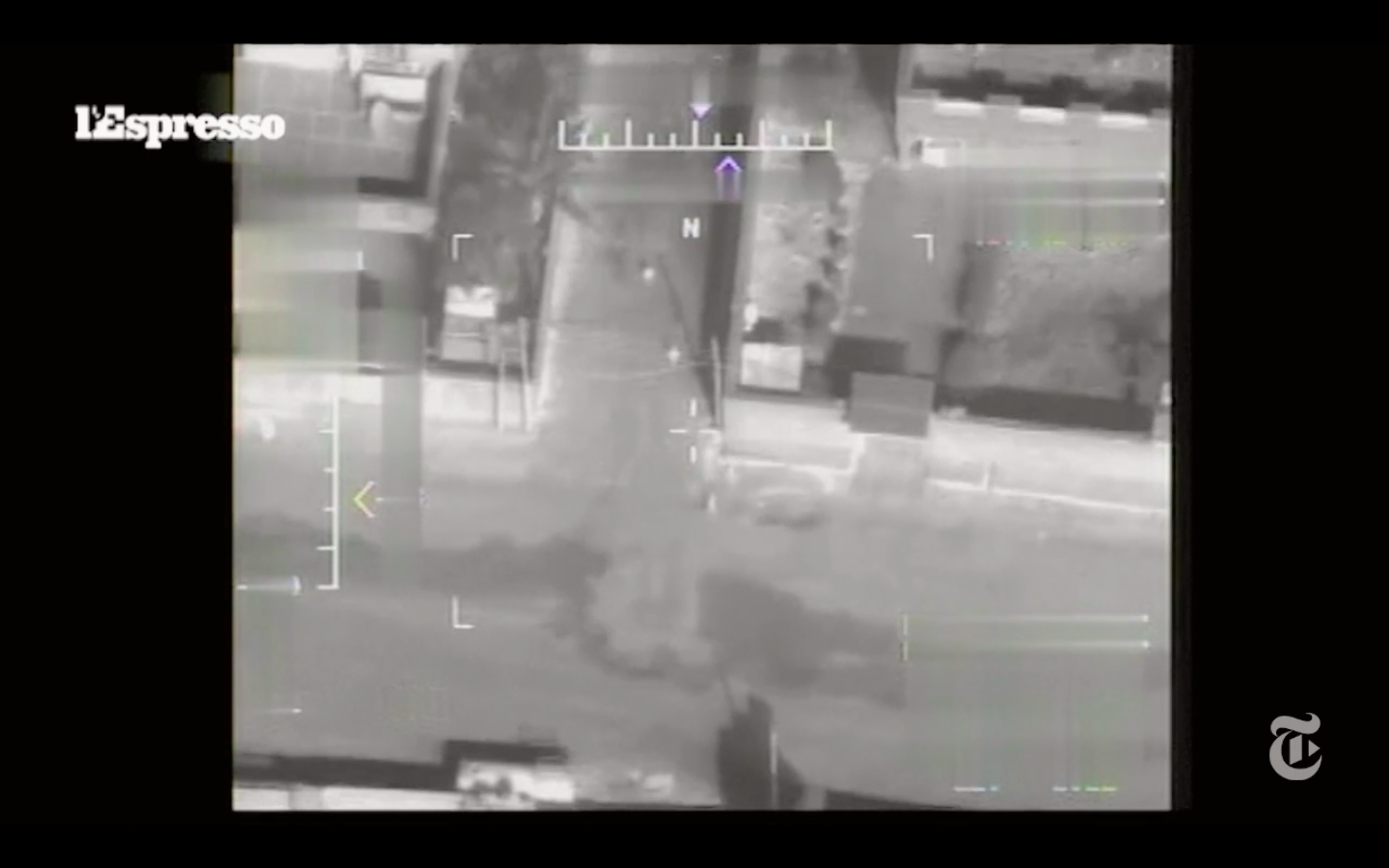
The footage … begins with grainy black-and-white images of an airstrike on what appears to have been a checkpoint on a road in northern Iraq, beneath a huge black flag.

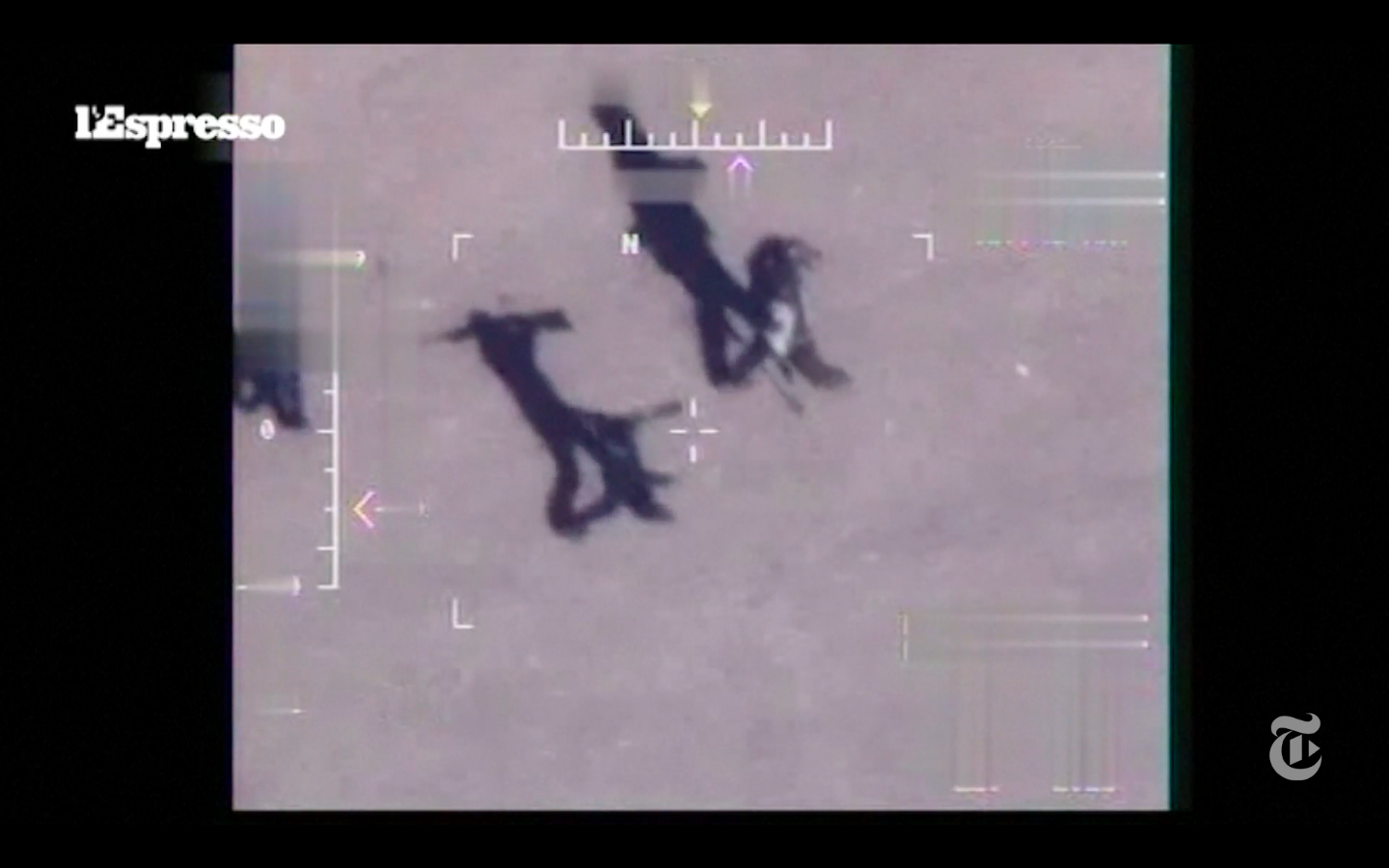
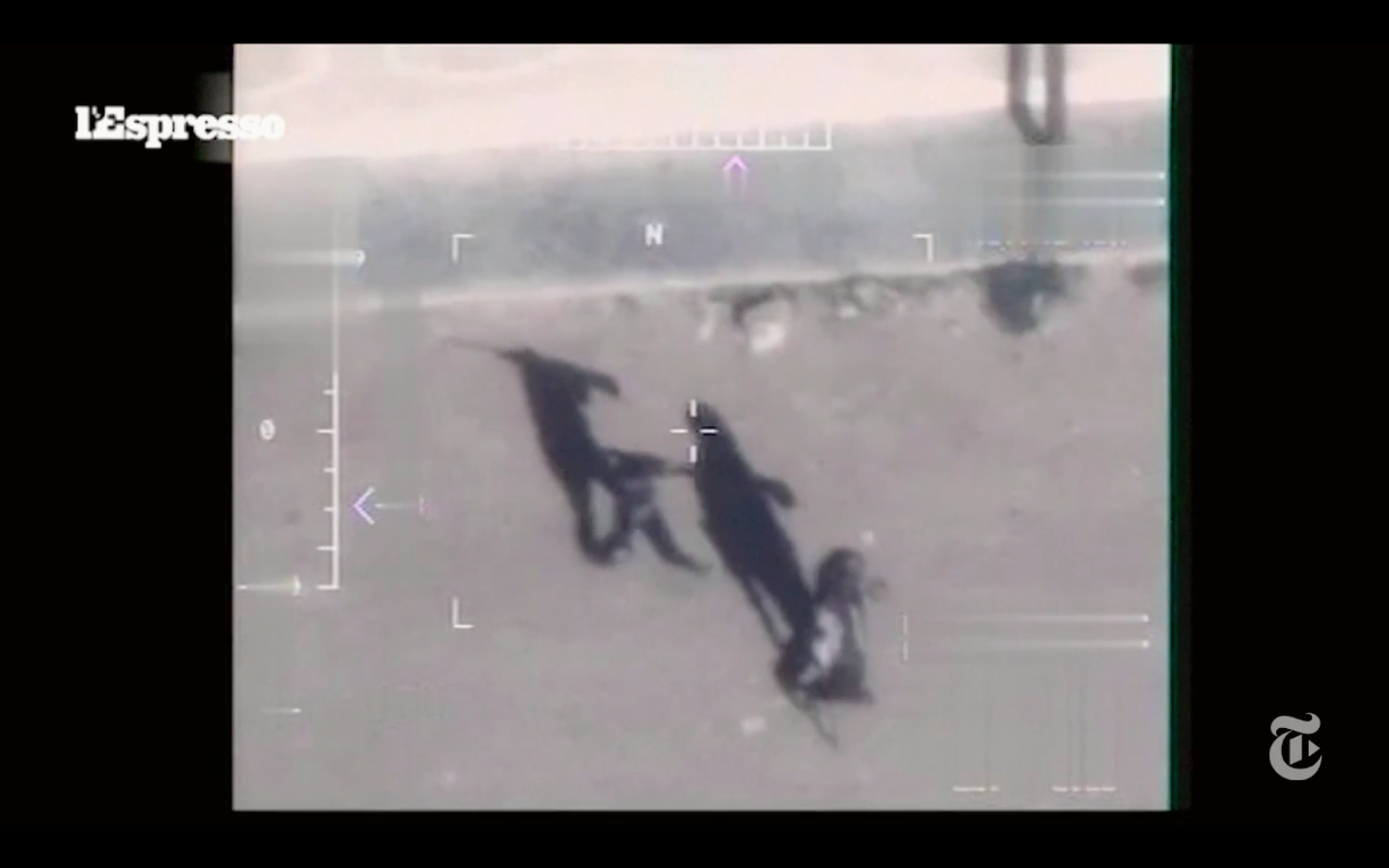
Then there is something altogether different: high-resolution, color video of four distinct armed figures walking out of a house and along the streets of a town. At one stage, the picture suddenly zooms in on two of the suspected militants to reveal that one of them is almost certainly a child, propping a rifle on his shoulder that indicates how small he is relative to the man next to him. The images are so clear that even the shadows of the figures can be examined.

Italian Drone video BItalian drone video CItalian drone video AItalian drone video DItalian drone video I

But the significance of all this is less straightforward than it might appear.

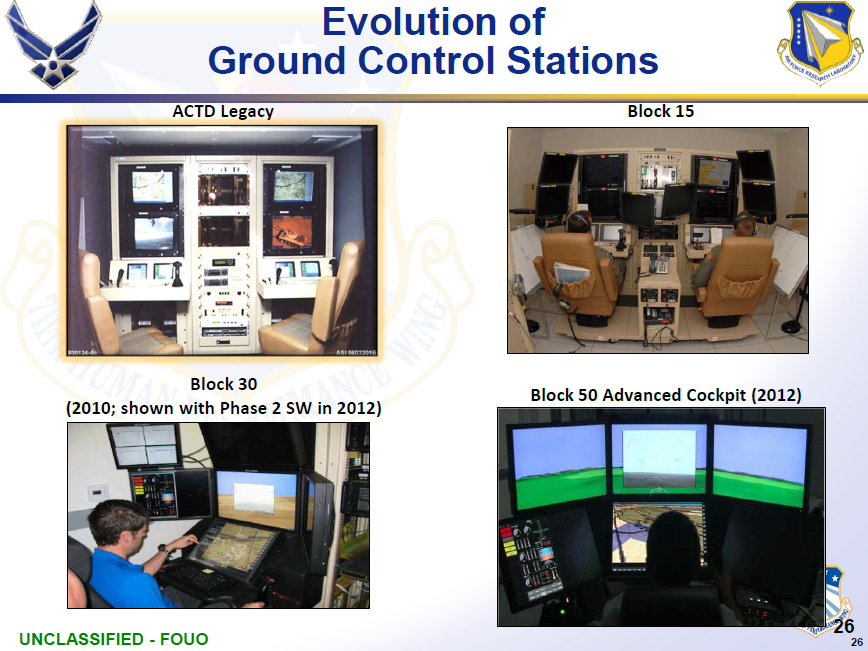
First, not all drones have this HD capability.  We know from investigations into civilian casualty incidents in Afghanistan that the feeds from Predators but also early model (‘Block’) Reapers are frequently grainy and imprecise.  Sean Davies reports that the video compression necessary for data transmission squeezed 560 x 480 pixel resolution images into 3.2 MBps at 30 frames per second whereas the newer (Block 5) Reapers provide 1280 x 720 pixel resolution images resolution images at 6.4 MBps.  The enhanced video feeds can be transmitted not only to the Ground Control Stations from which the aircraft are flown – and those too have been upgraded (see image below) – but also to operations centres monitoring the missions and, crucially, to ruggedized laptops (‘ROVERs’) used by special forces and other troops on the ground.

ground-control-stations

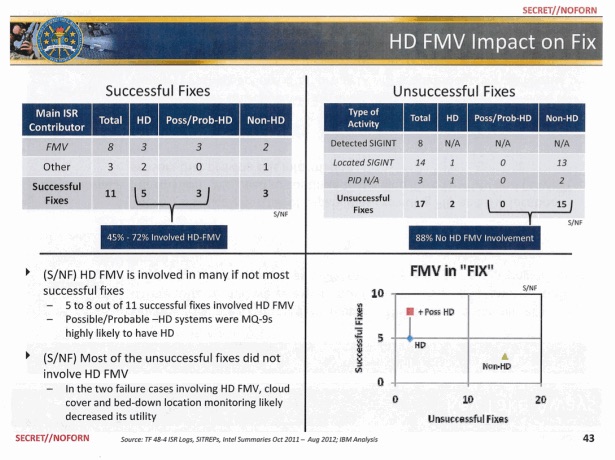
The significance of HD full-motion video is revealed in the slide below, taken from a briefing on ‘small footprint operations’ in Somalia and Yemen prepared in February 2013 and published as part of The Intercept‘s Drone Papers, which summarises its impact on the crucial middle stage of the ‘find, fix, finish‘ cycle of targeted killing:

HD FMV impact on Fix

As you can see, HD FMV was involved in as many as 72 per cent of the successful ‘fixes’ and was absent from 88 per cent of the unsuccessful ones.

Second, Eyal Weizman cautions that the image stream shown on the Italian video was captured ‘either very early or very late in the day.  Without shadows we could not identify these as weapons at all.’  Infra-red images captured at night could obviously not provide definition of this quality, but even so-called ‘Day TV’ would not show clear shadows at most times of the day. In Eyal’s view, ‘showing these rare instances could skew our understanding of how much can be seen by drones and how clear what we see is.’

Third, no matter how high the resolution of the video feeds, we need to remember that their interpretation is a techno-cultural process.  One of the figures shown in the Italian video ‘is almost certainly a child’, reports the New York Times.  So bear in mind this exchange between the crew of a Predator circling over three vehicles travelling through the mountains of Uruzgan in February 2010 (see also here and here):

1:07 􏰀(MC):􏰀 screener􏰀 said 􏰀at least 􏰀one 􏰀child 􏰀near 􏰀SUV􏰀

1:07 􏰀(Sensor):􏰀 bull􏰀 (expletive 􏰀deleted)…where!?􏰀

1:07 􏰀(Sensor): 􏰀send 􏰀me 􏰀a 􏰀(expletive􏰀deleted) 􏰀still,􏰀􏰀 I􏰀 don’t 􏰀think 􏰀they 􏰀have 􏰀kids 􏰀out 􏰀at 􏰀this 􏰀hour, 􏰀I 􏰀know􏰀 they’re 􏰀shady 􏰀but􏰀 come􏰀 on􏰀

1:07􏰀 (Pilot):􏰀 at 􏰀least 􏰀one 􏰀child…􏰀Really?􏰀 Listing 􏰀the􏰀 MAM [Military-Aged Male], 􏰀uh, 􏰀that 􏰀means 􏰀he’s 􏰀guilty􏰀

1:07􏰀 (Sensor):􏰀 well 􏰀may be􏰀 a 􏰀teenager 􏰀but 􏰀I 􏰀haven’t􏰀 seen􏰀 anything 􏰀that 􏰀looked 􏰀that 􏰀short, 􏰀granted 􏰀they’e􏰀 all 􏰀grouped 􏰀up 􏰀here,􏰀 but.􏰀..

1:07 􏰀(MC): 􏰀They’re 􏰀reviewing􏰀

1:07 􏰀(Pilot):􏰀Yeah 􏰀review 􏰀that􏰀 (expletive 􏰀deleted)…why􏰀 didn’t 􏰀he 􏰀say􏰀 possible􏰀 child,􏰀 why􏰀 are􏰀 they􏰀 so 􏰀quick􏰀 to 􏰀call 􏰀(expletive􏰀 deleted) 􏰀kids 􏰀but􏰀 not 􏰀to 􏰀call 􏰀(expletive􏰀deleted) 􏰀a 􏰀rifle􏰀….

03:10 􏰀(Pilot):􏰀 And 􏰀Kirk􏰀97, 􏰀good 􏰀copy􏰀 on􏰀 that.􏰀 We 􏰀are 􏰀with 􏰀you.􏰀 Our 􏰀screener􏰀 updated􏰀 only􏰀 one􏰀 adolescent 􏰀so 􏰀that’s 􏰀one􏰀 double 􏰀digit􏰀 age 􏰀range.􏰀 How􏰀 Copy?􏰀

03:10 􏰀(JAG25):􏰀We’ll􏰀 pass 􏰀that 􏰀along 􏰀to 􏰀the 􏰀ground 􏰀force􏰀 commander.􏰀 But 􏰀like 􏰀I 􏰀said, 􏰀12 􏰁13 􏰀years 􏰀old 􏰀with􏰀 a 􏰀weapon 􏰀is􏰀 just 􏰀as􏰀 dangerous.􏰀􏰀

In other words – it’s more than a matter of high definition; it’s also a matter of political and cultural definition.

Grotesque geographies

KRUPAR lecture

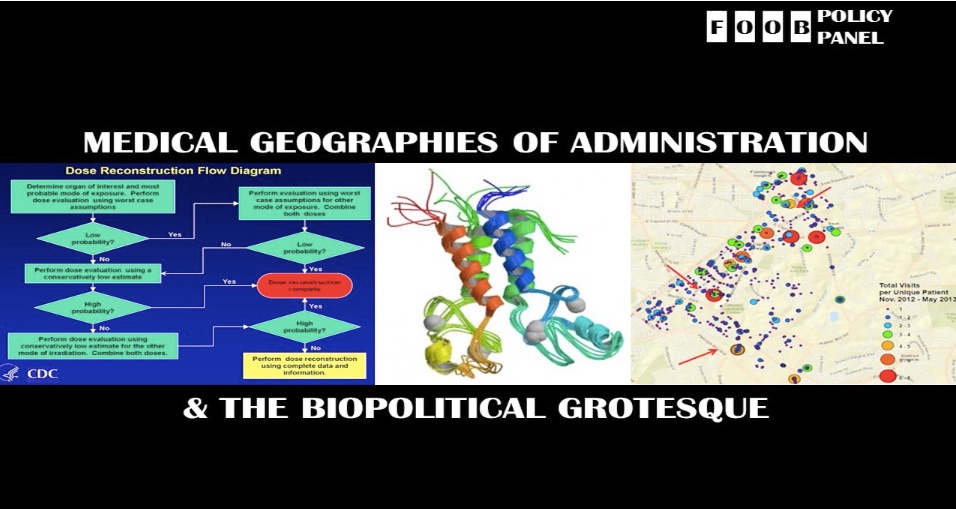
The 2nd Neil Smith Lecture at St Andrews, which was given last month by Shiloh Krupar on ‘Operational Banality: medical geographies of administration and the biopolitical grotesque‘, is now available online here.  A tour de force (plus a splendid cartoon of the spectacularly grotesque Donald Trump).

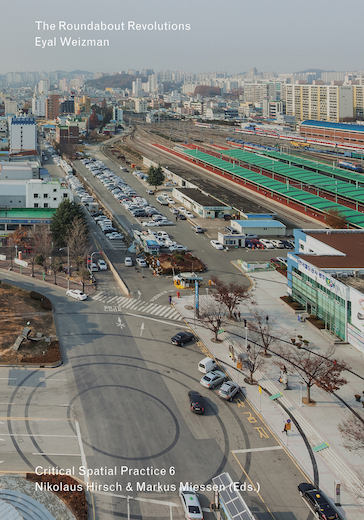
The Roundabout Revolutions

CSP6_Weizman_364

In ‘Tahrir: politics, publics and performances of space’ (DOWNLOADS tab) I tried to sketch out a preliminary analysis of Tahrir Square as a spatial instantiation of the Arab uprisings – it was, in part, also an attempt to work with Judith Butler‘s ideas about performative spaces in “Bodies in Alliance”. Now Eyal Weizman‘s latest extended essay puts all this in a wider context but a similar spatial frame: The roundabout revolutions from Sternberg Press.

One common feature of the wave of recent revolutions and revolts around the world is not political but rather architectural: many erupted on inner-city roundabouts. In thinking about the relation between protest and urban form, Eyal Weizman starts with the May 1980 uprising in Gwangju, South Korea, the first of the “roundabout revolutions,” and traces its lineage to the Arab Spring and its hellish aftermath.

Rereading the history of the roundabout through the vortices of history that traverse it, the book follows the development of the roundabout in Europe and North America in the early twentieth century, to its subsequent export to the colonial world in the context of attempts to discipline and police the “chaotic” non-Western city. How did an urban apparatus put in the service of authoritarian power became the locus of its undoing?

Today, as the tide of revolt that characterized the Arab Spring seems to ebb, when nations and societies disintegrate by brutal civil wars and military oppression, the series of revolutions might seem like Dante’s circles of hell. To counter this counter-revolution, Weizman proposes that the immanent power of the people at the roundabouts will need to find its corollary in sustained work at round tables—the ongoing formation of political movements able to enact political change.

The sixth volume of the Critical Spatial Practice series stems from Eyal Weizman’s contribution to the Gwangju Folly II in 2013, an exhibition curated by Nikolaus Hirsch with Philipp Misselwitz and Eui Young Chun for the Gwangju Biennale. Weizman and the architect Samaneh Moafi constructed a folly composed of seven roundabouts and a round table in front of the Gwangju train station, one of the central points in the events of May 1980.

There’s a review by Pranav Kohli over at Warscapes here:

Weizman’s description is reminiscent of Michel Foucault’s theorization of power. Foucault theorized power not as something that is hierarchically exercised but as a force that circuitously flows and passes through individuals, networks and organizations. Weizman recognizes the emerging character of power as a circle, describing the concentric arrangements of crowds as a “political collective in becoming.” These concentric crowd circles can be seen as a diagram of the fields of power emanating from the roundabout, with the roundabout itself becoming a beacon of a newfound people’s power.

Weizman’s analysis has a special focus on the Arab Spring and in a later section he returns to this idea of an interconnected collective while describing the protestors at Tahrir Square. They are linked not only by physical space and communication technologies but also by “an “Internet of things”—a form of connectivity that entangles organizations, individuals, material objects, and urban spaces such as roundabouts together: sites and websites, proximity and distance, remote solidarity and physical corporality” …

Weizman locates the true reason for the revolutionary turn in the roundabout’s history, within the spatial peculiarities of the roundabout itself. The roundabout’s attraction lies in the fact that it is an expansive public space that serves an integral function in the city’s infrastructure. In this sense, the roundabout can be seen as one of the last remaining public spaces where large crowds can gather in the congested modern city…. Weizman doesn’t regard the occupation of the roundabout as the moment when the public reclaimed public ownership of the republic. In his view, it was when the protestors at Tahrir Square began cleaning up the square, shortly after Mubarak’s deposition, that they truly assumed public ownership of the roundabout, and thereby the republic.

Another Manhattan Project

I still regard Postmodern geographies as Ed Soja‘s finest book – his most considered and his most creative – and within that his essay on ‘Taking Los Angeles Apart‘ is surely the stand-out contribution.  By turns playful and passionate, it’s packed with insights about Los Angeles and late modern cities.  I discussed it at length in Geographical imaginations – the book not the blog – but the essay has come back to haunt me ever since I learned of an extraordinary new book which I know Ed would have read with the greatest interest.

KISHIK The Manhattan Project

It’s David Kishik‘s The Manhattan Project, which I stumbled across because of its title and my new-found interest in seeing drones through post-atomic eyes.  But it’s not about that Manhattan Project at all.  Instead, it riffs on Benjamin’s Arcades Project in the most astonishing of ways:

In The Manhattan Project, David Kishik dares to imagine a Walter Benjamin who did not commit suicide in 1940, but managed instead to escape the Nazis to begin a long, solitary life in New York. During his anonymous, posthumous existence, while he was haunting and haunted by his new city, Benjamin composed a sequel to his Arcades Project. Just as his incomplete masterpiece revolved around Paris, capital of the nineteenth century, this spectral text was dedicated to New York, capital of the twentieth. Kishik’s sui generis work of experimental scholarship or fictional philosophy is thus presented as a study of a manuscript that was never written.

The fictitious prolongation of Benjamin’s life will raise more than one eyebrow, but the wit, breadth, and incisiveness of Kishik’s own writing is bound to impress. Kishik reveals a world of secret affinities between New York City and Paris, the flâneur and the homeless person, the collector and the hoarder, the covered arcade and the bare street, but also between photography and graffiti, pragmatism and minimalism, Andy Warhol and Robert Moses, Hannah Arendt and Jane Jacobs. A critical celebration of New York City, The Manhattan Project reshapes our perception of urban life, and rethinks our very conception of modernity.

Another good friend who is sadly no longer with us, Allan Pred, would surely have relished that too. I’m sure Ed would have insisted that Benjamin would never have gone to New York and that, in common with Adorno, he would have sought refuge in L.A. (where else? In fact Adorno left New York for LA, though it’s impossible to think of Ed calling that ‘exile’).

You can read the Introduction to The Manhattan Project here and an extract from the first chapter here; there’s also an extended interview with David about the project here.

Finally, there’s an excellent review by Dustin Illingworth at The Brooklyn Rail here.  When Dustin says this –

Like Borges’s “Aleph,” New York is “the place where, without admixture or confusion, all the places of the world, seen from every angle, coexist.” It is therefore much to Kishik’s credit that his slim volume, a drop in the vast ocean of literature on the city, packs such a considerable theoretical punch.

– then we are back with Ed Soja’s essay, which also began with an appeal to The Aleph and also packed a considerable theoretical punch.

A lack of intelligence

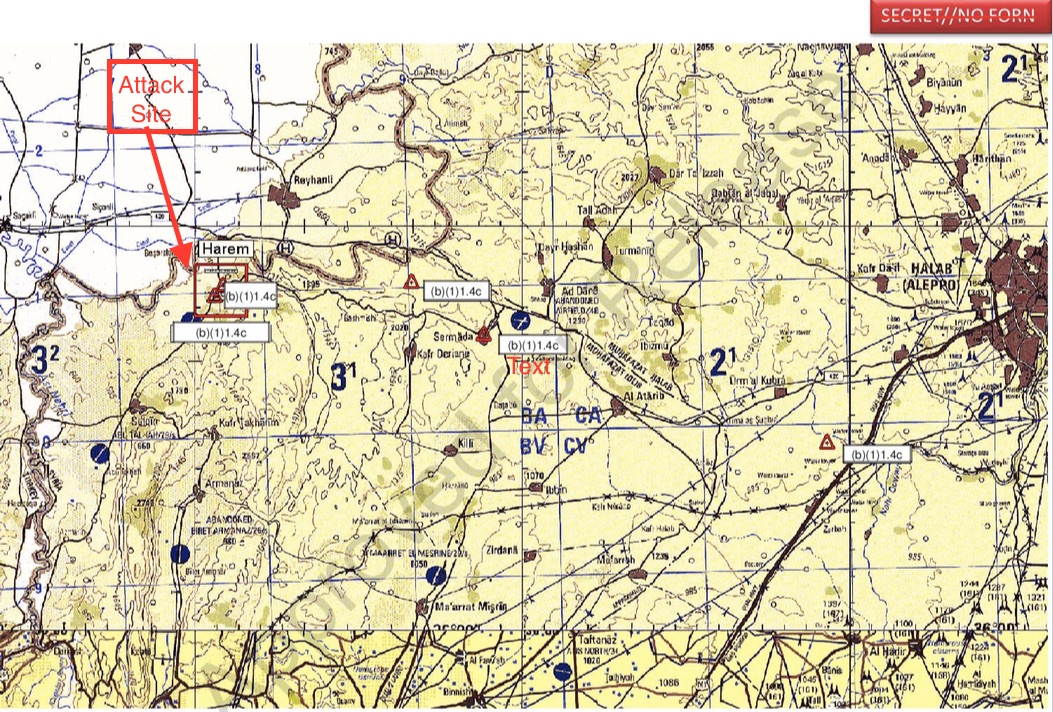
Harim Air Strike MAP annotated

The second of the three recent US air strikes I’ve been looking at took place near Harim [Harem on the map above] in Syria on the night of 5-6 November 2014.  The report of the military investigation into allegations of civilian casualties is here.

The aircraft launched multiple strikes against two compounds which had been identified as sites used as meeting places for named (though redacted) terrorists and sites for the manufacture and storage of explosives by the al-Qaeda linked ‘Khorasan Group’ (if the scare-quotes puzzle you, compare here and here).

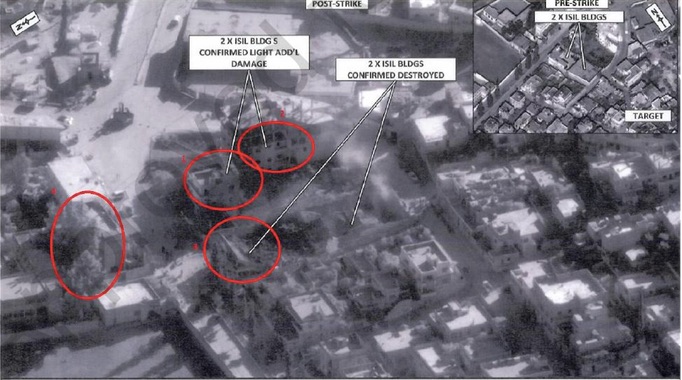
The compounds each contained several buildings and had previously been on a No Strike List under a category that includes civilian housing; they lost their protected status when ‘they were assessed as being converted to military use’ but ‘other residential and commercial structures were situated around both targets’.  An annotated image of the attack on the first compound is shown below:

Harim Air Strike on Compound 001

Although the report argues that ‘the targets were engaged in the early morning hours when the risk to civilians was minimized’ – a strange statement, since most civilians would have been asleep inside those ‘residential structures’ – US Central Command subsequently received open-source reports of from three to six civilian casualties, together with still and video imagery.  By the end of December 2014 the Combined Joint Task Force conducting ‘Operation Inherent Resolve’ had completed a preliminary ‘credibility assessment’ of the claims and found sufficient evidence to establish a formal investigation into the allegations of civilian casualties.  The investigating officer delivered his final report on 13 February 2015.

He also had access to a report from the Syrian Network for Human Rights that provided a ground-level perspective (including video) unavailable to the US military.  Its narrative is different from US Central Command, identifying the targets as being associated with An-Nussra:

The warplanes launched, at first, four missiles that hit three military points, which are located next to each other, in the northeast of the town:

1 – The Agricultural Bank, which is used by An-Nussra front as a center.
2 – The central prison checkpoint, where An-Nussra fighters were stationed.
3 – An ammunition depot in the same area.

The shelling destroyed and burned the Agricultural Bank’s building completely in addition to damaging a number of building nearby. Furthermore, a number of cars were burned while a series of explosions occurred after an explosion in the ammunition depot..
Afterwards, the warplanes targeted a fourth center with two missiles. [This target] was a building by an old deserted gas station located near the industrial school in the south of the town. The shelling destroyed the center completely as well as the gas station in addition to severely damaging the surrounding buildings. Harem residents were aided by the civil-defense teams to save people from underneath the rubble.

SNHR documented the killing of two young girls; one could not be unidentified but the other was Daniya, aged 5, who was killed along with her father who was said to be one of the An-Nussra fighters living in a house near the Agricultural Bank.  Daniya’s mother and her brother Saeed, aged 7, were seriously wounded.

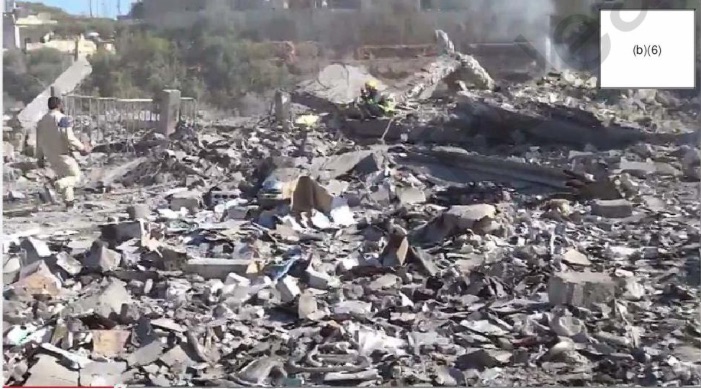
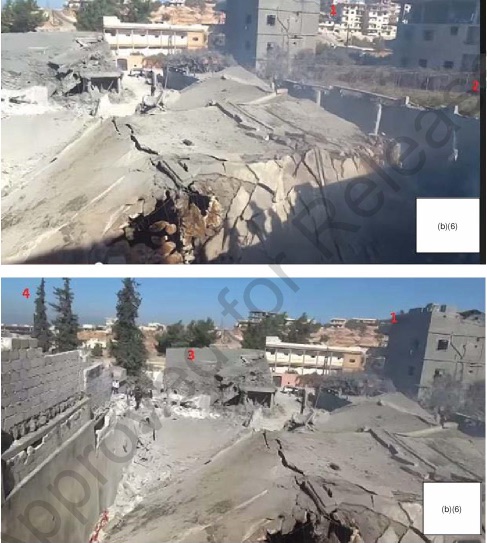
The report also included post-strike imagery from YouTube videos and Twitter feeds:

Harim VIDEO 1 jpeg

Harim VIDEO 2 jpeg

In contrast to the report on the air strike in Iraq I discussed in my previous post, this one includes no details of the attack, nor the procedures through which it was authorised and conducted – though we do know that there is a considerable military bureaucracy behind all these strikes, especially in the administration of what in this case was clearly a pre-planned rather than emergent target.  For more on the bureaucratisation of targeting, incidentally, see  Astrid Nordin and Dan Öberg, ‘Targeting the ontology of war: From Clausewitz to Baudrillard’, Millennium 43 (2) (2015) 392-410; analytically it’s right on the mark, I think, and I’ll be advancing similar arguments in my Tanner Lectures – though stripped of any reference to Baudrillard…

But there is one revealing sentence in the report.  Although the investigating officer had no doubt that the Harim strikes were perfectly legal, everything worked like clockwork and nothing need be changed –

Harim conclusion

– there is nevertheless a recommendation for ‘sustained ISR [intelligence, surveillance and reconnaissance] whenever practicable based on operational requirements, to ensure that no civilians are entering or exiting a facility.’  The clear implication is that these strikes – pre-planned, remember: these were not fleeting targets of opportunity – were not supported by real-time ISR.  When you add to that the reliance placed by the investigation on ground imagery from YouTube and Twitter, you begin to realise how little the US military and its allies must know about many of the targets they strike in Iraq and Syria.  (I might add that the US has not been averse to using Twitter feeds for targeting too: see Robert Gregory‘s compelling discussion in Clean bombs and dirty wars: air power in Kosovo and Libya, where he describes the central role played by Twitter feeds from Libyan rebels in identifying targets for the US Air Force and its NATO allies: by the closing months of the campaign France was deriving 80 per cent of its intelligence from social media contacts on the ground).

All this gives the lie to the cheery ‘let ’em have it’ guff from Robert Caruso, commenting on US air strikes in Syria last September:

By relying so heavily on drones in our recent counter-terror campaigns we’ve been fighting with one hand tied behind our back. But a key to the success of Monday’s strikes was the use of manned aircraft with pilots who can seek out enemy targets and make on-the-spot decisions…

it’s time to drop the drone fetish, and the limitations it imposed, and go back to using manned airpower, which is more powerful and better suited to hunting down elusive targets like ISIS.

Regular readers will know that I’m not saying that drones are the answer, or that their ability to provide persistent, real-time, full-motion video feeds in high definition makes the battlespace transparent; on the contrary (see my ‘Angry Eyes’ posts here and especially here: more to come soon).

But the absence of their ISR capability can only make a bad situation worse.  In February, the director of the National Counterterrorism Center conceded that that US had not ‘closed the gap on where we need to be in terms of our understanding, with granularity, about what is going on on the ground in Syria.’  Indeed, during the first four months of this year ‘nearly 75 percent of U.S. bombing runs targeting the Islamic State in Iraq and Syria [a total of more than 7,000 sorties] returned to base without firing any weapons’, and reports claimed that aircrews held their fire ‘mainly because of a lack of ground intelligence.’

Full-motion video cannot compensate for that absence, of course, and in any case there are serious limitations on the number of ISR orbits that are possible over Iraq and Syria given the demands for drones over Afghanistan and elsewhere: each orbit requires three to four aircraft to provide 24/7 coverage, and the global maximum the US Air Force can provide using its Predators and Reapers varies between 55 and 65 orbits (or ‘combat air patrols’).

In late August 2014 Obama authorised both manned and unmanned ISR flights over Syria, and since then the United States has been joined by the UK and France in deploying MQ-9 Reapers over Iraq and Syria, where their video feeds have helped to orchestrate missions carried out by conventional strike aircraft (see, for example, here).  In August 2015 France claimed that all its air strikes in Iraq had to be validated by ISR provided by a drone:

reaper-20150508

But that was in August, before Hollande threw caution to the winds and ramped up French air strikes in response to the Paris attacks in November – an escalation that relied on targeting packages supplied by the United States.

In any case, Predators and Reapers are also armed and in their ‘hunter-killer’ role they had executed around one quarter of all airstrikes conducted by the United States in Iraq and Syria by June 2015 and more than half the air strikes conducted by the UK in Iraq.  Although the UK only extended its bombing campaign against Islamic State to Syria this month, its Reapers had been entering Syrian airspace in steadily increasing numbers since November 2014 to provide ISR (in part, presumably, to enable the United States to orchestrate its air strikes) and in September 2015 it used one of them to carry out the UK’s first acknowledged targeted killing near Raqqa (see also here and here); the United States has also routinely used the aircraft in the extension of its multi-sited targeted killing program to Syria (see also here).

All this bombing, all this blood: and yet strategically remarkably little to show for it.   And all for a lack of intelligence…

Three strikes…

I’ve been working away on my Tanner Lectures, which has plunged me back in to my research on air strikes.  There is a dismal topicality to the subject, since in the UK the hawks on both right and left are circling the lobbies in the wake of the attacks in Paris (but still not, it seems, those in Beirut) demanding that yet more bombs fall on Syria.  They are less than hawk-eyed, however, since they offer no insight into what – precisely (not exactly the right word where bombing is concerned) – this is designed to achieve.  They have learned nothing from the 100-odd years of the history of bombing, or even from its more recent effects.

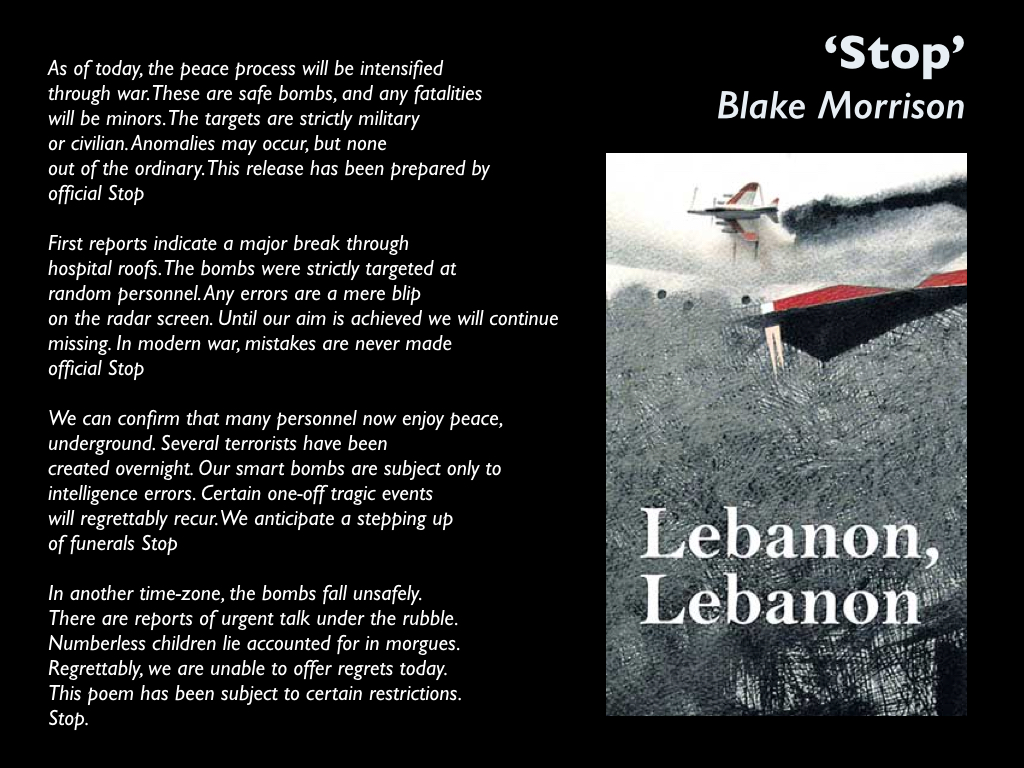
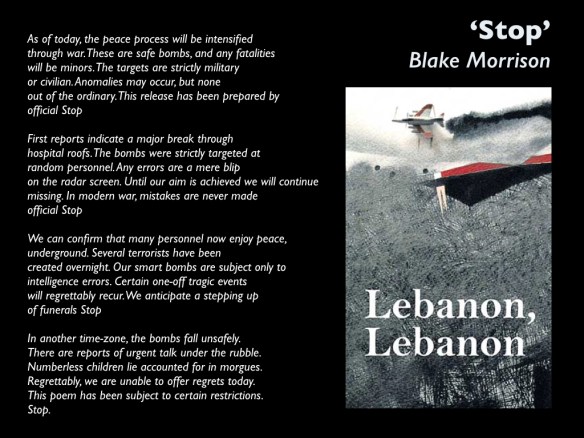
And talking of Beirut: when I delivered a presentation there in 2006, six months after Israel’s devastating air strikes on its southern suburbs, I borrowed my title [‘In another time-zone the bombs fall unsafely’: see DOWNLOADS tab] from Blake Morrison‘s poem ‘Stop’ which was reprinted in an anthology to aid children’s charities in Lebanon:
Blake Morrison STOP.001

So let me turn to three recent investigations of civilian casualties caused by US air strikes.  In each case it’s difficult to say as much as one ought to be able to say: in the first two cases (in Iraq and Syria) the reports have been heavily redacted, and in the third case (the attack on MSF’s hospital in Kunduz) all we have so far is an extended summary (though Kate Clark, as always, does a brilliant forensic job in filleting it here).

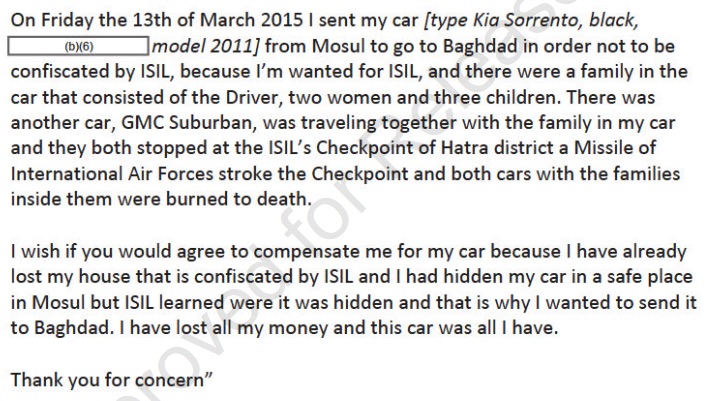
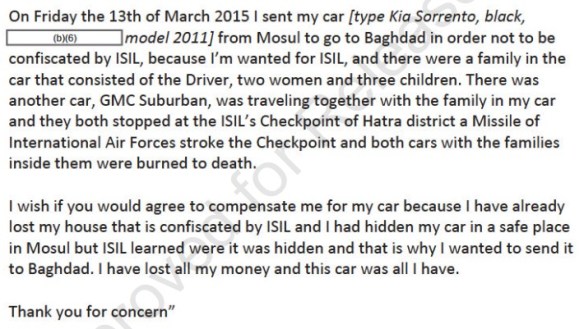
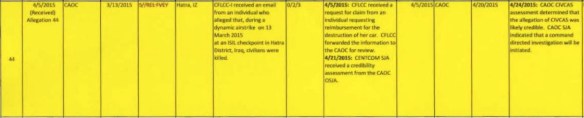
In this post I’ll discuss the report of an investigation into an air strike by two A-10 (‘Warthog’) aircraft on an Islamic State checkpoint near Al Hatra in Iraq on 13 March 2015.  On 2 April CENTCOM’s Combined Air Operations Center (CAOC) at Al Udeid Air Base in Qatar was forwarded the following e-mail:
e-mail translation Al Hatra CIVCAS

Officers at the CAOC completed an initial ‘Civilian Casualty [CIVCAS] Credibility Assessment’ and agreed that the details in the e-mail were consistent with the known air strike.  On 20 April an investigation was established ‘to determine the veracity of the CIVCAS claim’ and, in the event that it was upheld, to review the targeting process ‘to determine if any errors occurred.’  Between 22 April and 1 June the investigating officer interviewed the military personnel involved in the air strike and reviewed intelligence reports and imagery of the target area.  This included an examination of the weapons system video (WSV) conducted by an ISR imagery analyst, and a transcript of the associated audio: neither has been released to the public, but you can get a sense of what A-10 imagery can (and cannot) show in this compilation video from Iraq here.
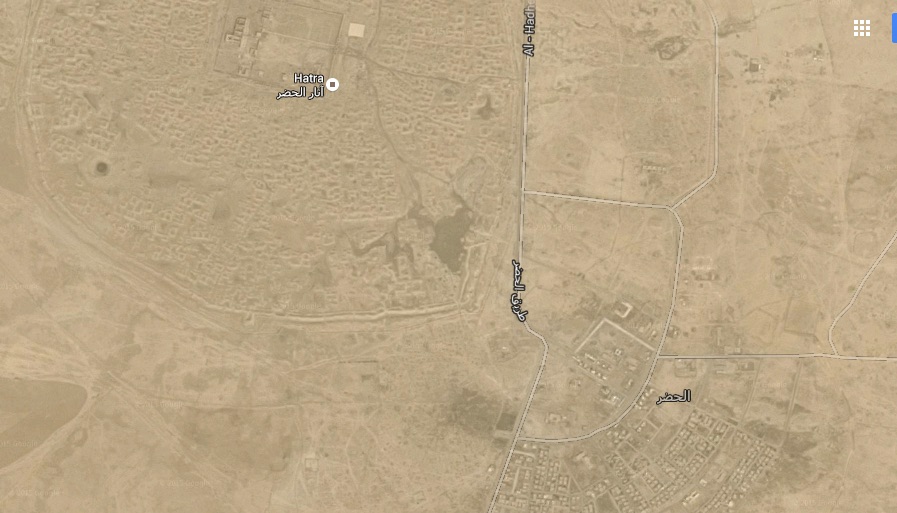
al Hatra map JPEG

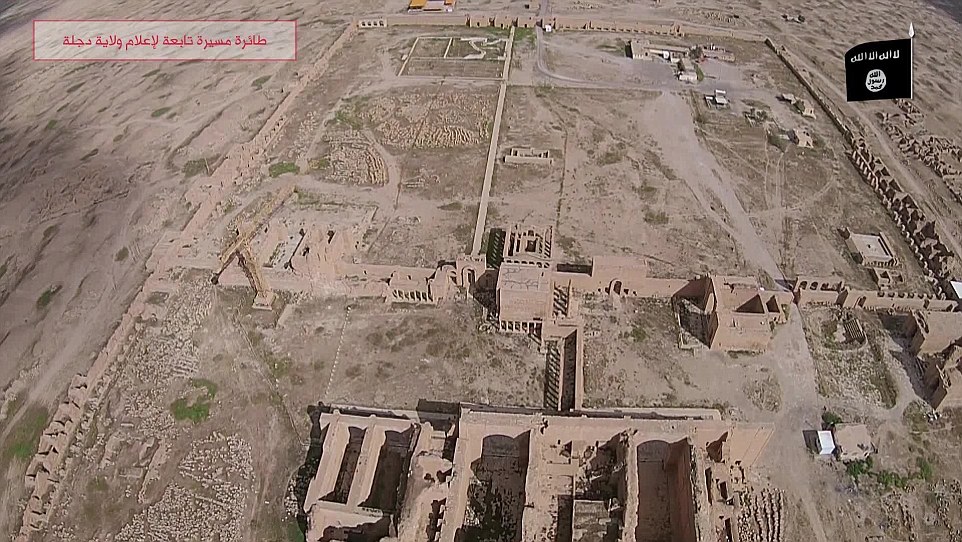
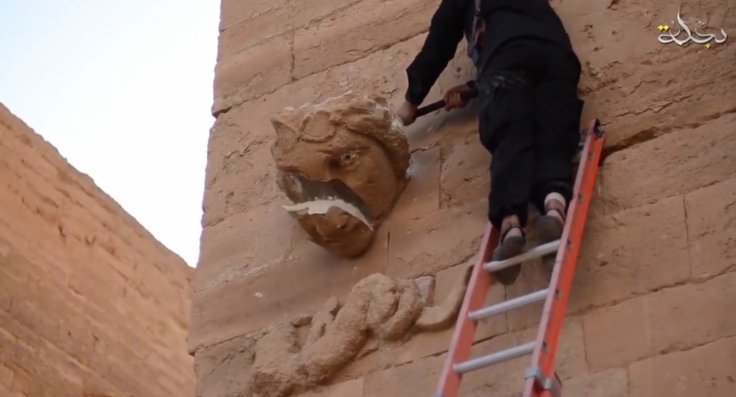
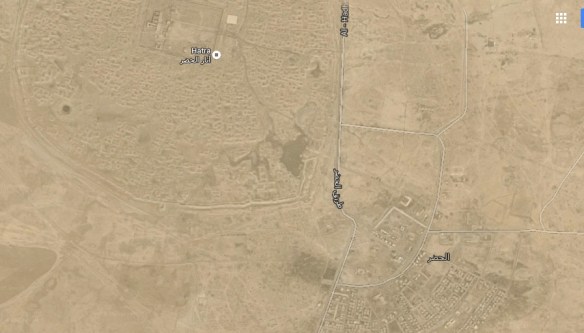
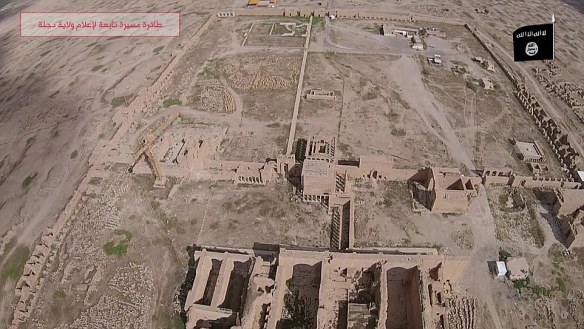
Al Hatra is the site of the ancient fortified city of al Hadr, 2km northwest of the modern settlement (see map above), established under the Seleucids, and after its capture by the Parthians it became one of the major cities of the post-Alexandrian world.   Since October, intelligence reports had identified the ruins as an Islamic State training camp, and in March IS announced its intention to level the site and purge it of the ‘symbols of idolatry‘. (In April it released a video showing just that: see the images below, and more here).

IS video of al Hatra

IS Video of destruction at al Hatra

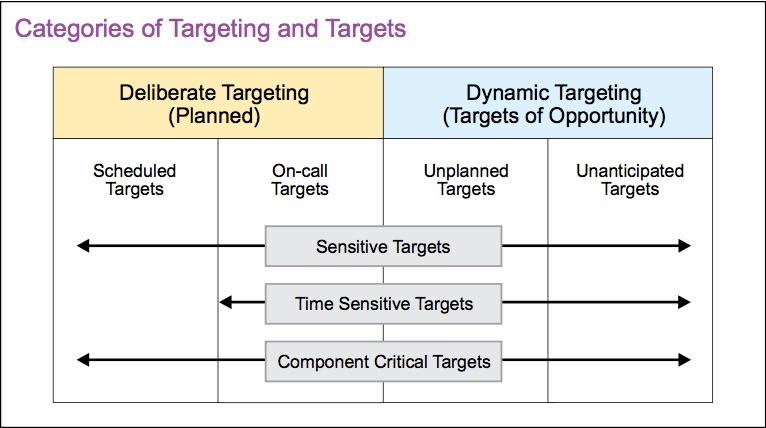
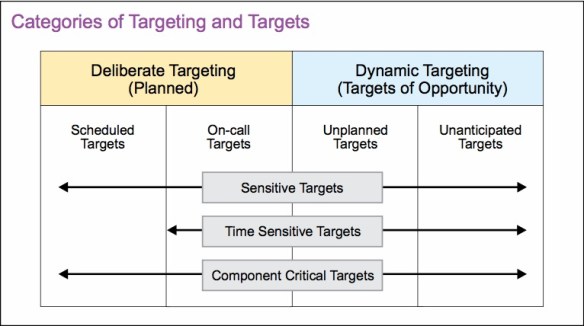
The initial target for the air strike on 13 March was an IS checkpoint and ‘enemy personnel’ who were stopping traffic.  They had been seen by an A-10 aircraft en route for refuelling – A10s fly sorties lasting between five and nine hours, and can require two or three inflight refuellings – and the information had been passed to the Dynamic Targeting Cell responsible for drawing up a detailed target folder or target package (a ‘Joint Targeting Message’) for all emergent targets: in effect, targets of opportunity.
Targeting and Targets (JP 3-60) 2013

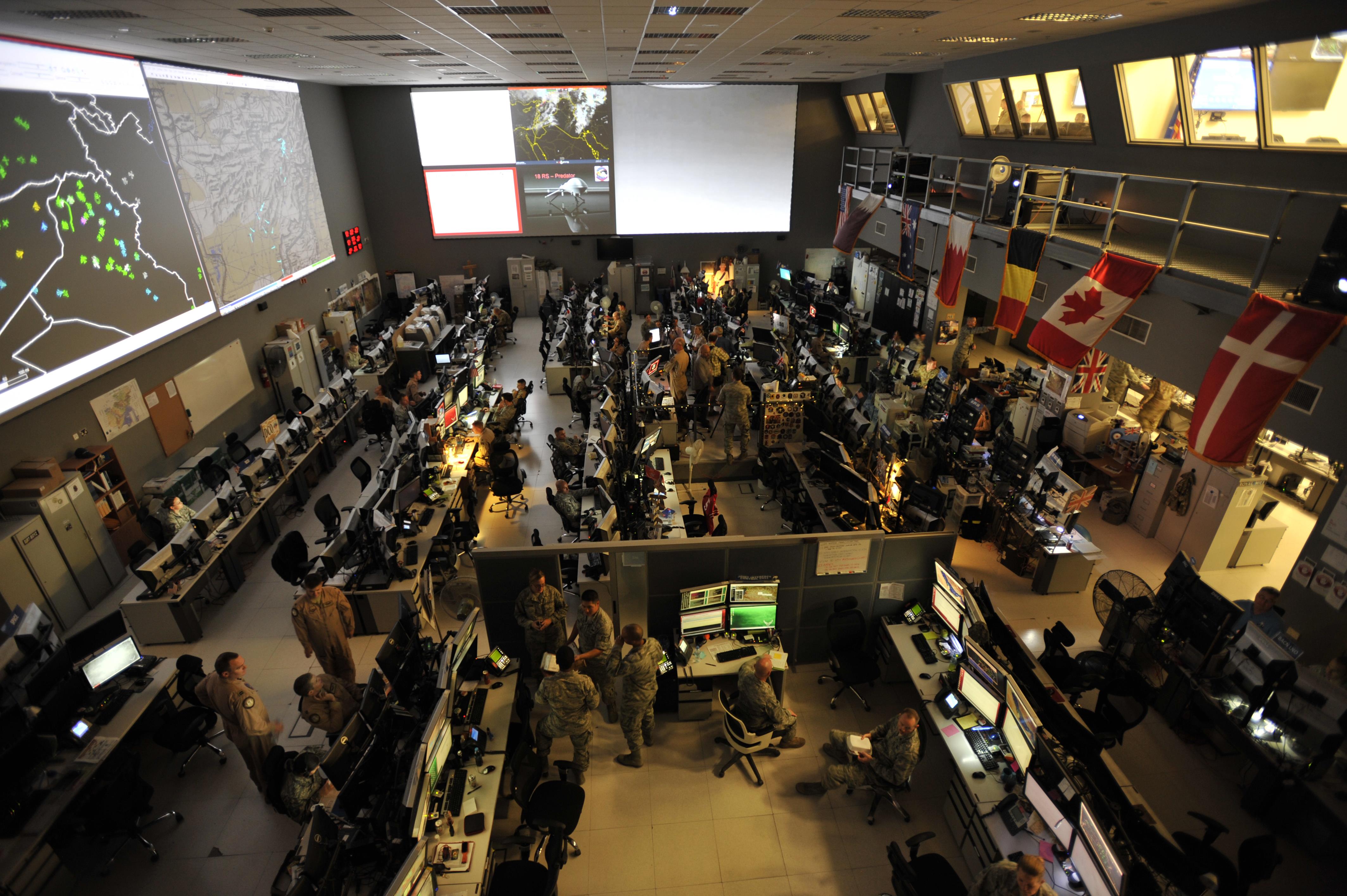
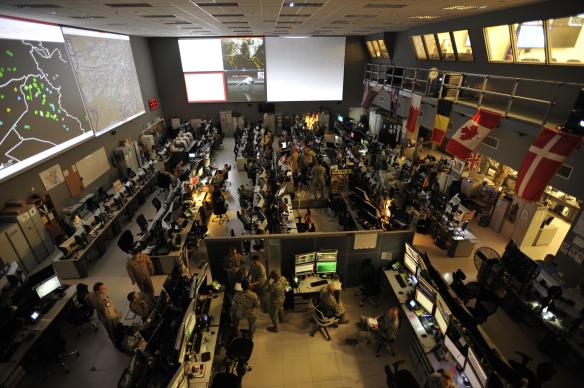
It must have seemed routine to those on duty in the CAOC (shown below): there had been multiple strikes in the vicinity for several months.  The Dynamic Targeting Cell cleared the operation via the Battle Director at Al Udeid with the CAOC director who acted as the ‘Target Engagement Authority’ to sanction the strike, with ultimate responsibility for all lethal strikes against Islamic State in Syria and designated areas of western Iraq.
Combined Air and Space Operations Center (CAOC), Al Udeid Air Base, 2015

While this was happening, the same aircraft reported that two vehicles had pulled into the side of the road next to the checkpoint (and within ‘the target area outline’: notice how rapidly individuals disappear from view, contained first within objects and then the objects within an area).

The occupants began to interact with the people manning the checkpoint – the pilot said the two vehicles ‘appeared to be a part of the checkpoint’ but he also made it clear that this was only an ‘opinion’ and that responsibility for the positive identification of the vehicles and passengers as a legitimate target had to rest with superior officers – and the Dynamic Targeting Cell agreed to ‘seek additional authority’.  After a short time he radioed back with permission for them to be included as part of the original Joint Targeting Message: ‘You’re cleared to execute Joint Targeting Message [Reference Number] including vehicles and all associated PAX [people/passengers] with PID [Positive Identification].’  The investigating officer evidently thought this perfectly reasonable, agreeing that ‘these vehicles did not display characteristics typical of transient vehicles at checkpoints’; rather than passing through (as seven other vehicles did), they stopped and ‘appeared to be functionally and geospatially tied to the … checkpoint and personnel authorized for strike.’

But this amendment to the original targeting package was never reported up the chain of command to the Target Engagement Authority who only validated the original Joint Targeting Message.  He was provided with imagery showing the intended target area, confirmed that it had ‘a single use purpose’, and so had no doubt that the checkpoint and its operators constituted ‘a functionally and geospatially defined object of attack’ and that it was a ‘legitimate military target’ in accordance with international humanitarian law – what the US military prefers to call ‘the law of armed conflict’ – and consistent with the military’s own rules of engagement.  The repetition of those qualifiers is vital: the US military defines Positive Identification [PID] as ‘the reasonable certainty that a functionally and geospatially defined object of attack is a legitimate military target’.

The Target Engagement Authority sought no advice from a Judge Advocate, the military lawyer on duty, about the propriety of striking the vehicles and passengers because they were not included in the original package.  He testified that ‘at no point was there any discussion of vehicles in association with this strike’: in fact, he explicitly instructed the aircrew ‘to clear for transients [passing vehicles] prior to weapons release.’

The deputy legal adviser to the Combat Operations Division in the CAOC explained that a Judge Advocate was involved in all Dynamic Targeting strikes.  The Dynamic Targeting Chief works with the Targets Duty Officer to establish positive identification of the target.  The Targets Duty Officer usually spends half of a 12-hour shift on the combat operations floor with the Chief and half with ISR analysts preparing target packages, and it is the responsibility of the Chief to write the ‘5Ws’ – who, what, where, when and why – necessary for any dynamic targeting strike.  As the two of them ‘work’ the target, the deputy legal adviser added, they ‘may bring [in] the legal adviser at various times’ throughout the process to provide advice derived from international humanitarian law, the rules of engagement and any special instructions (‘spins’).  The Judge Advocate also acts as ‘a second pair of eyes’ scrutinising the co-ordinates of the target and provides legal recommendations to the Target Engagement Authority.

It seems clear, even with the redactions, that in this case the Judge Advocate was not consulted about the (verbal) amendment to the initial targeting package because the procedure was amended as a direct consequence of the incident under investigation.  Instead of ‘returning to his or her desk’ once approval had been obtained from the Target Engagement Authority, the Judge Advocate is now required to observe ‘the passing of the Joint Targeting Message and [to] monitor the strike by remaining close to the Dynamic Targeting cell.’

There is also a wider responsibility: the deputy legal adviser made it clear that ‘anyone in the chain or the Dynamic Targeting cell has the responsibility to call an abort on the strike if the conditions change.’  In this case, clearly, they did – but nobody intervened.

The Dynamic Targeting Chief claims he telephoned the Battle Director for permission to extend the original Joint Targeting Message, but the exchange took just 80 seconds.  One witness – who may well have been the Battle Director: it’s impossible to know for sure – thought this highly unlikely: 80 seconds would have been ‘very, very quick for [him] to take a call, gather the information, relay it to the Targeting Engagement Authority, get approval, and then relay it back down to [the Dynamic Targeting Cell].’  And the CAOC director was adamant: ‘even if the aviators could identify the vehicles as hostile … there was still no authority to strike without requesting authorization for a Joint Targeting Message change‘ from him.
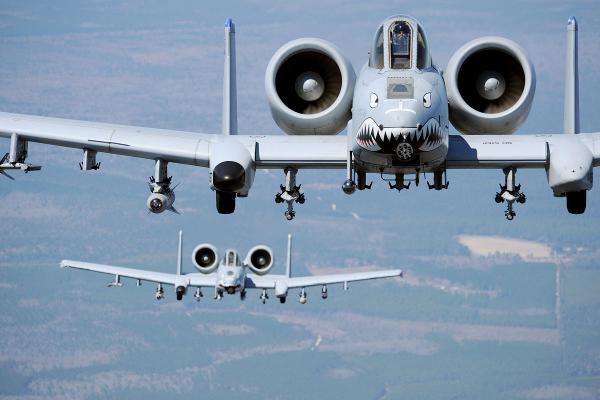
a-10-thunderbolt-ii_011-ts600

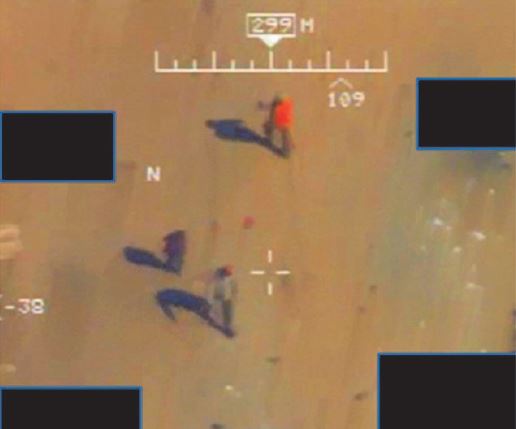
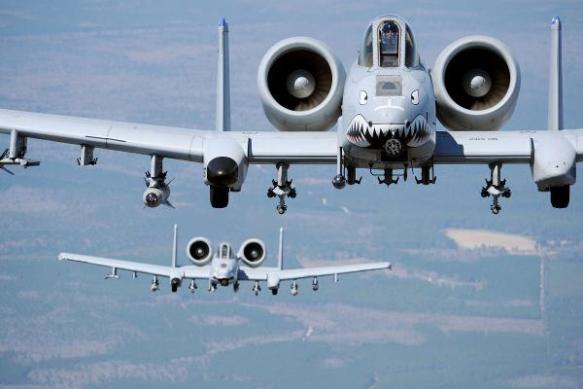
The A-10’s sensor remained ‘padlocked on these vehicles’ and when the pilot was finally cleared to engage he naturally assumed that the Target Engagement Authority had been satisfied by their inclusion in the target package.  Six seconds before they were hit, four people got out; the ISR analyst reviewing the post-strike video concluded that one of them was possibly a child.  But the investigating officer emphasised that they were only visible on the weapons system video and only after being played back at slow speed: ‘There is no reasonable expectation that [the pilot] could have seen, assessed and called for ABORT on the strike through real-time viewing of his targeting pod display inflight.’  The A-10 has a targeting pod under one wing which, as Andrew Cockburn reports, ‘ in daylight transmits video images of the ground below, and infrared images at night. This video feed is displayed on the plane’s instrument panel.’  As the pilot approached the target and entered his ‘weapons engagement envelope’ – again, note the geometric disposition – the investigating officer accepts that neither could he have ‘been able to discriminate between combatant and non-combatant personnel’.

The vehicles were attacked with the A-10’s 30mm rotary cannon – ‘a good weapon for reducing collateral damage’, according to one pilot (see the image below!) – and soon after a second A-10 dropped a single GBU-38 bomb and destroyed the guard shack; this is a conventional 500 lb bomb converted into a ‘guided bomb’, a ‘precision munition’, through the incorporation of a GPS/inertial navigation system so that it can attain a circular error probable of between 10 and 30 metres (which means that, assuming a bivariate normal distribution and all other things being equal, then 50% of the time it will land within that radius: which also means that the other half of the time it won’t, even under ideal experimental conditions).

A-10_Warthog-41

Here is how that same pilot (who was not, so far as I know, flying this mission) characterised these operations against IS to Tom Philpott in April:

A-10 pilots are trained to find a target, seek verification and do on-the-fly targeting and strike. While that sounds like a solo operation, Stohler says “the coalition flying up there is enormous and we work as a team.”

Almost all targets get vetted up to higher command to determine validity. “As you can imagine this is complex,” Stohler says… The most challenging moment “is the weapon employment phase of the flight,” says Stohler. “Our number one focus is to deliver the ordnance on target, on the first pass, while minimizing collateral damage. This takes a great deal of skill that our pilots train to daily back home.”

“I tell our guys this is like trying to drop bombs on bad guys in your hometown. Your goal is not to hurt anyone else, or destroy anything that you don’t have to destroy. It’s a constant challenge to do that and we do it very well.”

But while collateral damage is key it might not be “a showstopper,” says Stohler. “Clearly if the target we need to hit is significant we will employ on it wherever it is – if we have the approval.”

In this case it took under an hour from first observing the checkpoint to striking the target; only eight minutes elapsed between the confirmation of the Joint Targeting Message and the execution of the strike; and it took just three or four seconds ‘from trigger squeeze to impact’.  According to the e-mail, at least two women and three children were killed.  The military decided not to award the writer of that message any compensation for the destruction of her vehicle and no solatia payments will be made to the families of the deceased since no survivors have come forward to ask for them.

CENTCOM’s press release summarising the investigation is a model of complacency and fails to include any of the qualifications and mis-steps I’ve noted in the previous paragraphs:

Based on the actions being observed, aircrew and CAOC personnel assessed that the checkpoint, additional vehicles, and additional personnel were lawful targets consistent with the Law of Armed Conflict (LOAC) at the time the weapon was released on the target area.

The investigation concluded that the airstrikes resulted in the destruction of the intended target, and that the two vehicles parked at the checkpoint were also hit. Upon further review, it was determined that all ordnance functioned properly and accurately struck the intended target.

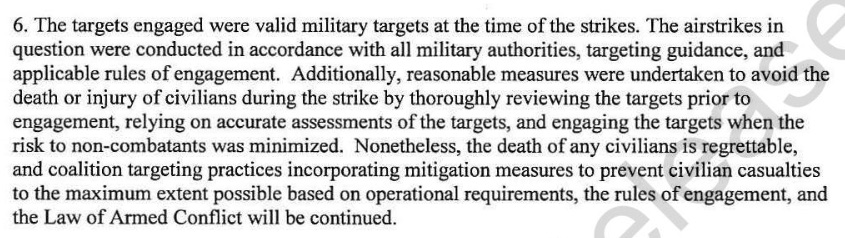
The investigation concluded that the airstrikes were conducted in accordance with applicable military authorizations, targeting guidance, and LOAC. The target engaged was a valid military target, and the LOAC principles of military necessity, proportionality, and distinction were observed. All reasonable measures were taken to avoid unintended deaths of or injuries to non-combatants by reviewing the targets thoroughly prior to engagement, relying on accurate assessments of the targets, and engaging the targets when the risk to non-combatants was thought to be minimized.

Micah Zenko has an analysis of this strike here, and he adds these chilling paragraphs:

To intensify the U.S.-led coalition’s war against the Islamic State … the Pentagon is considering further loosening the rules of engagement (ROEs) that are intended to minimize civilian casualties and expanding the target sets that can be bombed…

The first problem with this theory is that large militant armies are not defeated, either exclusively or primarily, with air power. Military and civilian policymakers repeat the mantra that “you can’t kill your way out” of the problem posed by such adversaries, but then continue to call upon air power to do just that. This is despite the fact that all of the militant armies and terrorist groups that have been bombed and droned for the past 14 years have survived. None have been completely destroyed, which is allegedly the strategic objective against the Islamic State. Moreover, the size of the al Qaeda-affiliated groups that the United States claims to be at war with have either stayed flat or grown, while the total number of State Department-designated Foreign Terrorist Organizations has grown from 34 in 2002 to 59 in 2015.

However, the larger concern with this mindset is the assured growth of collateral damage and civilian casualties that will accompany significantly loosened ROEs. Last month, Lt. Gen. Bob Otto, the U.S. Air Force’s deputy chief of staff for intelligence, surveillance, and reconnaissance, observed that the coalition was “challenged in finding enough targets that the airplanes can hit that meet the rules of engagement.” However, he added an important caveat: “If you inadvertently — legally — kill innocent men, women, and children, then there’s a backlash from that. And so we might kill three and create 10 terrorists.”

And yet, as Micah emphasizes, there have been only two military investigations into civilian casualties throughout the air campaign against IS:

8,300 airstrikes, 16,000 Islamic State targets destroyed, more than 20,000 Islamic State fighters killed — and only two claims of collateral damage. Either the U.S.-led coalition is really, really, really good at bombing these days, or they are shooting first and not asking questions later.

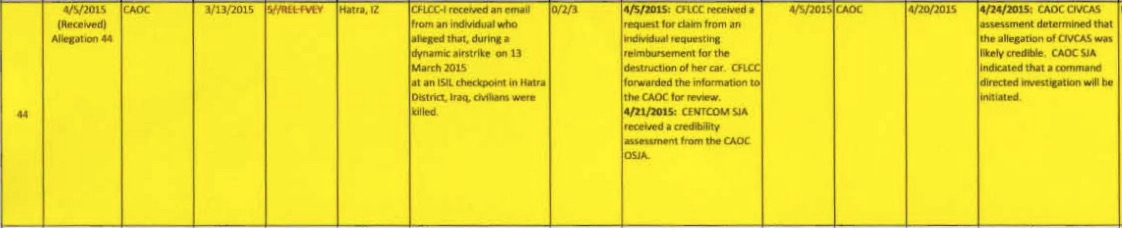
More in the same vein from Joseph Trevithick at War is Boring here.  You can access the US Air Force’s own (secret) tabulation of CIVCAS allegations here, which lists 45 separate incidents, far in excess of the two that have been officially acknowledged to date.  Joseph notes that most of them were dismissed within 48 hours as ‘not credible’ because there was ‘insufficient evidence’ or ‘insufficient information.’  Al Hatra was number 44:
CIVCAS allegation 44 al Hatra

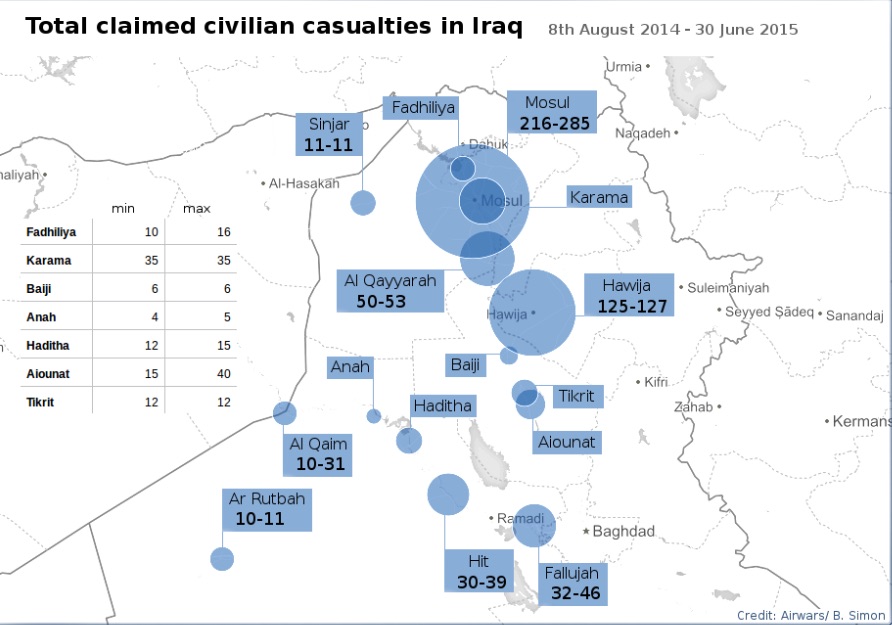
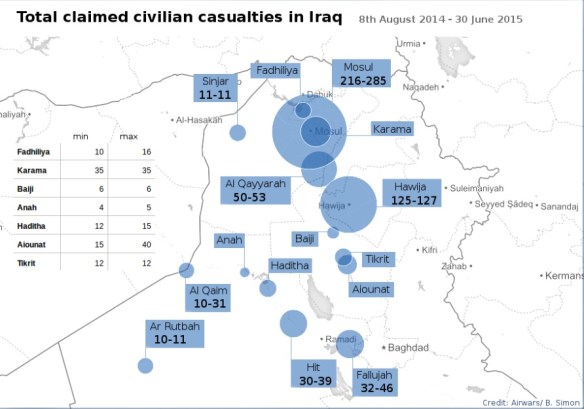
The  Airwars team has provisionally estimated that from 8 August 2014 to 24 November 2015 ‘between 682 and 977 civilian non-combatants are likely to have been killed in 113 incidents where there is fair reporting publicly available of an event, and where Coalition strikes were confirmed in the near vicinity on that date.’  I’ve pasted their map of total claimed civilian casualties in Iraq (to 30 June 2015) below; you can find their full report, Cause for Concern, here.
Civilian casualties claimed Iraq 8 August 2014-30 June 2015

To be continued.  Sadly.
The sound of refugees

Distance from home

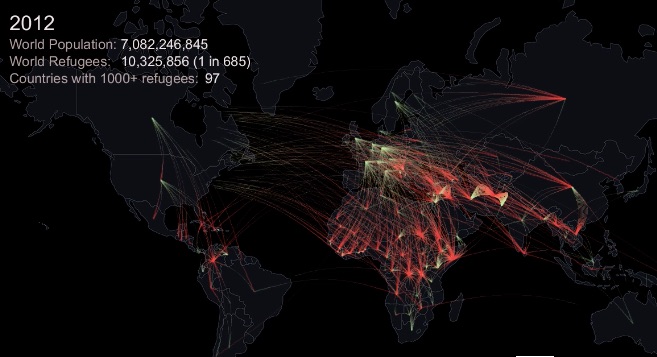
Brian Foo is a programmer and visual artist who has been conducting a series of music experiments at Date Driven DJ that combine data, algorithms, and borrowed sounds.  His video below (screenshot above), ‘Distance from home‘, which is also available on vimeo, uses refugee data from the United Nations from 1975 to 2012 to create a truly remarkable audio visualization.

Brian explained that his composition was inspired by The Refugee Project, and that it follows a series of algorithms:

Each year between 1975 and 2012 correlates to a 4-second segment in the song.

The annual global aggregate volume of refugee migration controls the quantity of instruments playing. The higher the volume of refugee migration, the more instruments are added to the song.

The annual average distance of refugee migration controls the duration and pitch of the instruments. Longer distances yield instruments that play longer and lower-pitch notes (e.g. long distances: , short distances: ).

The annual amount of countries with 1000+ refugees control the variety of instruments playing, where the more countries with 1000+ refugees, the more variety of instruments are playing in the song.

Thanks to Jaimie for bringing this project to my attention – which assumes a new significance as so many politicians and commentators foment fear, anger and rejection towards refugees seeking to escape war, misery and violence.  For a counterpoint, try this.

Operational Banality

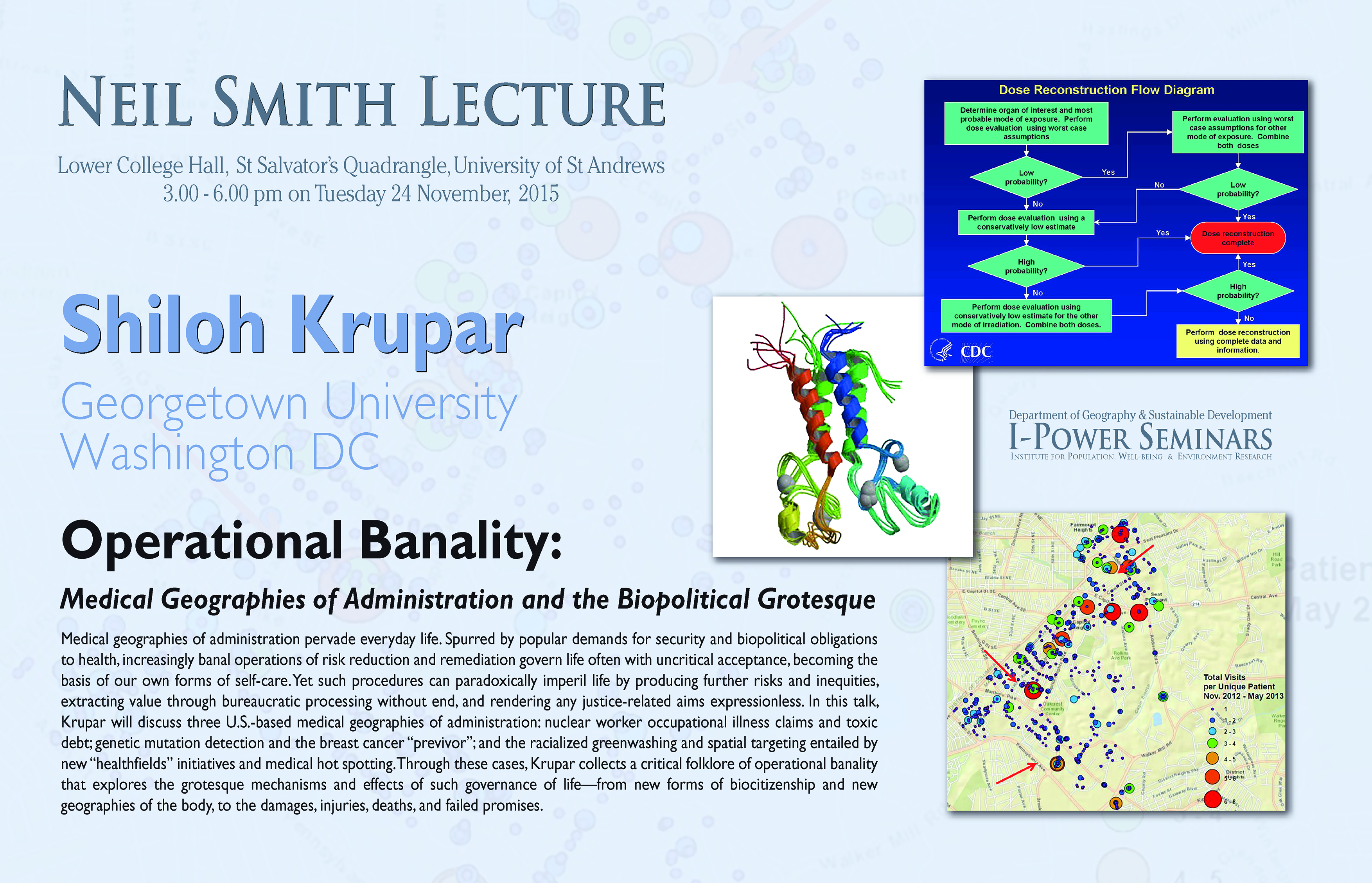
The next Neil Smith Lecture will be given by the amazing Shiloh Krupar at St Andrews next week (24 November at 3 p.m.) on “Operational Banality: medical geographies of administration and the biopolitical grotesque”: online version will follow soon after.

Posters

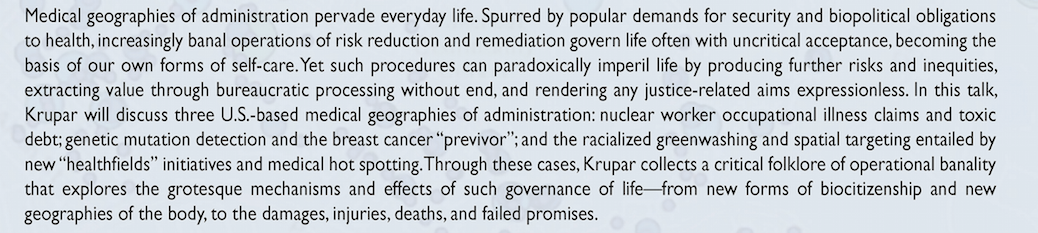
In case the text in the poster (above) is too small:

Screen Shot 2015-11-16 at 12.21.07

I wish I could be there.

Paris of/in the Middle East

Paris:Peace

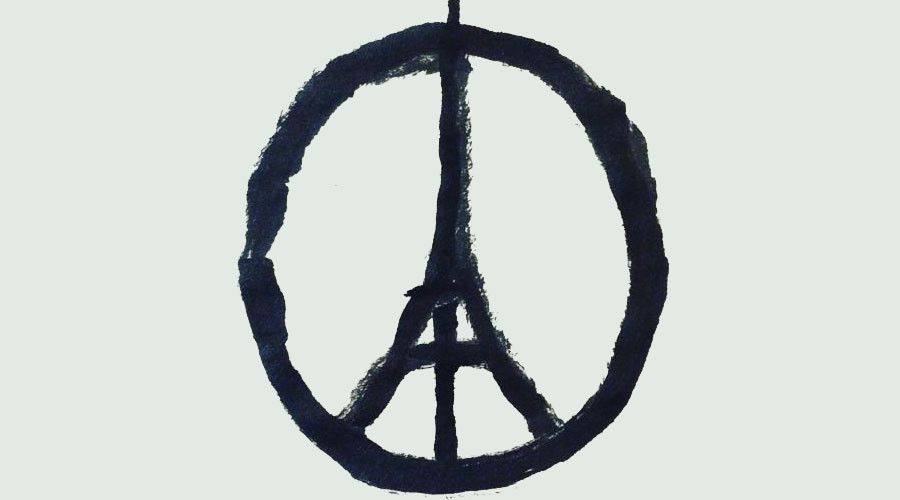
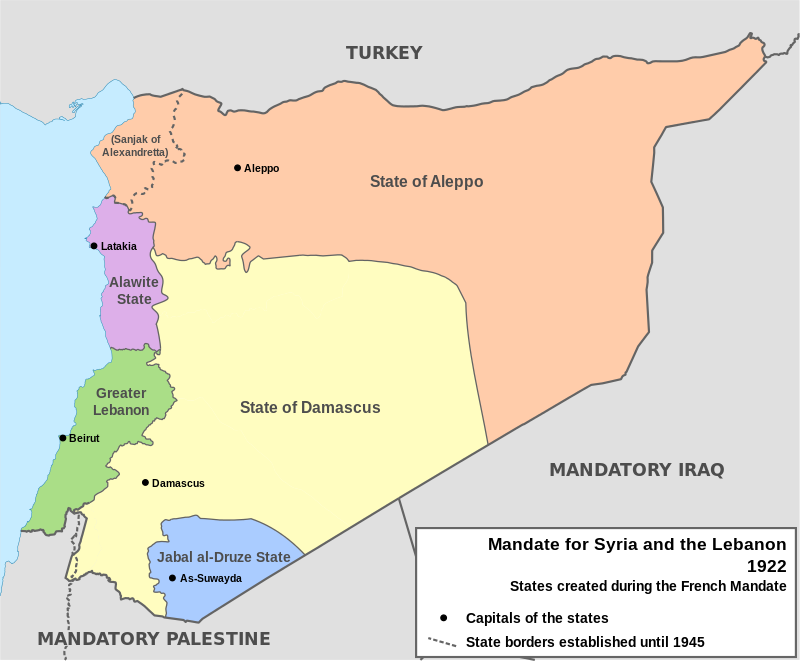
Islamic State has claimed responsibility for last night’s co-ordinated terrorist attacks in Paris, calling them the ‘first of the storm’ and castigating the French capital as ‘the capital of prostitution and obscenity’.   Walter Benjamin‘s celebrated ‘capital of the nineteenth century’ has been called many things, of course, and as I contemplated the symbol that has now gone viral (above), designed by Jean Jullien, I realised that Paris had been the stage for the 1919 Peace Conference that not only established the geopolitical settlement after the First World War but also accelerated the production of today’s ‘Middle East’ by awarding ‘mandates’ to both Britain and France and crystallising the secret Sykes-Picot agreement struck between the two powers in 1916 (more on that from the Smithsonian here).

Margaret MacMillan has a spirited summary of the conference here, with some lively side-swipes at the astonishing lack of geographical knowledge displayed by the principal protagonists.  Much on my mind was the French mandate for Syria and Lebanon:

French Mandate for Syria and Lebanon

For as I watched Friday night’s terrifying events in Paris unfold, I had also been reminded of the horrors visited upon Beirut the evening before.

Two suicide bombers detonated their explosives in Burj el-Barajneh in the city’s southern suburbs; the attacks were carefully timed for the early evening, when the streets were full of families gathering after work and crowds were leaving mosques after prayers: they killed 43 people and injured more than 200 others.

Islamic State issued a statement saying that ’40 rafideen– a pejorative term for Shiite Muslims used by Sunni Islamists – were killed in the “security operation”’ and claimed the attacks were in retaliation for Hezbollah’s role in the Syrian war.

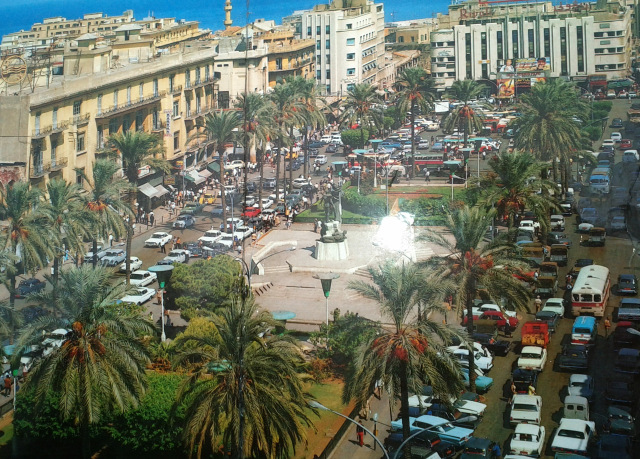
beirut60s

In the 1950s and 60s Beirut was known as ‘the Paris of the Middle East’ (above) – widely seen as more chic, more cosmopolitan than the ‘Paris-on-the-Nile’ created by Francophile architects and planners west of the old city of Cairo in the late nineteenth and early twentieth centuries.

Now I’ve always been troubled by these city switchings – the ‘Venice of the North’ is another example – because they marginalise what is so distinctive about the cities in question and crush the creativity that is surely at the very heart of their urbanity.
And yet, after last night, I can see a different point in the politics of comparison (from Kennedy’s Ich bin ein Berliner to the post 9/11 insistence that “we are all New Yorkers…”).  More accurately, in the politics of non-comparison: as Chris Graham asks (and answers): why the silence over what happened in Beirut on Thursday?  Why no mobilisation of the news media and no interruptions to regular programmes on TV or radio?  Why no anguished personal statements from Obama, Cameron or, yes, Hollande?

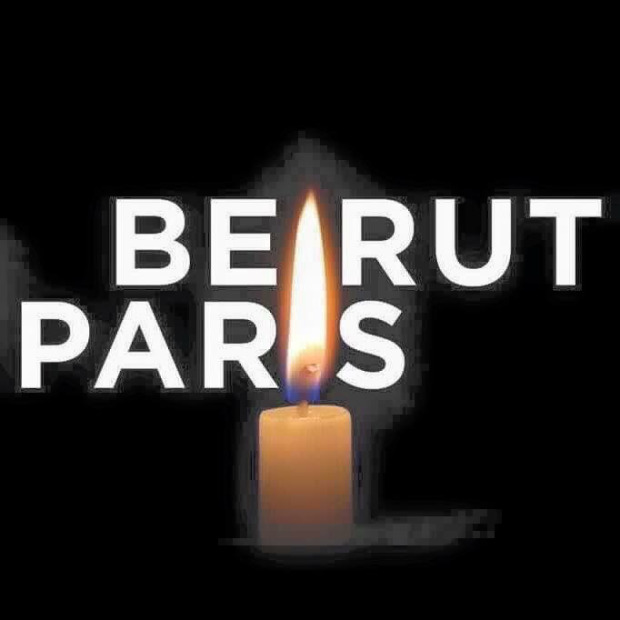
Beirut:Paris

Nobody has put those questions with more passion and justice than Elie Fares writing from Beirut:

I woke up this morning to two broken cities. My friends in Paris who only yesterday were asking what was happening in Beirut were now on the opposite side of the line. Both our capitals were broken and scarred, old news to us perhaps but foreign territory to them….

Amid the chaos and tragedy of it all, one nagging thought wouldn’t leave my head. It’s the same thought that echoes inside my skull at every single one of these events, which are becoming sadly very recurrent: we don’t really matter.

When my people were blown to pieces on the streets of Beirut on November 12th, the headlines read: explosion in Hezbollah stronghold, as if delineating the political background of a heavily urban area somehow placed the terrorism in context.

When my people died on the streets of Beirut on November 12th, world leaders did not rise in condemnation. There were no statements expressing sympathy with the Lebanese people. There was no global outrage that innocent people whose only fault was being somewhere at the wrong place and time should never have to go that way or that their families should never be broken that way or that someone’s sect or political background should never be a hyphen before feeling horrified at how their corpses burned on cement. Obama did not issue a statement about how their death was a crime against humanity; after all what is humanity but a subjective term delineating the worth of the human being meant by it?

Here we might pause to remind ourselves that most of the victims of Islamic State have been Muslims (see, for example, here and here).

Here Hamid Dabashi‘s reflections are no less acute:

In a speech expressing his solidarity and sympathy with the French, US President Barack Obama said, “This is an attack not just on Paris, it’s an attack not just on the people of France, but this is an attack on all of humanity and the universal values that we share.”

Of course, the attack on the French is an attack on humanity, but is an attack on a Lebanese, an Afghan, a Yazidi, a Kurd, an Iraqi, a Somali, or a Palestinian any less an attack “on all of humanity and the universal values that we share”? What is it exactly that a North American and a French share that the rest of humanity is denied sharing?

In his speech, UK Prime Minister David Cameron, speaking as a European, was emphatic about “our way of life”, and then addressing the French he added: “Your values are our values, your pain is our pain, your fight is our fight, and together, we will defeat these terrorists.”

What exactly are these French and British values? Can, may, a Muslim share them too – while a Muslim? Or must she or he first denounce being a Muslim and become French or British before sharing those values?

These are loaded terms, civilisational terms, and culturally coded registers. Both Obama and Cameron opt to choose terms that decidedly and deliberately turn me and millions of Muslims like me to their civilisational other.

They make it impossible for me to remain the Muslim that I am and join them and millions of other people in the US and the UK and the EU in sympathy and solidarity with the suffering of the French.

As a Muslim I defy their provincialism, and I declare my sympathy and solidarity with the French; and I do so, decidedly, pointedly, defiantly, as a Muslim.

When Arabs or Muslims die in the hands of the selfsame criminal Islamic State of Iraq and the Levant (ISIL) gangs in Afghanistan, Iraq, Syria, or Lebanon, they are reduced to their lowest common denominator and presumed sectarian denominations, overcoming and camouflaging our humanity. But when French or British or US citizens are murdered, they are raised to their highest common abstractions and become the universal icons of humanity at large.

Why? Are we Muslims not human? Does the murder of one of us not constitute harm to the entire body of humanity?

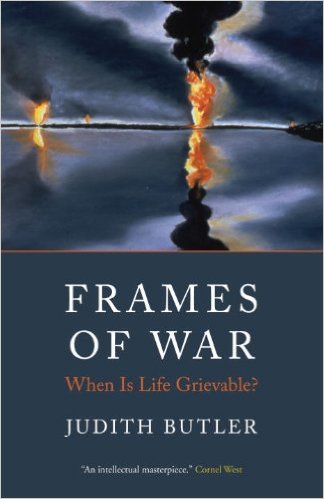
BUTLER Frames of WarElie’s and Hamid’s questions are multiple anguished variations of Judith Butler‘s trenchant demand: why are these lives deemed grievable and not those others?

To ask this is not to minimise the sheer bloody horror of mass terrorism in Paris nor to marginalise the terror, pain and suffering inflicted last night on hundreds of innocents – and also affecting directly or indirectly thousands and thousands of others.

In fact the question assumes a new urgency in the wake of what happened in Paris – where I think the most telling comparison is with Beirut and not with the attacks on Charlie Hebdo (see my commentary here) – because the extreme right (the very same people who once elected to stuff “Freedom Fries” down their throats) has lost no time in using last night’s events to ramp up their denigration of Syrian refugees and their demands for yet more bombing (and dismally failing to see any connection between the two).  You can see something of what I mean here.

And so I suggest we reflect on Jason Burke‘s commentary on Islamic State’s decision to ‘go global’ and its tripartite strategy of what he calls ‘terrorise, mobilise, polarise’.  The three are closely connected, but it’s the last term that is crucial:

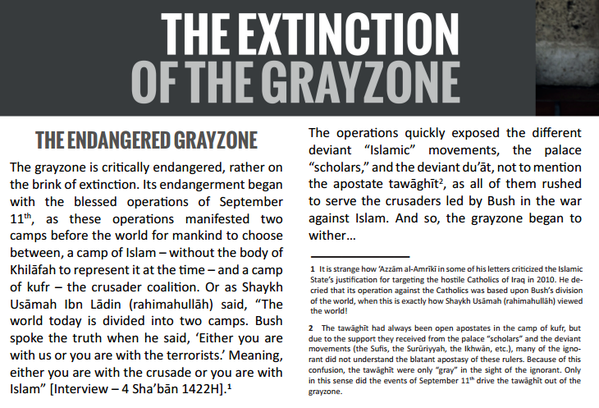
In February this year, in a chilling editorial in its propaganda magazine, Dabiq, Isis laid out its own strategy to eliminate what the writer, or writers, called “the grey zone”.

This was, Isis said, what lay between belief and unbelief, good and evil, the righteous and the damned. It was home, too, to all those who had yet to commit to the forces of either side.

The grey zone, Isis claimed, had been “critically endangered [since] the blessed operations of September 11th”, as “these operations showed the world” the two camps that mankind must choose between.

Over the years, since successive violent acts had narrowed the grey zone to the point where by the end of 2014 “the time had come for another event to … bring division to the world and destroy the grey zone everywhere”.

extinction-of-the-grayzone

More from Ben Norton here.  The imaginative geographies of Islamic State overlap with those spewed by the extreme right in Europe and North America and, like all imaginative geographies, they have palpable effects: not fifty shades of grey but fifty versions of supposedly redemptive violence.

UPDATE (1):  For more on these questions – and the relevance of Butler’s work– see Carolina Yoko Furusho‘s essay ‘On Selective Grief’ at Critical Legal Thinking here.

As it happens, Judith is in Paris, and posted a short reflection on Verso’s blog here.  She ends with these paragraphs:

My wager is that the discourse on liberty will be important to track in the coming days and weeks, and that it will have implications for the security state and the narrowing versions of democracy before us. One version of liberty is attacked by the enemy, another version is restricted by the state. The state defends the version of liberty attacked as the very heart of France, and yet suspends freedom of assembly (“the right to demonstrate”) in the midst of its mourning and prepares for an even more thorough militarization of the police. The political question seems to be, what version of the right-wing will prevail in the coming elections? And what now becomes a permissable right-wing once le Pen becomes the “center”. Horrific, sad, and foreboding times, but hopefully we can still think and speak and act in the midst of it.

Mourning seems fully restricted within the national frame. The nearly 50 dead in Beirut from the day before are barely mentioned, and neither are the 111 in Palestine killed in the last weeks alone, or the scores in Ankara. Most people I know describe themseves as “at an impasse”, not able to think the situation through. One way to think about it may be to come up with a concept of transversal grief, to consider how the metrics of grievability work, why the cafe as target pulls at my heart in ways that other targets cannot. It seems that fear and rage may well turn into a fierce embrace of a police state. I suppose this is why I prefer those who find themselves at an impasse. That means that this will take some time to think through. It is difficult to think when one is appalled. It requires time, and those who are willing to take it with you – something that has a chance of happening in an unauthorized “rassemblement” [gathering].

UPDATE (2): At Open Democracy Nafeez Mossadeq Ahmed has a helpful essay, ‘ISIS wants to destroy the “grey zone”: Here’s how we defend it’: access here.

Collateral damage

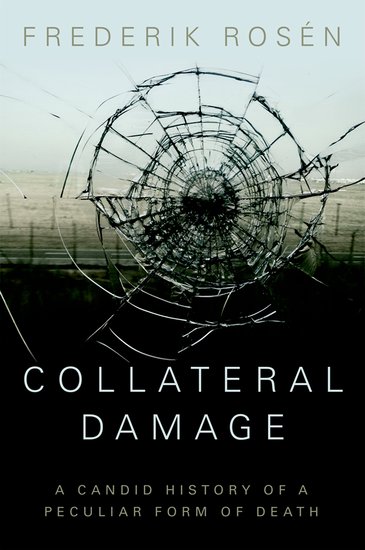
A gracious note from Antipode prompts me to add that today is also a day to remember the countless others who are victims of war and military/paramilitary violence.  And so to a new book due at the end of the month from Frederik RosénCollateral Damage: a candid history of a peculiar form of death (Hurst/Oxford University Press):

ROSEN Collateral damageThe dilemmas precipitated by the unintentional killing of civilians in war, or ‘collateral damage’, shape many aspects of military conduct, yet noticeable by its absence has been a methodical examination of the place and role of this phenomenon in modern warfare. This book offers a fresh perspective on a distressing consequence of conflict.

Rosén explains how collateral damage is linked to ideas of authority, thereby anchoring it to the existential riddles of our individual and collective lives, and that this peculiar form of death constitutes an image of what it means to be human.

His investigation of collateral damage is notable too for how the death of non-combatants sheds light on some of today’s critical challenges to war and global governance, such as the growing role of non-state actors, mercenary contractors and the impact of military privatization.

In the ethical realm those who successfully prove that collateral damage has occurred also enter the debate about which institutions may exert authority and thus how a truly decentralized world might be organized. This is why the in many ways underrepresented victims of collateral damage appear on closer inspection to have experienced a most significant form of death.

Contents:

Introduction
1. The Third Category of Death
2. Urban Warfare and Collateral Damage
3. Collateral Damage and the Question of Legal Responsibility
4. Collateral Damage and Compensation
5. Lifting the Fog of War and Collateral Damage
6. How Bad Can Be Good
7. A Death Without Sacrifice
8. Collateral Damage or Accident?
9. A Private Call for Collateral Damage?
10. A Place Between it All

This is a good moment to remember Patricia Owens’ classic and still vitally important essay, ‘Accidents don’t just happen: the liberal politics of high-technology “humanitarian” war’, Millennium 32 (3) (2003) 596-616, and to reflect on what is surely a classic-in-the-making: Emily Gilbert‘s brilliant new essay, ‘The gift of war: cash, counterinsurgency and “collateral damage”‘, Security dialogue (online early).

Then there is the intentional killing of civilians in war….