On the road

Angry Eyes QML 1

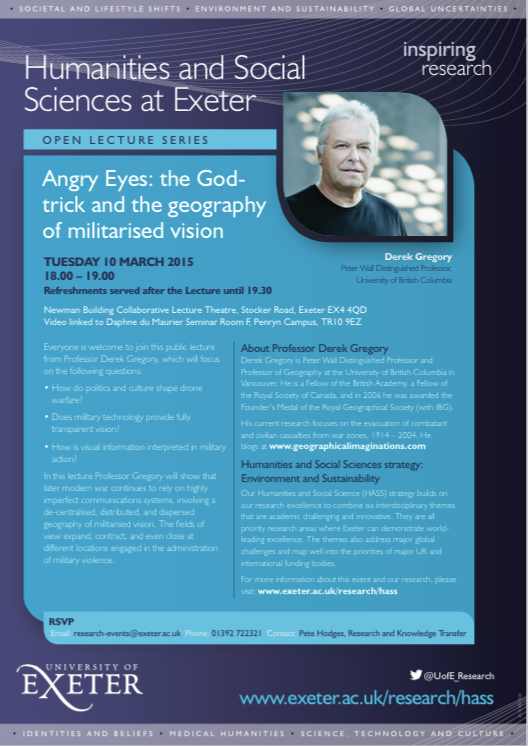
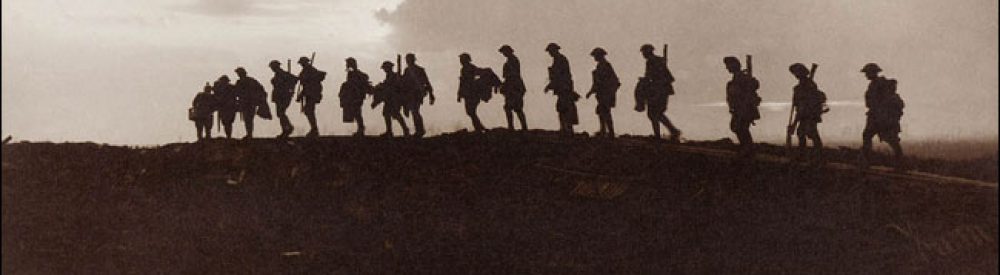
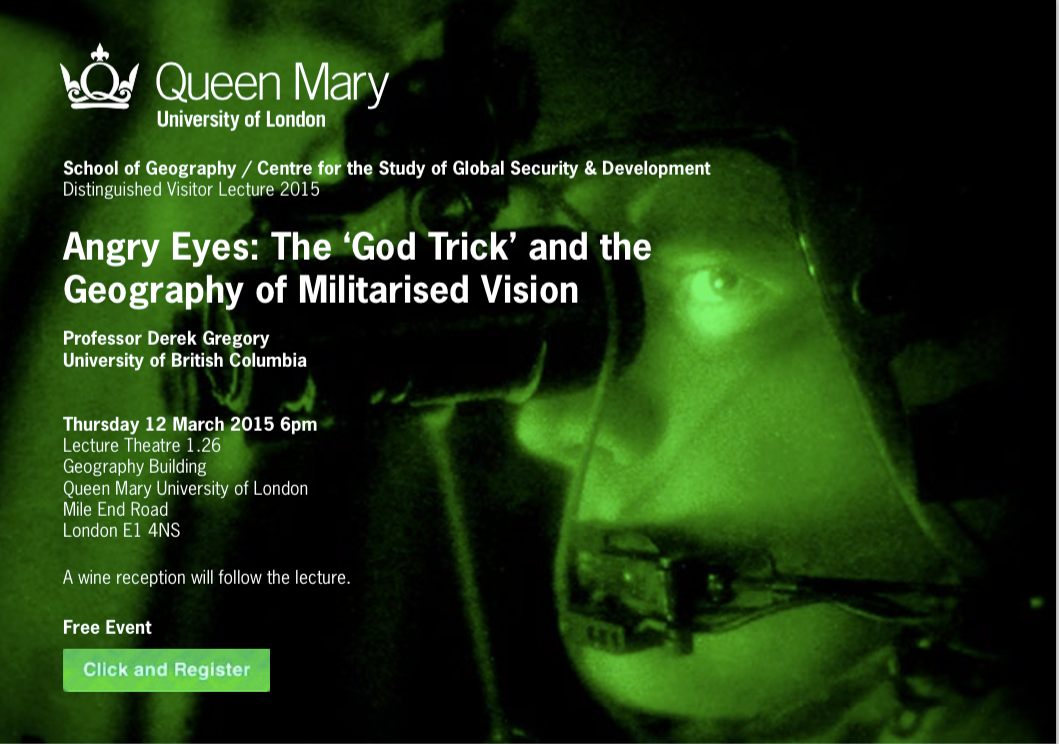
I’m in Mexico with wayward WiFi, which is why I’ve been so quiet lately.  The other reason is that I’ve been writing away (more on that soon).  Next month I really am on the road, as opposed to the beach, and I’ll be giving a series of talks in the UK at Durham (3-4 March), Newcastle (5-6 March), Exeter (9-10 March) and – as you can see from the posters above and below – Queen Mary London (12 March).

Durham gets a different talk (‘Dirty Dancing’, the latest version of my analysis of drone strikes and military violence in Pakistan, which I’m busy turning into an essay right now), but the rest involve the final version of ‘Angry Eyes’, which will also be ready in essay-form soon (which is to say once I’ve got feedback from these presentations).

Angry Eyes QML B

If any readers are near any of these talks, it would be good to see you.

Exeter poster

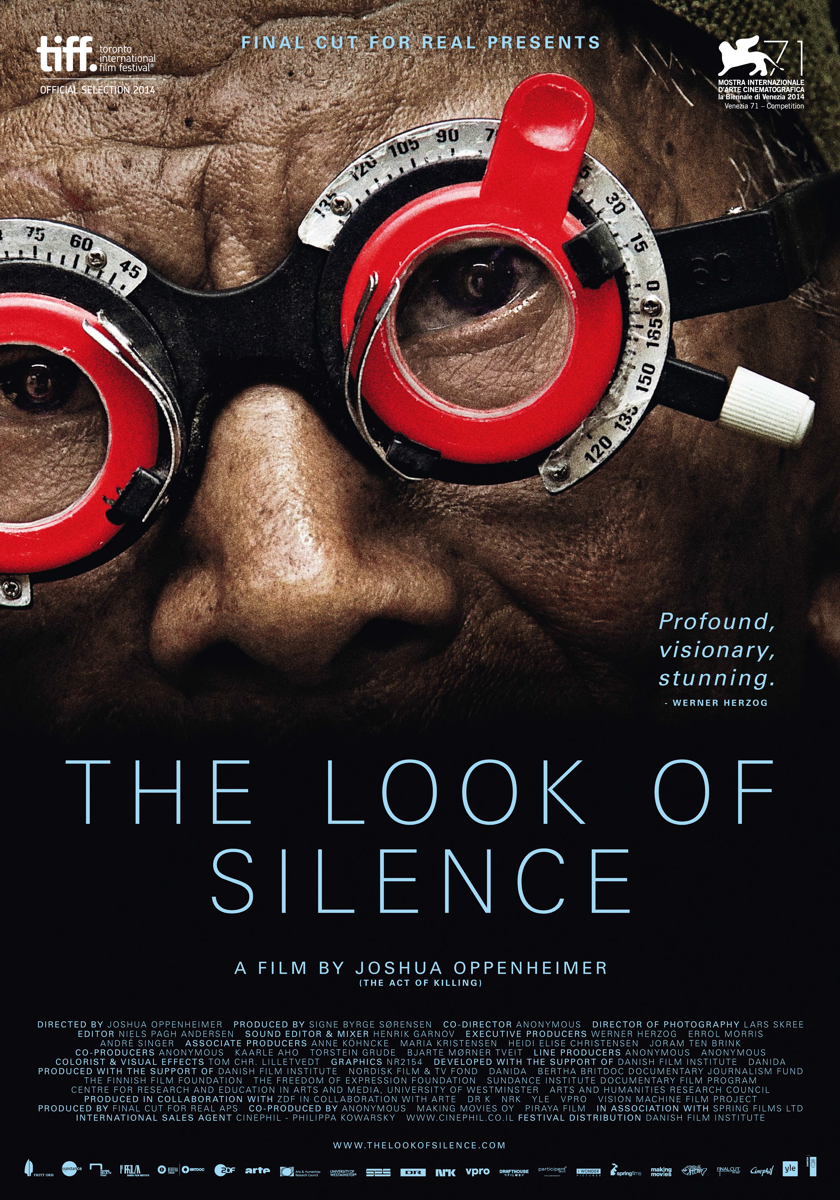
The Look of Silence

The Look of Silence

I commented on Joshua Oppenheimer‘s film about the Indonesian genocide in 1965, The Act of Killing, here and here.  There his focus was, unwaveringly, upon the killers.

But his new film, The Look of Silence, takes up the story of the victims.  Oppenheimer explains:

The Act of Killing exposed the consequences for all of us when we build our everyday reality on terror and lies. The Look of Silence explores what it is like to be a survivor in such a reality. Making any film about survivors of genocide is to walk into a minefield of clichés, most of which serve to create a heroic (if not saintly) protagonist with whom we can identify, thereby offering the false reassurance that, in the moral catastrophe of atrocity, we are nothing like perpetrators. But presenting survivors as saintly in order to reassure ourselves that we are good is to use survivors to deceive ourselves. It is an insult to survivors’ experience, and does nothing to help us understand what it means to survive atrocity, what it means to live a life shattered by mass violence, and to be silenced by terror. To navigate this minefield of clichés, we have had to explore silence itself.

The result, The Look of Silence, is, I hope, a poem about a silence borne of terror – a poem about the necessity of breaking that silence, but also about the trauma that comes when silence is broken. Maybe the film is a monument to silence – a reminder that although we want to move on, look away and think of other things, nothing will make whole what has been broken. Nothing will wake the dead. We must stop, acknowledge the lives destroyed, strain to listen to the silence that follows.

You can find out more about the production here, and Joshua Jelly-Schapiro interviews Oppenheimer about his general project and The Look of Silence in particular at Harper’s blog here.  He describes his focus on interior space in the new film – in contrast to The Act of Killing – like this:

‘I think one of the things that I realized very early on, with The Look of Silence, was that the best way to make the viewer feel what it means to have to build a life in a place that feels wrecked by endless fear, is to feel that in the most intimate way. Because those are very subtle personal things. And to understand something of what that’s really like, I thought, I would need to be incredibly microscopic. You’re entering a space where people are not putting words to what they experienced, where they’re too afraid to talk about it. I felt that I should try to create a kind of poem to a silence borne of fear, a poem to the necessity and trauma that comes with breaking that silence. The idea was to home in on the smallest details—the wrinkles in the ancient skin of Adi’s father, a crease in the brow of Adi’s mother—and to really focus on the silence, listen to that silence, and hear what it has to say.’

And he also glosses the image that appears on the poster above:

In The Look of Silence, we see an optometrist who probes the silence that his family has lived under, and then confronts the killers. If we made that a fiction story, it wouldn’t have at all the same interest. In fact the metaphor of the optometrist would be all too neat. Similarly, a death squad that makes a musical about their killings would be ridiculous as a fiction. But when it’s real, what we’re watching is the transformative effect of the process on the people. And I think that’s why I make film. It’s why I make nonfiction film. And it’s also why, in all of my films, I don’t hide the apparatus of filmmaking by pretending to be a fly on the wall, or by being a transparent interviewer eliciting testimony from the subject. Because I believe that if one is honest, then the genesis of the drama, and the genesis of the transformation, is also the filmmaking process itself.

Not only Openheimer, then, but Heisenberg too.

The prosthetics of military violence

Neve Gordon‘s review of Grégoire Chamayou‘s A theory of the drone on Al-Jazeera is now available in a more extended form at Counterpunch here.  It’s a succinct summary of the book’s main theses, though there’s not much critical engagement with them (you can access my own series of commentaries here [scroll down]).  He closes his review like this:

Because drones transform warfare into a ghostly teleguided act orchestrated from a base in Nevada or Missouri, whereby soldiers no longer risk their lives, the critical attitude of citizenry towards war is also profoundly transformed, altering, as it were, the political arena within drone states.

Drones, Chamayou says, are a technological solution for the inability of politicians to mobilize support for war. In the future, politicians might not need to rally citizens because once armies begin deploying only drones and robots there will be no need for the public to even know that a war is being waged. So while, on the one hand, drones help produce the social legitimacy towards warfare through the reduction of risk, on the other hand, they render social legitimacy irrelevant to the political decision making process relating to war. This drastically reduces the threshold for resorting to violence, so much so that violence appears increasingly as a default option for foreign policy. Indeed, the transformation of wars into a risk free enterprise will render them even more ubiquitous than they are today.

Neve is the author of the indispensable Israel’s occupation, and while these paragraphs closely follow A theory of the drone the title of the book is in the singular – and so I’m left wondering about military violence that isn’t orchestrated from Nevada or Missouri and what other ‘theories of the drone’ are needed to accommodate a ‘drone state’ like Israel (not that I’m sure what a ‘drone state’ is…)?
Shoot and Strike

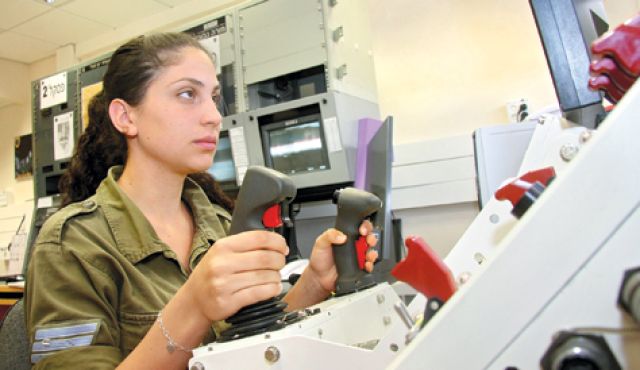
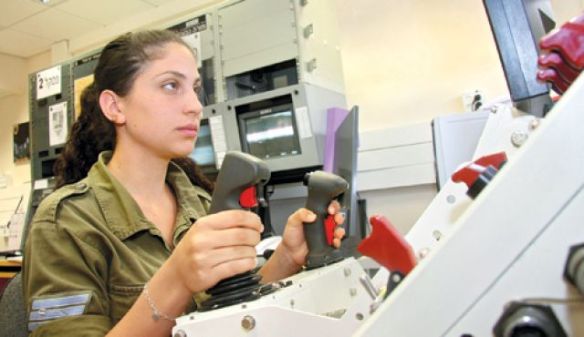
The Israeli military is no stranger to what, following Joseph Pugliese, I’ll call prosthetic violence. While Israel remains a leading manufacturer of drones (see here and here), and routinely deploys them over the occupied territories, it also enforces its ‘Death Zone‘ in Gaza through an automated, ground-based ‘Spot and Strike’ shooting system:

The soldiers, trainees in the course for the “Spot and Strike” system, sit in a tower facing the wilderness of the southern Negev, at the far edge of the Field Intelligence School at the Sayarim base, not far from Ovda. Between their tower and the wide-open desert stands another tower topped by a metal dome. With the press of a button the dome opens to reveal a heavy machine gun. Small tweaks of the joystick aim the barrel. To the right of the gun is a camera, which transmits a clear picture of the target onto a screen opposite the soldier. A press of the button and the figure in the crosshairs is hit by a 0.5-inch bullet.

This dovetails (wrong bird) with a discussion of online shooting in A theory of the drone, but here is risk-transfer war waged over extremely short distances.  ‘Remoteness’ is as much an imaginative as a physical condition, and one that is constantly manipulated so that the threat from Hamas’s rockets and tunnels becomes ‘danger close’ even as the hideous consequences of Israel’s own military offensives become distanced (unless, of course, you choose to turn killing into a spectator sport).  In Israel, it seems, these prosthetic assemblages – of which drones are a vital part – serve to animate a deeply militarised society in which evidence of a martial stance is precisely a prerequisite for its claims to legitimacy.

PUGLIESE State violence

So we clearly need a more inclusive analysis of the prosthetics of military violence – the bio-technical means by which its range is extended – that acknowledges the role of drones for more than ‘targeted killing’ and which incorporates other emergent modalities altogether, including cyberwarfare.  One of the best places to start thinking through these issues, in relation to drones at any rate, is Joseph’s tour de force, State violence and the execution of law (2013), which emphasises how ‘through a series of instrumental mediations, the biological human actor becomes coextensive with the drone that she or he pilots from the remote ground control station’ (p. 184) (I connected this to Grégoire’s theses here).

The experience may be more conditional than this allows, though.  Timothy Cullen‘s study of USAF crews training to operate the MQ-9 Reaper found that the sense of ‘co-extension’ – or bioconvergence – was much stronger among sensor operators than pilots:

After a couple hundred hours of flight experience and a sense of comfort with the modes, interfaces, and capabilities of the sensor ball, sensor operators began to feel like they were a part of the machine. With proficiency as a “sensor,” sensor operators found themselves shifting and straining their bodies in front of the [Heads Up Display] to look around an object.  As pilots flew closer to a target, the transported operators tilted their heads in anticipation of the camera’s [redacted].  Feelings of remote presence helped sensor operators move their bodies, and instructors believed that operators who felt as if they were “flying the sensor” could hold their attention longer on a scene…

Both pilots and sensor operators said pilots did not transport themselves conceptually into the machine to the same extent as a sensor operator. Nor did pilots attain similar feelings of connection and control with Reaper as they did with their previous aircraft.

The term ‘prosthetics’ implies these are at once extensions and embodiments of a military violence whose prosthetics also assume more mundane bioconvergent forms.  This is an obvious but in most cases strangely overlooked point.  Joseph mentions it in passing, juxtaposing his ‘mobilisation of the prosthetic trope’ with ‘the material literality of prosthetics: drones as the militarized prosthetics of empire inherently generate civilian amputees in need of prosthetic limbs’ (p. 214).  There’s also a suggestive discussion in Jennifer Fluri‘s ‘States of (in)security’, which devotes a whole section to what she calls ‘prosthetics biopower’ and the multiply corporeal geographies of contemporary wars [Environment and Planning D: Society & Space 32 (2014) 795-814].  Although Jennifer doesn’t directly connect these intimacies to distant vectors of military violence, the implication (and invitation) is clearly there.

So let me try to supplement her observations, drawing in part on my project on military-medical machines that treats (among other theatres of war) the evacuation of injured soldiers and civilians in Afghanistan.  It’s important to trace the two pathways, as I’ll show in a moment (and I’ll say much more about this in a later post), but it’s also necessary to remember, as Sarah Jain crisply observes in her classic essay on ‘The prosthetic imagination‘ (p. 36), that ‘it usually is not the same body that is simultaneously extended and wounded’  [Science, technology and human values 24 (1) (1999) 31-54].  That said, there is a distinctively corporeal geography to those that are.
US military Limb amutations in Afghanistan and Iraq PNG

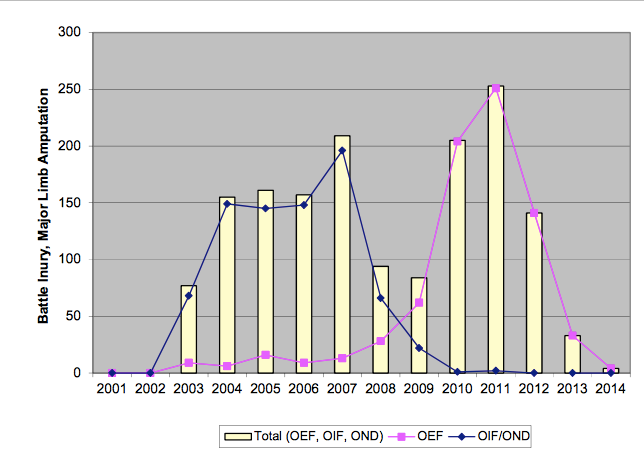
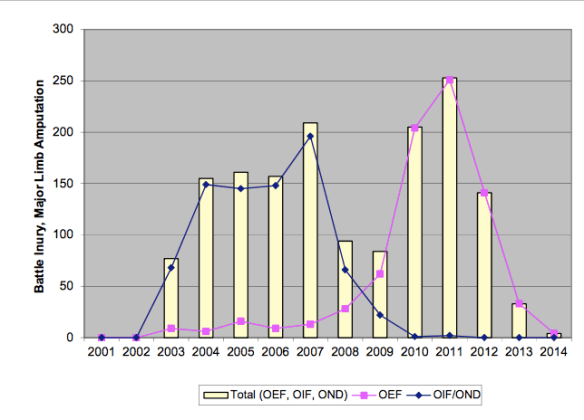
Major limb amputations (US military) in Iraq (OIF) and Afghanistan (OEF) 2001-2014 (Source: Congressional Research Services US Military Casualty Statistics, November 2014)

The incidence of devastating injuries to the limbs of troops in Iraq and Afghanistan (see the graph above; for comparable UK figures, see here) – mainly from IEDs – has been acknowledged in the role played by amputees in mission rehearsal exercises and pre-deployment training since 2005 (see here for an excellent general account).
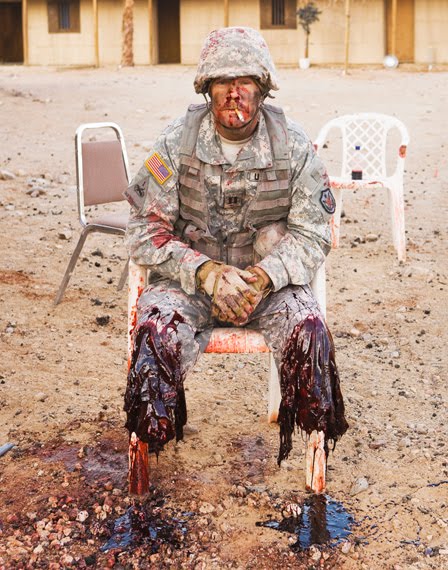
Peter Bohler:Fort Irwin training

Private contractors like Amputees in Action pride themselves on providing ‘de-sensitising’ exposure to ‘catastrophic injury amputations’ and replicating the latest field injuries for these exercises.  There is a risk in re-enrolling war veterans, as the company concedes:

Every amputee is vetted and put through specialist training beforehand to see if they are up to the job. For some it is too close to the mark, too realistic. The last thing we want to do is traumatize someone, stymie their rehabilitation.

These simulations have been used to prepare ordinary soldiers for the situations they will face – today it’s not only the ‘golden hour’ between injury and surgery that is crucial but also (and much more so) the ‘platinum ten minutes’ immediately following the incident, so the first response is vital. They have also been used to ready trauma teams for the war zone: the BBC has a report on the Royal Army Medical Corps’s mock ‘Camp Bastion’ at Strenshall in Yorkshire here.

These various exercises incorporate the latest advances in evacuation and trauma care, which have meant that today’s soldiers are far more likely to survive even the most life-threatening wounds than those who fought in previous conflicts, but the horrors experienced by young men and women in the military who lose arms and legs – sometimes all of them – are truly hideous:  read, for example, Anne Jones‘s mesmerising and deeply moving account of  They Were Soldiers: How the wounded return from America’s wars (you can get an idea from her ‘Star-spangled Baggage’ here).  Their road to rehabilitation is far longer, and infinitely more painful, than the precarious journey through which they returned to the United States (see also my ‘Bodies on the line‘).
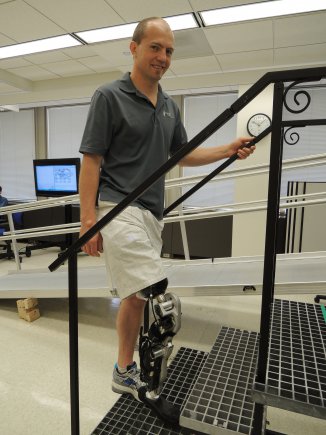
Zac Vawter at the Rehabilitation Institute of Chicago

Researchers unveiled the world’s first thought-controlled bionic leg  on 25 September 2013  funded through the US Army Medical Research and Materiel Command’s (USAMRMC) Telemedicine and Advanced Technology Research Center (TATRC) and developed by researchers at the Rehabilitation Institute of Chicago (RIC) Center for Bionic Medicine. 

There is some light in the darkness – ongoing experiments with state-of-the-art, ‘bionic’ prosthetics animated by microprocessors in the US, the UK and elsewhere that restore far more stability, mobility and movement than would have been possible even five years ago (see above, and here and here for the US, here and here for the UK).  In the 1980s less than 2 per cent of US soldiers who had suffered major limb amputations returned to duty; by 2006 that had increased to over 16 per cent (see also here and here).  There are several reasons for the change, but in 2012 Jason Koebler reported:

According to the Army, at least 167 soldiers who have had a major limb amputation (complete loss of an arm, leg, hand, or foot) have remained on active duty since the start of the Afghanistan and Iraq wars, with some returning to battle. Many others have returned overseas to work in support roles behind the lines.

“When we have someone we know wants to return, their rehab is geared that way,” says John Fergason, chief of prosthetics at the Army Center for the Intrepid at Fort Sam in Houston, Texas.

Kevin Carroll, vice president of Prosthetics at Hanger, a company that makes artificial limbs, says prosthetics have become more comfortable to wear and closer in range of motion to natural limbs.  “Unfortunately, when you have war, you have casualties, but with that comes innovation,” he says. Artificial joints are getting better at approximating the knee, elbow, wrist, and ankle, and microprocessors embedded in prostheses are able to pick up and adjust for impacts from walking, running, jumping, and climbing.

“The person doesn’t have to worry about the prosthetic device, they’re worrying about the task in front of them,” Carroll says. “If they want to go back to be with their troops, that’s an option for many soldiers these days.”

Notice, though, that these advances in prosthetic design and manufacture are part of an intimate conjunction between military violence and military medicine, in which materials science, bio-engineering, electronics and computer science simultaneously provide new means of bodily injury and new modalities of bodily repair.  This is captured in the title of David Serlin‘s thought-provoking essay, ‘The other arms race’ [in Lennard Davis (ed), The Disability Studies Reader (second edition, 2006) 49-65; this essay is not included in the latest edition, but see also the collection David edited with Katherine OttArtificial parts, practical lives: modern histories of prosthetics (2002) and his own Replaceable You: engineering the body in postwar America (2004)].  You can also find an excellent brief historical review of ‘Prosthetics under trials of war’ here.
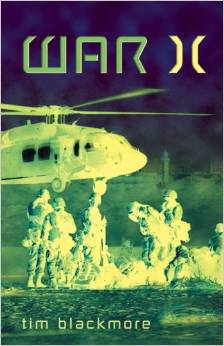
War XAnd, given the circuits within the military-medical machine, there may be more to come.  There are those who anticipate a future in which prosthetics will not only reinstate but also increase a soldier’s capabilities.  Koebler cites Jonathan Moreno, a bioethicist at the University of Pennsylvania, who ‘talks about a future where prosthetics are “enhancers” that allow soldiers to be stronger, faster, and more durable than their peers.’  These fantasies feed through the masculinist imaginary of the post-human cyborg soldier (sketched an age ago by Chris Hables Gray and revisited here) to the prosthetics of military violence with which I began. Here Tim Blackmore‘s War X: Human extensions in battlespace (2011) is also relevant.

But Koebler is quick to add that all this is still a distant prospect:

“I know the question is often, ‘How close are we to true bionic or having artificial limbs that are more versatile than natural ones?'” Fergason says. “Frankly, we’re not that close. You’re not going to see anyone decide, ‘Boy, I think I’d like to get a bionic leg because they’re so fantastic.’

“We love to read about the super-soldier, but that’s not the case right now. Amputation is so complex in what it does to your body that it’s a very long recovery,” he adds.

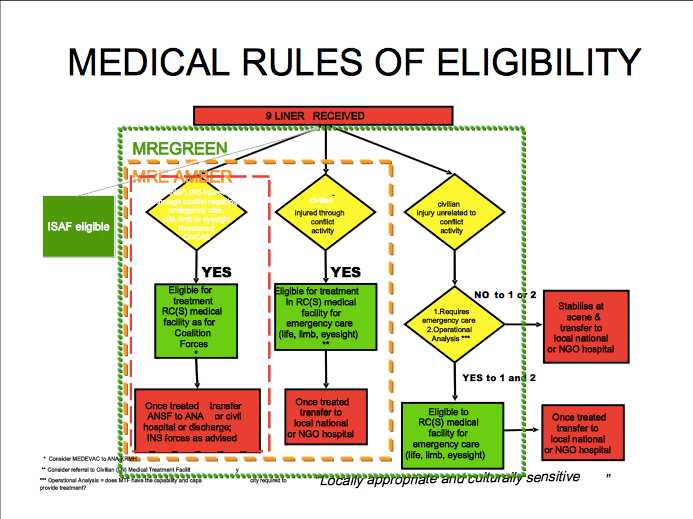
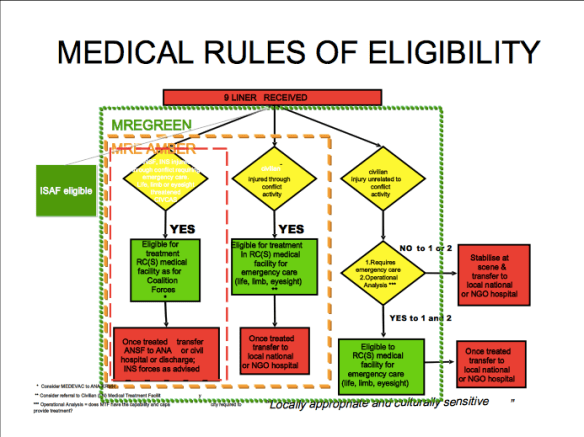
So what, then, of civilians?  Under ISAF’s Medical Rules of Eligibility Afghan civilians who were injured during military operations and/or needed ‘life, limb or eyesight saving care’ could be admitted to the international medical system, and were eligible for emergency casualty evacuation and treatment at one of the Category III advanced trauma centres at Bagram or Camp Bastion.
Medical Rules of Eligibility PNG

As soon as possible, however, Afghans were to be treated by Afghans and so, after surgical intervention they had to be transferred to the local healthcare system.  The same applied to the Afghan National Army and police.  In consequence, the drawdown of international forces – which also includes their medevac and trauma teams – has left the local population desperately vulnerable to the after-effects of continuing and residual military and paramilitary violence (see here and here).

The inadequacies and insufficiencies of the Afghan healthcare system have prompted a number of NGOs to fill the gap between the radically different systems, and they have done – and continue to do –  immensely important work.

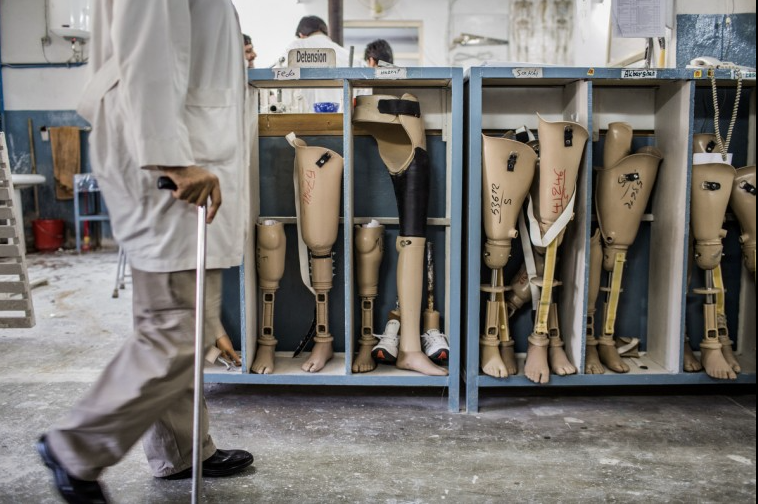
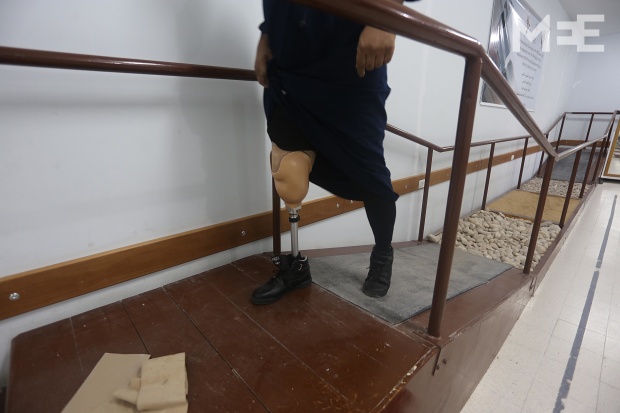
But compare the prosthetics available to US soldiers with those supplied to Afghan civilians.  I don’t mean to minimise the invaluable work done by hard-pressed and underfunded NGOs, but the image below is from the ICRC‘s Orthopedic Center in Kabul (see also here).  There are other centres supported by the ICRC in Faizabad, Gulbahar, Herat, Jalalabad, Lashkar Gah, and Mazar-e-Sharif, together with a manufacturing facility in Kabul, and other NGOs are active elsewhere  – Médecins sans Frontières runs a similar facility in Kunduz, for example.
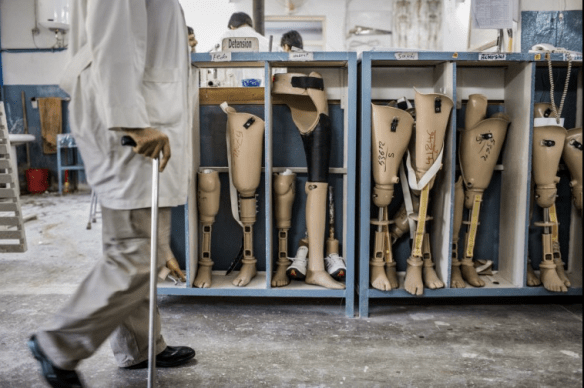
ICRC Orthopedic Center Kabul PNG

In addition to these facilities, there have been some ingenious work-arounds.  Carmen Gentile describes how US soldiers at Forward Operating Base Kasab in Kandahar were moved by the plight of Mohammed Rafiq, an eight-year old boy whose legs were blown off by an IED.  ‘Since we couldn’t get a supply of commercially made legs, we decided that maybe we could make them ourselves,’ explained Major Brian Egloff, a US Army surgeon at the base.

Using scrap tubing and some ingenuity, Egloff fitted Rafiq with small prosthetic legs. Rafiq was now able to get around the village…

Egloff did not end his work with Rafiq. He knew there must be other amputees living in the area…  Soldiers on patrol had noticed “a lot of guys with amputations that had no prosthetic legs and were reduced to crawling around on the ground and relying on the charity of strangers just to get by,” he says.  Afghans heard about what was done for Rafiq and asked for help for others. Egloff made the legs from material readily available in any welding shop, he says, mostly scrap aluminum tubing for the legs and aluminum plates for the prosthetic feet. A spring-loaded hinge served as the ankle joint.  “It’s a very simple design, nothing complicated,” he says.

These legs were intended to be temporary replacements until ‘a professionally fitted prosthetic’ was available, but the same report notes that ‘getting to a provincial capital, where most hospitals are located, is not easy for many Afghans and the routes are dangerous.’  There’s much more about inaccessibility in MSF’s Between rhetoric and reality: the ongoing struggle to access healthcare in Afghanistan (February 2014).

Like Mohammed – and many ISAF and Afghan soldiers – many of these amputees are the victims of IEDs or even land mines left over from the Soviet occupation (for a global review of the rehabilitation of people maimed by the explosive remnants of war [ERW], see this 2014 report from the International Campaign to Ban Landmines–Cluster Munition Coalition).

But some of them will be the victims of air strikes from or orchestrated by Predators and Reapers: in recent years Afghanistan has been the most heavily ‘droned’ theatre of operations in the world.  In some cases they were caught in the blast, but in others they were the victims of what Rob Nixon calls ‘slow violence‘.  According to a report by Sune Engel Rasmussen in the Guardian:

Since 2001, the coalition has dropped about 20,000 tonnes of ammunition over Afghanistan. Experts say about 10% of munitions do not detonate: some malfunction, others land on sandy ground. In rural areas, children often bring in vital income to households, but collecting scrap metal or herding animals can be fraught with unpredictable risks. Of all Afghans killed and maimed by unexploded ordnance, 75% are children…

Their future is usually bleak.  Erin Cunningham reports that ‘even as the population of Afghans who are missing limbs grows, amputees face discrimination and the harsh stigma of being disabled.’

“Socially and financially, their lives are destroyed,” Emanuele Nannini, program director at the Italian nonprofit Emergency, which operates health-care centers across Afghanistan, said of Afghan amputees.

From January to June [2014], Emergency’s Center for War Trauma Victims in Lashkar Gah, the capital of Helmand province in southern Afghanistan, performed 69 amputations. The fiercest fighting between the two sides usually takes place in the warmer summer months.

Emergency then sends the amputees to the nearby International Committee for the Red Cross orthopedic facility for long-term rehabilitation. The patients receive vocational training and other support to reintegrate them into society. The ICRC said that between April and June this year, it admitted 351 amputee patients to its facilities across Afghanistan.

But for the most part, amputees “are completely dependent on their families, and they become a huge burden,” said Nannini, who is based in Kabul. “The real tragedy starts when they go home. If they don’t have a strong family, they become beggars.”

Emergency runs two other surgical centers, in Kabul and Anabah, as well as a number of clinics and first aid posts in the villages; at Lashkar Gah six out of every ten admissions are victims of bombs, land mines or bullets.

The story is, if anything, even worse across the border in Pakistan’s Federally Administered Tribal Areas, whose inhabitants are also subject to explosive violence from the Taliban and other groups, and from CIA-directed drone strikes and air and ground attacks by Pakistan’s military.  As Madiha Tahir has shown, the victims usually disappear from public attention, at least in the United States:

What is the dream?

I dream that my legs have been cut off, that my eye is missing, that I can’t do anything … Sometimes, I dream that the drone is going to attack, and I’m scared. I’m really scared.

After the interview is over, Sadaullah Wazir pulls the pant legs over the stubs of his knees till they conceal the bone-colored prostheses.

The articles published in the days following the attack on September 7, 2009, do not mention this poker-faced, slim teenage boy who was, at the time of those stories, lying in a sparse hospital in North Waziristan, his legs smashed to a pulp by falling debris, an eye torn out by shrapnel….

Did you hear it coming?

No.

What happened?

I fainted. I was knocked out.
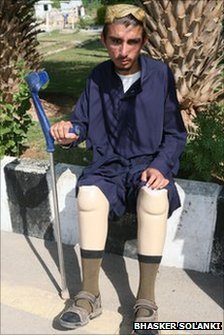
sadulla1As Sadaullah, unconscious, was shifted to a more serviceable hospital in Peshawar where his shattered legs would be amputated, the media announced that, in all likelihood, a senior al-Qaeda commander, Ilyas Kashmiri, had been killed in the attack. The claim would turn out to be spurious, the first of three times when Kashmiri would be reported killed.

Sadaullah and his relatives, meanwhile, were buried under a debris of words: “militant,” “lawless,” “counterterrorism,” “compound,” (a frigid term for a home). Move along, the American media told its audience, nothing to see here. Some 15 days later, after the world had forgotten, Sadaullah awoke to a nightmare.

Do you recall the first time you realized your legs were not there?

I was in bed, and I was wrapped in bandages. I tried to move them, but I couldn’t, so I asked, “Did you cut off my legs?” They said no, but I kind of knew.

Zeeshan-ul-hassan Usmani and Hira Bashir listed some of the long-term implications in a report completed last December for the Costs of War project:

Drone injuries are catastrophic ones.  Wounded survivors of drone attacks have often lost limbs and are usually left with intense and unmanaged pain, and some desire death. Those who survive with severe disabilities face a difficult situation given lack of accommodation for people with disabilities in Pakistan. FATA is an extremely difficult terrain for a disabled person. A walk out for the morning naan (traditional bread) may require navigating through a twisty mud track, with regular dips and bumps. The traditional mud houses of the area themselves have a mud floored haweli (an open-air area onto which all the rooms usually open up). A person with a leg amputation cannot use a regular wheel chair, go to school or hospital, or even use a toilet on his own. Disability of the primary breadwinner can change the course of life for an entire family, since most village jobs are physical ones.

Here too the barriers are more than physical.  In 2011 Farooq Rathore and Peter New described how disability remains a stigma in many sectors of Pakistani society, and rehabilitation medicine is still underdeveloped.

The leading prosthetics center is the Armed Forces Institute for Rehabilitation Medicine at Rawalpindi – whose rehabilitation services for injured soldiers are reportedly ‘the best in the country‘ – but it ‘still manufactures prostheses and orthoses with wood, leather, and metal.’  For injured civilians, the outlook is still more grim.  In 2012 a plan was announced to appoint orthotic specialists and physiotherapists at district hospitals throughout the FATA:

The prolonged United States-led war against terrorism has left a large number of people disabled in Pakistan, compelling the government to institute a rehabilitation plan that will include imparting vocational skills…

“We plan to enhance the physical rehabilitation services for the victims of terrorism to save them from permanent disability,” [Mahboob ur Rehman, head of the physiotherapy department at the Hayatabad Medical Complex (HMC)in Peshawar] told IPS.

The decade-long armed conflict has resulted in injuries to thousands of people from blasts, shelling and drone attacks, with the majority of the victims needing prosthetic and orthotic management to help regain the ability to walk, he said.

But it turns out that the emphasis is as much on ‘wheelchairs and sewing machines’ as it is on even the most basic prosthetics.

Once again, NGOs have provided vital services in the most difficult circumstances.  In 1979 the ICRC established a Paraplegic Rehabilitation Center in Peshawar for victims of the Afghan war, for example, which was subsequently transferred to the control of the Khyber-Pakhtunkhwa provincial government.  It has achieved some notable successes, but here too the focus is on physical therapy and it is outside the FATA so that access is difficult for many people.

And so, finally, to Gaza.  Here the differences with Afghanistan and Pakistan are striking.  Throughout the Israeli assault last summer, as I showed in detail here, medical services were severely compromised, and hospitals and medical centres actively targeted.  The only rehabilitation hospital, El-Wafa, was destroyed.  The injuries were also aggravated by the use of Dense Inert Metal Explosives (DIME) – developed for the US Air Force in 2006 – and which, according to a Briefing Note issued by the Palestinian human rights organisation Al-Haq, were fired from Israeli drones.
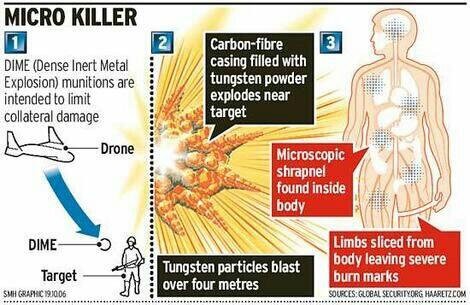
DIME blast injuries

These experimental weapons are supposed to decrease collateral damage by constricting the lethal blast radius.  But inside that perimeter the explosive blast is concentrated and magnified:

The injuries of victims who have been in contact with experimental DIME weapons are distinguishable from injuries sustained by non-experimental weapons. While signs of solid shrapnel or metal fragments are typical of amputations sustained from traditional explosives, physicians in the Gaza Strip are witnessing gruesome amputations caused by a metal vapor or residue which indicate the detonation of an extreme force in a small radius. In fact, as a result of these weapons, reported cases in the Gaza Strip include entire bodies cut in half, shattered bones, and skin, muscle and bones turned into charcoal due to the destructive burns associated with the weaponry’s extreme force and high temperature.

The lacerations are so severe that many victims bleed out and die.

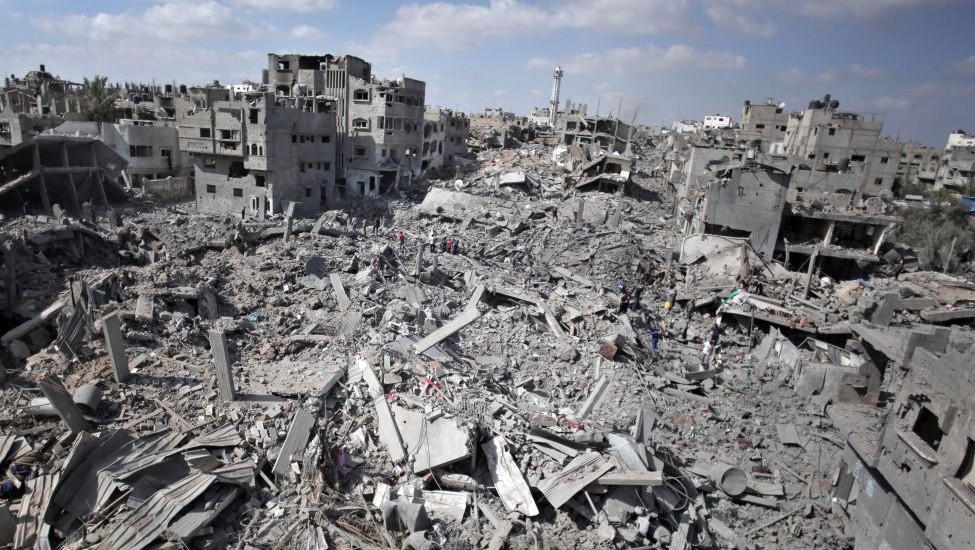
The scale of destruction in Gaza also presents a radically different landscape for survivors of blast injuries.  If the terrain in FATA is formidably difficult for anyone using prosthetics or in a wheelchair, imagine what it must be like to be confronted with this:
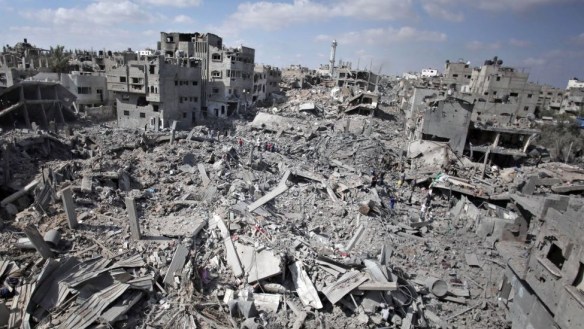
al Shejaiya Gaza 2014

When you look at that, bear in mind that when the assault came to an end there were still around 7,000 unexploded bombs and other explosive remnants of war beneath the rubble.

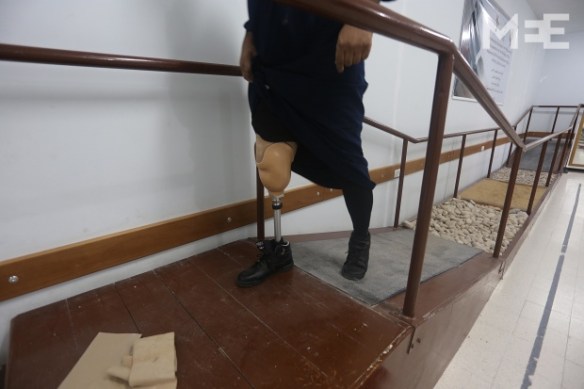
These are all dreadful effects and yet, compared to Afghanistan and Pakistan, the situation for prosthetics and rehabilitation seems somewhat better.  The prosthetics are more advanced, and some patients have been able to travel to Beirut, Amman and on occasion into Israel for treatment.  But there are still formidable obstacles in the essential provision of continuing local care.  Bayan Abdel Wahad reports from the Artificial Limb Centre, the only one of it kind in Gaza:

The number of patients who have benefited from the service of prosthetic replacement which the Centre provides for free is about 300 people who have been injured as a result of the Israeli bombardments in the past five years. However, a number of people injured in the last war – Operation Protective Edge – have not been able to come to the center yet because they are still bed-ridden due to several injuries whose treatment takes precedence over prosthetic replacement…. The technical coordinator at the center, Nivine al-Ghusain, said that “despite all the difficulties we face in funding and getting the materials necessary to manufacture the artificial limbs, we will continue in our work.” She [said] that the Centre takes upon itself the maintenance of the prosthesis from time to time “in addition to changing it based on the patients’ needs.”
15_0

The Centre relies on the ICRC for components and raw materials from France, Germany, Switzerland and the United States, but there are continuing difficulties in importing these via Israel or Egypt.  In December 2014 the Center was treating around 950 amputees.

Reports about the cultural and social response to these visible victims of military violence are mixed. Guillaume Zerr, who directs Handicap International’s operations in Gaza, told Reuters that ‘there can be less acceptance of their condition than in other regions of the world’, whereas one young man – a double amputee – insisted that ‘I feel more love, support and sympathy from people now than before my injuries, and Gazan society is non-discriminating toward me.’  Perhaps this is, at least in part, because he, like others wounded in Gaza, can provide an unambiguous narrative, ‘to tell the story behind the loss of his legs’.  I remember Omar Dewachi explaining to me how patients from Iraq, Libya or Syria who are treated in Beirut for their wounds have to return home with a narrative that can explain what happened to them in terms that will satisfy whichever side in those civil wars might call them to account.  Such narratives are important not only for their rehabilitation (and here they are vital) but also for their very survival.  This is presumably more straightforward in Gaza, but this ‘politics of the wound’ is also always a geopolitics of the wound.

One last thought.  I’m struck by how often the term ‘asymmetric war’ is used to imply that conflicts of this sort are somehow unfair – to those who possess overwhelming firepower.  But war is about more than firepower, more even than killing, and I hope I’ve shown that the differences between the continuing care and rehabilitation available to those who are maimed in these wars reveal not only a different prosthetics of military violence but also a new and grievous asymmetry in its enduring consequences.
Overlooking Auschwitz

To mark the 70th anniversary of the liberation of Auschwitz-Birkenau concentration camp, there has been widespread interest in a haunting video shot for the BBC using a commercial drone:

For once, the emptiness of the scene – just buildings, fences and railway tracks – is desperately affecting.   It’s surely impossible to watch this without thinking of the millions of people whose lives were so brutally effaced by the murderous regime of the Third Reich.  The only sign of a human presence in the video is a glimpse over the wall of trucks racing by: a reminder that Auschwitz was (and disconcertingly remains) at the centre of a small town (see also my post on Auschwitz here).

There are at least two other films that ought to be seen too.

Night Will Fall 2

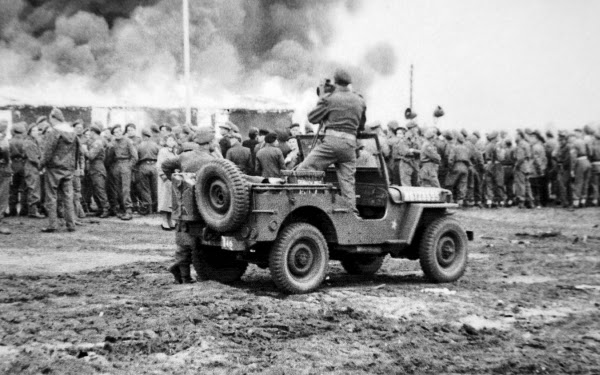
The first is a documentary commissioned in 1945 by the Psychological Warfare Film Section of the Supreme Headquarters Allied Expeditionary Force to document the liberation of Bergen-Belsen.  The producer was Sidney Bernstein, for Britain’s Ministry of Information; Alfred Hitchcock was drafted in as a ‘treatment adviser’.  The working title was German Concentration Camps: Factual Survey; it was never shown in its entirety (though Billy Wilder turned the footage into a short, Death Mills), and the Imperial War Museum notes:

From the start of the project, there were a number of problems including the practical difficulties of international co-operation and the realities of post-war shortages. These issues delayed the film long enough to be overtaken by other events including the completion of two other presentations of concentration camp footage to the German people and the evolution of occupation policy, where the authorities no longer considered a one-hour compilation of atrocity material appropriate. The last official action on the film was a screening of an incomplete rough-cut on 29 September 1945, after which the film was shelved, unfinished.

The footage has now been incorporated into a stunning HBO documentary, Night Will Fall, directed by André Singer, who was an Executive Producer for Act of Killing (see my posts here, here and here).

NIGHT-WILL-FALL-POSTER-2

There are all sorts of stories about why the full version was never shown – see the Guardian‘s report here – but the fullest discussions are Kay Gladstone‘s ‘Separate intentions’ in Toby Haggith and Joanna Newman (eds) Holocaust and the moving image (2005) (see also Haggith’s ‘Filming the liberation of Bergen-Belsen here) and her ‘Memory of the Camps: the rescue of an abandoned film’, in Griselda Pollock and Max Silverman (eds) Concentrationary cinema (2011).

The second film returns to the aerial view and to Auschwitz: Harun Farocki’s Images of the world and the Inscription of War.  Shockingly and sadly, Farocki died last summer at the age of 70, and Images is widely regarded as his masterpiece (see Thomas Voltzenlogel‘s wide-ranging and appreciative discussion of ‘Dialectics in images’ here).  The central motif is an image taken from a series of aerial photographs of Auschwitz shot by the Allies between April 1944 and January 1945 (see also here and here).

1389.3 Holocaust E

This image was taken on 4 April 1944 by Lt Charles Barry flying a Mosquito from 60 Photo Reconnaissance Squadron of the South African Air Force.  From the film’s commentary [available in Discourse 5(3) (1993) 78-92]:

American aircraft had taken off in Foggia, Italy, and flown towards targets in Silesia – factories for synthetic petrol and rubber – known as Buna.

On the flightover the IG Farben company factory still under construction, a pilot clicked his camera shutter and took photographs of the Auschwitz concentration camp.

First picture of Auschwitz taken at 7,000 meters altitude.

The pictures taken in April 1944 in Silesia arrived for evaluation in Medmenham, England [the RAF’s Central Intelligence Unit concerned with air photograph interpretation].

The analysts discovered a power station, a carbide factory, a factory under construction for Buna and another for petrol hydrogenation.

They were not under orders to look for the Auschwitz camp, and thus they did not find it.

How close the one is to the other: the industry – the camp.

It was not until 1977 that two employees of the CIA [Dino Brugioni and Robert Poirer: see their detailed report here] went through the archives to find and evaluate the photographs of Auschwitz. It was not until thirty-three years later that the following words were inscribed:

Tower and Commandant’s house and

Registration Building and Headquarters and Administration and

Fence and execution wall and Block 11 and the word “Gas chamber” was inscribed.

tumblr_n6e9sd1riY1rxmv4io1_500

Kaja Silverman adds this gloss [‘What is a camera?’ Discourse 5 (30 (1993) 3-56]:

Not only does the camera here manifestly “apprehend” what the human eye cannot, but the latter seems strikingly handicapped by its historical and institutional placement, as if to suggest that military control attempts to extend beyond behavior, speech, dress,and bodily posture to the very sensory organs themselves. This sequence indicates, in other words,that military discipline and the logic of warfare function to hyperbolize the distance separating look from gaze and to subordinate the former completely to the latter.

These are similar issues that haunt my own discussions of the video feeds from Predators and Reapers over Afghanistan and Iraq.  In another commentary, Christa Blümingler writes:

The vanishing point of Images of The World is the conceptual image of the ‘blind spot’ of the evaluators of aerial footage of the IG Farben industrial plant taken by the Americans in 1944. Commentaries and notes on the photographs show that it was only decades later that the CIA noticed what the Allies hadn’t wanted to see [my emphasis]: that the Auschwitz concentration camp is depicted next to the industrial bombing target.

Bombing of AuschwitzThe claim that the ‘Allies didn’t want to see’ spirals through an important debate about whether the Allies could or should have bombed Auschwitz (see, in addition to the symposium on the right, here and here).  In fact, as Christa observes later,

In … 1944, the allies bombed not Auschwitz, but the IG Farben factory nearby the death camp. Drawing on analyses of these events, how and why the allies didn’t act on their knowledge of the mass destruction of the Jews, Farocki … decodes a host of military images, focusing on two visual dispositives: American pilots in 1944 and CIA agents in 1977 offering two different [readings] of the aerial photographs of Auschwitz.

In this instance, Farocki developed an epistemological field of technological history — measurement and surveillance in a period of rapid automatization. At the end of the film, a blind spot in the photographic act, referring back to the reality of the concentration camp, becomes visible.

The final shots further emphasize details of the American pilots’ aerial photos, which are picked up in the sweep of the film several times, framed and arranged in different ways. At the end of the film, through a permutative movement of cuts, the extreme enlargement of the photographs reminds us once again of their materiality. Farocki shows these images in precisely the spaces where visual thought takes place, and in connection to specific techniques of reproduction and distribution (in albums, archives, institutions). Whenever he used marginal and hard-to-access image materials from specialized archives, he sought to consider these conditions of visibility in his analysis.

Farocki2

What particularly interests me, and the reason I juxtapose these two films, is an interview with Chris Darke in 2003 in which Farocki artfully tracks between the eye-witness and the aerial shot:

Chris Darke: In Images of the World and the Inscription of War there is this repeated phrase: “Beside the real world there is a second world, a world of pure military fiction”. I was very strongly reminded of Colin Powell at the UN Security Council presenting degraded military surveillance images as proof and justification for military action.

HF: Yes, it reminded me so much of the Auschwitz sequences in Images of the World, the way they involved aerial reconnaissance images that you had to be a specialist to read. Who knows what they are telling you? Who knows what happened there? What is so interesting is that the personal witness of two people who had escaped from the camps was so important. It was the way that traditional history was always written. You need an eye-witness, a narrative, otherwise you’ll never believe in it. And it turns out that our imaginative minds are still very old-fashioned. We don’t understand modernist strategies such as those used by the Americans in the first Gulf War. You really want to see these terrible, dirty images of burning streets and wounded people in the same way that psychoanalysis knows that you need dirty thoughts for the imagination, just as for love you need dirty images. The audience is not prepared for this automatically recorded history that more or less happens already, where everything is recorded; so there has to be an old-fashioned drama made out of it.

There are at least two other detailed commentaries on the film that address the question of visuality in depth: Thomas Keenan‘s ‘Light weapons’, in Documents 1/2 (1992) 147-58 and Nora Alter‘s ‘The political im/perceptible in the essay film:  Farocki’s Images of the world and the inscription of war‘, in New German Critique 68 (1996). More generally, I also recommend the special issue of e-flux on Farocki’s work here, including a commentary by Trevor Paglen on Farocki’s ‘operative images’, and David Cox‘s brief commentary here.

Note:  Belinda Gomez writes (in relation to the commentary for Images of the World):

“Fence and execution wall and Block 11 and the word “Gas chamber” was inscribed….” But that’s not quite accurate. Brugioni and Poirier didn’t write that in 1977. The gas chamber didn’t have a sign. That they were able to locate the gas chamber and crematoria was due to their superior technology and they knew what they were looking for. The pilot/photographers in 1944 took photos of the factory and what was taken as a workers camp. To say that they didn’t see Auschwitz because they weren’t told to look for it is more of a hind-sight interpretation.

Unlawful combatants

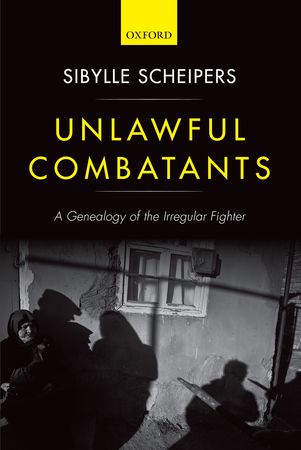
Unlawful combatantsI know several friends are interested (critically) in Carl Schmitt‘s Theory of the Partisan (see also Jan-Werner Müller‘s commentary here), but Sibylle Scheipers has now provided an indispensable genealogy of these often shadowy figures and their late modern incarnations: Unlawful Combatants: a genealogy of the irregular fighter (Oxford, 2015).

Unlawful Combatants brings the study of irregular warfare back into the centre of war studies. The experience of recent and current wars in Afghanistan, Iraq, Libya, and Syria showed that the status and the treatment of irregular fighters is one of the most central and intricate practical problems of contemporary warfare. Yet, the current literature in strategic studies and international relations more broadly does not problematize the dichotomy between the regular and the irregular. Rather, it tends to take it for granted and even reproduces it by depicting irregular warfare as a deviation from the norm of conventional, inter-state warfare. In this context, irregular warfare is often referred to as the ‘new wars’ and is associated with the erosion of statehood and sovereignty more generally. This obscures the fact that irregulars such as rebels, guerrillas, insurgents and terrorist groups have a far more ambiguous relationship to the state than the dichotomy between the state and ‘non-state’ actors implies. They often originate from states, are supported by states and/or aspire to statehood themselves.

The ambiguous relationship between irregular fighters and the state is the focus of the book. It explores how the category of the irregular fighter evolved as the conceptual opposite of the regular armed forces, and how this emergence was tied to the evolution of the nation state and its conscripted mass armies at the end of the eighteenth century. It traces the development of the dichotomy of the irregular and the regular, which found its foremost expression in the modern law of armed conflict, into the twenty-first century and provides a critique of the concept of the ‘unlawful combatant’ as it emerged in the framework of the ‘war on terror’.

Here is the Contents list:

1: Introduction
2: The Making of the Irregular Fighter, 1740-1815
3: The Nineteenth Century: Rebels, Rifles, and the Laws of War
4: The Second World War: Anti-Partisan Warfare, Genocide, and the Rebirth of the Auxiliary Fighter
5: Wars in the Colonies: Orientalism and the Social Production of Colonial Subjects
6: Irregular Fighters in the Twenty-first Century: Between ‘Unlawful Combatants’ and ‘Rebel’ Auxiliaries
7: Conclusion

The book is a product of the Changing Character of War programme at the University of Oxford, where Sibylle was Director of Studies until she moved to St Andrews in 2011.

The trauma hero

wwi-trauma

Following up my earlier post on novels, memoirs and narratives of war, there’s a thoughtful discussion by Roy Scranton at the LA Review of Books on what he calls ‘the myth of the trauma hero’.

A boy goes to war, his head full of romantic visions of glory, courage, and sacrifice, his heart yearning to achieve heroic deeds, but on the field of battle he finds only death and horror. He sees, suffers, and causes brutal and brutalizing violence. Such violence wounds the soldier’s very soul.

After the war the boy, now a veteran and a man, returns to the world of peace haunted by his experience, wracked by the central compulsion of trauma and atrocity: the struggle between the need to bear witness to his shattering encounter with violence, and the compulsion to repress it. The veteran tries to make sense of his memory but finds it all but impossible. Most people don’t want to hear the awful truths that war has taught him, the political powers that be want to cover up the shocking reality of war, and anybody who wasn’t there simply can’t understand what it was like.

The truth of war, the veteran comes to learn, is a truth beyond words, a truth that can only be known by having been there, an unspeakable truth he must bear for society.

This is probably the place to say that Roy served in the US Army in Iraq 2002-2006, studied at the New School for Social Research, and in 2010 embarked on a doctorate in English at Princeton – although, as you will soon see, this runs the very real risk of claiming that ‘he knows what he writes’ by virtue of these experiences.
Roy traces the myth of the trauma hero to eighteenth-century European Romanticism, and argues that it achieved its mature form in the twentieth century.  Accordingly he follows its development through Wilfred Owen in the First World War, Ernest Hemingway in the Second and Tim O’Brien in Vietnam until he reaches its contemporary form in Afghanistan and Iraq – and, in our own immediate present, in a film like Eastwood’s American Sniper.

It’s a beautifully composed contribution, and it’s made me re-think the basis for my ‘Gabriel’s Map’ and ‘Natures of War’ essays (DOWNLOADS tab) because Roy’s central thesis turns on a critique of the sacralization of trauma in ways that, at first sight, collide with my own attempts to develop what I’ve called a corpography (also DOWNLOADS tab) that can make us attentive to the corporeality and materiality of modern war:

‘Most Americans seem to believe that war can only be known through direct, physical, sensory experience on the battlefield, such as the moment of vision Owen describes in “Dulce et Decorum Est.” Ernest Hemingway, who in contrast to Owen’s long front-line service lasted only a few weeks as a noncombatant before being wounded and returning to the US, stands in American letters as the high priest of combat gnosticism. In Hemingway’s work, the emphasis on physicality, embodiment, and materiality we see in Owen’s representations of the soldier’s truth opens into a metaphysical bias against representation itself.’

d34387b998ba1136a34e9cc9e03515eeIn effect, Roy suggests, ‘being there’ becomes a privileged position from which truth cannot be communicated – only felt, and so only shared between those who were there.  The assertion of ethnographic privilege run through multiple fields from anthropology to journalism, of course, and it bedevils any attempt at historical reconstruction, but here it is heightened by the appeal to the supposedly inexpressible experience of trauma.  This could be developed still further through the reflections of, say, Elaine Scarry or Giorgio Agamben.  I take this very seriously, and yet if you work your way through the letters, diaries and memoirs of those who returned from the wars there is, I think, a sustained (and diverse) attempt to convey the corporeal – viscerally traumatising – experience of military violence.

But Roy’s point, I take it, is that this dilemma can function – can even be invoked – to exclude commentary and criticism.  And he concludes by emphasising the work that the ‘trauma hero’ continues to perform hors de combat:

‘[The most troubling consequence of our faith in the revelatory truth of combat experience and our sanctification of the trauma hero [is] that by focusing so insistently on the psychological trauma American soldiers have had to endure, we allow ourselves to forget the death and destruction those very soldiers are responsible for… Understanding the problem of American political violence demands recognizing soldiers as agents of national power, and understanding what kind of work the trauma hero is doing when he comes bearing witness in his bloody fatigues.’

I understand this concern too; there are – as I’ve argued in ‘The Natures of War’ – moments in many memoirs, novel and poems that reach towards the redemptive, even the exculpatory.  But I’ve also been deeply affected by those that disclose a more complex sense of the soldier as victim and vector of military violence: one of the recurrent motifs of the texts from the Western Front that I’ve worked with, for example, is the description of the fighting as ‘murder’.

So, much to think about – not least for the ways in which Roy’s ideas about the contemporary trauma hero complicate theses about a supposed transition to ‘post-heroic war’.  Those claims have a special resonance in the drone debates where, as I’ve noted elsewhere, Grégoire Chamayou has suggested that the trauma reportedly suffered by drone operators is ‘being mobilised to restore to war the ethico-heroic temper [critics] insisted it had lost through trauma’.

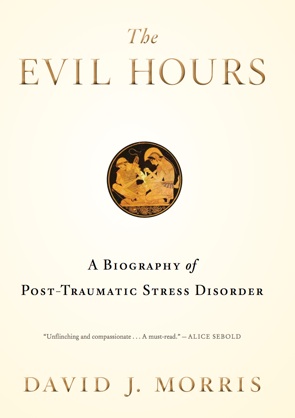
Evil Hours Cover Final

If you want to know more about the genealogy of post-traumatic stress, I recommend David J. Morris, The evil hours: a biography of post-traumatic stress disorder (Eamon Dolan/Houghton Mifflin Harcourt, 2015).   You can read an extract over at Salon here.  The book is particularly relevant to this discussion because it suggests that where trauma was once mediated through philosophy and literature it is now constituted through psychology and psychiatry.  David is very good on the arguments that raged over ‘shell-shock’ during the First World War, but if you want a ‘biography’ of that then you should turn to Michèle Barratt‘s Casualty figures: how five men survived the First World War (Verso, 2007).

Finally, Roy’s Learning to die in the Anthropocene is due from City Lights in the fall; you can get a taste of it from his essay in the New York Times with the same title here; this was the final installment of a five-part series on War and the city in which Roy retraced his footsteps from civilian to soldier to civilian.

Bodies of violence

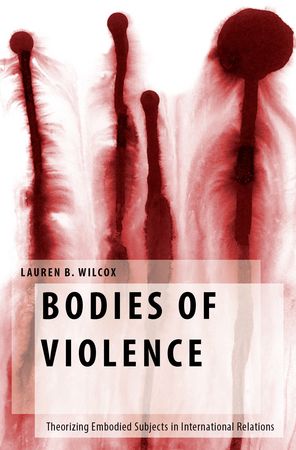
Bodies of violenceNew from Oxford University Press, Lauren Wilcox‘s Bodies of violence: theorizing embodied subjects in International Relations (how I wish books didn’t come with subtitles that serve only to narrow the audience for works that deserves a much wider one).

According to conventional international relations theory, states or groups make war and, in doing so, kill and injure people that other states are charged with protecting. While it sees the perpetrators of violence as rational actors, it views those who are either protected or killed by this violence as mere bodies: ahistorical humans who breathe, suffer and die but have no particular political agency. In its rationalist variants, IR theory only sees bodies as inert objects. Constructivist theory argues that subjects are formed through social relations, but leaves the bodies of subjects outside of politics, as “brute facts.”

According to Wilcox, such limited thinking about bodies and violence is not just wrong, but also limits the capacity of IR to theorize the meaning of political violence. By contrast to rationalist and constructivist theory, feminist theory sees subjectivity and the body as inextricably linked. This book argues that IR needs to rethink its approach to bodies as having particular political meaning in their own right. For example, bodies both direct violent acts (violence in drone warfare, for example) and are constituted by practices that manage violence (for example, scrutiny of persons as bodies through biometric technologies and body scanners). The book also argues that violence is more than a strategic action of rational actors (as in rationalist theories) or a destructive violation of community laws and norms (as in liberal and constructivist theories). Because IR theorizes bodies as outside of politics, it cannot see how violence can be understood as a creative force for shaping the limits of how we understand ourselves as political subjects, as well as forming the boundaries of our political communities.

By engaging with feminist theories of embodiment and violence, Bodies of Violence provides a more nuanced treatment of the nexus of bodies, subjects and violence than currently exists in the field of international relations.

Here’s the Contents list:

Introduction
Chapter 1: Bodies, Subjects, and Violence in International Relations
Chapter 2: Dying is Not Permitted: Guantánamo Bay and the Liberal Subject of IR
Chapter 3: Explosive Bodies: Suicide Bombing as an Embodied Practice and the Politics of Abjection
Chapter 4: Crossing Borders, Securing Bodies: Airport Security Assemblages and Bodies of Information
Chapter 5: Body Counts: The Politics of Embodiment in Precision Warfare
Chapter 6: Vulnerable Bodies and “Responsibility to Protect”

If you don’t know Lauren’s work already, you can catch up with some of it here.

No Safe Place

PHR Gaza 2014

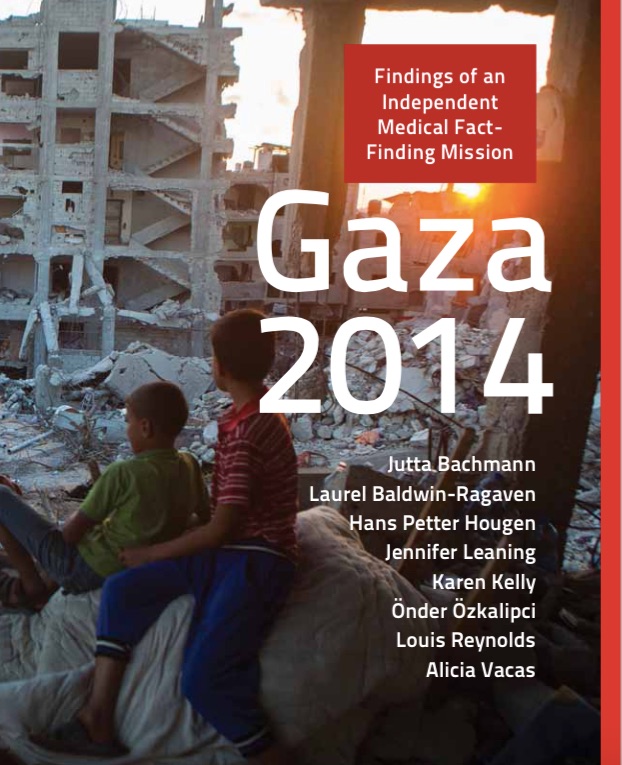
Physicians for Human Rights has published a ‘First Experts’ report on Israel’s military assault on Gaza last summer, Gaza 2014: No Safe Place.  It provides a much more detailed accounting of the attacks on the medical infrastructure of Gaza than I was able to do in Gaza 101 and subsequent posts.  Here is PHR’s description of the mission:

On 8 July 2014, Israel initiated a military offensive in the Gaza Strip. Although accounts vary, most estimates put the number of residents of Gaza killed in the 50-day armed conflict at over 2,100, of whom at least 70% were civilians, including over 500 children. Over 11,000 were wounded and over 100,000 made homeless. According to Israeli official accounts, 73 Israelis were killed: 67 soldiers and 6 civilians, including one child and one migrant worker. 469 soldiers and 255 civilians were wounded.

Questions arose regarding violations of international human rights and humanitarian law in the course of the conflict. In July 2014, following discussions with Al-Mezan, Physicians for Human Rights-Israel (PHR-Israel) commissioned a fact-finding mission (hereafter ‘FFM’) to Gaza, whose aim was to gather evidence and draw preliminary conclusions regarding types, causes and patterns of injuries and attacks; attacks on medical teams and facilities; evacuation; impact of the conflict on the healthcare system; and longer-term issues including rehabilitation of the wounded, mental health, public health and displacement.

PHR-Israel recruited 8 independent international medical experts, unaffiliated with Israeli or Palestinian parties involved in the conflict: four with special expertise in the fields of forensic medicine and pathology; and four experts in emergency medicine, public health, paediatrics and paediatric intensive care, and health and human rights.

The team made three visits to Gaza between August and November last year:

Meetings and site visits were held in medical facilities and in the community, and included interviews with victims, witnesses, healthcare professionals and human rights workers, officials from the Gaza Ministries of Health and Justice, and representatives of international health organisations in Gaza and the West Bank. Wherever possible, forensic, medical and other material evidence was collected to support oral testimonies.

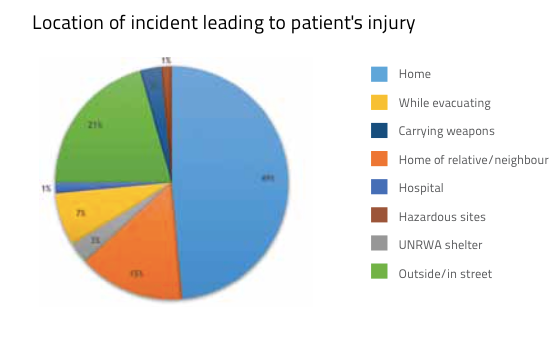
They interviewed 68 patients, and the chart below (from p. 36 of the report) explains why there was indeed ‘no safe place’ in Gaza.  As I argued previously, the Israeli military turned Gaza into a vast death zone extending far beyond the so-called ‘restricted areas’:

Location of incident leading to patient's injury PNG

Here are the summary conclusions from the report [the emphases are mine]:

The attacks were characterised by heavy and unpredictable bombardments of civilian neighbourhoods in a manner that failed to discriminate between legitimate targets and protected populations and caused widespread destruction of homes and civilian property. Such indiscriminate attacks, by aircraft, drones, artillery, tanks and gunships, were unlikely to have been the result of decisions made by individual soldiers or commanders; they must have entailed approval from top-level decision-makers in the Israeli military and/or government.

The initiators of the attacks, despite giving some prior warnings of these attacks, failed to take the requisite precautions that would effectively enable the safe evacuation of the civilian population, including provision of safe spaces and routes. As a result, there was no guaranteed safe space in the Gaza Strip, nor were there any safe escape routes from it.

In numerous cases double or multiple consecutive strikes on a single location [double tap] led to multiple civilian casualties and to injuries and deaths among rescuers.

Coordination of medical evacuation was often denied and many attacks on medical teams and facilities were reported. It is not clear whether such contravention of medical neutrality was the result of a policy established by senior decision-makers, a general permissive atmosphere leading to the flouting of norms, or the result of individual choices made on the ground during armed clashes.

In Khuza’a, the reported conduct of specific troops in the area is indicative of additional serious violations of international human rights and humanitarian law.

Ha’aretz‘s English-language coverage of the report is here.

Freedom fries, anyone?

Three more contributions to the Charlie Hebdo debate to think about.  The first is from Pankaj Mishra at the Guardian.  Not sure about his call for a ‘new Enlightenment’ – though there was certainly much wrong with the old one – but it’s a luminously (sic) intelligent argument.  He writes about ‘a profound clash – not between civilisations, or the left and the right, but a clash of old and new visions of the world in the space we call the west, which is increasingly diverse, unequal and volatile.’

It is not just secular, second-generation immigrant novelists [Hari Kunzru, Laila Lalami and Teju Cole] who express unease over the unprecedented, quasi-ideological nature of the consensus glorifying Charlie Hebdo’s mockery of Islam and Muslims. Some Muslim schoolchildren in France refused to observe the minute-long silence for the victims of the attack on Charlie Hebdo mandated by French authorities.

It seems worthwhile to reflect, without recourse to the clash of civilisations discourse, on the reasons behind these striking harmonies and discords. Hannah Arendt anticipated them when she wrote that “for the first time in history, all peoples on earth have a common present … Every country has become the almost immediate neighbour of every other country, and every man feels the shock of events which take place at the other end of the globe.” Indeed, it may be imperative to explore this negative solidarity of mankind – a state of global existence in which people from different pasts find themselves thrown together in a common present.’

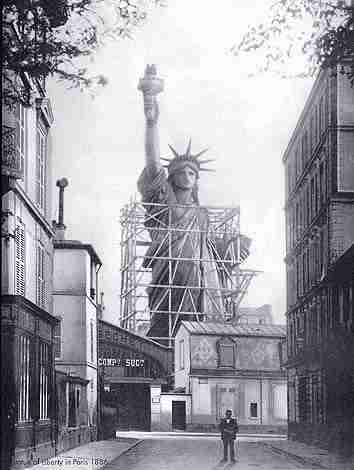
Construction of Statue of Liberty in Paris.comI think that’s right, which is why I’m disconcerted by Pankaj’s focus on Europe; I certainly don’t think the murders in Paris can be assimilated to ‘an assault on American values’ (far from it), but the complicated and often confounding relations between the two republics need excavation too.  They go back far beyond the gift of the Statue of Liberty to the US in the 1880s – I discussed this in what is still my favourite chapter in Geographical Imaginations – and reach forward to include the double, displaced misadventures in Indochina (not least the conviction that the US would sort out Vietnam after France had failed to do) and, still more proximately, France’s refusal to support the US-led invasion of Iraq (“freedom fries“, anyone?).

NIVAT Bagdad zone rougePankaj is simply brilliant on the ghosts of the colonial past, as you would expect, and they reappear in a different spectral guise in a short essay by Anne Nivat at Warscapes.  She provided some of the most reflective reporting from occupied Iraq (see her Bagdad, zone rouge), and in ‘Charlie Hebdo and the Boomerang Effect’ she mines that rich vein of experience to reflect on the knee-jerk responses to the murders in Paris:

In a democracy, one has the privilege of freedom of expression, and it is in the name of this that, for years, I have been traveling to the lands of “Islamist” wars.

For some time, I have been amazed, and even hurt, to hear friendly voices claim not to understand why I continue to give the floor to “the other side”; to those who make us afraid; to the “bad guy”; the “barbarian”; the “jihadist”; the Taliban; the “Islamic fighters” – the ones our allies have sought out to fight, or to “bump off in the outhouse,” as Russian President Vladimir Putin so elegantly put it in 2000 in reference to Chechen separatist fighters (Western military and political leaders typically use less violent vocabulary, but the meaning remains the same).

I regret that the attempts to know the “enemy” – my work, and others’ – have not been sufficient, as evidenced by the onslaught of hate on social networks.

And at the same site Andrew Ryder explores the multiform versions of ‘hate’ in ‘Charlie Hebdo and the limits of nihilism’.  He maps the gavotte between iconoclasm and nationalism and in so doing returns us to the figure of the Republic and to the dilemmas exposed by Pankaj Mishra.

Three years ago, [the editor of Charlie Hebdo] said, “If we say to religion, ‘You are untouchable,’ we’re fucked.” His idea was that no religion should be free from mockery, because to allow this is to permit the continuing subjugation of human freedom by religious superstition…

However, Charb also said, that same year, “I don’t blame Muslims for not laughing at our drawings. I live under French law. I don’t live under Koranic law.” This is the point where this apparent commitment to freedom actually masks French nationalism. What he is really saying, whether he was conscious of it or not, is that traditional French secularism, the products of a distinct national revolutionary tradition, should take absolute precedence over the values of immigrants. The secularism takes the shape of social chauvinism. In this context, it’s no longer a progressive contribution to the liberation of human beings. The apparent irreverence is bound to a greater advocacy of European heritage over the cultural character of the immigrants who now comprise such a large part of its society, and who were traditionally colonized and exploited by the ostensibly progressive and liberal nations whose secular values are then rhapsodized… [T]his complicity with racism was probably unrecognizable to him. We can see this today in the irony of the French right, paying homage to a magazine that hated them.

Torture and raison d’état

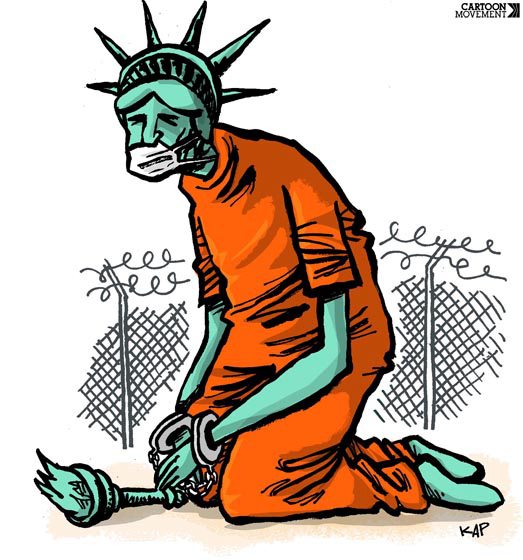
statue-of-liberty-waterboardingMelanie Richter-Montpetit has an essay at The disorder of things, ‘Why Torture When Torture Does Not Work? Orientalism, Anti-Blackness and the Persistence of White Terror‘, which repays careful reading.

[L]ocating the findings of the Senate Torture Report within the racial-sexual grammars of chattel slavery and its afterlife opens up our analyses beyond explanatory and moral frameworks such as failed intelligence-gathering, “state of exception” or “human rights abuses” towards a more comprehensive understanding of seemingly illiberal security practices in the War on Terror. This genealogy indicates the fundamental role and value of force for the consolidation of the sovereign authority of the U.S. settler imperial formation ‘at home’ and abroad, and suggests the stubborn persistence of certain racial-sexual grammars of legitimate violence and suffering in this age of “post-racial triumph.” For “[w]ithout the capacity to inspire terror, whiteness no longer signifies the right to dominate.”

The immediate provocation for her essay, which is rooted in her recent York PhD thesis Beyond the Erotics of Orientalism: Homeland Security, Liberal War and the Pacification of the Global Frontier, was the Senate Torture Report (see my earlier post on ‘Tortured geographies’ here).

GTMO Statue of LibertyAt Just Security Jameel Jaffer has a brief, important post about the release of these documents – and, crucially, the Obama administration’s attempt to prevent the publication of photographs documenting the abuse of detainees at US military facilities – that loops back to the debate over the Charlie Hebdo cartoons.  He argues that it is at the very least ironic that some of the same voices calling for the freedom to publish cartoons whatever their consequences are now demanding the suppression of other images ‘because of the possibility that their release will provoke violence’…

And speaking of violence and torture in the global war prison, Mohamedou Ould Slahi‘s Guantanamo Diary, which is being serialised in the Guardian and was published in book form earlier this week, provides more evidence of its routinised, banalised practice.

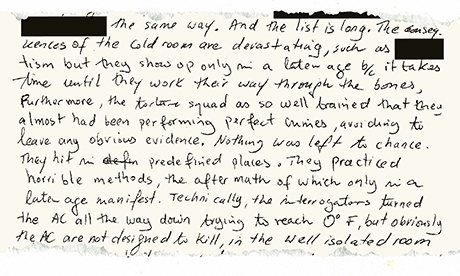
Slahi Unclassified Manuscript scan

Slahi is still incarcerated at Guantanamo even though he was approved for release in 2010.  Spencer Ackerman reports:

Slahi’s manuscript was subjected to more than 2,500 redactions before declassification, ostensibly to protect classified information, but with the effect of preventing readers from learning the full story of his ordeal. The book is being published with all the censor’s marks in place, and the publishers – Canongate in the UK and Little, Brown in the US – hope they will be able to publish an uncensored edition when Slahi is eventually released.

The full manuscript is available here.  You can find Tim Stanley‘s review at the Telegraph here (‘a necessary book’ that ‘reminds us that the evil we’re fighting can be found in ourselves as well as in our enemies’), Mark Danner‘s extended review at the New York Times here (‘Slahi’s memoirs are filled with numbingly absurd exchanges that could have been lifted whole cloth from “The Trial”’), and Deborah Perlstein‘s review at the Washington Post here (‘Slahi’s descriptions of … torture are the book’s most compelling, and difficult, passages [and] … are closely consistent with descriptions in official investigations of the treatment of other U.S.-held detainees’.)

In the face of these horrors, it’s necessary to consider this blunt reminder from Peter Beinart:

Torture, declared President Obama … in response to the newly released Senate report on CIA interrogation, is “contrary to who we are.” Maine Senator Angus King added that, “This is not America. This is not who we are.” According to Kentucky Congressman John Yarmuth, “We are better than this.”

No, actually, we’re not. There’s something bizarre about responding to a 600-page document detailing systematic U.S. government torture by declaring that the real America—the one with good values—does not torture. It’s exoneration masquerading as outrage. Imagine someone beating you up and then, when confronted with the evidence, declaring that “I’m not really like that” or “that wasn’t the real me.” Your response is likely to be some variant of: “It sure as hell seemed like you when your fist was slamming into my nose.” A country, like a person, is what it does.

And in the face of evasion and denial – and redaction and suppression – here is Chase Madar from February’s Bookforum:

Though the [Senate] report has blacked out the names of the torturers, refusing even to use pseudonyms, torture watchers have been able to identify one of the agents, a model for Maya in Zero Dark Thirty. Her record of malfeasance, misrepresentation, incompetence, and gratuitous participation in waterboarding was blisteringly detailed by NBC News and [Jane Mayer at] the New Yorker, though neither outlet would name her. But far from being sanctioned or even demoted, she has risen to the civilian-rank equivalent of general inside the CIA. She has, unbelievably, served as the recent head of the agency’s “global jihad unit.”

It’s tempting to compare this to Latin American–style police impunity, but that would be unfair to the societies that have punished at least some of the abuses of their past dictatorships. In the same week that the SSCI released its report, Brazil published its own investigation into state torture of political dissidents under its long dictatorship. Indeed, one of that torture regime’s victims, Dilma Rousseff, is now the head of state. Latin American nations have been chipping away at, or simply ignoring, the amnesty deals made with the authoritarian rulers of the ’70s and ’80s and have brought many of their torturers to justice.

The United States would face a very different reckoning with its record of torture, should it elect to take a genuine, closer look at it. In our case, the impact of torture has largely been muffled by the military adventurism that has underwritten it…