Tomorrow’s Battlefield

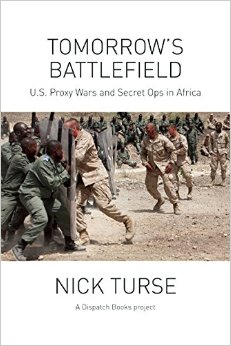
TURSE Tomorrow's BattlefieldJust back from the AAG in Chicago, where I picked up a pre-publication copy of Nick Turse‘s new book, Tomorrow’s Battlefield: US proxy wars and secret ops in Africa (Haymarket) (and I have to say it was a relief to see Haymarket and Verso after the depressing parade of textbooks that dominated the publishers’ exhibition).

The book gathers together Nick’s reports for TomDispatch on US Africa Command; you can catch his latest here.

You won’t see segments about it on the nightly news or read about it on the front page of America’s newspapers, but the Pentagon is fighting a new shadow war in Africa, helping to destabilize whole countries and preparing the ground for future blowback. Behind closed doors, U.S. officers now claim that “Africa is the battlefield of tomorrow, today.” In Tomorrow’s Battlefield, award-winning journalist and bestselling author Nick Turse exposes the shocking true story of the U.S. military’s spreading secret wars in Africa.

The official publication is scheduled for early June, both paperback and e-edition.

Nick says very little about AFRICOM’s enlistment in the ‘war on Ebola’, which takes me back to the AAG conference where – amongst several other commitments – I revisited my previous posts (here and here).  In particular, I sketched out some of the ways in which a different West Point – the inhabitants of Monravia’s largest informal community – came to resist the militarisation of public health and to develop their own, remarkably effective community response to the epidemic.  More on this soon.

Dirty Dancing online

I had a wonderful time at the Balsillie School at Waterloo last week – good company, constructive conversations and endless hospitality – and I’m truly grateful to Simon Dalby, Jasmin Habib and all the graduate students who made my visit so enjoyable.  I finished by giving one of the Centre for Global Governance Innovation (CIGI)’s Signature Lectures.

This was the latest (and near-final) version of “Dirty dancing: drones and death in the borderlands”.   The argument has developed considerably since my first presentations; I’ll upload the written version once it’s finished, but CIGI has posted the lecture and Q&A online here.  I’ve also embedded the YouTube version below, but if that doesn’t work try here.

My thanks to the AV technicians who made this possible: their help with the production followed by their assured and rapid-fire editing beats anything I’ve encountered anywhere.

In this version, I begin with two CIA-directed drone strikes in Pakistan’s Federally Administered Tribal Areas, one on Baitullah Mehsud (the leader of Tehrik-i-Taliban) and the other on ‘Mamana’ Bibi, an innocent grandmother and midwife, and ask what it is that makes strikes like these – which is to say strikes as unlike these – possible.  My answer turns on the kinds of space the FATA been made out to be: in particular, a space of exception in which people are knowingly and deliberately exposed to death, and a territory conceived as a political technology through which power lays claim to bodies-in-space.

Unlike Giorgio Agamben‘s original formulation, though, my discussion of the space of exception focuses not on violence authorised through the suspension of the law but rather violence that operates inside the law: so I look at the legal regimes, both international and national, that affect military and paramilitary violence in the FATA.  A further difference is that this exceptional state of affairs is provoked not by an event but by a margin: by the construction of the FATA as a liminal zone, borderlands that are outside ‘Pakistan proper’ or ‘mainland Pakistan’.  Many commentators (including me) trace the origin of aerial violence to the British Raj, its Frontier Crimes Regulations and its ‘policing’ of the North-West Frontier.  This is important, but the line of descent to today’s air strikes is not direct.  In particular, it is important to bring into view the cross-border incursions made by Soviet and Afghan aircraft during the occupation of Afghanistan.  Thousands of people were killed and injured during these attacks, and this constitutes an important horizon of memory, but no less important is the response of the Pakistan Air Force: their US-supplied jets intercepted incoming aircraft and either escorted them out of Pakistani air space or, towards the end of the 1980s, engaged them in combat.  This begs an obvious question: if Pakistan objects to the US strikes – carried out by drones that are slow, noisy and sluggish – why does its Air Force not shoot them down?  Since today’s drones cannot be used in contested air space – bluntly, they can only be used against defenceless people – why does Pakistan elect to render the people of FATA defenceless?  This immediately brings into view the other source of aerial violence in the borderlands: the ongoing offensives in the FATA launched by the Pakistan Air Force (in concert with large-scale ground operations).  Even though the Pakistan Air Force has its own reconnaissance drones, some of which are now armed, these are not attempts to put ‘warheads on foreheads’, as the US Air Force would have it, but wide-area assaults conducted by conventional strike aircraft and attack helicopters – as I show in the case of Mir Ali and Miran Shah during Operation Zarb-i-Azb (see here and here and here).

To complete the sequence and add the US drone strikes, I trace the intimate collaboration between both the CIA and the US Air Force and between Washington and Islamabad.  The diplomatic cables released by Wikileaks show time and time again that many of the negotiations about access to ‘flight boxes’ over North and South Waziristan were conducted by the Chairman of the Joint Chiefs of Staff and the commander of US Central Command.  I show, too, how the collaboration between Washington and Islamabad continued until at least 2013.

Hacking.001

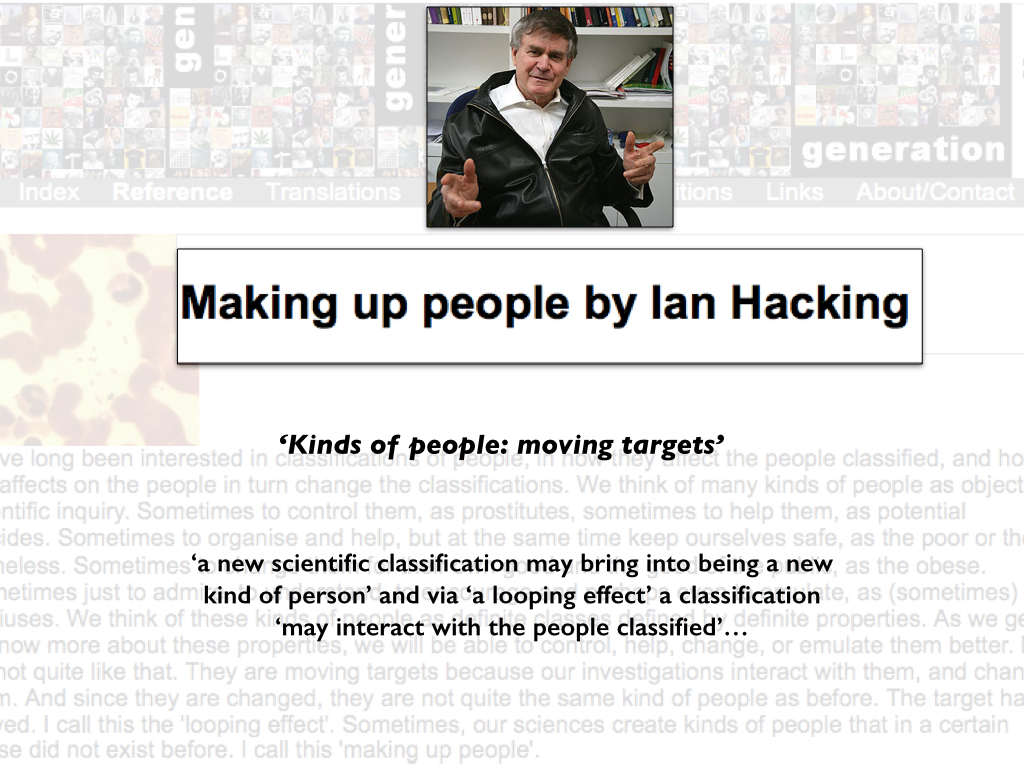
In order for the CIA-directed strikes to be possible, however, the FATA must also be turned into a territory in something like the sense proposed by Stuart Elden.  So I describe the multiple ways in which data is harvested by the NSA and other agencies to produce what Rob Kitchin and Martin Dodge call code/space: the algorithmic combination of sensors, traces and intercepts to summon into being a body-as-target (for more, see here: scroll down), and to produce the space of the target where fleshy bodies disappear and are replaced by codes, co-ordinates and cross-hairs.  This is another version of what Ian Hacking calls ‘making up people’: there is an important sense, then, in which the supposed ‘individuation’ of later modern war depends on the selective and active production (and destruction) of an ‘individual’.

The questions and comments after the lecture were immensely helpful, and as I turn this into its final, written version I’d be grateful for any further comments if you watch the video.

Civil(ian) wars in Yemen

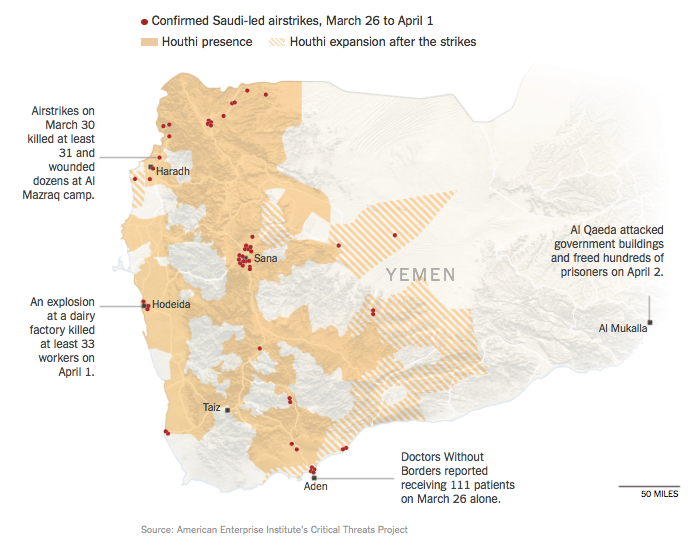
It’s not easy to keep track of the intensifying civil war/proxy war in Yemen, but the New York Times has published a series of maps – including the one below – that sketch out some of the contours of violence.
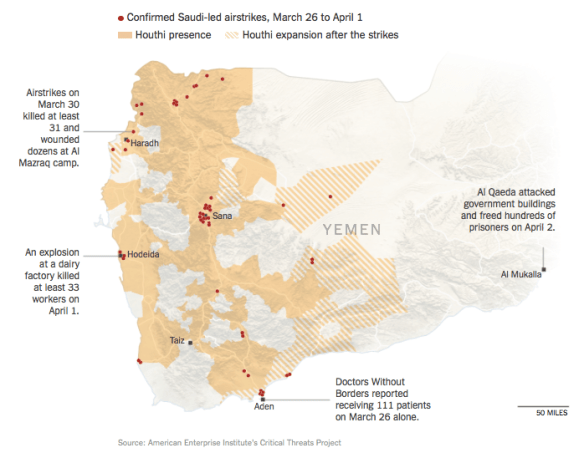
Saudi-led airstrikes in Yemen to April 2015

Not surprisingly, the Saudi-led air strikes (‘Operation Decisive Storm’ – really) have been ineffective in halting the advance of the Houthis; in fact, they may be counterproductive.  Three days ago senior United Nations officials warned that the loss of civilian lives and the repeated attacks on civilian infrastructure may constitute grave violations of international law, and there are now reports that US officials are also becoming alarmed at the mounting toll of civilian casualties.

The United States is, of course, intimately involved in the air campaign.  According to the Los Angeles Times:

Pentagon officials, who pride themselves on the care they take to avoid civilian casualties, have watched with growing alarm as Saudi airstrikes have hit what the U.N. this week called “dozens of public buildings,” including hospitals, schools, residential areas and mosques. The U.N. said at least 364 civilians have been killed in the campaign.

Although U.S. personnel don’t pick the bombing targets, Americans are working beside Saudi military officials to check the accuracy of target lists in a joint operations center in Riyadh, defense officials said. The Pentagon has expedited delivery of GPS-guided “smart” bomb kits to the Saudi air force to replenish supplies.

The U.S. role was quietly stepped up last week after the civilian death toll rose sharply. The number of U.S. personnel was increased from 12 to 20 in the operations center to help vet targets and to perform more precise calculations of bomb blast areas to help avoid civilian casualties.

U.S. reconnaissance drones now send live video feeds of potential targets and of damage after the bombs hit. The Air Force also began daily refueling flights last week to top off Saudi and United Arab Emirates fighter jets in midair, outside Yemen’s borders, so they can quickly return to the war.

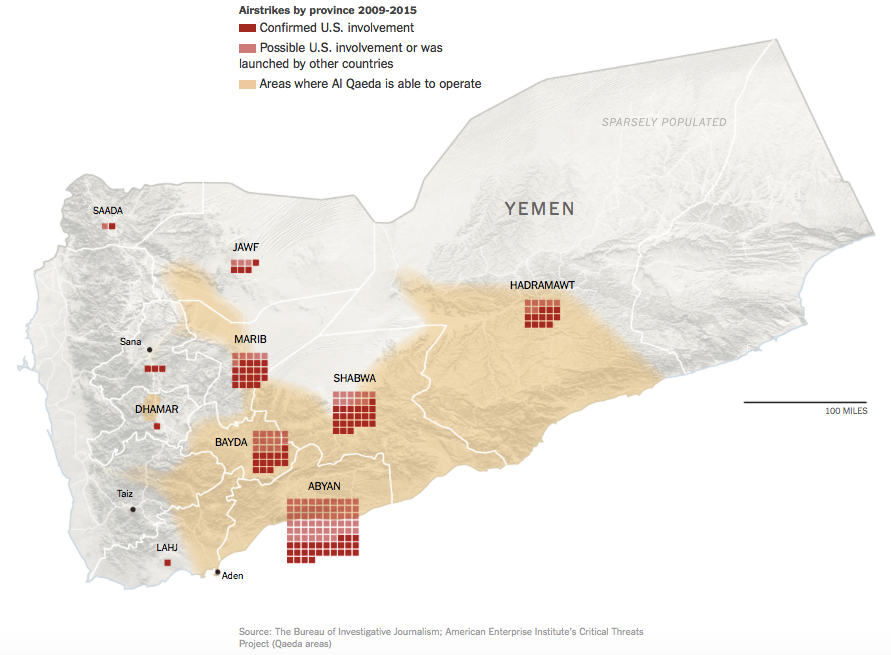
You could be forgiven for thinking this a bit rich.  The US has long been waging its own air campaign in Yemen:
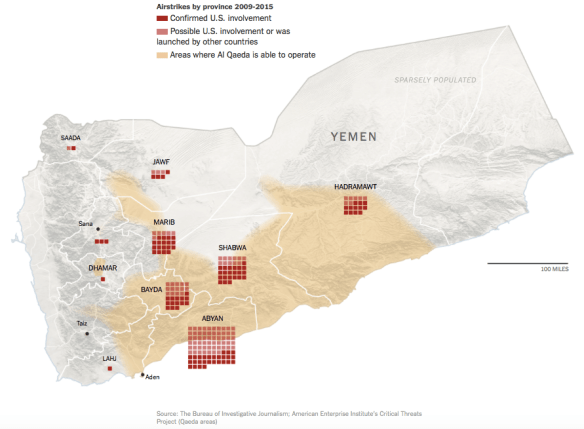
US air strikes in Yemen 2009-15

The NYT map above is derived from the vital work of the Bureau of Investigative Journalism, and you can find its detailed accounting of drone strikes in Yemen here.  Drone strikes have not been suspended during the new air offensive: earlier this week Al Qaeda in the Arabian Peninsula announced that one of its most prominent spokesmen and clerics, Ibrahim al-Rubeish, had been killed by a US drone strike near the coastal city of al Mukalla.

Readers will know that there has been considerable critical discussion of civilian casualties caused by the programme of targeted killing in Yemen (and elsewhere): so much so that on 23 May 2013 the Obama administration issued a Presidential Policy Guidance [PPG] for the use of force ‘outside the United States and areas of active hostilities’ that supposedly imposed more stringent restrictions on its use of (para)military violence outside ‘hot battlefields’ like Afghanistan.
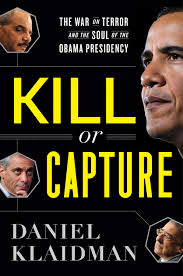
KLAIDMAN Kill or CaptureThe guidelines affirmed a preference for ‘capture’ over ‘kill’ – ‘The policy of the United States is not to use lethal force when it is feasible to capture a terrorist suspect, because capturing a terrorist offers the best opportunity to gather meaningful intelligence and to mitigate and disrupt terrorist plots’ – and so limited the use of lethal force to situations where ‘capture is not feasible at the time of the operation‘.  That last clause –my emphasis – clearly provides wide latitude for elevating ‘kill’ over capture’, but for a recent, vigorous discussion of the kill/capture debate prompted by the arrest and indictment of Mohanad Mahmoud Al Farekh earlier this month, see David Cole on ‘Targeted killing’ here.

In addition, crucially, the PPG required there to be a ‘near certainty’ that civilians would not be killed or injured during the operation.

Yet even when the guidelines were issued, they were ambiguous.  As Ryan Goodman pointed out, grey zones remained:

The notion of “areas of active hostilities” essentially refers to geographic zones where belligerents engage in sustained fighting. It is a term of art, as far as we can tell, developed by the administration at an unknown date, and not found in international law. In congressional testimony, the administration has stated that it considers Afghanistan an area of active hostilities, and it considers Yemen (despite frequent drone operations in that country) and Somalia outside the area of active hostilities.

These topological contortions did not begin with Obama.  The Bush administration made no secret of its central interest in ‘conducting war in countries we are not at war with‘.

Ryan’s discussion focused on the ambiguous location of Pakistan in this atlas of violence, and in particular the Federally Administered Tribal Areas: were they inside or outside “areas of active hostilities” (or even ‘half-in, half-out’)?  Since then, clearly, Yemen too may have been repositioned by Obama’s cartographers: it’s surely difficult to maintain the pretence that it is now not an ‘area of active hostilities’.

But in between the PPG and the opening of the new air offensive in Yemen, how effective were those restrictions on civilian casualties?  A collaborative investigation carried out by the Open Society Justice Initiative in the United States and the Mwatana Organization for Human Rights in Yemen raises plausible doubts.
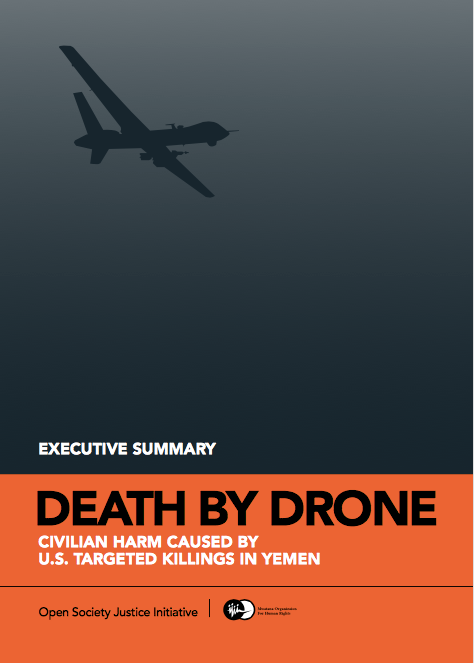
Death by Drone (Yemen) (2015)

Their joint report, Death by Drone: civilian harm caused by targeted killing in Yemen, investigates nine US air strikes carried out between May 2012 and April 2014, and is based on interviews with survivors and eyewitnesses, relatives of individuals killed or injured in the attacks, local community leaders, doctors and hospital staff who were involved in the treatment of victims, and Yemeni government officials:

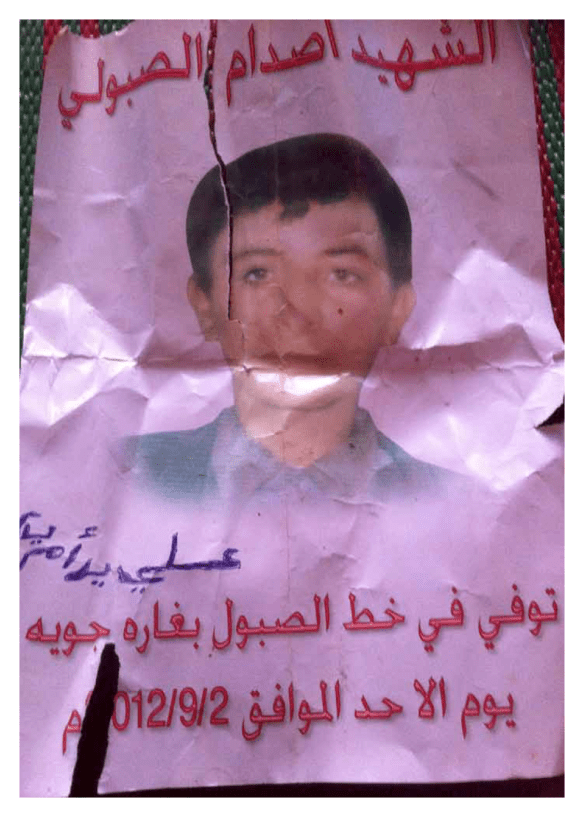
The nine case studies documented in this report provide evidence of 26 civilian deaths and injuries to an additional 13 civilians. This evidence casts doubt on the U.S. and Yemeni governments’ statements about the precision of drone strikes. Yemen’s President Abdu Rabbu Mansour al-Hadi praised U.S. drone strikes in Yemen as having a “zero margin of error” and commented that “the electronic brain’s precision is unmatched by the human brain.” The United States government has similarly emphasized that the precision afforded by drone technology enables the U.S. to kill al-Qaeda terrorists while limiting civilian harm…

[T]his report provides credible evidence that civilians were killed and/or injured in all nine airstrikes, including four which post-date President Obama’s [PPG] speech. To be sure, it is possible—owing to a mistake or an unforeseeable change of circumstances that manifests between the ordering of a strike and its occurrence—for civilians to be killed or injured despite a near-certainty prior to the strike that this would not happen. Nonetheless, the evidence of civilian deaths and injuries in nine cases raises serious concerns about the effective implementation of the “near-certainty” standard.
death-drones-report-eng-20150413 (dragged)

And in paragraphs that will be dismally familiar to anyone who has read the Stanford/NYU report on Living under drones in the Federally Administered Tribal Areas, the authors add:

The testimonies in this report describe desperately poor communities left to fend for themselves amid the devastation caused by U.S. drone strikes. Mothers and fathers who lost their children in drone strikes speak of inconsolable loss. They speak of their children’s bodies charred beyond recognition. Wives speak of losing their breadwinners, and of young children asking where their fathers have gone. The victims of these strikes say that these strikes will not make the United States or Yemen safer, and will only strengthen support for al-Qaeda.

The report also describes the terrorizing effects of U.S. drones on local populations. In many of the incidents documented, local residents had to live with drones continually flying overhead prior to the strikes and have lived in constant fear of another attack since. Some fled their villages for months after the strike, and lost their source of livelihood in the process. Survivors of the attacks continue to have nightmares of being killed in the next strike. Men go to their farms in fear. Children are afraid to go to school.

The Executive Summary is here, and you can download the full 123pp report here.

Law, ethics and drone warfare

SCHELLER Kill-chain

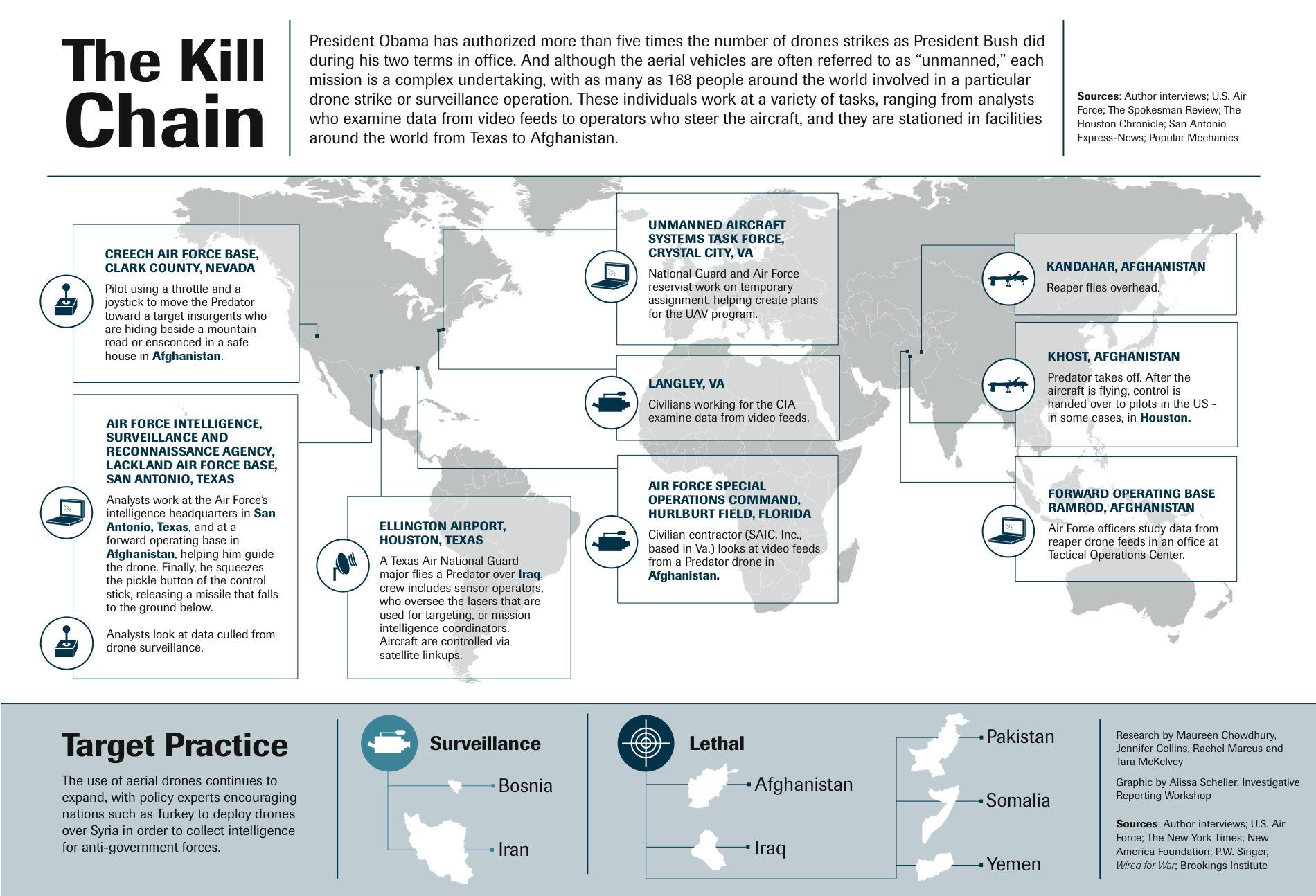
The infographic above was produced by Alissa Scheller for an Investigative Reporting Workshop on Drones, and specifically an article by Tara McKelvey on Harold Koh and the legal armature that the Obama administration has sought for its nominally covert program of targeted killing.

Since then (2012) there has been a cascade of essays around these legal and ethical issues; much of the spikiest writing is to be found on the indispensable ssrn, but here are some other essays I’ve just caught up with that readers might also find helpful:

Special issue: ‘Legal and ethical implications of drone warfare’, in International Journal of Human Rights 19 (2) (2015) including:

Michael J. Boyle, ‘The legal and ethical implications of drone warfare’ (pp 105-126)

Stephanie Carvin, ‘Getting drones wrong’ (pp. 127-141)

Craig Martin, ‘A means-methods paradox and the legality of drone strikes in armed combat’ (pp. 142-175)

Daniel R. Brunstetter & Arturo Jimenez-Bacardi, ‘Clashing over drones: the legal and normative gap between the United States and the human rights community’ (pp. 176-198)

David Whetham, ‘Drones to protect’ (pp. 199-210)

Caroline Kennedy & James I. Rogers, ‘Virtuous drones?’ (pp. 210-227)

Symposium: ‘Towards a drone accountability regime‘, in Ethics and International Affairs 1 (2015) with a major contribution from Allen Buchanan and Robert O. Keohane

From a moral standpoint, lethal drones are intrinsically no worse as a means of warfare than bombing or sending commandos to kill enemies. From the perspective of their users, they have six major advantages over more conventional weapons: they are often cheaper; their use can be more readily concealed; they allow for more precise targeting, with the potential for less “collateral damage”; their use can involve less serious infringements of sovereignty than invasion by troops; and they may be less likely to provoke widespread hostile reactions by the population of the country in which they are used than military operations involving troops on the ground. But these advantages generate three major risks: of violating sovereignty, of over-using the military option, and of making it more difficult to identify violations of constraints against targeting noncombatants. To deal with these risks, a Drone Accountability Regime is needed that imposes obligations on states, which in turn would be required to impose them on their agents. Since it would be infeasible to negotiate a treaty-based legal regime at present and for the foreseeable future, the Drone Accountability Regime should be informal and should involve transnational actors as well as states. Its key principle should be transparency, helping enable civil society to hold states accountable, and its central agent would be an Ombudsperson with broad authority to investigate situations and publicize her findings. No institution can ensure that states, or operators, are held fully accountable to appropriate standards of conduct, but such a regime could increase the degree of accountability for the use of lethal drones.

— and critical responses from Neta Crawford, Janina Dill, and David Whetham.

Bianca Baggiarini, ‘Drone warfare and the limits of sacrifice’, Journal of international political theory 11 (1) (2015) 128-44

M.J. Boyle, ‘The race for drones’, Orbis 59 (1) (2015) 76-94

Lindsay Cohn-Warrior, ‘Drones and targeted killing: costs, accountability and US Civil-Military relations’, Orbis 59 (1) (2015) 95-110

Jelena Pejic, ‘Extraterritorial targeting by means of armed drones: some legal implications’, International review of the Red Cross (2015) (online early)

Lauren Wilcox, ‘Drone warfare and making bodies out of place’, Critical studies on security 3 (1) (2015) 127-131

John Williams, ‘Distant intimacy: space, drones and Just War’, Ethics and International Affairs 1 (2015) 93-110

And to widen the discussion and give it substantive depth, see Craig Jones, ‘Lawfare and the juridification of late modern war‘, Progress in human geography (2015) (Online First):

Processes of juridification are a defining feature of late modern war. But geographic accounts of war have generally not considered the role that law plays in shaping its conduct. This paper explores the juridification of war using the concept of lawfare. Lawfare may signal an intensification and shift in the relationship between war and law, but I argue that understanding the nature and extent of these changes requires a careful examination of the historical geographies of war, law and lawfare. Drawing from critical legal approaches I offer a preliminary geographical and historical theorization of lawfare so that we may better understand the relationship between war and law today.

Refractions of war

Empire of chance

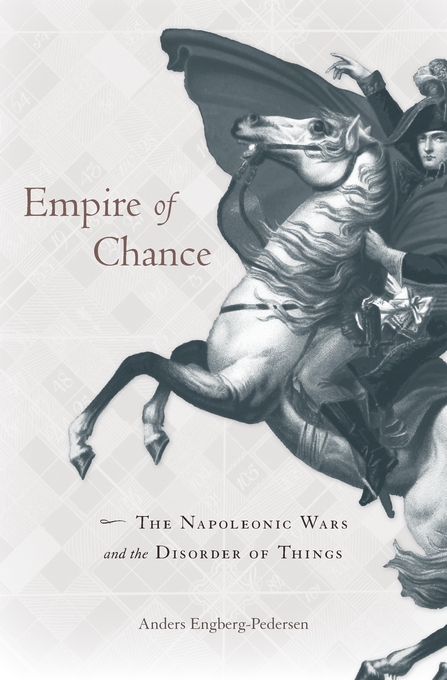
During my recovery I’ve done less writing than I would like but more reading than I thought possible.  Out of the blue I received Anders Engberg-Pedersen‘s Empire of chance: the Napoleonic wars and the disorder of things, which turns out to be one of the best books I’ve read in an age.  Here’s the summary:

Napoleon’s campaigns were the most complex military undertakings in history before the nineteenth century. But the defining battles of Austerlitz, Borodino, and Waterloo changed more than the nature of warfare. Concepts of chance, contingency, and probability became permanent fixtures in the West’s understanding of how the world works. Empire of Chance examines anew the place of war in the history of Western thought, showing how the Napoleonic Wars inspired a new discourse on knowledge.

Soldiers returning from the battlefields were forced to reconsider basic questions about what it is possible to know and how decisions are made in a fog of imperfect knowledge. Artists and intellectuals came to see war as embodying modernity itself. The theory of war espoused in Carl von Clausewitz’s classic treatise responded to contemporary developments in mathematics and philosophy, and the tools for solving military problems—maps, games, and simulations—became models for how to manage chance. On the other hand, the realist novels of Balzac, Stendhal, and Tolstoy questioned whether chance and contingency could ever be described or controlled.

As Anders Engberg-Pedersen makes clear, after Napoleon the state of war no longer appeared exceptional but normative. It became a prism that revealed the underlying operative logic determining the way society is ordered and unfolds.

And here is the Contents list:

Introduction: The Prism of War
1. The Geometry of War: Siege Architecture and Narrative Form
2. State of War 1800: Topography and Chance
3. Modus Operandi: On Touch, Tact, and Tactics
4. Exercising Judgment: Technologies of Experience
5. Paper Empires: Military Cartography and the Management of Space
6. The Poetics of War: Cartography and the Realist Novel
Conclusion: The Disorder of Things

It’s a stunning achievement: beautifully written, meticulously argued, bristling with ideas and substantive insights.

Off the Road

I’m sorry for the inordinately long silence – and grateful to all those who have written to ask if I’m OK. The short answer is yes – now.

At the end of February I had a routine biopsy and, having asked, was told that it was perfectly safe to travel: there was only a 1 per cent risk of infection.  So the next day I flew off to the UK for a series of lectures at Durham, Newcastle, Exeter and Queen Mary London.  Somewhere over Greenland I realised that all was not well – a combination of high temperature and chills (which I’m relieved I didn’t know at the time doctors call ‘rigors’) – and I recognised, through my confusion, the symptoms of sepsis.  I managed to explain to the Cabin Service Director what was happening, and she found two doctors on board who looked after me: by this stage I was very ill and going in to shock.  At one stage plans were laid to divert to Rekjavik, but the doctors – magnificent men in that flying machine – gave me antibiotics and brought my temperature down.  I was moved to a flat bed (ah!) and by the time we landed in London (straight in: the flight crew declared a medical emergency) I felt much better.  Before I was allowed to disembark, I was checked over by two cheery paramedics, and then wheeled through the terminal by the captain and the Cabin Service Director.  So a huge thank you to all those on BA 84 who came to my aid: I cannot praise their professionalism, care and competence too highly.

Sepsis on the ground is terrifying – my wife has had it multiple times – but at 38,000 feet it’s almost overwhelming.  It was, I thought, a sharp lesson for someone who now works on casualty evacuation…

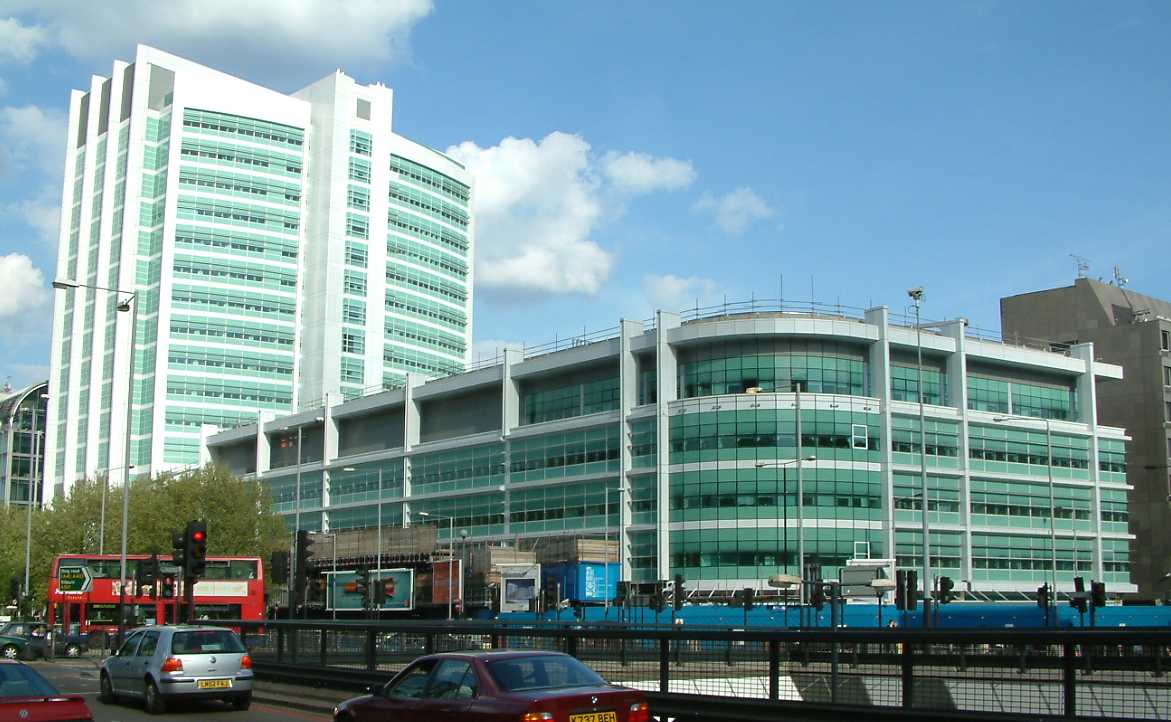
So I headed off to London and checked in at the Great Northern Hotel, ready for the train to Durham the next day.  Twenty minutes after I’d phoned Angela (‘Have I got a story for you?!’) the symptoms returned, so I went down to reception to ask them to call an ambulance.  Their first thought was that a cab would be quicker – but this was King’s Cross and the queues were enormous – so they called a paramedic who cycled over from St Pancras.  I can remember muttering something about ‘not going on your crossbar’, and when I stumbled through my explanation he called a car which took me to University College London Hospital just down the road.

I thought I’d be there for a few hours while they pumped IV antibiotics in to me, and even though they kept me overnight, the next morning I was still counting on making my train to Durham at mid-day. Then a consultant explained that I would be going nowhere until I’d had no temperature spike for 48 hours, and ordered all sorts of lab work to find out what was going on.

University_College_Hospital_-_New_Building_-_London_-_020504

Eventually I was there for five days on IV, receiving absolutely wonderful care (so hands off the NHS!).  By then I’d cancelled Newcastle and Durham, and was discharged into the care of my brother and his family with a course of heavy-duty oral antibiotics.  Never having been in hospital before, I wasn’t prepared for how weak I was — it turns out that life-saving antibiotics are also life-draining ones — nor for how vulnerable I would feel.  Over the weekend it became clear that I’d have to cancel Exeter, and by mid-week QML had to go too.

I flew home at the end of the week, just when the course of antibiotics had expired: you can perhaps imagine how apprehensive I was during the flight.  But to distract me I managed to watch “Testament of Youth“, loosely (but brilliantly) based on Vera Brittain‘s autobiographical memoir of being a nurse in the First World War — when sepsis was a major killer.  Smart choice.

Alicia Vikander as Vera Brittain

I’ve been slowly recovering since then, having battled a series of secondary infections, and I’m now just about OK.  I’m really sorry to have had to let so many people down, since I know that everyone who arranged my lectures and seminars had gone to a huge amount of trouble on my behalf: I was really looking forward to those exchanges.  I’m now staring at a backlog on my screen and on my desk, so I also have to apologise to all those whose messages and requests have gone unanswered: I’ll do my best to get back on track.

It may take a while: I’m off to deliver the two presentations I’d planned for the UK – “Angry Eyes” (about air strikes in Afghanistan) and “Dirty Dancing” (about drones and military violence in the Federally Administered Tribal Areas) – at the Balsillie School of International Affairs and the Centre for International Governance Innovation at Waterloo.  And then it’s the Annual Meeting of the Association of American Geographers in Chicago…  So bear with me, and thanks again to all those who have written.  I really appreciate it.

There’s something in the air…

Gas attack Somme

In ‘The Natures of War’ I include a brief discussion of the ways in which chemical gas attacks on the Western Front militarised the atmosphere:

Gas warfare turned the very air the soldier breathed into a potential enemy and, to Peter Sloterdijk, inaugurated a ‘new “ecologized” war’, a battle ‘conducted in the atmospheric environment [that] was about conquering the respiratory “potentials” of hostile parties’.  Here the French and the Germans led the way. The French were the first to use toxic gas shells on a large scale but these discharged tear gas which in most cases was not lethal, and when the Germans used similar shells against the British in October 1914 at Neuve Chapelle they too proved largely ineffective.  These were ‘Lilliputian efforts’, according to Peter Bull, and experiments by both sides with other systems were aimed at a greater harvest.

They yielded their first (poisoned) fruit on 22 April when the Germans launched the first lethal gas attack at Ypres. Unlike those earlier attempts this did not involve artillery – which is how the High Command persuaded themselves they were not violating the 1899 Hague agreement that prohibited the ‘use of projectiles the sole use of which is the diffusion of asphyxiating or noxious gases’  – and instead released chlorine gas from specially adapted industrial storage containers hidden in the German trenches and then relied on the wind to disperse the gas cloud. On that first, fateful evening more than 5,000 cylinders discharged 150 tons of chlorine gas. It billowed into a yellow-green cloud nearly six kilometres wide and 600-900 meters deep, which was then carried on a north-easterly wind towards two French divisions at 2-3 meters a second. The gas attacked the bronchial tubes and victims suffocated by drowning in their own fluids. German infantry advanced behind the gas cloud which had breached the French lines, and while they did not press home their advantage all sides concluded that gas was the way ‘to break the “riddle of the trenches”’ by flushing troops from cover and ending ‘the stalemate that had confounded all.’  But the reliance on wind as a dispersal vector was risky, not least because the prevailing wind on the Front was from the west – the initial attack had been postponed time and time again until conditions were favourable – and on 25 September the British launched their own gas cloud attack at Loos. This too went awry as a result of changing wind direction, and soon both sides had reverted to artillery delivery systems. They also developed deadlier agents (all derived from chlorine), and from 1916 gas of more than 60 types was in every engagement by artillery on all sides for both offensive and defensive purposes.

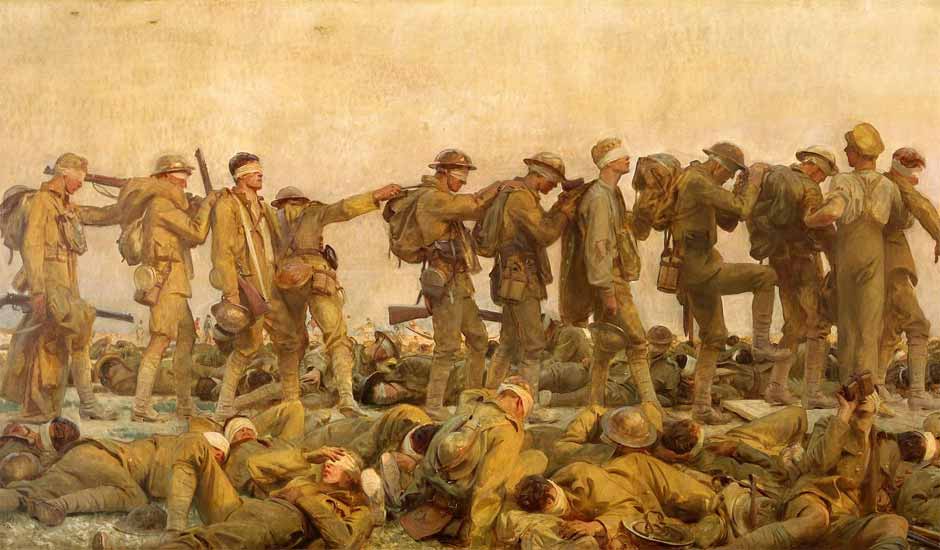
These gases affected more than the surface environment because they were all heavier than air. Chlorine and the far more deadly phosgene seeped into craters and shell holes, ‘corrupting the very areas of relative safety where men took refuge’. Mustard gas lingered even longer. It was designed to disable not kill – a blistering agent, it burned the skin and caused (usually temporary) blindness [see John Singer Sargent‘s famous Gassed, below] – and repeated intermittent exposure deadened the sense of smell so a man could no longer detect it. Since mustard gas remained dormant for days, it ‘consigned the soldier to a state of permanent unease’ in which ‘every puddle [became] an imagined trap’; in the winter of 1917-1918 there were reports of soldiers tracking frozen mud contaminated with mustard gas into their dugouts where it melted and gassed their companions.  Here too, the psychological effects of this militarised nature were as significant as their physiological ones. Gas turned out not to be the decisive weapon of the war; it accounted for around 1 per cent of British deaths but caused disproportionately more casualties. One of its main purposes, Tim Cook concludes, became disruption: spreading surprise, uncertainty, and fear on the battlefield. By 1918 gas made up 20-40 per cent of all shells within the artillery dumps on both sides and ‘all soldiers on the Western Front lived in an environment where gas was a daily fact of life…’

John Singer Sergeant, Gassed (1919)

The bibliographic references are in the draft text under the DOWNLOADS tab, but I rehearse all this because Sarah Everts has a richly illustrated and informative new essay on ‘When chemicals became weapons of war’ here – it’s an excellent survey.

The nature(s) of war and biomimetic war

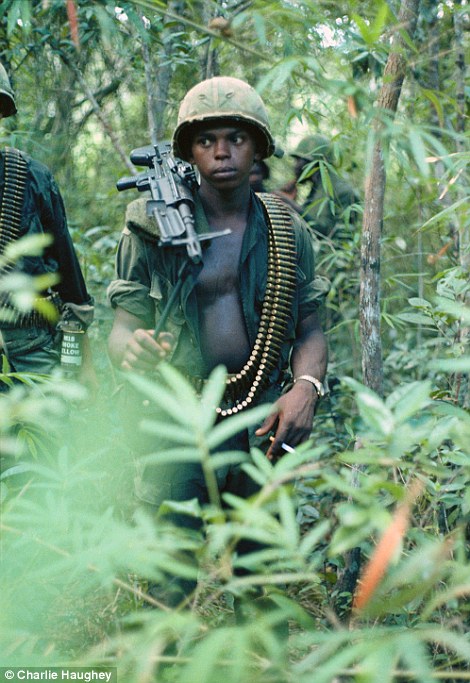
Charlie Haughey, VietnamOne of my tasks this past week has been to complete the revisions to ‘The Natures of War’ which, to my delight, Antipode has agreed to publish in its entirety (and with a handful of illustrations too).  I’ve added a discussion of the ways in which the narratives on which I draw – for the Western Front, the deserts of North Africa, and Vietnam – were all, for various reasons, ‘white boy’s stories’.  I had made it clear that there were troops from other continents fighting and dying on the Western Front, for whom the militarized nature of trench warfare in Europe would have been doubly strange (see also here), and I had also explained that in Vietnam there were at least two other stories to be told: most of the US memoirs were written by white soldiers so that the experiences of African-Americans were written out of the narrative, and the (not so different, as it happens) experiences of Vietnamese fighters only flickered in the footnotes.  I now address all these issues in the body of the text, and the racism of military violence – the racism within militaries ad coalitions as well as racial violence directed at ‘the enemy’ – speaks directly to racializations of nature, and I plan to write another essay drawing on the few extant and relevant memoirs from the People’s Army of North Vietnam and their ancillaries (for a taster, see here: scroll down).

But Juanita Sundberg has raised an altogether different though related question, about the ways in which non-white and (post)colonial subjects construed violence and, indeed, experienced it as quotidian.  In short, is war itself – in so far as its dominant conceptions privilege Europe and North America – seen from the position of a white subject, which is then confounded by the ‘intemperate natures’ of desert and rainforest?

The unrevised draft is still under the DOWNLOADS tab.  More soon.

***

While I’ve been rooting around with these questions, I discovered another way of thinking about ‘The Nature of War’.  Not sure how I missed this, but over at the Vision Machine Roger Stahl previews an essay on ‘The Nature of War’ and the ways in which

‘the discourse of “war” in news, pop culture, and weapons industry PR has taken on a host of biological metaphors. I call this discourse “biomimetic war,” and it is one that, in the end, tacitly extends military jurisdiction to the governance of life itself…

13sd1Of course, biological metaphors have been a part of war/security discourse for a while. Consider the fact that “drone” came from a WWII experiment in unmanned flight that relied on a control center called the “Queen Bee.” Surveillance, especially during the Cold War, has been rife with “bugs” and “flies on the wall.” In the post-9/11 period, however, the biological has edged toward the center as ultimate object of military power. War has gone ecological. Here, terrorism fuses with the natural disaster, Homeland Security responds to disease outbreak and domestic bombing alike, and the specter of biological weapons haunts the public imagination. In such a discursive environment, the contest we call “war” has effectively been mapped onto the biosphere as a permanent and ubiquitous condition determined less by the policing of national boundaries than policing life systems. ‘

You can download the full essay, ‘Life is War: the rhetoric of biomimesis and the future military’ at Democratic Communique 26 (2) (2014) 122-137 here.

War at a distance

Porter-The-Global-Village-Myth-webNews from Patrick Porter of a new book due out in March, The global village myth: distance, war and the limits of power (from Hurst in the UK/Georgetown University Press in the US):

According to security elites, revolutions in information, transport, and weapons technologies have shrunk the world, leaving the United States and its allies more vulnerable than ever to violent threats like terrorism or cyberwar. As a result, they practice responses driven by fear: theories of falling dominoes, hysteria in place of sober debate, and an embrace of preemptive war to tame a chaotic world.

Patrick Porter challenges these ideas. In The Global Village Myth, he disputes globalism’s claims and the outcomes that so often waste blood and treasure in the pursuit of an unattainable “total” security. Porter reexamines the notion of the endangered global village by examining Al-Qaeda’s global guerilla movement, military tensions in the Taiwan Strait, and drones and cyberwar, two technologies often used by globalists to support their views. His critique exposes the folly of disastrous wars and the loss of civil liberties resulting from the globalist enterprise. Showing that technology expands rather than shrinks strategic space, Porter offers an alternative outlook to lead policymakers toward more sensible responses—and a wiser, more sustainable grand strategy.

You can get a preliminary preview of Patrick’s basic argument at War on the Rocks here.

Drone networks

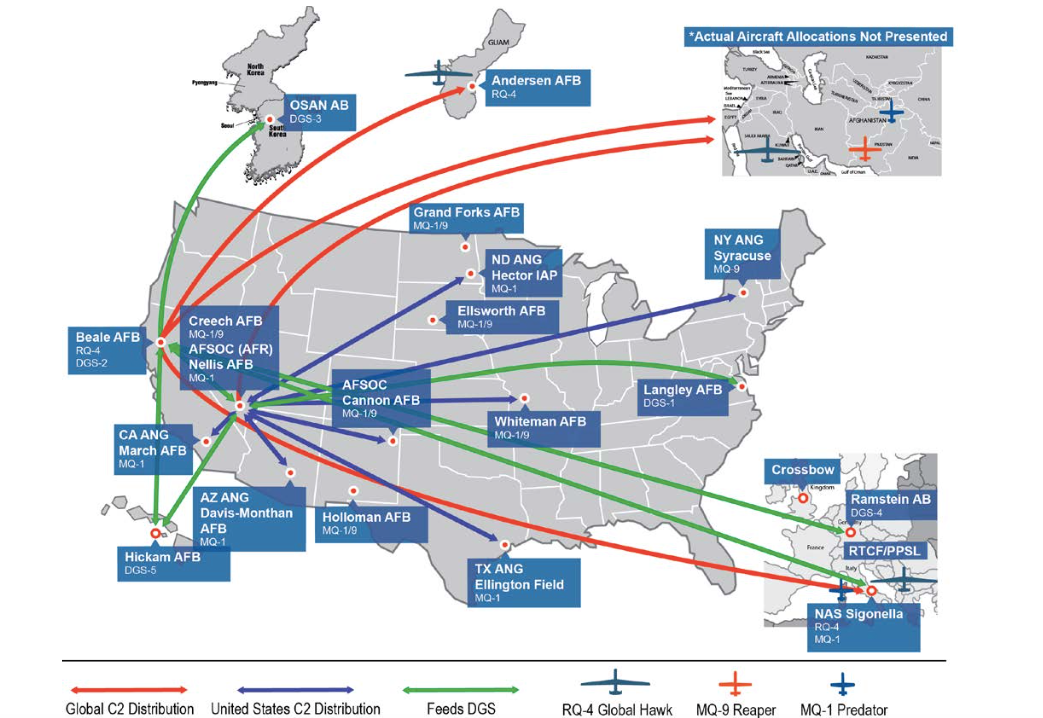
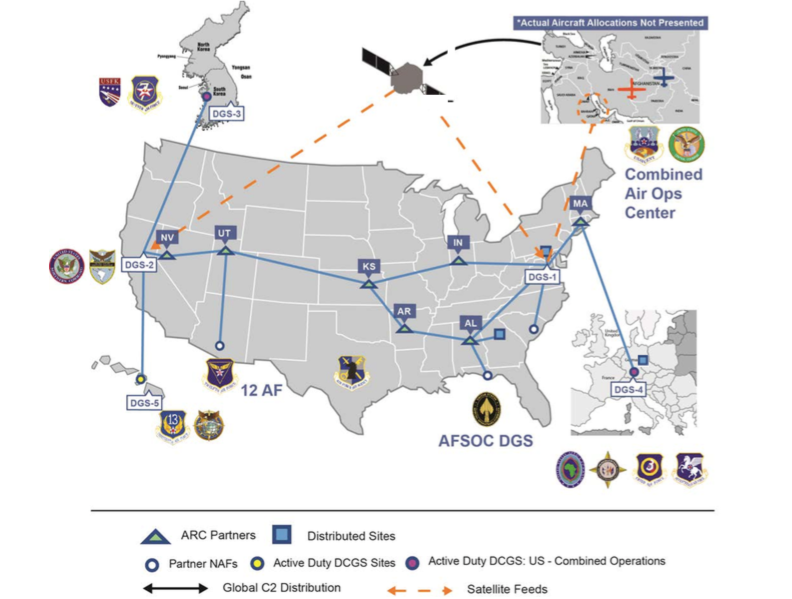
Three contributions to the debates over drones and military violence.  First, my friends at the Bard Center for the Study of the Drone have published Dan Gettinger‘s essay on ‘Drone Geography: mapping a system of intelligence‘.  It’s a superb sketch of the intelligence network in which the US Air Force’s drones are embedded (you can read my complementary take on ‘Drone geographies’ under the DOWNLOADS tab).  Let me add just one map to the illustrations that stud his essay.  It’s taken from the Air Force’s RPA Vector report for 2013-28, published last February, and it shows the architecture of remote split operations within and beyond the United States.  It’s helpful (I hope) because it shows how the Ground Control Stations in the continental United States feed in to the Distributed Common Ground System that provides image analysis and exploitation (shown in the second map, which appears in a different form in Dan’s essay).  I’m having these two maps combined, and I’ll post the result when it’s finished.

RSO architecture (USAF) 1

Distributed Common Ground System (USAF) 2

Dan is right to emphasise the significance of satellite communications; much of the discussion of later modern war and its derivatives has focused on satellite imagery, and I’ve discussed some of its complications in previous posts, but satellite communications materially shape the geography of remote operations.  The Pentagon has become extraordinarily reliant on commercial providers (to such an extent that Obama’s ‘pivot to the Pacific’ may well be affected), and limitations of bandwidth have required full-motion video streams from Predators and Reapers (which are bandwidth hogs) to be compressed and image quality to be degraded.  Steve Graham and I are currently working on a joint essay about these issues.

One caveat: this is not the only network in which US remote operations are embedded.  In my essay on ‘Dirty Dancing’ (now racing towards the finish line) I argue that the CIA-directed program of targeted killing in the Federally Administered Tribal Areas of Pakistan cannot be severed from the multiple ways in which the FATA have been configured as both borderlands and battlefields and, in particular, from the cascade of military operations that have rendered the FATA as a space of exception (in something both more and less than Agamben’s sense of the term).  Here I’ve learned much from an excellent essay by Elizabeth Cullen Dunn and Jason Cons, ‘Aleatory sovereignty and the rule of sensitive spaces’, Antipode 46 (1) (2014) 92-109).  They complicate the claim that spaces of exception always derive from a single locus of sovereign power (or ‘the sovereign decision’).  Instead, they  suggest that borderlands are ‘contested spaces’ where ‘competing’ powers ‘collide’.  In the FATA multiple powers have been involved in the administration of military violence, but on occasion – and crucially – they have done so in concert and their watchword has been a qualified and covert collaboration. In particular, the FATA have been marked by a long and chequered gavotte between the militaries and intelligence services of the United States and Pakistan which, since the 1980s, has consistently put at risk the lives of the people of the borderlands.  And in my essay on ‘Angry Eyes’ (next on my screen) I argue that the US military’s major use of Predators and Reapers in Afghanistan – orchestrating strikes by conventional aircraft and providing close air support to ‘troops in contact’ – depends on communication networks with ground troops in theatre, and that this dispersed geography of militarised vision introduces major uncertainties into the supposedly ‘precise’ targeting process.

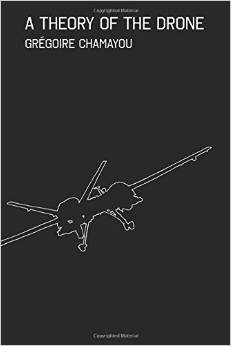
CHAMAYOU Theory of the droneSecond: Elliott Prasse-Freeman has an extended review of the English translation of Grégoire Chamayou‘s Theory of the drone – called ‘Droning On‘ – over at the New Inquiry (you can access my own commentaries on the French edition here: scroll down).  His central criticism is this:

While his title promises theory, we instead are treated to a digression on the military and social ethics of attacks from the air, in which Chamayou asks without irony, “can counterinsurgency rise to the level of an aero-policy without losing its soul?” What offends Chamayou is the “elimination, already rampant but here absolutely radicalized, of any immediate relation of reciprocity” in warfare. This, we are told, is the problem.

Promised a theory of the drone, how do we arrive at a theory of the noble soldier?…

And so, dispatching with the dream of the drone … Chamayou assumes the concerns not of the brutalized but of military leaders and soldiers.

He continues in terms that resonate with my argument in ‘Dirty Dancing’:

By combining knowing (intelligence, surveillance, reconnaissance), sighting (targeting in movement and in the moment), and eliminating (“putting warheads on foreheads”), the drone constitutes an assemblage of force (as drone-theorist Derek Gregory puts it) that promises a revolution in control and allows the US war apparatus to imagine space and politics in new ways. Because the body of the accused can ostensibly be precisely seen, it can be seen as itself carving out a body-sized exception to state sovereignty over the territory on which that body moves. In this way, eliminating the body does not constitute an assault on the territory of the state, as these bodies are presented as ontologically (and hence quasi-legally) disconnected from that territory.  Geographer Stuart Elden in Terror and Territory (2009) points out the significant overlap between who are labeled ‘terrorists’ and movements fighting for their own political spaces – which hence necessarily violate extant states’ ‘territories’ (and hence the entire international order of states): to violate territory is to terrorize. The US is hence remarkably concerned in its arrogation of a position of supra-sovereignty to ensure that it overlaps with ‘classic’ state sovereignty, and by no means violates the norm of territorial integrity (well-defined borders): by harboring or potentially harboring unacceptable transnational desires, the militant uproots himself, and risks being plucked out and vaporized in open space that belongs only to him. The exception to sovereignty provides the drone the opportunity to extend this exception into temporal indefiniteness: wars are not declared, aggressions are not announced—the fleet, fusing police and military functions, merely watches and strikes, constantly pruning the ground of human weeds.

In ‘Dirty Dancing’ I’m trying to prise apart – analytically, at least – the space of exception, conceived as one in which a particular group of people is knowingly and deliberately exposed to death through the political-juridical removal of legal protections and affordances that would otherwise be available to them, and territory conceived (as Stuart suggests) as a political-juridical technology, a series of calculative practices that seeks to calibrate and register a claim over bodies-in-spaces.  That’s why Dan Gettinger’s essay is so timely too, and why I’ve been thinking about the FATA as a performance of what Rob Kitchin and Martin Dodge call ‘code/space’, why I’ve been working my way through the files released by Edward Snowden, and why I’ve been thinking so much about Louise Amoore‘s superb critique of The politics of possibility: risk and security beyond probability (2013).

Screen Shot 2015-01-07 at 10.03.16 AM

Although Louise doesn’t address drone strikes directly, her arguments are full of vital insights into the networks that are mobilised through them.  ‘The sovereign strike is always something more, something in excess of a single flash of decision’, she insists, and when she writes that —

those at risk (which is to say those who are to be put at risk by virtue of their inferred riskiness) are ‘not strictly “included by means of their own exclusion”, as Agamben frames the exception, they are more accurately included by means of a dividuated and mobile drawing of risk fault lines’

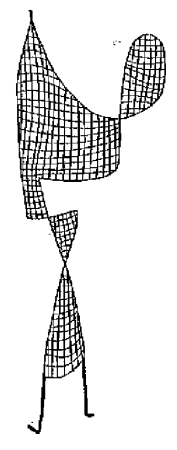
17— it’s a very short journey back to Grégoire Chamayou‘s reflections on the strange (in)dividual whose ‘schematic body’ emerges on the targeting screen of the Predator or Reaper.  Louise writes of ‘the appearance of an emergent subject’, which is a wonderfully resonant way of capturing the performative practices through which targets are produced: ‘pixelated people’, she calls them, that emerge on screens scanning databanks but which also appear in the crosshairs…

And finally, Corporate Watch has just published a report by Therezia Cooper and Tom Anderson, Gaza: life beneath the drones.  This brings together a series of interviews conducted in 2012 – when ‘drones killed more people in Gaza than any other aircraft’ – that were first published in serial form in 2014.  The report includes a tabulation of deaths from Israeli military action in Gaza and those killed directly by drones (2000-2014) and a profile of some of the companies involved in Israel’s military-industrial complex.