I am a camera

Last December Brandon Bryant, a six-year USAF veteran, told Der Spiegel of his experiences as a sensor operator in a team controlling a Predator over Iraq and Afghanistan from Creech Air Force Base in Nevada and then Cannon Air Force Base in New Mexico.  One day he wrote in his diary:

 “On the battlefield there are no sides, just bloodshed. Total war. Every horror witnessed. I wish my eyes would rot.”

When he left the Air Force he was handed a sheet informing him that all the missions in which he been involved had killed a total of 1, 626 people. This morning he appeared on NBC’s Today programme to describe in detail one of those missions.
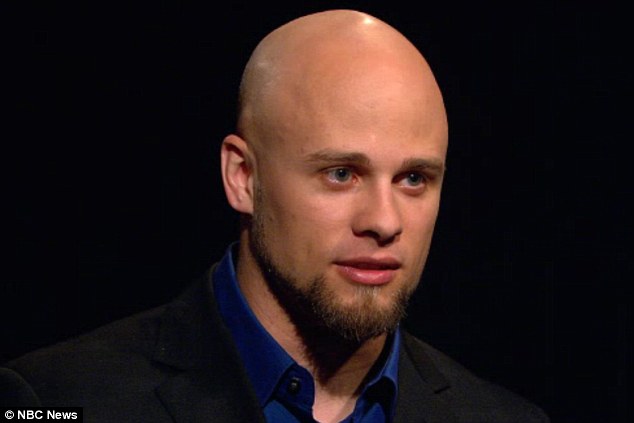
Brandon Bryant

You can watch the interview with Richard Engel here, but since no transcript is available here is the substance of what he said:

‘I operated the camera, so like zoom in, zoom out, make sure that everyone can see a good picture, make sure it’s in focus, guide the laser, shoot the spot-tracker…

‘We’re just sitting there and like OK, it’s obvious these guys are obviously bad guys…

‘The guy in the back hears the sonic boom [from the missile] when it reaches him, and he runs forward.  We’re actually told to get the two guys in front, worry about the guy in the back later, follow him to wherever he goes.  The guy in the back runs forward between the two and we strike all three of them.  And the guy that was running forward, when the smoke clears, there’s a crater there, he’s missing his right leg.  

‘And I watch this guy bleed out and it’s clear enough that I watch him and he’s grabbing his leg and he’s rowing, like, I can almost see the agony on this guy’s face and eventually this guy becomes the same colour as the ground that he bled upon…

‘You know how people say that drone strikes are like mortar attacks, artillery, well, artillery doesn’t see this, artillery doesn’t see the result of their actions.  It’s really more intimate for us because we see the before action and then after.

‘And so I watched this guy bleed out, I watched the result of, I guess collectively it was our action, but ultimately I’m the responsible one who guides the missile in.’

He was also interviewed on CBC Radio earlier this year: listen here.  From 6.20 Bryant describes what happens in the 14-16 second interval between firing a missile and hitting the target: he says that if something happens –  like a child running into the frame – there’s an 8 second window to use the laser to divert the missile.  From Spiegel:

With seven seconds left to go, there was no one to be seen on the ground. Bryant could still have diverted the missile at that point. Then it was down to three seconds. Bryant felt as if he had to count each individual pixel on the monitor. Suddenly a child walked around the corner, he says.

Second zero was the moment in which Bryant’s digital world collided with the real one in a village between Baghlan and Mazar-e-Sharif.

Bryant saw a flash on the screen: the explosion. Parts of the building collapsed. The child had disappeared. Bryant had a sick feeling in his stomach.

“Did we just kill a kid?” he asked the man sitting next to him.

“Yeah, I guess that was a kid,” the pilot replied.

“Was that a kid?” they wrote into a chat window on the monitor.

Then, someone they didn’t know answered, someone sitting in a military command center somewhere in the world who had observed their attack. “No. That was a dog,” the person wrote.

They reviewed the scene on video. A dog on two legs?
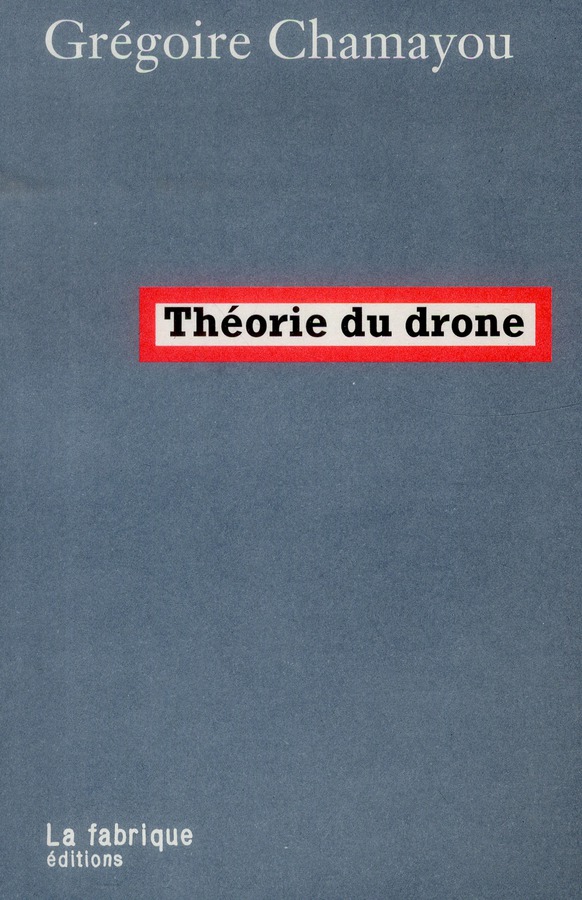
Theory of the drone

Theorie du droneI’ve been contacted by L’actualité for an interview on drones, which led me to a new book by French philosopher Grégoire Chamayou (CNRS): Théorie du drone (La fabrique, 2013).  I’ve only just ordered it, so this post is advance notice, the product of some rummaging around the web, and I’ll post a considered discussion as soon as I’ve read it.

Chamayou has translated Clausewitz into French, and readers may know one of his earlier texts, I think the only one to be translated into English thus far, Manhunts: a philosophical history (Princeton 2012; original French publication, Les chasses à l’homme: histoire et philosophie du pouvoir cynegetique (La fabrique, 2010); reviewed in English translation at Books & Ideas here).  If you want a good sense of Chamayou’s style, check out this video of a lecture in New York in 2011, ‘Hunter vs. Hunted’, artfully organised around film clips.

Manhunts doesn’t address targeted killing and drone warfare, but you can read a related essay from Radical Philosophy (169/2011) on ‘The manhunt doctrine’ that does here:

George W. Bush had warned us early on: the United States has launched itself into a new kind of war, a ‘war that requires us to be on an international manhunt’… The doctrine of the manhunt breaks with conventional warfare, which rests on the concepts of fronts, linear battles and face-to-face opposition. In 1916, General Pershing launched a large military offensive on Mexican territory to seize the revolutionary Pancho Villa. The massive deployment of force drew a blank. For the American strategists who cite this historic precedent as a counter-example, it is a question of reversing the polarity: faced with the ‘asymmetrical extremes’ posed by small mobile groups of ‘non-state actors’, one must employ small flexible units in a logic of targeted attacks. Contrary to Clausewitz’s classic definition, such cynegetic war is not, in its fundamental structure, a duel. The structure does not involve two fighters facing off, but something else: a hunter who advances and a prey who flees or who hides…

The prey who wants to escape his pursuers tries to become undetectable or inaccessible. But inaccessibility is not only a function of physical geography – such as an inextricable bush or deep crevice. The theorists of manhunting remind us that the ‘political and legal restrictions, especially in the form of jurisdictional boundaries’, are an eminent part of the ‘set of constraints that shape the rules of the game’. From this point of view, it is clear that ‘sovereign borders are among the greatest allies’ that a fugitive can have. The hunter’s power has no regard for borders. It allows itself the right of universal trespassing, in defiance of territorial integrity of sovereign states. It is an invasive power which, unlike the imperial manoeuvres of the past, is based less on a notion of right of conquest than of a right of pursuit….

In cynegetic war, armed violence seeks to pursue the prey wherever it might be. The place of hostilities is no longer defined by the locatable space of an effective combat zone, but by the simple presence of the hunted individual who carries with him everywhere a kind of little halo denoting a personal hostility zone. In this way of thinking, the very notion of armed conflict occurring in a distinct geographical space tends to vanish. Here, on the one hand, the combat zone tends to be reduced to the body of the enemy, which must then, according to the principle of distinction, be the only space that is targeted; but, on the other hand, it is believed that this mobile micro-space can be targeted wherever it happens to be. The paradox is that the principle of targeting is accompanied by a limitless virtual extension of the conflict zone: the world becomes the battlefield. Thus the classical distinction is erased between armed conflict zones, in which the use of weapons of war is allowed, and other zones in which they are not allowed…

Cynegetic war bears an ideal of non-confrontation with death, and of domination without real combat. While a duel involves a reciprocal relation of exposure to death – each participant bearing his chest to the enemy – in the hunt, on the contrary, the master barely ever confronts his prey directly. He uses intermediaries, beaters or the pack. Everything is done so that his life is never in danger, to assure him maximum protection. The use of predator drones and of Hellfire missiles, operated at a distance from American soil, illustrates this principle of absolute preservation of the life of the hunter by the mediation of hunting auxiliaries.

So far, so familiar. Chamayou treats the drone as ‘the emblem of contemporary cynegetic war’, which is to say war that ‘bears an ideal of non-confrontation with death, and of domination without real combat’: hence the new book which, like my own work, explores the complex field of death at a distance and, in a direct line of descent from Manhunts, embeds the drone into the apparatus of a new predatory state (Etat-chasseur) emphasised in this review in Le Devoir.  Here is a listing of the contents:

Theory of the drone

Prelude  — 9
Introduction — 21

I. Techniques and tactics — 33

Methodologies in a hostile environment — 35
Genealogy of the Predator— 41
Theoretical principles of the manhunt— 47
To watch and to annihilate — 57
Pattern of life analysis — 69
Kill box — 79
Counterinsurgency from the air — 91
Vulnerabilities— 109

II. Ethos et psyche— 119

Drones and the kamikazi (suicide attacks) — 121
‘That others should die’ — 131
A crisis in military ethics— 137
Psycho-pathologies of the drone— 151
Killing at a distance— 162

III. Necro-ethics — 177

Combatant immunity— 179
The humanitarian weapon — 190
Precision — 197

IV. Legal philosophy of killing— 211

Thoughtless assassins — 213
War without combat — 220
Licence to kill — 231

V. Political bodies— 241

In war and in peace — 243
Democratic militarism— 254
The essence of warriors — 269
The production of political robots — 285

Epilogue. War, at a distance — 309

21 February 2010 Uruzgan CIVCASYou can find a short extract from Théorie du drone here. This is of particular interest to me since it includes a transcript of an air strike mediated but not directly carried out by a Predator crew and its associated network/assemblage in Uruzgan province, Afghanistan on 21 February 2010, which killed 23 civilians and wounded 8 others.  It’s the mediation that is crucial, though I’m not (yet) sure that what Chayamou means by ‘intermediaries’ in the passage from RP above is quite what I have in mind: we’ll see.  In any event, I discussed the strike and Major General Timothy McHale’s subsequent investigation in ‘From a view to a kill’ (DOWNLOADS tab) and I’ve now provided a much more detailed discussion, with longer extracts from the transcript Chamayou uses here, in The everywhere war (due to be finished, please God, this summer). Chamayou uses this incident as a Prelude to his main argument which – unlike so much philosophical reflection on later modern war, and as he makes clear in his Introduction is in part inspired by the example of Simone Weil – evidently engages directly with the material conduct of military violence.

There’s another extract from the book available here. There are also many  interviews with Chamayou available, but a succinct yet wide-ranging one is available here in which, amongst other things, he assails those American and Israeli philosophers who have defended the use of drones as ‘ethical’, ‘humane’, and even as vehicles for a newly humanitarian mode of war.  He doesn’t name them, but one of those he surely has in his sights is Bradley Jay Strawser (see here,  here and here), whose edited collection on Killing by remote control: the ethics of an unmanned military was published last month by Oxford University Press.  Appropriately, you can buy a Kindle edition from Amazon in just one click.

UPDATE:  For a succinct overview of Chamayou’s work, see Kieran Aarons, ‘Cartographies of capture’, Theory & Event 16 (2) (2013).

Playing war

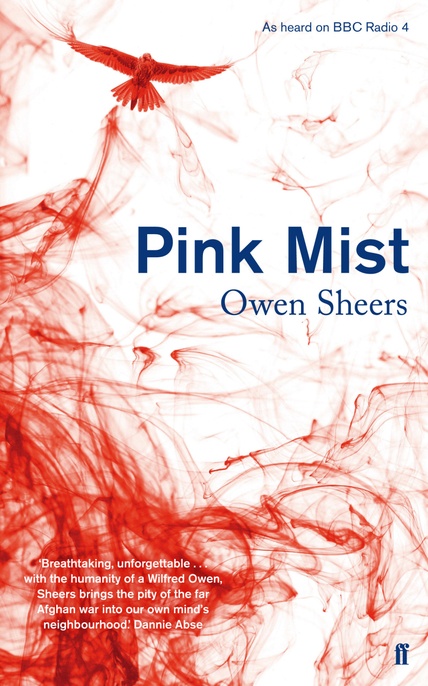
SHEERS Pink MistI’ve just finished reading – but certainly not thinking about – Owen Sheers‘ extraordinary dramatic poem, Pink Mist.

It was originally commissioned by BBC Radio 4 for its More than Words Festival in 2012 but sadly it’s not available on the BBC iPlayer Radio – though you can now get it as a physical book and an e-book.

I’ve spent much of the last several weeks reading poetry from the First and the Second World Wars, but few of those poems have affected me as much as Pink Mist.  I noted Owen Sheers’ work in passing, when I was writing about Keith Douglas’s poems from the Western Desert, but Pink Mist is insistently about the present.

It tells the story of three young men – Arthur, Hads and Taff – who grew up together in Bristol, ‘playing war’ like so many other boys. They decide, a spur of the moment thing, to enlist in the British Army and soon find themselves serving together in Afghanistan:

It’s like my recruiter said today,

it’ll be a chance to do the job

they train you for.

Otherwise it’s like going to the fair,

but staying off the rides.

So yeah, I want to go to war.

But of course it’s not a fairground ride, and nobody is ‘playing war’ any more.

Sheers captures in short bursts the surreal violence of war in Afghanistan.  The accidental killing of a farmer’s wife and two year old grand-daughter:

I can still see his face, even now.

An outdoor man, skin leathered by the sun,

The way he unwrapped the end of his turban

to wipe at his eyes, raw with what we’d done.

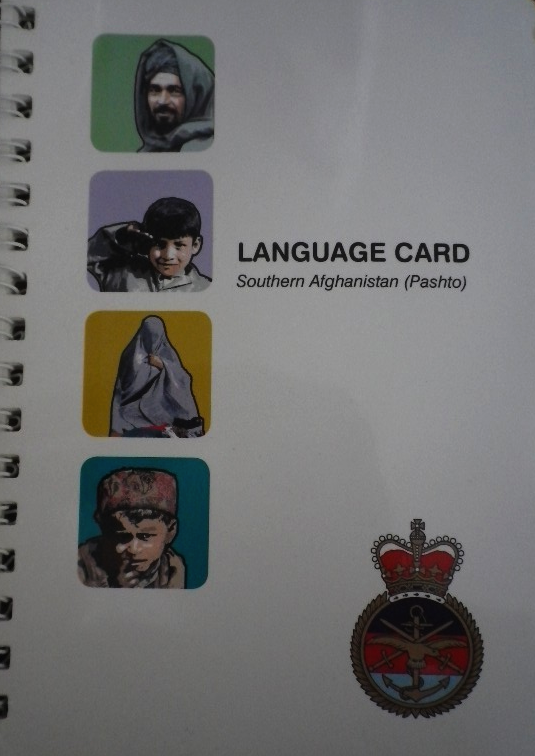
An illustrated language card issued to troops to help them communicate in Pashto and Dari, ‘a kid’s cartoon book of modern warfare’:

British Army Language CardWhere is the pain? – Dard cheri day?

Blood – Khoon

Dead – Maray

Go home – Khaana burayn

Shot – Wishtalay

Go home – Korta dzai

One at a time – Pa waar yao

One at a time.

And the three friends do go home, one at a time, wrapped in the shadows of violence that now fall across the lives of a mother, wife and girl-friend.

Hads returns without his legs, the victim of a ‘blue on blue’ air strike that killed two of his mates:

… that’s what you’re fighting for.

The man on your left and the man on your right.

Forget queen and country, the mission or belief.

It’s more about keeping your mates alive.

Or avenging the ones who’ve already died.

Taff is so consumed by by PTSD that he is haunted even by the silent, ‘Sunday-morning dead’ streets of his home town:

But all Taff’s feeling is the threat.

The echo of when a village went like this back there,

when the women and kids melted away.

That’s what he’s trying to keep at bay,

plugging in his headphones, turning the volume right up.

Eventually he becomes homeless, like many other vets, living on the streets:

There’s a spread of regiments under those blankets …  

And a spread of wars too –

Falklands, Gulf, Northern Ireland, Iraq.  

Yeah, you walk this country’ streets

and there’s our history, under your feet.

And Arthur? Read it for yourself.

It’s a profound work, I think, at once an art-work and a documentary.  As in so much of Sheers’ writing, Pink Mist is based on careful research and sensitive interviewing so detailed and so intimate you can almost feel it in the sinews of the words and the cadence of the lines.  Sheers records his debt to ‘the many service personnel and their families whose stories have informed this work, especially Lyndon Chatting-Walters and Daniel Shaw, whose own experiences are, at times, closely echoed in these pages.’

http://vimeo.com/35462502

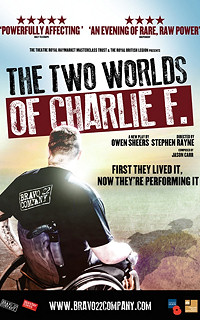
bravo22aThose interviews were, in turn, part of Sheers’s research for The Two Worlds of Charlie F, a play not only about the Army’s wounded and injured from Afghanistan but also, and remarkably, largely performed by them.  Sheers describes the project here (and see the clip above).  In Afghanistan 22 per cent of British service personnel have been injured – a higher proportion than in the Second World War – and to prepare for the play Sheers and his director travelled the UK: ‘We became well-acquainted with the names of certain drugs, types of prosthetics, military jargon. We visited barracks, PRUs (Personnel Recovery Units) and rehabilitation centres.’  And then they worked with the soldiers.  There are plans for the production to tour again this year.

I’m making so much of this for two reasons beyond the power of Sheers’s project.  The first is that Sheers has much to teach us about transcending the limitations of conventional academic genres and incorporating the arts into the research process, not only as objects of contemplation and critique but also as ways of working.  (Think how lifeless so many ethnographies and interviews become on the printed page).  The second is that Pink Mist and The Two Worlds of Charlie F ought to confound the politics of care that assumes a concern with civilian casualities is the exclusive preserve of the left, while a concern for military casualties is the exclusive preserve of the right.

As Arthur says, at the very end of Pink Mist,

So that’s all I hope for.

When the debate’s being had,

the reasons given,

that people will remember

what those three letters mean,

before starting the chant once more –

Who wants to play war?

Who wants to play war?

Producing the public in Arab societies

logo_acss_arabic2

More news from Paul Amar about the inaugural research program launched by the Arab Council of Social Sciences (headquartered in Beirut; more at Jadaliyya here) on ‘Producing the Public in Arab Societies: space, media, participation.’

Formulating new understandings of public life in societies within conditions of twenty- first century globalization is an urgent priority for the social sciences. The insecurity of global and national financial systems, the increased violence and securitization of social and political life and the new modes and practices of making collective and social/cultural claims require rethinking concepts such as the “public sphere,” “public culture,” “public institutions,” “public access (e.g. to information)” and “the public good.” In addition, calls within some disciplines for the importance of “public knowledge” (e.g. “public sociology” and “public anthropology”) means that the social sciences themselves are part, and not only observers and analyzers, of re- conceptualizing public life. Knowledge production in general is integral to the development and maintenance of a vibrant public sphere in which different opinions, identities and political positions can be explored without recourse to violence. At least this is the hope embedded in these reformulations.

In this context, the Arab Council of the Social Sciences (ACSS) is launching a research program entitled “Producing the Public in Arab Societies,” that will enable projects to examine political, social and cultural issues in relation to one another while focusing on specific topics. This multidisciplinary program will explore the new possibilities, spaces and means for political action and practice in different Arab societies that bring to light, and create, new publics. The political and social imaginaries that are being produced not only open up new futures but also reread histories and reconfigure relations between different groups and actors in society, including the relationship between the intelligentsia and the rest of society. The retaking and remaking of the state, the new modes of inclusion and exclusion and the role of diasporas are among the issues raised by this research program. All these processes have profound implications for the societies in question but also for the social sciences in general.

The Program will consist of three Working Groups, one focusing on space, another on media, and a third on participation. These three Working Groups will be relatively autonomous, but will engage in regular dialogue with each other, occasionally come together for joint meetings; and they may develop cross-cutting research collaborations or products. In addition, there may be opportunities for cross-regional collaboration with researchers in Asia, Africa and Latin America.

Paul will co-ordinate the working group on Space, Tarik Sabry the working group on media, and Sherene Seikaly the working group on participation.

Producing the public in Arab societies

Here is the summary prospectus for the Space working group:

“Producing the Public: Spaces of Struggle, Embodiments of Futurity” This Working Group will research public spaces and spatializing embodiments that reverse class, sectarian, and gender segregation, foster social equalization, revive previous intersectional public subjectivities, and/or create future utopias. Our research will explore the context and legacies of the “Arab Spring”-era events; but we will largely (but not exclusively) focus on countries identified more with war and counterrevolution rather than with the triumphant social uprisings of 2011. Thus we aim to bridge gaps between analyses of spaces of war and armed intervention (in Syria, Libya, Iraq, Bahrain, etc.), and embodiments of future hope, inclusion, and justice across the Arab region.

Very exciting work has been done in the last generation shedding critical light on regimes of power, cultures of fear, and technologies of planning that have transformed public spaces. This work has focused on deconstructing neoliberal policies and discourses, exposing the techniques and economies of war and occupation, and articulating the spatial dimensions of postcolonial moral, ethno-sectarian, and religious regimes. This generation of scholarship has asked: How have social classes have been polarized by new kinds of space and public morality; how have built forms and spatial performances exacerbated sectarian divisions or even “invented” them; how have regimes of public-space regulation instituted regimes of puristic or pietist morality; and how have shifting norms of public-versus-private space restricted gender identities and issues of sexuality to an ever-narrowing private sphere where consumer and patriarchal values dominate. However, this set of research innovations have tended to neglect the kinds of spatial practices, movements, public embodiments, and policy regimes that can reverse or generate spatial alternatives that counter these segregatory dynamics and territorialization practices. In this light, “Producing the Public: Spaces of Struggle, Embodiments of Futurity” aims to produce a new body of comparative case studies. This Working group will be oriented explicitly toward positive alternatives, even in the most fraught contexts, and will offer new analyses of spatial and historical relations of power, war, control, and subjectivation.

Paul is particularly keen to include scholars working on Libya, though anyone who meets the critera (below) is welcome to apply.   Questions about the Space working group to Paul at amar@global.ucsb.edu and about the program in general to grants@theacss.org.

Working group meetings start in September; those participating will receive full support for travel to and accommodations at all research workshops/group meetings, which will be held twice per year (usually held in the Arab Region or perhaps in Cyprus or Turkey), together with around $10,000 in research funds.  This is a marvellous and rare opportunity, and so not surprisingly the criteria are stringent:

1) Due to the specialized mandate of the ACSS itself, all applicants must be either (1) a current or former citizen of one of the member states of the League of Arab States; OR (2) of Arab origin or part-Arab descent (or of any other ethnic, national, sectarian or minority “identity” within any Arab League country). Applicants who meet the above criteria and are living in the Arab region are encouraged to apply. Those living outside the Arab region are also welcome to apply, but they should demonstrate that they spend a significant part of each year in the region, engaged substantively with publics in a particular site, and be fully committed to public movements, cultures, and organizations in the region.

2) Applicants for the “Space” Working Group must be either in the final stages of receiving their PhD (“ABD” or prospectus finished), or be a professor or lecturer in the first seven years after completing their PhD. Applicants should have a social science degree, or a degree in a field within the “humanistic social studies” such as history, cultural studies, legal studies, etc.

3) Applicants for the “Participation” Working Group can be practitioners, media workers, journalists, techies, and scholars engaged in participatory work that both critiques and engages social sciences in the Arab world. 

4) Applicants for the “Media” Working Group should have a degree in the ‘humanistic social sciences’. They will need to have published and conducted research in the Arab region, focusing on the relationships between media, culture and society. They will also be expected to think beyond disciplinary boundaries by engaging critically with scholars specializing in different fields of the humanities and the social sciences, including anthropology, media studies, cultural studies and philosophy. They must also be fluent in Arabic.

5) All applicants should be proficient in Arabic as well as English and/or French. Much of the readings and some of the conversations will be conducted in English, due to the overwhelming use of English in the relevant academic, political, and technical literatures. However ACSS encourages and permits writings and publications in Arabic, French or English. And each group will, of course, constantly engage public expressions, leaders, and research meetings in Arabic.

libyan_papers

Incidentally, anyone who finds the idea of ‘producing’ the public an unfamiliar one should read Michael Warner‘s classic work, The letters of the Republic: publication and the public sphere in eighteenth-century America; you can also find a snappy essay by him, ‘Publics and counterpublics’, at Public culture (2002).  As this suggests, so many of the available models and substantive treatments of these issues traffic in the public spheres of Europe and the shadows of Habermas, and it will be exceptionally interesting to see what happens when the focus and language of the discussion travels beyond these too familiar waters and also addresses the formation of transnational public spheres.  And I’m also drawn to the way in which Paul’s working group will move the research frontier towards sites of war, counter-revolution and resistance.  Do contact him if you’re interested.

Scanning the horizon

I’ve been reading poetry from the Second World War, mainly as part of the preparation for my talk on “The natures of war” tonight.  My main focus for the last several weeks has been on the sand and dust of the Western Desert but my eyes kept straying.

I’ve been moved by the work of Keith Douglas, amongst several other ‘desert poets’, but his “How to kill” captures the impersonality-intimacy of the killing space better than almost anything I know and has a relevance far beyond its time and place:

‘Now in my dial of glass appears

the soldier who is going to die.

He smiles, and moves about in ways

his mother knows, habits of his.

The wires touch his face: I cry

NOW.  Death, like a familiar, hears

and look, has made a man of dust

of a man of flesh…’

Here is a virtualized reading of the poem (more details of what that means here)

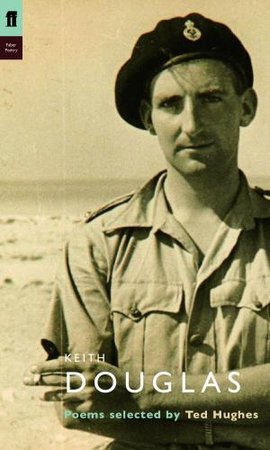
The poems of Keith Douglas edited by Ted Hughs for FaberDouglas’s body of work is remarkable.  He’s often described as one of the finest poets of the war; he served as a tank commander in the Western Desert and was subsequently killed in Normandy in June 1944.  There’s a compelling combination of the theatrical with the documentary (what Douglas called ‘the extrospective’) in his writing: you can see it in his poetry but also in his prose account of the desert war, From Alamein to Zem Zem (newly available in a Kindle edition), and this prompted Owen Sheers to put Douglas on the stage in a one-man play at the Old Vic, Unicorns, Almost, with Joseph Fiennes (‘Who then can live among this gentle/obsolescent breed of heroes and not weep/Unicorns almost’).  Sheers also developed a documentary for BBC4, Battlefield Poet.

There’s an excellent discussion of ‘The vision of Keith Douglas’ in Tim Kendall’s Modern English war poetry (2009; available online if your library has a copy), another by Adam Piette on ‘Keith Douglas and the poetry of the Second World War’ in Cambridge’s Companion to twentieth-centuy English poetry (2007; also available online, same conditions apply) and a very good open access essay by Costas Evangelides, ‘Keith Douglas: Death’s several faces’, here.

I’ve found it hard to leave Douglas’s work alone, along with other ‘desert poets’, but this poem by Barry Conrad Amiel took me away from the sand and dust to my Killing Space project on bombing.  It’s called “Death is a matter of mathematics” (Amiel was an artilleryman but there too death came from above).

Death is a matter of mathematics

It screeches down at you from dirtywhite nothingness
And your life is a question of velocity and altitude,
With allowances for wind and the quick, relentless pull
Of gravity.

Or else it lies concealed
In that fleecy, peaceful puff of cloud ahead,
A streamlined, muttering vulture, waiting
To swoop upon you with a rush of steel.
And then your chances very as the curves
Of your parabolas, your banks, your dives,
The scientific soundness of your choice
Of what you push or pull, and how, and when.

Or perhaps you walk oblivious in a wood,
Or crawl flat-bellied over pockmarked earth,
And Death awaits you in a field-gray tunic.
Sights upright and aligned. Range estimated
And set in. A lightning, subconcious calculation
Of trajectory and deflection. With you the focal pont,
The centere of the problem. The A and B
Or the Smith and Jones of schoolboy textbooks.

Ten out of ten means you are dead.

Belatedly, I discovered that passages from both poets appear in Christopher Coker‘s The future of war: the re-enchantment of war in the twenty-first century.  Coker argues that the poets of World War II ‘have far more to tell us about the future face of conflict than their World War I predecessors’ because they address so directly the ways in which military technology was effacing the human…  This is the right time of year in many universities for me to add just one word: “Discuss”.

Tahrir and performances of space

EgyptianRevolutionManual (dragged) 1

An update to my post earlier this week on Tahrir Square and the Arab uprisings: I’ve now (at last!) added the manuscript version of my essay, ‘Tahrir: politics, publics and performances of space’, forthcoming in Middle East Critique, to the DOWNLOADS page.  As always, I’d welcome any comments or suggestions.

The image above is taken from a 26-page pamphlet circulated in Cairo in January 2011, ‘How to protest intelligently’: you can download the whole thing here and find a side-by-side English and Arabic version of some of the pages here.  I discuss the significance of all this in the essay.

Not the Manhattan Project

The Act Of Killing

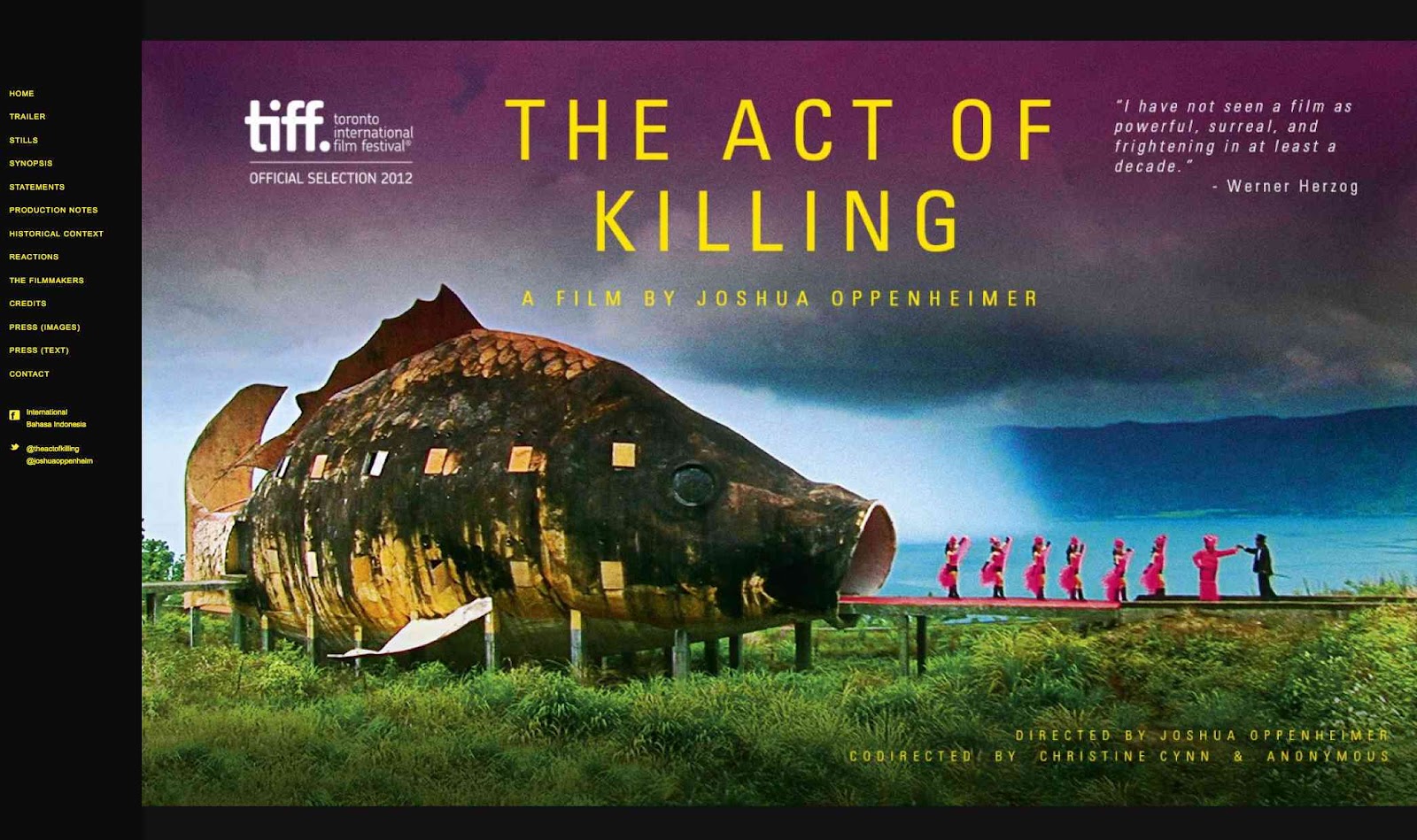
I’ve only just caught up with this…. Joshua Oppenheimer‘s surreal-documentary film The act of killing (2012).  It’s so surreal I need to let the synopsis speak for itself:

‘The unrepentant former members of Indonesian death squads are challenged to re-enact some of their many murders in the style of the American movies they love.’  

Killer ImagesIt’s a deeply serious work; Oppenheimer has worked for years with militias, death squads and their victims to explore the relationship between political violence and the public imagination, and his co-director, Christine Cynn, is a founding member of the Vision Machine Film Project in London and has worked on the AHRC Genocide and Genre project. Oppenheimer has also co-edited Killer images: documentary, memory and the performance of violence (2013).

Here’s a more prosaic version of the synopsis from the University of Westminster, where Oppenheimer is based in the International Centre for Documentary and Experimental Film:

Made as a Danish/Norwegian/British co-production, The Act of Killing is a highly controversial account of the year following the 1965 Indonesian military coup in which pro-regime paramilitaries killed more than a million alleged Communists. These murders went unpunished and the perpetrators are still powerful, influential people who can rely on the support of corrupt politicians.

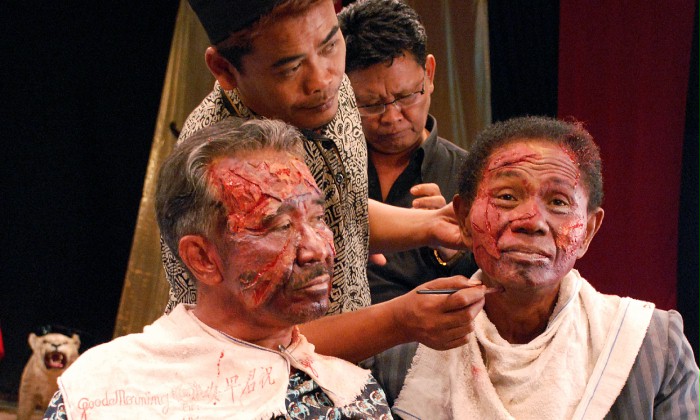
In the film, these men proudly recall their struggle against the Communists and demonstrate their efficient methods of slaughter. Slim Anwar Congo and portly Herman Koto are delighted when the film’s directors ask them to re-enact these murders for their documentary. They zealously set about finding actors, designing elaborate costumes and discussing possible scenarios. They see themselves as film stars who will show the world Indonesia’s truepremen or ‘free men’. But eventually the film project gets these men to talk about and reflect upon their actions as they have never done before. Congo says that for the first time he felt what his victims must have felt. It begins to dawn on him exactly what he did to hundreds of people. The reconstruction of reality has become more real for these men than their actions originally were.

The Act of Killing 2

Errol Morris (an executive producer for the film with Werner Herzog) has this to say about it:

“An extraordinary portrayal of genocide. To the inevitable question: what were they thinking, Joshua Oppenheimer provides an answer. It starts as a dreamscape, an attempt to allow the perpetrators to reenact what they did, and then something truly amazing happens. The dream dissolves into nightmare and then into bitter reality. An amazing and impressive film.”

Joshua OPPENHEIMERYou can watch the trailer here, and read interviews with Oppenheimer about the research for and the making of the film here, here and here.  The historical and geographical context for the film is summarised here (scroll down).

According to the Jakarta Post, many survivors have praised the film but others have criticised Oppenheimer for marginalising the role of the military in the massacres.  The same production team is now developing a follow-up, The Look of Silence, which reportedly will deal with ‘the other side of the story’, how survivors and victims’ families co-exist with the perpetrators.

A host of questions here, not least about aesthetics and violence and about the incorporation of art-work into the research process, but also about the question that inevitably haunted me during my visit to Auschwitz, and that returns again and again as I work on my bombing project: how could people do such things?  A question that finally returns us to my title and to J. Robert Oppenheimer.

Julius, in case you’re wondering: not Joshua.

War and peace in an age of ecological conflict

Bruno LATOURAdvance notice (hence the image on the left):  after a show-stopping performance by my friend and colleague Brett Finlay at last night’s Wall Exchange at the Vogue Theatre  in Vancouver – not only a wry and pointed lecture on Bugs R Us but some excellent jazz to warm us (and our bugs) up – the next Wall Exchange will be on Monday 23 September when Bruno Latour, professor at Sciences Po in Paris and winner of this year’s Holberg International Prize, will give a public lecture on ‘War and peace in an age of ecological conflict’.  Full details will eventually be posted here.

This will be Bruno’s second visit to UBC, and we are looking forward to his return; the first was organised by the Department of Geography several years ago, when he announced that, rather like Molière’s M. Jourdain, he now realised he had always been a geographer without realising it.

You can get a foretaste of the argument from his penultimate Gifford Lecture delivered at the University of Edinburgh earlier this year: an extended version of the text of the lectures, Facing Gaia, is here.  They were dedicated to Peter Sloterdijk, the darling of at least some of today’s geographers, but they begin with an homage to Elisée Reclus.

UPDATE:  Booking is now open online here.

Renditions rendered

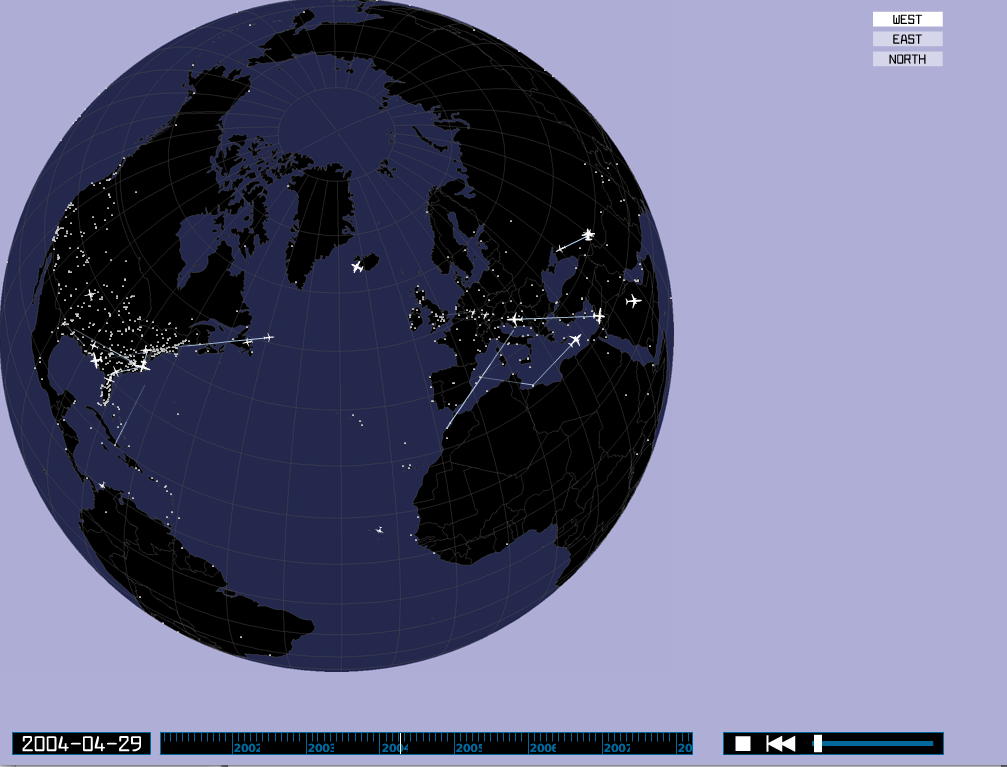
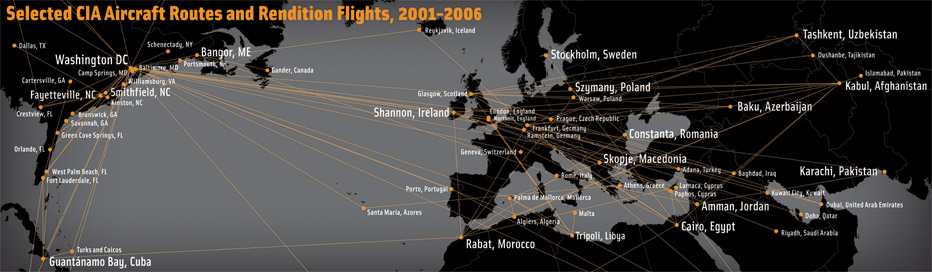
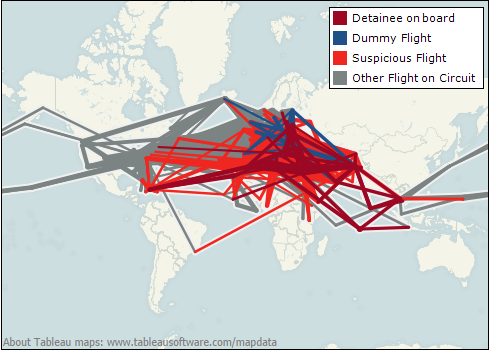
Many readers will know of various attempts made, several years ago, to map the CIA’s extraordinary rendition programme.  One of the most innovative was artist-geographer Trevor Paglen‘s Terminal Air project (and the idea of (de)basing the travel agency in this way was taken up, in a different register, by Adel Abidin: see here).

Trevor and his collaborators produced a series of visualizations of the flight network between Guantanamo and various black sites, some in digital form (like Terminal Air) — the image below is a screenshot of a remarkable animated sequence —

Terminal Air interactive screenshot

— and others displayed on physical billboards, like this one:

PAGLEN:EMERSON CIA FLIGHTS 2001-6

Today the Guardian publishes the results of a three-year programme of ESRC-funded collaborative research between Ruth Blakeley at the University of Kent and Sam Raphael at Kingston University in association with Reprieve into the system of extraordinary rendition and its associated practices.  This is of more than historical interest; they write:

The Rendition Project aims to analyse the emergence, development and operation of the global system of rendition and secret detention in the years since 9/11. In doing so, it aims to bring together as much of the publicly-available information as possible on the detainees who have been held in secret, the detention sites in which they have been held, and the methods and timings of their transfers.

With this data in place, we will seek to identify specific ‘key moments’ that have shaped the operation of rendition and secret detention, both regionally and in a global context. We are particularly interested in the contest between the executive, the judiciary, and the human rights community (comprising human rights lawyers, human rights NGOs, and some academics), over whether and how domestic and international law applies to those detainees held within the system. A key aim of the project is therefore to identify how rendition and secret detention have evolved within the context of this struggle to defend basic human rights.

The Rendition Project also examines the ways in which this system has evolved over time, including during the Obama administration. While President Obama has ordered the closure of CIA-run secret prisons (the so-called ‘black sites’), and revoked authorisation for use by US agents of ‘enhanced interrogation techniques’, many thousands of detainees in the ‘War on Terror’ continue to be held beyond the bounds of US and international law. Moreover, continued rendition and proxy detention have not been ruled out by the US Government, and may still form a central plank of counterterrorism policy.

The Rendition Project

The website for The Rendition Project includes testimony, profiles and documentation together with a detailed database and an interactive map (produced in collaboration with Craig Bloodworth from The Information Lab).

The composite map is daunting, as befits the terrifying scale of the process itself:

The Rendition Project composite map

But the ability to disentangle the threads and to interrogate the database changes the terms of the engagement, making it possible to track the experience of individual victims and to identify the major circuits and the global network of complicities in which they were enmeshed.

Chillingly brilliant work.

Tahrir Squared

I’ve been putting the finishing touches to the extended version of my essay on Tahrir Square and the Egyptian uprisings, which focuses on performance, performativity and space through an engagement with Judith Butler‘s ‘Bodies in alliance and the politics of the street’ essay/lecture (originally delivered in Venice in 2011).

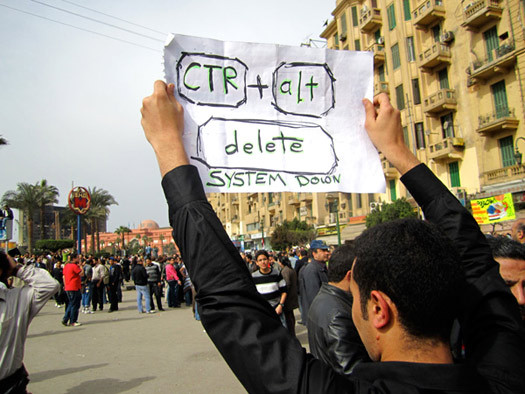
Tahrir Square (Mohamed Elshahed)Much of the existing discussion of Tahrir treats performance in conventional dramaturgical terms, and owes much more to Erving Goffman‘s classic work than to Judith’s recent contributions, so that spatiality is more or less reduced to a stage: see, for example, Charles Tripp, ‘Performing the public: theatres of power in the Middle East’, Constellations (2013) doi: 10.1111/cons.12030 (early view).  Others have preferred to  analyse the spatialities of Tahrir through the work of Henri Lefebvre: I’m thinking of Ahmed Kanna, ‘Urban praxis and the Arab Spring’, City 16 (3) (2012) 360-8; Hussam Hussein Salama, ‘Tahrir Square: a narrative of public space’, Archnet – IJAR 7 (1) (2013) 128-38;and even, en passant, W.J.T.Mitchell, ‘Image, space, revolution: the arts of occupation’, Critical Inquiry 39 (1) (2012) 8-32.

None of these seem to me to convey the way in which, as Judith has it, the presence of bodies in the square becomes the performance of a new spatiality through which people

‘seize upon an already established space permeated by existing power, seeking to sever the relation between the public space, the public square, and the existing regime. So the limits of the political are exposed, and the link between the theatre of legitimacy and public space is severed; that theatre is no longer unproblematically housed in public space, since public space now occurs in the midst of another action, one that displaces the power that claims legitimacy precisely by taking over the field of its effects…. In wresting that power, a new space is created, a new “between” of bodies, as it were, that lays claim to existing space through the action of a new alliance, and those bodies are seized and animated by those existing spaces in the very acts by which they reclaim and resignify their meanings.’

I see a similar conception at work in Adam Ramadan‘s emphasis on Tahrir as at once a space and an act – a space-in-process, if you like – of encampment: ‘From Tahrir to the world: the camp as a political public space’, European Urban and Regional Studies 20 (2013) 145-9.  I’m drawn to these formulations partly because they connect performance to the possibility of performativity through space-in-process, and partly because these ideas, attentive as they are to ‘space’, also pay close attention to ‘time’ (or rather space-time) (for a suggestive discussion of the temporalities of Tahrir, which I think have been marginalised in too many ‘spatialising’ discussions, see Hanan Sabea, ‘A “time out of time”‘, here.)

These comments are little more than place-holders, I realise, and I hope my reworked essay will clarify them; I’ll post the final version on the Downloads page as soon as it’s ready – in the next day or two, I hope. [UPDATE: The manuscript version, to appear in Middle East Critique, is now available under the DOWNLOADS tab: ‘Tahrir: politics, publics and performances of space’]

In the meantime, if you’re interested in the Egyptian uprisings, there’s an excellent online bibliography at Mark Allen Peterson‘s equally excellent Connected in Cairo here; Mark also provides a listing of documentary films here (including YouTube feeds).

Tahrir Squared

Part of my discussion addresses the imbrications of the digital and the physical, the virtual and the visceral.  For a quick overview, see Mohamed Elshahed here (from whom I’ve borrowed the wonderful image at the head of this post), but for a remarkable online platform that, amongst other things, seeks to ‘multiply the Tahir Effect around the globe’, capitalising on the transformations from the digital to the physical and back again, try Tahrir Squared:

‘T2 is a one-stop shop for reliable and enlightening information about the Arab uprisings, revolutions and their effects. It combines both original content by leading analysts, journalists and authoritative commentators, and curated content carefully selected from across the web to provide activists, researchers, observers and policy makers a catch-all source for the latest on the Arab revolutions and related issues through an interactive, virtual multimedia platform.
 
Unattached to governments or political entities, Tahrir Squared is concerned with ‘multiplying the Tahrir Effect around the globe’: an Effect which reawakened civic consciousness and awareness. An Effect which led to neighbourhood protection committees, and created those scenes in Tahrir of different religions, creeds and backgrounds engaging, assisting, and protecting one another. 
 
That Effect still lives inside those who believe in the ongoing revolutions that called for ‘bread, freedom, social justice and human dignity’. This website is a part of that broader initiative, seeking to provide people with the knowledge and information to assist and stimulate that process of reawakening, through the provision of reliable news reports, thoughtful commentary, and useful analysis.