Deadly improvisations

There is nothing refined about killing, but the war in Syria has shown that both sides have resorted to improvisational tactics.  I say ‘both sides’ as a short-hand: this is hardly a two-party conflict, since the anti-Assad forces are far from united and a number of external powers – not only Iran and Saudi Arabia – are plainly using the parties as players in a proxy war.

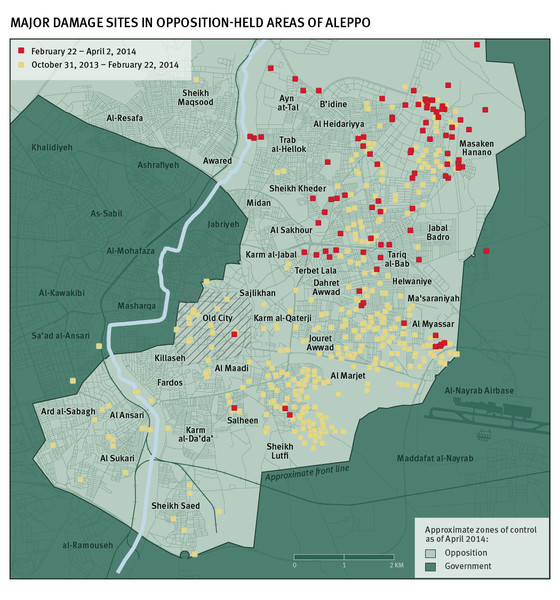
One of the first signs was the Syrian Air Force’s use of so-called ‘barrel bombs’: in effect, these are improvised explosive devices made from oil barrels filled with crude explosive and, on occasion, metal shrapnel and even chemicals like chlorine, which are then dropped from helicopters.  At first, they were dropped from low altitudes – which, according to Richard Lloyd at least, made them accurate enough to strike particular targets – but once the rebels were equipped with rocket-launchers (MANPADs) the helicopters had to fly much higher (near 7,000 feet) with a corresponding diminution in accuracy.  The first attacks took place against the city of Homs in August 2012, but the locus then shifted to rebel-held areas in Aleppo – the map below comes from Human Rights Watch‘s forensic analysis of strikes against that city between October 2013 and April 2014; some of the sites identified may have been struck by other munitions, HRW concedes, including conventional bombs, mortars and artillery shells, but the vast majority reveal the characteristic signature of the indiscriminate deployment of barrel bombs.  The Syrian National Council estimates that 20,000 people have been killed by barrel bombs thus far.

Aleppo Barrel Bombs (Human Rights Watch)

Since the Syrian Air Force has been supplied with conventional bombs by both Russia and Iran, many commentators have concluded that the recourse to crude barrel bombs is not the result of any munitions shortage but is rather a determined attempt to spread indiscriminate terror.  For we need to remember that there’s nothing special about barrel bombs; they are probably less effective – certainly less accurate – than conventional munitions.  In short, they are, as I’ve said, an improvisation – what the indefatigable Eliot Higgins (of Brown Moses fame: an absolutely indispensable source for all this) calls ‘a piece of crap’.  But they are also unequivocal evidence that the regime is ‘interested in no path forward other than by killing.’

The result has been captured in a sobering video from Syrian Zero, showing barrel bomb attacks on Darayya, a neighbourhood in Damascus during the last week of January (below; you can find a brief, helpful exposition and commentary on the video here).

Barrel bombs have also been used by the Sudanese Air Force in Southern Kordofan and Blue Nile states, and most recently by the Iraqi Air Force against Fallujah.

A second tactic used in Syria – this time by opposition forces – hearkens back to the First World War. Earlier this month, and in part as a counter to the crude air war against the rebel-held areas of Aleppo, the Islamic Front detonated a vast underground mine packed with explosives beneath the city’s Carlton Hotel, which was used as a base by the Syrian Army.  Video of the construction of the 75 metre tunnel had previously been uploaded to YouTube:

http://www.youtube.com/watch?v=iny_uVNz30Q

According to the BBC the explosion, just outside the Citadel, levelled the hotel and seriously damaged many surrounding buildings; there has been no official estimate of casualties, but it seems that dozens were killed or injured.  In the last few days  a much longer (850 metre) tunnel, which reportedly took 7 months to excavate, was used to detonate 60 tonnes of explosive packed under a Syrian Army base at Wadi al-Deif, also in the north of Syria.  The base, outside the town of Maarrat al-Nu’man, occupies a strategic location on the main route linking Damascus and Aleppo, and had been besieged by rebel forces for over a year.  Dozens of soldiers were killed in the attack.

http://www.youtube.com/watch?v=1f6_DMRageY

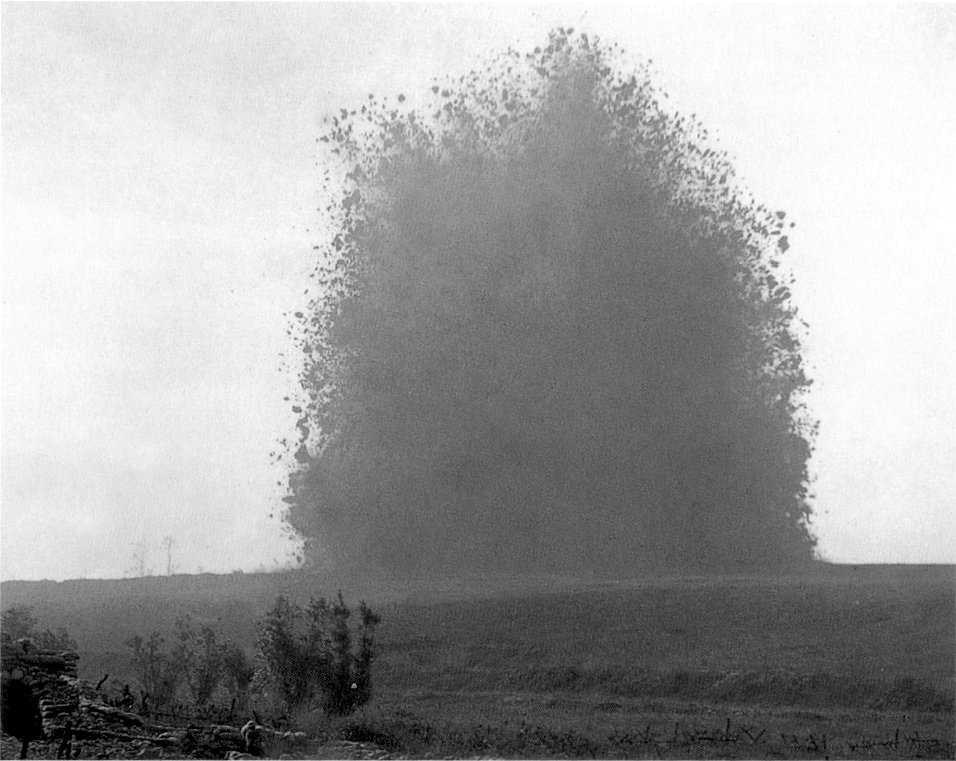
Tunnels, then, can be used not only to break sieges and blockades – as in those that keep the economy of Gaza supplied against the Israeli stranglehold: in effect, lifelines (if you want more on this, try the brilliant documentary Gaza: Tunnels to Nowhere and Nicolas Pelham, ‘Gaza’s tunnel phenomenon’, Journal of Palestine Studies 41 (4) 2012, pp. 6-31).  They can also be deathlines, dug for directly offensive purposes.  The tactic had been used to devastating effect on the Western Front, as I noted in a previous post on 3-D war: the image below is Ernest Brooks‘s famous photograph of the detonation of the British mine underneath the German lines at Hawthorn Ridge on the first day of the Battle of the Somme on 1 July 1916.  You can find video of the explosion here.

Hawthorn Ridge 1916

Then as now, as Jane Burgess argues in a dispatch from the frontlines of  ‘The Battle for Aleppo’, they are deadly improvisations in a war of attrition.

Both of these developments/reversions – the barrel bombs and the mines – obviously reinforce Stuart Elden‘s discussion of attempts to ‘secure the volume’.  But they also speak directly to a bleak politics of insecurity.

War and therapeutic geographies

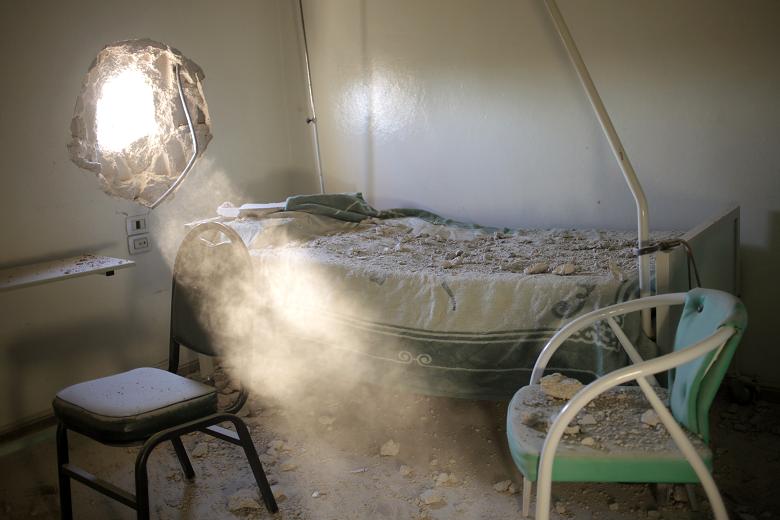
Tall Rifat hospital near Aleppo attacked by helicopter gunships June 2012

I previously noted the problems of providing medical care to those fleeing the war in Syria – and to those who’ve been left behind – and an article by Thanassis Cambanis in the Boston Globe (‘Medical care is now a tool of war’) reinforces the importance of the issue:

 The medical students disappeared on a run to the Aleppo suburbs. It was 2011, the first year of the Syrian uprising, and they were taking bandages and medicine to communities that had rebelled against the brutal Assad regime. A few days later, the students’ bodies, bruised and broken, were dumped on their parents’ doorsteps.

Dr. Fouad M. Fouad, a surgeon and prominent figure in Syrian public health, knew some of the students who had been killed. And he knew what their deaths meant. The laws of war—in which medical personnel are allowed to treat everybody equally, combatants and civilians from any side—no longer applied in Syria.

“The message was clear: Even taking medicine to civilians in opposition areas was a crime,” he recalled.

As the war accelerated, Syria’s medical system was dragged further into the conflict. Government officials ordered Fouad and his colleagues to withhold treatment from people who supported the opposition, even if they weren’t combatants. The regime canceled polio vaccinations in opposition areas, allowing a preventable disease to take hold. And it wasn’t just the regime: Opposition fighters found doctors and their families a soft target for kidnapping; doctors always had some cash and tended not to have special protection like other wealthy Syrians.

Doctors began to flee Syria, Fouad among them. He left for Beirut in 2012. By last year, according to a United Nations working group, the number of doctors in Aleppo, Syria’s largest city, had plummeted from more than 5,000 to just 36.

Since then, Fouad has joined a small but growing group of doctors trying to persuade global policy makers—starting with the world’s public health community—to pay more urgent attention to how profoundly new types of war are transforming medicine and public health.

It is grotesquely ironic that ‘global policy-makers’ should have to be persuaded of the new linkages between war, medicine and public health, given how often later modern war is described (and, by implication, legitimated) through medical metaphors: see in particular Colleen Bell, ‘War and the allegory of medical intervention: why metaphors matter’, International Political Sociology 6: 3 (2012) 325-28 and ‘Hybrid warfare and its metaphors’, Humanity 3 (2) (2012) 225-47.

AI Health Crisis in SyriaBut there are, as Fouad emphasises, quite other, densely material biopolitics attached to contemporary military and paramilitary violence, including not only the targeting of medical staff, as he says, but also their patients.

“In Syria today, wounded patients and doctors are pursued and risk torture and arrest at the hands of the security services,” said Marie-Pierre Allié, president of [Médecins san Frontières’]. “Medicine is being used as a weapon of persecution.”

In October 2011 Amnesty International described the partisan abuse of the wounded in hospitals in Damascus and Homs, and the denial of medical care in detention facilities, in chilling detail.

At least then (and there) there were hospitals.  Linking only too directly to my previous post on Aleppo, Cambanis concludes:

Today, Fouad’s former home of Aleppo is largely a ghost town, its population displaced to safer parts of Syria or across the border to Turkey and Lebanon. The city’s former residents carry the medical consequences of war to their new homes, Fouad said—not just injuries, but effects as varied as smoking rates, untreated cancer, and scabies. Wars like those in Syria and Iraq don’t follow the old rules, and their effects don’t stop at the border.

I first became aware of these issues at a conference on War and medicine in Paris in December 2012, which prompted my current interest in the casualties of war, combatant and civilian, and the formation of modern medical-military machines.  Several friends from the Paris meeting (Omar Dewachi, Vinh-Kim Nguyen and  Ghassan Abu Sitta) have since joined with other colleagues to produce a preliminary review published this month in The Lancet: ‘Changing therapeutic geographies of the Iraqi and Syrian wars’.  They write:

War is a global health problem. The repercussions of war go beyond death, injury, and morbidity. The effects of war are long term, reshaping the everyday lives and survival of entire populations.

In this report,we assess the long-term and transnational dimensions of two conflicts: the US-led occupation of Iraq in 2003 and the ongoing armed conflict in Syria, which erupted in 2011. Our aim is to show that, although these conflicts differ in their geopolitical contexts and timelines, they share similarities in terms of the effects on health and health care. We analyse the implications of two intertwined processes—the militarisation and regionalisation of health care.  In both Syria and Iraq,boundaries between civilian and combatant spaces have been blurred. Consequently,hospitals and clinics are no longer safe havens. The targeting and misappropriation of health-care facilities have become part of the tactics of warfare. Simultaneously, the conflicts in Iraq and Syria have caused large-scale internal and external displacement of populations. This displacement has created huge challenges for neighbouring countries that are struggling to absorb the health-care needs of millions of people.

They emphasise ‘the targeting and implication of medicine in warfare’ and note that ‘the militarisation of health care follows the larger trends of the war on terror, where the boundaries between civilian and combatant spaces are broadly disrespected.’  They have in mind ‘not only the problem of violence against health care, but also [the ways in which] health care itself has become an instrument of violence, with health professionals participating (or being forced to participate) in torture, the withholding of care, or preferential treatment of soldiers.’

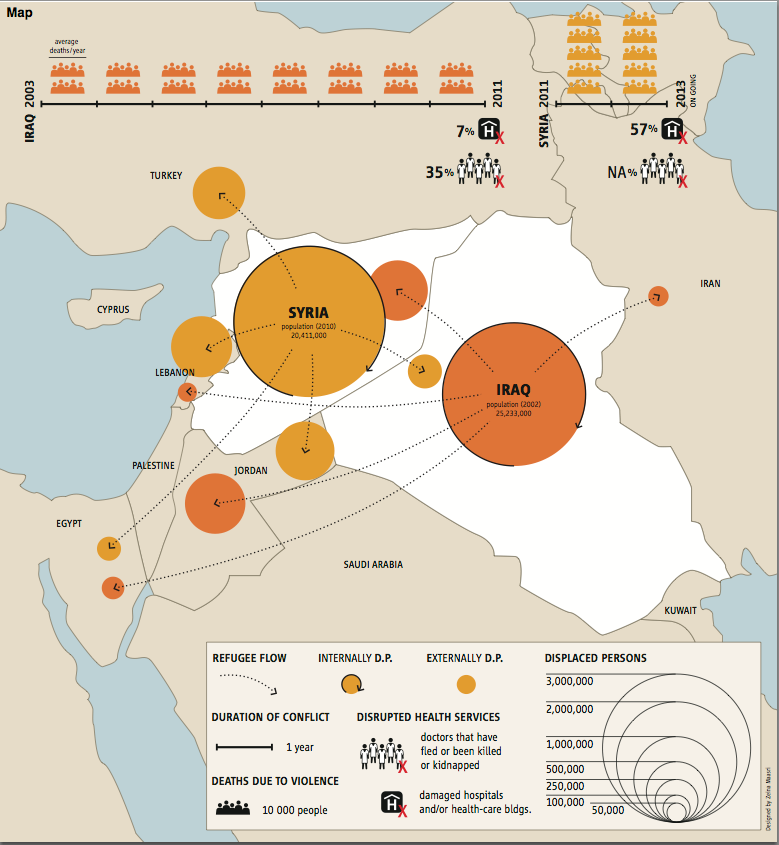
And they describe a largely unplanned dispersal of medical care across the region that blurs other – national – boundaries, requiring careful analysis of the ‘therapeutic geographies‘ which trace the precarious and shifting journeys through which people obtain medical treatment in and beyond the war zone.  They insist that ‘migrants seeking refuge from violence cannot be framed and presented as mere victims but as people using various strategies to acquire health care and remake their lives.’ The manuscript version of the report included the map below, which illustrates the scale of the problem:

Therapeutic geographies

My own work addresses similar issues through four case studies over a longer time-span, to try to capture the dynamics of these medical-military constellations: the Western Front in 1914-18, the Western Desert in the Second World War, Vietnam, and Afghanistan 2001-2014 (see ‘Medical-military machines’, DOWNLOADS tab).

msf-afghanistan-report-finaToday Médecins sans Frontières published an important report, Between rhetoric and reality:  the ongoing struggle to access healthcare in Afghanistan, that speaks directly to these concerns.  Like the Lancet team, the report explores the ways in which war affects not only the provision of healthcare for those wounded by its violences but also access to healthcare for those in the war zone who suffer from other, often chronic and life-threatening illnesses: ‘The conflict creates dramatic barriers that people must overcome to reach basic or life- saving medical assistance. It also directly causes death, injury or suffering that increase medical needs.’  Releasing their findings, MSF explained:

After more than a decade of international aid and investment, access to basic and emergency medical care in Afghanistan remains severely limited and sorely ill-adapted to meet growing needs created by the ongoing conflict…  While healthcare is often held up as an achievement of international state-building efforts in Afghanistan, the situation is far from being a simple success story. Although progress has been made in healthcare provision since 2002, the report … reveals the serious and often deadly risks that people are forced to take to seek both basic and emergency care.

The research – conducted over six months in 2013 with more than 800 patients in the hospitals where MSF works in Helmand, Kabul, Khost and Kunduz provinces – makes it clear that the upbeat rhetoric about the gains in healthcare risks overlooking the suffering of Afghans who struggle without access to adequate medical assistance.

“One in every five of the patients we interviewed had a family member or close friend who had died within the last year due to a lack of access to medical care,” said Christopher Stokes, MSF general director. “For those who reached our hospitals, 40 per cent of them told us they faced fighting, landmines, checkpoints or harassment on their journey.”

The patients’ testimonies expose a wide gap between what exists on paper in terms of healthcare and what actually functions. The majority said that they had to bypass their closest public health facility during a recent illness, pushing them to travel greater distances – at significant cost and risk – to seek care.

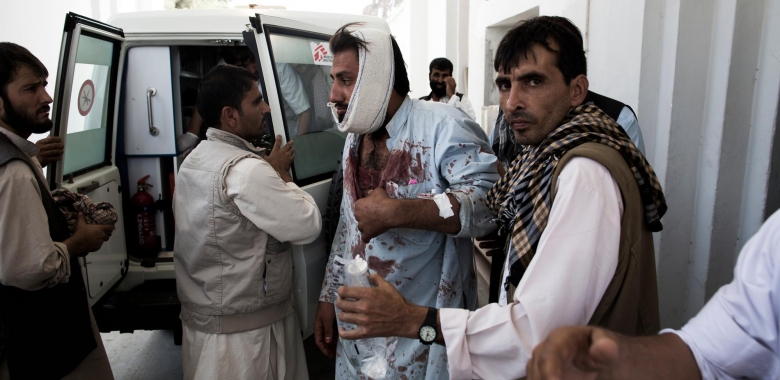
MSF provides a photoessay describing some of these precarious journeys (‘Long and dangerous roads’) here, from which I’ve taken the photograph below, showing an inured man being led by a relative into the Kunduz Trauma Centre.

MSB5652

Mapping Aleppo – and more

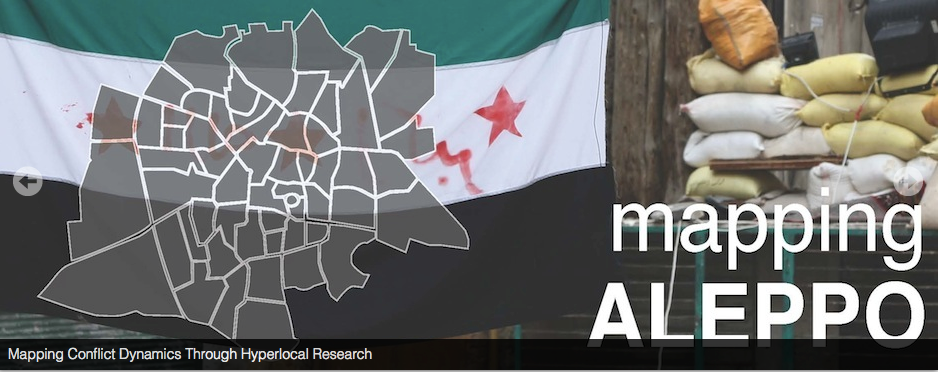
Mapping Aleppo

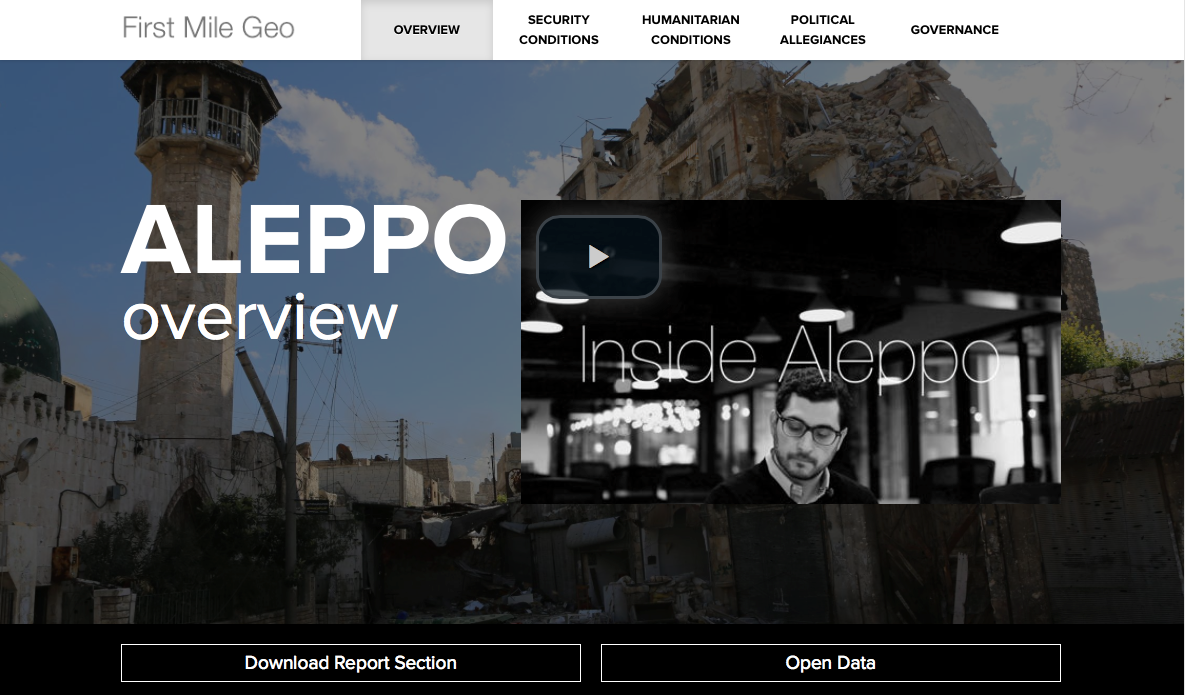
I’ve posted about mapping the war in Syria and its spillover effects before (see here and here), but most of these projects cover a wide area with varying degrees of reliability.  Now News from Laleh Khalili of a report from David Kilcullen‘s Caerus Associates (with the American Security Project) on the civil war in Aleppo, “Mapping the conflict in Aleppo, Syria”, which provides a much more fine-grained view of what is happening on the ground.  You can download the report here or view the interactive version via First Mile Geo here, and you can read an account of the project from Wired‘s Greg Miller here.

Caerus has also joined with the Pentagon’s Center for Complex Operations to produce a special supplement of PRISM (vol.  4, 2014) on the Syrian conflict, which includes an essay by Kilcullen and Nathaniel Rosenblatt on ‘The Rise of Syria’s Urban Poor: Why the War for Syria’s Future Will Be Fought Over the Country’s New Urban Villages’; the whole issue is available on open access here.

These interventions are important and interesting for several reasons.

First, the report is based on exacting local fieldwork.  Acknowledging that local people in conflict zones develop vitally important stocks of local knowledge as a means of survival, the report also accepts that this ‘information-rich environment remains analytically poor.’  For that reason, the field teams ‘provided training and cloud-based tools to help local actors collect locally understood knowledge about their conflict for rigorous analysis.’

From September 16, 2013 to January 6, 2014, we collected four types of information: a monthly survey of perceptions among 560 residents in Aleppo’s 56 neighborhoods, biweekly location and status data for bakeries (a key indicator of humanitarian conditions due to the centrality of bread in the Syrian diet), biweekly location and status data on security checkpoints (a key indicator of security, territorial control and public safety conditions), and a monthly neighborhood-level assessment filled out by our enumerators. These four data streams not only allowed the research team to detect and visualize shifts in the environment in near-real time, but also provided an extremely rich source of insights on the geo-social dynamics at play. All field research was conducted in Arabic.

First Mile Geo notes that it will make the data available to organisations ‘for responsible use’: see Open Data here.

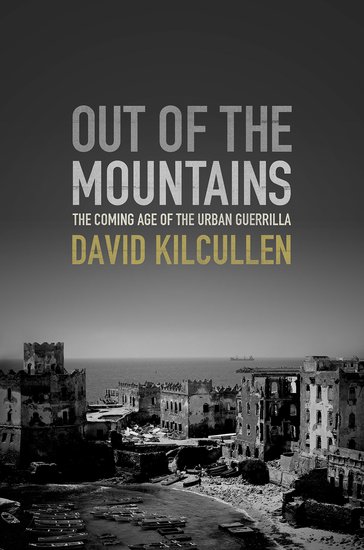
KILCULLEN Out of the mountainsSecond, Kilcullen’s analytical argument (he is described as ‘Principal Investigator’ for the Mapping project) is, naturally enough, fully conformable with the thesis he develops at length in his latest book, Out of the mountains: the coming age of the urban guerrilla (2013); the report reveals the grisly details of contemporary siege warfare and urbicide – central themes in the book, where Kilcullen notes the work of  Steve Graham and Eyal Weizman – and gestures towards a future ‘feral city’ (how I hate that phrase) broken into multiple fiefdoms where gangs and militias exact violence and provide rudimentary services to the residents:

‘The inability of opposition groups to aid residents of neighborhoods they control suggests Aleppo – and Syria as a whole – will become a mosaic of small, intersecting fiefdoms, each providing assistance to its respective neighborhood without regard to macro-level concerns for national governance and reconciliation. Growing warlordism may be particularly acute in Aleppo, where economic rent-seeking opportunities will attract armed gangs who will attempt to seize control of its neighborhoods. These “conflict entrepreneurs” will have little incentive to end a conflict from which they derive power, prestige, and profit. Even in the event of peace, Aleppo’s strategic location will help these actors establish roots for illicit networks that may endure well beyond the present conflict. Moreover, as a non-capital city, Aleppo will not benefit from national government attention. Instead, Aleppo’s future may resemble that of similarly conflict-plagued second cities in the Middle East, such as Mosul in Iraq or Benghazi in Libya. These cities are plagued by warlordism and dominated by illicit economies. They have quickly become safe havens enabling terrorist networks to plan, recruit, and launch attacks.’ 

I’ve posted about Out of the Mountains here, when I promised an extended commentary: Laleh and I will be working on a joint examination of Kilcullen’s larger thesis in the near future, so watch this space. We already have Mike Davis‘s thumbnail view:

‘Although an enemy of the state, I must concede that this is a brilliant book by the most unfettered and analytically acute mind in the military intelligentsia. Kilcullen unflinchingly confronts the nightmare of endless warfare in the slums of the world.’

Here, incidentally, it’s revealing to read Kilcullen’s theses alongside Neil Brenner‘s ‘Theses on urbanisation’, Public culture 25:1 (2013) 85-114, which makes a series of suggestive proposals – but from which war is strikingly absent.  So Kilcullen’s thesis certainly demands serious scrutiny, particularly by those who think that the future of war is somehow encapsulated in the drone.  In my previous note, I joined Geoff Manaugh in being sceptical about the ‘aerial-algorithmic’ interventions that attracted Kilcullen in a series of talks based around the book, but ‘Mapping the conflict in Aleppo’ reveals a much more substantial interest in ‘the facts on the ground’, local actors and local knowledge.  (And here a good counter-text would be the brilliant work of AbdouMaliq Simone; see also his blog, Villes-Noires, here).  So, as I say, watch this space.

First Mile Geo ALEPPO

But there’s a third reason this matters.  I’ve been reading and thinking about Jeremy Crampton, Sue Roberts and Ate Poorhuis‘s ‘The new political economy of geographical intelligence’ – a fine essay in the Annals of the Association of American Geographers 104: 1 (2014) 196-214 – and I’ll be returning to this in the next day or two.  They emphasise the importance of satellite imagery in the production of US geospatial intelligence, whereas I’ve been developing a different (though related) argument about  the importance of satellite communications for the ‘everywhere war’.  In both cases, there is an intimate relation between ‘milsat’ and ‘comsat’, the military and commercial sectors, which will come as no surprise to those who’ve been plotting the extending contours of the military-industrial complex.

Those contours have snared all sorts of other institutions, of course, which is why James Der Derian talks about MIME-NET (the military-industrial-media-entertainment network) and I’ve talked about MAIM-NET (the military-academic-industrial-media network).  The role of universities in the development of military capabilities and military knowledge (and ultimately the production of military violence) is no less surprising, of course, and in fact there’s a session on ‘Geography and the military’ organised by Eric Sheppard at the AAG conference in Tampa (an appropriate location for several reasons) to debate these issues.  But it should now be clear that the production of these geographical knowledges is not confined to the military and civilian intelligence agencies, the academy and large corporations but also includes a host of much smaller private contractors devoted to ‘geographical intelligence’.  They come in different shapes and sizes, and with different agendas.  Caerus, for example, describes itself as a ‘strategy and design firm’ that helps clients ‘understand and thrive in complex, conflict-afflicted, and disaster-affected environments’.  But there are many others, and it’s important not to lose sight of their role in what the US military would call ‘shaping the battlespace’…

The facts on the ground

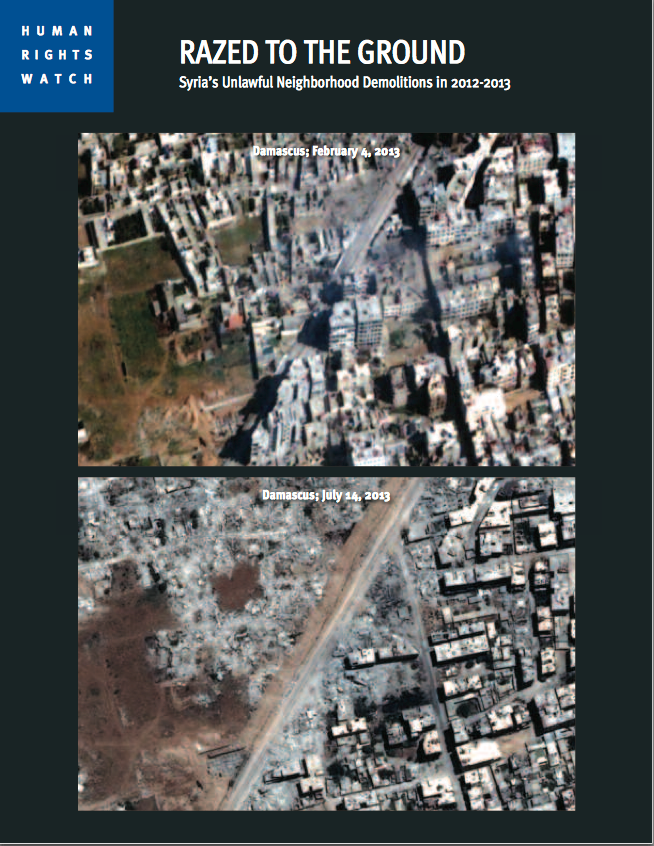
Razed to the groundHuman Rights Watch has released a bleak report, Razed to the Ground: Syria’s unlawful neighborhood demolitions, 2012-2013.

Satellite imagery, witness statements, and video and photographic evidence show that Syrian authorities deliberately and unlawfully demolished thousands of residential buildings in Damascus and Hama in 2012 and 2013, Human Rights Watch said in a report released today.

The 38-page report, “Razed to the Ground: Syria’s Unlawful Neighborhood Demolitions in 2012-2013,” documents seven cases of large-scale demolitions with explosives and bulldozers that violated the laws of war. The demolitions either served no necessary military purpose and appeared to intentionally punish the civilian population or caused disproportionate harm to civilians, Human Rights Watch found.

“Wiping entire neighborhoods off the map is not a legitimate tactic of war,” said Ole Solvang, emergencies researcher at Human Rights Watch. “These unlawful demolitions are the latest additions to a long list of crimes committed by the Syrian government.”

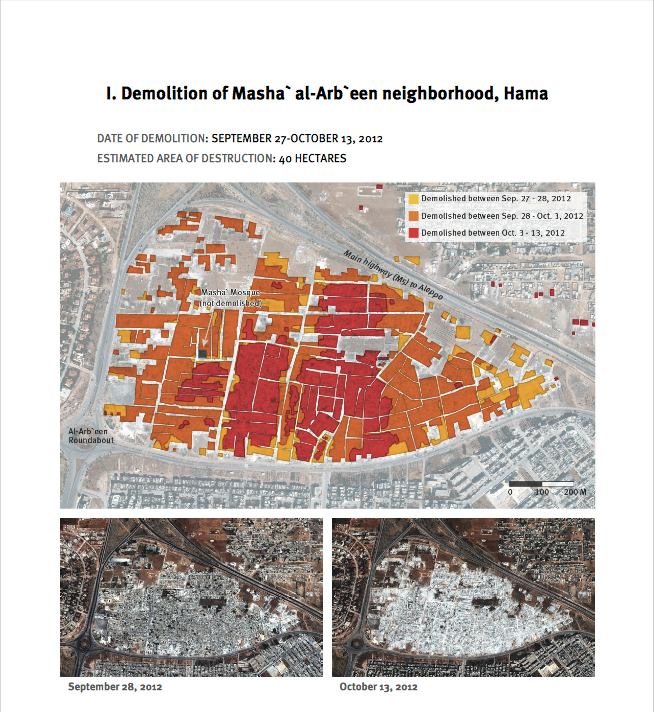
Demolitions, Hama

More images and commentary here, but this is almost certainly only a fragmentary map of a still wider geography of urbicide.  According to Martin Chulov, reporting from Beirut,

Nadim Houry, deputy director of Human Rights Watch for the Middle East and North Africa, said: “These are the areas that we were told about by witnesses. There are likely to be other areas, but there are many black holes in Syria where we don’t have information. This is likely part of a systematic policy in rebel held areas elsewhere in the country as well.

“It shows yet again that this is not a one-off act by a commander. This is part of a strategy targeting all opposition-held areas. It is a mirror image of the starvation of people in Yarmouk [refugee camp in Damascus] or in Old Homs. It shows yet again how ready the government is to collectively harm areas of people that are supporting the opposition.”

http://www.youtube.com/watch?v=Q-gC5WT-AAo

The circumstances and context are different, but Assad is clearly borrowing yet another tactic from Israel’s playbook.  The ongoing demolition of homes in occupied Palestine is a slower process, but just as brutal and just as illegal: see the work of the Israeli Committee against House Demolitions here (though I wish it were called the Committee against Home Demolitions to capture more fully what is being so deliberately and callously destroyed).  Here is Human Rights Watch last summer:

Israeli forces should immediately end unlawful demolitions of Palestinian homes and other structures in Occupied Palestinian Territory. The demolitions have displaced at least 79 Palestinians since August 19, 2013. Demolitions of homes and other structures that compel Palestinians to leave their communities may amount to the forcible transfer of residents of an occupied territory, which is a war crime.

Human Rights Watch documented demolitions on August 19 in East Jerusalem that displaced 39 people, including 18 children. Israeli human rights groups and the United Nations Office for the Coordination of Humanitarian Affairs (OCHA) documented additional demolitions in East Jerusalem and the West Bank on August 20 and 21 that destroyed the homes of 40 people, including 20 children.

“When Israeli forces routinely and repeatedly demolish homes in occupied territory without showing that it’s necessary for military operations, it appears that the only purpose is to drive families off their land, which is a war crime,” said Joe Stork, acting Middle East director at Human Rights Watch. “The politics of peace talks do not make it any less unlawful for Israel to demolish Palestinians’ homes without a valid military reason.”

Remember these two reports when you read the response from the ‘international community’ to the latest Syrian revelations.  And listen to the silences.

A mile in these shoes

I’m just back from Beirut, and trying to catch up.  Every day I went for a walk along the Corniche, and on the second morning a young Syrian boy asked if he could clean my shoes.  I was wearing trainers, but told him that I’d pay him anyway and he could clean my shoes next time I came out; he refused to take the money until I had agreed where and when I would present myself for the service.  Heart-warming and hear-breaking, and I can’t get him out of my mind.  So here is a quick up-date on the situation (see also my previous posts here and here).

Syria civil war casualties

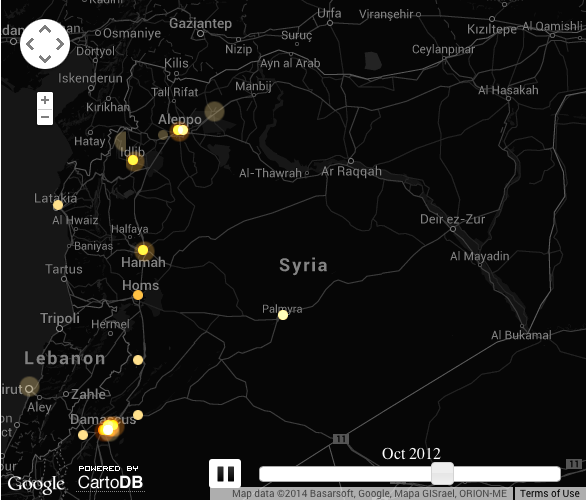
First, this week Foreign Policy published this sobering animated map of casualties from the civil war in Syria based on data from the Human Rights Data Analysis Group:

It visualizes the approximately 74,000 people who died from March 2011 to November 2013. Every flare represents the death of one or more people, the most common causes being shooting, shelling, and field execution. The brighter a flare is, the more people died in that specific time and place. The data used are drawn from the Violations Documentation Center (VDC), the documentation arm of the Local Coordination Committees in Syria which has been one of the eight sources on which HRDAG has based its count. In a June 2013 report, HRDAG cited VDC as the most thorough accounting of casualties in Syria, though the dataset has been found to contain some inconsistencies…

What the map demonstrates is the escalation of the conflict — with data from March 2011 through the VDC’s Nov. 21, 2013 report — and its quick descent from being a smattering of violence to a multi-front war with militias challenging the military (and other militias) almost everywhere at once. What it can’t show, of course, is the horror and destruction of this war.

My image is just a screen grab, of course, so you need to visit the original to see the overall, devastating effect.

For more detail, I recommend Syria Deeply, a new digital platform that attempts to combine citizen journalism with professional analysis; there’s a profile of the project at start-up over at Fast Company here and a more recent commentary from its founder Lara Setrakian here. I think there are lessons to be learned here about the way publics can be created and brought to engage with conflicts, and that goes for academics as well as journalists.

Second, it’s much harder to find information about those who have been wounded in the conflict – one of my present preoccupations: see here and here – but while I was in Beirut Lebanon’s Daily Star published an interesting report on NGOs working in the borderlands to treat casualties from the war zone.  In the Bekaa Valley the International Committee of the Red Cross has treated over 700 people since 2012, while a 20-bed clinic run by Lebanon’s Ighatheyya has treated 135 people since it opened five months ago in Kamed al-Loz.  The casualties include pro- and anti-Assad fighters (according to the ICRC, ‘When we know the patients are from opposing sides we separate them by placing them on different floors … We make sure they don’t know the other is there’) and civilians alike.  Many of them are suffering from infected wounds because they were initially treated in makeshift facilities in tents or private houses, which is why the perilous journey across the border is so vitally important. Neither the ICRC nor Ighatheyya make cross-border runs.  The Star‘s reporters explain:

Many patients are lawfully retrieved from the border by the Lebanese Red Cross, who then take them to a number of cooperating hospitals across the Bekaa Valley for treatment. According to a well-informed source, the ICRC has contracted four hospitals, in Chtaura, Jib Jenin, Baalbek and Hermel, to care for war wounded Syrians.

After surgery patients are often referred to clinics run by other non-governmental organizations, such as Ighatheyya, who oversee the patients’ convalescence…. Ighatheyya is [also] in the process of building a fully equipped 30-bed hospital in the border town of Arsal, where many refugees and combatants cross into Lebanon.

Another major locus of emergency medical treatment is Tripoli, just 30 km from the border and the primary treatment centre for Syrians seeking emergency medical assistance in northern Lebanon.  Médecins Sans Frontières, which also operates from four locations in the Bekaa Valley, has been supporting local clinics and hospitals here since February 2012 (and it’s been working inside Syria since March 2011).

NGOs are not the only organisations on the field.  Last summer NBC described the operation of a new clinic set up by the Syrian National Opposition to treat opposition fighters.  It too is in the Bekaa Valley, which is for the most part controlled by Hezbollah – which is of course militantly pro-Asad.  Four days after the clinic opened a local militia aligned with Hezbollah broke into the compound and forced a rapid evacuation, and early last summer armed men attacked an ambulance transporting a patient to surgery and kidnapped him: ‘Since then, the Lebanese Red Cross has refused to transport the clinic’s patients in ambulances through certain Hezbollah-dominated areas without an army escort. And private cars carrying patients through those areas have been shot at.’

For more on the transnational ‘therapeutic geographies’ involved in the wars in Iraq and Syria, see Omar Dewachi, Mac Skelton, Vinh-Kim Nguyen, Fouad Fouad, Ghassan Abu Sitta, Zeina Maasri and Rita Giacaman, ‘The Changing Therapeutic Geographies of the Iraqi and Syrian Wars’, forthcoming in The Lancet.  And for a discussion of the regional geopolitics of all this, including a corrective to the claim that the war in Syria is simply ‘spilling over’ into Lebanon, see Bélen Fernández over at warscapes here.

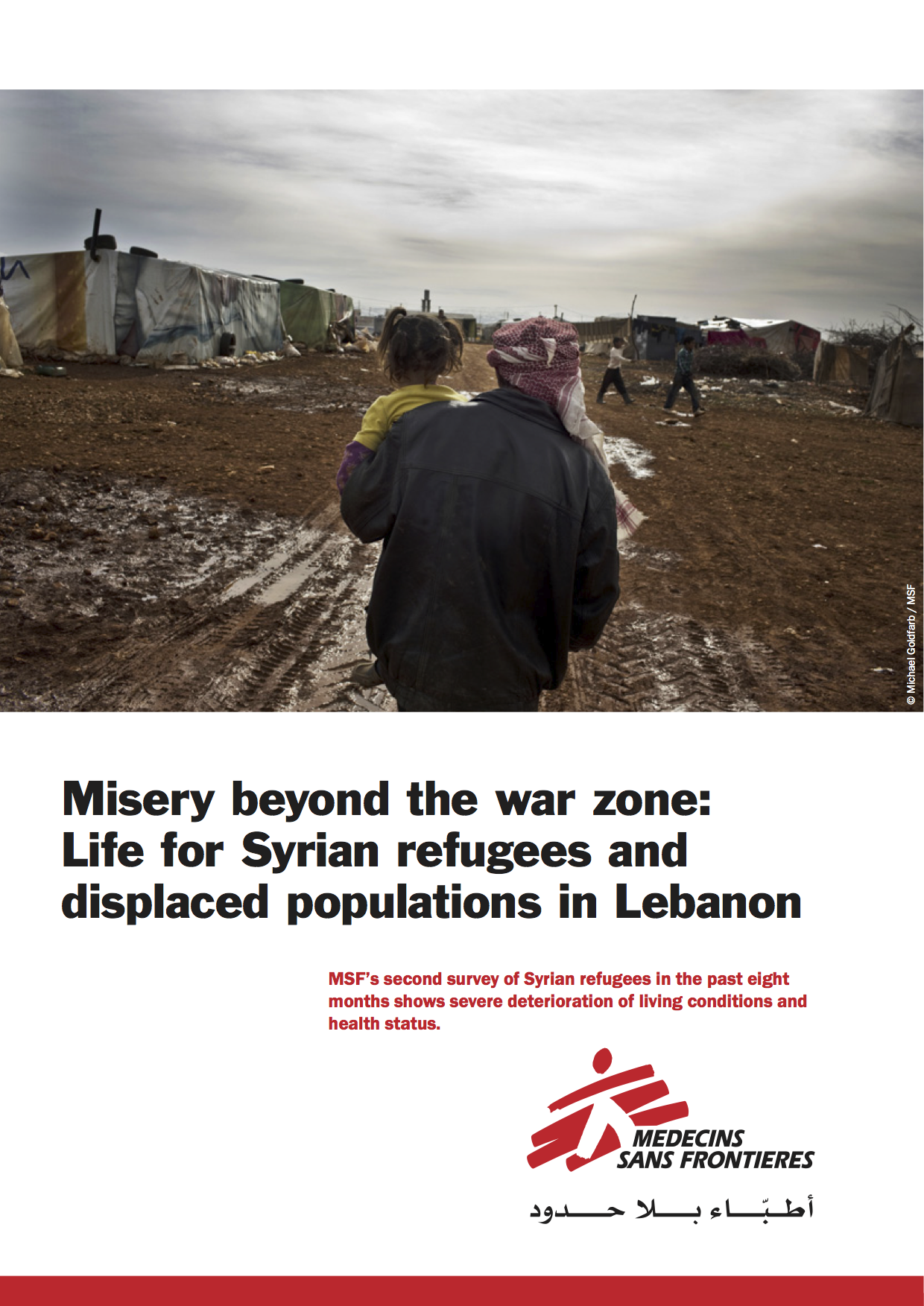
Syria-Lebanon-Report-2013 (dragged)As MSF emphasises, refugees from the conflict in Syria need more than emergency treatment for war wounds: ‘The epidemiological profile of populations does not change when they cross borders; those who needed medications for chronic conditions in Syria still need them in Lebanon.’  And, clearly, they have other pressing needs too:

‘[T]the gaps in service that existed [in June 2012] have not been sufficiently addressed but have in fact widened as more people have streamed across the border. Living conditions among the majority of refugees and Lebanese returnees remain extremely precarious, particularly with winter arriving. More than 50% of those interviewed, whether they were officially registered or not, are housed in substandard structures — inadequate collective shelters, farms, garages, unfinished buildings and old schools — that provide paltry, if any, protection against the elements. The rest are renting houses, but many of those people, now separated from their lives and livelihoods, are struggling to pay the rent. The medical picture has deteriorated as well. More than half of all interviewees (52%) cannot afford treatment for chronic disease care, and nearly one-third of them have had to suspend treatment already underway because it was too expensive to continue. For those who are and are not registered alike, the costs attached to essential primary health care, ante-natal care and institutional deliveries are prohibitive. Among non-registered returnees and internally displaced Lebanese, 63% received no assistance whatsoever from any NGO.’

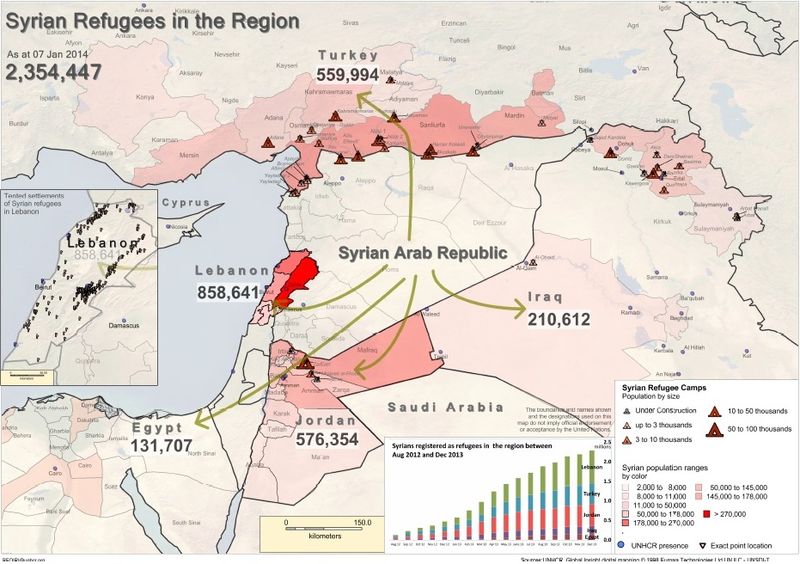
Here’s a recent map of Syrian refugee flows:

Syrian refugee flows to December 2013

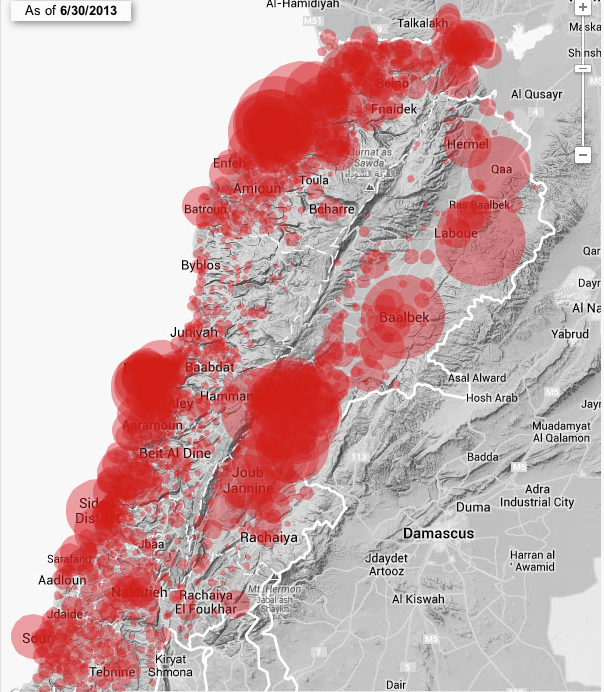
For more detail, UNHCR’s tabulations of Syrian refugees in Lebanon can be found here, and there’s a remarkable interactive map here (again, the image below is just a screen grab).

Syrian refugees in Lebanon summer 2013

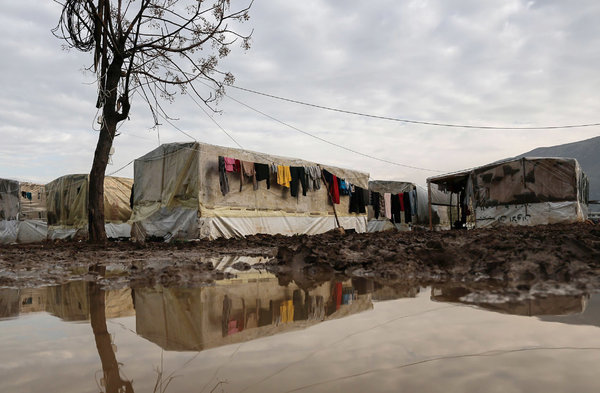
The number of registered refugees in Lebanon – and, as that MSF report indicates, registration is itself a deeply problematic process and the numbers understate the gravity of the situation – is now around one million; Lebanon’s population is four million, so one person in five is a refugee.  But wary of its experience with the Palestinian refugee camps – on which Adam Ramadan‘s work is indispensable: his book is due out later this year, but in the meantime see ‘In the ruins of Nahr al-Barid: Understanding the meaning of the camp‘, Journal of Palestine Studies 40 (1) (2010) and  ‘Spatialising the refugee camp‘, Transactions of the Institute of British Geographers 38 (1) (2013) 65-77 – Lebanon has refused to sanction camps for Syrian refugees: hence those ‘tented settlements’ on the map above (and see the image below).

24iht-m24-lebanon-refugees-articleLarge-v3

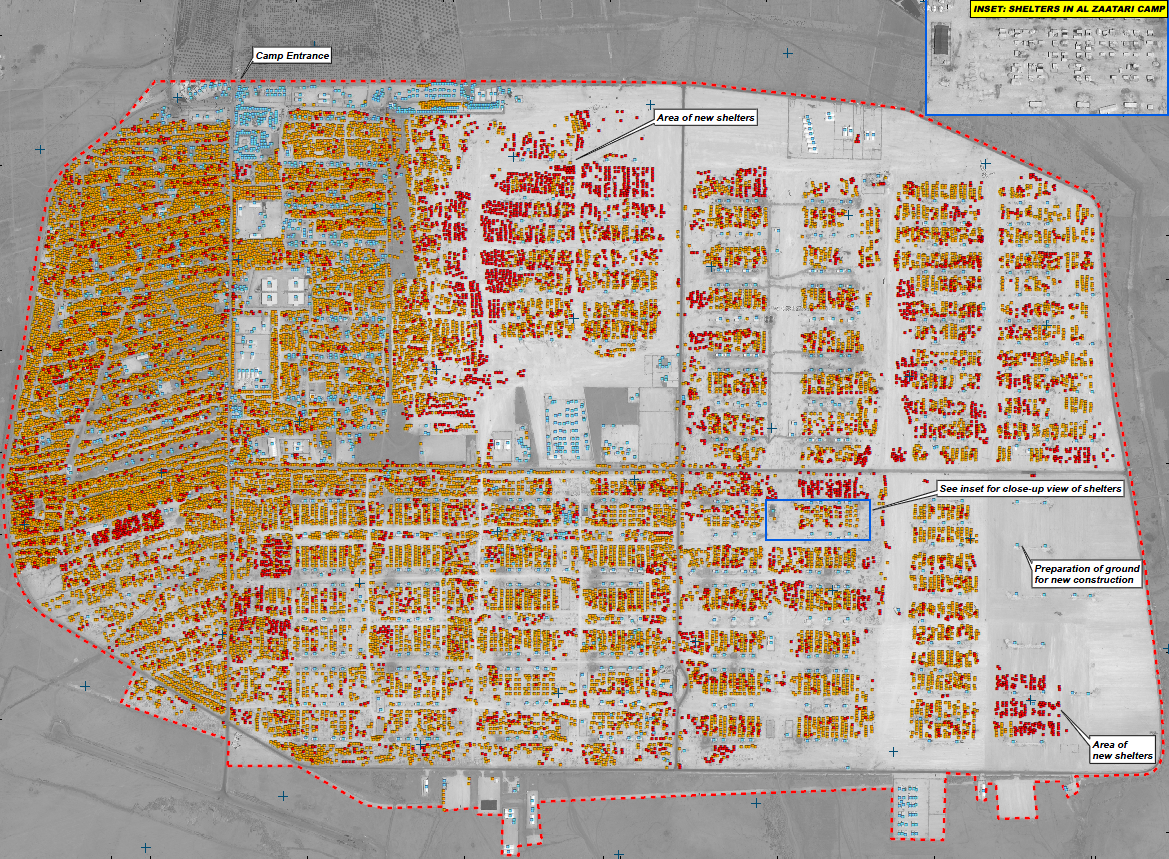
This strategy, or lack of it, is in marked contrast to Jordan, where Al- Za’atari, which opened in July 2012, will soon become the largest refugee camp in the world (below): you can find a sequence of satellite images showing its explosive growth here.

al-zataari-may-2013

But Lebanon is adamant that it will not sanction any intimations of permanence.  Norimitsu Onishi reported recently in the New York Times that

Those fears have forced the refugees to try to squeeze into pre-existing buildings and blend into the landscape. Those with means rent apartments. But hundreds of thousands are living in garages and occupying the nooks and crannies of buildings under construction. Abandoned buildings, including universities and shopping malls, have been taken over in their entirety by refugees.

Here, as usual, there are pickings to be had.  Last year Tracy McVeigh reported in the Guardian that

‘While there are widespread reports of extraordinary acts of generosity and kindness by Lebanese towards Syrian refugees, many people here are making money from Syria’s war. Landlords are getting rents for barely habitable properties, stables and outhouses. There are hefty profits to be made in the gun-running business, and refugees are easily exploited as cheap labour. The government is getting military resources from America and Europe, which are keen to see it able to protect its borders. But many others are losing out – those who are trying to house and feed large families along with their own.’

And that includes young boys looking for shoes to clean on the waterfront in Beirut.  If you want to donate more than the cost of a shoe-clean, you can reach Oxfam here, the International Rescue Committee here and UNHCR here.
Hard rain

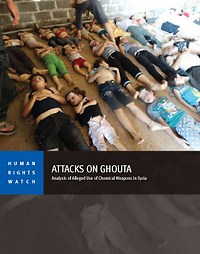
Human Rights WatchSome more forensic geography from Human Rights Watch (I’ve long though that some of the very best human geography is produced by organisations like HRW).

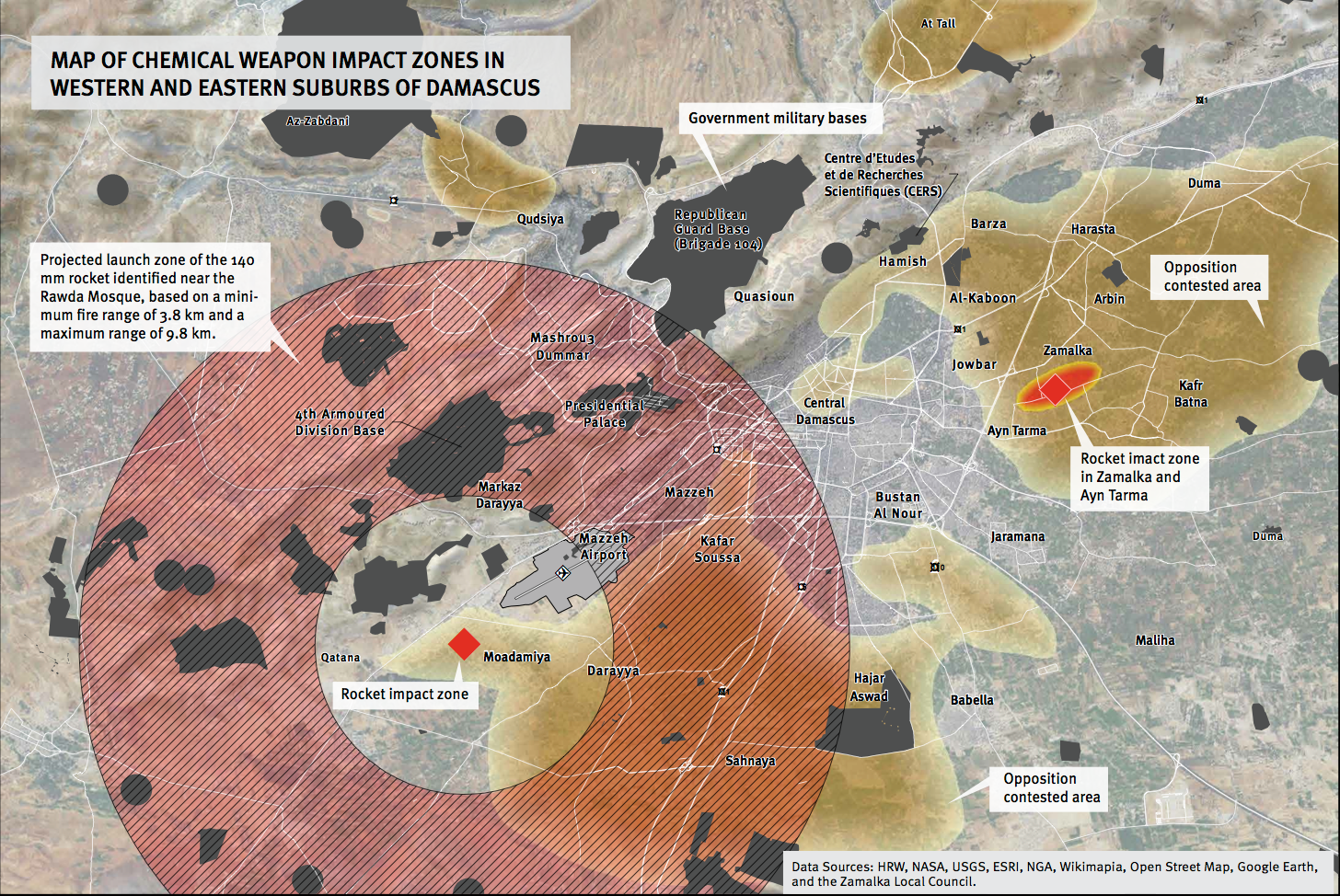
Attacks on Ghoutta (22 pp) analyses the chemical weapons attacks on the suburbs of Ghoutta on 21 August 2013.  Here is the Executive Summary:

This report details two alleged chemical weapons attacks in Syria on the opposition-controlled Damascus suburbs of Eastern and Western Ghouta, located 16 kilometers apart, on the morning of August 21, 2013. The attacks killed hundreds of civilians, including large numbers of children. Human Rights Watch analyzed witness accounts of the rocket attacks, information on the likely source of the attacks, the physical remnants of the weapon systems used, and the medical symptoms exhibited by the victims of the attack as documented by medical staff.

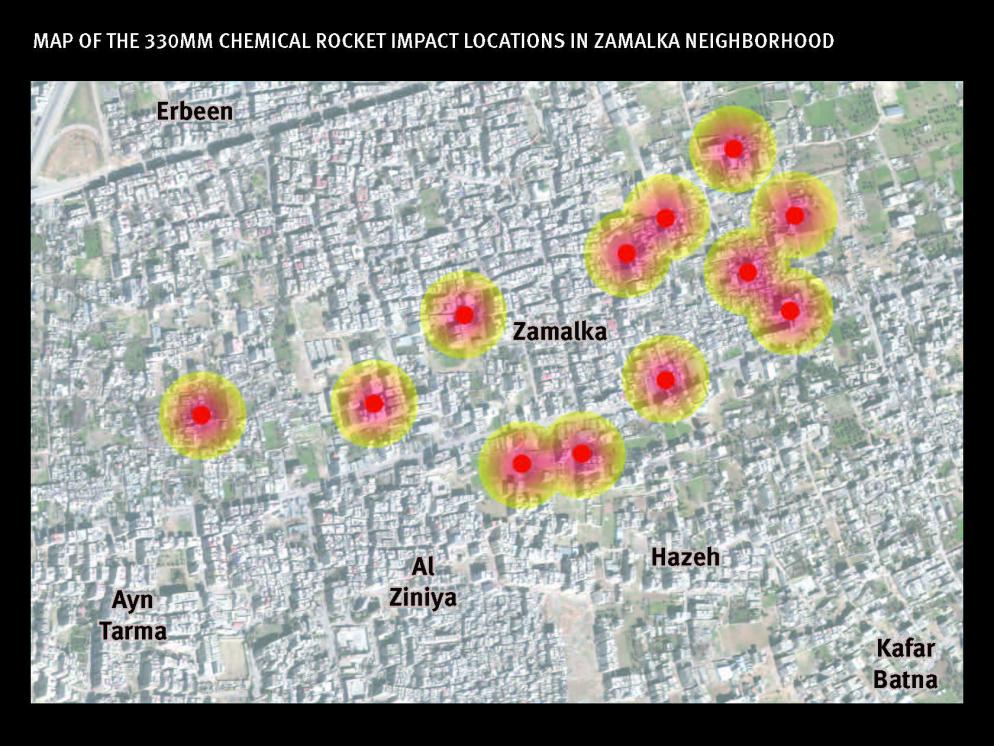
zamalaka_mapOur investigation finds that the August 21 attacks were likely chemical weapons attacks using a surface-to-surface rocket system of approximately 330mm in diameter—likely  Syrian-produced—and a Soviet-era 140mm surface-to-surface rocket system to deliver a nerve agent. Evidence suggests the agent was most likely Sarin or a similar weapons-grade nerve agent. Three local doctors told Human Rights Watch that victims of the attacks showed symptoms which are consistent with exposure to nerve gas, including suffocation; constricted, irregular, and infrequent breathing; involuntary muscle spasms; nausea; frothing at the mouth; fluid coming out of noses and eyes; convulsing; dizziness; blurred vision; and red and irritated eyes, and pin-point pupils.

The evidence concerning the type of rockets and launchers used in these attacks strongly suggests that these are weapon systems known and documented to be only in the possession of, and used by, Syrian government armed forces. Human Rights Watch and arms experts monitoring the use of weaponry in Syria have not documented Syrian opposition forces to be in the possession of the 140mm and 330mm rockets used in the attack, or their associated launchers.

The Syrian government has denied its responsibility for the attack, and has blamed opposition groups, but has presented no evidence to back up its claims. Based on the available evidence, Human Rights Watch finds that Syrian government forces were almost certainly responsible for the August 21 attacks, and that a weapons-grade nerve agent was delivered during the attack using specially designed rocket delivery systems. The scale and coordinated nature of the two attacks; against opposition-held areas; the presence of government-controlled potential launching sites within range of the targets; the pattern of other recent alleged chemical weapon attacks against opposition-held areas using the same 330mm rocket delivery system; and the documented possession of the 140mm and 330mm rocket systems able to deliver chemical weapons in the government arsenal—all point towards Syrian government responsibility for the attacks.

Human Rights Watch has investigated alternative claims that opposition forces themselves were responsible for the August 21 attacks, and has found such claims lacking in credibility and inconsistent with the evidence found at the scene. Claims that the August 21 deaths were caused by an accidental explosion by opposition forces mishandling chemical weapons in their possession are inconsistent with large numbers of deaths at two locations 16 kilometers apart, and documentation of rocket attacks on the sites that morning, as evidenced by witness accounts, the damage visible on the rockets themselves, and their impact craters.

Chemical weapon impact zones, Ghoutta (HRW)

Three quick observations.

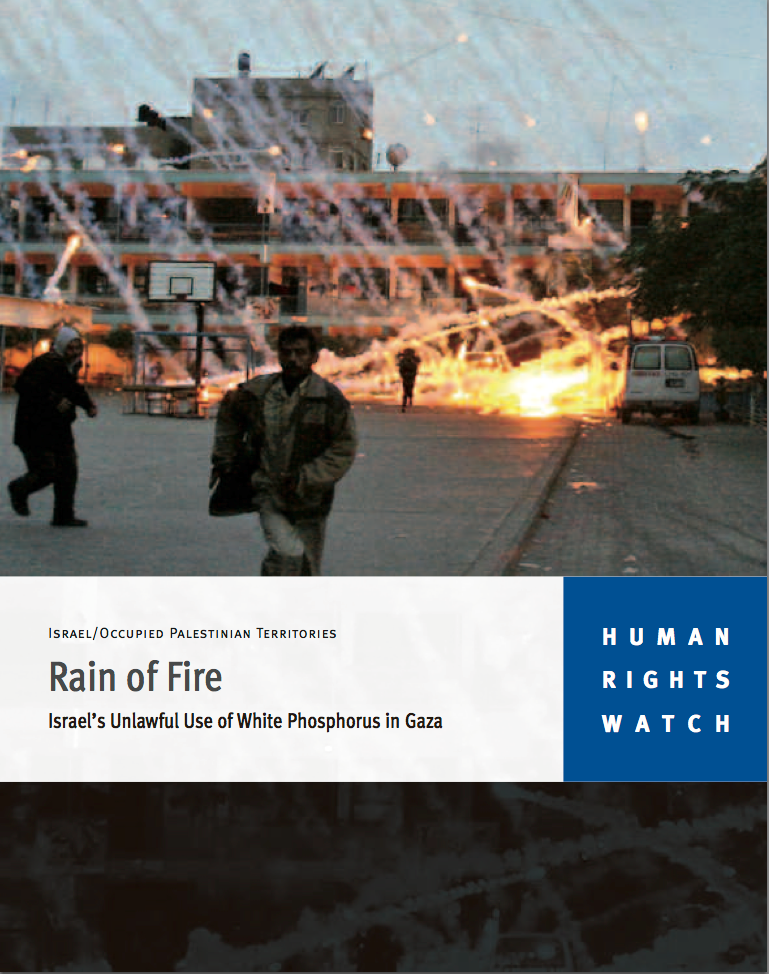
HRW Rain of FireHRW used a range of sources to conduct its analysis-from-a-distance, including Skype interviews, video and photographic footage, and satellite imagery, and consulted with scientific experts on chemical warfare, key analysts from its own Arms Division and independent arms experts. I rehearse all this because when HRW carried out its searching analysis of the unlawful use of white phosphorus by the Israel Defense Force in Gaza, Rain of Fire, a forensic analysis that was cited multiple times in the Goldstone report, the defenders of the IDF (there’s a phrase) unleashed a desperate campaign to discredit HRW’s expert Marc Garlasco.  You can find a discussion in Eyal Weizman‘s The least of all possible evils (see also here). This time round, of course, the government of Israel has joined the (I think convincing) chorus identifying the Syrian Army as the culprits: but it will be interesting to see whether it has also been magically converted to the propriety of HRW’s forensic analysis.

I link the two reports for a second reason, which is the disgracefully selective and self-serving nature of the ‘humanitarian’ condemnation of chemical weapons.  Here is President Obama speaking yesterday:

‘…the world saw in gruesome detail the terrible nature of chemical weapons, and why the overwhelming majority of humanity has declared them off-limits — a crime against humanity, and a violation of the laws of war.’

He conceded that this wasn’t always the case:

‘In World War I, American GIs were among the many thousands killed by deadly gas in the trenches of Europe. In World War II, the Nazis used gas to inflict the horror of the Holocaust. Because these weapons can kill on a mass scale, with no distinction between soldier and infant, the civilized world has spent a century working to ban them. And in 1997, the United States Senate overwhelmingly approved an international agreement prohibiting the use of chemical weapons, now joined by 189 governments that represent 98 percent of humanity.

On August 21st, these basic rules were violated, along with our sense of common humanity.’

But what a selective mobilisation of history, in which the US rises from victim to saviour.  Now I agree that the use of chemical weapons in Syria is vile – but so too was  Israel’s use of white phosphorus in Gaza ( in the same speech Obama reaffirmed the US’s “unshakable support” for Israel), the US-led coalition’s use of depleted uranium munitions in Iraq (which goes back to 1991; see also Omar Dewachi on ‘the toxicity of everyday life’ here), Iraq’s use of nerve gas against Iran in 1988 (in which we now have proof that the US was complicit), the US deployment of chemical herbicides in Vietnam, Laos and Cambodia… the list goes on and on.

And this brings me to my third (no less obvious) observation: showing who used chemical weapons is a far cry from knowing what to do about it – especially when the network of responsibility and complicity is so hideously extensive.

***

Update: I’ve been so busy trying to finish two desperately overdue essays and to prepare for the start of a new term (I’ve posted the new outlines for my undergraduate and graduate courses under the TEACHING tab) that I haven’t had a chance to return to my reading of Théorie du drone, but I’m determined to do so very soon.

Deconstruction on the map

There have been many maps tracking the course of military and paramilitary violence in Syria.  They include general ‘situation maps’ like this one from Canada’s National Post early last year (and whatever I think about the politics of the paper, its graphics are often outstanding):

National Post 13 January 2012

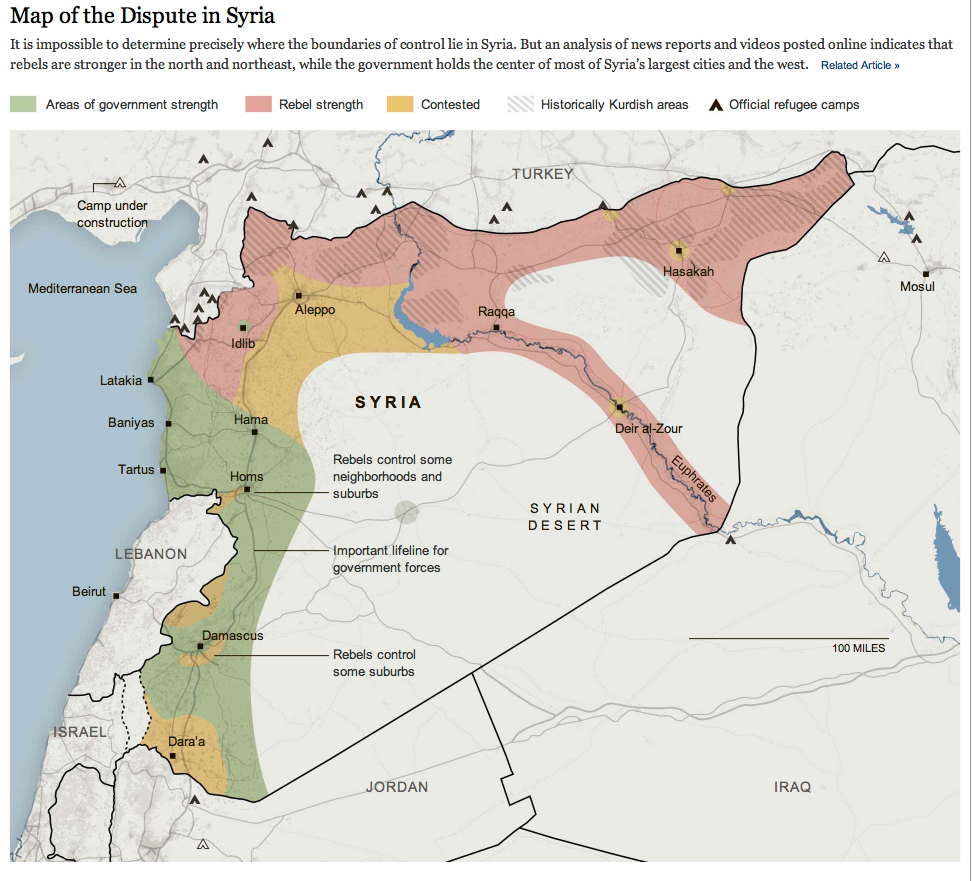
Or this one from the New York Times on 12 March 2013 (and, as Brian Harley would have been the first to remind us, the very titles of the maps tell their own stories of uncertainty, sympathy and affiliation: but ‘Map of the dispute in Syria’?  I understand ‘conflict’, ‘civil war’, ‘uprising’ – but ‘dispute‘?!).

Map of the dispute in Syria NYT

Other sites have tried to capture the fluidity of the situation through a series of updated though largely conventional maps, like Political Geography Now‘s maps of ‘rebel activity’ here and a very different, quite remarkable series of ‘military maps’ here (though as far as I can see no information on sources is provided).  The BBC‘s ‘Mapping the Conflict’ interactive is here and its earlier attempts at ‘Mapping the Insurgency’ are here.  Relief Web‘s bi-weekly mapped updates on the refugee crisis are all here.

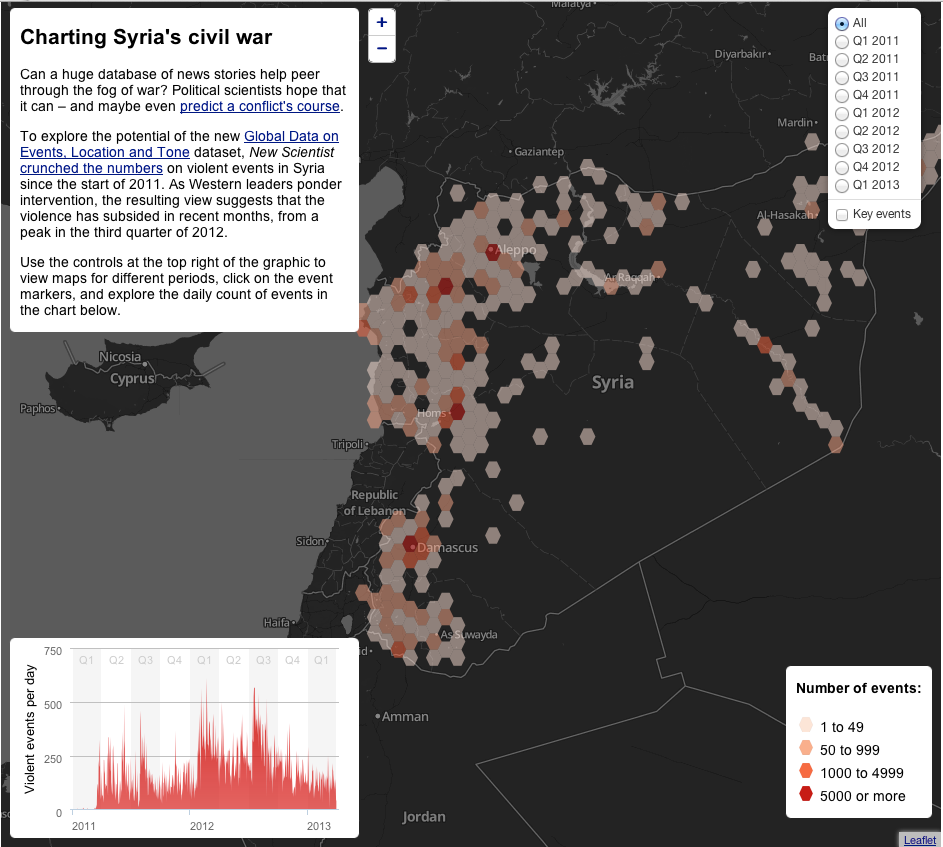
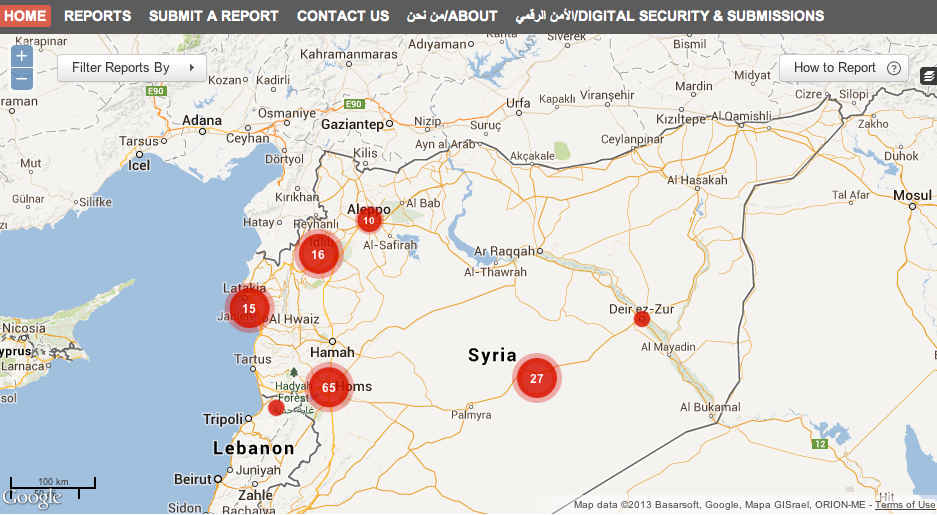
Some of the most imaginative crowd-sourced maps are provided by Syria Tracker here (and more on the project’s data mining and crowd sourcing from iRevolution here). One of the most ambitious interactive projects, reported by the Guardian and master-minded by the New Scientist, is this one, which uses the open-source QGIS to extract and locate violent events recorded on the new Global Data on Events, Location and Tone database (though, for reasons that will be obvious to most geographers, the hexagons give me another pause for unquiet thought); you can access the interactive via the NS here:

NS Charting Syria's Civil War

All of these maps suffer from inevitable imperfections and deficiencies of data, and they all process and manipulate what they have in different ways (not least by the boundaries they draw around their maps: see this more porous map of the internationalization of the war from Foreign Policy).

We all surely know that none of these representations can be innocent – which brings me to other, more specific mapping projects, like this crowd-sourced map of rape as a military weapon from Women under siege; the live, interactive map is here.

Sexualized violence in Syria

You can find a detailed discussion of the project up to July 2012 by the project’s director Lauren Wolfe here (and an excellent interview here):

‘To step back from the red dots on our map and try to understand the sexualized violence of Syria’s war, our team of doctors, activists, and journalists has taken the 81 stories we’ve gathered so far, from the onset of the conflict in March 2011 through June 2012… Many more victims are included in these reports, but the vagueness of much of the information does not allow us to give an estimate of the total number…. Our data, though largely anecdotal, gives us a sense of the scope and impact of sexualized violence in Syria. It appears to be widespread, not limited to any particular city, and often involves rape.

“The data we have so far suggest sexualized violence is being used as a tool of war, although possibly haphazardly and not necessarily as an organized strategy,” said Dr. Karestan Koenen, associate professor of epidemiology at the Mailman School of Public Health at Columbia University and the lead epidemiologist on the mapping project. “These reports indicate that post-conflict intervention will need to address the consequences of sexualized violence for victims.”

More on that and the possibilities of what we might call forensic cartography from Laura Bates at Open Democracy here:

The crowdmap may serve another vital function in the future, when the information might be used to help drive prosecutions and bring perpetrators to justice. Wolfe hopes that collecting these reports now will give us a base from which to pursue more detailed investigations on the ground post-conflict “to turn our documentation into evidence that could be used in future war crimes trials”. This is vital when dealing with a crime which carries so much stigma that “stories are usually gathered after the fact, when much has been lost to shame and the destruction of evidence.”

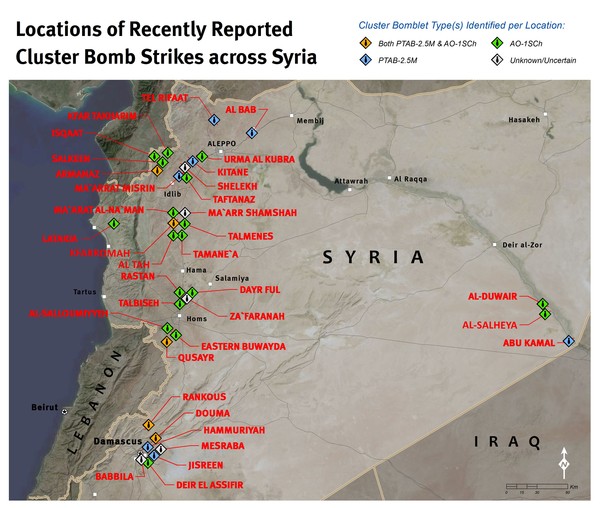
Another potential instance of forensic cartography is this map from Human Rights Watch of sites where, despite denials by the Syrian Army, there is evidence of cluster bombs being used (more here):

2012MENA_Syria_Clusters_Map_1022-1

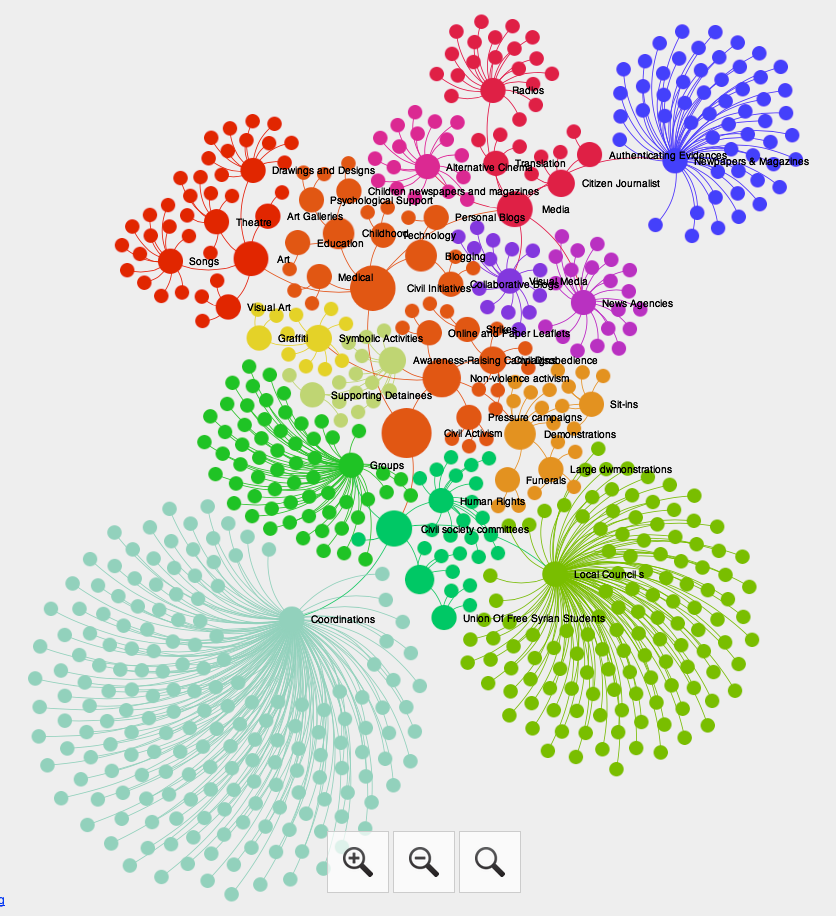
Apart from the forensic possibilities, all of this must seem desperately depressing – so many violent deconstructions of the material map – but a Syrian activist, Omar al Assil, has produced a map (of sorts – it’s a web of associations, technically a force-directed graph: plotting physical locations of activists would obviously be inviting reprisals) of non-violent activism in Syria; you can read about it courtesy of Amnesty International here and check out the interactive here.  Incidentally, unless it’s a temporary glitch, Amnesty’s own Eyes on Syria project seems to have shut both of them…

Non-violence map of the Syrian uprising

 “In the [Syria Non-Violence Movement] we believe that there is still a room for peaceful struggle and creativity amid all this chaos. Many people thought that the non-violence came to an end and this is a small step to show them that it is still there and they are using it or working with it on daily basis. So mainly it was to motivate people and the other aim is to document all these activities so interested people can have access to it easily.”

Taken together, these last maps say something about the courage of people’s convictions – and perhaps even the (I fear faint) possibility of cartographic convictions.