Theory of the drone 3: Killing grounds

This is the third in a series of posts on Grégoire Chamayou‘s Théorie du drone, in which I provide a detailed summary of his argument, links to some of his key sources, and reflections drawn from my soon-to-be-completed The everywhere war (and I promise to return to it as soon as I’ve finished this marathon).

5: Pattern of life analysis

Chamayou begins with the so-called ‘Terror Tuesdays‘ when President Obama regularly approves the ‘kill list’ (or disposition matrix) that authorises ‘personality strikes’ against named individuals: ‘the drones take care of the rest’.

a0018519784_2

But Chamayou immediately acknowledges that most strikes are ‘signature strikes‘ against individuals whose names are unknown but for whom a ‘pattern of life analysis‘ has supposedly detected persistent anomalies in normal rhythms of activity, which are read as signs (‘signatures’) of imminent threat.  I’ve described this as a militarized rhthmanalysis, even a weaponized time-geography, in ‘From a view to a kill’ (DOWNLOADS tab), and Chamayou also notes the conjunction of human geography and social analysis to produce a forensic mapping whose politico-epistemological status is far from secure.

The principal limitation – and the grave danger – lies in mistaking form for substance.  Image-streams are too imprecise and monotonic to allow for  fine-grained interpretation, Chamayou argues, and supplementing them by equally distant measures, like telephone contacts, often compounds the problem.  Hence Gareth Porter‘s objection, which both Chamayou and I fasten upon:

‘The phone numbers and call histories from those phones go into the database which is used to “map the networks.” But the link analysis methodology employed by intelligence analysis is incapable of qualitative distinctions among relationships depicted on their maps of links among “nodes.” It operates exclusively on quantitative data – in this case, the number of phone calls to or visits made to an existing JPEL target or to other numbers in touch with that target. The inevitable result is that more numbers of phones held by civilian noncombatants show up on the charts of insurgent networks. If the phone records show multiple links to numbers already on the “kill/capture” list, the individual is likely to be added to the list.’

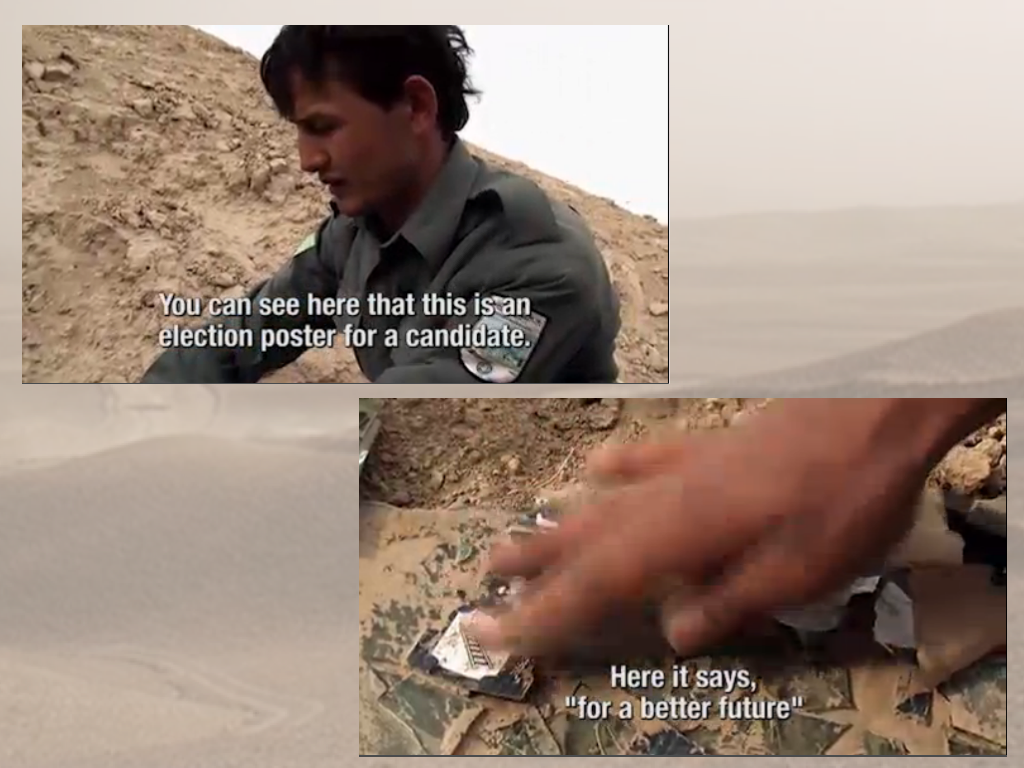
This is exactly what happened in the Takhar attack in Afghanistan on 2 September 2010 that I’ve discussed elsewhere, relying on the fine investigative work of Kate Clark, and Chamayou draws attention to it too.   The general assumption, as Kate was told by one officer, seems to be that ‘”If we decide he’s a bad person, the people with him are also bad.”
Takhar For a better future.001

These necro-methodologies raise two questions that Chamayou doesn’t address here.

The first, as Porter notes, is that ‘guilt by association’ is ‘clearly at odds with the criteria used in [international] humanitarian law to distinguish between combatants and civilians.’  You can find a much more detailed assessment of the legality of signature strikes (and what he calls their ‘evidential adequacy’)  in Kevin Jon Heller‘s fine essay, ”One hell of a killing machine”: Signature strikes and international law’ [Journal of international criminal justice 11 (2013) 89-119; I discussed a pre-publication version here].

The geo-legal ramifications of these attacks reach far beyond the killing grounds.  Earlier this month in the High Court in London one man who lost five relatives in the air strike in Takhar (as you can see on the slide above, on an election convoy) challenged the legality of the alleged involvement of Britain’s Serious and Organised Crimes Agency (SOCA) in drawing up the kill-list, the Joint Prioritized Effects List, used by the military to authorise the attack: more herehere and here. (It was the presence of names on the list that triggered the faulty network analysis).

The second is the imaginary conjured up by the very idea of a ‘pattern of life’ analysis.  I’ve written before about the way in which the screen on which the full-motion video feeds from the Predators and Reapers are displayed interpellates those who watch what is happening on the ground from thousands of miles away, and I’ve emphasised that this isn’t a purely optical affair:  that it is an embodied, techno-culturally mediated process that involves a series of structured dispositions to view the other as Other (and often dangerous Other).   But these dispositions also reside in what we might think of as a grammar of execution.  To see what I mean, here is Micah Zenko:

‘Recently, I spoke to a military official with extensive and wide-ranging experience in the special operations world, and who has had direct exposure to the targeted killing program. To emphasize how easy targeted killings by special operations forces or drones has become, this official flicked his hand back over and over, stating: “It really is like swatting flies. We can do it forever easily and you feel nothing. But how often do you really think about killing a fly?”’

Hence, of course, ‘Bugsplat’ [according to Rolling Stone, ‘the military slang for a man killed by a drone strike is “bug splat,” since viewing the body through a grainy-green video image gives the sense of an insect being crushed’], and a host of other predatory terms (see also here) that distinguish between this mere (bare) life and what Judith Butler calls ‘a life that qualifies for recognition’.
state-violence-and-the-execution-of-lawBut the same result is achieved through the nominally neutral, technical-scientific vocabulary deployed in these strikes. Joseph Pugliese captures the grammar of execution with acute insight in another fine essay, ‘Prosthetics of law and the anomic violence of drones’, [Griffith Law Review 20 (4) (2011) 931-961; you can also find it in his excellent new book State violence and the execution of law]:

‘The term ‘heat signature’ works to reduce the targeted human body to an anonymous heat-emitting entity that merely radiates signs of life. This clinical process of reducing human subjects to purely biological categories of radiant life is further elaborated by the US military’s use of the term ‘pattern of life’…

‘The military term ‘pattern of life’ is inscribed with two intertwined systems of scientific conceptuality: algorithmic and biological. The human subject detected by drone’s surveillance cameras is, in the first scientific schema, transmuted algorithmically into a patterned sequence of numerals: the digital code of ones and zeros. Converted into digital data coded as a ‘pattern of life’, the targeted human subject is reduced to an anonymous simulacrum that flickers across the screen and that can effectively be liquidated into a ‘pattern of death’ with the swivel of a joystick. Viewed through the scientific gaze of clinical biology, ‘pattern of life’ connects the drone’s scanning technologies to the discourse of an instrumentalist science, its constitutive gaze of objectifying detachment and its production of exterminatory violence. Patterns of life are what are discovered and analysed in the Petri dish of the laboratory…

‘Analogically, the human subjects targeted as suspect yet anonymous ‘patterns of life’ by the drones become equivalent to forms of pathogenic life. The operators of the drones’ exterminatory attacks must, in effect, be seen to conduct a type of scientific ethnic cleansing of pathogenic ‘life forms’. In the words of one US military officer: “Our major role is to sanitize the battlefield.”’

Later modern war more generally works through relays of biological-medical metaphors – equally obviously in counterinsurgency, as I’ve described in “Seeing Red” and other essays (DOWNLOADS tab), where the collective enemy becomes a ‘cancer’ that can only be removed by a therapeutic ‘killing to make live’ (including ‘surgical strikes’) – and Colleen Bell has provided an illuminating series of reflections in ‘Hybrid warfare and its metaphors’ [in Humanity 3 (2) (2012) 225-247] and ‘War and the allegory of medical intervention’ [International Political Sociology 6 (3) (2012) 325-8].

This immunitary logic is clearly bio-political, and its speech-acts just as plainly performative, and Pugliese draws the vital conclusion:

‘As mere patterns of pathogenic life, these targeted human subjects effectively are reduced to what Giorgio Agamben would term ‘a kind of absolute biopolitical substance’ that can killed with no concern about the possibility of juridical accountability: they are ‘bare life’ that can be killed with absolute impunity. Anonymous ‘patterns of life’ signify in contradistinction to legally named persons; they exemplify the ‘ontological hygiene’ legislated by US government policy in order to secure the reproduction of the ‘principle of scarcity with respect to agency and personhood’.

‘Situated in this Agambenian context of the extermination of human life with absolute impunity, the Predator drones must be seen as instantiating mobile ‘zones of exception’…’

Which artfully brings me to Chamayou’s next chapter…

6: Kill-box

Chamayou notes that the ‘war on terror’ loosed the dogs of war from their traditional boundaries in time and in space: at once ‘permanent war’ and, as he notes, ‘everywhere war’.

But for Chamayou it is more accurate to speak of the world turned into a ‘hunting ground’ rather than a battlefield, and this matters because two different geographies (his term) are involved.  War is defined by combat, he explains, hunting by pursuit.  Combat happens where opposing forces engage, but hunting tracks the prey, so that the place of military violence is no longer defined by a delimited space (‘the battlefield’) but by the presence of the enemy-prey who carries with him, as it were, his own mobile halo of a zone of personal hostilities.

To escape, the quarry must make itself undetectable or inaccessible – and the ability to do so depends not only on physical geography (terrain) but also on political and legal geography.  For this reason, Chamayou argues, the US has rendered contingent the sovereignty of Pakistan because it (for the most part unwillingly) provides sanctuary to those fleeing across the border from Afghanistan.  In such circumstances, what becomes crucial for the hunter is not the military occupation of territory but the ability to control trans-border spaces from a distance through the instantiation of what Eyal Weizman called the politics of verticality that has since captured the attention of Stuart Elden [“Secure the volume: vertical geopolitics and the depth of power”, Political Geography 34 (2013) 35-51], Steve Graham [“Vertical geopolitics: Baghdad and after”, Antipode 36 (1) (2004) 12-23] and others.  For this to work, as Weizman shows in the case of occupied Palestine, air power is indispensable.

Chamayou suggests that the US has refined this capacity – in effect, finely calibrated the time and space of the hunt – through the concept of the kill-box.  I’m not so sure about this; the lineage of the ‘kill-box’ goes back to the USAF’s ‘target boxes’ [target boxes around An Loc in Vietnam in 1972 are shown below] – and two or three specified ‘boxes’ or ‘Restricted Operating Zones‘ were used to define the Predato’s’  ‘hunting grounds’ over North and South Waziristan that were tacitly endorsed by the Pakistan state.
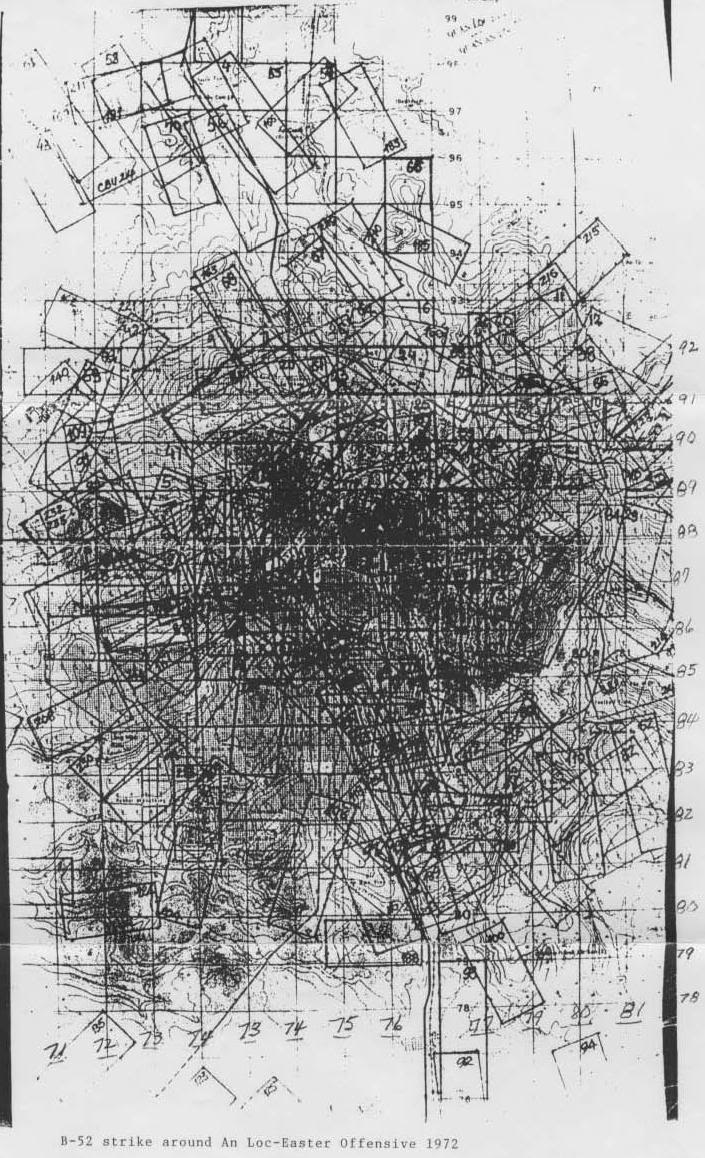
Target boxes around An Loc 1972

The concept of the ‘kill box’ was formalised as a joint operations doctrine in the 1990s as part of the established targeting cycle: what Henry Nash famously described in another context as ‘the bureaucratization of homicide’.  Nash worked for the USAF Air Targets Division in the 1950s and 60s, identifying targets in the USSR for nuclear attack by US Strategic Air Command, but I doubt that Chamayou would dissent from using either the verb or the noun to describe the contemporary, non-nuclear kill-chain.  (In a later post I’ll explain how this technical division of labour feeds in to what Chamayou castigates as a ‘setting aside’, a dispersal of responsibility, which functions to separate an action from its consequences: this is aggravated by the remote-split operations in which drones are embedded, and is central to Chamayou’s critique).  Here is how the relevant military manuals incorporated the development of the kill box into the targeting cycle in 2009 (ATO = Air Tasking Order):
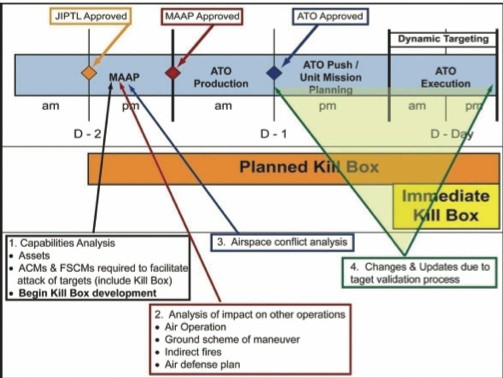
Kill Box Development

You can find more on kill-boxes and their operationalisation here.
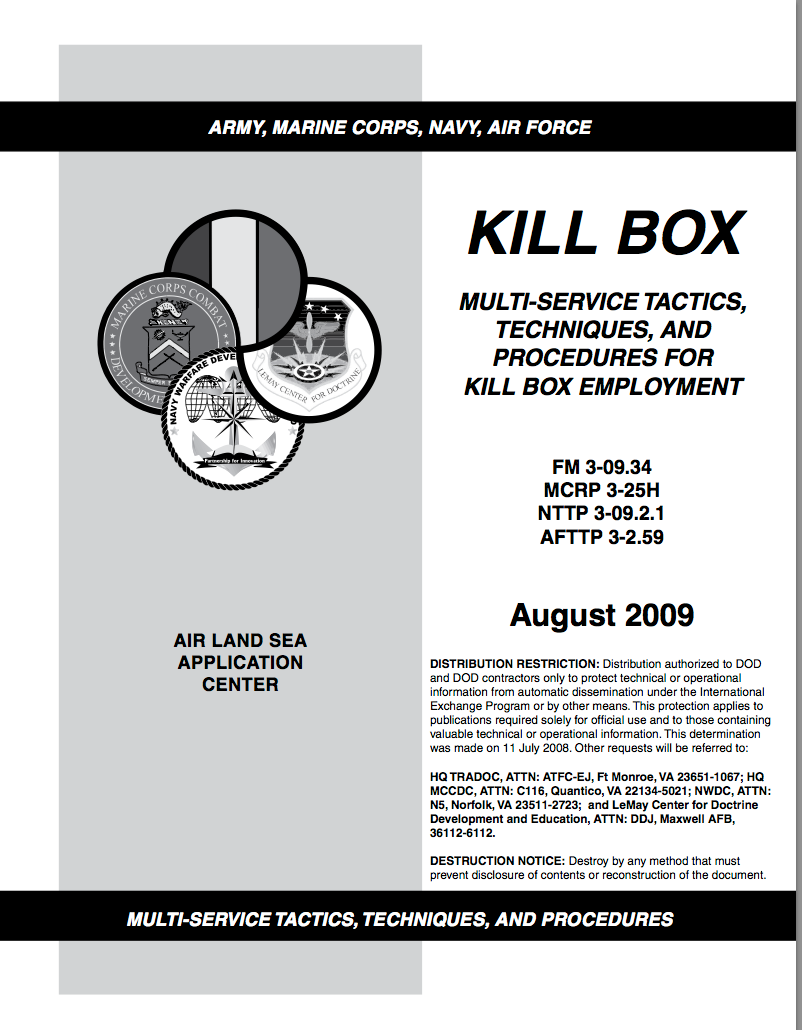
Kill Box TTP

Chamayou doesn’t track the development of the concept, but since then the ‘kill-box’ has been supplanted or at least supplemented by the ‘Joint Fires Area’ as a way of continuing to co-ordinate the deployment of lethal force and allowing targets to be engaged without additional communication.  Within the grid of the JFA (shown below, taken from an essay by Major James Mullin on ‘redefining the kill box’) permission to fire in specified cells is established in advance; areas are defined, targeting intervals stipulated, and the time-space cells can be opened and closed as operations proceed.

It is this capacity that Chamayou seizes upon: within the kill box targets can be engaged at will, so that the kill box, he writes, ‘is an autonomous zone of temporary killing’ (cf. the ‘free fire/specified fires zone’ in Vietnam: see my discussion of Fred Kaplan‘s recent essay, ‘The world as a free-fire zone‘).

3-D representation of Joint Fires Area using Global Area Reference System

Chamayou implies that the schema has been further refined in contemporary counterinsurgency and counter-terrorism operations: the fact that the kill-box and its successor allow for dynamic targeting across a series of scales is crucial, he says, because its improvisational, temporary nature permits targeting to be extended beyond a declared zone of conflict. The scale of the JFA telescopes down from the cell shown on the right of the figure below through the quadrant in the centre to the micro-scale ‘keypad’ (sic) on the right.

Global Area Reference System

This is more than a grid, though; the JFA is, in effect, a performative space that authorises, schedules and triggers lethal action.  Chamayou: ‘Temporary micro-cubes of lethal exception can be opened anywhere in the world, according to the contingencies of the moment, once an individual who qualifies as a legitimate target has been located.’  Thus, even as the target becomes ever more individuated – so precisely specified that air strikes no longer take the form of the area bombing of cities in World War II  or the carpet bombing of the rainforest of Vietnam – the hunting ground becomes, by virtue of the nature of the pursuit and the remote technology that activates the strike, global.

KAPLAN World as Free-Fire Zone

The system I’ve described here is one adopted by the US military, and how far its procedures are used by other agencies outside established conflict zones is unknown to me and doubtless to Chamayou too.  Are these micro-cells used to specify individual compounds or rooms, as Chamayou suggests in a thought-experiment?  For him, however, it’s the imperative logic that matters, and here Kaplan’s tag-line (above) can provide the key explanatory exhibit: ‘to kill a particular person anywhere on the planet.’   The doubled process of time-space calibration and individuation is what allows late modern war to become the everywhere (but, contra Kaplan,  not the anywhere, because specified) war.

On the one side, then, a principle of what Chamayou calls precision or specification:  ‘The zone of armed conflict, fragmented into micro-scale kill boxes, reduces itself in the ideal-typical case to the single body of the enemy-prey: the body as the field of battle.’  Yet on the other side, a principle of globalisation or homogenisation: ‘Because we can target our quarry with precision, the military and the CIA say in effect, we can strike them wherever we see fit, even outside a war zone.’

This paradoxical articulation has sparked fierce debates among legal scholars – Chamayou cites Kenneth Anderson, Michael Lewis, and Mary Ellen O’Connell – over whether the ‘zone of armed conflict’ should be geo-centred (as in the conventional battlefield) or target-centred (‘attached to the body of the enemy-prey’). Jurists are thus in the front line of the battle over the extension of the hunting ground, he writes, and ‘applied ontology’ is the ground on which they fight.  I’ll have more to say about this on my own account in a later post.
Drones and civilian casualties in Afghanistan

I’ve been urging for some time now that the debate over drone strikes must not neglect what has been happening in Afghanistan: hence “From a view to a kill” (DOWNLOADS tab) and the much longer version to appear in The everywhere war.  According to a report on the Guardian website posted late on Tuesday by the resourceful Spencer Ackerman, ex-Danger Room (now sadly itself an ex-site), ‘A study conducted by a US military adviser has found that drone strikes in Afghanistan during a year of the protracted conflict caused 10 times more civilian casualties than strikes by manned fighter aircraft.’  The period under analysis (from mid-2010 to mid-2011) followed a series of measures announced by General Stanley McChrystal to reduce civilian casualties from air operations, and coincided with a dramatic increase in the number of drone strikes (which continued to increase through 2012).

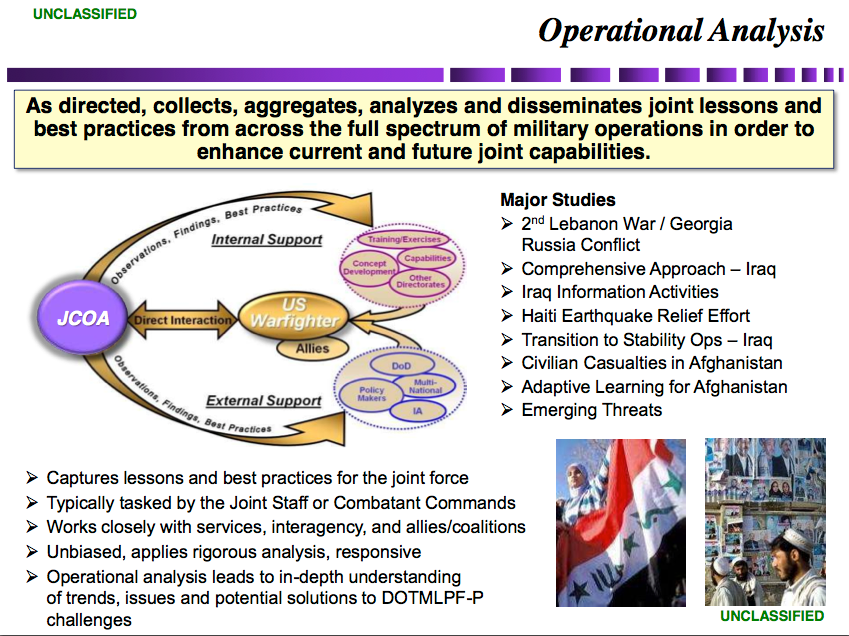
The study in question was carried out by Larry Lewis for the Joint Coalition and Operational Analysis (JCOA), a division of the Joint Staff J7 whose work is summarised in the following slide (which comes not from Edward Snowden‘s cache but from here):

JCOA

Notice ‘Civilian casualties in Afghanistan’ is #6 on the list of major studies.  The completed study is called Drone Strikes: Civilian Casualty Considerations and, apart from the Executive Summary that was published on 18 June, remains classified.  The opening paragraph is the primary source for Spencer’s story, and here it is:

‘The US government has described drone airstrikes in operations outside declared theaters of armed conflict as surgical and causing minimal civilian casualties. Analysis of air operations in Afghanistan, combined with a review of open-source reports for drone strikes in Pakistan, suggest that these fell short of intended goals. Specifically, drone strikes in Afghanistan were seen to have close to the same number of civilian casualties per incident as manned aircraft, and were an order of magnitude more likely to result in civilian casualties per engagement. Specific causal factors were identified that contributed to the relative propensity of drones to cause civilian casualties. Tailored training that addresses these causal factors could aid in reducing civilian casualties in engagements involving drones. While processes and operating forces in Afghanistan can differ from those in operations outside declared theaters of armed conflict, the factors above suggest that a dedicated analysis of civilian casualties in such operations would be worthwhile.’

The key sentence is in bold, and a version of it reappears in an essay, ‘Changing of the Guard: civilian protection for an evolving military’, that Lewis wrote with Sarah Holewinski, Executive Director of the Center for Civilians in Conflict and which appears in the latest issue of PRISM 4 (2) (2013), a journal of the Center for Complex Operations at the National Defense University (the press release from Civilians in Conflict is here).  The authors’ central concern is that ‘as Washington shifts its focus from counter-insurgency to counterterrorism, and from large-scale ground operations to more discrete and oftentimes-unmanned operations, the progress U.S. forces have made on preventing and mitigating civilian harm may soon be lost.’

They consider the risks attendant upon the increased reliance on Special Operations Forces – something that readers of Jeremy Scahill‘s Dirty Wars will need no warning of –  but also those that are likely to flow from an increased use of Unmanned Aerial Systems (UAS):

‘America’s use of force will increasing rely on new technologies, including air force capabilities to penetrate enemy defenses and strike over long distances. Unmanned Aerial Systems, sometimes referred to as “drones,” saw major use in Iraq and Afghanistan, and are slated for a big leap in funding. The Pentagon called for a nearly one-third increase in its fleet in the years ahead.

‘The use of UAS can have military advantages for avoiding civilian casualties in armed conflict, if used with that intent in mind. Their systems feature precision weapons, their sensors have increasingly high-resolution imagery to assess the ground situation, and back in the control room, trained imagery analysts scrutinize a target area prior to engaging, which isn’t always possible in a full ground operation.’

They list a series of familiar objections to the use of these remote platforms in areas outside ‘traditional combat theaters’, but they are also critical of  claims about their forensic capacity inside war-zones:

‘The assumption that UAS strikes are surgical in nature is … belied by research on recent combat operations in Afghanistan. There, UAS operations were statistically more likely to cause civilian casualties than were operations conducted by manned air platforms. One reason was limited training for UAS operators and analysts in how to minimize civilian harm. adding or improving training on civilian casualty prevention is a resource decision in direct tension with the increasing demand for more uaS and more operations, since additional training on civilian protection means time must be taken from somewhere else including the mission itself.’

They don’t say much about the reasons for this, except that they then criticise the ‘clandestine use of UAS by the US government’ because it raises ‘significant concerns that civilian casualties will not be properly monitored or investigated and thus called into question’ and then, several paragraphs later, they note that non-covert operations in Afghanistan ‘are replete with examples where all the engaged individuals were believed to be combatants, but a later investigation found many or all were civilians misidentified as combatants.’

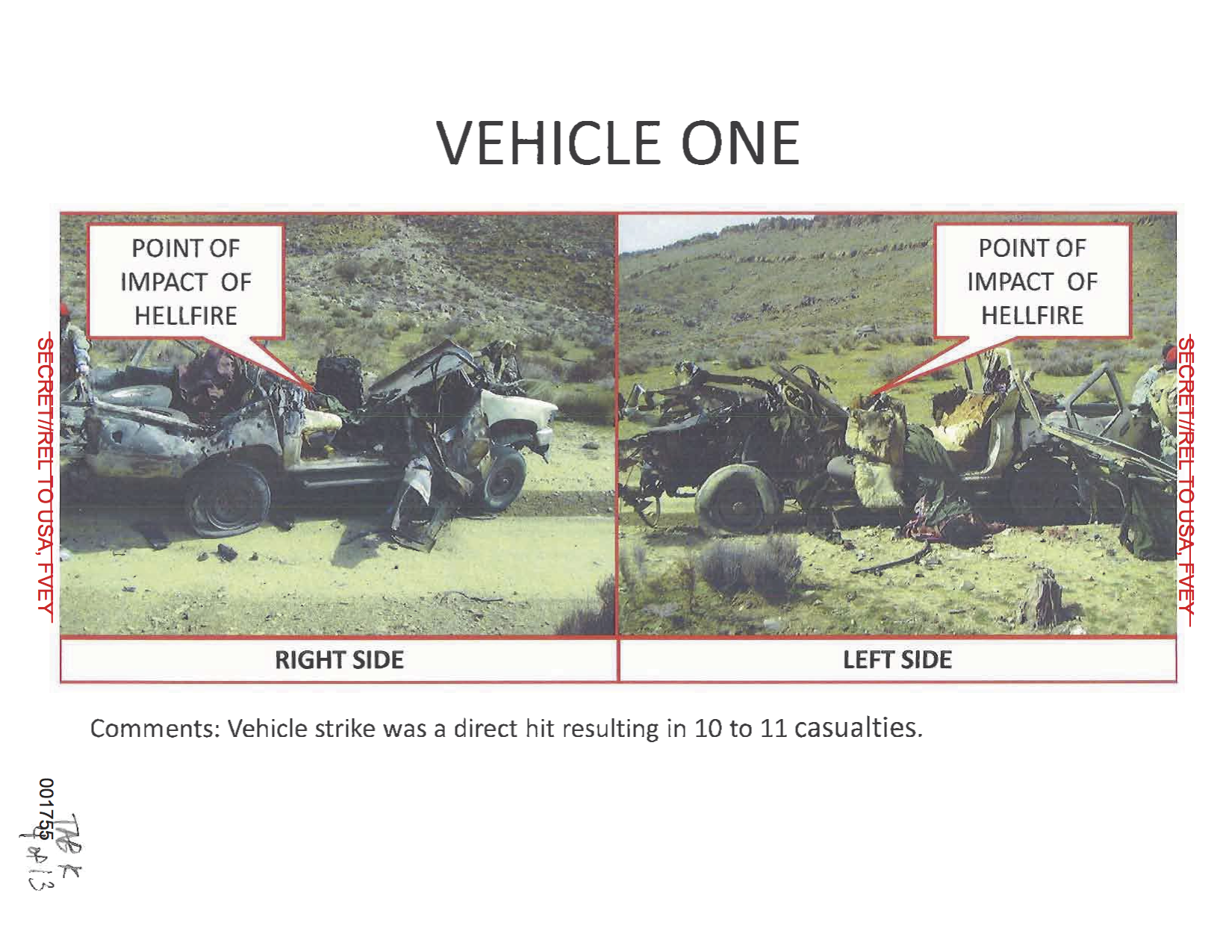
Attachment TAB A (Part 22 of 28) FOIA 10-0218 Uruzgan - Pages 1751-1800 (dragged) 1

A key issue, then appears to be misidentification, and in my examination of one hideous incident in Uruzgan province in Afghanistan in February 2010 (in “From a view to a kill”; see also the image above) – an analysis I develop in my more detail in The everywhere war – I suggested that the high-resolution video feeds from these remote platforms engender an intimacy with ground troops that belies the physical remoteness of the drone operators.  They routinely claim to be not 7,500 miles from the battlespace but just 18 inches – the distance from eye to screen – and this immersive capacity (which these feeds do indeed share with videogames) predisposes them to view virtually every proximate Afghan action as hostile:

‘… the greater incidence of civilian casualties when close air support is provided to ‘troops in contact’ may result not only from time-critical targeting and its correspondingly ‘fewer checks to determine if there is a civilian presence’ … but also from the persistent presence of the [UAS] and its video feeds immersing its remote operators in, and to some substantial degree rendering them responsible for the evolving situation on the ground. This predicament, in which proximity not distance becomes the problem, cannot be resolved by tinkering with the Rules of Engagement; high-resolution imagery is not a uniquely technical capacity but part of a techno-cultural system that renders ‘our’ space familiar even in ‘their’ space – which remains obdurately Other.’

I don’t know if this forms part of the classified report, of course, but in an earlier report, Reducing and mitigating civilian casualties: enduring lessons (dated April 2013) Lewis emphasised the importance of using ‘discrimination tools’ in ‘situations where forces need to discern whether an individual is demonstrating hostile intent’ – but what he seemed to have in mind was another technological fix, ‘higher-resolution imagery or night vision devices’, whereas the root of the problem may well not be the power to see but the capacity to make sense of what is seen.

In any event two other questions remain.

First, during the period under analysis drone strikes accounted for around 5 – 6 per cent of total weapon releases by all aircraft in Afghanistan, but many of the conventional strikes nevertheless relied on persistent surveillance of targets from Predators or Reapers and then attacks by helicopters or fighter-bombers (which was the case in the Uruzgan attack).  Does Lewis’s statistical analysis shed any light on the difference (I assume there is one) between a UAS acting as a ‘hunter-killer’ and a UAS providing only real-time ISR as part of a networked operation?

Second, what is the difference between ‘an incident’ and an ‘engagement’ in the first extract I’ve quoted?  This is a substantive issue of considerable moment: if drone strikes produce a roughly similar number of civilian casualties as conventional strike aircraft ‘per incident’ but ten times the number ‘per engagement’, it’s vital to know the difference. Protagonists of remote operations will undoubtedly seize on the first, critics on the second.

I’m trying to chase down the difference. To be continued…

Terror and terrain

Over at Space and Politics my friend and colleague Gaston Gordillo has a long post, ‘Opaque zones of empire’, in which he seeks to examine ‘the panoptic regime of hyper-visibility by focusing not on the prying cameras of drones and satellites but on the rugged topographies they permanently scrutinize; not on what the panoptic regime sees but on what it cannot see, or what it cannot see clearly.’

This is the paper he gave as part of the Space and Violence sessions at the Association of American Geographers conference in L.A. earlier this year, and it’s the draft of a longer article in progress.  It’s also a remarkably ambitious exercise, in which Gaston artfully tracks between Stuart Elden, Eyal Weizman, Henri Lefebvre, Alain Badiou, Allan Feldman and a host of others.

But it’s the conclusion that has given me most pause for thought.  Here Gaston conjures the opacity inherent in the three-dimensionality of terrain (the central concept in the essay) apprehended by military vision and violence:

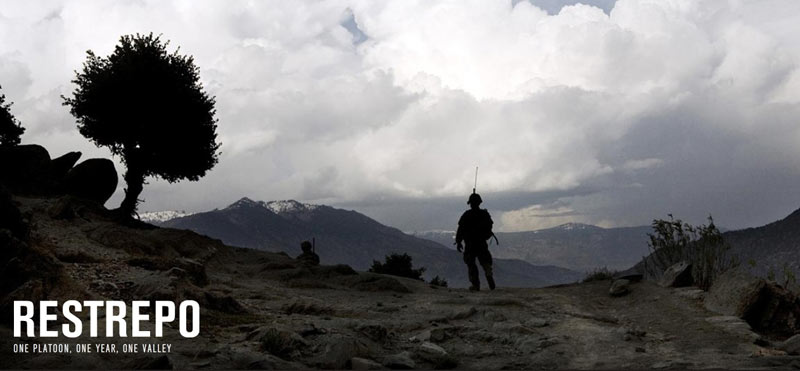
‘Badiou argues that the figure of the pure multiplicity of being, precisely because its multiplicity cannot be represented, is the void. The void is, indeed, the figure of the terrain. This void should be read not as an abstraction but in its spatial and bodily immanence: through the vertigo that the vast, opaque, three-dimensional, and not fully visible geographies of the planet create in the human body. This is the void graphically represented, for instance, on Tim Hetherington’s documentary Restrepo, where US soldiers stationed in an outpost in the Korengal Valley in eastern Afghanistan felt haunted by the terrain they were immersed in. In the film, those soldiers make it clear that those opaque mountains, forests, and valleys were for them a hostile immensity that turned insurgents into a ghostly presence. Those mountains constitute a tangible void within Empire: one of the countless outsides of a world without outside.

Restrepo

I’m particularly taken by this image (which I think is much clearer in the film than in Sebastian Junger‘s War) because it’s helped me think about how my work on ‘the natures of war’ intersects with my work on later modern war in the mountains of Afghanistan and Pakistan.

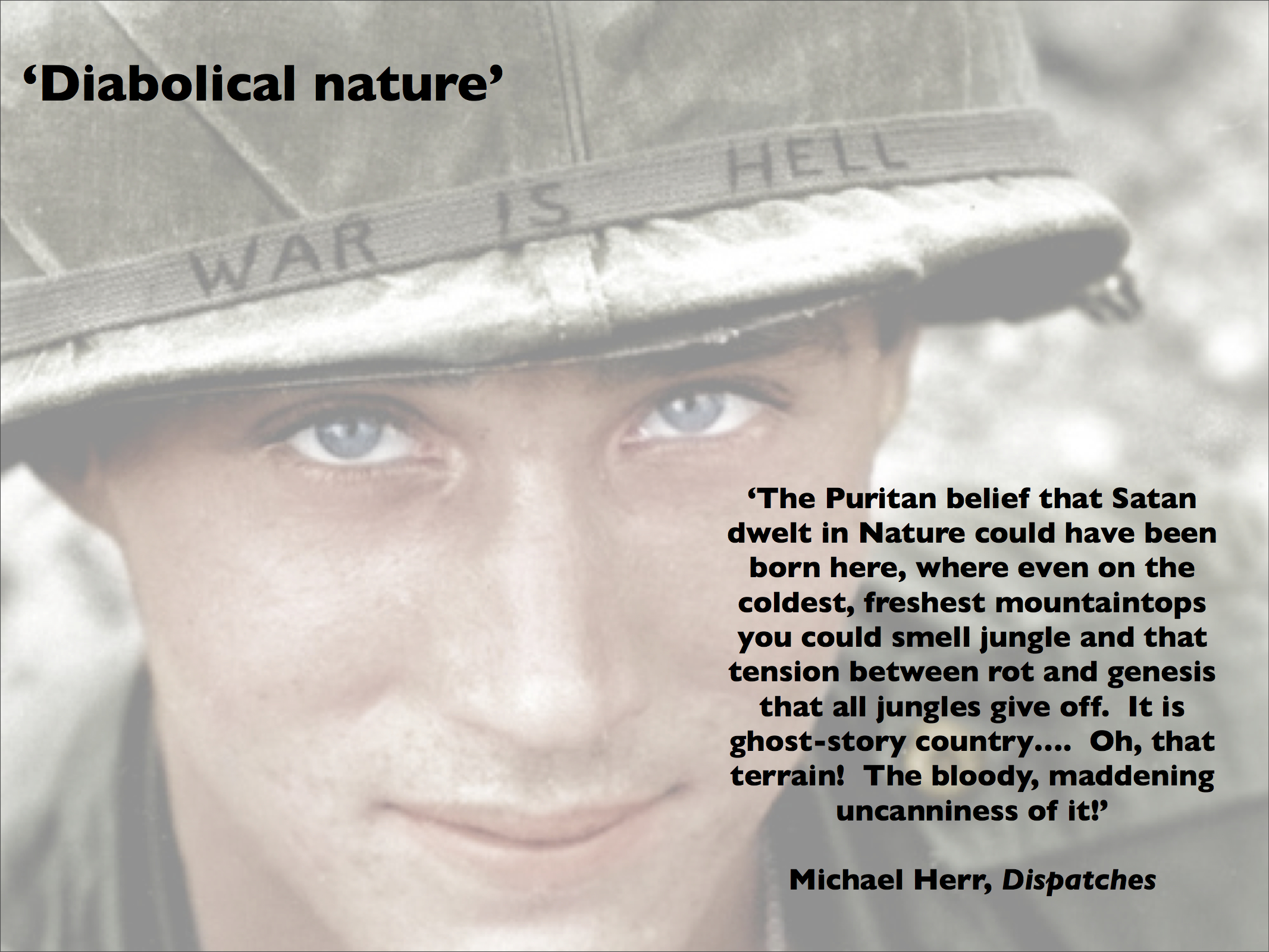
I only have room for one example.  To US infantry in the rainforest and highlands of Vietnam, terrain was not only (or even primarily) apprehended visually: in contrast to staff officers poring over maps and air photographs and to the crews of combat helicopters and strike aircraft flying over the jungle, terrain was made known – a knowledge that was always precarious, that could always become undone – through the body itself and all its senses, including hearing, touch and smell. Terrain is more than a visual construct, especially in its three-dimensionality, and there is nothing ‘dead, passive, fixed’ about it. Michael Herr captured something of what I have in mind in a passage that loops back to Gaston’s coda:

Diabolical nature

This unheimlich nature, ‘diabolical nature’ in what Gaston calls its ‘hostile immensity’, had a Janus-face.  On the one side it was a cyborg nature, no longer wholly ‘natural’ (even as the rainforest was rendered excessive or fallen through the standard tropes of tropicality) because it had been mined, booby-trapped and honeycombed with tunnels.  In The natures of war I develop this argument in more depth than I can here, in relation not only to the ‘jungle’ but also to the mud of the Western Front in World War I and to the sand and stone of the Western Desert in World War II, which both became cyborg natures or, if you prefer, techno-natures.  Here are two slides from that presentation, which summarise what I mean about the corporeality of knowledge and the techno-nature of the war in Vietnam:

Cyborg nature Vietnam


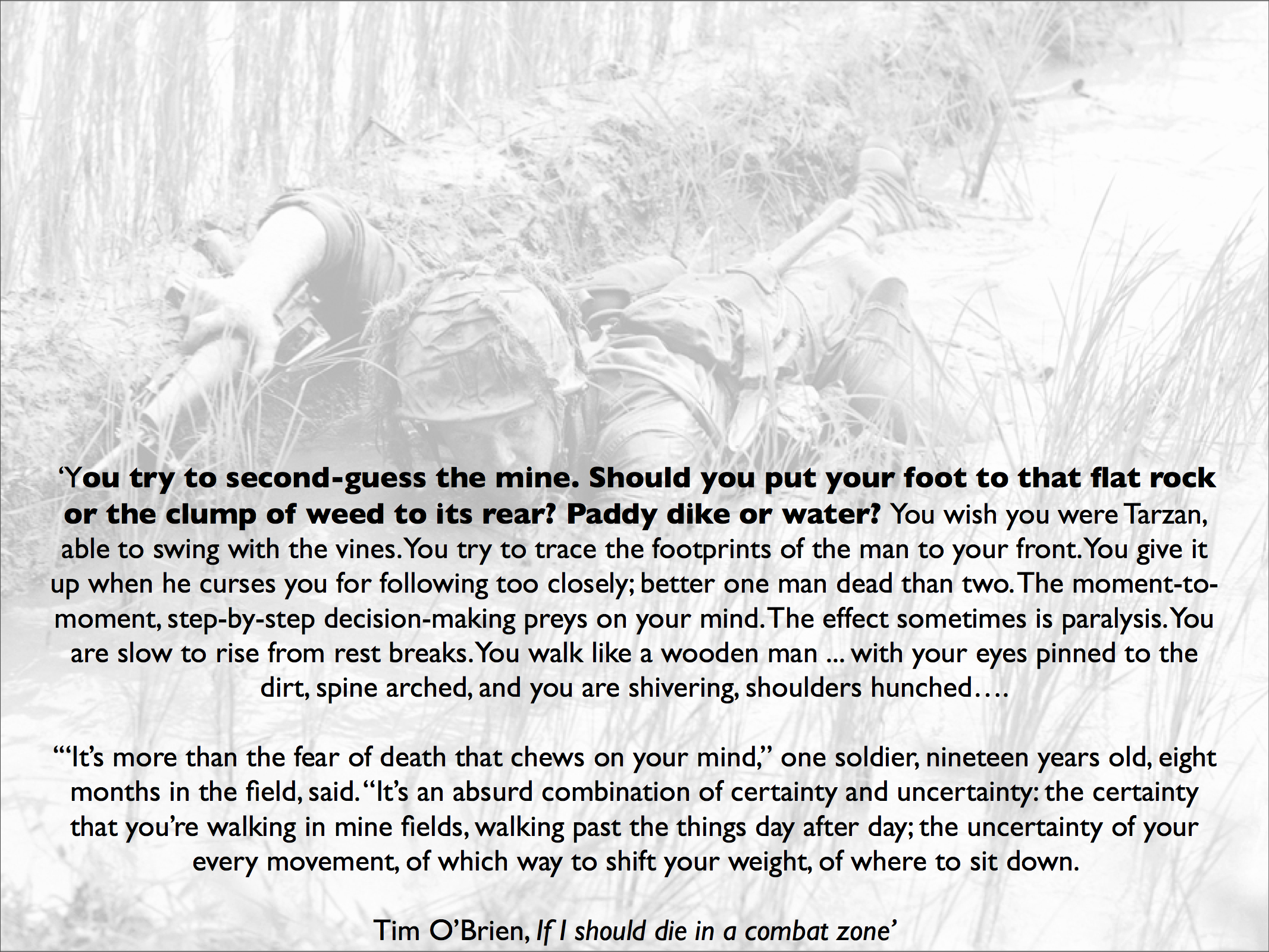
Certainty and uncertainty Vietnam

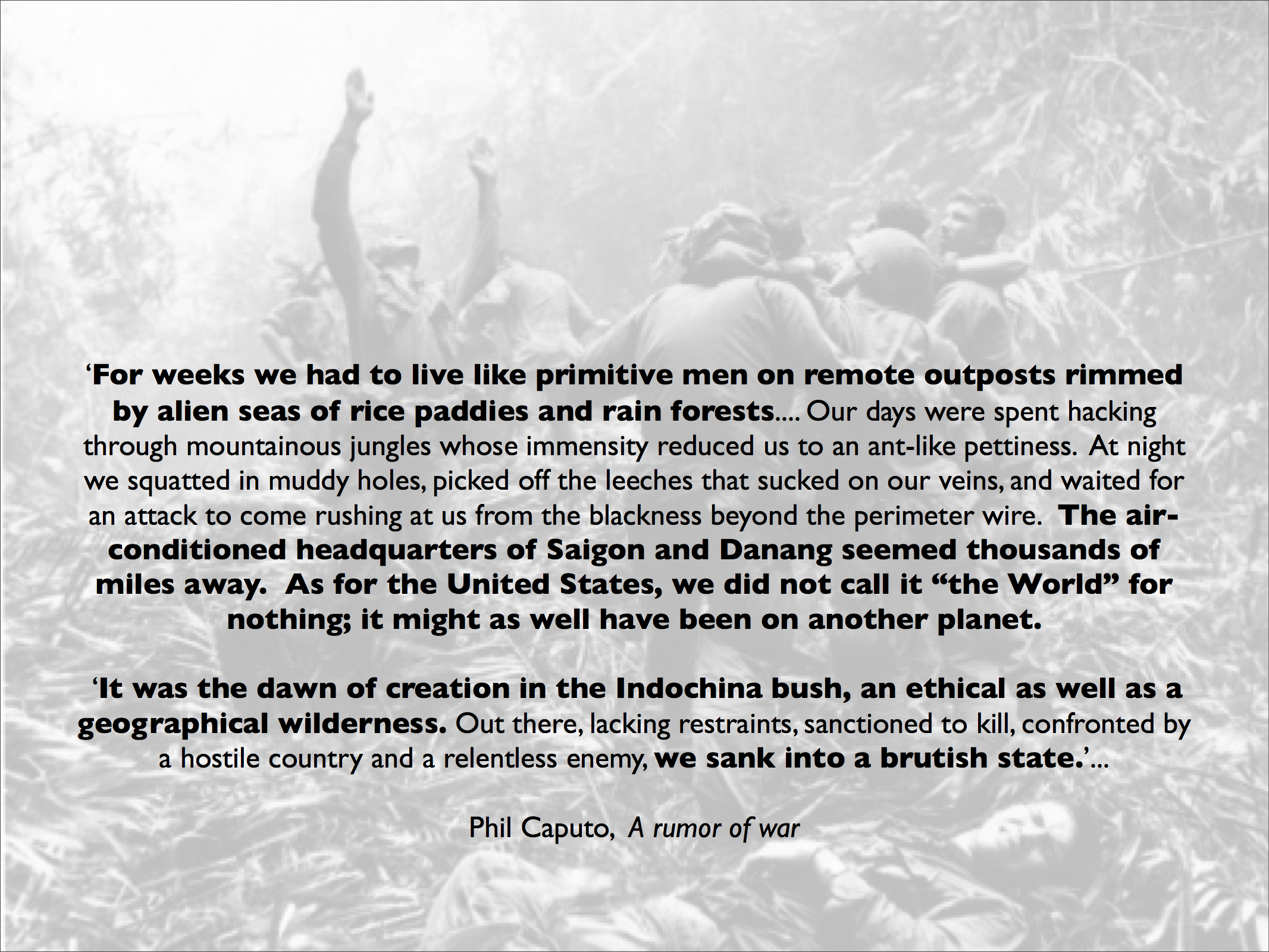
Yet on the other side there was also something exculpatory about it all.  Recalling a similar argument developed by Michael Taussig in a different context in Shamanism, colonialism and the wild man, here’s Philip Caputo again:

‘Scorched by the sun, wracked by the wind and rain of the monsoon, fighting in alien swamps and jungles, our humanity rubbed off of us as the protective bluing rubbed off the barrels of our rifles.We were fighting in the crudest kind of conflict, a people’s war. It was no orderly campaign, as in Europe, but a war for survival waged in a wilderness without rules or laws.’

And again, in a passage that makes the geography of this hostile terrain clear (and also speaks directly to Gaston’s argument about Restrepo – and even to Carl Schmitt):

Ethical wilderness Vietnam

In that last slide I’ve deliberately juxtaposed Caputo’s apologia with Art Greenspon‘s famous photograph of soldiers from the 101st Airborne waiting to be evacuated by helicopter after a five-day patrol near Hue, South Vietnam in April 1968 because – as those upheld arms imply – this confession carries buried within it a promise of redemption too.  Forgive me, for this fallen nature has cast me down.  And help me escape back into The World.  Yet, as Taussig showed, this too was a thoroughly imperialist catechism: primeval nature fouling our civilised, ‘second nature’, seducing and destroying our very humanity, when in so many ways it was our own ‘second nature’ and its technowar that was laying waste to the rainforest.

These are complex arguments, and a post like this inevitably runs the risk of caricature.  But I hope I’ve said enough to suggest some of the other ways in which the ‘opaque zones of empire’ extend beyond the horizon of vision.  And in case I haven’t been clear, I should add that I think Gaston is absolutely right to make terrain central to the analysis, not least because this makes it possible to invest two other master-concepts (sic), ‘space’ and ‘nature’, with corporeal and material depth.

I am a camera

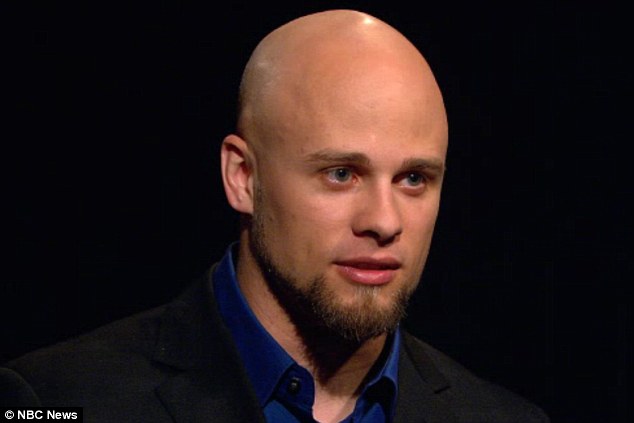
Last December Brandon Bryant, a six-year USAF veteran, told Der Spiegel of his experiences as a sensor operator in a team controlling a Predator over Iraq and Afghanistan from Creech Air Force Base in Nevada and then Cannon Air Force Base in New Mexico.  One day he wrote in his diary:

 “On the battlefield there are no sides, just bloodshed. Total war. Every horror witnessed. I wish my eyes would rot.”

When he left the Air Force he was handed a sheet informing him that all the missions in which he been involved had killed a total of 1, 626 people. This morning he appeared on NBC’s Today programme to describe in detail one of those missions.

Brandon Bryant

You can watch the interview with Richard Engel here, but since no transcript is available here is the substance of what he said:

‘I operated the camera, so like zoom in, zoom out, make sure that everyone can see a good picture, make sure it’s in focus, guide the laser, shoot the spot-tracker…

‘We’re just sitting there and like OK, it’s obvious these guys are obviously bad guys…

‘The guy in the back hears the sonic boom [from the missile] when it reaches him, and he runs forward.  We’re actually told to get the two guys in front, worry about the guy in the back later, follow him to wherever he goes.  The guy in the back runs forward between the two and we strike all three of them.  And the guy that was running forward, when the smoke clears, there’s a crater there, he’s missing his right leg.  

‘And I watch this guy bleed out and it’s clear enough that I watch him and he’s grabbing his leg and he’s rowing, like, I can almost see the agony on this guy’s face and eventually this guy becomes the same colour as the ground that he bled upon…

‘You know how people say that drone strikes are like mortar attacks, artillery, well, artillery doesn’t see this, artillery doesn’t see the result of their actions.  It’s really more intimate for us because we see the before action and then after.

‘And so I watched this guy bleed out, I watched the result of, I guess collectively it was our action, but ultimately I’m the responsible one who guides the missile in.’

He was also interviewed on CBC Radio earlier this year: listen here.  From 6.20 Bryant describes what happens in the 14-16 second interval between firing a missile and hitting the target: he says that if something happens –  like a child running into the frame – there’s an 8 second window to use the laser to divert the missile.  From Spiegel:

With seven seconds left to go, there was no one to be seen on the ground. Bryant could still have diverted the missile at that point. Then it was down to three seconds. Bryant felt as if he had to count each individual pixel on the monitor. Suddenly a child walked around the corner, he says.

Second zero was the moment in which Bryant’s digital world collided with the real one in a village between Baghlan and Mazar-e-Sharif.

Bryant saw a flash on the screen: the explosion. Parts of the building collapsed. The child had disappeared. Bryant had a sick feeling in his stomach.

“Did we just kill a kid?” he asked the man sitting next to him.

“Yeah, I guess that was a kid,” the pilot replied.

“Was that a kid?” they wrote into a chat window on the monitor.

Then, someone they didn’t know answered, someone sitting in a military command center somewhere in the world who had observed their attack. “No. That was a dog,” the person wrote.

They reviewed the scene on video. A dog on two legs?

Theory of the drone

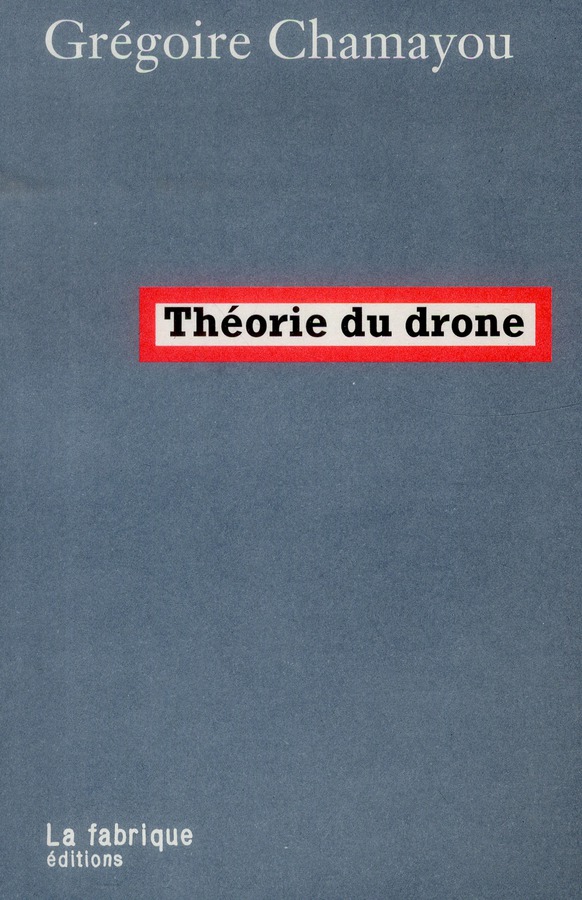
Theorie du droneI’ve been contacted by L’actualité for an interview on drones, which led me to a new book by French philosopher Grégoire Chamayou (CNRS): Théorie du drone (La fabrique, 2013).  I’ve only just ordered it, so this post is advance notice, the product of some rummaging around the web, and I’ll post a considered discussion as soon as I’ve read it.

Chamayou has translated Clausewitz into French, and readers may know one of his earlier texts, I think the only one to be translated into English thus far, Manhunts: a philosophical history (Princeton 2012; original French publication, Les chasses à l’homme: histoire et philosophie du pouvoir cynegetique (La fabrique, 2010); reviewed in English translation at Books & Ideas here).  If you want a good sense of Chamayou’s style, check out this video of a lecture in New York in 2011, ‘Hunter vs. Hunted’, artfully organised around film clips.

Manhunts doesn’t address targeted killing and drone warfare, but you can read a related essay from Radical Philosophy (169/2011) on ‘The manhunt doctrine’ that does here:

George W. Bush had warned us early on: the United States has launched itself into a new kind of war, a ‘war that requires us to be on an international manhunt’… The doctrine of the manhunt breaks with conventional warfare, which rests on the concepts of fronts, linear battles and face-to-face opposition. In 1916, General Pershing launched a large military offensive on Mexican territory to seize the revolutionary Pancho Villa. The massive deployment of force drew a blank. For the American strategists who cite this historic precedent as a counter-example, it is a question of reversing the polarity: faced with the ‘asymmetrical extremes’ posed by small mobile groups of ‘non-state actors’, one must employ small flexible units in a logic of targeted attacks. Contrary to Clausewitz’s classic definition, such cynegetic war is not, in its fundamental structure, a duel. The structure does not involve two fighters facing off, but something else: a hunter who advances and a prey who flees or who hides…

The prey who wants to escape his pursuers tries to become undetectable or inaccessible. But inaccessibility is not only a function of physical geography – such as an inextricable bush or deep crevice. The theorists of manhunting remind us that the ‘political and legal restrictions, especially in the form of jurisdictional boundaries’, are an eminent part of the ‘set of constraints that shape the rules of the game’. From this point of view, it is clear that ‘sovereign borders are among the greatest allies’ that a fugitive can have. The hunter’s power has no regard for borders. It allows itself the right of universal trespassing, in defiance of territorial integrity of sovereign states. It is an invasive power which, unlike the imperial manoeuvres of the past, is based less on a notion of right of conquest than of a right of pursuit….

In cynegetic war, armed violence seeks to pursue the prey wherever it might be. The place of hostilities is no longer defined by the locatable space of an effective combat zone, but by the simple presence of the hunted individual who carries with him everywhere a kind of little halo denoting a personal hostility zone. In this way of thinking, the very notion of armed conflict occurring in a distinct geographical space tends to vanish. Here, on the one hand, the combat zone tends to be reduced to the body of the enemy, which must then, according to the principle of distinction, be the only space that is targeted; but, on the other hand, it is believed that this mobile micro-space can be targeted wherever it happens to be. The paradox is that the principle of targeting is accompanied by a limitless virtual extension of the conflict zone: the world becomes the battlefield. Thus the classical distinction is erased between armed conflict zones, in which the use of weapons of war is allowed, and other zones in which they are not allowed…

Cynegetic war bears an ideal of non-confrontation with death, and of domination without real combat. While a duel involves a reciprocal relation of exposure to death – each participant bearing his chest to the enemy – in the hunt, on the contrary, the master barely ever confronts his prey directly. He uses intermediaries, beaters or the pack. Everything is done so that his life is never in danger, to assure him maximum protection. The use of predator drones and of Hellfire missiles, operated at a distance from American soil, illustrates this principle of absolute preservation of the life of the hunter by the mediation of hunting auxiliaries.

So far, so familiar. Chamayou treats the drone as ‘the emblem of contemporary cynegetic war’, which is to say war that ‘bears an ideal of non-confrontation with death, and of domination without real combat’: hence the new book which, like my own work, explores the complex field of death at a distance and, in a direct line of descent from Manhunts, embeds the drone into the apparatus of a new predatory state (Etat-chasseur) emphasised in this review in Le Devoir.  Here is a listing of the contents:

Theory of the drone

Prelude  — 9
Introduction — 21

I. Techniques and tactics — 33

Methodologies in a hostile environment — 35
Genealogy of the Predator— 41
Theoretical principles of the manhunt— 47
To watch and to annihilate — 57
Pattern of life analysis — 69
Kill box — 79
Counterinsurgency from the air — 91
Vulnerabilities— 109

II. Ethos et psyche— 119

Drones and the kamikazi (suicide attacks) — 121
‘That others should die’ — 131
A crisis in military ethics— 137
Psycho-pathologies of the drone— 151
Killing at a distance— 162

III. Necro-ethics — 177

Combatant immunity— 179
The humanitarian weapon — 190
Precision — 197

IV. Legal philosophy of killing— 211

Thoughtless assassins — 213
War without combat — 220
Licence to kill — 231

V. Political bodies— 241

In war and in peace — 243
Democratic militarism— 254
The essence of warriors — 269
The production of political robots — 285

Epilogue. War, at a distance — 309

21 February 2010 Uruzgan CIVCASYou can find a short extract from Théorie du drone here. This is of particular interest to me since it includes a transcript of an air strike mediated but not directly carried out by a Predator crew and its associated network/assemblage in Uruzgan province, Afghanistan on 21 February 2010, which killed 23 civilians and wounded 8 others.  It’s the mediation that is crucial, though I’m not (yet) sure that what Chayamou means by ‘intermediaries’ in the passage from RP above is quite what I have in mind: we’ll see.  In any event, I discussed the strike and Major General Timothy McHale’s subsequent investigation in ‘From a view to a kill’ (DOWNLOADS tab) and I’ve now provided a much more detailed discussion, with longer extracts from the transcript Chamayou uses here, in The everywhere war (due to be finished, please God, this summer). Chamayou uses this incident as a Prelude to his main argument which – unlike so much philosophical reflection on later modern war, and as he makes clear in his Introduction is in part inspired by the example of Simone Weil – evidently engages directly with the material conduct of military violence.

There’s another extract from the book available here. There are also many  interviews with Chamayou available, but a succinct yet wide-ranging one is available here in which, amongst other things, he assails those American and Israeli philosophers who have defended the use of drones as ‘ethical’, ‘humane’, and even as vehicles for a newly humanitarian mode of war.  He doesn’t name them, but one of those he surely has in his sights is Bradley Jay Strawser (see here,  here and here), whose edited collection on Killing by remote control: the ethics of an unmanned military was published last month by Oxford University Press.  Appropriately, you can buy a Kindle edition from Amazon in just one click.

UPDATE:  For a succinct overview of Chamayou’s work, see Kieran Aarons, ‘Cartographies of capture’, Theory & Event 16 (2) (2013).

Playing war

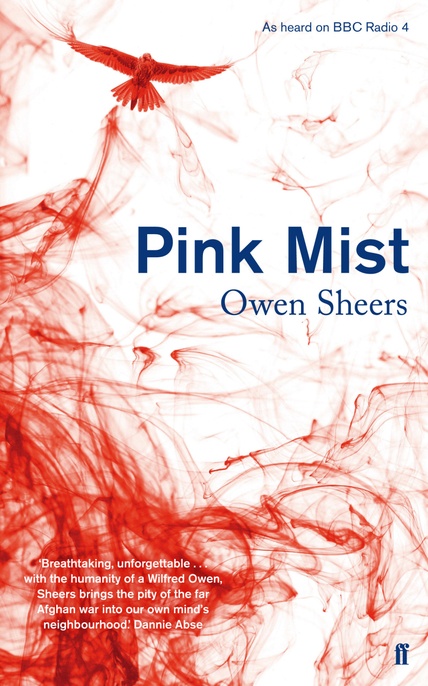
SHEERS Pink MistI’ve just finished reading – but certainly not thinking about – Owen Sheers‘ extraordinary dramatic poem, Pink Mist.

It was originally commissioned by BBC Radio 4 for its More than Words Festival in 2012 but sadly it’s not available on the BBC iPlayer Radio – though you can now get it as a physical book and an e-book.

I’ve spent much of the last several weeks reading poetry from the First and the Second World Wars, but few of those poems have affected me as much as Pink Mist.  I noted Owen Sheers’ work in passing, when I was writing about Keith Douglas’s poems from the Western Desert, but Pink Mist is insistently about the present.

It tells the story of three young men – Arthur, Hads and Taff – who grew up together in Bristol, ‘playing war’ like so many other boys. They decide, a spur of the moment thing, to enlist in the British Army and soon find themselves serving together in Afghanistan:

It’s like my recruiter said today,

it’ll be a chance to do the job

they train you for.

Otherwise it’s like going to the fair,

but staying off the rides.

So yeah, I want to go to war.

But of course it’s not a fairground ride, and nobody is ‘playing war’ any more.

Sheers captures in short bursts the surreal violence of war in Afghanistan.  The accidental killing of a farmer’s wife and two year old grand-daughter:

I can still see his face, even now.

An outdoor man, skin leathered by the sun,

The way he unwrapped the end of his turban

to wipe at his eyes, raw with what we’d done.

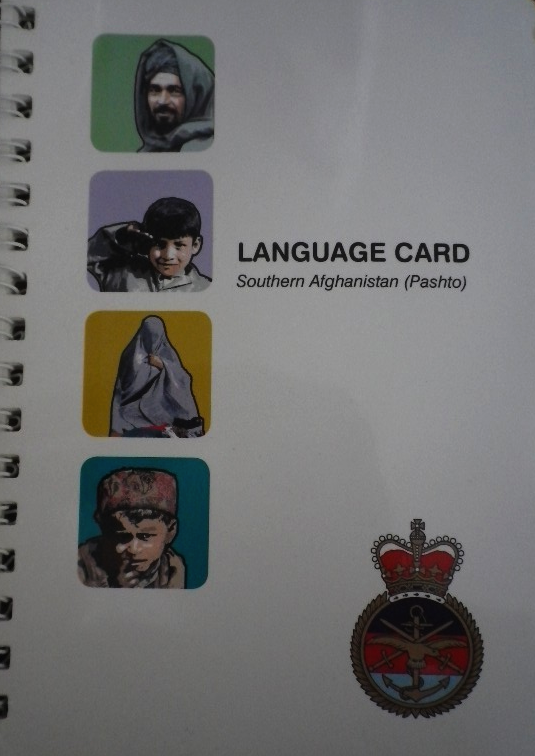
An illustrated language card issued to troops to help them communicate in Pashto and Dari, ‘a kid’s cartoon book of modern warfare’:

British Army Language CardWhere is the pain? – Dard cheri day?

Blood – Khoon

Dead – Maray

Go home – Khaana burayn

Shot – Wishtalay

Go home – Korta dzai

One at a time – Pa waar yao

One at a time.

And the three friends do go home, one at a time, wrapped in the shadows of violence that now fall across the lives of a mother, wife and girl-friend.

Hads returns without his legs, the victim of a ‘blue on blue’ air strike that killed two of his mates:

… that’s what you’re fighting for.

The man on your left and the man on your right.

Forget queen and country, the mission or belief.

It’s more about keeping your mates alive.

Or avenging the ones who’ve already died.

Taff is so consumed by by PTSD that he is haunted even by the silent, ‘Sunday-morning dead’ streets of his home town:

But all Taff’s feeling is the threat.

The echo of when a village went like this back there,

when the women and kids melted away.

That’s what he’s trying to keep at bay,

plugging in his headphones, turning the volume right up.

Eventually he becomes homeless, like many other vets, living on the streets:

There’s a spread of regiments under those blankets …  

And a spread of wars too –

Falklands, Gulf, Northern Ireland, Iraq.  

Yeah, you walk this country’ streets

and there’s our history, under your feet.

And Arthur? Read it for yourself.

It’s a profound work, I think, at once an art-work and a documentary.  As in so much of Sheers’ writing, Pink Mist is based on careful research and sensitive interviewing so detailed and so intimate you can almost feel it in the sinews of the words and the cadence of the lines.  Sheers records his debt to ‘the many service personnel and their families whose stories have informed this work, especially Lyndon Chatting-Walters and Daniel Shaw, whose own experiences are, at times, closely echoed in these pages.’

http://vimeo.com/35462502

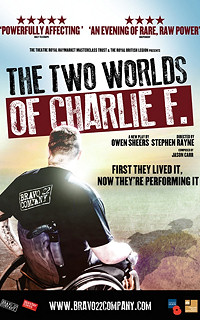
bravo22aThose interviews were, in turn, part of Sheers’s research for The Two Worlds of Charlie F, a play not only about the Army’s wounded and injured from Afghanistan but also, and remarkably, largely performed by them.  Sheers describes the project here (and see the clip above).  In Afghanistan 22 per cent of British service personnel have been injured – a higher proportion than in the Second World War – and to prepare for the play Sheers and his director travelled the UK: ‘We became well-acquainted with the names of certain drugs, types of prosthetics, military jargon. We visited barracks, PRUs (Personnel Recovery Units) and rehabilitation centres.’  And then they worked with the soldiers.  There are plans for the production to tour again this year.

I’m making so much of this for two reasons beyond the power of Sheers’s project.  The first is that Sheers has much to teach us about transcending the limitations of conventional academic genres and incorporating the arts into the research process, not only as objects of contemplation and critique but also as ways of working.  (Think how lifeless so many ethnographies and interviews become on the printed page).  The second is that Pink Mist and The Two Worlds of Charlie F ought to confound the politics of care that assumes a concern with civilian casualities is the exclusive preserve of the left, while a concern for military casualties is the exclusive preserve of the right.

As Arthur says, at the very end of Pink Mist,

So that’s all I hope for.

When the debate’s being had,

the reasons given,

that people will remember

what those three letters mean,

before starting the chant once more –

Who wants to play war?

Who wants to play war?

Sim Cities and theatres of war

When I wrote “Rush to the intimate” (DOWNLOADS tab), a discussion of the ‘cultural turn’ in US counterinsurgency, I was fascinated by a rich and rapidly expanding literature on pre-deployment training and Mission Rehearsal Exercises in simulated “Afghanistans” and “Iraqs” across the United States and beyond in what Steve Graham later called, in Cities under siege, a ‘theme-park archipelago’:

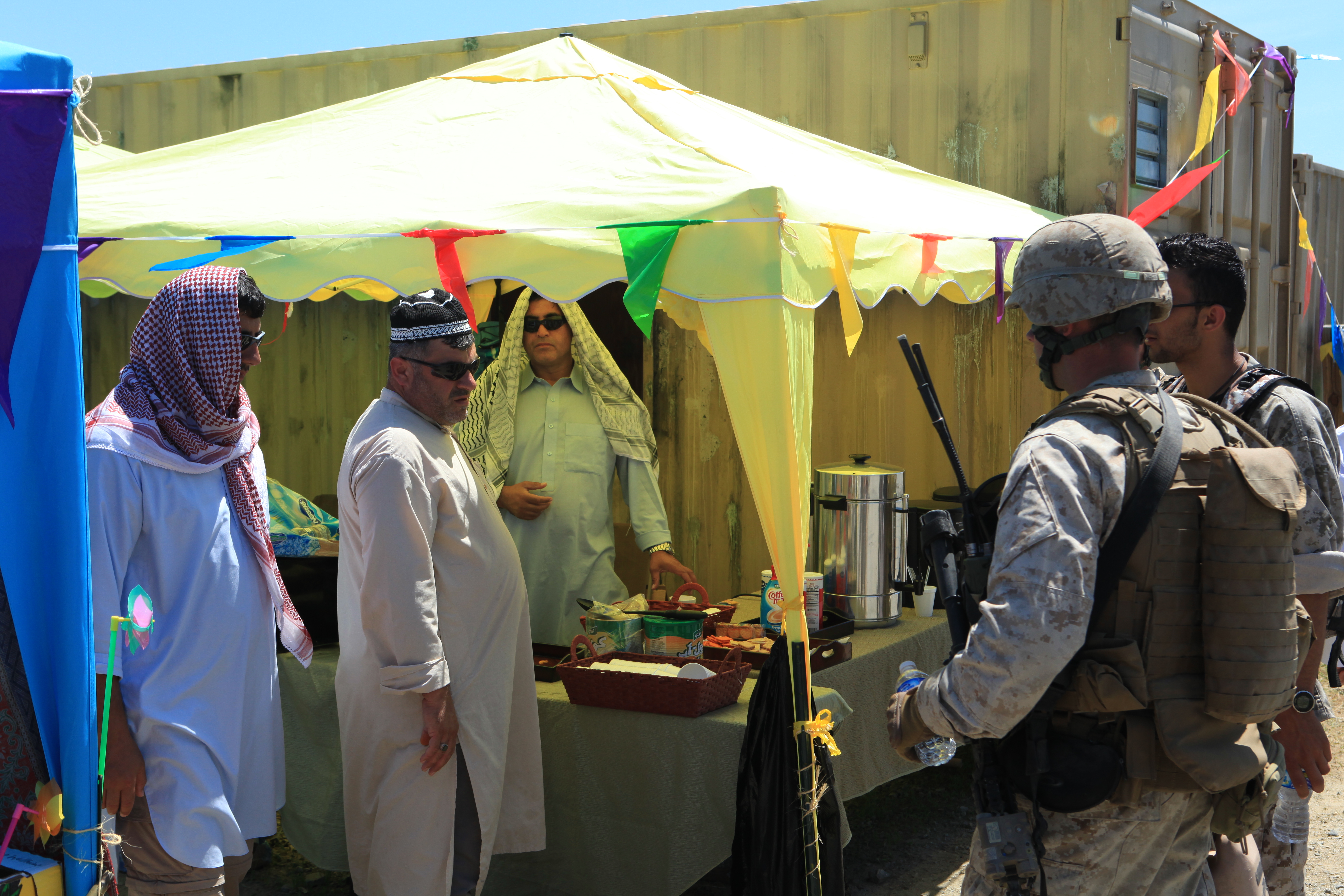
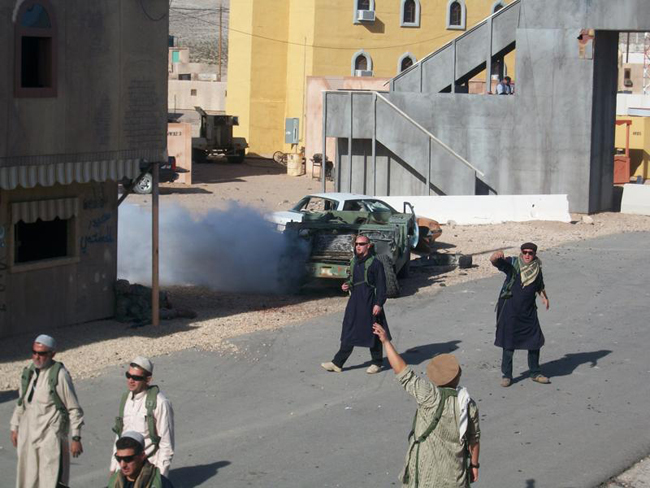
fort-polk‘US troops prepare for deployment in Afghanistan and Iraq by rotating through major Combat Training Centers.  The arc of these ‘theatres of war’ runs from the United States through Europe to Jordan and Kuwait, but the main Mission Rehearsal Exercises are conducted at the Joint Readiness Training Center at Fork Polk, Louisiana; the National Training Center at Fort Irwin, California; and the US Marine Corps Air Ground Combat Training Center at Twentynine Palms, California.  Each includes prefabricated villages and small towns to train troops in urban operations.  … There is little attempt at morphological similitude.  In fact, the same physical structures serve for Afghanistan and Iraq, as though the two are indistinguishable and interchangeable, and the buildings are rudimentary approximations.  One journalist described the crude architecture of ‘Wadi al Sahara’ at Twentynine Palms as being ‘like an impressionist painting’.  From the surrounding hills it could be mistaken for part of Basra or Fallujah, but ‘a walk through its dusty streets shows it to be only a vast collection of shipping containers.’ This too is not without its performative consequences.  Shipping containers are an improvement on poker chips and Lego bricks, but reducing living spaces to metal boxes and studio flats conveys a silent message about the sort of people who live in them.

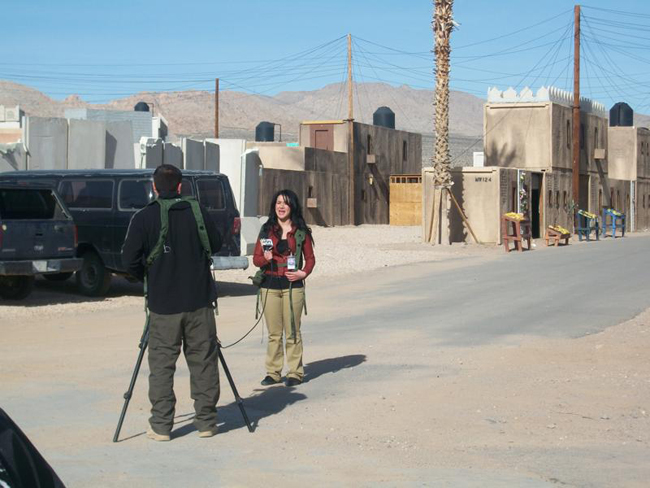
Realistic Urban Training‘The focus at all the training centres is on interactive realism, and the cultural turn has transformed the terms of engagement.  In the early stages of the ‘war on terror’, the emphasis was on kinetic operations and on state-of-the-art special effects that drew on the visual and pyrotechnic skills of Hollywood and theme-park designers.  When one reporter visited Fort Polk in January 2003, she described troops calling in air strikes, securing roads and bridges on the perimeter of a town, and dealing with ambushes staged by insurgents played by soldiers from the base. Her story repeated the physical imagery of the Handbook for Joint Urban Operations issued the previous fall with precision: ‘From sewers to rooftops, cities are multi-layered, like three-dimensional chess boards.’  Civilians appeared only as casualties, and then only in the very last paragraph, where one soldier admitted that he had ‘no clear answer’: ‘“What can you do?”’ The cultural turn is supposed to provide the answer to that question, and from 2006 a flurry of media reports described a new emphasis on military-civilian interaction.  Exercises still include kinetic operations, though these are now more likely to focus on combating IEDs and suicide bombings, but the main objective is no longer scoring kills but ‘gaining the trust of the locals.’  The deployment of Civilian (sometimes called Cultural) Role Players has expanded dramatically.  More than 1,000 are on call at Fort Polk alone, including 250 Arabic speakers, many of them recruited from the Iraqi diaspora in Atlanta, Houston, Memphis and as far away as Michigan.  Their very presence has changed the imaginative geography.  One corporal noted that his previous training had never incorporated civilians ‘wondering what’s going on, and looking around, and doing everyday things.  So when we got there and there were other people besides the enemy, it kind of threw us on our heels.  You know, all we trained for was that the enemy are the only ones on the streets.’  But these Civilian Role Players are not extras, figures to be bypassed, and their roles are carefully scripted.  They play community leaders, police chiefs, clerics, shopkeepers, aid workers, and journalists, and new scenarios require troops to understand the meaning of cultural transactions and to conduct negotiations with local people.  Careful tallies are kept of promises made by US commanders, and the immediate consequences of civilian casualties are dramatized in depth.  Mock newscasts by teams representing CNN and al Jazeera remind troops that local actions can have far-reaching consequences.  Even the special effects have become more intimate; in one Gothic gesture, amputees are used to simulate the effects of suicide bombs (though not, I suspect, US air strikes).  ‘It is no longer close in and destroy the enemy,’ one Marine officer explained: ‘We have to build relationships with Iraqis in the street.’

At the time the richest reports were these (and the quotations above were taken from them): Dexter Filkins and John Burns, ‘Mock Iraqi villages in Mojave prepare troops for battle’, New York Times, 1 May 2006; Wells Tower, ‘Letter from Talatha: Under the God Gun’, Harper’s Magazine, January 2006; Vince Beiser, ‘Baghdad, USA’, Wired Magazine 14.06 (June 2006); Tony Perry, ‘“Mojave Viper” sessions reflect situations in Iraq’, Los Angeles Times, 24 July 2006; Guy Rez, ‘Simulated city preps Marines for reality of Iraq’, National Public Radio, 13 April 2007.

I now need to re-visit all of this for The everywhere war.  My good friend, the ever-enterprising Oliver Belcher, visited Muscatatuk Urban Training Center in Indiana in September 2010 as part of his PhD research, so I had some idea of what had changed in the interim (and what had not).

NTC Fort Irwin exercise

Now Geoff Manaugh (of BldgBlog fame) has provided a sumptuously illustrated account (also on his blog here and at Venue here) of his recent visit to the simulated Afghan town of Ertebat Shar at Fort Irwin in the Mojave Desert (above); when US troops were training for Iraq it was Medina Wasl, and the basic geometry was imported from satellite photographs of Baghdad.
‘… at the most basic level, soldiers will use Fort Irwin’s facsimile villages to practice clearing structures and navigating unmapped, roofed alleyways through cities without clear satellite communications links. However, at least in the training activities accessible to public visitors, the architecture is primarily a stage set for the theater of human relations: a backdrop for meeting and befriending locals (again, paid actors), controlling crowds (actors), rescuing casualties (Fort Irwin’s roster of eight amputees are its most highly paid actors, we learned, in recompense for being literally dragged around during simulated combat operations), and, ultimately, locating and eliminating the bad guys (the Blackhorse regiment [a 120-strong insurgent force drawn from the 11th Armored]).’

Other recent images and video-essays can be found here and here.

Two things in particular stand out for me from Geoff’s immensely interesting essay.

First, the site and at least some of its training exercises are now regularly open to the public – NTC ‘Box Tours’ run twice a month and can be booked no more than 30 days in advance: see here for details – so special dispensations are no longer needed.  As this implies, the sense of public scrutiny has evidently been dramatically heightened since 2007, though even then national media seemed to be all over the place, and this now extends to the incorporation of the visitors themselves.  Geoff reports:

‘In the series of set-piece training exercises that take place within the village, the action is coordinated from above by a ring of walkie-talkie connected scenographers, including an extensive internal media presence, who film all of the simulations for later replay in combat analysis. The sense of being on an elaborate, extremely detailed film set is here made explicit. In fact, visitors are openly encouraged to participate in this mediation of the events: We were repeatedly urged to take as many photographs as possible and to share the resulting images on Facebook, Twitter, and more.’

NTC Fort Irwin media

As I’ve argued before, this sense of reflexivity – attention to the conduct of conduct – is focal to later modern war (though it extends far beyond multiple media platforms and includes, crucially, the lawyering-up of the kill-chain).

Second, the wounds of war have become ever more elaborately scripted.  Wells Tower‘s brilliant ‘Letter from Talatha’ (cited above) was very good on this, but now Geoff reproduces
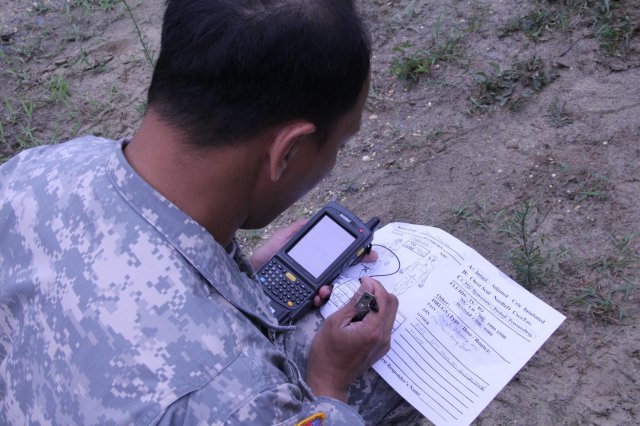
‘an extraordinary collection of injury cards handed out to fallen soldiers and civilians. These detail the specific rules given for role-playing a suite of symptoms and behavior — a kind of design fiction of military injury.’

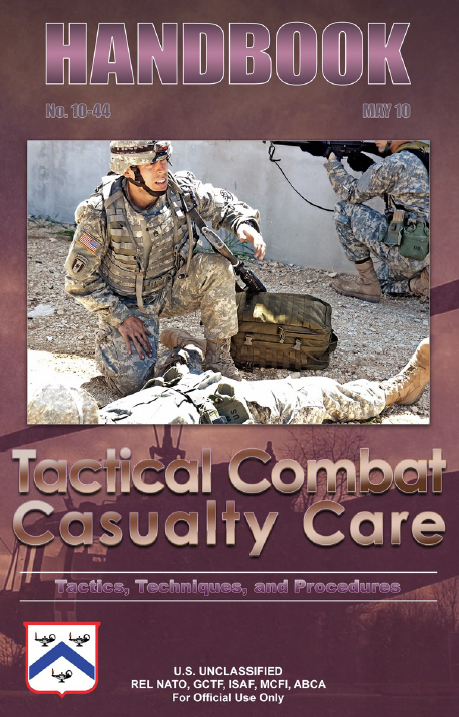
US ArmyTactical Combat Casualty CareScanning these cards raises a series of questions about other, more visceral geographies that lie behind the fiction: the (selective) geographies of care that extend from a war-zone back to hospitals in the United States. The US military has developed an elaborate system of recording and removing its own casualties (as part of what it usually calls ‘tactical combat casualty care‘).

Tactical telemedicineThe geography of this process is acutely physical. The delays imposed by time and space can kill, which is why the US military is currently exploring what it calls ‘tactical telemedicine’ (see the simulation report here; image on right).

The military casualty system is the product of a long historical geography: there’s a useful review of the US experience up to World War II by Bernard Rostker here, and I’m starting to wonder – with another good friend, Craig Jones – and as part of our joint interest in ‘geographies of the kill-chain’ how to explore the changing political and cultural geographies of injury and trauma that radiate from military violence.  There are vital comparative aspects to this, involving not only the (differential) treatment of combatants and civilians by different actors but also the different capacities of military and civilian medicine in war-zones and beyond.  All other dimensions of the theatre of war.

War wounds

London last week, Warsaw at the weekend and now Ostrava this week…  More on the last two soon, but while I was in London I gave a new version of “Gabriel’s Map” to Geography and War Studies at King’s College London.  A large and lively crowd, and I learned much from it all: many thanks to Nick Clifford and Richard Schofield for the invitation and the excellent hospitality.

Amongst other things, I had the opportunity to explain the continuities I see between the argument I’ve developed around the First World War and my research on the war in Afghanistan.  Many protagonists have come to represent contemporary war (‘later modern war’) as the hypostatisation of the ‘optical war’ I described on the Western Front, involving a reliance on visual imagery at every level (from the full-motion video feeds provided by remote platforms to the digital displays in command centres down to hand-held devices) and the virtual (sic) erasure of the body: you can see this in arguments as diverse as those proposed by Christopher Coker and James Der Derian.  Der Derian is rightly suspicious of all this, of course, and I tried to show in “Gabriel’s Map” that on the Western Front there co-existed a radically different apprehension of the battlefield – a haptic geography that relied on a bodily habitus and on sound and touch.  This is no less true of ground troops in Afghanistan today; it takes different forms, to be sure, but it’s clear from military blogs and memoirs that for most of those beyond the Forward Operating Bases war is as intimate, as corporeal and as visceral as it ever was.  I’m working my way through a series of memoirs and other materials now and, for all its problems (on which Nick Turse is exactly right), Sebastian Junger‘s War/Restrepo duo (the latter produced with Tim Hetherington) speaks directly to this question.

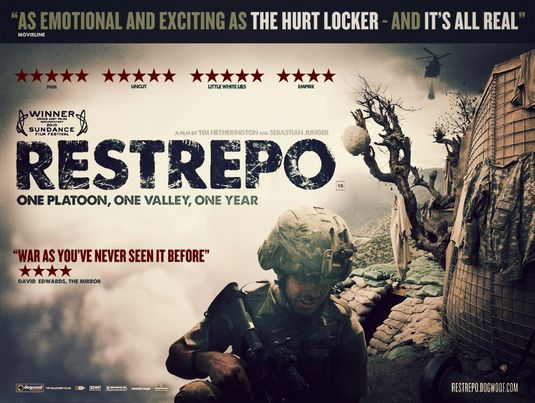
restrepo_ver2

This has the liveliest of political and ethical implications, but I’ve had other reasons not to leave the trenches behind… Jasper Humphreys at KCL’s Marjan Centre has proposed an extremely interesting project as part of next year’s commemoration of the outbreak of the First World War, drawing on the riches of KCL’s Liddell Hart Centre for Military Archives.  The working title is the same – “Gabriel’s Map” – and the aim is to provide a different narrative of the war that develops the themes I sketched in the presentation, using video and social media to capture the attention of young people (and, I hope, the not-so-young…!).  This is exciting stuff, and I’ll keep you posted.

First World War centenaryThe centenary is itself an interesting project. According to the Guardian, the British government anticipates “unprecedented public interest” and, for once, they may have got something right (as opposed to Right); Andrew Murrison, the minister responsible for the commemorations, has both acknowledged the lively debates that continue to swirl around the conflict and expressed the hope that a central motif will be how the war played out at the ‘intimate level’.

More from the Imperial War Museum (itself being remodelled) here and from the excellent Australian War Memorial here.

Retrograde logistics

In recent years much attention has been focused on the logistics of supplying the war in Afghanistan.  But now the reverse operation is gearing up, and (as anticipated) it’s no more straightforward.  Here’s Nate Rawlings for TIME:

For many good reasons, Afghanistan has been called a logistician’s nightmare. It is landlocked and far from a working port. Much of the country – especially in the east where a great deal of the fighting has taken place – is covered with mountains and threaded by decades-old roads and questionable bridges. The easiest way in and out of the country is a geopolitical minefield and the other two routes are three times as expensive.

And yet, for twelve years, logisticians have supplied troops with the equipment — large and small — necessary to fight a war. They have airdropped pallets of food and repair parts on remote bases, tossed “Speedballs” — body bags filled with ammunition and water — out of helicopters to troops under fire. And along the way, extra equipment has piled up at bases around Afghanistan. According to a December 2012 report to Congress by the by the Government Accountability Office, there is the equivalent of more than 90,000 twenty-foot containers of equipment all over Afghanistan. All together, there is $36 billion worth of vehicles, weapons systems, repair parts and utter junk scattered throughout the country, and bringing it home will cost an estimated $5.7 billion. 

(You can access a gallery of Yuri Kozyrev‘s photographs, all taken in late January this year, that accompany the essay here; some details of the corresponding British operation, including video, are available here).

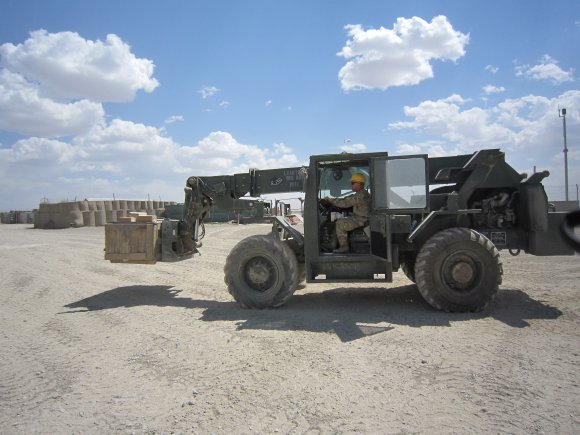
Now AFP has confirmed that the current estimated cost of withdrawing US hardware and vehicles from Afghanistan – called a “retrograde” (sic) – will be $5–6 billion from 2012 through to 2014.  According to Brigadier General Steven Shapiro of 1st Theater Sustainment Command, a veteran of the withdrawal from Iraq, ‘the retrograde from Afghanistan is one of the most challenging military transportation operations in history in terms of scale and complexity.’  It’s certainly more difficult than Iraq, when equipment was simply trucked across the border to Kuwait ‘where it was packed, cleaned, recorded and shipped on’ within a stable security envelope.  Brigadier General Lee K. Levy explains: ‘If you think Iraq was difficult, I would call that getting your bachelor’s degree in logistics. Withdrawing from Afghanistan is getting your PhD in logistics and we are writing our thesis as we speak.’

1st Infantry Division's retrograde yard at FOB Sharana, Afghanistan

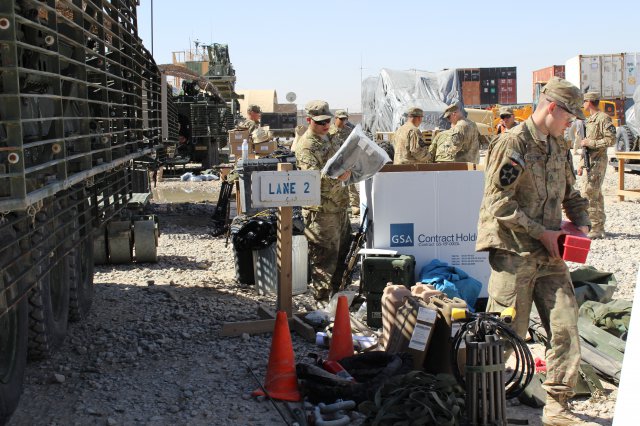
In Afghanistan the most sensitive equipment will again be sent to Kuwait, though this time the US will be forced to use giant C-17 transport planes.  Some of the remaining gear will be sold (but the opportunities in Afghanistan are likely to be less than they were in Iraq, when some $1 billion of equipment were sold off or simply given to the Iraqi military) or even destroyed.  The process requires a labour-intensive inventory, selection and strip-down – you can get an idea of what’s involved in this short video from Bagram – and even then a vast amount will remain to be shipped out.

Soldiers inventory Stryker combat vehicle for retrograde, Kandahar, March 2013 (Sharonda Pearson)

The Wall Street Journal reports that the operation began in earnest last month, when a trial convoy of 20 military vehicles and more than 70 containers of military hardware was trucked through Pakistan and shipped out from Karachi.  According to the Journal,

The military says it now plans to move a combined total of around 100 containers and vehicles per week through Pakistan, a figure that is going to increase gradually over the coming weeks.

When the exodus is in full swing — military commanders expect the logistics push to reach its peak this August — the U.S. will be sending about 1,500 military vehicles and 1,000 containers per month out of Afghanistan. The majority — around two-thirds of that cargo — will move through Pakistan, military officials say.

Shapiro was bullish about the operation – the US Army has made no secret that what it calls the Pakistan Ground Lines of Communication are critical to the success of the retrograde –  and he claimed to be ‘very confident  that the Pakistani military is going to help us move through Pakistan.’  But it remains to be seen whether the outbound supply chain will be any more secure than the inbound one was:  today five NATO trucks en route for Karachi were torched and more or less completely destroyed 120 km. south east of Quetta.

Lost in translation

US Army translation in Afghanistan, 2010

The power of coincidence.  Just after I finished posting about the fog (and friction) of war, I opened an e-mail from Vince Rafael, who was at UBC a year or so ago to present a paper on counterinsurgency on which I’d been asked to comment.  He’s now sent me the published version, ‘Targeting translation: counterinsurgency and the weaponization of languiage’, which appears in the latest issue of Social Text 30 (4) (2012) 55-80.  It’s a characteristically elegant, original and powerful argument:

The chronic failure of counterinsurgency to convert language, whether its own, English, or the other’s, into a weapon, that is, into a standing reserve that could be switched, secured, and deployed, tends to generate catastrophic effects. Targets are missed or misconstrued, accidents abound, death proliferates, while no one is held accountable. As I have been suggesting, the resistance of language to weaponization is not incidental but structurally built into the very discourse and practices of counterinsurgency. That counterinsurgency harbors the very elements of its own undoing can be understood in at least two ways. On the one hand, as military leaders and engineers tend to think of it, the intractability of language could be regarded as a kind of noise that adds to the friction of war: merely a technical problem that can be fixed with greater application of resources, financial and technological, and a strengthening of political will. On the other hand, we could think of the insurgency of language as evidence of the possibility of another kind of translation practice at work. Operating in between the lines of imperial commands, it would be a kind of translation that evades targeting, spurring instead the emergence of forms of life at variance with the biopolitical prescriptions of counterinsurgency.

It’s an argument that not only extends the standard critique of ‘the weaponization of culture’ directly into the domain of language but also explores, in Vince’s brilliant coda ‘Translating otherwise’, the confounding capacities of language to refuse the reduction of the life of the Other to a target.