Just caught up with this: a fine essay over at the Deterritorial Investigations Unit – ‘Instead of building a genealogy of neoliberalism, we must build a cartography of the system’ – called “The sage speaks of what he sees”: War Games and the New Spirit of Capitalism.
It’s a provocative Deleuzian take on the intersections between systems technology, military violence and the production of code/space, that starts with World War II and tracks on into the present (so in fact it combines genealogy and geography).
Developments in aviation technology, such as the capability for flying at higher altitudes and more complex bomb and weapon systems, led to profound problems in fire-control: in high-speed warfare, it was necessary for gunners to be able to respond immediately to actions in the combat environment and to hit their targets with a greater degree of accuracy. In order to deal with this new machinic vision of warfare (which extends beyond the fire-control issue itself, as larger programs like the Manhattan Project indicate), militaries were quickly investing millions of dollars into scientific research in an effort to find mastery over combat theaters. Through science, the command structures of the military were seeking an orderly control over the environment.
A central part in the narrative is played by the Semi-Automated [sometimes ‘Automatic’] Ground Environment (SAGE – hence in part the title) and its successor projects, including civilian derivatives like SABRE that revolutionised air travel ticketing (and Travelocity). On that tangled web, see Jordan Crandall on ‘tracking’ here (also here) and here.
As George Valley and Jay Forrester(later of Urban dynamics fame) conceived of SAGE in 1953, the system would consist of
(1) a net of radars and other data sources and (2) digital computers that (a) receive the radar and other information to detect and tract aircraft, (b) process the track data to form a complete air situation, and (c) guide weapons to destroy enemy aircraft.
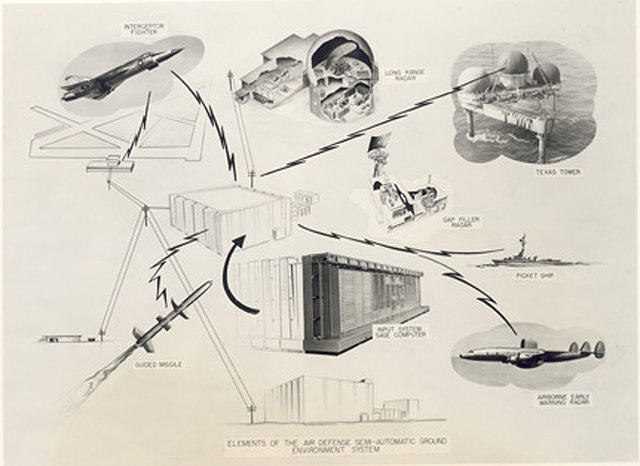
The system was developed at MIT’s Lincoln Laboratory (at a greater cost than the Manhattan Project, incidentally), and this is how the Lab summarises SAGE:
A large network of radars would automatically detect a hostile bomber formation as it approached the U.S. mainland from any direction. The radar detections would be transmitted over telephone lines to the nearest SAGE direction center, where they would be processed by an AN/FSQ-7 computer. The direction center would then send out notification and continuous targeting information to the air bases best situated to carry out interception of the approaching bombers, as well as to a set of surface-to-air missile batteries. The direction center would also send data to and receive data from adjoining centers, and send situational awareness information to the command centers. As the fighters from the air bases scrambled and became airborne, the direction center would continue to process track data from multiple radars and would transmit updated target positions in order to vector the intercepting aircraft to their targets. After the fighter aircraft intercepted the approaching bombers, they would send raid assessment information back to the direction center to determine whether additional aircraft or missile intercepts were necessary.
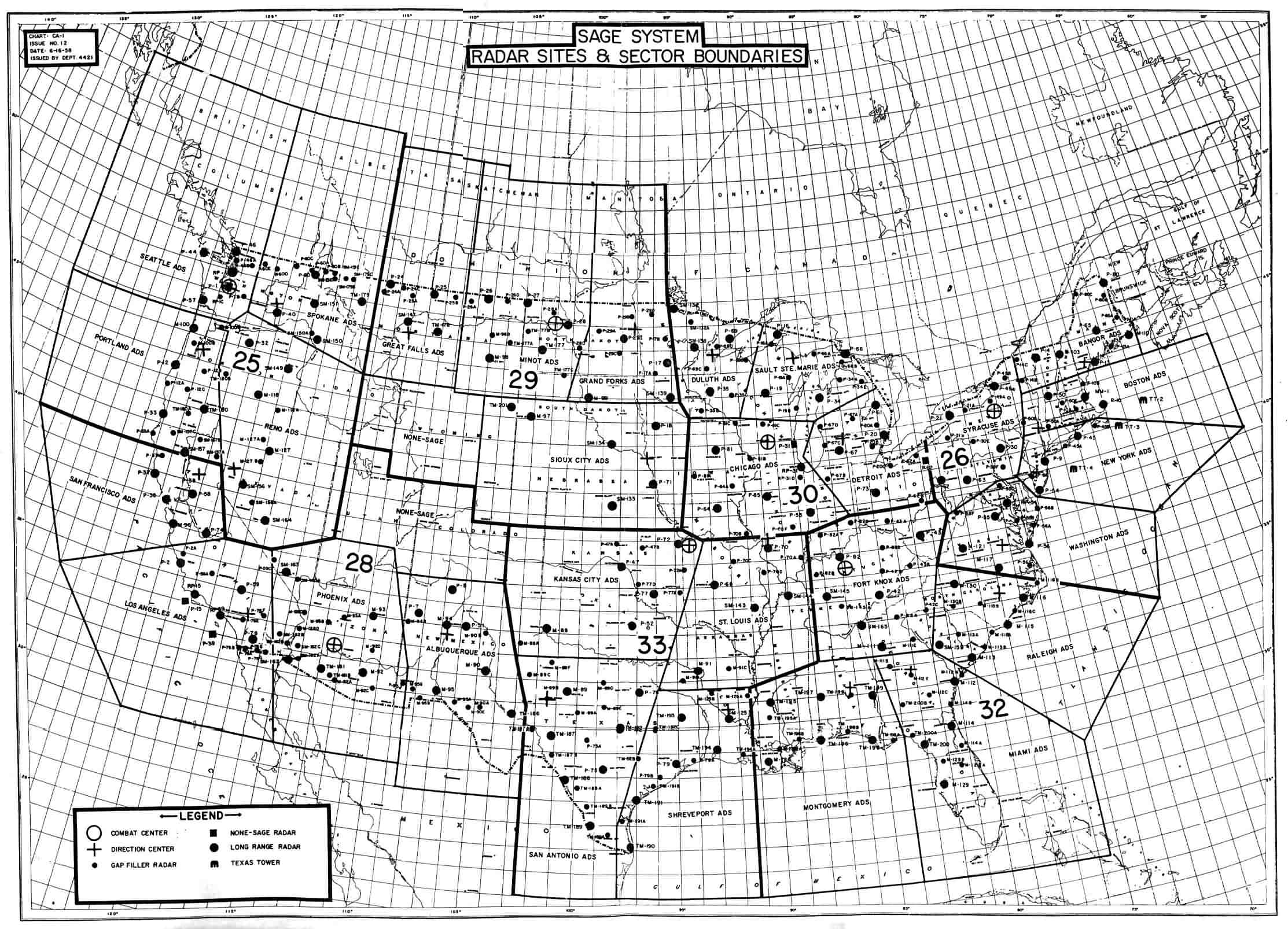
The network as envisaged in 1958 is shown below (more details here):
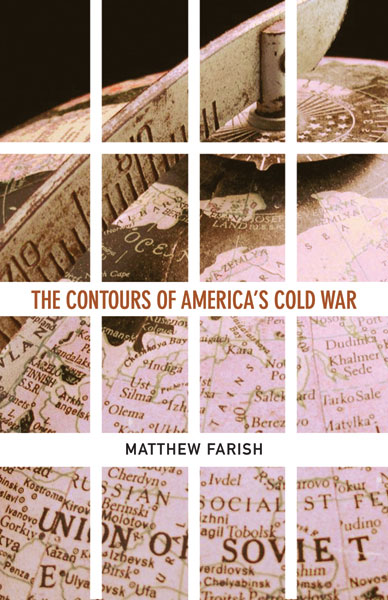
This plainly reaches back to the air defence systems set up by Britain and Germany during the Second World War, but more significantly for my purposes it intersects with the sensor-shooter system that was at the deadly centre of the ‘electronic battlefield’ during the Vietnam war and with a stream of subsequent tactical (rather than purely strategic) developments. If you want to know more about SAGE and its spiralling military trajectory, I recommend Matt Farish‘s brilliant chapter in The contours of America’s Cold War(Minnesota, 2010), ‘The cybernetic continent: North America as defense laboratory’.
More recently still, there’s Jeremy Packer and Joshua Reeves, ‘Romancing the drone: military desire and anthropophobia from SAGE to swarm’, Canadian Journal of Communication 38 (2013) 309-31. And, as their title suggests, all of this feeds into my continuing interest in the networks that make today’s drone wars possible, to which I’ll return shortly.
As I work on turning my Beirut talk on drone strikes in the Federally Administered Tribal Areas (FATA) into a long-form version – which includes a detailed and critical engagement with Giorgio Agamben‘s characterisation of the state/space of exception – I’ll post some of the key arguments here. But for now, two important developments.
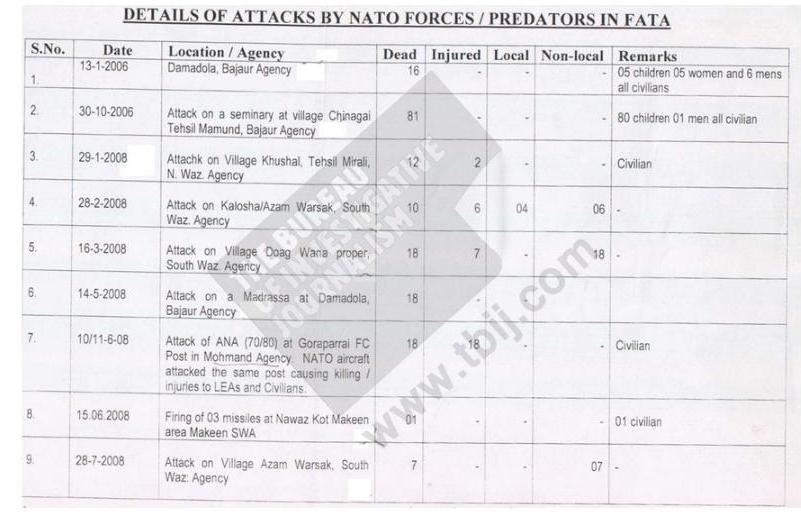
First, the Bureau of Investigative Journalism has just published a list of 330 drone strikes between 2006 and July 2013 (data for the five strikes that took place in 2007 are missing) compiled by the Pakistan government (see extract above); this is an update of a partial release from the Bureau last summer. The source is a series of reports filed each evening by Political Agents in the field to the FATA secretariat, and while it’s not a comprehensive listing – and Islamabad relies on other sources too – the document closely follows the Bureau’s own database compiled from other independent sources. It also allows for a more accurate mapping of the strikes – more to come on this.
But one key difference between the list and the Bureau’s database is that, following the election of Obama, the official reports no longer attempted to classify the victims as combatants or civilians: and the coincidence may not be coincidental. According to Chris Woods,
‘One of my sources, a former Pakistani minister, has indicated that local officials may have come under pressure to play down drone civilian deaths following the election of Barack Obama. It’s certainly of concern that almost all mention of non-combatant casualties simply disappears from this document after 2009, despite significant evidence to the contrary.’
One of the most egregious omissions is the drone strike on 24 October 2012 that killed Mamana Bibi, a grandmother tending the fields with her grandchildren. The case was documented extensively by Amnesty International and yet, as the Bureau notes, while the date and location of the strike is recorded the report from the political agent is remarkably terse and makes nothing of her evident civilian status.
‘If a case as well-documented as Mamana Bibi’s isn’t recorded as a civilian death, that raises questions about whether any state records of these strikes can be seen as reliable, beyond the most basic information,’ said Mustafa Qadri, a researcher for Amnesty International…. ‘It also raises questions of complicity on the part of the Pakistan state – has there been a decision to stop recording civilians deaths?’
These are important questions, and in fact one of the central objectives of my own essay is to document the close, covert co-operation between the US and Pakistani authorities: what I called, in an earlier post, dirty dancing, trading partly on Jeremy Scahill’s inventory of ‘dirty wars’ and partly on Joshua Foust‘s calling out of the ‘Islamabad drone dance’.
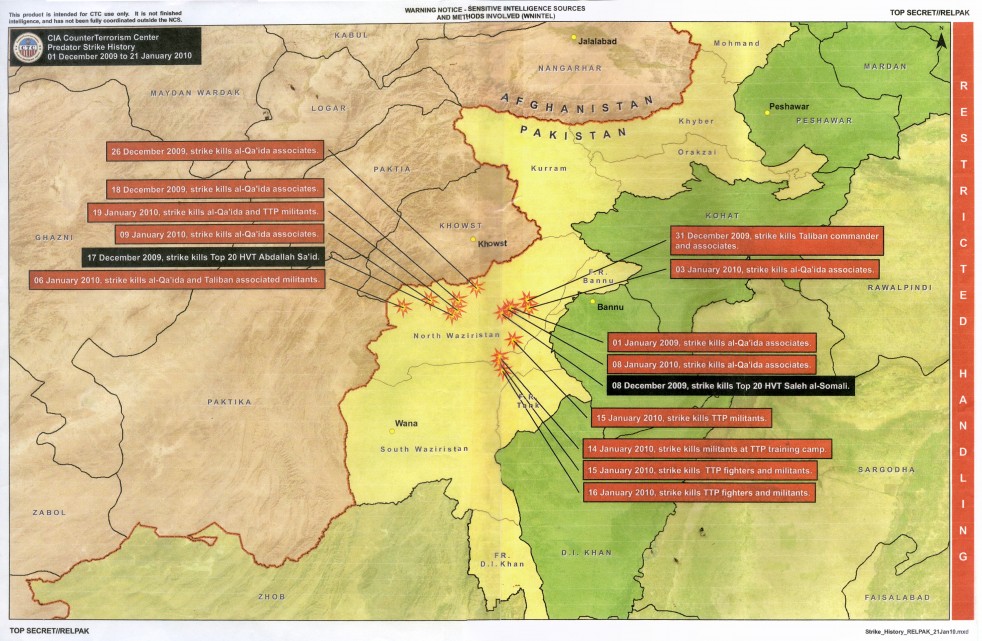
We now know that this collaboration continued at the very least until late 2011. The CIA’s Counterterrorism Center routinely prepared reports that included maps (see below) and pre- and post-strike imagery that were briefed by the Deputy Director to Husain Haqqani, the Pakistani ambassador in Washington, and subsequently transmitted to Islamabad.
And consistent with the reports from Political Agents to the FATA Secretariat, Greg Miller and Bob Woodward note that in these briefings:
Although often uncertain about the identities of its targets, the CIA expresses remarkable confidence in its accuracy, repeatedly ruling out the possibility that any civilians were killed. One table estimates that as many as 152 “combatants” were killed and 26 were injured during the first six months of 2011. Lengthy columns with spaces to record civilian deaths or injuries contain nothing but zeroes.
The collaboration is important, because it has major implications for how one thinks about the Federally Administered Tribal Areas as a ‘space of exception’: there are multiple legal regimes through which the people who live in these borderlands are knowingly and deliberately ‘exposed to death’, as Agamben would have it. More on this later, but for now there is a second, more substantive point to be sharpened.
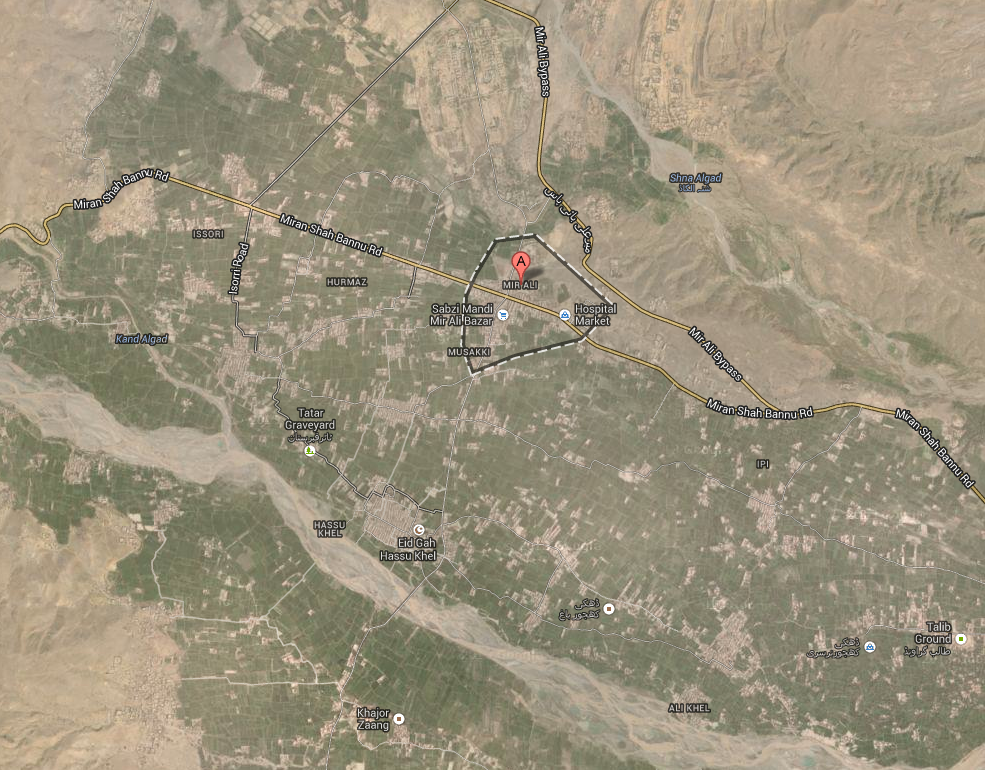
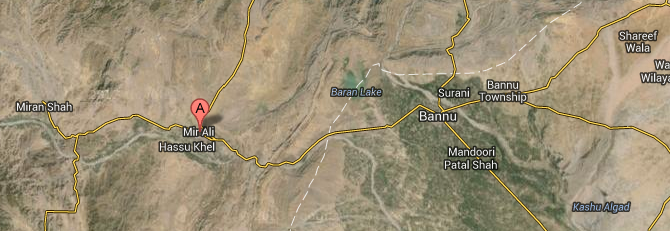
I’ve previously emphasised that the people of FATA are not only ‘living under drones‘, as the Stanford/NYU legal team put it last year, but also under the threat of air strikes from the Pakistan Air Force. Last week the PAF resumed air strikes against leaders of the Tehrik-i-Taliban Pakistan (TTP) in North Waziristan, using first F-16 aircraft and then helicopter gunships to attack what were described as ‘eight major targets’ in the villages of Mir Ali (Hamzoni, Issori, Khadi and Nawana). Although the Air Force described the operation as a ‘blitz’, it initially claimed that only two people were killed. A different story soon emerged.
According to Pakistan’s International News, the air raids started just before midnight on 20 January, and people ‘left their homes in desperation and spent the night in the open along with children when the jets started bombing.’
There were conflicting reports about the identity of those killed. Military authorities said all the 40 people killed in the overnight aerial strikes were hardcore militants or their relatives and family members.
However, tribesmen in Mir Ali subdivision insisted that some local villagers, including women, children and elderly people, were also killed in the bombing by the PAF’s fighter aircraft and Pakistan Army’s helicopter gunships as residential areas were attacked.
Several days later there were reports of hundreds – even thousands – of people fleeing the area in anticipation of continuing and intensifying military operations. On 25 January the Express Tribune reported:
“Most of the families of Mir Ali Bazaar and adjacent areas have been leaving,” Abdullah Wazir, a resident of Spin Wam told The Express Tribune, adding, “women and children have been leaving with household materials, but livestock and larger items of belongings are being abandoned by these families.”
“It is difficult to find shelter in Bannu,” said Janath Noor, aged 38, who travelled there with her family. “There are problems at home and here in Bannu too.” She added that the families were forced to act independently as the political administrations in North Waziristan and Bannu have not made arrangements for the fleeing families. Some families reportedly spent the night under the open sky in Bannu town, waiting for any available shelter.
Some IDPs have also faced problems such as harassment at the hands of the police, requests for bribes, soaring rates of transport from Mir Ali and inflated rents for houses in Bannu. Some families, suspected of being militants, have had problems finding accommodation in Bannu district.
By 27 January the government estimated that 8,000 people had arrived in Bannu, while many others unable to find shelter and unwilling to sleep in the open had hone on to Peshawar and elsewhere. But the head of the FATA Disaster Management Authority declared that ‘No military operation has been announced in the tribal area so there are no instructions to make arrangements for the internally displaced people.’
Most local people were clearly sceptical about that and, certainly, there were authoritative claims that Pakistan was being put ‘on a war footing’ to counter the surging power of the TTP. In the same week that the air strikes were launched, Islamabad promulgated an amended Protection of Pakistan Ordinance (PPO), modelled on the imperial Rowlatt Act of 1919, that included provisions for secret courts, greater shoot-to-kill license for the police, house raids without warrants and the detention of terror suspects without charge. Rana Sanaullah, Minister for Law, Parliamentary Affairs and Public Prosecution in the Punjab and a close confidant of Prime Minister Nawaz Sharif, told the Guardian: ‘I think what will be done will be no worse than what has happened in Guantánamo Bay.’ Not surprisingly, he also offered support for the US drone strikes:
‘We believe that drone attacks damage the terrorists, very much… Inside, everyone believes that drone attacks are good; but outside, everyone condemn because the drones are American.’
And, as I’ll try to show in a later post, it’s a different inside/outside indistinction that plays a vital role in producing the FATA as a space of exception.
The US military defines Close Air Support (CAS) as ‘air action by fixed-wing and rotary-wing aircraft against hostile targets that are in close proximity to friendly forces, and [it] requires detailed integration of each air mission with the fire and movement of those forces.’ It’s a difficult and dangerous business, and not only for the intended targets.
The technologies of CAS have been transformed but, according to the the Defense Advanced Research Projects Agency, its fundamentals haven’t changed since the First World War.
‘Pilots and dismounted ground agents must ensure they hit only the intended target using just voice directions and, if they’re lucky, a common paper map. It can often take up to an hour to confer, get in position and strike—time in which targets can attack first or move out of reach.’
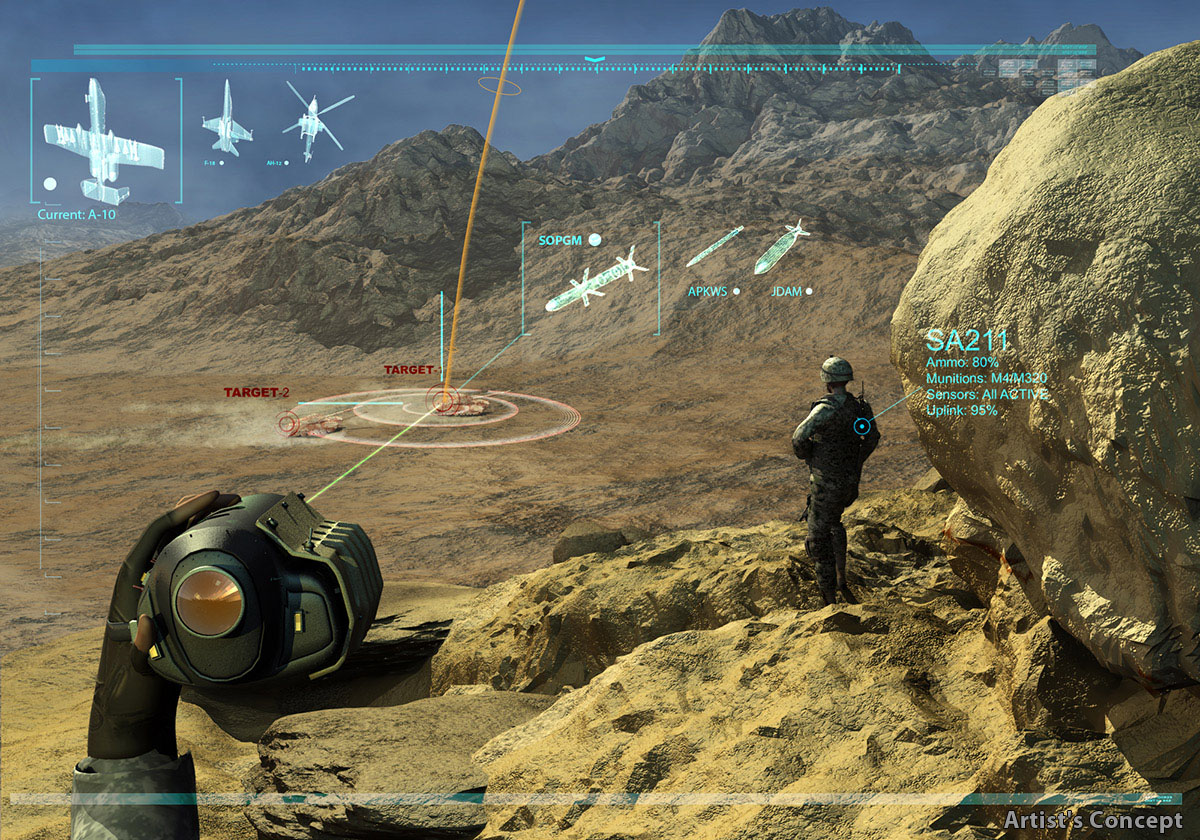
To achieve what is in effect the time-space compression of the kill-chain, DARPA is developing its Persistent Close Air Support program to provide an all-digital system. The system ‘lets a Joint Tactical Air Controller call up CAS from a variety of sources, such as aircraft or missile platforms, to engage multiple, moving and simultaneous targets,’ explainsDavid Szondy (from whom I’ve borrowed the short-hand ‘digital airstrikes’). ‘By eliminating all the radio chatter and map fumbling, the exercise is much faster and more accurate with reduced risk of friendly fire incidents.’ The program manifesto, for want of a better word, includes these aims and specifications:
The program seeks to leverage advances in computing and communications technologies to fundamentally increase CAS effectiveness, as well as improve the speed and survivability of ground forces engaged with enemy forces.
The program envisions numerous benefits, including:
Reducing the time from calling in a strike to the weapon hitting the target by a factor of 10, from up to 60 minutes down to just 6 minutes
Direct coordination of airstrikes by a ground agent from manned or unmanned air vehicles
Improved speed and survivability of ground forces engaged with enemy forces
Use of smaller, more precise munitions against smaller and moving targets in degraded visual environments
Graceful degradation of services—if one piece of the system fails, warfighters would still retain CAS capability
PCAS has two components:
The first is PCAS-Air, which … involves the use of internal guidance systems, weapons and engagement management systems, and communications using either the Ethernet or aircraft networks for high-speed data transmission and reception. PCAS-Air processes the data received, and provides aircrews via aircraft displays or tablets with the best travel routes to the target, which weapons to use, and how best to use them.
The other half is PCAS-Ground, intended for improved mobility, situational awareness and communications for fire coordination. Soldiers on the ground can use an HUD eyepiece wired to a tablet that displays tactical imagery, maps, digital terrain elevation data, and other information [the image above is an artist’s impression of the Heads-Up Display]. This means they can receive tactical data from PCAS without having to keep looking at a computer screen.
PCAS-Ground has been deployed in Afghanistan since December 2012. The original plan, as the emphasis on ‘persistent’ implies, was to integrate the system with drones, but after the cancellation of the US Air Force’s MQ-X (‘Avenger’) program Raytheon announced that PCAS would be developed using a conventional A-10 Thunderbolt.
There is of course a long history to the digitisation and automation of the battlespace, and that reference to the First World War was not an anachronism. There were such intimate links between mapping, aerial photography and artillery ranging on the Western Front – whose cascade of updated imagery and intelligence underwrote the seeming stasis of trench warfare – that Peter Chasseauddescribed the result as ‘a sophisticated three-dimensional fire-control data base’ through which ‘in effect, the battlefield had been digitised.’ It was also, in a sense, automated; I discuss this in detail in ‘Gabriel’s Map’, but it’s captured perfectly in Tom McCarthy‘s novel C.
More obvious way stations to the present include the Vietnam-era Electronic Battlefield, whose sensor-shooter system I described in ‘Lines of descent’ (DOWNLOADS tab) as a vital precursor to today’s remote operations:
Another was the development of the PowerScene digital terrain simulation that was used to identify target imagery transmitted by proto-Predators over Bosnia-Hercegovina and to rehearse NATO bombing missions.
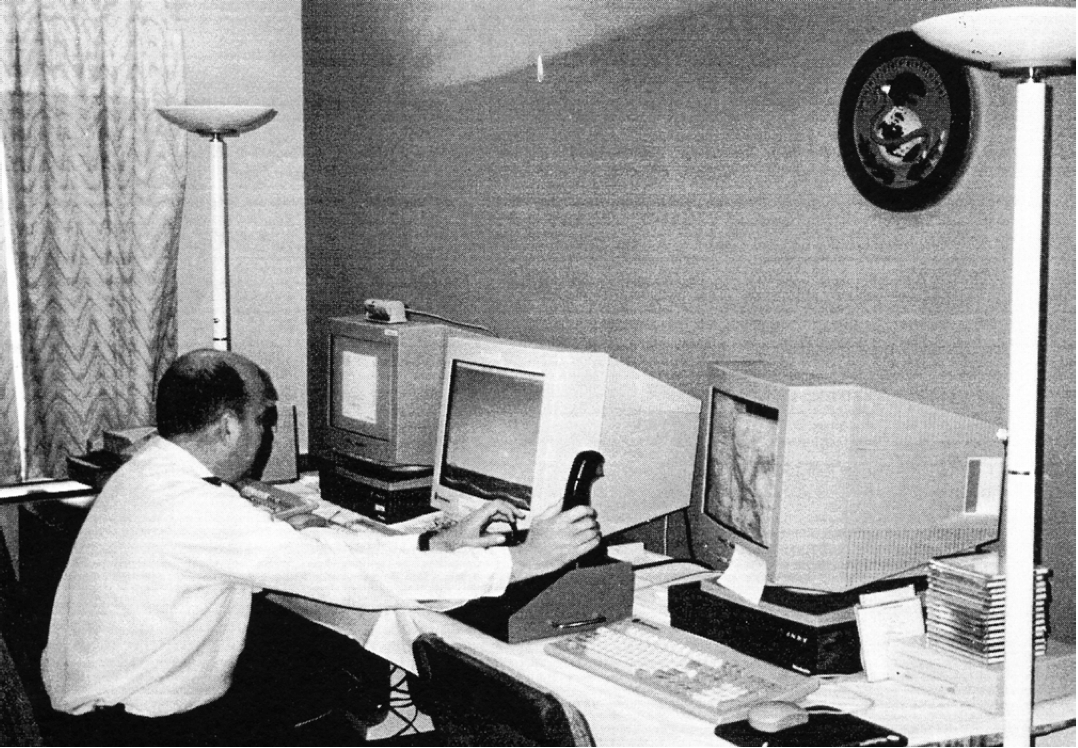
Remarkably, it was also used at Wright-Patterson Air Force Base during the negotiations that led to the Dayton peace accords. As one US officer explained: ‘It’s an instrument of war but we’ll use it for peace because you are willing to come to the table’. The system was used to explore proposals for potential boundaries, but the sub-text was clear: if agreement could not be reached, NATO had a detailed military knowledge of terrain and targets. (For more, see James Hasik‘s Arms and innovation: entrepreneurship and alliances in the twenty-first century defense industry (2008) Ch. 6: ‘Mountains Miles Apart’; Richard Johnson‘s ‘Virtual Diplomacy’ report here; and a precocious paper by Mark Corson and Julian Minghihere, from which I’ve taken the image on the left).
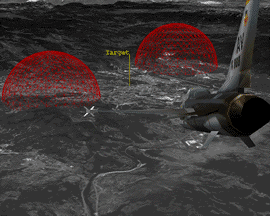
PowerScene was later used by USAF pilots rehearsing simulated bombing missions against Baghdad in the 1990s (see right) – the system fixed target co-ordinates and red ‘bubbles’ displayed threats calibrated on the range of surface-to-air missile systems – and when Anteon Corporation and Lockheed Martin introduced TopScene air strikes over Afghanistan in 2001 were also rehearsed over digital terrain.
But there is another side to all this, because digital platforms can also be used to enable others to display and interrogate the geography of air strikes. I’ve discussed this before in relation to the CIA-directed program of targeted killing in Pakistan here and here, but impressive progress has also been made in plotting air strikes across the border in Afghanistan.
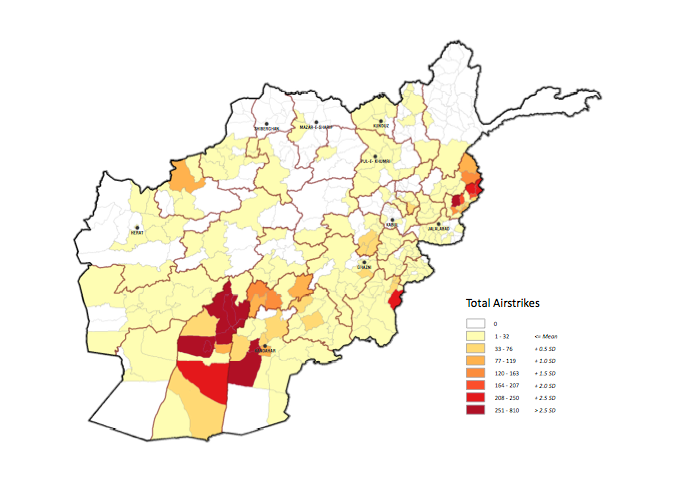
The most remarkable use of USAF/ISAF data that I know is Jason Lyall‘s work in progress on what he calls ‘Dynamic coercion in civil wars’ – ‘Are airstrikes an effective tool of coercion against insurgent organizations?’ – which focuses on air strikes in Afghanistan between 2006 and 2011. This is part of a book project, Death from above: the effects of airpower in small wars; the most recent version of the relevant analysis is here. The map below is Jason’s summary of air strikes in Afghanistan 2006-11, but as I’ll explain in a moment, it gives little idea of the critical digital power that lies behind it.
First, the original USAF/ISAF data was in digital form, but transforming it into a coherent and consistent geo-coded database has involved a truly extraordinary enterprise:
We draw on multiple sources to construct a dataset of nearly 23,000 airstrikes and shows of force in Afghanistan during 2006-11. The bulk of the dataset stems from newly-declassified data from the Air Forces Central’s (AFCENT) Combined Air Operations Center (CAOC) in Southwest Asia, which recorded the location, date, platform, and type/number of bombs dropped for January 2008 to December 2011 in Afghanistan. These data required extensive cleaning to ensure that a consistent standard for each type of air operation was maintained and duplicates dropped. These data were supplemented by declassified data from the International Security Assistance Force’s (ISAF) Combined Information Data Exchange Network (CIDNE) for the January 2006 to December 2011 time period. Finally, additional records from press releases by the Air Force’s Public Affairs Office (the “Daily Airpower Summary,” or DAPS) were also incorporated. … Each air operations’ intended target was confirmed using at least two independent coders drawing on publicly available satellite imagery. Merging of these records was extremely labor intensive, not least because of the near total absence of overlap between CAOC, CIDNE, and DAPS records. Only 448 events were found in all three datasets, underscoring the problems inherent in single-sourcing data, even official data, in conflict settings (my emphasis).
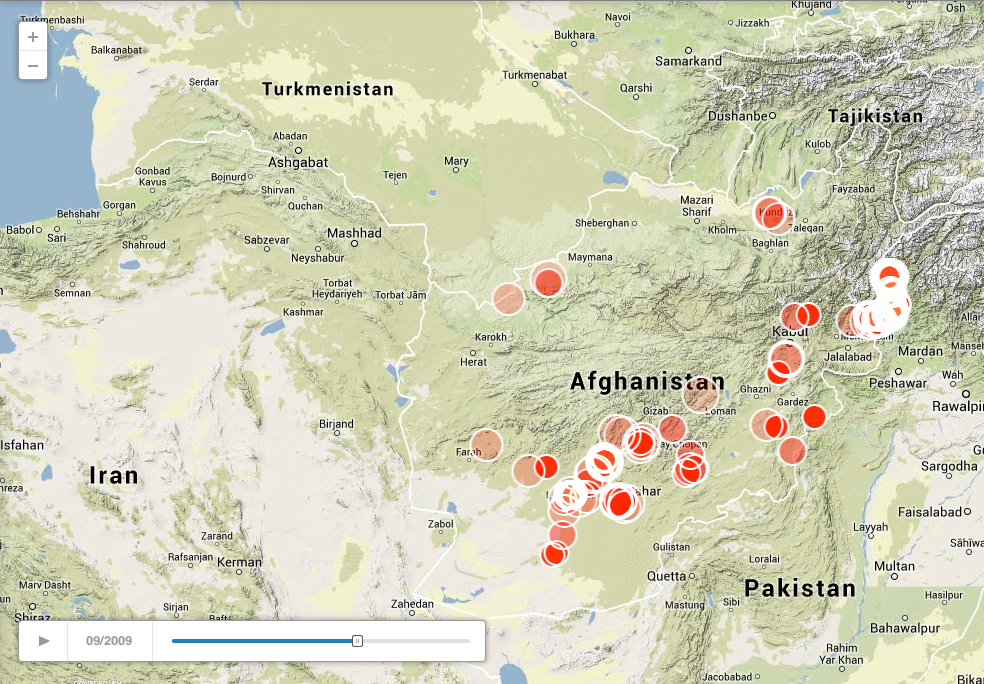
Second, to get the full visual effect of Jason’s analysis you absolutely need to see the animation that he’s made available on his website here; the image below is just a screenshot for September 2009 (I’ll explain why I chose that month in my next post).
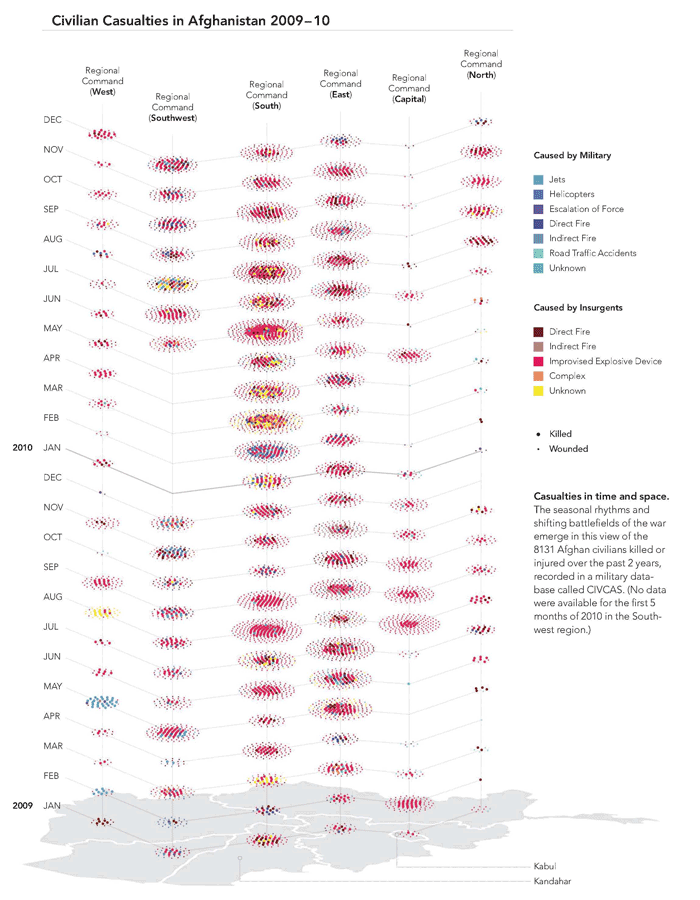
But what about casualty figures? Josh includes a summary map of 216 air strikes involving acknowledged civilian casualties, taken from the same military databases (with all their limitations), and in January 2011 the US military released its data on ‘CIVCAS’ for the previous two years to the journal Science. They included casualties from all parties to the conflict:
The numbers show that 2,537 Afghans civilians were killed and 5,594 were wounded in the past two years. Most of the deaths – 80 percent – are attributed to insurgents, with 12 percent caused by coalition forces, a 26 percent drop.
Here is Science‘s visualization of the CIVCAS data, designed to capture the time-space rhythms of violence from multiple causes:
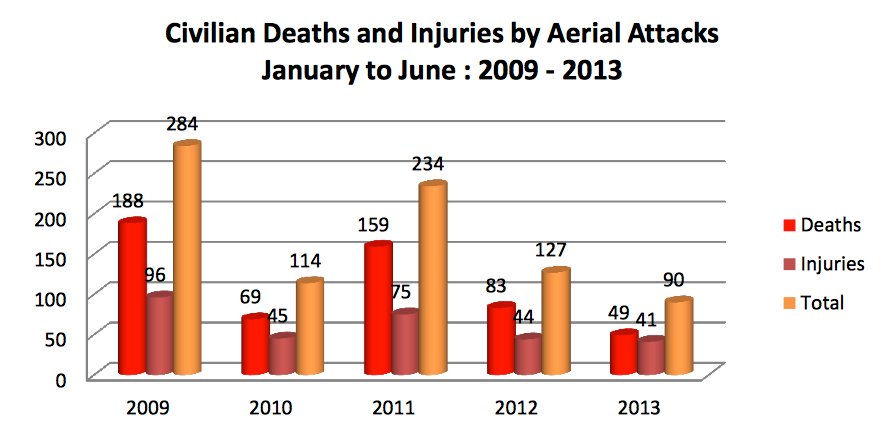
But other sources (notably the Afghan Rights Monitor and the UN Mission in Afghanistan, UNAMA, which produces six-monthly Reports on the protection of civilians in armed conflict) using different methodologies came up with much higher figures; here is a graph from the most recent UNAMA report showing casualties from air strikes 2009-13:
UNAMA added this comment:
UNAMA welcomes the reduction in civilian casualties from aerial operations but reiterates its concern regarding several operations that caused disproportionate loss of civilian life and injury. UNAMA also raises concerns with the lack of transparency and accountability about several aerial operations carried out by international military forces that resulted in civilian casualties.
You can find the full analysis by John Bohannon, which includes a discussion of both databases, at Science (open access) here.
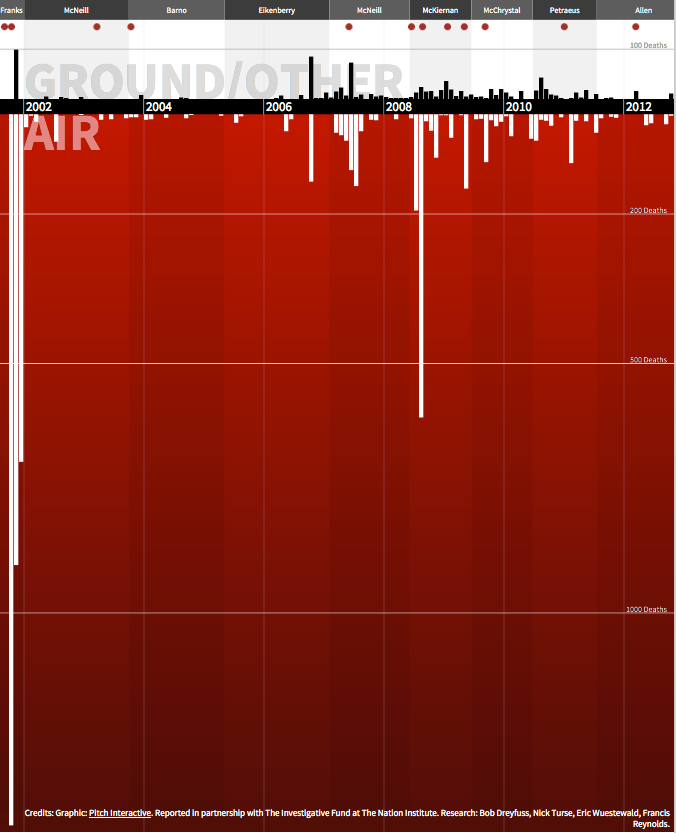
To be sure, counting casualties is always a contentious (and often dangerous) affair. Getting information from the government of Afghanistan isn’t any more straightforward, as Nick Turse has shown: as he adds, ‘neither is it cheap’. But he persevered, and the wonderful Pitch Interactive(a data visualization studio that also produced the haunting representation of deaths from drone strikes in Pakistan)collaborated with The Nation to produce a stunning interactive of ‘civilian deaths that have occurred in Afghanistan as a result of war-related actions by the United States, its allies and Afghan government forces.’ Here’s a screenshot:
You will see running along the top the military commanders during each period; the red dots mark major events. It’s common knowledge – or should be – that the US-led invasion of Afghanistan in 2001 was spearheaded by an intensive high-level bombing campaign (I described this in The Colonial Present), shown along that desperately deep left margin. But I suspect fewer people have grasped the reliance that ISAF has continued to place on air power. What stands out from the image above, clearly, is the disproportionate (sic) number of deaths attributed to air strikes (5, 622) compared with ground operations (794) throughout the period: the UNAMA data above suggest that this only started to change in 2013. You can read more about this in the essay by Bob Dreyfuss and Nick Turse that accompanied the interactive, ‘America’s Afghan victims’, here, and – as always – the tireless work of Marc Heroldis indispensable.
And to forestall a stream of comments, my title is not intended to suggest that digital technologies or the airstrikes they facilitate are somehow ‘immaterial’; nothing could be further from the truth. Or the killing fields.
I’m slowly working my war through Richard Overy‘s magisterial account of The Bombing War: Europe 1939-1945; the subtitle is a necessary reminder that this wasn’t the only ‘bombing war’ of the period, but Overy’s scope is still much wider than the usual focus on the Blitz and the combined bomber offensive against Germany. Too soon for me to work out what I think, but there’s an appreciative review by another brilliant historian of the period, Richard J. Evans, in the Guardianhere. Evans calls The Bombing War ‘probably the most important book published on the history of the second world war this century.’
Evans’s summary of bombing’s ‘surprising inefficiency’ and ‘staggering inaccuracy’ is worth repeating:
Bombing was surprisingly inefficient. As Overy shows, poor visibility, the sudden deterioration of weather conditions, malfunctioning equipment, outdated and slow-moving aircraft, pilot inexperience or crew exhaustion, and enemy action varying from anti-aircraft batteries to night-fighters or the jamming of navigation beams, all reduced the effectiveness of bomber fleets. Aircraft crashed, ran out of fuel or suffered engine failure with astonishing frequency. In its raids on Britain from January to June 1941, for example, 216 German bombers were lost and 190 damaged; 282 of these were as a result of flying accidents. The death rate among bomber crews was appallingly high (crew members in Bomber Command had a one-in-four chance of surviving their first tour of duty, and a one-in-10 chance of surviving their second) but not all of it was as a result of enemy action. At the end of 1941 Bomber Command reckoned that it was losing six aircraft to accidents for every one shot down by the enemy. The British and especially the Americans could make good these losses, and more besides; in the end, Germany’s smaller resources meant that the German air force was increasingly outproduced.
Above all, bombing was staggeringly inaccurate. Bomber fleets had to fly high to avoid anti-aircraft fire from the ground, so even if the weather was clear, they were often unable to locate their targets effectively. On one mission, Robert Kee, a bomber pilot who later became a successful historian, “bombed some incendiaries at what we hoped was Hanover” but mostly dropped his bombs on searchlight concentrations because that was all he could see through the cloud. One report, compiled in September 1941, reported that only 15% of aircraft were bombing within five miles of their target. In the last three months of 1944, it was reckoned that only 5.6% of bombs fell within a mile of the aiming point if there was cloud, despite the use of electronic navigation aids. One raid on a major oil plant saw 87% of the bombs missing their target entirely, and only two actually hitting the buildings.
There’s also a thoughtful review of The Bombing War by Keith Lowehere; Lowe’s account of the bombing of Hamburg, Inferno: the devastation of Hamburg, 1943, is another tour de force, which describes both the execution of the air raids and the consequences for those on the ground. Claire Tomalin‘s review of Inferno closed with a sentence that has haunted me ever since I read it: ‘Once you are committed to fighting, you are going to kill the innocent with whatever technology you have developed.’ Overy does discuss those consequences too, but I think it’s fair to say that the tone of his discussion is largely (though not exclusively) policy-directed – a matter of response rather than experience.
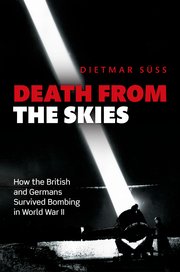
There are now a number of major studies of the effects of bombing individual cities, and Jörg Friedrich‘s The Fire: the bombing of Germany 1940-1945 is also indispensable. But for an account of the experiences of those crouching (and dying) under the bombs on an equally epic scale to Overy, albeit confined to Britain and Germany, we have to wait for Dietmar Süss‘s Death from the skies: how the British and Germans survived bombing in World War II, due from Oxford University Press next spring. Originally published in 2011 as Tod aus der Luft, the book has been a bestseller in Germany. Stefan Goebel provides a detailed review here:
‘The publication of Tod aus der Luft is to be highly welcomed, not least because it breaks into a market that for too long has been dominated by popular accounts on the one hand and official histories on the other. Süß’s extraordinary book combines the virtues of both genres: delivered with great panache, it is also based on a scrupulous examination of archival records. Potential buyers of Tod aus der Luft can expect multiple ‘two-in-one’ deals: not only is this book both sophisticated and accessible, written by an academic historian with a background in journalism, it is also a stimulating synthesis of the social, political, and cultural history of war, and a thoughtful comparative study of Britain (or ‘England’, as Süß has it) and Germany in the era of the Second World War…
‘At the centre of this comparative study are not the political systems (even though Süß has a great deal to say about their institutional structures) but the emergence of a Kriegsmoral (war morale) at the intersection of individual experiences and political mobilization. Moreover, this hefty tome is not meant to be a comprehensive ac-count of the British and German bombing campaigns of the Second World War. Rather, the author’s approach might be described as a history of the air war ‘from below’: one that is focused on the fear, experience, and memory (of people on the ground) of death and destruction….
‘The construction of a Kriegsmoral became the central preoccupation of both societies during the air war. This book offers an intriguing exploration of the comparative method; the author’s discussion of British society during the Blitz throws many aspects of the German experience of the air war into much sharper relief (and vice versa).’
Both books are, appropriately, blockbusters: Overy comes in at 880 pp and Süss at 736 pp.
I’ve added a draft of a new essay, ‘Moving targets and violent geographies’, under the DOWNLOADS tab. It’s a general essay on drones, summarising both their genealogies and geographies, and I would welcome any comments, preferably by e-mail so they don’t get lost in the spam nets: again, this is a draft, so please treat it as such. I wrote it for a volume of essays in honour of the work of my great friend Allan Pred, though I’ll incorporate a different version in The everywhere war. This raw draft doesn’t feature any images (despite the references to Figure 1, etc): I’m still trying decide what to include.
You’ll see that it draws on a number of posts on the blog – a large number, now I’ve realised just how how many drone sightings there have been on geographicalimaginations.com! – as well as recent presentations. I’ve noted before that I find presentations a useful way to prepare for an essay; I treat these visuals as storyboards and, once the essay has been drafted, it’s time to move on to other presentations: reading to an audience from a finalised script seems a waste of time to me. But I’ve also found those scattered posts immensely helpful too, and I’ve been surprised at the consistent themes that emerged from them once I started to put them together. This is more than cut-and-paste (or at least I hope so), and there are new arguments in the essay. Let me know what you think.
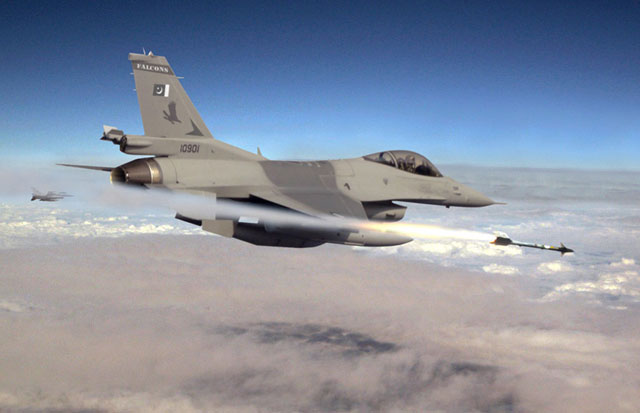
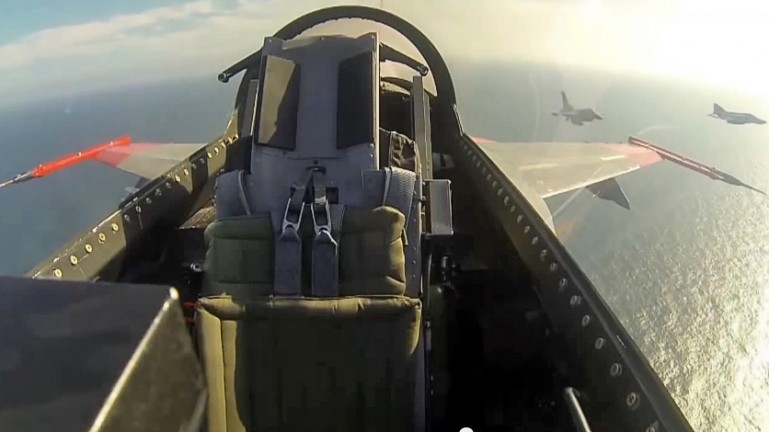
Drones are moving targets in all sorts of ways – not only because, as I explain in the essay, they are currently unable to operate in contested A2/AD (‘anti-access/area denial’) environments, and not even because Boeing has recently converted some of its mothballed F-16 fighter aircraft into target drones (see the image above; there’s a long history of target drones, of course) – but also because advanced militaries are re-evaluating their role and capabilities.
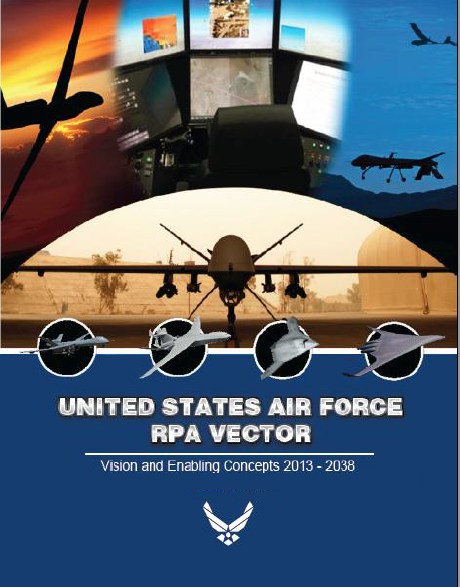
The Pentagon issued its first integrated ‘UAS roadmap‘ in 2005, a review of all unmanned systems in 2007 and an update in 2011. The Air Force produced its own ‘UAS Flight Plan‘ in 2009 (see the briefing slides here) and has promised its new ‘RPA [Remotely Piloted Aircraft] Vector’ report in the very near future.
It’s keenly awaited because there are indications that the Air Force is re-thinking its infatuation with Predators and Reapers. The commander of Air Combat Combat, General Mike Hostage, has made it plain that they are ‘useless in a contested environment‘ and so are unlikely to have a prominent place in Obama’s ‘pivot’ to Asia/Pacific.
While you are waiting, you can get a taste of what is to come from this June 2013 briefing by Jeffrey Eggers.
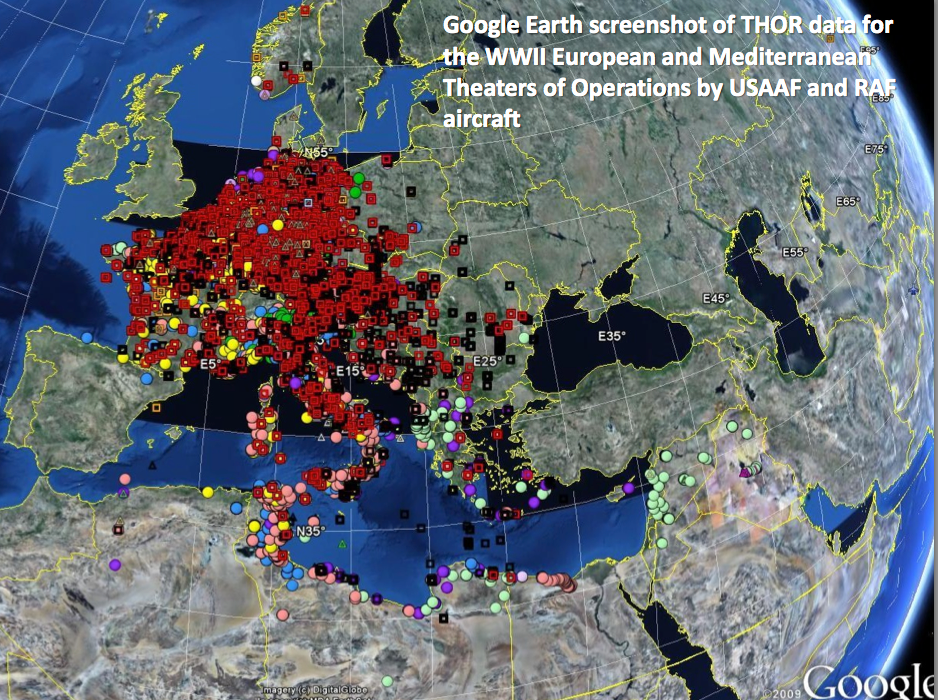
I’ve posted about this remarkable project before. The Air Force Research Institute has now made available online its historical database of air strikes. Although a USAF project, the Theater History of Operations Reportsis not confined to US airstrikes but includes allied strikes; the main focus is on World War I (from June 1916), World War II and Vietnam (from 1965-1969, though I haven’t yet checked whether this includes Laos and Cambodia).
The original description of the Project included the Korean War, Desert Storm (1991), Allied Force (1999), Afghanistan (2001 on) and Iraq (2003-11), but these are still classified and not yet available online. Here is the architect of the project, Lt Col Jenns Roberston, explaining the background:
That was a year ago. There’s now a Quick Start Guide here, and you can download the full, unclassified database and also ‘Grab and Go’ files for Google Earth. Latest background information here.
Here’s a grab of Allied bombing in Europe and the Mediterranean during World War II, though the key here is obviously to disaggregate and refine the data – which is precisely what the database allows. The red squares on the map are B-17 strikes but these overlay (for example) the orange squares of Wellington bombers so the impression at this scale is not particularly helpful.
And while we’re on the subject of World War II, don’t forget the Bomb Sight project, which maps the London Blitz in extraordinary detail: more here.
It’s important to look beyond Europe, of course. Roberston, who started work on the database in 2006, told the Air Force Timesthat he was surprised at the level of Allied bombing in the Pacific theater:
“We were blown away – no pun intended – by the level of bombing that was taking place, not only in the South Pacific but also in Burma, which is something that nobody looks at; Formosa, currently known as Taiwan; and the Philippines – how heavily those regions were bombed in the lead-up to bombing Japan proper.”
On bombing ‘Japan proper’ in World War II, as I’ve noted previously, the very best source is Japan Air Raids.org.
If anyone else is working through the disaggregated database too, do let me know how you get on.
The tabulations are significant because they are not based on press reports – the standard and highly imperfect source – but on reports prepared for the FATA Secretariat and transmitted to Islamabad by government agents in the field (who rely on their own observations, and reports from the tribal police and other informants). According to one well-placed observer, ‘There was no benefit in officials “cooking the books” here, since this document was clearly never intended to be seen outside the civilian administration.’
It’s an incomplete list – the Bureau has a more comprehensive tabulation – but of the 746 deaths from these air strikes 147 (20 per cent) are identified as civilians (including 94 children).
Still, the Bureau notes some puzzling (even troubling) omissions. In particular, reports of civilian deaths virtually disappear from the record after Obama took office: ‘In part this is because officials occasionally note that “details of casualties are yet to be ascertained.” But many credible reports of civilian deaths are simply missing. The Bureau’s own research shows that civilian deaths have been credibly reported in at least 17 of the 53 CIA drone strikes in Obama’s first year in office. Yet FATA officials report civilian deaths in only three incidents in 2009.’
There have been rumours of more comprehensive tabulations, but the Bureau acknowledges that much also depends on information provided by the Pakistani military. And it would be interesting to see a comparable list of casualties resulting from Pakistan’s own air strikes in the FATA.
I’ve been urging for some time now that the debate over drone strikes must not neglect what has been happening in Afghanistan: hence “From a view to a kill” (DOWNLOADS tab) and the much longer version to appear in The everywhere war. According to a report on the Guardian website posted late on Tuesday by the resourceful Spencer Ackerman, ex-Danger Room (now sadly itself an ex-site), ‘A study conducted by a US military adviser has found that drone strikes in Afghanistan during a year of the protracted conflict caused 10 times more civilian casualties than strikes by manned fighter aircraft.’ The period under analysis (from mid-2010 to mid-2011) followed a series of measures announced by General Stanley McChrystalto reduce civilian casualties from air operations, and coincided with a dramatic increase in the number of drone strikes (which continued to increase through 2012).
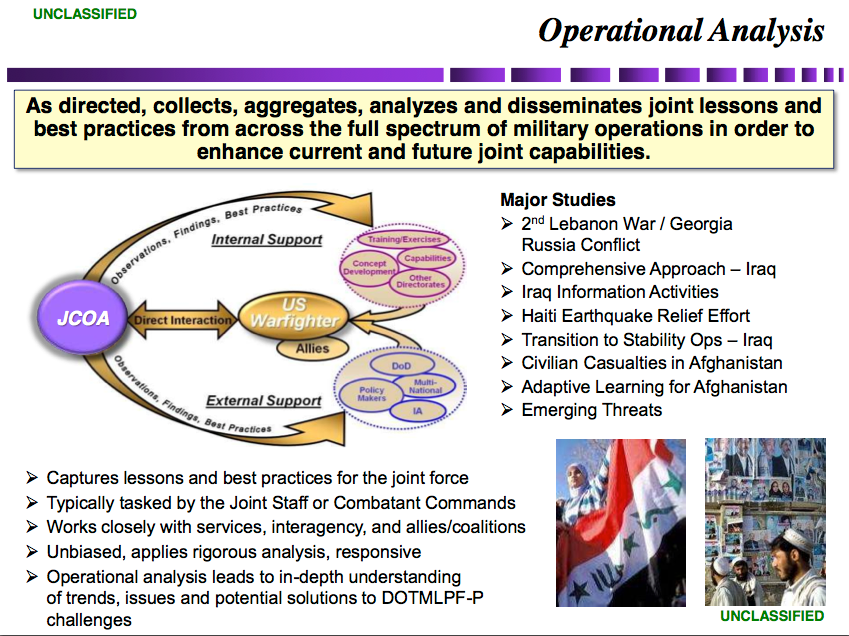
The study in question was carried out by Larry Lewisfor the Joint Coalition and Operational Analysis (JCOA), a division of the Joint Staff J7 whose work is summarised in the following slide (which comes not from Edward Snowden‘s cache but from here):
Notice ‘Civilian casualties in Afghanistan’ is #6 on the list of major studies. The completed study is called Drone Strikes: Civilian Casualty Considerations and, apart from the Executive Summary that was published on 18 June, remains classified. The opening paragraph is the primary source for Spencer’s story, and here it is:
‘The US government has described drone airstrikes in operations outside declared theaters of armed conflict as surgical and causing minimal civilian casualties. Analysis of air operations in Afghanistan, combined with a review of open-source reports for drone strikes in Pakistan, suggest that these fell short of intended goals. Specifically, drone strikes in Afghanistan were seen to have close to the same number of civilian casualties per incident as manned aircraft, and were an order of magnitude more likely to result in civilian casualties per engagement. Specific causal factors were identified that contributed to the relative propensity of drones to cause civilian casualties. Tailored training that addresses these causal factors could aid in reducing civilian casualties in engagements involving drones. While processes and operating forces in Afghanistan can differ from those in operations outside declared theaters of armed conflict, the factors above suggest that a dedicated analysis of civilian casualties in such operations would be worthwhile.’
The key sentence is in bold, and a version of it reappears in an essay, ‘Changing of the Guard: civilian protection for an evolving military’, that Lewis wrote with Sarah Holewinski, Executive Director of the Center for Civilians in Conflict and which appears in the latest issue of PRISM 4 (2) (2013), a journal of the Center for Complex Operations at the National Defense University (the press release from Civilians in Conflict is here). The authors’ central concern is that ‘as Washington shifts its focus from counter-insurgency to counterterrorism, and from large-scale ground operations to more discrete and oftentimes-unmanned operations, the progress U.S. forces have made on preventing and mitigating civilian harm may soon be lost.’
They consider the risks attendant upon the increased reliance on Special Operations Forces – something that readers of Jeremy Scahill‘s Dirty Wars will need no warning of – but also those that are likely to flow from an increased use of Unmanned Aerial Systems (UAS):
‘America’s use of force will increasing rely on new technologies, including air force capabilities to penetrate enemy defenses and strike over long distances. Unmanned Aerial Systems, sometimes referred to as “drones,” saw major use in Iraq and Afghanistan, and are slated for a big leap in funding. The Pentagon called for a nearly one-third increase in its fleet in the years ahead.
‘The use of UAS can have military advantages for avoiding civilian casualties in armed conflict, if used with that intent in mind. Their systems feature precision weapons, their sensors have increasingly high-resolution imagery to assess the ground situation, and back in the control room, trained imagery analysts scrutinize a target area prior to engaging, which isn’t always possible in a full ground operation.’
They list a series of familiar objections to the use of these remote platforms in areas outside ‘traditional combat theaters’, but they are also critical of claims about their forensic capacity inside war-zones:
‘The assumption that UAS strikes are surgical in nature is … belied by research on recent combat operations in Afghanistan. There, UAS operations were statistically more likely to cause civilian casualties than were operations conducted by manned air platforms. One reason was limited training for UAS operators and analysts in how to minimize civilian harm. adding or improving training on civilian casualty prevention is a resource decision in direct tension with the increasing demand for more uaS and more operations, since additional training on civilian protection means time must be taken from somewhere else including the mission itself.’
They don’t say much about the reasons for this, except that they then criticise the ‘clandestine use of UAS by the US government’ because it raises ‘significant concerns that civilian casualties will not be properly monitored or investigated and thus called into question’ and then, several paragraphs later, they note that non-covert operations in Afghanistan ‘are replete with examples where all the engaged individuals were believed to be combatants, but a later investigation found many or all were civilians misidentified as combatants.’
A key issue, then appears to be misidentification, and in my examination of one hideous incident in Uruzgan province in Afghanistan in February 2010 (in “From a view to a kill”; see also the image above) – an analysis I develop in my more detail in The everywhere war – I suggested that the high-resolution video feeds from these remote platforms engender an intimacy with ground troops that belies the physical remoteness of the drone operators. They routinely claim to be not 7,500 miles from the battlespace but just 18 inches – the distance from eye to screen – and this immersive capacity (which these feeds do indeed share with videogames) predisposes them to view virtually every proximate Afghan action as hostile:
‘… the greater incidence of civilian casualties when close air support is provided to ‘troops in contact’ may result not only from time-critical targeting and its correspondingly ‘fewer checks to determine if there is a civilian presence’ … but also from the persistent presence of the [UAS] and its video feeds immersing its remote operators in, and to some substantial degree rendering them responsible for the evolving situation on the ground. This predicament, in which proximity not distance becomes the problem, cannot be resolved by tinkering with the Rules of Engagement; high-resolution imagery is not a uniquely technical capacity but part of a techno-cultural system that renders ‘our’ space familiar even in ‘their’ space – which remains obdurately Other.’
I don’t know if this forms part of the classified report, of course, but in an earlier report, Reducing and mitigating civilian casualties: enduring lessons(dated April 2013) Lewis emphasised the importance of using ‘discrimination tools’ in ‘situations where forces need to discern whether an individual is demonstrating hostile intent’ – but what he seemed to have in mind was another technological fix, ‘higher-resolution imagery or night vision devices’, whereas the root of the problem may well not be the power to see but the capacity to make sense of what is seen.
In any event two other questions remain.
First, during the period under analysis drone strikes accounted for around 5 – 6 per cent of total weapon releases by all aircraft in Afghanistan, but many of the conventional strikes nevertheless relied on persistent surveillance of targets from Predators or Reapers and then attacks by helicopters or fighter-bombers (which was the case in the Uruzgan attack). Does Lewis’s statistical analysis shed any light on the difference (I assume there is one) between a UAS acting as a ‘hunter-killer’ and a UAS providing only real-time ISR as part of a networked operation?
Second, what is the difference between ‘an incident’ and an ‘engagement’ in the first extract I’ve quoted? This is a substantive issue of considerable moment: if drone strikes produce a roughly similar number of civilian casualties as conventional strike aircraft ‘per incident’ but ten times the number ‘per engagement’, it’s vital to know the difference. Protagonists of remote operations will undoubtedly seize on the first, critics on the second.
I’m trying to chase down the difference. To be continued…
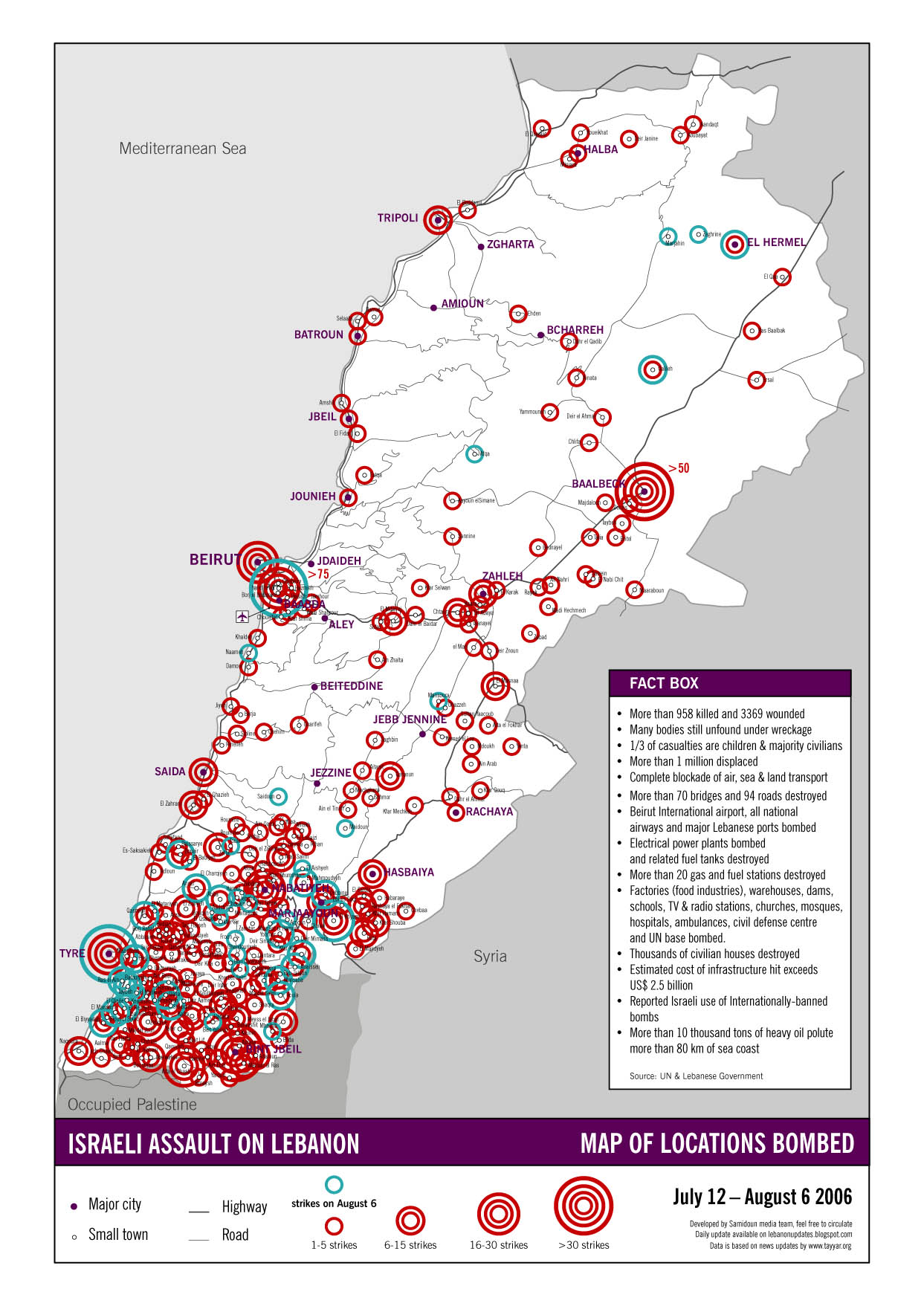
My first attempt to think through the histories and geographies of bombing from the air was, appropriately enough, a plenary address to the Arab World Geographerconference in Beirut in 2006 – a meeting which had had to be postponed until December as a result of Israel’s summer-long attack on Lebanon. Registrations fell away, especially from the United States and the U.K., but we had a wonderfully lively meeting.
I eventually turned my presentation – which, under the title “The death of the civilian”, developed the twin genealogies of the target and the civilian to address Israel’s bombing of southern Lebanon and Beirut – into an essay for the journal: “In another time zone, the bombs fall unsafely: Targets, civilians and late modern war”(published in 2007: see DOWNLOADS tab).
I began like this:
My title comes from a poem by Blake Morrison, ‘Stop’, which was reprinted in an anthology to aid children’s charities in Lebanon compiled by Anna Wilson after the Israeli assault on that country during the summer of 2006. The poem speaks directly to the ideology of late modern war – to what Christopher Coker praises as the ‘re-enchantment’ of war through its rhetorical erasure of death– and to its dissonance from ‘another’ time and space where bombs continue to ‘fall unsafely’. It begins like this:
‘As of today, the peace process will be intensified
through war. These are safe bombs, and any fatalities
will be minors. The targets are strictly military
or civilian. Anomalies may occur, but none
out of the ordinary. This release has been prepared by
official Stop.’
Morrison perfectly captures the hypocrisy of war – the malevolent twisting of words to mean the opposite of what they say, the cosmetic face of public war put on to conceal the harrowing face of private death – and also the intimacy of the furtive, fugitive relationship between ‘targets’ and ‘civilians’ in late modern war. In what follows, I will try to lay that relationship bare by reconstructing its historical geography. In doing so, I will also show how our meeting in Beirut to discuss ‘the European-Arab encounter’, less than six months after Israel’s war on Lebanon, must confront the connections between the political and military strategies mobilized during the summer of 2006 and a series of colonial encounters between Europe and the Arab world in the years surrounding the First World War.
That remains one of the primary motivations for my Killing Space project.
But 2006 was not the first time that Israel had sent its fighter-bombers into the skies over Lebanon. What I did not know when I prepared my presentation was that during the bloody invasion of Lebanon in 1982 a number of Israeli Air Force pilots had refused to bomb ‘non-military targets’. Now there is still fierce debate over the distinction between ‘military’ and ‘non-military’ targets, and over the civilian casualties that may nevertheless result from bombing ostensibly ‘military’ targets, both in principle and in practice, and it’s an argument which is conducted on legal and ethical terrains (though we hear much more of the former than the latter). But here I’m particularly interested in the act of refusal itself: less in the application of abstract, formal principles – important though these are – and more in the personal, rational and affective moment of abjuration.
In 2002 Ha’aretzpublished interviews by Avihai Beckerwith three IAF officers who had formally refused; the testimonies of two of them were already known, but it’s the third that I want to describe here. Hagai Tamir, a major in the IAF, grew up as one of what he calls ‘the lyric pilots’, consummating a love of flight itself:
“I wanted to feel like a bird. The whole idea of the plane as a war machine was much less appealing to me. The concept of a plane as a platform for weapons was foreign to me so I enjoyed the aerobatics much more than I did dropping ordnance. Even during my compulsory service as a young pilot, I didn’t derive any pleasure from it.”
After his compulsory military service and his move to the reserves, Tamir trained as an architect and this enhanced his sense of unease, even disengagement.
“Who knows better than me, an architect, how hard it is to build a city? So at least, don’t rejoice when you destroy houses. It takes a lot longer to build a city than it does to strike a target.”
In June 1982, one week into the invasion of Lebanon, Tamir was flying over the port city of Saida (Sidon), near the Ain El Helweh refugee camp:
“We flew in tandem above the place. The liaison officer who was with the ground forces informed me of the target, a large building on top of a hill. I looked at it and to the best of my judgment, the structure could have only been one of two things – a hospital or a school. I questioned the officer and asked why I was being given that target. His reply was that they were shooting from there. There were a thousand reasons why I didn’t think I should bomb the building. I asked him if he knew what the building was. He said he didn’t. I insisted that he find out. He got back to me with some vague answers.”
Tamir was not satisfied by the response, reported a ‘malfunction’, cut off radio contact and did not release his bombs (on some accounts, he dropped them into the sea).
The episode is significant for several reasons. The first is that this was an intensely personal decision: Tamir did not publicise it (though the IAF did investigate the incident), and it made no material difference to the outcome since the accompanying aircraft went ahead and levelled the building (which was indeed a secondary school for boys). Even so, Tamir was not alone; others refused similar orders, and although it’s difficult to gauge how far the ripples caused by these refusals travelled into 2006 and beyond – see Asher Kaufman‘s thoughtful discussion in Shadows of war: a social history of silence in the twentieth centuryhere – twenty years later Tamir did join 24 other active, reserve and retired Air Force officers in signing a public letter refusing to carry out air strikes in occupied Palestine (and who were roundly abused for doing so: see here and more on the Courage to Refuse movement here).
The second is that, even though Tamir confided what happened over Saida only to his family and close friends, the story spread through the town, embellished in the telling and re-telling: so how did the people know, and what significance did they see in it?
The third is that the story has become the subject of a remarkable multimedia installation by Beiruti artist Akram Zaatari, Letter to a refusing pilot, which is the only artwork representing Lebanon at the 55th Venice Biennale this year. Zaatari describes himself as
‘an architect, a documentary filmmaker, and an ethnographer working in the art world, so I use the tools and approaches that I have learned from those three disciplines. I have no particular method to apply, otherwise it would make my work too simple. I enjoy reflecting on complex social and political issues particularly related to geographies.’
You can find images and a commentary on the Biennale installation here and here, but Zaatari explains his project like this:
“The importance of the story is that it gives the pilot a human face. It gives what he is about to bomb, which is considered terrorist ground, it also gives that a human face. I think it’s important to remember in times of war that everyone is a human being. Taking it to this level humanizes it completely, and we’re not used to this at all.”
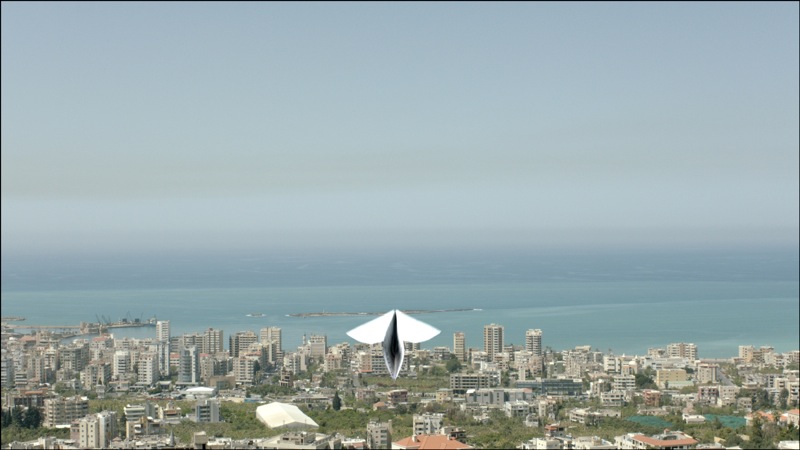
Zaatari was born in Saida – in fact his father founded the school that was the target of the IAF attack – and the film that is the heart of the art-work is, like Tamir’s decision, an intensely personal one whose resonances reach far and wide. Zaatari met with Tamir, and the film affirms the Israeli pilot’s original impulse to fly: hands draw paper aeroplanes and, at the end of the film, two boys climb up to the roof of the school and launch them into the air. The film is cut with family photographs and Zaatari’s own diary entries from the invasion too: you can find copies of the film on You Tube starting here.
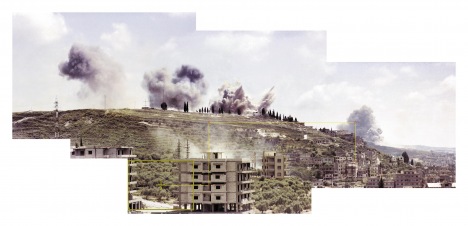
On the opposite wall, separated and joined by a single red cinema seat, another (shorter) film silently projects the hillside overlooking Said being systematically bombed. The sequence derives from a series of photographs Zaatari took in 1982.
From that seat, the viewer is invited to watch only that film, facing away from the more personal, vividly human story being told by the first film. Negar Azimi provides a fuller discussion of the installation here, and she concludes that ‘by placing each one of us, alone, within the generous frame of the work, it seems to remind us that, not unlike the pilot, we are sometimes caught up in vexed circumstances beyond our control.’ Certainly the title of the work directly addresses the pilot and so, by extension, perhaps the pilot-observer that late modern war has invited those of us who watch wars from a safe distance to become.
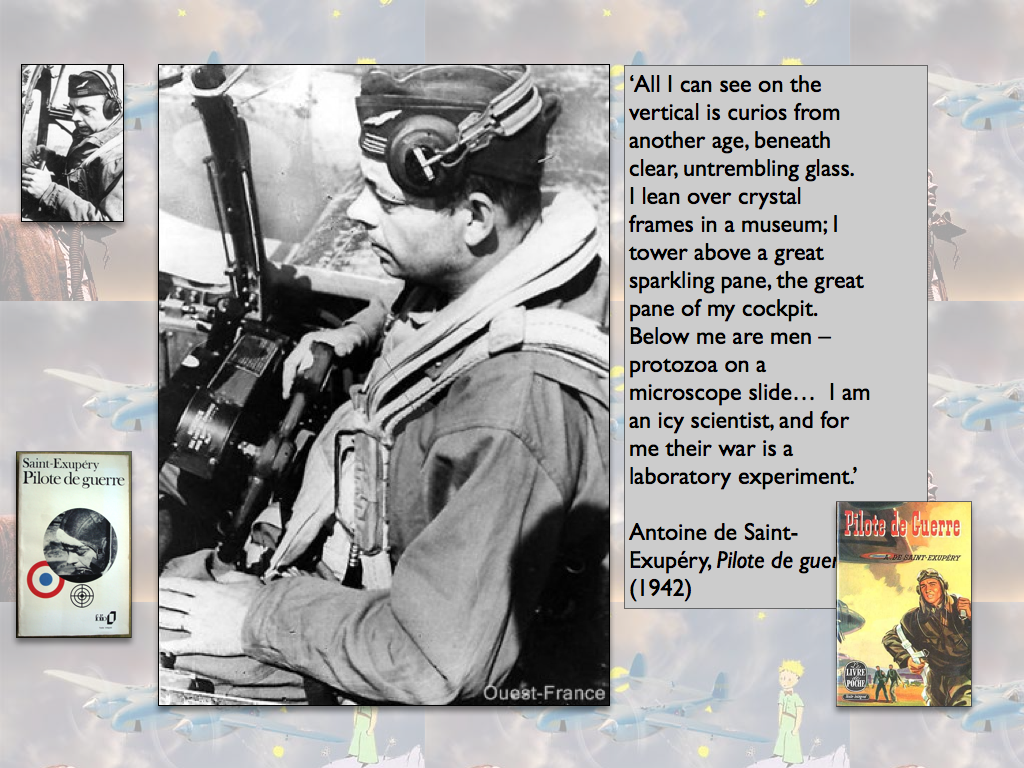
Perhaps. But this is a multi-layered work, and there are other readings. Near the beginning of the personal memory-film, and before the title appears on the screen, gloved hands turn the pages of Antoine de Saint-Exupéry‘s The Little Prince, which Negar describes as a ‘much-adored 1943 tale of youthful existentialism’. The point here, I take it, is to reinforce or reinscribe the acknowledged affinities between Zaatari’s work and Albert Camus‘s Letters to a German friend (“I should like to be able to love my country and still love justice.”)
But, as she also, notes Saint-Exupéry was ‘a famous war-time aviator’, and in that role he had a decidedly different view of things that speaks directly to (or rather from) the object record-film of the bombing:
Much of Zaatari’s work, as he confirms in this exceptionally rich conversation with Chad Elias for the Tate in 2011, asks us to ‘rethink what it means to witness, survive, or even document a war’. With that in mind, in gazing at the image stream of bombs, with our backs to the lifeworld that was also for many a deathworld, is it not possible that we are also being invited from that single red chair to adopt the position of Walter Benjamin‘s Angel of History?
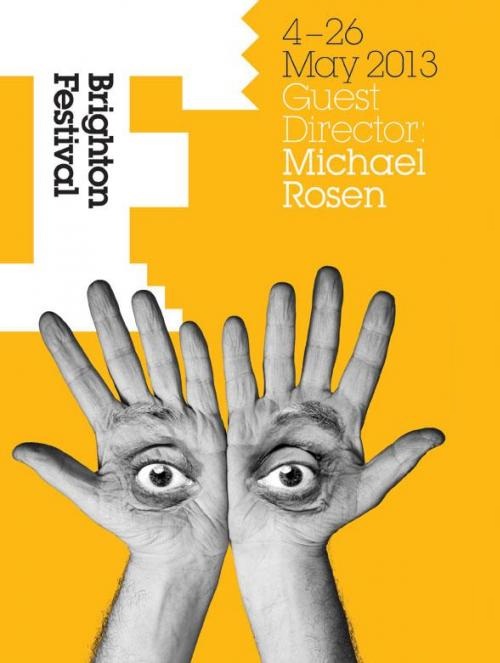
Two art projects from Lighthouseat the Brighton Festival in the UK this month (4-26 May); thanks to Sam Hind for the information.
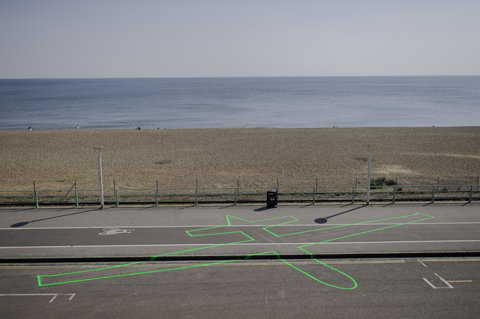
James Bridle‘s work will be familiar to most readers, and in Brighton he’s reprising his Under the shadow of the drone, which is a true-to-scale rendering of a Reaper, this time on the seafront:
The stark marking out in an unexpected public space of a Reaper drone’s silhouette brings the reality of these technologies into our daily lives. The work critiques the way that contemporary networked technologies, while enabling the digitally saturated culture of the 21st century, can also obscure and distance us from political and moral responsibility.
Bridle explains:
“Drones are just the latest in a long line of military technologies augmenting the process of death-dealing, but they are among the most efficient, the most distancing, the most invisible. These qualities allow them to do what they do unseen.
“We all live under the shadow of the drone, although most of us are lucky enough not to live under its direct fire. But the attitude they represent – of technology used for obscuration and violence; of the obfuscation of morality and culpability; of the illusion of omniscience and omnipotence; of the lesser value of other people’s lives; of, frankly, endless war – should concern us all.”
And Lighthouse adds: ‘By superimposing a large-scale drawing of the shadow of a drone in an urban location in Brighton, Bridle brings these chilling machines uncomfortably close to us, embedding them into our daily lives, and in the process perhaps making the reality of the daily occurrence of deadly drone strikes more tangible.’
For me, some of Bridle’s other projects – like Dronestagram – are more effective in bringing the strikes (rather than the technology) down to earth and into the spaces of everyday life, but it’s still an arresting project. Size and scale matter; I remember visiting the RAF Museum at Hendon and being truly astonished at how small a Lancaster bomber was – and yet how vast the bomb door in its belly. If you’re in Brighton, you can find Bridle’s rendering 5 minutes/500 metres walk east from the Brighton Wheel on Marine Parade, towards Yellowave Beach Sports Venue; then look down to Madeira Drive.
… an exhibition of startling images that explore the disturbing, and often invisible, technologies of war. In dramatic contrast with her more familiar depictions of landscape and the sublimity of nature, this highly topical study brings us face to face with weapons of mass destruction.
Neudecker’s artistic strategy is rooted in ‘ground truth’, a term used in remote sensing to describe data collected on location. Works created whilst on site at the historic Nike missile facility in the US are emblematic of Neudecker’s determination to go beyond mere representation. Her extraordinary graphite rubbings of vast Hercules missiles physically capture the object, making what is otherwise abstract and monstrous, tactile and present. Other works investigate military imaging and tactical communication, which provide us with new ways of detecting what is intended to be camouflaged and out of view.
You can see this at Lighthouse, 28 Kensington Street, Brighton, and preview images here.
For more on artworks, invisible military technologies and ‘geographies of seeing’, I thoroughly recommend honor harger‘s excellent reflections on Unmanned Aerial Ecologieshere, which includes a series of brilliant images and commentaries on the work of Trevor Paglen and Marko Peljhan. The latter is new to me and very interesting: the title for this post is taken not only from the military, which is appropriate enough, but also from one of Peljhan’s projects featured in honor’s essay.

 This plainly reaches back to the air defence systems set up by Britain and Germany during the Second World War, but more significantly for my purposes it intersects with the sensor-shooter system that was at the deadly centre of the ‘electronic battlefield’ during the Vietnam war and with a stream of subsequent tactical (rather than purely strategic) developments. If you want to know more about SAGE and its spiralling military trajectory, I recommend Matt Farish‘s brilliant chapter in The contours of America’s Cold War (Minnesota, 2010), ‘The cybernetic continent: North America as defense laboratory’.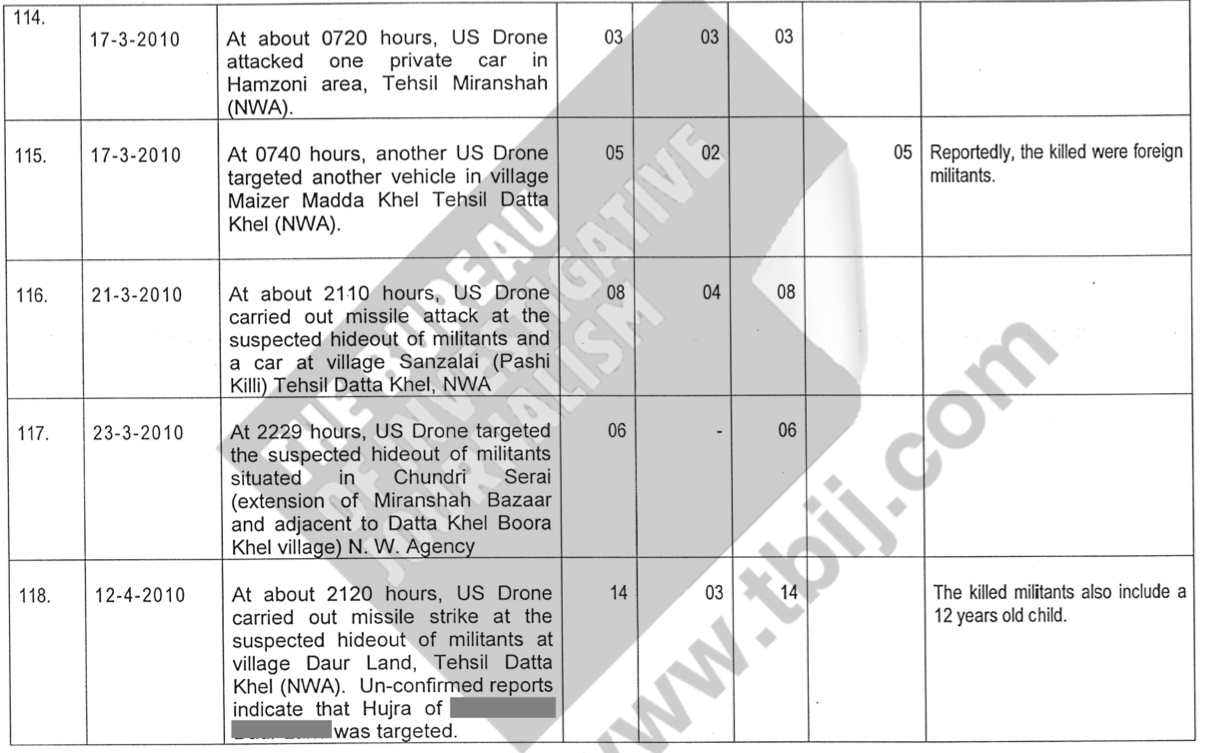





 geographical imaginations