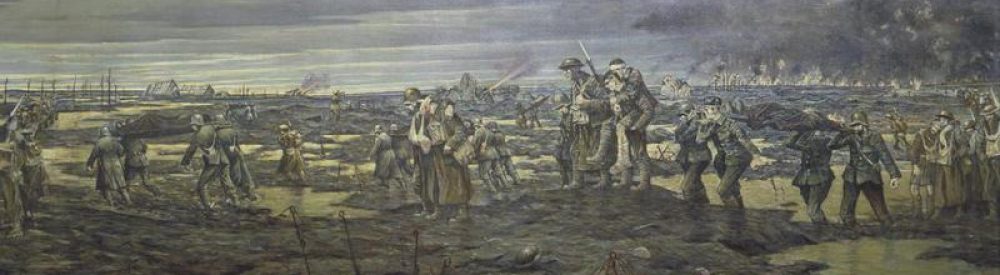
The Last Dance

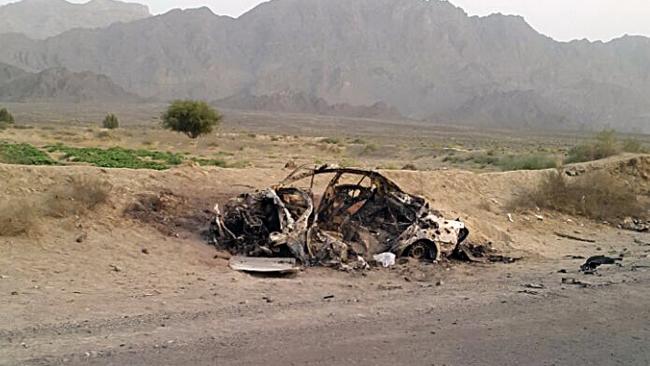
Mansour strike photo

I have – at long last – finished the longform version of “Dirty dancing: drones and death in the borderlands“, which analyses drone strikes in Pakistan’s Federally Administered Tribal Areas and situates them within a wider context of military violence in the region.  You can find it under the DOWNLOADS tab, but I’ve pasted the conclusion below; there’s also a video of the last presentation I gave under that title here.

To make sense of the conclusion, I should explain that the essay opens by juxtaposing the killing of two people, Baitullah Mehsud (leader of the Pakistan Taliban) and Mamana Bibi (a village midwife), to pose the question: what kinds of spaces are the FATA made to be for incidents like these – incidents as unlike as these – to be possible?

My answer works with two framing devices.

The first is the space of exception – a space in which people are knowingly and deliberately exposed to death through the political-juridical removal of legal protections and affordances that would otherwise be available to them.  My version of this is different from that proposed by Giorgio Agamben, and far from invoking a suspension of the law I explore three legal geographies that have been used to prepare the ground for aerial violence in the borderlands.

The second is the space of execution; here I riff off Owen Sheers‘ perceptive remark about ‘the territory of the screen’ (as I note, ‘Killing somebody with a Hellfire missile controlled from thousands of miles away depends upon a screen – or more accurately a series of screens – on which the image of a human body will eventually be touched by the cross-hairs of a targeting pod’).  Owen’s phrase is much more than metaphor, so I treat ‘territory’ as a (bio)political technology whose calibrations enable states to assert, enact and enforce a claim over bodies-in-space (you can no doubt hear the echoes of Stuart Elden) and then explore the technicity involved in three of its screen elements that jointly transform the FATA into a space of execution: kill lists, signals intercepts and visual feeds.

***
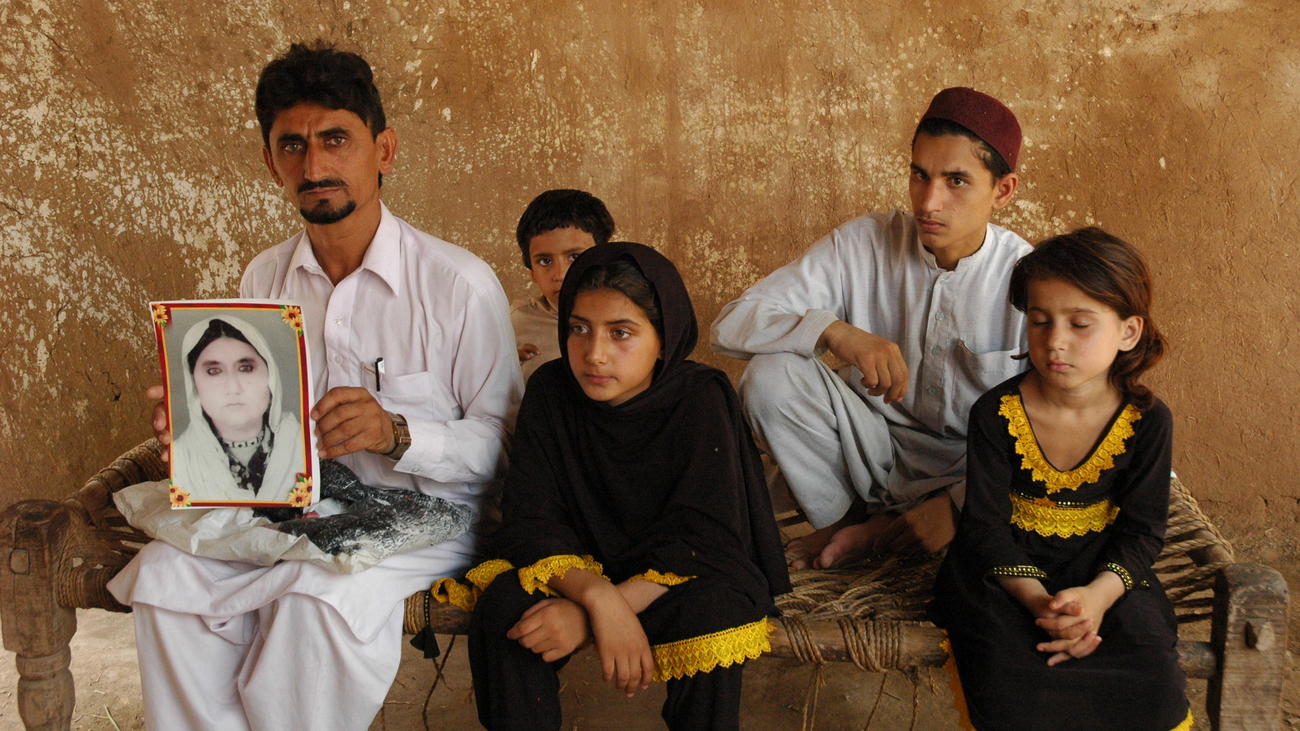
Mamana Bibi's surviving family

Here, then, is the conclusion:

The production of the borderlands as spaces of exception and spaces of execution are attempts to force those who live there into particular subject-positions as a means of subjugation. These positions are partial and precarious but the project to establish them as legitimate and rational has consequences that are material and affective. They clearly affect those targeted – people like Baitullah Mehsud – whose political agency exceeds in terrifying ways the normative space allowed them by the state of Pakistan and the United States and in so doing brings their actions to the attention of both. But they also impact the rest of the population in the FATA, constricting their mobilities and stoking their fears to such a degree that ‘normal life’ for many of them threatens to become a memory or a fantasy. Their existence is rendered more precarious because the subject-positions to which they are so brutally assigned are racialized. These are ‘tribal peoples’, different from those who inhabit ‘mainland Pakistan’, while the United States writes off their incidental deaths as ‘collateral damage’ whose anonymity confers on them no individuality only a collective ascription. When a CIA-directed drone strike on a compound in the Shawal Valley of South Waziristan on 15 January 2015 was found to have killed not only a deputy leader of al-Qaeda in the Indian subcontinent and a local Taliban commander but also two hostages, an American development contractor and an Italian aid worker, a ‘grim-faced’ and ‘visibly moved’ Obama made a personal and public apology. [i] The rarity of the gesture is revealing. For the value of their lives was acknowledged and their deaths were made grievable in ways that others – which is to say Others – were not. Nobody has ever accepted responsibility or apologised for the death of Mamana Bibi or any of the other innocent victims of aerial violence.

For this reason it is important to resist those versions of the space of exception that are complicit in the denial of agency to those who live within its confines. The state of Pakistan administers the inhabitants of the FATA through Political Agents: but this does not remove (though it does diminish) their own political agency. Pakistan’s armed forces conduct clearing operations that ruthlessly drive people from their homes and into camps for displaced persons: but this does not turn the FATA into one vast ‘camp’. The presence of US drones strips those who live under them of their well-being and dignity: but this does not reduce them to ‘bare life’. Similarly, the emergent subject that is produced within the space of execution, apprehended as a network trace, a sensor signature and a screen image, is a cipher that stands in for – and in the way of – a corporeal actor whose existence is not measured by the calculative alone.

***

This version, or something very much like it, will appear in a collection edited by Caren Kaplan and Lisa Parks, Life in the Age of Drones.  But an (even longer!) version will eventually appear in my own book, with images and maps (you can find many of them scattered through my previous posts: for example here, here and here), so I really would welcome any comments or suggestions if you have time to read the full thing: derek.gregory@ubc.ca.
 

The Body of War

Here is a call for papers for a wonderfully creative international symposium, The Body of War: Drones and Lone Wolves,  to be held at the University of Lancaster  on 24-25 November 2016.  It’s part of the ongoing States of Exceptions project (for Part I, see here).

I’ve just agreed to give a keynote; it’s an interdisciplinary event, and the organisers tell me they are keen to encourage the participation of early career scholars.

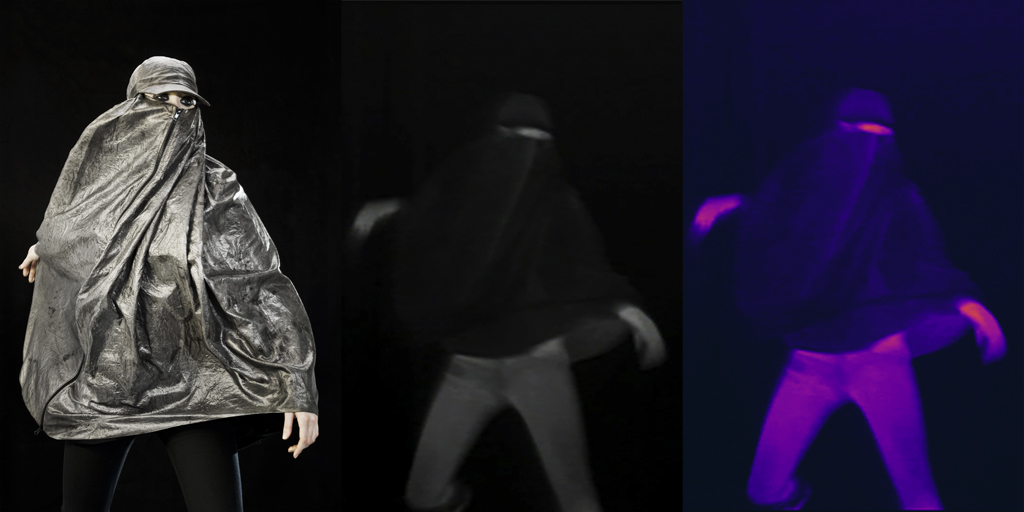
Anti-drone Burqa (Adam Harvey)

Anti-drone Burqa (Adam Harvey)

“The discriminatory concept of the enemy as a criminal and the attendant implication of justa causa run parallel to the intensification of the means of destruction and the disorientation of theaters of war. Intensification of the technical means of destruction opens the abyss of an equally destructive legal and moral discrimination. […] Given the fact that war has been transformed into a police action against troublemakers, criminals, and pests, justification of the methods of this “police bombing” must be intensified. Thus, one is compelled to push the discrimination of the opponent into the abyss.”

Carl Schmitt, The Nomos of the Earth (1950)

13 November 2015: three suicide bombers blew themselves up near the Stade de France in Saint-Denis, Paris, killing themselves and a bystander, and triggering a series of violent actions that caused 130 casualties. 15 November 2015: the President of France, François Hollande, after defying the attacks ‘an act of war’ by the Islamic State, launched a three-month state of emergency and ‘Opération Chammal’, a huge airstrike campaign against ISIL targets in Syria.

These two violent actions design a deformed and limitless theater of war, within which all distinctions and limitations elaborated by International Law seem to disappear. It is not merely the loss of the fundamental distinction between combatants and civilians, that both suicide bombers and airstrike bombings signal. In the current situation, all the fundamental principles that gave birth to the Laws of War seem to collapse: spatial and temporal limitations of hostilities, proportionality of military actions, discrimination of targets, weapons and just methods to use them. In this way, the ‘enemy’, from a juridical concept, is transformed into an ‘ideological object’; his figure, pushed to a climax from both these ‘invisible’ and ‘mobile’ fronts, becomes absolute and de-humanized. Hollande, Cameron and Obama’s unwillingness to use ground troops against the ‘uncivilized’ (Kerry 2015) is mirrored by the ISIL call to intensify suicide missions against the ‘cowards’ (Dābiq, 12: 2015).

But what lies behind the asymmetric confrontation between airstrikes and ‘humanstrikes’, behind the blurring of the distinction between the state of war and state of peace? What notion of humanity are the physical disengagement of the Western powers (with their tele-killing via drones and airstrikes) and the physical engagement of suicide bombers (ready to turn their bodies into a weapon) trying to convey? In other words, how and to what extent is there a connection between the automatization and biopoliticization of war operated by Western powers and the sacrificial nature of the conflict adopted by those who want to fight these powers?

In this second part of the “States of Exceptions” project, our intention is to explore these questions in order to map the crucial transformations of warfare, of its ethical principles and methods of engagement.

We invite potential participants to submit abstracts of no more than 250 words by 31 July 2016 drawing upon, but not limited to, such issues as:

  • Theatres of War: The New Spatialities and Temporalities of Warfare
  • Mirror Images? Drones vs. Suicide Bombers
  • Phenomenology of Drones
  • New Perspectives on Ethics, Horror & Terror
  • The Ubiquity of the Enemy: Lone Wolves and Self-Representing Terror
  • The Collapse of International Law: What Enemy? Which Proportionality?
  • The Body as a Weapon: The Immanentization of Martyrdom
  • Phenomenology of Lone Wolves
  • The End of Law: Rethinking Limitation, Proportionality and Discrimination

Please send abstracts with “States of Exception II” in subject line to bisagroup.cript@gmail.com

In the footsteps of war

Landmine+Victims+Receive+Tretment+ICRC+Rehabilitation+Mo_OXg8Ps5Gl

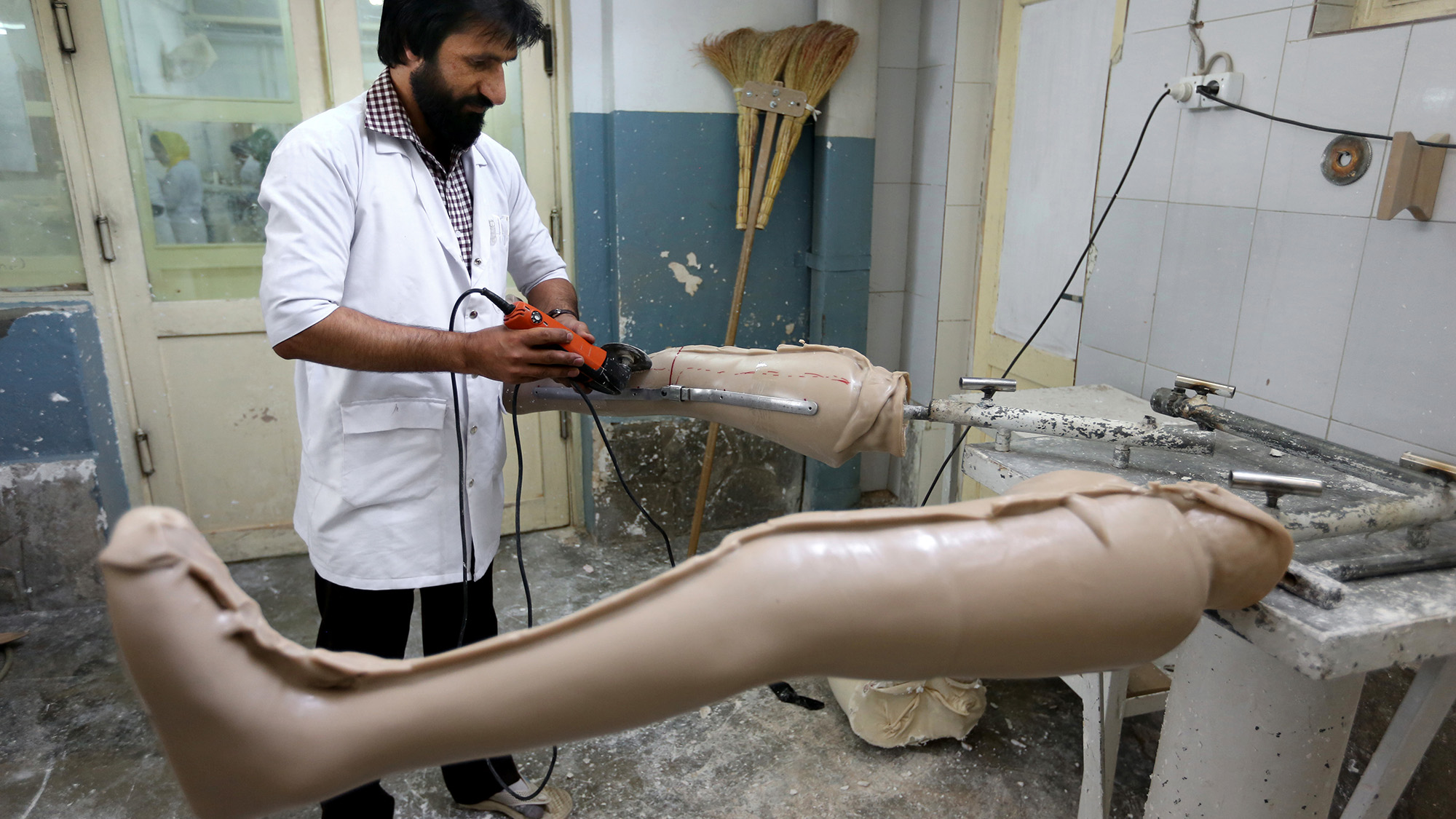
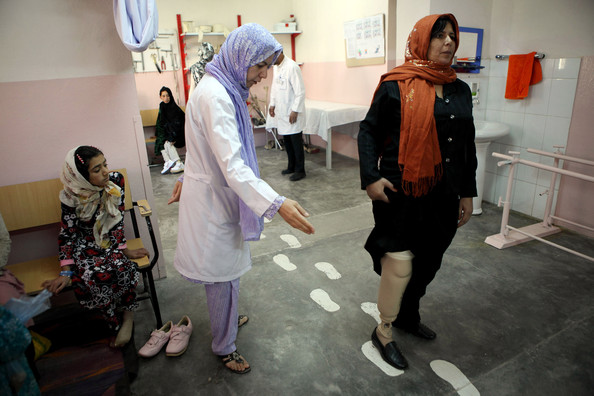
An update to my discussion of ‘The prosthetics of military violence‘: Gizmodo has published an arresting series of images from the ICRC’s rehabilitation centre in Kabul.  As Jamie Condliffe notes, and as I tried to show in that extended post:

Last week, bioengineering’s most advanced prosthetics were shown off at the world’s largest orthopedics event in Germany. But in Afghanistan, things are a little different.

These photographs, from AP, show the work being carried out at the International Committee of the Red Cross’s physical rehabilitation center in Kabul, Afghanistan. There, those who have suffered the loss of a limb — whether children with birth defects or adults who’ve been injured in war — are fitted with the best prosthetics the ICRC can provide.

As you can see, they’re not quite as advanced as those shown off in Germany last week. Think less of carbon fiber and 3D printing, and more of plaster and orbital sanders.

An Afghan employee of the International Committee of the Red Cross (ICRC) works on a prosthetic leg at the ICRC physical rehabilitation center in Kabul, Afghanistan, Tuesday, May 10, 2016. Afghanistan is one of the world's most heavily mined countries. (AP Photo/Rahmat Gul)

An Afghan employee of the International Committee of the Red Cross (ICRC) works on a prosthetic leg at the ICRC physical rehabilitation center in Kabul, Afghanistan, Tuesday, May 10, 2016. Afghanistan is one of the world’s most heavily mined countries. (AP Photo/Rahmat Gul)

You can find many more remarkable photographs from the ICRC centre at Getty Images here.

Object Lessons

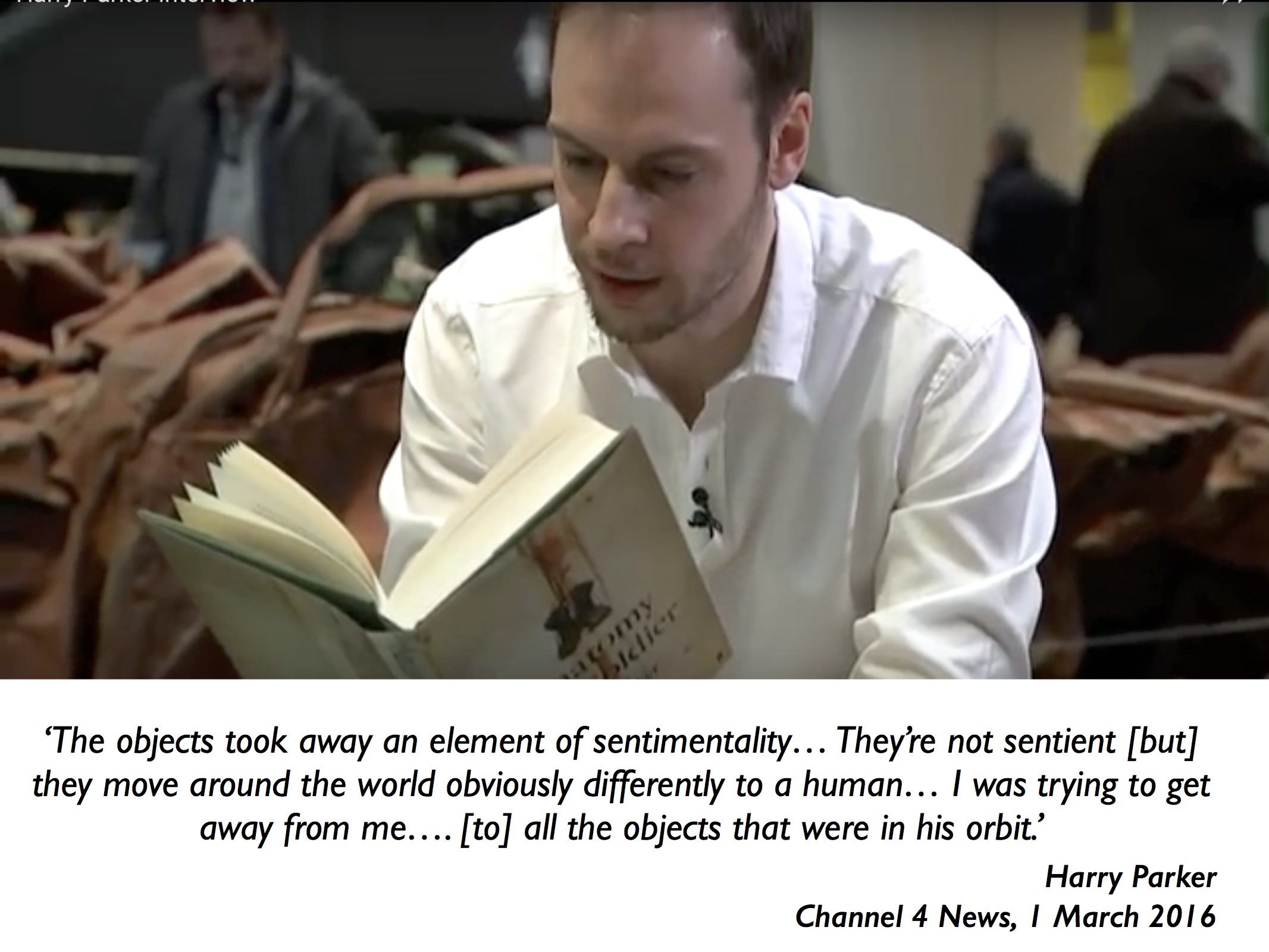
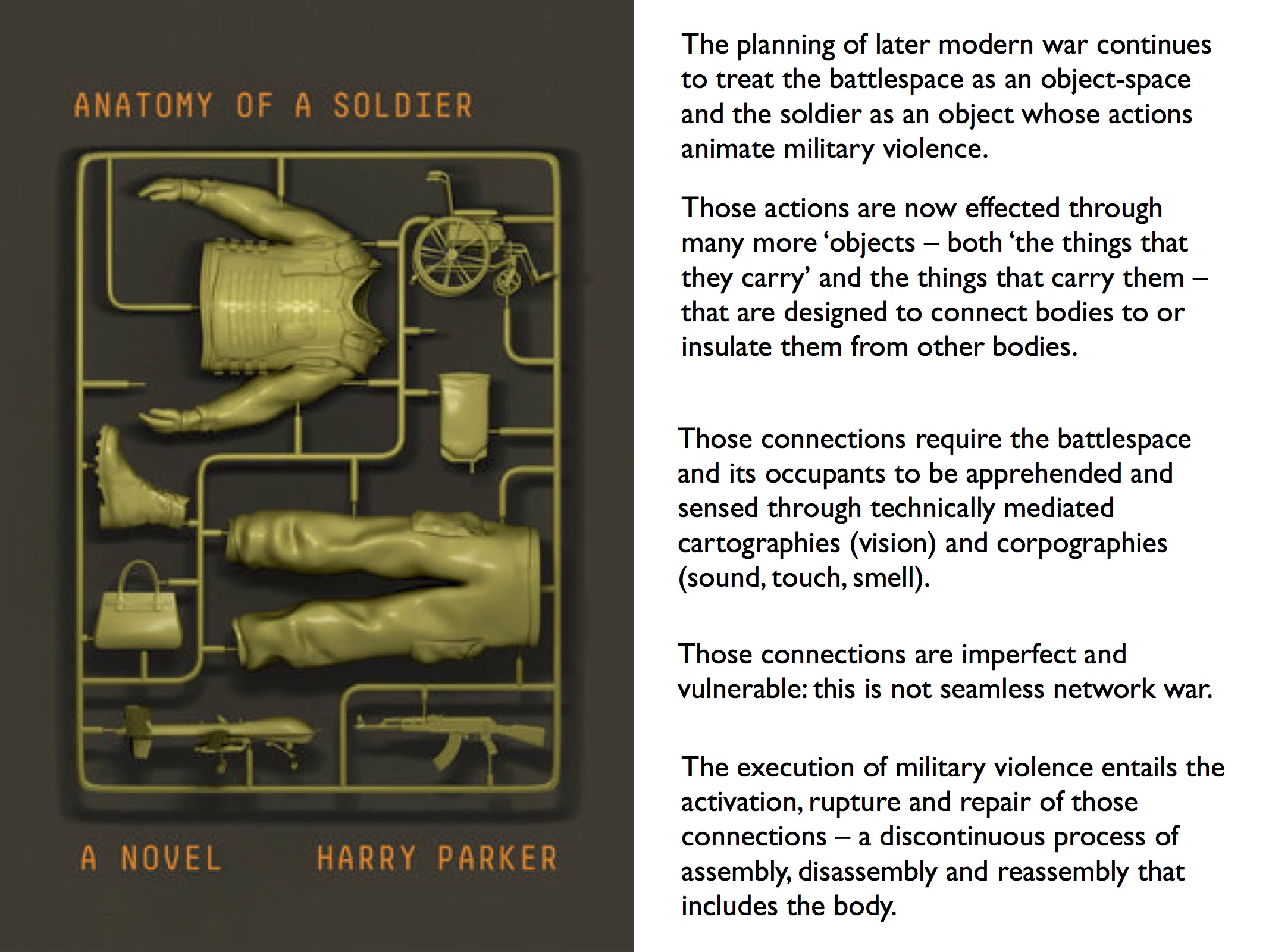
I was supposed to give a shortened version of ‘Little boys and blue skies‘ at the AAG Annual Meeting in San Francisco (about drones and atomic war: available under the DOWNLOADS tab) and fully intended to do so.  But in the event – and as I implied in a previous post – I decided to talk instead about Harry Parker‘s Anatomy of a soldier.  It was a spur of the moment decision, though it had been pricking away in my mind ever since I read the novel, and I only decided to do it at 10.30 the night before: madness.  But it was much closer to the theme of the sessions organised by Kate Kindervater and Ian Shaw on ‘Objects of Security and War: Material Approaches to Violence and Conflict‘ than my original presentation would have been.

I’ve added the presentation to those available under the DOWNLOADS tab (scroll right down).

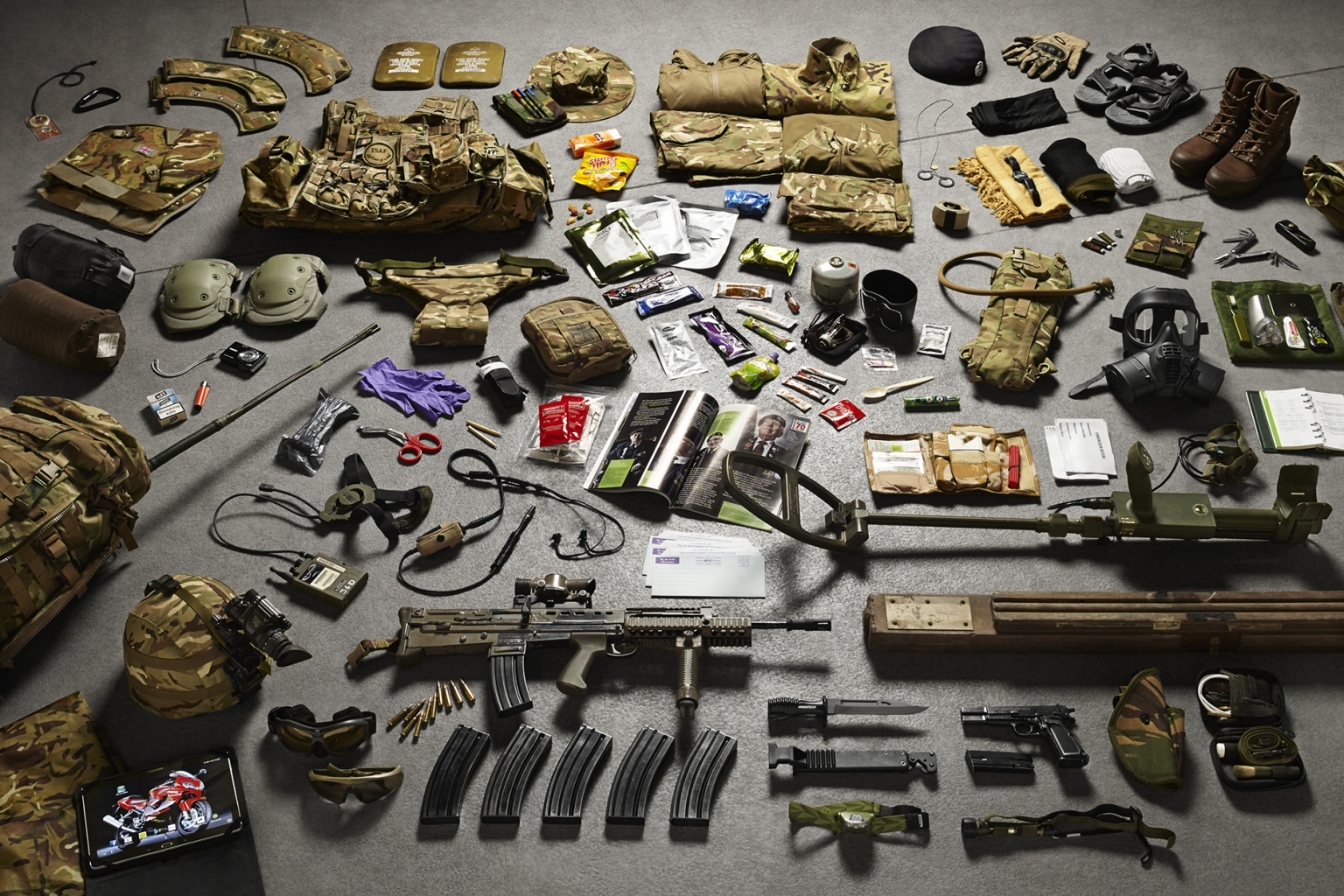
I hope that most of it will be self-explanatory, but some notes might help.  I started out by invoking Tim O’Brien‘s twin accounts of the Vietnam War, The things they carried and If I should die in a combat zone, which provide vivid reminders of the weight – physical and emotional – borne by ground troops and the toll they impose on the soldier’s body.

I talked about this in ‘The natures of war‘ (also under the DOWNLOADS tab) and – following in the footsteps of that essay – I sketched a brief history of the objects soldiers carried in to the killing fields: from the Somme in 1916 through Arnhem in 1944 to Helmand in Afghanistan in 2014 [shown below].  My source for these images was photographer Thom Atkinson‘s portfolio of Soldiers’ Inventories.

KIT Helmand 2014

But I was more interested now in the objects that carried the soldiers, so to speak, which is why I turned to Anatomy of a soldier.  

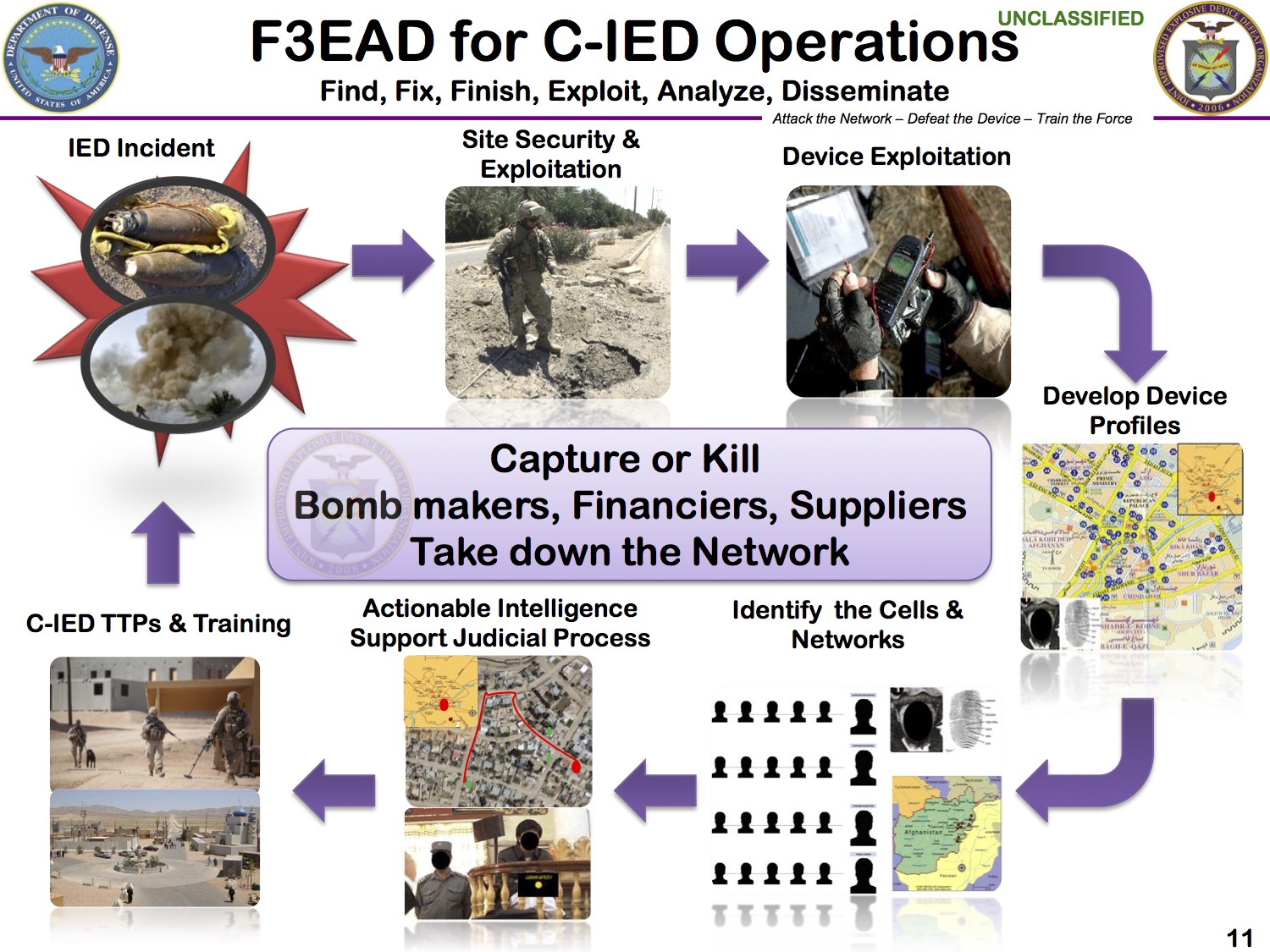
In order to throw the novel into even sharper relief, I outlined some of the other ways in which IED blasts in Afghanistan have been narrated.  These ranged from the US Army’s own schematics [the image below is taken from a presentation by Captain Frederick Gaghan here]  to Brian Castner’s truly brilliant non-fiction All the ways we kill and die, in which he describes his investigation into the death of his friend Matt Schwartz from an IED blast in Helmand in January 2012. (This book has taught me more about the war in Afghanistan than anything – I mean anything – I’ve ever read).

GAGHAN Attacking the IED Network jpegs

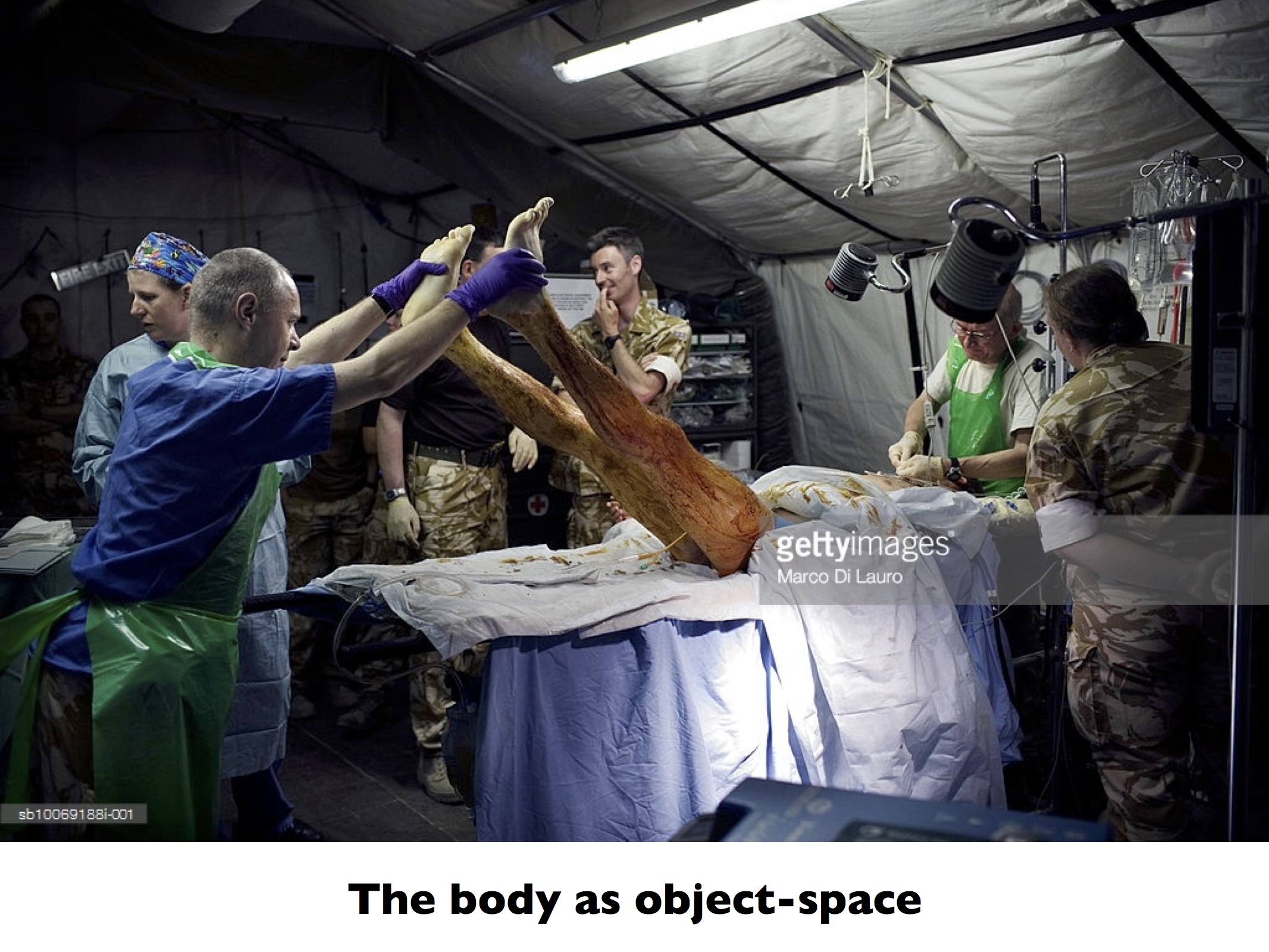
All of this prepared the ground for Parker’s novel which tells the story of a young British officer in Helmand, Tom Barnes, who loses his legs to an IED blast – told in 45 short chapters by the different objects involved.  Not all of the chapters are wholly successful, but many of them are utterly compelling and immensely affecting.  The overall effect is to emphasize at once the corporeality of war – ‘virtually every object-fragment that is proximate to Barnes is impregnated with his body: its feel – its very fleshiness – its sweat, its smell, its touch’ – and the object-ness of military violence.

GREGORY The body as object-space

I juxtaposed the novel to Parker’s own story – he too lost his legs to an IED in Afghanistan in July 2009.  Yet he constantly emphasises that he never wanted the novel to be about him.

Harry Parker reading from Anatomy of a Soldier, IWM, LOndon

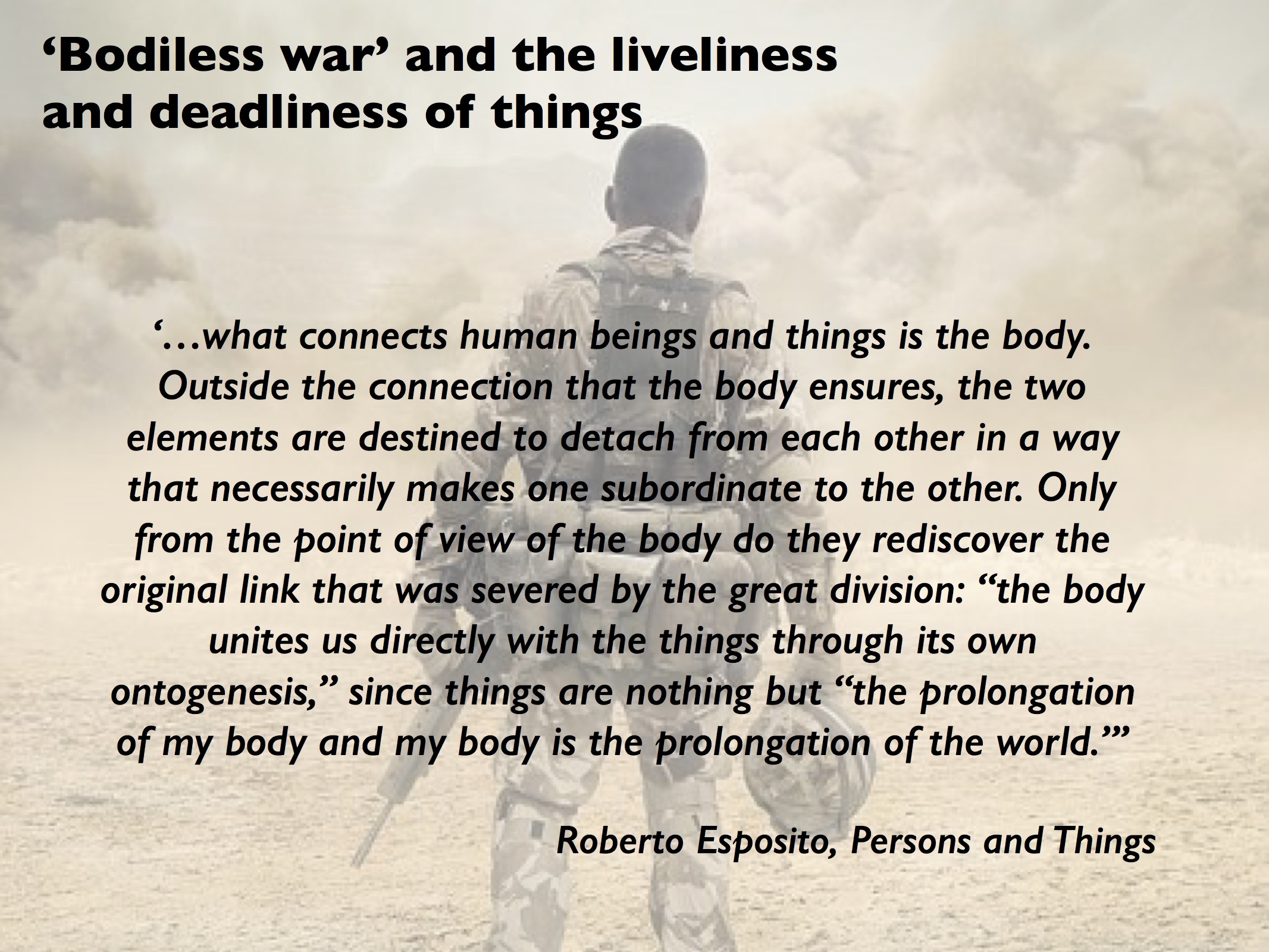
Still, the body is central to all this – Parker’s body and Barnes’s body – and so finally I drew on Roberto Esposito‘s Persons and Things to draw the wider lesson and, in particular, to nail the treacherous lie of ‘bodiless war’:

GREGORY The things that carry them

GREGORY Bodiless war

Standing on occupied ground

This is Reading Week at UBC, so I’m doing just that…  At the AAG Annual Meeting in San Francisco there is a Plenary Session on Friday 1 April (sic) on Forging Solidarity: Taking a stand on Palestine:

In July 2015 the International Critical Geography Group convened its seventh conference in the occupied city of Ramallah, Palestine. The conference brought together scholars and activists committed to combating social exploitation and oppression. Altogether four hundred participants from over forty countries energetically took up issues on and beyond the violent frontlines of class, gender, race, sexual, and colonial divisions. Yet they also took critical steps beyond discussion and debate of our intellectual work towards concrete collective action. An example of this was the overwhelmingly vote of conference participants for a strong resolution to sign onto the Palestinian Academic and Cultural Boycott and the broader Boycott Divestment and Sanctions (BDS) campaign against Israel. The resolution adopted is both a political statement in solidarity with the anti-colonial struggle of our Palestinian comrades but also an agenda for a broader commitment to anti-capitalist, decolonial, anti-racist, feminist and queer social movements and struggles around the world against growing social, economic and political precarity, rising authoritarianism, encroachment of fundamental rights, dispossession, structural adjustment in the south and north, revanchism, ongoing colonization of public space, land and resources, the privatization of the commons, as well as structural and state-sanctioned violence against racialized, gendered, queer bodies, and other targeted bodies and communities.

Building on the momentum generated by the conference and this resolution, this discussion panel aims to open up a serious discussion about BDS and the academic boycott of Israel within the Association of American Geographers. This is, we believe, particularly relevant in light of the current situation in Palestine/Israel but also taking into consideration how academics from other professional organisations such as the American Anthropological Association, the Association for Asian American Studies, the American Studies Association and the Native American Studies Association, as well as a number of student councils worldwide, have already endorsed this call for solidarity. Our distinguished panel of scholars and activists will speak out about the importance and the urgency to adopt a political stand on Palestine and to further the work of decolonizing the discipline of geography. In doing so, we hope to reaffirm a commitment to critical scholarship and praxis by encouraging and enabling spaces of political and conceptual possibility for geographers in solidarity with ongoing socio-political, economic and environmental struggles around the globe.

w512

In the wake of that ICG Conference in Ramallah, David Lloyd‘s moving reflections on another conference/workshop in the same city, ‘Walter Benjamin in Palestine‘, repay careful reading:

Activism is in fact the antagonist of complacency and of the satisfaction with familiar protocols that dulls thinking and makes the institutionalized academic a little stupid. But activism is not always expressed in headlong mobilization or fervent debates, nor is thought only the forethought that shapes or the afterthought that reflects on practice. As “Benjamin in Palestine” exemplified, it can also take the form of deliberate thinking in common whose very exercise is a form of resistance, however limited. As the BDS movement continues to advance, perhaps workshops like these, which step beyond mere “severance of relations” (as Benjamin described the act of striking) to shape conditions for new modes of relation, may offer a way to think the future of our resistance to Israeli apartheid. Perhaps too it offers a model also for an alternative to the insidious corporatization of our intellectual and creative lives under the neoliberal dispensation we all confront, wherever we reside, and not only in occupied Palestine. That, indeed, may be the insight we have been gifted by those who daily struggle for the right to education in the face of dispossession.

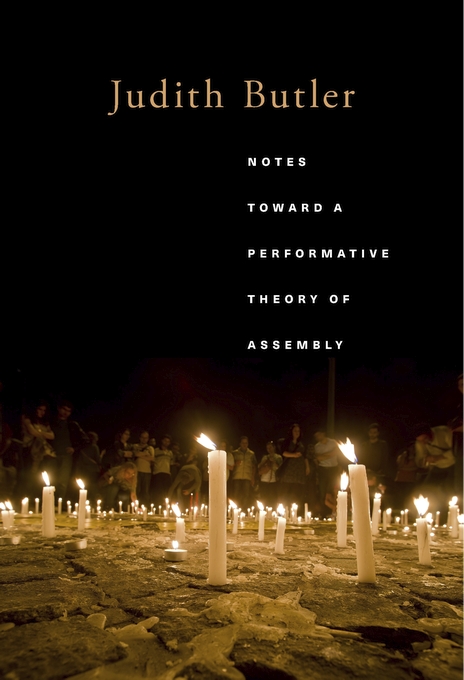
BUTLER NotesIn its way this, too, is a modestly performative politics of assembly.  So it’s good to see that panelists at the AAG plenary include this year’s Honorary Geographer, Judith Butler; full list is here.  You can find Judith’s previous remarks on BDS (at Brooklyn College) here.

You can also find out much more about the American Anthropological Association’s stand (last year) here; the statement that accompanied the successful resolution is here; a series of FAQs (“Yes, but…”) is here; and other resources are here.

It’s opportune, too, that the latest issue of borderlands should be devoted to The politics of suffering – with a special focus on occupied Palestine.  Among the many truly excellent essays three stand out for me.

First, Suvendrini Perera‘s accomplished contrapuntal reading of transnational justice, ‘Visibility, Atrocity and the Subject of Postcolonial Justice‘, which proceeds’ through a series of key sites – Congo, Belgium, Nuremberg, Israel, Gaza – that links past and present, colonial and colonizing worlds’, and then focuses on the deaths of tens of thousands of civilians on the beaches of Mullivaikkal in northeast Sri Lanka:

In the context of the 2009 atrocities in Lanka, in this paper I attempt to think through a set of questions about visibility, witness, suffering, accountability and disposability as they are played out in the relations between the necro-geo-politics of global institutions and the patchworks of local and transnational movements that attempt to materialize peoples’ suffering and realize the possibility of justice within fragile and compromised frameworks.

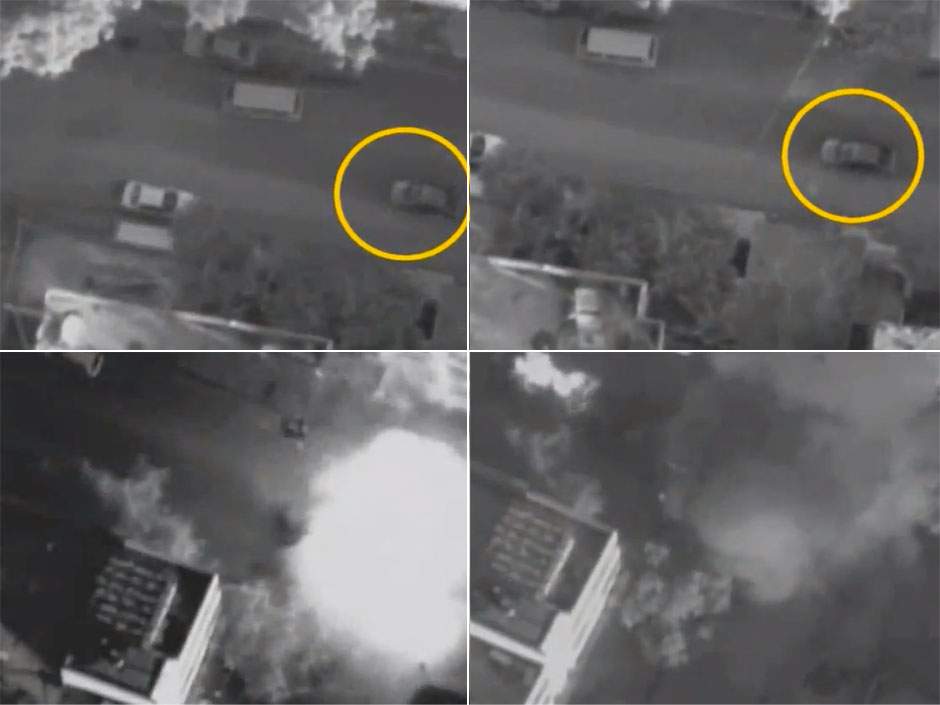
Drone feed Gaza city November 2012

Second, Joseph Pugliese‘s characteristically innovative ‘Forensic ecologies of occupied zones and Geographies of dispossession: Gaza and occupied East Jerusalem‘:

In this essay, I work to develop what I term multi-dimensional matrices of suffering that envisage the understanding of suffering beyond the locus of the human subject. In my theorising of multi-dimensional matrices of suffering, I proceed to conceptualise the suffering experienced in occupied zones as both relational and distributed. In the occupied zone, suffering encompasses complex, multi-dimensional vectors that bind humans, animals, animate and non-animate objects and entities, buildings and land. In the context of the regimes of violence that inscribe occupied zones, I situate suffering, and a range of other affects, in ecological configurations that, through a range of forensic indices, evidence the impact of these regimes of violence on the broad spectrum of entities that comprise a particular occupied zone. The conceptualisation of suffering and trauma in occupied zones in terms of its relational multi-dimensionality, its site-specific matrices and relational distribution across ecologies, I conclude, enables an understanding of suffering that moves beyond anthropocentric approaches. I situate my analysis in the context of Israel’s drone-enabled regime of unrelenting surveillance, occupation and military control over Gaza [see image above] and its continuing occupation of East Jerusalem.

It really is a tour de force, only too literally so, and builds not only on Joe’s brilliant State violence and the execution of law and his previous research but also on Jane Bennett‘s work and – as the title signposts – on Eyal Weizman‘s project of forensic architecture.  It’s doubly important because so much critical writing on military drones has virtually nothing to say about Israel’s use (and sale) of them.

Finally, Jasbir Puar‘s ‘The ‘right’ to maim: Disablement and inhumanist biopolitics in Palestine‘:

This essay argues that Israel manifests an implicit claim to the ‘right to maim’ and debilitate Palestinian bodies and environments as a form of biopolitical control and as central to a scientifically authorized humanitarian economy. In this context, the essay tracks the permeating relations between living and dying that complicate Michel Foucault’s foundational mapping of biopower, in this case, the practice of deliberate maiming. In doing so it demonstrates the limitations of the idea of ‘collateral damage’ that disarticulates the effects of warfare from the perpetration of violence, and notes that the policy of maiming is a productive one, a form of weaponized epigenetics through the profitability of a speculative rehabilitative economy.

This too is meticulously argued and imaginatively constructed, and adds important dimensions to my posts about Israel’s war on Gaza and, in particular, my preliminary speculations about the prosthetics of military violence.

Citizen Ex

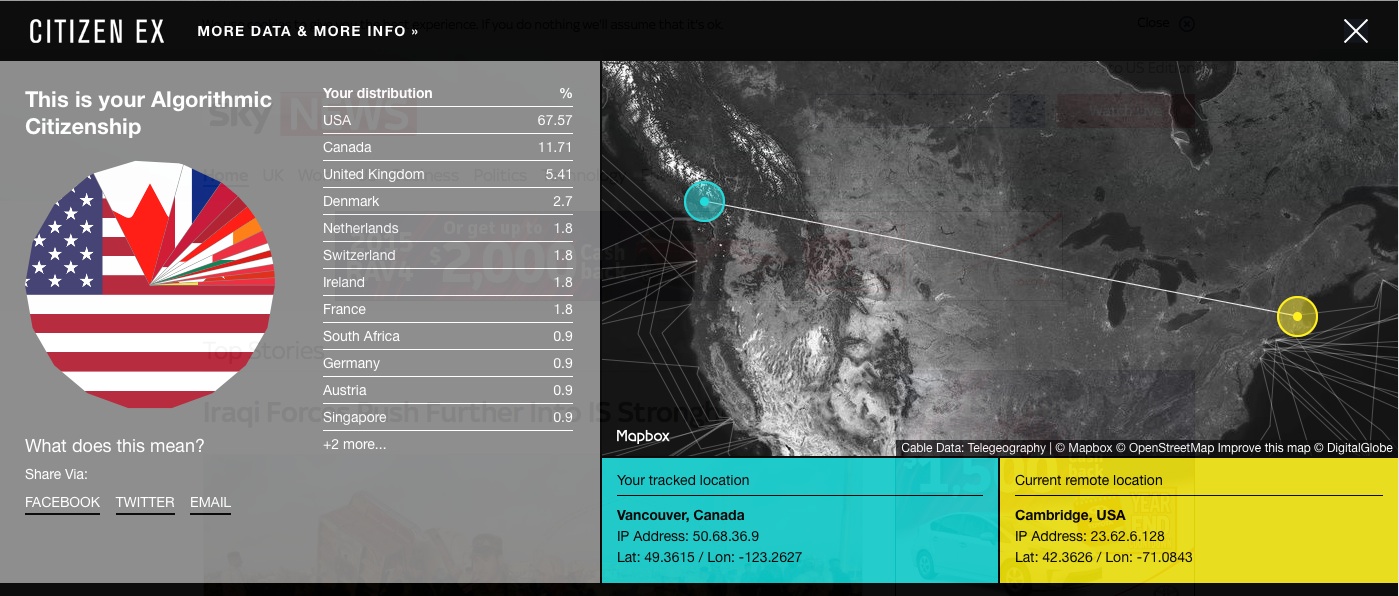
Algorithmic citizenship JPEG

I’m late to this, so apologies, but if you are either weary of web-surfing or can’t get off your digital board, check out James Bridle‘s Citizen Ex project on ‘algorithmic citizenship’:

Algorithmic Citizenship is a form of citizenship which is not assigned at birth, or through complex legal documents, but through data. Like other computerised processes, it can happen at the speed of light, and it can happen over and over again, constantly revising and recalculating. It can split a single citizenship into an infinite number of sub-citizenships, and count and weight them over time to produce combinations of affiliations to different states.

Citizen Ex calculates your Algorithmic Citizenship based on where you go online. Every site you visit is counted as evidence of your affiliation to a particular place, and added to your constantly revised Algorithmic Citizenship. Because the internet is everywhere, you can go anywhere – but because the internet is real, this also has consequences.

The basic idea is derived from an essay by John Cheney-Lippold in Theory, culture and society here:

Marketing and web analytic companies have implemented sophisticated algorithms to observe, analyze, and identify users through large surveillance networks online. These computer algorithms have the capacity to infer categories of identity upon users based largely on their web-surfing habits. In this article I will first discuss the conceptual and theoretical work around code, outlining its use in an analysis of online categorization practices. The article will then approach the function of code at the level of the category, arguing that an analysis of coded computer algorithms enables a supplement to Foucauldian thinking around biopolitics and biopower, of what I call soft biopower and soft biopolitics. These new conceptual devices allow us to better understand the workings of biopower at the level of the category, of using computer code, statistics and surveillance to construct categories within populations according to users’ surveilled internet history. Finally, the article will think through the nuanced ways that algorithmic inference works as a mode of control, of processes of identification that structure and regulate our lives online within the context of online marketing and algorithmic categorization.

From James’s Citizen Ex site you can download (from the banner, top left) an extension to your browser which – after you’ve browsed some more – will calculate, in a very rough and ready way, your own algorithmic citizenship.  Mine (from today’s little effort) is shown at the head of this post.

This may look like an entertaining distraction, but what lies behind it is of course deadly serious: read, for example, James’s (short) stories on Libya and Syria.

Created as a browser plug-in, Citizen Ex shows us the true physical locations of the sites we visit and the territories that govern our actions as we traverse the web. In this reality, every mouse click leaves a trace, as our personal data is collected and stored in locations around the globe. It is with this information that governments and corporations construct a notional vision of our lives. This is our ‘algorithmic citizenship’ — the way we appear to the network. This programmatic fluidity is far removed from the true complexity of human identity. It reduces it to something calculable, which has profound implications for our understanding of privacy, citizenship and the self.

It also has profound implications for surveillance and the digital production of the killing spaces of later modern war.  Read this alongside Louise Amoore‘s brilliant work on The politics of possibility and you can perhaps see where I’m going:

‘[W]hat comes to count as the actionable intelligence behind a sovereign decision is a mosaic of overwhelmingly ordinary fragments of a life that become, once arrayed together, secret and sensitive evidence…

‘Drawing some elements of past activities into the calculation, the mosaic nonetheless moves over the surface of multiple past subjects and events in order to imagine a future unknown subject.’

It’s not difficult to divine (sic) how ‘Citizen Ex’ becomes ‘Citizen-Ex’.

Grotesque geographies

KRUPAR lecture

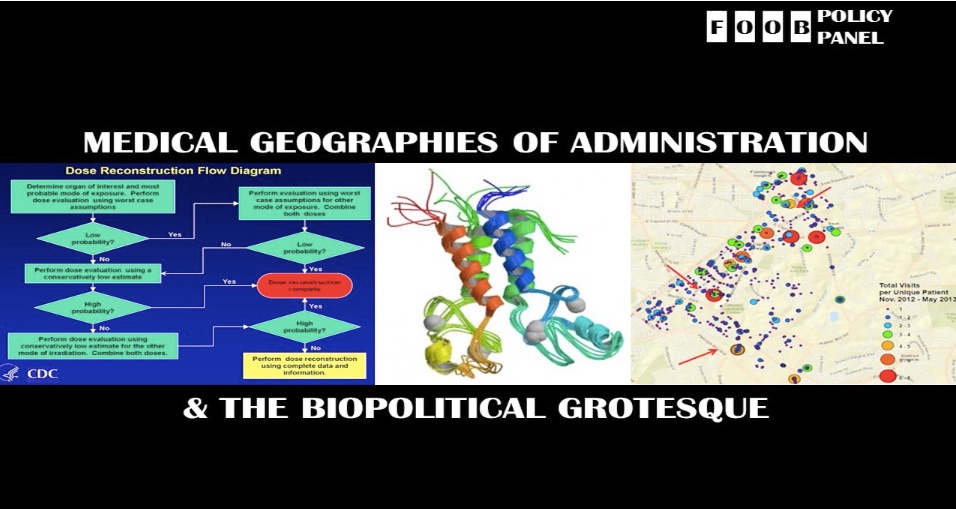
The 2nd Neil Smith Lecture at St Andrews, which was given last month by Shiloh Krupar on ‘Operational Banality: medical geographies of administration and the biopolitical grotesque‘, is now available online here.  A tour de force (plus a splendid cartoon of the spectacularly grotesque Donald Trump).

Operational Banality

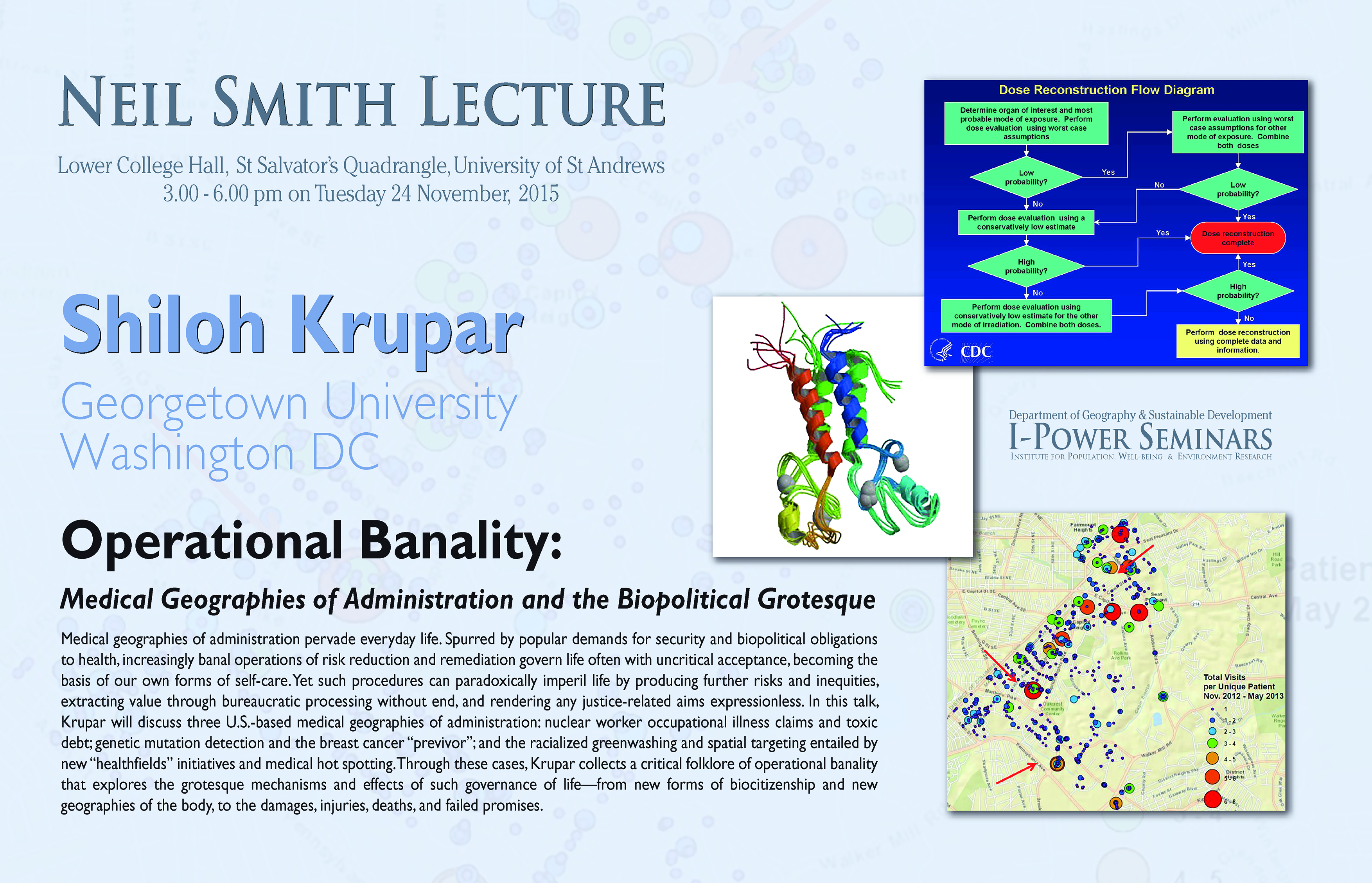
The next Neil Smith Lecture will be given by the amazing Shiloh Krupar at St Andrews next week (24 November at 3 p.m.) on “Operational Banality: medical geographies of administration and the biopolitical grotesque”: online version will follow soon after.

Posters

In case the text in the poster (above) is too small:

Screen Shot 2015-11-16 at 12.21.07

I wish I could be there.

Atomic soldiers and the nuclear battlefield

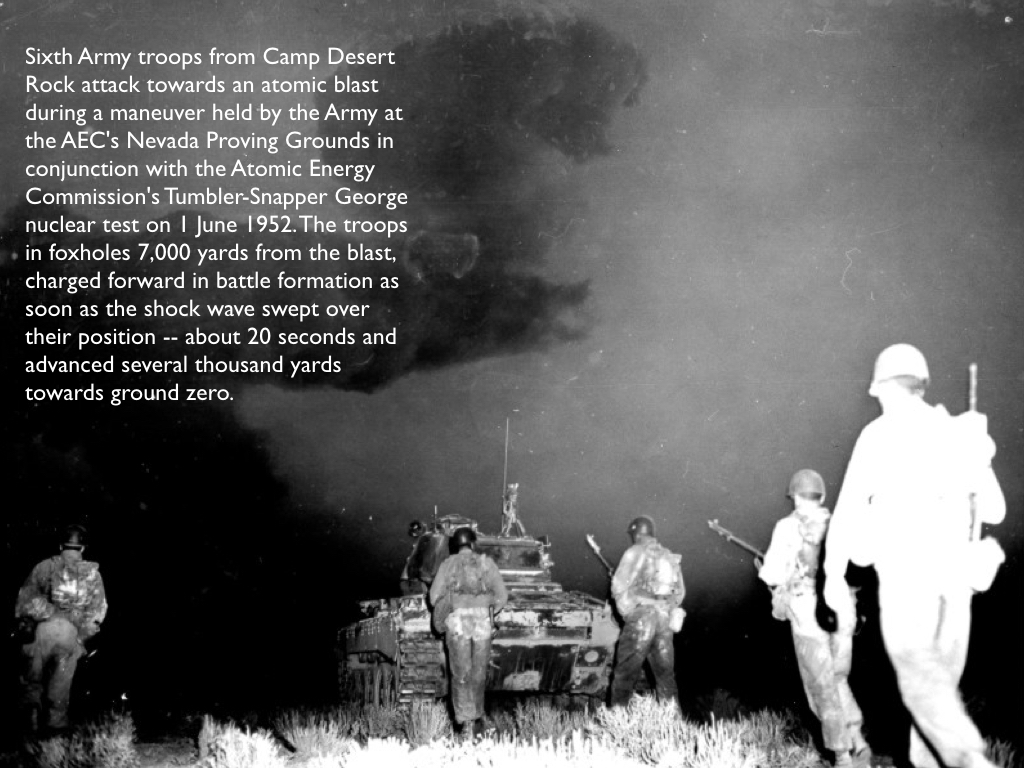
As promised, I’ve posted the slides from my presentation on “Little Boys and Blue Skies: drones through post-atomic eyes” under the DOWNLOADS tab.  Given my previous posts (here and here) these ought to be reasonably self-explanatory, but I’ve added a series of images derived from Matt Farish‘s brilliant presentation “Beneath the bombs” at the same conference and these probably need explanation.

Tumbler-Snapper 1 June 1952.001

One of the central themes of my presentation was the emphasis placed on American lives by those who planned the attacks on Hiroshima and Nagasaki – which is why the crew of the Enola Gay had to execute such a tight turn to escape the shock waves from the blast – and by American commentators who almost immediately contemplated the possibility of a nuclear attack on the continental United States.

The same was true of those who prepared for subsequent nuclear strikes (which is why the US Air Force experimented with drones to ‘deliver’ the bombs) and by those who orchestrated subsequent nuclear tests in the Marshall Islands and in Nevada (which is why the US Air Force and the US Navy used drones to fly through the atomic clouds to collect samples).

As I showed in the presentation, these same priorities have been extended to today’s use of armed drones by the US Air Force, which repeatedly cites its Predators and Reapers as ‘projecting power without vulnerability’.

All of this will be clear from my slides and posts.

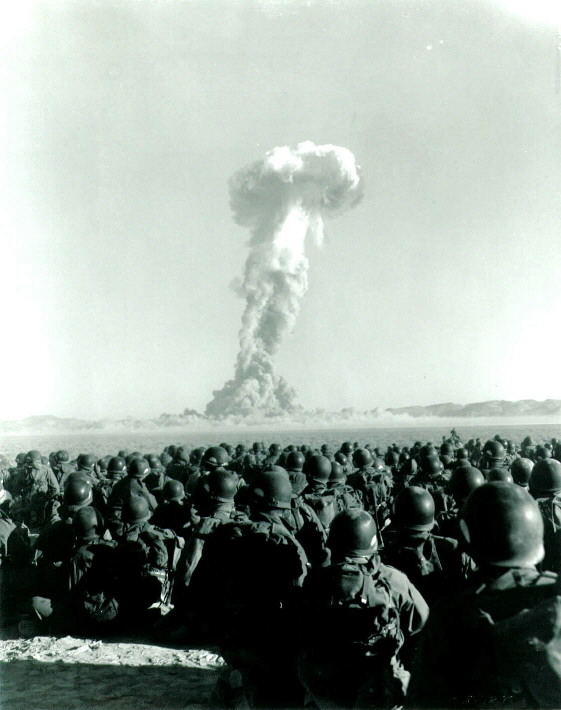
Troops watching atomic test, Yucca Flat, November 1951

But what I didn’t know was that the US Army and Marine Corps had no such qualms about exposing the bodies of their soldiers and marines to the dangers of atomic tests.  Matt described a series of exercises in Nevada – Desert Rock – held between 1951 and 1957 in which ground troops not only watched the tests from a distance (this I did know: see the image above) but were also ordered forward to secure the blast area.  Here is an official video (watch from 3.00).

This is a silent film, but if you prefer a video with a jaunty, reassuring commentary you can find one from the Internet Archive here.  It’s accompanied by this transcript of an interview between a sergeant and a training officer before a blast:

Question. “How many of your men would volunteer to go up and be in the foxholes?” (one-half mile from ground zero)

Answer. “I guess about half a dozen.”

Question. “It’s quite a loud noise when that bomb goes off … would it do them any harm?”

Answer. “No sir, not the noise, no.”

Question. “How about the radiation? Do you think there is much danger?”

Answer. “Radiation is the least of their worries that the men are thinking about.”

Question. “I think most thought radiation was the greatest danger, didn’t they? Where did they learn differently?”

Answer. “They were, prior to our instructions here. We received a very thorough briefing.”

royal_nevada_atomic_soldiers_19550418_courtesy_las_vegas_news_bureau_WEB-300x300

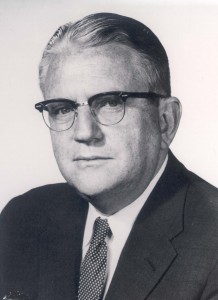
Part of the purpose of the tests was indeed to show how safe the tests were.  As Dr Richard Meiling, the chair of the Armed Forces Medical Policy Council, explained in a memorandum to the Pentagon on 27 June 1951:

‘Fear of radiation … is almost universal among the uninitiated and unless it is overcome in the military forces it could present a most serious problem if atomic weapons are used…. It has been proven repeatedly that persistent ionizing radiation following air bursts does not occur, hence the fear that it presents a dangerous hazard to personnel is groundless.’

Meiling-Richard-L.-218x300Meiling recommended that ‘positive action be taken at the earliest opportunity to demonstrate this fact in a practical manner’, ideally by deploying a Regimental Combat Team ‘approximately twelve miles from the designated ground zero of an air blast and immediately following the explosion . . . they should move into the burst area in fulfillment of a tactical problem.’

In effect, Meiling wanted to conduct an extended psychological experiment in which the Test Site would become a vast human – as much as physical – laboratory.

Simon 1953 EMP shock test

According to a report from the Human Resources Research Organization:

By means of attitude measurement methods measuring psychological effects of stress, both applied at critical points during the maneuver, an attempt was made:

1. To evaluate effects of atomic indoctrination on troop participants; and

2. To estimate effects of the detonation together with its accompanying affects on performance.

One Army officer, Captain Richard Taffe, provided a remarkably cheery first-hand account for Collier’s on 26 January 1952:

I walked through an atom-bombed area. I didn’t get burned, I didn’t become radioactive, and I didn’t become sterile. And neither did the 5,000 guys with me. Furthermore, I wasn’t scared—either while taking my walk through the blasted miles, or while watching the world’s most feared weapon being exploded seven miles in front of me.

But, I’ve been asked a hundred times since the Desert Rock maneuvers at Yucca Flats in the Nevada atomic test site, “What was it like?”…

Suddenly it came. A gigantic flash of white light, bright as a photoflash bulb exploding in our eyes—even with our backs turned. The order “Turn” screamed over the public address system and 5,000 soldiers spun and stared. As we turned, it was as though someone had opened the door of a blast furnace as the terrific heat reached us. There, suspended over the desert floor, was the fireball which follows the initial flash of an atomic bomb.

Hung there in the sky, the tremendous ball of flame was too blinding to stare at, and suddenly there was much more to see.

Sucked into that fireball were the tons of debris from the desert floor. Almost at once dust clouds climbed hundreds of yards off the ground for miles in each direction. Then the familiar column of dirty gray smoke formed and started to rise.

Up to this point we had seen, but we had not heard and we had not felt, the explosion.

But then came the shock wave. The ground beneath us started to heave and sway. Not back and forth as you might expect, but sideways. The earthquakelike movement of the ground rocked us on our haunches and, had we been standing, it could have knocked us down.

About that time, our heads were snapped back with the force of the terrible blast as the sound finally crossed those seven miles and reached us. The tremendous crack was a louder one than most of us had ever heard before. And right behind it came another crack—there seemed to be some debate as to whether this was an echo or another chain reaction in the fireball.

From the throats of everyone there came noises. Noises, not words. I listened particularly for the first coherent statement, but, like myself, few people could voice normal exclamations. It was not something normal and words just wouldn’t come out—only unintelligible sounds.

The first words I did hear came from a caustic corporal behind me, who said, almost calmly, “Well, I finally located that damned Ground Zero.”

Our roar of laughter broke the tension, but the spectacle was far from over.

The horror turned to beauty. It isn’t difficult to associate the word beautiful with such a lethal exhibition, because from this point on, the atomic blast became just that—beautiful. A column rose from where the fireball had dimmed, crawled through the brown doughnut above the fireball, and boiled skyward. The dirty gray of the stem was rapidly offset by the purple hues and blues of the column. Then came the mushroom—the trade-mark of an atomic bomb.

Capped in pure white, the seething mushroom emitted browns, blood orange, pastel pinks, each fighting its way to the surface only to be sucked to the bottom and then back into the middle of the mass of white. Within minutes, the top was at 30,000 feet and then the huge cloud broke loose from the stem and drifted in the wind toward Las Vegas. . . .

This explosion had three lethal qualities. They were: blast, heat and radiation. The greatest fear the public has today in connection with the atom bomb probably is radiation. People forget that it caused only 15 per cent of the 140,000 deaths at Hiroshima.

One second after an air burst of an atom bomb, 50 per cent of the radiation is gone. All danger of lingering radiation has disappeared after 90 seconds.

As to the other two qualities, blast caused 60 per cent of the deaths at Hiroshima. Heat and the accompanying fires accounted for the other 25 per cent. . . .

As we moved up the road in the trucks, the effects of the blast became more apparent. About two miles from Ground Zero—and incidentally the bomber dropped his lethal egg in the proverbial bucket, right on the target—it became obvious that a terrible force had been at work.

At one of the closest positions we again left the trucks and walked through the charred area. Despite the devastation, there was no doubt that a successful attack could have been made by friendly troops directly through the blasted area—immediately after the explosion.

You can find much more here (scroll way down).  The purpose of reports like this was clearly to ‘indoctrinate’ a far wider audience than the US military.

All of this raises two questions.  One is about the radical difference between saving the lives of airmen and risking the lives of ground troops; the answer surely lies only partly in the insistence that there was no risk at all – since the Air Force clearly believed otherwise – and so must also lie in a dismal cost-benefit analysis that reckoned the cost (and time) involved in training aircrew against that involved in training ground troops.

The other is about what could possibly have required a ‘successful attack’ on ground zero and what would have been left for those troops to ‘secure’ after the blast…

Note: If you wonder about the long-term effects of the tests on residents of the area around the Nevada Test Site, see Harvey Wasserman and Norman Solomon, Killing our own: the disaster of America’s experiencewith atomic radiation, which is open access here (see chapter 3: ‘Bringing the bombs home’).

The US Advisory Committee on Human Radiation Experiments provided a report on the effects on ground troops in The Human Radiation Experiments (1996) (Ch 10: ‘Atomic veterans: human experimentation in connection with bomb tests’).

More tortured geographies

Route Map 2

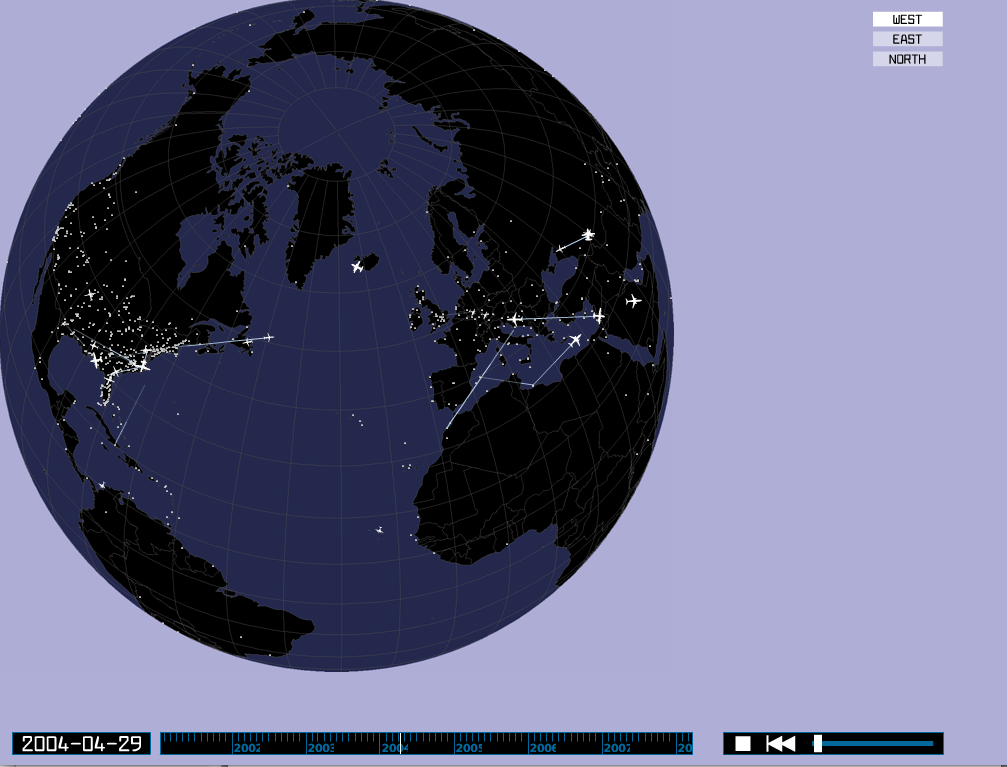
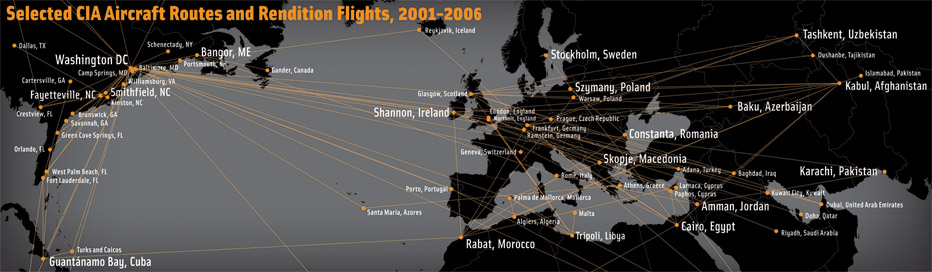
There have been several attempts to reconstruct the geography of the CIA’s program of extraordinary rendition. I’ve long admired the work of my good friend Trevor Paglen, described in his book with A.C. ThompsonTorture Taxi: on the trail of the CIA’s rendition flights, available in interactive map form through Trevor’s collaboration with the Institute for Applied Autonomy as Terminal Air. (I’ve commented on the project before, here and especially here).

terminal-air

And you can only applaud Trevor’s chutzpah is displaying the results of his work on a public billboard:

paglenemerson-cia-flights-2001-6

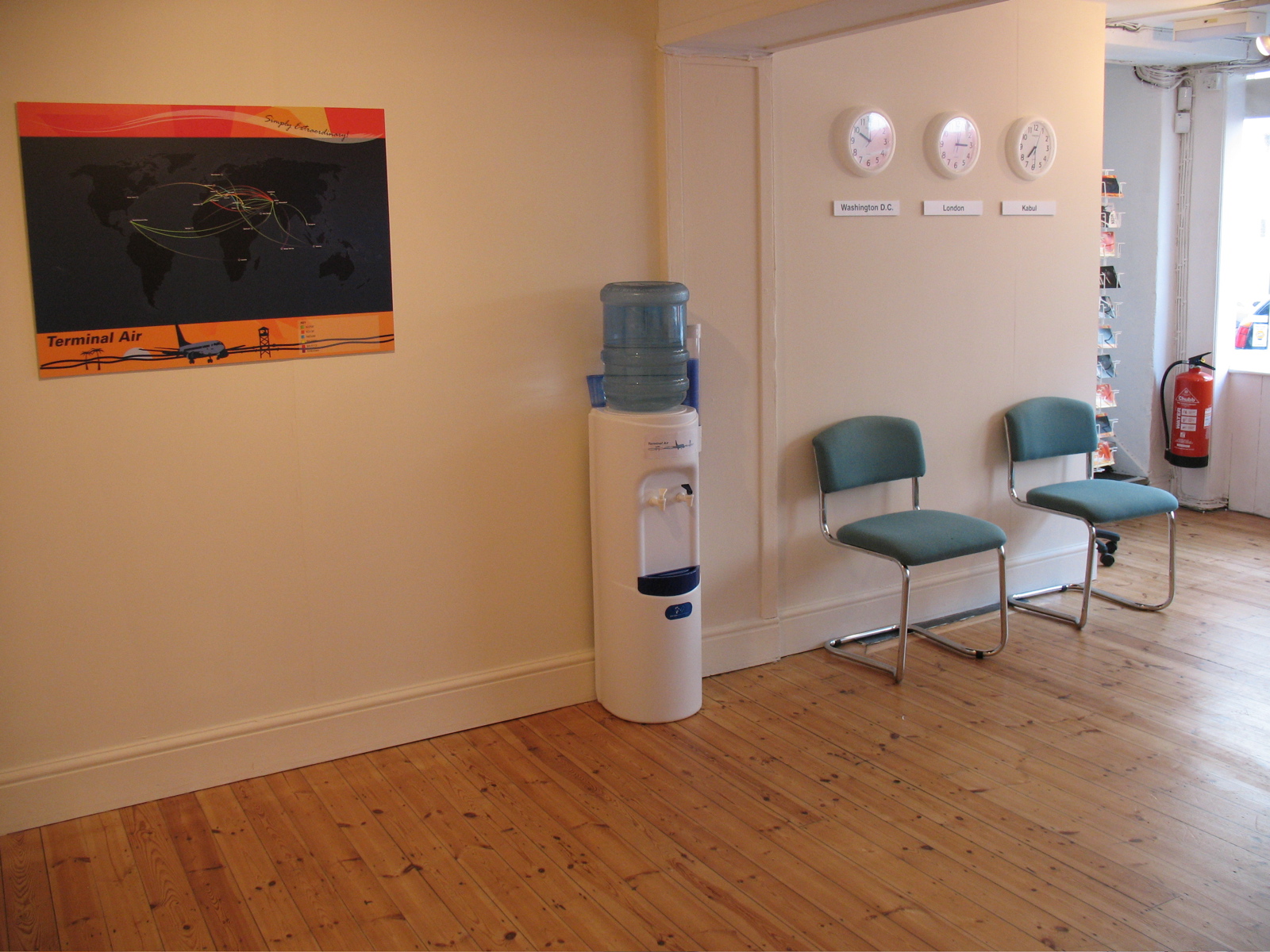
The project, which involved the painstaking analysis of countless flight records and endless exchanges with the geeks who track aircraft as a hobby, triggered an installation in which the CIA was reconfigured as a ‘travel agency‘:

Terminal Air travel agency

At the time (2007), Rhizome – which co-sponsored the project – explained:

Terminal Air is an installation that examines the mechanics of extraordinary rendition, a current practice of the United States Central Intelligence Agency (CIA) in which suspected terrorists detained in Western countries are transported to so-called “black sites” for interrogation and torture. Based on extensive research, the installation imagines the CIA office through which the program is administered as a sort of travel agency coordinating complex networks of private contractors, leased equipment, and shell companies. Wall-mounted displays track the movements of aircraft involved in extraordinary rendition, while promotional posters identify the private contractors that supply equipment and personnel. Booking agents’ desks feature computers offering interactive animations that enable visitors to monitor air traffic and airport data from around the world, while office telephones provide real-time updates as new flight plans are registered with international aviation authorities. Seemingly-discarded receipts, notes attached to computer monitors, and other ephemera provide additional detail including names of detainees and suspected CIA agents, dates of known renditions, and images of rendition aircraft. Terminal Air was inspired through conversations with researcher and author Trevor Paglen (Torture Taxi: On the Trail of the CIA’s Rendition Flights – Melville House Publishing). Data on the movements of the planes was compiled by Paglen, author Stephen Grey (Ghost Plane: The True Story of the CIA Torture Program – St. Martin’s Press) and an anonymous army of plane-spotting enthusiasts.

There’s a short video documenting the project on Vimeo here and embedded below (though strangely Trevor isn’t mentioned and doesn’t appear in it):

Although Trevor subsequently explained why he tried to ‘stay away from cartography and “mapping” as much as possible’ in his work, preferring instead the ‘view from the ground’, the cartography of all of this matters in so many ways – from the covert complicity of many governments around the world in a global geopolitics of torture through to the toll exerted on the bodies and minds of prisoners as they were endlessly shuffled in hoods and chains over long distances from one black site to another.

And now, thanks to the equally admirable work of the Bureau of Investigative Journalism, it’s possible to take the analysis even further.  Here is Crofton Black and Sam Raphael introducing their project, ‘The boom and bust of the CIA’s secret torture sites‘:

In spring 2003 an unnamed official at CIA headquarters in Langley sat down to compose a memo. It was 18 months after George W Bush had declared war on terror. “We cannot have enough blacksite hosts,” the official wrote. The reference was to one of the most closely guarded secrets of that war – the countries that had agreed to host the CIA’s covert prison sites.

Between 2002 and 2008, at least 119 people disappeared into a worldwide detention network run by the CIA and facilitated by its foreign partners.

Lawyers, journalists and human rights organisations spent the next decade trying to figure out whom the CIA had snatched and where it had put them. A mammoth investigation by the US Senate’s intelligence committee finally named 119 of the prisoners in December 2014. It also offered new insights into how the black site network functioned – and gruesome, graphic accounts of abuses perpetrated within it.

Many of those 119 had never been named before.

The report’s 500-page summary, which contained the CIA official’s 2003 remarks, was only published after months of argument between the Senate committee, the CIA and the White House. It was heavily censored, while the full 6,000-page study it was based on remains secret. All names of countries collaborating with the CIA in its detention and interrogation operations were removed, along with key dates, numbers, names and much other material.

In nine months of research, the Bureau of Investigative Journalism and The Rendition Project have unpicked these redactions to piece together the hidden history of the CIA’s secret sites. This account unveils many of the censored passages in the report summary, drawing on public data sources such as flight records, aviation contracts, court cases, prisoner testimonies, declassified government documents and media and NGO reporting.

Although many published accounts of individual journeys through the black site network exist, this is the first comprehensive portrayal of the system’s inner dynamics from beginning to end.

CIA black sites (BOIJ:REndition Project)

At present the mapping is rudimentary (see the screenshot above), but the database matching prisoners to black sites means that it ought to be possible to construct a more fine-grained representation of the cascade of individual movements.  The Rendition Project has already identified more than 40 rendition circuits involving more than 60 renditions of CIA prisoners: see here and the interactive maps here.