Bodies of violence

wilcox-bodies-of-violence

I’m finally working my way through Lauren Wilcox‘s impressive Bodies of Violence (see my earlier notice here), both to develop my ideas about corpography in general (see here, here and here) and to think through her arguments about drones in particular (in the penultimate chapter, ‘Body counts: the politics of embodiment in precision warfare’).

More on both later, but in the meantime there’s an extremely interesting symposium on the book over at The Disorder of Things that went on for most of last month.  I’ll paste some extracts below to give a flavour of the discussion, which is well worth reading in its entirety.

Lauren Wilcox on ‘Bodies of Violence: Theorizing embodied subjects in International Relations’.

[W]hile war is actually inflicted on bodies, or bodies are explicitly protected, there is a lack of attention to the embodied dynamics of war and security…. I focus on Judith Butler’s work, in conversation with other theorists such as Julia Kristeva, Donna Haraway and Katherine Hayles. I argue, as have others, that there is continuity between her works on “Gender” from Gender Trouble and Bodies that Matter and her more explicitly ethical and political works such as Precarious Life and Frames of War. A central feature of Butler’s concept of bodily precarity is that our bodies are formed in and through violence….
My book makes three interrelated arguments:

First, contemporary practices of violence necessitate a different conception of the subject as embodied. Understanding the dynamics of violence means that our conceptual frameworks cannot remain ‘disembodied’. My work builds on feminist and biopolitical perspectives that make the question of embodiment central to interrogating power and violence.

Second, taking the embodied subject seriously entails conceptualizing the subject as ontologically precarious, whose body is not given by nature but formed through politics and who is not naturally bounded or separated from others. Feminist theory in particular offers keen insights for thinking about our bodies as both produced by politics as well as productive of [politics].

Third, theorizing the embodied subject in this way requires violence to be considered not only destructive, but also productive in its ability to re-make subjects and our political worlds.

Antoine Bousquet on ‘Secular bodies of pain and the posthuman martial corps

[I]t increasingly appears that the attribution of rights is made to hinge on the recognition of their putative holder’s ability to feel pain, even where this might breach the species barrier or concern liminal states of human existence. As such, any future proponents of robot rights may well have to demonstrate less the sentient character of such machines than their sensitivity to pain (of course, it may well turn out that one entails the other). In relation to Bodies of Violence, if we are indeed to take the liberal conception of pain as purely negative as limiting (and we should perhaps not be too hastily dismissive of the moral and societal progresses that can be attributed to it), how does the recognition of ‘vulnerable bodies’ advocated by Wilcox depart from such an understanding? Is it simply a call for dismantling the asymmetries that render the pain of certain subjects less acknowledgeable than others or does it propose to actually restore a ‘positivity’ to suffering within a post-Christian worldview?…

[A]s our knowledge of the human as an object of scientific study grows, our conception of the human as a unitary and stable entity becomes increasingly untenable, incrementally dissipating into a much broader continuum of being to be brought under the ambit of control. But where does such an expanded framing of human life leave the ‘normative model of the body’ as ‘an adult, young, healthy, male, cisgendered, and non-racially marked body’ (p.51) from which all minoritarian deviations are to be variously silenced, regulated and policed? Does the technicist efficiency-driven mobilisation of human life not corrode those normative hierarchies that do not contribute to or might even impede such a process? As Wilcox notes, the traditional investment of masculinist values in the military institution is unsettled when ‘the precision bomber or drone operator is seen as a “de-gendered” or “post-gendered” subject, in which it does not matter whether the pilot or operator is a male or female’ (p.135). Indeed, there seems to be no inherent reason why any number of deviations from the normative body would be an obstacle to their integration into the assemblage of military drones, to stay with that example. One can even conceive of cases where they could be beneficial – might not certain ‘disabilities’ offer particularly propitious terrain for the successful grafting of cybernetic prosthetics? In this context, corporeal plasticity and ontological porosity seem less like the adversaries of posthuman martiality than its necessary enablers.

Kevin McSorley on ‘Violence, norms and embodiment

[W]hat sense there might be any particular limits to the explanatory value of the key sensitising theoretical framework of embodied performativity and ‘normative violence’ that is deployed across all the numerous case studies considered here. Notwithstanding the supplementary engagement in certain chapters with further vocabularies of e.g. abjection or the posthuman to problematize bodily boundaries, the social embodiment of violent norms is really the major theoretical underpinning of all of the analyses undertaken in each of the five different case studies selected for interpretation. My sense was that Bodies of Violence was primarily concerned with establishing broad proof of concept that such theoretical deployment could work rather than engaging with detailed questions about the potential limits of its conceptual purchase and differences in explanatory value across the five varied case studies. The analyses undertaken propose if anything a near-universal analytic utility for the conceptual framework deployed in that there is a consistent interpretation that underlying normative violences operate within each of the different case studies. Additional comparative analysis, that specifically highlighted and attempted to think through where and why the interpretative framework might be especially productive, or indeed where and why it might feel less resonant and begin to break down, may potentially be insightful for further theoretical elaboration….

[W]hat might happen if the many embodied subjects theorised were able to more consistently speak back to theory, if their feelings and desires were more enfleshed in the analysis[?] Would the stability of this conceptual grid of intelligibility remain intact and unmoved if such encounters and dialogues were able to be staged, if the complex emotions and meaning-worlds of those socially embodied subjects actively negotiating normative violences could have a more audible place in the analysis?

Alison Howell on ‘Bodies, and Violence: Thinking with and beyond feminist IR

Can a theory rooted in a singular concept of ‘the body’ take full account of difference? Can it register the diverse ways in which different bodies become subject to and constituted through power and violence, or management and governance?

Wilcox does amply illustrate that there is no such unitary thing as ‘the body’… [but] there are long-standing traditions of theorizing embodiment and de-naturalizing ‘the body’ in anti-racist, postcolonial, and disability scholarship. These critical traditions should not be subsumed under the category of feminist scholarship, though they do certainly engage with feminist theory, often critically. They make unique contributions to theorizing embodiment, often through intersectional analyses.

Bodies of Violence does take up many texts from these traditions, but, for instance makes use of Margrit Shildrick’s and Jasbir Puar’s earlier work on the body, without also contemplating each of their more recent work on disability and debility…. A second line of inquiry a renewed focus on embodiment potentially suggests might center around the as-yet unmet potential for studying the role of medicine in IR. The sine qua non of medicine is, after all, the body, and if embodiment is important in the study of IR, then we should also be studying that system of knowledge and practice that has taken for itself authoritative dominion over bodies and that does the kind of productive work in relation to embodiment that Wilcox is interested in illuminating.  As with disability studies, there is a significant literature, in this case emanating out of medical anthropology, medical sociology, bio-ethics and history of medicine….

But what of the book’s other titular concept: violence?  Bodies of Violence suggests that to study embodiment is also to study violence. Yet violence is a concept and not merely a bare fact: ‘violence’ is a way of making sense and grouping together a number of practices….

Butler’s work has been central to de-essentializing both sex and gender, thus undermining radical feminist theories of violence that ascribe peacefulness to women and violence to men.Yet Butler’s work is less useful as a tool for excavating the particularly racist and Eurocentric forms that radical feminist thought on violence has taken. Instead, we might look towards Audre Lorde’s debates with Mary Daly, and to the succeeding traditions of anti-racist feminist thought.

Pablo K [Paul Kirby] on ‘Bodies, what matter?

Thinking about the value of bodies draws us into a contemplation of human life and its treatment. Which is why the mere act of recognising bodies can seem tantamount to calling for the preservation and celebration of life. Drawing attention to bodies to highlight an equality of concern due to those who have otherwise been rendered invisible is itself to engage in materialisation, making those bodies matter in a different way. It is a way to turn bodies (which are, on the whole, visible to us) into persons (entities with value and meaning which we may not recognise). And yet the body – precisely because it is inescapable and ubiquitous – is also evasive, and the form of its mattering elusive.

For Judith Butler, ‘mattering’ is the conjoined process of materialisation (suggestive of the way bodies are produced or come into being) and meaning (how bodies are recognised and invested with worth). The stress in contemporaneous and subsequent work on material-isation (on matter-ing) is thus intended to signal a break with ideas of matter as simply there, as idle or inert, and therefore as a kind of brute fact which is inescapable or consistent in its ahistorical role. Thus we are pushed to examine not the characteristics of matter, but the historical process of mattering; not the innate sex that simply bears gender constructions, but the moments which seemed to establish bodies (or body parts) as prior to the sign system which names them. The point is well taken, and has consequences for a theory of embodiment…

And so what is needed is a deeper excavation of the form, degree and value of mattering.

For the so-called new materialists, such a theory means attributing a certain agency to bodily substance (genetics, morphology, neural pathways, flesh itself). As Karen Barad has insisted:

any robust theory of the materialization of bodies would necessarily take account of how the body’s materiality – for example its anatomy and physiology – and other material forces actively matter to the process of materialization.

This is importantly different to saying that political regimes interpret and work bodies in distinct ways. In Bodies of Violence, despite the emphasis on how bodies produce politics, it is mainly politics that produces bodies. Or better, politics that intervenes on and shapes bodies.

Lauren Wilcox, ‘Theorizing embodiment and making bodies “matter“‘

Gravity modelling

Mediterranean migration crisis (HRW) MAP

The latest issue of Radical Philosophy (192, July/August 2015) is out now, and it includes a short essay by Martina Tazzioli, ‘The politics of counting and the scene of rescue: Border deaths in the Mediterranean’ (see also my post about The Left to Die Boat).  Her commentary adds new dimensions to discussions of the humanitarian present:

The exclusive focus on the modalities of rescue has overshadowed the peculiar politics of life that underpins military-humanitarian operations: migrants seeking asylum become lives to rescue and their freedom – of movement and of choosing a safe place to stay – is dislodged from the outset. The mechanisms of capture and containment of unauthorized movements act simultaneously through border restrictions that cause border deaths and through the humanitarian channelling system. The risks to life that people who seek asylum in Europe take, being forced to cross the Mediterranean ‘illegally’, and rescue politics are not opposite mechanisms of migration government. This means that humanitarian measures hold a specific political technology over migrant lives by rescuing, sorting and channelling migrants, one in which people escaping wars can seek asylum only by first becoming shipwrecked persons to rescue. Humanitarian and security measures are thus two intertwined political technologies of migration governmentality.

mapsmania

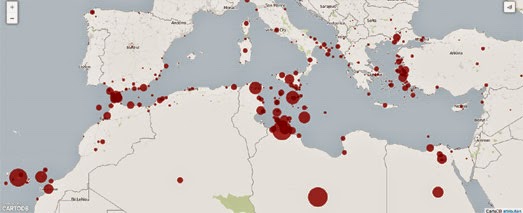
The map above is drawn from the Migrants Files, a database recording the deaths of more than 29,000 migrants who have tried to seek refuge in Europe since 200.  But Martina’s commentary details what she calls the ‘politics of counting’ and in doing so she enlarges the scope of those (other) projects that seek to move behind the statistical toll of wars and other forms of military and paramilitary violence to identify and name their otherwise nameless casualties:

If border deaths are accounted for through a logic of counting, something remains undetectable from the political perspective of the northern shore of the Mediterranean. Moving beyond the logic of counting means refusing to look at border deaths from the standpoint of this governmental gaze – migration agencies or states – and taking into account what border deaths are for the friends and the relatives of the missing migrants. This means engaging in a decolonial move that challenges the logic of recognition that sustains political campaigns and research projects aiming to count and identify dead migrants. By moving from the northern to the southern shore of the Mediterranean we realize that these uncounted deaths not only have a name but are fully known by their friends and relatives. Rather than producing a more exact border deaths population database, it is a question of bringing into visibility the reality of what the visa regime and the European mechanisms of border control generate: the ‘disappearance’ of women and men who die without being detected but who are counted as ‘missing’ in the countries of origin or of transit by those who know them. The logic of identification – giving a name to corpses found at sea – risks, paradoxically, reproducing the hierarchy that assumes dead migrants are people who, in order to exist, have to be recognized, counted and named from the northern shore of the Mediterranean. A politics that accounts for border deaths without reproducing this space of governmentality attends to what exists beyond counting and identification: unaccountable deaths represent the unquantifiable ‘cost’ of borders that cannot be assessed from the northern shore of the Mediterranean and that requires taking into account those people – friends and relatives – for whom they are missing persons.

HRW Med Migration Crisis JPEG

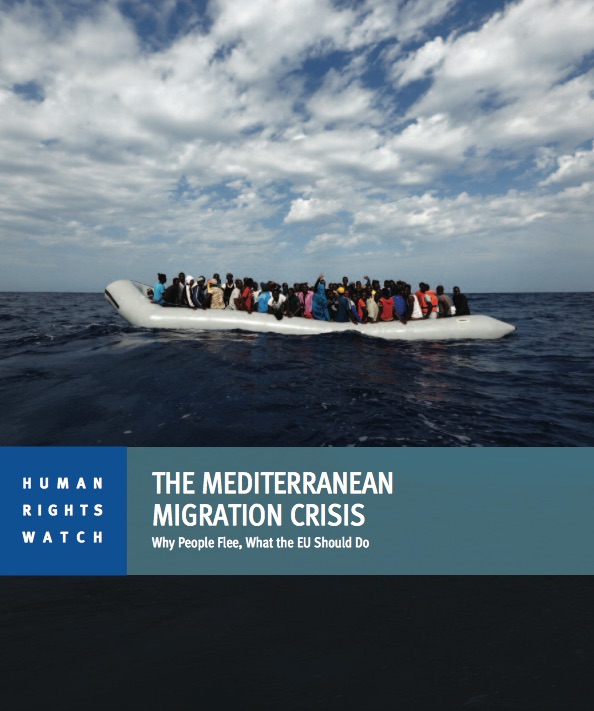
Last week, Human Rights Watch issued a report on The Mediterranean Migration Crisis: Why People Flee, What the EU Should Do; the map at the head of this post identifies sample migration routes derived from the interviews carried out by HRW for its report:

The report draws on Human Rights Watch’s extensive work on the human rights situation in the four main sending countries as well as interviews with Syrians, Eritreans, Afghans, and Somalis who crossed the Mediterranean in May 2015. Human Rights Watch staff interviewed over 150 recently-arrived migrants and asylum seekers in Italy (Lampedusa, Catania, and Milan) and Greece (the islands of Lesbos, Chios, Samos, Leros, and Kos).

Note: For those who had the good fortune to escape spatial science in the 1960s and 70s, and who might well be puzzled by my title, gravity models were (and probably still are) one of the canonical forms of migration modelling.  Martina’s commentary is an urgent reminder of the gravity that lies behind the politics of calibration and calculation.

Disposable futures

EVANS and GIROUX Disposable futures

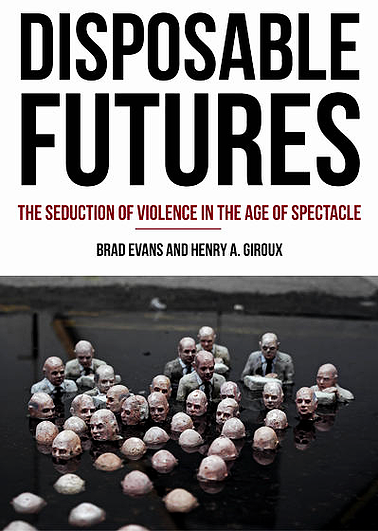
News from Brad Evans of a new book co-authored with Henry Giroux, Disposable futures: the seductions of violence in the age of spectacle (out next month from City Lights).

Disposable Futures makes the case that we have not just become desensitized to violence, but rather, that we are being taught to desire it.

From movies and other commercial entertainment to “extreme” weather and acts of terror, authors Brad Evans and Henry Giroux examine how a contemporary politics of spectacle–and disposability–curates what is seen and what is not, what is represented and what is ignored, and ultimately, whose lives matter and whose do not.

Disposable Futures explores the connections between a range of contemporary phenomena: mass surveillance, the militarization of police, the impact of violence in film and video games, increasing disparities in wealth, and representations of ISIS and the ongoing terror wars. Throughout, Evans and Giroux champion the significance of public education, social movements and ideas that rebel against the status quo in order render violence intolerable.

You can read the preface and an excerpt from the first chapter here, and you can get a taste of their argument from their op-ed for Truthout in June 2014 here, where they explain why they decided

‘…to develop a paradigm that focused on the intensification of what we called the politics of disposability. This requires taking our analysis beyond 20th century frames of analysis to look at the ways in which more and more individuals and groups are now considered excess by the onslaught of global forces that no longer offer the possibility of alternative futures. It talks precisely to those contemporary forms of disposability that have become so normalized; the burden of the guilt is placed on the shoulders of the victims, while the most pernicious of systemic abuses continues to hide things in plain sight. And it develops a critical angle of vision that goes well beyond the mere authentication of lives as simply born vulnerable to question the systemic design for oppression and exploitation that produces humans as some expendable category…

‘There is something, however, more at stake here than the contemporary plight of those millions forced to live in intolerable conditions. What makes the contemporary forms of disposability so abhorrent is precisely the way it shapes disposable futures. The future now appears to us as a terrain of endemic catastrophe and disorder from which there is no viable escape except to draw upon the logics of those predatory formations that put us there in the first place. Devoid of any alternative image of the world, we are merely requested to see the world as predestined and catastrophically fated. Frederic Jameson‘s claim then that it is easier to “imagine the end of the world than it is the end of capitalism” is more than a reflection on the poverty of contemporary imaginations. It is revealing of the nihilism of our times that forces us to accept that the only world conceivable is the one we are currently forced to endure: a world that is brutally reproduced and forces us all to become witness to its spectacles of violence that demand we accept that all things are ultimately insecure by design. In this suffocating climate, the best we can hope for is to be connected to some fragile and precarious life support system that may be withdrawn from us at any moment. Hope has dissolved into the pathology of social and civil death and the quest for mere survival. For if there is a clear lesson to living in these times, it is precisely that the lights can go out at any given moment, without any lasting concern for social responsibility. This is simply the natural order of things (so we are told) and we need to adapt our thinking accordingly.’

And, as always, you can find much more on these themes over at Brad’s History of Violence project (and particularly the Disposable Life series of lectures here).

Wastelands

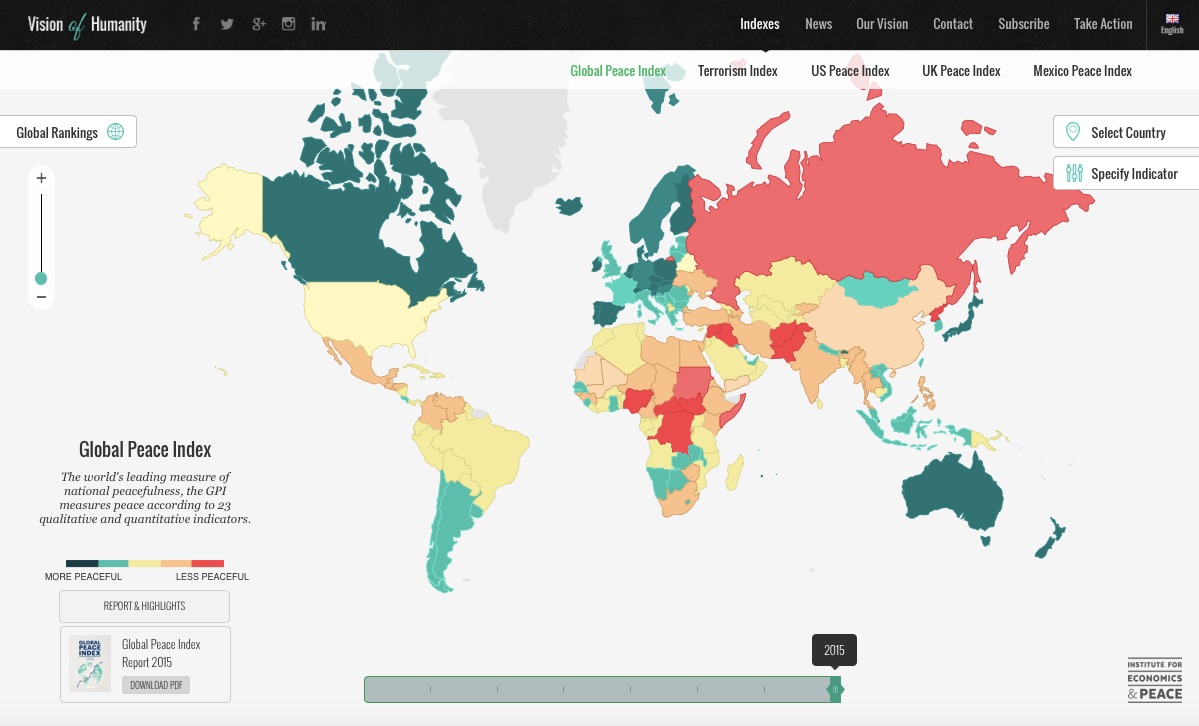
Global Peace Index 2015 JPEG The Institute for Economics and Peace has issued its Global Peace Index for 2014.  There are all sorts of problems in calculating indices like these – and interpreting them (as you can see if you read some of the press releases and reports surrounding the publication of the GPI) – and in this case:

The Global Peace Index is a composite index comprised of 23 qualitative and quantitative indicators that gauge the level of peace in 162 countries. These indicators can be grouped into three broad themes: the level of safety and security in a society, the number of international and domestic conflicts and the degree of militarisation.

Crunching the numbers,  the Institute concludes that

Syria remains the world’s least peaceful country, followed by Iraq and Afghanistan. The country that suffered the most severe deterioration in peace was Libya, which now ranks 149th of 162 countries. Ukraine suffered the second largest deterioration…

Its President, Steve Killelea, explained that:

2014 was marked by contradictory trends: on the one hand many countries in the OECD achieved historically high levels of peace, while on the other, strife-torn nations, especially in the Middle East, became more violent.

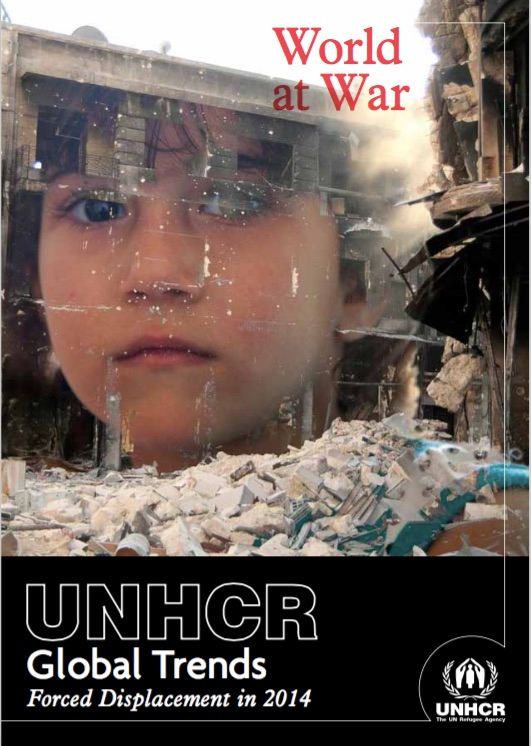
What the Report doesn’t pursue are the close links between those two trends; and when you look at the map you will soon realise that being ‘peaceful’ is not the same thing as not being belligerent… But the Report does emphasise the absurdist cost of all this violence (while noting that much more is at stake than money): ‘The economic impact of violence reached a total of US$14.3 trillion or 13.4% of global GDP last year.’ You can download the full Report here or find the interactive map (screenshot at the head of this post) here. UNHCR World at War 2014 JPEG On the same day, the United Nations High Commissioner for Refugees published different maps in World at War that provide a radically different calculus of the cost of such violence.  Writing in the New York Times Somini Sengupta reports:

Nearly 60 million people have been driven from their homes by war and persecution, an unprecedented global exodus that has burdened fragile countries with waves of newcomers and littered deserts and seas with the bodies of those who died trying to reach safety. 0745631649The new figures, released Thursday by the United Nations refugee agency, paint a staggering picture of a world where new conflicts are erupting and old ones are refusing to subside, driving up the total number of displaced people to a record 59.5 million by the end of 2014, the most recent year tallied. Half of the displaced are children. Nearly 14 million people were newly displaced in 2014, according to the annual report by the Office of the United Nations High Commissioner for Refugees. In other words, tens of thousands of people were forced to leave their homes every day and “seek protection elsewhere” last year, the report found. That included 11 million people who scattered within the borders of their own countries, the highest figure ever recorded in the agency’s 50-year history. Tens of millions of others fled in previous years and remain stuck, sometimes for decades, unable to go home or find a permanent new one, according to the refugee agency. They include the more than 2.5 million displaced in the Darfur region of Sudan, and the 1.5 million Afghans still living in Pakistan.

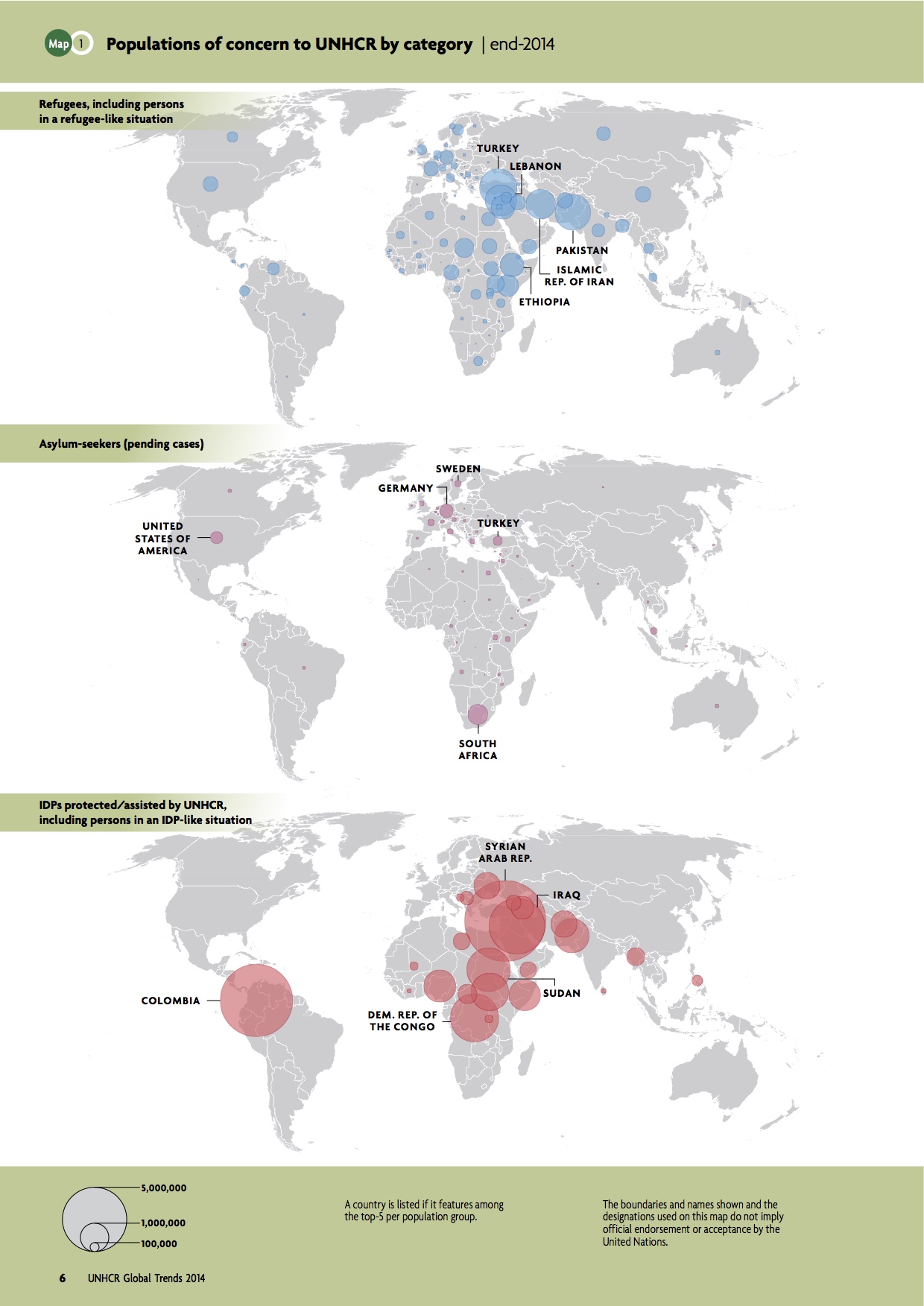
Populations of concern to UNHCR to end 2014 And the map reveals a starkly different bi-polar geography to the division highlighted by the GPI:

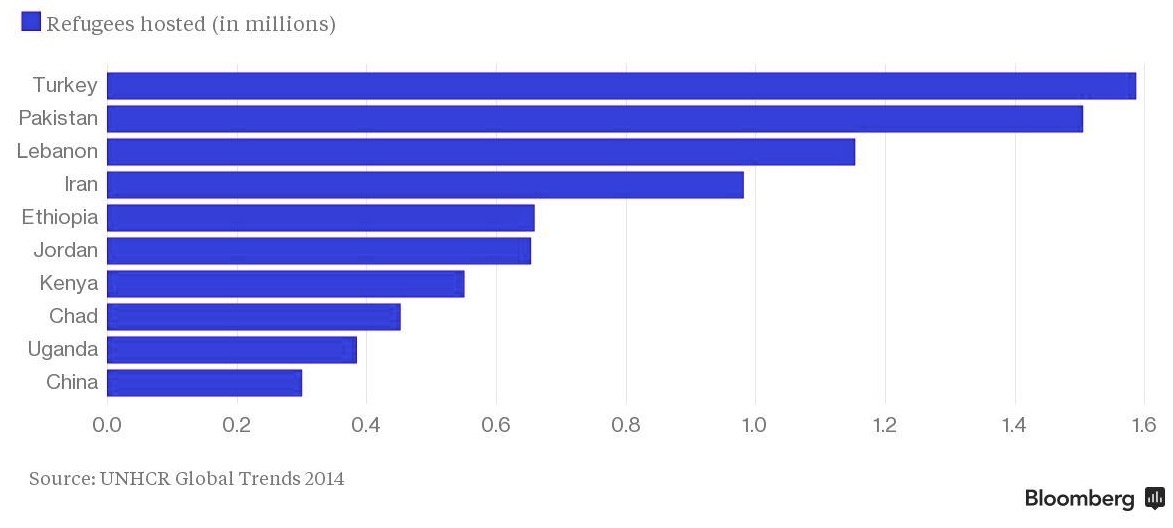
When refugees flee their own countries, most of them wind up in the world’s less-developed nations, with Turkey, Iran and Pakistan hosting the largest numbers. One in four refugees now finds shelter in the world’s poorest countries, with Ethiopia and Kenya taking many more refugees than, say, Britain and France. As the report states, “the global distribution of refugees remains heavily skewed away from wealthier nations and towards the less wealthy.”

Refugees hosted 2014 JPEG You can download World at War here.

Medical neutrality and modern war

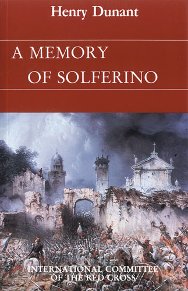
md_p0361-memory-solferinoI expect most readers know how the International Committee of the Red Cross had its origins in Henry Dunant‘s horror at the unrelieved suffering he witnessed in the aftermath of the Battle of Solferino in 1859 (see my earlier post here).

In A Memory of Solferino (1862) he asked: ‘Would it not be possible, in time of peace and quiet, to form relief societies for the purpose of having care given to the wounded in wartime by zealous, devoted and thoroughly qualified volunteers?’

Dunant’s vision of an impartial relief society to provide aid to those wounded in time of war led to the formation of a series of national relief societies and, as John Hutchinson shows in Champions of Charity: War and the rise of the Red Cross, these national societies soon became entangled with nationalism.  ‘Gripped by the passions of patriotism,’ he writes, by the time of the First World War these national societies ‘undertook to perform whatever repair work the armies required of them.’

And yet, even with these entanglements, a key principle was defended: medical neutrality.  According to Physicians for Human Rights, medical neutrality requires:

  1. The protection of medical personnel, patients, facilities, and transport from attack or interference;
  2. Unhindered access to medical care and treatment;
  3. The humane treatment of all civilians; and
  4. Nondiscriminatory treatment of the sick and injured.

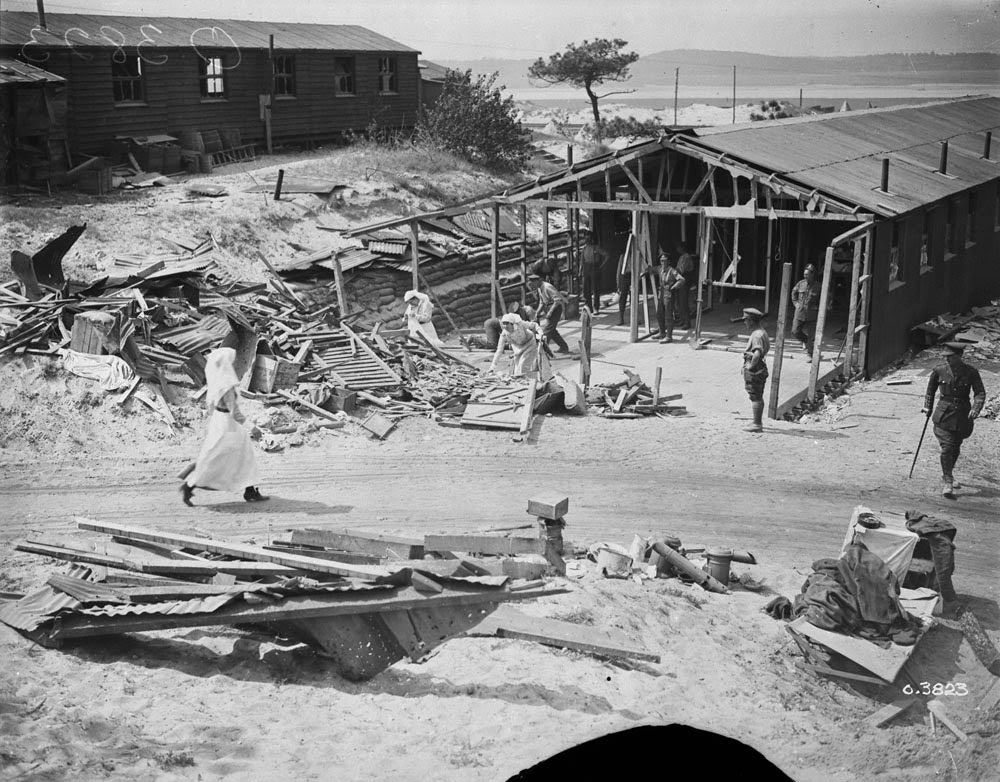
During the First World war there were complaints that the principle had been sporadically violated: that stretcher-bearers had been attacked by snipers when they sought to recover the wounded or that military hospitals had been deliberately shelled or bombed.  Here, for example, is the aftermath of one of several air raids targeting base hospitals at Etaples on the French coast between May and August 1918 (supposedly in retaliation for a British air raid on Cologne):

Lowe_Field_Hospital_bombed_LAC_PA_003747_a003747_v8.jpg_pv4a5fab25f240997c

But in the last decade of our own century such violations have become increasingly systematic. And, as more and more civilians have become trapped and even targeted in conflict zones whose ‘battlefields’ know no bounds, so those violations have extended far beyond attacks on military-medical infrastructure and personnel.

Last summer I detailed the attacks made by the Israeli military on medical facilities and emergency systems in Gaza, and I drew attention to the work of Physicians for Human Rights in documenting the precariousness of medical care there.  But the calculated production of these spaces of exception is not exceptional, and attacks like these have become part of the arsenal of later modern war.  “Instead of being protected,” says Donna McKay, executive director of PHR, “medical care is actually a target.”

HRW Attacks on Health

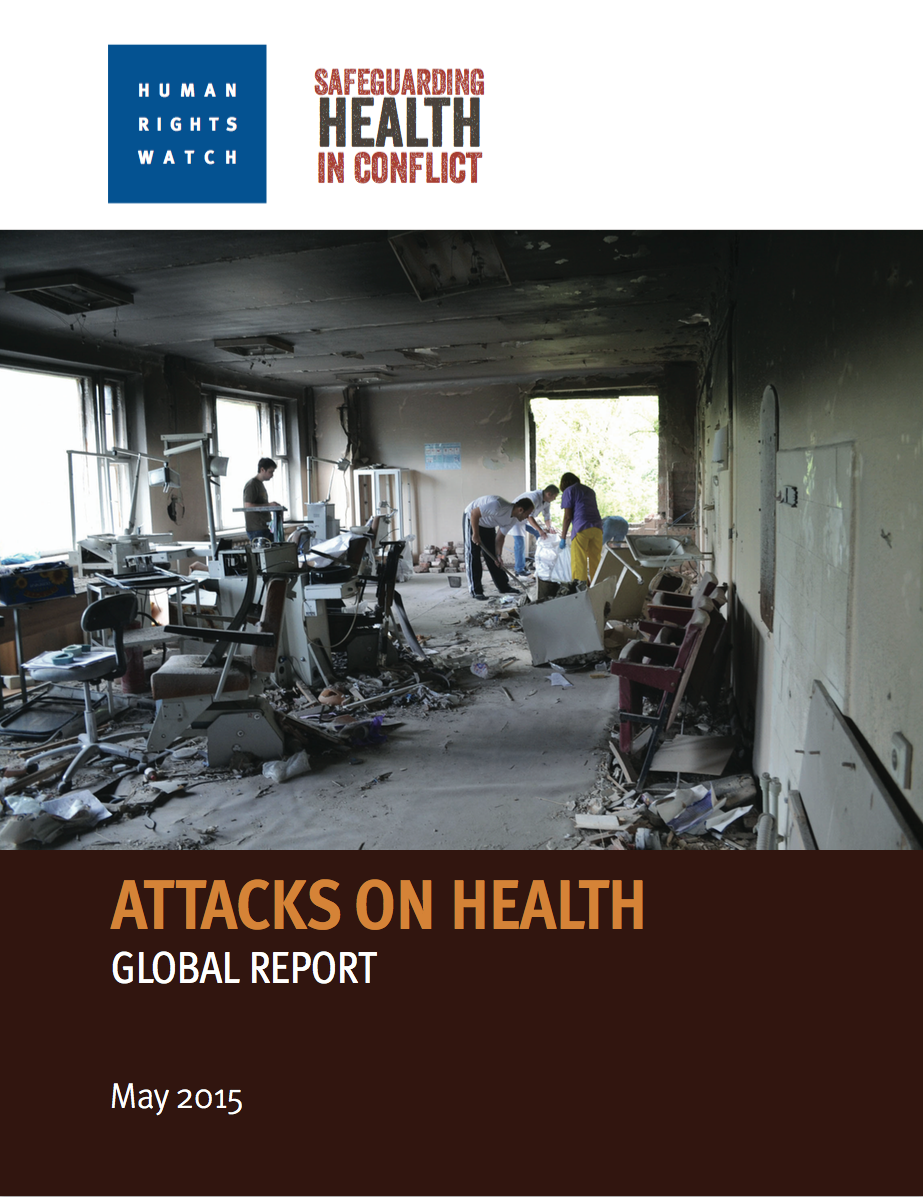
Physicians for Human Rights is part of the Safeguarding Health in Conflict Coalition which has now joined with Human Rights Watch to publish Attacks on Health: a Global Report (2015) that summarises attacks on health care facilities and health care workers around the world:

Over the past year armed groups have attacked hospitals, clinics, and health personnel in 41 incidents in Afghanistan and deliberately killed over 45 health workers, primarily polio vaccinators, in Nigeria and Pakistan. In Syria, where medical facilities in Aleppo have been hit with government barrel bombs, 194 medical personnel have been killed and 104 medical facilities attacked since 2014….

The organizations described attacks in South Sudan, where 58 people were killed in four hospitals in a series of attacks in early 2014, and in eastern Ukraine, where it is estimated that 30 to 70 percent of health workers have fled the region because of insecurity. In Yemen, Al-Qaeda in the Arabian Peninsula (AQAP) militants carried out attacks on health facilities in early 2014, and the 10-country Saudi-led coalition conducted air strikes that hit hospitals and interrupted medical supplies during the conflict in early 2015. Relying on data from Insecurity Insight’s Security in Numbers Database, the report also shows trends in attacks on health care over the course of a decade in South Sudan and Central African Republic.

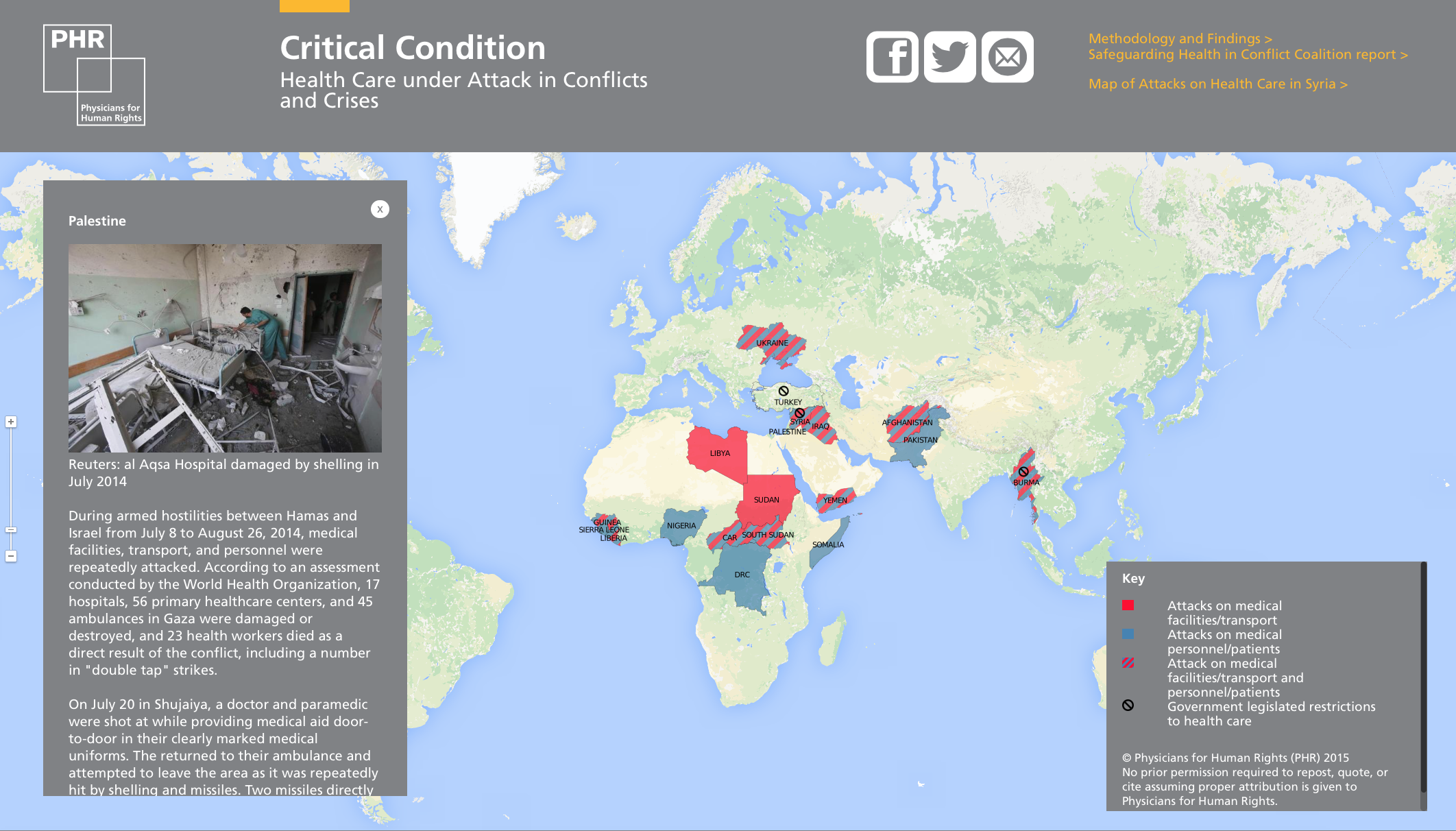
PHR Critical Condition

In close concert with the report Physicians for Human Rights have produced an interactive online map of attacks on health care around the world between January 2014 and April 2015 (see the screenshot above).

PHR Attacks on health care in Syria

The organisation has also produced a detailed map of attacks on health care systems – or what’s left of them – in Syria (see the screenshot above), which you can access here.  It needs to be supplemented by PHR’s Doctors in the crosshairs: four years of attacks on health care in Syria, which was published in March:

The symbols of the Red Cross and Red Crescent have been turned from a shield of protection into crosshairs on the backs of those who knowingly risk their lives to save others.

You can find more on the violation of medical neutrality in Syria in an open-access article by Ravi S. Katari in the Journal of global health here and in a short essay by Sasha Zients and Dylan Okabe-Jawdat for the Columbia Political Review (May 2015) here.

And you can find more on the systematic violation of medical neutrality in Bahrein and elsewhere here.

West Point and the war on Ebola

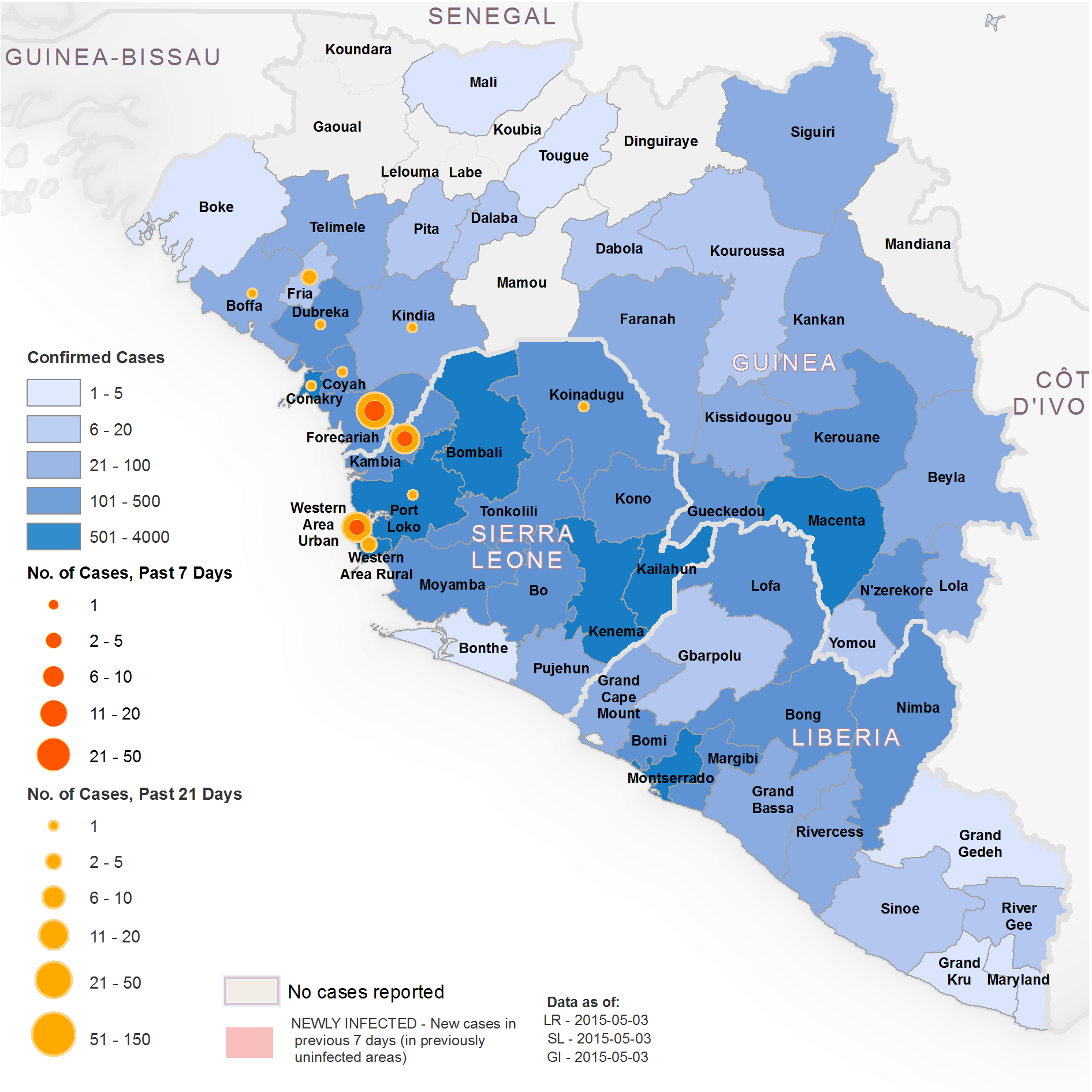
I’ve taken this map from a Situation Report issued by the World Health Organisation on 6 May, which superimposes new cases of Ebola virus disease (EVD) over total confirmed cases throughout the epidemic in West Africa:

SITREP_CASECOUNT_7

Three days later the WHO declared Liberia to be free of Ebola:

Forty-two days have passed since the last laboratory-confirmed case was buried on 28 March 2015. The outbreak of Ebola virus disease in Liberia is over.

Interruption of transmission is a monumental achievement for a country that reported the highest number of deaths in the largest, longest, and most complex outbreak since Ebola first emerged in 1976. At the peak of transmission, which occurred during August and September 2014, the country was reporting from 300 to 400 new cases every week.

During those 2 months, the capital city Monrovia was the setting for some of the most tragic scenes from West Africa’s outbreak: gates locked at overflowing treatment centres, patients dying on the hospital grounds, and bodies that were sometimes not collected for days.

So it’s high time I redeemed my promise to return to the ‘war on Ebola‘.

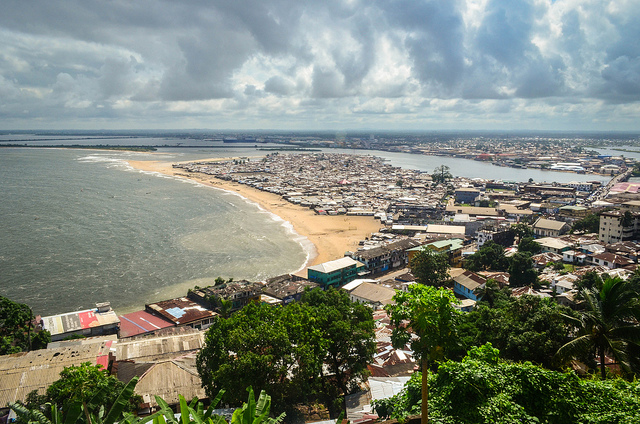
In previous commentaries I discussed the militarisation of the epidemic and, in particular, the mission of the US military under the direction of US Africa Command.  But the ‘West Point’ in my title is thousands of miles from the US Military Academy in upstate New York…   It’s a sprawling informal settlement in Monrovia, the capital of Liberia (below).

West Point, Monrovia

In an extended essay in the New Yorker earlier this year, ‘When the fever breaks‘, Luke Mogelson told the story of Omu Fahnbulleh and her husband Abraham.  They lived with their three children in Robertsport in northern Liberia.  Last summer Fahnbulleh tested positive for Ebola; by the time an ambulance arrived Abraham was sick too, and they were both loaded into the back and driven off.

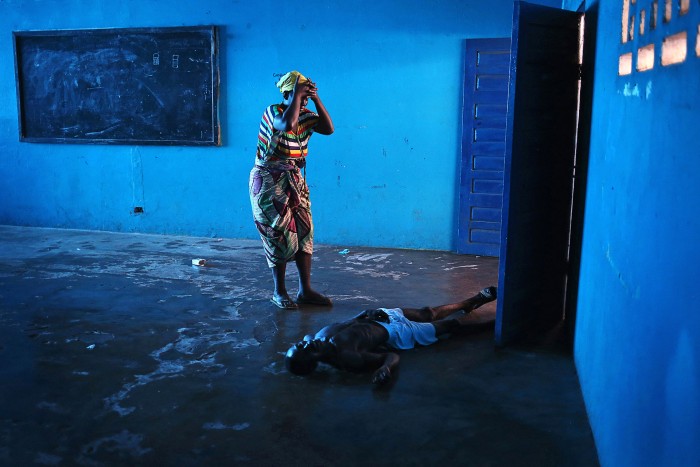
Fahnbulleh and her husband believed that they were going to a hospital. Instead, several hours later, the ambulance turned onto a narrow lane that ran past low-slung shops and shanties. Fahnbulleh realized that they were in West Point, Monrovia’s largest slum. A police officer opened a metal gate, and the ambulance stopped inside a compound enclosed by tall walls. In the middle of the compound stood a schoolhouse. The driver helped Fahnbulleh and Abraham through a door, down a hall, and into a classroom. A smeared chalkboard hung on one of the walls, which were painted dark blue. Dim light filtered through a latticed window. On the concrete floor, ailing people were lying on soiled mattresses. When Fahnbulleh lay down, she saw that the two men beside her were dead.

This was the only school in West Point, originally built by USAID, and it had been converted into a ‘holding centre’ for Ebola patients; the only ‘treatment’ on offer was provided by a man in a biohazard suit spraying the floor, the walls and the patients with chlorine.  Two nights later Abraham died, and as soon as it was light Fahnbulleh – convinced she would die too if she stayed – determined to escape.

At daybreak, after spending the night in the other classroom, she walked out of the school. Policemen loitered in the yard. When Fahnbulleh reached the gate, they let her pass, afraid to touch her.

After several nights of sleeping rough she was taken to an Ebola Treatment Unit at a government hospital, from where she was eventually discharged.

image.php

It’s a heart-breaking story, made all the more extraordinary by a photograph taken by John Moore which shows ‘Omu Fereneh’ standing over the body of her husband ‘Ibrahim’ on 15 August in the schoolhouse. The image was widely reproduced – see also here, for example – and raises important questions about the mediatisation as well as the militarisation of the crisis.  Moore’s work won him the title of  L’Iris d’Or /Sony World Photography Awards’ Photographer of the Year:

 John Moore’s photographs of this crisis show in full the brutality of people’s daily lives torn apart by this invisible enemy. However, it is his spirit in the face of such horror that garners praise. His images are intimate and respectful, moving us with their bravery and journalistic integrity. It is a fine and difficult line between images that exploit such a situation, and those that convey the same with heart, compassion and understanding, which this photographer has achieved with unerring skill. Combine this with an eye for powerful composition and cogent visual narrative, and good documentary photography becomes great.

I’m not sure that Omu Fereneh is Omu Fahnbulleh, or Ibrahim Abraham, but it would be a remarkable coincidence if they were not the same people.

In any event, soon after the photograph was taken and soon after Fahnbulleh escaped, the situation in West Point changed dramatically.  Realising that their community had become a dumping ground for Ebola victims from all over Liberia, local residents stormed the schoolhouse and demanded it be closed.  They ransacked the building, making off with mattresses and sheets, and evicted over 20 patients who they claimed had been brought in from outside West Point.

src.adapt.960.high.west_point_ebola_1.1408545798468

Two days later the state called in its security forces which had urged the imposition of mass quarantine.  Joe Shute takes up the story:

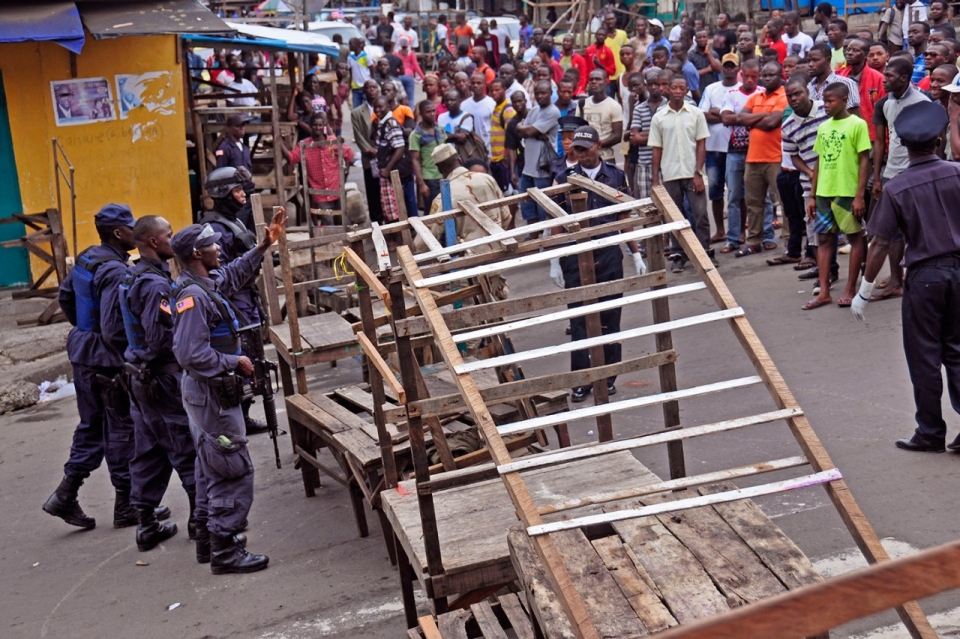
On August 20, President Ellen Johnson Sirlief ordered the only road leading in to the slum be sealed off, and the entire community placed under quarantine. As the army moved in, many of the city’s vagrants who slept in the slum at night were trapped inside.

f-libebola-a-20140822-870x577

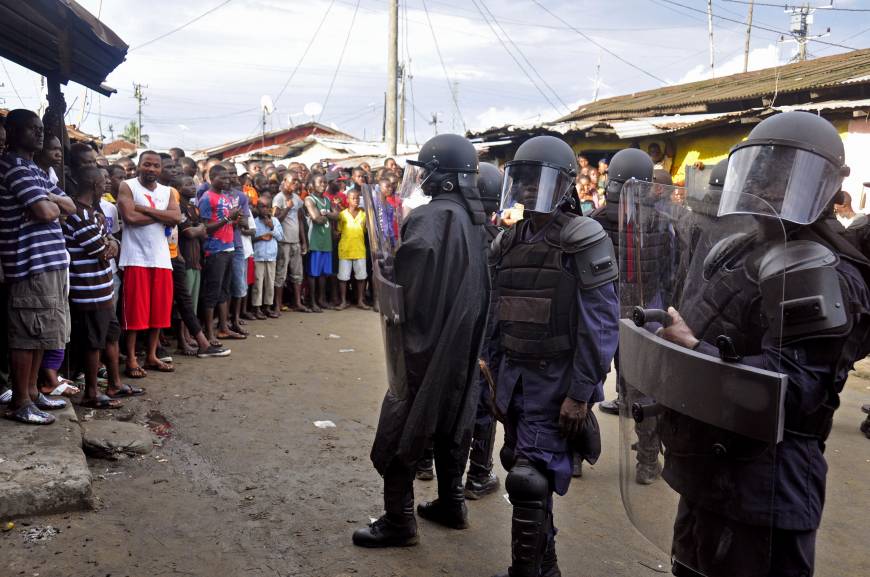
West Point was surrounded by barricades and barbed wire; police in helmets and riot-shields stopped people going out into the city; gunships patrolled the water front, and a nightly curfew was imposed on the district’s 70,000 residents.  There was, Joe reports, ‘a desperate clamour to escape, some people even trying to swim around the peninsula to enter the city’s port.’

image.adapt.960.high.westpoint_1

The imposition of a militarised quarantine was a double mis-step.

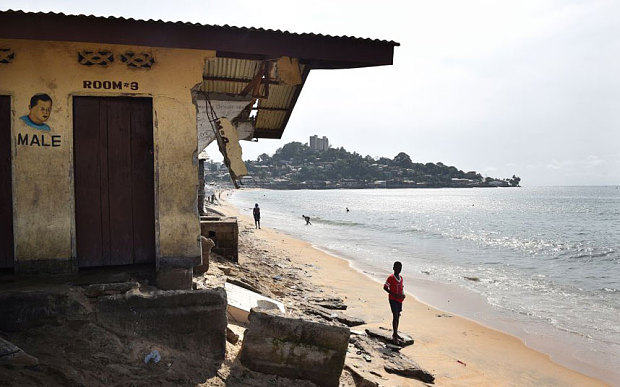
First, it exacerbated the already precarious position of West Point residents.  Many of them were refugees and child soldiers from Liberia’s civil wars; they were crowded together in makeshift corrugated-iron shacks, almost all of them without plumbing or running water.  The district is threaded by narrow sand alleys – there is only one paved road – and by open sewers.  In 2009 the UN Office for the Coordination of Humanitarian Affairs reported there were only four public toilets in West Point; to use them cost 2-3 cents, and many chose to use the beach instead.

ebola-beach_3139030b

Most of West Point’s residents were dependent on access to the city and the ocean for their livelihood, but with the imposition of the blockade food supplies dwindled and food prices sky-rocketed.  As the Institute for Development Studies argued in a Practice Paper on ‘Urbanisation, per-urban growth and zoonotic disease‘ earlier this year:

Poor peri-urban residents, with no money to purchase and store in bulk, buy essentials daily. When lock-down, intended to halt disease spread, occurs, shops, markets and transport facilities are closed, reducing opportunities for peri-urban residents to work and earn cash for food. Many of their activities continue clandestinely, undermining the health intervention. During attempts in West Point to contain the spread of Ebola, people found new ways of moving through the area quarantined in August 2014. Their concern was not exposure to Ebola, but their inability to access food and water.

Some bribed the police to let them out; others, still more desperate, even swam around the point.  Here is a report from Norimitsu Onishi writing in the New York Times:

“We suffering! No food, Ma, no eat. We beg you, Ma!” one man yelled at Ms. Johnson Sirleaf as she visited West Point … surrounded by concentric circles of heavily armed guards, some linking arms and wearing surgical gloves.

“We want to go out!” yet another pleaded. “We want to be free, Mama, please.”

Quarantine has to be seen as a political, even a biopolitical response.  As the IDS insists,

In the face of Ebola, and with the pressure on governments to act, the peri-urban area becomes an attractive place to intervene. The deployment of the military and the police to quarantine the peri-urban is a tangible manifestation of state power that is oppressive for residents. Thus quarantine-related activities fulfil the political role of assuaging the urban elite’s fears of contagion – ‘cleaning up’ the peri-urban by excluding the poor, rather than helping them or addressing the key challenges of the disease.

And, as Onishi also explained, the political implications were not lost on local residents:

“Putting the police and the army in charge of the quarantine was the worst thing you could do,” said Dr. Jean-Jacques Muyembe, a Congolese physician who helped identify the Ebola virus in the 1970s, battled many outbreaks in Central Africa and has been visiting Monrovia to advise the government. “You must make the people inside the quarantine zone feel that they are being helped, not oppressed.”

image.adapt.960.high.westpoint_5

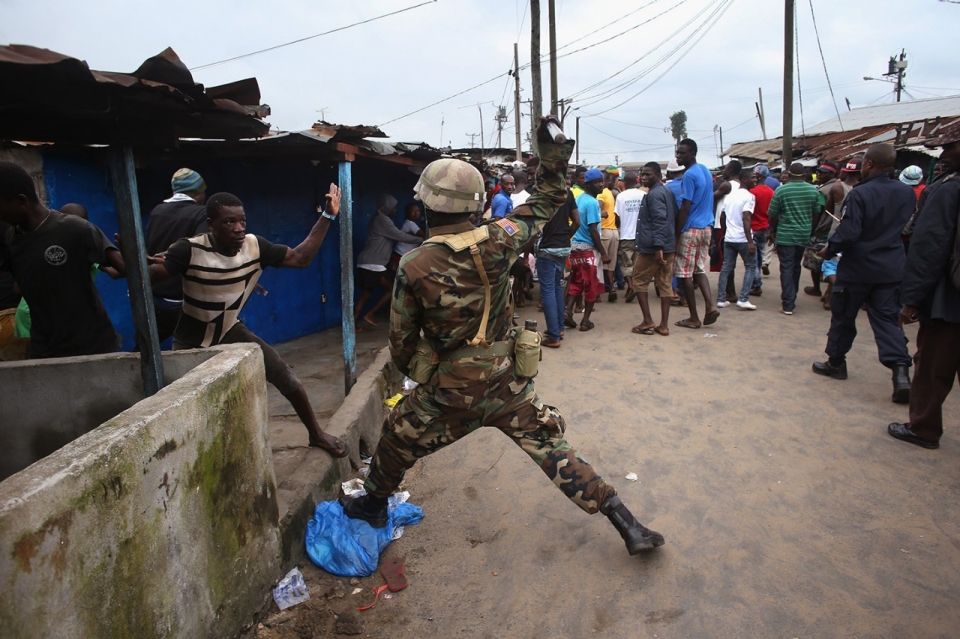
Not surprisingly, the imposition of quarantine provoked concerted collective protest.  Hundreds of young men tried to storm the barricades and force their way through the makeshift checkpoint.  Soldiers and police opened fire, killing a fifteen-year-old boy.

As Clare Macdougall reported:

“The force was disproportionate, they were already using batons, sticks, they had access to teargas and equipment to things to control an unarmed crowd,” said Counsellor Tiawan Gongloe, Liberia’s most prominent human rights lawyer. “I find it difficult to believe that there was any justification for shooting a 15-year-old boy who was unarmed. This is not a militarized conflict, it is a disease situation and a biological problem.”

Second, as this implies, quarantine is not an effective counter-measure and may well be counter-productive.  Sealing off ‘plague towns’ was a medieval and early modern response to infectious disease – remember your Foucault! – but as one commentator noted, ‘isolating a small group of unhealthy people with a large group of healthy residents can cause more harm than good if they don’t get access to food, water and medical care — all of which are in increasingly short supply.’  In fact, transmission of Ebola occurs through bodily fluids once a patient shows symptoms of the disease, which means that the most effective response is not mass quarantine but the isolation of individual cases.  This places a premium on contact tracing (you can find another image gallery from John Moore here, tracking a tracing coordinator in West Point; see also my previous post for more details and links on contact tracing).

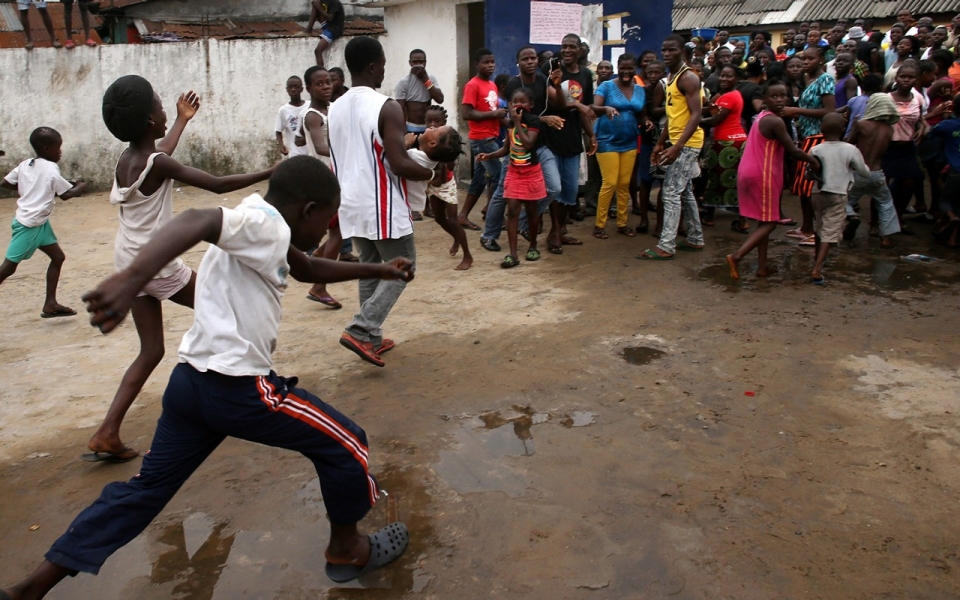
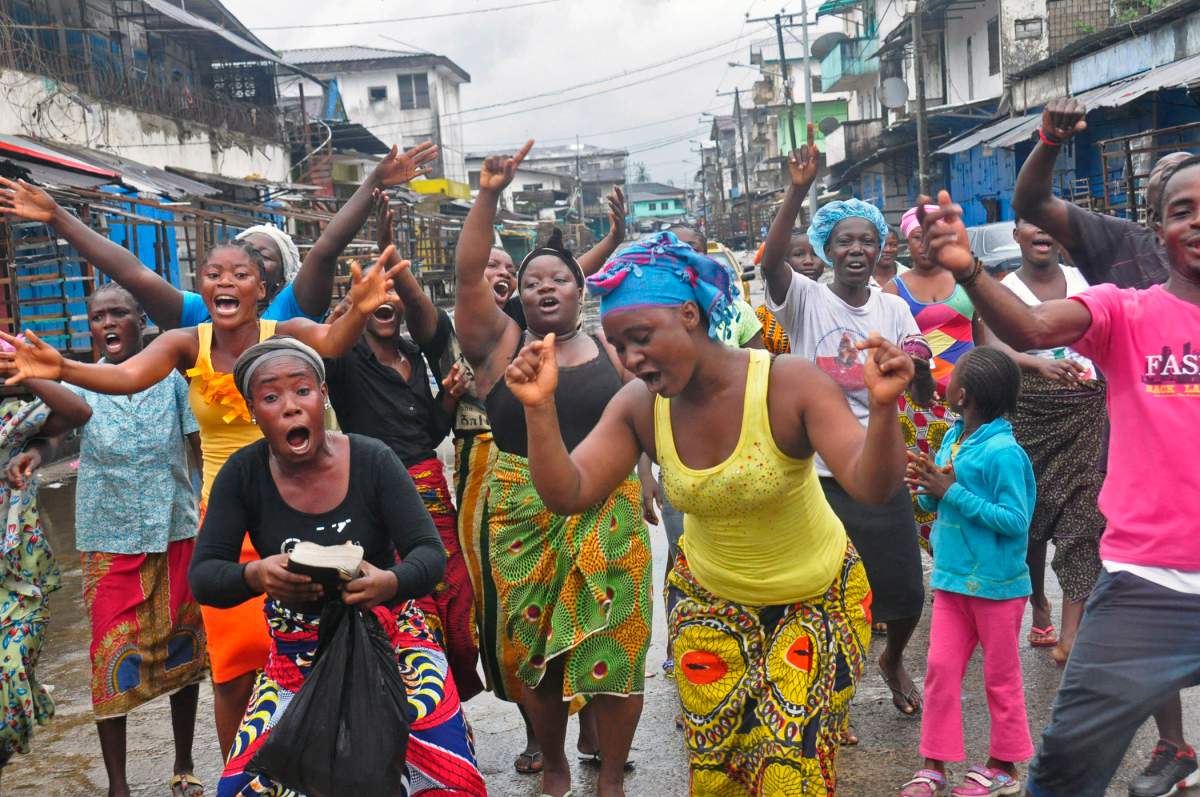
Following negotiations with community leaders, the government eventually agreed to lift the quarantine.  ‘We are out of jail!” declared one triumphant resident.

People celebrate in a street outside of West Point slum in Monrovia, Liberia, Saturday, Aug. 30, 2014. Crowds cheer and celebrate in the streets after Liberian authorities reopened a slum where tens of thousands of people were barricaded amid the countryís Ebola outbreak. The slum of 50,000 people in Liberia's capital was sealed off more than a week ago, sparking unrest and leaving many without access to food or safe water. (AP Photo/Abbas Dulleh)

People celebrate in a street outside of West Point slum in Monrovia, Liberia, Saturday, Aug. 30, 2014. Crowds cheer and celebrate in the streets after Liberian authorities reopened a slum where tens of thousands of people were barricaded amid the countryís Ebola outbreak. The slum of 50,000 people in Liberia’s capital was sealed off more than a week ago, sparking unrest and leaving many without access to food or safe water. (AP Photo/Abbas Dulleh)

Now people started to mobilise in other ways.  In return for removing the barriers and barbed wire, Luke Mogelson explained, community leaders implemented other containment measures:

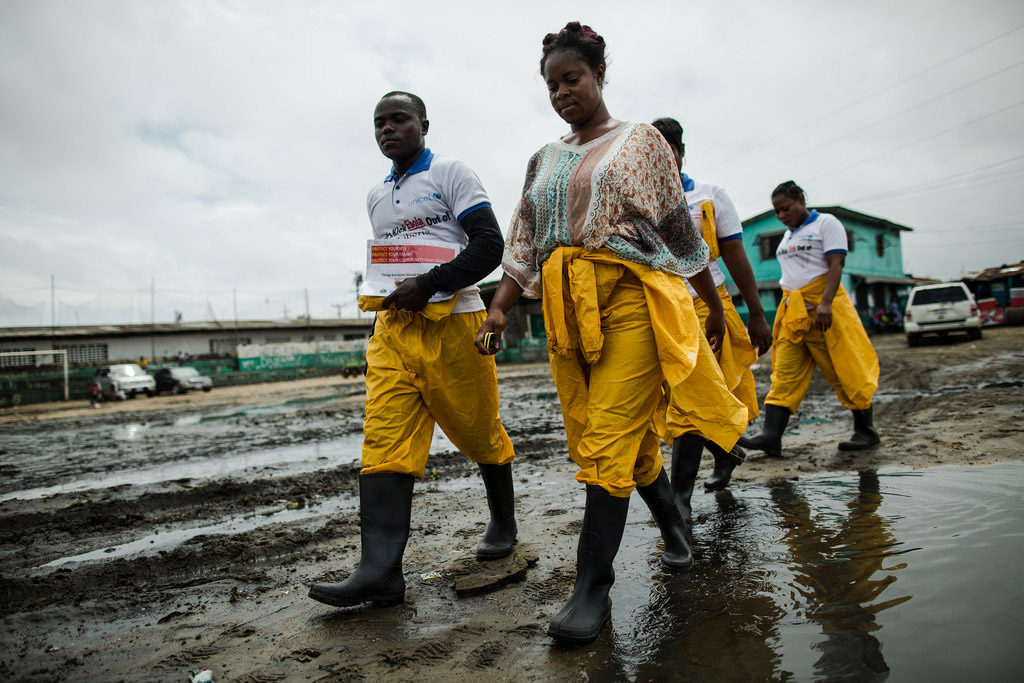
identifying sick people, removing them from the community, quarantining their houses, tracking down their recent contacts, and monitoring those contacts for twenty-one days—the maximum amount of time the virus has been known to incubate before manifesting symptoms. Previously, all this was the responsibility of highly trained specialists…

In West Point, the job fell to the neighborhood. “We had to guarantee that the things that needed to be done would be done by ourselves,” Archie Gbessay, another local leader, who worked with Martu to carry out the interventions, told me one afternoon in November. We were walking down the main road that snakes through West Point. Gbessay wore a knapsack filled with case-investigation forms and kept his thumbs hooked on the chest-strap clipped across his sternum. He is twenty-eight years old but exudes a quiet force that seems to have accrued over a much longer life; his face quivers with intensity when he talks about Ebola. “If we didn’t do this, nobody was going to do it for us,” he said.

To build a network of active case-finders who could cover all of West Point, Gbessay recruited three volunteers from each of the slum’s thirty-five blocks. Most of them were young and had a degree of social clout—“credible people,” Gbessay called them. The quarantine had done little to alleviate popular skepticism of the government’s Ebola-containment policies, however, and, for a while, hostility persisted. “At first, the cases were skyrocketing,” Gbessay said. “We used to see seventy, eighty cases a day. But by the middle of September everyone started to think, Look, I better be careful. Today, you talk to your friend—tomorrow, you hear the guy is gone. So they started to pay attention.”

11-05-2014Volunteers_Ebola

Otis Bundor, a contact tracer in West Point, described his day’s work and emphasised the importance of a trust that depended on local knowledge and on being known:

At the beginning of the outbreak, people were afraid to tell us if their family members were sick. They worried about stigmatization, and they were frightened that their wife or sister or son would go to the hospital and never come back. Some people thought that health workers were injecting patients with poison. As a contact tracer, you need to have the intellectual prowess to convince doubters that Ebola is real…

At first, family members hid bodies and buried them under the cover of darkness. This is one of the reasons that the disease became an epidemic. Attitudes changed only when people noticed that in almost all of the houses where someone died, another person later got sick. In one household, more than seven people died after they vehemently prevented contact tracers from entering.

But gradually contact tracing – or, more accurately, the contact tracers – became accepted as something other than policing.  By the time Luke Mogelson visited West Point the holding centre in the schoolhouse had reopened as a transit centre:

 Now, when residents of the slum felt unwell, they came here to be diagnosed and, if necessary, wait for an ambulance that was staffed by West Pointers and managed by Martu. The average wait time had become a matter of minutes, rather than days.

In September, at the height of the outbreak in Monrovia, the C.D.C. warned that Ebola could infect 1.4 million West Africans by late January. The prediction assumed that no “changes in community behavior” would occur. By November, that assumption was obsolete in West Point. Gbessay’s active case-finders had largely prevailed on their neighbors to come forward with symptoms and observe basic precautions such as avoiding physical contact with each other and washing their hands several times a day at the hundreds of chlorine buckets stationed throughout the city. As a result, cases were waning. “Every day, patients come,” the supervisor of the transit center told me. “But it’s going down. It’s getting less and less.”

And as Lenny Bernstein noted, this turn-around ‘has occurred without the provision of a single treatment bed by the U.S. military, which has promised to build 17 Ebola facilities containing 100 beds each across Liberia.’

Joining the dots…

The Bureau of Investigative Journalism and The Rendition Project have just published their first quarterly report on 119 people secretly detained and tortured by the CIA as part of the ‘war on/of terror’.

You can download the brief report as a pdf here, but the infographic below summarises the key findings (and don’t let its stark simplicity fool anyone about the detailed research that went into its production: this is difficult work).

what-we-know

Many commentators have noted that the Obama administration’s determination to end the CIA’s rendition program coincided with a decision to ramp up its covert program of targeted killing.  The preference for ‘kill’ over ‘capture’ is complicated by the living death suffered by many of those who were imprisoned in the carceral archipelago of black sites and prisons – and we should surely welcome the determination to widen the focus beyond Guantanamo to include, notably, Bagram.

But the apparent distinction between the two programs becomes even more blurred once you realise that many of the officials in charge of the one were switched to the other.  According to Mark Mazzetti and Matt Apuzzo writing in the New York Times:

‘Perhaps no single C.I.A. officer has been more central to the effort than Michael D’Andrea, a gaunt, chain-smoking convert to Islam who was chief of operations during the birth of the agency’s detention and interrogation program and then, as head of the C.I.A. Counterterrorism Center, became an architect of the targeted killing program. Until last month, when Mr. D’Andrea was quietly shifted to another job, he presided over the growth of C.I.A. drone operations and hundreds of strikes in Pakistan and Yemen during nine years in the position…

‘Mr. D’Andrea was a senior official in the Counterterrorism Center when the agency opened the Salt Pit, a notorious facility in Afghanistan where prisoners were tortured. His counterterrorism officers oversaw the interrogation and waterboarding of Abu Zubaydah, Abd al-Rahim al-Nashiri and Khalid Shaikh Mohammed. His actions are described in the withering Senate Intelligence Committee report about torture that was released late last year, although he was not identified publicly.’

(On the Times‘ decision to name names, see Jack Goldsmith‘s interview with Dean Baquet, Executive Editor of the Times).

But the real sting in the tail comes when Mazetti and Apuzzo also note:

‘The confidence [Senator Dianne] Feinstein and other Democrats express about the drone program, which by most accounts has been effective in killing hundreds of Qaeda operatives and members of other militant groups over the years, stands in sharp contrast to the criticism among lawmakers of the now defunct C.I.A. program to capture and interrogate Qaeda suspects in secret prisons.

‘When Ms. Feinstein was asked in a meeting with reporters in 2013 why she was so sure she was getting the truth about the drone program while she accused the C.I.A. of lying to her about torture, she seemed surprised.

‘“That’s a good question, actually,” she said.’

The nature(s) of war and biomimetic war

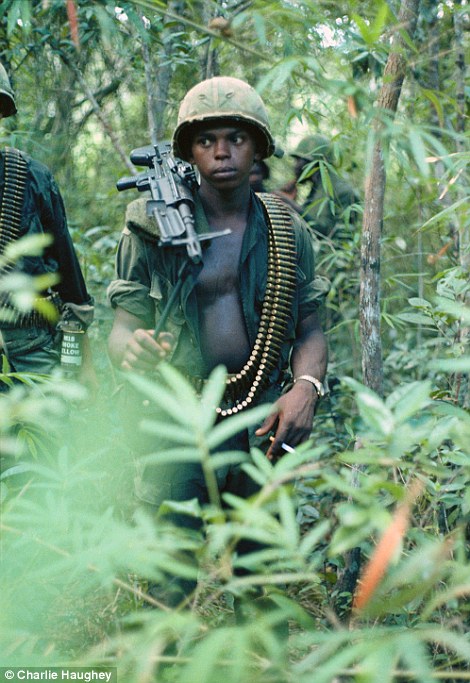
Charlie Haughey, VietnamOne of my tasks this past week has been to complete the revisions to ‘The Natures of War’ which, to my delight, Antipode has agreed to publish in its entirety (and with a handful of illustrations too).  I’ve added a discussion of the ways in which the narratives on which I draw – for the Western Front, the deserts of North Africa, and Vietnam – were all, for various reasons, ‘white boy’s stories’.  I had made it clear that there were troops from other continents fighting and dying on the Western Front, for whom the militarized nature of trench warfare in Europe would have been doubly strange (see also here), and I had also explained that in Vietnam there were at least two other stories to be told: most of the US memoirs were written by white soldiers so that the experiences of African-Americans were written out of the narrative, and the (not so different, as it happens) experiences of Vietnamese fighters only flickered in the footnotes.  I now address all these issues in the body of the text, and the racism of military violence – the racism within militaries ad coalitions as well as racial violence directed at ‘the enemy’ – speaks directly to racializations of nature, and I plan to write another essay drawing on the few extant and relevant memoirs from the People’s Army of North Vietnam and their ancillaries (for a taster, see here: scroll down).

But Juanita Sundberg has raised an altogether different though related question, about the ways in which non-white and (post)colonial subjects construed violence and, indeed, experienced it as quotidian.  In short, is war itself – in so far as its dominant conceptions privilege Europe and North America – seen from the position of a white subject, which is then confounded by the ‘intemperate natures’ of desert and rainforest?

The unrevised draft is still under the DOWNLOADS tab.  More soon.

***

While I’ve been rooting around with these questions, I discovered another way of thinking about ‘The Nature of War’.  Not sure how I missed this, but over at the Vision Machine Roger Stahl previews an essay on ‘The Nature of War’ and the ways in which

‘the discourse of “war” in news, pop culture, and weapons industry PR has taken on a host of biological metaphors. I call this discourse “biomimetic war,” and it is one that, in the end, tacitly extends military jurisdiction to the governance of life itself…

13sd1Of course, biological metaphors have been a part of war/security discourse for a while. Consider the fact that “drone” came from a WWII experiment in unmanned flight that relied on a control center called the “Queen Bee.” Surveillance, especially during the Cold War, has been rife with “bugs” and “flies on the wall.” In the post-9/11 period, however, the biological has edged toward the center as ultimate object of military power. War has gone ecological. Here, terrorism fuses with the natural disaster, Homeland Security responds to disease outbreak and domestic bombing alike, and the specter of biological weapons haunts the public imagination. In such a discursive environment, the contest we call “war” has effectively been mapped onto the biosphere as a permanent and ubiquitous condition determined less by the policing of national boundaries than policing life systems. ‘

You can download the full essay, ‘Life is War: the rhetoric of biomimesis and the future military’ at Democratic Communique 26 (2) (2014) 122-137 here.

Overlooking Auschwitz

To mark the 70th anniversary of the liberation of Auschwitz-Birkenau concentration camp, there has been widespread interest in a haunting video shot for the BBC using a commercial drone:

For once, the emptiness of the scene – just buildings, fences and railway tracks – is desperately affecting.   It’s surely impossible to watch this without thinking of the millions of people whose lives were so brutally effaced by the murderous regime of the Third Reich.  The only sign of a human presence in the video is a glimpse over the wall of trucks racing by: a reminder that Auschwitz was (and disconcertingly remains) at the centre of a small town (see also my post on Auschwitz here).

There are at least two other films that ought to be seen too.

Night Will Fall 2

The first is a documentary commissioned in 1945 by the Psychological Warfare Film Section of the Supreme Headquarters Allied Expeditionary Force to document the liberation of Bergen-Belsen.  The producer was Sidney Bernstein, for Britain’s Ministry of Information; Alfred Hitchcock was drafted in as a ‘treatment adviser’.  The working title was German Concentration Camps: Factual Survey; it was never shown in its entirety (though Billy Wilder turned the footage into a short, Death Mills), and the Imperial War Museum notes:

From the start of the project, there were a number of problems including the practical difficulties of international co-operation and the realities of post-war shortages. These issues delayed the film long enough to be overtaken by other events including the completion of two other presentations of concentration camp footage to the German people and the evolution of occupation policy, where the authorities no longer considered a one-hour compilation of atrocity material appropriate. The last official action on the film was a screening of an incomplete rough-cut on 29 September 1945, after which the film was shelved, unfinished.

The footage has now been incorporated into a stunning HBO documentary, Night Will Fall, directed by André Singer, who was an Executive Producer for Act of Killing (see my posts here, here and here).

NIGHT-WILL-FALL-POSTER-2

There are all sorts of stories about why the full version was never shown – see the Guardian‘s report here – but the fullest discussions are Kay Gladstone‘s ‘Separate intentions’ in Toby Haggith and Joanna Newman (eds) Holocaust and the moving image (2005) (see also Haggith’s ‘Filming the liberation of Bergen-Belsen here) and her ‘Memory of the Camps: the rescue of an abandoned film’, in Griselda Pollock and Max Silverman (eds) Concentrationary cinema (2011).

The second film returns to the aerial view and to Auschwitz: Harun Farocki’s Images of the world and the Inscription of War.  Shockingly and sadly, Farocki died last summer at the age of 70, and Images is widely regarded as his masterpiece (see Thomas Voltzenlogel‘s wide-ranging and appreciative discussion of ‘Dialectics in images’ here).  The central motif is an image taken from a series of aerial photographs of Auschwitz shot by the Allies between April 1944 and January 1945 (see also here and here).

1389.3 Holocaust E

This image was taken on 4 April 1944 by Lt Charles Barry flying a Mosquito from 60 Photo Reconnaissance Squadron of the South African Air Force.  From the film’s commentary [available in Discourse 5(3) (1993) 78-92]:

American aircraft had taken off in Foggia, Italy, and flown towards targets in Silesia – factories for synthetic petrol and rubber – known as Buna.

On the flightover the IG Farben company factory still under construction, a pilot clicked his camera shutter and took photographs of the Auschwitz concentration camp.

First picture of Auschwitz taken at 7,000 meters altitude.

The pictures taken in April 1944 in Silesia arrived for evaluation in Medmenham, England [the RAF’s Central Intelligence Unit concerned with air photograph interpretation].

The analysts discovered a power station, a carbide factory, a factory under construction for Buna and another for petrol hydrogenation.

They were not under orders to look for the Auschwitz camp, and thus they did not find it.

How close the one is to the other: the industry – the camp.

It was not until 1977 that two employees of the CIA [Dino Brugioni and Robert Poirer: see their detailed report here] went through the archives to find and evaluate the photographs of Auschwitz. It was not until thirty-three years later that the following words were inscribed:

Tower and Commandant’s house and

Registration Building and Headquarters and Administration and

Fence and execution wall and Block 11 and the word “Gas chamber” was inscribed.

tumblr_n6e9sd1riY1rxmv4io1_500

Kaja Silverman adds this gloss [‘What is a camera?’ Discourse 5 (30 (1993) 3-56]:

Not only does the camera here manifestly “apprehend” what the human eye cannot, but the latter seems strikingly handicapped by its historical and institutional placement, as if to suggest that military control attempts to extend beyond behavior, speech, dress,and bodily posture to the very sensory organs themselves. This sequence indicates, in other words,that military discipline and the logic of warfare function to hyperbolize the distance separating look from gaze and to subordinate the former completely to the latter.

These are similar issues that haunt my own discussions of the video feeds from Predators and Reapers over Afghanistan and Iraq.  In another commentary, Christa Blümingler writes:

The vanishing point of Images of The World is the conceptual image of the ‘blind spot’ of the evaluators of aerial footage of the IG Farben industrial plant taken by the Americans in 1944. Commentaries and notes on the photographs show that it was only decades later that the CIA noticed what the Allies hadn’t wanted to see [my emphasis]: that the Auschwitz concentration camp is depicted next to the industrial bombing target.

Bombing of AuschwitzThe claim that the ‘Allies didn’t want to see’ spirals through an important debate about whether the Allies could or should have bombed Auschwitz (see, in addition to the symposium on the right, here and here).  In fact, as Christa observes later,

In … 1944, the allies bombed not Auschwitz, but the IG Farben factory nearby the death camp. Drawing on analyses of these events, how and why the allies didn’t act on their knowledge of the mass destruction of the Jews, Farocki … decodes a host of military images, focusing on two visual dispositives: American pilots in 1944 and CIA agents in 1977 offering two different [readings] of the aerial photographs of Auschwitz.

In this instance, Farocki developed an epistemological field of technological history — measurement and surveillance in a period of rapid automatization. At the end of the film, a blind spot in the photographic act, referring back to the reality of the concentration camp, becomes visible.

The final shots further emphasize details of the American pilots’ aerial photos, which are picked up in the sweep of the film several times, framed and arranged in different ways. At the end of the film, through a permutative movement of cuts, the extreme enlargement of the photographs reminds us once again of their materiality. Farocki shows these images in precisely the spaces where visual thought takes place, and in connection to specific techniques of reproduction and distribution (in albums, archives, institutions). Whenever he used marginal and hard-to-access image materials from specialized archives, he sought to consider these conditions of visibility in his analysis.

Farocki2

What particularly interests me, and the reason I juxtapose these two films, is an interview with Chris Darke in 2003 in which Farocki artfully tracks between the eye-witness and the aerial shot:

Chris Darke: In Images of the World and the Inscription of War there is this repeated phrase: “Beside the real world there is a second world, a world of pure military fiction”. I was very strongly reminded of Colin Powell at the UN Security Council presenting degraded military surveillance images as proof and justification for military action.

HF: Yes, it reminded me so much of the Auschwitz sequences in Images of the World, the way they involved aerial reconnaissance images that you had to be a specialist to read. Who knows what they are telling you? Who knows what happened there? What is so interesting is that the personal witness of two people who had escaped from the camps was so important. It was the way that traditional history was always written. You need an eye-witness, a narrative, otherwise you’ll never believe in it. And it turns out that our imaginative minds are still very old-fashioned. We don’t understand modernist strategies such as those used by the Americans in the first Gulf War. You really want to see these terrible, dirty images of burning streets and wounded people in the same way that psychoanalysis knows that you need dirty thoughts for the imagination, just as for love you need dirty images. The audience is not prepared for this automatically recorded history that more or less happens already, where everything is recorded; so there has to be an old-fashioned drama made out of it.

There are at least two other detailed commentaries on the film that address the question of visuality in depth: Thomas Keenan‘s ‘Light weapons’, in Documents 1/2 (1992) 147-58 and Nora Alter‘s ‘The political im/perceptible in the essay film:  Farocki’s Images of the world and the inscription of war‘, in New German Critique 68 (1996). More generally, I also recommend the special issue of e-flux on Farocki’s work here, including a commentary by Trevor Paglen on Farocki’s ‘operative images’, and David Cox‘s brief commentary here.

Note:  Belinda Gomez writes (in relation to the commentary for Images of the World):

“Fence and execution wall and Block 11 and the word “Gas chamber” was inscribed….” But that’s not quite accurate. Brugioni and Poirier didn’t write that in 1977. The gas chamber didn’t have a sign. That they were able to locate the gas chamber and crematoria was due to their superior technology and they knew what they were looking for. The pilot/photographers in 1944 took photos of the factory and what was taken as a workers camp. To say that they didn’t see Auschwitz because they weren’t told to look for it is more of a hind-sight interpretation.

Torture and raison d’état

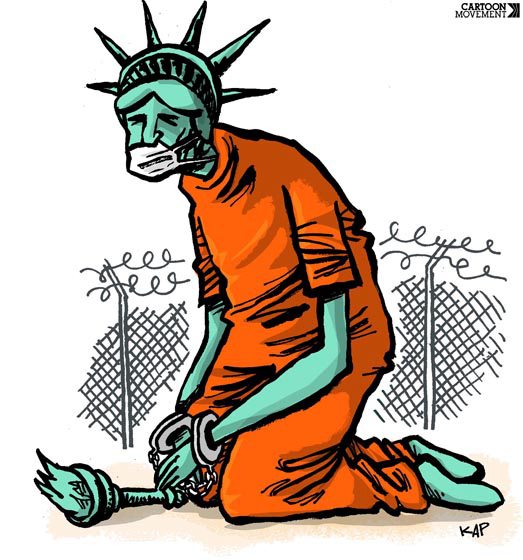
statue-of-liberty-waterboardingMelanie Richter-Montpetit has an essay at The disorder of things, ‘Why Torture When Torture Does Not Work? Orientalism, Anti-Blackness and the Persistence of White Terror‘, which repays careful reading.

[L]ocating the findings of the Senate Torture Report within the racial-sexual grammars of chattel slavery and its afterlife opens up our analyses beyond explanatory and moral frameworks such as failed intelligence-gathering, “state of exception” or “human rights abuses” towards a more comprehensive understanding of seemingly illiberal security practices in the War on Terror. This genealogy indicates the fundamental role and value of force for the consolidation of the sovereign authority of the U.S. settler imperial formation ‘at home’ and abroad, and suggests the stubborn persistence of certain racial-sexual grammars of legitimate violence and suffering in this age of “post-racial triumph.” For “[w]ithout the capacity to inspire terror, whiteness no longer signifies the right to dominate.”

The immediate provocation for her essay, which is rooted in her recent York PhD thesis Beyond the Erotics of Orientalism: Homeland Security, Liberal War and the Pacification of the Global Frontier, was the Senate Torture Report (see my earlier post on ‘Tortured geographies’ here).

GTMO Statue of LibertyAt Just Security Jameel Jaffer has a brief, important post about the release of these documents – and, crucially, the Obama administration’s attempt to prevent the publication of photographs documenting the abuse of detainees at US military facilities – that loops back to the debate over the Charlie Hebdo cartoons.  He argues that it is at the very least ironic that some of the same voices calling for the freedom to publish cartoons whatever their consequences are now demanding the suppression of other images ‘because of the possibility that their release will provoke violence’…

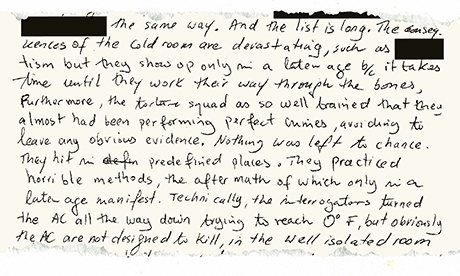
And speaking of violence and torture in the global war prison, Mohamedou Ould Slahi‘s Guantanamo Diary, which is being serialised in the Guardian and was published in book form earlier this week, provides more evidence of its routinised, banalised practice.

Slahi Unclassified Manuscript scan

Slahi is still incarcerated at Guantanamo even though he was approved for release in 2010.  Spencer Ackerman reports:

Slahi’s manuscript was subjected to more than 2,500 redactions before declassification, ostensibly to protect classified information, but with the effect of preventing readers from learning the full story of his ordeal. The book is being published with all the censor’s marks in place, and the publishers – Canongate in the UK and Little, Brown in the US – hope they will be able to publish an uncensored edition when Slahi is eventually released.

The full manuscript is available here.  You can find Tim Stanley‘s review at the Telegraph here (‘a necessary book’ that ‘reminds us that the evil we’re fighting can be found in ourselves as well as in our enemies’), Mark Danner‘s extended review at the New York Times here (‘Slahi’s memoirs are filled with numbingly absurd exchanges that could have been lifted whole cloth from “The Trial”’), and Deborah Perlstein‘s review at the Washington Post here (‘Slahi’s descriptions of … torture are the book’s most compelling, and difficult, passages [and] … are closely consistent with descriptions in official investigations of the treatment of other U.S.-held detainees’.)

In the face of these horrors, it’s necessary to consider this blunt reminder from Peter Beinart:

Torture, declared President Obama … in response to the newly released Senate report on CIA interrogation, is “contrary to who we are.” Maine Senator Angus King added that, “This is not America. This is not who we are.” According to Kentucky Congressman John Yarmuth, “We are better than this.”

No, actually, we’re not. There’s something bizarre about responding to a 600-page document detailing systematic U.S. government torture by declaring that the real America—the one with good values—does not torture. It’s exoneration masquerading as outrage. Imagine someone beating you up and then, when confronted with the evidence, declaring that “I’m not really like that” or “that wasn’t the real me.” Your response is likely to be some variant of: “It sure as hell seemed like you when your fist was slamming into my nose.” A country, like a person, is what it does.

And in the face of evasion and denial – and redaction and suppression – here is Chase Madar from February’s Bookforum:

Though the [Senate] report has blacked out the names of the torturers, refusing even to use pseudonyms, torture watchers have been able to identify one of the agents, a model for Maya in Zero Dark Thirty. Her record of malfeasance, misrepresentation, incompetence, and gratuitous participation in waterboarding was blisteringly detailed by NBC News and [Jane Mayer at] the New Yorker, though neither outlet would name her. But far from being sanctioned or even demoted, she has risen to the civilian-rank equivalent of general inside the CIA. She has, unbelievably, served as the recent head of the agency’s “global jihad unit.”

It’s tempting to compare this to Latin American–style police impunity, but that would be unfair to the societies that have punished at least some of the abuses of their past dictatorships. In the same week that the SSCI released its report, Brazil published its own investigation into state torture of political dissidents under its long dictatorship. Indeed, one of that torture regime’s victims, Dilma Rousseff, is now the head of state. Latin American nations have been chipping away at, or simply ignoring, the amnesty deals made with the authoritarian rulers of the ’70s and ’80s and have brought many of their torturers to justice.

The United States would face a very different reckoning with its record of torture, should it elect to take a genuine, closer look at it. In our case, the impact of torture has largely been muffled by the military adventurism that has underwritten it…