Periscope

Unknown

Continuing my gradual process of re-immersion….  I suspect that, for many of us, the summer is a time to redeem all those promissory notes: to devise a new research and writing schedule, free of term-time commitments, to turn notes and drafts into a finished essay, chapter or book; and – this I don’t suspect, I know – to issue even more promissory notes (‘I will get it to you by the end of next month…’).  But it’s also a time for more or less uninterrupted reading, catching up with stuff for research and for teaching, but also – this I also know – as a distraction from all those promissory notes.

2014_cover_publication_forensis_imgsize_SSo here’s my preliminary list which is also intended to answer the perennial ‘Have you read anything interesting lately?’ question.  As I explained here, under this heading I list stuff that is catching my attention at the moment – sometimes with a brief annotation, sometimes not; sometimes hot off the press (or, appropriately enough, the Kindle), sometimes something I really should have noticed an age ago…. And I promise to try to do this more often in future.  I’ve excluded all those books I’ve already trailed, but I must make one exception: my copy of Forensis was waiting for me on my return – ordered from the excellent Book Depository (‘free delivery worldwide’ – and incredible fast too) – and it is sumptuous.  As soon as I’ve finished this post, I’m off to the deck with a drink to continue reading it.

Here’s my list:

Richard Adams and Chris Barrie, ‘The bureaucratisation of war: moral challenges exemplified by the covert lethal drone’, Ethics & Global Politics 6 (4) (2013) 245-60 – I’m thinking about this in relation to my essay/chapter on ‘The God trick and the administration of military violence’, which is a detailed analysis of the Uruzgan air strike: ‘administration’ here has its double meaning, for which I am as always deeply grateful to David Nally who first alerted me to it (in the radically different context of the Irish Famine).
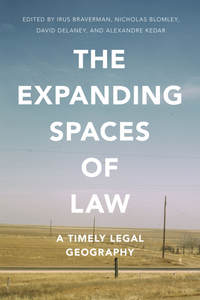
0804787182Irus Braverman, Nicholas Blomley, David Delaney and Alexandre Kedar (eds) The expanding spaces of law: a timely legal geography (Stanford University Press, 2014) – essential reading, important not least for Michael Smith on ‘the geolegalities of the Afghanistan intervention’; it’s taken legal geography a surprisingly long time to address international law, no?  I sometimes think that if I had realised the intellectual firepower of critical legal scholarship (especially in relation to international law) and its intersections with critical human geography years ago, I would have followed a radically different career path.
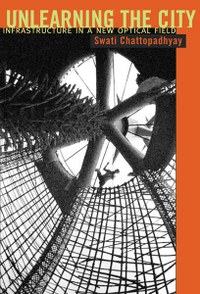
Unlearning the citySwati Chattopadhyay, Unlearning the city: infrastructure in a new optical field (Minnesota, 2013) – this is a truly lovely book, bursting with ideas, but I’m trying to ‘reverse-engineer’ some of them: Unlearning the city is about subaltern groups re-working established urban infrastructures, and I want to transport this to Baghdad as I re-think what I once called ‘the counter-city’ and to explore other insurgent practices….
Jihadis ReturnPatrick Cockburn, The Jihadis Return: ISIS and the new Sunni uprising (OR Books, 2014) – as I try to keep up with events in Syria and Iraq for The everywhere war, Cockburn’s reports from Baghdad are as lucid and indispensable as they were for The colonial present.

Jean Comaroff and John Comaroff, Theory from the South: or, how Euro-America is evolving toward Africa (Paradigm, 2012): I read this last year, and always learn so much from these authors; but with the Johannesburg Workshop in Theory and Criticism travelling around South Africa at the moment (‘Archives of the Non-Racial’ this year, and you can check out previous presentations and productions here) it’s a good time to re-visit and re-think what I thought I’d learned.

J. Martin Daughtry, ‘Thanatosonics: ontologies of acoustic violence’, Social text 119 (32 [4]) (2014) 25-51 – I’ve noted the importance of the sounds of war on several occasions, here and here and (on sound-ranging) here, and incorporated some of that into my discussion of the corpographies of the Western Front in ‘Gabriel’s map’ (DOWNLOADS tab), but this is a must-read essay both for its general argument and for its compelling discussion of the thanatosonics of the US-led war in Iraq.

Rosalyn Deutsche, ‘Un-War: an aesthetic sketch’, October 147 (2014) 3-19 – a characteristically clear and though-provoking reflection on Krzysztof Wodiczko‘s Arc de Triomphe: World Institute for the Abolition of War (see my post here).  A welcome change from the preachiness of peace-talk in some quarters.

Isla Forsyth, ‘Designs on the desert: camouflage, deception and the militarisation of space’, Cultural geographies 21 (2014) 247-265 – an exquisitely written account of the camoufleurs in the Western Desert in the Second World War, which I’m drawing on for the long-form version of ‘The nature(s) of war’ (one of my promissory notes).

John Bellamy Foster and Robert W. McChesney, ‘Surveillance Capitalism, Monopoly-Finance Capital, the Military-Industrial Complex, and the Digital Age’, Monthly Review 66 (3) (2014) available as a pdf here.
No Good MenAnand Gopal, No good men among the living: America, the Taliban and the war through Afghan eyes (Metropolitan Books, 2014) – see Juan Cole‘s commentary here.

Marie-Hélène Huet, The culture of disaster (University of Chicago Press, 2012) – a brilliant genealogy of disaster from the Enlightenment to the present: I’m particularly taken by the final chapter, ‘Now playing everywhere’ (not least because I think war is a disaster too).

John Kaag and Sarah Kreps, Drone warfare (Polity, 2014) – a philosopher and a political scientist join forces; no shortage of books on drones on the way, but this is likely to be one of the very best.  If you haven’t seen it, their NYT Op-Ed from 2012, ‘The moral hazard of drones’, is here.

Laleh Khalili, ‘The uses of happiness in counterinsurgencies’, Social text 118 [32 (1)] (2014) 23-43 – another artful, spellbinding essay from our most accomplished critic of counterinsurgency.

Jason Lyall, ‘Bombing to lose? Airpower and the dynamics of coercion in counterinsurgency wars’, available here – yet another forensic account from one of the most astute analysts in contemporary political science; it’s the lead chapter from his book-in-progress, Death from above: the effects of air power in small wars.

Robert Marzec, ‘Militarized ecologies: visualisation of environmental struggle in the Brazilian Amazon’, Public culture 26 (2) (2014) 233-255 – more than anything I’ve read in an age, this has helped me re-think the implications of my work on ‘The nature(s) of war’ for contemporary military violence (and also made me realise how much more I need to do); it’s remarkably modest in tone and temper but it’s also theoretically sophisticated and written with a power, imagination and clarity that is wholly enviable.  Its opening epigraph is an extraordinary remark from US Admiral T. Joseph Lopez: ‘Climate change will provide the conditions that will extend the war on terror’…. Discuss.
Transformation of the WorldJürgen OsterhammelThe Transformation of the World: A Global History of the Nineteenth Century (Princeton University Press, 2014) – with its chapters on Space, Mobilities, Frontiers, Networks and much (much) more, David Cannadine suggests that this acclaimed panoramic survey by ‘the Braudel of the nineteenth century’ is the one work of history to read this summer and, he adds,’believe me, it will take you all of a very long summer’.  But why no illustrations?

 Clare Richard and Peter Asaro, ‘Can drones have ethics?’ An extended interview with Peter Asaro over at Public Books; I really like Peter’s work, and if you haven’t read his ‘The Labor of Surveillance and Bureaucratized Killing: New Subjectivities of Military Drone Operators’, Social semiotics 23 (2) (2013) 196-224, now’s the time…

Ann Rogers and John Hill, Unmanned: drone warfare and global security (Pluto Press, 2014).

Kristin Bergtora Sandvik and Kjersti Lohne, ‘The rise of the humanitarian drone’, Millennium (online first: 27 June 2014) – a much needed discussion of how ‘military humanism’ has become entangled with drone warfare, showing how the military conduct of remote operations may also affect the deployment of so-called ‘humanitarian drones’.
Counterinsurgent's constitutionGanesh Sitaraman, The counterinsurgent’s constitution: law in the age of small wars (Oxford University Press, 2013).

David Trotter, ‘Messages from the 29th Floor‘, London Review of Books, 3 July 2014 – a very different ‘politics of verticality’…

Elspeth van Veeren, ‘Materializing US Security: Guantanamo’s object lessons and concrete messages’, International Political Sociology 8 (2014) 20-42 – a compelling account of a ‘Guantanamo tour’ (yet another arrow in the dismal quiver of ‘dark tourism’) and its wider implications.  More generally, you can find reports on last month’s conference on Ending sexual violence in conflict here

Julia Welland, ‘Militarised violences, basic training and the myths of asexuality and discipline’, Review of International Studies 39 (2013) 881-902 – an immensely helpful argument that works with Avery Gordon‘s ideas about ‘haunting’ to think through the sexualisation of military violence and detainee abuse.

Elvin Wyly, ‘The new quantitative revolution’, Dialogues in human geography 4 (1) (2014) 26-38 – not what you might think, and about much more than its characteristically modest title: a brilliant, just brilliant, wonderfully angry warning about the threats to a critical spatial science from the neo-liberal noösphere in which Elvin and I (and you) are embedded.

 Joseba Zulaika, ‘Drones and fantasy in US counterterrorism’, Journal for cultural research 218 (2) (2014) 171-87

‘Books constitute capital’

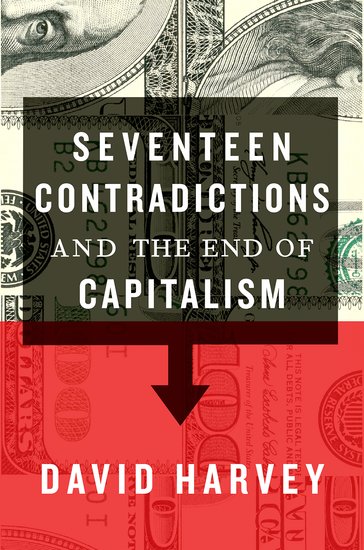
HARVEY Seventeen contradictionsIntroducing his interview with David Harvey at the Chronicle of Higher Education earlier this week, Scott Carlson notes that

‘The American stage has recently been set for questioning capitalism, with the U.S. tour of academe’s rock star of the moment, Thomas Piketty. The French economist’s Capital in the Twenty-First Century has highlighted capitalism’s drift toward inequality and criticized economists’ focus on pure theory.’

The interview was prompted by the publication of David’s latest book, Seventeen contradictions and the end of capitalism: see also this interview with Jonathan Derbyshire here.  En route, David has good things to say about Piketty’s project – its empirical detail, its humanistic flourishes (see also Paul Krugman here) – but he is evidently dissatisfied with its analytical and, in consequence, its political reach.

Since he spoke to the Chronicle, David has fleshed out his critique of Piketty here.

The book has often been presented as a twenty-first century substitute for Karl Marx’s nineteenth century work of the same title. Piketty actually denies this was his intention, which is just as well since his is not a book about capital at all. It does not tell us why the crash of 2008 occurred and why it is taking so long for so many people to get out from under the dual burdens of prolonged unemployment and millions of houses lost to foreclosure. It does not help us understand why growth is currently so sluggish in the US as opposed to China and why Europe is locked down in a politics of austerity and an economy of stagnation. What Piketty does show statistically (and we should be indebted to him and his colleagues for this) is that capital has tended throughout its history to produce ever-greater levels of inequality. This is, for many of us, hardly news. It was, moreover, exactly Marx’s theoretical conclusion in Volume One of his version of Capital. Piketty fails to note this, which is not surprising since he has since claimed, in the face of accusations in the right wing press that he is a Marxist in disguise, not to have read Marx’s Capital.

If he had – David’s central point – he would have realised that capital has to be conceived not as a thing but as a process: the insight that has animated so much of his own work ever since he made his celebrated ‘transition’ in Social justice and the city from liberal to socialist formulations.

But we might also note the reference in the passage I’ve highlighted to difference, to the macro-scale differences between the US, Europe and China, and by implication to the production of a variegated and highly uneven capitalist space.  David’s insights here have surely been his crowning achievement – and, significantly, the Chronicle interview is captioned ‘Mapping a new economy’.

SLOTERDIJK World Interior of CapitalHe’s no longer alone, of course, and many critics have also been enthralled by another rock star release, Peter Sloterdijk‘s In the world interior of capital (memorably described by Carl Raschke as a ‘philosophical docudrama’):

‘No point on the Earth’s surface, once money had stopped off there, could escape the fate of becoming a location – and a location is not a blind spot in a field, but rather a place in which one sees that one is seen.’

It’s also, as Harvey shows, rather more than that.  Sloterdijk shows that too, hence his ‘spherology‘ and his emphasis on ‘spatial multiplicities’.  But their analyses – like their philosophies and their politics – take us to radically different destinations.

So back to my title: these three books ‘constitute capital’, in exactly the sense Thomas Jefferson meant, but they also enable us to apprehend capital – in the double sense of comprehending its exactions and, ultimately, indicting its deformations.

In the literary trenches

Barbusse2

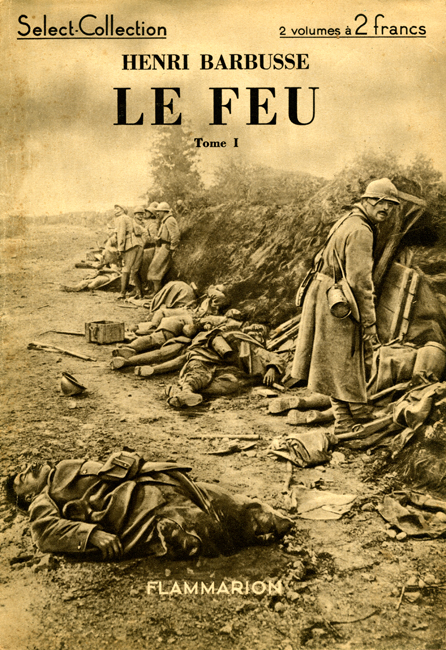
Until now, my knowledge of the French experience on the Western Front has been largely confined to Henri Barbusse’s Under Fire.  I was particularly taken by his striking evocation of the materiality of war – of the ‘slimescape’ – which features in ‘Gabriel’s Map’ and ‘The Natures of War’ (both soon to be available in written form):

The earth! It is a vast and water-logged desert that begins to take shape under the long-drawn desolation of daybreak. There are pools and gullies where the bitter breath of earliest morning nips the water and sets it a-shiver; tracks traced by the troops and the convoys of the night in these barren fields, the lines of ruts that glisten in the weak light like steel rails, mud-masses with broken stakes protruding from them, ruined trestles, and bushes of wire in tangled coils. With its slime-beds and puddles, the plain might be an endless gray sheet that floats on the sea and has here and there gone under. Though no rain is falling, all is drenched, oozing, washed out and drowned, and even the wan light seems to flow. Now you can make out a network of long ditches where the lave of the night still lingers. It is the trench. It is carpeted at bottom with a layer of slime that liberates the foot at each step with a sticky sound; and by each dug-out it smells of the night’s excretions. The holes themselves, as you stoop to peer in, are foul of breath. I see shadows coming from these sidelong pits and moving about, huge and misshapen lumps, bear-like, that flounder and growl. They are “us.”

Or again:

We begin to flow again in one direction. No doubt it is a movement planned up there, back yonder, by the chiefs. We trample soft bodies underfoot, some of which are moving and slowly altering their position; rivulets and cries come from them. Like posts and heaps of rubbish, corpses are piled anyhow on the wounded, and press them down, suffocate them, strangle them. So that I can get by, I must push at a slaughtered trunk of which the neck is a spring of gurgling blood.

The ground is so full of dead that the earth-falls uncover places that bristle with feet, with half-clothed skeletons, and with ossuaries of skulls placed side by side on the steep slope like porcelain globe-jars. In the ground here there are several strata of dead and in many places the delving of the shells has brought out the oldest and set them out in display on the top of the new ones. The bottom of the ravine is completely carpeted with debris of weapons, clothing, and implements. One tramples shell fragments, old iron, loaves and even biscuits that have fallen from knapsacks and are not yet dissolved by the rain. Mess-tins, pots of jam, and helmets are pierced and riddled by bullets—the scrapings and scum of a hell-broth; and the dislocated posts that survive are stippled with holes.

It’s a clunky old translation, but the power of Barbusse’s prose still shines through.  Small wonder that he later confided: ‘I once used to think that the worst hell in war was the flame of shells; and then for long I thought it was the suffocation of the caverns which eternally confine us. But it is neither of these. Hell is water.’ (If you want more on these imaginative geographies, incidentally, I recommend Susan Grayzel‘s short essay on Barbusse and, more generally, Claire Keith‘s ‘Pilgrims in a toxic land: Writing the Trenches of the French Great War’ in Jeff Persels‘s collection, The environment in French and Francophone Literature and Film (2013) pp. 69-85).

BARTHAS Poilu

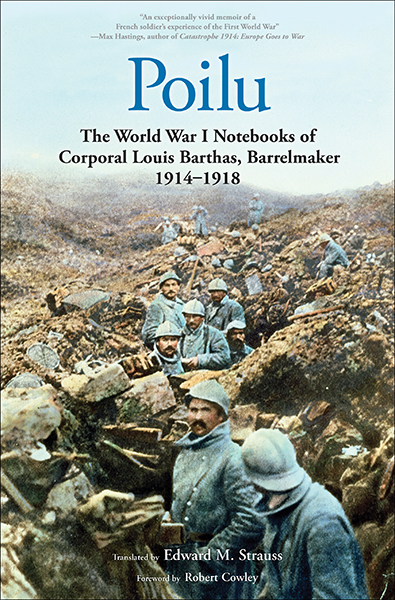
I’ve spent the last several days reading two other accounts by French authors.  The first, Louis Barthas‘s Poilu, has only recently been made available in English translation (it was first published in France in 1978).  ‘Poilu’ means ‘hairy one’, but probably the closest English-language equivalent is the much more recent ‘grunt’, for Poilu presents  the view of the (not so) common soldier.  It’s a carefully assembled account, as Robert Cowley explains in his helpful introduction:

‘Few documents from the Great War are as remarkable as the war notebooks of Louis Barthas, published in English for the first time in Edward M. Strauss’s fine translation. They are special for a number of reasons. Their author left a record of four years of service at the front, an unusual span of survival. He was not an officer but a common soldier, a corporal, a man approaching middle age who in civilian life had been a barrelmaker from the Languedoc region of France, a wine-growing center…. After he was mustered out in February 1919, Barthas began to assemble a narrativeRead more at describing his time on the Western Front that would eventually run to nineteen notebooks. He would work on it after he finished a long day of barrel-making, fleshing out the original diaries with quotes from letters home, official reports and orders that he had kept, and accounts by fellow soldiers that he had written down at the time, as well as with ephemera such as postcards and newspaper clippings. Those sources he put together in the book you read here, one that is part diary, part memoir.’

It’s been praised to the skies – see, for example, this review in the New York Times and this review at the Daily Beast – and Barthas’s spirited socialism and pacifism make it all the more interesting.  But, for me at least, it doesn’t capture the slimescape with the same intensity as my second book: Gabriel Chevallier‘s Fear.

CHEVALLIER Fear

I confess to being taken aback by its very existence.  In another life – in grammar school – my French teacher, a wonderful man called Robert Bratcher, recommended Chevallier’s Clochemerle as a way, I now suspect, of teaching us what ‘Rabelaisian’ meant without actually having to read Rabelais.  It’s a brilliantly comic novel (or at least it seemed so to this fifteen year-old), shot through with word play, artful phrases and visually, almost viscerally immediate staging in which the body – and the fear of/fascination with  its functions – loomed large.

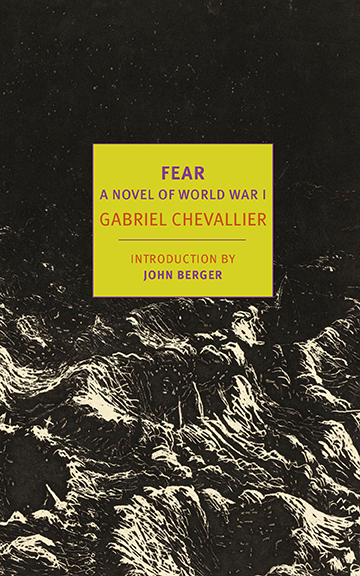
It turns out that the same sensibilities run through Fear, which is a novelisation grounded in Chavellier’s own experiences. Malcolms Imrie‘s fine translation was made available in the UK in 2012, but the New York Times is now publishing a US edition.  ‘At times,’ Neil Fitzgerald wrote in the TLS (in a review tellingly entitled ‘When the body takes charge’),

reading Fear feels like being led through the damnation panel of Bosch’s “The Garden of Earthly Delights”, the front line “blazing like some infernal factory where monstrous crucibles melted human flesh into a bloody lava”. There are wince-inducing close-ups of mutilated men and corpses. Chevallier’s turn of phrase, brilliantly rendered in Malcolm Imrie’s translation, makes this distant war feel horrifying and close. Dartemont’s ultimate triumph, beside surviving, is in never having allowed himself to become dehumanized.

It turns out that others were also taken aback by its very existence.  Fear was originally published in 1930, as Tobias Grey explains, and the French officer class rose up against Chevallier’s merciless assault (which you can also find in Barthas):

Subsequent criticism of “Fear” meant that it was withdrawn from circulation in France on the eve of World War II and did not reappear until 1951. Chevallier, who had scored a big hit with his satirical novel “Clochemerle” (1934) in the meantime, declined to kick up a fuss. “Once war has come, the time has passed for warning that it is a disastrous venture with unforeseeable consequences,” Chevallier reasoned in the preface of “Fear.” “That is something that must be understood earlier, and acted on accordingly.” When “Fear” was recently re-published in France after many years out of print, one critic still felt it necessary to point out that pages like the ones he had just read “would have had the author shot during the war.”

As I’ve indicated, central to Chevallier’s account is the human body and the hapticity of war: its sensual, physical apprehension and its corporeal inscription.  Grey concludes:

… above all “Fear” is a novel whose most indelible passages describe the sensory degradation of war on the human body. These baroque descriptions are generously translated into English by Malcolm Imrie without a hint of stiltedness [in fact, Imrie won the Scott Moncrieff Prize for his translation]. A face is described as seeming to “acquire a dull, gray coating, as if someone had forgotten to dust it, and the beard, drawing strength from the compost of unhealthy flesh, spread rapidly, seeming to drive out life, like ivy takes light from the front of a house.” It is the kind of powerful prose that helps to make Chevallier’s long-neglected novel one of the most effective indictments of war ever written.

All of this reading is in part preparation for a trip later this month with an old friend to the battlefields of the Western Front (we’re still arguing over which of us is Blackadder and which is Baldrick, but it’s really no contest): watch this space for a report.

In media res

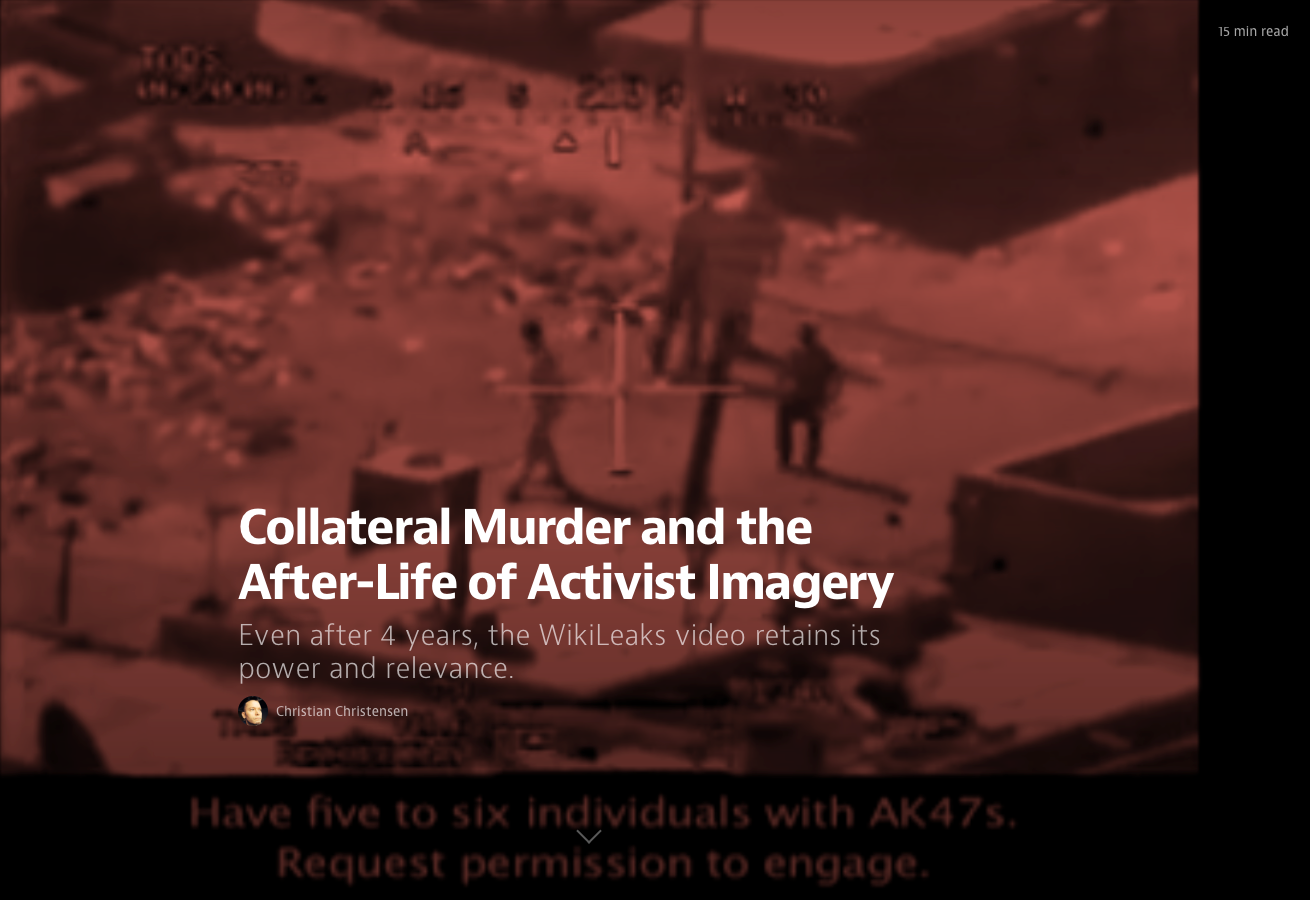
Two short essays that address the public circulation of supposedly secret information.  The first, “Collateral Murder and the After-Life of Activist Imagery”, is by Christian Christensen, and concerns the video clip released by Wikileaks as Collateral Murder in April 2010.  I’ve discussed this edited video of a US Apache helicopter attack in New Baghdad in 2007 before, together with the two documentary films that it provoked, and it forms part of my ‘Militarized Vision’ project (you can find links to the clip and to subsequent commentary in that original post).

CHRISTENSEN Collateral Murder

Christian doesn’t explore the content of the video so much as its inscription and re-inscription within public debates, part of the mediatization of later modern war.  He does make a sharp point about the status of the imagery:

One could argue that the repeated use of this imagery (and corresponding audio) has created an entirely new genre of military reporting. It is a genre with specific, often disturbing conventions: the grainy images of those on the ground, the flat, bland coloring, the “narration” of the aircraft operators which swings between the clinical and the cynical, the silence of those under surveillance or attack, the sound of the weaponry as it is discharged, and, importantly, the “overtness” of the technology, by which I mean the way in which the screen is filled with evidence of the technology being used in the form of the cross-hairs in the middle and data visible at the top and the bottom of the screen…

The Collateral Murder video not only shatters the mythology of humane warfare and benevolent US power, but also causes us to question the notion of neutral technology at the service of human development: a theme which has regained a central space in public debate in recent years.

But he also thinks there is another, no less sharp point to be made about the very act of reporting:

Within this context, the killing of two Reuters employees by the US military was particularly poignant. At the most basic level, this was the symbolic killing of Journalism (with a capital “J”) by a military unaccustomed to critical coverage or investigation at home. The killings, of course, then went unreported until Manning leaked the material and WikiLeaks published it: itself an act of journalism. With Collateral Murder, there is a layering and re-layering of meaning, and, for me, journalism lies at the heart of the clip. These are humans first, of course, and most of those killed or wounded in the attack were not journalists. But, in addition to the tragedy of human death, there is also the tragedy of what is symbolically destroyed: Transparency. Democracy. Knowledge. Critical thinking. And it took an act of journalism to bring these tragedies to light, an act of which has now itself been subjected to the full force of the state via the imprisonment of Manning, and the threat of criminal charges being brought against Assange in the US.

Incidentally, the essay is the text of Christian’s presentation to the ‘Image Operationsconference held at the Institute of Cultural Inquiry (ICI) in Berlin earlier this month; the program is here.

Image Operations

The second essay is Adam Morris‘s wide-ranging review of ‘The geopolitics of the Snowden Files‘ at the Los Angeles Review of Books.  Its immediate provocation is the publication of the Obama administration’s self-serving ‘NSA Report’:

The-NSA-Report-243x366The NSA Report — commissioned by the White House in August, published on its website in December, and now available in print via Princeton University Press— was authored by the President’s Review Group on Intelligence and Communications Technologies. As suggested by its official title, “Liberty and Security in a Changing World,” the Report was intended to advise President Obama on how to reform the data collection practices of the Intelligence Community (IC), in particular the NSA. Its authors include such veterans of the US security sector as Richard A. Clarke, Michael J. Morrell, and Peter Swire. This insiders’ perspective, in theory, is balanced by the addition to the group of constitutional lawyers Geoffrey R. Stone and Cass Sunstein. The unofficial purpose of the Report, however, was the Obama administration’s attempt to put a lid on the NSA scandal by pretending to be interested in reform. As Luke Harding points out in The Snowden Files, the Review Group was working out of the offices of the Director of National Intelligence, currently occupied by the felonious General James Clapper, w _ho knowingly lied in Congressional testimony about the bulk collection of Americans’ communication data.

The essay provides a fine, critical reading of the Report –

‘The anodyne language of these and other recommendations signals the imperial agenda out of which they are born: The NSA Report is obsessed with framing the debate over surveillance around the neopositivist vocabulary of “risk management,” but we know from history that political liberty will always suffer when a dominant regime deems a nation, its leadership or its population a “national security threat”…’

– but it also spirals off into a vigorous mapping of the context in which the NSA set about its covert operations and Edward Snowden‘s principled decision to go public (Adam also provides a commentary on Luke Harding‘s The Snowden Files: for another review, see Daniel Soar at the London Review of Books here).  And here too, of course, investigative journalism is a vital, enabling and even empowering practice.

Securing the volumes

More on war, police and the ‘security forces’ (see also herehere and here).  My copy of Mark Neocleous‘s  War power, Police power (Edinburgh, 2014) has just arrived, and I’m about to work my way through it (you can download the Introduction here).

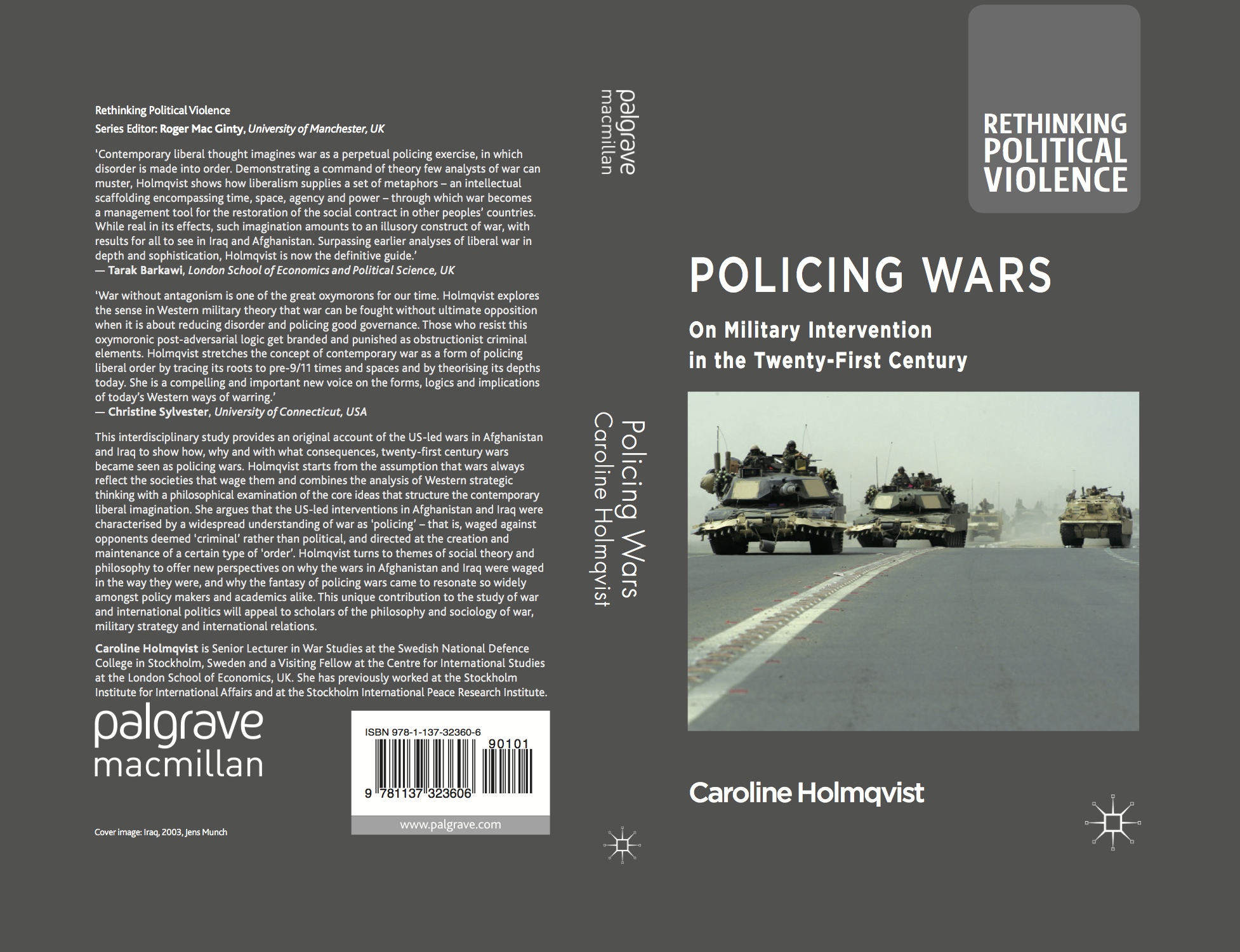
But I’ve just stumbled upon another new book, by Caroline Holmqvist – Policing Wars: On military intervention in the twenty-first century (Palgrave Macmillan, 2014) – that I obviously need to read in parallel.

COVER_POLICING_WARS-libre

I’ve referred to Caroline’s work before, and in case you can’t read the small print in the image above here’s the blurb:

This interdisciplinary study provides an original account of the US-led wars in Afghanistan and Iraq to show how, why and with what consequences, twenty-first century wars became seen as policing wars.  Holmqvist starts from the assumption that wars always reflect the societies that wage them and combines the analysis of western strategic thinking with a philosophical examination of the core ideas that structure the contemporary liberal imagination. She argues that the US-led interventions in Afghanistan and Iraq were characterised by a widespread understanding of war as ‘policing’ – that is, waged against opponents deemed ‘criminal’ rather than political, and directed at the creation and maintenance of a certain type of ‘order’. Holmqvist turns to themes of social theory and philosophy to offer new perspectives on why the wars in Afghanistan and Iraq were waged in the way they were, and why the fantasy of policing wars came to resonate so widely amongst policy makers and academics alike.

When I wear my alligator boots

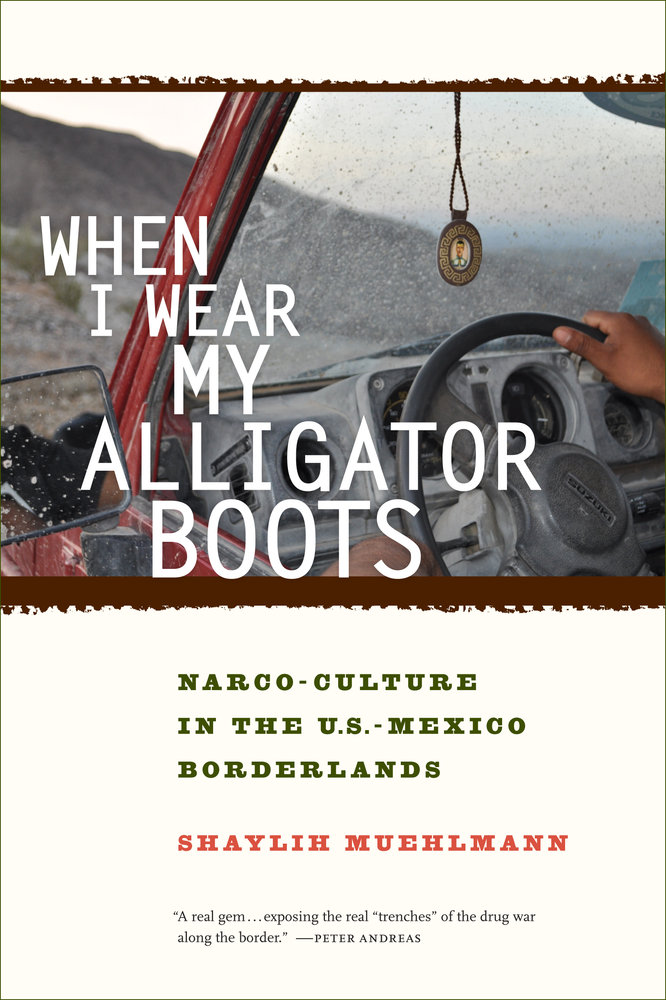
When I wear my alligator bootsI left at the crack of dawn the very next day for Madison, so I couldn’t post about this before: last Wednesday Shaylih Muehlmann gave a reading from her new book, When I wear my alligator boots: Narco-culture in the US-Mexico borderlands (University of California Press, 2014) at the Peter Wall Institute for Advanced Studies (where she was an Early Career Scholar last year).

Her reading was beautifully judged – a series of exquisitely written (and read) extracts that re-traced the narrative arc of the book, explained her own take on ethnography (and its writing), and sparked a lively discussion.  Thanks to Gaston Gordillo‘s generosity, I was able to devour the book on the flight to Madison; since I had to get up at 3 a.m., that was no mean feat and speaks volumes about the book.

When I Wear My Alligator Boots examines how the lives of dispossessed men and women are affected by the rise of narcotrafficking along the U.S.-Mexico border. In particular, the book explores a crucial tension at the heart of the “war on drugs”: despite the violence and suffering brought on by drug cartels, for the rural poor in Mexico’s north, narcotrafficking offers one of the few paths to upward mobility and is a powerful source of cultural meanings and local prestige.

In the borderlands, traces of the drug trade are everywhere: from gang violence in cities to drug addiction in rural villages, from the vibrant folklore popularized in the narco-corridos of Norteña music to the icon of Jesús Malverde, the “patron saint” of narcos, tucked beneath the shirts of local people. In When I Wear My Alligator Boots, the author explores the everyday reality of the drug trade by living alongside its low-level workers, who live at the edges of the violence generated by the militarization of the war on drugs. Rather than telling the story of the powerful cartel leaders, the book focuses on the women who occasionally make their sandwiches, the low-level businessmen who launder their money, the addicts who consume their products, the mules who carry their money and drugs across borders, and the men and women who serve out prison sentences when their bosses’ operations go awry.

Read it to find out much more about the intersections between popular culture, the ‘drug wars’ , and the borderlands than the usual cartel-talk.  A central theme of the book is not so much the narco-corridors snaking across the border as the narco-corridos, folk-ballads telling stories of the men and women who work the drug business.  These are also the subject of Shaul Shwarz‘s prize-winning documentary Narcocultura (2013); I’ve embedded the trailer below, and you find out more here and read a thoughtful review here.

Shaylih’s subjects, then, are the low-level players who are, in their way, also being played.  For this very reason, their construction and celebration of narco-culture is also a real challenge to the corruptions, exactions and violences of the state.  Shaylih unravels the connections between prohibition, poverty and addiction in northern Mexico, and en route her gift for narrative – for telling their stories – provides a powerful analytical lens:

‘The people whose lives are chronicled in this book reveal the extent to which the war on drugs ultimately pushes many of the costs of trafficking – the deaths, the vulnerability, and the risk – over the border into Mexico and particularly onto the Mexican poor.  These are the people who run the risks of the business, experience the brunt of the violence, and serve the prison sentences that the wealthy cartel bosses largely avoid…  In the stories that follow, we will see that those who become involved in the narco-economy do so precisely because the Mexican and U.S. governments have declared war against it.  And as their stories show, for a long time this war was already being waged against them.’

Read it, too, for an object lesson in writing prose that doesn’t hobble the flight of the intellectual imagination – as even the chapter titles show:

Introduction: Life at the Edges of the War on Drugs
1. Narco-Wives, Beauty Queens, and a Mother’s Bribes
2. “When I Wear My Alligator Boots”
3. “A Narco without a Corrido Doesn’t Exist”
4. The View from Cruz’s Throne
5. Moving the Money When the Bank Accounts Get Full
6. “Now They Wear Tennis Shoes”: Social Debts and Calculated Risks
Conclusion: Puro pa’delante Mexico

You can access the first chapter here (box, top right). The marvellous title is easily explained:

‘Javier … wore alligator boots like a badge of his past smuggling work… He said that while you may see people dressed as cheros, the alligator boots are how you know if they are really narcotraficantes.’

Eternal Harvest

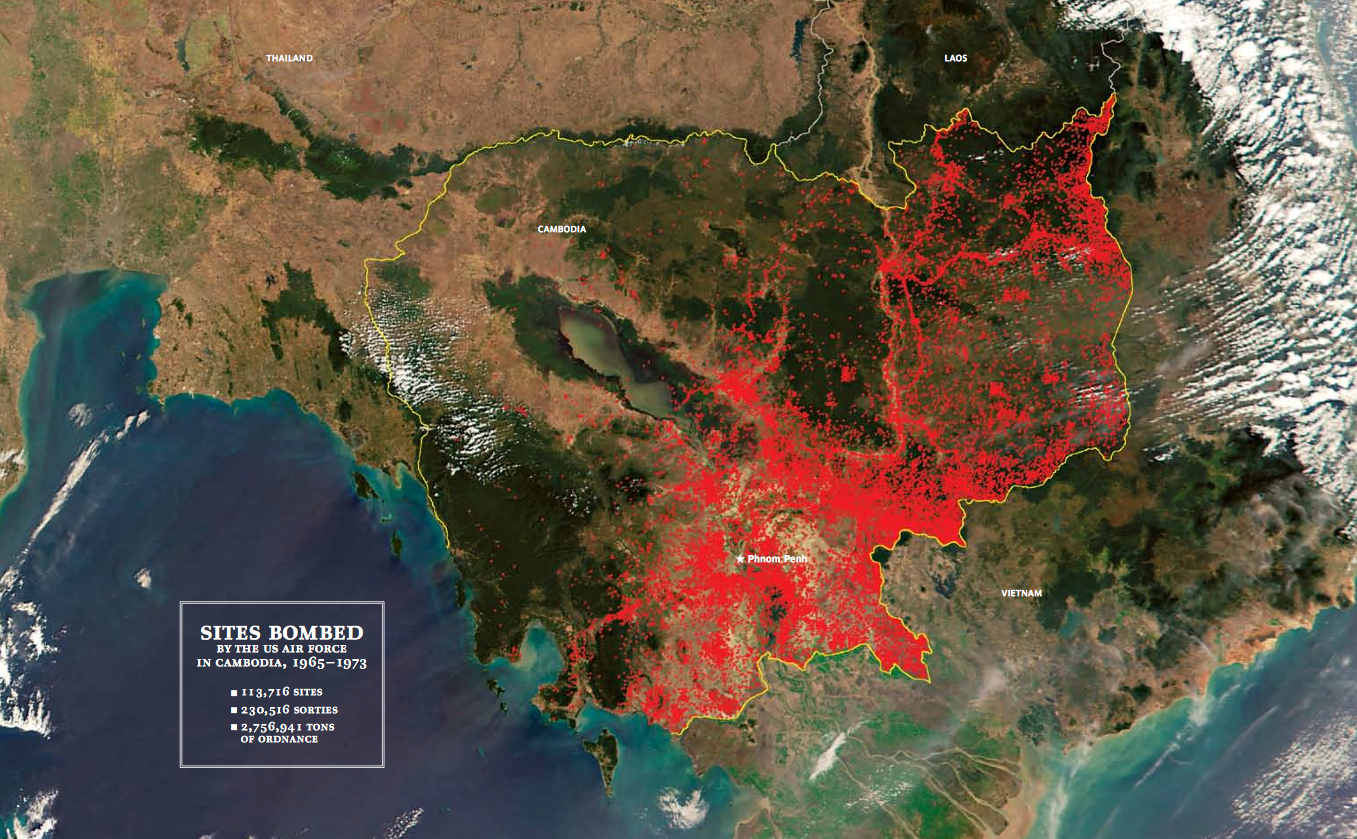
Many readers will know the remarkable work that’s been done to reconstruct the US bombing of Cambodia during the ‘Vietnam’ War: I’m thinking of Taylor Owen and Ben Kiernan‘s ‘Bombs over Cambodia’ which appeared in The Walrus in 2006: available here and here.

The still-incomplete database (it has several “dark” periods) reveals that from October 4, 1965, to August 15, 1973, the United States dropped far more ordnance on Cambodia than was previously believed: 2,756,941 tons’ worth, dropped in 230,516 sorties on 113,716 sites. Just over 10 percent of this bombing was indiscriminate, with 3,580 of the sites listed as having “unknown” targets and another 8,238 sites having no target listed at all. The database also shows that the bombing began four years earlier than is widely believed—not under Nixon, but under Lyndon Johnson. The impact of this bombing, the subject of much debate for the past three decades, is now clearer than ever. Civilian casualties in Cambodia drove an enraged populace into the arms of an insurgency that had enjoyed relatively little support until the bombing began, setting in motion the expansion of the Vietnam War deeper into Cambodia, a coup d’état in 1970, the rapid rise of the Khmer Rouge, and ultimately the Cambodian genocide.

US bombing of Cambodia

The contemporary significance of these air strikes includes, of course, what Rob Nixon calls the ‘slow violence’ of the unexploded ordnance that still haunts the Cambodian landscape today.  But they also have implications for recent bombing campaigns in Afghanistan, as Ben and Taylor discuss in ‘Roots of U.S. Troubles in Afghanistan: Civilian Bombing Casualties and the Cambodian Precedent’  here, and for today’s cross-border (though rather less covert) drone strikes in Pakistan, as Henry Grabar argued last year in The Atlantic here.

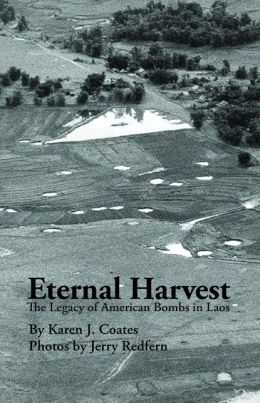
Eternal HarvestThe conflict in Vietnam spilled across into Laos too, and a new book by Karen Coates (with photographs by Jerry Redfern) documents the effects of this even more shocking campaign in depth and detail: Eternal Harvest: the legacy of American bombs in Laos.  The short animation below, just 98 seconds of your time, prepared by Jerry for Mother Jones, shows each bombing run:

The nearly 600,000 bombing runs delivered a staggering amount of explosives: The equivalent of a planeload of bombs every eight minutes for nine years, or a ton of bombs for every person in the country—more than what American planes unloaded on Germany and Japan combined during World War II. Laos remains, per capita, the most heavily bombed country on earth.

There’s a much longer version at vimeo here, which comes with this rider:

This video shows the US Air Force bombing campaign in Laos, from 1965 to 1973. The data comes from the website of the National Regulatory Authority of Lao PDR (NRA), which oversees UXO clearance in that country. They received the data from the US Embassy in Vientiane in 2000, from records originally created by the Department of Defense and stored at the National Archives.

The NRA data sets include information on the number and types of aircraft flown, types of bombs dropped, target conditions and after-action reports. For this graphic, only the dates, latitude and longitude, and the number of bombs dropped per mission are used.

The US Air Force began bombing Laos in June 1964. Many branches of the US, Thai, Lao, South Vietnamese and other forces also conducted aerial missions. But this graphic reflects only bombing missions noted in the NRA data, which show US Air Force missions beginning on October 1, 1965.

There’s much more information, plus photographs from the book, at the website that accompanies the book.

COVER MAKER 5.5X8.25.inddIf you want a quick overview of the geography of bombing Laos, Peter Larson also has a useful survey which includes some helpful maps here; he’s constructed his own animation here.

‘Animation’ is hardly the verb for such appalling carnage, I realise; the classic English-language account giving voices to the survivors (and victims) is Fred Branfman‘s brilliant Voices from the Plain of Jars: life under an air war, first published in 1972 and republished last year with an introduction by Alfred McCoy and available as an e-book.

Scarry thoughts

SCARRY Thermonuclear monarchyI imagine most readers will know Elaine Scarry‘s vital account of The Body in Pain.  She has produced several important books since then, of course, but Scarry explains that her latest book, Thermonuclear monarchy: choosing between democracy and doom, published last month by Norton, emerged directly from her first:

It directly emerged from “The Body in Pain,” which has a first chapter on torture and a second on war. I was trying to address the question why when people prohibit torture they make it an absolute prohibition, but when they make a prohibition on war, they always make exceptions.

I realized that nuclear weapons much more approximate the condition of torture than of war. Torture involves zero consent on the part of the injured, whereas conventional war allows many levels of consent. With nuclear weapons, there’s zero consent.

There is an excellent, wide-ranging conversation between Scarry and Sarah Gerard at The American Reader here that goes back as far as Hobbes (who turns out to be crucial for Scarry’s argument) and spools forward to today’s drone wars.  If you read just one thing this week, read that.

Security archipelagos

Three short contributions that have caught my eye raise a series of interesting questions about contemporary ‘security archipelagos’ (in multiple sense of the term, hence the plural).

amar-security-archipelagoThe term itself comes from Paul Amar, and Austin Zeiderman has a short but interesting review of his The Security Archipelago: Human-Security States, Sexuality Politics, and the End of Neoliberalism (Duke, 2013) over at Public Books (Public Culture‘s public site):

‘Amar asserts that we need an analytical framework focused on the rise of human security—a governance regime that “aim[s] to protect, rescue, and secure certain idealized forms of humanity.” This new regime is gradually replacing neoliberalism, Amar contends, “as the hegemonic project of global governance and of state administration.” This shift is evident in how security is now justified and pursued by states. The antagonistic relationship between security and human rights that characterized the “neoliberal market states” of the late 20th century is no longer so evident. The repressive security strategies that underpinned earlier development paradigms have been succeeded by the “promise to reconcile human rights and national security interests” in the interest of economic prosperity. Progressive and conservative security doctrines now agree on the imperative to “humanize” (or “humanitarianize”) both state and parastatal security apparatuses. The result, Amar argues, is what he calls the “human-security state”: a globally emergent governance regime with “consistent character and political profile.” From Latin America to the Middle East, political legitimacy is increasingly based on securing humanity against a range of malicious forces….

If the megacities of the Global South are indeed “laboratories” in which new logics and techniques of global governance are being created, it is up to other researchers to fill out and develop further Amar’s concept of the “security archipelago.” Though his study provides both the theoretical rationale and the analytical tools with which to do so, it may be worth questioning whether the “human” is necessarily central to emerging security regimes. For along with human security apparatuses and the human actors struggling to articulate progressive alternatives, a host of non-humans—drones, border fences, hurricanes—are actively producing the security landscape of the future.’

Secondly, I’ve been thinking about the ways in which the work of these ‘laboratories’ often relies on non-state, which is to say corporate, commercial sites (this isn’t news to Paul, of course, even if he wants to challenge our ideas about neoliberalism).  We surely know that the traditional concept of the military-industrial complex now needs wholesale revision, and I’ve noted before the timely and important essay by Jeremy Crampton, Sue Roberts and Ate Poorthuis on ‘The new political economy of geospatial intelligence‘ in the Annals of the Association of American Geographers 104 (1)  (2014) (to which I plan to return in a later post).  The latest MIT Technology Review has a short but suggestive essay by Antonio Regalado, ‘Spinoffs from Spyland’, which describes some of the pathways through which the National Security Agency commercializes (and thus potentially subcontracts and, in some cases, even subverts) its surveillance technology:

In 2011, the NSA released 200,000 lines of code to the Apache Foundation. When Atlas Venture’s Lynch read about that, he jumped—here was a technology already developed, proven to work on tens of terabytes of data, and with security features sorely needed by heavily regulated health-care and banking customers. When Fuchs’s NSA team got cold feet about leaving, says Lynch, “I said ‘Either you do it, or I’ll find five kids from MIT to do it and they’ll steal your thunder.’”

Eventually, Fuchs and several others left the NSA, and now their company [Sqrrl] is part of a land grab in big data, where several companies, like Splunk, Palantir, and Cloudera, have quickly become worth a billion dollars or more.

Over the summer, when debate broke out over NSA surveillance of Americans and others, Sqrrl tried to keep a low profile. But since then, it has found that its connection to the $10-billion-a-year spy agency is a boost, says Ely Kahn, Sqrrl’s head of business development and a cofounder. “Large companies want enterprise-scale technology. They want the same technology the NSA has,” he says.

SQRRL

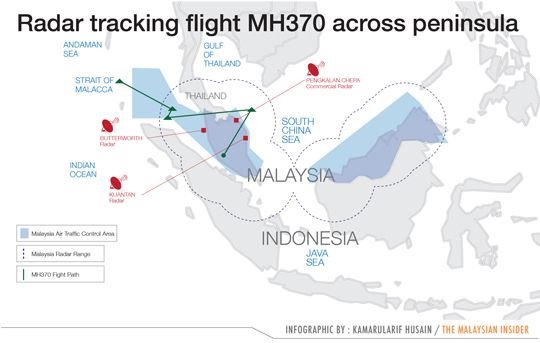
And finally, before we rush to radicalise and globalise Foucault’s critique of the Panopticon, it’s worth reading my friend Gaston Gordillo‘s cautionary note – prompted by the search for missing Malaysian Airlines Flight 370 – on ‘The Opaque Planet’:

The fascination with, and fetishization of, technologies of global location and surveillance often makes us forget that, for all their sophistication, we live on a planet riddled with opaque zones that will always erode the power of human-made systems of orientation, for the simple fact that no such system (contrary to what the NSA seems to believe) will ever manage to create an all-seeing God. This opacity is intrinsic to the textured, three-dimensional materiality of the surface of the planet, and is especially marked in the liquid vastness of the ocean.

MH370-military_radar-tracking-peninsula-170314-eng-graphcs-tmi-kamarul

Phil Steinberg has already commented on the geopolitics of the search, but Gaston draws out attention to the gaps in the surveillance capabilities of states, and here too the geopolitical meshes (and sometimes jibes against) the geoeconomic, as described in this report from Reuters:

Analysts say the gaps in Southeast Asia’s air defenses are likely to be mirrored in other parts of the developing world, and may be much greater in areas with considerably lower geopolitical tensions.

“Several nations will be embarrassed by how easy it is to trespass their airspace,” said Air Vice Marshal Michael Harwood, a retired British Royal Air Force pilot and ex-defense attache to Washington DC. “Too many movies and Predator (unmanned military drone) feeds from Afghanistan have suckered people into thinking we know everything and see everything. You get what you pay for. And the world, by and large, does not pay.”

Blockbusters

OVERY The Bombing War Europe 1939-1945I’m slowly working my war through Richard Overy‘s magisterial account of The Bombing War: Europe 1939-1945; the subtitle is a necessary reminder that this wasn’t the only ‘bombing war’ of the period, but Overy’s scope is still much wider than the usual focus on the Blitz and the combined bomber offensive against Germany.  Too soon for me to work out what I think, but there’s an appreciative review by another brilliant historian of the period, Richard J. Evans, in the Guardian here.  Evans calls The Bombing War ‘probably the most important book published on the history of the second world war this century.’

Evans’s summary of bombing’s ‘surprising inefficiency’ and ‘staggering inaccuracy’ is worth repeating:

Bombing was surprisingly inefficient. As Overy shows, poor visibility, the sudden deterioration of weather conditions, malfunctioning equipment, outdated and slow-moving aircraft, pilot inexperience or crew exhaustion, and enemy action varying from anti-aircraft batteries to night-fighters or the jamming of navigation beams, all reduced the effectiveness of bomber fleets. Aircraft crashed, ran out of fuel or suffered engine failure with astonishing frequency. In its raids on Britain from January to June 1941, for example, 216 German bombers were lost and 190 damaged; 282 of these were as a result of flying accidents. The death rate among bomber crews was appallingly high (crew members in Bomber Command had a one-in-four chance of surviving their first tour of duty, and a one-in-10 chance of surviving their second) but not all of it was as a result of enemy action. At the end of 1941 Bomber Command reckoned that it was losing six aircraft to accidents for every one shot down by the enemy. The British and especially the Americans could make good these losses, and more besides; in the end, Germany’s smaller resources meant that the German air force was increasingly outproduced.

Above all, bombing was staggeringly inaccurate. Bomber fleets had to fly high to avoid anti-aircraft fire from the ground, so even if the weather was clear, they were often unable to locate their targets effectively. On one mission, Robert Kee, a bomber pilot who later became a successful historian, “bombed some incendiaries at what we hoped was Hanover” but mostly dropped his bombs on searchlight concentrations because that was all he could see through the cloud. One report, compiled in September 1941, reported that only 15% of aircraft were bombing within five miles of their target. In the last three months of 1944, it was reckoned that only 5.6% of bombs fell within a mile of the aiming point if there was cloud, despite the use of electronic navigation aids. One raid on a major oil plant saw 87% of the bombs missing their target entirely, and only two actually hitting the buildings.

There’s also a thoughtful review of The Bombing War by Keith Lowe here; Lowe’s account of the bombing of Hamburg, Inferno: the devastation of Hamburg, 1943, is another tour de force, which describes both the execution of the air raids and the consequences for those on the ground. Claire Tomalin‘s review of Inferno closed with a sentence that has haunted me ever since I read it: ‘Once you are committed to fighting, you are going to kill the innocent with whatever technology you have developed.’  Overy does discuss those consequences too, but I think it’s fair to say that the tone of his discussion is largely (though not exclusively) policy-directed – a matter of response rather than experience.

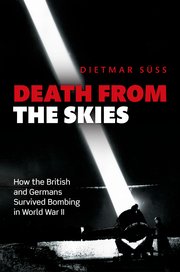
SUSS Death from the skiesThere are now a number of major studies of the effects of bombing individual cities, and Jörg Friedrich‘s The Fire: the bombing of Germany 1940-1945 is also indispensable.  But for an account of the experiences of those crouching (and dying) under the bombs on an equally epic scale to Overy, albeit confined to Britain and Germany, we have to wait for Dietmar Süss‘s  Death from the skies: how the British and Germans survived bombing in World War II, due from Oxford University Press next spring.  Originally published in 2011 as Tod aus der Luft, the book has been a bestseller in Germany.  Stefan Goebel provides a detailed review here:

‘The publication of Tod aus der Luft is to be highly welcomed, not least because it breaks into a market that for too long has been dominated by popular accounts on the one hand and official histories on the other. Süß’s extraordinary book combines the virtues of both genres: delivered with great panache, it is also based on a scrupulous examination of archival records. Potential buyers of Tod aus der Luft can expect multiple ‘two-in-one’ deals: not only is this book both sophisticated and accessible, written by an academic historian with a background in journalism, it is also a stimulating synthesis of the social, political, and cultural history of war, and a thoughtful comparative study of Britain (or ‘England’, as Süß has it) and Germany in the era of the Second World War…

‘At the centre of this comparative study are not the political systems (even though Süß has a great deal to say about their institutional structures) but the emergence of a Kriegsmoral (war morale) at the intersection of individual experiences and political mobilization. Moreover, this hefty tome is not meant to be a comprehensive ac-count of the British and German bombing campaigns of the Second World War. Rather, the author’s approach might be described as a history of the air war ‘from below’: one that is focused on the fear, experience, and memory (of people on the ground) of death and destruction….

‘The construction of a Kriegsmoral became the central preoccupation of both societies during the air war. This book offers an intriguing exploration of the comparative method; the author’s discussion of British society during the Blitz throws many aspects of the German experience of the air war into much sharper relief (and vice versa).’

Both books are, appropriately, blockbusters: Overy comes in at 880 pp and Süss  at 736 pp.