Eyes in the Skies

eyes_in_the_skies_pic

I’m just back from a wonderful time at UC Davis, where I was speaking at a symposium called “Eyes in the skies: drones and the politics of distance warfare.”  It was a creative program, packed with insights from Caren Kaplan and Andrea Miller, Priya Satia and Joe Delappe.

On my way back to Vancouver on Wednesday I received an invitation from Britain’s Guardian (in fact, the Sunday version, the Observer) to write something around that very question using the Gavin Hood film “Eyes in the sky” as a peg.

It’s just been published and you can find it here.
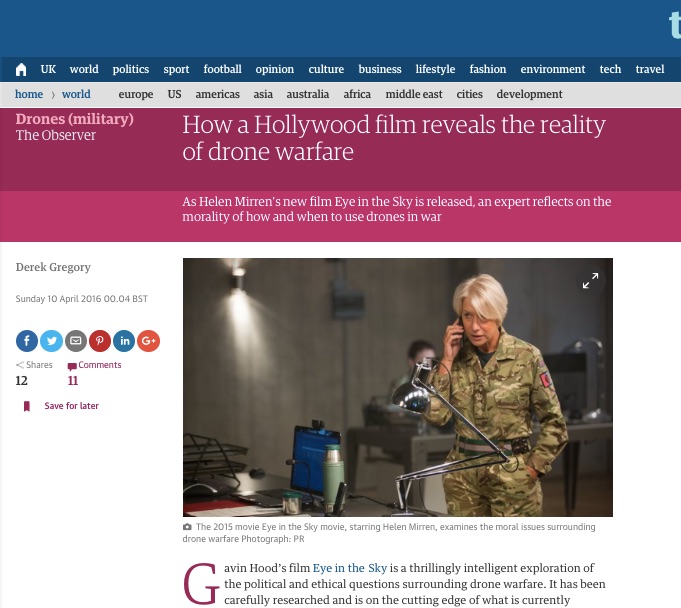
GREGORY Observer

At Davis I’d been giving what I think will be my final presentation of “Angry Eyes” (see here and here), so I was still preoccupied with remote platforms and close air support – not the contradiction it sounds – rather than targeted killing (which is the focus of the film).  The published version has, inevitably, been edited, so I’m pasting the full-length version below and added some links that might help.  There are still lots of short-cuts and elisions, necessarily so for anything of this length, so I hope readers will forgive the inevitable simplifications.

***

Gavin Hood’s Eye in the Sky is a thrillingly intelligent exploration of the political and ethical questions surrounding drone warfare. It’s been carefully researched and is on the cutting-edge of what is currently possible. But there’s a longer history and a wider geography that casts those issues in a different light.  As soon as the Wright Brothers demonstrated the possibility of human flight, others were busy imagining flying machines with nobody on board.  In 1910 Raymond Phillips captivated crowds in the London Hippodrome with a remotely controlled airship that floated out over the stalls and, when he pressed a switch, released hundreds of paper birds on the heads of the audience below. When he built the real thing, he promised, the birds would be replaced with bombs. Sitting safely in London he could attack Paris, Berlin – or Manchester (a possibility that understandably prompted questions about navigation).

There has always been something hideously theatrical about bombing, from the Hendon air displays in the 1920s featuring attacks on ‘native villages’ to the Shock and Awe visited on the inhabitants of Baghdad in 2003. The spectacle now includes the marionette movements of Predators and Reapers whose electronic strings are pulled from thousands of miles away. And it was precisely the remoteness of the control that thrilled the crowds in the Hippodrome. But what mattered even more was surely the prospect Phillips made so real: bombing cities and attacking civilians far from any battlefield.

Remoteness’ is in any case an elastic measure. Human beings have been killing other human beings at ever greater distances since the invention of the dart, the spear and the slingshot. Pope Urban II declared the crossbow illegal and Pope Innocent II upheld the ban in 1139 because it transformed the terms of encounter between Christian armies (using it against non-Christians was evidently a different matter). The invention of firearms wrought another transformation in the range of military violence, radicalized by the development of artillery, and airpower another. And yet today, in a world selectively but none the less sensibly shrunken by the very communications technologies that have made the deployment of armed drones possible, the use of these remote platforms seems to turn distance back into a moral absolute.

But if it is wrong to kill someone from 7,500 miles away (the distance from Creech Air Force Base in Nevada to Afghanistan), over what distance is it permissible to kill somebody?  For some, the difference is that drone crews are safe in the continental United States – their lives are not on the line – and this has become a constant refrain in the drone debates. In fact, the US Air Force has been concerned about the safety of its aircrews ever since its high losses during the Second World War. After Hiroshima and Nagasaki the Air Force experimented with using remotely controlled B-17 and B-47 aircraft to drop nuclear bombs without exposing aircrews to danger from the blast, and today it lauds its Predators and Reapers for their ability to ‘project power without vulnerability’.

It’s a complicated boast, because these remote platforms are slow, sluggish and easy to shoot down – they won’t be seen over Russian or Chinese skies any time soon. They can only be used in uncontested air space – against people who can’t fight back – and this echoes Britain’s colonial tactic of ‘air policing’ its subject peoples in the Middle East, East Africa and along the North-West Frontier (which, not altogether coincidentally, are the epicentres of todays’ remote operations). There are almost 200 people involved in every combat air patrol – Nick Cullather once described these remote platforms as the most labour intensive weapons system since the Zeppelin – and most of them are indeed out of harm’s way. It’s only a minor qualification to say that Predators and Reapers have a short range, so that they have to be launched by crews close to their targets before being handed off to their home-based operators. This is still remote-control war, mediated by satellite links and fiber-optic cables, but in Afghanistan the launch and recovery and the maintenance crews are exposed to real danger. Even so, Grégoire Chamayou insists that for most of those involved this is hunting not warfare, animated by pursuit not combat [see here, here and here].

Yet it’s important not to use this aperçu to lionize conventional bombing. There is an important sense in which virtually all aerial violence has become remarkably remote. It’s not just that bombing has come to be seen as a dismal alternative to ‘boots on the ground’; advanced militaries pick their fights, avoid symmetrical warfare and prefer enemies whose ability to retaliate is limited, compromised or degraded. When he was Secretary of Defense Robert Gates acknowledged that the US had not lost a pilot in air combat for forty years. ‘The days of jousting with the enemy in the sky, of flirting daily with death in the clouds, are all but over,’ writes the far-from-pacifist Mark Bowden, ‘and have been for some time.’ The US Air Force goes to war ‘virtually unopposed’. In short, the distance between the pilot in the box at Creech and the pilot hurtling through the skies over Afghanistan is less than you might think. ‘Those pilots might as well be in Nevada’, says Tom Engelhardt, ‘since there is no enemy that can touch them.’

This suggests that we need to situate armed drones within the larger matrix of aerial violence.  Bombing in the major wars of the twentieth century was always dangerous to those who carried it out, but those who dropped bombs over Hamburg or Cologne in the Second World War or over the rainforests of South Vietnam in the 1960s and 70s were, in a crucial sense, also remote from their targets. Memoirs from Bomber Command crews confirm that the target cities appeared as lights sparkling on black velvet, ‘like a Brocks firework display.’ ‘The good thing about being in an aeroplane at war is that you never touch the enemy’, recalled one veteran. ‘You never see the whites of their eyes. You drop a four-thousand-pound cookie and kill a thousand people but you never see a single one of them.’ He explained: ‘It’s the distance and the blindness that enables you to do these things.’ The crews of B-52 bombers on Arc Light missions dropped their loads on elongated target boxes that were little more than abstract geometries. ‘Sitting in their air-conditioned compartments more than five miles above the jungle’, the New York Times reported in 1972, the crews ‘knew virtually nothing about their targets, and showed no curiosity.’ One of them explained that ‘we’re so far away’ that ‘it’s a highly impersonal war for us.’

Distance no longer confers blindness on those who operate today’s drones. They have a much closer, more detailed view of the people they kill. The US Air Force describes their job as putting ‘warheads on foreheads’, and they are required to remain on station to carry out a battle damage assessment that is often an inventory of body parts.  Most drone crews will tell you that they do not feel thousands of miles away from the action: just eighteen inches, the distance from eye to screen.

Their primary function is to provide intelligence, surveillance and reconnaissance. This was exactly how the Wright brothers thought military aircraft would be used – in July 1917 Orville insisted that ‘bomb-dropping’ would be at best a minor role and almost certainly useless, though he was speaking before the major air offensives in the final year of the war and could have had no inkling of what was to come in the Second World War. The Predator and its precursors were designed to identify targets for conventional strike aircraft over the Balkans in the 1990s, and thirty years later it is still those ‘eyes in the sky’ that make the difference. Although drones have been armed since 2001, until late 2012 they were directly responsible for only 5-10 per cent of all air strikes in Afghanistan. But they were involved in orchestrating many more. Flying a Predator or a Reaper ‘is more like being a manager’, one pilot explained to Daniel Rothenberg: ‘You’re managing multiple assets and you’re involved with the other platforms using the information coming off of your aircraft.’ In principle it’s not so different from using aircraft to range targets for artillery on the Western Front, but the process has been radicalized by the drone’s real-time full-motion video feeds that enable highly mobile ‘targets of opportunity’ to be identified and tracked. In the absence of ground intelligence, this becomes crucial: until drones were relocated in sufficient numbers from Afghanistan and elsewhere to enable purported IS-targets in Syria to be identified, most US aircraft were returning to base without releasing their weapons.

Armed drones are used to carry out targeted killings, both inside and outside areas of ‘active hostilities’, and to provide close air support to ground troops. Targeted killing has spurred an intense critical debate, and rightly so – this is the focus of Eye in the sky too – but close air support has not been subject to the same scrutiny. In both cases, video feeds are central, but it is a mistake to think that this reduces war to a video game – a jibe that in any case fails to appreciate that today’s video games are often profoundly immersive.   In fact, that may be part of the problem. Several studies have shown that civilian casualties are most likely when air strikes are carried out to support troops in contact with an enemy, and even more likely when they are carried out from remote platforms. I suspect that drone crews may compensate for their physical rather than emotional distance by ‘leaning forward’ to do everything they can to protect the troops on the ground. This in turn predisposes them to interpret every action in the vicinity of a ground force as hostile – and civilians as combatants – not least because these are silent movies: the only sound, apart from the clacking of computer keys as they talk in secure chat rooms with those watching the video feeds, comes from radio communications with their own forces.

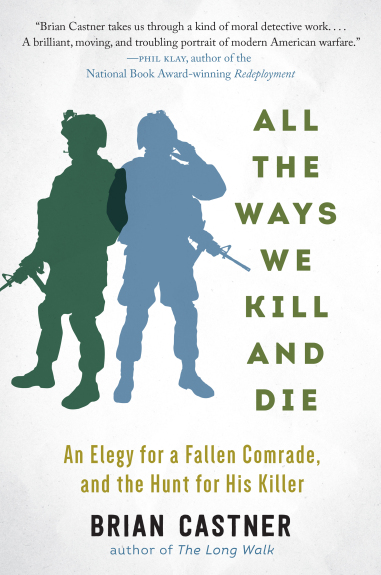
In contrast to those shown in Eye in the Sky, those feeds are often blurry, fuzzy, indistinct, broken, compressed -– and, above all, ambiguous. How can you be sure that is an insurgent burying an IED and not a farmer digging a ditch?  The situation is more fraught because the image stream is watched by so many other eyes on the ground, who all have their own ideas about what is being shown and what to do about it.  Combining sensor and shooter in the same (remote) platform may have ‘compressed the kill-chain’, as the Air Force puts it, and this is vital in an era of ‘just-in-time’, liquid war where everything happens so fast. Yet in another sense the kill-chain has been spectacularly extended: senior officers, ground force commanders, military lawyers, video analysts all have access to the feeds. There’s a wonderful passage in Brian Castner‘s All the ways we kill and die that captures the dilemma perfectly. ‘A human in the loop?’, Castner’s drone pilot complains.

‘Try two or three or a hundred humans in the loop. Gene was the eye of the needle, and the whole war and a thousand rich generals must pass through him… If they wanted to fly the fucking plane, they could come out and do it themselves.’

This is the networked warfare, scattered over multiple locations around the world, shown in Eye in the Sky. But the network often goes down and gets overloaded – it’s not a smooth and seamlessly functioning machine – and it is shot through with ambiguity, uncertainty and indecision.  And often those eyes in the sky multiply rather than disperse the fog of war.
Anatomy of a soldier

I’ve drawn attention to Harry Parker‘s spellbinding Anatomy of a Soldier in an earlier post; here at the AAG in San Francisco I may even be speaking about it tomorow – we’ll see.  (I’m supposed to be speaking about something else altogether but it’s in a session on’ Objects of security and war’, so I’m half-way through a new presentation, ‘Object lessons’).

Channel Four has posted an interview with the author at the Imperial War Museum on YouTube:

And there’s another interview with the BBC here.

Industrialised war

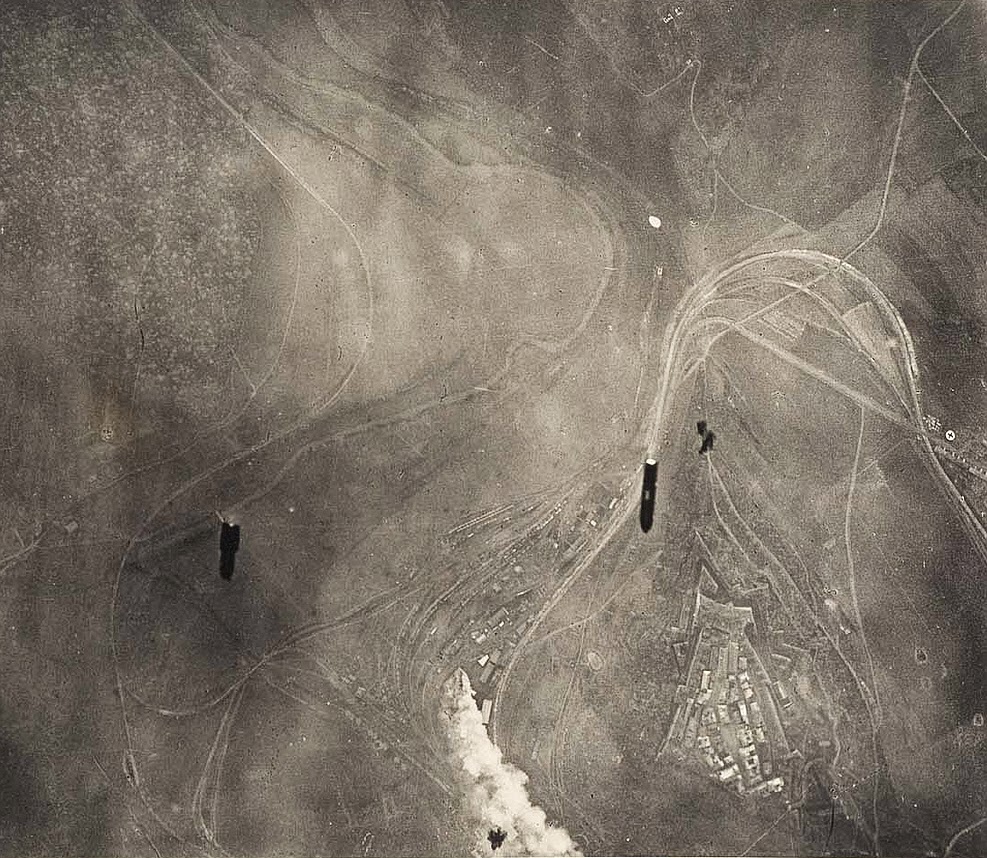
Bombs falling on Montmedy and marshalling yards

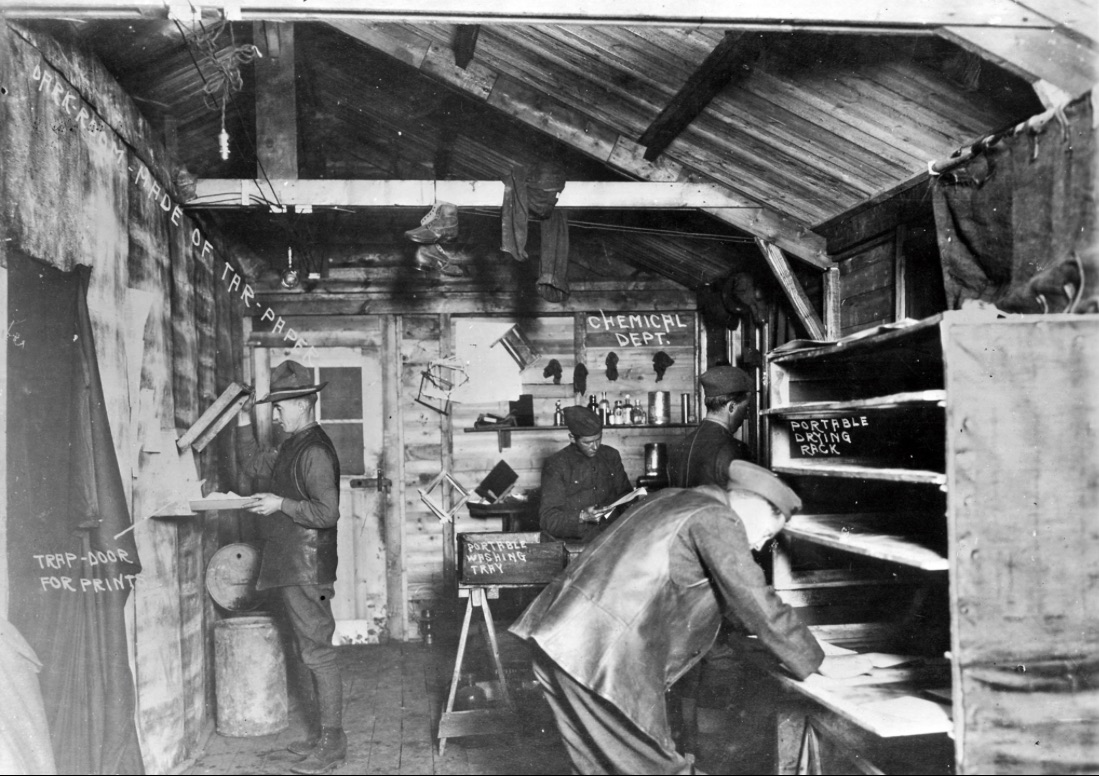
As I work on the text of “Reach from the Sky”, I’ve been revisiting the role of Edward Steichen in the development (in fact, the industrialisation) of air photography on the Western Front.  As I noted, all too briefly, in ‘Gabriel’s map’ (DOWNLOADS tab), Steichen commanded the photographic division of the American Expeditionary Forces. He organised the 55 officers and 1,111 men under his command into what Paul Virilio described as ‘a factory-style output of war information’ that ‘fitted perfectly with the statistical tendencies of this first great military-industrial conflict’.

Steichen 5th Photographic section at work on Western Front

The classic source on Steichen’s assembly-line methods of reproduction (and much more) is Allen Sekula‘s essay, ‘The instrumental image: Steichen at war’, in Artforum 14 (1975) 26-35 [see also the image above]:

The establishment of this method of production grew out of demands for resolution, volume, and immediacy. No method of reproduction but direct printing from the original negative would hold the detail necessary for reconnaissance purposes. Large numbers of prints from a single negative had to be made for distribution throughout the hierarchy of command. In addition, the information in prints dated very rapidly. Under these circumstances, efficiency depended on a thorough-going division of labor and a virtually continuous speedup of the work process. Printers worked in unventilated, makeshift darkrooms; 20 workers might produce as many as 1,500 prints in an hour, working 16-hour shifts.

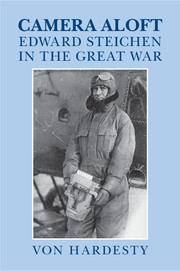
Analytically the essay has never been surpassed, but now there is a new book that fills in the biographical details of Steichen’s service during the First World War: Von Hardesty‘s Camera Aloft: Edward Steichen in the Great War (Cambridge, 2016):

Von Hardesty Camera AloftEdward Steichen (1879–1973) played a key role in the development of photography in the twentieth century. He is well known for his varied career as an artist, a celebrated photographer, and museum curator. However, Steichen is less known for his pivotal role in shaping America’s first experiments in aerial photography as a tool for intelligence gathering in what may be called his “lost years.” In Camera Aloft, Von Hardesty tells how Steichen volunteered in 1917 to serve in the American Expeditionary Forces (AEF). He rose rapidly in the ranks of the Air Service, emerging as Chief of Air Photography during the dramatic final offensives of the war. His photo sections were responsible for the rapid processing of aerial images gained through the daily and hazardous sorties over the front and in the enemy rear areas. What emerged in the eighteen months of his active service was a new template for modern aerial reconnaissance. The aerial camera, as with new weapons such as the machine gun, the tank, and the airplane, profoundly transformed modern warfare.

Here is the table of contents:

Foreword: taking the camera aloft
1. War and exile
2. A new life in the military
3. Over there
4. The world of air observation
5. Taking charge
6. Over the front
7. War and photography
Appendix: life at the cutting edge: the photo sections.

The book includes stunning reproductions of photographs (from which I’ve borrowed the annotated image of the Photographic Section above): you can see a selection from the book here.  Other Steichen aerial imagery from the period is here and here.

As you’ll be able to see when I’m finished, I’m no less interested in Steichen’s work during the Second World War, and in particular the various photographic projects he directed in the Pacific that captured – and celebrated – the masculinism and homosociality of modern war (here the work of Horace Bristol is especially revealing).

But right now it’s the industrialisation of aerial imagery that is capturing my attention.  It’s a commonplace that the First World War was industrial warfare on the grand scale, of course, but often our attention is distracted by the killing machines and mechanisms themselves – the gas, the tanks, the aircraft – and we lose sight of the assembly-line logic that animated the slaughter not only during but also before and after.

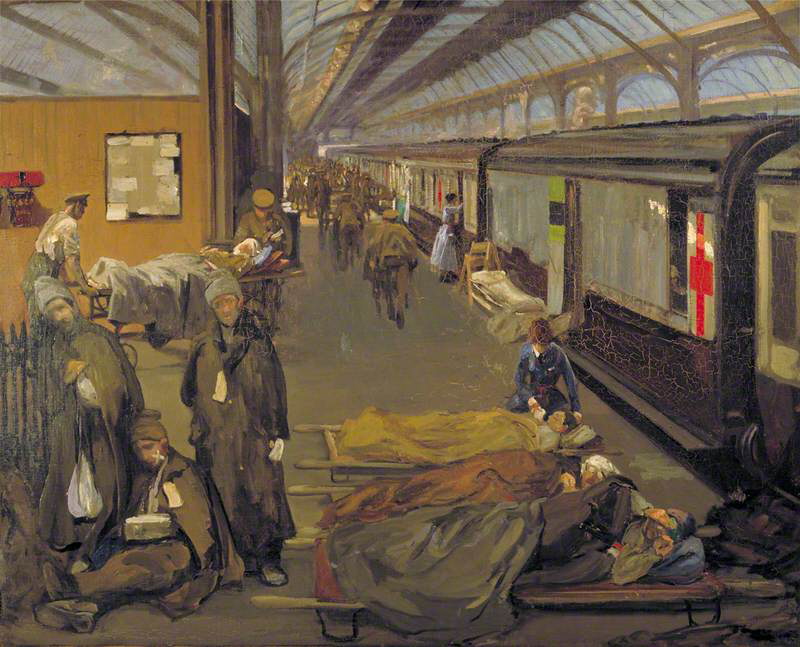
LOBLEY Reception of wounded at 1st CCS, Le Chateau October 1918

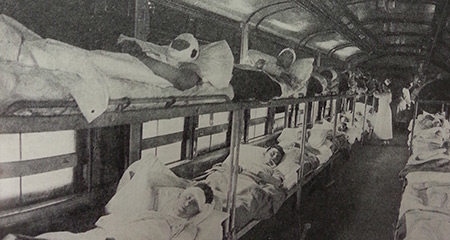
You can see it in Steichen’s production line, but there are countless other examples.  Last summer I was working in the Friends’ Library in London, recovering the role of the Quakers in providing medical care on the Western Front as part of my research on casualty evacuation, when I encountered this extraordinary passage that speaks directly to the relentless motion of the killing machine (see also my ‘Divisions of Life’ here).  It’s a medical orderly’s account of loading an ambulance train, written some time in 1915:

Down in a hedged field at the end of the straggling mining village lies the casualty clearing station, some two-score large tents… Since midday the [casualty] clearing station has been full to overflowing, but still an endless line of motor ambulances moves down along the crowded road from the fighting line, through the village and into the muddy field. It is night now, starless and dark as pitch, and a lashing rain is driven hard in your face before a bitter and rising wind; but still the cars are discharging their pitiful loads in dreary succession when the train is brought into the siding which serves this desolate little camp.

day2day-amb2

From the train itself you can scarcely see anything of the clearing station tonight; only the headlights of the cars as they turn in through the gate, and a few hurricane lamps flickering here and there. Near one end of the train, at the wooden footbridge which crosses the stream separating the camp from the railway track, there stands a powerful acetylene flare, casting a circle of vivid light on the deep mud of the path. Save for three or four feeble oil-lamps on the ground beside the long darkened train, this is the only light at the loading place. A few moments of uncertain waiting, and the first stretcher comes down, its weary bearers slithering and stumbling in the watery mire. As you watch the flare you see them emerge suddenly from the utter blackness beyond into the fierce glare of the light; they halt for a moment, while a cloaked officer standing on the bridge raises the waterproof sheet which protects the wounded man’s face from the beating rain; a name is given and noted; the covering is dropped over the head, and the bearers move on again, seeing to vanish as if by magic as they pass with their burden out of the light into the enveloping blackness. A pause, another stretcher enters the circle of light; the same words pass, the same motions, and it too move son, blotted out as suddenly as it appeared. Watching this time after time, you feel as if a picture were being cast on a screen and flashed off, over and over again: for there is something cruelly mechanical about it all.

(c) Rosenstiel's; Supplied by The Public Catalogue Foundation

All the ways we kill and die

all-the-ways-we-kill-and-die-cover

I’ve noticed Brian Castners astonishing work before – see my post here – and I’m now deep into his latest book (published on my birthday).  I’ll write a detailed response when I’m finished, but it is so very good that I wanted to give readers advance notice of it.  It’s called All the ways we kill and die (Arcade, 2016):

The EOD—explosive ordnance disposal—community is tight-knit, and when one of their own is hurt, an alarm goes out. When Brian Castner, an Iraq War vet, learns that his friend and EOD brother Matt has been killed by an IED in Afghanistan, he goes to console Matt’s widow, but he also begins a personal investigation. Is the bomb maker who killed Matt the same man American forces have been hunting since Iraq, known as the Engineer?

In this nonfiction thriller Castner takes us inside the manhunt for this elusive figure, meeting maimed survivors, interviewing the forensics teams who gather post-blast evidence, the wonks who collect intelligence, the drone pilots and contractors tasked to kill. His investigation reveals how warfare has changed since Iraq, becoming individualized even as it has become hi-tech, with our drones, bomb disposal robots, and CSI-like techniques. As we use technology to identify, locate, and take out the planners and bomb makers, the chilling lesson is that the hunters are also being hunted, and the other side—from Al-Qaeda to ISIS— has been selecting its own high-value targets.

This is how Brian himself describes the book:

In January of 2012, a good friend of mine–Matt Schwartz from Traverse City, Michigan–was killed in Afghanistan. Matt was an Explosive Ordnance Disposal technician. We had the same job, but while I had done my two tours in Iraq and went home, Matt deployed again and again and again. He was shot on his second tour, and died on his sixth.

I realize now that I was bound to do an investigation into his death; my training demanded it. But instead of asking “what” killed him–we knew immediately it was a roadside bomb–I asked “who” killed him. It’s a question that would not have made any sense in past wars, not even at the start of this one. But we have individualized the war, we target specific people in specific insurgent organizations, and in the course of my research, I discovered the leaders on the other side do the same in reverse to us.

This is the story of an American family at war, and the men and women who fight this new technology-heavy and intelligence-based conflict. I interviewed intel analysts, biometrics engineers, drone pilots, special operations aircrew, amputees who lost their legs, and the contractors hired to finish the job. They are all hunting a man known as al-Muhandis, The Engineer, the brains behind the devices that have killed so many soldiers in Iraq and Afghanistan.

You can read an excerpt at VICE (‘The problem with biometrics at war‘) and another at Foreign Policy (‘You will know the Bomber by his designs).

Reading this in counterpoint to Harry Parker‘s  Anatomy of a soldier (see my post here) – both deal with the aftermath of an IED in Afghanistan – is proving to be a rich and truly illuminating experience.

Red Cross-Fire

Yet more on violations of medical neutrality in contemporary conflicts (see my posts here, herehere and here).  Over at Afghan Analysts Network Kate Clark provides a grim review of (un)developments in Afghanistan, Clinics under fire? Health workers caught up in the Afghan conflict.

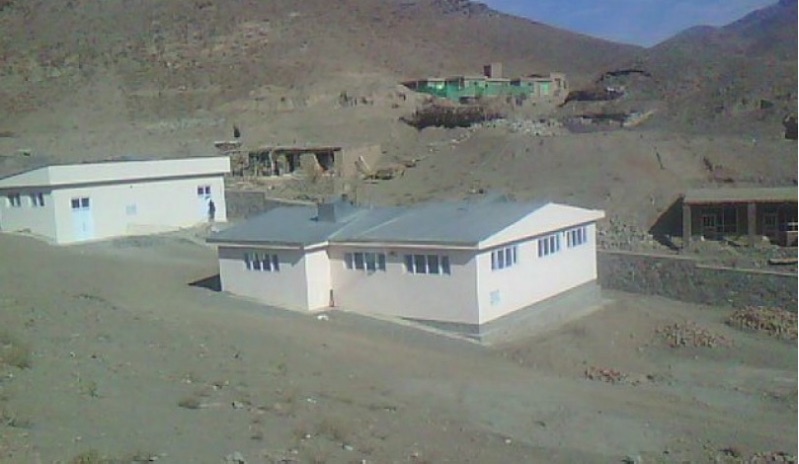
Those providing health care in contested areas in Afghanistan say they are feeling under increasing pressure from all sides in the war. There have been two egregious attacks on medical facilities in the last six months: the summary execution of two patients and a carer taken from a clinic in Wardak by Afghan special forces in mid-February – a clear war crime – and the United States bombing of the Médecins Sans Frontières (MSF) hospital in Kunduz in October 2015, which left dozens dead and injured – an alleged war crime. Health professionals have told AAN of other violations, by both pro and anti-government forces. Perhaps most worryingly, reports AAN Country Director Kate Clark, have been comments by government officials, backing or defending the attacks on the MSF hospital and Wardak clinic [see image below].

SCA Wardak clinic JPEG

So, for example:

Afghan government reactions to the news of the Wardak killings [at Tangi Sedan during the night of 17/18 February 2016; see also here] came largely at the provincial level, from officials who saw no problem in those they believed were Taleban – wounded or otherwise – being taken from a clinic and summarily executed. Head of the provincial council, Akhtar Muhammad Tahiri, was widely quoted, saying: “The Afghan security forces raided the hospital as the members of the Taliban group were being treated there.” Spokesperson for the provincial governor, Toryalay Hemat, said, “They were not patients, but Taliban,” and “The main target of the special forces was the Taliban fighters, not the hospital.” Spokesman for Wardak’s police chief, Abdul Wali Noorzai, said “Those killed in the hospital were all terrorists,” adding he was “happy that they were killed.”

Yet, the killings were a clear war crime. The Laws of Armed Conflict, also known as International Humanitarian Law, give special protection to medical facilities, staff and patients during war time – indeed, this is the oldest part of the Geneva Conventions. The Afghan special forces’ actions in Wardak involved numerous breaches: forcibly entering a medical clinic, harming and detaining staff and killing patients.  The two boys and the man who were summarily executed were, in any case, protected either as civilians (the caretaker clearly, the two patients possibly – they had claimed to have been injured in a motorbike accident) or as fighters who were hors d’combat (literally ‘out of the fight’) because they were wounded and also then detained.  Anyone who is hors d’combat is a protected person under International Humanitarian Law and cannot be harmed, the rationale being that they can no longer defend themselves. It is worth noting that, for the staff at the clinic to have refused to treat wounded Taleban would also have been a breach of medical neutrality: International Humanitarian Law demands that medical staff treat everyone according to medical need only.

That the Wardak provincial officials endorsed a war crime is worrying enough, but their words echoed reactions from more senior government officials to the US military’s airstrikes on a hospital belonging to the NGO Médecins Sans Frontières on 3 October 2015. Then, ministers and other officials appeared to defend the attack by saying it had targeted Taleban whom they said were in the hospital (conveniently forgetting that, until the fall of Kunduz city became imminent when the government evacuated all of its wounded from the hospital except the critically ill, the hospital had largely treated government soldiers). The Ministry of Interior spokesman, for example, said, “10 to 15 terrorists were hiding in the hospital last night and it came under attack. Well, they are all killed. All of the terrorists were killed. But we also lost doctors. We will do everything we can to ensure doctors are safe and they can do their jobs.”

MSF denied there were any armed men in the hospital. However, even if there had been, International Humanitarian Law would still have protected patients and medical staff: they would still have had to have been evacuated and warnings given before the hospital could have been legally attacked.

Not surprisingly heads of various humanitarian agencies all reported that the situation was worsening:

“General abuses against medical staff and facilities are on the rise from all parties to the conflict,” said one head of agency, while another said, “We have a good reputation with all sides, but we have still had threats from police, army and insurgents.” The head of a medical NGO described the situation as “messy, really difficult”:

All health facilities are under pressure. We have had some unpleasant experiences, The ALP [Afghan Local Police] are not professional, not disciplined. If the ALP or Taleban take over a clinic, we rely on local elders [to try to sort out the situation]. We are between the two parties.

He described the behaviour of overstretched Afghan special forces as “quite desperate,” adding, “They are struggling, trying to be everywhere and get very excited when there’s fighting.” Most of them, he said, were northerners speaking little or no Pashto, which can make things “difficult for our clinics in the south.”

The head of another agency listed the problems his staff are facing:

“We have seen the presence of armed men in medical facilities, turning them into targets. We have seen violations by the ANSF [Afghan National Security Forces], damage done to health facilities that were taken over as bases to conceal themselves and fight [the insurgents] from. We have seen checkpoints located close to health centres. Why? So that in case of hostilities, forces can take shelter in the concrete building. We have seen looting. We have seen ANSF at checkpoints deliberately causing delays, especially in the south, including blocking patients desperately needing to get to a health facility. We can never be certain that [such a delay] was the cause of death, but we believe it has been.”

He said his medical staff had been threatened by “ANSF intervening in medical facilities at the triage stage, forcing doctors to stop the care of other patients and treat their own soldiers, in disregard of medical priorities.” Less commonly, but more dangerously for the doctors themselves, he said, was the threat of Taleban abduction. He described a gathering of surgeons in which all reported having been abducted from their homes at least once and brought to the field to attend wounded fighters “with all the dangers you can imagine along the road.” He said the surgeons were “forced to operate without proper equipment and forced to abandon their own patients in clinics because the abduction would last days.”

Locally, medical staff often try to mitigate threats from both government forces and insurgents by seeking protection first from the local community. One head of agency described their strategy:

“When we open a clinic, our first interlocutors are the elders. Everyone wants a clinic in their area, but we decide the location and make the elders responsible for the clinic… They have to give us a building – three to four rooms. All those who work in the clinic – the ambulance driver, the owner of the vehicle, everyone – come from the area. We also need the elders to deal with the parties… If the ALP or Taleban take over clinic, we always start with the elders [who negotiate with whoever has taken over the clinic].”

However, this tactic puts a burden on community elders who may not be able to negotiate if the ANSF, ALP or insurgents are also threatening them.

***

I’ve delayed following up my previous commentaries on the US airstrike on the MSF Trauma Center in Kunduz (here and here) because I had hoped the full report of the internal investigation carried out by the US military would be released: apparently it runs to 3,000-odd pages.  I don’t for a minute believe that it would settle matters, but in any event nothing has emerged so far – though I’m sure it’s subject to multiple FOIA requests and, if and when it is released, will surely have been redacted.

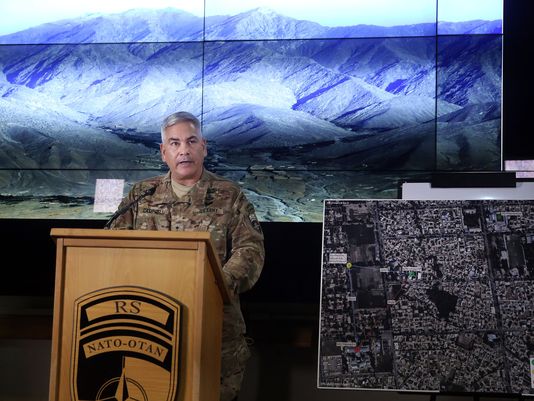
CAMBELL Press conference

All we have is an official statement by General John Campbell on 25 November 2015 (above), which described the airstrike as ‘a tragic, but avoidable accident caused primarily by human error’, and a brief Executive Summary of the findings of the Combined Civilian Casualty Assessment Team (made up of representatives from NATO and the Afghan government) which emphasised that those errors were ‘compounded by failures of process and procedure, and malfunctions of technical equipment.’

The parallel investigations identified a series of cumulative, cascading errors and malfunctions:

(1) The crew of the AC-130 gunship that carried out the attack set out without a proper mission brief or a list of ‘no-strike’ targets; the aircraft had been diverted from its original mission, to provide close air support to ‘troops in contact’, and was unprepared for this one (which was also represented as ‘troops in contact’, a standard designation meaning that troops are under hostile fire).

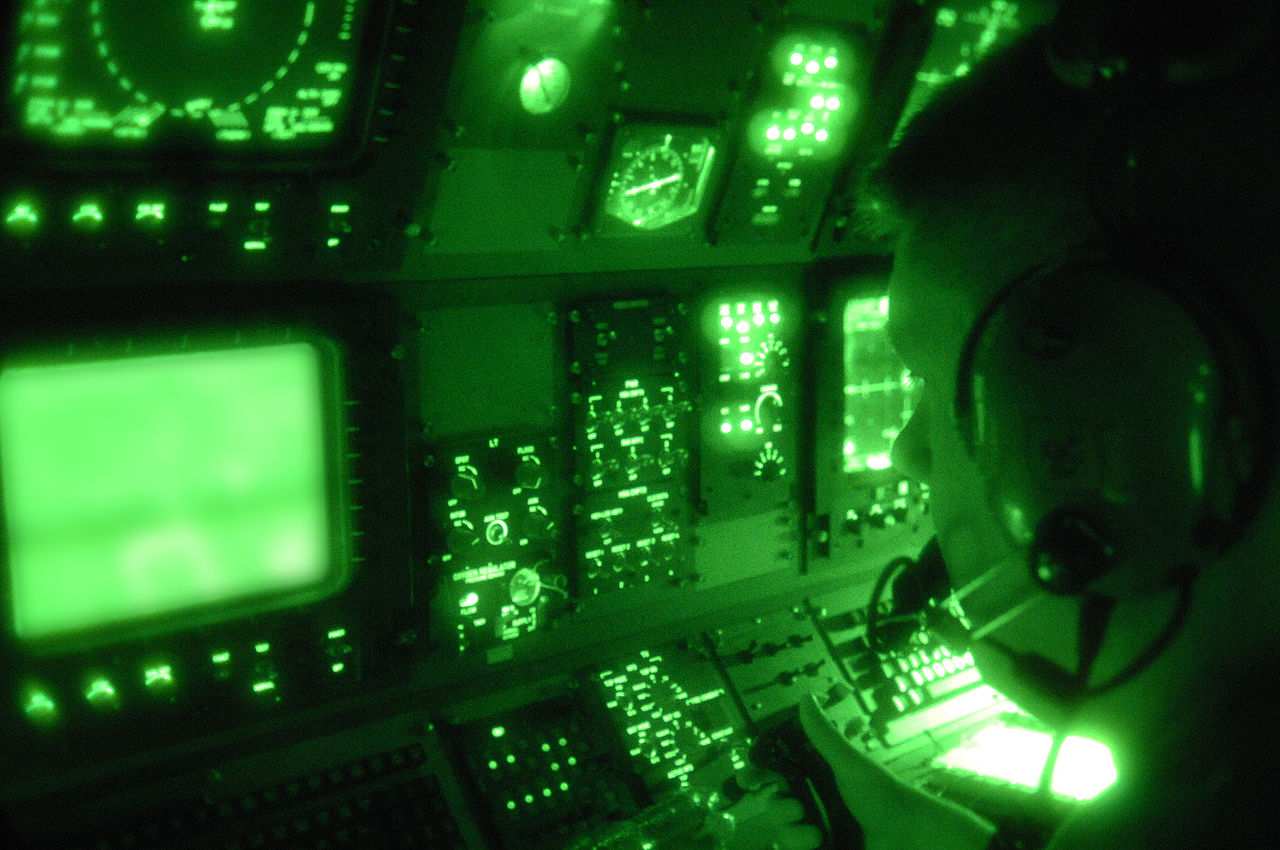
(2) Communications systems on the aircraft failed, including – crucially – the provision of video feeds to ground force commanders and the transmission of electronic messages (the AC-130 has a sophisticated sensor and communications suite  – or ‘battle management center’ –on board, staffed by two sensor operators, a navigator, a fire control officer, and an electronic warfare officer, and many messages are sent via classified chat rooms).

AC-130U_Sensor_Operator

The problem was apparently a jerry-rigged antenna that was supposed to link the AC-130 to the ground.  Here is how General Bradley Heithold explained it to Defense One:

“Today, we pump full-motion video into the airplane and out of the airplane. So we have a Ku-band antenna on the airplane … the U-model….  On our current legacy airplanes, the solution we used was rather scabbed on: take the overhead escape hatch out, put an antenna on, stick it back up there, move the beams around. We’ve had some issues, but we’re working with our industry partners to resolve that issue.”

He added, “99.9 percent of the time we’ve had success with it. These things aren’t perfect; they’re machines.”

Heithold said that dedicated Ku-band data transfer is now standard on later models of the AC-130, which should make data transfer much more reliable.

(3)  Afghan Special Forces in Kunduz had requested close air support for a clearing operation in the vicinity of the former National Directorate of Security compound, which they believed was now a Taliban ‘command and control node’.  The commander of US Special Forces on the ground agreed and provided the AC-130 crew with the co-ordinates for the NDS building.  He could see neither the target nor the MSF Trauma Center from his location but this is not a requirement for authorising a strike; he was also working from a map that apparently did not mark the MSF compound as a medical facility.  According to AP, he had been given the coordinates of the hospital two days before but said he didn’t recall seeing them.  The targeting system onboard the AC-130 was degraded and directed the aircraft to an empty field and so the crew relied on a visual identification of the target using a description provided by Afghan Special Forces – and they continued to rely on their visual fix even when the targeting system had been re-aligned (‘the crew remained fixated on the physical description of the facility’) and, as David Cloud points out, even though there was no visible sign of ‘troops in contact’ in the vicinity of the Trauma Center (‘An AC-130 is normally equipped with infrared surveillance cameras capable of detecting gunfire on the ground’):

MSF Kunduz attack

Sundarsan Raghaven adds that ‘Not long before the attack on the hospital, a U.S. airstrike pummeled an empty warehouse across the street from the Afghan intelligence headquarters. How U.S. personnel could have confused its location only a few hours later is not clear…’  More disturbingly, two US Special Forces troops have claimed that their Afghan counterparts told their commander that it was the Trauma Center that was being used as the ‘command and control node’, and that the Taliban ‘had already removed and ransomed the foreign doctors, and they had fired on partnered personnel from there.’

(4) The aircrew cleared the strike with senior commanders at the Joint Operations Center at Bagram and provided them with the co-ordinates of the intended target.  Those commanders failed to recognise that these were the co-ordinates of the MSF hospital which was indeed on the ‘no-strike’ list; ‘this confusion was exacerbated by the lack of video and electronic communications between the headquarters and the aircraft, caused by the earlier malfunction, and a belief at the headquarters that the force on the ground required air support as a matter of immediate force protection’;

(5) The strike continued even after MSF notified all the appropriate authorities that their clinic was under attack; no explanation was offered, though the US military claims the duration was shorter (29 minutes) than the 60-minutes reported by those on the ground.

Campbell announced that those ‘most closely associated’ with the incident had been suspended from duty for violations of the Rules of Engagement – those ‘who requested the strike and those who executed it from the air did not undertake the appropriate measures to verify that the facility was a legitimate military target’ – though he gave no indication how far up the chain of command responsibility would be extended; in January it was reported that US Central Command was weighing disciplinary action against unspecified individuals.  In the meantime, solatia payments had been made to the families of the killed ($6,000) and injured ($3,000).

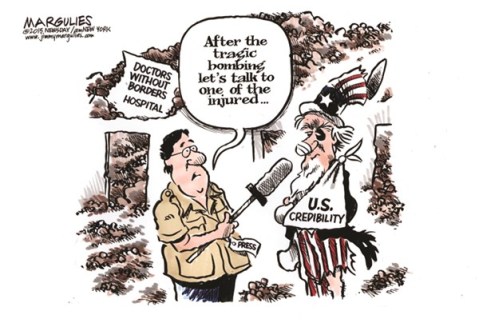
doctors-without-borders-us-credibility

Not surprisingly, MSF reacted angrily to Campbell’s summary: according to Christopher Stokes,

‘The U.S. version of events presented today leaves MSF with more questions than answers.  The frightening catalog of errors outlined today illustrates gross negligence on the part of U.S. forces and violations of the rules of war.’

Joanne Liu, MSF’s President, subsequently offered a wider reflection on war in today’s ‘barbarian times’, prompted by further attacks on other hospitals and clinics in Afghanistan, Syria, Yemen and elsewhere:

“The unspoken thing, the elephant in the room, is the war against terrorism, it’s tainting everything,” she said. “People have real difficulty, saying: ‘Oh, you were treating Taliban in your hospital in Kunduz?’ I said we have been treating everyone who is injured, and it will have been Afghan special forces, it will have been the Taliban, yes we are treating everybody.”

She added: “People have difficulty coming around to it. It’s the core, stripped-down-medical-ethics duty as a physician. If I’m at the frontline and refuse to treat a patient, it’s considered a crime. As a physician this is my oath, I’m going to treat everyone regardless.”

Kate Clark‘s forensic response to the US investigation of the Kunduz attack is here; she insists, I think convincingly, that

‘… rather than a simple string of human errors, this seems to have been a string of reckless decisions, within a larger system that failed to provide the legally proscribed safeguards when using such firepower. There were also equipment failures that compounded the problem but, again, if the forces on the ground and in the air had followed their own rules of engagement, the attack would have been averted.’

This is what just-in-time war looks like, but it’s not enough to blame all this on what General Campbell called a ‘high operational tempo’.  As a minimum, we need to be able to read the transcripts of the ground/air communications – which are recorded as a matter of course, no matter what the tempo, and which are almost always crucial in any civilian casualty incident resulting from ‘troops in contact’ (see, for another vivid example, my discussion here) – to make sense of the insensible.

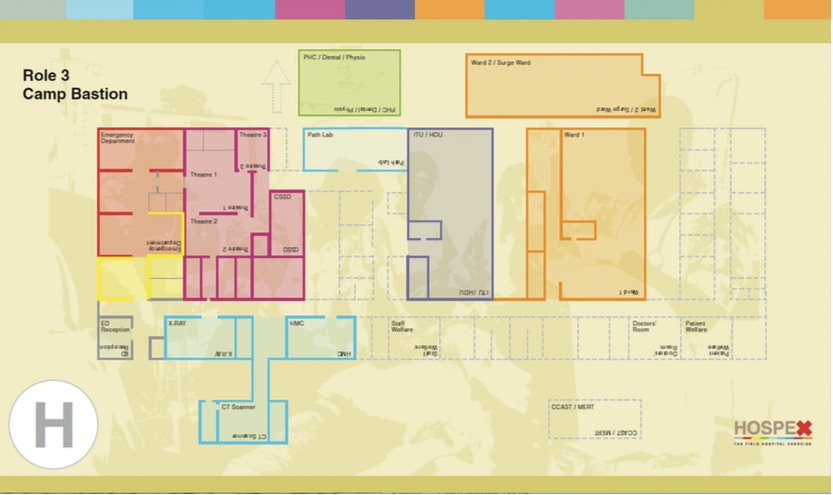
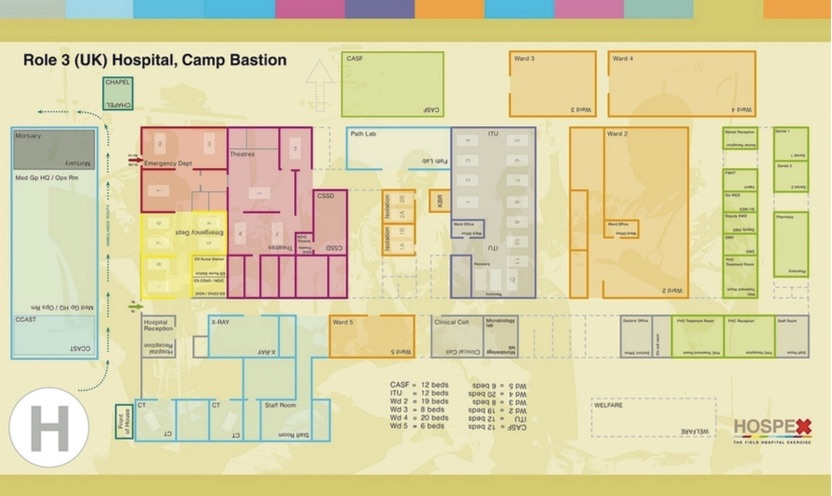
The last Bastion

Camp Bastion Role 3 hospital (2008-9)

Camp Bastion Role 3 hospital (late 2010)

In between my other projects, I’m battling my way back to my current research on casualty evacuation.  Reading about the military hospital at Camp Bastion in Afghanistan – you can find a bare-bones’ (sic) summary of its development in a series of linked reports from David Vassallo here, here and here (the plans above document its expansion from 2008 to 2010) – I came across the ethnographic work of Mark de Rond:

Cornell University Press are publishing a monograph based on his work later this year – Doctors at war: an ethnographer’s account of life and death in a field hospital – though so far I’ve been unable to track down any more details of what promises to be an essential study of combat casualty care (and Mark’s key interest, ‘teamwork’ – hence his study of the Cambridge Boat Race crew).

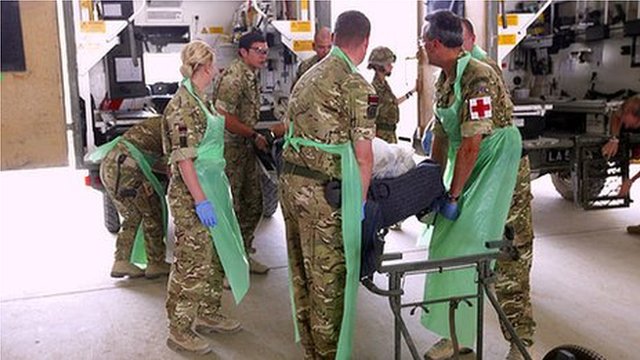
Bastion casualty arrival

In the meantime, you can get a sense of what he calls ‘field work beyond the comfort zone’ from an essay, ‘Soldier, surgeon, photographer, fly’ that appeared in Strategic Organization 10 (3) (2012) 256-262, available open access here:

To treat major trauma effectively requires surgeons and anaesthetists to align their efforts in a context where the margin for error is small and the stakes matters of life and death. Yet even such close cooperation does not rule out rivalry. For leave these surgeons with little or nothing to do work-wise and they may turn on each other instead. Unable to sit still, some begin to interfere in the affairs of others or to compete for work. As one of the surgeons admitted: ‘He is fighting for work. I am fighting for work, each of us hoping the other will be late.’ Sebastian Junger described the troops he embedded himself with as so bored on occasion that ‘they prayed for contact [with the enemy] as farmers pray for rain’ (Hetherington, 2010: 15). Even when work is plentiful, surgeons may compete for the most interesting jobs.

As in Junger’s Korengal Valley, in Camp Bastion’s hospital periods of great intensity follow periods of boredom in which it is however impossible to relax or to put oneself to productive use; surgeons and warriors alike intentionally objectify casualties yet can feel callous for not caring more than they do. It is here that the extremes of busyness and boredom, significance and futility can change rapidly and unpredictably, and shift the balance between altruism and selfishness, pleasure and guilt, the thrill of warfare and cowardice. ‘In this kind of war’, wrote McCullin, ‘you are on a schizophrenic trip. You cannot equate what is going on with anything else in life. . . . None of the real world judgments seem to apply. What’s peace, what’s war, what’s dead, what’s living, what’s right, what’s wrong? You don’t know the answers’ (2002: 100–1).

I’m looking forward to reading Mark’s account alongside the remarkable work of David Cotterrell that I described in ‘Bodies on the line’ here.

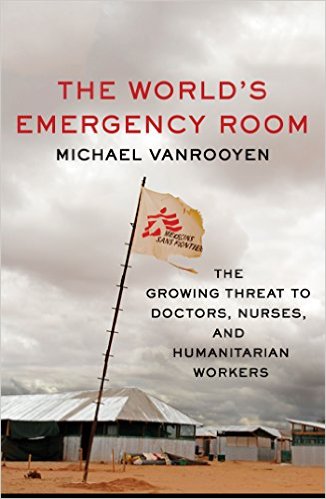
The World’s E.R.

VanRooyen World's Emergency RoomAs military and paramilitary attacks on hospitals and medical facilities have increased – in Afghanistan, GazaSyria, Yemen and elsewhere – even as the number of casualties has soared, Michael VanRooyen‘s new book The World’s Emergency Room (out next month from St Martin’s) promises to provide an urgent overview of what has become a routinised violation of medical neutrality:

Twenty years ago, the most common cause of death for medical humanitarians and other aid workers was traffic accidents; today, it is violent attacks. And the death of each doctor, nurse, paramedic, midwife, and vaccinator is multiplied untold times in the vulnerable populations deprived of their care. In a 2005 report, the ICRC found that for every soldier killed in the war in the Democratic Republic of the Congo, more than 60 civilians died due to loss of immunizations and other basic health services.

The World’s Emergency Room: The Growing Threat to Doctors, Nurses, and Humanitarian Workers documents this dangerous trend, demonstrates the urgent need to reverse it, and explores how that can be accomplished. Drawing on VanRooyen’s personal experiences and those of his colleagues in international humanitarian medicine, he takes readers into clinics, wards, and field hospitals around the world where medical personnel work with inadequate resources under dangerous conditions to care for civilians imperiled by conflict. VanRooyen undergirds these compelling stories with data and historical context, emphasizing how they imperil the key doctrine of medical neutrality, and what to do about it.

Michael is a professor at the Harvard Medical School and director of the Harvard Humanitarian Initiative.

From Kirkus:

A behind-the-scenes look at the nascent field of humanitarian medicine as it has evolved in recent years of civil wars, famines, tsunamis, and other natural and man-made disasters.

Since 1990, world conflicts and refugee crises have spurred the growth of a massive force of humanitarian aid workers—some 275,000 individuals with the United Nations and NGOs, most of whom lack the formal training needed to deal with complex events like the catastrophic 2010 Haiti earthquake. In that 25-year period, more than 1,000 aid workers were killed in attacks on hospitals, medical staff, and civilian patients. VanRooyen, a professor at Harvard Medical School and the co-founder and director of the Harvard Humanitarian Initiative, came of age professionally in the fields of emergency medicine and humanitarian medicine, which are the focus of this fascinating debut. “What the emergency room is to Detroit, Chicago, and Baltimore, humanitarian medical relief is to the world’s crisis zones,” he writes. Whether in an unstable inner city or a failed state, doctors provide a safety net of emergency health care for people with critical needs. The author recounts his experiences on the ground as an emergency physician in Bosnia, Chad, the Congo, Haiti, Somalia, and many other countries and how he and like-minded colleagues have sought to professionalize humanitarian efforts, which have frequently been criticized as uncoordinated and wasteful. (The Haitian relief effort was a “humanitarian free-for-all,” he writes, involving novice agencies, inexperienced surgical teams, and “disaster tourists.”) In 2005, VanRooyen and others established the Harvard Humanitarian Initiative, a first-of-its-kind, universitywide effort to pursue research, training, and innovative approaches to humanitarian aid that could be leveraged to achieve policy changes. Despite the subtitle, the author devotes relatively little attention to the increasing dangers facing aid workers, focusing mainly on the need to establish rigorous standards for the field in order to prevent the malnutrition and infectious diseases that are the biggest killers in communities in conflict.

Anatomy of a war

PARKER Anatomy of a soldier

‘He straightened and held me in one hand.  “Right, orders for tomorrow’s operation,” he said.   “We’re deploying most of the company for the first time and the whole platoon’s out together.  It’s a standard route security operation for the logistics convoy bringing in our supplies.  There’s nothing complicated about this patrol, but we’ll be static for long periods and that will make us vulnerable.  We have to clear all the roads in our AO and then secure it so the convoy can travel safely through.”  He moved his hand up my shaft and used me to point at the flat ground.

“Is everyone happy with the model?” he said.

There were a few silent nods from the watching men.

“Just to orientate you again.  This is our current location.”  He pointed me at a tiny block of wood near the centre of the grid that had PB43 written on it in peeling blue paint.  It was the largest of a hundred little wooden squares placed carefully across the earth and numbered in black.  “This is Route Hammer.”  He moved my end along a piece of orange ribbon that was pinned into the dirt.  “And this blue ribbon represents the river that runs past Howshal Nalay.”  I swept along the ribbon over a denser group of wooden blocks.  “These red markers are the IED finds in the last three months, so there’s quite a few on Hammer.”  I hovered over red pinheads…

He started describing the plan and used me to direct their attention to different parts of the square.  He said their mission was to secure the road and then provide rear protection.  He told them how they would move out before first light and push along the orange ribbon, past the blocks with L33 and L34 written on them.  I paused as he explained how vulnerable this point was, and that one team would provide overwatch at the block marked M13 while others cleared the road.

I was pointed at one of the men, who nodded that he understood.

He told them how they would spread out between block L42 and the green string.  Two other platoons would move through them and secure the orange ribbon farther up.  Then he swept me over the zones they were most likely to be attacked from.  He said the hardest part of the operation was to clear the crossroads at the area of interest named Cambridge; this was 6 Platoon’s responsibility.  I hovered over where the orange ribbon was crossed by white tape.

I had done it all before: secured sections of the ribbon, dominated areas of dirt, reassured little labels, ambushed red markers and attacked through clusters of wooden blocks.  I had destroyed as my end was pushed down hard and twisted into the ground.  I’d drawn lines in the sand that were fire-support positions and traced casualty evacuation routes through miniature fields.  I was master of the model.’

This passage comes from Harry Parker‘s stunning novel about the war in Afghanistan, Anatomy of a soldier (Faber, 2016).

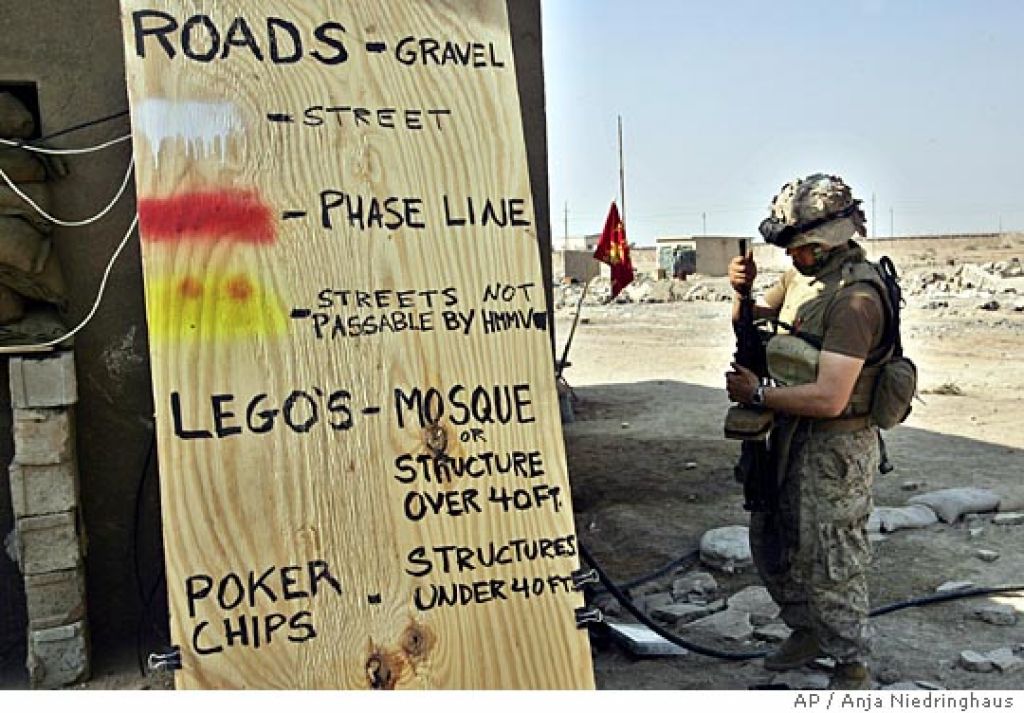
In one sense, perhaps, it’s not so remarkable: the use of improvised physical models to familiarise troops with the local terrain is a commonplace even of later modern war.  In Rush to the intimate (DOWNLOADS tab) I described how in November 2004, immediately before the second US assault on Fallujah, US Marines constructed a large model of the city at their Forward Operating Base, in which roads were represented by gravel, structures under 40′ by poker chips and structures over 40′ by Lego bricks (see image below). Infantry officers made their own physical model of the city using bricks to represent buildings and spent shells to represent mosques.

Fallujah model

I called this a ‘rush from the intimate to the inanimate’, and discussed the ways in which the rendering of the city as an object-space empty of life was a powerfully performative gesture – one in which, as Anne Barnard put it, the soldiers straddled the model ‘like Gulliver in Lilliput’.

As the passage I’ve just quoted suggests, it was standard practice in Afghanistan too; here are soldiers from the Afghan National Army studying a model for Operation Tufan/Storm, a joint ANA/UK operation in Helmand:

Afghan Warriors Tackle Insurgents in Huge Joint Operation with Scottish Troops

So far, then, so familiar.  But the passage with which I began is remarkable because the narrator – whose shaft is gripped by the officer’s hand, who hovers over the orange ribbon, who confesses to having done it all before – is the handle of a broken broom.  ‘My first purpose was to hold my head down against the ground as I brushed sand out of a small, dirty room,’ the chapter begins.  ‘In time, my head loosened and the nail then held it on pulled free.  Someone tried to push it back on, but my head swung round and fell off.  I was discarded.’

‘That would have been the end of me,’ the broom handle continues – ‘my head was burned with the rubbish’ – ‘but I was reinvented and became useful again.’

The novel tells the story of Captain Tom Barnes, a British army officer who steps on an IED while on patrol in Afghanistan; he is airlifted to the Role 3 hospital at Camp Bastion and then evacuated to Britain; he loses both his legs, the first to the effects of the blast and the second to infection.  And the narrative is reconstructed through the objects that are entangled in – and which also, in an extraordinarily powerful sense, animate – the events.

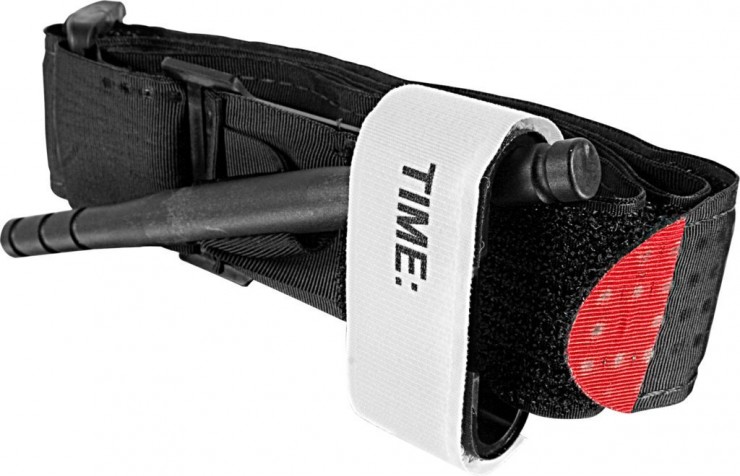
So, for example, a tourniquet:

‘My serial number is 6545-01-522… A black marker wrote BA5799 O POS on me and I was placed in the left thigh pocket of BA5799’s combat trousers… At 0618 on 15 August, when I was sliding along BA5799’s thigh, I was lifted into the sky and turned over.  And suddenly I was in the light… I was pulled open by panicked fingers and covered in the thick liquid… I was wound tighter, gripping his thigh… I clung to him as we flew low across the fields and glinting irrigation ditches…’

CAT-Combat-Application-Tourniquet-740x476

The story is continued in and through other object-fragments.  On patrol, a boot; day-sack; helmet (‘My overhanging rim cut his vision as a black horizontal blur and my chinstrap bounced up against his stubble as he pounded onto each stride’); night vision goggles (‘My green light reflected off the glassy bulge of his retina’); a radio (‘His breathing deepened under the weight of the kit and condensation formed on the gauze of my microphone… I continued to play transmissions in BA5799’s ear as the other stations in the network pushed farther up the road’); an aerial photograph (‘He took me out and traced his finger across my surface… in the operations room a small blue sticker labelled B30 was moved across a map pinned to the wall.  That map was identical to me’); and his identity tags (‘I had dropped around your neck and my discs rested on the green canvas stretcher stained with your blood’).

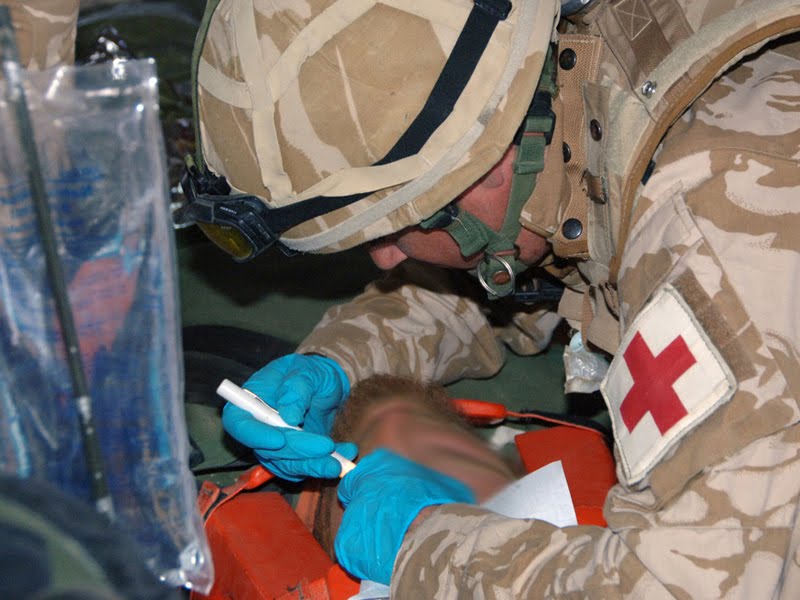
Medical care en route to Bastion

After the blast from the IED and a helicopter evacuation, the medical apparatus: a tube inserted into his throat at Camp Bastion’s trauma centre (‘I was part of a system now; I was inside you…’); a surgical saw (‘He held me like a weapon, and down at the end of my barrel was my flat stainless-steel blade… My blade-end cut through the bone, flashing splinters and dust from the thin trench I gouged out’); a plasma bag (‘I hung over you… I was empty; my plastic walls had collapsed together and red showed only around my seals.  The rest of the blood I’d carried since a young man donated it after a lecture, joking with a mate in the queue, was now in you’); a catheter; a wheelchair; his series of prosthetics (‘You pressed your stump into me and we became one for the first time… Slowly you outgrew all my parts and the man switched them over until I only existed as separate components in a cupboard and you’d progressed to a high-activity leg and a carbon-fibre socket’).

The agency of many of the objects is viscerally clear:

‘I lived in the soil.  My spores existed everywhere in the decomposing vegetable matter of the baked earth.  Something happened that meant I was suddenly inside you…  I was inside your leg, deep among flesh that was torn and churned.  I lived there for a week and wanted to take root, but it wasn’t easy… I struggled to survive.  Except they missed a small haematoma that had formed around a collection of mud in your calf…  You degraded and I survived… I made you feverish and feasted unseen on your insides…’

Or again, his first prosthetics:

‘You improved on me but you became thinner.  The pressure I exerted on you, and the weight you lost from the energy I used, made your stump shrink.  I could no longer support you properly.’

And the new ones:

‘Your hand caressed my grey surface and felt around the hydraulic piston under my knee joint… You’d been waiting for me but were nervous about what I might do for you…’

What is even more remarkable, as many of the passages I have quoted demonstrate, is that these events are narrated through objects that in all sorts of ways show how military violence reduces not only the ground but the human body to an object-space, perhaps nowhere more clearly than in this remark: ‘You were not a whole to them, just a wound to be closed or a level on a screen to monitor or a bag of blood to be changed.’  And yet: virtually every one of those passages is also impregnated with Barnes’s body: its feel – its very fleshiness – its sweat, its smell, its touch.

O'BRIEN The things they carriedI think this is an even more successful attempt to render the corporeality of war through its objects than Tim O’Brien‘s brilliant account of Vietnam in The Things They Carried (for more, see my post on ‘Boots on the Ground‘ and my essay on ‘The natures of war’: DOWNLOADS tab). This is, in part, because the narrative is not confined to those objects close to Barnes’ own body; it spirals far beyond them to include a drone providing close air support (‘I banked around the area and my sensor zoomed out again and I could see the enemy in relation to the soldiers who needed me’) and, significantly, extends to the components of the IED and the bodies of the insurgents who constructed and buried it.

There is a powerful moment when the two collide, when the father of a young insurgent killed in the drone strike wheels his son’s body to the patrol base:

‘The corpse was half in me, with my front end under it and my handles sticking up in the air.  He managed to push it farther into me and the distended head bounced off my metal side.  Dried blood showed around its ears and nose and was red in its mouth.  And then he pushed my handles down and I scooped it all up…  The corpse’s eyes had opened from the jolting and looked up at him.  He looked down into them, at his son’s face and the blue lips and purple blotching across his cheeks and he knew he had already accepted the loss.  He lowered my handles and smoothed the eyelids shut again.  He pushed me down the road.’

Barnes reaches for a compensation form, which takes up the story:

‘There was a leaflet that BA5799 had read tucked in the notebook next to me.  It described how to deal with this.  What to say, what not to say…  He was dealing with death in an alien culture and he had no idea how to relate to this man or the death of his son…  BA5799 wanted to feel compassion for this man and his dead son but only felt discomfort and the man’s eyes challenging him.  And all he cared about was getting back into the base and the loss of a potential asset in securing the area.’

All of these criss-crossing, triangulating lines capture not only the anatomy of a soldier but an anatomy of the war itself – at once calmly, coolly and shockingly abstract – in a word, objectified – and invasively, terrifyingly, ineluctably intimate.

***

Harry Parker (Ben Murphy photo)Postscript: You probably won’t be surprised to learn that Anatomy of a soldier is based on Harry Parker’s own experience.  Out on patrol with his men on 18 July 2009 in central Helmand he stepped on an IED; he lost his lower left leg in the blast and had his lower right leg amputated at Selly Oak Hospital in Birmingham (the major centre for advanced trauma care for the British military).  ‘‘Writing about the explosion felt good creatively,’ he told Christian House, ‘but also you’ve mined your personal experiences’ and the process left him ‘a sweaty mess’.  I’ve written about what Roy Scranton calls ‘the trauma hero‘ before, and so it’s important to add that Parker insists that the novel is not disguised autobiography: ‘I didn’t want to write, “I was in the Helmand valley.”’

One other note: at the AAG meeting in San Francisco next month Iain Shaw and Katherine Kindervater have organised a series of really interesting sessions on Objects of Security and War:

These sessions aim to bring together scholars working in the areas of war and security that are attentive to the materialities of contemporary violence and conflict. We are especially interested in work that seeks to place objects of security and war within a wider set of practices, assemblages, bodies, and histories. From drones and documents, to algorithms and atom bombs, the materiality of state power continues to anchor and disrupt the conduct and geography of (international) violence.

I’m part of those sessions – but reading Anatomy of a soldier has made me think about giving an altogether different presentation. I’ve long argued that we need to disrupt that lazy divide between ‘fact’ and ‘fiction’ and that literature is able to convey important truths that evade conventional academic prose (hence my unbounded admiration for Tom McCarthy‘s C, for example).  And Anatomy of a soldier convinces me that I’ll find more inspiration in novels like that than in whole libraries on object-oriented philosophy…

Standing on occupied ground

This is Reading Week at UBC, so I’m doing just that…  At the AAG Annual Meeting in San Francisco there is a Plenary Session on Friday 1 April (sic) on Forging Solidarity: Taking a stand on Palestine:

In July 2015 the International Critical Geography Group convened its seventh conference in the occupied city of Ramallah, Palestine. The conference brought together scholars and activists committed to combating social exploitation and oppression. Altogether four hundred participants from over forty countries energetically took up issues on and beyond the violent frontlines of class, gender, race, sexual, and colonial divisions. Yet they also took critical steps beyond discussion and debate of our intellectual work towards concrete collective action. An example of this was the overwhelmingly vote of conference participants for a strong resolution to sign onto the Palestinian Academic and Cultural Boycott and the broader Boycott Divestment and Sanctions (BDS) campaign against Israel. The resolution adopted is both a political statement in solidarity with the anti-colonial struggle of our Palestinian comrades but also an agenda for a broader commitment to anti-capitalist, decolonial, anti-racist, feminist and queer social movements and struggles around the world against growing social, economic and political precarity, rising authoritarianism, encroachment of fundamental rights, dispossession, structural adjustment in the south and north, revanchism, ongoing colonization of public space, land and resources, the privatization of the commons, as well as structural and state-sanctioned violence against racialized, gendered, queer bodies, and other targeted bodies and communities.

Building on the momentum generated by the conference and this resolution, this discussion panel aims to open up a serious discussion about BDS and the academic boycott of Israel within the Association of American Geographers. This is, we believe, particularly relevant in light of the current situation in Palestine/Israel but also taking into consideration how academics from other professional organisations such as the American Anthropological Association, the Association for Asian American Studies, the American Studies Association and the Native American Studies Association, as well as a number of student councils worldwide, have already endorsed this call for solidarity. Our distinguished panel of scholars and activists will speak out about the importance and the urgency to adopt a political stand on Palestine and to further the work of decolonizing the discipline of geography. In doing so, we hope to reaffirm a commitment to critical scholarship and praxis by encouraging and enabling spaces of political and conceptual possibility for geographers in solidarity with ongoing socio-political, economic and environmental struggles around the globe.

w512

In the wake of that ICG Conference in Ramallah, David Lloyd‘s moving reflections on another conference/workshop in the same city, ‘Walter Benjamin in Palestine‘, repay careful reading:

Activism is in fact the antagonist of complacency and of the satisfaction with familiar protocols that dulls thinking and makes the institutionalized academic a little stupid. But activism is not always expressed in headlong mobilization or fervent debates, nor is thought only the forethought that shapes or the afterthought that reflects on practice. As “Benjamin in Palestine” exemplified, it can also take the form of deliberate thinking in common whose very exercise is a form of resistance, however limited. As the BDS movement continues to advance, perhaps workshops like these, which step beyond mere “severance of relations” (as Benjamin described the act of striking) to shape conditions for new modes of relation, may offer a way to think the future of our resistance to Israeli apartheid. Perhaps too it offers a model also for an alternative to the insidious corporatization of our intellectual and creative lives under the neoliberal dispensation we all confront, wherever we reside, and not only in occupied Palestine. That, indeed, may be the insight we have been gifted by those who daily struggle for the right to education in the face of dispossession.

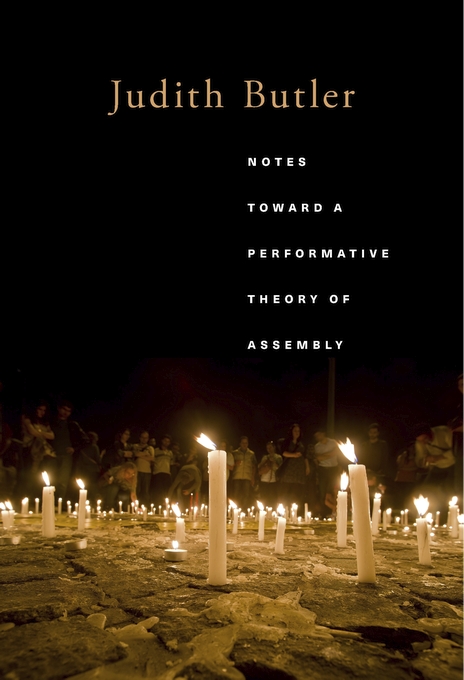
BUTLER NotesIn its way this, too, is a modestly performative politics of assembly.  So it’s good to see that panelists at the AAG plenary include this year’s Honorary Geographer, Judith Butler; full list is here.  You can find Judith’s previous remarks on BDS (at Brooklyn College) here.

You can also find out much more about the American Anthropological Association’s stand (last year) here; the statement that accompanied the successful resolution is here; a series of FAQs (“Yes, but…”) is here; and other resources are here.

It’s opportune, too, that the latest issue of borderlands should be devoted to The politics of suffering – with a special focus on occupied Palestine.  Among the many truly excellent essays three stand out for me.

First, Suvendrini Perera‘s accomplished contrapuntal reading of transnational justice, ‘Visibility, Atrocity and the Subject of Postcolonial Justice‘, which proceeds’ through a series of key sites – Congo, Belgium, Nuremberg, Israel, Gaza – that links past and present, colonial and colonizing worlds’, and then focuses on the deaths of tens of thousands of civilians on the beaches of Mullivaikkal in northeast Sri Lanka:

In the context of the 2009 atrocities in Lanka, in this paper I attempt to think through a set of questions about visibility, witness, suffering, accountability and disposability as they are played out in the relations between the necro-geo-politics of global institutions and the patchworks of local and transnational movements that attempt to materialize peoples’ suffering and realize the possibility of justice within fragile and compromised frameworks.

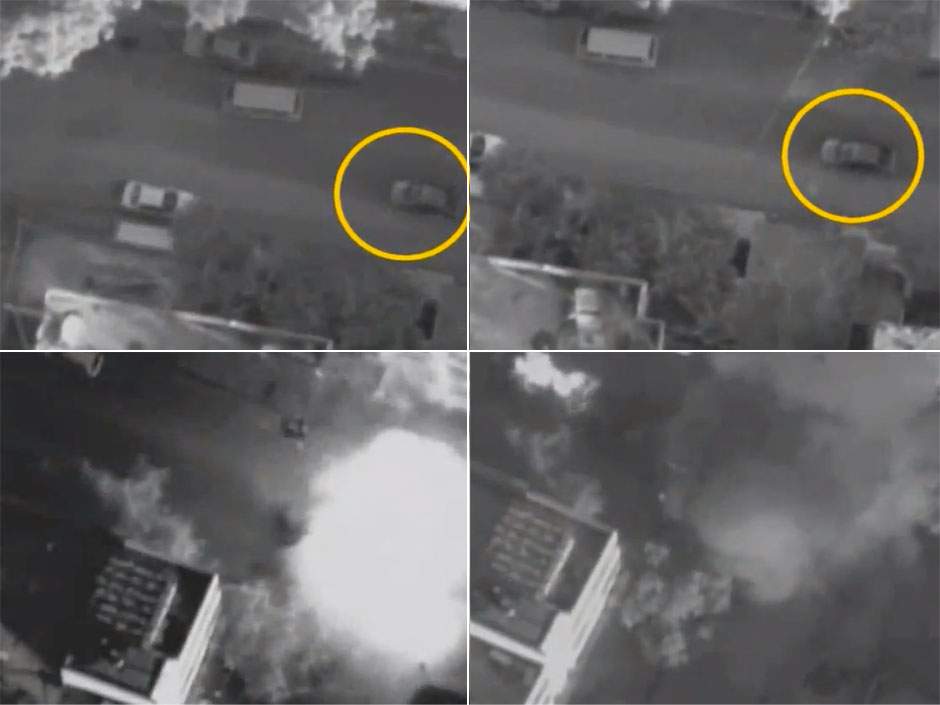
Drone feed Gaza city November 2012

Second, Joseph Pugliese‘s characteristically innovative ‘Forensic ecologies of occupied zones and Geographies of dispossession: Gaza and occupied East Jerusalem‘:

In this essay, I work to develop what I term multi-dimensional matrices of suffering that envisage the understanding of suffering beyond the locus of the human subject. In my theorising of multi-dimensional matrices of suffering, I proceed to conceptualise the suffering experienced in occupied zones as both relational and distributed. In the occupied zone, suffering encompasses complex, multi-dimensional vectors that bind humans, animals, animate and non-animate objects and entities, buildings and land. In the context of the regimes of violence that inscribe occupied zones, I situate suffering, and a range of other affects, in ecological configurations that, through a range of forensic indices, evidence the impact of these regimes of violence on the broad spectrum of entities that comprise a particular occupied zone. The conceptualisation of suffering and trauma in occupied zones in terms of its relational multi-dimensionality, its site-specific matrices and relational distribution across ecologies, I conclude, enables an understanding of suffering that moves beyond anthropocentric approaches. I situate my analysis in the context of Israel’s drone-enabled regime of unrelenting surveillance, occupation and military control over Gaza [see image above] and its continuing occupation of East Jerusalem.

It really is a tour de force, only too literally so, and builds not only on Joe’s brilliant State violence and the execution of law and his previous research but also on Jane Bennett‘s work and – as the title signposts – on Eyal Weizman‘s project of forensic architecture.  It’s doubly important because so much critical writing on military drones has virtually nothing to say about Israel’s use (and sale) of them.

Finally, Jasbir Puar‘s ‘The ‘right’ to maim: Disablement and inhumanist biopolitics in Palestine‘:

This essay argues that Israel manifests an implicit claim to the ‘right to maim’ and debilitate Palestinian bodies and environments as a form of biopolitical control and as central to a scientifically authorized humanitarian economy. In this context, the essay tracks the permeating relations between living and dying that complicate Michel Foucault’s foundational mapping of biopower, in this case, the practice of deliberate maiming. In doing so it demonstrates the limitations of the idea of ‘collateral damage’ that disarticulates the effects of warfare from the perpetration of violence, and notes that the policy of maiming is a productive one, a form of weaponized epigenetics through the profitability of a speculative rehabilitative economy.

This too is meticulously argued and imaginatively constructed, and adds important dimensions to my posts about Israel’s war on Gaza and, in particular, my preliminary speculations about the prosthetics of military violence.

It’s not brain surgery

I’ve often drawn attention to the biomedical and surgical metaphors that have become commonplace in attempts to sanitise and legitimise later modern war.  Reading Stephen Zunes‘s chillingly helpful commentary, ‘Republican candidates defend killing civilians to fight terrorism—and so do Democrats’, I stumbled across this exchange between Hugh Hewitt and retired neurosurgeon Ben Carson, who compares his own surgical skills to bombing (from the recent Republican Party ‘debate’ on 15 December 2015:

HUGH HEWITT: We’re talking about ruthless things tonight — carpet bombing, toughness, war. And people wonder, could you do that? Could you order air strikes that would kill innocent children by not the scores, but the hundreds and the thousands?

BEN CARSON: …..you have to be able to look at the big picture and understand that it’s actually merciful if you go ahead and finish the job, rather than death by 1,000 pricks.

HEWITT: So you are OK with the deaths of thousands of innocent children and civilian? It’s like…

CARSON: You got it. You got it.

A pity he didn’t stick to his day job.