Liberties and Republicans

On this terrible morning, with Donald Trump elected as President-designate of the United States, what to say?  Wrestling with sleeplessness last night, I started to think about the Statue of Liberty (bear with me).  I wrote about its multiple valences more than twenty years ago in Geographical Imaginations:  

Frédéric-Auguste Bartholdi‘s original proposal was for a lighthouse in the likeness of a woman to be raised at the Mediterranean entrance to the Suez Canal as a symbol of the nineteenth-century expansion of Europe.  Its title, Egypt carrying light to Asia, was intended to assert the historical mission of Europe – with a colonized Egypt acting as its handmaiden – to bring “enlightenment” to the Orient.  Bartholdi spent two years making plans and models but in 1869 – the year the Canal opened – the Khedive Ismail withdrew his support and it was not until 1871 that Bartholdi was able to reactivate his scheme.

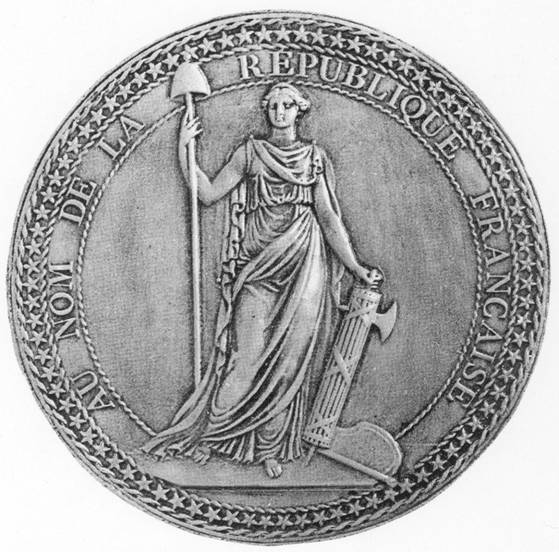
By then, in the wake of the Pais Commune, the project had been transformed and relocated.  One of his patrons, Édouard de Laboulaye, suggested that a monument be raised on the shores of the New World to symbolize Liberty Enlightening the World.  The representation of Liberty as a woman derived from classical antiquity, but this ‘whole allegorical apparatus’, as Maurice Agulhon called it, had been codified in France in the late seventeenth century.  When the Revolution occurred, Liberty already had an established iconographical status and a decree of 1792 adopted her as the seal of the republic: ‘the image of France in the guise of a woman, dressed in the style of Antiquity, standing upright, her right hand holding a pike surrounded by a Phyrgian cap or cap of liberty.’

image064

By the opening decades of the nineteenth century the use of ‘Marianne’ as a symbol of both Liberty and the Republic had become a commonplace.  This was true in the most literal of senses.  “Where was this woman to be seen?” ask Agulhon.  The answer: “all over the place”.  Paris had two statues of her, in the Place de la Concorde and the Place Vendôme, and many other towns had their own effigies.  In 1848 she appeared on the second seal of the Republic, wearing a diadem of corn with seven rays of the sun encircling her head in a spiked halo.

sceau_de_la_republique

The resemblance to the head of the American statue is striking, but a sunburst was also the Bartholdi family emblem and, still more significantly, it was intimately associated with the reign of Louis XIV, the ‘Sun King’.  To adorn Liberty with a sunburst was thus in a sense ‘to “crown” her’, Kaja Silverman argues, ‘and thereby align her with a tradition of stable and conservative government.’

That Liberty should be represented by a woman was clearly not without irony.  In practice, Joan Landes remarks,

the assault on paternalism was limited by force … and by the redirection of women’ public and sentimental existence into a new allegory of republican, virtuous family life.  Liberty herself is a profoundly ironic symbol, a public representation of a polity that sanctioned a limited domestic role for women … If Liberty represented woman, surely it was as an abstract emblem of male power and authority.

The power of patriarchy was reasserted still more forcibly after the fall of the Commune with the triumph of the bourgeois republic and its cult of respectability.  As Roger Magraw observed, ‘the official Mariannes who adorned town halls by the 1880s wore a halo of flowers and the motto Concorde, moving towards that anodyne statue which France sent to her fellow capitalist republic as the State of Liberty.’  Anodyne indeed: Silverman argues that Bartholdi virtually erased the corporeality of the body.  Thus he ‘completely buries the female form beneath hear classic drapery’ and ‘any thought that a body might nevertheless lurk beneath those folds is abruptly put to flight by the possibility of entering the statue and climbing up inside it.’  She is well aware of the sexual connotations of such a reading, of course, and moves quickly to foreclose them.  ‘Liberty is precisely an extension of the desire to “return” to the inside of the fantastic mother’s body,’ she proposes, ‘without having to confront her sexuality in any way.’  Viewed in this light, therefore, Liberty is rendered non-threatening and even ‘safe’.

It was thus from within a many-layered iconographical tradition that Laboulaye’s proposal was made.  He was Professor of Comparative Law at the Collège de France and although he never crossed the Atlantic he was regarded as France’s greatest expert on the United States.  Like many other republicans at the time, he regarded the United States as a model of the ideal society and he and his companions were convinced that a Statue of Liberty, given by France to America, would symbolize their most cherished principles.  For this reason Bartholdi was urged to ensure that the statue should ‘not be liberty in a red cap, striding across corpses with her pike at the port’ – a reference to Delacroix’s famous Liberty guiding the people to the barricades (below) –  but ‘the American liberty whose torch is held high not to inflame but to enlighten.’  Bartholdi agreed.  ‘Revolutionary Liberty cannot evoke American Liberty,’ he declared, ‘which after a hundred years of uninterrupted existence, should not appear as an intrepid young girl but as a woman of mature years, calm, advancing with the light but sure step of progress.’

Delacroix Liberty leading the people

For all there enthusiasm of the projects initiators, however, public subscriptions were slow – even Gounod conducting La liberté éclairant le monde at the Paris Opéra brought in a mere 8,000 francs – and in American they were slower still.  Bartholdi made a show of offering the statue to Philadelphia and Boston; other American cities submitted bids until at last prominent subscribers in New York were goaded into action.

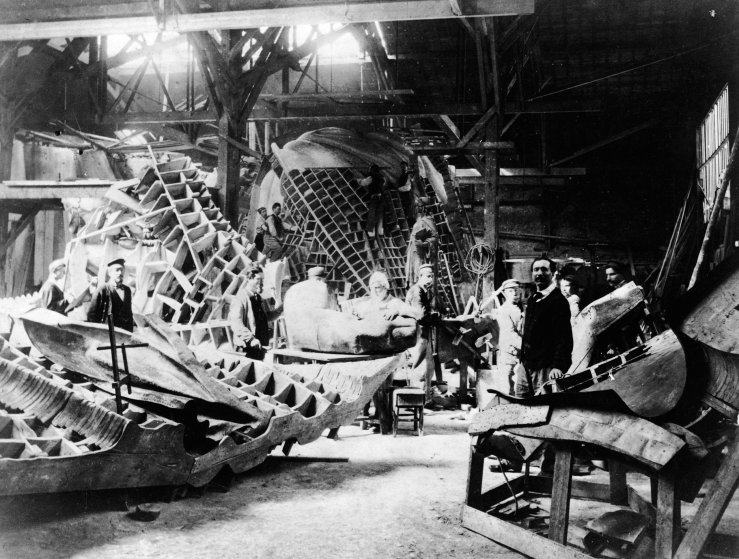
In 1875 Bartholdi started work in his Paris atelier:

Statue Of Liberty In Bartholdi Workshop

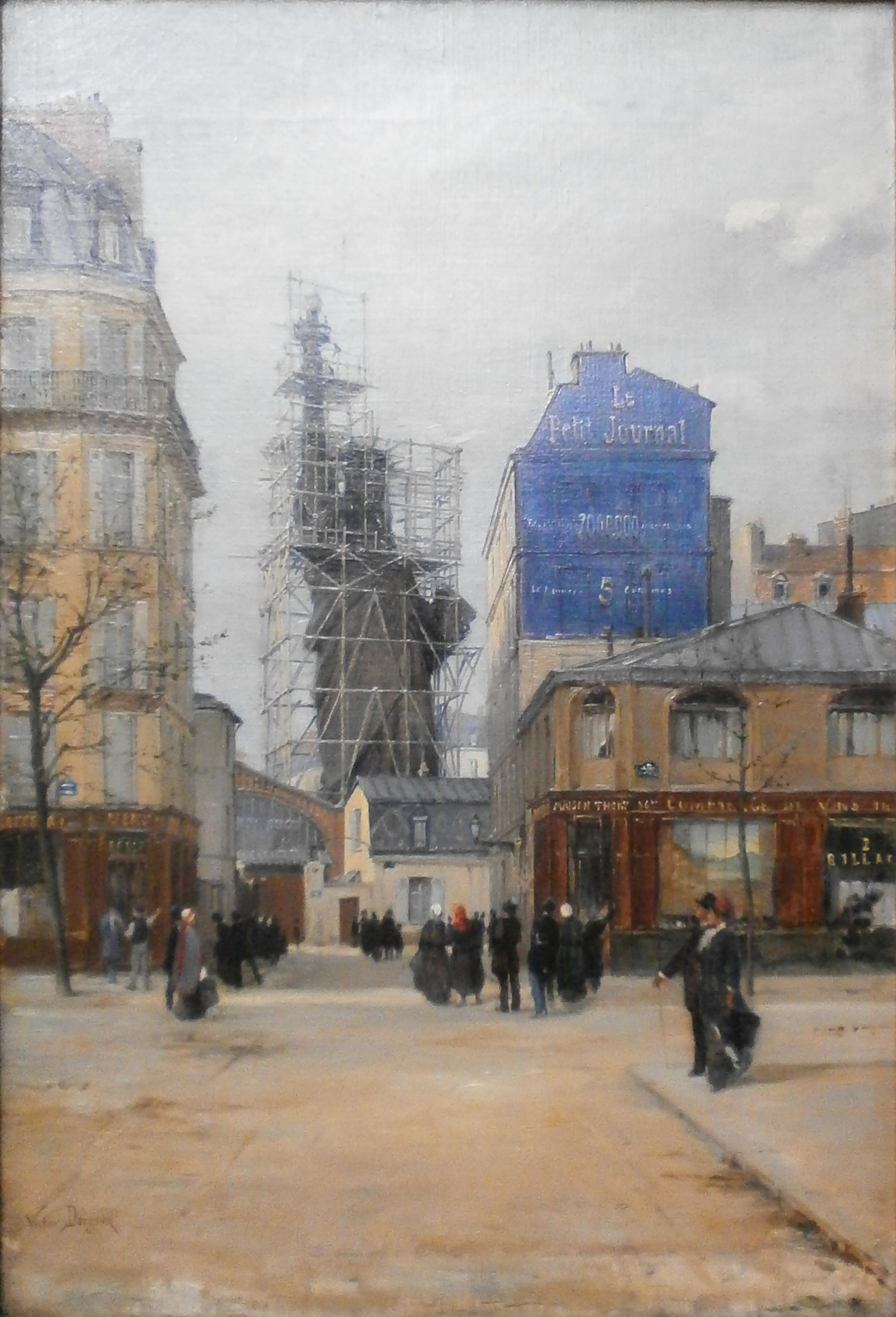
He soon realized the magnitude of the task  and invited Gustave Eiffel to design the wrought-iron bracing needed to support the copper sheets that would form the outer skin of the sculpture.  It took several years to complete the disembodied sections of the statue, but by the spring of 1883 Bartholdi was at last ready to assemble them.  By the end of the year, as Victor Dargaud‘s canvas shows, the statue still surrounded by its scaffolding was looming about the rue de Chazelles.

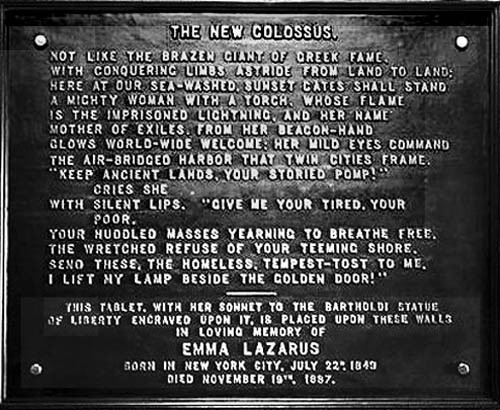
That same year Emma Lazarus published ‘The New Colossus’ to raise money for the statue’s plinth; its famous lines were eventually mounted inside the lower level:

the-new-colossus

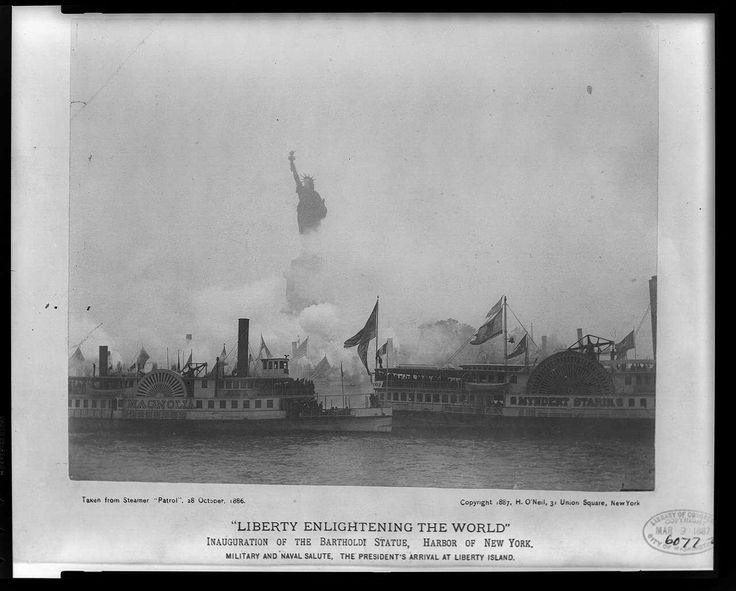
The government of France presented the Statue of Liberty to the United States on the Fourth of July 1884, and five months later it was dismantled, shipped across the Atlantic and reassembled on Bedloe’s Island in New York harbour.

2-statue-of-liberty-1886-granger

Astonishingly when the inauguration ceremony was held in October 1886, all women were barred except for the wives of the French delegation (led by Bartholdi).  American suffragists held their own simultaneous ceremony, and issued this pointed declaration: ‘In erecting a Statue of Liberty embodied as a woman in a land where no woman has political liberty, men have shown a delightful inconsistency which excites the wonder and admiration of the opposite sex.’

378ea56a2613fd744d571e5d9f7fac58

This is only a partial narrative but its echoes this morning are only too sonorous – not least the casual Orientalism, the overpowering whiteness, the complicated sexism and (in blessed counterpoint) Lazarus’s defiant acceptance of the exile and the refugee.

And so, for all the baggage carried by Liberty, if I could draw her now I would show an endless line of refugees; at the very back, a woman in a long flowing dress, her crown askew, using her battered torch as a crutch as she limps along in the dust, hoping against hope to be allowed to cross the border; and on an island in New York Harbor a new, glittering faux-gold statue of a man raising his searchlight in his tiny hands, and on the base Dante‘s immortal instruction: ‘Abandon hope, all ye who enter here….’

Yet today of all days we surely cannot afford to abandon hope.  Never has it been more urgent for scholars to reach out far beyond the academy, to create and engage new publics, and to help revitalize a critical and participatory political and intellectual culture – one in which knowledge trumps ignorance, compassion hostility and solidarity selfishness.

Spaces of exception and enemies

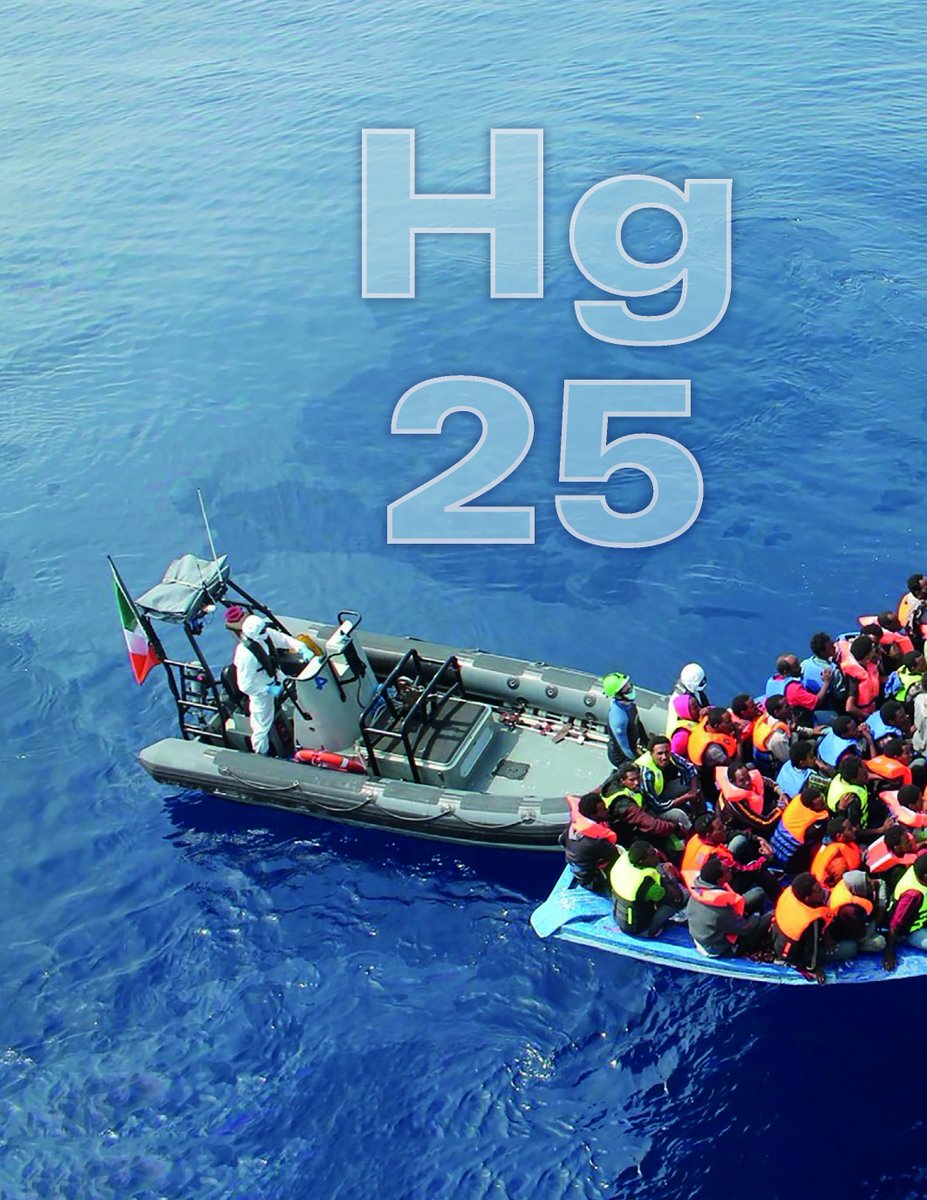
Human Geography 25

I’m just back from a wonderful time at a conference in Galway organised by John Morrissey as part of The Haven Project on the refugee crisis in the Mediterranean.  The latest issue of Human Geography (Vol 9, No 2) is devoted to Geographical Perspectives on the European ‘Migration and Refugee Crisis‘ – those scare-quotes are vital – and if your library doesn’t subscribe you can contact the Institute of Human Geography at insthugeog@gmail.com (most of the articles can be downloaded here).

At Galway I gave a new presentation on ‘Surgical strikes and modern war’, describing and analyzing the ways in which hospitals and ambulances, doctors and nurses have become targets of military violence; it drew on my new series of posts (see here and here), and there will be more to come on both Kunduz and on Syria (which was my main focus), but you can find a preliminary account of the whole event from Alex Jeffrey here.

My starting point was the modern space of exception seen not as ‘the camp‘, as Giorgio Agamben would have it, but as the killing fields of contemporary military and paramilitary violence (what would once have been called ‘the battlefield‘).  For these are spaces in which groups of people are knowingly and deliberately exposed to death through the removal of legal protections that would ordinarily be afforded them; and yet these are not spaces in which the law is suspended tout court, spaces from which the law withdraws and abandons the victims of violence to their fatebut rather spaces in which law – and specifically international humanitarian law – seeks to regulate and, crucially, to sanction violence.  This is a form of martial law that Agamben never considers (I know I am taking liberties with that term, but that is precisely my point): here as elsewhere violence exists not only beyond the law but is inscribed within it.  My purpose was to show how what was once a sacred space within this zone of exception – ‘the hospital’,  a topological figure that extends from the body of the wounded through the sites of the evacuation chain to the hospital itself – has become corroded; no longer a space of immunity – of safety – an exception to the exception, it has often become a central target of contemporary violence.

The need to pull all this together largely explains my silence these last weeks, and a lot has happened in the interim.  Where to start?  A good place is the latest issue of Radical Philosophy, the last in its present form, which includes two essays of direct relevance to the theme of the Galway conference.

First, an important essay by Achille Mbembe on ‘The Society of Enmity’ which you can download here:

Desire (master or otherwise) is also that movement through which the subject – enveloped on all sides by a specific phantasy [fantasme] (whether of omnipotence, ablation, destruction or persecution, it matters little) – seeks to turn back on itself in the hope of protecting itself from external danger, while other times it reaches outside of itself in order to face the windmills of the imagination that besiege it. Once uprooted from its structure, desire then sets out to capture the disturbing object. But since in reality this object has never existed – does not and will never exist – desire must continually invent it. An invented object, however, is still not a real object. It marks an empty yet bewitching space, a hallucinatory zone, at once enchanted and evil, an empty abode haunted by the object as if by a spell.

The desire for an enemy, the desire for apartheid, for separation and enclosure, the phantasy of extermination, today all haunt the space of this enchanted zone. In a number of cases, a wall is enough to express it.  There exist several kinds of wall, but they do not fulfil the same functions. [6] A separation wall is said to resolve a problem of excess numbers, a surplus of presence that some see as the primary reason for conditions of unbearable suffering. Restoring the experience of one’s existence, in this sense, requires a rupture with the existence of those whose absence (or complete disappearance) is barely experienced as a loss at all – or so one would like to believe. It also involves recognizing that between them and us there can be nothing that is shared in common. The anxiety of annihilation is thus at the heart of contemporary projects of separation.

Everywhere, the building of concrete walls and fences and other ‘security barriers’ is in full swing. Alongside the walls, other security structures are appearing: checkpoints, enclosures, watchtowers, trenches, all manner of demarcations that in many cases have no other function than to intensify the zoning off of entire communities, without ever fully succeeding in keeping away those considered a threat.

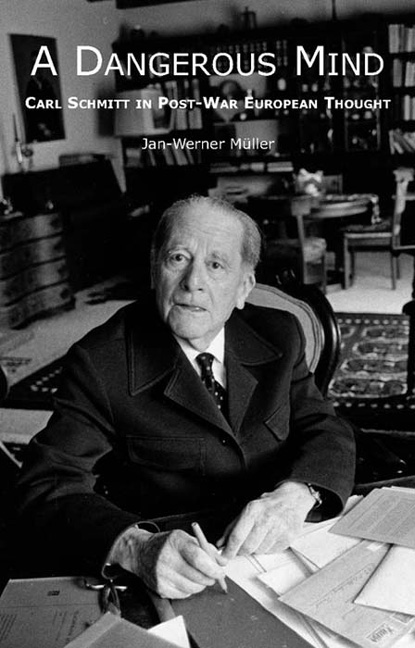
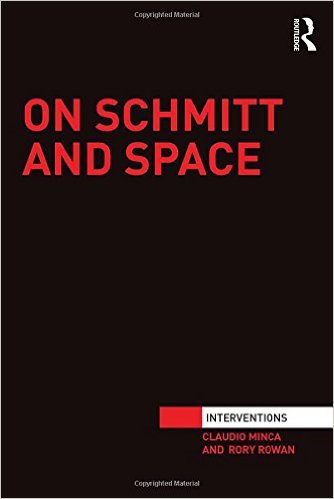
You can already surely hear the deadly echoes of Carl Schmitt – whose spectral presence lurked in the margins of my own presentation in Galway (for geographical elaborations of Schmitt, see Steve Legg‘s Spatiality, sovereignty and Carl Schmitt and Claudio Minca and Rory Rowan‘s On Schmitt and space) – and Achille makes the link explicit:

dangerousmindThis is an eminently political epoch, since ‘the specific political distinction’ from which ‘the political’ as such is defined – as Carl Schmitt argued, at least – is that ‘between friend and enemy’.  If our world today is an effectuation of Schmitt’s, then the concept of enemy is to be understood for its concrete and existential meaning, and not at all as a metaphor or an empty lifeless abstraction. The enemy Schmitt describes is neither a simple competitor, nor an adversary, nor a private rival whom one might hate or feel antipathy for. He is rather the object of a supreme antagonism. In both body and flesh, the enemy is that individual whose physical death is warranted by their existential denial of our own being.

However, to distinguish between friends and enemies is one thing; to identify the enemy with certainty is quite another. Indeed, as a ubiquitous yet obscure figure, today the enemy is even more dangerous by being everywhere: without face, name or place. If they have a face, it is only a veiled face, the simulacrum of a face. And if they have a name, this might only be a borrowed name, a false name whose primary function is dissimulation. Sometimes masked, other times in the open, such an enemy advances among us, around us, and even within us, ready to emerge in the middle of the day or in the heart of night, every time his apparition threatening the annihilation of our way of life, our very existence.

Yesterday, as today, the political as conceived by Schmitt owes its volcanic charge to the fact that it is closely connected to an existential will to power. As such, it necessarily and by definition opens up the extreme possibility of an infinite deployment of pure means without ends, as embodied in the execution of murder.

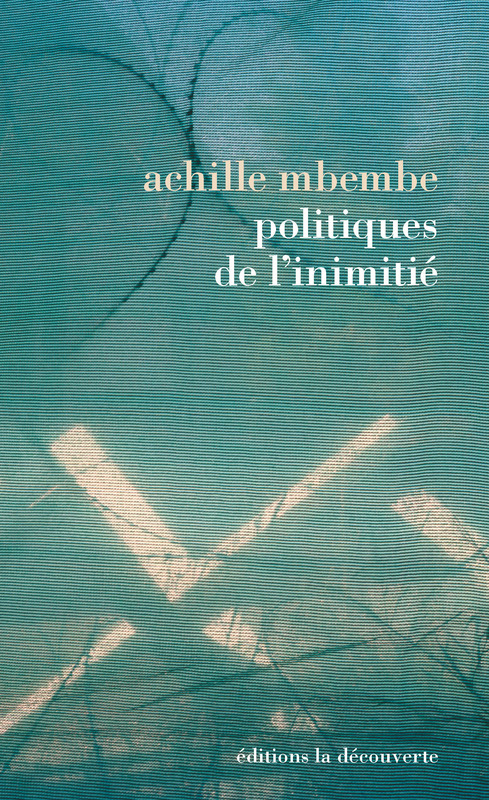
The essay is taken from Achille’s latest book, Politiques de l’inimitié published by Découverte in 2016:

Introduction – L’épreuve du monde
1. La sortie de la démocratie
Retournement, inversion et accélération
Le corps nocturne de la démocratie
Mythologiques
La consumation du divin
Nécropolitique et relation sans désir
97827071881822. La société d’inimitié
L’objet affolant
L’ennemi, cet Autre que je suis
Les damnés de la foi
État d’insécurité
Nanoracisme et narcothérapie
3. La pharmacie de Fanon
Le principe de destruction
Société d’objets et métaphysique de la destruction
Peurs racistes
Décolonisation radicale et fête de l’imagination
La relation de soin
Le double ahurissant
La vie qui s’en va
4. Ce midi assommant
Impasses de l’humanisme
L’Autre de l’humain et généalogies de l’objet
Le monde zéro
Anti-musée
Autophagie
Capitalisme et animisme
Émancipation du vivant
Conclusion. L’éthique du passant

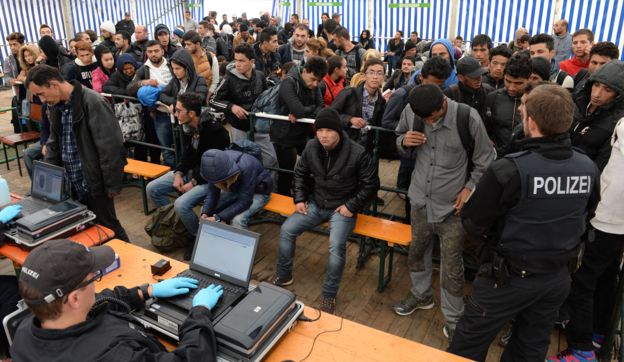
Asylum seekers being registered at Passau

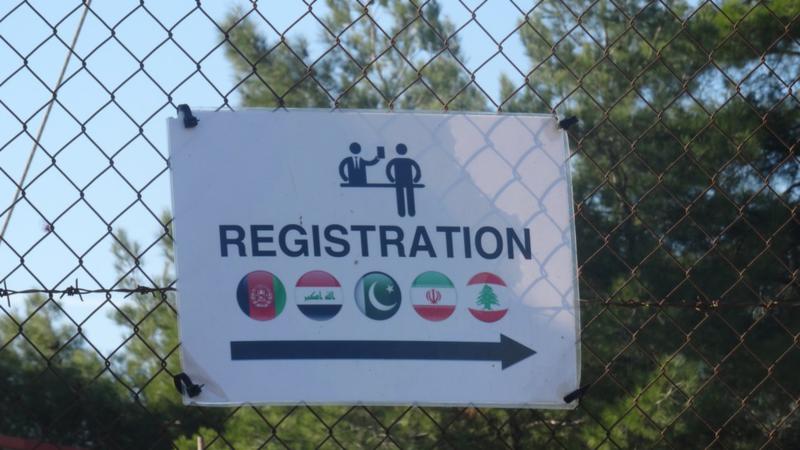
Second, an essay by Mark Neocleous and Maria Kastrinou, ‘The EU hotspot: Police war against the migrant’, which you can download here.  They start by asking a series of provocative questions about the EU strategy of ‘managing’ (read: policing) migration through the designation of ‘hotspots’ in which all refugees are to be identified, registered and fingerprinted:

There is no doubt that in some ways the term ‘hotspot’ is meant to play on the ubiquity of this word as a contemporary cultural trope, but this obviousness may obscure something far more telling, something not touched on by the criticisms of the hotspots, which tend to focus on either their squalid conditions or their legality (for example, with routes out of Greece being closed off migrants are in many ways being detained rather than registered; likewise, although ‘inadmissibility’ is being used as the reason to ship migrants back to Turkey, in reality ‘inadmissibility’ often means nothing other than that the political and bureaucratic machine is working too slowly to adequately process asylum claims).  Neither the legality nor the sanitary state of the hotspot is our concern here. Nor is the fact that the hotspots use identification measures largely as instruments of exclusion. Rather, we are interested in what the label ‘hotspot’ might tell us about the way the EU wants to manage the crisis. What might the hotspot tell us about how the EU imagines the refugee? But also, given that the EU’s management of the refugee crisis is a means for it to manage migration flows across Europe as a whole, what might the hotspot tell us about how the EU imagines the figure of the migrant in general?

You can find an official gloss (sic) on hotspots here (and more detail here), critical readings by Frances Webber here and Glenda Garelli and Martina Taziolli here, and NGO responses from Oxfam here and Caritas here.  The Bureau of Investigative Journalism also has a useful report on Frontex, the EU’s border agency, here.

registration-at-hotspots-frontex

Here is the kernel of Mark’s and Maria’s answer to their questions – and you will see see the link with Achille’s essay immediately:

For every police war, an enemy is needed. Defining the zones as hotspots suggests that migrants have arrived as somehow already ‘illegal’ in some way, enabling them to be situated within the much wider and never-ending ‘war on crime’. Yet this process needs to be understood within the wider practice of criminalizing breaches of immigration law in western capitalist polities over the last twenty years, as individual states and the state system as a whole have increasingly sought to make the criminal law work much more closely with immigration law: ‘crimmigration’, as it has become known, means that criminal offences can now very easily result in deportation, while immigration violations are now frequently treated as criminal offences. Concerning the UK, for example, Ana Aliverti has noted that ‘the period between 1997 and 2009 witnessed the fastest and largest expansion of the catalogue of immigration crimes since 1905’.  This expansion serves to further reinforce the conception of the migrant as already tainted by crime, as the figure of the criminal and the figure of the migrant slowly merge. The term ‘illegal immigrant’ plays on this connection in all sorts of ambiguous ways. Indeed, it is significant that the very term ‘illegal immigrant’ has over the same period replaced the term ‘undocumented migrant’, so that a figure once seen as lacking papers is seen now as lacking law.

However, the fact that migrants arriving in the EU hotspots do so as propertyless (or at least apparently so) subjects adds a further significance. Why? Because by arriving propertyless the historical figure to which the migrant is most closely aligned is as much the vagrant as the criminal. Aliverti’s reference to 1905 is a reference to the Aliens Act of that year, in which any ‘alien’ landing in the UK in contravention of the Act was deemed to be a rogue and vagabond. The Act was underpinned by making such ‘aliens’ liable to prosecution under section 4 of the Vagrancy Act of 1824, usually punishable in the form of hard labour in a house of correction. As Aliverti puts it, ‘in view of the similarities between the poor laws and early immigration norms, it is no coincidence that the first comprehensive immigration legislation in 1905 penalized the unauthorized landing of immigrants with the penalties imposed on “rogues and vagabonds” and vagrancy was one of the grounds for expulsion of foreigners.’  In the mind of the state, the vagrant is the classic migrant, just as migrants arriving in the hotspots are increasingly coming to look like and be treated as the newest type of vagrant. In the mind of the state, the propertyless migrant is a kind of vagrant-migrant (which is of course one reason why welfare and migration are so frequently connected).

Vagrancy legislation has always been the ultimate form of police legislation: it criminalizes a status rather than an act (the offence of vagrancy consists of being a vagrant); it gives utmost authority to the police power (the accusation of vagrancy lies at the discretion of the police officer); and it seeks not to punish a crime as such but to instead eliminate what are regarded as threats to social order (as in section 4 of the UK’s Vagrancy Act of 1824, which enables people to be arrested and punished for being ‘idle and disorderly’, for ‘being a rogue’, for ‘wandering abroad’ or for simply ‘not giving a good account of himself or herself’; note the present tense used – section 4 of the Act of 1824 is still in operation in the UK).

And in case the links with ‘The society of enmity’ are still opaque, I leave the last word to Achille:

Hate movements, groups invested in an economy of hostility, enmity, various forms of struggle against an enemy – all these have contributed, at the turn of the twenty-first century, to a significant increase in the acceptable levels and types of violence that one can (or should) inflict on the weak, on enemies, intruders, or anyone considered as not being one of us. They have also contributed to a widespread instrumentalization of social relations, as well as to profound mutations within contemporary regimes of collective desire and affect. Further, they have served to foster the emergence and consolidation of a state-form often referred to as the surveillance or security state.

From this standpoint, the security state can be seen to feed on a state of insecurity, which it participates in fomenting and to which it claims to be the solution. If the security state is a structure, the state of insecurity is instead a kind of passion, or rather an affect, a condition, or a force of desire. In other words, the state of insecurity is the condition upon which the functioning of the security state relies in so far as the latter is ultimately a structure charged with the task of investing, organizing and diverting the constitutive drives of contemporary human life. As for the war, which is supposedly charged with conquering fear, it is neither local, national nor regional. Its extent is global and its privileged domain of action is everyday life itself. Moreover, since the security state presupposes that a ‘cessation of hostilities’ between ourselves and those who threaten our way of life is impossible – and that the existence of an enemy which endlessly transforms itself is irreducible – it is clear that this war must be permanent. Responding to threats – whether internal, or coming from the outside and then relayed into the domestic sphere – today requires that a set of extra-military operations as well as enormous psychic resources be mobilized. The security state – being explicitly animated by a mythology of freedom, in turn derived from a metaphysics of force – is, in short, less concerned with the allocation of jobs and salaries than with a deeper project of control over human life in general, whether it is a case of its subjects or of those designated as enemies.

The hospital raids

This is the first in a new series of posts on military violence against hospitals and medical personnel in conflict zones.  I’ve discussed these issues on multiple occasions in the past – in relation to Afghanistan, Gaza and Syria – but I’m now working towards a presentation – and ultimately an extended essay – that brings this all together (including a detailed analysis of the US air strike on the MSF Trauma Centre in Kunduz).  It will have its first outing (“Surgical Strikes and Modern War”) at NUI Galway next month.

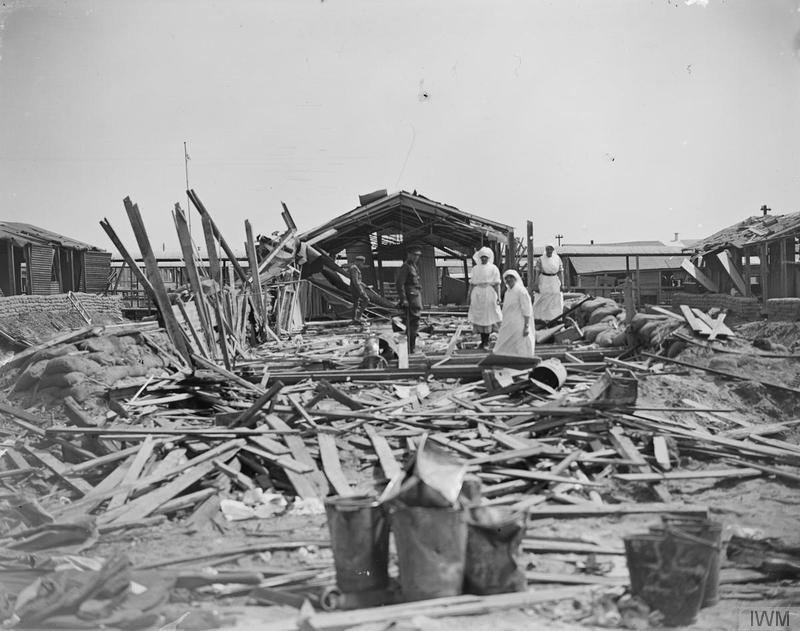
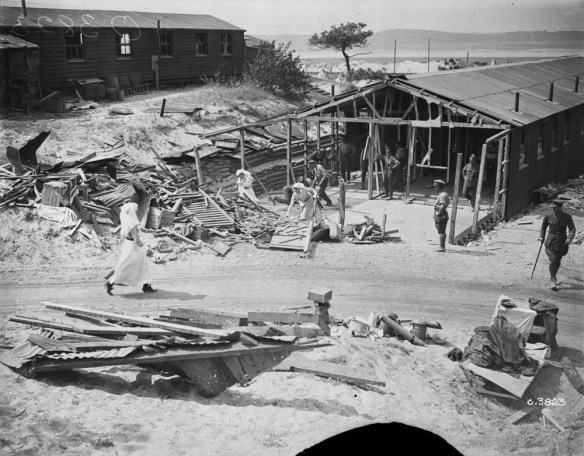
It was a clear, moonlit night and the hospitals – many of them provided by humanitarian organisations – were brightly lit as the nurses moved about the wards caring for their patients; elsewhere the hard-pressed surgeons were still operating on the maimed bodies of the wounded.  At 10 p.m. they heard the sound of approaching aircraft: first the clatter of gunfire and then, after the hospitals were plunged into precautionary darkness, the whistle of bombs falling.  The hospitals were hit repeatedly, and two hours later – when the flames had burned themselves out and the smoke cleared – several nurses had been killed and hundreds of patients had been killed or injured; multiple wards had been severely damaged.  Ten days later the aircraft returned; one hospital was totally destroyed and elsewhere operating rooms and wards were destroyed or damaged.

The scene is all too familiar: but this is not Gaza in 2014, Afghanistan in 2015 or Syria in 2016.  This is Étaples on the coast of France, 25 km south of Boulogne, in May 1918.
etaples-bombing-2-lowe_field_hospital_bombed_lac_pa_003747_a003747_v8-jpg_pv4a5fab25f240997c

On the Western Front it was common for stretcher-bearers to come under fire as they retrieved the wounded from No Man’s Land or carried them through the trenches and down the roads to aid posts and dressing stations; those places were often shelled since they were close to the front lines.  On 13 September 1914 Travis Hampson – a Medical Officer with a Field Ambulance – noted:

As one of our buses drove out onto the road to pick up some wounded gunners from the battery opposite, one landed on the road in front of it, and one behind, but not near enough to do any damage. With their glasses they must have been able to distinguish the white tilt and red cross, but we can’t grumble about being shelled if we are put amongst ammunition columns and batteries.

So too with the Casualty Clearing Stations (CCS) which had moved close to the front lines to speed up the treatment of what were often catastrophic wounds and to minimise the risk of infection.  Here is Kate Luard writing in her diary at Brandhoek on 18 August 1917:

He [the enemy] played about all night till daylight. There were several of him. He went to C.C.S.’s behind us. At one he wounded three Sisters and blew their cook-boy to pieces. The Sisters went to the Base by Ambulance Train this morning. At the other he wounded six Medical Officers among other casualties. A dirty trick, because he has maps and knows which are hospitals back there. Here we are in a continuous line of camps, batteries, dumps, etc., and he may not know.

In fact, her CCS was judged to be too close for comfort  and was ordered to evacuate a few days later.

Luard’s last sentence reinforces Hampson’s; in general (so she suggests) the Red Cross was respected.  The following year she wrote about German air raids on the CCS:

Jerry comes every night again and drops below the barrage, seeking whom he may devour: I think he gets low enough to see our huge Red Cross, as even when some of our lads butt in and engage him with their machine-guns, he hasn’t dropped anything on us.

For the most part, then, it seems that attacks on medical sites and personnel were the result of the inaccuracy of shellfire and bombing (especially at night) compounded by the close proximity of aid posts, dressing stations, CCS and ambulance trains to the fighting.

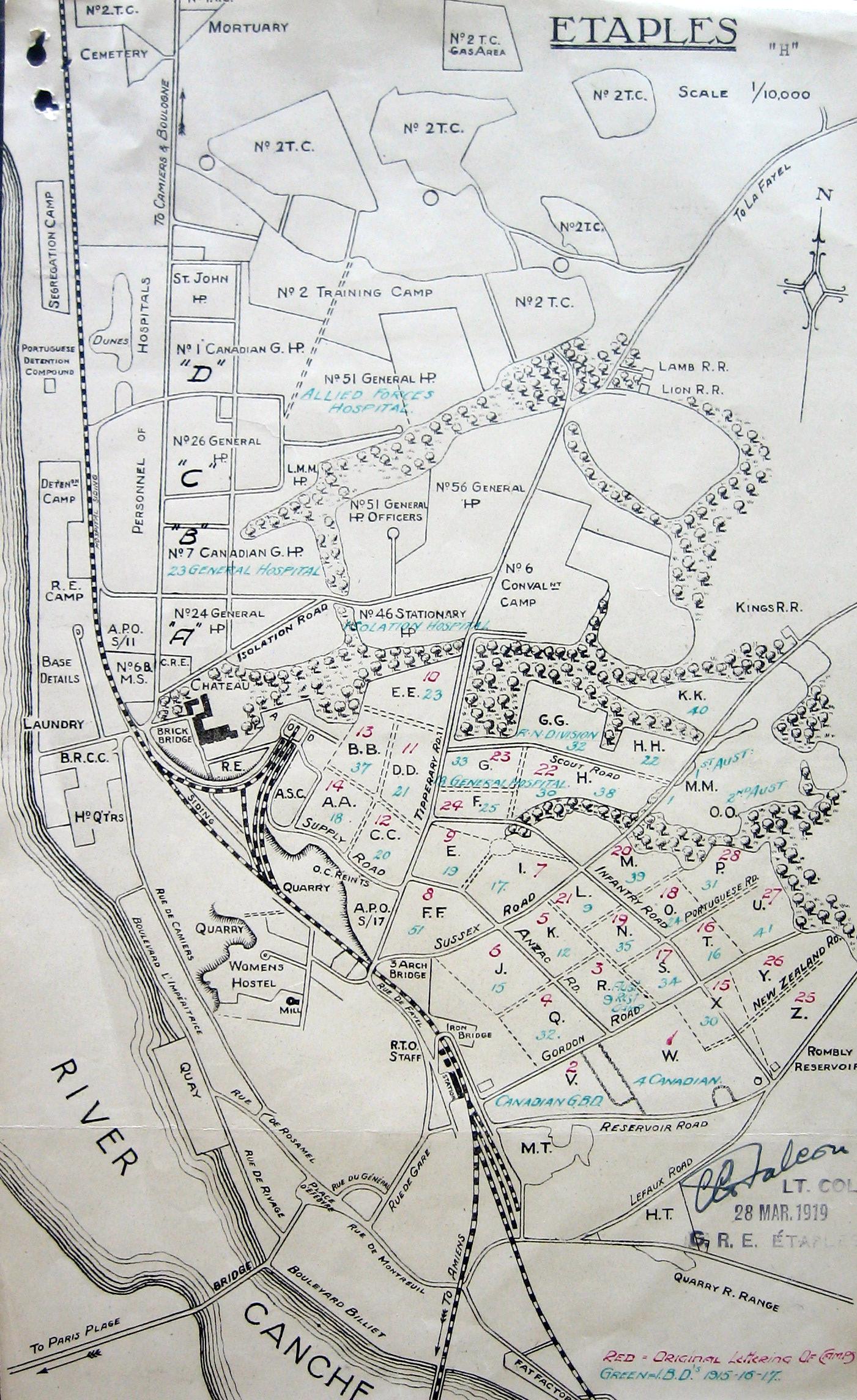
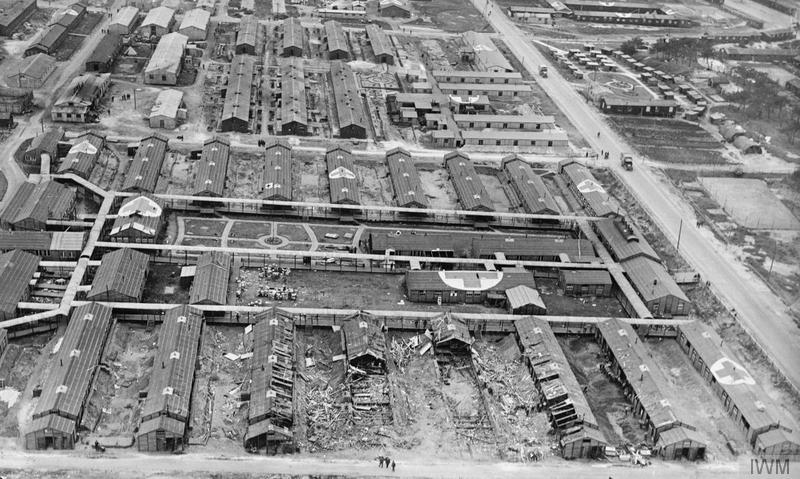
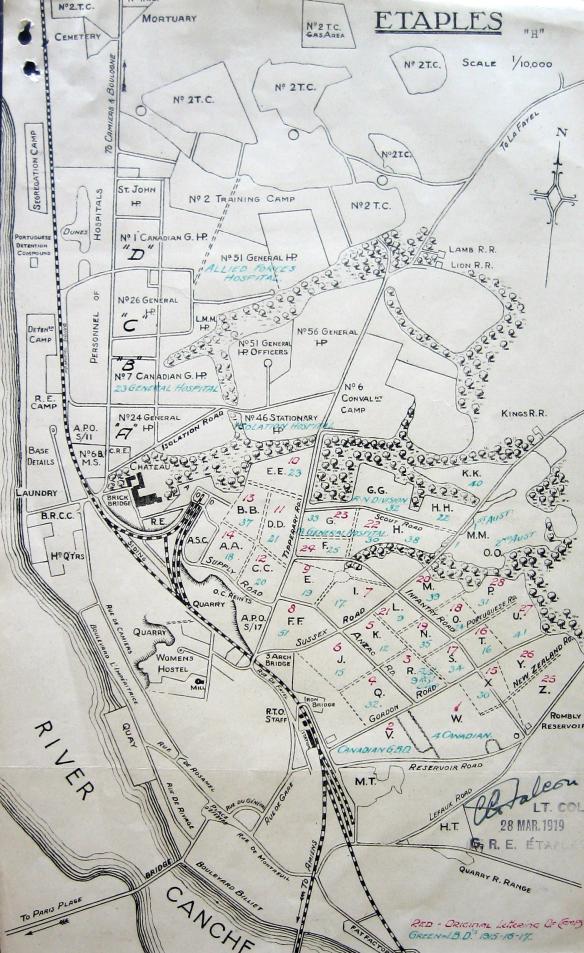
Yet the hospital raids in the last year of the war seemed to be something else.  Étaples was distant from the fighting, the site of a vast collection of ‘base hospitals’ – ‘the Land of Hospitals’, Sister Elsie Tranter called it, ‘a stretch of six kilometres of hospitals’ – to which wounded soldiers were sent from casualty clearing stations near the rapidly moving front: some to be treated and returned to active service, others to be evacuated across the Channel on hospital ships.
etaples-map

As soon as the news broke, the British press were up in arms at what the Times lost no time in calling ‘German savagery at its worst’:

‘During the recent fine weather our airmen have … made every use of the still air and the good visibility to attack and harass the enemy by bombing his camps, billets, rail-heads, batteries, dumps, roads and all points of military importance in the battle area and immediately behind.  At the same time, the German airmen have also been making use of the favourable conditions by having recourse to their old trick of bombing hospitals.

‘There is one place in France, faraway from the battle area, where we have a large group of hospitals.  The hospital tents there cover a great area of ground.  The Germans are perfectly aware of the character of the place, and they selected it as the object of a bombing raid last year.  They have again been attacking it, and the size of the tract of ground covered with hospital outfits and the entire absence of any concealment make it a mark which no airman could possibly miss.  An airman blind and drunk could let bombs fall from any height in any wind and weather, and they must land somewhere amongst the attendants’ quarters or on the tents where the nursing sisters move among the rows of cots with their helpless occupants.

‘On Sunday night the Germans attacked the place with all the ferocity of which they are capable… The scenes inside the tents were of the most piteous description, and the total casualties to patients, sisters, medical officers and attendants must have far exceeded those of any London air raid.  The redeeming feature of the whole horrible affair was the magnificent behaviour of the hospital staff…’ [Times, 24 May 1918]

This too is a familiar narrative, and one that would be repeated in countless wars to come: ‘we’ attack military targets with precision, ‘they’ attack civilian targets with abandon; their aircrew are cowards, our victims are heroes.

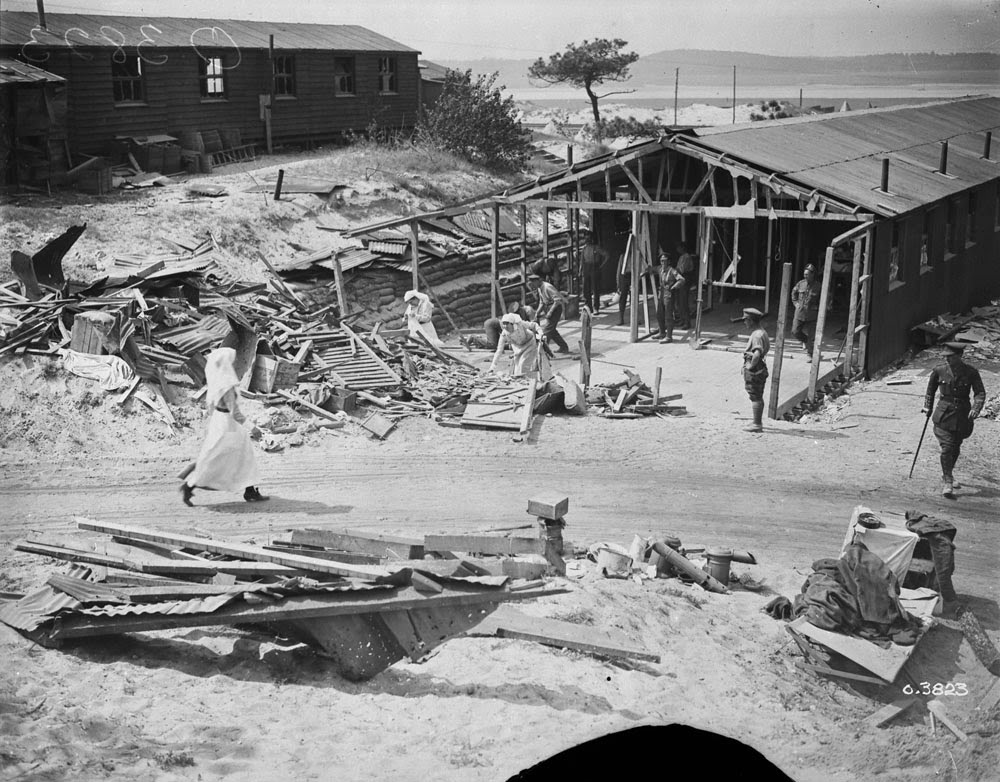
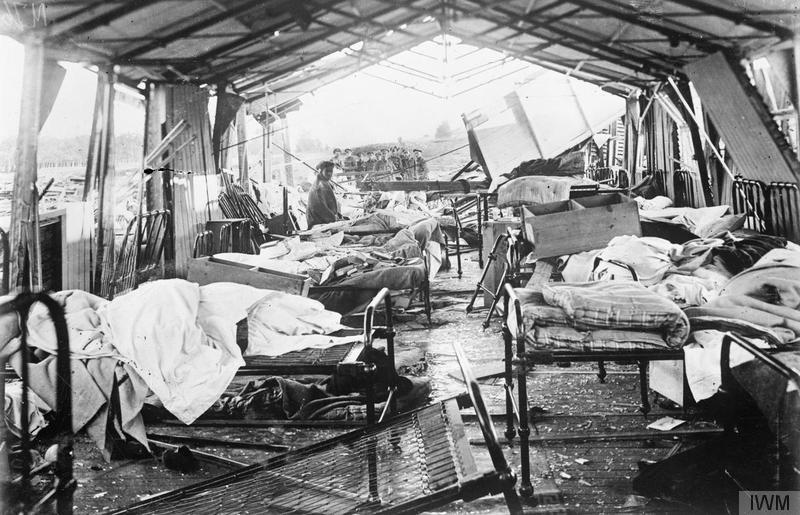
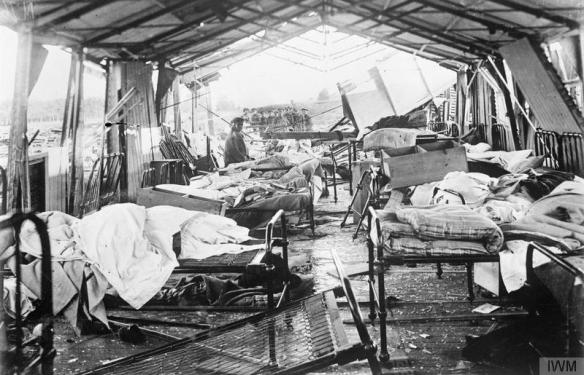
The press provided photographic evidence of the aftermath of the raids:
sjab-ward-destroyed-by-air-raids-etaples-may-1918

One of the German pilots was shot down – ‘and is now being cared for in the hospital he bombed’, thundered the Times – and his protestations were summarily dismissed:

‘He tried at first to excuse himself by saying that he saw no Red Cross.  When challenged with the fact that he knew that he was attacking hospitals he endeavoured to plead that hospitals should not be placed near railways, or if they are, they must take the consequences.  Apart from the fact that hospitals must be near railways for the transport of their patients, in this case, as in the others, the raiders were not attacking the railway but came deliberately to bomb the hospital.’

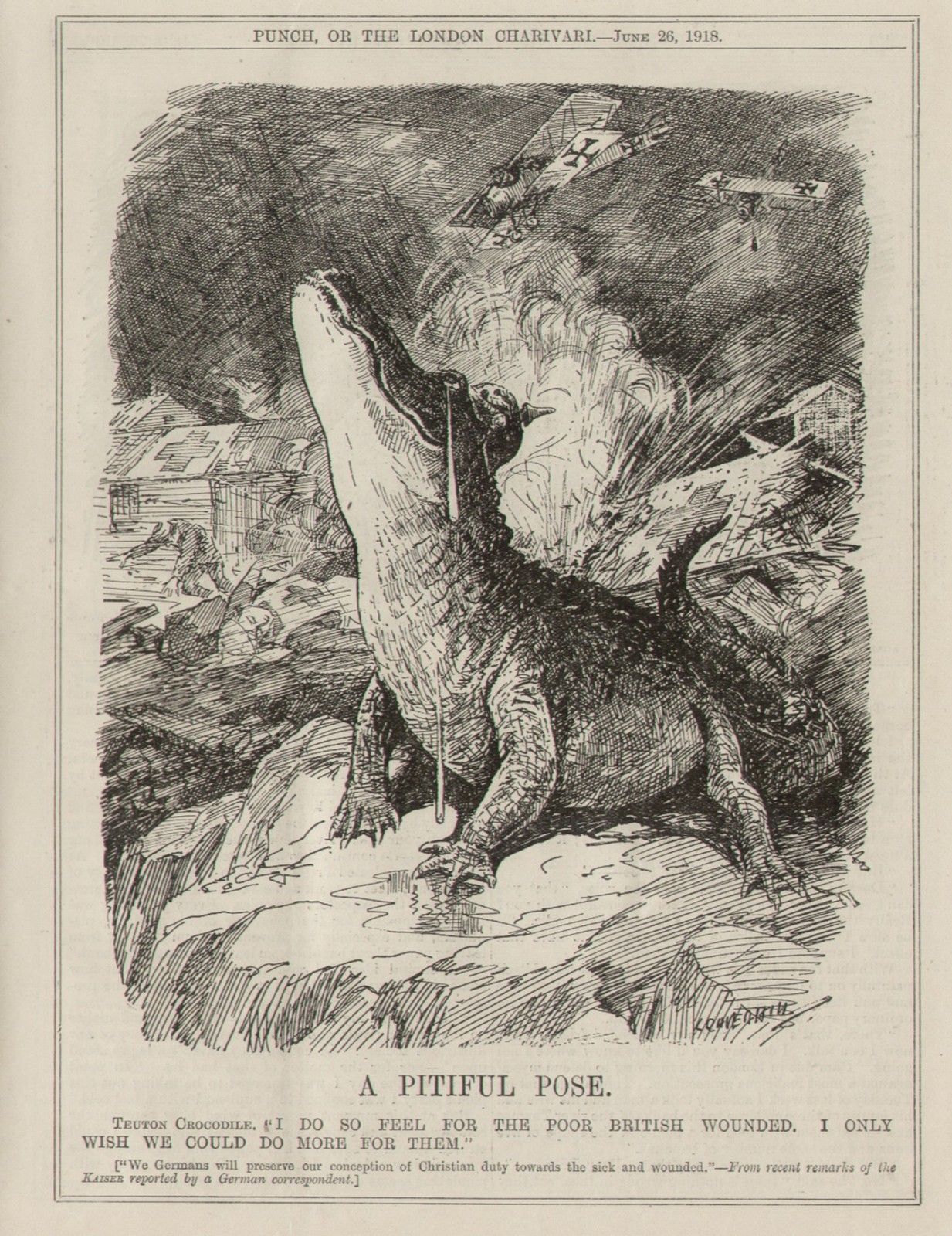
Punch dismissed German remorse as crocodile tears:
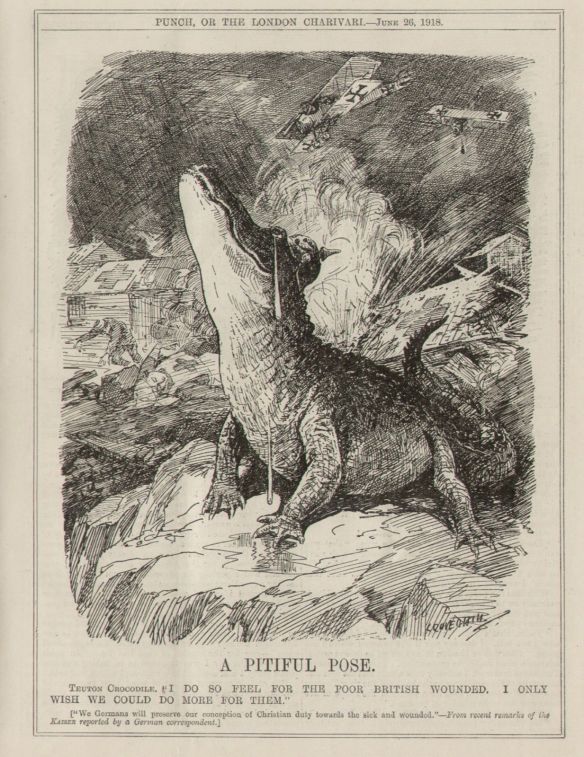
punch-26-june-1918

There were repeated angry calls for reprisals. Arthur Conan Doyle urged that the captured pilot be shot ‘with a notice that such will be the fate of all airmen who are captured in such attempts’ and recommended that German prisoners of war ‘at once be picketed among the tents’ to deter future raids [Times, 27 May 1918].  Sir James Bell went further.  Although his son had been killed in one of the raids, reprisals were not about revenge, he said, but were a strictly ‘military matter’.  He recommended ‘bombing German hospitals and killing their wounded’ to stop the outrages [Times, 5 June 1918].

Finally, the press trumped arguments about the presence of Red Crosses on the hospitals.  The Hague Convention required belligerents to take ‘all the necessary measures … to spare, as far as possible, … hospitals, and places where the sick and wounded are collected, on the understanding that they are not being used at the same time for military purposes’ and required them to mark such places with ‘distinctive and visible signs’.

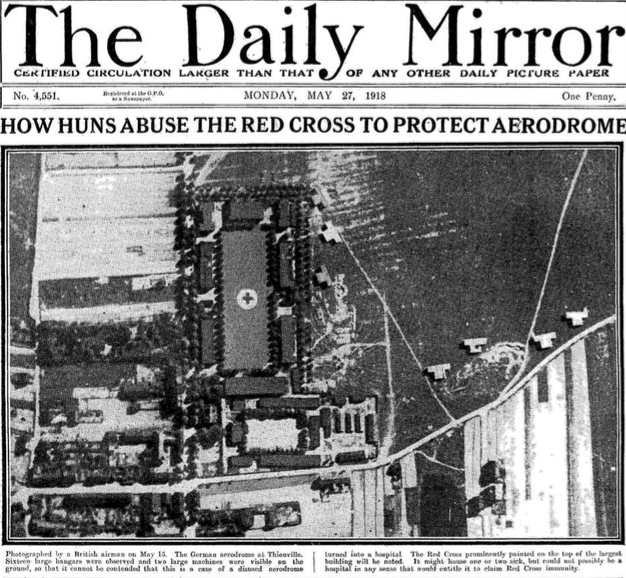
But far from respecting these protocols there was photographic evidence that the Germans were abusing the Red Cross to protect their own military installations:
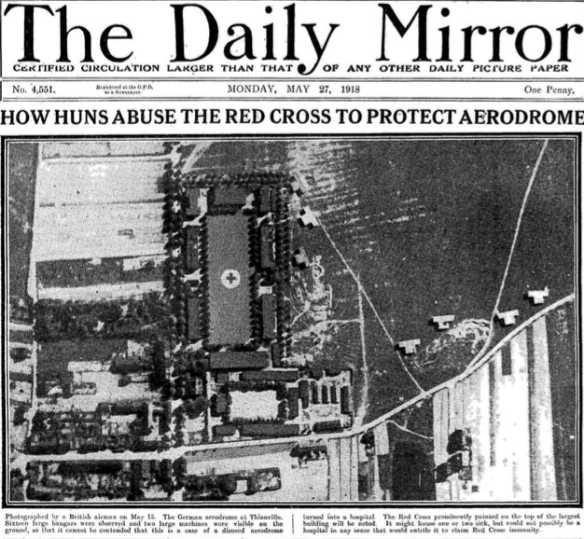
dm-27-may-1918

The aerial photograph was taken on 15 May 1918, and the caption described this as an active aerodrome at Thionville; the large building displaying the Red Cross ‘might house one or two sick’ but the Mirror insisted it ‘could not possibly be a hospital in any sense that would enable it to claim Red Cross immunity.’

And so, in her diary entry for 24 June 1918, Sister Edith Appleton wondered

‘if there is any truth in what they say about the bombing of hospitals – that in German territory the flying men have seen what are without doubt aeroplane hangers and ammunition dumps marked with huge red crosses. They are not near a railway and are so placed that they simply cannot be hospitals. I suppose they think we do the same and they bomb us on the chance of it. Of course we bomb their hangers and dumps – we should be fools if we didn’t! I am quite sure though that they do know what is a real hospital. They can see the wounded men walking about and some lying out in beds.’

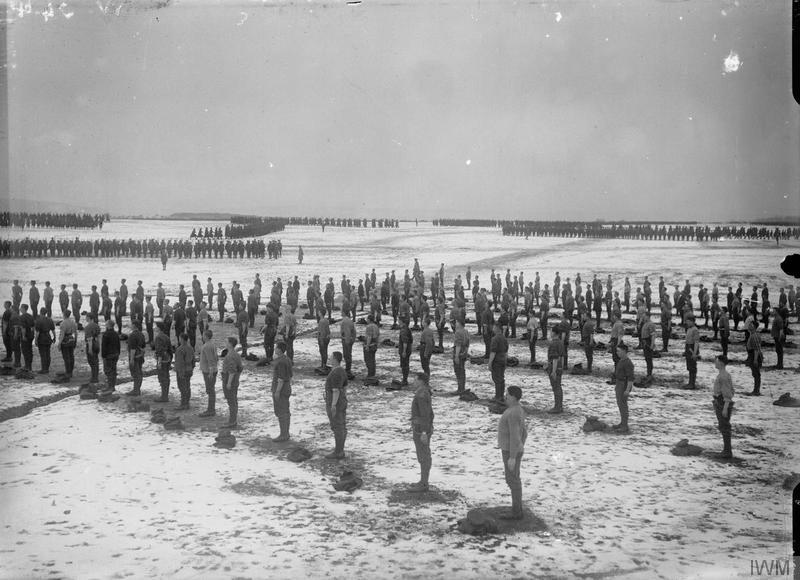
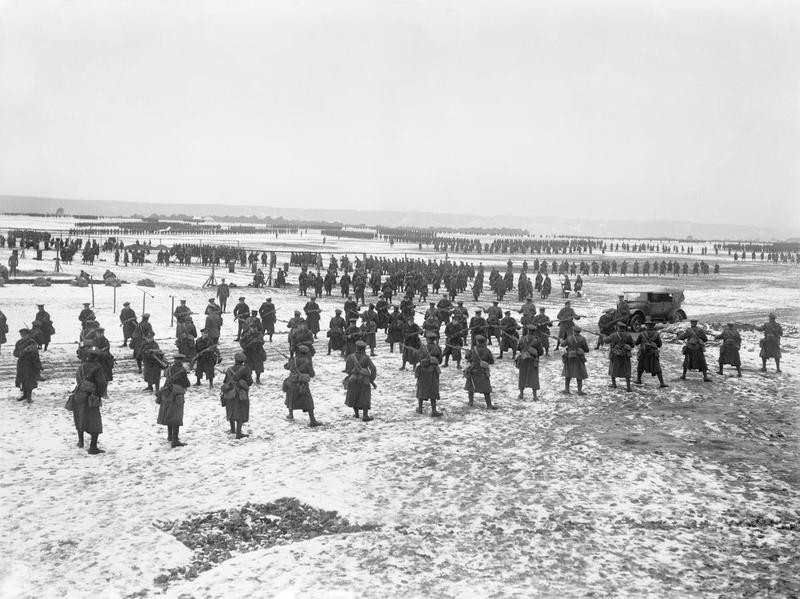
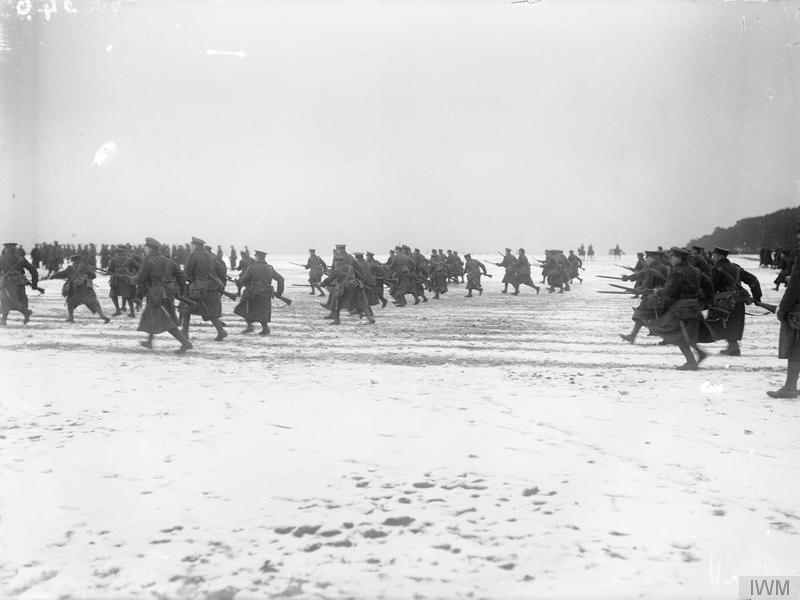
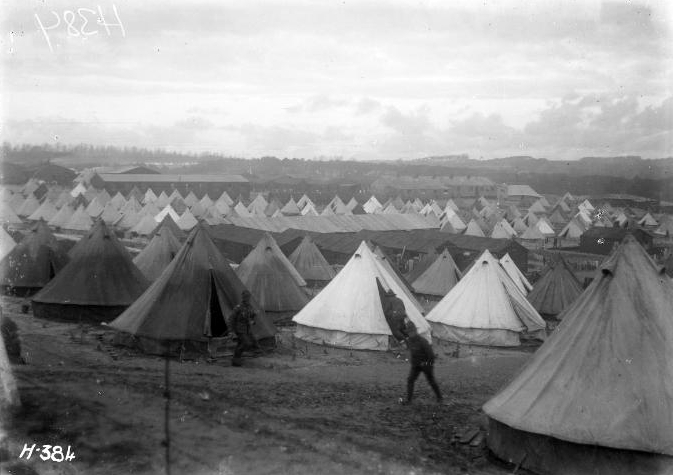
Yet the press reports were studiedly disingenuous.  Étaples was indeed physically removed from the fighting – ‘far away from the battle’, as the Times‘s correspondent noted – but it was functionally and logistically absolutely central to the Allied military machine because it was the site of multiple Infantry Base Depots.  It was a vital transit and training camp – all those ‘TCs’ scattered across the map (above).

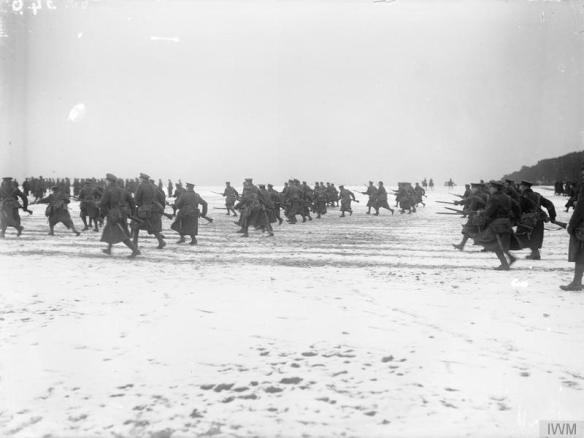
‘The Base!’ Edmund Blunden exclaimed in Undertones of War: ‘dismal tents, huge wooden warehouses, glum roadways, prisoning wire.’  He associated it, ‘as millions do, with “The Bull-Ring”, that thirsty, savage, interminable training-ground’ among the dunes where new recruits and newly discharged patients were put through their paces and ‘toughened up’ by unrelenting instructors.  When American military surgeon Harvey Cushing drove past its camps in 1917 they were ‘full of men rushing about like so many ants and all the color of the soil; drilling in the sand, practicing with machine guns, throwing bombs [grenades], having bayonet exercise, digging trenches and I know not what all.’  [For a thoughtful account of the oppressive conditions endured by troops during their two-week stints at the base and their contribution to the mutiny of 1917, see Douglas Gill and Gloden Dallas, ‘Mutiny at Étaples base 1917’, Past and Present 69 (1975) 88-112: ‘A corporal encountered several men returning to the front with wounds which were far from being healed. “When I asked why they had returned in that condition they invariably replied: ‘To get away from the Bull Ring’.”‘]
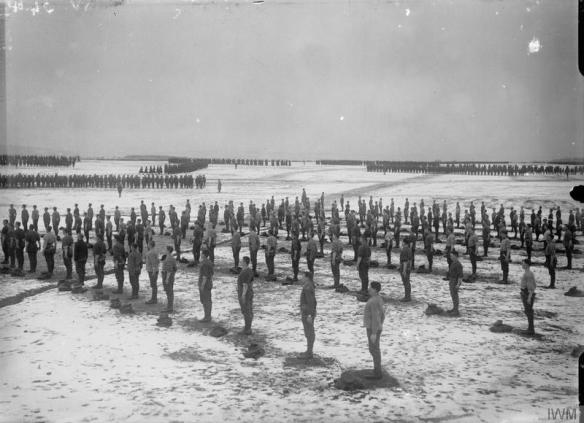
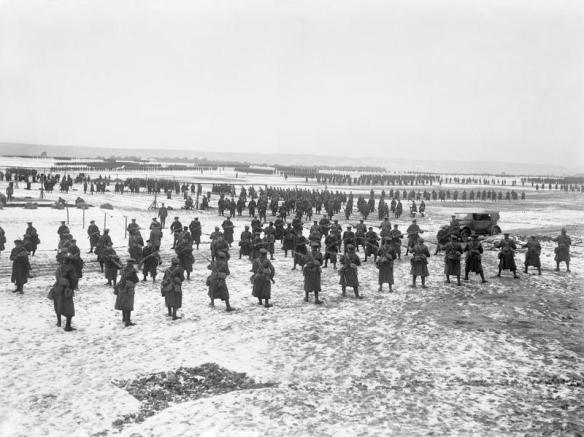
pe-in-the-bull-ring-at-etaples

bayonet-practice-in-bull-ring-at-etaples-iwm

troops-practice-bayonet-charge-in-the-bull-ring-at-etaples

In a letter to his mother Wilfred Owen described the base as ‘a vast, dreadful encampment’:

It seemed neither France nor England, but a kind of paddock where the beasts are kept a few days before the shambles [slaughter] … Chiefly I thought of the very strange look on all the faces in that camp; an incomprehensible look, which a man will never see in England …; nor can it be seen in any battle.  But only in Étaples. It was not despair, or terror, it was more terrible than terror, for it was a blindfold look, and without expression, like a dead rabbit’s.

The training camps were a sea of bell tents (below) – like many of the hospitals – and the captured airmen insisted that this had been their objective: ‘the number of bell tents convinced them this was not [a hospital] as patients would not be in bell tents.’
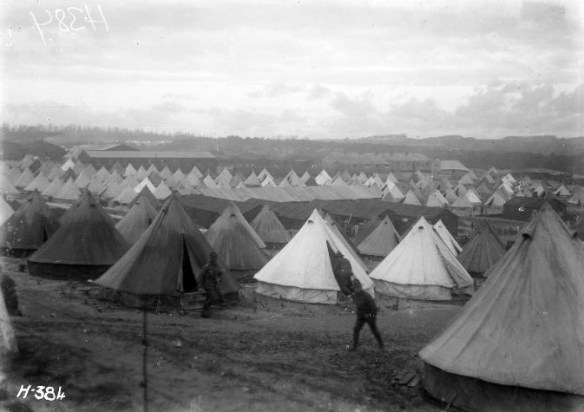
etaples-2

Étaples had been targeted before.  Vera Brittain, who was a nurse with the Voluntary Aid Detachment at No 24 General Hospital, described the ‘ceaseless and deafening roar [that] filled the air’ during the German  offensive in the spring: ‘Motor lorries and ammunition waggons crashed endlessly along the road; trains with reinforcements thundered all day up the line, or lumbered down more slowly with their heavy freight of wounded…’
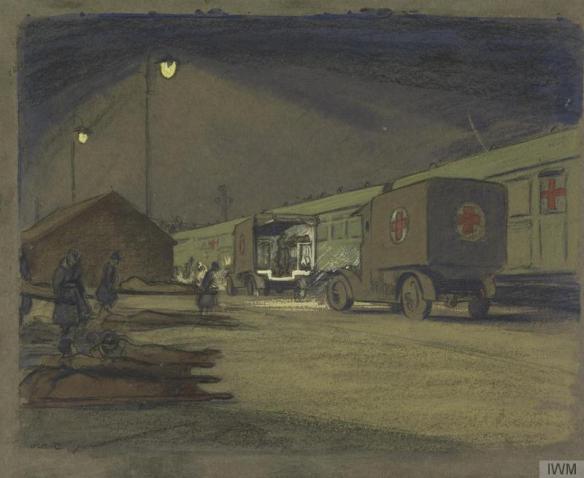
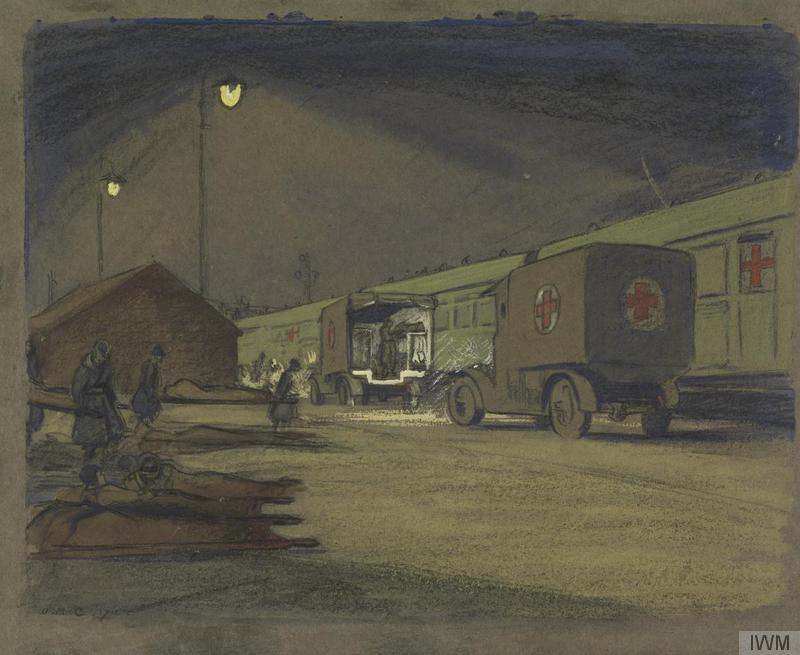
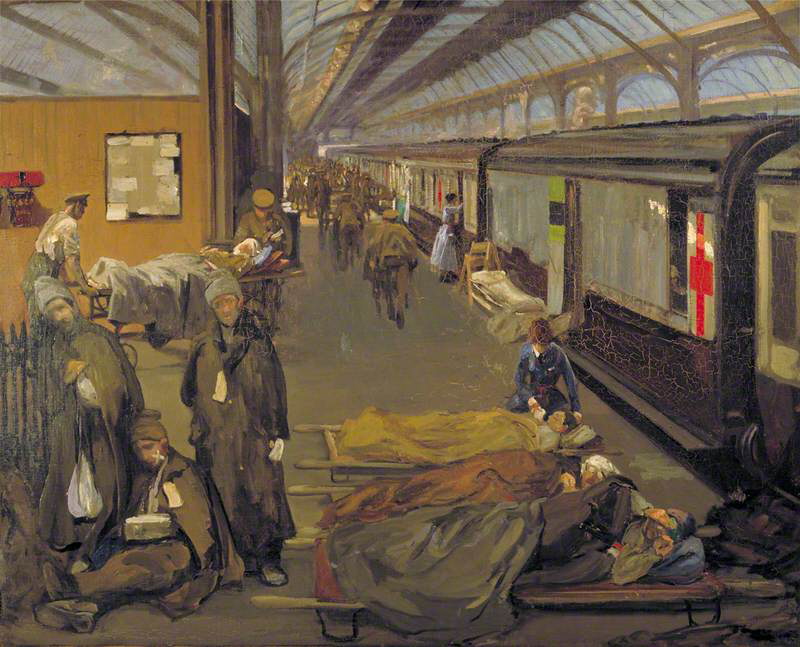
olive-mudie-cooke-unloading-ambulance-train-at-etaples-by-night

Images like this painting (above) by Olive Mudie-Cooke – a VAD convoy unloading an ambulance train at Étaples – are immensely powerful, but they ought not to blind us to the movement of men and matériel in the other direction.  As Vera Brittain knew only too well, there were in consequence frequent air raids on the lines of communication:

Certainly no Angels of Mons were watching over Etaples, or they would not have allowed mutilated men and exhausted women to be further oppressed by the series of nocturnal air-raids which for over a month supplied the camps beside the railway with periodic intimations of the less pleasing characteristics of a front-line trench.  The offensive seemed to have lasted since the beginning of creation, but must have actually been on for less than a fortnight, when the lights suddenly went out one evening…  Instead of the usual interval of silence followed by the return of the lights, an almost immediate series of crashes showed this alarm to be real…

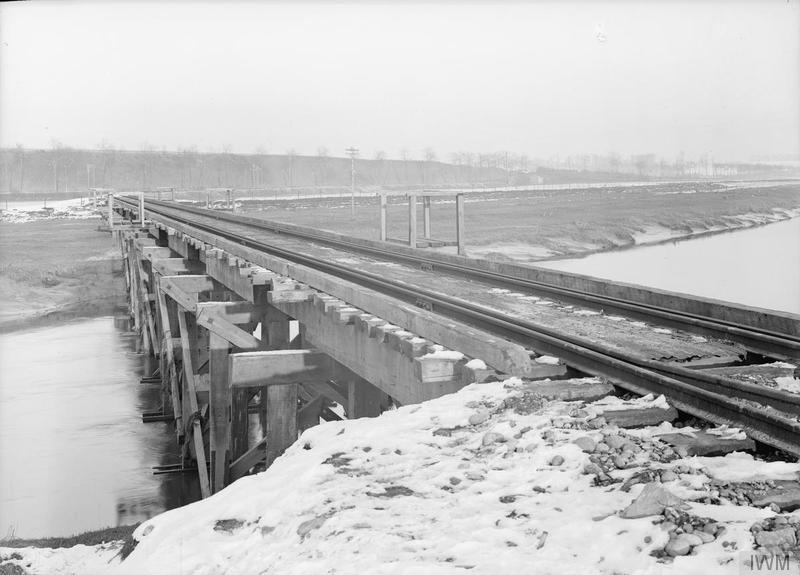
Gradually, after another brief burst of firing, the camp became quiet, though the lights were not turned on again that night.  Next day we were told that most of the bombs had fallen on the village; the bridge over the Canche, it was reported, had been smashed, and the train service had to be suspended while the engineers performed the exciting feat of mending it in less than twelve hours.
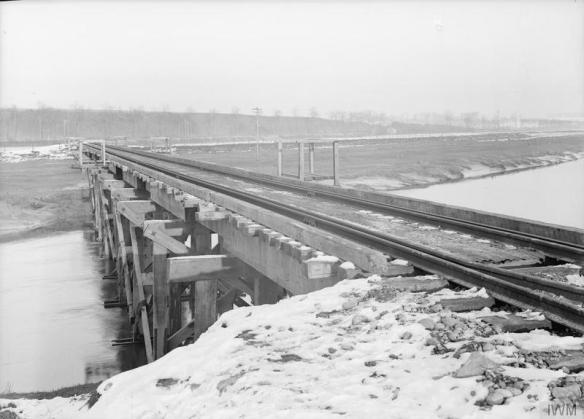
bridge-over-the-canche-at-etaples

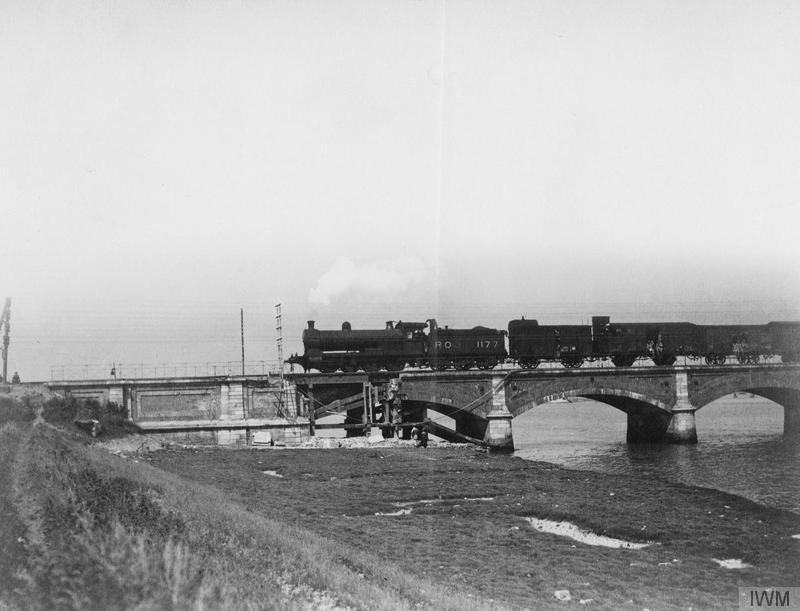
The bridge was of overwhelming strategic importance: by the time of the spring offensive a hundred military trains were passing over it every day.  Here is H.A. Jones in the official history of The war in the air (citing Colonel M.G. Taylor):

The enemy advance against the British on the Somme and on the Lys in March and April had endangered the railway system. ‘The culmination was reached in May 1918, when the great lateral line from St. Just, via Amiens, to Hazebrouck had to be abandoned as a railway route owing to enemy shell fire. Our armies were then penned into a narrow strip of country, possessing only one lateral railway communication, through Abbeville and Boulogne. Most of the forward engine depots had been lost, and several of the important engine depots remaining were so close to the enemy as to be practically useless, and our one lateral, along which all reserves and reinforcements drawn from one part of the front to be thrown in at another had to be moved, was threatened daily and nightly by persistent air attacks on the bridge over the Canche river at Etaples.

The Germans knew the importance of destroying, and the British of protecting, this line of communications.
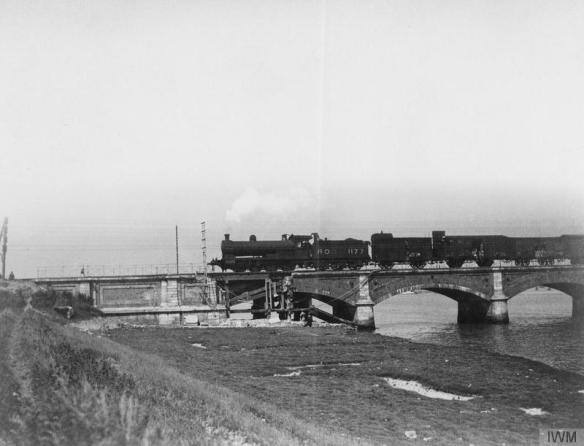
bridge-over-river-canche-at-etaples-damage-from-enemy-bombing-at-south-end-1918

Vera Brittain had returned to London when the Times published its report on the air raids in May. ‘It was clear from the guarded communiqué that this time the bombs had dropped on the hospitals themselves,’ she wrote, ‘causing many casualties and far more damage than the breaking of the bridge over the Canche in the first big raid.’  Cushing also recorded the enormity of the raid:

Étaples has had a bad hit – much worse than we had supposed… For two hours the raiders kept it up, returning again and again like moths around a flame.

But he knew Étaples of old and reckoned the objective was the same as before: not even the camps but the railway. ‘They were doubtless after the railroad and perhaps the bridge half a mile below.’

The official British history was similarly unequivocal:

During the night of the 19th/20th of May, at the time when the last of the German aeroplane raids was being made on London, fifteen bombers attacked the Etaples bridge. Only one bomb fell close and this did no damage: most of them exploded in neighbouring hospitals and camps with terrible effect… One of the German bombers was shot down, and the captured crew insisted that they did not know that hospitals were situated near the railway. They also expressed surprise, not without reason, that large hospitals should be placed close to air targets of first-rate military importance.

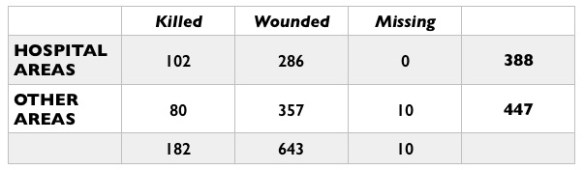
Certainly, the casualties were not confined to the hospital area:
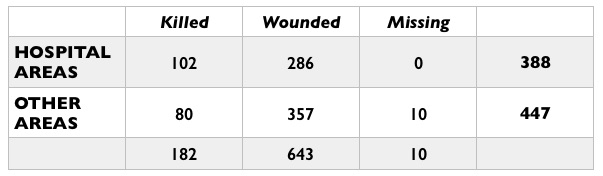
casualties-from-etaples-bombing-1920-may-1918

Two Infantry Base Depots suffered direct hits; 53 per cent of military casualties were outside the hospital area.

In fact, behind the scenes the British military and the intelligence service accepted that the hospitals were probably not the intended targets of the raid on 19-20 May or the second raid on 31 May/1 June. Here is the aftermath of that second raid on one Canadian hospital:
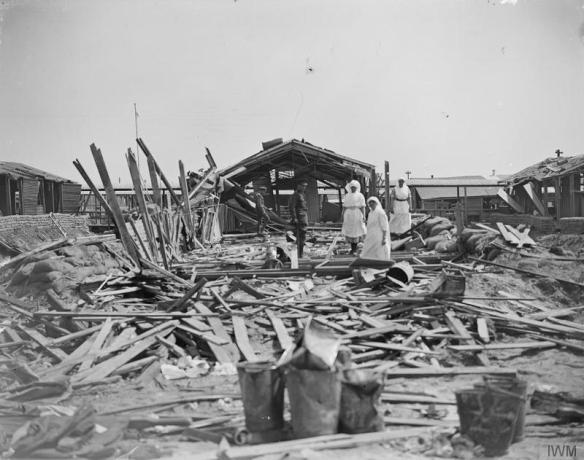
no-9-canadian-stationary-hospital-etaples-31-may-1918-iwm

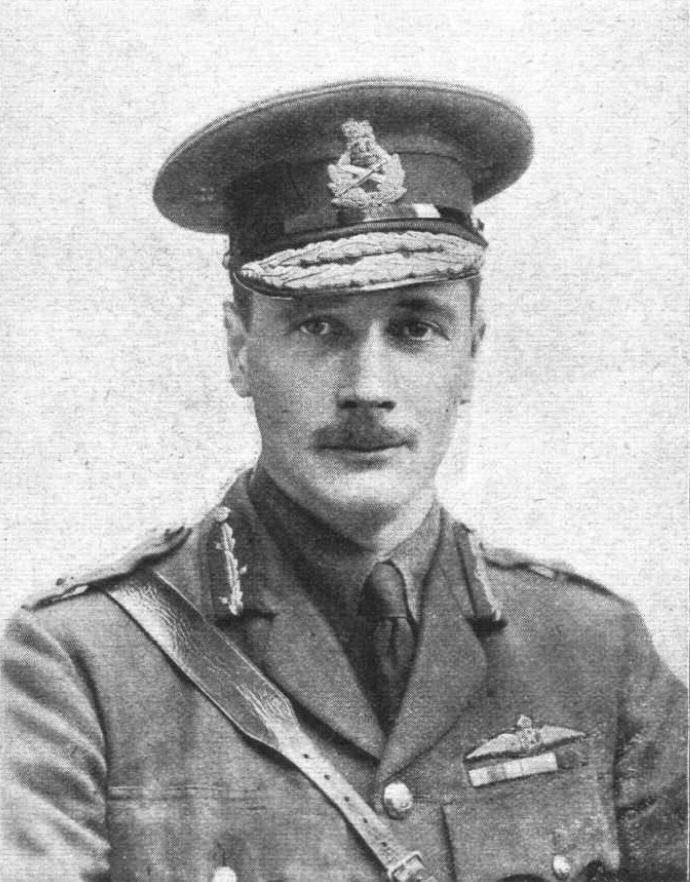
major-general_john_maitland_salmondAlthough Sir Douglas Haig firmly believed the hospitals were deliberately targeted in the second raid – he complained that ‘special measures’ had been taken after the air raid on the night of 19-20 May, with ‘Red Crosses repainted so that there could be no possible doubt as to the hospital area’ [see the image below] – Major-General John Salmond [right], who commanded the newly designated Royal Air Force in France, ‘considered it extremely improbable that Red or White Crosses would be distinctly visible at the height from which hostile pilots drop their bombs, usually 5,000 feet or over.’
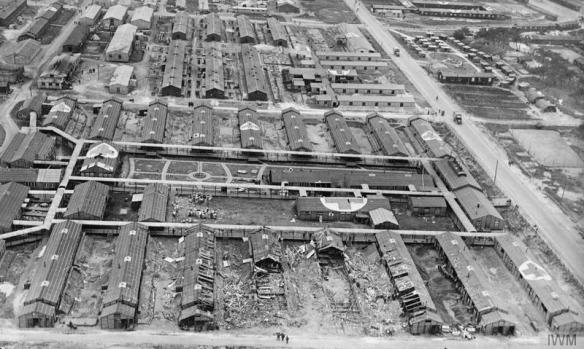
etaples-hospital-after-bombing-may-1918-iwm

The same (classified) report dated 29 June 1918 conceded that no definitive conclusion could be reached, but its author, the Director of Military Operations at the War Office Sir Percy Radcliffe, was none the less adamant that

We have no right to have hospitals mixed up with reinforcement camps, and close to railways and important bombing objectives, and until we remove the hospitals from vicinity of these objectives and place them in a region where there are no important objectives. I do not think we can reasonably accuse the Germans.

Indeed, Vera Brittain had prefaced her account of the May raids with a revealing rider.  ‘The persistent German raiders,’ she wrote, ‘had at last succeeded in their intention of smashing up the Étaples hospitals’ which ‘had so satisfactorily protected the railway line for three years without further trouble or expense to the military authorities‘ (my emphasis).  Now she was scarcely a spokeswoman for the British military, but her remark gestures towards the possibility of a remarkably cynical extension of the medical exemption to cover military objectives.

A hundred years later these same arguments about intentionality, accuracy, co-location and the protection (or otherwise) of a Red Cross would reappear in different guises.  But they would also be joined by others that revealed an aggressive refusal to accept the principle of medical neutrality at all.

To be continued
#PortesOuvertes

Like many other people, I’ve been trying to make sense of the horrific attack in Nice on 14 July. I’ve delayed writing about it because so much remains unknown – though that has not stopped a cascade of malignant certainties spewing from those on the Right who see every event as an opportunity to foment fear, harness hatred and deepen division.
A Tunisian man with no known history of political activism or religious affirmation kills 84 people by deliberately driving a truck through crowds along the Promenade des Anglais who were celebrating Bastille Day; a man who lived on the margins with a record of petty crime and domestic abuse; somebody with precious few resources, yet able to rent a truck and acquire weapons; and a claim to have ‘inspired’ the attack from Islamic State, which then hailed him as a ‘soldier’.

No wonder that Peter Beaumont agonises over ‘a new kind of terror – one we can’t define‘, where the systematic recruitment, training and organisation of other terrorist attacks bleeds into the savage violence of the ‘lone wolf’ prowling undetected in the darkness.  The incorporation and adulation of individuals and small groups with no previous connection to IS or other jihadi groups reverses what he calls the standard ‘polarity of responsibility: encouraging acts of violence that it accepts as bloody tributes thrown at its feet.’

The link with petty crime is not surprising.  Scott Atran notes that

Serious jihadi involvement with petty criminal networks began after the September 11 attacks as an unintended consequence of the ability of the United States and allies to cut off the flow of funding to suspect groups, especially through Islamic charities. So al-Qaeda and others began looking for funding and arms in criminal networks instead. And in these networks there were large numbers of marginalized immigrant youth, especially in France.

Indeed, Joseph Micallef makes a plausible case for IS expanding its involvement in criminality as its territorial hold on Iraq and Syria comes under intensifying assault: ‘The smuggling networks that are used to bring in armaments and militants can be just as easily be used to traffic in drugs and illegal immigrants.’  His inclusion of ‘illegal immigrants’ should give us pause for thought; I have no idea if he intends this to include refugees from the turmoil in Iraq, Syria and Libya (it shouldn’t).  But to the extent that IS is involved in human trafficking then this is a double victimisation of its prey.

All of this may be granted; but a causal link between Lahouaiej-Bouhlel’s murderous drive through crowds of innocent people and the designs of IS or any other radical version of political Islam is proving remarkably elusive.  There is a wider debate in France about whether the terrorism serially inflicted upon its people is at root about ‘the radicalization of Islam’ (Gilles Kepel – below left) or the ‘Islamicization of radicalism’ (Olivier Roy – below right) – there is a good summary here – but in this instance it is far from clear that either of them is relevant.

Gilles Keppel and Olivier Roy

Indeed, Farhad Khorokhavar, a sociologist at the École des Hautes Etudes en Sciences Sociales, doubts that ‘radicalisation’ is the appropriate term at all:

“I don’t think he was radicalised at all… It’s a case of raw violence. He took a decision to kill in a moment of despair. My guess is that it’s much more like a mass shooting in the US than [Islamist] radicalisation.”

He speaks instead of ‘mimetic violence’, where previous attacks have furnished ‘a model that fragile people can imitate.’

So I don’t know whether the atrocity in Nice can be attributed to IS or not – but I have no doubt that the precipitate rush to do so has substantive consequences.

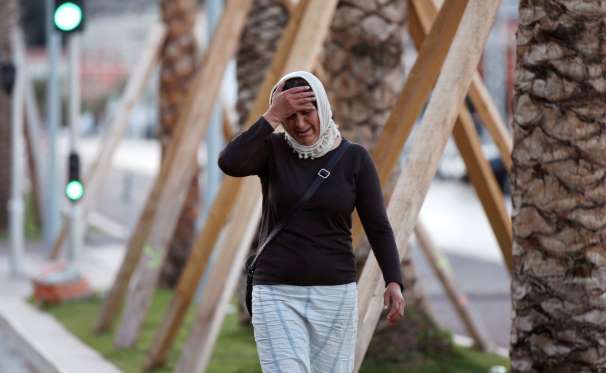
One place to start thinking critically about them is this photograph of a woman consumed by grief as she searches for her son after the attack:

Nice July 2016

The image serves to remind us that – if, to repeat, this does prove to be an attack whose trail can be traced back, however indirectly, to the dismal doors of Islamic State – the victims of such atrocities include people of many cultures and faiths.  Theirs is not a ‘war’ against a single, monolithic enemy; Nice is far from being a homogeneous city – like France, like the rest of Europe – and Alissa Rubin captures what she calls its ‘many-layered’ geography better than most:

There is the Nice of popular imagination, the old-world resort dotted with palm trees and cafes that look out on the Mediterranean Sea, suffused with an incandescent light prized for centuries by artists.

Then there is the other Nice, one that begins to show its face a few blocks inland from the seaside Promenade des Anglais, the majestic arc of a boulevard where 84 people were killed by a 31-year-old Tunisian immigrant at the wheel of a 19-ton truck. This Nice is home to many Muslim immigrants from North Africa, including a secular middle-class that has lived alongside non-Muslim French, and is also a place that local officials estimate has sent as many as 100 young people to fight in Syria with extremists.

“It is rare that these two worlds mix with each other except at the moment of festivities or of agreement, like the gatherings on Saturday,” said Feiza Ben Mohamed of the Muslims of the South, an organization that fights radicalization, referring to the public mourning for those killed in the truck attack.

“Yet the first victim was Muslim, and a good number of the victims were Muslims,” Ms. Mohamed added. “Just yesterday I was on the promenade reflecting on what had happened, and a journalist asked me if I was there to apologize in the name of Muslims. I said to him, ‘No, I came to weep for the dead like everyone else.’”

You can read another (short) essay by Farhad Khorokhavar on these divisions in France, ‘Jihad and the French exception’, here.  In Nice they have been intensified, not only by recruiters for the butchery in Syria – and there is no doubt of their success in Nice: Alpes-Maritimes was one of the first French départements to implement a counter-radicalisation strategy of sorts – but also by the advance of the far right National Front, and no doubt by memories of France’s colonial adventures in North Africa and the Levant and its deepening military involvement in Syria.

For now, France seems under repeated attack: the Charlie Hebdo murders in Paris in January 2015; the attacks on the Bataclan and other public places in Paris last November; and now the murder of more than 80 people in Nice.

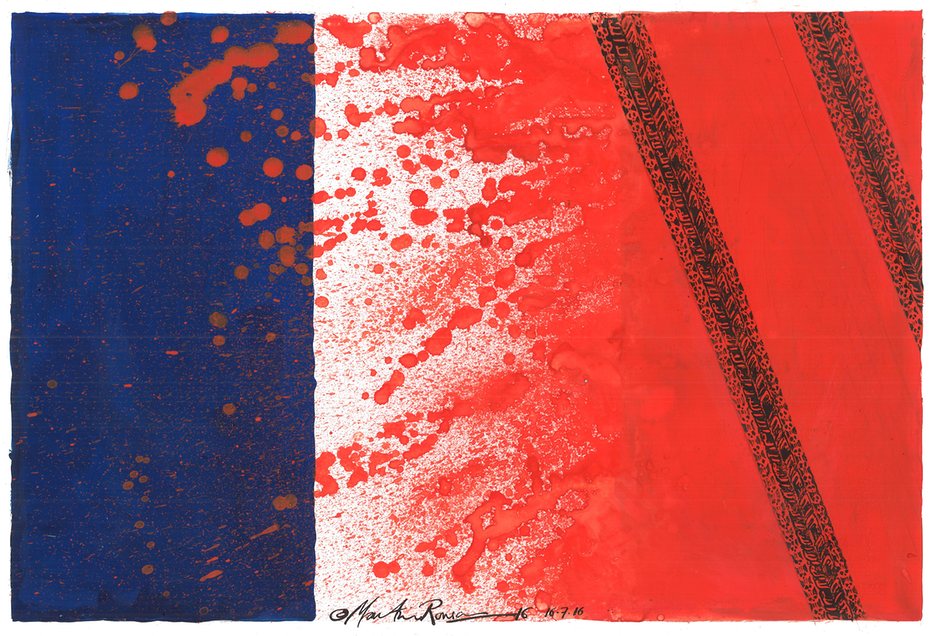
Martin Rowson cartoon Guardian

Each of these mass murders is truly, wrenchingly shocking: but those of us who live in Europe or North America cannot afford to allow those shock-waves to be refracted by geography because this would erect the bloody partition that is one of IS’s central objectives.  Nihilism meets narcissism.

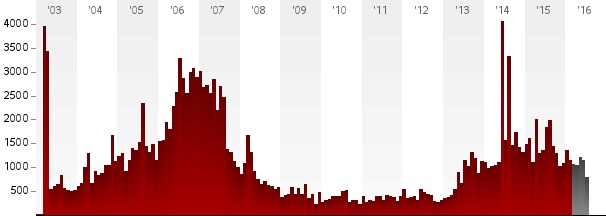
I made much the same point about Paris and Beirut last year.  Now we might twin Nice with Baghdad. Like Nice – like all cities worthy of the name – Baghdad is far from homogeneous, for all the ethno-sectarian ‘cleansing’ that occurred during the US occupation (see my account of ‘The Biopolitics of Baghdad’: DOWNLOADS tab), and those tensions continue to roil.  The truck bombing and subsequent fire that killed 300 people in the Karrada district as they broke their Ramadan fast at the end of the day on 3 July may have seemed like the ‘new normal’ to commentators watching the rising tide of violence in post-occupation Iraq; it too was claimed by IS.  So too many of us doubtless shrugged our shoulders.

Documented civilian deaths from violence in Iraq 2003-July 2016 (Iraq Body Count)

Documented civilian deaths from violence in Iraq 2003-July 2016 (Iraq Body Count)

And yet, as Walaa Chahine so movingly testified after another bombing there on 12 July, ‘We may be used to bombings in Baghdad, but Baghdad isn’t‘:

We are used to it, so we don’t make hashtags, change our profile pictures, or memorize their names. By taking away these rights away from them, and yes, they have become rights, as long as other victims are given them, we are taking away their connection to us as humans. We forget that we would probably never get used to having our hometowns bombed every day, that just like us, they are humans who don’t forget, can’t forget.

No, the eleven people killed today weren’t used to dying. The 292 killed last week were not used to it. Their families will never get used to it. No matter how long you spend in a war area, you never get used to it. Ask a soldier, ask a refugee, ask someone who experiences violence and pain on the daily if they ever truly get used to it. We might be able to tune out their screams, but we weren’t the ones screaming in the first place.

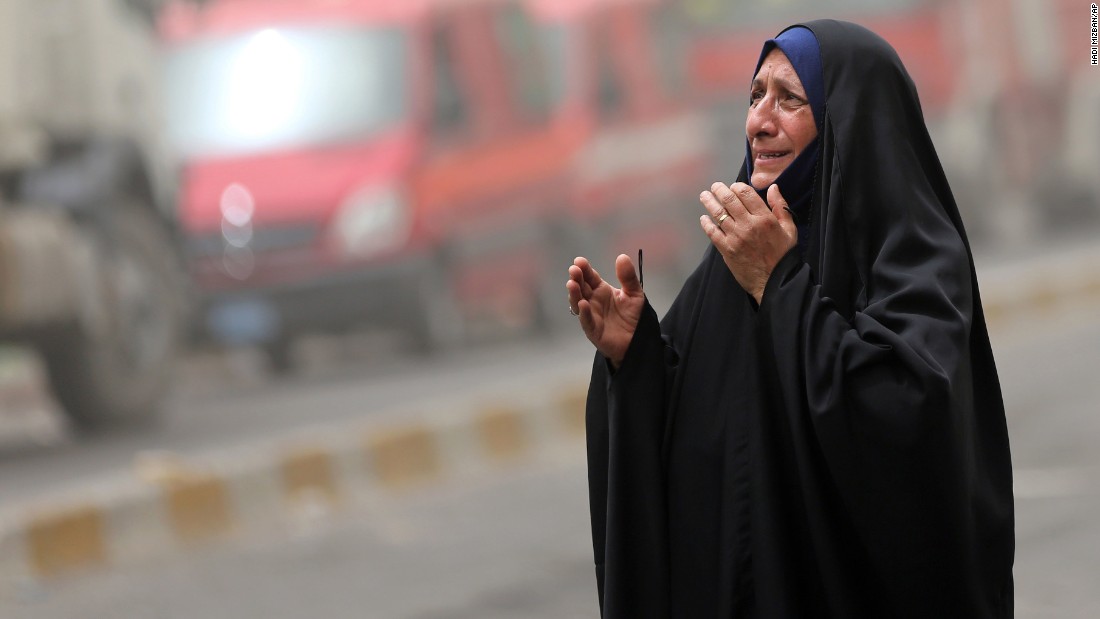
Iraqi woman grieving in Karrada July 2016

And so, as this contrapuntal geography shows, it bears repeating – until even the tone-deaf Donald Trump gets it – that most of the victims of Islamic State’s terrible violence are other, innocent Muslims.  And they live – and die – outside Europe and North America too.

‘Empire of the Globe’

Klementinum Library, Prague

A quick heads-up: the latest issue of Millennium [44 (3) (2016) 305-20] includes Bruno Latour‘s, ‘Onus Orbis Terrarum: About a Possible Shift in the Definition of Sovereignty’, a keynote address that – amongst many other targets – goes after the globe and geopolitics….  To give you a taste:

To put it more dramatically, the concept of the Globe allows geopolitics to unfold in just the same absolute space that was used by physicists before Einstein. Geopolitics remains stubbornly Newtonian. All loci might be different, but they are all visualised and pointed to on the same grid. They all differ from one another, but in the same predictable way: by their longitude and latitude.

What is amazing if you look at geopolitical textbooks, is that, apparently, the Globe remains a universal, unproblematic, and uncoded category that is supposed to mean the same thing for everybody. But for me, this is just the position that marks, without any doubt, the imperial dominion of the European tradition that is now shared, or so it seems, by everyone else.

I want to argue that the problem raised by the link between Europe and the Globe is that of understanding, as Peter Sloterdijk suggests, why it is that the onus orbis terrarum has been spread so efficiently that it has become the only space for geopolitics to unfold. Why is it that the res extensa, to use a Latin term that pertains to the history of art as well as of science and of philosophy, has been extended so much?

Instead of asking what vision of the Globe Europe should develop, it seems to me that the question should be: is Europe allowed to think grandly and radically enough to get rid of ‘the Globe’ as the unquestioned space for geopolitics? If it is the result of European invention and European dominion, this does not mean that it should remain undisputed. If there is one thing to provincialise, in addition to Europe, it is the idea of a natural Globe itself. We should find a way to provincialise the Globe, that is, to localise the localising system of coordinates that is used to pinpoint and situate, relative to one another, all the entities allowed to partake in geopolitical power grabs. This is the only way, it seems to me, to detach the figure of the emerging Earth from that of the Globe.

Geopolitics limited to absolute space?  The Globe as the ‘unquestioned space’ for geopolitics (and a geopolitics that is indifferent to, even silent about ‘the Earth’)?  Really?

MINCA and ROWAN Schmitt and SpaceIn an interview with Mark Salter and William Walters, which appears as a coda to the issue, there is also a lot about Carl Schmitt and the Nomos of the Earth (and a pointed rejection of the interpretation offered by Claudio Minca and Rory Rowan), and this passage on drones that loops back to the discussion of sovereignty:

The point, I think, is that ‘sovereign’ has one very precise meaning, which is: a referee. So, is there a referee or not? In my understanding of Schmitt, in the two great ideas of his – the ones on politics and the ones in Nomos – there is no referee, precisely. And so, you have to do politics, which means you have to have enemies and friends. Not because of any sort of war-like attitude (even though there is some talk of that in Schmitt as well). But because, precisely, if you have no referee, then you have to doubt; you have to risk that the others might be right, and that you might be wrong. You don’t know your value; you are not in a police operation. OK, so that defines the state now, because the state goes, all the way down, to a police operation. If there is a police operation and not war, then there is a State, in some ordinary sense. That is how we can understand the first hegemon of the United States, entering the First World War as a police operation, no question. The drone, now, flowing over [and] … moving on top of the space of the land, is a police operation because the one who sent it has no doubt that he or she acts as referee. So, the first thing is to draw the extent of that hegemon. How we would do that, I don’t know. Certainly, there would have been a book by Schmitt a few days after the first drone, about this new definition of the State, extending above air its police operation everywhere.

Good knock-about stuff, but I’m not convinced about any of this either (and exasperated by the current preoccupation with the hypostatisation of ‘policing’)…

Wounded

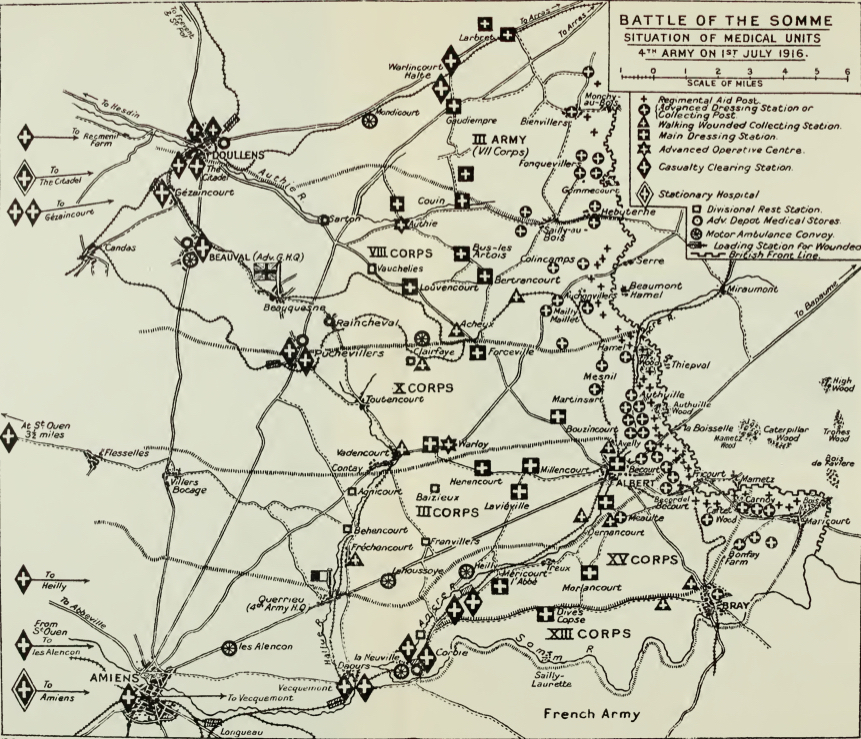
Somme medical dispositions.001

This summer London’s Science Museum is staging an exhibition that is of direct relevance to my current research on casualty evacuation from war zones over the last hundred years:  Wounded: Conflict, Casualties and Care.  It opens on 29 June and is designed to commemorate the centenary of the Battle of the Somme:

57,000 casualties were sustained by British Forces on 1 July 1916, the first day of the Battle of the Somme, creating huge and unprecedented medical challenges. Wounded: Conflict, Casualties and Care, a new exhibition opening at the Science Museum on 29 June, will commemorate the 100th anniversary of this battle and the remarkable innovations in medical practices and technologies that developed as a result of this new kind of industrialised warfare.

During the First World War ten million combatants were killed, but double that number were wounded and millions were left disabled, disfigured or traumatised by their experiences. The challenges were immense. For medical personnel near the front line treating blood loss and infection was the immediate priority in order to save lives. However medics also encountered new forms of physical and mental wounding on a scale that had never been seen before, creating huge numbers of veterans returning home with serious long term care needs.

At the centre of the exhibition will be a remarkable collection of historic objects from the Science Museum’s First World War medical collections, illustrating the stories of the wounded and those who cared for them. From stretchers adapted for use in narrow trenches to made-to-measure artificial arms fitted back in British hospitals, medical technologies, techniques and strategies were pioneered or adapted throughout the war to help the wounded along each stage of rescue and treatment. Visitors will also see unique lucky charms and improvised personal protective items carried by soldiers on the frontline alongside examples of official frontline medical equipment.

I’m looking forward to seeing this over the summer.  The organisers note that:

 Warfare has changed dramatically over the last one hundred years, but similarities remain with the military medical challenges faced today, both through the experiences of the wounded and in their treatment and care. The Wounded exhibition team has worked closely with two UK charities that were formed during the First World War, Combat Stress and Blind Veterans UK, to draw out these parallels and share the personal experiences of soldiers wounded in more recent conflicts.

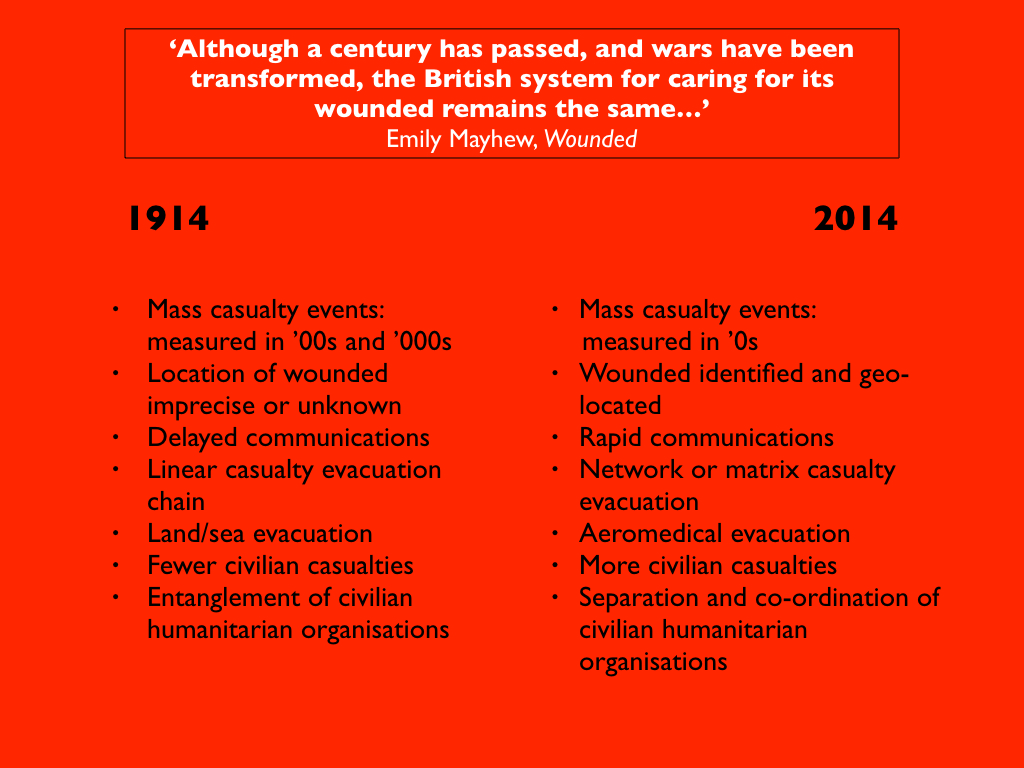
You can find some of my preliminary thoughts on casualty evacuation from the Western Front here and here, and on twenty-first century casualty evacuation in Afghanistan here and here.  Some of the differences between the two systems are summarised in this slide from a presentation on the project I gave in 2014.

WOUNDS OF WAR Vancouver Jan 2014.001

Much  more to come!

Flying lessons

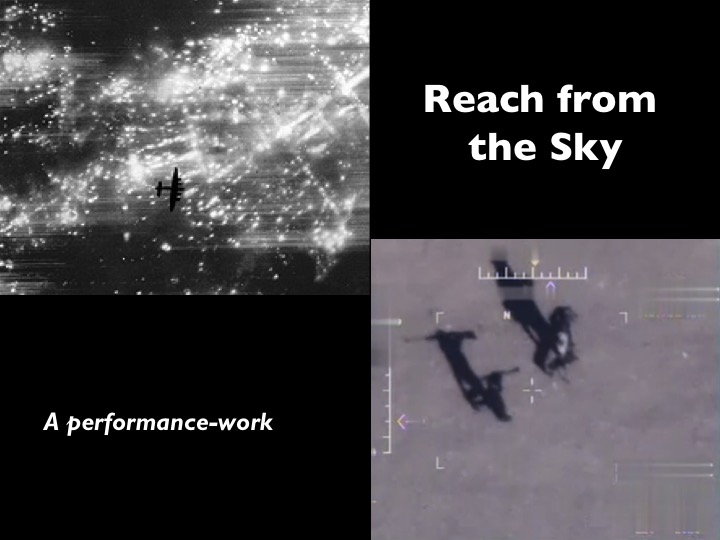
Reach from the Sky PERFORMANCE WORK

To complement the comparison implicit in my last post – between ‘manned’ and ‘unmanned’ military violence – I’ve added a presentation to those available under the DOWNLOADS tab.  I prepared it last month for an event at the Peter Wall Institute for Advanced Studies, where I performed it with my good friend Toph Marshall.  It’s part of my performance-work on bombing, and stages two cross-cutting monologues between a veteran from RAF Bomber Command who flew missions over France and Germany in the Second World War and a pilot at Creech Air Force Base in Nevada operating a Predator over Afghanistan.  As the title implies, it dramatises many of the themes I discuss in more analytical terms in my Tanner Lectures, ‘Reach from the Sky’.

For the performance, each speech was complemented by back-projected images.  Virtually all of the words were taken from ‘found texts’ – memoirs, diaries, letters and interviews – and the only consciously fictional lines were lifted from Andrew Niccol‘s Good Kill (and I’m sure that they originated in an interview with a real pilot).

It’s imperfect in all sorts of ways, and it is still very much a work in progress, but I’m posting it because it might be helpful for anyone teaching about aerial violence and its history.  If it is – or even (especially) if it is isn’t – I hope you’ll let me know.

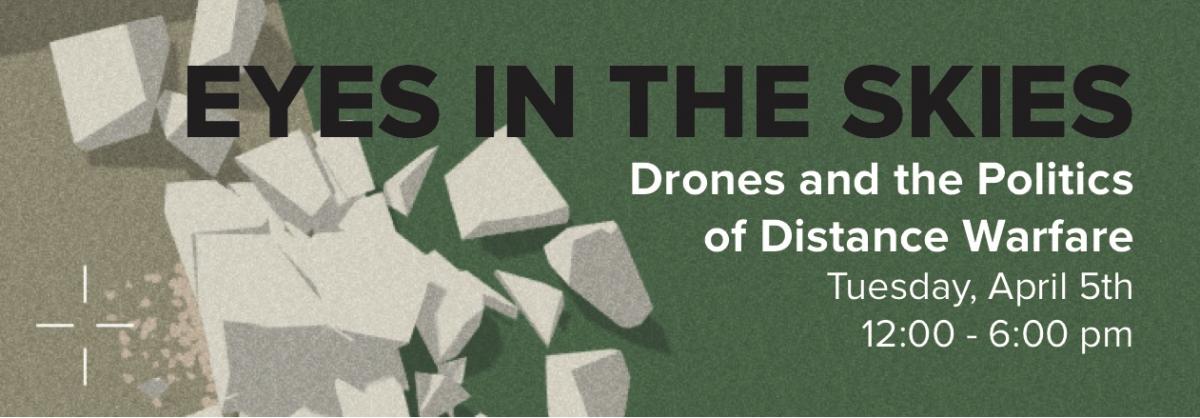
Eyes in the Skies

eyes_in_the_skies_pic

I’m just back from a wonderful time at UC Davis, where I was speaking at a symposium called “Eyes in the skies: drones and the politics of distance warfare.”  It was a creative program, packed with insights from Caren Kaplan and Andrea Miller, Priya Satia and Joe Delappe.

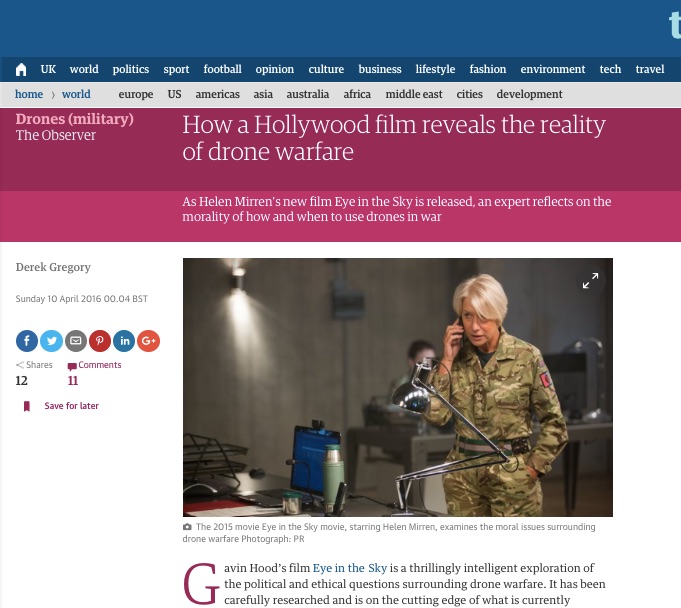
On my way back to Vancouver on Wednesday I received an invitation from Britain’s Guardian (in fact, the Sunday version, the Observer) to write something around that very question using the Gavin Hood film “Eyes in the sky” as a peg.

It’s just been published and you can find it here.

GREGORY Observer

At Davis I’d been giving what I think will be my final presentation of “Angry Eyes” (see here and here), so I was still preoccupied with remote platforms and close air support – not the contradiction it sounds – rather than targeted killing (which is the focus of the film).  The published version has, inevitably, been edited, so I’m pasting the full-length version below and added some links that might help.  There are still lots of short-cuts and elisions, necessarily so for anything of this length, so I hope readers will forgive the inevitable simplifications.

***

Gavin Hood’s Eye in the Sky is a thrillingly intelligent exploration of the political and ethical questions surrounding drone warfare. It’s been carefully researched and is on the cutting-edge of what is currently possible. But there’s a longer history and a wider geography that casts those issues in a different light.  As soon as the Wright Brothers demonstrated the possibility of human flight, others were busy imagining flying machines with nobody on board.  In 1910 Raymond Phillips captivated crowds in the London Hippodrome with a remotely controlled airship that floated out over the stalls and, when he pressed a switch, released hundreds of paper birds on the heads of the audience below. When he built the real thing, he promised, the birds would be replaced with bombs. Sitting safely in London he could attack Paris, Berlin – or Manchester (a possibility that understandably prompted questions about navigation).

There has always been something hideously theatrical about bombing, from the Hendon air displays in the 1920s featuring attacks on ‘native villages’ to the Shock and Awe visited on the inhabitants of Baghdad in 2003. The spectacle now includes the marionette movements of Predators and Reapers whose electronic strings are pulled from thousands of miles away. And it was precisely the remoteness of the control that thrilled the crowds in the Hippodrome. But what mattered even more was surely the prospect Phillips made so real: bombing cities and attacking civilians far from any battlefield.

Remoteness’ is in any case an elastic measure. Human beings have been killing other human beings at ever greater distances since the invention of the dart, the spear and the slingshot. Pope Urban II declared the crossbow illegal and Pope Innocent II upheld the ban in 1139 because it transformed the terms of encounter between Christian armies (using it against non-Christians was evidently a different matter). The invention of firearms wrought another transformation in the range of military violence, radicalized by the development of artillery, and airpower another. And yet today, in a world selectively but none the less sensibly shrunken by the very communications technologies that have made the deployment of armed drones possible, the use of these remote platforms seems to turn distance back into a moral absolute.

But if it is wrong to kill someone from 7,500 miles away (the distance from Creech Air Force Base in Nevada to Afghanistan), over what distance is it permissible to kill somebody?  For some, the difference is that drone crews are safe in the continental United States – their lives are not on the line – and this has become a constant refrain in the drone debates. In fact, the US Air Force has been concerned about the safety of its aircrews ever since its high losses during the Second World War. After Hiroshima and Nagasaki the Air Force experimented with using remotely controlled B-17 and B-47 aircraft to drop nuclear bombs without exposing aircrews to danger from the blast, and today it lauds its Predators and Reapers for their ability to ‘project power without vulnerability’.

It’s a complicated boast, because these remote platforms are slow, sluggish and easy to shoot down – they won’t be seen over Russian or Chinese skies any time soon. They can only be used in uncontested air space – against people who can’t fight back – and this echoes Britain’s colonial tactic of ‘air policing’ its subject peoples in the Middle East, East Africa and along the North-West Frontier (which, not altogether coincidentally, are the epicentres of todays’ remote operations). There are almost 200 people involved in every combat air patrol – Nick Cullather once described these remote platforms as the most labour intensive weapons system since the Zeppelin – and most of them are indeed out of harm’s way. It’s only a minor qualification to say that Predators and Reapers have a short range, so that they have to be launched by crews close to their targets before being handed off to their home-based operators. This is still remote-control war, mediated by satellite links and fiber-optic cables, but in Afghanistan the launch and recovery and the maintenance crews are exposed to real danger. Even so, Grégoire Chamayou insists that for most of those involved this is hunting not warfare, animated by pursuit not combat [see here, here and here].

Yet it’s important not to use this aperçu to lionize conventional bombing. There is an important sense in which virtually all aerial violence has become remarkably remote. It’s not just that bombing has come to be seen as a dismal alternative to ‘boots on the ground’; advanced militaries pick their fights, avoid symmetrical warfare and prefer enemies whose ability to retaliate is limited, compromised or degraded. When he was Secretary of Defense Robert Gates acknowledged that the US had not lost a pilot in air combat for forty years. ‘The days of jousting with the enemy in the sky, of flirting daily with death in the clouds, are all but over,’ writes the far-from-pacifist Mark Bowden, ‘and have been for some time.’ The US Air Force goes to war ‘virtually unopposed’. In short, the distance between the pilot in the box at Creech and the pilot hurtling through the skies over Afghanistan is less than you might think. ‘Those pilots might as well be in Nevada’, says Tom Engelhardt, ‘since there is no enemy that can touch them.’

This suggests that we need to situate armed drones within the larger matrix of aerial violence.  Bombing in the major wars of the twentieth century was always dangerous to those who carried it out, but those who dropped bombs over Hamburg or Cologne in the Second World War or over the rainforests of South Vietnam in the 1960s and 70s were, in a crucial sense, also remote from their targets. Memoirs from Bomber Command crews confirm that the target cities appeared as lights sparkling on black velvet, ‘like a Brocks firework display.’ ‘The good thing about being in an aeroplane at war is that you never touch the enemy’, recalled one veteran. ‘You never see the whites of their eyes. You drop a four-thousand-pound cookie and kill a thousand people but you never see a single one of them.’ He explained: ‘It’s the distance and the blindness that enables you to do these things.’ The crews of B-52 bombers on Arc Light missions dropped their loads on elongated target boxes that were little more than abstract geometries. ‘Sitting in their air-conditioned compartments more than five miles above the jungle’, the New York Times reported in 1972, the crews ‘knew virtually nothing about their targets, and showed no curiosity.’ One of them explained that ‘we’re so far away’ that ‘it’s a highly impersonal war for us.’

Distance no longer confers blindness on those who operate today’s drones. They have a much closer, more detailed view of the people they kill. The US Air Force describes their job as putting ‘warheads on foreheads’, and they are required to remain on station to carry out a battle damage assessment that is often an inventory of body parts.  Most drone crews will tell you that they do not feel thousands of miles away from the action: just eighteen inches, the distance from eye to screen.

Their primary function is to provide intelligence, surveillance and reconnaissance. This was exactly how the Wright brothers thought military aircraft would be used – in July 1917 Orville insisted that ‘bomb-dropping’ would be at best a minor role and almost certainly useless, though he was speaking before the major air offensives in the final year of the war and could have had no inkling of what was to come in the Second World War. The Predator and its precursors were designed to identify targets for conventional strike aircraft over the Balkans in the 1990s, and thirty years later it is still those ‘eyes in the sky’ that make the difference. Although drones have been armed since 2001, until late 2012 they were directly responsible for only 5-10 per cent of all air strikes in Afghanistan. But they were involved in orchestrating many more. Flying a Predator or a Reaper ‘is more like being a manager’, one pilot explained to Daniel Rothenberg: ‘You’re managing multiple assets and you’re involved with the other platforms using the information coming off of your aircraft.’ In principle it’s not so different from using aircraft to range targets for artillery on the Western Front, but the process has been radicalized by the drone’s real-time full-motion video feeds that enable highly mobile ‘targets of opportunity’ to be identified and tracked. In the absence of ground intelligence, this becomes crucial: until drones were relocated in sufficient numbers from Afghanistan and elsewhere to enable purported IS-targets in Syria to be identified, most US aircraft were returning to base without releasing their weapons.

Armed drones are used to carry out targeted killings, both inside and outside areas of ‘active hostilities’, and to provide close air support to ground troops. Targeted killing has spurred an intense critical debate, and rightly so – this is the focus of Eye in the sky too – but close air support has not been subject to the same scrutiny. In both cases, video feeds are central, but it is a mistake to think that this reduces war to a video game – a jibe that in any case fails to appreciate that today’s video games are often profoundly immersive.   In fact, that may be part of the problem. Several studies have shown that civilian casualties are most likely when air strikes are carried out to support troops in contact with an enemy, and even more likely when they are carried out from remote platforms. I suspect that drone crews may compensate for their physical rather than emotional distance by ‘leaning forward’ to do everything they can to protect the troops on the ground. This in turn predisposes them to interpret every action in the vicinity of a ground force as hostile – and civilians as combatants – not least because these are silent movies: the only sound, apart from the clacking of computer keys as they talk in secure chat rooms with those watching the video feeds, comes from radio communications with their own forces.

In contrast to those shown in Eye in the Sky, those feeds are often blurry, fuzzy, indistinct, broken, compressed -– and, above all, ambiguous. How can you be sure that is an insurgent burying an IED and not a farmer digging a ditch?  The situation is more fraught because the image stream is watched by so many other eyes on the ground, who all have their own ideas about what is being shown and what to do about it.  Combining sensor and shooter in the same (remote) platform may have ‘compressed the kill-chain’, as the Air Force puts it, and this is vital in an era of ‘just-in-time’, liquid war where everything happens so fast. Yet in another sense the kill-chain has been spectacularly extended: senior officers, ground force commanders, military lawyers, video analysts all have access to the feeds. There’s a wonderful passage in Brian Castner‘s All the ways we kill and die that captures the dilemma perfectly. ‘A human in the loop?’, Castner’s drone pilot complains.

‘Try two or three or a hundred humans in the loop. Gene was the eye of the needle, and the whole war and a thousand rich generals must pass through him… If they wanted to fly the fucking plane, they could come out and do it themselves.’

This is the networked warfare, scattered over multiple locations around the world, shown in Eye in the Sky. But the network often goes down and gets overloaded – it’s not a smooth and seamlessly functioning machine – and it is shot through with ambiguity, uncertainty and indecision.  And often those eyes in the sky multiply rather than disperse the fog of war.

Industrialised war

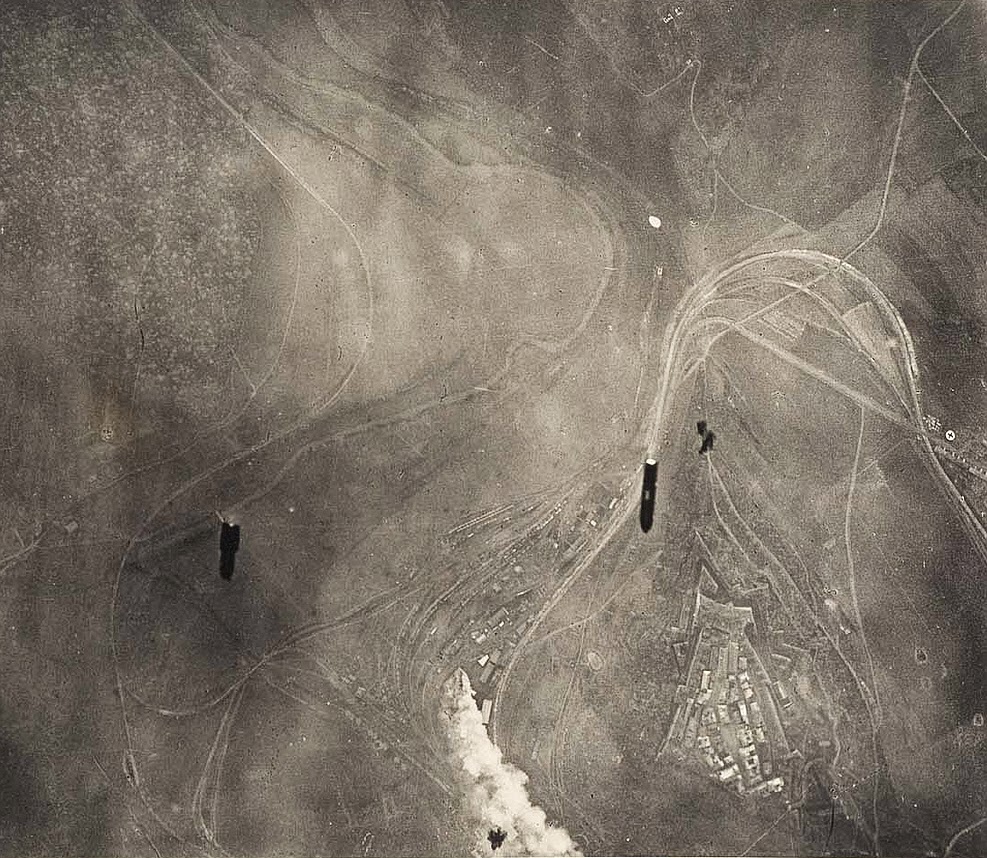
Bombs falling on Montmedy and marshalling yards

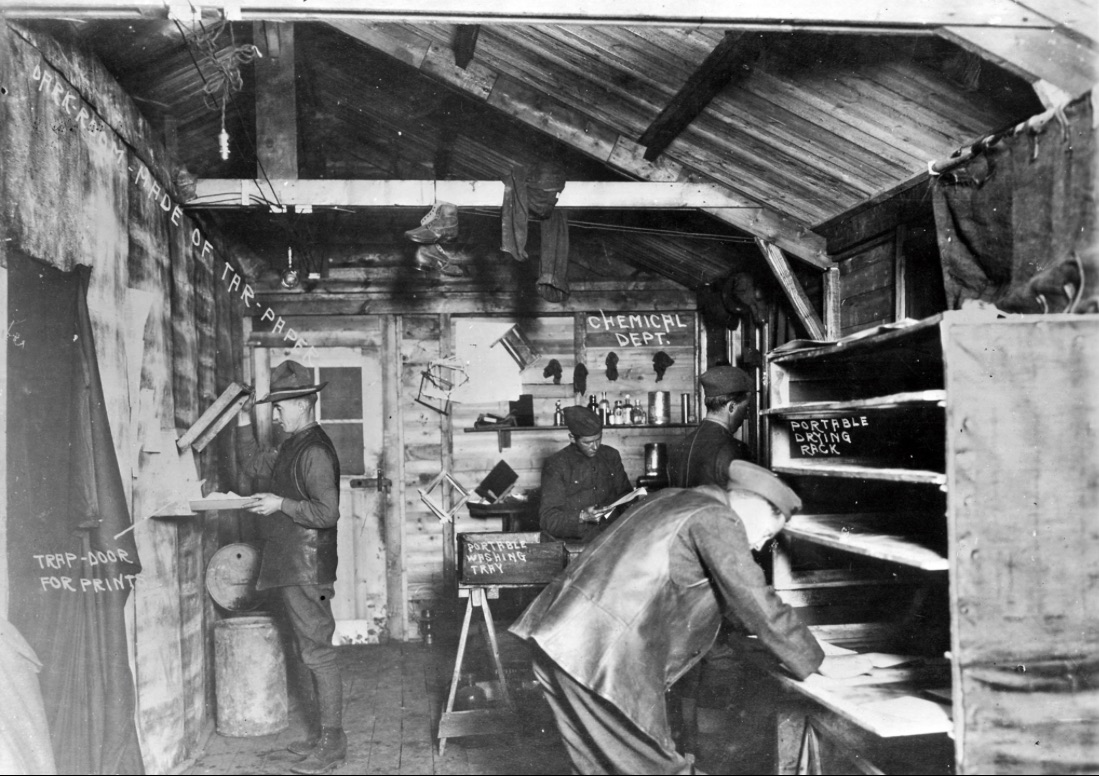
As I work on the text of “Reach from the Sky”, I’ve been revisiting the role of Edward Steichen in the development (in fact, the industrialisation) of air photography on the Western Front.  As I noted, all too briefly, in ‘Gabriel’s map’ (DOWNLOADS tab), Steichen commanded the photographic division of the American Expeditionary Forces. He organised the 55 officers and 1,111 men under his command into what Paul Virilio described as ‘a factory-style output of war information’ that ‘fitted perfectly with the statistical tendencies of this first great military-industrial conflict’.

Steichen 5th Photographic section at work on Western Front

The classic source on Steichen’s assembly-line methods of reproduction (and much more) is Allen Sekula‘s essay, ‘The instrumental image: Steichen at war’, in Artforum 14 (1975) 26-35 [see also the image above]:

The establishment of this method of production grew out of demands for resolution, volume, and immediacy. No method of reproduction but direct printing from the original negative would hold the detail necessary for reconnaissance purposes. Large numbers of prints from a single negative had to be made for distribution throughout the hierarchy of command. In addition, the information in prints dated very rapidly. Under these circumstances, efficiency depended on a thorough-going division of labor and a virtually continuous speedup of the work process. Printers worked in unventilated, makeshift darkrooms; 20 workers might produce as many as 1,500 prints in an hour, working 16-hour shifts.

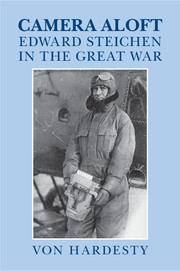
Analytically the essay has never been surpassed, but now there is a new book that fills in the biographical details of Steichen’s service during the First World War: Von Hardesty‘s Camera Aloft: Edward Steichen in the Great War (Cambridge, 2016):

Von Hardesty Camera AloftEdward Steichen (1879–1973) played a key role in the development of photography in the twentieth century. He is well known for his varied career as an artist, a celebrated photographer, and museum curator. However, Steichen is less known for his pivotal role in shaping America’s first experiments in aerial photography as a tool for intelligence gathering in what may be called his “lost years.” In Camera Aloft, Von Hardesty tells how Steichen volunteered in 1917 to serve in the American Expeditionary Forces (AEF). He rose rapidly in the ranks of the Air Service, emerging as Chief of Air Photography during the dramatic final offensives of the war. His photo sections were responsible for the rapid processing of aerial images gained through the daily and hazardous sorties over the front and in the enemy rear areas. What emerged in the eighteen months of his active service was a new template for modern aerial reconnaissance. The aerial camera, as with new weapons such as the machine gun, the tank, and the airplane, profoundly transformed modern warfare.

Here is the table of contents:

Foreword: taking the camera aloft
1. War and exile
2. A new life in the military
3. Over there
4. The world of air observation
5. Taking charge
6. Over the front
7. War and photography
Appendix: life at the cutting edge: the photo sections.

The book includes stunning reproductions of photographs (from which I’ve borrowed the annotated image of the Photographic Section above): you can see a selection from the book here.  Other Steichen aerial imagery from the period is here and here.

As you’ll be able to see when I’m finished, I’m no less interested in Steichen’s work during the Second World War, and in particular the various photographic projects he directed in the Pacific that captured – and celebrated – the masculinism and homosociality of modern war (here the work of Horace Bristol is especially revealing).

But right now it’s the industrialisation of aerial imagery that is capturing my attention.  It’s a commonplace that the First World War was industrial warfare on the grand scale, of course, but often our attention is distracted by the killing machines and mechanisms themselves – the gas, the tanks, the aircraft – and we lose sight of the assembly-line logic that animated the slaughter not only during but also before and after.

LOBLEY Reception of wounded at 1st CCS, Le Chateau October 1918

You can see it in Steichen’s production line, but there are countless other examples.  Last summer I was working in the Friends’ Library in London, recovering the role of the Quakers in providing medical care on the Western Front as part of my research on casualty evacuation, when I encountered this extraordinary passage that speaks directly to the relentless motion of the killing machine (see also my ‘Divisions of Life’ here).  It’s a medical orderly’s account of loading an ambulance train, written some time in 1915:

Down in a hedged field at the end of the straggling mining village lies the casualty clearing station, some two-score large tents… Since midday the [casualty] clearing station has been full to overflowing, but still an endless line of motor ambulances moves down along the crowded road from the fighting line, through the village and into the muddy field. It is night now, starless and dark as pitch, and a lashing rain is driven hard in your face before a bitter and rising wind; but still the cars are discharging their pitiful loads in dreary succession when the train is brought into the siding which serves this desolate little camp.

day2day-amb2

From the train itself you can scarcely see anything of the clearing station tonight; only the headlights of the cars as they turn in through the gate, and a few hurricane lamps flickering here and there. Near one end of the train, at the wooden footbridge which crosses the stream separating the camp from the railway track, there stands a powerful acetylene flare, casting a circle of vivid light on the deep mud of the path. Save for three or four feeble oil-lamps on the ground beside the long darkened train, this is the only light at the loading place. A few moments of uncertain waiting, and the first stretcher comes down, its weary bearers slithering and stumbling in the watery mire. As you watch the flare you see them emerge suddenly from the utter blackness beyond into the fierce glare of the light; they halt for a moment, while a cloaked officer standing on the bridge raises the waterproof sheet which protects the wounded man’s face from the beating rain; a name is given and noted; the covering is dropped over the head, and the bearers move on again, seeing to vanish as if by magic as they pass with their burden out of the light into the enveloping blackness. A pause, another stretcher enters the circle of light; the same words pass, the same motions, and it too move son, blotted out as suddenly as it appeared. Watching this time after time, you feel as if a picture were being cast on a screen and flashed off, over and over again: for there is something cruelly mechanical about it all.

(c) Rosenstiel's; Supplied by The Public Catalogue Foundation

Deadly animation

IWM Strategic bombing campaign 14 December 1941

IWM Strategic bombing campaign 12 August 1944

Britain’s Imperial War Museum has produced a striking animation of the ‘strategic bombing campaign’ in Europe during the Second World War:

https://www.youtube.com/watch?v=Vwf792GKqQ0

If the YouTube link (above) doesn’t work in your region, try this.  I can’t find any version on the IWM website – this version originates with the Daily Mail here – but an interactive version will be available to visitors at the reopened American Air Museum in Britain (at IWM Duxford) from the weekend.  The first bombing mission by the USAAF took place on 29 June 1942 against the Hazebrouk marshalling yards.