National Bird

Sonia Kennebeck‘s documentary National Bird is previewed in today’s New York Times:

If we can eliminate enemy threats without placing boots on a battlefield, then why not do so? That’s one of the unspoken questions raised, and largely unanswered, by “National Bird,” Sonia Kennebeck’s elegantly unsettling documentary about the United States’ reliance on aerial combat drones.

The weapons themselves, though, demand less of her attention than their psychological impact on three former operators and current whistle-blowers. Identified only by first names (though one full name is visible in a shot of a 2013 exposé in The Guardian), all three were involved in some form of top-secret data analysis and the tracking of targets. Justifiably nervous, they wear haunted, closed expressions as they relate stories of guilt, PTSD and persecution…’
11nationalbirdsub-master768

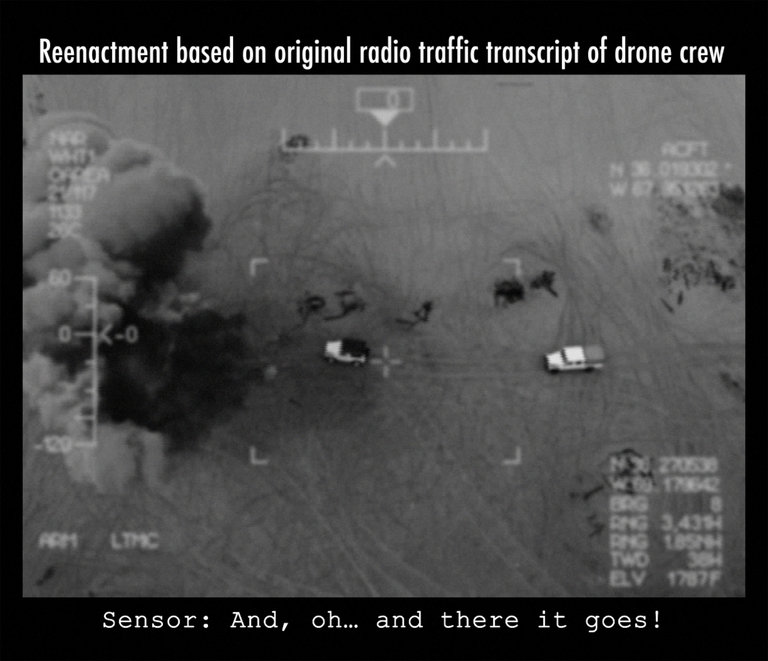
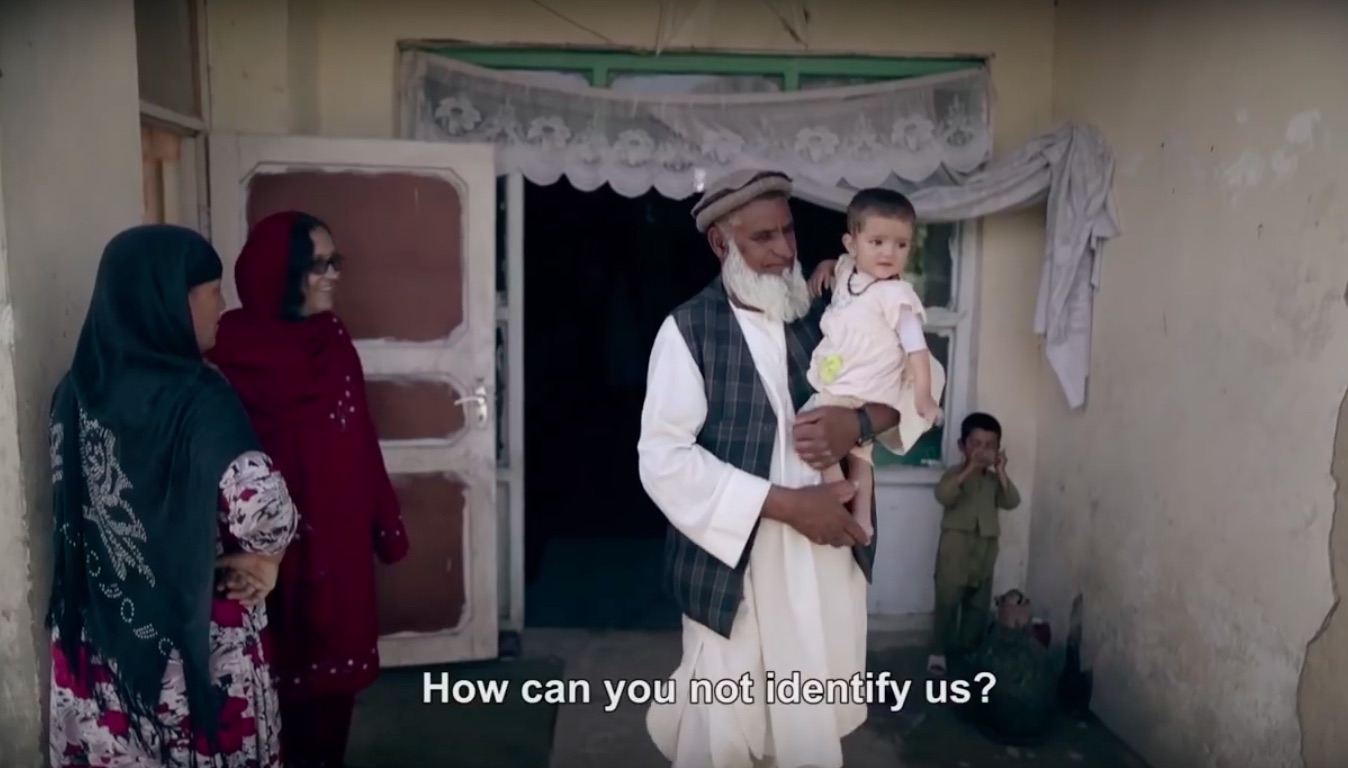
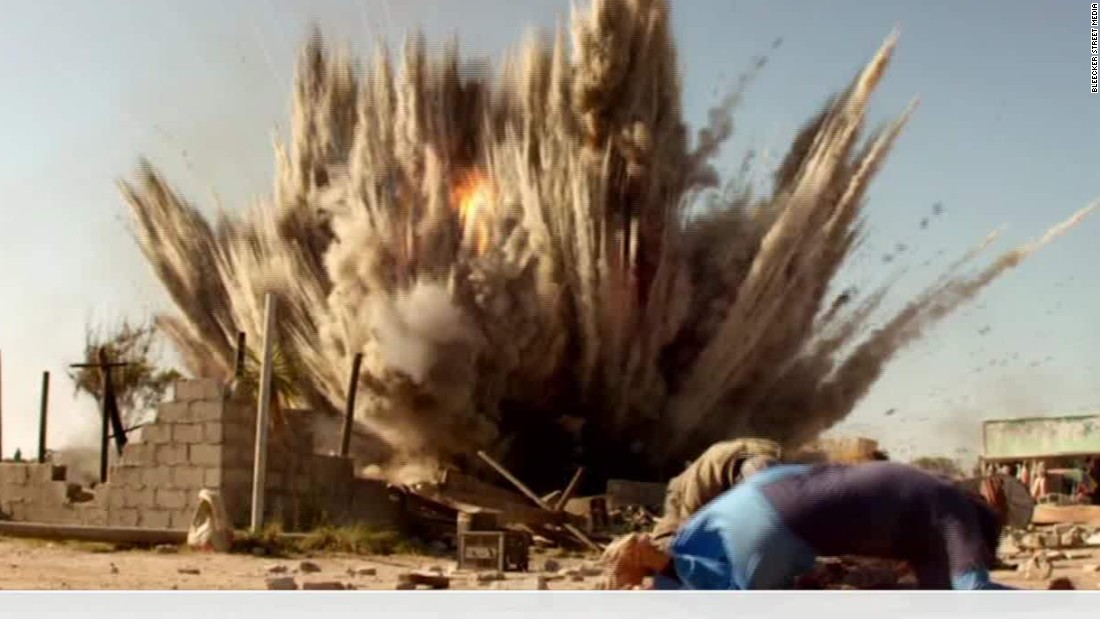
The documentary includes a re-enactment (see still above) of what has become a signature drone strike to critics of remote warfare – the attack on a ‘convoy’ of three vehicles in Uruzgan in 2010 that I analysed in Angry Eyes (here and here); the strike was orchestrated by the crew of a Predator but carried out by two attack helicopters.  Kennebeck based her reconstruction on the report from the same US military investigation I used, though I think her reading of it is limited by its focus on the Predator crew in Nevada and its neglect of what was happening (or more accurately not happening) at operations centres on the ground in Afghanistan.  She’s not alone in that – follow the link to the second part of Angry Eyes above to see why –  but what she adds is a series of vital interviews with the survivors:

I found the survivors of the airstrike and was the first person to interview them and get their first-person accounts…  Their stories give a much larger dimension to the incident and reveal that parts of the military investigation had been sugarcoated.
uruzgan-survivor

Winston Cook-Wilson agrees that the cross-cutting between the strike and its victims is immensely affecting:

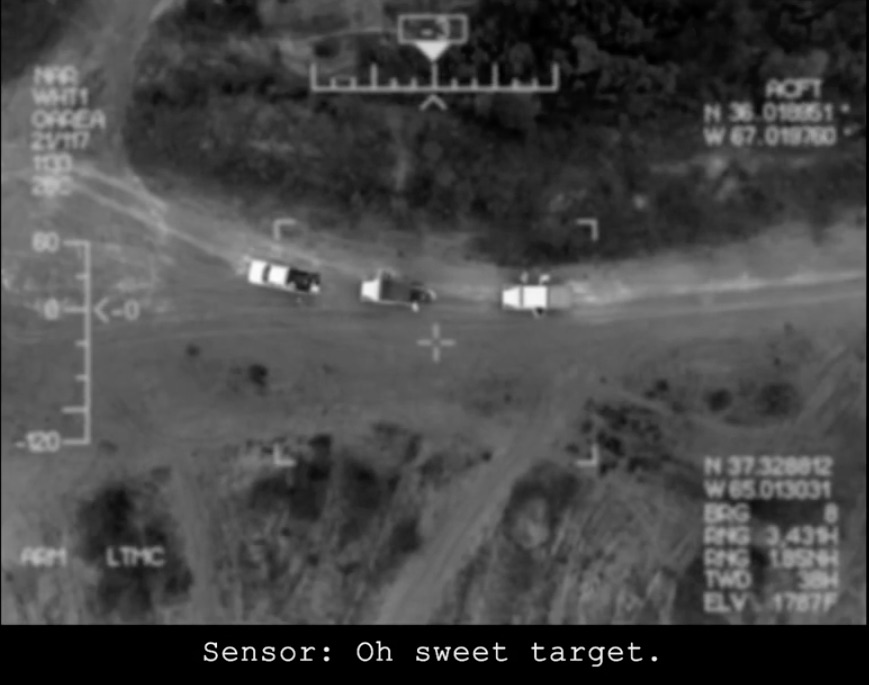
The most powerful section of Kennebeck’s film, by far, are the interviews with family members and witnesses of a mistaken drone attack which killed 22 men, women and children in Afghanistan. Before meeting the Afghani mother who lost her children, the man who lost his leg in the explosion, and others, Kennebeck shows the attack in re-enactment that utilizes frighteningly blurry drone vision. Slightly overdone, static-ridden voiceovers from a radio transcript are included. The emotional footage in Afghanistan here is undeniably powerful; Kennebeck then unexpectedly cuts in grainy footage, filmed by one of the families of the victims, poring over their maimed remains.

This section of the film induces nausea, grief, and confusion all at the same time.
uruzgan-sweet-target

‘Frighteningly blurry drone vision’ is exactly right, as I’ve argued elsewhere (you can find a discussion of this in the second of my ‘Reach from the Skies’ lectures and in the penultimate section of ‘Dirty Dancing’, DOWNLOADS tab).  Here is Naomi Pitcairn who sharpens the same point:

We can see, clearly, how little they can actually see: tiny dots, like ants walking slowly, in single file. This is the all seeing but lacking feeling, understanding and cultural context, vision of a drone video feed and the drone operators callousness in the transcript seems to reflect that. Their bloodlust combined with the minimalism of the feed is intense in its very … primitivism.

Jeanette Catsoulis also thinks the cross-cutting between the strike and the survivors is highly effective (see also Susan Carruthers, ‘Detached Retina: The new cinema of drone warfare’, in Cineaste, who regards those sequences as providing ‘a more profound, affecting, and sustained reckoning with what drones do than anything else to date’), but she doesn’t think it sufficient:

If “National Bird” wants to persuade us that the emotional and collateral damage of this technology is greater than that caused by conventional weapons, it needs to widen its lens. Interviews with military specialists able to elucidate the complex calculus of risk and reward would have been invaluable in balancing the narrative and perhaps clarifying the ethical fuzziness.

Even so, there’s a sense that some unwritten human compact has been broken. As an ominously beautiful drone’s-eye camera glides above peaceful American streets, we’re uncomfortably reminded that an invisible death could one day hover over us all.

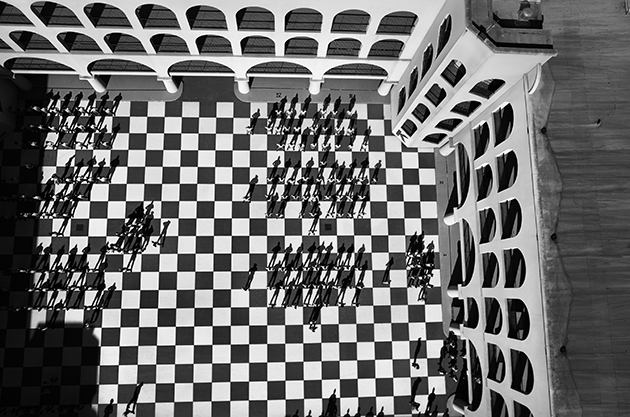
So it could – perhaps especially now.  As a reminder of that dread possibility, one of the phrases that recurs in the transcript from the Uruzgan strike is ‘military-aged males’ (with all that implies), so here is an image from Tomas van Houtryve‘s photographic series Blue Sky Days.  It’s also called ‘Military-Aged Males‘:
"Military-Age Males" (Tomas van Houtryve)

It shows civilian cadets assembling in formation at the Citadel Military College in Charleston, South Carolina.
50 Feet from Syria

50-feet-from-syria

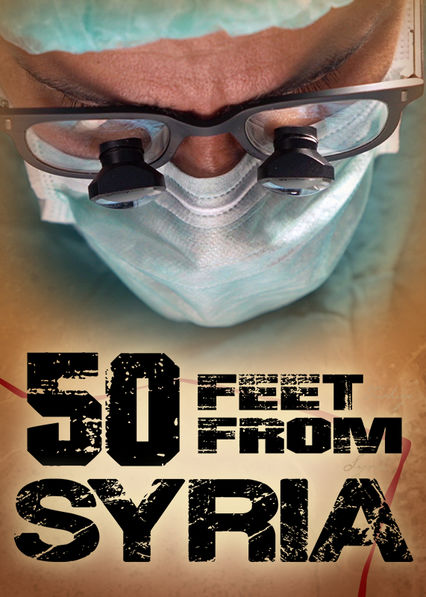
As I continue my work on the targeting of hospitals and ambulances, doctors and nurses, and on the precarious provision of medical care in Syria, I’ve been watching Skye Fitzgerald‘s remarkable documentary 50 Feet from Syria, which is now available on iTunes and (in some places) on Netflix:

With a suitcase full of donated stainless-steel bone implants, Syrian-American surgeon Hisham Bismar arrives at a Turkish hospital on the Syrian border, ready for anything. What he finds is horror, chaos, and an ocean of refugees in need of medical care: colleagues who perform operations without anesthesia, stories of Syrian government snipers targeting pregnant women and children, and images of 55 gallon barrels filled with shrapnel and TNT deliberately dropped on civilians.

With dull drill bits and ill-fitting bone and joint implants Bismar repairs the bodies of the wounded fortunate enough to find their way to the hospital – both civilians and fighters. Amongst this remarkable work, remarkable people abound: “M”, a ‘Turkish Schindler’ selflessly crossing the border each day to retrieve the wounded and ferry them to the care of surgeons, and “AM” a hero among his peers for his willingness to live for years in Syrian field hospitals repeatedly bombed by the Assad regime.

50 Feet From Syria is a portrait of a quiet and determined man, performing intricate acts of medical necessity undeterred by the chaos and complexity of war around him. The film serves as a snapshot in time for the current plight of Syrian refugees. It also indelibly communicates the human cost of one of the most brutal, dehumanizing conflicts in modern history that continues to destroy and displace millions of lives.

It’s a stark reminder of the circumstances in which, once you turn from killing to caring, 5,000 feet isn’t the best….

Someone who has demonstrated the variability of distance in these situations is the remarkable British surgeon David Nott, who has both worked in field hospitals inside Syria and also advised colleagues in Aleppo and elsewhere from London by Skype and whatsapp (the most intimate of remote medicines):

You can read much more on his work – and on the medical underground in Syria more generally – in Ben Taub‘s compelling account of ‘The shadow doctors’ at the New Yorker here.

I’ve drawn on these and many other accounts for my ‘Surgical strikes and modern war’: much more to come very soon.

In continent

160311024028-drone-warfare-film-eye-in-the-sky-sesay-pkg-00001425-super-169

Over at the LA Review of Books Will Govinsky has a fine essay on Eye in the Sky called ‘The beauty of an imperial dilemma‘.  It begins with the image of a French gunboat firing shots into the African rainforest from Joseph Conrad‘s Heart of Darkness:

The ship’s absurdly one-sided battle becomes, for Marlow, an emblem of pointless, indiscriminate imperial violence: “[T]here she was, incomprehensible, firing into a continent.”

Will’s point is about the parallel between the anonymity of imperial violence in the African rainforest and the anonymity of the US (un)targeted killing program:

The chilling anonymity of this “targeted” drone program’s victims, crossed with the sanguine official line, again recalls Conrad’s French warship. “There was a touch of insanity in the proceeding,” Marlow says, which “was not dissipated by somebody on board assuring me earnestly there was a camp of natives ­— he called them enemies! — hidden out of sight somewhere.”

Conrad’s critique of European imperial violence moves with notorious swiftness from the opacity of the victim to the opacity at the heart of the colonizer. Marlow does not know who exactly are the victims of the French warship’s shells, but Conrad’s racism, as Chinua Achebe famously argued, precludes his narrator from caring that much. Marlow’s concern is not for the mangled bodies on the receiving end of colonial violence, but for the deplorable madness at the heart of the imperialist himself.

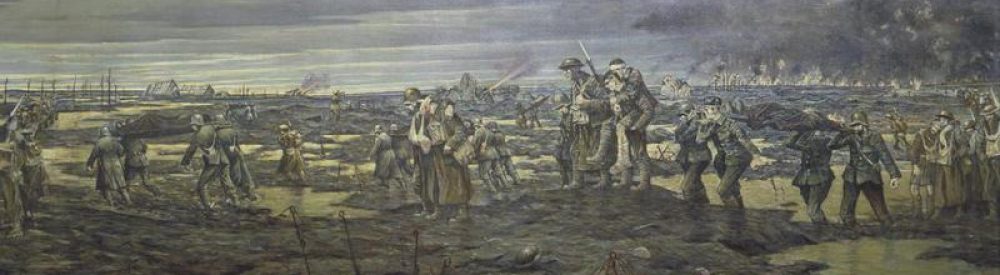
As I’ve described elsewhere, the genealogy can be traced across multiple theatres.  Here, for example, is Arnold Bennett on the Western Front:

Of the target I am absolutely ignorant.001

And here is Frederic Downs describing a US artillery bombardment in Vietnam – Francis Ford Coppola‘s setting for Heart of Darkness – in terms which loop back directly to Will’s (Conrad’s) point about anonymity, impersonality and the madness of it all:

The coordinates for that location and the time for firing would be relayed to the gun crews. At the specified time, the gun crews would be awakened. Perhaps it would be just after midnight. As the minutes ticked closer to a time set by an unknown intelligence the men would load the artillery pieces, anticipating the release of their impersonal death into a grid square. The gun commander would give the order to fire and the night would explode with man’s lightning and thunder. After the prescribed rounds, the guns would cease, the cleanup would begin, and the men would go back to their bunks. Thinking what? Within the range of those guns, within a specified area, the Central Highlands had for a brief moment changed from the jungle it had been for thousands of years into the particular insanity of man.

artillery

In these two cases, clearly, the gunners were firing blind – but what lay behind their guns was a stream of co-ordinates.

This raises two issues that bear directly on the use of today’s remote platforms.

The first is about the ethics of killing at a distance which, as Will notes, also has a (far longer) genealogy.  He cites Chateaubriand‘s question – ‘If, merely by wishing it, you could kill a man in China and inherit his fortune in Europe, being assured by supernatural means that the deed would remain forever unknown, would you allow yourself to form that project?’ – and explains that ‘killing the mandarin’ became shorthand in French for committing ‘an evil action in the hope that it will remain unknown.’

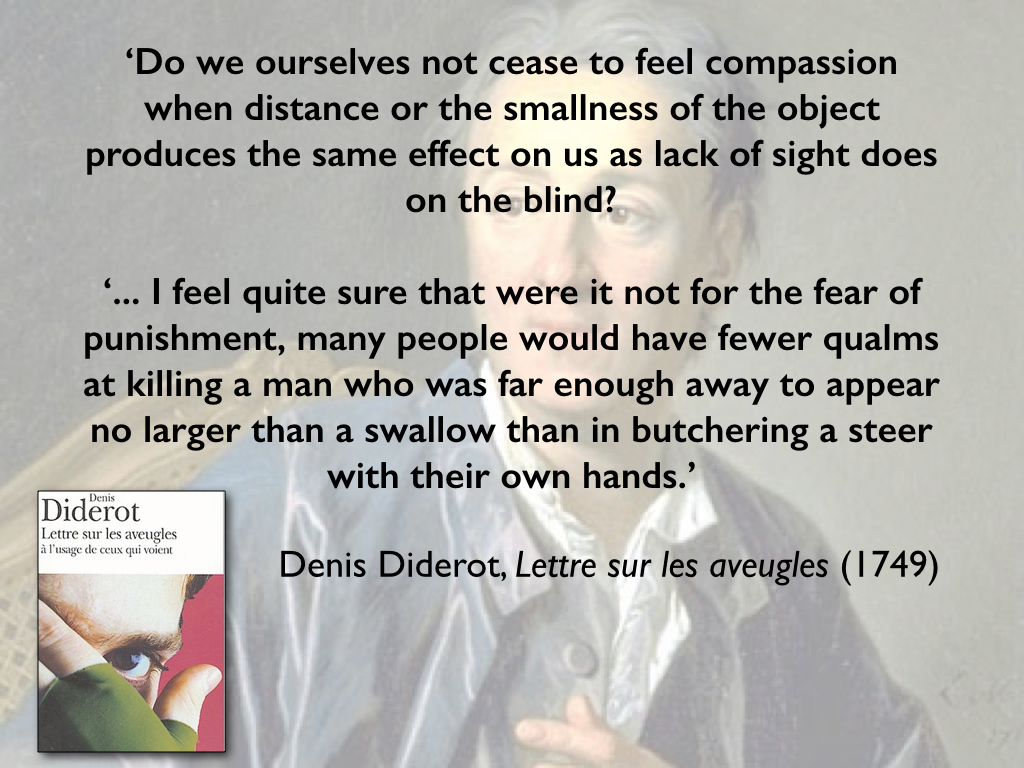
But the US targeted killing program is hardly unknown, and my own preference – which turns out to be closely related to tuer le mandarin – is to turn to Denis Diderot:

Diderot.001

The intimate connection between distance and blindness can be read again and again in accounts of bombing during the Second World War, most directly here:

Distance and blindess.001

But again, what lay behind ‘the distance and the blindness’ was a stream of intelligence.

Recognising the importance of those intelligence streams – and conceding that ‘crunching petabytes of metadata just wouldn’t make for good cinema’ – Will’s key point (and the second issue) is that in its representation of a drone strike in East Africa Eye in the Sky artfully reverses Conrad’s trope:

It asks what we would do if we knew everything. In a taut 102 minutes, the film condenses the ambiguities of drone warfare into a balance sheet of nigh certainties.

eye-in-the-sky

In a fine passage, he suggests the film offers the fantasy

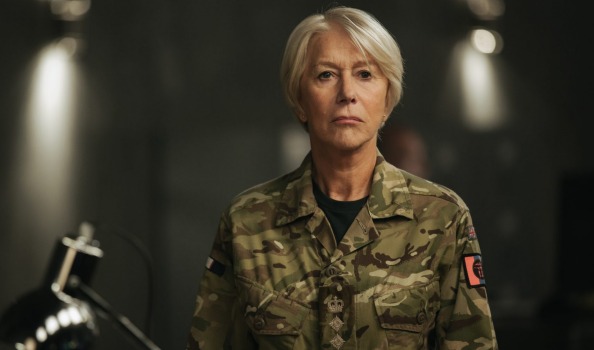
of perfect, visual knowledge — a platform for the terrible beauty of a globe-girdling ethical dilemma. Poised, confident, her silver hair luminescent in the metallic grey-blue glow of her theater-like command center, [Helen] Mirren’s Col. Powell gathers up in her steely 10,000-mile stare the awful knowledge of her options.

But – as I argued in my own commentary on Eye in the Sky – this is indeed a fantasy.  The video feeds from remote platforms do not render the battle space transparent, and the make-believe that they do, Will concludes, renders the film ‘less a representation of drone warfare than a grotesque abstraction of it.’  Hence his brilliantly sobering conclusion:

We need plots that provide the narrative space to ask questions: whether the very terms of our dilemmas are spurious; whether firing into continents, day in and day out, can be anyone’s prerogative, let alone ours.

Hollow men?

eye-in-sky-group

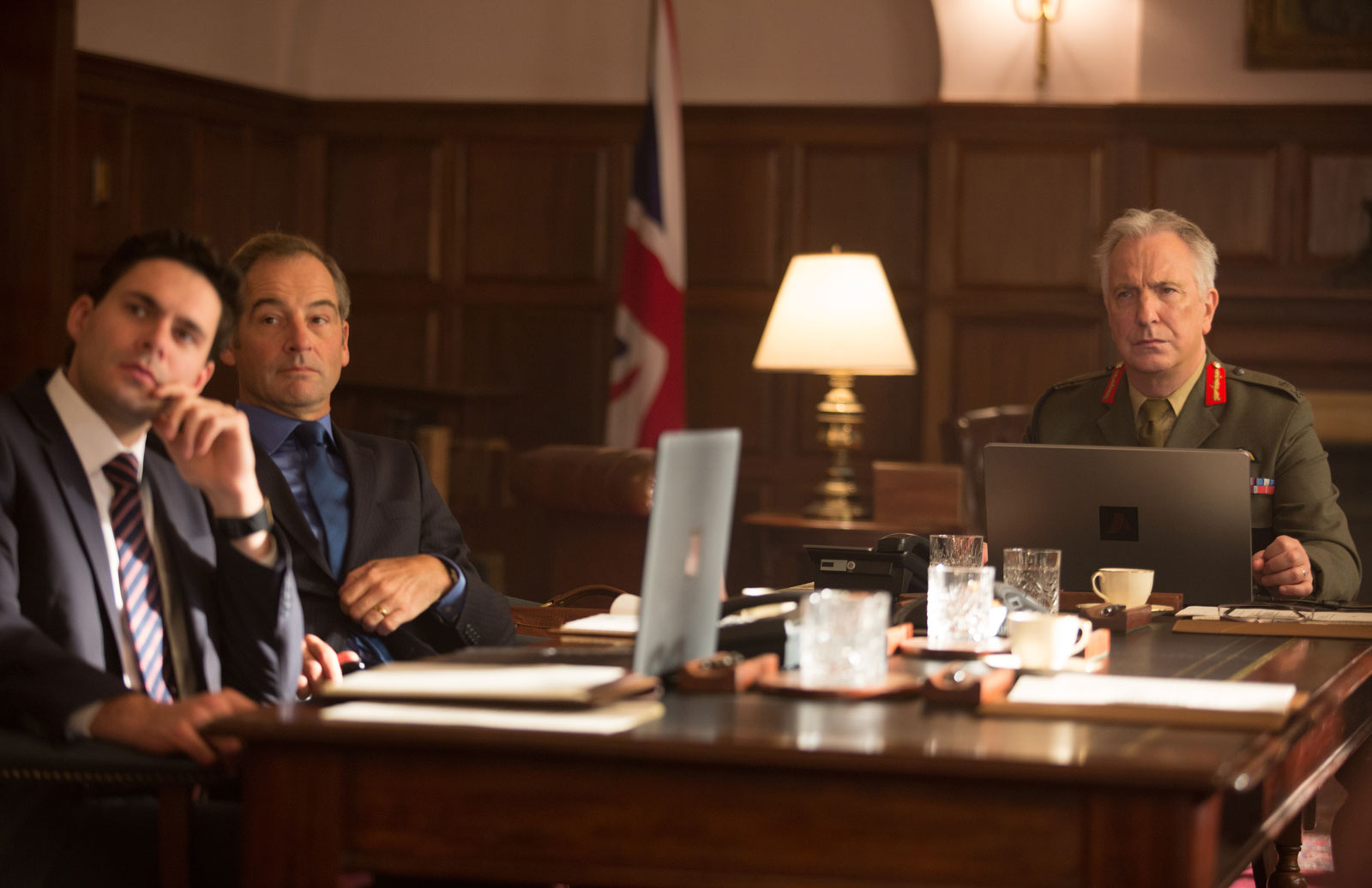
In my commentary on Eye in the Sky I emphasised the dispersed geography of command and responsibility involved, and it turns out that was a key concern of the film’s director Gavin Hood.  In an interview with Dan Gettinger for Bard’s Center for the Study of the Drone, he explains:

‘… we obviously designed the film frankly as a thought experiment; it is based on a very specific set of circumstances … these circumstances are not the circumstances of every drone strike. As you know, it is not the case that in every single drone strike the question of whether to fire or to not fire is referred all the way up the kill chain to the foreign secretary, or the prime minister, or in the case of the United States, the secretary of state, secretary of defense, or indeed the president. Depending on the geographical location of these strikes, different rules apply. If you are striking within an already defined conflict zone with clear rules of engagement, in areas such as Iraq or Afghanistan, then sadly this level of debate does not always happen. It very much depends on who is being targeted and where that target is taking place, as to whether the authorization of the strike is referred high up the kill chain.

In our case, in the case of the film, we wanted to create a scenario in which as much discussion as possible was possible within our film. We didn’t want to make a film where the discussion ended at the local commander level. That is a story that can and should be told—the story of the strikes over the tribal areas of Pakistan, for example, where signature strikes take place and where many civilians have been killed—but what we felt was helpful was to make a film which would allow many different points of view to be represented in order to help the conversation that is already underway, but which the public is not necessarily particularly aware of.’

See also David Cole‘s ‘Killing from the Conference Room’ here.

3054521-inline-i-1-lr-meet-the-new-maverick

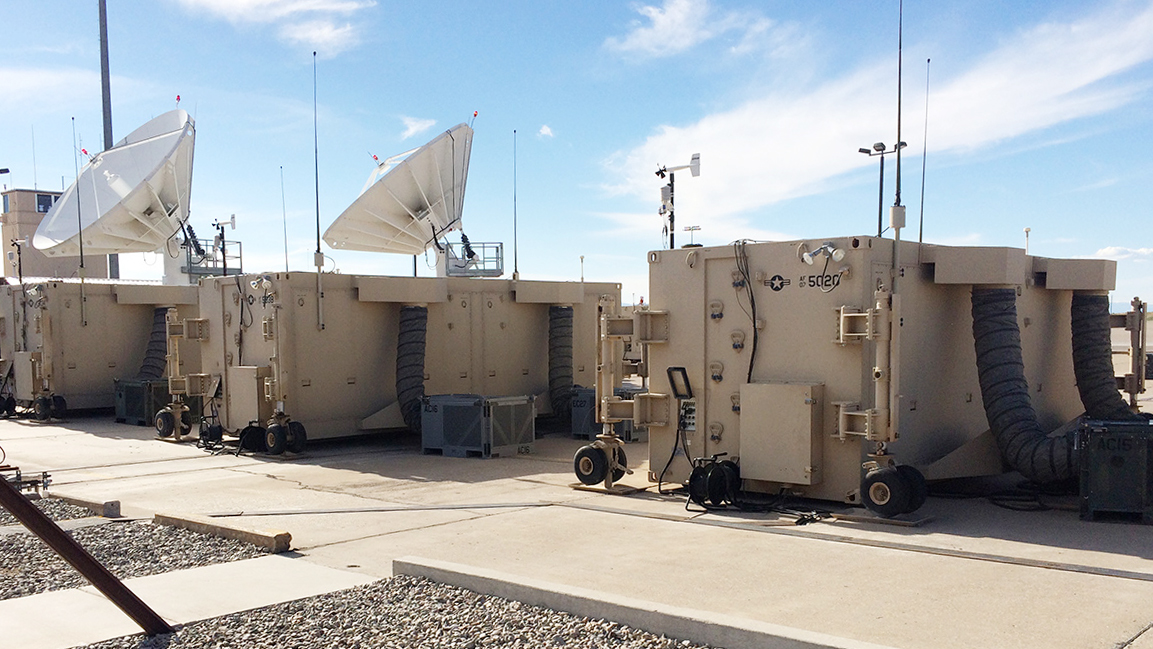
It was partly for the same reason that Ainsley O’Connell travelled to Holloman Air Force Base in New Mexico for Fast Company: to see what the training program for the crews that operate the Air Force’s remote platforms reveals about today’s management.

Her extended report riffs off Tom Cruise‘s Maverick in Top Gun, and his boast that – like all pilots of conventional strike aircraft – ‘You don’t have time to think up there… If you think, you’re dead.’  In contrast, Ainsley reports:

The new Maverick represents the future of work in a fully global world dominated by complex machines, complex communications, and fluid, remote teams. A body of economic research produced over the last 15 years suggests that organizations are shifting to a model of work characterized by continuous learning and flat teams with complementary skill sets. In this model there is room for autonomy and improvisation, but it takes place in the context of managerial surveillance and shared goals. The military, though still wedded to its lock-step hierarchies, is not immune to the trend. And RPA crews, despite their image as video gamers operating in the dark, are arguably one of the best case studies for how the future of work will affect war and conflict.

She finds that remote crews have to develop not only ‘air awareness’ – since they don’t have the physical sensations of flight or situation available to conventional pilots – but also ‘social awareness’: the ability to collaborate and communicate with military actors across the network.

I discuss the layered bureaucracy – and its imperfect network – in more detail in ‘Reach from the sky‘ and will post the text of those two lectures soon (see also here).

In the meantime, there is an earlier report on the training program at Holloman by Corey Mead for the Atlantic here.

Viewing Eyes in the Sky


This image released by Bleecker Street shows Phoebe Fox, left, and Aaron Paul in a scene from "Eye In the Sky." (Keith Bernstein/Bleecker Street via AP)

This image released by Bleecker Street shows Phoebe Fox, left, and Aaron Paul in a scene from “Eye In the Sky.” (Keith Bernstein/Bleecker Street via AP)

The New York Review of Books has a characteristically thoughtful response by David Cole to Gavin Hood‘s newly released Eye in the Sky: ‘Killing from the Conference Room‘.

The film traces the arc of a joint US/UK drone strike in Nairobi, told from the viewpoints of those charged with authorising and executing the kill.  The nominal target is a safehouse, and the two al-Shabab leaders inside (conveniently one American citizen and one British citizen); less conveniently, after the strike has been authorised a young girl sets up a bread stand in front of the house.

It’s a more complicated scenario than the serial drone strikes dramatized in Andrew Niccol‘s  Good Kill – because here the politicians are brought into the frame too – and David sees it as a twenty-first century version of the ‘trolley-problem’:

Eye in the SkyIn the classic version of the problem, a runaway train is hurtling down a track on which five people are tied; they will die if the train is not diverted. By pulling a lever, you can switch the train to an alternate track, but doing so will kill one person on that track. Should you pull the switch and be responsible for taking a human life, or do nothing and let five people die?

In Eye in the Sky, the question is whether to [use a drone to] strike the compound, thereby preventing an apparent terrorist attack and potentially saving many lives, though the strike itself might kill the young girl as well as the suspected terrorists. If the operation is delayed to try to avoid endangering the girl, the terrorists may leave the compound, and it may become impossible to prevent the suicide mission. But it’s also possible that the girl will finish selling her bread and leave the danger zone before the suspects depart. If the terrorists leave the compound, an opportunity to capture or kill them without harming others may arise. And of course, the suicide mission itself might fail. As a Danish proverb holds, predictions are hazardous, especially about the future. But a decision must nonetheless be made, and the clock is ticking.

As he points out, there’s no right, neat answer:

There are only competing intuitions, based on utilitarian calculations, the difference, or lack thereof, between act and omission, and the like. In Eye in the Sky, and all the more so in the real world, the choices are never as clearly delineated as in the “trolley problem”; decisions must be made in the face of multiple unknowns. The girl may die and the terrorists may get away and kill many more. But what the film makes clear is that, notwithstanding today’s most sophisticated technology, which allows us to see inside a compound in Africa from half a world away, to confirm positive identifications with facial imaging technology, to make joint real-time decision about life and death across several continents, and then to pinpoint a strike to reduce significantly the danger to innocent bystanders, the dilemmas remain. Technology cannot solve the moral and ethical issues; it only casts them into sharper relief.

Consider, for example, the implications of the purported accuracy of armed drones. The fact that it is possible to conduct “surgical” strikes and to maintain distance surveillance for extended periods of time increases the moral and legal obligation to avoid killing innocents. When the only way to counter an imminent threat was with more blunt explosives or by sending in ground forces, attacks entailing substantial harm to civilians were nonetheless sometimes warranted. As technology makes it increasingly feasible to strike with precision, risks to civilian lives that were once inescapable can now be avoided. And if they can be avoided, mustn’t they be? Thus, when President Barack Obama in May 2013 announced a standard for targeted killings away from traditional battlefields, he said he would authorize such strikes only when there was a “near-certainty that no civilians will be killed or injured—the highest standard we can set.” Precisely because they are so discriminating, drones may demand such a standard. Yet as the film shows, that standard can be very difficult to uphold, even under the best of circumstances.

Given my own interest in the film, I’ll share my thoughts as soon as I’ve seen it.

Note: In the most recent US strike against al-Shabab on 5 March, in which drones and conventional strike aircraft were used to kill perhaps 150 people (or perhaps not) at a training camp 120 miles north of Mogadishu, it seems clear that few doubts were entertained (but see Glenn Greenwald here).

Bodies at risk

This is far more than a post-script to my last post.  In writing ‘The Natures of War’ I started to develop the concept of a corpography (see also ‘Corpographies’ DOWNLOADS tab) because I became keenly interested in the ways in which the entanglements between military violence and ‘nature’ were registered on and through the body.

I had an appreciative message from Eileen Rositzka, following my Neil Smith Lecture at St Andrews, and I’ve finally caught up with a marvellous, exquisitely illustrated essay she has co-written with Robert Burgoyne: ‘Goya on his Shoulder: Tim Hetherington, Genre Memory, and the Body at Risk.’  It was published in Frames Cinema Journal 7 (2015) and is available open access here.

The figure of the body in narratives of war has long served to crystallize ideas about collective violence and the value or futility of sacrifice, often functioning as a symbol of historical transformation and renewal or, contrastingly, as a sign of utter degeneration and waste. As a number of recent studies have shown, the power of somatic imagery to shape cultural perceptions of war has had a decisive impact on the way wars have been regarded in history, and has sometimes influenced the conduct of war as it unfolds.

Following my good friend Gastón Gordillo‘s exemplary lead, I’ve been thinking about extending my original analysis from the mud of the Western Front in the First World War, the deserts of North Africa in the Second, and the rainforests of Vietnam into Afghanistan (for the book-version of the essay), and ‘Goya on his shoulder’ is full of all sorts of ideas on how to do exactly that.  Gastón has made much of Sebastian Junger/Tim Hetherington‘s extraordinary film Restrepo – see here and especially here – and Robert and Eileen add all sorts of insights to the mix and, in particular, provide an illuminating visual genealogy of the issues at stake:

With their concentrated focus on the body in war, Restrepo and Infidel also mark an intervention into contemporary debates in the emerging doctrine of “bodiless war” or virtual war – what is known in war policy circles as the “Revolution in Military Affairs” (RMA). In contrast to the decorporealised, bloodless war culture promoted and even celebrated in many contemporary theories of war, Restrepo and Infidel implicitly dramatise the limitations of so called “optical war” in many current conflict zones, emphasising the body of the soldier as a critical site of representation and meaning.

Their journey takes them from photography of the American Civil War through Edward Steichen‘s mesmerising project to capture what they call ‘bodies at risk’ in the Pacific theatre of the Second World War to Afghanistan today.  As it happens, I’ve spent the last several weeks immersed in Steichen’s project for my ‘Reach from the skies’ lectures: Steichen was one of the foremost architects of aerial photography on the Western Front during the First World War, and the photographs taken of US sailors taken under his direction during the Second have much to show us about the entanglements between military violence, masculinism and the body (the slide below is taken from my discussion in ‘Reach from the sky’).

RFTS Masculinism and military violence.001

And so to Restrepo:

‘… the work of Hetherington and Junger marks an intervention in the contemporary cultural imaginary of war, dramatizing the limitations of so called “optical war” or “bodiless war” in the conflict zones of Afghanistan. The concentrated attention to the touchscape of modern war in their work, moreover, provides a fresh perspective on older traditions of visual representation, illuminating the genre codes of war photography and film in a new way. The visual and acoustic design of Restrepo, in particular, captures the haptic geography of combat in a remote mountain outpost in the Korengal Valley. The film highlights the concentrated experience of sound and touch, providing a first-person account of the way the body inhabits contested space, the way the intensities of war confuse and overwrite the sensory codes of vision, and the compensatory drive of somatic mastery, which is projected in vivid displays of masculine athleticism in the relative safety of the enclosure.

What Steichen called “the machinery of war” is all but absent in these images. Like Steichen, Hetherington expresses the brotherhood of the men in directly physical, gestural forms – in close physical contact, in the “bloodying” of new men, and in the tattoos they give each other with a tattoo gun they have brought up to the camp…

Depictions of war in Restrepo and Infidel revolve around touch – the heat, cold, and dirt, the intense exertion, the texture of skin. Although Hetherington’s images of white, muscular soldiers may be compared to the displays of imperial masculinity celebrated by Edison in his War-Graph actualities, and by Roosevelt in his appeal to the brave “game boys” of military adventure, they also relay the heightened sensuality of Steichen’s World War II sailors to a contemporary war setting. Scenes that contain a high quotient of violence – the firefights with insurgents, the roughhousing, the bloodying of new recruits – are here juxtaposed with shots of soldiers sleeping and other scenes of quiet reflection…

Foregrounding the body of the soldier as a medium of sensory experience and as a body at risk, their work recalls the long history of war photography, painting, and film, dramatizing the importance of the figure of the body in narratives of war, and the power of somatic imagery to shape cultural perceptions of conflict. In Restrepo and Infidel, haptic experience and embodied vulnerability unfold as the central fact of war, the heart of warfare. Here too, however, a certain cultural imaginary is invoked, visible in Junger’s discussion of “young men in war” and of the “hard wiring” of young men for the violence of war, a theme that sacrifices any consideration of context, as if war was an existential constant. Nonetheless, in this framing of contemporary western war, centred on the haptic geography of combat, we can see an initial sketch, an introduction, to a critical understanding of the corpography of war in the current period.

My extracts don’t do justice to the range and depth of the essay, and it really does repay close reading.

Danse macabre

Patterns of life 3 JPEG

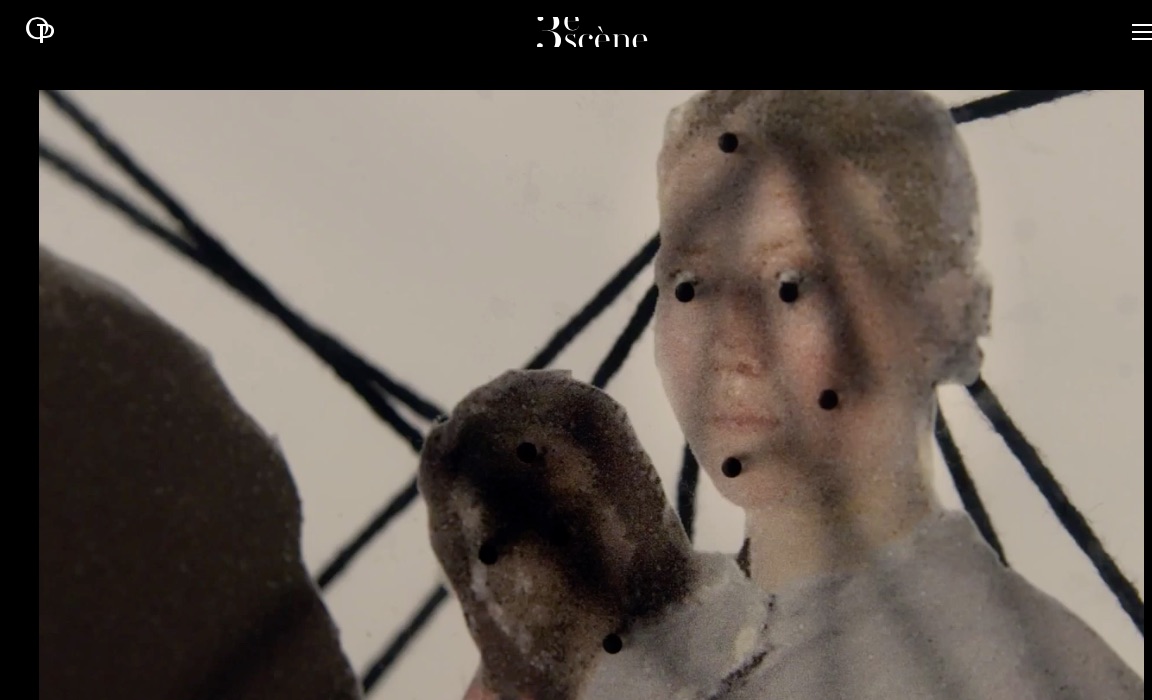
Grégoire Chamayou writes to say that after our conversations in Irvine last year he has worked with an artist friend, Julien Prévieux (who won the Prix Marcel Duchamp in 2014) and the Opéra national de Paris to turn his ideas about schematic bodies and patterns of life into a short film: Patterns of Life.

I’ve embedded it below, but if the link doesn’t work you can watch it here or on YouTube here. You will soon see why Anne Buttimer once described Torsten Hågerstrand‘s time-geography diagrams as a danse macabre.  The subtitles are in French but the commentary is in English.

I find the combination of intellectual imagination and performance work absolutely compelling – see my comments on ‘Bodies on the line’ here, for example.

Eyes opening

Eye in the sky JPEG

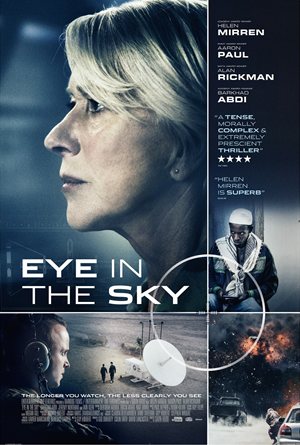
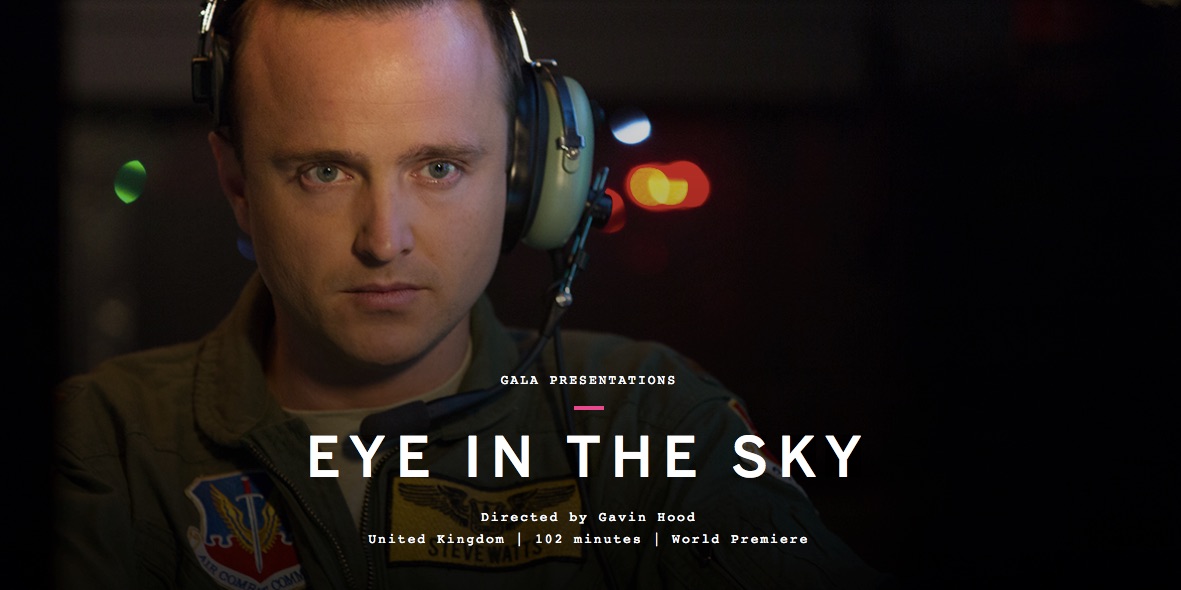
Guy Hibbert writes to say that Gavin Hood‘s Eye in the Sky has its world première at the Toronto International Film Festival later this month (see also my earlier post here).

A fascinating look at how our leaders wage war now, Eye in the Sky takes us into the control rooms and shipping containers where military personnel make decisions that could result in the deaths of people thousands of miles away. Featuring Helen Mirren, Aaron Paul, and Alan Rickman, the latest from Tsotsi director Gavin Hood is enormously pertinent and eerily entertaining.

The goal of British-led Operation Cobra is the capture of Aisha Al Hady (Lex King), a radicalized British citizen who has joined the Somali terrorist group Al Shabab. But their “capture” objective is changed to “kill” when the indomitable Colonel Katherine Powell (Mirren), who has been tracking Al Hady for years, learns that Al Shabab is planning suicide attacks. Nevada-based drone operator Steve Watts (Paul) targets Al Shabab’s Nairobi safehouse but reports back to London that a nine-year-old girl has entered the kill zone. Given the value of the target, could a civilian child be chalked up to collateral damage? Is the potential political fallout worth the risk?

Written by Guy Hibbert with an unerring ear for military doublespeak, Eye in the Sky becomes blackly comic as the officers’ concern with optics sparks a protracted game of bureaucratic pass-the-buck, with everyone “referring up” the chain of command, through the UK Foreign Secretary (who has food poisoning) and the US Foreign Secretary (busy attending a ping pong tournament in China) all the way up to the Prime Minister. Shades of Dr. Strangelove abound — though, as with the Kubrick classic, Eye in the Sky is only as funny as it is because the truths it arrives at are so very grave and resonant.

Full details are here.

Visual occupations and a counter-politics of visuality

Most readers will know Eyal Weizman‘s searing account of the cruel intersections between the politics of visibility and the politics of verticality in occupied Palestine, Hollow Land: Israel’s architecture of occupation.

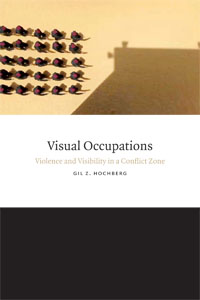
But there are other, no less intimate and intrusive dimensions to the politics of visibility for a people under military (and civilian) occupation that amount to what Gil Hochberg calls an ‘uneven distribution of “visual rights”‘.  In her brilliant new book from Duke University Press, Visual occupations: violence and visibility in a conflict zone, she explores ‘the political importance of various artistic attempts to redistribute the visible’ (my emphasis) and, in effect, to put in place a counter-politics of visuality.

978-0-8223-5887-9_prIn Visual Occupations Gil Z. Hochberg shows how the Israeli Occupation of Palestine is driven by the unequal access to visual rights, or the right to control what can be seen, how, and from which position. Israel maintains this unequal balance by erasing the history and denying the existence of Palestinians, and by carefully concealing its own militarization. Israeli surveillance of Palestinians, combined with the militarized gaze of Israeli soldiers at places like roadside checkpoints, also serve as tools of dominance. Hochberg analyzes various works by Palestinian and Israeli artists, among them Elia Suleiman, Rula Halawani, Sharif Waked, Ari Folman, and Larry Abramson, whose films, art, and photography challenge the inequity of visual rights by altering, queering, and manipulating dominant modes of representing the conflict. These artists’ creation of new ways of seeing—such as the refusal of Palestinian filmmakers and photographers to show Palestinian suffering or the Israeli artists’ exposure of state manipulated Israeli blindness —offers a crucial gateway, Hochberg suggests, for overcoming and undoing Israel’s militarized dominance and political oppression of Palestinians.

Here’s the Contents List:

Introduction. Visual Politics at a Conflict Zone

Part I. Concealment

1. Visible Invisibility: On Ruins, Erasure, and Haunting
2. From Invisible Spectators to the Spectacle of Terror: Chronicles of a Contested Citizenship

Part II. Surveillance

3. The (Soldier’s) Gaze and the (Palestinian) Body: Power, Fantasy, and Desire in the Militarized Contact Zone
4. Visual Rights and the Prospect of Exchange: The Photographic Event Placed under Duress

Part III. Witnessing

5. “Nothing to Look At”; or, “For Whom Are You Shooting?”: The Imperative to Witness and the Menace of the Global Gaze
6. Shooting War: On Witnessing One’s Failure to See (on Time)

Closing Words

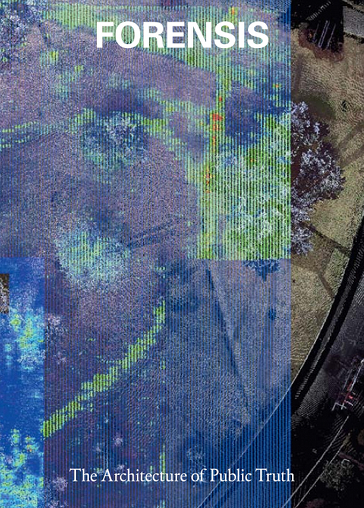
2014_cover_publication_forensisIt’s a compelling book, and I’m struck by another parallel with Eyal’s work.  In Hollow Land Eyal showed the central role that architecture and architects play in Israel’s illegal occupation of the West Bank, but in subsequently developing his collaborative Forensic Architecture project he effectively reverse-engineers architecture’s dominant imaginary to use built forms and spatial formations as a way of revealing prior trajectories of violence to a public forum.  That too is a counter-politics of visuality.

Noises off

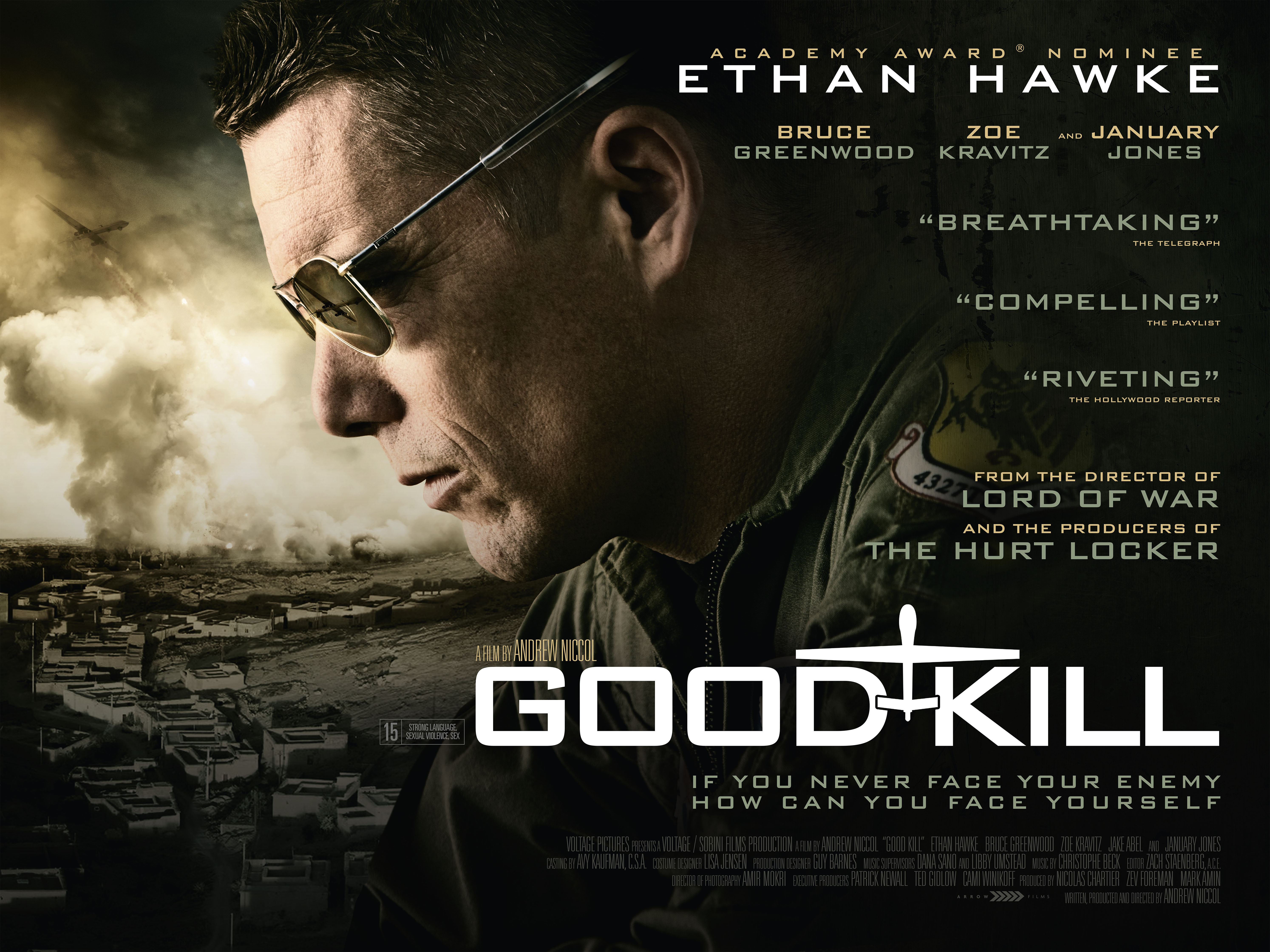
Good Kill

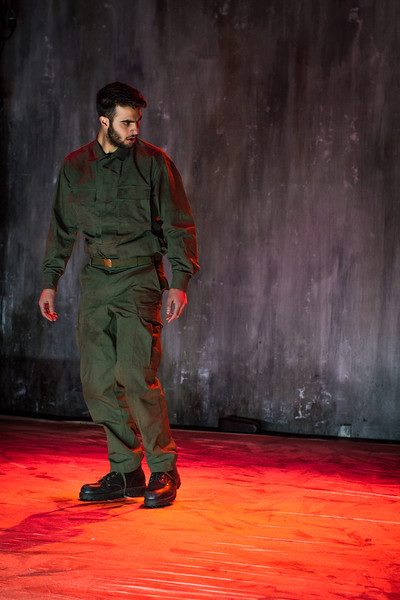
Matt Gallagher has an excellent double review of George Brant‘s play Grounded and Andrew Niccol‘s film Good Kill at The Intercept here:

‘[B]oth leave viewers with only keyhole snippets, stories of American homefront trauma with little reckoning of life on the receiving end of the unmanned aerial campaigns…

As Americans funding the largest war machine the world has ever known, it’s not just about us, even when we’re the ones pulling the trigger on the ground or pressing the joystick in Nevada. It’s also about them, because they are the ones living with the consequences of what our post-9/11 wars have wrought. Perhaps ironically, perhaps not, recent creative work produced by veterans of Iraq and Afghanistan, such as Maurice DeCaul’s play Dijla Wal Furat and Elliot Ackerman’s novel Green on Blue, recognize this. We’re well past time the rest of America recognizes it, too.’

As I’ve noted before, ‘popular culture continues to be preoccupied with what happens in Nevada – and what happens on the ground is left shrouded in so many shades of grey.’

10985573_938400016200522_8075406720922201197_n

If you’re wondering about Matt’s recommendations (he is the author of Kaboom: embracing the suck in a savage little war, incidentally), then you can find discussion and reviews of Dijla Wal Furat: between the Tigris and the Euphrates (which had its premiere in February) here, here and here, and Green on Blue here and (especially) here.