Vertical fields

I’ve just been reading and thinking about Lisa Parks‘s short but immensely suggestive essay, ‘Drones, Vertical Mediation, and the Targeted Class’, in Feminist Studies 42 (2016) 227-35. Lisa develops her ideas about vertical mediation but at the end of the essay she illustrates them through an art installation staged in Beirut last spring. This is what she says:

In an effort to publicize the drone’s vertical mediations—the way the technology uses the vertical field in efforts to materially reform life on earth—I collaborated with a group of Lebanese and Slovenian artists (Marc Abou Farhat, Tadej Fius, Elie Mouhanna, and Miha Vipotnik) to create a multimedia installation titled Spectral Configuration. The installation was part of the Vertical Collisions exhibition at the Station Art Gallery in Beirut in May 2015. The installation’s centerpiece is a massive, elevated, four-meter-long, supine human body, hand-crocheted out of thin aluminum wire. As it soars in mid-air, the wiry surface of this colossal corpse turns translucent as multiple media projections, made from video footage leaked from the US military-industrial complex, flicker around and upon it. These electromagnetic projections envelop the silvery drone-like body within the luminous footprint of world his- tory and militarization, cycling through a series of spectral suspects, framed targets, and aerial strikes that appear in visible light and infrared.

Circumnavigating the earth on an endless flight path, this “spectral configuration” not only captures and reflects light and heat waves, it remediates life on earth, altering one’s disposition to the sky, the ground, and the skin…  To make Spectral Configuration, we used the same global information networks, geospatial images, and video-capture technologies utilized each day by US drone operators. The difference, however, was that we commandeered these devices to conceptualize and produce a form and an event that would question the militarization of the vertical field by enacting it on a micro-scale and trying to make its effects intelligible and palpable to publics beyond drone war. By staging the militarization of the vertical field in a country adjacent to, yet not subject to drone war (Lebanon), Spectral Configuration also spoke to the exploitation of borders and associative relations by US drone operators and aroused concerns about the usage of the technology in the region.

Grim Reapers

cegrab-20160505-002509-0-1-589x442

Sky News has a report on Launch & Recovery crews responsible for US/UK drone operations against IS in Iraq and Syria based “somewhere in the Middle East”.

Much of it will be all too familiar to most readers:

Relentlessly watching their prey. Monitoring every movement a high profile Islamic State target makes.

In the words of the American officer I speak to, “we are the unblinking eye”…

“We are going to be on that target as long as the weather allows and as long as the mission allows.

In many cases there is more than one asset on that individual.

“You know when he’s going to go to the bathroom, you know when he’s going to go to eat, you know when he’s going to go to prayer time.

“You know where he goes, his associates.

“That’s all about building that picture so that we know and we can project when he’s going and where he’s going to be.”

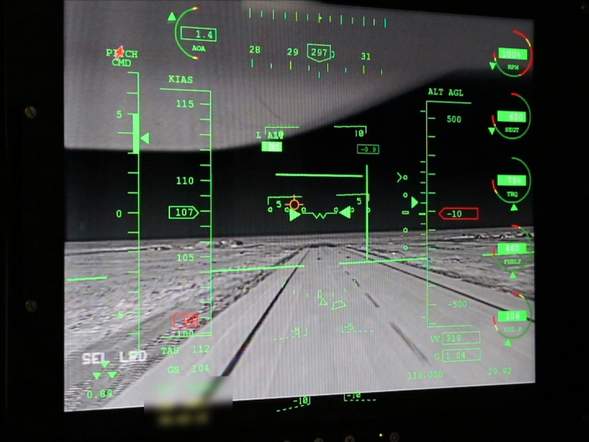
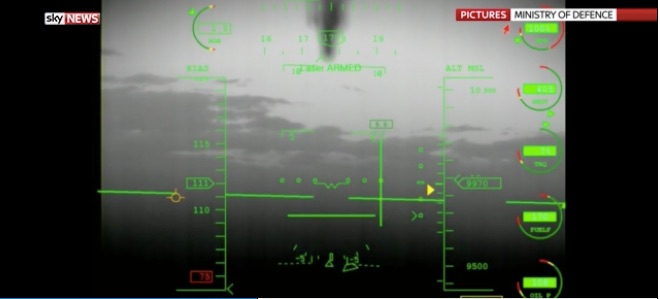
But the video embedded in the report repays close attention, not least for the brief glimpses of the video feeds from the drones themselves.

Drone airborne JPEG

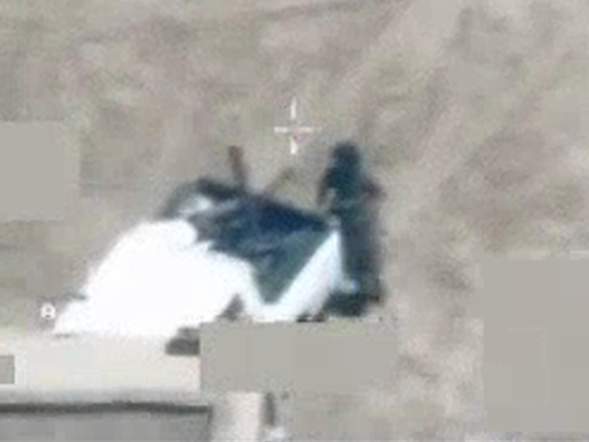
The first two images (above) are clips from the video used by the pilot to control the aircraft – a view of the runway before take-off and an airborne view before control is handed off to the crew who will fly the assault mission from ground control stations in either the US or the UK – while the third (below) is from the imagery used to identify a ‘possible target’.  The comparison between this last image and the equally ‘High Definition’ imagery released from an Italian MQ-9 Reaper late last year is instructive: see my post here.

cegrab-20160505-002219-0-1-589x442

You can find updates on the UK campaign in Iraq and Syria at Drone Wars UK here and here.

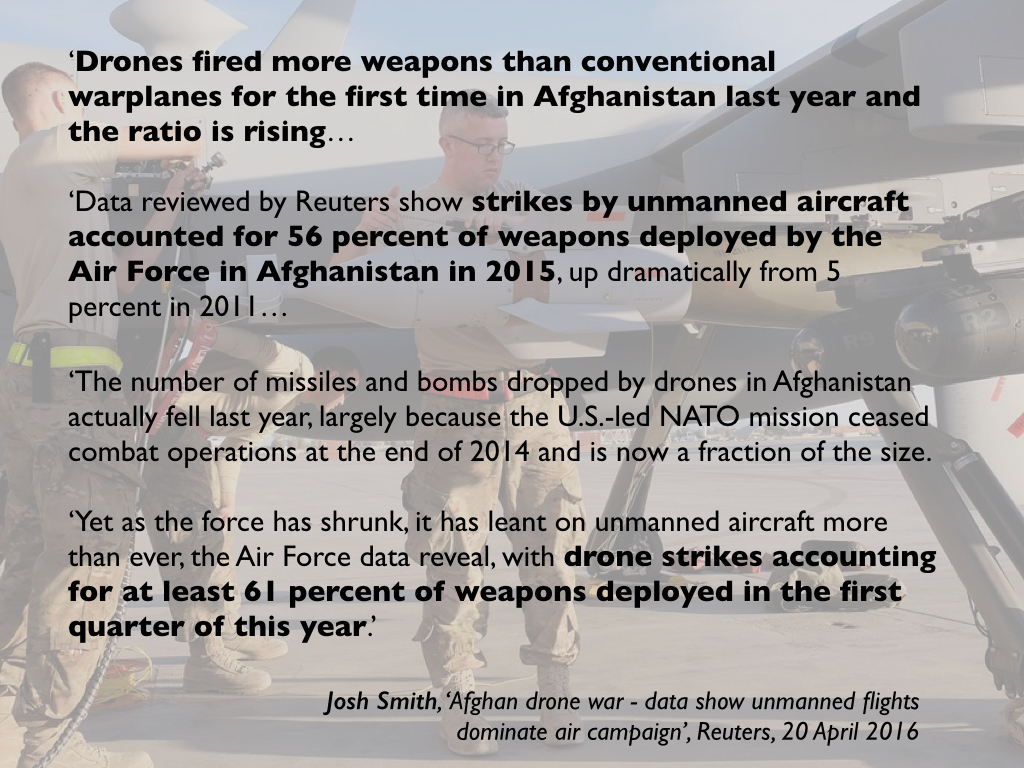
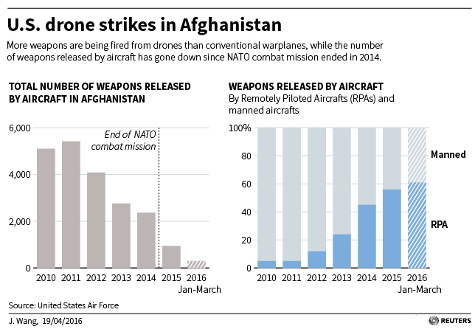
As Chris Cole reports there, too, the use of remote platforms [RPAs] to strike targets in Afghanistan has increased dramatically following the draw-down of US and NATO forces:

Drones in Afghanistan 2016.001

afghanistan-drones-sized

It is surely not coincidental that last month the US Air Force renamed eight of its RPA reconnaissance squadrons ‘attack squadrons’:

‘Eight RPA reconnaissance squadrons [based at Holloman AFB in New Mexico, Whiteman AFB in Missouri, and Creech AFB in Nevada] will be redesignated as attack squadrons [and]… Air Force Chief of Staff Gen. Mark A. Welsh III authorized RPA aircrews to log combat time when flying an aircraft within designated hostile airspace, regardless of the aircrew’s physical location.

The changes were two of many recommendations that emerged as part of Air Combat Command’s Culture and Process Improvement Program, which seeks to address a number of issues affecting operations and the morale and welfare of Airmen across the RPA enterprise….

“Aerial warfare continues to evolve. Our great RPA Airmen are leading that change. They are in the fight every day,” Welsh said. “These policy changes recognize the burdens they bear in providing combat effects for joint warfighters around the world.”’

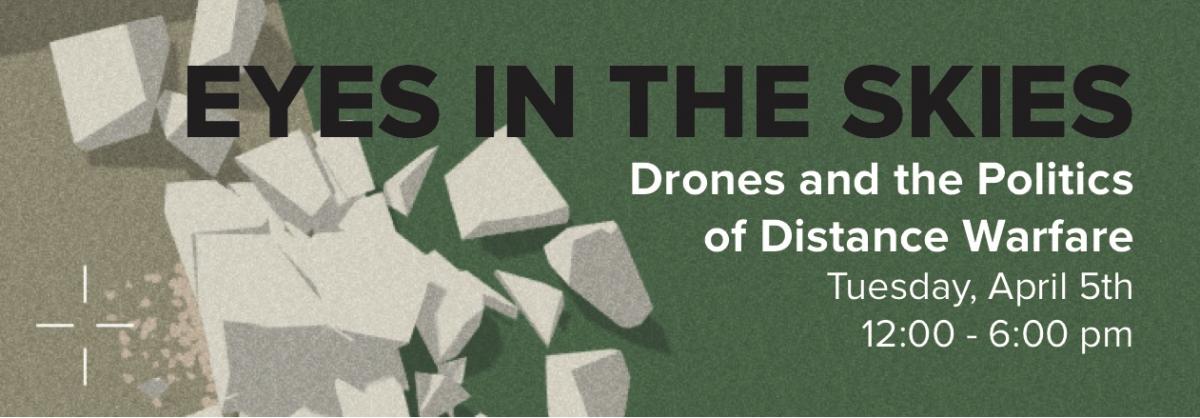
Eyes in the Skies

eyes_in_the_skies_pic

I’m just back from a wonderful time at UC Davis, where I was speaking at a symposium called “Eyes in the skies: drones and the politics of distance warfare.”  It was a creative program, packed with insights from Caren Kaplan and Andrea Miller, Priya Satia and Joe Delappe.

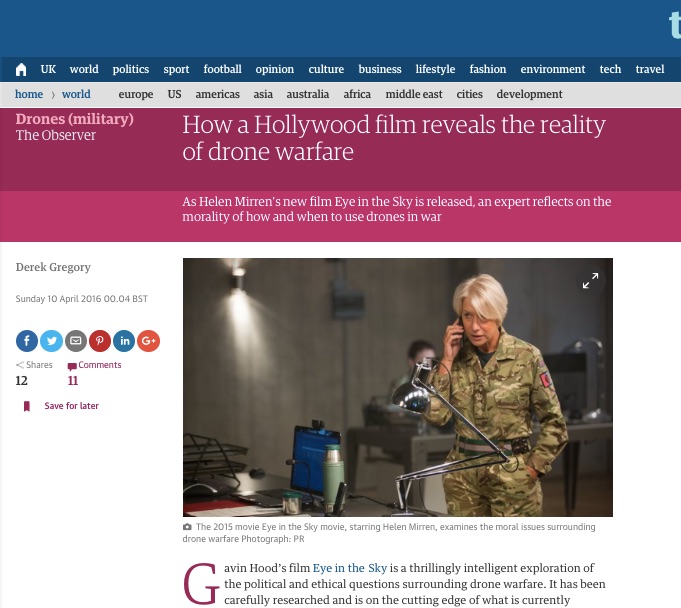
On my way back to Vancouver on Wednesday I received an invitation from Britain’s Guardian (in fact, the Sunday version, the Observer) to write something around that very question using the Gavin Hood film “Eyes in the sky” as a peg.

It’s just been published and you can find it here.

GREGORY Observer

At Davis I’d been giving what I think will be my final presentation of “Angry Eyes” (see here and here), so I was still preoccupied with remote platforms and close air support – not the contradiction it sounds – rather than targeted killing (which is the focus of the film).  The published version has, inevitably, been edited, so I’m pasting the full-length version below and added some links that might help.  There are still lots of short-cuts and elisions, necessarily so for anything of this length, so I hope readers will forgive the inevitable simplifications.

***

Gavin Hood’s Eye in the Sky is a thrillingly intelligent exploration of the political and ethical questions surrounding drone warfare. It’s been carefully researched and is on the cutting-edge of what is currently possible. But there’s a longer history and a wider geography that casts those issues in a different light.  As soon as the Wright Brothers demonstrated the possibility of human flight, others were busy imagining flying machines with nobody on board.  In 1910 Raymond Phillips captivated crowds in the London Hippodrome with a remotely controlled airship that floated out over the stalls and, when he pressed a switch, released hundreds of paper birds on the heads of the audience below. When he built the real thing, he promised, the birds would be replaced with bombs. Sitting safely in London he could attack Paris, Berlin – or Manchester (a possibility that understandably prompted questions about navigation).

There has always been something hideously theatrical about bombing, from the Hendon air displays in the 1920s featuring attacks on ‘native villages’ to the Shock and Awe visited on the inhabitants of Baghdad in 2003. The spectacle now includes the marionette movements of Predators and Reapers whose electronic strings are pulled from thousands of miles away. And it was precisely the remoteness of the control that thrilled the crowds in the Hippodrome. But what mattered even more was surely the prospect Phillips made so real: bombing cities and attacking civilians far from any battlefield.

Remoteness’ is in any case an elastic measure. Human beings have been killing other human beings at ever greater distances since the invention of the dart, the spear and the slingshot. Pope Urban II declared the crossbow illegal and Pope Innocent II upheld the ban in 1139 because it transformed the terms of encounter between Christian armies (using it against non-Christians was evidently a different matter). The invention of firearms wrought another transformation in the range of military violence, radicalized by the development of artillery, and airpower another. And yet today, in a world selectively but none the less sensibly shrunken by the very communications technologies that have made the deployment of armed drones possible, the use of these remote platforms seems to turn distance back into a moral absolute.

But if it is wrong to kill someone from 7,500 miles away (the distance from Creech Air Force Base in Nevada to Afghanistan), over what distance is it permissible to kill somebody?  For some, the difference is that drone crews are safe in the continental United States – their lives are not on the line – and this has become a constant refrain in the drone debates. In fact, the US Air Force has been concerned about the safety of its aircrews ever since its high losses during the Second World War. After Hiroshima and Nagasaki the Air Force experimented with using remotely controlled B-17 and B-47 aircraft to drop nuclear bombs without exposing aircrews to danger from the blast, and today it lauds its Predators and Reapers for their ability to ‘project power without vulnerability’.

It’s a complicated boast, because these remote platforms are slow, sluggish and easy to shoot down – they won’t be seen over Russian or Chinese skies any time soon. They can only be used in uncontested air space – against people who can’t fight back – and this echoes Britain’s colonial tactic of ‘air policing’ its subject peoples in the Middle East, East Africa and along the North-West Frontier (which, not altogether coincidentally, are the epicentres of todays’ remote operations). There are almost 200 people involved in every combat air patrol – Nick Cullather once described these remote platforms as the most labour intensive weapons system since the Zeppelin – and most of them are indeed out of harm’s way. It’s only a minor qualification to say that Predators and Reapers have a short range, so that they have to be launched by crews close to their targets before being handed off to their home-based operators. This is still remote-control war, mediated by satellite links and fiber-optic cables, but in Afghanistan the launch and recovery and the maintenance crews are exposed to real danger. Even so, Grégoire Chamayou insists that for most of those involved this is hunting not warfare, animated by pursuit not combat [see here, here and here].

Yet it’s important not to use this aperçu to lionize conventional bombing. There is an important sense in which virtually all aerial violence has become remarkably remote. It’s not just that bombing has come to be seen as a dismal alternative to ‘boots on the ground’; advanced militaries pick their fights, avoid symmetrical warfare and prefer enemies whose ability to retaliate is limited, compromised or degraded. When he was Secretary of Defense Robert Gates acknowledged that the US had not lost a pilot in air combat for forty years. ‘The days of jousting with the enemy in the sky, of flirting daily with death in the clouds, are all but over,’ writes the far-from-pacifist Mark Bowden, ‘and have been for some time.’ The US Air Force goes to war ‘virtually unopposed’. In short, the distance between the pilot in the box at Creech and the pilot hurtling through the skies over Afghanistan is less than you might think. ‘Those pilots might as well be in Nevada’, says Tom Engelhardt, ‘since there is no enemy that can touch them.’

This suggests that we need to situate armed drones within the larger matrix of aerial violence.  Bombing in the major wars of the twentieth century was always dangerous to those who carried it out, but those who dropped bombs over Hamburg or Cologne in the Second World War or over the rainforests of South Vietnam in the 1960s and 70s were, in a crucial sense, also remote from their targets. Memoirs from Bomber Command crews confirm that the target cities appeared as lights sparkling on black velvet, ‘like a Brocks firework display.’ ‘The good thing about being in an aeroplane at war is that you never touch the enemy’, recalled one veteran. ‘You never see the whites of their eyes. You drop a four-thousand-pound cookie and kill a thousand people but you never see a single one of them.’ He explained: ‘It’s the distance and the blindness that enables you to do these things.’ The crews of B-52 bombers on Arc Light missions dropped their loads on elongated target boxes that were little more than abstract geometries. ‘Sitting in their air-conditioned compartments more than five miles above the jungle’, the New York Times reported in 1972, the crews ‘knew virtually nothing about their targets, and showed no curiosity.’ One of them explained that ‘we’re so far away’ that ‘it’s a highly impersonal war for us.’

Distance no longer confers blindness on those who operate today’s drones. They have a much closer, more detailed view of the people they kill. The US Air Force describes their job as putting ‘warheads on foreheads’, and they are required to remain on station to carry out a battle damage assessment that is often an inventory of body parts.  Most drone crews will tell you that they do not feel thousands of miles away from the action: just eighteen inches, the distance from eye to screen.

Their primary function is to provide intelligence, surveillance and reconnaissance. This was exactly how the Wright brothers thought military aircraft would be used – in July 1917 Orville insisted that ‘bomb-dropping’ would be at best a minor role and almost certainly useless, though he was speaking before the major air offensives in the final year of the war and could have had no inkling of what was to come in the Second World War. The Predator and its precursors were designed to identify targets for conventional strike aircraft over the Balkans in the 1990s, and thirty years later it is still those ‘eyes in the sky’ that make the difference. Although drones have been armed since 2001, until late 2012 they were directly responsible for only 5-10 per cent of all air strikes in Afghanistan. But they were involved in orchestrating many more. Flying a Predator or a Reaper ‘is more like being a manager’, one pilot explained to Daniel Rothenberg: ‘You’re managing multiple assets and you’re involved with the other platforms using the information coming off of your aircraft.’ In principle it’s not so different from using aircraft to range targets for artillery on the Western Front, but the process has been radicalized by the drone’s real-time full-motion video feeds that enable highly mobile ‘targets of opportunity’ to be identified and tracked. In the absence of ground intelligence, this becomes crucial: until drones were relocated in sufficient numbers from Afghanistan and elsewhere to enable purported IS-targets in Syria to be identified, most US aircraft were returning to base without releasing their weapons.

Armed drones are used to carry out targeted killings, both inside and outside areas of ‘active hostilities’, and to provide close air support to ground troops. Targeted killing has spurred an intense critical debate, and rightly so – this is the focus of Eye in the sky too – but close air support has not been subject to the same scrutiny. In both cases, video feeds are central, but it is a mistake to think that this reduces war to a video game – a jibe that in any case fails to appreciate that today’s video games are often profoundly immersive.   In fact, that may be part of the problem. Several studies have shown that civilian casualties are most likely when air strikes are carried out to support troops in contact with an enemy, and even more likely when they are carried out from remote platforms. I suspect that drone crews may compensate for their physical rather than emotional distance by ‘leaning forward’ to do everything they can to protect the troops on the ground. This in turn predisposes them to interpret every action in the vicinity of a ground force as hostile – and civilians as combatants – not least because these are silent movies: the only sound, apart from the clacking of computer keys as they talk in secure chat rooms with those watching the video feeds, comes from radio communications with their own forces.

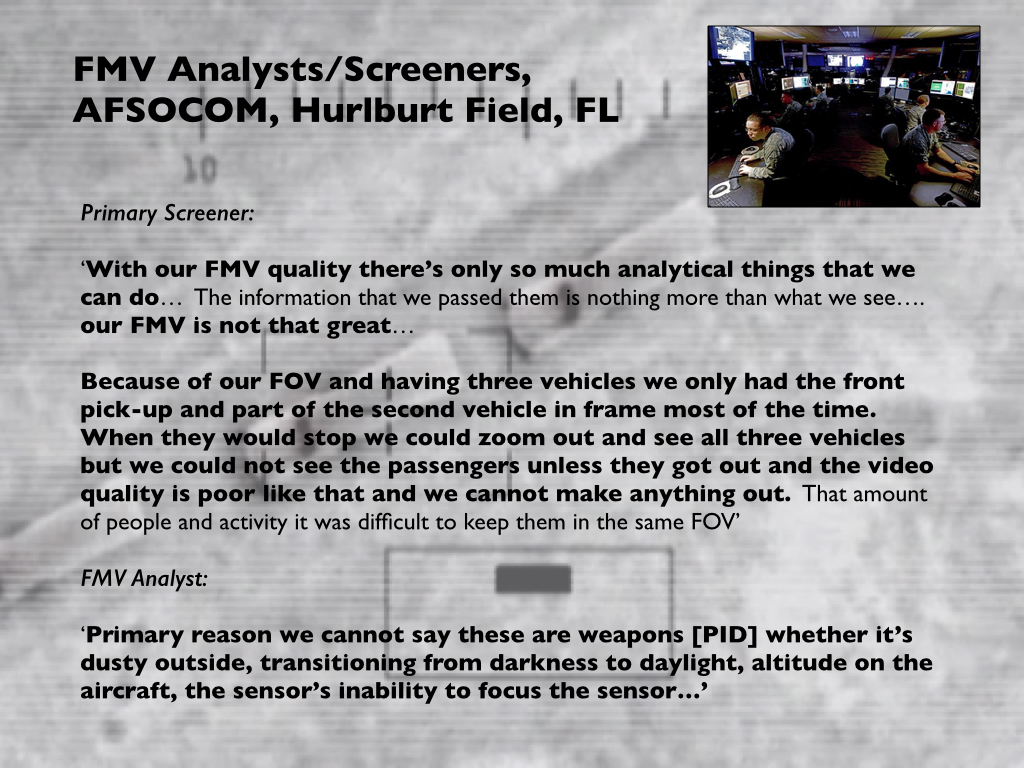
In contrast to those shown in Eye in the Sky, those feeds are often blurry, fuzzy, indistinct, broken, compressed -– and, above all, ambiguous. How can you be sure that is an insurgent burying an IED and not a farmer digging a ditch?  The situation is more fraught because the image stream is watched by so many other eyes on the ground, who all have their own ideas about what is being shown and what to do about it.  Combining sensor and shooter in the same (remote) platform may have ‘compressed the kill-chain’, as the Air Force puts it, and this is vital in an era of ‘just-in-time’, liquid war where everything happens so fast. Yet in another sense the kill-chain has been spectacularly extended: senior officers, ground force commanders, military lawyers, video analysts all have access to the feeds. There’s a wonderful passage in Brian Castner‘s All the ways we kill and die that captures the dilemma perfectly. ‘A human in the loop?’, Castner’s drone pilot complains.

‘Try two or three or a hundred humans in the loop. Gene was the eye of the needle, and the whole war and a thousand rich generals must pass through him… If they wanted to fly the fucking plane, they could come out and do it themselves.’

This is the networked warfare, scattered over multiple locations around the world, shown in Eye in the Sky. But the network often goes down and gets overloaded – it’s not a smooth and seamlessly functioning machine – and it is shot through with ambiguity, uncertainty and indecision.  And often those eyes in the sky multiply rather than disperse the fog of war.

Industrialised war

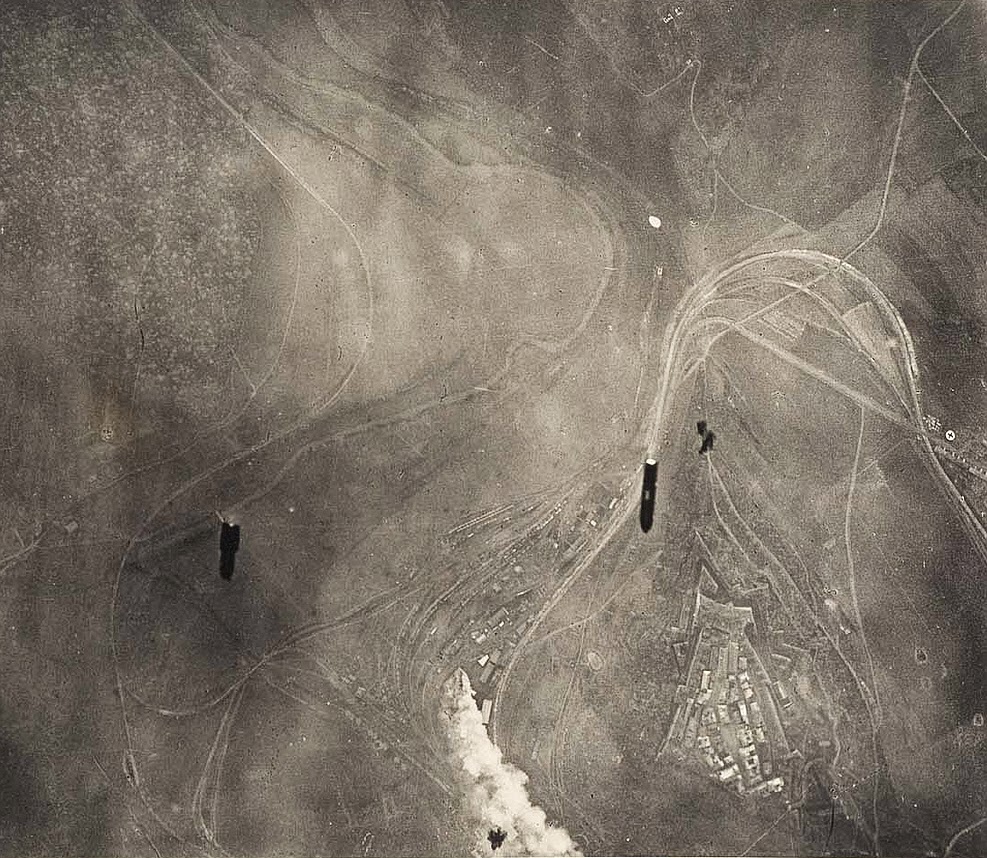
Bombs falling on Montmedy and marshalling yards

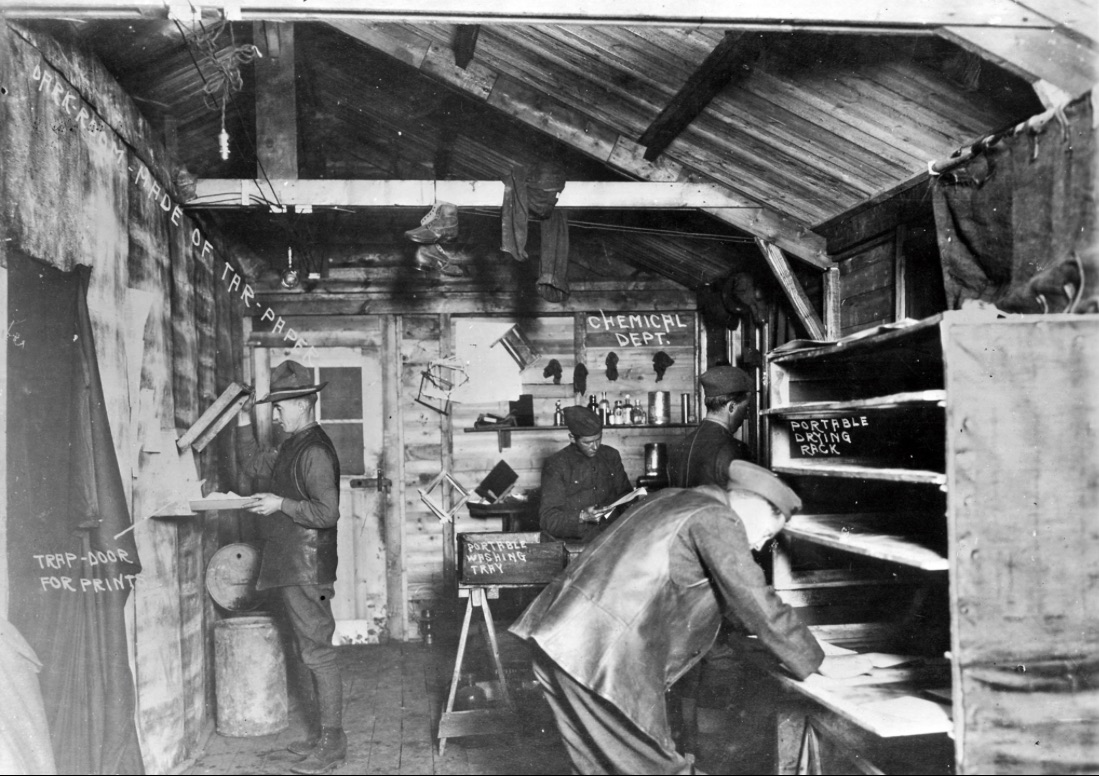
As I work on the text of “Reach from the Sky”, I’ve been revisiting the role of Edward Steichen in the development (in fact, the industrialisation) of air photography on the Western Front.  As I noted, all too briefly, in ‘Gabriel’s map’ (DOWNLOADS tab), Steichen commanded the photographic division of the American Expeditionary Forces. He organised the 55 officers and 1,111 men under his command into what Paul Virilio described as ‘a factory-style output of war information’ that ‘fitted perfectly with the statistical tendencies of this first great military-industrial conflict’.

Steichen 5th Photographic section at work on Western Front

The classic source on Steichen’s assembly-line methods of reproduction (and much more) is Allen Sekula‘s essay, ‘The instrumental image: Steichen at war’, in Artforum 14 (1975) 26-35 [see also the image above]:

The establishment of this method of production grew out of demands for resolution, volume, and immediacy. No method of reproduction but direct printing from the original negative would hold the detail necessary for reconnaissance purposes. Large numbers of prints from a single negative had to be made for distribution throughout the hierarchy of command. In addition, the information in prints dated very rapidly. Under these circumstances, efficiency depended on a thorough-going division of labor and a virtually continuous speedup of the work process. Printers worked in unventilated, makeshift darkrooms; 20 workers might produce as many as 1,500 prints in an hour, working 16-hour shifts.

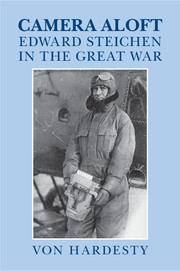
Analytically the essay has never been surpassed, but now there is a new book that fills in the biographical details of Steichen’s service during the First World War: Von Hardesty‘s Camera Aloft: Edward Steichen in the Great War (Cambridge, 2016):

Von Hardesty Camera AloftEdward Steichen (1879–1973) played a key role in the development of photography in the twentieth century. He is well known for his varied career as an artist, a celebrated photographer, and museum curator. However, Steichen is less known for his pivotal role in shaping America’s first experiments in aerial photography as a tool for intelligence gathering in what may be called his “lost years.” In Camera Aloft, Von Hardesty tells how Steichen volunteered in 1917 to serve in the American Expeditionary Forces (AEF). He rose rapidly in the ranks of the Air Service, emerging as Chief of Air Photography during the dramatic final offensives of the war. His photo sections were responsible for the rapid processing of aerial images gained through the daily and hazardous sorties over the front and in the enemy rear areas. What emerged in the eighteen months of his active service was a new template for modern aerial reconnaissance. The aerial camera, as with new weapons such as the machine gun, the tank, and the airplane, profoundly transformed modern warfare.

Here is the table of contents:

Foreword: taking the camera aloft
1. War and exile
2. A new life in the military
3. Over there
4. The world of air observation
5. Taking charge
6. Over the front
7. War and photography
Appendix: life at the cutting edge: the photo sections.

The book includes stunning reproductions of photographs (from which I’ve borrowed the annotated image of the Photographic Section above): you can see a selection from the book here.  Other Steichen aerial imagery from the period is here and here.

As you’ll be able to see when I’m finished, I’m no less interested in Steichen’s work during the Second World War, and in particular the various photographic projects he directed in the Pacific that captured – and celebrated – the masculinism and homosociality of modern war (here the work of Horace Bristol is especially revealing).

But right now it’s the industrialisation of aerial imagery that is capturing my attention.  It’s a commonplace that the First World War was industrial warfare on the grand scale, of course, but often our attention is distracted by the killing machines and mechanisms themselves – the gas, the tanks, the aircraft – and we lose sight of the assembly-line logic that animated the slaughter not only during but also before and after.

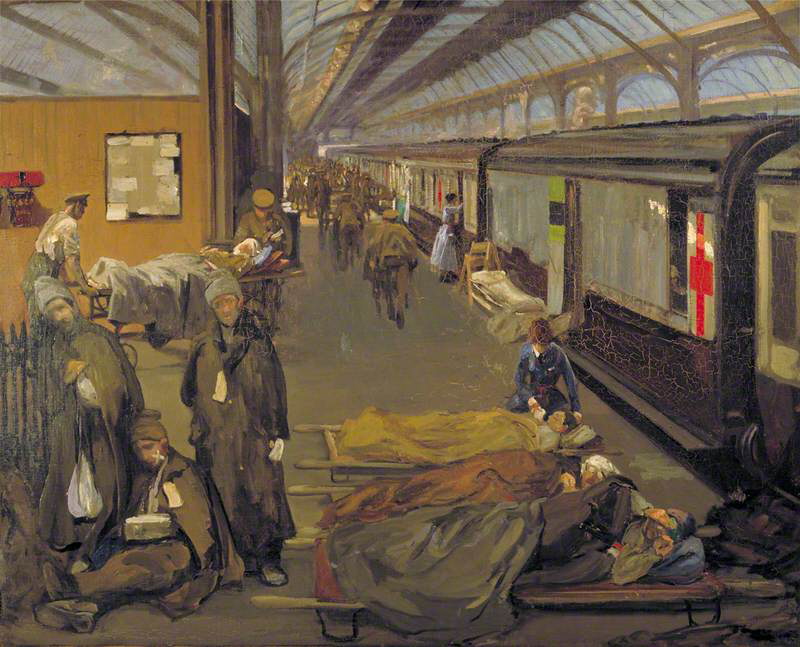
LOBLEY Reception of wounded at 1st CCS, Le Chateau October 1918

You can see it in Steichen’s production line, but there are countless other examples.  Last summer I was working in the Friends’ Library in London, recovering the role of the Quakers in providing medical care on the Western Front as part of my research on casualty evacuation, when I encountered this extraordinary passage that speaks directly to the relentless motion of the killing machine (see also my ‘Divisions of Life’ here).  It’s a medical orderly’s account of loading an ambulance train, written some time in 1915:

Down in a hedged field at the end of the straggling mining village lies the casualty clearing station, some two-score large tents… Since midday the [casualty] clearing station has been full to overflowing, but still an endless line of motor ambulances moves down along the crowded road from the fighting line, through the village and into the muddy field. It is night now, starless and dark as pitch, and a lashing rain is driven hard in your face before a bitter and rising wind; but still the cars are discharging their pitiful loads in dreary succession when the train is brought into the siding which serves this desolate little camp.

day2day-amb2

From the train itself you can scarcely see anything of the clearing station tonight; only the headlights of the cars as they turn in through the gate, and a few hurricane lamps flickering here and there. Near one end of the train, at the wooden footbridge which crosses the stream separating the camp from the railway track, there stands a powerful acetylene flare, casting a circle of vivid light on the deep mud of the path. Save for three or four feeble oil-lamps on the ground beside the long darkened train, this is the only light at the loading place. A few moments of uncertain waiting, and the first stretcher comes down, its weary bearers slithering and stumbling in the watery mire. As you watch the flare you see them emerge suddenly from the utter blackness beyond into the fierce glare of the light; they halt for a moment, while a cloaked officer standing on the bridge raises the waterproof sheet which protects the wounded man’s face from the beating rain; a name is given and noted; the covering is dropped over the head, and the bearers move on again, seeing to vanish as if by magic as they pass with their burden out of the light into the enveloping blackness. A pause, another stretcher enters the circle of light; the same words pass, the same motions, and it too move son, blotted out as suddenly as it appeared. Watching this time after time, you feel as if a picture were being cast on a screen and flashed off, over and over again: for there is something cruelly mechanical about it all.

(c) Rosenstiel's; Supplied by The Public Catalogue Foundation

Rooting for the uprooted

There’s an excellent account by Michael Hodges of Eyal Weizman‘s Forensic Architecture project (he now calls it a research agency) over at Wired UK.  Unlike some media versions, this is fully – and appropriately – embodied and materialised, following Eyal through East Jerusalem and into the West Bank in August 2015.  He explains:

“The idea is to use forensic architecture as a method that extends deep into the facts and looks at them and maps them out to see the materialisation of political forces. Forensic Architecture assumes that every bit of material reality is the product of a complex force field that extends in space and time. So you can take an inanimate object and see into it, almost like a crystal ball.”

That’s as good a summary of the project as you’ll find, but en route you also understand the ‘situatedness’ of the project – that’s an inadequate formulation, I increasingly think, since it’s also about extending deep into what, for want of a batter word, we might call the field: it’s about the rootedness of Forensic Architecture in the lives of the uprooted.

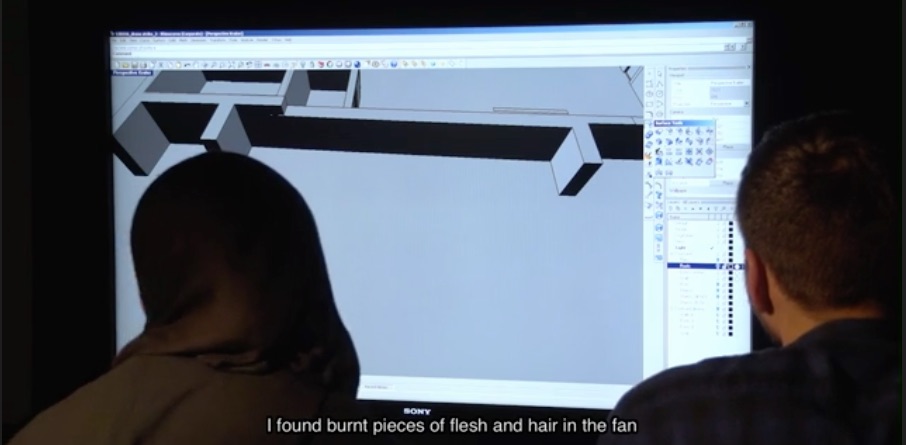
FA Waziristan 2010 reconstruction

In consequence, what also comes into view during the report is the passionate commitment of its investigators to the witnesses whose experiences they recover:

“We understand the relationship between memory, architecture and violence,” Weizman says. “Take the woman who survived the drone strike in Waziristan [above; see also the video here: scroll down to case 2]. She was very traumatised; she lost relatives in there. We returned her digitally to the site of the attack and built it together with her, reconstructed her family house that had been hit by the drone [above]. During the modelling process she was meticulous about every window, every object we placed in there, every person. But she was very obsessed with a fan. In the beginning she said it was on the ceiling. Then she said no, it was a standing fan. She asked us to move it to the left and then to the right and then back again, until we were wondering, what is it about the fan? But when we made her walk through the space she recollected exactly where it had been, and that after the strike had killed her family she had found bits of human flesh on the blades of the fan. You see, the fan acted as an anchor for her memory and in the end we reassembled that memory in a digital space.”

And as you follow Eyal through occupied Palestine, you also realise that there is something vitally defiant in so thoroughly challenging Israel’s rhetorical claim to the ‘facts on the ground’.

Matters of definition

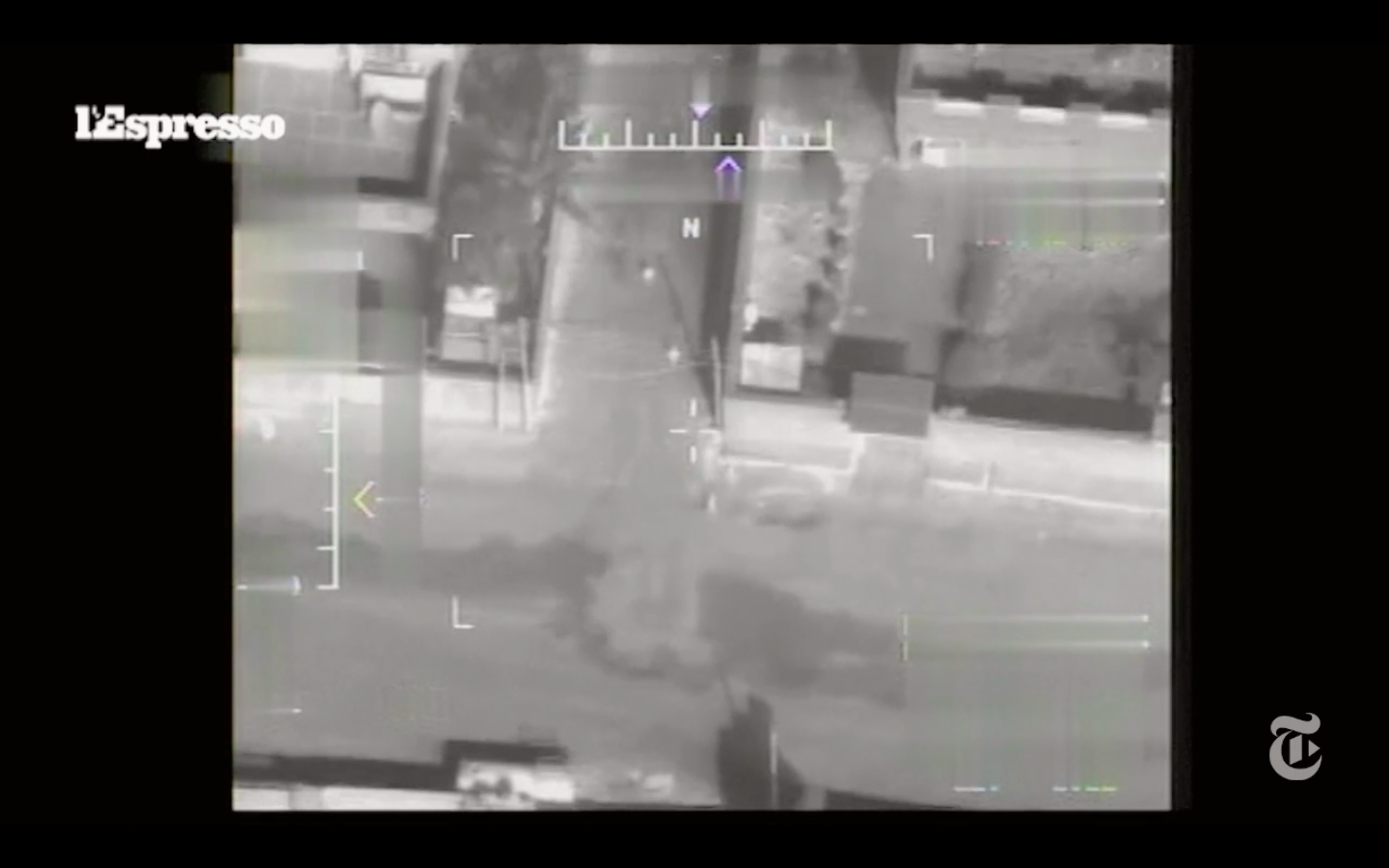
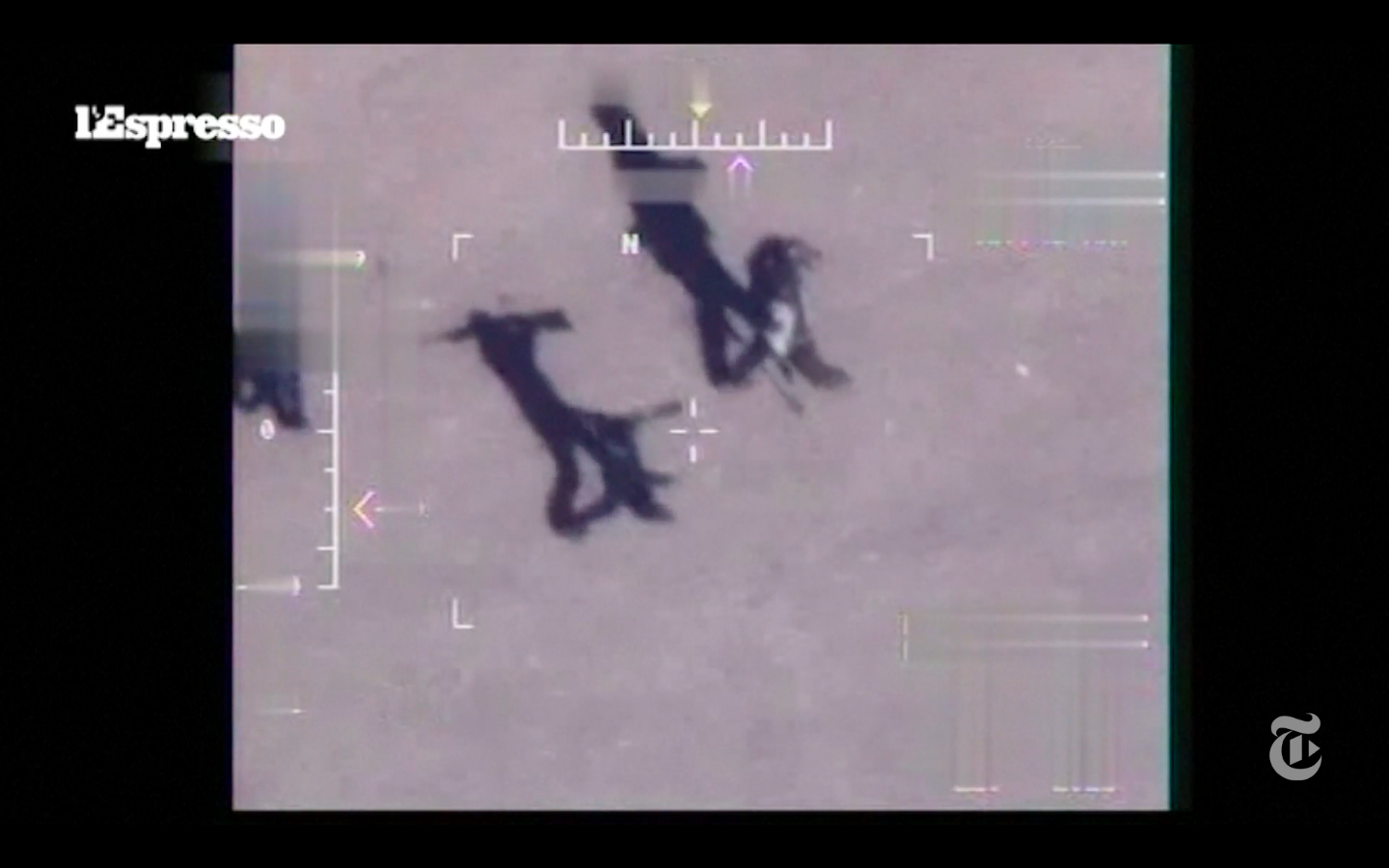
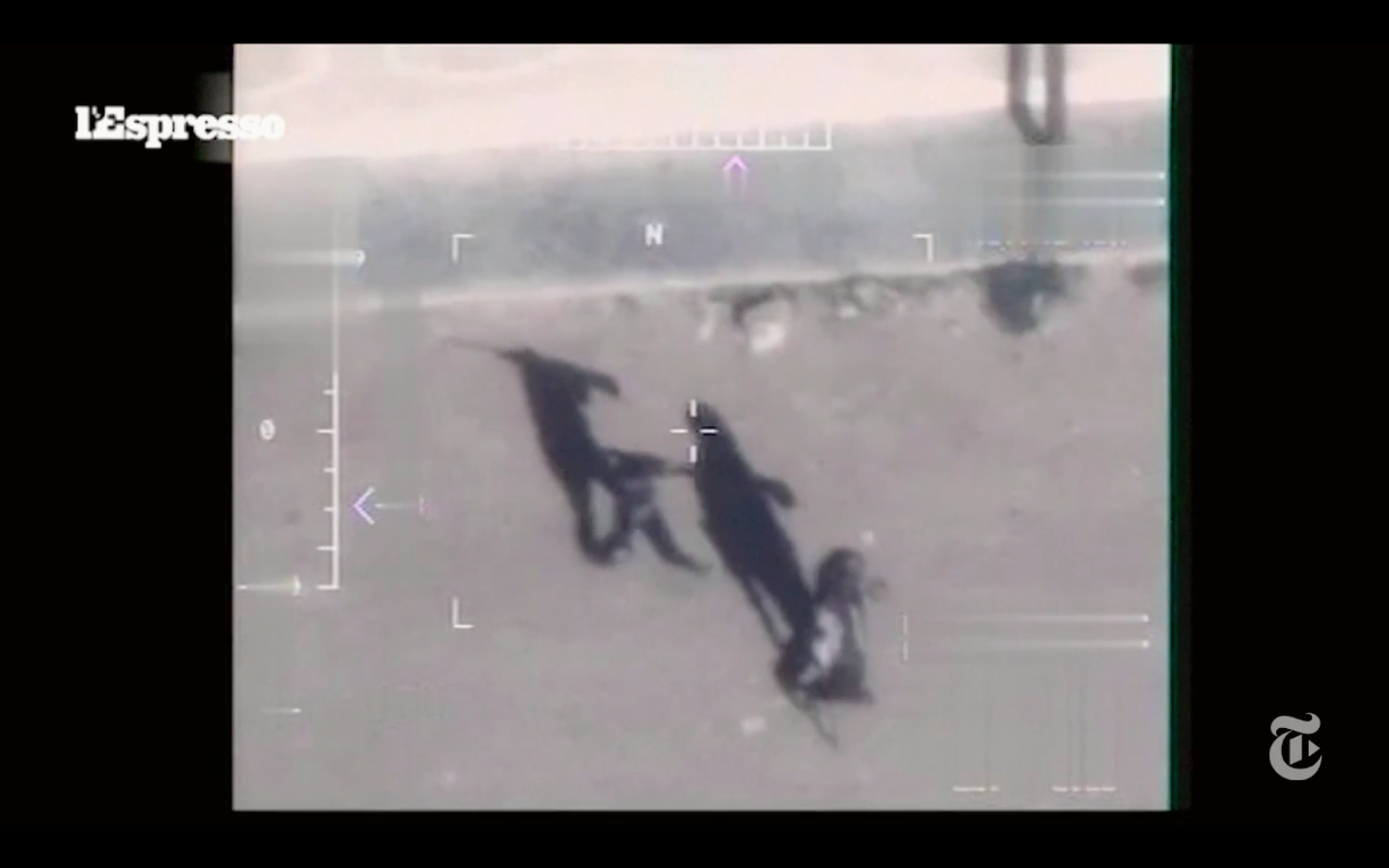
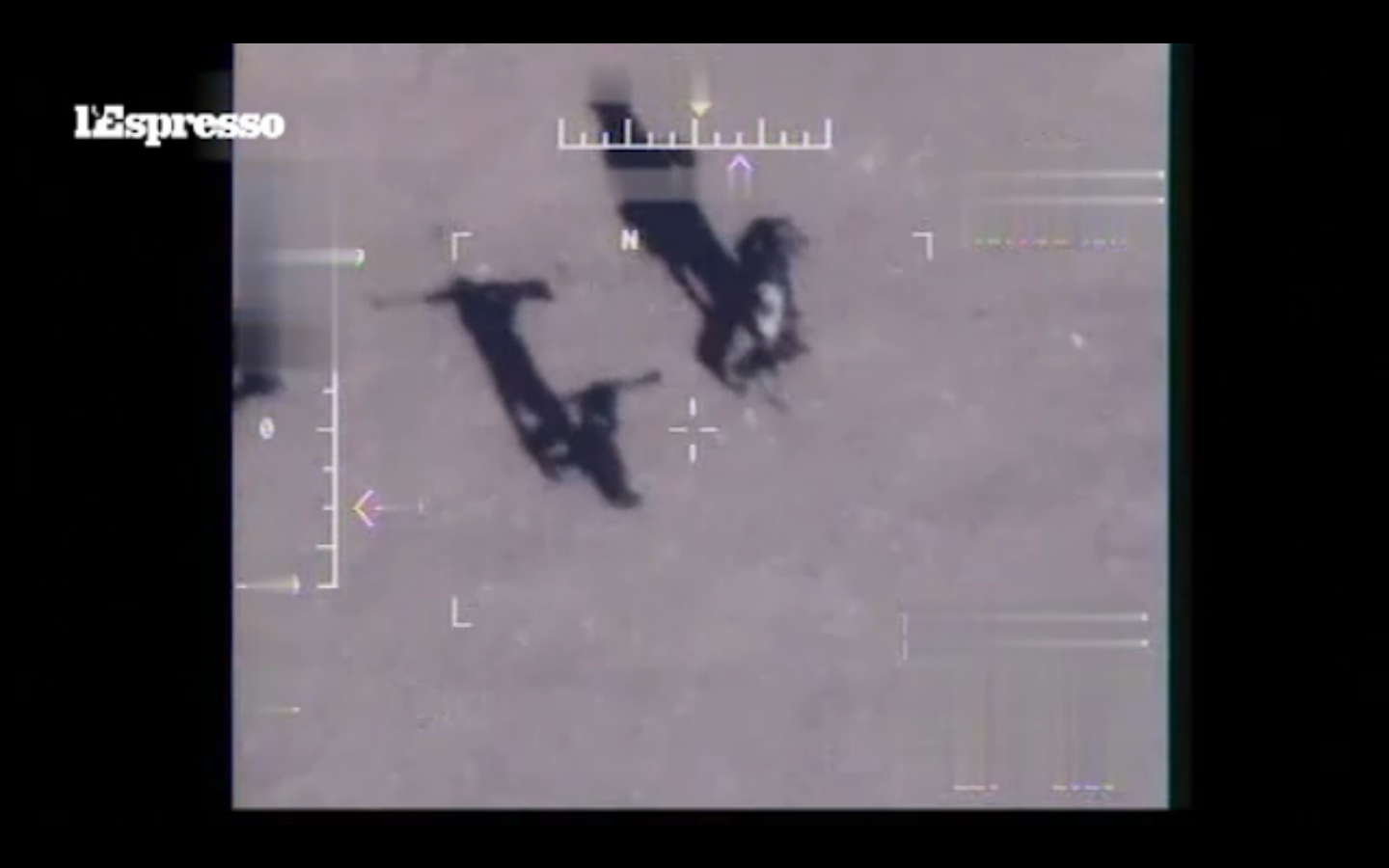
Since my post on the use of drones to provide intelligence, surveillance and reconnaissance over Iraq and Syria I’ve been thinking about the image stream provided by Predators and Reapers.  Then I used an image from what I think must be an MQ-9 Reaper operated by France which was in full colour and – this is the important part – in high definition.  Over the weekend the New York Times published a report, culled from the Italian magazine L’Espresso, which – together with the accompanying video clip (the link is to the Italian original not the Times version) – confirmed the power of HD full motion video, this time from a Reaper operated by Italy:

The footage … begins with grainy black-and-white images of an airstrike on what appears to have been a checkpoint on a road in northern Iraq, beneath a huge black flag.

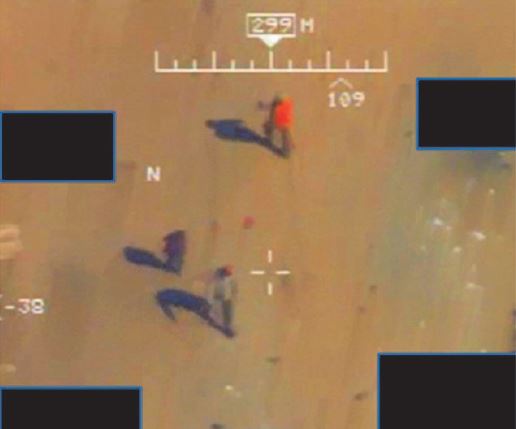
Then there is something altogether different: high-resolution, color video of four distinct armed figures walking out of a house and along the streets of a town. At one stage, the picture suddenly zooms in on two of the suspected militants to reveal that one of them is almost certainly a child, propping a rifle on his shoulder that indicates how small he is relative to the man next to him. The images are so clear that even the shadows of the figures can be examined.

Italian Drone video BItalian drone video CItalian drone video AItalian drone video DItalian drone video I

But the significance of all this is less straightforward than it might appear.

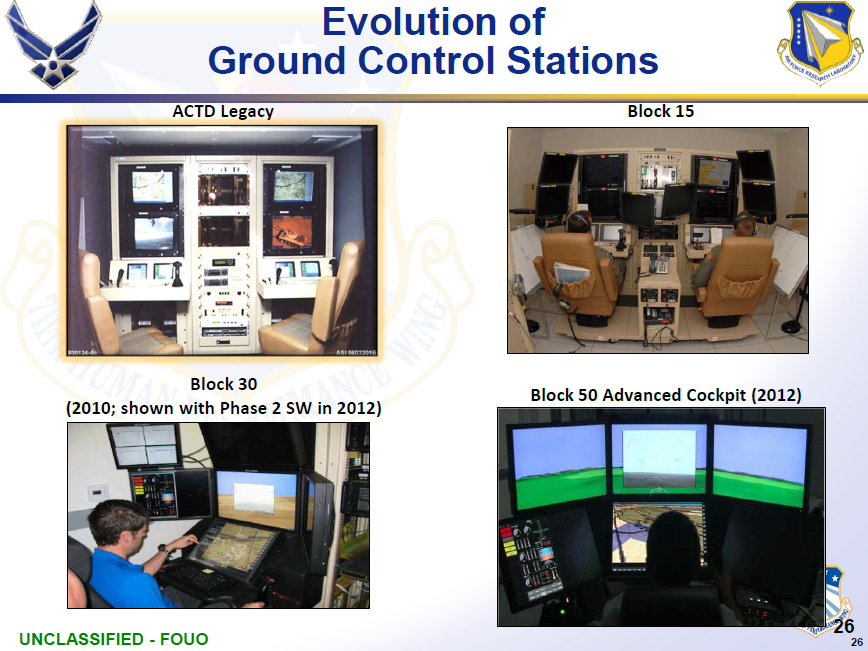
First, not all drones have this HD capability.  We know from investigations into civilian casualty incidents in Afghanistan that the feeds from Predators but also early model (‘Block’) Reapers are frequently grainy and imprecise.  Sean Davies reports that the video compression necessary for data transmission squeezed 560 x 480 pixel resolution images into 3.2 MBps at 30 frames per second whereas the newer (Block 5) Reapers provide 1280 x 720 pixel resolution images resolution images at 6.4 MBps.  The enhanced video feeds can be transmitted not only to the Ground Control Stations from which the aircraft are flown – and those too have been upgraded (see image below) – but also to operations centres monitoring the missions and, crucially, to ruggedized laptops (‘ROVERs’) used by special forces and other troops on the ground.

ground-control-stations

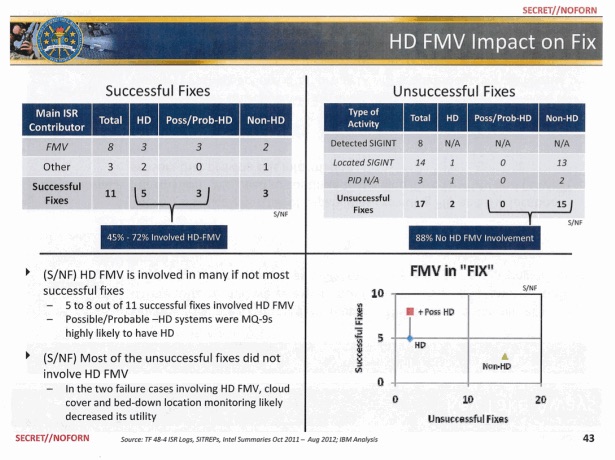
The significance of HD full-motion video is revealed in the slide below, taken from a briefing on ‘small footprint operations’ in Somalia and Yemen prepared in February 2013 and published as part of The Intercept‘s Drone Papers, which summarises its impact on the crucial middle stage of the ‘find, fix, finish‘ cycle of targeted killing:

HD FMV impact on Fix

As you can see, HD FMV was involved in as many as 72 per cent of the successful ‘fixes’ and was absent from 88 per cent of the unsuccessful ones.

Second, Eyal Weizman cautions that the image stream shown on the Italian video was captured ‘either very early or very late in the day.  Without shadows we could not identify these as weapons at all.’  Infra-red images captured at night could obviously not provide definition of this quality, but even so-called ‘Day TV’ would not show clear shadows at most times of the day. In Eyal’s view, ‘showing these rare instances could skew our understanding of how much can be seen by drones and how clear what we see is.’

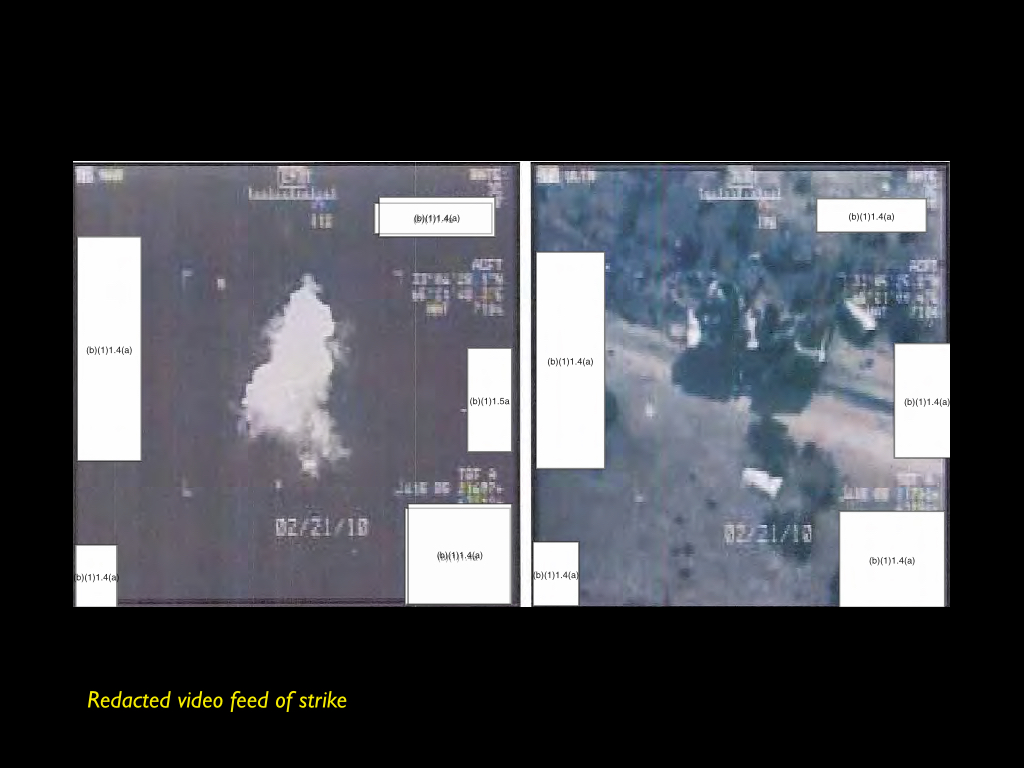
Third, no matter how high the resolution of the video feeds, we need to remember that their interpretation is a techno-cultural process.  One of the figures shown in the Italian video ‘is almost certainly a child’, reports the New York Times.  So bear in mind this exchange between the crew of a Predator circling over three vehicles travelling through the mountains of Uruzgan in February 2010 (see also here and here):

1:07 􏰀(MC):􏰀 screener􏰀 said 􏰀at least 􏰀one 􏰀child 􏰀near 􏰀SUV􏰀

1:07 􏰀(Sensor):􏰀 bull􏰀 (expletive 􏰀deleted)…where!?􏰀

1:07 􏰀(Sensor): 􏰀send 􏰀me 􏰀a 􏰀(expletive􏰀deleted) 􏰀still,􏰀􏰀 I􏰀 don’t 􏰀think 􏰀they 􏰀have 􏰀kids 􏰀out 􏰀at 􏰀this 􏰀hour, 􏰀I 􏰀know􏰀 they’re 􏰀shady 􏰀but􏰀 come􏰀 on􏰀

1:07􏰀 (Pilot):􏰀 at 􏰀least 􏰀one 􏰀child…􏰀Really?􏰀 Listing 􏰀the􏰀 MAM [Military-Aged Male], 􏰀uh, 􏰀that 􏰀means 􏰀he’s 􏰀guilty􏰀

1:07􏰀 (Sensor):􏰀 well 􏰀may be􏰀 a 􏰀teenager 􏰀but 􏰀I 􏰀haven’t􏰀 seen􏰀 anything 􏰀that 􏰀looked 􏰀that 􏰀short, 􏰀granted 􏰀they’e􏰀 all 􏰀grouped 􏰀up 􏰀here,􏰀 but.􏰀..

1:07 􏰀(MC): 􏰀They’re 􏰀reviewing􏰀

1:07 􏰀(Pilot):􏰀Yeah 􏰀review 􏰀that􏰀 (expletive 􏰀deleted)…why􏰀 didn’t 􏰀he 􏰀say􏰀 possible􏰀 child,􏰀 why􏰀 are􏰀 they􏰀 so 􏰀quick􏰀 to 􏰀call 􏰀(expletive􏰀 deleted) 􏰀kids 􏰀but􏰀 not 􏰀to 􏰀call 􏰀(expletive􏰀deleted) 􏰀a 􏰀rifle􏰀….

03:10 􏰀(Pilot):􏰀 And 􏰀Kirk􏰀97, 􏰀good 􏰀copy􏰀 on􏰀 that.􏰀 We 􏰀are 􏰀with 􏰀you.􏰀 Our 􏰀screener􏰀 updated􏰀 only􏰀 one􏰀 adolescent 􏰀so 􏰀that’s 􏰀one􏰀 double 􏰀digit􏰀 age 􏰀range.􏰀 How􏰀 Copy?􏰀

03:10 􏰀(JAG25):􏰀We’ll􏰀 pass 􏰀that 􏰀along 􏰀to 􏰀the 􏰀ground 􏰀force􏰀 commander.􏰀 But 􏰀like 􏰀I 􏰀said, 􏰀12 􏰁13 􏰀years 􏰀old 􏰀with􏰀 a 􏰀weapon 􏰀is􏰀 just 􏰀as􏰀 dangerous.􏰀􏰀

In other words – it’s more than a matter of high definition; it’s also a matter of political and cultural definition.

A lack of intelligence

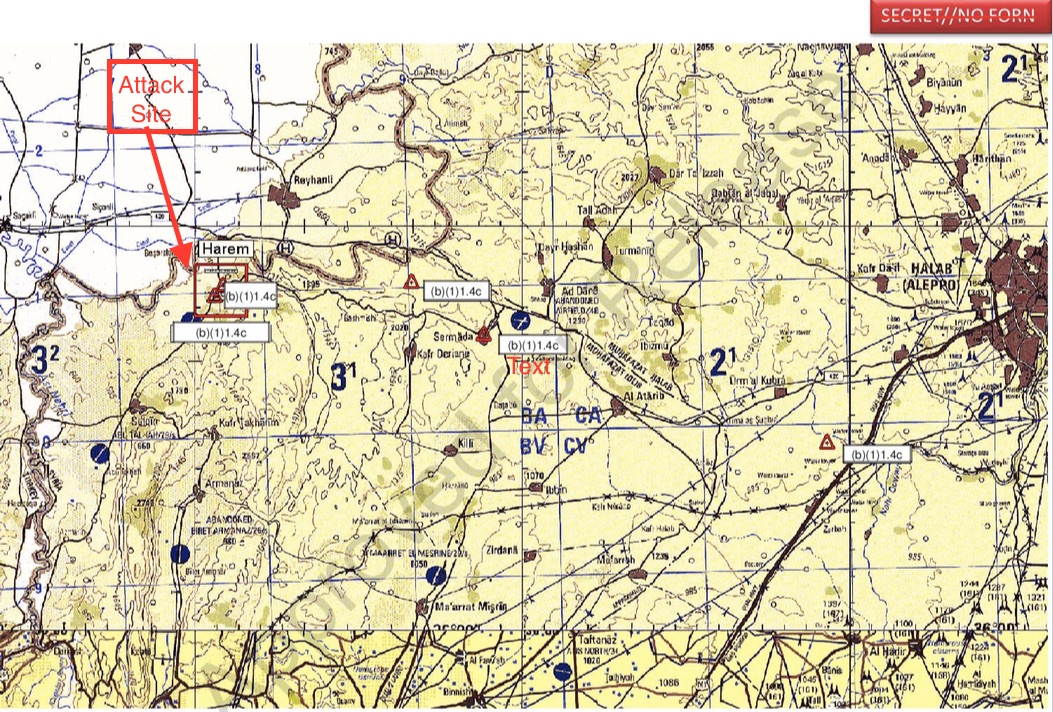
Harim Air Strike MAP annotated

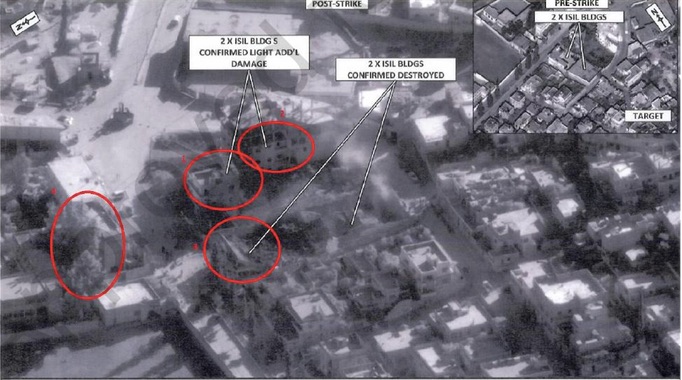
The second of the three recent US air strikes I’ve been looking at took place near Harim [Harem on the map above] in Syria on the night of 5-6 November 2014.  The report of the military investigation into allegations of civilian casualties is here.

The aircraft launched multiple strikes against two compounds which had been identified as sites used as meeting places for named (though redacted) terrorists and sites for the manufacture and storage of explosives by the al-Qaeda linked ‘Khorasan Group’ (if the scare-quotes puzzle you, compare here and here).

The compounds each contained several buildings and had previously been on a No Strike List under a category that includes civilian housing; they lost their protected status when ‘they were assessed as being converted to military use’ but ‘other residential and commercial structures were situated around both targets’.  An annotated image of the attack on the first compound is shown below:

Harim Air Strike on Compound 001

Although the report argues that ‘the targets were engaged in the early morning hours when the risk to civilians was minimized’ – a strange statement, since most civilians would have been asleep inside those ‘residential structures’ – US Central Command subsequently received open-source reports of from three to six civilian casualties, together with still and video imagery.  By the end of December 2014 the Combined Joint Task Force conducting ‘Operation Inherent Resolve’ had completed a preliminary ‘credibility assessment’ of the claims and found sufficient evidence to establish a formal investigation into the allegations of civilian casualties.  The investigating officer delivered his final report on 13 February 2015.

He also had access to a report from the Syrian Network for Human Rights that provided a ground-level perspective (including video) unavailable to the US military.  Its narrative is different from US Central Command, identifying the targets as being associated with An-Nussra:

The warplanes launched, at first, four missiles that hit three military points, which are located next to each other, in the northeast of the town:

1 – The Agricultural Bank, which is used by An-Nussra front as a center.
2 – The central prison checkpoint, where An-Nussra fighters were stationed.
3 – An ammunition depot in the same area.

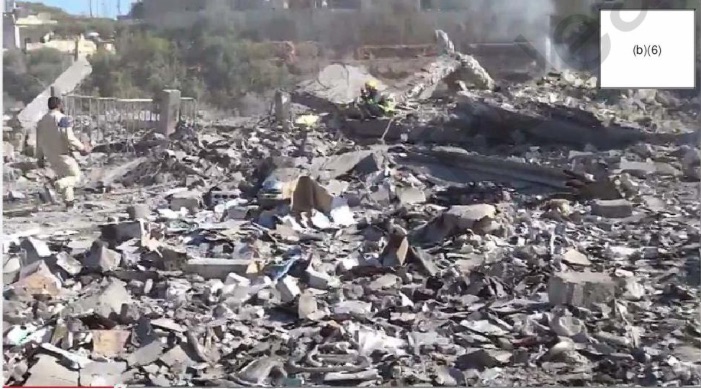
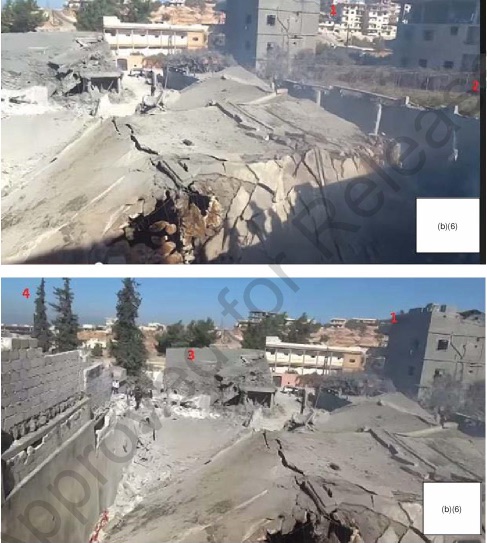
The shelling destroyed and burned the Agricultural Bank’s building completely in addition to damaging a number of building nearby. Furthermore, a number of cars were burned while a series of explosions occurred after an explosion in the ammunition depot..
Afterwards, the warplanes targeted a fourth center with two missiles. [This target] was a building by an old deserted gas station located near the industrial school in the south of the town. The shelling destroyed the center completely as well as the gas station in addition to severely damaging the surrounding buildings. Harem residents were aided by the civil-defense teams to save people from underneath the rubble.

SNHR documented the killing of two young girls; one could not be unidentified but the other was Daniya, aged 5, who was killed along with her father who was said to be one of the An-Nussra fighters living in a house near the Agricultural Bank.  Daniya’s mother and her brother Saeed, aged 7, were seriously wounded.

The report also included post-strike imagery from YouTube videos and Twitter feeds:

Harim VIDEO 1 jpeg

Harim VIDEO 2 jpeg

In contrast to the report on the air strike in Iraq I discussed in my previous post, this one includes no details of the attack, nor the procedures through which it was authorised and conducted – though we do know that there is a considerable military bureaucracy behind all these strikes, especially in the administration of what in this case was clearly a pre-planned rather than emergent target.  For more on the bureaucratisation of targeting, incidentally, see  Astrid Nordin and Dan Öberg, ‘Targeting the ontology of war: From Clausewitz to Baudrillard’, Millennium 43 (2) (2015) 392-410; analytically it’s right on the mark, I think, and I’ll be advancing similar arguments in my Tanner Lectures – though stripped of any reference to Baudrillard…

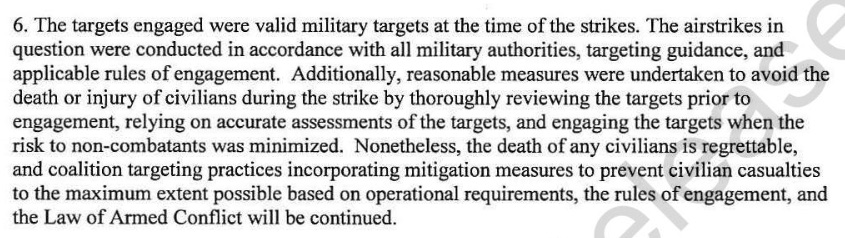
But there is one revealing sentence in the report.  Although the investigating officer had no doubt that the Harim strikes were perfectly legal, everything worked like clockwork and nothing need be changed –

Harim conclusion

– there is nevertheless a recommendation for ‘sustained ISR [intelligence, surveillance and reconnaissance] whenever practicable based on operational requirements, to ensure that no civilians are entering or exiting a facility.’  The clear implication is that these strikes – pre-planned, remember: these were not fleeting targets of opportunity – were not supported by real-time ISR.  When you add to that the reliance placed by the investigation on ground imagery from YouTube and Twitter, you begin to realise how little the US military and its allies must know about many of the targets they strike in Iraq and Syria.  (I might add that the US has not been averse to using Twitter feeds for targeting too: see Robert Gregory‘s compelling discussion in Clean bombs and dirty wars: air power in Kosovo and Libya, where he describes the central role played by Twitter feeds from Libyan rebels in identifying targets for the US Air Force and its NATO allies: by the closing months of the campaign France was deriving 80 per cent of its intelligence from social media contacts on the ground).

All this gives the lie to the cheery ‘let ’em have it’ guff from Robert Caruso, commenting on US air strikes in Syria last September:

By relying so heavily on drones in our recent counter-terror campaigns we’ve been fighting with one hand tied behind our back. But a key to the success of Monday’s strikes was the use of manned aircraft with pilots who can seek out enemy targets and make on-the-spot decisions…

it’s time to drop the drone fetish, and the limitations it imposed, and go back to using manned airpower, which is more powerful and better suited to hunting down elusive targets like ISIS.

Regular readers will know that I’m not saying that drones are the answer, or that their ability to provide persistent, real-time, full-motion video feeds in high definition makes the battlespace transparent; on the contrary (see my ‘Angry Eyes’ posts here and especially here: more to come soon).

But the absence of their ISR capability can only make a bad situation worse.  In February, the director of the National Counterterrorism Center conceded that that US had not ‘closed the gap on where we need to be in terms of our understanding, with granularity, about what is going on on the ground in Syria.’  Indeed, during the first four months of this year ‘nearly 75 percent of U.S. bombing runs targeting the Islamic State in Iraq and Syria [a total of more than 7,000 sorties] returned to base without firing any weapons’, and reports claimed that aircrews held their fire ‘mainly because of a lack of ground intelligence.’

Full-motion video cannot compensate for that absence, of course, and in any case there are serious limitations on the number of ISR orbits that are possible over Iraq and Syria given the demands for drones over Afghanistan and elsewhere: each orbit requires three to four aircraft to provide 24/7 coverage, and the global maximum the US Air Force can provide using its Predators and Reapers varies between 55 and 65 orbits (or ‘combat air patrols’).

In late August 2014 Obama authorised both manned and unmanned ISR flights over Syria, and since then the United States has been joined by the UK and France in deploying MQ-9 Reapers over Iraq and Syria, where their video feeds have helped to orchestrate missions carried out by conventional strike aircraft (see, for example, here).  In August 2015 France claimed that all its air strikes in Iraq had to be validated by ISR provided by a drone:

reaper-20150508

But that was in August, before Hollande threw caution to the winds and ramped up French air strikes in response to the Paris attacks in November – an escalation that relied on targeting packages supplied by the United States.

In any case, Predators and Reapers are also armed and in their ‘hunter-killer’ role they had executed around one quarter of all airstrikes conducted by the United States in Iraq and Syria by June 2015 and more than half the air strikes conducted by the UK in Iraq.  Although the UK only extended its bombing campaign against Islamic State to Syria this month, its Reapers had been entering Syrian airspace in steadily increasing numbers since November 2014 to provide ISR (in part, presumably, to enable the United States to orchestrate its air strikes) and in September 2015 it used one of them to carry out the UK’s first acknowledged targeted killing near Raqqa (see also here and here); the United States has also routinely used the aircraft in the extension of its multi-sited targeted killing program to Syria (see also here).

All this bombing, all this blood: and yet strategically remarkably little to show for it.   And all for a lack of intelligence…

“I’ve looked at clouds from both sides now…”

Eyal Weizman‘s stunning Wall Exchange, “Forensic Architecture”, which he presented at the Vogue Theatre in Vancouver earlier this month, is now up on YouTube here and embedded below.

https://www.youtube.com/watch?v=qBDWPn7QcIg

If you are puzzled by my riff on Joni Mitchell, start around 46:10 (though you’ll miss a lot if you do…).

And while we’re on the subject of clouds, you’ll find a remarkable analysis of a different sort of militarized cloud in Tung-Hui Hu‘s A Prehistory of the Cloud from MIT:

We may imagine the digital cloud as placeless, mute, ethereal, and unmediated. Yet the reality of the cloud is embodied in thousands of massive data centers, any one of which can use as much electricity as a midsized town. Even all these data centers are only one small part of the cloud. Behind that cloud-shaped icon on our screens is a whole universe of technologies and cultural norms, all working to keep us from noticing their existence. In this book, Tung-Hui Hu examines the gap between the real and the virtual in our understanding of the cloud.

Hu shows that the cloud grew out of such older networks as railroad tracks, sewer lines, and television circuits. He describes key moments in the prehistory of the cloud, from the game “Spacewar” as exemplar of time-sharing computers to Cold War bunkers that were later reused as data centers. Countering the popular perception of a new “cloudlike” political power that is dispersed and immaterial, Hu argues that the cloud grafts digital technologies onto older ways of exerting power over a population. But because we invest the cloud with cultural fantasies about security and participation, we fail to recognize its militarized origins and ideology. Moving between the materiality of the technology itself and its cultural rhetoric, Hu’s account offers a set of new tools for rethinking the contemporary digital environment.

Prehistory of the Cloud

Here is Lisa Parks on what is surely one of the must-reads of the year:

“Hu’s riveting genealogy of the cloud takes us into its precursors and politics, and boldly demonstrates how fantasies of sovereignty, security, and participation are bound up in it. Much more than a data center, the cloud is a diffuse and invisible structure of power that has yielded a data-centric order. Imaginative and lucidly written, this book will be core to digital media studies.”

Angry Eyes (2)

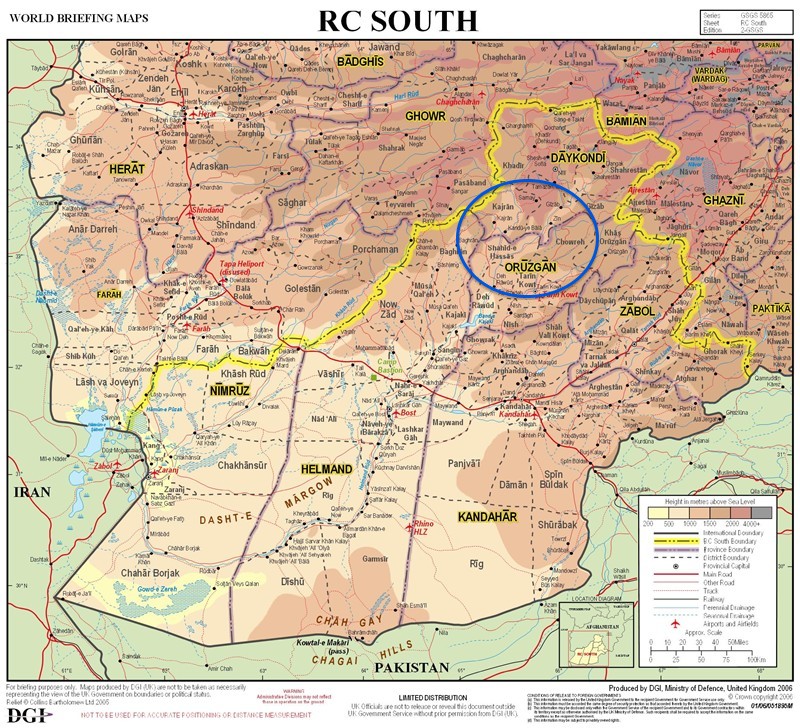
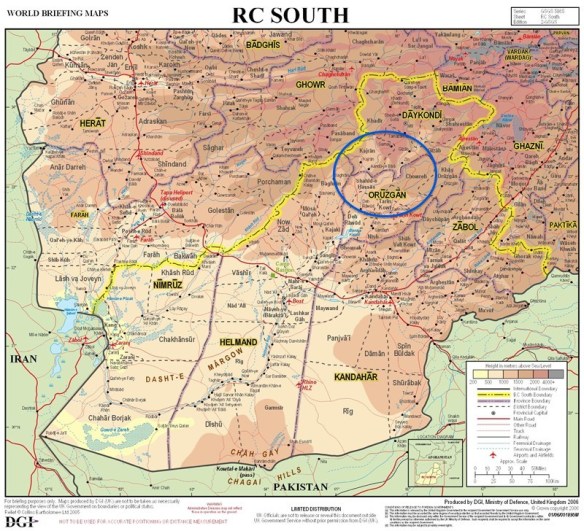
MAP isaf-rc-south

This is the second installment of my analysis of an air strike orchestrated by a Predator in Uruzgan province, Afghanistan on 21 February 2010; the first installment is here.

(4) Command and control?

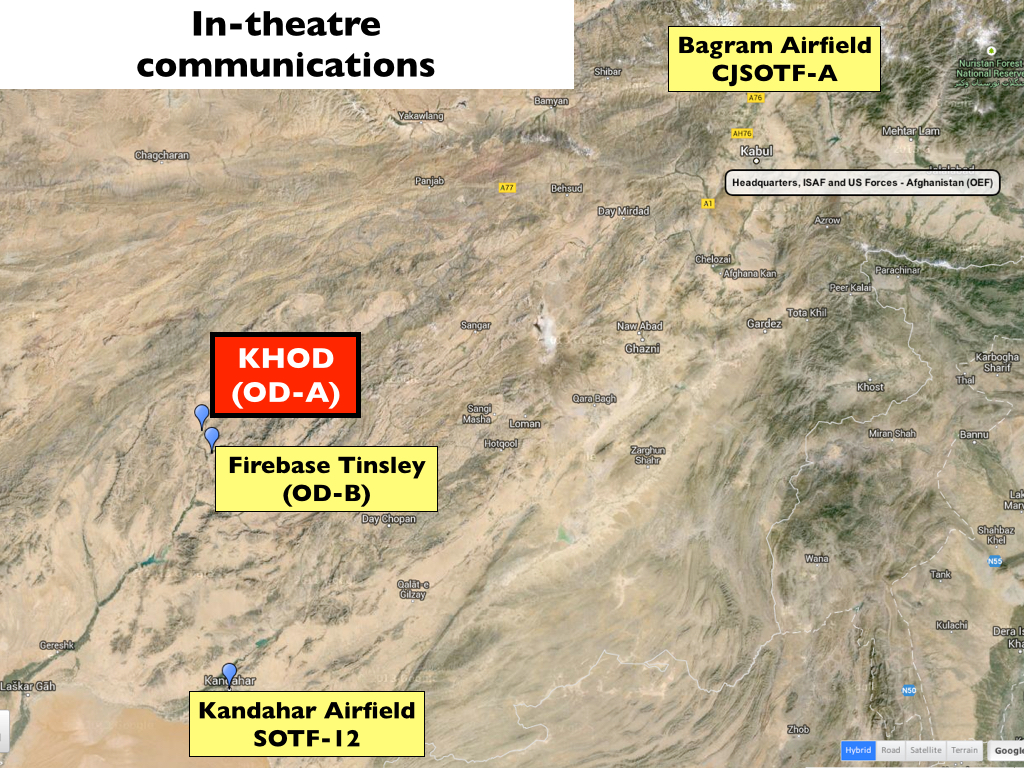
What was happening in and around Khod was being followed not only by flight crews and image analysts in the continental United States but also by several Special Forces command posts or Operations Centers in Afghanistan.  In ascending order these were:

(1) the base from which ODA 3124 had set out at Firebase Tinsley (formerly known as Cobra);

(2) Special Operations Task Force-12 (SOTF-12), based at Kandahar;

(3) Combined Joint Special Operations Task Force – Afghanistan (CJSOTF-A) based at Bagram.
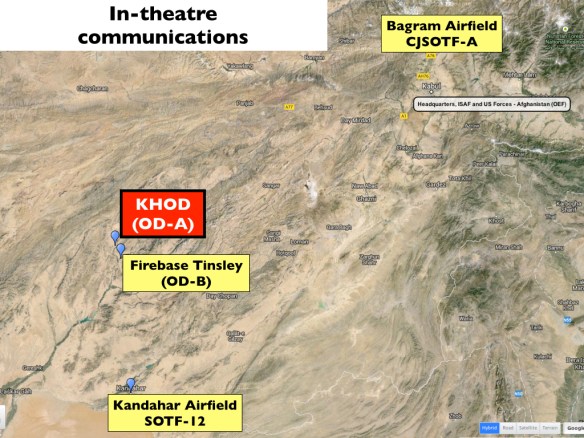
GREGORY Angry Eyes 2015 IMAGES.064

Once the ODA 3124 left the wire, command and support passed to SOTF-12; the OD-B at Tinsley had limited resources and limited (and as it happens intermittent) communications access and could only monitor what was happening.

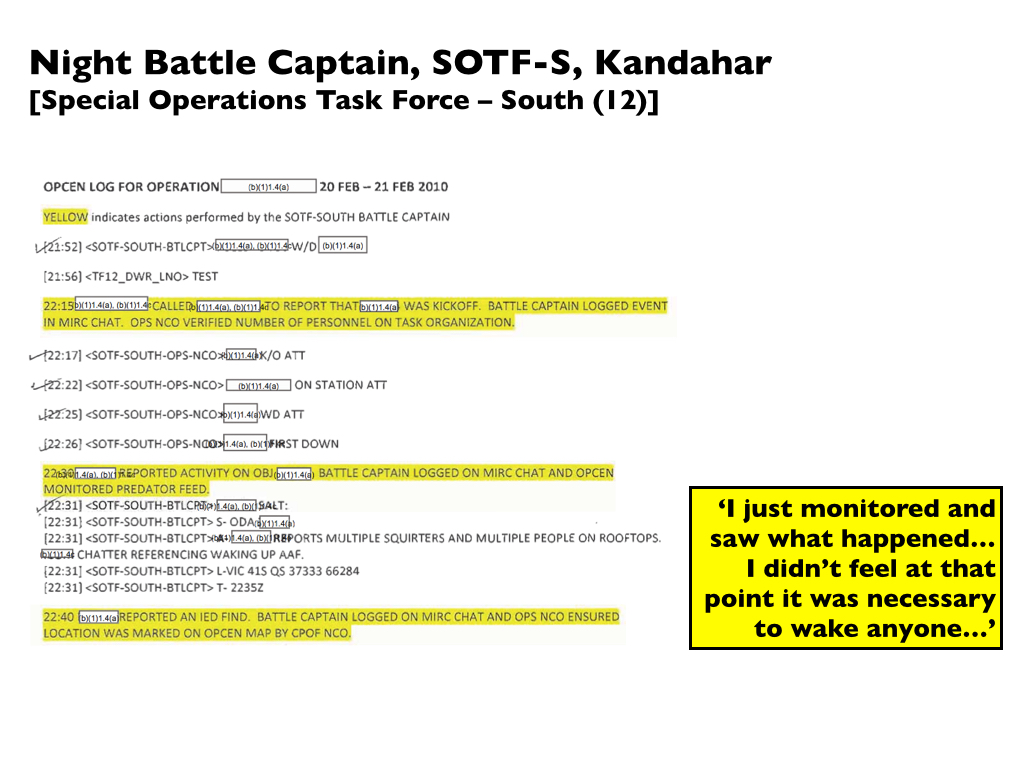
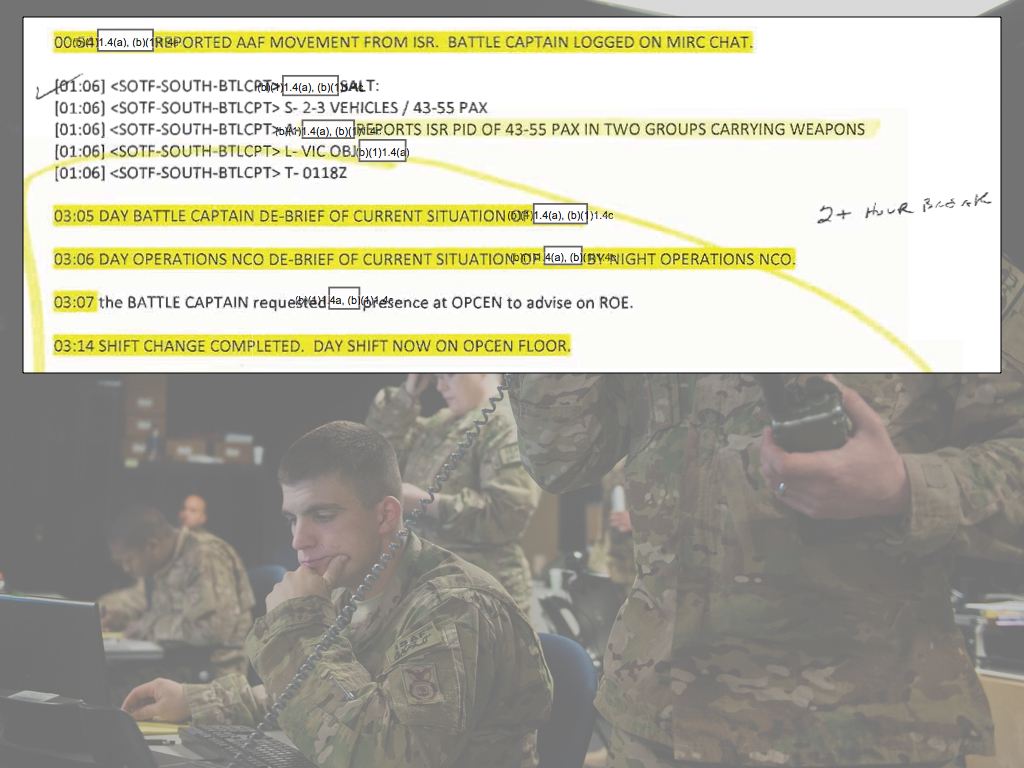
That was normal, but in fact both higher commands did more or less the same: and the investigating team was clearly appalled.  At SOTF-12 all senior (field grade) officers were asleep during the period of ‘highest density of risk and threatening kinetic activity’ (although they had established ‘wake-up criteria’ for emergency situations).  The Night Battle Captain had been in post for just three weeks and had been given little training in his role; he received a stream of SALT reports from the Ground Force Commander of ODA 3124 (which detailed Size of enemy force, Activity of enemy force, Location and Time of observation) but simply monitored the developing situation – what one investigating officer characterised as ‘a pretty passive kind of watching’.
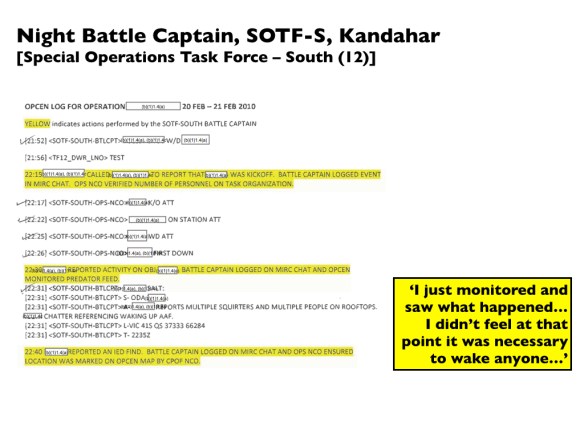
GREGORY Angry Eyes 2015 IMAGES.065

The same was true at CJSOTF-A (the staff there monitored 15-25 missions a day, but this was the only active operation that had declared a potential Troops in Contact).

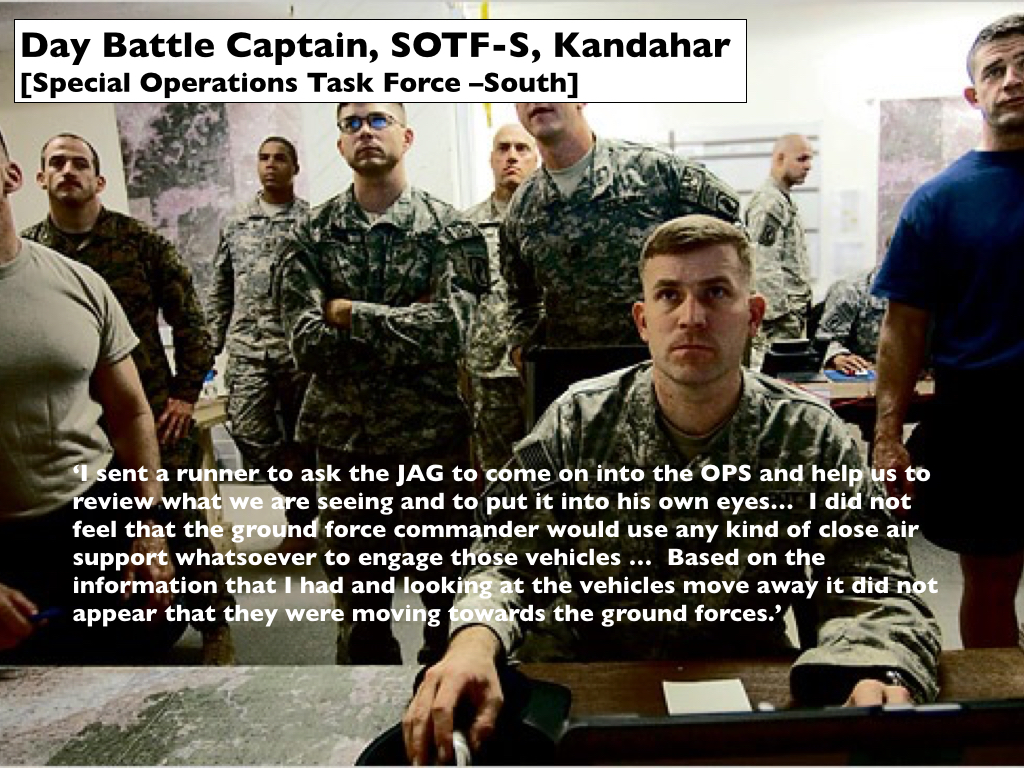
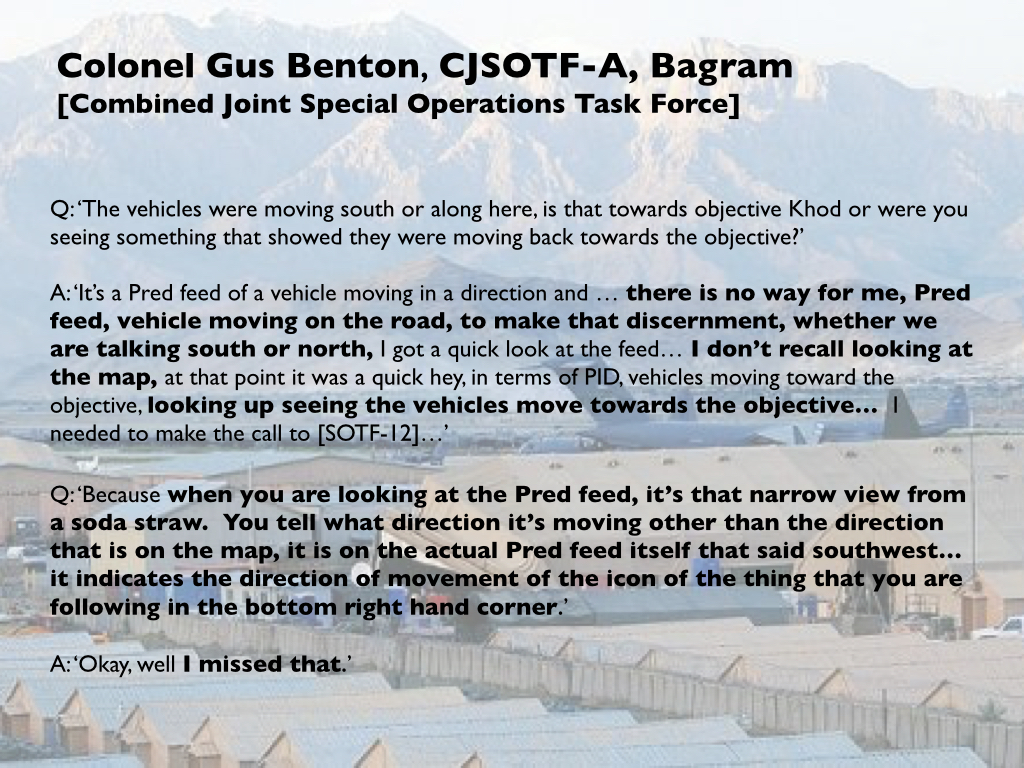
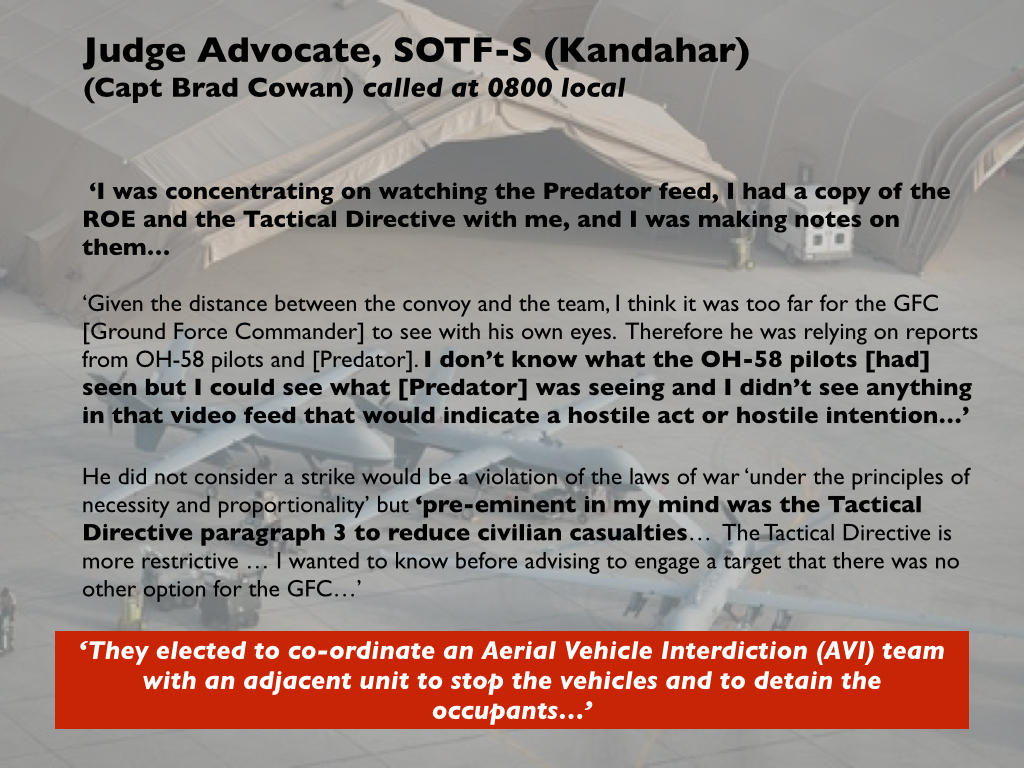
When the more experienced Day Battle Captain entered the Joint Operations Center at Kandahar and was briefed by the Night Battle Captain he was sufficiently concerned to send a runner to ask the Judge Advocate, a military lawyer, to come to the JOC.  He believed the occupants of the vehicles were hostile but was not convinced that they posed an immediate threat to troops on the ground:  ‘I wanted to hear someone who was extremely smart with the tactical directive and use of CAS [Close Air Support] in a situation I hadn’t seen before’.

This was a smart call for many reasons; the commander of US Special Forces, Brigadier General Edward Reeder, told the inquiry: ‘Honestly I don’t take a shit without one [a JAG], especially in this business’.  Significantly, the Safety Observer at Creech testified that there was no ‘operational law attorney’ available onsite for aircrews conducting remote operations; conversely, JAGs were on the operations floor of CENTCOM’s Combined Air and Space Operations Centre at Ul Udeid Air Base and, as this case shows, they were available at operations centers established by subordinate commands in-theatre.
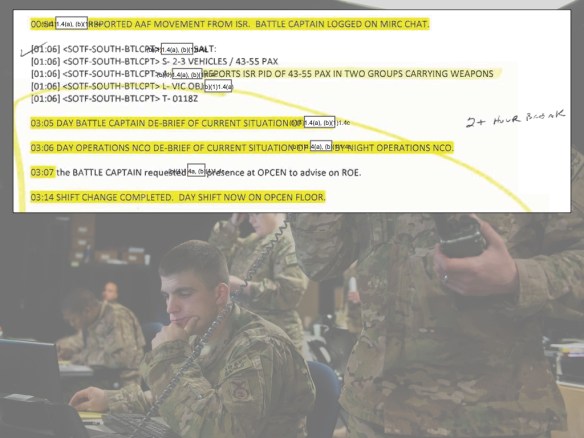
GREGORY Angry Eyes 2015 IMAGES.073

GREGORY Angry Eyes 2015 IMAGES.074

The JAG at Kandahar was not routinely called in for ‘Troops in Contact’ but on this occasion he was told ‘my Legal Opinion [was] needed at the OPCENT and that it wasn’t imminent but they wanted me to rush over there right away…’

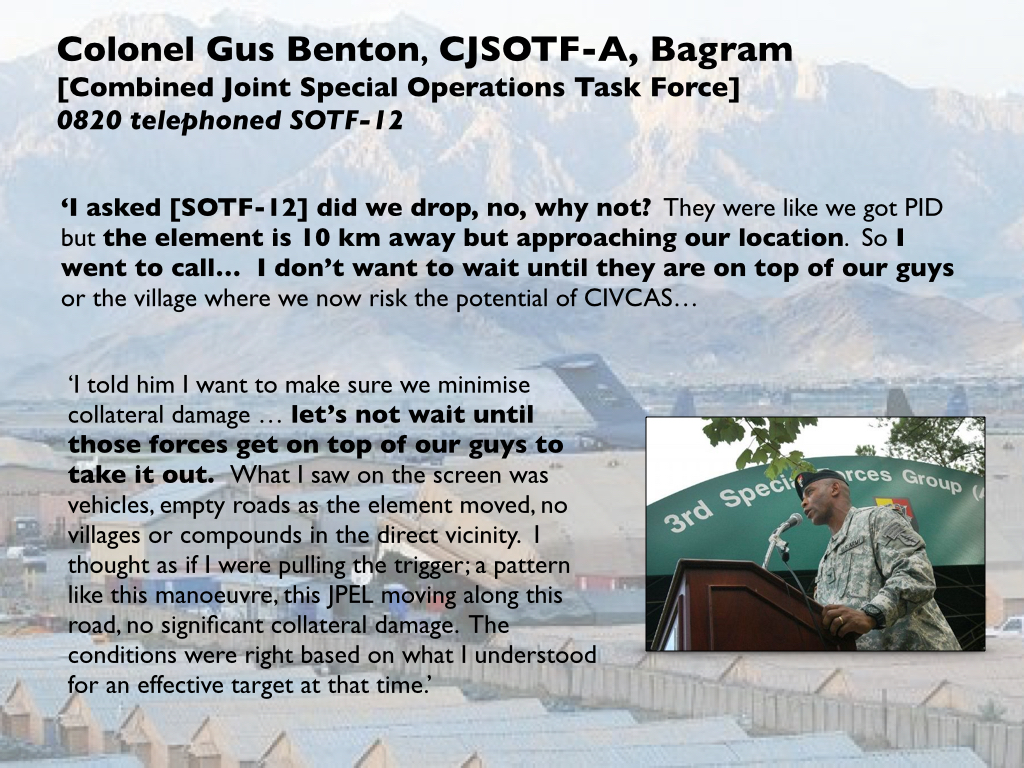
Meanwhile up at Bagram Colonel Gus Benton, the commanding officer of CJSOTF-A, was being briefed by his second-in-command who understood that the Ground Force Commander’s intention was to allow the three vehicles to move closer to his position at Khod.  He thought that made sound tactical sense.

‘I said that … is what we did, we let them come to us so we can get eyes on them. During my time I never let my guys engage with CAS if they couldn’t see it. I said that is great and COL [Benton] said “that is not fucking great” and left the room.’

At 0820, ten minutes after the JAG entered the JOC at Kandahar, while he was watching the Predator feed, the phone rang: it was Benton.  He demanded Lt Colonel Brian Petit, the SOTF-12 commander, be woken up and brought to the phone:
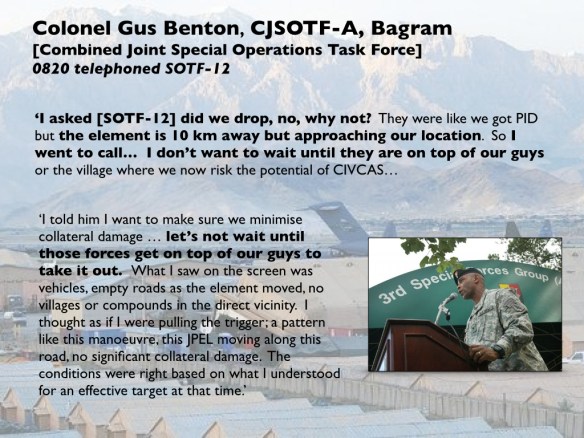
GREGORY Angry Eyes 2015 IMAGES.076

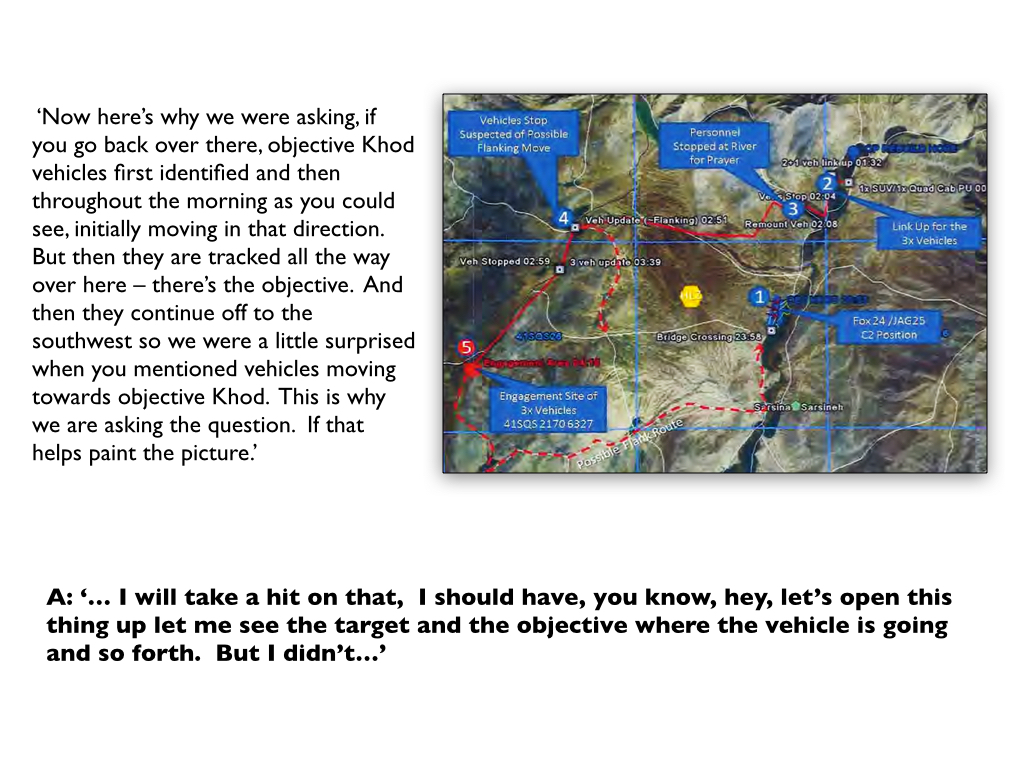
He spectacularly mis-read the situation (not least because he mis-read the Predator feed).  It was true that the vehicles were in open country, and not near any compounds or villages; but Benton consistently claimed that the vehicles were ‘travelling towards our objective’ whereas – as MG McHale’s investigating team pointed out to him – they were in fact moving away from Khod.
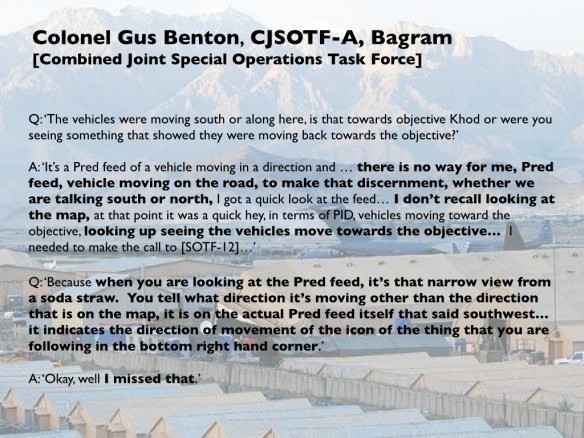
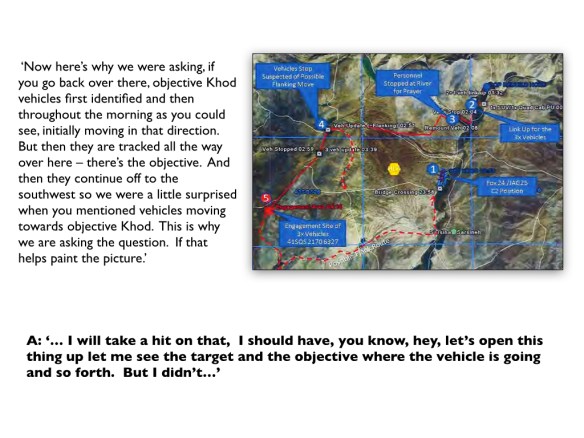
GREGORY Angry Eyes 2015 IMAGES.077

GREGORY Angry Eyes 2015 IMAGES.078

There had also been some, inconclusive discussion of a possible ‘High Value Target’ when the vehicles were first tracked, but the presence of a pre-approved target on the Joint Prioritised Effects List (Benton’s ‘JPEL moving along this road’) had never been confirmed and the Ground Force Commander had effectively discarded it (‘above my authority’, he said).

Certainly, the JAG at Kandahar read the situation differently:
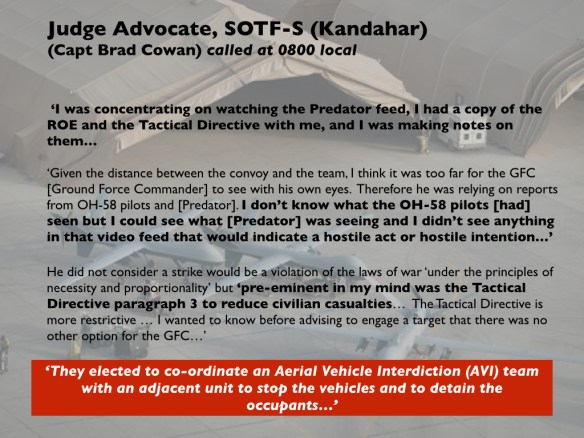
GREGORY Angry Eyes 2015 IMAGES.075

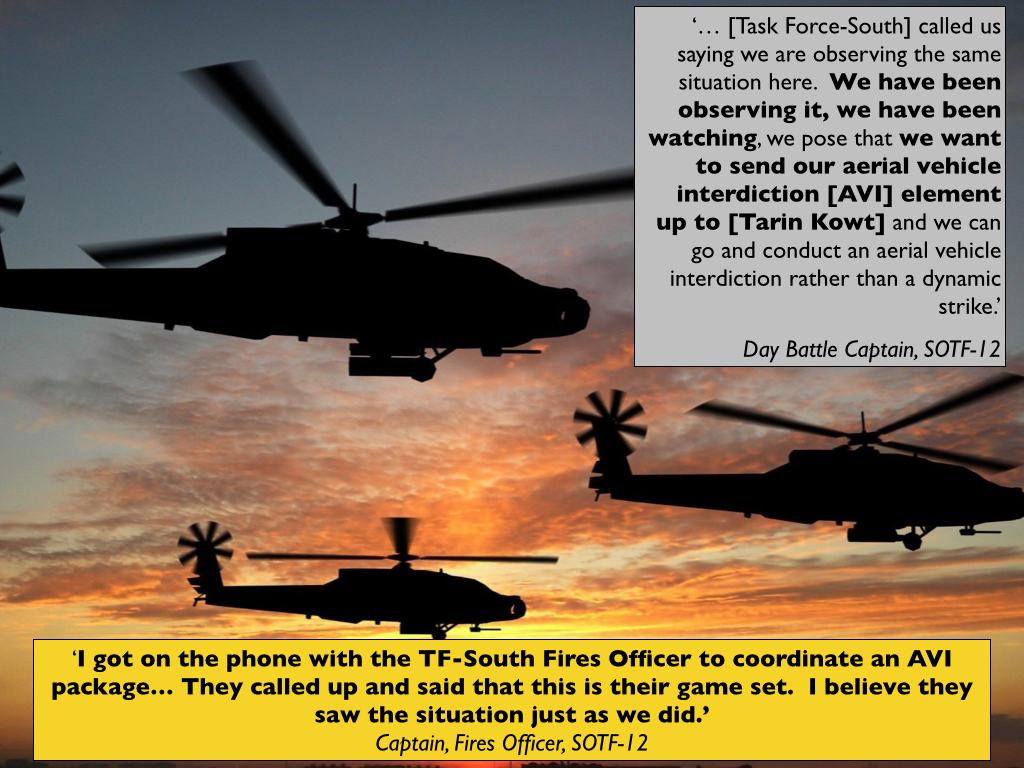
When Benton rang off, the JAG went over to the Day Battle Captain and Lt Col Petit and recommended an Aerial Vehicle Interdiction (AVI) team be called in for a show of force to stop the vehicles without engaging the occupants in offensive action.

They agreed; in fact another Task Force also watching the Predator feed called to make the same suggestion, and the Fires Officer set about arranging to use their Apache helicopters to conduct an AVI:
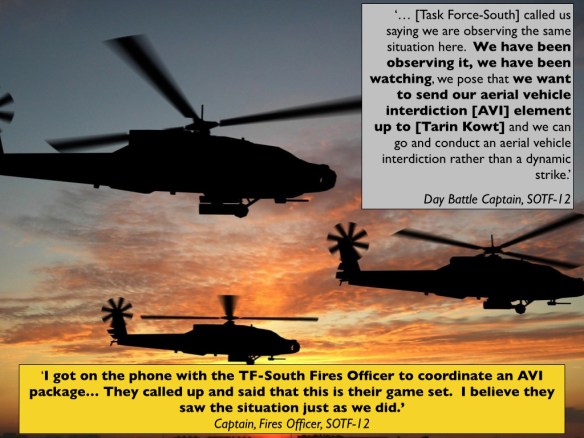
GREGORY Angry Eyes 2015 IMAGES.079

The Fires Officer had been responsible for setting up the Restricted Operating Zone for aircraft supporting the ODA – de-conflicting the airspace and establishing what aircraft would be available – but its management was de-centralised:

‘I establish the ROZ, give the initial layout of what assets are going on, and then I pass that to the JTAC [Joint Terminal Attack Controller with the Ground Force Commander at Khod].  I pass the frequencies to the assets and the JTAC controls them from there.’

At 0630, long before all this frantic activity at Kandahar, the two OH-58s had arrived at a short hold location beyond the ‘range of enemy visual and audio detection’, and at 0730 they had left to refuel at Tarin Kowt.  The Day Battle Captain and the Fires Officer both thought they were still off station.  In fact, the helicopters had returned to hold at Tinsley/Cobra at 0810 and flat pitched to conserve fuel (which means they landed and left the rotor blades spinning but with no lift); thirty minutes later the JTAC called them forward and the Predator began to talk them on to the target.

The Day Battle Captain had another reason for thinking he and his colleagues in the JOC had more time.  He maintained that the helicopters had been brought in not to engage the three vehicles but to provide air support if and when the ‘convoy’ reached Khod and the precautionary ‘AirTic’ turned into a real TIC or Troops in Contact:

‘… the CAS brought on station for his [the Ground Force Commander’s] use was not for the vehicles but for what we thought was going to be a large TIC on the objective. The weapons team that was pushed forward to his location was not for the vehicles, it was for the possibility of a large TIC on the objective based on the ICOM chatter that we had.’

That chimes with Benton’s second-in-command at Bagram, who also thought the Ground Force Commander was waiting for the ‘convoy’ to reach Khod, but neither witness explained the basis for their belief.  It was presumably a string of transmissions from the JTAC to the Predator crew: at 0538 he told them the Ground Force Commander wanted to ‘keep tracking them and bring them in as close as we can until we have CCA up’ (referring to the Close Combat Attack helicopters, the OH-58s); shortly before 0630 he confirmed that the Ground Force Commander’s intent was to ‘permit the enemy to close, and we’ll engage them closer when they’re all consolidated’; and at 0818 he was still talking about allowing the vehicles to ‘close distance.’

Yet this does not account for the evident urgency with which the Day Battle Captain and the JAG were concerned to establish ‘hostile intent’ and ‘immediate threat’.  When the vehicles were first spotted they were 5 km from Khod, and when they were attacked they were 12 km away across broken and difficult terrain: so what was the rush if the Ground Force Commander was continuing to exercise what the Army calls ‘tactical patience’ and wait for the vehicles to reach him and his force?

In fact, the messages from the Ground Force Commander had been mixed; throughout the night the JTAC had also repeatedly made it clear that the ODA commander’s intent was ‘to destroy the vehicles and the personnel’.  The Ground Force Commander insisted that ‘sometime between 0820 and 0830’ he sent a SALT report to SOTF-12 to say that he was going to engage the target.  Unfortunately there is no way to confirm this, because SOTF’s text records of the verbal SALT reports stopped at 0630 for reasons that were never disclosed (or perhaps never pursued), but it would explain why the JTAC’s log apparently showed the JAG contacting him at 0829 to confirm there were no women and children on the target.  It would also account for testimony by one of the screeners, who realised that the helicopters were cleared to engage at 0835, ten minutes before the strike, when the NCO responsible for monitoring the Predator feed at SOTF-12 ‘dropped’ into the ‘ISR’ (I presume the relevant chat room window), and in response:

‘The MC [Mission Intelligence Co-ordinator at Creech] passed that the OH58 were cleared to engage the vehicles. We were all caught off guard… It seemed strange because we had called out that these vehicles were going west. I don’t know how they determined these vehicles to be hostile… I brought up a whisper [private chat] with the MC, I said are you sure, what are the time frames when they will be coming in, and the MC responded saying we don’t know their ETA and at that moment the first vehicle blew up…’

Should those watching the events unfold have been taken aback when the vehicles were attacked?  According to the pilot of the Predator, he and his crew were surprised at the rapid escalation of events:

‘The strike ultimately came a little quicker than we expected…. we believed we were going to continue to follow, continue to pass up feeds… When he decided to engage with the helos when they did, it happened very quickly from our standpoint. I don’t have a lot of info or situational awareness of why the JTAC decided to use them when they did. When they actually came up … the JTAC switched me on frequencies. So we weren’t talking on the frequency I was talking to him on a different frequency to coordinate with the helos.

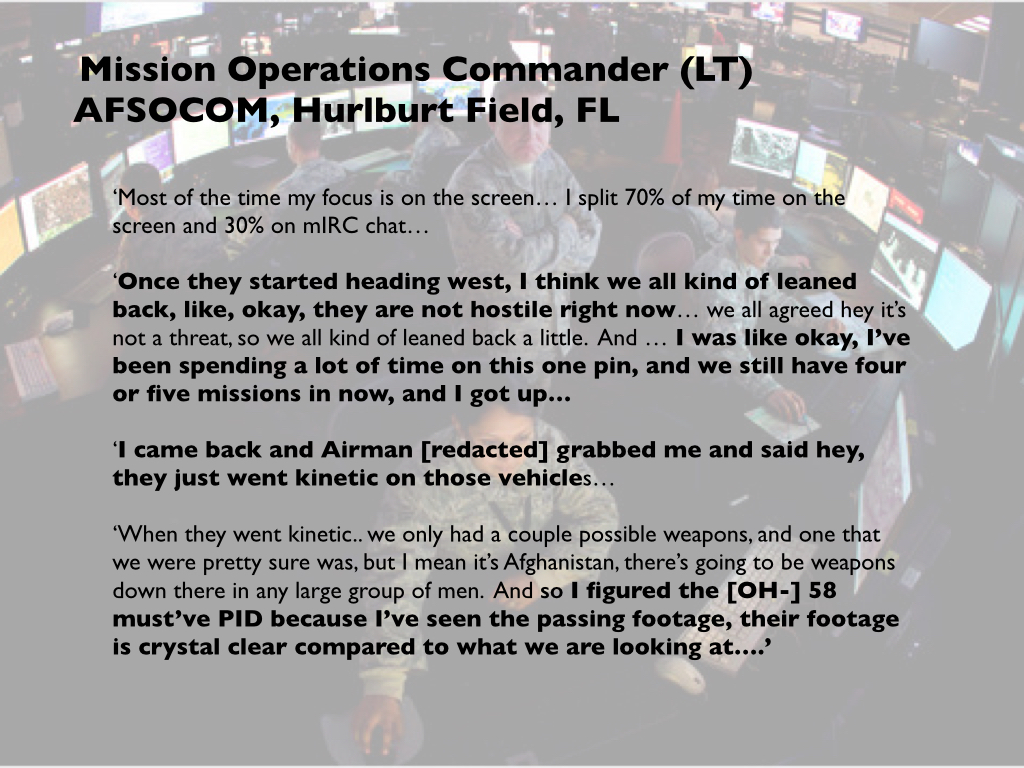
But their surprise was as nothing compared to the reaction of most observers when the first vehicle exploded.  The officer in charge of the screeners and imagery analysts who had been scrutinising the Predator feed at Air Force Special Operations Command at Hurlburt Field in Florida couldn’t believe it:

GREGORY Angry Eyes 2015 IMAGES.088

The Day Battle Captain testified:

‘I did not feel that the ground force commander would use any kind of close air support whatsoever to engage those vehicles… Based on the information that I had and looking at the vehicles move away it did not appear that they were moving towards the ground forces…

… as we were watching the Predator feed the first vehicles exploded. And everyone in the OPSCEN was immediately shocked… The amount of time from when that course of action approved by the SOTF commander to when we actually saw the strike occur there was no time, there was not adequate time to inform the ground commander that that was the course of action decided by the CJSOTF commander… I have phones ringing left and right, talking to people, trying to explain things, you know we look up on the screen and it happened…’
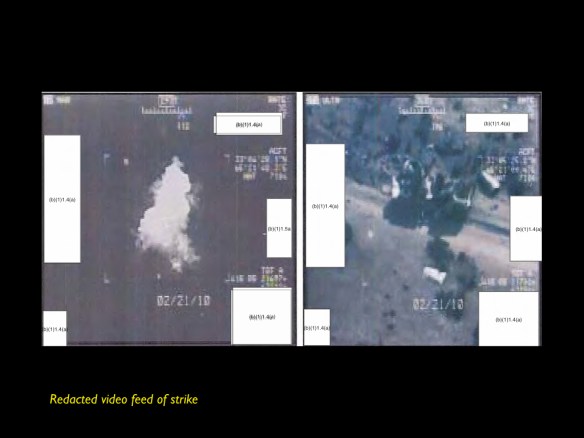
GREGORY Angry Eyes 2015 IMAGES.089

The Fires Officer:

‘I don’t think at any time anyone communicated to the GFC [Ground Force Commander] not to strike these vehicles because it is not something that we normally do. We feel that if he is in contact with the Predator and the OH-58s that we sent out to screen which we were not aware of and he is on the ground he generally has a pretty good picture of what is going on. He might be more privy to some conversation that he had with the OH-58 than what we know about. We normally give the GFC pretty big leeway on how they operate and the same with the JTAC because he has control of the assets and I am not going to try to take his assets away.’

In short, the investigation concluded that the Ground Force Commander never knew that an Aerial Vehicle Interdiction was being arranged, and neither of his higher commands were aware that he had cleared the helicopters to attack the three vehicles.

But, as I will show next, what lay behind these failures of communication was a de-centralised, distributed and dispersed geography of militarised vision whose fields of view expanded, contracted and even closed at different locations engaged in the administration of military violence.  Far from being a concerted performance of Donna Haraway‘s ‘God-trick’ – the ability to see everything from nowhere – this version of networked war was one in which nobody had a clear and full view of what was happening.

Part of this can be attributed to technical issues – the different fields of view available on different platforms, the low resolution of infra-red imagery (which Andrew Cockburn claims registers a visual acuity of 20/200, ‘the legal definition of blindness in the United States’), transmission interruptions, and the compression of full-colour imagery to accommodate bandwidth pressure.  So for example:
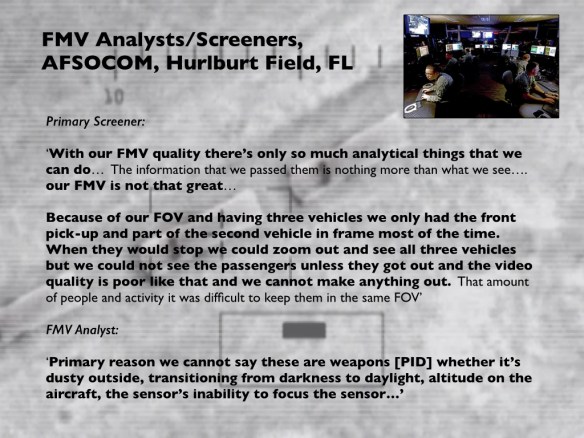
GREGORY Angry Eyes 2015 IMAGES.125

But it is also a matter of different interpretive fields.  Peter Asaro cautions:

‘The fact that the members of this team all have access to high-resolution imagery of the same situation does not mean that they all ‘‘see’’ the same thing. The visual content and interpretation of the visual scene is the product of analysis and negotiation among the team, as well as the context given by the situational awareness, which is itself constructed.’

The point is a sharp one: different visualities jostle and collide, and in the transactions between the observers the possibility of any synoptic ‘God-trick’ disappears.  But it needs to be sharpened, because different people have differential access to the distributed stream of visual feeds, mIRC and radio communications.  Here the disposition of bodies combines with the techno-cultural capacity to make sense of what was happening to fracture any ‘common operating picture’.   As one officer at Kandahar put it:

‘We didn’t have eyes on, minus ISR platform, that we can all see, who watches what? All the discrepancies between who watches what. What I see may be different from what someone else might interpret on the ISR… ISR is not reliable; it is simply a video platform.’

He was talking specifically about the multiple lines of communication (and hence bases for interpretation) within his Operations Center: now multiply that across sites scattered across Afghanistan and the continental United States and it becomes clear that the contemporary ‘fog of war’ may be as much the result of too much information as too little.

To be continued.

Post-atomic eyes

Postcard

I’m speaking at a conference called “Through Post-Atomic Eyes” in Toronto next month.
Through Post-Atomic Eyes brings together an interdisciplinary group of artists and scholars to explore the complex legacy of the atomic age in contemporary art and culture. In what ways do photography and other lens-based art practices shed light on this legacy in the 21st century, and how has atomic culture shaped contemporary intersections of photography, nuclear industries, and military techno-cultures? Join us as we explore some of the most urgent issues of our time, from climate change and the Anthropocene to surveillance culture and the advent of drone warfare, through a post-atomic lens.

Through Post-Atomic Eyes is scheduled to coincide with John O’Brian’s groundbreaking exhibition, Camera Atomica, the first substantial exhibition of nuclear photography to encompass the postwar period from the bombings of Hiroshima and Nagasaki in 1945 to the meltdown at Fukushima in 2011. Now on view at the Art Gallery of Ontario (until November 15, 2015).

(John’s exhibition at the AGO follows a successful showing in London late last year: see my post here).

I confess that when I received the Toronto invitation I was at a loss: how was I supposed to view drone warfare through post-atomic eyes?  At first sight, any comparison between America’s nuclear war capability and its drone strikes in Afghanistan, Iraq, Pakistan, Somalia, Syria and Yemen seems fanciful. The scale of investment, the speed and range of the delivery systems, the nature of the targets, the blast radii and precision of the munitions, and the time and space horizons of the effects are so clearly incommensurable.  So I dragged my feet, accepting the invitation because the other presenters (see the poster above) include so many people whose work I admire, but not making much progress.

Eventually I realised that the root problem was that, while I had extensive research on genealogies of bombing under my belt, I knew next to nothing about The Bomb.  So, while I’ve been burrowing away in the archives in London for my project on casualty evacuation 1914-2014 and also inching my “Dirty Dancing’ essay into the home straight, I’ve also been reading and reading and reading.  So much wonderful, sobering material out there, some of which surfaced in my recent posts on Hiroshima and the metastases of nuclear weapons since then.

And, as I’ll try to show in detail in my next post, I’ve found a startling series of coincidences, convergences and transformations.  I now have a rough shape for my presentation, which I’m calling “Little Boys and Blue Skies“: a title which, as you’ll soon see, traces an arc from bombing Hiroshima to bombing Waziristan.  Watch this space.